EP0191726A2 - Polypyrrol-Polyimidzusammensetzungen - Google Patents
Polypyrrol-Polyimidzusammensetzungen Download PDFInfo
- Publication number
- EP0191726A2 EP0191726A2 EP86810008A EP86810008A EP0191726A2 EP 0191726 A2 EP0191726 A2 EP 0191726A2 EP 86810008 A EP86810008 A EP 86810008A EP 86810008 A EP86810008 A EP 86810008A EP 0191726 A2 EP0191726 A2 EP 0191726A2
- Authority
- EP
- European Patent Office
- Prior art keywords
- alkyl
- polyimide
- formula
- polypyrrole
- radicals
- Prior art date
- Legal status (The legal status is an assumption and is not a legal conclusion. Google has not performed a legal analysis and makes no representation as to the accuracy of the status listed.)
- Withdrawn
Links
Classifications
-
- C—CHEMISTRY; METALLURGY
- C08—ORGANIC MACROMOLECULAR COMPOUNDS; THEIR PREPARATION OR CHEMICAL WORKING-UP; COMPOSITIONS BASED THEREON
- C08L—COMPOSITIONS OF MACROMOLECULAR COMPOUNDS
- C08L79/00—Compositions of macromolecular compounds obtained by reactions forming in the main chain of the macromolecule a linkage containing nitrogen with or without oxygen or carbon only, not provided for in groups C08L61/00 - C08L77/00
- C08L79/04—Polycondensates having nitrogen-containing heterocyclic rings in the main chain; Polyhydrazides; Polyamide acids or similar polyimide precursors
- C08L79/08—Polyimides; Polyester-imides; Polyamide-imides; Polyamide acids or similar polyimide precursors
-
- C—CHEMISTRY; METALLURGY
- C08—ORGANIC MACROMOLECULAR COMPOUNDS; THEIR PREPARATION OR CHEMICAL WORKING-UP; COMPOSITIONS BASED THEREON
- C08L—COMPOSITIONS OF MACROMOLECULAR COMPOUNDS
- C08L79/00—Compositions of macromolecular compounds obtained by reactions forming in the main chain of the macromolecule a linkage containing nitrogen with or without oxygen or carbon only, not provided for in groups C08L61/00 - C08L77/00
- C08L79/04—Polycondensates having nitrogen-containing heterocyclic rings in the main chain; Polyhydrazides; Polyamide acids or similar polyimide precursors
- C08L79/06—Polyhydrazides; Polytriazoles; Polyamino-triazoles; Polyoxadiazoles
-
- H—ELECTRICITY
- H01—ELECTRIC ELEMENTS
- H01B—CABLES; CONDUCTORS; INSULATORS; SELECTION OF MATERIALS FOR THEIR CONDUCTIVE, INSULATING OR DIELECTRIC PROPERTIES
- H01B1/00—Conductors or conductive bodies characterised by the conductive materials; Selection of materials as conductors
- H01B1/06—Conductors or conductive bodies characterised by the conductive materials; Selection of materials as conductors mainly consisting of other non-metallic substances
- H01B1/12—Conductors or conductive bodies characterised by the conductive materials; Selection of materials as conductors mainly consisting of other non-metallic substances organic substances
- H01B1/124—Intrinsically conductive polymers
- H01B1/127—Intrinsically conductive polymers comprising five-membered aromatic rings in the main chain, e.g. polypyrroles, polythiophenes
-
- Y—GENERAL TAGGING OF NEW TECHNOLOGICAL DEVELOPMENTS; GENERAL TAGGING OF CROSS-SECTIONAL TECHNOLOGIES SPANNING OVER SEVERAL SECTIONS OF THE IPC; TECHNICAL SUBJECTS COVERED BY FORMER USPC CROSS-REFERENCE ART COLLECTIONS [XRACs] AND DIGESTS
- Y10—TECHNICAL SUBJECTS COVERED BY FORMER USPC
- Y10T—TECHNICAL SUBJECTS COVERED BY FORMER US CLASSIFICATION
- Y10T428/00—Stock material or miscellaneous articles
- Y10T428/31504—Composite [nonstructural laminate]
- Y10T428/31721—Of polyimide
Definitions
- the present invention relates to polypyrrole-polyimide compositions, preferably polyimide films modified by a polymerized or copolymerized pyrrole derivative, to a process for producing these films and to their use as electrically conductive films or as composite materials.
- Layers made of polypyrrole or copolymers of pyrrole are known. These films have high electrical conductivity and are resistant to environmental influences (air, moisture).
- Polypyrrole films with inorganic anions are brittle and tear easily under stress. This limits their practical applicability because, for example, they are difficult to deform.
- DE-OS 3,227,914 describes a process for processing polypyrrole in which the polymer is deformed at defined high temperatures under pressure and, if appropriate, with other substances.
- Pt electrodes are coated on all sides with a 1 to 10 ⁇ m thick polymer film and switched as an anode in an electrolysis bath.
- the electrolytic solution contains pyrrole.
- polypyrrole is deposited on the insulator polymer film, the good mechanical properties of the insulator polymer film being retained and the conductivity of the composition reaching the value of pure polypyrrole films.
- Pyrrole polymers have a high temperature resistance even at temperatures above 250 ° C.
- the carrier material used previously for electrolytically deposited polypyrroles undergoes changes in the mechanical properties at such high temperatures. Be it that it changes into the thermoplastic state or that the material already decomposes at these temperatures. So far, polyimides have not been used. It has now been found that high-temperature-resistant polyimide-polypyrrole alloys with a high glass transition temperature can be produced.
- the present invention relates to a composition containing polypyrrole and polyimide soluble in organic solvents.
- the polyimides of structure class A are generally insoluble in organic solvents. Since generally valid relationships between structure and solubility of a polyimide cannot currently be established, it must be determined in individual cases on the basis of routine tests whether a particular compound is soluble or not and can therefore be used as a carrier film in the context of this invention.
- a polyimide is generally considered soluble if it dissolves in the solvent in question at 25 ° C to at least 1 mg / l, preferably at least 1 g / l.
- the tetravalent radical Z can be selected from the following general groups: aromatic, aliphatic, cycloaliphatic, heterocyclic groups, combinations of aromatic and aliphatic groups and the corresponding substituted groups thereof.
- the groups Z preferably comprise the following structures: in which R 1 is hydrogen or C 1 -C 5 alkyl, and in which R 2 is selected from the group consisting of alkylene having 1 to 3 carbon atoms, R 3 is hydrogen, C 1 -C 5 alkyl or phenyl.
- the radicals R 1 , R3, R 4 , R5, R 6 , R7, R 8 , and R 9 as alkyl with 1 to 5 carbon atoms mean, for example, methyl, ethyl, n-propyl, isopropyl, n-butyl, sec. Butyl, tert. Butyl, n-pentyl or neopentyl. Methyl is preferred.
- R 4 and R 5 mean, for example, methoxy, ethoxy, n-propoxy, isopropoxy, n-butoxy, sec-butoxy, tert-butoxy, n-pentoxy or neopentoxy. Methoxy is preferred.
- Halogen R 4 , R 5 , R 6 , R 7 , R 8 or R 9 is fluorine, chlorine, bromine or iodine. Bromine or chlorine and especially chlorine are preferred.
- R 4 and R 5 are, for example, phenyl or naphthyl, where naphthyl can be linked in the 1- or 2-position to the rest of the system. Phenyl is preferred.
- Z 'de notes straight-chain or branched alkylene, such as, for example, ethylene, trimethylene, tetramethylene, pentamethylene, hexamethylene, heptamethylene, octamethylene, nonamethylene, decamethylene, undecamethylene, dodecamethylene, and -C (CH 3 ) 2 -, - (CH 2 ) 3 -C (CH 3 ) 2 - (CH 2 ) 3 - or - (CH 2 ) 3 -CH (CH 3 ) - (CH 2 ) 4 -.
- the three latter branched alkylene radicals and hexamethylene are preferred.
- Q 1 means, for example, methylene, ethylene, trimethylene, ethylidene and 2-propylidene.
- Z 'means for example, cyclobutylene, cyclopentylene or cyclohexylene.
- the residues can be connected to the rest of the molecular structure in the 1,2-, 1,3- or 1,4-position.
- the 1,4 linkage is preferred. Cyclohexylene-1,4 is particularly preferred.
- Z 'as xylylene is ortho-, metha- or para-xylylene. However, mixtures of these xylylenes can also be involved. Mixtures of xylylene or para-xylylene are preferred.
- the linkage with the residual molecule can be in 2,3-, 2,4-, 2,5-, 2,6-, 3,5-, 3,6-, 4,5-, or 4, 6-position, based on the methyl group.
- each phenyl nucleus of biphenylene forms a valence to the residual molecule.
- Residues are particularly preferably the 4,4'-, 3,3'- or 2,2'-derivatives, and very particularly the 4,4'-derivative.
- Q 1 as arylene is, for example, phenylene or naphthylene, but is preferably phenylene.
- Phenylene is understood to mean ortho-, meta- or para-phenylene.
- Para-phenylene is preferred.
- Q 1 is dialkylsilyl, it is, for example, dimethylsilyl, diethylsilyl, di- (n-propyl) -silyl, di- (isopropyl) -silyl or di- (n-butyl) -silyl. Dimethylsilyl is preferred. If Q 1 is diarylsilyl, it is preferably diphenylsilyl.
- polyimides of the above-mentioned structure types A, B or C are preferably compounds containing the structural units of the formulas I or II or III in the same order; very particularly preferred are polyimides consisting exclusively of structural elements of the formulas I or II or III, and of combinations of the possible structural units of the formulas I or II or III which differ within the given definitions.
- the chain length of the polyimides can vary over a wide range.
- Polyimides containing from 5 to 1000 of the repeating structural units of the formula I or II or III are preferably used; however, very particularly preferably polyimides containing more than 10, in particular from 10 to 500, of the recurring structural units of the formula 1 or II or III.
- Z is one of the radicals defined as preferred above or a combination of the radicals in which R 1 has the meaning defined above but preferably denotes hydrogen or methyl, R 2 -CH 2 -, -CO-or -C (CH 3 ) 2 -, and Z 'is one of the residues or a combination of the residues
- R 1 and R 6 to R 9 have the meaning defined above and in which Q 2 is -CH 2 -, -CO-, -0-, -S-, -SO-, -SO 2 - or -C (CH 3 ) 2 - means.
- Polyimides of the formula I in which Z is one of the radicals or a combination of the radicals are also particularly preferred and wherein Z 'is one of the residues or a combination of the residues or means, and wherein at least one of R 6 to R 9 is C 1 -C 5 alkyl; R 6 to R 9 and Q 2 have the meaning defined above.
- Phenimine-containing polyimides are described in U.S. Patent 3,856,752. Regarding the preparation and the preferred range of these compounds, reference is made to the description of this patent.
- Another preferred polyimide of type A) contains Z groups of the formula as tetravalent radical or or mixtures of these groups, and as the bivalent radical Z ' or or mixtures of these groups; from the total number of the residues Z and Z 'are at least 10% phenylindane residues, as defined above;
- R 1 and R 6 to R 9 independently of one another are hydrogen or methyl
- R 2 ' is hydrogen, halogen or C 1 -C 5 -alkyl, preferably hydrogen or methyl
- Q 3 is a CC bond, -CH 2 -, - C (CH 3 ) 2 -, -CO-, -0-, -S- or -SO 2 -.
- R 15 has the same meaning as R 2 '.
- polyimides are compounds of the formula I containing, as structural element Z ', only phenylindane radicals, as defined above.
- polyimides of the formula I containing as groups Z 0-100% of the radicals or mixtures of these residues, and 100 to 0% of the residues or mixtures thereof; in total, however, at least 10% phenylindane residues, based on Z and Z '.
- compositions according to the invention are polyimides of the formula I containing Z as 100% of groups of the formula and containing as Z 'only residues of the formula
- compositions according to the invention are polyimides of the formula I containing as group Z and containing only as group Z 1
- polyimides of the formula I in which the group Z has one of the meanings and in which group 2 ' means;
- at least 30% of the Z groups are a radical of the formula and at least 30% of the groups Z 'are radicals of the formula and or wherein said polyimides are more than 10% by weight soluble in phenol and wherein 0.5 g / 100 ml of said polyimide in m-cresol have an inherent viscosity of more than 0.05 (at 30 ° C).
- Polyimides of this type are described in U.S. Patent 3,666,709.
- the compounds of the formula II contain residues Z ', these are preferably the groups already mentioned above, but very particularly 4,4'-diphenylmethane, 4,4'-diphenyl ether or 4,4'-diphenylsulphone.
- soluble polyimides of the formula III are preferably compounds in which Z "is an aromatic radical and in which Q is an alkylene group having 2 to 12 carbon atoms or an arylene group selected from ortho-, meta- or para -Phenylene or -tolylene or under an aryl group of the formula means;
- Q 1 has one of the meanings defined above, but is very particularly preferably -0-, -S-, -SO z -, -CO-, -CH z - or -C (CH 3 ) 2 -,
- X and Y preferably have the same meaning.
- Compounds of the formula III in which X and Y are -NH- are very particularly preferably used.
- aromatic radicals Z "of the compound III include, in particular, ortho-, meta- or para-phenylene, and also tolylene or xylylene and 4,4'-biphenylene, 2,2'-biphenylene or radicals of the formula to mention; R 4 , R 5 and Q 1 have the meanings and preferences already defined above.
- the polyimides can be prepared in various ways. One method is based on the conversion of aromatic tetracarboxylic acids, the carboxyl groups of which are in pairs in the ortho position to one another. These tetracarboxylic acids or their dianhydrides are reacted with bifunctional primary amines to give polyamic acids. These intermediates are generally soluble and can optionally be processed into moldings. In a second stage, the polyamic acid is cyclized to the polyimide.
- the formation of the amic acid is optionally carried out in the melt, but preferably in polar solvents, such as, for example, dimethylformamide, dimethylacetamide, dimethyl sulfoxide, N-methylpyrrolidone or m-cresol; the reaction temperature is preferably not allowed to rise above 50 ° C. in order to prevent premature cyclization to the polyimide.
- polar solvents such as, for example, dimethylformamide, dimethylacetamide, dimethyl sulfoxide, N-methylpyrrolidone or m-cresol
- the cyclization step is preferably carried out at temperatures above 150 ° C. and, if appropriate, a dehydroatising agent, for example acetic anhydride, is added.
- a dehydroatising agent for example acetic anhydride
- Type C polyimides can be obtained by reacting bis-maleimides with primary diamines or with diols. Such bis-maleimides can also be converted into polyimides as bifunctional dienophiles in a Diels-Alder reaction with bis-dienes.
- Monomeric pyrroles that can be polymerized are pyrrole or substituted pyrroles, which can be C- and / or N-substituted. These pyrroles must have at least two hydrogen atoms on the core (C-bonded) for the polymerization to take place.
- polypyrrole is understood to mean homo- or copolymers of pyrrole and / or substituted pyrrole or copolymers of pyrrole and / or substituted pyrrole with five- or six-membered heteroaromatic compounds.
- the monomeric pyrroles preferably have the structure of the formula X in which R 16 is hydrogen, alkyl, cycloalkyl, aryl, aralkyl or alkaryl, where said organic radicals are optionally by -COR 20 , -COOR 20 , -SO 2 R 20 , -SO 3 R 20 , -PO 3 R 20 R 21 , -PO 2 R 20 , -NR 20 R 21 , -OR 20 , -SR 20 , -CN or -SiR 22 R 23 R 24 , or where R 16 22 is also -CN, -SO 2 R 20 , - SO 3 is R 20 , -COR 20 , -PO 2 R 20 or -SiR 3 ,
- R 20 and R 21 are independently hydrogen, alkyl, aryl or aralkyl
- R 22 , R 23 and R 24 are independently alkyl or phenyl
- R 17 and R 18 are independently hydrogen, alkyl, cycloalkyl, aryl, aralkyl, alkaryl, -COR 19 , -CN or halogen and R 19 is hydrogen, alkyl or aryl.
- R 16 , R 17 , R 18 , R 19 , R 20 , R 21 , R 22 , R 2 3 and R 24 are preferably C 1 -C 20 alkyl and are then, for example, methyl, ethyl, propyl, butyl, Cetyl, lauryl or stearyl. Methyl is particularly preferred.
- cycloalkyl R 16 , R 17 or R 18 are preferably Cs-C 7 -cycloalkyl, that is to say cyclopentyl, cyclohexyl or cycloheptyl, but particularly preferably cyclohexyl.
- Halogen R 17 or R 18 is fluorine, chlorine, bromine or iodine, preferably bromine or chlorine.
- radicals are aryl, it is preferably phenyl or naphthyl, but especially phenyl.
- any residues are aralkyl, then preferably C 7 -C 14 aralkyl is meant, but especially benzyl.
- Alkaryl is preferably understood to mean C 7 -C 14 alkaryl; tolyl or xylyl are very particularly preferred.
- radicals are substituted, they are preferably mono- or disubstituted groups, very particularly preferably monosubstituted radicals.
- Preferred pyrroles are, on the one hand, the unsubstituted pyrrole, the N-alkylpyrroles, in particular the N-methylpyrrole, or the N-arylpyrroles, in particular the N-phenylpyrrole, and those on the
- the mono- or the dimethyl compound or the monobromo or the dibromo compound and the monochloro or dichloro compound are particularly preferred.
- Carbon-substituted pyrroles are preferably substituted in the 3- and / or 4-position.
- pyrrole polymers in the context of this invention mean both homopolymers and copolymers of pyrroles in general.
- copolymers of the abovementioned pyrroles preferably of the unsubstituted pyrrole, with other comonomers, in particular other five- and / or six-membered heteroaromatic compounds, can also be prepared.
- heteroaromatic compounds furan, thiophene, thiazole, oxazole, thiadiazole, imidazole, pyridine, 3,5-dimethylpyridine, pyrazine, pyridazine, 3,5-dimethylpyrazine, carbazole or phenothiazine are particularly preferred.
- Copolymers of this type and their preparation are described for example in DE-OS 3,223,544.
- Copolymers of unsubstituted pyrrole and optionally substituted N-methylpyrrole and copolymers of unsubstituted pyrrole or N-methylpyrrole and thiophene or furan are very particularly preferred.
- the polypyrrole-containing polyimide compositions according to the invention are produced by polymerizing the monomeric pyrrole in the presence of a polyimide film. This polymerization can be electro be carried out lytically, but any other polymerization process can also be used, for example a polymerization using redox pairs.
- Polypyrrole is electrically (electronically) conductive when charged or oxidized. In this state it is generated by electropolymerization. During the electropolymerization process, a counter anion is built into the material to balance the positive charge on the polymer backbone.
- Polypyrrole can also be discharged and converted into a reduced (yellow) form. In this state it is an electrical insulator.
- polypyrrole in the context of this invention means both the oxidized and the reduced form, but preferably the oxidized form.
- compositions according to the invention are preferably prepared by anodically oxidizing a monomeric pyrrole dissolved in a polar solvent on an electrode which is in contact with the polyimide film in question. It is very particularly preferred to use polyimide-coated electrodes.
- the solvent contains a conductive salt, the anions of which, as mentioned above, are incorporated into the polypyrrole film and lead to an increase in the conductivity.
- the conductive salt is added to the electrolyte in the form of the respective protonic acid or one of its salts, preferably the tetraalkylammonium or alkali metal salts.
- the invention therefore preferably relates to conductive polyimide-polypyrrole compositions containing polypyrrole in the oxidized form and as an anion an anion selected from the group consisting of BF 4 - , PF 6 , AsF 6 - , SbF 6 - , SbCl 6 - , ClO 4 - , IO 4 - , HS0 4- , S0 4 2- , CF 3 SO 3 - , CH 3 C 6 H 4 S0 3- , CF 3 COO - , HC 2 O 4 - or [Fe (CN) 6 ] 3 - , and also from alkyl sulfate, alkyl sulfonate, alkyl phosphate or alkyl phosphonate and combinations of these anions.
- the invention therefore also relates to a process for producing polyimide-polypyrrole films by anodic oxidation of a dissolved pyrrole and, if appropriate, a suitable comonomer on an electrode which is in contact with a polymer film, characterized in that a polyimide is used as the material for the polymer film, which is soluble in organic solvents.
- the electrolysis is preferably carried out in polar organic solvents, but the pyrrole and conductive salt do not dissolve the polyimide film on the electrode.
- organic solvents include, for example, alcohols, polyols, organic carbonates, such as e.g. Propylene carbonate, ethers such as 1,2-dimethoxyethane, dioxane, THF and methyltetrahydrofuran, nitriles such as acetonitrile and benzonitrile, N-methylpyrrolidone, methylene chloride, dimethyl sulfoxide, dimethylformamide, or acetone.
- organic solvents include, for example, alcohols, polyols, organic carbonates, such as e.g. Propylene carbonate, ethers such as 1,2-dimethoxyethane, dioxane, THF and methyltetrahydrofuran, nitriles such as acetonitrile and benzonitrile, N-methylpyrroli
- Acetonitrile is preferably used as the solvent.
- water-miscible solvents small amounts of water, generally up to 3% based on the organic solvent, can be added to increase the electrical conductivity.
- Preferred solvents of this type are alcohols of low carbon number (C l -C 4) ethers such as dioxane, tetrahydrofuran or 1,2-dimethoxyethane, acetic acid, acetone, dimethylformamide, N-methylpyrrolidone, acetonitrile, or propylene carbonate.
- two-phase electrolyte baths can also be used.
- This is understood to mean mixtures of water containing the dissolved pyrrole and optionally the copolymerizable component and an organic diluent which is immiscible with water.
- organic diluents are organic hydrocarbons, such as aliphatic or aromatic hydrocarbons, and halogenated aliphatic or aromatic hydrocarbons. Specific examples of these are hexane, toluene, 1,2-dichloroethane, dichloromethane, carbon tetrachloride or chlorobenzene.
- the electrolysis bath may also contain other constituents which impart desired properties to the compositions according to the invention.
- the electrolyte contains the monomeric pyrrole and optionally the comonomer component in solution.
- the amount of this or these monomers in the electrolysis bath can vary within a wide range; however, the total amount of the dissolved monomer must be greater than the part required to form the total amount of polymer.
- the amount of pyrrole and optionally more comonomer component present in the electrolysis solution must be sufficient to ensure a reasonable rate of conversion. As a rule, concentrations of more than 10 -3 mol per liter are necessary.
- the saturation concentration of the pyrrole or of the comonomer in the respective electrolyte is to be regarded as the upper limit of the monomer concentration.
- the conductive salt concentration is preferably 0.001 to 1 mol per liter.
- a concentration up to saturation of the electrolyte can also be used here.
- Electrodes coated with the respective polyimide are used.
- Common conductive materials for example metals such as nickel or steel, which can be used for polypyrrole synthesis, are suitable as electrode materials.
- electrodes can also be used which are formed from electrically conductive polymers, for example from polypyrrole or polythiophene formed by anodic oxidation, from doped p-conducting polyacetylene or from doped p-conducting polyphenylene.
- the shape of the electrodes is arbitrary. Plate-shaped electrodes can be used in a parallel arrangement or cylindrical electrodes, which can be rotated about the longitudinal axis if necessary.
- the electrodes can be coated in a wide variety of ways, for example by spin or curtain coating. Depending on the shape and material of the electrodes, different requirements must be placed on the coating process and on the electrode material as the substrate.
- a polyimide solution is used, applied to the electrode surface and the solvent evaporates or the solvent is removed by applying a vacuum. What remains is a polyimide film.
- the thickness of this film can be controlled via the concentration or the amount of the solution used. Solutions of polyimides with a viscosity increased by more than 1%, very particularly preferably by more than 5%, compared to the pure solvent, are preferably used.
- the solvents can be used alone or in combination of solvents or in combination with diluents such as benzene, benzonitrile, xylene, toluene and cyclohexane.
- polyimides that are already soluble in solvents with weaker dissolving power.
- solvents include aliphatic ketones, such as cyclopentanone, cyclohexanone, cycloheptanone, cyclooctanone, 4-methylcyclohexanone, 3-methylcyclohexanone or 2-methylcyclohexanone; aromatic-aliphatic ketones, such as acetophenone, propiophenone or butyrophenone; chlorinated hydrocarbons, such as methylene chloride, chloroform, tetrachlorethylene, chlorobenzene or o-dichlorobenzene; Ethers such as ethylene glycol dimethyl ether, diethylene glycol dimethyl ether, tetrahydrofuran or dioxane; Ether acetals, such as methyl glycol acetate or ethyl glycol acetate; as well as other polar aprotic solvents, such as propylene carbon
- the thickness of the polyimide films to be applied on the electrode is preferably not more than 50 ⁇ m, but very particularly preferably less than 10 ⁇ m.
- the electrolysis is preferably carried out with a simple electrolysis arrangement consisting of a cell without a diaphragm and two electrodes, preferably steel or platinum electrodes. At least the anode, on which the polypyrrole is later deposited, must be flat and coated with a polyimide film.
- electrolysis arrangements such as cells with a diaphragm or cells with a reference electrode for exact potential determination, can also be used.
- a measurement of the amount of current is appropriate.
- the electrolysis solution can be agitated during the electropolymerization of the monomers.
- the movement can be achieved in any of the usual ways, for example by vigorous stirring with paddle stirrers, magnetic stirrers, ultrasound, vibration or by passing gases through the electrolyte (including the gases generated at the cathode).
- the stirring can also be done by moving the electrodes.
- a voltage is applied to the electrodes for electropolymerization. This voltage is chosen so that it is sufficient to carry out the reaction. This can be a direct voltage or an alternating voltage, on which a direct voltage component is superimposed.
- AC voltages can have the most varied of time profiles; for example, sinusoidal or rectangular voltage profiles are possible. DC voltages are preferably used.
- the voltage between the electrodes should be sufficient to oxidize the monomers without producing any significant changes in the bath, for example by degrading components of the bath.
- the electrolysis can also be carried out under inert gas; you can also electrolyze in air.
- the monomeric pyrrole is oxidized at the anode.
- a temperature of the electrolyte between -20 ° and + 30 ° C is expediently maintained during the electrolysis. However, different temperatures can also occur. The temperature limits depend primarily on the electrolyte solution (solidification or evaporation point). Electrolysis is preferably carried out at room temperature.
- the amount of polypyrrole to be deposited on the polyimide film depends entirely on the intended use of the films, and can be quickly determined by a person skilled in the art using routine tests.
- the polypyrrole films deposited anodically during the electrolysis in the presence of conductive salts are advantageously washed with solvent in order to remove adhering conductive salt and dried at temperatures ° 50 ° C. After drying, the polyimide / polypyrrole film can be easily removed from the electrode.
- compositions according to the invention can be used to produce self-supporting, electrically conductive films with a high glass transition temperature and tear resistance.
- Such films can be used in the field of electronics or microelectronics, for example as conductive composite materials in the manufacture of electrical conductors, electrodes, batteries, switches or semiconductor components, as well as in the antistatic equipment or the electromagnetic shielding of electronic components.
- the films according to the invention combine advantageous properties such as high electrical conductivity, high mechanical stability, high thermal resistance (T) (250 ° C.) and chemical resistance.
- the Poiymid / Polypyrrol film After rinsing the anode with acetonitrile and drying at 60 ° C, the Poiymid / Polypyrrol film can be removed from the base.
- the glass transition temperature (T) of the composite film corresponds to that of the pure polyimide film.
- the coating is done by spin coating
- Examples 1-6 According to the general working instructions above, polyimide / polypyrrole films are produced.
- the polyimide used is DAPI polyimide.
- the pyrrole monomers used, the conductive salt used and some properties of the composite films can be found in Tab. Ia, while parameters that are varied during film production are listed in Tab. Ib. All composite films can be folded and folded without breaking, while the corresponding pure polypyrrole films break.
- DAPI polyimide has the following structural unit:
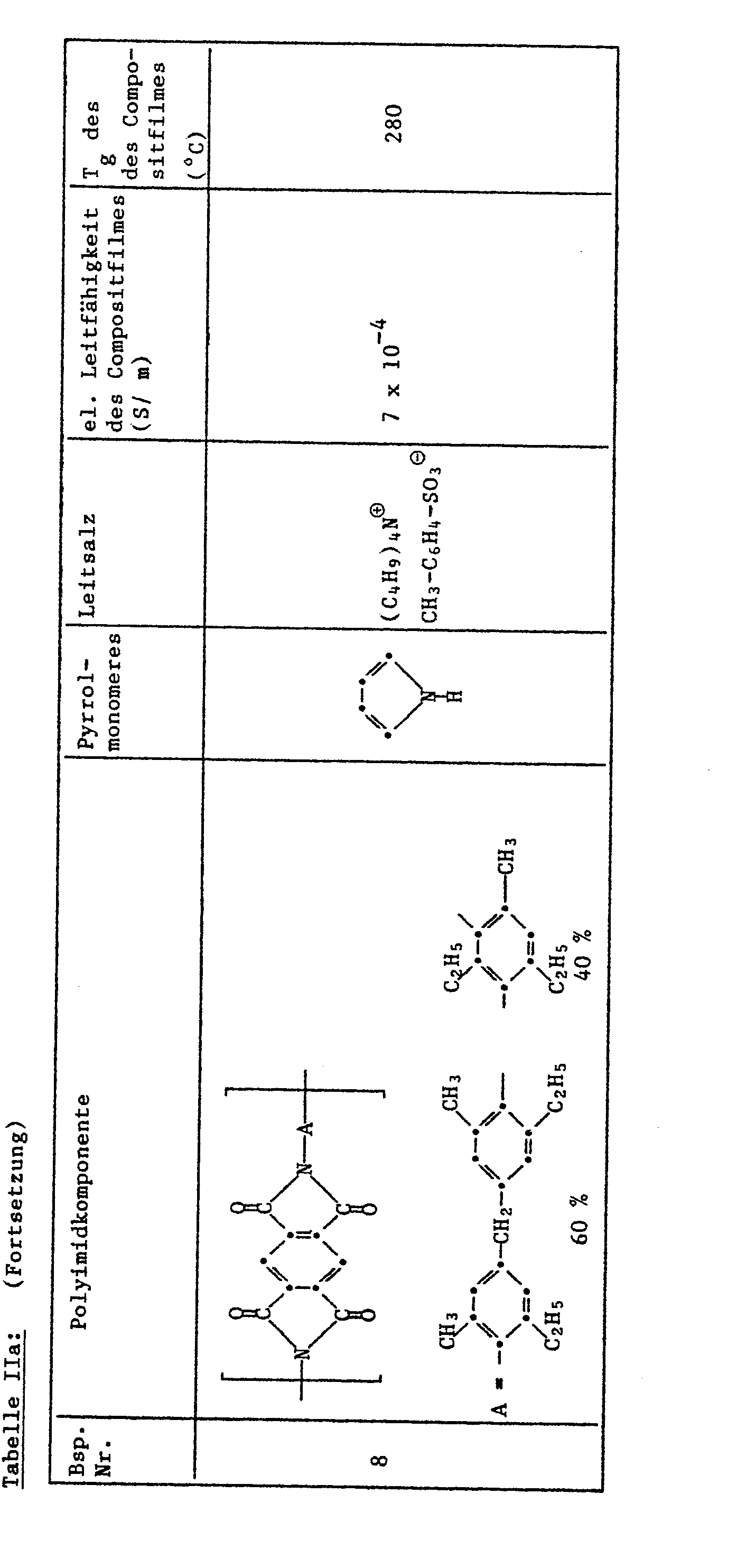
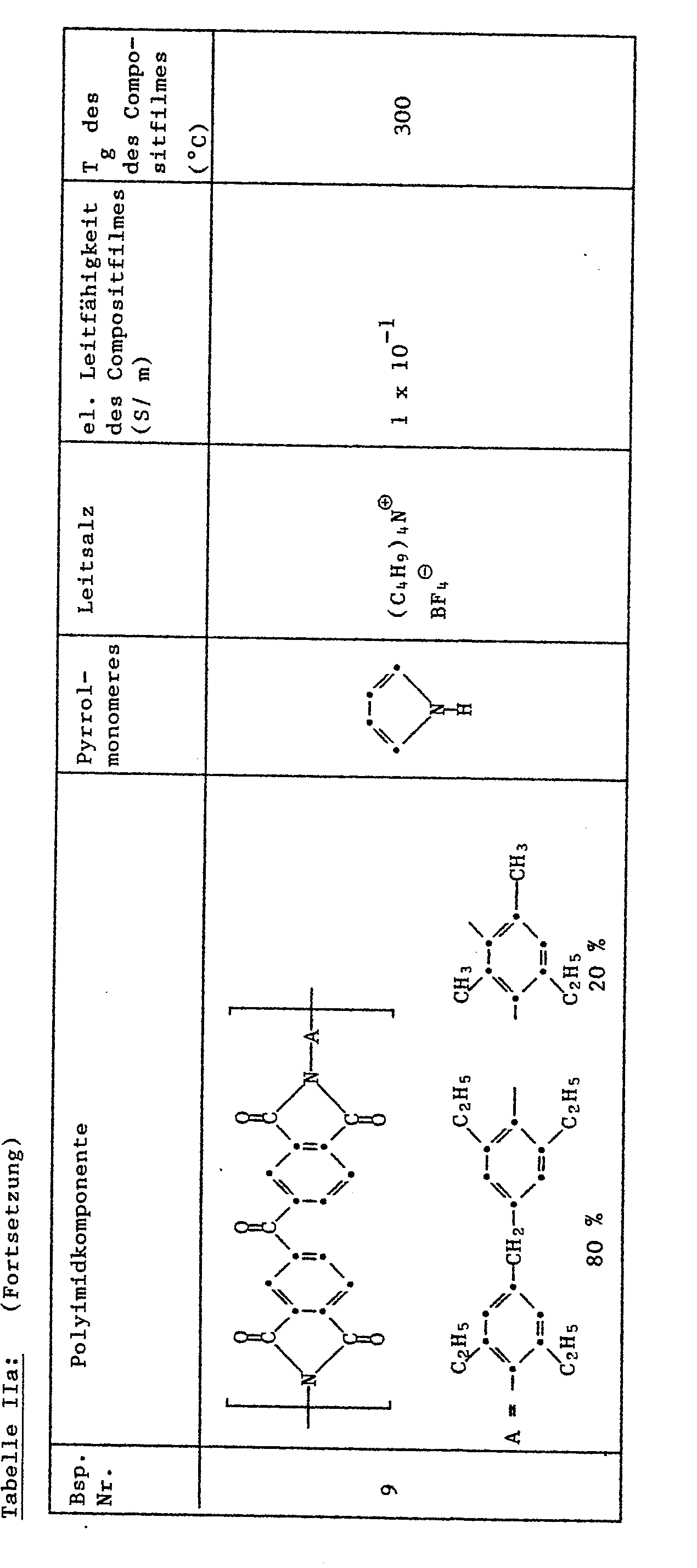
- Examples 7-9 The procedure is as in Example 1. Only now other polyimide films are used to coat the electrode. The components of the films and some of their properties can be found in Table IIa, while the manufacturing conditions are listed in Table IIb. All composite films can be folded and folded without breaking, while the corresponding polypyrrole films break.
Landscapes
- Chemical & Material Sciences (AREA)
- Health & Medical Sciences (AREA)
- Chemical Kinetics & Catalysis (AREA)
- Medicinal Chemistry (AREA)
- Polymers & Plastics (AREA)
- Organic Chemistry (AREA)
- Physics & Mathematics (AREA)
- Spectroscopy & Molecular Physics (AREA)
- Compositions Of Macromolecular Compounds (AREA)
- Polyoxymethylene Polymers And Polymers With Carbon-To-Carbon Bonds (AREA)
- Macromolecular Compounds Obtained By Forming Nitrogen-Containing Linkages In General (AREA)
Abstract
Description
- Die vorliegende Erfindung betrifft Polypyrrol-Polyimidzusammensetzungen, bevorzugt Polyimidfilme, die durch ein polymerisiertes oder copolymerisiertes Pyrrolderivat modifiziert sind, ein Verfahren zur Herstellung dieser Filme, sowie deren Verwendung als elektrisch leitende Filme oder als Verbundwerkstoffe.
- Schichten aus Polypyrrol oder aus Copolymerisaten von Pyrrol sind bekannt. Diese Filme besitzen eine hohe elektrische Leitfähigkeit und sind gegenüber Umgebungseinflüssen (Luft, Feuchtigkeit) resistent.
- Ihre mechanischen Eigenschaften lassen allerdings zu wünschen übrig. Polypyrrolfilme mit anorganischen Anionen sind spröde und zerreissen leicht unter Belastung. Dies begrenzt ihre praktische Anwendbarkeit, da sie sich beispielsweise nur schlecht verformen lassen.
- Es hat daher nicht an Versuchen gefehlt, Polypyrrolfilme in eine für die Anwendung vorteilhaftere Form zu bringen.
- In der DE-OS 3,227,914 wird ein Verfahren zum Verarbeiten von Polypyrrol beschrieben, bei dem das Polymere bei definierten hohen Temperaturen unter Druck und gegebenenfalls mit weiteren Stoffen verformt wird.
- Auch über die Herstellung elektrisch leitfähiger Filme aus Polypyrrol und anderen herkömmlichen isolierenden Polymeren, wie beispielsweise PVC, wurde bereits berichtet (Niwa und Tamamura, J.Chem.Soc.Chem.Comm., 1984, 817 bzw. De Paoli, Waltmann, Diaz und Bargon, J.Chem.Soc.Chem.Comm., 1984, 1015).
- Zu diesem Zweck werden Pt-Elektroden mit einem 1 bis 10 um dicken Polymerfilm allseitig beschichtet und in einem Elektrolysierbad als Anode geschaltet. Die Elektrolytlösung enthält Pyrrol. Schon nach kurzem Stromfluss scheidet sich Polypyrrol auf dem Isolator-Polymerfilm ab, wobei die guten mechanischen Eigenschaften des Isolator-Polymerfilms erhalten bleiben und die Leitfähigkeit der Zusammensetzung den Wert reiner Polypyrrolfilme erreicht. Pyrrolpolymere besitzen eine hohe Temperaturbeständigkeit selbst bei Temperaturen über 250°C. Im Gegensatz dazu erleidet das bislang verwendete Trägermaterial für elektrolytisch abgeschiedene Polypyrrole bei solch hohen Temperaturen Aenderungen der mechanischen Eigenschaften. Sei es, dass es in den thermopastischen Zustand übergeht oder dass bei diesen Temperaturen bereits eine Zersetzung des Materials eintritt. Polyimide wurden bislang nicht verwendet. Es wurde nun gefunden, dass sich hochtemperaturbeständige Polyimid-Polypyrrollegierungen mit einer hohen Glasusewandlungstemperatur herstellen lassen.
- Die vorliegende Erfindung betrifft eine Zusammensetzung enthaltend Polypyrrol und in organischen Lösungsmitteln lösliches Polyimid.
- Die löslichen Polyimide, die zur Herstellung der erfindungsgemässen Zusammensetzungen verwendet werden können, lassen sich in folgende Strukturklassen einteilen:
- A) In organischen Lösungsmitteln lösliche Verbindungen enthaltend die wiederkehrende Struktureinheit der Formel I

Z ein vierwertiger organischer Rest, der mindestens einen aromatischen Ring enthält, ist und worin Z' ein zweiwertiger aliphatischer, cycloaliphatischer, aromatischer, araliphatischer oder heterozyklischer Rest ist oder wobei Z und/oder Z' Kombinationen dieser Reste innerhalb der gegebenen Definitionen darstellen; - B) in organischen Lösungsmitteln lösliche Verbindungen enthaltend die wiederkehrende Struktureinheit der Formel II


- C) in organischen Lösungsmitteln lösliche Verbindungen enthaltend die wiederkehrende Struktureinheit der Formel III

- Insbesondere die Polyimide der Strukturklasse A) sind in der Regel in organischen Lösungsmitteln unlöslich. Da allgemein gültige Beziehungen zwischen Struktur und Löslichkeit eines Polyimids derzeit nicht aufstellbar sind, muss im Einzelfall anhand von Routineversuchen ermittelt werden, ob eine bestimmte Verbindung löslich ist oder nicht, und somit im Rahmen dieser Erfindung als Trägerfilm verwendet werden kann.
- Ein Polyimid wird in der Regel dann als löslich angesehen, wenn es sich bei 25°C zu mindestens 1 mg/l, vorzugsweise zu mindestens 1 g/l, in dem betreffenden Lösungsmittel löst.
- Zusammenhänge zwischen Molekularstruktur und Löslichkeit von Polyimiden werden von F.W. Harris und Lynn H. Lanier in "Structure-Solubility Relationships in Polyimides" (Academic Press, New York, 1977, S. 183 bis 198) beschrieben. Die dort aufgelisteten löslichen Polyimide lassen sich auch im Rahmen dieser Erfindung als Trägerfilme einsetzen.
- Der vierwertige Rest Z kann unter den folgenden allgemeinen Gruppen ausgewählt werden: aromatische, aliphatische, cycloaliphatische, heterocyclische Gruppen, Kombinationen von aromatischen und aliphatischen Gruppen und die entsprechenden substituierten Gruppen davon. Die Gruppen Z umfassen vorzugsweise die folgenden Strukturen:


- Die vorstehend definierte Gruppe Z' kann vorzugsweise ausgewählt werden unter Alkylengruppen mit 2 bis 12 Kohlenstoffatomen, Cycloalkylengruppen mit 4 bis 6 Kohlenstoffatomen; einer Xylylengruppe, Arylengruppen ausgewählt unter ortho-, meta- oder para-Phenylen, das gegebenenfalls 1-4 C1-C5-Alkylresten trägt, Biphenylen, Naphthylen oder Anthrylen; einer substituierten Arylengruppe der Formel


- Die Reste R1, R3, R4, R5, R6, R7, R8, und R9 bedeuten als Alkyl mit 1 bis 5 Kohlenstoffatomen beispielsweise Methyl, Ethyl, n-Propyl, Isopropyl, n-Butyl, sek. Butyl, tert. Butyl, n-Pentyl oder Neopentyl. Bevorzugt wird Methyl.
- Als Alkoxy mit 1 bis 5 Kohlenstoffatomen bedeuten R4 und R5 beispielsweise Methoxy, Ethoxy, n-Propoxy, Isopropoxy, n-Butoxy, sek.-Butoxy, tert.-Butoxy, n-Pentoxy oder Neopentoxy. Bevorzugt wird Methoxy.
- Als Halogen bedeuten R4, R5, R6, R7, R8 oder R9 Fluor, Chlor, Brom oder Iod. Bevorzugt werden Brom oder Chlor und ganz besonders Chlor.
- Als Aryl bedeuten R4 und R5 beispielsweise Phenyl oder Naphthyl, wobei Naphthyl in 1- oder in 2-Position mit dem restlichen System verknüpft sein kann. Bevorzugt wird Phenyl.
- Als Alkylengruppe mit 2 bis 12 Kohlenstoffatomen bedeutet Z' geradkettiges oder verzweigtes Alkylen, wie beispielsweise Ethylen, Trimethylen, Tetramethylen, Pentamethylen, Hexamethylen, Heptamethylen, Octamethylen, Nonamethylen, Decamethylen, Undecamethylen, Dodecamethylen, sowie -C(CH3)2-, -(CH2)3-C(CH3)2-(CH2)3- oder -(CH2)3-CH(CH3)-(CH2)4-. Bevorzugt werden die drei letztgenannten verzweigten Alkylenreste sowie Hexamethylen.
- Als lineare oder verzweigte Alkylengruppe mit 1 bis 3 Kohlenstoffatomen bedeutet Ql beispielsweise Methylen, Ethylen, Trimethylen, Ethyliden sowie 2-Propyliden.
- Bevorzugt sind Methylen und 2-Propyliden.
- Als Cycloalkylengruppe mit 4 bis 6 Kohlenstoffatomen bedeutet Z' beispielsweise Cyclobutylen, Cyclopentylen oder Cyclohexylen. Die Reste können in 1,2-, 1,3- oder 1,4-Position mit dem restlichen Molekülgerüst verbunden sein. Bevorzugt wird die 1,4-Verknüpfung. Insbesondere bevorzugt wird Cyclohexylen-1,4.
- Bei Z' als Xylylen handelt es sich um das ortho-, metha- oder para-Xylylen. Es kann sich aber auch um Gemische dieser Xylylene handeln. Bevorzugt werden Gemische der Xylylene oder para-Xylylen.
- Bei Z' als Tolylen kann die Verknüpfung mit dem Restmolekül in 2,3-, 2,4-, 2,5-, 2,6-, 3,5-, 3,6-, 4,5-, oder 4,6-Position, bezogen auf die Methylgruppe, erfolgen.
- Bedeutet Z' Biphenylen, so kann die Verknüpfung mit dem Restmolekül an irgendeiner Stelle des Biphenylens erfolgen. Bevorzugt sind Reste, bei denen jeder Phenylkern des Biphenylens eine Valenz zum Restmolekül ausbildet. Besonders bevorzugt handelt es sich hier um die 4,4'-, 3,3'- oder 2,2'-Derivate, und ganz besonders um das 4,4'-Derivat.
- Bei Ql als Arylen handelt es sich beispielsweise um Phenylen oder um Naphthylen, bevorzugt jedoch um Phenylen. Unter Phenylen wird ortho-, meta- oder para-Phenylen verstanden. Bevorzugt wird para-Phenylen.
- Bedeutet Ql Dialkylsilyl, so handelt es sich beispielsweise um Dimethylsilyl, Diethylsilyl, Di-(n-propyl)-silyl, Di-(isopropyl)-silyl oder Di-(n-butyl)-silyl. Bevorzugt wird Dimethylsilyl. Bedeutet Q1 Diarylsilyl, so handelt es sich vorzugsweise um Diphenylsilyl.
- Bei den Polyimiden der oben erwähnten Strukturtypen A, B oder C handelt es sich vorzugsweise um Verbindungen enthaltend die Struktureinheiten der Formeln I oder II oder III in gleichsinniger Reihenfolge; ganz besonders bevorzugt werden Polyimide bestehend ausschliesslich aus Strukturelementen der Formeln I oder II oder III, sowie aus Kombinationen der im Rahmen der gegebenen Definitionen unterschiedlichen möglichen Struktureinheiten der Formeln I oder II oder III.
- Die Kettenlänge der Polyimide kann in weiten Bereichen schwanken. Bevorzugt verwendet man Polyimide enthaltend von 5 bis 1000 der wiederkehrenden Struktureinheiten der Formel I oder II oder III; ganz besonders bevorzugt jedoch Polyimide enthaltend mehr als 10, insbesondere von 10 bis 500 der wiederkehrenden Struktureinheiten der Formel 1 oder II oder III.
- Ganz besonders bevorzugt verwendet man diejenigen Polyimide, die aus wiederkehrenden Struktureinheiten der Formel I bestehen und die in organischen Lösungsmitteln löslich sind.
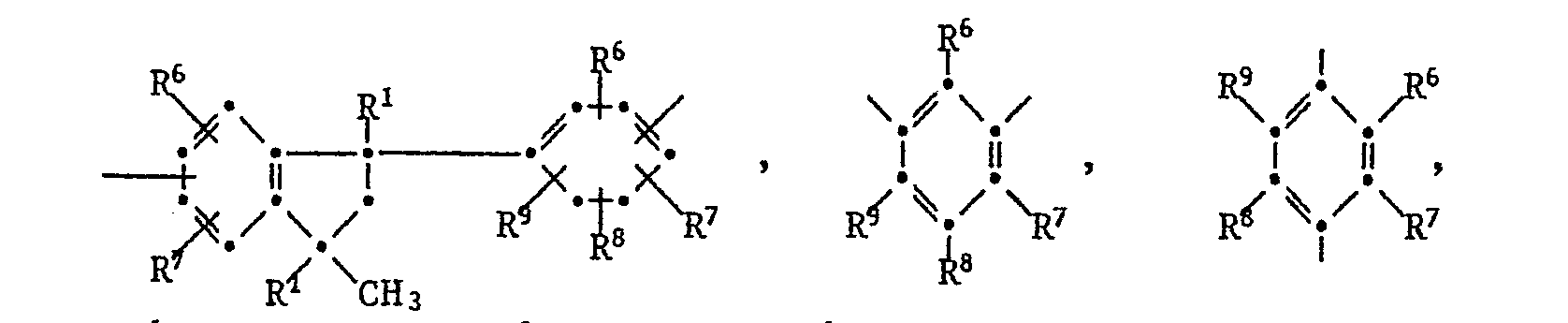
- Von den löslichen Verbindungen enthaltend die wiederkehrende Struktureinheit der Formel 1 sind insbesondere solche bevorzugt, worin Z einer der oben als bevorzugt definierten Reste oder eine Kombination der Reste ist, worin R1 die oben definierte Bedeutung besitzt, vorzugsweise aber Wasserstoff oder Methyl bedeutet, R2 -CH2-, -CO-oder -C(CH3)2- ist, und Z' einer der Reste oder eine Kombination der Reste
-



- Besonders bevorzugt werden auch Polyimide der Formel I, worin Z einer der Reste oder eine Kombination der Reste


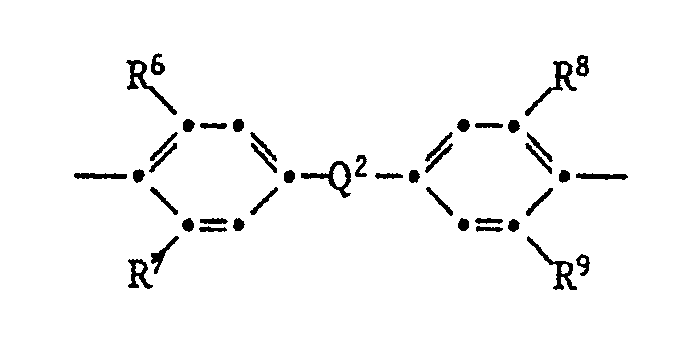
- In einer besonders bevorzugten Ausführungsform dieser Erfindung verwendet man lösliche Polyimide enthaltend im wesentlichen die wiederkehrende Struktureinheit der Formel I, worin
- 1) aus der Gesamtzahl der wiederkehrenden Polyimideinheiten
- A) in 0 bis 100 % solcher Einheiten Z ein Phenylindanrest der Strukturformel

- B) in 0 bis 100 % solcher Einheiten Z' ein Phenylindanrest der Strukturformel

- A) in 0 bis 100 % solcher Einheiten Z ein Phenylindanrest der Strukturformel
- 2) aus der Gesamtzahl der Reste Z und Z' mindestens 10 % Phenylindanreste sind.
- Phenylindanhaltige Polyimide sind in der US-PS 3,856,752 beschrieben. Bezüglich der Herstellung und des bevorzugten Bereiches dieser Verbindungen wird auf die Beschreibung dieser Patentschrift verwiesen.
- Ein ebenfalls bevorzugtes Polyimid vom Typ A) enthält als tetravalenten Rest Z Gruppen der Formel


- Ebenfalls bevorzugte Verwendung als Polyimide finden Verbindungen der Formel I enthaltend als Strukturelement Z' nur Phenylindanreste, wie oben definiert.
- Auch finden Polyimide der Formel I Beachtung, die als Z' 10 bis 100 % Phenylindanreste, wie oben definiert, enthalten, und die 0 bis 90 % an Resten der Formeln
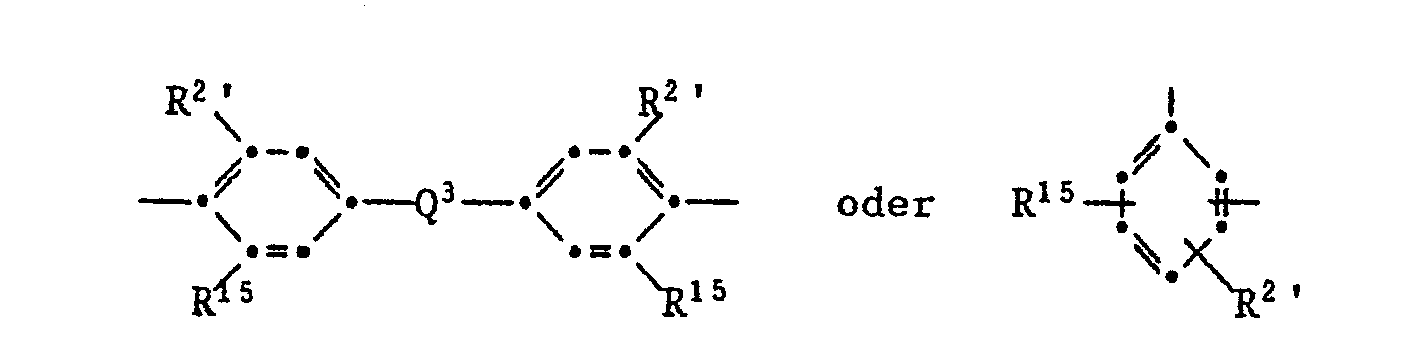
- Ganz besonderes Interesse finden Polyimide der Formel I, enthaltend als Gruppen Z 0-100 % der Reste


- Weiterhin bleiben zu erwähnen Polyimide der Formel I enthaltend als Z 100 % der Reste
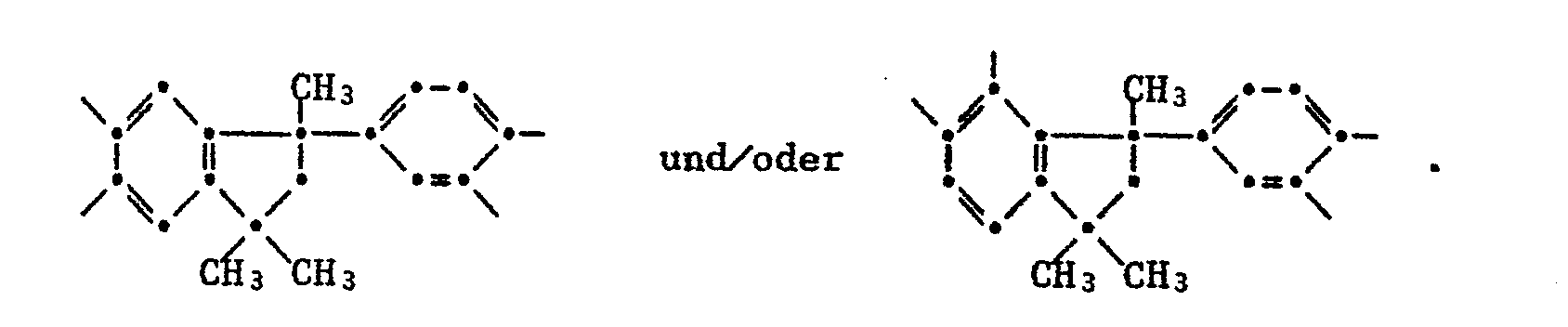
- Ganz besonders bevorzugt in den erfindungsgemässen Zusammensetzungen werden Polyimide der Formel I enthaltend als Z jeweils 100 % von Gruppen der Formel


- Schliesslich finden Polyimide der Formel I Beachtung, deren Gruppen Z
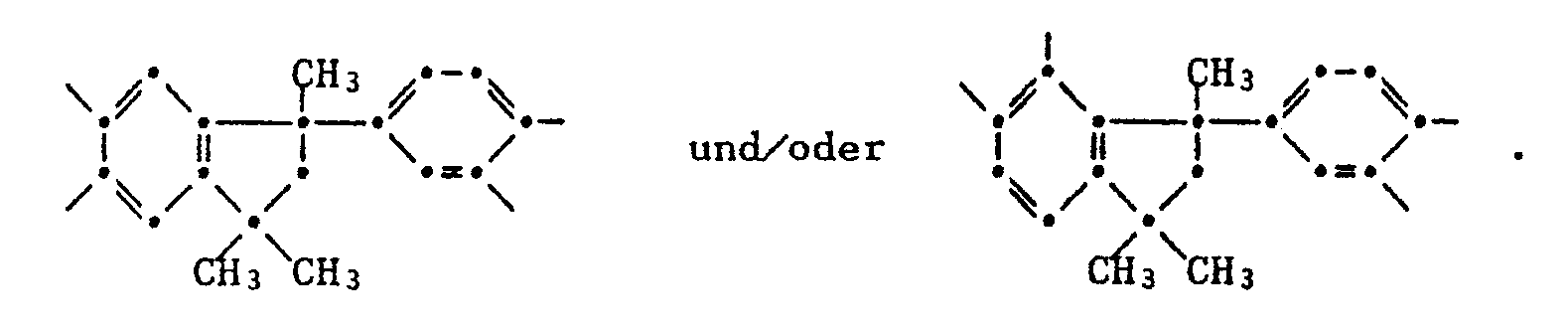

- Ganz besonders bevorzugt in den erfindungsgemässen Zusammensetzungen werden Polyimide der Formel I enthaltend als Gruppe Z


- Schliesslich bleiben noch Polyimide der Formel I zu erwähnen, bei denen Z


- Auch finden Polyimide der Formel I Beachtung, worin die Gruppe Z eine der Bedeutungen


- Ebenfalls Beachtung finden Polyimide der Formel I, worin Z


- Verbindungen dieses Typs, deren Herstellung und Verwendung sind in der US-PS 3,708,458 beschrieben. Von den löslichen Polyimiden der Formel II (Typ B) sind insbesondere solche bevorzugt, deren Rest R sich in meta-Position zu einer der Carbonylgruppen des Imidsystems befindet.
- Besondere Beachtung finden lösliche Polyimide der Formel II, worin R eine der folgenden Bedeutungen besitzt:

- Auch verwendet man vorzugsweise Verbindungen der Formel II mit m=0.
- Enthalten die Verbindungen der Formel II Reste Z', so handelt es sich dabei vorzugsweise um die bereits weiter oben erwähnten Gruppierungen, ganz besonders jedoch um 4,4'-Diphenylmethan, 4,4'-Diphenylether oder 4,4'-Diphenylsulphon.
- Werden lösliche Polyimide der Formel III (Typ C) verwendet, so handelt es sich dabei vorzugsweise um Verbindungen, worin Z" ein aromatischer Rest ist und worin Q eine Alkylengruppe mit 2 bis 12 Kohlenstoffatomen oder eine Arylengruppe ausgewählt aus ortho-, meta- oder para-Phenylen oder -Tolylen oder unter einer Arylgruppe der Formel

- Die Reste Z" und Q können die gleiche Bedeutung besitzen, sie können aber auch durchaus unterschiedlich sein.
- X und Y haben vorzugsweise die gleiche Bedeutung. Ganz besonders bevorzugt eingesetzt werden Verbindungen der Formel III, worin X und Y -NH- sind.
- Unter den aromatischen Resten Z" der Verbindung III sind insbesondere ortho-, meta- oder para-Phenylen, sowie Tolylen oder Xylylen und 4,4'-Biphenylen, 2,2'-Biphenylen oder Reste der Formel

- Die Herstellung der Polyimide kann auf verschiedenen Wegen erfolgen. Eine Methode geht von der Umsetzung aromatischer Tetracarbonsäuren aus, deren Carboxylgruppen jeweils paarweise in ortho-Position zueinander stehen. Diese Tetracarbonsäuren oder ihre Dianhydride werden mit bifunktionellen primären Aminen zu Polyamidsäuren umgesetzt. Diese Zwischenprodukte sind in der Regel löslich und können gegebenenfalls zu Formkörpern verarbeitet werden. In einer zweiten Stufe zyklisiert man die Polyamidsäure zum Polyimid.
- Anstelle der Tetracarbonsäuren können auch deren funktionalisierte Derivate wie beispielsweise Carbonsäurechloride oder Carbonsäureester eingesetzt werden.
- Die Bildung der Amidsäure wird gegebenenfalls in der Schmelze durchgeführt, vorzugsweise jedoch in polaren Lösungsmitteln, wie beispielsweise Dimethylformamid, Dimethylacetamid, Dimethylsulfoxid, N-Methylpyrrolidon oder m-Kresol; dabei wird die Reaktionstemperatur vorzugsweise nicht über 50°C steigen gelassen, um eine vorzeitige Zyklisierung zum Polyimid zu unterbinden.
- Die Zyklisierungsstufe wird vorzugsweise bei Temperaturen oberhalb 150°C durchgeführt und gegebenenfalls wird ein Dehydroatisierungsmittel, beispielsweise Acetanhydrid, zugefügt.
- Ein weiterer Syntheseweg zu Polyimiden verwendet Tetracarbonsäureanhydride, die mit Di-isocyanaten anstelle von Diaminen umgesetzt werden. Diese Reaktionsfolge führt unter C02 Abspaltung in der Regel direkt zu den Polyimiden; es ist aber auch möglich, Polyamidsäuren zu erhalten, wenn man Tetracarbonsäuren als Ausgangsmaterialien einsetzt. Polyimide des Typs C können durch Umsetzung von Bis-maleinimiden mit primären Diaminen oder mit Diolen erhalten werden. Solche Bis-maleinimide lassen sich auch als bifunktionelle Dienophile in einer Diels-Alder Reaktion mit Bis-dienen zu Polyimiden umsetzen.
- Eine Uebersicht über die einzelnen Reaktionswege zur Herstellung von Polyimiden bzw. über verschiedene Typen von Polyimiden ist in Encycl. Chem. Tech., 18, 709-719 (1982) zu finden.
- Monomere Pyrrole, die polymerisiert werden können, sind Pyrrol oder substituierte Pyrrole, die C- und/oder N-substituiert sein können. Diese Pyrrole müssen mindestens zwei Wasserstoffatome am Kern (C-gebunden) aufweisen, damit die Polymerisation ablaufen kann.
- Insbesondere versteht man unter dem Begriff Polypyrrol Homo- oder Copolymerisate von Pyrrol und/oder substituiertem Pyrrol oder Copolymerisate von Pyrrol und/oder substituiertem Pyrrol mit fünf-oder sechsgliedrigen heteroaromatischen Verbindungen.
- Die monomeren Pyrrole besitzen vorzugsweise die Struktur der Formel X

- R20 und R21 unabhängig voneinander Wasserstoff, Alkyl, Aryl oder Aralkyl sind, R22, R23 und R24 unabhängig vonelnander Alkyl oder Phenyl bedeuten, R17 und R18 unabhängig voneinander Wasserstoff, Alkyl, Cycloalkyl, Aryl, Aralkyl, Alkaryl, -COR19, -CN oder Halogen bedeuten und R19 Wasserstoff, Alkyl oder Aryl ist.
- Als Alkyl bedeuten R16, R17, R18, R19, R20, R21, R22, R23 und R24 vorzugsweise C1-C20-Alkyl und sind dann beispielsweise Methyl, Ethyl, Propyl, Butyl, Cetyl, Lauryl oder Stearyl. Besonders bevorzugt wird Methyl.
- Als Cycloalkyl bedeuten R16, R17 oder R18 vorzugsweise Cs-C7-Cycloalkyl, sind also Cyclopentyl, Cyclohexyl oder Cycloheptyl, besonders bevorzugt jedoch Cyclohexyl.
- Als Halogen bedeuten R17 oder R18 Fluor, Chlor, Brom oder Iod, bevorzugt Brom oder Chlor.
- Bedeuten irgendwelche Reste Aryl, so handelt es sich dabei vorzugsweise um Phenyl oder um Naphthyl, insbesondere jedoch um Phenyl.
- Handelt es sich bei irgendwelchen Resten um Aralkyl, so ist vorzugsweise C7-C14Aralkyl gemeint, insbesondere jedoch Benzyl.
- Unter Alkaryl versteht man bevorzugt C7-C14Alkaryl, ganz besonders bevorzugt werden Tolyl oder Xylyl.
- Sind irgendwelche Reste substituiert, so handelt es sich bevorzugt um mono- oder disubstituierte Gruppen, ganz besonders bevorzugt um monosubstituierte Reste.
- Als Pyrrole bevorzugt werden zum einen das unsubstituierte Pyrrol, die N-Alkylpyrrole, insbesondere das N-Methylpyrrol, oder die N-Arylpyrrole, insbesondere das N-Phenylpyrfol, sowie die an den
- Kohlenstoffatomen monoalkyl- oder dialkylsubstituierten Pyrrole oder die an den Kohlenstoffatomen mono- oder dihalogensubstituierten Pyrrole.
- Von diesen letzteren beiden Verbindungsklassen werden insbesondere die Mono- oder die Dimethylverbindung oder die Monobrom- oder die Dibromverbindung sowie die Monochlor- oder Dichlorverbindung bevorzugt.
- Kohlenstoffsubstituierte Pyrrole sind vorzugsweise in 3- und/oder 4-Position substituiert.
- Unter den Pyrrolpolymeren im Rahmen dieser Erfindung werden sowohl Homo- als auch Copolymere von Pyrrolen ganz allgemein verstanden.
- Hierzu gehören insbesondere die Homopolymeren des unsubstituierten Pyrrols selber. Es lassen sich aber auch Copolymere der oben genannten Pyrrole, bevorzugt des unsubstituierten Pyrrols, mit anderen Comonomeren, insbesondere anderen fünf- und/oder sechsgliedrigen heteroaromatischen Verbindungen herstellen. Unter diesen heteroaromatischen Verbindungen sind besonders bevorzugt: Furan, Thiophen, Thiazol, Oxazol, Thiadiazol, Imidazol, Pyridin, 3,5-Dimethylpyridin, Pyrazin, Pyridazin, 3,5-Dimethylpyrazin, Carbazol oder Phenothiazin.
- Copolymere dieses Typs und deren Herstellung sind beispielsweise in der DE-OS 3,223,544 beschrieben.
- Ganz besonders bevorzugt werden Copolymere aus unsubstituiertem Pyrrol und gegebenenfalls substituiertem N-Methylpyrrol, sowie Copolymere aus unsubstituiertem Pyrrol oder N-Methylpyrrol und Thiophen oder Furan.
- Die Herstellung der erfindungsgemässen polypyrrolhaltigen Polyimidzusammensetzungen erfolgt durch Polymerisation des monomeren Pyrrols in Gegenwart eines Polyimidfilms. Diese Polymerisation kann elektrolytisch erfolgen, es kann aber auch jedes andere Polymerisationsverfahren verwendet werden, beispielsweise eine Polymerisation unter Verwendung von Redoxpaaren.
- Polypyrrol ist im geladenen oder oxidierten Zustand elektrisch (elektronisch) leitend. Es wird in diesem Zustand durch Elektropolymerisation erzeugt. Während des Elektropolymerisationsvorganges wird zum Ausgleich der positiven Ladung am Polymerisat-Grundgerüst ein Gegenanion in das Material eingebaut.
- Polypyrrol kann aber auch entladen und in eine reduzierte (gelbe) Form überführt werden. In diesem Zustand ist es ein elektrischer Isolator.
- Unter dem Begriff "Polypyrrol" im Rahmen dieser Erfindung werden sowohl die oxidierte als auch die reduzierte Form verstanden, bevorzugt jedoch die oxidierte Form.
- Vorzugsweise stellt man die erfindungsgemässen Zusammensetzungen her, indem man ein in einem polaren Lösungsmittel gelöstes monomeres Pyrrol an einer mit dem betreffenden Polyimidfilm in Kontakt stehenden Elektrode anodisch oxidiert. Ganz besonders bevorzugt verwendet man Polyimid beschichtete Elektroden. Das Lösungsmittel enthält ein Leitsalz, dessen Anionen wie oben erwähnt in den Polypyrrolfilm eingebaut werden und zu einer Erhöhung der Leitfähigkeit führen. Das Leitsalz wird in Form der jeweiligen Protonensäure oder eines ihrer Salze, bevorzugt der Tetraalkylammonium- oder Alkalimetallsalze, dem Elektrolyten zugegeben.
- Die Erfindung betrifft daher vorzugsweise leitfähige Polyimid-Polypyrrol-zusammensetzungen enthaltend Polypyrrol in der oxidierten Form und als Gegenanion ein Anion ausgewählt aus der Gruppe bestehend aus BF4 -, PF6-, AsF6 -, SbF6 -, SbCl6 -, ClO4 -, IO4 -, HS04-, S04 2-, CF3SO3 -, CH3C6H4S03-, CF3COO-, HC2O4 - oder [Fe(CN)6]3-, sowie auch aus Alkylsulfat, Alkylsulfonat, Alkylphosphat oder Alkylphosphonat sowie Kombinationen dieser Anionen.
- Der Einbau von Gegenanionen und die damit verbundene Erhöhung der Leitfähigkeit ist bekannt und beispielsweise in J. Electrochem. Soc. 128, 2596 (1981) beschrieben.
- Die Erfindung betrifft daher auch ein Verfahren zur Herstellung von Polyimid-Polypyrrolfilmen durch anodische Oxidation eines gelösten Pyrrols und gegebenenfalls eines geeigneten Comonomeren an einer Elektrode, die in Kontakt zu einem Polymerfilm steht, dadurch gekennzeichnet, dass man als Material für den Polymerfilm ein Polyimid verwendet, das in organischen Lösungsmitteln löslich ist.
- Die Elektrolyse wird vorzugsweise in polaren organischen Lösungsmitteln, die Pyrrol und Leitsalz nicht jedoch den Polyimidfilm auf der Elektrode lösen, durchgeführt. Zu diesen organischen Lösungsmitteln zählen beispielsweise Alkohole, Polyole, organische Carbonate, wie z.B. Propylencarbonat, Ether wie 1,2-Dimethoxyethan, Dioxan, THF und Methyltetrahydrofuran, Nitrile wie Acetonitril und Benzonitril, N-Methylpyrrolidon, Methylenchlorid, Dimethylsulfoxid, Dimethylformamid, oder Aceton.
- Vorzugsweise verwendet man Acetonitril als Lösungsmittel.
- Werden mit Wasser mischbare Lösungsmittel verwendet, so können zur Erhöhung der elektrischen Leitfähigkeit geringe Mengen an Wasser, im allg. bis zu 3 % bezogen auf das organische Lösungsmittel zugesetzt werden. Bevorzugte Lösungsmittel dieser Art sind Alkohole niedriger Kohlenstoffzahl (Cl-C4), Ether, wie Dioxan, Tetrahydrofuran oder 1,2-Dimethoxyethan, Eisessig, Aceton, Dimethylformamid, N-Methylpyrrolidon, Acetonitril oder Propylencarbonat.
- Es lassen sich aber auch zweiphasige Elektrolytbäder verwenden. Darunter versteht man Gemische von Wasser, enthaltend das gelöste Pyrrol und gegebenenfalls die copolymerisierbare Komponente, und ein organisches Verdünnungsmittel, das mit Wasser nicht mischbar ist. Beispiele für solche Verdünnungsmittel sind organische Kohlenwasserstoffe, wie aliphatische oder aromatische Kohlenwasserstoffe sowie halogenierte aliphatische oder aromatische Kohlenwasserstoffe. Spezielle Beispiele davon sind Hexan, Toluol, 1,2-Dichlorethan, Dichlormethan, Tetrachlormethan oder Chlorbenzol.
- Das Elektrolysierbad kann darüber hinaus noch andere Bestandteile enthalten, die den erfindungsgemässen Zusammensetzungen gewünschte Eigenschaften verleihen.
- Dazu zählen beispielsweise Weichmacher, Redoxpaare, Netzmittel oder Emulgatoren. Bezüglich dieser Zusätze wird auf die DE-OS 3,402,133 verwiesen, in der solche Elektrolytsysteme und deren Auswirkung auf die Eigenschaften der fertigen Polypyrrolfilme ausführlich beschrieben sind.
- Der Elektrolyt enthält das monomere Pyrrol und gegebenenfalls die comonomere Komponente gelöst.
- Die Menge dieses oder dieser Monomeren im Elektrolysebad kann innerhalb eines breiten Bereiches schwanken; dabei muss aber die Gesamtmenge des gelösten Monomeren grösser sein als der zur Bildung der gesamten Polymerisatmenge erforderliche Teil.
- Die Menge an Pyrrol und gegebenenfalls comonomerer Komponente, die in der Elektrolyselösung vorhanden ist, muss ausreichend sein, um eine vernünftige Umsetzungsgeschwindigkeit zu gewährleisten. In der Regel sind Konzentrationen von mehr als 10-3 Mol pro Liter nötig. Als obere Grenze der Monomerenkonzentration ist die Sättigungskonzentration des Pyrrols bzw. des Comonomeren im jeweiligen Elektrolyten anzusehen.
- Vorzugsweise verwendet man 0,01 Mol pro Liter bis 0,1 Mol pro Liter gelöstes Pyrrol.
- Die Leitsalzkonzentration beträgt vorzugsweise 0,001 bis 1 Mol pro Liter. Es kann auch hier eine Konzentration bis zur Sättigung des Elektrolyten verwendet werden.
- Ein besonderes Augenmerk bei der Durchführung des erfindungsgemässen Verfahrens ist auf die Elektroden zu richten.
- Man verwendet Elektroden, die mit dem jeweiligen Polyimid beschichtet sind. Als Elektrodenmaterialien kommen gängige leitfähige Stoffe, beispielsweise Metalle wie Nickel oder Stahl in Frage, die für die Polypyrrolsynthese eingesetzt werden können. Vorzugsweise verwendet man Graphit, Stahl oder Edelmetalle, insbesondere Platin. Man kann aber auch Elektroden verwenden, die aus elektrisch leitfähigen Polymeren gebildet werden, beispielsweise aus durch anodische Oxidation gebildetem Polypyrrol oder Polythiophen, aus dotiertem p-leitendem Polyacetylen oder aus dotiertem p-leitendem Polyphenylen.
- Die Form der Elektroden ist beliebig. Es können plattenförmige Elektroden in paralleler Anordnung verwendet werden oder aber zylinderförmige Elektroden, die gegebenenfalls um die Längsachse rotiert werden können.
- Die Beschichtung der Elektroden kann auf unterschiedlichste Art und Weise erfolgen beispielsweise durch Spin- oder Curtain-Coating. Je nach Elektrodenform und -material sind unterschiedliche Anforderungen an den Beschichtungsvorgang bzw. an das Elektrodenmaterial als Substrat zu stellen.
- In einem allgemein anwendbaren und daher bevorzugten Verfahren verwendet man eine Polyimidlösung, bringt diese auf die Elektrodenoberfläche auf und lässt das Lösungsmittel verdunsten oder entfernt das Lösungsmittel durch Anlegen eines Vakuums. Zurück bleibt ein Polyimidfilm. Die Dicke dieses Films kann über die Konzentration bzw. die Menge der verwendeten Lösung kontrolliert werden. Bevorzugt verwendet man Lösungen von Polyimiden mit einer gegenüber dem reinen Lösungsmittel um mehr als 1 %, ganz besonders bevorzugt um mehr als 5 %, vergrösserten Viskosität.
- Als organische Lösungsmittel für lösliche Polyimide sind beispielsweise zu nennen:
- N,N-Dimethylformamid, N,N-Dimethylacetamid, N-Methyl-2-pyrrolidon, N,N-Diethylformamid, N,N-Diethylacetamid, N-Methylcaptolactam, Dioxan, Dimethylsulfoxyd, Tetramethylharnstoff, Pyridin, Dimethylsulfon, Hexamethylphosphoramid, Tetramethylensulfon, Formamid, N-Methylformamid, y-Butyrolacton, Tetrahydrofuran, m-Kresol, Phenol, 2-Methoxyethylacetat, 1,2-Dimethoxyethan, Bis-(2-methoxyethyl)-ether, Chloroform, Nitrobenzol.
- Die Lösungsmittel können allein oder in Kombination von Lösungsmitteln oder in Kombination mit Verdünnungsmitteln, wie Benzol, Benzonitril, Xylol, Toluol und Cyclohexan verwendet werden.
- Es gibt jedoch auch Polyimide, die bereits in Lösungsmitteln mit schwächerer Lösekraft löslich sind. Beispiele für solche Lösungsmittel sind aliphatische Ketone, wie Cyclopentanon, Cyclohexanon, Cycloheptanon, Cyclooctanon, 4-Methylcyclohexanon, 3-Methylcyclohexanon oder 2-Methylcyclohexanon; aromatisch-aliphatische Ketone, wie Acetophenon, Propiophenon oder Butyrophenon; chlorierte Kohlenwasserstoffe, wie Methylenchlorid, Chloroform, Tetrachlorethylen, Chlorbenzol oder o-Dichlorbenzol; Ether, wie Ethylenglykoldimethylether, Diethylenglykoldimethylether, Tetrahydrofuran oder Dioxan; Etheracetale, wie Methylglykolacetat oder Ethylglykolacetat; sowie andere polare aprotische Lösungsmittel, wie Propylencarbonat oder Isophoron, die eine etwas schwächere Lösekraft als die stark lösenden polar aprotischen Lösungsmittel, wie N-Methylpyrrolidon, y-Butyrolacton oder N,N-Dimethylacetamid, besitzen.
- Die Dicke der auf der Elektrode aufzubringenden Polyimidfilme beträgt vorzugsweise nicht mehr als 50 um, ganz besonders bevorzugt jedoch weniger als 10 pm.
- Die Elektrolyse wird vorzugsweise mit einer einfachen Elektrolyseanordnung bestehend aus einer Zelle ohne Diaphragma und zwei Elektroden, bevorzugt Stahl oder Platinelektroden, durchgeführt. Zumindest die Anode, auf der sich das Polypyrrol später abscheidet, muss flächig ausgebildet und mit einem Polyimidfilm beschichtet sein.
- Auch andere Elektrolyseanordnungen, wie beispielsweise Zellen mit Diaphragma oder solche mit Referenzelektrode zur exakten Potentialbestimmung, können verwendet werden. Zur Kontrolle der abgeschiedenen Polypyrrolmenge ist eine Messung der Strommenge (Ampere*sec) angebracht.
- Die Elektrolyselösung kann während der Elektropolymerisation der Monomeren bewegt werden. Die Bewegung kann in irgendeiner der üblichen Arten erreicht werden, beispielsweise durch starkes Rühren mit Flügelrührern, Magnetrührern, Ultraschall, Vibration oder durch Hindurchleiten von Gasen durch den Elektrolyten (einschliesslich der an der Kathode erzeugten Gase). Das Rühren kann aber auch durch Bewegung der Elektroden erfolgen. Zur Elektropolymerisation wird an die Elektroden eine Spannung angelegt. Diese Spannung wird so gewählt, dass sie ausreicht, um die Reaktion durchzuführen. Dabei kann es sich um eine Gleichspannung oder eine Wechselspannung handeln, der ein Gleichspannungsanteil überlagert ist. Wechselspannungen können unterschiedlichste Zeitverläufe aufweisen; es kommen beispielsweise sinusförmige oder rechteckige Spannungsverläufe in Frage. Bevorzugt verwendet man Gleichspannungen.
- Die Spannung zwischen den Elektroden soll ausreichen, um die Monomeren zu oxidieren, ohne wesentliche Aenderungen im Bad zu erzeugen, beispielsweise durch Abbau von Bestandteilen des Bades.
- Im allgemeinen werden Stromdichten von bis zu 2 A/cm2 verwendet, vorzugsweise jedoch Stromdichten von weniger als 500 mA/cm2.
- Die Elektrolyse kann auch unter Intertgas durchgeführt werden; ebenso kann man an der Luft elektrolysieren.
- Bei der Elektrolyse wird das monomere Pyrrol an der Anode oxidiert. Während der Elektrolyse wird zweckmässig eine Temperatur des Elektrolyten zwischen -20° und +30°C eingehalten. Es können aber auch davon abweichende Temperaturen vorkommen. Die Temperaturgrenzen richten sich in erster Linie nach der Elektrolytlösung (Erstarrungs- bzw. Verdampfungspunkt). Vorzugsweise elektrolysiert man bei Raumtemperatur.
- Die auf den Polyimidfilm abzuscheidende Polypyrrolmenge richtet sich ganz nach dem beabsichtigten Verwendungszweck der Folien, und kann vom Fachmann anhand von Routineversuchen schnell ermittelt werden.
- Die während der Elektrolyse in Gegenwart von Leitsalzen anodisch abgeschiedenen Polypyrrolfilme werden zur Entfernung von anhaftendem Leitsalz vorteilhafterweise mit Lösungsmittel gewaschen und bei Temperaturen ≥50°C getrocknet. Nach der Trocknung lässt sich der Polyimid/Polypyrrol-Film leicht von der Elektrode lösen.
- Die erfindungsgemässen.Zusammensetzungen lassen sich zur Herstellung selbsttragender, elektrisch leitfähiger Filme mit hoher Glasumwandlungstemperatur und Reissfestigkeit verwenden. Solche Filme könne auf dem Gebiet der Elektronik bzw. der Mikroelektronik Anwendung finden, beispielsweise als leitfähige Verbundwerkstoffe bei der Herstellung von elektrischen Leitern, Elektroden, Batterien, Schaltern oder Halbleiterbauteilen, sowie bei der antistatischen Ausrüstung oder der elektromagnetischen Abschirmung von elektronischen Bauteilen.
- Die erfindungsgemässen Filme vereinen so vorteilhafte Eigenschaften wie eine hohe elektrische Leitfähigkeit, hohe mechanische Stabilität, hohe thermische Beanspruchbarkeit (T )250°C) und chemische g Beständigkeit.
- Allgemeine Arbeitsvorschrift:In einem Glasgefäss werden 250 ml Elektrolytlösung (0,1 mol/1 Leitsalz, 0,05 mol/1 Pyrrol(derivat) und gegebenenfalls Comonomeres, Lösungsmittel Acetonitril mit einem Wassergehalt von 1 %) vorgelegt. Zwei Elektroden (Grösse 50x20x1 mm) von denen die Anode vollseitig mit einem Polyimidfilm beschichtet*) ist, werden im Abstand von 4 cm in die Lösung gebracht. Unter Rühren und Argonspülung wird für die Dauer von 5, 10 oder 30 Min. elektrolysiert. Die Anode färbt sich rasch dunkelgrün bis schwarz durch Bildung einer Polymerlegierung aus dem Polyimid und Polypyrrol. Nach Spülen der Anode mit Acetonitril und Trocknung bei 60°C lässt sich der Poiymid/Polypyrrol-Film von der Unterlage entfernen. Die Glasübergangstemperatur (T ) des Compositfilmes entspricht derjenigen des reinen Polyimidfilmes.
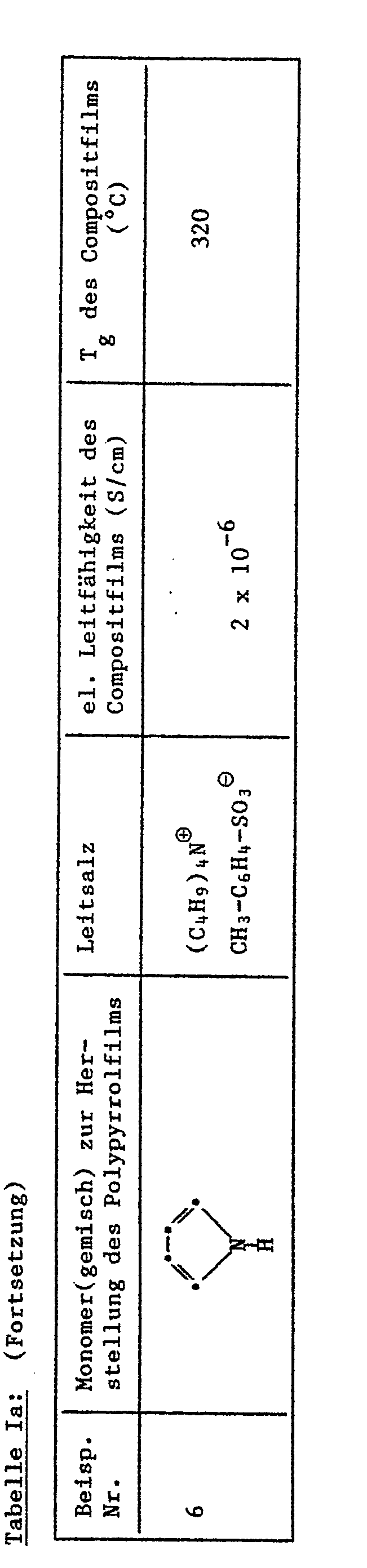
- Beispiele 1-6: Gemäss der voranstehenden allgemeinen Arbeitsvorschrift werden Polyimid/Polypyrrol-Filme hergestellt. Bei dem verwendeten Polyimid handelt es sich jeweils um DAPI-Polyimid . Die eingesetzten Pyrrolmonomeren, das verwendete Leitsalz und einige Eigenschaften der Compositfilme sind in Tab. Ia zu finden, während Parameter, die bei der Filmherstellung variiert werden, in Tab. Ib aufgelistet sind. Sämtliche Compositfilme sind ohne Bruch knick- und faltbar, während die entsprechenden reinen Polypyrrolfilme zerbrechen.
-





Claims (14)


worin Z einer der Reste oder eine Kombination der Reste








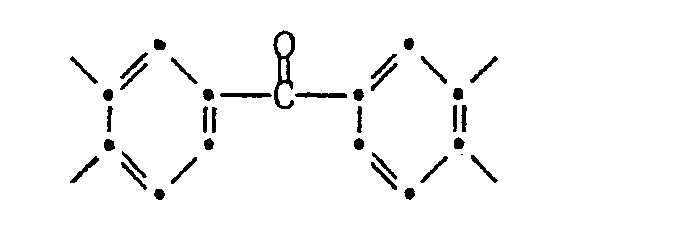


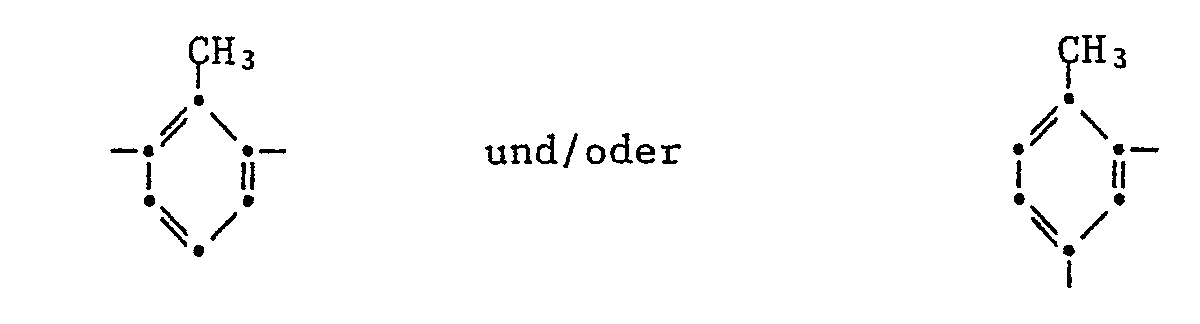
Applications Claiming Priority (2)
| Application Number | Priority Date | Filing Date | Title |
|---|---|---|---|
| CH205/85 | 1985-01-17 | ||
| CH20585 | 1985-01-17 |
Publications (2)
| Publication Number | Publication Date |
|---|---|
| EP0191726A2 true EP0191726A2 (de) | 1986-08-20 |
| EP0191726A3 EP0191726A3 (de) | 1988-05-11 |
Family
ID=4181648
Family Applications (1)
| Application Number | Title | Priority Date | Filing Date |
|---|---|---|---|
| EP86810008A Withdrawn EP0191726A3 (de) | 1985-01-17 | 1986-01-13 | Polypyrrol-Polyimidzusammensetzungen |
Country Status (3)
| Country | Link |
|---|---|
| US (1) | US4771111A (de) |
| EP (1) | EP0191726A3 (de) |
| JP (1) | JPS61168651A (de) |
Cited By (8)
| Publication number | Priority date | Publication date | Assignee | Title |
|---|---|---|---|---|
| US5061401A (en) * | 1988-09-08 | 1991-10-29 | Ciba-Geigy Corporation | Electrically conductive composition of polyheteroaromatic compounds and polymeric sulfates |
| EP0446172A3 (en) * | 1990-03-08 | 1992-03-04 | Ciba-Geigy Ag | Electrical conductive press masses and polyheteroaromates and polymere sulfate fillers |
| WO1992018552A1 (de) * | 1991-04-11 | 1992-10-29 | Wacker-Chemie Gmbh | Leiterpolymere mit konjugierten doppelbindungen |
| WO1997004464A1 (en) * | 1995-07-19 | 1997-02-06 | University Of Warwick | Conducting polymer films |
| US6774100B2 (en) | 2000-12-06 | 2004-08-10 | Imaginative Research Associates, Inc. | Anhydrous creams, lotions and gels |
| DE102014001816A1 (de) | 2014-02-13 | 2015-08-13 | Jenabatteries GmbH | Redox-Flow-Zelle zur Speicherung elektrischer Energie und deren Verwendung |
| DE102015010083A1 (de) | 2015-08-07 | 2017-02-09 | Friedrich-Schiller-Universität Jena | Redox-Flow-Zelle zur Speicherung elektrischer Energie und deren Verwendung |
| DE102015014828A1 (de) | 2015-11-18 | 2017-05-18 | Friedrich-Schiller-Universität Jena | Hybrid-Flow-Zelle zur Speicherung elektrischer Energie und deren Verwendung |
Families Citing this family (12)
| Publication number | Priority date | Publication date | Assignee | Title |
|---|---|---|---|---|
| JP2796970B2 (ja) * | 1988-02-19 | 1998-09-10 | 富士通株式会社 | 半導体装置の製造方法 |
| US4855361A (en) * | 1988-02-22 | 1989-08-08 | Lockheed Corporation | Conductive polymer-polyimide blends and method for producing same |
| US4993811A (en) * | 1988-12-08 | 1991-02-19 | Eastman Kodak Company | Ridge array light valve device |
| US5679760A (en) * | 1991-04-11 | 1997-10-21 | Hoechst Aktiengesellschaft | Ladder polymers containing conjugated double bonds |
| JPH0826231B2 (ja) * | 1991-08-16 | 1996-03-13 | インターナショナル・ビジネス・マシーンズ・コーポレイション | 導電性ポリマー材料及びその使用 |
| US6399206B1 (en) | 1992-09-30 | 2002-06-04 | The Dow Chemical Company | Electrostatically painted polymers and a process for making same |
| US6869515B2 (en) | 2001-03-30 | 2005-03-22 | Uri Cohen | Enhanced electrochemical deposition (ECD) filling of high aspect ratio openings |
| US20040084318A1 (en) * | 2002-11-05 | 2004-05-06 | Uri Cohen | Methods and apparatus for activating openings and for jets plating |
| DE102008056391B4 (de) * | 2008-09-26 | 2021-04-01 | Osram Oled Gmbh | Organisches elektronisches Bauelement und Verfahren zu dessen Herstellung |
| JP5461372B2 (ja) * | 2010-11-26 | 2014-04-02 | 株式会社ジャパンディスプレイ | 配向膜形成用溶媒、それを用いた配向膜材料および液晶表示装置の製造方法 |
| EP3634528B1 (de) | 2017-06-07 | 2023-06-07 | Shifamed Holdings, LLC | Intravaskuläre fluidbewegungsvorrichtungen, systeme und verwendungsverfahren |
| CN114716672A (zh) * | 2022-02-25 | 2022-07-08 | 江苏光辉包装材料有限公司 | 高频热封petg热收缩标签膜面层添加剂及制备方法及母粒及制备方法及面层及热封方法 |
Family Cites Families (18)
| Publication number | Priority date | Publication date | Assignee | Title |
|---|---|---|---|---|
| US3666709A (en) * | 1968-12-14 | 1972-05-30 | Shawa Densen Denran Kk A K A S | Solvent soluble aromatic polymides and production thereof |
| US3708458A (en) * | 1971-03-16 | 1973-01-02 | Upjohn Co | Copolyimides of benzophenone tetracarboxylic acid dianhydride and mixture of diisocyanates |
| US3856752A (en) * | 1973-10-01 | 1974-12-24 | Ciba Geigy Corp | Soluble polyimides derived from phenylindane diamines and dianhydrides |
| JPS5268371U (de) * | 1975-11-14 | 1977-05-20 | ||
| JPS5845734Y2 (ja) * | 1978-05-22 | 1983-10-18 | マルマンゴルフ株式会社 | ゴルフクラブのグリップ |
| DE3049551A1 (de) * | 1980-12-31 | 1982-07-29 | Basf Ag, 6700 Ludwigshafen | Elektrisch leitfaehige poly(pyrrol)-derivate |
| JPS58185254U (ja) * | 1982-06-02 | 1983-12-09 | 永柳工業株式会社 | ゴルフクラブ用グリツプ |
| DE3223545A1 (de) * | 1982-06-24 | 1983-12-29 | Basf Ag, 6700 Ludwigshafen | Copolymere von pyrrolen, verfahren zu ihrer herstellung sowie ihre verwendung |
| DE3223544A1 (de) * | 1982-06-24 | 1983-12-29 | Basf Ag, 6700 Ludwigshafen | Copolymere von pyrrolen, verfahren zu ihrer herstellung sowie ihre verwendung |
| DE3227914A1 (de) * | 1982-07-27 | 1984-02-02 | Basf Ag, 6700 Ludwigshafen | Verfahren zum verarbeiten von elektrisch leitfaehigen pyrrol-polymeren sowie nach diesem verfahren herstellbare mehrschichtenelemente |
| ZA8420B (en) * | 1983-01-24 | 1985-02-27 | Lubrizol Enterprises Inc | Electronically conducting polypyrrole and co-polymers of pyrrole,compositions containing them,methods for making them,and electro-chemical cells using them |
| US4552713A (en) * | 1983-02-04 | 1985-11-12 | Jamak, Inc. | Method of forming an improved handgrip having non-slip features |
| US4559112A (en) * | 1983-10-07 | 1985-12-17 | Nippon Telegraph & Telephone | Electrically conducting polymer film and method of manufacturing the same |
| DE3338905A1 (de) * | 1983-10-27 | 1985-05-09 | Basf Ag, 6700 Ludwigshafen | Elektrochemische zelle |
| DE3409462A1 (de) * | 1984-03-15 | 1985-09-19 | Basf Ag, 6700 Ludwigshafen | Elektrisch leitfaehige thermoplastische mischungen aus makromolekularen verbindungen und feinteiligen pyrrolpolymerisaten |
| DE3410494A1 (de) * | 1984-03-22 | 1985-10-03 | Basf Ag, 6700 Ludwigshafen | Verfahren zur herstellung von polypyrrol-pfropfpolymerisaten |
| US4644037A (en) * | 1984-07-30 | 1987-02-17 | Gte Laboratories Incorporated | Multicomponent systems based on polypyrrole |
| US4604427A (en) * | 1984-12-24 | 1986-08-05 | W. R. Grace & Co. | Method of forming electrically conductive polymer blends |
-
1986
- 1986-01-13 EP EP86810008A patent/EP0191726A3/de not_active Withdrawn
- 1986-01-17 JP JP61007818A patent/JPS61168651A/ja active Pending
-
1987
- 1987-07-09 US US07/071,585 patent/US4771111A/en not_active Expired - Fee Related
Cited By (14)
| Publication number | Priority date | Publication date | Assignee | Title |
|---|---|---|---|---|
| US5061401A (en) * | 1988-09-08 | 1991-10-29 | Ciba-Geigy Corporation | Electrically conductive composition of polyheteroaromatic compounds and polymeric sulfates |
| USRE34514E (en) * | 1988-09-09 | 1994-01-18 | Ciba-Geigy Corporation | Electrically conductive composition of polyheteroaromatic compounds and polymeric sulfates |
| US5324463A (en) * | 1988-09-09 | 1994-06-28 | Ciba-Geigy Corporation | Process for the preparation of an electrically conductive composition of polyheteroaromatic compounds and polymeric sulfates |
| EP0446172A3 (en) * | 1990-03-08 | 1992-03-04 | Ciba-Geigy Ag | Electrical conductive press masses and polyheteroaromates and polymere sulfate fillers |
| US5206297A (en) * | 1990-03-08 | 1993-04-27 | Ciba-Geiby Corporation | Electrically conductive moulding compositions and fillers from polyheteroaromatic compounds and polymeric sulfates |
| WO1992018552A1 (de) * | 1991-04-11 | 1992-10-29 | Wacker-Chemie Gmbh | Leiterpolymere mit konjugierten doppelbindungen |
| WO1997004464A1 (en) * | 1995-07-19 | 1997-02-06 | University Of Warwick | Conducting polymer films |
| US6774100B2 (en) | 2000-12-06 | 2004-08-10 | Imaginative Research Associates, Inc. | Anhydrous creams, lotions and gels |
| DE102014001816A1 (de) | 2014-02-13 | 2015-08-13 | Jenabatteries GmbH | Redox-Flow-Zelle zur Speicherung elektrischer Energie und deren Verwendung |
| WO2015120971A1 (de) | 2014-02-13 | 2015-08-20 | Jenabatteries GmbH | Redox-flow-zelle zur speicherung elektrischer energie und deren verwendung |
| DE102015010083A1 (de) | 2015-08-07 | 2017-02-09 | Friedrich-Schiller-Universität Jena | Redox-Flow-Zelle zur Speicherung elektrischer Energie und deren Verwendung |
| US11515557B2 (en) | 2015-08-07 | 2022-11-29 | Jenabatteries GmbH | Redox flow cell for storing electrical energy and use thereof |
| DE102015014828A1 (de) | 2015-11-18 | 2017-05-18 | Friedrich-Schiller-Universität Jena | Hybrid-Flow-Zelle zur Speicherung elektrischer Energie und deren Verwendung |
| US11283077B2 (en) | 2015-11-18 | 2022-03-22 | Jena Batteries, Gmbh | Hybrid flow battery for storing electrical energy and use thereof |
Also Published As
| Publication number | Publication date |
|---|---|
| US4771111A (en) | 1988-09-13 |
| JPS61168651A (ja) | 1986-07-30 |
| EP0191726A3 (de) | 1988-05-11 |
Similar Documents
| Publication | Publication Date | Title |
|---|---|---|
| EP0099984B1 (de) | Elektrisch leitfähige Copolymere von Pyrrolen sowie Verfahren zu ihrer Herstellung | |
| DE60224724T2 (de) | 3,4-alkylendioxythiophen-verbindungen und ihre polymere | |
| EP0129698B1 (de) | Verfahren zur Herstellung von Polypyrrolen und nach diesem Verfahren erhaltene filmförmige Produkte | |
| US4771111A (en) | Polypyrrole/polyimide compositions | |
| DE3223545A1 (de) | Copolymere von pyrrolen, verfahren zu ihrer herstellung sowie ihre verwendung | |
| DE112008001233T5 (de) | Elektrotauchlackierungsmaterial und Elektrotauchlackierungsverfahren | |
| EP0358188B1 (de) | Elektrisch leitende Zusammensetzung mit Polyheteroaromaten und polymeren Sulfaten | |
| DE3249532T1 (de) | Elektroaktives Polymeres | |
| DE3307954A1 (de) | Verfahren zur herstellung von elektrisch leitfaehigen feinteiligen pyrrolpoylmerisaten | |
| DE10237577A1 (de) | Substituierte Poly(alkylendioxythiophene) als Feststoffelektrolyte in Elektrolytkondensatoren | |
| DE3341627A1 (de) | Elektroaktives polymeres | |
| DE69828573T2 (de) | Transparente leitfähige Polymere | |
| DE3627242A1 (de) | Verfahren zur herstellung eines elektrisch leitenden polymeren | |
| DE3720321A1 (de) | Polymere, enthaltend von aminoaromaten ableitbare einheiten | |
| EP0446172A2 (de) | Elektrisch leitende Pressmassen und Füllstoffe aus Polyheteroaromaten und polymeren Sulfaten | |
| US4832869A (en) | Highly conducting polymers and materials for polymeric batteries | |
| DE3938094A1 (de) | Verfahren zur herstellung von elektrisch leitfaehigen polymerisaten | |
| DE60309096T2 (de) | Poly(5-aminoquinoxaline); deren Herstellung und Verwendung | |
| DE10133927A1 (de) | Benzodioxinothiophene, deren Herstellung und Verwendung | |
| EP0166980B1 (de) | Verfahren zur Herstellung von elektrisch leitfähigen Homo- und Copolymerisaten von Pyrrolen sowie deren Verwendung | |
| DE3827640A1 (de) | Elektrisch leitfaehige copolymerisate auf der basis von verbindungen mit porphyrinstruktur | |
| DE3609137A1 (de) | Filme aus elektrisch leitfaehigen polymeren sowie mit diesen filmen beschichtete elektrodenmaterialien | |
| DE3929383A1 (de) | Verfahren zur herstellung von elektrisch leitfaehigen polymerisaten | |
| DE3338904A1 (de) | Aminoaromatische copolymere von pyrrolen, verfahren zu ihrer herstellung sowie ihre verwendung | |
| DE3929688A1 (de) | Intrinsisch elektrisch leitende polymere, verfahren zu ihrer herstellung und ihre verwendung |
Legal Events
| Date | Code | Title | Description |
|---|---|---|---|
| PUAI | Public reference made under article 153(3) epc to a published international application that has entered the european phase |
Free format text: ORIGINAL CODE: 0009012 |
|
| 17P | Request for examination filed |
Effective date: 19860115 |
|
| AK | Designated contracting states |
Kind code of ref document: A2 Designated state(s): BE CH DE FR GB LI NL |
|
| PUAL | Search report despatched |
Free format text: ORIGINAL CODE: 0009013 |
|
| RHK1 | Main classification (correction) |
Ipc: C08L 79/08 |
|
| AK | Designated contracting states |
Kind code of ref document: A3 Designated state(s): BE CH DE FR GB LI NL |
|
| 17Q | First examination report despatched |
Effective date: 19900530 |
|
| STAA | Information on the status of an ep patent application or granted ep patent |
Free format text: STATUS: THE APPLICATION IS DEEMED TO BE WITHDRAWN |
|
| 18D | Application deemed to be withdrawn |
Effective date: 19910302 |
|
| RIN1 | Information on inventor provided before grant (corrected) |
Inventor name: TIEKE, BERND, DR. Inventor name: ZAHIR, SHEIK ABDUL-CADER, DR. |