EP3318629B1 - Neuartige transaminase und verfahren zur deamidierung einer aminoverbindung unter verwendung davon - Google Patents
Neuartige transaminase und verfahren zur deamidierung einer aminoverbindung unter verwendung davon Download PDFInfo
- Publication number
- EP3318629B1 EP3318629B1 EP16818137.8A EP16818137A EP3318629B1 EP 3318629 B1 EP3318629 B1 EP 3318629B1 EP 16818137 A EP16818137 A EP 16818137A EP 3318629 B1 EP3318629 B1 EP 3318629B1
- Authority
- EP
- European Patent Office
- Prior art keywords
- polypeptide
- seq
- amino
- acid
- reaction
- Prior art date
- Legal status (The legal status is an assumption and is not a legal conclusion. Google has not performed a legal analysis and makes no representation as to the accuracy of the status listed.)
- Active
Links
Images







Classifications
-
- C—CHEMISTRY; METALLURGY
- C12—BIOCHEMISTRY; BEER; SPIRITS; WINE; VINEGAR; MICROBIOLOGY; ENZYMOLOGY; MUTATION OR GENETIC ENGINEERING
- C12N—MICROORGANISMS OR ENZYMES; COMPOSITIONS THEREOF; PROPAGATING, PRESERVING, OR MAINTAINING MICROORGANISMS; MUTATION OR GENETIC ENGINEERING; CULTURE MEDIA
- C12N15/00—Mutation or genetic engineering; DNA or RNA concerning genetic engineering, vectors, e.g. plasmids, or their isolation, preparation or purification; Use of hosts therefor
- C12N15/09—Recombinant DNA-technology
- C12N15/11—DNA or RNA fragments; Modified forms thereof; Non-coding nucleic acids having a biological activity
- C12N15/52—Genes encoding for enzymes or proenzymes
-
- C—CHEMISTRY; METALLURGY
- C12—BIOCHEMISTRY; BEER; SPIRITS; WINE; VINEGAR; MICROBIOLOGY; ENZYMOLOGY; MUTATION OR GENETIC ENGINEERING
- C12N—MICROORGANISMS OR ENZYMES; COMPOSITIONS THEREOF; PROPAGATING, PRESERVING, OR MAINTAINING MICROORGANISMS; MUTATION OR GENETIC ENGINEERING; CULTURE MEDIA
- C12N15/00—Mutation or genetic engineering; DNA or RNA concerning genetic engineering, vectors, e.g. plasmids, or their isolation, preparation or purification; Use of hosts therefor
- C12N15/09—Recombinant DNA-technology
- C12N15/63—Introduction of foreign genetic material using vectors; Vectors; Use of hosts therefor; Regulation of expression
- C12N15/70—Vectors or expression systems specially adapted for E. coli
-
- C—CHEMISTRY; METALLURGY
- C12—BIOCHEMISTRY; BEER; SPIRITS; WINE; VINEGAR; MICROBIOLOGY; ENZYMOLOGY; MUTATION OR GENETIC ENGINEERING
- C12N—MICROORGANISMS OR ENZYMES; COMPOSITIONS THEREOF; PROPAGATING, PRESERVING, OR MAINTAINING MICROORGANISMS; MUTATION OR GENETIC ENGINEERING; CULTURE MEDIA
- C12N9/00—Enzymes; Proenzymes; Compositions thereof; Processes for preparing, activating, inhibiting, separating or purifying enzymes
- C12N9/10—Transferases (2.)
- C12N9/1096—Transferases (2.) transferring nitrogenous groups (2.6)
-
- C—CHEMISTRY; METALLURGY
- C12—BIOCHEMISTRY; BEER; SPIRITS; WINE; VINEGAR; MICROBIOLOGY; ENZYMOLOGY; MUTATION OR GENETIC ENGINEERING
- C12P—FERMENTATION OR ENZYME-USING PROCESSES TO SYNTHESISE A DESIRED CHEMICAL COMPOUND OR COMPOSITION OR TO SEPARATE OPTICAL ISOMERS FROM A RACEMIC MIXTURE
- C12P13/00—Preparation of nitrogen-containing organic compounds
-
- C—CHEMISTRY; METALLURGY
- C12—BIOCHEMISTRY; BEER; SPIRITS; WINE; VINEGAR; MICROBIOLOGY; ENZYMOLOGY; MUTATION OR GENETIC ENGINEERING
- C12P—FERMENTATION OR ENZYME-USING PROCESSES TO SYNTHESISE A DESIRED CHEMICAL COMPOUND OR COMPOSITION OR TO SEPARATE OPTICAL ISOMERS FROM A RACEMIC MIXTURE
- C12P13/00—Preparation of nitrogen-containing organic compounds
- C12P13/04—Alpha- or beta- amino acids
- C12P13/14—Glutamic acid; Glutamine
-
- C—CHEMISTRY; METALLURGY
- C12—BIOCHEMISTRY; BEER; SPIRITS; WINE; VINEGAR; MICROBIOLOGY; ENZYMOLOGY; MUTATION OR GENETIC ENGINEERING
- C12Y—ENZYMES
- C12Y206/00—Transferases transferring nitrogenous groups (2.6)
- C12Y206/01—Transaminases (2.6.1)
- C12Y206/01011—Acetylornithine transaminase (2.6.1.11)
Definitions
- the present disclosure relates to a novel separated polypeptide having transaminase activity, a polynucleotide encoding the polypeptide, a microorganism including the polynucleotide, and a method of deaminating an amino compound by using the polypeptide or the microorganism.
- Adipic acid is a dicarboxylic acidic compound having a molecular formula of (CH 2 ) 4 (COOH) 2 .
- Adipic acid has been widely used as a raw material for nylon resin, plastic plasticizers, and dyes and pharmaceuticals.
- as an important intermediate product for the production of a polyamide, such as nylon 6,6, adipic acid has a very high commercial value.
- Adipic acid is mainly produced by a chemical method involving a two-step process using a petroleum compound as a raw material.
- cyclic compounds such as phenol, cyclohexane, cyclohexene, and benzene
- KA oil ketone-alcohol oil
- adipic acid is produced.
- Such a chemical process is highly efficient and economical, but use of benzene as a raw material and the production of an enormous amount of nitrogen oxide as a by-product are considered to be problems.
- UniProt accession number S6JJQ1 discloses a polypeptide sequence of an acetylorthinine transaminase from Pseudomonas stutzeri.
- the enzymatic conversion reaction from 6-aminocaproic acid to adipic acid which consists of the same number of carbons as 6-aminocaproic acid, is highly valued as a novel technology as well as for its high commercial value.
- an enzyme or a microorganism that can participate in the actual reaction is not known.
- the inventors of the present disclosure isolated a novel microorganism having deamination activity while studying the deamination of 6-aminocaproic acid, and accordingly, a novel enzyme has been discovered from the novel microorganism, thereby completing the present disclosure.
- the invention provides use of a separated polypeptide having transaminase activity for an amino compound for transaminating an amino compound, wherein the polypeptide has the amino acid sequence of SEQ ID NO: 7 or an amino acid sequence having at least 75% homology with SEQ ID NO: 7, wherein the amino compound is selected from the group consisting of gamma-aminobutyric acid, 5-aminovaleric acid, and 6-aminocaproic acid.
- the invention also provides use of a microorganism transformed to express a separated polypeptide having transaminase activity for an amino compound for transaminating an amino compound, the polypeptide having the amino acid sequence of SEQ ID NO: 7 or an amino acid sequence having at least 75% homology with SEQ ID NO: 7, wherein the amino compound is selected from the group consisting of gamma-aminobutyric acid, 5-aminovaleric acid, and 6-aminocaproic acid.
- the invention further provides a method of deaminating an amino compound, the method comprising: adding a separated polypeptide having transaminase activity for an amino compound, the polypeptide having the amino acid sequence of SEQ ID NO: 7 or an amino acid sequence having at least 75% homology with SEQ ID NO: 7 or a microorganism, preferably Escherichia, more preferably Escherichia coli, transformed to express a separated polypeptide having transaminase activity for an amino compound, the polypeptide having the amino acid sequence of SEQ ID NO: 7 or an amino acid sequence having at least 75% homology with SEQ ID NO: 7 to a solution containing the amino compound, wherein the amino compound is at least one selected from the group consisting of gamma-aminobutyric acid, 5-aminovaleric acid, and 6-aminocaproic acid.
- the invention additionally provides, a method of producing an amino compound, the method comprising: adding a separated polypeptide having transaminase activity for an amino compound, the polypeptide having the amino acid sequence of SEQ ID NO: 7 or an amino acid sequence having at least 75% homology with SEQ ID NO: 7 or a microorganism, preferably Escherichia, more preferably Escherichia coli, transformed to express a separated polypeptide having transaminase activity for an amino compound, the polypeptide having the amino acid sequence of SEQ ID NO: 7 or an amino acid sequence having at least 75% homology with SEQ ID NO: 7 to a solution containing a semi-aldehyde compound, wherein the semi-aldehyde compound is at least one selected from the group consisting of succinate semialdehyde, glutarate semialdehyde, and adipate semialdehyde.
- the present disclosure provides a novel separated polypeptide having transaminase activity.
- the present disclosure provides a polynucleotide encoding the polypeptide.
- the present disclosure provides a microorganism transformed to express the novel polypeptide.
- the present disclosure provides a method of deaminating an amino compound, and a method of converting a semialdehyde compound to an amino compound by using the polypeptide having the transaminase activity.
- An aspect of the disclosure provides a separated polypeptide having transaminase activity, the polypeptide having an amino acid sequence of SEQ ID NO: 7 or an amino acid sequence having at least 75% homology with SEQ ID NO: 7.
- polypeptide having transaminase activity refers to a polypeptide having activity of catalyzing a reversible amino group transfer reaction between an amino acid and an ⁇ -keto acid.
- the transaminase may be named aminotransferase.
- polypeptide refers to a polymer of amino acids. In general, a form where a few amino acids are linked together is called a peptide, and a form where many amino acids are linked together is called a protein. About 20 types of amino acids, which constitute a protein, are linked to each other via chemical bonding to form a polypeptide.
- the polypeptide having transaminase activity of the present disclosure may include an amino acid sequence of SEQ ID NO: 7.
- the polypeptide may have any amino acid sequence without limitation, as long as an amino acid sequence of the polypeptide has activity of catalyzing an amino group transfer reaction of a transaminase.
- the polypeptide may include a variant or an analogue of the amino acid sequence.
- homology refers to the degree of sequence identity with respect to a given polypeptide sequence or polynucleotide sequence, wherein the degree can be represented as a percentage.
- homology of a sequence identical to a given polypeptide sequence or polynucleotide sequence or homology of a sequence having similar activity to that of a given polypeptide sequence or polynucleotide sequence is represented in terms of "% homology".
- the homology may be determined by using standard software, e.g., BLAST 2.0, to calculate parameters, such as score, identity, and similarity.
- the homology may be identified by comparing sequences according to a hybridization method, such as southern hybridization, performed under defined stringent conditions. The defined and appropriate conditions for the hybridization method may be determined in consideration of methods well known to one of ordinary skill in the art.
- the polypeptide having transaminase activity may be derived from P . stutzeri.
- the polypeptide may be derived from P. stutzeri CJ-MKB (KCCM11587P).
- P. stutzeri CJ-MKB KCCM11587P
- a separated or isolated P. stutzeri CJ-MKB which is a novel strain that can fix 6-aminocaproic acid as a nitrogen source, thereby obtaining a novel transaminase.
- the polypeptide having transaminase activity of the present disclosure may deaminate an amino compound.
- the amino compound may include at least one selected from the group consisting of N-acetylornithine, gamma-aminobutyric acid (4-aminobutyric acid), 5-aminovaleric acid, and 6-aminocaproic acid, but is not limited thereto.
- the amino compound may be 5-aminovaleric acid or 6-aminocaproic acid.
- a conventionally known N-acetylornithine transaminase is known to use N-acetylornithine and N-succinyl-L-2-amino-6-oxopimelate as a substrate.
- the polypeptide of the present disclosure may use, as a substrate, gamma-aminobutyric acid, 5-aminovaleric acid, or 6-aminocaproic acid, in addition to N-acetylornithine, to thereby catalyze a deamination reaction thereof.
- N-acetylornithine, gamma-aminobutyric acid, 5-aminovaleric acid, or 6-aminocaproic acid can be deaminated by the polypeptide of the present disclosure, and the production of glutamate can be confirmed.
- Another aspect of the present disclosure provides a polynucleotide encoding the polypeptide having transaminase activity.
- polynucleotide refers to a polymer of nucleotides in which nucleotide monomers are linked in a long chain via covalent bonds, and in general, refers to a deoxyribonucleic acid (DNA) strain or ribonucleic acid (RNA) strain of more than a certain length.
- DNA deoxyribonucleic acid
- RNA ribonucleic acid
- the polynucleotide may include a nucleotide sequence encoding a polypeptide of SEQ ID NO: 7 or a polypeptide having at least 75% homology with SEQ ID NO: 7.
- the polynucleotide may include a base sequence of SEQ ID NO: 4.
- the polynucleotide may include a sequence having at least 80%, for example, at least 90%, for example, at least 95% homology with SEQ ID NO: 4, as long as the sequence is a nucleotide sequence encoding the protein having transaminase activity according to the present disclosure.
- the polynucleotide may include a variant of the nucleotide sequence encoding the same amino acid sequence.
- microorganism transformed to express the polypeptide having transaminase activity.
- the microorganism is transformed to express a polynucleotide encoding a polypeptide having transaminase activity, and more particularly, may be transformed by a recombinant vector to which the polynucleotide is operably linked.
- polypeptide and the polynucleotide are as described above, respectively.
- operably linked means that the gene sequence is functionally linked to a promoter sequence that initiates and mediates the transcription of the polynucleotide encoding the polypeptide having transaminase activity according to the present disclosure.
- the linkage with the expression vector can be prepared using genetic recombination technology known in the art. For example, a site-specific DNA cleavage and linkage may be prepared using a nicking enzyme and a linking enzyme.
- expression vector refers to a DNA construct including a base sequence of a polynucleotide that encodes a target protein, which is operably linked to a suitable control sequence so that the target protein can be expressed in a suitable host cell.
- the control sequence may include a promoter for initiating the transcription, any operator sequence for controlling the transcription, a sequence encoding a suitable ribosome binding site of mRNA, and a sequence for controlling the transcription and translation termination.
- the vector may be transformed into a suitable host, and then, replicated or functionalized, regardless of the host genome. In addition, the vector may be integrated into the host genome itself.
- the vector used in the present disclosure is not particularly limited as long as the vector is replicable in a host, and any vector known in the art may be used.
- Examples of the conventionally used vector are a natural or recombinant plasmid, a cosmid, a virus, and a bacteriophage, but are not limited thereto.
- the expression vector including the polynucleotide encoding the polypeptide having the transaminase activity is transformed or transfected into a host cell, a desirable polypeptide having transaminase activity can be expressed in the host cell.
- transformation refers to the introduction of a vector, which includes a target protein-coding polynucleotide, into a host cell to allow expression of a protein encoded by the polynucleotide in the host cell.
- the transformed polynucleotide may include all types in any case whether the transformed polynucleotide is inserted in the chromosomes of the host cell or the transformed polynucleotide is located outside the chromosomes of the host cell.
- the method of transforming the vector of the present disclosure into the cell includes any method of introducing a base into a cell, and for example, the transformation may be performed by selecting suitable standard techniques known in the art, such as electroporation, calcium phosphate co-precipitation, retroviral infection, microinjection, DEAE-dextran, a cationic liposome method, or like.
- suitable standard techniques such as electroporation, calcium phosphate co-precipitation, retroviral infection, microinjection, DEAE-dextran, a cationic liposome method, or like.
- the transformation method is not limited thereto.
- the term "transformed microorganism” as used herein refers to any microorganism including both a prokaryotic microorganism and a eukaryotic microorganism, as long as a microorganism can express the polypeptide having transaminase activity.
- the microorganism may be a strand of a microorganism belonging to the genus Escherichia, Erwinia, Serratia, Providencia, Corynebacterium, or Brevibacterium.
- the microorganism may belong to the genus Escherichia, and for example, may be Eschericia coli.
- Another aspect of the present disclosure provides a method of deaminating an amino compound, the method including adding the polypeptide having transaminase activity or a microorganism expressing the polypeptide to a solution containing the amino compound.
- polypeptide having transaminase activity is as described above.
- the microorganism expressing the polypeptide having transaminase activity may be transformed with a recombinant vector that includes a polynucleotide encoding the polypeptide having transaminase activity.
- a transformed microorganism is as described above.
- the microorganism may be added to the solution containing the amino compound in the form of a culture of the microorganism or a lysate of the microorganism.
- the amino compound may include, for example, at least one selected from the group consisting of N-acetylornithine, gamma-aminobutyric acid, 5-aminovaleric acid, and 6-aminocaproic acid, but is not limited thereto.
- the amino compound may include, for example, gamma-aminobutyric acid, 5-aminovaleric acid, or 6-aminocaproic acid.
- the solution containing the amino compound may include at least one selected from the group consisting of pyruvate, oxaloacetate, and ⁇ -ketoglutarate, in addition to pyridoxal phosphate.
- the pyridoxal phosphate may be required as a coenzyme in the transaminase reaction of the polypeptide of the present disclosure.
- the pyruvate, the oxaloacetate, and the ⁇ -ketoglutarate may be used as amine acceptors to accept an amino group that is released from the amino group in the reaction.
- the method of deaminating the amino compound may further include recovering the compound from which the amino group is removed from the reaction product.
- the compound from which the amino group is removed may include at least one selected from the group consisting of N-acetylglutamate5-semialdehyde, succinate semialdehyde, glutarate semialdehyde, and adipate semialdehyde, but is not limited thereto.
- a compound from which the amino group is removed from a cell or a culture depending on a culturing method, a compound from which the amino group is removed is collected or recovered from the culture using a suitable method known in the art. For example, centrifugation, filtration, anion exchange chromatography, crystallization, and HPLC may be used, but embodiments are not limited thereto.
- Another aspect of the present disclosure provides a method of producing an amino compound, the method including adding a polypeptide having transaminase activity or the microorganism expressing the polypeptide to a solution containing a semialdehyde compound.
- the polypeptide having transaminase activity is as described above.
- the polypeptide having transaminase activity also has catalytic activity for a reverse reaction of the deamination of the amino compound, such that a semialdehyde compound can be converted to an amino compound.
- the semialdehyde compound may include at least one selected from the group consisting of N-acetylglutamate 5-semialdehyde, succinate semialdehyde, glutarate semialdehyde, and adipate semialdehyde, but is not limited thereto.
- the solution containing the semialdehyde compound may further include glutamate or aspartate, in addition to pyridoxal phosphate.
- the method of producing the amino compound may further include recovering the produced amino compound from the solution.
- the amino compound may include at least one selected from the group consisting of N-acetylornithine, gamma-aminobutyric acid, 5-aminovaleric acid, and 6-aminocaproic acid, but is not limited thereto.
- the recovering of the produced amino compound may be performed by a suitable method known in the art.
- the method of deaminating the amino compound may be used for the production of adipic acid.
- the transaminase of the present disclosure or a lysate of the microorganism including the transaminase may be added to a solution containing 6-aminocaproic acid as the amino compound, and then, adipic acid may be synthesized from adipate semialdehyde that is converted from the 6-aminocaproic acid by using a suitable method known in the art.
- the synthesis of adipic acid from the adipate semialdehyde may be preferably performed by an aldehyde dehydrogenase reaction.
- the polypeptide having transaminase activity of the present disclosure was first discovered.
- the method of deaminating the amino compound by using the polypeptide can be applied to a bio-based production method of adipic acid. That is, in consideration of the production of adipic acid using a conventional chemical method, the present disclosure is meaningful in terms of providing the basis for bio-based production of adipic acid using a novel path.
- Example 1 Identification of a microorganism using 6-aminocaproic acid as a nitrogen source
- 6-aminocaproic acid (6-ACA) was fixed as a nitrogen source, and a novel strain, P. stutzeri CJ-MKB, which can deaminate 6-ACA, was selected through a subculture.
- a minimal medium in which a microorganism can be cultured was prepared with the composition of Table 1.
- a nitrogen source for the strain culture was 6-ACA.
- a soil sample from the Gimpo Plant of CJ Cheiljedang Corp. located in Gayang-dong, Seoul, Korea, was cultured in a medium having the composition of Table 1 at a temperature of 37°C and at a speed of 200 rpm.
- the cultured candidate strains were cultured again until an optical density thereof reached 0.5 under the conditions where the same medium was used at an initial inoculation optical density (OD600) of 0.05, at a temperature of 37°C, and at a speed of 200 rpm.
- OD600 initial inoculation optical density
- a microorganism cultured in the medium having the composition of Table 1 was selected through a subculture five times.
- the selected microorganism was primarily named 'CJ-MKB', and the following experiment was performed to confirm that the selected microorganism was a new microorganism.
- the CJ-MKB strains cultured in the liquid medium were streaked and spread over an M9 agar plate to obtain colonies.
- the colonies obtained therefrom were resistant to ampicillin at a concentration of 25 mg/ml.
- genomic DNA was extracted using a genomic DNA prep kit.
- 16S ribosomal RNA (16S rRNA) sequences were analyzed.
- primers commonly used for analysis of the 16S rRNA sequences of the microorganism such as 27F (AGA GTT TGA TCC TGG CTC AG; SEQ ID NO: 18) and 1492R (GGT TAC CTT GTT ACG ACT T; SEQ ID NO: 19), were used, and accordingly it was confirmed that the 16S rRNA of the CJ-MKB genome had a base sequence of SEQ ID NO: 1.
- the strain had the same sequence as 16S rRNA of each of P. stutzeri strain NBRIS11, gamma proteobacterium BP44-iso8, uncultured bacterium clone 9, Escherichia coli strain BM0446, and enterobacteriaceae bacterium BM005, respectively.
- microorganisms of the genus Pseudomonas are known to produce exopolysaccharide for the formation of a bio-film.
- the microorganisms of the genus Pseudomonas were also resistant to beta-lactam antibiotics, such as penicillin.
- beta-lactam antibiotics such as penicillin.
- the selected strain was highly expected to be a microorganism of the genus Pseudomonas.
- the single colony obtained on the M9 medium agar plate containing 25 mg/ml of ampicillin was cultured in an LB broth, and then centrifuged at a speed of 13,000 rpm for 1 minute, thereby obtaining a culture of the strain ( FIG. 1 ).
- distilled water was added to the obtained strain and the mixed solution was lightly shaken, the bio-film and the strain were easily separated from each other.
- nucleotide sequence confirmed to have homology is a short sequence of 714 bases, the subgrouping of the microorganism could not be classified correctly.
- additional protein nucleic acid sequences were analyzed to confirm the subgrouping.
- N-ACETYLORNITHINE transaminase or 4-aminobutyrate transaminase, among transaminases is specifically expected to be involved in an enzyme conversion reaction. Accordingly, the base sequence of the protein having the two enzymatic activities was confirmed.
- argD_F2 (5' primer: ATTTAAGGATCCGTCCGCCCCGCACACCCCGG; SEQ ID NO: 22) and argD_R2 (3' primer: ATTTAAGAGCTCTCAGGCCTGGGTCAGCGTC; SEQ ID NO: 23) were used to analyze the nucleic acid sequences by PCR.
- argD_R2 3' primer: ATTTAAGAGCTCTCAGGCCTGGGTCAGCGTC; SEQ ID NO: 23
- gabT_F (5' primer: ATTTAACATATGCAACGCCGTGTCGCCGCCGTTCC; SEQ ID NO: 24) and gabT_R (3' primer: ATTTAAGAATTCTCAGGTCAGCTCGTCGAAACACT; SEQ ID NO: 25) were used to perform PCR.
- gabT_R 3' primer: ATTTAAGAATTCTCAGGTCAGCTCGTCGAAACACT; SEQ ID NO: 25
- the selected P. stutzeri CJ-MKB strain had the highest homology with P. stutzeri A1501 among the known microorganism genomic sequences to date, and thus, it is a novel strain. Accordingly, the selected strain was deposited on October 22, 2014 in the Korean Culture Center of Microorganisms, and was given accession number KCCM11587P.
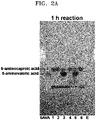
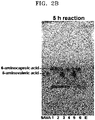
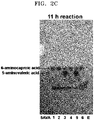
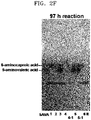
- P. stutzeri CJ-MKB was subjected to an evaluation of deamination reactivity of 5-aminovaleric acid and 6-aminocaproic acid. Since a transaminase reaction is a substitution reaction between an amine group and a ketone group, the substrates and the products were easily identified through a color reaction in which the reaction products that were subjected to material separation using thin layer chromatography (TLC) were able to be easily identified by color reaction of an amine group of ninhydrin. To confirm transaminase activity of P. stutzeri CJ-MKB, a whole cell reaction was performed. When P.
- the reaction volume was 100 ⁇ l, and the production of glutamate and the degree of substrate degradation, which were dependent upon various concentrations of 5-aminovaleric acid, 6-aminocaproic acid, alpha-ketoglutarate, and pyridoxal phosphate and the presence and absence of each substrate, were confirmed on TLC.
- TLC development was completed, a material containing an amine group was developed with the 3% ninhydrin solution. According to the TLC results, it was confirmed that 5-aminovaleric acid and 6-aminocaproic acid was reduced, and glutamate was produced (see FIGS. 2A to 2F ).
- Example 3 Induction of overexpression of a new polypeptide having transaminase activity of the present disclosure in an E. coli strain, and evaluation of reactivity of the polypeptide
- cloning was performed by adding a His-tag at the 5-terminal of the base sequence of argD for the expression.
- recombinant argD derived from the P. stutzeri CJ-MKB was introduced to E. coli Rosetta by using E. coli expression vector pETDuet1 (Merch Millipore, Darmstadt, Germany) to prepare a transformed strain.
- the prepared transformed strain was added to a 3 mL LB broth medium to which 50 mg/ml of ampicillin was added, and the strain was cultured at a temperature of 37°C for 12 hours.
- the cultured strain was cultured at a temperature of 37°C in a 50 mL LB medium containing antibiotics.
- the transformed E. coli Rosetta was named 'E. coli Rosetta CC04-0057', and deposited in the Korean Culture Center of Microorganisms (KCCM) on October 22, 2014 under accession number of KCCM11588P.
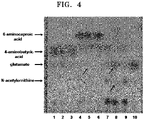
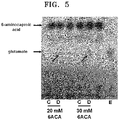
- each of the amino compounds (gamma-aminobutyric acid, 6-aminocaproic acid, and N-acetylornithine) was evaluated using the lysate of E . coli in which N-acetylornithine transaminase of Example 3-1 was overexpressed. 10 mM of each of the three amino compounds, 10 mM alpha-ketoglutarate, and 0.1 mM pyridoxal phosphate were added, and the activity of the overexpressed N-acetylornithine transaminase was evaluated. 50 ⁇ l of the lysate of E.
- N-acetylornithine transaminase was observed to be highly reactive with N-acetylornithine which is known to be an original substrate (Lane 8 of FIG. 4 ).
- N-acetylornithine was significantly decreased while glutamate, which is a co-reactant of transaminase, was significantly increased.
- glutamate which is a co-reactant of transaminase
- Example 4 Evaluation of deamination activity of N-acetylornithine transaminase derived from various Pseudomonas strains
- the deamination activity of the polypeptide for 6-aminocaproic acid was evaluated, wherein the polypeptide was derived from P. stutzeri CJ-MKB and had the transaminase activity of Example 3.
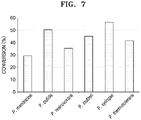
- genes for N-acetylornithine transaminases derived from microorganisms of the genus Pseudomonas such as P. mendocina, P. putida, P. resinovorans, P. syringae, and P. thermotolerans, that are considered to be capable of the same bioconversion reaction as the above, were expressed in E. coli for the evaluation of the reactivity thereof.
- Example 4-1 The genes for N-acetylornithine transaminases of five Pseudomonas strains and the gene for the polypeptide having transaminase activity derived from P. stutzeri CJ-MKB of the present disclosure in Example 4-1 were obtained, and expressed in E. coli in the same manner as in Example 3-1. Then, proteins purified using the His-tag column were obtained. As a result of comparing the obtained proteins on SDS-PAGE gel, it was confirmed that the proteins were purified in a normal manner ( FIG. 6 ).
- Example 4-2 The reactivities of the proteins purified in Example 4-2 for 6-aminocaproic acid were verified (Lanes 3, 5, 7, 9, 11, and 13 of FIG. 6 ).
- each purified N-acetylornithine transaminase was added at a concentration of 0.5 mg/ml of the total reaction solution.
- 50 mM HEPES (pH 8.0) was then added to the mixed solution, and a reaction was performed at a volume of 100 ⁇ l.
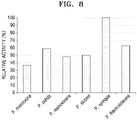
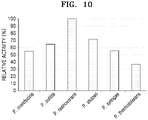
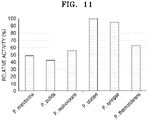
- the reactivities of the N-acetylornithine transaminases which were derived from five microorganisms of the genus Pseudomonas and of which reactivities were identified in Example 4-3, and reactivities of the polypeptide of the present disclosure, were evaluated.
- N-acetylornithine, gamma-aminobutyric acid, or 5-aminovaleric acid was added at a concentration of 10 mM of the total reaction solution, and N-acetylornithine transaminase was added at a concentration of 0.5 mg/ml of the total reaction solution, for a reaction at a temperature of 37°C for 1 hour.
- 10 ⁇ l out of 100 ⁇ l of the reactant was diluted with 180 ⁇ l of 50 mM HEPES buffer (pH 8.0), and 10 ⁇ l of Schiff's reagent was used for a reaction for 30 minutes. Then, a 96-well plate reader was used to compare relative enzymatic activities.
- N-acetylornithine which is known as the original substrate of N-acetylornithine transaminase, showed the highest activity when derived from P. mendocina ( FIG. 9 ).
- Example 5 Evaluation of reverse-reaction activity of polypeptide having transaminase activity derived from P. stutzeri CJ-MKB
- Example 4 it was confirmed that the N-acetylornithine transaminases derived from various Pseudomonas strains and the polypeptide of the present disclosure were converted to adipate semialdehyde and the like by deamination of an amine compound, such as 6-aminocaproic acid.
- Example 5 as a reverse reaction of the reaction of Example 4, for confirming the conversion reactivity from adipate semialdehyde to 6-aminocaproic acid, excess glutamate was treated in the presence of adipate semialdehyde produced by N-acetylornithine transaminase to thereby confirm whether adipate semialdehyde was produced to 6-aminocaproic acid.
- 5 mM 6-aminocaproic acid, 5 mM alpha-ketoglutarate, and 0.1 mM pyridoxal phosphate were prepared with 50 mM HEPES buffer (pH 8.0) at a volume of 100 ⁇ l, and N-acetylornithine transaminases derived from five Pseudomonas strains and the polypeptide of the present disclosure were added thereto at a concentration of 0.5 mg/ml of the total reaction solution, thereby performing a reaction at a temperature of 37°C for 1 hour. After the completion of the reaction, the reaction sample was treated at a temperature of 100°C for at least 5 minutes to thereby remove the enzyme activity.
- the heat-treated sample was centrifuged at a speed of 14,000 rpm for 10 minutes at a temperature 4°C, and then, 10 ⁇ l of the supernatant was diluted with 180 ⁇ l of 50 mM HEPES buffer (pH 8.0) (forward reaction, alpha-ketoglutarate (a-KG) reaction),
- a sample having a volume of 200 ⁇ l was prepared and treated under the same conditions as above. After performing centrifugation thereon, 20 mM glutamate and 0.5 mg/ml of enzyme were added to 97 ⁇ l of the supernatant. Then, at a volume of 100 ⁇ l, the reaction sample was reacted at a temperature of 37°C for 1 hour, followed by treatment at a temperature of 100°C for 5 minutes.
- the obtained sample was reacted with 10 ⁇ l of Schiff's reagent for 30 minutes, and a 96-well plate reader was used to compare the relative enzymatic activities.
- a 96-well plate reader was used to compare the relative enzymatic activities.
Landscapes
- Chemical & Material Sciences (AREA)
- Life Sciences & Earth Sciences (AREA)
- Health & Medical Sciences (AREA)
- Organic Chemistry (AREA)
- Engineering & Computer Science (AREA)
- Genetics & Genomics (AREA)
- Wood Science & Technology (AREA)
- Zoology (AREA)
- Bioinformatics & Cheminformatics (AREA)
- General Engineering & Computer Science (AREA)
- Biotechnology (AREA)
- General Health & Medical Sciences (AREA)
- Biochemistry (AREA)
- Biomedical Technology (AREA)
- Microbiology (AREA)
- Molecular Biology (AREA)
- Chemical Kinetics & Catalysis (AREA)
- General Chemical & Material Sciences (AREA)
- Plant Pathology (AREA)
- Biophysics (AREA)
- Physics & Mathematics (AREA)
- Medicinal Chemistry (AREA)
- Micro-Organisms Or Cultivation Processes Thereof (AREA)
- Enzymes And Modification Thereof (AREA)
- Preparation Of Compounds By Using Micro-Organisms (AREA)
Claims (7)
- Verwendung eines abgetrennten Polypeptids mit Transaminaseaktivität für eine Aminoverbindung zur Transaminierung einer Aminoverbindung, wobei das Polypeptid die Aminosäuresequenz von SEQ ID NO: 7 hat oder eine Aminosäuresequenz, die mindestens 75 % Homologie mit SEQ ID NO:7 aufweist, wobei die Aminoverbindung aus der Gruppe bestehend aus Gamma-Aminobuttersäure, 5-Aminovaleriansäure und 6-Aminocapronsäure ausgewählt ist.
- Verwendung eines Mikroorganismus, der so transformiert ist, dass er ein abgetrenntes Polypeptid mit Transaminaseaktivität für eine Aminoverbindung für die Transaminierung einer Aminoverbindung exprimiert, wobei das Polypeptid die Aminosäuresequenz von SEQ ID NO:7 hat oder eine Aminosäuresequenz, die mindestens 75 % Homologie mit SEQ ID NO:7 aufweist, wobei die Aminoverbindung aus der Gruppe bestehend aus Gamma-Aminobuttersäure, 5-Aminovaleriansäure und 6-Aminocapronsäure ausgewählt ist.
- Verwendung nach Anspruch 2, wobei der Mikroorganismus zur Gattung Escherichia gehört.
- Verwendung nach Anspruch 3, wobei der Mikroorganismus Escherichia coli ist.
- Verfahren zur Desaminierung einer Aminoverbindung, wobei das Verfahren Folgendes umfasst:
Hinzufügen eines abgetrennten Polypeptids mit Transaminaseaktivität für eine Aminoverbindung, wobei das Polypeptid die Aminosäuresequenz von SEQ ID NO:7 hat oder eine Aminosäuresequenz, die mindestens 75 % Homologie mit SEQ ID NO:7 aufweist, oder eines Mikroorganismus, bevorzugt Escherichia, noch mehr bevorzugt Escherichia coli, der so transformiert ist, dass er ein abgetrenntes Polypeptid mit Transaminaseaktivität für eine Aminoverbindung exprimiert, wobei das Polypeptid die Aminosäuresequenz von SEQ ID NO:7 hat oder eine Aminosäuresequenz, die mindestens 75 % Homologie mit SEQ ID NO:7 aufweist, zu einer Lösung, die die Aminoverbindung enthält, wobei die Aminoverbindung mindestens eine ausgewählt aus der Gruppe bestehend aus Gamma-Aminobuttersäure, 5-Aminovaleriansäure und 6-Aminocapronsäure ist. - Verfahren nach Anspruch 5, wobei die Lösung ferner Pyridoxalphosphat enthält, zusätzlich zu mindestens einem ausgewählt aus der Gruppe bestehend aus Pyruvat, Oxalacetat und Alpha-Ketoglutarat.
- Verfahren zur Herstellung einer Aminoverbindung, wobei das Verfahren Folgendes umfasst:
Hinzufügen eines abgetrennten Polypeptids mit Transaminaseaktivität für eine Aminoverbindung, wobei das Polypeptid die Aminosäuresequenz von SEQ ID NO:7 hat oder eine Aminosäuresequenz, die mindestens 75 % Homologie mit SEQ ID NO:7 aufweist, oder eines Mikroorganismus, bevorzugt Escherichia, noch mehr bevorzugt Escherichia coli, der so transformiert ist, dass er ein abgetrenntes Polypeptid mit Transaminaseaktivität für eine Aminoverbindung exprimiert, wobei das Polypeptid die Aminosäuresequenz von SEQ ID NO:7 hat oder eine Aminosäuresequenz, die mindestens 75 % Homologie mit SEQ ID NO:7 aufweist, zu einer Lösung, die eine Semialdehydverbindung enthält, wobei die Semialdehydverbindung mindestens eine ausgewählt aus der Gruppe bestehend aus Succinat-Semialdehyd, Glutarat-Semialdehyd und Adipat-Semialdehyd ist.
Applications Claiming Priority (2)
| Application Number | Priority Date | Filing Date | Title |
|---|---|---|---|
| KR1020150094943A KR20170004510A (ko) | 2015-07-02 | 2015-07-02 | 신규 트랜스아미나제 및 이를 이용한 아미노 화합물의 탈아민 방법 |
| PCT/KR2016/005870 WO2017003104A1 (ko) | 2015-07-02 | 2016-06-03 | 신규 트랜스아미나제 및 이를 이용한 아미노 화합물의 탈아민 방법 |
Publications (3)
| Publication Number | Publication Date |
|---|---|
| EP3318629A1 EP3318629A1 (de) | 2018-05-09 |
| EP3318629A4 EP3318629A4 (de) | 2018-12-12 |
| EP3318629B1 true EP3318629B1 (de) | 2022-07-20 |
Family
ID=57608381
Family Applications (1)
| Application Number | Title | Priority Date | Filing Date |
|---|---|---|---|
| EP16818137.8A Active EP3318629B1 (de) | 2015-07-02 | 2016-06-03 | Neuartige transaminase und verfahren zur deamidierung einer aminoverbindung unter verwendung davon |
Country Status (8)
| Country | Link |
|---|---|
| US (2) | US10538747B2 (de) |
| EP (1) | EP3318629B1 (de) |
| JP (1) | JP6837014B2 (de) |
| KR (1) | KR20170004510A (de) |
| CN (1) | CN107922928B (de) |
| MY (1) | MY190201A (de) |
| RU (1) | RU2718778C9 (de) |
| WO (1) | WO2017003104A1 (de) |
Families Citing this family (1)
| Publication number | Priority date | Publication date | Assignee | Title |
|---|---|---|---|---|
| KR102597723B1 (ko) * | 2021-10-20 | 2023-11-03 | 홍익대학교세종캠퍼스산학협력단 | 5-아미노발레르산으로부터 글루타르산으로의 전환 방법 |
Family Cites Families (11)
| Publication number | Priority date | Publication date | Assignee | Title |
|---|---|---|---|---|
| KR100190501B1 (ko) | 1996-12-20 | 1999-06-01 | 손 경 식 | D-아미노산 아미노트랜스퍼라아제 활성을 갖는 고온성 균주 바실러스 스티아로더모필러스 kl-01 |
| KR100251524B1 (ko) | 1997-11-15 | 2000-04-15 | 박호군 | 고온성미생물바실러스속균주유래의내열성d-아미노산아미노트랜스퍼라아제를암호하는유전자및이를이용한d-아미노산아미노트랜스퍼라아제의제조방법 |
| JP2003159075A (ja) | 2001-11-26 | 2003-06-03 | Tosoh Corp | 蛋白質、それをコードするdna、及び宿主細胞 |
| EP2557160A3 (de) * | 2002-12-09 | 2013-03-27 | Ajinomoto Co., Inc. | Mutierte D-Aminotransferase und Verfahren zur Herstellung optisch aktiver Glutaminsäurederivate damit |
| US8673599B2 (en) | 2008-03-11 | 2014-03-18 | Dsm Ip Assets B.V. | Preparation of 6-aminocaproic acid from 5-formylvaleric acid |
| US8470564B2 (en) | 2009-01-08 | 2013-06-25 | Codexis, Inc. | Transaminase polypeptides |
| ES2644992T3 (es) * | 2009-06-22 | 2017-12-01 | Codexis, Inc. | Reacciones de transaminasa |
| WO2012050125A1 (ja) | 2010-10-14 | 2012-04-19 | 味の素株式会社 | モナティンの製造方法 |
| US8771997B2 (en) | 2011-04-20 | 2014-07-08 | Ajinomoto Co., Inc. | Method for producing monatin using an L-amino acid aminotransferase |
| KR101526047B1 (ko) | 2013-04-26 | 2015-06-04 | 상지대학교산학협력단 | 아미노트랜스퍼라제 활성 강화를 통하여 l-오르니틴 생산능이 향상된 미생물 및 이를 이용한 l-오르니틴의 제조방법 |
| EP3008199A4 (de) | 2013-06-12 | 2017-01-18 | Commonwealth Scientific and Industrial Research Organisation | Transaminase-biokatalysatoren |
-
2015
- 2015-07-02 KR KR1020150094943A patent/KR20170004510A/ko not_active Ceased
-
2016
- 2016-06-03 JP JP2017567772A patent/JP6837014B2/ja active Active
- 2016-06-03 CN CN201680051231.2A patent/CN107922928B/zh active Active
- 2016-06-03 RU RU2018101961A patent/RU2718778C9/ru active
- 2016-06-03 WO PCT/KR2016/005870 patent/WO2017003104A1/ko not_active Ceased
- 2016-06-03 EP EP16818137.8A patent/EP3318629B1/de active Active
- 2016-06-03 US US15/740,666 patent/US10538747B2/en active Active
- 2016-06-03 MY MYPI2017001964A patent/MY190201A/en unknown
-
2019
- 2019-10-22 US US16/659,813 patent/US11091744B2/en active Active
Also Published As
| Publication number | Publication date |
|---|---|
| US10538747B2 (en) | 2020-01-21 |
| US11091744B2 (en) | 2021-08-17 |
| JP2018519828A (ja) | 2018-07-26 |
| EP3318629A1 (de) | 2018-05-09 |
| JP6837014B2 (ja) | 2021-03-03 |
| EP3318629A4 (de) | 2018-12-12 |
| BR112017028617A2 (pt) | 2018-09-04 |
| MY190201A (en) | 2022-04-04 |
| US20200040315A1 (en) | 2020-02-06 |
| RU2018101961A (ru) | 2019-08-05 |
| WO2017003104A1 (ko) | 2017-01-05 |
| CN107922928B (zh) | 2021-09-14 |
| KR20170004510A (ko) | 2017-01-11 |
| RU2718778C2 (ru) | 2020-04-14 |
| RU2018101961A3 (de) | 2019-08-05 |
| RU2718778C9 (ru) | 2020-09-01 |
| CN107922928A (zh) | 2018-04-17 |
| US20190032030A1 (en) | 2019-01-31 |
Similar Documents
| Publication | Publication Date | Title |
|---|---|---|
| US11667936B2 (en) | Modified polypeptide with attenuated activity of citrate synthase and method for producing L-amino acid using the same | |
| CN101688176B (zh) | 具有羧基的酸性物质的生产方法 | |
| US20190169592A1 (en) | Expression system for psicose epimerase and production for psicose using the same | |
| KR101483012B1 (ko) | 재조합 대장균을 이용하여 3-히드록시프로피온산을 고수율로 생산하는 방법 | |
| AU2022286220B2 (en) | Novel yhhs variant and method for producing o-phosphoserine, cysteine, and derivate of cysteine using same | |
| EP3498854B1 (de) | Verfahren zur fermentativen herstellung von l-lysin | |
| US11091744B2 (en) | Transaminases and method, for deaminating amino compound, using same | |
| EP3670526B1 (de) | Verfahren zur fermentativen herstellung von l-lysin unter verwendung von c.-glutamicum-stämmen mit einem mutierten kup-transporter | |
| KR20230149787A (ko) | L-히스티딘 배출 단백질 및 이를 이용한 l-히스티딘 생산 방법 | |
| JP7317810B2 (ja) | コリネ型細菌の形質転換体およびそれを用いる有用化合物の製造方法 | |
| CN116004501A (zh) | Nadp-铁氧还蛋白还原酶突变体及其在生产谷氨酸中的应用 | |
| KR101898171B1 (ko) | 신규 트랜스아미나제 및 이를 이용한 아미노 화합물의 탈아민 방법 | |
| CN114540261A (zh) | 一种产氨基己二酸的基因工程菌 | |
| JP7839035B2 (ja) | 芳香族化合物の製造方法 | |
| KR101716188B1 (ko) | 신규 트랜스아미나제 및 이를 이용한 아미노 화합물의 탈아민 방법 | |
| CN115927325A (zh) | 柠檬酸合酶启动子突变体及其应用 | |
| CN108884465B (zh) | 具有丙烯酸生产能力的修饰的微生物以及利用其制备丙烯酸的方法 | |
| BR112017028617B1 (pt) | Método de desaminação de um composto amino e método de produção de um composto amino | |
| KR101651239B1 (ko) | 신규 슈도모나스 종 균주 및 이를 이용한 6-아미노카프로산의 탈아민 방법 | |
| CN119061006A (zh) | 丙酮酸羧化酶基因启动子的突变体及其在生产氨基酸中的应用 | |
| US20260109957A1 (en) | Novel polynucleotide and method for producing l-alanine using same | |
| CN115948396A (zh) | 谷氨酸脱氢酶启动子突变体及其应用 | |
| TW201033370A (en) | Adipate (ester or thioester) synthesis |
Legal Events
| Date | Code | Title | Description |
|---|---|---|---|
| STAA | Information on the status of an ep patent application or granted ep patent |
Free format text: STATUS: THE INTERNATIONAL PUBLICATION HAS BEEN MADE |
|
| PUAI | Public reference made under article 153(3) epc to a published international application that has entered the european phase |
Free format text: ORIGINAL CODE: 0009012 |
|
| STAA | Information on the status of an ep patent application or granted ep patent |
Free format text: STATUS: REQUEST FOR EXAMINATION WAS MADE |
|
| 17P | Request for examination filed |
Effective date: 20171222 |
|
| AK | Designated contracting states |
Kind code of ref document: A1 Designated state(s): AL AT BE BG CH CY CZ DE DK EE ES FI FR GB GR HR HU IE IS IT LI LT LU LV MC MK MT NL NO PL PT RO RS SE SI SK SM TR |
|
| AX | Request for extension of the european patent |
Extension state: BA ME |
|
| DAV | Request for validation of the european patent (deleted) | ||
| DAX | Request for extension of the european patent (deleted) | ||
| A4 | Supplementary search report drawn up and despatched |
Effective date: 20181113 |
|
| RIC1 | Information provided on ipc code assigned before grant |
Ipc: C12N 9/10 20060101AFI20181102BHEP Ipc: C12P 13/00 20060101ALI20181102BHEP Ipc: C12N 15/52 20060101ALI20181102BHEP Ipc: C12N 15/70 20060101ALI20181102BHEP |
|
| STAA | Information on the status of an ep patent application or granted ep patent |
Free format text: STATUS: EXAMINATION IS IN PROGRESS |
|
| 17Q | First examination report despatched |
Effective date: 20200304 |
|
| GRAP | Despatch of communication of intention to grant a patent |
Free format text: ORIGINAL CODE: EPIDOSNIGR1 |
|
| STAA | Information on the status of an ep patent application or granted ep patent |
Free format text: STATUS: GRANT OF PATENT IS INTENDED |
|
| INTG | Intention to grant announced |
Effective date: 20220216 |
|
| GRAS | Grant fee paid |
Free format text: ORIGINAL CODE: EPIDOSNIGR3 |
|
| GRAA | (expected) grant |
Free format text: ORIGINAL CODE: 0009210 |
|
| STAA | Information on the status of an ep patent application or granted ep patent |
Free format text: STATUS: THE PATENT HAS BEEN GRANTED |
|
| AK | Designated contracting states |
Kind code of ref document: B1 Designated state(s): AL AT BE BG CH CY CZ DE DK EE ES FI FR GB GR HR HU IE IS IT LI LT LU LV MC MK MT NL NO PL PT RO RS SE SI SK SM TR |
|
| REG | Reference to a national code |
Ref country code: CH Ref legal event code: EP |
|
| REG | Reference to a national code |
Ref country code: DE Ref legal event code: R096 Ref document number: 602016073667 Country of ref document: DE |
|
| REG | Reference to a national code |
Ref country code: AT Ref legal event code: REF Ref document number: 1505557 Country of ref document: AT Kind code of ref document: T Effective date: 20220815 |
|
| REG | Reference to a national code |
Ref country code: IE Ref legal event code: FG4D |
|
| REG | Reference to a national code |
Ref country code: LT Ref legal event code: MG9D |
|
| REG | Reference to a national code |
Ref country code: NL Ref legal event code: MP Effective date: 20220720 |
|
| PG25 | Lapsed in a contracting state [announced via postgrant information from national office to epo] |
Ref country code: SE Free format text: LAPSE BECAUSE OF FAILURE TO SUBMIT A TRANSLATION OF THE DESCRIPTION OR TO PAY THE FEE WITHIN THE PRESCRIBED TIME-LIMIT Effective date: 20220720 Ref country code: RS Free format text: LAPSE BECAUSE OF FAILURE TO SUBMIT A TRANSLATION OF THE DESCRIPTION OR TO PAY THE FEE WITHIN THE PRESCRIBED TIME-LIMIT Effective date: 20220720 Ref country code: PT Free format text: LAPSE BECAUSE OF FAILURE TO SUBMIT A TRANSLATION OF THE DESCRIPTION OR TO PAY THE FEE WITHIN THE PRESCRIBED TIME-LIMIT Effective date: 20221121 Ref country code: NO Free format text: LAPSE BECAUSE OF FAILURE TO SUBMIT A TRANSLATION OF THE DESCRIPTION OR TO PAY THE FEE WITHIN THE PRESCRIBED TIME-LIMIT Effective date: 20221020 Ref country code: NL Free format text: LAPSE BECAUSE OF FAILURE TO SUBMIT A TRANSLATION OF THE DESCRIPTION OR TO PAY THE FEE WITHIN THE PRESCRIBED TIME-LIMIT Effective date: 20220720 Ref country code: LV Free format text: LAPSE BECAUSE OF FAILURE TO SUBMIT A TRANSLATION OF THE DESCRIPTION OR TO PAY THE FEE WITHIN THE PRESCRIBED TIME-LIMIT Effective date: 20220720 Ref country code: LT Free format text: LAPSE BECAUSE OF FAILURE TO SUBMIT A TRANSLATION OF THE DESCRIPTION OR TO PAY THE FEE WITHIN THE PRESCRIBED TIME-LIMIT Effective date: 20220720 Ref country code: FI Free format text: LAPSE BECAUSE OF FAILURE TO SUBMIT A TRANSLATION OF THE DESCRIPTION OR TO PAY THE FEE WITHIN THE PRESCRIBED TIME-LIMIT Effective date: 20220720 Ref country code: ES Free format text: LAPSE BECAUSE OF FAILURE TO SUBMIT A TRANSLATION OF THE DESCRIPTION OR TO PAY THE FEE WITHIN THE PRESCRIBED TIME-LIMIT Effective date: 20220720 |
|
| REG | Reference to a national code |
Ref country code: AT Ref legal event code: MK05 Ref document number: 1505557 Country of ref document: AT Kind code of ref document: T Effective date: 20220720 |
|
| PG25 | Lapsed in a contracting state [announced via postgrant information from national office to epo] |
Ref country code: PL Free format text: LAPSE BECAUSE OF FAILURE TO SUBMIT A TRANSLATION OF THE DESCRIPTION OR TO PAY THE FEE WITHIN THE PRESCRIBED TIME-LIMIT Effective date: 20220720 Ref country code: IS Free format text: LAPSE BECAUSE OF FAILURE TO SUBMIT A TRANSLATION OF THE DESCRIPTION OR TO PAY THE FEE WITHIN THE PRESCRIBED TIME-LIMIT Effective date: 20221120 Ref country code: HR Free format text: LAPSE BECAUSE OF FAILURE TO SUBMIT A TRANSLATION OF THE DESCRIPTION OR TO PAY THE FEE WITHIN THE PRESCRIBED TIME-LIMIT Effective date: 20220720 Ref country code: GR Free format text: LAPSE BECAUSE OF FAILURE TO SUBMIT A TRANSLATION OF THE DESCRIPTION OR TO PAY THE FEE WITHIN THE PRESCRIBED TIME-LIMIT Effective date: 20221021 |
|
| REG | Reference to a national code |
Ref country code: DE Ref legal event code: R097 Ref document number: 602016073667 Country of ref document: DE |
|
| PG25 | Lapsed in a contracting state [announced via postgrant information from national office to epo] |
Ref country code: SM Free format text: LAPSE BECAUSE OF FAILURE TO SUBMIT A TRANSLATION OF THE DESCRIPTION OR TO PAY THE FEE WITHIN THE PRESCRIBED TIME-LIMIT Effective date: 20220720 Ref country code: RO Free format text: LAPSE BECAUSE OF FAILURE TO SUBMIT A TRANSLATION OF THE DESCRIPTION OR TO PAY THE FEE WITHIN THE PRESCRIBED TIME-LIMIT Effective date: 20220720 Ref country code: DK Free format text: LAPSE BECAUSE OF FAILURE TO SUBMIT A TRANSLATION OF THE DESCRIPTION OR TO PAY THE FEE WITHIN THE PRESCRIBED TIME-LIMIT Effective date: 20220720 Ref country code: CZ Free format text: LAPSE BECAUSE OF FAILURE TO SUBMIT A TRANSLATION OF THE DESCRIPTION OR TO PAY THE FEE WITHIN THE PRESCRIBED TIME-LIMIT Effective date: 20220720 Ref country code: AT Free format text: LAPSE BECAUSE OF FAILURE TO SUBMIT A TRANSLATION OF THE DESCRIPTION OR TO PAY THE FEE WITHIN THE PRESCRIBED TIME-LIMIT Effective date: 20220720 |
|
| PLBE | No opposition filed within time limit |
Free format text: ORIGINAL CODE: 0009261 |
|
| STAA | Information on the status of an ep patent application or granted ep patent |
Free format text: STATUS: NO OPPOSITION FILED WITHIN TIME LIMIT |
|
| PG25 | Lapsed in a contracting state [announced via postgrant information from national office to epo] |
Ref country code: SK Free format text: LAPSE BECAUSE OF FAILURE TO SUBMIT A TRANSLATION OF THE DESCRIPTION OR TO PAY THE FEE WITHIN THE PRESCRIBED TIME-LIMIT Effective date: 20220720 Ref country code: EE Free format text: LAPSE BECAUSE OF FAILURE TO SUBMIT A TRANSLATION OF THE DESCRIPTION OR TO PAY THE FEE WITHIN THE PRESCRIBED TIME-LIMIT Effective date: 20220720 |
|
| 26N | No opposition filed |
Effective date: 20230421 |
|
| PG25 | Lapsed in a contracting state [announced via postgrant information from national office to epo] |
Ref country code: AL Free format text: LAPSE BECAUSE OF FAILURE TO SUBMIT A TRANSLATION OF THE DESCRIPTION OR TO PAY THE FEE WITHIN THE PRESCRIBED TIME-LIMIT Effective date: 20220720 |
|
| P01 | Opt-out of the competence of the unified patent court (upc) registered |
Effective date: 20230606 |
|
| PG25 | Lapsed in a contracting state [announced via postgrant information from national office to epo] |
Ref country code: SI Free format text: LAPSE BECAUSE OF FAILURE TO SUBMIT A TRANSLATION OF THE DESCRIPTION OR TO PAY THE FEE WITHIN THE PRESCRIBED TIME-LIMIT Effective date: 20220720 |
|
| PG25 | Lapsed in a contracting state [announced via postgrant information from national office to epo] |
Ref country code: MC Free format text: LAPSE BECAUSE OF FAILURE TO SUBMIT A TRANSLATION OF THE DESCRIPTION OR TO PAY THE FEE WITHIN THE PRESCRIBED TIME-LIMIT Effective date: 20220720 |
|
| PG25 | Lapsed in a contracting state [announced via postgrant information from national office to epo] |
Ref country code: MC Free format text: LAPSE BECAUSE OF FAILURE TO SUBMIT A TRANSLATION OF THE DESCRIPTION OR TO PAY THE FEE WITHIN THE PRESCRIBED TIME-LIMIT Effective date: 20220720 |
|
| REG | Reference to a national code |
Ref country code: CH Ref legal event code: PL |
|
| REG | Reference to a national code |
Ref country code: BE Ref legal event code: MM Effective date: 20230630 |
|
| PG25 | Lapsed in a contracting state [announced via postgrant information from national office to epo] |
Ref country code: LU Free format text: LAPSE BECAUSE OF NON-PAYMENT OF DUE FEES Effective date: 20230603 |
|
| REG | Reference to a national code |
Ref country code: IE Ref legal event code: MM4A |
|
| PG25 | Lapsed in a contracting state [announced via postgrant information from national office to epo] |
Ref country code: LU Free format text: LAPSE BECAUSE OF NON-PAYMENT OF DUE FEES Effective date: 20230603 |
|
| PG25 | Lapsed in a contracting state [announced via postgrant information from national office to epo] |
Ref country code: IE Free format text: LAPSE BECAUSE OF NON-PAYMENT OF DUE FEES Effective date: 20230603 |
|
| PG25 | Lapsed in a contracting state [announced via postgrant information from national office to epo] |
Ref country code: IE Free format text: LAPSE BECAUSE OF NON-PAYMENT OF DUE FEES Effective date: 20230603 Ref country code: CH Free format text: LAPSE BECAUSE OF NON-PAYMENT OF DUE FEES Effective date: 20230630 |
|
| PG25 | Lapsed in a contracting state [announced via postgrant information from national office to epo] |
Ref country code: BE Free format text: LAPSE BECAUSE OF NON-PAYMENT OF DUE FEES Effective date: 20230630 |
|
| PG25 | Lapsed in a contracting state [announced via postgrant information from national office to epo] |
Ref country code: BG Free format text: LAPSE BECAUSE OF FAILURE TO SUBMIT A TRANSLATION OF THE DESCRIPTION OR TO PAY THE FEE WITHIN THE PRESCRIBED TIME-LIMIT Effective date: 20220720 |
|
| PG25 | Lapsed in a contracting state [announced via postgrant information from national office to epo] |
Ref country code: BG Free format text: LAPSE BECAUSE OF FAILURE TO SUBMIT A TRANSLATION OF THE DESCRIPTION OR TO PAY THE FEE WITHIN THE PRESCRIBED TIME-LIMIT Effective date: 20220720 |
|
| PGFP | Annual fee paid to national office [announced via postgrant information from national office to epo] |
Ref country code: DE Payment date: 20250220 Year of fee payment: 10 |
|
| PGFP | Annual fee paid to national office [announced via postgrant information from national office to epo] |
Ref country code: GB Payment date: 20250407 Year of fee payment: 10 |
|
| PG25 | Lapsed in a contracting state [announced via postgrant information from national office to epo] |
Ref country code: CY Free format text: LAPSE BECAUSE OF FAILURE TO SUBMIT A TRANSLATION OF THE DESCRIPTION OR TO PAY THE FEE WITHIN THE PRESCRIBED TIME-LIMIT; INVALID AB INITIO Effective date: 20160603 |
|
| PG25 | Lapsed in a contracting state [announced via postgrant information from national office to epo] |
Ref country code: HU Free format text: LAPSE BECAUSE OF FAILURE TO SUBMIT A TRANSLATION OF THE DESCRIPTION OR TO PAY THE FEE WITHIN THE PRESCRIBED TIME-LIMIT; INVALID AB INITIO Effective date: 20160603 |
|
| PG25 | Lapsed in a contracting state [announced via postgrant information from national office to epo] |
Ref country code: TR Free format text: LAPSE BECAUSE OF FAILURE TO SUBMIT A TRANSLATION OF THE DESCRIPTION OR TO PAY THE FEE WITHIN THE PRESCRIBED TIME-LIMIT Effective date: 20220720 |
|
| PGFP | Annual fee paid to national office [announced via postgrant information from national office to epo] |
Ref country code: IT Payment date: 20260223 Year of fee payment: 11 |
|
| PGFP | Annual fee paid to national office [announced via postgrant information from national office to epo] |
Ref country code: FR Payment date: 20260224 Year of fee payment: 11 |