EP3310866B1 - Copolymere aus cyclischen exo-vinylencarbonatacrylaten - Google Patents
Copolymere aus cyclischen exo-vinylencarbonatacrylaten Download PDFInfo
- Publication number
- EP3310866B1 EP3310866B1 EP16732476.3A EP16732476A EP3310866B1 EP 3310866 B1 EP3310866 B1 EP 3310866B1 EP 16732476 A EP16732476 A EP 16732476A EP 3310866 B1 EP3310866 B1 EP 3310866B1
- Authority
- EP
- European Patent Office
- Prior art keywords
- group
- groups
- formula
- monomers
- copolymer
- Prior art date
- Legal status (The legal status is an assumption and is not a legal conclusion. Google has not performed a legal analysis and makes no representation as to the accuracy of the status listed.)
- Active
Links
Classifications
-
- C—CHEMISTRY; METALLURGY
- C08—ORGANIC MACROMOLECULAR COMPOUNDS; THEIR PREPARATION OR CHEMICAL WORKING-UP; COMPOSITIONS BASED THEREON
- C08F—MACROMOLECULAR COMPOUNDS OBTAINED BY REACTIONS ONLY INVOLVING CARBON-TO-CARBON UNSATURATED BONDS
- C08F220/00—Copolymers of compounds having one or more unsaturated aliphatic radicals, each having only one carbon-to-carbon double bond, and only one being terminated by only one carboxyl radical or a salt, anhydride ester, amide, imide or nitrile thereof
- C08F220/02—Monocarboxylic acids having less than ten carbon atoms; Derivatives thereof
- C08F220/10—Esters
- C08F220/12—Esters of monohydric alcohols or phenols
- C08F220/16—Esters of monohydric alcohols or phenols of phenols or of alcohols containing two or more carbon atoms
- C08F220/18—Esters of monohydric alcohols or phenols of phenols or of alcohols containing two or more carbon atoms with acrylic or methacrylic acids
- C08F220/1804—C4-(meth)acrylate, e.g. butyl (meth)acrylate, isobutyl (meth)acrylate or tert-butyl (meth)acrylate
-
- B—PERFORMING OPERATIONS; TRANSPORTING
- B32—LAYERED PRODUCTS
- B32B—LAYERED PRODUCTS, i.e. PRODUCTS BUILT-UP OF STRATA OF FLAT OR NON-FLAT, e.g. CELLULAR OR HONEYCOMB, FORM
- B32B27/00—Layered products comprising a layer of synthetic resin
-
- B—PERFORMING OPERATIONS; TRANSPORTING
- B32—LAYERED PRODUCTS
- B32B—LAYERED PRODUCTS, i.e. PRODUCTS BUILT-UP OF STRATA OF FLAT OR NON-FLAT, e.g. CELLULAR OR HONEYCOMB, FORM
- B32B27/00—Layered products comprising a layer of synthetic resin
- B32B27/06—Layered products comprising a layer of synthetic resin as the main or only constituent of a layer, which is next to another layer of the same or of a different material
- B32B27/08—Layered products comprising a layer of synthetic resin as the main or only constituent of a layer, which is next to another layer of the same or of a different material of synthetic resin
-
- B—PERFORMING OPERATIONS; TRANSPORTING
- B32—LAYERED PRODUCTS
- B32B—LAYERED PRODUCTS, i.e. PRODUCTS BUILT-UP OF STRATA OF FLAT OR NON-FLAT, e.g. CELLULAR OR HONEYCOMB, FORM
- B32B27/00—Layered products comprising a layer of synthetic resin
- B32B27/32—Layered products comprising a layer of synthetic resin comprising polyolefins
-
- B—PERFORMING OPERATIONS; TRANSPORTING
- B32—LAYERED PRODUCTS
- B32B—LAYERED PRODUCTS, i.e. PRODUCTS BUILT-UP OF STRATA OF FLAT OR NON-FLAT, e.g. CELLULAR OR HONEYCOMB, FORM
- B32B27/00—Layered products comprising a layer of synthetic resin
- B32B27/36—Layered products comprising a layer of synthetic resin comprising polyesters
-
- B—PERFORMING OPERATIONS; TRANSPORTING
- B32—LAYERED PRODUCTS
- B32B—LAYERED PRODUCTS, i.e. PRODUCTS BUILT-UP OF STRATA OF FLAT OR NON-FLAT, e.g. CELLULAR OR HONEYCOMB, FORM
- B32B37/00—Methods or apparatus for laminating, e.g. by curing or by ultrasonic bonding
- B32B37/12—Methods or apparatus for laminating, e.g. by curing or by ultrasonic bonding characterised by using adhesives
-
- B—PERFORMING OPERATIONS; TRANSPORTING
- B32—LAYERED PRODUCTS
- B32B—LAYERED PRODUCTS, i.e. PRODUCTS BUILT-UP OF STRATA OF FLAT OR NON-FLAT, e.g. CELLULAR OR HONEYCOMB, FORM
- B32B7/00—Layered products characterised by the relation between layers; Layered products characterised by the relative orientation of features between layers, or by the relative values of a measurable parameter between layers, i.e. products comprising layers having different physical, chemical or physicochemical properties; Layered products characterised by the interconnection of layers
-
- B—PERFORMING OPERATIONS; TRANSPORTING
- B32—LAYERED PRODUCTS
- B32B—LAYERED PRODUCTS, i.e. PRODUCTS BUILT-UP OF STRATA OF FLAT OR NON-FLAT, e.g. CELLULAR OR HONEYCOMB, FORM
- B32B7/00—Layered products characterised by the relation between layers; Layered products characterised by the relative orientation of features between layers, or by the relative values of a measurable parameter between layers, i.e. products comprising layers having different physical, chemical or physicochemical properties; Layered products characterised by the interconnection of layers
- B32B7/04—Interconnection of layers
- B32B7/12—Interconnection of layers using interposed adhesives or interposed materials with bonding properties
-
- C—CHEMISTRY; METALLURGY
- C08—ORGANIC MACROMOLECULAR COMPOUNDS; THEIR PREPARATION OR CHEMICAL WORKING-UP; COMPOSITIONS BASED THEREON
- C08F—MACROMOLECULAR COMPOUNDS OBTAINED BY REACTIONS ONLY INVOLVING CARBON-TO-CARBON UNSATURATED BONDS
- C08F226/00—Copolymers of compounds having one or more unsaturated aliphatic radicals, each having only one carbon-to-carbon double bond, and at least one being terminated by a single or double bond to nitrogen or by a heterocyclic ring containing nitrogen
-
- C—CHEMISTRY; METALLURGY
- C08—ORGANIC MACROMOLECULAR COMPOUNDS; THEIR PREPARATION OR CHEMICAL WORKING-UP; COMPOSITIONS BASED THEREON
- C08G—MACROMOLECULAR COMPOUNDS OBTAINED OTHERWISE THAN BY REACTIONS ONLY INVOLVING UNSATURATED CARBON-TO-CARBON BONDS
- C08G71/00—Macromolecular compounds obtained by reactions forming a ureide or urethane link, otherwise, than from isocyanate radicals in the main chain of the macromolecule
- C08G71/04—Polyurethanes
-
- C—CHEMISTRY; METALLURGY
- C09—DYES; PAINTS; POLISHES; NATURAL RESINS; ADHESIVES; COMPOSITIONS NOT OTHERWISE PROVIDED FOR; APPLICATIONS OF MATERIALS NOT OTHERWISE PROVIDED FOR
- C09D—COATING COMPOSITIONS, e.g. PAINTS, VARNISHES OR LACQUERS; FILLING PASTES; CHEMICAL PAINT OR INK REMOVERS; INKS; CORRECTING FLUIDS; WOODSTAINS; PASTES OR SOLIDS FOR COLOURING OR PRINTING; USE OF MATERIALS THEREFOR
- C09D11/00—Inks
- C09D11/02—Printing inks
- C09D11/10—Printing inks based on artificial resins
- C09D11/106—Printing inks based on artificial resins containing macromolecular compounds obtained by reactions only involving carbon-to-carbon unsaturated bonds
- C09D11/107—Printing inks based on artificial resins containing macromolecular compounds obtained by reactions only involving carbon-to-carbon unsaturated bonds from unsaturated acids or derivatives thereof
-
- C—CHEMISTRY; METALLURGY
- C09—DYES; PAINTS; POLISHES; NATURAL RESINS; ADHESIVES; COMPOSITIONS NOT OTHERWISE PROVIDED FOR; APPLICATIONS OF MATERIALS NOT OTHERWISE PROVIDED FOR
- C09D—COATING COMPOSITIONS, e.g. PAINTS, VARNISHES OR LACQUERS; FILLING PASTES; CHEMICAL PAINT OR INK REMOVERS; INKS; CORRECTING FLUIDS; WOODSTAINS; PASTES OR SOLIDS FOR COLOURING OR PRINTING; USE OF MATERIALS THEREFOR
- C09D135/00—Coating compositions based on homopolymers or copolymers of compounds having one or more unsaturated aliphatic radicals, each having only one carbon-to-carbon double bond, and at least one being terminated by a carboxyl radical, and containing at least another carboxyl radical in the molecule, or of salts, anhydrides, esters, amides, imides or nitriles thereof; Coating compositions based on derivatives of such polymers
- C09D135/02—Homopolymers or copolymers of esters
-
- C—CHEMISTRY; METALLURGY
- C09—DYES; PAINTS; POLISHES; NATURAL RESINS; ADHESIVES; COMPOSITIONS NOT OTHERWISE PROVIDED FOR; APPLICATIONS OF MATERIALS NOT OTHERWISE PROVIDED FOR
- C09J—ADHESIVES; NON-MECHANICAL ASPECTS OF ADHESIVE PROCESSES IN GENERAL; ADHESIVE PROCESSES NOT PROVIDED FOR ELSEWHERE; USE OF MATERIALS AS ADHESIVES
- C09J133/00—Adhesives based on homopolymers or copolymers of compounds having one or more unsaturated aliphatic radicals, each having only one carbon-to-carbon double bond, and at least one being terminated by only one carboxyl radical, or of salts, anhydrides, esters, amides, imides, or nitriles thereof; Adhesives based on derivatives of such polymers
- C09J133/04—Homopolymers or copolymers of esters
- C09J133/06—Homopolymers or copolymers of esters of esters containing only carbon, hydrogen and oxygen, the oxygen atom being present only as part of the carboxyl radical
- C09J133/08—Homopolymers or copolymers of acrylic acid esters
-
- C—CHEMISTRY; METALLURGY
- C09—DYES; PAINTS; POLISHES; NATURAL RESINS; ADHESIVES; COMPOSITIONS NOT OTHERWISE PROVIDED FOR; APPLICATIONS OF MATERIALS NOT OTHERWISE PROVIDED FOR
- C09J—ADHESIVES; NON-MECHANICAL ASPECTS OF ADHESIVE PROCESSES IN GENERAL; ADHESIVE PROCESSES NOT PROVIDED FOR ELSEWHERE; USE OF MATERIALS AS ADHESIVES
- C09J135/00—Adhesives based on homopolymers or copolymers of compounds having one or more unsaturated aliphatic radicals, each having only one carbon-to-carbon double bond, and at least one being terminated by a carboxyl radical, and containing at least another carboxyl radical in the molecule, or of salts, anhydrides, esters, amides, imides or nitriles thereof; Adhesives based on derivatives of such polymers
- C09J135/02—Homopolymers or copolymers of esters
-
- C—CHEMISTRY; METALLURGY
- C09—DYES; PAINTS; POLISHES; NATURAL RESINS; ADHESIVES; COMPOSITIONS NOT OTHERWISE PROVIDED FOR; APPLICATIONS OF MATERIALS NOT OTHERWISE PROVIDED FOR
- C09J—ADHESIVES; NON-MECHANICAL ASPECTS OF ADHESIVE PROCESSES IN GENERAL; ADHESIVE PROCESSES NOT PROVIDED FOR ELSEWHERE; USE OF MATERIALS AS ADHESIVES
- C09J175/00—Adhesives based on polyureas or polyurethanes; Adhesives based on derivatives of such polymers
- C09J175/04—Polyurethanes
-
- B—PERFORMING OPERATIONS; TRANSPORTING
- B32—LAYERED PRODUCTS
- B32B—LAYERED PRODUCTS, i.e. PRODUCTS BUILT-UP OF STRATA OF FLAT OR NON-FLAT, e.g. CELLULAR OR HONEYCOMB, FORM
- B32B37/00—Methods or apparatus for laminating, e.g. by curing or by ultrasonic bonding
- B32B37/12—Methods or apparatus for laminating, e.g. by curing or by ultrasonic bonding characterised by using adhesives
- B32B2037/1269—Methods or apparatus for laminating, e.g. by curing or by ultrasonic bonding characterised by using adhesives multi-component adhesive
Definitions
- the invention relates to copolymers of (a) monomers M1 of the formula wherein R 1 is an organic radical with a (meth)acrylic group, R 2 , R 3 and R 4 independently represent an H atom or a C1 to C10 alkyl group; and (b) ethylenically unsaturated, free-radically copolymerizable monomers M2 that are different from the monomers M1. Also described are two-component adhesives which contain the copolymers and a polyfunctional hardener. The copolymers and the two-part adhesives can be used as laminating adhesives.
- laminating adhesives Two-component systems in which isocyanate components react with polyol components to form a high-molecular polymer are often used as laminating adhesives (also called laminating adhesives) for flexible food packaging. These systems are applied either as solvent-free and water-free reactive 100% systems or as an adhesive dissolved in an organic solvent. The adhesives are applied to a plastic or aluminum foil or paper using a suitable application system and then, if necessary after the solvent has evaporated, a second film is laminated on under pressure and possibly at an increased temperature. In such a process, laminates can be produced that consist of two or more foils or paper layers.
- the reactive isocyanates contained in conventional laminating adhesives pose a toxicological risk.
- WO 2011/157671 discloses a cyclic carbonate compound having a double bond directly on the ring system, which is also referred to as exo-vinylene carbonate. There are no descriptions of cyclic exo-vinylene carbonate compounds which have a polymerizable acrylate group.
- the polymerizable double bond is here via a spacer to the exo-vinylene group of the exo-vinylene carbonate WO 2011/157671 bound.
- the cyclic carbonate compounds WO 2013/144299 are polymerized and find a wide variety of uses as polymers or copolymers. However, the reactivities are not yet fully sufficient for use in two-component adhesives.
- the object of the invention was to make available a suitable alternative, isocyanate-free laminating adhesive for flexible packaging.
- This adhesive should be able to build up sufficiently high bond strengths in the packaging laminate in a short time.
- the laminating adhesive according to the invention can be applied as a solution in an organic solvent or as a solvent-free and water-free one hundred percent system.
- the monomers M1 are preferably used in an amount of at least 1% by weight, in particular at least 5% by weight or at least 10% by weight, for example from 5 to 50% by weight, particularly preferably from 15 to 35% by weight, based on the total amount all monomers used.
- the monomers M2 are preferably used in an amount of 1 to 99% by weight, more preferably 50 to 95% by weight or 65 to 85% by weight, based on the total amount of all monomers.
- R 1 represents an organic residue having a (meth)acrylic group.
- R 2 , R 3 and R 4 independently represent an H atom or a C1 to C10 alkyl group. links of the formula I are also referred to below as ExoVC-(meth)acrylates.
- R 1 is preferably an organic radical having a maximum of 24 carbon atoms, in particular a maximum of 18 carbon atoms and particularly preferably a maximum of 14 carbon atoms.
- R 1 can contain further heteroatoms such as nitrogen or sulfur.
- R 1 consists exclusively of carbon, hydrogen and oxygen and therefore contains no further heteroatoms apart from oxygen atoms.
- Oxygen atoms are found in the acrylic group or methacrylic group, (meth)acrylic group for short and optionally in other functional groups such as ether groups, hydroxyl groups or carbonyl groups.
- R 1 contains oxygen in the (meth)acrylic group and, moreover, only in any ether groups that may be present.
- R 1 is particularly preferably one of the following groups of the formula (II), (III) or (IV).
- X represents a bond or an alkylene group having 1 to 18 carbon atoms and R 5 represents an H atom or a methyl group.
- X preferably represents an alkylene group having 1 to 18 carbon atoms.
- the alkylene group can be a linear or branched alkylene group. It is particularly preferably an alkylene group having 1 to 10 carbon atoms. In particular, it is a linear C1 to C10 alkylene group. In a particular embodiment, it is a linear C2 to C8 alkylene group. In particular, it is a linear C2 to C6 alkylene group, for example an ethylene, n-propylene or n-butylene group; very particularly preferably X is an n-propylene group.
- m and p are independently 0 or an integer from 1 to 10, R 5 has the above meaning and R 6 is an H atom or a C1 to C10 alkyl group.
- m is preferably an integer from 1 to 10, in particular an integer from 1 to 6, very particularly preferably m is 1.
- p is preferably 0 or an integer from 1 to 6, in particular p is an integer A number from 1 to 6, very particularly preferably p is 1.
- m and p are independently an integer from 1 to 6.
- both m and p are for 1.
- R 6 preferably represents an H atom or a C1 to C6 alkyl group.
- R 6 is a C1 to C6 alkyl group, for example a methyl group or ethyl group, in particular an ethyl group.
- s and t are independently 0 or an integer from 1 to 10, R 5 has the above meaning and R 7 is an H atom or a C1 to C10 alkyl group.
- R 7 is an H atom or a C1 to C10 alkyl group.
- s and t independently of one another, are an integer from 1 to 10, in particular an integer from 1 to 6.
- both s and t are 1.
- R 7 is preferably an H atom or a C1 - up to C6 alkyl group.
- R 7 is an H atom.
- R 2 preferably represents an H atom or a C1 to C6 alkyl group.
- R 2 is a C1 to C6 alkyl group, particularly preferably a methyl group.
- R 3 and R 4 independently represent an H atom or a C1 to C10 alkyl group.
- the alkyl group is in particular a C1 to C6 alkyl group, preferably a C1 to C3 alkyl group and in a particular embodiment a methyl group.
- At least one of the radicals R 3 and R 4 is preferably an H atom.
- both R 3 and R 4 are an H atom or one of R 3 and R 4 is an H atom and the other is an alkyl group, in particular a methyl or ethyl group.
- both R 3 and R 4 are an H atom.
- R5 is preferably an H atom in all compounds of the formula I (or of the formulas II to IV), and compounds of the formula I are therefore preferably acrylic compounds.
- Particularly preferred compounds of the formula I are those in which R 1 is a group of the formula (II) or (III), in particular a group of the formula (II).
- the reaction of the first step is a per se known addition of triple bonds to a carbonyl group.
- Suitable compounds with a terminal triple bond are, in particular, compounds of the formula V Y-CH ⁇ CH, where Y is an H atom, a hydrocarbon group having 1 to 10 carbon atoms, for example an alkyl or aryl group, or a protective group having a maximum of 10 carbon atoms. If Y is not a protective group, the substituents of the Y-substituted C atom determine the later radicals R3 and R4 in formula I. Starting from formula V, one of the radicals R3 or R4 in formula I is therefore an H atom and the other Y. The preferred meanings of Y therefore correspond to the above preferred meanings of R3 and R4, respectively.
- Y can also represent a protecting group.
- Protective groups are split off again during or after the synthesis has taken place, so that in this case the later radicals R3 and R4 in formula I both stand for an H atom.
- a suitable protective group is e.g. the trimethylsilyl group (TMS for short)
- Preferred hydroxyalkanones or hydroxyalkanals are compounds of formula VI wherein R2 is an H atom or a C1 to C10 alkyl group.
- R2 corresponds to R2 in formula I; in a preferred embodiment, R2 is a methyl group.
- X corresponds to X in formula II.
- the starting compounds are preferably reacted in the presence of a strong base.
- Preferred strong bases are metal alkoxides. These are preferably metal salts of aliphatic alcohols, in particular metal salts of C1 to C8, preferably C2 to C6, alcohols, such as ethanol, n-propanol, isopropanol, n-butanol or tertiary butanol.
- the metal cations of the metal alkoxides are preferably alkali metal cations, for example the cations of sodium or potassium. Examples of preferred metal alkoxides which may be mentioned are potassium tertiary butylate, sodium tertiary butylate, potassium isopropylate and sodium isopropylate.
- the reaction is preferably carried out in the presence of a solvent.
- Inert solvents are preferred as solvents; these do not contain any reactive groups which react with the starting compounds.
- Inert, polar, aprotic solvents are particularly preferred. Examples of such compounds which may be mentioned are cyclic ether compounds, in particular THF.
- the reaction is generally exothermic, so the reaction is preferably cooled.
- the temperature of the reaction mixture is preferably at most 50° C., in particular at most 25° C.; preferably it is between 0 and 25°C.
- a non-polar organic solvent can be added to work up the resulting product mixture.
- the organic solvent can be dispensed with. Two phases are formed, of which the organic phase contains the product of the 1st stage (addition products).
- the organic phase can be dried to remove water. Solvent can easily be removed by distillation.
- the product can be obtained in pure form by vacuum distillation.
- the work-up can also be carried out by conventional crystallization or extraction processes, particularly if the product of the 1st stage has a very high boiling point.
- a hydroxy group of the obtained dihydroxy compound is protected with a protective group.
- the hydroxy group, which has emerged from the carbonyl group, is reacted with CO 2 in the third stage to form the carbonate ring.
- the hydroxy group of the starting compound that is already present before the 1st stage is protected in order to avoid side reactions.
- Ester groups are particularly suitable as protective groups.
- the starting hydroxy group is reacted with an acid or an acid derivative.
- the reaction with a carboxylic acid e.g. formic acid or acetic acid, or in particular with a carboxylic acid derivative, e.g. a carboxylic acid anhydride, carboxylic acid ester or carboxylic acid chloride, is preferred.
- the parent hydroxy group is much more reactive than the hydroxy group derived from the carbonyl group. Therefore, only the ester of the starting hydroxy group is initially formed during the esterification. The esterification is terminated before appreciable esterification with the other hydroxy group is observed. The reaction can be checked by gas chromatography.
- the esterification can be carried out according to usual methods. During the reaction, the temperature is preferably raised only slowly, so that the progress of the ester formation can be monitored well chromatographically and the reaction can be terminated in good time.
- the reaction can take place, for example, at temperatures of from 0 to 100° C., preferably between 0 and 40°C.
- the ester obtained can be purified by distillation. In the case of high boiling points, work-up and purification by crystallization or extraction can also be considered.
- ring closure takes place with carbon dioxide to form the cyclic carbonate group.
- carbon dioxide is brought into contact with the ester under pressure, preferably in gaseous form or in a supercritical state.
- the reaction is therefore preferably carried out in an autoclave.
- Carbon dioxide can also be used in a mixture with inert gas.
- the reaction preferably takes place in the presence of catalysts. It is preferably carried out in the presence of a base catalyst or, more preferably, in the presence of a base/metal salt catalyst system.
- a base catalyst or, more preferably, in the presence of a base/metal salt catalyst system.
- Such bases are known. They usually have a molecular weight below 500 g/mol, in particular below 300 g/mol. In particular, these are aliphatic or cycloaliphatic compounds.
- the metal salt is preferably a salt with one to three valent cations, in particular cations of Cu, Ag or Au.
- the anion of the metal salts is preferably a carboxylate, especially a C1 to C6 carboxylate. Silver acetate or copper acetate may be mentioned as preferred metal salts.
- Phosphanes can also be used as catalysts.
- these are trialkyl or triarylphosphines. These can be used alone or also in combination with a metal salt.
- the reaction is preferably carried out at a pressure of from 1 to 100 bar, in particular from 5 to 70 bar.
- the temperature of the reaction mixture is preferably from 10 to 100.degree. C., in particular from 10 to 80.degree.
- the reaction can be monitored, for example, by gas chromatography.
- the product obtained can be worked up.
- An organic solvent preferably an inert, hydrophobic organic solvent such as dichloromethane or toluene, and aqueous acid, e.g. aqueous HCl, are added so that two phases form.
- the organic phase contains the desired product.
- Water can be removed from the organic phase by drying.
- Solvent can be removed by distillation.
- the product can be purified by distillation.
- a gentle and therefore preferred distillation is, for example, distillation in a thin-film evaporator. Thin-film evaporators with a wiper system are particularly suitable for this purpose.
- the product of the third stage has a high boiling point, it can also be worked up and purified by crystallization or extraction.
- the protected ExoVC obtained in the third stage e.g. the ExoVC ester
- a (meth)acrylic compound is reacted with a (meth)acrylic compound to give the ExoVC (meth)acrylate of the formula I.
- the (meth)acrylic compound an alkyl (meth)acrylate such as methyl (meth)acrylate is used in particular.
- the protective group, here the formate, is replaced by the (meth)acrylic group, with the corresponding alkyl formate being released.
- Lipases are suitable as enzymes for this purpose. Lipases catalyze the breakdown or formation of fat from fatty acids and glycerol and are therefore also suitable as catalysts for esterifications or transesterifications or corresponding transesterification reactions in which two esters exchange the rest of the alcohol used originating from the esterification reaction.
- a suitable lipase is, for example, the enzyme Candida Antartica lipase B.
- the lipases are preferably used in an immobilized form. Immobilized lipases are those bound to a carrier. Suitable carriers are natural organic polymers such as cellulose, synthetic organic polymers such as polystyrene, or inorganic substances such as clays or silicates.
- the enzymatically catalyzed reaction can take place, for example, at a temperature of the reaction mixture of 0 to 100°C, preferably 20 to 80°C, particularly preferably 30 to 60°C.
- the reaction is simply carried out under normal pressure; an increase or decrease in pressure is not necessary, but is also not disadvantageous.
- the reaction is an equilibrium reaction.
- the compound released during the reaction is therefore preferably removed from the mixture, either by distilling off, e.g. the alkyl formate liberated, or by absorption, e.g. on a molecular sieve.
- the compound released can be removed continuously, e.g. by means of a permanent vacuum.
- the conversion can be interrupted after a certain time in order to remove the freed compound and then resumed.
- the enzyme can be removed from the reaction mixture by filtration and the mixture can be purified by removing the unreacted starting materials or by-products formed by distillation.
- the reaction of the first step is a per se known addition of triple bonds to a carbonyl group.
- Suitable compounds with a terminal triple bond are, in particular, compounds of the formula V as listed above. The above statements on formula V and the preferred compounds of the formula apply here accordingly.
- the alkanones or alkanals used contain an acetal group.
- Preferred alkanones or alkanals with an acetal group are those of the formula VII wherein R 2 is an H atom or a C1 to C10 alkyl group, m is 0 or an integer from 1 to 10.
- m corresponds to m in formula III above and has the corresponding meanings and preferred meanings.
- R 2 corresponds to R 2 in formula I and has the corresponding meanings and preferred meanings; in a preferred embodiment, R 2 is a methyl group.
- stage 2 the ring closure takes place.
- the ring closure to the 1,3 dioxane ring takes place.
- the product of the second stage is reacted with a compound having a total of at least three hydroxyl groups, preferably exactly three hydroxyl groups, with two of the hydroxyl groups being in the 1,3 position.
- the two hydroxyl groups in the 1,3 position form the 1,3 dioxane ring by reacting with the acetal group. This reaction can be carried out by customary methods.
- the compound having the at least three hydroxyl groups is preferably a compound of the formula VIII R 6 and p correspond to R 6 and p in formula III above and therefore have the corresponding meanings and preferred meanings.
- the compound of formula VIII is trimethylolpropane.
- the reaction can be carried out in the presence or absence of a solvent. It is preferably carried out in the presence of solvents.
- the solvent is preferably chosen so that all the starting materials are dissolved as completely as possible.
- the alcohol HO-R 8 is eliminated, in particular it is methanol.
- a high-boiling solvent such as toluene
- methanol can easily be removed by distillation.
- the alcohol HO—R 8 in particular methanol, can also remain in the reaction mixture; therefore, solvents with a lower boiling point or polar solvents such as acetonitrile are also suitable.
- the reaction preferably takes place in the presence of catalysts.
- suitable catalysts are organic or inorganic acids. Examples which may be mentioned are methanesulfonic acid and p-toluenesulfonic acid.
- the solvent used in the reaction can, if appropriate, be removed before further work-up.
- Working up can in turn be carried out by phase separation.
- a suitable solvent which dissolves the desired product of the 3rd stage as completely as possible and is immiscible with water is added.
- Toluene or MTBE (methyl tertiary butyl ether), for example, can be used as solvents.
- the organic phase obtained can be washed with water once or several times.
- the aqueous phase is discarded in each case.
- the organic phase can be purified by distillation or crystallization.
- stage 1 the above numerical order of the stages from stage 1, through stage 2, then 3 to stage 4 is preferred.
- Preferred monomers M2 are those from groups b9 (preferably vinylaromatic hydrocarbons, specifically styrene), b10 (preferably esters of acrylic acid or methacrylic acid with C1-C20 alcohols, for example n-butyl acrylate, 2-ethylhexyl acrylate, methyl acrylate and methyl methacrylate), b13 (preferably vinyl acetate) and b14 (preferably butadiene).
- groups b9 preferably vinylaromatic hydrocarbons, specifically styrene
- b10 preferably esters of acrylic acid or methacrylic acid with C1-C20 alcohols, for example n-butyl acrylate, 2-ethylhexyl acrylate, methyl acrylate and methyl methacrylate
- b13 preferably vinyl acetate
- b14 preferably butadiene
- the monomers M1 to be polymerized preferably comprise at least 1 to 99% by weight, in particular 5 to 95% by weight and especially 10 to 90% by weight of a compound of the formula I and 1 to 99% by weight, in particular 5 to 95% by weight and especially 10 to 90% by weight of at least one, preferably monoethylenically unsaturated, monomer M2, the figures in % by weight the total amount of the monomers are related.
- the monomers M1 of the formula I are mixed with a monomer M2 from group b9, such as a vinylaromatic hydrocarbon such as styrene, and another monomer M2 from group b10, such as an ester of acrylic acid or methacrylic acid with a C 1 -C 20 alcohol such as methyl acrylate, methyl methacrylate, n-butyl acrylate or 2-ethylhexyl acrylate
- the group b9 monomers to be polymerized are preferably used in an amount of 10 to 80% by weight, in particular 20 to 60% by weight, and the Group b10 monomers in an amount of 10 to 80% by weight, in particular 20 to 60% by weight, the percentages by weight being based on the total amount of the monomers.
- the monomers of the formula I then make up preferably 10 to 80% by weight, in particular 20 to 60% by weight, based on the total amount of the monomers M.
- the comonomers M2 of groups b9 and b10 are then preferably used in a ratio of comonomers of group b9 to comonomers of group b10 of from 10:1 to 1:10, in particular from 5:1 to 1:5.
- the monomers M1 of the formula I are copolymerized with a group b10 comonomer M2, such as an ester of acrylic acid or methacrylic acid with a C 1 -C 20 alcohol such as, for example, methyl acrylate, methyl methacrylate, n-butyl acrylate or 2-ethylhexyl acrylate
- the monomers M2 of group b10 to be polymerized are preferably in an amount of 1 to 99% by weight, preferably 50 to 95% by weight, and the monomers M1 of the formula I in an amount of 1 to 99% by weight, preferably 5 to 50% by weight, based on the total amount of the monomers M.
- the monomers M1 in addition to the monomers of the formula I and the comonomer(s) M2, comprise one or more polyethylenically unsaturated monomers having, for example, 2, 3 or 4 non-conjugated, ethylenically unsaturated double bonds which are im Also referred to below as monomers M3.
- Examples of monomers M3 are diesters and triesters of ethylenically unsaturated carboxylic acids, in particular the bis- and tris-acrylates of diols or polyols having 3 or more OH groups, for example the bis-acrylates and bis-methacrylates of ethylene glycol, diethylene glycol, triethylene glycol, neopentyl glycol or polyethylene glycols. If desired, such monomers M3 are used, for example in an amount of from 0.01 to 10% by weight, based on the total amount of the monomers to be polymerized.
- the polymers according to the invention preferably have a number-average molecular weight in the range from 1000 to 10 6 g/mol, in particular in the range from 1200 to 10 5 g/mol.
- the weight-average molecular weight of the polymers according to the invention is preferably in the range from 1200 to 5 ⁇ 10 6 g/mol, in particular in the range from 2000 to 2 ⁇ 10 6 g/mol.
- Molecular weights can be measured by gel permeation chromatography using tetrahydrofuran as the eluent and polystyrene (PS) as the standard.
- the polymers according to the invention have a glass transition temperature of preferably -50 to +20.degree. C., in particular from -30 to +10.degree.
- the glass transition temperature is determined by differential scanning calorimetry (ASTM D 3418-08, so-called "midpoint temperature").
- the glass transition temperature of the polymer is the glass transition temperature obtained when evaluating the second heating curve (heating rate 20° C./min).
- the polymerization of the monomers can be carried out by conventional free-radical polymerization processes. These include solution and precipitation polymerization, suspension polymerization and emulsion polymerization, including miniemulsion polymerization.
- the polymerization process takes place in a non-aqueous solvent or diluent as the polymerization medium.
- the polymerisation is carried out in a solvent or diluent in the sense of a solution or precipitation polymerisation which contains no water or only small amounts of water.
- the amount of water is preferably not more than 2% by weight, in particular not more than 1% by weight and especially not more than 0.5% by weight.
- the amount of water, based on the monomer is preferably not more than 10% by weight, often not more than 5% by weight, in particular not more than 2% by weight and especially not more than 1% by weight. %.
- Suitable solvents or diluents are, in particular, those in which the monomers to be polymerized are soluble. It is also possible to polymerize in organic solvents in which the monomers to be polymerized are not soluble. The polymerization then takes place as an oil-in-oil emulsion or suspension polymerization, with the monomers forming the coherent phase or preferably the disperse phase, depending on the proportions of monomers and organic solvent.
- Suitable solvents include, in particular, aprotic solvents. These include aliphatic and cycloaliphatic hydrocarbons and halogenated hydrocarbons such as n-hexane, n-heptane, cyclohexane, dichloromethane, 1,2-dichloroethane, aromatic hydrocarbons and aromatic halogenated hydrocarbons such as benzene, toluene, xylenes, chlorobenzene, dichlorobenzene, anhydrides of aliphatic, non-polymerizable carboxylic acids such as acetic anhydride, C 1 -C 6 alkyl esters and C 5 -C 6 cycloalkyl esters of aliphatic monocarboxylic acids having 1 to 4 carbon atoms such as methyl acetate, ethyl acetate, propyl acetate, n-butyl acetate, methyl butyrate, ethyl butyrate, propyl but
- Suitable solvents for the polymerization are also protic solvents and mixtures thereof with one or more aprotic solvents.
- These include, in particular, aliphatic alcohols such as C 2 -C 4 -alkylene glycol mono-C 1 -C 4 -alkyl ethers such as 1-methoxy-2-propanol, C 1 -C 4 -alkyl- C 2 -C 4 -alkylene glycol mono-C 1 - C 4 alkyl ethers such as 1-methoxy-2-methyl-2-propanol, C 1 -C 10 alkanols such as methanol, ethanol, n-propanol, isopropanol, n-butanol, 2-butanol, isobutanol, tert-butanol, amyl alcohol, isoamyl alcohol and mixtures of the aforementioned protic solvents.
- Preferred solvents are C 1 -C 6 alkyl esters of aliphatic C 1 -C 4 monocarboxylic acids such as n-butyl acetate, C 2 -C 4 alkylene glycol mono-C 1 -C 4 alkyl ethers such as 1-methoxy-2-propanol, C 1 -C 4 -alkyl- C 2 -C 4 -alkylene glycol mono-C 1 -C 4 -alkyl ethers such as 1-methoxy-2-methyl-2-propanol, C 1 -C 4 -di-alkyl carbonates such as dimethyl carbonate, diethyl carbonate, dipropyl carbonate, dibutyl carbonate, cyclic carbonates such as ethylene carbonate and propylene carbonate, ethers such as glyme and anisole.
- C 1 -C 6 alkyl esters of aliphatic C 1 -C 4 monocarboxylic acids such as n-butyl
- the organic solvent is preferably calculated in such a way that the amount of the monomers M to be polymerized, based on the total amount of monomers M plus solvent, is in the range from 10 to 65% by weight, in particular in the range from 20 to 60% by weight. lies. Accordingly, in the case of a solution polymerization, polymer solutions with solids contents in the range from 10 to 90% by weight and in particular from 20 to 80% by weight are obtained.
- the polymerization of the monomers M can be carried out by customary methods of free-radical homo- or copolymerization.
- the monomers M will preferably be polymerized under reaction conditions under which free radicals are formed.
- the radicals are preferably formed by using a so-called polymerization initiator, ie a compound which forms radicals during decomposition, which can be triggered chemically, thermally or photochemically.
- Suitable polymerization initiators include organic azo compounds, organic peroxides and hydroperoxides, inorganic peroxides and so-called redox initiators.
- the organic peroxide compounds include, for example, tert-butyl peroxy-2-ethylhexanoate, tert-butyl peroxypivalate, acetyl peroxide, benzoyl peroxide, lauroyl peroxide, tert-butyl peroxyisobutyrate, caproyl peroxide.
- the hydroperoxides also include organic hydroperoxides such as cumene hydroperoxide, tert-butyl hydroperoxide, tert-amyl hydroperoxide and the like.
- organic hydroperoxides such as cumene hydroperoxide, tert-butyl hydroperoxide, tert-amyl hydroperoxide and the like.
- azo compounds include 2,2'-azobisisobutyronitrile, 2,2'-azobis(2-methylbutyronitrile), 2,2'-azobis[2-methyl-N-(2-hydroxyethyl)propionamide], 1,1 '-Azobis(1-cyclohexanecarbonitrile), 2,2'-Azobis(2,4-dimethylvaleronitrile), 2,2'-Azobis(N,N'-dimethyleneisobutyroamidine), 2,2'-Azobis(2-methylpropionamidine ), N-(3-Hydroxy-1,1
- the inorganic peroxides include peroxodisulfuric acid and its salts such as ammonium, sodium and potassium peroxodisulphate.
- Redox initiator systems are understood as meaning initiator systems which contain an oxidizing agent, for example a salt of peroxodisulfuric acid, hydrogen peroxide or an organic peroxide such as tert-butyl hydroperoxide, and a reducing agent. They preferably contain a sulfur compound as the reducing agent, which is selected in particular from sodium hydrogen sulfite, sodium hydroxymethanesulfinate and the hydrogen sulfite adduct of acetone.
- Suitable reducing agents are phosphorus-containing compounds such as phosphorous acid, hypophosphites and phosphinates, as well as hydrazine or hydrazine hydrate and ascorbic acid.
- redox initiator systems can contain an addition of small amounts of redox metal salts such as iron salts, vanadium salts, copper salts, chromium salts or manganese salts, such as the redox initiator system ascorbic acid/iron(II) sulfate/sodium peroxodisulfate.
- Particularly preferred initiators for the polymerization process according to the invention are azo compounds, specifically azobisisobutyronitrile (AIBN).
- these polymerization initiators are preferably used in an amount of from 0.01 to 5% by weight, in particular in an amount of from 0.1 to 3% by weight, based on the monomers to be polymerized.
- the usual polymerization techniques can be used for the polymerization.
- a (semi-)batch process in which the main amount, i.e. at least 60% by weight, in particular at least 80% by weight and often the total amount of the monomers M to be polymerized, is initially taken in the polymerization vessel, as well as the monomer feed process, in which the main amount of the monomers M to be polymerized, frequently at least 60% by weight, in particular at least 80% by weight and especially at least 90% by weight, is added to the polymerization vessel in the course of the polymerization reaction.
- the polymerization is often carried out as a monomer feed process in larger batches.
- the polymerization initiator can be initially charged in the polymerization vessel or added in the course of the polymerization reaction. Frequently one will proceed in such a way that one at least adding part of the initiator, preferably at least 50% by weight and more preferably at least 80% by weight of the polymerisation initiator, in the course of the polymerisation reaction. In particular, it has proven a small part of the monomers M, z. B.
- the polymerization temperatures usually used for the polymerization are preferably in the range from 20 to 180.degree. C., in particular in the range from 40 to 130.degree. C. and especially in the range from 50 to 120.degree.
- the polymerization pressure is of secondary importance and can be in the range of normal pressure or slightly reduced pressure, e.g. B.> 800 mbar, or at overpressure, z. up to 10 bar, although higher or lower pressures can also be used.
- the polymerization time will preferably not exceed 10 hours and is often in the range from 1 to 8 hours.
- the polymerization process according to the invention can be carried out in the reactors customary for free-radical polymerization, for example stirred tanks, in particular those with wall-passing stirrers, including stirred tank cascades and tubular reactors which may have dynamic and/or static mixing elements.
- the reactors preferably have one or more devices for supplying the starting materials and devices for removing the products and, if appropriate, means for supplying and dissipating the heat of reaction and, if appropriate, means for controlling and/or monitoring the reaction parameters pressure, temperature, conversion, etc.
- the reactors can be operated batchwise or continuously.
- the polymerization mixture can be worked up in a customary manner.
- the polymer can be filtered off, for example. Volatile components, such as solvents, can also be removed by means of distillation.
- the polymer obtained can also be precipitated, for example by adding an organic solvent in which the polymer is not soluble.
- the invention also relates to a two-component adhesive (2-component adhesive, in particular 2-component laminating adhesive, eg for composite film lamination) containing a first component containing at least one copolymer according to the invention and a second component containing at least one polyfunctional curing agent which has at least two functional groups selected from primary amino groups, secondary amino groups, hydroxyl groups, phosphine groups, phosphonate groups and mercaptan groups.
- the functional groups of the hardener are selected from aliphatic hydroxyl groups, aliphatic primary amino groups, aliphatic secondary amino groups, aliphatic phosphine groups, aliphatic phosphonate groups and aliphatic mecaptan groups.
- Two-component adhesives are understood as meaning a binder which contains at least two polyfunctional binder components which react with one another to form a bond and thereby form a polymeric network. Because of the alkylidene-1,3-dioxolan-2-one groups present therein, the polymers according to the invention can react with numerous nucleophilic groups to form bonds.
- nucleophilic groups are primarily aliphatic hydroxyl groups, aliphatic primary and secondary amino groups, phosphine groups, especially aliphatic phosphine groups, phosphonate groups, especially aliphatic phosphonate groups, and analogous phosphorus compounds, as well as mercaptan groups, especially aliphatic mecaptan groups.
- 2K binder compositions preferably also contain at least one compound which has at least 2 functional groups F, e.g. 2, 3, 4, 5, 6, 7, 8, 9 or 10 functional groups F, which come under aliphatic hydroxyl groups, aliphatic primary or secondary amino groups, aliphatic phosphine groups, aliphatic phosphonate groups, and the like. groups and aliphatic mercaptan groups are selected. These compounds are also referred to below as hardeners.
- Preferred functional groups F are aliphatic hydroxyl groups and aliphatic primary and secondary amino groups.
- the amount of hardener is preferably chosen such that the molar ratio of functional alkylidene-1,3-dioxo-lan-2-one groups of the formula I to the functional groups F in the hardener is in the range from 1:10 to 10:1, in particular in the range from 5:1 to 1:5 and especially in the range from 1:2 to 2:1.
- the hardener can be a low-molecular substance, i. i.e. its molecular weight is below 500 g/mol, or an oligomeric or polymeric substance which has a number average molecular weight above 500 g/mol.
- the hardeners preferred according to the invention include amine hardeners, i. H. Hardeners that have at least two primary or secondary amino groups, and alcoholic hardeners, ie compounds that have at least two hydroxyl groups.
- Preferred amine hardeners are aliphatic polyamines, especially 2,2-dimethylpropylenediamine, aromatic diamines, especially m-xylylenediamine (MXDA) and cycloaliphatic diamines, especially isophoronediamine, N-cyclohexylpropylene-1,3-diamine and 4,4'-diaminodicyclohexylmethane (dicykan) .
- MXDA m-xylylenediamine
- cycloaliphatic diamines especially isophoronediamine, N-cyclohexylpropylene-1,3-diamine and 4,4'-diaminodicyclohexylmethane (dicykan) .
- difunctional or trifunctional primary polyetheramines based on polypropylene glycol, such as. B. Jeffamine ® D 230 or Jeffamine ® T 403.
- polyamines in which high mobility and low steric hindrance around the amino group prevail, for example 4,9-dioxado-decane-1,12-diamine, 4, 7,10-Trioxatridecan-1,13-diamine, PolyTHF Amine 350 (BASF SE).
- Mixtures of the amines mentioned as preferred are also preferred, for example mixtures which contain 2,2-dimethylpropyleneamine and isophoronamine.
- the alcoholic hardeners include, in particular, low-molecular and high-molecular aliphatic and cycloaliphatic alcohols.
- Alcoholic hardeners crosslink carbonate polymers by reacting the primary or secondary alcohol functions with the 1,3-dioxolan-2-one groups of the carbonate polymers to form diesters of carbonic acid.
- Preferred alcoholic hardeners have on average at least two primary or secondary hydroxy groups per molecule, e.g. B. two, three or four primary or secondary hydroxy groups per molecule on.
- Suitable low molecular weight alcoholic hardeners are, for. B.
- 1,4-butanediol ethylene glycol, diethylene glycol, triethylene glycol, neopentyl glycol, 1,3-propanediol, 1,5-pentanediol, 1,6-hexanediol, glycerol, diglycerol, pentaerythritol, dipentaerythritol, sugar alcohols such as sorbitol and mannitol.
- Suitable alcoholic hardeners are also relatively high molecular weight, polymeric polyols, for example polyester polyols, polycarbonate polyols, polyether polyols, polyacrylate polyols and polyvinyl alcohols.
- Suitable polymeric polyol hardeners preferably have an average OH functionality of at least 1.5 mol and especially at least 1.8, e.g. B. in the range of 1.5 to 10 and in particular in the range of 1.8 to 4 on.
- the average OH functionality means the average number of OH groups per polymer chain.
- Typical polymeric polyol components preferably have a number average molecular weight of about 250 to 50,000 g/mol, preferably about 500 to 10,000 g/mol. Preferably at least 50 mole percent of the hydroxyl groups contained in the polymeric polyol component are primary hydroxyl groups.
- Polyester polyols are preferably linear or branched polymeric compounds with ester groups in the polymer backbone and free hydroxyl groups at the ends of the polymer chain exhibit. These are preferably polyesters obtained by polycondensation of dihydric alcohols with dibasic carboxylic acids, optionally in the presence of higher alcohols (e.g. 3, 4, 5 or 6-hydric alcohols) and/or higher polycarboxylic acids. Instead of the free di- or polycarboxylic acids, the corresponding di- or polycarboxylic acid anhydrides or corresponding di- or polycarboxylic acid esters of lower alcohols or mixtures thereof can also be used to prepare the polyester polyols.
- the di- or polycarboxylic acids can be aliphatic, cycloaliphatic, araliphatic, aromatic or heterocyclic, preferably have 2 to 50 and in particular 4 to 20 carbon atoms and can optionally, for. B. by halogen atoms, substituted and / or unsaturated.
- Examples include: suberic acid, azelaic acid, phthalic acid, isophthalic acid, phthalic anhydride, tetrahydrophthalic anhydride, hexahydrophthalic anhydride, tetrachlorophthalic anhydride, endomethylenetetrahydrophthalic anhydride, glutaric anhydride, maleic acid, maleic anhydride, alkenylsuccinic acid, fumaric acid and dimeric fatty acids.
- Suitable diols for the preparation of the polyester polyols are, in particular, aliphatic and cycloaliphatic diols preferably having 2 to 40 and in particular 2 to 20 carbon atoms, e.g. B.
- ethylene glycol propane-1,2-diol, propane-1,3-diol, butane-1,3-diol, butane-1,4-diol, butene-1,4-diol, butyne-1,4- diol, pentane-1,5-diol, neopentyl glycol, bis(hydroxymethyl)cyclohexanes such as 1,4-bis(hydroxymethyl)cyclohexane, 2-methylpropane-1,3-diol, methylpentanediols, also diethylene glycol, triethylene glycol, tetraethylene glycol , polyethylene glycol, dipropylene glycol, polypropylene glycol, dibutylene glycol and polybutylene glycols.
- Alcohols of the general formula HO-(CH 2 ) x -OH, where x is a number from 2 to 20, preferably an even number from 2 to 12, are preferred.
- Examples are ethylene glycol, butane-1,4-diol, hexane-1,6-diol, octane-1,8-diol and dodecane-1,12-diol.
- Neopentyl glycol and pentane-1,5-diol are also preferred.
- lactone-based polyester polyols which are homopolymers or copolymers of lactones, preferably hydroxyl-terminated adducts of lactones onto suitable difunctional starter molecules.
- Preferred lactones are those derived from compounds of the general formula HO-(CH 2 ) z -COOH, where z is a number from 1 to 20 and an H atom of a methylene unit can also be replaced by a C 1 - to C 4 -alkyl radical may be substituted. Examples are ⁇ -caprolactone, ⁇ -propiolactone, ⁇ -butyrolactone and/or methyl- ⁇ -caprolactone and mixtures thereof.
- Suitable starter molecules are z. B.
- polyester polyols the low molecular weight dihydric alcohols mentioned above as structural components for the polyester polyols.
- the corresponding polymers of ⁇ -caprolactone are particularly preferred.
- Lower polyester diols or polyether diols can also be used as starters for preparing the lactone polymers.
- the polymers of lactones it is also possible to use the corresponding, chemically equivalent polycondensates of the hydroxycarboxylic acids corresponding to the lactones.
- polyester polyols examples include e.g. B. the polyester polyols known from Ullmann's Encyclopedia of Industrial Chemistry, 4th edition, volume 19, pages 62 to 65.
- polycarbonate polyols such as those used, for. B. can be obtained by reacting phosgene with an excess of the low molecular weight alcohols mentioned as components for the polyester polyols.
- the polyether polyols are, in particular, polyether polyols which are obtained by polymerizing ethylene oxide, propylene oxide, butylene oxide, tetrahydrofuran, styrene oxide or epichlorohydrin with themselves, e.g. B. in the presence of BF 3 or by addition of these compounds, optionally in admixture or in succession, to bi- or polyfunctional starter components having reactive hydrogen atoms, such as polyols or polyfunctional amines, eg. B.
- sucrose polyether see UK 1176358 and UK 1064938
- polyethers started on formite or formose see UK 2639083 and UK 2737951
- Polyhydroxyolefins are also suitable, preferably those having 2 terminal hydroxyl groups, e.g. B. ⁇ - ⁇ -dihydroxypolybutadiene.
- Polyhydroxypolyacrylates are also suitable, it being possible for the hydroxyl groups to be arranged laterally or terminally.
- examples include ⁇ , ⁇ -dihydroxypoly(meth)acrylic esters obtained by homo- or copolymerization of alkyl esters of acrylic acid and/or methacrylic acid in the presence of OH-containing regulators such as mercaptoethanol or mercaptopropanol and subsequent transesterification with a low molecular weight polyol , for example an alkylene glycol such as butanediol.
- OH-containing regulators such as mercaptoethanol or mercaptopropanol
- Such polymers are, for example, from EP-A 622 378 known.
- polymers obtainable by copolymerization of alkyl esters of acrylic acid and/or methacrylic acid with hydroxyalkyl esters of ethylenically unsaturated carboxylic acids such as hydroxyethyl acrylate, hydroxypropyl acrylate, hydroxybutyl acrylate, hydroxyethyl methacrylate, hydroxypropyl methacrylate or hydroxybutyl methacrylate.
- polyvinyl alcohols which can preferably be obtained by complete or partial hydrolysis of polyvinyl esters, in particular polyvinyl acetate. If the polyvinyl esters, preferably polyvinyl acetate, are partially hydrolyzed, preferably not more than 50 to 95% of the ester groups are hydrolyzed as hydroxyl groups. If the polyvinyl esters, preferably polyvinyl acetate, are completely saponified, generally more than 95% up to 100% of the ester groups are saponified as hydroxyl groups.
- Alcoholic hardeners preferred among the higher molecular weight, polymeric polyols are, in particular, polyacrylate polyols, which are available, for example, under the brand name Joncryl® from BASF SE, eg. B. Joncryl® 945.
- Suitable hardeners are also amino acids, e.g. B. lysine, arginine, glutamine and asparagine and their stereoisomers and mixtures thereof.
- Mixtures of different hardeners can of course also be used, e.g. B. Mixtures of one or more amine hardeners with one or more alcoholic hardeners, mixtures of one or more amine hardeners with one or more amino acids or mixtures of one or more alcoholic hardeners with one or more amino acids.
- the total amount of hardeners is preferably 0.1% to 50% by weight, often 0.5 to 40% by weight and in particular 1 to 30% by weight, based on the total amount of carbonate polymers plus hardeners used.
- the binder composition can be cured thermally by heating the mixture of polymer according to the invention and curing agent to a temperature above the mixing temperature. Curing can also take place at lower temperatures.
- the binder compositions according to the invention are typically cured at temperatures in the range from 0 to 200.degree. C., preferably in the range from 5 to 180.degree. C. and in particular in the range from 10 to 150.degree. Which temperature is suitable depends on the respective hardeners and the desired curing speed and can be determined in individual cases by a person skilled in the art, for example using simple preliminary tests. In the lower temperature range (5 to approx. 35° C.), which corresponds to the ambient temperature that usually prevails, it is of course sufficient to mix the polymer according to the invention and the hardener.
- curing is preferably microwave-induced.
- the two-component binder compositions can also contain one or more suitable catalysts for curing, which depend on the nature of the reactive functional groups F in a known manner.
- the catalysts are used in proportions of from 0.01% by weight to about 10% by weight, based on the total weight of the polymers according to the invention having functional alkylidene-1,3-dioxolan-2-one groups of the formula I and the hardener used.
- no catalysts are required, particularly in the case of curing agents which have amino groups as functional groups, i.e. the content of catalysts in the composition is then less than 0.01% by weight.
- Catalysts are preferably used when the hardener has reactive groups F that are different from amino groups, especially when the hardener has hydroxyl groups.
- Catalysts used with preference are basic catalysts, particularly preferably organic amines and organic phosphines.
- organic amines are amidine bases such as 1,8-diazabicyclo[5.4.0]undec-7-ene (DBU) and 1,5-diazabicyclo[4.3.0]non-5-ene (DBN), Mono-C 1 -C 6 -alkyl, di-C 1 -C 6 -alkyl and tri-C 1 -C 6 -alkylamines, in particular triethylamine and tert-butylamine, are preferred.
- DBU 1,8-diazabicyclo[5.4.0]undec-7-ene
- DBN 1,5-diazabicyclo[4.3.0]non-5-ene
- Mono-C 1 -C 6 -alkyl, di-C 1 -C 6 -alkyl and tri-C 1 -C 6 -alkylamines in particular triethyl
- organic phosphines trialkylphosphines and triarylphosphines are preferred, for example tri-n-butylphosphine and triphenylphosphine.
- the catalysts can of course also be used as mixtures, if appropriate in combination with tri-C 1 -C 6 -alkylammonium halides and copper salts, for example Triphenylphosphine in combination with a tri-C 1 -C 6 alkyl ammonium halide and a copper salt, e.g. B. copper (I) chloride, copper (I) bromide, copper (II) chloride or copper (II) sulfate.
- the 2K binder composition can contain the additives customary for this purpose.
- suitable conventional additives for the composition according to the invention depends on the respective intended use of the two-component binder composition and can be determined in the individual case by a person skilled in the art.
- Suitable additives include, for example, antioxidants, UV absorbers / light stabilizers, metal deactivators, antistatic agents, reinforcing materials, fillers, antifogging agents, blowing agents, biocides, plasticizers, lubricants, emulsifiers, colorants, pigments, rheological agents, impact modifiers, adhesion regulators, optical brighteners, flame retardants, anti-drip agents, nucleating agents , wetting agents, thickeners, protective colloids, defoamers, tackifiers, solvents and reactive diluents and mixtures thereof.
- Fillers can be organic and inorganic in nature; preferred inorganic fillers are in the form of platelets, which can be aligned to form layers with an increased barrier effect against liquids and gases.
- Example are phyllosilicates such as montmorillonite and hectorite, as for example in the WO 2011/089089 , WO 2012/175427 or in the WO 2012/175431 are described.
- Phyllosilicates which have an aspect ratio of at least 50, at least 400, or at least 1000 and in particular greater than or equal to 10,000 are preferred.
- the layer thickness is approximately 1 nm, for example.
- the layered silicates can be of natural or synthetic origin.
- Suitable phyllosilicates are montmorillonite, bentonite, kaolinite, mica, hectorite, fluorohectorite, saponite, beidellite, nontronite, stevensite, vermiculite, fluoroovermiculite, halloysite, volkonskoite, suconite, magadite, sauconite, stibensite, stipulgite, attapulgite, illite, kenyaite, smectite, Allevardite, muscovite, palygorskite, sepiolite, silinaite, grumantite, revdite, zeolite, Fuller's earth, natural or synthetic talc or mica, or permutite.
- montmorillonite aluminum magnesium silicate
- hectorite magnesium lithium silicate
- synthetic fluorohectorite synthetic fluorohectorite
- exfoliated organically modified smectites are particularly preferred.
- the phyllosilicates can be modified or unmodified.
- Cationic modified phyllosilicates are preferred.
- Cationically modified means that inorganic cations of the layered silicate are at least partially exchanged for organic cations, for example by an ion exchange process.
- Organic cations are organic compounds which have at least one cationic group, for example quaternary ammonium group, phosphonium group, pyridinium group or the like, or a cationic amine salt.
- the two-component adhesive is preferably free from isocyanates, i.e. it preferably does not contain any isocyanate compounds as hardeners.
- the two-component adhesive is preferably either in the form of a solution in an organic solvent or is solvent-free. Solvent-free means that less than 5% by weight, particularly preferably less than 2% by weight, or no organic solvent or water is present.
- the invention also relates to a process for producing laminates, in which a film is laminated onto a substrate using at least one copolymer according to the invention or using a two-component adhesive according to the invention.
- Lamination is a process for gluing large-area substrates, e.g. for the production of composite films and for the production of laminated moldings.
- suitable substrates are polymer foils, metal foils, paper and shaped bodies made of metal, plastic or wood.
- the present invention thus also relates to a method for producing composite films, in which a two-component adhesive according to the invention is used.
- the two-component adhesives can be used as such or after they have been made up with the usual additives.
- In the process for producing composite films at least two films are bonded together using the two-component adhesive.
- the two-component adhesive according to the invention is applied to the large-area substrates to be bonded, preferably with a layer thickness of 0.1 to 20 g/m 2 , particularly preferably 1 to 7 g/m 2 , for example applied by squeegee, brush, etc.
- Conventional coating methods can be used, for example roll coating, reverse roll coating, gravure roll coating, reverse gravure roll coating, brush coating, bar coating, spray coating, air knife coating, meniscus coating, curtain coating or dip coating.
- the coated substrate can then be laminated with a second substrate, the temperature being, for example, 20 to 200° C., preferably 20 to 100° C., and the pressure being, for example, 100 to 3000 kN/m 2 , preferably 300 to 2000 kN/m 2 .
- At least one of the foils can be printed or metalized on the side coated with the adhesive.
- Suitable substrates are, for example, polymer films, in particular made of polyethylene (PE), oriented polypropylene (OPP), unstretched polypropylene (CPP), polyamide (PA), polyethylene terephthalate (PET), polyacetate, cellophane, with metal, e.g. As aluminum, coated (evaporated) polymer films (short: metallized films) or metal foils, z. B. aluminum.
- Said films can be attached to each other or to paper or to another type of film, e.g. B. polymer films with metal foils, different polymer films are glued together, etc.
- the foils mentioned can also be printed with printing inks, for example.
- One embodiment of the invention is a composite film produced using one of the two-component adhesives according to the invention described above, the material of a first film being selected from OPP, CPP, PE, PET and PA and the material of a second film being selected from OPP, CPP, PE, PET, PA and metal foil.
- the first film and/or the second film is printed or metalized on the respective side that is coated with the adhesive.
- the thickness of the substrate films can be, for example, from 5 to 100 ⁇ m, preferably from 5 to 40 ⁇ m.
- a surface treatment of the film substrates is not absolutely necessary before coating with an adhesive according to the invention. However, better results can be obtained if the surface of the film substrates is modified before coating.
- Conventional surface treatments can be used here, for example corona treatment to strengthen the adhesive effect. Corona treatment or other surface treatments are carried out to the extent necessary for sufficient wettability with the coating composition. Usually a corona treatment of about 10 watts per square meter per minute is sufficient for this purpose.
- primers or intermediate layers can optionally also be used between the film substrate and the adhesive coating.
- the composite films can have further, additional functional layers, for example barrier layers, printed layers, layers of paint or varnish or protective layers. The functional layers can be located on the outside, ie on the side of the film substrate facing away from the adhesive-coated side, or on the inside, between the film substrate and the adhesive layer.
- the adhesive according to the invention is able to build up sufficiently high bond strengths in a short time.
- a laminate produced according to the invention preferably has a shear strength of greater than 0.2 N after 1 minute and a shear strength of greater than 1 N after 24 hours, measured at 20° C. (see examples).
- the subject matter of the invention is also a laminate produced by the method according to the invention.
- the invention also relates to the use of copolymers according to the invention as components of adhesives, in particular of laminating adhesives, in particular of two-component adhesives or of two-component laminating adhesives, and the use as components of paints, coatings, sealants, paints and inks and for binding fibers and particles.
- the invention also relates to the use of copolymers according to the invention for producing flexible packaging, in particular flexible food packaging.
- the production takes place in four stages.
- the reaction scheme below comprises steps 1 to 3
- KOtBu 800 g, 7.1 mol
- anhydrous THF 4.5 L
- Acetylene 280 g, 10.8 mol
- hydroxypentanone 550 g, 5.39 mol
- an orange-brown solution is formed.
- the mixture is warmed to RT and ammonium chloride (1068 g in 5 L of water) is added at 20-25° C. over the course of 45 min.
- the diol obtained in the first stage (1,305 kg, 10.2 mol) is initially taken, and formic acid (1,512 L, 40 mol) is added at 7-8° C. over the course of 1 hour. It is then warmed to room temperature and the progress of the reaction is observed by GC/FID. The reaction is allowed to run until the main peak practically no longer increases, which is the case after about 4 h at RT. If the reaction is continued beyond this point, more doubly-formylated product is formed. For work-up, it is first concentrated in vacuo without heating, and the crude product obtained is then distilled at 12 mbar. The main fraction passes over at 112-115 °C as a clear, yellow liquid (1,453 kg, 9.3 mol, 91%).
- the formate obtained in the second stage (1.623 kg, 10.4 mol) is mixed with silver acetate (1.38 g) and TMTACN (N,N',N"-trimethyl-1,4,7-triazacyclononane, 13.8 mL) and in a Stirred autoclave with pressure control valve charged with 10 bar CO 2 .
- the temperature rises to 56° C. and the pressure to 18 bar within 5 hours.
- the pressure increases to about 28 bar.
- the reaction control shows practically no more starting material (GC/FID). It is cooled and relaxed.
- the production takes place in four stages.
- the reaction scheme below comprises steps 1 to 3
- TMS-acetylene (982 g, 10 mol) is introduced into THF (17 L, dried over molecular sieve) under argon and cooled to -68.degree.
- n -Butyllithium (2.5 M in hexane, 4 L) is added dropwise at ⁇ 68° C. over the course of 1 h, with stirring, and the mixture is stirred for a further 1 h.
- the ketone (1.319 kg, 10 mol) is then added dropwise at -68° C. to -54° C. over the course of 30 minutes and the mixture is then stirred for a further 15 minutes. Then it is heated to 9°C and water (2.9 L) is added in one portion. The temperature rises to approx. 17°C.
- the reaction mixture is thoroughly concentrated at 45°C/8 torr. GC analysis ensures that there is no longer any TMS-protected product.
- the residue is suspended in diethyl ether (750 mL), filtered and the filtration residue is washed again with diethyl ether. The filtrate is concentrated in vacuo. About 1.2 kg of raw material remains as a brown liquid. About 1.1 kg (7 mol, 70%) of the ethynylated product are obtained from this at 64-68° C. as a colorless oil by vacuum distillation (5 mbar).
- stage 1 The acetylene alcohol obtained in stage 1 (1233 g; 7.79 mol) is placed in acetonitrile (1.2 L) and mixed with PMDETA (pentamethyldiethylenetriamine; 138.9 g; 0.8 mol) and AgOAc (12.9 g; 0.078 mol) added. 50 bar CO 2 are injected and the mixture is stirred for 2.5 h. The temperature rises to 75°C. After cooling to room temperature, the reaction mixture is let down to normal pressure, filtered and concentrated at 100° C./5 mbar. About 1.5 kg of raw material remains as a brown liquid.
- PMDETA penentamethyldiethylenetriamine
- AgOAc 12.9 g; 0.078 mol
- the dimethoxy-substituted carbonate from Step 2 (250 g, 1.24 mol) is placed in 1.4 L of acetonitrile under an argon atmosphere. Then 253 g (1.87 mol) of trimethylolpropane and 407 mg (0.002 mol) of p -toluenesulfonic acid hydrate are added. The mixture is refluxed for 10 h. After cooling to room temperature, the solvent is removed in vacuo and the residue is taken up in about 1 L MTBE. It is washed four times with 300 ml of water each time. The organic phase is dried over sodium sulfate, filtered off and concentrated on a rotary evaporator. It is then dried at 40° C. in an oil pump vacuum for several hours. The product is obtained as a viscous, slightly yellowish oil (339 g) in the form of two isomers, which slowly crystallizes on prolonged standing at room temperature.
- methyl ethyl ketone 864.9 g of methyl ethyl ketone (MEK) are placed in a gentle stream of nitrogen and heated to 80° C. in a polymerization apparatus consisting of a glass reactor, reflux condenser, stirrer and nitrogen inlet. 15 g of a monomer mixture consisting of 225 g of n-butyl acrylate and 75 g of ExoVC acrylate 1 are added. After 80° C. has been reached again, 1.7 g of a starter solution of 4 g of tert-butyl perpivalate (75% in mineral oil) and 30 g of MEK are added and polymerized for 3 minutes. Then the remaining 285 g of monomer mixture and 32.3 g of starter solution are fed in over 3 hours. The temperature is then increased to 90°C and a solution of 0.96 g t-butyl perpivalate (75% in mineral oil) in 15 g MEK was added in 30 min. Then it is cooled down
- the copolymer described in example 3.1 was mixed with 2 wt.
- the solvent was evaporated by means of a stream of hot air and then a 60 ⁇ m thick polyethylene film, which had previously been provided with a corona treatment, was laminated onto the adhesive layer under a pressure of 3 bar in a calender.
- the resulting laminate was cut into 15 mm wide strips and the peel strength of these strips was determined a) after 1 min and b) after 24 h at room temperature (20° C.) [N/15 mm].
- a tearing machine was used and the peel strength test was carried out at a tearing angle of 90° (T-test). The results are shown in Table 1.
- a two-component adhesive can be produced and used analogously with the copolymer of example 3.2.
- Table 1 Results of the peel strength measurements Peel strength after 1 min [N/15 mm] Peel strength after 24 h [N/15 mm]
- Example 3.1 mixed with 2% by weight of IPDA 0.3 1.4
- a peel strength of more than 0.2 N after 1 minute and more than 1 N after 24 hours is sufficient for applications of the adhesive in flexible packaging and builds up in a sufficiently short time to be industrially usable.
Landscapes
- Chemical & Material Sciences (AREA)
- Organic Chemistry (AREA)
- Chemical Kinetics & Catalysis (AREA)
- Health & Medical Sciences (AREA)
- Medicinal Chemistry (AREA)
- Polymers & Plastics (AREA)
- Life Sciences & Earth Sciences (AREA)
- Engineering & Computer Science (AREA)
- Materials Engineering (AREA)
- Wood Science & Technology (AREA)
- Addition Polymer Or Copolymer, Post-Treatments, Or Chemical Modifications (AREA)
- Laminated Bodies (AREA)
- Adhesives Or Adhesive Processes (AREA)
- Organic Low-Molecular-Weight Compounds And Preparation Thereof (AREA)
Description
- Die Erfindung betrifft Copolymere aus (a) Monomeren M1 der Formel

R2, R3 und R4 unabhängig voneinander für ein H-Atom oder eine C1- bis C10-Alkylgruppe stehen; und (b) von den Monomeren M1 verschiedenen, ethylenisch ungesättigten, radikalisch copolymerisierbaren Monomeren M2. Beschrieben werden auch Zweikomponenten Klebstoffe, welche die Copolymere und einen mehrfunktionellen Härter enthalten. Die Copolymere und die Zweikomponenten-Klebstoffe können als Laminierklebstoffe verwendet werden. - Als Kaschierklebstoffe (auch Laminierklebstoffe genannt) für flexible Lebensmittelverpackungen werden häufig zweikomponentige Systeme verwendet, in denen Isocyanatkomponenten mit Polyolkomponenten zu einem hochmolekularen Polymer reagieren. Diese Systeme werden entweder als lösemittelfreie und wasserfreie reaktive Einhundertprozentsysteme appliziert oder als in einem organischen Lösemittel gelöster Klebstoff. Die Klebstoffe werden mittels eines geeigneten Auftragssystems auf eine Kunstoff- oder Alufolie oder auch auf Papier aufgetragen und dann wird ggf. nach Verdampfen des Lösemittels eine zweite Folie unter Druck und ggf. erhöhter Temperatur zukaschiert. In einem solchen Prozess können Laminate hergestellt werden, die aus zwei oder mehreren Folien bzw. Papierlagen bestehen. Die in herkömmlichen Kaschierklebstoffen enthaltenen reaktiven Isocyanate stellen ein toxikologisches Risiko dar. Das betrifft zum einen die Verarbeitung dieser Klebstoffe bei der Laminatherstellung, weil die Isocyanate in der Regel eine hohe Toxizität und ein hohes allergenes Potential aufweisen. Zum anderen besteht die Gefahr, dass im flexiblen Verpackungslaminat nicht vollständig abreagiertes aromatisches Isocyanat durch die innere Folie ins verpackte Lebensmittel migriert und dort durch Wasseranteile im Lebensmittel zu carzinogenen aromatischen Aminen hydrolysiert.
-
WO 2011/157671 offenbart eine cyclische Carbonatverbindung mit einer Doppelbindung direkt am Ringsystem, welche auch als exo-Vinylencarbonat bezeichnet wird. Es werden keine cyclische exo-Vinylencarbonatverbindungen beschrieben, welche eine polymerisierbare Acrylatgruppe aufweisen. - Aus der
US 2003/100687 sind 4-(Meth)acryloxyalkyl-1,3-dioxolan-2-one bekannt, die mit ethylenisch ungesättigten Comonomeren zu Copolymeren polymerisiert werden, welche über Alkyloxycarbonyl-Einheiten gebundene 1,3-Dioxolan-2-on-Gruppen aufweisen. Die Polymere werden mit aminischen Verbindungen umgesetzt, wobei man Pfropfpolymere erhält, die Urethan- und Hydroxylgruppen aufweisen. Die Pfropfpolymere werden in Beschichtungsmitteln eingesetzt. Verbindungen mit einer cyclischen Carbonatgruppe und mit einer polymerisierbaren Doppelbindung sind ausWO 2013/144299 bekannt. Die polymerisierbare Doppelbindung ist hier über einen Spacer an die exo-Vinylengruppe des exo-Vinylencarbonat derWO 2011/ 157671 gebunden. Die cyclischen Carbonatverbindungen derWO 2013/144299 werden polymerisiert und finden als Polymere beziehungsweise Copolymere verschiedenste Verwendungen. Für Verwendungen in Zweikomponenten-Klebstoffen sind die Reaktivitäten aber noch nicht völlig ausreichend. - Die Aufgabe der Erfindung bestand darin, einen geeigneten alternativen, isocyanatfreien Kaschierklebstoff für flexible Verpackungen zugänglich zu machen. Dieser Klebstoff sollte in der Lage sein, in einer kurzen Zeit hinreichend hohe Verbundfestigkeiten im Verpackungslaminat aufzubauen.
- Es gelang dies durch die Copolymerisation von bestimmten exo-Vinylencarbonat-haltigen Acrylaten mit olefinische Doppelbindungen enthaltenden Comonomeren und Abmischungen dieser Copolymere mit einer mehrfunktionellen Härterkomponente. Der erfindungsgemäße Kaschierklebstoff kann als Lösung in einem organischen Lösemittel oder als lösemittel- und wasserfreies Einhundertprozentsystem appliziert werden.
- Gegenstand der Erfindung sind Copolymere, gebildet durch radikalische Copolymerisation aus
- (a) mindestens einem Monomeren M1 der Formel

- (b) mindestens einem, z.B. 1, 2, 3 oder mehr, von den Monomeren M1 verschiedenen, ethylenisch ungesättigten, radikalisch copolymerisierbaren Monomer M2.
- Die Monomere M1 werden vorzugsweise in einer Menge von mindestens 1 Gew.% insbesondere wenigstens 5 Gew.-% oder wenigstens 10 Gew.-%, z.B. von 5 bis 50 Gew%, besonders bevorzugt von 15 bis 35 Gew% , bezogen auf die Gesamtmenge aller Monomere eingesetzt. Die Monomere M2 werden vorzugsweise in einer Menge 1 bis 99 Gew.% , besonders bevorzugt von 50 bis 95 Gew.% oder von 65 bis 85 Gew.-% bezogen auf die Gesamtmenge aller Monomere eingesetzt.
- In Formel (I) steht R1 für einen organischen Rest mit einer (Meth)acrylgruppe. R2, R3 und R4 stehen unabhängig voneinander für ein H-Atom oder eine C1- bis C10-Alkylgruppe. Verbindungen der Formel I werden im Nachfolgenden auch als ExoVC-(meth)acrylate bezeichnet. Vorzugsweise steht R1 für einen organischen Rest mit insgesamt maximal 24 C-Atomen, insbesondere maximal 18 C-Atomen und besonders bevorzugt maximal 14 C-Atomen. R1 kann neben Sauerstoff weitere Heteroatome wie Stickstoff oder Schwefel enthalten.
- In einer besonderen Ausführungsform besteht R1 ausschließlich aus Kohlenstoff, Wasserstoff und Sauerstoff und enthält daher außer Sauerstoffatomen keine weiteren Heteroatome. Sauerstoffatome finden sich in der Acrylgruppe bzw. Methacrylgruppe, kurz (Meth)acrylgruppe und gegebenenfalls in weiteren funktionellen Gruppen wie Ethergruppen, Hydroxygruppen oder Carbonylgruppen. Insbesondere enthält R1 Sauerstoff in der (Meth)acrylgruppe und darüber hinaus nur noch in gegebenenfalls vorhandenen Ethergruppen.
- Besonders bevorzugt handelt es sich bei R1 um eine der nachstehenden Gruppen der Formel (II), (III) oder (IV).
- In Formel (II)

- In Formel (III)

- In Formel (IV)

- In den Verbindungen der Formel I steht R2 vorzugsweise für ein H-Atom oder eine C1- bis C6-Alkylgruppe. Insbesondere steht R2 für eine C1- bis C6-Alkylgruppe, besonderes bevorzugt für eine Methylgruppe.
- In den Verbindungen der Formel I stehen R3 und R4 unabhängig voneinander für ein H-Atom oder eine C1- bis C10-Alkylgruppe. Bei der Alkylgruppe handelt es sich insbesondere um eine C1- bis C6-Alkylgruppe, bevorzugt eine C1 bis C3-Alkylgruppe und in einer besonderen Ausführungsform um eine Methylgruppe.
- Vorzugsweise steht mindestens einer der Reste R3 und R4 für ein H Atom. Besonders bevorzugt stehen sowohl R3 als auch R4 für ein H-Atom oder einer der R3 und R4 für ein H-Atom und der andere für eine Alkylgruppe, insbesondere eine Methyl- oder Ethylgruppe. Ganz besonders bevorzugt stehen sowohl R3 als auch R4 für ein H-Atom.
- R5 steht vorzugsweise in allen Verbindungen der Formel I (bzw. der Formeln II bis IV) für ein H-Atom, es handelt sich daher bei Verbindungen der Formel I vorzugsweise um Acrylverbindungen.
- Besonders bevorzugte Verbindungen der Formel I sind solche in denen es sich bei R1 um eine Gruppe der Formel (II) oder (III), insbesondere um eine Gruppe der Formel (II) handelt.
- Als Beispiele für Verbindungen der Formel (1) seien die folgenden bevorzugten Verbindungen genannt:
- Verbindung der Formel I a:

- Verbindung der Formel I b:

- Verbindung der Formel I c:

- und Verbindung der Formel I d

- Herstellung von Verbindungen der Formel (I) mit R1 = Formel (II):
Verbindungen der Formel (I) mit R1 = Formel (II) können insbesondere durch ein Verfahren hergestellt werden, bei dem - in einer ersten Stufe eine Verbindung mit einer endständigen Dreifachbindung mit einem Hydroxyalkanon oder Hydroxyalkanal umgesetzt wird, wobei sich die Dreifachbindung an die Carbonylgruppe des Hydroxyalkanon oder Hydroxyalkanal unter Ausbildung einer Dihydroxyverbindung addiert,
- in einer zweiten Stufe die Hydroxygruppe der erhaltenen Dihydroxyverbindung, welche nicht aus der Carbonylgruppe hervorgegangen ist, mit einer Schutzgruppe geschützt wird,
- in einer dritten Stufe mit Kohlendioxid der Ringschluss zur Carbonatgruppe erfolgt und
- in einer vierten Stufe die Schutzgruppe durch eine (Meth)acrylgruppe ersetzt wird.
- Die Umsetzung der ersten Stufe ist eine an sich bekannte Addition von Dreifachbindungen an eine Carbonylgruppe. Geeignete Verbindungen mit einer endständigen Dreifachbindung sind insbesondere Verbindungen der Formel V
Y-CH≡CH,
wobei Y für ein H-Atom, eine Kohlenwasserstoffgruppe mit 1 bis 10 C- Atomen, z.B. eine Alkyl- oder Arylgruppe oder eine Schutzgruppe mit maximal 10 C-Atomen steht. Soweit es sich bei Y nicht um eine Schutzgruppe handelt, bestimmen die Substituenten des Y- substituierten C-Atoms die späteren Reste R3 und R4 in Formel I. Ausgehend von Formel V ist daher einer der Reste R3 oder R4 in Formel I ein H-Atom und der andere Y. Die bevorzugten Bedeutungen von Y entsprechen daher den obigen bevorzugten Bedeutungen von R3 bzw. R4. - Y kann jedoch auch für eine Schutzgruppe stehen. Schutzgruppen werden während oder nach der erfolgten Synthese wieder abgespalten, so dass in diesem Fall die späteren Reste R3 und R4 in Formel I beide für ein H-Atom stehen. Eine geeignete Schutzgruppe ist z.B. die Trimethylsilylgruppe (kurz TMS)
- Bevorzugte Hydroxyalkanone oder Hydroxyalkanale sind Verbindungen der Formel VI

- Zur Durchführung der Additionsreaktion sind verschiedene Methoden bekannt. Vorzugsweise werden die Ausgangsverbindungen in Gegenwart einer starken Base umgesetzt. Bevorzugte starke Basen sind Metallalkoholate. Es handelt sich dabei vorzugsweise um Metallsalze aliphatischer Alkohole, insbesondere Metallsalze von C1- bis C8-, vorzugsweise C2- bis C6- Alkoholen, wie Ethanol, n-Propanol, iso-Propanol, n-Butanol oder tertiär-Butanol. Bei den Metallkationen der Metallalkoholate handelt es sich vorzugsweise um Alkali-kationen, z.B. die Kationen von Natrium oder Kalium. Als bevorzugtes Metallalkoholat seien z.B. Kalium-tertiärbutylat, Natriumtertiärbutylat, Kaliumisopropylat und Natriumisopropylat genannt.
- Die Umsetzung wird vorzugsweise in Gegenwart eines Lösemittels durchgeführt. Als Lösemittel bevorzugt sind inerte Lösemittel; diese enthalten keine reaktiven Gruppen, welche mit den Ausgangsverbindungen reagieren. Besonders bevorzugt sind inerte, polare, aprotische Lösemittel. Als solche genannt seien z.B. cyclische Etherverbindungen, insbesondere THF. Die Umsetzung ist im Allgemeinen exotherm, daher wird bei der Umsetzung vorzugsweise gekühlt. Die Temperatur des Reaktionsgemisches beträgt vorzugsweise maximal 50 °C, insbesondere maximal 25°C; vorzugsweise liegt sie zwischen 0 und 25°C.
- Zur Aufarbeitung des erhaltenen Produktgemisches kann Wasser, gegebenenfalls Säure und gegebenenfalls ein unpolares organisches Lösemittel zugegeben. Soweit das Wertprodukt der 1.Stufe bereits eine eigenständige organische Phase ausbildet, kann auf das organische Lösemittel verzichtet werden. Es bilden sich zwei Phasen aus, von denen die organische Phase das Produkt der 1. Stufe (Additionsprodukte) enthält. Die organische Phase kann zur Entfernung von Wasser getrocknet werden. Lösemittel kann leicht destillativ abgetrennt werden. Das Produkt kann durch Vakuumdestillation in Reinform erhalten werden. Alternativ kann die Aufarbeitung auch nach üblichen Verfahren der Kristallisation oder Extraktion erfolgen, insbesondere wenn das Produkt der 1.Stufe einen sehr hohen Siedepunkt hat.
- In der zweiten Stufe wird eine Hydroxygruppe der erhaltenen Dihydroxyverbindung mit einer Schutzgruppe geschützt. Die Hydroxygruppe, welche aus der Carbonylgruppe hervorgegangen ist, wird in der dritten Stufe mit CO2 zum Carbonatring umgesetzt. Die schon vor der 1. Stufe vorhandene Hydroxygruppe der Ausgangsverbindung (kurz Ausgangs-Hydroxygruppe) wird geschützt, um Nebenreaktionen zu vermeiden.
- Als Schutzgruppen geeignet sind insbesondere Estergruppen. Dazu wird die Ausgangs-Hydroxygruppe mit einer Säure oder einem Säurederivat umgesetzt. Bevorzugt ist die Umsetzung mit einer Carbonsäure, z.B. Ameisensäure oder Essigsäure, oder insbesondere mit einem Carbonsäurederivat, z.B. einem Carbonsäureanhydrid, Carbonsäurester oder Carbonsäurechlorid.
- Die Ausgangs-Hydroxygruppe ist wesentlich reaktiver als die Hydroxygruppe, welche aus der Carbonylgruppe hervorgegangen ist. Daher bildet sich bei der Veresterung zunächst nur der Ester der Ausgangs-hydroxygruppe. Die Veresterung wird abgebrochen, bevor eine merkliche Esterbildung mit der anderen Hydroxygruppe beobachtet wird. Die Umsetzung kann durch Gaschromatographie kontrolliert werden.
- Die Veresterung kann nach üblichen Verfahren durchgeführt werden. Bei der Umsetzung wird die Temperatur vorzugsweise nur langsam gesteigert, so dass das Fortschreiten der Esterbildung gut chromatographisch verfolgt werden und die Umsetzung rechtzeitig abgebrochen werden kann. Die Umsetzung kann z.B. bei Temperaturen von 0 bis 100°C erfolgen, vorzugsweise zwischen 0 und 40°C. Der erhaltene Ester kann durch Destillation gereinigt werden. Bei hohen Siedepunkten kommt auch eine Aufarbeitung und Reinigung durch Kristallisation oder Extraktion in Betracht.
- In einer dritten Stufe erfolgt der Ringschluss mit Kohlendioxid zur Ausbildung der cyclischen Carbonatgruppe. Dazu wird Kohlendioxid vorzugsweise gasförmig oder in überkritischem Zustand unter Druck mit dem Ester in Kontakt gebracht. Die Umsetzung wird daher vorzugsweise in einem Autoklaven durchgeführt. Kohlendioxid kann auch in Gemisch mit Inertgas verwendet werden.
- Die Umsetzung erfolgt vorzugsweise in Gegenwart von Katalysatoren. Vorzugsweise erfolgt sie in Gegenwart einer Base als Katalysator oder besonders bevorzugt in Gegenwart eines Katalysatorsystems aus einer Base und einem Metallsalz. Als Base sind Verbindungen mit mindestens einer tertiären Aminogruppe, z.B. mit ein bis drei tertiären Aminogruppen bevorzugt. Derartige Basen sind bekannt. Sie haben üblicherweise ein Molgewicht unter 500 g/mol, insbesondere unter 300 g/mol. Insbesondere handelt es sich dabei um aliphatische oder cycloaliphatische Verbindungen.
- Als Basen genannt seien z.B.
- TMTACN (N,N',N"-trimethyl-1,4,7-triazacyclononan),
- PMDETA ( Pentamethyldiethylentriamin)
- TMEDA (Tetramethylethylendiamin)
- DBU (1,8-Diazabicyclo[5.4.0]undec-7-en) oder
- DBN (1,5-Diazabicyclo[4.3.0]non-5-en).
- Bei dem Metallsalz handelt es sich vorzugsweise um Salze mit ein bis drei wertigen Kationen, insbesondere Kationen des Cu, Ag oder Au. Das Anion der Metallsalze ist vorzugsweise ein Carboxylat, insbesondere ein C1- bis C6-Carboxylat. Als bevorzugte Metallsalze genannt seien Silberacetat oder Kupferacetat.
- Als Katalysatoren kommen auch Phosphane in Betracht. Insbesondere handelt es sich dabei um Trialkyl- oder Triarylphosphane. Diese können allein oder ebenfalls in Kombination mit einem Metallsalz eingesetzt werden.
- Die Umsetzung wird vorzugsweise bei einem Druck von 1 bis 100 bar, insbesondere 5 bis 70 bar durchgeführt. Die Temperatur des Reaktionsgemisches beträgt vorzugsweise 10 bis 100°C, insbesondere 10 bis 80°C. Die Umsetzung kann z.B. durch Gaschromatographie überwacht werden.
- Nach Abkühlung und Druckentspannung kann das erhaltene Produkt (ExoVC-Ester) aufgearbeitet werden. Es kann ein organisches Lösemittel, vorzugsweise ein inertes, hydrophobes organisches Lösemittel wie Dichlormethan oder Toluol, und wässrige Säure, z.B. wässrige HCl, zugegeben werden, so dass sich zwei Phasen bilden. Die organische Phase enthält das gewünschte Produkt. Aus der organischen Phase kann Wasser durch Trocknung entfernt werden. Lösemittel kann destillativ entfernt werden. Das Produkt kann durch Destillation gereinigt werden. Eine schonende und daher bevorzugte Destillation ist z.B. die Destillation in einem Dünnschichtverdampfer. Insbesondere sind dazu Dünnschichtverdampfer mit Wischersystem geeignet. Alternativ kommt bei hohen Siedepunkten des Produkts der dritten Stufe auch eine Aufarbeitung und Reinigung durch Kristallisation oder Extraktion in Betracht.
- In der 4. Stufe wird das in der dritten Stufe erhaltene, geschützte ExoVC, z.B. der ExoVC-ester, mit einer (Meth)acrylverbindung zum ExoVC-(meth)acrylat der Formel I umgesetzt. Als (Meth)-acrylverbindung wird insbesondere ein Alkyl(meth)acrylat, z.B. Methyl(meth)acrylat, verwendet. Die Schutzgruppe, hier das Formiat, wird durch die (Meth)acrylgruppe ersetzt, wobei das entsprechende Alkylformiat freigesetzt wird.
- Diese Reaktion kann durch verschiedene Methoden durchgeführt werden, welche dem Fachmann bekannt sind. Vorzugsweise wird sie enzymatisch durchgeführt. Als Enzyme eignen sich dazu Lipasen. Lipasen katalysieren den Fettabbau bzw. Fettbildung aus Fettsäuren und Glycerin und eignen sich daher auch als Katalysatoren für Veresterungen bzw. Umesterungen oder entsprechende Umesterungsreaktionen, bei denen zwei Ester ihren aus der Veresterungsreaktion stammenden Rest des verwendeten Alkohols tauschen. Eine geeignete Lipase ist z.B. das Enzym Candida Antartica Lipase B. Die Lipasen werden vorzugsweise in einer immobilisierten Form verwendet. Immobilisierte Lipasen sind solche, die an einen Träger gebunden sind. Geeignete Träger sind natürliche organische Polymere wie Cellulose, synthetische organische Polymere wie Polystyrol oder anorganische Substanzen wie Tone oder Silikate.
- Die enzymatisch katalysierte Reaktion kann z.B. bei einer Temperatur des Reaktionsgemisches von 0 bis 100°C, vorzugsweise 20 bis 80°C, besonderes bevorzugt 30 bis 60°C erfolgen. Die Umsetzung wird einfacherweise bei Normaldruck durchgeführt, eine Druckerhöhung oder -absenkung ist nicht notwendig, aber auch nicht nachteilig.
- Bei der Reaktion handelt es sich um eine Gleichgewichtsreaktion. Die bei der Reaktion frei gesetzte Verbindung wird daher vorzugsweise dem Gemisch entzogen, sei es durch Abdestillieren, z.B. des freigesetzten Alkylformiats, oder auch durch Absorption, z.B. an einem Molekularsieb. Die Entfernung der frei gesetzten Verbindung kann kontinuierlich, z.B. durch ein dauerhaftes Vakuum erfolgen. Alternativ kann die Umsetzung nach einer bestimmten Zeit unterbrochen werden, um die frei gesetzte Verbindung zu entfernen, und danach wieder fortgesetzt werden. Abschließend kann das Enzym durch Filtration aus der Reaktionsmischung abgetrennt werden und die Mischung durch destillative Abtrennung der nicht umsetzten Ausgangsstoffe oder entstandenen Nebenprodukte gereinigt werden.
- Die Umsetzung über alle vier Stufen verläuft insgesamt problemlos und in einfacher Weise und eignet sich daher auch für einen industriellen Maßstab. Das ExoVC-(meth)acrylat wird mit hoher Ausbeute und Selektivität erhalten. Eine schematische Darstellung der vier Stufen findet sich auch im Herstellungsbeispiel 2.1.
- Herstellung von Verbindungen der Formel (I) mit R1 = Formel (III)
Verbindungen der Formel (I) mit R1 = Formel (III) können insbesondere durch Verfahren hergestellt werden, bei dem - in einer ersten Stufe eine Verbindung mit einer endständigen Dreifachbindung mit einem Alkanon oder Alkanal, welches eine Acetalgruppe enthält, umgesetzt wird, wobei sich die Dreifachbindung an die Carbonylgruppe des Alkanon oder Alkanals unter Ausbildung einer Hydroxyverbindung addiert,
- in einer zweiten Stufe mit Kohlendioxid der Ringschluss zur Carbonatgruppe erfolgt,
- in einer dritten Stufe der Ringschluss zum 1,3-Dioxanring durch Umsetzung der Acetalgruppe mit einer Verbindung mit insgesamt mindestens drei Hydroxylgruppen wobei sich zwei der Hydroxylgruppen in 1,3 Stellung befinden, durchgeführt wird und
- in einer vierten Stufe die (Meth)acrylgruppe durch eine Veresterung oder Umesterung der verbleibenden Hydroxylgruppe eingeführt wird.
- Die Umsetzung der ersten Stufe ist eine an sich bekannte Addition von Dreifachbindungen an eine Carbonylgruppe. Geeignete Verbindungen mit einer endständigen Dreifachbindung sind insbesondere Verbindungen der Formel V, wie sie oben aufgeführt sind. Die obigen Ausführungen zu Formel V und den bevorzugten Verbindungen der Formel gelten hier entsprechend.
- Die verwendeten Alkanone oder Alkanale enthalten eine Acetalgruppe. Bevorzugte Alkanone oder Alkanale mit einer Acetalgruppe sind solche der Formel VII
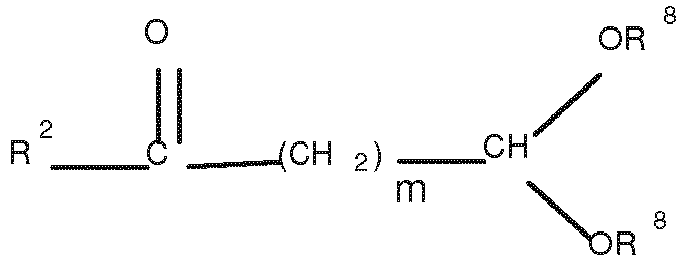

- Zur Durchführung der Additionsreaktion gelten analog die obigen Ausführungen zur Stufe 1 bei der Herstellung von Verbindungen der Formel I mit R1 = Formel II.
- In Stufe 2 erfolgt der Ringschluss. Hier gelten analog die obigen Ausführungen zur Stufe 3 bei der Herstellung von Verbindungen der Formel I mit R1 = Formel II. Produkt der zweiten Stufe ist eine Verbindung mit einer cyclischen Carbonatgruppe und einer Acetalgruppe.
- In der 3. Stufe erfolgt der Ringschluss zum 1,3 Dioxanring. Dazu wird das Produkt der zweiten Stufe mit einer Verbindung mit insgesamt mindestens drei Hydroxylgruppen, vorzugsweise genau drei Hydroxylgruppen, wobei sich zwei der Hydroxylgruppen in 1,3 Stellung befinden, umgesetzt. Die beiden Hydroxylgruppen in 1,3 Stellung bilden durch Umsetzung mit der Acetalgruppe den 1,3 Dioxanring. Diese Umsetzung kann nach üblichen Methoden durchgeführt werden.
- Bei der Verbindung mit den mindestens drei Hydroxylgruppen handelt es sich vorzugsweise um eine Verbindung der Formel VIII

- Die Umsetzung kann in Gegenwart oder Abwesenheit von Lösemittel durchgeführt werden. Vorzugsweise erfolgt sie in Gegenwart von Lösemittel. Das Lösemittel wird dabei vorzugsweise so gewählt, dass alle Ausgangsstoffe möglichst vollständig gelöst werden. Bei der Umsetzung wird der Alkohol HO-R8 abgespalten, insbesondere handelt es sich dabei um Methanol. Bei Verwendung eines hochsiedenden Lösemittels wie Toluol kann Methanol leicht destillativ entfernt werden. Der Alkohol HO-R8, insbesondere Methanol, kann jedoch auch in der Reaktionsmischung verbleiben; daher sind auch Lösemittel mit tieferem Siedepunkt oder polare Lösemittel, wie Acetonitril geeignet.
- Vorzugsweise erfolgt die Umsetzung in Gegenwart von Katalysatoren. Als Katalysatoren geeignet sind z.B. organische oder anorganische Säuren. Genannt seien exemplarisch Methansulfonsäure und p-Toluolsulfonsäure.
- Das bei der Umsetzung verwendete Lösemittel kann gegebenenfalls vor der weiteren Aufarbeitung entfernt werden. Die Aufarbeitung kann wiederum durch eine Phasentrennung erfolgen.
- Dazu wird ein geeignetes Lösemittel, welches das Wertprodukt der 3. Stufe möglichst vollständig löst und mit Wasser nicht mischbar ist zugegeben. Als Lösemittel kommen z.B. Toluol oder MTBE (Methyltertiärbutylether) in Betracht. Die erhaltene organische Phase kann mit Wasser einmal oder mehrfach gewaschen werden. Die wässrige Phase wird jeweils verworfen. Die organische Phase kann durch Destillation oder Kristallisation gereinigt werden.
- In der 4. Stufe wird schließlich die Verbindung der Formel I mit R1= Formel III durch eine Umesterung erhalten. Diese 4. Stufe entspricht der 4. Stufe bei der Herstellung von Verbindungen der Formel I mit R1 = Formel II, nur mit dem Unterschied, dass hier nicht von einem geschützten Alkohol ausgegangen wird, sondern von einem ungeschützten. Es gelten daher alle diesbezüglichen obigen Ausführungen entsprechend.
- Eine schematische Darstellung der vier Stufen findet sich auch im Herstellungsbeispiel.
- In einer alternativen Verfahrensweise könnte man die Reihenfolge der Stufen ändern und z.B. die Reihenfolge der Stufen 2 und 3 umkehren, so dass sich die Reihenfolge 1-3-2-4 der vorstehenden Stufen ergibt. Dann würde zunächst die Umacetalisierung mit der Verbindung der Formel VIII durchgeführt. Vorzugsweise wird dabei die dritte Hydroxylgruppe der Verbindung VIII, welche an der Umacetalisierung nicht teilnehmen soll, durch eine Schutzgruppe geschützt. Erst danach erfolgt dann der Ringschluss mit CO2.
- Bevorzugt ist jedoch die obige, numerische Reihenfolge der Stufen von Stufe 1, über Stufe 2, dann 3 zu Stufe 4.
- Herstellung von Verbindungen der Formel (I) mit R1 = Formel (IV)
Verbindungen der Formel (I) mit R1 = Formel (IV) können insbesondere durch Verfahren hergestellt werden, bei dem - in einer ersten Stufe eine Verbindung mit einer endständigen Dreifachbindung mit einem Alkanon oder Alkanal, welches eine Acetalgruppe enthält, umgesetzt wird, wobei sich die Dreifachbindung an die Carbonylgruppe des Alkanon oder Alkanals unter Ausbildung einer Hydroxyverbindung addiert,
- in einer zweiten Stufe mit Kohlendioxid der Ringschluss zur Carbonatgruppe erfolgt,
- in einer dritten Stufe der Ringschluss zum 1,3-Dioxolanring durch Umsetzung der Acetalgruppe mit einer Verbindung mit insgesamt mindestens drei Hydroxylgruppen wobei sich zwei der Hydroxylgruppen in 1,2 Stellung befinden, durchgeführt wird und
- in einer vierten Stufe die (Meth)acrylgruppe durch eine Veresterung oder Umesterung der verbleibenden Hydroxylgruppe eingeführt wird.
- Diese vier Stufen entsprechen den vier Stufen bei der vorstehend beschriebenen Herstellung von Verbindungen der Formel I mit R1= Formel III. daher gelten die vorstehenden Ausführungen zur Herstellung von Verbindungen der Formel I mit R1= Formel III entsprechend, soweit im Folgenden nichts anderes festgestellt wird. Der wesentliche Unterschied besteht naturgemäß in der Wahl der Verbindung mit den mindestens drei Hydroxygruppen in der 3. Stufe, da ein 1,3 Dioxolanring (Fünfring) statt eines 1,3 Dioxanrings (Sechsring) hergestellt wird. Entsprechend stehen zwei der Hydroxylgruppen der Verbindung in 1,2 Stellung. Eine bevorzugte Verbindung mit drei derartige Hydroxylgruppen ist Glycerin.
- Geeignete Monomere M2 (Comonomere) sind vor allem monoethylenisch ungesättigte Comonomere, aber auch konjugiert diethylenisch ungesättigte Verbindungen. Zu den Comonomeren M2 zählen beispielsweise:
- b1
- monoethylenisch ungesättigte C3-C8-Mono- und C4-C8-Dicarbonsäuren wie z.B. Acrylsäure, Methacrylsäure, Vinylessigsäure, Crotonsäure, Fumarsäure, Maleinsäure und Itaconsäure;
- b2
- Amide monoethylenisch ungesättigter C3-C8-Mono- und C4-C8-Dicarbonsäuren wie Acrylamid, Methacrylamid, Fumarsäureamid und Maleinimid;
- b3
- Anhydride monoethylenisch ungesättigter C4-C8-Dicarbonsäuren wie Maleinsäureanhydrid;
- .b4
- Hydroxy-C2-C4-alkylester monoethylenisch ungesättigter C3-C8-Mono- und C4-C8-Dicarbonsäuren wie 2-Hydroxyethylacrylat, 2-Hydroxypropylacrylat, 3-Hydroxypropylacrylat, 2-Hydroxybutylacrylat, 4-Hydroxybutylacrylat, 2-Hydroxyethylmethacrylat, 2-Hydroxy-propylmethacrylat, 3-Hydroxypropylmethacrylat, 2-Hydroxybutylmethacrylat, 4-Hydroxy-butylmethacrylat;
- b5
- monoethylenisch ungesättigte Sulfonsäuren und deren Salze, z. B. Vinylsulfonsäure, Allylsulfonsäure, Methallylsulfonsäure, Styrolsulfonsäure, 2-Acrylamido-2-methylpropan-sulfonsäure, 2-Methacrylamido-2-methylpropansulfonsäure, 2-Acrylamidoethansulfonsäure, 2-Methacrylamidoethansulfonsäure, 2-Acryloxyethansulfonsäure, 2-Methacryloxyethansulfonsäure, 3-Acryloxypropansulfonsäure und 2-Methacryloxypropansulfonsäure;
- b6
- monoethylenisch ungesättigte Nitrile mit 3 bis 5 C-Atomen wie Acrylnitril und Methacrylnitril;
- b7
- N-Vinylheterocyclen wie N-Vinylpyrrolidon, N-Vinylcaprolactam, N-Vinylimidazol;
- b8
- monoethylenisch ungesättigte Verbindungen mit wenigstens einer Poly-C2-C4-alkylenoxid-Gruppe, beispielsweise Vinyl- und Allylether von Poly-C2-C4-alkylenglykolen oder C1-C10-Alkyl-poly-C2-C4-alkylenglykolen, Ester monoethylenisch ungesättigter Mono- und Dicarbonsäuren mit 3 bis 8 C-Atomen mit Poly-C2-C4-alkylenglykolen oder C1-C10-Alkyl-poly-C2-C4-alkylenglykolen;
- b9
- vinylaromatische Kohlenwasserstoffe wie Styrol, α-Methylstyrol und die Vinyltoluolisomere;
- b10
- Ester monoethylenisch ungesättigter C3-C8-Monocarbonsäuren mit C1-C20-Alkanolen, C5-C8-Cycloalkanolen, Phenyl-C1-C4-alkanolen oder Phenoxy-C1-C4-alkanolen, z.B. Ester der Acrylsäure mit C1-C20-Alkanolen wie Methylacrylat, Ethylacrylat, n-Butylacrylat, 2-Butylacrylat, Isobutylacrylat, tert.-Butylacrylat, 2-Ethylhexylacrylat, Decylacrylat, Laurylacrylat und Stearylacrylat, Ester der Acrylsäure mit C5-C10-Cycloalkanolen wie Cyclohexylacrylat, Ester der Acrylsäure mit Phenyl-C1-C4-alkanolen wie Benzylacrylat, 2-Phenylethylacrylat und 1-Phenylethylacrylat, Ester der Acrylsäure mit Phenoxy-C1-C4-alkanolen wie 2-Phenoxyethylacrylat, Ester der Methacrylsäure mit C1-C20-Alkanolen, vorzugsweise C1-C10-Al-kanolen, wie Methylmethacrylat, Ethylmethacrylat, n-Butylmethacrylat, 2-Butylmethacrylat, Isobutylmethacrylat, tert.-Butylmethacrylat, 2-Ethylhexylmethacrylat, Decylmethacrylat, Laurylmethacrylat und Stearylmethacrylat, Ester der Methacrylsäure mit C5-C10-Cyclo-alkanolen wie Cyclohexylmethacrylat, Ester der Methacrylsäure mit Phenyl-C1-C4-alka-nolen wie Benzylmethacrylat, 2-Phenylethylmethacrylat und 1-Phenylethylmethacrylat und Ester der Methacrylsäure mit Phenoxy-C1-C4-alkanolen wie 2-Phenoxyethylmethacrylat;
- b11
- Diester monoethylenisch ungesättigter C4-C8-Dicarbonsäuren mit C1-C20-Alkanolen, C5-C8-Cycloalkanolen, Phenyl-C1-C4-alkanolen oder Phenoxy-C1-C4-alkanolen;
- b12
- C1-C20-Alkylamide und Di-C1-C20-alkylamide monoethylenisch ungesättigter C3-C8-Monocarbonsäuren, insbesondere die C1-C20-Alkylamide und Di-C1-C20-alkylamide der Acrylsäure und der Methacrylsäure, z. B. Ethylacrylamid, Dimethylacrylamid, Diethylacrylamid, n-Propylacrylamid, n-Butylacrylamid, Laurylacrylamid, Stearylacrylamid, Ethylmethacrylamid, Dimethylmethacrylamid, Diethylmethacrylamid, n-Propylmethacrylamid, n-Butyl-methacrylamid, Laurylmethacrylamid, Stearylmethacrylamid;
- b13
- Vinylester aliphatischer Carbonsäuren mit 1 bis 20 C-Atomen, z. B. Vinylacetat, Vinylpropionat, Vinylbutyrat, Vinylhexanoat, Vinyllaurat und Vinylstearat;
- b14
- konjugiert diethylenisch ungesättigte C4-C10-Olefine wie Butadien und Isopren;
- b15
- C2-C20-Olefine wie Ethylen, Propen, 1-Buten, 2-Buten, Isobuten, 1-Hexen, 1-Octen, Diisobuten und 1-Decen;
- b16
- halogensubstituierte C2-C20-Olefine wie Vinylchlorid, Vinylidenchlorid, Vinylbromid, Fluorethen, 1,1-Difluorethen und Tetrafluorethen;
- b17
- monoethylenisch ungesättigte Monomere, die eine oder zwei Epoxidgruppen aufweisen, wie Mono- und Diester von monoethylenisch ungesättigten Mono- oder Dicarbonsäuren, insbesondere Mono- und Diester von C3-C10-Epoxyalkanolen, z. B. Mono- oder Diglycidylester monoethylenisch ungesättigter C3-C8-Mono- oder C4-C8-Dicarbonsäuren wie Glycidylacrylat und Glycidylmethacrylat, oder monoethylenisch ungesättigte Ether von C3-C10-Epoxyalkanolen, insbesondere Allyl- oder Methallylether, z. B. Allylglycidylether und Methallylglycidylether;
- b18
- monoethylenisch ungesättigte Monomere, die wenigstens eine Carbonatgruppe, insbesondere eine cyclische Carbonatgruppe, z.B. eine 1,3-Dioxolan-2-on-Gruppe oder 4-Methyl-1,3-dioxolan-2-on-Gruppe, aufweisen, z.B. Propylencarbonat-acrylat ([1,3-Dioxolan-2-on-4-yl]methylacrylat) oder Propylencarbonat-methacrylat ([1,3-Dioxolan-2-on-4-yl]-methylmethacrylat);
- b19
- Ester monoethylenisch ungesättigter C3-C8-Monocarbonsäuren oder monoethylenisch ungesättigter C4-C8-Dicarbonsäuren mit C8-C24-Alkenolen oder C8-C24-Alkandienolen, insbesondere die Ester der Acrylsäure oder der Methacrylsäure, wie beispielsweise Oleylacrylat, Oleylmethacrylat, Linolylacrylat oder Linolylmethacrylat.
- Bevorzugte Monomere M2 sind solche der Gruppen b9 (vorzugsweise vinylaromatische Kohlenwasserstoffe, speziell Styrol), b10 (vorzugsweise Ester der Acrylsäure oder der Methacrylsäure mit C1-C20-Alkoholen, z.B. n-Butylacrylat, 2-Ethylhexylacrylat, Methylacrylat und Methylmethacrylat), b13 (vorzugsweise Vinylacetat) und b14 (vorzugsweise Butadien).
- Sofern das erfindungsgemäße Polymer wenigstens ein Monomer M2 der Gruppen b9 und b10, einpolymerisiert enthält, umfassen die zu polymerisierenden Monomere M1 vorzugsweise 1 bis 99 Gew.-%, insbesondere 5 bis 95 Gew.-% und speziell 10 bis 90 Gew.-% wenigstens einer Verbindung der Formel I und 1 bis 99 Gew.-%, insbesondere 5 bis 95 Gew.-% und speziell 10 bis 90 Gew.-% wenigstens eines, vorzugsweise monoethylenisch ungesättigten, Monomers M2, wobei die Angaben in Gew.-% auf die Gesamtmenge der Monomere bezogen sind.
- Sofern die Monomere M1 der Formel I mit einem Monomer M2 der Gruppe b9, wie einem vinylaromatischen Kohlenwasserstoff wie beispielsweise Styrol, und einem weiteren Monomer M2 der Gruppe b10, wie einem Ester der Acrylsäure oder Methacrylsäure mit einem C1-C20-Alkohol wie beispielsweise Methylacrylat, Methylmethacrylat, n-Butylacrylat oder 2-Ethylhexylacrylat, copolymerisiert werden, setzt man die zu polymerisierenden Monomere der Gruppe b9 vorzugsweise in einer Menge von 10 bis 80 Gew.-%, insbesondere 20 bis 60 Gew.-%, und die zu polymerisierenden Monomere der Gruppe b10 in einer Menge von 10 bis 80 Gew.-%, insbesondere 20 bis 60 Gew.-%, ein, wobei die Angaben in Gew.-% auf die Gesamtmenge der Monomere bezogen sind. Die Monomere der Formel I machen dann vorzugsweise 10 bis 80 Gew.-%, insbesondere 20 bis 60 Gew.-%, bezogen auf die Gesamtmenge der Monomere M, aus. Insbesondere setzt man dann die Comonomere M2 der Gruppen b9 und b10 vorzugsweise im Verhältnis von Comonomeren der Gruppe b9 zu Comonomeren der Gruppe b10 von 10 : 1 bis 1 : 10, insbesondere 5:1 bis 1 : 5 ein.
- Sofern die Monomere M1 der Formel I mit einem Comonomer M2 der Gruppe b10, wie einem Ester der Acrylsäure oder der Methacrylsäure mit einem C1-C20-Alkohol wie beispielsweise Methylacrylat, Methylmethacrylat, n-Butylacrylat oder 2-Ethylhexylacrylat, copolymerisiert werden, setzt man die zu polymerisierenden Monomere M2 der Gruppe b10 vorzugsweise in einer Menge von 1 bis 99 Gew.-%, vorzugsweise 50 bis 95 Gew.-% und die Monomere M1 der Formel I in einer Menge von 1 bis 99 Gew.-%, vorzugsweise 5 bis 50 Gew.-%, bezogen auf die Gesamtmenge der Monomere M, ein.
- Außerdem kann es zweckmäßig sein, dass die Monomere M1 neben den Monomeren der Formel I und dem bzw. den Comonomer(en) M2 ein oder mehrere mehrfach ethylenisch ungesättigte Monomere mit z.B. 2, 3 oder 4 nicht konjugierten, ethylenisch ungesättigten Doppelbindungen umfassen, die im Folgenden auch als Monomere M3 bezeichnet werden. Beispiele für Monomere M3 sind Diester und Triester ethylenisch ungesättigter Carbonsäuren, insbesondere die Bis- und Trisacrylate von Diolen oder Polyolen mit 3 oder mehr OH-Gruppen, z.B. die Bisacrylate und die Bismethacrylate von Ethylenglykol, Diethylenglykol, Triethylen-glykol, Neopentylglykol oder Polyethylenglykolen. Derartige Monomere M3 werden, sofern erwünscht, z.B. in einer Menge von 0,01 bis 10 Gew.-%, bezogen auf die Gesamtmenge der zu polymerisierenden Monomere, eingesetzt.
- Die erfindungsgemäßen Polymere weisen vorzugsweise ein zahlenmittleres Molekulargewicht im Bereich von 1000 bis 106 g/mol, insbesondere im Bereich von 1200 bis 105 g/mol auf. Das gewichtsmittlere Molekulargewicht der erfindungsgemäßen Polymere liegt vorzugsweise im Bereich von 1200 bis 5×10⁶ g/mol, insbesondere im Bereich von 2000 bis 2×10⁶ g/mol. Die Molekulargewichte können gemessen werden durch Gelpermeationschromatographie mit Tetrahydrofuran als Elutionsmittel und Polystyrol (PS) als Standard.
- Die erfindungsgemäßen Polymere weisen eine Glasübergangstemperatur von vorzugsweise -50 bis +20 °C, insbesondere von -30 bis +10 °C auf. Die Glasübergangs-temperatur wird durch Differential Scanning Calorimetrie (ASTM D 3418-08, sogenannte "midpoint temperature") bestimmt. Die Glasübergangstemperatur des Polymers ist die bei Auswertung der zweiten Heizkurve (Heizrate 20° C/min) erhaltene Glasübergangstemperatur.
- Die Polymerisation der Monomeren kann nach üblichen Verfahren der radikalischen Polymerisation durchgeführt werden. Hierzu zählen Lösungs- und Fällungspolymerisation, Suspensionspolymerisation und Emulsionspolymerisation, einschließlich einer Miniemulsionspolymerisation.
- In einer bevorzugten Ausführungsform der Erfindung erfolgt das Polymerisationsverfahren in einem nicht-wässrigen Lösungs- oder Verdünnungsmittel als Polymerisationsmedium. Mit anderen Worten, die Polymerisation wird in einem Lösungs- oder Verdünnungsmittel im Sinne einer Lösungs- oder Fällungspolymerisation durchgeführt, das kein Wasser oder nur geringe Mengen an Wasser enthält. Bezogen auf das Gesamtvolumen der Polymerisationsmischung beträgt die Menge an Wasser vorzugsweise nicht mehr als 2 Gew.-%, insbesondere nicht mehr als 1 Gew.-% und speziell nicht mehr als 0,5 Gew.-%. Vorzugsweise liegt die Menge an Wasser, bezogen auf das Monomer, bei nicht mehr als 10 Gew.-%, häufig nicht mehr als 5 Gew.-%, insbesondere nicht mehr als 2 Gew.-% und speziell nicht mehr als 1 Gew.-%.
- Geeignete Lösungs- oder Verdünnungsmittel sind insbesondere solche, in dem die zu polymerisierenden Monomere löslich sind. Man kann auch in organischen Lösungsmitteln polymerisieren, in denen die zu polymerisierenden Monomere nicht löslich sind. Die Poly-merisation erfolgt dann als eine Öl-in-Öl-Emulsions- oder Suspensionspolymerisation, wobei, abhängig von den Mengenverhältnissen von Monomeren und organischem Lösungsmittel, die Monomere die kohärente Phase oder vorzugsweise die disperse Phase bilden.
- Geeignete Lösungsmittel umfassen insbesondere aprotische Lösungsmittel. Hierzu zählen aliphatische und cycloaliphatische Kohlenwasserstoffe und Halogenkohlenwasserstoffe wie n-Hexan, n-Heptan, Cyclohexan, Dichlormethan, 1,2-Dichlorethan, aromatische Kohlenwasserstoffe und aromatische Halogenkohlenwasserstoffe wie Benzol, Toluol, Xylole, Chlorbenzol, Dichlorbenzole, Anhydride aliphatischer, nicht-polymerisierbarer Carbonsäuren wie Acetan-hydrid, C1-C6-Alkylester und C5-C6-Cycloalkylester aliphatischer Monocarbonsäuren mit 1 bis 4 C-Atomen wie Methylacetat, Ethylacetat, Propylacetat, n-Butylacetat, Methylbutyrat, Ethylbutyrat, Propylbutyrat, Methylpropionat, Ethylpropionat, Propylpropionat, Ethylformiat, Butylformiat, Cyclohexylacetat und dergleichen, C1-C4-Alkoxy-C2-C4-alkylalkanoate wie 1-Methoxy-2-propylacetat oder 2-Methoxyethylacetat, N,N-Di-C1-C4-alkylamide von aliphatischen C1-C4-Carbonsäuren wie N,N-Dimethylformamid, N,N-Dimethylacetamid, N-C1-C4-Alkyllactame wie N-Methylpyrrolidon, N-Ethylpyrrolidon, Di-C1-C4-alkylsulfoxide wie Dimethylsulfoxid, alicyclische und cyclische Ketone mit 3 bis 8 C-Atomen wie Methylethylketon, Aceton und Cyclohexanon, Di-C1-C4-alkylether und aliphatische, cycloaliphatische und aromatische Ether wie Diethylether, Methyltert.-butylether, Dioxan, Tetrahydrofuran, Monoglyme und Anisol, außerdem cyclische und acyclische, gesättigte Carbonate mit vorzugsweise 3 bis 8 C-Atomen wie Ethylencarbonat (1,3-Dioxolan-2-on) und Propylencarbonat, C1-C4-Dialkylcarbonate wie Dimethylcarbonat, Diethylcarbonat, Dipropylcarbonat, Dibutylcarbonat sowie Gemische der vorgenannten aprotischen Lösungsmittel. Geeignete Lösungsmittel für die Polymerisation sind außerdem protische Lösungsmittel und deren Gemische mit einem oder mehreren aprotischen Lösungsmitteln. Hierzu zählen vor allem aliphatische Alkohole wie C2-C4-Alkylenglykolmono-C1-C4-alkylether wie 1-Methoxy-2-propanol, C1-C4-Alkyl- C2-C4-alkylenglykolmono-C1-C4-alkylether wie 1-Methoxy-2-methyl-2-propanol, C1-C10-Alkanole wie Methanol, Ethanol, n-Propanol, Isopropanol, n-Butanol, 2-Butanol, Isobutanol, tert.-Butanol, Amylalkohol, Isoamylalkohol sowie Gemische der vorgenannten protischen Lösungsmittel.
- Bevorzugte Lösungsmittel sind C1-C6-Alkylester von aliphatischen C1-C4-Monocarbonsäuren wie n-Butylacetat, C2-C4-Alkylenglykolmono-C1-C4-alkylether wie 1-Methoxy-2-propanol, C1-C4-Alkyl- C2-C4-alkylenglykolmono-C1-C4-alkylether wie 1-Methoxy-2-methyl-2-propanol, C1-C4-Di-alkylcarbonate wie Dimethylcarbonat, Diethylcarbonat, Dipropylcarbonat, Dibutylcarbonat, cyclische Carbonate wie Ethylencarbonat und Propylencarbonat, Ether wie Glyme und Anisol.
- Im Falle der Fällungspolymerisation handelt es sich um ein organisches Lösungsmittel oder Verdünnungsmittel, in dem das Copolymer unlöslich ist. Im Falle der Lösungspolymerisation handelt es sich typischerweise um ein organisches Lösungsmittel, in dem das Copolymer löslich ist.
- Vorzugsweise wird man das organische Lösungsmittel so bemessen, dass die Menge der zu polymerisierenden Monomere M, bezogen auf die Gesamtmenge an Monomeren M plus Lösungsmittel, im Bereich von 10 bis 65 Gew.-%, insbesondere im Bereich von 20 bis 60 Gew.-% liegt. Bei einer Lösungspolymerisation werden dementsprechend Polymerlösungen mit Feststoffgehalten im Bereich von 10 bis 90 Gew.-% und insbesondere 20 bis 80 Gew.-% erhalten.
- Die Polymerisation der Monomere M kann nach üblichen Verfahren der radikalischen Homo- oder Copolymerisation erfolgen. Vorzugsweise wird man hierzu die Monomere M unter Reaktionsbedingungen polymerisieren, bei denen sich Radikale bilden. Die Bildung der Radikale erfolgt vorzugsweise durch Einsatz eines sogenannten Polymerisationsinitiators, d. h. einer Verbindung, die beim Zerfall, der chemisch, thermisch oder photochemisch ausgelöst werden kann, Radikale bildet.
- Zu den geeigneten Polymerisationsinitiatoren zählen organische Azoverbindungen, organische Peroxide und Hydroperoxide, anorganische Peroxide und sogenannte Redoxinitiatoren. Zu den organischen Peroxidverbindungen zählen beispielsweise tert.-Butylperoxy-2-ethylhexanoat, tert.-Butylperoxypivalat, Acetylperoxid, Benzoylperoxid, Lauroylperoxid, tert.-Butylperoxyisobutyrat, Caproylperoxid. Zu den Hydroperoxiden zählen neben Wasserstoffperoxid auch organische Hydroperoxide wie Cumolhydroperoxid, tert.-Butylhydroperoxid, tert.-Amylhydroperoxid und dergleichen. Zu den Azoverbindungen zählen beispielsweise 2,2'-Azobis-isobutyronitril, 2,2'-Azobis(2-methylbutyronitril), 2,2'-Azobis[2-methyl-N-(2-hydroxyethyl)propionamid], 1,1'-Azobis(1-cyclohexancarbonitril), 2,2'-Azobis(2,4-dimethylvaleronitril), 2,2'-Azobis(N,N'-dimethylenisobutyroamidin), 2,2'-Azobis(2-methylpropion-amidin), N-(3-Hydroxy-1,1-bis-hydroxymethylpropyl)-2-[1-(3-hydroxy-1,1-bis-hydroxymethyl-propylcarbamoyl)-1-methyl-ethylazo]-2-methylpropionamid sowie N-(1-Ethyl-3-hydroxypropyl)-2-[1-(1-ethyl-3-hydroxypropylcarbamoyl)-1-methyl-ethylazo]-2-methyl-propionamid. Zu den anorganischen Peroxiden zählen Peroxodischwefelsäure und deren Salze wie Ammonium-, Natrium- und Kaliumperoxodisulfat. Unter Redoxinitiatorsystemen versteht man Initiatorsysteme, die ein Oxidationsmittel, beispielsweise ein Salz der Peroxodischwefelsäure, Wasserstoffperoxid oder ein organisches Peroxid wie tert.-Butylhydroperoxid, und ein Reduktionsmittel enthalten. Als Reduktionsmittel enthalten sie vorzugsweise eine Schwefelverbindung, die insbesondere ausgewählt ist unter Natriumhydrogensulfit, Natriumhydroxymethansulfinat und dem Hydrogensulfit-Addukt an Aceton. Weitere geeignete Reduktionsmittel sind phosphorhaltige Verbindungen wie phosphorige Säure, Hypophosphite und Phosphinate sowie Hydrazin bzw. Hydrazinhydrat und Ascorbinsäure. Weiterhin können Redoxinitiatorsysteme einen Zusatz geringer Mengen von Redoxmetallsalzen wie Eisensalze, Vanadiumsalze, Kupfersalze, Chromsalze oder Mangansalze enthalten, wie beispielsweise das Redoxinitiatorsystem Ascorbinsäure/Eisen(II)sulfat/Natriumperoxodisulfat. Besonders bevorzugte Initiatoren für das erfindungsgemäße Polymerisationsverfahren sind Azoverbindungen, speziell Azobisisobutyronitril (AIBN).
- Zur radikalischen Polymerisation der Monomere M werden diese Polymerisationsinitiatoren vorzugsweise in einer Menge von 0,01 bis 5 Gew.-%, insbesondere in einer Menge von 0,1 bis 3 Gew.-%, bezogen auf die zu polymerisierenden Monomere, eingesetzt.
- Zur Polymerisation können die üblichen Polymerisationstechniken angewendet werden. Hier sind insbesondere ein (Semi-)Batch-Verfahren, bei dem die Hauptmenge, d.h. wenigstens 60 Gew.-%, insbesondere wenigstens 80 Gew.-% und häufig die Gesamtmenge der zu polymerisierenden Monomere M im Polymerisationsgefäß vorgelegt wird, sowie das Monomerzulaufverfahren, bei dem die Hauptmenge der zu polymerisierenden Monomere M, häufig wenigstens 60 Gew.-%, insbesondere wenigstens 80 Gew.-% und speziell wenigstens 90 Gew.-%, im Verlauf der Polymerisationsreaktion in das Polymerisationsgefäß gegeben wird, zu nennen. Aus Praktikabilitätsgründen wird bei größeren Ansätzen die Polymerisation häufig als Monomerzulaufverfahren durchgeführt.
- Der Polymerisationsinitiator kann im Polymerisationsgefäß vorgelegt oder im Verlauf der Polymerisationsreaktion zugegeben werden. Häufig wird man so vorgehen, dass man wenigstens einen Teil des Initiators, vorzugsweise wenigstens 50 Gew.-% und insbesondere wenigstens 80 Gew.-% des Polymerisationsinitiators, im Verlauf der Polymerisationsreaktion zugibt. Insbesondere hat es sich bewährt, einen geringen Teil der Monomere M, z. B. 0,1 bis 20 Gew.-%, bezogen auf die Gesamtmenge der zu polymerisierenden Monomere M, gegebenenfalls zusammen mit einer Teilmenge oder der Gesamtmenge an Polymerisationsinitiator und einem Teil oder der Gesamtmenge des Lösungs- bzw. Verdünnungsmittels, im Polymerisationsgefäß vorzulegen, die Polymerisation zu starten, beispielsweise durch Erwärmen der Polymerisationsmischung, und dann die Restmenge der Monomere M und, sofern erforderlich, die Restmenge an Polymerisationsinitiator und Lösungsmittel im Verlauf der Polymerisation zuzugeben.
- Die für die Polymerisation üblicherweise angewendeten Polymerisationstemperaturen liegen, abhängig von dem gewählten Initiatorsystem, vorzugsweise im Bereich von 20 bis 180 °C, insbesondere im Bereich von 40 bis 130 °C und speziell im Bereich von 50 bis 120 °C. Der Polymerisationsdruck ist von untergeordneter Bedeutung und kann im Bereich von Normaldruck oder leichtem Unterdruck, z. B. > 800 mbar, oder bei Überdruck, z. B. bis 10 bar, liegen, wobei höhere oder niedrigere Drücke ebenfalls angewendet werden können. Die Polymerisationsdauer wird vorzugsweise 10 Stunden nicht überschreiten und liegt häufig im Bereich von 1 bis 8 Stunden.
- Das erfindungsgemäße Polymerisationsverfahren kann in den für eine radikalische Polymerisation üblichen Reaktoren durchgeführt werden, beispielsweise Rührkesseln, insbesondere solchen mit wandgängigen Rührern, einschließlich Rührkesselkaskaden sowie Rohrreaktoren, die gegebenenfalls dynamische und/oder statische Mischelemente aufweisen können. Die Reaktoren weisen vorzugsweise ein oder mehrere Vorrichtungen zur Zuführung der Edukte und Vorrichtungen zur Entnahme der Produkte sowie gegebenenfalls Mittel zur Zufuhr und zur Abfuhr der Reaktionswärme sowie gegebenenfalls Mittel zur Steuerung und/oder Kontrolle der Reaktionsparameter Druck, Temperatur, Umsatz etc. auf. Die Reaktoren können absatzweise oder kontinuierlich betrieben werden.
- Nach Beendigung der Polymerisation kann man das Polymerisationsgemisch in üblicher Weise aufarbeiten. Im Falle einer Fällungspolymerisation kann man das Polymer beispielsweise abfiltrieren. Flüchtige Komponenten, beispielsweise Lösungsmittel, lassen sich auch durch destillative Maßnahmen abtrennen. Im Falle einer Lösungspolymerisation kann man auch eine Fällung des erhaltenen Polymerisats herbeiführen, beispielsweise durch Zugabe eines organischen Lösungsmittels, in welchem das Polymerisat nicht löslich ist. Gegebenenfalls kann man im Anschluss an die Polymerisation auch einen Lösungsmittelaustausch durchführen, z. B. um das Polymer von einer Lösung in eine Dispersion zu überführen. Gegebenenfalls wird man das erhaltene Polymerisat einer Entgasung unterziehen, um weitere flüchtige Bestandteile zu entfernen.
- Gegenstand der Erfindung ist auch ein Zweikomponenten-Klebstoff (2K-Klebstoff, insbesondere 2K-Laminierklebstoff, z.B. für die Verbundfolienkaschierung), enthaltend eine erste Komponente enthaltend mindestens ein erfindungsgemäßes Copolymer und eine zweite Komponente enthaltend mindestens einen mehrfunktionellen Härter, welcher mindestens zwei funktionelle Gruppen aufweist ausgewählt aus primären Aminogruppen, sekundären Aminogruppen, Hydroxygruppen, Phosphingruppen, Phosphonatgruppen und Mercaptangruppen. Vorzugsweisesind die funktionellen Gruppen des Härters ausgewählt aus aliphatischen Hydroxylgruppen, aliphatischen primären Aminoguppen, aliphatischen sekundären Aminogruppen, aliphatischen Phosphingruppen, aliphatischen Phosphonatgruppen und aliphatischen Mecaptangruppen.
- Unter Zweikomponenten-Klebstoffen (im Folgenden auch 2K-Bindemittelzusammensetzungen genannt) versteht man ein Bindemittel, das wenigstens zwei polyfunktionelle Bindemittelbestandteile enthält, die miteinander unter Bindungsbildung reagieren und dabei ein polymeres Netzwerk ausbilden. Die erfindungsgemäßen Polymere können aufgrund der darin vorhandenen Alkyliden-1,3-dioxolan-2-on-Gruppen mit zahlreichen nucleophilen Gruppen unter Bindungsbildung reagieren. Beispiele für solche nucleophilen Gruppen sind vor allem aliphatische Hydroxylgruppen, aliphatische primäre und sekundäre Aminogruppen, Phosphingruppen, insbesondere aliphatische Phosphingruppen, Phosphonatgruppen, insbesondere aliphatische Phosphonatgruppen, sowie analoge Phosphorverbindungen, außerdem Mercaptangruppen, insbesondere aliphatische Mecaptangruppen.
- Dementsprechend enthalten 2K-Bindemittelzusammensetzungen neben wenigstens einem erfindungsgemäßen Polymer vorzugsweise zusätzlich wenigstens eine Verbindung, die wenigstens 2 funktionelle Gruppen F, z.B. 2, 3, 4, 5, 6, 7, 8, 9 oder 10 funktionelle Gruppen F, aufweist, welche unter aliphatischen Hydroxylgruppen, aliphatischen primären oder sekundären Aminogruppen, aliphatischen Phosphingruppen, aliphatischen Phosphonatgruppen u.ä. Gruppen und aliphatischen Mercaptangruppen ausgewählt sind. Diese Verbindungen werden im Folgenden auch als Härter bezeichnet. Bevorzugte funktionelle Gruppen F sind aliphatische Hydroxylgruppen und aliphatische primäre und sekundäre Aminogruppen. Vorzugsweise wird die Menge an Härter so gewählt, dass das Molverhältnis von funktionellen Alkyliden-1,3-dioxo-lan-2-on-Gruppen der Formel I zu den funktionellen Gruppen F im Härter im Bereich von 1 : 10 bis 10 : 1, insbesondere im Bereich von 5 : 1 bis 1 : 5 und speziell im Bereich von 1 : 2 bis 2 : 1 liegt.
- Der Härter kann eine niedermolekulare Substanz sein, d. h., sein Molekulargewicht liegt unterhalb 500 g/mol, oder eine oligomere oder polymere Substanz, die ein zahlenmittleres Molekulargewicht oberhalb 500 g/mol aufweist.
- Zu den erfindungsgemäß bevorzugten Härtern gehören aminische Härter, d. h. Härter, die wenigstens zwei primäre oder sekundäre Aminogruppen aufweisen, und alkoholische Härter, also Verbindungen, die wenigstens zwei Hydroxylgruppen aufweisen.
- Zu den aminischen Härtern, im Folgenden auch Aminhärter, zählen beispielsweise aliphatische und cycloaliphatische Polyamine, aromatische und araliphatische Polyamine sowie polymere Amine, z. B. Aminoplaste und Polyamidoamine. Aminhärter vernetzen Polymere mit 1,3-Dioxolan-2-on-Gruppen, im Folgenden auch Carbonatpolymere genannt, durch Reaktion der primären oder sekundären Aminofunktionen der Polyamine mit den 1,3-Dioxolan-2-on-Gruppen der Carbonatpolymere unter Ausbildung von Urethanfunktionen. Bevorzugte Polyaminhärter weisen im Mittel wenigstens zwei primäre oder sekundäre Aminogruppen pro Molekül, z. B. zwei, drei oder vier primäre oder sekundäre Aminogruppen pro Molekül, auf. Sie können auch zusätzlich ein oder mehrere tertiäre Aminogruppen enthalten. Geeignete Polyamine sind beispielsweise
- aliphatische Polyamine wie Ethylendiamin, 1,2- und 1,3-Propandiamin, Neopentandiamin, Hexamethylendiamin, Octamethylendiamin, 1,10-Diaminodecan, 1,12-Diaminododecan, Diethylentriamin, Triethylentetramin, Tetraethylenpentamin, 2,2-Dimethylpropylendiamin, Trimethylhexamethylendiamin, 1-(3-Aminopropyl)-3-aminopropan, 1,3-Bis-(3-amino-propyl)propan, 4-Ethyl-4-methylamino-1-octylamin und dergleichen;
- cycloaliphatische Diamine wie 1,2-Diaminocyclohexan, 1,2-, 1,3-, 1,4-Bis(aminomethyl)-cyclohexan, 1-Methyl-2,4-diaminocyclohexan, N-Cyclohexylpropylen-1,3-diamin, 4-(2-Aminopropan-2-yl)-1-methylcyclohexan-1-amin, Isophorondiamin, 4,4'-Diaminodicyclohexylmethan (Dicykan), 3,3'-Dimethyl-4,4'-diaminodicyclohexylmethan, 3,3',5,5'-Tetra-methyl-4,4'-diaminodicyclohexylmethan, 4,8-Diamino-tricyclo[5.2.1.0]decan, Norbornandiamin, Menthandiamin, Menthendiamin und dergleichen;
- aromatische Diamine wie Toluylendiamin, Xylylendiamin, insbesondere meta-Xylylendiamin (MXDA), Bis(4-aminophenyl)methan (MDA oder Methylendianilin), Bis(4-aminophenyl)sulfon (auch als DADS, DDS oder Dapson bekannt) und dergleichen;
- cyclische Polyamine wie Piperazin, N-Aminoethylpiperazin und dergleichen;
- Polyetheramine, insbesondere difunktionelle und trifunktionelle primäre Polyetheramine auf der Basis von Polypropylenglykol, Polyethylenglykol, Polybutylenoxid, Poly-(1,4-butandiol), Poly-Tetrahydrofuran (Poly-THF) oder Polypentylenoxid, z. B. 4,7,10-Trioxatridecan-1,3-diamin, 4,7,10-Trioxatridecan-1,13-diamin, 1,8-Diamino-3,6-dioxaoctan (XTJ-504, Fa. Huntsman), 1,10-Diamino-4,7-dioxadecan (XTJ-590, Fa. Huntsman), 1,12-Diamino-4,9-dioxadodecan (Fa. BASF SE), 1,3-Diamino-4,7,10-trioxatridecan (Fa. BASF SE), primäre Polyetheramine auf der Basis von Polypropylenglykol mit einer mittleren Molmasse von 230 wie z. B. Polyetheramine D 230 (Fa. BASF SE) oder Jeffamine® D 230 (Fa. Huntsman), difunktionelle, primäre Polyetheramine auf der Basis von Polypropylenglykol mit einer mittleren Molmasse von 400, z. B. Polyetheramine D 400 (Fa. BASF SE) oder Jeffamine® XTJ 582 (Fa. Huntsman), difunktionelle, primäre Polyetheramine auf Basis von Polypropylenglykol mit einer mittleren Molmasse von 2000 wie z. B. Polyetheramine D 2000 (Fa. BASF SE), Jeffamine® D2000 oder Jeffamine® XTJ 578 (jeweils Fa. Huntsman), difunktionelle, primäre Polyetheramine auf der Basis von Propylenoxid mit einer mittleren Molmasse von 4000 wie z. B. Polyetheramin D 4000 (Fa. BASF SE), trifunktionelle, primäre Polyetheramine hergestellt durch Reaktion von Propylenoxid mit Trimethylolpropan, gefolgt durch eine Aminierung der endständigen OH-Gruppen mit einer mittleren Molmasse von 403 wie z. B. Polyetheramine T 403 (Fa. BASF SE) oder Jeffamine® T 403 (Fa. Huntsman), trifunktionelle, primären Polyetheramin, hergestellt durch Reaktion von Propylenoxid mit Glycerin, gefolgt durch eine Aminierung der endständigen OH-Gruppen mit einer mittleren Molmasse von 5000 wie z. B. Polyetheramine T 5000 (Fa. BASF SE) oder Jeffamine® T 5000 (Fa. Huntsman), aliphatische Polyetheramine, die aus einem mit Propylenoxid gepfropften Polyethylenglykol aufgebaut sind und eine mittlere Molmasse von 600 aufweisen, wie z. B. Jeffamine® ED-600 bzw. Jeffamine® XTJ-501 (jeweils Fa. Huntsman), aliphatische Polyetheramine, die aus einem mit Propylenoxid gepfropften Polyethylenglykol aufgebaut sind und eine mittlere Molmasse von 900 aufweisen, wie z. B. Jeffamine® ED-900 (Fa. Huntsman), aliphatische Poly-etheramine, die aus einem mit Propylenoxid gepfropften Polyethylenglykol aufgebaut sind und eine mittlere Molmasse von 2000 aufweisen, wie z. B. Jeffamine® ED-2003 (Fa. Huntsman), difunktionelle, primäre Polyetheramin, hergestellt durch Aminierung eines mit Propylenoxid gepfropften Diethylenglykols mit einer mittleren Molmasse von 220 wie z. B. Jeffamine® HK-511 (Fa. Huntsman), aliphatische Polyetheramine auf der Basis eines Copolymers aus Poly(tetramethylenetherglykol) und Polypropylenglykol mit einer mittleren Molmasse von 1000 wie z. B. Jeffamine® XTJ-542 (Fa. Huntsman), aliphatische Polyetheramine auf der Basis eines Copolymers aus Poly(tetramethylenetherglykol) und Polypropylenglykol mit einer mittleren Molmasse von 1900 wie z. B. Jeffamine® XTJ-548 (Fa. Huntsman), aliphatische Polyetheramine auf der Basis eines Copolymers aus Poly(tetra-methylenetherglykol) und Polypropylenglykol mit einer mittleren Molmasse von 1400 wie z. B. Jeffamine® XTJ-559 (Fa. Huntsman), Polyethertriamine auf der Basis eines mit Butylenoxid gepfropften mindestens dreiwertigen Alkohols mit einer mittleren Molmasse von 400 wie z. B. Jeffamine® XTJ-566 (Fa. Huntsman), aliphatische Polyetheramine, hergestellt durch Aminierung von mit Butylenoxid aufgepfropften Alkoholen mit einer mittleren Molmasse von 219 wie z. B. Jeffamine® XTJ-568 (Fa. Huntsman), Polyetheramine auf der Basis von Pentaerythrit und Propylenoxid mit einer mittleren Molmasse von 600 wie z. B. Jeffamine® XTJ-616 (Fa. Huntsman), Polyetheramine auf der Basis von Triethylenglykol mit einer mittleren Molmasse von 148, z. B. Jeffamine® EDR-148 (Fa. Huntsman), difunktionelle, primäre Polyetheramine, hergestellt durch Aminierung eines mit Propylenoxid gepfropften Ethylenglykols mit einer mittleren Molmasse von 176 wie z. B. Jeffamine® EDR-176 (Fa. Huntsman) sowie Polyetheramine, hergestellt durch Aminierung von Poly-Tetra-hydrofuran (Poly-THF) mit einer mittleren Molmasse von 250, z. B. PolyTHF-Amin 350 (Fa. BASF SE) und Mischungen dieser Amine;
- Polyamidoamine (Amidopolyamine), die durch die Reaktion von dimeren Fettsäuren (z. B. dimere Linolsäure) mit niedermolekularen Polyaminen wie Diethylentriamin, 1-(3-Aminopropyl)-3-aminopropan oder Triethylentetramin oder anderen Diaminen wie den zuvor genannten aliphatischen oder cycloaliphatischen Diaminen erhältlich sind;
- Addukte, die durch Umsetzung von Aminen, insbesondere Diaminen, mit einem Unterschuss an Epoxidharz bzw. Reaktivverdünner erhältlich sind, wobei man vorzugsweise solche Addukte einsetzt, worin etwa 5 bis 20 % der Epoxidgruppen mit Aminen, insbesondere Diaminen, umgesetzt worden sind;
- Phenalkamine, wie aus der Epoxidchemie bekannt;
- Mannichbasen, welche z. B. durch Kondensation von Polyaminen, vorzugsweise Diethylentriamin, Triethylentetramin, Isophorondiamin, 2,2,4- bzw. 2,4,4-Trimethylhexamethylendiamin, 1,3- und 1,4-Bis(aminomethyl)cyclohexan mit Aldehyden, vorzugsweise Formaldehyd und ein- oder mehrwertigen Phenolen mit mindestens einer aldehydreaktiven Kernstelle, z. B. die verschiedenen Kresole und Xylenole, p-tert.-Butyl-phenol, Resorcin, 4,4'-Dihydroxydiphenylmethan, 4,4'-Dihydroxydiphenyl-2,2-propan, vorzugsweise aber Phenol, hergestellt werden;
- Bevorzugte aminische Härter sind aliphatische Polyamine, insbesondere 2,2-Dimethylpropylendiamin, aromatische Diamine, insbesondere m-Xylylendiamin (MXDA) und cycloaliphatische Diamine, insbesondere Isophorondiamin, N-Cyclohexylpropylen-1,3-diamin und 4,4'-Diaminodicyclohexylmethan (Dicykan). Bevorzugt sind auch difunktionelle oder trifunktionelle primäre Polyetheramine auf der Basis von Polypropylenglykol, wie z. B. Jeffamine® D 230 oder Jeffamine® T 403. Besonders bevorzugt sind Polyamine, bei denen eine hohe Beweglichkeit und eine geringe sterische Hinderung rund um die Aminogruppe vorherrschen, z.B. 4,9-Dioxado-decan-1,12-diamin, 4,7,10-Trioxatridecan-1,13-diamin, PolyTHF Amin 350 (BASF SE).
- Bevorzugt sind auch Mischungen der als bevorzugt genannten Amine, beispielsweise Mischungen, die 2,2-Dimethylpropylenamin und Isophoronamin enthalten.
- Zu den alkoholischen Härtern zählen vor allem niedermolekulare und höhermolekulare aliphatische und cycloaliphatische Alkohole. Alkoholische Härter vernetzen Carbonatpolymere durch Reaktion der primären oder sekundären Alkoholfunktionen mit den 1,3-Dioxolan-2-on-Gruppen der Carbonatpolymere unter Ausbildung von Diestern der Kohlensäure. Bevorzugte alkoholische Härter weisen im Mittel wenigstens zwei primäre oder sekundäre Hydroxygruppen pro Molekül, z. B. zwei, drei oder vier primäre oder sekundäre Hydroxygruppen pro Molekül, auf. Geeignete niedermolekulare alkoholische Härter sind z. B. 1,4-Butandiol, Ethylenglykol, Diethylenglykol, Triethylenglykol, Neopentylglykol, 1,3-Propandiol, 1,5-Pentandiol, 1,6-Hexandiol, Glycerin, Diglycerin, Pentaerythrit, Dipentaerythrit, Zuckeralkohole wie Sorbit und Mannit.
- Geeignete alkoholische Härter sind auch höhermolekulare, polymere Polyole, beispielsweise Polyesterpolyole, Polycarbonatpolyole, Polyetherpolyole, Polyacrylatpolyole und Polyvinylalkohole. Geeignete polymere Polyolhärter weisen vorzugsweise eine mittlere OH-Funktionalität von wenigstens 1,5 mol und speziell wenigstens 1,8, z. B. im Bereich von 1,5 bis 10 und insbesondere im Bereich von 1,8 bis 4, auf. Unter der mittleren OH-Funktionalität versteht man die mittlere Anzahl OH-Gruppen je Polymerkette. Typische polymere Polyolkomponenten weisen vorzugsweise ein zahlenmittleres Molekulargewicht von etwa 250 bis 50000 g/mol, vorzugsweise von etwa 500 bis 10000 g/mol auf. Vorzugsweise sind wenigstens 50 mol-% der in der polymeren Polyolkomponente enthaltenen Hydroxylgruppen primäre Hydroxylgruppen.
- Vorzugsweise handelt es sich bei Polyesterpolyolen um lineare oder verzweigte polymere Verbindungen mit Estergruppen im Polymerrückgrat, die an den Enden der Polymerkette freie Hydroxylgruppen aufweisen. Vorzugsweise handelt es sich hierbei um Polyester, die durch Polykondensation von zweiwertigen Alkoholen mit zweiwertigen Carbonsäuren, gegebenenfalls in Gegenwart höherwertiger Alkohole (z. B. 3, 4, 5 oder 6-wertiger Alkohole) und/oder höherwertiger Polycarbonsäuren, erhalten werden. Anstelle der freien Di- bzw. Polycarbonsäuren können auch die entsprechenden Di- bzw. Polycarbonsäureanhydride oder entsprechende Di- bzw. Polycarbonsäureester von niederen Alkoholen oder deren Gemische zur Herstellung der Polyesterpolyole verwendet werden. Die Di- bzw. Polycarbonsäuren können aliphatisch, cyclo-aliphatisch, araliphatisch, aromatisch oder heterocyclisch sein, weisen vorzugsweise 2 bis 50 und insbesondere 4 bis 20 C-Atome auf und können gegebenenfalls, z. B. durch Halogenatome, substituiert und/oder ungesättigt sein. Als Beispiele hierfür seien genannt: Korksäure, Azelainsäure, Phthalsäure, Isophthalsäure, Phthalsäureanhydrid, Tetrahydrophthalsäureanhydrid, Hexahydrophthalsäureanhydrid, Tetrachlorphthalsäureanhydrid, Endomethylentetrahydrophthalsäureanhydrid, Glutarsäureanhydrid, Maleinsäure, Maleinsäureanhydrid, Alkenylbernsteinsäure, Fumarsäure und dimere Fettsäuren. Für die Herstellung der Polyesterpolyole kommen als Diole insbesondere aliphatische und cycloaliphatische Diole mit vorzugsweise 2 bis 40 und insbesondere 2 bis 20 C-Atomen in Betracht, z. B. Ethylenglykol, Propan-1,2-diol, Propan-1,3-diol, Butan-1,3-diol, Butan-1,4-diol, Buten-1,4-diol, Butin-1,4-diol, Pentan-1,5-diol, Neopentylglykol, Bis-(hydroxymethyl)cyclohexane wie 1,4-Bis-(hydroxymethyl)cyclohexan, 2-Methyl-propan-1,3-diol, Methylpentandiole, ferner Diethylenglykol, Triethylenglykol, Tetraethylenglykol, Polyethylenglykol, Dipropylenglykol, Polypropylenglykol, Dibutylenglykol und Polybutylenglykole. Bevorzugt sind Alkohole der allgemeinen Formel HO-(CH2)x-OH, wobei x eine Zahl von 2 bis 20, bevorzugt eine gerade Zahl von 2 bis 12 ist. Beispiele hierfür sind Ethylenglykol, Butan-1,4-diol, Hexan-1,6-diol, Octan-1,8-diol und Dodecan-1,12-diol. Weiterhin bevorzugt sind Neopentylglykol und Pentan-1,5-diol.
- Geeignet als alkoholische Härter sind auch Polyesterpolyole auf Lacton-Basis, wobei es sich um Homo- oder Mischpolymerisate von Lactonen, bevorzugt um endständige Hydroxylgruppenaufweisende Anlagerungsprodukte von Lactonen an geeignete difunktionelle Startermoleküle handelt. Als Lactone kommen bevorzugt solche in Betracht, die sich von Verbindungen der allgemeinen Formel HO-(CH2)z-COOH ableiten, wobei z eine Zahl von 1 bis 20 ist und ein H-Atom einer Methyleneinheit auch durch einen C1- bis C4-Alkylrest substituiert sein kann. Beispiele sind ε-Caprolacton, β-Propiolacton, γ-Butyrolacton und/oder Methyl-ε-caprolacton sowie deren Gemische. Geeignete Startermoleküle sind z. B. die vorstehend als Aufbaukomponente für die Polyesterpolyole genannten niedermolekularen zweiwertigen Alkohole. Die entsprechenden Polymerisate des ε-Caprolactons sind besonders bevorzugt. Auch niedere Polyesterdiole oder Polyetherdiole können als Starter zur Herstellung der Lacton-Polymerisate eingesetzt sein. Anstelle der Polymerisate von Lactonen können auch die entsprechenden, chemisch äquivalenten Polykondensate der den Lactonen entsprechenden Hydroxycarbonsäuren eingesetzt werden.
- Beispiele für geeignete Polyesterpolyole sind z. B. die aus Ullmanns Enzyklopädie der Technischen Chemie, 4. Auflage, Band 19, Seiten 62 bis 65 bekannten Polyesterpolyole.
- Ferner kommen auch Polycarbonatpolyole, wie sie z. B. durch Umsetzung von Phosgen mit einem Überschuss von den als Aufbaukomponenten für die Polyesterpolyole genannten niedermolekularen Alkohole erhalten werden können, in Betracht.
- Bei den Polyetherpolyolen handelt es sich insbesondere um Polyetherpolyole, die durch Polymerisation von Ethylenoxid, Propylenoxid, Butylenoxid, Tetrahydrofuran, Styroloxid oder Epichlorhydrin mit sich selbst, z. B. in Gegenwart von BF3 oder durch Anlagerung dieser Verbindungen gegebenenfalls im Gemisch oder nacheinander, an bi- oder polyfunktionelle Startkomponenten mit reaktionsfähigen Wasserstoffatomen, wie Polyole oder polyfunktionelle Amine, z. B. Wasser, Ethylenglykol, Propan-1,2-diol, Propan-1,3-diol, 1,1-Bis-(4-hydroxyphenyl)propan, Trimethylolpropan, Glycerin, Sorbit, Ethanolamin oder Ethylendiamin, hergestellt werden können. Auch Succrosepolyether (siehe
DE 1176358 undDE 1064938 ) sowie auf Formit oder Formose gestartete Polyether (sieheDE 2639083 undDE 2737951 ) kommen in Frage. - Geeignet sind ebenfalls Polyhydroxyolefine, bevorzugt solche mit 2 endständigen Hydroxylgruppen, z. B. α-ω-Dihydroxypolybutadien.
- Geeignet sind ebenfalls Polyhydroxypolyacrylate, wobei die Hydroxylgruppen seitenständig oder endständig angeordnet sein können. Beispiel hierfür sind α,ω-Dihydroxypoly(meth)acryl-ester, die durch Homo- oder Copolymerisation von Alkylestern der Acrylsäure und/oder der Methacrylsäure in Gegenwart von OH-Gruppen-enthaltenden Reglern wie Mercaptoethanol oder Mercaptopropanol und anschließende Umesterung mit einem niedermolekularen Polyol, beispielsweise einem Alkylenglykol wie Butandiol, erhältlich sind. Solche Polymere sind beispielsweise aus der
EP-A 622 378 - Geeignet sind auch Polyvinylalkohole, die vorzugsweise durch vollständige oder teilweise Verseifung von Polyvinylestern, insbesondere Polyvinylacetat, erhalten werden können. Sofern die Polyvinylester, bevorzugt Polyvinylacetat, teilverseift vorliegen, liegen bevorzugt höchstens 50 bis 95 % der Estergruppen verseift als Hydroxylgruppen vor. Sofern die Polyvinylester, bevorzugt Polyvinylacetat, vollständig verseift vorliegen, liegen im Allgemeinen mehr als 95 % bis zu 100 % der Estergruppen verseift als Hydroxylgruppen vor.
- Unter den höhermolekularen, polymeren Polyolen bevorzugte alkoholische Härter sind insbesondere Polyacrylatpolyole, diese sind beispielsweise unter dem Markennamen Joncryl® der Fa. BASF SE erhältlich, z. B. Joncryl® 945.
- Geeignete Härter sind auch Aminosäuren, z. B. Lysin, Arginin, Glutamin und Asparagin und deren Stereoisomere und deren Mischungen.
- Selbstredend können auch Mischungen unterschiedlicher Härter eingesetzt werden, z. B. Mischungen eines oder mehrerer aminischer Härter mit einem oder mehreren alkoholischen Härtern, Mischungen eines oder mehrerer aminischer Härter mit einer oder mehreren Aminosäuren oder Mischungen eines oder mehrerer alkoholischer Härter mit einer oder mehreren Aminosäuren.
- In den erfindungsgemäßen Bindemittelzusammensetzungen beträgt die Gesamtmenge an Härtern vorzugsweise 0,1 Gew.-% bis 50 Gew.-%, häufig 0,5 bis 40 Gew.-% und insbesondere 1 bis 30 Gew.-%, bezogen auf die Gesamtmenge an Carbonatpolymeren plus eingesetzten Härtern.
- Die Härtung der Bindemittelzusammensetzung kann thermisch durch Erwärmen des Gemischs aus erfindungsgemäßem Polymer und Härter auf eine Temperatur oberhalb der Mischtemperatur erfolgen. Die Härtung kann auch bei niedrigeren Temperaturen erfolgen. Typischerweise erfolgt die Härtung der erfindungsgemäßen Bindemittelzusammensetzungen bei Temperaturen im Bereich von 0 bis 200 °C, vorzugsweise im Bereich von 5 bis 180 °C und insbesondere im Bereich von 10 bis 150 °C. Welche Temperatur geeignet ist, hängt von den jeweiligen Härtern und der gewünschten Härtungsgeschwindigkeit ab und kann im Einzelfall vom Fachmann beispielsweise anhand einfacher Vorversuche ermittelt werden. Im unteren Temperaturbereich (5 bis ca. 35 °C), der ja der meist vorherrschenden Umgebungstemperatur entspricht, reicht es selbstverständlich aus, erfindungsgemäßes Polymer und Härter zu mischen. Alternativ erfolgt die Härtung vorzugsweise mikrowelleninduziert.
- Die 2K-Bindemittelzusammensetzungen können auch einen oder mehrere geeignete Katalysatoren für die Aushärtung enthalten, die sich in bekannter Weise nach der Art der reaktiven funktionellen Gruppen F richten. Die Katalysatoren werden, sofern erwünscht, in Anteilen von 0,01 Gew.-% bis etwa 10 Gew.-%, bezogen auf das Gesamtgewicht der erfindungsgemäßen Polymere mit funktionellen Alkyliden-1,3-dioxolan-2-on-Gruppen der Formel I und des Härters, eingesetzt. In einer Ausgestaltung werden keine Katalysatoren benötigt, insbesondere bei Härtern, die als funktionelle Gruppen Aminogruppen aufweisen, d.h., der Gehalt an Katalysatoren in der Zusammensetzung beträgt dann weniger als 0,01 Gew.-%. Katalysatoren werden bevorzugt dann eingesetzt, wenn der Härter reaktive Gruppen F aufweist, die von Aminogruppen verschieden sind, insbesondere wenn der Härter Hydroxylgruppen aufweist.
- Bevorzugt eingesetzte Katalysatoren sind basische Katalysatoren, besonders bevorzugt organische Amine und organische Phosphine. Unter den organischen Aminen sind Amidinbasen, wie beispielsweise 1,8-Diazabicyclo[5.4.0]undec-7-en (DBU) und 1,5-Diazabicyclo[4.3.0]non-5-en (DBN), Mono-C1-C6-alkyl-, Di-C1-C6-alkyl- und Tri-C1-C6-alkylamine, insbesondere Triethylamin und tert.-Butylamin, bevorzugt. Unter den organischen Phosphinen sind Trialkylphosphine und Triarylphosphine bevorzugt, beispielsweise Tri-n-butylphosphin und Triphenylphosphin. Die Katalysatoren können selbstverständlich auch als Mischungen eingesetzt werden, gegebenenfalls in Kombination mit Tri-C1-C6-alkylammoniumhalogeniden und Kupfersalzen, zum Beispiel Triphenylphosphin in Kombination mit einem Tri-C1-C6-alkylammoniumhalogenid und einem Kupfersalz, z. B. Kupfer(I)-chlorid, Kupfer(I)-bromid, Kupfer(II)-chlorid oder Kupfer(II)-sulfat.
- Neben den vorgenannten Bestandteilen kann die 2K-Bindemittelzusammensetzung die hierfür üblichen Additive enthalten. Die Wahl geeigneter herkömmlicher Additive für die erfindungsgemäße Zusammensetzung hängt vom jeweiligen Verwendungszweck der 2K-Bindemittelzu-sammensetzung ab und kann im Einzelfall vom Fachmann bestimmt werden.
- Geeignete Additive umfassen beispielsweise Antioxidantien, UV-Absorber/Lichtstabilisatoren, Metalldeaktivatoren, Antistatika, Verstärkungsstoffe, Füllstoffe, Antifoggingmittel, Treibmittel, Biozide, Weichmacher, Gleitmittel, Emulgatoren, Farbmittel, Pigmente, Rheologiemittel, Schlagzähigkeitsverbesserer, Adhäsionsregulatoren, optische Aufheller, Flammschutzmittel, Antitropfmittel, Nukleierungsmittel, Netzmittel, Verdicker, Schutzkolloide, Entschäumer, Tackifier, Lösungsmittel und Reaktivverdünner sowie Gemische davon.
- Füllstoffe können organischer und anorganischer Natur sein; bevorzugte anorganische Füllstoffe liegen in Form von Plättchen vor, die sich zu Schichten mit verstärkter Barrierewirkung gegenüber Flüssigkeiten und Gasen ausrichten lassen. Beispiel sind Schichtsilikate wie Montmorillonit und Hectorit, wie sie z.B. in der
WO 2011/089089 ,WO 2012/175427 oder in derWO 2012/175431 beschrieben sind. Bevorzugt sind Schichtsilikate, die ein Aspektverhältnis von mindestens 50, mindestens 400, oder mindestens 1000 und insbesondere größer oder gleich 10000 aufweisen. Die Schichtdicke ist z.B. ungefähr 1 nm. Die Schichtsilikate können natürlichen oder synthetischen Ursprungs sein. Geeignete Schichtsilikate sind z.B. Montmorillonit, Bentonit, Kaolinit, Mica, Hectorit, Fluorohectorit, Saponit, Beidellit, Nontronit, Stevensite, Vermiculit, Fluorovermiculit, Halloysit, Volkonskoit, Suconit, Magadit, Sauconit, Stibensit, Stipulgit, Attapulgit, Illit, Kenyait, Smectit, Allevardit, Muscovit, Palygorskit, Sepiolit, Silinait, Grumantit, Revdit, Zeolit, Fuller's earth, natürlicher oder synthetischer Talk oder Mica, oder Permutit. Besonders bevorzugt sind Montmorillonit (Aluminiummagnesiumsilikat), Hectorit (Magnesiumlithiumsilikat), synthetisches Fluorohectorit und exfolierte, organisch modifizierte Smectite. Die Schichtsilikate können modifiziert oder unmodifiziert sein. Bevorzugt sind kationisch modifizierte Schichtsilikate. Kationisch modifiziert bedeutet, dass anorganische Kationen des Schichtsilikats zumindest zum Teil gegen organische Kationen ausgetauscht sind, z.B. durch ein Ionenaustauschverfahren. Organische Kationen sind organische Verbindungen, welche mindestens eine kationische Gruppe aufweisen, z.B. quaternäre Ammoniumgruppe, Phosphoniumgruppe, Pyridiniumgruppe oder ähnliche oder ein kationisches Aminsalz. - Die gegebenenfalls verwendeten Lichtstabilisatoren/UV-Absorber, Antioxidantien und Metalldeaktivatoren weisen vorzugsweise eine hohe Migrationsstabilität und Temperaturbeständigkeit auf. Sie sind beispielsweise aus den Gruppen a) bis t) ausgewählt. Die Verbindungen der Gruppen a) bis g) und i) stellen Lichtstabilisatoren/UV-Absorber dar, während Verbindungen j) bis t) als Stabilisatoren wirken.
- a) 4,4-Diarylbutadiene,
- b) Zimtsäureester,
- c) Benzotriazole,
- d) Hydroxybenzophenone,
- e) Diphenylcyanacrylate,
- f) Oxamide,
- g) 2-Phenyl-1,3,5-triazine,
- h) Antioxidantien,
- i) Nickelverbindungen,
- j) sterisch gehinderte Amine,
- k) Metalldesaktivatoren,
- l) Phosphite und Phosphonite,
- m) Hydroxylamine,
- n) Nitrone,
- o) Aminoxide,
- p) Benzofuranone und Indolinone,
- q) Thiosynergisten,
- r) Peroxid-zerstörende Verbindungen,
- s) Polyamidstabilisatoren und
- t) basische Costabilisatoren.
- Der Zweikomponenten-Klebstoff ist vorzugsweise frei von Isocyanaten, d.h. er enthält vorzugsweise keine Isocyanatverbindungen als Härter. Der Zweikomponenten-Klebstoff liegt vorzugsweise entweder in Form einer Lösung in einem organischen Lösungsmittel oder er ist lösemittelfrei. Lösemittelfrei bedeutet, dass weniger als 5 Gew.%, besonders bevorzugt weniger als 2 Gew.% oder kein organisches Lösungsmittel oder Wasser enthalten ist.
- Gegenstand der Erfindung ist auch ein Verfahren zur Herstellung von Laminaten, wobei eine Folie unter Verwendung mindestens eines erfindungsgemäßen Copolymeren oder unter Verwendung eines erfindungsgemäßen Zweikomponenten-Klebstoffs auf ein Substrat kaschiert wird. Bei Kaschierungen handelt es sich um ein Verfahren zum Verkleben von großflächigen Substraten, z.B. für die Herstellung von Verbundfolien und für die Herstellung von kaschierten Formkörpern. Geeignete Substrate sind z.B. Polymerfolien, Metallfolien, Papier und Formkörpern aus Metall, Kunststoff oder Holz.
- Die vorliegende Erfindung betrifft somit auch ein Verfahren zur Herstellung von Verbundfolien, bei dem man einen erfindungsgemäßen Zweikomponenten-Klebstoff einsetzt. Hierbei können die Zweikomponenten-Klebstoffe als solche oder nach Konfektionierung mit üblichen Additiven eingesetzt werden. Bei dem Verfahren zur Herstellung von Verbundfolien werden mindestens zwei Folien unter Verwendung des Zweikomponenten-Klebstoffs miteinander verklebt.
- Bei dem erfindungsgemäßen Verfahren zur Herstellung von Verbundfolien wird der erfindungsgemäße Zweikomponenten-Klebstoff auf die zu verklebenden, großflächigen Substrate vorzugsweise mit einer Schichtdicke von 0,1 bis 20 g/m2, besonders bevorzugt 1 bis 7 g/m2 z.B. durch Rakeln, Streichen etc. aufgetragen. Es können übliche Beschichtungsverfahren angewendet werden, z.B. Walzenstreichen, Gegenlaufwalzenstreichen, Gravurwalzenstreichen, Gegenlaufgravurwalzenstreichen, Bürstenstreichen, Stabstreichen, Sprühbeschichten, Luftbürstenbeschichtung, Meniskusbeschichtung, Vorhangbeschichtung oder Tauchbeschichtung. Nach kurzer Zeit zur Ablüftung von flüchtigen Bestandteilen kann das beschichtete Substrat dann mit einem zweiten Substrat kaschiert werden, wobei die Temperatur z.B. 20 bis 200 °C, vorzugsweise 20 bis 100 °C und der Druck z. B. 100 bis 3000 kN/m2, vorzugsweise 300 bis 2000 kN/m2 betragen kann.
- Wenigstens eine der Folien kann auf der mit dem Klebstoff beschichteten Seite bedruckt oder metallisiert sein. Als Substrate eignen sich z.B. Polymerfolien, insbesondere aus Polyethylen (PE), orientiertem Polypropylen (OPP), ungerecktes Polypropylen (CPP), Polyamid (PA), Polyethylenterephthalat (PET), Polyacetat, Zellophan, mit Metall, z. B. Aluminium, beschichtete (bedampfte) Polymerfolien (kurz : metallisierte Folien) oder Metallfolien, z. B. aus Aluminium. Die genannten Folien können miteinander oder mit Papier oder mit einer Folie eines anderen Typs, z. B. Polymerfolien mit Metallfolien, verschiedene Polymerfolien miteinander etc. verklebt werden. Die genannten Folien können beispielsweise auch mit Druckfarben bedruckt sein.
- Eine Ausführungsform der Erfindung ist eine Verbundfolie, hergestellt unter Verwendung eines der oben beschriebenen erfindungsgemäßen Zwei-Komponentenklebstoffe, wobei das Material einer ersten Folie ausgewählt ist aus OPP, CPP, PE, PET und PA und wobei das Material einer zweiten Folie ausgewählt ist aus OPP, CPP, PE, PET, PA und Metallfolie. In einer Ausführungsform der Erfindung ist die erste Folie und/oder die zweite Folie auf der jeweiligen Seite, welche mit dem Klebstoff beschichtet wird, bedruckt oder metallisiert. Die Dicke der Substratfilme kann beispielsweise von 5 bis 100 µm, vorzugsweise von 5 bis 40 µm betragen.
- Eine Oberflächenbehandlung der Foliensubstrate ist vor der Beschichtung mit einem erfindungsgemäßen Klebstoffs nicht unbedingt erforderlich. Bessere Ergebnisse können aber erhalten werden, wenn die Oberfläche der Foliensubstrate vor der Beschichtung modifiziert werden. Hierbei können übliche Oberflächenbehandlungen angewendet werden, z.B. Coronabehandlung zur Verstärkung der Haftwirkung. Die Coronabehandlung oder andere Oberflächenbehandlungen werden in dem Maße durchgeführt, wie für eine ausreichende Benetzbarkeit mit der Beschichtungszusammensetzung erforderlich ist. Üblicherweise ist eine Coronabehandlung von ungefähr 10 Watt pro Quadratmeter und Minute für diesen Zweck ausreichend. Alternativ oder zusätzlich können optional auch noch Primer oder Zwischenschichten zwischen Foliensubstrat und Klebstoffbeschichtung verwendet werden. Außerdem können die Verbundfolien, weitere, zusätzliche funktionale Schichten aufweisen, z.B. Barriereschichten, Druckschichten, Farb- oder Lackschichten oder Schutzschichten. Die funktionalen Schichten können sich dabei außen, d.h. auf der mit Klebstoff beschichteten Seite abgewandten Seite des Foliensubstrats oder innen, zwischen Foliensubstrat und Klebstoffschicht befinden.
- Der erfindungsgemäße Klebstoff ist in der Lage, in kurzer Zeit hinreichend hohe Verbundfestigkeiten aufzubauen. Vorzugsweise weist ein erfindungsgemäß hergestelltes Laminat nach 1 Minute eine Scherfestigkeit von größer 0,2 N und eine Scherfestigkeit von größer 1 N nach 24 Stunden auf, gemessen bei 20 °C auf (siehe Beispiele).
- Gegenstand der Erfindung ist auch ein Laminat, hergestellt nach dem erfindungsgemäßen Verfahren.
- Gegenstand der Erfindung ist auch die Verwendung von erfindungsgemäßen Copolymeren als Komponenten von Klebstoffen, insbesondere von Kaschierklebstoffen, insbesondere von Zweikomponenten-Klebstoffen bzw. von Zweikomponenten-Kaschierklebstoffen sowie die Verwendung als Komponenten von Lacken, Beschichtungen, Dichtungsmitteln, Farben und Tinten und zur Bindung von Fasern und Partikeln. Gegenstand der Erfindung ist auch die Verwendung von erfindungsgemäßen Copolymeren zur Herstellung von flexiblen Verpackungen, insbesondere von flexiblen Lebensmittelverpackungen.
- Besondere Vorteile des erfindungsgemäßen Herstellverfahrens und der erfindungsgemäßen Produkte sind insbesondere:
- isocyanatfreier Kaschierklebstoff, insbesondere gut geeignet für flexible Verpackungen, insbesondere für Lebensmittelverpackungen
- Aufbau von hinreichend hohen Verbundfestigkeiten im Verpackungslaminat in einer kurzen Zeit
-

-

- Die Herstellung erfolgt in vier Stufen.
- Das nachstehende Reaktionsschema umfasst die Stufen 1 bis 3
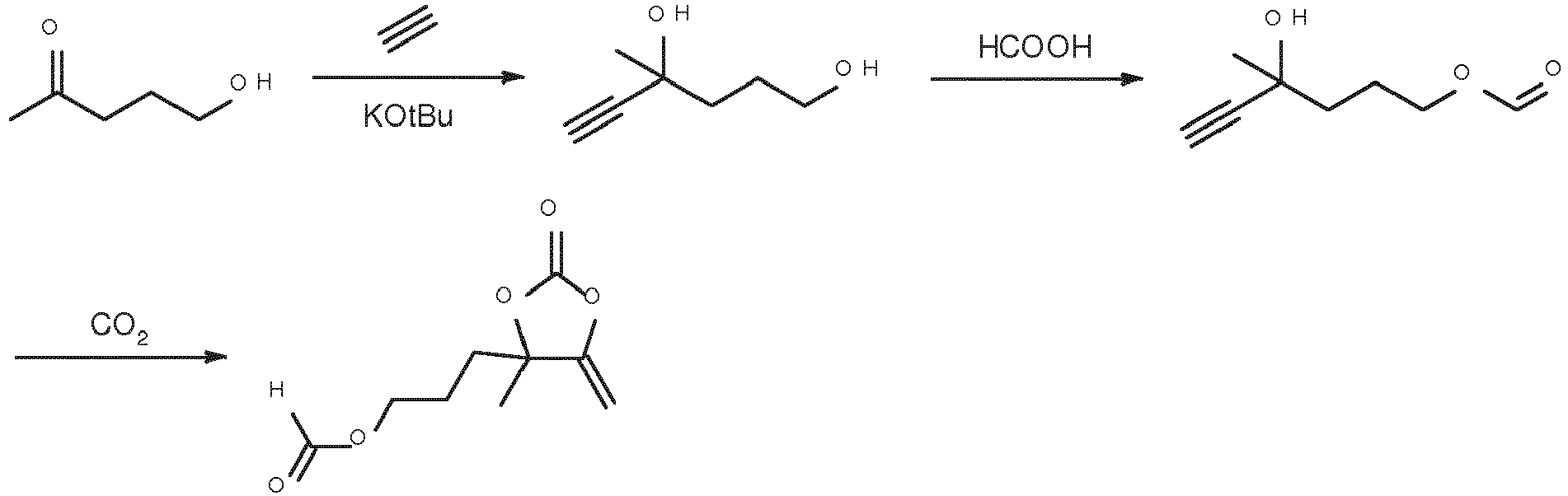
- KOtBu (800 g, 7,1 mol) wird in wasserfreiem THF (4,5 L) vorgelegt und auf 0-3°C gekühlt. Acetylen (280 g, 10,8 mol) wird innerhalb von 3 h bei dieser Temperatur eingeleitet. Unter weiterem Einleiten von Acetylen (130 g, 5 mol) wird dann Hydroxypentanon (550 g, 5.39 mol) innerhalb von 1 h bei 0-6°C zugetropft. Hierbei entsteht nach Durchlaufen eines Viskositätsmaximums eine orangebraune Lösung. Nach 1 h Nachrühren bei 0-3 °C wird auf RT erwärmt und bei 20-25°C Ammoniumchlorid (1068 g in 5 L Wasser) innerhalb von 45 min zugegeben. Dabei bilden sich zwei Phasen. Die organische Phase wird abgetrennt, über Natriumsulfat getrocknet und das Lösemittel wird bei 40 °C und 5 mbar am Rotationsverdampfer entfernt. Es werden 649 g eines braunen Öls erhalten. Dieses wird im Ölpumpen-Vakuum destilliert, wobei auf eine Sumpftemperatur von max. 130°C geachtet wurde. Die Hauptfraktion wurde bei 110-111°C in Form eines gelben Öls (440 g, 3,4 mol, 64%) erhalten.
- Reinheit (GC-Flächen-%): 93%
- Das in der ersten Stufe erhaltene Diol (1.305 kg, 10.2 mol) wird vorgelegt und innerhalb von 1 h bei 7-8 °C mit Ameisensäure (1.512 L, 40 mol) versetzt. Dann wird auf Raumtemperatur erwärmt und man beobachtet das Fortschreiten der Reaktion mittels GC/FID. Man lässt die Reaktion so lange laufen, bis der Hauptpeak praktisch nicht mehr zunimmt, was nach ca. 4 h bei RT der Fall ist. Führt man die Reaktion über diesen Punkt hinaus fort, bildet sich vermehrt zweifach formyliertes Produkt. Zur Aufarbeitung wird zunächst im Vakuum, ohne zu erwärmen, eingeengt und das erhaltene Rohprodukt dann bei 12 mbar destilliert. Die Hauptfraktion geht bei 112-115 °C als klare, gelbe Flüssigkeit (1.453 kg, 9.3 mol, 91%) über.
- Reinheit (GC-Flächen-%): 93%
- Das in der zweiten Stufe erhaltene Formiat (1.623 kg, 10.4 mol) wird mit Silberacetat (1.38 g) und TMTACN (N,N',N"-trimethyl-1,4,7-triazacyclononan, 13.8 mL) versetzt und in einem Rührautoklaven mit Druckhalteventil mit 10 bar CO2 beaufschlagt. Innerhalb von 5 h steigen die Temperatur auf 56°C und der Druck auf 18 bar an. Wenn die Temperatur wieder auf RT abgefallen ist, wird auf 70 °C erwärmt. Der Druck steigt dabei auf ca. 28 bar an. Nach ca. 4 h zeigt die Reaktionskontrolle praktisch kein Edukt mehr (GC/FID). Es wird abgekühlt und entspannt. Der Autoklaveninhalt wird nach Zusatz von Dichlormethan (1.5 L) zweimal mit HCl (10%ige Lösung, je 480 mL) gewaschen, über Natriumsulfat getrocknet und das Lösemittel am Rotationsverdampfer entfernt (40°C, 60 mbar). Danach werden unter Rühren bei RT alle im Ölpumpenvakuum flüchtigen Bestandteile entfernt, was bis zu 48 h dauern kann. Es werden ca. 1,9 kg Rohprodukt erhalten. Zur weiteren Aufreinigung werden in einem Dünnschichtverdampfer mit Wischersystem zunächst flüchtige Komponenten abgetrennt (0,05-0,02 mbar, Manteltemperatur 109-114°C). Hierfür sind in der Regel mindestens zwei Läufe erforderlich. In einem weiteren Lauf wird dann die Zielverbindung von schwerflüchtigen Bestandteilen abgetrennt (0,012 mbar, Manteltemperatur 170°C).
- Ausbeute an ExoVC-formiat: 1,419 kg (7,1 mol, 68%).
- Reinheit (GC-Flächen-%): 97%
-

- In einem zwei Liter Flachkolben mit Teflonrührer, Thermometer und Kühler wurden 300g Exo-VC-formiat (1.5 mol) und 1200 g Methylacrylat (14 mol) gegeben. Das Methylacrylat enthielt 0,3g MeHQ (Monomethylether des Hydrochinons) als Inhibitor. Die Mischung wurde gerührt und auf 40°C erwärmt. 30 g des Enzyms Candida Antartica Lipase B (immobilisierte Form) wurden zugesetzt. Nach 24 Stunden wurde die erhaltene Mischung in einen zwei Liter Rundkolben dekantiert, wobei das Enzym in dem Flachkolben zurückblieb. Das entstandene Methanol und gleichzeitig Methylacrylat wurden unter Vakuum entfernt. Der Rückstand wurde zusammen mit 1000g frischem Methylacrylat zurück in den Flachkolben gegeben, der das Enzym enthält. Die erhaltene Mischung wurde erneut 24 Stunden bei 40°C gerührt. Die Reaktionsmischung wurde auf Raumtemperatur abgekühlt und filtriert. Methanol und nicht umgesetztes Methylacrylat wurden unter Vakuum abdestilliert.
- Die Ausbeute betrug 339 g Exo-VC-acrylat 1
- Reinheit: 96.7% (gaschromatographisch bestimmt)
- Die Herstellung erfolgt in vier Stufen.
- Das nachstehende Reaktionsschema umfasst die Stufen 1 bis 3

- TMS-Acetylen (982 g, 10 mol) wird in THF (17 L, getrocknet über Molsieb) unter Argon vorgelegt und auf -68 °C abgekühlt. Unter Rühren wird innerhalb von 1 h n-Butyllithium (2,5 M in Hexan, 4 L) bei -68 °C zugetropft und 1 h nachgerührt. Innerhalb von 30 min wird dann das Keton (1,319 kg, 10 mol) bei -68°C bis -54°C zugetropft und in Anschluss 15 min nachgerührt. Danach wird auf 9°C erwärmt und Wasser (2,9 L) wird in einer Portion zugegeben. Dabei steigt die Temperatur auf ca. 17°C an. Das Reaktionsgemisch wird bei 45°C/8 Torr gründlich eingeengt. Durch GC-Analytik wird sichergestellt, dass kein TMS-geschütztes Produkt mehr enthalten ist. Der Rückstand wird in Diethylether (750 mL) aufgeschlämmt, filtriert und der Filtrationsrückstand nochmals mit Diethylether gewaschen. Das Filtrat wird im Vakuum eingeengt. Es bleiben ca. 1,2 kg Rohmaterial als braune Flüssigkeit. Durch Vakuumdestillation (5 mbar) werden daraus bei 64-68 °C ca. 1,1 kg (7 mol, 70%) ethinyliertes Produkt als farbloses Öl erhalten.
- Reinheit: >96% (GC-Flächen%)
- Der in Stufe 1 erhaltene Acetylenalkohol (1233 g; 7,79 mol) wird in Acetonitril (1,2 L) vorgelegt und in einem Rührautoklaven mit PMDETA (Pentamethyldiethylentriamin; 138,9 g; 0,8 mol) und AgOAc (12,9 g; 0,078 mol) versetzt. Es werden 50 bar CO2 aufgepresst und 2,5 h gerührt. Die Temperatur steigt bis auf 75°C. Das Reaktionsgemisch wird nach Abkühlen auf Raumtemperatur auf Normaldruck entspannt, filtriert und bei 100°C/5 mbar eingeengt. Es bleiben ca. 1,5 kg Rohmaterial als braune Flüssigkeit. Durch Vakuumdestillation bei 5 mbar werden daraus bei 114-115°C ca. 1,39 kg des Carbonats als orangefarbenes Öl erhalten, welches (ggfs. Nach Zusatz einiger Impfkristalle) über Nacht durchkristallisiert. Die Kristallmasse wird mit Cyclohexan (1,34 L) verrührt, abgesaugt und der Rückstand nochmals mit Cyclohexan (0,45 L) nachgewaschen. Nach Trocknen im Vakuum werden 1,29 kg (6,38 mol, 64%) fast farbloser Feststoff erhalten.
- Reinheit: >99% (GC-Flächen%)
- Das dimethoxy-substituierte Carbonat aus Stufe 2 (250 g, 1,24 mol) wird in 1,4 L Acetonitril unter Argonatmosphäre vorgelegt. Dann werden 253 g (1,87 mol) Trimethylolpropan und 407 mg (0,002 mol) p-Toluolsulfonsäure-Hydrat zugegeben. Die Mischung wird 10 h unter Rückfluss erhitzt. Nach Abkühlen auf Raumtemperatur wird das Lösemittel im Vakuum entfernt und der Rückstand in ca. 1 L MTBE aufgenommen. Es wird viermal mit je 300 ml Wasser gewaschen. Die organische Phase wird über Natriumsulfat getrocknet, abfiltriert und am Rotationsverdampfer eingeengt. Anschließend wird bei 40°C im Ölpumpenvakuum für mehrere Stunden nachgetrocknet. Das Produkt wird als zähflüssiges, leicht gelbliches Öl (339 g) in Form zweier Isomere erhalten, welches bei längerem Stehen bei Raumtemperatur langsam kristallisiert.
- Reinheit: >98% (GC-Flächen%)
-

- In einem zwei Liter Flachkolben mit Teflonrührer, Thermometer und Kühler wurden 129 g Exo-VC-PMP Alkohol (0.47 mol), 409 g Methylacrylat (4.75 mol) und 152 g Molekularsieb 5 Ǻ Pulver gegeben. Das Methylacrylat enthielt 0,3 g MeHQ (Monomethylether des Hydrochinons) als Inhibitor. Die Mischung wurde gerührt und auf 60°C erwärmt. 9,7 g des Enzyms Candida Antartica Lipase B (immobilisierte Form) wurden zugesetzt. Nach 72 Stunden wurden 100 g Molekularsieb 5 Ǻ Pulver und 9,7 g des Enzyms Candida Antartica Lipase B (immobilisierte Form) zugesetzt. Nach 96 Stunden wurde die Reaktionsmischung auf Raumtemperatur abgekühlt und filtriert. Methanol und nicht umgesetztes Methylacrylat wurden unter Vakuum abdestilliert.
- Die Ausbeute betrug 153 g ExoVC-acrylat 2.
- Reinheit: 97.1% (gaschromatographisch bestimmt)
- In einer Polymerisationsapparatur bestehend aus Glasreaktor, Rückflusskühler, Rührer und Stickstoffeinlass werden in leichtem Stickstoffstrom 864,9 g Methylethylketon (MEK) vorgelegt und auf 80 °C erwärmt. Es werden 15 g einer Monomerenmischung bestehend aus 225 g n-Butylacrylat und 75 g ExoVC-acrylat 1 zugegeben. Nach Wiedererreichen von 80°C werden 1,7 g einer Starterlösung aus 4 g tert.-Butylperpivalat (75%ig in Mineralöl) und 30 g MEK zugegeben und 3 min anpolymerisiert. Dann werden die restlichen 285 g Monomerenmischung und 32,3 g Starterlösung in 3 h zugefahren. Anschließend wird die Temperatur auf 90°C erhöht und eine Lösung von 0,96 g tert.-Butylperpivalat (75%ig in Mineralöl) in 15 g MEK in 30 min zugegeben. Danach wird abgekühlt.
- K-Wert; 1% in THF: 27
- Feststoffgehalt: 22,9%
- Das im Beispiel 3.1 beschriebene Copolymer wurde mit 2 Gew.% Isophorondiamin (IPDA) als Härter abgemischt und der resultierende reaktive zweikomponentige Klebstoff unmittelbar nach dem Mischen in einer Schichtdicke von 3 µm druckseitig auf eine bedruckte 12 µm starke Polyesterfolie aufgetragen. Das Lösungsmittel wurde mittels eines Heißluftstroms verdampft und dann wurde in einem Kalander eine 60 µm starke Polyethylenfolie, die zuvor mit einer KoronaBehandlung versehen worden war, unter einem Druck von 3 bar auf die Klebstoffschicht kaschiert. Das resultierende Laminat wurde in 15 mm breite Streifen geschnitten und von diesen Streifen wurde a) nach 1 min und b) nach 24 h die Schälfestigkeit bei Raumtemperatur (20 °C) ermittelt [N/15 mm]. Dazu bediente man sich einer Reißmaschine und führte die Schälfestigkeitsprüfung unter einem Reißwinkel von 90 ° durch (T-Test). Die Ergebnisse sind in Tabelle 1 wiedergegeben.
- Analog kann ein Zweikomponenten-Klebstoff mit dem Copolymer des Beispiels 3.2 hergestellt und angewendet werden.
Tabelle 1: Ergebnisse der Schälfestigkeitsmessungen Schälfestigkeit nach 1 min [N/15 mm] Schälfestigkeit nach 24 h [N/15 mm] Beispiel 3.1 abgemischt mit 2 Gew.% IPDA 0,3 1,4 Beispiel 3.1 ohne IPDA (Vergleich, 1K-Klebstoff) <0,1 <0,1 - Eine Schälfestigkeit von grösser 0,2 N nach 1 min und grösser 1 N nach 24 h ist für Anwendungen des Klebstoffs in flexiblen Verpackungen ausreichend und baut sich in einer hinreichend kurzen Zeit auf, um industriell verwertbar zu sein.
Claims (17)
- Copolymere, gebildet durch radikalische Copolymerisation aus(a) mindestens einem Monomeren M1 der Formel
 R1 für einen organischen Rest mit einer (Meth)acrylgruppe steht,R2, R3 und R4 unabhängig voneinander für ein H-Atom oder eine C1- bis C10-Alkylgruppe stehen; und(b) mindestens einem, von den Monomeren M1 verschiedenen, ethylenisch ungesättigten, radikalisch copolymerisierbaren Monomer M2.
 - Copolymere gemäß Anspruch 1, dadurch gekennzeichnet, dass die Monomere M1 in einer Menge von 5 bis 50 Gew.%, bezogen auf die Gesamtmenge aller Monomere eingesetzt werden und dass die Monomere M2 in einer Menge von 50 bis 95 Gew.%, bezogen auf die Gesamtmenge aller Monomere eingesetzt werden.
- Copolymere gemäß einem der vorhergehenden Ansprüche, dadurch gekennzeichnet, dass R1 für einen organischen Rest mit insgesamt maximal 24 C-Atomen steht und außer Sauerstoffatomen keine weiteren Heteroatome enthält.
- Copolymere gemäß einem der vorhergehenden Ansprüche, dadurch gekennzeichnet, dass R1 eine Gruppe der Formel (II)

oder eine Gruppe der Formel (III)
oder eine Gruppe der Formel (IV)
- Copolymere gemäß einem der vorhergehenden Ansprüche, dadurch gekennzeichnet, dass R2 für eine Methylgruppe und R3 und R4 für ein H-Atom stehen.
- Copolymere gemäß einem der vorhergehenden Ansprüche, dadurch gekennzeichnet, dass das mindestens eine Monomere M2 ausgewählt ist aus der Gruppe bestehend aus vinylaromatischen Kohlenwasserstoffen, Estern monoethylenisch ungesättigter C3-C8-Mono-carbonsäuren mit C1-C20-Alkanolen, C5-C8-Cycloalkanolen, Phenyl-C1-C4-alkanolen oder Phenoxy-C1-C4-alkanolen, Vinylestern aliphatischer Carbonsäuren mit 1 bis 20 C-Atomen und konjugiert diethylenisch ungesättigten C4-C10-Olefinen.
- Copolymere gemäß einem der vorhergehenden Ansprüche, dadurch gekennzeichnet, dass sie eine Glasübergangstemperatur von -50 bis +20 °C aufweisen, gemessen durch Differential Scanning Calorimetrie gemäß ASTM D 3418-08 mit einer Heizrate von 20° C/min.
- Zweikomponenten-Klebstoff, enthaltend eine erste Komponente enthaltend mindestens ein Copolymer gemäß einem der vorhergehenden Ansprüche und eine zweite Komponente enthaltend mindestens einen mehrfunktionellen Härter, welcher mindestens zwei funktionelle Gruppen aufweist ausgewählt aus primären Aminogruppen, sekundären Aminogruppen, Hydroxygruppen, Phosphingruppen, Phosphonatgruppen und Mercaptangruppen.
- Zweikomponenten-Klebstoff gemäß dem vorhergehenden Anspruch, dadurch gekennzeichnet, dass das molare Verhältnis von Alkyliden-1,3-dioxolan-2-on-Gruppen des Copolymers zu den funktionellen Gruppen des Härters von 1 : 10 bis 10 : 1 beträgt.
- Zweikomponenten-Klebstoff gemäß einem der Ansprüche 8 bis 9, dadurch gekennzeichnet, dass er frei von Isocyanaten ist und entweder in Form einer Lösung in einem organischen Lösungsmittel oder lösemittelfrei vorliegt.
- Zweikomponenten-Klebstoff gemäß einem der Ansprüche 8 bis 10, dadurch gekennzeichnet, dass ein hiermit hergestelltes Laminat nach 1 Minute eine Schälfestigkeit von größer 0,2 N und eine Schlälfestigkeit von größer 1 N nach 24 Stunden aufweist, gemessen bei 20°C, wie in der Beschreibung angegeben.
- Zweikomponenten-Klebstoff gemäß einem der Ansprüche 8 bis 11, dadurch gekennzeichnet, dass er mindestens einen Katalysator enthält für die Katalysierung der Reaktion der funktionellen Alkyliden-1,3-dioxolan-2-on-Gruppen des Copolymers mit den funktionellen Gruppen des Härters.
- Verfahren zur Herstellung von Laminaten, wobei eine Folie unter Verwendung mindestens eines Copolymeren gemäß einem der Ansprüche 1 bis 7 oder unter Verwendung eines Zweikomponenten-Klebstoffs gemäß einem der Ansprüche 8 bis 12 auf ein Substrat kaschiert wird.
- Verfahren nach dem vorhergehenden Anspruch, dadurch gekennzeichnet, dass das Substrat ausgewählt ist aus Polymerfolien, Metallfolien, Papier und Formkörpern aus Metall, Kunststoff oder Holz.
- Laminat, hergestellt nach dem Verfahren gemäß einem der beiden vorhergehenden Ansprüche.
- Verwendung von Copolymeren gemäß einem der Ansprüche 1 bis 7 als Komponenten von Klebstoffen, Lacken, Beschichtungen, Dichtungsmitteln, Farben und Tinten, und zur Bindung von Fasern und Partikeln.
- Verwendung nach dem vorhergehenden Anspruch zur Herstellung von flexiblen Lebensmittelverpackungen.
Applications Claiming Priority (2)
| Application Number | Priority Date | Filing Date | Title |
|---|---|---|---|
| EP15172703 | 2015-06-18 | ||
| PCT/EP2016/062938 WO2016202652A1 (de) | 2015-06-18 | 2016-06-08 | Copolymere aus cyclischen exo-vinylencarbonatacrylaten |
Publications (2)
| Publication Number | Publication Date |
|---|---|
| EP3310866A1 EP3310866A1 (de) | 2018-04-25 |
| EP3310866B1 true EP3310866B1 (de) | 2022-08-10 |
Family
ID=53488170
Family Applications (1)
| Application Number | Title | Priority Date | Filing Date |
|---|---|---|---|
| EP16732476.3A Active EP3310866B1 (de) | 2015-06-18 | 2016-06-08 | Copolymere aus cyclischen exo-vinylencarbonatacrylaten |
Country Status (7)
| Country | Link |
|---|---|
| US (1) | US10385152B2 (de) |
| EP (1) | EP3310866B1 (de) |
| JP (1) | JP6903016B2 (de) |
| CN (1) | CN107810211B (de) |
| CA (1) | CA2989696A1 (de) |
| ES (1) | ES2925351T3 (de) |
| WO (1) | WO2016202652A1 (de) |
Families Citing this family (6)
| Publication number | Priority date | Publication date | Assignee | Title |
|---|---|---|---|---|
| WO2018054713A1 (de) * | 2016-09-21 | 2018-03-29 | Basf Se | Verbindungen mit zwei oder mehr exovinylen-cyclocarbonateinheiten |
| FR3071502B1 (fr) | 2017-09-28 | 2020-06-19 | Bostik Sa | Copolymeres hydrocarbones liquides a deux groupements terminaux ester cyclocarbonate |
| EP3569597A1 (de) | 2018-05-18 | 2019-11-20 | Basf Se | Monomere mit mindestens einer 4-(2-oxyethylidene)-1,3-dioxolan-2-on-einheit und ihre verwendung |
| EP3818097B1 (de) | 2018-07-04 | 2022-08-17 | Basf Se | Klebeverfahren unter verwendung von 2-komponentenklebstoffen auf basis von verbindungen mit cyclothiocarbonat-einheiten |
| CN109988143B (zh) * | 2019-04-24 | 2021-07-16 | 大连理工大学 | 一种通过生物质多元醇制备功能化手性环状碳酸酯的方法 |
| US11787983B2 (en) | 2019-08-21 | 2023-10-17 | Basf Se | Method of making film laminates using amine-reactive acrylic lamination adhesives |
Family Cites Families (18)
| Publication number | Priority date | Publication date | Assignee | Title |
|---|---|---|---|---|
| DE1064938B (de) | 1956-12-24 | 1959-09-10 | Dow Chemical Co | Verfahren zur Oxypropylierung von mehrwertigen Alkoholen |
| BE593754A (de) | 1959-08-12 | |||
| DE2639083C2 (de) | 1976-08-31 | 1983-02-10 | Bayer Ag, 5090 Leverkusen | Verfahren zur Herstellung von Polyätherpolyolen und ihre Verwendung als Ausgangsmaterialien für Polyurethankunststoffe |
| DE2737951A1 (de) | 1977-08-23 | 1979-03-08 | Bayer Ag | Verfahren zur herstellung von polyaetherpolyolen |
| US4536554A (en) * | 1984-02-22 | 1985-08-20 | Barnes-Hind, Inc. | Hydrophilic polymers and contact lenses made therefrom |
| DE4314111A1 (de) | 1993-04-29 | 1994-11-03 | Goldschmidt Ag Th | alpha,omega-Polymethacrylatdiole, Verfahren zu ihrer Herstellung und deren Verwendung zur Herstellung von Polymeren, insbesondere Polyurethanen und Polyestern |
| JP2001081111A (ja) * | 1999-09-13 | 2001-03-27 | Nippon Shokubai Co Ltd | カチオン重合性樹脂組成物の製造方法 |
| US7122605B2 (en) | 2001-11-29 | 2006-10-17 | Basf Corporation | Method for selective graft polymerization |
| JP2006052244A (ja) * | 2004-08-10 | 2006-02-23 | Nippon Synthetic Chem Ind Co Ltd:The | 2液硬化型水性接着剤 |
| JP5432456B2 (ja) * | 2008-01-23 | 2014-03-05 | 出光興産株式会社 | アダマンタン系共重合樹脂、樹脂組成物及びその用途 |
| US7939621B2 (en) * | 2009-04-30 | 2011-05-10 | International Business Machines Corporation | Oligocarbonate molecular transporters |
| EP2301977A1 (de) * | 2009-09-25 | 2011-03-30 | Construction Research & Technology GmbH | Wasserdispergierbares, cyclocarbonatfunktionalisiertes vinylcopolymer-system |
| JP2013517215A (ja) | 2010-01-20 | 2013-05-16 | バイエル・インテレクチュアル・プロパティ・ゲゼルシャフト・ミット・ベシュレンクテル・ハフツング | 高アスペクト比を有するフィロシリケートプレートレットの製造方法 |
| KR20140004615A (ko) * | 2010-06-15 | 2014-01-13 | 바스프 에스이 | 에폭시 수지 조성물에서의 시클릭 카르보네이트의 용도 |
| WO2012175427A2 (de) | 2011-06-20 | 2012-12-27 | Bayer Intellectual Property Gmbh | Herstellung von folien mit flexiblen barrierebeschichtungen enthaltend schichtsilicate |
| WO2012175431A2 (de) | 2011-06-20 | 2012-12-27 | Bayer Intellectual Property Gmbh | Herstellung von folien mit flexiblen barrierebeschichtungen enthaltend schichtsilicate |
| US9062136B2 (en) * | 2012-03-29 | 2015-06-23 | Basf Se | Polymerizable alkylidene-1,3-dioxolane-2-one and use thereof |
| KR102070052B1 (ko) | 2012-03-29 | 2020-01-29 | 바스프 에스이 | 중합성 알킬리덴-1,3-디옥솔란-2-온 및 그의 용도 |
-
2016
- 2016-06-08 CA CA2989696A patent/CA2989696A1/en not_active Abandoned
- 2016-06-08 JP JP2017565103A patent/JP6903016B2/ja active Active
- 2016-06-08 ES ES16732476T patent/ES2925351T3/es active Active
- 2016-06-08 EP EP16732476.3A patent/EP3310866B1/de active Active
- 2016-06-08 US US15/736,970 patent/US10385152B2/en active Active
- 2016-06-08 CN CN201680035581.XA patent/CN107810211B/zh active Active
- 2016-06-08 WO PCT/EP2016/062938 patent/WO2016202652A1/de not_active Ceased
Also Published As
| Publication number | Publication date |
|---|---|
| US20180155479A1 (en) | 2018-06-07 |
| CN107810211A (zh) | 2018-03-16 |
| CN107810211B (zh) | 2021-03-26 |
| ES2925351T3 (es) | 2022-10-17 |
| JP2018529784A (ja) | 2018-10-11 |
| CA2989696A1 (en) | 2016-12-22 |
| US10385152B2 (en) | 2019-08-20 |
| JP6903016B2 (ja) | 2021-07-14 |
| WO2016202652A1 (de) | 2016-12-22 |
| EP3310866A1 (de) | 2018-04-25 |
Similar Documents
| Publication | Publication Date | Title |
|---|---|---|
| EP2831055B1 (de) | Polymerisierbare alkyliden-1,3-dioxolan-2-one und deren verwendung | |
| WO2016202652A1 (de) | Copolymere aus cyclischen exo-vinylencarbonatacrylaten | |
| EP3050910B1 (de) | Modifizierte alkoxylierungsprodukte, die zumindest eine nicht-terminale alkoxysilylgruppe aufweisen, mit erhöhter lagerstabilität und verbesserter dehnung und der unter deren verwendung hergestellten polymere | |
| EP3024901B1 (de) | Beschichtungsmassen, enthaltend eine verbindung mit mindestens zwei cyclischen carbonatgruppen und einer siloxangruppe | |
| KR102571880B1 (ko) | 경화성 조성물 및 이의 용도 | |
| WO2020007634A1 (de) | Klebeverfahren unter verwendung von 2-komponentenklebstoffen auf basis von verbindungen mit cyclothiocarbonat-einheiten | |
| CN109562596B (zh) | 含有环状结构基元、氨基甲酸酯/脲基连接单元和可自由基聚合的官能团的化合物 | |
| EP2736980A1 (de) | Niedermolekulare produkte, und deren verwendung als reversible oder permanente niedertemperatur-vernetzer bei diels-alder-reaktionen | |
| EP3464405B1 (de) | Verwendung von verbindungen mit n 2-oxo-1,3-dioxolan-4-carbonsäureamid-einheiten in zweikomponentenklebstoffen | |
| EP3049452B1 (de) | Beschichtungsmittelzusammensetzungen und daraus hergestellte, bei niedrigen temperaturen härtbare beschichtungen und sowie deren verwendung | |
| FR3081869A1 (fr) | Monomeres monoethyleniquement insatures et leurs utilisations | |
| JP2019534933A (ja) | 少なくとも2つのエキソビニレン環式カーボネート単位を有する化合物に基づく二液型組成物 | |
| EP3515900B1 (de) | Verbindungen mit zwei oder mehr exovinylen-cyclocarbonateinheiten | |
| EP3099697B1 (de) | Silanmodifizierte formamide | |
| US20220227693A1 (en) | Vinyl-ethers and methods of their production | |
| DE102012206508A1 (de) | Neue, einfach herstellbare, VOC reduzierte, umweltfreundliche (Meth)acrylamido-funktionelle Siloxan-Systeme Verfahren zu ihrer Herstellung sowie Verwendung | |
| CN112041293B (zh) | 含不饱和双键化合物、使用了该化合物的氧吸收剂、以及树脂组合物 | |
| EP3286173B1 (de) | Cyclische carbonate | |
| DE3103779A1 (de) | Polymerisierbare bicyclische orthoesterverbindungen | |
| EP2477737B1 (de) | Silangruppenhaltige reaktivverdünner |
Legal Events
| Date | Code | Title | Description |
|---|---|---|---|
| STAA | Information on the status of an ep patent application or granted ep patent |
Free format text: STATUS: THE INTERNATIONAL PUBLICATION HAS BEEN MADE |
|
| PUAI | Public reference made under article 153(3) epc to a published international application that has entered the european phase |
Free format text: ORIGINAL CODE: 0009012 |
|
| STAA | Information on the status of an ep patent application or granted ep patent |
Free format text: STATUS: REQUEST FOR EXAMINATION WAS MADE |
|
| 17P | Request for examination filed |
Effective date: 20180118 |
|
| AK | Designated contracting states |
Kind code of ref document: A1 Designated state(s): AL AT BE BG CH CY CZ DE DK EE ES FI FR GB GR HR HU IE IS IT LI LT LU LV MC MK MT NL NO PL PT RO RS SE SI SK SM TR |
|
| AX | Request for extension of the european patent |
Extension state: BA ME |
|
| DAV | Request for validation of the european patent (deleted) | ||
| DAX | Request for extension of the european patent (deleted) | ||
| REG | Reference to a national code |
Ref country code: DE Ref legal event code: R079 Ref document number: 502016015162 Country of ref document: DE Free format text: PREVIOUS MAIN CLASS: C09J0133060000 Ipc: C09J0133080000 |
|
| GRAP | Despatch of communication of intention to grant a patent |
Free format text: ORIGINAL CODE: EPIDOSNIGR1 |
|
| STAA | Information on the status of an ep patent application or granted ep patent |
Free format text: STATUS: GRANT OF PATENT IS INTENDED |
|
| RIC1 | Information provided on ipc code assigned before grant |
Ipc: B32B 27/00 20060101ALI20220114BHEP Ipc: B32B 7/00 20060101ALI20220114BHEP Ipc: C07D 317/34 20060101ALI20220114BHEP Ipc: B32B 7/12 20060101ALI20220114BHEP Ipc: C09J 175/04 20060101ALI20220114BHEP Ipc: C08G 71/04 20060101ALI20220114BHEP Ipc: C08F 220/18 20060101ALI20220114BHEP Ipc: C09J 133/06 20060101ALI20220114BHEP Ipc: C09J 133/08 20060101AFI20220114BHEP |
|
| INTG | Intention to grant announced |
Effective date: 20220207 |
|
| GRAS | Grant fee paid |
Free format text: ORIGINAL CODE: EPIDOSNIGR3 |
|
| GRAA | (expected) grant |
Free format text: ORIGINAL CODE: 0009210 |
|
| STAA | Information on the status of an ep patent application or granted ep patent |
Free format text: STATUS: THE PATENT HAS BEEN GRANTED |
|
| AK | Designated contracting states |
Kind code of ref document: B1 Designated state(s): AL AT BE BG CH CY CZ DE DK EE ES FI FR GB GR HR HU IE IS IT LI LT LU LV MC MK MT NL NO PL PT RO RS SE SI SK SM TR |
|
| REG | Reference to a national code |
Ref country code: AT Ref legal event code: REF Ref document number: 1510544 Country of ref document: AT Kind code of ref document: T Effective date: 20220815 Ref country code: CH Ref legal event code: EP |
|
| REG | Reference to a national code |
Ref country code: DE Ref legal event code: R096 Ref document number: 502016015162 Country of ref document: DE |
|
| REG | Reference to a national code |
Ref country code: IE Ref legal event code: FG4D Free format text: LANGUAGE OF EP DOCUMENT: GERMAN |
|
| REG | Reference to a national code |
Ref country code: ES Ref legal event code: FG2A Ref document number: 2925351 Country of ref document: ES Kind code of ref document: T3 Effective date: 20221017 |
|
| REG | Reference to a national code |
Ref country code: NL Ref legal event code: MP Effective date: 20220810 |
|
| REG | Reference to a national code |
Ref country code: LT Ref legal event code: MG9D |
|
| PG25 | Lapsed in a contracting state [announced via postgrant information from national office to epo] |
Ref country code: SE Free format text: LAPSE BECAUSE OF FAILURE TO SUBMIT A TRANSLATION OF THE DESCRIPTION OR TO PAY THE FEE WITHIN THE PRESCRIBED TIME-LIMIT Effective date: 20220810 Ref country code: RS Free format text: LAPSE BECAUSE OF FAILURE TO SUBMIT A TRANSLATION OF THE DESCRIPTION OR TO PAY THE FEE WITHIN THE PRESCRIBED TIME-LIMIT Effective date: 20220810 Ref country code: PT Free format text: LAPSE BECAUSE OF FAILURE TO SUBMIT A TRANSLATION OF THE DESCRIPTION OR TO PAY THE FEE WITHIN THE PRESCRIBED TIME-LIMIT Effective date: 20221212 Ref country code: NO Free format text: LAPSE BECAUSE OF FAILURE TO SUBMIT A TRANSLATION OF THE DESCRIPTION OR TO PAY THE FEE WITHIN THE PRESCRIBED TIME-LIMIT Effective date: 20221110 Ref country code: NL Free format text: LAPSE BECAUSE OF FAILURE TO SUBMIT A TRANSLATION OF THE DESCRIPTION OR TO PAY THE FEE WITHIN THE PRESCRIBED TIME-LIMIT Effective date: 20220810 Ref country code: LV Free format text: LAPSE BECAUSE OF FAILURE TO SUBMIT A TRANSLATION OF THE DESCRIPTION OR TO PAY THE FEE WITHIN THE PRESCRIBED TIME-LIMIT Effective date: 20220810 Ref country code: LT Free format text: LAPSE BECAUSE OF FAILURE TO SUBMIT A TRANSLATION OF THE DESCRIPTION OR TO PAY THE FEE WITHIN THE PRESCRIBED TIME-LIMIT Effective date: 20220810 Ref country code: FI Free format text: LAPSE BECAUSE OF FAILURE TO SUBMIT A TRANSLATION OF THE DESCRIPTION OR TO PAY THE FEE WITHIN THE PRESCRIBED TIME-LIMIT Effective date: 20220810 |
|
| PG25 | Lapsed in a contracting state [announced via postgrant information from national office to epo] |
Ref country code: PL Free format text: LAPSE BECAUSE OF FAILURE TO SUBMIT A TRANSLATION OF THE DESCRIPTION OR TO PAY THE FEE WITHIN THE PRESCRIBED TIME-LIMIT Effective date: 20220810 Ref country code: IS Free format text: LAPSE BECAUSE OF FAILURE TO SUBMIT A TRANSLATION OF THE DESCRIPTION OR TO PAY THE FEE WITHIN THE PRESCRIBED TIME-LIMIT Effective date: 20221210 Ref country code: HR Free format text: LAPSE BECAUSE OF FAILURE TO SUBMIT A TRANSLATION OF THE DESCRIPTION OR TO PAY THE FEE WITHIN THE PRESCRIBED TIME-LIMIT Effective date: 20220810 Ref country code: GR Free format text: LAPSE BECAUSE OF FAILURE TO SUBMIT A TRANSLATION OF THE DESCRIPTION OR TO PAY THE FEE WITHIN THE PRESCRIBED TIME-LIMIT Effective date: 20221111 |
|
| PG25 | Lapsed in a contracting state [announced via postgrant information from national office to epo] |
Ref country code: SM Free format text: LAPSE BECAUSE OF FAILURE TO SUBMIT A TRANSLATION OF THE DESCRIPTION OR TO PAY THE FEE WITHIN THE PRESCRIBED TIME-LIMIT Effective date: 20220810 Ref country code: RO Free format text: LAPSE BECAUSE OF FAILURE TO SUBMIT A TRANSLATION OF THE DESCRIPTION OR TO PAY THE FEE WITHIN THE PRESCRIBED TIME-LIMIT Effective date: 20220810 Ref country code: DK Free format text: LAPSE BECAUSE OF FAILURE TO SUBMIT A TRANSLATION OF THE DESCRIPTION OR TO PAY THE FEE WITHIN THE PRESCRIBED TIME-LIMIT Effective date: 20220810 Ref country code: CZ Free format text: LAPSE BECAUSE OF FAILURE TO SUBMIT A TRANSLATION OF THE DESCRIPTION OR TO PAY THE FEE WITHIN THE PRESCRIBED TIME-LIMIT Effective date: 20220810 |
|
| REG | Reference to a national code |
Ref country code: DE Ref legal event code: R097 Ref document number: 502016015162 Country of ref document: DE |
|
| PG25 | Lapsed in a contracting state [announced via postgrant information from national office to epo] |
Ref country code: SK Free format text: LAPSE BECAUSE OF FAILURE TO SUBMIT A TRANSLATION OF THE DESCRIPTION OR TO PAY THE FEE WITHIN THE PRESCRIBED TIME-LIMIT Effective date: 20220810 Ref country code: EE Free format text: LAPSE BECAUSE OF FAILURE TO SUBMIT A TRANSLATION OF THE DESCRIPTION OR TO PAY THE FEE WITHIN THE PRESCRIBED TIME-LIMIT Effective date: 20220810 |
|
| PLBE | No opposition filed within time limit |
Free format text: ORIGINAL CODE: 0009261 |
|
| STAA | Information on the status of an ep patent application or granted ep patent |
Free format text: STATUS: NO OPPOSITION FILED WITHIN TIME LIMIT |
|
| PG25 | Lapsed in a contracting state [announced via postgrant information from national office to epo] |
Ref country code: AL Free format text: LAPSE BECAUSE OF FAILURE TO SUBMIT A TRANSLATION OF THE DESCRIPTION OR TO PAY THE FEE WITHIN THE PRESCRIBED TIME-LIMIT Effective date: 20220810 |
|
| 26N | No opposition filed |
Effective date: 20230511 |
|
| PG25 | Lapsed in a contracting state [announced via postgrant information from national office to epo] |
Ref country code: SI Free format text: LAPSE BECAUSE OF FAILURE TO SUBMIT A TRANSLATION OF THE DESCRIPTION OR TO PAY THE FEE WITHIN THE PRESCRIBED TIME-LIMIT Effective date: 20220810 |
|
| PG25 | Lapsed in a contracting state [announced via postgrant information from national office to epo] |
Ref country code: MC Free format text: LAPSE BECAUSE OF FAILURE TO SUBMIT A TRANSLATION OF THE DESCRIPTION OR TO PAY THE FEE WITHIN THE PRESCRIBED TIME-LIMIT Effective date: 20220810 |
|
| PG25 | Lapsed in a contracting state [announced via postgrant information from national office to epo] |
Ref country code: MC Free format text: LAPSE BECAUSE OF FAILURE TO SUBMIT A TRANSLATION OF THE DESCRIPTION OR TO PAY THE FEE WITHIN THE PRESCRIBED TIME-LIMIT Effective date: 20220810 |
|
| REG | Reference to a national code |
Ref country code: CH Ref legal event code: PL |
|
| REG | Reference to a national code |
Ref country code: BE Ref legal event code: MM Effective date: 20230630 |
|
| PG25 | Lapsed in a contracting state [announced via postgrant information from national office to epo] |
Ref country code: LU Free format text: LAPSE BECAUSE OF NON-PAYMENT OF DUE FEES Effective date: 20230608 |
|
| REG | Reference to a national code |
Ref country code: IE Ref legal event code: MM4A |
|
| PG25 | Lapsed in a contracting state [announced via postgrant information from national office to epo] |
Ref country code: LU Free format text: LAPSE BECAUSE OF NON-PAYMENT OF DUE FEES Effective date: 20230608 |
|
| PG25 | Lapsed in a contracting state [announced via postgrant information from national office to epo] |
Ref country code: IE Free format text: LAPSE BECAUSE OF NON-PAYMENT OF DUE FEES Effective date: 20230608 |
|
| PG25 | Lapsed in a contracting state [announced via postgrant information from national office to epo] |
Ref country code: IE Free format text: LAPSE BECAUSE OF NON-PAYMENT OF DUE FEES Effective date: 20230608 Ref country code: CH Free format text: LAPSE BECAUSE OF NON-PAYMENT OF DUE FEES Effective date: 20230630 |
|
| PG25 | Lapsed in a contracting state [announced via postgrant information from national office to epo] |
Ref country code: BE Free format text: LAPSE BECAUSE OF NON-PAYMENT OF DUE FEES Effective date: 20230630 |
|
| REG | Reference to a national code |
Ref country code: AT Ref legal event code: MM01 Ref document number: 1510544 Country of ref document: AT Kind code of ref document: T Effective date: 20230608 |
|
| PG25 | Lapsed in a contracting state [announced via postgrant information from national office to epo] |
Ref country code: AT Free format text: LAPSE BECAUSE OF NON-PAYMENT OF DUE FEES Effective date: 20230608 |
|
| PG25 | Lapsed in a contracting state [announced via postgrant information from national office to epo] |
Ref country code: AT Free format text: LAPSE BECAUSE OF NON-PAYMENT OF DUE FEES Effective date: 20230608 |
|
| PG25 | Lapsed in a contracting state [announced via postgrant information from national office to epo] |
Ref country code: BG Free format text: LAPSE BECAUSE OF FAILURE TO SUBMIT A TRANSLATION OF THE DESCRIPTION OR TO PAY THE FEE WITHIN THE PRESCRIBED TIME-LIMIT Effective date: 20220810 |
|
| PG25 | Lapsed in a contracting state [announced via postgrant information from national office to epo] |
Ref country code: BG Free format text: LAPSE BECAUSE OF FAILURE TO SUBMIT A TRANSLATION OF THE DESCRIPTION OR TO PAY THE FEE WITHIN THE PRESCRIBED TIME-LIMIT Effective date: 20220810 |
|
| PGFP | Annual fee paid to national office [announced via postgrant information from national office to epo] |
Ref country code: DE Payment date: 20250626 Year of fee payment: 10 |
|
| PGFP | Annual fee paid to national office [announced via postgrant information from national office to epo] |
Ref country code: GB Payment date: 20250618 Year of fee payment: 10 |
|
| PGFP | Annual fee paid to national office [announced via postgrant information from national office to epo] |
Ref country code: FR Payment date: 20250624 Year of fee payment: 10 |
|
| PG25 | Lapsed in a contracting state [announced via postgrant information from national office to epo] |
Ref country code: CY Free format text: LAPSE BECAUSE OF FAILURE TO SUBMIT A TRANSLATION OF THE DESCRIPTION OR TO PAY THE FEE WITHIN THE PRESCRIBED TIME-LIMIT; INVALID AB INITIO Effective date: 20160608 |
|
| PG25 | Lapsed in a contracting state [announced via postgrant information from national office to epo] |
Ref country code: HU Free format text: LAPSE BECAUSE OF FAILURE TO SUBMIT A TRANSLATION OF THE DESCRIPTION OR TO PAY THE FEE WITHIN THE PRESCRIBED TIME-LIMIT; INVALID AB INITIO Effective date: 20160608 |
|
| PGFP | Annual fee paid to national office [announced via postgrant information from national office to epo] |
Ref country code: ES Payment date: 20250710 Year of fee payment: 10 |
|
| PGFP | Annual fee paid to national office [announced via postgrant information from national office to epo] |
Ref country code: IT Payment date: 20250623 Year of fee payment: 10 |
|
| PG25 | Lapsed in a contracting state [announced via postgrant information from national office to epo] |
Ref country code: TR Free format text: LAPSE BECAUSE OF FAILURE TO SUBMIT A TRANSLATION OF THE DESCRIPTION OR TO PAY THE FEE WITHIN THE PRESCRIBED TIME-LIMIT Effective date: 20220810 |