EP3290220B1 - Flexodruckplatte - Google Patents
Flexodruckplatte Download PDFInfo
- Publication number
- EP3290220B1 EP3290220B1 EP16786225.9A EP16786225A EP3290220B1 EP 3290220 B1 EP3290220 B1 EP 3290220B1 EP 16786225 A EP16786225 A EP 16786225A EP 3290220 B1 EP3290220 B1 EP 3290220B1
- Authority
- EP
- European Patent Office
- Prior art keywords
- distal end
- small
- image area
- dot
- diameter
- Prior art date
- Legal status (The legal status is an assumption and is not a legal conclusion. Google has not performed a legal analysis and makes no representation as to the accuracy of the status listed.)
- Active
Links
- 238000007639 printing Methods 0.000 title claims description 248
- 238000010147 laser engraving Methods 0.000 claims description 29
- 229920005989 resin Polymers 0.000 description 83
- 239000011347 resin Substances 0.000 description 83
- 229920000642 polymer Polymers 0.000 description 80
- 150000001875 compounds Chemical class 0.000 description 70
- 239000011342 resin composition Substances 0.000 description 46
- -1 polyethylene terephthalate Polymers 0.000 description 37
- 238000000034 method Methods 0.000 description 33
- 239000000976 ink Substances 0.000 description 31
- 239000000463 material Substances 0.000 description 30
- 239000000178 monomer Substances 0.000 description 27
- 238000006243 chemical reaction Methods 0.000 description 26
- 239000005062 Polybutadiene Substances 0.000 description 24
- 150000001993 dienes Chemical class 0.000 description 23
- 239000003795 chemical substances by application Substances 0.000 description 22
- 229920002857 polybutadiene Polymers 0.000 description 22
- 239000007787 solid Substances 0.000 description 22
- 239000003505 polymerization initiator Substances 0.000 description 21
- RRHGJUQNOFWUDK-UHFFFAOYSA-N Isoprene Chemical compound CC(=C)C=C RRHGJUQNOFWUDK-UHFFFAOYSA-N 0.000 description 20
- 230000009467 reduction Effects 0.000 description 20
- 239000004215 Carbon black (E152) Substances 0.000 description 19
- 239000000975 dye Substances 0.000 description 19
- 229930195733 hydrocarbon Natural products 0.000 description 19
- 150000002430 hydrocarbons Chemical class 0.000 description 19
- 229920001195 polyisoprene Polymers 0.000 description 19
- 238000004132 cross linking Methods 0.000 description 18
- 239000002243 precursor Substances 0.000 description 18
- KAKZBPTYRLMSJV-UHFFFAOYSA-N Butadiene Chemical compound C=CC=C KAKZBPTYRLMSJV-UHFFFAOYSA-N 0.000 description 15
- 239000002904 solvent Substances 0.000 description 15
- 229920001577 copolymer Polymers 0.000 description 14
- 150000001451 organic peroxides Chemical class 0.000 description 14
- 229920001971 elastomer Polymers 0.000 description 13
- FBPFZTCFMRRESA-FSIIMWSLSA-N D-Glucitol Natural products OC[C@H](O)[C@H](O)[C@@H](O)[C@H](O)CO FBPFZTCFMRRESA-FSIIMWSLSA-N 0.000 description 12
- FBPFZTCFMRRESA-JGWLITMVSA-N D-glucitol Chemical compound OC[C@H](O)[C@@H](O)[C@H](O)[C@H](O)CO FBPFZTCFMRRESA-JGWLITMVSA-N 0.000 description 12
- 229920000034 Plastomer Polymers 0.000 description 12
- 239000000600 sorbitol Substances 0.000 description 12
- 239000006229 carbon black Substances 0.000 description 11
- 239000000049 pigment Substances 0.000 description 11
- 238000004519 manufacturing process Methods 0.000 description 10
- 239000012487 rinsing solution Substances 0.000 description 10
- 239000000126 substance Substances 0.000 description 10
- 239000000758 substrate Substances 0.000 description 10
- 230000032258 transport Effects 0.000 description 10
- XLYOFNOQVPJJNP-UHFFFAOYSA-N water Substances O XLYOFNOQVPJJNP-UHFFFAOYSA-N 0.000 description 10
- 150000002148 esters Chemical class 0.000 description 9
- 125000002887 hydroxy group Chemical group [H]O* 0.000 description 9
- 230000002829 reductive effect Effects 0.000 description 9
- 239000004065 semiconductor Substances 0.000 description 9
- 238000012360 testing method Methods 0.000 description 9
- NIXOWILDQLNWCW-UHFFFAOYSA-M Acrylate Chemical compound [O-]C(=O)C=C NIXOWILDQLNWCW-UHFFFAOYSA-M 0.000 description 8
- RTZKZFJDLAIYFH-UHFFFAOYSA-N Diethyl ether Chemical compound CCOCC RTZKZFJDLAIYFH-UHFFFAOYSA-N 0.000 description 8
- WYURNTSHIVDZCO-UHFFFAOYSA-N Tetrahydrofuran Chemical compound C1CCOC1 WYURNTSHIVDZCO-UHFFFAOYSA-N 0.000 description 8
- 150000001408 amides Chemical group 0.000 description 8
- 230000000052 comparative effect Effects 0.000 description 8
- 150000001732 carboxylic acid derivatives Chemical class 0.000 description 7
- 230000000379 polymerizing effect Effects 0.000 description 7
- 239000005060 rubber Substances 0.000 description 7
- 239000004094 surface-active agent Substances 0.000 description 7
- 238000012546 transfer Methods 0.000 description 7
- CURLTUGMZLYLDI-UHFFFAOYSA-N Carbon dioxide Chemical compound O=C=O CURLTUGMZLYLDI-UHFFFAOYSA-N 0.000 description 6
- RWCCWEUUXYIKHB-UHFFFAOYSA-N benzophenone Chemical compound C=1C=CC=CC=1C(=O)C1=CC=CC=C1 RWCCWEUUXYIKHB-UHFFFAOYSA-N 0.000 description 6
- 239000012965 benzophenone Substances 0.000 description 6
- 238000001035 drying Methods 0.000 description 6
- 239000000806 elastomer Substances 0.000 description 6
- 239000000835 fiber Substances 0.000 description 6
- 238000005227 gel permeation chromatography Methods 0.000 description 6
- 238000010438 heat treatment Methods 0.000 description 6
- 230000002093 peripheral effect Effects 0.000 description 6
- 238000012719 thermal polymerization Methods 0.000 description 6
- 229960000834 vinyl ether Drugs 0.000 description 6
- CSCPPACGZOOCGX-UHFFFAOYSA-N Acetone Chemical compound CC(C)=O CSCPPACGZOOCGX-UHFFFAOYSA-N 0.000 description 5
- OKTJSMMVPCPJKN-UHFFFAOYSA-N Carbon Chemical compound [C] OKTJSMMVPCPJKN-UHFFFAOYSA-N 0.000 description 5
- 239000000654 additive Substances 0.000 description 5
- 238000007774 anilox coating Methods 0.000 description 5
- 238000011156 evaluation Methods 0.000 description 5
- 230000009477 glass transition Effects 0.000 description 5
- 239000000203 mixture Substances 0.000 description 5
- 230000036961 partial effect Effects 0.000 description 5
- 229920000098 polyolefin Polymers 0.000 description 5
- 230000035945 sensitivity Effects 0.000 description 5
- 238000009864 tensile test Methods 0.000 description 5
- HECLRDQVFMWTQS-RGOKHQFPSA-N 1755-01-7 Chemical compound C1[C@H]2[C@@H]3CC=C[C@@H]3[C@@H]1C=C2 HECLRDQVFMWTQS-RGOKHQFPSA-N 0.000 description 4
- IJGRMHOSHXDMSA-UHFFFAOYSA-N Atomic nitrogen Chemical compound N#N IJGRMHOSHXDMSA-UHFFFAOYSA-N 0.000 description 4
- 229920002943 EPDM rubber Polymers 0.000 description 4
- LYCAIKOWRPUZTN-UHFFFAOYSA-N Ethylene glycol Chemical compound OCCO LYCAIKOWRPUZTN-UHFFFAOYSA-N 0.000 description 4
- CERQOIWHTDAKMF-UHFFFAOYSA-N Methacrylic acid Chemical compound CC(=C)C(O)=O CERQOIWHTDAKMF-UHFFFAOYSA-N 0.000 description 4
- PPBRXRYQALVLMV-UHFFFAOYSA-N Styrene Chemical compound C=CC1=CC=CC=C1 PPBRXRYQALVLMV-UHFFFAOYSA-N 0.000 description 4
- 238000002679 ablation Methods 0.000 description 4
- 125000001931 aliphatic group Chemical group 0.000 description 4
- 150000001412 amines Chemical class 0.000 description 4
- 229910002092 carbon dioxide Inorganic materials 0.000 description 4
- 238000005516 engineering process Methods 0.000 description 4
- 238000007373 indentation Methods 0.000 description 4
- 230000002401 inhibitory effect Effects 0.000 description 4
- 150000005673 monoalkenes Chemical class 0.000 description 4
- 229920000139 polyethylene terephthalate Polymers 0.000 description 4
- 239000005020 polyethylene terephthalate Substances 0.000 description 4
- 238000002360 preparation method Methods 0.000 description 4
- 229920003048 styrene butadiene rubber Polymers 0.000 description 4
- 229920000468 styrene butadiene styrene block copolymer Polymers 0.000 description 4
- YLQBMQCUIZJEEH-UHFFFAOYSA-N tetrahydrofuran Natural products C=1C=COC=1 YLQBMQCUIZJEEH-UHFFFAOYSA-N 0.000 description 4
- 229920002554 vinyl polymer Polymers 0.000 description 4
- XMNIXWIUMCBBBL-UHFFFAOYSA-N 2-(2-phenylpropan-2-ylperoxy)propan-2-ylbenzene Chemical compound C=1C=CC=CC=1C(C)(C)OOC(C)(C)C1=CC=CC=C1 XMNIXWIUMCBBBL-UHFFFAOYSA-N 0.000 description 3
- ZWEHNKRNPOVVGH-UHFFFAOYSA-N 2-Butanone Chemical compound CCC(C)=O ZWEHNKRNPOVVGH-UHFFFAOYSA-N 0.000 description 3
- WEVYAHXRMPXWCK-UHFFFAOYSA-N Acetonitrile Chemical compound CC#N WEVYAHXRMPXWCK-UHFFFAOYSA-N 0.000 description 3
- HRPVXLWXLXDGHG-UHFFFAOYSA-N Acrylamide Chemical compound NC(=O)C=C HRPVXLWXLXDGHG-UHFFFAOYSA-N 0.000 description 3
- LFQSCWFLJHTTHZ-UHFFFAOYSA-N Ethanol Chemical compound CCO LFQSCWFLJHTTHZ-UHFFFAOYSA-N 0.000 description 3
- VGGSQFUCUMXWEO-UHFFFAOYSA-N Ethene Chemical compound C=C VGGSQFUCUMXWEO-UHFFFAOYSA-N 0.000 description 3
- XEKOWRVHYACXOJ-UHFFFAOYSA-N Ethyl acetate Chemical compound CCOC(C)=O XEKOWRVHYACXOJ-UHFFFAOYSA-N 0.000 description 3
- 239000005977 Ethylene Substances 0.000 description 3
- KFZMGEQAYNKOFK-UHFFFAOYSA-N Isopropanol Chemical compound CC(C)O KFZMGEQAYNKOFK-UHFFFAOYSA-N 0.000 description 3
- OKKJLVBELUTLKV-UHFFFAOYSA-N Methanol Chemical compound OC OKKJLVBELUTLKV-UHFFFAOYSA-N 0.000 description 3
- LRHPLDYGYMQRHN-UHFFFAOYSA-N N-Butanol Chemical compound CCCCO LRHPLDYGYMQRHN-UHFFFAOYSA-N 0.000 description 3
- 239000002202 Polyethylene glycol Substances 0.000 description 3
- YXFVVABEGXRONW-UHFFFAOYSA-N Toluene Chemical compound CC1=CC=CC=C1 YXFVVABEGXRONW-UHFFFAOYSA-N 0.000 description 3
- 238000010521 absorption reaction Methods 0.000 description 3
- 239000002253 acid Substances 0.000 description 3
- XECAHXYUAAWDEL-UHFFFAOYSA-N acrylonitrile butadiene styrene Chemical compound C=CC=C.C=CC#N.C=CC1=CC=CC=C1 XECAHXYUAAWDEL-UHFFFAOYSA-N 0.000 description 3
- 229920000122 acrylonitrile butadiene styrene Polymers 0.000 description 3
- 239000004676 acrylonitrile butadiene styrene Substances 0.000 description 3
- 125000003647 acryloyl group Chemical group O=C([*])C([H])=C([H])[H] 0.000 description 3
- 238000007259 addition reaction Methods 0.000 description 3
- 150000001298 alcohols Chemical class 0.000 description 3
- 150000001336 alkenes Chemical class 0.000 description 3
- JNDMLEXHDPKVFC-UHFFFAOYSA-N aluminum;oxygen(2-);yttrium(3+) Chemical compound [O-2].[O-2].[O-2].[Al+3].[Y+3] JNDMLEXHDPKVFC-UHFFFAOYSA-N 0.000 description 3
- 239000000987 azo dye Substances 0.000 description 3
- 230000008901 benefit Effects 0.000 description 3
- 150000001733 carboxylic acid esters Chemical class 0.000 description 3
- 238000013461 design Methods 0.000 description 3
- MTHSVFCYNBDYFN-UHFFFAOYSA-N diethylene glycol Chemical compound OCCOCCO MTHSVFCYNBDYFN-UHFFFAOYSA-N 0.000 description 3
- 230000000694 effects Effects 0.000 description 3
- STVZJERGLQHEKB-UHFFFAOYSA-N ethylene glycol dimethacrylate Substances CC(=C)C(=O)OCCOC(=O)C(C)=C STVZJERGLQHEKB-UHFFFAOYSA-N 0.000 description 3
- 125000003055 glycidyl group Chemical group C(C1CO1)* 0.000 description 3
- 239000003999 initiator Substances 0.000 description 3
- 239000003550 marker Substances 0.000 description 3
- 238000005259 measurement Methods 0.000 description 3
- JRZJOMJEPLMPRA-UHFFFAOYSA-N olefin Natural products CCCCCCCC=C JRZJOMJEPLMPRA-UHFFFAOYSA-N 0.000 description 3
- 239000003960 organic solvent Substances 0.000 description 3
- 229920000647 polyepoxide Polymers 0.000 description 3
- 229920000728 polyester Polymers 0.000 description 3
- 229920001223 polyethylene glycol Polymers 0.000 description 3
- 229920000346 polystyrene-polyisoprene block-polystyrene Polymers 0.000 description 3
- BDERNNFJNOPAEC-UHFFFAOYSA-N propan-1-ol Chemical compound CCCO BDERNNFJNOPAEC-UHFFFAOYSA-N 0.000 description 3
- 230000001681 protective effect Effects 0.000 description 3
- 125000001424 substituent group Chemical group 0.000 description 3
- 238000011144 upstream manufacturing Methods 0.000 description 3
- 229910019901 yttrium aluminum garnet Inorganic materials 0.000 description 3
- 239000004711 α-olefin Substances 0.000 description 3
- QEQBMZQFDDDTPN-UHFFFAOYSA-N (2-methylpropan-2-yl)oxy benzenecarboperoxoate Chemical compound CC(C)(C)OOOC(=O)C1=CC=CC=C1 QEQBMZQFDDDTPN-UHFFFAOYSA-N 0.000 description 2
- QGKMIGUHVLGJBR-UHFFFAOYSA-M (4z)-1-(3-methylbutyl)-4-[[1-(3-methylbutyl)quinolin-1-ium-4-yl]methylidene]quinoline;iodide Chemical compound [I-].C12=CC=CC=C2N(CCC(C)C)C=CC1=CC1=CC=[N+](CCC(C)C)C2=CC=CC=C12 QGKMIGUHVLGJBR-UHFFFAOYSA-M 0.000 description 2
- LIKMAJRDDDTEIG-UHFFFAOYSA-N 1-hexene Chemical compound CCCCC=C LIKMAJRDDDTEIG-UHFFFAOYSA-N 0.000 description 2
- ARXJGSRGQADJSQ-UHFFFAOYSA-N 1-methoxypropan-2-ol Chemical compound COCC(C)O ARXJGSRGQADJSQ-UHFFFAOYSA-N 0.000 description 2
- VZSRBBMJRBPUNF-UHFFFAOYSA-N 2-(2,3-dihydro-1H-inden-2-ylamino)-N-[3-oxo-3-(2,4,6,7-tetrahydrotriazolo[4,5-c]pyridin-5-yl)propyl]pyrimidine-5-carboxamide Chemical compound C1C(CC2=CC=CC=C12)NC1=NC=C(C=N1)C(=O)NCCC(N1CC2=C(CC1)NN=N2)=O VZSRBBMJRBPUNF-UHFFFAOYSA-N 0.000 description 2
- OZAIFHULBGXAKX-UHFFFAOYSA-N 2-(2-cyanopropan-2-yldiazenyl)-2-methylpropanenitrile Chemical compound N#CC(C)(C)N=NC(C)(C)C#N OZAIFHULBGXAKX-UHFFFAOYSA-N 0.000 description 2
- SMZOUWXMTYCWNB-UHFFFAOYSA-N 2-(2-methoxy-5-methylphenyl)ethanamine Chemical compound COC1=CC=C(C)C=C1CCN SMZOUWXMTYCWNB-UHFFFAOYSA-N 0.000 description 2
- LEJBBGNFPAFPKQ-UHFFFAOYSA-N 2-(2-prop-2-enoyloxyethoxy)ethyl prop-2-enoate Chemical compound C=CC(=O)OCCOCCOC(=O)C=C LEJBBGNFPAFPKQ-UHFFFAOYSA-N 0.000 description 2
- NIXOWILDQLNWCW-UHFFFAOYSA-N 2-Propenoic acid Natural products OC(=O)C=C NIXOWILDQLNWCW-UHFFFAOYSA-N 0.000 description 2
- XFCMNSHQOZQILR-UHFFFAOYSA-N 2-[2-(2-methylprop-2-enoyloxy)ethoxy]ethyl 2-methylprop-2-enoate Chemical compound CC(=C)C(=O)OCCOCCOC(=O)C(C)=C XFCMNSHQOZQILR-UHFFFAOYSA-N 0.000 description 2
- INQDDHNZXOAFFD-UHFFFAOYSA-N 2-[2-(2-prop-2-enoyloxyethoxy)ethoxy]ethyl prop-2-enoate Chemical compound C=CC(=O)OCCOCCOCCOC(=O)C=C INQDDHNZXOAFFD-UHFFFAOYSA-N 0.000 description 2
- HCLJOFJIQIJXHS-UHFFFAOYSA-N 2-[2-[2-(2-prop-2-enoyloxyethoxy)ethoxy]ethoxy]ethyl prop-2-enoate Chemical compound C=CC(=O)OCCOCCOCCOCCOC(=O)C=C HCLJOFJIQIJXHS-UHFFFAOYSA-N 0.000 description 2
- WZFUQSJFWNHZHM-UHFFFAOYSA-N 2-[4-[2-(2,3-dihydro-1H-inden-2-ylamino)pyrimidin-5-yl]piperazin-1-yl]-1-(2,4,6,7-tetrahydrotriazolo[4,5-c]pyridin-5-yl)ethanone Chemical compound C1C(CC2=CC=CC=C12)NC1=NC=C(C=N1)N1CCN(CC1)CC(=O)N1CC2=C(CC1)NN=N2 WZFUQSJFWNHZHM-UHFFFAOYSA-N 0.000 description 2
- TXBCBTDQIULDIA-UHFFFAOYSA-N 2-[[3-hydroxy-2,2-bis(hydroxymethyl)propoxy]methyl]-2-(hydroxymethyl)propane-1,3-diol Chemical compound OCC(CO)(CO)COCC(CO)(CO)CO TXBCBTDQIULDIA-UHFFFAOYSA-N 0.000 description 2
- KUDUQBURMYMBIJ-UHFFFAOYSA-N 2-prop-2-enoyloxyethyl prop-2-enoate Chemical compound C=CC(=O)OCCOC(=O)C=C KUDUQBURMYMBIJ-UHFFFAOYSA-N 0.000 description 2
- WSSSPWUEQFSQQG-UHFFFAOYSA-N 4-methyl-1-pentene Chemical compound CC(C)CC=C WSSSPWUEQFSQQG-UHFFFAOYSA-N 0.000 description 2
- 229910002012 Aerosil® Inorganic materials 0.000 description 2
- IAZDPXIOMUYVGZ-UHFFFAOYSA-N Dimethylsulphoxide Chemical compound CS(C)=O IAZDPXIOMUYVGZ-UHFFFAOYSA-N 0.000 description 2
- 239000004593 Epoxy Substances 0.000 description 2
- JOYRKODLDBILNP-UHFFFAOYSA-N Ethyl urethane Chemical compound CCOC(N)=O JOYRKODLDBILNP-UHFFFAOYSA-N 0.000 description 2
- VQTUBCCKSQIDNK-UHFFFAOYSA-N Isobutene Chemical compound CC(C)=C VQTUBCCKSQIDNK-UHFFFAOYSA-N 0.000 description 2
- CERQOIWHTDAKMF-UHFFFAOYSA-M Methacrylate Chemical compound CC(=C)C([O-])=O CERQOIWHTDAKMF-UHFFFAOYSA-M 0.000 description 2
- 229920000459 Nitrile rubber Polymers 0.000 description 2
- 239000004793 Polystyrene Substances 0.000 description 2
- VYPSYNLAJGMNEJ-UHFFFAOYSA-N Silicium dioxide Chemical compound O=[Si]=O VYPSYNLAJGMNEJ-UHFFFAOYSA-N 0.000 description 2
- 229910000831 Steel Inorganic materials 0.000 description 2
- OKKRPWIIYQTPQF-UHFFFAOYSA-N Trimethylolpropane trimethacrylate Chemical compound CC(=C)C(=O)OCC(CC)(COC(=O)C(C)=C)COC(=O)C(C)=C OKKRPWIIYQTPQF-UHFFFAOYSA-N 0.000 description 2
- BZHJMEDXRYGGRV-UHFFFAOYSA-N Vinyl chloride Chemical compound ClC=C BZHJMEDXRYGGRV-UHFFFAOYSA-N 0.000 description 2
- 150000001252 acrylic acid derivatives Chemical class 0.000 description 2
- 230000009471 action Effects 0.000 description 2
- 125000003277 amino group Chemical group 0.000 description 2
- 239000002280 amphoteric surfactant Substances 0.000 description 2
- 150000008365 aromatic ketones Chemical class 0.000 description 2
- 230000008033 biological extinction Effects 0.000 description 2
- 230000015572 biosynthetic process Effects 0.000 description 2
- IISBACLAFKSPIT-UHFFFAOYSA-N bisphenol A Chemical compound C=1C=C(O)C=CC=1C(C)(C)C1=CC=C(O)C=C1 IISBACLAFKSPIT-UHFFFAOYSA-N 0.000 description 2
- 229920001400 block copolymer Polymers 0.000 description 2
- GKRVGTLVYRYCFR-UHFFFAOYSA-N butane-1,4-diol;2-methylidenebutanedioic acid Chemical compound OCCCCO.OC(=O)CC(=C)C(O)=O.OC(=O)CC(=C)C(O)=O GKRVGTLVYRYCFR-UHFFFAOYSA-N 0.000 description 2
- 239000001569 carbon dioxide Substances 0.000 description 2
- 125000003178 carboxy group Chemical group [H]OC(*)=O 0.000 description 2
- 239000003054 catalyst Substances 0.000 description 2
- 229920003211 cis-1,4-polyisoprene Polymers 0.000 description 2
- 239000003086 colorant Substances 0.000 description 2
- 239000003431 cross linking reagent Substances 0.000 description 2
- LDHQCZJRKDOVOX-NSCUHMNNSA-N crotonic acid Chemical compound C\C=C\C(O)=O LDHQCZJRKDOVOX-NSCUHMNNSA-N 0.000 description 2
- 125000003700 epoxy group Chemical group 0.000 description 2
- 239000003822 epoxy resin Substances 0.000 description 2
- LZCLXQDLBQLTDK-UHFFFAOYSA-N ethyl 2-hydroxypropanoate Chemical compound CCOC(=O)C(C)O LZCLXQDLBQLTDK-UHFFFAOYSA-N 0.000 description 2
- 125000000219 ethylidene group Chemical group [H]C(=[*])C([H])([H])[H] 0.000 description 2
- 239000000945 filler Substances 0.000 description 2
- 229920000578 graft copolymer Polymers 0.000 description 2
- 229910052736 halogen Inorganic materials 0.000 description 2
- 239000012948 isocyanate Substances 0.000 description 2
- IQPQWNKOIGAROB-UHFFFAOYSA-N isocyanate group Chemical group [N-]=C=O IQPQWNKOIGAROB-UHFFFAOYSA-N 0.000 description 2
- 150000002513 isocyanates Chemical class 0.000 description 2
- 229920003049 isoprene rubber Polymers 0.000 description 2
- 239000007788 liquid Substances 0.000 description 2
- 229910052751 metal Inorganic materials 0.000 description 2
- 239000002184 metal Substances 0.000 description 2
- 125000005397 methacrylic acid ester group Chemical group 0.000 description 2
- 125000002496 methyl group Chemical group [H]C([H])([H])* 0.000 description 2
- LVHBHZANLOWSRM-UHFFFAOYSA-N methylenebutanedioic acid Natural products OC(=O)CC(=C)C(O)=O LVHBHZANLOWSRM-UHFFFAOYSA-N 0.000 description 2
- 238000000465 moulding Methods 0.000 description 2
- 229910052757 nitrogen Inorganic materials 0.000 description 2
- 239000002736 nonionic surfactant Substances 0.000 description 2
- 229910052760 oxygen Inorganic materials 0.000 description 2
- 230000037361 pathway Effects 0.000 description 2
- 239000000088 plastic resin Substances 0.000 description 2
- 239000004014 plasticizer Substances 0.000 description 2
- 229920002239 polyacrylonitrile Polymers 0.000 description 2
- 229920001707 polybutylene terephthalate Polymers 0.000 description 2
- 229920002223 polystyrene Polymers 0.000 description 2
- 230000008569 process Effects 0.000 description 2
- 238000012545 processing Methods 0.000 description 2
- ODLMAHJVESYWTB-UHFFFAOYSA-N propylbenzene Chemical compound CCCC1=CC=CC=C1 ODLMAHJVESYWTB-UHFFFAOYSA-N 0.000 description 2
- QQONPFPTGQHPMA-UHFFFAOYSA-N propylene Natural products CC=C QQONPFPTGQHPMA-UHFFFAOYSA-N 0.000 description 2
- LLHKCFNBLRBOGN-UHFFFAOYSA-N propylene glycol methyl ether acetate Chemical compound COCC(C)OC(C)=O LLHKCFNBLRBOGN-UHFFFAOYSA-N 0.000 description 2
- 125000004805 propylene group Chemical group [H]C([H])([H])C([H])([*:1])C([H])([H])[*:2] 0.000 description 2
- 238000005096 rolling process Methods 0.000 description 2
- 238000001179 sorption measurement Methods 0.000 description 2
- 239000010959 steel Substances 0.000 description 2
- 150000005846 sugar alcohols Polymers 0.000 description 2
- LDHQCZJRKDOVOX-UHFFFAOYSA-N trans-crotonic acid Natural products CC=CC(O)=O LDHQCZJRKDOVOX-UHFFFAOYSA-N 0.000 description 2
- 125000000391 vinyl group Chemical group [H]C([*])=C([H])[H] 0.000 description 2
- 230000000007 visual effect Effects 0.000 description 2
- 238000005406 washing Methods 0.000 description 2
- DNIAPMSPPWPWGF-VKHMYHEASA-N (+)-propylene glycol Chemical compound C[C@H](O)CO DNIAPMSPPWPWGF-VKHMYHEASA-N 0.000 description 1
- RRKODOZNUZCUBN-CCAGOZQPSA-N (1z,3z)-cycloocta-1,3-diene Chemical compound C1CC\C=C/C=C\C1 RRKODOZNUZCUBN-CCAGOZQPSA-N 0.000 description 1
- FVQMJJQUGGVLEP-UHFFFAOYSA-N (2-methylpropan-2-yl)oxy 2-ethylhexaneperoxoate Chemical compound CCCCC(CC)C(=O)OOOC(C)(C)C FVQMJJQUGGVLEP-UHFFFAOYSA-N 0.000 description 1
- HCXVPNKIBYLBIT-UHFFFAOYSA-N (2-methylpropan-2-yl)oxy 3,5,5-trimethylhexaneperoxoate Chemical compound CC(C)(C)CC(C)CC(=O)OOOC(C)(C)C HCXVPNKIBYLBIT-UHFFFAOYSA-N 0.000 description 1
- GDIYMWAMJKRXRE-UHFFFAOYSA-N (2z)-2-[(2e)-2-[2-chloro-3-[(z)-2-(1,3,3-trimethylindol-1-ium-2-yl)ethenyl]cyclohex-2-en-1-ylidene]ethylidene]-1,3,3-trimethylindole Chemical compound CC1(C)C2=CC=CC=C2N(C)C1=CC=C1C(Cl)=C(C=CC=2C(C3=CC=CC=C3[N+]=2C)(C)C)CCC1 GDIYMWAMJKRXRE-UHFFFAOYSA-N 0.000 description 1
- OAKFFVBGTSPYEG-UHFFFAOYSA-N (4-prop-2-enoyloxycyclohexyl) prop-2-enoate Chemical compound C=CC(=O)OC1CCC(OC(=O)C=C)CC1 OAKFFVBGTSPYEG-UHFFFAOYSA-N 0.000 description 1
- PRBHEGAFLDMLAL-GQCTYLIASA-N (4e)-hexa-1,4-diene Chemical compound C\C=C\CC=C PRBHEGAFLDMLAL-GQCTYLIASA-N 0.000 description 1
- OJOWICOBYCXEKR-KRXBUXKQSA-N (5e)-5-ethylidenebicyclo[2.2.1]hept-2-ene Chemical compound C1C2C(=C/C)/CC1C=C2 OJOWICOBYCXEKR-KRXBUXKQSA-N 0.000 description 1
- DNIAPMSPPWPWGF-GSVOUGTGSA-N (R)-(-)-Propylene glycol Chemical compound C[C@@H](O)CO DNIAPMSPPWPWGF-GSVOUGTGSA-N 0.000 description 1
- FGTUGLXGCCYKPJ-SPIKMXEPSA-N (Z)-but-2-enedioic acid 2-[2-(2-hydroxyethoxy)ethoxy]ethanol Chemical compound OC(=O)\C=C/C(O)=O.OC(=O)\C=C/C(O)=O.OCCOCCOCCO FGTUGLXGCCYKPJ-SPIKMXEPSA-N 0.000 description 1
- DYLIWHYUXAJDOJ-OWOJBTEDSA-N (e)-4-(6-aminopurin-9-yl)but-2-en-1-ol Chemical compound NC1=NC=NC2=C1N=CN2C\C=C\CO DYLIWHYUXAJDOJ-OWOJBTEDSA-N 0.000 description 1
- SORHAFXJCOXOIC-CCAGOZQPSA-N (z)-4-[2-[(z)-3-carboxyprop-2-enoyl]oxyethoxy]-4-oxobut-2-enoic acid Chemical compound OC(=O)\C=C/C(=O)OCCOC(=O)\C=C/C(O)=O SORHAFXJCOXOIC-CCAGOZQPSA-N 0.000 description 1
- GPHWXFINOWXMDN-UHFFFAOYSA-N 1,1-bis(ethenoxy)hexane Chemical compound CCCCCC(OC=C)OC=C GPHWXFINOWXMDN-UHFFFAOYSA-N 0.000 description 1
- MYWOJODOMFBVCB-UHFFFAOYSA-N 1,2,6-trimethylphenanthrene Chemical compound CC1=CC=C2C3=CC(C)=CC=C3C=CC2=C1C MYWOJODOMFBVCB-UHFFFAOYSA-N 0.000 description 1
- ZXHDVRATSGZISC-UHFFFAOYSA-N 1,2-bis(ethenoxy)ethane Chemical compound C=COCCOC=C ZXHDVRATSGZISC-UHFFFAOYSA-N 0.000 description 1
- LXSVCBDMOGLGFA-UHFFFAOYSA-N 1,2-bis(ethenoxy)propane Chemical compound C=COC(C)COC=C LXSVCBDMOGLGFA-UHFFFAOYSA-N 0.000 description 1
- VDYWHVQKENANGY-UHFFFAOYSA-N 1,3-Butyleneglycol dimethacrylate Chemical compound CC(=C)C(=O)OC(C)CCOC(=O)C(C)=C VDYWHVQKENANGY-UHFFFAOYSA-N 0.000 description 1
- XDWRKTULOHXYGN-UHFFFAOYSA-N 1,3-bis(ethenoxy)-2,2-bis(ethenoxymethyl)propane Chemical compound C=COCC(COC=C)(COC=C)COC=C XDWRKTULOHXYGN-UHFFFAOYSA-N 0.000 description 1
- AITKNDQVEUUYHE-UHFFFAOYSA-N 1,3-bis(ethenoxy)-2,2-dimethylpropane Chemical compound C=COCC(C)(C)COC=C AITKNDQVEUUYHE-UHFFFAOYSA-N 0.000 description 1
- QVOHHWQAOFEPOQ-UHFFFAOYSA-N 1,3-bis(ethenoxy)butane Chemical compound C=COC(C)CCOC=C QVOHHWQAOFEPOQ-UHFFFAOYSA-N 0.000 description 1
- QOYBXUIKQOIDQO-UHFFFAOYSA-N 1,3-bis(ethenoxy)propane Chemical compound C=COCCCOC=C QOYBXUIKQOIDQO-UHFFFAOYSA-N 0.000 description 1
- YPFDHNVEDLHUCE-UHFFFAOYSA-N 1,3-propanediol Substances OCCCO YPFDHNVEDLHUCE-UHFFFAOYSA-N 0.000 description 1
- RYHBNJHYFVUHQT-UHFFFAOYSA-N 1,4-Dioxane Chemical compound C1COCCO1 RYHBNJHYFVUHQT-UHFFFAOYSA-N 0.000 description 1
- MWZJGRDWJVHRDV-UHFFFAOYSA-N 1,4-bis(ethenoxy)butane Chemical compound C=COCCCCOC=C MWZJGRDWJVHRDV-UHFFFAOYSA-N 0.000 description 1
- UEIPWOFSKAZYJO-UHFFFAOYSA-N 1-(2-ethenoxyethoxy)-2-[2-(2-ethenoxyethoxy)ethoxy]ethane Chemical compound C=COCCOCCOCCOCCOC=C UEIPWOFSKAZYJO-UHFFFAOYSA-N 0.000 description 1
- QGZLOSBGYYQRJU-UHFFFAOYSA-N 1-[1,1-bis[4-(2-ethenoxyethoxy)phenyl]ethyl]-4-(2-ethenoxyethoxy)benzene Chemical compound C=1C=C(OCCOC=C)C=CC=1C(C=1C=CC(OCCOC=C)=CC=1)(C)C1=CC=C(OCCOC=C)C=C1 QGZLOSBGYYQRJU-UHFFFAOYSA-N 0.000 description 1
- ZDQNWDNMNKSMHI-UHFFFAOYSA-N 1-[2-(2-prop-2-enoyloxypropoxy)propoxy]propan-2-yl prop-2-enoate Chemical compound C=CC(=O)OC(C)COC(C)COCC(C)OC(=O)C=C ZDQNWDNMNKSMHI-UHFFFAOYSA-N 0.000 description 1
- HMUNWXXNJPVALC-UHFFFAOYSA-N 1-[4-[2-(2,3-dihydro-1H-inden-2-ylamino)pyrimidin-5-yl]piperazin-1-yl]-2-(2,4,6,7-tetrahydrotriazolo[4,5-c]pyridin-5-yl)ethanone Chemical compound C1C(CC2=CC=CC=C12)NC1=NC=C(C=N1)N1CCN(CC1)C(CN1CC2=C(CC1)NN=N2)=O HMUNWXXNJPVALC-UHFFFAOYSA-N 0.000 description 1
- CZAVRNDQSIORTH-UHFFFAOYSA-N 1-ethenoxy-2,2-bis(ethenoxymethyl)butane Chemical compound C=COCC(CC)(COC=C)COC=C CZAVRNDQSIORTH-UHFFFAOYSA-N 0.000 description 1
- NVZWEEGUWXZOKI-UHFFFAOYSA-N 1-ethenyl-2-methylbenzene Chemical compound CC1=CC=CC=C1C=C NVZWEEGUWXZOKI-UHFFFAOYSA-N 0.000 description 1
- FCHGUOSEXNGSMK-UHFFFAOYSA-N 1-tert-butylperoxy-2,3-di(propan-2-yl)benzene Chemical compound CC(C)C1=CC=CC(OOC(C)(C)C)=C1C(C)C FCHGUOSEXNGSMK-UHFFFAOYSA-N 0.000 description 1
- LRZPQLZONWIQOJ-UHFFFAOYSA-N 10-(2-methylprop-2-enoyloxy)decyl 2-methylprop-2-enoate Chemical compound CC(=C)C(=O)OCCCCCCCCCCOC(=O)C(C)=C LRZPQLZONWIQOJ-UHFFFAOYSA-N 0.000 description 1
- RHNJVKIVSXGYBD-UHFFFAOYSA-N 10-prop-2-enoyloxydecyl prop-2-enoate Chemical compound C=CC(=O)OCCCCCCCCCCOC(=O)C=C RHNJVKIVSXGYBD-UHFFFAOYSA-N 0.000 description 1
- SUFSXWBMZQUYOC-UHFFFAOYSA-N 2,2-bis(ethenoxymethyl)propane-1,3-diol Chemical compound C=COCC(CO)(CO)COC=C SUFSXWBMZQUYOC-UHFFFAOYSA-N 0.000 description 1
- LUIMSMUHYNOORM-UHFFFAOYSA-N 2-(1-cyanoethyldiazenyl)propanenitrile Chemical compound N#CC(C)N=NC(C)C#N LUIMSMUHYNOORM-UHFFFAOYSA-N 0.000 description 1
- AVTLBBWTUPQRAY-UHFFFAOYSA-N 2-(2-cyanobutan-2-yldiazenyl)-2-methylbutanenitrile Chemical compound CCC(C)(C#N)N=NC(C)(CC)C#N AVTLBBWTUPQRAY-UHFFFAOYSA-N 0.000 description 1
- JJBFVQSGPLGDNX-UHFFFAOYSA-N 2-(2-methylprop-2-enoyloxy)propyl 2-methylprop-2-enoate Chemical compound CC(=C)C(=O)OC(C)COC(=O)C(C)=C JJBFVQSGPLGDNX-UHFFFAOYSA-N 0.000 description 1
- JAHNSTQSQJOJLO-UHFFFAOYSA-N 2-(3-fluorophenyl)-1h-imidazole Chemical compound FC1=CC=CC(C=2NC=CN=2)=C1 JAHNSTQSQJOJLO-UHFFFAOYSA-N 0.000 description 1
- OEPOKWHJYJXUGD-UHFFFAOYSA-N 2-(3-phenylmethoxyphenyl)-1,3-thiazole-4-carbaldehyde Chemical compound O=CC1=CSC(C=2C=C(OCC=3C=CC=CC=3)C=CC=2)=N1 OEPOKWHJYJXUGD-UHFFFAOYSA-N 0.000 description 1
- PFHOSZAOXCYAGJ-UHFFFAOYSA-N 2-[(2-cyano-4-methoxy-4-methylpentan-2-yl)diazenyl]-4-methoxy-2,4-dimethylpentanenitrile Chemical compound COC(C)(C)CC(C)(C#N)N=NC(C)(C#N)CC(C)(C)OC PFHOSZAOXCYAGJ-UHFFFAOYSA-N 0.000 description 1
- WYGWHHGCAGTUCH-UHFFFAOYSA-N 2-[(2-cyano-4-methylpentan-2-yl)diazenyl]-2,4-dimethylpentanenitrile Chemical compound CC(C)CC(C)(C#N)N=NC(C)(C#N)CC(C)C WYGWHHGCAGTUCH-UHFFFAOYSA-N 0.000 description 1
- APJRQJNSYFWQJD-GGWOSOGESA-N 2-[(e)-but-2-enoyl]oxyethyl (e)-but-2-enoate Chemical compound C\C=C\C(=O)OCCOC(=O)\C=C\C APJRQJNSYFWQJD-GGWOSOGESA-N 0.000 description 1
- APJRQJNSYFWQJD-GLIMQPGKSA-N 2-[(z)-but-2-enoyl]oxyethyl (z)-but-2-enoate Chemical compound C\C=C/C(=O)OCCOC(=O)\C=C/C APJRQJNSYFWQJD-GLIMQPGKSA-N 0.000 description 1
- CIGRHQLFRAAAFZ-UHFFFAOYSA-N 2-[2,2-bis(ethenoxy)ethoxy]-1,1-bis(ethenoxy)ethane Chemical compound C=COC(OC=C)COCC(OC=C)OC=C CIGRHQLFRAAAFZ-UHFFFAOYSA-N 0.000 description 1
- JFZBUNLOTDDXNY-UHFFFAOYSA-N 2-[2-(2-methylprop-2-enoyloxy)propoxy]propyl 2-methylprop-2-enoate Chemical compound CC(=C)C(=O)OCC(C)OCC(C)OC(=O)C(C)=C JFZBUNLOTDDXNY-UHFFFAOYSA-N 0.000 description 1
- HWSSEYVMGDIFMH-UHFFFAOYSA-N 2-[2-[2-(2-methylprop-2-enoyloxy)ethoxy]ethoxy]ethyl 2-methylprop-2-enoate Chemical compound CC(=C)C(=O)OCCOCCOCCOC(=O)C(C)=C HWSSEYVMGDIFMH-UHFFFAOYSA-N 0.000 description 1
- OWDBMKZHFCSOOL-UHFFFAOYSA-N 2-[2-[2-(2-methylprop-2-enoyloxy)propoxy]propoxy]propyl 2-methylprop-2-enoate Chemical compound CC(=C)C(=O)OC(C)COC(C)COC(C)COC(=O)C(C)=C OWDBMKZHFCSOOL-UHFFFAOYSA-N 0.000 description 1
- SXAMGRAIZSSWIH-UHFFFAOYSA-N 2-[3-[2-(2,3-dihydro-1H-inden-2-ylamino)pyrimidin-5-yl]-1,2,4-oxadiazol-5-yl]-1-(2,4,6,7-tetrahydrotriazolo[4,5-c]pyridin-5-yl)ethanone Chemical compound C1C(CC2=CC=CC=C12)NC1=NC=C(C=N1)C1=NOC(=N1)CC(=O)N1CC2=C(CC1)NN=N2 SXAMGRAIZSSWIH-UHFFFAOYSA-N 0.000 description 1
- WWSJZGAPAVMETJ-UHFFFAOYSA-N 2-[4-[2-(2,3-dihydro-1H-inden-2-ylamino)pyrimidin-5-yl]-3-ethoxypyrazol-1-yl]-1-(2,4,6,7-tetrahydrotriazolo[4,5-c]pyridin-5-yl)ethanone Chemical compound C1C(CC2=CC=CC=C12)NC1=NC=C(C=N1)C=1C(=NN(C=1)CC(=O)N1CC2=C(CC1)NN=N2)OCC WWSJZGAPAVMETJ-UHFFFAOYSA-N 0.000 description 1
- FYELSNVLZVIGTI-UHFFFAOYSA-N 2-[4-[2-(2,3-dihydro-1H-inden-2-ylamino)pyrimidin-5-yl]-5-ethylpyrazol-1-yl]-1-(2,4,6,7-tetrahydrotriazolo[4,5-c]pyridin-5-yl)ethanone Chemical compound C1C(CC2=CC=CC=C12)NC1=NC=C(C=N1)C=1C=NN(C=1CC)CC(=O)N1CC2=C(CC1)NN=N2 FYELSNVLZVIGTI-UHFFFAOYSA-N 0.000 description 1
- ZRPAUEVGEGEPFQ-UHFFFAOYSA-N 2-[4-[2-(2,3-dihydro-1H-inden-2-ylamino)pyrimidin-5-yl]pyrazol-1-yl]-1-(2,4,6,7-tetrahydrotriazolo[4,5-c]pyridin-5-yl)ethanone Chemical compound C1C(CC2=CC=CC=C12)NC1=NC=C(C=N1)C=1C=NN(C=1)CC(=O)N1CC2=C(CC1)NN=N2 ZRPAUEVGEGEPFQ-UHFFFAOYSA-N 0.000 description 1
- VIYWVRIBDZTTMH-UHFFFAOYSA-N 2-[4-[2-[4-[2-(2-methylprop-2-enoyloxy)ethoxy]phenyl]propan-2-yl]phenoxy]ethyl 2-methylprop-2-enoate Chemical compound C1=CC(OCCOC(=O)C(=C)C)=CC=C1C(C)(C)C1=CC=C(OCCOC(=O)C(C)=C)C=C1 VIYWVRIBDZTTMH-UHFFFAOYSA-N 0.000 description 1
- CMIPCRJDHTUYMZ-UHFFFAOYSA-N 2-[[(1z)-1-amino-1-hydroxyimino-2-methylpropan-2-yl]diazenyl]-n'-hydroxy-2-methylpropanimidamide Chemical compound ON=C(N)C(C)(C)N=NC(C)(C)C(N)=NO CMIPCRJDHTUYMZ-UHFFFAOYSA-N 0.000 description 1
- XKBHBVFIWWDGQX-UHFFFAOYSA-N 2-bromo-3,3,4,4,5,5,5-heptafluoropent-1-ene Chemical compound FC(F)(F)C(F)(F)C(F)(F)C(Br)=C XKBHBVFIWWDGQX-UHFFFAOYSA-N 0.000 description 1
- LYPGJGCIPQYQBW-UHFFFAOYSA-N 2-methyl-2-[[2-methyl-1-oxo-1-(prop-2-enylamino)propan-2-yl]diazenyl]-n-prop-2-enylpropanamide Chemical compound C=CCNC(=O)C(C)(C)N=NC(C)(C)C(=O)NCC=C LYPGJGCIPQYQBW-UHFFFAOYSA-N 0.000 description 1
- TURITJIWSQEMDB-UHFFFAOYSA-N 2-methyl-n-[(2-methylprop-2-enoylamino)methyl]prop-2-enamide Chemical compound CC(=C)C(=O)NCNC(=O)C(C)=C TURITJIWSQEMDB-UHFFFAOYSA-N 0.000 description 1
- YBKWKURHPIBUEM-UHFFFAOYSA-N 2-methyl-n-[6-(2-methylprop-2-enoylamino)hexyl]prop-2-enamide Chemical compound CC(=C)C(=O)NCCCCCCNC(=O)C(C)=C YBKWKURHPIBUEM-UHFFFAOYSA-N 0.000 description 1
- GDHSRTFITZTMMP-UHFFFAOYSA-N 2-methylidenebutanedioic acid;propane-1,2-diol Chemical compound CC(O)CO.OC(=O)CC(=C)C(O)=O.OC(=O)CC(=C)C(O)=O GDHSRTFITZTMMP-UHFFFAOYSA-N 0.000 description 1
- VFZKVQVQOMDJEG-UHFFFAOYSA-N 2-prop-2-enoyloxypropyl prop-2-enoate Chemical compound C=CC(=O)OC(C)COC(=O)C=C VFZKVQVQOMDJEG-UHFFFAOYSA-N 0.000 description 1
- CGGPFKYFPZUTCV-UHFFFAOYSA-N 2-tert-butylperoxy-3-methylbenzoic acid Chemical compound CC1=CC=CC(C(O)=O)=C1OOC(C)(C)C CGGPFKYFPZUTCV-UHFFFAOYSA-N 0.000 description 1
- BIISIZOQPWZPPS-UHFFFAOYSA-N 2-tert-butylperoxypropan-2-ylbenzene Chemical compound CC(C)(C)OOC(C)(C)C1=CC=CC=C1 BIISIZOQPWZPPS-UHFFFAOYSA-N 0.000 description 1
- ILRVMZXWYVQUMN-UHFFFAOYSA-N 3-ethenoxy-2,2-bis(ethenoxymethyl)propan-1-ol Chemical compound C=COCC(CO)(COC=C)COC=C ILRVMZXWYVQUMN-UHFFFAOYSA-N 0.000 description 1
- FQMIAEWUVYWVNB-UHFFFAOYSA-N 3-prop-2-enoyloxybutyl prop-2-enoate Chemical compound C=CC(=O)OC(C)CCOC(=O)C=C FQMIAEWUVYWVNB-UHFFFAOYSA-N 0.000 description 1
- VFXXTYGQYWRHJP-UHFFFAOYSA-N 4,4'-azobis(4-cyanopentanoic acid) Chemical compound OC(=O)CCC(C)(C#N)N=NC(C)(CCC(O)=O)C#N VFXXTYGQYWRHJP-UHFFFAOYSA-N 0.000 description 1
- XOJWAAUYNWGQAU-UHFFFAOYSA-N 4-(2-methylprop-2-enoyloxy)butyl 2-methylprop-2-enoate Chemical compound CC(=C)C(=O)OCCCCOC(=O)C(C)=C XOJWAAUYNWGQAU-UHFFFAOYSA-N 0.000 description 1
- JLBJTVDPSNHSKJ-UHFFFAOYSA-N 4-Methylstyrene Chemical compound CC1=CC=C(C=C)C=C1 JLBJTVDPSNHSKJ-UHFFFAOYSA-N 0.000 description 1
- KTZOPXAHXBBDBX-FCXRPNKRSA-N 4-[(e)-but-2-enoyl]oxybutyl (e)-but-2-enoate Chemical compound C\C=C\C(=O)OCCCCOC(=O)\C=C\C KTZOPXAHXBBDBX-FCXRPNKRSA-N 0.000 description 1
- DBCAQXHNJOFNGC-UHFFFAOYSA-N 4-bromo-1,1,1-trifluorobutane Chemical compound FC(F)(F)CCCBr DBCAQXHNJOFNGC-UHFFFAOYSA-N 0.000 description 1
- JHWGFJBTMHEZME-UHFFFAOYSA-N 4-prop-2-enoyloxybutyl prop-2-enoate Chemical compound C=CC(=O)OCCCCOC(=O)C=C JHWGFJBTMHEZME-UHFFFAOYSA-N 0.000 description 1
- SAPGBCWOQLHKKZ-UHFFFAOYSA-N 6-(2-methylprop-2-enoyloxy)hexyl 2-methylprop-2-enoate Chemical compound CC(=C)C(=O)OCCCCCCOC(=O)C(C)=C SAPGBCWOQLHKKZ-UHFFFAOYSA-N 0.000 description 1
- FIHBHSQYSYVZQE-UHFFFAOYSA-N 6-prop-2-enoyloxyhexyl prop-2-enoate Chemical compound C=CC(=O)OCCCCCCOC(=O)C=C FIHBHSQYSYVZQE-UHFFFAOYSA-N 0.000 description 1
- UBRPGRAGAZVZKQ-UHFFFAOYSA-N 8-(2-methylprop-2-enoyloxy)octyl 2-methylprop-2-enoate Chemical compound CC(=C)C(=O)OCCCCCCCCOC(=O)C(C)=C UBRPGRAGAZVZKQ-UHFFFAOYSA-N 0.000 description 1
- IHNQLRURNALWRJ-UHFFFAOYSA-N 8-prop-2-enoyloxyoctyl prop-2-enoate Chemical compound C=CC(=O)OCCCCCCCCOC(=O)C=C IHNQLRURNALWRJ-UHFFFAOYSA-N 0.000 description 1
- YJVIKVWFGPLAFS-UHFFFAOYSA-N 9-(2-methylprop-2-enoyloxy)nonyl 2-methylprop-2-enoate Chemical compound CC(=C)C(=O)OCCCCCCCCCOC(=O)C(C)=C YJVIKVWFGPLAFS-UHFFFAOYSA-N 0.000 description 1
- PGDIJTMOHORACQ-UHFFFAOYSA-N 9-prop-2-enoyloxynonyl prop-2-enoate Chemical compound C=CC(=O)OCCCCCCCCCOC(=O)C=C PGDIJTMOHORACQ-UHFFFAOYSA-N 0.000 description 1
- KWIUHFFTVRNATP-UHFFFAOYSA-N Betaine Natural products C[N+](C)(C)CC([O-])=O KWIUHFFTVRNATP-UHFFFAOYSA-N 0.000 description 1
- 229920002799 BoPET Polymers 0.000 description 1
- DKPFZGUDAPQIHT-UHFFFAOYSA-N Butyl acetate Natural products CCCCOC(C)=O DKPFZGUDAPQIHT-UHFFFAOYSA-N 0.000 description 1
- LAKGQRZUKPZJDH-GLIMQPGKSA-N C\C=C/C(=O)OCC(CO)(CO)COC(=O)\C=C/C Chemical compound C\C=C/C(=O)OCC(CO)(CO)COC(=O)\C=C/C LAKGQRZUKPZJDH-GLIMQPGKSA-N 0.000 description 1
- RPNUMPOLZDHAAY-UHFFFAOYSA-N Diethylenetriamine Chemical compound NCCNCCN RPNUMPOLZDHAAY-UHFFFAOYSA-N 0.000 description 1
- IAYPIBMASNFSPL-UHFFFAOYSA-N Ethylene oxide Chemical compound C1CO1 IAYPIBMASNFSPL-UHFFFAOYSA-N 0.000 description 1
- PXGOKWXKJXAPGV-UHFFFAOYSA-N Fluorine Chemical compound FF PXGOKWXKJXAPGV-UHFFFAOYSA-N 0.000 description 1
- 244000043261 Hevea brasiliensis Species 0.000 description 1
- NTIZESTWPVYFNL-UHFFFAOYSA-N Methyl isobutyl ketone Chemical compound CC(C)CC(C)=O NTIZESTWPVYFNL-UHFFFAOYSA-N 0.000 description 1
- UIHCLUNTQKBZGK-UHFFFAOYSA-N Methyl isobutyl ketone Natural products CCC(C)C(C)=O UIHCLUNTQKBZGK-UHFFFAOYSA-N 0.000 description 1
- FXHOOIRPVKKKFG-UHFFFAOYSA-N N,N-Dimethylacetamide Chemical compound CN(C)C(C)=O FXHOOIRPVKKKFG-UHFFFAOYSA-N 0.000 description 1
- SECXISVLQFMRJM-UHFFFAOYSA-N N-Methylpyrrolidone Chemical compound CN1CCCC1=O SECXISVLQFMRJM-UHFFFAOYSA-N 0.000 description 1
- 229930192627 Naphthoquinone Natural products 0.000 description 1
- 239000000020 Nitrocellulose Substances 0.000 description 1
- YDMUKYUKJKCOEE-SPIKMXEPSA-N OC(=O)\C=C/C(O)=O.OC(=O)\C=C/C(O)=O.OCC(CO)(CO)CO Chemical compound OC(=O)\C=C/C(O)=O.OC(=O)\C=C/C(O)=O.OCC(CO)(CO)CO YDMUKYUKJKCOEE-SPIKMXEPSA-N 0.000 description 1
- BEAWHIRRACSRDJ-UHFFFAOYSA-N OCC(CO)(CO)CO.OC(=O)CC(=C)C(O)=O.OC(=O)CC(=C)C(O)=O Chemical compound OCC(CO)(CO)CO.OC(=O)CC(=C)C(O)=O.OC(=O)CC(=C)C(O)=O BEAWHIRRACSRDJ-UHFFFAOYSA-N 0.000 description 1
- AMFGWXWBFGVCKG-UHFFFAOYSA-N Panavia opaque Chemical compound C1=CC(OCC(O)COC(=O)C(=C)C)=CC=C1C(C)(C)C1=CC=C(OCC(O)COC(=O)C(C)=C)C=C1 AMFGWXWBFGVCKG-UHFFFAOYSA-N 0.000 description 1
- 241000282320 Panthera leo Species 0.000 description 1
- OFOBLEOULBTSOW-UHFFFAOYSA-N Propanedioic acid Natural products OC(=O)CC(O)=O OFOBLEOULBTSOW-UHFFFAOYSA-N 0.000 description 1
- ZJCCRDAZUWHFQH-UHFFFAOYSA-N Trimethylolpropane Chemical compound CCC(CO)(CO)CO ZJCCRDAZUWHFQH-UHFFFAOYSA-N 0.000 description 1
- DAKWPKUUDNSNPN-UHFFFAOYSA-N Trimethylolpropane triacrylate Chemical compound C=CC(=O)OCC(CC)(COC(=O)C=C)COC(=O)C=C DAKWPKUUDNSNPN-UHFFFAOYSA-N 0.000 description 1
- XTXRWKRVRITETP-UHFFFAOYSA-N Vinyl acetate Chemical compound CC(=O)OC=C XTXRWKRVRITETP-UHFFFAOYSA-N 0.000 description 1
- ULFUTCYGWMQVIO-PCVRPHSVSA-N [(6s,8r,9s,10r,13s,14s,17r)-17-acetyl-6,10,13-trimethyl-3-oxo-2,6,7,8,9,11,12,14,15,16-decahydro-1h-cyclopenta[a]phenanthren-17-yl] acetate;[(8r,9s,13s,14s,17s)-3-hydroxy-13-methyl-6,7,8,9,11,12,14,15,16,17-decahydrocyclopenta[a]phenanthren-17-yl] pentano Chemical compound C1CC2=CC(O)=CC=C2[C@@H]2[C@@H]1[C@@H]1CC[C@H](OC(=O)CCCC)[C@@]1(C)CC2.C([C@@]12C)CC(=O)C=C1[C@@H](C)C[C@@H]1[C@@H]2CC[C@]2(C)[C@@](OC(C)=O)(C(C)=O)CC[C@H]21 ULFUTCYGWMQVIO-PCVRPHSVSA-N 0.000 description 1
- GQPVFBDWIUVLHG-UHFFFAOYSA-N [2,2-bis(hydroxymethyl)-3-(2-methylprop-2-enoyloxy)propyl] 2-methylprop-2-enoate Chemical compound CC(=C)C(=O)OCC(CO)(CO)COC(=O)C(C)=C GQPVFBDWIUVLHG-UHFFFAOYSA-N 0.000 description 1
- CQHKDHVZYZUZMJ-UHFFFAOYSA-N [2,2-bis(hydroxymethyl)-3-prop-2-enoyloxypropyl] prop-2-enoate Chemical compound C=CC(=O)OCC(CO)(CO)COC(=O)C=C CQHKDHVZYZUZMJ-UHFFFAOYSA-N 0.000 description 1
- ULQMPOIOSDXIGC-UHFFFAOYSA-N [2,2-dimethyl-3-(2-methylprop-2-enoyloxy)propyl] 2-methylprop-2-enoate Chemical compound CC(=C)C(=O)OCC(C)(C)COC(=O)C(C)=C ULQMPOIOSDXIGC-UHFFFAOYSA-N 0.000 description 1
- JUDXBRVLWDGRBC-UHFFFAOYSA-N [2-(hydroxymethyl)-3-(2-methylprop-2-enoyloxy)-2-(2-methylprop-2-enoyloxymethyl)propyl] 2-methylprop-2-enoate Chemical compound CC(=C)C(=O)OCC(CO)(COC(=O)C(C)=C)COC(=O)C(C)=C JUDXBRVLWDGRBC-UHFFFAOYSA-N 0.000 description 1
- HVVWZTWDBSEWIH-UHFFFAOYSA-N [2-(hydroxymethyl)-3-prop-2-enoyloxy-2-(prop-2-enoyloxymethyl)propyl] prop-2-enoate Chemical compound C=CC(=O)OCC(CO)(COC(=O)C=C)COC(=O)C=C HVVWZTWDBSEWIH-UHFFFAOYSA-N 0.000 description 1
- XRMBQHTWUBGQDN-UHFFFAOYSA-N [2-[2,2-bis(prop-2-enoyloxymethyl)butoxymethyl]-2-(prop-2-enoyloxymethyl)butyl] prop-2-enoate Chemical compound C=CC(=O)OCC(COC(=O)C=C)(CC)COCC(CC)(COC(=O)C=C)COC(=O)C=C XRMBQHTWUBGQDN-UHFFFAOYSA-N 0.000 description 1
- LAKGQRZUKPZJDH-GGWOSOGESA-N [2-[[(e)-but-2-enoyl]oxymethyl]-3-hydroxy-2-(hydroxymethyl)propyl] (e)-but-2-enoate Chemical compound C\C=C\C(=O)OCC(CO)(CO)COC(=O)\C=C\C LAKGQRZUKPZJDH-GGWOSOGESA-N 0.000 description 1
- SWHLOXLFJPTYTL-UHFFFAOYSA-N [2-methyl-3-(2-methylprop-2-enoyloxy)-2-(2-methylprop-2-enoyloxymethyl)propyl] 2-methylprop-2-enoate Chemical compound CC(=C)C(=O)OCC(C)(COC(=O)C(C)=C)COC(=O)C(C)=C SWHLOXLFJPTYTL-UHFFFAOYSA-N 0.000 description 1
- HSZUHSXXAOWGQY-UHFFFAOYSA-N [2-methyl-3-prop-2-enoyloxy-2-(prop-2-enoyloxymethyl)propyl] prop-2-enoate Chemical compound C=CC(=O)OCC(C)(COC(=O)C=C)COC(=O)C=C HSZUHSXXAOWGQY-UHFFFAOYSA-N 0.000 description 1
- MPIAGWXWVAHQBB-UHFFFAOYSA-N [3-prop-2-enoyloxy-2-[[3-prop-2-enoyloxy-2,2-bis(prop-2-enoyloxymethyl)propoxy]methyl]-2-(prop-2-enoyloxymethyl)propyl] prop-2-enoate Chemical compound C=CC(=O)OCC(COC(=O)C=C)(COC(=O)C=C)COCC(COC(=O)C=C)(COC(=O)C=C)COC(=O)C=C MPIAGWXWVAHQBB-UHFFFAOYSA-N 0.000 description 1
- KYIKRXIYLAGAKQ-UHFFFAOYSA-N abcn Chemical compound C1CCCCC1(C#N)N=NC1(C#N)CCCCC1 KYIKRXIYLAGAKQ-UHFFFAOYSA-N 0.000 description 1
- 238000005299 abrasion Methods 0.000 description 1
- VEBCLRKUSAGCDF-UHFFFAOYSA-N ac1mi23b Chemical compound C1C2C3C(COC(=O)C=C)CCC3C1C(COC(=O)C=C)C2 VEBCLRKUSAGCDF-UHFFFAOYSA-N 0.000 description 1
- 239000006230 acetylene black Substances 0.000 description 1
- 125000005396 acrylic acid ester group Chemical group 0.000 description 1
- 230000000996 additive effect Effects 0.000 description 1
- 239000000853 adhesive Substances 0.000 description 1
- 230000001070 adhesive effect Effects 0.000 description 1
- XYLMUPLGERFSHI-UHFFFAOYSA-N alpha-Methylstyrene Chemical compound CC(=C)C1=CC=CC=C1 XYLMUPLGERFSHI-UHFFFAOYSA-N 0.000 description 1
- 229910052782 aluminium Inorganic materials 0.000 description 1
- XAGFODPZIPBFFR-UHFFFAOYSA-N aluminium Chemical compound [Al] XAGFODPZIPBFFR-UHFFFAOYSA-N 0.000 description 1
- 125000003368 amide group Chemical group 0.000 description 1
- 239000003945 anionic surfactant Substances 0.000 description 1
- 239000001000 anthraquinone dye Substances 0.000 description 1
- 239000003963 antioxidant agent Substances 0.000 description 1
- 230000003078 antioxidant effect Effects 0.000 description 1
- 239000007864 aqueous solution Substances 0.000 description 1
- 125000003118 aryl group Chemical group 0.000 description 1
- QVGXLLKOCUKJST-UHFFFAOYSA-N atomic oxygen Chemical compound [O] QVGXLLKOCUKJST-UHFFFAOYSA-N 0.000 description 1
- 229960003237 betaine Drugs 0.000 description 1
- 239000011230 binding agent Substances 0.000 description 1
- WPKWPKDNOPEODE-UHFFFAOYSA-N bis(2,4,4-trimethylpentan-2-yl)diazene Chemical compound CC(C)(C)CC(C)(C)N=NC(C)(C)CC(C)(C)C WPKWPKDNOPEODE-UHFFFAOYSA-N 0.000 description 1
- JZQAAQZDDMEFGZ-UHFFFAOYSA-N bis(ethenyl) hexanedioate Chemical compound C=COC(=O)CCCCC(=O)OC=C JZQAAQZDDMEFGZ-UHFFFAOYSA-N 0.000 description 1
- LWMFAFLIWMPZSX-UHFFFAOYSA-N bis[2-(4,5-dihydro-1h-imidazol-2-yl)propan-2-yl]diazene Chemical compound N=1CCNC=1C(C)(C)N=NC(C)(C)C1=NCCN1 LWMFAFLIWMPZSX-UHFFFAOYSA-N 0.000 description 1
- 230000001680 brushing effect Effects 0.000 description 1
- OZQCLFIWZYVKKK-UHFFFAOYSA-N butane-1,3-diol 2-methylidenebutanedioic acid Chemical compound CC(O)CCO.OC(=O)CC(=C)C(O)=O.OC(=O)CC(=C)C(O)=O OZQCLFIWZYVKKK-UHFFFAOYSA-N 0.000 description 1
- 229920005549 butyl rubber Polymers 0.000 description 1
- 238000011088 calibration curve Methods 0.000 description 1
- 229910052799 carbon Inorganic materials 0.000 description 1
- 125000004432 carbon atom Chemical group C* 0.000 description 1
- 125000005626 carbonium group Chemical group 0.000 description 1
- 239000011111 cardboard Substances 0.000 description 1
- 238000005266 casting Methods 0.000 description 1
- 239000003093 cationic surfactant Substances 0.000 description 1
- 230000008859 change Effects 0.000 description 1
- 239000006231 channel black Substances 0.000 description 1
- 229920003193 cis-1,4-polybutadiene polymer Polymers 0.000 description 1
- 238000004040 coloring Methods 0.000 description 1
- 238000004891 communication Methods 0.000 description 1
- 239000000470 constituent Substances 0.000 description 1
- 238000001816 cooling Methods 0.000 description 1
- 125000004956 cyclohexylene group Chemical group 0.000 description 1
- 238000000354 decomposition reaction Methods 0.000 description 1
- LSXWFXONGKSEMY-UHFFFAOYSA-N di-tert-butyl peroxide Chemical compound CC(C)(C)OOC(C)(C)C LSXWFXONGKSEMY-UHFFFAOYSA-N 0.000 description 1
- 125000004386 diacrylate group Chemical group 0.000 description 1
- 238000000113 differential scanning calorimetry Methods 0.000 description 1
- 239000002270 dispersing agent Substances 0.000 description 1
- YMRYNEIBKUSWAJ-UHFFFAOYSA-N ditert-butyl benzene-1,3-dicarboperoxoate Chemical compound CC(C)(C)OOC(=O)C1=CC=CC(C(=O)OOC(C)(C)C)=C1 YMRYNEIBKUSWAJ-UHFFFAOYSA-N 0.000 description 1
- 230000005489 elastic deformation Effects 0.000 description 1
- 238000010894 electron beam technology Methods 0.000 description 1
- 239000003480 eluent Substances 0.000 description 1
- 238000007720 emulsion polymerization reaction Methods 0.000 description 1
- DAOJMFXILKTYRL-UHFFFAOYSA-N ethane-1,2-diol;2-methylidenebutanedioic acid Chemical compound OCCO.OC(=O)CC(=C)C(O)=O.OC(=O)CC(=C)C(O)=O DAOJMFXILKTYRL-UHFFFAOYSA-N 0.000 description 1
- ZTWTYVWXUKTLCP-UHFFFAOYSA-L ethenyl-dioxido-oxo-$l^{5}-phosphane Chemical compound [O-]P([O-])(=O)C=C ZTWTYVWXUKTLCP-UHFFFAOYSA-L 0.000 description 1
- UHESRSKEBRADOO-UHFFFAOYSA-N ethyl carbamate;prop-2-enoic acid Chemical class OC(=O)C=C.CCOC(N)=O UHESRSKEBRADOO-UHFFFAOYSA-N 0.000 description 1
- 229940116333 ethyl lactate Drugs 0.000 description 1
- 238000011049 filling Methods 0.000 description 1
- 239000010408 film Substances 0.000 description 1
- 229910052731 fluorine Inorganic materials 0.000 description 1
- 239000011737 fluorine Substances 0.000 description 1
- 238000010528 free radical solution polymerization reaction Methods 0.000 description 1
- 229910021485 fumed silica Inorganic materials 0.000 description 1
- 239000006232 furnace black Substances 0.000 description 1
- 239000003365 glass fiber Substances 0.000 description 1
- 125000005843 halogen group Chemical group 0.000 description 1
- FUZZWVXGSFPDMH-UHFFFAOYSA-N hexanoic acid Chemical compound CCCCCC(O)=O FUZZWVXGSFPDMH-UHFFFAOYSA-N 0.000 description 1
- 125000004435 hydrogen atom Chemical group [H]* 0.000 description 1
- 230000002209 hydrophobic effect Effects 0.000 description 1
- WGCNASOHLSPBMP-UHFFFAOYSA-N hydroxyacetaldehyde Natural products OCC=O WGCNASOHLSPBMP-UHFFFAOYSA-N 0.000 description 1
- 239000003112 inhibitor Substances 0.000 description 1
- 238000002347 injection Methods 0.000 description 1
- 239000007924 injection Substances 0.000 description 1
- LDHQCZJRKDOVOX-IHWYPQMZSA-N isocrotonic acid Chemical compound C\C=C/C(O)=O LDHQCZJRKDOVOX-IHWYPQMZSA-N 0.000 description 1
- ZFSLODLOARCGLH-UHFFFAOYSA-N isocyanuric acid Chemical compound OC1=NC(O)=NC(O)=N1 ZFSLODLOARCGLH-UHFFFAOYSA-N 0.000 description 1
- 238000004898 kneading Methods 0.000 description 1
- 239000006233 lamp black Substances 0.000 description 1
- 238000000608 laser ablation Methods 0.000 description 1
- 238000007644 letterpress printing Methods 0.000 description 1
- CDOSHBSSFJOMGT-UHFFFAOYSA-N linalool Chemical compound CC(C)=CCCC(C)(O)C=C CDOSHBSSFJOMGT-UHFFFAOYSA-N 0.000 description 1
- VZCYOOQTPOCHFL-UPHRSURJSA-N maleic acid Chemical compound OC(=O)\C=C/C(O)=O VZCYOOQTPOCHFL-UPHRSURJSA-N 0.000 description 1
- 239000011976 maleic acid Substances 0.000 description 1
- 150000002689 maleic acids Chemical class 0.000 description 1
- 230000000873 masking effect Effects 0.000 description 1
- 230000007246 mechanism Effects 0.000 description 1
- 229910001507 metal halide Inorganic materials 0.000 description 1
- 150000005309 metal halides Chemical class 0.000 description 1
- 229910044991 metal oxide Inorganic materials 0.000 description 1
- 150000004706 metal oxides Chemical class 0.000 description 1
- 229920003145 methacrylic acid copolymer Polymers 0.000 description 1
- 125000001434 methanylylidene group Chemical group [H]C#[*] 0.000 description 1
- YDKNBNOOCSNPNS-UHFFFAOYSA-N methyl 1,3-benzoxazole-2-carboxylate Chemical compound C1=CC=C2OC(C(=O)OC)=NC2=C1 YDKNBNOOCSNPNS-UHFFFAOYSA-N 0.000 description 1
- ZQMHJBXHRFJKOT-UHFFFAOYSA-N methyl 2-[(1-methoxy-2-methyl-1-oxopropan-2-yl)diazenyl]-2-methylpropanoate Chemical compound COC(=O)C(C)(C)N=NC(C)(C)C(=O)OC ZQMHJBXHRFJKOT-UHFFFAOYSA-N 0.000 description 1
- 125000000325 methylidene group Chemical group [H]C([H])=* 0.000 description 1
- SNVLJLYUUXKWOJ-UHFFFAOYSA-N methylidenecarbene Chemical compound C=[C] SNVLJLYUUXKWOJ-UHFFFAOYSA-N 0.000 description 1
- ZIUHHBKFKCYYJD-UHFFFAOYSA-N n,n'-methylenebisacrylamide Chemical compound C=CC(=O)NCNC(=O)C=C ZIUHHBKFKCYYJD-UHFFFAOYSA-N 0.000 description 1
- WVFLGSMUPMVNTQ-UHFFFAOYSA-N n-(2-hydroxyethyl)-2-[[1-(2-hydroxyethylamino)-2-methyl-1-oxopropan-2-yl]diazenyl]-2-methylpropanamide Chemical compound OCCNC(=O)C(C)(C)N=NC(C)(C)C(=O)NCCO WVFLGSMUPMVNTQ-UHFFFAOYSA-N 0.000 description 1
- BUGISVZCMXHOHO-UHFFFAOYSA-N n-[1,3-dihydroxy-2-(hydroxymethyl)propan-2-yl]-2-[[1-[[1,3-dihydroxy-2-(hydroxymethyl)propan-2-yl]amino]-2-methyl-1-oxopropan-2-yl]diazenyl]-2-methylpropanamide Chemical compound OCC(CO)(CO)NC(=O)C(C)(C)N=NC(C)(C)C(=O)NC(CO)(CO)CO BUGISVZCMXHOHO-UHFFFAOYSA-N 0.000 description 1
- MVBJSQCJPSRKSW-UHFFFAOYSA-N n-[1,3-dihydroxy-2-(hydroxymethyl)propan-2-yl]prop-2-enamide Chemical compound OCC(CO)(CO)NC(=O)C=C MVBJSQCJPSRKSW-UHFFFAOYSA-N 0.000 description 1
- YQCFXPARMSSRRK-UHFFFAOYSA-N n-[6-(prop-2-enoylamino)hexyl]prop-2-enamide Chemical compound C=CC(=O)NCCCCCCNC(=O)C=C YQCFXPARMSSRRK-UHFFFAOYSA-N 0.000 description 1
- SFLRURCEBYIKSS-UHFFFAOYSA-N n-butyl-2-[[1-(butylamino)-2-methyl-1-oxopropan-2-yl]diazenyl]-2-methylpropanamide Chemical compound CCCCNC(=O)C(C)(C)N=NC(C)(C)C(=O)NCCCC SFLRURCEBYIKSS-UHFFFAOYSA-N 0.000 description 1
- WMRNGPYHLQSTDL-UHFFFAOYSA-N n-cyclohexyl-2-[[1-(cyclohexylamino)-2-methyl-1-oxopropan-2-yl]diazenyl]-2-methylpropanamide Chemical compound C1CCCCC1NC(=O)C(C)(C)N=NC(C)(C)C(=O)NC1CCCCC1 WMRNGPYHLQSTDL-UHFFFAOYSA-N 0.000 description 1
- 150000002791 naphthoquinones Chemical class 0.000 description 1
- 229920003052 natural elastomer Polymers 0.000 description 1
- 229920001194 natural rubber Polymers 0.000 description 1
- 229920001220 nitrocellulos Polymers 0.000 description 1
- 230000000269 nucleophilic effect Effects 0.000 description 1
- 239000003921 oil Substances 0.000 description 1
- 239000013307 optical fiber Substances 0.000 description 1
- 230000010355 oscillation Effects 0.000 description 1
- 239000001301 oxygen Substances 0.000 description 1
- 238000010422 painting Methods 0.000 description 1
- 239000000123 paper Substances 0.000 description 1
- 239000002245 particle Substances 0.000 description 1
- 125000005010 perfluoroalkyl group Chemical group 0.000 description 1
- 239000005011 phenolic resin Substances 0.000 description 1
- IEQIEDJGQAUEQZ-UHFFFAOYSA-N phthalocyanine Chemical compound N1C(N=C2C3=CC=CC=C3C(N=C3C4=CC=CC=C4C(=N4)N3)=N2)=C(C=CC=C2)C2=C1N=C1C2=CC=CC=C2C4=N1 IEQIEDJGQAUEQZ-UHFFFAOYSA-N 0.000 description 1
- 239000001007 phthalocyanine dye Substances 0.000 description 1
- FSDNTQSJGHSJBG-UHFFFAOYSA-N piperidine-4-carbonitrile Chemical compound N#CC1CCNCC1 FSDNTQSJGHSJBG-UHFFFAOYSA-N 0.000 description 1
- 229920003023 plastic Polymers 0.000 description 1
- 239000004033 plastic Substances 0.000 description 1
- 229920002587 poly(1,3-butadiene) polymer Polymers 0.000 description 1
- 229920001228 polyisocyanate Polymers 0.000 description 1
- 239000005056 polyisocyanate Substances 0.000 description 1
- 238000006116 polymerization reaction Methods 0.000 description 1
- 229920005650 polypropylene glycol diacrylate Polymers 0.000 description 1
- 229920005651 polypropylene glycol dimethacrylate Polymers 0.000 description 1
- 229920001296 polysiloxane Polymers 0.000 description 1
- 229920000166 polytrimethylene carbonate Polymers 0.000 description 1
- 239000004800 polyvinyl chloride Substances 0.000 description 1
- 229920000915 polyvinyl chloride Polymers 0.000 description 1
- 125000002924 primary amino group Chemical group [H]N([H])* 0.000 description 1
- 239000010734 process oil Substances 0.000 description 1
- 239000003586 protic polar solvent Substances 0.000 description 1
- JEXVQSWXXUJEMA-UHFFFAOYSA-N pyrazol-3-one Chemical compound O=C1C=CN=N1 JEXVQSWXXUJEMA-UHFFFAOYSA-N 0.000 description 1
- WVIICGIFSIBFOG-UHFFFAOYSA-N pyrylium Chemical class C1=CC=[O+]C=C1 WVIICGIFSIBFOG-UHFFFAOYSA-N 0.000 description 1
- 239000001008 quinone-imine dye Substances 0.000 description 1
- 239000007870 radical polymerization initiator Substances 0.000 description 1
- 230000009257 reactivity Effects 0.000 description 1
- 238000011160 research Methods 0.000 description 1
- 230000000630 rising effect Effects 0.000 description 1
- 229920006395 saturated elastomer Polymers 0.000 description 1
- 239000000344 soap Substances 0.000 description 1
- 241000894007 species Species 0.000 description 1
- 239000007921 spray Substances 0.000 description 1
- 238000005507 spraying Methods 0.000 description 1
- 238000010186 staining Methods 0.000 description 1
- 229910001220 stainless steel Inorganic materials 0.000 description 1
- 239000010935 stainless steel Substances 0.000 description 1
- 230000001954 sterilising effect Effects 0.000 description 1
- 238000004659 sterilization and disinfection Methods 0.000 description 1
- 238000006467 substitution reaction Methods 0.000 description 1
- 229940117986 sulfobetaine Drugs 0.000 description 1
- 150000003460 sulfonic acids Chemical class 0.000 description 1
- 229920003051 synthetic elastomer Polymers 0.000 description 1
- 239000005061 synthetic rubber Substances 0.000 description 1
- 239000008399 tap water Substances 0.000 description 1
- 235000020679 tap water Nutrition 0.000 description 1
- OPQYOFWUFGEMRZ-UHFFFAOYSA-N tert-butyl 2,2-dimethylpropaneperoxoate Chemical compound CC(C)(C)OOC(=O)C(C)(C)C OPQYOFWUFGEMRZ-UHFFFAOYSA-N 0.000 description 1
- JIYXDFNAPHIAFH-UHFFFAOYSA-N tert-butyl 3-tert-butylperoxycarbonylbenzoate Chemical compound CC(C)(C)OOC(=O)C1=CC=CC(C(=O)OC(C)(C)C)=C1 JIYXDFNAPHIAFH-UHFFFAOYSA-N 0.000 description 1
- VNJISVYSDHJQFR-UHFFFAOYSA-N tert-butyl 4,4-dimethylpentaneperoxoate Chemical compound CC(C)(C)CCC(=O)OOC(C)(C)C VNJISVYSDHJQFR-UHFFFAOYSA-N 0.000 description 1
- NMOALOSNPWTWRH-UHFFFAOYSA-N tert-butyl 7,7-dimethyloctaneperoxoate Chemical compound CC(C)(C)CCCCCC(=O)OOC(C)(C)C NMOALOSNPWTWRH-UHFFFAOYSA-N 0.000 description 1
- SWAXTRYEYUTSAP-UHFFFAOYSA-N tert-butyl ethaneperoxoate Chemical compound CC(=O)OOC(C)(C)C SWAXTRYEYUTSAP-UHFFFAOYSA-N 0.000 description 1
- 239000006234 thermal black Substances 0.000 description 1
- 238000005979 thermal decomposition reaction Methods 0.000 description 1
- 230000008719 thickening Effects 0.000 description 1
- 150000007944 thiolates Chemical class 0.000 description 1
- 125000005424 tosyloxy group Chemical group S(=O)(=O)(C1=CC=C(C)C=C1)O* 0.000 description 1
- VZCYOOQTPOCHFL-UHFFFAOYSA-N trans-butenedioic acid Natural products OC(=O)C=CC(O)=O VZCYOOQTPOCHFL-UHFFFAOYSA-N 0.000 description 1
- QXJQHYBHAIHNGG-UHFFFAOYSA-N trimethylolethane Chemical compound OCC(C)(CO)CO QXJQHYBHAIHNGG-UHFFFAOYSA-N 0.000 description 1
- 150000003673 urethanes Chemical class 0.000 description 1
- 239000011800 void material Substances 0.000 description 1
- 239000001993 wax Substances 0.000 description 1
- 125000006839 xylylene group Chemical group 0.000 description 1
Images



Classifications
-
- B—PERFORMING OPERATIONS; TRANSPORTING
- B41—PRINTING; LINING MACHINES; TYPEWRITERS; STAMPS
- B41N—PRINTING PLATES OR FOILS; MATERIALS FOR SURFACES USED IN PRINTING MACHINES FOR PRINTING, INKING, DAMPING, OR THE LIKE; PREPARING SUCH SURFACES FOR USE AND CONSERVING THEM
- B41N1/00—Printing plates or foils; Materials therefor
- B41N1/12—Printing plates or foils; Materials therefor non-metallic other than stone, e.g. printing plates or foils comprising inorganic materials in an organic matrix
-
- B—PERFORMING OPERATIONS; TRANSPORTING
- B41—PRINTING; LINING MACHINES; TYPEWRITERS; STAMPS
- B41C—PROCESSES FOR THE MANUFACTURE OR REPRODUCTION OF PRINTING SURFACES
- B41C1/00—Forme preparation
- B41C1/02—Engraving; Heads therefor
- B41C1/04—Engraving; Heads therefor using heads controlled by an electric information signal
- B41C1/05—Heat-generating engraving heads, e.g. laser beam, electron beam
-
- B—PERFORMING OPERATIONS; TRANSPORTING
- B41—PRINTING; LINING MACHINES; TYPEWRITERS; STAMPS
- B41C—PROCESSES FOR THE MANUFACTURE OR REPRODUCTION OF PRINTING SURFACES
- B41C1/00—Forme preparation
- B41C1/18—Curved printing formes or printing cylinders
-
- B—PERFORMING OPERATIONS; TRANSPORTING
- B41—PRINTING; LINING MACHINES; TYPEWRITERS; STAMPS
- B41F—PRINTING MACHINES OR PRESSES
- B41F5/00—Rotary letterpress machines
-
- B—PERFORMING OPERATIONS; TRANSPORTING
- B41—PRINTING; LINING MACHINES; TYPEWRITERS; STAMPS
- B41F—PRINTING MACHINES OR PRESSES
- B41F5/00—Rotary letterpress machines
- B41F5/24—Rotary letterpress machines for flexographic printing
-
- B—PERFORMING OPERATIONS; TRANSPORTING
- B41—PRINTING; LINING MACHINES; TYPEWRITERS; STAMPS
- B41M—PRINTING, DUPLICATING, MARKING, OR COPYING PROCESSES; COLOUR PRINTING
- B41M1/00—Inking and printing with a printer's forme
- B41M1/02—Letterpress printing, e.g. book printing
- B41M1/04—Flexographic printing
-
- B—PERFORMING OPERATIONS; TRANSPORTING
- B41—PRINTING; LINING MACHINES; TYPEWRITERS; STAMPS
- B41N—PRINTING PLATES OR FOILS; MATERIALS FOR SURFACES USED IN PRINTING MACHINES FOR PRINTING, INKING, DAMPING, OR THE LIKE; PREPARING SUCH SURFACES FOR USE AND CONSERVING THEM
- B41N1/00—Printing plates or foils; Materials therefor
- B41N1/16—Curved printing plates, especially cylinders
-
- B—PERFORMING OPERATIONS; TRANSPORTING
- B41—PRINTING; LINING MACHINES; TYPEWRITERS; STAMPS
- B41N—PRINTING PLATES OR FOILS; MATERIALS FOR SURFACES USED IN PRINTING MACHINES FOR PRINTING, INKING, DAMPING, OR THE LIKE; PREPARING SUCH SURFACES FOR USE AND CONSERVING THEM
- B41N1/00—Printing plates or foils; Materials therefor
- B41N1/16—Curved printing plates, especially cylinders
- B41N1/22—Curved printing plates, especially cylinders made of other substances
-
- G—PHYSICS
- G03—PHOTOGRAPHY; CINEMATOGRAPHY; ANALOGOUS TECHNIQUES USING WAVES OTHER THAN OPTICAL WAVES; ELECTROGRAPHY; HOLOGRAPHY
- G03F—PHOTOMECHANICAL PRODUCTION OF TEXTURED OR PATTERNED SURFACES, e.g. FOR PRINTING, FOR PROCESSING OF SEMICONDUCTOR DEVICES; MATERIALS THEREFOR; ORIGINALS THEREFOR; APPARATUS SPECIALLY ADAPTED THEREFOR
- G03F7/00—Photomechanical, e.g. photolithographic, production of textured or patterned surfaces, e.g. printing surfaces; Materials therefor, e.g. comprising photoresists; Apparatus specially adapted therefor
Definitions
- the present invention relates to a flexo printing plate.
- a flexo printing plate having a flexible relief forming layer made of a resin or rubber has relatively soft projections (image areas) for printing and can conform to various shapes. Therefore, a flexo printing plate is used for printing performed on printing targets made of various materials, thick printing targets, and the like.
- An image area of the flexo printing plate has a constitution in which a halftone dot area consisting of many projection-like small dots is formed, and the size or density of the small dots in the halftone dot area varies with the position.
- the flexo printing plate expresses the density of an image printed on a printing target ( JP2011-224878A ).
- the flexo printing plate is loaded onto the peripheral surface of a cylindrical drum, and while a roller is being rotated, the flexo printing plate is brought into contact with a printing target. In this way, ink is directly transferred to the printing target from the surface of projections (image areas) of the printing plate, and an image is formed on the printing target.
- EP 3 260 301 A1 (prior art under Art. 54(3) EPC) describes a flexo printing plate that adopts a constitution in which, within the highlight halftone dot portion having a halftone dot area ratio of higher than 0% and equal to or lower than 10%, among the small dots constituting the highlight halftone dot portion, at least one small dot adjacent to the non-image portion that continues 10 mm or further in a direction separating from the edge of the highlight halftone dot portion has a height smaller than the average height of the small dots of the highlight halftone dot portion.
- a highlight area with low density and a non-image area are printed in a state of being adjacent to each other, and in this way, a continuous change of color density, that is, gradation is expressed.
- the present invention is for solving the aforementioned problem of the related art, and an object thereof is to provide a flexo printing plate which makes it possible to perform printing in which the discontinuity of density is not visually recognized by inhibiting the enlargement of halftone dots in the boundary between an image area with a low halftone dot rate and a non-image area.
- the inventor of the present invention conducted an intensive research. As a result, the inventor found that, by adopting a constitution in which an image area has a highlight halftone dot area having a halftone dot rate higher than 0% and equal to or lower than 10%, and within the highlight halftone dot area, among small dots constituting the highlight halftone dot area, at least one of the small dot adjacent to a non-image area that continues 10 mm or further from the edge of the highlight halftone dot area in a direction orthogonal to the edge has a distal end diameter smaller than the average of distal end diameters of the small dots in the highlight halftone dot area, it is possible to perform printing in which the discontinuity of density is not visually recognized by inhibiting the enlargement of halftone dots in the boundary between the image area having a low halftone dot rate and the non-image area. Based on what they found, the inventor accomplished the present invention.
- the present invention provides a flexo printing plate constituted as below.
- a flexo printing plate which makes it possible to perform printing in which the discontinuity of density is not visually recognized by inhibiting the enlargement of halftone dots in the boundary between an image area having a low halftone dot rate and a non-image area.
- a range of numerical values described using “to” means a range including the numerical values listed before and after “to” as a lower limit and an upper limit.
- the flexo printing plate (hereinafter, simply referred to as "printing plate” as well) according to the present invention is a flexo printing plate in which an image area has a highlight halftone dot area having a halftone dot rate higher than 0% and equal to or lower than 10%, and within the highlight halftone dot area, among small dots constituting the highlight halftone dot area, at least one of the small dots adjacent to the non-image area that continues 10 mm or further from the edge of the highlight halftone dot area in a direction orthogonal to the edge has a distal end diameter smaller than the average of distal end diameters of the small dots in the highlight halftone dot area, and within the highlight halftone dot area, a distal end diameter of small dots in a range from the non-image area side to the tenth line is smaller than the average of the distal end diameters of the small dots in the highlight halftone dot area.
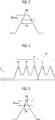
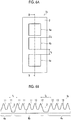
- Fig. 1 is a top view schematically showing an example of the flexo printing plate according to the present invention
- Fig. 2A is an enlarged view showing a portion of a cross-sectional view taken along the line A-A of Fig. 1.
- Fig. 2B is a view schematically showing an image printed using the flexo printing plate shown in Fig. 2A .
- each of the dots formed on a printing substrate 50 (a first dot 51, a second dot 52, and a third dot 53) is formed through the transfer of ink by small dots (a first small dot 11, a second small dot 12, and a third small dot 13) in the in positions corresponding to the horizontal direction in Fig. 2A .
- a printing plate 1a as an example of the flexo printing plate according to the present invention has an image area 3 and a non-image area 2.
- the image area 3 is a region to which ink is applied and from which the ink is transferred to a printing substrate at the time of printing, that is, a region which forms an image at the time of printing.
- the non-image area 2 is a region to which ink is not applied at the time of printing, that is, a region which does not form an image.
- the image area 3 includes a solid portion for performing printing as if painting a printing substrate by transferring ink to the whole surface of the substrate and/or a halftone dot area which is constituted with a plurality of projection-like small dots and expresses the density (gradation) of an image printed on a printing target by varying the size or density of the small dots.
- the small dots constituting the halftone dot area are formed based on a predetermined number of screen lines (definition), for example, based on the number of screen lines of about 100 to 175 lines per inch (lpi).
- the image area 3 of the printing plate 1a as the flexo printing plate of the present invention has a highlight halftone dot area 4 having a halftone dot rate higher than 0% and equal to or lower than 10%.
- a region of the image area 3 on the upper side in the drawing is the highlight halftone dot area 4
- a region of the image area 3 on the lower side in the drawing is an image area 5 which has a halftone dot rate higher than 10% and equal to or lower than 100% and is not included in the highlight halftone dot area.
- the highlight halftone dot area 4 has a constitution in which the distal end diameter (diameter) of at least one of the small dots, which are in a direction orthogonal to the edge of the highlight halftone dot area 4 and are adjacent to the non-image area 2 that continues 10 mm or further from the edge in a direction orthogonal to the edge, is smaller than the average of distal end diameters of the small dots in the highlight halftone dot area 4.
- Fig. 2A is an enlarged cross-sectional view of the boundary portion between the non-image area 2 and the highlight halftone dot area 4.
- Fig. 3 is a cross-sectional view showing one small dot in the highlight halftone dot area 4.
- the highlight halftone dot area 4 has many small dots (references 11 to 13) constituting halftone dots. Furthermore, as shown in Figs. 2A and 3 , each small dot forms a trapezoidal cylinder shape tapering toward the distal end. That is, a cross-section of the small dot in a direction parallel to the height direction of the small dot has a trapezoidal shape.
- a distal end diameter De 2 of a small dot 12 (hereinafter, referred to as a second small dot as well) adjacent to the non-image area 2 and a distal end diameter De 3 of a small dot 13 (hereinafter, referred to as a third small dot as well), which is adjacent to the second small dot 12, that is, which is positioned in the second line from the non-image area 2 side, are smaller than a distal end diameter De 1 of a first small dot 11 which is a small dot other than the second small dot 12 and the third small dot 13.
- All of the first small dots 11 which are small dots other than the second small dot 12 and the third small dot 13 have the same distal end diameter De 1 .
- distal end diameter De 2 of the second small dot 12 and the distal end diameter De 3 of the third small dot 13 are smaller than the average of the distal end diameter De of all the small dots in the highlight halftone dot area 4.
- the first small dot 11 is a small dot closest to the center of the highlight halftone dot area 4. Accordingly, it can be said that the distal end diameter De 2 of the second small dot 12 and the distal end diameter De 3 of the third small dot 13 are smaller than the distal end diameter of the small dot closest to the center.
- a diameter Dm 2 (see Fig. 3 ) of the second small dot 12 adjacent to the non-image area 2 that is measured at a position 40 ⁇ m distant from the distal end of the second small dot 12 and a diameter Dm 3 of the third small dot 13 as a small dot in the second line that is measured at a position 40 ⁇ m distant from the distal end of the third small dot 13 are smaller than a diameter Dm 1 of the first small dot 11 that is measured in a position 40 ⁇ m distant from the distal end of the first small dot 11.
- the diameter Dm 2 of the second small dot 12 that is measured at a position 40 ⁇ m distant from the distal end of the second small dot 12 and the diameter Dm 3 of the third small dot 13 that is measured at a position 40 ⁇ m distant from the distal end of the third small dot 13 are smaller than the average of the diameter Dm of all the small dots in the highlight halftone dot area 4 that is measured at a position 40 ⁇ m distant from the distal end of all the small dots.
- the distal end diameter De of a small dot is a diameter measured at a position 5 ⁇ m distant from the distal end (top) of the small dot. Furthermore, the distal end diameter De of a small dot and the diameter Dm of a small dot measured at a position 40 ⁇ m distant from the distal end of the small dot can be measured using a laser microscope VK8900 (manufactured by KEYENCE CORPORATION.), for example.
- the diameter of a circle having an area equivalent to the area of the cross-section is taken as the distal end diameter De and the diameter Dm measured at a position 40 ⁇ m distant from the distal end of the small dot.
- the diameter Dm measured at a position 40 ⁇ m distant from the distal end of the small dot will be referred to as "40 ⁇ m diameter Dm" as well.
- the average of distal end diameters of the small dots in the highlight halftone dot area and the average of diameters of the small dots measured at a position 40 ⁇ m distant from the distal end of the small dots are obtained by calculating the average of diameters of small dots in a range from the non-image area side to the twentieth lines in a direction starting from the edge of the highlight halftone dot area and being orthogonal to the edge.
- the flexo printing plate within the highlight halftone dot area, among the small dots constituting the highlight halftone dot area, at least one of the small dots adjacent to the non-image area which continues 10 mm or further from the edge of the highlight halftone dot area in a direction orthogonal to the edge has a distal end diameter that is smaller than the average of distal end diameters of the small dots in the highlight halftone dot area.
- Fig. 9A is a schematic cross-sectional view of an example of a flexo printing plate of the related art
- Fig. 9B is a schematic view of an image printed using the flexo printing plate shown in Fig. 9A
- each of the dots formed on a printing substrate 150 (a first dot 151, a second dot 152, and a third dot 153) is formed through the transfer of ink by small dots (a first small dot 111, a second small dot 112, and a third small dot 113) in the in positions corresponding to the horizontal direction in Fig. 9A .
- the flexo printing plate of the related art has a constitution in which within a highlight halftone dot area having a halftone dot rate higher than 0% and equal to or lower than 10%, all the small dots constituting the highlight halftone dot area have the same distal end diameter. That is, a second small dot 112 adjacent to a non-image area 102, a third small dot 113 position in the second line from the non-image area 102 side, and the first small dot 111 other than the second small dot 112 and the third small dot 113 have the same distal end diameter.
- the flexo printing plate 100 is formed of a flexible material made of a resin or rubber. Therefore, in a case where printing is performed using such a printing plate 100, printing pressure is concentrated on the second small dot 112 or the third small dot 113 in the vicinity of the non-image area 102, and hence a phenomenon of collapse and enlargement of the small dots occurs.
- the size of a second dot 152 and a third dot 153 formed through the transfer of ink, which has adhered to the second small dot 112 adjacent to the non-image area 102 or the third small dot 113 in the vicinity of the non-image area 102, to the printing substrate 150 becomes greater than the size of the first dot 151 formed through the transfer of ink from the first small dot 111 in the position separating from the non-image area 102.
- the highlight area Due to the phenomenon of enlargement of the small dots adjacent to the non-image area, the highlight area is connected to the non-image area, that is, gradation starts, the boundary line between the highlight area and the non-image area becomes thick, and this leads to the problem of the occurrence of discontinuity of density which is so-called tone jump.
- a printing plate 1a which is the flexo printing plate of the present invention
- the distal end diameter De 2 and De 3 of the second small dot 12 adjacent to the non-image area 2 and the third small dot 13 positioned in the second line from the non-image area 2 side are smaller than the average of the distal end diameter De of the small dots in the highlight halftone dot area 4. That is, the distal end diameter De 2 and the distal end diameter De 3 are smaller than the distal end diameter De 1 of the first small dot 11.
- the size of the second dot 52 and the third dot 53 formed through the transfer of ink, which has adhered to the second small dot 12 adjacent to the non-image area 2 or the third small dot 13 in the second line from the non-image area 2 side, to the printing substrate 50 can be made the same as the size of the first dot 51 formed through the transfer of ink from the first small dot 11 in the position separating from the non-image area 2.
- a 40 ⁇ m diameter Dm 2 of the second small dot 12 adjacent to the non-image area 2 and a 40 ⁇ m diameter Dm 3 of the third small dot 13 positioned in the second line from the non-image area 2 side are smaller than the average of 40 ⁇ m diameter Dm of the small dots in the highlight halftone dot area 4, that is, smaller than the 40 ⁇ m diameter Dm 1 of the first small dot 11.
- a standard printing pressure for flexo printing using a flexo printing plate is set such that an indentation amount becomes about 40 ⁇ m to 100 ⁇ m at a kiss touch printing pressure. Therefore, the size of an actually printed dot is considered to be greatly affected by the diameter of a small dot in a position corresponding to the indentation amount at the time of indentation.
- the 40 ⁇ m diameters Dm 2 and Dm 3 of the second small dot 12 and the third small dot 13 smaller than the average of the 40 ⁇ m diameter Dm of the small dots in the highlight halftone dot area 4, in a case where the printing pressure is concentrated on the second small dot 12 or the third small dot 13 and hence the phenomenon of collapse and enlargement of the small dots occurs, the difference between the diameters Dm 2 and Dm 3 of the enlarged small dots that are measured at a position 40 ⁇ m distant from the distal end of the small dots and the diameter Dm 1 of the first small dot 11 that is measured at a position 40 ⁇ m distant from the distal end of the first small dot 11 can be reduced. As a result, it is possible to more suitably inhibit the halftone dots in the boundary between the highlight halftone dot area 4 and the non-image area 2 from being enlarged and to inhibit the occurrence of tone jump.
- a constitution is adopted in which the distal end diameter De 2 of the second small dot 12 adjacent to the non-image area 2 and the distal end diameter De 3 of the third small dot 13 positioned in the second line from the non-image area side are made smaller than the distal end diameter De 1 of the first small dot 11.
- the present invention is not limited thereto.
- a constitution may be adopted in which at least the distal end diameter De 2 of the second small dot 12 adjacent to the non-image area 2 is smaller than the distal end diameter De 1 of the first small dot 11.
- the distal end diameter De of small dots in a range from the third line from the non-image area 2 may be made smaller than the distal end diameter De 1 of the first small dot 11.
- the distal end diameter De of the small dots in the first to tenth lines from the non-image area 2 is made smaller than the distal end diameter De 1 of the first small dot 11
- the distal end diameter De of the small dots in the first and second lines is made smaller than the distal end diameter De 1 of the first small dot 11.
- the distal end diameter De of the small dots within a region of 500 ⁇ m from the boundary between the highlight halftone dot area 4 and the non-image area 2 made smaller than the distal end diameter De 1 of the first small dot 11.
- the present invention is not limited to the constitution in which the 40 ⁇ m diameter Dm 2 of the second small dot 12 adjacent to the non-image area 2 and the 40 ⁇ m diameter Dm 3 of the third small dot 13 positioned in the second line from the non-image area side are smaller than the 40 ⁇ m diameter Dm 1 of the first small dot 11. Only the 40 ⁇ m diameter Dm 2 of the second small dot 12 adjacent to the non-image area 2 may be made smaller than the 40 ⁇ m diameter Dm 1 of the first small dot 11.
- the 40 ⁇ m diameter Dm of the second small dot 12 adjacent to the non-image area 2 and the third small dot 13 in the second line from the non-image area 2 may be made smaller than the 40 ⁇ m diameter Dm 1 of the first small dot 11.
- the 40 ⁇ m diameter Dm of the small dots in the first to tenth lines from the non-image area 2 is made smaller than the 40 ⁇ m diameter Dm 1 of the first small dot 11, and it is particularly preferable that the 40 ⁇ m diameter Dm of the small dots in the first and second lines is made smaller than the 40 ⁇ m diameter Dm 1 of the first small dot 11. Furthermore, it is also preferable that the 40 ⁇ m diameter Dm of the small dots within a range of 500 ⁇ m from the boundary between the highlight halftone dot area 4 and the non-image area 2 is made smaller than the 40 ⁇ m diameter Dm 1 of the first small dot 11.
- the small dot adjacent to the non-image area 2 (second small dot 12) and the small dots, which are in a range from the second line from the non-image area 2 and have a distal end diameter De smaller than the distal end diameter De of the first small dot 11, will be collectively referred to as "small dots in the vicinity of the non-image area" as well.
- the distal end diameters De of the small dots in the vicinity of the non-image area will be collectively referred to as "distal end diameter De s " as well.
- the 40 ⁇ m diameters Dm of the small dots in the vicinity of the non-image area will be collectively referred to as "40 ⁇ m diameter Dm s " as well.
- a ratio of the distal end diameter De s of the small dots in the vicinity of the non-image area to the distal end diameter De 1 of the first small dot 11 may be appropriately set according to the material forming the image area, the shape and dimension of the small dots, the printing pressure set at the time of printing, and the like.
- the ratio is preferably 1 % to 70%.
- the ratio of the distal end diameter De s of the small dots in the vicinity of the non-image area to the distal end diameter De 1 of the first small dot 11 is set to be equal to or lower than 70%, because then the difference between the distal end diameter De s of the collapsed and enlarged small dots in the vicinity of the non-image area and the distal end diameter De 1 of the first small dot 11 can be reliably reduced at the time of printing.
- the ratio of the distal end diameter De s of the small dots in the vicinity of the non-image area to the distal end diameter De 1 of the first small dot 11 is set to be equal to or higher than 1%, because then the small dots in the vicinity of the non-image area can be reliably pressed on the printing substrate 50, the occurrence of voids can be prevented, and the folding of the small dots can be prevented.
- the ratio of the distal end diameter De s of the small dots in the vicinity of the non-image area to the distal end diameter De 1 of the first small dot 11 is preferably 5% to 60%, and particularly preferably 10% to 50%.
- the ratio of the distal end diameter De s of the small dots in the vicinity of the non-image area to the average of the distal end diameter De of the small dots other than the small dots in the vicinity of the non-image area may be made fall into the above range.
- a ratio of a 40 ⁇ m diameter Dm s of the small dots in the vicinity of the non-image area to the 40 ⁇ m diameter Dm 1 of the first small dot 11 may be appropriately set according to the material forming the image area, the shape and dimension of the small dots, the printing pressure set at the time of printing, and the like.
- the ratio is preferably 1% to 70%, more preferably 5% to 60%, and particularly preferably 10% to 50%.
- the ratio of the distal end diameter De s of the small dots in the vicinity of the non-image area to the distal end diameter De 1 of the first small dot 11 will be referred to as “diameter ratio” as well, and making the distal end diameter De s of the small dots in the vicinity of the non-image area smaller than the distal end diameter De 1 of the first small dot 11 will be referred to as “diameter reduction” as well.
- the distal end diameter De 2 of the second small dot 12 is the same as the distal end diameter De 3 of the third small dot 13.
- the present invention is not limited thereto, and the distal end diameter De 2 of the second small dot 12 may be different from the distal end diameter De 3 of the third small dot 13.
- the distal end diameter De 2 of the second small dot 12 may be the smallest, and the distal end diameter De 3 of the third small dot 13 may be larger than the distal end diameter De 2 of the second small dot 12 and smaller than the distal end diameter De 1 of the first small dot 11.
- the closer the small dots to the non-image area 2 the smaller the distal end diameter De thereof.
- the distal end diameter De 2 of the second small dot 12 adjacent to the non-image area 2 is the smallest among the distal end diameters De of the small dots in the highlight halftone dot area 4.
- the difference between the distal end diameter De s of the collapsed and enlarged small dots in the vicinity of the non-image area and the distal end diameter De 1 of the first small dot 11 can be more reliably reduced at the time of printing, and the occurrence of void at the time of printing can be prevented.
- the distal end diameter De s of at least one of the small dots adjacent to the non-image area 2, which continues 10 mm or further from the edge of the highlight halftone dot area 4 in a direction orthogonal to the edge is smaller than the average of the distal end diameter De of the small dots in the highlight halftone dot area 4. It is preferable that the distal end diameter De s of all the small dots adjacent to the non-image area 2, which continues 10 mm or further from the edge of the highlight halftone dot area 4 in a direction orthogonal to the edge, is smaller than the average of the distal end diameter De of the small dots in the highlight halftone dot area 4. That is, the distal end diameter De s of the small dots forming the boundary between the highlight halftone dot area 4 and the non-image area 2 is preferably smaller than the average of the distal end diameter De.
- the difference between the distal end diameter De s of the collapsed and enlarged small dots in the vicinity of the non-image area and the distal end diameter De 1 of the first small dot 11 can be more reliably reduced.
- the cross-sectional shape of a small dot in a cross-section parallel to the height direction of the small dot is a trapezoidal shape, but the present invention is not limited thereto.
- the cross-sectional shape of the small dot may be rectangular, wavy, and the like.
- the small dot may have a trapezoidal shape on the proximal end side thereof and a rectangular shape on the distal end side thereof.
- the cross-sectional shape of the small dot in the cross-section parallel to the height direction thereof is preferably a trapezoidal shape.
- the cross-sectional shape of the small dot in the cross-section orthogonal to the height direction thereof is not limited to the trapezoidal shape, and may be elliptical, rectangular, triangular, polygonal, and the like.
- the height of a small dot in the highlight halftone dot area is not particularly limited, and may be the same as the height of a small dot in a highlight halftone dot area of a flexo printing plate of the related art.
- the height of a small dot is preferably about 100 to 150 ⁇ m.
- the height of the bottom portion of a region between small dots is different from the height of the surface of the non-image area 2.
- the present invention is not limited thereto, and the height of the bottom portion of the region between small dots may be the same as the height of the surface of the non-image area 2.
- the shape of the highlight halftone dot area (shape of the image area) seen in a direction orthogonal to the main surface of the flexo printing plate, according to the image to be printed, it is possible to adopt various shapes such as a circular shape, an elliptical shape, a triangular shape, a quadrangular shape, a polygonal shape, a letter shape, a shape of number, and a shape of sign.
- the small dot subjected to diameter reduction is a small dot adjacent to the non-image area which continues 10 mm or further from the edge of the highlight halftone dot area in a direction orthogonal to the edge. That is, in a case where the length of each of the non-image areas adjacent to each other is less than 10 mm, the small dots adjacent to the non-image areas are not subjected to the diameter reduction.
- the length of the non-image area in a direction orthogonal to the edge of the highlight halftone dot area will be simply referred to as "length of the non-image area" as well.
- the edge of the highlight halftone dot area (boundary between the highlight halftone dot area and the non-image area) forms a curve
- the length of the non-image area in a direction orthogonal to a tangent of the curve will be regarded as "length of the non-image area”.
- Fig. 6A is a top view schematically showing another example of the flexo printing plate of the present invention
- Fig. 6B is a cross-sectional view taken along the line B-B in Fig. 6A .
- a printing plate 1b shown in Fig. 6A has three image areas and the non-image area 2, and all of the image areas are highlight halftone dot areas 4a to 4c having a halftone dot rate higher than 0% and equal to or lower than 10%. As shown in the drawing, the highlight halftone dot areas 4a to 4c are separated from each other by a predetermined distance and arrayed in a vertical direction in the drawing.
- a distance t 1 between the highlight halftone dot area 4a disposed on the upper side in the drawing and the highlight halftone dot area 4b disposed in the middle of the drawing is less than 10 mm.
- a distance t 2 between the highlight halftone dot area 4b disposed in the middle of the drawing and the highlight halftone dot area 4c disposed on the lower side is equal to or greater than 10 mm.
- the small dots constituting the edge of the lower side of the highlight halftone dot area 4b in the drawing and the small dots constituting the edge of the upper side of the highlight halftone dot area 4c in the drawing are small dots adjacent to the non-image area which continues 10 mm or further from the edge of the highlight halftone dot area in a direction orthogonal to the edge. Therefore, as shown in Fig. 6B , the second small dot 12 adjacent to the non-image area 2 and the third small dot 13 in the second line are subjected to diameter reduction.
- the small dots constituting the edge of the lower side of the highlight halftone dot area 4a in the drawing and the small dot constituting the edge of the upper side of the highlight halftone dot area 4b in the drawing are adjacent to the non-image area 2, they are not small dots adjacent to the non-image area which continues 10 mm or further from the edge of the highlight halftone dot area in the direction orthogonal to the edge. Therefore, as shown in Fig. 6B , the small dots adjacent to the non-image area 2 are not subjected to the diameter reduction, and the distal end diameter De of the small dots adjacent to the non-image area 2 is the same as that of the small dot (first small dot) of the central side.
- the length of the non-image area is less than 10 mm, that is, in a case where a gap between image areas is less than 10 mm, it is difficult for the printing pressure to be concentrated on the small dots of the edge of the image area. Therefore, in a case where the small dots adjacent to the non-image area having a length less than 10 mm are subjected to diameter reduction, to the small dots having undergone the diameter reduction, only an appropriate printing pressure is applied while an excessive printing pressure is not applied. Consequently, the phenomenon of the collapse and enlargement of the small dots hardly occurs. As a result, the size of printed dots may be too small, or voids may occur.
- the small dots adjacent to the non-image area having a length equal to or greater than 10 mm are subjected to the diameter reduction, but the small dots adjacent to the non-image area having a length less than 10 mm are not subjected to the diameter reduction.
- the method for manufacturing the flexo printing plate is a method in which a cured layer (relief forming layer) of a flexo printing plate precursor is laser-engraved such that the cured layer in the portion that will become a non-image area is removed and that a projection-like image area is formed, arid the cured layer in the image area is removed according to the desired number of screen lines, a predetermined halftone dot rate, and the like such that many small dots and a halftone dot area are formed.
- the small dots adjacent to the non-image area having a length equal to or greater than 10 mm may be subjected to diameter reduction.
- the original image data of the printing plate to be prepared is obtained. Then, in order to convert the original image data into data for performing laser engraving, processing using a raster image processor (RIP) is performed.
- RIP raster image processor
- a template of a pattern for performing diameter reduction at a predetermined halftone dot rate is superimposed, thereby generating a mask.
- the template is selected such that the diameter is reduced further as the small dots become close to the non-image area side.
- the image data having undergone the RIP processing is multiplied by the generated mask, thereby generating output image data.
- the output image data is generated.
- laser engraving is performed, and a flexo printing plate is prepared.
- the laser engraving method is basically the same as the laser engraving method used in the method for manufacturing a flexo printing plate of the related art.
- the laser engraving method for example, it is possible to use a method in which a sheet-like printing plate precursor for laser engraving is wound around the outer peripheral surface of a cylindrical drum; the drum is rotated; a laser beam corresponding to the aforementioned output image data is emitted to the printing plate precursor from an exposure head; and the exposure head is caused to perform scanning at a predetermined pitch in a sub-scanning direction orthogonal to a main scanning direction such that a two-dimensional image is engraved (recorded) at a high speed on the surface of the printing plate precursor.
- the type of the laser used in the laser engraving is not particularly limited, but an infrared laser is preferably used.
- an infrared laser By the irradiation of the infrared laser, molecules in the cured layer vibrate, and hence heat is generated.
- a high-power laser such as a carbon dioxide laser or a yttrium aluminum garnet (YAG) laser is used as the infrared laser, a large amount of heat is generated in the portion irradiated with the laser, and the molecules in the cured layer are cleaved or ionized. As a result, the cured layer is selectively removed, that is, engraved.
- the advantage of the laser engraving is that it enables three-dimensional control of the structures because the engraving depth can be arbitrarily set.
- the cured layer can be selectively removed with higher sensitivity, and hence a relief layer having a sharp image is obtained.
- a carbon dioxide laser (CO 2 laser) or a semiconductor laser is preferable, and a semiconductor infrared laser with fiber (FC-LD) is particularly preferable.
- CO 2 laser carbon dioxide laser
- FC-LD semiconductor infrared laser with fiber
- the semiconductor laser has higher laser oscillation efficiency, is less expensive, and can be further miniaturized. Furthermore, it is easy to make an array of the semiconductor lasers because of the small size thereof.
- the beam shape can be controlled.
- the wavelength of the semiconductor laser is preferably 700 to 1,300 nm, more preferably 800 to 1,200 nm, even more preferably 860 to 1,200 nm, and particularly preferably 900 to 1,100 nm.
- the laser can efficiently emit laser beams, and accordingly, such a laser is effective for the laser engraving. Furthermore, by treating the fiber, the beam shape can be controlled. For example, it is possible to make the beam profile have a top-hat shape, and in this way, energy can be stably applied to the surface of the plate. Details of the semiconductor laser are described in "Laser Handbook, 2 nd Edition” edited by Laser Society of Japan, and in “Practical Laser Technology” written and edited by Institute of Electronics and Communication Engineers of Japan.
- a plate-making apparatus including the semiconductor laser with fiber specifically described in JP2009-172658A and JP2009-214334A can be suitably used in the method for manufacturing the flexo printing plate of the present invention.
- the method for manufacturing the flexo printing plate is not limited to aforementioned laser engraving (direct laser engraving (DLE) method), and it is possible to use various known manufacturing methods such as a laser ablation masking system (LAMS) method in which an image is graven on the surface of a printing plate precursor by using a laser and developed.
- DLE direct laser engraving
- LAMS laser ablation masking system
- the flexo printing plate precursor used in the present invention is not particularly limited as long as it is a known resin plate or rubber plate for flexo printing. Furthermore, the printing plate precursor may have a sheet shape or a cylindrical shape.
- the printing plate precursor has the following resin sheet as a cured layer (relief forming layer).
- the resin sheet is preferably a sheet which is obtained in a manner in which a curable resin composition containing at least a polymer having a monomer unit derived from diene-based hydrocarbon (hereinafter, referred to as "resin composition for forming a resin sheet" as well) is made into a sheet-shaped material and cured by the action of heat and/or light, and more preferably a sheet formed of the resin composition for forming a resin sheet which will be described later.
- a curable resin composition containing at least a polymer having a monomer unit derived from diene-based hydrocarbon herein composition for forming a resin sheet
- the resin sheet can be laser-engraved.
- Preferred examples of methods for forming the resin sheet include a method of preparing the resin composition for forming a resin sheet, removing a solvent from the resin composition if necessary, and then melt-extruding the resin composition onto a support, a method of preparing the resin composition for forming a resin sheet, casting the resin composition onto a support, and removing a solvent by heating and drying the cast resin composition in an oven or the like, and a method of molding the resin composition into a sheet-shaped material by using calender rolls shown in Fig. 7 .
- calender rolls 60 have a first roll 62a to a fourth roll 62d, and the gap between the rolls, the roll temperature, and the rotation rate of the rolls can be set.
- a resin sheet 71 By setting a kneaded material 70 between the rolls and molding the material by rolling, a resin sheet 71 can be obtained.
- the material used in the support is not particularly limited as long as the material can be mounted on a printing cylinder.
- materials having high dimensional stability are preferably used, and examples thereof include a metal such as steel, stainless steel, or aluminum; a plastic resin such as polyester (for example, polyethylene terephthalate (PET), polybutylene terephthalate (PBT), or polyacrylonitrile (PAN)), or polyvinyl chloride; synthetic rubber such as styrene-butadiene rubber; and a plastic resin (such as an epoxy resin or a phenol resin) reinforced with glass fiber.
- a PET film or a steel substrate is preferably used as the support.
- the resin composition for forming a resin sheet used in the present invention can be manufactured by, for example, dissolving or dispersing a polymer having a monomer unit derived from diene-based hydrocarbon, a polymerizable compound, aromatics, a plasticizer, and the like in an appropriate solvent and then dissolving a cross-linking agent, a polymerization initiator, a cross-linking accelerator, and the like therein.
- a cross-linking agent e.g., a polymerization initiator, aromatics, a plasticizer, and the like
- a cross-linking agent e.g., a polymerization initiator, a cross-linking accelerator, and the like therein.
- the solvent an organic solvent having appropriate volatility is preferable.
- the resin sheet used in the present invention contains a polymer having a monomer unit derived from diene-based hydrocarbon (hereinafter, referred to as "specific polymer” as well) as an essential component.
- specific polymer a polymer having a monomer unit derived from diene-based hydrocarbon
- the weight-average molecular weight of the specific polymer is preferably 5,000 to 1,600,000, more preferably 10,000 to 1,000,000, and even more preferably 15,000 to 600,000. In a case where the weight-average molecular weight is equal to or greater than 5,000, the shape retaining properties of the polymer as a simple resin becomes excellent. It is preferable that weight-average molecular weight is equal to or less than 1,600,000, because then the polymer easily dissolves in a solvent, and it is easy to prepare a resin composition for laser engraving.
- the weight-average molecular weight is measured by a gel permeation chromatography (GPC) and expressed in terms of standard polystyrene.
- GPC gel permeation chromatography
- HLC-8220 GPC manufactured by Tosoh Corporation
- TSKgeL Super HZM-H three columns consisting of TSKgeL Super HZM-H, TSKgeL Super HZ4000, and TSKgeL Super HZ 2000 (manufactured by Tosoh Corporation, 4.6 mm ID ⁇ 15 cm)
- THF tetrahydrofuran
- GPC is performed using an IR detector under the conditions of a sample concentration of 0.35% by mass, a flow rate of 0.35 ml/min, sample injection amount of 10 ⁇ L, and a measurement temperature of 40°C.
- a calibration curve is prepared from 8 samples of "Standard Sample TSK standard, polystyrene" manufactured by Tosoh Corporation: "F-40", “F-20”, “F-4", “F-1”, "A-5000”, “A-2500”, "A-1000", and "n-propylbenzene".
- the specific polymer may be a specific polymer having a monomer unit derived from unconjugated diene-based hydrocarbon, but is preferably a specific polymer having a monomer unit derived from conjugated diene-based hydrocarbon.
- Preferred examples of the specific polymer having a monomer unit derived from conjugated diene-based hydrocarbon include a polymer obtained by polymerizing conjugated diene-based hydrocarbon, a copolymer obtained by polymerizing conjugated diene-based hydrocarbon with other unsaturated compound are preferably with a monoolefin-based unsaturated compounds, and the like.
- the aforementioned polymer or copolymer may be modified.
- a reactive group such as (meth)acryloyl group may be introduced into the terminal thereof, or a portion of the internal olefin may be hydrogenated.
- the polybutadiene in which a portion of the internal olefin is hydrogenated will be referred to as “partially hydrogenated polybutadiene” as well, and the polyisoprene in which a portion of the internal olefin is hydrogenated likewise will be referred to as “partially hydrogenated polyisoprene” as well.
- the copolymer is not particularly limited, and may be a random polymer, a block copolymer, or a graft polymer.
- conjugated diene-based hydrocarbon examples include 1,3-butadiene, isoprene, and the like. One kind of these compounds are used singly, or two or more kinds thereof are used in combination.
- monoolefin-based unsaturated compounds include styrene, ⁇ -methylstyrene, o-methylstyrene, p-methylstyrene, isobutene, vinyl chloride, vinylidene chloride, (meth)acrylamide, (meth)acrylamide vinyl acetate, (meth)acrylic acid ester, (meth)acrylic acid, and the like.
- the polymer obtained by polymerizing conjugated diene-based hydrocarbon or the copolymer obtained by polymerizing conjugated diene-based hydrocarbon with a monoolefin-based unsaturated compound is not particularly limited, and specific examples thereof include a butadiene polymer, an isoprene polymer, a styrene-butadiene copolymer, a styrene-isoprene copolymer, an acrylic acid ester-isoprene copolymer, a copolymer of methacrylic acid ester and the aforementioned conjugated diene, an acrylonitrile-butadiene-styrene copolymer, a styrene-isoprene-styrene block copolymer, a styrene-butadiene-styrene block copolymer, an isobutene-isoprene copolymer (butyl rubber), and the
- These polymers may be subjected to emulsion polymerization or solution polymerization.
- the specific polymer may have an ethylenically unsaturated group on the terminal thereof, and may have a partial structure represented by the following Formula (A-1).
- R 1 represents a hydrogen atom or a methyl group
- A represents O or NH
- * represents a binding position in which the structure is bonded to other structures.
- A preferably represents O.
- the specific polymer may have a (meth)acryloyloxy group or a (meth)acrylamide group in a molecule.
- the specific polymer more preferably has a (meth)acryloyloxy group.
- the specific polymer may have the partial structure represented by Formula (A-1) on the terminal of a main chain or in a side chain. It is preferable that the specific polymer has the partial structure of the terminal of the main chain.
- the specific polymer has two or more partial structures represented by Formula (A-1) in a molecule.
- Examples of the specific polymer having the partial structure represented by Formula (A-1) include polyolefin (meth)acrylate obtained by reacting a hydroxyl group of a hydroxyl group-containing polyolefin with an ethylenically unsaturated group-containing compound (for example, BAC-45 (manufactured by OSAKA ORGANIC CHEMICAL INDUSTRY LTD), TEA-1000, TE-2000, EMA-3000 (manufactured by NIPPON SODA CO., LTD.)), such as polybutadiene di(meth)acrylate, partially hydrogenated polybutadiene di(meth)acrylate, polyisoprene di(meth)acrylate, and partially hydrogenated polyisoprene (meth)acrylate.
- an ethylenically unsaturated group-containing compound for example, BAC-45 (manufactured by OSAKA ORGANIC CHEMICAL INDUSTRY LTD), TEA-1000, TE-2000
- Examples of the specific polymer also preferably include modified polyolefin obtained by modifying polyolefin such that an ethylenically unsaturated bond is introduced into the polyisoprene (for example, methacrylate-introduced polyolefin (KURAPRENE UC-203 and UC-102 (manufactured by KURARAY CO., LTD.)).
- modified polyolefin obtained by modifying polyolefin such that an ethylenically unsaturated bond is introduced into the polyisoprene
- methacrylate-introduced polyolefin KURAPRENE UC-203 and UC-102 (manufactured by KURARAY CO., LTD.)
- the specific polymer is a polymer having a monomer unit derived from butadiene and/or isoprene.
- polystyrene rubber polybutadiene (butadiene rubber), partially hydrogenated polybutadiene, terminal-modified polybutadiene, polyisoprene (isoprene rubber), partially hydrogenated polyisoprene, terminal-modified polyisoprene, styrene-butadiene rubber (SBR), a styrene-butadiene-styrene triblock copolymer (SBS), an acrylonitrile-butadiene-styrene copolymer (ABS), a styrene-isoprene-styrene triblock copolymer (SIS), an isoprene/butadiene copolymer, and the like.
- SBR styrene-butadiene rubber
- SBS styrene-butadiene-styrene triblock copolymer
- ABS acrylonitrile-butadiene-styrene
- Terminal-modified means that the terminal of the main chain or the side chain is modified with an amide group, a carboxyl group, a hydroxyl group, a (meth)acryloyl group, a glycidyl group, or the like.
- polybutadiene, partially hydrogenated polybutadiene, hydroxyl group-terminated polybutadiene, glycidyl ether-modified polybutadiene, polyisoprene, partially hydrogenated polyisoprene, terminal-modified polyisoprene, hydroxyl group-terminated polyisoprene, glycidyl ether-modified polyisoprene, SBS, and SIS are preferable.
- the proportion of the monomer unit derived from butadiene, isoprene, or hydrogenated butadiene or isoprene is preferably equal to or higher than 30 mol% in total, more preferably equal to or higher than 50 mol% in total, and even more preferably equal to or higher than 80 mol% in total.
- isoprene is polymerized by 1,2-, 3,4-, or 1,4-addition depending on the catalyst or the reaction condition.
- the polyisoprene polymerized by any of the aforementioned addition pathways may be used.
- the specific polymer contains cis-1,4-polyisoprene as a main component.
- the content of the cis-1,4-polyisoprene is preferably equal to or greater than 50% by mass, more preferably equal to or greater than 65% by mass, even more preferably equal to or greater than 80% by mass, and particularly preferably equal to or greater than 90% by mass.
- polyisoprene natural rubber may be used.
- commercially available polyisoprene can be used, and examples thereof include a NIPOL IR series (manufactured by ZEON CORPORATION).
- butadiene is polymerized by 1,2- or 1,4-addition depending on the catalyst or the reaction condition.
- the polybutadiene polymerized by any of the aforementioned addition pathways may be used.
- the specific polymer contains 1,4-polybutadiene as a main component.
- the content of 1,4-polybutadiene is preferably equal to or greater than 50% by mass, more preferably equal to or greater than 65% by mass, even more preferably equal to or greater than 80% by mass, and particularly preferably equal to or greater than 90% by mass.
- the content of a cis-isomer or a trans-isomer is not particularly limited. From the viewpoint of expressing rubber elasticity, a cis-isomer is preferable.
- the content of cis-1,4-polybutadiene is preferably equal to or greater than 50% by mass, more preferably equal to or greater than 65% by mass, even more preferably equal to or greater than 80% by mass, and particularly preferably equal to or greater than 90% by mass.
- polystyrene As polybutadiene, commercially available products may be used, and examples thereof include a NIPOL BR series (manufactured by ZEON CORPORATION), a UBEPOL BR series (manufactured by UBE INDUSTRIES, LTD.), and the like.
- NIPOL BR series manufactured by ZEON CORPORATION
- UBEPOL BR series manufactured by UBE INDUSTRIES, LTD.
- the specific polymer may be a specific polymer having a monomer unit derived from unconjugated diene-based hydrocarbon.
- Examples of the specific polymer preferably include a copolymer obtained by polymerizing unconjugated diene-based hydrocarbon with other unsaturated compounds and preferably with an ⁇ olefin-based unsaturated compound, and the like.
- the copolymer is not particularly limited, and may be a random polymer, a block copolymer, or a graft polymer.
- unconjugated diene-based hydrocarbon examples include dicyclopentadiene, 1,4-hexadiene, cyclooctadiene, methylene norbomene, ethylidene norbomene, and the like.
- dicyclopentadiene and ethylidene norbomene are preferable, and ethylidene norbornene is more preferable.
- the aforementioned monoolefin-based unsaturated compound include ⁇ -olefin having 2 to 20 carbon atoms such as ethylene, propylene, 1-butene, 1-hexene, and 4-methyl-pentene.
- ethylene and propylene are preferable. It is more preferable to use ethylene and propylene in combination. These compounds are used singly or used in combination of two or more kinds thereof.
- the polymer obtained by polymerizing the conjugated diene-based hydrocarbon or the copolymer obtained by polymerizing conjugated diene-based hydrocarbon with an ⁇ -olefin-based unsaturated compound is not particularly limited.
- an ethylene-a olefin-diene copolymer is preferable, and ethylene-propylene-diene rubber (EPDM) is more preferable.
- styrene-butadiene rubber styrene-butadiene rubber, butadiene rubber, isoprene rubber, or ethylene-propylene-diene rubber is preferable, and butadiene rubber is more preferable.
- the specific polymer is preferably a polymer in which the main chain mainly contains isoprene or butadiene as a monomer unit. Furthermore, a portion of the specific polymer may be hydrogenated and converted into a saturated bond. In addition, the middle or the terminal of the main chain of the polymer may be modified with amide, a carboxyl group, a hydroxyl group, a (meth)acryloyl group, or the like or may be epoxylated.
- polybutadiene, polyisoprene, and an isoprene/butadiene copolymer are preferable, polybutadiene and polyisoprene are more preferable, and polybutadiene is even more preferable.
- the glass transition temperature (Tg) of the specific polymer is preferably equal to or lower than 20°C.
- the glass transition temperature of the specific polymer is measured according to JIS K 7121-1987 by using a differential scanning calorimeter (DSC).
- the specific polymer has two or more glass transition temperatures, it is preferable that at least one of them is equal to or lower than 20°C. It is more preferable that all of the glass transition temperatures are equal to or lower than 20°C.
- the SP value of the specific polymer is preferably 14.0 to 18.0 MPa 1/2 , more preferably 15.0 to 17.5 MPa 1/2 , and even more preferably 16.0 to 17.5 MPa 1/2 .
- the SP value equals the square root of cohesive energy density of a molecule.
- the SP value shows the magnitude of intermolecular cohesive force, and is a parameter of polarity.
- the SP value is within the above range, because then appropriate adhesiveness with respect to a urethane-based adhesive is obtained.
- the SP value is calculated based on the Okitsu method described in The Journal of The Adhesion Society of Japan, 29(3), 1993, 204-211 .
- the specific polymer is preferably an elastomer or a plastomer.
- the specific polymer is an elastomer or a plastomer, when a printing plate precursor for laser engraving obtained from the specific polymer is made into a sheet-like precursor or a cylindrical precursor, excellent thickness accuracy or dimensional accuracy can be achieved.
- the specific polymer is an elastomer or a plastomer, because then necessary elasticity can be imparted to the flexo printing plate.
- plastomer means a polymer substance having the properties of easily performing flow deformation by heating and of being able to be solidified into the deformed shape by cooling, as describe in " New Edition of Polymer Dictionary” (The Society of Polymer Science, Japan, Asakura Publishing Co., Ltd., 1988 ).
- "Plastomer” is a term of contrast to "elastomer” (a substance having the properties of being instantaneously deformed according to an external force when an external force is applied thereto and restoring the original shape in a short time when the external force is removed).
- the plastomer is a substance which does not perform elastic deformation unlike the elastomer while easily performs plastic deformation.
- the plastomer means a substance which can be deformed such that the size thereof increases up to 200% with small external force at room temperature (20°C) provided that the original size of the plastomer is regarded as being 100%, and does not shrink to such a degree that the size becomes equal to or less than 130% even when the external force is removed.
- the small force specifically refers to the external force at which the tensile strength becomes 1 to 100 MPa.
- the plastomer means a substance having properties in which, in a case where a dumbbell-shaped No.
- test piece specified in JIS K 6251-1993 is used based on the permanent set testing methods of JIS K 6262-1997, in a tensile test performed at 20°C, the test piece can be elongated without breakage until the distance between marker lines marked before the tensile test doubles; and in a case where the test piece is held as is for 60 minutes at a point in time when the distance between marker lines marked before the tensile test doubles, the external tensile force is removed, and then the test piece is allowed to stand for 5 minutes, the tensile permanent set measured at this time is equal to or higher than 30%.
- all of the testing conditions were based on the permanent set testing methods of JIS K 6262-1997, except that the dumbbell-shaped No. 4 test piece specified in JIS K 6251-1993 was used, the holding time was set to be 60 minutes, and the temperature of the testing room was set to be 20°C.
- a polymer which cannot be measured in the aforementioned method that is, a polymer which is deformed even if external tensile force is not applied thereto and does not restore its original shape in a tensile test or a polymer which is broken when the small external force used at the time of measurement described above is applied thereto corresponds to the plastomer.
- the glass transition temperature (Tg) of the polymer plastomer is less than 20°C. In a case where the polymer has two or more Tg's, all of Tg's are less than 20°C. Tg of the polymer can be measured by differential scanning calorimetry (DSC).
- elastomer means a polymer which can be elongated until the distance between marker lines doubles in the aforementioned tensile test and having a tensile permanent set, measured 5 minutes after the external tensile force is removed, less than 30%.
- the viscosity of the specific polymer of the present invention measured at 20°C is preferably 10 Pa ⁇ s to 10 kPa ⁇ s, and more preferably 50 Pa ⁇ s to 5 kPa ⁇ s. In a case where the viscosity is within the above range, the resin composition is easily molded into a sheet-shaped material, and the process becomes simple. In the present invention, in a case where the specific polymer is a plastomer, when the resin composition for forming a resin sheet is molded into a sheet-shaped material, excellent thickness accuracy or dimensional accuracy can be achieved.
- one kind of the specific polymer may be used singly, or two or more kinds thereof may be used in combination.
- the total content of the specific polymer in the resin sheet used in the present invention is, with respect to the total mass of the solid content of the resin sheet, preferably 5% to 90% by mass, more preferably 15% to 85% by mass, and even more preferably 30% to 80% by mass.
- the total content of the specific polymer in the resin composition for forming a resin sheet used in the present invention is, with respect to the total mass of the solid content of the resin composition, preferably 5% to 90% by mass, more preferably 15% to 85% by mass, and even more preferably 30% to 80% by mass.
- the content of the specific polymer is equal to or greater than 5% by mass, printing durability enough for the obtained resin sheet to be used as a printing plate is obtained.
- the content of the specific polymer is equal to or less than 90% by mass, the amount of other components does not become insufficient, and flexibility enough for the prepared printing plate to be used as a printing plate can be obtained.
- Total mass of the solid content means the total mass determined when volatile components such as a solvent are excluded from the resin sheet or the resin composition for forming a resin sheet.
- the resin sheet and the resin composition for forming a resin sheet used in the present invention contains a polymerization initiator, a photothermal conversion agent, a solvent, and other components.
- a polymerization initiator e.g., ethylene glycol dimethacrylate, ethylene glycol dimethacrylate, ethylene glycol dimethacrylate, ethylene glycol dimethacrylate, ethylene glycol dimethacrylate, ethylene glycol dimethacrylate, tert copolymer, terpolymer, terpolymer, graft copolymer, graft copolymer, graft copolymer, graft copolymer, graft copolymer, ethylene glycol dimethacrylate, ethylene glycol dimethacrylate, ethylene glycol dimethacrylate, ethylene glycol dimethacrylate, ethylene glycol dimethacrylate, ethylene glycol dimethacrylate, ethylene glycol dimethacrylate, sulfate
- the resin composition for laser engraving is formed using the resin composition for forming a resin sheet containing a polymerization initiator.
- the resin composition for forming a resin sheet contains a polymerization initiator, the cross-linking of the specific polymer and the ethylenically unsaturated bonds contained in the polymerizable compound which will be described later is accelerated.
- the compounds known to those in the related art can be used without limitation. Although any of a photopolymerization initiator and a thermal polymerization initiator can be used, a thermal polymerization initiator is preferable because this compound makes it possible to form a cross-link by using a simple device.
- a radical polymerization initiator as a preferred polymerization initiator will be specifically described, but the present invention is not limited thereto.
- preferred polymerization initiators include (a) aromatic ketones, (b) onium salt compound, (c) organic peroxide, (d) thio compound, (e) hexaaryl biimidazole compound, (f) ketoxime ester compound, (g) borate compound, (h) azinium compound, (i) metallocene compound, (j) active ester compound, (k) carbon-halogen bond-containing compound, (1) azo-based compound, and the like.
- Specific examples of (a) to (1) will be shown below, but the present invention is not limited thereto.
- organic peroxide and (1) azo-based compound are more preferable, and (c) organic peroxide is particularly preferable.
- organic peroxide and (1) azo-based compound the following compounds are preferable.
- organic peroxide preferred as the thermal polymerization initiator which can be used in the present invention
- peroxyester-based compounds such as 3,3'4,4'-tetra(t-butylperoxycarbonyl)benzophenone, 3,3'4,4'-tetra(t-amylperoxycarbonyl)benzophenone, 3,3'4,4'-tetra(t-hexylperoxycarbonyl)benzophenone, 3,3'4,4'-tetra(t-octylperoxycarbonyl)benzophenone, 3,3'4,4'-tetra(cumylperoxycarbonyl)benzophenone, 3,3'4,4'-tetra(p-isopropylcumylperoxycarbonyl)benzophenone, di-t-butyldiperoxyisophthalate, di-t-butylperoxyisophthalate, t-butylperoxybenzoate, t-butylperoxy-3 -
- azo-based compound preferred as the polymerization initiator which can be used in the present invention include 2,2'-azobisisobutyronitrile, 2,2'-azobispropionitrile, 1,1'-azobis(cyclohexane-1-carbonitrile), 2,2'-azobis(2-methylbutyronitrile), 2,2'-azobis(2,4-dimethylvaleronitrile), 2,2'-azobis(4-methoxy-2,4-dimethylvaleronitrile), 4,4'-azobis(4-cyanovalerate), dimethyl 2,2'-azobisisobutyrate, 2,2'-azobis(2-methylpropionamidoxime), 2,2'-azobis[2-(2-imidazolin-2-yl)propane], 2,2'-azobis ⁇ 2-methyl-N-[1,1-bis(hydroxymethyl)-2-hydroxyethyl]propionamide ⁇ , 2,2'-azobis[2-methyl-N-(2-hydroxyethyl)propionamide], 2,2'
- organic peroxide described above is particularly preferred as the polymerization initiator used in the present invention.
- the unreacted organic peroxide not being involved in the generation of a radical remains.
- the remaining organic peroxide functions as a self-reactive additive and is decomposed in an exothermic way at the time of laser engraving.
- the released heat may be added to the radiated laser energy, and hence the engraving sensitivity may be improved.
- polymerization initiator only one kind of polymerization initiator may be used, or two or more kinds thereof may be used in combination.
- the content of the polymerization initiator in the resin sheet used in the present invention is, with respect to the total mass of the solid content, preferably 0.01% to 30% by mass, more preferably 0.1% to 20% by mass, and even more preferably 1% to 15% by mass.
- the content of the polymerization initiator in the resin composition for forming a resin sheet used in the present invention is, with respect to the total mass of the solid content, preferably 0.01% to 30% by mass, more preferably 0.1% to 20% by mass, and even more preferably 1% to 15% by mass. It is preferable that the content is within the above range, because then the curing properties (cross-linking properties) become excellent, the relief edge shape obtained at the time of laser engraving becomes excellent, and the rinsing properties become excellent.
- the resin sheet and the resin composition for forming a resin sheet used in the present invention further contain a photothermal conversion agent. That is, it is considered that, by absorbing the laser light and releasing heat, the photothermal conversion agent in the present invention may accelerate the thermal decomposition of the cured material at the time of laser engraving. Therefore, it is preferable to select a photothermal conversion agent that absorbs light having the wavelength of the laser used for engraving.
- a laser (a YAG laser, a semiconductor laser, a fiber laser, a surface emitting laser, or the like) emitting infrared rays at 700 nm to 1,300 nm is used as a light source for laser-engraving the resin sheet used in the present invention
- a compound having a maximum absorption wavelength at 700 to 1,300 nm is used as the photothermal conversion agent.
- various dyes or pigments are used as the photothermal conversion agent.
- dyes commercially available dyes and known dyes described in documents such as " Dye Handbook” (edited by The Society of Synthetic Organic Chemistry, Japan, 1970 ) can be used. Specific examples thereof include dyes having a maximum absorption wavelength at 700 to 1,300 nm.
- Examples thereof preferably include dyes such as an azo dye, a metal complex salt azo dye, pyrazolone azo dye, a naphthoquinone dye, an anthraquinone dye, a phthalocyanine dye, a carbonium dye, a diimonium compound, a quinoneimine dye, a methine dye, a cyanine dye, a squarylium dye, a pyrylium salt, and a metal thiolate complex.
- dyes such as an azo dye, a metal complex salt azo dye, pyrazolone azo dye, a naphthoquinone dye, an anthraquinone dye, a phthalocyanine dye, a carbonium dye, a diimonium compound, a quinoneimine dye, a methine dye, a cyanine dye, a squarylium dye, a pyrylium salt, and a metal thiolate complex.
- dyes which can be preferably used in the present invention include a cyanine-based dye such as a heptamethine cyanine dye, an oxonol-based dye such as pentamethine oxonol dye, a phthalocyanine-based dye, and the dyes described in paragraphs"0124" to "0137" in JP2008-63554A .
- pigments commercially available pigments and the pigments described in the color index (C. I.) handbook, " Latest Pigment Handbook” (edited by The Society of Pigment Technology, Japan, 1977 ), “ Latest Application Technology of Pigment” (published by CMC Publishing Co., Ltd., 1986 ), and “ Printing Ink Technology” (published by CMC Publishing Co., Ltd., 1984 ) can be used. Furthermore, as pigments, the pigments described in paragraphs "0122" to "0125” in JP2009-178869A can be exemplified.
- carbon black is preferable.
- carbon black including those graded by ASTM can be used regardless of the purpose (for example, carbon black for coloring, rubber, batteries, and the like) as long as the dispersibility thereof in the composition is stable.
- Carbon black includes, for example, furnace black, thermal black, channel black, lamp black, acetylene black, and the like.
- a black colorant such as carbon black is easily dispersed. Therefore, if necessary, carbon black can be used in the form of a color chip or color paste obtained by dispersing in advance the pigment in nitrocellulose, a binder, or the like by using a dispersant.
- the chip or paste is easily available as commercial products. Examples of carbon black also include those described in paragraphs "0130" to "0134" in JP2009-178869A .
- the resin sheet and the resin composition for forming a resin sheet used in the present invention only one kind of photothermal conversion agent may be used, or two or more kinds of thereof may be used in combination.
- the content of the photothermal conversion agent in the resin sheet greatly varies with the magnitude of a molecular extinction coefficient inherent to the molecule of the photothermal conversion agent.
- the content of the photothermal conversion agent is preferably within a range of 0.01% to 30% by mass, more preferably 0.05% to 20% by mass, and particularly preferably 0.1% to 10% by mass of the total mass of the solid content.
- the content of the photothermal conversion agent in the resin composition for forming a resin sheet greatly varies with the magnitude of a molecular extinction coefficient inherent to the molecule of the photothermal conversion agent.
- the content of the photothermal conversion agent is preferably within a range of 0.01% to 30% by mass, more preferably 0.05% to 20% by mass, and particularly preferably 0.1% to 10% by mass of the total mass of the solid content.
- the resin composition for forming a resin sheet used in the present invention may contain a solvent.
- preferred aprotic organic solvents include acetonitrile, tetrahydrofuran, dioxane, toluene, propylene glycol monomethyl ether acetate, methyl ethyl ketone, acetone, methyl isobutyl ketone, ethyl acetate, butyl acetate, ethyl lactate, N,N-dimethylacetamide, N-methylpyrrolidone, and dimethyl sulfoxide.
- preferred organic protic solvents include methanol, ethanol, 1-propanol, 2-propanol, 1-butanol, 1-methoxy-2-propanol, ethylene glycol, diethylene glycol, and 1,3-propanediol.
- propylene glycol monomethyl ether acetate is particularly preferable.
- additives can be appropriately mixed with the resin sheet and the resin composition for forming a resin sheet used in the present invention, within a range that does not impair the effects of the present invention.
- the additives include a cross-linking agent, a cross-linking accelerator, a plasticizer, a filler, wax, process oil, a metal oxide, an antiozonant, an antioxidant, a polymerization inhibitor, a coloring agent, and the like.
- One kind of these additives may be used singly, or two or more kinds thereof may be used in combination.
- the resin sheet used in the present invention can be formed using the resin composition for forming a resin sheet containing a polymerizable compound.
- the resin composition contains a polymerizable compound, the formation of a cross-linked structure is accelerated, and the printing durability of the obtained printing plate becomes excellent.
- the aforementioned specific polymer having an ethylenically unsaturated group is not included in the polymerizable compound.
- the polymerizable compound is preferably a compound having a molecular weight less than 3,000, and more preferably a compound having a molecular weight less than 1,000.
- the polymerizable compound is preferably a radically polymerizable compound or an ethylenically unsaturated compound.
- the polymerizable compound used in the present invention is preferably a polyfunctional ethylenically unsaturated compound. In a case where the above aspect is adopted, the printing durability of the obtained printing plate is further improved.
- the compounds having 2 to 20 ethylenically unsaturated groups on the terminal are preferable.
- a group of these compounds is widely known in the field of the related art, and can be used in the present invention without particular limitation.
- Examples of compounds from which the ethylenically unsaturated group in the polyfunctional ethylenically unsaturated compound is derived include unsaturated carboxylic acid (for example, acrylic acid, methacrylic acid, itaconic acid, crotonic acid, isocrotonic acid, or maleic acid) and esters or amides thereof.
- unsaturated carboxylic acid for example, acrylic acid, methacrylic acid, itaconic acid, crotonic acid, isocrotonic acid, or maleic acid
- esters of unsaturated carboxylic acid and an aliphatic polyhydric alcohol compound and amides of unsaturated carboxylic acid and an aliphatic polyvalent amine compound are preferably used.
- a product of an addition reaction between an unsaturated carboxylic acid ester having a nucleophilic substituent such as a hydroxyl group or an amino group, amides, polyfunctional isocyanates, and epoxies, a product of a dehydrocondensation reaction with polyfunctional carboxylic acid, and the like are suitably used.
- a product of an addition reaction between an unsaturated carboxylic acid ester having an electrophilic substituent such as an isocyanate group or an epoxy group, amides, monofunctional or polyfunctional alcohols, and amines, and a product of a substitution reaction between an unsaturated carboxylic acid ester having a leaving substituent such as a halogen group or a tosyloxy group, amides, monofunctional or polyfunctional alcohols, and amines are suitable.
- an unsaturated carboxylic acid ester having an electrophilic substituent such as an isocyanate group or an epoxy group
- amides, monofunctional or polyfunctional alcohols, and amines and a product of a substitution reaction between an unsaturated carboxylic acid ester having a leaving substituent such as a halogen group or a tosyloxy group, amides, monofunctional or polyfunctional alcohols, and amines
- a leaving substituent such as a halogen group or a tosyloxy group
- the ethylenically unsaturated group contained in the polymerizable compound is preferably a residue of acrylate, methacrylate, a vinyl compound, or an allyl compound.
- the polyfunctional ethylenically unsaturated compound more preferably has 3 or more ethylenically unsaturated groups.
- monomers of esters of an aliphatic polyhydric alcohol compound and unsaturated carboxylic acid include acrylic acid esters such as ethylene glycol diacrylate, diethylene glycol diacrylate, triethylene glycol diacrylate, polyethylene glycol diacrylate, 1,3-butanediol diacrylate, tetramethylene glycol diacrylate, propylene glycol diacrylate, dipropylene glycol diacrylate, tripropylene glycol diacrylate, polypropylene glycol diacrylate, neopentyl glycol diacrylate, 1,6-hexanediol diacrylate, 1,4-cyclohexanediol diacrylate, tetraethylene glycol diacrylate, polytetramethylene glycol diacrylate, 1,8-octanediol diacrylate, 1,9-nonanediol diacrylate, 1,10-decanediol diacrylate, tricyclodecanedimethanol diacryl
- aforementioned monomers include methacrylic acid esters such as tetramethylene glycol dimethacrylate, ethylene glycol dimethacrylate, diethylene glycol dimethacrylate, triethylene glycol dimethacrylate, polyethylene glycol dimethacrylate, propylene glycol dimethacrylate, dipropylene glycol dimethacrylate, tripropylene glycol dimethacrylate, polypropylene glycol dimethacrylate, neopentyl glycol dimethacrylate, trimethylolpropane trimethacrylate, trimethylolethane trimethacrylate, 1,3-butanediol dimethacrylate, 1,6-hexanediol dimethacrylate, 1,8-octanediol dimethacrylate, 1,9-nonanediol dimethacrylate, 1,10-decanediol dimethacrylate, pentaerythritol dime
- aforementioned monomers include itaconic acid esters such as ethylene glycol diitaconate, propylene glycol diitaconate, 1,3-butanediol diitaconate, 1,4-butanediol diitaconate, tetramethylene glycol diitaconate, pentaerythritol diitaconate, and sorbitol tetraitaconate.
- itaconic acid esters such as ethylene glycol diitaconate, propylene glycol diitaconate, 1,3-butanediol diitaconate, 1,4-butanediol diitaconate, tetramethylene glycol diitaconate, pentaerythritol diitaconate, and sorbitol tetraitaconate.
- crotonic acid esters such as ethylene glycol dicrotonate, tetramethylene glycol dicrotonate, pentaerythritol dicrotonate, and sorbitol tetracrotonate.
- aforementioned monomers include isocrotoinc acid esters such as ethylene glycol diisocrotonate, pentaerythritol diisocrotonate, and sorbitol tetraisocrotonate.
- maleic acid esters such as ethylene glycol dimaleate, triethylene glycol dimaleate, pentaerythritol dimaleate, and sorbitol tetramaleate.
- esters for example, the aliphatic alcohol-based esters described in JP1971-27926B ( JP-S46-27926B ), JP1976-47334B ( JP-S51-47334B ), and JP1982-196231A ( JP-S57-196231A ), the esters having an aromatic skeleton described in JP1984-5240A ( JP-S59-5240A ), JP1984-5241A ( JP-S59-5241A ), and JP1990-226149A ( JP-H02-226149A ), the amino group-containing esters described in JP1989-165613A ( JP-H01-165613A ), and the like are suitably used.
- the aforementioned ester monomers can be used as a mixture.
- monomers of an amide of an aliphatic polyvalent amine compound and unsaturated carboxylic acid include methylene bisacrylamide, methylene bismethacrylamide, 1,6-hexamethylenebis-acrylamide, 1,6-hexamethylenebismethacrylamide, diethylene triamine trisacrylamide, xylylene bisacrylamide, xylylene bismethacrylamide, and the like.
- Examples other preferred amide-based monomers include the monomers having a cyclohexylene structure described in JP1979-21726B ( JP-S54-21726B ).
- a urethane-based addition-polymerizable compound manufactured using an addition reaction of isocyanate and a hydroxyl group is also suitable.
- the compound include a vinyl methane compound containing 2 or more polymerizable vinyl groups in one molecule that is obtained by adding a hydroxyl group-containing vinyl monomer represented by the following Formula (i) to a polyisocyanate compound having 2 or more isocyanate groups in one molecule that is described in JP1973-41708B ( JP-S48-41708B ), and the like.
- CH 2 C(R)COOCH 2 CH(R')OH (i) (R and R' each represent H or CH 3 .)
- JP1976-37193A JP-S51-37193A
- JP1990-32293B JP-H02-32293B
- JP1990-16765B JP-H02-16765B
- the urethane compounds having an ethylene oxide-based skeleton described in JP1983-49860B JP-S58-49860B
- JP1981-17654B JP-S56-17654B
- JP1987-39417B JP-S62-39417B
- JP1987-39418B JP-S62-39418B
- Examples of the aforementioned monomers also include polyfunctional acrylate or methacrylate such as the polyester acrylates described in JP1973-64183A ( JP-S48-64183A ), JP 1974-43191B ( JP-S49-43191B ), and JP1977-30490B ( JP-S52-30490B ) and epoxy acrylates obtained by reacting an epoxy resin with (meth)acrylic acid, specific unsaturated compounds described in JP1971-43946B ( JP-S46-43946B ), JP1989-40337B ( JP-H01-40337B ), and JP1989-40336B ( JP-H01-40336B ), the vinyl phosphonate-based compound described in JP1990-25493A ( JP-H02-25493A ), and the like.
- polyfunctional acrylate or methacrylate such as the polyester acrylates described in JP1973-64183A ( JP-S48-64183A ), JP 1974
- JP1986-22048A JP-S61-22048A
- JP-S61-22048A JP-S61-22048A
- JP-S61-22048A it is possible to use those introduced as photocurable monomers and oligomers in The Journal of The Adhesion Society of Japan, vol. 20, No. 7, pp 300-308 (1984 ).
- vinyl compound examples include butanediol-1,4-divinyl ether, ethylene glycol divinyl ether, 1,2-propanediol divinyl ether, 1,3-propanediol divinyl ether, 1,3-butanediol divinyl ether, 1,4-butanediol divinyl ether, neopentyl glycol divinyl ether, trimethylolpropane trivinyl ether, trimethylolethane trivinyl ether, hexanediol divinyl ether, tetraethylene glycol divinyl ether, pentaerythritol divinyl ether, pentaerythritol trivinyl ether, pentaerythritol tetravinyl ether, sorbitol tetravinyl ether, sorbitol pentavinyl ether, ethylene glycol diethylene vinyl ether
- the resin sheet used in the present invention and the resin composition used for forming the resin sheet only one kind of polymerizable compound may be used, or two or more kinds thereof may be used in combination.
- the content of the polymerizable compound in the resin sheet used in the present invention is, with respect to the total mass of the solid content of the resin composition, preferably 0.1% to 30% by mass, more preferably 0.5% to 20% by mass, and even more preferably 1% to 10% by mass.
- the content of the polymerizable compound in the resin composition for forming a resin sheet used in the present invention is, with respect to the total mass of the solid content of the resin composition, preferably 0.1% to 30% by mass, more preferably 0.5% to 20% by mass, and even more preferably 1% to 10% by mass.
- the content of the polymerizable compound is within the above range, the rising properties of engraving scum that occurs at the time of laser engraving are further improved, and the printing durability of the obtained printing plate is further improved.
- the total content of the specific polymer in the resin sheet is preferably 5% to 90% by mass with respect to the total mass of the solid content of the resin sheet used in the present invention.
- the content of the polymerization initiator in the resin sheet is preferably 0.01% to 30% by mass with respect to the total mass of the solid content of the resin sheet used in the present invention.
- the content of the photothermal conversion agent in the resin sheet is preferably within a range of 0.01% to 30% by mass with respect to the total mass of the solid content of the resin sheet used in the present invention.
- the content of the polymerizable compound is preferably 0% to 30% by mass with respect to the total mass of the solid content of the resin sheet used in the present invention.
- the total content of the specific polymer in the resin composition for forming a resin sheet is preferably 5% to 90% by mass with respect to the total mass of the solid content of the resin composition for forming a resin sheet used in the present invention.
- the content of the polymerization initiator in the resin composition is preferably 0.01% to 30% by mass with respect to the total mass of the solid content of the resin composition for forming a resin sheet used in the present invention.
- the content of the photothermal conversion agent in the resin composition is preferably within a range of 0.01% to 30% by mass with respect to the total mass of the solid content of the resin composition for forming a resin sheet used in the present invention.
- the content of the polymerizable compound in the resin composition is preferably 0% to 30% by mass with respect to the total mass of the solid content of the resin composition for forming a resin sheet used in the present invention.
- the resin sheet used in the present invention is preferably a sheet cured by the action of heat and/or light.
- the resin sheet used in the present invention contains a photopolymerization initiator
- the resin sheet can be cured by being irradiated with light.
- the entire surface of the resin sheet is irradiated with light.
- Examples of light include visible light, ultraviolet light, and electron beams, and among these, ultraviolet light is most preferable.
- the support side of the resin sheet is regarded as a rear surface, only a front surface may be irradiated with light.
- the support is a transparent film that transmits light
- the resin sheet includes a protective film
- the front surface may be irradiated with light in the presence of the protective film or may be irradiated with light after the protective film is peeled off.
- the resin sheet may be irradiated with light after being covered with a vinyl chloride sheet and subjected to vacuuming.
- the resin sheet contains a thermal polymerization initiator (the aforementioned photopolymerization initiator can be a thermal polymerization initiator)
- the resin sheet can be cured by heating (thermal cross-linking step).
- means for heating for performing thermal cross-linking include a method of heating the resin sheet in a hot air oven or an infrared oven for a certain period of time and a method of bringing the resin sheet into contact with a heated roll for a certain period of time.
- thermal cross-linking is preferable because this method enables the resin sheet to be uniformly cured (cross-linked) from the surface to the inside.
- the method for manufacturing the flexo printing plate may further include, after the engraving step, the following rinsing step, drying step, and/or post-cross-linking step.
- Rinsing step a step of rinsing the engraved surface of the engraved relief layer with water or a liquid containing water as a main component
- Drying step a step of drying the engraved relief layer
- Post-cross-linking step a step of further cross-linking the relief layer by applying energy to the engraved relief layer
- a rinsing step of washing off the engraving scum by rinsing the engraved surface with water or a liquid containing water as a main component may be added.
- means for rinsing include a method of performing rinsing with tap water; a method of spraying water at a high pressure; a method of brushing the engraving surface mainly in the presence of water by using a batch-type or transport-type brush-like rinsing machine known as a developing machine for a photosensitive resin letterpress; and the like.
- a rinsing solution to which soap or a surfactant is added may be used.
- the rinsing step of rinsing the engraved surface it is preferable to add a drying step of drying the engraved recording layer so as to volatilize the rinsing solution.
- a post-cross-linking step of further cross-linking the engraved recording layer may be added.
- the post-cross-linking step which is an additional cross-linking step, it is possible to toughen the relief formed by engraving.
- the pH of the rinsing solution used in the rinsing step is preferably equal to or greater than 9, more preferably equal to or greater than 10, and even more preferably equal to or greater than 11. Furthermore, the pH of the rinsing solution is preferably equal to or less than 14, more preferably equal to or less than 13.5, and even more preferably equal to or less than 13.1. If the pH is within the above range, it is easy to handle the rinsing solution. In order to make the pH of the rinsing solution fall into the above range, the pH should be appropriately adjusted using an acid and/or a base, and the acid and base used are not particularly limited.
- the rinsing solution contains water as a main component.
- the rinsing solution may contain, as a solvent other than water, a water-miscible solvent such as alcohols, acetone, or tetrahydrofuran.
- the rinsing solution contains a surfactant.
- a surfactant from the viewpoint of engraving scum removability and reducing the influence on the flexo printing plate, a betaine compound (amphoteric surfactant) such as a carboxybetaine compound, a sulfobetaine compound, a phosphobetaine compound, an amine oxide compound, or a phosphine oxide compound is preferably exemplified.
- surfactant examples include known anionic surfactants, cationic surfactants, amphoteric surfactants, nonionic surfactants, and the like. Furthermore, nonionic surfactants based on fluorine and silicone can also be used.
- One kind of surfactant may be used singly, or two or more kinds thereof may be used concurrently.
- the amount of the surfactant used does not need to be particularly limited. However, it is preferably 0.01% by mass to 20% by mass, and more preferably 0.05% by mass to 10% by mass, with respect to the total mass of the rinsing solution.
- the thickness of the relief layer (cured layer) included in the prepared flexo printing plate is preferably equal to or greater than 0.05 mm and equal to or less than 10 mm, more preferably equal to or greater than 0.05 mm and equal to or less than 7 mm, and particularly preferably equal to or greater than 0.05 mm and equal to or less than 3 mm.
- the Shore A hardness of the relief layer included in the prepared flexo printing plate is preferably equal to or greater than 50° and equal to or less than 90°. If the Shore A hardness of the relief layer is equal to or greater than 50°, printing can be normally performed without causing the minute halftone dots formed by engraving to be collapsed and crushed due to the strong printing pressure of the letterpress printing machine. Furthermore, if the Shore A hardness of the relief layer is equal to or less than 90°, it is possible to prevent the occurrence of printing blurring in a solid portion even when flexo printing is performed at a kiss-touch printing pressure.
- the Shore A hardness in the present specification is a value measured by a durometer (spring-type rubber hardness tester) which pushes a stylus (referred to as an indenter point or an indenter) into the surface of the measurement target so as to cause deformation, measures the deformation amount (indentation depth), and digitizes the deformation amount.
- a durometer spring-type rubber hardness tester
- the constitution of a flexo printing apparatus (hereinafter, simply referred to as a "printing apparatus" as well) using the flexo printing plate according to the present invention will be specifically described. Except for using the flexo printing plate described above, the flexo printing apparatus basically has the same constitution as the flexo printing apparatus of the related art.
- Fig. 8 is a view schematically showing main portions of the flexo printing apparatus using the flexo printing plate according to the present invention.
- a flexo printing apparatus 30 has a flexo printing plate 1 described above, a drum (plate cylinder) 31, a transport roller (impression cylinder) 32, an anilox roller 33, a doctor chamber 34, and a circulation chamber 35.
- the drum 31 has a cylindrical shape, and the flexo printing plate 1 is loaded onto the peripheral surface thereof. While rotating, the drum 31 brings the flexo printing plate 1 into contact with a printing target z.
- the transport roller 32 is a roller constituting a transport portion (not shown in the drawing) which transports the printing target z along a predetermined transport path.
- the transport roller 32 is disposed such that the peripheral surface thereof faces the peripheral surface of the drum 31, and brings the printing target z into contact with the flexo printing plate 1.
- the drum 31 is disposed such that the rotation direction thereof becomes identical to the transport direction of the printing target z.
- the anilox roller 33, the doctor chamber 34, and the circulation tank 35 are portions for supplying ink to the flexo printing plate 1.
- the circulation tank 35 stores ink, and the ink in the circulation tank 35 is supplied to the doctor chamber 34 by a pump (not shown in the drawing).
- the doctor chamber 34 is disposed to come into close contact with the surface of the anilox roller 33 and holds ink in the inside thereof.
- the anilox roller 33 rotates in synchronization with the drum 31 in a state of coming into contact with the peripheral surface of the drum 31, such that the printing plate 1 is coated (supplied) with the ink in the doctor chamber 34.
- the flexo printing apparatus 30 While transporting the printing target z along a predetermined transport path, the flexo printing apparatus 30 constituted as above rotates the flexo printing plate 1 loaded onto the drum 31 and transfers the ink to the printing target z, thereby performing printing. That is, the rotation direction of the drum onto which the flexo printing plate is loaded becomes the printing direction.
- the type of the printing target used in the flexo printing apparatus using the flexo printing plate of the present invention is not particularly limited, and various known printing targets used in general flexo printing apparatuses, such as paper, films, and cardboards, can be used.
- the type of the ink used in the flexo printing apparatus using the flexo printing plate of the present invention is not particularly limited, and various known inks used in general flexo printing apparatuses, such as an aqueous ink, a UV ink, an oil ink, and an EB ink, can be used.
- the printing machine is stopped, and the ink on the surface of the printing plate is washed with a chemical for washing ink. Furthermore, before printing, the surface of the plate can be coated in advance with an ink-proof chemical such as E-GUARD (manufactured by Sigma-Aldrich Co.
- a number-average molecular weight (Mn) and a weight-average molecular weight (Mw) of a polymer represent values measured by a GPC method.
- MITSUI EPT 1045 EPDM (Mooney viscosity (ML 1+4 , 100°C): 38, ethylene content: 58% by mass, diene content: 5% by mass, diene species: dicyclopentadiene (DCPD)), manufactured by Mitsui Chemicals, Inc.
- DCPD dicyclopentadiene
- SEAST 9 manufactured by Tokai Carbon Co., Ltd.
- the kneaded material was cooled to 60°C, PERCUMYL D-40 (organic peroxide, dicumyl peroxide (40% by mass), manufactured by NOF CORPORATION) as a thermal polymerization initiator was added thereto, and kneaded for 10 minutes at 60°C with a front blade at 20 rpm and a rear blade at 20 rpm, thereby preparing a resin composition for laser engraving.
- PERCUMYL D-40 organic peroxide, dicumyl peroxide (40% by mass), manufactured by NOF CORPORATION
- the resin composition for laser engraving obtained as above was molded into a sheet-shaped material as shown in Fig. 7 by using calender rolls (4 inverted L-shaped rolls manufactured by Nippon Roll MFG Co., Ltd). By heating warm-up rolls to 50°C, the resin composition for laser engraving was preliminarily kneaded for 10 minutes. The kneaded material wound around the roll was cut in the process of kneading, drawn in the form of a sheet, and rolled up first. Thereafter, the kneaded material was set between the first roll and the second roll of the calender roll and molded by rolling.
- the temperature of each of the calender rolls was set such that the first roll had a temperature of 50°C, the second roll had a temperature of 60°C, the third roll had a temperature of 70°C, and the fourth roll had a temperature of 80°C.
- the gap between the first and second rolls was set to be 1.0 mm
- the gap between the second and third rolls was set to be 0.9 mm
- the gap between the third and fourth rolls was set to be 0.8 mm.
- the transport rate was set to be 1 m/min.
- the kneaded material was cut in 20 cm (width) ⁇ 20 cm (length) and then heated to 160°C for 20 minutes under pressure of 4 MPa by using a press machine (SA-303 manufactured by TESTER SANGYO CO., LTD.), thereby obtaining a relief layer having an average film thickness of 0.8 mm.
- the relief layer obtained as above was coated with a photocurable composition (manufactured by ThreeBond Holdings Co., Ltd.: 3030) such that a layer having an average film thickness of 80 ⁇ m was formed, then a PET support having a thickness of 250 ⁇ m was bonded thereto by using a nip roller. After 20 seconds, from the PET support side, the photocurable layer was cured by a UV exposure machine (UV exposure machine ECS-151U manufactured by EYE GRAPHICS Co., Ltd., metal halide lamp, 1,500 mJ/cm 2 , exposure for 14 sec), thereby preparing a flexo printing plate precursor.
- a UV exposure machine UV exposure machine ECS-151U manufactured by EYE GRAPHICS Co., Ltd., metal halide lamp, 1,500 mJ/cm 2 , exposure for 14 sec
- the flexo printing plate precursor obtained as above was engraved at a resolution of 2,540 dots per inch (dpi), a depth power of 100%, and a dot shape profile: slope of 60°, such that the following shape was obtained. Then, a washer (2% aqueous solution of JOY W Sterilization manufactured by Procter & Gamble Company) was applied onto the plate, the plate was rubbed with a pig hair brush, and rinsed with running water such that the engraving scum was removed.
- a washer 2% aqueous solution of JOY W Sterilization manufactured by Procter & Gamble Company
- the printing plate obtained after engraving had a shape in which a highlight halftone dot area having a diameter of 30 mm was at the center of the printing plate, and a solid image area separating 10 mm from the highlight halftone dot area toward the upstream side in the printing direction extended in the width direction of the printing plate. That is, the length of the non-image area adjacent to the highlight halftone dot area was 10 mm.
- the number of screen lines (definition) of the highlight halftone dot area was set to be 175 lpi.
- the halftone dot rate was set to be 1%.
- the height of small dots was set to be 125 ⁇ m.
- the distal end diameter De 1 of the first small dot that was not adjacent to the non-image area was set to be 15 ⁇ m, and the diameter Dm 1 of the first small dot measured at a position 40 ⁇ m distant from the distal end of the first small dot was set to be 50 ⁇ m.
- the distal end diameter De of the second small dot and the third small dot was set to be 3 ⁇ m (20% of the distal end diameter De 1 of the first small dot), and the diameter Dm (40 ⁇ m diameter) of the second small dot and the third small dot measured at a position 40 ⁇ m distant from the distal end of the small dots was set to be 10 ⁇ m (20% of the 40 ⁇ m diameter Dm 1 of the first small dot).
- the distal end diameter De and the 40 ⁇ m diameter Dm of each of ten first small dots, ten second small dots, and ten third small dots were measured using a laser microscope VK8900 (manufactured by KEYENCE CORPORATION). As a result, both the distal end diameter De and the 40 ⁇ m diameter Dm of the small dots were within a range of a design value ⁇ 0.1 ⁇ m.
- the distal end diameter De and the 40 ⁇ m diameter Dm of small dots in a range from the non-image area side to the twentieth line were measured from the edge of the highlight halftone dot area in a direction orthogonal to the edge, and the average of the distal end diameter De and the average of the 40 ⁇ m diameter Dm were calculated.
- a flexo printing plate was prepared in the same manner as in Example 1, except that the halftone dot rate of the highlight halftone dot area, the distal end diameter De and the 40 ⁇ m diameter Dm of each small dot, and the length of the non-image area were changed as shown in Table 1.
- a flexo printing plate was prepared in the same manner as in Example 1, except that a constitution was adopted in which diameter reduction was performed on the distal end diameter De and the 40 ⁇ m diameter Dm of small dots in the first to fifth lines from the non-image area side and that the distal end diameter De and the 40 ⁇ m diameter Dm of each small dot were changed as shown in Table 2.
- a flexo printing plate was prepared in the same manner as in Example 11, except that the halftone dot rate of the highlight halftone dot area and the distal end diameter De and the 40 ⁇ m diameter Dm of each small dot were changed as shown in Table 2.
- a LAM plate FW-L (1.14 mm, manufactured by FUJIFILM Global Graphic Systems Co., Ltd.) was exposed to light (rear exposure) for 10 seconds from a support side by using an exposure device (Concept 302ECDLF, manufactured by Glunz & Jensen). Then, by using CDI Spark 4835 (manufactured by Esko), a negative pattern was formed at 175 lpi on an infrared ablation layer. Thereafter, from the infrared ablation layer side, the plate was exposed to light (main exposure) for 5 minutes by using the exposure device (Concept 302ECDLF).
- the plate was washed off for 5 minutes at 50°C in an aqueous developer containing a surfactant, then dried for 5 minutes with hot air with a temperature of 60°C, and exposed to UV-A (post-exposure) for 5 minutes and to UV-C (detackification) for 3 minutes by using the exposure device (Concept 302ECDLF), thereby preparing a plate having the following shape.
- the prepared printing plate had a shape in which a highlight halftone dot area having a diameter of 30 mm was at the center of the printing plate, and a solid image area 10 mm distant from the highlight halftone dot area toward the upstream side in the printing direction extended in the width direction of the printing plate. That is, the length of the non-image area adjacent to the highlight halftone dot area was set to be 10 mm.
- the number of screen lines (definition) of the highlight halftone dot area was set to be 175 lpi.
- the halftone dot rate was set to be 1%.
- the height of small dots was set to be 125 ⁇ m.
- the distal end diameter De 1 of the first small dot that was not adjacent to the non-image area was set to be 15 ⁇ m, and the diameter Dm1 of the first small dot measured at a position 40 ⁇ m distant from the distal end thereof was set to be 50 ⁇ m.
- the distal end diameters De of the second small dot and the third small dot was set to be 3 ⁇ m (20% of the distal end diameter De 1 of the first small dot), and the diameter Dm (40 ⁇ m diameter) of the second small dot and the third small dot measured at a position 40 ⁇ m distant from the distal end thereof was set to be 10 ⁇ m (20% of the 40 ⁇ m diameter Dm 1 of the first small dot).
- the distal end diameter De and the 40 ⁇ m diameter Dm of each of ten first small dots, ten second small dots, and ten third small dots were measured using a laser microscope VK8900 (manufactured by KEYENCE CORPORATION). As a result, both the distal end diameter De and the 40 ⁇ m diameter Dm of the small dots were within a range of a design value ⁇ 0.1 ⁇ m.
- a LAM DPR (1.14 mm, manufactured by DuPont) was exposed to light (rear exposure) for 10 seconds from a support side by using an exposure device (Concept 302ECDLF, manufactured by Glunz & Jensen). Then, by using CDI Spark 4835 (manufactured by Esko), a negative pattern was formed at 175 lpi on an infrared ablation layer. Thereafter, from the infrared ablation layer side, the plate was exposed to light (main exposure) for 5 minutes by using the exposure device (Concept 302ECDLF).
- the plate was washed off in a developer dedicated for DPR, then dried with hot air with a temperature of 60°C, and exposed to UV-A (post-exposure) for 5 minutes and to UV-C (detackification) for 3 minutes by using the exposure device (Concept 302ECDLF), thereby preparing a plate having the following shape.
- the prepared printing plate had a shape in which a highlight halftone dot area having a diameter of 30 mm was at the center of the printing plate, and a solid image area 10 mm distant from the highlight halftone dot area toward the upstream side in the printing direction extended in the width direction of the printing plate. That is, the length of the non-image area adjacent to the highlight halftone dot area was set to be 10 mm.
- the number of screen lines (definition) of the highlight halftone dot area was set to be 175 lpi.
- the halftone dot rate was set to be 1%.
- the height of small dots was set to be 125 ⁇ m.
- the distal end diameter De 1 of the first small dot that was not adjacent to the non-image area was set to be 15 ⁇ m, and the diameter Dm 1 of the first small dot measured at a position 40 ⁇ m distant from the distal end thereof was set to be 50 ⁇ m.
- the distal end diameters De of the second small dot and the third small dot was set to be 3 ⁇ m (20% of the distal end diameter De 1 of the first small dot), and the diameter Dm (40 ⁇ m diameter) of the second small dot and the third small dot measured at a position 40 ⁇ m distant from the distal end thereof was set to be 10 ⁇ m (20% of the 40 ⁇ m diameter Dm 1 of the first small dot).
- the distal end diameter De and the 40 ⁇ m diameter Dm of each of ten first small dots, ten second small dots, and ten third small dots were measured using a laser microscope VK8900 (manufactured by KEYENCE CORPORATION). As a result, both the distal end diameter De and the 40 ⁇ m diameter Dm of the small dots were within a range of a design value ⁇ 0.1 ⁇ m.
- a printing machine As a printing machine, a 4C printing machine (manufactured by TAIYO KIKAI Ltd.) was used. The obtained printing plate was bonded to a printing plate cylinder (drum) through a cushion tape (manufactured by Lohmann GmbH & Co.KG) and installed in the printing machine. Thereafter, kiss touch (printing pressure at which the entirety of an image starts to be printed) was set to be 0 (standard printing pressure), and under a condition in which a printing target was pressed by 40 ⁇ m at the set pressure, printing was performed at a printing rate of 150 m/min.
- a 50 ⁇ m OPP film manufactured by ABE Paper Corporation
- HYDRIC FCF manufactured by Dainichiseika Color & Chemicals Mfg Co., Ltd.
- the printing plate was evaluated to be "A". In a case where the size was greater than 110% and equal to or less than 120% of the size of the dots printed by the small dots 500 ⁇ m distant from the central side of the highlight halftone dot area, the printing plate was evaluated to be "B”.
- the printing plate was evaluated to be "C”. In a case where the size was greater than 125% of the size of the dots printed by the small dots 500 ⁇ m distant from the central side of the highlight halftone dot area, and a printed material was not reproduced due to the occurrence of voids, the printing plate was evaluated to be "D".
- the printing plate was evaluated to be "A”. In a case where slight density unevenness was visually observed, the printing plate was evaluated to be "B”. In a case where density unevenness was fairly observed, the printing plate was evaluated to be "C”. In a case where density unevenness was clearly observed, the printing plate was evaluated to be "D”.
- Examples 1 to 14 of the present invention having a constitution in which within a highlight halftone dot area having a halftone dot rate higher than 0% and equal to or lower than 10%, among the small dots constituting the highlight halftone dot area, a small dot adjacent to a non-image area that continues 10 mm or further from the edge of the highlight halftone dot area in a direction orthogonal to the edge has a distal end diameter smaller than the average of distal end diameters of the small dots in the highlight halftone dot area, even in a case where the printing pressure is concentrated on the small dots in the vicinity of the non-image area and hence the phenomenon of collapse and enlargement of the small dots occurs, the difference between the distal end diameter De s of the small dots in the vicinity of the non-image area and the distal end diameter De 1 of other small dots (first small dots) can be reduced, and accordingly, the enlargement of halftone dots can be further inhibited, the printed material reproducibility is better,
- Example 7 Furthermore, from the comparison between Example 3 and Example 7, it is understood that it is preferable to perform diameter reduction on the 40 ⁇ m diameter Dm in addition to the distal end diameter De.
- Example 1 From the comparison between Example 1 and Example 8, it is understood that it is preferable to perform diameter reduction on the small dots in two or more lines from the non-image area.
- the ratio of the distal end diameter De of the small dots in the vicinity of the non-image area to the distal end diameter De of the first small dot not being subjected to diameter reduction is preferably equal to or lower than 70%.
- non-image areas adjacent to each other each have a length equal to or greater than 10 mm, it is possible to inhibit the size of the printed dots from becoming too small and to inhibit the occurrence of voids at the time of printing.
Landscapes
- Engineering & Computer Science (AREA)
- Physics & Mathematics (AREA)
- Manufacturing & Machinery (AREA)
- Mechanical Engineering (AREA)
- Optics & Photonics (AREA)
- Plasma & Fusion (AREA)
- Health & Medical Sciences (AREA)
- General Health & Medical Sciences (AREA)
- Toxicology (AREA)
- General Physics & Mathematics (AREA)
- Manufacture Or Reproduction Of Printing Formes (AREA)
- Printing Plates And Materials Therefor (AREA)
Claims (6)
- Flexographiedruckplatte, umfassend:einen Bildbereich, der einen Halbton-Punktbereich enthält; undeinen Nicht-Bildbereich,worin der Bildbereich einen Highlight-Halbton-Punktbereich mit einem Halbtonanteil von größer als 0 % und gleich oder weniger als 10 % aufweist, undworin innerhalb des Highlight-Halbton-Punktbereichs unter den kleinen Punkten, die den Highlight-Halbton-Punktbereich bilden, zumindest einer der kleinen Punkte, die an den Nicht-Bildbereich angrenzen, welcher sich 10 mm oder mehr von der Kante des Highlight-Halbton-Punktbereichs in einer Richtung orthogonal zu der Kante erstreckt, einen distalen Enddurchmesser aufweist, der kleiner ist als der Mittelwert der distalen Enddurchmesser der kleinen Punkte in dem Highlight-Halbton-Punktbereich, undworin innerhalb des Highlight-Halbton-Punktbereichs ein distaler Enddurchmesser von kleinen Punkten in einem Bereich von der Nicht-Bildbereich-Seite bis zur zehnten Linie kleiner ist als der Mittelwert der distalen Enddurchmesser der kleinen Punkte in dem Highlight-Halbton-Punktbereich.
- Flexographiedruckplatte gemäß Anspruch 1,
worin ein Durchmesser der an den Nicht-Bildbereich angrenzenden kleinen Punkte, der an einer Position 40 µm entfernt von dem distalen Ende der kleinen Punkte gemessen wird, kleiner ist als der Mittelwert der Durchmesser der kleinen Punkte in dem Highlight-Halbton-Punktbereich, der an einer Position 40 µm entfernt von dem distalen Ende der kleinen Punkte gemessen wird. - Flexographiedruckplatte gemäß Anspruch 1 oder 2,
worin das Verhältnis des distalen Enddurchmessers der an den Nicht-Bildbereich angrenzenden kleinen Punkte zu einem distalen Enddurchmesser der kleinen Punkte, die sich von den an den Nicht-Bildbereich angrenzenden kleinen Punkten unterscheiden, 1 % bis 70 % beträgt. - Flexographiedruckplatte gemäß irgendeinem der Ansprüche 1 bis 3,
worin innerhalb des Highlight-Halbton-Punktbereichs der distale Enddurchmesser der kleinen Punkte umso kleiner wird, je näher die kleinen Punkte am Nicht-Bildbereich vorliegen. - Flexographiedruckplatte gemäß irgendeinem der Ansprüche 1 bis 4,
worin der distale Enddurchmesser von allen an den Nicht-Bildbereich angrenzeden kleinen Punkten kleiner ist als der Mittelwert der distalen Enddurchmesser der kleinen Punkte im Highlight-Halbton-Punktbereich. - Flexographiedruckplatte gemäß irgendeinem der Ansprüche 1 bis 5,
worin der Bildbereich, einschließlich des Highlight-Halbton-Punktbereichs und des Nicht-Bildbereichs, durch Lasergravur gebildet ist.
Applications Claiming Priority (3)
| Application Number | Priority Date | Filing Date | Title |
|---|---|---|---|
| JP2015092965 | 2015-04-30 | ||
| JP2016025814 | 2016-02-15 | ||
| PCT/JP2016/058168 WO2016174948A1 (ja) | 2015-04-30 | 2016-03-15 | フレキソ印刷版 |
Publications (3)
| Publication Number | Publication Date |
|---|---|
| EP3290220A1 EP3290220A1 (de) | 2018-03-07 |
| EP3290220A4 EP3290220A4 (de) | 2018-05-30 |
| EP3290220B1 true EP3290220B1 (de) | 2019-07-31 |
Family
ID=57199320
Family Applications (1)
| Application Number | Title | Priority Date | Filing Date |
|---|---|---|---|
| EP16786225.9A Active EP3290220B1 (de) | 2015-04-30 | 2016-03-15 | Flexodruckplatte |
Country Status (5)
| Country | Link |
|---|---|
| US (1) | US10059138B2 (de) |
| EP (1) | EP3290220B1 (de) |
| JP (1) | JP6395928B2 (de) |
| CN (1) | CN107531071B (de) |
| WO (1) | WO2016174948A1 (de) |
Families Citing this family (4)
| Publication number | Priority date | Publication date | Assignee | Title |
|---|---|---|---|---|
| JP6278942B2 (ja) * | 2015-10-21 | 2018-02-14 | 日本航空電子工業株式会社 | フレキソ印刷による絶縁膜の形成方法 |
| JP7410487B2 (ja) * | 2019-05-16 | 2024-01-10 | Toppanホールディングス株式会社 | 印刷物製造方法 |
| WO2021039107A1 (ja) * | 2019-08-23 | 2021-03-04 | 東洋紡株式会社 | フレキソ印刷版 |
| NL2024368B1 (en) * | 2019-12-03 | 2021-08-31 | Xeikon Prepress Nv | Method and system for processing a raster image file |
Family Cites Families (16)
| Publication number | Priority date | Publication date | Assignee | Title |
|---|---|---|---|---|
| US3147705A (en) * | 1961-08-07 | 1964-09-08 | Grace W R & Co | Flexible printing plates with improved printing surfaces |
| JPS5220102A (en) * | 1975-08-01 | 1977-02-15 | Xerox Corp | Elastic master for direct lithographic printing |
| JPS63188046A (ja) * | 1987-01-29 | 1988-08-03 | Matsushita Electric Ind Co Ltd | フレキソ印刷版 |
| JP2001260306A (ja) * | 2000-03-21 | 2001-09-25 | Riso Kagaku Corp | 感熱孔版原紙の製版方法 |
| US7126724B2 (en) * | 2003-03-11 | 2006-10-24 | Kodak Graphic Communications Canada Company | Flexographic printing |
| EP1588847B1 (de) * | 2004-04-21 | 2007-05-09 | Agfa Graphics N.V. | Verfahren zur genauen Belichtung von kleinen Punkten auf eine Wärmeempfindliche positiv arbeitende Flachdruckplatte |
| JP5463649B2 (ja) * | 2008-10-27 | 2014-04-09 | 独立行政法人 国立印刷局 | グラデーション樹脂版面及びグラデーション樹脂版面を用いた印刷物 |
| US8399177B2 (en) * | 2008-12-08 | 2013-03-19 | Eastman Kodak Company | Enhanced relief printing plate |
| JP5500853B2 (ja) | 2009-03-31 | 2014-05-21 | 富士フイルム株式会社 | 凸版印刷版並びに凸版印刷版の製版方法及び装置 |
| JP2010234753A (ja) * | 2009-03-31 | 2010-10-21 | Fujifilm Corp | 凸版印刷版並びに凸版印刷版の製版方法及び装置 |
| JP5547543B2 (ja) * | 2010-04-20 | 2014-07-16 | 富士フイルム株式会社 | 印刷用凸版 |
| US8408130B2 (en) * | 2010-08-25 | 2013-04-02 | Eastman Kodak Company | Method of making flexographic printing members |
| JP5496162B2 (ja) * | 2011-09-26 | 2014-05-21 | 富士フイルム株式会社 | 凸版印刷版の製造方法、凸版印刷版作成装置、並びにプログラム |
| JP6035137B2 (ja) * | 2012-12-19 | 2016-11-30 | 株式会社ジャパンディスプレイ | 配向膜印刷版および液晶表示装置の製造方法 |
| JP5908429B2 (ja) * | 2013-03-29 | 2016-04-26 | 富士フイルム株式会社 | 製版方法、製版装置及び印刷装置 |
| JP6395920B2 (ja) * | 2015-02-19 | 2018-09-26 | 富士フイルム株式会社 | フレキソ印刷版 |
-
2016
- 2016-03-15 EP EP16786225.9A patent/EP3290220B1/de active Active
- 2016-03-15 CN CN201680024195.0A patent/CN107531071B/zh not_active Expired - Fee Related
- 2016-03-15 JP JP2017515428A patent/JP6395928B2/ja not_active Expired - Fee Related
- 2016-03-15 WO PCT/JP2016/058168 patent/WO2016174948A1/ja not_active Ceased
-
2017
- 2017-10-20 US US15/789,606 patent/US10059138B2/en active Active
Non-Patent Citations (1)
| Title |
|---|
| None * |
Also Published As
| Publication number | Publication date |
|---|---|
| WO2016174948A1 (ja) | 2016-11-03 |
| US20180056699A1 (en) | 2018-03-01 |
| US10059138B2 (en) | 2018-08-28 |
| EP3290220A4 (de) | 2018-05-30 |
| CN107531071B (zh) | 2019-07-23 |
| JP6395928B2 (ja) | 2018-09-26 |
| JPWO2016174948A1 (ja) | 2018-02-01 |
| EP3290220A1 (de) | 2018-03-07 |
| CN107531071A (zh) | 2018-01-02 |
Similar Documents
| Publication | Publication Date | Title |
|---|---|---|
| EP3260301B1 (de) | Flexodruckplatte | |
| US10059138B2 (en) | Flexo printing plate | |
| US20170368863A1 (en) | Flexo printing plate and method for manufacturing flexo printing plate | |
| EP3059091A1 (de) | Flexodruckplatte | |
| US10272710B2 (en) | Flexographic printing plate, flexographic printing plate precursor, and manufacturing methods therefor | |
| US10807401B2 (en) | Cylindrical printing plate, cylindrical printing plate precursor, method for manufacturing cylindrical printing plate precursor, and method for manufacturing cylindrical printing plate | |
| JP5918731B2 (ja) | レーザー彫刻用樹脂組成物、レーザー彫刻用フレキソ印刷版原版及びその製造方法、並びに、フレキソ印刷版及びその製版方法 | |
| JP2015123714A (ja) | レーザー彫刻用樹脂組成物、レーザー彫刻型フレキソ印刷版原版及びその製造方法、並びに、フレキソ印刷版の製版方法 | |
| JP2017154301A (ja) | フレキソ印刷版、フレキソ印刷版の製造方法およびフレキソ印刷版の製造装置 | |
| JP2013240998A (ja) | レーザー彫刻用樹脂組成物、レーザー彫刻用レリーフ印刷版原版の製造方法、レリーフ印刷版原版、レリーフ印刷版の製版方法及びレリーフ印刷版 | |
| JP2016210104A (ja) | 接着層付フレキソ印刷版、接着層付フレキソ印刷版原版、積層構造物およびこれらの製造方法 | |
| JP6055092B2 (ja) | フレキソ印刷版の製版方法 | |
| JP2015071298A (ja) | レーザー彫刻用樹脂組成物、レーザー彫刻用フレキソ印刷版原版及びその製造方法、並びに、フレキソ印刷版及びその製版方法 | |
| JP2016221921A (ja) | フレキソ印刷版、フレキソ印刷版原版、および、これらの製造方法 | |
| JP2014233936A (ja) | レーザー彫刻用樹脂組成物、レーザー彫刻用フレキソ印刷版原版及びその製造方法、並びに、フレキソ印刷版及びその製版方法 | |
| JP2015030121A (ja) | レーザー彫刻用樹脂組成物、レーザー彫刻用フレキソ印刷版原版の製造方法、フレキソ印刷版原版、フレキソ印刷版の製版方法及びフレキソ印刷版 | |
| WO2015152213A1 (ja) | 円筒状印刷版原版の製造方法、円筒状印刷版の製版方法及び製造方法、並びに、フレキソ印刷版の取り外し方法 | |
| JP2023049236A (ja) | 感光性フレキソ印刷版原版 |
Legal Events
| Date | Code | Title | Description |
|---|---|---|---|
| STAA | Information on the status of an ep patent application or granted ep patent |
Free format text: STATUS: THE INTERNATIONAL PUBLICATION HAS BEEN MADE |
|
| PUAI | Public reference made under article 153(3) epc to a published international application that has entered the european phase |
Free format text: ORIGINAL CODE: 0009012 |
|
| STAA | Information on the status of an ep patent application or granted ep patent |
Free format text: STATUS: REQUEST FOR EXAMINATION WAS MADE |
|
| 17P | Request for examination filed |
Effective date: 20171023 |
|
| AK | Designated contracting states |
Kind code of ref document: A1 Designated state(s): AL AT BE BG CH CY CZ DE DK EE ES FI FR GB GR HR HU IE IS IT LI LT LU LV MC MK MT NL NO PL PT RO RS SE SI SK SM TR |
|
| AX | Request for extension of the european patent |
Extension state: BA ME |
|
| A4 | Supplementary search report drawn up and despatched |
Effective date: 20180504 |
|
| RIC1 | Information provided on ipc code assigned before grant |
Ipc: B41C 1/05 20060101ALI20180426BHEP Ipc: B41F 5/00 20060101ALI20180426BHEP Ipc: B41C 1/18 20060101ALI20180426BHEP Ipc: B41N 1/12 20060101AFI20180426BHEP Ipc: B41N 1/22 20060101ALI20180426BHEP Ipc: G03F 7/00 20060101ALI20180426BHEP Ipc: B41M 1/04 20060101ALI20180426BHEP Ipc: B41N 1/16 20060101ALI20180426BHEP |
|
| DAV | Request for validation of the european patent (deleted) | ||
| DAX | Request for extension of the european patent (deleted) | ||
| GRAP | Despatch of communication of intention to grant a patent |
Free format text: ORIGINAL CODE: EPIDOSNIGR1 |
|
| STAA | Information on the status of an ep patent application or granted ep patent |
Free format text: STATUS: GRANT OF PATENT IS INTENDED |
|
| INTG | Intention to grant announced |
Effective date: 20181206 |
|
| GRAJ | Information related to disapproval of communication of intention to grant by the applicant or resumption of examination proceedings by the epo deleted |
Free format text: ORIGINAL CODE: EPIDOSDIGR1 |
|
| STAA | Information on the status of an ep patent application or granted ep patent |
Free format text: STATUS: REQUEST FOR EXAMINATION WAS MADE |
|
| INTC | Intention to grant announced (deleted) | ||
| GRAS | Grant fee paid |
Free format text: ORIGINAL CODE: EPIDOSNIGR3 |
|
| STAA | Information on the status of an ep patent application or granted ep patent |
Free format text: STATUS: GRANT OF PATENT IS INTENDED |
|
| GRAP | Despatch of communication of intention to grant a patent |
Free format text: ORIGINAL CODE: EPIDOSNIGR1 |
|
| GRAA | (expected) grant |
Free format text: ORIGINAL CODE: 0009210 |
|
| STAA | Information on the status of an ep patent application or granted ep patent |
Free format text: STATUS: THE PATENT HAS BEEN GRANTED |
|
| INTG | Intention to grant announced |
Effective date: 20190606 |
|
| AK | Designated contracting states |
Kind code of ref document: B1 Designated state(s): AL AT BE BG CH CY CZ DE DK EE ES FI FR GB GR HR HU IE IS IT LI LT LU LV MC MK MT NL NO PL PT RO RS SE SI SK SM TR |
|
| REG | Reference to a national code |
Ref country code: CH Ref legal event code: EP Ref country code: GB Ref legal event code: FG4D |
|
| REG | Reference to a national code |
Ref country code: AT Ref legal event code: REF Ref document number: 1160503 Country of ref document: AT Kind code of ref document: T Effective date: 20190815 |
|
| REG | Reference to a national code |
Ref country code: IE Ref legal event code: FG4D |
|
| REG | Reference to a national code |
Ref country code: DE Ref legal event code: R096 Ref document number: 602016017842 Country of ref document: DE |
|
| REG | Reference to a national code |
Ref country code: NL Ref legal event code: MP Effective date: 20190731 |
|
| REG | Reference to a national code |
Ref country code: LT Ref legal event code: MG4D |
|
| REG | Reference to a national code |
Ref country code: AT Ref legal event code: MK05 Ref document number: 1160503 Country of ref document: AT Kind code of ref document: T Effective date: 20190731 |
|
| PG25 | Lapsed in a contracting state [announced via postgrant information from national office to epo] |
Ref country code: LT Free format text: LAPSE BECAUSE OF FAILURE TO SUBMIT A TRANSLATION OF THE DESCRIPTION OR TO PAY THE FEE WITHIN THE PRESCRIBED TIME-LIMIT Effective date: 20190731 Ref country code: HR Free format text: LAPSE BECAUSE OF FAILURE TO SUBMIT A TRANSLATION OF THE DESCRIPTION OR TO PAY THE FEE WITHIN THE PRESCRIBED TIME-LIMIT Effective date: 20190731 Ref country code: NL Free format text: LAPSE BECAUSE OF FAILURE TO SUBMIT A TRANSLATION OF THE DESCRIPTION OR TO PAY THE FEE WITHIN THE PRESCRIBED TIME-LIMIT Effective date: 20190731 Ref country code: BG Free format text: LAPSE BECAUSE OF FAILURE TO SUBMIT A TRANSLATION OF THE DESCRIPTION OR TO PAY THE FEE WITHIN THE PRESCRIBED TIME-LIMIT Effective date: 20191031 Ref country code: SE Free format text: LAPSE BECAUSE OF FAILURE TO SUBMIT A TRANSLATION OF THE DESCRIPTION OR TO PAY THE FEE WITHIN THE PRESCRIBED TIME-LIMIT Effective date: 20190731 Ref country code: PT Free format text: LAPSE BECAUSE OF FAILURE TO SUBMIT A TRANSLATION OF THE DESCRIPTION OR TO PAY THE FEE WITHIN THE PRESCRIBED TIME-LIMIT Effective date: 20191202 Ref country code: NO Free format text: LAPSE BECAUSE OF FAILURE TO SUBMIT A TRANSLATION OF THE DESCRIPTION OR TO PAY THE FEE WITHIN THE PRESCRIBED TIME-LIMIT Effective date: 20191031 Ref country code: FI Free format text: LAPSE BECAUSE OF FAILURE TO SUBMIT A TRANSLATION OF THE DESCRIPTION OR TO PAY THE FEE WITHIN THE PRESCRIBED TIME-LIMIT Effective date: 20190731 Ref country code: AT Free format text: LAPSE BECAUSE OF FAILURE TO SUBMIT A TRANSLATION OF THE DESCRIPTION OR TO PAY THE FEE WITHIN THE PRESCRIBED TIME-LIMIT Effective date: 20190731 |
|
| PG25 | Lapsed in a contracting state [announced via postgrant information from national office to epo] |
Ref country code: RS Free format text: LAPSE BECAUSE OF FAILURE TO SUBMIT A TRANSLATION OF THE DESCRIPTION OR TO PAY THE FEE WITHIN THE PRESCRIBED TIME-LIMIT Effective date: 20190731 Ref country code: ES Free format text: LAPSE BECAUSE OF FAILURE TO SUBMIT A TRANSLATION OF THE DESCRIPTION OR TO PAY THE FEE WITHIN THE PRESCRIBED TIME-LIMIT Effective date: 20190731 Ref country code: GR Free format text: LAPSE BECAUSE OF FAILURE TO SUBMIT A TRANSLATION OF THE DESCRIPTION OR TO PAY THE FEE WITHIN THE PRESCRIBED TIME-LIMIT Effective date: 20191101 Ref country code: LV Free format text: LAPSE BECAUSE OF FAILURE TO SUBMIT A TRANSLATION OF THE DESCRIPTION OR TO PAY THE FEE WITHIN THE PRESCRIBED TIME-LIMIT Effective date: 20190731 Ref country code: AL Free format text: LAPSE BECAUSE OF FAILURE TO SUBMIT A TRANSLATION OF THE DESCRIPTION OR TO PAY THE FEE WITHIN THE PRESCRIBED TIME-LIMIT Effective date: 20190731 Ref country code: IS Free format text: LAPSE BECAUSE OF FAILURE TO SUBMIT A TRANSLATION OF THE DESCRIPTION OR TO PAY THE FEE WITHIN THE PRESCRIBED TIME-LIMIT Effective date: 20191130 |
|
| PG25 | Lapsed in a contracting state [announced via postgrant information from national office to epo] |
Ref country code: TR Free format text: LAPSE BECAUSE OF FAILURE TO SUBMIT A TRANSLATION OF THE DESCRIPTION OR TO PAY THE FEE WITHIN THE PRESCRIBED TIME-LIMIT Effective date: 20190731 |
|
| PG25 | Lapsed in a contracting state [announced via postgrant information from national office to epo] |
Ref country code: DK Free format text: LAPSE BECAUSE OF FAILURE TO SUBMIT A TRANSLATION OF THE DESCRIPTION OR TO PAY THE FEE WITHIN THE PRESCRIBED TIME-LIMIT Effective date: 20190731 Ref country code: EE Free format text: LAPSE BECAUSE OF FAILURE TO SUBMIT A TRANSLATION OF THE DESCRIPTION OR TO PAY THE FEE WITHIN THE PRESCRIBED TIME-LIMIT Effective date: 20190731 Ref country code: IT Free format text: LAPSE BECAUSE OF FAILURE TO SUBMIT A TRANSLATION OF THE DESCRIPTION OR TO PAY THE FEE WITHIN THE PRESCRIBED TIME-LIMIT Effective date: 20190731 Ref country code: RO Free format text: LAPSE BECAUSE OF FAILURE TO SUBMIT A TRANSLATION OF THE DESCRIPTION OR TO PAY THE FEE WITHIN THE PRESCRIBED TIME-LIMIT Effective date: 20190731 Ref country code: PL Free format text: LAPSE BECAUSE OF FAILURE TO SUBMIT A TRANSLATION OF THE DESCRIPTION OR TO PAY THE FEE WITHIN THE PRESCRIBED TIME-LIMIT Effective date: 20190731 |
|
| PG25 | Lapsed in a contracting state [announced via postgrant information from national office to epo] |
Ref country code: SM Free format text: LAPSE BECAUSE OF FAILURE TO SUBMIT A TRANSLATION OF THE DESCRIPTION OR TO PAY THE FEE WITHIN THE PRESCRIBED TIME-LIMIT Effective date: 20190731 Ref country code: SK Free format text: LAPSE BECAUSE OF FAILURE TO SUBMIT A TRANSLATION OF THE DESCRIPTION OR TO PAY THE FEE WITHIN THE PRESCRIBED TIME-LIMIT Effective date: 20190731 Ref country code: IS Free format text: LAPSE BECAUSE OF FAILURE TO SUBMIT A TRANSLATION OF THE DESCRIPTION OR TO PAY THE FEE WITHIN THE PRESCRIBED TIME-LIMIT Effective date: 20200224 Ref country code: CZ Free format text: LAPSE BECAUSE OF FAILURE TO SUBMIT A TRANSLATION OF THE DESCRIPTION OR TO PAY THE FEE WITHIN THE PRESCRIBED TIME-LIMIT Effective date: 20190731 |
|
| REG | Reference to a national code |
Ref country code: DE Ref legal event code: R097 Ref document number: 602016017842 Country of ref document: DE |
|
| PLBE | No opposition filed within time limit |
Free format text: ORIGINAL CODE: 0009261 |
|
| STAA | Information on the status of an ep patent application or granted ep patent |
Free format text: STATUS: NO OPPOSITION FILED WITHIN TIME LIMIT |
|
| PG2D | Information on lapse in contracting state deleted |
Ref country code: IS |
|
| PG25 | Lapsed in a contracting state [announced via postgrant information from national office to epo] |
Ref country code: IS Free format text: LAPSE BECAUSE OF FAILURE TO SUBMIT A TRANSLATION OF THE DESCRIPTION OR TO PAY THE FEE WITHIN THE PRESCRIBED TIME-LIMIT Effective date: 20191030 |
|
| 26N | No opposition filed |
Effective date: 20200603 |
|
| PG25 | Lapsed in a contracting state [announced via postgrant information from national office to epo] |
Ref country code: SI Free format text: LAPSE BECAUSE OF FAILURE TO SUBMIT A TRANSLATION OF THE DESCRIPTION OR TO PAY THE FEE WITHIN THE PRESCRIBED TIME-LIMIT Effective date: 20190731 |
|
| PG25 | Lapsed in a contracting state [announced via postgrant information from national office to epo] |
Ref country code: MC Free format text: LAPSE BECAUSE OF FAILURE TO SUBMIT A TRANSLATION OF THE DESCRIPTION OR TO PAY THE FEE WITHIN THE PRESCRIBED TIME-LIMIT Effective date: 20190731 |
|
| REG | Reference to a national code |
Ref country code: CH Ref legal event code: PL |
|
| REG | Reference to a national code |
Ref country code: BE Ref legal event code: MM Effective date: 20200331 |
|
| PG25 | Lapsed in a contracting state [announced via postgrant information from national office to epo] |
Ref country code: LU Free format text: LAPSE BECAUSE OF NON-PAYMENT OF DUE FEES Effective date: 20200315 |
|
| PG25 | Lapsed in a contracting state [announced via postgrant information from national office to epo] |
Ref country code: IE Free format text: LAPSE BECAUSE OF NON-PAYMENT OF DUE FEES Effective date: 20200315 Ref country code: CH Free format text: LAPSE BECAUSE OF NON-PAYMENT OF DUE FEES Effective date: 20200331 Ref country code: LI Free format text: LAPSE BECAUSE OF NON-PAYMENT OF DUE FEES Effective date: 20200331 Ref country code: FR Free format text: LAPSE BECAUSE OF NON-PAYMENT OF DUE FEES Effective date: 20200331 |
|
| PG25 | Lapsed in a contracting state [announced via postgrant information from national office to epo] |
Ref country code: BE Free format text: LAPSE BECAUSE OF NON-PAYMENT OF DUE FEES Effective date: 20200331 |
|
| PG25 | Lapsed in a contracting state [announced via postgrant information from national office to epo] |
Ref country code: MT Free format text: LAPSE BECAUSE OF FAILURE TO SUBMIT A TRANSLATION OF THE DESCRIPTION OR TO PAY THE FEE WITHIN THE PRESCRIBED TIME-LIMIT Effective date: 20190731 Ref country code: CY Free format text: LAPSE BECAUSE OF FAILURE TO SUBMIT A TRANSLATION OF THE DESCRIPTION OR TO PAY THE FEE WITHIN THE PRESCRIBED TIME-LIMIT Effective date: 20190731 |
|
| PG25 | Lapsed in a contracting state [announced via postgrant information from national office to epo] |
Ref country code: MK Free format text: LAPSE BECAUSE OF FAILURE TO SUBMIT A TRANSLATION OF THE DESCRIPTION OR TO PAY THE FEE WITHIN THE PRESCRIBED TIME-LIMIT Effective date: 20190731 |
|
| PGFP | Annual fee paid to national office [announced via postgrant information from national office to epo] |
Ref country code: GB Payment date: 20230202 Year of fee payment: 8 Ref country code: DE Payment date: 20230131 Year of fee payment: 8 |
|
| P01 | Opt-out of the competence of the unified patent court (upc) registered |
Effective date: 20230515 |
|
| REG | Reference to a national code |
Ref country code: DE Ref legal event code: R119 Ref document number: 602016017842 Country of ref document: DE |
|
| GBPC | Gb: european patent ceased through non-payment of renewal fee |
Effective date: 20240315 |
|
| PG25 | Lapsed in a contracting state [announced via postgrant information from national office to epo] |
Ref country code: DE Free format text: LAPSE BECAUSE OF NON-PAYMENT OF DUE FEES Effective date: 20241001 |
|
| PG25 | Lapsed in a contracting state [announced via postgrant information from national office to epo] |
Ref country code: GB Free format text: LAPSE BECAUSE OF NON-PAYMENT OF DUE FEES Effective date: 20240315 |
|
| PG25 | Lapsed in a contracting state [announced via postgrant information from national office to epo] |
Ref country code: GB Free format text: LAPSE BECAUSE OF NON-PAYMENT OF DUE FEES Effective date: 20240315 Ref country code: DE Free format text: LAPSE BECAUSE OF NON-PAYMENT OF DUE FEES Effective date: 20241001 |