EP3281014B1 - A test device for detecting an analyte in a saliva sample and method of use - Google Patents
A test device for detecting an analyte in a saliva sample and method of use Download PDFInfo
- Publication number
- EP3281014B1 EP3281014B1 EP16716788.1A EP16716788A EP3281014B1 EP 3281014 B1 EP3281014 B1 EP 3281014B1 EP 16716788 A EP16716788 A EP 16716788A EP 3281014 B1 EP3281014 B1 EP 3281014B1
- Authority
- EP
- European Patent Office
- Prior art keywords
- test
- saliva sample
- sample
- test device
- progesterone
- Prior art date
- Legal status (The legal status is an assumption and is not a legal conclusion. Google has not performed a legal analysis and makes no representation as to the accuracy of the status listed.)
- Active
Links
Images


Classifications
-
- G—PHYSICS
- G01—MEASURING; TESTING
- G01N—INVESTIGATING OR ANALYSING MATERIALS BY DETERMINING THEIR CHEMICAL OR PHYSICAL PROPERTIES
- G01N33/00—Investigating or analysing materials by specific methods not covered by groups G01N1/00 - G01N31/00
- G01N33/48—Biological material, e.g. blood, urine; Haemocytometers
- G01N33/50—Chemical analysis of biological material, e.g. blood, urine; Testing involving biospecific ligand binding methods; Immunological testing
- G01N33/53—Immunoassay; Biospecific binding assay; Materials therefor
- G01N33/543—Immunoassay; Biospecific binding assay; Materials therefor with an insoluble carrier for immobilising immunochemicals
- G01N33/54366—Apparatus specially adapted for solid-phase testing
- G01N33/54386—Analytical elements
- G01N33/54387—Immunochromatographic test strips
- G01N33/54388—Immunochromatographic test strips based on lateral flow
-
- A—HUMAN NECESSITIES
- A61—MEDICAL OR VETERINARY SCIENCE; HYGIENE
- A61B—DIAGNOSIS; SURGERY; IDENTIFICATION
- A61B10/00—Instruments for taking body samples for diagnostic purposes; Other methods or instruments for diagnosis, e.g. for vaccination diagnosis, sex determination or ovulation-period determination; Throat striking implements
- A61B10/0045—Devices for taking samples of body liquids
- A61B10/0051—Devices for taking samples of body liquids for taking saliva or sputum samples
-
- B—PERFORMING OPERATIONS; TRANSPORTING
- B01—PHYSICAL OR CHEMICAL PROCESSES OR APPARATUS IN GENERAL
- B01L—CHEMICAL OR PHYSICAL LABORATORY APPARATUS FOR GENERAL USE
- B01L3/00—Containers or dishes for laboratory use, e.g. laboratory glassware; Droppers
- B01L3/50—Containers for the purpose of retaining a material to be analysed, e.g. test tubes
- B01L3/502—Containers for the purpose of retaining a material to be analysed, e.g. test tubes with fluid transport, e.g. in multi-compartment structures
- B01L3/5023—Containers for the purpose of retaining a material to be analysed, e.g. test tubes with fluid transport, e.g. in multi-compartment structures with a sample being transported to, and subsequently stored in an absorbent for analysis
-
- G—PHYSICS
- G01—MEASURING; TESTING
- G01K—MEASURING TEMPERATURE; MEASURING QUANTITY OF HEAT; THERMALLY-SENSITIVE ELEMENTS NOT OTHERWISE PROVIDED FOR
- G01K13/00—Thermometers specially adapted for specific purposes
- G01K13/20—Clinical contact thermometers for use with humans or animals
-
- G—PHYSICS
- G01—MEASURING; TESTING
- G01N—INVESTIGATING OR ANALYSING MATERIALS BY DETERMINING THEIR CHEMICAL OR PHYSICAL PROPERTIES
- G01N33/00—Investigating or analysing materials by specific methods not covered by groups G01N1/00 - G01N31/00
- G01N33/48—Biological material, e.g. blood, urine; Haemocytometers
- G01N33/50—Chemical analysis of biological material, e.g. blood, urine; Testing involving biospecific ligand binding methods; Immunological testing
- G01N33/68—Chemical analysis of biological material, e.g. blood, urine; Testing involving biospecific ligand binding methods; Immunological testing involving proteins, peptides or amino acids
- G01N33/689—Chemical analysis of biological material, e.g. blood, urine; Testing involving biospecific ligand binding methods; Immunological testing involving proteins, peptides or amino acids related to pregnancy or the gonads
-
- G—PHYSICS
- G01—MEASURING; TESTING
- G01N—INVESTIGATING OR ANALYSING MATERIALS BY DETERMINING THEIR CHEMICAL OR PHYSICAL PROPERTIES
- G01N33/00—Investigating or analysing materials by specific methods not covered by groups G01N1/00 - G01N31/00
- G01N33/48—Biological material, e.g. blood, urine; Haemocytometers
- G01N33/50—Chemical analysis of biological material, e.g. blood, urine; Testing involving biospecific ligand binding methods; Immunological testing
- G01N33/74—Chemical analysis of biological material, e.g. blood, urine; Testing involving biospecific ligand binding methods; Immunological testing involving hormones or other non-cytokine intercellular protein regulatory factors such as growth factors, including receptors to hormones and growth factors
- G01N33/743—Steroid hormones
-
- B—PERFORMING OPERATIONS; TRANSPORTING
- B01—PHYSICAL OR CHEMICAL PROCESSES OR APPARATUS IN GENERAL
- B01L—CHEMICAL OR PHYSICAL LABORATORY APPARATUS FOR GENERAL USE
- B01L2300/00—Additional constructional details
- B01L2300/02—Identification, exchange or storage of information
- B01L2300/021—Identification, e.g. bar codes
-
- B—PERFORMING OPERATIONS; TRANSPORTING
- B01—PHYSICAL OR CHEMICAL PROCESSES OR APPARATUS IN GENERAL
- B01L—CHEMICAL OR PHYSICAL LABORATORY APPARATUS FOR GENERAL USE
- B01L2300/00—Additional constructional details
- B01L2300/02—Identification, exchange or storage of information
- B01L2300/023—Sending and receiving of information, e.g. using bluetooth
-
- B—PERFORMING OPERATIONS; TRANSPORTING
- B01—PHYSICAL OR CHEMICAL PROCESSES OR APPARATUS IN GENERAL
- B01L—CHEMICAL OR PHYSICAL LABORATORY APPARATUS FOR GENERAL USE
- B01L2300/00—Additional constructional details
- B01L2300/06—Auxiliary integrated devices, integrated components
- B01L2300/0627—Sensor or part of a sensor is integrated
-
- B—PERFORMING OPERATIONS; TRANSPORTING
- B01—PHYSICAL OR CHEMICAL PROCESSES OR APPARATUS IN GENERAL
- B01L—CHEMICAL OR PHYSICAL LABORATORY APPARATUS FOR GENERAL USE
- B01L2300/00—Additional constructional details
- B01L2300/06—Auxiliary integrated devices, integrated components
- B01L2300/069—Absorbents; Gels to retain a fluid
-
- B—PERFORMING OPERATIONS; TRANSPORTING
- B01—PHYSICAL OR CHEMICAL PROCESSES OR APPARATUS IN GENERAL
- B01L—CHEMICAL OR PHYSICAL LABORATORY APPARATUS FOR GENERAL USE
- B01L2300/00—Additional constructional details
- B01L2300/08—Geometry, shape and general structure
- B01L2300/0809—Geometry, shape and general structure rectangular shaped
- B01L2300/0825—Test strips
-
- G—PHYSICS
- G01—MEASURING; TESTING
- G01N—INVESTIGATING OR ANALYSING MATERIALS BY DETERMINING THEIR CHEMICAL OR PHYSICAL PROPERTIES
- G01N2800/00—Detection or diagnosis of diseases
- G01N2800/36—Gynecology or obstetrics
- G01N2800/367—Infertility, e.g. sperm disorder, ovulatory dysfunction
Definitions
- the present disclosure relates to devices, kits, instruments and methods for quantitatively detecting one or more analytes in a sample. More specifically, the present disclosure relates to a lateral flow test device, a kit or an instrument comprising the test device, and a method of using the test device, kit, or instrument for quantitatively detecting an analyte in a saliva sample, e.g., a saliva sample from a subject, for example, for assessing hormone(s), ovulation, pregnancy, and/or fertility for a user, e . g ., hormonal, ovulation, pregnancy, fertility status, time window, trend, or therapy monitoring or guidance for the user.
- a saliva sample e.g., a saliva sample from a subject
- hormone(s), ovulation, pregnancy, and/or fertility for a user e.g ., hormonal, ovulation, pregnancy, fertility status, time window, trend, or therapy monitoring or guidance for the user.
- Lateral flow immunoassays are widely used in many different areas of analytical chemistry and medicine, for example, in clinical diagnosis to determine the presence of an analyte of interest in a sample, such as a bodily fluid. Previous lateral flow immunoassay work is exemplified by U.S.
- WO2008/106149A1 discloses a lateral flow assay for predicting the onset of menarche based on the detection of 17-beta estradiol, progesterone and/or further hormones in saliva.
- EP1051616 , CA2366309 , US2011300531 and WO2015073878A1 disclose the use of compounds such as creatinine and albumin as internal normalization substances in saliva.
- Conventional lateral flow testing devices have typically required a relatively large sample volume and large amounts of conjugate. These devices usually require a blood, plasma, serum, or urine sample from a subject. In addition, they have also had a long wait time before the results of the test can be read.
- Infertility is an age-old problem. The desire to bear children is one of the most fundamental biologically motivated human desires.
- Today, home-based pregnancy testing is qualitative and typically relies upon analyzing urine.
- These self-test pregnancy testing devices are typically used by women who suspect they may be pregnant.
- the device is usually a lateral flow immunoassay device, and normally the test is initiated by contacting a sampling portion of a lateral flow assay stick with a urine sample.
- the sampling portion of the assay stick may be immersed into a sample of urine in a container or, more typically, the user may urinate directly onto the sampling portion.
- the assay then runs without the woman needing to perform any further steps, and the result is indicated and read by eye or, in a digital device, is determined by an assay result reading means and displayed to the user, by means of a display such as, for example, a liquid crystal display (LCD).
- a display such as, for example, a liquid crystal display (LCD).
- Conventional pregnancy tests work by measuring hCG (human chorionic gonadotrophin) in the urine sample. The hCG is produced by the developing embryo and a concentration of hCG in the sample above a certain threshold will trigger a positive result indicating pregnancy.
- a lateral flow test device for quantitatively detecting an analyte in a saliva sample, e.g., a saliva sample from a subject, according to claim 1, which device comprises: a first porous matrix that comprises two first test locations on said first porous matrix, one of said first test locations comprising a test reagent being able to compete with 17-beta estradiol in said sample for binding to a labeled Fab fragment that specifically binds to 17-beta estradiol, and the other said first test location comprising a test reagent being able to compete with progesterone in said sample for binding to a labeled Fab fragment that specifically binds to progesterone, wherein the saliva sample can flow laterally along said test device and can pass said two first test locations to form two first detectable signals, wherein said device further comprises a second porous matrix that comprises a second test location on said second porous matrix, said second test location comprising a second test reagent that is a
- test device disclosed herein further comprises a temperature sensor that is configured to measure temperature of a subject while the device is inserted into the mouth of the subject.
- the temperature sensor can comprise an electronic sleeve, a conductive ink, a temperature sensitive material, an optical measurement means, and/or an optical temperature sensor.
- the temperature sensor can be comprised at least partially at a portion of the device configured to be inserted into the mouth of the subject.
- the first porous matrix and the second porous matrix are the same matrix.
- the second test reagent is a normalization substance that competes with a normalization substance in the saliva sample for binding to a binding reagent for the normalization substance, wherein the normalization substance is transferrin, albumin, creatinine, or a combination thereof.
- the first test reagents and/or the second test reagent can be non-covalently bound to the first porous matrix and/or the second porous matrix.
- the first test reagent and/or the second test reagent is or are linked to a carrier, e.g., a carrier protein, to form a conjugate, and the conjugate(s) is or are immobilized to the first test site and/or the second test site on the first porous matrix and/or the second porous matrix.
- the first test reagents and/or the second test reagent can be covalently bound to the first porous matrix and/or the second porous matrix.
- the first test reagents and/or the second test reagent is or are covalently bound to the first test site and/or the second test site on the first porous matrix and/or the second porous matrix.
- the first porous matrix and/or the second porous matrix can comprise nitrocellulose, glass fiber, polypropylene, polyethylene (preferably of very high molecular weight), polyvinylidene fluoride, ethylene vinylacetate, acrylonitrile and/or polytetrafluoro-ethylene.
- the first porous matrix and/or the second porous matrix can be in the form a strip or a circle.
- the first porous matrix and/or the second porous matrix can be a single element or can comprise multiple elements.
- the test device disclosed herein can further comprise a sample application element(s) upstream from and in fluid communication with the matrix or matrices.
- the sample application element(s) can optionally comprise an absorbent material, e . g ., a polymeric material and/or a cellulosic material.
- the sample application element is a saliva collector portion of the device.
- the saliva collector portion is engineered to promote unidirectional flow of saliva toward another portion of the device, for example, a test region of the lateral flow assay device.
- test device disclosed herein can further comprise a liquid absorption element(s) downstream from and in fluid communication with the matrix or matrices.
- At least a portion of the matrix or matrices can be supported by a solid backing.
- a portion of the matrix or matrices, upstream from the test locations can comprise a dried, labeled reagent, the labeled reagent capable of being moved by a liquid sample and/or a further liquid, e.g., a sample transporting fluid or a washing fluid, to the first and/or second test location(s) and/or a positive and/or negative control location(s) to generate a detectable signal(s).
- a liquid sample and/or a further liquid e.g., a sample transporting fluid or a washing fluid
- the dried, labeled reagent(s) can be located downstream from a sample application place(s) on the test device. In any of the preceding embodiments, the dried, labeled reagent(s) can be located upstream from a sample application place(s) on the test device.
- the test device can further comprise, upstream from the test locations, a conjugate element(s) that comprises a dried, labeled reagent(s), the labeled reagent(s) being capable of being moved by a liquid sample and/or a further liquid to the test locations and/or a positive and/or negative control location to generate a detectable signal(s).
- the conjugate element(s) is or are located downstream from a sample application place(s) on the test device.
- the conjugate element(s) is or are located upstream from a sample application place(s) on the test device.
- the label can be a soluble label, e.g., a fluorescent label, or Tide Fluor 5.
- the label can be a particle label, e.g., a gold, latex particle label, Europium chelate (generally in latex or other microbeads) or Cellulose Nano Beads (manufactured by Asahi Kasei, Japan), wherein the particle label can comprise a covalently bound fluorophore or a fluorophore that is not covalently bound to the particle label (e.g., a fluorophore that is trapped inside the particle label), and wherein the particle label optionally can be fluorescent (e.g., the particle label comprises a quantum dot).
- a particle label e.g., a gold, latex particle label, Europium chelate (generally in latex or other microbeads) or Cellulose Nano Beads (manufactured by Asahi Kasei, Japan)
- the particle label can comprise a covalently bound fluorophore or a fluorophore that is not covalently
- the labeled reagent can be dried in the presence of a material that: a) stabilizes the labeled reagent; b) facilitates solubilization or resuspension of the labeled reagent in a liquid; c) facilitates mobility of the labeled reagent; and/or prevents aggregation of the labeled reagent ( e.g. , the labeled reagent comprising a particle label).
- the material is selected from the group consisting of: a protein, e.g. , a casein or BSA; a peptide; a polysaccharide; a sugar; a polymer, e .
- polyvinylpyrrolidone PVP-40
- a gelatin e.g., polyvinylpyrrolidone (PVP-40); a gelatin; a detergent, e.g. , Tween-20; a polyol, e.g. , mannitol; and combinations thereof ( e.g. , a combination of at least two, at least three, at least four, or more of the listed materials).
- the test device can further comprise: a control location comprising means for indicating proper flow of the liquid sample, indicating that the labeled reagent is added to the device, indicating that the labeled reagent is properly solubilized or dispersed, indicating a valid test result, indicating non-specific or unintended specific binding, or indicating heterophilic antibody interference, e . g ., human anti-mouse antibody (HAMA) interference; and/or a reducing agent, for example, a reducing agent in the first and/or second porous matrix, e . g ., for reducing a mucin in the sample, linearizing the structure of a mucin in the sample, and/or reducing sample viscosity to enable sample flow through the first and/or second porous matrix and laterally along the test device.
- a control location comprising means for indicating proper flow of the liquid sample, indicating that the labeled reagent is added to the device, indicating that the labeled reagent is properly
- the test device can be configured for a saliva sample alone to transport the analyte and/or the labeled reagent to the test locations.
- the test device can be configured for a developing liquid to be used to transport the analytes and/or the labeled reagent to the test locations.
- the test device can further comprise a housing that covers at least a portion of the test device.
- the housing comprises a sample application port to allow sample application upstream from or to the test location and/or an optic opening around the test locations to allow signal detection at the test location.
- the housing can cover the entire test device.
- At least a portion of the sample receiving portion of the matrix or the sample application element can be not covered by the housing and a sample or a buffer diluent can be applied to the portion of the sample receiving portion of the matrix or the sample application element outside the housing and then transported to the test location.
- the housing can comprise a plastic material, laminated material, metal, glass, fiberglass, and/or ceramic.
- the housing can comprise at least a portion of the temperature sensor that is configured to measure temperature of a subject while the device is inserted into the mouth of the subject.
- the test device herein can further comprise a reader for detecting the first detectable signal, the second detectable signal and/or the temperature signal measured by the temperature sensor.
- the reader is comprised in, on or within the housing.
- the reader can be an optical reader, an electronic reader, a magnetic reader, or an electrochemical reader, or a combination thereof.
- the porous matrix or the matrices and the housing comprising the temperature sensor and the reader can be configured to be releaseably assembled.
- the assembly of the porous matrix or the matrices and the housing aligns the reader spatially within the device for detecting the first detectable signal, the second detectable signal and/or the temperature signal measured by the temperature sensor.
- the porous matrix or the matrices can be configured to be a disposable unit.
- the housing comprising the temperature sensor and the reader can be configured to be a reusable unit.
- test device can further comprise a liquid container.
- the test device can further comprise machine-readable information, e . g ., a barcode.
- the barcode comprises lot specific information of the test device, e.g. , lot number of the test device.
- the machine-readable information is comprised in a storage medium, e . g ., a RFID device.
- the RFID device comprises lot specific information, information on a liquid control or information to be used for quality control purpose.
- the test device can further comprise a means for transmitting the signal(s) detected by the reader and/or the machine-readable information to another device.
- the test device is configured for transmitting the signal(s) detected by the reader and/or the machine-readable information to another device via a wired connection between the test device and the other device.
- the test device is configured for transmitting the signal(s) detected by the reader and/or the machine-readable information to another device wirelessly.
- the other device can be mobile phone, a tablet, a computer, an analytic device or system, a database, a LCD-enabled electronic monitor, or a combination thereof.
- the second test location can comprise a second test reagent for quantitatively detecting transferrin, albumin, and/or creatinine as normalization substance(s).
- the first detectable signals and the second detectable signal can be configured to be compared in a form of a ratio, an addition, a subtraction, a multiplication, and/or a division, or a combination thereof, to assess the amount of the analyte in the saliva sample, wherein a weighing factor is optionally applied to the first detectable signal or the second detectable signal or both before the comparison.
- the first detectable signal(s) for estradiol and/or progesterone and the second detectable signal(s) are configured to be compared to assess amount of estradiol and/or progesterone in the saliva sample.
- the first detectable signal(s) for estradiol and/or progesterone and the second detectable signal(s) are configured to be compared in a form of a ratio, an addition, a subtraction, a multiplication, and/or a division, or a combination thereof, to assess amount of estradiol and/or progesterone in the saliva sample, wherein a weighing factor is optionally applied to the first detectable signal(s) or the second detectable signal(s) or both before the comparison.
- an optical test can be used.
- the total fluorescence on the assay sample line is determined, and a measurement of "background” fluorescence from a region of the assay that shouldn't have fluorescence is subtracted from the total fluorescence. This gives the fluorescence on the assay sample line.
- the total fluorescence on the control sample line is determined, and a measurement of "background” fluorescence from a region of the assay that shouldn't have fluorescence is subtracted from the total fluorescence. This gives the fluorescence on the control sample line.
- the fluorescence on the assay sample line and the fluorescence on the control sample line are compared to assess the amount of the analyte in the saliva sample.
- a weighting factor can be applied to the fluorescence on the assay sample line and/or the fluorescence on the control sample line before comparing the values.
- the first detectable signal and the second detectable signal can be configured to be compared using a mathematical formula, an algorithm, a software and/or a computer.
- the levels of estradiol and progesterone in a saliva sample can be determined and combined into a single test result.
- the levels of the multiple analytes in a saliva sample can be combined into a single test result using a mathematical formula, an algorithm, a software and/or a computer.
- the levels of estradiol and progesterone in a saliva sample and temperature of a subject are determined and combined into a single test result.
- the levels of the multiple analytes in the saliva sample and temperature of a subject can be combined into a single test result using a mathematical formula, an algorithm, software and/or a computer.
- the level of estradiol and progesterone in a saliva sample and temperature of a subject are combined into a single test result using a mathematical formula, an algorithm, a software and/or a computer.
- the test device is configured for quantitatively detecting estradiol in a saliva sample from a subject ranging from about 1 pg/ml to about 30 pg/ml.
- the test device can be configured for quantitatively detecting progesterone in a saliva sample from a subject ranging from about 50 pg/ml to about 500 pg/ml.
- the test device can be configured for assessing hormone(s), ovulation, pregnancy, fertility, e . g ., hormonal, ovulation, pregnancy, fertility status, time window, trend, or therapy monitoring or guidance. In one embodiment, the test device is configured for predicting ovulation. In another embodiment, the test device is configured for confirming pregnancy. In one embodiment, the test device is configured for assessing overall fertility and/or ability to conceive.
- a liquid can have moved laterally along the test device to generate a detectable signal at the test location(s).
- a method for quantitatively detecting 17-beta estradiol and progesterone in a saliva sample e.g., a saliva sample from a subject, according to the attached claims, which method comprises: a) contacting a saliva sample with the test device of any of the preceding embodiments, wherein the saliva sample is applied to a site of the test device upstream of the first and second test locations, wherein the site optionally comprises an absorbent material, e .
- a polymeric material and/or a cellulosic material b) transporting 17-beta estradiol and progesterone, if present in the saliva sample, and the labeled Fab fragment that specifically binds to 17-beta estradiol and the labeled Fab fragment that specifically binds to progesterone to the two first test location(s) and transporting the Fab fragment that specifically binds to the normalization substance to the second test location; and c) assessing the two first detectable signal(s) at the two first test locations, wherein: 1) the second detectable signal(s) at the second test location is assessed and compared to the first detectable signal(s) to assess levels of 17-beta estradiol and progesterone in said saliva sample; and 2) combining the levels of 17-beta estradiol and progesterone in the saliva sample into a single test result.
- said method further comprises measuring temperature of a subject while the device is inserted into the mouth of the subject.
- the site of the test device upstream of the test location(s) is a saliva collector site of the device.
- the saliva collector site is engineered to promote unidirectional flow of saliva toward another site of the device, for example, a test location on the device.
- the liquid sample and the labeled reagent can be premixed to form a mixture and the mixture is applied to the test device.
- the method further comprises a washing step after the mixture is applied to the test device.
- the washing step comprises adding a washing liquid after the mixture is applied to the test device.
- the test device comprises a liquid container comprising a washing liquid and the washing step comprises releasing the washing liquid from the liquid container.
- the test device can comprise a dried labeled reagent before use and the dried labeled reagent is solubilized or resuspended, and transported to the test location(s) by the liquid sample.
- the dried labeled reagent is located downstream from the sample application site, and the dried labeled reagent is solubilized or resuspended, and transported to the test location by the liquid sample.
- the dried labeled reagent is located upstream from the sample application site, and the dried labeled reagent is solubilized or resuspended, and transported to the test location by another liquid.
- the labeled reagent is solubilized or resuspended, and transported to the test location by the liquid or saliva sample alone.
- the analyte and/or labeled reagent are solubilized or resuspended, and transported to the test location by another liquid.
- the detectable signal can be assessed by a reader, such as an optical reader, an electronic reader, a magnetic reader, or an electrochemical reader, or a combination thereof.
- the detectable signal is a fluorescent signal and the fluorescent signal is assessed by a fluorescent reader.
- the fluorescent reader is a laser based or a light emitting diode (LED) based fluorescent reader.
- the reader can comprise a single or multiple photodiodes or photodetectors, a charge-coupled device (CCD), a complementary metal-oxide semiconductor (CMOS), a camera (e.g., a digital camera), or any combination thereof.
- CCD charge-coupled device
- CMOS complementary metal-oxide semiconductor
- camera e.g., a digital camera
- the method can further comprise measuring temperature of a subject while the device is inserted into the mouth of the subject.
- the method can further comprise transmitting the signal(s) detected by the reader and/or the machine-readable information of the device to another device.
- the method comprises transmitting the signal(s) detected by the reader and/or the machine-readable information to another device via a wired connection between the test device and the other device.
- the method comprises transmitting the signal(s) detected by the reader and/or the machine-readable information to another device wirelessly.
- the other device can be a mobile phone, a tablet, a computer, an analytic device or system, a database, a LCD-enabled electronic monitor, or a combination thereof.
- the method can comprise quantitatively detecting an analyte in a saliva sample that is selected from the group consisting of cortisol, dehydroepiandrosterone (DHEA), dehydroepiandrosterone sulfate (DHEA-S), estriol, estradiol, estrone, progesterone, testosterone, thyroxine, triiodothyronine, thyroid stimulating hormone, androstenedione, alpha-amylase, C-reactive protein, melatonin, uric acid, interleukin 1-beta, interleukin-6, secretory immunoglobulin A, and a combination thereof.
- the method comprises quantitatively detecting estradiol and progesterone.
- the method can comprise quantitatively detecting transferrin, albumin, creatinine, or a combination thereof, as a normalization substance.
- the method can comprise comparing the two first detectable signals and the second detectable signal in a form of a ratio, an addition, a subtraction, a multiplication, and/or a division, or a combination thereof, to assess amount of the analytes in the saliva sample, wherein a weighing factor is optionally applied to the first detectable signal or the second detectable signal or both before the comparison.
- the method comprises comparing the two first detectable signals for estradiol and progesterone and the second detectable signal(s) for transferrin and/or albumin to assess amount of estradiol and progesterone in the saliva sample.
- the two first detectable signals for estradiol and progesterone and the second detectable signal(s) are configured to be compared in a form of a ratio, an addition, a subtraction, a multiplication, and/or a division, or a combination thereof, to assess amount of estradiol and progesterone in the saliva sample, wherein a weighing factor is optionally applied to the two first detectable signals or the second detectable signal(s) or both before the comparison.
- the two first detectable signal and the second detectable signal are compared using a mathematical formula, an algorithm, a software and/or a computer.
- the levels of estradiol and progesterone in a saliva sample are determined and combined into a single test result.
- the levels of the multiple analytes in a saliva sample can be combined into a single test result using a mathematical formula, an algorithm, a software and/or a computer.
- levels of estradiol and progesterone in a saliva sample and temperature of a subject are determined and combined into a single test result.
- the level of estradiol and progesterone in the saliva sample and temperature of a subject are combined into a single test result using a mathematical formula, an algorithm, a software and/or a computer.
- the method can be used for quantitatively detecting estradiol in a saliva sample from a subject ranging from about 1 pg/ml to about 30 pg/ml. In one embodiment, the method is used for quantitatively detecting progesterone in a saliva sample from a subject ranging from about 50 pg/ml to about 500 pg/ml.
- the method is used for assessing hormone(s), ovulation, pregnancy, fertility, e . g ., hormonal, ovulation, pregnancy, fertility status, time window, trend, or therapy monitoring or guidance. In one embodiment, the method is used for predicting ovulation. In one embodiment, the method is used for confirming pregnancy. In one embodiment, the method is used for assessing overall fertility and/or ability to conceive, for family planning, and/or for birth control.
- the subject can be a mammal.
- the mammal is a human.
- the mammal is a non-human mammal.
- the subject can be a farm animal, an economical animal or a pet, e.g., a bovine, equine, or canine.
- the invention can be used in a kit for quantitatively detecting the analytes in a saliva sample, e.g. , a saliva sample from a subject, which kit comprises: a) a test device of any of the preceding embodiments; and b) an instruction for using the test device for quantitatively detecting the analytes in a saliva sample.
- a plurality of hardware and software based devices, as well as a plurality of different structural components may be used to implement the present disclosure.
- embodiments of the present disclosure may include hardware, software, and electronic components or modules that, for purposes of discussion, may be illustrated and described as if the majority of the components were implemented solely in hardware.
- the electronic based aspects of the present disclosure may be implemented in software ( e . g ., stored on non-transitory computer-readable medium) executable by one or more processors.
- a plurality of hardware and software based devices, as well as a plurality of different structural components may be utilized to implement the present disclosure.
- an "individual” or a “subject” can be any living organism, including humans and other mammals.
- the term “subject” is not limited to a specific species or sample type.
- the term “subject” may refer to a patient, and frequently a human patient. However, this term is not limited to humans and thus encompasses a variety of mammalian or other species.
- the subject can be a mammal or a cell, a tissue, an organ or a part of the mammal.
- Mammals include any of the mammalian class of species, preferably human (including humans, human subjects, or human patients). Mammals include, but are not limited to, farm animals, sport animals, pets, primates, horses, dogs, cats, mice and rats.
- sample refers to anything which may contain an analyte for which an analyte assay is desired.
- a biological sample can refer to any sample obtained from a living or viral source or other source of macromolecules and biomolecules, and includes any cell type or tissue of a subject from which nucleic acid or protein or other macromolecule can be obtained.
- the biological sample can be a sample obtained directly from a biological source or a sample that is processed. For example, isolated nucleic acids that are amplified constitute a biological sample.
- Biological samples include, but are not limited to, body fluids, such as saliva, urine, blood, plasma, serum, semen, stool, sputum, cerebrospinal fluid, synovial fluid, sweat, tears, mucus, amniotic fluid, tissue and organ samples from animals and plants and processed samples derived therefrom.
- body fluids such as saliva, urine, blood, plasma, serum, semen, stool, sputum, cerebrospinal fluid, synovial fluid, sweat, tears, mucus, amniotic fluid, tissue and organ samples from animals and plants and processed samples derived therefrom.
- body fluids such as saliva, urine, blood, plasma, serum, semen, stool, sputum, cerebrospinal fluid, synovial fluid, sweat, tears, mucus, amniotic fluid, tissue and organ samples from animals and plants and processed samples derived therefrom.
- biological tissues also include organs, tumors, lymph nodes, arteries and individual cell(s).
- quantitatively detecting an analyte or analytes means that each of the analytes is determined with a precision, or coefficient of variation (CV), at about 30% or less, at analyte level(s) or concentration(s) that encompasses one or more desired threshold values of the analyte(s), and/or at analyte level(s) or concentration(s) that is below, at about low end, within, at about high end, and/or above one or more desired reference ranges of the analyte(s). In some embodiments, it is often desirable or important to have higher precision, e.g.
- analytes are quantified with a desired or required CV at analyte level(s) or concentration(s) that is substantially lower than, at about, or at, and/or substantially higher than the desired or required threshold values of the analyte(s).
- analytes are quantified with a desired or required CV at analyte level(s) or concentration(s) that is substantially lower than the low end of the reference range(s), that encompasses at least 10%, 20%, 30%, 40%, 50%, 60%, 70%, 80%, 90%, 95%, or the entire reference range(s), and/or that is substantially higher than the high end of the reference range(s).
- an analyte level or concentration "at about” a threshold value or a particular point, e.g., low or high end, of a reference range means that the analyte level or concentration is at least within plus or minus 20% of the threshold value or the particular point, e.g., low or high end, of the reference range.
- an analyte level or concentration "at about” a threshold value or a particular point of a reference range means that the analyte level or concentration is at from 80% to 120% of the threshold value or a particular point of the reference range.
- an analyte level or concentration "at about" a threshold value or a particular point of a reference range means that the analyte level or concentration is at least within plus or minus 15%, 10%, 5%, 4%, 3%, 2%, 1%, or equals to the threshold value or the particular point of the reference range.
- analyte level or concentration that is “substantially lower than” a threshold value or the low end of a reference range means that the analyte level or concentration is at least within minus 50% of the threshold value or the low end of the reference range.
- an analyte level or concentration that is “substantially lower than” the threshold value or the low end of the reference range means that the analyte level or concentration is at least at 50% of the threshold value or the low end of the reference range.
- analyte level or concentration that is "substantially lower than” the threshold value or the low end of the reference range means that the analyte level or concentration is at least at 60%, 70%, 80%, 90%, 95%, 96%, 97%, 98%, 99% of the threshold value or the low end of the reference range.
- analyte level or concentration that is “substantially higher than” a threshold value or the high end of a reference range means that the analyte level or concentration is at least within plus 5 folds of the threshold value or the high end of the reference range.
- an analyte level or concentration that is “substantially higher than” the threshold value or the high end of the reference range means that the analyte level or concentration is at 101% to 5 folds of the threshold value or the high end of the reference range.
- analyte level or concentration that is "substantially higher than” the threshold value or the high end of the reference range means that the analyte level or concentration is at least at 101%, 102%, 103%, 104%, 105%, 110%, 120%, 130%, 140%, 150%, 2 folds, 3 folds, 4 folds or 5 folds of the threshold value or the high end of the reference range.
- threshold value refers to an analyte level or concentration obtained from samples of desired subjects or population ( e . g ., women who are pregnant or not pregnant, or women at a particular stage of pregnancy), e . g ., values of analyte level or concentration found in normal, clinically healthy individuals, analyte level or concentration found in "diseased” subjects or population, or analyte level or concentration determined previously from samples of desired subjects or population. If a "normal value” is used as a “threshold range,” depending on the particular test, a result can be considered abnormal if the value of the analyte level or concentration is more or less than the normal value.
- a “threshold value” can be based on calibrated or un-calibrated analyte levels or concentrations.
- reference range refers to a range of analyte level or concentration obtained from samples of a desired subjects or population (e . g ., women who are pregnant or not pregnant, or women at a particular stage of pregnancy), e . g ., the range of values of analyte level or concentration found in normal, clinically healthy individuals, the range of values of analyte level or concentration found in "diseased" subjects or population, or the range of values of analyte level or concentration determined previously from samples of desired subjects or population.
- a “normal range” is used as a “reference range,” a result is considered abnormal if the value of the analyte level or concentration is less than the lower limit of the normal range or is greater than the upper limit.
- a “reference range” can be based on calibrated or un calibrated analyte levels or concentrations.
- antibody refers a peptide or polypeptide derived from, modeled after or substantially encoded by an immunoglobulin gene or immunoglobulin genes, or fragments thereof, capable of specifically binding an antigen or epitope. See, e.g. Fundamental Immunology, 3rd Edition, W.E. Paul, ed., Raven Press, N.Y. (1993 ); Wilson (1994; J. Immunol. Methods 175:267-273 ; Yarmush (1992) J. Biochem. Biophys. Methods 25:85-97 .
- the term antibody includes antigen-binding portions, i.e. , "antigen binding sites," ( e.g.
- CDRs complementarity determining regions
- Fab fragment a monovalent fragment consisting of the VL, VH, CL and CHI domains
- F(ab')2 fragment a bivalent fragment comprising two Fab fragments linked by a disulfide bridge at the hinge region
- a Fd fragment consisting of the VH and CHI domains
- a Fv fragment consisting of the VL and VH domains of a single arm of an antibody
- a dAb fragment Ward et al., (1989) Nature 341:544-546 ), which consists of a VH domain
- CDR complementarity determining region
- antibody Single chain antibodies are also included by reference in the term “antibody.”
- An “antibody” may be naturally occurring or man-made such as monoclonal antibodies produced by conventional hybridoma technology, various display methods, e . g ., phage display, and/or a functional fragment thereof.
- epitope refers to an antigenic determinant capable of specific binding to an antibody.
- Epitopes usually or often consist of chemically active surface groupings of molecules such as amino acids or sugar side chains and can have specific three dimensional structural characteristics, as well as specific charge characteristics. Conformational and nonconformational epitopes are distinguished in that the binding to the former but not the latter is lost in the presence of denaturing solvents.
- monoclonal antibody refers to an antibody obtained from a population of substantially homogeneous antibodies, i.e. , the antibodies comprising the population are identical except for possible naturally occurring mutations that are present in minor amounts. As used herein, a “monoclonal antibody” further refers to functional fragments of monoclonal antibodies.
- binding reagent refers to any substance that binds to a target or an analyte with desired affinity and/or specificity.
- Non-limiting examples of the binding reagent include cells, cellular organelles, viruses, particles, microparticles, molecules, or an aggregate or complex thereof, or an aggregate or complex of molecules.
- Exemplary binding reagents can be an amino acid, a peptide, a protein, e.g., an antibody or receptor, a nucleoside, a nucleotide, an oligonucleotide, a nucleic acid, e.g., DNA or RNA, a vitamin, a monosaccharide, an oligosaccharide, a carbohydrate, a lipid, an aptamer and a complex thereof.
- binding reagent e.g., an antibody or an aptamer
- a binding reagent "specifically binds" to a target if it binds with greater affinity, avidity, more readily, and/or with greater duration than it binds to other substances.
- a binding reagent that specifically binds to a target may bind to the target analyte with at least about 10%, at least about 20%, at least about 30%, at least about 40%, at least about 50%, at least about 60%, at least about 70%, at least about 80%, at least about 90% or more, greater affinity as compared to binding to other substances; or with at least about two-fold, at least about five-fold, at least about ten-fold or more of the affinity for binding to a target analyte as compared to its binding to other substances.
- Recognition by a binding reagent of a target analyte in the presence of other potential interfering substances is also one characteristic of specifically binding.
- a binding reagent e.g., an antibody or an aptamer, that is specific for or binds specifically to a target analyte, avoids binding to a significant percentage of non-target substances, e . g ., non-target substances present in a testing sample.
- a binding reagent avoids binding greater than about 90% of non-target substances, although higher percentages are clearly contemplated and preferred.
- a binding reagent can avoid binding about 91%, about 92%, about 93%, about 94%, about 95%, about 96%, about 97%, about 98%, about 99%, about 99% and about 99.9% or more of non-target substances.
- a binding reagent can avoid binding greater than about 10%, 20%, 30%, 40%, 50%, 60%, or 70%, or greater than about 75%, or greater than about 80%, or greater than about 85% of non-target substances.
- an accurate and easy-to-use technology for measuring fertility is desired.
- disclosed herein is a technology that delivers early answers, diagnosing pregnancy as early as ultrasound technology, an average of five days sooner than currently available home pregnancy tests. While trying to become pregnant, women obtain quantitative information about their body that is currently unavailable with any other test, including those most commonly administered at the doctor's office. The information from this new technology will enable physicians to make infertility-related diagnoses.
- the device and method disclosed herein requires only a small sample of saliva, making it possible for women to test discretely and comfortably.
- the device of the invention can be used to measure the concentration of the mentioned hormones in bodily fluids, such as saliva, which comprises: (1) an assay device for collecting body fluids and determining hormone concentrations, (2) an electronic device for reading the results of the assay, and (3) a thermometer for measuring the temperature of the user.
- the results of said device are then transferred, wirelessly or through a cable, to a computerized device to process and display the information.
- the hormone levels of a user can be monitored.
- the method comprises collecting a saliva sample of a user and performing an assay on the saliva sample to determine a chemical concentration of the mentioned bioavailable hormones.
- the method further comprises measuring a basal temperature of the user and analyzing the assay and the basal temperature to produce a quantified result.
- the quantified result is transmitted to a software program on a computerized device, where the computerized device has a graphical user interface that displays the assay results.
- a system and method of monitoring fertility measures the active form of the mentioned hormones in saliva using an integrated assay and a basal temperature.
- the system comprises at least three components.
- the first component (e . g ., component 10 in FIG. 5 ) of the system comprises a collecting device for collecting a saliva sample of a user.
- the collecting device is used to perform an assay on the saliva sample.
- the collection device is used to perform an assay on the saliva sample to determine the concentration of bioavailable progesterone and estradiol.
- the collecting device can comprise a disposable material such as paper or can comprise a reusable material such as plastic.
- the second component (e.g., component 20 in FIG. 5 ) of the system comprises a thin electronic sleeve that measures the basal temperature of the user.
- the electronic sleeve analyzes the measured basal temperature and the result of the assay performed by the collecting device and quantifies the data. The quantified data can then be produced as a quantitative readout that the user can understand.
- the electronic sleeve connects to a smartphone or tablet (e.g., using a cable or by wireless communication) through which it delivers the quantitative readout to the user.
- the third component of the system comprises a software application on a smartphone or a tablet.
- the software application processes and displays the readout of the device and can share it with other electronic resources.
- another embodiment comprises independently measuring the basal body temperature and entering the ancillary information into the software for processing and transmission.
- a device for monitoring the mentioned hormone levels of the user comprising: a collection device for obtaining a bodily fluid sample from a user; an assay device to determine the active hormone concentrations in the sample; an electronic device that can interpret and quantitate a result of the assay, and a computerized device able to receive and process the information.
- the device comprises a component for measuring a basal body temperature of the user.
- a method of monitoring the mentioned hormone levels of a user comprising: collecting a saliva sample of a user; performing an assay on the saliva sample to determine a chemical concentration of bioavailable hormones; analyzing the assay and the basal temperature and producing a quantified result; transmitting the quantified result to a software program on a computerized device, the computerized device having a user interface, and displaying the quantified result on the user interface in the form of a readout via the software program.
- the method comprises an additional step of measuring a basal temperature of the user.
- a device designed to collect bodily fluids and quantitatively measure the mentioned hormones.
- a device comprising: (a) a collection component for bodily fluids, (b) a component for measuring a basal body temperature of an animal, (c) a component for measuring a result of an assay performed on the body fluid, and (d) a computerized device for analyzing an output of a reading and transferring the output to other electronic records.
- the present invention provides a lateral flow test device for quantitatively detecting 17-beta estradiol and progesterone in a saliva sample, e.g., a saliva sample from a subject, which device comprises: a first porous matrix that comprises two first test locations on said first porous matrix, one of said first test locations comprising a test reagent being able to compete with 17-beta estradiol in said sample for binding to a labeled Fab fragment that specifically binds to 17-beta estradiol, and the other said first test location comprising a test reagent being able to compete with progesterone in said sample for binding to a labeled Fab fragment that specifically binds to progesterone, wherein the saliva sample flows laterally along said test device and passes said two first test location to form two first detectable signals, wherein: 1) said device further comprises a second porous matrix that comprises a second test location on said second porous matrix, said second test location comprising a second test reagent
- the test device disclosed herein can further comprise a temperature sensor that is configured to measure temperature of a subject while the device is inserted into the mouth of the subject.
- the temperature sensor can comprise an electronic sleeve.
- the temperature sensor can get integrated on any part of the lateral flow device, for example, on the membrane of the lateral flow device.
- a temperature sensor can be integrated on the device, for example, by applying a defined structure of conductive material resistances in a defined range. With changing temperature, the resistance of the printed electronic temperature sensor will change in a defined way, allowing the temperature to be measured.
- the temperature sensor can be comprised at least partially at a portion of the device configured to be inserted into the mouth of the subject.
- the sensor(s) for the lateral flow devices can comprise an electronic sleeve for sensing the basal temperature of a subject, or can be prepared using printed electronics (e . g ., conductive inks and temperature sensitive materials, such as conductive platinum ink (DuPont BQ321)). As discussed they can be printed either directly on (for example) the nitrocellulose, on the backing material, or on a top layer that is attached to the device. Likewise, in an alternative embodiment, non-printed electrodes may be applied either directly onto the absorbent material (such as the nitrocellulose membrane), or through the backing material of the device.
- the interface to the electronic integrated circuits can be made by use of flex circuits or similar technologies.
- the matrix can comprise any suitable material(s).
- the matrix can comprise nitrocellulose, glass fiber, polypropylene, polyethylene (preferably of very high molecular weight), polyvinylidene flouride, ethylene vinylacetate, acrylonitrile and/or polytetrafluoro-ethylene.
- the first porous matrix and the second porous matrix can be two distinct matrices.
- the first porous matrix and the second porous matrix can be the same matrix.
- the matrix can have any suitable form.
- the matrix can be in the form a strip or a circle.
- the matrix can be a single element or can comprise multiple elements.
- test device can comprise additional elements.
- the test device can further comprise a sample application element upstream from and in fluid communication with the matrix.
- the test device can further comprise a liquid absorption element downstream from and in fluid communication with the matrix.
- the matrix is supported by a solid backing. In other embodiments, half, more than half or all portion of the matrix is supported by a solid backing.
- the solid backing can be made of any suitable material, e . g ., solid plastics. If the test device comprises electrode or other electrical elements, the solid backing should generally comprise non-conductive materials.
- the dried, labeled reagent can be located at any suitable locations.
- the dried, labeled reagent is located downstream from a sample application place on the test device.
- the dried, labeled reagent is located upstream from a sample application place on the test device.
- the test device further comprises, upstream from the test locations, a conjugate element that comprises a dried, labeled reagent, the labeled reagent being capable of being moved by a liquid sample and/or a further liquid to the test locations and/or a control location, e.g., a positive and/or negative control location, to generate a detectable signal.
- the conjugate element can be located downstream from a sample application place on the test device.
- the conjugate element can be located upstream from a sample application place on the test device.
- the labeled reagent can have any suitable binding affinity and/or specificity.
- the labeled reagent binds, and preferably specifically binds, to one or more analytes in the sample.
- the test device comprises multiple labeled reagents, wherein each of the labeled reagents competes with a different analyte in the sample for binding to a binding reagent for the analyte at a test location.
- the label can be a direct label or an indirect label.
- a direct label can be detected by an instrument, device or naked eyes without further step to generate a detectable signal.
- a visual direct label e.g., a gold or latex particle label, can be detected by naked eyes.
- An indirect label e.g., an enzyme label, requires further step to generate a detectable signal.
- the label is a soluble label, such as a colorimetric, radioactive, enzymatic, luminescent or fluorescent label.
- Exemplary fluorescent label includes Tide Fluor 5, and the DyLight Fluor family of fluorescent dyes, e .
- the label is a particle or particulate label, such as a particulate direct label, or a colored particle label.
- Exemplary particle or particulate labels include colloidal gold label, latex particle label, electrochemical particle label, magnetic particle label, nanoparticle label and quantum dot label.
- the labels such as colorimetric, radioactive, enzymatic, luminescent or fluorescent label, can be either a soluble label or a particle or particulate label.
- the labeled reagent can be dried in the presence of a material that: a) stabilizes the labeled reagent; b) facilitates solubilization or resuspension of the labeled reagent in a liquid; and/or c) facilitates mobility of the labeled reagent.
- the exemplary material can be a protein, e.g. , a casein or BSA, a peptide, a polysaccharide, a sugar, a polymer, e.g. , polyvinylpyrrolidone (PVP-40), a gelatin, a detergent, e.g. , Tween-20, and a polyol, e.g. , mannitol.
- the labeled reagent e.g. , a fluorescently labeled antibody
- the labeled reagent can be conjugated to polyethylene glycol (PEG) and/or polyethylene oxide (PEO).
- PEG polyethylene glycol
- PEO polyethylene oxide
- the presence of PEG and/or PEO can increase solubility, prolong stability and minimizes nonspecific binding of the labeled reagent.
- the presence of PEG and/or PEO can minimize nonspecific binding of the labeled reagent by causing the binding reagents or antibodies to sterically repel one another as well as other proteins and/or surfaces, e .
- PEG and/or PEO can be conjugated to the labeled reagent by any suitable ways.
- PEG and/or PEO can be conjugated to the labeled reagent via various amines, e . g ., primary amines, and/or sulfhydryl groups.
- the test device can further comprise a control location for any suitable purpose.
- a control location can comprise means for indicating proper flow of the liquid sample, means for indicating that the labeled reagent is added to the device and/or means for indicating that the labeled reagent is properly solubilized or dispersed, e.g. , a labeled reagent added by an operator and/or a labeled reagent embedded on a test device.
- the means can comprise a substance that will generate a detectable signal, e . g ., fluorescent, color or electrical signal, once a liquid flow along or through the control location.
- a labeled binding partner e.g.
- a labeled avidin or strepavidin can be dried on the device.
- the labeled binding partner can be transported to a control location with an immobilized corresponding binding partner, e . g ., biotin, to generate a detectable signal at the control location.
- the detection of the signal at the control location can be used to indicate proper addition and flow of sample or other liquid, and/or proper solubilization, suspension and transportation of the labeled reagents to the intended locations.
- a control location can comprise means for indicating a valid test result.
- the means comprises a binding reagent that binds to a binding reagent with a detectable label that also binds to the analyte.
- the means comprises a binding reagent that binds to a binding reagent with a detectable label that does not bind to the analyte.
- the means comprises a binding reagent that binds to a substance in a test sample that is not a target analyte.
- a control location can comprise means for indicating non-specific or unintended specific binding, or indicating heterophilic antibody interference, e . g ., human anti-mouse antibody (HAMA) interference.
- a control location can comprise means for generating a control signal that is compared to signals at the test locations in determining amounts of the multiple analytes.
- the test device can comprise a single or multiple control locations, e.g., a positive control location and a negative control location.
- the analytes and/or the labeled reagent can be transported to the test locations by any suitable methods.
- a sample liquid alone is used to transport the analytes and/or the labeled reagent to the test locations.
- a developing liquid is used to transport the analytes and/or the labeled reagent to the test locations.
- a combination of a sample liquid and a developing liquid is used to transport the analytes and/or the labeled reagent to the test locations.
- the test device can further comprise a housing that covers at least a portion of the test device, wherein the housing comprises a sample application port to allow sample application upstream from or to the test locations and an optic opening around the test locations to allow signal detection at the test locations.
- the optic opening can be achieved in any suitable way.
- the optic opening can simply be an open space.
- the optic opening can be a transparent cover.
- the housing covers the entire test device. In other embodiments, at least a portion of the sample receiving portion of the matrix or the sample application element is not covered by the housing and a sample or a buffer diluent is applied to the portion of the sample receiving portion of the matrix or the sample application element outside the housing and is then transported to the test locations.
- the housing can comprise any suitable material.
- the housing can comprise a plastic material.
- the housing whether in part or in its entirety, can comprise an opaque, translucent and/or transparent material.
- the test device is configured for quantitatively detecting estradiol in a saliva sample from a subject ranging from about 1 pg/ml to about 30 pg/ml.
- the test device can be configured for quantitatively detecting progesterone in a saliva sample from a subject ranging from about 50 pg/ml to about 500 pg/ml.
- the present test device can be used for quantitatively detecting analytes with any desired or intended precision.
- the present test device can be used for quantitatively detecting analytes, wherein the amount of at least one analyte, some analytes, or each of the analytes is determined with a CV ranging from about 0.1% to about 10%.
- At least one analyte, some analytes, or each of the analytes has a concentration ranging from about 1 pg/ml to about 1 ⁇ g/ml, e.g., about 1 pg/ml, 10 pg/ml, 100 pg/ml, 1 ng/ml, 2 ng/ml, 3 ng/ml, 3.5 ng/ml, 4 ng/ml, 5 ng/ml, 6 ng/ml, 7 ng/ml, 8 ng/ml, 9 ng/ml, 10 ng/ml, 100 ng/ml, 200 ng/ml, 300 ng/ml, 400 ng/ml, 500 ng/ml, 600 ng/ml, 700 ng/ml, 800 ng/ml, 900 ng/ml, 950 ng/ml, or higher.
- the present test device can further comprise a liquid container.
- the liquid container can comprise any suitable liquid and/or reagent.
- the liquid container can comprise a developing liquid, a wash liquid and/or a labeled reagent
- the present test device can further comprise machine-readable information, e . g ., a barcode.
- the barcode can comprise any suitable information.
- the barcode comprises lot specific information of the test device, e.g., lot number of the test device.
- the machine-readable information is comprised in a storage medium, e . g ., a (radio-frequency identification) RFID device.
- the RFID device can comprise any suitable information.
- the RFID device comprises lot specific information, information on a liquid control or information to be used for quality control purpose.
- a fluorescent conjugate comprising a biological reagent and a fluorescent molecule is used to generate a detectable signal at the test locations.
- the fluorescent conjugate and/or the test device can further comprise a means for impeding phototoxic degradation of the biological reagent or impeding nonspecific binding of the fluorescent conjugate to the test device or a non-analyte moiety. Any suitable means or substances can be used to impede phototoxic degradation of the biological reagent. See. e.g. , U.S. Patent Nos. 6,544,797 and 7,588,908 .
- the means for impeding phototoxic degradation of the biological reagent can comprise a cross-linking substance having a long molecular distance, whereby the cross-linking substance links the fluorescent molecule and the biological reagent.
- a protein; a quencher of singlet oxygen; a quencher of a free radical; a system for depleting oxygen; or a combination thereof can be used to impede phototoxic degradation of the biological reagent.
- any suitable means or substances can be used to impede nonspecific binding of the fluorescent conjugate.
- the means for impeding nonspecific binding of the fluorescent conjugate comprises PEG or PEO bound to the fluorescent conjugate.
- the test device tis used in a competition assay format, generally described in the following.
- An analyte or analyte analog is used as a capture reagent at the test location.
- a labeled reagent e.g. , an antibody having a detectable label
- An analyte in a sample will compete with the analyte or analyte analog at the test location for binding to the labeled reagent, e.g. , an antibody, having a detectable label.
- the labeled reagent e.g. , an antibody, having a detectable label.
- different analytes or analyte analogs are used at different test locations to compete with different analytes for binding to the different labeled reagents.
- Antibodies used in the immunoassays described herein preferably specifically bind to the target analytes, estradiol and progesterone.
- the term “specifically binds” is not intended to indicate that an antibody binds exclusively to its intended target since, as noted above, an antibody binds to any polypeptide displaying the epitope(s) to which the antibody binds. In some cases, an antibody "specifically binds” if its affinity for its intended target is about 5-fold greater when compared to its affinity for a non-target molecule which does not display the appropriate epitope(s).
- the affinity of the antibody may be at least about 5 fold, preferably 10 fold, more preferably 25-fold, even more preferably 50-fold, and most preferably 100-fold or more, greater for a target molecule than its affinity for a non-target molecule.
- preferred antibodies bind with affinities of at least about 10 7 M -1 , and preferably between about 10 8 M -1 to about 10 9 M -1 , about 10 9 M -1 to about 10 10 M -1 , or about 10 10 M -1 to about 10 12 M -1 .
- Antibody affinity measurement by Scatchard analysis is well known in the art. See, e.g. , van Erp et al., J. Immunoassay 12: 425-43, 1991 ; Nelson and Griswold, Comput. Methods Programs Biomed. 27: 65-8, 1988 .
- phage display technology to produce and screen libraries of polypeptides for binding to a selected analyte. See, e.g , Cwirla et al., Proc. Natl. Acad. Sci. USA 87, 6378-82, 1990 ; Devlin et al., Science 249, 404-6, 1990 , Scott and Smith, Science 249, 386-88, 1990 ; and Ladner et al., U.S. Pat. No. 5,571,698 .
- a basic concept of phage display methods is the establishment of a physical association between DNA encoding a polypeptide to be screened and the polypeptide.
- This physical association is provided by the phage particle, which displays a polypeptide as part of a capsid enclosing the phage genome which encodes the polypeptide.
- the establishment of a physical association between polypeptides and their genetic material allows simultaneous mass screening of very large numbers of phage bearing different polypeptides.
- Phage displaying a polypeptide with affinity to a target bind to the target and these phage are enriched by affinity screening to the target.
- the identity of polypeptides displayed from these phage can be determined from their respective genomes. Using these methods a polypeptide identified as having a binding affinity for a desired target can then be synthesized in bulk by conventional means. See, e.g. , U.S. Patent No. 6,057,098 .
- the antibodies that are generated by these methods may then be selected by first screening for affinity and specificity with the purified polypeptide of interest and, if required, comparing the results to the affinity and specificity of the antibodies with polypeptides that are desired to be excluded from binding.
- the screening procedure can involve immobilization of the purified polypeptides in separate wells of microtiter plates. The solution containing a potential antibody or groups of antibodies is then placed into the respective microtiter wells and incubated for about 30 min to 2 h.
- microtiter wells are then washed and a labeled secondary antibody (for example, an anti-mouse antibody conjugated to alkaline phosphatase if the raised antibodies are mouse antibodies) is added to the wells and incubated for about 30 min and then washed. Substrate is added to the wells and a color reaction will appear where one or more antibodies to the immobilized polypeptide(s) are present.
- a labeled secondary antibody for example, an anti-mouse antibody conjugated to alkaline phosphatase if the raised antibodies are mouse antibodies
- the antibodies so identified may then be further analyzed for affinity and specificity in the assay design selected.
- the purified target protein acts as a standard with which to judge the sensitivity and specificity of the immunoassay using the antibodies that have been selected. Because the binding affinity of various antibodies may differ; certain antibody pairs (e.g., in sandwich assays) may interfere with one another sterically, etc., assay performance of an antibody may be a more important measure than absolute affinity and specificity of an antibody.
- aptamers are oligonucleic acid or peptide molecules that bind to a specific target molecule. Aptamers are usually created by selecting them from a large random sequence pool, but natural aptamers also exist. High-affinity aptamers containing modified nucleotides conferring improved characteristics on the ligand, such as improved in vivo stability or improved delivery characteristics. Examples of such modifications include chemical substitutions at the ribose and/or phosphate and/or base positions, and may include amino acid side chain functionalities.
- the present invention provides for a test device wherein a liquid has moved laterally along the test device to generate a detectable signal at the test locations.
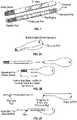
- Figure 1 illustrates a lateral flow assay test strip which is embedded within a cartridge.
- the cartridge may take one of many forms (plastic, laminated, other novel material, etc .). In this non-limiting example, this entire piece of our product is designed to be single use and disposable.
- the cartridge has a portion at one end where saliva can enter the cartridge through a matrix of pores and absorbs into a sample pad. This end of the cartridge is intended in this example to be inserted into the mouth under the tongue. The saliva then wicks through sample pad, conjugate pad, and test region, and is collected by the absorbent pad at the opposite end.
- the window in the cartridge allows light to pass freely in and out, providing for the test to be read by the electronic reader.
- Figure 2A illustrates the electronic reader according to one embodiment of the present disclosure.
- Figure 2B illustrates that the lateral flow assay cartridge is designed to slide into the reader so that the window in the cartridge aligns with electronics that will read the results from the test strip.
- the "click” mechanism provides for this alignment when the user slides the cartridge into the reader.
- the cartridge is “unclicked” when testing is done and the cartridge can be thrown away.
- the reader is a reusable product.
- Figure 2C illustrates that in this example, the neck portion of the reader is designed to insert into the mouth under the tongue, with the saliva-collection portion of the cartridge displayed.
- the portion that inserts into the mouth possibly associated with the small “click” protrusion on the reader, has a thin thermocouple wire embedded that will allow the device to take a user's basal temperature while the lateral flow assay is collecting saliva.
- Figure 3 illustrates that the electronic reader reads results from the lateral flow assay.
- the cartridge inserts into the body of the reader so that the cartridge window aligns with the appropriate electronics to sense results from the test strip (it clicks into place to assure accurate placement).
- the neck portion of the reader fits into the mouth with the saliva collection portion under the tongue.
- the reader can also take a user's basal temperature while inserted into the mouth. This is achieved by a thermocouple wire embedded in the neck portion of the reader, possibly within the precision "click" protrusion.
- the reader has a battery which is rechargeable through a port in the body of the reader.
- the operation of the device disclosed herein can comprise: (1) removing a disposable test cartridge from packaging; (2) inserting the test cartridge into a reader until it clicks into place; (3) the reader automatically turning on after the click; (4) the reader automatically attempting to interface with an mobile app and setup connection; (5) an indicator light on the reader turning on, indicating that the test is ready and a new test cartridge is in place; (6) the mobile app prompting an user to place the neck portion of the assembled reader/test into the mouth under tongue; (7) the user placing the neck portion of the assembly into his or her mouth under the tongue; (8) the app controlling the reader to sense saliva volume adequacy, for example, based upon a normalization scheme disclosed herein; (9) meanwhile, the app also retrieving basal temperature information from the reader; (10) when saliva analysis and temperature measurement are complete, the app prompting the user to remove the test strip from the mouth, (11) the reader beeping and/or indicator light telling the user to remove the test strip from the mouth, (12) the user prompted to set assembly aside without removing the
- the device can comprise a LCD located by the indicator light.
- the device comprises a LCD instead of the indicator light, and the information given to the user by the indicator light is instead displayed on the LCD.
- the LCD can indicate to the user whether the cartridge is inserted correctly, whether the wireless connection is established, and/or whether the assay is completed.
- kit for quantitatively detecting multiple analytes in a sample comprises a test device as described above.
- the kit can further comprise an instruction for using the test device to quantitatively detect the multiple analytes in a sample, and/or means for obtaining and/or processing the sample to be tested.
- the present invention provides a method for quantitatively detecting 17-beta estradiol and progesterone in a saliva sample, e.g., a saliva sample from a subject, which method comprises: a) contacting a saliva sample with the test device disclosed herein, wherein the saliva sample is applied to a site of the test device upstream of the first and second test location(s), wherein the site optionally comprises an absorbent material, e .
- a polymeric material and/or a cellulosic material b) transporting 17-beta estradiol and progesterone, if present in the saliva sample, and the labeled Fab fragment that specifically binds to 17-beta estradiol and the labeled Fab fragment that specifically binds to progesterone to the two first test locations on the first porous matrix, and transporting the Fab fragment that specifically binds to the normalization substance to the second test location; and c) assessing the two first detectable signals at the two first test locations, wherein: 1) the second detectable signal(s) is assessed and compared to the first detectable signal(s) to assess levels of 17-beta estradiol and progesterone in said saliva sample.
- said method further comprises measuring temperature of a subject while the device is inserted into the mouth of the subject.
- the site of the test device upstream of the test location(s) is a saliva collector site of the device.
- the saliva collector site is engineered to promote unidirectional flow of saliva toward another site of the device, for example, a test location on the device.
- the liquid sample and the labeled reagent can be premixed to form a mixture and the mixture is applied to the test device.
- the labeled reagent can be stored and/or used in any suitable manner.
- the labeled reagent can be stored and/or used in liquid format.
- the labeled reagent can be stored in a dry format off the device, e.g., in a container, pipette tip, or tube.
- the labeled reagent can be dried on the surface of the container, pipette tip, or tube.
- the labeled reagent can be dried as particles or beads and the particles or beads can be stored in the container, pipette tip, or tube.
- the dried labeled reagent can be dissolved or resuspended by a liquid sample or buffer to form a mixture and the mixture is applied to the test device.
- the present method can further comprise a washing step after the mixture is applied to the test device.
- the washing step can be conducted by any suitable ways.
- the washing step can comprise adding a washing liquid after the mixture is applied to the test device.
- the test device can comprise a liquid container comprising a washing liquid and the washing step comprises releasing the washing liquid from the liquid container. See e.g. , U.S. patent No. 4,857,453 .
- the test device can also comprise a dried labeled reagent before use and the dried labeled reagent can be solubilized or resuspended, and transported to the test locations by the liquid sample.
- the dried labeled reagent is located downstream from the sample application site, and the dried labeled reagent is solubilized or resuspended, and transported to the test location by the liquid sample.
- the dried labeled reagent is located upstream from the sample application site, and the dried labeled reagent is solubilized or resuspended, and transported to the test location by another liquid.
- multiple analytes and/or labeled reagent(s) are solubilized or resuspended, and transported to the test location by the liquid sample alone.
- multiple analytes and/or labeled reagent(s) are solubilized or resuspended, and transported to the test location by another liquid, or by a combination of the sample liquid and another liquid, e.g., a developing fluid.
- the present method can be used for quantitatively detecting the multiple analytes in any suitable sample.
- the sample is a biological sample or clinical sample.
- the detectable signal can be assessed by any suitable methods.
- the label is a visual direct label, e.g., a gold or latex particle label
- the detectable signal can be assessed by naked eyes without using any instrument.
- the detectable signal is often or typically assessed by a reader, such as an optical reader, an electronic reader, a magnetic reader, or an electrochemical reader, or a combination thereof.
- a reader is used to assess the detectable signal regardless whether the detectable signal can be assessed by naked eyes or not.
- the detectable signal is often or typically assessed by a reader for quantitatively detecting the analytes.
- the detectable signal is a fluorescent signal and the fluorescent signal is assessed by a fluorescent reader.
- a fluorescent reader can be any suitable fluorescent reader.
- the fluorescent reader can be a laser based or a light emitting diode (LED) based fluorescent reader.
- the fluorescent reader can illuminate at any suitable angle relative to the surface of the test device to excite the fluorescent label at the test locations and/or can detect the fluorescent light at any suitable angle relative to the surface of the test device.
- the fluorescent reader illuminates at an angle substantially normal, or normal, to the surface of the test device to excite the fluorescent label at the test locations and/or detects the fluorescent light at an angle substantially normal, or normal, to the surface of the test device.
- the surface for detection of the fluorescent light in the fluorescent reader is substantially parallel, or parallel, to the surface of the test device.
- the surface for detection of the fluorescent light in the fluorescent reader is not parallel to the surface of the test device.
- a light source and a photodetector can be positioned at the same side or different sides of the test device.
- An illumination system of the reader can scan any suitable or desired size or defined area of the test and/or control locations to detect the detectable or fluorescent signal.
- at least one, some or each of the test locations comprises a capture region characterized by a first dimension transverse to the lateral flow direction and a second dimension parallel to the lateral flow direction
- the reader comprises an illumination system operable to focus a beam of light onto an area of the test and/or control locations having at least one surface dimension at most equal to smallest of the first and second dimensions of the test and/or control locations.
- the reader can comprise a single or multiple photodetectors.
- the detectable signal can be measured at any suitable or desired time point(s). In some embodiments, the detectable signal is measured before the detectable signal reaches its equilibrium. In other embodiments, the detectable signal is measured after the detectable signal reaches its equilibrium. In still other embodiments, the detectable signal is measured at a preset time after the sample is added to the test device.
- the present methods can further comprise comparing the amounts of the multiple analytes to a single threshold, multiple thresholds or a reference range, e.g., a normal range, a disease range, a clinical range, or a reference range based on calibrated or uncalibrated analyte levels or concentrations.
- the amount of at least one, some or each of the multiple analytes is compared to a single corresponding threshold or multiple corresponding thresholds.
- the amounts of the multiple analytes are used to form a composite amount that is compared to a composite threshold or reference range.
- the present methods can be used for quantitatively detecting any suitable number of analytes.
- the present methods can be used for quantitatively detecting 2, 3, 4, 5, 6, 7, 8, 9, 10 or more analytes.
- the present methods can be used for any suitable purpose.
- the present can be used for quantitatively detecting multiple analytes that are diagnostic, prognostic, risk assessment, stratification and/or treatment monitoring markers.
- the present methods can be used for quantitatively detecting any suitable markers for assessing hormone(s), ovulation, pregnancy, fertility, e . g ., hormonal, ovulation, pregnancy, fertility status, time window, trend, or therapy monitoring or guidance.
- kits for quantitatively detecting 17-beta estradiol and progesterone in a saliva sample e.g., a saliva sample from a subject
- kit comprises: a) a test device of any of the preceding embodiments; and b) an instruction for using the test device for quantitatively detecting an analyte in a saliva sample.
- the present invention provides a system for quantitatively detecting the multiple analytes 17-beta estradiol and progesterone in a sample, which system comprises: a) a test device described above; and b) a reader that comprises a light source and a photodetector to detect a detectable signal.
- any suitable reader can be used, e.g., a fluorescent reader.
- a fluorescent reader can be used.
- the fluorescent reader can be a laser based or a light emitting diode (LED) based fluorescent reader.
- the fluorescent reader can illuminate at any suitable angle relative to the surface of the test device to excite the fluorescent label at the test locations and/or can detect the fluorescent light at any suitable angle relative to the surface of the test device.
- the fluorescent reader illuminates at an angle substantially normal, or normal, to the surface of the test device to excite the fluorescent label at the test locations and/or detects the fluorescent light at an angle substantially normal, or normal, to the surface of the test device.
- the surface for detection of the fluorescent light in the fluorescent reader is substantially parallel, or parallel, to the surface of the test device.
- the surface for detection of the fluorescent light in the fluorescent reader is not parallel to the surface of the test device.
- a light source and a photodetector can be positioned at the same side or different sides of the test device.
- An illumination system of the reader can scan any suitable or desired size or defined area of the test and/or control locations to detect the detectable or fluorescent signal.
- at least one, some or each of the test locations comprises a capture region characterized by a first dimension transverse to the lateral flow direction and a second dimension parallel to the lateral flow direction
- the reader comprises an illumination system operable to focus a beam of light onto an area of the test and/or control locations having at least one surface dimension at most equal to smallest of the first and second dimensions of the test and/or control locations.
- the reader can comprise a single or multiple photodetectors.
- the detectable signal can be measured at any suitable or desired time point(s). In some embodiments, the detectable signal is measured before the detectable signal reaches its equilibrium. In other embodiments, the detectable signal is measured after the detectable signal reaches its equilibrium. In still other embodiments, the detectable signal is measured at a preset time after the sample is added to the test device.
- the present systems can comprise machine-readable information and a reader for detecting the machine-readable information.
- the test device can comprise machine-readable information, e . g ., a barcode
- the reader can comprise a function for detecting the machine-readable information, e . g ., a barcode reader.
- the machine-readable information can be any suitable or desired information, e . g ., lot specific information of the test device or the assay, information on a liquid control or information to be used for quality control purpose, etc.
- the present system e.g. , the present device, can comprise a barcode that comprises lot specific information of the test device, e.g. , lot number of the test device.
- the present system can comprise a storage medium, e . g ., a RFID device.
- the RFID device can comprise lot specific information, information on a liquid control or information to be used for quality control purpose.
- the RFID device can be provided in any suitable ways or locations.
- an RFID device can be provided as an RFID card with an embedded antenna and an RFID tag.
- the RFID device or card can be provided within a package of a plurality of the present devices, or can be provided on the package, but is not made part of a present device.
- the RFID device or card can be provided on any suitable location on a test device, e.g., on the housing of the test device or at any location that is not test locations.
- the present systems can be used for quantitatively detecting 17-beta estradiol and progesterone.
- the kit and/or the system can be used for assessing hormone(s), ovulation, pregnancy, fertility, e . g ., hormonal, ovulation, pregnancy, fertility status, time window, trend, or therapy monitoring or guidance.
- the method is used for predicting ovulation.
- the method is used for confirming pregnancy.
- the kit and/or the system can be used for assessing overall fertility and/or ability to conceive, for family planning, and/or for birth control.
Landscapes
- Health & Medical Sciences (AREA)
- Life Sciences & Earth Sciences (AREA)
- Engineering & Computer Science (AREA)
- Immunology (AREA)
- Molecular Biology (AREA)
- Hematology (AREA)
- Biomedical Technology (AREA)
- Chemical & Material Sciences (AREA)
- Urology & Nephrology (AREA)
- General Health & Medical Sciences (AREA)
- Pathology (AREA)
- General Physics & Mathematics (AREA)
- Physics & Mathematics (AREA)
- Analytical Chemistry (AREA)
- Food Science & Technology (AREA)
- Medicinal Chemistry (AREA)
- Biochemistry (AREA)
- Microbiology (AREA)
- Cell Biology (AREA)
- Biotechnology (AREA)
- Public Health (AREA)
- Animal Behavior & Ethology (AREA)
- Veterinary Medicine (AREA)
- Surgery (AREA)
- Medical Informatics (AREA)
- Pulmonology (AREA)
- Heart & Thoracic Surgery (AREA)
- Proteomics, Peptides & Aminoacids (AREA)
- Pregnancy & Childbirth (AREA)
- Gynecology & Obstetrics (AREA)
- Reproductive Health (AREA)
- Endocrinology (AREA)
- Clinical Laboratory Science (AREA)
- Chemical Kinetics & Catalysis (AREA)
- Investigating Or Analysing Biological Materials (AREA)
- Measuring Or Testing Involving Enzymes Or Micro-Organisms (AREA)
- Apparatus Associated With Microorganisms And Enzymes (AREA)
Applications Claiming Priority (2)
| Application Number | Priority Date | Filing Date | Title |
|---|---|---|---|
| US201562143792P | 2015-04-06 | 2015-04-06 | |
| PCT/US2016/026049 WO2016164365A1 (en) | 2015-04-06 | 2016-04-05 | A test device for detecting an analyte in a saliva sample and method of use |
Publications (2)
| Publication Number | Publication Date |
|---|---|
| EP3281014A1 EP3281014A1 (en) | 2018-02-14 |
| EP3281014B1 true EP3281014B1 (en) | 2022-09-21 |
Family
ID=55754464
Family Applications (1)
| Application Number | Title | Priority Date | Filing Date |
|---|---|---|---|
| EP16716788.1A Active EP3281014B1 (en) | 2015-04-06 | 2016-04-05 | A test device for detecting an analyte in a saliva sample and method of use |
Country Status (6)
| Country | Link |
|---|---|
| US (2) | US20180106799A1 (enExample) |
| EP (1) | EP3281014B1 (enExample) |
| JP (3) | JP2018513983A (enExample) |
| CN (2) | CN115728482A (enExample) |
| BR (1) | BR112017021305A2 (enExample) |
| WO (1) | WO2016164365A1 (enExample) |
Families Citing this family (38)
| Publication number | Priority date | Publication date | Assignee | Title |
|---|---|---|---|---|
| EP3557252A4 (en) * | 2016-12-14 | 2020-02-26 | Konica Minolta, Inc. | INSPECTION CASSETTE AND BLOOD INSPECTION DEVICE |
| US12282029B2 (en) | 2017-05-08 | 2025-04-22 | MPB Fertility, Inc. | Portable diagnostic system for ovulation cycle monitoring |
| US11061026B2 (en) | 2017-02-17 | 2021-07-13 | MFB Fertility, Inc. | System of evaluating corpus luteum function by recurrently evaluating progesterone non-serum bodily fluids on multiple days |
| CN107015006A (zh) * | 2017-03-30 | 2017-08-04 | 北京理工大学 | 一种细胞因子免疫层析试纸及其制备方法 |
| US20210156855A1 (en) * | 2017-07-04 | 2021-05-27 | Ellume Limited | Methods and apparatus for sample analysis using lateral flow |
| CN107727855B (zh) * | 2017-09-30 | 2020-03-17 | 广州万孚生物技术股份有限公司 | 用于检测尿液中hiv抗体的样品垫、样品垫处理液及试纸条 |
| CN107727856B (zh) * | 2017-09-30 | 2020-11-06 | 广州万孚生物技术股份有限公司 | 检测尿液中hiv抗体的试纸条、检测线包被液及其制备方法 |
| US20210025905A1 (en) * | 2017-12-06 | 2021-01-28 | Dawn Maslar | Testosterone Saliva Test |
| US20190170773A1 (en) * | 2017-12-06 | 2019-06-06 | Dawn Maslar | Testosterone Saliva Test |
| CA3091087A1 (en) | 2018-02-14 | 2019-08-22 | Salignostics Ltd. | Methods and apparatus for detecting analytes |
| CN108956992A (zh) * | 2018-05-02 | 2018-12-07 | 北京厚生正德科技有限公司 | 一种基于量子点荧光的利巴韦林检测试纸条的制备方法 |
| CN108913143B (zh) * | 2018-07-03 | 2021-03-09 | 山东交通学院 | 一种金属有机聚合物负载Au掺杂量子点复合材料的制备方法及应用 |
| WO2020033539A1 (en) * | 2018-08-10 | 2020-02-13 | Qoolabs, Inc. | Lateral flow assay for assessing target conjugation |
| US12181465B2 (en) | 2018-08-22 | 2024-12-31 | MFB Fertility, Inc. | Method for evaluating urine of a subject to estimate the fertile window by evaluating for the presence of analytes of estrogen and progesterone |
| CN112444630A (zh) * | 2019-09-05 | 2021-03-05 | 北京动物园 | 一种同时检测雌二醇和睾酮的速测卡及其制备和使用方法 |
| CN110907653B (zh) * | 2019-12-06 | 2021-09-28 | 郑州安图生物工程股份有限公司 | 一种检测促甲状腺激素的试剂盒及其制备方法和应用 |
| US12158430B2 (en) | 2020-03-23 | 2024-12-03 | Kenvue Brands Llc | Disposable indicator component for measuring analyte concentration in bodily fluids |
| JP7579190B2 (ja) * | 2020-03-30 | 2024-11-07 | ミナリスメディカル株式会社 | 競合法による検体中のステロイドホルモンの測定用キットの安定化方法 |
| WO2021236050A1 (en) | 2020-05-18 | 2021-11-25 | Baseline Global, Inc. | Assay device, system, method, and kit |
| JP7540903B2 (ja) * | 2020-06-19 | 2024-08-27 | デンカ株式会社 | 流路とコロイド粒子を用いた被検物質検出方法 |
| WO2022035853A1 (en) * | 2020-08-12 | 2022-02-17 | University Of Washington | Systems and methods for imaging of real-time nucleic acid amplification tests (naats) |
| WO2022085719A1 (ja) * | 2020-10-21 | 2022-04-28 | 東洋紡株式会社 | ビタミンa定量用イムノクロマトストリップおよび測定キット |
| CN112858699B (zh) * | 2021-02-26 | 2024-11-22 | 深圳量点科技有限公司 | 便携式压力与精神疾病客观指标评估试纸条及方法 |
| JP7619127B2 (ja) * | 2021-03-30 | 2025-01-22 | 東洋紡株式会社 | ビタミンaの定量方法 |
| AT17585U1 (de) * | 2021-04-29 | 2022-07-15 | Tagtron Gmbh | Vorrichtung zum qualitativen Nachweis von Stoffen mit Antikörpern |
| JP7738411B2 (ja) * | 2021-06-08 | 2025-09-12 | キヤノン株式会社 | 粒子およびその製造方法 |
| EP4201343A1 (en) | 2021-12-24 | 2023-06-28 | Happy Innova SL | A saliva monitoring oral device for collecting and monitoring a saliva sample |
| GB202209807D0 (en) * | 2022-07-04 | 2022-08-17 | Univ Of Lincoln | Analytical methods, devices and kits for use therein |
| CN115754269A (zh) * | 2022-11-17 | 2023-03-07 | 广州德成生物科技有限公司 | 用于唾液检测的样品垫处理液及其应用 |
| WO2024159031A1 (en) * | 2023-01-25 | 2024-08-02 | Oral Genome Corp. | Saliva paired imaging test apparatus and method |
| WO2024214446A1 (ja) * | 2023-04-12 | 2024-10-17 | 学校法人東邦大学 | 予測モデル及び男性不妊症のリスク判定方法 |
| CN116966941B (zh) * | 2023-06-28 | 2025-12-02 | 东南大学 | 用于肌酐及尿酸检测的多通道微流控芯片及检测装置 |
| IT202300016413A1 (it) * | 2023-08-03 | 2025-02-03 | Vincenzo Stornelli | Metodo ed apparato per analisi domiciliare su campioni di saliva |
| WO2025094139A1 (en) * | 2023-11-01 | 2025-05-08 | Mara Nanotech, Inc. | Simultaneous detection of multiple alzheimer biomarkers |
| AT527879A1 (de) | 2023-12-18 | 2025-07-15 | Tagtron Gmbh | Vorrichtung für einen Lateral-Flow-Test |
| WO2025145131A1 (en) * | 2023-12-28 | 2025-07-03 | Innomed Eight, L.L.C. | Kits and methods for semen collection and filtration |
| WO2025143227A1 (ja) * | 2023-12-28 | 2025-07-03 | Zacros株式会社 | 反応性物質が塗布された反応部を備えた検査デバイス |
| FR3158871A1 (fr) * | 2024-02-01 | 2025-08-08 | Lp23 | Dispositif de mesure biochimique par test salivaire au moyen de couples vecteur de prélèvement – capteur |
Citations (14)
| Publication number | Priority date | Publication date | Assignee | Title |
|---|---|---|---|---|
| CA2366309A1 (en) * | 1999-03-16 | 2000-09-21 | Serex, Inc. | Method and device for detection of apo a, apo b and the ratio thereof in saliva |
| EP1051616A2 (en) * | 1997-08-04 | 2000-11-15 | Serex, Inc. | Integrated collection and assay device for saliva and blood |
| EP1301790A2 (en) * | 2000-07-12 | 2003-04-16 | Naser, Werner, Dr. | Direct assessment of analyte to reference molecule ratios |
| WO2008106149A1 (en) * | 2007-02-28 | 2008-09-04 | Children's Medical Center Corporation | Methods for predicting the onset of menarche |
| US20090075387A1 (en) * | 2005-10-14 | 2009-03-19 | Kalns John E | Methods and Compositions for Biomarkers Associated with Change in Physical Performance |
| US7763433B2 (en) * | 2004-07-01 | 2010-07-27 | Forsite Diagnostics Limited | Analyte detection system |
| US20110300531A1 (en) * | 2005-05-02 | 2011-12-08 | Agdia | Method and device to detect the presence of analytes in a sample |
| EP2465469A1 (en) * | 2010-12-19 | 2012-06-20 | Leo Vankrieken | Device for predicting the optimum insemination time for an animal |
| US20120263796A1 (en) * | 2009-10-11 | 2012-10-18 | Biogen Idec Ma Inc. | Anti-vla-4 related assays |
| US20120265032A1 (en) * | 2009-12-09 | 2012-10-18 | Arie FRIDENSON | Ovulating sensing and analyzing system |
| US20130102003A1 (en) * | 2011-10-21 | 2013-04-25 | Decimadx, Llc | Point-of-Care Immunoassay for Quantitative Small Analyte Detection |
| WO2014028687A1 (en) * | 2012-08-15 | 2014-02-20 | Hydradx, Inc. | Diagnostic device and method for sensing hydration state of mammalian subject |
| US20140323819A1 (en) * | 2013-04-29 | 2014-10-30 | Elwha LLC, a limited liability company of the State of Delaware | Multi-parameter test units for initial indication of medical symptoms |
| WO2015073878A1 (en) * | 2013-11-15 | 2015-05-21 | Ur Diet, Llc | Real-time satiety biofeedback |
Family Cites Families (91)
| Publication number | Priority date | Publication date | Assignee | Title |
|---|---|---|---|---|
| US5622871A (en) | 1987-04-27 | 1997-04-22 | Unilever Patent Holdings B.V. | Capillary immunoassay and device therefor comprising mobilizable particulate labelled reagents |
| US3504705A (en) | 1967-10-09 | 1970-04-07 | Cascade Corp | Revolving connector |
| IL52322A (en) | 1976-06-18 | 1980-10-26 | Alfa Laval Ab | Method of making reagent test device and device made accorording to this method |
| US5073484A (en) | 1982-03-09 | 1991-12-17 | Bio-Metric Systems, Inc. | Quantitative analysis apparatus and method |
| DE3484505D1 (de) | 1983-12-19 | 1991-05-29 | Daiichi Pure Chemicals Co Ltd | Immuntest. |
| US4703017C1 (en) | 1984-02-14 | 2001-12-04 | Becton Dickinson Co | Solid phase assay with visual readout |
| US4695554A (en) | 1984-02-14 | 1987-09-22 | Becton Dickinson And Company | Sac or liposome containing dye (sulforhodamine) for immunoassay |
| US4743560A (en) | 1984-03-26 | 1988-05-10 | Becton Dickinson And Company | Solid phase assay |
| US4784942A (en) * | 1984-11-05 | 1988-11-15 | The Board Of Regents For The University Of Oklahoma | Monoclonal antibodies against autoimmune RNA proteins |
| AU602694B2 (en) | 1986-06-09 | 1990-10-25 | Ortho Diagnostic Systems Inc. | Improved colloidal gold membrane assay |
| CA1303983C (en) | 1987-03-27 | 1992-06-23 | Robert W. Rosenstein | Solid phase assay |
| USRE38430E1 (en) | 1987-03-27 | 2004-02-17 | Becton, Dickinson And Company | Solid phase chromatographic immunoassay |
| US4857453A (en) | 1987-04-07 | 1989-08-15 | Syntex (U.S.A.) Inc. | Immunoassay device |
| DE560410T1 (de) | 1987-04-27 | 2001-12-20 | Unilever Nv | Testgerät zur Durchführung von spezifischen Bindungsprüfungen. |
| US5120643A (en) | 1987-07-13 | 1992-06-09 | Abbott Laboratories | Process for immunochromatography with colloidal particles |
| US4956302A (en) | 1987-09-11 | 1990-09-11 | Abbott Laboratories | Lateral flow chromatographic binding assay device |
| ES2050697T3 (es) | 1987-12-21 | 1994-06-01 | Abbott Lab | Metodos y dispositivos de ensayo de fijacion cromatografico. |
| AU2684488A (en) | 1988-06-27 | 1990-01-04 | Carter-Wallace, Inc. | Test device and method for colored particle immunoassay |
| US4942522A (en) | 1988-08-19 | 1990-07-17 | Motorola, Inc. | Timer channel with multiple timer reference features |
| US5223409A (en) | 1988-09-02 | 1993-06-29 | Protein Engineering Corp. | Directed evolution of novel binding proteins |
| GB8903626D0 (en) * | 1989-02-17 | 1989-04-05 | Unilever Plc | Methods and devices for use therein |
| US6352862B1 (en) | 1989-02-17 | 2002-03-05 | Unilever Patent Holdings B.V. | Analytical test device for imuno assays and methods of using same |
| US5252496A (en) | 1989-12-18 | 1993-10-12 | Princeton Biomeditech Corporation | Carbon black immunochemical label |
| KR910014706A (ko) | 1990-01-10 | 1991-08-31 | 원본미기재 | 세척이 필요없는 개량된 이뮤노어세이(immunoassay)장치 |
| FI92882C (fi) | 1992-12-29 | 1995-01-10 | Medix Biochemica Ab Oy | Kertakäyttöinen testiliuska ja menetelmä sen valmistamiseksi |
| US5422726A (en) | 1993-02-16 | 1995-06-06 | Tyler; Jonathan M. | Solid state spectrofluorimeter and method of using the same |
| JP3441763B2 (ja) * | 1993-06-30 | 2003-09-02 | キリン−アムジエン・インコーポレーテツド | モノクローナル抗体及び該モノクローナル抗体を用いたヒトg−csfの測定法 |
| JP3679808B2 (ja) | 1994-07-05 | 2005-08-03 | コーニンクレッカ フィリップス エレクトロニクス エヌ ヴィ | 信号処理システム |
| EP0703454B1 (en) * | 1994-09-23 | 2001-12-05 | Unilever N.V. | Monitoring methods and devices for use therein |
| DE19634873A1 (de) | 1996-08-29 | 1998-03-12 | Boehringer Mannheim Gmbh | System zur Unterscheidung fluoreszierender Molekülgruppen durch zeitaufgelöste Fluoreszenzmessung |
| US5710005A (en) | 1996-10-29 | 1998-01-20 | Biocode, Inc. | Analyte detection with a gradient lateral flow device |
| US6057098A (en) | 1997-04-04 | 2000-05-02 | Biosite Diagnostics, Inc. | Polyvalent display libraries |
| US6544797B1 (en) | 1997-04-09 | 2003-04-08 | Biosite Diagnostics, Inc. | Compositions and methods for inhibiting light-induced inactivation of biological reagents |
| SE9704933D0 (sv) | 1997-12-30 | 1997-12-30 | Pharmacia & Upjohn Diag Ab | Metod som utnyttjar en ny kalibrator och test kit som innehåller kalibratorn |
| US7713703B1 (en) | 2000-11-13 | 2010-05-11 | Biosite, Inc. | Methods for monitoring the status of assays and immunoassays |
| US6194222B1 (en) | 1998-01-05 | 2001-02-27 | Biosite Diagnostics, Inc. | Methods for monitoring the status of assays and immunoassays |
| WO1999040438A1 (en) | 1998-02-03 | 1999-08-12 | Synbiotics Corporation | Device and method to detect immunoprotective antibody titers |
| US6267722B1 (en) | 1998-02-03 | 2001-07-31 | Adeza Biomedical Corporation | Point of care diagnostic systems |
| US6394952B1 (en) | 1998-02-03 | 2002-05-28 | Adeza Biomedical Corporation | Point of care diagnostic systems |
| DE19844500A1 (de) | 1998-09-29 | 2000-03-30 | Roche Diagnostics Gmbh | Verfahren zur photometrischen Auswertung von Testelementen |
| US6812038B1 (en) | 1999-11-18 | 2004-11-02 | Pharmacia Diagnostics Ab | Assay device and use thereof |
| US6777198B2 (en) | 2000-10-11 | 2004-08-17 | Pharmacia Diagnostics Ab | Assay method and kit therefor |
| US6756202B2 (en) | 2001-04-30 | 2004-06-29 | Agilent Technologies, Inc. | Reading multi-featured arrays |
| US6770487B2 (en) | 2001-05-01 | 2004-08-03 | Ischemia Technologies, Inc. | Bar code readable diagnostic strip test |
| US6720165B2 (en) * | 2001-06-14 | 2004-04-13 | Zyomix, Inc. | Methods for making antibody fragments and compositions resulting therefrom |
| US8367013B2 (en) | 2001-12-24 | 2013-02-05 | Kimberly-Clark Worldwide, Inc. | Reading device, method, and system for conducting lateral flow assays |
| US7371582B2 (en) | 2002-01-23 | 2008-05-13 | Boditechmed Inc. | Lateral flow quantitative assay method and strip and laser-induced fluorescence detection device therefor |
| US7175992B2 (en) | 2002-04-10 | 2007-02-13 | Response Biomedical Corporation | Sensitive immunochromatographic assay |
| JP4532121B2 (ja) | 2002-04-10 | 2010-08-25 | レスポンス バイオメディカル コーポレイション | 高感度の免疫クロマトグラフィーアッセイ法 |
| US7256053B2 (en) | 2002-10-24 | 2007-08-14 | Nanogen, Inc. | Diagnostic device for analyte detection |
| US7247500B2 (en) | 2002-12-19 | 2007-07-24 | Kimberly-Clark Worldwide, Inc. | Reduction of the hook effect in membrane-based assay devices |
| US7315378B2 (en) | 2003-06-04 | 2008-01-01 | Inverness Medical Switzerland Gmbh | Optical arrangement for assay reading device |
| US7317532B2 (en) | 2003-06-04 | 2008-01-08 | Inverness Medical Switzerland Gmbh | Flow sensing for determination of assay results |
| US7239394B2 (en) | 2003-06-04 | 2007-07-03 | Inverness Medical Switzerland Gmbh | Early determination of assay results |
| US7178416B2 (en) | 2003-07-08 | 2007-02-20 | Alexeter Technologies, Llc. | Radio frequency identification (RFID) test information control and tracking system |
| US20070143035A1 (en) | 2005-12-19 | 2007-06-21 | Petruno Patrick T | Diagnostic test reader with disabling unit |
| US20050221504A1 (en) | 2004-04-01 | 2005-10-06 | Petruno Patrick T | Optoelectronic rapid diagnostic test system |
| US8128871B2 (en) | 2005-04-22 | 2012-03-06 | Alverix, Inc. | Lateral flow assay systems and methods |
| US7521259B2 (en) | 2004-04-01 | 2009-04-21 | Alverix, Inc. | Assay test strips with multiple labels and reading same |
| US20070185679A1 (en) | 2004-04-01 | 2007-08-09 | Petruno Patrick T | Indicating status of a diagnostic test system |
| US20050244953A1 (en) | 2004-04-30 | 2005-11-03 | Kimberly-Clark Worldwide, Inc. | Techniques for controlling the optical properties of assay devices |
| US7815854B2 (en) | 2004-04-30 | 2010-10-19 | Kimberly-Clark Worldwide, Inc. | Electroluminescent illumination source for optical detection systems |
| US7796266B2 (en) | 2004-04-30 | 2010-09-14 | Kimberly-Clark Worldwide, Inc. | Optical detection system using electromagnetic radiation to detect presence or quantity of analyte |
| US7763454B2 (en) | 2004-07-09 | 2010-07-27 | Church & Dwight Co., Inc. | Electronic analyte assaying device |
| CN1311239C (zh) * | 2004-09-07 | 2007-04-18 | 李人 | 免疫层析测试条及其制造方法 |
| US20070121113A1 (en) | 2004-12-22 | 2007-05-31 | Cohen David S | Transmission-based optical detection systems |
| US7785899B2 (en) | 2005-02-18 | 2010-08-31 | Charm Sciences, Inc. | Lateral flow test kit and method for detecting an analyte |
| US7939342B2 (en) * | 2005-03-30 | 2011-05-10 | Kimberly-Clark Worldwide, Inc. | Diagnostic test kits employing an internal calibration system |
| US9891217B2 (en) | 2005-04-22 | 2018-02-13 | Alverix, Inc. | Assay test strips with multiple labels and reading same |
| CA2614935A1 (en) * | 2005-07-21 | 2007-02-01 | The Johns Hopkins University | Methods of detecting and treating acute kidney injury |
| JP2009512871A (ja) * | 2005-10-24 | 2009-03-26 | マナワトゥ バイオテック インベストメンツ リミテッド (エムビーアイエル) | 排卵周期のモニタリングおよび管理 |
| US8124359B2 (en) | 2006-03-24 | 2012-02-28 | Aokin Ag | Use of additives for the reduction of non-specific binding in assays |
| US9377407B2 (en) | 2006-04-19 | 2016-06-28 | It-Is International Limited | Reaction monitoring |
| JP2009545739A (ja) | 2006-08-02 | 2009-12-24 | コーニンクレッカ フィリップス エレクトロニクス エヌ ヴィ | 多孔質膜に結合する検体センサ分子を用いた検体の濃度を決定する方法 |
| US7679745B2 (en) | 2006-11-21 | 2010-03-16 | Neptec Optical Solutions | Time-resolved fluorescence spectrometer for multiple-species analysis |
| US8405827B2 (en) | 2006-11-21 | 2013-03-26 | Ricardo Claps | Time-resolved spectroscopy system and methods for multiple-species analysis in fluorescence and cavity-ringdown applications |
| CN101021526B (zh) | 2007-03-16 | 2012-01-25 | 艾博生物医药(杭州)有限公司 | 一种直观显示检测结果的装置和方法 |
| WO2009038798A1 (en) | 2007-09-21 | 2009-03-26 | Charm Sciences, Inc. | Assay reader insert and method of maintaining a reader |
| US7988918B2 (en) | 2007-11-01 | 2011-08-02 | Complete Genomics, Inc. | Structures for enhanced detection of fluorescence |
| US8901366B2 (en) | 2007-12-14 | 2014-12-02 | Kimberly Clark Worldwide, Inc. | Urine volume hydration test devices |
| CN101344526A (zh) * | 2008-08-22 | 2009-01-14 | 无锡纳生生物科技有限公司 | 一种快速、精确的前列腺癌的检测试纸条及其制备和应用 |
| US8046175B2 (en) | 2008-10-13 | 2011-10-25 | Actherm Inc | Analytical strip reading apparatus and the analyical strip used therein |
| WO2010063141A1 (zh) | 2008-12-05 | 2010-06-10 | 红电医学科技股份有限公司 | 具有可拆卸式韧体装置的检测试片读取机 |
| GB0820999D0 (en) * | 2008-11-17 | 2008-12-24 | Menon Johansson Anatole S | Pregnancy testing |
| WO2010057184A2 (en) * | 2008-11-17 | 2010-05-20 | The Brigham And Women's Hospital, Inc. | Methods for detection of acute kidney injury in humans |
| US20100173423A1 (en) | 2009-01-06 | 2010-07-08 | Inverness Medical Switzerland Gmbh | Multiple testing apparatus and method |
| CN102253222B (zh) * | 2011-04-21 | 2014-07-16 | 中国农业科学院农业质量标准与检测技术研究所 | 检测雌激素的方法及其专用试纸 |
| US20150241455A1 (en) * | 2012-09-27 | 2015-08-27 | Ellume Pty Ltd | Diagnostic devices and methods |
| EP2923204A1 (en) * | 2012-10-31 | 2015-09-30 | Astute Medical, Inc. | Quantitative lateral flow assay |
| US20140127827A1 (en) * | 2012-11-05 | 2014-05-08 | Gwangju Institute Of Science And Technology | Method for detection of antigen using fluorescence resonance energy transfer immunoassay |
| US20150111777A1 (en) * | 2013-09-24 | 2015-04-23 | Kansas City University Of Medicine And Biosciences | Biomarker for early neurodegeneration detection |
-
2016
- 2016-04-05 JP JP2018503728A patent/JP2018513983A/ja active Pending
- 2016-04-05 BR BR112017021305A patent/BR112017021305A2/pt not_active Application Discontinuation
- 2016-04-05 CN CN202211315819.8A patent/CN115728482A/zh active Pending
- 2016-04-05 CN CN201680032652.0A patent/CN107667290A/zh active Pending
- 2016-04-05 US US15/564,731 patent/US20180106799A1/en not_active Abandoned
- 2016-04-05 WO PCT/US2016/026049 patent/WO2016164365A1/en not_active Ceased
- 2016-04-05 EP EP16716788.1A patent/EP3281014B1/en active Active
-
2021
- 2021-01-28 US US17/160,883 patent/US20210223243A1/en not_active Abandoned
- 2021-11-11 JP JP2021184153A patent/JP7471269B2/ja active Active
-
2023
- 2023-12-26 JP JP2023219181A patent/JP2024038119A/ja active Pending
Patent Citations (14)
| Publication number | Priority date | Publication date | Assignee | Title |
|---|---|---|---|---|
| EP1051616A2 (en) * | 1997-08-04 | 2000-11-15 | Serex, Inc. | Integrated collection and assay device for saliva and blood |
| CA2366309A1 (en) * | 1999-03-16 | 2000-09-21 | Serex, Inc. | Method and device for detection of apo a, apo b and the ratio thereof in saliva |
| EP1301790A2 (en) * | 2000-07-12 | 2003-04-16 | Naser, Werner, Dr. | Direct assessment of analyte to reference molecule ratios |
| US7763433B2 (en) * | 2004-07-01 | 2010-07-27 | Forsite Diagnostics Limited | Analyte detection system |
| US20110300531A1 (en) * | 2005-05-02 | 2011-12-08 | Agdia | Method and device to detect the presence of analytes in a sample |
| US20090075387A1 (en) * | 2005-10-14 | 2009-03-19 | Kalns John E | Methods and Compositions for Biomarkers Associated with Change in Physical Performance |
| WO2008106149A1 (en) * | 2007-02-28 | 2008-09-04 | Children's Medical Center Corporation | Methods for predicting the onset of menarche |
| US20120263796A1 (en) * | 2009-10-11 | 2012-10-18 | Biogen Idec Ma Inc. | Anti-vla-4 related assays |
| US20120265032A1 (en) * | 2009-12-09 | 2012-10-18 | Arie FRIDENSON | Ovulating sensing and analyzing system |
| EP2465469A1 (en) * | 2010-12-19 | 2012-06-20 | Leo Vankrieken | Device for predicting the optimum insemination time for an animal |
| US20130102003A1 (en) * | 2011-10-21 | 2013-04-25 | Decimadx, Llc | Point-of-Care Immunoassay for Quantitative Small Analyte Detection |
| WO2014028687A1 (en) * | 2012-08-15 | 2014-02-20 | Hydradx, Inc. | Diagnostic device and method for sensing hydration state of mammalian subject |
| US20140323819A1 (en) * | 2013-04-29 | 2014-10-30 | Elwha LLC, a limited liability company of the State of Delaware | Multi-parameter test units for initial indication of medical symptoms |
| WO2015073878A1 (en) * | 2013-11-15 | 2015-05-21 | Ur Diet, Llc | Real-time satiety biofeedback |
Non-Patent Citations (3)
| Title |
|---|
| E B SCHWARTZ ET AL: "Transferrin Enzyme Immunoassay for Quantitative Monitoring of Blood Contamination in Saliva", CLINICAL CHEMISTRY, vol. 50, no. 3, 1 March 2004 (2004-03-01), pages 654 - 656, XP055282720, DOI: 10.1373/clinchem.2003.028266 * |
| JOU Y J ET AL: "Proteomic identification of salivary transferrin as a biomarker for early detection of oral cancer", ANALYTICA CHIMICA ACTA, ELSEVIER, AMSTERDAM, NL, vol. 681, no. 1-2, 29 November 2010 (2010-11-29), pages 41 - 48, XP027450898, ISSN: 0003-2670, [retrieved on 20100925], DOI: 10.1016/J.ACA.2010.09.030 * |
| MARTINA ZANGHERI ET AL: "A simple and compact smartphone accessory for quantitative chemiluminescence-based lateral flow immunoassay for salivary cortisol detection", BIOSENSORS AND BIOELECTRONICS, vol. 64, 1 February 2015 (2015-02-01), AMSTERDAM, NL, pages 63 - 68, XP055282181, ISSN: 0956-5663, DOI: 10.1016/j.bios.2014.08.048 * |
Also Published As
| Publication number | Publication date |
|---|---|
| US20210223243A1 (en) | 2021-07-22 |
| WO2016164365A1 (en) | 2016-10-13 |
| JP2022028783A (ja) | 2022-02-16 |
| US20180106799A1 (en) | 2018-04-19 |
| CN115728482A (zh) | 2023-03-03 |
| CA2981297A1 (en) | 2016-10-13 |
| BR112017021305A2 (pt) | 2018-06-26 |
| JP7471269B2 (ja) | 2024-04-19 |
| JP2018513983A (ja) | 2018-05-31 |
| CN107667290A (zh) | 2018-02-06 |
| JP2024038119A (ja) | 2024-03-19 |
| EP3281014A1 (en) | 2018-02-14 |
Similar Documents
| Publication | Publication Date | Title |
|---|---|---|
| JP7471269B2 (ja) | 唾液試料中の分析物を検出するための試験装置および使用方法 | |
| CN104870997B (zh) | 诊断装置和方法 | |
| US10919037B2 (en) | Systems and apparatus for detecting compounds in human biological samples | |
| CN108957006A (zh) | 非酒精性脂肪肝疾病(nafld)和非酒精性脂肪性肝炎(nash)生物标记及其用途 | |
| US20180074074A1 (en) | Homogenous and heterogeneous assays and systems for determination of ocular biomarkers | |
| JP2011528229A (ja) | 側方流動核酸検出器 | |
| US11782052B2 (en) | Biosensor for male infertility | |
| Posthuma-Trumpie et al. | Perspectives for on-site monitoring of progesterone | |
| Choi et al. | Light source-free smartphone detection of salivary cortisol via colorimetric lateral flow immunoassay using a photoluminescent film | |
| US20130224768A1 (en) | Immunochromatographic assay method and apparatus | |
| JP2021517250A (ja) | 自己抗体−抗原結合体を利用した肺癌診断用免疫学的組成物、これを用いた肺癌診断方法及びこれを含む肺癌診断用キット | |
| US20200049700A1 (en) | Nanoparticle-enhanced enzymatic immune biosensor assay for antigen detection | |
| US20230417745A1 (en) | Rapid quantitative assay to assess duration of infection | |
| CN105647930A (zh) | 一种基于唾液中的孕酮的核酸适配体及检测用金标试纸条 | |
| CA2981297C (en) | A test device for detecting an analyte in a saliva sample and method of use | |
| EP3714797B1 (en) | Diagnostic device and diagnostic method | |
| GB2552461A (en) | Method and assay kit to detect an analyte | |
| US20110269246A1 (en) | Measuring levels of frataxin | |
| WO2007016665A2 (en) | Single use fluorescent assays for determination of analytes | |
| EP2277040A1 (en) | Acetaminophen-protein adduct assay device and method | |
| HK40037058A (en) | Biosensor for male infertility | |
| HK40037058B (en) | Biosensor for male infertility |
Legal Events
| Date | Code | Title | Description |
|---|---|---|---|
| STAA | Information on the status of an ep patent application or granted ep patent |
Free format text: STATUS: THE INTERNATIONAL PUBLICATION HAS BEEN MADE |
|
| PUAI | Public reference made under article 153(3) epc to a published international application that has entered the european phase |
Free format text: ORIGINAL CODE: 0009012 |
|
| STAA | Information on the status of an ep patent application or granted ep patent |
Free format text: STATUS: REQUEST FOR EXAMINATION WAS MADE |
|
| 17P | Request for examination filed |
Effective date: 20171106 |
|
| AK | Designated contracting states |
Kind code of ref document: A1 Designated state(s): AL AT BE BG CH CY CZ DE DK EE ES FI FR GB GR HR HU IE IS IT LI LT LU LV MC MK MT NL NO PL PT RO RS SE SI SK SM TR |
|
| AX | Request for extension of the european patent |
Extension state: BA ME |
|
| RIN1 | Information on inventor provided before grant (corrected) |
Inventor name: WEIBEL, DOUGLAS, BENJAMIN Inventor name: BRENNER, SARAH, KATHERINE |
|
| DAV | Request for validation of the european patent (deleted) | ||
| DAX | Request for extension of the european patent (deleted) | ||
| PUAG | Search results despatched under rule 164(2) epc together with communication from examining division |
Free format text: ORIGINAL CODE: 0009017 |
|
| STAA | Information on the status of an ep patent application or granted ep patent |
Free format text: STATUS: EXAMINATION IS IN PROGRESS |
|
| 17Q | First examination report despatched |
Effective date: 20190129 |
|
| B565 | Issuance of search results under rule 164(2) epc |
Effective date: 20190129 |
|
| RIC1 | Information provided on ipc code assigned before grant |
Ipc: G01N 33/558 20060101AFI20190124BHEP Ipc: A61M 39/02 20060101ALI20190124BHEP Ipc: A61B 10/00 20060101ALI20190124BHEP Ipc: G01N 33/68 20060101ALI20190124BHEP Ipc: G01K 13/00 20060101ALI20190124BHEP |
|
| GRAP | Despatch of communication of intention to grant a patent |
Free format text: ORIGINAL CODE: EPIDOSNIGR1 |
|
| STAA | Information on the status of an ep patent application or granted ep patent |
Free format text: STATUS: GRANT OF PATENT IS INTENDED |
|
| RIC1 | Information provided on ipc code assigned before grant |
Ipc: G01K 13/00 20060101ALI20220324BHEP Ipc: G01N 33/68 20060101ALI20220324BHEP Ipc: A61B 10/00 20060101ALI20220324BHEP Ipc: G01N 33/558 20060101AFI20220324BHEP |
|
| INTG | Intention to grant announced |
Effective date: 20220413 |
|
| GRAS | Grant fee paid |
Free format text: ORIGINAL CODE: EPIDOSNIGR3 |
|
| GRAA | (expected) grant |
Free format text: ORIGINAL CODE: 0009210 |
|
| STAA | Information on the status of an ep patent application or granted ep patent |
Free format text: STATUS: THE PATENT HAS BEEN GRANTED |
|
| AK | Designated contracting states |
Kind code of ref document: B1 Designated state(s): AL AT BE BG CH CY CZ DE DK EE ES FI FR GB GR HR HU IE IS IT LI LT LU LV MC MK MT NL NO PL PT RO RS SE SI SK SM TR |
|
| REG | Reference to a national code |
Ref country code: GB Ref legal event code: FG4D |
|
| REG | Reference to a national code |
Ref country code: CH Ref legal event code: EP |
|
| REG | Reference to a national code |
Ref country code: IE Ref legal event code: FG4D |
|
| REG | Reference to a national code |
Ref country code: DE Ref legal event code: R096 Ref document number: 602016075141 Country of ref document: DE |
|
| REG | Reference to a national code |
Ref country code: AT Ref legal event code: REF Ref document number: 1520183 Country of ref document: AT Kind code of ref document: T Effective date: 20221015 |
|
| REG | Reference to a national code |
Ref country code: LT Ref legal event code: MG9D |
|
| REG | Reference to a national code |
Ref country code: NL Ref legal event code: MP Effective date: 20220921 |
|
| PG25 | Lapsed in a contracting state [announced via postgrant information from national office to epo] |
Ref country code: SE Free format text: LAPSE BECAUSE OF FAILURE TO SUBMIT A TRANSLATION OF THE DESCRIPTION OR TO PAY THE FEE WITHIN THE PRESCRIBED TIME-LIMIT Effective date: 20220921 Ref country code: RS Free format text: LAPSE BECAUSE OF FAILURE TO SUBMIT A TRANSLATION OF THE DESCRIPTION OR TO PAY THE FEE WITHIN THE PRESCRIBED TIME-LIMIT Effective date: 20220921 Ref country code: NO Free format text: LAPSE BECAUSE OF FAILURE TO SUBMIT A TRANSLATION OF THE DESCRIPTION OR TO PAY THE FEE WITHIN THE PRESCRIBED TIME-LIMIT Effective date: 20221221 Ref country code: LV Free format text: LAPSE BECAUSE OF FAILURE TO SUBMIT A TRANSLATION OF THE DESCRIPTION OR TO PAY THE FEE WITHIN THE PRESCRIBED TIME-LIMIT Effective date: 20220921 Ref country code: LT Free format text: LAPSE BECAUSE OF FAILURE TO SUBMIT A TRANSLATION OF THE DESCRIPTION OR TO PAY THE FEE WITHIN THE PRESCRIBED TIME-LIMIT Effective date: 20220921 Ref country code: FI Free format text: LAPSE BECAUSE OF FAILURE TO SUBMIT A TRANSLATION OF THE DESCRIPTION OR TO PAY THE FEE WITHIN THE PRESCRIBED TIME-LIMIT Effective date: 20220921 |
|
| REG | Reference to a national code |
Ref country code: AT Ref legal event code: MK05 Ref document number: 1520183 Country of ref document: AT Kind code of ref document: T Effective date: 20220921 |
|
| PG25 | Lapsed in a contracting state [announced via postgrant information from national office to epo] |
Ref country code: HR Free format text: LAPSE BECAUSE OF FAILURE TO SUBMIT A TRANSLATION OF THE DESCRIPTION OR TO PAY THE FEE WITHIN THE PRESCRIBED TIME-LIMIT Effective date: 20220921 Ref country code: GR Free format text: LAPSE BECAUSE OF FAILURE TO SUBMIT A TRANSLATION OF THE DESCRIPTION OR TO PAY THE FEE WITHIN THE PRESCRIBED TIME-LIMIT Effective date: 20221222 |
|
| PG25 | Lapsed in a contracting state [announced via postgrant information from national office to epo] |
Ref country code: SM Free format text: LAPSE BECAUSE OF FAILURE TO SUBMIT A TRANSLATION OF THE DESCRIPTION OR TO PAY THE FEE WITHIN THE PRESCRIBED TIME-LIMIT Effective date: 20220921 Ref country code: RO Free format text: LAPSE BECAUSE OF FAILURE TO SUBMIT A TRANSLATION OF THE DESCRIPTION OR TO PAY THE FEE WITHIN THE PRESCRIBED TIME-LIMIT Effective date: 20220921 Ref country code: PT Free format text: LAPSE BECAUSE OF FAILURE TO SUBMIT A TRANSLATION OF THE DESCRIPTION OR TO PAY THE FEE WITHIN THE PRESCRIBED TIME-LIMIT Effective date: 20230123 Ref country code: ES Free format text: LAPSE BECAUSE OF FAILURE TO SUBMIT A TRANSLATION OF THE DESCRIPTION OR TO PAY THE FEE WITHIN THE PRESCRIBED TIME-LIMIT Effective date: 20220921 Ref country code: CZ Free format text: LAPSE BECAUSE OF FAILURE TO SUBMIT A TRANSLATION OF THE DESCRIPTION OR TO PAY THE FEE WITHIN THE PRESCRIBED TIME-LIMIT Effective date: 20220921 Ref country code: AT Free format text: LAPSE BECAUSE OF FAILURE TO SUBMIT A TRANSLATION OF THE DESCRIPTION OR TO PAY THE FEE WITHIN THE PRESCRIBED TIME-LIMIT Effective date: 20220921 |
|
| PG25 | Lapsed in a contracting state [announced via postgrant information from national office to epo] |
Ref country code: SK Free format text: LAPSE BECAUSE OF FAILURE TO SUBMIT A TRANSLATION OF THE DESCRIPTION OR TO PAY THE FEE WITHIN THE PRESCRIBED TIME-LIMIT Effective date: 20220921 Ref country code: PL Free format text: LAPSE BECAUSE OF FAILURE TO SUBMIT A TRANSLATION OF THE DESCRIPTION OR TO PAY THE FEE WITHIN THE PRESCRIBED TIME-LIMIT Effective date: 20220921 Ref country code: IS Free format text: LAPSE BECAUSE OF FAILURE TO SUBMIT A TRANSLATION OF THE DESCRIPTION OR TO PAY THE FEE WITHIN THE PRESCRIBED TIME-LIMIT Effective date: 20230121 Ref country code: EE Free format text: LAPSE BECAUSE OF FAILURE TO SUBMIT A TRANSLATION OF THE DESCRIPTION OR TO PAY THE FEE WITHIN THE PRESCRIBED TIME-LIMIT Effective date: 20220921 |
|
| P01 | Opt-out of the competence of the unified patent court (upc) registered |
Effective date: 20230419 |
|
| REG | Reference to a national code |
Ref country code: DE Ref legal event code: R097 Ref document number: 602016075141 Country of ref document: DE |
|
| PG25 | Lapsed in a contracting state [announced via postgrant information from national office to epo] |
Ref country code: NL Free format text: LAPSE BECAUSE OF FAILURE TO SUBMIT A TRANSLATION OF THE DESCRIPTION OR TO PAY THE FEE WITHIN THE PRESCRIBED TIME-LIMIT Effective date: 20220921 Ref country code: AL Free format text: LAPSE BECAUSE OF FAILURE TO SUBMIT A TRANSLATION OF THE DESCRIPTION OR TO PAY THE FEE WITHIN THE PRESCRIBED TIME-LIMIT Effective date: 20220921 |
|
| PLBE | No opposition filed within time limit |
Free format text: ORIGINAL CODE: 0009261 |
|
| STAA | Information on the status of an ep patent application or granted ep patent |
Free format text: STATUS: NO OPPOSITION FILED WITHIN TIME LIMIT |
|
| PG25 | Lapsed in a contracting state [announced via postgrant information from national office to epo] |
Ref country code: DK Free format text: LAPSE BECAUSE OF FAILURE TO SUBMIT A TRANSLATION OF THE DESCRIPTION OR TO PAY THE FEE WITHIN THE PRESCRIBED TIME-LIMIT Effective date: 20220921 |
|
| 26N | No opposition filed |
Effective date: 20230622 |
|
| PG25 | Lapsed in a contracting state [announced via postgrant information from national office to epo] |
Ref country code: SI Free format text: LAPSE BECAUSE OF FAILURE TO SUBMIT A TRANSLATION OF THE DESCRIPTION OR TO PAY THE FEE WITHIN THE PRESCRIBED TIME-LIMIT Effective date: 20220921 |
|
| REG | Reference to a national code |
Ref country code: CH Ref legal event code: PL |
|
| PG25 | Lapsed in a contracting state [announced via postgrant information from national office to epo] |
Ref country code: LU Free format text: LAPSE BECAUSE OF NON-PAYMENT OF DUE FEES Effective date: 20230405 |
|
| REG | Reference to a national code |
Ref country code: BE Ref legal event code: MM Effective date: 20230430 |
|
| PG25 | Lapsed in a contracting state [announced via postgrant information from national office to epo] |
Ref country code: MC Free format text: LAPSE BECAUSE OF FAILURE TO SUBMIT A TRANSLATION OF THE DESCRIPTION OR TO PAY THE FEE WITHIN THE PRESCRIBED TIME-LIMIT Effective date: 20220921 |
|
| PG25 | Lapsed in a contracting state [announced via postgrant information from national office to epo] |
Ref country code: MC Free format text: LAPSE BECAUSE OF FAILURE TO SUBMIT A TRANSLATION OF THE DESCRIPTION OR TO PAY THE FEE WITHIN THE PRESCRIBED TIME-LIMIT Effective date: 20220921 Ref country code: LI Free format text: LAPSE BECAUSE OF NON-PAYMENT OF DUE FEES Effective date: 20230430 Ref country code: CH Free format text: LAPSE BECAUSE OF NON-PAYMENT OF DUE FEES Effective date: 20230430 |
|
| REG | Reference to a national code |
Ref country code: IE Ref legal event code: MM4A |
|
| PG25 | Lapsed in a contracting state [announced via postgrant information from national office to epo] |
Ref country code: BE Free format text: LAPSE BECAUSE OF NON-PAYMENT OF DUE FEES Effective date: 20230430 |
|
| PG25 | Lapsed in a contracting state [announced via postgrant information from national office to epo] |
Ref country code: IE Free format text: LAPSE BECAUSE OF NON-PAYMENT OF DUE FEES Effective date: 20230405 |
|
| PG25 | Lapsed in a contracting state [announced via postgrant information from national office to epo] |
Ref country code: IE Free format text: LAPSE BECAUSE OF NON-PAYMENT OF DUE FEES Effective date: 20230405 |
|
| PG25 | Lapsed in a contracting state [announced via postgrant information from national office to epo] |
Ref country code: IT Free format text: LAPSE BECAUSE OF FAILURE TO SUBMIT A TRANSLATION OF THE DESCRIPTION OR TO PAY THE FEE WITHIN THE PRESCRIBED TIME-LIMIT Effective date: 20220921 |
|
| PG25 | Lapsed in a contracting state [announced via postgrant information from national office to epo] |
Ref country code: BG Free format text: LAPSE BECAUSE OF FAILURE TO SUBMIT A TRANSLATION OF THE DESCRIPTION OR TO PAY THE FEE WITHIN THE PRESCRIBED TIME-LIMIT Effective date: 20220921 |
|
| PG25 | Lapsed in a contracting state [announced via postgrant information from national office to epo] |
Ref country code: BG Free format text: LAPSE BECAUSE OF FAILURE TO SUBMIT A TRANSLATION OF THE DESCRIPTION OR TO PAY THE FEE WITHIN THE PRESCRIBED TIME-LIMIT Effective date: 20220921 |
|
| PGFP | Annual fee paid to national office [announced via postgrant information from national office to epo] |
Ref country code: DE Payment date: 20250429 Year of fee payment: 10 |
|
| PGFP | Annual fee paid to national office [announced via postgrant information from national office to epo] |
Ref country code: GB Payment date: 20250428 Year of fee payment: 10 |
|
| PGFP | Annual fee paid to national office [announced via postgrant information from national office to epo] |
Ref country code: FR Payment date: 20250425 Year of fee payment: 10 |
|
| PG25 | Lapsed in a contracting state [announced via postgrant information from national office to epo] |
Ref country code: CY Free format text: LAPSE BECAUSE OF FAILURE TO SUBMIT A TRANSLATION OF THE DESCRIPTION OR TO PAY THE FEE WITHIN THE PRESCRIBED TIME-LIMIT; INVALID AB INITIO Effective date: 20160405 |
|
| PG25 | Lapsed in a contracting state [announced via postgrant information from national office to epo] |
Ref country code: HU Free format text: LAPSE BECAUSE OF FAILURE TO SUBMIT A TRANSLATION OF THE DESCRIPTION OR TO PAY THE FEE WITHIN THE PRESCRIBED TIME-LIMIT; INVALID AB INITIO Effective date: 20160405 |
|
| PG25 | Lapsed in a contracting state [announced via postgrant information from national office to epo] |
Ref country code: TR Free format text: LAPSE BECAUSE OF FAILURE TO SUBMIT A TRANSLATION OF THE DESCRIPTION OR TO PAY THE FEE WITHIN THE PRESCRIBED TIME-LIMIT Effective date: 20220921 |