EP3237943B1 - Oxidation and moisture barrier layers for wire grid polarizer - Google Patents
Oxidation and moisture barrier layers for wire grid polarizer Download PDFInfo
- Publication number
- EP3237943B1 EP3237943B1 EP16773995.2A EP16773995A EP3237943B1 EP 3237943 B1 EP3237943 B1 EP 3237943B1 EP 16773995 A EP16773995 A EP 16773995A EP 3237943 B1 EP3237943 B1 EP 3237943B1
- Authority
- EP
- European Patent Office
- Prior art keywords
- ribs
- barrier
- conformal
- coating
- layer
- Prior art date
- Legal status (The legal status is an assumption and is not a legal conclusion. Google has not performed a legal analysis and makes no representation as to the accuracy of the status listed.)
- Active
Links
Images



Classifications
-
- B—PERFORMING OPERATIONS; TRANSPORTING
- B05—SPRAYING OR ATOMISING IN GENERAL; APPLYING FLUENT MATERIALS TO SURFACES, IN GENERAL
- B05D—PROCESSES FOR APPLYING FLUENT MATERIALS TO SURFACES, IN GENERAL
- B05D5/00—Processes for applying liquids or other fluent materials to surfaces to obtain special surface effects, finishes or structures
- B05D5/08—Processes for applying liquids or other fluent materials to surfaces to obtain special surface effects, finishes or structures to obtain an anti-friction or anti-adhesive surface
-
- C—CHEMISTRY; METALLURGY
- C09—DYES; PAINTS; POLISHES; NATURAL RESINS; ADHESIVES; COMPOSITIONS NOT OTHERWISE PROVIDED FOR; APPLICATIONS OF MATERIALS NOT OTHERWISE PROVIDED FOR
- C09D—COATING COMPOSITIONS, e.g. PAINTS, VARNISHES OR LACQUERS; FILLING PASTES; CHEMICAL PAINT OR INK REMOVERS; INKS; CORRECTING FLUIDS; WOODSTAINS; PASTES OR SOLIDS FOR COLOURING OR PRINTING; USE OF MATERIALS THEREFOR
- C09D5/00—Coating compositions, e.g. paints, varnishes or lacquers, characterised by their physical nature or the effects produced; Filling pastes
- C09D5/08—Anti-corrosive paints
- C09D5/082—Anti-corrosive paints characterised by the anti-corrosive pigment
- C09D5/084—Inorganic compounds
-
- C—CHEMISTRY; METALLURGY
- C23—COATING METALLIC MATERIAL; COATING MATERIAL WITH METALLIC MATERIAL; CHEMICAL SURFACE TREATMENT; DIFFUSION TREATMENT OF METALLIC MATERIAL; COATING BY VACUUM EVAPORATION, BY SPUTTERING, BY ION IMPLANTATION OR BY CHEMICAL VAPOUR DEPOSITION, IN GENERAL; INHIBITING CORROSION OF METALLIC MATERIAL OR INCRUSTATION IN GENERAL
- C23C—COATING METALLIC MATERIAL; COATING MATERIAL WITH METALLIC MATERIAL; SURFACE TREATMENT OF METALLIC MATERIAL BY DIFFUSION INTO THE SURFACE, BY CHEMICAL CONVERSION OR SUBSTITUTION; COATING BY VACUUM EVAPORATION, BY SPUTTERING, BY ION IMPLANTATION OR BY CHEMICAL VAPOUR DEPOSITION, IN GENERAL
- C23C16/00—Chemical coating by decomposition of gaseous compounds, without leaving reaction products of surface material in the coating, i.e. chemical vapour deposition [CVD] processes
- C23C16/22—Chemical coating by decomposition of gaseous compounds, without leaving reaction products of surface material in the coating, i.e. chemical vapour deposition [CVD] processes characterised by the deposition of inorganic material, other than metallic material
- C23C16/30—Deposition of compounds, mixtures or solid solutions, e.g. borides, carbides, nitrides
- C23C16/32—Carbides
- C23C16/325—Silicon carbide
-
- C—CHEMISTRY; METALLURGY
- C23—COATING METALLIC MATERIAL; COATING MATERIAL WITH METALLIC MATERIAL; CHEMICAL SURFACE TREATMENT; DIFFUSION TREATMENT OF METALLIC MATERIAL; COATING BY VACUUM EVAPORATION, BY SPUTTERING, BY ION IMPLANTATION OR BY CHEMICAL VAPOUR DEPOSITION, IN GENERAL; INHIBITING CORROSION OF METALLIC MATERIAL OR INCRUSTATION IN GENERAL
- C23C—COATING METALLIC MATERIAL; COATING MATERIAL WITH METALLIC MATERIAL; SURFACE TREATMENT OF METALLIC MATERIAL BY DIFFUSION INTO THE SURFACE, BY CHEMICAL CONVERSION OR SUBSTITUTION; COATING BY VACUUM EVAPORATION, BY SPUTTERING, BY ION IMPLANTATION OR BY CHEMICAL VAPOUR DEPOSITION, IN GENERAL
- C23C16/00—Chemical coating by decomposition of gaseous compounds, without leaving reaction products of surface material in the coating, i.e. chemical vapour deposition [CVD] processes
- C23C16/22—Chemical coating by decomposition of gaseous compounds, without leaving reaction products of surface material in the coating, i.e. chemical vapour deposition [CVD] processes characterised by the deposition of inorganic material, other than metallic material
- C23C16/30—Deposition of compounds, mixtures or solid solutions, e.g. borides, carbides, nitrides
- C23C16/40—Oxides
- C23C16/401—Oxides containing silicon
-
- C—CHEMISTRY; METALLURGY
- C23—COATING METALLIC MATERIAL; COATING MATERIAL WITH METALLIC MATERIAL; CHEMICAL SURFACE TREATMENT; DIFFUSION TREATMENT OF METALLIC MATERIAL; COATING BY VACUUM EVAPORATION, BY SPUTTERING, BY ION IMPLANTATION OR BY CHEMICAL VAPOUR DEPOSITION, IN GENERAL; INHIBITING CORROSION OF METALLIC MATERIAL OR INCRUSTATION IN GENERAL
- C23C—COATING METALLIC MATERIAL; COATING MATERIAL WITH METALLIC MATERIAL; SURFACE TREATMENT OF METALLIC MATERIAL BY DIFFUSION INTO THE SURFACE, BY CHEMICAL CONVERSION OR SUBSTITUTION; COATING BY VACUUM EVAPORATION, BY SPUTTERING, BY ION IMPLANTATION OR BY CHEMICAL VAPOUR DEPOSITION, IN GENERAL
- C23C16/00—Chemical coating by decomposition of gaseous compounds, without leaving reaction products of surface material in the coating, i.e. chemical vapour deposition [CVD] processes
- C23C16/22—Chemical coating by decomposition of gaseous compounds, without leaving reaction products of surface material in the coating, i.e. chemical vapour deposition [CVD] processes characterised by the deposition of inorganic material, other than metallic material
- C23C16/30—Deposition of compounds, mixtures or solid solutions, e.g. borides, carbides, nitrides
- C23C16/40—Oxides
- C23C16/405—Oxides of refractory metals or yttrium
-
- G—PHYSICS
- G02—OPTICS
- G02B—OPTICAL ELEMENTS, SYSTEMS OR APPARATUS
- G02B1/00—Optical elements characterised by the material of which they are made; Optical coatings for optical elements
- G02B1/04—Optical elements characterised by the material of which they are made; Optical coatings for optical elements made of organic materials, e.g. plastics
-
- G—PHYSICS
- G02—OPTICS
- G02B—OPTICAL ELEMENTS, SYSTEMS OR APPARATUS
- G02B1/00—Optical elements characterised by the material of which they are made; Optical coatings for optical elements
- G02B1/10—Optical coatings produced by application to, or surface treatment of, optical elements
- G02B1/14—Protective coatings, e.g. hard coatings
-
- G—PHYSICS
- G02—OPTICS
- G02B—OPTICAL ELEMENTS, SYSTEMS OR APPARATUS
- G02B5/00—Optical elements other than lenses
- G02B5/30—Polarising elements
- G02B5/3025—Polarisers, i.e. arrangements capable of producing a definite output polarisation state from an unpolarised input state
- G02B5/3058—Polarisers, i.e. arrangements capable of producing a definite output polarisation state from an unpolarised input state comprising electrically conductive elements, e.g. wire grids, conductive particles
-
- B—PERFORMING OPERATIONS; TRANSPORTING
- B05—SPRAYING OR ATOMISING IN GENERAL; APPLYING FLUENT MATERIALS TO SURFACES, IN GENERAL
- B05D—PROCESSES FOR APPLYING FLUENT MATERIALS TO SURFACES, IN GENERAL
- B05D1/00—Processes for applying liquids or other fluent materials
- B05D1/60—Deposition of organic layers from vapour phase
-
- B—PERFORMING OPERATIONS; TRANSPORTING
- B05—SPRAYING OR ATOMISING IN GENERAL; APPLYING FLUENT MATERIALS TO SURFACES, IN GENERAL
- B05D—PROCESSES FOR APPLYING FLUENT MATERIALS TO SURFACES, IN GENERAL
- B05D2350/00—Pretreatment of the substrate
- B05D2350/60—Adding a layer before coating
- B05D2350/63—Adding a layer before coating ceramic layer
-
- C—CHEMISTRY; METALLURGY
- C23—COATING METALLIC MATERIAL; COATING MATERIAL WITH METALLIC MATERIAL; CHEMICAL SURFACE TREATMENT; DIFFUSION TREATMENT OF METALLIC MATERIAL; COATING BY VACUUM EVAPORATION, BY SPUTTERING, BY ION IMPLANTATION OR BY CHEMICAL VAPOUR DEPOSITION, IN GENERAL; INHIBITING CORROSION OF METALLIC MATERIAL OR INCRUSTATION IN GENERAL
- C23C—COATING METALLIC MATERIAL; COATING MATERIAL WITH METALLIC MATERIAL; SURFACE TREATMENT OF METALLIC MATERIAL BY DIFFUSION INTO THE SURFACE, BY CHEMICAL CONVERSION OR SUBSTITUTION; COATING BY VACUUM EVAPORATION, BY SPUTTERING, BY ION IMPLANTATION OR BY CHEMICAL VAPOUR DEPOSITION, IN GENERAL
- C23C16/00—Chemical coating by decomposition of gaseous compounds, without leaving reaction products of surface material in the coating, i.e. chemical vapour deposition [CVD] processes
- C23C16/22—Chemical coating by decomposition of gaseous compounds, without leaving reaction products of surface material in the coating, i.e. chemical vapour deposition [CVD] processes characterised by the deposition of inorganic material, other than metallic material
- C23C16/30—Deposition of compounds, mixtures or solid solutions, e.g. borides, carbides, nitrides
- C23C16/308—Oxynitrides
-
- C—CHEMISTRY; METALLURGY
- C23—COATING METALLIC MATERIAL; COATING MATERIAL WITH METALLIC MATERIAL; CHEMICAL SURFACE TREATMENT; DIFFUSION TREATMENT OF METALLIC MATERIAL; COATING BY VACUUM EVAPORATION, BY SPUTTERING, BY ION IMPLANTATION OR BY CHEMICAL VAPOUR DEPOSITION, IN GENERAL; INHIBITING CORROSION OF METALLIC MATERIAL OR INCRUSTATION IN GENERAL
- C23C—COATING METALLIC MATERIAL; COATING MATERIAL WITH METALLIC MATERIAL; SURFACE TREATMENT OF METALLIC MATERIAL BY DIFFUSION INTO THE SURFACE, BY CHEMICAL CONVERSION OR SUBSTITUTION; COATING BY VACUUM EVAPORATION, BY SPUTTERING, BY ION IMPLANTATION OR BY CHEMICAL VAPOUR DEPOSITION, IN GENERAL
- C23C16/00—Chemical coating by decomposition of gaseous compounds, without leaving reaction products of surface material in the coating, i.e. chemical vapour deposition [CVD] processes
- C23C16/22—Chemical coating by decomposition of gaseous compounds, without leaving reaction products of surface material in the coating, i.e. chemical vapour deposition [CVD] processes characterised by the deposition of inorganic material, other than metallic material
- C23C16/30—Deposition of compounds, mixtures or solid solutions, e.g. borides, carbides, nitrides
- C23C16/34—Nitrides
- C23C16/345—Silicon nitride
-
- C—CHEMISTRY; METALLURGY
- C23—COATING METALLIC MATERIAL; COATING MATERIAL WITH METALLIC MATERIAL; CHEMICAL SURFACE TREATMENT; DIFFUSION TREATMENT OF METALLIC MATERIAL; COATING BY VACUUM EVAPORATION, BY SPUTTERING, BY ION IMPLANTATION OR BY CHEMICAL VAPOUR DEPOSITION, IN GENERAL; INHIBITING CORROSION OF METALLIC MATERIAL OR INCRUSTATION IN GENERAL
- C23C—COATING METALLIC MATERIAL; COATING MATERIAL WITH METALLIC MATERIAL; SURFACE TREATMENT OF METALLIC MATERIAL BY DIFFUSION INTO THE SURFACE, BY CHEMICAL CONVERSION OR SUBSTITUTION; COATING BY VACUUM EVAPORATION, BY SPUTTERING, BY ION IMPLANTATION OR BY CHEMICAL VAPOUR DEPOSITION, IN GENERAL
- C23C16/00—Chemical coating by decomposition of gaseous compounds, without leaving reaction products of surface material in the coating, i.e. chemical vapour deposition [CVD] processes
- C23C16/22—Chemical coating by decomposition of gaseous compounds, without leaving reaction products of surface material in the coating, i.e. chemical vapour deposition [CVD] processes characterised by the deposition of inorganic material, other than metallic material
- C23C16/30—Deposition of compounds, mixtures or solid solutions, e.g. borides, carbides, nitrides
- C23C16/40—Oxides
- C23C16/403—Oxides of aluminium, magnesium or beryllium
-
- C—CHEMISTRY; METALLURGY
- C23—COATING METALLIC MATERIAL; COATING MATERIAL WITH METALLIC MATERIAL; CHEMICAL SURFACE TREATMENT; DIFFUSION TREATMENT OF METALLIC MATERIAL; COATING BY VACUUM EVAPORATION, BY SPUTTERING, BY ION IMPLANTATION OR BY CHEMICAL VAPOUR DEPOSITION, IN GENERAL; INHIBITING CORROSION OF METALLIC MATERIAL OR INCRUSTATION IN GENERAL
- C23C—COATING METALLIC MATERIAL; COATING MATERIAL WITH METALLIC MATERIAL; SURFACE TREATMENT OF METALLIC MATERIAL BY DIFFUSION INTO THE SURFACE, BY CHEMICAL CONVERSION OR SUBSTITUTION; COATING BY VACUUM EVAPORATION, BY SPUTTERING, BY ION IMPLANTATION OR BY CHEMICAL VAPOUR DEPOSITION, IN GENERAL
- C23C16/00—Chemical coating by decomposition of gaseous compounds, without leaving reaction products of surface material in the coating, i.e. chemical vapour deposition [CVD] processes
- C23C16/44—Chemical coating by decomposition of gaseous compounds, without leaving reaction products of surface material in the coating, i.e. chemical vapour deposition [CVD] processes characterised by the method of coating
- C23C16/455—Chemical coating by decomposition of gaseous compounds, without leaving reaction products of surface material in the coating, i.e. chemical vapour deposition [CVD] processes characterised by the method of coating characterised by the method used for introducing gases into reaction chamber or for modifying gas flows in reaction chamber
- C23C16/45523—Pulsed gas flow or change of composition over time
- C23C16/45525—Atomic layer deposition [ALD]
- C23C16/45555—Atomic layer deposition [ALD] applied in non-semiconductor technology
Definitions
- the present application is related generally to wire grid polarizers.
- Wire grid polarizers can be used to divide light into two different polarization states.
- One polarization state can pass through the WGP and the other can be absorbed or reflected.
- the effectiveness or performance of WGPs is based on a very high percent transmission of one polarization (sometimes called Tp) and minimal transmission of an opposite polarization (sometimes called Ts). It can be beneficial to have high contrast (Tp/Ts).
- Tp/Ts The percent reflection of the opposite polarization
- Rs can also be an important indicator of polarizer performance.
- Ribs or wires of WGPs can have small, delicate ribs with nanometer-sized pitch, wire-width, and wire-height.
- WGPs are used in systems (e.g. computer projectors, semiconductor inspection tools, etc.) that require high performance. Small defects in the WGP, such as dust, corroded ribs, and collapsed ribs can significantly degrade system performance (e.g. distorted image from a computer projector). Oxidation can degrade performance by adversely affecting contrast or Rs. Therefore, it can be important to protect the ribs from corrosion, oxidation, mechanical damage, and dust.
- Water can condense or drop only onto limited portions of a WGP. Because the water can be in one channel but not in an adjacent channel, forces in the water can cause ribs to topple over, thus damaging the WGP.
- WGP performance can also degrade by corrosion. Water can condense onto the WGP and wick into narrow channels between ribs due to capillary action. The water can then corrode the ribs. Corroded regions can have reduced contrast, changed Rs, or can fail to polarize at all.
- Oxidization of the ribs can also degrade WGP performance. For example, as an aluminum wire forms a natural oxide over time, the underlying, substantially-pure aluminum is consumed, thus reducing the size of the substantially-pure aluminum wire and changing polarization characteristics of the WGP.
- Protective coatings have been applied by dipping the WGP in an aqueous solution containing the coating. The coating can adhere to the ribs, then the WGP can be removed from the aqueous solution. Amino phosphonates, as described in U.S. Patent Number 6,785,050 , have commonly been applied in this manner. Application of protective coatings by this method has been reasonably successful for some wire materials, such as for example aluminum and silicon, but may be insufficient for WGP protection in extreme environments. Silicon is used in selectively-absorptive WGPs to absorb one polarization of light, and thus reduce Rs. The performance of such silicon-containing WGPs can degrade over time as shown by gradually-increasing Rs.
- Protective coatings can adversely affect polarizer performance.
- the coating can cause a reduction of Tp.
- Thicker coatings may be needed for to provide sufficient oxidation or corrosion protection, but thinner coatings may be preferred in order to minimize performance degradation by the coating.
- EP 1970194EP A1 discloses a moistureproof cellulose ester film which comprises: a cellulose ester film and, deposited on at least one side thereof in the following order, one or more adhesion layers each having a carbon content in terms of atom number concentration of 1-40% and comprising an inorganic compound as the main component, one or more barrier layers each having a carbon content in terms of atom number concentration of 0.1% or lower, comprising silicon oxide as the main component, and having a film density of 2.16-2.60, and one or more protective layers each having a carbon content in terms of atom number concentration of 1-40% and comprising an inorganic compound as the main component.
- the total thickness of these deposit layers on one side is 1-100 nm. It is characterized in that the barrier layers on one side have a thickness of 0.1-30 nm.
- US2007/053113 A1 discloses magnetic tunnel junctions that include ferromagnetic (or ferrimagnetic) materials and a bilayer tunnel barrier structure that includes a layer of a rare earth oxide.
- the bilayer also includes a layer of crystalline material, such as MgO or Mg-ZnO. If MgO is used, then it is preferably (100) oriented.
- the magnetic tunnel junctions so formed enjoy high tunneling magnetoresistance, e.g., much greater than 100% at room temperature.
- the present invention is directed to various embodiments of WGPs with protective coatings, and methods of making WGPs with protective coatings, that satisfy these needs. Each embodiment may satisfy one, some, or all of these needs.
- a wire grid polarizer comprising:
- alkyl refers to a branched, unbranched, or cyclic saturated hydrocarbon group.
- Alkyls include, but are not limited to, methyl, ethyl, n-propyl, isopropyl, n-butyl, isobutyl, t-butyl, octyl, and decyl, for example, as well as cycloalkyl groups such as cyclopentyl, and cyclohexyl, for example.
- alkyl can typically be relatively small to facilitate vapor deposition, if overall atomic weight of the molecule is considered, such as for example ⁇ 2 carbon atoms in one aspect, ⁇ 3 carbon atoms in another aspect, ⁇ 5 carbon atoms in another aspect, or ⁇ 10 carbon atoms in another aspect.
- substituted alkyl refers to an alkyl substituted with one or more substituent groups.
- heteroalkyl refers to an alkyl in which at least one carbon atom is replaced with a heteroatom. If not otherwise indicated, the term “alkyl” includes unsubstituted alkyl, substituted alkyl, and heteroalkyl.
- aryl refers to a group containing a single aromatic ring or multiple aromatic rings that are fused together, directly linked, or indirectly linked (such that the different aromatic rings are bound to a common group such as a methylene or ethylene moiety).
- Aryl groups include, for example, phenyl, naphthyl, anthryl, phenanthryl, biphenyl, diphenylether, diphenylamine, and benzophenone.
- substituted aryl refers to an aryl group comprising one or more substituent groups.
- heteroaryl refers to an aryl group in which at least one carbon atom is replaced with a heteroatom. If not otherwise indicated, the term “aryl” includes unsubstituted aryl, substituted aryl, and heteroaryl.
- the phrase "bond to the ribs" or similar phrases can mean a direct bond between the chemical and the ribs or a bond to an intermediate layer which is bonded directly, or through other layer(s) to the ribs.
- these layer(s) can be other conformal-coating(s).
- the term carbon chain can include at least five carbon atoms in a row in one aspect, at least ten carbon atoms in a row in another aspect, or at least fifteen carbon atoms in a row in another aspect.
- the term carbon chain can also include ether linkages (C-O-C moieties).
- the term carbon chain includes single, double, and triple carbon to carbon bonds. The carbon atoms can be attached to any element or molecule.
- elongated means that a length L (see FIG. 6 ) of the ribs 12 is substantially greater than rib width W 12 or rib thickness T 12 (see FIG. 1 ).
- WGPs for ultraviolet or visible light can often have a rib width W 12 between 20 and 100 nanometers and rib thickness T 12 between 50 and 500 nanometers; and rib length L of about 1 millimeter to 20 centimeters or more, depending on the application.
- elongated ribs 12 can have a length L that is many times (even thousands of times) larger than rib width W 12 or rib thickness T 12 .
- gap means a space, opening, or divide, separating one rib from another rib.
- the gap can be filled with a vacuum, gas, liquid, or solid, unless otherwise specified.
- sccm means cubic centimeters per minute at 0 °C and 1 atmosphere pressure.
- the term “substrate” includes a base material, such as for example a glass wafer.
- the term “substrate” includes a single material, and also includes multiple materials (e.g. layered, composite, or the like), such as for example a glass wafer with at least one thin film on a surface of the wafer used together as the base material.
- optical structures absorb some light, reflect some light, and transmit some light.
- the following definitions are intended to distinguish between materials or structures that are primarily absorptive, primarily reflective, or primarily transparent.
- Each material can be primarily absorptive, primarily reflective, or primarily transparent in a specific wavelength of interest (e.g. all or a portion of the ultraviolet, visible, or infrared spectrums of light) and can have a different property in a different wavelength of interest.
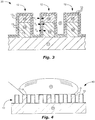
- wire grid polarizers (WGPs or WGP for singular) 10, 20, 30, 40, 50, and 60 are shown comprising ribs 12 located over a surface of a transparent substrate 11.
- the ribs 12 can be elongated and arranged in a substantially parallel array.
- the ribs 12 can have a small pitch P (see FIG. 1 ), such as for example a pitch P of less than 200 nanometers in one aspect or less than 150 nanometers in another aspect.
- gaps G between at least a portion of the ribs 12 (i.e. a gap G between a rib 12 and an adjacent rib 12).
- the gaps G can be filled with air in one aspect, a liquid in another aspect, a transparent, solid, dielectric material in another aspect, or combinations thereof.
- a conformal-coating 13 can be located over the ribs 12.
- the conformal-coating 13 can also be located over an exposed surface of the substrate 11 ("exposed surface” meaning a surface of the substrate not covered with ribs 12).
- Use of a conformal-coating 13 can be beneficial because by following a contour of the ribs 12 and an exposed surface of the substrate 11, conformal-coating thickness T p , T m , and T d , can be minimized, thus reducing any detrimental effect of the conformal-coating(s) 13 on WGP performance.
- the conformal-coating 13 can cover an exposed surface of the ribs 12.
- the conformal-coating 13 can include a barrier-layer, a hydrophobic-layer, or both.
- the barrier-layer can include an oxidation-barrier, a moisture-barrier, or both.
- the conformal-coating 13 can include a single layer ( FIG. 1 ) or multiple, different layers (see FIGs. 2-3 ) across all or substantially all of the ribs 12.
- the conformal-coating 13 can include at least one of: a proximal conformal-coating 13 p , a middle conformal-coating 13 m , and a distal conformal-coating 13 d . It can be important to have sufficient thickness T p , T m , and T d for each of these layers 13 p , 13 m , and 13 d , respectively, of the conformal-coating 13, in order to provide sufficient protection to the ribs 12 and/or to provide a base for an upper layer of the conformal-coating 13.
- one or more of the proximal conformal-coating 13 p , the middle conformal-coating 13 m , and the distal conformal-coating 13 d can have a thickness T p , T m , or T d that is at least 0.1 in one aspect, at least 0.5 nanometers in another aspect, or at least 1 nanometer in another aspect.
- T p , T m , and T d are sufficiently small thickness for each of these layers 13 p , 13 m , and 13 d , respectively, of the conformal-coating 13, in order to avoid or minimize degradation of WGP performance caused by the conformal-coating 13.
- one or more of the proximal conformal-coating 13 p , the middle conformal-coating 13 m , and the distal conformal-coating 13 d can have a thickness T p , T m , or T d that is less than 2 nanometers in one aspect, less than 3 nanometers in another aspect, less than 5 nanometers in another aspect, less than 10 nanometers in another aspect, less than 15 nanometers in another aspect, or less than 20 nanometers in another aspect.
- These thickness values can be a minimum thickness or a maximum thickness at any location of the conformal-coating 13, or simply a thickness at a location of the conformal-coating 13.
- Each layer of the conformal-coating 13 can be a monolayer.
- a conformal-coating 55 with one chemistry can adhere to one region 15 and a conformal-coating 54 with a different chemistry can adhere to a different region 14.
- the chemistry of multiple, different, conformal-coatings can be selected such that different regions of the WGP, with different chemistries, can be protected.
- the conformal-coating 13 can include a hydrophobic-layer.
- the hydrophobic-layer can include a phosphonate conformal-coating, which can include: where each R 1 can independently be a hydrophobic group, Z can be a bond to the ribs, and R 5 can be any suitable chemical element or group.
- R 5 can be a phosphonate-reactive-group, R 1 , or R 6 .
- the phosphonate-reactive-group can be a chemical element or group likely to react to form an additional bond Z to the ribs 12, such as but not limited to -CI, -OR 6 , -OCOR 6 , or -OH.
- Each R 6 can independently be an alkyl group, an aryl group, or combinations thereof.
- the hydrophobic-layer can alternatively or in addition include a silane conformal-coating, which can include chemical formula (1), chemical formula (2), or combinations thereof: where r can be a positive integer, X can be a bond to the ribs, and each R 3 can be independently a chemical element or a group. Each R 1 , as mentioned above, can independently be a hydrophobic group.
- Each R 3 can be independently selected from the group consisting of: a silane-reactive-group, -H, R 1 , and R 6 .
- R 6 was defined above.
- Each silane-reactive-group can be independently selected from the group consisting of: -CI, - OR 6 , -OCOR 6 , -N(R 6 ) 2 , and -OH.
- R 3 and/or R 5 can be a small group, such as for example -OCH 3 , to allow easier vapor-deposition. Benefits of vapor-deposition are described below.
- the hydrophobic-layer can alternatively or in addition include a sulfur conformal-coating, which can include: where T can be a bond to the ribs and each R 1 , as mentioned above, can independently be a hydrophobic group.
- each rib 12 can include different regions 15 and 14, such as an upper-rib 15 and a lower-rib 14.
- the lower-rib 14 can be sandwiched between the upper-rib 15 and the substrate 11.
- At least one of these (lower-rib 14 or upper-rib 15) can be reflective (e.g. aluminum for visible light) and can be called a wire.
- At least one of these (lower-rib 14 or upper-rib 15) can be absorptive or transparent and can be called a rod.
- the rod can be absorptive and can be the upper-rib 15, and the wire can be the lower-rib 14. See US 7,961,393 which is incorporated by reference herein.
- the rod can be the upper-rib 15, can be made of silicon, and the silane conformal-coating 55 can preferentially adhere to the silicon upper-rib 15; and the wire can be the lower-rib 15, can be made of aluminum, and the phosphonate conformal-coating 54 can preferentially adhere to the aluminum lower-rib 15.
- X can be a bond to the rod.
- X can be -O-Si.
- T and/or Z can be a bond to the wire.
- T and/or Z can be -O-Metal, where Metal is a metal atom.
- the silane conformal-coating can preferentially attach to one material (e.g. silicon) and the phosphonate conformal-coating or the sulfur conformal-coating can preferentially attach to another material (e.g. a metal) to provide protection to multiple rib 12 materials.
- the chemicals in the hydrophobic-layer include molecules that each has multiple bonds T, Z, and/or X to the ribs 12.
- each molecule forming multiple bonds X more of the underlying surface (e.g. rib 12, proximal conformal-coating 13 p , or middle conformal-coating 13 m ) can be bound and thus unavailable for bonding or interaction with undesirable chemicals, such as water for example.
- multiple bonds to the surface can improve resiliency of the hydrophobic-layer because it can be less likely for multiple bonds Z/X/T to fail than for a single bond Z/X/T to fail.
- R 1 can be: where A is a central atom, R 7 can be a hydrophobic group as described above, g can be an integer from 1 to 3, and R 8 can be moiety (1), moiety (2), moiety (3), or combinations thereof: R 3 and R 5 were described above.
- the central atom A can be selected from group III, IV, or V in the periodic table in one aspect or can be selected from the group consisting of carbon, nitrogen, phosphorous, and silicon in another aspect.
- R 5 Another way for molecules in the hydrophobic-layer to form multiple bonds Z, and/or X to the ribs 12 is for R 5 to be Z and/or for R 3 to be X. This can be accomplished if, in the phosphonate chemistry as applied, R 5 is a phosphonate-reactive-group and/or if, in the silane chemistry as applied, R 3 is a silane-reactive-group.
- the hydrophobic group can be or can include a carbon chain in one aspect and can include at least one halogen bonded to a carbon in another aspect.
- the carbon chain can include a perfluorinated group including at least 1 carbon atom in one aspect or at least 3 carbon atoms in another aspect.
- the perfluorinated group can include less than 20 carbon atoms in another aspect, less than 30 carbon atoms in another aspect, or less than 40 carbon atoms in another aspect. It can be beneficial for the perfluorinated group to have at least 4 carbon atoms to provide a hydrophobic chain. It can be beneficial for the perfluorinated group to not be too long or have too many carbon atoms in order to maintain a high enough vapor pressure to allow vapor-deposition.
- the carbon chain of R 1 can include CF 3 (CF 2 ) n . Due to the high electronegativity of fluorine, it can be beneficial to have a hydrocarbon chain to separate the perfluorinated group from the phosphorous or sulfur.
- the carbon chain of R 1 can include CF 3 (CF 2 ) n (CH 2 ) m , where n can be an integer within the boundaries of 0 ⁇ n ⁇ 20 in one aspect or 4 ⁇ n ⁇ 10 in another aspect, and m can be an integer within the boundaries of 0 ⁇ m ⁇ 5 in one aspect or 2 ⁇ m ⁇ 5 in another aspect.
- each molecule in the phosphonate conformal-coating (excluding the bond to the ribs Z), each molecule in the silane conformal-coating (excluding the bond to the ribs X), and/or each molecule in the sulfur conformal-coating (excluding the bond to the ribs T), can have a molecular weight of at least 100 grams per mole in one aspect, at least 150 grams per mole in another aspect, or at least 400 grams per mole in another aspect, and less than 600 grams per mole in one aspect, less than 1000 grams per mole in another aspect, or less than 1500 grams per mole in another aspect.
- the bond between silicon (Si) and R 1 can be a silicon to carbon bond (Si-C); the bond between phosphorous (P) and R 1 can be a phosphorous to carbon bond (P-C); and/or the bond between sulfur (S) and R 1 can be a sulfur to carbon bond (S-C).
- the hydrophobic-layer located on the ribs 12 can provide a hydrophobic surface, which can be a superhydrophobic surface, depending on the chemistry and the structure of the ribs, such as pitch P and rib width W 12 .
- the WGP and conformal-coating 13 can include a hydrophobic-layer and can be capable of keeping water 41, on a surface of the ribs 12, in a Cassie-Baxter state.
- a water contact angle A can be greater than 110° in one aspect, greater than 120° in another aspect, greater than 130° in another aspect, or greater than 140° in another aspect.
- At least one of the lower-rib 14 or upper-rib 15 can be reflective (e.g. aluminum for visible light) and can be called a wire and at least one can be absorptive or transparent and can be called a rod.
- the rod can be made of silicon, an absorptive material for visible light.
- Silicon-containing, selectively-absorptive WGPs have been used in image projectors. Selectively-absorptive WGPs can substantially allow one polarization (e.g. p-polarized light) to pass through and can absorb an opposite polarization (e.g. s-polarized light). In an image projector, the p-polarized light can be used for forming the image.
- Ghosting of the projected image can be reduced by the WGP absorbing the s-polarized light.
- Some image projectors separate light into three different light beams. One of these light beams can have a wavelength of about 450 nm, another can have a wavelength of about 550 nm, and the third can have a wavelength of about 650 nm. In order to optimize polarization of each light beam, different WGP designs can be used for each different light beam.
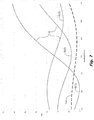
- Graphical silicon-plots Si in FIG. 7 show the relationship between wavelength and reflectance of one polarization (e.g. reflectance of s-polarization Rs) of a selectively-absorptive WGP that includes silicon.
- the first silicon-plot Si(1) is for with a WGP having a silicon thickness selected for optimal (low) Rs at around 450 nanometers.
- the second silicon-plot Si(2) is for with a WGP having a silicon thickness selected for optimal (low) Rs at around 550 nanometers.
- the third silicon-plot Si(3) is for with a WGP having a silicon thickness selected for optimal (low) Rs at around 650 nanometers. It would be simpler, and manufacturing errors could be avoided, if less than three different WGP designs were required.
- FIG. 7 Also shown in FIG. 7 is a graphical germanium-plot Ge of the relationship between wavelength and reflectance of one polarization (e.g. s-polarization) of a selectively-absorptive WGP that includes germanium.
- the WGP that includes germanium has better Rs across 2/3 of wavelengths from 400-700 nm.
- use of a WGP that includes germanium can provide a benefit of improved Rs from about 500-700 nm.
- one WGP design can be used for at least two of the light beams (e.g. 550 and 650).
- a rod in a selectively-absorptive WGP can include at germanium.
- the rod can include at least 20 mass percent germanium in one aspect, at least 50 mass percent germanium in another aspect, at least 80 mass percent germanium in another aspect, or at least 95 mass percent germanium in another aspect.
- a difficulty of using germanium is that it has a soluble oxide (about 4.5 g/L at 25°C).
- WGP performance can decrease if the polarizer, with an exterior of the rib 12 including germanium / germanium oxide, is immersed into an aqueous solution.
- aqueous solution can be for applying a protective coating (e.g. amino phosphonate as taught in U.S. Patent Number 6,785,050 which is incorporated herein by reference).
- a protective coating e.g. amino phosphonate as taught in U.S. Patent Number 6,785,050 which is incorporated herein by reference.
- Such protective coatings can be important to avoid corrosion of the WGP.
- WGPs made with such water-soluble materials can also benefit from anhydrous-immersion and / or vapor-deposition for applying the conformal-coating(s) 13.
- an anhydrous method can be helpful if a material of an exterior of the ribs 12 has solubility in water of at least 0.015 grams per liter at 25°C in one aspect, at least 0.02 grams per liter at 25°C in another aspect, at least 0.05 grams per liter at 25°C in another aspect, at least 0.5 grams per liter at 25°C in another aspect, at least 1 gram per liter at 25°C in another aspect, at least 2 grams per liter at 25°C in another aspect, or at least 4 grams per liter at 25°C in another aspect.
- anhydrous method for applying protective coatings such as anhydrous-immersion or vapor-deposition.
- vapor-deposition methods include chemical vapor-deposition (CVD), low-pressure CVD (LPCVD), plasma-enhanced CVD, physical vapor-deposition (PVD), atomic layer deposition (ALD), thermoreactive diffusion, electron-beam deposition, sputtering, and thermal evaporation.
- Anhydrous-immersion can include submersion of the WGP in an anhydrous, liquid bath. A solvent that will not dissolve rib 12 materials can be selected. Vapor-deposition can be preferred over immersion because of reduced process-waste disposal problems, reduced health hazards, reduced or no undesirable residue from rinsing, and vapor-deposition can be done with standard semiconductor processing equipment.
- the oxidation-barrier and the moisture-barrier described below can be applied by ALD.
- Some embodiments of the hydrophobic-layer have a sufficiently-high vapor pressure and can be applied by vapor-deposition.
- the conformal-coating 13 can include a barrier-layer.
- the barrier-layer can include an oxidation-barrier, a moisture-barrier, or both.
- the barrier-layer can include a metal oxide, or layers of different metal oxides.
- Oxidation of WGP ribs 12 can degrade performance of the WGP, by adversely affecting contrast or Rs.
- An oxidation-barrier can reduce oxidation of the ribs 12, and thus reduce or avoid such WGP performance degradation.
- the term "oxidation-barrier" means a first material capable of reducing the ingress of oxygen into a second material, which may cause the second material to oxidize.
- An oxidation barrier can be placed on the ribs 12 to protect the ribs 12 from oxidation.
- Non-limiting examples of chemicals that can be used as an oxidation-barrier include: aluminum oxide, silicon oxide, silicon nitride, silicon oxynitride, silicon carbide, or combinations thereof.
- WGP corrosion can degrade WGP performance. For example, water can condense onto the WGP and wick into narrow channels between ribs due to capillary action. The water can then corrode the ribs. Corroded regions can have reduced contrast, changed Rs, or can fail to polarize at all.
- a moisture-barrier can resist corrosion. A moisture-barrier can protect the ribs 12 from water or other corrosion. Examples of chemicals that can be used as a moisture-barrier include: hafnium oxide, zirconium oxide, or combinations thereof.
- the barrier-layer can include rare earth oxides, for example, oxides of scandium, yttrium, lanthanum, cerium, praseodymium, neodymium, promethium, samarium, europium, gadolinium, terbium, dysprosium, holmium, erbium, thulium, ytterbium, and lutetium. These rare earth oxides can be at least part of the oxidation-barrier, the moisture-barrier, or both.
- rare earth oxides for example, oxides of scandium, yttrium, lanthanum, cerium, praseodymium, neodymium, promethium, samarium, europium, gadolinium, terbium, dysprosium, holmium, erbium, thulium, ytterbium, and lutetium. These rare earth oxides can be at least part of the oxidation-barrier,
- the barrier-layer can be distinct from the ribs 12, meaning (1) there can be a boundary line or layer between the ribs 12 and the barrier-layer; or (2) there can be some difference of material of the barrier-layer relative to a material of the ribs 12.
- a native aluminum oxide can form at a surface of aluminum ribs 12.
- a layer of aluminum oxide (oxidation-barrier) can then be applied to the ribs (e.g. by ALD). This added layer of aluminum oxide can be important, because a thickness and / or density of the native aluminum oxide can be insufficient for protecting a core of the ribs 12 (e.g. substantially pure aluminum) from oxidizing.
- the oxidation-barrier (Al 2 O 3 ) has the same material composition as a surface (Al 2 O 3 ) of the ribs 12, the oxidation-barrier can still be distinct due to (1) a boundary layer between the oxidation-barrier and the ribs 12 and / or (2) a difference in material properties, such as an increased density of the oxidation-barrier relative to the native aluminum oxide.
- a silicon dioxide conformal-coating can be located between the silane conformal-coating and the ribs 12.
- the silicon dioxide conformal-coating can help the silane conformal-coating 14 bond to the ribs 12.
- the silicon dioxide conformal-coating can be the proximal conformal-coating 13 p or the middle conformal-coating 13 m , or an additional layer of the conformal-coating 13 located between the middle conformal-coating 13 m and the distal conformal-coating 13 d .
- the oxidation-barrier can be less effective at resisting corrosion.
- the moisture-barrier and / or hydrophobic-layer can be less effective at resisting oxidation.
- it can be beneficial to combine both an oxidation-barrier with a moisture-barrier and / or hydrophobic-layer.
- the moisture-barrier can resist corrosion, it can eventually break down. Thus, it can be beneficial to minimize exposure of the moisture-barrier to water.
- a hydrophobic-layer can minimize or prevent condensed water on the WGP from attacking the moisture-barrier, thus extending the life of the moisture-barrier and the WGP. If the hydrophobic-layer perfectly covers the ribs 12, and never breaks down, then a moisture-barrier might not be needed. But, due to imperfections in manufacturing, there can be locations on the ribs 12 that are not covered, or less densely covered, by the hydrophobic-layer. The moisture-barrier can provide protection to these locations. Also, the hydrophobic-layer can break down over time. The moisture-barrier can provide protection after such breakdown. Therefore, it can be beneficial to combine both a moisture-barrier and a hydrophobic-layer.
- the hydrophobic-layer keeps water on the ribs 12 in a Cassie-Baxter state, then rib 12 damage, which could otherwise be caused by tensile forces in water in the gaps G, can be avoided. Also, the water can roll off the surface of the WGP, often carrying dust particles with it, in a self-cleaning fashion.
- the conformal-coating 13 can have multiple layers, which can include at least two of: an oxidation-barrier, a moisture-barrier, a silicon dioxide conformal-coating, and a hydrophobic-layer. This added protection, however, is not free.
- Each additional layer in the conformal-coating 13 can increase WGP cost, especially if more than one tool is required to apply the multiple layers of the conformal-coating 13.
- a determination of the number of layers in the conformal-coatings 13 can be made by weighing cost against desired protection.
- WGP 10 in FIG. 1 includes a conformal-coating 13 with one layer: a distal conformal-coating 13 d .
- the distal conformal-coating 13 d can be the oxidation-barrier, the moisture-barrier, or the hydrophobic-layer.
- WGP 20 in FIG. 2 includes a conformal-coating 13 with two layers: a proximal conformal-coating 13 p located closer to the ribs 12 and substrate 11 and a distal conformal-coating 13 d located over the proximal conformal-coating 13 p .
- the proximal conformal-coating 13 p and the distal conformal-coating 13 d can comprise oxidation-barrier(s), moisture-barrier(s), and / or hydrophobic-layer(s).
- WGP 30 in FIG. 3 includes a conformal-coating 13 with three layers: the proximal conformal-coating 13 p , the distal conformal-coating 13 d , and a middle conformal-coating 13 m located between the proximal conformal-coating 13 p and the distal conformal-coating 13 d .
- the proximal conformal-coating 13 p , the middle conformal-coating 13 m , and the distal conformal-coating 13 d can comprise oxidation-barrier(s), moisture-barrier(s), and / or hydrophobic-layer(s).
- the moisture-barrier can provide corrosion protection to the oxidation-barrier.
- the oxidation-barrier can provide a good substrate for deposition of the moisture-barrier, resulting in a less porous moisture-barrier.
- the same moisture protection may be obtained by a relatively thinner moisture-barrier. This can be important because the moisture-barrier can degrade WGP performance, but such degradation can be minimized by reduced moisture-barrier thickness.
- the moisture-barrier can provide an improved surface for attachment of the hydrophobic-layer (if used).
- the hydrophobic-layer can be located over the barrier-layer (i.e. the hydrophobic-layer can be the distal conformal-coating 13 d ) in order to best keep moisture from entering the gaps G and to minimize or eliminate moisture exposure of the underlying layer(s) in the conformal-coating 13 (e.g. the proximal conformal-coating 13 p and also possibly the middle conformal-coating 13 m ).
- Image projector 80 can comprise a light source 81, color-splitting optics 82, color-combining optics 88, a projection lens system 85, one or more spatial light modulators 87, and one or more WGPs 84.
- the light source 81 can emit a beam of light 83, which can initially be unpolarized.
- the color-splitting optics 82 can be located to receive at least part of the beam of light 83 and can split the beam of light 83 into multiple, differently-colored light beams (colored beams) 83 c .
- the colored beams 83 c can be primary colors.
- Color-combining optics 88 can be located to receive and can recombine at least some of the colored beams 83 c into a combined beam or final beam 83 f .
- Color-combining optics 88 are sometimes called X-Cubes, X-Cube prisms, X-prisms, light recombination prisms, or cross dichroic prisms.
- Color-combining optics 88 are used in computer projectors for combining different colors of light into a single image to be projected.
- X-Cubes are typically made of four right angle prisms, with dichroic coatings, that are cemented together to form a cube.
- the projection lens system 85 can be located to receive the combined beam 83f and can project a colored image 83 i onto a screen 86.
- exemplary projection lens systems 85 are described in U.S. Patent Numbers 6,585,378 and 6,447,120 , which are hereby incorporated herein by reference in their entirety.
- One spatial light modulator 87 can be located to receive, in each light path between the color-splitting optics 82 and the color-combining optics 88, one of the colored beams 83 c .
- Each spatial light modulator 87 can have a plurality of pixels. Each pixel can receive a signal. The signal can be an electronic signal. Depending on whether or not each pixel receives the signal, the pixel can rotate a polarization of, or transmit or reflect without causing a change in polarization of, incident light.
- the spatial light modulator(s) 87 can be a liquid crystal device / display (LCD) and can be transmissive, reflective, or transflective.
- Each WGP 84 can be located in one of the colored beams 83 c prior to entering the spatial light modulator 87, after exiting the spatial light modulator 87, or both.
- the WGP(s) 84 help form the colored image 83 i by transmitting, reflecting, or absorbing light of each pixel depending on the type of WGP 84 and whether each pixel received the signal.
- FIG. 9 Another type of image projector 90 is shown in FIG. 9 , and can comprise a light source 91, a projection lens system 85, a spatial light modulator 87, and a WGP 84.
- the light source 91 can sequentially emit multiple, differently-colored light beams (colored beams) 93.
- the colored beams 93 can be primary colors.
- the projection lens system 85 can be located to receive the colored beams 93 and can project a colored image 83 i onto a screen 86.
- the projection lens system 85, spatial light modulator 87, WGP 84, colored image 83 i , and screen 86 were described above.
- the spatial light modulator 87 can be located to receive, in a light path between the light source 91 and the projection lens system 85, the colored beams 93.
- the WGP 84 can be located in the colored beams 93 prior to entering the spatial light modulator 87 and after exiting the spatial light modulator 87.
- Integrated circuits can be made of semiconductor material and can include nanometer-sized features. ICs can be used in various electronic devices (e.g. computer, motion sensor, etc.). Defects in the IC can cause the electronic device to fail. Thus, inspection of the IC can be important for avoiding failure of the electronic device, while in use by the consumer. Such inspection can be difficult due to the small feature-size of IC components. Light, with small wavelengths (e.g. ultraviolet), can be used to inspect small feature-size components. It can be difficult to have sufficient contrast between these small feature-size components and defects or their surroundings. Use of polarized light can improve integrated circuit (IC) inspection contrast. It can be difficult to polarize the small wavelengths of light (e.g. ultraviolet/UV) used for IC inspection. Polarizers that can polarize such small wavelengths, and that can withstand exposure to high-energy wavelengths of light, may be needed.
- ICs e.g. ultraviolet/UV
- the WGPs described herein can polarize small wavelengths of light (e.g. UV) and can be made of materials sufficiently durable to withstand exposure to such light.
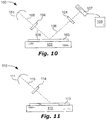
- An IC inspection tool 100 is shown in FIG. 10 , comprising a light source 101 and a stage 102 for holding an IC wafer 103.
- the light source 101 can be located to emit an incident light-beam 105 (e.g. visible, ultraviolet, or x-ray) onto the IC wafer 103.
- the incident light-beam 105 can be directed to the wafer 103 by optics (e.g. mirrors).
- the incident light-beam 105 can have an acute angle of incidence 109 with a face of the wafer 103.
- a WGP 104 (according to an embodiment described herein) can be located in, and can polarize, the incident light-beam 105.
- a detector 107 e.g. CCD
- An electronic circuit 108 can be configured to receive and analyze a signal from the detector 107 (the signal based on the output light-beam 106 received by the detector 107).
- a WGP 104 (according to an embodiment described herein) can be located in, and can polarize, the output light-beam 106.
- FPDs can include an aligned polymer film and liquid crystal.
- An FPD manufacturing tool 110 is shown in FIG. 11 , comprising a light source 111, a stage 112 for holding an FPD 113, and a WGP 114 (according to an embodiment described herein).
- the light source 111 can emit ultraviolet light 115.
- the WGP 114 can be located between the light source 111 and the stage 112 and can polarize the ultraviolet light 115. Exposing the FPD 113 to polarized ultraviolet light 115 can align the polymer film. See US Patents 8,797,643 and 8,654,289 , both incorporated herein by reference. Exposing the FPD 113 to polarized ultraviolet light 115 can help repair the FPD 113. See US Patent 7,697,108 , which is incorporated herein by reference.
- a method of making a WGP can include some or all of the following steps. The steps can be performed in the order shown, or alternate order:
- One, two, or every layer of the conformal coating can have one or more of the following characteristics:
- the hydrophobic group, the phosphonate-reactive-group, the silane-reactive-group, R 6 , R 3 , and R 5 can have the properties as described above.
- the silane chemical and the phosphonate chemical can be applied sequentially or simultaneously.
Landscapes
- Chemical & Material Sciences (AREA)
- Physics & Mathematics (AREA)
- Organic Chemistry (AREA)
- Engineering & Computer Science (AREA)
- Materials Engineering (AREA)
- Inorganic Chemistry (AREA)
- Mechanical Engineering (AREA)
- Metallurgy (AREA)
- General Chemical & Material Sciences (AREA)
- Chemical Kinetics & Catalysis (AREA)
- General Physics & Mathematics (AREA)
- Optics & Photonics (AREA)
- Life Sciences & Earth Sciences (AREA)
- Wood Science & Technology (AREA)
- Polarising Elements (AREA)
- Laminated Bodies (AREA)
- Surface Treatment Of Optical Elements (AREA)
- Liquid Crystal (AREA)
Applications Claiming Priority (8)
| Application Number | Priority Date | Filing Date | Title |
|---|---|---|---|
| US201562142854P | 2015-04-03 | 2015-04-03 | |
| US201562190188P | 2015-07-08 | 2015-07-08 | |
| US201562209024P | 2015-08-24 | 2015-08-24 | |
| US201562216782P | 2015-09-10 | 2015-09-10 | |
| US201562242883P | 2015-10-16 | 2015-10-16 | |
| US201562265773P | 2015-12-10 | 2015-12-10 | |
| US15/078,495 US10054717B2 (en) | 2015-04-03 | 2016-03-23 | Oxidation and moisture barrier layers for wire grid polarizer |
| PCT/US2016/024713 WO2016160803A1 (en) | 2015-04-03 | 2016-03-29 | Oxidation and moisture barrier layers for wire grid polarizer |
Publications (3)
| Publication Number | Publication Date |
|---|---|
| EP3237943A1 EP3237943A1 (en) | 2017-11-01 |
| EP3237943A4 EP3237943A4 (en) | 2018-07-04 |
| EP3237943B1 true EP3237943B1 (en) | 2021-01-13 |
Family
ID=57007562
Family Applications (1)
| Application Number | Title | Priority Date | Filing Date |
|---|---|---|---|
| EP16773995.2A Active EP3237943B1 (en) | 2015-04-03 | 2016-03-29 | Oxidation and moisture barrier layers for wire grid polarizer |
Country Status (6)
| Country | Link |
|---|---|
| US (1) | US10054717B2 (enExample) |
| EP (1) | EP3237943B1 (enExample) |
| JP (4) | JP7059497B2 (enExample) |
| KR (1) | KR20170134422A (enExample) |
| CN (2) | CN111766656A (enExample) |
| WO (1) | WO2016160803A1 (enExample) |
Families Citing this family (17)
| Publication number | Priority date | Publication date | Assignee | Title |
|---|---|---|---|---|
| KR102422109B1 (ko) | 2015-01-08 | 2022-07-19 | 삼성디스플레이 주식회사 | 액정 표시 장치 및 이를 제조하는 방법 |
| US9995864B2 (en) * | 2015-04-03 | 2018-06-12 | Moxtek, Inc. | Wire grid polarizer with silane protective coating |
| US10534120B2 (en) | 2015-04-03 | 2020-01-14 | Moxtek, Inc. | Wire grid polarizer with protected wires |
| US10444410B2 (en) | 2016-08-16 | 2019-10-15 | Moxtek, Inc. | Overcoat wire grid polarizer having conformal coat layer with oxidation barrier and moisture barrier |
| WO2018097873A1 (en) * | 2016-11-22 | 2018-05-31 | Moxtek, Inc. | Overcoat wire grid polarizer |
| CN107102394B (zh) * | 2017-07-03 | 2020-05-22 | 京东方科技集团股份有限公司 | 一种线栅偏振器、其制作方法及显示面板 |
| JP2019061125A (ja) * | 2017-09-27 | 2019-04-18 | デクセリアルズ株式会社 | 偏光板及びその製造方法、並びに光学機器 |
| JP6678630B2 (ja) * | 2017-09-28 | 2020-04-08 | デクセリアルズ株式会社 | 偏光板及びこれを備える光学機器 |
| US10852464B2 (en) * | 2018-03-01 | 2020-12-01 | Moxtek, Inc. | High-contrast polarizer |
| JP7333168B2 (ja) * | 2018-11-19 | 2023-08-24 | デクセリアルズ株式会社 | 偏光素子、偏光素子の製造方法及び光学機器 |
| US11746418B2 (en) * | 2018-12-03 | 2023-09-05 | Moxtek, Inc. | Chemical vapor deposition of thick inorganic coating on a polarizer |
| PH12020050239A1 (en) * | 2019-08-27 | 2021-05-17 | Moxtek Inc | Optical device with embedded organic moieties |
| CN117320648A (zh) * | 2021-02-03 | 2023-12-29 | 捷锐士阿希迈公司(以奥林巴斯美国外科技术名义) | 用于蒸汽袋点火的结构化电极 |
| US20220291434A1 (en) * | 2021-03-12 | 2022-09-15 | Moxtek, Inc. | Wire Grid Polarizer Wire Sidewall Protection |
| US12554056B2 (en) * | 2021-07-16 | 2026-02-17 | Moxtek, Inc. | Wire grid polarizer having wires with silicon core and silicon dioxide ribs |
| US20230236347A1 (en) * | 2022-01-26 | 2023-07-27 | Moxtek, Inc. | Reflective ultraviolet wire grid polarizer |
| TW202422131A (zh) * | 2022-11-22 | 2024-06-01 | 日商牛尾電機股份有限公司 | 反射型相位差構造體及其製造方法 |
Family Cites Families (65)
| Publication number | Priority date | Publication date | Assignee | Title |
|---|---|---|---|---|
| US3630790A (en) | 1969-05-13 | 1971-12-28 | Dow Chemical Co | Method of protection of metal surfaces from corrosion |
| US5045347A (en) | 1986-11-07 | 1991-09-03 | Hoechst Aktiengesellschaft | Reclaimable polyester film having adhesion-promoting coating |
| US4705725A (en) | 1986-11-28 | 1987-11-10 | E. I. Du Pont De Nemours And Company | Substrates with sterically-protected, stable, covalently-bonded organo-silane films |
| US4759611A (en) | 1986-12-19 | 1988-07-26 | Polaroid Corporation, Patent Department | Liquid crystal display having silylated light polarizers |
| DE4313130C1 (de) | 1993-04-22 | 1994-05-26 | Goldschmidt Ag Th | Verfahren zur Herstellung von Silanen bzw. Organosiliciumhydriden durch Reduktion der entsprechenden Siliciumhalogenide bzw. Organosiliciumhalogenide |
| DE19539789A1 (de) * | 1995-10-26 | 1997-04-30 | Merck Patent Gmbh | Mittel und Verfahren zur Herstellung von wasserabweisenden Beschichtungen auf optischen Substraten |
| JP3520775B2 (ja) | 1998-09-08 | 2004-04-19 | ソニーケミカル株式会社 | 低接着性塗料 |
| US6447120B2 (en) | 1999-07-28 | 2002-09-10 | Moxtex | Image projection system with a polarizing beam splitter |
| US6585378B2 (en) | 2001-03-20 | 2003-07-01 | Eastman Kodak Company | Digital cinema projector |
| CA2474913A1 (en) | 2002-02-05 | 2003-08-14 | Gencell Corporation | Silane coated metallic fuel cell components and methods of manufacture |
| CN100592112C (zh) | 2002-02-12 | 2010-02-24 | 奥尔利康贸易股份公司(特吕巴赫) | 包括亚微米空心空间的部件 |
| US6785050B2 (en) | 2002-05-09 | 2004-08-31 | Moxtek, Inc. | Corrosion resistant wire-grid polarizer and method of fabrication |
| US7404878B2 (en) | 2003-03-31 | 2008-07-29 | Chlorine Engineers Corp., Ltd. | Gas diffusion electrode assembly, bonding method for gas diffusion electrodes, and electrolyzer comprising gas diffusion electrodes |
| US7189479B2 (en) * | 2003-08-21 | 2007-03-13 | 3M Innovative Properties Company | Phototool coating |
| US7961393B2 (en) | 2004-12-06 | 2011-06-14 | Moxtek, Inc. | Selectively absorptive wire-grid polarizer |
| WO2006127664A1 (en) | 2005-05-23 | 2006-11-30 | Innovation Chemical Technologies, Ltd. | Fluorinated organic silicon coating material |
| KR100720454B1 (ko) | 2005-06-14 | 2007-05-22 | 엘지.필립스 엘시디 주식회사 | 액정표시소자 및 그 제조방법 |
| US7345855B2 (en) | 2005-09-07 | 2008-03-18 | International Business Machines Corporation | Tunnel barriers based on rare earth element oxides |
| KR101135381B1 (ko) | 2005-12-20 | 2012-04-17 | 엘지디스플레이 주식회사 | 평판 디스플레이 패널의 리페어 방법 |
| EP1970194B1 (en) * | 2006-01-06 | 2012-10-31 | Konica Minolta Holdings, Inc. | Moistureproof cellulose ester film, polarizer-protective film, and polarizer |
| US20070242352A1 (en) | 2006-04-13 | 2007-10-18 | Macmaster Steven William | Wire-grid polarizers, methods of fabrication thereof and their use in transmissive displays |
| US7854864B2 (en) | 2006-04-28 | 2010-12-21 | Konica Minolta Opto, Inc. | Method for manufacturing an optical film having a convexoconcave structure |
| US20080015298A1 (en) | 2006-07-17 | 2008-01-17 | Mingna Xiong | Superhydrophobic coating composition and coated articles obtained therefrom |
| US20080131709A1 (en) | 2006-09-28 | 2008-06-05 | Aculon Inc. | Composite structure with organophosphonate adherent layer and method of preparing |
| JP5409369B2 (ja) | 2006-10-12 | 2014-02-05 | カンブリオス テクノロジーズ コーポレイション | ナノワイヤベースの透明導電体およびその適用 |
| TWI439740B (zh) | 2006-11-17 | 2014-06-01 | Dainippon Printing Co Ltd | 光學薄膜、偏光板及影像顯示裝置 |
| KR101281164B1 (ko) | 2006-11-21 | 2013-07-02 | 삼성디스플레이 주식회사 | 와이어 그리드 편광자 및 이의 제조방법 |
| US20080245273A1 (en) | 2007-04-05 | 2008-10-09 | Jouko Vyorkka | Hydrophobic coatings |
| CN101334497B (zh) * | 2007-06-28 | 2015-11-25 | 第一毛织株式会社 | 偏振分光器件及其制造方法和设备以及包括其的显示器 |
| CN101399205A (zh) * | 2007-09-28 | 2009-04-01 | 力晶半导体股份有限公司 | 制作快闪存储器的方法 |
| JP5219715B2 (ja) | 2007-09-28 | 2013-06-26 | 富士フイルム株式会社 | 磁性粉末用表面改質剤、それを含む磁性塗料、ならびに磁気記録媒体 |
| JP5315681B2 (ja) | 2007-12-12 | 2013-10-16 | Tdk株式会社 | ハードコート用組成物、ハードコート層を有する物体およびその製造方法 |
| US20090231702A1 (en) * | 2008-03-17 | 2009-09-17 | Qihong Wu | Optical films and methods of making the same |
| JP5365626B2 (ja) | 2008-04-08 | 2013-12-11 | 旭硝子株式会社 | ワイヤグリッド型偏光子の製造方法 |
| WO2009148138A1 (ja) * | 2008-06-05 | 2009-12-10 | 旭硝子株式会社 | ナノインプリント用モールド、その製造方法および表面に微細凹凸構造を有する樹脂成形体ならびにワイヤグリッド型偏光子の製造方法 |
| WO2010005059A1 (ja) | 2008-07-10 | 2010-01-14 | 旭硝子株式会社 | ワイヤグリッド型偏光子およびその製造方法 |
| KR101383930B1 (ko) | 2008-12-24 | 2014-04-10 | 엘지디스플레이 주식회사 | 광 조사 장치 |
| US20110189382A1 (en) | 2009-07-23 | 2011-08-04 | E. I. Du Pont De Nemours And Company | Method of preparing fluorinated hybrid compositions |
| US20110200826A1 (en) | 2009-07-23 | 2011-08-18 | E. I. Du Pont De Nemours And Company | Articles containing fluorinated hybrid compositions |
| US20110186790A1 (en) | 2009-07-23 | 2011-08-04 | E. I. Du Pont De Nemours And Company | Fluorinated hybrid compositions |
| JP5735522B2 (ja) | 2009-10-27 | 2015-06-17 | シルコテック コーポレイション | 化学気相成長コーティング、物品、及び方法 |
| CN101819125B (zh) * | 2010-03-24 | 2012-05-23 | 江苏大学 | 一种光栅结构的稳定超疏水表面设计方法 |
| JP2011248284A (ja) | 2010-05-31 | 2011-12-08 | Sony Chemical & Information Device Corp | 偏光板及び偏光板の製造方法 |
| JP2012002972A (ja) * | 2010-06-16 | 2012-01-05 | Seiko Epson Corp | 偏光素子及びその製造方法、液晶装置、電子機器 |
| JP5682437B2 (ja) * | 2010-09-07 | 2015-03-11 | ソニー株式会社 | 固体撮像素子、固体撮像装置、撮像機器、及び、偏光素子の製造方法 |
| JP2012058397A (ja) * | 2010-09-07 | 2012-03-22 | Asahi Glass Co Ltd | ワイヤグリッド型偏光子、その製造方法および液晶表示装置 |
| US8913321B2 (en) | 2010-09-21 | 2014-12-16 | Moxtek, Inc. | Fine pitch grid polarizer |
| US8611007B2 (en) * | 2010-09-21 | 2013-12-17 | Moxtek, Inc. | Fine pitch wire grid polarizer |
| JP5244889B2 (ja) | 2010-10-28 | 2013-07-24 | 富士フイルム株式会社 | 立体画像印刷用印画紙、立体画像印刷物、及び立体画像の提供方法 |
| JP5760388B2 (ja) * | 2010-11-01 | 2015-08-12 | セイコーエプソン株式会社 | 偏光素子とその製造方法、プロジェクター、液晶装置、電子機器 |
| US20150077851A1 (en) | 2010-12-30 | 2015-03-19 | Moxtek, Inc. | Multi-layer absorptive wire grid polarizer |
| CN103392135A (zh) * | 2011-02-22 | 2013-11-13 | 旭硝子株式会社 | 微细结构成形体和包括该微细结构成形体的液晶显示装置 |
| US20120219801A1 (en) | 2011-02-25 | 2012-08-30 | Yu-Hui Huang | Hydrophobic and lipophobic coating material |
| JP6051562B2 (ja) * | 2011-04-28 | 2016-12-27 | セントラル硝子株式会社 | 撥水性保護膜形成用薬液 |
| WO2013111990A1 (ko) | 2012-01-27 | 2013-08-01 | 제일모직 주식회사 | 윈도우 시트용 적층체, 이를 포함하는 윈도우 시트 및 이를 포함하는 디스플레이 장치 |
| US20150210951A1 (en) | 2012-07-13 | 2015-07-30 | President And Fellows Of Harvard College | Multifunctional repellent materials |
| JP6100492B2 (ja) | 2012-09-05 | 2017-03-22 | デクセリアルズ株式会社 | 偏光素子、プロジェクター及び偏光素子の製造方法 |
| JP6268692B2 (ja) * | 2012-09-14 | 2018-01-31 | 大日本印刷株式会社 | 光学積層体、偏光板及び画像表示装置 |
| JP2014077972A (ja) * | 2012-09-18 | 2014-05-01 | Ricoh Co Ltd | 光学フィルタ及び該光学フィルタを備える撮像装置、並びに光学フィルタの製造方法 |
| JP2014085516A (ja) * | 2012-10-24 | 2014-05-12 | Asahi Kasei E-Materials Corp | ワイヤグリッド偏光板及びその製造方法 |
| JP2014209558A (ja) * | 2013-03-27 | 2014-11-06 | 東京エレクトロン株式会社 | シリコン酸化膜の形成方法、及び、シリコン酸化膜の形成装置 |
| US9666766B2 (en) | 2013-08-21 | 2017-05-30 | Pacific Light Technologies Corp. | Quantum dots having a nanocrystalline core, a nanocrystalline shell surrounding the core, and an insulator coating for the shell |
| KR20150029817A (ko) * | 2013-09-10 | 2015-03-19 | 삼성디스플레이 주식회사 | 편광판, 이를 갖는 표시장치 및 이의 제조방법 |
| US9703028B2 (en) * | 2015-04-03 | 2017-07-11 | Moxtek, Inc. | Wire grid polarizer with phosphonate protective coating |
| US9995864B2 (en) * | 2015-04-03 | 2018-06-12 | Moxtek, Inc. | Wire grid polarizer with silane protective coating |
-
2016
- 2016-03-23 US US15/078,495 patent/US10054717B2/en active Active
- 2016-03-29 EP EP16773995.2A patent/EP3237943B1/en active Active
- 2016-03-29 JP JP2017538195A patent/JP7059497B2/ja active Active
- 2016-03-29 CN CN202010697586.7A patent/CN111766656A/zh active Pending
- 2016-03-29 KR KR1020177027671A patent/KR20170134422A/ko not_active Ceased
- 2016-03-29 WO PCT/US2016/024713 patent/WO2016160803A1/en not_active Ceased
- 2016-03-29 CN CN201680018879.XA patent/CN107533172B/zh active Active
-
2020
- 2020-05-20 JP JP2020088222A patent/JP7088497B2/ja active Active
-
2022
- 2022-01-13 JP JP2022003989A patent/JP2022044664A/ja active Pending
- 2022-05-31 JP JP2022089259A patent/JP2022107723A/ja active Pending
Non-Patent Citations (1)
| Title |
|---|
| None * |
Also Published As
| Publication number | Publication date |
|---|---|
| JP2022107723A (ja) | 2022-07-22 |
| JP7059497B2 (ja) | 2022-04-26 |
| CN111766656A (zh) | 2020-10-13 |
| JP2018511816A (ja) | 2018-04-26 |
| KR20170134422A (ko) | 2017-12-06 |
| JP2022044664A (ja) | 2022-03-17 |
| CN107533172A (zh) | 2018-01-02 |
| EP3237943A1 (en) | 2017-11-01 |
| US20160291208A1 (en) | 2016-10-06 |
| EP3237943A4 (en) | 2018-07-04 |
| US10054717B2 (en) | 2018-08-21 |
| WO2016160803A1 (en) | 2016-10-06 |
| JP7088497B2 (ja) | 2022-06-21 |
| CN107533172B (zh) | 2020-08-14 |
| JP2020122991A (ja) | 2020-08-13 |
Similar Documents
| Publication | Publication Date | Title |
|---|---|---|
| US11513272B2 (en) | Wire grid polarizer with silane protective coating | |
| US10054717B2 (en) | Oxidation and moisture barrier layers for wire grid polarizer | |
| US10025015B2 (en) | Wire grid polarizer with phosphonate protective coating | |
| US10534120B2 (en) | Wire grid polarizer with protected wires | |
| US10302832B2 (en) | Embedded wire grid polarizer with high reflectivity on both sides | |
| US10656309B2 (en) | Overcoat wire grid polarizer having overcoat layer spanning air-filled channels | |
| US11002899B2 (en) | Durable, high performance wire grid polarizer | |
| CN107429086A (zh) | 疏水性膦酸酯和硅烷化学物质 | |
| US20140211181A1 (en) | Optical element | |
| WO2016160786A1 (en) | Wire grid polarizer with silane protective coating | |
| WO2016160795A1 (en) | Wire grid polarizer with phosphonate protective coating | |
| WO2016160784A1 (en) | Wire grid polarizer with water-soluble materials | |
| WO2018097873A1 (en) | Overcoat wire grid polarizer | |
| JP7200510B2 (ja) | 配向方法及び光配向装置 | |
| JP2005258028A (ja) | 光学部品及び投写型表示装置 |
Legal Events
| Date | Code | Title | Description |
|---|---|---|---|
| STAA | Information on the status of an ep patent application or granted ep patent |
Free format text: STATUS: THE INTERNATIONAL PUBLICATION HAS BEEN MADE |
|
| PUAI | Public reference made under article 153(3) epc to a published international application that has entered the european phase |
Free format text: ORIGINAL CODE: 0009012 |
|
| STAA | Information on the status of an ep patent application or granted ep patent |
Free format text: STATUS: REQUEST FOR EXAMINATION WAS MADE |
|
| 17P | Request for examination filed |
Effective date: 20170725 |
|
| AK | Designated contracting states |
Kind code of ref document: A1 Designated state(s): AL AT BE BG CH CY CZ DE DK EE ES FI FR GB GR HR HU IE IS IT LI LT LU LV MC MK MT NL NO PL PT RO RS SE SI SK SM TR |
|
| AX | Request for extension of the european patent |
Extension state: BA ME |
|
| RIN1 | Information on inventor provided before grant (corrected) |
Inventor name: LINFORD, MATT Inventor name: WANGENSTEEN, TED Inventor name: DIWAN, ANUBHAV Inventor name: NIELSON, STEW Inventor name: LANE, FRED Inventor name: MATTHEW C. GEORGE |
|
| RIN1 | Information on inventor provided before grant (corrected) |
Inventor name: LANE, FRED Inventor name: MATTHEW C. GEORGE Inventor name: LINFORD, MATT Inventor name: NIELSON, STEW Inventor name: DIWAN, ANUBHAV Inventor name: WANGENSTEEN, TED |
|
| A4 | Supplementary search report drawn up and despatched |
Effective date: 20180606 |
|
| RIC1 | Information provided on ipc code assigned before grant |
Ipc: G02B 5/26 20060101ALI20180530BHEP Ipc: G02B 5/30 20060101AFI20180530BHEP |
|
| DAV | Request for validation of the european patent (deleted) | ||
| DAX | Request for extension of the european patent (deleted) | ||
| STAA | Information on the status of an ep patent application or granted ep patent |
Free format text: STATUS: EXAMINATION IS IN PROGRESS |
|
| 17Q | First examination report despatched |
Effective date: 20190130 |
|
| GRAP | Despatch of communication of intention to grant a patent |
Free format text: ORIGINAL CODE: EPIDOSNIGR1 |
|
| STAA | Information on the status of an ep patent application or granted ep patent |
Free format text: STATUS: GRANT OF PATENT IS INTENDED |
|
| INTG | Intention to grant announced |
Effective date: 20200902 |
|
| GRAS | Grant fee paid |
Free format text: ORIGINAL CODE: EPIDOSNIGR3 |
|
| GRAA | (expected) grant |
Free format text: ORIGINAL CODE: 0009210 |
|
| STAA | Information on the status of an ep patent application or granted ep patent |
Free format text: STATUS: THE PATENT HAS BEEN GRANTED |
|
| AK | Designated contracting states |
Kind code of ref document: B1 Designated state(s): AL AT BE BG CH CY CZ DE DK EE ES FI FR GB GR HR HU IE IS IT LI LT LU LV MC MK MT NL NO PL PT RO RS SE SI SK SM TR |
|
| REG | Reference to a national code |
Ref country code: GB Ref legal event code: FG4D |
|
| REG | Reference to a national code |
Ref country code: CH Ref legal event code: EP |
|
| REG | Reference to a national code |
Ref country code: DE Ref legal event code: R096 Ref document number: 602016051426 Country of ref document: DE |
|
| REG | Reference to a national code |
Ref country code: IE Ref legal event code: FG4D |
|
| REG | Reference to a national code |
Ref country code: AT Ref legal event code: REF Ref document number: 1354990 Country of ref document: AT Kind code of ref document: T Effective date: 20210215 |
|
| REG | Reference to a national code |
Ref country code: AT Ref legal event code: MK05 Ref document number: 1354990 Country of ref document: AT Kind code of ref document: T Effective date: 20210113 |
|
| REG | Reference to a national code |
Ref country code: NL Ref legal event code: MP Effective date: 20210113 |
|
| REG | Reference to a national code |
Ref country code: LT Ref legal event code: MG9D |
|
| PG25 | Lapsed in a contracting state [announced via postgrant information from national office to epo] |
Ref country code: HR Free format text: LAPSE BECAUSE OF FAILURE TO SUBMIT A TRANSLATION OF THE DESCRIPTION OR TO PAY THE FEE WITHIN THE PRESCRIBED TIME-LIMIT Effective date: 20210113 Ref country code: GR Free format text: LAPSE BECAUSE OF FAILURE TO SUBMIT A TRANSLATION OF THE DESCRIPTION OR TO PAY THE FEE WITHIN THE PRESCRIBED TIME-LIMIT Effective date: 20210414 Ref country code: FI Free format text: LAPSE BECAUSE OF FAILURE TO SUBMIT A TRANSLATION OF THE DESCRIPTION OR TO PAY THE FEE WITHIN THE PRESCRIBED TIME-LIMIT Effective date: 20210113 Ref country code: PT Free format text: LAPSE BECAUSE OF FAILURE TO SUBMIT A TRANSLATION OF THE DESCRIPTION OR TO PAY THE FEE WITHIN THE PRESCRIBED TIME-LIMIT Effective date: 20210513 Ref country code: NO Free format text: LAPSE BECAUSE OF FAILURE TO SUBMIT A TRANSLATION OF THE DESCRIPTION OR TO PAY THE FEE WITHIN THE PRESCRIBED TIME-LIMIT Effective date: 20210413 Ref country code: LT Free format text: LAPSE BECAUSE OF FAILURE TO SUBMIT A TRANSLATION OF THE DESCRIPTION OR TO PAY THE FEE WITHIN THE PRESCRIBED TIME-LIMIT Effective date: 20210113 Ref country code: BG Free format text: LAPSE BECAUSE OF FAILURE TO SUBMIT A TRANSLATION OF THE DESCRIPTION OR TO PAY THE FEE WITHIN THE PRESCRIBED TIME-LIMIT Effective date: 20210413 |
|
| PG25 | Lapsed in a contracting state [announced via postgrant information from national office to epo] |
Ref country code: AT Free format text: LAPSE BECAUSE OF FAILURE TO SUBMIT A TRANSLATION OF THE DESCRIPTION OR TO PAY THE FEE WITHIN THE PRESCRIBED TIME-LIMIT Effective date: 20210113 Ref country code: RS Free format text: LAPSE BECAUSE OF FAILURE TO SUBMIT A TRANSLATION OF THE DESCRIPTION OR TO PAY THE FEE WITHIN THE PRESCRIBED TIME-LIMIT Effective date: 20210113 Ref country code: LV Free format text: LAPSE BECAUSE OF FAILURE TO SUBMIT A TRANSLATION OF THE DESCRIPTION OR TO PAY THE FEE WITHIN THE PRESCRIBED TIME-LIMIT Effective date: 20210113 Ref country code: PL Free format text: LAPSE BECAUSE OF FAILURE TO SUBMIT A TRANSLATION OF THE DESCRIPTION OR TO PAY THE FEE WITHIN THE PRESCRIBED TIME-LIMIT Effective date: 20210113 Ref country code: SE Free format text: LAPSE BECAUSE OF FAILURE TO SUBMIT A TRANSLATION OF THE DESCRIPTION OR TO PAY THE FEE WITHIN THE PRESCRIBED TIME-LIMIT Effective date: 20210113 |
|
| PG25 | Lapsed in a contracting state [announced via postgrant information from national office to epo] |
Ref country code: IS Free format text: LAPSE BECAUSE OF FAILURE TO SUBMIT A TRANSLATION OF THE DESCRIPTION OR TO PAY THE FEE WITHIN THE PRESCRIBED TIME-LIMIT Effective date: 20210513 |
|
| REG | Reference to a national code |
Ref country code: DE Ref legal event code: R097 Ref document number: 602016051426 Country of ref document: DE |
|
| PG25 | Lapsed in a contracting state [announced via postgrant information from national office to epo] |
Ref country code: SM Free format text: LAPSE BECAUSE OF FAILURE TO SUBMIT A TRANSLATION OF THE DESCRIPTION OR TO PAY THE FEE WITHIN THE PRESCRIBED TIME-LIMIT Effective date: 20210113 Ref country code: CZ Free format text: LAPSE BECAUSE OF FAILURE TO SUBMIT A TRANSLATION OF THE DESCRIPTION OR TO PAY THE FEE WITHIN THE PRESCRIBED TIME-LIMIT Effective date: 20210113 Ref country code: EE Free format text: LAPSE BECAUSE OF FAILURE TO SUBMIT A TRANSLATION OF THE DESCRIPTION OR TO PAY THE FEE WITHIN THE PRESCRIBED TIME-LIMIT Effective date: 20210113 Ref country code: MC Free format text: LAPSE BECAUSE OF FAILURE TO SUBMIT A TRANSLATION OF THE DESCRIPTION OR TO PAY THE FEE WITHIN THE PRESCRIBED TIME-LIMIT Effective date: 20210113 |
|
| REG | Reference to a national code |
Ref country code: CH Ref legal event code: PL |
|
| PLBE | No opposition filed within time limit |
Free format text: ORIGINAL CODE: 0009261 |
|
| STAA | Information on the status of an ep patent application or granted ep patent |
Free format text: STATUS: NO OPPOSITION FILED WITHIN TIME LIMIT |
|
| PG25 | Lapsed in a contracting state [announced via postgrant information from national office to epo] |
Ref country code: DK Free format text: LAPSE BECAUSE OF FAILURE TO SUBMIT A TRANSLATION OF THE DESCRIPTION OR TO PAY THE FEE WITHIN THE PRESCRIBED TIME-LIMIT Effective date: 20210113 Ref country code: SK Free format text: LAPSE BECAUSE OF FAILURE TO SUBMIT A TRANSLATION OF THE DESCRIPTION OR TO PAY THE FEE WITHIN THE PRESCRIBED TIME-LIMIT Effective date: 20210113 Ref country code: RO Free format text: LAPSE BECAUSE OF FAILURE TO SUBMIT A TRANSLATION OF THE DESCRIPTION OR TO PAY THE FEE WITHIN THE PRESCRIBED TIME-LIMIT Effective date: 20210113 |
|
| REG | Reference to a national code |
Ref country code: BE Ref legal event code: MM Effective date: 20210331 |
|
| 26N | No opposition filed |
Effective date: 20211014 |
|
| PG25 | Lapsed in a contracting state [announced via postgrant information from national office to epo] |
Ref country code: CH Free format text: LAPSE BECAUSE OF NON-PAYMENT OF DUE FEES Effective date: 20210331 Ref country code: AL Free format text: LAPSE BECAUSE OF FAILURE TO SUBMIT A TRANSLATION OF THE DESCRIPTION OR TO PAY THE FEE WITHIN THE PRESCRIBED TIME-LIMIT Effective date: 20210113 Ref country code: LI Free format text: LAPSE BECAUSE OF NON-PAYMENT OF DUE FEES Effective date: 20210331 Ref country code: LU Free format text: LAPSE BECAUSE OF NON-PAYMENT OF DUE FEES Effective date: 20210329 Ref country code: ES Free format text: LAPSE BECAUSE OF FAILURE TO SUBMIT A TRANSLATION OF THE DESCRIPTION OR TO PAY THE FEE WITHIN THE PRESCRIBED TIME-LIMIT Effective date: 20210113 Ref country code: IE Free format text: LAPSE BECAUSE OF NON-PAYMENT OF DUE FEES Effective date: 20210329 Ref country code: FR Free format text: LAPSE BECAUSE OF NON-PAYMENT OF DUE FEES Effective date: 20210331 |
|
| PG25 | Lapsed in a contracting state [announced via postgrant information from national office to epo] |
Ref country code: SI Free format text: LAPSE BECAUSE OF FAILURE TO SUBMIT A TRANSLATION OF THE DESCRIPTION OR TO PAY THE FEE WITHIN THE PRESCRIBED TIME-LIMIT Effective date: 20210113 |
|
| PG25 | Lapsed in a contracting state [announced via postgrant information from national office to epo] |
Ref country code: IT Free format text: LAPSE BECAUSE OF FAILURE TO SUBMIT A TRANSLATION OF THE DESCRIPTION OR TO PAY THE FEE WITHIN THE PRESCRIBED TIME-LIMIT Effective date: 20210113 |
|
| PG25 | Lapsed in a contracting state [announced via postgrant information from national office to epo] |
Ref country code: IS Free format text: LAPSE BECAUSE OF FAILURE TO SUBMIT A TRANSLATION OF THE DESCRIPTION OR TO PAY THE FEE WITHIN THE PRESCRIBED TIME-LIMIT Effective date: 20210513 |
|
| PG25 | Lapsed in a contracting state [announced via postgrant information from national office to epo] |
Ref country code: BE Free format text: LAPSE BECAUSE OF NON-PAYMENT OF DUE FEES Effective date: 20210331 |
|
| PG25 | Lapsed in a contracting state [announced via postgrant information from national office to epo] |
Ref country code: HU Free format text: LAPSE BECAUSE OF FAILURE TO SUBMIT A TRANSLATION OF THE DESCRIPTION OR TO PAY THE FEE WITHIN THE PRESCRIBED TIME-LIMIT; INVALID AB INITIO Effective date: 20160329 |
|
| PG25 | Lapsed in a contracting state [announced via postgrant information from national office to epo] |
Ref country code: NL Free format text: LAPSE BECAUSE OF NON-PAYMENT OF DUE FEES Effective date: 20210113 Ref country code: CY Free format text: LAPSE BECAUSE OF FAILURE TO SUBMIT A TRANSLATION OF THE DESCRIPTION OR TO PAY THE FEE WITHIN THE PRESCRIBED TIME-LIMIT Effective date: 20210113 |
|
| PG25 | Lapsed in a contracting state [announced via postgrant information from national office to epo] |
Ref country code: MK Free format text: LAPSE BECAUSE OF FAILURE TO SUBMIT A TRANSLATION OF THE DESCRIPTION OR TO PAY THE FEE WITHIN THE PRESCRIBED TIME-LIMIT Effective date: 20210113 |
|
| PG25 | Lapsed in a contracting state [announced via postgrant information from national office to epo] |
Ref country code: MT Free format text: LAPSE BECAUSE OF FAILURE TO SUBMIT A TRANSLATION OF THE DESCRIPTION OR TO PAY THE FEE WITHIN THE PRESCRIBED TIME-LIMIT Effective date: 20210113 |
|
| PG25 | Lapsed in a contracting state [announced via postgrant information from national office to epo] |
Ref country code: TR Free format text: LAPSE BECAUSE OF FAILURE TO SUBMIT A TRANSLATION OF THE DESCRIPTION OR TO PAY THE FEE WITHIN THE PRESCRIBED TIME-LIMIT Effective date: 20210113 |
|
| PGFP | Annual fee paid to national office [announced via postgrant information from national office to epo] |
Ref country code: GB Payment date: 20260316 Year of fee payment: 11 |
|
| PGFP | Annual fee paid to national office [announced via postgrant information from national office to epo] |
Ref country code: DE Payment date: 20260319 Year of fee payment: 11 |