EP3209302B1 - Carbidopa and l-dopa prodrugs and their use to treat parkinson's disease - Google Patents
Carbidopa and l-dopa prodrugs and their use to treat parkinson's disease Download PDFInfo
- Publication number
- EP3209302B1 EP3209302B1 EP15791424.3A EP15791424A EP3209302B1 EP 3209302 B1 EP3209302 B1 EP 3209302B1 EP 15791424 A EP15791424 A EP 15791424A EP 3209302 B1 EP3209302 B1 EP 3209302B1
- Authority
- EP
- European Patent Office
- Prior art keywords
- compound
- formula
- dopa
- carbidopa
- pharmaceutically acceptable
- Prior art date
- Legal status (The legal status is an assumption and is not a legal conclusion. Google has not performed a legal analysis and makes no representation as to the accuracy of the status listed.)
- Active
Links
- 0 *C([C@](Cc1cc(O)c(*)cc1)N)=O Chemical compound *C([C@](Cc1cc(O)c(*)cc1)N)=O 0.000 description 3
- PQUZXFMHVSMUNG-JTQLQIEISA-N C[C@](Cc(cc1)cc(O)c1OP(O)(O)=O)(C(O)=O)NN Chemical compound C[C@](Cc(cc1)cc(O)c1OP(O)(O)=O)(C(O)=O)NN PQUZXFMHVSMUNG-JTQLQIEISA-N 0.000 description 3
- ZRBWPXGANGSKJG-ZETCQYMHSA-N N[C@@H](Cc(cc1)cc(OCOP(O)(O)=O)c1O)C(O)=O Chemical compound N[C@@H](Cc(cc1)cc(OCOP(O)(O)=O)c1O)C(O)=O ZRBWPXGANGSKJG-ZETCQYMHSA-N 0.000 description 2
- RVCPBIZDIKPVPH-LBPRGKRZSA-N COC([C@@](Cc(cc1)cc(O)c1OP(O)(O)=O)(C#C)NN)=O Chemical compound COC([C@@](Cc(cc1)cc(O)c1OP(O)(O)=O)(C#C)NN)=O RVCPBIZDIKPVPH-LBPRGKRZSA-N 0.000 description 1
- XHECKZQVRIJLRW-ZETCQYMHSA-N COC([C@H](Cc(cc1)cc(O)c1OP(O)(O)=O)NN)=O Chemical compound COC([C@H](Cc(cc1)cc(O)c1OP(O)(O)=O)NN)=O XHECKZQVRIJLRW-ZETCQYMHSA-N 0.000 description 1
- OZCQHHBLESOGHN-YTTGMZPUSA-N C[C@](Cc(cc1)cc(O)c1O)(C(OCc1ccccc1)=O)N(Cc1ccccc1)NC(OCc1ccccc1)=O Chemical compound C[C@](Cc(cc1)cc(O)c1O)(C(OCc1ccccc1)=O)N(Cc1ccccc1)NC(OCc1ccccc1)=O OZCQHHBLESOGHN-YTTGMZPUSA-N 0.000 description 1
- YNXJHSFOHQVLFG-JTQLQIEISA-N C[C@](Cc(cc1)cc(OP(O)(O)=O)c1O)(C(O)=O)NN Chemical compound C[C@](Cc(cc1)cc(OP(O)(O)=O)c1O)(C(O)=O)NN YNXJHSFOHQVLFG-JTQLQIEISA-N 0.000 description 1
Images









Classifications
-
- A—HUMAN NECESSITIES
- A61—MEDICAL OR VETERINARY SCIENCE; HYGIENE
- A61K—PREPARATIONS FOR MEDICAL, DENTAL OR TOILETRY PURPOSES
- A61K31/00—Medicinal preparations containing organic active ingredients
- A61K31/66—Phosphorus compounds
- A61K31/661—Phosphorus acids or esters thereof not having P—C bonds, e.g. fosfosal, dichlorvos, malathion or mevinphos
-
- A—HUMAN NECESSITIES
- A61—MEDICAL OR VETERINARY SCIENCE; HYGIENE
- A61K—PREPARATIONS FOR MEDICAL, DENTAL OR TOILETRY PURPOSES
- A61K31/00—Medicinal preparations containing organic active ingredients
- A61K31/66—Phosphorus compounds
- A61K31/661—Phosphorus acids or esters thereof not having P—C bonds, e.g. fosfosal, dichlorvos, malathion or mevinphos
- A61K31/6615—Compounds having two or more esterified phosphorus acid groups, e.g. inositol triphosphate, phytic acid
-
- A—HUMAN NECESSITIES
- A61—MEDICAL OR VETERINARY SCIENCE; HYGIENE
- A61K—PREPARATIONS FOR MEDICAL, DENTAL OR TOILETRY PURPOSES
- A61K45/00—Medicinal preparations containing active ingredients not provided for in groups A61K31/00 - A61K41/00
- A61K45/06—Mixtures of active ingredients without chemical characterisation, e.g. antiphlogistics and cardiaca
-
- A—HUMAN NECESSITIES
- A61—MEDICAL OR VETERINARY SCIENCE; HYGIENE
- A61P—SPECIFIC THERAPEUTIC ACTIVITY OF CHEMICAL COMPOUNDS OR MEDICINAL PREPARATIONS
- A61P25/00—Drugs for disorders of the nervous system
-
- A—HUMAN NECESSITIES
- A61—MEDICAL OR VETERINARY SCIENCE; HYGIENE
- A61P—SPECIFIC THERAPEUTIC ACTIVITY OF CHEMICAL COMPOUNDS OR MEDICINAL PREPARATIONS
- A61P25/00—Drugs for disorders of the nervous system
- A61P25/14—Drugs for disorders of the nervous system for treating abnormal movements, e.g. chorea, dyskinesia
- A61P25/16—Anti-Parkinson drugs
-
- A—HUMAN NECESSITIES
- A61—MEDICAL OR VETERINARY SCIENCE; HYGIENE
- A61P—SPECIFIC THERAPEUTIC ACTIVITY OF CHEMICAL COMPOUNDS OR MEDICINAL PREPARATIONS
- A61P43/00—Drugs for specific purposes, not provided for in groups A61P1/00-A61P41/00
-
- C—CHEMISTRY; METALLURGY
- C07—ORGANIC CHEMISTRY
- C07C—ACYCLIC OR CARBOCYCLIC COMPOUNDS
- C07C281/00—Derivatives of carbonic acid containing functional groups covered by groups C07C269/00 - C07C279/00 in which at least one nitrogen atom of these functional groups is further bound to another nitrogen atom not being part of a nitro or nitroso group
- C07C281/02—Compounds containing any of the groups, e.g. carbazates
-
- C—CHEMISTRY; METALLURGY
- C07—ORGANIC CHEMISTRY
- C07C—ACYCLIC OR CARBOCYCLIC COMPOUNDS
- C07C309/00—Sulfonic acids; Halides, esters, or anhydrides thereof
- C07C309/01—Sulfonic acids
- C07C309/02—Sulfonic acids having sulfo groups bound to acyclic carbon atoms
- C07C309/24—Sulfonic acids having sulfo groups bound to acyclic carbon atoms of a carbon skeleton containing six-membered aromatic rings
-
- C—CHEMISTRY; METALLURGY
- C07—ORGANIC CHEMISTRY
- C07C—ACYCLIC OR CARBOCYCLIC COMPOUNDS
- C07C47/00—Compounds having —CHO groups
- C07C47/20—Unsaturated compounds having —CHO groups bound to acyclic carbon atoms
- C07C47/277—Unsaturated compounds having —CHO groups bound to acyclic carbon atoms containing ether groups, groups, groups, or groups
-
- C—CHEMISTRY; METALLURGY
- C07—ORGANIC CHEMISTRY
- C07F—ACYCLIC, CARBOCYCLIC OR HETEROCYCLIC COMPOUNDS CONTAINING ELEMENTS OTHER THAN CARBON, HYDROGEN, HALOGEN, OXYGEN, NITROGEN, SULFUR, SELENIUM OR TELLURIUM
- C07F9/00—Compounds containing elements of Groups 5 or 15 of the Periodic Table
- C07F9/02—Phosphorus compounds
- C07F9/06—Phosphorus compounds without P—C bonds
-
- C—CHEMISTRY; METALLURGY
- C07—ORGANIC CHEMISTRY
- C07F—ACYCLIC, CARBOCYCLIC OR HETEROCYCLIC COMPOUNDS CONTAINING ELEMENTS OTHER THAN CARBON, HYDROGEN, HALOGEN, OXYGEN, NITROGEN, SULFUR, SELENIUM OR TELLURIUM
- C07F9/00—Compounds containing elements of Groups 5 or 15 of the Periodic Table
- C07F9/02—Phosphorus compounds
- C07F9/06—Phosphorus compounds without P—C bonds
- C07F9/08—Esters of oxyacids of phosphorus
- C07F9/09—Esters of phosphoric acids
- C07F9/094—Esters of phosphoric acids with arylalkanols
-
- A—HUMAN NECESSITIES
- A61—MEDICAL OR VETERINARY SCIENCE; HYGIENE
- A61K—PREPARATIONS FOR MEDICAL, DENTAL OR TOILETRY PURPOSES
- A61K2300/00—Mixtures or combinations of active ingredients, wherein at least one active ingredient is fully defined in groups A61K31/00 - A61K41/00
-
- C—CHEMISTRY; METALLURGY
- C07—ORGANIC CHEMISTRY
- C07B—GENERAL METHODS OF ORGANIC CHEMISTRY; APPARATUS THEREFOR
- C07B2200/00—Indexing scheme relating to specific properties of organic compounds
- C07B2200/13—Crystalline forms, e.g. polymorphs
Definitions
- the present disclosure relates to (a) carbidopa prodrugs, (b) L-dopa prodrugs, (c) pharmaceutical combinations and compositions comprising a carbidopa prodrug and/or an L-dopa prodrug, and (d) methods of treating Parkinson's disease and associated conditions comprising administering a carbidopa prodrug and an L-dopa prodrug to a subject with Parkinson's disease.
- Parkinson's disease is a chronic and progressive neurodegenerative condition characterized by reduced levels in the brain of the neurotransmitter dopamine (i.e., 3,4-dihydroxyphenethylamine).
- dopamine i.e., 3,4-dihydroxyphenethylamine
- Administration of L-dopa i.e., L-3,4-dihydroxyphenylalanine
- L-dopa which unlike dopamine can cross the blood-brain barrier, is enzymatically converted in the brain to dopamine resulting in an increase in dopamine levels:
- L-dopa mono- and di-phosphorylated versions of L-dopa are disclosed in Pawelek et al., Cancer Research (1986) 46:493-497 for their cytotoxic effects against melanoma cells.
- Compositions comprising e.g . L-dopa mono- or di-phosphates are disclosed in US 2012/0288446 A1 for their potential use in bone cement.
- Certain monophosphorylated esters of L-dopa for oral administration are disclosed in EP 0 393 781 A2 .
- Maeda et al., Phosphorous Research Bulletin. (2011) 25:56-60 discloses certain mono-phosphorylated versions of L-dopa.
- US 3,132,171 discloses certain di-phosphorylated versions of L-dopa for oral administration useful as an anti-depressive.
- L-dopa The conversion of L-dopa to dopamine is catalyzed by aromatic L-amino acid decarboxylase, a ubiquitous enzyme that promotes central as well as peripheral metabolism of L-dopa to dopamine. Due to the peripheral metabolism of L-dopa, a relatively large dose of L-dopa is required to achieve therapeutically effective dopamine levels in the brain. Administration of such large L-dopa doses results in elevated peripheral dopamine levels that can cause nausea in some patients.
- L-dopa generally is co-administered with a peripheral aromatic L-amino acid decarboxylase inhibitor such as carbidopa (i.e., (2 S )-3-(3,4-dihydroxyphenyl)-2-hydrazino-2-methylpropanoic acid): Co-administration of carbidopa with L-dopa inhibits the peripheral metabolism of L-dopa to dopamine, which significantly reduces the L-dopa dose required for a therapeutically effective response and reduces the associated side effects.
- a peripheral aromatic L-amino acid decarboxylase inhibitor such as carbidopa (i.e., (2 S )-3-(3,4-dihydroxyphenyl)-2-hydrazino-2-methylpropanoic acid)
- L-dopa and carbidopa are co-administered, however, it is difficult to consistently maintain the desired dopamine levels in the brain due to the relatively short half-life of L-dopa in plasma.
- the tolerance of many patients to variability in dopamine levels in the brain decreases as the disease progresses.
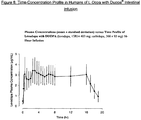
- One approach that has been effective in reducing variability of dopamine levels is the continuous intestinal delivery of an adjustable dose of an L-dopa/carbidopa gel known by its commercial name, DuoDopa® in Europe and Duopa® in the United States.
- DuoDopa®/Duopa® is a suspension of L-dopa/carbidopa monohydrate (4:1 ratio of L-dopa to carbidopa monohydrate) in an aqueous gel (carboxymethyl cellulose sodium) having a viscosity that permits homogeneous distribution of micronized substance particles.
- the gel is delivered to the proximal small intestine through a jejunal tube inserted through a percutaneous endoscopic gastrostomy port.
- DuoDopa®/Duopa® is packaged in medication cassette reservoirs and continuously administered via a software-controlled ambulatory infusion pump.
- L-dopa and carbidopa have low aqueous solubility at the pH range required for infusion. Stable, more highly concentrated, and/or less viscous formulations comprising L-dopa and/or carbidopa (or compounds capable of in vivo bioconversion to L-dopa and/or carbidopa) are desirable.
- Such formulations can provide advantages over existing intestinal infusion therapy including: (a) decreasing the volume and improving the pumpability of the formulation to be delivered to the patient which also allows for a reduction of the size and weight of delivery device; (b) extending the shelf life of the formulation by reducing degradation and improving stability of the formulation; and/or (c) providing the patient with increased flexibility in managing their treatment by reducing or eliminating cold storage requirements for the formulation (e.g., longer times to handle the formulation outside of refrigerated storage).
- Such stable, more highly concentrated, and/or less viscous formulations also can be employed in less invasive modes of administration (e.g., subcutaneous infusion).
- compositions and methods that can provide continuous and consistent dopamine levels in the brain to effectively treat movement disorders such as Parkinson's disease.
- the present disclosure provides such improved compositions and methods.
- the present invention provides pharmaceutical compositions and their use in treating Parkinson's disease, as well as compounds, as set out in the appended claims.
- the present disclosure relates to a compound corresponding in structure to Formula (I): or a pharmaceutically acceptable salt thereof, wherein R 1 and R 2 are each independently selected from the group consisting of hydrogen, -P(O)(OH) 2 , and-R 5 -O-P(O)(OH) 2 ; R 5 is a C 1 -C 4 -alkyl; R 6 is hydrogen or a C 1 -C 4 -alkyl; and provided that at least one of R 1 and R 2 is -P(O)(OH) 2 or -R 5 -O-P(O)(O) 2 .
- the present disclosure relates to a compound corresponding in structure Formula (II): or a pharmaceutically acceptable salt thereof, wherein R 3 and R 4 are each independently selected from the group consisting of hydrogen, -P(O)(OH) 2 , and-R 5 -O-P(O)(OH) 2 ; R 5 is a C 1 -C 4 -alkyl; R 6 is hydrogen or a C 1 -C 4 -alkyl; and provided that at least one of R 3 and R 4 is -P(O)(OH) 2 or -R 5 -O-P(O)(OH) 2 .
- the present disclosure relates to a pharmaceutical combination comprising a first compound corresponding in structure to Formula (I), or a pharmaceutically acceptable salt thereof, and a second compound corresponding in structure to Formula (II) or a pharmaceutically acceptable salt thereof.
- the present disclosure relates to a pharmaceutical composition
- a pharmaceutical composition comprising a first compound corresponding in structure to Formula (I), or a pharmaceutically acceptable salt thereof, and a pharmaceutically acceptable carrier.
- the pharmaceutical composition may further comprise a second compound corresponding in structure to Formula (II) or a pharmaceutically acceptable salt thereof.
- the present disclosure relates to a method of treating Parkinson's disease or an associated condition in a patient comprising administering to the patient a therapeutically effective amount of a pharmaceutical combination comprising a first compound corresponding in structure to Formula (I), or a pharmaceutically acceptable salt thereof, and a second compound corresponding in structure to Formula (II), or a pharmaceutically acceptable salt thereof.
- the method comprises administering the first compound corresponding in structure to Formula (I), or a pharmaceutically acceptable salt thereof, and the second compound corresponding in structure to Formula (II) in a single pharmaceutical composition or in separate pharmaceutical compositions.
- each intervening number within the range is explicitly contemplated with the same degree of precision.
- the numbers 7 and 8 are contemplated in addition to 6 and 9, and for the range 6.0 to 7.0, the numbers 6.0, 6.1, 6.2, 6.3, 6.4, 6.5, 6.6, 6.7, 6.8, 6.9 and 7.0 are explicitly contemplated.
- all recited ratios also include all sub-ratios falling within the broader ratio.
- improve and “improving” have their plain and ordinary meaning to one skilled in the art of pharmaceutical or medical sciences and specifically include ameliorating the effects of Parkinson's disease, or decreasing or lessening a side effect of Parkinson's disease.
- patient includes mammals and humans, particularly humans.
- pharmaceutically acceptable carrier or “pharmaceutically acceptable excipient” refers to any and all solvents, dispersion media, preservatives, antioxidants, coatings, isotonic and absorption delaying agents, and the like, that are compatible with pharmaceutical administration.
- salts refers to a salt of a compound that is pharmaceutically acceptable and that possesses the desired pharmacological activity of the parent compound.
- Such salts include: (1) acid addition salts, formed with inorganic acids such as hydrochloric acid, hydrobromic acid, sulfuric acid, nitric acid, phosphoric acid, and the like; or formed with organic acids such as acetic acid, propionic acid, hexanoic acid, cyclopentanepropionic acid, glycolic acid, pyruvic acid, lactic acid, malonic acid, succinic acid, malic acid, maleic acid, fumaric acid, tartaric acid, citric acid, benzoic acid, 3-(4-hydroxybenzoyl)benzoic acid, cinnamic acid, mandelic acid, methanesulfonic acid, ethanesulfonic acid, 1,2-ethane-disulfonic acid, 2-hydroxyethanesulfonic acid, benzenesulfonic
- Parkinson's disease side effect such as dyskinesias or hallucinations.
- terapéuticaally effective amount means an amount of a compound that, when administered to a patient suffering from or susceptible to Parkinson's disease or an associated condition is sufficient, either alone or in combination with additional therapies, to effect treatment for Parkinson's disease or the associated condition.
- the “therapeutically effective amount” will vary depending, for example, on the compound, the condition treated and its severity, and the age and weight of the patient to be treated.
- treat and “treating” have their plain and ordinary meaning to one skilled in the art of pharmaceutical or medical sciences and specifically include improving the quality of life or reducing the symptoms or side effects of Parkinson's disease.
- prodrug approaches have failed for a number of reasons due to these technical challenges (including insufficient chemical stability, insufficient solubility, in vivo bioconversion issues, and the like) and no L-dopa prodrugs or carbidopa prodrugs for infusion have been successfully commercialized.
- the prodrugs, pharmaceutical combinations and compositions, and methods of treatment of the present disclosure have overcome these challenges. They can be used to treat patients suffering from Parkinson's disease and associated conditions and do not always require invasive surgery.
- compositions comprise L-dopa and carbidopa prodrugs that convert to L-dopa and carbidopa in vivo which allows for delivery by continuous administration methods including intragastric, intramuscular, intravenous, and subcutaneous administration.
- L-dopa and carbidopa prodrugs that convert to L-dopa and carbidopa in vivo which allows for delivery by continuous administration methods including intragastric, intramuscular, intravenous, and subcutaneous administration.
- the present invention relates to a compound corresponding in structure to Formula (I): or a pharmaceutically acceptable salt thereof, wherein R 1 and R 2 are each independently selected from the group consisting of hydrogen, -P(O)(OH) 2 , and-R 5 -O-P(O)(OH) 2 ; R 5 is a C 1 -C 4 -alkyl; R 6 is hydrogen or a C 1 -C 4 -alkyl; and provided that at least one of R 1 and R 2 is -P(O)(OH) 2 or -R 5 -O-P(O)(OH) 2 .
- the compound corresponds in structure to Formula (I).
- the compound is a pharmaceutically acceptable salt of a compound corresponding in structure to Formula (I).
- the present disclosure relates to a compound corresponding in structure to Formula (I) or a pharmaceutically acceptable salt thereof, wherein R 1 and R 2 are each independently selected from the group consisting of hydrogen and -P(O)(OH) 2 ; R 6 is hydrogen or a C 1 -C 4 -alkyl; and provided that at least one of R 1 and R 2 is -P(O)(OH) 2 .
- the compound corresponds in structure to Formula (I).
- the compound is a pharmaceutically acceptable salt of a compound corresponding in structure to Formula (I).
- the present disclosure relates to a compound corresponding in structure to Formula (I-a): or a pharmaceutically acceptable salt thereof.
- the compound corresponds in structure to Formula (I-a).
- the compound is a pharmaceutically acceptable salt of a compound corresponding in structure to Formula (I-a).
- the present disclosure relates to a compound corresponding in structure to Formula (I-b): or a pharmaceutically acceptable salt thereof.
- the compound corresponds in structure to Formula (I-b).
- the compound is a pharmaceutically acceptable salt of a compound corresponding in structure to Formula (I-b).
- the present disclosure relates to a compound corresponding in structure to Formula (I-c): or a pharmaceutically acceptable salt thereof.
- the compound corresponds in structure to Formula (I-c).
- the compound is a pharmaceutically acceptable salt of a compound corresponding in structure to Formula (I-c).
- the present disclosure relates to a compound corresponding in structure to Formula (I) or a pharmaceutically acceptable salt thereof, wherein R 1 and R 2 are each independently selected from the group consisting of hydrogen and -R 5 -O-P(O)(OH) 2 ; wherein R 5 is a C 1 -C 4 -alkyl; R 6 is hydrogen or a C 1 -C 4 -alkyl; and provided that at least one of R 1 and R 2 is-R 5 -O-P(O)(OH) 2 .
- the present disclosure relates to a compound corresponding in structure to Formula (I) or a pharmaceutically acceptable salt thereof, wherein R 1 and R 2 are each independently selected from the group consisting of hydrogen and -R 5 -O-P(O)(OH) 2 ; wherein R 5 is methyl; R 6 is hydrogen or a C 1 -C 4 -alkyl; and provided that at least one of R 1 and R 2 is -R 5 -O-P(O)(OH) 2 .
- the present disclosure relates to a compound corresponding in structure to Formula (I) or a pharmaceutically acceptable salt thereof, wherein R 1 and R 2 are each independently selected from the group consisting of hydrogen and -R 5 -O-P(O)(OH) 2 ; wherein R 5 is ethyl; R 6 is hydrogen or a C 1 -C 4 -alkyl; and provided that at least one of R 1 and R 2 is -R 5 -OP(O)(OH) 2 .
- the present disclosure relates to a compound corresponding in structure to Formula (I) or a pharmaceutically acceptable salt thereof, wherein R 1 and R 2 are each independently selected from the group consisting of hydrogen and -R 5 -O-P(O)(OH) 2 ; wherein R 5 is propyl; R 6 is hydrogen or a C 1 -C 4 -alkyl; and provided that at least one of R 1 and R 2 is -R 5 -O-P(O)(OH) 2 .
- the present disclosure relates to a compound corresponding in structure to Formula (I) or a pharmaceutically acceptable salt thereof, wherein R 1 and R 2 are each independently selected from the group consisting of hydrogen and -R 5 -O-P(O)(OH) 2 ; wherein R 5 is butyl; R 6 is hydrogen or a C 1 -C 4 -alkyl; and provided that at least one of R 1 and R 2 is -R 5 -OP(O)(OH) 2 .
- the present disclosure relates to a compound corresponding in structure to Formula (I) or a pharmaceutically acceptable salt thereof, wherein R 1 and R 2 are each independently selected from the group consisting of hydrogen, -P(O)(OH) 2 , and - R 5 -O-P(O)(OH) 2 ; R 5 is a C 1 -C 2 -alkyl; R 6 is hydrogen; and provided that at least one of R 1 and R 2 is -P(O)(OH) 2 or - R 5 -O-P(O)(OH) 2 .
- the present disclosure relates to a compound corresponding in structure to Formula (I) or a pharmaceutically acceptable salt thereof, wherein R 1 and R 2 are each independently hydrogen or- R 5 -O-P(O)(OH) 2 ; R 5 is a C 1 -C 2 -alkyl; R 6 is hydrogen; and provided that one of R 1 and R 2 is - R 5 -O-P(O)(OH) 2 .
- the present disclosure relates to a compound corresponding in structure to Formula (I-d): or a pharmaceutically acceptable salt thereof.
- the compound corresponds in structure to Formula (I-d).
- the compound is a pharmaceutically acceptable salt of a compound corresponding in structure to Formula (I-d).
- the present disclosure relates to a compound corresponding in structure to Formula (I-e):
- the present disclosure relates to a compound corresponding in structure to Formula (I) or a pharmaceutically acceptable salt thereof, wherein R 1 and R 2 are each independently selected from the group consisting of hydrogen and -P(O)(OH) 2 ; R 6 is hydrogen or a C 1 -C 4 -alkyl; and provided that at least one of R 1 and R 2 is -P(O)(OH) 2 .
- the present disclosure relates to a compound corresponding in structure to Formula (I) or a pharmaceutically acceptable salt thereof, wherein R 1 and R 2 are each independently selected from the group consisting of hydrogen and -P(O)(OH) 2 ; R 6 is methyl; and provided that at least one of R 1 and R 2 is -P(O)(OH) 2 .
- the present disclosure relates to a compound corresponding in structure to Formula (I) or a pharmaceutically acceptable salt thereof, wherein R 1 and R 2 are each independently selected from the group consisting of hydrogen and -P(O)(OH) 2 ; R 6 is ethyl; and provided that at least one of R 1 and R 2 is -P(O)(OH) 2 .
- the present disclosure relates to a compound corresponding in structure to Formula (I) or a pharmaceutically acceptable salt thereof, wherein R 1 and R 2 are each independently selected from the group consisting of hydrogen and -P(O)(OH) 2 ; R 6 is propyl; and provided that at least one of R 1 and R 2 is -P(O)(OH) 2 .
- the present disclosure relates to a compound corresponding in structure to Formula (I) or a pharmaceutically acceptable salt thereof, wherein R 1 and R 2 are each independently selected from the group consisting of hydrogen and -P(O)(OH) 2 ; R 6 is butyl; and provided that at least one of R 1 and R 2 is -P(O)(OH) 2 .
- the present disclosure relates to a compound corresponding in structure to Formula (I-f):
- the compound corresponds in structure to Formula (I-f). In another aspect, the compound is a pharmaceutically acceptable salt of a compound corresponding in structure to Formula (I-f).
- the present disclosure relates to a compound corresponding in structure Formula (II): or a pharmaceutically acceptable salt thereof, wherein R 3 and R 4 are each independently selected from the group consisting of hydrogen, -P(O)(OH) 2 , and- R 5 -O-P(O)(OH) 2 ; R 5 is a C 1 -C 4 -alkyl; R 6 is hydrogen or a C 1 -C 4 -alkyl; and provided that at least one of R 3 and R 4 is -P(O)(OH) 2 or - R 5 -O-P(O)(OH) 2 .
- the compound corresponds in structure to Formula (II).
- the compound is a pharmaceutically acceptable salt of a compound corresponding in structure to Formula (II).
- the present disclosure relates to a compound corresponding in structure Formula (II) or a pharmaceutically acceptable salt thereof, wherein R 3 and R 4 are each independently selected from the group consisting of hydrogen and -P(O)(OH) 2 ; R 6 is hydrogen or a C 1 -C 4 -alkyl; and provided that at least one of R 3 and R 4 is -P(O)(OH) 2 .
- the compound corresponds in structure to Formula (II).
- the compound is a pharmaceutically acceptable salt of a compound corresponding in structure to Formula (II).
- the present disclosure relates to a compound corresponding in structure to Formula (II-a): or a pharmaceutically acceptable salt thereof.
- the compound corresponds in structure to Formula (II-a).
- the compound is a pharmaceutically acceptable salt of a compound corresponding in structure to Formula (II-a).
- the present disclosure relates to a compound corresponding in structure to Formula (II-c): or a pharmaceutically acceptable salt thereof.
- the compound corresponds in structure to Formula (II-c).
- the compound is a pharmaceutically acceptable salt of a compound corresponding in structure to Formula (II-c).
- the present disclosure relates to a compound corresponding in structure to Formula (II) or a pharmaceutically acceptable salt thereof, wherein R 3 and R 4 are each independently selected from the group consisting of hydrogen and -R 5 -O-P(O)(OH) 2 ; wherein R 5 is a C 1 -C 4 -alkyl; R 6 is hydrogen or a C 1 -C 4 -alkyl; and provided that at least one of R 3 and R 4 is-R 5 -O-P(O)(OH) 2 .
- the present disclosure relates to a compound corresponding in structure to Formula (II), wherein R 3 and R 4 are each independently selected from the group consisting of hydrogen and -R 5 -O-P(O)(OH) 2 ; wherein R 5 is methyl; R 6 is hydrogen or a C 1 -C 4 -alkyl; and provided that at least one of R 3 and R 4 is -R 5 -O-P(O)(OH) 2 .
- the present disclosure relates to a compound corresponding in structure to Formula (II), wherein R 3 and R 4 are each independently selected from the group consisting of hydrogen and -R 5 -O-P(O)(OH) 2 ; wherein R 5 is ethyl; R 6 is hydrogen or a C 1 -C 4 -alkyl; and provided that at least one of R 3 and R 4 is -R 5 -O-P(O)(OH) 2 .
- the present disclosure relates to a compound corresponding in structure to Formula (II), wherein R 3 and R 4 are each independently selected from the group consisting of hydrogen and -R 5 -O-P(O)(OH) 2 ; wherein R 5 is propyl; R 6 is hydrogen or a C 1 -C 4 -alkyl; and provided that at least one of R 3 and R 4 is -R 5 -O-P(O)(OH) 2 .
- the present disclosure relates to a compound corresponding in structure to Formula (II), wherein R 3 and R 4 are each independently selected from the group consisting of hydrogen and -R 5 -O-P(O)(OH) 2 ; wherein R 5 is butyl; R 6 is hydrogen or a C 1 -C 4 -alkyl; and provided that at least one of R 3 and R 4 is -R 5 -O-P(O)(OH) 2 .
- the present disclosure relates to a compound corresponding in structure to Formula (II-d): or a pharmaceutically acceptable salt thereof.
- the compound corresponds in structure to Formula (II-d).
- the compound is a pharmaceutically acceptable salt of a compound corresponding in structure to Formula (II-d).
- the present disclosure relates to a compound corresponding in structure to Formula (II-e): or a pharmaceutically acceptable salt thereof.
- the compound corresponds in structure to Formula (II-e).
- the compound is a pharmaceutically acceptable salt of a compound corresponding in structure to Formula (II-e).
- the present disclosure relates to a compound corresponding in structure to Formula (II) or a pharmaceutically acceptable salt thereof, wherein R 3 and R 4 are each independently selected from the group consisting of hydrogen and -P(O)(OH) 2 ; R 6 is hydrogen or a C 1 -C 4 -alkyl; and provided that at least one of R 3 and R 4 is -P(O)(OH) 2 .
- the present disclosure relates to a compound corresponding in structure to Formula (II) or a pharmaceutically acceptable salt thereof, wherein R 3 and R 4 are each independently selected from the group consisting of hydrogen and -P(O)(OH) 2 ; R 6 is methyl; and provided that at least one of R 3 and R 4 is -P(O)(OH) 2 .
- the present disclosure relates to a compound corresponding in structure to Formula (II) or a pharmaceutically acceptable salt thereof, wherein R 3 and R 4 are each independently selected from the group consisting of hydrogen and -P(O)(OH) 2 ; R 6 is ethyl; and provided that at least one of R 3 and R 4 is -P(O)(OH) 2 .
- the present disclosure relates to a compound corresponding in structure to Formula (II) or a pharmaceutically acceptable salt thereof, wherein R 3 and R 4 are each independently selected from the group consisting of hydrogen and -P(O)(OH) 2 ; R 6 is propyl; and provided that at least one of R 3 and R 4 is -P(O)(OH) 2 .
- the present disclosure relates to a compound corresponding in structure to Formula (II) or a pharmaceutically acceptable salt thereof, wherein R 3 and R 4 are each independently selected from the group consisting of hydrogen and -P(O)(OH) 2 ; R 6 is butyl; and provided that at least one of R 3 and R 4 is -P(O)(OH) 2 .
- the present disclosure relates to a compound corresponding in structure to Formula (II) or a pharmaceutically acceptable salt thereof, wherein R 3 is hydrogen; R 4 is -P(O)(OH) 2 ; and R 6 is methyl.
- Bn refers to a benzyl group and “Cbz” refers to a carboxybenzyl group.
- the present disclosure also relates to pharmaceutical combinations and compositions comprising a carbidopa prodrug and/or an L-dopa prodrug.
- the pharmaceutical compositions comprise a carbidopa prodrug. In some instances, the pharmaceutical compositions comprise an L-dopa prodrug. In still other embodiments, the pharmaceutical compositions comprise both a carbidopa prodrug and an L-dopa prodrug.
- the carbidopa and L-dopa prodrugs disclosed herein can be formulated in the same pharmaceutical composition or can be present in separate pharmaceutical compositions.
- a pharmaceutical combination disclosed herein can comprise a carbidopa prodrug in a first pharmaceutical composition and an L-dopa prodrug in a separate, second pharmaceutical composition.
- the pharmaceutical combination can comprise a carbidopa prodrug and L-dopa prodrug in the same pharmaceutical composition.
- the pharmaceutical composition comprises a first compound corresponding in structure to Formula (I-a) or a pharmaceutically acceptable salt thereof, and a pharmaceutically acceptable carrier.
- the composition comprises a first compound corresponding in structure to Formula (I-a).
- the composition comprises a pharmaceutically acceptable salt of the first compound corresponding in structure to Formula (I-a).
- the pharmaceutical composition comprises a first compound corresponding in structure to Formula (I-b) or a pharmaceutically acceptable salt thereof, and a pharmaceutically acceptable carrier.
- the composition comprises a first compound corresponding in structure to Formula (I-b).
- the composition comprises a pharmaceutically acceptable salt of the first compound corresponding in structure to Formula (I-b).
- the pharmaceutical composition comprises a first compound corresponding in structure to Formula (I-c) or a pharmaceutically acceptable salt thereof, and a pharmaceutically acceptable carrier.
- the composition comprises a first compound corresponding in structure to Formula (I-c).
- the composition comprises a pharmaceutically acceptable salt of the first compound corresponding in structure to Formula (I-c).
- the pharmaceutical composition comprises a first compound corresponding in structure to Formula (I-d) or a pharmaceutically acceptable salt thereof, and a pharmaceutically acceptable carrier.
- the composition comprises a first compound corresponding in structure to Formula (I-d).
- the composition comprises a pharmaceutically acceptable salt of the first compound corresponding in structure to Formula (I-d).
- the pharmaceutical composition comprises a first compound corresponding in structure to Formula (I-e) or a pharmaceutically acceptable salt thereof, and a pharmaceutically acceptable carrier.
- the composition comprises a first compound corresponding in structure to Formula (I-e).
- the composition comprises a pharmaceutically acceptable salt of the first compound corresponding in structure to Formula (I-e).
- the pharmaceutical composition comprises a first compound corresponding in structure to Formula (I-f) or a pharmaceutically acceptable salt thereof, and a pharmaceutically acceptable carrier.
- the composition comprises a first compound corresponding in structure to Formula (I-f).
- the composition comprises a pharmaceutically acceptable salt of the first compound corresponding in structure to Formula (I-f).
- the pharmaceutical composition of the invention further comprises a second compound corresponding in structure to Formula (II): or a pharmaceutically acceptable salt thereof, wherein R 3 and R 4 are each independently selected from the group consisting of hydrogen, -P(O)(OH) 2 , and- R 5 -O-P(O)(OH) 2 ; R 5 is a C 1 -C 4 -alkyl; R 6 is hydrogen or a C 1 -C 4 -alkyl; and provided that at least one of R 3 and R 4 is -P(O)(OH) 2 or - R 5 -O-P(O)(OH) 2 .
- the composition comprises a second compound corresponding in structure to Formula (II).
- the composition comprises a pharmaceutically acceptable salt of the first compound corresponding in structure to Formula (II).
- the pharmaceutical composition comprises a second compound corresponding in structure to Formula (II-b) or a pharmaceutically acceptable salt thereof, and a pharmaceutically acceptable carrier.
- the composition comprises a second compound corresponding in structure to Formula (II-b).
- the composition comprises a pharmaceutically acceptable salt of the second compound corresponding in structure to Formula (II-b).
- the pharmaceutical composition comprises a second compound corresponding in structure to Formula (II-c) or a pharmaceutically acceptable salt thereof, and a pharmaceutically acceptable carrier.
- the composition comprises a second compound corresponding in structure to Formula (II-c).
- the composition comprises a pharmaceutically acceptable salt of the second compound corresponding in structure to Formula (II-c).
- the pharmaceutical composition comprises a second compound corresponding in structure to Formula (II-d) or a pharmaceutically acceptable salt thereof, and a pharmaceutically acceptable carrier.
- the composition comprises a second compound corresponding in structure to Formula (II-d).
- the composition comprises a pharmaceutically acceptable salt of the second compound corresponding in structure to Formula (II-d).
- the pharmaceutical composition comprises a second compound corresponding in structure to Formula (II-e) or a pharmaceutically acceptable salt thereof, and a pharmaceutically acceptable carrier.
- the composition comprises a second compound corresponding in structure to Formula (II-e).
- the composition comprises a pharmaceutically acceptable salt of the second compound corresponding in structure to Formula (II-e).
- the pharmaceutical composition comprises a first compound, a second compound, and a pharmaceutically acceptable carrier, wherein:
- the composition may independently comprise the first compound and the second compound as either the free form of the compound or a pharmaceutically acceptable salt of the compound.
- the composition comprises the free form of the first compound.
- the composition comprises a pharmaceutically acceptable salt of the first compound.
- the composition comprises the free form of the second compound.
- the composition comprises a pharmaceutically acceptable salt of the second compound.
- the composition comprises the free form of the first compound and the free form of the second compound.
- the composition comprises a pharmaceutically acceptable salt of the first compound and a pharmaceutically acceptable salt of the second compound.
- the pharmaceutical composition comprises a first compound, a second compound, and a pharmaceutically acceptable carrier, wherein:
- the pharmaceutical composition comprises a first compound, a second compound, and a pharmaceutically acceptable carrier, wherein:
- the pharmaceutical composition comprises a first compound, a second compound, and a pharmaceutically acceptable carrier, wherein:
- the pharmaceutical composition comprises a first compound, a second compound, and a pharmaceutically acceptable carrier, wherein:
- the pharmaceutical composition comprises a first compound, a second compound, and a pharmaceutically acceptable carrier, wherein:
- the pharmaceutical composition comprises a first compound, a second compound, and a pharmaceutically acceptable carrier, wherein:
- the pharmaceutical composition comprises a first compound, a second compound, and a pharmaceutically acceptable carrier, wherein:
- the pharmaceutical composition comprises a first compound, a second compound, and a pharmaceutically acceptable carrier, wherein:
- the pharmaceutical composition comprises a first compound, a second compound, and a pharmaceutically acceptable carrier, wherein:
- the pharmaceutical composition comprises a first compound, a second compound, and a pharmaceutically acceptable carrier, wherein:
- the pharmaceutical composition comprises a first compound, a second compound, and a pharmaceutically acceptable carrier, wherein:
- the pharmaceutical composition comprises a first compound, a second compound, and a pharmaceutically acceptable carrier, wherein:
- the pharmaceutical composition comprises a first compound, a second compound, and a pharmaceutically acceptable carrier, wherein:
- the pharmaceutical composition comprises a first compound, a second compound, and a pharmaceutically acceptable carrier, wherein:
- the pharmaceutical composition comprises a first compound, a second compound, and a pharmaceutically acceptable carrier, wherein:
- the pharmaceutical composition comprises a first compound, a second compound, and a pharmaceutically acceptable carrier, wherein:
- the pharmaceutical composition comprises a first compound, a second compound, and a pharmaceutically acceptable carrier, wherein:
- the pharmaceutical composition comprises a first compound, a second compound, and a pharmaceutically acceptable carrier, wherein:
- the pharmaceutical composition comprises a first compound, a second compound, and a pharmaceutically acceptable carrier, wherein:
- the pharmaceutical composition comprises a first compound, a second compound, and a pharmaceutically acceptable carrier, wherein:
- the pharmaceutical composition comprises a first compound, a second compound, and a pharmaceutically acceptable carrier, wherein:
- the pharmaceutical composition comprises a first compound, a second compound, and a pharmaceutically acceptable carrier, wherein:
- the pharmaceutical composition comprises a first compound, a second compound, and a pharmaceutically acceptable carrier, wherein:
- the pharmaceutical composition comprises a first compound, a second compound, and a pharmaceutically acceptable carrier, wherein:
- the pharmaceutical composition comprises a first compound, a second compound, and a pharmaceutically acceptable carrier, wherein:
- the pharmaceutical composition comprises a first compound, a second compound, and a pharmaceutically acceptable carrier, wherein:
- the pharmaceutical composition comprises a first compound, a second compound, and a pharmaceutically acceptable carrier, wherein:
- the pharmaceutical composition comprises a first compound, a second compound, and a pharmaceutically acceptable carrier, wherein:
- the pharmaceutical composition comprises a first compound, a second compound, and a pharmaceutically acceptable carrier, wherein:
- the pharmaceutical composition comprises a first compound, a second compound, and a pharmaceutically acceptable carrier, wherein:
- the pharmaceutical composition comprises a first compound, a second compound, and a pharmaceutically acceptable carrier, wherein:
- the pharmaceutical composition comprises a first compound, a second compound, and a pharmaceutically acceptable carrier, wherein:
- the pharmaceutical composition comprises a first compound, a second compound, and a pharmaceutically acceptable carrier, wherein:
- the pharmaceutical composition comprises a first compound, a second compound, and a pharmaceutically acceptable carrier, wherein: the first compound corresponds in structure to Formula (I-f) or a pharmaceutically acceptable salt thereof; and the second compound corresponds in structure to Formula (II-e) or a pharmaceutically acceptable salt thereof.
- compositions of the present disclosure comprising both the first compound and the second compound generally will comprise the first compound and the second compound at a weight ratio from about 1:1 to about 1:50.
- the weight ratio is from about 1:2 to about 1:15.
- the weight ratio is from about 1:4 to about 1:10.
- the weight ratio is about 1:4.
- the weight ratio is about 1:7.5.
- the weight ratio is about 1:10.
- Excipients include, for example, antioxidants, agents to adjust the pH and osmolarity, preservatives, thickening agents, colorants, buffering agents, bacteriostats, and stabilizers.
- a given excipient, if present, generally will be present in an amount of about 0.001 % to about 95%, about 0.01 % to about 80%, about 0.02% to about 25%, or about 0.3% to about 10%, by weight.
- Suitable buffering agents further include carbonates, phosphates, bicarbonates, citrates, borates, acetates, phthalates, tartrates, succinates of any of the foregoing, for example, sodium or potassium phosphate, citrate, borate, acetate, bicarbonate and carbonate.
- the pharmaceutical composition is a solid composition.
- the pharmaceutical composition is a solid composition that is suitable for oral administration.
- the first and second compound may be present as independent, separate solid dosage forms or combined in the same solid dosage form.
- Suitable solid dosage forms include capsules, tablets, pills, powders and granules.
- the first and/or second compound may be mixed with at least one inert, pharmaceutically acceptable excipient or carrier, such as sodium citrate or dicalcium phosphate and/or a) fillers or extenders such as starches, lactose, sucrose, glucose, mannitol and silicic acid; b) binders such as carboxymethylcellulose, alginates, gelatin, polyvinylpyrrolidone, sucrose and acacia; c) humectants such as glycerol; d) disintegrating agents such as agar-agar, calcium carbonate, potato or tapioca starch, alginic acid, certain silicates and sodium carbonate; e) solution retarding agents such as paraffin; f) absorption accelerators such as quaternary ammonium compounds; g) wetting agents such as cetyl alcohol and glycerol monostearate; h) absorbents such as kaolin and bentonite clay and i)
- compositions of a similar type may also be employed as fillers in soft and hard-filled gelatin capsules using such carriers as lactose or milk sugar as well as high molecular weight polyethylene glycols and the like.
- the solid dosage forms of tablets, dragees, capsules, pills and granules can be prepared with coatings and shells such as enteric coatings and other coatings well-known in the pharmaceutical formulating art. They may optionally contain opacifying agents and may also be of a composition such that they release the active ingredient(s) only, or preferentially, in a certain part of the intestinal tract, optionally, in a delayed manner.
- coatings and shells such as enteric coatings and other coatings well-known in the pharmaceutical formulating art. They may optionally contain opacifying agents and may also be of a composition such that they release the active ingredient(s) only, or preferentially, in a certain part of the intestinal tract, optionally, in a delayed manner.
- embedding compositions which can be used include polymeric substances and waxes.
- the first and/or second compounds can also be in micro-encapsulated form (separately or together), if appropriate, with one or more of the above-mentioned carriers.
- the pharmaceutical composition is a liquid composition.
- the composition comprises water and is suitable for infusion.
- the pharmaceutical composition is a liquid composition that is suitable for intragastric, intestinal (e.g., intraduodenum, intrajejunum), intranasal, subcutaneous, intramuscular or intravenous administration.
- the composition is suitable for intragastric administration.
- the composition is suitable for subcutaneous administration.
- the composition is suitable for intramuscular administration.
- the composition is suitable for intravenous administration.
- the composition is suitable for intestinal administration.
- the composition is suitable for intraduodenum administration.
- the composition is suitable for intrajejunum administration.
- the composition is suitable for intranasal administration.
- the L-dopa prodrug concentration is at least about 200 mg/mL. In another aspect, the L-dopa prodrug concentration is at least about 250 mg/mL. In another aspect, the L-dopa prodrug concentration is at least about 300 mg/mL. In another aspect, the L-dopa prodrug concentration is at least about 350 mg/mL. In another aspect, the L-dopa prodrug concentration is at least about 400 mg/mL.
- L-dopa prodrug concentrations may be L-dopa phosphate prodrug concentrations, more particularly L-dopa 3'-monophosphate prodrug, L-dopa 4'-monophosphate prodrug and/or L-dopa 3',4'-diphosphate prodrug concentrations.
- the pharmaceutical compositions may have a pH of ⁇ ⁇ 2.0, ⁇ ⁇ 2.5, ⁇ ⁇ 3.0, ⁇ ⁇ 3.5, ⁇ ⁇ 4.0, ⁇ ⁇ 4.5, ⁇ ⁇ 5.0, ⁇ ⁇ 5.5, ⁇ ⁇ 6.0, ⁇ ⁇ 6.2, ⁇ ⁇ 6.4, ⁇ ⁇ 6.5, ⁇ ⁇ 6.6, ⁇ ⁇ 6.8, ⁇ ⁇ 7.0, ⁇ ⁇ 7.1, ⁇ ⁇ 7.2, ⁇ ⁇ 7.3, ⁇ ⁇ 7.4, ⁇ ⁇ 7.5, ⁇ ⁇ 7.6, ⁇ ⁇ 7.7, ⁇ ⁇ 7.8, ⁇ ⁇ 7.9, ⁇ ⁇ 8.0, ⁇ ⁇ 8.2, ⁇ ⁇ 8.4, ⁇ ⁇ 8.6, ⁇ ⁇ 8.8, or ⁇ ⁇ 9.0.
- the pH is ⁇ ⁇ 7.4.
- Ranges expressly disclosed include combinations of any of the above-enumerated values, e.g., ⁇ 2.0 to ⁇ 7.5, ⁇ 6.0 to ⁇ 9.0, ⁇ 6.4 to ⁇ 7.7, ⁇ 7.0 to ⁇ 7.9, ⁇ 7.3 to ⁇ 8.2, etc.
- the pH is from about 2 to about 8.
- the pH is from about 2.0 to about 7.5.
- the pH is from about 3.0 to about 7.5.
- the pH is from about 4.0 to about 7.5.
- the pH is from about 5.0 to about 7.5.
- the pH is from about 6.0 to about 7.5.
- the first compound (e.g ., the phosphate prodrugs) and the second compound (e. g., the phosphate prodrugs) in the pharmaceutical compositions advantageously may remain stable in liquid compositions (e.g, aqueous solutions) at the above-described pHs for ⁇ ⁇ 24 hours, ⁇ ⁇ 36 hours, ⁇ ⁇ 48 hours, ⁇ ⁇ 60 hours, ⁇ ⁇ 72 hours, ⁇ ⁇ 84 hours, ⁇ ⁇ 96 hours, ⁇ ⁇ 108 hours, ⁇ ⁇ 120 hours, ⁇ ⁇ 132 hours, ⁇ ⁇ 136 hours, ⁇ ⁇ 144 hours, ⁇ ⁇ 156 hours, ⁇ ⁇ 168 hours, or ⁇ ⁇ 180 hours.
- liquid compositions e.g, aqueous solutions
- the pharmaceutical compositions may remain stable in aqueous solutions for ⁇ ⁇ 24 hours at a pH of ⁇ 6 to ⁇ 8.
- Ranges expressly disclosed include combinations of any of the above-enumerated values, e.g., ⁇ 24 hours to ⁇ 180 hours, ⁇ 24 hours to ⁇ 168 hours, ⁇ 36 hours to ⁇ 72 hours, etc.
- Such increased stability is important for liquid compositions of the pharmaceutical compositions because typically the liquid compositions are stored prior to administration (e.g., intragastric, subcutaneous, intrajejunum, intranasal, intramuscular and/or intravenous), and thus, the first compound and the second compound must remain stable and not degrade significantly during the course of storage.
- the first compound (e.g ., the phosphate prodrugs) and the second compound (e.g ., the phosphate prodrugs) in the pharmaceutical compositions unexpectedly have increased solubility in liquid compositions ( e.g , aqueous solutions).
- the first compound and/or the second compound may have a solubility at a pH of about ⁇ 5 to ⁇ 8, or more particularly at about a neutral pH of about 6.9 to about 7.5, of ⁇ ⁇ 90 mg/mL, ⁇ ⁇ 100 mg/mL, ⁇ ⁇ 110 mg/mL, ⁇ ⁇ 120 mg/mL, ⁇ ⁇ 130 mg/mL, ⁇ ⁇ 140 mg/mL, ⁇ ⁇ 150 mg/mL, ⁇ ⁇ 160 mg/mL, ⁇ ⁇ 170 mg/mL, ⁇ ⁇ 180 mg/mL, ⁇ ⁇ 190 mg/mL, ⁇ ⁇ 200 mg/mL, ⁇ ⁇ 210 mg/mL, ⁇ ⁇ 220 mg/mL, ⁇ ⁇ 230 mg/mL, ⁇ ⁇ 240 mg/mL, ⁇ ⁇ 250 mg/mL, ⁇ ⁇ 260 mg/mL, ⁇ ⁇ 270 mg/mL, ⁇ ⁇ 280 mg/mL, ⁇
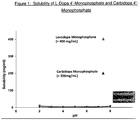
- the first compound or pharmaceutically acceptable salt thereof has a solubility of at least about 200 mg/ml in aqueous solution at about neutral pH
- the second compound or pharmaceutically acceptable salt thereof has a solubility of at least about 400 mg/ml in aqueous solution at about neutral pH. This increased solubility allows for higher concentrations of the first compound and/or second compound in the pharmaceutical composition, which leads to more effective and higher systemic levels of the first compound and/or second compound once administered to a patient.
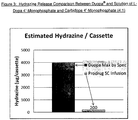
- compositions described herein at a pH of ⁇ 5 to ⁇ 8 release hydrazine in amounts of ⁇ ⁇ 60 ppm/hr, ⁇ ⁇ 55 ppm/hr, ⁇ ⁇ 50 ppm/hr, ⁇ ⁇ 45 ppm/hr, ⁇ ⁇ 40 ppm/hr, ⁇ ⁇ 35 ppm/hr, ⁇ ⁇ 30 ppm/hr, ⁇ ⁇ 25 ppm/hr, ⁇ ⁇ 20 ppm/hr, ⁇ ⁇ 15 ppm/hr, ⁇ ⁇ 10 ppm/hr, ⁇ ⁇ 5 ppm/hr, ⁇ ⁇ 4 ppm/hr, ⁇ ⁇ 3 ppm/hr, ⁇ ⁇ 2 ppm/hr, ⁇ ⁇ 1 ppm/hr, or ⁇ ⁇ 0.5 ppm/hr.
- a pharmaceutical combination comprising a first compound corresponding in structure to Formula (I): or a pharmaceutically acceptable salt thereof, wherein R 1 and R 2 are each independently selected from the group consisting of hydrogen, -P(O)(OH) 2 , and- R 5 -O-P(O)(OH) 2 ; R 5 is a C 1 -C 4 -alkyl; R 6 is hydrogen or a C 1 -C 4 -alkyl; and provided that at least one of R 1 and R 2 is -P(O)(OH) 2 or - R 5 -O-P(O)(OH) 2 ; and a second compound corresponding in structure Formula (II): or a pharmaceutically acceptable salt thereof, wherein R 3 and R 4 are each independently selected from the group consisting of hydrogen, -P(O)(OH) 2 , and- R 5 -O-P(O)(OH) 2 ; R 5 is a C 1 -C 4 -alkyl; R 6 is hydrogen
- the present disclosure further relates to methods of treating Parkinson's disease and associated conditions comprising administering an effective amount of a carbidopa prodrug and an L-dopa prodrug to a patient.
- the first compound and the second compound are administered in amounts that together provide a therapeutically effect for the subject (e.g. patient).
- the first compound corresponds in structure to Formula (I-a), and the second compound corresponds in structure to Formula (II-b).
- the first compound corresponds in structure to Formula (I-b), and the second compound corresponds in structure to Formula (II-b).
- the first compound corresponds in structure to Formula (I-d), and the second compound corresponds in structure to Formula (II-b).
- the first compound corresponds in structure to Formula (I-e), and the second compound corresponds in structure to Formula (II-b).
- the first compound corresponds in structure to Formula (I-b), and the second compound corresponds in structure to Formula (II-c).
- the first compound corresponds in structure to Formula (I-c), and the second compound corresponds in structure to Formula (II-c).
- the first compound corresponds in structure to Formula (I-d), and the second compound corresponds in structure to Formula (II-c).
- the first compound corresponds in structure to Formula (I-f), and the second compound corresponds in structure to Formula (II-c).
- the first compound corresponds in structure to Formula (I-b), and the second compound corresponds in structure to Formula (II-d).
- the first compound corresponds in structure to Formula (I-d), and the second compound corresponds in structure to Formula (II-d).
- the first compound corresponds in structure to Formula (I-e), and the second compound corresponds in structure to Formula (II-d).
- the first compound corresponds in structure to Formula (I-f), and the second compound corresponds in structure to Formula (II-d).
- the first compound corresponds in structure to Formula (I-a), and the second compound corresponds in structure to Formula (II-e).
- the first compound corresponds in structure to Formula (I-c), and the second compound corresponds in structure to Formula (II-e).
- the first compound corresponds in structure to Formula (I-d), and the second compound corresponds in structure to Formula (II-e).
- the first compound corresponds in structure to Formula (I-e), and the second compound corresponds in structure to Formula (II-e).
- the first compound corresponds in structure to Formula (I-f), and the second compound corresponds in structure to Formula (II-e).
- the condition treated by administering the first compound and the second compound is sleep disturbance in a patient with Parkinson's disease (i.e., a method of reducing sleep disturbance in a patient with Parkinson's disease).
- condition treated by administering the first compound and the second compound is impaired motor performance in a patient with Parkinson's disease (i.e., a method of improving motor performance in a patient with Parkinson's disease).
- the condition treated by administering the first compound and the second compound is nighttime disability in a patient with Parkinson's disease (i.e., a method of reducing nighttime disabilities in a patient with Parkinson's disease).
- the first compound and the second compound are administered to treat motor fluctuations in a patient with Parkinson's disease.
- the first compound and the second compound are administered to treat dyskinesia in a patient with Parkinson's disease.
- the first compound and the second compound are administered to delay the onset of motor fluctuations in a patient with Parkinson's disease.
- the first compound and the second compound are administered to delay the onset of dyskinesia in a patient with Parkinson's disease.
- the present disclosure relates to a method of treating a condition in need of treatment, wherein the method comprises administering to a subject (e.g. patient) a therapeutically effective amount of a pharmaceutical composition of the present disclosure.
- the composition administered comprises a first compound corresponding in structure to Formula (I-a), and a second compound corresponding in structure to Formula (II-a).
- composition administered comprises a first compound corresponding in structure to Formula (I-b), and a second compound corresponding in structure to Formula (II-a).
- composition administered comprises a first compound corresponding in structure to Formula (I-c), and a second compound corresponding in structure to Formula (II-a).
- composition administered comprises a first compound corresponding in structure to Formula (I-d), and a second compound corresponding in structure to Formula (II-a).
- composition administered comprises a first compound corresponding in structure to Formula (I-e), and a second compound corresponding in structure to Formula (II-a).
- composition administered comprises a first compound corresponding in structure to Formula (I-f), and a second compound corresponding in structure to Formula (II-a).
- composition administered comprises a first compound corresponding in structure to Formula (I-a), and a second compound corresponding in structure to Formula (II-b).
- composition administered comprises a first compound corresponding in structure to Formula (I-b), and a second compound corresponding in structure to Formula (II-b).
- composition administered comprises a first compound corresponding in structure to Formula (I-c), and a second compound corresponding in structure to Formula (II-b).
- composition administered comprises a first compound corresponding in structure to Formula (I-d), and a second compound corresponding in structure to Formula (II-b).
- composition administered comprises a first compound corresponding in structure to Formula (I-e), and a second compound corresponding in structure to Formula (II-b).
- composition administered comprises a first compound corresponding in structure to Formula (I-f), and a second compound corresponding in structure to Formula (II-b).
- composition administered comprises a first compound corresponding in structure to Formula (I-a), and a second compound corresponding in structure to Formula (II-c).
- composition administered comprises a first compound corresponding in structure to Formula (I-b), and a second compound corresponding in structure to Formula (II-c).
- composition administered comprises a first compound corresponding in structure to Formula (I-c), and a second compound corresponding in structure to Formula (II-c).
- composition administered comprises a first compound corresponding in structure to Formula (I-d), and a second compound corresponding in structure to Formula (II-c).
- composition administered comprises a first compound corresponding in structure to Formula (I-e), and a second compound corresponding in structure to Formula (II-c).
- composition administered comprises a first compound corresponding in structure to Formula (I-f), and a second compound corresponding in structure to Formula (II-c).
- composition administered comprises a first compound corresponding in structure to Formula (I-a), and a second compound corresponding in structure to Formula (II-d).
- composition administered comprises a first compound corresponding in structure to Formula (I-b), and a second compound corresponding in structure to Formula (II-d).
- composition administered comprises a first compound corresponding in structure to Formula (I-c), and a second compound corresponding in structure to Formula (II-d).
- composition administered comprises a first compound corresponding in structure to Formula (I-d), and a second compound corresponding in structure to Formula (II-d).
- composition administered comprises a first compound corresponding in structure to Formula (I-e), and a second compound corresponding in structure to Formula (II-d).
- composition administered comprises a first compound corresponding in structure to Formula (I-f), and a second compound corresponding in structure to Formula (II-d).
- composition administered comprises a first compound corresponding in structure to Formula (I-a), and a second compound corresponding in structure to Formula (II-e).
- composition administered comprises a first compound corresponding in structure to Formula (I-b), and a second compound corresponding in structure to Formula (II-e).
- composition administered comprises a first compound corresponding in structure to Formula (I-c), and a second compound corresponding in structure to Formula (II-e).
- composition administered comprises a first compound corresponding in structure to Formula (I-d), and a second compound corresponding in structure to Formula (II-e).
- composition administered comprises a first compound corresponding in structure to Formula (I-e), and a second compound corresponding in structure to Formula (II-e).
- composition administered comprises a first compound corresponding in structure to Formula (I-f), and a second compound corresponding in structure to Formula (II-e).
- the condition treated by administering the pharmaceutical composition is Parkinson's disease.
- the condition treated by administering the pharmaceutical composition is sleep disturbance in a patient with Parkinson's disease (i.e., a method of reducing sleep disturbance in a patient with Parkinson's disease).
- the condition treated by administering the pharmaceutical composition is impaired motor performance in a patient with Parkinson's disease (i.e., a method of improving motor performance in a patient with Parkinson's disease).
- the pharmaceutical composition is administered to treat motor fluctuations in a patient with Parkinson's disease.
- the pharmaceutical composition is administered to treat dyskinesia in a patient with Parkinson's disease.
- the pharmaceutical composition is administered to delay the onset of motor fluctuations in a patient with Parkinson's disease.
- the pharmaceutical composition is administered to delay the onset of dyskinesia in a patient with Parkinson's disease.
- the condition treated by administering the pharmaceutical composition is nighttime disability in a patient with Parkinson's disease (i.e., a method of reducing nighttime disabilities in a patient with Parkinson's disease).
- the weight ratio of the first compound (e.g., the phosphate prodrugs) and the second compound (e.g., the phosphate prodrugs) administered to the patient (either separately or together in a single pharmaceutical composition) is from about 1:1 to about 1:50. In one aspect, the weight ratio is from about 1:2 to about 1:15. In another aspect, the weight ratio is from about 1:4 to about 1:10. In another aspect, the weight ratio is about 1:4. In another aspect, the weight ratio is about 1:7.5. In another aspect, the weight ratio is about 1:10.
- the first compound (e.g., the phosphate prodrugs) and the second compound (e.g., the phosphate prodrugs) are administered to the patient in the form of a solid composition (or solid compositions).
- the composition is suitable for oral administration.
- the first compound (e.g., the phosphate prodrugs) and the second compound (e.g., the phosphate prodrugs) are administered to the patient in the form of a liquid composition (or liquid compositions).
- the composition comprises water and is suitable for infusion.
- the first compound (e.g., the phosphate prodrugs) and the second compound (e.g., the phosphate prodrugs) are administered to the patient as a liquid composition (either separately or in the same pharmaceutical composition) that is suitable for intragastric, subcutaneous, intranasal, intramuscular or intravenous administration.
- the liquid composition(s) is suitable for intragastric administration.
- the liquid composition(s) is suitable for subcutaneous administration.
- the liquid composition(s) is suitable for intramuscular administration.
- the liquid composition(s) is suitable for intravenous administration.
- the liquid composition(s) is suitable for intranasal administration.
- the first compound (e.g., the phosphate prodrugs) and the second compound (e.g., the phosphate prodrugs) are administered via intestinal administration (e.g., intrajejunum, intraduodenum) (either separately or in the same pharmaceutical composition). They can be administered (or "infused") directly into the intestine, e.g ., duodenum or the jejunum by a permanent tube inserted via percutaneous endoscopic gastrostomy, for example, with an outer transabdominal tube and an inner intestinal tube.
- intestinal administration e.g., intrajejunum, intraduodenum
- a permanent tube inserted via percutaneous endoscopic gastrostomy, for example, with an outer transabdominal tube and an inner intestinal tube.
- the first compound (e.g., the phosphate prodrugs) and the second compound (e.g., the phosphate prodrugs) are administered via a tube inserted by radiological gastrojejunostomy.
- the first compound (e.g., the phosphate prodrugs) and the second compound (e.g., the phosphate prodrugs) are administered via a temporary nasoduodenal tube that is inserted into the patient initially to determine if the patient responds favorably to the treatment method before the permanent tube is inserted.
- first compound e.g., the phosphate prodrugs
- second compound e.g., the phosphate prodrugs
- administration can be carried out using a portable pump, such as the pump sold under the trade name, CADD-Legacy Duodopa.RTM. pump®.
- a cassette, pouch, or vial comprising the first compound (e.g., the phosphate prodrugs) and the second compound (e.g., the phosphate prodrugs) can be attached to the pump to create the delivery system.
- the delivery system is then connected to the nasoduodenal tube, the transabdominal port, the duodenal tube, or the jejunum tube for intestinal administration.
- the method comprises administering the first compound and the second compound to the patient substantially continuously over a period of at least about 12 hours.
- the first compound (e.g., the phosphate prodrugs) and the second compound (e.g., the phosphate prodrugs) are administered substantially continuously over a period of at least about 16 hours, at least about 24 hours, about 2 days, about 3 days, about 4 days, about 5 days, about 6 days, about one week, or longer.
- the first compound (e.g., the phosphate prodrugs) and the second compound (e.g., the phosphate prodrugs) may be subcutaneously administered substantially continuously over a period of at least about 16 hours.
- the dosing of the first compound and the second compound administered to the patient is adjusted to optimize the clinical response achieved by a subject (e.g. patient), which means maximizing the functional ON-time during the day by minimizing the number and duration of OFF-time episodes (i.e., bradykinesia) and minimizing ON-time with disabling dyskinesia.
- a subject e.g. patient
- maximizing the functional ON-time during the day by minimizing the number and duration of OFF-time episodes (i.e., bradykinesia) and minimizing ON-time with disabling dyskinesia.
- the daily dose of the L-dopa prodrug (i.e., the second compound) administered to the patient according to methods of the present disclosure may be, for example, about 20 to about 1000000 mg, about 20 to about 100000 mg, about 20 to about 10000 mg, about 20 to about 5000 mg, about 20 mg to about 4000 mg, about 20 mg to about 3000 mg, about 20 mg to about 2000 mg, or about 20 mg to about 1000 mg per day.
- L-dopa phosphate prodrug more particularly L-dopa 3'-monophosphate prodrug, L-dopa 4'-monophosphate prodrug and/or L-dopa 3',4'-diphosphate prodrug are administered in the above daily doses.
- the daily dose of the carbidopa prodrug (i.e., the first compound) administered to the patient according to methods of the present disclosure may be, for example, 0 mg to about 2500 mg, 0 mg to about 1250 mg, 0 mg to about 1000 mg, 0 mg to about 750 mg, 0 mg to about 625 mg, 0 mg to about 500 mg, 0 mg to about 375 mg, 0 mg to about 250 mg, or 5 mg to about 125 mg per day.
- carbidopa phosphate prodrug more particularly carbidopa 3'-monophosphate prodrug, carbidopa 4'-monophosphate prodrug and/or carbidopa 3',4'-diphosphate prodrug are administered in the above daily doses.
- an amount of the first compound and an amount of the second compound are administered such that in combination they are sufficient to achieve an L-dopa plasma level in the patient of at least about 100 ng/mL.
- the L-dopa plasma level is at least about 200 ng/mL.
- the L-dopa plasma level is at least about 300 ng/mL.
- the L-dopa plasma level is at least about 400 ng/mL.
- the L-dopa plasma level is at least about 500 ng/mL.
- the L-dopa plasma level is at least about 600 ng/mL.
- the L-dopa plasma level is at least about 700 ng/mL. In another aspect, the L-dopa plasma level is at least about 800 ng/mL. In another aspect, the L-dopa plasma level is at least about 900 ng/mL. In another aspect, the L-dopa plasma level is at least about 1,000 ng/mL. In another aspect, the L-dopa plasma level is at least about 1,500 ng/mL. In another aspect, the L-dopa plasma level is at least about 2,000 ng/mL. In another aspect, the L-dopa plasma level is at least about 3,000 ng/mL.
- the L-dopa plasma level is at least about 4,000 ng/mL. In another aspect, the L-dopa plasma level is at least about 5,000 ng/mL. In another aspect, the L-dopa plasma level is at least about 6,000 ng/mL. In another aspect, the L-dopa plasma level is at least about 7,000 ng/mL. In another aspect, the L-dopa plasma level is at least about 8,000 ng/mL. In another aspect, the L-dopa plasma level is at least about 9,000 ng/mL.
- the first compound may be carbidopa phosphate prodrug, more particularly carbidopa 3'-monophosphate prodrug, carbidopa 4'-monophosphate prodrug and/or carbidopa 3',4'-diphosphate prodrug.
- the second compound may be L-dopa phosphate prodrug, more particularly L-dopa 3'-monophosphate prodrug, L-dopa 4'-monophosphate prodrug and/or L-dopa 3',4'-diphosphate prodrug.
- an amount of the first compound and an amount of the second compound are administered such that in combination they are sufficient to achieve an L-dopa plasma level from about 10 ng/mL to about 9,000 ng/mL.
- the L-dopa plasma level is from about 10 ng/mL to about 8,000 ng/mL
- the L-dopa plasma level is from about 25 ng/mL to about 6,000 ng/mL.
- the L-dopa plasma level is from about 50 ng/mL to about 4,000 ng/mL.
- the L-dopa plasma level is from about 100 ng/mL to about 2,000 ng/mL.
- the L-dopa plasma level is from about 25 ng/mL to about 1,200 ng/mL. In another aspect, the L-dopa plasma level is from about 10 ng/mL to about 500 ng/mL. In another aspect, the L-dopa plasma level is from about 25 ng/mL to about 500 ng/mL.
- the first compound may be carbidopa phosphate prodrug, more particularly carbidopa 3'-monophosphate prodrug, carbidopa 4'-monophosphate prodrug and/or carbidopa 3',4'-diphosphate prodrug.
- the second compound may be L-dopa phosphate prodrug, more particularly L-dopa 3'-monophosphate prodrug, L-dopa 4'-monophosphate prodrug and/or L-dopa 3',4'-diphosphate prodrug.
- the above-described L-dopa concentration ranges can be maintained for at least about a 1 hour interval, a 2 hour interval, a 3 hour interval, a 4 hour interval, a 5 hour interval, a 6 hour interval, a 7 hour interval, an 8 hour interval, a 9 hour interval, a 10 hour interval, an 11 hour interval, a 12 hour interval, a 13 hour interval, a 14 hour interval, a 15 hour interval, a 16 hour interval, a 17 hour interval, an 18 hour interval, a 19 hour interval, a 20 hour interval, a 21 hour interval, a 22 hour interval, a 23 hour interval, or a 24 hour interval.
- an unexpected concentration of the second compound i.e., an L-dopa phosphate prodrug
- an unexpected concentration of the first compound i.e., a carbidopa phosphate prodrug
- the L-dopa phosphate prodrug and/or the carbidopa phosphate prodrug may remain in blood plasma during full duration of continuous infusion of the first compound and/or second compound.
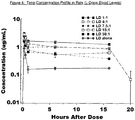
- administration of the first and second compound results in an L-dopa phosphate prodrug plasma level from about 0 ng/mL to about 3600 ng/mL, about 1 ng/mL to about 3600 ng/mL, or about 10 ng/mL to about 3600 ng/mL.
- the L-dopa phosphate prodrug plasma level is from about 10 ng/mL to about 3200 ng/mL.
- the L-dopa phosphate prodrug plasma level is from about 25 ng/mL to about 2800 ng/mL.
- the L-dopa phosphate prodrug plasma level is from about 50 ng/mL to about 2400 ng/mL. In another aspect, the L-dopa phosphate prodrug plasma level is from about 10 ng/mL to about 2000 ng/mL. In another aspect, the L-dopa phosphate prodrug plasma level is from about 25 ng/mL to about 1600 ng/mL. In another aspect, the L-dopa phosphate prodrug plasma level is from about 25 ng/mL to about 1200 ng/mL. In another aspect, the L-dopa phosphate prodrug plasma level is from about 10 ng/mL to about 800 ng/mL.
- administration of the first and second compound results in an carbidopa phosphate prodrug plasma level from about 0 ng/mL to about 600 ng/mL, about 1 ng/mL to about 600 ng/mL or about 10 ng/mL to 600 ng/mL.
- the carbidopa phosphate prodrug plasma level is from about 10 ng/mL to about 500 ng/mL.
- the carbidopa phosphate prodrug plasma level is from about 10 ng/mL to about 400 ng/mL.
- the carbidopa phosphate prodrug plasma level is from about 10 ng/mL to about 300 ng/mL.
- the carbidopa phosphate prodrug plasma level is from about 10 ng/mL to about 200 ng/mL. In another aspect, the carbidopa phosphate prodrug plasma level is from about 10 ng/mL to about 100 ng/mL. In another aspect, the carbidopa phosphate prodrug plasma level is from about 25 ng/mL to about 600 ng/mL. In another aspect, the carbidopa phosphate prodrug plasma level is from about 25 ng/mL to about 500 ng/mL. In another aspect, the carbidopa phosphate prodrug plasma level is from about 25 ng/mL to about 400 ng/mL.
- an amount of the first compound and an amount of the second compound can be administered to a subject and achieve a phosphorus intake of less than about 2000 mg/day, or less than about 2500 mg/day or less than about 3000 mg/day.
- the value 3000 mg/day is the accepted tolerable upper intake level. See DRI Dietary Reference Intakes for Calcium, Phosphorus, Vitamin D and Fluoride at www.nap.edu/ctalog/5776.
- the additional therapeutic agent(s) is selected from the group consisting of decarboxylase inhibitors other than carbidopa (e.g., benserazide), catechol-0-methyl transferase (“COMT”) inhibitors (e.g., entacapone and tolcapone), and monoamine oxidase A (“MAO-A”) or monoamine oxidase B (“MAO-B”) inhibitors (e.g., moclobemide, rasagiline, selegiline, and safinamide).
- the additional therapeutic agent(s) is selected from the group consisting of decarboxylase inhibitors other than carbidopa.
- the additional therapeutic agent(s) is selected from the group consisting of COMT inhibitors, such as entacapone. In another aspect, the additional therapeutic agent(s) is selected from the group consisting of MAO-A inhibitors. In another aspect, the additional therapeutic agent(s) is selected from the group consisting of MAO-B inhibitors.
- compositions of the present disclosure optionally can further comprise one or more additional therapeutic agents for the treatment of Parkinson's disease as described above.
- kits comprising one or more pharmaceutical dosage forms comprising a carbidopa phosphate prodrug; kits comprising one or more pharmaceutical dosage forms comprising a an L-dopa phosphate prodrug; and kits comprising one or more pharmaceutical dosage forms comprising both a carbidopa phosphate prodrug and an L-dopa phosphate prodrug.
- the kit optionally can comprise one or more additional therapeutic agents and/or instructions, for example, instructions for using the kit to treat a patient having Parkinson's disease and an associated condition.
- the kit comprises a first pharmaceutical dosage form, wherein the first pharmaceutical dosage form comprises a first compound corresponding in structure to Formula (I), or a pharmaceutically acceptable salt thereof.
- the kit comprises a second pharmaceutical dosage form comprising a second compound corresponding in structure to Formula (II), or a pharmaceutically acceptable salt thereof.
- the first pharmaceutical dosage form further comprises a second compound corresponding in structure to Formula (II), or a pharmaceutically acceptable salt thereof.
- the first pharmaceutical dosage form and, where applicable, the second pharmaceutical dosage form are liquid pharmaceutical dosage forms.
- dopamine is an achiral compound
- the various embodiments discussed above potentially could be adapted for use with a D-dopa phosphate prodrug or a racemate of D-dopa phosphate prodrug and L-dopa phosphate prodrug in place of the L-dopa phosphate prodrug.
- L-dopa 4'-monophosphate anhydrate i
- L-dopa 4'-monophosphate anhydrate ii
- L-dopa 3'-monophosphate L-dopa 3',4'-diphosphate trihydrate
- carbidopa 4'-monophosphate trihydrate carbidopa 4'-monophosphate trihydrate
- carbidopa 4'-monophosphate dihydrate carbidopa 4'-monophosphate dehydrate
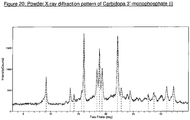
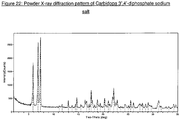
- carbidopa 3'-monophosphate (ii) carbidopa 3'-monophosphate sodium salt.
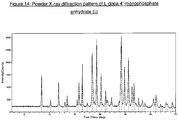
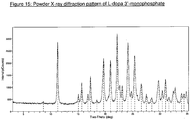
- L-dopa 4'-monophosphate anhydrate (i) crystalline solid can be identified by characteristic peaks in its powder X-ray diffraction pattern ( Figure 13 ).
- One with skill in the art of analytical chemistry would be able to readily identify L-dopa 4'-monophosphate anhydrate (i) solid by as few as one characteristic peak in its powder X-ray diffraction pattern.
- a crystalline L-dopa 4'-monophosphate anhydrate (i) is provided demonstrating at least 1, at least 2, at least 3, at least 4, at least 5, at least 6, at least 7, at least 8, at least 9, at least 10, at least 11, at least 12, at least 13, at least 14 or 15 characteristic peaks in a powder X-ray diffraction pattern at values of two theta of 10.261 ⁇ 0.20, 12.053 ⁇ 0.20, 13.759 ⁇ 0.20, 14.932 ⁇ 0.20, 16.147 ⁇ 0.20, 16.718 ⁇ 0.20, 17.34 ⁇ 0.20, 19.254 ⁇ 0.20, 20.654 ⁇ 0.20, 22.078 ⁇ 0.20, 23.599 ⁇ 0.20, 24.198 ⁇ 0.20, 25.898 ⁇ 0.20, 26.338 ⁇ 0.20, and 27.117 ⁇ 0.20.
- Crystallographic unit cell parameters of L-dopa 4'-monophosphate anhydrate (i) also were obtained and were determined as: a is 7.0508 ⁇ , b is 10.6253 ⁇ , c is 14.7588 ⁇ , to afford a cell volume of 1105.68 ⁇ 3 , wherein a, b, and c are each a representative length of the crystal lattice.
- L-dopa 4'-monophosphate anhydrate (ii) crystalline solid can be identified by characteristic peaks in its powder X-ray diffraction pattern ( Figure 14 ).
- One with skill in the art of analytical chemistry would be able to readily identify L-dopa 4'-monophosphate anhydrate (ii) solid by as few as one characteristic peak in its powder X-ray diffraction pattern.
- a crystalline L-dopa 4'-monophosphate anhydrate (ii) is provided demonstrating at least 1, at least 2, at least 3, at least 4, at least 5, at least 6, at least 7, at least 8, at least 9, at least 10, at least 11, at least 12, at least 13, at least 14 or 15 characteristic peaks in a powder X-ray diffraction pattern at values of two theta of 8.468 ⁇ 0.20, 10.234 ⁇ 0.20, 11.821 ⁇ 0.20, 13.084 ⁇ 0.20, 13.503 ⁇ 0.20, 15.48 ⁇ 0.20, 15.848 ⁇ 0.20, 16.513 ⁇ 0.20, 18.447 ⁇ 0.20, 19.346 ⁇ 0.20, 20.239 ⁇ 0.20, 21.139 ⁇ 0.20, 24.221 ⁇ 0.20, 24.865 ⁇ 0.20, 25.647 ⁇ 0.20.
- L-dopa 3'-monophosphate crystalline solid can be identified by characteristic peaks in its powder X-ray diffraction pattern ( Figure 15 ).
- One with skill in the art of analytical chemistry would be able to readily identify L-dopa 3'-monophosphate solid by as few as one characteristic peak in its powder X-ray diffraction pattern.
- a crystalline L-dopa 3',4'-diphosphate trihydrate is provided demonstrating at least 1, at least 2, at least 3, at least 4, at least 5, at least 6, at least 7, at least 8, at least 9, at least 10, at least 11, at least 12, at least 13, at least 14 or 15 characteristic peaks in a powder X-ray diffraction pattern at values of two theta of 7.118 ⁇ 0.20, 10.342 ⁇ 0.20, 11.355 ⁇ 0.20, 12.16110.20, 14.20110.20, 17.36 ⁇ 0.20, 17.632 ⁇ 0.20, 19.196 ⁇ 0.20, 19.444 ⁇ 0.20, 20.83 ⁇ 0.20, 21.504 ⁇ 0.20, 22.491 ⁇ 0.20, 23.085 ⁇ 0.20, 24.487 ⁇ 0.20, and 25.11 ⁇ 0.20.
- Carbidopa 4'-monophosphate trihydrate crystalline solid can be identified by characteristic peaks in its powder X-ray diffraction pattern ( Figure 17 ).
- One with skill in the art of analytical chemistry would be able to readily identify carbidopa 4'-monophosphate trihydrate solid by as few as one characteristic peak in its powder X-ray diffraction pattern.
- Crystallographic unit cell parameters of carbidopa 4'-monophosphate trihydrate also were obtained and were determined as: a is 7.0226 ⁇ , b is 9.4565 ⁇ , c is 23.615 ⁇ , to afford a cell volume of 1568.25 ⁇ 3 , wherein a, b, and c are each a representative length of the crystal lattice.
- Carbidopa 4'-monophosphate dihydrate crystalline solid can be identified by characteristic peaks in its powder X-ray diffraction pattern ( Figure 18 ).
- One with skill in the art of analytical chemistry would be able to readily identify carbidopa 4'-monophosphate dihydrate solid by as few as one characteristic peak in its powder X-ray diffraction pattern.
- Carbidopa 4'-monophosphate dehydrate crystalline solid can be identified by characteristic peaks in its powder X-ray diffraction pattern ( Figure 19 ).
- One with skill in the art of analytical chemistry would be able to readily identify carbidopa 4'-monophosphate dehydrate solid by as few as one characteristic peak in its powder X-ray diffraction pattern.
- Carbidopa 3'-monophosphate (ii) crystalline solid can be identified by characteristic peaks in its powder X-ray diffraction pattern ( Figure 21 ).
- One with skill in the art of analytical chemistry would be able to readily identify carbidopa 3'-monophosphate (ii) solid by as few as one characteristic peak in its powder X-ray diffraction pattern.
- a crystalline carbidopa 3'-monophosphate (ii) is provided demonstrating at least 1, at least 2, at least 3, at least 4, at least 5, at least 6, at least 7, at least 8, at least 9, or at least 10 characteristic peaks in a powder X-ray diffraction pattern at values of two theta of 4.433 ⁇ 0.20, 8.917 ⁇ 0.20, 9.654 ⁇ 0.20, 13.192 ⁇ 0.20, 15.288 ⁇ 0.20, 15.747 ⁇ 0.20, 17.886 ⁇ 0.20, 19.291 ⁇ 0.20, 20.554 ⁇ 0.20, and 21.797.
- a crystalline carbidopa 3',4'-diphosphate sodium salt is provided demonstrating at least 1, at least 2, at least 3, at least 4, at least 5, at least 6, at least 7, at least 8, at least 9, at least 10, at least 11, at least 12, at least 13, at least 14 or 15 characteristic peaks in a powder X-ray diffraction pattern at values of two theta of 5.852 ⁇ 0.20, 6.861 ⁇ 0.20, 7.338 ⁇ 0.20, 11.159 ⁇ 0.20, 11.729 ⁇ 0.20, 12.953 ⁇ 0.20, 13.714 ⁇ 0.20, 14.381 ⁇ 0.20, 14.686 ⁇ 0.20, 15.479 ⁇ 0.20, 16.676 ⁇ 0.20, 17.179 ⁇ 0.20, 17.592 ⁇ 0.20, 18.861 ⁇ 0.20 and 20.305 ⁇ 0.20.
- compositions and combinations comprising the above-described L-dopa and carbidopa polymorphs are also contemplated. Therefore, in one or more embodiments, pharmaceutical compositions and combinations comprising the above-described L-dopa and carbidopa polymorphs are provided as well as methods of treating Parkinson's disease by administering such pharmaceutical compositions and combinations. In particular methods of treating Parkinson's disease by administering a pharmaceutical composition comprising one or more of the L-dopa and carbidopa polymorphs identified by characteristic peaks in the powder X-ray diffraction patterns of any one of Figures 13-22 is provided.
- Powder X-ray diffraction (PXRD) analysis of samples was conducted in the following manner.
- Samples for X-ray diffraction analysis were prepared by spreading the sample in a thin layer on the sample holder and gently flattening the sample with a microscope slide.
- the sample may have been ground to a fine powder with mortar and pestle, or with glass microscope slides for limited quantity samples.
- Samples were run in one of three configurations: circular bulk holder, a quartz zero background plate, or hot stage mount (similar mounting to a zero background plate).
- X-ray powder diffraction can be performed using a Rigaku Miniflex difractometer (30 kV and 15 mA; X-ray source: Cu; Range: 2.00-40.00° Two Theta; Scan rate: 1-5 degree/minute) or a Scintag X1 or X2 difractometer (2 kW normal focus X-ray tube with either a liquid nitrogen or Peltier cooled germanium solid state detector; 45 kV and 40 mA; X-ray source: Cu; Range: 2.00-40.00°Two Theta; Scan Rate: 1-5 degree/minute).
- Rigaku Miniflex difractometer (30 kV and 15 mA; X-ray source: Cu; Range: 2.00-40.00° Two Theta; Scan rate: 1-5 degree/minute) or a Scintag X1 or X2 difractometer (2 kW normal focus X-ray tube with either a liquid nitrogen or Peltier cooled germanium solid state detector; 45 kV and 40 mA
- Characteristic powder X-ray diffraction pattern peak positions are reported in terms of angular positions (two theta) with an allowable variability of ⁇ 0.20°.
- the variability of ⁇ 0.10° is intended to be used when comparing two powder X-ray diffraction patterns.
- a diffraction pattern peak from one pattern is assigned a range of angular positions (two theta) which is the measured peak position ⁇ 0.20° and a diffraction pattern peak from another pattern is assigned a range of angular positions (two theta) which is measured peak position ⁇ 0.20° and if those ranges of peak position overlap, then the two peaks are considered to have the same angular position (two theta).
- L-dopa 3'-monophosphate and L-dopa 4'-monophosphate were prepared as described in Steps 1 through 5B below.
- the organic layer was separated and discarded.
- the combined organic layer was washed with water (500 mL), saturated sodium chloride solution (500 mL), dried over sodium sulfate, and concentrated under vacuum at 45°C to 50°C to provide crude Compound 2 as a viscous liquid (120 g, 72%).
- the crude product obtained was blended with the crude product from previous batches (total of 1.6 Kg) and was repeatedly purified by flash column chromatography over silica gel (230-400 mesh) using 10-20 % ethyl acetate in petroleum ether to provide Compounds 4a (270 g) and 4b (255 g).
- L-dopa 3',4'-diphosphate was prepared as described in Steps 6 and 7 below.
- Carbidopa 3'-phosphate and carbidopa 4'-phosphate were prepared as shown in Scheme 3 below:
- Carbidopa 3',4'-diphosphate was prepared as shown in Scheme 4a below:
- carbidopa 3',4'-diphosphate was prepared as described in Steps 1 through 4 below.
- the aqueous layers were acidified with 2 N HCl (160 mL) and the acidic aqueous layer was extracted with MTBE (2 x 100 mL). During the second back-extraction, a small amount of product began to precipitate.
- the combined organic layers were washed with brine (20 mL) and residual solid rinsed out of the separatory funnel with MTBE (20 mL).
- the resulting mixture was concentrated to 43 g total mass and 10% THF/MTBE (60 mL) was added. The mixture was too thick to stir, so additional MTBE (60 mL to 6 vol 5% THF/MTBE) was added. The resulting white slurry was then heated to 50°C.
- Carbidopa 3',4'-diphosphate was prepared as shown in Scheme 4b below:
- Tetrahydrofuran (10.00 mL) was added to Compounds 4 and 5 (1.026 g, 0.980 mmol) and 5% Pd/C (50% wet JM#9) (0.199 g, 1.870 mmol, 0.10 g dry weight) in a 20 mL Barnstead w/ glass liner.
- the mixture was stirred under 80 psig of Hydrogen at 25 °C for 1.5 hr.
- Water (5.00 mL) was added and the mixture was hydrogenated for another 1.5 hr. Then after 1.5 hr, the mixture was filtered through a polypropylene membrane, 2.5 mL of MTBE was added, the mixture was shaken in a separatory funnel, and the lower aqueous layer was drained.
- the aqueous solution was washed twice with 2.5 mL of MTBE, giving a significant reduction in volume (THF and toluene pulled into the MTBE).
- the colorless aq. solution (water layer) was lyophilized for 3 days, giving 385 mg of the desired product (93.9% pa) compound 6.
- L-Dopa 4'-monophosphate was prepared as described in Steps 1 through 5 below.
- the biphasic reaction mixture was diluted with 16 mL of MTBE.
- the aqueous layer was removed and washed with 16 mL of MTBE.
- the aq layer was then transferred to a 250-mL flask and quantity sufficient 6 M aq HCl was added to adjust to pH 1.8.
- L-Dopa 4'-monophosphate was prepared as shown below:
- Carbidopa 4'-monophosphate was prepared as shown in Scheme 7 below:
- Carbidopa 4'-monophosphate was prepared as described in Steps 1 through 5 below.
- a 500 mL three-neck round bottom flask was charged with compound 1 (25.04 g, 90 mmol), tris(dibenzylideneacetone)palladium (1.23 g, 1.343 mmol), tri-tert-butylphosphonium tetrafluoroborate (.875 g, 3.02 mmol), and a stir bar.
- a thermocouple, reflux condenser, and stopper were placed onto the three necks of the flask. The flask was purged with nitrogen for 1 h.
- the biphasic mixture was stirred for 10 min and phase cut.
- the organic solution was removed from the reactor and the aqueous phase returned.
- Ethyl acetate 150 mL was added to the aqueous material and the mixture was agitated for 10 min.
- the aqueous layer was drained from the reaction, and the original ethyl acetate was returned to the reactor.
- This combined mixture was washed (2 x 10 min with stirring) with 5% N-acetylcysteine/8% sodium bicarbonate mixture.
- the yellow organic solution was filtered through Celite® diatomaceous earth. Karl Fischer titration of the organic reaction mixture showed that the content of water was 3.3 wt%.
- the yellow organic solution was returned to the reactor and stirred as sodium bisulfite (18.67 g, 179 mmol) was added.
- the reaction mixture was heated to 40 °C for 13 h. After this time, the precipitate was filtered and the solid was washed with ethyl acetate (3 x 100 mL) to give a white solid in 64.2% yield.
- the potency of the material was determined to be 60.0% by Q-NMR spectroscopy.
- reaction mixture was diluted with acetonitrile (88 mL) and water (58 mL) was added to precipitate the product.
- the resulting slurry was stirred overnight at 25 °C and then filtered and washed with 28 wt% water in acetonitrile (30 mL) to provide compound 5 (8.9 g, 50% yield) as a white solid.
- reaction was quenched with a 6.0 mL water solution of sodium sulfite (1.60 g, 12.7 mmol). The reaction was stirred for 20 min after the sulfite addition. After this time, the reaction was poured into a separatory funnel and the round bottom flask was rinsed with 50 mL of isopropyl acetate and 50 mL of water. The aqueous and organic layers were separated. The organic layer was washed with 50 mL of water. An emulsion formed upon shaking the layers. At this time, 20 mL of brine was then added and the phases separated upon disappearance of the emulsion.
- a 1-gallon Parr reactor was charged with 5 wt% dry basis of 5% Pd/C (63.6% H2O, 15.0 g), water (182 mL) and 5 wt% aqueous sodium bicarbonate (215 mL).
- aqueous catalyst slurry was added a THF solution (1090 mL) of compound 6 (109 g, 85% potent).
- the reactor was assembled and inerted with nitrogen, followed by purging with hydrogen (4 x 30 psig pressure purges). The reactor was then re-pressurized to 30 psig with hydrogen.
- the reactor was vigorously agitated at 25 °C for at least 1 h. Upon obtaining complete reaction conversion, hydrogen was vented and the reactor was inerted with nitrogen.
- the biphasic reaction mixture was then filtered to remove the catalyst, followed by rinsing with water (93 mL).
- the biphasic reaction mixture was diluted with MTBE (370 mL). The mixture was stirred for 15 min, then allowed to settle for 10 min (note the product is contained in the aqueous layer). Separated the layers and washed the aqueous layer with MTBE (370 mL) as described above.
- the solution is acidified to pH 1.9. Seeded the aqueous solution with 0.1 wt% of compound 7 to induce nucleation. Added isopropanol (1326 mL) to the seed slurry and mixed for at least 5 h at ambient temperature. The slurry was filtered to collect the product, recirculating the liquors as a rinse if necessary. Washed the wetcake solids with isopropanol (370 mL). The product solids were air-dried on the funnel for 2 h. Isolated 38.5 g of compound 7 as the trihydrate (97.2% potency adjusted yield).
- L-dopa 4'-phonoxymethyl ester was prepared as described in Steps 1 through 6 below.
- Carbidopa 3'-phonoxymethyl ester and Carbidopa 4'-phonoxymethyl ester were prepared as shown in Scheme 10 below:
- Carbidopa 3'-phonoxymethyl ester and Carbidopa 4'-phonoxymethyl ester were prepared as described in Steps 1 through 3 below.
- 1,8-Diazabicyclo[5.4.0 ⁇ undec-7-ene (0.745 mL, 4.99 mmol) was added, and the mixture was stirred in the ice bath for 30 minutes, then at room temperature overnight. Water was added to the reaction mixture, and the mixture was extracted with ethyl acetate twice. The combined organic layers were washed with water and brine, dried over anhydrous sodium sulfate, and concentrated.
- the filtrate was mixed with water, extracted with methyl t-butyl ether twice.
- the aqueous phase was dried by a lyophilizer.
- the concentrate was purified by RP-HPLC (0-10% 0.1% formic acid/acetonitrile in 0.1% formic acid/water on Kromacil Phenyl 3.0 cm IDx25 cm, 5u column). The two isomers were separated. The fractions collected were combined respectively, and dried by a lyophilizer to afford Compound 4 and Compound 5, each as a loose white solid.
- the reactor was sealed and purged with argon (4 x 40 psig), then H 2 (4 x 50 psig). The reactor was then re-pressurized to 50 psig of H 2 and stirred at ambient temperature for 60 min. After this time, the biphasic reaction mixture was filtered through Celite® diatomaceous earth, using water (2.2 mL) to rinse and filter the remnants in the reactor. The biphasic mixture was diluted with MTBE (8 ml), stirred for 5 min, and poured into a separatory funnel. The aqueous layer was separated and washed with DCM (3 x 30 mL). The aqueous layer was collected and dried on a lyophilizer to give 68% yield of compound 3 as an off-white solid.
- the L-dopa phosphate prodrugs and the carbidopa phosphate prodrugs were evaluated in a stability study.
- Aqueous solutions of the prodrugs (80 ⁇ g/mL) were monitored over a range of pH values at ambient storage conditions through one day to demonstrate feasibility of dosing over the course of infusion.
- Table 12-A below reports the results of this study which confirm that the prodrugs have good stability at room temperature over a one day period.
- Table 12-A Stability Study (Prodrugs) Compound pH % Remaining After One Day L-dopa 3'-phosphate 7.0 > 99% L-dopa 4'-phosphate 7.0 > 99% L-dopa 3', 4'-diphosphate 7.0 > 99% Carbidopa 3'-phosphate 6.5 > 94% Carbidopa 4'-phosphate 6.8 > 98% Carbidopa 3', 4'-diphosphate 6.8 > 97%
- Table 12-C Stability Study (4' Monophosphate Combination) Compound pH Purged or Non-Purged % Remaining After 7 Days L-dopa 4'-monophosphate 7.4 Nitrogen Purged > 99% Carbidopa 4'-monophosphate > 99% L-dopa 4'-monophosphate Non-Purged > 99% Carbidopa 4'-monophosphate > 97%
- the L-dopa phosphate prodrugs and the carbidopa phosphate prodrugs were evaluated in a solubility study.
- the solubility values of the phosphate prodrugs in water under ambient conditions were determined by visual assessment.
- Table 13-A reports the results of the study, including the measured values for L-dopa and carbidopa.
- Table 13-A Solubility Study Compound pH Solid State Form Solubility (mg/mL) L-dopa 4-7 Crystalline ⁇ 6 L-dopa 3'-phosphate 7.0 Crystalline > 161 L-dopa 4'-phosphate 7.4 Crystalline > 400 L-dopa 3', 4'-diphosphate 5.5 Amorphous > 330 Carbidopa 4-7 Crystalline monohydrate ⁇ 4 Carbidopa 3'-phosphate 7.1 Amorphous > 96 Carbidopa 4'-phosphate 7.4 Amorphous >200 Carbidopa 3', 4'-diphosphate 5.5 Amorphous > 247
- Figure 1 shows increased solubility of L-dopa 4'-monophosphate and carbidopa 4'-monophosphate compared to L-dopa and carbidopa.
- the 4:1 ratio of a solution L-dopa 4'-monophosphate and carbidopa 4'-monophosphate at a pH of about 7.4 unexpectedly has a much lower release of hydrazine compared to Duopa®.
- L-dopa and carbidopa phosphate prodrugs were incubated with tissue homogenate or fractions from rats, mini-pigs, or human, including blood, skin homogenate (3 mg/mL), liver microsomes (1 mg/mL), liver S9 fraction (1 mg/mL), kidney S9 fraction (1 mg/mL), and intestine S9 fractions (1 mg/mL).
- tissue homogenate or fractions from rats, mini-pigs, or human, including blood, skin homogenate (3 mg/mL), liver microsomes (1 mg/mL), liver S9 fraction (1 mg/mL), kidney S9 fraction (1 mg/mL), and intestine S9 fractions (1 mg/mL).
- the reaction mixtures were incubated at 37°C for 5 to 6 time points within 1 to 2 hours.
- reaction mixtures were quenched by 2 to 3 volumes of 5% trichloroacetic acid in water. After quenching, the mixtures were centrifuged at 3000 rpm for 20 minutes, and the supernatants were analyzed by LC-MS for quantitation of the prodrug, L-dopa or carbidopa.
- the in vitro bioconversion was assessed by monitoring both time-dependent depletion of the prodrug and the formation of the corresponding L-dopa or carbidopa.
- Table 15-A reports the results of the study in blood.
- all four mono-phosphate prodrugs were rapidly dephosphorylated in rat, mini-pig, and human, with corresponding time-dependent formation of L-dopa or carbidopa.
- the t 1/2 is the shortest in mini-pig, followed by rat, and then human.
- the diphosphate prodrugs of carbidopa and L-dopa were also rapidly dephosphorylated in rat blood with a t 1/2 of 53 minutes and 6 minutes, respectively, with corresponding formation of L-dopa or carbidopa.
- Table 15-B below reports the results of the study in skin homogenates.
- the four mono-phosphate prodrugs were slowly dephosphorylated with a t1/2 ranging from 114 minutes to 992 minutes, with corresponding formation of L-dopa or carbidopa.
- the two diphosphate prodrugs were stable in skin homogenates of rat, mini-pig, and human. No formation of L-dopa or carbidopa was observed in the incubations.
- Table 15-B In Vitro Bioconversion Study (Skin Homogenates) Prodrug Species T 1/2 (min.) L-Dopa or Carbidopa Formation 3'-monophosphate prodrug of L-dopa Human 673 Yes Rat 737 Yes Mini-pig 885 Yes 4'-monophosphate prodrug of L-dopa Human 592 Yes Rat 992 Yes Mini-pig 424 Yes 3',4'-disphosphate prodrug of L-dopa Human stable No Rat stable No Mini-pig stable No 3'-monophosphate prodrug of carbidopa Human 602 Yes Rat 724 Yes Mini-pig 413 Yes 4'-monophosphate prodrug of carbidopa Human 138 Yes Rat 271 Yes Mini-pig 114 Yes 3',4'-diphosphate prodrug of carbidopa Human stable No Rat stable No Mini-pig stable No
- liver S9 fractions of rat, mini-pig and human four prodrugs (4'-phosophate and diphosphate prodrugs of L-dopa, and 4'-phosophate and diphosphate prodrugs of carbidopa) were stable without formation of L-dopa or carbidopa observed.
- kidney S9 fractions of rat and human four prodrugs (4'-phosophate and diphosphate prodrugs of L-dopa, and 4'-phosophate and diphosphate prodrugs of carbidopa) were stable without formation of L-dopa or carbidopa observed.
- Table 14-C reports the results of the study in intestinal S9 fractions.
- intestinal S9 fractions of rat and human four prodrugs (4'-phosophate and diphosphate prodrugs of L-dopa, and 4'-phosophate and diphosphate prodrugs of carbidopa) were rapidly dephosphorylated.
- the t 1/2 appeared to be shorter in human intestinal S9 than in rat intestinal S9.
- Corresponding time-dependent formation of L-dopa or carbidopa was observed in the incubations of prodrugs with rat or human intestinal S9 fractions. The results suggest significant phosphatase activities in rat and human intestine.
- Table 15-C In Vitro Bioconversion Study (Intestinal S9 Fractions) Prodrug Species T 1/2 (min.) L-Dopa or Carbidopa Formation 4'-monophosphate prodrug of L-dopa Human 34.3 Yes Rat 158 Yes 3',4'-disphosphate prodrug of L-dopa Human 92 Yes Rat 54.2 Yes 4'-monophosphate prodrug of carbidopa Human 24.1 Yes Rat 73.6 Yes 3',4'-diphosphate prodrug of carbidopa Human 31.5 Yes Rat 79 Yes
- Table 16-A In Vitro Exposures in Rats (L-Dopa) Dosed Compound Dosing Route Dose (mg/kg) L-dopa AUC O-8h (ng.hr/mL) Estimated Conversion % (Based on L-dopa AUC) 3'-monophosphate prodrug of L-dopa SC 7.05 645 96 IV 7.05 768 66 4'-monophosphate prodrug of L-dopa SC 7.05 1280 >100 IV 7.05 1540 >100 3',4'-diphosphate prodrug of L-dopa SC 8.5 1480 >100 IV 8.5 1700 >100 L-dopa SC 5 669 - IV 5 1170 - Table 16-B: In Vitro Exposures in Rats (Carbidopa) Dosed Compound Dosing Route Dose (mg/kg) L-dopa AUC O-8h (ng.hr/mL) Estimated Con
- Rats were initially given subcutaneous bolus doses over one minute at the dose volume of 1 mL/kg. After 1.5 hours, continuous infusion doses were administrated over the following 14.5 hours at the dose volume of 10 mL/kg. Blood samples were collected at 0.25, 0.5, 1, 6, 16 and 20 hours post bolus dose. The blood samples were processed in the same way as described in Example 16. Separate aliquots of blood samples were collected for measurement of hydrazine.
- Table 17-A Study Design of Prodrug Ratio Study in Rats Dose Group Subcutaneous Bolus Dose (mg/Kg) over 1 min Subcutaneous Infusion Dose (mg/kg) over 14.5h L-Dopa Diphosphate Prodrug Carbidopa Diphosphate Prodrug L-Dopa Diphosphate Prodrug Carbidopa Diphosphate Prodrug LD alone 15 0 75 0 LD 50:1 15 0.3 75 1.5 LD 15:1 15 1 75 5 LD 7.5:1 15 2 75 10 LD 4:1 15 3.75 75 18.75 LD 1:1 15 15 75 75 75
- Figure 4 provides a time-concentration profile for L-dopa blood levels after administration of the combination of diphosphate prodrugs at different ratios.
- Figure 5 provides a time-concentration profile for carbidopa blood levels after administration of the combination of diphosphate prodrugs at different ratios.
- Table 17-B reports the measured steady-state blood levels of L-dopa ("LD") and carbidopa ("CD").
- Figure 6 presents the same data graphically.
- the ratio of the L-dopa diphosphate to the carbidopa phosphate had a significant effect on the steady state level of L-dopa.
- mean plasma concentration of L-dopa at 6 hours (C 6h ) was 0.164 ⁇ g/mL.
- Table 17-B Steady-State Levels of L-Dopa and Carbidopa (Different Prodrug Ratios) Group LD concentration at 6h ( ⁇ g/mL) CD concentration at 6h ( ⁇ g/mL) LD alone 0.164 0 LD 50:1 0.55 0.006 LD 15:1 0.52 0.03 LD 7.5:1 1 0.103 LD 4:1 0.99 0.175 LD 1:1 1.47 0.734
- Figure 7 provides a time-concentration profile for L-dopa and L-dopa 4'-monophosphate blood levels after administration of the combination of 4'-monophosphate prodrugs at a 4:1 ratio.
- continuous subcutaneous infusion of 4:1 L-dopa 4'-monophosphate and carbidopa 4'-monophosphate delivered high systematic levels of L-dopa ( e.g ., ⁇ 10 ⁇ g/mL), which meets and/or exceeds the plasma levels ( e.g ., ⁇ 3 ⁇ g/mL) achieved with Duopa®, as shown in Figure 8 .
- the rat received a 24-hour subcutaneous infusion of a combination of the L-dopa (LD) 4'-monophosphate and the carbidopa (CD) 4'-monophosphate together in an aqueous solution at a dose ratio of 4:1 for 7 days.
- Table 18-A reports the measured steady-state concentration of levodopa at various amounts of L-dopa 4'-monophosphate and carbidopa 4'-monophosphate in a 4:1 ratio.
- Table 18-A Steady-State Concentration Levels of L-Dopa Prodrug Dose LD-4'-Phosphate/CD-4'-phosphate (mg/kg) L-Dopa Css ( ⁇ g/mL) 100/25 2.18 ⁇ 0.3 300/75 9.36 ⁇ 1.9 750/187.5 35.2 ⁇ 13.5
- the in vivo conversion of the carbidopa diphosphate to carbidopa was evaluated in a mini-pig pharmacokinetics study in which the prodrug was administered in aqueous solution subcutaneously to a group of three mini-pigs.
- a pharmacokinetics study with carbidopa also was conducted to help assess the in vivo conversion of the carbidopa prodrugs.
- Table 19-A reports the measured carbidopa exposures.
- the estimated in vivo conversion of the carbidopa diphosphate to carbidopa was approximately 100%, based on the carbidopa exposures.
- Table 19-A In Vivo Carbidopa Exposures in Mini-Pig Dosed Compound Dosing Route Dose (mg/kg) Carbidopa AUC O-8h (ng.hr/mL) Estimated Conversion % (Based on Carbidopa AUC) 3',4'-diphosphate prodrug of carbidopa SC 8.5 6870 100 Carbidopa SC 2 1610 -
- the effect of various dose ratios of the carbidopa diphosphate to the L-dopa diphosphate on steady state levels of L-dopa was evaluated in a mini-pig pharmacokinetics study.
- the mini-pig received a 16-hour subcutaneous infusion of a combination of the L-dopa diphosphate and the carbidopa diphosphate together in an aqueous solution at a specified dose ratio.
- a wash-out period followed each dose ratio.
- the study design is summarized in Table 19-B below and was similar to the design of the previously described rat study except that there were no initial subcutaneous bolus doses. Blood samples were collected at 1, 2, 4, 6, 8, 10, 14, 16, and 24 hours post dose.
- Figure 10 provides a time-concentration profile for L-dopa blood levels after administration of the combination of diphosphate prodrugs at different ratios. No dopamine was detected in the mini-pigs blood plasma samples.
- the pig received a 16-hour subcutaneous infusion of a combination of the L-dopa 4'-monophosphate and the carbidopa 4'-monophosphate together in an aqueous solution at a dose ratio of 15:1 without an initial bolus dose.
- the doses were 48/3.2 mg/kg for L-dopa 4'-monophosphate and the carbidopa 4'-monophosphate, respectively.
- Blood samples were collected at 1, 3, 6, 8, 10, 14, and 24 hours post dose. The blood samples were processed in the same way as described in Example 12. Separate aliquots of blood samples were collected for measurement of hydrazine.
- Table 20-A provides a summary of measured exposures of L-dopa 4'-monophosphate and L-dopa in the mini-pigs.
- Table 20-A L-dopa Prodrug Levodopa Minipig # C max T max AUC 0-t C max T max AUC 0-t 1 814 3.0 7110 4320 14 63000 2 681 3.0 6450 6030 10 84300 3 689 6.0 6670 6180 14 85400 Mean 728 4.0 6740 5510 13 77600 SEM 43.1 1.0 194 597 1.3 7270 C max [ng/mL]; T max [hr]; AUC 0-t [ng*hr/mL];
- Figure 11 provides a time-concentration profile for L-dopa and L-dopa 4'-monophosphate blood levels after administration of the combination of 4'-monophosphate prodrugs at a 15:1 ratio.
- continuous subcutaneous infusion of 15:1 L-dopa 4'-monophosphate and carbidopa 4'-phosphate delivered high systematic levels of L-dopa ( e.g ., ⁇ 5.5 ⁇ g/mL), which meets and/or exceeds the plasma levels ( e.g ., ⁇ 3 ⁇ g/mL) achieved with Duopa®, as shown in Figure 8 .
- Plasma concentration of levodopa increased over time and was close to steady state at ⁇ 10 hours post dose.
- Steady-state levodopa plasma concentration was achieved at ⁇ 5.5 ⁇ g/mL. Exposure of the remaining the L-dopa 4'-monophosphate was ⁇ 10% of the levodopa exposure.
- Carbidopa plasma concentration reached steady-state at ⁇ 3 hours post dose with a steady-state concentration of ⁇ 0.2 ⁇ g/mL. Exposure of the remaining the carbidopa 4'-monophosphate was ⁇ 22% of the carbidopa exposure .
- the doses were well tolerated in mini-pigs, and no hydrazine was detected in mini-pig plasma samples.
- Figure 12 provides a time-concentration profile for carbidopa and carbidopa 4'-monophosphate blood levels after administration of the combination of 4'-monophosphate prodrugs at a 15:1 ratio.
- Test item related clinical signs in the 400/100 mg/kg consisted of emesis in both dogs, which occurred early during the dosing interval.
- Clinical pathology findings in the Levodopa and Carbidopa 4'-monophosphate prodrugs consisted of mildly increased neutrophil and monocyte counts at 400/100 mg/kg; mildly decreased triglycerides for animals administered ⁇ 200/50 mg/kg; mildly increased bilirubin for animals administered ⁇ 200/50 mg/kg; increased urine specific gravity at all doses; minimally increased urine phosphorus to creatinine ratio and fractional excretion of phosphorus at 400/100 mg/kg.
- Table 21-A Steady-State Concentration Levels of L-Dopa Prodrug Dose LD-4'-monophosphate/CD-4'-monophosphate (mg/kg) L-Dopa Css ( ⁇ g/mL) Carbidopa Css ( ⁇ g / mL ) 100/25 2.13 0.673 200/50 5.08 1.47 400/100 18.3 2.88
- L-dopa diphosphate/carbidopa diphosphate prodrug composition i.e., diphosphate composition
- serum phosphate there was an increase in serum phosphate at doses ⁇ 300/75 mg/kg/day.
- This elevation in serum phosphate did not occur in rats administered L-dopa 4'-monophosphate/carbidopa 4'-monophosphate composition (i.e., monophosphate composition) at doses of up to 750/187.5 mg/kg/day.
- LD/CD diphosphate Pain on injection was evaluated in rabbits using intravenous, paravenous, and subcutaneous bolus injection of LD/CD diphosphate at concentrations for 200/50 mg/mL. Immediately upon injection and through 24 hours of observation there was no indication of injection site pain or local tissue irritation. There were no adverse clinical signs or microscopic findings indicative of local intolerance in rats administered a single SC bolus dose of LD diphosphate at concentrations up to 125 mg/mL or in minipigs subcutaneously infused LD/CD diphosphate for 24 hours at 200/50 mg/mL.
- a 7-day IV infusion toxicity study was conducted with L-Dopa and carbidopa diphosphate prodrugs together in an aqueous solution.
- rats in the 720/180 mg/kg group exhibited an increase in serum phosphorus, other than body weight loss and reductions in food consumption there were no adverse clinical signs, clinical pathology or histopathology findings observed.
- the L-Dopa disphosphate and carbidopa diphosphate prodrugs dose of 720/180 mg/kg resulted in a levodopa plasma concentration of 15.2 ⁇ g/mL.
- a 7-day SC infusion toxicity study was also conducted with L-Dopa and carbidopa diphosphate prodrugs together in an aqueous solution.
- male rats in the 300/75 and male and female rats in the 750/187.5 mg/kg groups exhibited an increase in serum phosphorus, with exception of body weight loss and reductions in food intake there were no adverse clinical signs, clinical pathology or histopathology findings observed.
- the dose of 750/187.5 mg/kg resulted in a levodopa plasma concentration of 19.6 ⁇ g/mL.
- a 7-day SC infusion toxicity study was also conducted with L-Dopa and carbidopa mixed monophosphate together in an aqueous solution.
- Mean body weights at the end of the study in the 300/75 mg/kg groups were decreased by - 18% relative to the start of dosing on day 1. There were no significant effects on serum or urinary phosphate and there were no adverse clinical pathology or histopathology findings.
- the levodopa plasma concentration was 9.4 ⁇ g/mL in the 300/75 mg/kg group.
- Example 24 Human Prediction of Steady State Exposures of L-dopa and L-dopa 4'-monophosphate, Carbidopa and Carbidopa 4'-monophosphate as well as Phosphorus daily load.
- the aqueous solubility of L-dopa 4'-monophosphate can reach as high as > 300 mg/mL.
- One 20-mL vial of dose solution per day could deliver > 6000 mg per day of L-dopa 4'-monophosphate, which could deliver the Css of levodopa of > 5 ug/mL assuming linear human pharmacokinetics.
- amorphous carbidopa-4'-monophosphate was weighed into a 4 mL vial. 200 ⁇ l of water was added. After all the solids were dissolved, 500 ⁇ l of isopropyl alcohol was added and the solution was stirred at room temperature using a magnetic stir bar. 30 min later solids were observed in the vial. At that point 200 ⁇ l of IPA was added and the slurry was stirred for 30 more min. The solids were then isolated and a PXRD pattern of the wet cake was analyzed. The PXRD pattern of the wet cake was consistent with the PXRD pattern shown in Figure 18 .
- Crystalline L-dopa-3'-monophosphate was prepared according to Example 1 (Steps 1, 2, 3, 4b, 5b) described above.
- the PXRD pattern for crystalline L-dopa-3'-monophosphate is shown in Figure 15 .
- Crystalline L-dopa-4'-monophosphate anhydrate (i) was prepared according to Example 5 described above.
- the PXRD pattern for crystalline L-dopa-4'-monophosphate anhydrate (i) is shown in Figure 13 .
- ethyl acetate, isopropanol, water-saturated ethyl acetate, methyl ethyl ketone, acetone, tetrahydrofuran, toluene, 2-methyl THF, dichloromethane, tert-tributylamine, isobutylacetate, 1,4-dioxane can also be used as solvents to crystallize out L-dopa-3',4'-diphosphate trihydrate.
- the following mixtures of solvents in a 1:1 ratio by volume can be used as well: acetone/water, isopropyl acetate/heptane.
Landscapes
- Chemical & Material Sciences (AREA)
- Health & Medical Sciences (AREA)
- Organic Chemistry (AREA)
- Life Sciences & Earth Sciences (AREA)
- General Health & Medical Sciences (AREA)
- Animal Behavior & Ethology (AREA)
- Public Health (AREA)
- Veterinary Medicine (AREA)
- Medicinal Chemistry (AREA)
- Pharmacology & Pharmacy (AREA)
- Epidemiology (AREA)
- Bioinformatics & Cheminformatics (AREA)
- Engineering & Computer Science (AREA)
- Biomedical Technology (AREA)
- Neurology (AREA)
- Neurosurgery (AREA)
- Molecular Biology (AREA)
- Biochemistry (AREA)
- General Chemical & Material Sciences (AREA)
- Chemical Kinetics & Catalysis (AREA)
- Nuclear Medicine, Radiotherapy & Molecular Imaging (AREA)
- Psychology (AREA)
- Acyclic And Carbocyclic Compounds In Medicinal Compositions (AREA)
- Pharmaceuticals Containing Other Organic And Inorganic Compounds (AREA)
- Medicinal Preparation (AREA)
- Medicines That Contain Protein Lipid Enzymes And Other Medicines (AREA)
- Organic Low-Molecular-Weight Compounds And Preparation Thereof (AREA)
- Nitrogen Condensed Heterocyclic Rings (AREA)
Priority Applications (8)
| Application Number | Priority Date | Filing Date | Title |
|---|---|---|---|
| EP22204022.2A EP4186510A1 (en) | 2014-10-21 | 2015-10-21 | Intermediates and process for preparing l-dopa diphosphate |
| SM20190376T SMT201900376T1 (it) | 2014-10-21 | 2015-10-21 | Profarmaci di carbidopa e l-dopa e loro uso per trattare il morbo di parkinson |
| PL15791424T PL3209302T3 (pl) | 2014-10-21 | 2015-10-21 | Proleki karbidopy i L-dopy oraz ich zastosowanie do leczenia choroby Parkinsona |
| EP19164151.3A EP3569587A1 (en) | 2014-10-21 | 2015-10-21 | Intermediates and process for preparing l-dopa diphosphate |
| RS20190854A RS58972B1 (sr) | 2014-10-21 | 2015-10-21 | Karbidopa i l-dopa prolekovi i njihova primena za lečenje parkinsonove bolesti |
| SI201530761T SI3209302T1 (sl) | 2014-10-21 | 2015-10-21 | Predzdravila karbidope in L-dope in njihova uporaba za zdravljenje parkinsonove bolezni |
| HRP20191285TT HRP20191285T1 (hr) | 2014-10-21 | 2015-10-21 | Predlijekovi karbidopa i l-dopa te njihova uporaba za liječenje parkinsonove bolesti |
| HUS2300009C HUS2300009I1 (hu) | 2014-10-21 | 2023-02-20 | Karbidopa és L-dopa prodrogok és alkalmazásuk Parkinson-kór kezelésére |
Applications Claiming Priority (2)
| Application Number | Priority Date | Filing Date | Title |
|---|---|---|---|
| US201462066771P | 2014-10-21 | 2014-10-21 | |
| PCT/US2015/056686 WO2016065019A1 (en) | 2014-10-21 | 2015-10-21 | Carbidopa and l-dopa prodrugs and their use to treat parkinson's disease |
Related Child Applications (3)
| Application Number | Title | Priority Date | Filing Date |
|---|---|---|---|
| EP19164151.3A Division EP3569587A1 (en) | 2014-10-21 | 2015-10-21 | Intermediates and process for preparing l-dopa diphosphate |
| EP19164151.3A Division-Into EP3569587A1 (en) | 2014-10-21 | 2015-10-21 | Intermediates and process for preparing l-dopa diphosphate |
| EP22204022.2A Division EP4186510A1 (en) | 2014-10-21 | 2015-10-21 | Intermediates and process for preparing l-dopa diphosphate |
Publications (2)
| Publication Number | Publication Date |
|---|---|
| EP3209302A1 EP3209302A1 (en) | 2017-08-30 |
| EP3209302B1 true EP3209302B1 (en) | 2019-04-24 |
Family
ID=54478240
Family Applications (3)
| Application Number | Title | Priority Date | Filing Date |
|---|---|---|---|
| EP15791424.3A Active EP3209302B1 (en) | 2014-10-21 | 2015-10-21 | Carbidopa and l-dopa prodrugs and their use to treat parkinson's disease |
| EP22204022.2A Pending EP4186510A1 (en) | 2014-10-21 | 2015-10-21 | Intermediates and process for preparing l-dopa diphosphate |
| EP19164151.3A Withdrawn EP3569587A1 (en) | 2014-10-21 | 2015-10-21 | Intermediates and process for preparing l-dopa diphosphate |
Family Applications After (2)
| Application Number | Title | Priority Date | Filing Date |
|---|---|---|---|
| EP22204022.2A Pending EP4186510A1 (en) | 2014-10-21 | 2015-10-21 | Intermediates and process for preparing l-dopa diphosphate |
| EP19164151.3A Withdrawn EP3569587A1 (en) | 2014-10-21 | 2015-10-21 | Intermediates and process for preparing l-dopa diphosphate |
Country Status (37)
Families Citing this family (27)
| Publication number | Priority date | Publication date | Assignee | Title |
|---|---|---|---|---|
| EP3116475B1 (en) | 2014-03-13 | 2020-11-04 | Neuroderm Ltd | Dopa decarboxylase inhibitor compositions |
| US10258585B2 (en) | 2014-03-13 | 2019-04-16 | Neuroderm, Ltd. | DOPA decarboxylase inhibitor compositions |
| MX393568B (es) | 2014-10-21 | 2025-03-24 | Abbvie Inc | Profarmacos de carbidopa y l-dopa y metodos de uso |
| JP2019515908A (ja) * | 2016-04-20 | 2019-06-13 | アッヴィ・インコーポレイテッド | カルビドパ及びl−ドパプロドラッグ並びに使用方法 |
| WO2017223182A1 (en) * | 2016-06-22 | 2017-12-28 | Medchem Partners, Llc. | Nitric oxide donors |
| WO2018154447A1 (en) * | 2017-02-21 | 2018-08-30 | Neuroderm Ltd | Dopa decarboxylase inhibitor compositions |
| US20180311238A1 (en) * | 2017-04-28 | 2018-11-01 | Saniona A/S | Selective Agonist Of a6 Containing nAChRs |
| WO2019097120A1 (en) | 2017-11-16 | 2019-05-23 | Orion Corporation | New use and pharmaceutical dosage forms |
| CR20200225A (es) | 2017-11-24 | 2020-07-25 | H Lundbeck As | Nuevos fármacos de catecolamina para uso en el tratamiento de la enfermedad de parkinson |
| CN110294789A (zh) * | 2018-03-21 | 2019-10-01 | 海南大学 | 含多巴寡肽的合成方法及其在抗帕金森病前药方面的应用 |
| US20220047529A1 (en) | 2018-09-13 | 2022-02-17 | University Of Canberra | Methods of inhibition |
| UY38473A (es) * | 2018-11-15 | 2020-06-30 | Abbvie Inc | Formulaciones farmacéuticas para una administración subcutánea |
| WO2020178810A1 (en) * | 2019-03-04 | 2020-09-10 | Neuroderm, Ltd. | Pharmaceutical compositions comprising levodopa amide derivatives and uses thereof |
| US11104697B2 (en) | 2019-05-20 | 2021-08-31 | H. Lundbeck A/S | Process for the manufacture of (2S,3S,4S,5R,6S)-3,4,5-trihydroxy-6-(((4AR,10AR)-7-hydroxy-1- propyl-1,2,3,4,4A,5,10,10A-octahydrobenzo[g]quinolin-6-yl)oxy)tetrahydro-2H-pyran-2-carboxylic acid |
| US11111263B2 (en) | 2019-05-20 | 2021-09-07 | H. Lundbeck A/S | Process for the manufacture of (2S,3S,4S,5R,6S)-3,4,5-trihydroxy-6-(((4aR,10aR)-7-hydroxy-1-propyl-1,2,3,4,4a,5,10,10a-octahydrobenzo[g]quinolin-6-yl)oxy)tetrahydro-2H-pyran-2-carboxylic acid |
| US11168056B2 (en) | 2019-05-20 | 2021-11-09 | H. Lundbeck A/S | Process for the manufacturing of (6aR,10aR)-7-propyl-6,6a,7,8,9,10,10a,11-octahydro-[1,3]dioxolo[4′,5′:5,6]benzo[1,2-G]quinoline and (4aR,10aR)-1-propyl-1,2,3,4,4a,5,10,10a-octahydro-benzo[G]quinoline-6,7-diol |
| US11130775B2 (en) | 2019-05-20 | 2021-09-28 | H. Lundbeck A/S | Solid forms of (2S,3S,4S,5R,6S)-3,4,5-trihydroxy-6-(((4aR,10aR)-7-hydroxy-1-propyl-1,2,3,4,4A,5,10,10A-octahydrobenzo[g]quinolin-6-yl)oxy)tetrahydro-2H-pyran-2-carboxylic acid |
| JP7562562B2 (ja) | 2019-05-21 | 2024-10-07 | ハー・ルンドベック・アクチエゼルスカベット | パーキンソン病の治療に使用するための新規なカテコールアミンプロドラッグ |
| JP7641234B2 (ja) | 2019-05-21 | 2025-03-06 | ハー・ルンドベック・アクチエゼルスカベット | パーキンソン病の治療に使用するための新規なカテコールアミンプロドラッグ |
| EP3972600B1 (en) | 2019-05-21 | 2026-02-18 | H. Lundbeck A/S | Catecholamine carbamate prodrugs for use in the treatment of parkinson s disease |
| EP3972971A1 (en) | 2019-05-21 | 2022-03-30 | H. Lundbeck A/S | New catecholamine prodrugs for use in the treatment of parkinson's diseases |
| US11844754B2 (en) | 2020-11-17 | 2023-12-19 | Neuroderm, Ltd. | Methods for treatment of Parkinson's disease |
| US11213502B1 (en) | 2020-11-17 | 2022-01-04 | Neuroderm, Ltd. | Method for treatment of parkinson's disease |
| US11331293B1 (en) | 2020-11-17 | 2022-05-17 | Neuroderm, Ltd. | Method for treatment of Parkinson's disease |
| KR20230155508A (ko) * | 2021-03-10 | 2023-11-10 | 뉴로덤 엘티디 | 레보도파-티로신 접합체를 포함하는 안정화된 액체 조성물 및 그의 용도 |
| EP4223288B1 (en) | 2022-02-07 | 2024-03-06 | Berlirem GmbH | Novel kit of pharmaceutical preparations for the treatment of parkinson's disease |
| US12161612B2 (en) | 2023-04-14 | 2024-12-10 | Neuroderm, Ltd. | Methods and compositions for reducing symptoms of Parkinson's disease |
Family Cites Families (49)
| Publication number | Priority date | Publication date | Assignee | Title |
|---|---|---|---|---|
| US3132171A (en) * | 1962-06-18 | 1964-05-05 | Strong Cobb Arner Inc | 3, 4-diphosphatophenyl-alanine and process for making same |
| US4016288A (en) * | 1975-08-13 | 1977-04-05 | Merck & Co., Inc. | Compositions and method of treating hypertension |
| DD230865B1 (de) * | 1982-08-09 | 1987-05-20 | Dresden Arzneimittel | Verfahren zur herstellung von hydrazinocarbonsaeurederivaten durch n-aminierung von aminocarbonsaeurederivaten |
| US4508706A (en) * | 1983-03-30 | 1985-04-02 | Yale University | Composition for increasing melanin in mammalian skin and hair |
| US4618484A (en) | 1983-03-30 | 1986-10-21 | Yale University | Composition and method for treatment of melanomas |
| IT1213182B (it) * | 1984-06-25 | 1989-12-14 | Simes | Derivati di composti a struttura catecolamminica. |
| US4616484A (en) | 1984-11-30 | 1986-10-14 | Kysor Industrial Corporation | Vehicle refrigerant heating and cooling system |
| IT1200427B (it) | 1985-03-22 | 1989-01-18 | Afros Spa | Procedimento ed impianto per lo stampaggio di pezzi in materiale plastico espanso,con parti o inserti preformati a spruzzo nello stesso stampo di formatura |
| JPH02138A (ja) | 1987-09-18 | 1990-01-05 | Banyu Pharmaceut Co Ltd | L‐ドーパ誘導体 |
| IT1226727B (it) | 1988-07-29 | 1991-02-05 | Simes | Farmaci precursori della dopamina. |
| DE69016688T2 (de) * | 1989-04-20 | 1995-10-05 | Zambon Spa | Dopamin-Medikament-Vorstufe. |
| GB9102812D0 (en) | 1991-02-11 | 1991-03-27 | Enzymatix Ltd | Compounds |
| IT1255471B (it) | 1992-07-30 | 1995-11-02 | Zambon Spa | Derivati di catecolammine,processo per la loro preparazione e composizioni farmaceutiche che li contengono |
| SE9203594D0 (sv) | 1992-11-30 | 1992-11-30 | Christer Nystroem | Laekemedel i dispersa system |
| AU1457299A (en) * | 1997-11-12 | 1999-05-31 | Ariad Pharmaceuticals, Inc. | Novel signal transduction inhibitors, compositions containing them |
| US6365180B1 (en) | 1998-01-20 | 2002-04-02 | Glenn A. Meyer | Oral liquid compositions |
| US6204257B1 (en) | 1998-08-07 | 2001-03-20 | Universtiy Of Kansas | Water soluble prodrugs of hindered alcohols |
| KR20050016449A (ko) * | 2002-05-29 | 2005-02-21 | 임팩스 라보라토리즈, 인코포레이티드 | 레보도파/카르비도파의 즉시 방출 및 제어 방출 조합 투여형 |
| CA2490626A1 (en) | 2002-06-20 | 2003-12-31 | Nippon Suisan Kaisha, Ltd. | Prodrug, medicinal utilization thereof and process for producing the same |
| AU2003293423A1 (en) | 2002-12-06 | 2004-06-30 | Xenoport, Inc. | Carbidopa prodrugs and uses thereof |
| EP1596808A4 (en) | 2003-02-07 | 2007-04-04 | Yissum Res Dev Co | L-DOPA AMID DERIVATIVES AND THEIR USE |
| CN1845728B (zh) * | 2003-08-29 | 2013-06-19 | 转化医药公司 | 包含左旋多巴和卡比多巴的药物组合物 |
| JP5160786B2 (ja) | 2003-08-29 | 2013-03-13 | トランスフォーム・ファーマシューティカルズ・インコーポレイテッド | 医薬組成物及びレボドパ及びカルビドパの使用方法 |
| WO2005041925A2 (en) | 2003-10-31 | 2005-05-12 | Alza Corporation | Compositions and dosage forms for enhanced absorption |
| US7342131B2 (en) * | 2004-06-04 | 2008-03-11 | Xenoport, Inc. | Levodopa prodrugs, and compositions and uses thereof |
| ES2402552T3 (es) | 2004-07-06 | 2013-05-06 | Abbott Laboratories | Profármacos de inhibidores de proteasa de VIH |
| EP1959948B1 (en) * | 2005-12-05 | 2012-07-18 | XenoPort, Inc. | Levodopa prodrug mesylate, compositions thereof, and uses thereof |
| RU2484815C2 (ru) * | 2006-05-31 | 2013-06-20 | Зольвай Фармасьютиклз Гмбх | Продолжительное 24-часовое введение в кишечник леводопа/карбидопа |
| KR20090033871A (ko) * | 2006-06-16 | 2009-04-06 | 솔베이 파마슈티칼스 비. 브이 | 비페프루녹스 및 l-dopa를 포함하는 병용 제제 |
| TW200843732A (en) | 2006-12-21 | 2008-11-16 | Xenoport Inc | Levodopa dimethyl-substituted diester prodrugs, compositions, and methods of use |
| GB0713189D0 (en) | 2007-07-06 | 2007-08-15 | Proximagen Ltd | Amino acid derivatives |
| AU2009211028B2 (en) * | 2008-02-06 | 2013-12-05 | Wockhardt Research Centre | Pharmaceutical compositions of entacapone, levodopa and carbidopa with improved bioavailability |
| JP5757864B2 (ja) | 2008-05-20 | 2015-08-05 | ニューロジェシックス, インコーポレイテッド | 水溶性アセトアミノフェン類似体 |
| RU2559083C9 (ru) | 2009-05-19 | 2016-01-20 | Неуродерм Лтд | Композиции для непрерывного введения ингибиторов допа-декарбоксилазы |
| US20130253056A1 (en) | 2009-05-19 | 2013-09-26 | Neuroderm, Ltd. | Continuous Administration of Levodopa and/or Dopa Decarboxylase Inhibitors and Compositions for Same |
| WO2011056240A2 (en) | 2009-11-09 | 2011-05-12 | Xenoport, Inc. | Pharmaceutical compositions and oral dosage forms of a levodopa prodrug and methods of use |
| WO2011109767A2 (en) | 2010-03-04 | 2011-09-09 | University Of Notre Dame Du Lac | Gelatinase inhibitors and prodrugs |
| CN110123743A (zh) | 2010-11-15 | 2019-08-16 | 纽罗德姆有限公司 | L-多巴、多巴脱羧酶抑制剂、儿茶酚-o-甲基转移酶抑制剂及其组合物的连续施用 |
| CA2818161A1 (en) | 2010-12-02 | 2012-06-07 | Ono Pharmaceutical Co., Ltd. | Novel compound and medical use thereof |
| BR112013014304A2 (pt) | 2010-12-10 | 2016-07-19 | Synagile Corp | composições de pró-fármaco levodopa infundíveis subcutaneamente e método de infusão |
| US8765189B2 (en) * | 2011-05-13 | 2014-07-01 | Howmedica Osteonic Corp. | Organophosphorous and multivalent metal compound compositions and methods |
| KR20130070371A (ko) * | 2011-12-19 | 2013-06-27 | 울산대학교 산학협력단 | 퇴행성 신경질환 예방 또는 치료용 조성물 |
| RU2677278C2 (ru) | 2013-03-13 | 2019-01-16 | Неуродерм Лтд | Способ лечения болезни паркинсона |
| BR112015022896B1 (pt) | 2013-03-15 | 2022-08-23 | Chongxi Yu | Composto de fármacos de alta penetração, composição farmacêutica e seus usos para o tratamento de doenças de parkinson |
| MX393568B (es) | 2014-10-21 | 2025-03-24 | Abbvie Inc | Profarmacos de carbidopa y l-dopa y metodos de uso |
| MA41377A (fr) | 2015-01-20 | 2017-11-28 | Abbvie Inc | Gel intestinal de lévodopa et de carbidona et procédés d'utilisation |
| JP2019515908A (ja) | 2016-04-20 | 2019-06-13 | アッヴィ・インコーポレイテッド | カルビドパ及びl−ドパプロドラッグ並びに使用方法 |
| EP3518920A1 (en) | 2016-09-29 | 2019-08-07 | Berlirem GmbH | L-dopa derivatives for the treatment of neurological diseases |
| WO2018154447A1 (en) | 2017-02-21 | 2018-08-30 | Neuroderm Ltd | Dopa decarboxylase inhibitor compositions |
-
2015
- 2015-10-21 MX MX2021003840A patent/MX393568B/es unknown
- 2015-10-21 CN CN202010250046.4A patent/CN111454290B/zh active Active
- 2015-10-21 AU AU2015335941A patent/AU2015335941B2/en active Active
- 2015-10-21 DK DK15791424.3T patent/DK3209302T3/da active
- 2015-10-21 CN CN201580069519.8A patent/CN107206013A/zh active Pending
- 2015-10-21 PL PL15791424T patent/PL3209302T3/pl unknown
- 2015-10-21 CN CN202010250040.7A patent/CN111494395B/zh active Active
- 2015-10-21 RS RS20190854A patent/RS58972B1/sr unknown
- 2015-10-21 UA UAA201704815A patent/UA120437C2/uk unknown
- 2015-10-21 KR KR1020237015051A patent/KR20230066484A/ko not_active Ceased
- 2015-10-21 LT LTEP15791424.3T patent/LT3209302T/lt unknown
- 2015-10-21 SI SI201530761T patent/SI3209302T1/sl unknown
- 2015-10-21 AR ARP150103412A patent/AR102389A1/es unknown
- 2015-10-21 RU RU2021103000A patent/RU2021103000A/ru unknown
- 2015-10-21 KR KR1020247023761A patent/KR20240113982A/ko active Pending
- 2015-10-21 JP JP2017521517A patent/JP6567049B2/ja active Active
- 2015-10-21 MX MX2017005236A patent/MX381069B/es unknown
- 2015-10-21 EP EP15791424.3A patent/EP3209302B1/en active Active
- 2015-10-21 MY MYPI2017701367A patent/MY189519A/en unknown
- 2015-10-21 ES ES15791424T patent/ES2739536T3/es active Active
- 2015-10-21 WO PCT/US2015/056686 patent/WO2016065019A1/en not_active Ceased
- 2015-10-21 CN CN202010123543.8A patent/CN111362980B/zh active Active
- 2015-10-21 EP EP22204022.2A patent/EP4186510A1/en active Pending
- 2015-10-21 EP EP19164151.3A patent/EP3569587A1/en not_active Withdrawn
- 2015-10-21 KR KR1020177013734A patent/KR102537018B1/ko active Active
- 2015-10-21 RU RU2017117413A patent/RU2743347C2/ru active
- 2015-10-21 BR BR112017008198-9A patent/BR112017008198B1/pt active IP Right Grant
- 2015-10-21 HR HRP20191285TT patent/HRP20191285T1/hr unknown
- 2015-10-21 SG SG11201703170RA patent/SG11201703170RA/en unknown
- 2015-10-21 US US14/919,418 patent/US9446059B2/en active Active
- 2015-10-21 TW TW104134601A patent/TWI718999B/zh active
- 2015-10-21 TW TW110101738A patent/TWI755257B/zh active
- 2015-10-21 PT PT15791424T patent/PT3209302T/pt unknown
- 2015-10-21 TR TR2019/08296T patent/TR201908296T4/tr unknown
- 2015-10-21 HU HUE15791424 patent/HUE044115T2/hu unknown
- 2015-10-21 CA CA2965379A patent/CA2965379A1/en not_active Abandoned
- 2015-10-21 SM SM20190376T patent/SMT201900376T1/it unknown
-
2016
- 2016-07-21 US US15/216,009 patent/US20160362431A1/en not_active Abandoned
-
2017
- 2017-04-19 ZA ZA2017/02760A patent/ZA201702760B/en unknown
- 2017-04-20 IL IL251829A patent/IL251829B/en active IP Right Grant
- 2017-04-20 SA SA521421115A patent/SA521421115B1/ar unknown
- 2017-04-21 PH PH12017500746A patent/PH12017500746B1/en unknown
- 2017-09-26 US US15/715,245 patent/US10174061B2/en active Active
-
2018
- 2018-12-05 US US16/210,996 patent/US10730895B2/en active Active
-
2019
- 2019-07-19 CY CY20191100771T patent/CY1121826T1/el unknown
- 2019-07-30 JP JP2019139442A patent/JP6750076B2/ja active Active
- 2019-08-23 IL IL268885A patent/IL268885B/en active IP Right Grant
-
2020
- 2020-05-04 US US16/866,400 patent/US11091507B2/en not_active Expired - Fee Related
- 2020-08-04 IL IL276493A patent/IL276493A/en unknown
- 2020-08-11 JP JP2020135560A patent/JP6932227B2/ja active Active
-
2021
- 2021-03-04 AU AU2021201414A patent/AU2021201414B2/en active Active
- 2021-07-16 US US17/378,321 patent/US20220153765A1/en not_active Abandoned
- 2021-08-16 JP JP2021132161A patent/JP2021183628A/ja active Pending
-
2022
- 2022-10-24 US US17/971,836 patent/US20230106081A1/en not_active Abandoned
-
2023
- 2023-02-20 HU HUS2300009C patent/HUS2300009I1/hu unknown
- 2023-03-07 CY CY2023010C patent/CY2023010I1/el unknown
- 2023-03-20 NO NO2023013C patent/NO2023013I1/no unknown
- 2023-03-24 NL NL301224C patent/NL301224I2/nl unknown
- 2023-03-31 FI FIC20230014C patent/FIC20230014I1/fi unknown
- 2023-04-03 LU LU00304C patent/LUC00304I2/fr unknown
- 2023-06-08 LT LTPA2023519C patent/LTC3209302I2/lt unknown
- 2023-08-04 AU AU2023210650A patent/AU2023210650A1/en not_active Abandoned
- 2023-09-29 FR FR23C1035C patent/FR23C1035I2/fr active Active
- 2023-10-06 JP JP2023174083A patent/JP7688087B2/ja active Active
-
2025
- 2025-05-21 JP JP2025084629A patent/JP2025118978A/ja active Pending
- 2025-09-25 AU AU2025238004A patent/AU2025238004A1/en active Pending
Non-Patent Citations (1)
| Title |
|---|
| None * |
Also Published As
Similar Documents
| Publication | Publication Date | Title |
|---|---|---|
| US20230106081A1 (en) | Methods of treating parkinson's disease | |
| US20240024338A1 (en) | Carbidopa and l-dopa prodrugs and methods of use | |
| HK40092679A (en) | Intermediates and process for preparing l-dopa diphosphate | |
| HK40017405A (en) | Intermediates and process for preparing l-dopa diphosphate | |
| HK1240507B (en) | Carbidopa and l-dopa prodrugs and their use to treat parkinson's disease | |
| HK1240507A1 (en) | Carbidopa and l-dopa prodrugs and their use to treat parkinson's disease | |
| HK40034110B (en) | Carbidopa and l-dopa prodrugs and their use to treat parkinson's disease | |
| HK40034110A (en) | Carbidopa and l-dopa prodrugs and their use to treat parkinson's disease | |
| BR122020023057B1 (pt) | Compostos de carbidopa e l-dopa, composições farmacêuticas compreendendo ditos compostos e uso das mesmas para tratar doença de parkinson ou para fornecer terapia de resgate a um indivíduo tendo doença de parkinson |
Legal Events
| Date | Code | Title | Description |
|---|---|---|---|
| STAA | Information on the status of an ep patent application or granted ep patent |
Free format text: STATUS: THE INTERNATIONAL PUBLICATION HAS BEEN MADE |
|
| PUAI | Public reference made under article 153(3) epc to a published international application that has entered the european phase |
Free format text: ORIGINAL CODE: 0009012 |
|
| STAA | Information on the status of an ep patent application or granted ep patent |
Free format text: STATUS: REQUEST FOR EXAMINATION WAS MADE |
|
| 17P | Request for examination filed |
Effective date: 20170519 |
|
| AK | Designated contracting states |
Kind code of ref document: A1 Designated state(s): AL AT BE BG CH CY CZ DE DK EE ES FI FR GB GR HR HU IE IS IT LI LT LU LV MC MK MT NL NO PL PT RO RS SE SI SK SM TR |
|
| AX | Request for extension of the european patent |
Extension state: BA ME |
|
| DAV | Request for validation of the european patent (deleted) | ||
| DAX | Request for extension of the european patent (deleted) | ||
| STAA | Information on the status of an ep patent application or granted ep patent |
Free format text: STATUS: EXAMINATION IS IN PROGRESS |
|
| REG | Reference to a national code |
Ref country code: HK Ref legal event code: DE Ref document number: 1240507 Country of ref document: HK |
|
| 17Q | First examination report despatched |
Effective date: 20180515 |
|
| GRAP | Despatch of communication of intention to grant a patent |
Free format text: ORIGINAL CODE: EPIDOSNIGR1 |
|
| STAA | Information on the status of an ep patent application or granted ep patent |
Free format text: STATUS: GRANT OF PATENT IS INTENDED |
|
| INTG | Intention to grant announced |
Effective date: 20190107 |
|
| RIN1 | Information on inventor provided before grant (corrected) |
Inventor name: WANG, ZHI Inventor name: HENRY, RODGER F. Inventor name: ENRIGHT, BRIAN P. Inventor name: HO, RAIMUNDO Inventor name: MACKEY, SEAN E. Inventor name: HUANG, YE Inventor name: KLIX, RUSSELL C. Inventor name: CARDINAL-DAVID, BENOIT Inventor name: STELLA, VALENTINO J. Inventor name: LOU, XIAOCHUN Inventor name: KRABBE, SCOTT W. Inventor name: DEMPAH, KASSIBLA E. Inventor name: ZHANG, GEOFF G. Inventor name: MATULENKO, MARK A. Inventor name: HUTERS, ALEXANDER D. Inventor name: LAO, YANBIN Inventor name: STAMBULI, JAMES Inventor name: CHAN, VINCENT S. Inventor name: MILLER, CHRISTOPHER P. Inventor name: MAYER, PETER T. Inventor name: VOIGHT, ERIC A. Inventor name: KYM, PHILIP R. |
|
| GRAS | Grant fee paid |
Free format text: ORIGINAL CODE: EPIDOSNIGR3 |
|
| GRAA | (expected) grant |
Free format text: ORIGINAL CODE: 0009210 |
|
| STAA | Information on the status of an ep patent application or granted ep patent |
Free format text: STATUS: THE PATENT HAS BEEN GRANTED |
|
| AK | Designated contracting states |
Kind code of ref document: B1 Designated state(s): AL AT BE BG CH CY CZ DE DK EE ES FI FR GB GR HR HU IE IS IT LI LT LU LV MC MK MT NL NO PL PT RO RS SE SI SK SM TR |
|
| REG | Reference to a national code |
Ref country code: GB Ref legal event code: FG4D |
|
| REG | Reference to a national code |
Ref country code: CH Ref legal event code: EP |
|
| REG | Reference to a national code |
Ref country code: DK Ref legal event code: T3 Effective date: 20190510 |
|
| REG | Reference to a national code |
Ref country code: CH Ref legal event code: NV Representative=s name: SERVOPATENT GMBH, CH Ref country code: AT Ref legal event code: REF Ref document number: 1123316 Country of ref document: AT Kind code of ref document: T Effective date: 20190515 Ref country code: IE Ref legal event code: FG4D |
|
| REG | Reference to a national code |
Ref country code: DE Ref legal event code: R096 Ref document number: 602015028980 Country of ref document: DE |
|
| REG | Reference to a national code |
Ref country code: RO Ref legal event code: EPE |
|
| REG | Reference to a national code |
Ref country code: HR Ref legal event code: TUEP Ref document number: P20191285 Country of ref document: HR |
|
| REG | Reference to a national code |
Ref country code: PT Ref legal event code: SC4A Ref document number: 3209302 Country of ref document: PT Date of ref document: 20190719 Kind code of ref document: T Free format text: AVAILABILITY OF NATIONAL TRANSLATION Effective date: 20190711 |
|
| REG | Reference to a national code |
Ref country code: SE Ref legal event code: TRGR |
|
| REG | Reference to a national code |
Ref country code: NL Ref legal event code: FP |
|
| REG | Reference to a national code |
Ref country code: EE Ref legal event code: FG4A Ref document number: E017572 Country of ref document: EE Effective date: 20190604 |
|
| REG | Reference to a national code |
Ref country code: NO Ref legal event code: T2 Effective date: 20190424 |
|
| REG | Reference to a national code |
Ref country code: HR Ref legal event code: ODRP Ref document number: P20191285 Country of ref document: HR Payment date: 20191009 Year of fee payment: 5 Ref country code: HR Ref legal event code: T1PR Ref document number: P20191285 Country of ref document: HR |
|
| REG | Reference to a national code |
Ref country code: GR Ref legal event code: EP Ref document number: 20190402185 Country of ref document: GR Effective date: 20191016 |
|
| REG | Reference to a national code |
Ref country code: HU Ref legal event code: AG4A Ref document number: E044115 Country of ref document: HU |
|
| REG | Reference to a national code |
Ref country code: SK Ref legal event code: T3 Ref document number: E 31790 Country of ref document: SK |
|
| REG | Reference to a national code |
Ref country code: DE Ref legal event code: R097 Ref document number: 602015028980 Country of ref document: DE |
|
| REG | Reference to a national code |
Ref country code: ES Ref legal event code: FG2A Ref document number: 2739536 Country of ref document: ES Kind code of ref document: T3 Effective date: 20200131 |
|
| PLBE | No opposition filed within time limit |
Free format text: ORIGINAL CODE: 0009261 |
|
| STAA | Information on the status of an ep patent application or granted ep patent |
Free format text: STATUS: NO OPPOSITION FILED WITHIN TIME LIMIT |
|
| 26N | No opposition filed |
Effective date: 20200127 |
|
| REG | Reference to a national code |
Ref country code: AT Ref legal event code: UEP Ref document number: 1123316 Country of ref document: AT Kind code of ref document: T Effective date: 20190424 |
|
| REG | Reference to a national code |
Ref country code: CH Ref legal event code: PCAR Free format text: NEW ADDRESS: WANNERSTRASSE 9/1, 8045 ZUERICH (CH) |
|
| REG | Reference to a national code |
Ref country code: HR Ref legal event code: ODRP Ref document number: P20191285 Country of ref document: HR Payment date: 20201001 Year of fee payment: 6 |
|
| REG | Reference to a national code |
Ref country code: HR Ref legal event code: ODRP Ref document number: P20191285 Country of ref document: HR Payment date: 20211005 Year of fee payment: 7 |
|
| REG | Reference to a national code |
Ref country code: DE Ref legal event code: R082 Ref document number: 602015028980 Country of ref document: DE Representative=s name: ZACCO LEGAL RECHTSANWALTSGESELLSCHAFT MBH, DE |
|
| REG | Reference to a national code |
Ref country code: FR Ref legal event code: PLFP Year of fee payment: 8 |
|
| REG | Reference to a national code |
Ref country code: HR Ref legal event code: ODRP Ref document number: P20191285 Country of ref document: HR Payment date: 20221005 Year of fee payment: 8 |
|
| REG | Reference to a national code |
Ref country code: BE Ref legal event code: SPCF Free format text: PRODUCT NAME: COMBINATIE VAN FOSLEVODOPA EN FOSCARBIDOPA, ELK IN ALLE VORMEN BESCHERMD DOOR HET BASISOCTROOI; AUTHORISATION NUMBER AND DATE: BE660571 20220901 Spc suppl protection certif: 2023C/510 Filing date: 20230221 Expiry date: 20351021 Extension date: 20370826 |
|
| REG | Reference to a national code |
Ref country code: SE Ref legal event code: SPCF Free format text: PRODUCT NAME: FOSLEVODOPA/FOSKARBIDOPA; NAT. REG. NO/DATE: MTNR 62386 20220912; FIRST REG.: AT 141371 20220826 Spc suppl protection certif: 2390502-9 |
|
| REG | Reference to a national code |
Ref country code: NO Ref legal event code: SPCF Free format text: PRODUCT NAME: COMBINATION OF FOSLEVODOPA AND FOSCARBIDOPA, EACH IN ALL FORMS PROTECTED BY THE BASIC PATENT; NAT. REG. NO/DATE: 21-14211 20221007; FIRST REG. NO/DATE: 141371 20220826 Spc suppl protection certif: 2023013 Filing date: 20230320 |
|
| REG | Reference to a national code |
Ref country code: HU Ref legal event code: AA1S Ref document number: E044115 Country of ref document: HU Spc suppl protection certif: S2300009 Filing date: 20230220 |
|
| REG | Reference to a national code |
Ref country code: NL Ref legal event code: SPCF Free format text: PRODUCT NAME: COMBINATIE VAN FOSIEVODOPA EN FOSCARBIDOPA, ELK IN ALLE VORMEN BESCHERMD DOOR HET BASISOCTROOI; NATIONAL REGISTRATION NO/DATE: RVG128752 20221107; FIRST REGISTRATION: AT 141371 20220826 Spc suppl protection certif: 301224 Filing date: 20230324 Expiry date: 20351020 Extension date: 20370825 Ref country code: IE Ref legal event code: SPCF Free format text: PRODUCT NAME: "COMBINATION OF FOSLEVODOPA AND FOSCARBIDOPA, EACH IN ALL FORMS PROTECTED BY THE BASIC PATENT"; NAT REGISTRATION NO/DATE: PA1824/002/003 20220923; FIRST REGISTRATION NO/DATE: 141371 00200825 Spc suppl protection certif: 2023/009 Filing date: 20230224 |
|
| REG | Reference to a national code |
Ref country code: AT Ref legal event code: SPCF Ref document number: 1123316 Country of ref document: AT Kind code of ref document: T Free format text: PRODUCT NAME: KOMBINATION VON FOSLEVODOPA UND FOSCARBIDOPA, JEDES IN ALLEN FORMEN, DIE VOM GRUNDPATENT GESCHUETZT SIND; REGISTRATION NO/DATE: 141371 20220825 Spc suppl protection certif: 11/2023 Filing date: 20230220 Effective date: 20230415 |
|
| REG | Reference to a national code |
Ref country code: EE Ref legal event code: AA1Y Ref document number: E017572 Country of ref document: EE Free format text: PRODUCT NAME: FOSLEVODOPA + FOSKARBIDOPA;REG NO/DATE: EE 1074522 07.10.2022 Spc suppl protection certif: C20230011 Filing date: 20230321 |
|
| REG | Reference to a national code |
Ref country code: GB Ref legal event code: CTFF Free format text: PRODUCT NAME: COMBINATION OF FOSLEVODOPA AND FOSCARBIDOPA, EACH IN ALL FORMS PROTECTED BY THE BASIC PATENT; REGISTERED: AT 141371 20220826; UK PLNI 41042/0048 20221019; UK PLGB 41042/0091 20221019 Spc suppl protection certif: SPC/GB23/011 Filing date: 20230404 |
|
| REG | Reference to a national code |
Ref country code: LU Ref legal event code: SPCF Free format text: PRODUCT NAME: COMBINAISON DE FOSLEVODOPA ET DE FOSCARBIDOPA, CHACUNE SOUS TOUTES SES FORMES PROTEGEES PAR LE BREVET DE BASE; AUTHORISATION NUMBER AND DATE: 141371 20220826 Spc suppl protection certif: LUC00304 Filing date: 20230403 Expiry date: 20351021 Extension date: 20370826 |
|
| REG | Reference to a national code |
Ref country code: DK Ref legal event code: CTFF Free format text: PRODUCT NAME: KOMBINATION AF FOSLEVODOPA ELLER ET FARMACEUTISK ACCEPTABELT SALT DERAF OG FOSCARBIDOPA ELLER ET FARMACEUTISK ACCEPTABELT SALT DERAF; NAT. REG. NO/DATE: 66549 (DK) 20221205; FIRST REG. NO/DATE: AT 141371 20220826 Spc suppl protection certif: CA 2023 00015 Filing date: 20230504 Expiry date: 20351021 Extension date: 20370826 |
|
| REG | Reference to a national code |
Ref country code: SI Ref legal event code: SPCF Ref document number: 3209302 Country of ref document: SI Kind code of ref document: T1 Free format text: PRODUCT NAME: COMBINATION OF FOSLEVODOPA AND FOSCARBIDOPA; NATIONAL AUTHORISATION NUMBER: H/05/00514/002; DATE OF NATIONAL AUTHORISATION: 20221215; AUTHORITY FOR NATIONAL AUTHORISATION: SI; FIRST AUTHORISATION IN THE EUROPEAN ECONOMIC AREA: 141371; DATE OF FIRST AUTHORISATION IN THE EUROPEAN ECONOMIC AREA: 20220825; AUTHORITY OF FIRST AUTHORISATION IN THE EUROPEAN ECONOMIC AREA: AT Spc suppl protection certif: 202340008 Filing date: 20230418 |
|
| P01 | Opt-out of the competence of the unified patent court (upc) registered |
Effective date: 20230330 |
|
| REG | Reference to a national code |
Ref country code: LT Ref legal event code: SPCF Free format text: PRODUCT NAME: FOSLEVODOPOS IR FOSKARBIDOPOS KOMPOZICIJA, KURIU KIEKVIENA YRA VISU FORMU SAUGOMA PAGRINDINIO PATENTO; REGISTRATION NO/DATE: AT, 141371 20220825 Spc suppl protection certif: PA2023519 Filing date: 20230608 Expiry date: 20351021 |
|
| P02 | Opt-out of the competence of the unified patent court (upc) changed |
Effective date: 20230519 |
|
| REG | Reference to a national code |
Ref country code: DE Ref legal event code: R065 Ref document number: 602015028980 Country of ref document: DE Free format text: PRODUCT NAME: KOMBINATION VON FOSLEVODOPA UND FOSCARBIDOPA, JEWEILS IN SAEMTLICHEN DURCH DAS GRUNDPATENT GESCHUETZEN FORMEN; NAT. REGISTRATION NO/DATE: 7005976.00.00 20230223; FIRST REGISTRATION: OESTERREICH 141371 20220825 Spc suppl protection certif: 122023000043 Filing date: 20230713 Expiry date: 20351022 Ref country code: DE Ref legal event code: R065 Ref document number: 602015028980 Country of ref document: DE Free format text: PRODUCT NAME: KOMBINATION VON FOSLEVODOPA ODER EINEM PHARMAZEUTISCH AKZEPTABLEN SALZ DAVON MIT FOSCARBIDOPA ODER EINEM PHARMAZEUTISCH AKZEPTABLEN SALZ DAVON; NAT. REGISTRATION NO/DATE: 7005976.00.00 20230223; FIRST REGISTRATION: OESTERREICH 141371 20220825 Spc suppl protection certif: 122023000043 Filing date: 20230713 Expiry date: 20351022 Extension date: 20370826 |
|
| REG | Reference to a national code |
Ref country code: NL Ref legal event code: SPCG Free format text: PRODUCT NAME: COMBINATIE VAN FOSLEVODOPA EN FOSCARBIDOPA, ELK DESGEWENST IN DE VORM VAN EEN FARMACEUTISCH AANVAARDBAAR ZOUT; NATIONAL REGISTRATION NO/DATE: RVG128752 20221107; FIRST REGISTRATION: AT 141371 20220826 Spc suppl protection certif: 301224 Filing date: 20230324 Expiry date: 20351020 Extension date: 20370825 Effective date: 20230816 |
|
| REG | Reference to a national code |
Ref country code: ES Ref legal event code: SPCF Free format text: PRODUCT NAME: COMBINACION DE FOSLEVODOPA Y FOSCARBIDOPA, CADA UNA EN TODAS LAS FORMAS PROTEGIDAS POR LA PATENTE BASE; NATIONAL AUTHORISATION NUMBER: 88677-SE/H/0415/003/DC; DATE OF AUTHORISATION: 20230220; NUMBER OF FIRST AUTHORISATION IN EUROPEAN ECONOMIC AREA (EEA): 141371; DATE OF FIRST AUTHORISATION IN EEA: 20220825 Spc suppl protection certif: C202330028 Effective date: 20230710 |
|
| REG | Reference to a national code |
Ref country code: FR Ref legal event code: CP Free format text: PRODUCT NAME: COMBINAISON DE FOSLEVODOPA ET DE FOSCARBIDOPA, CHACUNE DANS TOUTES LES FORMES PROTEGEES PAR LE BREVET DE BASE; NAT. REGISTRATION NO/DATE: 34009 302 790 8 3 20230901; FIRST REGISTRATION: AT - 141371 20220826 Spc suppl protection certif: 23C1035 Filing date: 20230929 Ref country code: SI Ref legal event code: SPCG Ref document number: 3209302 Country of ref document: SI Kind code of ref document: T1 Free format text: PRODUCT NAME: COMBINATION OF FOSLEVODOPA OR ITS PHARMACEUTICALLY ACCEPTABLE SALT AND FOSCARBIDOPA OR ITS PHARMACEUTICALLY ACCEPTABLE SALT; NATIONAL AUTHORISATION NUMBER: H/05/00514/002; DATE OF NATIONAL AUTHORISATION: 20221215; AUTHORITY FOR NATIONAL AUTHORISATION: SI; FIRST AUTHORISATION IN THE EUROPEAN ECONOMIC AREA: 141371; DATE OF FIRST AUTHORISATION IN THE EUROPEAN ECONOMIC AREA: 20220825; AUTHORITY OF FIRST AUTHORISATION IN THE EUROPEAN ECONOMIC AREA: AT Spc suppl protection certif: 202340008 Filing date: 20230418 Expiry date: 20351021 Extension date: 20370826 |
|
| REG | Reference to a national code |
Ref country code: AT Ref legal event code: SPCG Ref document number: 1123316 Country of ref document: AT Kind code of ref document: T Free format text: PRODUCT NAME: KOMBINATION VON FOSLEVODOPA ODER EINEM PHARMAZEUTISCH AKZEPTABLEN SALZ DAVON UND FOSCARBIDOPA ODER EINEM PHARMAZEUTISCH AKZEPTABLEN SALZ DAVON; REGISTRATION NO/DATE: 141371 20220826 Spc suppl protection certif: 11/2023 Filing date: 20230220 Expiry date: 20351021 Extension date: 20370826 Effective date: 20231015 |
|
| REG | Reference to a national code |
Ref country code: HR Ref legal event code: ODRP Ref document number: P20191285 Country of ref document: HR Payment date: 20230919 Year of fee payment: 9 |
|
| REG | Reference to a national code |
Ref country code: DK Ref legal event code: CTFG Free format text: PRODUCT NAME: KOMBINATION AF FOSLEVODOPA ELLER ET FARMACEUTISK ACCEPTABELT SALT DERAF OG FOSCARBIDOPA ELLER ET FARMACEUTISK ACCEPTABELT SALT DERAF; NAT. REG. NO/DATE: 66549 (DK) 20221205; FIRST REG. NO/DATE: AT 141371 20220826 Spc suppl protection certif: CR 2023 00015 Filing date: 20230504 Expiry date: 20351021 Extension date: 20370826 |
|
| REG | Reference to a national code |
Ref country code: HU Ref legal event code: FG4S Ref document number: E044115 Country of ref document: HU Free format text: PRODUCT NAME: COMBINATION OF FOSLEVODOPA AND FOSCARBIDOPA, IN ALL FORMS PROTECTED BY THE BASIC PATENT; NAT. REGISTRATION NO/DATE: OGYI-T-10543/02 20220902; FIRST REGISTRATION: 141371 20220826 Spc suppl protection certif: S2300009 Filing date: 20230220 |
|
| REG | Reference to a national code |
Ref country code: ES Ref legal event code: SPCG Free format text: PRODUCT NAME: COMBINACION DE FOSLEVODOPA O UNA SAL FARMACEUTICAMENTE ACEPTABLE DE LA MISMA Y FOSCARBIDOPA O UNA SAL FARMACEUTICAMENTE ACEPTABLE DE LA MISM.; NATIONAL AUTHORISATION NUMBER: 88677-SE/H/0415/003/DC; DATE OF AUTHORISATION: 20230220; NUMBER OF FIRST AUTHORISATION IN EUROPEAN ECONOMIC AREA (EEA): 141371; DATE OF FIRST AUTHORISATION IN EEA: 20220825 Spc suppl protection certif: C202330028 Extension date: 20370825 Effective date: 20240821 |
|
| REG | Reference to a national code |
Ref country code: HR Ref legal event code: ODRP Ref document number: P20191285 Country of ref document: HR Payment date: 20240924 Year of fee payment: 10 |
|
| REG | Reference to a national code |
Ref country code: SE Ref legal event code: SPCG Free format text: PRODUCT NAME: FOSLEVODOPA/FOSCARBIDOPA; NAT. REG. NO/DATE: MTNR 62386 20220912; FIRST REG.: AT 141371 20220826 Spc suppl protection certif: 2390502-9 Expiry date: 20351022 Extension date: 20370826 |
|
| REG | Reference to a national code |
Ref country code: FR Ref legal event code: CT Free format text: PRODUCT NAME: COMBINAISON DE FOSLEVODOPA ET DE FOSCARBIDOPA, CHACUNE DANS TOUTES LES FORMES PROTEGEES PAR LE BREVET DE BASE; NAT. REGISTRATION NO/DATE: 34009 302 790 8 3 20230901; FIRST REGISTRATION: AT - 141371 20220826 Spc suppl protection certif: 23C1035 Filing date: 20230929 Extension date: 20370826 |
|
| REG | Reference to a national code |
Ref country code: DE Ref legal event code: R082 Ref document number: 602015028980 Country of ref document: DE |
|
| REG | Reference to a national code |
Ref country code: LU Ref legal event code: SPCG Free format text: PRODUCT NAME: COMBINAISON DE FOSLEVODOPA ET DE FOSCARBIDOPA, CHACUNE SOUS TOUTES SES FORMES PROTEGEES PAR LE BREVET DE BASE; MARKETING AUTHORISATION NUMBER AND DATE: 141371, 20220826 Spc suppl protection certif: LUC00304 Filing date: 20230403 Expiry date: 20351021 Extension date: 20370826 Effective date: 20250922 |
|
| PGFP | Annual fee paid to national office [announced via postgrant information from national office to epo] |
Ref country code: SM Payment date: 20250923 Year of fee payment: 11 |
|
| PGFP | Annual fee paid to national office [announced via postgrant information from national office to epo] |
Ref country code: FI Payment date: 20250926 Year of fee payment: 11 Ref country code: PT Payment date: 20250926 Year of fee payment: 11 |
|
| PGFP | Annual fee paid to national office [announced via postgrant information from national office to epo] |
Ref country code: LT Payment date: 20250916 Year of fee payment: 11 Ref country code: DK Payment date: 20250926 Year of fee payment: 11 |
|
| REG | Reference to a national code |
Ref country code: LT Ref legal event code: SPCG Free format text: PRODUCT NAME: FOSLEVODOPOS IR FOSKARBIDOPOS KOMPOZICIJA, KURIU KIEKVIENA YRA VISU FORMU SAUGOMA PAGRINDINIO PATENTO; REGISTRATION NO/DATE: AT, 141371 20220825 Spc suppl protection certif: PA2023519,C3209302 Filing date: 20230608 Expiry date: 20351021 Extension date: 20370826 |
|
| PGFP | Annual fee paid to national office [announced via postgrant information from national office to epo] |
Ref country code: MC Payment date: 20250926 Year of fee payment: 11 Ref country code: NO Payment date: 20250912 Year of fee payment: 11 Ref country code: GR Payment date: 20250925 Year of fee payment: 11 |
|
| PGFP | Annual fee paid to national office [announced via postgrant information from national office to epo] |
Ref country code: NL Payment date: 20250916 Year of fee payment: 11 Ref country code: TR Payment date: 20250925 Year of fee payment: 11 Ref country code: LU Payment date: 20250915 Year of fee payment: 11 |
|
| PGFP | Annual fee paid to national office [announced via postgrant information from national office to epo] |
Ref country code: BG Payment date: 20250924 Year of fee payment: 11 Ref country code: BE Payment date: 20250916 Year of fee payment: 11 Ref country code: GB Payment date: 20250911 Year of fee payment: 11 |
|
| PGFP | Annual fee paid to national office [announced via postgrant information from national office to epo] |
Ref country code: HR Payment date: 20250926 Year of fee payment: 11 |
|
| PGFP | Annual fee paid to national office [announced via postgrant information from national office to epo] |
Ref country code: FR Payment date: 20250912 Year of fee payment: 11 |
|
| PGFP | Annual fee paid to national office [announced via postgrant information from national office to epo] |
Ref country code: MT Payment date: 20250920 Year of fee payment: 11 |
|
| PGFP | Annual fee paid to national office [announced via postgrant information from national office to epo] |
Ref country code: EE Payment date: 20250918 Year of fee payment: 11 Ref country code: CZ Payment date: 20250923 Year of fee payment: 11 Ref country code: IE Payment date: 20250912 Year of fee payment: 11 |
|
| REG | Reference to a national code |
Ref country code: HR Ref legal event code: ODRP Ref document number: P20191285 Country of ref document: HR Payment date: 20250926 Year of fee payment: 11 |
|
| PGFP | Annual fee paid to national office [announced via postgrant information from national office to epo] |
Ref country code: SK Payment date: 20250912 Year of fee payment: 11 |
|
| PGFP | Annual fee paid to national office [announced via postgrant information from national office to epo] |
Ref country code: LV Payment date: 20250915 Year of fee payment: 11 |
|
| PGFP | Annual fee paid to national office [announced via postgrant information from national office to epo] |
Ref country code: SI Payment date: 20250917 Year of fee payment: 11 |
|
| REG | Reference to a national code |
Ref country code: CH Ref legal event code: U11 Free format text: ST27 STATUS EVENT CODE: U-0-0-U10-U11 (AS PROVIDED BY THE NATIONAL OFFICE) Effective date: 20251101 |
|
| PGFP | Annual fee paid to national office [announced via postgrant information from national office to epo] |
Ref country code: MK Payment date: 20250918 Year of fee payment: 11 |
|
| PGFP | Annual fee paid to national office [announced via postgrant information from national office to epo] |
Ref country code: HU Payment date: 20251008 Year of fee payment: 11 |
|
| PGFP | Annual fee paid to national office [announced via postgrant information from national office to epo] |
Ref country code: IS Payment date: 20251008 Year of fee payment: 11 Ref country code: DE Payment date: 20250912 Year of fee payment: 11 |
|
| PGFP | Annual fee paid to national office [announced via postgrant information from national office to epo] |
Ref country code: AT Payment date: 20250926 Year of fee payment: 11 |
|
| PGFP | Annual fee paid to national office [announced via postgrant information from national office to epo] |
Ref country code: IT Payment date: 20251013 Year of fee payment: 11 |
|
| PGFP | Annual fee paid to national office [announced via postgrant information from national office to epo] |
Ref country code: AL Payment date: 20251007 Year of fee payment: 11 |
|
| PGFP | Annual fee paid to national office [announced via postgrant information from national office to epo] |
Ref country code: CH Payment date: 20251101 Year of fee payment: 11 Ref country code: SE Payment date: 20251010 Year of fee payment: 11 |
|
| PGFP | Annual fee paid to national office [announced via postgrant information from national office to epo] |
Ref country code: CY Payment date: 20251007 Year of fee payment: 11 |
|
| PGFP | Annual fee paid to national office [announced via postgrant information from national office to epo] |
Ref country code: PL Payment date: 20251001 Year of fee payment: 11 |
|
| PGFP | Annual fee paid to national office [announced via postgrant information from national office to epo] |
Ref country code: RO Payment date: 20251001 Year of fee payment: 11 |
|
| PGFP | Annual fee paid to national office [announced via postgrant information from national office to epo] |
Ref country code: RS Payment date: 20251006 Year of fee payment: 11 |
|
| PGFP | Annual fee paid to national office [announced via postgrant information from national office to epo] |
Ref country code: ES Payment date: 20251105 Year of fee payment: 11 |
|
| REG | Reference to a national code |
Ref country code: DE Ref legal event code: R067 Ref document number: 602015028980 Country of ref document: DE Free format text: PRODUCT NAME: KOMBINATION VON FOSLEVODOPA ODER EINEM PHARMAZEUTISCH AKZEPTABLEN SALZ DAVON MIT FOSCARBIDOPA ODER EINEM PHARMAZEUTISCH AKZEPTABLEN SALZ DAVON; NAT. REGISTRATION NO/DATE: 7005976.00.00 20230223; FIRST REGISTRATION: OESTERREICH 141371 20220825 Spc suppl protection certif: 122023000043 Filing date: 20230713 Expiry date: 20351022 Extension date: 20370826 |