EP3207388B1 - Batteriezustandsüberwachung - Google Patents
Batteriezustandsüberwachung Download PDFInfo
- Publication number
- EP3207388B1 EP3207388B1 EP15780869.2A EP15780869A EP3207388B1 EP 3207388 B1 EP3207388 B1 EP 3207388B1 EP 15780869 A EP15780869 A EP 15780869A EP 3207388 B1 EP3207388 B1 EP 3207388B1
- Authority
- EP
- European Patent Office
- Prior art keywords
- battery
- voltage
- state
- charge
- estimated
- Prior art date
- Legal status (The legal status is an assumption and is not a legal conclusion. Google has not performed a legal analysis and makes no representation as to the accuracy of the status listed.)
- Active
Links
Images
Classifications
-
- B—PERFORMING OPERATIONS; TRANSPORTING
- B60—VEHICLES IN GENERAL
- B60L—PROPULSION OF ELECTRICALLY-PROPELLED VEHICLES; SUPPLYING ELECTRIC POWER FOR AUXILIARY EQUIPMENT OF ELECTRICALLY-PROPELLED VEHICLES; ELECTRODYNAMIC BRAKE SYSTEMS FOR VEHICLES IN GENERAL; MAGNETIC SUSPENSION OR LEVITATION FOR VEHICLES; MONITORING OPERATING VARIABLES OF ELECTRICALLY-PROPELLED VEHICLES; ELECTRIC SAFETY DEVICES FOR ELECTRICALLY-PROPELLED VEHICLES
- B60L58/00—Methods or circuit arrangements for monitoring or controlling batteries or fuel cells, specially adapted for electric vehicles
- B60L58/10—Methods or circuit arrangements for monitoring or controlling batteries or fuel cells, specially adapted for electric vehicles for monitoring or controlling batteries
- B60L58/12—Methods or circuit arrangements for monitoring or controlling batteries or fuel cells, specially adapted for electric vehicles for monitoring or controlling batteries responding to state of charge [SoC]
-
- G—PHYSICS
- G01—MEASURING; TESTING
- G01R—MEASURING ELECTRIC VARIABLES; MEASURING MAGNETIC VARIABLES
- G01R31/00—Arrangements for testing electric properties; Arrangements for locating electric faults; Arrangements for electrical testing characterised by what is being tested not provided for elsewhere
- G01R31/36—Arrangements for testing, measuring or monitoring the electrical condition of accumulators or electric batteries, e.g. capacity or state of charge [SoC]
- G01R31/382—Arrangements for monitoring battery or accumulator variables, e.g. SoC
- G01R31/3828—Arrangements for monitoring battery or accumulator variables, e.g. SoC using current integration
-
- G—PHYSICS
- G01—MEASURING; TESTING
- G01R—MEASURING ELECTRIC VARIABLES; MEASURING MAGNETIC VARIABLES
- G01R31/00—Arrangements for testing electric properties; Arrangements for locating electric faults; Arrangements for electrical testing characterised by what is being tested not provided for elsewhere
- G01R31/36—Arrangements for testing, measuring or monitoring the electrical condition of accumulators or electric batteries, e.g. capacity or state of charge [SoC]
- G01R31/367—Software therefor, e.g. for battery testing using modelling or look-up tables
-
- G—PHYSICS
- G01—MEASURING; TESTING
- G01R—MEASURING ELECTRIC VARIABLES; MEASURING MAGNETIC VARIABLES
- G01R31/00—Arrangements for testing electric properties; Arrangements for locating electric faults; Arrangements for electrical testing characterised by what is being tested not provided for elsewhere
- G01R31/36—Arrangements for testing, measuring or monitoring the electrical condition of accumulators or electric batteries, e.g. capacity or state of charge [SoC]
- G01R31/382—Arrangements for monitoring battery or accumulator variables, e.g. SoC
- G01R31/3842—Arrangements for monitoring battery or accumulator variables, e.g. SoC combining voltage and current measurements
-
- G—PHYSICS
- G01—MEASURING; TESTING
- G01R—MEASURING ELECTRIC VARIABLES; MEASURING MAGNETIC VARIABLES
- G01R31/00—Arrangements for testing electric properties; Arrangements for locating electric faults; Arrangements for electrical testing characterised by what is being tested not provided for elsewhere
- G01R31/36—Arrangements for testing, measuring or monitoring the electrical condition of accumulators or electric batteries, e.g. capacity or state of charge [SoC]
- G01R31/392—Determining battery ageing or deterioration, e.g. state of health
-
- Y—GENERAL TAGGING OF NEW TECHNOLOGICAL DEVELOPMENTS; GENERAL TAGGING OF CROSS-SECTIONAL TECHNOLOGIES SPANNING OVER SEVERAL SECTIONS OF THE IPC; TECHNICAL SUBJECTS COVERED BY FORMER USPC CROSS-REFERENCE ART COLLECTIONS [XRACs] AND DIGESTS
- Y02—TECHNOLOGIES OR APPLICATIONS FOR MITIGATION OR ADAPTATION AGAINST CLIMATE CHANGE
- Y02T—CLIMATE CHANGE MITIGATION TECHNOLOGIES RELATED TO TRANSPORTATION
- Y02T10/00—Road transport of goods or passengers
- Y02T10/60—Other road transportation technologies with climate change mitigation effect
- Y02T10/70—Energy storage systems for electromobility, e.g. batteries
Definitions
- the present disclosure relates to battery condition monitoring and particularly, but not exclusively, to monitoring the condition of a vehicle battery. Aspects of the invention relate to a system, to a method and to a vehicle, for example an electric vehicle which incorporates the system and or which deploys the method.
- Electric vehicles having an all-electric powertrain and hybrid electric vehicles i.e. vehicles having both an internal combustion engine powertrain and an electric powertrain (in this specification we refer to both interchangeably as electric vehicles except as where the context requires the two to be distinguished) are becoming more popular. Indeed, electric vehicles may become ubiquitous as demands for reduced localised exhaust emissions increase.
- Electric vehicles may have one or more batteries to provide motive power. It is obviously important to know how much power can be provided by the one or more batteries before the battery requires re-charging.
- a key parameter indicative of the energy stored in a battery is the state-of-charge (SOC).
- SOC state-of-charge
- US6534954 discloses a means for estimating SOC using a Kalman filter or extended Kalman filter and, as such, discloses a complex model-based system which requires intensive calculation.
- US 2005/194936 discloses a method of estimating the SOC using a neural network performing a neural network algorithm and a learning algorithm based on data comprising current, voltage and temperature, transmitted thereto from the sensing section, and present time data, thereby outputting the SOC of the battery estimated through a final learning algorithm, and a comparator for comparing an output value of the neural network with a predetermined target value and making the neural network iteratively perform the learning algorithm if a difference between the output value of the neural network and the predetermined target value is outside of a predetermined limit.
- US2013/0006455 discloses a method of estimating an open cell voltage (OCV) of a battery and relating the OCV to the SOC via nonlinear mapping.
- OCV open cell voltage
- US2014/272653 discloses a flow battery system including a model of a flow cell stored within the memory, and a processor configured to obtain a current signal and a voltage signal, estimate a state of charge (SOC) of the flow cell using the obtained current signal, compute a model voltage of the flow cell using the obtained current signal, the obtained voltage signal, and the model, compare the model voltage with the obtained voltage signal, calculate a voltage error based upon the comparison of the model voltage with the obtained voltage signal, and correct the estimated SOC based upon the voltage error.
- SOC state of charge
- US4390841 discloses an apparatus for monitoring energy that a battery power source has remaining.
- a battery model forms the basis for monitoring with a capacity prediction determined from measurement of the discharge current rate and stored battery parameters. The predicted capacity is used to provide a state-of-charge indication. Self-calibration over the life of the battery power supply is enacted through use of a feedback voltage based upon the difference between predicted and measured voltages to correct the battery mathematical model.
- state of charge is determined by delivering a measure of battery current to an integrator.
- a feedback path includes a battery modelling unit providing an estimate of battery voltage which is compared with measured battery voltage to produce an error, which is processed to correct measured current applied to the integrator.
- US2012/153960 discloses negative peak voltage detection for battery end of life estimations in fuel gauging. By negative peak detection relative to the average battery voltage, the end of life or discharged voltage condition can be altered in response to the negative peaks to obtain the maximum battery life without risk of the device inadvertently shutting down.
- EP1081499 discloses a means for estimating a charged state of a battery comprising a start of charge correction calculating means that calculates the correction of the state of charge for equalizing an estimated voltage to a measured voltage.
- a system for determining the state of charge of a battery comprising a battery model having an input configured to receive an estimated state of charge value, the battery model being configured to generate at least one voltage loss output from which an estimated battery voltage is determined. The or each voltage loss output is representative of the contributions to voltage loss due to a parameter.
- the system also includes a comparator configured to determine a voltage error between the estimated battery voltage and the actual battery voltage.
- the battery model is configured to modify an adaptive state of charge weight based on the determined voltage error, and the state of charge is determined by modifying the estimated state of charge with the adaptive state of charge weight.
- the battery model is configured to back propagate the voltage error to modify the adaptive state of charge weight.
- Forward propagation and/or backward propagation through the battery may be performed iteratively.
- a method for determining the state of charge of a battery comprises receiving an estimated state of charge value into a battery model, and generating at least one voltage loss output from the battery model, the or each voltage loss output being representative of the contributions to voltage loss due to a parameter.
- the method also comprises determining an estimated battery voltage based on the at least one voltage loss output, and determining a voltage error between the estimated battery voltage and the actual battery voltage.
- the method further comprises modifying an adaptive state of charge weight based on the determined voltage error, and determining the state of charge by modifying the estimated state of charge with the adaptive state of charge weight.
- the adaptive state of charge weight is modified by back propagating the voltage error through the battery model.
- the at least one voltage loss output may include one or more of the internal resistance, polarisation voltage, open cell voltage.
- the method may comprise applying voltage contribution weighs to the voltage loss outputs.
- the method may comprise determining a voltage error in the estimated battery voltage by comparing the estimated voltage with the actual voltage.
- an electric vehicle having a battery for providing at least a portion of the motive force for the vehicle, the battery having a state of charge, and the vehicle comprising an system as outlined above.
- a non-transitory, computer-readable storage medium storing instructions thereon that when executed by one or more processors causes the one or more processors to carry out the method outlined above.
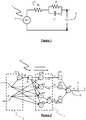
- a battery model 1 which describes the electrical behaviour of a battery in transient and steady conditions.
- the battery model 1 takes into consideration dynamic contributions related to the OCV 2, the ohmic loss ( R o ) 3, polarization time constants ( 1 / RC ) 4 to provide an output 5 relating to the battery voltage ( V T ).
- the battery model 1 may include inputs for other dynamic contributions such as hysteresis (e.g. electrochemical or electromechanical hysteresis) and thermal effects.
- the associated parameters are known to be nonlinear functions of the SOC and temperature.
- the battery SOC can be defined as the ratio between the actual charge stored in the battery with respect to its nominal capacity.
- the SOC at any particular time t may be determined by considering the total current flow over time. It will be appreciated that an initial value of the SOC ( SOC(t 0 ) ) and the nominal battery capacity (Q) are required to perform equation (1).
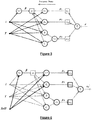
- the battery model 1 is deployed within an adaptive structure 10, as seen in Figure 2 .
- the adaptive structure 10 comprises the battery model 1 and a coulomb counter 2. This is embodied by plural activation nodes (indicated by circles) and plural adaptive gains or weights (indicated by squares).
- the inputs 11, 12 are respectively battery current ( i ) and battery temperature ( T ) and the output 13 is an estimation of the battery voltage ( V T ).
- the battery model 1 comprises five nodes 22-26 representing, respectively the contributions from the losses due to the following parameters: open-circuit voltage OCV, internal resistance R 0 , resistance R, capacitance C, polarisation voltage Vc.
- the output from the coulomb counter 2 (as modified by equation (3)) and the second input 12 are the inputs to the first node 22 of the battery model 1.
- the output from the coulomb counter 2 (as modified by equation (3)) and the first and second inputs 11, 12 are the inputs to the second node 23 of the battery model 1.
- the output from the coulomb counter 2 (as modified by equation (3)) and the first and second inputs 11, 12 are the inputs to the third node 24 of the battery model 1.
- the output from the coulomb counter 2 (as modified by equation (3)) and the first and second inputs 11, 12 are the inputs to the fourth node 25 of the battery model 1.
- the outputs of the third 24 and fourth 25 nodes are the inputs to the fifth node 26 of the battery model 1.
- Each node 22, 23, 26 provides a corresponding voltage loss output 42, 43, 46.
- the error in the voltage is determined in accordance with equation (9) below.
- the combination of the battery model 1 and the coulomb counter 2 within an adaptive structure 10 allows the use of powerful leaning algorithms, such as a Back Propagation algorithm (BP).
- BP Back Propagation algorithm
- the BP uses the gradient of the output error to tune the adaptive weights 31, 32, 33 and 36 associated with the activation nodes 21, 22, 23 and 26.
- ⁇ and ⁇ are used as learning factors, which define the speed at which the error is minimised; k is the time sample.
- the use of the learning algorithm is split into two phases: Forward and Backward phase.
- Forward phase ( Figure 2 ) the voltage error is calculated; all weights 32, 33, 36 are kept fixed and, at every sampling interval the adaptive weights ⁇ 1-3 are updated using equations 4 to 6 above and the value of SOC* from equation 3.
- Backward phase ( Figure 3 ) the error is back-propagated to tune the adaptive weights 31, 32, 33, 36 as per equations 10 and 11.
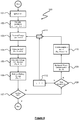
- Figure 4 shows a flow diagram 100 of operation of the proposed algorithm to provide an accurate determination of SOC.
- the flow diagram 100 commences with turning on the ignition 101 (or the 'wake-up' signal of the ECU where the SOC algorithm is embedded within the ECU or associated computing means), and setting the initial weight conditions 102.
- the instantaneous values for i and T are provided 103 as inputs 12 and 13 to allow the coulomb counter 2 to generate a value of SOC* 104.
- the voltage contributions are determined 105 using the battery model 1 and the battery voltage is estimated 106 to provide output 13, i.e. in accordance with the description of Figure 2 .
- the flow diagram runs to an adaptation decision point 108.
- the BP will be run 109 to calculate the voltage error e and to back propagate 110 through the model 1 to update the adaptive weights 31, 32, 33, 36, i.e. in accordance with the description of Figure 3 .
- the iteration step is then updated 112 and the new values for adaptive weights 31, 32, 33, 36 are used in the forward propagation steps 103 to 106.
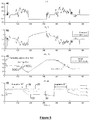
- FIG. 5 there is a shown a computer simulation of a typical 600 second drive cycle which depicts the effects of inaccurate SOC initialisation and sensor errors.
- Figure 5a shows the input current i, as it varies over the sampling time frame.
- Figure 5b shows the estimated voltage V T and actual voltage V
- Figure 5c shows the variation of both actual (SOC A ) and estimated SOC (SOC E )
- Figure 5d shows the variation in the adaptive weights 31, 32, 33, 36 over time with periods where the adaption 109, 110 has been stopped.
- the adaptive structure 10 accurately determines the value of the SOC using the battery model 1 and coulomb counter 2 and the Backward phase to generate the appropriate weights 31, 32, 33, 36.
- the estimated SOC (SOC E ) quickly and effectively mirrors the actual SOC (SOC A ) using the method and system of the invention when the invention is in use and deviation occurs ('SOC Drift Effect') between the estimated and actual values when the invention is not in use ('adaptation off in Figure 5d ).
- the adaptive structure 10 has been shown to demonstrate a high level of accuracy in estimating SOC with much less mathematical foundation that at least some of the prior art methods which use Kalman-type filters and the like. Because of the simplicity of the model 1, and the deployment of the known coulomb counting functionality the method and system is easier to implement and deploy and has reduced debugging and development time. Moreover, because the structure 10 is self-adaptive there is no need for calibration. The self-adaptive nature of the structure 10 ensures that there is no requirement for off-line training as is most usually required for state of the art neural network-based approaches for determining the SOC. This is because voltage measurements are used to calculate the network error which allows for an indirect adjustment of the estimated SOC value.
- the battery state of health can be used to adjust the node's activation functions.
- the SOH may be comprised of two main components: a capacity fade component fed into nodes 21 and 22 of Fig 2 , and a power fade component fed into node 23.
- the SOH is typically presented as a ratio or proportion of the operating health of the battery in relation to the optimal SOH, which may be an ideal characteristic or the characteristic of the battery as manufactured. It is known that the SOH can be determined by using one or more of, for example, internal resistance, impedance, conductance, capacity, voltage, self-discharge, chargeability. In which case the, for example, power fade of the battery relates to the SOH.
- the back propagation routine can be utilised to provide an accurate determination of the SOC, in accordance with the above-description.
- the SOH is provided as an input to further improve the robustness of the SOC estimation.
Landscapes
- Physics & Mathematics (AREA)
- General Physics & Mathematics (AREA)
- Engineering & Computer Science (AREA)
- Life Sciences & Earth Sciences (AREA)
- Sustainable Development (AREA)
- Sustainable Energy (AREA)
- Power Engineering (AREA)
- Transportation (AREA)
- Mechanical Engineering (AREA)
- Secondary Cells (AREA)
Claims (14)
- System zum Bestimmen des Ladezustands einer Batterie;
wobei das System Folgendes umfasst:ein Batteriemodell (1), das einen Eingang aufweist, der konfiguriert ist, um einen geschätzten Ladezustandswert zu empfangen, wobei das Batteriemodell konfiguriert ist, um wenigstens eine Spannungsverlustausgangsleistung (42, 43, 46) zu erzeugen, aus der eine geschätzte Batteriespannung bestimmt wird, wobei die oder jede Spannungsverlustausgangsleistung darstellend für die Beiträge zu dem Spannungsverlust aufgrund eines Parameters ist; undeinen Komparator, der konfiguriert ist, um einen Spannungsfehler zwischen der geschätzten Batteriespannung und der tatsächlichen Batteriespannung zu bestimmen, wobei das System dadurch gekennzeichnet ist, dass:
das Batteriemodell konfiguriert ist, um ein adaptives Ladezustandsgewicht basierend auf dem bestimmten Spannungsfehler zu modifizieren, wobei der Ladezustand durch das Modifizieren des geschätzten Ladezustands mit dem adaptiven Ladegewicht bestimmt wird, und wobei das Batteriemodell konfiguriert ist, um den Spannungsfehler rückzupropagieren, um das adaptive Ladezustandsgewicht zu modifizieren. - System nach Anspruch 1, das einen Coulomb-Zähler (2) umfasst, der konfiguriert ist, um den geschätzten Ladezustand auszugeben.
- System nach Anspruch 2, wobei der Coulomb-Zähler und das Batteriemodell innerhalb einer unitären Struktur bereitgestellt sind, und die Struktur Aktivierungsknoten umfasst.
- System nach Anspruch 2 oder 3, wobei der Batteriestrom als eine Eingangsleistung für den Coulomb-Zähler bereitgestellt ist.
- System nach einem der Ansprüche 2 bis 4, wobei der Gesundheitszustand der Batterie als eine Eingangsleistung für den Coulomb-Zähler bereitgestellt ist.
- System nach einem der Ansprüche 2 bis 5, wobei der Coulomb-Zähleranteil konfiguriert ist, um den geschätzten Ladezustandswert durch Folgendes zu bestimmen:

- System nach einem der vorhergehenden Ansprüche, wobei der geschätzte Ladezustand durch das adaptive Ladezustandsgewicht für die Eingangsleistung in das Batteriemodell modifiziert wird.
- System nach einem der vorhergehenden Ansprüche, wobei eine fernere Eingangsleistung an das Batteriemodell den Batteriestrom, eine Batterietemperatur und/oder den Gesundheitszustand einer Batterie umfasst.
- System nach einem der vorhergehenden Ansprüche, wobei das Batteriemodell wenigstens zwei Spannungsverlustausgangsleistungen erzeugt, wobei jede der Spannungsverlustausgangsleistungen mit einem adaptiven Spannungsbeitragsgewicht verknüpft ist.
- System nach Anspruch 9, das einen Summierungsknoten (27) umfasst, der konfiguriert ist, um die wenigstens zwei Spannungsverlustausgangsleistungen zu summieren, die durch das verknüpfte adaptive Spannungsbeitragsgewicht modifiziert sind, um die geschätzte Batteriespannung zu bestimmen.
- System nach Anspruch 9 oder 10, wobei das Batteriemodell konfiguriert ist, um den Spannungsfehler rückzupropagieren, um eines oder mehrere der adaptiven Spannungsbeitragsgewichte zu modifizieren.
- Verfahren zum Bestimmen des Ladezustands einer Batterie;wobei das Verfahren durch einen oder mehrere Prozessoren ausgeführt wird und Folgendes umfasst:Empfangen eines geschätzten Ladezustandswerts in ein Batteriemodell;Erzeugen wenigstens einer Spannungsverlustausgangsleistung aus dem Batteriemodell, wobei die oder jede Spannungsverlustausgangsleistung darstellend für die Beiträge zu dem Spannungsverlust aufgrund eines Parameters ist;Bestimmen einer geschätzten Batteriespannung basierend auf der wenigstens einen Spannungsverlustausgangsleistung;Bestimmen eines Spannungsfehlers zwischen der geschätzten Batteriespannung und der tatsächlichen Batteriespannung;wobei das Verfahren durch Folgendes gekennzeichnet ist:Modifizieren eines adaptiven Ladegewichtszustandszustands basierend auf dem bestimmten Spannungsfehler; undBestimmen des Ladezustands durch das Modifizieren des geschätzten Ladezustands mit dem adaptiven Ladezustandsgewicht, wobei das adaptive Ladezustandsgewicht durch das Rückpropagieren des Spannungsfehlers durch das Batteriemodell hindurch modifiziert wird.
- Elektrofahrzeug, das eine Batterie zum Bereitstellen von wenigstens einem Anteil der Antriebskraft für das Fahrzeug aufweist, wobei die Batterie einen Ladezustand aufweist und das Fahrzeug ein System nach einem der Ansprüche 1 bis 11 umfasst.
- Nicht flüchtiges, computerlesbares Speichermedium, das darauf Anweisungen speichert, die, wenn durch einen oder mehrere Prozessoren ausgeführt, den einen oder die mehreren Prozessoren veranlassen, das Verfahren nach Anspruch 12 vorzunehmen.
Applications Claiming Priority (2)
| Application Number | Priority Date | Filing Date | Title |
|---|---|---|---|
| GBGB1418440.2A GB201418440D0 (en) | 2014-10-17 | 2014-10-17 | Battery condition monitoring |
| PCT/EP2015/073808 WO2016059126A1 (en) | 2014-10-17 | 2015-10-14 | Battery condition monitoring |
Publications (2)
| Publication Number | Publication Date |
|---|---|
| EP3207388A1 EP3207388A1 (de) | 2017-08-23 |
| EP3207388B1 true EP3207388B1 (de) | 2021-03-31 |
Family
ID=52013140
Family Applications (1)
| Application Number | Title | Priority Date | Filing Date |
|---|---|---|---|
| EP15780869.2A Active EP3207388B1 (de) | 2014-10-17 | 2015-10-14 | Batteriezustandsüberwachung |
Country Status (3)
| Country | Link |
|---|---|
| EP (1) | EP3207388B1 (de) |
| GB (2) | GB201418440D0 (de) |
| WO (1) | WO2016059126A1 (de) |
Families Citing this family (20)
| Publication number | Priority date | Publication date | Assignee | Title |
|---|---|---|---|---|
| CN106154180B (zh) * | 2016-08-18 | 2019-02-05 | 中国科学院自动化研究所 | 储能电池充/放电异常行为检测方法及检测系统 |
| KR102634815B1 (ko) * | 2016-11-22 | 2024-02-07 | 삼성전자주식회사 | 오차 보정에 기초한 배터리 상태 추정 방법 및 장치 |
| WO2018127296A1 (en) * | 2017-01-09 | 2018-07-12 | Volvo Truck Corporation | A method and arrangement for determining the state of charge of a battery pack |
| CN108804720B (zh) * | 2017-04-26 | 2021-09-14 | 重庆科技学院 | 基于改进无迹Kalman滤波与RBF神经网络的抽油机故障诊断方法 |
| CN108804721B (zh) * | 2017-04-26 | 2021-09-14 | 重庆科技学院 | 基于自适应无迹Kalman滤波与RBF神经网络的抽油机故障诊断方法 |
| CN107436411B (zh) * | 2017-07-28 | 2019-06-14 | 南京航空航天大学 | 基于分数阶神经网络和双容积卡尔曼的电池soh在线估计方法 |
| CN107994570B (zh) * | 2017-12-04 | 2022-03-25 | 华北电力大学(保定) | 一种基于神经网络的状态估计方法及系统 |
| EP3591800B1 (de) | 2018-07-03 | 2023-11-15 | Schneider Electric IT Corporation | Vorrichtung zur unterbrechungsfreien stromversorgung und nichttransitorisches computerlesbares medium |
| CN109782176A (zh) * | 2018-12-20 | 2019-05-21 | 上海交通大学 | 基于narx模型的电池剩余容量在线估计方法 |
| KR102465373B1 (ko) * | 2019-01-23 | 2022-11-08 | 주식회사 엘지에너지솔루션 | 배터리 관리 장치, 배터리 관리 방법 및 배터리팩 |
| CN109849693B (zh) * | 2019-03-11 | 2020-11-03 | 中南大学 | 一种基于自适应小波转换的电动汽车混合能源管理系统及其控制方法 |
| CN110412470B (zh) * | 2019-04-22 | 2021-09-21 | 上海博强微电子有限公司 | 电动汽车动力电池soc估计方法 |
| CN110789396A (zh) * | 2019-11-04 | 2020-02-14 | 广州小鹏汽车科技有限公司 | 电池组荷电状态数据检测方法、装置、介质、终端及汽车 |
| CN111505504B (zh) * | 2020-04-30 | 2022-07-19 | 中国科学院深圳先进技术研究院 | 一种电池荷电状态估计方法及估计器 |
| WO2022101769A1 (en) * | 2020-11-13 | 2022-05-19 | Kpit Technologies Limited | A hybrid system and method for estimating state of charge of a battery |
| FR3121754A1 (fr) * | 2021-04-08 | 2022-10-14 | Psa Automobiles Sa | Systeme d’estimation d’etat de charge de batterie de traction de vehicule automobile, procede et vehicule comprenant un tel systeme |
| US12504478B2 (en) * | 2022-05-23 | 2025-12-23 | Gotion, Inc. | Apparatus and method for battery SOC estimation |
| GB202212015D0 (en) * | 2022-08-17 | 2022-09-28 | Nordic Semiconductor Asa | Battery-powered devices |
| CN115728641B (zh) * | 2022-11-14 | 2023-09-01 | 珠海英集芯半导体有限公司 | 一种具有自学习、自校准功能的ocv电量计算方法 |
| CN116243173A (zh) * | 2022-12-30 | 2023-06-09 | 联合汽车电子有限公司 | 一种soc的修正方法、装置和车载终端 |
Citations (1)
| Publication number | Priority date | Publication date | Assignee | Title |
|---|---|---|---|---|
| EP1081499A1 (de) * | 1998-05-28 | 2001-03-07 | Toyota Jidosha Kabushiki Kaisha | Mittel zum schätzen des ladungszustands eines batterie und verfahren zum schätzen des degradierten zustands einer batterie |
Family Cites Families (5)
| Publication number | Priority date | Publication date | Assignee | Title |
|---|---|---|---|---|
| US4390841A (en) * | 1980-10-14 | 1983-06-28 | Purdue Research Foundation | Monitoring apparatus and method for battery power supply |
| FR2835923B1 (fr) * | 2002-02-13 | 2004-05-14 | Peugeot Citroen Automobiles Sa | Systeme de determination de l'etat de charge d'une batterie, notamment pour vehicule automobile |
| US9052368B2 (en) * | 2010-12-15 | 2015-06-09 | Maxim Integrated Products, Inc. | Negative peak voltage detection for enhanced FuelGauge empty voltage prediction |
| US9201119B2 (en) * | 2011-12-19 | 2015-12-01 | Qualcomm Incorporated | Battery fuel gauge |
| US20140272653A1 (en) * | 2013-03-14 | 2014-09-18 | Robert Bosch Gmbh | Flow Battery System and Method of SOC Determination |
-
2014
- 2014-10-17 GB GBGB1418440.2A patent/GB201418440D0/en not_active Ceased
-
2015
- 2015-10-14 WO PCT/EP2015/073808 patent/WO2016059126A1/en not_active Ceased
- 2015-10-14 GB GB1518181.1A patent/GB2532343B/en active Active
- 2015-10-14 EP EP15780869.2A patent/EP3207388B1/de active Active
Patent Citations (1)
| Publication number | Priority date | Publication date | Assignee | Title |
|---|---|---|---|---|
| EP1081499A1 (de) * | 1998-05-28 | 2001-03-07 | Toyota Jidosha Kabushiki Kaisha | Mittel zum schätzen des ladungszustands eines batterie und verfahren zum schätzen des degradierten zustands einer batterie |
Also Published As
| Publication number | Publication date |
|---|---|
| EP3207388A1 (de) | 2017-08-23 |
| GB201418440D0 (en) | 2014-12-03 |
| WO2016059126A1 (en) | 2016-04-21 |
| GB201518181D0 (en) | 2015-11-25 |
| GB2532343A (en) | 2016-05-18 |
| GB2532343B (en) | 2017-03-01 |
Similar Documents
| Publication | Publication Date | Title |
|---|---|---|
| EP3207388B1 (de) | Batteriezustandsüberwachung | |
| Peng et al. | An improved state of charge estimation method based on cubature Kalman filter for lithium-ion batteries | |
| Ge et al. | State of charge estimation of lithium-ion battery based on improved forgetting factor recursive least squares-extended Kalman filter joint algorithm | |
| CN113466723B (zh) | 确定电池荷电状态的方法及装置,电池管理系统 | |
| Xiong et al. | A data-driven adaptive state of charge and power capability joint estimator of lithium-ion polymer battery used in electric vehicles | |
| JP4692246B2 (ja) | 二次電池の入出力可能電力推定装置 | |
| JP5842421B2 (ja) | 電池状態推定装置 | |
| Pérez et al. | Enhanced closed loop State of Charge estimator for lithium-ion batteries based on Extended Kalman Filter | |
| US6534954B1 (en) | Method and apparatus for a battery state of charge estimator | |
| Meng et al. | Low-complexity online estimation for LiFePO4 battery state of charge in electric vehicles | |
| JP5595361B2 (ja) | 二次電池の充電状態推定装置 | |
| EP3593155B1 (de) | Verfahren zur schätzung des ladezustandes einer batteriezelle und überwachungssystem für den batteriezustand | |
| JP7552995B2 (ja) | エネルギー貯蔵システムの充電容量算出装置及び方法 | |
| CN103529398A (zh) | 基于扩展卡尔曼滤波的锂离子电池soc在线估计方法 | |
| WO1999061929A1 (fr) | Moyen permettant d'evaluer l'etat de charge d'une batterie et procede permettant d'evaluer l'etat de decharge d'une batterie | |
| CN112649747A (zh) | 一种分数阶扩展卡尔曼的锂电池soc估算方法 | |
| JP5163542B2 (ja) | 二次電池の入出力可能電力推定装置 | |
| JP6455914B2 (ja) | 蓄電残量推定装置、蓄電池の蓄電残量を推定する方法、及びコンピュータプログラム | |
| JP4865627B2 (ja) | バッテリ残存容量推定方法、バッテリ残存容量推定装置及びバッテリ電源システム | |
| Zhan et al. | Application of adaptive extended Kalman algorithm based on strong tracking fading factor in Stat-of-Charge estimation of lithium-ion battery | |
| TWI773306B (zh) | 電池電量狀態的檢測方法 | |
| EP3343389B1 (de) | Verfahren zur berechnung einer leerlaufspannung eines energieakkumulators und zugehörige grafikdarstellungsvorrichtung | |
| Gholizadeh et al. | SOC estimation for a lithium-ion battery by designing a nonlinear observer based on an equivalent circuit model | |
| JP4720364B2 (ja) | 二次電池の内部抵抗推定装置 | |
| KR102877721B1 (ko) | 차량용 배터리 상태 추정 값과 실제 값을 이용한 파라미터 보정 방법 |
Legal Events
| Date | Code | Title | Description |
|---|---|---|---|
| STAA | Information on the status of an ep patent application or granted ep patent |
Free format text: STATUS: THE INTERNATIONAL PUBLICATION HAS BEEN MADE |
|
| PUAI | Public reference made under article 153(3) epc to a published international application that has entered the european phase |
Free format text: ORIGINAL CODE: 0009012 |
|
| STAA | Information on the status of an ep patent application or granted ep patent |
Free format text: STATUS: REQUEST FOR EXAMINATION WAS MADE |
|
| 17P | Request for examination filed |
Effective date: 20170517 |
|
| AK | Designated contracting states |
Kind code of ref document: A1 Designated state(s): AL AT BE BG CH CY CZ DE DK EE ES FI FR GB GR HR HU IE IS IT LI LT LU LV MC MK MT NL NO PL PT RO RS SE SI SK SM TR |
|
| AX | Request for extension of the european patent |
Extension state: BA ME |
|
| DAV | Request for validation of the european patent (deleted) | ||
| DAX | Request for extension of the european patent (deleted) | ||
| STAA | Information on the status of an ep patent application or granted ep patent |
Free format text: STATUS: EXAMINATION IS IN PROGRESS |
|
| 17Q | First examination report despatched |
Effective date: 20200420 |
|
| GRAP | Despatch of communication of intention to grant a patent |
Free format text: ORIGINAL CODE: EPIDOSNIGR1 |
|
| STAA | Information on the status of an ep patent application or granted ep patent |
Free format text: STATUS: GRANT OF PATENT IS INTENDED |
|
| RIC1 | Information provided on ipc code assigned before grant |
Ipc: G01R 31/3828 20190101ALI20200925BHEP Ipc: G01R 31/36 20200101AFI20200925BHEP Ipc: G01R 31/3842 20190101ALI20200925BHEP Ipc: G01R 31/367 20190101ALI20200925BHEP |
|
| INTG | Intention to grant announced |
Effective date: 20201019 |
|
| GRAS | Grant fee paid |
Free format text: ORIGINAL CODE: EPIDOSNIGR3 |
|
| GRAA | (expected) grant |
Free format text: ORIGINAL CODE: 0009210 |
|
| STAA | Information on the status of an ep patent application or granted ep patent |
Free format text: STATUS: THE PATENT HAS BEEN GRANTED |
|
| AK | Designated contracting states |
Kind code of ref document: B1 Designated state(s): AL AT BE BG CH CY CZ DE DK EE ES FI FR GB GR HR HU IE IS IT LI LT LU LV MC MK MT NL NO PL PT RO RS SE SI SK SM TR |
|
| REG | Reference to a national code |
Ref country code: GB Ref legal event code: FG4D Ref country code: CH Ref legal event code: EP |
|
| REG | Reference to a national code |
Ref country code: DE Ref legal event code: R096 Ref document number: 602015067504 Country of ref document: DE Ref country code: AT Ref legal event code: REF Ref document number: 1377544 Country of ref document: AT Kind code of ref document: T Effective date: 20210415 |
|
| REG | Reference to a national code |
Ref country code: IE Ref legal event code: FG4D |
|
| REG | Reference to a national code |
Ref country code: LT Ref legal event code: MG9D |
|
| PG25 | Lapsed in a contracting state [announced via postgrant information from national office to epo] |
Ref country code: HR Free format text: LAPSE BECAUSE OF FAILURE TO SUBMIT A TRANSLATION OF THE DESCRIPTION OR TO PAY THE FEE WITHIN THE PRESCRIBED TIME-LIMIT Effective date: 20210331 Ref country code: FI Free format text: LAPSE BECAUSE OF FAILURE TO SUBMIT A TRANSLATION OF THE DESCRIPTION OR TO PAY THE FEE WITHIN THE PRESCRIBED TIME-LIMIT Effective date: 20210331 Ref country code: NO Free format text: LAPSE BECAUSE OF FAILURE TO SUBMIT A TRANSLATION OF THE DESCRIPTION OR TO PAY THE FEE WITHIN THE PRESCRIBED TIME-LIMIT Effective date: 20210630 Ref country code: BG Free format text: LAPSE BECAUSE OF FAILURE TO SUBMIT A TRANSLATION OF THE DESCRIPTION OR TO PAY THE FEE WITHIN THE PRESCRIBED TIME-LIMIT Effective date: 20210630 |
|
| PG25 | Lapsed in a contracting state [announced via postgrant information from national office to epo] |
Ref country code: SE Free format text: LAPSE BECAUSE OF FAILURE TO SUBMIT A TRANSLATION OF THE DESCRIPTION OR TO PAY THE FEE WITHIN THE PRESCRIBED TIME-LIMIT Effective date: 20210331 Ref country code: RS Free format text: LAPSE BECAUSE OF FAILURE TO SUBMIT A TRANSLATION OF THE DESCRIPTION OR TO PAY THE FEE WITHIN THE PRESCRIBED TIME-LIMIT Effective date: 20210331 Ref country code: LV Free format text: LAPSE BECAUSE OF FAILURE TO SUBMIT A TRANSLATION OF THE DESCRIPTION OR TO PAY THE FEE WITHIN THE PRESCRIBED TIME-LIMIT Effective date: 20210331 |
|
| REG | Reference to a national code |
Ref country code: NL Ref legal event code: MP Effective date: 20210331 |
|
| REG | Reference to a national code |
Ref country code: AT Ref legal event code: MK05 Ref document number: 1377544 Country of ref document: AT Kind code of ref document: T Effective date: 20210331 |
|
| PG25 | Lapsed in a contracting state [announced via postgrant information from national office to epo] |
Ref country code: LT Free format text: LAPSE BECAUSE OF FAILURE TO SUBMIT A TRANSLATION OF THE DESCRIPTION OR TO PAY THE FEE WITHIN THE PRESCRIBED TIME-LIMIT Effective date: 20210331 Ref country code: NL Free format text: LAPSE BECAUSE OF FAILURE TO SUBMIT A TRANSLATION OF THE DESCRIPTION OR TO PAY THE FEE WITHIN THE PRESCRIBED TIME-LIMIT Effective date: 20210331 Ref country code: EE Free format text: LAPSE BECAUSE OF FAILURE TO SUBMIT A TRANSLATION OF THE DESCRIPTION OR TO PAY THE FEE WITHIN THE PRESCRIBED TIME-LIMIT Effective date: 20210331 Ref country code: CZ Free format text: LAPSE BECAUSE OF FAILURE TO SUBMIT A TRANSLATION OF THE DESCRIPTION OR TO PAY THE FEE WITHIN THE PRESCRIBED TIME-LIMIT Effective date: 20210331 Ref country code: AT Free format text: LAPSE BECAUSE OF FAILURE TO SUBMIT A TRANSLATION OF THE DESCRIPTION OR TO PAY THE FEE WITHIN THE PRESCRIBED TIME-LIMIT Effective date: 20210331 Ref country code: SM Free format text: LAPSE BECAUSE OF FAILURE TO SUBMIT A TRANSLATION OF THE DESCRIPTION OR TO PAY THE FEE WITHIN THE PRESCRIBED TIME-LIMIT Effective date: 20210331 |
|
| PG25 | Lapsed in a contracting state [announced via postgrant information from national office to epo] |
Ref country code: IS Free format text: LAPSE BECAUSE OF FAILURE TO SUBMIT A TRANSLATION OF THE DESCRIPTION OR TO PAY THE FEE WITHIN THE PRESCRIBED TIME-LIMIT Effective date: 20210731 Ref country code: PT Free format text: LAPSE BECAUSE OF FAILURE TO SUBMIT A TRANSLATION OF THE DESCRIPTION OR TO PAY THE FEE WITHIN THE PRESCRIBED TIME-LIMIT Effective date: 20210802 Ref country code: PL Free format text: LAPSE BECAUSE OF FAILURE TO SUBMIT A TRANSLATION OF THE DESCRIPTION OR TO PAY THE FEE WITHIN THE PRESCRIBED TIME-LIMIT Effective date: 20210331 Ref country code: SK Free format text: LAPSE BECAUSE OF FAILURE TO SUBMIT A TRANSLATION OF THE DESCRIPTION OR TO PAY THE FEE WITHIN THE PRESCRIBED TIME-LIMIT Effective date: 20210331 Ref country code: RO Free format text: LAPSE BECAUSE OF FAILURE TO SUBMIT A TRANSLATION OF THE DESCRIPTION OR TO PAY THE FEE WITHIN THE PRESCRIBED TIME-LIMIT Effective date: 20210331 |
|
| REG | Reference to a national code |
Ref country code: DE Ref legal event code: R097 Ref document number: 602015067504 Country of ref document: DE |
|
| PG25 | Lapsed in a contracting state [announced via postgrant information from national office to epo] |
Ref country code: DK Free format text: LAPSE BECAUSE OF FAILURE TO SUBMIT A TRANSLATION OF THE DESCRIPTION OR TO PAY THE FEE WITHIN THE PRESCRIBED TIME-LIMIT Effective date: 20210331 Ref country code: AL Free format text: LAPSE BECAUSE OF FAILURE TO SUBMIT A TRANSLATION OF THE DESCRIPTION OR TO PAY THE FEE WITHIN THE PRESCRIBED TIME-LIMIT Effective date: 20210331 Ref country code: ES Free format text: LAPSE BECAUSE OF FAILURE TO SUBMIT A TRANSLATION OF THE DESCRIPTION OR TO PAY THE FEE WITHIN THE PRESCRIBED TIME-LIMIT Effective date: 20210331 |
|
| PLBE | No opposition filed within time limit |
Free format text: ORIGINAL CODE: 0009261 |
|
| STAA | Information on the status of an ep patent application or granted ep patent |
Free format text: STATUS: NO OPPOSITION FILED WITHIN TIME LIMIT |
|
| 26N | No opposition filed |
Effective date: 20220104 |
|
| REG | Reference to a national code |
Ref country code: CH Ref legal event code: PL |
|
| PG25 | Lapsed in a contracting state [announced via postgrant information from national office to epo] |
Ref country code: IS Free format text: LAPSE BECAUSE OF FAILURE TO SUBMIT A TRANSLATION OF THE DESCRIPTION OR TO PAY THE FEE WITHIN THE PRESCRIBED TIME-LIMIT Effective date: 20210731 |
|
| REG | Reference to a national code |
Ref country code: BE Ref legal event code: MM Effective date: 20211031 |
|
| PG25 | Lapsed in a contracting state [announced via postgrant information from national office to epo] |
Ref country code: MC Free format text: LAPSE BECAUSE OF FAILURE TO SUBMIT A TRANSLATION OF THE DESCRIPTION OR TO PAY THE FEE WITHIN THE PRESCRIBED TIME-LIMIT Effective date: 20210331 |
|
| PG25 | Lapsed in a contracting state [announced via postgrant information from national office to epo] |
Ref country code: LU Free format text: LAPSE BECAUSE OF NON-PAYMENT OF DUE FEES Effective date: 20211014 Ref country code: IT Free format text: LAPSE BECAUSE OF FAILURE TO SUBMIT A TRANSLATION OF THE DESCRIPTION OR TO PAY THE FEE WITHIN THE PRESCRIBED TIME-LIMIT Effective date: 20210331 Ref country code: BE Free format text: LAPSE BECAUSE OF NON-PAYMENT OF DUE FEES Effective date: 20211031 |
|
| PG25 | Lapsed in a contracting state [announced via postgrant information from national office to epo] |
Ref country code: LI Free format text: LAPSE BECAUSE OF NON-PAYMENT OF DUE FEES Effective date: 20211031 Ref country code: CH Free format text: LAPSE BECAUSE OF NON-PAYMENT OF DUE FEES Effective date: 20211031 |
|
| PG25 | Lapsed in a contracting state [announced via postgrant information from national office to epo] |
Ref country code: IE Free format text: LAPSE BECAUSE OF NON-PAYMENT OF DUE FEES Effective date: 20211014 |
|
| PG25 | Lapsed in a contracting state [announced via postgrant information from national office to epo] |
Ref country code: HU Free format text: LAPSE BECAUSE OF FAILURE TO SUBMIT A TRANSLATION OF THE DESCRIPTION OR TO PAY THE FEE WITHIN THE PRESCRIBED TIME-LIMIT; INVALID AB INITIO Effective date: 20151014 |
|
| PG25 | Lapsed in a contracting state [announced via postgrant information from national office to epo] |
Ref country code: CY Free format text: LAPSE BECAUSE OF FAILURE TO SUBMIT A TRANSLATION OF THE DESCRIPTION OR TO PAY THE FEE WITHIN THE PRESCRIBED TIME-LIMIT Effective date: 20210331 |
|
| P01 | Opt-out of the competence of the unified patent court (upc) registered |
Effective date: 20230528 |
|
| PG25 | Lapsed in a contracting state [announced via postgrant information from national office to epo] |
Ref country code: GR Free format text: LAPSE BECAUSE OF FAILURE TO SUBMIT A TRANSLATION OF THE DESCRIPTION OR TO PAY THE FEE WITHIN THE PRESCRIBED TIME-LIMIT Effective date: 20210331 |
|
| PG25 | Lapsed in a contracting state [announced via postgrant information from national office to epo] |
Ref country code: MK Free format text: LAPSE BECAUSE OF FAILURE TO SUBMIT A TRANSLATION OF THE DESCRIPTION OR TO PAY THE FEE WITHIN THE PRESCRIBED TIME-LIMIT Effective date: 20210331 |
|
| PG25 | Lapsed in a contracting state [announced via postgrant information from national office to epo] |
Ref country code: MT Free format text: LAPSE BECAUSE OF FAILURE TO SUBMIT A TRANSLATION OF THE DESCRIPTION OR TO PAY THE FEE WITHIN THE PRESCRIBED TIME-LIMIT Effective date: 20210331 |
|
| PG25 | Lapsed in a contracting state [announced via postgrant information from national office to epo] |
Ref country code: TR Free format text: LAPSE BECAUSE OF FAILURE TO SUBMIT A TRANSLATION OF THE DESCRIPTION OR TO PAY THE FEE WITHIN THE PRESCRIBED TIME-LIMIT Effective date: 20210331 |
|
| PGFP | Annual fee paid to national office [announced via postgrant information from national office to epo] |
Ref country code: DE Payment date: 20251021 Year of fee payment: 11 |
|
| PGFP | Annual fee paid to national office [announced via postgrant information from national office to epo] |
Ref country code: GB Payment date: 20251024 Year of fee payment: 11 |
|
| PGFP | Annual fee paid to national office [announced via postgrant information from national office to epo] |
Ref country code: FR Payment date: 20251030 Year of fee payment: 11 |