EP3205797B2 - Übersetzungsgetriebe für einen treibstangenbeschlag - Google Patents
Übersetzungsgetriebe für einen treibstangenbeschlag Download PDFInfo
- Publication number
- EP3205797B2 EP3205797B2 EP17150925.0A EP17150925A EP3205797B2 EP 3205797 B2 EP3205797 B2 EP 3205797B2 EP 17150925 A EP17150925 A EP 17150925A EP 3205797 B2 EP3205797 B2 EP 3205797B2
- Authority
- EP
- European Patent Office
- Prior art keywords
- drive rod
- section
- transmission gear
- slide
- drive
- Prior art date
- Legal status (The legal status is an assumption and is not a legal conclusion. Google has not performed a legal analysis and makes no representation as to the accuracy of the status listed.)
- Active
Links
Images


Classifications
-
- E—FIXED CONSTRUCTIONS
- E05—LOCKS; KEYS; WINDOW OR DOOR FITTINGS; SAFES
- E05C—BOLTS OR FASTENING DEVICES FOR WINGS, SPECIALLY FOR DOORS OR WINDOWS
- E05C9/00—Arrangements of simultaneously actuated bolts or other securing devices at well-separated positions on the same wing
- E05C9/10—Actuating mechanisms for bars
- E05C9/12—Actuating mechanisms for bars with rack and pinion mechanism
-
- E—FIXED CONSTRUCTIONS
- E05—LOCKS; KEYS; WINDOW OR DOOR FITTINGS; SAFES
- E05C—BOLTS OR FASTENING DEVICES FOR WINGS, SPECIALLY FOR DOORS OR WINDOWS
- E05C9/00—Arrangements of simultaneously actuated bolts or other securing devices at well-separated positions on the same wing
- E05C9/02—Arrangements of simultaneously actuated bolts or other securing devices at well-separated positions on the same wing with one sliding bar for fastening when moved in one direction and unfastening when moved in opposite direction; with two sliding bars moved in the same direction when fastening or unfastening
- E05C9/021—Arrangements of simultaneously actuated bolts or other securing devices at well-separated positions on the same wing with one sliding bar for fastening when moved in one direction and unfastening when moved in opposite direction; with two sliding bars moved in the same direction when fastening or unfastening with rack and pinion mechanism
Definitions
- the invention relates to a transmission gear for a connecting rod fitting of a window, a balcony door or the like, with a drivable nut and a gear coupled to the nut for driving a connecting rod, the gear being arranged between a slide and the connecting rod and a gear ratio not equal to 1: 1 comprises that the nut has a drive pinion, that the drive pinion is coupled to the slide and has a series of recesses into which the drive pinion engages.
- An edge gear with a drive pinion which has a further pinion for receiving the handle, is from the EP 1 533 453 A1 known.
- a transmission gear is arranged between the two pinions and has a longitudinally displaceable coupling part which engages with the further pinion and is connected to the mounting of the drive pinion.
- the drive rod section has several recesses, via which the drive pinion is in engagement with it.
- One of the two drive pinions here has a square seat, whereas the second drive pinion engages on the one hand with a rolling toothing that is stationary in the housing and on the other hand with a longitudinally displaceable rack.
- This rack engages in the drive rod via driver elements in order to move it.
- a transmission for a lock which has arms rotatably mounted on racks.
- the racks are arranged symmetrically on both sides around the handle of the transmission and the arms mounted on them engage in curved link guides on both sides.
- the connecting slides have straight guides in which the arms engage and are thus moved along with the movement of the racks.
- Such a transmission gear is, for example, from EP 2 366 855 B1 known.
- the first lever protrudes from the nut, while the second lever is hinged to a slide.
- the two levers thus form a crank mechanism for driving the slide.
- the slide drives a gear, which in turn drives part of the drive rod. If the levers are at a right angle to one another, the slide and thus the drive rod are moved further with a fixed deflection of the nut than with an almost straight arrangement of the levers to one another. An intended course of the movement of the drive rod via the rotational movement of the nut cannot be set as a result.
- the disadvantage of the known transmission gear is the large number of components, since the gear is arranged behind the crank mechanism in the drive direction. An envisaged translation of the transmission also requires a large lever arm of the crank drive and thus very large installation space.
- the invention is based on the problem of developing a drive pinion of the type mentioned at the beginning in such a way that it has a particularly small installation space.
- the transmission gear with the gear and with the slide driven by the drive pinion has two devices arranged one behind the other, each with its own transmission ratio to the intended direction of movement of the drive rod arranged first section and an adjoining, opposite to the first section inclined second section.
- the transmission gear has a variable transmission ratio when driving the drive rod. If the crank pin is guided in the first section of the link, there is a slight movement of the drive rod when the nut rotates. If, however, the crank pin is guided by the second section of the link, the drive via the nut has a significantly greater translation, so that the drive rod is moved much more strongly with the same rotary movement of the nut.
- the guide of the crank pin in the first section can be arranged directly at the closed position if several closures of the drive rod fitting are moved into the locking position via the movement of the drive rod.
- the crank pin can be guided in the second section when the locks are separated from one another, since in this position the frictional resistance of the drive rod fitting is particularly low.
- an intended path of the drive rod can be easily set if the link has a third section which is arranged parallel to the direction of movement of the drive rod and which adjoins the second section.
- the crank pin is preferably guided in the third section when the connecting rod fitting is driven from a rotational position to a tilted position.
- the transmission gear can be arranged in particularly flat recesses in the window if a section of the drive rod is trough-shaped for receiving the slide.
- the spatial assignment of the bearing of the nut and the guide of the crank pin can easily be determined according to another advantageous development of the invention if a housing has a housing base and a housing cover, if at least one of the components of the housing base or the housing cover has a bearing shell for the nut and has a recess for the backdrop.
- the transmission gear has a particularly high level of stability.
- the housing has a guide for the slide and for the section of the drive rod.
- the guides are preferably formed by bends of at least one of the components of the housing base or of the housing cover. This helps to further increase the stability of the transmission gear.
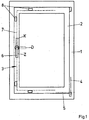
- Figure 1 shows a window with a frame 1 and a sash 2 and with a connecting rod fitting 3 for locking the sash 2 in the frame 1.
- the sash 2 can be pivoted about a vertical axis 4 with respect to the frame 1 into a rotary position and about a horizontal axis 5 tilt with respect to the frame 1 in a tilted position.
- the drive rod fitting 3 can be driven via a handle 6 and has a drive rod 7 for driving several locks 8.
- the handle 6 In the illustrated position, the handle 6 is in position "Z", which indicates the closed position in which the leaf 2 is in the frame 1 and is locked via the locks 8.
- the handle 6 can be moved into a rotary position “D” in which the wing 2 can be rotated about the vertical axis 4.
- a position “K” of the handle 6 the wing 2 can be tilted about the horizontal axis 5 with respect to the frame 1.
- FIG 2 shows a transmission gear of the espagnolette 3 from Figure 1 in the closed position in which the handle 6 is in position "Z".
- the transmission gear 9 has a nut 11 rotatably mounted in a housing 10 for attaching the in Figure 1 handle 6 shown and a portion of the drive rod 7.
- the housing 10 has a housing bottom 26 arranged parallel to the plane of the drawing and a housing cover with a bearing shell (not shown) for mounting the nut 11, which is manufactured in one piece with the drive pinion 13. To simplify the drawing, the housing cover is not shown.
- the transmission gear 9 has a gear 12 with a drive pinion 13 arranged concentrically to the nut 11 for driving a slide 14 and with a toggle lever 17 formed by two levers 15, 16.
- the slide 14 has a series of recesses 18 which the drive pinion 13 meshes with .
- a first lever 15 of the toggle lever 17 is articulated on the slide 14, while the second lever 16 is articulated on the section of the drive rod 7.
- the levers 15, 16 are connected to one another via a bearing pin 19.
- a crank pin 20 is made in one piece with the bearing pin 19 and is guided in a link 21.
- the gate 21 is designed as a recess 27 in at least the housing bottom 26 of the housing 10.
- the housing 10 has a respective guide 22, 23 for the slide 14 and for the section of the drive rod 7.
- the slide 14 is guided on the section of the drive rod 7.
- the drive rod 7 is designed in the shape of a trough to accommodate the slide 14.
- the first lever 15 has a bearing 24 on the slide 14 and the second lever 16 has a bearing 25 on the section of the drive rod 7.
- the gate 21 has a first section 28 inclined to the intended direction of movement of the section of the drive rod 7 and a second section 29 inclined opposite to the first section 28.
- a third section 30 of the gate 21 is arranged parallel to the direction of movement of the section of the drive rod 7 and adjoins the second section 29. In the illustrated closed position, the crank pin 20 is located at the end of the first section 28.
- Figure 5 shows the course of the translation I of the transmission gear 9 when the handle is driven from the “Z” position through the “D” position into the “K” position. Between the “K” position and the “D” position, the transmission gear 9 has a constant ratio. If, starting from position “D”, the transmission gear 9 is moved in the direction of the locking position “Z”, a very high transmission ratio is first achieved, which means that initially with a slight rotation of the nut 11 there is a large displacement of the drive rod 7. Only when the crank pin 20 is in the first section 28 of the link 21 is the portion of the drive rod 7 driven with a low gear ratio. This means that a large rotation of the nut 11 only leads to a small displacement of the section of the drive rod 7.
- Figure 6 shows the course of the longitudinal movement x of the section of the drive rod 7 when the nut 11 is rotated through the positions "K", "D” and "Z".
Landscapes
- Engineering & Computer Science (AREA)
- Mechanical Engineering (AREA)
- Transmission Devices (AREA)
Description
- Die Erfindung betrifft ein Übersetzungsgetriebe für einen Treibstangenbeschlag eines Fensters, einer Fenstertür oder dergleichen, mit einer antreibbaren Nuss und einem mit der Nuss gekoppelten Getriebe zum Antrieb einer Treibstange, wobei das Getriebe zwischen einem Schieber und der Treibstange angeordnet ist und ein Übersetzungsverhältnis ungleich 1:1 aufweist, dass die Nuss ein Antriebsritzel hat, dass das Antriebsritzel mit dem Schieber gekoppelt ist und eine Reihe von Ausnehmungen hat, in die das Antriebsritzel eingreift.
- Ein Kantengetriebe mit einem Antriebsritzel, welches ein weiteres Ritzel zur Aufnahme der Handhabe aufweist ist aus der
EP 1 533 453 A1 bekannt. Zwischen den beiden Ritzeln ist ein Übersetzungsgetriebe angeordnet, das ein längs verschiebbares, mit dem weiteren Ritzel in Eingriff stehendes und mit der Lagerung des Antriebsritzel verbundenes Koppelteil aufweist. Weiterhin weist der Treibstangenabschnitt mehrere Ausnehmungen auf, über welche der Antriebsritzel mit ihm in Eingriff steht. - Weiterhin ist aus der
DE 12 44 611 B ein Getriebe bekannt, welches zwei Antriebsritzel aufweist, die über eine Antriebszahnstange miteinander verbunden sind. Eines der beiden Antriebsritzel weist hierbei eine Vierkantaufnahme auf, wohingegen das zweite Antriebsritzel einerseits mit einer, im Gehäuse, ortsfesten Abwälzverzahnung und andererseits mit einer längs verlagerbaren Zahnstange in Eingriff steht. Über Mitnehmerelemente greift diese Zahnstange in die Treibstange, um diese zu verlagern. - Aus der
WO 2004/083575 A1 ist ein Getriebe für ein Schloss bekannt, welches drehbar an Zahnstangen gelagerte Arme aufweist. Die Zahnstangen sind beidseitig symmetrisch um die Handhabe des Getriebes angeordnet und die an ihnen gelagerten Arme greifen beidseitig in bogenförmige Kulissenführungen ein. Hierdurch drehen sich die Arme bei einer Verlagerung der Zahnstangen, sodass sich die effektive Länge des Zahnstangen-Arm-Verbundes ändert. Die Anschlussschieber weisen gerade Führungen auf, in welche die Arme eingreifen und werden so, bei Bewegung der Zahnstangen, mitbewegt. - Ein solches Übersetzungsgetriebe ist beispielsweise aus der
EP 2 366 855 B1 bekannt. Bei diesem Übersetzungsgetriebe steht der erste Hebel von der Nuss ab, während der zweite Hebel an einem Schieber angelenkt ist. Die beiden Hebel bilden damit einen Kurbeltrieb zum Antrieb des Schiebers. Der Schieber treibt ein Zahnrad an, welches wiederum ein Teilstück der Treibstange antreibt. Stehen die Hebel in einem rechten Winkel zueinander, wird der Schieber und damit die Treibstange bei einer festgelegten Auslenkung der Nuss weiter bewegt, als bei einer nahezu gestreckten Anordnung der Hebel zueinander. Ein vorgesehener Verlauf der Bewegung der Treibstange über die Drehbewegung der Nuss lässt sich hierdurch nicht einstellen. Nachteilig bei dem bekannten Übersetzungsgetriebe ist die hohe Anzahl an Bauteilen, da das Getriebe in Antriebsrichtung hinter dem Kurbeltrieb angeordnet ist. Eine vorgesehene Übersetzung des Getriebes erfordert zudem einen großen Hebelarm des Kurbeltriebs und damit sehr großen Bauraum. - Aus der
EP 0 534 089 B1 ist ein Antriebsgetriebe bekannt, bei dem zwei Hebel zu einem Kurbeltrieb zusammengestellt und von einer Nuss antreibbar sind. Über diesen Kurbeltrieb wird ein die Treibstange kämmendes Ritzel angetrieben. Der Verschiebeweg der Treibstange ist sehr stark abhängig von der Drehstellung der Nuss. - Der Erfindung liegt das Problem zugrunde, ein Antriebsritzel der eingangs genannten Art so weiter zu bilden, dass es einen besonders geringen Bauraum aufweist.
- Dieses Problem wird erfindungsgemäß dadurch gelöst, dass der Schieber auf der Treibstange geführt ist
- Durch diese Gestaltung hat das Übersetzungsgetriebe mit dem Getriebe und mit dem von dem Antriebsritzel angetriebenen Schieber zwei hintereinander angeordnete Einrichtungen, mit jeweils einem eigenen Übersetzungsverhält-Das Übersetzungsgetriebe ermöglicht gemäß einer anderen vorteilhaften Weiterbildung der Erfindung eine besonders leichtgängige Verriegelung des Treibstangenbeschlages, wenn die Kulisse einen geneigt zur vorgesehenen Bewegungsrichtung der Treibstange angeordneten ersten Abschnitt und einen sich daran anschließenden, entgegengesetzt zu dem ersten Abschnitt geneigten zweiten Abschnitt hat. Durch diese Gestaltung hat das Übersetzungsgetriebe eine variable Übersetzung beim Antrieb der Treibstange. Ist der Kurbelzapfen im ersten Abschnitt der Kulisse geführt, erfolgt eine geringe Bewegung der Treibstange bei einer Drehbewegung der Nuss. Wird jedoch der Kurbelzapfen von dem zweiten Abschnitt der Kulisse geführt, hat der Antrieb über die Nuss eine deutlich größere Übersetzung, so dass bei der gleichen Drehbewegung der Nuss die Treibstange wesentlich stärker bewegt wird. Um den Antrieb des Treibstangenbeschlages besonders leichtgängig zu gestalten, lässt sich die Führung des Kurbelzapfens in dem ersten Abschnitt unmittelbar an der Schließstellung anordnen, wenn über die Bewegung der Treibstange mehrere Verschlüsse des Treibstangenbeschlages in die Verriegelungsstellung bewegt werden. In dem zweiten Abschnitt kann der Kurbelzapfen geführt werden, wenn die Verschlüsse voneinander getrennt sind, da in dieser Stellung ein Reibungswiderstand des Treibstangenbeschlages besonders gering ist.
- Ein vorgesehener Weg der Treibstange lässt sich gemäß einer anderen vorteilhaften Weiterbildung der Erfindung einfach einstellen, wenn die Kulisse einen dritten parallel zur Bewegungsrichtung der Treibstange angeordneten Abschnitt hat, welcher sich an den zweiten Abschnitt anschließt. In dem dritten Abschnitt ist der Kurbelzapfen vorzugsweise geführt, wenn der Treibstangenbeschlag von einer Drehstellung in eine Kippstellung angetrieben wird.
- Das Übersetzungsgetriebe lässt sich gemäß einer anderen vorteilhaften Weiterbildung der Erfindung in besonders flach gestalteten Ausnehmungen des Fensters anordnen, wenn ein Abschnitt der Treibstange wannenförmig zur Aufnahme des Schiebers gestaltet ist.
- Die räumliche Zuordnung der Lagerung der Nuss und der Führung des Kurbelzapfens lässt sich gemäß einer anderen vorteilhaften Weiterbildung der Erfindung einfach festlegen, wenn ein Gehäuse einen Gehäuseboden und einen Gehäusedeckel hat, wenn zumindest eines der Bauteile des Gehäusebodens oder des Gehäusedeckels eine Lagerschale für die Nuss und eine Ausnehmung für die Kulisse hat. Durch diese Gestaltung weist das Übersetzungsgetriebe eine besonders hohe Stabilität auf.
- Zur Vereinfachung des Aufbaus des Übersetzungsgetriebes trägt es gemäß einer anderen vorteilhaften Weiterbildung der Erfindung bei, wenn das Gehäuse jeweils eine Führung für den Schieber und für den Abschnitt der Treibstange hat. Vorzugsweise sind die Führungen von Abwinklungen zumindest eines der Bauteile des Gehäusebodens oder des Gehäusedeckels gebildet. Dies trägt zur weiteren Erhöhung der Stabilität des Übersetzungsgetriebes bei.
- Die Erfindung lässt zahlreiche Ausführungsformen zu. Zur weiteren Verdeutlichung ihres Grundprinzips ist eine davon in der Zeichnung dargestellt und wird nachfolgend beschrieben. Diese zeigt in
- Fig. 1
- ein Fenster mit einem Treibstangenbeschlag,
- Fig. 2
- vergrößert ein Übersetzungsgetriebe des Treibstangenbeschlages in einer Schließstellung,
- Fig. 3
- das Übersetzungsgetriebe aus
Figur 2 in einer Drehstellung, - Fig. 4
- das Übersetzungsgetriebe aus
Figur 2 in einer Kippstellung, - Fig. 5
- ein Diagramm über den Übersetzungsverlauf des Übersetzungsgetriebes,
- Fig. 6
- ein Diagramm über den Verschiebeweg einer Treibstange beim Antrieb des Übersetzungsgetriebes.
-
Figur 1 zeigt ein Fenster mit einem Rahmen 1 und einem Flügel 2 und mit einem Treibstangenbeschlag 3 zur Verriegelung des Flügels 2 in dem Rahmen 1. Der Flügel 2 lässt sich um eine vertikale Achse 4 gegenüber dem Rahmen 1 in eine Drehstellung verschwenken und um eine horizontale Achse 5 gegenüber dem Rahmen 1 in eine Kippstellung kippen. Der Treibstangenbeschlag 3 lässt sich über eine Handhabe 6 antreiben und hat eine Treibstange 7 zum Antrieb mehrerer Verschlüsse 8. Die Handhabe 6 befindet sich in der dargestellten Stellung in der Position "Z", welche die Schließstellung kennzeichnet, in der der Flügel 2 in dem Rahmen 1 liegt und über die Verschlüsse 8 verriegelt ist. Die Handhabe 6 lässt sich in eine Drehstellung "D" bewegen, in der der Flügel 2 um die vertikale Achse 4 verdreht werden kann. In einer Stellung "K" der Handhabe 6 lässt sich der Flügel 2 um die horizontale Achse 5 gegenüber dem Rahmen 1 kippen. -
Figur 2 zeigt ein Übersetzungsgetriebe des Treibstangenbeschlages 3 ausFigur 1 in der Schließstellung, in der sich die Handhabe 6 in Position "Z" befindet. Das Übersetzungsgetriebe 9 hat eine in einem Gehäuse 10 drehbar gelagerte Nuss 11 zum Ansetzen der inFigur 1 dargestellten Handhabe 6 und ein Teilstück der Treibstange 7. Das Gehäuse 10 hat einen parallel zur Zeichenebene angeordneten Gehäuseboden 26 und einen Gehäusedeckel mit einer nicht näher dargestellten Lagerschale zur Lagerung der einstückig mit dem Antriebsritzel 13 gefertigten Nuss 11. Zur Vereinfachung der Zeichnung ist der Gehäusedeckel nicht dargestellt. Das Übersetzungsgetriebe 9 hat ein Getriebe 12 mit einem konzentrisch zur der Nuss 11 angeordneten Antriebsritzel 13 zum Antrieb eines Schiebers 14 und mit einem von zwei Hebeln 15, 16 gebildeten Kniehebel 17. Der Schieber 14 hat eine Reihe von Ausnehmungen 18, welche das Antriebsritzel 13 kämmt. Ein erster Hebel 15 des Kniehebels 17 ist an dem Schieber 14 angelenkt, während der zweite Hebel 16 an dem Teilstück der Treibstange 7 angelenkt ist. Die Hebel 15, 16 sind über einen Lagerzapfen 19 miteinander verbunden. Ein Kurbelzapfen 20 ist einstückig mit dem Lagerzapfen 19 gefertigt und in einer Kulisse 21 geführt. Die Kulisse 21 ist als Ausnehmung 27 in zumindest dem Gehäuseboden 26 des Gehäuses 10 ausgebildet. Weiterhin hat das Gehäuse 10 jeweils eine Führung 22, 23 für den Schieber 14 und für das Teilstück der Treibstange 7. Der Schieber 14 ist auf dem Teilstück der Treibstange 7 geführt. Die Treibstange 7 ist zur Aufnahme des Schiebers 14 wannenförmig gestaltet. Zur Anlenkung hat der erste Hebel 15 ein Lager 24 an dem Schieber 14 und der zweite Hebel 16 ein Lager 25 an dem Teilstück der Treibstange 7. - Die Kulisse 21 hat einen ersten, geneigt zur vorgesehenen Bewegungsrichtung des Teilstücks der Treibstange 7 angeordneten Abschnitt 28 und einen zweiten, entgegengesetzt zum ersten Abschnitt 28 geneigten Abschnitt 29. Ein dritter Abschnitt 30 der Kulisse 21 ist parallel zur Bewegungsrichtung des Teilstücks der Treibstange 7 angeordnet und schließt sich an den zweiten Abschnitt 29 an. Der Kurbelzapfen 20 befindet sich in der dargestellten Schließstellung am Ende des ersten Abschnitts 28.
- Dreht man die Handhabe 6 ausgehend von der Stellung aus
Figur 2 um 90° in die Stellung "D", so gelangt man in die inFigur 3 dargestellte Drehstellung des Übersetzungsgetriebes 9. Hier befindet sich der Kurbelzapfen 20 an einem Ende des dritten, parallel zur Bewegungsrichtung der Treibstange 7 angeordneten Abschnitts 30. Bei dem Antrieb von der Schließstellung in die Drehstellung wird der Kniehebel 17 zunächst gestreckt, bis er das Ende des ersten geneigten Abschnitts 28 erreicht hat und wird anschließend bei der Bewegung über den zweiten geneigten Abschnitt 29 wieder angewinkelt. Damit variiert beim Antrieb des Teilstücks der Treibstange 7 über die Handhabe 6 die Übersetzung und damit der Kraftverlauf. Dieser Sachverhalt wird in der Beschreibung zuFigur 5 und Figur 6 näher erläutert. - Dreht man ausgehend von der in
Figur 3 dargestellten Drehstellung die Handhabe 6 in die Stellung "K", wird das Übersetzungsgetriebe 9 in die Kippstellung angetrieben, welche inFigur 4 dargestellt ist. Zwischen der Drehstellung und der Kippstellung wird der Kurbelzapfen 20 in dem parallel zur Bewegungsrichtung des Teilstücks der Treibstange 7 verfahren. Während dieser Bewegung wird der Kniehebel 17 nicht gestreckt oder angewinkelt, so dass das Übersetzungsgetriebe 9 eine konstante Übersetzung und einen konstanten Kraftverlauf hat. -
Figur 5 zeigt den Verlauf der Übersetzung I des Übersetzungsgetriebes 9 beim Antrieb der Handhabe von der Stellung "Z" über die Stellung "D" in die Stellung "K". Zwischen der Stellung "K" und der Stellung "D" hat das Übersetzungsgetriebe 9 eine konstante Übersetzung. Bewegt man ausgehend von der Stellung "D" das Übersetzungsgetriebe 9 in Richtung der Verriegelungsstellung "Z" wird zunächst eine sehr hohe Übersetzung erreicht, was bedeutet, dass zunächst bei einer geringen Verdrehung der Nuss 11 eine große Verschiebung der Treibstange 7 erfolgt. Erst wenn sich der Kurbelzapfen 20 in dem ersten Abschnitt 28 der Kulisse 21 befindet, erfolgt der Antrieb des Teilstücks der Treibstange 7 mit einer geringen Übersetzung. Dies bedeutet, dass eine große Drehung der Nuss 11 nur zu einer kleinen Verschiebung des Teilstücks der Treibstange 7 führt. -
Figur 6 zeigt zur Verdeutlichung den Verlauf der Längsbewegung x des Teilstücks der Treibstange 7 bei der Verdrehung der Nuss 11 über die Stellungen "K", "D" und "Z". - Die niedrige Übersetzung vor der Stellung "Z" führt im montierten Zustand dazu, dass Reibungskräfte der in
Figur 1 dargestellten Verschlüsse 8 einfach überwunden werden können. Außerhalb der Schließstellung setzen die Verschlüsse 8 dem Antrieb der Treibstange 7 keine Reibungskräfte entgegen, so dass in diesen Stellungen der Antrieb mit einer hohen Übersetzung erfolgen kann.
Claims (7)
- Übersetzungsgetriebe (9) für einen Treibstangenbeschlag (3) eines Fensters, einer Fenstertür oder dergleichen, mit einer antreibbaren Nuss (11) und einem mit der Nuss (11) gekoppelten Getriebe (12) zum Antrieb einer Treibstange (7), wobei das Getriebe (12) zwischen einem Schieber (14) und der Treibstange (7) angeordnet ist und ein Übersetzungsverhältnis ungleich 1:1 aufweist, dass die Nuss (11) ein Antriebsritzel (13) hat, dass das Antriebsritzel (13) mit dem Schieber (14) gekoppelt ist und eine Reihe von Ausnehmungen (18) hat, in die das Antriebsritzel (13) eingreift, dadurch gekennzeichnet, dass der Schieber (14) auf der Treibstange (7) geführt ist, dass das Getriebe (12) einen ersten Hebel (15) und einen an dem ersten Hebel (15) schwenkbar gelagerten zweiten Hebel (16) hat, dass die Hebel (15, 16) zu einem Kniehebel (17) angeordnet sind und dass die Hebel (15, 16) einen in einer Kulisse (21) geführten Kurbelzapfen (20) aufweisen, dass der erste Hebel (15) an dem Schieber (14) angelenkt und der zweite Hebel (16) ein Lager (25) zur Anlenkung an der Treibstange (7) hat.
- Übersetzungsgetriebe nach Anspruch 1, dadurch gekennzeichnet, dass ein die beiden Hebel (15, 16) miteinander verbindender Lagerzapfen (19) einstückig mit dem Kurbelzapfen (20) gefertigt ist.
- Übersetzungsgetriebe nach Anspruch 1 oder 2, dadurch gekennzeichnet, dass die Kulisse (21) einen geneigt zur vorgesehenen Bewegungsrichtung der Treibstange (7) angeordneten ersten Abschnitt (28) und einen sich daran anschließenden, entgegengesetzt zu dem ersten Abschnitt (28) geneigten zweiten Abschnitt (29) hat.
- Übersetzungsgetriebe nach einem Anspruch 3, dadurch gekennzeichnet, dass die Kulisse (21) einen dritten parallel zur Bewegungsrichtung der Treibstange (7) angeordneten Abschnitt (30) hat, welcher sich an den zweiten Abschnitt (29) anschließt.
- Übersetzungsgetriebe nach einem der Ansprüche 1 bis 4, dadurch gekennzeichnet, dass ein Abschnitt der Treibstange (7) wannenförmig zur Aufnahme des Schiebers (14) gestaltet ist.
- Übersetzungsgetriebe nach einem der Ansprüche 1 bis 5, dadurch gekennzeichnet, dass ein Gehäuse (10) einen Gehäuseboden (26) und einen Gehäusedeckel hat, und dass zumindest eines der Bauteile des Gehäusebodens (26) oder des Gehäusedeckels eine Lagerschale für die Nuss (11) und eine Ausnehmung (27) für die Kulisse (21) hat.
- Übersetzungsgetriebe nach Anspruch 6, dadurch gekennzeichnet, dass das Gehäuse (10) jeweils eine Führung (22, 23) für den Schieber (14) und für den Abschnitt der Treibstange (7) hat.
Applications Claiming Priority (1)
| Application Number | Priority Date | Filing Date | Title |
|---|---|---|---|
| DE102016202064.1A DE102016202064A1 (de) | 2016-02-11 | 2016-02-11 | Übersetzungsgetriebe für einen Treibstangenbeschlag |
Publications (3)
| Publication Number | Publication Date |
|---|---|
| EP3205797A1 EP3205797A1 (de) | 2017-08-16 |
| EP3205797B1 EP3205797B1 (de) | 2018-10-24 |
| EP3205797B2 true EP3205797B2 (de) | 2021-09-01 |
Family
ID=57794146
Family Applications (1)
| Application Number | Title | Priority Date | Filing Date |
|---|---|---|---|
| EP17150925.0A Active EP3205797B2 (de) | 2016-02-11 | 2017-01-11 | Übersetzungsgetriebe für einen treibstangenbeschlag |
Country Status (2)
| Country | Link |
|---|---|
| EP (1) | EP3205797B2 (de) |
| DE (2) | DE102016202064A1 (de) |
Citations (2)
| Publication number | Priority date | Publication date | Assignee | Title |
|---|---|---|---|---|
| DE1196538B (de) † | 1958-07-29 | 1965-07-08 | Ver Baubeschlag Gretsch Co | Stellgetriebe fuer zwei aufeinanderfolgende Schiebebewegungen zweier parallel an ein Antriebsglied angeschlossener Abtriebsglieder, insbesondere zum Entriegeln und Ausstellen der Fluegel von Fenstern, Tueren od. dgl. |
| JPH0882140A (ja) † | 1994-09-12 | 1996-03-26 | Takigen Mfg Co Ltd | 錠止用ハンドル装置 |
Family Cites Families (6)
| Publication number | Priority date | Publication date | Assignee | Title |
|---|---|---|---|---|
| DE1244611B (de) * | 1963-08-26 | 1967-07-13 | Jaeger Frank K G | Betaetigungsgetriebe fuer laengsverschiebbare Treibstangen an Fenstern, Tueren, Klappen od. dgl., insbesondere fuer Kipp-Schwenkfluegel |
| DE9112079U1 (de) | 1991-09-27 | 1993-01-28 | Siegenia-Frank Kg, 5900 Siegen | Betätigungsgetriebe für längsverschiebbare Treibstangen an Beschlägen von Fenstern und Türen o.dgl. |
| CN1163977A (zh) * | 1996-03-28 | 1997-11-05 | 泷源制造株式会社 | 锁定用手柄装置 |
| RU2336402C2 (ru) * | 2003-03-19 | 2008-10-20 | Мул-Т-Лок Текнолоджис Лтд. | Выдвигающееся многозапорное замковое устройство усиленного типа |
| DE10354185B4 (de) * | 2003-11-20 | 2015-04-02 | Aug. Winkhaus Gmbh & Co. Kg | Kantengetriebe |
| EP2366855B1 (de) | 2010-03-19 | 2014-07-23 | ROTO FRANK Aktiengesellschaft | Beschlag für ein Fenster, eine Tür oder dergleichen sowie Fenster, Tür oder dergleichen mit einem Beschlag |
-
2016
- 2016-02-11 DE DE102016202064.1A patent/DE102016202064A1/de not_active Withdrawn
-
2017
- 2017-01-11 EP EP17150925.0A patent/EP3205797B2/de active Active
- 2017-01-11 DE DE202017007199.1U patent/DE202017007199U1/de not_active Expired - Lifetime
Patent Citations (2)
| Publication number | Priority date | Publication date | Assignee | Title |
|---|---|---|---|---|
| DE1196538B (de) † | 1958-07-29 | 1965-07-08 | Ver Baubeschlag Gretsch Co | Stellgetriebe fuer zwei aufeinanderfolgende Schiebebewegungen zweier parallel an ein Antriebsglied angeschlossener Abtriebsglieder, insbesondere zum Entriegeln und Ausstellen der Fluegel von Fenstern, Tueren od. dgl. |
| JPH0882140A (ja) † | 1994-09-12 | 1996-03-26 | Takigen Mfg Co Ltd | 錠止用ハンドル装置 |
Also Published As
| Publication number | Publication date |
|---|---|
| EP3205797A1 (de) | 2017-08-16 |
| DE202017007199U1 (de) | 2020-01-20 |
| DE102016202064A1 (de) | 2017-08-17 |
| EP3205797B1 (de) | 2018-10-24 |
Similar Documents
| Publication | Publication Date | Title |
|---|---|---|
| DE202017106376U1 (de) | Wohnwagenfenster und Öffnungsmechanismus dafür | |
| DE202007015503U1 (de) | Treibstangengetriebe | |
| DE3723453C2 (de) | ||
| EP3656960A2 (de) | Stellglied und lagerungseinrichtung für eine klappe | |
| EP4004314B1 (de) | Antriebseinheit für kraftfahrzeugtechnische anwendungen | |
| EP2143859B1 (de) | Verriegelungsvorrichtung | |
| EP2366855B1 (de) | Beschlag für ein Fenster, eine Tür oder dergleichen sowie Fenster, Tür oder dergleichen mit einem Beschlag | |
| DE10354185B4 (de) | Kantengetriebe | |
| EP3205797B1 (de) | Übersetzungsgetriebe für einen treibstangenbeschlag | |
| EP2735678B1 (de) | Beschlag für Fenster, Türen oder dergleichen | |
| EP3205798B2 (de) | Antriebsgetriebe für einen treibstangenbeschlag | |
| EP3128109B1 (de) | Antriebsgetriebe für einen treibstangenbeschlag | |
| EP1288418B1 (de) | Beschlagseinheit für ein Kipp- oder Drehkippfenster | |
| DE10301584B4 (de) | Vorrichtung zur verschieblichen Anordnung eines Paneels | |
| DE1266173B (de) | Getriebe eines Treibstangenbeschlages fuer Fenster, Tueren od. dgl., insbesondere fuer Kipp-Schwenkfluegel-Fenster | |
| DE1942566A1 (de) | Vorrichtung zur Eckumlenkung fuer im Fluegel oder im feststehenden Rahmen eines Fensters od.dgl. gefuehrte Stellstangen | |
| AT406176B (de) | Mehrriegelverschluss | |
| EP1533454B1 (de) | Treibstangenbeschlag | |
| EP3299559B1 (de) | Verriegelungordnung für ein fenster | |
| DE102022119851A1 (de) | Aufstellvorrichtung | |
| EP1619332B1 (de) | Antriebsgetriebe für einen Treibstangenbeschlag | |
| WO2023046436A1 (de) | Verstellvorrichtung zum verstellen einer fahrzeugtür sowie fahrzeugtür | |
| DE102007050076A1 (de) | Funktionsteil | |
| DE202012011180U1 (de) | Türschliesser | |
| WO2019219116A1 (de) | Elektromotorischer antrieb für kraftfahrzeugtechnische anwendungen |
Legal Events
| Date | Code | Title | Description |
|---|---|---|---|
| REG | Reference to a national code |
Ref country code: DE Ref legal event code: R138 Ref document number: 202017007199 Country of ref document: DE Free format text: GERMAN DOCUMENT NUMBER IS 502017000271 |
|
| PUAI | Public reference made under article 153(3) epc to a published international application that has entered the european phase |
Free format text: ORIGINAL CODE: 0009012 |
|
| STAA | Information on the status of an ep patent application or granted ep patent |
Free format text: STATUS: THE APPLICATION HAS BEEN PUBLISHED |
|
| AK | Designated contracting states |
Kind code of ref document: A1 Designated state(s): AL AT BE BG CH CY CZ DE DK EE ES FI FR GB GR HR HU IE IS IT LI LT LU LV MC MK MT NL NO PL PT RO RS SE SI SK SM TR |
|
| AX | Request for extension of the european patent |
Extension state: BA ME |
|
| STAA | Information on the status of an ep patent application or granted ep patent |
Free format text: STATUS: REQUEST FOR EXAMINATION WAS MADE |
|
| 17P | Request for examination filed |
Effective date: 20180130 |
|
| RBV | Designated contracting states (corrected) |
Designated state(s): AL AT BE BG CH CY CZ DE DK EE ES FI FR GB GR HR HU IE IS IT LI LT LU LV MC MK MT NL NO PL PT RO RS SE SI SK SM TR |
|
| GRAP | Despatch of communication of intention to grant a patent |
Free format text: ORIGINAL CODE: EPIDOSNIGR1 |
|
| STAA | Information on the status of an ep patent application or granted ep patent |
Free format text: STATUS: GRANT OF PATENT IS INTENDED |
|
| INTG | Intention to grant announced |
Effective date: 20180531 |
|
| GRAS | Grant fee paid |
Free format text: ORIGINAL CODE: EPIDOSNIGR3 |
|
| GRAA | (expected) grant |
Free format text: ORIGINAL CODE: 0009210 |
|
| STAA | Information on the status of an ep patent application or granted ep patent |
Free format text: STATUS: THE PATENT HAS BEEN GRANTED |
|
| AK | Designated contracting states |
Kind code of ref document: B1 Designated state(s): AL AT BE BG CH CY CZ DE DK EE ES FI FR GB GR HR HU IE IS IT LI LT LU LV MC MK MT NL NO PL PT RO RS SE SI SK SM TR |
|
| REG | Reference to a national code |
Ref country code: CH Ref legal event code: EP |
|
| REG | Reference to a national code |
Ref country code: IE Ref legal event code: FG4D Free format text: LANGUAGE OF EP DOCUMENT: GERMAN |
|
| REG | Reference to a national code |
Ref country code: AT Ref legal event code: REF Ref document number: 1056858 Country of ref document: AT Kind code of ref document: T Effective date: 20181115 |
|
| REG | Reference to a national code |
Ref country code: DE Ref legal event code: R096 Ref document number: 502017000271 Country of ref document: DE |
|
| REG | Reference to a national code |
Ref country code: NL Ref legal event code: MP Effective date: 20181024 |
|
| REG | Reference to a national code |
Ref country code: LT Ref legal event code: MG4D |
|
| PG25 | Lapsed in a contracting state [announced via postgrant information from national office to epo] |
Ref country code: NL Free format text: LAPSE BECAUSE OF FAILURE TO SUBMIT A TRANSLATION OF THE DESCRIPTION OR TO PAY THE FEE WITHIN THE PRESCRIBED TIME-LIMIT Effective date: 20181024 |
|
| PG25 | Lapsed in a contracting state [announced via postgrant information from national office to epo] |
Ref country code: LT Free format text: LAPSE BECAUSE OF FAILURE TO SUBMIT A TRANSLATION OF THE DESCRIPTION OR TO PAY THE FEE WITHIN THE PRESCRIBED TIME-LIMIT Effective date: 20181024 Ref country code: ES Free format text: LAPSE BECAUSE OF FAILURE TO SUBMIT A TRANSLATION OF THE DESCRIPTION OR TO PAY THE FEE WITHIN THE PRESCRIBED TIME-LIMIT Effective date: 20181024 Ref country code: IS Free format text: LAPSE BECAUSE OF FAILURE TO SUBMIT A TRANSLATION OF THE DESCRIPTION OR TO PAY THE FEE WITHIN THE PRESCRIBED TIME-LIMIT Effective date: 20190224 Ref country code: HR Free format text: LAPSE BECAUSE OF FAILURE TO SUBMIT A TRANSLATION OF THE DESCRIPTION OR TO PAY THE FEE WITHIN THE PRESCRIBED TIME-LIMIT Effective date: 20181024 Ref country code: BG Free format text: LAPSE BECAUSE OF FAILURE TO SUBMIT A TRANSLATION OF THE DESCRIPTION OR TO PAY THE FEE WITHIN THE PRESCRIBED TIME-LIMIT Effective date: 20190124 Ref country code: PL Free format text: LAPSE BECAUSE OF FAILURE TO SUBMIT A TRANSLATION OF THE DESCRIPTION OR TO PAY THE FEE WITHIN THE PRESCRIBED TIME-LIMIT Effective date: 20181024 Ref country code: NO Free format text: LAPSE BECAUSE OF FAILURE TO SUBMIT A TRANSLATION OF THE DESCRIPTION OR TO PAY THE FEE WITHIN THE PRESCRIBED TIME-LIMIT Effective date: 20190124 Ref country code: FI Free format text: LAPSE BECAUSE OF FAILURE TO SUBMIT A TRANSLATION OF THE DESCRIPTION OR TO PAY THE FEE WITHIN THE PRESCRIBED TIME-LIMIT Effective date: 20181024 Ref country code: LV Free format text: LAPSE BECAUSE OF FAILURE TO SUBMIT A TRANSLATION OF THE DESCRIPTION OR TO PAY THE FEE WITHIN THE PRESCRIBED TIME-LIMIT Effective date: 20181024 |
|
| PG25 | Lapsed in a contracting state [announced via postgrant information from national office to epo] |
Ref country code: RS Free format text: LAPSE BECAUSE OF FAILURE TO SUBMIT A TRANSLATION OF THE DESCRIPTION OR TO PAY THE FEE WITHIN THE PRESCRIBED TIME-LIMIT Effective date: 20181024 Ref country code: AL Free format text: LAPSE BECAUSE OF FAILURE TO SUBMIT A TRANSLATION OF THE DESCRIPTION OR TO PAY THE FEE WITHIN THE PRESCRIBED TIME-LIMIT Effective date: 20181024 Ref country code: GR Free format text: LAPSE BECAUSE OF FAILURE TO SUBMIT A TRANSLATION OF THE DESCRIPTION OR TO PAY THE FEE WITHIN THE PRESCRIBED TIME-LIMIT Effective date: 20190125 Ref country code: PT Free format text: LAPSE BECAUSE OF FAILURE TO SUBMIT A TRANSLATION OF THE DESCRIPTION OR TO PAY THE FEE WITHIN THE PRESCRIBED TIME-LIMIT Effective date: 20190224 Ref country code: SE Free format text: LAPSE BECAUSE OF FAILURE TO SUBMIT A TRANSLATION OF THE DESCRIPTION OR TO PAY THE FEE WITHIN THE PRESCRIBED TIME-LIMIT Effective date: 20181024 |
|
| REG | Reference to a national code |
Ref country code: DE Ref legal event code: R026 Ref document number: 502017000271 Country of ref document: DE |
|
| PG25 | Lapsed in a contracting state [announced via postgrant information from national office to epo] |
Ref country code: DK Free format text: LAPSE BECAUSE OF FAILURE TO SUBMIT A TRANSLATION OF THE DESCRIPTION OR TO PAY THE FEE WITHIN THE PRESCRIBED TIME-LIMIT Effective date: 20181024 Ref country code: IT Free format text: LAPSE BECAUSE OF FAILURE TO SUBMIT A TRANSLATION OF THE DESCRIPTION OR TO PAY THE FEE WITHIN THE PRESCRIBED TIME-LIMIT Effective date: 20181024 Ref country code: CZ Free format text: LAPSE BECAUSE OF FAILURE TO SUBMIT A TRANSLATION OF THE DESCRIPTION OR TO PAY THE FEE WITHIN THE PRESCRIBED TIME-LIMIT Effective date: 20181024 |
|
| PLBI | Opposition filed |
Free format text: ORIGINAL CODE: 0009260 |
|
| PLAX | Notice of opposition and request to file observation + time limit sent |
Free format text: ORIGINAL CODE: EPIDOSNOBS2 |
|
| PG25 | Lapsed in a contracting state [announced via postgrant information from national office to epo] |
Ref country code: RO Free format text: LAPSE BECAUSE OF FAILURE TO SUBMIT A TRANSLATION OF THE DESCRIPTION OR TO PAY THE FEE WITHIN THE PRESCRIBED TIME-LIMIT Effective date: 20181024 Ref country code: MC Free format text: LAPSE BECAUSE OF FAILURE TO SUBMIT A TRANSLATION OF THE DESCRIPTION OR TO PAY THE FEE WITHIN THE PRESCRIBED TIME-LIMIT Effective date: 20181024 Ref country code: SK Free format text: LAPSE BECAUSE OF FAILURE TO SUBMIT A TRANSLATION OF THE DESCRIPTION OR TO PAY THE FEE WITHIN THE PRESCRIBED TIME-LIMIT Effective date: 20181024 Ref country code: EE Free format text: LAPSE BECAUSE OF FAILURE TO SUBMIT A TRANSLATION OF THE DESCRIPTION OR TO PAY THE FEE WITHIN THE PRESCRIBED TIME-LIMIT Effective date: 20181024 Ref country code: SM Free format text: LAPSE BECAUSE OF FAILURE TO SUBMIT A TRANSLATION OF THE DESCRIPTION OR TO PAY THE FEE WITHIN THE PRESCRIBED TIME-LIMIT Effective date: 20181024 |
|
| 26 | Opposition filed |
Opponent name: GEZE GMBH Effective date: 20190723 |
|
| PG25 | Lapsed in a contracting state [announced via postgrant information from national office to epo] |
Ref country code: LU Free format text: LAPSE BECAUSE OF NON-PAYMENT OF DUE FEES Effective date: 20190111 |
|
| REG | Reference to a national code |
Ref country code: BE Ref legal event code: MM Effective date: 20190131 |
|
| REG | Reference to a national code |
Ref country code: IE Ref legal event code: MM4A |
|
| PG25 | Lapsed in a contracting state [announced via postgrant information from national office to epo] |
Ref country code: SI Free format text: LAPSE BECAUSE OF FAILURE TO SUBMIT A TRANSLATION OF THE DESCRIPTION OR TO PAY THE FEE WITHIN THE PRESCRIBED TIME-LIMIT Effective date: 20181024 |
|
| PG25 | Lapsed in a contracting state [announced via postgrant information from national office to epo] |
Ref country code: BE Free format text: LAPSE BECAUSE OF NON-PAYMENT OF DUE FEES Effective date: 20190131 |
|
| PLBB | Reply of patent proprietor to notice(s) of opposition received |
Free format text: ORIGINAL CODE: EPIDOSNOBS3 |
|
| PG25 | Lapsed in a contracting state [announced via postgrant information from national office to epo] |
Ref country code: IE Free format text: LAPSE BECAUSE OF NON-PAYMENT OF DUE FEES Effective date: 20190111 |
|
| PG25 | Lapsed in a contracting state [announced via postgrant information from national office to epo] |
Ref country code: TR Free format text: LAPSE BECAUSE OF FAILURE TO SUBMIT A TRANSLATION OF THE DESCRIPTION OR TO PAY THE FEE WITHIN THE PRESCRIBED TIME-LIMIT Effective date: 20181024 |
|
| PG25 | Lapsed in a contracting state [announced via postgrant information from national office to epo] |
Ref country code: MT Free format text: LAPSE BECAUSE OF FAILURE TO SUBMIT A TRANSLATION OF THE DESCRIPTION OR TO PAY THE FEE WITHIN THE PRESCRIBED TIME-LIMIT Effective date: 20181024 |
|
| REG | Reference to a national code |
Ref country code: CH Ref legal event code: PL |
|
| PG25 | Lapsed in a contracting state [announced via postgrant information from national office to epo] |
Ref country code: LI Free format text: LAPSE BECAUSE OF NON-PAYMENT OF DUE FEES Effective date: 20200131 Ref country code: CH Free format text: LAPSE BECAUSE OF NON-PAYMENT OF DUE FEES Effective date: 20200131 |
|
| PG25 | Lapsed in a contracting state [announced via postgrant information from national office to epo] |
Ref country code: CY Free format text: LAPSE BECAUSE OF FAILURE TO SUBMIT A TRANSLATION OF THE DESCRIPTION OR TO PAY THE FEE WITHIN THE PRESCRIBED TIME-LIMIT Effective date: 20181024 |
|
| PG25 | Lapsed in a contracting state [announced via postgrant information from national office to epo] |
Ref country code: HU Free format text: LAPSE BECAUSE OF FAILURE TO SUBMIT A TRANSLATION OF THE DESCRIPTION OR TO PAY THE FEE WITHIN THE PRESCRIBED TIME-LIMIT; INVALID AB INITIO Effective date: 20170111 |
|
| PUAH | Patent maintained in amended form |
Free format text: ORIGINAL CODE: 0009272 |
|
| STAA | Information on the status of an ep patent application or granted ep patent |
Free format text: STATUS: PATENT MAINTAINED AS AMENDED |
|
| 27A | Patent maintained in amended form |
Effective date: 20210901 |
|
| AK | Designated contracting states |
Kind code of ref document: B2 Designated state(s): AL AT BE BG CH CY CZ DE DK EE ES FI FR GB GR HR HU IE IS IT LI LT LU LV MC MK MT NL NO PL PT RO RS SE SI SK SM TR |
|
| REG | Reference to a national code |
Ref country code: DE Ref legal event code: R102 Ref document number: 502017000271 Country of ref document: DE |
|
| GBPC | Gb: european patent ceased through non-payment of renewal fee |
Effective date: 20210111 |
|
| PG25 | Lapsed in a contracting state [announced via postgrant information from national office to epo] |
Ref country code: GB Free format text: LAPSE BECAUSE OF NON-PAYMENT OF DUE FEES Effective date: 20210111 |
|
| PG25 | Lapsed in a contracting state [announced via postgrant information from national office to epo] |
Ref country code: MK Free format text: LAPSE BECAUSE OF FAILURE TO SUBMIT A TRANSLATION OF THE DESCRIPTION OR TO PAY THE FEE WITHIN THE PRESCRIBED TIME-LIMIT Effective date: 20181024 |
|
| P01 | Opt-out of the competence of the unified patent court (upc) registered |
Effective date: 20230516 |
|
| REG | Reference to a national code |
Ref country code: DE Ref legal event code: R081 Ref document number: 502017000271 Country of ref document: DE Owner name: AUG. WINKHAUS SE & CO. KG, DE Free format text: FORMER OWNER: AUG. WINKHAUS GMBH & CO. KG, 48291 TELGTE, DE Ref country code: DE Ref legal event code: R081 Ref document number: 502017000271 Country of ref document: DE Owner name: AUG. WINKHAUS SE, DE Free format text: FORMER OWNER: AUG. WINKHAUS GMBH & CO. KG, 48291 TELGTE, DE |
|
| PGFP | Annual fee paid to national office [announced via postgrant information from national office to epo] |
Ref country code: FR Payment date: 20250122 Year of fee payment: 9 |
|
| REG | Reference to a national code |
Ref country code: DE Ref legal event code: R081 Ref document number: 502017000271 Country of ref document: DE Owner name: AUG. WINKHAUS SE, DE Free format text: FORMER OWNER: AUG. WINKHAUS SE & CO. KG, 48291 TELGTE, DE |
|
| PGFP | Annual fee paid to national office [announced via postgrant information from national office to epo] |
Ref country code: DE Payment date: 20260120 Year of fee payment: 10 |
|
| PGFP | Annual fee paid to national office [announced via postgrant information from national office to epo] |
Ref country code: AT Payment date: 20260119 Year of fee payment: 10 |