EP3205333B1 - Minderung des intraokulardrucks mit intrakameralen prostamide-implantaten - Google Patents
Minderung des intraokulardrucks mit intrakameralen prostamide-implantaten Download PDFInfo
- Publication number
- EP3205333B1 EP3205333B1 EP16201104.3A EP16201104A EP3205333B1 EP 3205333 B1 EP3205333 B1 EP 3205333B1 EP 16201104 A EP16201104 A EP 16201104A EP 3205333 B1 EP3205333 B1 EP 3205333B1
- Authority
- EP
- European Patent Office
- Prior art keywords
- implant
- prostamide
- eye
- implants
- carbon atoms
- Prior art date
- Legal status (The legal status is an assumption and is not a legal conclusion. Google has not performed a legal analysis and makes no representation as to the accuracy of the status listed.)
- Active
Links
Images




Classifications
-
- A—HUMAN NECESSITIES
- A61—MEDICAL OR VETERINARY SCIENCE; HYGIENE
- A61K—PREPARATIONS FOR MEDICAL, DENTAL OR TOILETRY PURPOSES
- A61K31/00—Medicinal preparations containing organic active ingredients
- A61K31/16—Amides, e.g. hydroxamic acids
- A61K31/165—Amides, e.g. hydroxamic acids having aromatic rings, e.g. colchicine, atenolol, progabide
-
- A—HUMAN NECESSITIES
- A61—MEDICAL OR VETERINARY SCIENCE; HYGIENE
- A61K—PREPARATIONS FOR MEDICAL, DENTAL OR TOILETRY PURPOSES
- A61K9/00—Medicinal preparations characterised by special physical form
- A61K9/0012—Galenical forms characterised by the site of application
- A61K9/0048—Eye, e.g. artificial tears
- A61K9/0051—Ocular inserts, ocular implants
-
- A—HUMAN NECESSITIES
- A61—MEDICAL OR VETERINARY SCIENCE; HYGIENE
- A61K—PREPARATIONS FOR MEDICAL, DENTAL OR TOILETRY PURPOSES
- A61K31/00—Medicinal preparations containing organic active ingredients
- A61K31/557—Eicosanoids, e.g. leukotrienes or prostaglandins
-
- A—HUMAN NECESSITIES
- A61—MEDICAL OR VETERINARY SCIENCE; HYGIENE
- A61K—PREPARATIONS FOR MEDICAL, DENTAL OR TOILETRY PURPOSES
- A61K31/00—Medicinal preparations containing organic active ingredients
- A61K31/557—Eicosanoids, e.g. leukotrienes or prostaglandins
- A61K31/5575—Eicosanoids, e.g. leukotrienes or prostaglandins having a cyclopentane, e.g. prostaglandin E2, prostaglandin F2-alpha
-
- A—HUMAN NECESSITIES
- A61—MEDICAL OR VETERINARY SCIENCE; HYGIENE
- A61K—PREPARATIONS FOR MEDICAL, DENTAL OR TOILETRY PURPOSES
- A61K47/00—Medicinal preparations characterised by the non-active ingredients used, e.g. carriers or inert additives; Targeting or modifying agents chemically bound to the active ingredient
- A61K47/30—Macromolecular organic or inorganic compounds, e.g. inorganic polyphosphates
- A61K47/34—Macromolecular compounds obtained otherwise than by reactions only involving carbon-to-carbon unsaturated bonds, e.g. polyesters, polyamino acids, polysiloxanes, polyphosphazines, copolymers of polyalkylene glycol or poloxamers
-
- A—HUMAN NECESSITIES
- A61—MEDICAL OR VETERINARY SCIENCE; HYGIENE
- A61K—PREPARATIONS FOR MEDICAL, DENTAL OR TOILETRY PURPOSES
- A61K9/00—Medicinal preparations characterised by special physical form
- A61K9/20—Pills, tablets, discs, rods
- A61K9/2004—Excipients; Inactive ingredients
- A61K9/2022—Organic macromolecular compounds
- A61K9/2031—Organic macromolecular compounds obtained otherwise than by reactions only involving carbon-to-carbon unsaturated bonds, e.g. polyethylene glycol, polyethylene oxide, poloxamers
- A61K9/204—Polyesters, e.g. poly(lactide-co-glycolide)
-
- A—HUMAN NECESSITIES
- A61—MEDICAL OR VETERINARY SCIENCE; HYGIENE
- A61P—SPECIFIC THERAPEUTIC ACTIVITY OF CHEMICAL COMPOUNDS OR MEDICINAL PREPARATIONS
- A61P27/00—Drugs for disorders of the senses
-
- A—HUMAN NECESSITIES
- A61—MEDICAL OR VETERINARY SCIENCE; HYGIENE
- A61P—SPECIFIC THERAPEUTIC ACTIVITY OF CHEMICAL COMPOUNDS OR MEDICINAL PREPARATIONS
- A61P27/00—Drugs for disorders of the senses
- A61P27/02—Ophthalmic agents
-
- A—HUMAN NECESSITIES
- A61—MEDICAL OR VETERINARY SCIENCE; HYGIENE
- A61P—SPECIFIC THERAPEUTIC ACTIVITY OF CHEMICAL COMPOUNDS OR MEDICINAL PREPARATIONS
- A61P27/00—Drugs for disorders of the senses
- A61P27/02—Ophthalmic agents
- A61P27/06—Antiglaucoma agents or miotics
-
- A—HUMAN NECESSITIES
- A61—MEDICAL OR VETERINARY SCIENCE; HYGIENE
- A61P—SPECIFIC THERAPEUTIC ACTIVITY OF CHEMICAL COMPOUNDS OR MEDICINAL PREPARATIONS
- A61P9/00—Drugs for disorders of the cardiovascular system
- A61P9/12—Antihypertensives
Definitions
- the present invention relates to a method of treating glaucoma, comprising the step of placing a biodegradable intraocular implant in an eye of the patient, the implant comprising a prostamide and a biodegradable polymer matrix that releases drug at a rate effective to sustain release of an amount of the prostamide from the implant to provide an amount of the prostamide effective to prevent or reduce a symptom of glaucoma.
- the anterior and posterior chambers of the eye are filled with aqueous humor, a fluid predominantly secreted by the ciliary body with an ionic composition similar to the blood.
- aqueous humor a fluid predominantly secreted by the ciliary body with an ionic composition similar to the blood.
- the function of the aqueous humor is two-fold: to 1) supply nutrients to the avascular structures of the eye, such as the lens and cornea and 2) maintain intraocular pressure (IOP) within its physiological range. Maintenance of IOP and supply of nutrients to the anterior segment are factors that are critical for maintaining normal visual acuity.
- Aqueous humor is predominantly secreted to the posterior chamber of the eye by the ciliary processes of the ciliary body and a minor mechanism of aqueous humor production is through ultrafiltration from arterial blood.
- Aqueous humor then reaches the anterior chamber by crossing the pupil and there are convection currents where the aqueous, adjacent to the iris, flows upwards, and the aqueous, adjacent to the cornea, flows downwards.
- the uveoscleral or nonconventional pathway refers to the aqueous humor leaving the anterior chamber by diffusion through intercellular spaces among ciliary muscle fibers. Although this seems to be a minority outflow pathway in humans, the uveoscleral or nonconventional pathway is the target of specific anti-hypertensive drugs such as the hypotensive lipids, e.g.
- bimatoprost that increase the functionality of this route through remodeling of the extracellular matrix.
- a release implant comprising bimatoprost is disclosed in US2008/145403 .
- bimatoprost may improve aqueous outflow through the trabecular meshwork ("TM") mediated through a prostamide receptor.
- TM trabecular meshwork
- the main outflow route is the trabecular or conventional outflow pathway.
- This tissue contains three differentiated layers. From the inner to the outermost part, the layer of tissue closest to the anterior chamber is the uveal meshwork, formed by prolongations of connective tissue arising from the iris and ciliary body stromas and covered by endothelial cells.
- the next layer is characterized by the presence of lamellae covered by endothelium-like cells on a basal membrane.
- the lamellae are formed by glycoproteins, collagen, hyaluronic acid, and elastic fibers.
- the higher organization of the corneoscleral meshwork in relation to the uveal meshwork as well as their narrower intercellular spaces are responsible for the increase in flow resistance.
- the third layer which is in direct contact with the inner wall of endothelial cells from Schlemm's canal, is the juxtacanalicular meshwork.
- aqueous humor crosses the inner wall endothelium of Schlemm's canal by two different mechanisms: a paracellular route through the junctions formed between the endothelial cells and a transcellular pathway through intracellular expandable pores of the same cells.
- Aqueous humor outflow via the trabecular pathway is IOP dependent, usually measured as outflow facility, and expressed in microliters per minute per millimeter of mercury.
- the episcleral venous pressure controls outflow through the collector channels and is one factor that contributes to the intraocular pressure. Increases in the episcleral venous pressure such as seen with carotid-cavernous sinus fistulas, orbital varices, and Sturge-Weber Syndrome, can lead to difficult to manage glaucoma.
- Reducing episcleral venous pressure in disease states can normalize the episcleral venous pressure and reduce the intraocular pressure.
- the mechanism of action of modem ocular hypotensive agents for treating ocular hypertension and open angle glaucoma are as follows: 1- reduce aqueous humor production, 2- improve uveoscleral outflow, 3- improve outflow through the TM with miotic agents by providing tension as the scleral spur with stimulation of the ciliary body muscle, 4-combination of any of the above.
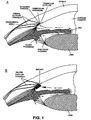
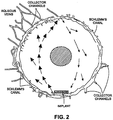
- the intracameral implants which are located adjacent to the TM , as shown in Figure 3 , provide a high drug concentration into the outflow channels and dilate the vessels in the episcleral and conjunctival venous plexus, thereby resulting in a novel mechanism of IOP reduction.
- the dilation appears 360 degrees around the eye since drug released from an implant positioned at the 6:00 O'clock position is well-mixed throughout the anterior segment through the convection currents.
- This incremental reduction in the IOP with the intracameral bimatoprost implants is advantageous for patients with ocular hypertension and open angle glaucoma that require sustained reduction in IOP to prevent progressive optic neuropathy.
- Patients can avoid the need for combination eye drops and/or surgery (including incisional surgery such as trabeculectomy, laser procedures such as ALT and SLT, and aqueous humor bypass stents), if they are able to achieve profound reductions in IOP with the intracameral implant described herein.
- controlled and sustained administration of a therapeutic agent through the use of one or more intraocular implants may improve treatment of undesirable ocular conditions, in particular glaucoma.
- the implants comprise a pharmaceutically acceptable polymeric composition and are formulated to release one or more pharmaceutically active agents, such as a prostamide, over an extended period of time.
- the implants are effective to provide a therapeutically effective dosage of the agent or agents directly to a region of the eye to treat or prevent one or more undesirable ocular conditions.
- therapeutic agents will be made available at the site where they are needed and will be maintained for an extended period of time, rather than subjecting the patient to repeated injections or repeated administration of topical drops.
- the above implants are utilized in a method of treating glaucoma comprising the step of placing a biodegradable intraocular implant in an eye of the patient, the implant comprising a prostamide and a biodegradable polymer matrix that releases prostamide at a rate effective to sustain an amount of prostamide effective to prevent or reduce a symptom of the ocular condition, wherein said ocular condition is elevated IOP and said implant is placed in an intracameral location to dilate the outflow channels of the eye emanating from Schlemm's Canal.
- An intraocular implant in accordance with the disclosure herein comprises a therapeutic component.
- the therapeutic component comprises, consists essentially of, or consists of, a prostamide.
- a drug release sustaining component may be associated with the therapeutic component to sustain release of an effective amount of the prostamide into an eye in which the implant is placed. The amount of the prostamide is released into the eye for a period of time greater than about one week after the implant is placed in the eye, and is effective in treating or reducing a symptom of an ocular condition.
- the implant is made of polymeric materials to provide maximal approximation of the implant to the iridocorneal angle.
- the size of the implant which ranges from a diameter of approximately 0.1 to 1 mm, and lengths from 0.1 to 6 mm, enables the implant to be inserted into the anterior chamber using an applicator with a small gauge needle ranging from 22 to 30G.
- an "intraocular implant” refers to a device or element that is structured, sized, or otherwise configured to be placed in an eye. Intraocular implants are generally biocompatible with physiological conditions of an eye and do not cause adverse side effects. Intraocular implants may be placed in an eye without disrupting vision of the eye.
- a "therapeutic component” refers to a portion of an intraocular implant comprising one or more therapeutic agents or substances used to treat a medical condition of the eye.
- the therapeutic component may be a discrete region of an intraocular implant, or it may be homogenously distributed throughout the implant.
- the therapeutic agents of the therapeutic component are typically ophthalmically acceptable, and are provided in a form that does not cause adverse reactions when the implant is placed in an eye.
- a drug release sustaining component refers to a portion of the intraocular implant that is effective to provide a sustained release of the therapeutic agents of the implant.
- a drug release sustaining component may be a biodegradable polymer matrix, or it may be a coating covering a core region of the implant that comprises a therapeutic component.
- association with means mixed with, dispersed within, coupled to, covering, or surrounding.
- an "ocular region” or “ocular site” refers generally to any area of the eyeball, including the anterior and posterior segment of the eye, and which generally includes, but is not limited to, any functional (e.g., for vision) or structural tissues found in the eyeball, or tissues or cellular layers that partly or completely line the interior or exterior of the eyeball.
- areas of the eyeball in an ocular region include the anterior chamber, the posterior chamber, the vitreous cavity, the choroid, the suprachoroidal space, the conjunctiva, the subconjunctival space, the episcleral space, the intracomeal space, the epicorneal space, the sclera, the pars plana, surgically induced avascular regions, the macula, and the retina.
- an "ocular condition" is a disease, ailment or condition which affects or involves the eye or one of the parts or regions of the eye.
- the eye includes the eyeball and the tissues and fluids which constitute the eyeball, the periocular muscles (such as the oblique and rectus muscles) and the portion of the optic nerve which is within or adjacent to the eyeball.
- An anterior ocular condition is a disease, ailment or condition which affects or which involves an anterior (i.e. front of the eye) ocular region or site, such as a periocular muscle, an eye lid or an eye ball tissue or fluid which is located anterior to the posterior wall of the lens capsule or ciliary muscles.
- an anterior ocular condition primarily affects or involves the conjunctiva, the cornea, the anterior chamber, the iris, the posterior chamber (behind the retina but in front of the posterior wall of the lens capsule), the lens or the lens capsule and blood vessels and nerve which vascularize or innervate an anterior ocular region or site.
- an anterior ocular condition can include a disease, ailment or condition, such as for example, aphakia; pseudophakia; astigmatism; blepharospasm; cataract; conjunctival diseases; conjunctivitis; corneal diseases; corneal ulcer, dry eye syndromes; eyelid diseases; lacrimal apparatus diseases; lacrimal duct obstruction; myopia; presbyopia; pupil disorders; refractive disorders and strabismus.
- Glaucoma can also be considered to be an anterior ocular condition because a clinical goal of glaucoma treatment can be to reduce a hypertension of aqueous fluid in the anterior chamber of the eye (i.e. reduce intraocular pressure).
- a posterior ocular condition is a disease, ailment or condition which primarily affects or involves a posterior ocular region or site such as choroid or sclera (in a position posterior to a plane through the posterior wall of the lens capsule), vitreous, vitreous chamber, retina, optic nerve (i.e. the optic disc), and blood vessels and nerves which vascularize or innervate a posterior ocular region or site.
- a posterior ocular region or site such as choroid or sclera (in a position posterior to a plane through the posterior wall of the lens capsule), vitreous, vitreous chamber, retina, optic nerve (i.e. the optic disc), and blood vessels and nerves which vascularize or innervate a posterior ocular region or site.
- a posterior ocular condition can include a disease, ailment or condition, such as for example, acute macular neuroretinopathy; Behcet's disease; choroidal neovascularization; diabetic uveitis; histoplasmosis; infections, such as fungal or viral-caused infections; macular degeneration, such as acute macular degeneration, non-exudative age related macular degeneration and exudative age related macular degeneration; edema, such as macular edema, cystoid macular edema and diabetic macular edema; multifocal choroiditis; ocular trauma which affects a posterior ocular site or location; ocular tumors; retinal disorders, such as central retinal vein occlusion, diabetic retinopathy (including proliferative diabetic retinopathy), proliferative vitreoretinopathy (PVR), retinal arterial occlusive disease, retinal detachment, uveitic retinal
- biodegradable polymer refers to a polymer or polymers which degrade in vivo, and wherein erosion of the polymer or polymers over time occurs concurrent with or subsequent to release of the therapeutic agent.
- hydrogels such as methylcellulose which act to release drug through polymer swelling are specifically excluded from the term “biodegradable polymer”.
- biodegradable and “bioerodible” are equivalent and are used interchangeably herein.
- a biodegradable polymer may be a homopolymer, a copolymer, or a polymer comprising more than two different polymeric units.
- treat refers to reduction or resolution or prevention of an ocular condition, ocular injury or damage, or to promote healing of injured or damaged ocular tissue.
- a treatment is usually effective to reduce at least one symptom of an ocular condition, ocular injury or damage.
- a therapeutically effective amount of a therapeutic agent such as a prostamide, is an amount that is effective in reducing at least one symptom of an ocular condition.
- Intraocular implants have been developed which can release drug loads over various time periods. These implants, which when inserted into an eye, such as the vitreous of an eye, provide therapeutic levels of a prostamide for extended periods of time (e.g., for about 1 week or more).
- the disclosed implants are effective in treating ocular conditions, such as ocular conditions associated with elevated intraocular pressure, and more specifically in reducing at least one symptom of glaucoma.
- an intraocular implant comprises a biodegradable polymer matrix.
- the biodegradable polymer matrix is one type of a drug release-sustaining component.
- the biodegradable polymer matrix is effective in forming a biodegradable intraocular implant.
- the biodegradable intraocular implant comprises a prostamide associated with the biodegradable polymer matrix. The matrix degrades at a rate effective to sustain release of an amount of the prostamide for a time greater than about one week from the time in which the implant is placed in ocular region or ocular site, such as the vitreous of an eye.
- the prostamide component of the implant includes one or more types of prostamides.
- the prostamide component comprises a compound having the formula (I). wherein the dashed bonds represent a single or double bond which can be in the cis or trans configuration,
- A is an alkylene or alkenylene radical having from two to six carbon atoms, which radical may be interrupted by one or more oxide radicals and substituted with one or more hydroxy, oxo, alkyloxy or akylcarboxy groups wherein said alkyl radical comprises from one to six carbon atoms;
- B is a cycloalkyl radical having from three to seven carbon atoms, or an aryl radical, selected from the group consisting of hydrocarbyl aryl and heteroaryl radicals having from four to ten carbon atoms wherein the heteroatom is selected from the group consisting of nitrogen, oxygen and sulfur atoms;
- X is --N(R 4 ) .2 wherein R.4 is independently selected from the group consisting of hydrogen and lower
- Pharmaceutically acceptable acid addition salts of the compounds of the invention are those formed from acids which form non-toxic addition salts containing pharmaceutically acceptable anions, such as the hydrochloride, hydrobromide, hydroiodide, sulfate, or bisulfate, phosphate or acid phosphate, acetate, maleate, fumarate, oxalate, lactate, tartrate, citrate, gluconate, saccharate and p-toluene sulphonate salts.
- pharmaceutically acceptable anions such as the hydrochloride, hydrobromide, hydroiodide, sulfate, or bisulfate, phosphate or acid phosphate, acetate, maleate, fumarate, oxalate, lactate, tartrate, citrate, gluconate, saccharate and p-toluene sulphonate salts.
- the prostamide comprises a compound wherein R 1 , R 2 and R 3 are OH, y is 1, x is 0, n is 0 and X is N(H)(C 2 H 5 ) ,e.g.. cyclopentane N-ethyl heptenamide-5-cis-2-(3 ⁇ .-hydroxy-5-phenyl-1-trans-pentenyl)-3,5-dihydroxy, [1 ⁇ .,2 ⁇ .,3 ⁇ ,5 ⁇ .].
- the compound, cyclopentane N-ethyl heptenamide-5-cis-2-(3 ⁇ .-hydroxy-5-phenyl-1-trans-pentenyl)-3, 5-dihydroxy, [1 ⁇ .,2 ⁇ .,3 ⁇ ,5 ⁇ .], is also known as bimatoprost and is publicly available in a topical ophthalmic solution under the tradename, Lumigan.RTM. (Allergan, Inc., CA).
- the prostamide may be any of the prostamides disclosed in US Patent No. 6,3 95,787 .
- the implant may comprise a therapeutic component which comprises, consists essentially of, or consists of bimatoprost, a salt thereof, or mixtures thereof.
- the prostamide may be in a particulate or powder form and it may be entrapped by the biodegradable polymer matrix.
- prostamide particles will have an effective average size less than about 3000 nanometers.
- the particles may have an effective average particle size about an order of magnitude smaller than 3000 nanometers.
- the particles may have an effective average particle size of less than about 500 nanometers.
- the particles may have an effective average particle size of less than about 400 nanometers, and in still further embodiments, a size less than about 200 nanometers.
- the prostamide of the implant is preferably from about 10% to 90% by weight of the implant. More preferably, the prostamide is from about 20% to about 80% by weight of the implant. In a preferred embodiment, the prostamide comprises about 20% by weight of the implant (e.g., 15%-25%). In another embodiment, the prostamide comprises about 50% by weight of the implant.
- Suitable polymeric materials or compositions for use in the implant include those materials which are compatible, that is biocompatible, with the eye so as to cause no substantial interference with the functioning or physiology of the eye. Such materials preferably are at least partially and more preferably substantially completely biodegradable or bioerodible.
- useful polymeric materials include, without limitation, such materials derived from and/or including organic esters and organic ethers, which when degraded result in physiologically acceptable degradation products, including the monomers.
- polymeric materials derived from and/or including, anhydrides, amides, orthoesters and the like, by themselves or in combination with other monomers may also find use.
- the polymeric materials may be addition or condensation polymers, advantageously condensation polymers.
- the polymeric materials may be cross-linked or non-cross-linked, for example not more than lightly cross-linked, such as less than about 5%, or less than about 1% of the polymeric material being cross-linked. For the most part, besides carbon and hydrogen, the polymers will include at least one of oxygen and nitrogen, advantageously oxygen.
- the oxygen may be present as oxy, e.g. hydroxy or ether, carbonyl, e.g. non-oxo-carbonyl, such as carboxylic acid ester, and the like.
- the nitrogen may be present as amide, cyano and amino.
- Polyesters of interest include polymers of D-lactic acid, L-lactic acid, racemic lactic acid, glycolic acid, polycaprolactone, and combinations thereof.
- L-lactate or D-lactate a slowly eroding polymer or polymeric material is achieved, while erosion is substantially enhanced with the lactate racemate.
- polysaccharides are, without limitation, calcium alginate, and functionalized celluloses, particularly carboxymethylcellulose esters characterized by being water insoluble, a molecular weight of about 5 kD to 500 kD, for example.
- polymers of interest include, without limitation, polyvinyl alcohol, polyesters, polyethers and combinations thereof which are biocompatible and may be biodegradable and/or bioerodible.
- Some preferred characteristics of the polymers or polymeric materials for use in the present invention may include biocompatibility, compatibility with the therapeutic component, ease of use of the polymer in making the drug delivery systems of the present invention, a half-life in the physiological environment of at least about 6 hours, preferably greater than about one day, not significantly increasing the viscosity of the vitreous, and water insolubility.
- the biodegradable polymeric materials which are included to form the matrix are desirably subject to enzymatic or hydrolytic instability.
- Water-soluble polymers may be cross-linked with hydrolytic or biodegradable unstable cross-links to provide useful water insoluble polymers.
- the degree of stability can be varied widely, depending upon the choice of monomer, whether a homopolymer or copolymer is employed, employing mixtures of polymers, and whether the polymer includes terminal acid groups.
- the relative average molecular weight of the polymeric composition employed in the implant is the relative average molecular weight of the polymeric composition employed in the implant. Different molecular weights of the same or different polymeric compositions may be included in the implant to modulate the release profile. In certain implants, the relative average molecular weight of the polymer will range from about 9 to about 64 kD, usually from about 10 to about 54 kD, and more usually from about 12 to about 45 kD.
- copolymers of glycolic acid and lactic acid are used, where the rate of biodegradation is controlled by the ratio of glycolic acid to lactic acid.
- the most rapidly degraded copolymer has roughly equal amounts of glycolic acid and lactic acid.
- Homopolymers, or copolymers having ratios other than equal, are more resistant to degradation.
- the ratio of glycolic acid to lactic acid will also affect the brittleness of the implant, where a more flexible implant is desirable for larger geometries.
- the % of polylactic acid in the polylactic acid polyglycolic acid (PLGA) copolymer can be 0-100%, preferably about 15-85%, more preferably about 35-65%. In some implants, a 50/50 PLGA copolymer is used.
- the biodegradable polymer matrix of the intraocular implant may comprise a mixture of two or more biodegradable polymers.
- the implant may comprise a mixture of a first biodegradable polymer and a different second biodegradable polymer.
- One or more of the biodegradable polymers may have terminal acid groups.
- the matrix of the intraocular implant may release drug at a rate effective to sustain release of an amount of the prostamide component for more than one week after implantation into an eye. In certain implants, therapeutic amounts of the prostamide component are released for no more than about 30-35 days after implantation.
- an implant may comprise bimatoprost, and the matrix of the implant degrades at a rate effective to sustain release of a therapeutically effective amount of bimatoprost for about one month after being placed in an eye.
- the implant may comprise bimatoprost, and the matrix releases drug at a rate effective to sustain release of a therapeutically effective amount of bimatoprost for more than forty days, such as for about six months.
- biodegradable intraocular implant comprises a prostamide associated with a biodegradable polymer matrix, which comprises a mixture of different biodegradable polymers. At least one of the biodegradable polymers is a polylactide having a molecular weight of about 63.3 kD. A second biodegradable polymer is a polylactide having a molecular weight of about 14 kD. Such a mixture is effective in sustaining release of a therapeutically effective amount of the prostamide for a time period greater than about one month from the time the implant is placed in an eye.
- biodegradable intraocular implant comprises an prostamide associated with a biodegradable polymer matrix, which comprises a mixture of different biodegradable polymers, each biodegradable polymer having an inherent viscosity from about 0.16 dl/g to about 1.0 dl/g.
- a biodegradable polymer matrix which comprises a mixture of different biodegradable polymers, each biodegradable polymer having an inherent viscosity from about 0.16 dl/g to about 1.0 dl/g.
- one of the biodegradable polymers may have an inherent viscosity of about 0.3 dl/g.
- a second biodegradable polymer may have an inherent viscosity of about 1.0 dl/g.
- Additional implants may comprise biodegradable polymers that have an inherent viscosity between about 0.2 dl/g and 0.5 dl/g. The inherent viscosities identified above may be determined in 0.1% chloroform at 25.degree. C.
- One particular implant comprises bimatoprost associated with a combination of two different polylactide polymers.
- the bimatoprost is present in about 20% by weight of the implant.
- One polylactide polymer has a molecular weight of about 14 kD and an inherent viscosity of about 0.3 dl/g, and the other polylactide polymer has a molecular weight of about 63.3 kD and an inherent viscosity of about 1.0 dl/g.
- the two polylactide polymers are present in the implant in a 1:1 ratio.
- Such an implant may be effective in releasing the bimatoprost for more than two months.
- the implant is provided in the form of a rod or a filament produced by an extrusion process.
- a preferred implant formulation for the invention is API 30%, R203S 45%, R202H 20%, PEG 3350 5% or API 20%, R203S 45%, R202H 10%, RG752S 20%, PEG 3350 5%, wherein the API is bimatoprost.
- the range of concentrations of the constituents that can be used in the preferred implant formulation are API 5 to 40%, R203S 10 to 60%, R202H 5 to 20%, RG752S 5 to 40%, PEG 3350 0 to 15%.
- the PLA/PLGA polymers are from the Resomer product line available from Boehringer Ingelheim in Ingelheim, Germany and include the following: Resomer Monomer ratio i.v.
- the release of the prostamide from the intraocular implant comprising a biodegradable polymer matrix may include an initial burst of release followed by a gradual increase in the amount of the prostamide released, or the release may include an initial delay in release of the prostamide component followed by an increase in release.
- the percent of the prostamide that has been released is about one hundred.
- the implants disclosed herein do not completely release, or release about 100% of the prostamide, until after about one week of being placed in an eye.
- the prostamide may be desirable to provide a relatively constant rate of release of the prostamide from the implant over the life of the implant. For example, it may be desirable for the prostamide to be released in amounts from about 0.01 .mu.g to about 2 .mu.g per day for the life of the implant. However, the release rate may change to either increase or decrease depending on the formulation of the biodegradable polymer matrix.
- the release profile of the prostamide may include one or more linear portions and/or one or more non-linear portions. Preferably, the release rate is greater than zero once the implant has begun to degrade or erode.
- the implants may be monolithic, i.e. having the active agent or agents homogenously distributed through the polymeric matrix, or encapsulated, where a reservoir of active agent is encapsulated by the polymeric matrix. Due to ease of manufacture, monolithic implants are usually preferred over encapsulated forms. However, the greater control afforded by the encapsulated, reservoir-type implant may be of benefit in some circumstances, where the therapeutic level of the drug falls within a narrow window.
- the therapeutic component, including the prostamide may be distributed in a non-homogenous pattern in the matrix.
- the implant may include a portion that has a greater concentration of the prostamide relative to a second portion of the implant.
- the intraocular implants disclosed herein may have a size of between about 5 .mu.m and about 10 mm, or between about 10 .mu.m and about 1 mm for administration with a needle, greater than 1 mm, or greater than 2 mm, such as 3 mm or up to 10 mm, for administration by surgical implantation.
- the implants may have any appropriate length so long as the diameter of the implant permits the implant to move through a needle.
- implants having a length of about 6 mm to about 7 mm have been injected into an eye.
- the implants administered by way of a needle should have a diameter that is less than the inner diameter of the needle. In certain implants, the diameter is less than about 500 .mu.m.
- the vitreous chamber in humans is able to accommodate relatively large implants of varying geometries, having lengths of, for example, 1 to 10 mm.
- the implant may be a cylindrical pellet (e. g., rod) with dimensions of about 2 mm.times.0.75 mm diameter.
- the implant may be a cylindrical pellet with a length of about 7 mm to about 10 mm, and a diameter of about 0.75 mm to about 1.5 mm.
- the implants may also be at least somewhat flexible so as to facilitate both insertion of the implant in the eye, such as in the vitreous, and accommodation of the implant.
- the total weight of the implant is usually about 250-5000 .mu.g, more preferably about 500-1000 .mu.g.
- an implant may be about 500 .mu.g, or about 1000 .mu.g.
- the dimensions and total weight of the implant(s) may be larger or smaller, depending on the type of individual.
- humans have a vitreous volume of approximately 3.8 ml, compared with approximately 30 ml for horses, and approximately 60-100 ml for elephants.
- An implant sized for use in a human may be scaled up or down accordingly for other animals, for example, about 8 times larger for an implant for a horse, or about, for example, 26 times larger for an implant for an elephant.
- implants can be prepared where the center may be of one material and the surface may have one or more layers of the same or a different composition, where the layers may be cross-linked, or of a different molecular weight, different density or porosity, or the like.
- the center may be a polylactate coated with a polylactate-polyglycolate copolymer, so as to enhance the rate of initial degradation.
- the center may be polyvinyl alcohol coated with polylactate, so that upon degradation of the polylactate exterior the center would dissolve and be, rapidly washed out of the eye.
- the implants may be of any geometry including fibers, sheets, films, microspheres, spheres, circular discs, plaques and the like.
- the upper limit for the implant size will be determined by factors such as toleration for the implant, size limitations on insertion, ease of handling, etc.
- the sheets or films will be in the range of at least about 0.5 mm.times.0.5 mm, usually about 3-10 mm.times.5-10 mm with a thickness of about 0.1-1.0 mm for ease of handling.
- the fiber diameter will generally be in the range of about 0.05 to 3 mm and the fiber length will generally be in the range of about 0.5-10 mm.
- Spheres may be in the range of about 0.5 .mu.m to 4 mm in diameter, with comparable volumes for other shaped particles.
- the size and form of the implant can also be used to control the rate of release, period of treatment, and drug concentration at the site of implantation. Larger implants will deliver a proportionately larger dose, but depending on the surface to mass ratio, may have a slower release rate.
- the particular size and geometry of the implant are chosen to suit the site of implantation.
- the implant is sized to fit the anatomy of the iridocorneal angle of the eye.
- the proportions of the prostamide, polymer, and any other modifiers may be empirically determined by formulating several implants with varying proportions.
- a USP approved method for dissolution or release test can be used to measure the rate of release (USP 23; NF 18 (1995) pp. 1790-1798).
- USP 23; NF 18 (1995) pp. 1790-1798 For example, using the infinite sink method, a weighed sample of the implant is added to a measured volume of a solution containing 0.9% NaCl in water, where the solution volume will be such that the drug concentration is after release is less than 5% of saturation. The mixture is maintained at 37.degree. C. and stirred slowly to maintain the implants in suspension.
- the appearance of the dissolved drug as a function of time may be followed by various methods known in the art, such as spectrophotometrically, HPLC, mass spectroscopy, etc. until the absorbance becomes constant or until greater than 90% of the drug has been released.
- the intraocular implants may also include one or more additional ophthalmically acceptable therapeutic agents as described in US Patent Application 10/837,260 .
- one implant may comprise a combination of bimatoprost and a beta-adrenergic receptor antagonist. More specifically, the implant may comprise a combination of bimatoprost and Tirnolol.RTM. Or, an implant may comprise a combination of bimatoprost and a carbonic anyhdrase inhibitor. For example, the implant may comprise a combination of bimatoprost and dorzolamide (Trusopt.RTM.).
- One implant may comprise a combination of bimatoprost and latanoprost.
- Another implant may comprise a combination of bimatoprost and travoprost.
- the intraocular implants disclosed herein may include effective amounts of buffering agents, preservatives and the like.
- a benzylalkonium chloride preservative is provided in the implant, such as when the prostamide consists essentially of bimatoprost.
- release modulators such as those described in U.S. Pat. No. 5,869,079 may be included in the implants.
- the amount of release modulator employed will be dependent on the desired release profile, the activity of the modulator, and on the release profile of the prostamide in the absence of modulator.
- Electrolytes such as sodium chloride and potassium chloride may also be included in the implant.
- the buffering agent or enhancer is hydrophilic, it may also act as a release accelerator. Hydrophilic additives act to increase the release rates through faster dissolution of the material surrounding the drug particles, which increases the surface area of the drug exposed, thereby increasing the rate of drug bioerosion.
- an implant comprising bimatoprost and a biodegradable polymer matrix is able to release or deliver an amount of bimatoprost between about 0.1 mg to about 0.5 mg for about 3-6 months after implantation into the eye.
- the implant may be configured as a rod or a wafer.
- a rod-shaped implant may be derived from filaments extruded from a 720 .mu.m nozzle and cut into 1 mg size.
- a wafer-shaped implant may be a circular disc having a diameter of about 2.5 mm, a thickness of about 0.127 mm, and a weight of about 1 mg.
- the present implants are configured to release an amount of prostamide effective to treat an ocular condition, such as by reducing at least one symptom of the ocular condition. More specifically, the implants may be used in a method to treat glaucoma, such as open angle glaucoma, ocular hypertension, chronic angle-closure glaucoma, with patent iridotomy, psuedoexfoliative glaucoma, and pigmentary glaucoma.
- glaucoma such as open angle glaucoma, ocular hypertension, chronic angle-closure glaucoma, with patent iridotomy, psuedoexfoliative glaucoma, and pigmentary glaucoma.
- the implants disclosed herein may also be configured to release the prostamide or additional therapeutic agents, as described above, which to prevent or treat diseases or conditions, such as described in US Patent Application 10/837,260 .
- an implant such as the implants disclosed herein, is administered to a posterior segment of an eye of a human or animal patient, and preferably, a living human or animal.
- an implant is administered without accessing the subretinal space of the eye.
- a method of treating a patient may include placing the implant directly into the posterior chamber of the eye.
- a method of treating a patient may comprise administering an implant to the patient by at least one of intravitreal injection, subconjuctival injection, sub-tenon injections, retrobulbar injection, and suprachoroidal injection.
- a method of reducing intraocular pressure in an eye of a patient comprises administering one or more implants containing a prostamide, as disclosed herein, to a patient by at least one of intravitreal injection, subconjuctival injection, sub-tenon injection, retrobulbar injection, and suprachoroidal injection.
- a syringe apparatus including an appropriately sized needle for example, a 22-30 gauge needle, such as a 22 gauge needle, a 27 gauge needle, a 28 gauge needle, or a 30 gauge needle, can be effectively used to inject the composition with the posterior segment of an eye of a human or animal. Repeat injections are often not necessary due to the extended release of the prostamide from the implants.
- the method may include one or more additional steps of administering additional therapeutic agents to the eye, such as by topically administering compositions containing timolol, dorzolamide, and iatoprost, among others.
- the implant comprises a therapeutic component which consists essentially of bimatoprost, salts thereof, and mixtures thereof, and a biodegradable polymer matrix.
- the biodegradable polymer matrix may consist essentially of PLA, PLGA, or a combination thereof.
- Other implants disclosed herein may be configured such that the amount of the prostamide that is released from the implant within two days of being placed in the eye is less than about 95% of the total amount of the prostamide in the implant. In certain implants, 95% of the prostamide is not released until after about one week of being placed in an eye. In certain implants, about 50% of the prostamide is released within about one day of placement in the eye, and about 2% is released for about 1 month after being placed in the eye. In other implants, about 50% of the prostamide is released within about one day of placement in the eye, and about 1% is released for about 2 months after being placed in the eye.
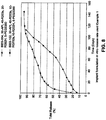
- a bimatoprost implant comprising Bimatoprost 30%, R203S 45%, R202H 20%, PEG 3350 5% was manufactured with a total implant weight of 900 mg (drug load 270 ug).
- the in vitro release rates of this implant are shown in Figure 8 .
- This implant releases ⁇ 70% over first 30 days.
- An implant with a 270 ug drug load would release 189ug over first 30 days or 6.3ug per day.
- the remainder of the implant (81ug) is released over the next 4 months (i.e. 675ng per day).
- a normal beagle dog was given general anesthesia and a 3 mm wide keratome knife was used to enter the anterior chamber of the right eye.
- the intracameral bimatoprost implant was placed in the anterior chamber and it settled out in the inferior angle within 24 hours.
- the IOP was reduced to approximately -60% from baseline and this was sustained for at least 5 months (See Figure 5 ).
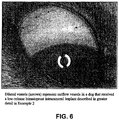
- the episcleral vessels are dilated.
- a bimatoprost implant comprising Bimatoprost 20%, R203S 45%, R202H 10%, RG752S 20%, PEG 3350 5% was manufactured with a total implant weight of 300ug or 600ug (drug loads of 60 or 120 ug, respectively).
- the in vitro release rates of this implant are shown in Figure 9 .
- the implant releases ⁇ 15% of the drug load over the first month.
- An implant with a 60ug drug load would release 9 ug over first 30 days or 300 ng per day, thereafter, it releases ⁇ 50 ug over 60 days or ⁇ 700ng/day.
- the episcleral vessels were dilated.
- Implants were loaded in a customized applicator with a 25G UTW needle. Under general anesthesia, normal beagle dogs had the implant inserted in the anterior chamber through clear cornea and the wound was self-sealing.
- the applicator is described in Published United States Patent Application 20080033351 .
- Pre-filled applicators were used to administer the implant to 4 dogs per dose. (It was noted that the Bimato IC DDS, which is disclosed in Published US Patent Application 20080033351 , releases only the amide. In Figures 12 and 13, PK data with different doses of the implant is shown. It is noted that there is a dose response, and the predominant species, especially in the ICB, is the amide.)
- the prostaglandin or prodrug thereof of the implant may include one or more types of prostaglandin or prodrug thereofs.
- the prostaglandin or prodrug thereof comprises a compound having the formula (1).
- A is an alkylene or alkenylene radical having from two to six carbon atoms, which radical may be interrupted by one or more oxide radicals and substituted with one or more hydroxy, oxo, alkyloxy or akylcarboxy groups wherein said alkyl radical comprises from one to six carbon atoms;
- B is a cycloalkyl radical having from three to seven carbon atoms, or an aryl radical, selected from the group consisting of hydrocarbyl aryl and heteroaryl radicals having from four to ten carbon atoms wherein the heteroatom is selected from the group consisting of nitrogen, oxygen and sulfur atoms;
- X is -(OR 4 ).
- the prostaglandin prodrug comprises a compound wherein R 1 , R 2 and R 3 are OH, y is 1, x is 0, n is 0 and X is (OC 3 H 7 ) ,e.g.. cyclopentane hepten-5-oic acid-cis-2-(3 ⁇ .-hydroxy-5-phenylpentyl)-3,5-dihydroxy, isopropyl ester [1 ⁇ .,2 ⁇ .,3 ⁇ ,5 ⁇ .], i.e. latanoprost.
- the prostaglandin prodrug comprises a compound wherein R 1 , R 2 and R 3 are OH, y is 0, x is 1, n is 1, Y is CF 3 and X is (OC 3 H 7 ) ,e.g.. cyclopentane hepten-5-oic acid-cis-2-(3 ⁇ .-hydroxy-5-phenylpentyl)-3, 5-dihydroxy, isopropyl ester [1 ⁇ .,2 ⁇ .,3 ⁇ ,5 ⁇ .], i.e. travoprost.
- the prostaglandin may be unuprostone.
- the implant may comprise a therapeutic component which comprises, consists essentially of, or consists of latanoprost, or travoprost or unoprostone.
Landscapes
- Health & Medical Sciences (AREA)
- Chemical & Material Sciences (AREA)
- Life Sciences & Earth Sciences (AREA)
- Pharmacology & Pharmacy (AREA)
- Veterinary Medicine (AREA)
- Public Health (AREA)
- General Health & Medical Sciences (AREA)
- Animal Behavior & Ethology (AREA)
- Medicinal Chemistry (AREA)
- Epidemiology (AREA)
- Ophthalmology & Optometry (AREA)
- Nuclear Medicine, Radiotherapy & Molecular Imaging (AREA)
- General Chemical & Material Sciences (AREA)
- Chemical Kinetics & Catalysis (AREA)
- Organic Chemistry (AREA)
- Bioinformatics & Cheminformatics (AREA)
- Engineering & Computer Science (AREA)
- Proteomics, Peptides & Aminoacids (AREA)
- Inorganic Chemistry (AREA)
- Heart & Thoracic Surgery (AREA)
- Cardiology (AREA)
- Pharmaceuticals Containing Other Organic And Inorganic Compounds (AREA)
- Medicinal Preparation (AREA)
- Materials For Medical Uses (AREA)
- Prostheses (AREA)
- Medicines That Contain Protein Lipid Enzymes And Other Medicines (AREA)
Claims (10)
- Prostamid zur Verwendung bei der Behandlung von Glaukom durch Platzieren eines bioabbaubaren intraokularen Implantats in einem Auge eines Patienten, der dieser Behandlung bedarf; wobei:das Implantat ein Prostamid in einer Menge von 15-25 % des Gewichts des Implantats umfasst, wobei das Prostamid mit einer bioabbaubaren Polymermatrix assoziiert ist, die eine Menge des Prostamids freisetzt, die ein Symptom von Glaukom wirksam verhindert oder reduziert; unddas Implantat in einer intrakameralen Lokalisation an der 6-Uhr-Position platziert wird, so dass die Ausflusskanäle des Auges, die vom Schlemm'schen Kanal ausgehen, dilatiert werden und dadurch sich das Prostamid innerhalb des vorderen Abschnitts mittels der Konvektionsströme gut durchmischt.
- Prostamid zur Verwendung gemäß Anspruch 1, wobei das Implantat in einer intrakameralen Lokalisation an der 6-Uhr-Position platziert wird, so dass die Gefäße im episkleralen und konjuktivalen venösen Plexus dilatiert werden.
- Prostamid zur Verwendung gemäß Anspruch 1, wobei das Implantat an der 6-Uhr-Position in der vorderen Augenkammer platziert wird.
- Prostamid zur Verwendung gemäß Anspruch 1, wobei das Implantat an der 6-Uhr-Position im iridokornealen Winkel des Auges platziert wird.
- Prostamid zur Verwendung gemäß Anspruch 1, wobei das Implantat im Auge unter Verwendung einer Okularimplantat-Abgabeanordnung platziert wird, die umfasst: (a) eine Kanüle mit einer äußeren Wand, einem proximalen Ende, einer Öffnung des Proximalen Endes, einem distalen Ende, einer Öffnung des distalen Endes und einem Lumen, das sich durch die Kanüle erstreckt; (b) ein Okularimplantat mit Größe und Struktur zur Implantierung in einem Auge, wobei das Okularimplantat sich in dem Lumen befindet; und (c) eine Kappe mit einem geschlossenen distalen Ende, die in Kontakt mit der äußeren Wand der Kanüle steht und das distale Ende und die Öffnung des distalen Endes der Kanüle abdeckt, wobei die Kappe eine Struktur aufweist, die das Durchführen des distalen Endes und der Öffnung des distalen Endes der Kanüle durch die Kappe ermöglicht, wenn die Kanüle in ein Auge eingeführt wird.
- Prostamid zur Verwendung gemäß Anspruch 1, wobei das Prostamid eine Verbindung mit der Formel (I) ist:

Z =O ist; eines von R1 und R2 =O, -OH oder eine-O(CO)R6-Gruppe ist und das andere -OH oder -O(CO)R6 ist oder R1 =O ist und R2 H ist; wobei R6 eine gesättigte oder ungesättigte acyclische Kohlenwasserstoffgruppe mit von 1 bis etwa 20 Kohlenstoffatomen oder -(CH2)mR7 ist, wobei m 0 bis 10 ist und R7 ein Cycloalkylrest mit von drei bis sieben Kohlenstoffatomen oder ein Hydrocarbylaryl oder Heteroaryl, wie oben definiert, ist. - Prostamid zur Verwendung gemäß Anspruch 6, wobei das Prostamid die folgende Formel (II) aufweist:

- Prostamid zur Verwendung gemäß Anspruch 7, wobei das Prostamid Bimatoprost, Salze davon oder Mischungen davon umfasst.
- Prostamid zur Verwendung gemäß einem der vorhergehenden Ansprüche, wobei der Durchmesser des Implantats weniger als 500 µm beträgt.
- Prostamid zur Verwendung gemäß einem der Ansprüche 1 bis 8, wobei das Implantat eine solche Größe aufweist, dass es in die Anatomie des iridokornealen Winkels des Auges passt.
Priority Applications (4)
| Application Number | Priority Date | Filing Date | Title |
|---|---|---|---|
| SI201131645T SI3205333T1 (sl) | 2010-04-16 | 2011-04-14 | Zniževanje intraokularnega tlaka z vsadki prostamida v prekatu |
| EP18187001.5A EP3456323A1 (de) | 2010-04-16 | 2011-04-14 | Minderung des intraokulardrucks mit intrakameralen bimatoprost-implantaten |
| PL16201104T PL3205333T3 (pl) | 2010-04-16 | 2011-04-14 | Zmniejszanie ciśnienia wewnątrzgałkowego z użyciem dokomorowych implantów zawierających prostamid |
| EP23202362.2A EP4316594A3 (de) | 2010-04-16 | 2011-04-14 | Intraokulare druckreduzierung mit intrakameralen bimatoprost-implantaten |
Applications Claiming Priority (4)
| Application Number | Priority Date | Filing Date | Title |
|---|---|---|---|
| US12/761,765 US8673341B2 (en) | 2004-04-30 | 2010-04-16 | Intraocular pressure reduction with intracameral bimatoprost implants |
| EP11717096.9A EP2558081B1 (de) | 2010-04-16 | 2011-04-14 | Minderung des intraokulardrucks mit intrakameralen bimatoprost-implantaten |
| EP14194703.6A EP2902018B1 (de) | 2010-04-16 | 2011-04-14 | Minderung des Intraokulardrucks mit intrakameralen Bimatoprost-Implantaten |
| PCT/US2011/032393 WO2011130462A2 (en) | 2010-04-16 | 2011-04-14 | Intraocular pressure reduction with intracameral bimatoprost implants |
Related Parent Applications (2)
| Application Number | Title | Priority Date | Filing Date |
|---|---|---|---|
| EP11717096.9A Division EP2558081B1 (de) | 2010-04-16 | 2011-04-14 | Minderung des intraokulardrucks mit intrakameralen bimatoprost-implantaten |
| EP14194703.6A Division EP2902018B1 (de) | 2010-04-16 | 2011-04-14 | Minderung des Intraokulardrucks mit intrakameralen Bimatoprost-Implantaten |
Related Child Applications (3)
| Application Number | Title | Priority Date | Filing Date |
|---|---|---|---|
| EP23202362.2A Division EP4316594A3 (de) | 2010-04-16 | 2011-04-14 | Intraokulare druckreduzierung mit intrakameralen bimatoprost-implantaten |
| EP18187001.5A Division-Into EP3456323A1 (de) | 2010-04-16 | 2011-04-14 | Minderung des intraokulardrucks mit intrakameralen bimatoprost-implantaten |
| EP18187001.5A Division EP3456323A1 (de) | 2010-04-16 | 2011-04-14 | Minderung des intraokulardrucks mit intrakameralen bimatoprost-implantaten |
Publications (2)
| Publication Number | Publication Date |
|---|---|
| EP3205333A1 EP3205333A1 (de) | 2017-08-16 |
| EP3205333B1 true EP3205333B1 (de) | 2018-10-03 |
Family
ID=44194969
Family Applications (5)
| Application Number | Title | Priority Date | Filing Date |
|---|---|---|---|
| EP14194703.6A Active EP2902018B1 (de) | 2010-04-16 | 2011-04-14 | Minderung des Intraokulardrucks mit intrakameralen Bimatoprost-Implantaten |
| EP11717096.9A Active EP2558081B1 (de) | 2010-04-16 | 2011-04-14 | Minderung des intraokulardrucks mit intrakameralen bimatoprost-implantaten |
| EP18187001.5A Withdrawn EP3456323A1 (de) | 2010-04-16 | 2011-04-14 | Minderung des intraokulardrucks mit intrakameralen bimatoprost-implantaten |
| EP23202362.2A Withdrawn EP4316594A3 (de) | 2010-04-16 | 2011-04-14 | Intraokulare druckreduzierung mit intrakameralen bimatoprost-implantaten |
| EP16201104.3A Active EP3205333B1 (de) | 2010-04-16 | 2011-04-14 | Minderung des intraokulardrucks mit intrakameralen prostamide-implantaten |
Family Applications Before (4)
| Application Number | Title | Priority Date | Filing Date |
|---|---|---|---|
| EP14194703.6A Active EP2902018B1 (de) | 2010-04-16 | 2011-04-14 | Minderung des Intraokulardrucks mit intrakameralen Bimatoprost-Implantaten |
| EP11717096.9A Active EP2558081B1 (de) | 2010-04-16 | 2011-04-14 | Minderung des intraokulardrucks mit intrakameralen bimatoprost-implantaten |
| EP18187001.5A Withdrawn EP3456323A1 (de) | 2010-04-16 | 2011-04-14 | Minderung des intraokulardrucks mit intrakameralen bimatoprost-implantaten |
| EP23202362.2A Withdrawn EP4316594A3 (de) | 2010-04-16 | 2011-04-14 | Intraokulare druckreduzierung mit intrakameralen bimatoprost-implantaten |
Country Status (21)
| Country | Link |
|---|---|
| US (3) | US8673341B2 (de) |
| EP (5) | EP2902018B1 (de) |
| JP (5) | JP5982360B2 (de) |
| KR (2) | KR101915326B1 (de) |
| CN (2) | CN103002884B (de) |
| AU (1) | AU2011239642B2 (de) |
| BR (1) | BR112012026535A2 (de) |
| CA (2) | CA3010374A1 (de) |
| CY (3) | CY1115912T1 (de) |
| DK (3) | DK2558081T3 (de) |
| ES (3) | ES2528117T3 (de) |
| HU (2) | HUE040529T2 (de) |
| IL (1) | IL222457A (de) |
| MX (2) | MX385821B (de) |
| PL (3) | PL2558081T3 (de) |
| PT (3) | PT3205333T (de) |
| RU (1) | RU2586298C2 (de) |
| SG (2) | SG10201606415UA (de) |
| SI (3) | SI3205333T1 (de) |
| TR (1) | TR201820663T4 (de) |
| WO (1) | WO2011130462A2 (de) |
Families Citing this family (63)
| Publication number | Priority date | Publication date | Assignee | Title |
|---|---|---|---|---|
| US7867186B2 (en) | 2002-04-08 | 2011-01-11 | Glaukos Corporation | Devices and methods for treatment of ocular disorders |
| ES2304438T3 (es) | 2001-04-07 | 2008-10-16 | Glaukos Corporation | Stent de glaucoma para el tratamiento del glaucoma. |
| US7431710B2 (en) | 2002-04-08 | 2008-10-07 | Glaukos Corporation | Ocular implants with anchors and methods thereof |
| US20060182781A1 (en) * | 2004-04-30 | 2006-08-17 | Allergan, Inc. | Methods for treating ocular conditions with cyclic lipid contraining microparticles |
| US8722097B2 (en) | 2004-04-30 | 2014-05-13 | Allergan, Inc. | Oil-in-water method for making polymeric implants containing a hypotensive lipid |
| US7799336B2 (en) | 2004-04-30 | 2010-09-21 | Allergan, Inc. | Hypotensive lipid-containing biodegradable intraocular implants and related methods |
| US8425929B2 (en) | 2004-04-30 | 2013-04-23 | Allergan, Inc. | Sustained release intraocular implants and methods for preventing retinal dysfunction |
| US7993634B2 (en) | 2004-04-30 | 2011-08-09 | Allergan, Inc. | Oil-in-oil emulsified polymeric implants containing a hypotensive lipid and related methods |
| US8673341B2 (en) | 2004-04-30 | 2014-03-18 | Allergan, Inc. | Intraocular pressure reduction with intracameral bimatoprost implants |
| US9498457B2 (en) * | 2004-04-30 | 2016-11-22 | Allergan, Inc. | Hypotensive prostamide-containing biodegradable intraocular implants and related implants |
| JP5748407B2 (ja) | 2006-11-10 | 2015-07-15 | グローコス コーポレーション | ブドウ膜強膜シャント |
| US8969415B2 (en) * | 2006-12-01 | 2015-03-03 | Allergan, Inc. | Intraocular drug delivery systems |
| US8846073B2 (en) | 2006-12-19 | 2014-09-30 | Allergan, Inc. | Low temperature processes for making cyclic lipid implants for intraocular use |
| US20170360609A9 (en) | 2007-09-24 | 2017-12-21 | Ivantis, Inc. | Methods and devices for increasing aqueous humor outflow |
| AU2009221859B2 (en) | 2008-03-05 | 2013-04-18 | Alcon Inc. | Methods and apparatus for treating glaucoma |
| WO2010093945A2 (en) | 2009-02-13 | 2010-08-19 | Glaukos Corporation | Uveoscleral drug delivery implant and methods for implanting the same |
| US20100247606A1 (en) * | 2009-03-25 | 2010-09-30 | Allergan, Inc. | Intraocular sustained release drug delivery systems and methods for treating ocular conditions |
| US20190021991A9 (en) * | 2009-05-18 | 2019-01-24 | Glaukos Corporation | Ocular implants configured to store and release stable drug formulations |
| US10206813B2 (en) | 2009-05-18 | 2019-02-19 | Dose Medical Corporation | Implants with controlled drug delivery features and methods of using same |
| US12478503B2 (en) | 2009-05-18 | 2025-11-25 | Glaukos Corporation | Implants with controlled drug delivery features and methods of using same |
| AU2010249683B2 (en) | 2009-05-18 | 2015-06-25 | Glaukos Corporation | Drug eluting ocular implant |
| AU2010256558B2 (en) | 2009-06-03 | 2013-10-03 | Forsight Labs, Llc | Anterior segment drug delivery |
| EP2451375B1 (de) | 2009-07-09 | 2018-10-03 | Ivantis, Inc. | Einzelbedienervorrichtung zur verabreichung eines augenimplantats |
| CN102481404B (zh) | 2009-07-09 | 2014-03-05 | 伊万提斯公司 | 眼部植入物 |
| ES2561083T3 (es) | 2010-01-22 | 2016-02-24 | Allergan, Inc. | Implantes intracamerales de agentes terapéuticos de liberación sostenida |
| AU2011256259A1 (en) | 2010-05-17 | 2012-11-08 | Novaer Holdings, Inc. | Drug delivery devices for delivery of ocular therapeutic agents |
| EP2654715B1 (de) | 2010-11-24 | 2017-01-25 | Dose Medical Corporation | Arzneimittelfreisetzendes augenimplantat |
| EP3494959A3 (de) | 2011-04-29 | 2019-09-11 | Allergan, Inc. | Latanoprost-implantat mit verzögerter freisetzung |
| US10245178B1 (en) | 2011-06-07 | 2019-04-02 | Glaukos Corporation | Anterior chamber drug-eluting ocular implant |
| US8657776B2 (en) | 2011-06-14 | 2014-02-25 | Ivantis, Inc. | Ocular implants for delivery into the eye |
| AU2012308317B2 (en) | 2011-09-14 | 2017-01-05 | Forsight Vision5, Inc. | Ocular insert apparatus and methods |
| US8663150B2 (en) | 2011-12-19 | 2014-03-04 | Ivantis, Inc. | Delivering ocular implants into the eye |
| CA2868341C (en) | 2012-03-26 | 2021-01-12 | Glaukos Corporation | System and method for delivering multiple ocular implants |
| US9358156B2 (en) | 2012-04-18 | 2016-06-07 | Invantis, Inc. | Ocular implants for delivery into an anterior chamber of the eye |
| US20150272877A1 (en) * | 2012-10-26 | 2015-10-01 | Allergan, Inc. | Ketorolac-containing sustained release drug delivery systems |
| SI2911623T1 (sl) | 2012-10-26 | 2019-12-31 | Forsight Vision5, Inc. | Oftalmični sistem za podaljšano sproščanje zdravila v oko |
| WO2014066653A1 (en) * | 2012-10-26 | 2014-05-01 | Allergan, Inc. | Ketorolac-containing sustained release intraocular drug delivery systems |
| US10617558B2 (en) | 2012-11-28 | 2020-04-14 | Ivantis, Inc. | Apparatus for delivering ocular implants into an anterior chamber of the eye |
| US10517759B2 (en) | 2013-03-15 | 2019-12-31 | Glaukos Corporation | Glaucoma stent and methods thereof for glaucoma treatment |
| US9289413B2 (en) * | 2013-03-15 | 2016-03-22 | Allergan, Inc. | Prostamide-containing intraocular implant |
| WO2014160828A1 (en) * | 2013-03-27 | 2014-10-02 | Forsight Vision5, Inc. | Bimatoprost ocular silicone inserts and methods of use thereof |
| CA2908645A1 (en) | 2013-04-01 | 2014-10-09 | Allergan, Inc. | Microsphere drug delivery system for sustained intraocular release |
| EP3351239B1 (de) * | 2013-10-31 | 2020-04-01 | Allergan, Inc. | Prostamidhaltige intraokularimplantate und verfahren zur verwendung davon |
| CA2950187A1 (en) | 2014-05-29 | 2015-12-03 | Glaukos Corporation | Implants with controlled drug delivery features and methods of using same |
| US10709547B2 (en) | 2014-07-14 | 2020-07-14 | Ivantis, Inc. | Ocular implant delivery system and method |
| EP3283004A4 (de) | 2015-04-13 | 2018-12-05 | Forsight Vision5, Inc. | Augeneinsatzzusammensetzung aus einem semikristallinen oder kristallinen pharmazeutischen wirkstoff |
| WO2017015675A1 (en) * | 2015-07-23 | 2017-01-26 | Envisia Therapeutics, Inc. | Glaucoma treatment via intracameral ocular implants |
| ES2962607T3 (es) | 2015-08-14 | 2024-03-20 | Alcon Inc | Implante ocular con sensor de presión |
| US11925578B2 (en) | 2015-09-02 | 2024-03-12 | Glaukos Corporation | Drug delivery implants with bi-directional delivery capacity |
| WO2017053885A1 (en) | 2015-09-25 | 2017-03-30 | Glaukos Corporation | Punctal implants with controlled drug delivery features and methods of using same |
| US11458041B2 (en) | 2015-10-08 | 2022-10-04 | Ocular Therapeutix, Inc. | Punctal plug and bioadhesives |
| WO2017106517A1 (en) | 2015-12-15 | 2017-06-22 | Ivantis, Inc. | Ocular implant and delivery system |
| EP3442479A1 (de) | 2016-04-20 | 2019-02-20 | Harold Alexander Heitzmann | Vorrichtung zur verabreichung eines bioresorbierbaren okularen medikaments |
| KR102520771B1 (ko) | 2016-09-23 | 2023-04-12 | 인셉트, 엘엘씨 | 전안방내 약물 전달 데포 |
| USD841152S1 (en) | 2017-06-27 | 2019-02-19 | Monica S. Naylor | Eye drop container |
| CN110573117B (zh) | 2017-10-06 | 2021-10-26 | 格劳科斯公司 | 用于递送多个眼部植入物的系统和方法 |
| USD846738S1 (en) | 2017-10-27 | 2019-04-23 | Glaukos Corporation | Implant delivery apparatus |
| CA3207829A1 (en) | 2018-02-22 | 2019-08-29 | Alcon Inc. | Ocular implant and delivery system |
| CN112566622A (zh) * | 2018-06-19 | 2021-03-26 | 细胞疗法有限责任公司 | 用于治疗青光眼或高眼压症的包含眼内压降低剂、cnp化合物、npr-b化合物、tie-2激动剂或神经营养剂的缓释药物递送系统 |
| EP3990042A4 (de) | 2019-06-27 | 2023-07-19 | Layerbio, Inc. | Verfahren und systeme zur freisetzung von augenvorrichtungen |
| DK3861985T3 (da) | 2020-02-06 | 2023-07-24 | Ocular Therapeutix Inc | Sammensætninger og fremgangsmåder til behandling af øjensygdomme |
| CN115768385A (zh) | 2020-04-27 | 2023-03-07 | 视觉治疗股份有限公司 | 治疗过敏性结膜炎的方法 |
| US11540940B2 (en) | 2021-01-11 | 2023-01-03 | Alcon Inc. | Systems and methods for viscoelastic delivery |
Family Cites Families (209)
| Publication number | Priority date | Publication date | Assignee | Title |
|---|---|---|---|---|
| AT252264B (de) | 1965-03-17 | 1967-02-10 | Etapharm Chem Pharm Lab Ges M | Verfahren zur Herstellung eines reinen hochviskosen Hyaluronsäurepräparates |
| US3393081A (en) * | 1966-12-06 | 1968-07-16 | Monsanto Co | Heat sealable moisture barrier coatings for polystyrene articles |
| US3749776A (en) | 1970-08-28 | 1973-07-31 | Allergan Pharma | Method for blocking prostaglandin activity |
| US3845770A (en) | 1972-06-05 | 1974-11-05 | Alza Corp | Osmatic dispensing device for releasing beneficial agent |
| US3916899A (en) | 1973-04-25 | 1975-11-04 | Alza Corp | Osmotic dispensing device with maximum and minimum sizes for the passageway |
| SE390255B (sv) | 1974-02-18 | 1976-12-13 | N G Y Torphammar | Upprullningsanordning foretredesvis for ett sekerhetsbelte i ett fordon |
| GB1478759A (en) | 1974-11-18 | 1977-07-06 | Alza Corp | Process for forming outlet passageways in pills using a laser |
| US3966749A (en) | 1975-02-10 | 1976-06-29 | Interx Research Corporation | Novel synthesis of optically active m-acyloxy-α-[(methylamino)methyl]benzyl alcohols, the pharmaceutically acceptable acid addition salts thereof and intermediate useful in the preparation thereof |
| US4014335A (en) | 1975-04-21 | 1977-03-29 | Alza Corporation | Ocular drug delivery device |
| US4144317A (en) | 1975-05-30 | 1979-03-13 | Alza Corporation | Device consisting of copolymer having acetoxy groups for delivering drugs |
| US4052505A (en) | 1975-05-30 | 1977-10-04 | Alza Corporation | Ocular therapeutic system manufactured from copolymer |
| US4057619A (en) | 1975-06-30 | 1977-11-08 | Alza Corporation | Ocular therapeutic system with selected membranes for administering ophthalmic drug |
| US4063064A (en) | 1976-02-23 | 1977-12-13 | Coherent Radiation | Apparatus for tracking moving workpiece by a laser beam |
| US4186184A (en) | 1977-12-27 | 1980-01-29 | Alza Corporation | Selective administration of drug with ocular therapeutic system |
| US4190642A (en) | 1978-04-17 | 1980-02-26 | Alza Corporation | Ocular therapeutic system for dispensing a medication formulation |
| US4200098A (en) | 1978-10-23 | 1980-04-29 | Alza Corporation | Osmotic system with distribution zone for dispensing beneficial agent |
| US4285957A (en) | 1979-04-10 | 1981-08-25 | Richardson-Merrell Inc. | 1-Piperidine-alkanol derivatives, pharmaceutical compositions thereof, and method of use thereof |
| US4303637A (en) | 1980-04-04 | 1981-12-01 | Alza Corporation | Medication indicated for ocular hypertension |
| US4281654A (en) | 1980-04-07 | 1981-08-04 | Alza Corporation | Drug delivery system for controlled ocular therapy |
| US4396625A (en) | 1980-05-13 | 1983-08-02 | Sumitomo Chemical Company, Limited | Treatment of glaucoma or ocular hypertension and ophthalmic composition |
| US4425346A (en) | 1980-08-01 | 1984-01-10 | Smith And Nephew Associated Companies Limited | Pharmaceutical compositions |
| US4304765A (en) | 1980-10-14 | 1981-12-08 | Alza Corporation | Ocular insert housing steroid in two different therapeutic forms |
| US4327725A (en) | 1980-11-25 | 1982-05-04 | Alza Corporation | Osmotic device with hydrogel driving member |
| JPS58126435U (ja) | 1982-02-19 | 1983-08-27 | オリンパス光学工業株式会社 | Ttlオ−トストロボ用絞り制御回路 |
| US4454151A (en) | 1982-03-22 | 1984-06-12 | Syntex (U.S.A.) Inc. | Use of pyrrolo pyrroles in treatment of ophthalmic diseases |
| US4599353A (en) | 1982-05-03 | 1986-07-08 | The Trustees Of Columbia University In The City Of New York | Use of eicosanoids and their derivatives for treatment of ocular hypertension and glaucoma |
| DE3220156C2 (de) | 1982-05-28 | 1990-01-25 | Heida Houston Tex. Thurlow | Mit Metallgriffen, insbesondere Edelstahlgriffen, versehenes Koch- und Bratgeschirr mit Deckel |
| US4649151A (en) | 1982-09-27 | 1987-03-10 | Health Research, Inc. | Drugs comprising porphyrins |
| US5166331A (en) | 1983-10-10 | 1992-11-24 | Fidia, S.P.A. | Hyaluronics acid fractions, methods for the preparation thereof, and pharmaceutical compositions containing same |
| US4521210A (en) | 1982-12-27 | 1985-06-04 | Wong Vernon G | Eye implant for relieving glaucoma, and device and method for use therewith |
| US4478818A (en) | 1982-12-27 | 1984-10-23 | Alza Corporation | Ocular preparation housing steroid in two different therapeutic forms |
| US6309669B1 (en) | 1984-03-16 | 2001-10-30 | The United States Of America As Represented By The Secretary Of The Army | Therapeutic treatment and prevention of infections with a bioactive materials encapsulated within a biodegradable-biocompatible polymeric matrix |
| US4693885A (en) | 1984-07-18 | 1987-09-15 | Nippon Petrochemicals Co., Ltd. | Tetrapyrrole therapeutic agents |
| US4675338A (en) | 1984-07-18 | 1987-06-23 | Nippon Petrochemicals Co., Ltd. | Tetrapyrrole therapeutic agents |
| FR2577509B1 (fr) | 1985-02-21 | 1987-05-07 | Nirvana Espar Systems Sa | Mat de bateau a voile |
| US4656186A (en) | 1985-04-30 | 1987-04-07 | Nippon Petrochemicals Co., Ltd. | Tetrapyrrole therapeutic agents |
| US4668506A (en) | 1985-08-16 | 1987-05-26 | Bausch & Lomb Incorporated | Sustained-release formulation containing and amino acid polymer |
| FR2594438B1 (fr) | 1986-02-14 | 1990-01-26 | Labaz Sanofi Nv | Derives d'indolizine, leur procede de preparation ainsi que les compositions en contenant |
| US4959217A (en) | 1986-05-22 | 1990-09-25 | Syntex (U.S.A.) Inc. | Delayed/sustained release of macromolecules |
| CA1311686C (en) | 1986-06-25 | 1992-12-22 | John Weldon Shell | Controlled release bioerodible drug delivery system |
| US4863457A (en) | 1986-11-24 | 1989-09-05 | Lee David A | Drug delivery device |
| US5089509A (en) | 1988-09-15 | 1992-02-18 | Allergan, Inc. | Disubstituted acetylenes bearing heteroaromatic and heterobicyclic groups having retinoid like activity |
| US4981871A (en) | 1987-05-15 | 1991-01-01 | Abelson Mark B | Treatment of ocular hypertension with class I calcium channel blocking agents |
| US4853224A (en) | 1987-12-22 | 1989-08-01 | Visionex | Biodegradable ocular implants |
| US4997652A (en) | 1987-12-22 | 1991-03-05 | Visionex | Biodegradable ocular implants |
| US4865846A (en) | 1988-06-03 | 1989-09-12 | Kaufman Herbert E | Drug delivery system |
| US4968715A (en) | 1988-07-06 | 1990-11-06 | Health Research, Inc. | Use of purified hematoporphyrin trimers in photodynamic therapy |
| US5190966A (en) | 1988-07-06 | 1993-03-02 | Health Research, Inc. | Purified hematoporphyrin dimers and trimers useful in photodynamic therapy |
| US5093349A (en) | 1988-07-20 | 1992-03-03 | Health Research Inc. | Photosensitizing agents |
| US5198460A (en) | 1988-07-20 | 1993-03-30 | Health Research Inc. | Pyropheophorbides and their use in photodynamic therapy |
| US5002962A (en) | 1988-07-20 | 1991-03-26 | Health Research, Inc. | Photosensitizing agents |
| ES2062102T5 (es) | 1988-09-06 | 2004-12-01 | Pharmacia Ab | Derivados de prostaglandinas para el tratamiento de glaucoma o hipertension ocular. |
| US4935498A (en) | 1989-03-06 | 1990-06-19 | Board Of Regents, The University Of Texas System | Expanded porphyrins: large porphyrin-like tripyrroledimethine-derived macrocycles |
| US5457183A (en) | 1989-03-06 | 1995-10-10 | Board Of Regents, The University Of Texas System | Hydroxylated texaphyrins |
| US5173504A (en) | 1989-04-21 | 1992-12-22 | Health Research, Inc. | Bacteriochlorophyll-a derivatives useful in photodynamic therapy |
| US5171741A (en) | 1989-04-21 | 1992-12-15 | Health Research, Inc. | Bacteriochlorophyll-a derivatives useful in photodynamic therapy |
| US5019400A (en) | 1989-05-01 | 1991-05-28 | Enzytech, Inc. | Very low temperature casting of controlled release microspheres |
| US4932984A (en) | 1989-07-27 | 1990-06-12 | The Dow Chemical Company | Process for reduction of chlorinated solvent emissions |
| US5028624A (en) | 1989-07-27 | 1991-07-02 | Allergan, Inc. | Intraocular pressure reducing 9,15-diacyl prostaglandins |
| US5034413A (en) | 1989-07-27 | 1991-07-23 | Allergan, Inc. | Intraocular pressure reducing 9,11-diacyl prostaglandins |
| US5268178A (en) | 1989-09-25 | 1993-12-07 | The Board Of Regents, The University Of Texas System | Biodegradable antibiotic implants and methods of their use in treating and preventing infections |
| US5503721A (en) | 1991-07-18 | 1996-04-02 | Hri Research, Inc. | Method for photoactivation |
| US5164188A (en) | 1989-11-22 | 1992-11-17 | Visionex, Inc. | Biodegradable ocular implants |
| US5075115A (en) | 1990-04-02 | 1991-12-24 | Fmc Corporation | Process for polymerizing poly(lactic acid) |
| US5232844A (en) | 1990-05-15 | 1993-08-03 | New York Blood Center | Photodynamic inactivation of viruses in cell-containing compositions |
| US5196460A (en) * | 1990-05-29 | 1993-03-23 | Repap Technologies Inc. | Rubber compositions containing high purity lignin derivatives |
| US5100431A (en) | 1990-09-27 | 1992-03-31 | Allergan, Inc. | Single stitch suture needle and method |
| KR0185215B1 (ko) | 1990-11-30 | 1999-05-01 | 요시다 쇼오지 | 서방성 안구삽입용 약제 |
| CA2055522A1 (en) | 1990-12-12 | 1992-06-13 | Masako Andoh | Microspheres for ophthalmic use |
| US5378475A (en) | 1991-02-21 | 1995-01-03 | University Of Kentucky Research Foundation | Sustained release drug delivery devices |
| MX9203083A (es) | 1991-06-21 | 1994-08-31 | Genetics Inst | Formulaciones farmaceuticas de proteinas osteogenicas. |
| US5356629A (en) | 1991-07-12 | 1994-10-18 | United States Surgical Corporation | Composition for effecting bone repair |
| US5169638A (en) | 1991-10-23 | 1992-12-08 | E. R. Squibb & Sons, Inc. | Buoyant controlled release powder formulation |
| US5543154A (en) | 1991-12-27 | 1996-08-06 | Merck & Co., Inc. | Controlled release nifedipine delivery device |
| US5656297A (en) | 1992-03-12 | 1997-08-12 | Alkermes Controlled Therapeutics, Incorporated | Modulated release from biocompatible polymers |
| US5384333A (en) | 1992-03-17 | 1995-01-24 | University Of Miami | Biodegradable injectable drug delivery polymer |
| IT1263116B (it) | 1992-04-09 | 1996-07-30 | Rotta Research Lab | Derivati basici dell'acido glutammico ed acido aspartico, procedimento per la loro preparazione e loro uso farmaceutico |
| US5655832A (en) | 1992-04-16 | 1997-08-12 | Tir Technologies, Inc. | Multiple wavelength light processor |
| US5244914A (en) | 1992-04-27 | 1993-09-14 | American Cyanamid Company | Stable porfimer sodium compositions and methods for their manufacture |
| US5178635A (en) | 1992-05-04 | 1993-01-12 | Allergan, Inc. | Method for determining amount of medication in an implantable device |
| US6217869B1 (en) | 1992-06-09 | 2001-04-17 | Neorx Corporation | Pretargeting methods and compounds |
| US5972991A (en) | 1992-09-21 | 1999-10-26 | Allergan | Cyclopentane heptan(ene) oic acid, 2-heteroarylalkenyl derivatives as therapeutic agents |
| US5688819A (en) | 1992-09-21 | 1997-11-18 | Allergan | Cyclopentane heptanoic acid, 2-cycloalkyl or arylalkyl derivatives as therapeutic agents |
| US5922773A (en) | 1992-12-04 | 1999-07-13 | The Children's Medical Center Corp. | Glaucoma treatment |
| US5707643A (en) | 1993-02-26 | 1998-01-13 | Santen Pharmaceutical Co., Ltd. | Biodegradable scleral plug |
| US5886026A (en) | 1993-07-19 | 1999-03-23 | Angiotech Pharmaceuticals Inc. | Anti-angiogenic compositions and methods of use |
| US5770589A (en) | 1993-07-27 | 1998-06-23 | The University Of Sydney | Treatment of macular degeneration |
| US5504074A (en) | 1993-08-06 | 1996-04-02 | Children's Medical Center Corporation | Estrogenic compounds as anti-angiogenic agents |
| US5385887A (en) | 1993-09-10 | 1995-01-31 | Genetics Institute, Inc. | Formulations for delivery of osteogenic proteins |
| US5443505A (en) | 1993-11-15 | 1995-08-22 | Oculex Pharmaceuticals, Inc. | Biocompatible ocular implants |
| US6051576A (en) | 1994-01-28 | 2000-04-18 | University Of Kentucky Research Foundation | Means to achieve sustained release of synergistic drugs by conjugation |
| DE4403326C1 (de) | 1994-02-03 | 1995-06-22 | Hans Reinhard Prof Dr Koch | Intraokulare Linsenanordnung zur Astigmatismuskorrektur |
| US5798349A (en) | 1994-03-14 | 1998-08-25 | The General Hospital Corporation | Use of green porphyrins to treat neovasculature in the eye |
| US5516522A (en) | 1994-03-14 | 1996-05-14 | Board Of Supervisors Of Louisiana State University | Biodegradable porous device for long-term drug delivery with constant rate release and method of making the same |
| US5466233A (en) | 1994-04-25 | 1995-11-14 | Escalon Ophthalmics, Inc. | Tack for intraocular drug delivery and method for inserting and removing same |
| US6290991B1 (en) | 1994-12-02 | 2001-09-18 | Quandrant Holdings Cambridge Limited | Solid dose delivery vehicle and methods of making same |
| US6270492B1 (en) | 1994-09-09 | 2001-08-07 | Cardiofocus, Inc. | Phototherapeutic apparatus with diffusive tip assembly |
| US5585401A (en) | 1994-12-09 | 1996-12-17 | The Reents Of The University Of California | Method for enhancing outflow of aqueous humor in treatment of glaucoma |
| US5972326A (en) | 1995-04-18 | 1999-10-26 | Galin; Miles A. | Controlled release of pharmaceuticals in the anterior chamber of the eye |
| US5612027A (en) | 1995-04-18 | 1997-03-18 | Galin; Miles A. | Controlled release of miotic and mydriatic drugs in the anterior chamber |
| US5869079A (en) | 1995-06-02 | 1999-02-09 | Oculex Pharmaceuticals, Inc. | Formulation for controlled release of drugs by combining hydrophilic and hydrophobic agents |
| US6369116B1 (en) | 1995-06-02 | 2002-04-09 | Oculex Pharmaceuticals, Inc. | Composition and method for treating glaucoma |
| HUP9700322A3 (en) | 1995-06-09 | 2001-03-28 | Euro Celtique Sa | Formulations and methods for providing prolonged local anesthesia |
| US5906920A (en) | 1995-08-29 | 1999-05-25 | The Salk Institute For Biological Studies | Methods for the detection of ligands for retinoid X receptors |
| US5958954A (en) | 1995-09-01 | 1999-09-28 | Allergan Sales, Inc. | Synthesis and use of retinoid compounds having negative hormone and/or antagonist activities |
| US5776699A (en) | 1995-09-01 | 1998-07-07 | Allergan, Inc. | Method of identifying negative hormone and/or antagonist activities |
| US5877207A (en) | 1996-03-11 | 1999-03-02 | Allergan Sales, Inc. | Synthesis and use of retinoid compounds having negative hormone and/or antagonist activities |
| AU4582797A (en) | 1996-09-13 | 1998-04-02 | Regents Of The University Of California, The | Methods for treatment of retinal diseases |
| US5913884A (en) | 1996-09-19 | 1999-06-22 | The General Hospital Corporation | Inhibition of fibrosis by photodynamic therapy |
| US6270749B1 (en) | 1996-12-11 | 2001-08-07 | Pharmacyclics, Inc. | Use of Texaphyrin in ocular diagnosis and therapy |
| US6274614B1 (en) | 1997-02-11 | 2001-08-14 | Qlt Inc. | Methods, compositions and articles for reducing or preventing the effects of inflammation |
| US5919970A (en) | 1997-04-24 | 1999-07-06 | Allergan Sales, Inc. | Substituted diaryl or diheteroaryl methanes, ethers and amines having retinoid agonist, antagonist or inverse agonist type biological activity |
| EP0994709A4 (de) | 1997-06-30 | 2006-02-01 | Allergan Inc | Calcium-blocker zur behandlung der proliferativen vitreoretinopathie |
| US6306426B1 (en) | 1997-08-11 | 2001-10-23 | Allergan Sales, Inc. | Implant device with a retinoid for improved biocompatibility |
| EP1003569B1 (de) | 1997-08-11 | 2004-10-20 | Allergan, Inc. | Steriles retinoid enthaltendes biodegradierbares implantat mit verbesserter biocompatibilität und verfahren zu dessen herstellung |
| FR2767699A1 (fr) * | 1997-08-28 | 1999-02-26 | Oreal | Composition filmogene epaissie |
| US6207713B1 (en) * | 1997-09-17 | 2001-03-27 | Eric T. Fossel | Topical and oral delivery of arginine to cause beneficial effects |
| US6646001B2 (en) | 1997-12-19 | 2003-11-11 | Alcon Manufacturing, Ltd. | Use of non-steroidal anti-inflammatory agents in combination with prostaglandin FP receptor agonists to treat glaucoma and ocular hypertension |
| US6271220B1 (en) | 1998-03-11 | 2001-08-07 | Allergan Sales, Inc. | Anti-angiogenic agents |
| ATE428345T1 (de) | 1998-07-09 | 2009-05-15 | Curelight Medical Ltd | Vorrichtung und verfahren zur wirkungsvollen hochenergetischen photodynamischen therapie von akne vulgaris und seborrhoe |
| EP1130996B1 (de) | 1998-11-20 | 2005-04-13 | The University of Connecticut | Generisch integriete implantierbare potentiostat fernmessanordnung für elektrochemische fühler |
| US6217895B1 (en) | 1999-03-22 | 2001-04-17 | Control Delivery Systems | Method for treating and/or preventing retinal diseases with sustained release corticosteroids |
| US6482854B1 (en) | 1999-03-25 | 2002-11-19 | Massachusetts Eye And Ear Infirmary | Glaucoma treatment |
| US6290713B1 (en) | 1999-08-24 | 2001-09-18 | Thomas A. Russell | Flexible illuminators for phototherapy |
| US6317616B1 (en) | 1999-09-15 | 2001-11-13 | Neil David Glossop | Method and system to facilitate image guided surgery |
| KR100732262B1 (ko) | 1999-10-21 | 2007-06-25 | 알콘, 인코퍼레이티드 | 약물 전달 장치 |
| US6331313B1 (en) | 1999-10-22 | 2001-12-18 | Oculex Pharmaceticals, Inc. | Controlled-release biocompatible ocular drug delivery implant devices and methods |
| EP1096719A3 (de) | 1999-11-01 | 2007-12-05 | Matsushita Electric Industrial Co., Ltd. | Verfahren und System zur Relaisdatenwiederübertragung |
| US6319273B1 (en) | 1999-12-16 | 2001-11-20 | Light Sciences Corporation | Illuminating device for treating eye disease |
| US6395787B1 (en) | 2000-02-08 | 2002-05-28 | Allergan Sales, Inc. | Ocular hypotensive lipids |
| EP1997513B1 (de) | 2000-02-10 | 2012-04-11 | Massachusetts Eye & Ear Infirmary | Kombinationen und Zubereitung zur Anwendung in PDT zur Behandlung von Augenleiden mit unerwünschter choriodaler Neovascularisation |
| US7708711B2 (en) | 2000-04-14 | 2010-05-04 | Glaukos Corporation | Ocular implant with therapeutic agents and methods thereof |
| US20040208910A1 (en) | 2000-04-26 | 2004-10-21 | Control Delivery Systems, Inc. | Sustained release device and method for ocular delivery of adrenergic agents |
| US6726918B1 (en) | 2000-07-05 | 2004-04-27 | Oculex Pharmaceuticals, Inc. | Methods for treating inflammation-mediated conditions of the eye |
| PE20020146A1 (es) | 2000-07-13 | 2002-03-31 | Upjohn Co | Formulacion oftalmica que comprende un inhibidor de ciclooxigenasa-2 (cox-2) |
| CN100569291C (zh) | 2000-07-14 | 2009-12-16 | 阿勒根公司 | 含有α-2肾上腺素能激动剂的组合物 |
| US6357568B1 (en) | 2000-09-27 | 2002-03-19 | Shou Mao Chen | Structure for protecting a luggage shell |
| AU2002248284A1 (en) | 2000-11-01 | 2002-08-06 | Allergan, Inc. | Compositions for treatment of ocular neovascularization |
| ATE306951T1 (de) | 2000-11-29 | 2005-11-15 | Allergan Inc | Verhinderung von transplantatabstossung im auge |
| US6595945B2 (en) | 2001-01-09 | 2003-07-22 | J. David Brown | Glaucoma treatment device and method |
| US6713081B2 (en) | 2001-03-15 | 2004-03-30 | The United States Of America As Represented By The Department Of Health And Human Services | Ocular therapeutic agent delivery devices and methods for making and using such devices |
| US7563255B2 (en) | 2001-05-03 | 2009-07-21 | Massachusetts Eye And Ear Infirmary | Implantable drug delivery device and use thereof |
| TWI298257B (en) | 2001-05-31 | 2008-07-01 | Allergan Inc | Hypotensive lipid and timolol compositions and methods of using same |
| US6713268B2 (en) | 2001-06-26 | 2004-03-30 | Allergan, Inc. | Methods of identifying ocular hypotensive compounds having reduced hyperpigmentation |
| US20030220376A1 (en) | 2001-08-10 | 2003-11-27 | Pharmacia Corporation | Methods for treating carbonic anhydrase mediated disorders |
| US20030100594A1 (en) | 2001-08-10 | 2003-05-29 | Pharmacia Corporation | Carbonic anhydrase inhibitor |
| US7749528B2 (en) | 2001-08-29 | 2010-07-06 | Ricardo Azevedo Pontes De Carvalho | Implantable and sealable medical device for unidirectional delivery of therapeutic agents to tissues |
| GB0122318D0 (en) * | 2001-09-14 | 2001-11-07 | Novartis Ag | Organic compounds |
| WO2003027102A1 (en) | 2001-09-27 | 2003-04-03 | Allergan, Inc. | 3-(arylamino)methylene-1, 3-dihydro-2h-indol-2-ones as kinase inhibitors |
| US20040058313A1 (en) | 2002-04-24 | 2004-03-25 | Abreu Marcio Marc | Compositions, targets, methods and devices for the therapy of ocular and periocular disorders |
| WO2003092665A2 (en) | 2002-05-02 | 2003-11-13 | Massachusetts Eye And Ear Infirmary | Ocular drug delivery systems and use thereof |
| CA2496797C (en) | 2002-08-29 | 2012-01-10 | Santen Pharmaceutical Co., Ltd. | Therapeutic agent for glaucoma comprising rho kinase inhibitor and prostaglandin |
| CN1301692C (zh) * | 2002-09-18 | 2007-02-28 | 阿勒根公司 | 眼植入物导入的器械 |
| US6899717B2 (en) | 2002-09-18 | 2005-05-31 | Allergan, Inc. | Methods and apparatus for delivery of ocular implants |
| WO2004043432A2 (en) | 2002-11-06 | 2004-05-27 | Alza Corporation | Controlled release depot formulations |
| JP2004196787A (ja) | 2002-12-04 | 2004-07-15 | Santen Pharmaceut Co Ltd | 結膜下デポによるドラッグデリバリーシステム |
| US20040137059A1 (en) | 2003-01-09 | 2004-07-15 | Thierry Nivaggioli | Biodegradable ocular implant |
| US20090148527A1 (en) | 2007-12-07 | 2009-06-11 | Robinson Michael R | Intraocular formulation |
| US7186744B2 (en) | 2003-11-13 | 2007-03-06 | Allergan, Inc. | Prostamides for the treatment of glaucoma and related diseases |
| JP2007520496A (ja) | 2004-02-04 | 2007-07-26 | レットメッド ピーティーワイ リミテッド | 徐放性ステロイド組成物 |
| US7799336B2 (en) | 2004-04-30 | 2010-09-21 | Allergan, Inc. | Hypotensive lipid-containing biodegradable intraocular implants and related methods |
| US8722097B2 (en) | 2004-04-30 | 2014-05-13 | Allergan, Inc. | Oil-in-water method for making polymeric implants containing a hypotensive lipid |
| US20050244465A1 (en) | 2004-04-30 | 2005-11-03 | Allergan, Inc. | Drug delivery systems and methods for treatment of an eye |
| US7993634B2 (en) | 2004-04-30 | 2011-08-09 | Allergan, Inc. | Oil-in-oil emulsified polymeric implants containing a hypotensive lipid and related methods |
| US7589057B2 (en) | 2004-04-30 | 2009-09-15 | Allergan, Inc. | Oil-in-water method for making alpha-2 agonist polymeric drug delivery systems |
| US20050244469A1 (en) | 2004-04-30 | 2005-11-03 | Allergan, Inc. | Extended therapeutic effect ocular implant treatments |
| US20060182781A1 (en) | 2004-04-30 | 2006-08-17 | Allergan, Inc. | Methods for treating ocular conditions with cyclic lipid contraining microparticles |
| US8673341B2 (en) | 2004-04-30 | 2014-03-18 | Allergan, Inc. | Intraocular pressure reduction with intracameral bimatoprost implants |
| US20050244478A1 (en) | 2004-04-30 | 2005-11-03 | Allergan, Inc. | Anti-excititoxic sustained release intraocular implants and related methods |
| US7771742B2 (en) | 2004-04-30 | 2010-08-10 | Allergan, Inc. | Sustained release intraocular implants containing tyrosine kinase inhibitors and related methods |
| US20050244462A1 (en) | 2004-04-30 | 2005-11-03 | Allergan, Inc. | Devices and methods for treating a mammalian eye |
| US8147865B2 (en) | 2004-04-30 | 2012-04-03 | Allergan, Inc. | Steroid-containing sustained release intraocular implants and related methods |
| US20050244463A1 (en) * | 2004-04-30 | 2005-11-03 | Allergan, Inc. | Sustained release intraocular implants and methods for treating ocular vasculopathies |
| US20050244466A1 (en) | 2004-04-30 | 2005-11-03 | Allergan, Inc. | Photodynamic therapy in conjunction with intraocular implants |
| US20050244471A1 (en) | 2004-04-30 | 2005-11-03 | Allergan, Inc. | Estradiol derivative and estratopone containing sustained release intraocular implants and related methods |
| US20050244461A1 (en) | 2004-04-30 | 2005-11-03 | Allergan, Inc. | Controlled release drug delivery systems and methods for treatment of an eye |
| US20050244458A1 (en) * | 2004-04-30 | 2005-11-03 | Allergan, Inc. | Sustained release intraocular implants and methods for treating ocular neuropathies |
| US8685435B2 (en) | 2004-04-30 | 2014-04-01 | Allergan, Inc. | Extended release biodegradable ocular implants |
| US8425929B2 (en) | 2004-04-30 | 2013-04-23 | Allergan, Inc. | Sustained release intraocular implants and methods for preventing retinal dysfunction |
| US8119154B2 (en) | 2004-04-30 | 2012-02-21 | Allergan, Inc. | Sustained release intraocular implants and related methods |
| US7091231B2 (en) | 2004-12-10 | 2006-08-15 | Allergan, Inc. | 12-Aryl prostaglandin analogs |
| EP1856042B1 (de) | 2005-03-10 | 2012-06-27 | Allergan, Inc. | Substituierte gammalactame als therapeutika |
| US7585895B2 (en) | 2005-12-06 | 2009-09-08 | Allergan, Inc. | Therapeutic substituted cyclopentanes |
| US7427685B2 (en) | 2005-12-06 | 2008-09-23 | Allergan, Inc. | Therapeutic substituted cyclopentanes |
| BRPI0619966A2 (pt) | 2005-12-16 | 2011-10-25 | Alcon Inc | controle de pressão intra-ocular usando agentes de modulação de alk5 |
| CA2637602C (en) | 2006-01-17 | 2014-09-16 | Forsight Labs, Llc | Drug delivery treatment device |
| CN101605529B (zh) * | 2006-02-09 | 2013-03-13 | 参天制药株式会社 | 稳定制剂及它们的制备和使用方法 |
| US7592364B2 (en) | 2006-02-28 | 2009-09-22 | Allergan, Inc. | Substituted gamma lactams as therapeutic agents |
| US20080097335A1 (en) | 2006-08-04 | 2008-04-24 | Allergan, Inc. | Ocular implant delivery assemblies |
| US8969415B2 (en) | 2006-12-01 | 2015-03-03 | Allergan, Inc. | Intraocular drug delivery systems |
| US8846073B2 (en) * | 2006-12-19 | 2014-09-30 | Allergan, Inc. | Low temperature processes for making cyclic lipid implants for intraocular use |
| US7589213B2 (en) | 2007-04-27 | 2009-09-15 | Old David W | Therapeutic substituted lactams |
| US8231892B2 (en) | 2007-05-24 | 2012-07-31 | Allergan, Inc. | Biodegradable drug delivery system |
| US7947732B2 (en) | 2007-07-13 | 2011-05-24 | Allergan, Inc. | Therapeutic substituted chlorocyclopentanols |
| US7740604B2 (en) | 2007-09-24 | 2010-06-22 | Ivantis, Inc. | Ocular implants for placement in schlemm's canal |
| IL186598A0 (en) | 2007-10-11 | 2008-11-03 | Mohammad Abdulrazik | Composition and method for the treatment or prevention of glaucoma and ocular hypertension |
| NZ585517A (en) | 2007-11-09 | 2012-08-31 | Allergan Inc | 5-[3-(2-Alkyl-cyclopentyl)-propyl]thiophene-2-carboxylic acid derivatives as prostaglandin analogues, and pharmaceutical uses thereof |
| US20110152328A1 (en) | 2008-04-16 | 2011-06-23 | Whitcup Scott M | Combination Therapy For Glaucoma |
| BRPI0911347A2 (pt) | 2008-04-24 | 2018-03-20 | Allergan Inc | gama lactamas substituídas como agentes terapêuticos |
| EP2296621A1 (de) | 2008-05-20 | 2011-03-23 | Yale University | Ein hydrophobes arzneimittel umfassende biologisch abbaubare polymer-mikroteilchen mit verzögerter freisetzung zur ophthalmischen anwendung |
| US20100098772A1 (en) | 2008-10-21 | 2010-04-22 | Allergan, Inc. | Drug delivery systems and methods for treating neovascularization |
| US20100104654A1 (en) | 2008-10-27 | 2010-04-29 | Allergan, Inc. | Prostaglandin and prostamide drug delivery systems and intraocular therapeutic uses thereof |
| US9095506B2 (en) | 2008-11-17 | 2015-08-04 | Allergan, Inc. | Biodegradable alpha-2 agonist polymeric implants and therapeutic uses thereof |
| WO2010093945A2 (en) * | 2009-02-13 | 2010-08-19 | Glaukos Corporation | Uveoscleral drug delivery implant and methods for implanting the same |
| US20100247606A1 (en) | 2009-03-25 | 2010-09-30 | Allergan, Inc. | Intraocular sustained release drug delivery systems and methods for treating ocular conditions |
| AU2010276648A1 (en) | 2009-07-30 | 2012-02-23 | Allergan, Inc. | Selective alpha 2B/2C agonists |
| WO2011075481A1 (en) | 2009-12-16 | 2011-06-23 | Allergan, Inc. | Intracameral devices for sustained delivery |
| ES2561083T3 (es) * | 2010-01-22 | 2016-02-24 | Allergan, Inc. | Implantes intracamerales de agentes terapéuticos de liberación sostenida |
| WO2011109384A2 (en) | 2010-03-02 | 2011-09-09 | Allergan, Inc. | Biodegradable polymers for lowering intraocular pressure |
-
2010
- 2010-04-16 US US12/761,765 patent/US8673341B2/en not_active Expired - Lifetime
-
2011
- 2011-04-14 WO PCT/US2011/032393 patent/WO2011130462A2/en not_active Ceased
- 2011-04-14 EP EP14194703.6A patent/EP2902018B1/de active Active
- 2011-04-14 DK DK11717096T patent/DK2558081T3/en active
- 2011-04-14 ES ES11717096.9T patent/ES2528117T3/es active Active
- 2011-04-14 EP EP11717096.9A patent/EP2558081B1/de active Active
- 2011-04-14 CN CN201180027636.XA patent/CN103002884B/zh active Active
- 2011-04-14 KR KR1020127029910A patent/KR101915326B1/ko not_active Expired - Fee Related
- 2011-04-14 PT PT16201104T patent/PT3205333T/pt unknown
- 2011-04-14 SG SG10201606415UA patent/SG10201606415UA/en unknown
- 2011-04-14 MX MX2014008487A patent/MX385821B/es unknown
- 2011-04-14 SI SI201131645T patent/SI3205333T1/sl unknown
- 2011-04-14 PT PT117170969T patent/PT2558081E/pt unknown
- 2011-04-14 JP JP2013505123A patent/JP5982360B2/ja active Active
- 2011-04-14 EP EP18187001.5A patent/EP3456323A1/de not_active Withdrawn
- 2011-04-14 SI SI201131120A patent/SI2902018T1/sl unknown
- 2011-04-14 RU RU2012147550/15A patent/RU2586298C2/ru active
- 2011-04-14 CA CA3010374A patent/CA3010374A1/en not_active Abandoned
- 2011-04-14 PL PL11717096T patent/PL2558081T3/pl unknown
- 2011-04-14 TR TR2018/20663T patent/TR201820663T4/tr unknown
- 2011-04-14 EP EP23202362.2A patent/EP4316594A3/de not_active Withdrawn
- 2011-04-14 SI SI201130419T patent/SI2558081T1/sl unknown
- 2011-04-14 HU HUE16201104A patent/HUE040529T2/hu unknown
- 2011-04-14 PT PT141947036T patent/PT2902018T/pt unknown
- 2011-04-14 AU AU2011239642A patent/AU2011239642B2/en not_active Ceased
- 2011-04-14 DK DK14194703.6T patent/DK2902018T3/en active
- 2011-04-14 BR BR112012026535A patent/BR112012026535A2/pt not_active Application Discontinuation
- 2011-04-14 EP EP16201104.3A patent/EP3205333B1/de active Active
- 2011-04-14 SG SG2012077079A patent/SG184905A1/en unknown
- 2011-04-14 MX MX2012012040A patent/MX2012012040A/es active IP Right Grant
- 2011-04-14 KR KR1020187030085A patent/KR102252437B1/ko active Active
- 2011-04-14 ES ES14194703.6T patent/ES2617285T3/es active Active
- 2011-04-14 CA CA2796443A patent/CA2796443C/en active Active
- 2011-04-14 ES ES16201104T patent/ES2707801T3/es active Active
- 2011-04-14 PL PL16201104T patent/PL3205333T3/pl unknown
- 2011-04-14 DK DK16201104.3T patent/DK3205333T3/en active
- 2011-04-14 HU HUE14194703A patent/HUE033186T2/en unknown
- 2011-04-14 CN CN202010034408.6A patent/CN111450041A/zh active Pending
- 2011-04-14 PL PL14194703T patent/PL2902018T3/pl unknown
-
2012
- 2012-10-15 IL IL222457A patent/IL222457A/en active IP Right Grant
-
2014
- 2014-03-07 US US14/201,194 patent/US20140316009A1/en not_active Abandoned
-
2015
- 2015-01-21 CY CY20151100056T patent/CY1115912T1/el unknown
-
2016
- 2016-06-03 JP JP2016111665A patent/JP6416154B2/ja active Active
-
2017
- 2017-02-24 CY CY20171100261T patent/CY1120299T1/el unknown
-
2018
- 2018-10-03 JP JP2018188114A patent/JP6683787B2/ja active Active
- 2018-12-27 CY CY181101399T patent/CY1121064T1/el unknown
-
2020
- 2020-03-26 JP JP2020055435A patent/JP6946503B2/ja active Active
-
2021
- 2021-09-15 JP JP2021150124A patent/JP2022000441A/ja active Pending
-
2023
- 2023-12-15 US US18/541,570 patent/US20240277609A1/en active Pending
Non-Patent Citations (1)
| Title |
|---|
| None * |
Also Published As
Similar Documents
| Publication | Publication Date | Title |
|---|---|---|
| US20240277609A1 (en) | Intraocular pressure reduction with intracameral bimatoprost implants | |
| KR102126007B1 (ko) | 전방내 서방성 치료제 이식물 | |
| US20230026451A1 (en) | Intraocular pressure reduction with intracameral bimatoprost implants | |
| HK1244665B (en) | Intraocular pressure reduction with intracameral prostamide implants | |
| HK1244665A1 (en) | Intraocular pressure reduction with intracameral prostamide implants | |
| HK1183436A (en) | Intraocular pressure reduction with intracameral bimatoprost implants | |
| HK1183436B (zh) | 用前房内比马前列素植入物的眼内压降低 |
Legal Events
| Date | Code | Title | Description |
|---|---|---|---|
| PUAI | Public reference made under article 153(3) epc to a published international application that has entered the european phase |
Free format text: ORIGINAL CODE: 0009012 |
|
| STAA | Information on the status of an ep patent application or granted ep patent |
Free format text: STATUS: THE APPLICATION HAS BEEN PUBLISHED |
|
| AC | Divisional application: reference to earlier application |
Ref document number: 2902018 Country of ref document: EP Kind code of ref document: P Ref document number: 2558081 Country of ref document: EP Kind code of ref document: P |
|
| AK | Designated contracting states |
Kind code of ref document: A1 Designated state(s): AL AT BE BG CH CY CZ DE DK EE ES FI FR GB GR HR HU IE IS IT LI LT LU LV MC MK MT NL NO PL PT RO RS SE SI SK SM TR |
|
| STAA | Information on the status of an ep patent application or granted ep patent |
Free format text: STATUS: REQUEST FOR EXAMINATION WAS MADE |
|
| 17P | Request for examination filed |
Effective date: 20180117 |
|
| RBV | Designated contracting states (corrected) |
Designated state(s): AL AT BE BG CH CY CZ DE DK EE ES FI FR GB GR HR HU IE IS IT LI LT LU LV MC MK MT NL NO PL PT RO RS SE SI SK SM TR |
|
| RIC1 | Information provided on ipc code assigned before grant |
Ipc: A61K 47/34 20170101ALI20180313BHEP Ipc: A61K 31/165 20060101ALI20180313BHEP Ipc: A61K 9/00 20060101AFI20180313BHEP Ipc: A61K 31/5575 20060101ALI20180313BHEP Ipc: A61K 31/557 20060101ALI20180313BHEP |
|
| GRAP | Despatch of communication of intention to grant a patent |
Free format text: ORIGINAL CODE: EPIDOSNIGR1 |
|
| STAA | Information on the status of an ep patent application or granted ep patent |
Free format text: STATUS: GRANT OF PATENT IS INTENDED |
|
| INTG | Intention to grant announced |
Effective date: 20180423 |
|
| RIN1 | Information on inventor provided before grant (corrected) |
Inventor name: BURKE, JAMES A. Inventor name: ROBINSON, MICHAEL R. Inventor name: HUGHES, PATRICK M. |
|
| REG | Reference to a national code |
Ref country code: HK Ref legal event code: DE Ref document number: 1244665 Country of ref document: HK |
|
| GRAS | Grant fee paid |
Free format text: ORIGINAL CODE: EPIDOSNIGR3 |
|
| GRAA | (expected) grant |
Free format text: ORIGINAL CODE: 0009210 |
|
| STAA | Information on the status of an ep patent application or granted ep patent |
Free format text: STATUS: THE PATENT HAS BEEN GRANTED |
|
| AC | Divisional application: reference to earlier application |
Ref document number: 2902018 Country of ref document: EP Kind code of ref document: P Ref document number: 2558081 Country of ref document: EP Kind code of ref document: P |
|
| AK | Designated contracting states |
Kind code of ref document: B1 Designated state(s): AL AT BE BG CH CY CZ DE DK EE ES FI FR GB GR HR HU IE IS IT LI LT LU LV MC MK MT NL NO PL PT RO RS SE SI SK SM TR |
|
| REG | Reference to a national code |
Ref country code: GB Ref legal event code: FG4D |
|
| REG | Reference to a national code |
Ref country code: CH Ref legal event code: EP Ref country code: AT Ref legal event code: REF Ref document number: 1047874 Country of ref document: AT Kind code of ref document: T Effective date: 20181015 |
|
| REG | Reference to a national code |
Ref country code: IE Ref legal event code: FG4D Ref country code: DE Ref legal event code: R096 Ref document number: 602011052684 Country of ref document: DE |
|
| REG | Reference to a national code |
Ref country code: RO Ref legal event code: EPE |
|
| REG | Reference to a national code |
Ref country code: PT Ref legal event code: SC4A Ref document number: 3205333 Country of ref document: PT Date of ref document: 20190111 Kind code of ref document: T Free format text: AVAILABILITY OF NATIONAL TRANSLATION Effective date: 20181228 |
|
| REG | Reference to a national code |
Ref country code: CH Ref legal event code: NV Representative=s name: VALIPAT S.A. GEVERS SA, CH |
|
| REG | Reference to a national code |
Ref country code: DK Ref legal event code: T3 Effective date: 20190109 |
|
| REG | Reference to a national code |
Ref country code: NL Ref legal event code: FP |
|
| REG | Reference to a national code |
Ref country code: SE Ref legal event code: TRGR |
|
| REG | Reference to a national code |
Ref country code: EE Ref legal event code: FG4A Ref document number: E016528 Country of ref document: EE Effective date: 20181221 |
|
| REG | Reference to a national code |
Ref country code: NO Ref legal event code: T2 Effective date: 20181003 |
|
| REG | Reference to a national code |
Ref country code: LT Ref legal event code: MG4D |
|
| REG | Reference to a national code |
Ref country code: HU Ref legal event code: AG4A Ref document number: E040529 Country of ref document: HU |
|
| REG | Reference to a national code |
Ref country code: CH Ref legal event code: PCAR Free format text: NEW ADDRESS: RUE DES NOYERS 11, 2000 NEUCHATEL (CH) |
|
| REG | Reference to a national code |
Ref country code: ES Ref legal event code: FG2A Ref document number: 2707801 Country of ref document: ES Kind code of ref document: T3 Effective date: 20190405 |
|
| REG | Reference to a national code |
Ref country code: GR Ref legal event code: EP Ref document number: 20180403892 Country of ref document: GR Effective date: 20190422 |
|
| PG25 | Lapsed in a contracting state [announced via postgrant information from national office to epo] |
Ref country code: LV Free format text: LAPSE BECAUSE OF FAILURE TO SUBMIT A TRANSLATION OF THE DESCRIPTION OR TO PAY THE FEE WITHIN THE PRESCRIBED TIME-LIMIT Effective date: 20181003 Ref country code: LT Free format text: LAPSE BECAUSE OF FAILURE TO SUBMIT A TRANSLATION OF THE DESCRIPTION OR TO PAY THE FEE WITHIN THE PRESCRIBED TIME-LIMIT Effective date: 20181003 Ref country code: HR Free format text: LAPSE BECAUSE OF FAILURE TO SUBMIT A TRANSLATION OF THE DESCRIPTION OR TO PAY THE FEE WITHIN THE PRESCRIBED TIME-LIMIT Effective date: 20181003 |
|
| PG25 | Lapsed in a contracting state [announced via postgrant information from national office to epo] |
Ref country code: AL Free format text: LAPSE BECAUSE OF FAILURE TO SUBMIT A TRANSLATION OF THE DESCRIPTION OR TO PAY THE FEE WITHIN THE PRESCRIBED TIME-LIMIT Effective date: 20181003 Ref country code: RS Free format text: LAPSE BECAUSE OF FAILURE TO SUBMIT A TRANSLATION OF THE DESCRIPTION OR TO PAY THE FEE WITHIN THE PRESCRIBED TIME-LIMIT Effective date: 20181003 |
|
| REG | Reference to a national code |
Ref country code: DE Ref legal event code: R097 Ref document number: 602011052684 Country of ref document: DE |
|
| PLBE | No opposition filed within time limit |
Free format text: ORIGINAL CODE: 0009261 |
|
| STAA | Information on the status of an ep patent application or granted ep patent |
Free format text: STATUS: NO OPPOSITION FILED WITHIN TIME LIMIT |
|
| PG25 | Lapsed in a contracting state [announced via postgrant information from national office to epo] |
Ref country code: SM Free format text: LAPSE BECAUSE OF FAILURE TO SUBMIT A TRANSLATION OF THE DESCRIPTION OR TO PAY THE FEE WITHIN THE PRESCRIBED TIME-LIMIT Effective date: 20181003 |
|
| 26N | No opposition filed |
Effective date: 20190704 |
|
| REG | Reference to a national code |
Ref country code: AT Ref legal event code: UEP Ref document number: 1047874 Country of ref document: AT Kind code of ref document: T Effective date: 20181003 |
|
| PG25 | Lapsed in a contracting state [announced via postgrant information from national office to epo] |
Ref country code: MT Free format text: LAPSE BECAUSE OF FAILURE TO SUBMIT A TRANSLATION OF THE DESCRIPTION OR TO PAY THE FEE WITHIN THE PRESCRIBED TIME-LIMIT Effective date: 20181003 |
|
| PG25 | Lapsed in a contracting state [announced via postgrant information from national office to epo] |
Ref country code: MK Free format text: LAPSE BECAUSE OF FAILURE TO SUBMIT A TRANSLATION OF THE DESCRIPTION OR TO PAY THE FEE WITHIN THE PRESCRIBED TIME-LIMIT Effective date: 20181003 |
|
| P01 | Opt-out of the competence of the unified patent court (upc) registered |
Effective date: 20230331 |
|
| PGFP | Annual fee paid to national office [announced via postgrant information from national office to epo] |
Ref country code: GR Payment date: 20240326 Year of fee payment: 14 |
|
| PGFP | Annual fee paid to national office [announced via postgrant information from national office to epo] |
Ref country code: IS Payment date: 20240319 Year of fee payment: 14 |
|
| PGFP | Annual fee paid to national office [announced via postgrant information from national office to epo] |
Ref country code: IE Payment date: 20240326 Year of fee payment: 14 Ref country code: LU Payment date: 20240319 Year of fee payment: 14 Ref country code: NL Payment date: 20240319 Year of fee payment: 14 |
|
| PGFP | Annual fee paid to national office [announced via postgrant information from national office to epo] |
Ref country code: MC Payment date: 20240327 Year of fee payment: 14 |
|
| PGFP | Annual fee paid to national office [announced via postgrant information from national office to epo] |
Ref country code: FI Payment date: 20240327 Year of fee payment: 14 Ref country code: EE Payment date: 20240318 Year of fee payment: 14 Ref country code: CZ Payment date: 20240320 Year of fee payment: 14 Ref country code: BG Payment date: 20240321 Year of fee payment: 14 Ref country code: GB Payment date: 20240314 Year of fee payment: 14 Ref country code: PT Payment date: 20240326 Year of fee payment: 14 Ref country code: SK Payment date: 20240315 Year of fee payment: 14 |
|
| PGFP | Annual fee paid to national office [announced via postgrant information from national office to epo] |
Ref country code: TR Payment date: 20240318 Year of fee payment: 14 Ref country code: PL Payment date: 20240319 Year of fee payment: 14 Ref country code: NO Payment date: 20240326 Year of fee payment: 14 Ref country code: FR Payment date: 20240315 Year of fee payment: 14 Ref country code: DK Payment date: 20240327 Year of fee payment: 14 Ref country code: BE Payment date: 20240319 Year of fee payment: 14 |
|
| PGFP | Annual fee paid to national office [announced via postgrant information from national office to epo] |
Ref country code: DE Payment date: 20240315 Year of fee payment: 14 |
|
| PGFP | Annual fee paid to national office [announced via postgrant information from national office to epo] |
Ref country code: CH Payment date: 20240501 Year of fee payment: 14 |
|
| PGFP | Annual fee paid to national office [announced via postgrant information from national office to epo] |
Ref country code: ES Payment date: 20240510 Year of fee payment: 14 |
|
| PGFP | Annual fee paid to national office [announced via postgrant information from national office to epo] |
Ref country code: AT Payment date: 20240326 Year of fee payment: 14 |
|
| PGFP | Annual fee paid to national office [announced via postgrant information from national office to epo] |
Ref country code: RO Payment date: 20240408 Year of fee payment: 14 Ref country code: IT Payment date: 20240410 Year of fee payment: 14 Ref country code: CY Payment date: 20240321 Year of fee payment: 14 Ref country code: SI Payment date: 20240319 Year of fee payment: 14 |
|
| PGFP | Annual fee paid to national office [announced via postgrant information from national office to epo] |
Ref country code: SE Payment date: 20240408 Year of fee payment: 14 Ref country code: HU Payment date: 20240327 Year of fee payment: 14 |
|
| REG | Reference to a national code |
Ref country code: DK Ref legal event code: EBP Effective date: 20250430 |
|
| REG | Reference to a national code |
Ref country code: CH Ref legal event code: H13 Free format text: ST27 STATUS EVENT CODE: U-0-0-H10-H13 (AS PROVIDED BY THE NATIONAL OFFICE) Effective date: 20251125 |
|
| REG | Reference to a national code |
Ref country code: SK Ref legal event code: MM4A Ref document number: E 29672 Country of ref document: SK Effective date: 20250414 |
|
| REG | Reference to a national code |
Ref country code: SE Ref legal event code: EUG |
|
| REG | Reference to a national code |
Ref country code: NL Ref legal event code: MM Effective date: 20250501 |
|
| PG25 | Lapsed in a contracting state [announced via postgrant information from national office to epo] |
Ref country code: PT Free format text: LAPSE BECAUSE OF NON-PAYMENT OF DUE FEES Effective date: 20251014 |
|
| PG25 | Lapsed in a contracting state [announced via postgrant information from national office to epo] |
Ref country code: HU Free format text: LAPSE BECAUSE OF NON-PAYMENT OF DUE FEES Effective date: 20250415 |
|
| PG25 | Lapsed in a contracting state [announced via postgrant information from national office to epo] |
Ref country code: LU Free format text: LAPSE BECAUSE OF NON-PAYMENT OF DUE FEES Effective date: 20250414 |
|
| REG | Reference to a national code |
Ref country code: AT Ref legal event code: MM01 Ref document number: 1047874 Country of ref document: AT Kind code of ref document: T Effective date: 20250414 |