EP3204976B1 - Vanadiumsulfat-redox-flow-batteriesystem - Google Patents
Vanadiumsulfat-redox-flow-batteriesystem Download PDFInfo
- Publication number
- EP3204976B1 EP3204976B1 EP15849294.2A EP15849294A EP3204976B1 EP 3204976 B1 EP3204976 B1 EP 3204976B1 EP 15849294 A EP15849294 A EP 15849294A EP 3204976 B1 EP3204976 B1 EP 3204976B1
- Authority
- EP
- European Patent Office
- Prior art keywords
- ions
- phosphate
- anolyte
- catholyte
- vanadium
- Prior art date
- Legal status (The legal status is an assumption and is not a legal conclusion. Google has not performed a legal analysis and makes no representation as to the accuracy of the status listed.)
- Active
Links
Images


Classifications
-
- H—ELECTRICITY
- H01—ELECTRIC ELEMENTS
- H01M—PROCESSES OR MEANS, e.g. BATTERIES, FOR THE DIRECT CONVERSION OF CHEMICAL ENERGY INTO ELECTRICAL ENERGY
- H01M8/00—Fuel cells; Manufacture thereof
- H01M8/18—Regenerative fuel cells, e.g. redox flow batteries or secondary fuel cells
- H01M8/184—Regeneration by electrochemical means
- H01M8/188—Regeneration by electrochemical means by recharging of redox couples containing fluids; Redox flow type batteries
-
- H—ELECTRICITY
- H01—ELECTRIC ELEMENTS
- H01M—PROCESSES OR MEANS, e.g. BATTERIES, FOR THE DIRECT CONVERSION OF CHEMICAL ENERGY INTO ELECTRICAL ENERGY
- H01M8/00—Fuel cells; Manufacture thereof
- H01M8/20—Indirect fuel cells, e.g. fuel cells with redox couple being irreversible
-
- Y—GENERAL TAGGING OF NEW TECHNOLOGICAL DEVELOPMENTS; GENERAL TAGGING OF CROSS-SECTIONAL TECHNOLOGIES SPANNING OVER SEVERAL SECTIONS OF THE IPC; TECHNICAL SUBJECTS COVERED BY FORMER USPC CROSS-REFERENCE ART COLLECTIONS [XRACs] AND DIGESTS
- Y02—TECHNOLOGIES OR APPLICATIONS FOR MITIGATION OR ADAPTATION AGAINST CLIMATE CHANGE
- Y02E—REDUCTION OF GREENHOUSE GAS [GHG] EMISSIONS, RELATED TO ENERGY GENERATION, TRANSMISSION OR DISTRIBUTION
- Y02E60/00—Enabling technologies; Technologies with a potential or indirect contribution to GHG emissions mitigation
- Y02E60/30—Hydrogen technology
- Y02E60/50—Fuel cells
Definitions
- This invention concerns embodiments of an all-vanadium sulfate acid electrolyte comprising chloride ions and phosphate ions for use in a redox-flow battery system.
- a redox flow battery stores electrical energy in reduced and oxidized species dissolved in two separate electrolyte solutions.
- the anolyte and the catholyte circulate through a cell electrode separated by a membrane or separator.
- Redox flow batteries are advantageous for energy storage because they are capable of tolerating fluctuating power supplies, repetitive charge/discharge cycles at maximum rates, overcharging, overdischarging, and because cycling can be initiated at any state of charge.
- Embodiments of an all-vanadium sulfate acid flow battery system are disclosed.
- the system includes an anolyte comprising V 2+ and V 3+ in an aqueous supporting solution, and a catholyte comprising V 4+ and V 5+ in an aqueous supporting solution.
- the aqueous supporting solution for each of the anolyte and the catholyte includes sulfate ions, protons, chloride ions, and phosphate ions.
- the chloride ions may be provided by an inorganic chloride salt.
- the phosphate ions may be provided by an inorganic phosphate salt.
- the aqueous supporting solution may further include magnesium ions, ammonium ions, or magnesium ions and ammonium ions.
- [V] may be ⁇ 1.0 M in the anolyte and [V] may be ⁇ 1.0 M in the catholyte.
- the aqueous supporting solution comprises 0.05-0.5 M chloride ions.
- the chloride ions may be provided by MgCl 2 .
- the aqueous supporting solution comprises 0.05-0.5 M phosphate ions.
- the phosphate ions may be provided by ammonium phosphate.
- the phosphate ions are provided by (NH 4 ) 2 HPO 4 .
- the battery system may have a Mg:V molar ratio within a range of 1:100 to 1:1, a CI:V molar ratio within a range of 1:50 to 1:2, a phosphate:V molar ratio within a range of 1:50 to 1:2, a NH 4 + :V molar ratio within a range of 1:50 to 1:3, a Cl:phosphate molar ratio within a range of 10:1 to 1:10, a NH 4 + :Mg molar ratio within a range of 60:1 to 1:5, or any combination thereof
- the sulfate concentration is 4.5-6 M.
- the aqueous supporting solution may include HzO, H 2 SO 4 , MgCl 2 , and ammonium phosphate. In some embodiments, the aqueous supporting solution comprises 0.025-0.25 M MgCl 2 and 0.05-0.5 M ammonium phosphate.
- the anolyte may comprise 1.0-2.5 M vanadium as V 2+ and V 3+ , 0.025-0.5 M magnesium ions, 0.05-0.5 M chloride ions, 0.05-1.5 M ammonium ions, and 0.05-0.5 M phosphate ions
- the catholyte may comprise 1.0-2.5 M vanadium as V 4+ and V 5+ , 0.025-0.25 M magnesium ions, 0.0.5-0.5 M chloride ions, 0.05-0.1.5 M ammonium ions, and 0.05-0.5 M phosphate ions.
- the anolyte and catholyte independently comprise 0.5-0.1 M MgCl 2 and 0.1-0.2 M (NH 4 ) 2 HPO 4 .
- the anolyte and catholyte may comprise, consist essentially of, or consist of a solution prepared by combining HzO, VOSO 4 -H 2 SO 4 , MgCl 2 , and ammonium phosphate to provide 1.0-2.5 M VOSO 4 - 3.5 M H 2 SO 4 , 0.025-0.25 M MgCl 2 , and 0.05-0.5 M ammonium phosphate.
- the ammonium phosphate is (NH 4 ) 2 HPO 4 .
- the system may have an operating cell temperature within a range of -5 °C to 50 °C.
- the system may further include an anode, a cathode, and a separator or membrane separating the anolyte and the catholyte.
- the anode and cathode are graphite or carbon-based electrodes.
- Embodiments of an anolyte and catholyte system for use in an all vanadium sulfate acid redox flow battery system include an aqueous anolyte comprising V 2+ ,V 3+ , sulfate, magnesium ions, ammonium ions, chloride ions, and phosphate ions; and an aqueous catholyte comprising V 4+ , V 5+ , sulfate, magnesium ions, ammonium ions, chloride ions, and phosphate ions.
- the anolyte and the catholyte independently comprise 0.025-0.25 M MgCl 2 .
- the anolyte and the catholyte may independently comprise 0.05-0.5 M ammonium phosphate.
- the anolyte and catholyte system may have a CI:V molar ratio within a range of 1:50 to 1:2 and a phosphate:V molar ratio within a range of 1:50 to 1:2.
- Embodiments of an all-vanadium sulfate acid flow battery system are disclosed.
- the system includes a liquid-phase anolyte comprising V 2+ and V 3+ and a liquid-phase catholyte comprising V 4+ and V 5+ .
- the anolyte and catholyte comprise sulfuric acid and a dual-component system to increase solubility and/or stability of the vanadium species, wherein the components comprise chloride ions and phosphate ions.
- phosphate ions includes PO 4 3- , HPO 4 2- , and H 2 PO 4 - ions, and all combinations thereof.
- Embodiments of the system include a higher concentration of vanadium and/or have an increased operating temperature range compared to vanadium sulfate systems in the absence of the chloride ions and phosphate ions.
- Redox flow batteries can provide electrical energy converted from chemical energy continuously, and are promising systems for energy storage to integrate renewable energies (e.g., solar and/or wind energy) into electrical supply grids.
- a RFB system comprises a positive half-cell and a negative half-cell. The half-cells are separated by a membrane or separator, such as an ion-conductive membrane or separator.
- the positive half-cell contains a catholyte and the negative half-cell contains an anolyte.
- the anolyte and catholyte are solutions comprising electrochemically active elements in different oxidation states.
- the electrochemically active elements in the catholyte and anolyte couple as redox pairs.
- the catholyte and anolyte are continuously circulating through the positive and negative electrodes, respectively, where the redox reactions proceed providing the conversion between chemical energy and electrical energy or vice-versa.
- positive and negative electrodes of a RFB are electrically connected through current collectors with an external load.
- the all-vanadium redox flow battery (VRFB) is currently considered one of the most promising candidates for grid scale energy storage.
- all-vanadium means that the major redox active materials (i.e., at least 95%, at least 97%, or at least 99% of the redox active materials) participating in redox reactions during battery cycling (charging/discharging) after initial charging are vanadium ion redox pairs, i.e., V 2+ , V 3+ , V 4+ (VO 2+ ), V 5+ (VO 2 + ).
- Other redox pairs may participate during initial charging of the redox flow battery.
- the VRFB has several advantages such as high energy efficiency, quick response time, long lifespan, low self-discharge, no crossover issues, and low maintenance cost.
- the disadvantages of low energy density and poor stability and solubility of flow battery electrolyte solutions limit its applications.
- Embodiments of the disclosed all-vanadium sulfate acid redox flow battery system have an anolyte comprising V 2+ and V 3+ in an aqueous supporting solution and a catholyte comprising V 4+ and V 5+ in an aqueous supporting solution, wherein the aqueous supporting solution comprises sulfate ions, protons, and a dual-component system comprising chloride ions and phosphate ions to stabilize and increase the solubility of the vanadium species.
- the combination of sulfate ions, protons, chloride ions, and phosphate ions may act synergistically to stabilize and increase solubility of the vanadium species.
- Suitable electrodes include graphite and/or carbon based electrodes, e.g., graphite felt, graphene, carbon felt, carbon foam electrodes, and so on.
- the cathode and the anode are graphite electrodes.
- the system further includes a separator or membrane, such as an ion-conducting separator or membrane, separating the anolyte and the catholyte.
- the vanadium may be provided, for example, by dissolving vanadium (IV) oxide sulfate hydrate (VOSO 4 ⁇ x H 2 O) in sulfuric acid.
- the system is operable, without an external heat management device, over an operating temperature range of-5 °C to 50 °C with vanadium concentrations up to 2.5 M, such as from 1.0-2 M.
- the flow battery system may be operated as a closed system, which advantageously prevents rapid oxidation of V 2+ and V 3+ by air and minimizes electrolyte loss.
- V 5+ species precipitate at elevated temperatures (e.g., at 50 °C) and V 4+ species precipitate at lower temperatures (e.g., less than 0 °C).
- concentrations > 1.7 M V 5+ has poor thermal stability at temperatures ⁇ 40 °C.
- V 2+ and V 3+ ions also may precipitate at lower temperatures.
- the disclosed supporting solutions include a dual-component system to maintain electrolyte stability, thereby enabling increased vanadium concentration and thus the energy density of the system.
- the supporting solutions comprise a dual-component system that increases the solubility and stability of vanadium (IV) and vanadium (V) species.
- Effective components do not adversely react with the redox species, e.g., do not change the potential of redox reaction between V 5+ and V 4+ , and do not react with sulfate.
- Effective components also are electrochemically stable over the flow battery operation voltage window.
- the added components are effective at low concentrations relative to the vanadium species and sulfuric acid; high added component concentrations may exacerbate vanadium species precipitation, particularly V 3+ , and/or form sulfate precipitates.
- Embodiments of the disclosed supporting solutions comprise sulfate ions (e.g. , provided by sulfuric acid), protons, and a dual-component system comprising chloride ions and phosphate ions.
- the protons are hydrogen ions (H + ).
- the protons are solvated hydrogen ions, e.g., H 3 O + , [H 5 O 2 ] + , [H 9 O 4 ] + , and combinations thereof.
- the protons are a combination of H + , H 3 O + , [H 5 O 2 ] + , and/or [H 9 O 4 ] + .
- the protons may be provided by sulfuric acid.
- the chloride ions may be provided by an inorganic chloride salt.
- the term "inorganic chloride salt” refers to a salt composed of metal or ammonium cations and chloride anions.
- the phosphate ions may be provided by an inorganic phosphate salt.
- the term “inorganic phosphate salt” refers to a salt composed of metal or ammonium cations and phosphate ions (HzPOa , HPO 4 2- , PO 4 3- , and combinations thereof).
- the chloride ions and phosphate ions increase the stability and/or solubility of the vanadium species in the anolyte and catholyte.
- chloride ions in the disclosed supporting solutions are provided by an inorganic chloride salt.
- an inorganic chloride salt makes the supporting solutions less corrosive than supporting solutions comprising HCl in addition to H 2 SO 4 , and also advantageously reduces system corrosion and HCl vapors within the system.
- Inorganic chloride salts are preferable to organic chloride salts, which can reduce V 5+ to V 4+ .
- Magnesium chloride, MgCl 2 was surprisingly found to be a particularly effective inorganic chloride salt. Without wishing to be bound by a particular theory, Mg 2+ ions may further augment stability of the vanadium species. Although calcium chloride may be a more effective anti-freezing agent with respect to vanadium, calcium can react with sulfate to form precipitated calcium sulfate. In some embodiments, the supporting solution includes 0.05-0.1 M MgCl 2 , thereby providing 0.1-0.2 M chloride ions.
- inorganic chloride salts are effective at higher temperatures within the redox flow battery's operating temperature range, inorganic chloride salts may not sufficiently stabilize the vanadium species at lower temperatures, e.g., less than 10 °C. Thus, it is beneficial to include a second added component that stabilizes the anolyte and catholyte at low temperatures. Phosphate ions were found to stabilize the electrolytes at low temperatures and increase the solubility of vanadium (IV) species.
- the supporting solution comprises 0.1-0.2 M phosphate ions. Phosphate ions may be provided by an inorganic phosphate salt. In some embodiments, phosphate ions are provided by ammonium phosphate.
- ammonium phosphate refers to (NH 4 )H 2 PO 4 , (NH 4 ) 2 HPO 4 , (NH 4 ) 3 PO 4 , and combinations thereof.
- phosphate ions were provided by ammonium hydrogen phosphate (ammonium phosphate dibasic), (NH 4 ) 2 HPO 4 .
- the anolyte and catholyte include the dual-component system comprising chloride ions and phosphate ions
- the anolyte and catholyte may independently have a total vanadium concentration (i.e., V 2+ /V 3+ , V 4+ /V 5+ ) greater than 1.0 M, such as within the range of 1.0-2.5 M, 1.5-2.5 M, or 1.5-2.0 M.
- Increasing the vanadium concentration correspondingly increases the energy capacity of the system.
- the total vanadium concentration in each of the anolyte and the catholyte is 2 M, an increase of 33% compared to vanadium-sulfate systems without the disclosed dual-component system comprising chloride ions and phosphate ions, thereby providing an increased energy capacity of 33%.
- a vanadium-sulfate redox flow battery system without the disclosed dual-component system and having a total vanadium concentration of 1.5M has an energy density of 20.1 Wh/L, based on theoretical voltage and 80% of state of charge (SOC).
- SOC state of charge
- a vanadium-sulfate redox flow battery system with the disclosed dual-component system and having a total vanadium concentration of 2M has an energy density of 26.8 Wh/L, based on theoretical voltage and 80% SOC.
- Embodiments of the disclosed all vanadium sulfate redox flow battery systems include an anolyte aqueous supporting solution and a catholyte aqueous supporting solution that comprise sulfate, chloride ions, and phosphate ions.
- the anolyte aqueous supporting solution and catholyte aqueous supporting solution may further comprise magnesium ions, ammonium ions, or magnesium and ammonium ions.
- the anolyte further comprises V 2+ and V 3+ under battery charge/discharge conditions.
- the catholyte further comprises V 4+ and V 5+ under battery discharge/discharge conditions.
- the anolyte aqueous supporting solution and catholyte aqueous supporting solution independently comprise 0.05-0.5 M, such as 0.1-0.2 M, chloride ions provided by an inorganic chloride salt.
- the inorganic chloride salt may be MgCl 2 .
- the anolyte aqueous supporting solution and catholyte aqueous supporting solution independently comprise 0.05-0.5 M, such as 0.1-0.2 M, phosphate ions.
- Phosphate ions may be provided by an inorganic phosphate salt.
- the phosphate salt is ammonium phosphate, e.g., ammonium phosphate dibasic.
- the anolyte and catholyte supporting solutions independently comprise, or consist essentially of, HzO, H 2 SO 4 , magnesium ions, chloride ions, ammonium ions, and phosphate ions.
- the anolyte and catholyte independently comprise, or consist essentially of, HzO, VOSO 4 , H 2 SO 4 , MgCl 2 , and ammonium phosphate.
- "consists essentially of” means that the electrolyte includes no other components that materially affect battery performance.
- the electrolyte may include components that do not materially affect battery performance during charging/discharging, for example, non-electrochemically active species such as alkali metal cations.
- the anolyte and catholyte may independently comprise, or consist essentially of, HzO, VOSO 4 , H 2 SO 4 , 0.025-0.25 M MgCl 2 , and 0.05-0.5 M ammonium phosphate.
- the anolyte and catholyte may independently comprise, or consist essentially of, HzO, VOSO 4 , H 2 SO 4 , 0.05-0.1 M MgCl 2 , and 0.1-0.2 M ammonium phosphate.
- the anolyte and catholyte consist of HzO, VOSO 4 , H 2 SO 4 , MgCl 2 , and ammonium phosphate.
- the anolyte and catholyte may independently consist of HzO, VOSO 4 , H 2 SO 4 , 0.025-0.25 M MgCl 2 , and 0.05-0.5 M ammonium phosphate.
- the anolyte and catholyte independently consist of HzO, VOSO 4 , H 2 SO 4 , 0.05-0.1 M MgCl 2 , and 0.1-0.2 M ammonium phosphate.
- the ammonium phosphate may be (NH 4 ) 2 HPO 4 .
- the anolyte during battery charge/discharge, has a total [V] ⁇ 1.0 M as V 2+ and V 3+
- the catholyte has a total [V] ⁇ 1.0 M as V 4+ ( e.g., VO 2+ ) and V 5+ (e.g., VO 2 + ).
- the anolyte and catholyte may independently have a total concentration of 1.0-2.5 M vanadium or 1.5-2.5 M vanadium, such as a concentration of 2 M vanadium.
- the anolyte and catholyte independently have a CI:V molar ratio within a range of 1:50 to 1:2, such as from 1:25 to 1:4, or from 1:20 to 1:10. In some examples, the CI:V molar ratio was 1:20.
- the anolyte and catholyte independently have a phosphate:V molar ratio within a range of 1:50 to 1:2, such as from 1:25 to 1:4, or from 1:20 to 1:10. In some examples, the phosphate:V molar ratio was 1:13.
- the anolyte and catholyte independently have a Mg:V molar ratio within a range of 1:100 to 1:1, such as 1:50 to 1:8, or from 1:40 to 1:20. In some examples, the Mg:V molar ratio was 1:40.
- the anolyte and catholyte independently have a NH 4 + :V molar ratio within a range of 1:50 to 1:3, such as from 1:25 to 1:1.3, or 1:10 to 1:5. In some examples, the NH 4 + :V molar ratio was 1:6.7.
- the anolyte and catholyte independently have a Cl:SO 4 molar ratio within a range of 1:120 to 1:9, such as from 1:60 to 1:25, or 1:55 to 1:35. In some examples, the Cl:SO 4 molar ratio was 1:55.
- the anolyte and catholyte independently have a phosphate:SO 4 molar ratio within a range of 1:120 to 1:9, such as from 1:60 to 1:25, or 1:50 to 1:25. In some examples, the phosphate:SO 4 molar ratio was 1:37 or 1:27.
- the anolyte and catholyte independently have a Cl:phosphate molar ratio within a range of 10:1 to 1:10, such as from 5:1 to 1:5, from 2:1 to 1:2, or from 1:1 to 1:2. In some examples, the Cl:phosphate molar ratio was 1:1.5.
- the anolyte and catholyte independently have a NH 4 + :Mg molar ratio within a range of 60:1 to 1:5, such as from 12:1 to 1:1, or from 8:1 to 4:1. In some examples, the NH 4 + :Mg molar ratio was 6:1 or 8:1.
- the anolyte and catholyte independently have a Mg:CI molar ratio of 1:2.
- the anolyte and catholyte independently have a NH 4 + :phosphate molar ratio within a range of 3:1 to 1:1, such as from 2.5:1 to 1.5:1. In some examples, the NH 4 + :phosphate molar ratio was 2:1.
- the anolyte and catholyte independently comprise, consist essentially of, or consist of a solution prepared by combining HzO, VOSO 4 -H 2 SO 4 , a magnesium ion source, a chloride ion source, an ammonium ion source, and a phosphate ion source to provide 1.0-2.5 M vanadium, 4.5-6 M SO 4 2- , 0.025-0.25 M Mg 2+ , 0.05-0.5 M Cl - , 0.05-1.5 M NH 4 + , and 0.05-0.5 M phosphate.
- the anolyte and catholyte may independently comprise, consist essentially of, or consist of a solution prepared by combining HzO, VOSO 4 -H 2 SO 4 , a magnesium ion source, a chloride ion source, an ammonium ion source, and a phosphate ion source to provide 1.0-2.5 M vanadium, 4.5-6 M SOa 2- , 0.05-0.1 M Mg 2+ , 0.1-0.2 M Cl - , 0.1-0.6 M NH 4 + , and 0.1-0.2 M phosphate.
- Suitable ion sources may include, but are not limited to, MgCl 2 , (NH 4 ) 2 HPO 4 , (NH 4 )H 2 PO 4 , (NH 4 ) 3 PO 4 , Mg(OH)z, HCl, NH 4 OH, H 3 PO 4 , NH 4 Cl, MgHPO 4 , Mg(H 2 PO 4 ) 2 , Mg 3 (PO 4 ) 2 , and NH 4 MgPO 4 ,
- the anolyte and catholyte independently comprise, consist essentially of, or consist of a solution prepared by combining HzO, VOSO 4 -H 2 SO 4 , MgCl 2 , and ammonium phosphate to provide 1.0-2.5 M vanadium, 4.5-6 M SOa 2- , 0.025-0.25 M MgCl 2 , and 0.05-0.5 M ammonium phosphate.
- the anolyte and catholyte may independently comprise, consist essentially of, or consist of a solution prepared by combining HzO, VOSO 4 -H 2 SO 4 , MgCl 2 , and ammonium phosphate to provide 1.0-2.5 M vanadium, 4.5-6 M SOa 2- , 0.05-0.1 M MgCl 2 , and 0.1-0.2 M ammonium phosphate or 0.15-2 M ammonium phosphate.
- the ammonium phosphate may be (NH 4 ) 2 HPO 4 .
- the anolyte and catholyte comprise 2 M vanadium, 5.5 M SOa 2- , 0.05 M MgCl 2 , and 0.15 M (NH 4 ) 2 HPO 4 .
- Embodiments of the disclosed all vanadium sulfate acid redox flow battery systems are operable over a temperature range from -5 °C to 50 °C and a current density range from 1 mA/cm 2 to 1000 mA/cm 2 .
- the disclosed systems are operable over a temperature range from -5 °C to 50 °C with a coulombic efficiency > 90%, such as > 95% or > 97% at a current density from 10 mA/cm 2 to 320 mA/cm 2 .
- the disclosed systems have an energy efficiency and a voltage efficiency > 75%, > 80%, or > 85% over the operating temperature range at a current density from 10 mA/cm 2 to 320 mA/cm 2 .
- Coulombic, energy, and/or voltage efficiency may depend at least in part on other parameters, such as flow field, pump rate, etc.
- embodiments of the disclosed all vanadium sulfate redox flow battery systems including 2 M VOSO 4 - 3.5 M H 2 SO 4 , 0.1-0.2 M Cl - provided by an inorganic chloride salt, and 0.1-0.2 M phosphate ions have a charge capacity and discharge capacity greater than 1.2 Ah, a charge energy greater than 2 Wh, and a discharge energy greater than 1.6 Wh over at least 75 cycles.
- the voltage efficiency and energy efficiency is greater than 80%, with a coulombic efficiency greater than 95%.
- the same systems have a charge capacity and discharge capacity from 1.8-2.2 Ah, a charge energy from 2.9-3.2 Wh, and a discharge energy from 2.7-3 Wh over at least 25 cycles.
- the voltage and energy efficiencies are greater than 85%, with a coulombic efficiency greater than 95%.
- the coulombic, energy, and voltage efficiencies of the disclosed systems remain substantially constant (i.e., varying by less than 5%) over at least 25 cycles, at least 50 cycles, at least 70 cycles, or at least 80 cycles (see, e.g., FIGS. 3 and 5 ).
- Charge and discharge capacities also remain substantially constant (see, e.g., FIGS. 2 and 4 ).
- the electrolytes included 2 M vanadium, 5.5 M sulfate, 0.05 M MgCl 2 , and 0.15 M (NH 4 ) 2 HPO 4
- the coulombic efficiency was 97-99% and the energy efficiency was 80-89% over the temperature range from -5 °C to 50 °C at a current density of 50 mA/cm 2 .
- the charge and discharge capacities were 1.3-2.2 Ah, the charge energy was 2-3.2 Wh, and the discharge energy was 1.7-2.7 Wh.
- Vanadium sulfate was purchased from Arthur Technology. All other chemicals were purchased from Sigma-Aldrich.
- the V 4+ electrolyte solutions were prepared by dissolving VOSO 4 ⁇ xH 2 O in sulfuric acid aqueous solutions.
- the electrolyte solutions containing V 2+ , V 3+ and V 5+ cations were prepared electrochemically by charging the V 4+ solutions in a flow cell.
- the stability evaluations were carried out at a temperature range of -5 to 50 °C in a temperature-controlled bath.
- a known amount of each added component i.e., chloride, phosphate
- All the stability tests were carried out statically without any stirring or shaking. During the evaluation, each sample was scanned once a day for precipitation and solution color change.
- the concentrations of electrolyte solution were analyzed by inductively coupled plasma/atomic emission spectrometry (ICP/AES, Optima 7300DV, Perkin Elmer) techniques after appropriate dilution. Three emission lines were chosen for each element as a crosscheck for spectral interference.
- the calibration standards were matrix-matched in water.
- the flow cell tests were conducted at 50, 25 and -5 °C respectively in a single flow cell with graphite plates as positive and negative current collectors.
- Graphite felt (“GFD5", SGL Carbon group, Germany) was employed as both positive and negative electrodes, with geometrical area of 10 cm 2 and heat treatment at 400 °C in air for 6h.
- the electrolyte solutions containing 2M V 4+ ion with 0.15 M (NH 4 ) 2 HPO 4 and 0.05 M MgCl 2 in 5.5 M H 2 SO 4 were employed and the flow rate was fixed at 20 mL/min. Charging was conducted at 50 mA/cm 2 to 1.6 voltage (80% SOC) and discharged to 0.8 voltage with the same current density. To keep the charge balance at positive and negative sides, the V 5+ solution (ca. 100% SOC) at positive side after the first charge process was replaced by the original V 4+ solution with the same volume.
- the highest concentration of all-vanadium sulfate acid electrolyte solution was 1.5 M over the operating temperature range of -5 to 50°C as shown in Table1. As shown in Table 1, species of V 4+ and V 5+ easily precipitated out from electrolyte solutions.
- Inorganic salt anti-freezing components were chosen because organic salts could react with V 5+ species and reduce V 5+ species to V 4+ which is unsuitable for the all-vanadium flow battery system.
- the added salts were evaluated at temperatures ranging from -5 to 50 °C.
- the best salts were mixtures of ammonium phosphate dibasic and magnesium chloride, which could stabilize all vanadium species of V 3+ , V 4+ and V 5+ in a sulfate acid system.
- calcium chloride is a more efficient anti-freezing agent, calcium ions could react with sulfate acid to form undissolved calcium sulfate.
- Other anti-freezing agents or salts were either not strong enough to stabilize the V 3+ , V 4+ and/or V 5+ at temperature range of -5 to 50 °C or could react with sulfate acid to form undissolved salts.
- Ammonium phosphate dibasic and magnesium chloride individually were not strong enough to stabilize all the four vanadium species.
- V 3+ is stable at temperatures ranging from -5 to 50 °C.
- any added salt could cause precipitation in highly concentrated electrolyte solutions. Therefore it is preferable to include minimal concentrations of added salts to avoid precipitation of V 3+ .
- chloride based salts it has been shown that chloride ion can stabilize V 5+ species in electrolyte solution ( Li et al., Advanced Energy Materials 2011, 1:394-400 ). However, the stability studies showed that chloride ion did not improve the solubility of V 4+ species. It also was demonstrated that ammonium phosphate dibasic did not improve the solubility and stability of V 5+ electrolyte, but was a good salt for stabilizing V 4+ species.
- Electrochemical properties of the all vanadium mixed acid electrolyte with and without added salts were investigated using the cyclic voltammogram (CV) method.
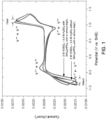
- the CV scan of 2.0 M VOSO 4 and 3.5 M H 2 SO 4 electrolyte with and without 0.15 M (NH 4 ) 2 HPO 4 and 0.05 M MgCl 2 are shown in FIG. 1 .
- both ammonium phosphate dibasic and magnesium chloride were unreactive with the vanadium species.
- the CV scans of 2 M VOSO 4 - 3.5 M H 2 SO 4 electrolyte with and without 0.05 M MgCl 2 were almost identical, indicating that magnesium chloride does not react with vanadium species at all.
- ammonium phosphate dibasic had a catalytic effect on both positive and negative electrolytes.
- both the peak currents of electrolyte with ammonium phosphate dibasic were higher than that of electrolyte without ammonium phosphate dibasic.
- the peak voltage was shifted 75mV from 1.15V to 1.075V when scanning from V 4+ to V 5+ , indicating ammonium phosphate dibasic can help V 4+ to V 5+ transfer.
- the peak voltage was shifted about 100mV from -0.835V to -0.735V and the peak currents were much wider and higher than that without ammonium phosphate dibasic electrolytes.
- the cell performance of the all vanadium sulfate acid electrolyte solution was evaluated in a single RFB cell. As shown in FIGS. 2 and 4 , charge capacity, discharge capacity, charge energy, and discharge energy remained substantially constant for at least 80 cycles at -5 °C and for at least 25 cycles at 50 °C.
- the columbic efficiency was 99% at -5 °C and 97% at 50°C.
- Energy efficiency was 80% at -5 °C and 89% at 50 °C; and voltage efficiency was about 80%.
- Voltage efficiency was similar to energy efficiency.
- Vanadium solvate structures were analyzed using density functional theory (DFT)-based calculations with the NWchem 6.1 package (developed and maintained by the Environmental Molecular Science Laboratory, at Pacific Northwest National Laboratory, Richland, WA; Valiev et al., Comput Phys. Commun. 2010, 181 :1477 ). All of the calculations were done at the B3LYP theory level with dispersion correction (D3) using the 6-31G** (all-electron valence double zeta with polarization function) Gaussian-type basis set without any geometrical constraints.
- DFT density functional theory
- COSMO an implicit solvent model
- dielectric constant ( ⁇ ) 29.8
- the vanadate solvate structure revealed that the water molecule bonded with metal cation, i.e., [V 2 O 3 (H 2 O) 7 ] 4+ , is prone to losing a proton due to its electrostatic interaction with the metal center even under highly acidic conditions (represented by H 3 O + ions).
- the relatively higher electronegativity of the vanadate cation leads to transfer of electron density from the molecular orbital of the water molecules to the empty orbitals of the metal cation. This charge transfer weakens the O-H bond in the coordinated water molecules and makes it more acidic, leading to proton loss and subsequently hydroxo-species which are prone to hydrolysis-based polymerization leading to V 2 O 5 precipitation.
- the proton loss can be controlled by temperature and pH of the solvent system, the higher charge cations (Z ⁇ 4+) could still be susceptible to proton loss.
- a Mg 2+ -based added component was selected because its lower electronegativity can inhibit the proton loss from the coordinated water molecules and because it could also directly coordinate with the vanadate molecule through a bridging oxygen configuration.
- DFT analysis revealed a lower formation energy ( ⁇ 0.30 eV) for the Mg 2+ -coordinated vanadate solvate structure ( FIG. 6B ) corroborating the advantages of the Mg 2+ -based added component.
- electrolytes were prepared with a high concentration ( ⁇ 2M) of vanadate and a low concentration (0.1M) of MgCl 2 as an added component system.
- the 51 V NMR analysis of pristine and added component vanadate-based electrolytes is shown in FIG. 7 .
- the added component-based electrolyte reveals the formation of new species indicated by a low-field resonance (peak B ⁇ -592 ppm) relative to the pristine vanadate electrolyte (peak A ⁇ -577 ppm), which corroborated the DFT-based prediction.
Landscapes
- Life Sciences & Earth Sciences (AREA)
- Engineering & Computer Science (AREA)
- Manufacturing & Machinery (AREA)
- Sustainable Development (AREA)
- Sustainable Energy (AREA)
- Chemical & Material Sciences (AREA)
- Chemical Kinetics & Catalysis (AREA)
- Electrochemistry (AREA)
- General Chemical & Material Sciences (AREA)
- Fuel Cell (AREA)
- Inorganic Compounds Of Heavy Metals (AREA)
Claims (15)
- Reines Vanadiumsulfat-Säure-Redox-Flow-Batteriesystem, umfassend:einen Anolyten, umfassend V2+ und V3+ in einer wässrigen Trägerlösung; undeinen Katholyten, umfassend V4+ und V5+ in einer wässrigen Trägerlösung;die wässrige Trägerlösung für jeden des Anolyten und des Katholyten umfassendSulfationen, wobei die Sulfatkonzentration 4,5 bis 6 M beträgt,Protonen,Chloridionen, undPhosphationenwobei die wässrige Trägerlösung umfasst:zu 0,05 bis 0,5 M Chloridionen; undzu 0,05 bis 0,5 M Phosphationen.
- Batteriesystem nach Anspruch 1, wobei die Chloridionen durch ein anorganisches Chloridsalz bereitgestellt werden.
- Batteriesystem nach Anspruch 1, wobei die wässrige Trägerlösung ferner umfasst:Magnesiumionen;Ammoniumionen; oderMagnesiumionen und Ammoniumionen.
- Batteriesystem nach Anspruch 3, das aufweist:ein Mg : V-Molverhältnis in einem Bereich von 1 : 100 bis 1 : 1; oderein NH4 + : V-Molverhältnis in einem Bereich von 1 : 50 bis 1 : 3.
- Batteriesystem nach Anspruch 1, wobei:die Chloridionen durch MgCl2 bereitgestellt werden; oderdie Phosphationen durch Ammoniumphosphat bereitgestellt werden.
- Batteriesystem nach Anspruch 1, das aufweist:ein Cl : V-Molverhältnis in einem Bereich von 1 : 50 bis 1 : 2; oderein Phosphat: V-Molverhältnis in einem Bereich von 1 : 50 bis 1 : 2.
- Batteriesystem nach Anspruch 1, wobei die wässrige Trägerlösung H2O, H2SO4, MgCl2 und Ammoniumphosphat umfasst, optional wobei die wässrige Trägerlösung umfasst:zu 0,025 bis 0,25 M MgCl2; undzu 0,05 bis 0,5 M Ammoniumphosphat.
- Batteriesystem nach Anspruch 1, wobei:der Anolyt umfasstzu 1,0 bis 2,5 M Vanadium als V2+ und V3+,zu 0,025 bis 0,25 M Magnesiumionen,zu 0,05 bis 0,5 M Chloridionen,zu 0,05 bis 1,5 M Ammoniumionen undzu 0,05 bis 0,5 M Phosphationen; undder Katholyt umfasstzu 1,0 bis 2,5 M Vanadium als V4+ und V5+,zu 0,025 bis 0,25 M Magnesiumionen,zu 0,05 bis 0,5 M Chloridionen,zu 0,05 bis 1,5 M Ammoniumionen undzu 0,05 bis 0,5 M Phosphationen.
- Batteriesystem nach Anspruch 1, wobei der Anolyt und der Katholyt unabhängig voneinander eine Lösung umfassen, die durch Kombinieren von H2O, VOSO4 -H2SO4, MgCl2 und Ammoniumphosphat hergestellt wird, zum Bereitstellen von:zu 1,0 bis 2,5 M VOSO4 bis 3,5 M H2SO4;zu 0,025 bis 0,25 M MgCl2; undzu 0,05 bis 0,5 M Ammoniumphosphat.
- Batteriesystem nach Anspruch 1, wobei die wässrige Trägerlösung für jeden des Anolyten und des Katholyten umfasst:Sulfationen,Protonen,Magnesiumionen,Ammoniumionen,Chloridionen undPhosphationen.
- Batteriesystem nach Anspruch 10, wobei die wässrige Trägerlösung für jeden des Anolyten und des Katholyten umfasst:i. Magnesiumchlorid und Ammoniumphosphat; oderii. zu 0,05 M MgCl2; oderiii. zu 0,15 M (NH4)2HPO4.
- Batteriesystem nach einem der Ansprüche 1 bis 11, ferner umfassend;eine Anode, optional wobei die Anode Graphit oder eine Elektrode auf Kohlenstoffbasis ist;eine Kathode, optional wobei die Kathode Graphit oder eine Elektrode auf Kohlenstoffbasis ist; undeinen Trenner oder eine Membran, die den Anolyten und den Katholyten trennt.
- Anolyt- und Katholytsystem zur Verwendung in einem reinen Vanadiumsulfat-Säure-Redox-Flow-Batteriesystem, umfassend:einen wässrigen Anolyten, umfassend V2+ und V3+, in einer wässrigen Trägerlösung, umfassend zu 4,5 bis 6 M Sulfationen, Magnesiumionen, Ammoniumionen, 0,05 bis 0,5 M Chloridionen und 0,05 bis 0,5 Phosphationen; undeinen wässrigen Katholyten, umfassend V4+ und V5+, in einer wässrigen Trägerlösung, umfassend zu 4,5 bis 6 M Sulfationen, Magnesiumionen, Ammoniumionen, 0,05 bis 0,5 M Chloridionen und 0,05 bis 0,5 M Phosphationen.
- Anolyt- und Katholytsystem nach Anspruch 13, wobei der Anolyt und der Katholyt unabhängig voneinander zu 0,025 bis 0,25 M MgCl2 oder zu 0,05 bis 0,5 M Ammoniumphosphat umfassen.
- Anolyt- und Katholytsystem nach Anspruch 13 oder 14, das ein Cl : V-Molverhältnis in einem Bereich von 1 : 50 bis 1 : 2 und ein Phosphat: V-Molverhältnis in einem Bereich von 1 : 50 bis 1 : 2 aufweist.
Applications Claiming Priority (2)
| Application Number | Priority Date | Filing Date | Title |
|---|---|---|---|
| US201462060438P | 2014-10-06 | 2014-10-06 | |
| PCT/US2015/054075 WO2016057423A1 (en) | 2014-10-06 | 2015-10-05 | All-vanadium sulfate acid redox flow battery system |
Publications (4)
| Publication Number | Publication Date |
|---|---|
| EP3204976A1 EP3204976A1 (de) | 2017-08-16 |
| EP3204976A4 EP3204976A4 (de) | 2018-03-14 |
| EP3204976C0 EP3204976C0 (de) | 2025-01-01 |
| EP3204976B1 true EP3204976B1 (de) | 2025-01-01 |
Family
ID=55633457
Family Applications (1)
| Application Number | Title | Priority Date | Filing Date |
|---|---|---|---|
| EP15849294.2A Active EP3204976B1 (de) | 2014-10-06 | 2015-10-05 | Vanadiumsulfat-redox-flow-batteriesystem |
Country Status (9)
| Country | Link |
|---|---|
| US (2) | US10673090B2 (de) |
| EP (1) | EP3204976B1 (de) |
| JP (1) | JP6650444B2 (de) |
| KR (1) | KR102410425B1 (de) |
| CN (1) | CN107078330B (de) |
| AU (1) | AU2015328395B2 (de) |
| BR (1) | BR112017005398B1 (de) |
| CA (1) | CA2958909C (de) |
| WO (1) | WO2016057423A1 (de) |
Families Citing this family (14)
| Publication number | Priority date | Publication date | Assignee | Title |
|---|---|---|---|---|
| US8628880B2 (en) | 2010-09-28 | 2014-01-14 | Battelle Memorial Institute | Redox flow batteries based on supporting solutions containing chloride |
| KR102069407B1 (ko) * | 2016-03-31 | 2020-01-22 | 주식회사 엘지화학 | 이온교환 분리막, 이를 포함하는 전기화학 전지, 흐름전지 및 연료 전지, 및 이의 제조방법 |
| US11251430B2 (en) | 2018-03-05 | 2022-02-15 | The Research Foundation For The State University Of New York | ϵ-VOPO4 cathode for lithium ion batteries |
| WO2019181983A1 (ja) * | 2018-03-20 | 2019-09-26 | 昭和電工株式会社 | 電解液およびレドックスフロー電池 |
| CN110858659B (zh) * | 2018-08-24 | 2021-08-10 | 江苏泛宇能源有限公司 | 用于液流电池废气处理的方法以及液流电池系统 |
| CN110571463B (zh) * | 2019-08-22 | 2020-10-23 | 浙江大学 | 硫酸氧化钒均相辅助催化的直接甲酸燃料电池 |
| US12183932B2 (en) | 2019-10-14 | 2024-12-31 | Georgia Tech Research Corporation | Electrochemical flow devices and methods of making the same |
| KR102362607B1 (ko) * | 2019-11-15 | 2022-02-15 | 한국생산기술연구원 | 첨가제를 포함하는 바나듐 레독스 흐름전지용 전해질 및 그를 포함하는 바나듐 레독스 흐름전지 |
| WO2022265579A2 (en) * | 2021-06-17 | 2022-12-22 | V-Flow Tech Pte. Ltd. | Electrolyte formulation |
| CN114142076B (zh) * | 2021-11-30 | 2024-04-19 | 成都先进金属材料产业技术研究院股份有限公司 | 提高钒电池电解液电化学活性的方法 |
| CN115377473A (zh) * | 2022-08-31 | 2022-11-22 | 湖南汇锋高新能源有限公司 | 钒电池电解液及钒液流电池 |
| DE102022128209B4 (de) | 2022-10-25 | 2024-05-02 | Fraunhofer-Gesellschaft zur Förderung der angewandten Forschung eingetragener Verein | Chlorid-freie Elektrolytzusammensetzung für einen längeren Betrieb bei hohen Temperaturen (>40°C) in Vanadium Redox-Flow-Batterien |
| CN115498232B (zh) * | 2022-11-18 | 2023-02-03 | 苏州融科储能技术有限公司 | 一种电解液及全钒液流电池 |
| CA3227263A1 (en) * | 2022-11-18 | 2024-05-18 | Mingming SONG | Electrolyte solutions and all-vanadium redox flow batteries |
Family Cites Families (45)
| Publication number | Priority date | Publication date | Assignee | Title |
|---|---|---|---|---|
| US3540933A (en) | 1967-07-11 | 1970-11-17 | Jan Boeke | Redox fuel cell |
| US3996064A (en) | 1975-08-22 | 1976-12-07 | The United States Of America As Represented By The Administrator Of The National Aeronautics And Space Administration | Electrically rechargeable REDOX flow cell |
| US4469760A (en) | 1981-09-08 | 1984-09-04 | Electric Power Research, Institute | Redox battery including a bromine positive electrode and a chromium ion negative electrode, and method |
| US4786567A (en) | 1986-02-11 | 1988-11-22 | Unisearch Limited | All-vanadium redox battery |
| JPS62216176A (ja) | 1986-03-15 | 1987-09-22 | Agency Of Ind Science & Technol | レドツクス電池用電解液 |
| JPH0758625B2 (ja) | 1990-05-11 | 1995-06-21 | 工業技術院長 | レドックス電池 |
| WO1993006626A1 (en) | 1991-09-17 | 1993-04-01 | Unisearch Limited | Permeation selective separators and processes for making such separators |
| AU696452B2 (en) | 1993-11-17 | 1998-09-10 | Jd Holding Inc. | Stabilised electrolyte solutions, methods of preparation thereof and redox cells and batteries containing stabilised electrolyte solutions |
| CA2220075C (en) | 1995-05-03 | 2008-07-08 | Unisearch Limited | High energy density vanadium electrolyte solutions, methods of preparation thereof and all-vanadium redox cells and batteries containing high energy vanadium electrolyte solutions |
| JP2001102080A (ja) | 1999-09-30 | 2001-04-13 | Kashimakita Kyodo Hatsuden Kk | レドックス電池 |
| SG97839A1 (en) | 2000-01-28 | 2003-08-20 | Pi Eta Consulting Company Pte | Fully flexible financial instrument pricing system with intelligent user interfaces |
| JP3959234B2 (ja) | 2000-12-26 | 2007-08-15 | 日本化学工業株式会社 | 変性バナジウム化合物、その製造方法、レドックスフロー型電池用電解液組成物及びレドックスフロー型電池用電解液の製造方法 |
| WO2002095855A1 (en) | 2001-05-18 | 2002-11-28 | Unisearch Limited | Vanadium redox battery electrolyte |
| AUPR722101A0 (en) | 2001-08-24 | 2001-09-13 | Skyllas-Kazacos, Maria | Vanadium chloride/polyhalide redox flow battery |
| AUPS192102A0 (en) | 2002-04-23 | 2002-05-30 | Unisearch Limited | Vanadium bromide redox flow battery |
| AU2003901183A0 (en) | 2003-03-14 | 2003-03-27 | Michael Kazacos | Novel vanadium bromide redox flow cell |
| AU2003901763A0 (en) | 2003-04-14 | 2003-05-01 | Michael Kazacos | Novel bromide redox flow cells and batteries |
| CA2517690C (en) | 2003-03-14 | 2012-06-19 | Michael Kazacos | Novel vanadium halide redox flow battery |
| WO2006135958A1 (en) | 2005-06-20 | 2006-12-28 | V-Fuel Pty Ltd | Improved perfluorinated membranes and improved electrolytes for redox cells and batteries |
| US20100230632A1 (en) | 2005-09-20 | 2010-09-16 | Virtic, Llc | High energy battery materials |
| CN1312788C (zh) | 2005-09-30 | 2007-04-25 | 清华大学 | 全钒氧化还原液流电池用质子交换复合膜及其制备方法 |
| CN100466349C (zh) * | 2006-07-19 | 2009-03-04 | 中国科学院金属研究所 | 一种全钒离子氧化还原液流电池电解液的制备方法 |
| JP2008117720A (ja) * | 2006-11-08 | 2008-05-22 | Matsushita Electric Ind Co Ltd | 二次電池 |
| CN202144772U (zh) | 2007-06-07 | 2012-02-15 | 韦福普泰有限公司 | 产生和储存电力的发电系统 |
| US8722226B2 (en) * | 2008-06-12 | 2014-05-13 | 24M Technologies, Inc. | High energy density redox flow device |
| US7820321B2 (en) | 2008-07-07 | 2010-10-26 | Enervault Corporation | Redox flow battery system for distributed energy storage |
| JP2010086935A (ja) | 2008-09-03 | 2010-04-15 | Sharp Corp | レドックスフロー電池 |
| DE102009009357B4 (de) * | 2009-02-18 | 2011-03-03 | Fraunhofer-Gesellschaft zur Förderung der angewandten Forschung e.V. | Redox-Flow-Batterie zur Speicherung von elektrischer Energie in ionischen Flüssigkeiten |
| WO2010138942A2 (en) | 2009-05-28 | 2010-12-02 | Deeya Energy, Inc. | Redox flow cell rebalancing |
| CN101572319B (zh) | 2009-06-18 | 2012-01-11 | 湖南维邦新能源有限公司 | 用于全钒液流电池的电解液及其制备方法、以及包括该电解液的全钒液流电池 |
| CN101834302B (zh) | 2009-07-03 | 2012-09-05 | 中南大学 | 全钒液流电池电解液及其制备方法、以及全钒液流电池 |
| US20110027629A1 (en) | 2009-07-29 | 2011-02-03 | Searete Llc, A Limited Liability Corporation Of The State Of Delaware | Instrumented fluid-surfaced electrode |
| JP5427560B2 (ja) | 2009-11-10 | 2014-02-26 | 株式会社ブリヂストン | タイヤ |
| US9281535B2 (en) | 2010-08-12 | 2016-03-08 | Imergy Power Systems, Inc. | System dongle |
| US8808888B2 (en) | 2010-08-25 | 2014-08-19 | Applied Materials, Inc. | Flow battery systems |
| US9960443B2 (en) * | 2010-09-28 | 2018-05-01 | Battelle Memorial Institute | Redox flow batteries having multiple electroactive elements |
| US8771856B2 (en) | 2010-09-28 | 2014-07-08 | Battelle Memorial Institute | Fe-V redox flow batteries |
| US8628880B2 (en) | 2010-09-28 | 2014-01-14 | Battelle Memorial Institute | Redox flow batteries based on supporting solutions containing chloride |
| CN102110836A (zh) * | 2011-01-26 | 2011-06-29 | 上海林洋储能科技有限公司 | 一种高稳定性的钒离子电解液 |
| IN2014CN02817A (de) | 2011-10-14 | 2015-07-03 | Deeya Energy Inc | |
| JP5363691B2 (ja) | 2011-10-14 | 2013-12-11 | 株式会社ギャラキシー | バナジウム電解液、その製造方法及びその製造装置 |
| US20150050570A1 (en) * | 2011-10-14 | 2015-02-19 | Imergy Power Systems Inc. | Production of vanadium electrolyte for a vanadium flow cell |
| WO2014099874A1 (en) * | 2012-12-17 | 2014-06-26 | E. I. Du Pont De Nemours And Company | Flow battery having a separator membrane comprising an ionomer |
| US10153511B2 (en) * | 2013-05-10 | 2018-12-11 | Uchicago Argonne, Llc | Rechargeable nanoelectrofuel electrodes and devices for high energy density flow batteries |
| KR20150036702A (ko) * | 2013-06-21 | 2015-04-07 | 스미토모덴키고교가부시키가이샤 | 레독스 플로우 전지용 전해액 및 레독스 플로우 전지 |
-
2015
- 2015-10-05 CA CA2958909A patent/CA2958909C/en active Active
- 2015-10-05 KR KR1020177012166A patent/KR102410425B1/ko active Active
- 2015-10-05 EP EP15849294.2A patent/EP3204976B1/de active Active
- 2015-10-05 WO PCT/US2015/054075 patent/WO2016057423A1/en not_active Ceased
- 2015-10-05 JP JP2017518359A patent/JP6650444B2/ja active Active
- 2015-10-05 CN CN201580053091.8A patent/CN107078330B/zh active Active
- 2015-10-05 AU AU2015328395A patent/AU2015328395B2/en active Active
- 2015-10-05 BR BR112017005398-5A patent/BR112017005398B1/pt active IP Right Grant
- 2015-10-05 US US14/875,565 patent/US10673090B2/en active Active
-
2020
- 2020-04-27 US US16/859,142 patent/US11532832B2/en active Active
Also Published As
| Publication number | Publication date |
|---|---|
| US20160099480A1 (en) | 2016-04-07 |
| EP3204976C0 (de) | 2025-01-01 |
| KR20170057453A (ko) | 2017-05-24 |
| US11532832B2 (en) | 2022-12-20 |
| EP3204976A1 (de) | 2017-08-16 |
| CN107078330A (zh) | 2017-08-18 |
| CA2958909A1 (en) | 2016-04-14 |
| JP2017535035A (ja) | 2017-11-24 |
| BR112017005398B1 (pt) | 2022-03-29 |
| AU2015328395B2 (en) | 2020-05-07 |
| CA2958909C (en) | 2023-05-02 |
| US20200259200A1 (en) | 2020-08-13 |
| BR112017005398A2 (pt) | 2017-12-12 |
| JP6650444B2 (ja) | 2020-02-19 |
| CN107078330B (zh) | 2021-03-23 |
| KR102410425B1 (ko) | 2022-06-17 |
| WO2016057423A1 (en) | 2016-04-14 |
| US10673090B2 (en) | 2020-06-02 |
| AU2015328395A1 (en) | 2017-03-16 |
| EP3204976A4 (de) | 2018-03-14 |
Similar Documents
| Publication | Publication Date | Title |
|---|---|---|
| US11532832B2 (en) | All-vanadium sulfate acid redox flow battery system | |
| Wang et al. | Li‐redox flow batteries based on hybrid electrolytes: at the cross road between Li‐ion and redox flow batteries | |
| Zhao et al. | A reversible Br 2/Br− redox couple in the aqueous phase as a high-performance catholyte for alkali-ion batteries | |
| Leung et al. | A mixed acid based vanadium–cerium redox flow battery with a zero-gap serpentine architecture | |
| US8628880B2 (en) | Redox flow batteries based on supporting solutions containing chloride | |
| JP5007849B1 (ja) | レドックスフロー電池、及びその運転方法 | |
| US8771856B2 (en) | Fe-V redox flow batteries | |
| US9793566B2 (en) | Aqueous electrolytes for redox flow battery systems | |
| Park et al. | New hybrid redox flow battery with high energy density using V–Mn/V–Mn multiple redox couples | |
| US12119527B2 (en) | Redox flow battery | |
| Zhang et al. | Enhanced reaction kinetics of an aqueous Zn–Fe hybrid flow battery by optimizing the supporting electrolytes | |
| CN108475802A (zh) | 再生燃料电池 | |
| Yu et al. | Unveil the Failure of Alkali Ion‐Sulfur Aqueous Batteries: Resolving Water Migration by Coordination Regulation | |
| US20150349369A1 (en) | High-Energy-Density, Nonaqueous, Redox Flow Batteries Having Iodine-based Species | |
| Nandi et al. | Al3+ ion storage in LiMnPO4 for rechargeable aqueous aluminum-ion battery | |
| KR20170026574A (ko) | 배터리 | |
| JP2012204347A (ja) | レドックスフロー電池、及びその運転方法 | |
| CN102306820A (zh) | 一种钒电池用电解液及其制备方法 | |
| Hiasa et al. | Aqueous lithium-ion battery of dual electrolytes separated by cation-exchange membrane with enhanced rate capability for thick electrodes | |
| Mishra et al. | Zinc‐Cerium Hybrid Redox Flow Batteries | |
| KR20160062528A (ko) | 아연-브롬 화학흐름전지의 운전 방법 | |
| Kim et al. | An Effect of a Thermal Stability Agent for Vanadium Redox Flow Battery at Room Temperature | |
| Cronin | Ultra-Reduced and Protonated Aqueous Solutions of Polyoxometalate Clusters for Flexible Energy Storage |
Legal Events
| Date | Code | Title | Description |
|---|---|---|---|
| STAA | Information on the status of an ep patent application or granted ep patent |
Free format text: STATUS: THE INTERNATIONAL PUBLICATION HAS BEEN MADE |
|
| PUAI | Public reference made under article 153(3) epc to a published international application that has entered the european phase |
Free format text: ORIGINAL CODE: 0009012 |
|
| STAA | Information on the status of an ep patent application or granted ep patent |
Free format text: STATUS: REQUEST FOR EXAMINATION WAS MADE |
|
| 17P | Request for examination filed |
Effective date: 20170221 |
|
| AK | Designated contracting states |
Kind code of ref document: A1 Designated state(s): AL AT BE BG CH CY CZ DE DK EE ES FI FR GB GR HR HU IE IS IT LI LT LU LV MC MK MT NL NO PL PT RO RS SE SI SK SM TR |
|
| AX | Request for extension of the european patent |
Extension state: BA ME |
|
| DAV | Request for validation of the european patent (deleted) | ||
| DAX | Request for extension of the european patent (deleted) | ||
| A4 | Supplementary search report drawn up and despatched |
Effective date: 20180213 |
|
| RIC1 | Information provided on ipc code assigned before grant |
Ipc: H01M 2/38 20060101ALI20180207BHEP Ipc: H01M 8/18 20060101AFI20180207BHEP Ipc: H01M 8/20 20060101ALI20180207BHEP Ipc: H01M 4/96 20060101ALI20180207BHEP |
|
| STAA | Information on the status of an ep patent application or granted ep patent |
Free format text: STATUS: EXAMINATION IS IN PROGRESS |
|
| 17Q | First examination report despatched |
Effective date: 20210921 |
|
| GRAP | Despatch of communication of intention to grant a patent |
Free format text: ORIGINAL CODE: EPIDOSNIGR1 |
|
| STAA | Information on the status of an ep patent application or granted ep patent |
Free format text: STATUS: GRANT OF PATENT IS INTENDED |
|
| RIC1 | Information provided on ipc code assigned before grant |
Ipc: H01M 8/20 20060101ALI20240823BHEP Ipc: H01M 8/18 20060101AFI20240823BHEP |
|
| INTG | Intention to grant announced |
Effective date: 20240909 |
|
| GRAS | Grant fee paid |
Free format text: ORIGINAL CODE: EPIDOSNIGR3 |
|
| GRAA | (expected) grant |
Free format text: ORIGINAL CODE: 0009210 |
|
| STAA | Information on the status of an ep patent application or granted ep patent |
Free format text: STATUS: THE PATENT HAS BEEN GRANTED |
|
| AK | Designated contracting states |
Kind code of ref document: B1 Designated state(s): AL AT BE BG CH CY CZ DE DK EE ES FI FR GB GR HR HU IE IS IT LI LT LU LV MC MK MT NL NO PL PT RO RS SE SI SK SM TR |
|
| REG | Reference to a national code |
Ref country code: GB Ref legal event code: FG4D |
|
| REG | Reference to a national code |
Ref country code: CH Ref legal event code: EP |
|
| REG | Reference to a national code |
Ref country code: DE Ref legal event code: R096 Ref document number: 602015090778 Country of ref document: DE |
|
| REG | Reference to a national code |
Ref country code: IE Ref legal event code: FG4D |
|
| U01 | Request for unitary effect filed |
Effective date: 20250120 |
|
| U07 | Unitary effect registered |
Designated state(s): AT BE BG DE DK EE FI FR IT LT LU LV MT NL PT RO SE SI Effective date: 20250124 |
|
| PG25 | Lapsed in a contracting state [announced via postgrant information from national office to epo] |
Ref country code: PL Free format text: LAPSE BECAUSE OF FAILURE TO SUBMIT A TRANSLATION OF THE DESCRIPTION OR TO PAY THE FEE WITHIN THE PRESCRIBED TIME-LIMIT Effective date: 20250101 |
|
| PG25 | Lapsed in a contracting state [announced via postgrant information from national office to epo] |
Ref country code: ES Free format text: LAPSE BECAUSE OF FAILURE TO SUBMIT A TRANSLATION OF THE DESCRIPTION OR TO PAY THE FEE WITHIN THE PRESCRIBED TIME-LIMIT Effective date: 20250101 |
|
| PG25 | Lapsed in a contracting state [announced via postgrant information from national office to epo] |
Ref country code: IS Free format text: LAPSE BECAUSE OF FAILURE TO SUBMIT A TRANSLATION OF THE DESCRIPTION OR TO PAY THE FEE WITHIN THE PRESCRIBED TIME-LIMIT Effective date: 20250501 Ref country code: NO Free format text: LAPSE BECAUSE OF FAILURE TO SUBMIT A TRANSLATION OF THE DESCRIPTION OR TO PAY THE FEE WITHIN THE PRESCRIBED TIME-LIMIT Effective date: 20250401 |
|
| PG25 | Lapsed in a contracting state [announced via postgrant information from national office to epo] |
Ref country code: HR Free format text: LAPSE BECAUSE OF FAILURE TO SUBMIT A TRANSLATION OF THE DESCRIPTION OR TO PAY THE FEE WITHIN THE PRESCRIBED TIME-LIMIT Effective date: 20250101 |
|
| PG25 | Lapsed in a contracting state [announced via postgrant information from national office to epo] |
Ref country code: GR Free format text: LAPSE BECAUSE OF FAILURE TO SUBMIT A TRANSLATION OF THE DESCRIPTION OR TO PAY THE FEE WITHIN THE PRESCRIBED TIME-LIMIT Effective date: 20250402 |
|
| PG25 | Lapsed in a contracting state [announced via postgrant information from national office to epo] |
Ref country code: CZ Free format text: LAPSE BECAUSE OF FAILURE TO SUBMIT A TRANSLATION OF THE DESCRIPTION OR TO PAY THE FEE WITHIN THE PRESCRIBED TIME-LIMIT Effective date: 20250101 |
|
| PG25 | Lapsed in a contracting state [announced via postgrant information from national office to epo] |
Ref country code: SM Free format text: LAPSE BECAUSE OF FAILURE TO SUBMIT A TRANSLATION OF THE DESCRIPTION OR TO PAY THE FEE WITHIN THE PRESCRIBED TIME-LIMIT Effective date: 20250101 |
|
| PGFP | Annual fee paid to national office [announced via postgrant information from national office to epo] |
Ref country code: GB Payment date: 20250911 Year of fee payment: 11 |
|
| U20 | Renewal fee for the european patent with unitary effect paid |
Year of fee payment: 11 Effective date: 20250915 |
|
| PG25 | Lapsed in a contracting state [announced via postgrant information from national office to epo] |
Ref country code: SK Free format text: LAPSE BECAUSE OF FAILURE TO SUBMIT A TRANSLATION OF THE DESCRIPTION OR TO PAY THE FEE WITHIN THE PRESCRIBED TIME-LIMIT Effective date: 20250101 |
|
| PLBE | No opposition filed within time limit |
Free format text: ORIGINAL CODE: 0009261 |
|
| STAA | Information on the status of an ep patent application or granted ep patent |
Free format text: STATUS: NO OPPOSITION FILED WITHIN TIME LIMIT |
|
| 26N | No opposition filed |
Effective date: 20251002 |