EP3204530B1 - Produit plat en acier laminé à froid et recristallisant, ainsi que son procédé de fabrication - Google Patents
Produit plat en acier laminé à froid et recristallisant, ainsi que son procédé de fabrication Download PDFInfo
- Publication number
- EP3204530B1 EP3204530B1 EP15762569.0A EP15762569A EP3204530B1 EP 3204530 B1 EP3204530 B1 EP 3204530B1 EP 15762569 A EP15762569 A EP 15762569A EP 3204530 B1 EP3204530 B1 EP 3204530B1
- Authority
- EP
- European Patent Office
- Prior art keywords
- flat steel
- steel product
- flat
- temper
- overaging
- Prior art date
- Legal status (The legal status is an assumption and is not a legal conclusion. Google has not performed a legal analysis and makes no representation as to the accuracy of the status listed.)
- Active
Links
Images
Classifications
-
- C—CHEMISTRY; METALLURGY
- C21—METALLURGY OF IRON
- C21D—MODIFYING THE PHYSICAL STRUCTURE OF FERROUS METALS; GENERAL DEVICES FOR HEAT TREATMENT OF FERROUS OR NON-FERROUS METALS OR ALLOYS; MAKING METAL MALLEABLE, e.g. BY DECARBURISATION OR TEMPERING
- C21D8/00—Modifying the physical properties of ferrous metals or ferrous alloys by deformation combined with, or followed by, heat treatment
- C21D8/02—Modifying the physical properties of ferrous metals or ferrous alloys by deformation combined with, or followed by, heat treatment during manufacturing of plates or strips
- C21D8/04—Modifying the physical properties of ferrous metals or ferrous alloys by deformation combined with, or followed by, heat treatment during manufacturing of plates or strips to produce plates or strips for drawing, e.g. for deep-drawing
- C21D8/0421—Modifying the physical properties of ferrous metals or ferrous alloys by deformation combined with, or followed by, heat treatment during manufacturing of plates or strips to produce plates or strips for drawing, e.g. for deep-drawing characterised by the working steps
- C21D8/0436—Cold rolling
-
- C—CHEMISTRY; METALLURGY
- C21—METALLURGY OF IRON
- C21D—MODIFYING THE PHYSICAL STRUCTURE OF FERROUS METALS; GENERAL DEVICES FOR HEAT TREATMENT OF FERROUS OR NON-FERROUS METALS OR ALLOYS; MAKING METAL MALLEABLE, e.g. BY DECARBURISATION OR TEMPERING
- C21D8/00—Modifying the physical properties of ferrous metals or ferrous alloys by deformation combined with, or followed by, heat treatment
- C21D8/02—Modifying the physical properties of ferrous metals or ferrous alloys by deformation combined with, or followed by, heat treatment during manufacturing of plates or strips
- C21D8/04—Modifying the physical properties of ferrous metals or ferrous alloys by deformation combined with, or followed by, heat treatment during manufacturing of plates or strips to produce plates or strips for drawing, e.g. for deep-drawing
- C21D8/0447—Modifying the physical properties of ferrous metals or ferrous alloys by deformation combined with, or followed by, heat treatment during manufacturing of plates or strips to produce plates or strips for drawing, e.g. for deep-drawing characterised by the heat treatment
-
- C—CHEMISTRY; METALLURGY
- C21—METALLURGY OF IRON
- C21D—MODIFYING THE PHYSICAL STRUCTURE OF FERROUS METALS; GENERAL DEVICES FOR HEAT TREATMENT OF FERROUS OR NON-FERROUS METALS OR ALLOYS; MAKING METAL MALLEABLE, e.g. BY DECARBURISATION OR TEMPERING
- C21D8/00—Modifying the physical properties of ferrous metals or ferrous alloys by deformation combined with, or followed by, heat treatment
- C21D8/02—Modifying the physical properties of ferrous metals or ferrous alloys by deformation combined with, or followed by, heat treatment during manufacturing of plates or strips
- C21D8/04—Modifying the physical properties of ferrous metals or ferrous alloys by deformation combined with, or followed by, heat treatment during manufacturing of plates or strips to produce plates or strips for drawing, e.g. for deep-drawing
- C21D8/0421—Modifying the physical properties of ferrous metals or ferrous alloys by deformation combined with, or followed by, heat treatment during manufacturing of plates or strips to produce plates or strips for drawing, e.g. for deep-drawing characterised by the working steps
- C21D8/0442—Flattening; Dressing; Flexing
-
- C—CHEMISTRY; METALLURGY
- C21—METALLURGY OF IRON
- C21D—MODIFYING THE PHYSICAL STRUCTURE OF FERROUS METALS; GENERAL DEVICES FOR HEAT TREATMENT OF FERROUS OR NON-FERROUS METALS OR ALLOYS; MAKING METAL MALLEABLE, e.g. BY DECARBURISATION OR TEMPERING
- C21D8/00—Modifying the physical properties of ferrous metals or ferrous alloys by deformation combined with, or followed by, heat treatment
- C21D8/02—Modifying the physical properties of ferrous metals or ferrous alloys by deformation combined with, or followed by, heat treatment during manufacturing of plates or strips
- C21D8/04—Modifying the physical properties of ferrous metals or ferrous alloys by deformation combined with, or followed by, heat treatment during manufacturing of plates or strips to produce plates or strips for drawing, e.g. for deep-drawing
- C21D8/0447—Modifying the physical properties of ferrous metals or ferrous alloys by deformation combined with, or followed by, heat treatment during manufacturing of plates or strips to produce plates or strips for drawing, e.g. for deep-drawing characterised by the heat treatment
- C21D8/0473—Final recrystallisation annealing
-
- C—CHEMISTRY; METALLURGY
- C21—METALLURGY OF IRON
- C21D—MODIFYING THE PHYSICAL STRUCTURE OF FERROUS METALS; GENERAL DEVICES FOR HEAT TREATMENT OF FERROUS OR NON-FERROUS METALS OR ALLOYS; MAKING METAL MALLEABLE, e.g. BY DECARBURISATION OR TEMPERING
- C21D9/00—Heat treatment, e.g. annealing, hardening, quenching or tempering, adapted for particular articles; Furnaces therefor
- C21D9/46—Heat treatment, e.g. annealing, hardening, quenching or tempering, adapted for particular articles; Furnaces therefor for sheet metals
-
- C—CHEMISTRY; METALLURGY
- C22—METALLURGY; FERROUS OR NON-FERROUS ALLOYS; TREATMENT OF ALLOYS OR NON-FERROUS METALS
- C22C—ALLOYS
- C22C38/00—Ferrous alloys, e.g. steel alloys
- C22C38/001—Ferrous alloys, e.g. steel alloys containing N
-
- C—CHEMISTRY; METALLURGY
- C22—METALLURGY; FERROUS OR NON-FERROUS ALLOYS; TREATMENT OF ALLOYS OR NON-FERROUS METALS
- C22C—ALLOYS
- C22C38/00—Ferrous alloys, e.g. steel alloys
- C22C38/004—Very low carbon steels, i.e. having a carbon content of less than 0,01%
-
- C—CHEMISTRY; METALLURGY
- C22—METALLURGY; FERROUS OR NON-FERROUS ALLOYS; TREATMENT OF ALLOYS OR NON-FERROUS METALS
- C22C—ALLOYS
- C22C38/00—Ferrous alloys, e.g. steel alloys
- C22C38/008—Ferrous alloys, e.g. steel alloys containing tin
-
- C—CHEMISTRY; METALLURGY
- C22—METALLURGY; FERROUS OR NON-FERROUS ALLOYS; TREATMENT OF ALLOYS OR NON-FERROUS METALS
- C22C—ALLOYS
- C22C38/00—Ferrous alloys, e.g. steel alloys
- C22C38/02—Ferrous alloys, e.g. steel alloys containing silicon
-
- C—CHEMISTRY; METALLURGY
- C22—METALLURGY; FERROUS OR NON-FERROUS ALLOYS; TREATMENT OF ALLOYS OR NON-FERROUS METALS
- C22C—ALLOYS
- C22C38/00—Ferrous alloys, e.g. steel alloys
- C22C38/04—Ferrous alloys, e.g. steel alloys containing manganese
-
- C—CHEMISTRY; METALLURGY
- C22—METALLURGY; FERROUS OR NON-FERROUS ALLOYS; TREATMENT OF ALLOYS OR NON-FERROUS METALS
- C22C—ALLOYS
- C22C38/00—Ferrous alloys, e.g. steel alloys
- C22C38/06—Ferrous alloys, e.g. steel alloys containing aluminium
-
- C—CHEMISTRY; METALLURGY
- C22—METALLURGY; FERROUS OR NON-FERROUS ALLOYS; TREATMENT OF ALLOYS OR NON-FERROUS METALS
- C22C—ALLOYS
- C22C38/00—Ferrous alloys, e.g. steel alloys
- C22C38/14—Ferrous alloys, e.g. steel alloys containing titanium or zirconium
-
- C—CHEMISTRY; METALLURGY
- C22—METALLURGY; FERROUS OR NON-FERROUS ALLOYS; TREATMENT OF ALLOYS OR NON-FERROUS METALS
- C22C—ALLOYS
- C22C38/00—Ferrous alloys, e.g. steel alloys
- C22C38/18—Ferrous alloys, e.g. steel alloys containing chromium
- C22C38/40—Ferrous alloys, e.g. steel alloys containing chromium with nickel
- C22C38/42—Ferrous alloys, e.g. steel alloys containing chromium with nickel with copper
-
- C—CHEMISTRY; METALLURGY
- C22—METALLURGY; FERROUS OR NON-FERROUS ALLOYS; TREATMENT OF ALLOYS OR NON-FERROUS METALS
- C22C—ALLOYS
- C22C38/00—Ferrous alloys, e.g. steel alloys
- C22C38/18—Ferrous alloys, e.g. steel alloys containing chromium
- C22C38/40—Ferrous alloys, e.g. steel alloys containing chromium with nickel
- C22C38/44—Ferrous alloys, e.g. steel alloys containing chromium with nickel with molybdenum or tungsten
-
- C—CHEMISTRY; METALLURGY
- C22—METALLURGY; FERROUS OR NON-FERROUS ALLOYS; TREATMENT OF ALLOYS OR NON-FERROUS METALS
- C22C—ALLOYS
- C22C38/00—Ferrous alloys, e.g. steel alloys
- C22C38/18—Ferrous alloys, e.g. steel alloys containing chromium
- C22C38/40—Ferrous alloys, e.g. steel alloys containing chromium with nickel
- C22C38/46—Ferrous alloys, e.g. steel alloys containing chromium with nickel with vanadium
-
- C—CHEMISTRY; METALLURGY
- C22—METALLURGY; FERROUS OR NON-FERROUS ALLOYS; TREATMENT OF ALLOYS OR NON-FERROUS METALS
- C22C—ALLOYS
- C22C38/00—Ferrous alloys, e.g. steel alloys
- C22C38/18—Ferrous alloys, e.g. steel alloys containing chromium
- C22C38/40—Ferrous alloys, e.g. steel alloys containing chromium with nickel
- C22C38/48—Ferrous alloys, e.g. steel alloys containing chromium with nickel with niobium or tantalum
-
- C—CHEMISTRY; METALLURGY
- C22—METALLURGY; FERROUS OR NON-FERROUS ALLOYS; TREATMENT OF ALLOYS OR NON-FERROUS METALS
- C22C—ALLOYS
- C22C38/00—Ferrous alloys, e.g. steel alloys
- C22C38/18—Ferrous alloys, e.g. steel alloys containing chromium
- C22C38/40—Ferrous alloys, e.g. steel alloys containing chromium with nickel
- C22C38/50—Ferrous alloys, e.g. steel alloys containing chromium with nickel with titanium or zirconium
-
- C—CHEMISTRY; METALLURGY
- C22—METALLURGY; FERROUS OR NON-FERROUS ALLOYS; TREATMENT OF ALLOYS OR NON-FERROUS METALS
- C22C—ALLOYS
- C22C38/00—Ferrous alloys, e.g. steel alloys
- C22C38/18—Ferrous alloys, e.g. steel alloys containing chromium
- C22C38/40—Ferrous alloys, e.g. steel alloys containing chromium with nickel
- C22C38/54—Ferrous alloys, e.g. steel alloys containing chromium with nickel with boron
-
- C—CHEMISTRY; METALLURGY
- C25—ELECTROLYTIC OR ELECTROPHORETIC PROCESSES; APPARATUS THEREFOR
- C25D—PROCESSES FOR THE ELECTROLYTIC OR ELECTROPHORETIC PRODUCTION OF COATINGS; ELECTROFORMING; APPARATUS THEREFOR
- C25D3/00—Electroplating: Baths therefor
- C25D3/02—Electroplating: Baths therefor from solutions
- C25D3/22—Electroplating: Baths therefor from solutions of zinc
-
- C—CHEMISTRY; METALLURGY
- C21—METALLURGY OF IRON
- C21D—MODIFYING THE PHYSICAL STRUCTURE OF FERROUS METALS; GENERAL DEVICES FOR HEAT TREATMENT OF FERROUS OR NON-FERROUS METALS OR ALLOYS; MAKING METAL MALLEABLE, e.g. BY DECARBURISATION OR TEMPERING
- C21D2211/00—Microstructure comprising significant phases
- C21D2211/005—Ferrite
Definitions
- the invention relates to a cold-rolled and recrystallized annealed flat steel product having a ferritic microstructure.
- Flat steel products of this type are used in particular in the field of automobile body construction, where particularly high demands are placed on the deformability and the visual appearance of the components formed from such flat steel products.
- these are rolled products, such as steel strips or sheets, as well as blanks and blanks derived therefrom.
- the invention relates to a method for producing a flat steel product of the type in question. Insofar as information on the contents of alloys is given below, these always refer to the weight, unless stated otherwise. On the other hand, information on the composition of atmospheres always refers to the considered volume, unless stated otherwise.
- a surface structure that is characterized by a defined roughness and an equally defined peak distribution, in order to meet the customer requirements in terms of formability and surface appearance (paintability and gloss finish).
- a typical example of corresponding specifications from the automotive industry is an arithmetic center roughness (hereinafter referred to as "roughness") Ra of 1.1-1.6 ⁇ m with a peak number RPc of at least 60 1 / cm.
- the roughness Ra and the peak number RPc are determined in accordance with the steel iron test sheet SEP 1940 using a stylus cutter according to ISO 3274.
- Wsa waviness characteristic Wsa (1-5)
- Wsa waviness characteristic Wsa (1-5)
- Typical requirements are Wsa values of 0.35 ⁇ m to 0.40 ⁇ m.
- Particularly good gloss is obtained at Wsa values of ⁇ 0.35 ⁇ m, in particular ⁇ 0.30 ⁇ m.
- peak numbers RPc of at least 75 l / cm and roughnesses Ra of 0.9-1.4 ⁇ m are required.
- the setting of the material characteristics Ra and RPc in the production of cold rolled flat steel products is typically done by temper rolling after the recrystallizing annealing that the flat steel products undergo after cold rolling to ensure their optimum ductility.
- skin-pass coating is meant a tempering followed by recrystallizing annealing, in which the flat steel product is subjected to a small deformation of about 0.2-2.0%, which is referred to herein as a "temper rolling grade".
- the Degree of D can not be varied arbitrarily, also with regard to the mechanical properties of the steel substrate. Too low a degree of dressing D counteracts a pronounced yield strength only insufficient. On the other hand, the strength of the steel substrate due to excessive work hardening can be non-correctable due to too high a degree of dressing D.
- soft here is meant a steel having a yield strength Rp0.2 of at most 180 N / mm2 and a tensile strength Rm of at most 340 N / mm2 in the recrystallized state and after temper rolling. In practice, this has the consequence that flat steel products of the type in question with dimensions typical for automobiles can only be produced with the desired operational reliability with great effort. Particularly critical are steels with a yield strength Rp0,2 of max. 150 MPa and a tensile strength Rm of at most 310 MPa.
- An example of this is the one from EP 0 234 698 B1 known method for producing a steel sheet suitable for painting.
- This method provides that a regular pattern of pits is formed in the surface of a skin pass mill by means of an energy beam.
- the flat steel product to be processed is tempered by means of two work rolls, of which at least one is machined in the manner indicated above.
- the cross-sectional reduction achieved by the temper rolling should not be less than 0.3% in order to transfer the pattern from the work roll to the surface of the steel sheet.
- a steel sheet having an average surface roughness Ra within the range of 0.3 to 3.0 ⁇ m and a surface roughness-forming microscopic shape obtained from trapezoidal land portions having a flat upper surface, groove-like depression portions, and the like should be obtained are formed to completely or partially surround a land portion, and to have center portions formed between the land portions outside the groove portions such that they are higher than the bottom of the groove portions and lower than or equal to the upper surfaces of the land portions.
- the elevations and depressions should have certain geometrical dependencies, inter alia, on the diameter of the indentations formed in the skin pass rolling mill.
- the steel sheet consists of a steel in wt .-%, 0,10% or less C, 0.05% or less Si, 0.1 - 1.0% Mn, 0.05% or less P, 0, 02% or less S, 0.02-0.10% Al, less than 0.005% N and balance of Fe and unavoidable impurities.
- the steel sheet thus obtained is subjected to an annealing treatment, in which it is annealed for at least 30 s at an annealing temperature of 730-850 ° C and then cooled to a maximum of 600 ° C temperature with a cooling rate of at least 5 ° C / s.
- the cold rolled annealed flat steel product obtained thereafter has a mainly ferrite structure having an average crystal grain diameter of 5 to 30 ⁇ m.
- the flat steel product is rollformed using a roll whose surface roughness Ra is at most 2 ⁇ m.
- the draw ratio achieved by the temper rolling is set depending on the average crystal grain diameter of the thin cold-rolled annealed sheet.
- a method for producing a non-grain oriented steel which comprises 0.1-1% Si, 0.005-1.0% Al, at most 0.004% C, 0.10-1.50% Mn, at most 0.2% P , not more than 0,05% S, not more than 0,002% N, at most 0.006% Nb + V + Ti and the remainder contains iron and unavoidable impurities.
- From the EP 0 484 960 A2 are a cold-rolled steel strip having a r value in the 45 ° direction of at least 1.90, and a method for producing the same.
- EP 1 111 081 A1 are an Nb alloyed ultra-low carbon steel containing almost no niobium carbides, and a method for its production.
- Out DE 10 2012 017 703 A1 are a flat product of a metal material having a surface texture with a centerline arithmetic of 0.3-3.6 ⁇ m and a peak number of 45-180 1 / cm, and a method of known for its production.
- the object of the invention was to provide a flat steel product which has optimized formability and excellent painting properties and can be produced economically and reliably.
- the invention has achieved this object by providing such a flat steel product according to claim 1.
- a method which allows the reliable production of a flat steel product according to the invention is specified in claim 5.
- the center roughness Ra and the number of tips RPc conditional, molded into the surface depressions and tips are stochastically distributed.
- An inventive flat steel product thus consists of a soft steel having a yield strength Rp0.2 of up to 180 MPa, in particular of less than 150 MPa, a tensile strength Rm of up to 340 MPa, in particular of less than 310 MPa, and having a breaking elongation A80 of at least 40% has a high elongation and a high n-value of at least 0.23.
- Rp0.2 yield strength of up to 180 MPa, in particular of less than 150 MPa
- a tensile strength Rm of up to 340 MPa, in particular of less than 310 MPa
- breaking elongation A80 of at least 40% has a high elongation and a high n-value of at least 0.23.
- a flat steel product according to the invention has a surface finish characterized by an average arithmetic roughness Ra of 0.8-1.6 ⁇ m and a peak number RPc of at least 75 1 / cm, which gives it outstanding suitability for a coating with optimized gloss.
- Surface structures of the invention reliably achieve Wsa values of not more than 0.40 ⁇ m, typically not more than 0.35 ⁇ m, in particular less than 0.30 ⁇ m, in particular even if the flat steel products according to the invention achieve a dimension spectrum typical for automotive applications with thicknesses of up to 1.0 mm and widths of at least 1000 mm.
- An inventive flat steel product has its particular suitability for forming and painting in the uncoated or coated with a metallic protective layer state.
- Such a metallic coating it should be applied by electrolytic coating.
- electrolytic coating By using known electrolytic process ensures that there remains the surface structure of the present invention trained steel strip on the surface of the occupied with the metallic coating flat steel product.
- a metallic protective layer in particular, an electrolytically applied layer based on zinc is suitable.
- the flat steel product according to the invention can also be coated with an inorganic or an organic coating.
- inorganic coating is a typical for tape processes passive layer, eg. B. meant as phosphating or chromating.
- organic coating is a typical for tape processes thick film passivation, z. B. based on Cr (III) -containing compounds.
- coating compositions which are likewise known per se can be used, which are usually used to improve the paint adhesion, the friction behavior in the forming tool and the like.
- the surface texture formed on the surface of a flat steel product according to the invention is characterized by a stochastic distribution of the depressions and tips which determine the roughness value Ra according to the invention and the tip number RPc according to the invention.
- Stochastic surface textures as in the invention are irregular surface textures, which are characterized by an irregular statistical distribution of the design features such.
- deterministic surface textures are regular surface textures characterized by a regular distribution of similar design features.
- a stochastic surface texturing is sought according to the invention in order to optimize the friction behavior between the steel surface and the tool during forming processes in the oiled or greased state.
- a stochastic surface structure is characterized by the fact that under high pressure stresses the lubricant can flow out of the stress zone via microchannels which open up between the mountains and valleys of the surface texture. Compared to the more isolated lubrication pockets of deterministic surface texturing, this finer mesh of microchannels allows for a more even distribution of lubricant across the entire surface, resulting in a contact between the tool and the flat steel product in the forming process. Furthermore, a stochastic basic structure ensures flow and adhesion properties for organic or metallic coatings which, if necessary, are additionally applied to the flat steel product according to the invention can.
- the roughness value Ra should not be less than 0.8 ⁇ m in the surface of a flat steel product according to the invention, since the surface is otherwise too smooth.
- the roughness Ra should not be greater than 1.6 microns, because the surface is then too rough to achieve optimized forming properties. To be able to use the advantages of the invention reliably, roughness values Ra of 0.9-1.4 ⁇ m can be provided.
- the peak number RPc should not be less than 75 per cm, because this would have a negative effect on the Wsa value.
- the number of tips By setting the number of tips to at least 75 1 / cm, it is ensured that the Wsa value of a flat steel product according to the invention does not rise above 0.40 ⁇ m, in particular not more than 0.35 ⁇ m, and that a coating achieves an optimum gloss finish.
- Higher peak numbers lead to further improved Wsa values of the inventively provided surface of a flat steel product according to the invention. In this way, the Wsa values of flat steel products according to the invention of less than 0.30 ⁇ m can be achieved.
- Wsa values of at most 0.40 ⁇ m are reliably achieved if the peak number RPc for the surface according to the invention is set to at least 75 per cm. Wsa values of at most 0.35 ⁇ m are established when the peak number RPc for the steel flat product surface produced according to the invention is set to at least 80 per cm. Wsa values of less than 0.30 ⁇ m can finally be ensured by the fact that for the peak number RPc is set to a minimum value of 90 per cm.
- a flat steel product according to the invention contains as mandatory alloying elements C, Si, Mn, P, Al and Ti with the following proviso:
- the C content of the flat steel product according to the invention is 0.0001 - 0.003 wt .-%.
- C is inevitably contained in the molten steel, so that C contents of at least 0.0001 wt .-% are always detectable in a steel according to the invention.
- a C content above 0.003% by weight deteriorates the intended reformability due to an excessive solidification contribution of the carbon. This can surely be prevented by lowering the C content to 0.002 wt% or less.
- Si is present in a flat steel product of the invention at levels of 0.001-0.025 wt%. Also, Si is inevitably contained in the molten steel. However, an Si content above the limit of 0.025% by weight according to the invention deteriorates the formability due to an excessive solidification contribution. In order to avoid negative influences of the presence of Si, the Si content of a flat steel product according to the invention may be limited to at most 0.015% by weight.
- Mn is present in a steel flat product according to the invention in amounts of 0.05-0.20% by weight.
- Mn contents which are in this range contribute optimally to the formability of a flat steel product according to the invention.
- An optimum influence of the presence of Mn in the flat steel product according to the invention can be ensured by limiting the Mn content to at most 0.15% by weight.
- P is provided in a flat steel product according to the invention in amounts of 0.001-0.015% by weight. Also, P is inevitably contained in the molten steel and contributes to solid solution hardening. However, a P content above the limit according to the invention deteriorates the desired forming capacity and has negative effects on the desired coating result. In order to take advantage of the positive influences of the presence of P by solid-solution hardening and at the same time reliably exclude negative influences, the P content can be limited to at most 0.012 wt%.
- Al is present in a flat steel product of the invention at levels of 0.02-0.055 wt%.
- Al is used in steel making to calm the molten steel and must therefore be alloyed within the limits of the invention.
- an Al content above the upper limit of the Al content provided according to the invention deteriorates the desired formability.
- Optimum use can be made of the positive influence of Al in the alloy of a flat steel product according to the invention in that the Al content is limited to at most 0.03% by weight.
- Ti is present in a flat steel product of the invention at levels of 0.01-0.1 wt%. Ti serves to bond interstitial alloying elements and thus contributes to precipitation hardening. At a Ti content of less than 0.01 wt .-% interstitial alloying elements are still dissolved in the crystal lattice, which has a negative effect on the desired forming capacity. By above 0.1 wt .-% lying Ti contents, the forming capacity is not further improved. The positive effects of the presence of Ti can then be used with high reliability if the Ti content is 0.05-0.09 wt.%.
- a flat steel product according to the invention can optionally additionally contain the following alloying elements in order to achieve or set certain properties: Cr can be added in amounts of 0.001-0.05% by weight to a flat steel product according to the invention, so that the presence of Cr at such low levels has a positive effect on the mechanical properties of the flat steel product according to the invention, in particular its yield strength and tensile strength.
- Cr can be added in amounts of 0.001-0.05% by weight to a flat steel product according to the invention, so that the presence of Cr at such low levels has a positive effect on the mechanical properties of the flat steel product according to the invention, in particular its yield strength and tensile strength.
- a Cr content above the range provided according to the invention deteriorates the desired forming capacity.
- V may optionally be alloyed with the molten steel so as to be more interstitial for setting Alloy elements and thus contribute to a precipitation hardening.
- V can be present in the flat steel product according to the invention in contents of up to 0.005% by weight.
- Mo may optionally be present at levels of up to 0.015% by weight in the flat steel product of the present invention to serve for solid solution strengthening.
- a Mo content above the limit of the invention deteriorates the intended formability.
- contents of N in the flat steel product according to the invention are attributable to the technically unavoidable impurities.
- N may additionally serve for precipitation strengthening by TiN formation. If the proportion of N is greater than 0.004 wt .-%, there is a risk that nitrogen is present dissolved in the crystal lattice and causes a pronounced yield strength, which causes a poor thermoformability. Therefore, the optional N content is optimally limited to at most 0.003 wt% in order to secure the intended forming properties.
- Steel flat products produced according to the invention can be reliably produced, for example, by the method of production according to the invention.
- step b) of the method according to the invention the respective partial steps provided for the heat treatment of the flat steel product are completed in a continuous furnace.
- the heat treatment process is carried out as completed in a continuous pass annealing, because in this way the individual sub-steps of the heat treatment homogeneously join together. From the uninterrupted flow results in a much lower dispersion of the mechanical properties of the flat steel product over its length and width.
- the cooling of the steel flat product to the overaging start temperature T2 and the final cooling of the steel flat product to room temperature can be achieved in a conventional manner by blowing gas, e.g. B. N2, H2 or a mixture thereof, by applying water, mist or by cooling by contact with cooling rollers are performed, and each of these measures can also be carried out in combination with one or more of the other cooling measures.
- blowing gas e.g. B. N2, H2 or a mixture thereof
- a holding temperature T1 is provided, which lies in the temperature range of 750-860 ° C. At below 750 ° C annealing temperatures, the complete recrystallization of the structure of the flat steel product can not be achieved safely. At temperatures of more than 860 ° C, however, there is a risk of coarse grain formation. Both would have a negative effect on the forming properties. Optimum results of the recrystallizing annealing are obtained when the temperature T1 is 800-850 ° C.
- the duration t1 over which the flat steel product is held at the holding temperature T1 in the recrystallizing annealing is 30-90 seconds in order to ensure optimum forming properties of the steel flat product produced according to the invention. If t1 were less than 30 seconds, complete recrystallization of the microstructure could no longer be reliably achieved. With a holding time t1, which is longer than 90 seconds, again the risk of coarse grain formation would exist.
- the flat steel product After holding at the holding temperature T1, the flat steel product is cooled to the overaging start temperature T2 at a cooling rate CR1 of 2 - 100 ° C / sec.
- the cooling rate CR1 is chosen so that a flat steel product is obtained with optimal forming properties.
- a minimum cooling rate CR1 of 2 ° C / s is required to avoid coarse grain formation.
- the cooling rate CR1 above 100 ° C / s would form too fine grain, which would also preclude the desired good formability.
- the overaging start temperature T2 is at least 400 ° C, because at lower temperatures, the cooling power required for cooling to the overaging start temperature T2 high, but the material properties would not be further positively influenced. On the other hand, if the overaging start temperature T2 were above 600 ° C., the recrystallization would not be stopped in a sustainable manner and the risk of coarse grain formation would exist. With an overaging start temperature T2 of 400-600 ° C., in particular 400-550 ° C., optimized forming properties can be achieved.
- the steel flat product is subjected to overaging treatment for a period t2 of 30-400 seconds, during which it is cooled to the overaging end temperature T3 at a cooling rate CR2 of 0.5-12 ° C / s. If time t2 were less than 30 seconds, that would be the time too short, in which the interstitial alloy atoms can be distributed uniformly by diffusion in the recrystallized structure of the flat steel product. This would have a negative effect on the forming properties. An overaging treatment that lasts longer than 400 seconds would not produce any additional positive effect. A cooling rate CR2 of at least 0.5 ° C / sec is set to complete the overaging treatment within a practical time.
- the final temperature T3 of the overaging treatment according to the invention is 250-350 ° C. If the over-aging end temperature T3 were above 350 ° C., the steel flat product would be transferred too hot into the final cooling, which would have a negative effect on the surface quality and thus the coating properties of the flat steel product according to the invention. By contrast, an over-aging temperature T3 below 250 ° C. would have no additional positive effect.
- step b) The partial operations of step b) are carried out under an inert gas annealing atmosphere, which has a hydrogen content of 1 to 7 vol .-% and otherwise consists of nitrogen and technically unavoidable impurities.
- an H2-share of less 1.0% by volume would entail the risk of oxide formation on the surface of the flat steel product, which would degrade its surface quality and thus its painting properties.
- an H2 content of the annealing atmosphere above 7.0% by volume would not bring any additional positive effect and would also be problematic from the point of view of operational safety.
- the dew point of the annealing atmosphere is according to the invention at -10 ° C to -60 ° C. If the dew point of the annealing atmosphere were above -10 ° C., there would also be the risk of undesirable oxide formation on the surface of the flat steel product with regard to the desired surfaces. A dew point below -60 ° C would only be possible with great effort on a large-scale and would also have no additional positive effect. Optimum operating conditions arise when the dew point of the annealing atmosphere is -15 ° C to -50 ° C.
- a cooling rate CR3 of 1.5 - 5.0 ° C / s is provided. This cooling rate CR3 is chosen to economically avoid deterioration of the surface condition due to oxide formation, which could occur if the cooling is too slow.
- the process step c) of the method according to the invention is essential for the particularly good suitability of inventive flat steel products for a coating with optimized Lacquer finish.
- This particular suitability results from a Wsa value of at most 0.40 ⁇ m, typically at most 0.35 ⁇ m, in particular smaller than 0.30 ⁇ m, which stands for minimized waviness of the flat steel product surface.
- the degree of dressing D defined above according to the invention after the heat treatment (steps b)) provided temper rolling (step c)) is 0.4 to 0.7%. With a D grade of less than 0.4%, a deformation of the flat steel product insufficient for optimum forming properties would be achieved. Even with such low degrees of skin pass, the values for the roughness Ra and the peak number RPc which are predetermined according to the invention could not be achieved. However, if the degree of dipping was greater than 0.7%, there would be the risk that too high solidification would be introduced into the steel strip, which in turn would have a negative effect on the forming properties.
- a skin pass roughness D of more than 0.7% could lead to a roughness Ra which would be outside the range of roughness values prescribed according to the invention in terms of the desired surface properties.
- the degree of temper rolling D can be set to at least 0.5%. If any negative effect of temper rolling is to be avoided, then the degree of temper rolling D can be limited to a maximum of 0.6%. The latter is particularly useful when the Alloy components of the steel of which a flat steel product according to the invention consists, in each case with contents which are in the areas which have been found to be particularly advantageous above.
- the skin pass coating Ra acting on the relevant surface of the flat steel product has a roughness Ra of 1.0-2.5 ⁇ m and a peak number RPc of at least 100 per cm. If the roughness Ra of the work roll is smaller than 1.0 ⁇ m or larger than 2.5 ⁇ m, the values of Ra and RPc according to the invention can not be applied to the flat steel product within the limits according to the invention. Forming and painting properties would deteriorate accordingly.
- the roughness Ra of the temper rolling mill can be set to 1.2-2.3 ⁇ m.
- the peak number RPc of the skin pass mill roll surface is at least 100 per cm, with higher peak numbers RPc, such as peak number RPc of the stripper, of at least 110 per cm, especially more than 130 per cm, being particularly advantageous.
- the surface structure of the peripheral surface of the skin pass rolling mill coming into contact with the flat steel product is correspondingly stochastically formed.
- EDT Electro Discharge Texturing
- the EDT technique is based on roughening the surface of the roll by spark erosion.
- the skin pass mill is guided past an electrode in a tank in which a dielectric is located.
- sparking small craters are beaten into the roll surface.
- the electrode is connected as anode (+) (ie the current flows away from the roller to the electrode), very inhomogeneous results on the roller Krater, which comes with a higher number of peaks.
- the current flows to the roller. Results are smooth craters.
- the cap (-) variant of the EDT technique is based on a capacitor discharge that occurs when the electrode is close enough to the roller.
- the cap process produces a stochastic texture on the work rolls, as the capacitor capacity varies widely (between 30% and 100%) and thus different sized holes are shot in the roll material.
- the pulse (+) variant of the EDT technique is based on a principle in which the same amount of energy is always applied to the roller to be textured. As a result, a stochastic surface texture with greater regularity is formed, which, however, offers a sufficiently stochastic distribution of the depressions and tips for the purposes according to the invention.
- the work roll according to the invention can optionally undergo a post-treatment.
- the post-treatment can be performed as a SuperFinish treatment.
- This is a microfinishing process with the aim of removing peaks that are above the mean value of the surface roughness or reducing their number to a minimum.
- Possibilities of Practical implementation of the SuperFinish process for example, from the DE 10 2004 013 031 A1 or the EP 2 006 037 B1 known.
- the number of tips changes negligible due to the respective after-treatment.
- the roughness is distributed unevenly, whereas low or negative Rsk values are associated with a very uniform roughness distribution.
- temper mill rollers may be hard chrome plated prior to their use in a known manner to optimize their wear resistance.
- steps b) and c) of the method according to the invention without interruption in a continuous pass.
- the heat treatment device (step b)) and the temper rolling mill required for the work step c) are set up in a line.
- the temper rolled according to step c) of the cooled after the step b) and exiting the heat treatment device steel flat product is then carried out in a single skin pass.
- the temper rolling is to be carried out off-line, ie independently of the heat treatment, several temper rolling passes can also be carried out, again showing that optimum results are achieved if the off-line temper rolling is completed in only one pass.
- a casting medium may have advantages in terms of a cleaning or lubricating effect during temper rolling.
- dry-drawing can have the advantage that the flat steel product does not come into contact with any wetting medium and, as a consequence, the risk of corrosion during subsequent storage or further processing of the flat steel product is also minimized.
- the flat steel products were heat treated in various dimensions in a continuous RTF type heat treatment furnace, then cooled to room temperature and then roll-formed in-line.
- the heat treatment comprises recrystallizing annealing in which the steel strips B1 - B12 have been heated to a holding temperature T1 of 835 ° C ⁇ 15 ° C, where they have been held for a holding time T1 of 60 s.
- the steel strips B1-B12 were subjected to an overaging treatment. For this purpose, they were cooled from the holding temperature T1 at a cooling rate CR1 of 8.5 ° C / s to an overaging start temperature T2 which was 530 ⁇ 15 ° C.
- the steel strips B1 - B12 are then each over an overaging period t2 of 302 seconds cooled to an over-aging end temperature T3 which was 280 ⁇ 15 ° C.
- the cooling rate CR2 at which the steel strips B1-B12 were cooled from the overaging start temperature T2 to the overaging end temperature T3 was 0.82 ° C / sec.
- the steel strips B1 - B12 were kept under an annealing atmosphere consisting of 4% by volume of H2 and the balance of N2 and unavoidable impurities. Their dew point was set at -45 ° C ⁇ 2 ° C.
- the steel strips B1-B12 are still cooled to room temperature under the inert gas atmosphere at a cooling rate CR3 of 3.5 ° C / s and continuously in a four-high rolling stand for temper rolling with back-up rolls and tempering work rolls.
- the temper rolling rollers of the temper rolling stand were always roughened in the cap (-) mode by means of EDT technology and subjected to hard chromium plating in a manner known per se. All temper rolling tests were carried out without the use of a skin-pass agent (dry-dressing).
- the parameters of skin pass rolling (dressing degree D, roughness Ra_W and peak number RPc_W of the circumferential surface of the skin pass rolling mill rolls) as well as the width b, thickness d, yield point Rp0,2 determined for the steel strips B1 - B12, Tensile strength Rm, elongation A80 and n value are given in Table 2.
- the mechanical properties were determined in a quasi-static tensile test according to DIN 6892 with sample position along the rolling direction.
- Table 2 Also shown in Table 2 are the roughness Ra and peak number RPc determined for the surfaces of the steel strips B1-B12.
- the center-line arithmetic Ra, Ra_W and peak number RPc, RPc_W were always measured in accordance with the Steel Iron Test Sheet (SEP) 1940 by means of an electric stylus cutter according to ISO 3274.
- SEP Steel Iron Test Sheet
- the non-inventive steel strips B11 and B12 prove the importance of the degree of temperament for the success of the invention.
- the Wsa values are determined for the surfaces of the steel strips B1 - B12.
- the results are also listed in Table 2. They confirm that the exemplary embodiments according to the invention achieve a Wsa value ⁇ 0.40 ⁇ m and thus offer optimum conditions for a particularly good gloss finish.
- the measurement of the waviness characteristic value Wsa was carried out according to the Stahl-Eisen-Prüfblatt (SEP) 1941, which was measured on a steel sample which underwent 5% plastic elongation in the Marciniak deepening test.
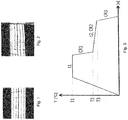
- Fig. 1 and Fig. 2 illustrate this by means of a comparison of components which have been produced from a flat and non-inventive steel flat product by forming and painting.
- Table 1 stolen C Si Mn P al Ti S Cr Nb V Mo N Cu Ni B sn S1 0.0019 0.005 0.11 0,010 0,029 0.072 0,007 0.032 0.001 0.001 0,004 0.0017 0,014 0,021 0.0002 0,004 S2 0.0015 0,006 0.13 0,010 0.026 0,069 0.009 0,045 0.001 0.001 0,006 0.0026 0,017 0,022 0.0002 0,007 S3 0.0023 0.005 0.09 0,008 0.024 0,075 0.005 0,030 0.001 0.001 0.009 0.0027 0,017 0.027 0.0002 0,004 S4 0.0025 0,006 0.09 0,008 0.024 0.073 0,007 0.024 0.001 0,002 0,004 0.0037 0,010 0.016 0.0002 0.005 S5 0.0020 0.005 0.11 0,010 0.026 0.072 0,007 0.028 0.001 0,003 0,003
Landscapes
- Chemical & Material Sciences (AREA)
- Engineering & Computer Science (AREA)
- Materials Engineering (AREA)
- Metallurgy (AREA)
- Organic Chemistry (AREA)
- Mechanical Engineering (AREA)
- Physics & Mathematics (AREA)
- Thermal Sciences (AREA)
- Crystallography & Structural Chemistry (AREA)
- Chemical Kinetics & Catalysis (AREA)
- Electrochemistry (AREA)
- Metal Rolling (AREA)
- Heat Treatment Of Sheet Steel (AREA)
- Heat Treatment Of Steel (AREA)
Claims (15)
- Produit en acier plat, laminé à froid et recuit avec recristallisation, présentant une structure de réseau ferritique, qui est constitué par un acier présentant la composition suivante (en % en poids) :C : 0,0001-0,003%,Si : 0,001-0,025%,Mn : 0,05-0,20%,P : 0,001-0,015%,Al : 0,02-0,055%,Ti : 0,01-0,1%,le reste étant constitué de fer et d'impuretés inévitables, l'acier pouvant en outre contenir les éléments d'alliage facultatifs suivants :Cr : 0,001-0,05%,V : jusqu'à 0,005%,Mo : jusqu'à 0,015%,N : 0,001-0,004%,B, Cu, Nb, Ni, Sb, Sn et S comptant parmi les impuretés inévitables, dont la proportion, au total, est d'au plus 0,2% en poidset qui présente une limite d'allongement rémanent Rp0,2 de jusqu'à 180 MPa,
une résistance à la traction Rm de jusqu'à 340 MPa,
un allongement à la rupture de A80 d'au moins 40%,
une valeur n d'au moins 0,23,
ainsi que sur au moins une de ses surfaces, une rugosité arithmétique moyenne Ra de 0,8-1,6 µm et un nombre de pointes RPc d'au moins 75 1/cm,
les creux et les pointes, façonnés dans la surface, provoquant la rugosité moyenne Ra et le nombre de pointes RPc, se trouvant dans une répartition stochastique. - Produit en acier plat selon la revendication 1, caractérisé en ce qu'il est recouvert par une couche de protection métallique appliquée par revêtement électrolytique.
- Produit en acier plat selon l'une quelconque des revendications précédentes, caractérisé en ce qu'il est recouvert par un revêtement inorganique.
- Produit en acier plat selon l'une quelconque des revendications précédentes, caractérisé en ce qu'il présente une épaisseur d'au plus 1 mm et une largeur d'au moins 1000 mm.
- Procédé pour la fabrication d'un produit en acier plat selon l'une quelconque des revendications 1 à 4, comprenant les étapes de travail suivantes :a) mise à disposition d'un produit en acier plat durci au laminage, laminé à froid, présentant une structure de réseau ferritique, qui est constitué par un acier présentant la composition suivante (en % en poids) :C : 0,0001-0,003%,Si : 0,001-0,025%,Mn : 0,05-0,20%,P : 0,001-0,015%,Al : 0,02-0,055%,Ti : 0,01-0,1%,le reste étant constitué de fer et d'impuretés inévitables, l'acier pouvant en outre contenir les éléments d'alliage facultatifs suivants :Cr : 0,001-0,05%,V : jusqu'à 0,005%,Mo : jusqu'à 0,015%,N : 0,001-0,004%, etB, Cu, Nb, Ni, Sb, Sn et S comptant parmi les impuretés inévitables, dont la proportion, au total, est d'au plus 0,2% en poids ;b) traitement thermique du produit en acier plat réalisé en passage continu à travers un four de recuit sous une atmosphère de recuit qui est constituée, à un point de rosée de -10°C à -60°C, par 1-7% en volume de H2 et, comme reste, par N2 et des impuretés inévitables,- le produit en acier plat, pour le recuit avec recristallisation,- étant chauffé jusqu'à une température de maintien T1 de 750-860°C,- étant maintenu à la température de maintien T1 pendant une durée t1 de 30-90 s,- le produit en acier plat, pour un traitement de vieillissement consécutif,- étant refroidi de la température de maintien T1, à une vitesse de refroidissement CR1 de 2-100°C/s, à une température de départ de vieillissement T2 de 400-600°C,- étant refroidi, après le refroidissement à la température de départ de vieillissement T2, sur une durée t2 de 30-400 s à une vitesse de refroidissement CR2 de 0,5-12°C/s, à une température finale de vieillissement T3 de 250-350°C et- le produit en acier plat étant refroidi, après le refroidissement à la température finale de vieillissement T3, à une vitesse de refroidissement CR3 de 1,5-5,0°C/s, à température ambiante ;c) laminage d'écrouissage du produit en acier plat recuit avec recristallisation à un degré d'écrouissage D de 0,4-0,7% avec utilisation d'un cylindre de travail d'écrouissage, dont la surface périphérique entrant en contact avec le produit en acier plat présente une rugosité arithmétique moyenne Ra de 1,0-2,5 µm et un nombre de pointes RPc d'au moins 100 1/cm, les creux et les pointes façonnés dans la surface du cylindre de travail d'écrouissage, provoquant la rugosité moyenne Ra et le nombre de pointes RPc, présentant une répartition stochastique.
- Procédé selon la revendication 5, caractérisé en ce que la température de maintien T1 est de 800-850°C.
- Procédé selon l'une quelconque des revendications 5 ou 6, caractérisé en ce que la température de début de vieillissement T2 est de 400-550°C.
- Procédé selon l'une quelconque des revendications 5 à 7, caractérisé en ce que le point de rosée de l'atmosphère de recuit est de -15°C à -50°C.
- Procédé selon l'une quelconque des revendications 5 à 8, caractérisé en ce que le laminage d'écrouissage est réalisé en tant que laminage d'écrouissage humide, lors duquel un liquide d'écrouissage est appliqué, en amont du cylindre de travail d'écrouissage dans le sens de transport du produit en acier plat, sur la surface du produit en acier plat sur laquelle agit le cylindre de travail d'écrouissage.
- Procédé selon l'une quelconque des revendications 5 à 9, caractérisé en ce que le degré d'écrouissage D est 0,5-0,6%.
- Procédé selon l'une quelconque des revendications 5 à 10, caractérisé en ce que la rugosité arithmétique moyenne Ra de la surface périphérique du cylindre de travail d'écrouissage qui entre en contact avec le produit en acier plat est de 1,2-2,3 µm.
- Procédé selon l'une quelconque des revendications 5 à 11, caractérisé en ce que le nombre de pointes RPc de la surface périphérique du cylindre de travail d'écrouissage qui entre en contact avec le produit en acier plat est d'au moins 130 1/cm.
- Procédé selon l'une quelconque des revendications 5 à 12, caractérisé en ce que les étapes de travail b) et c) sont effectuées dans une succession sans interruption.
- Procédé selon l'une quelconque des revendications 5 à 13, caractérisé en ce que le produit en acier plat est recouvert, après le laminage d'écrouissage, par un revêtement métallique à base de Zn.
- Procédé selon la revendication 14, caractérisé en ce que le revêtement métallique est appliqué par galvanisation électrolytique sur le produit en acier plat.
Priority Applications (1)
| Application Number | Priority Date | Filing Date | Title |
|---|---|---|---|
| PL15762569.0T PL3204530T5 (pl) | 2014-10-09 | 2015-09-09 | Walcowany na zimno i wyżarzany rekrystalizująco płaski wyrób stalowy oraz sposób jego wytwarzania |
Applications Claiming Priority (2)
| Application Number | Priority Date | Filing Date | Title |
|---|---|---|---|
| EP14188314 | 2014-10-09 | ||
| PCT/EP2015/070577 WO2016055227A1 (fr) | 2014-10-09 | 2015-09-09 | Produit plat en acier laminé à froid et recuit avec recristallisation et procédé de production dudit produit |
Publications (3)
| Publication Number | Publication Date |
|---|---|
| EP3204530A1 EP3204530A1 (fr) | 2017-08-16 |
| EP3204530B1 true EP3204530B1 (fr) | 2019-01-09 |
| EP3204530B2 EP3204530B2 (fr) | 2024-10-09 |
Family
ID=51743278
Family Applications (1)
| Application Number | Title | Priority Date | Filing Date |
|---|---|---|---|
| EP15762569.0A Active EP3204530B2 (fr) | 2014-10-09 | 2015-09-09 | Produit plat en acier laminé à froid et recristallisant, ainsi que son procédé de fabrication |
Country Status (13)
| Country | Link |
|---|---|
| US (1) | US10683560B2 (fr) |
| EP (1) | EP3204530B2 (fr) |
| JP (1) | JP6636512B2 (fr) |
| KR (1) | KR102462210B1 (fr) |
| CN (1) | CN106795575B (fr) |
| BR (1) | BR112017007273B1 (fr) |
| CA (1) | CA2961427C (fr) |
| ES (1) | ES2716937T5 (fr) |
| MX (1) | MX2017004593A (fr) |
| PL (1) | PL3204530T5 (fr) |
| TR (1) | TR201905219T4 (fr) |
| WO (1) | WO2016055227A1 (fr) |
| ZA (1) | ZA201701938B (fr) |
Cited By (2)
| Publication number | Priority date | Publication date | Assignee | Title |
|---|---|---|---|---|
| DE102021200744A1 (de) | 2021-01-28 | 2022-07-28 | Thyssenkrupp Steel Europe Ag | Verfahren zum Texturieren einer Dressierwalze, Dressierwalze und dressiertes Stahlblech |
| DE102023111354A1 (de) | 2023-05-03 | 2024-11-07 | Thyssenkrupp Steel Europe Ag | Elektrolytisch verzinktes Stahlblech |
Families Citing this family (17)
| Publication number | Priority date | Publication date | Assignee | Title |
|---|---|---|---|---|
| ES2716937T5 (en) | 2014-10-09 | 2025-02-12 | Thyssenkrupp Steel Europe Ag | Cold rolled steel sheet and recrystallisation-annealed steel flat product and method for producing the same |
| EP4339304A1 (fr) | 2016-09-20 | 2024-03-20 | ThyssenKrupp Steel Europe AG | Procédé de fabrication de produits plats en acier et produit plat en acier |
| DE102017103308A1 (de) * | 2017-02-17 | 2018-08-23 | Voestalpine Stahl Gmbh | Verfahren zum Herstellen von Stahlblechen |
| JP2020525639A (ja) * | 2017-02-17 | 2020-08-27 | フォエスタルピネ スタール ゲーエムベーハー | 鋼板の製造方法 |
| DE102017103303A1 (de) * | 2017-02-17 | 2018-08-23 | Voestalpine Stahl Gmbh | Verfahren zum Herstellen von Stahlblechen |
| DE102017218704A1 (de) * | 2017-10-19 | 2019-04-25 | Thyssenkrupp Ag | Verfahren zur Herstellung eines mit einem metallischen, vor Korrosion schützenden Überzug versehenen Stahlbauteils |
| CN108642421A (zh) * | 2018-05-15 | 2018-10-12 | 首钢集团有限公司 | 一种镀锌钢板的生产方法 |
| TWI656225B (zh) * | 2018-05-18 | 2019-04-11 | 中國鋼鐵股份有限公司 | 熱浸鍍鋅鋼片之製造方法 |
| WO2020048601A1 (fr) * | 2018-09-06 | 2020-03-12 | Thyssenkrupp Steel Europe Ag | Tôle fine à froid zinguée dotée de propriétés tribologiques i améliorées |
| WO2020048602A1 (fr) * | 2018-09-06 | 2020-03-12 | Thyssenkrupp Steel Europe Ag | Tôle fine à froid zinguée aux propriétés tribologiques ii améliorées |
| CN109825763B (zh) * | 2019-01-23 | 2021-04-30 | 邢台钢铁有限责任公司 | 一种高导电性阴极扁钢用工业纯铁及其生产方法 |
| DE102019118578A1 (de) * | 2019-07-09 | 2021-01-14 | Thyssenkrupp Steel Europe Ag | Verfahren zum Herstellen eines Blechproduktes und Blechprodukt |
| KR102281203B1 (ko) * | 2019-12-19 | 2021-07-26 | 주식회사 포스코 | 프레스 성형성 및 도장 선영성이 우수한 도금강판용 조질압연 롤 및 이를 이용한 도금강판의 제조방법 |
| KR102484992B1 (ko) * | 2020-11-18 | 2023-01-05 | 주식회사 포스코 | 강도, 성형성 및 표면 품질이 우수한 도금강판 및 이의 제조방법 |
| DE102021125889A1 (de) * | 2021-10-06 | 2023-04-06 | Thyssenkrupp Steel Europe Ag | Verfahren zum Dressieren eines Stahlblechs, dressiertes Stahlblech und daraus hergestelltes Bauteil |
| CN114182079B (zh) * | 2021-11-18 | 2024-04-16 | 山东钢铁集团日照有限公司 | 一种外板用冷轧深冲钢表面轧制纹的控制方法 |
| CN117551857B (zh) * | 2023-11-14 | 2025-12-12 | 张家港扬子江冷轧板有限公司 | 冷轧带钢及其生产方法 |
Citations (6)
| Publication number | Priority date | Publication date | Assignee | Title |
|---|---|---|---|---|
| EP0391658B1 (fr) | 1989-04-07 | 1993-07-21 | Kawasaki Steel Corporation | Procédé pour laminer à froid par voie humide |
| JPH08337842A (ja) | 1995-06-12 | 1996-12-24 | Kobe Steel Ltd | 耐木目状疵性に優れた電気亜鉛めっき用鋼板および電気亜鉛めっき鋼板、並びにそれらの製造方法 |
| DE69408739T2 (de) | 1993-06-29 | 1998-07-16 | Nippon Kokan Kk | Oberflächenbehandeltes Stahlblech und Methode zur Herstellung desselben |
| US5954896A (en) | 1995-02-23 | 1999-09-21 | Nippon Steel Corporation | Cold rolled steel sheet and galvanized steel sheet having improved homogeneity in workability and process for producing same |
| RU2366730C1 (ru) | 2008-07-08 | 2009-09-10 | Открытое акционерное общество "Магнитогорский металлургический комбинат" | Способ производства if-стали |
| WO2014037545A1 (fr) * | 2012-09-07 | 2014-03-13 | Daetwyler Graphics Ag | Produit plat constitué d'un matériau métallique, en particulier d'un matériau acier, utilisation dudit produit plat, ainsi que cylindre et procédé de fabrication dudit produit plat |
Family Cites Families (38)
| Publication number | Priority date | Publication date | Assignee | Title |
|---|---|---|---|---|
| JPS61291924A (ja) * | 1985-06-17 | 1986-12-22 | Nippon Steel Corp | 加工性の優れたプレス成形用鋼板の製造方法 |
| US4775599A (en) | 1985-12-24 | 1988-10-04 | Kawasaki Steel Corporation | Cold rolled steel sheets having an improved press formability |
| US4798772A (en) | 1986-01-17 | 1989-01-17 | Kawasaki Steel Corporation | Steel sheets for painting and a method of producing the same |
| JP2792898B2 (ja) * | 1989-04-07 | 1998-09-03 | 川崎製鉄株式会社 | 化成処理性にすぐれた深絞り用冷延鋼板の製造方法 |
| DE69117876T3 (de) * | 1990-11-09 | 2003-10-30 | Nippon Steel Corp., Tokio/Tokyo | Kaltgewalztes Stahlband mit hervorragender Pressverformbarkeit und Verfahren zur Herstellung |
| JPH04200902A (ja) * | 1990-11-30 | 1992-07-21 | Kawasaki Steel Corp | 塗膜鮮映性とプレス成形性に優れた金属板およびその製造方法 |
| JP3185227B2 (ja) * | 1991-01-07 | 2001-07-09 | 日本鋼管株式会社 | 極めて優れた深絞り成形性と張出し成形性を有する冷延鋼板の製造方法 |
| DE19622164C1 (de) | 1996-06-01 | 1997-05-07 | Thyssen Stahl Ag | Verfahren zur Erzeugung eines kaltgewalzten Stahlbleches oder -bandes mit guter Umformbarkeit |
| DE19701443A1 (de) | 1997-01-17 | 1998-07-23 | Thyssen Stahl Ag | Stahl |
| ES2203055T3 (es) | 1999-12-22 | 2004-04-01 | Sidmar N.V. | Composicion de acero con contenido en carbono ultrabajo, procedimiento para la produccion de un producto de acero ulc y producto obtenido. |
| JP2001288549A (ja) * | 2000-03-31 | 2001-10-19 | Kawasaki Steel Corp | プレス成形性に優れた冷延鋼板、めっき鋼板の製造方法 |
| US20030015263A1 (en) * | 2000-05-26 | 2003-01-23 | Chikara Kami | Cold rolled steel sheet and galvanized steel sheet having strain aging hardening property and method for producing the same |
| WO2001092593A1 (fr) * | 2000-05-31 | 2001-12-06 | Kawasaki Steel Corporation | Tole d'acier laminee a froid presentant d'excellentes proprietes de rheodurcissement par vieillissement, et procede de production |
| EP2312009A1 (fr) * | 2000-06-20 | 2011-04-20 | JFE Steel Corporation | Feuille d'acier et son procédé de fabrication |
| JP2002004019A (ja) * | 2000-06-23 | 2002-01-09 | Nkk Corp | 亜鉛めっき鋼板 |
| EP1327697A4 (fr) | 2000-10-19 | 2009-11-11 | Jfe Steel Corp | Tole d'acier plaque de zinc et procede de preparation de cette tole, et procede de fabrication d'un article forme par usinage a la presse |
| BR0210265B1 (pt) * | 2001-06-06 | 2013-04-09 | folha de aÇo galvanizado ou galvanelado com imersço a quente. | |
| JP4110750B2 (ja) | 2001-06-07 | 2008-07-02 | Jfeスチール株式会社 | 耐食性と導電性に優れた有機被覆鋼板 |
| JP2003080302A (ja) * | 2001-09-12 | 2003-03-18 | Nkk Corp | 亜鉛めっき鋼板の調質圧延方法 |
| JP3753062B2 (ja) * | 2001-12-20 | 2006-03-08 | Jfeスチール株式会社 | 合金化溶融亜鉛めっき鋼板及びその製造方法 |
| JP2003306759A (ja) * | 2002-04-18 | 2003-10-31 | Jfe Steel Kk | プレス成形性に優れた亜鉛めっき鋼板の製造方法 |
| JP2004076158A (ja) * | 2002-07-29 | 2004-03-11 | Jfe Steel Kk | 表面処理鋼板 |
| JP4599855B2 (ja) * | 2004-03-04 | 2010-12-15 | Jfeスチール株式会社 | 冷延鋼板の製造方法及び圧延用ロール表面の調整方法 |
| DE102004013031A1 (de) | 2004-03-16 | 2005-10-06 | Waldrich Siegen Werkzeugmaschinen Gmbh | Verfahren und Maschine zur Herstellung einer Walze |
| KR101030207B1 (ko) * | 2006-03-16 | 2011-04-22 | 제이에프이 스틸 가부시키가이샤 | 냉연 강판 및 그 제조 방법, 전지 및 그 제조 방법 |
| ES2348815T3 (es) | 2007-06-22 | 2010-12-15 | Thyssenkrupp Steel Europe Ag | Producto plano de un material metalico, en particular de un material de acero, uso de un producto plano semejante asi como cilindro y procedimiento para la fabricacion de tales productos planos. |
| EP2020451A1 (fr) † | 2007-07-19 | 2009-02-04 | ArcelorMittal France | Procédé de fabrication de tôles d'acier à hautes caractéristiques de résistance et de ductilité, et tôles ainsi produites |
| JP5589269B2 (ja) * | 2008-09-25 | 2014-09-17 | 新日鐵住金株式会社 | 合金化溶融亜鉛めっき鋼板及び合金化溶融亜鉛めっき鋼板の製造方法 |
| JP5655300B2 (ja) * | 2009-03-05 | 2015-01-21 | Jfeスチール株式会社 | 曲げ加工性に優れた冷延鋼板、その製造方法およびそれを用いた部材 |
| DE102010017354A1 (de) | 2010-06-14 | 2011-12-15 | Thyssenkrupp Steel Europe Ag | Verfahren zum Herstellen eines warmgeformten und gehärteten, mit einer metallischen Korrosionsschutzbeschichtung überzogenen Stahlbauteils aus einem Stahlflachprodukt |
| JP5549414B2 (ja) * | 2010-06-23 | 2014-07-16 | Jfeスチール株式会社 | 形状凍結性に優れた冷延薄鋼板およびその製造方法 |
| CN102453837B (zh) | 2010-10-25 | 2013-07-17 | 宝山钢铁股份有限公司 | 一种高磁感无取向硅钢的制造方法 |
| CN101956133B (zh) | 2010-10-29 | 2012-09-05 | 攀钢集团钢铁钒钛股份有限公司 | 一种低屈服强度耐时效连退冷轧钢板及其生产方法 |
| WO2012070271A1 (fr) * | 2010-11-22 | 2012-05-31 | 新日本製鐵株式会社 | Feuille d'acier de type à durcissement par vieillissement sous contrainte ayant une excellente résistance au vieillissement après cuisson de peinture et son procédé de fabrication |
| JP5958038B2 (ja) | 2011-04-21 | 2016-07-27 | Jfeスチール株式会社 | 外圧に対する缶胴部の座屈強度が高く、成形性および成形後の表面性状に優れた缶用鋼板およびその製造方法 |
| DE102014010020A1 (de) | 2014-07-08 | 2016-01-14 | Clariant International Ltd. | Adsorptionsmaterial zur Adsorption von Edelgasen, Verwendung desselben und Verfahren zur Adsorption von Edelgasen |
| ES2716937T5 (en) | 2014-10-09 | 2025-02-12 | Thyssenkrupp Steel Europe Ag | Cold rolled steel sheet and recrystallisation-annealed steel flat product and method for producing the same |
| CN104946978B (zh) * | 2015-07-07 | 2017-03-01 | 新余钢铁集团有限公司 | 一种用于家电面板的彩涂冷轧基板及其制造方法 |
-
2015
- 2015-09-09 ES ES15762569T patent/ES2716937T5/es active Active
- 2015-09-09 CN CN201580054737.4A patent/CN106795575B/zh active Active
- 2015-09-09 CA CA2961427A patent/CA2961427C/fr active Active
- 2015-09-09 JP JP2017518505A patent/JP6636512B2/ja not_active Expired - Fee Related
- 2015-09-09 EP EP15762569.0A patent/EP3204530B2/fr active Active
- 2015-09-09 TR TR2019/05219T patent/TR201905219T4/tr unknown
- 2015-09-09 KR KR1020177012453A patent/KR102462210B1/ko active Active
- 2015-09-09 WO PCT/EP2015/070577 patent/WO2016055227A1/fr not_active Ceased
- 2015-09-09 US US15/518,167 patent/US10683560B2/en active Active
- 2015-09-09 MX MX2017004593A patent/MX2017004593A/es unknown
- 2015-09-09 PL PL15762569.0T patent/PL3204530T5/pl unknown
- 2015-09-09 BR BR112017007273-4A patent/BR112017007273B1/pt not_active IP Right Cessation
-
2017
- 2017-03-20 ZA ZA2017/01938A patent/ZA201701938B/en unknown
Patent Citations (7)
| Publication number | Priority date | Publication date | Assignee | Title |
|---|---|---|---|---|
| EP0391658B1 (fr) | 1989-04-07 | 1993-07-21 | Kawasaki Steel Corporation | Procédé pour laminer à froid par voie humide |
| DE69408739T2 (de) | 1993-06-29 | 1998-07-16 | Nippon Kokan Kk | Oberflächenbehandeltes Stahlblech und Methode zur Herstellung desselben |
| US5954896A (en) | 1995-02-23 | 1999-09-21 | Nippon Steel Corporation | Cold rolled steel sheet and galvanized steel sheet having improved homogeneity in workability and process for producing same |
| JPH08337842A (ja) | 1995-06-12 | 1996-12-24 | Kobe Steel Ltd | 耐木目状疵性に優れた電気亜鉛めっき用鋼板および電気亜鉛めっき鋼板、並びにそれらの製造方法 |
| RU2366730C1 (ru) | 2008-07-08 | 2009-09-10 | Открытое акционерное общество "Магнитогорский металлургический комбинат" | Способ производства if-стали |
| WO2014037545A1 (fr) * | 2012-09-07 | 2014-03-13 | Daetwyler Graphics Ag | Produit plat constitué d'un matériau métallique, en particulier d'un matériau acier, utilisation dudit produit plat, ainsi que cylindre et procédé de fabrication dudit produit plat |
| DE102012017703A1 (de) | 2012-09-07 | 2014-03-13 | Daetwyler Graphics Ag | Flachprodukt aus Metallwerkstoff, insbesondere einem Stahlwerkstoff, Verwendung eines solchen Flachprodukts sowie Walze und Verfahren zur Herstellung solcher Flachprodukte |
Non-Patent Citations (18)
| Title |
|---|
| "Spurenelemente in Stählen", 1985, VERLAG STAHLEISEN, Düsseldorf, article "Spurenelemente im Stahl - Moeglichkeiten zur Beeinflussung im Smelzbetrieb", pages: 19 - 22, XP002433212 |
| "Stahlfibel FACHBUCH", 2007, VERLAG STAHLEISEN, Düsseldorf, article "Kaltumformen von Stahl", pages: 120 - 123, XP055653070 |
| ANONYMOUS: "Qualitätsprotokoll Dressierstraße 3", SALZGITTER NR. 0047783/001, 24 June 2014 (2014-06-24), XP055652763 |
| ANONYMOUS: "ThyssenKrupp Steel Europe présents innovative finishes for top class paintwork", THYSSENKRUPP - PRESS RELEASE, 5 November 2013 (2013-11-05), XP055654006, Retrieved from the Internet <URL:https://www.thyssenkrupp-steel.com/en/newsroom/press-releases/press-release-2282.html> |
| BÉRANGER G. ET AL: "Le livre de l'acier", 1994, TECHNIQUE & DOCUMENTATION, article "INT'ERÉT INDUSTRIEL DU RECUIT CONTINU", pages: 1350 - 1352, XP055654012 |
| BSI: "Cold rolled low carbon steel flat products for cold forming - Technical delivery conditions", BSI NORME EN 10130:2006, December 2006 (2006-12-01), XP055653082 |
| COPPIN P. ET AL: "Atmosphères de traitement thermique", TECHNIQUES DE L'INGÉNIEUR, 10 March 2000 (2000-03-10), XP055654034, Retrieved from the Internet <URL:https://www.techniques-ingenieur.fr/base-documentaire/materiaux-th11/traitements-thermiques-des-metaux-generalites-42500210/atmospheres-de-traitement-thermique-m1220/role-de-l-atmosphere-m1220niv10001.html> |
| CORNELIUS FRONHOFFS ET AL: "Steel for highest paint appearance quality in automotive application", STEELS IN CARS AND TRUCKS. SCT2014, 15 June 2014 (2014-06-15) - 19 June 2014 (2014-06-19), pages 175 - 182, XP055654002 |
| DIN: "Elektrolytisch verzinkte kaltgewalzte Flacherzeugnisse aus Stahl zum Kaltu mformen - Technische Lieferbedingungen; Deutsche Fassung EN 10152:2009", DIN EN 10152, July 2009 (2009-07-01), pages 1 - 21, XP055651994 |
| FRANK BEIER ET AL: "From skin pass to paint - evaluation of measurements of sheet metal waviness and roughness throughout the processing chain", SCT 2014, 15 June 2014 (2014-06-15) - 19 June 2014 (2014-06-19), pages 183 - 190, XP055653077 |
| GREGORY GERSTEIN ET AL: "Characterization of the microstructure evolution in IF-Steel and AA6016 during plane-strain tension and simple shear", MATERIALS, vol. 8, no. 1, 15 January 2015 (2015-01-15), pages 285, XP055653086 |
| IRIE T. ET AL: "Development of deep drawable and bake hardenable high strength steel sheet by continuous annealing of extra low-carbon steels with Nb or Ti and P", METALLURGY OF CONTINUOUS-ANNEALED STEEL SHEET, 15 February 1982 (1982-02-15), pages 155 - 171, XP055654029 |
| KOHICHI TAYA ET AL: "Development of the strip temperature control technique for a continuos annealing line", DEVELOPMENTS IN THE ANNEALING OF STEEL SHEETS, 22 October 1991 (1991-10-22) - 24 October 1991 (1991-10-24), pages 133 - 143, XP055654023 |
| LOUIS P. ET AL: "Continuous annealing line of Sollac Ste Agathe", DEVELOPMENTS IN THE ANNEALING OF SHEET STEELS, 22 October 1991 (1991-10-22) - 24 October 1991 (1991-10-24), pages 43 - 49, XP055654020 |
| M. BLUMENAU ET AL: "Modernization of the continuous annealing line of ThyssenKrupp Steel Europe in Dortmund", STEEL, 2012, pages 568 - 576, XP055654027 |
| RITTERBACH B.: "Qualitätregelkreis zur Erzeugung definierter Feinblechrauheiten mit verschiedenen Texturierverfahren", DISSERTATION, 1999, XP055654036 |
| WOLFGANG BLECK: "Werkstoffkunde Stahl für Studium und Praxis", 2004, IEHK, Aachen, pages: 126 - 129, XP055653036 |
| ZIMNIK, WALTER: "Pretex - Ein neues Verfahren zur Erzeugung texturierter Feinbleche für höchste Ansprüche", STAHL UND EISEN, vol. 118, no. 3, 1998, pages 75 - 80, XP055651998 |
Cited By (3)
| Publication number | Priority date | Publication date | Assignee | Title |
|---|---|---|---|---|
| DE102021200744A1 (de) | 2021-01-28 | 2022-07-28 | Thyssenkrupp Steel Europe Ag | Verfahren zum Texturieren einer Dressierwalze, Dressierwalze und dressiertes Stahlblech |
| DE102023111354A1 (de) | 2023-05-03 | 2024-11-07 | Thyssenkrupp Steel Europe Ag | Elektrolytisch verzinktes Stahlblech |
| WO2024227762A1 (fr) | 2023-05-03 | 2024-11-07 | Thyssenkrupp Steel Europe Ag | Tôle d'acier galvanisée par électrolyse |
Also Published As
| Publication number | Publication date |
|---|---|
| JP2017534758A (ja) | 2017-11-24 |
| BR112017007273A2 (pt) | 2018-01-23 |
| EP3204530B2 (fr) | 2024-10-09 |
| CN106795575B (zh) | 2018-08-28 |
| PL3204530T5 (pl) | 2024-12-02 |
| ZA201701938B (en) | 2022-05-25 |
| TR201905219T4 (tr) | 2019-05-21 |
| CA2961427C (fr) | 2019-01-08 |
| ES2716937T5 (en) | 2025-02-12 |
| US10683560B2 (en) | 2020-06-16 |
| ES2716937T3 (es) | 2019-06-18 |
| CN106795575A (zh) | 2017-05-31 |
| EP3204530A1 (fr) | 2017-08-16 |
| PL3204530T3 (pl) | 2019-07-31 |
| CA2961427A1 (fr) | 2016-04-14 |
| KR20170067839A (ko) | 2017-06-16 |
| BR112017007273B1 (pt) | 2021-03-09 |
| MX2017004593A (es) | 2017-07-10 |
| WO2016055227A1 (fr) | 2016-04-14 |
| US20170306430A1 (en) | 2017-10-26 |
| KR102462210B1 (ko) | 2022-11-03 |
| JP6636512B2 (ja) | 2020-01-29 |
Similar Documents
| Publication | Publication Date | Title |
|---|---|---|
| EP3204530B2 (fr) | Produit plat en acier laminé à froid et recristallisant, ainsi que son procédé de fabrication | |
| EP2848709B1 (fr) | Procédé de fabrication d'un composant en acier revêtu d'une coiffe métallique protégeant de la corrosion et composant en acier | |
| EP1660693B1 (fr) | Procede de production d'un element constitutif profile trempe | |
| EP2553133B1 (fr) | Acier, produit plat en acier, élément en acier et procédé de fabrication d'un élément en acier | |
| EP2290133B1 (fr) | Procédé de fabrication d'un composant en acier revêtu d'une coiffe métallique protégeant de la corrosion et composant en acier | |
| EP2655674B1 (fr) | Procédé de formage et de durcissement de tôles d'acier revêtues | |
| EP3655560B1 (fr) | Produit plat en acier possédant une bonne résistance au vieillissement et son procédé de fabrication | |
| DE60119826T2 (de) | Verfahren zum Herstellen eines Bauteils mit sehr guten mechanischen Eigenschaften, Umformung durch Tiefziehen, aus gewalztem insbesondere warmgewalztem und beschichtetem Stahlblech | |
| EP2812458B1 (fr) | Procédé pour le revêtement par immersion à chaud d'un produit plat en acier | |
| EP3250727B2 (fr) | Procédé de fabrication d'une pièce constituée de tôle d'acier revêtue à base d'aluminium durcie par moulage par compression | |
| EP2208803A1 (fr) | Acier à résistance élevée, formable à froid, produit plat en acier, procédé de fabrication d'un produit plat en acier et utilisation du produit plat en acier | |
| WO2018234102A1 (fr) | Procédé de fabrication d'un composant en acier pourvu d'un revêtement métallique anticorrosion | |
| EP3658307B1 (fr) | Pièce en tôle fabriquée par formage à chaud d'un produit plat en acier et procédé pour sa fabrication | |
| EP1263540B1 (fr) | Procede pour produire des pieces en acier a faible epaisseur de paroi, et pieces ainsi produites | |
| EP4038215B1 (fr) | Procédé de fabrication d'une pièce en tôle d'acier trempée à la presse présentant un revêtement à base d'aluminium, ébauche de tôle initiale et pièce en tôle d'acier trempée à la presse fabriquée à partir de celle-ci | |
| EP2987889B1 (fr) | Tôle d'acier avec surface finie et son procédé de fabrication | |
| WO2022029033A1 (fr) | Procédé de production d'une bande d'acier revêtue, et procédé de production d'un produit d'acier trempé à partir de celle-ci | |
| EP3827103B1 (fr) | Procédé pour la fabrication d'un produit en acier durci | |
| EP3332048B1 (fr) | Procédé de production d'un revêtement par immersion à chaud, galvanisé à base de zinc - magnésium et un produit plat en acier doté d'un tel revêtement | |
| EP3583239B1 (fr) | Procédé de fabrication de tôles d'acier, tôle d'acier et son utilisation | |
| EP1865086B1 (fr) | Utilisation d'un produit plat fabriqué à partir d'un acier au manganèse et au bore et procédé de sa fabrication | |
| EP3356565B1 (fr) | Produit plat en acier et pièce en acier fabriquée par mise en forme d'un tel produit plat en acier | |
| EP4093896A1 (fr) | Composant en acier comprenant une couche anti-corrosion contenant du manganèse | |
| DE102020203421A1 (de) | Stahlflachprodukt mit einem ZnCu-Schichtsystem | |
| EP4516954A1 (fr) | Produit plat en acier avec une couche de protection contre la calamine |
Legal Events
| Date | Code | Title | Description |
|---|---|---|---|
| STAA | Information on the status of an ep patent application or granted ep patent |
Free format text: STATUS: THE INTERNATIONAL PUBLICATION HAS BEEN MADE |
|
| PUAI | Public reference made under article 153(3) epc to a published international application that has entered the european phase |
Free format text: ORIGINAL CODE: 0009012 |
|
| STAA | Information on the status of an ep patent application or granted ep patent |
Free format text: STATUS: REQUEST FOR EXAMINATION WAS MADE |
|
| 17P | Request for examination filed |
Effective date: 20170314 |
|
| AK | Designated contracting states |
Kind code of ref document: A1 Designated state(s): AL AT BE BG CH CY CZ DE DK EE ES FI FR GB GR HR HU IE IS IT LI LT LU LV MC MK MT NL NO PL PT RO RS SE SI SK SM TR |
|
| AX | Request for extension of the european patent |
Extension state: BA ME |
|
| TPAC | Observations filed by third parties |
Free format text: ORIGINAL CODE: EPIDOSNTIPA |
|
| DAV | Request for validation of the european patent (deleted) | ||
| DAX | Request for extension of the european patent (deleted) | ||
| STAA | Information on the status of an ep patent application or granted ep patent |
Free format text: STATUS: EXAMINATION IS IN PROGRESS |
|
| 17Q | First examination report despatched |
Effective date: 20180125 |
|
| GRAP | Despatch of communication of intention to grant a patent |
Free format text: ORIGINAL CODE: EPIDOSNIGR1 |
|
| STAA | Information on the status of an ep patent application or granted ep patent |
Free format text: STATUS: GRANT OF PATENT IS INTENDED |
|
| INTG | Intention to grant announced |
Effective date: 20180914 |
|
| GRAS | Grant fee paid |
Free format text: ORIGINAL CODE: EPIDOSNIGR3 |
|
| GRAA | (expected) grant |
Free format text: ORIGINAL CODE: 0009210 |
|
| STAA | Information on the status of an ep patent application or granted ep patent |
Free format text: STATUS: THE PATENT HAS BEEN GRANTED |
|
| AK | Designated contracting states |
Kind code of ref document: B1 Designated state(s): AL AT BE BG CH CY CZ DE DK EE ES FI FR GB GR HR HU IE IS IT LI LT LU LV MC MK MT NL NO PL PT RO RS SE SI SK SM TR |
|
| REG | Reference to a national code |
Ref country code: GB Ref legal event code: FG4D Free format text: NOT ENGLISH |
|
| REG | Reference to a national code |
Ref country code: AT Ref legal event code: REF Ref document number: 1087367 Country of ref document: AT Kind code of ref document: T Effective date: 20190115 Ref country code: CH Ref legal event code: EP |
|
| REG | Reference to a national code |
Ref country code: IE Ref legal event code: FG4D Free format text: LANGUAGE OF EP DOCUMENT: GERMAN |
|
| REG | Reference to a national code |
Ref country code: DE Ref legal event code: R096 Ref document number: 502015007629 Country of ref document: DE |
|
| REG | Reference to a national code |
Ref country code: SE Ref legal event code: TRGR |
|
| REG | Reference to a national code |
Ref country code: NL Ref legal event code: FP |
|
| REG | Reference to a national code |
Ref country code: LT Ref legal event code: MG4D |
|
| REG | Reference to a national code |
Ref country code: ES Ref legal event code: FG2A Ref document number: 2716937 Country of ref document: ES Kind code of ref document: T3 Effective date: 20190618 |
|
| PG25 | Lapsed in a contracting state [announced via postgrant information from national office to epo] |
Ref country code: PT Free format text: LAPSE BECAUSE OF FAILURE TO SUBMIT A TRANSLATION OF THE DESCRIPTION OR TO PAY THE FEE WITHIN THE PRESCRIBED TIME-LIMIT Effective date: 20190509 Ref country code: LT Free format text: LAPSE BECAUSE OF FAILURE TO SUBMIT A TRANSLATION OF THE DESCRIPTION OR TO PAY THE FEE WITHIN THE PRESCRIBED TIME-LIMIT Effective date: 20190109 Ref country code: NO Free format text: LAPSE BECAUSE OF FAILURE TO SUBMIT A TRANSLATION OF THE DESCRIPTION OR TO PAY THE FEE WITHIN THE PRESCRIBED TIME-LIMIT Effective date: 20190409 Ref country code: FI Free format text: LAPSE BECAUSE OF FAILURE TO SUBMIT A TRANSLATION OF THE DESCRIPTION OR TO PAY THE FEE WITHIN THE PRESCRIBED TIME-LIMIT Effective date: 20190109 |
|
| REG | Reference to a national code |
Ref country code: SK Ref legal event code: T3 Ref document number: E 30805 Country of ref document: SK |
|
| PG25 | Lapsed in a contracting state [announced via postgrant information from national office to epo] |
Ref country code: HR Free format text: LAPSE BECAUSE OF FAILURE TO SUBMIT A TRANSLATION OF THE DESCRIPTION OR TO PAY THE FEE WITHIN THE PRESCRIBED TIME-LIMIT Effective date: 20190109 Ref country code: IS Free format text: LAPSE BECAUSE OF FAILURE TO SUBMIT A TRANSLATION OF THE DESCRIPTION OR TO PAY THE FEE WITHIN THE PRESCRIBED TIME-LIMIT Effective date: 20190509 Ref country code: BG Free format text: LAPSE BECAUSE OF FAILURE TO SUBMIT A TRANSLATION OF THE DESCRIPTION OR TO PAY THE FEE WITHIN THE PRESCRIBED TIME-LIMIT Effective date: 20190409 Ref country code: GR Free format text: LAPSE BECAUSE OF FAILURE TO SUBMIT A TRANSLATION OF THE DESCRIPTION OR TO PAY THE FEE WITHIN THE PRESCRIBED TIME-LIMIT Effective date: 20190410 Ref country code: RS Free format text: LAPSE BECAUSE OF FAILURE TO SUBMIT A TRANSLATION OF THE DESCRIPTION OR TO PAY THE FEE WITHIN THE PRESCRIBED TIME-LIMIT Effective date: 20190109 Ref country code: LV Free format text: LAPSE BECAUSE OF FAILURE TO SUBMIT A TRANSLATION OF THE DESCRIPTION OR TO PAY THE FEE WITHIN THE PRESCRIBED TIME-LIMIT Effective date: 20190109 |
|
| REG | Reference to a national code |
Ref country code: DE Ref legal event code: R026 Ref document number: 502015007629 Country of ref document: DE |
|
| PLBI | Opposition filed |
Free format text: ORIGINAL CODE: 0009260 |
|
| PLAX | Notice of opposition and request to file observation + time limit sent |
Free format text: ORIGINAL CODE: EPIDOSNOBS2 |
|
| PG25 | Lapsed in a contracting state [announced via postgrant information from national office to epo] |
Ref country code: RO Free format text: LAPSE BECAUSE OF FAILURE TO SUBMIT A TRANSLATION OF THE DESCRIPTION OR TO PAY THE FEE WITHIN THE PRESCRIBED TIME-LIMIT Effective date: 20190109 Ref country code: EE Free format text: LAPSE BECAUSE OF FAILURE TO SUBMIT A TRANSLATION OF THE DESCRIPTION OR TO PAY THE FEE WITHIN THE PRESCRIBED TIME-LIMIT Effective date: 20190109 Ref country code: AL Free format text: LAPSE BECAUSE OF FAILURE TO SUBMIT A TRANSLATION OF THE DESCRIPTION OR TO PAY THE FEE WITHIN THE PRESCRIBED TIME-LIMIT Effective date: 20190109 Ref country code: DK Free format text: LAPSE BECAUSE OF FAILURE TO SUBMIT A TRANSLATION OF THE DESCRIPTION OR TO PAY THE FEE WITHIN THE PRESCRIBED TIME-LIMIT Effective date: 20190109 |
|
| 26 | Opposition filed |
Opponent name: ARCELORMITTAL Effective date: 20191007 Opponent name: SALZGITTER FLACHSTAHL GMBH Effective date: 20191008 |
|
| PG25 | Lapsed in a contracting state [announced via postgrant information from national office to epo] |
Ref country code: SM Free format text: LAPSE BECAUSE OF FAILURE TO SUBMIT A TRANSLATION OF THE DESCRIPTION OR TO PAY THE FEE WITHIN THE PRESCRIBED TIME-LIMIT Effective date: 20190109 |
|
| PLBB | Reply of patent proprietor to notice(s) of opposition received |
Free format text: ORIGINAL CODE: EPIDOSNOBS3 |
|
| PG25 | Lapsed in a contracting state [announced via postgrant information from national office to epo] |
Ref country code: SI Free format text: LAPSE BECAUSE OF FAILURE TO SUBMIT A TRANSLATION OF THE DESCRIPTION OR TO PAY THE FEE WITHIN THE PRESCRIBED TIME-LIMIT Effective date: 20190109 |
|
| PG25 | Lapsed in a contracting state [announced via postgrant information from national office to epo] |
Ref country code: MC Free format text: LAPSE BECAUSE OF FAILURE TO SUBMIT A TRANSLATION OF THE DESCRIPTION OR TO PAY THE FEE WITHIN THE PRESCRIBED TIME-LIMIT Effective date: 20190109 |
|
| REG | Reference to a national code |
Ref country code: CH Ref legal event code: PL |
|
| PG25 | Lapsed in a contracting state [announced via postgrant information from national office to epo] |
Ref country code: LI Free format text: LAPSE BECAUSE OF NON-PAYMENT OF DUE FEES Effective date: 20190930 Ref country code: CH Free format text: LAPSE BECAUSE OF NON-PAYMENT OF DUE FEES Effective date: 20190930 Ref country code: IE Free format text: LAPSE BECAUSE OF NON-PAYMENT OF DUE FEES Effective date: 20190909 Ref country code: LU Free format text: LAPSE BECAUSE OF NON-PAYMENT OF DUE FEES Effective date: 20190909 |
|
| RDAF | Communication despatched that patent is revoked |
Free format text: ORIGINAL CODE: EPIDOSNREV1 |
|
| PG25 | Lapsed in a contracting state [announced via postgrant information from national office to epo] |
Ref country code: CY Free format text: LAPSE BECAUSE OF FAILURE TO SUBMIT A TRANSLATION OF THE DESCRIPTION OR TO PAY THE FEE WITHIN THE PRESCRIBED TIME-LIMIT Effective date: 20190109 |
|
| APBM | Appeal reference recorded |
Free format text: ORIGINAL CODE: EPIDOSNREFNO |
|
| APBP | Date of receipt of notice of appeal recorded |
Free format text: ORIGINAL CODE: EPIDOSNNOA2O |
|
| APAH | Appeal reference modified |
Free format text: ORIGINAL CODE: EPIDOSCREFNO |
|
| PG25 | Lapsed in a contracting state [announced via postgrant information from national office to epo] |
Ref country code: HU Free format text: LAPSE BECAUSE OF FAILURE TO SUBMIT A TRANSLATION OF THE DESCRIPTION OR TO PAY THE FEE WITHIN THE PRESCRIBED TIME-LIMIT; INVALID AB INITIO Effective date: 20150909 Ref country code: MT Free format text: LAPSE BECAUSE OF FAILURE TO SUBMIT A TRANSLATION OF THE DESCRIPTION OR TO PAY THE FEE WITHIN THE PRESCRIBED TIME-LIMIT Effective date: 20190109 |
|
| APBQ | Date of receipt of statement of grounds of appeal recorded |
Free format text: ORIGINAL CODE: EPIDOSNNOA3O |
|
| PG25 | Lapsed in a contracting state [announced via postgrant information from national office to epo] |
Ref country code: MK Free format text: LAPSE BECAUSE OF FAILURE TO SUBMIT A TRANSLATION OF THE DESCRIPTION OR TO PAY THE FEE WITHIN THE PRESCRIBED TIME-LIMIT Effective date: 20190109 |
|
| P01 | Opt-out of the competence of the unified patent court (upc) registered |
Effective date: 20230526 |
|
| PGFP | Annual fee paid to national office [announced via postgrant information from national office to epo] |
Ref country code: TR Payment date: 20230907 Year of fee payment: 9 Ref country code: NL Payment date: 20230920 Year of fee payment: 9 Ref country code: GB Payment date: 20230920 Year of fee payment: 9 Ref country code: CZ Payment date: 20230905 Year of fee payment: 9 |
|
| PGFP | Annual fee paid to national office [announced via postgrant information from national office to epo] |
Ref country code: SK Payment date: 20230904 Year of fee payment: 9 Ref country code: SE Payment date: 20230920 Year of fee payment: 9 |
|
| APBU | Appeal procedure closed |
Free format text: ORIGINAL CODE: EPIDOSNNOA9O |
|
| PUAH | Patent maintained in amended form |
Free format text: ORIGINAL CODE: 0009272 |
|
| STAA | Information on the status of an ep patent application or granted ep patent |
Free format text: STATUS: PATENT MAINTAINED AS AMENDED |
|
| 27A | Patent maintained in amended form |
Effective date: 20241009 |
|
| AK | Designated contracting states |
Kind code of ref document: B2 Designated state(s): AL AT BE BG CH CY CZ DE DK EE ES FI FR GB GR HR HU IE IS IT LI LT LU LV MC MK MT NL NO PL PT RO RS SE SI SK SM TR |
|
| REG | Reference to a national code |
Ref country code: DE Ref legal event code: R102 Ref document number: 502015007629 Country of ref document: DE |
|
| REG | Reference to a national code |
Ref country code: ES Ref legal event code: DC2A Ref document number: 2716937 Country of ref document: ES Kind code of ref document: T5 Effective date: 20250212 |
|
| PG25 | Lapsed in a contracting state [announced via postgrant information from national office to epo] |
Ref country code: NL Free format text: LAPSE BECAUSE OF FAILURE TO SUBMIT A TRANSLATION OF THE DESCRIPTION OR TO PAY THE FEE WITHIN THE PRESCRIBED TIME-LIMIT Effective date: 20190109 |
|
| REG | Reference to a national code |
Ref country code: SK Ref legal event code: MM4A Ref document number: E 30805 Country of ref document: SK Effective date: 20240909 |
|
| PG25 | Lapsed in a contracting state [announced via postgrant information from national office to epo] |
Ref country code: CZ Free format text: LAPSE BECAUSE OF FAILURE TO SUBMIT A TRANSLATION OF THE DESCRIPTION OR TO PAY THE FEE WITHIN THE PRESCRIBED TIME-LIMIT Effective date: 20190109 |
|
| REG | Reference to a national code |
Ref country code: SE Ref legal event code: EUG |
|
| GBPC | Gb: european patent ceased through non-payment of renewal fee |
Effective date: 20240909 |
|
| PG25 | Lapsed in a contracting state [announced via postgrant information from national office to epo] |
Ref country code: GB Free format text: LAPSE BECAUSE OF NON-PAYMENT OF DUE FEES Effective date: 20240909 |
|
| PG25 | Lapsed in a contracting state [announced via postgrant information from national office to epo] |
Ref country code: SK Free format text: LAPSE BECAUSE OF NON-PAYMENT OF DUE FEES Effective date: 20240909 |
|
| PGFP | Annual fee paid to national office [announced via postgrant information from national office to epo] |
Ref country code: DE Payment date: 20250919 Year of fee payment: 11 |
|
| PG25 | Lapsed in a contracting state [announced via postgrant information from national office to epo] |
Ref country code: SE Free format text: LAPSE BECAUSE OF NON-PAYMENT OF DUE FEES Effective date: 20240910 |
|
| PGFP | Annual fee paid to national office [announced via postgrant information from national office to epo] |
Ref country code: PL Payment date: 20250901 Year of fee payment: 11 Ref country code: IT Payment date: 20250923 Year of fee payment: 11 |
|
| PGFP | Annual fee paid to national office [announced via postgrant information from national office to epo] |
Ref country code: BE Payment date: 20250918 Year of fee payment: 11 |
|
| PGFP | Annual fee paid to national office [announced via postgrant information from national office to epo] |
Ref country code: FR Payment date: 20250922 Year of fee payment: 11 Ref country code: AT Payment date: 20250919 Year of fee payment: 11 |
|
| PGFP | Annual fee paid to national office [announced via postgrant information from national office to epo] |
Ref country code: ES Payment date: 20251028 Year of fee payment: 11 |
|
| REG | Reference to a national code |
Ref country code: DE Ref legal event code: R081 Ref document number: 502015007629 Country of ref document: DE Owner name: THYSSENKRUPP STEEL EUROPE AG, DE Free format text: FORMER OWNERS: THYSSENKRUPP AG, 45143 ESSEN, DE; THYSSENKRUPP STEEL EUROPE AG, 47166 DUISBURG, DE |