EP3172363B1 - Partikelgefüllte faser und daraus geformte artikel - Google Patents
Partikelgefüllte faser und daraus geformte artikel Download PDFInfo
- Publication number
- EP3172363B1 EP3172363B1 EP15753234.2A EP15753234A EP3172363B1 EP 3172363 B1 EP3172363 B1 EP 3172363B1 EP 15753234 A EP15753234 A EP 15753234A EP 3172363 B1 EP3172363 B1 EP 3172363B1
- Authority
- EP
- European Patent Office
- Prior art keywords
- article
- particulate
- fiber
- polymer fiber
- fibers
- Prior art date
- Legal status (The legal status is an assumption and is not a legal conclusion. Google has not performed a legal analysis and makes no representation as to the accuracy of the status listed.)
- Active
Links
Images



Classifications
-
- G—PHYSICS
- G01—MEASURING; TESTING
- G01N—INVESTIGATING OR ANALYSING MATERIALS BY DETERMINING THEIR CHEMICAL OR PHYSICAL PROPERTIES
- G01N23/00—Investigating or analysing materials by the use of wave or particle radiation, e.g. X-rays or neutrons, not covered by groups G01N3/00 – G01N17/00, G01N21/00 or G01N22/00
- G01N23/02—Investigating or analysing materials by the use of wave or particle radiation, e.g. X-rays or neutrons, not covered by groups G01N3/00 – G01N17/00, G01N21/00 or G01N22/00 by transmitting the radiation through the material
- G01N23/06—Investigating or analysing materials by the use of wave or particle radiation, e.g. X-rays or neutrons, not covered by groups G01N3/00 – G01N17/00, G01N21/00 or G01N22/00 by transmitting the radiation through the material and measuring the absorption
- G01N23/083—Investigating or analysing materials by the use of wave or particle radiation, e.g. X-rays or neutrons, not covered by groups G01N3/00 – G01N17/00, G01N21/00 or G01N22/00 by transmitting the radiation through the material and measuring the absorption the radiation being X-rays
-
- D—TEXTILES; PAPER
- D01—NATURAL OR MAN-MADE THREADS OR FIBRES; SPINNING
- D01D—MECHANICAL METHODS OR APPARATUS IN THE MANUFACTURE OF ARTIFICIAL FILAMENTS, THREADS, FIBRES, BRISTLES OR RIBBONS
- D01D5/00—Formation of filaments, threads, or the like
- D01D5/08—Melt spinning methods
-
- D—TEXTILES; PAPER
- D01—NATURAL OR MAN-MADE THREADS OR FIBRES; SPINNING
- D01F—CHEMICAL FEATURES IN THE MANUFACTURE OF ARTIFICIAL FILAMENTS, THREADS, FIBRES, BRISTLES OR RIBBONS; APPARATUS SPECIALLY ADAPTED FOR THE MANUFACTURE OF CARBON FILAMENTS
- D01F1/00—General methods for the manufacture of artificial filaments or the like
- D01F1/02—Addition of substances to the spinning solution or to the melt
- D01F1/10—Other agents for modifying properties
-
- D—TEXTILES; PAPER
- D01—NATURAL OR MAN-MADE THREADS OR FIBRES; SPINNING
- D01F—CHEMICAL FEATURES IN THE MANUFACTURE OF ARTIFICIAL FILAMENTS, THREADS, FIBRES, BRISTLES OR RIBBONS; APPARATUS SPECIALLY ADAPTED FOR THE MANUFACTURE OF CARBON FILAMENTS
- D01F1/00—General methods for the manufacture of artificial filaments or the like
- D01F1/02—Addition of substances to the spinning solution or to the melt
- D01F1/10—Other agents for modifying properties
- D01F1/106—Radiation shielding agents, e.g. absorbing, reflecting agents
-
- D—TEXTILES; PAPER
- D01—NATURAL OR MAN-MADE THREADS OR FIBRES; SPINNING
- D01F—CHEMICAL FEATURES IN THE MANUFACTURE OF ARTIFICIAL FILAMENTS, THREADS, FIBRES, BRISTLES OR RIBBONS; APPARATUS SPECIALLY ADAPTED FOR THE MANUFACTURE OF CARBON FILAMENTS
- D01F8/00—Conjugated, i.e. bi- or multicomponent, artificial filaments or the like; Manufacture thereof
- D01F8/04—Conjugated, i.e. bi- or multicomponent, artificial filaments or the like; Manufacture thereof from synthetic polymers
- D01F8/06—Conjugated, i.e. bi- or multicomponent, artificial filaments or the like; Manufacture thereof from synthetic polymers with at least one polyolefin as constituent
-
- D—TEXTILES; PAPER
- D04—BRAIDING; LACE-MAKING; KNITTING; TRIMMINGS; NON-WOVEN FABRICS
- D04H—MAKING TEXTILE FABRICS, e.g. FROM FIBRES OR FILAMENTARY MATERIAL; FABRICS MADE BY SUCH PROCESSES OR APPARATUS, e.g. FELTS, NON-WOVEN FABRICS; COTTON-WOOL; WADDING ; NON-WOVEN FABRICS FROM STAPLE FIBRES, FILAMENTS OR YARNS, BONDED WITH AT LEAST ONE WEB-LIKE MATERIAL DURING THEIR CONSOLIDATION
- D04H1/00—Non-woven fabrics formed wholly or mainly of staple fibres or like relatively short fibres
- D04H1/40—Non-woven fabrics formed wholly or mainly of staple fibres or like relatively short fibres from fleeces or layers composed of fibres without existing or potential cohesive properties
- D04H1/42—Non-woven fabrics formed wholly or mainly of staple fibres or like relatively short fibres from fleeces or layers composed of fibres without existing or potential cohesive properties characterised by the use of certain kinds of fibres insofar as this use has no preponderant influence on the consolidation of the fleece
-
- D—TEXTILES; PAPER
- D04—BRAIDING; LACE-MAKING; KNITTING; TRIMMINGS; NON-WOVEN FABRICS
- D04H—MAKING TEXTILE FABRICS, e.g. FROM FIBRES OR FILAMENTARY MATERIAL; FABRICS MADE BY SUCH PROCESSES OR APPARATUS, e.g. FELTS, NON-WOVEN FABRICS; COTTON-WOOL; WADDING ; NON-WOVEN FABRICS FROM STAPLE FIBRES, FILAMENTS OR YARNS, BONDED WITH AT LEAST ONE WEB-LIKE MATERIAL DURING THEIR CONSOLIDATION
- D04H1/00—Non-woven fabrics formed wholly or mainly of staple fibres or like relatively short fibres
- D04H1/40—Non-woven fabrics formed wholly or mainly of staple fibres or like relatively short fibres from fleeces or layers composed of fibres without existing or potential cohesive properties
- D04H1/42—Non-woven fabrics formed wholly or mainly of staple fibres or like relatively short fibres from fleeces or layers composed of fibres without existing or potential cohesive properties characterised by the use of certain kinds of fibres insofar as this use has no preponderant influence on the consolidation of the fleece
- D04H1/4209—Inorganic fibres
- D04H1/4234—Metal fibres
-
- D—TEXTILES; PAPER
- D04—BRAIDING; LACE-MAKING; KNITTING; TRIMMINGS; NON-WOVEN FABRICS
- D04H—MAKING TEXTILE FABRICS, e.g. FROM FIBRES OR FILAMENTARY MATERIAL; FABRICS MADE BY SUCH PROCESSES OR APPARATUS, e.g. FELTS, NON-WOVEN FABRICS; COTTON-WOOL; WADDING ; NON-WOVEN FABRICS FROM STAPLE FIBRES, FILAMENTS OR YARNS, BONDED WITH AT LEAST ONE WEB-LIKE MATERIAL DURING THEIR CONSOLIDATION
- D04H1/00—Non-woven fabrics formed wholly or mainly of staple fibres or like relatively short fibres
- D04H1/40—Non-woven fabrics formed wholly or mainly of staple fibres or like relatively short fibres from fleeces or layers composed of fibres without existing or potential cohesive properties
- D04H1/42—Non-woven fabrics formed wholly or mainly of staple fibres or like relatively short fibres from fleeces or layers composed of fibres without existing or potential cohesive properties characterised by the use of certain kinds of fibres insofar as this use has no preponderant influence on the consolidation of the fleece
- D04H1/4382—Stretched reticular film fibres; Composite fibres; Mixed fibres; Ultrafine fibres; Fibres for artificial leather
- D04H1/43825—Composite fibres
- D04H1/43828—Composite fibres sheath-core
-
- D—TEXTILES; PAPER
- D04—BRAIDING; LACE-MAKING; KNITTING; TRIMMINGS; NON-WOVEN FABRICS
- D04H—MAKING TEXTILE FABRICS, e.g. FROM FIBRES OR FILAMENTARY MATERIAL; FABRICS MADE BY SUCH PROCESSES OR APPARATUS, e.g. FELTS, NON-WOVEN FABRICS; COTTON-WOOL; WADDING ; NON-WOVEN FABRICS FROM STAPLE FIBRES, FILAMENTS OR YARNS, BONDED WITH AT LEAST ONE WEB-LIKE MATERIAL DURING THEIR CONSOLIDATION
- D04H1/00—Non-woven fabrics formed wholly or mainly of staple fibres or like relatively short fibres
- D04H1/40—Non-woven fabrics formed wholly or mainly of staple fibres or like relatively short fibres from fleeces or layers composed of fibres without existing or potential cohesive properties
- D04H1/54—Non-woven fabrics formed wholly or mainly of staple fibres or like relatively short fibres from fleeces or layers composed of fibres without existing or potential cohesive properties by welding together the fibres, e.g. by partially melting or dissolving
- D04H1/56—Non-woven fabrics formed wholly or mainly of staple fibres or like relatively short fibres from fleeces or layers composed of fibres without existing or potential cohesive properties by welding together the fibres, e.g. by partially melting or dissolving in association with fibre formation, e.g. immediately following extrusion of staple fibres
-
- D—TEXTILES; PAPER
- D04—BRAIDING; LACE-MAKING; KNITTING; TRIMMINGS; NON-WOVEN FABRICS
- D04H—MAKING TEXTILE FABRICS, e.g. FROM FIBRES OR FILAMENTARY MATERIAL; FABRICS MADE BY SUCH PROCESSES OR APPARATUS, e.g. FELTS, NON-WOVEN FABRICS; COTTON-WOOL; WADDING ; NON-WOVEN FABRICS FROM STAPLE FIBRES, FILAMENTS OR YARNS, BONDED WITH AT LEAST ONE WEB-LIKE MATERIAL DURING THEIR CONSOLIDATION
- D04H3/00—Non-woven fabrics formed wholly or mainly of yarns or like filamentary material of substantial length
- D04H3/08—Non-woven fabrics formed wholly or mainly of yarns or like filamentary material of substantial length characterised by the method of strengthening or consolidating
- D04H3/10—Non-woven fabrics formed wholly or mainly of yarns or like filamentary material of substantial length characterised by the method of strengthening or consolidating with bonds between yarns or filaments made mechanically
- D04H3/11—Non-woven fabrics formed wholly or mainly of yarns or like filamentary material of substantial length characterised by the method of strengthening or consolidating with bonds between yarns or filaments made mechanically by fluid jet
-
- G—PHYSICS
- G01—MEASURING; TESTING
- G01N—INVESTIGATING OR ANALYSING MATERIALS BY DETERMINING THEIR CHEMICAL OR PHYSICAL PROPERTIES
- G01N23/00—Investigating or analysing materials by the use of wave or particle radiation, e.g. X-rays or neutrons, not covered by groups G01N3/00 – G01N17/00, G01N21/00 or G01N22/00
- G01N23/02—Investigating or analysing materials by the use of wave or particle radiation, e.g. X-rays or neutrons, not covered by groups G01N3/00 – G01N17/00, G01N21/00 or G01N22/00 by transmitting the radiation through the material
- G01N23/06—Investigating or analysing materials by the use of wave or particle radiation, e.g. X-rays or neutrons, not covered by groups G01N3/00 – G01N17/00, G01N21/00 or G01N22/00 by transmitting the radiation through the material and measuring the absorption
-
- G—PHYSICS
- G01—MEASURING; TESTING
- G01V—GEOPHYSICS; GRAVITATIONAL MEASUREMENTS; DETECTING MASSES OR OBJECTS; TAGS
- G01V3/00—Electric or magnetic prospecting or detecting; Measuring magnetic field characteristics of the earth, e.g. declination, deviation
- G01V3/38—Processing data, e.g. for analysis, for interpretation, for correction
-
- D—TEXTILES; PAPER
- D01—NATURAL OR MAN-MADE THREADS OR FIBRES; SPINNING
- D01F—CHEMICAL FEATURES IN THE MANUFACTURE OF ARTIFICIAL FILAMENTS, THREADS, FIBRES, BRISTLES OR RIBBONS; APPARATUS SPECIALLY ADAPTED FOR THE MANUFACTURE OF CARBON FILAMENTS
- D01F6/00—Monocomponent artificial filaments or the like of synthetic polymers; Manufacture thereof
- D01F6/02—Monocomponent artificial filaments or the like of synthetic polymers; Manufacture thereof from homopolymers obtained by reactions only involving carbon-to-carbon unsaturated bonds
- D01F6/04—Monocomponent artificial filaments or the like of synthetic polymers; Manufacture thereof from homopolymers obtained by reactions only involving carbon-to-carbon unsaturated bonds from polyolefins
- D01F6/06—Monocomponent artificial filaments or the like of synthetic polymers; Manufacture thereof from homopolymers obtained by reactions only involving carbon-to-carbon unsaturated bonds from polyolefins from polypropylene
-
- D—TEXTILES; PAPER
- D04—BRAIDING; LACE-MAKING; KNITTING; TRIMMINGS; NON-WOVEN FABRICS
- D04H—MAKING TEXTILE FABRICS, e.g. FROM FIBRES OR FILAMENTARY MATERIAL; FABRICS MADE BY SUCH PROCESSES OR APPARATUS, e.g. FELTS, NON-WOVEN FABRICS; COTTON-WOOL; WADDING ; NON-WOVEN FABRICS FROM STAPLE FIBRES, FILAMENTS OR YARNS, BONDED WITH AT LEAST ONE WEB-LIKE MATERIAL DURING THEIR CONSOLIDATION
- D04H1/00—Non-woven fabrics formed wholly or mainly of staple fibres or like relatively short fibres
- D04H1/40—Non-woven fabrics formed wholly or mainly of staple fibres or like relatively short fibres from fleeces or layers composed of fibres without existing or potential cohesive properties
- D04H1/42—Non-woven fabrics formed wholly or mainly of staple fibres or like relatively short fibres from fleeces or layers composed of fibres without existing or potential cohesive properties characterised by the use of certain kinds of fibres insofar as this use has no preponderant influence on the consolidation of the fleece
- D04H1/4382—Stretched reticular film fibres; Composite fibres; Mixed fibres; Ultrafine fibres; Fibres for artificial leather
- D04H1/43825—Composite fibres
- D04H1/4383—Composite fibres sea-island
-
- D—TEXTILES; PAPER
- D10—INDEXING SCHEME ASSOCIATED WITH SUBLASSES OF SECTION D, RELATING TO TEXTILES
- D10B—INDEXING SCHEME ASSOCIATED WITH SUBLASSES OF SECTION D, RELATING TO TEXTILES
- D10B2321/00—Fibres made from polymers obtained by reactions only involving carbon-to-carbon unsaturated bonds
- D10B2321/02—Fibres made from polymers obtained by reactions only involving carbon-to-carbon unsaturated bonds polyolefins
- D10B2321/022—Fibres made from polymers obtained by reactions only involving carbon-to-carbon unsaturated bonds polyolefins polypropylene
-
- D—TEXTILES; PAPER
- D10—INDEXING SCHEME ASSOCIATED WITH SUBLASSES OF SECTION D, RELATING TO TEXTILES
- D10B—INDEXING SCHEME ASSOCIATED WITH SUBLASSES OF SECTION D, RELATING TO TEXTILES
- D10B2509/00—Medical; Hygiene
Definitions
- the present invention relates to the technical field of polymeric composite fibers, and in particular to polymeric fibers with high loadings of functional particulate that impart specific physical, mechanical or chemical properties to the articles formed from such fibers.
- U.S. Patent No. 5,897,673 teaches fibers containing fine metallic particles that are cross-linked to the polymeric fiber. While various pure metals are contemplated in the literature, little attention has been paid to the unique problems associated with stainless steel particulate or other functional particulates. As many manufactured substances can only be exposed to stainless steel or other functional particulates, the lack of stainless steel or other functional particle filled fibers precludes the usage of many useful articles from these controlled manufacturing sites.
- a melt-spun polymer fiber is provided having a cross-section and a length.
- a detectable particulate has a size of less than 31 microns and is present in an amount of 2 to 50 total weight percent metal particulate to render the polymer fiber detectable by magnetic detection, alone or in combination with a secondary functional particulate distributed in or on the polymer fiber to render the polymer fiber chemically responsive to a chemical reactant, change in pH or temperature.
- the detectable particulate and the secondary functional particulate are each independently present in a core, a sheath, or both portions of polymer matrix.
- a process of detecting a fabric made from such a fiber is provided. The fabric article passes through detector. A signal is collected from the detector indicative of the presence of the fabric article.
- a particle filled spun fiber that when formed into a nonwoven material affords an article that is detectable so as to prevent retention in a medical or production context.
- the resultant article is also rendered functional through the inclusion of additional types of particulate.
- Non-woven fabrics are formed that have additional functionality in the context of filtration; blood clotting; detection of changes in pH, temperature, of the presence of a chemical or biologic; or can be solidified to form a form fitting mass.
- a prototypical form sheets in particle filled non-woven fibers are formed as wipes for various wiping applications such as personal hygiene, medical procedures, or equipment or parts cleaning.
- the present invention may also be used to manufacture various personal protective articles from such sheets such as shoe covers, hair nets, beard nets, sleeve covers, aprons or any other protective article that can be used in the food, medical, pharmaceutical, or other industries where there is a concern regarding the need for specific physical, chemical, or mechanical properties.
- the material may also be used to manufacture other materials illustratively including filters and filter media and electrostatically dissipative products.
- a detectable particulate-containing article affords the benefit of subsequent detection and inventory control to an otherwise conventional article, and with the addition of functional particulate material included in the fiber affords functionality unique to various fields of endeavor.
- Detectable particulate additives are present from 2.0 to 50.0 weight percent loadings, for manufacturing the filled-fiber non-woven material. This is accomplished by incorporating detectable particles with a size of D90 ⁇ 31 micron or smaller into a monofilament, composite or bi-, tri-, or multi-component fiber in the spinning process.
- a secondary, functional particulate is added during or after the spinning process to impart additional functionality to the resulting non-woven article.
- One feature of the functional fibers is that a constituent of the composite or multi-component fiber is a removable sheath that upon removal exposes the underlying particles.
- the novel feature is that processing, cleaning, protective, or other non-woven articles formed with fibers containing the above referenced detectable particulate alone, or in combination with functional additives are used to impart detectability, as well as specific functional properties associated with the inclusion of secondary, functional particulate.
- a fiber is provided with a polymer having a cross-section and a length.
- a particulate is distributed in the polymer in an amount to make the fiber detectable alone, or also functional.
- the particulate is present in a core, a sheath, or both portions of the fiber defined by a polymer matrix.
- a process of detecting a fabric article includes the formation of a fiber in the form of a polymer having a cross-section and a length. A particulate is distributed in the polymer. A fiber is formed into a non-woven fabric. A fabric article may then be manufactured from the fabric. The fabric article provides an end-use functionality. A signal is collected from the X-ray detector or the magnetic detector indicative of the presence of the fabric article.
- the present invention has utility as non-woven article formed from a fiber that is electromagnetic spectrally detectable that may also have functional properties that are suitable for usage in a variety of fields and production environments illustratively including food production, medical, and pharmaceutical production environments.
- a secondary functional particulate Through inclusion of a secondary functional particulate, an additional functionality is imparted to the resulting article.
- Such functionality includes drug delivery; filtration; blood clotting; detection of changes in pH, temperature, of the presence of a chemical or biologic; or can be solidified to form a form fitting mass.
- the term "fiber” defines both fibers of finite length, illustratively including conventional preselected length fiber, as well as substantially continuous structures, such as continuous filaments, unless otherwise indicated.
- the fibers of the present invention are appreciated to be hollow or solid fibers, and further can have a substantially round or circular cross-section or cross-sections of different symmetry space groups with other cross-sections illustratively including oval; circular; multi-lobal; lobular; and polygonal such as triangular, square, rectangular, trapezoidal, pentagonal, and hexagonal.
- An article of the present invention in some embodiments has a sheath that varies in polymer or particulate, with the variation being as to composition or concentration, or both such properties.
- multi-component fibers is defined to include preselected length fiber and continuous filaments with two or more discrete structured domains of deliberately different composition or component concentration and is intended to specifically include sheath/core and island configurations.
- the term “yarn” defines multiple fibers wound together into a single continuous strand.
- range is intended to encompass not only the end point values of the range but also intermediate values of the range as explicitly being included within the range and varying by the last significant figure of the range.
- a recited range of from 1 to 4 is intended to include 1-2, 1-3, 2-4, 3-4, and 1-4.
- a fiber according to the present invention is a single or multi-component composite fiber formed from a melt of one or more polymeric materials loaded with one or more metallic or radiopaque materials as specified below.
- the polymeric component of an inventive fiber is readily selected from any of the types of polymers known in the art that are capable of being formed into fibers, including polyolefins, polyvinyl, polyvinyl alcohol, polyesters, polyamides, copolymers containing any of the aforementioned polymers as blocks of a copolymer, and combinations thereof.
- polyolefins operative herein illustratively include polypropylene; polyethylene; polybutene; and polyisobutylene; polyamides such as NYLON 6 and NYLON 6,6; polyacrylates; polystyrenes; polyurethanes; acetal resins; polyethylene vinyl alcohol; polyesters illustratively including polyethylene terephthalate (PET), polyethylene naphthalate, polytrimethylene terephthalate, poly(1,4-cyclohexylene dimethylene terephthalate) (PCT), polycarbonates; and aliphatic polyesters illustratively including polylactic acid (PLA); polyphenylene sulfide; thermoplastic elastomers; polyacrylonitrile; cellulose and cellulose derivatives; polyaramids; acetals; fluoropolymers; copolymers and terpolymers thereof, and mixtures or blends thereof, and without regard as whether a given polyolefin is syndiota
- aliphatic polyesters operative in the present invention include fiber forming polymers formed from a combination of an aliphatic glycol such as ethylene glycol, propylene glycol, butylene glycol, hexanediol, octanediol or decanediol or an oligomer of ethylene glycol (e.g., diethylene glycol or triethylene glycol) with an aliphatic dicarboxylic acid such as succinic acid, adipic acid, hexanedicarboxylic acid or decaneolicarboxylic acid; or the self-condensation of hydroxy carboxylic acids other than poly(lactic acid), such as polyhydroxy butyrate, polyethylene adipate, polybutylene adipate, polyhexane adipate, and copolymers containing the same.
- an aliphatic glycol such as ethylene glycol, propylene glycol, butylene glycol, hexanedio
- Aromatic polyesters operative in the present invention include fiber forming polymers formed from polyesters of alkylene glycols having 2-10 carbon atoms and aromatic diacids; polyalkylene naphthalates, which are polyesters of 2,6-naphthalenedicarboxylic acid and alkylene glycols, as for example polyethylene naphthalate; or polyesters derived from 1,4-cyclohexanedimethanol and terephthalic acid, as for example polycyclohexane terephthalate.
- Exemplary polyalkylene terephthalates include polyethylene terephthalate (also PET) and polybutylene terephthalate.
- the particulate is stainless steel.
- the stainless steel is ferromagnetic and detectable by magnetic induction coil detectors.
- Specific grades of stainless particulate operative herein include 300 series, 400 series and in particular 306 (L), 316 and 430 compositions.
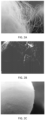
- spherical particulate is shown in FIGs.1B -1D; in the present invention prolate spheroids and oblate spheroids are used. It has been surprisingly discovered that non-spherical particulate tends to align along a fiber length with the shortest linear dimension axis from the three orthogonal axes of X-Y-Z oriented generally perpendicular to the longest axis length of the fiber.
- the present invention attempts to retain the processing and performance properties of the native polymer while imparting the ability to render the fiber and articles formed therefrom X-ray or magnetic anomaly detectable. This is achieved by inclusion of particulate having a shortest linear dimension, as measured from among the three orthogonal Cartesian coordinate axes X-Y-Z that is less than or equal to one half the fiber cross-sectional average dimension along the three orthogonal Cartesian coordinate axes X-Y-Z. For the purposes of calculation of the particulate dimension, the average particle dimension is used for polydisperse particulate.
- the detectable particulate with a size of D90 ⁇ 31 micron or smaller.
- a circular cross-section fiber with a diameter of 35 microns is loaded with spherical particulate having a diameter of less or equal to 17 microns.
- the ratio of rod length to diameter is between 1.3-20: 1 and in still other embodiments between 1.5-8:1
- each of the polymeric components of an inventive fiber includes other substances known conventionally to modify a processing property or performance property.
- additive substances illustratively include antioxidants, stabilizers, surfactants, waxes, flow promoters, solid solvents, dyes, pigments, plasticizers, and combinations thereof.
- a pigment can encompass a composition of a particulate material detailed above to impart detectability to the inventive fiber, and in such instances the pigment is compositionally distinct from the particulate and present in a lower weight percentage than the particulate.
- the loading of particulate to achieve X-ray or magnetic detection of articles formed from inventive fibers is dictated by factors including the X-ray cross-section or the magnetic susceptibility of a given particulate.
- ferromagnetic materials are detectable at loadings of from > 2 total weight percent by magnetic induction detection.
- typical loadings are from 2 to 4 total weight percent for magnetic induction detection.
- typical loadings are from 2 to 50 total weight percent. It is appreciated that the above typical loading can be exceeded, yet often at the expense of detrimentally influencing the ability to process or increasing material financial costs with only incremental improvements in detection.
- Specific embodiments of the invention incorporate secondary functional additives into the manufacture of nonwoven materials, which allow for the particulate-containing article to be used in a manner making benefit of the functional particulate material included in the fiber.
- Embodiments of the invention incorporate functional additive particulate at 0.01 to 5.0 weight percent loadings in the melt-spun fiber, for the manufacturing the filled-fiber material to be used in various functional applications.
- One feature of the functional fibers is that a constituent of the composite or multi-component fiber is removable to expose the particles thereby imparting specific functionality.
- the novel feature is that processing, cleaning, and protective articles formed with fibers containing the above referenced functional additives may be used to impart specific functional properties.
- Non limiting examples of uses for the functional particles may include the delivery of blood clotting chemicals or other topical medicines, and color changing particles for indicating changes in pH and temperature, as well as detection and identification of specific chemicals, virus, and bacteria. Temperature change is readily detected with plasmonic nanoparticles able to change perceived color including metal nanoparticles, alone or in combination with oxide shells that illustratively include gold, silver, and nickel. Oxide coatings operative herein illustratively include silica and iron oxide. It is appreciated that some of these secondary functional particles have a small signal in electromagnetic spectrally detectable instrumentation in comparison to the detectable particulate.
- Blood clotting particles include deformable microgel particles that are about 1 micron in diameter and similar to the size of platelets, the microgel particles being attached to human antibody fragments that recognize fibrin.
- Drug delivery is achieved with particles illustratively including poly-lactic-co-glycolic acid (PLGA), metal nanocrystals; silica or dendrimers. Particles having a size of between 2 nm and 5 microns are particularly well-suited for drug delivery.
- PLGA poly-lactic-co-glycolic acid
- metal nanocrystals silica or dendrimers.
- Functional particles may also have reactive properties.
- reactive particles may be particles that undergo an endothermic or exothermic reaction upon exposure to air and illustratively include iron particles. It is appreciated that based on the temperature generated and the melt properties of the coupled fiber, can induce fusion between contiguous fibers. In other embodiments, the particles are reacted with reagents that induce covalent bonding between particles.
- metal particles are readily joined through disulfides; dicarboxylates; polycarboxylates such are acrylates; diamines; polyamines such as cyclen; or combinations thereof. As a result, an inventive particle filled fiber mass is solidified by exposure to such a reagent.
- the resultant solidified fiber mass is useful in a variety of applications including filtration, leak treatment, or blood clotting.
- filtration applications illustratively include water purification, bacteria, viruses, detrimental water-borne chemicals, and separation of metal fines.
- Further non-limiting example applications of the inventive reactive particles may include solar energy generation, addition of abrasiveness or to deliver and apply a polish, and reactive particles that change colors or shape with induction of electricity.
- particles are compounded with one or more suitable pre-polymeric or polymeric compounds, as defined above that will form the basic fiber structure.
- the compounded material then undergoes a melt-spinning process and forms metal/polymer composite fibers.
- the melt-spinning process tends to align asymmetric particles with the shortest linear dimension axis along the direction of fiber draw.
- the particulate forms protrusions extending from the sides of the fibers, as seen in FIGS. 1B-1C . These protrusions have the added benefit of increase fiber surface area for a given length of fiber, and also appear to increase the energy needed to pull contiguous fibers from one another.
- inventive fibers are produced that have a homogenous distribution of particulate along the length of the fiber and retain 70% of the tensile strength of a given fiber composition absent particulate loading.
- a sheath is simultaneously drawn about a core.
- the sheath is free of particulate and the core is loaded with particulate.
- the fibers are drawn using technology known to those experienced in the art to their final tensile strength and diameter, preferably between 0.1 and 500 microns in diameter. In other embodiments, the fibers have a diameter or between 10 and 50 microns.
- thermoplastic pellets loaded to up to 50 total weight percent of stainless steel particulate in spite of being more dense than non-particulate loaded thermoplastic pellets, are melt-spun without adjusting the feeding system, with the proviso that magnets conventional to the melt-spinning equipment are removed in those instances when the detected particulate is magnetic.
- thermal retention of the particulate affects the filament cool down and draw behavior.
- Secondary functional particulate that is tolerant of the temperature and pressure conditions conventional to melt-spun fiber production are readily intermixed with the detectable particulate and incorporated into a fiber therewith into a fiber core, fiber sheath, or both.
- the particulate and at least one polymer are mixed or blended prior to extrusion using known techniques into extrudable pellets.
- the particulate is homogeneously dispersed throughout the polymer in which it is dispersed as the polymer streams are fed into the spinneret plate.
- a particulate loaded pellets are used as a feedstock alone or intermixed with non-loaded pellets or pellets that vary in at least property of polymer composition, particulate size, particulate composition, additive composition, additive loading, particulate loading, or a combination of such properties.
- the polymers follow separate paths to the fiber spinneret and are combined in a spinneret hole.
- the spinneret is configured so that the extrudant has the desired overall fiber cross-section.
- a core is extruded from particulate loaded pellets with a sheath formed from a particulate free pellet feedstock.
- the resulting thin fluid strands, or filaments remain in the molten state for some distance before they are solidified by cooling in a surrounding fluid medium, which may be, for example, chilled air blown through the strands.
- Secondary functional particulate is in some inventive embodiments applied to fibers as an aerosol in the chilled air carrier used to cool the spun fiber. Once solidified, the filaments are taken up on a godet roller or another take-up surface. Secondary functional particulate is in some inventive embodiments applied to fibers from a bath prior to, or after take up on godet roller or other surface.
- the strands can be taken up on a godet which draws down the thin fluid streams in proportion to the speed of the take-up godet.
- the strands can be collected in a jet, such as for example, an air attenuator, and blown onto a take-up surface such as a roller or a moving belt to form a spun-bonded web.
- a melt-blown process air is ejected at the surface of the spinneret which serves to simultaneously draw down and cool the thin fluid streams as they are deposited on a take-up surface in the path of cooling air, thereby forming a fiber web.
- Secondary functional particulate is in some inventive embodiments applied to spun-bonded web or a fiber web from an aerosol spray or a soaking bath.
- the thin fluid streams are melt drawn down in a plastic state to orient the polymer molecules for good tenacity.
- Typical melt draw down ratios known in the industry are operative herein.
- the strands are drawn in the solid state with conventional drawing equipment, such as, for example, sequential godets operating at differential speeds.
- the continuous filaments in certain inventive embodiments are mechanically crimped and cut into a desirable fiber length, thereby producing staple fiber.
- the length of the staple fibers typically ranges from 25 to 50 millimeters, although the fibers may be cut to any desired length outside this range.
- the multi-component fibers of the invention may be staple fibers, continuous filaments, or meltblown fibers.
- staple fibers, multifilament, and spunbond fibers formed in accordance with the present invention may have a fineness of 0.1 to 500 microns per filament.
- the filaments have a fineness diameter or between 10 and 50 microns per filament.
- Meltblown filaments can have a fineness of 0.1 to 500 microns.
- Monofilament fibers may have a fineness of 0.1 to 500 microns.
- the filaments have a fineness diameter or between 10 and 50 microns per filament.
- the multi-component fibers of the invention are useful in the production of a wide variety of products, including without limitation nonwoven structures, such as but not limited to carded webs, wet laid webs, dry laid webs, spunbond webs, meltblown webs, and the like.
- the nonwoven webs can be bonded to transform the webs into a coherent nonwoven fabric using bonding techniques known in the industry.
- Exemplary bonding techniques for nonwoven webs include mechanical bonding, such as hydro-entanglement and needle punching, adhesive bonding, thermal bonding, and the like.
- An example of thermal bonding is through air bonding, although other thermal bonding techniques, such as calendaring, microwave, or other RF treatments are readily employed.
- An inventive fiber is well suited for use in a composite product, such as one with a dual surface in which a melt blown web includes a surface layer of fibers applied on the surface of the web to create a different textured surface relative to the web.
- a polypropylene web with the detectable inventive particle filled fiber for the textured side has a spun bond melt blown spun bond (SMS) where only one layer has the inventive detectable fibers. SMS is a very common composite nonwoven used in surgical gowns.
- SMS spun bond melt blown spun bond
- Articles formed according to the present invention from such particulate loaded fibers illustratively include non-limiting example of hair nets, protective suits, shoe covers, wipes, food packaging, aprons, beard covers, and mop heads.
- Such products in certain embodiments retain the operational properties of non-particulate loaded fibers of the same polymer composition, with the added attribute of being detectable with conventional food, medical and pharmaceutical production magnetic or X-ray detectors.
- the inventive fibers are subjected to a coating, laminate, or otherwise cover the outer and/or inner surfaces of threads or layers of material contained within any final product without falling outside the scope of the invention.
- This is a practice well known to those experienced in the art, and is commonly used to impart non-stick, low-friction, or additional chemical and heat resistance properties to the final product.
- additional non-polymeric particles identical, similar, or fundamentally different to the particles already contained within the composite fibers of the invention yet at the expense of lowering the overall metal content loading of the resultant article unless such treatments carry therewith particulate.
- a fiber or core portion of a sheathed fiber has particulate protruding from the wall of the fiber and a concomitant relative depletion of particulate from the central region of a fiber.
- the inclusion of particulate protrusions and a centrally depleted fiber region has been found to afford considerable benefits in increasing the loading amount of particulate to detectable levels and the energy needed to slide fibers past one another.
- the fibers or other non-woven creations of the invention are coated, dusted, or otherwise induced to carry on the exterior of individual filaments or layers additional particulate identical, similar, or fundamentally different to the particulate already contained within the composite fibers of the invention.
- Particulate is most easily adhered to the outside of the fibers using a process which passes the extruded filament or non-woven creation through an enclosed chamber or fluidized bed, in which a fan system lifts and circulates the particulate throughout the air contained within the chamber such that a fraction of the particles that contact the filament will adhere to the surface.
- the fibers of the invention are used to make yarns.
- Yarns prepared for use in forming such woven and knit fabrics are similarly included within the scope of the present invention.
- Such yarns may be prepared from the continuous filament or spun yarns comprising staple fibers of the present invention by methods known in the industry, such as twisting or air entanglement.
- An inventive non-woven fabric performs comparably to standard polymer containing fabrics with respect to most attributes, such as strength, durability, and hand, yet like the fibers exhibits properties which deviate significantly from those normally associated with the polymeric material by those experienced in the art, these unique properties beside detectability illustratively include high density, conductivity, electromagnetic shielding, cut-resistance, heat-resistance, and radiation shielding relative to the base polymer absent particulate loading.
- the fibers or filament produced by this invention are suitable for application in knitting yarns. Further detail is outside the scope of this invention, but is well known to those experienced in the art.
- the fabric may be cut, sewn, and otherwise tailored towards its final purpose using techniques also known to those skilled in the art.
- the fabric of the present invention may be manufactured, tailored, or otherwise altered or modified in design to exhibit other functional properties without falling outside the scope of the invention.
- These alterations or modifications illustratively include micro-perforations, patches of alternative fabrics, seamless knitting, fashion-centric alterations, dyeing or other coloring, and snaps, zippers, or other pockets for the addition and removal of personal effects, weights, or other articles to be carried or worn.
- the fabric of the present invention may be formed using a variety of different weaving or knitting techniques, both those known and unknown to those experienced in the art, without falling outside the scope of the present invention, which may result in additional qualities or properties of the final product.
- processes and machinery have been developed to knit at very high speeds, at very low amounts of stress on the fiber or fabric, and in seamless and/or circular patterns and arrangements.
- the fabric of the present invention may be used to configure composite articles, both those known and unknown to those experienced in the art, without falling outside the scope of the present invention, which may result in additional qualities or properties of the final product.
- processes and machinery have been developed to mechanically integrate microfiber thread loops into the detectable ground fabric to produce stitchbonded micro fiber napped wipes.
- Modern metal detection is based on creating a magnetic field with a transmitter coil and two receiving coils wired in reverse.
- the resulting field is interrupted when a conductive or magnetic contaminant passes through the field.
- the contaminant is detected by measuring the change in voltage above the change in voltage of non-contaminated product. If a contaminant is detected, that product is rejected.
- Contaminants are generally categorized as sphere equivalents in millimeters. The sensitivity and throughput of the contaminant detection process is machine dependent.
- X-ray inspection is based on density. The higher the density of the object being examined, the more energy is absorbed. X-ray detection measures how much energy is absorbed by a product or contaminant. X-ray detection can detect contaminants such as glass or bone that a metal detector will not detect. X-ray detection can perform other quality functions outside the scope of process or product contamination. The present invention focuses on contaminant and foreign object detection. The sensitivity and throughput of an X-ray inspection process is also machine dependent.
- Spherical stainless steel particulate (430 series) having a Poisson size distribution and an average particle size of 12 microns is mixed into polypropylene (PP) to form pellets with a particulate loading of 12 percent.
- the particles are melt-spun by running through a five layer screen pack of mesh sized from 30 to 325. The melt is then drawn to a fiber as shown in FIGS. 1B-1C . Some of the particulate is noted to be flattened or misshaped.
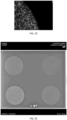
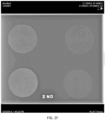
- Spun fiber PP with BaSO 4 The fiber is spun into pads as shown in FIGS. 2A-2H .
- the resulting fibers are detectable with X-rays when layers of spun fiber pads are overlayed and imaged by transmitted X-rays.
- Photograph of extruded polypropylene fiber containing 30.0 wt % barium sulfate particles FIG. 2A
- X-ray film of extruded polypropylene fiber containing 30.0 wt % barium sulfate particles FIG.
- FIG. 2B photograph of pad cut from melt-blown polypropylene fiber containing 30.0 wt % barium sulfate particles
- FIG. 2C photograph of pad cut from melt-blown polypropylene fiber containing 30.0 wt % barium sulfate particles
- FIG. 2D X-ray film of pad cut from melt-blown polypropylene fiber containing 30.0 wt % barium sulfate particles
- FIG. 2F X-ray transmission images of barium sulfate/propylene melt-blown pads clockwise from the first quadrant for 3, 6, 20, and 10 layers that are produced with higher die temperature to yield a comparatively denser pad, as compared to those of FIG. 2F ( FIG.
- FIG. 2E X-ray transmission images of barium sulfate/propylene melt-blown pads clockwise from the first quadrant for 3, 6, 20, and 10 layers that are produced with lower die temperature to yield a fluffier pad
- FIG. 2F X-ray transmission image of barium sulfate/propylene melt-blown as a 10 layer pad submerged in 3.5 inches of water to simulate tissue with a US quarter used as a weight to keep the pad submerged
- FIG. 2H X-ray transmission image of barium sulfate/propylene melt-blown as a 20 layer pad submerged in 3.5 inches of water to simulate tissue with two US quarters used as a weight to keep the pad submerged
- Spun fiber PP with BaSO 4 and gold nanocrystals The process of Example 2 is repeated with cooled fibers drawn through a suspension of 3 nm gold nanocrystals prior to take up on a godet roller to obtain a 0.1 total weight percent gold nanocrystal coating fiber that is formed into a pad per Example 2. The resulting pad covalently bonds thiols from a test solution.
- Spun fiber PP with BaSO 4 and anti-mouse IgG-gold nanocrystals The process of Example 3 is repeated with cooled fibers drawn through a suspension of commercially available 9-11 nm gold nanocrystals bonded to anti-mouse IgG prior to take up on a godet roller to obtain a 0.05 total weight percent gold nanocrystal coating fiber that is formed into a pad per Example 2.
- the resulting pad covalently bonds mouse IgG from a test solution, based on secondary labelling of the IgG.
- Spun fiber PP with BaSO 4 and gold nanocrystals The pad of Example 3 is compressed in a test tube and exposed to a buffer solution of 0.3 M NaCl and 10 mM phosphate buffer containing dithiothreitol or mercaptoethanol, (0.1 ml, 100 mM) at 40 °C for 30 minutes to fix the shape of the pad to that of the test tube, after removal therefrom.
Landscapes
- Engineering & Computer Science (AREA)
- Textile Engineering (AREA)
- Chemical & Material Sciences (AREA)
- Life Sciences & Earth Sciences (AREA)
- Chemical Kinetics & Catalysis (AREA)
- General Chemical & Material Sciences (AREA)
- Health & Medical Sciences (AREA)
- Physics & Mathematics (AREA)
- General Physics & Mathematics (AREA)
- Manufacturing & Machinery (AREA)
- Biochemistry (AREA)
- Pathology (AREA)
- Immunology (AREA)
- General Health & Medical Sciences (AREA)
- Analytical Chemistry (AREA)
- Mechanical Engineering (AREA)
- Inorganic Chemistry (AREA)
- Toxicology (AREA)
- Geophysics (AREA)
- Remote Sensing (AREA)
- Environmental & Geological Engineering (AREA)
- General Life Sciences & Earth Sciences (AREA)
- Geology (AREA)
- Artificial Filaments (AREA)
- Multicomponent Fibers (AREA)
- Nonwoven Fabrics (AREA)
- Chemical Or Physical Treatment Of Fibers (AREA)
Claims (12)
- Vliesfaserartikel zur Verwendung in einer Nahrungsmittelproduktion, einer medizinischen Produktion oder einer pharmazeutischen Produktionsumgebung, der Vliesfaserartikel aufweisend:eine schmelzgesponnene Polymerfaser mit einem Querschnitt und einer Länge; undein detektierbares Edelstahlteilchen, das in der Polymerfaser verteilt ist, wobei das detektierbare Edelstahlteilchen eine Größe von weniger als 31 Mikrometer hat,wobei die detektierbaren Edelstahlteilchen abgeflachte Sphäroide sind; undin einer Menge von 2,0 bis 50,0 Gew.-% Metallbeladungen vorhanden sind, um die Polymerfaser allein oder in Kombination mit einem sekundären funktionellen Teilchen detektierbar zu machen, das in oder auf der Polymerfaser verteilt ist, um die Polymerfaser chemisch auf einen chemischen Reaktanten, eine Änderung des pH-Werts oder der Temperatur reagieren zu lassen; undwobei der Vliesfaserartikel eines von einem Haarnetz; einem Schutzanzug; einem Schuhüberzug;einem Wischtuch; einer Verpackung; einer Schürze;einem Bartüberzug; einem Moppbezug ist.
- Artikel nach Anspruch 1, wobei die detektierbaren Edelstahlteilchen eine kürzeste lineare Abmessung, gemessen aus drei orthogonalen kartesischen Koordinatenachsen X-Y-Z, haben, die kleiner oder gleich einer halben durchschnittlichen Querschnittsabmessung der Polymerfaser entlang der drei orthogonalen kartesischen Koordinatenachsen X-Y-Z ist.
- Artikel nach Anspruch 1, wobei die Polymerfaser eines ist von Polypropylen, Polyethylen, Polybuten, Polyisobutylen, einem Polyamid, einem Polyacrylat, einem Polystyrol, einem Polyurethan, einem Acetalharz, einem Polyethylenvinylalkohol; einem Polyester, einem Polyphenylensulfid, einem thermoplastischen Elastomer, einem Polyacrylnitril; einer Cellulose, einem Polyaramid oder einem Blockcopolymer, das zumindest eines der vorstehenden enthält.
- Artikel nach Anspruch 1, wobei die Polymerfaser eine einzelne Zusammensetzung mit einem Querschnitt ist, der eines von kreisförmig, multilobal oder polygonal ist.
- Artikel nach Anspruch 1, ferner aufweisend eine Hülle, die die Polymerfaser umgibt.
- Artikel nach Anspruch 5, ferner aufweisend ein teilchenbeladenes Abstaub-Zwischenprodukt zwischen der Polymerfaser und der Hülle.
- Artikel nach Anspruch 1, wobei die Polymerfaser einen Durchmesser zwischen 0,1 und 500 Mikron hat.
- Artikel nach Anspruch 1, wobei das sekundäre funktionelle Teilchen einen metallischen Nanokristall aufweist.
- Artikel nach Anspruch 1, wobei das sekundäre funktionelle Teilchen in einer Menge von 0,01 bis
5 Gesamtgewichtsprozent vorhanden ist. - Artikel nach Anspruch 1, wobei das sekundäre funktionelle Teilchen einen Gold-Nanokristall aufweist.
- Artikel nach Anspruch 10, ferner aufweisend eine kovalent an den Gold-Nanokristall gebundene Einheit.
- Verfahren zum Detektieren eines Gewebeartikels, aufweisend:Bilden einer Polymerfaser mit einem Querschnitt und einer Länge und einem detektierbaren Teilchen, das in der Polymerfaser nach Anspruch 1 verteilt ist;Bilden eines Gewebes zumindest teilweise aus der Faser;Herstellen des Gewebeartikels zumindest teilweise aus dem Gewebe;Durchführen des Gewebeartikels durch einen Röntgendetektor oder einen Magnetdetektor; undErfassen eines Signals von dem Röntgendetektor oder dem Magnetdetektor, das das Vorhandensein des Gewebeartikels angibt.
Applications Claiming Priority (3)
| Application Number | Priority Date | Filing Date | Title |
|---|---|---|---|
| US201462029063P | 2014-07-25 | 2014-07-25 | |
| US14/705,565 US10753022B2 (en) | 2014-07-25 | 2015-05-06 | Particle-filled fiber and articles formed from the same |
| PCT/US2015/041461 WO2016014619A1 (en) | 2014-07-25 | 2015-07-22 | Particle-filled fiber and articles formed from the same |
Publications (2)
| Publication Number | Publication Date |
|---|---|
| EP3172363A1 EP3172363A1 (de) | 2017-05-31 |
| EP3172363B1 true EP3172363B1 (de) | 2023-11-29 |
Family
ID=53887190
Family Applications (1)
| Application Number | Title | Priority Date | Filing Date |
|---|---|---|---|
| EP15753234.2A Active EP3172363B1 (de) | 2014-07-25 | 2015-07-22 | Partikelgefüllte faser und daraus geformte artikel |
Country Status (3)
| Country | Link |
|---|---|
| US (1) | US10753022B2 (de) |
| EP (1) | EP3172363B1 (de) |
| WO (1) | WO2016014619A1 (de) |
Families Citing this family (15)
| Publication number | Priority date | Publication date | Assignee | Title |
|---|---|---|---|---|
| US10619268B2 (en) | 2013-11-13 | 2020-04-14 | Illinois Tool Works, Inc. | Metal detectable fiber and articles formed from the same |
| US10753022B2 (en) | 2014-07-25 | 2020-08-25 | Illinois Tool Works, Inc. | Particle-filled fiber and articles formed from the same |
| US11542634B2 (en) | 2014-07-25 | 2023-01-03 | Illinois Tool Works Inc. | Particle-filled fiber and articles formed from the same |
| US10718067B1 (en) * | 2016-08-31 | 2020-07-21 | Apple Inc. | Magnetic strands for fabric items |
| CN111051583A (zh) * | 2017-08-28 | 2020-04-21 | 关东电化工业株式会社 | 导热性粒子填充纤维 |
| US10337128B2 (en) * | 2017-08-31 | 2019-07-02 | Brrr! Inc. | Methods and compositions for cooling yarns and fabrics, and articles comprising same |
| US11124901B2 (en) * | 2017-11-27 | 2021-09-21 | First Step Holdings, Llc | Composite fabric, method for forming composite fabric, and use of a composite matter fabric |
| CN108221179B (zh) * | 2017-12-29 | 2021-06-15 | 普宁市新栩纺织有限公司 | 一种吸湿发热防菌型纱线的制备方法 |
| US10947664B2 (en) | 2018-02-19 | 2021-03-16 | Illinois Tool Works Inc. | Metal detectable scouring pad |
| US11813413B2 (en) * | 2018-03-27 | 2023-11-14 | St. Jude Medical, Cardiology Division, Inc. | Radiopaque outer cuff for transcatheter valve |
| JP6984835B2 (ja) * | 2018-08-03 | 2021-12-22 | 株式会社豊田自動織機 | 繊維試料の評価方法及び繊維試料評価システム |
| US10557219B1 (en) * | 2018-12-28 | 2020-02-11 | Brrr! Inc. | Methods and compositions for cooling yarns and fabrics comprising a cellulosic fiber, and articles comprising same |
| CN109972294A (zh) * | 2019-04-08 | 2019-07-05 | 山东彩汇包装科技有限公司 | 一种防破裂抗拉型无纺布面粉包装的制备工艺 |
| DE102020134541A1 (de) | 2020-12-22 | 2022-06-23 | Rheinisch-Westfälische Technische Hochschule (RWTH) Aachen, Körperschaft des öffentlichen Rechts | Implantat und Anordnung aufweisend eine Strahlungsquelle und ein Implantat |
| JP7188644B2 (ja) * | 2021-01-06 | 2022-12-13 | 東洋紡株式会社 | 繊維を含む製品の画像の解析方法、そのプログラムおよび解析装置 |
Citations (1)
| Publication number | Priority date | Publication date | Assignee | Title |
|---|---|---|---|---|
| US3911922A (en) * | 1974-06-11 | 1975-10-14 | Herbert L Kliger | Surgical sponge |
Family Cites Families (109)
| Publication number | Priority date | Publication date | Assignee | Title |
|---|---|---|---|---|
| US3068547A (en) | 1958-09-19 | 1962-12-18 | Chicopee Mfg Corp | Reinforced nonwoven fabrics |
| GB1135803A (en) | 1964-12-11 | 1968-12-04 | E M A Corp | Electromagnetic adhesive and method of joining materials thereby |
| US3491802A (en) | 1967-01-10 | 1970-01-27 | Johnson & Johnson | Open mesh woven fibrous absorbent media |
| US3633533A (en) | 1969-01-09 | 1972-01-11 | Griffolyn Company | Location of underground utility lines |
| US3701165A (en) | 1971-04-29 | 1972-10-31 | Oxford Industries | Garments with detectable marks |
| US3756512A (en) | 1971-12-28 | 1973-09-04 | G Dyal | Dispenser for pressurized container |
| US3756241A (en) | 1972-06-19 | 1973-09-04 | Kendall & Co | Radiopaque abdominal pack |
| US3867935A (en) | 1973-05-14 | 1975-02-25 | Johnson & Johnson | Plied absorbent structures |
| US3929659A (en) | 1973-06-18 | 1975-12-30 | Du Pont | Crosslinked rubber/resin binders for chromium dioxide recording members |
| US4068666A (en) | 1975-05-16 | 1978-01-17 | American Hospital Supply Corporation | Surgical sponge and method of forming the same |
| GB1575527A (en) * | 1976-12-20 | 1980-09-24 | Johnson & Johnson | Material detectable by x-rays |
| US4155487A (en) | 1977-09-09 | 1979-05-22 | Blake William S | Trigger sprayer |
| US4345718A (en) | 1979-04-23 | 1982-08-24 | William Horvath | Manually actuated trigger sprayer |
| NL193609C (nl) | 1981-12-30 | 2000-04-04 | Bekaert Sa Nv | Samengestelde streng voor verwerking als granulaat in kunststofproducten en werkwijze voor het vervaardigen van een kunststofmenggranulaat. |
| US4620656A (en) | 1983-04-11 | 1986-11-04 | Herbert L. Engineering Corp. | Automatic rivet-feeding system for reliable delivery of plural rivet sizes |
| US4645499A (en) | 1983-08-22 | 1987-02-24 | The Kendall Company | Surgical sponge |
| JPS60234653A (ja) | 1984-04-30 | 1985-11-21 | ジヨンソン・アンド・ジヨンソン・プロダクツ・インコーポレイテツド | 手術用スポンジ |
| US4620646A (en) | 1985-06-28 | 1986-11-04 | S. C. Johnson & Son, Inc. | Pump button and overcap assembly, and method of assembly of the overcap and pump button on a pump dispenser container |
| US4692380A (en) | 1985-08-06 | 1987-09-08 | Hercules Incorporated | Metallizable polypropylene film |
| US4718897A (en) | 1985-09-18 | 1988-01-12 | Chicopee | Nonwoven surgical sponge with x-ray detectable element |
| DE3641151A1 (de) | 1986-12-02 | 1988-06-09 | Freudenberg Carl Fa | Medizinischer saugkoerper mit roentgenkontrastmittel und verfahren zu seiner herstellung |
| US4935019A (en) | 1986-12-22 | 1990-06-19 | Johnson & Johnson Medical, Inc. | Radiopaque polymeric composition |
| US5045080A (en) | 1986-12-22 | 1991-09-03 | Johnson & Johnson Medical, Inc. | Surgical fabric with printed X-ray marker |
| KR890001835B1 (ko) | 1987-07-16 | 1989-05-25 | 주식회사 코오롱 | 도전성 폴리에스테르섬유의 제조방법 |
| US5183614A (en) * | 1989-01-26 | 1993-02-02 | E. I. Du Pont De Nemours And Company | Method for producing x-ray detectable spandex fibers |
| US5112325A (en) | 1989-02-17 | 1992-05-12 | Deroyal Industries, Inc. | Surgical sponge with plurality of radiopaque monofilaments |
| US5178354A (en) | 1990-07-25 | 1993-01-12 | Engvall David P | Tube holder and method of using the same |
| GB9118430D0 (en) | 1991-08-28 | 1991-10-16 | Mortile Ind Inc | Composite metal |
| US5204162A (en) * | 1991-10-03 | 1993-04-20 | Corning Incorporated | Non-spherical bodies |
| US5522921A (en) | 1992-10-23 | 1996-06-04 | Custer; Peter | Invisible, x-ray opaque fluorescent printing medium for multiplex reading |
| US5337912A (en) | 1992-11-30 | 1994-08-16 | Berry Plastics Corporation | Sturdy aerosol can lid |
| US5379924A (en) | 1993-01-08 | 1995-01-10 | Taylor; Brent | Aerosol container cap and activator button assembly |
| US5425996A (en) | 1994-04-05 | 1995-06-20 | Borden, Inc. | Biaxially oriented polypropylene metallized white film |
| JP3649457B2 (ja) | 1994-06-30 | 2005-05-18 | アジレント・テクノロジーズ・インク | 電磁誘導式プローブ、インピーダンス測定装置、校正方法、および、校正用治具 |
| JPH10508504A (ja) | 1994-09-16 | 1998-08-25 | バイオプシス メディカル インコーポレイテッド | 組織を特定しおよびマーキングする方法および装置 |
| DE4445004A1 (de) | 1994-12-16 | 1996-06-20 | Consortium Elektrochem Ind | Zusammensetzung zur delokalisierten Kennzeichnung von Gegenständen, ihre Herstellung und Verwendung |
| KR100426298B1 (ko) | 1994-12-26 | 2004-04-08 | 히다치 가세고교 가부시끼가이샤 | 필름 형상의 유기 다이본딩재의 라미네이트 방법,다이본딩 방법, 라미네이트 장치, 다이본딩 장치, 반도체장치 및 반도체 장치의 제조 방법 |
| US6177113B1 (en) | 1995-06-27 | 2001-01-23 | Apv Crepaco, Inc. | Process for detecting plastic or elastomeric contaminants in food processing |
| JPH0931749A (ja) | 1995-07-24 | 1997-02-04 | Kuraray Co Ltd | ポリエステル繊維の製造方法 |
| US5897673A (en) | 1995-12-29 | 1999-04-27 | Japan Exlan Company Limited | Fine metallic particles-containing fibers and method for producing the same |
| GB2315698A (en) | 1996-07-26 | 1998-02-11 | Harold Moore | A moulded tool |
| US5698148A (en) | 1996-07-26 | 1997-12-16 | Basf Corporation | Process for making electrically conductive fibers |
| US5931824A (en) | 1996-09-04 | 1999-08-03 | Stewart; William W. | Identification and accountability system for surgical sponges |
| US5919549A (en) | 1996-11-27 | 1999-07-06 | Minnesota Mining And Manufacturing Company | Abrasive articles and method for the manufacture of same |
| US5888640A (en) | 1997-07-09 | 1999-03-30 | Mobil Oil Corporation | Metallized uniaxially shrinkable biaxially oriented polypropylene film |
| RU2121177C1 (ru) | 1997-09-30 | 1998-10-27 | Поттер Текнолэджис Корп. (Potter Technologies Corp.) | Рентгенопоглащающий материал (варианты) |
| US5958566A (en) | 1997-10-17 | 1999-09-28 | Fina Technology, Inc. | Metal bond strength in polyolefin films |
| DE69719343T2 (de) | 1997-12-29 | 2003-10-30 | Sicpa Holding S.A., Prilly | Überzugszusammensetzung, Verwendung von Teilchen, Verfahren zur Markierung und Identifizierung eines diese Überzugszusammensetzung enthaltenden Sicherheitsdokumentes |
| GB9822842D0 (en) | 1998-10-20 | 1998-12-16 | Dynamic Products Limited | Laminar plastics film |
| US6371904B1 (en) | 1998-12-24 | 2002-04-16 | Vivant Medical, Inc. | Subcutaneous cavity marking device and method |
| US6356782B1 (en) | 1998-12-24 | 2002-03-12 | Vivant Medical, Inc. | Subcutaneous cavity marking device and method |
| US7038766B2 (en) | 1999-04-01 | 2006-05-02 | Microtrace, Llc | Identification particles and system and method for retrospective identification using spectral codes |
| FR2796624B1 (fr) | 1999-07-22 | 2001-09-28 | Oreal | Tete de distribution a bruit de fonctionnement ameliore et dispositif de conditionnement et de distribution ainsi equipe |
| US6332993B1 (en) | 1999-09-16 | 2001-12-25 | Nan Ya Plastics Corporation | Process of making heat-retaining fibers |
| US6716805B1 (en) | 1999-09-27 | 2004-04-06 | The Procter & Gamble Company | Hard surface cleaning compositions, premoistened wipes, methods of use, and articles comprising said compositions or wipes and instructions for use resulting in easier cleaning and maintenance, improved surface appearance and/or hygiene under stress conditions such as no-rinse |
| KR20010086868A (ko) | 2000-03-03 | 2001-09-15 | 김원배 | 질석 및 진주암 분말을 함유하는 섬유원사 |
| JP2002020554A (ja) | 2000-07-04 | 2002-01-23 | Nakagawa Seitai Kako Kk | 薄膜チューブ状プラスチックフィルムおよびその成形方法 |
| JP4554064B2 (ja) | 2000-12-19 | 2010-09-29 | 優一郎 新崎 | 線状のブラシ用素材 |
| KR100637752B1 (ko) | 2000-12-22 | 2006-10-23 | (주)엔피텍 | 나노사이즈 금속미립자를 함유한 합성섬유 및 그 제조방법 |
| US7084826B2 (en) | 2001-02-15 | 2006-08-01 | Integral Technologies, Inc. | Low cost inductor devices manufactured from conductive loaded resin-based materials |
| US20050236407A1 (en) | 2001-02-15 | 2005-10-27 | Integral Technologies, Inc. | Low cost food processing, preparation, and handling devices manufactured from conductive loaded resin-based materials |
| US7222727B2 (en) | 2001-02-15 | 2007-05-29 | Integral Technologies, Inc. | Low cost food processing belts and other conveyances manufactured from conductive loaded resin-based materials |
| GB2372934A (en) | 2001-03-09 | 2002-09-11 | Ck Europ Safety Equipment Ltd | Glove containing electromagnetically detectable particles |
| US7022394B2 (en) | 2001-05-04 | 2006-04-04 | Ykk Corporation | Fastener strip with discrete magnetically attractable area, and method and apparatus of making same |
| JP2004533899A (ja) | 2001-07-13 | 2004-11-11 | スリーエム イノベイティブ プロパティズ カンパニー | 付香した研磨繊維を有するクリーニングのための研磨物品 |
| DE60227390D1 (de) | 2001-09-28 | 2008-08-14 | Invista Tech Sarl | Dehnbarer vliesstoff und methode zu dessen herstellung |
| CA2468354C (en) | 2001-11-29 | 2010-08-03 | Bell, Glenda Fay | Moulding composition |
| AU2003268109A1 (en) | 2002-08-16 | 2004-03-03 | Plastech, Inc. | Multi-component packaging system and method for manufacture |
| US20040142495A1 (en) | 2002-12-16 | 2004-07-22 | Hartman William G. | Analyte detecting article and method |
| USD487353S1 (en) | 2003-01-23 | 2004-03-09 | Datco International, Inc. | Tack cloth |
| TW200427881A (en) * | 2003-05-19 | 2004-12-16 | Toray Industries | Fiber excellent in magnetic field response and conductivity and product made therefrom |
| JP3883007B2 (ja) | 2003-06-19 | 2007-02-21 | 住友金属鉱山株式会社 | ホウ化物微粒子含有繊維およびこれを用いた繊維製品 |
| US7465847B2 (en) | 2003-08-29 | 2008-12-16 | Fabian Carl E | Radiopaque marker for a surgical sponge |
| WO2005061649A1 (en) | 2003-12-24 | 2005-07-07 | James Walker New Zealand Limited | Resilient compound for sealing device comprising detectable material such as barium sulfate |
| WO2006026823A1 (en) | 2004-09-09 | 2006-03-16 | Bell, Glenda, Fay | Separation of plastic and elastomers for food and pharmaceutical products |
| DE102004050918A1 (de) | 2004-10-19 | 2006-04-20 | Hipp & Co | Verfahren zum Verhindern des Einschleusens von Dichtungsteilen und/oder Teilen der Verpackung von Ausgangsstoffen in Verpackungseinheiten und/oder von Teilen von Verpackungseinheiten in nachfolgende Verpackungseinheiten fließfähiger Lebensmittel |
| US7568590B1 (en) | 2004-11-23 | 2009-08-04 | Arrow Innovations, Llc | Multi-component product container with reclosable top |
| US7242176B2 (en) | 2004-12-20 | 2007-07-10 | Dell Products, L.P. | Systems and methods for evaluating electromagnetic interference |
| WO2006115266A1 (ja) * | 2005-04-26 | 2006-11-02 | Unitika Fibers Ltd. | X線造影糸、x線造影被覆糸、前記x線造影糸および、またはx線造影被覆糸を用いた繊維構造体 |
| GB2428629A (en) | 2005-07-27 | 2007-02-07 | B S Teasdale & Son Ltd | Magnetically detectable bag |
| US7795491B2 (en) | 2005-10-11 | 2010-09-14 | Patient Safety Technologies, Inc. | Systems and methods for counting surgical implements |
| DE102005048976A1 (de) | 2005-10-13 | 2007-04-19 | Manfred Messing | Elektrisch leitfähiges Kunststoff-Formteil aus recyceltem Reject-Material |
| DE102005057474A1 (de) | 2005-11-30 | 2007-05-31 | Merck Patent Gmbh | Lasertransfer von Sicherheitsmerkmalen |
| US20070219516A1 (en) * | 2006-03-14 | 2007-09-20 | Tyco Healthcare Group Lp | X-ray detectable element for association with surgical absorbent substrates and method of making |
| US8075985B2 (en) | 2006-06-06 | 2011-12-13 | Toray Plastics (America), Inc. | Metallized biaxially oriented polypropylene film with high metal adhesion |
| US7952375B2 (en) | 2006-06-06 | 2011-05-31 | Formfactor, Inc. | AC coupled parameteric test probe |
| US8129019B2 (en) | 2006-11-03 | 2012-03-06 | Behnam Pourdeyhimi | High surface area fiber and textiles made from the same |
| JP5363025B2 (ja) | 2007-05-08 | 2013-12-11 | ユニチカ株式会社 | X線造影性モノフィラメント |
| JP5271263B2 (ja) | 2007-05-30 | 2013-08-21 | ピアック株式会社 | X線検知材料含有布帛、x線検知用絆創膏およびx線検知用絆創膏の製造方法 |
| AU2007361262A1 (en) * | 2007-11-07 | 2009-05-14 | Noveko Trading 2008 Llc | Functional fiber, preparation method thereof and fabric made of it |
| CN101597811A (zh) | 2008-07-01 | 2009-12-09 | 河南瑞贝卡发制品股份有限公司 | 一种pvc/超细碳酸钙微粒复合纤维及其制备方法 |
| US8404338B2 (en) | 2008-09-30 | 2013-03-26 | Sabic Innovative Plastics Ip B.V. | X-ray and/or metal detectable articles and method of making the same |
| US20100087731A1 (en) | 2008-10-07 | 2010-04-08 | Medtronic Vascular, Inc. | Method for Tracking Degradation of a Biodegradable Stent Having Superparamagnetic Iron Oxide Particles Embedded Therein |
| US9663882B2 (en) | 2008-11-12 | 2017-05-30 | Thomas E. Haskett | Natural fiber nonwoven scouring material and methods of making |
| US9885154B2 (en) | 2009-01-28 | 2018-02-06 | Donaldson Company, Inc. | Fibrous media |
| US8772184B2 (en) * | 2009-03-31 | 2014-07-08 | Illinois Tool Works Inc. | Reversible color-changing sanitizer-indicating nonwoven wipe |
| CN101671864A (zh) | 2009-09-17 | 2010-03-17 | 吴江鹰翔万信化纤有限公司 | 一种悬垂性聚对苯二甲酸1,2-丙二醇酯纤维 |
| TWI405886B (zh) | 2009-12-31 | 2013-08-21 | San Fang Chemical Industry Co | 含彈性體之複合纖維及其製造方法,及包含該複合纖維之基材及其製造方法 |
| US8476007B2 (en) * | 2010-02-19 | 2013-07-02 | Indian Institute Of Technology Bombay | Optical fiber probe |
| US20110231983A1 (en) * | 2010-03-26 | 2011-09-29 | Walker Chan | Metal-Detectable Gloves |
| WO2012040038A2 (en) | 2010-09-23 | 2012-03-29 | Applied Nanostructured Solutions, Llc | Cnt-infused fiber as a self shielding wire for enhanced power transmission line |
| US8796164B2 (en) | 2010-12-28 | 2014-08-05 | Cytec Technology Corp. | Multilayer and composition gradient structures with improved damping properties |
| US8980982B2 (en) | 2011-03-25 | 2015-03-17 | Illinois Tool Works, Inc. | Electromagnetic spectrally detectable plastic packaging components |
| US20120289107A1 (en) * | 2011-04-22 | 2012-11-15 | OSUS, Inc. | Metal/polymer composite fibers |
| JP6097527B2 (ja) | 2012-11-12 | 2017-03-15 | 帝人株式会社 | 原着極細繊維の製造方法 |
| US10619268B2 (en) | 2013-11-13 | 2020-04-14 | Illinois Tool Works, Inc. | Metal detectable fiber and articles formed from the same |
| ES2951938T3 (es) | 2013-12-27 | 2023-10-25 | Saint Gobain Abrasives Inc | Artículos abrasivos no tejidos hechos mediante soldadura por fricción |
| US10753022B2 (en) | 2014-07-25 | 2020-08-25 | Illinois Tool Works, Inc. | Particle-filled fiber and articles formed from the same |
| CA2996185C (en) | 2015-09-15 | 2020-07-07 | Illinois Tool Works Inc. | Scrim substrate material with functional detectable additives for use with nonwoven fabric and composite material |
-
2015
- 2015-05-06 US US14/705,565 patent/US10753022B2/en active Active
- 2015-07-22 WO PCT/US2015/041461 patent/WO2016014619A1/en not_active Ceased
- 2015-07-22 EP EP15753234.2A patent/EP3172363B1/de active Active
Patent Citations (1)
| Publication number | Priority date | Publication date | Assignee | Title |
|---|---|---|---|---|
| US3911922A (en) * | 1974-06-11 | 1975-10-14 | Herbert L Kliger | Surgical sponge |
Also Published As
| Publication number | Publication date |
|---|---|
| EP3172363A1 (de) | 2017-05-31 |
| WO2016014619A1 (en) | 2016-01-28 |
| US20160024699A1 (en) | 2016-01-28 |
| US10753022B2 (en) | 2020-08-25 |
Similar Documents
| Publication | Publication Date | Title |
|---|---|---|
| EP3172363B1 (de) | Partikelgefüllte faser und daraus geformte artikel | |
| US10619268B2 (en) | Metal detectable fiber and articles formed from the same | |
| US20120289107A1 (en) | Metal/polymer composite fibers | |
| KR101061028B1 (ko) | 고분자 혼성체 섬유, 섬유구조체, 고분자 혼성체 펠릿 및 그들의 제조방법 | |
| CN106273826B (zh) | 一种复合无纺布及其制备方法 | |
| CA2996185C (en) | Scrim substrate material with functional detectable additives for use with nonwoven fabric and composite material | |
| US20190233983A1 (en) | Fiber-filled material and fiber product obtained by using same | |
| JP6752331B2 (ja) | 複合構造体 | |
| KR20100018485A (ko) | 코팅된 칼슘 카보네이트를 포함하는 스펀레이드 섬유, 및 이를 제조하는 방법, 및 부직포 제품 | |
| US7238313B2 (en) | Thermoplastic constructs with improved softness | |
| US20170074829A1 (en) | Scrim substrate material with functional detectable additives for use with nonwoven fabric and composite material | |
| JPWO2016159266A1 (ja) | 単層又は複層ポリエステル長繊維不織布及びそれを用いた食品用フィルター | |
| EP3327188A1 (de) | Dickes garn | |
| CZ2015441A3 (cs) | Absorpční hygienický výrobek obsahující netkanou textilii s bariérovými vlastnostmi | |
| KR20150086235A (ko) | 복합 구금 및 복합 섬유, 복합 섬유의 제조 방법 | |
| US11542634B2 (en) | Particle-filled fiber and articles formed from the same | |
| US7056580B2 (en) | Fibers formed of a biodegradable polymer and having a low friction surface | |
| JP2018159151A (ja) | 熱接着性複合繊維 | |
| EP3724380A1 (de) | Fasern mit einem alkylenoxidhaltigen nichtionischen tensid, gegenstände und verfahren | |
| JP7205196B2 (ja) | 嵩高糸 | |
| JP2025158874A (ja) | 芯鞘複合繊維及びそれを含む織編物ならびに芯鞘複合繊維の製造方法 | |
| JP2022171159A (ja) | 抗菌不織布 | |
| JP2004225206A (ja) | 複合繊維およびそれからなる布帛 | |
| Pereira | Filtration Efficiency of Meltblown Webs |
Legal Events
| Date | Code | Title | Description |
|---|---|---|---|
| STAA | Information on the status of an ep patent application or granted ep patent |
Free format text: STATUS: THE INTERNATIONAL PUBLICATION HAS BEEN MADE |
|
| PUAI | Public reference made under article 153(3) epc to a published international application that has entered the european phase |
Free format text: ORIGINAL CODE: 0009012 |
|
| STAA | Information on the status of an ep patent application or granted ep patent |
Free format text: STATUS: REQUEST FOR EXAMINATION WAS MADE |
|
| 17P | Request for examination filed |
Effective date: 20161222 |
|
| AK | Designated contracting states |
Kind code of ref document: A1 Designated state(s): AL AT BE BG CH CY CZ DE DK EE ES FI FR GB GR HR HU IE IS IT LI LT LU LV MC MK MT NL NO PL PT RO RS SE SI SK SM TR |
|
| AX | Request for extension of the european patent |
Extension state: BA ME |
|
| DAV | Request for validation of the european patent (deleted) | ||
| DAX | Request for extension of the european patent (deleted) | ||
| STAA | Information on the status of an ep patent application or granted ep patent |
Free format text: STATUS: EXAMINATION IS IN PROGRESS |
|
| 17Q | First examination report despatched |
Effective date: 20200130 |
|
| REG | Reference to a national code |
Ref country code: DE Ref legal event code: R079 Ref document number: 602015086727 Country of ref document: DE Free format text: PREVIOUS MAIN CLASS: D01F0001100000 Ipc: D01D0005080000 Ref country code: DE Ref legal event code: R079 Free format text: PREVIOUS MAIN CLASS: D01F0001100000 Ipc: D01D0005080000 |
|
| RIC1 | Information provided on ipc code assigned before grant |
Ipc: D01F 6/06 20060101ALI20230612BHEP Ipc: D01F 8/06 20060101ALI20230612BHEP Ipc: D04H 3/11 20120101ALI20230612BHEP Ipc: D04H 1/42 20120101ALI20230612BHEP Ipc: D04H 1/4382 20120101ALI20230612BHEP Ipc: G01N 23/083 20060101ALI20230612BHEP Ipc: D04H 13/00 20060101ALI20230612BHEP Ipc: D04H 1/4234 20120101ALI20230612BHEP Ipc: D01F 1/10 20060101ALI20230612BHEP Ipc: D01D 5/08 20060101AFI20230612BHEP |
|
| GRAP | Despatch of communication of intention to grant a patent |
Free format text: ORIGINAL CODE: EPIDOSNIGR1 |
|
| STAA | Information on the status of an ep patent application or granted ep patent |
Free format text: STATUS: GRANT OF PATENT IS INTENDED |
|
| INTG | Intention to grant announced |
Effective date: 20230724 |
|
| RIN1 | Information on inventor provided before grant (corrected) |
Inventor name: MERTINS, KAREN Inventor name: MARTIN, ROBERT Inventor name: ALDRIDGE, EMILY |
|
| GRAS | Grant fee paid |
Free format text: ORIGINAL CODE: EPIDOSNIGR3 |
|
| GRAA | (expected) grant |
Free format text: ORIGINAL CODE: 0009210 |
|
| STAA | Information on the status of an ep patent application or granted ep patent |
Free format text: STATUS: THE PATENT HAS BEEN GRANTED |
|
| AK | Designated contracting states |
Kind code of ref document: B1 Designated state(s): AL AT BE BG CH CY CZ DE DK EE ES FI FR GB GR HR HU IE IS IT LI LT LU LV MC MK MT NL NO PL PT RO RS SE SI SK SM TR |
|
| REG | Reference to a national code |
Ref country code: GB Ref legal event code: FG4D |
|
| REG | Reference to a national code |
Ref country code: CH Ref legal event code: EP |
|
| P01 | Opt-out of the competence of the unified patent court (upc) registered |
Effective date: 20231103 |
|
| REG | Reference to a national code |
Ref country code: DE Ref legal event code: R096 Ref document number: 602015086727 Country of ref document: DE |
|
| REG | Reference to a national code |
Ref country code: IE Ref legal event code: FG4D |
|
| REG | Reference to a national code |
Ref country code: LT Ref legal event code: MG9D |
|
| REG | Reference to a national code |
Ref country code: NL Ref legal event code: MP Effective date: 20231129 |
|
| PG25 | Lapsed in a contracting state [announced via postgrant information from national office to epo] |
Ref country code: GR Free format text: LAPSE BECAUSE OF FAILURE TO SUBMIT A TRANSLATION OF THE DESCRIPTION OR TO PAY THE FEE WITHIN THE PRESCRIBED TIME-LIMIT Effective date: 20240301 |
|
| PG25 | Lapsed in a contracting state [announced via postgrant information from national office to epo] |
Ref country code: IS Free format text: LAPSE BECAUSE OF FAILURE TO SUBMIT A TRANSLATION OF THE DESCRIPTION OR TO PAY THE FEE WITHIN THE PRESCRIBED TIME-LIMIT Effective date: 20240329 |
|
| PG25 | Lapsed in a contracting state [announced via postgrant information from national office to epo] |
Ref country code: LT Free format text: LAPSE BECAUSE OF FAILURE TO SUBMIT A TRANSLATION OF THE DESCRIPTION OR TO PAY THE FEE WITHIN THE PRESCRIBED TIME-LIMIT Effective date: 20231129 |
|
| PG25 | Lapsed in a contracting state [announced via postgrant information from national office to epo] |
Ref country code: ES Free format text: LAPSE BECAUSE OF FAILURE TO SUBMIT A TRANSLATION OF THE DESCRIPTION OR TO PAY THE FEE WITHIN THE PRESCRIBED TIME-LIMIT Effective date: 20231129 |
|
| PG25 | Lapsed in a contracting state [announced via postgrant information from national office to epo] |
Ref country code: LT Free format text: LAPSE BECAUSE OF FAILURE TO SUBMIT A TRANSLATION OF THE DESCRIPTION OR TO PAY THE FEE WITHIN THE PRESCRIBED TIME-LIMIT Effective date: 20231129 Ref country code: IS Free format text: LAPSE BECAUSE OF FAILURE TO SUBMIT A TRANSLATION OF THE DESCRIPTION OR TO PAY THE FEE WITHIN THE PRESCRIBED TIME-LIMIT Effective date: 20240329 Ref country code: GR Free format text: LAPSE BECAUSE OF FAILURE TO SUBMIT A TRANSLATION OF THE DESCRIPTION OR TO PAY THE FEE WITHIN THE PRESCRIBED TIME-LIMIT Effective date: 20240301 Ref country code: ES Free format text: LAPSE BECAUSE OF FAILURE TO SUBMIT A TRANSLATION OF THE DESCRIPTION OR TO PAY THE FEE WITHIN THE PRESCRIBED TIME-LIMIT Effective date: 20231129 Ref country code: BG Free format text: LAPSE BECAUSE OF FAILURE TO SUBMIT A TRANSLATION OF THE DESCRIPTION OR TO PAY THE FEE WITHIN THE PRESCRIBED TIME-LIMIT Effective date: 20240229 |
|
| REG | Reference to a national code |
Ref country code: AT Ref legal event code: MK05 Ref document number: 1636197 Country of ref document: AT Kind code of ref document: T Effective date: 20231129 |
|
| PG25 | Lapsed in a contracting state [announced via postgrant information from national office to epo] |
Ref country code: NL Free format text: LAPSE BECAUSE OF FAILURE TO SUBMIT A TRANSLATION OF THE DESCRIPTION OR TO PAY THE FEE WITHIN THE PRESCRIBED TIME-LIMIT Effective date: 20231129 |
|
| PG25 | Lapsed in a contracting state [announced via postgrant information from national office to epo] |
Ref country code: SE Free format text: LAPSE BECAUSE OF FAILURE TO SUBMIT A TRANSLATION OF THE DESCRIPTION OR TO PAY THE FEE WITHIN THE PRESCRIBED TIME-LIMIT Effective date: 20231129 Ref country code: RS Free format text: LAPSE BECAUSE OF FAILURE TO SUBMIT A TRANSLATION OF THE DESCRIPTION OR TO PAY THE FEE WITHIN THE PRESCRIBED TIME-LIMIT Effective date: 20231129 Ref country code: PL Free format text: LAPSE BECAUSE OF FAILURE TO SUBMIT A TRANSLATION OF THE DESCRIPTION OR TO PAY THE FEE WITHIN THE PRESCRIBED TIME-LIMIT Effective date: 20231129 Ref country code: NO Free format text: LAPSE BECAUSE OF FAILURE TO SUBMIT A TRANSLATION OF THE DESCRIPTION OR TO PAY THE FEE WITHIN THE PRESCRIBED TIME-LIMIT Effective date: 20240229 Ref country code: NL Free format text: LAPSE BECAUSE OF FAILURE TO SUBMIT A TRANSLATION OF THE DESCRIPTION OR TO PAY THE FEE WITHIN THE PRESCRIBED TIME-LIMIT Effective date: 20231129 Ref country code: LV Free format text: LAPSE BECAUSE OF FAILURE TO SUBMIT A TRANSLATION OF THE DESCRIPTION OR TO PAY THE FEE WITHIN THE PRESCRIBED TIME-LIMIT Effective date: 20231129 Ref country code: HR Free format text: LAPSE BECAUSE OF FAILURE TO SUBMIT A TRANSLATION OF THE DESCRIPTION OR TO PAY THE FEE WITHIN THE PRESCRIBED TIME-LIMIT Effective date: 20231129 |
|
| PG25 | Lapsed in a contracting state [announced via postgrant information from national office to epo] |
Ref country code: DK Free format text: LAPSE BECAUSE OF FAILURE TO SUBMIT A TRANSLATION OF THE DESCRIPTION OR TO PAY THE FEE WITHIN THE PRESCRIBED TIME-LIMIT Effective date: 20231129 |
|
| PG25 | Lapsed in a contracting state [announced via postgrant information from national office to epo] |
Ref country code: CZ Free format text: LAPSE BECAUSE OF FAILURE TO SUBMIT A TRANSLATION OF THE DESCRIPTION OR TO PAY THE FEE WITHIN THE PRESCRIBED TIME-LIMIT Effective date: 20231129 Ref country code: AT Free format text: LAPSE BECAUSE OF FAILURE TO SUBMIT A TRANSLATION OF THE DESCRIPTION OR TO PAY THE FEE WITHIN THE PRESCRIBED TIME-LIMIT Effective date: 20231129 |
|
| PG25 | Lapsed in a contracting state [announced via postgrant information from national office to epo] |
Ref country code: SK Free format text: LAPSE BECAUSE OF FAILURE TO SUBMIT A TRANSLATION OF THE DESCRIPTION OR TO PAY THE FEE WITHIN THE PRESCRIBED TIME-LIMIT Effective date: 20231129 |
|
| PG25 | Lapsed in a contracting state [announced via postgrant information from national office to epo] |
Ref country code: SM Free format text: LAPSE BECAUSE OF FAILURE TO SUBMIT A TRANSLATION OF THE DESCRIPTION OR TO PAY THE FEE WITHIN THE PRESCRIBED TIME-LIMIT Effective date: 20231129 Ref country code: SK Free format text: LAPSE BECAUSE OF FAILURE TO SUBMIT A TRANSLATION OF THE DESCRIPTION OR TO PAY THE FEE WITHIN THE PRESCRIBED TIME-LIMIT Effective date: 20231129 Ref country code: RO Free format text: LAPSE BECAUSE OF FAILURE TO SUBMIT A TRANSLATION OF THE DESCRIPTION OR TO PAY THE FEE WITHIN THE PRESCRIBED TIME-LIMIT Effective date: 20231129 Ref country code: IT Free format text: LAPSE BECAUSE OF FAILURE TO SUBMIT A TRANSLATION OF THE DESCRIPTION OR TO PAY THE FEE WITHIN THE PRESCRIBED TIME-LIMIT Effective date: 20231129 Ref country code: EE Free format text: LAPSE BECAUSE OF FAILURE TO SUBMIT A TRANSLATION OF THE DESCRIPTION OR TO PAY THE FEE WITHIN THE PRESCRIBED TIME-LIMIT Effective date: 20231129 Ref country code: DK Free format text: LAPSE BECAUSE OF FAILURE TO SUBMIT A TRANSLATION OF THE DESCRIPTION OR TO PAY THE FEE WITHIN THE PRESCRIBED TIME-LIMIT Effective date: 20231129 Ref country code: CZ Free format text: LAPSE BECAUSE OF FAILURE TO SUBMIT A TRANSLATION OF THE DESCRIPTION OR TO PAY THE FEE WITHIN THE PRESCRIBED TIME-LIMIT Effective date: 20231129 Ref country code: AT Free format text: LAPSE BECAUSE OF FAILURE TO SUBMIT A TRANSLATION OF THE DESCRIPTION OR TO PAY THE FEE WITHIN THE PRESCRIBED TIME-LIMIT Effective date: 20231129 |
|
| PG25 | Lapsed in a contracting state [announced via postgrant information from national office to epo] |
Ref country code: PT Free format text: LAPSE BECAUSE OF FAILURE TO SUBMIT A TRANSLATION OF THE DESCRIPTION OR TO PAY THE FEE WITHIN THE PRESCRIBED TIME-LIMIT Effective date: 20240401 |
|
| PG25 | Lapsed in a contracting state [announced via postgrant information from national office to epo] |
Ref country code: PT Free format text: LAPSE BECAUSE OF FAILURE TO SUBMIT A TRANSLATION OF THE DESCRIPTION OR TO PAY THE FEE WITHIN THE PRESCRIBED TIME-LIMIT Effective date: 20240401 |
|
| REG | Reference to a national code |
Ref country code: DE Ref legal event code: R097 Ref document number: 602015086727 Country of ref document: DE |
|
| PLBE | No opposition filed within time limit |
Free format text: ORIGINAL CODE: 0009261 |
|
| STAA | Information on the status of an ep patent application or granted ep patent |
Free format text: STATUS: NO OPPOSITION FILED WITHIN TIME LIMIT |
|
| PG25 | Lapsed in a contracting state [announced via postgrant information from national office to epo] |
Ref country code: SI Free format text: LAPSE BECAUSE OF FAILURE TO SUBMIT A TRANSLATION OF THE DESCRIPTION OR TO PAY THE FEE WITHIN THE PRESCRIBED TIME-LIMIT Effective date: 20231129 |
|
| PG25 | Lapsed in a contracting state [announced via postgrant information from national office to epo] |
Ref country code: SI Free format text: LAPSE BECAUSE OF FAILURE TO SUBMIT A TRANSLATION OF THE DESCRIPTION OR TO PAY THE FEE WITHIN THE PRESCRIBED TIME-LIMIT Effective date: 20231129 |
|
| 26N | No opposition filed |
Effective date: 20240830 |
|
| REG | Reference to a national code |
Ref country code: DE Ref legal event code: R119 Ref document number: 602015086727 Country of ref document: DE |
|
| PG25 | Lapsed in a contracting state [announced via postgrant information from national office to epo] |
Ref country code: MC Free format text: LAPSE BECAUSE OF FAILURE TO SUBMIT A TRANSLATION OF THE DESCRIPTION OR TO PAY THE FEE WITHIN THE PRESCRIBED TIME-LIMIT Effective date: 20231129 |
|
| REG | Reference to a national code |
Ref country code: CH Ref legal event code: PL |
|
| PG25 | Lapsed in a contracting state [announced via postgrant information from national office to epo] |
Ref country code: LU Free format text: LAPSE BECAUSE OF NON-PAYMENT OF DUE FEES Effective date: 20240722 |
|
| GBPC | Gb: european patent ceased through non-payment of renewal fee |
Effective date: 20240722 |
|
| PG25 | Lapsed in a contracting state [announced via postgrant information from national office to epo] |
Ref country code: LU Free format text: LAPSE BECAUSE OF NON-PAYMENT OF DUE FEES Effective date: 20240722 |
|
| PG25 | Lapsed in a contracting state [announced via postgrant information from national office to epo] |
Ref country code: DE Free format text: LAPSE BECAUSE OF NON-PAYMENT OF DUE FEES Effective date: 20250201 |
|
| PG25 | Lapsed in a contracting state [announced via postgrant information from national office to epo] |
Ref country code: CH Free format text: LAPSE BECAUSE OF NON-PAYMENT OF DUE FEES Effective date: 20240731 Ref country code: BE Free format text: LAPSE BECAUSE OF NON-PAYMENT OF DUE FEES Effective date: 20240731 |
|
| PG25 | Lapsed in a contracting state [announced via postgrant information from national office to epo] |
Ref country code: FR Free format text: LAPSE BECAUSE OF NON-PAYMENT OF DUE FEES Effective date: 20240731 |
|
| PG25 | Lapsed in a contracting state [announced via postgrant information from national office to epo] |
Ref country code: GB Free format text: LAPSE BECAUSE OF NON-PAYMENT OF DUE FEES Effective date: 20240722 |
|
| REG | Reference to a national code |
Ref country code: BE Ref legal event code: MM Effective date: 20240731 |
|
| PG25 | Lapsed in a contracting state [announced via postgrant information from national office to epo] |
Ref country code: IE Free format text: LAPSE BECAUSE OF NON-PAYMENT OF DUE FEES Effective date: 20240722 |
|
| PG25 | Lapsed in a contracting state [announced via postgrant information from national office to epo] |
Ref country code: FI Free format text: LAPSE BECAUSE OF FAILURE TO SUBMIT A TRANSLATION OF THE DESCRIPTION OR TO PAY THE FEE WITHIN THE PRESCRIBED TIME-LIMIT Effective date: 20231129 |
|
| PG25 | Lapsed in a contracting state [announced via postgrant information from national office to epo] |
Ref country code: CY Free format text: LAPSE BECAUSE OF FAILURE TO SUBMIT A TRANSLATION OF THE DESCRIPTION OR TO PAY THE FEE WITHIN THE PRESCRIBED TIME-LIMIT; INVALID AB INITIO Effective date: 20150722 |