EP3166973B1 - Immune-stimulating monoclonal antibodies against human interleukin-2 - Google Patents
Immune-stimulating monoclonal antibodies against human interleukin-2 Download PDFInfo
- Publication number
- EP3166973B1 EP3166973B1 EP15759938.2A EP15759938A EP3166973B1 EP 3166973 B1 EP3166973 B1 EP 3166973B1 EP 15759938 A EP15759938 A EP 15759938A EP 3166973 B1 EP3166973 B1 EP 3166973B1
- Authority
- EP
- European Patent Office
- Prior art keywords
- seq
- hil
- nmol
- antibody
- fragment
- Prior art date
- Legal status (The legal status is an assumption and is not a legal conclusion. Google has not performed a legal analysis and makes no representation as to the accuracy of the status listed.)
- Active
Links
Images






Classifications
-
- C—CHEMISTRY; METALLURGY
- C07—ORGANIC CHEMISTRY
- C07K—PEPTIDES
- C07K16/00—Immunoglobulins [IG], e.g. monoclonal or polyclonal antibodies
- C07K16/18—Immunoglobulins [IG], e.g. monoclonal or polyclonal antibodies against material from animals or humans
- C07K16/24—Immunoglobulins [IG], e.g. monoclonal or polyclonal antibodies against material from animals or humans against cytokines, lymphokines or interferons
- C07K16/244—Interleukins [IL]
- C07K16/246—IL-2
-
- A—HUMAN NECESSITIES
- A61—MEDICAL OR VETERINARY SCIENCE; HYGIENE
- A61K—PREPARATIONS FOR MEDICAL, DENTAL OR TOILETRY PURPOSES
- A61K38/00—Medicinal preparations containing peptides
- A61K38/16—Peptides having more than 20 amino acids; Gastrins; Somatostatins; Melanotropins; Derivatives thereof
- A61K38/17—Peptides having more than 20 amino acids; Gastrins; Somatostatins; Melanotropins; Derivatives thereof from animals; from humans
- A61K38/19—Cytokines; Lymphokines; Interferons
- A61K38/20—Interleukins [IL]
- A61K38/2013—IL-2
-
- A—HUMAN NECESSITIES
- A61—MEDICAL OR VETERINARY SCIENCE; HYGIENE
- A61K—PREPARATIONS FOR MEDICAL, DENTAL OR TOILETRY PURPOSES
- A61K39/00—Medicinal preparations containing antigens or antibodies
- A61K39/395—Antibodies; Immunoglobulins; Immune serum, e.g. antilymphocytic serum
- A61K39/39533—Antibodies; Immunoglobulins; Immune serum, e.g. antilymphocytic serum against materials from animals
- A61K39/3955—Antibodies; Immunoglobulins; Immune serum, e.g. antilymphocytic serum against materials from animals against proteinaceous materials, e.g. enzymes, hormones, lymphokines
-
- A—HUMAN NECESSITIES
- A61—MEDICAL OR VETERINARY SCIENCE; HYGIENE
- A61P—SPECIFIC THERAPEUTIC ACTIVITY OF CHEMICAL COMPOUNDS OR MEDICINAL PREPARATIONS
- A61P31/00—Antiinfectives, i.e. antibiotics, antiseptics, chemotherapeutics
- A61P31/12—Antivirals
-
- A—HUMAN NECESSITIES
- A61—MEDICAL OR VETERINARY SCIENCE; HYGIENE
- A61P—SPECIFIC THERAPEUTIC ACTIVITY OF CHEMICAL COMPOUNDS OR MEDICINAL PREPARATIONS
- A61P35/00—Antineoplastic agents
-
- C—CHEMISTRY; METALLURGY
- C07—ORGANIC CHEMISTRY
- C07K—PEPTIDES
- C07K14/00—Peptides having more than 20 amino acids; Gastrins; Somatostatins; Melanotropins; Derivatives thereof
- C07K14/435—Peptides having more than 20 amino acids; Gastrins; Somatostatins; Melanotropins; Derivatives thereof from animals; from humans
- C07K14/52—Cytokines; Lymphokines; Interferons
- C07K14/54—Interleukins [IL]
- C07K14/55—IL-2
-
- A—HUMAN NECESSITIES
- A61—MEDICAL OR VETERINARY SCIENCE; HYGIENE
- A61K—PREPARATIONS FOR MEDICAL, DENTAL OR TOILETRY PURPOSES
- A61K39/00—Medicinal preparations containing antigens or antibodies
- A61K2039/505—Medicinal preparations containing antigens or antibodies comprising antibodies
-
- C—CHEMISTRY; METALLURGY
- C07—ORGANIC CHEMISTRY
- C07K—PEPTIDES
- C07K2317/00—Immunoglobulins specific features
- C07K2317/30—Immunoglobulins specific features characterized by aspects of specificity or valency
- C07K2317/34—Identification of a linear epitope shorter than 20 amino acid residues or of a conformational epitope defined by amino acid residues
-
- C—CHEMISTRY; METALLURGY
- C07—ORGANIC CHEMISTRY
- C07K—PEPTIDES
- C07K2317/00—Immunoglobulins specific features
- C07K2317/50—Immunoglobulins specific features characterized by immunoglobulin fragments
- C07K2317/55—Fab or Fab'
-
- C—CHEMISTRY; METALLURGY
- C07—ORGANIC CHEMISTRY
- C07K—PEPTIDES
- C07K2317/00—Immunoglobulins specific features
- C07K2317/50—Immunoglobulins specific features characterized by immunoglobulin fragments
- C07K2317/56—Immunoglobulins specific features characterized by immunoglobulin fragments variable (Fv) region, i.e. VH and/or VL
- C07K2317/565—Complementarity determining region [CDR]
-
- C—CHEMISTRY; METALLURGY
- C07—ORGANIC CHEMISTRY
- C07K—PEPTIDES
- C07K2317/00—Immunoglobulins specific features
- C07K2317/70—Immunoglobulins specific features characterized by effect upon binding to a cell or to an antigen
- C07K2317/74—Inducing cell proliferation
-
- C—CHEMISTRY; METALLURGY
- C07—ORGANIC CHEMISTRY
- C07K—PEPTIDES
- C07K2317/00—Immunoglobulins specific features
- C07K2317/70—Immunoglobulins specific features characterized by effect upon binding to a cell or to an antigen
- C07K2317/76—Antagonist effect on antigen, e.g. neutralization or inhibition of binding
-
- C—CHEMISTRY; METALLURGY
- C07—ORGANIC CHEMISTRY
- C07K—PEPTIDES
- C07K2317/00—Immunoglobulins specific features
- C07K2317/90—Immunoglobulins specific features characterized by (pharmaco)kinetic aspects or by stability of the immunoglobulin
- C07K2317/92—Affinity (KD), association rate (Ka), dissociation rate (Kd) or EC50 value
Definitions
- the present invention relates to antibodies binding to human interleukin-2 (hIL-2).
- hIL-2 human interleukin-2
- the invention more specifically relates to antibodies specifically binding a particular epitope of hIL-2 and when bound to this epitope are capable of inhibit binding of hIL-2 to CD25.
- the invention relates to in vitro and in vivo therapeutic applications of the antibodies.
- Malignant melanoma is a frequent cancer type in men and women. Once melanoma becomes metastatic and spreads to distant sites, the 5-year survival rate is quite poor, calculated at about 15%. Currently available treatment strategies for metastatic melanoma barely improve this survival rate.
- Interleukin-2 is a cytokine able to potently stimulate cytotoxic lymphocytes against metastatic tumours.
- IL-2 is also able to stimulate so-called CD25 + CD4 + regulatory T cells (Treg cells) that are crucial for prevention of autoimmune disease.
- Treg cells can significantly dampen anti-tumour responses by cytotoxic lymphocytes, thus somewhat antagonizing the beneficial anti-tumour effects of IL-2.
- Treg cells can significantly dampen anti-tumour responses by cytotoxic lymphocytes, thus somewhat antagonizing the beneficial anti-tumour effects of IL-2.
- IL-2 can exert toxic adverse effects.
- Standard IL-2 immunotherapy has been used since the early 1980's for the immunotherapy of metastatic melanoma and metastatic renal cell carcinoma, leading to the approval by the FDA for these indications in 1996 and 1992, respectively.
- IL-2 given at high doses has shown objective response rates in about 17% and complete regression in about 6-9% of patients suffering from these deadly metastatic cancers, IL-2 given at these doses frequently led to toxic adverse effects, such as hypotension, pulmonary edema, liver cell damage, gastrointestinal toxicity, and general edema.
- IL-2 is able to stimulate Treg cells, which in turn are able to dampen the activity of anti-tumour CD8 + T cells and NK cells.
- IL-2/anti-IL-2 antibody complexes show strong biological activity by avoiding interaction with IL-2 receptor ⁇ subunit CD25. Proceedings of the National Academy of Sciences USA (2010) 107:2171-2176 ), thereby directing IL-2 preferentially to cytotoxic lymphocytes, but not Treg cells.
- This approach has the advantage that unmutated, natural IL-2 is delivered via anti-IL-2 mAb to CD8 + T cells and NK cells, which subsequently exert potent anti-tumour properties, while IL-2 complexed to this kind of anti-IL-2 mAb barely activates Treg cells. Moreover, IL-2 complexed to this kind of anti-IL-2 mAb is much less toxic than standard IL-2 immuno therapy in mice. However, this therapy has up to date not been available for use in patients due to the lack of appropriate anti-human IL-2 mAbs.
- the problem addressed by the present invention is to provide an anti-human IL-2 monoclonal antibody able to recognize and bind a specific epitope of human IL-2, thereby favoring the stimulation of cytotoxic T cells and NK cells compared to Treg cells, for use in in vitro and in vivo therapeutic applications.
- the invention relates to the embodiments as defined in the claims, thus it relates to the following items.
- a human interleukin-2 (hIL-2) specific monoclonal antibody (mAb), or a human interleukin-2 (hIL-2) specific antigen binding fragment thereof comprising HCDR1 according to SEQ ID NO: 7, HCDR2 according to SEQ ID NO: 8, HCDR3 according to SEQ ID NO: 9, LCDR1 according to SEQ ID NO: 10, LCDR2 according to SEQ ID NO: 11, LCDR3 according to SEQ ID NO: 12 is provided, wherein binding of said antibody, or antigen binding fragment thereof, to hIL-2 inhibits binding of hIL-2 to CD25, and the binding to hIL-2 is characterized by a dissociation constant (K D ) ⁇ 7,5 nmol/L, ⁇ 5 nmol/L, ⁇ 3 nmol/L, ⁇ 2 nmol/L or ⁇ 1,5 nmol/L determined in a surface plasmon resonance binding assay.
- K D dissociation constant
- hIL-2 human interleukin-2
- hIL-2 human interleukin-2
- the binding to hIL-2 is characterized by an off-rate (K off ) ⁇ 1x10 -4 s -1 , ⁇ 8x10 -5 s -1 , ⁇ 6x10 -5 s -1 , ⁇ 4x10 -5 s -1 , ⁇ 3x10 -5 s -1 or ⁇ 2,1x10 -5 s -1 .
- hIL-2 human interleukin-2
- hIL-2 human interleukin-2
- the antibody, or antigen binding fragment thereof displays no measurable cross-reactivity to murine IL-2.
- human interleukin-2 (hIL-2) specific monoclonal antibodies, or antigen binding fragments thereof are provided, characterized in that they comprise at least one VH and/or one VL sequence having an identity of ⁇ 80%, ⁇ 85%, ⁇ 90%, ⁇ 92%, ⁇ 93%, ⁇ 94%, ⁇ 95%, ⁇ 96%, ⁇ 97% or ⁇ 98% compared to SEQ ID NOs 019 or 20.
- a nucleic acid molecule encoding the human interleukin-2 (hIL-2) specific monoclonal antibody, or an antigen binding fragment thereof, according to the first aspect of the invention is provided.
- nucleic acid molecule according to the second aspect of the invention is provided, wherein the nucleic acid molecule has ⁇ 60%, ⁇ 70%, ⁇ 80%, ⁇ 85%, ⁇ 90%, ⁇ 92%, ⁇ 93%, ⁇ 94%, ⁇ 95%, ⁇ 96%, ⁇ 97% or ⁇ 98% sequence identity compared to SEQ ID NOs 003 or 004.
- nucleic acid molecule comprising the sequence of SEQ ID NOs 13, 14, 15, 16,17,18, 21 or 22, or a sequence having an identity of ⁇ 80%, ⁇ 85%, ⁇ 90%, ⁇ 92%, ⁇ 93%, ⁇ 94%, ⁇ 95%, ⁇ 96%, ⁇ 97% or ⁇ 98% compared to any one of SEQ ID NOs 13, 14, 15, 16, 17, 18, 21 or 22 is provided.
- a vector comprising the nucleic acid molecule according to the invention is provided.
- a cell comprising the nucleic acid molecule according to the invention, or expressing the nucleic acid molecule according to the invention is provided.
- a cell able to produce a human interleukin-2 (hIL-2) specific monoclonal antibody (mAb), or antigen binding fragment thereof, according to the first aspect of the invention is provided.
- hIL-2 human interleukin-2
- mAb monoclonal antibody
- a monoclonal antibody-producing hybridoma cell line is provided, characterized in that the produced antibodies are those of the first aspect of invention.
- a therapeutic formulation for use as a medicament particularly for use in the treatment of cancer or viral infections, comprising:
- the human interleukin-2 (hIL-2) specific monoclonal antibody, or antigen binding fragment thereof is provided for use in the treatment of cancer or viral infections, wherein the antibody, or antigen binding fragment thereof is administered together with human interleukin-2.
- a therapeutic formulation for use as a medicament is provided, particularly for use in the treatment of cancer or viral infections, containing a fusion protein that comprises:
- the antibody or antigen binding fragment thereof which binds to a human interleukin-2 (hIL-2) epitope comprising the amino acids K52, P54, K55, T57, R58, T61, F62, K63, Q94, and K96 is provided.
- hIL-2 human interleukin-2
- the antibody or antigen binding fragment thereof according to the tenth aspect of the invention is provided, wherein the epitope further comprises any one or more of the amino acids N50, N53, N91, L92, A93, N97.
- a human interleukin-2 (hIL-2) specific monoclonal antibody (mAb), or antigen binding fragment thereof is provided, wherein the antibody is able to bind to a particular epitope in hIL-2 thereby inhibiting the binding to CD25, thus modulating the immunological effects of hIL-2/IL-2R interaction.
- the antibody of the disclosure is further characterized by at least one of the parameters:
- a lack of cross-reactivity with murine IL-2 is advantageous for preclinical studies, which usually involve mouse models, such as the use of mAb ⁇ hIL-2 complexes for the treatment of murine tumour models where a cross-reactive anti-IL-2 mAb might bind and seclude endogenous murine IL-2 from endogenous murine Treg cells, thus enhancing the anti-tumour response.
- a lack of cross-reactivity with murine IL-2 is also advantageous for preclinical safety and efficacy studies conducted prior to development of a candidate mAb in human patients.
- the hIL-2 mAb comprises at least one V H and/or V L sequence having an identity of ⁇ 80%, ⁇ 85%, ⁇ 90%, ⁇ 92%, ⁇ 93%, ⁇ 94%, ⁇ 95%, ⁇ 96%, ⁇ 97% or ⁇ 98% compared to SEQ ID NOs 019 or SEQ ID NO 020.
- variable chain of the hIL-2 mAb comprises an amino acid sequence having an identity of ⁇ 85%, ⁇ 90%, ⁇ 95%, or ⁇ 99% compared to SEQ ID NOs 003, 004, 005 or 006 and the hIL-2 mAb is characterized by a dissociation constant ⁇ 7,5 nmol/L, ⁇ 5 nmol/L, ⁇ 3 nmol/L, ⁇ 2 nmol/L or ⁇ 1,5 nmol/L.
- variable chain of the hIL-2 mAb comprises an amino acid sequence having an identity of ⁇ 85%, ⁇ 90%, ⁇ 92%, ⁇ 93%, ⁇ 94%, ⁇ 95%, ⁇ 96%, ⁇ 97%, ⁇ 98% or ⁇ 99% compared to SEQ ID NO 005 or 006 and the hIL-2 mAb is characterized by an off-rate ⁇ 1x10 -4 s -1 , ⁇ 8x10 -5 s -1 , ⁇ 6x10 -5 s -1 , ⁇ 4x10 -5 s -1 , ⁇ 3x10 -5 s -1 or ⁇ 2,1x10 -5 s -1 .
- variable chain of the hIL-2 mAb comprises an amino acid sequence having an identity of ⁇ 85%, ⁇ 90%, ⁇ 92%, ⁇ 93%, ⁇ 94%, ⁇ 95%, ⁇ 96%, ⁇ 97%, ⁇ 98% or ⁇ 99% compared to SEQ ID NO 005 or 006 and the hIL-2 mAb displays no measurable cross-reactivity to murine IL-2.
- sequence of the hIL-2 mAb is humanized for administration to human patients to prevent adverse reactions.
- the hIL-2 mAb is provided as fragment antigen-binding (Fab) or single-chain variable fragment (scFv).
- the hIL-2 mAb comprises at least one complementarity determining (CDR) sequence having an identity of ⁇ 80%, ⁇ 85%, ⁇ 90%, ⁇ 92%, ⁇ 93%, ⁇ 94%, ⁇ 95%, ⁇ 96%, ⁇ 97% or ⁇ 98% compared to SEQ ID NOs 007, 008, 009, 010, 011 or 012.
- CDR complementarity determining
- nucleic acid molecule encoding the monoclonal antibody, or antigen binding fragment thereof, able to bind to human interleukin-2 according to the first aspect of the disclosure is provided.
- nucleic acid molecule according to the second aspect of the disclosure has ⁇ 60%, ⁇ 70%, ⁇ 80%, ⁇ 90%, ⁇ 95%, or ⁇ 99% sequence identity compared to SEQ ID NOs 003 to 004.
- a vector comprising the nucleic acid molecule according to the disclosure is provided.
- a cell comprising or expressing the nucleic acid molecule according to the disclosure.
- a cell able to produce the antibodies according to the first aspect of the disclosure is provided.
- a monoclonal antibody-producing hybridoma cell line is provided, characterized in that the antibodies produced are those of the first aspect of the disclosure.
- a therapeutic formulation for use in the treatment of cancer or other diseases benefiting from immune stimulatory therapy, such as viral infections comprising
- fusion protein comprises:
- the fusion protein retains the ability of the antibody to bind and direct human interleukin-2 to stimulate selected immune cells, such as CD8 + T cells and NK cells.
- an isolated antibody or antigen binding fragment thereof binding a specific epitope is provided.
- Said epitope can be the epitope to which an isolated antibody or antigen binding fragment thereof according to other aspects of the disclosure binds.
- the isolated antibody or molecule binds to a human interleukin-2 (hIL-2) epitope which comprises the amino acids K52, P54, K55, T57, R58, T61, F62, K63, Q94, and K96.
- the isolated antibody or molecule binds to an epitope further comprising any one or more of the amino acids N50, N53, N91, L92, A93, and N97.
- An isolated antibody or molecule, which comprises an antigen recognition surface having epitope recognition characteristics equivalent to an antibody or antigen binding fragment thereof according to other aspects is also provided.
- human interleukin-2 or "hIL-2” is meant the protein designated UniProt ID P60568 and is reproduced as SEQ ID NO: 1.
- Identity in the context of the present specification is a single quantitative parameter representing the result of a sequence comparison position by position.
- Methods of sequence comparison are known in the art; the BLAST algorithm available publicly is an example.
- One such example for comparison of nucleic acid sequences is the BLASTN algorithm that uses the default settings: Expect threshold: 10; Word size: 28; Max matches in a query range: 0; Match/Mismatch Scores: 1.-2; Gap costs: Linear.
- identity shall be measured according to the specification above.
- a whole antibody is a glycoprotein comprising at least two heavy (H) chains and two light (L) chains interconnected by disulfide bonds.
- Each heavy chain is comprised of a heavy chain variable region (V H ) and a heavy chain constant region (C H ).
- the heavy chain constant region is comprised of three domains, C H 1, C H 2 and C H 3.
- Each light chain is comprised of a light chain variable region (abbreviated herein as V L ) and a light chain constant region (C L ).
- the light chain constant region is comprised of one domain, C L .
- V H and V L regions can be further subdivided into regions of hypervariability, termed complementarity determining regions 20 (CDR), interspersed with regions that are more conserved, termed framework regions (FR).
- CDR complementarity determining regions 20
- FR framework regions
- Each V H and V L is composed of three CDRs and four FRs arranged from amino-terminus to carboxyterminus in the following order: FR1, CDR1, FR2, CDR2, FR3, CDR3, FR4.
- the variable regions of the heavy and light chains contain a binding domain that interacts with an antigen.
- the constant regions of the antibodies may mediate the binding of the immunoglobulin to host tissues or factors, including various cells of the immune system (e.g., effector cells) and the first component of the classical complement system.
- antigen binding portion or antigen binding fragment is used in its meaning known in the art of cell biology and immunology; it refers to one or more fragments of an intact antibody that retain the ability to specifically bind to a given antigen (e.g., interleukin-2).
- Antigen binding functions of an antibody can be performed by fragments of an intact antibody.
- binding fragments encompassed within the term antigen binding portion or antigen binding fragment of an antibody include a Fab fragment, a monovalent fragment consisting of the V L , V H , C L and C H domains; a F(ab) 2 fragment, a bivalent fragment comprising two Fab fragments linked by a disulfide bridge at the hinge region; an Fd fragment consisting of the V H and C H domains; an Fv fragment consisting of the V L and V H domains of a single arm of an antibody; a single domain antibody (dAb) fragment, which consists of a V H domain or a V L domain; and an isolated complementarity determining region (CDR).
- HCDR means a CDR of the heavy chain
- LCDR means a CDR of the light chain.
- chimeric antibody is used in its meaning known in the art of cell biology and immunology; it refers to an antibody molecule in which the constant region, or a portion thereof, is altered, replaced or exchanged so that the antigen binding site (variable region) is linked to a constant region of a different or altered class, effector function and/or species, or an entirely different molecule which confers new properties to the chimeric antibody, e.g., an enzyme, cytokine, toxin, hormone, growth factor, drug, etc.
- an antibody can be modified by replacing its constant region with a cytokine. Due to the replacement with a cytokine, the chimeric antibody can retain its specificity in recognizing the antigen while having also the function, or part thereof, of the original cytokine molecule.
- hybridoma is used in its meaning known in the art of cell biology and biochemistry; it refers to a hybrid cell created by fusion of a specific antibody-producing B-cell with a myeloma (B-cell cancer) cell.
- Hybridoma cells can be grown in tissue culture and produce antibodies of a single specificity (monoclonal antibodies).
- scFv single-chain variable fragment
- V H variable regions of the heavy
- V L variable regions of the heavy
- the scFv retains the specificity of the original immunoglobulin, despite removal of the constant regions and the introduction of the linker.
- fragment antigen-binding is used in its meaning known in the art of cell biology and immunology; it refers to a region on an antibody that binds to antigens. It is composed of one constant and one variable domain of each of the heavy (V H ) and light chains (V L ) of immunoglobulins. These domains shape the antigen-binding site at the amino terminal end of the monomer.
- dissociation constant (K D ) is used in its meaning known in the art of chemistry and physics; it refers to an equilibrium constant that measures the propensity of a larger object to dissociate reversibly into smaller components, as when a complex falls apart into its component molecules.
- K D is expressed in molar units [M] and corresponds to the concentration of [Ab] at which the binding sites of [Ag] are half occupied. In other words the concentration of unbound [Ab] equals the concentration of the [AbAg] complex.
- Koff and Kon can be experimentally determined using methods well established in the art.
- humanized antibodies is used in its meaning known in the art of cell biology and biochemistry; it refers to antibodies originally produced by immune cells of a non-human species, whose protein sequences have been modified to increase their similarity to antibody variants produced naturally in humans.
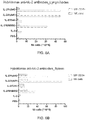
- no measurable cross-reactivity refers to the lacking capability of an antibody to recognize and bind to orthologous proteins from other species.
- an antibody directed against human interleukin-2 would have no measurable cross-reactivity to murine interleukin-2 if, under suitable conditions, binding of the antibody to murine interleukin-2 could not be detected with sufficiently sensitive methods such as surface plasmon resonance.
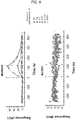
- Fig. 9 One such example of no measurable cross-reactivity is shown in Fig. 9 for the antibody in the lower panel (NARA1).
- an antibody or a protein that "specifically binds to hIL-2" is intended to refer to an antibody or protein that binds to human IL-2 polypeptide with a K D of 100nM or less, 10nM or less, 1nM or less, 100pM or less, or 10pM or less.
- An antibody that "cross-reacts with an antigen other than human IL-2” is intended to refer to an antibody that binds that antigen with a K D of 10nM or less, 1 nM or less, or 100 pM or less.
- an antibody that "does not cross-react with a particular antigen” is intended to refer to an antibody that binds to that antigen, with a K D of 100 nM or greater, or a K D of 1 ⁇ M or greater, or a K D of 10 ⁇ M or greater.
- such antibodies that do not cross-react with the antigen exhibit essentially undetectable binding against these proteins in standard binding assays.
- epitope means a protein determinant capable of specific binding to an antibody.
- Epitopes usually consist of chemically active surface groupings of molecules such as amino acids or sugar side chains and usually have specific three dimensional structural characteristics, as well as specific charge characteristics. Conformational and nonconformational epitopes are distinguished in that the binding to the former but not the latter is lost in the presence of denaturing solvents.
- epitope binding domain refers to portions of a binding molecule (e.g., an antibody or epitope-binding fragment or derivative thereof), that specifically interacts with (e.g., by binding, steric hindrance, stabilizing/destabilizing, spatial distribution) a binding site on a target epitope.
- EBD also refers to one or more fragments of an antibody that retain the ability to specifically interact with (e.g., by binding, steric hindrance, stabilizing/destabilizing, spatial distribution) a IL-2 epitope and inhibit signal transduction.
- antibody fragments include, but are not limited to, an scFv, a Fab fragment, a monovalent fragment consisting of the VL, VH, CL and CH1 domains; a F(ab) 2 fragment, a bivalent fragment comprising two Fab fragments linked by a disulfide bridge at the hinge region; a Fd fragment consisting of the VH and CH1 domains; a Fv fragment consisting of the VL and VH domains of a single arm of an antibody; a dAb fragment ( Ward et at., (1989) Nature 341:544-546 ), which consists of a VH domain; and an isolated complementarity determining region (CDR).
- an scFv a Fab fragment, a monovalent fragment consisting of the VL, VH, CL and CH1 domains
- F(ab) 2 fragment a bivalent fragment comprising two Fab fragments linked by a disulfide bridge at the hinge region
- a Fd fragment consisting of the V
- EBDs also include single domain antibodies, maxibodies, unibodies, minibodies, triabodies, tetrabodies, v-NAR and bis-scFv, as is known in the art (see, e.g., Hollinger and Hudson, (2005) Nature Biotechnology 23: 1126-1136 ), bispecific single chain diabodies, or single chain diabodies designed to bind two distinct epitopes.
- EBDs also include antibody-like molecules or antibody mimetics, which include, but not limited to minibodies, maxybodies, Fn3 based protein scaffolds, Ankyrin repeats (also known as DARpins), VASP polypeptides, Avian pancreatic polypeptide (aPP), Affilin, Knottins, SH3 domains, PDZ domains, Tendamistat, Neocarzinostatin, Protein A domains, Lipocalins, Transferrin, and Kunitz domains that specifically bind epitopes, which are within the scope of the disclosure.
- Antibody fragments can be grafted into scaffolds based on polypeptides such as Fibronectin type III (Fn3) (see U.S. Pat. No. 6,703,199 , which describes fibronectin polypeptide monobodies).
- Fn3 Fibronectin type III
- the present invention also encompasses an antibody to human IL-2, which is an isolated antibody.
- isolated antibody refers to antibody that is substantially free of other antibodies having different antigenic specificities (e.g., an isolated antibody that specifically binds hIL-2 is substantially free of antibodies that specifically bind antigens other than hIL-2).
- An isolated antibody that specifically binds hIL-2 may, however, have cross-reactivity to other antigens, such as IL-2 molecules from other species.
- an isolated antibody may be substantially free of other cellular material and/or chemicals.
- nucleic acid and “polynucleotide” or “nucleotide coding sequences” are used interchangeably and refer to a polymeric form of nucleotides of any length, either deoxyribonucleotides or ribonucleotides or analogs thereof. Polynucleotides can have any three-dimensional structure and can perform any function.
- polynucleotides a gene or gene fragment (for example, a probe, primer, EST or SAGE tag), exons, introns, messenger RNA (mRNA), transfer RNA, ribosomal RNA, ribozymes, cDNA, recombinant polynucleotides, branched polynucleotides, plasmids, vectors, isolated DNA of any sequence, isolated RNA of any sequence, nucleic acid probes, siRNAs, shRNAs, RNAi agents, and primers.
- a polynucleotide can be modified or substituted at one or more base, sugar and/or phosphate, with any of various modifications or substitutions described herein or known in the art.
- a polynucleotide can comprise modified nucleotides, such as methylated nucleotides and nucleotide analogs. If present, modifications to the nucleotide structure can be imparted before or after assembly of the polymer.
- the sequence of nucleotides can be interrupted by non-nucleotide components.
- a polynucleotide can be further modified after polymerization, such as by conjugation with a labeling component.
- the term also refers to both double- and single-stranded molecules. Unless otherwise specified or required, any embodiment of this invention that is a polynucleotide encompasses both the double-stranded form and each of two complementary single-stranded forms known or predicted to make up the double-stranded form.
- polypeptide is used interchangeably with the term “protein” and in its broadest sense refers to a compound of two or more subunit amino acids, amino acid analogs, or peptidomimetics.
- the subunits can be linked by peptide bonds. In another embodiment, the subunit may be linked by other bonds, e.g., ester, ether, etc.
- treating refers in one embodiment, to ameliorating the disease or disorder (e.g. slowing or arresting or reducing the development of the disease or at least one of the clinical symptoms thereof).
- treating refers to alleviating or ameliorating at least one physical parameter including those which may not be discernible by the patient.
- treating or “treatment” refers to modulating the disease or disorder, either physically, (e.g., stabilization of a discernible symptom), physiologically, (e.g., stabilization of a physical parameter), or both.
- the inventors have generated and characterized specific anti-human IL-2 mAbs that are able to bind human IL-2 and, when tested in mice, are able to exert specific and potent stimulation of cytotoxic lymphocytes, including CD8 + T cells and natural killer (NK) cells. Towards these ends several difficulties had to be overcome.
- the inventors have developed specific screening assays that allow detection of specific antihuman IL-2 antibodies (so-called "binders”) in the serum of immunized animals and in the supernatant of the B cell clones obtained after B cell hybridoma fusion. In a second step it was discriminated between standard binders and those targeting a presumed specific epitope of the human IL-2 molecule.
- ELISA enzyme-linked immunosorbent assay
- Antibodies of the invention include the antibody NARA1, which was derived, isolated and structurally characterized by its full length heavy chain according to SEQ ID NO: 5 and its full length light chain amino acid sequences according to SEQ ID NO: 6.
- variable regions V H and V L amino acid sequences of NARA1 are.
- SEQ ID NO: 19 variable heavy
- SEQ ID NO: 20 variable light
- nucleotide coding sequences of NARA1 are SEQ ID NO: 3 (heavy chain coding sequence, including leader sequence) and SEQ ID NO: 4 (light chain coding sequence, including leader sequence).
- Variable light and heavy chains nucleotide coding sequences of NARA1 are SEQ ID NO: 21 (variable heavy coding sequence) and SEQ ID NO: 22 (variable light coding sequence).
- NARA1 The CDR regions of NARA1 are delineated using the Kabat system ( Kabat, E. A., et al. 1991, Sequences of Proteins of Immunological Interest, Fifth Edition, U.S. Department of Health and Human Services, NIH Publication No. 91-3242 , see also Zhao&Lu 2009, Molecular Immunology 47:694-700 ).
- Kabat Kabat, E. A., et al. 1991, Sequences of Proteins of Immunological Interest, Fifth Edition, U.S. Department of Health and Human Services, NIH Publication No. 91-3242 , see also Zhao&Lu 2009, Molecular Immunology 47:694-700 .
- HCDR1, HCDR2, HCDR3, LCDR1, LCDR2, LCDR3 are called hereafter HCDR1, HCDR2, HCDR3, LCDR1, LCDR2, LCDR3 respectively.
- the CDR regions of NARA1 are: HCDR1 according to SEQ ID NO: 7, HCDR2 according to SEQ ID NO: 8, HCDR3 according to SEQ ID NO: 9, LCDR1 according to SEQ ID NO: 10, LCDR2 according to SEQ ID NO: 11, LCDR3 according to SEQ ID NO: 12.
- Nucleotide coding sequences for the CDR regions of NARA1 are: HCDR1 coding sequence according to SEQ ID NO: 13, HCDR2 coding sequence according to SEQ ID NO: 14, HCDR3 coding sequence according to SEQ ID NO: 15, LCDR1 coding sequence according to SEQ ID NO: 16, LCDR2 coding sequence according to SEQ ID NO: 17, LCDR3 coding sequence according to SEQ ID NO: 18.
- Fusion proteins are also provided according to SEQ ID NO: 23 and SEQ ID NO: 24.
- SEQ ID NO: 23 is a fusion protein comprising the variable heavy chain of NARA1 with its N-terminus fused to the C-terminus of hIL-2 via a GxS linker.
- SEQ ID NO: 24 is a fusion protein comprising the variable light chain of NARA1 with its N-terminus fused to the C-terminus of hIL-2 via a GxS linker.
- Proleukin As will be discussed in detail below, the differences in sequence between Proleukin and wt hIL-2 are irrelevant and Proleukin is a valid model for structural analysis of hIL-2.
- X-ray crystallography was ued to solve the atomic-resolution structure of the complex mentioned above.
- X-ray crystallography is a technology that has become routinely and widely used to generate structural data for biomolecules including antibodies and their complexes with antigens ( Adms et al, (2013) Annual Review Biophysics 42:265-287 ; Garman, (2014) Science 343:1102-1108 ; Joachimiak, (2009) Current Opinio Structural Biology 19:573-584 .)
- Proleukin The antigen, Proleukin, is commercially available as lyophilyzed powder together with excipients (every 1 mg Proleukin is mixed with approximately 50mg mannitol, 0.18mg sodium dodecyl sulfate, 0.173mg sodium dihydrogen phosphate, and 0.89mg disodium hydrogen phosphate). Before used for complex formation, Proleukin was purified by reverse-phase HPLC to remove the excipients.
- NARA1-Fab The Fab fragment of NARA1 (NARA1-Fab) was generated by papain cleavage of the full-length antibody followed by Protein A chromatography. Briefly, 6.5ml full-length NARA1 (9mg/ml in 50mM citrate buffer with 90mM sodium chloride at pH 7.0) was mixed with 5mM DTT and 590ug Papain (Roche). The cleavage reaction was kept at room temperature for 16h and stopped by addition of 15ul 56mM E64 solution (Roche).
- the cleavage solution was then diluted 10 times with 25mM Tris, 25mM NaCl, pH 8.0 and loaded onto a 5ml Protein A column (GE Healthcare) equilibrate with 5 column volune of 25mM Tris, 25mM NaCl, pH 8.0 and Fab fragment was in the loading-through fraction and Fc fragment was bound to the Protein A column.
- Proleukin powder after HPLC was dissolved in H 2 O at the concentration of 5.5 mg/ml. 6.6mg Proleukin, in excess, was added to 11.5mg NARA1 Fab fragment solution drop by drop. Centrifugation was used to remove the excess Proleukin that was precipitated under current condition.
- the complex was then purified by gel filtration with Superdex 200 10x300 (GE Healthcare) with running buffer of 25mM Tris, 25mM NaCl, pH 7.4.
- Proleukin/NARA1-Fab complex after gel filtration was concentrated to 14mg/ml and was screened by vapour diffusion method as sitting drops.
- the protein solution was mixed 1:1 with reservoir buffer to a total size of 0.4ul.
- the experiments were set up with Phoenix robotic system (Art Robbins Instruments), stored in a Rocklmager hotel (Formulatrix) at 19°C, and imaged automatically. Crystals were harvested 4 days after screening under condition of 20% w/v polyethylene Glycol 3350 and 0.2M sodium nitrate. Crystals were cryo-protected with reservoir buffer containing 10% glycerol and flashed frozen in liquid nitrogen prior to data collection. Diffraction data were collected at the Swiss Light Source (Villigen, Switzerland) at beam-line PX-II with a Pilatus pixel detector using x-ray radiation wavelength of 0.99998 ⁇ .
- the dataset was processed with XDS and XSCALE (version Dec. 6 th , 2010) and the structure was resolved with molecular replacement method with the program PHASERby using Protein Data Bank entry "3INK” as search model for IL-2 and Protein Data Bank entry "3TTI” as search model for Fab fragment. Iterative model building and refinement were performed with the programs Coot (Crystallographic Object-Oriented Toolkit) and AUTOBUSTER (Bricogne et al., 2011). All figures were generated with the program PyMOL (Molecular Graphics System; DeLano Scientific: Palo Alto, CA; http://www.pymol.org).
- Epitope residues are defined as those residues from Proleukin that are within 4 ⁇ distance from any atom in Fab fragment of NARA1 and are further confirmed by CCP4 program CONTACT and AREAIMOL (Collaborative Computational Project, Number 4, version 6.4.0). Similarly paratope residues are defined as those residues from NARA1-Fab that are within 4 ⁇ distance from any atom in Proleukin.
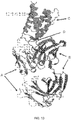
- Figure 10 provides the overview of the three-dimension structure of Proleukin/Fab-NARA1 complex as obtained in Example 1.
- Light chain of Fab fragment of NARA1 is designated A
- heavy chain of Fab fragment of NARA1 is shown as B
- epitope residues recognized by NARA1-Fab are designated D
- Proleukin is designated C and the mutation, C145S, is highlighted.
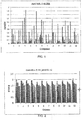
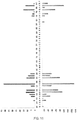
- Figure 11 provides further analysis of epitope residues.
- the X-axis lists the amino acid sequence and numbering according to SEQ ID No 1.
- the upper side of Y-axis demonstrates the total number of atoms of NARA1 -Fab that are within 4 ⁇ from corresponding residue from Proleukin and the lower side of Y-axis demonstrates the reduced solvent-accessible area ( ⁇ 2 ) after binding to NARA1-Fab.
- Proleukin used in Example 1 contains mutation of C145S. As shown in Figure 10 , C145S is far away from the epitope region. In addition the superposition of C ⁇ atoms between Proleukin in Example 1 with Ca atoms from wt hIL-2 in complex with CD25, CD122, and CD132 (PDB: 2B5I) shows r.m.s.d of 0.447 ⁇ , which indicates that the mutation does not disturb the over-all structure. Hence Proleukin with C145S mutation is a valid model for structural analysis for wt hIL-2.
- hIL-2 is 4-helix bundle protein and the 4 helices are named from N-terminus to C-terminus as A, B, C, and D, respectively.
- the epitope recognized by NARA1-Fab as shown in Figure 10 is a conformational epitope and spans two regions as shown in Figure 11 : one region (N50-K63) comprises a loop and a short helix and connects helix A and B, and the other region (N91-N97) comprises a loop and connects helix B and C.
- Arg58 as shown in Figure 11 is the most critical epitope residue for binding with NARA1-Fab, as this residue alone has 42 interacting atoms from NARA1-Fab and accounts for 17.7% of total reduced solvent-accessible surface area as a consequence of binding to NARA1-Fab.
- Arg58 as shown in Figure 12 , forms two strong salt-bridges with Glu35 in HCDR1 and with Asp100 from LCDR3, respectively. Arg58 also makes ⁇ -action interaction with the aromatic ring of Try100 from LCDR3.
- Residues K52, P54, K55, T57, T61, F62, K63, Q94, and K96 are also considered important for the binding to NARA1-Fab, since they all show equal to/more than 5 interacting atoms from NARA1-Fab and larger than 30 ⁇ 2 reduced solvent-accessible area as shown in Figure 11 .
- Table 3 shows that
- Figure 12 illustrates Arg58 as the most critical epitope residue recognized by the NARA1-Fab.
- A represents Proleukin
- B represents heavy chain
- C represents light chain. The involved residues are shown as sticks.
- Figure 13 shows the overlay of Proleukin/NARA1-Fab complex with IL-2/CD25/CD122/CD132 quaternary complex.
- the quaternary complex structure comes from PDB entry "2B5I” with cartoon D in pale cyan representing wt hIL-2, cartoon B in red representing CD122, cartoon C in blue representing CD132, and surface A in green representing CD25.
- cyan cartoon D overlayed with wt hIL-2 represents Proleukin
- cartoon E in magenta represents heavy chain
- cartoon F in yellow represents the light chain.
- Figure 14 displays the overlay of C helices from IL-2_C145A (PDB: 3INK), Superkine (PDB: 3Q81), IL-2/CD25/CD122/CD132 (PDB: 2B5I), and Proleukin/NARA1-Fab.
- a first library of 15-mer peptides was generated based on the sequence of human IL2.
- a second library of selected 15-mer peptides was also generated based on the mutation of 3 specific residues F(62), Y(65) and L(92). The latter mutations were done based on the Roche/Glycart IL2 mutein, as disclosed in WO2012/107417A1 which has these 3 mutations.
- Previous work done in lab Boyman (unpublished) showed that the commercial mouse anti-human IL2 mAb 602 with analogous function as A1 has strongly reduced binding to the F42A mutant of IL2 (one of the IL2 docking sites to CD25).
- each peptide in the first library has 15 amino acids and the sequence is derived by scanning the sequence of interest (see Table 4, reference peptides 1 to 41) with a step of 3 residues, starting from the N-terminus. Therefore a ladder is generated and each peptide contains 12 overlapping residues with the previous peptide and 12 overlapping residues with the following peptide in the ladder. In total, 41 peptides were generated from the expressed human IL2 sequence. A second library of peptides was generated by mutating F(62), Y(65) and L(92) to alanine in all corresponding peptides in the first library generated as described above (see Table 4, reference peptides no 42 to 60).
- Residue are the serine (S) replacing cysteines (C) 1 APTSSSTKKTQLQLE 2 SSSTKKTQLQLEHLL 3 TKKTQLQLEHLLLDL 4 TQLQLEHLLLDLQMI 5 QLEHLLLDLQMILNG 6 HLLLDLQMILNGINN 7 LDLQMILNGINNYKN 8 QMILNGINNYKNPKL 9 LNGINNYKNPKLTRM 10 INNYKNPKLTRMLTF 11 YKNPKLTRMLTFKFY 12 PKLTRMLTFKFYMPK 13 TRMLTFKFYMPKKAT 14 LTFKFYMPKKATELK 15 KFYMPKKATELKHLQ 16 MPKKATELKHLQSLE 17 KATELKHLQSLEEEL 18 ELKHLQSLEEELKPL 19 HLQSLEEELKPLEEV 20 SLEEELKPLEEVLNL 21 EELKPLEEVLNLAQS 22 KPLEEVLNLAQSKNF 23 EEVLNLAQSKNFHL
- Both set of peptides were printed on microarray slides in triplicate, incubated with the antibodies of interest (MAb602 and NARA1) and control antibodies. Additional incubations are with unrelated antibodies from the same isotype (mouse control IgG2a/lambda and mouse control IgG2a/kappa), and secondary antibodies (anti-mouse IgG (Thermo 84545, label DL650) or anti-mouse IgG (JIR 115-175-072, Label Cy5)) to assess unspecific binding due to the detection antibody.
- the experiments are performed essentially as described in Maksimov P, et al. 2012, PLoS One 7:e34212. doi:10.13711journal.pone. 0034212 .
- peptide-antibody binding was performed by RepliTope-analysis where the peptide microarray (triplicate) was incubated with the primary antibody followed by a fluorescently labelled secondary antibody directed against the Fc-part of the primary one. All steps were performed on a TECAN microarray processing station enabling highly reliable and reproducible washing and incubation steps. After performing the incubation steps and subsequent to the final washing steps (to remove the unbound secondary antibodies) the microarrays were dried using a nitrogen stream and scanned in a high resolution microarray scanning system with appropriate wavelength settings. Control incubations were performed with an unrelated antibody having the same isotype to exclude false positive signals. The resulting images were analyzed und quantified using spot-recognition software GenePix (Molecular Devices).
- the mean signal intensity was extracted (between 0 and 65535 arbitrary units).
- the MMC2 values were determined.
- the MMC2 equals the mean value of all three instances on the microarray. Except the coefficient of variation (CV) - standard-deviation divided by the mean value - is larger 0.5, in this case the mean of the two closest values (MC2) is assigned to MMC2.
- the data are summarized in Table 5.
- the anti-IL2 (NARA1) antibody did not show any significant reactivity towards the immobilized peptides. Only peptide 10 exhibited a weak response, however, this peptide was also weakly recognized by the mouse control antibodies.
- the commercial antibody MAB602 (mlgG2a) provided some weak signals on peptide 22 to 26 and some strong for peptides 10 to 13. Table 5. Result of Linear Epitope Mapping Reference peptide no.
Landscapes
- Health & Medical Sciences (AREA)
- Chemical & Material Sciences (AREA)
- Life Sciences & Earth Sciences (AREA)
- Medicinal Chemistry (AREA)
- General Health & Medical Sciences (AREA)
- Organic Chemistry (AREA)
- Immunology (AREA)
- Proteomics, Peptides & Aminoacids (AREA)
- Animal Behavior & Ethology (AREA)
- Pharmacology & Pharmacy (AREA)
- Public Health (AREA)
- Veterinary Medicine (AREA)
- Epidemiology (AREA)
- Bioinformatics & Cheminformatics (AREA)
- Engineering & Computer Science (AREA)
- Biophysics (AREA)
- Genetics & Genomics (AREA)
- Molecular Biology (AREA)
- Zoology (AREA)
- Gastroenterology & Hepatology (AREA)
- Biochemistry (AREA)
- Chemical Kinetics & Catalysis (AREA)
- General Chemical & Material Sciences (AREA)
- Nuclear Medicine, Radiotherapy & Molecular Imaging (AREA)
- Mycology (AREA)
- Microbiology (AREA)
- Endocrinology (AREA)
- Toxicology (AREA)
- Virology (AREA)
- Communicable Diseases (AREA)
- Oncology (AREA)
- Peptides Or Proteins (AREA)
- Medicines Containing Antibodies Or Antigens For Use As Internal Diagnostic Agents (AREA)
- Preparation Of Compounds By Using Micro-Organisms (AREA)
- Micro-Organisms Or Cultivation Processes Thereof (AREA)
- Medicines That Contain Protein Lipid Enzymes And Other Medicines (AREA)
Priority Applications (1)
| Application Number | Priority Date | Filing Date | Title |
|---|---|---|---|
| EP20158066.9A EP3693389B1 (en) | 2014-07-10 | 2015-07-10 | Immune-stimulating monoclonal antibodies against human interleukin-2 |
Applications Claiming Priority (2)
| Application Number | Priority Date | Filing Date | Title |
|---|---|---|---|
| EP14176619 | 2014-07-10 | ||
| PCT/IB2015/055226 WO2016005950A1 (en) | 2014-07-10 | 2015-07-10 | Immune-stimulating monoclonal antibodies against human interleukin-2 |
Related Child Applications (1)
| Application Number | Title | Priority Date | Filing Date |
|---|---|---|---|
| EP20158066.9A Division EP3693389B1 (en) | 2014-07-10 | 2015-07-10 | Immune-stimulating monoclonal antibodies against human interleukin-2 |
Publications (2)
| Publication Number | Publication Date |
|---|---|
| EP3166973A1 EP3166973A1 (en) | 2017-05-17 |
| EP3166973B1 true EP3166973B1 (en) | 2020-02-19 |
Family
ID=51162588
Family Applications (2)
| Application Number | Title | Priority Date | Filing Date |
|---|---|---|---|
| EP15759938.2A Active EP3166973B1 (en) | 2014-07-10 | 2015-07-10 | Immune-stimulating monoclonal antibodies against human interleukin-2 |
| EP20158066.9A Active EP3693389B1 (en) | 2014-07-10 | 2015-07-10 | Immune-stimulating monoclonal antibodies against human interleukin-2 |
Family Applications After (1)
| Application Number | Title | Priority Date | Filing Date |
|---|---|---|---|
| EP20158066.9A Active EP3693389B1 (en) | 2014-07-10 | 2015-07-10 | Immune-stimulating monoclonal antibodies against human interleukin-2 |
Country Status (9)
| Country | Link |
|---|---|
| US (2) | US10894828B2 (enExample) |
| EP (2) | EP3166973B1 (enExample) |
| JP (1) | JP7209464B2 (enExample) |
| CN (1) | CN106604932B (enExample) |
| AU (1) | AU2015287227B2 (enExample) |
| CA (1) | CA2954476C (enExample) |
| DK (1) | DK3166973T3 (enExample) |
| ES (2) | ES2989669T3 (enExample) |
| WO (1) | WO2016005950A1 (enExample) |
Families Citing this family (17)
| Publication number | Priority date | Publication date | Assignee | Title |
|---|---|---|---|---|
| BR112018014150A2 (en) * | 2016-01-11 | 2018-12-11 | Novartis Ag | immunostimulating humanized monoclonal antibodies to human interleukin-2, and fusion proteins thereof |
| AU2017335771A1 (en) | 2016-09-28 | 2019-02-28 | Musc Foundation For Research Development | Antibodies that bind interleukin-2 and uses thereof |
| GB201621806D0 (en) * | 2016-12-21 | 2017-02-01 | Philogen Spa | Immunocytokines with progressive activation mechanism |
| CN110913873A (zh) * | 2017-02-23 | 2020-03-24 | 希望之城 | 用于cd8+t细胞的体内扩增并预防或治疗gvhd的方法 |
| EP3600421A4 (en) * | 2017-03-23 | 2021-01-06 | The Trustees of The University of Pennsylvania | ANTI-C5A ANTIBODIES AND USES OF THEM |
| JP7057980B2 (ja) * | 2017-05-25 | 2022-04-21 | インスティテュート フォー ベーシック サイエンス | 抗-ヒトインターロイキン-2抗体及びその用途 |
| US12454561B2 (en) | 2018-03-19 | 2025-10-28 | Multivir Inc. | Methods and compositions comprising tumor suppressor gene therapy and CD122/CD132 agonists for the treatment of cancer |
| WO2021113644A1 (en) | 2019-12-05 | 2021-06-10 | Multivir Inc. | Combinations comprising a cd8+ t cell enhancer, an immune checkpoint inhibitor and radiotherapy for targeted and abscopal effects for the treatment of cancer |
| EP4090377A1 (en) | 2020-01-13 | 2022-11-23 | Synaffix B.V. | Conjugates of antibodies an immune cell engagers |
| CN115397852B (zh) | 2020-02-16 | 2023-08-11 | 奥罗斯生物科学公司 | 工程化抗il-2抗体 |
| IL297329A (en) * | 2020-04-22 | 2022-12-01 | Merck Sharp & Dohme Llc | Dimeric interleukin-2 beta gamma receptor-biased human interleukin-2 conjugates conjugated to soluble non-peptide polymers. |
| KR20230048151A (ko) * | 2020-08-18 | 2023-04-10 | 유니버시타트 취리히 | Cd25 편향된 항-il-2 항체 |
| JP2024506022A (ja) | 2021-02-08 | 2024-02-08 | シンアフィックス ビー.ブイ. | 多機能性抗体 |
| JP2024539749A (ja) | 2021-10-14 | 2024-10-29 | ラッティコン (スージョウ) バイオファーマシューティカルズ カンパニー リミテッド | 新規な抗体-サイトカイン融合タンパク質及びその製造方法と使用 |
| US11773160B1 (en) | 2022-08-05 | 2023-10-03 | Anaveon AG | Immune-stimulating IL-2 fusion proteins |
| CN119912559B (zh) * | 2025-01-22 | 2025-12-26 | 贵州中医药大学 | 一种新冠病毒变异株jn.1刺突s蛋白的单链抗体及其应用 |
| CN119775409B (zh) * | 2025-03-05 | 2025-07-11 | 深圳真实生物医药科技有限公司 | 靶向sost的抗体及其用途 |
Family Cites Families (17)
| Publication number | Priority date | Publication date | Assignee | Title |
|---|---|---|---|---|
| DK174501B1 (da) | 1983-12-23 | 2003-04-28 | Hoffmann La Roche | Fremgangsmåde til fremstilling af interleukin-2 |
| JPS62269698A (ja) * | 1986-03-17 | 1987-11-24 | エフ.ホフマン ― ラ ロシュ アーゲー | Il−2蛋白質に対するモノクロ−ナル抗体 |
| US6111090A (en) | 1996-08-16 | 2000-08-29 | Schering Corporation | Mammalian cell surface antigens; related reagents |
| WO1998006842A1 (en) | 1996-08-16 | 1998-02-19 | Schering Corporation | Mammalian cell surface antigens; related reagents |
| WO1998056915A2 (en) | 1997-06-12 | 1998-12-17 | Research Corporation Technologies, Inc. | Artificial antibody polypeptides |
| JP2006512391A (ja) | 2002-12-30 | 2006-04-13 | スリーエム イノベイティブ プロパティズ カンパニー | 組み合わせ免疫賦活薬 |
| EP1765402A2 (en) | 2004-06-04 | 2007-03-28 | Duke University | Methods and compositions for enhancement of immunity by in vivo depletion of immunosuppressive cell activity |
| NZ563213A (en) | 2005-06-01 | 2009-07-31 | Micromet Ag | Anti-IL2 antibodies |
| CN102875681A (zh) | 2005-07-08 | 2013-01-16 | 拜奥根Idec马萨诸塞公司 | 抗-αvβ6抗体及其用途 |
| US20100310501A1 (en) * | 2006-02-16 | 2010-12-09 | Onur Boyman | Methods for Improving Immune Function and Methods for Prevention or Treatment of Disease in a Mammalian Subject |
| CN101045923B (zh) * | 2006-03-31 | 2011-11-23 | 沈阳三生制药有限责任公司 | 生产一种白细胞介素类似物的方法 |
| EP2242773B1 (en) | 2008-02-11 | 2017-06-14 | Cure Tech Ltd. | Monoclonal antibodies for tumor treatment |
| LT3339323T (lt) | 2010-08-12 | 2020-02-10 | Eli Lilly And Company | Amiloido beta peptido antikūnai prieš n3glu ir jų panaudojimas |
| US9266938B2 (en) | 2011-02-10 | 2016-02-23 | Roche Glycart Ag | Mutant interleukin-2 polypeptides |
| WO2013157105A1 (ja) | 2012-04-18 | 2013-10-24 | 公立大学法人大阪市立大学 | ムチンサブタイプ5ac特異的ヒト化抗体およびその利用 |
| CN112587671A (zh) | 2012-07-18 | 2021-04-02 | 博笛生物科技有限公司 | 癌症的靶向免疫治疗 |
| WO2015109212A1 (en) * | 2014-01-17 | 2015-07-23 | Pfizer Inc. | Anti-il-2 antibodies and compositions and uses thereof |
-
2015
- 2015-07-10 AU AU2015287227A patent/AU2015287227B2/en not_active Ceased
- 2015-07-10 JP JP2017501280A patent/JP7209464B2/ja active Active
- 2015-07-10 DK DK15759938.2T patent/DK3166973T3/da active
- 2015-07-10 CN CN201580048027.0A patent/CN106604932B/zh active Active
- 2015-07-10 US US15/324,468 patent/US10894828B2/en active Active
- 2015-07-10 EP EP15759938.2A patent/EP3166973B1/en active Active
- 2015-07-10 ES ES20158066T patent/ES2989669T3/es active Active
- 2015-07-10 CA CA2954476A patent/CA2954476C/en active Active
- 2015-07-10 ES ES15759938T patent/ES2779977T3/es active Active
- 2015-07-10 WO PCT/IB2015/055226 patent/WO2016005950A1/en not_active Ceased
- 2015-07-10 EP EP20158066.9A patent/EP3693389B1/en active Active
-
2020
- 2020-12-22 US US17/131,221 patent/US20210230269A1/en not_active Abandoned
Non-Patent Citations (4)
| Title |
|---|
| J. TOMALA ET AL: "In Vivo Expansion of Activated Naive CD8+ T Cells and NK Cells Driven by Complexes of IL-2 and Anti-IL-2 Monoclonal Antibody As Novel Approach of Cancer Immunotherapy", THE JOURNAL OF IMMUNOLOGY, vol. 183, no. 8, 15 October 2009 (2009-10-15), US, pages 4904 - 4912, XP055369385, ISSN: 0022-1767, DOI: 10.4049/jimmunol.0900284 * |
| JAKUB TOMALA ET AL: "Chimera of IL-2 Linked to Light Chain of anti-IL-2 mAb Mimics IL-2/anti-IL-2 mAb Complexes Both Structurally and Functionally", ACS CHEMICAL BIOLOGY, vol. 8, no. 5, 17 May 2013 (2013-05-17), US, pages 871 - 876, XP055369414, ISSN: 1554-8929, DOI: 10.1021/cb3007242 * |
| KRIEG C ET AL: "Improved IL-2 immunotherapy by selective stimulation of IL-2 receptors on lymphocytes and endothelial cells", PROCEEDINGS NATIONAL ACADEMY OF SCIENCES PNAS, NATIONAL ACADEMY OF SCIENCES, US, vol. 107, no. 26, 29 June 2010 (2010-06-29), pages 11906 - 11911, XP002738483, ISSN: 0027-8424, [retrieved on 20100614], DOI: 10.1073/PNAS.1002569107 * |
| SCHWARTZENTRUBER D J ET AL: "In vitro predictors of therapeutic response in melanoma patients receiving tumor-infiltrating lymphocytes and interleukin-2", JOURNAL OF CLINICAL ONCOLOGY, AMERICAN SOCIETY OF CLINICAL ONCOLOGY, US, vol. 12, no. 7, 1 July 1994 (1994-07-01), pages 1475 - 1483, XP009187901, ISSN: 0732-183X * |
Also Published As
| Publication number | Publication date |
|---|---|
| CN106604932A (zh) | 2017-04-26 |
| CA2954476C (en) | 2023-09-19 |
| JP2017525343A (ja) | 2017-09-07 |
| CN106604932B (zh) | 2024-12-10 |
| US10894828B2 (en) | 2021-01-19 |
| CA2954476A1 (en) | 2016-01-14 |
| US20210230269A1 (en) | 2021-07-29 |
| EP3693389B1 (en) | 2024-09-04 |
| EP3693389A1 (en) | 2020-08-12 |
| WO2016005950A1 (en) | 2016-01-14 |
| EP3166973A1 (en) | 2017-05-17 |
| AU2015287227A1 (en) | 2017-02-09 |
| ES2989669T3 (es) | 2024-11-27 |
| AU2015287227B2 (en) | 2021-02-18 |
| EP3693389C0 (en) | 2024-09-04 |
| ES2779977T3 (es) | 2020-08-21 |
| DK3166973T3 (da) | 2020-04-06 |
| JP7209464B2 (ja) | 2023-01-20 |
| EP3693389A9 (en) | 2021-04-07 |
| US20170183403A1 (en) | 2017-06-29 |
| AU2015287227A8 (en) | 2017-02-16 |
Similar Documents
| Publication | Publication Date | Title |
|---|---|---|
| EP3166973B1 (en) | Immune-stimulating monoclonal antibodies against human interleukin-2 | |
| CN113166246B (zh) | 一种抗体及其用途 | |
| KR102662387B1 (ko) | B7-h3 항체, 이의 항원-결합 단편 및 이의 의학적 용도 | |
| CN110366560B (zh) | 抗b7-h4抗体、其抗原结合片段及其医药用途 | |
| JP2020531043A (ja) | 抗4−1bb抗体とその作製及び使用方法 | |
| CN113227148B (zh) | 抗gpc3抗体、其抗原结合片段及其医药用途 | |
| CN111225926A (zh) | 靶向pdl1的抗体及其使用方法 | |
| JP2020533970A (ja) | 抗cd3抗体とその作製及び使用方法 | |
| CN111492066A (zh) | 使用转录本进行抗体方向的方法及由其衍生的组合物 | |
| CN117279950A (zh) | 一种靶向il-18bp的抗体及其应用 | |
| CN115298216A (zh) | 抗体或其抗原结合片段、其制备方法及医药用途 | |
| CN111788229A (zh) | Csf1r结合剂 | |
| CN116847863A (zh) | 抗人cd22的单克隆抗体及其用途 | |
| TWI889766B (zh) | 抗cd19抗體以及使用與製造其的方法 | |
| EP4714974A1 (en) | Bispecific antigen binding molecule and use thereof | |
| HK40049006A (en) | Anti-gpc3 antibody, antigen-binding fragment thereof, and medical use thereof | |
| HK40049006B (en) | Anti-gpc3 antibody, antigen-binding fragment thereof, and medical use thereof | |
| WO2019137552A1 (en) | MODIFIED Cκ AND CH1 DOMAINS | |
| CN118355032A (zh) | Bcma抗体及其应用 |
Legal Events
| Date | Code | Title | Description |
|---|---|---|---|
| STAA | Information on the status of an ep patent application or granted ep patent |
Free format text: STATUS: THE INTERNATIONAL PUBLICATION HAS BEEN MADE |
|
| PUAI | Public reference made under article 153(3) epc to a published international application that has entered the european phase |
Free format text: ORIGINAL CODE: 0009012 |
|
| STAA | Information on the status of an ep patent application or granted ep patent |
Free format text: STATUS: REQUEST FOR EXAMINATION WAS MADE |
|
| 17P | Request for examination filed |
Effective date: 20170210 |
|
| AK | Designated contracting states |
Kind code of ref document: A1 Designated state(s): AL AT BE BG CH CY CZ DE DK EE ES FI FR GB GR HR HU IE IS IT LI LT LU LV MC MK MT NL NO PL PT RO RS SE SI SK SM TR |
|
| AX | Request for extension of the european patent |
Extension state: BA ME |
|
| DAV | Request for validation of the european patent (deleted) | ||
| DAX | Request for extension of the european patent (deleted) | ||
| STAA | Information on the status of an ep patent application or granted ep patent |
Free format text: STATUS: EXAMINATION IS IN PROGRESS |
|
| 17Q | First examination report despatched |
Effective date: 20171107 |
|
| 17Q | First examination report despatched |
Effective date: 20171114 |
|
| RIC1 | Information provided on ipc code assigned before grant |
Ipc: A61K 38/20 20060101ALI20181122BHEP Ipc: C07K 16/24 20060101AFI20181122BHEP Ipc: C07K 19/00 20060101ALI20181122BHEP |
|
| GRAP | Despatch of communication of intention to grant a patent |
Free format text: ORIGINAL CODE: EPIDOSNIGR1 |
|
| STAA | Information on the status of an ep patent application or granted ep patent |
Free format text: STATUS: GRANT OF PATENT IS INTENDED |
|
| INTG | Intention to grant announced |
Effective date: 20190222 |
|
| GRAJ | Information related to disapproval of communication of intention to grant by the applicant or resumption of examination proceedings by the epo deleted |
Free format text: ORIGINAL CODE: EPIDOSDIGR1 |
|
| STAA | Information on the status of an ep patent application or granted ep patent |
Free format text: STATUS: EXAMINATION IS IN PROGRESS |
|
| GRAP | Despatch of communication of intention to grant a patent |
Free format text: ORIGINAL CODE: EPIDOSNIGR1 |
|
| STAA | Information on the status of an ep patent application or granted ep patent |
Free format text: STATUS: GRANT OF PATENT IS INTENDED |
|
| INTC | Intention to grant announced (deleted) | ||
| INTG | Intention to grant announced |
Effective date: 20190726 |
|
| GRAS | Grant fee paid |
Free format text: ORIGINAL CODE: EPIDOSNIGR3 |
|
| RAP1 | Party data changed (applicant data changed or rights of an application transferred) |
Owner name: UNIVERSITAET ZUERICH |
|
| GRAA | (expected) grant |
Free format text: ORIGINAL CODE: 0009210 |
|
| STAA | Information on the status of an ep patent application or granted ep patent |
Free format text: STATUS: THE PATENT HAS BEEN GRANTED |
|
| AK | Designated contracting states |
Kind code of ref document: B1 Designated state(s): AL AT BE BG CH CY CZ DE DK EE ES FI FR GB GR HR HU IE IS IT LI LT LU LV MC MK MT NL NO PL PT RO RS SE SI SK SM TR |
|
| REG | Reference to a national code |
Ref country code: CH Ref legal event code: EP |
|
| REG | Reference to a national code |
Ref country code: DE Ref legal event code: R096 Ref document number: 602015047317 Country of ref document: DE |
|
| REG | Reference to a national code |
Ref country code: AT Ref legal event code: REF Ref document number: 1234879 Country of ref document: AT Kind code of ref document: T Effective date: 20200315 |
|
| REG | Reference to a national code |
Ref country code: IE Ref legal event code: FG4D |
|
| REG | Reference to a national code |
Ref country code: DK Ref legal event code: T3 Effective date: 20200330 |
|
| REG | Reference to a national code |
Ref country code: CH Ref legal event code: NV Representative=s name: TR-IP CONSULTING LLC, CH Ref country code: NL Ref legal event code: FP |
|
| REG | Reference to a national code |
Ref country code: SE Ref legal event code: TRGR |
|
| PG25 | Lapsed in a contracting state [announced via postgrant information from national office to epo] |
Ref country code: FI Free format text: LAPSE BECAUSE OF FAILURE TO SUBMIT A TRANSLATION OF THE DESCRIPTION OR TO PAY THE FEE WITHIN THE PRESCRIBED TIME-LIMIT Effective date: 20200219 Ref country code: RS Free format text: LAPSE BECAUSE OF FAILURE TO SUBMIT A TRANSLATION OF THE DESCRIPTION OR TO PAY THE FEE WITHIN THE PRESCRIBED TIME-LIMIT Effective date: 20200219 Ref country code: NO Free format text: LAPSE BECAUSE OF FAILURE TO SUBMIT A TRANSLATION OF THE DESCRIPTION OR TO PAY THE FEE WITHIN THE PRESCRIBED TIME-LIMIT Effective date: 20200519 |
|
| REG | Reference to a national code |
Ref country code: ES Ref legal event code: FG2A Ref document number: 2779977 Country of ref document: ES Kind code of ref document: T3 Effective date: 20200821 |
|
| REG | Reference to a national code |
Ref country code: LT Ref legal event code: MG4D |
|
| PG25 | Lapsed in a contracting state [announced via postgrant information from national office to epo] |
Ref country code: BG Free format text: LAPSE BECAUSE OF FAILURE TO SUBMIT A TRANSLATION OF THE DESCRIPTION OR TO PAY THE FEE WITHIN THE PRESCRIBED TIME-LIMIT Effective date: 20200519 Ref country code: GR Free format text: LAPSE BECAUSE OF FAILURE TO SUBMIT A TRANSLATION OF THE DESCRIPTION OR TO PAY THE FEE WITHIN THE PRESCRIBED TIME-LIMIT Effective date: 20200520 Ref country code: IS Free format text: LAPSE BECAUSE OF FAILURE TO SUBMIT A TRANSLATION OF THE DESCRIPTION OR TO PAY THE FEE WITHIN THE PRESCRIBED TIME-LIMIT Effective date: 20200619 Ref country code: LV Free format text: LAPSE BECAUSE OF FAILURE TO SUBMIT A TRANSLATION OF THE DESCRIPTION OR TO PAY THE FEE WITHIN THE PRESCRIBED TIME-LIMIT Effective date: 20200219 Ref country code: HR Free format text: LAPSE BECAUSE OF FAILURE TO SUBMIT A TRANSLATION OF THE DESCRIPTION OR TO PAY THE FEE WITHIN THE PRESCRIBED TIME-LIMIT Effective date: 20200219 |
|
| PG25 | Lapsed in a contracting state [announced via postgrant information from national office to epo] |
Ref country code: SK Free format text: LAPSE BECAUSE OF FAILURE TO SUBMIT A TRANSLATION OF THE DESCRIPTION OR TO PAY THE FEE WITHIN THE PRESCRIBED TIME-LIMIT Effective date: 20200219 Ref country code: LT Free format text: LAPSE BECAUSE OF FAILURE TO SUBMIT A TRANSLATION OF THE DESCRIPTION OR TO PAY THE FEE WITHIN THE PRESCRIBED TIME-LIMIT Effective date: 20200219 Ref country code: EE Free format text: LAPSE BECAUSE OF FAILURE TO SUBMIT A TRANSLATION OF THE DESCRIPTION OR TO PAY THE FEE WITHIN THE PRESCRIBED TIME-LIMIT Effective date: 20200219 Ref country code: SM Free format text: LAPSE BECAUSE OF FAILURE TO SUBMIT A TRANSLATION OF THE DESCRIPTION OR TO PAY THE FEE WITHIN THE PRESCRIBED TIME-LIMIT Effective date: 20200219 Ref country code: PT Free format text: LAPSE BECAUSE OF FAILURE TO SUBMIT A TRANSLATION OF THE DESCRIPTION OR TO PAY THE FEE WITHIN THE PRESCRIBED TIME-LIMIT Effective date: 20200712 Ref country code: RO Free format text: LAPSE BECAUSE OF FAILURE TO SUBMIT A TRANSLATION OF THE DESCRIPTION OR TO PAY THE FEE WITHIN THE PRESCRIBED TIME-LIMIT Effective date: 20200219 Ref country code: CZ Free format text: LAPSE BECAUSE OF FAILURE TO SUBMIT A TRANSLATION OF THE DESCRIPTION OR TO PAY THE FEE WITHIN THE PRESCRIBED TIME-LIMIT Effective date: 20200219 |
|
| REG | Reference to a national code |
Ref country code: AT Ref legal event code: MK05 Ref document number: 1234879 Country of ref document: AT Kind code of ref document: T Effective date: 20200219 |
|
| REG | Reference to a national code |
Ref country code: DE Ref legal event code: R097 Ref document number: 602015047317 Country of ref document: DE |
|
| PLBE | No opposition filed within time limit |
Free format text: ORIGINAL CODE: 0009261 |
|
| STAA | Information on the status of an ep patent application or granted ep patent |
Free format text: STATUS: NO OPPOSITION FILED WITHIN TIME LIMIT |
|
| 26N | No opposition filed |
Effective date: 20201120 |
|
| PG25 | Lapsed in a contracting state [announced via postgrant information from national office to epo] |
Ref country code: AT Free format text: LAPSE BECAUSE OF FAILURE TO SUBMIT A TRANSLATION OF THE DESCRIPTION OR TO PAY THE FEE WITHIN THE PRESCRIBED TIME-LIMIT Effective date: 20200219 |
|
| PG25 | Lapsed in a contracting state [announced via postgrant information from national office to epo] |
Ref country code: SI Free format text: LAPSE BECAUSE OF FAILURE TO SUBMIT A TRANSLATION OF THE DESCRIPTION OR TO PAY THE FEE WITHIN THE PRESCRIBED TIME-LIMIT Effective date: 20200219 Ref country code: PL Free format text: LAPSE BECAUSE OF FAILURE TO SUBMIT A TRANSLATION OF THE DESCRIPTION OR TO PAY THE FEE WITHIN THE PRESCRIBED TIME-LIMIT Effective date: 20200219 Ref country code: MC Free format text: LAPSE BECAUSE OF FAILURE TO SUBMIT A TRANSLATION OF THE DESCRIPTION OR TO PAY THE FEE WITHIN THE PRESCRIBED TIME-LIMIT Effective date: 20200219 |
|
| PG25 | Lapsed in a contracting state [announced via postgrant information from national office to epo] |
Ref country code: LU Free format text: LAPSE BECAUSE OF NON-PAYMENT OF DUE FEES Effective date: 20200710 |
|
| PG25 | Lapsed in a contracting state [announced via postgrant information from national office to epo] |
Ref country code: TR Free format text: LAPSE BECAUSE OF FAILURE TO SUBMIT A TRANSLATION OF THE DESCRIPTION OR TO PAY THE FEE WITHIN THE PRESCRIBED TIME-LIMIT Effective date: 20200219 Ref country code: MT Free format text: LAPSE BECAUSE OF FAILURE TO SUBMIT A TRANSLATION OF THE DESCRIPTION OR TO PAY THE FEE WITHIN THE PRESCRIBED TIME-LIMIT Effective date: 20200219 Ref country code: CY Free format text: LAPSE BECAUSE OF FAILURE TO SUBMIT A TRANSLATION OF THE DESCRIPTION OR TO PAY THE FEE WITHIN THE PRESCRIBED TIME-LIMIT Effective date: 20200219 |
|
| PG25 | Lapsed in a contracting state [announced via postgrant information from national office to epo] |
Ref country code: MK Free format text: LAPSE BECAUSE OF FAILURE TO SUBMIT A TRANSLATION OF THE DESCRIPTION OR TO PAY THE FEE WITHIN THE PRESCRIBED TIME-LIMIT Effective date: 20200219 Ref country code: AL Free format text: LAPSE BECAUSE OF FAILURE TO SUBMIT A TRANSLATION OF THE DESCRIPTION OR TO PAY THE FEE WITHIN THE PRESCRIBED TIME-LIMIT Effective date: 20200219 |
|
| P01 | Opt-out of the competence of the unified patent court (upc) registered |
Effective date: 20230330 |
|
| PGFP | Annual fee paid to national office [announced via postgrant information from national office to epo] |
Ref country code: IE Payment date: 20230719 Year of fee payment: 9 |
|
| PGFP | Annual fee paid to national office [announced via postgrant information from national office to epo] |
Ref country code: DK Payment date: 20230721 Year of fee payment: 9 |
|
| REG | Reference to a national code |
Ref country code: DK Ref legal event code: EBP Effective date: 20240731 |
|
| PG25 | Lapsed in a contracting state [announced via postgrant information from national office to epo] |
Ref country code: DK Free format text: LAPSE BECAUSE OF NON-PAYMENT OF DUE FEES Effective date: 20240731 |
|
| PG25 | Lapsed in a contracting state [announced via postgrant information from national office to epo] |
Ref country code: IE Free format text: LAPSE BECAUSE OF NON-PAYMENT OF DUE FEES Effective date: 20240710 |
|
| REG | Reference to a national code |
Ref country code: CH Ref legal event code: U11 Free format text: ST27 STATUS EVENT CODE: U-0-0-U10-U11 (AS PROVIDED BY THE NATIONAL OFFICE) Effective date: 20251222 |
|
| PGFP | Annual fee paid to national office [announced via postgrant information from national office to epo] |
Ref country code: DE Payment date: 20251211 Year of fee payment: 11 |
|
| PGFP | Annual fee paid to national office [announced via postgrant information from national office to epo] |
Ref country code: GB Payment date: 20251219 Year of fee payment: 11 |
|
| PGFP | Annual fee paid to national office [announced via postgrant information from national office to epo] |
Ref country code: IT Payment date: 20251222 Year of fee payment: 11 |
|
| PGFP | Annual fee paid to national office [announced via postgrant information from national office to epo] |
Ref country code: NL Payment date: 20251219 Year of fee payment: 11 Ref country code: FR Payment date: 20251219 Year of fee payment: 11 |
|
| PGFP | Annual fee paid to national office [announced via postgrant information from national office to epo] |
Ref country code: BE Payment date: 20251219 Year of fee payment: 11 |
|
| PGFP | Annual fee paid to national office [announced via postgrant information from national office to epo] |
Ref country code: CH Payment date: 20251222 Year of fee payment: 11 Ref country code: SE Payment date: 20251219 Year of fee payment: 11 |
|
| PGFP | Annual fee paid to national office [announced via postgrant information from national office to epo] |
Ref country code: ES Payment date: 20251229 Year of fee payment: 11 |