EP3109914A1 - Charge-transporting varnish - Google Patents
Charge-transporting varnish Download PDFInfo
- Publication number
- EP3109914A1 EP3109914A1 EP15752676.5A EP15752676A EP3109914A1 EP 3109914 A1 EP3109914 A1 EP 3109914A1 EP 15752676 A EP15752676 A EP 15752676A EP 3109914 A1 EP3109914 A1 EP 3109914A1
- Authority
- EP
- European Patent Office
- Prior art keywords
- group
- carbon atoms
- substituted
- charge
- formula
- Prior art date
- Legal status (The legal status is an assumption and is not a legal conclusion. Google has not performed a legal analysis and makes no representation as to the accuracy of the status listed.)
- Granted
Links
- 0 Cc1cccc2c1[n](**)c1c2cccc1 Chemical compound Cc1cccc2c1[n](**)c1c2cccc1 0.000 description 10
- XHHOLFLVZGPVTB-UHFFFAOYSA-N CC(C(C)(C(F)=C1C)F)C(C(C)=C)=C1C#N Chemical compound CC(C(C)(C(F)=C1C)F)C(C(C)=C)=C1C#N XHHOLFLVZGPVTB-UHFFFAOYSA-N 0.000 description 1
- VHUXLBLPAMBOJS-UHFFFAOYSA-N Cc(cc1)cc2c1[s]c1ccccc21 Chemical compound Cc(cc1)cc2c1[s]c1ccccc21 VHUXLBLPAMBOJS-UHFFFAOYSA-N 0.000 description 1
- JBFNQSFELCVNBC-UHFFFAOYSA-N Cc(cc1)cc2c1c(cccc1)c1[o]2 Chemical compound Cc(cc1)cc2c1c(cccc1)c1[o]2 JBFNQSFELCVNBC-UHFFFAOYSA-N 0.000 description 1
- URUCEYZTJIJMLX-UHFFFAOYSA-N Cc(cc1)cc2c1c1ccccc1[s]2 Chemical compound Cc(cc1)cc2c1c1ccccc1[s]2 URUCEYZTJIJMLX-UHFFFAOYSA-N 0.000 description 1
- FKBGOMKXPDJKFC-UHFFFAOYSA-N Cc(cc1)ccc1N(c1cc2ccccc2cc1)c1cc2ccccc2cc1 Chemical compound Cc(cc1)ccc1N(c1cc2ccccc2cc1)c1cc2ccccc2cc1 FKBGOMKXPDJKFC-UHFFFAOYSA-N 0.000 description 1
- PBHABHFBLQREQG-UHFFFAOYSA-N Cc(cccc1)c1N(c1cc2ccccc2cc1)c1c(cccc2)c2ccc1 Chemical compound Cc(cccc1)c1N(c1cc2ccccc2cc1)c1c(cccc2)c2ccc1 PBHABHFBLQREQG-UHFFFAOYSA-N 0.000 description 1
- AZCXNRJHTGDURM-UHFFFAOYSA-N Cc(cccc1)c1N(c1cc2ccccc2cc1)c1cc(cccc2)c2cc1 Chemical compound Cc(cccc1)c1N(c1cc2ccccc2cc1)c1cc(cccc2)c2cc1 AZCXNRJHTGDURM-UHFFFAOYSA-N 0.000 description 1
- GGXKQILBNJUKSH-UHFFFAOYSA-N Cc1c(c(cccc2)c2[o]2)c2ccc1 Chemical compound Cc1c(c(cccc2)c2[o]2)c2ccc1 GGXKQILBNJUKSH-UHFFFAOYSA-N 0.000 description 1
- XLTFRTTTZWMJJQ-UHFFFAOYSA-N Cc1c2[o]c(cccc3)c3c2ccc1 Chemical compound Cc1c2[o]c(cccc3)c3c2ccc1 XLTFRTTTZWMJJQ-UHFFFAOYSA-N 0.000 description 1
- VTKMFJSESAHMLR-UHFFFAOYSA-N Cc1ccc2[o]c(cccc3)c3c2c1 Chemical compound Cc1ccc2[o]c(cccc3)c3c2c1 VTKMFJSESAHMLR-UHFFFAOYSA-N 0.000 description 1
- AQKWSWAUVSJTJF-UHFFFAOYSA-N Cc1cccc(N(c2cc(cccc3)c3cc2)c2cccc3c2cccc3)c1 Chemical compound Cc1cccc(N(c2cc(cccc3)c3cc2)c2cccc3c2cccc3)c1 AQKWSWAUVSJTJF-UHFFFAOYSA-N 0.000 description 1
- BRGJNXMDVQYSLL-UHFFFAOYSA-N Cc1cccc(N(c2cc3ccccc3cc2)c2cc(cccc3)c3cc2)c1 Chemical compound Cc1cccc(N(c2cc3ccccc3cc2)c2cc(cccc3)c3cc2)c1 BRGJNXMDVQYSLL-UHFFFAOYSA-N 0.000 description 1
- NICUQYHIOMMFGV-UHFFFAOYSA-N Cc1cccc2c1[s]c1ccccc21 Chemical compound Cc1cccc2c1[s]c1ccccc21 NICUQYHIOMMFGV-UHFFFAOYSA-N 0.000 description 1
- HORCQSAKJDDBKB-UHFFFAOYSA-N Cc1cccc2c1c(cccc1)c1[s]2 Chemical compound Cc1cccc2c1c(cccc1)c1[s]2 HORCQSAKJDDBKB-UHFFFAOYSA-N 0.000 description 1
- HFACYLZERDEVSX-UHFFFAOYSA-N Nc(cc1)ccc1-c(cc1)ccc1N Chemical compound Nc(cc1)ccc1-c(cc1)ccc1N HFACYLZERDEVSX-UHFFFAOYSA-N 0.000 description 1
Images


Classifications
-
- H—ELECTRICITY
- H10—SEMICONDUCTOR DEVICES; ELECTRIC SOLID-STATE DEVICES NOT OTHERWISE PROVIDED FOR
- H10K—ORGANIC ELECTRIC SOLID-STATE DEVICES
- H10K71/00—Manufacture or treatment specially adapted for the organic devices covered by this subclass
- H10K71/10—Deposition of organic active material
- H10K71/12—Deposition of organic active material using liquid deposition, e.g. spin coating
- H10K71/15—Deposition of organic active material using liquid deposition, e.g. spin coating characterised by the solvent used
-
- C—CHEMISTRY; METALLURGY
- C08—ORGANIC MACROMOLECULAR COMPOUNDS; THEIR PREPARATION OR CHEMICAL WORKING-UP; COMPOSITIONS BASED THEREON
- C08G—MACROMOLECULAR COMPOUNDS OBTAINED OTHERWISE THAN BY REACTIONS ONLY INVOLVING UNSATURATED CARBON-TO-CARBON BONDS
- C08G73/00—Macromolecular compounds obtained by reactions forming a linkage containing nitrogen with or without oxygen or carbon in the main chain of the macromolecule, not provided for in groups C08G12/00 - C08G71/00
- C08G73/02—Polyamines
- C08G73/026—Wholly aromatic polyamines
- C08G73/0266—Polyanilines or derivatives thereof
-
- C—CHEMISTRY; METALLURGY
- C09—DYES; PAINTS; POLISHES; NATURAL RESINS; ADHESIVES; COMPOSITIONS NOT OTHERWISE PROVIDED FOR; APPLICATIONS OF MATERIALS NOT OTHERWISE PROVIDED FOR
- C09D—COATING COMPOSITIONS, e.g. PAINTS, VARNISHES OR LACQUERS; FILLING PASTES; CHEMICAL PAINT OR INK REMOVERS; INKS; CORRECTING FLUIDS; WOODSTAINS; PASTES OR SOLIDS FOR COLOURING OR PRINTING; USE OF MATERIALS THEREFOR
- C09D11/00—Inks
- C09D11/52—Electrically conductive inks
-
- C—CHEMISTRY; METALLURGY
- C09—DYES; PAINTS; POLISHES; NATURAL RESINS; ADHESIVES; COMPOSITIONS NOT OTHERWISE PROVIDED FOR; APPLICATIONS OF MATERIALS NOT OTHERWISE PROVIDED FOR
- C09D—COATING COMPOSITIONS, e.g. PAINTS, VARNISHES OR LACQUERS; FILLING PASTES; CHEMICAL PAINT OR INK REMOVERS; INKS; CORRECTING FLUIDS; WOODSTAINS; PASTES OR SOLIDS FOR COLOURING OR PRINTING; USE OF MATERIALS THEREFOR
- C09D165/00—Coating compositions based on macromolecular compounds obtained by reactions forming a carbon-to-carbon link in the main chain; Coating compositions based on derivatives of such polymers
-
- C—CHEMISTRY; METALLURGY
- C09—DYES; PAINTS; POLISHES; NATURAL RESINS; ADHESIVES; COMPOSITIONS NOT OTHERWISE PROVIDED FOR; APPLICATIONS OF MATERIALS NOT OTHERWISE PROVIDED FOR
- C09D—COATING COMPOSITIONS, e.g. PAINTS, VARNISHES OR LACQUERS; FILLING PASTES; CHEMICAL PAINT OR INK REMOVERS; INKS; CORRECTING FLUIDS; WOODSTAINS; PASTES OR SOLIDS FOR COLOURING OR PRINTING; USE OF MATERIALS THEREFOR
- C09D179/00—Coating compositions based on macromolecular compounds obtained by reactions forming in the main chain of the macromolecule a linkage containing nitrogen, with or without oxygen, or carbon only, not provided for in groups C09D161/00 - C09D177/00
- C09D179/02—Polyamines
-
- C—CHEMISTRY; METALLURGY
- C09—DYES; PAINTS; POLISHES; NATURAL RESINS; ADHESIVES; COMPOSITIONS NOT OTHERWISE PROVIDED FOR; APPLICATIONS OF MATERIALS NOT OTHERWISE PROVIDED FOR
- C09D—COATING COMPOSITIONS, e.g. PAINTS, VARNISHES OR LACQUERS; FILLING PASTES; CHEMICAL PAINT OR INK REMOVERS; INKS; CORRECTING FLUIDS; WOODSTAINS; PASTES OR SOLIDS FOR COLOURING OR PRINTING; USE OF MATERIALS THEREFOR
- C09D5/00—Coating compositions, e.g. paints, varnishes or lacquers, characterised by their physical nature or the effects produced; Filling pastes
- C09D5/24—Electrically-conducting paints
-
- C—CHEMISTRY; METALLURGY
- C09—DYES; PAINTS; POLISHES; NATURAL RESINS; ADHESIVES; COMPOSITIONS NOT OTHERWISE PROVIDED FOR; APPLICATIONS OF MATERIALS NOT OTHERWISE PROVIDED FOR
- C09D—COATING COMPOSITIONS, e.g. PAINTS, VARNISHES OR LACQUERS; FILLING PASTES; CHEMICAL PAINT OR INK REMOVERS; INKS; CORRECTING FLUIDS; WOODSTAINS; PASTES OR SOLIDS FOR COLOURING OR PRINTING; USE OF MATERIALS THEREFOR
- C09D7/00—Features of coating compositions, not provided for in group C09D5/00; Processes for incorporating ingredients in coating compositions
- C09D7/20—Diluents or solvents
-
- H—ELECTRICITY
- H01—ELECTRIC ELEMENTS
- H01B—CABLES; CONDUCTORS; INSULATORS; SELECTION OF MATERIALS FOR THEIR CONDUCTIVE, INSULATING OR DIELECTRIC PROPERTIES
- H01B1/00—Conductors or conductive bodies characterised by the conductive materials; Selection of materials as conductors
- H01B1/06—Conductors or conductive bodies characterised by the conductive materials; Selection of materials as conductors mainly consisting of other non-metallic substances
- H01B1/12—Conductors or conductive bodies characterised by the conductive materials; Selection of materials as conductors mainly consisting of other non-metallic substances organic substances
- H01B1/124—Intrinsically conductive polymers
- H01B1/127—Intrinsically conductive polymers comprising five-membered aromatic rings in the main chain, e.g. polypyrroles, polythiophenes
-
- H—ELECTRICITY
- H01—ELECTRIC ELEMENTS
- H01B—CABLES; CONDUCTORS; INSULATORS; SELECTION OF MATERIALS FOR THEIR CONDUCTIVE, INSULATING OR DIELECTRIC PROPERTIES
- H01B1/00—Conductors or conductive bodies characterised by the conductive materials; Selection of materials as conductors
- H01B1/06—Conductors or conductive bodies characterised by the conductive materials; Selection of materials as conductors mainly consisting of other non-metallic substances
- H01B1/12—Conductors or conductive bodies characterised by the conductive materials; Selection of materials as conductors mainly consisting of other non-metallic substances organic substances
- H01B1/124—Intrinsically conductive polymers
- H01B1/128—Intrinsically conductive polymers comprising six-membered aromatic rings in the main chain, e.g. polyanilines, polyphenylenes
-
- H—ELECTRICITY
- H10—SEMICONDUCTOR DEVICES; ELECTRIC SOLID-STATE DEVICES NOT OTHERWISE PROVIDED FOR
- H10K—ORGANIC ELECTRIC SOLID-STATE DEVICES
- H10K50/00—Organic light-emitting devices
- H10K50/10—OLEDs or polymer light-emitting diodes [PLED]
- H10K50/14—Carrier transporting layers
-
- H—ELECTRICITY
- H10—SEMICONDUCTOR DEVICES; ELECTRIC SOLID-STATE DEVICES NOT OTHERWISE PROVIDED FOR
- H10K—ORGANIC ELECTRIC SOLID-STATE DEVICES
- H10K50/00—Organic light-emitting devices
- H10K50/10—OLEDs or polymer light-emitting diodes [PLED]
- H10K50/14—Carrier transporting layers
- H10K50/15—Hole transporting layers
-
- H—ELECTRICITY
- H10—SEMICONDUCTOR DEVICES; ELECTRIC SOLID-STATE DEVICES NOT OTHERWISE PROVIDED FOR
- H10K—ORGANIC ELECTRIC SOLID-STATE DEVICES
- H10K50/00—Organic light-emitting devices
- H10K50/10—OLEDs or polymer light-emitting diodes [PLED]
- H10K50/17—Carrier injection layers
-
- H—ELECTRICITY
- H10—SEMICONDUCTOR DEVICES; ELECTRIC SOLID-STATE DEVICES NOT OTHERWISE PROVIDED FOR
- H10K—ORGANIC ELECTRIC SOLID-STATE DEVICES
- H10K85/00—Organic materials used in the body or electrodes of devices covered by this subclass
- H10K85/60—Organic compounds having low molecular weight
- H10K85/631—Amine compounds having at least two aryl rest on at least one amine-nitrogen atom, e.g. triphenylamine
- H10K85/636—Amine compounds having at least two aryl rest on at least one amine-nitrogen atom, e.g. triphenylamine comprising heteroaromatic hydrocarbons as substituents on the nitrogen atom
Definitions
- This invention relates to a charge-transporting varnish. More specifically, the invention relates to a charge-transporting varnish which reproducibly provides high-flatness thin-films.
- Organic electroluminescent (EL) devices are expected to see practical application in such fields as displays and lighting.
- a variety of research is being carried out on materials and device structures with the aim of achieving such properties as low-voltage driving, high brightness and longevity.
- a plurality of functional thin-films are used in organic EL devices, one of which, the hole injection layer, is responsible for transferring charge between an anode and a hole-transporting layer or an emissive layer, and thus serves an important function in achieving low-voltage driving and high brightness in organic EL devices.
- Processes for forming the hole injection layer are broadly divided into dry processes such as vapor deposition and wet processes such as spin coating. On comparing these processes, wet processes are better able to efficiently produce thin-films having a high flatness over a large surface area and therefore are often used particularly in the field of displays.
- Patent Document 1 JP-A 2012-113101
- the inventor has conducted extensive investigations, discovering as a result that given amide derivatives are good at dissolving charge-transporting substances such as aniline derivatives and thiophene derivatives, that varnishes obtained by dissolving a charge-transporting substance in such an acid amide derivative are able to maintain the liquid film state, including a tendency to not agglomerate, required to achieve a thin-film of high flatness on electrodes made of, for example, indium-tin oxide (ITO) or indium-zinc oxide (IZO), and that charge-transporting thin-films of excellent flatness can therefore be reproducibly obtained.
- ITO indium-tin oxide
- IZO indium-zinc oxide
- Patent Document 1 discloses an acid amide-containing photoresist stripper composition, but does not disclose a charge-transporting varnish that uses such an acid amide as a good solvent. Moreover, this document neither teaches nor suggests that a charge-transporting thin-film of excellent flatness can be reproducibly obtained from such a varnish.
- the invention provides the following charge-transporting varnish.
- the charge-transporting varnish of the invention in a variety of coating methods.
- a charge-transporting thin-film of excellent flatness and uniformity can be reproducibly obtained by various types of wet processes.
- the charge-transporting thin-film obtained from the charge-transporting varnish of the invention has excellent flatness and uniformity, when employed as a hole injection layer in an organic EL device, a thin-film capable of achieving excellent brightness characteristics can be obtained.
- use as, for example, a protective film for capacitor electrodes, an antistatic film, and an anode buffer layer in organic thin-film solar cells is also anticipated.
- the charge-transporting varnish of the invention includes a charge-transporting substance and an organic solvent.
- charge transportability is synonymous with electrical conductivity, and is also synonymous with hole transportability.
- the charge-transporting varnish may itself have charge transportability, or a solid film obtained using the varnish may have charge transportability.
- the organic solvent includes, as a good solvent, an acid amide derivative of formula (A) below.
- R 0 is a propyl or isopropyl group, with an isopropyl group being preferred.
- R A and R B are each independently an alkyl group of 1 to 4 carbon atoms.
- the alkyl group of 1 to 4 carbon atoms may be linear, branched or cyclic, and is exemplified by methyl, ethyl, propyl, isopropyl, cyclopropyl, n-butyl, isobutyl, s-butyl, t-butyl and cyclobutyl groups.
- R A and R B are preferably methyl or ethyl groups.
- acid amide derivatives of formula (A) include N,N-dimethylbutyramide, N,N-diethylbutyramide, N,N-methylethylbutyramide, N,N-dimethylisobutyramide, N,N-diethylisobutyramide and N-ethyl-N-methylisobutyramide. Of these, N,N-dimethylisobutyramide is especially preferred.
- the acid amide derivative of formula (A) may be synthesized by a substitution reaction between the corresponding carboxylic acid ester and amine, or a commercial product may be used.
- the charge-transporting varnish of the invention includes an acid amide derivative of formula (A), using this varnish enables charge-transporting thin-films of excellent flatness and uniformity to be more reproducibly obtained by various types of wet processes than conventional varnishes.
- organic solvent used in this invention may include also other organic solvents in addition to the acid amide derivative of formula (A).
- organic solvents are exemplified by, but not limited to, the following:
- the content of the acid amide derivative in the overall organic solvent is preferably at least 35 wt%, more preferably at least 50 wt%, even more preferably at least 55 wt%, still more preferably at least 60 wt%, and still yet more preferably at least 70 wt%, with a content of at least 75 wt%, or even at least 80 wt% being yet more preferable in this order.
- examples of the other organic solvent preferably include glycols, triols, alkylene glycols, alkylene glycol monoalkyl ethers, alkylene glycol dialkyl ethers, dialkylene glycol monoalkyl ethers and dialkylene glycol dialkyl ethers; more preferably include glycols, alkylene glycol monoalkyl ethers and dialkylene glycol monoalkyl ethers; still more preferably include diethylene glycol, triethylene glycol, dipropylene glycol, 1,2-ethanediol, 1,2-propanediol, 1,2-butanediol, 2,3-butanediol, 1,3-butanediol, 1,4-butanediol, ethylene glycol monomethyl ether, ethylene glycol monoethyl ether, ethylene glycol propyl ether, ethylene glycol is
- the charge-transporting varnish to be obtained by dissolving the charge-transporting substance, dopant and the like in the organic solvent, then filtering the solution using a submicron-order filter or the like.
- substances that have hitherto been used in, for example, the organic EL field may be used as the charge-transporting substance.
- Such substances are exemplified by various types of charge-transporting compounds, including arylamine derivatives (aniline derivatives) such as oligoaniline derivatives, N,N'-diarylbenzidine derivatives and N,N,N',N'-tetraarylbenzidine derivatives; thiophene derivatives such as oligothiophene derivatives, thienothiophene derivatives and thienobenzothiophene derivatives; and pyrrole derivatives such as oligopyrroles.
- arylamine derivatives and thiophene derivatives are preferred.
- the molecular weight of the charge-transporting compound is generally about 200 to 9,000.
- the molecular weight is preferably at least 300, and more preferably at least 400; to prepare a uniform varnish that more reproducibly gives thin-films having a high flatness, the molecular weight is preferably not more than 8,000, more preferably not more than 7,000, even more preferably not more than 6,000, and still more preferably not more than 5,000.
- the aniline derivative is exemplified by compounds of formula (1) or (2) below.
- R 1 and R 2 are each independently a hydrogen atom, a halogen atom, a nitro group, a cyano group, or an alkyl group of 1 to 20 carbon atoms, alkenyl group of 2 to 20 carbon atoms, alkynyl group of 2 to 20 carbon atoms, aryl group of 6 to 20 carbon atoms or heteroaryl group of 2 to 20 carbon which may be substituted with a halogen atom.
- halogen atom examples include fluorine, chlorine, bromine and iodine atoms, with a fluorine atom being preferred.
- the alkyl group of 1 to 20 carbon atoms may be linear, branched or cyclic. Examples include linear or branched alkyl groups of 1 to 20 carbon atoms, such as methyl, ethyl, n-propyl, isopropyl, n-butyl, isobutyl, s-butyl, t-butyl, n-pentyl, n-hexyl, n-heptyl, n-octyl, n-nonyl and n-decyl; and cyclic alkyl groups of 3 to 20 carbon atoms, such as cyclopropyl, cyclobutyl, cyclopentyl, cyclohexyl, cycloheptyl, cyclooctyl, cyclononyl, cyclodecyl, bicyclobutyl, bicyclopentyl, bicyclohexyl, bicycloheptyl
- alkenyl group of 2 to 20 carbon atoms examples include ethenyl, n-1-propenyl, n-2-propenyl, 1-methylethenyl, n-1-butenyl, n-2-butenyl, n-3-butenyl, 2-methyl-1-propenyl, 2-methyl-2-propenyl, 1-ethylethenyl, 1-methyl-1-propenyl, 1-methyl-2-propenyl, n-1-pentenyl, n-1-decenyl and n-1-eicosenyl.
- alkynyl groups of 2 to 20 carbons include ethynyl, n-1-propynyl, n-2-propynyl, n-1-butynyl, n-2-butynyl, n-3-butynyl, 1-methyl-2-propynyl, n-1-pentynyl, n-2-pentynyl, n-3-pentynyl, n-4-pentynyl, 1-methyl-n-butynyl, 2-methyl-n-butynyl, 3-methyl-n-butynyl, 1,1-dimethyl-n-propynyl, n-1-hexynyl, n-1-decynyl, n-1-pentadecynyl and n-1-eicosynyl.
- aryl groups of 6 to 20 carbon atoms include phenyl, 1-naphthyl, 2-naphthyl, 1-anthryl, 2-anthryl, 9-anthryl, 1-phenanthryl, 2-phenanthryl, 3-phenanthryl, 4-phenanthryl and 9-phenanthryl.
- heteroaryl groups of 2 to 20 carbon atoms include oxygen-containing heteroaryl groups such as 2-thienyl, 3-thienyl, 2-furanyl, 3-furanyl, 2-oxazolyl, 4-oxazolyl, 5-oxazolyl, 3-isooxazolyl, 4-isooxazolyl and 5-isooxazolyl; sulfur-containing heteroaryl groups such as 2-thiazolyl, 4-thiazolyl, 5-thiazolyl, 3-isothiazolyl, 4-isothiazolyl and 5-isothiazolyl; and nitrogen-containing heteroaryl groups such as 2-imidazolyl, 4-imidazolyl, 2-pyridyl, 3-pyridyl, 4-pyridyl, 2-pyrazyl, 3-pyrazyl, 5-pyrazyl, 6-pyrazyl, 2-pyrimidyl, 4-pyrimidyl, 5-pyrimidyl, 6-pyrimidyl, 3-pyridazyl, 4-pyrida
- R 1 and R 2 are each preferably a hydrogen atom, a fluorine atom, a cyano group, an alkyl group of 1 to 20 carbon atoms which may be substituted with a halogen atom, an aryl group of 6 to 20 carbon atoms which may be substituted with a halogen atom, or a heteroaryl group of 2 to 20 carbon atoms which may be substituted with a halogen atom; more preferably a hydrogen atom, a fluorine atom, a cyano group, an alkyl group of 1 to 10 carbon atoms which may be substituted with a halogen atom, or a phenyl group which may be substituted with a halogen atom; even more preferably a hydrogen atom, a fluorine atom, a methyl group or a trifluoromethyl group; and most preferably a hydrogen atom.
- Ph 1 represents a group of the formula (P1).
- R 3 to R 6 are each independently a hydrogen atom, a halogen atom, a nitro group, a cyano group, or an alkyl group of 1 to 20 carbon atoms, alkenyl group of 2 to 20 carbon atoms, alkynyl group of 2 to 20 carbon atoms, aryl group of 6 to 20 carbon atoms or heteroaryl group of 2 to 20 carbon atoms which may be substituted with a halogen atom.
- These groups are exemplified in the same way as described above for R 1 and R 2 .
- R 3 to R 6 are each preferably a hydrogen atom, a fluorine atom, a cyano group, an alkyl group of 1 to 20 carbon atoms which may be substituted with a halogen atom, an aryl group of 6 to 20 carbon atoms which may be substituted with a halogen atom, or a heteroaryl group of 2 to 20 carbon atoms which may be substituted with a halogen atom; more preferably a hydrogen atom, a fluorine atom, a cyano group, an alkyl group of 1 to 10 carbon atoms which may be substituted with a halogen atom, or a phenyl group which may be substituted with a halogen atom; even more preferably a hydrogen atom, a fluorine atom, a methyl group or a trifluoromethyl group; and most preferably a hydrogen atom.
- Ph 1 Groups which are suitable as Ph 1 include, but are not limited to, the following.
- each Ar 1 is independently a group represented by any of formulas (B1) to (B11), with a group represented by any of formulas (B1') to (B11") being especially preferred.
- R 7 to R 27 , R 30 to R 51 and R 53 to R 154 are each independently a hydrogen atom, a halogen atom, a nitro group, a cyano group, or a diphenylamino group, alkyl group of 1 to 20 carbon atoms, alkenyl group of 2 to 20 carbon atoms, alkynyl group of 2 to 20 carbon atoms, aryl group of 6 to 20 carbon atoms or heteroaryl group of 2 to 20 carbon atoms which may be substituted with a halogen atom; R 28 and R 29 are each independently an aryl group of 6 to 20 carbon atoms or a heteroaryl group of 2 to 20 carbon atoms which may be substituted with Z 1 ; R 52 is a hydrogen atom, an alkyl group of 1 to 20 carbon atoms, alkenyl group of 2 to 20 carbon atoms or alkynyl group of 2 to 20 carbon atoms which may be substituted with Z 4 , or an
- halogen atoms alkyl groups of 1 to 20 carbon atoms, alkenyl groups of 2 to 20 carbon atoms, alkynyl groups of 2 to 20 carbon atoms, aryl groups of 6 to 20 carbon atoms and heteroaryl groups of 2 to 20 carbon atoms are exemplified in the same way as described above for R 1 and R 2 .
- R 7 to R 27 , R 30 to R 51 and R 53 to R 154 are each preferably a hydrogen atom, a fluorine atom, a cyano group, a diphenylamino group which may be substituted with a halogen atom, an alkyl group of 1 to 20 carbon atoms which may be substituted with a halogen atom, an aryl group of 6 to 20 carbon atoms which may be substituted with a halogen atom, or a heteroaryl group of 2 to 20 carbon atoms which may be substituted with a halogen atom; more preferably a hydrogen atom, a fluorine atom, a cyano group, an alkyl group of 1 to 10 carbon atoms which may be substituted with a halogen atom, or a phenyl group which may be substituted with a halogen atom; even more preferably a hydrogen atom, a fluorine atom, a methyl group or a trifluor
- R 28 and R 29 are each preferably an aryl group of 6 to 14 carbon atoms which may be substituted with Z 1 or a heteroaryl group of 2 to 14 carbon atoms which may be substituted with Z 1 ; more preferably an aryl group of 6 to 14 carbon atoms which may be substituted with Z 1 ; and even more preferably a phenyl group which may be substituted with Z 1 , a 1-naphthyl group which may be substituted with Z 1 or a 2-naphthyl group which may be substituted with Z 1 .
- R 52 is preferably a hydrogen atom, an aryl group of 6 to 20 carbon atoms which may be substituted with Z 1 , a heteroaryl group of 2 to 20 carbon atoms which may be substituted with Z 1 or an alkyl group of 1 to 20 carbon atoms which may be substituted with Z 4 ; more preferably a hydrogen atom, an aryl group of 6 to 14 carbon atoms which may be substituted with Z 1 , a heteroaryl group of 2 to 14 carbon atoms which may be substituted with Z 1 , or an alkyl group of 1 to 10 carbon atoms which may be substituted with Z 4 ; even more preferably a hydrogen atom, an aryl group of 6 to 14 carbon atoms which may be substituted with Z 1 , a nitrogen-containing heteroaryl group of 2 to 14 carbons which may be substituted with Z 1 , or an alkyl group of 1 to 10 carbon atoms which may be substituted with Z 4 ; and most preferably a hydrogen atom, a
- Each Ar 4 independently represents an aryl group of 6 to 20 carbon atoms which may be substituted with a diarylamino group wherein each aryl group is an aryl group of 6 to 20 carbon atoms.
- aryl groups of 6 to 20 carbon atoms include the same as those mentioned for R 1 and R 2 .
- Specific examples of the diarylamino groups include diphenylamino, 1-naphthylphenylamino, di(1-naphthyl)amino, 1-naphthyl-2-naphthylamino and di(2-naphthyl)amino groups.
- Ar 4 is preferably a phenyl, 1-naphthyl, 2-naphthyl, 1-anthryl, 2-anthryl, 9-anthryl, 1-phenanthryl, 2-phenanthryl, 3-phenanthryl, 4-phenanthryl, 9-phenanthryl, p-(diphenylamino)phenyl, p-(1-naphthylphenylamino)phenyl, p-(di(1-naphthyl)amino)phenyl, p-(1-naphthyl-2-naphthylamino)phenyl or p-(di(2-naphthyl)amino)phenyl group; and more preferably a p-(diphenylamino)phenyl group.
- Suitable examples of Ar 1 include, but are not limited to, those shown below.
- DPA stands for a diphenylamino group and R 52 is as defined above.
- each Ar 2 is independently a group of any one of formulas (A1) to (A18).
- R 155 is a hydrogen atom, an alkyl group of 1 to 20 carbon atoms, alkenyl group of 2 to 20 carbon atoms or alkynyl group of 2 to 20 carbon atoms which may be substituted with Z 4 , or an aryl group of 6 to 20 carbons or heteroaryl group of 2 to 20 carbon atoms which may be substituted with Z 1 ;
- R 156 and R 157 are each independently an aryl group of 6 to 20 carbon atoms or heteroaryl group of 2 to 20 carbon atoms which may be substituted with Z 1 ; and DPA, Ar 4 , Z 1 and Z 4 are as defined above.
- halogen atoms alkyl groups of 1 to 20 carbon atoms, alkenyl groups of 2 to 20 carbon atoms, alkynyl group of 2 to 20 carbon atoms, aryl groups of 6 to 20 carbon atoms and heteroaryl groups of 2 to 20 carbon atoms are exemplified in the same way as described above for R 1 and R 2 .
- R 155 is preferably a hydrogen atom, an aryl group of 6 to 20 carbon atoms which may be substituted with Z 1 , a heteroaryl group of 2 to 20 carbon atoms which may be substituted with Z 1 , or an alkyl group of 1 to 20 carbon atoms which may be substituted with Z 4 ; more preferably a hydrogen atom, an aryl group of 6 to 14 carbon atoms which may be substituted with Z 1 , a heteroaryl group of 2 to 14 carbon atoms which may be substituted with Z 1 , or an alkyl group of 1 to 10 carbon atoms which may be substituted with Z 4 ; even more preferably a hydrogen atom, an aryl group of 6 to 14 carbon atoms which may be substituted with Z 1 , a nitrogen-containing heteroaryl group of 2 to 14 carbon atoms which may be substituted with Z 1 , or an alkyl group of 1 to 10 carbon atoms which may be substituted with Z 4 ; and still more preferably
- R 156 and R 157 are each preferably an aryl group of 6 to 14 carbon atoms which may be substituted with Z 1 or a heteroaryl group of 2 to 14 carbon atoms which may be substituted with Z 1 ; more preferably an aryl group of 6 to 14 carbon atoms which may be substituted with Z 1 ; and even more preferably a phenyl group which may be substituted with Z 1 , a 1-naphthyl group which may be substituted with Z 1 or a 2-naphthyl group which may be substituted with Z 1 .
- R 155 and DPA are as defined above.
- the aniline derivative of formula (1) is more preferably an aniline derivative of formula (1-1) below.
- Ph 1 and k are as defined above and Ar 5 is at the same time a group of any of formulas (D1) to (D13) below, with a group of any of formulas (D1') to (D13') being preferred.
- R 28 , R 29 , R 52 , Ar 4 and DPA are as defined above.
- Ar 5 is exemplified by the same groups as mentioned above as suitable examples of Ar 1 .
- the aniline derivative of formula (1) is preferably an aniline derivative of formula (1-2), both because, as subsequently described, it can be synthesized with relative ease using the relatively inexpensive bis(4-aminophenyl)amine as the starting compound, and because the resulting aniline derivative has an excellent solubility in organic solvents.
- Ar 6 at the same time represents a group of any one of formulas (E1) to (E14). Also, in the following formulas, R 52 is as defined above.
- Ar 3 is a group of any of formulas (C1) to (C8), with a group of any of formulas (C1') to (C8') being especially preferred.
- DPA is as defined above.
- k is an integer from 1 to 10. However, from the standpoint of increasing the solubility of the compound in the organic solvent, k is preferably from 1 to 5, more preferably from 1 to 3, even more preferably 1 or 2, and most preferably 1.
- the letter "l" represents 1 or 2.
- Z 1 is preferably a halogen atom, a nitro group, a cyano group, an alkyl group of 1 to 10 carbon atoms which may be substituted with Z 2 , an alkenyl group of 2 to 10 carbon atoms which may be substituted with Z 2 or an alkynyl group of 2 to 10 carbon atoms which may be substituted with Z 2 ; more preferably a halogen atom, a nitro group, a cyano group, an alkyl group of 1 to 3 carbon atoms which may be substituted with Z 2 , an alkenyl group of 2 or 3 carbon atoms which may be substituted with Z 2 , or an alkynyl group of 2 or 3 carbon atoms which may be substituted with Z 2 ; and even more preferably a fluorine atom, an alkyl group of 1 to 3 carbon atoms which may be substituted with Z 2 , an alkeny
- Z 4 is preferably a halogen atom, a nitro group, a cyano group or an aryl group of 6 to 14 carbon atoms which may be substituted with Z 5 ; more preferably a halogen atom, a nitro group, a cyano group, or an aryl group of 6 to 10 carbon atoms which may be substituted with Z 5 ; even more preferably a fluorine atom or an aryl group of 6 to 10 carbon atoms which may be substituted with Z 5 ; and yet more preferably a fluorine atom or a phenyl group which may be substituted with Z 5 .
- Z 2 is preferably a halogen atom, a nitro group, a cyano group, or an aryl group of 6 to 14 carbon atoms which may be substituted with Z 3 ; more preferably a halogen atom, a nitro group, a cyano group, or an aryl group of 6 to 10 carbon atoms which may be substituted with Z 3 ; even more preferably a fluorine atom or an aryl group of 6 to 10 carbon atoms which may be substituted with Z 3 ; and still more preferably a fluorine atom or a phenyl group which may be substituted with Z 3 .
- Z 5 is preferably a halogen atom, a nitro group, a cyano group, an alkyl group of 1 to 10 carbon atoms which may be substituted with Z 3 , an alkenyl group of 2 to 10 carbon atoms which may be substituted with Z 3 , or an alkynyl group of 2 to 10 carbon atoms which may be substituted with Z 3 ; more preferably a halogen atom, a nitro group, a cyano group, an alkyl group of 1 to 3 carbon atoms which may be substituted with Z 3 , an alkenyl group of 2 or 3 carbon atoms which may be substituted with Z 3 , or an alkynyl group of 2 or 3 carbon atoms which may be substituted with Z 3 ; and even more preferably a fluorine atom, an alkyl group of 1 to 3 carbon atoms which may be substituted with Z 3 , an alkyl group of 1 to 3 carbon atoms which may be substituted with Z 3
- Z 3 is preferably a halogen atom, and more preferably a fluorine atom.
- Z 1 is preferably a halogen atom, a nitro group, a cyano group, an alkyl group of 1 to 3 carbon atoms which may be substituted with Z 2 , an alkenyl group of 2 or 3 carbon atoms which may be substituted with Z 2 , or an alkynyl group of 2 or 3 carbon atoms which may be substituted with Z 2 ; more preferably a halogen atom or an alkyl group of 1 to 3 carbon atoms which may be substituted with Z 2 ; and even more preferably a fluorine atom or a methyl group which may be substituted with Z 2 .
- Z 4 is preferably a halogen atom, a nitro group, a cyano group, or an aryl group of 6 to 10 carbon atoms which may be substituted with Z 5 ; more preferably a halogen atom or an aryl group of 6 to 10 carbon atoms which may be substituted with Z 5 ; and even more preferably a fluorine atom or a phenyl group which may be substituted with Z 5 .
- Z 2 is preferably a halogen atom, a nitro group, a cyano group, or an aryl group of 6 to 10 carbon atoms which may be substituted with Z 3 ; more preferably a halogen atom or an aryl group of 6 to 10 carbon atoms which may be substituted with Z 3 ; and even more preferably a fluorine atom or a phenyl group which may be substituted with Z 3 .
- Z 5 is preferably a halogen atom, a nitro group, a cyano group, an alkyl group of 1 to 3 carbon atoms which may be substituted with Z 3 , an alkenyl group of 2 or 3 carbon atoms which may be substituted with Z 3 , or an alkynyl group of 2 or 3 carbon atoms which may be substituted with Z 3 ; more preferably a halogen atom or an alkyl group of 1 to 3 carbon atoms which may be substituted with Z 3 ; and even more preferably a fluorine atom or a methyl group which may be substituted with Z 3 .
- Z 3 is preferably a halogen atom, and more preferably a fluorine atom.
- R 52 and R 155 include, but are not limited to, those shown below.
- the number of carbon atoms on the above alkyl, alkenyl and alkynyl groups is preferably not more than 10, more preferably not more than 6, and even more preferably not more than 4.
- the number of carbon atoms on the above aryl groups and heteroaryl groups is preferably not more than 14, more preferably not more than 10, and even more preferably not more than 6.
- Aniline derivatives of formula (1) can be prepared by reacting an amine compound of formula (3) with an aryl compound of formula (4) in the presence of a catalyst.
- X is a halogen atom or a pseudo-halogen group; and Ar 1 , Ar 2 , Ph 1 and k are as defined above.
- aniline derivatives of formula (1-1) can be prepared by reacting an amine compound of formula (7) with an aryl compound of formula (8) in the presence of a catalyst.
- X, Ar 5 , Ph 1 and k are as defined above.
- Aniline derivatives of formula (1-2) can be prepared by reacting bis(4-aminophenyl)amine with an aryl compound of formula (9) in the presence of a catalyst.
- X and Ar 6 are as defined above.
- Aniline derivatives of formula (2) can be prepared by reacting an amine compound of formula (5) with an aryl compound of formula (6) in the presence of a catalyst.
- X, R 1 , R 2 , Ar 3 , Ph 1 and the letter "l" are as defined above.
- Examples of the halogen atom include the same as those mentioned above.
- Examples of pseudo-halogen groups include (fluoro)alkylsulfonyloxy groups such as methanesulfonyloxy, trifluoromethanesulfonyloxy and nonafluorobutanesulfonyloxy groups; and aromatic sulfonyloxy groups such as benzenesulfonyloxy and toluenesulfonyloxy groups.
- the charging ratio of the amine compound of formula (3), (5) or (7) or bis(4-aminophenyl)amine to the aryl compound of formula (4), (6), (8) or (9) may be set so as to make the amount of the aryl compound at least 1 equivalent, and preferably about 1 to 1.2 equivalents, with respect to the molar amount of all NH groups on the amine compound or bis(4-aminophenyl)amine.
- the catalyst used in the reaction is exemplified by copper catalysts such as copper chloride, copper bromide and copper iodide; and palladium catalysts such as tetrakis(triphenylphosphine)palladium (Pd(PPh 3 ) 4 ), bis(triphenylphosphine)dichloropalladium (Pd(PPh 3 ) 2 Cl 2 ), bis(dibenzylideneacetone)palladium (Pd(dba) 2 ), tris(dibenzylideneacetone)palladium (Pd 2 (dba) 3 ), bis(tri(t-butylphosphine)palladium (Pd(P-t-Bu 3 ) 2 ), and palladium acetate (Pd(OAc) 2 ).
- copper catalysts such as copper chloride, copper bromide and copper iodide
- palladium catalysts such as tetrakis(triphenylphosphine
- ligands include tertiary phosphines such as triphenylphosphine, tri-o-tolylphosphine, diphenylmethylphosphine, phenyldimethylphosphine, trimethylphosphine, triethylphosphine, tributylphosphine, tri-t-butylphosphine, di-t-butyl(phenyl)phosphine, di-t-butyl(4-dimethylaminophenyl)phosphine, 1,2-bis(diphenylphosphino)ethane, 1,3-bis(diphenylphosphino)propane, 1,4-bis(diphenylphosphino)butane and 1,1'-bis(diphenylphosphino)ferrocene; and tertiary phosphites such as trimethylphosphite, triethylphosphite and trip
- the amount of catalyst used may be set to about 0.2 mole per mole of the aryl compound of formula (4), (6), (8) or (9), with about 0.15 mole being preferred.
- the amount thereof may be set to from 0.1 to 5 equivalents, and preferably from 1 to 2 equivalents, with respect to the metal catalyst used.
- each of the above reactions is carried out in a solvent.
- the type of solvent is not particularly limited, provided it does not have an adverse effect on the reaction.
- Illustrative examples include aliphatic hydrocarbons (pentane, n-hexane, n-octane, n-decane, decalin, etc.), halogenated aliphatic hydrocarbons (chloroform, dichloromethane, dichloroethane, carbon tetrachloride, etc.), aromatic hydrocarbons (benzene, nitrobenzene, toluene, o-xylene, m-xylene, p-xylene, mesitylene, etc.), halogenated aromatic hydrocarbons (chlorobenzene, bromobenzene, o-dichlorobenzene, m-dichlorobenzene, p-dichlorobenzene, etc.), ethers (diethyl ether, diisopropyl ether, t-butyl methyl ether, tetrahydrofuran, dioxane, 1,2-dimethoxye
- the reaction temperature may be suitably set in the range of the melting point to the boiling point of the solvent used, with a temperature of about 0°C to 200°C being preferred, and a temperature of 20 to 150°C being more preferred.
- the target aniline derivative can be obtained by work-up in the usual manner.
- the amine compound of formula (3') that may be used as a starting material can be efficiently prepared by reacting an amine compound of formula (10) with an aryl compound of formula (11) in the presence of a catalyst.
- X, Ar 1 , Ph 1 and k are as defined above, provided that the two Ar 1 are not both groups of formula (B1).
- the above method for preparing an amine compound of formula (3') involves carrying out a coupling reaction between an amine compound of formula (10) and an aryl compound of formula (11).
- the amine compound of formula (10) and the aryl compound of formula (11) are charged in a molar ratio of preferably about 2 to 2.4 moles of the aryl compound per mole of the amine compound.
- Ar 1 is a group of the formula (B4) in which R 52 represents a hydrogen atom or a group of formula (B10), or Ar 2 is a group of formula (A12) or a group of formula (A16) in which R 155 (including R 52 in formula (1-1)) represents a hydrogen atom
- an aryl compound having a protective group on the amino group may be used in the above reaction.
- P 1 to P 6 are each independently amino-protecting groups.
- Conventional protective groups may be used as such protective groups.
- Specific examples include, but are not limited to, oxycarbonyl-type protective groups, such as substituted or unsubstituted alkoxycarbonyl groups (e.g., methoxycarbonyl, ethoxycarbonyl, t-butoxycarbonyl, 2,2,2-trichloroethoxycarbonyl, allyloxycarbonyl and 9-fluorenylmethyloxycarbonyl), substituted or unsubstituted aralkyloxycarbonyl groups (e.g., benzyloxycarbonyl), and substituted or unsubstituted aryloxycarbonyl groups (e.g., phenoxycarbonyl); formyl groups; carbonyl-type protective groups, such as substituted or unsubstituted alkanoyl groups (e.g., acetyl, trifluoroacetyl, t-butan
- Ar 51 to Ar 56 and Ar 61 to Ar 66 are each monovalent groups represented by removing X (a halogen atom or a pseudo-halogen group) from the respective aryl compounds.
- Ar 61 to Ar 66 respectively indicate the following groups.
- P 1 to P 6 , R 45 to R 51 , R 139 to R 146 and Ar 4 are as defined above.
- Conditions relating to the starting material charging ratios, catalysts, ligands, solvents, reaction temperatures and the like in preparation methods that use such aryl compounds having protective groups are the same as the conditions described above for aniline derivatives of formula (1) or amine compounds of formula (3'). Also, deprotection may be carried out by a suitable known method, such as treatment under acidic or basic conditions or treatment under oxidizing or reducing conditions, while referring to, for example, " Green's Protective Groups" in Organic Synthesis, 4th Editi on and taking into consideration the nature, etc. of the protective groups.
- the amine site on this secondary amine site-containing aniline derivative or amine compound is reacted with an aryl compound of formula (10) or a hydrocarbon compound of formula (11) or (12).
- Cb 155 and Cb 52 are each independently an alkyl group of 1 to 20 carbon atoms, alkenyl group of 2 to 20 carbon atoms or alkynyl group of 2 to 20 carbon atoms which may be substituted with Z 4 , or an aryl group of 6 to 20 carbon atoms or heteroaryl group of 2 to 20 carbon atoms which may be substituted with Z 1 , these alkyl, alkenyl, alkynyl, aryl and heteroaryl groups being the same as above.
- Z 1 and Z 4 are as defined above.
- the charging ratio of the aniline derivatives of formula (1-3) to (1-8) to the aryl compound of formula (10) or the hydrocarbon compounds of formulas (11) and (12) may be set such as to make the amount of the aryl compound or hydrocarbon compound at least 1 equivalent, and preferably about 1 to 1.2 equivalents, with respect to the molar amount of all the NH groups on the aniline derivative.
- the charging ratio of the amine compounds of formulas (3'-1) and (3'-2) to the aryl compound of formula (10) or the hydrocarbon compound of formula (12), expressed as a molar ratio, is preferably about 2 to 2.4 moles of the aryl compound of formula (10) or the hydrocarbon compound of formula (12) per mole of the amine compounds of formulas (3'-1) and (3'-2).
- the conditions relating to catalysts, ligands, solvents, reaction temperatures and the like that are employed when preparing aniline derivatives of formulas (1-9) to (1-14) or amine compounds of formulas (3'-3) to (3'-4) using the copper, palladium or other above-mentioned catalysts may be the conditions described above for the method of preparing aniline derivatives of formula (1).
- an aniline derivative of formulas (1-9) to (1-14) or an amine compound of formulas (3'-3) to (3'-4) is prepared by a substitution reaction using an aryl compound of formula (1), a hydrocarbon compound of formula (11) wherein Cb 155 is an alkyl group of 1 to 20 carbon atoms which may be substituted with Z 4 or an aryl group of 6 to 20 carbon atoms or heteroaryl group of 2 to 20 carbon atoms which may be substituted with Z 1 , or a hydrocarbon compound of formula (12) wherein Cb 52 is an alkyl group of 1 to 20 carbon atoms which may be substituted with Z 4 or an aryl group of 6 to 20 carbon atoms or heteroaryl group of 2 to 20 carbon atoms which may be substituted with Z 1 , the aniline derivative of formulas (1-3) to (1-8) or the amine compound of formulas (3'-1) to (3'-2) is reacted with a base in a solvent, and the resulting product is reacted with a hydrocarbon
- Examples of the base include, without particular limitation so long as use in this type of reaction is possible: uncombined alkali metals, alkali metal hydroxides, alkoxy alkali metals, alkali metal carbonates and alkali metal bicarbonates, such as lithium, sodium, potassium, lithium hydride, sodium hydride, potassium hydroxide, t-butoxylithium, t-butoxysodium, t-butoxypotassium, lithium hydroxide, sodium hydroxide, potassium hydroxide, sodium carbonate, potassium carbonate, sodium bicarbonate and potassium bicarbonate; alkaline earth metal carbonates such as calcium carbonate; organolithium compounds such as n-butyllithium, s-butyllithium and t-butyllithium; and amines such as triethylamine, diisopropylethylamine, tetramethylethylenediamine, triethylenediamine and pyridine.
- Sodium hydride, sodium carbonate and potassium carbonate are especially preferred
- the amount of base used is about 1 to 1.2 equivalents with respect to the molar amount of all the NH groups on the aniline derivative of formulas (1-3) to (1-8), and is about 2 to 2.4 equivalents per mole of amine compound of formulas (3'-1) to (3'-2).
- the solvent include the solvents mentioned with respect to the method for preparing aniline derivatives of formula (1).
- the reaction temperature should be suitably set within the range of the melting point to the boiling point of the solvent used, and is about 20°C to 150°C.
- a substitution reaction is preferred when X is a fluorine atom, and a reaction using a catalyst is preferred in cases other than when X is a fluorine atom.
- Amine compounds of formula (3) in which the two Ar 1 moieties are both groups of formula (B1) and which may be used as starting materials in the above-described method for preparing aniline derivatives of formula (1) can be synthesized in accordance with the methods described in WO 2008/129947 or WO 2013/08466 .
- the charge-transporting material of the invention includes a charge-transporting substance consisting of an aniline derivative of formula (1) or (2). From the standpoint of reproducibly obtaining large-surface area thin-films, the charge-transporting material is preferably in the form of a varnish.
- aniline derivatives of formula (1) or (2) include, but are not limited to, those shown below.
- “Me” stands for a methyl group
- “Et” for an ethyl group
- “Pr n” for an n-propyl group
- “Pr i” for an i-propyl group
- “Bu n” for an n-butyl group
- Bu i for an i-butyl group
- Bu s for an s-butyl group
- Bu t for a t-butyl group
- DPA for a diphenylamino group
- SBF for a 9,9'-spirobi[9H-fluoren]-2-yl group.
- aniline derivatives include those of formula (13) below.
- X 201 is -NY 201 -, -O-, - S- , - -(CR 207 R 208 ) L - or a single bond. However, when m 1 or m 2 is 0, X 201 is -NY 201 - .
- Each Y 201 is independently a hydrogen atom, an alkyl group of 1 to 20 carbon atoms, alkenyl group of 2 to 20 carbon atoms or alkynyl group of 2 to 20 carbon atoms which may be substituted with Z 201 , or an aryl group of 6 to 20 carbon atoms or heteroaryl group of 2 to 20 carbon atoms which may be substituted with Z 202 .
- alkyl groups of 1 to 20 carbon atoms alkenyl groups of 2 to 20 carbon atoms, alkynyl groups of 2 to 20 carbon atoms and aryl groups of 6 to 20 carbon atoms are exemplified in the same way as above.
- heteroaryl groups of 2 to 20 carbon atoms include 2-thienyl, 3-thienyl, 2-furanyl, 3-furanyl, 2-oxazolyl, 4-oxazolyl, 5-oxazolyl, 3-isooxazolyl, 4-isooxazolyl, 5-isooxazolyl, 2-thiazolyl, 4-thiazolyl, 5-thiazolyl, 3-isothiazolyl, 4-isothiazolyl, 5-isothiazolyl, 2-imidazolyl, 4-imidazolyl, 2-pyridyl, 3-pyridyl and 4-pyridyl.
- R 207 and R 208 are each independently a hydrogen atom, a halogen atom, a nitro group, a cyano group, an amino group, an aldehyde group, a hydroxyl group, a thiol group, a sulfonic acid group, a carboxylic acid group, an alkyl group of 1 to 20 carbon atoms, alkenyl group of 2 to 20 carbon atoms or alkynyl group of 2 to 20 carbon atoms which may be substituted with Z 1 , an aryl group of 6 to 20 carbon atoms or heteroaryl group of 2 to 20 carbon atoms which may be substituted with Z 2 , or a -NHY 202 , -NY 203 Y 204 , -C(O)Y 205 , -OY 206 , -SY 207 , -SO 3 Y 208 , -C(O)OY 209 , -OC(O)Y 210 , -
- Y 202 to Y 213 are each independently an alkyl group of 1 to 20 carbon atoms, alkenyl group of 2 to 20 carbon atoms or alkynyl group of 2 to 20 carbon atoms which may be substituted with Z 201 , or an aryl group of 6 to 20 carbon atoms or heteroaryl group of 2 to 20 carbon atoms which may be substituted with Z 202 .
- Z 201 is a halogen atom, a nitro group, a cyano group, an amino group, an aldehyde group, a hydroxyl group, a thiol group, a sulfonic acid group, a carboxylic acid group, or an aryl group of 6 to 20 carbon atoms or heteroaryl group of 2 to 20 carbon atoms which may be substituted with Z 203 .
- Z 202 is a halogen atom, a nitro group, a cyano group, an amino group, an aldehyde group, a hydroxyl group, a thiol group, a sulfonic acid group, a carboxylic acid group, or an alkyl group of 1 to 20 carbon atoms, alkenyl group of 2 to 20 carbon atoms or alkynyl group of 2 to 20 carbon atoms which may be substituted with Z 203 .
- Z 203 is a halogen atom, a nitro group, a cyano group, an amino group, an aldehyde group, a hydroxyl group, a thiol group, a sulfonic acid group or a carboxylic acid group.
- the halogen atom is exemplified by fluorine, chlorine, bromine and iodine atoms.
- alkyl groups, alkenyl groups, alkynyl groups, aryl groups and heteroaryl groups of R 207 to R 208 and Y 202 to Y 213 are exemplified in the same way as above.
- R 207 and R 208 are preferably hydrogen atoms or alkyl groups of 1 to 20 carbon atoms which may be substituted with Z 201 , more preferably hydrogen atoms or methyl groups which may be substituted with Z 201 , and most preferably both hydrogen atoms.
- L which represents the number of divalent recurring units represented as - (CR 207 R 208 )-, is an integer from 1 to 20, preferably from 1 to 10, more preferably from 1 to 5, even more preferably 1 or 2, and most preferably 1.
- L is 2 or more, the plurality of R 207 groups may be mutually the same or different, and the plurality of R 208 groups may be mutually the same or different.
- X 201 is preferably -NY 201 - or a single bond.
- Y 201 is preferably a hydrogen atom or an alkyl group of 1 to 20 carbon atoms which may be substituted with Z 201 , more preferably a hydrogen atom or a methyl group which may be substituted with Z 201 , and most preferably a hydrogen atom.
- R 201 to R 206 are each independently a hydrogen atom, a halogen atom, a nitro group, a cyano group, an amino group, an aldehyde group, a hydroxyl group, a thiol group, a sulfonic acid group, a carboxylic acid group, an alkyl group of 1 to 20 carbon atoms, alkenyl group of 2 to 20 carbon atoms or alkynyl group of 2 to 20 carbon atoms which may be substituted with Z 201 , an aryl group of 6 to 20 carbon atoms or heteroaryl group of 2 to 20 carbon atoms which may be substituted with Z 202 or a -NHY 202 , -NY 203 Y 204 , -C(O)Y 205 , -OY 206 , -SY 207 , -SO 3 Y 208 , -C(O)OY 209 , -OC(O)Y 210 , C(
- R 201 to R 204 are preferably hydrogen atoms, halogen atoms, alkyl groups of 1 to 10 carbon atoms which may be substituted with Z 201 , or aryl groups of 6 to 14 carbon atoms which may be substituted with Z 202 ; more preferably hydrogen atoms, fluorine atoms, or alkyl groups of 1 to 10 carbon atoms which may be substituted with fluorine atoms; and most preferably all hydrogen atoms.
- R 205 and R 206 are preferably hydrogen atoms, halogen atoms, alkyl groups of 1 to 10 carbon atoms which may be substituted with Z 201 , aryl groups of 6 to 14 carbon atoms which may be substituted with Z 202 or diphenylamino groups which may be substituted with Z 202 (-NY 203 Y 204 groups wherein Y 203 and Y 204 are phenyl groups which may be substituted with Z 202 ); more preferably hydrogen atoms, fluorine atoms, or diphenylamino groups which may be substituted with fluorine atoms; and even more preferably both hydrogen atoms or both diphenylamino groups.
- R 201 to R 204 are hydrogen atoms, fluorine atoms or alkyl groups of 1 to 10 carbon atoms which may be substituted with fluorine atoms
- R 205 and R 206 are hydrogen atoms, fluorine atoms or diphenylamino groups which may be substituted with fluorine atoms
- X 201 is -NY 201 - or a single bond
- Y 201 is a hydrogen atom or a methyl group
- R 201 to R 204 are hydrogen atoms
- R 205 and R 206 are both hydrogen atoms or diphenylamino groups
- X 201 is -NH- or a single bond are more preferred.
- m 1 and m 2 independently represent an integer of 0 or more and satisfy the condition 1 ⁇ m 1 +m 2 ⁇ 20. Taking into account the balance between the charge transportability of the resulting thin-film and the solubility of the aniline derivative, m 1 and m 2 preferably satisfy the condition 2 ⁇ m 1 +m 2 ⁇ 8, more preferably satisfy the condition 2 ⁇ m 1 +m 2 ⁇ 6, and still more preferably satisfy the condition 2 s m 1 +m 2 ⁇ 4.
- Z 201 is preferably a halogen atom or an aryl group of 6 to 20 carbon atoms which may be substituted with Z 203 , more preferably a halogen atom or a phenyl group which may be substituted with Z 203 , and most preferably does not exist (i.e., is non-substituting).
- Z 202 is preferably a halogen atom or an alkyl group of 1 to 20 carbon atoms which may be substituted with Z 203 , more preferably a halogen atom or an alkyl group of 1 to 4 carbon atoms which may be substituted with Z 203 , and most preferably does not exist (i.e., is non-substituting).
- Z 203 is preferably a halogen atom, more preferably fluorine, and most preferably does not exist (i.e., is non-substituting).
- the number of carbon atoms on the alkyl groups, alkenyl groups and alkynyl groups is preferably 10 or less, more preferably 6 or less, and even more preferably 4 or less.
- the number of carbons on the aryl groups and heteroaryl groups is preferably 14 or less, more preferably 10 or less, and even more preferably 6 or less.
- the aniline derivative has a molecular weight which is generally from 300 to 5,000. However, from the standpoint of increasing its solubility, the molecular weight is preferably not more than 4,000, more preferably not more than 3,000, and even more preferably not more than 2,000.
- Examples of methods for synthesizing the aniline derivative include, but are not particularly limited to, the methods described in Bulletin of Chemical Society of Japan, 67, pp. 1749-1752 (1994 ); Synthetic Metals, 84, pp. 119-120 (1997 ); Thin Solid Films, 520 (24), pp. 7157-7163 (2012 ), WO 2008/032617 , WO 2008/032616 and WO 2008/129947 .
- aniline derivatives of formula (13) include, but are not limited to, those shown below.
- DPA is as defined above
- Ph stands for a phenyl group
- TPA stands for a p-(diphenylamino)phenyl group.
- Thiophene derivatives that are suitable as the charge-transporting substance include, but are not limited to, those of formula (14) below.
- R 221 to R 226 are each independently a hydrogen atom, an alkyl group of 1 to 20 carbon atoms, alkenyl group of 2 to 20 carbon atoms or alkynyl group of 2 to 20 carbon atoms which may be substituted with Z 204 , an aryl group of 6 to 20 carbon atoms or heteroaryl group of 2 to 20 carbon atoms which may be substituted with Z 205 , or -OY 221 , - SY 222 , -NHY 223 , -NY 224 Y 225 or -NHC(O)Y 226 .
- R 221 and R 222 , R 223 and R 224 and/or R 225 and R 226 may mutually bond to form divalent groups.
- R 227 and R 228 are each independently a hydrogen atom, an alkyl group of 1 to 20 carbon atoms, alkenyl group of 2 to 20 carbon atoms or alkynyl group of 2 to 20 carbon atoms which may be substituted with Z 204 , an aryl group of 6 to 20 carbon atoms or heteroaryl group of 2 to 20 carbon atoms which may be substituted with Z 206 , or - OY 221 , -SY 222 , -NHY 223 , -NY 224 Y 225 or -NHC(O)Y 226 .
- Y 221 to Y 226 are each independently an alkyl group of 1 to 20 carbon atoms, alkenyl group of 2 to 20 carbon atoms or alkynyl group of 2 to 20 carbon atoms which may be substituted with Z 204 , or an aryl group of 6 to 20 carbon atoms or heteroaryl group of 2 to 20 carbon atoms which may be substituted with Z 205 .
- Z 204 is an aryl group of 6 to 20 carbon atoms or a heteroaryl group of 2 to 20 carbon atoms.
- Z 205 is an alkyl group of 1 to 20 carbon atoms, an alkenyl group of 2 to 20 carbon atoms, or an alkynyl group of 2 to 20 carbon atoms.
- Z 206 is an alkyl group of 1 to 20 carbon atoms, an alkenyl group of 2 to 20 carbon atoms, an alkynyl group of 2 to 20 carbon atoms, a dialkylamino group wherein each alkyl is an alkyl group of 1 to 20 carbon atoms, or a diarylamino group wherein each aryl is an aryl group of 6 to 20 carbon atoms.
- alkyl, alkenyl, alkynyl, aryl and heteroaryl groups are exemplified in the same way as described above.
- R 221 and R 222 are each preferably a hydrogen atom, an alkyl group of 1 to 20 carbon atoms or alkoxy group of 1 to 20 carbon atoms which may be substituted with Z 204 (i.e., an -OY 221 group wherein R 221 is an alkyl group of 1 to 20 carbon atoms that may be substituted with Z 204 ); more preferably a hydrogen atom, or an alkyl group of 1 to 10 carbon atoms or alkoxy group of 1 to 10 carbon atoms which may be substituted with Z 204 ; even more preferably a hydrogen atom, or an alkyl group of 1 to 8 carbon atoms or alkoxy group of 1 to 8 carbon atoms which may be substituted with Z 204 ; and most preferably a hydrogen atom.
- thiophene derivatives are exemplified by compounds of formula (15) below (wherein R 223 to R 228 are as defined above).
- R 223 to R 226 are each preferably a hydrogen atom, an alkyl group of 1 to 20 carbon atoms or alkoxy group of 1 to 20 carbons which may be substituted with Z 204 (i.e., an -OY 221 group wherein R 221 is an alkyl group of 1 to 20 carbon atoms that may be substituted with Z 204 ); more preferably a hydrogen atom, or an alkyl group of 1 to 10 carbon atoms or alkoxy group of 1 to 10 carbon atoms which may be substituted with Z 204 ; and even more preferably a hydrogen atom, or an alkyl group of 1 to 8 carbon atoms or alkoxy group of 1 to 8 carbon atoms which may be substituted with Z 204 . It is even more preferable for at least one of R 223 and R 224 to be an alkyl group of 1 to 18 carbon atoms or alkoxy group of 1 to 8 carbon atoms which may be substituted with Z 204 .
- R 227 and R 228 are each preferably a hydrogen atom, -NY 224 Y 225 , or an aryl group of 6 to 20 carbon atoms which may be substituted with a dialkylamino group wherein each alkyl group is an alkyl group of 1 to 20 carbon atoms or a diarylamino group wherein each aryl group is an aryl group of 6 to 20 carbon atoms.
- Y 224 and Y 225 are each preferably an alkyl group of 1 to 20 carbon atoms which may be substituted with Z 204 or an aryl group of 6 to 20 carbon atoms which may be substituted with Z 205 ; and more preferably an alkyl group of 1 to 10 carbon atoms which may be substituted with Z 204 or an aryl group of 6 to 10 carbon atoms which may be substituted with Z 205 .
- R 227 and R 228 are, in particular, each preferably a hydrogen atom, a diarylamino group in which each aryl group is an aryl group of 6 to 10 carbon atoms which may be substituted with Z 206 , or a phenyl group substituted with a diarylamino group in which each aryl group is an aryl group of 6 to 20 carbon atoms; and most preferably a hydrogen atom or a 4-diphenylaminophenyl group.
- Z 204 is preferably an aryl group of 6 to 20 carbon atoms, more preferably a phenyl group, and most preferably does not exist (i.e., is non-substituting).
- Z 205 is preferably an alkyl group of 1 to 20 carbon atoms, more preferably an alkyl group of 1 to 10 carbon atoms, even more preferably an alkyl group of 1 to 8 carbon atoms, still more preferably an alkyl group of 1 to 6 carbon atoms, and most preferably does not exist (i.e., is non-substituting).
- Z 206 is preferably an alkyl group of 1 to 20 carbon atoms, a dialkylamino group in which each alkyl group is an alkyl group of 1 to 20 carbon atoms, or a diarylamino group in which each aryl group is an aryl group of 6 to 20 carbon atoms; more preferably an alkyl group of 1 to 10 carbon atoms, a dialkylamino group in which each alkyl group is an alkyl group of 1 to 10 carbon atoms, or a diarylamino group in which each aryl group is an aryl group of 6 to 10 carbon atoms; even more preferably an alkyl group of 1 to 8 carbon atoms, a dialkylamino group in which each alkyl group is an alkyl group of 1 to 8 carbon atoms, or a diphenylamino group; and most preferably does not exist (i.e., is non-substituting) or is a diphenylamino group.
- n 1 to n 3 independently represent a positive integer and satisfy the condition 4 ⁇ n 1 +n 2 +n 3 ⁇ 20.
- n 1 is preferably from 1 to 15, more preferably from 1 to 10, even more preferably from 2 to 5, and still more preferably 2 or 3.
- n 2 and n 3 are preferably from 1 to 15, more preferably from 1 to 10, even more preferably from 1 to 5, and still more preferably from 1 to 3.
- n 1 to n 3 preferably satisfy the condition n 1 +n 2 +n 3 ⁇ 8, more preferably satisfy the condition n 1 +n 2 +n 3 ⁇ 7, even more preferably satisfy the condition n 1 +n 2 +n 3 ⁇ 6, and still more preferably satisfy the condition n 1 +n 2 +n 3 ⁇ 5.
- thiophene derivative of formula (14) include, but are not limited to, the following.
- n-Hex stands for an n-hexyl group
- TPA is as defined above.
- Such thiophene derivatives may be synthesized by a known method (e.g., the methods described in JP-A H02-250881 and Chem. Eur. J., 2005, 11, pp. 3742-3752 ), or a commercial product may be used.
- these thiophene derivatives may be synthesized by the reaction shown in Scheme 1 or 2 below.
- oligothiophene derivatives having, in particular, alkyl groups, alkenyl groups, alkynyl groups, aryl groups or heteroaryl groups at both ends (formula (14')) may be synthesized by the reaction shown in Scheme 3 below.
- X, R 221 to R 228 and n 1 to n 3 are as defined above, and "Bu stands for an n-butyl group.
- R 229 and R 230 are each independently an alkyl group of 1 to 20 carbon atoms, alkenyl group of 2 to 20 carbon atoms or alkynyl group of 2 to 20 carbon atoms which may be substituted with Z 204 , or an aryl group of 6 to 20 carbon atoms or heteroaryl group of 2 to 20 carbon atoms which may be substituted with Z 206 .
- Z 204 and Z 206 are the same as above.
- the charging ratios of the thiophene derivatives of formulas (16) to (18) are generally such that the amount of thiophene derivative of formula (16) and the amount of thiophene derivative of formula (18) are each about 0.5 to 1.5 equivalents, and preferably about 0.9 to 1.3 equivalents, with respect to the thiophene derivative of formula (17).
- the charging ratios of the thiophene derivatives of formulas (19) to (21) are generally such that the amount of thiophene derivative of formula (19) and the amount of thiophene derivative of formula (21) are each about 0.5 to 1.5 equivalents, and preferably about 0.9 to 1.3 equivalents, with respect to the thiophene derivative of formula (20).
- the charging ratios of the thiophene derivative of formula (22) and the compounds of formulas (23) and (24) are generally such that the amount of compound of formula (23) and the amount of compound of formula (24) are each about 0.5 to 1.5 equivalents, and preferably about 0.9 to 1.3 equivalents, with respect to the thiophene derivative of formula (22).
- the catalysts used in these reactions are exemplified in the same way as those described in connection with the method for preparing aniline derivatives of formula (1). These catalysts may be used singly or two or more may be used in combination. These catalysts may be used together with suitable known ligands. Such ligands are exemplified in the same way as those described in connection with the method for preparing aniline derivatives of formula (1).
- the amount of catalyst used may be set to generally about 0.01 to 0.2 mole per mole of the compound of formula (17), (20) or (22), with about 0.05 mole being preferred.
- the amount thereof may be set to from 0.1 to 5 equivalents, and preferably from 1 to 4 equivalents, with respect to the metal catalyst used.
- the above reactions may be carried out in a solvent.
- a solvent the type thereof is not particularly limited, provided it does not have an adverse effect on the reaction. Specific examples include the same as those mentioned in connection with the method of preparing aniline derivatives of formula (1).
- the solvent may be used singly, or two or more may be used in admixture.
- the reaction temperature may be suitably set in the range of the melting point to the boiling point of the solvent used, with a temperature of about 0°C to 200°C being preferred, and a temperature of 20°C to 150°C being more preferred.
- the compounds of formulas (17), (19), (21) and (22) used in the above reactions can each be obtained by using, in accordance with a common technique, a suitable base such as n-butyllithium and a suitable tin compound such as tributyl(chloro)stannane to introduce tributyltin groups onto both ends of thiophene compounds having structures corresponding to the respective compounds.
- compounds of formula (22) can be obtained by introducing tributyltin groups onto both ends of an oligothiophene derivative obtained in accordance with Scheme 1 or 2.
- the content of charge-transporting substance in the varnish of the invention is suitably set while taking into account such factors as the viscosity and surface tension of the varnish, and the thickness of the thin-film to be formed.
- the content is about 0.1 to 20 wt% of the overall varnish.
- the content is preferably about 0.1 to 10.0 wt%, more preferably about 0.5 to 5.0 wt%, and even more preferably about 1.0 to 3.0 wt%.
- the charge-transporting varnish of the invention may include a dopant.
- the dopant is not particularly limited. Preferred examples include heteropolyacids and arylsulfonic acids.
- heteropolyacids include phosphomolybdic acid, silicomolybdic acid, phosphotungstic acid and silicotungstic acid, with phosphotungstic acid or phosphomolybdic acid being preferred.
- the heteropolyacid may be used singly, or two or more may be used in combination.
- Arylsulfonic acid compounds that may be suitably used as dopants in this invention include those of formula (25) or (26) below.
- a 1 represents -O- or -S-, and is preferably -O-.
- a 2 represents a naphthalene ring or an anthracene ring, and is preferably a naphthalene ring.
- a 3 represents a divalent to tetravalent perfluorobiphenyl group and the subscript j 1 represents the number of bonds between A 1 and A 3 , which is an integer that satisfies the condition 2 ⁇ j 1 ⁇ 4, with A 3 preferably being a divalent perfluorobiphenyl group and j 1 preferably being 2.
- the subscript j 2 represents the number of sulfonic acid groups that are bonded to A 2 , this being an integer that satisfies the condition 1 ⁇ j 2 ⁇ 4, and preferably 2.
- a 4 to A 8 are each independently a hydrogen atom, a halogen atom, a cyano group, an alkyl group of 1 to 20 carbon atoms, a halogenated alkyl group of 1 to 20 carbon atoms, or a halogenated alkenyl group of 2 to 20 carbon atoms; of A 4 to A 8 , at least three are halogen atoms.
- the subscript i represents the number of sulfonic acid groups bonded to the naphthalene ring, this being an integer that satisfies the condition 1 ⁇ i ⁇ 4, preferably from 2 to 4, and more preferably 2.
- Illustrative examples of the halogenated alkyl group of 1 to 20 carbon atoms include trifluoromethyl, 2,2,2-trifluoroethyl, 1,1,2,2,2-pentafluoroethyl, 3,3,3-trifluoropropyl, 2,2,3,3,3-pentafluoropropyl, 1,1,2,2,3,3,3-heptafluoropropyl, 4,4,4-trifluorobutyl, 3,3,4,4,4-pentafluorobutyl, 2,2,3,3,4,4,4-heptafluorobutyl and 1,1,2,2,3,3,4,4,4-nonafluorobutyl groups.
- Illustrative examples of halogenated alkenyl groups of 2 to 20 carbon atoms include perfluorovinyl, 1-perfluoropropenyl, perfluoroallyl and perfluorobutenyl groups.
- halogen atoms and alkyl groups of 1 to 20 carbon atoms are exemplified in the same way as above, although the halogen atom is preferably a fluorine atom.
- a 4 to A 8 are each preferably a hydrogen atom, a halogen atom, a cyano group, an alkyl group of 1 to 10 carbon atoms, a halogenated alkyl group of 1 to 10 carbon atoms, or a halogenated alkenyl group of 2 to 10 carbon atoms, with at least three of A 4 to A 8 being fluorine atoms; more preferably a hydrogen atom, a fluorine atom, a cyano group, an alkyl group of 1 to 5 carbon atoms, a fluorinated alkyl group of 1 to 5 carbon atoms, or a fluorinated alkenyl group of 2 to 5 carbon atoms, with at least three of A 4 to A 8 being fluorine atoms; and even more preferably a hydrogen atom, a fluorine atom, a cyano group, a perfluoroalkyl group of 1 to 5 carbon atoms or a perfluoroalkeny
- perfluoroalkyl group refers to an alkyl group on which all the hydrogen atoms are substituted with fluorine atoms
- perfluoroalkenyl group refers to an alkenyl group on which all the hydrogen atoms are substituted with fluorine atoms.
- arylsulfonic acid compounds include, but are not limited to, the following.
- the amount of dopant included in the varnish of the invention is suitably selected while taking into account, for example, the type and amount of charge-transporting substance. Expressed as a weight ratio relative to unity (1) for the charge-transporting substance, the amount of dopant included is generally about 0.5 to about 10.
- a charge-transporting thin-film can be formed on a substrate by applying the charge-transporting varnish of the invention onto the substrate and baking.
- Examples of methods for applying the varnish include, but are not particularly limited to, dipping, spin coating, transfer printing, roll coating, brush coating, ink-jet printing, spraying and slit coating. It is preferable to adjust the viscosity and surface tension of the varnish in accordance with the method of application.
- the bake atmosphere is not particularly limited.
- a thin-film having a uniform film-forming surface can be obtained not only in an open-air atmosphere, but even in an inert gas such as nitrogen or in a vacuum.
- an open-air atmosphere is preferred because a thin-film having high charge transportability can be reproducibly obtained.
- the bake temperature is suitably set within the range of generally 100 to 260°C, based on such considerations as the intended use of the thin-film to be obtained, and the degree of charge-transportability to be conferred to the resulting thin-film.
- the bake temperature is preferably from about 140°C to about 250°C, and more preferably from about 145°C to about 240°C.
- a temperature change of two or more steps may be imparted. Heating should be carried out using a suitable apparatus such as a hot plate or an oven.
- the thickness of the charge-transporting thin-film is not particularly limited. However, when the thin-film is to be used as a hole injection layer in an organic EL device, a film thickness of 5 to 200 nm is preferred. Methods for varying the film thickness include, for example, changing the solids concentration in the varnish and changing the amount of solution on the substrate during application.
- the organic EL device of the invention has a pair of electrodes and, between these electrodes, the above-described charge-transporting thin-film of the invention.
- Typical organic EL device configurations include, but are not limited to, those of (a) to (f) below.
- an electron-blocking layer or the like may be provided between the emissive layer and the anode, and a hole-blocking layer or the like may be provided between the emissive layer and the cathode.
- the hole injection layer, hole-transporting layer or hole injecting and transporting layer may also have the function of, for example, an electron-blocking layer; and the electron injection layer, electron-transporting layer or electron injecting and transporting layer may also have the function of, for example, a hole-blocking layer.
- hole injection layer As used herein, “hole injection layer,” “hole-transporting layer” and “hole injecting and transporting layer” refer to layers which are formed between the emissive layer and the anode, and which have the function of transporting holes from the anode to the emissive layer.
- hole injecting and transporting layer When only one layer of hole-transporting material is provided between the emissive layer and the anode, this is a "hole injecting and transporting layer"; when two or more layers of hole-transporting material are provided between the emissive layer and the anode, the layer that is closer to the anode is a “hole injection layer” and the other layer is a “hole-transporting layer.”
- thin-films having not only an ability to receive holes from the anode but also an excellent ability to inject holes into, respectively, the hole-transporting layer and the emissive layer may be used as the hole injection layer and the hole injecting and transporting layer.
- electrostatic injection layer refers to layers which are formed between the emissive layer and the cathode, and which have the function of transporting electrons from the cathode to the emissive layer.
- an “electron injecting and transporting layer” refers to layers which are formed between the emissive layer and the cathode, and which have the function of transporting electrons from the cathode to the emissive layer.
- the "emissive layer” is an organic layer having a light-emitting function.
- this layer includes a host material and a dopant material.
- the function of the host material is primarily to promote the recombination of electrons and holes, and to confine the resulting excitons within the emissive layer.
- the function of the dopant material is to cause the excitons obtained by recombination to efficiently luminesce.
- the host material functions primarily to confine within the emissive layer the excitons generated by the dopant.
- the charge-transporting thin-film of the invention can preferably be used as a hole injection layer, a hole-transporting layer or a hole transporting and injecting layer, and can more preferably can be used as a hole injection layer, in an organic EL device.
- the electrode substrate to be used is preferably cleaned beforehand by liquid washing with, for example, a cleaning agent, alcohol or pure water.
- a cleaning agent for example, alcohol or pure water.
- the substrate is an anode substrate, it is preferably subjected to surface treatment such as UV/ozone treatment or oxygen-plasma treatment just prior to use.
- surface treatment need not be carried out if the anode material is composed primarily of organic substances.
- a hole injection layer is formed on an electrode by applying the charge-transporting varnish of the invention onto an anode substrate and baking.
- a hole-transporting layer, emissive layer, electron-transporting layer, electron injection layer and cathode are then provided in this order on the hole injection layer.
- the hole-transporting layer, emissive layer, electron-transporting layer and electron injection layer may be formed by a vapor deposition process or a coating process (wet process), depending on the properties of the material to be used.
- anode materials include transparent electrodes such as indium-tin oxide (ITO) and indium-zinc oxide (IZO), and metal anodes made of a metal such as aluminum or an alloy of such a metal.
- ITO indium-tin oxide
- IZO indium-zinc oxide
- metal anodes made of a metal such as aluminum or an alloy of such a metal.
- An anode material on which planarizing treatment has been carried out is preferred.
- Use can also be made of polythiophene derivatives and polyaniline derivatives having high charge transportability.
- Examples of other metals making up the metal anode include, but are not limited to, scandium, titanium, vanadium, chromium, manganese, iron, cobalt, nickel, copper, zinc, gallium, yttrium, zirconium, niobium, molybdenum, ruthenium, rhodium, palladium, cadmium, indium, scandium, lanthanum, cerium, praseodymium, neodymium, promethium, samarium, europium, gadolinium, terbium, dysprosium, holmium, erbium, thulium, ytterbium, hafnium, thallium, tungsten, rhenium, osmium, iridium, platinum, gold, titanium, lead, bismuth, and alloys thereof.
- hole-transporting layer-forming materials include the following hole-transporting low-molecular-weight materials: triarylamines such as (triphenylamine) dimer derivatives, [(triphenylamine) dimer] spirodimer, N,N'-bis(naphthalen-1-yl)-N,N'-bis(phenyl)benzidine ( ⁇ -NPD), N,N'-bis(naphthalen-2-yl)-N,N'-bis(phenyl)benzidine, N,N'-bis(3-methylphenyl)-N,N'-bis(phenyl)benzidine, N,N'-bis(3-methylphenyl)-N,N'-bis(phenyl)-9,9-spirobifluorene, N,N'-bis(naphthalen-1-yl)-N,N'-bis(phenyl)-9,9-splrobifluorene, N,N'-bis(3-methylphenyl)-N
- emissive layer-forming materials include tris(8-quinolinolate) aluminum(III) (Alq 3 ), bis(8-quinolinolate) zinc(II) (Znq 2 ), bis(2-methyl-8-quinolinolate)-4-(p-phenylphenolate) aluminum(III) (BAlq), 4,4'-bis(2,2-diphenylvinyl)biphenyl, 9,10-di(naphthalen-2-yl)anthracene, 2-t-butyl-9,10-di(naphthalen-2-yl)anthracene, 2,7-bis[9,9-di(4-methylphenyl)fluoren-2-yl]-9,9-di(4-methylphenyl)fluorene, 2-methyl-9,10-bis(naphthalen-2-yl)anthracene, 2-(9,9-spirobifluoren-2-yl)-9,9-spirobifluorene,
- light-emitting dopants include 3-(2-benzothiazolyl)-7-(diethylamino)coumarin, 2,3,6,7-tetrahydro-1,1,7,7-tetramethyl-1H,5H,11H-10-(2-benzothiazolyl)quinolidino[9,9a,1gh]coumarin, quinacridone, N,N'-dimethylquinacridone, tris(2-phenylpyridine) iridium(III) (Ir(ppy) 3 ), bis(2-phenylpyridine)(acetylacetonate) iridium(III) (Ir(ppy) 2 (acac)), tris[2-(p-tolyl]pyridine) iridium(III) (Ir(mppy) 3 ), 9,10-bis[N,N-di(p-tolyl)amino]anthracene, 9,10-bis[phenyl(m-tolyl)amino]anthracene
- electron transport layer-forming materials include lithium 8-hydroxyquinolinate, 2,2',2"-(1,3,5-benzinetriyl)-tris(1-phenyl-1-H-benzimidazole), 2-(4-biphenyl)-5-(4-t-butylphenyl)-1,3,4-oxadiazole, 2,9-dimethyl-4,7-diphenyl-1,10-phenanthroline, 4,7-diphenyl-1,10-phenanthroline, bis(2-methyl-8-quinolinolate)-4-(phenylphenolato)aluminum, 1,3-bis[2-(2,2'-bipyridin-6-yl)-1,3,4-oxadiazo-5-yl]benzene, 6,6'-bis[5-(biphenyl-4-yl)-1,3,4-oxadiazo-2-yl]-2,2'-bipyridine, 3-(4-biphenyl)-4-phenyl
- electron injection layer-forming materials include lithium oxide (Li 2 O), magnesium oxide (MgO), alumina (Al 2 O 3 ), lithium fluoride (LiF), sodium fluoride (NaF), magnesium fluoride (MgF 2 ), cesium fluoride (CsF), strontium fluoride (SrF 2 ), molybdenum trioxide (MoO 3 ), aluminum, lithium acetylacetonate Li(acac), lithium acetate and lithium benzoate.
- cathode materials examples include aluminum, magnesium-silver alloys, aluminum-lithium alloys, lithium, sodium, potassium and cesium.
- An organic EL device having a charge-transporting thin-film formed using the charge-transporting varnish of the invention can be produced by, in the fabrication of an EL device as described above, successively forming a hole-transporting and an emissive layer instead of carrying out vacuum evaporation operations for a hole-transporting layer, an emissive layer, an electron-transporting layer and an electron injection layer.
- the charge-transporting varnish of the invention is applied onto an anode substrate, and a hole injection layer is formed by the above-described method.
- a hole-transporting layer and an emissive layer are then successively formed thereon, following which a cathode material is vapor-deposited on top, thereby giving an organic EL device.
- the cathode and anode materials used here may be similar to those described above, and similar cleaning treatment and surface treatment may be carried out.
- the method of forming the hole-transporting layer and the emissive layer is exemplified by a film-forming method that entails adding a solvent to a hole-transporting polymer material or a light-emitting polymer material, or to a material obtained by adding a dopant to these, thereby dissolving or uniformly dispersing the material, and then applying the resulting solution or dispersion onto, respectively, the hole injection layer or the hole-transporting layer and subsequently baking the applied layer.
- hole-transporting polymer materials include poly[(9,9-dihexylfluorenyl-2,7-diyl)-co-(N,N'-bis ⁇ p-butylphenyl ⁇ -1,4-diaminophenylene)], poly[(9,9-dioctylfluorenyl-2,7-diyl)-co-(N,N'-bis ⁇ p-butylphenyl ⁇ -1,1'-biphenylene-4,4-diamine)], poly[(9,9-bis ⁇ 1'-penten-5'-yl ⁇ fluorenyl-2,7-diyl)-co-(N,N'-bis ⁇ p-butylphenyl ⁇ -1,4-diaminophenylene)], poly[N,N'-bis(4-butylphenyl)-N,N'-bis(phenyl)benzidine] end-capped with polysilsesquioxane and poly[
- light-emitting polymer materials include polyfluorene derivatives such as poly(9,9-dialkylfluorene) (PDAF), poly(phenylene vinylene) derivatives such as poly(2-methoxy-5-(2'-ethylhexoxy)-1,4-phenylene vinylene) (MEH-PPV), polythiophene derivatives such as poly(3-alkylthiophene) (PAT), and polyvinylcarbazole (PVCz).
- PDAF poly(9,9-dialkylfluorene)
- phenylene vinylene) derivatives such as poly(2-methoxy-5-(2'-ethylhexoxy)-1,4-phenylene vinylene) (MEH-PPV)
- MEH-PPV poly(2-methoxy-5-(2'-ethylhexoxy)-1,4-phenylene vinylene)
- PAT poly(3-alkylthiophene)
- Examples of the solvent include toluene, xylene and chloroform.
- Examples of the method of dissolution or uniform dispersion include stirring, stirring under applied heat, and ultrasonic dispersion.
- Examples of the coating method include, but are not particularly limited to, inkjet printing, spraying, dipping, spin coating, transfer printing, roll coating and brush coating. Coating is preferably carried out in an inert gas atmosphere such as nitrogen or argon.
- Examples of the baking method include methods that involve heating in an oven or on a hot plate, either within an inert gas atmosphere or in a vacuum.
- a hole injection layer is formed on an anode substrate.
- the charge-transporting varnish of the invention is applied onto this layer and baked by the above-described method, thereby producing a hole-transporting layer.
- An emissive layer, an electron-transporting layer, an electron injection layer and a cathode are provided in this order on the hole-transporting layer. Methods of forming the emissive layer, electron-transporting layer and electron injection layer, and specific examples of each, are exemplified in the same way as above.
- the hole injection layer may be formed by any vapor deposition process and coating process (wet process), according to the properties, etc. of the material used.
- Illustrative examples of the material that forms the hole injection layer include copper phthalocyanine, titanium oxide phthalocyanine, platinum phthalocyanine, pyrazino[2,3-f][1,10]phenanthroline-2,3-dicarbonitrile, N,N,N',N'-tetrakis(4-methoxyphenyl)benzidine.
- the anode material the materials which form the emissive layer, the light-emitting dopant, the electron-transporting layer and the electron-blocking layer, and the cathode material are exemplified in the same way as above.
- a hole injecting and transporting layer is formed on an anode substrate, and an emissive layer, an electron-transporting layer, an electron injection layer and a cathode are provided in this order on the hole injecting and transporting layer.
- Methods of forming the emissive layer, electron-transporting layer and electron injection layer, and specific examples of each, are exemplified in the same way as above.
- the anode material the materials which form the emissive layer, the light-emitting dopant, the electron-transporting layer and the electron-blocking layer, and the cathode material are exemplified in the same way as above.
- a hole-blocking layer, an electron-blocking layer or the like may be optionally provided between the electrodes and any of the above layers.
- an example of a material that forms an electron-blocking layer is tris(phenylpyrazole)iridium.
- the materials which make up the layers that form the anode, the cathode and the layers formed therebetween differ according to whether a device provided with a bottom emission structure or a top emission structure is to be fabricated, and so are suitably selected while taking this into account.
- a transparent anode is used on the substrate side and light is extracted from the substrate side
- a reflective anode made of metal is used and light is extracted from a transparent electrode (cathode) in the opposite direction from the substrate.
- the anode material for example, when fabricating a device having a bottom emission structure, a transparent anode of ITO or the like is used, and when manufacturing a device having a top emission structure, a reflective anode of Al/Nd or the like is used.
- the organic EL device of the invention in order to prevent a deterioration in characteristics, may be sealed in the usual manner with, if necessary, a desiccant or the like.
- a flask was charged with 5.00 g of N1-(4-aminophenyl)-benzene-1,4-diamine, 8.09 g of 9-benzyl-3-bromo-9H-carbazole, 252 mg of Pd(dba) 2 and 3.03 g of t-butoxysodium, following which the interior of the flask was flushed with nitrogen.
- 50 mL of toluene and 2.02 mL of a toluene solution of di-t-butyl(phenyl)phosphine (concentration, 96.4 g/L) prepared beforehand were added, and the system was stirred at 90°C for 3 hours.
- reaction mixture was cooled to room temperature, the cooled reaction mixture, 200 mL of toluene and 150 mL of saturated saline were mixed together, and separatory treatment was carried out. Next, 0.5 g of activated carbon was added to the resulting organic phase, which was then stirred at room temperature for 1 hour.
- the activated carbon was then removed by filtration, and the filtrate was concentrated.
- the concentrate was added dropwise to a mixed solvent of methanol and ethyl acetate (200 mL/200 mL), and the resulting slurry was stirred at room temperature for 1 hour, following which the slurry was filtered and the filtered matter was recovered.
- the resulting filtered matter was dried, thereby giving the target N1,N1,N4-tris(9-benzyl-9H-carbazol-3-yl)-N4-(4-(bis(9-benzyl-9H-carbazol-3-yl)amino)phenyl)benzene-1,4-diamine (amount, 8.46 g; yield, 80%).
- the 1 H-NMR results were as follows. 1 H-NMR (300 MHz, THF-d8) 8 [ppm]:
- reaction mixture was added dropwise to 120 mL of deionized water, and 9 mL of 5 mol/L hydrochloric acid was added dropwise thereto, following which the resulting slurry was stirred at room temperature for 1 hour.
- the slurry was then filtered, and the filtered matter was recovered.
- the filtered matter thus obtained was mixed thoroughly with 90 mL of tetrahydrofuran, the mixture was filtered with silica gel, and the resulting filtrate was concentrated.
- the concentrate was added dropwise to 150 mL of methanol, and the resulting slurry was stirred at room temperature for 1 hour.
- DPA stands for a diphenylamine group.
- a flask was charged with charged with 2.00 g of N1-(4-((4-((4-(diphenylamino)phenyl)amino)phenyl)amino)-phenyl)-N4,N4-diphenylbenzene-1,4-diamine, 3.24 g of the 9-benzyl-3-bromocarbozole obtained above, 50.5 mg of Pd(dba) 2 and 1.21 g of t-butoxysodium, following which the interior of the flask was flushed with nitrogen.
- the reaction mixture was cooled to room temperature, the cooled reaction mixture, toluene and saturated saline were mixed together, and separatory treatment was carried out.
- activated carbon was added to the resulting organic phase, which was then stirred at room temperature for 30 minutes, following which the activated carbon was removed by filtration and the filtrate was concentrated.
- the concentrate thus obtained was added dropwise to a mixed solvent of methanol and ethyl acetate, and the resulting slurry was stirred at room temperature.
- reaction mixture was added dropwise to a mixed solvent of deionized water and methanol, and the resulting mixture was stirred, after which 5 mL of 5 mol/L hydrochloric acid was added dropwise thereto and the system was additionally stirred.
- a flask was charged with 0.50 g of Aniline Derivative A, 0.67 g of potassium carbonate and 5 mL of N,N-dimethylformamide, following which the interior of the flask was flushed with nitrogen. Next, 330 ⁇ L of pentafluorobenzonitrile was added dropwise thereto, and the system was stirred at room temperature for 15 hours.
- a flask was charged with 2.36 g of Aniline Derivative B, 20 mL of N,N-dimethylformamide and 1.66 g of potassium carbonate, following which the flask interior was flushed with nitrogen. Next, while cooling the flask in an ice bath, 1.29 g of pentafluorobenzonitrile was added dropwise and the temperature was gradually raised to room temperature under stirring, after which the system was stirred at room temperature in this manner for 24 hours.
- a charge-transporting varnish was obtained by dissolving 0.067 g of an aniline derivative represented by formula (H1) below (referred to below as “H1”) as the charge-transporting substance and 0.137 g of an arylsulfonic acid compound of formula (D1) below (referred to below as “D1") as the dopant in 10 g of N,N-dimethylisobutyramide (DMIB), and using a PTFE filter having a pore size of 0.2 ⁇ m to filter the resulting solution.
- H1 aniline derivative represented by formula (H1) below
- D1 arylsulfonic acid compound of formula (D1) below
- charge-transporting varnishes were prepared by the same method as in Working Example 1-1.
- H2 represents the aniline derivative of formula (H2) below (wherein “Ph” stands for a phenyl group), H3 represents N,N'-diphenylbenzidine, H4 represents a thiophene derivative of formula (H4) below (wherein "n-Hex” stands for an n-hexyl group), D2 represents phosphotungstic dianhydride, DPM represents dipropylene glycol monomethyl ether, 2,3-BD represents 2,3-butanediol, DMI represents 1,3-dimethyl-2-imidazolidinone, and DMAc represents N,N-dimethylacetamide.
- H2 represents the aniline derivative of formula (H2) below (wherein “Ph” stands for a phenyl group)
- H3 represents N,N'-diphenylbenzidine
- H4 represents a thiophene derivative of formula (H4) below (wherein "n-Hex” stands for an n-hexyl group)
- D2 represents phospho
- the varnish obtained in Working Example 1-1 was coated onto an ITO substrate using a spin coater and was subsequently, in open air, pre-baked for 5 minutes at 50°C and then subjected to a main bake for 15 minutes at 230°C, thereby forming a 30 nm thin-film on an ITO substrate.
- a glass substrate with dimensions of 25 mm ⁇ 25 mm ⁇ 0.7 mm (t) and having indium-tin oxide (ITO) patterned on the surface to a film thickness of 150 nm was used as the ITO substrate.
- impurities on the surface were removed with an O 2 plasma cleaning system (150 W, 30 seconds).
- the surfaces of the resulting thin-films were examined using a laser microscope. The results are shown in FIGS. 1 to 9 .
- the surfaces of the resulting thin-films were observed to be uneven and, in most cases, a high-flatness thin-film could not obtained.
- the varnishes of the invention were used, surface unevenness was substantially not observed. Also, it was possible to reproducibly produce charge-transporting thin-films of excellent flatness, regardless of the types of dopant and host used.
- a 30 nm thin-film was formed on an ITO substrate by the same method as in Working Example 2-1.
- vapor deposition was carried out at a rate of 0.2 nm/s for ⁇ -NPD, Alq 3 and aluminum, and at a rate of 0.02 nm/s for lithium fluoride.
- the film thicknesses were set to, respectively, 30 nm, 40 nm, 0.5 nm and 120 nm.
- the organic EL device was sealed with sealing substrates, following which the characteristics were evaluated. Sealing was carried out by the following procedure.
- the organic EL device was placed between sealing substrates in a nitrogen atmosphere having an oxygen concentration of 2 ppm or less and a dew point of not more than -85°C, and the sealing substrates were laminated together using an adhesive (WB90US(P), from Moresco Corporation).
- a desiccant (HD-071010W-40, from Dynic Corporation) was placed, together with the organic EL device, within the sealing substrates.
- the laminated sealing substrates were irradiated with UV light (wavelength, 365 nm; dosage, 6,000 mJ/cm 2 ), then annealed at 80° C for 1 hour to cure the adhesive.
- the thin-films produced using the varnishes of the comparative examples had poor flatnesses, and so uneven light emission was observed in devices provided with these thin-films.
- the thin-films produced using the varnishes of the working examples had excellent flatnesses, and so uneven light emission was not observed in organic EL devices provided with these thin-films.
- the varnish obtained in Working Example 1-6 was coated onto an ITO substrate using a spin coater, then dried at 80°C for 1 minute and subsequently baked in an open-air atmosphere for 10 minutes at 150°C, thereby forming a uniform 30-nm thin-film on the ITO substrate.
- the ITO substrate used was similar to that used in Working Example 3-1.
- a 30 nm film of ⁇ -NPD was formed at a deposition rate of 0.2 nm/s on the ITO substrate on which a thin-film had been formed.
- CBP and Ir(PPy) 3 were then co-vapor deposited.
- Co-vapor deposition was carried out while controlling the vapor deposition rate so that the Ir(PPy) 3 concentration becomes 6%, thereby depositing a 40 nm layer.
- thin-films of BAlq, lithium fluoride and aluminum were successively deposited, thereby giving an organic EL device.
- vapor deposition was carried out at a rate of 0.2 nm/s each for BAlq and aluminum, and at a rate of 0.02 nm/s for lithium fluoride.
- the film thicknesses were set to respectively 20 nm, 0.5 nm and 100 nm.
- the devices were sealed in the same way as in Working Example 3-1, following which the device characteristics were evaluated.
Landscapes
- Chemical & Material Sciences (AREA)
- Engineering & Computer Science (AREA)
- Organic Chemistry (AREA)
- Physics & Mathematics (AREA)
- Materials Engineering (AREA)
- Wood Science & Technology (AREA)
- Life Sciences & Earth Sciences (AREA)
- Chemical Kinetics & Catalysis (AREA)
- Optics & Photonics (AREA)
- Polymers & Plastics (AREA)
- Medicinal Chemistry (AREA)
- Health & Medical Sciences (AREA)
- Spectroscopy & Molecular Physics (AREA)
- Manufacturing & Machinery (AREA)
- Electroluminescent Light Sources (AREA)
Abstract
Description
- This invention relates to a charge-transporting varnish. More specifically, the invention relates to a charge-transporting varnish which reproducibly provides high-flatness thin-films.
- Organic electroluminescent (EL) devices are expected to see practical application in such fields as displays and lighting. A variety of research is being carried out on materials and device structures with the aim of achieving such properties as low-voltage driving, high brightness and longevity.
- A plurality of functional thin-films are used in organic EL devices, one of which, the hole injection layer, is responsible for transferring charge between an anode and a hole-transporting layer or an emissive layer, and thus serves an important function in achieving low-voltage driving and high brightness in organic EL devices.
- Processes for forming the hole injection layer are broadly divided into dry processes such as vapor deposition and wet processes such as spin coating. On comparing these processes, wet processes are better able to efficiently produce thin-films having a high flatness over a large surface area and therefore are often used particularly in the field of displays.
- In view of the above, improvements in the wet process materials for hole injection layers are constantly being demanded. In particular, because they can help improve the brightness characteristics and longevity characteristics of organic EL devices, there has been a steady increase in the desire for materials which provide charge-transporting thin-films of excellent flatness.
- Patent Document 1:
JP-A 2012-113101 - Accordingly, there exists a desire for a charge-transporting varnish which reproducibly provides charge-transporting thin-films of excellent flatness.
- The inventor has conducted extensive investigations, discovering as a result that given amide derivatives are good at dissolving charge-transporting substances such as aniline derivatives and thiophene derivatives, that varnishes obtained by dissolving a charge-transporting substance in such an acid amide derivative are able to maintain the liquid film state, including a tendency to not agglomerate, required to achieve a thin-film of high flatness on electrodes made of, for example, indium-tin oxide (ITO) or indium-zinc oxide (IZO), and that charge-transporting thin-films of excellent flatness can therefore be reproducibly obtained.
- Patent Document 1 discloses an acid amide-containing photoresist stripper composition, but does not disclose a charge-transporting varnish that uses such an acid amide as a good solvent. Moreover, this document neither teaches nor suggests that a charge-transporting thin-film of excellent flatness can be reproducibly obtained from such a varnish.
- Accordingly, the invention provides the following charge-transporting varnish.
- 1. A charge-transporting varnish comprising a charge-transporting substance and an organic solvent, which charge-transporting varnish is characterized in that the organic solvent includes, as a good solvent, an acid amide derivative of formula (A) below

- 2. The charge-transporting varnish of 1 above, wherein the acid amide derivative is N,N-dimethylisobutyramide.
- 3. The charge-transporting varnish of 1 or 2 above, wherein the charge-transporting substance includes at least one compound selected from among aniline derivatives and thiophene derivatives.
- 4. The charge-transporting varnish of any one of 1 to 3 above which further comprises a dopant.
- 5. A charge-transporting thin-film produced using the charge-transporting varnish of any one of 1 to 4 above.
- 6. An organic electroluminescent device comprising the charge-transporting thin-film of 5 above.
- 7. A method of producing a charge-transporting thin-film, which method is characterized by using the charge-transporting varnish of any one of 1 to 4 above.
- 8. A method of fabricating an organic electroluminescent device, which method is characterized by using the charge-transporting thin-film of 5 above.
- 9. A method of planarizing a charge-transporting thin-film produced from a charge-transporting varnish containing a charge-transporting substance and an organic solvent, which method is characterized by using an acid amide derivative of formula (A) below as the organic solvent

- It is possible to employ the charge-transporting varnish of the invention in a variety of coating methods. By using this varnish, a charge-transporting thin-film of excellent flatness and uniformity can be reproducibly obtained by various types of wet processes. Moreover, because the charge-transporting thin-film obtained from the charge-transporting varnish of the invention has excellent flatness and uniformity, when employed as a hole injection layer in an organic EL device, a thin-film capable of achieving excellent brightness characteristics can be obtained. Additionally, use as, for example, a protective film for capacitor electrodes, an antistatic film, and an anode buffer layer in organic thin-film solar cells is also anticipated.
-
- [
FIG. 1] Fig. 1 shows micrographs of thin-films produced in Working Example 2-1 and Comparative Examples 2-1 and 2-2. - [
FIG. 2] Fig. 2 shows micrographs of thin-films produced in Working Example 2-2 and Comparative Examples 2-3 and 2-4. - [
FIG. 3] Fig. 3 shows micrographs of thin-films produced in Working Example 2-3 and Comparative Examples 2-5 and 2-6. - [
FIG. 4] Fig. 4 shows micrographs of thin-films produced in Working Example 2-4 and Comparative Examples 2-7 and 2-8. - [
FIG. 5] Fig. 5 shows micrographs of thin-films produced in Working Example 2-5 and Comparative Examples 2-9 and 2-10. - [
FIG. 6] FIG. 6 shows micrographs of thin-films produced in Working Examples 2-6 and 2-7. - [
FIG. 7] FIG. 7 shows micrographs of thin-films produced in Working Examples 2-8 to 2-10. - [
FIG. 8] FIG. 8 shows micrographs of thin-films produced in Working Examples 2-11 to 2-13. - [
FIG. 9] FIG. 9 shows micrographs of thin-films produced in Working Examples 2-14 to 2-16. - [
FIG. 10] FIG. 10 shows images obtained with a CCD camera of the light-emitting surfaces of organic EL devices produced in Working Example 3-1 and Comparative Examples 3-1 and 3-2. - [
FIG. 11] FIG. 11 shows images obtained with a CCD camera of the light-emitting surfaces of organic EL devices produced in Working Example 3-2 and Comparative Examples 3-3 and 3-4. - The charge-transporting varnish of the invention includes a charge-transporting substance and an organic solvent. As used herein, "charge transportability" is synonymous with electrical conductivity, and is also synonymous with hole transportability. The charge-transporting varnish may itself have charge transportability, or a solid film obtained using the varnish may have charge transportability.
- The organic solvent includes, as a good solvent, an acid amide derivative of formula (A) below.

- In the formula, R0 is a propyl or isopropyl group, with an isopropyl group being preferred. RA and RB are each independently an alkyl group of 1 to 4 carbon atoms. The alkyl group of 1 to 4 carbon atoms may be linear, branched or cyclic, and is exemplified by methyl, ethyl, propyl, isopropyl, cyclopropyl, n-butyl, isobutyl, s-butyl, t-butyl and cyclobutyl groups. Of these, RA and RB are preferably methyl or ethyl groups.
- Examples of acid amide derivatives of formula (A) include N,N-dimethylbutyramide, N,N-diethylbutyramide, N,N-methylethylbutyramide, N,N-dimethylisobutyramide, N,N-diethylisobutyramide and N-ethyl-N-methylisobutyramide. Of these, N,N-dimethylisobutyramide is especially preferred.
- The acid amide derivative of formula (A) may be synthesized by a substitution reaction between the corresponding carboxylic acid ester and amine, or a commercial product may be used.
- Because the charge-transporting varnish of the invention includes an acid amide derivative of formula (A), using this varnish enables charge-transporting thin-films of excellent flatness and uniformity to be more reproducibly obtained by various types of wet processes than conventional varnishes.
- The organic solvent used in this invention may include also other organic solvents in addition to the acid amide derivative of formula (A). Such organic solvents are exemplified by, but not limited to, the following:
- amides such as N-methylformamide, N,N-dimethylformamide, N,N-diethylformamide, N-methylacetamide, N,N-dimethylacetamide, N-methylpropionamide, 1,3-dimethyl-2-imidazolidinone and N-methylpyrrolidone;
- glycols such as diethylene glycol, triethylene glycol, tetraethylene glycol, dipropylene glycol, 1,2-ethanediol (ethylene glycol), 1,2-propanediol (propylene glycol), 1,2-butanediol, 2,3-butanediol, 1,3-butandiol, 1,4-butanediol, 1,5-pentanediol, 2-methyl-2,4-pentanediol (hexylene glycol), 1,3-octylene glycol and 3,6-octylene glycol;
- triols such as glycerol;
- alkylene glycol monoalkyl ethers, including ethylene glycol monoalkyl ethers such as ethylene glycol monomethyl ether, ethylene glycol monoethyl ether, ethylene glycol monopropyl ether, ethylene glycol monoisopropyl ether, ethylene glycol monobutyl ether, ethylene glycol monoisobutyl ether and ethylene glycol monohexyl ether, and propylene glycol monoalkyl ethers such as propylene glycol monomethyl ether, propylene glycol monoethyl ether, propylene glycol monopropyl ether, propylene glycol monoisopropyl ether, propylene glycol monobutyl ether, propylene glycol monoisobutyl ether and propylene glycol monohexyl ether;
- alkylene glycol monoaryl ethers, including ethylene glycol monoaryl ethers such as ethylene glycol monophenyl ether, and propylene glycol monoaryl ethers such as propylene glycol monophenyl ether;
- alkylene glycol monoaralkyl ethers, including ethylene glycol monoaralkyl ethers such as ethylene glycol monobenzyl ether, and propylene glycol monoaralkyl ethers such as propylene glycol monobenzyl ether;
- alkylene glycol alkoxyalkyl ethers, including ethylene glycol alkoxyalkyl ethers such as ethylene glycol butoxyethyl ether, and propylene glycol alkoxyalkyl ethers such as propylene glycol butoxyethyl ether;
- alkylene glycol dialkyl ethers, including ethylene glycol dialkyl ethers such as ethylene glycol dimethyl ether, ethylene glycol diethyl ether, ethylene glycol dipropyl ether, ethylene glycol diisopropyl ether and ethylene glycol dibutyl ether, and propylene glycol dialkyl ethers such as propylene glycol dimethyl ether, propylene glycol diethyl ether, propylene glycol dipropyl ether, propylene glycol diisopropyl ether and propylene glycol dibutyl ether;
- alkylene glycol monoalkyl ether acetates, including ethylene glycol monoalkyl ether acetates such as ethylene glycol monomethyl ether acetate, ethylene glycol monoethyl ether acetate, ethylene glycol monopropyl ether acetate, ethylene glycol monoisopropyl ether acetate and ethylene glycol monobutyl ether acetate, and propylene glycol monoalkyl ether acetates such as propylene glycol monomethyl ether acetate, propylene glycol monoethyl ether acetate, propylene glycol monopropyl ether acetate, propylene glycol monoisopropyl ether acetate and propylene glycol monobutyl ether acetate;
- alkylene glycol monoacetates, including ethylene glycol monoacetates such as ethylene glycol monoacetate and propylene glycol monoacetates such as propylene glycol monoacetate;
- alkylene glycol diacetates, including ethylene glycol diacetates such as ethylene glycol diacetate and propylene glycol diacetates such as propylene glycol diacetate;
- dialkylene glycol monoalkyl ethers, including diethylene glycol monoalkyl ethers such as diethylene glycol monomethyl ether, diethylene glycol monoethyl ether, diethylene glycol monopropyl ether, diethylene glycol monoisopropyl ether, diethylene glycol monobutyl ether, diethylene glycol monoisobutyl ether and diethylene glycol monohexyl ether, and dipropylene glycol monoalkyl ethers such as dipropylene glycol monomethyl ether, dipropylene glycol monoethyl ether, dipropylene glycol monopropyl ether, dipropylene glycol monoisopropyl ether, dipropylene glycol monobutyl ether, dipropylene glycol monoisobutyl ether and dipropylene glycol monohexyl ether;
- dialkylene glycol monoaryl ethers, including diethylene glycol monoaryl ethers such as diethylene glycol monophenyl ether, and dipropylene glycol monoaryl ethers such as dipropylene glycol monophenyl ether;
- dialkylene glycol dialkyl ethers, including diethylene glycol dialkyl ethers such as diethylene glycol dimethyl ether, diethylene glycol diethyl ether, diethylene glycol dipropyl ether, diethylene glycol diisopropyl ether and diethylene glycol dibutyl ether, and dipropylene glycol dialkyl ethers such as dipropylene glycol dimethyl ether, dipropylene glycol diethyl ether, dipropylene glycol dipropyl ether, dipropylene glycol diisopropyl ether and dipropylene glycol dibutyl ether;
- dialkylene glycol monoalkyl ether acetates, including diethylene glycol monoalkyl ether acetates such as diethylene glycol monomethyl ether acetate, diethylene glycol monoethyl ether acetate, diethylene glycol monopropyl ether acetate, diethylene glycol monoisopropyl ether acetate, diethylene glycol monobutyl ether acetate, diethylene glycol monoisobutyl ether acetate and diethylene glycol monohexyl ether acetate, and dipropylene glycol monoalkyl ether acetates such as dipropylene glycol monomethyl ether acetate, dipropylene glycol monoethyl ether acetate, dipropylene glycol monopropyl ether acetate, dipropylene glycol monoisopropyl ether acetate, dipropylene glycol monobutyl ether acetate, dipropylene glycol monoisobutyl ether acetate and dipropylene glycol monohexyl ether acetate;
- trialkylene glycol monoalkyl ethers, including triethylene glycol monoalkyl ethers such as triethylene glycol monomethyl ether and triethylene glycol monoethyl ether, and tripropylene glycol monoalkyl ethers such as tripropylene glycol monomethyl ether and tripropylene glycol monoethyl ether;
- trialkylene glycol dialkyl ethers, including triethylene glycol dialkyl ethers such as triethylene glycol dimethyl ether and triethylene glycol diethyl ether, and tripropylene glycol dialkyl ethers such as tripropylene glycol dimethyl ether and tripropylene glycol diethyl ether;
- aliphatic alcohols, including linear aliphatic alcohols such as 1-propanol, 2-propanol, 1-butanol, 2-butanol, 1-pentanol, 1-hexanol, 1-heptanol, 1-nonanol, 1-decanol, 1-undecanol, 1-dodecanol and 1-tetradecanol, and cyclic aliphatic alcohols such as cyclohexanol and 2-methylcyclohexanol;
- phenols such as phenol;
- aromatic alcohols such as benzyl alcohol;
- heterocycle-containing alcohols such as furfuryl alcohol;
- hydrogenated heterocycle-containing alcohols such as tetrahydrofurfuryl alcohol;
- dialkyl ethers such as diisopropyl ether, di-n-butyl ether and di-n-hexyl ether;
- alkyl aryl ethers such as methyl phenyl ether, ethyl phenyl ether, n-butyl phenyl ether, benzyl (3-methylbutyl) ether, (2-methylphenyl) methyl ether, (3-methylphenyl) methyl ether and (4-methylphenyl) methyl ether;
- alkyl aralkyl ethers such as ethyl benzyl ether;
- cyclic alkyl monoethers such as 2-methylfuran, tetrahydrofuran and tetrahydropyran;
- cyclic alkyl diethers such as 1,4-dioxane;
- cyclic alkyl triethers such as trioxane;
- diepoxyalkyl ethers such as diglycidyl ether;
- alkyl acetates, including linear or branched alkyl acetates such as ethyl acetate, n-propyl acetate, isopropyl acetate, n-butyl acetate, isobutyl acetate, s-butyl acetate, t-butyl acetate, n-pentyl acetate, (3-methylbutyl) acetate, n-hexyl acetate, (2-ethylbutyl) acetate and (2-ethylhexyl) acetate, and cyclic alkyl acetates such as cyclohexyl acetate and 2-methylcyclohexyl acetate; alkyl propionates, including linear or cyclic alkyl propionates such as ethyl propionate, n-propyl propionate, isopropyl propionate, n-butyl propionate, isobutyl propionate, s-butyl propionate, t-butyl propionate, n-pentyl propionate, (3-methylbutyl) propionate, n-hexyl propionate, (2-ethylbutyl) propionate and (2-ethylhexyl) propionate, and cyclic alkyl propionates such as cyclohexyl propionate and 2-methylcyclohexyl propionate; alkyl butyrates, including linear or branched alkyl butyrates such as ethyl butyrate, n-propyl butyrate, isopropyl butyrate, n-butyl butyrate, isobutyl butyrate, s-butyl butyrate, t-butyl butyrate, n-pentyl butyrate, (3-methylbutyl) butyrate, n-hexyl butyrate and (2-ethylbutyl) butyrate, (2-ethylhexyl) butyrate, and cyclic alkyl butyrates such as cyclohexyl butyrate and 2-methylcyclohexyl butyrate; and alkyl lactates, including linear or branched alkyl lactates such as ethyl lactate, n-propyl lactate, isopropyl lactate, n-butyl lactate, isobutyl lactate, s-butyl lactate, t-butyl lactate, n-pentyl lactate, (3-methylbutyl) lactate, n-hexyl lactate, (2-ethylbutyl) lactate and (2-ethylhexyl) lactate, and cyclic alkyl lactates such as cyclohexyl lactate and 2-methylcyclohexyl lactate;
- aralkyl alkyl esters, including aralkyl acetates such as benzyl acetate, aralkyl propionates such as benzyl propionate, aralkyl butyrates such as benzyl butyrate, and aralkyl lactates such as benzyl lactate;
- dialkyl ketones such as diethyl ketone, diisobutyl ketone, methyl ethyl ketone, methyl n-propyl ketone, methyl n-butyl ketone, methyl isobutyl ketone, methyl n-propyl ketone, methyl n-hexyl ketone, ethyl n-butyl ketone and di-n-propyl ketone;
- cyclic alkenyl ketones such as isophorone;
- cyclic alkyl ketones such as cyclohexanone;
- hydroxydialkyl ketones such as 4-hydroxy-4-methyl-2-pentanone (diacetone alcohol);
- heterocyclic-containing aldehydes such as furfural;
- linear or branched alkanes such as heptane, octane, 2,2,3-trimethylhexane, decane and dodecane;
- alkylbenzenes such as toluene, xylene, o-xylene, m-xylene, p-xylene, mesitylene, tetralin and cyclohexylbenzene; and
- cyclic alkanes such as cyclohexane, methylcyclohexane and ethylcyclohexane.
- When an acid amide derivative of formula (A) and another organic solvent are used as the organic solvent, from the standpoint of reproducibly achieving film flatness and uniformity, the content of the acid amide derivative in the overall organic solvent is preferably at least 35 wt%, more preferably at least 50 wt%, even more preferably at least 55 wt%, still more preferably at least 60 wt%, and still yet more preferably at least 70 wt%, with a content of at least 75 wt%, or even at least 80 wt% being yet more preferable in this order.
- When the charge-transporting varnish of the invention includes an organic solvent other than the acid amide derivative of formula (A), examples of the other organic solvent preferably include glycols, triols, alkylene glycols, alkylene glycol monoalkyl ethers, alkylene glycol dialkyl ethers, dialkylene glycol monoalkyl ethers and dialkylene glycol dialkyl ethers; more preferably include glycols, alkylene glycol monoalkyl ethers and dialkylene glycol monoalkyl ethers; still more preferably include diethylene glycol, triethylene glycol, dipropylene glycol, 1,2-ethanediol, 1,2-propanediol, 1,2-butanediol, 2,3-butanediol, 1,3-butanediol, 1,4-butanediol, ethylene glycol monomethyl ether, ethylene glycol monoethyl ether, ethylene glycol propyl ether, ethylene glycol isopropyl ether, ethylene glycol monobutyl ether, ethylene glycol monoisobutyl ether, propylene glycol monomethyl ether, propylene glycol monoethyl ether, propylene glycol monopropyl ether, propylene glycol monoisopropyl ether, propylene glycol monobutyl ether, propylene glycol monoisobutyl ether, diethylene glycol monomethyl ether, diethylene glycol monoethyl ether, diethylene glycol propyl ether, diethylene glycol isopropyl ether, diethylene glycol monobutyl ether, diethylene glycol monoisobutyl ether, dipropylene glycol monomethyl ether, dipropylene glycol monoethyl ether, dipropylene glycol monopropyl ether, dipropylene glycol monoisopropyl ether, dipropylene glycol monobutyl ether and dipropylene glycol monoisobutyl ether; and still yet more preferably include diethylene glycol, triethylene glycol, dipropylene glycol, 1,2-ethanediol, 1,2-propanediol, 1,2-butanediol, 2,3-butanediol, 1,3-butanediol, 1,4-butanediol, ethylene glycol monomethyl ether, propylene glycol monomethyl ether, diethylene glycol monomethyl ether and dipropylene glycol monomethyl ether.
- In this invention, from the standpoint of reproducibly obtaining a high-flatness thin-film, it is desirable for the charge-transporting varnish to be obtained by dissolving the charge-transporting substance, dopant and the like in the organic solvent, then filtering the solution using a submicron-order filter or the like.
- In this invention, substances that have hitherto been used in, for example, the organic EL field may be used as the charge-transporting substance. Such substances are exemplified by various types of charge-transporting compounds, including arylamine derivatives (aniline derivatives) such as oligoaniline derivatives, N,N'-diarylbenzidine derivatives and N,N,N',N'-tetraarylbenzidine derivatives; thiophene derivatives such as oligothiophene derivatives, thienothiophene derivatives and thienobenzothiophene derivatives; and pyrrole derivatives such as oligopyrroles. Of these, arylamine derivatives and thiophene derivatives are preferred.
- In the invention, from the standpoint of preparing a uniform varnish that provides thin-films having a high flatness, the molecular weight of the charge-transporting compound is generally about 200 to 9,000. However, to obtain thin-films having even better charge transportability, the molecular weight is preferably at least 300, and more preferably at least 400; to prepare a uniform varnish that more reproducibly gives thin-films having a high flatness, the molecular weight is preferably not more than 8,000, more preferably not more than 7,000, even more preferably not more than 6,000, and still more preferably not more than 5,000. To prevent separation of the charge-transporting substance when the varnish has been rendered into a thin-film, the charge-transporting compound preferably does not have a molecular weight distribution (dispersity = 1); i.e., it preferably has a single molecular weight.
- The aniline derivative is exemplified by compounds of formula (1) or (2) below.
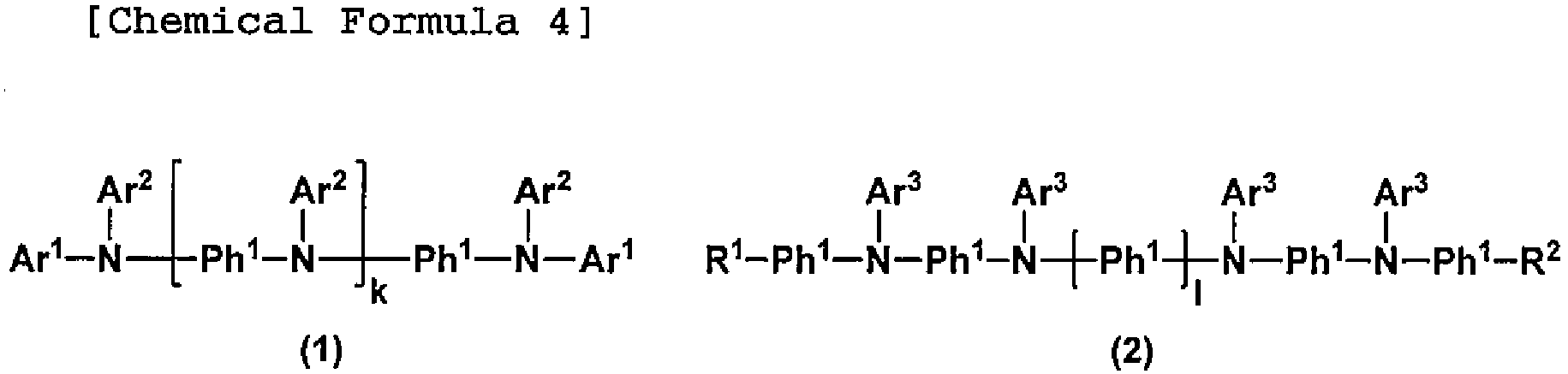
- In formula (2), R1 and R2 are each independently a hydrogen atom, a halogen atom, a nitro group, a cyano group, or an alkyl group of 1 to 20 carbon atoms, alkenyl group of 2 to 20 carbon atoms, alkynyl group of 2 to 20 carbon atoms, aryl group of 6 to 20 carbon atoms or heteroaryl group of 2 to 20 carbon which may be substituted with a halogen atom.
- Examples of the halogen atom include fluorine, chlorine, bromine and iodine atoms, with a fluorine atom being preferred.
- The alkyl group of 1 to 20 carbon atoms may be linear, branched or cyclic. Examples include linear or branched alkyl groups of 1 to 20 carbon atoms, such as methyl, ethyl, n-propyl, isopropyl, n-butyl, isobutyl, s-butyl, t-butyl, n-pentyl, n-hexyl, n-heptyl, n-octyl, n-nonyl and n-decyl; and cyclic alkyl groups of 3 to 20 carbon atoms, such as cyclopropyl, cyclobutyl, cyclopentyl, cyclohexyl, cycloheptyl, cyclooctyl, cyclononyl, cyclodecyl, bicyclobutyl, bicyclopentyl, bicyclohexyl, bicycloheptyl, bicyclooctyl, bicyclononyl and bicyclodecyl.
- Examples of alkenyl group of 2 to 20 carbon atoms include ethenyl, n-1-propenyl, n-2-propenyl, 1-methylethenyl, n-1-butenyl, n-2-butenyl, n-3-butenyl, 2-methyl-1-propenyl, 2-methyl-2-propenyl, 1-ethylethenyl, 1-methyl-1-propenyl, 1-methyl-2-propenyl, n-1-pentenyl, n-1-decenyl and n-1-eicosenyl.
- Examples of alkynyl groups of 2 to 20 carbons include ethynyl, n-1-propynyl, n-2-propynyl, n-1-butynyl, n-2-butynyl, n-3-butynyl, 1-methyl-2-propynyl, n-1-pentynyl, n-2-pentynyl, n-3-pentynyl, n-4-pentynyl, 1-methyl-n-butynyl, 2-methyl-n-butynyl, 3-methyl-n-butynyl, 1,1-dimethyl-n-propynyl, n-1-hexynyl, n-1-decynyl, n-1-pentadecynyl and n-1-eicosynyl.
- Examples of aryl groups of 6 to 20 carbon atoms include phenyl, 1-naphthyl, 2-naphthyl, 1-anthryl, 2-anthryl, 9-anthryl, 1-phenanthryl, 2-phenanthryl, 3-phenanthryl, 4-phenanthryl and 9-phenanthryl.
- Examples of heteroaryl groups of 2 to 20 carbon atoms include oxygen-containing heteroaryl groups such as 2-thienyl, 3-thienyl, 2-furanyl, 3-furanyl, 2-oxazolyl, 4-oxazolyl, 5-oxazolyl, 3-isooxazolyl, 4-isooxazolyl and 5-isooxazolyl; sulfur-containing heteroaryl groups such as 2-thiazolyl, 4-thiazolyl, 5-thiazolyl, 3-isothiazolyl, 4-isothiazolyl and 5-isothiazolyl; and nitrogen-containing heteroaryl groups such as 2-imidazolyl, 4-imidazolyl, 2-pyridyl, 3-pyridyl, 4-pyridyl, 2-pyrazyl, 3-pyrazyl, 5-pyrazyl, 6-pyrazyl, 2-pyrimidyl, 4-pyrimidyl, 5-pyrimidyl, 6-pyrimidyl, 3-pyridazyl, 4-pyridazyl, 5-pyridazyl, 6-pyridazyl, 1,2,3-triazin-4-yl, 1,2,3-triazin-5-yl, 1,2,4-triazin-3-yl, 1,2,4-triazin-5-yl, 1,2,4-triazin-6-yl, 1,3,5-triazin-2-yl, 1,2,4,5-tetrazin-3-yl, 1,2,3,4-tetrazin-5-yl, 2-quinolinyl, 3-quinolinyl, 4-quinolinyl, 5-quinolinyl, 6-quinolinyl, 7-quinolinyl, 8-quinolinyl, 1-isoquinoinyl, 3-isoquinolinyl, 4-isoquinolinyl, 5-isoquinolinyl, 6-isoquinolinyl, 7-isoquinolinyl, 8-isoquinolinyl, 2-quinoxanyl, 5-quinoxanyl, 6-quinoxanyl, 2-quinazolinyl, 4-quinazolinyl, 5-quinazolinyl, 6-quinazolinyl, 7-quinazolinyl, 8-quinazolinyl, 3-cinnolinyl, 4-cinnolinyl, 5-cinnolinyl, 6-cinnolinyl, 7-cinnolinyl and 8-cinnolinyl.
- Of these, R1 and R2 are each preferably a hydrogen atom, a fluorine atom, a cyano group, an alkyl group of 1 to 20 carbon atoms which may be substituted with a halogen atom, an aryl group of 6 to 20 carbon atoms which may be substituted with a halogen atom, or a heteroaryl group of 2 to 20 carbon atoms which may be substituted with a halogen atom; more preferably a hydrogen atom, a fluorine atom, a cyano group, an alkyl group of 1 to 10 carbon atoms which may be substituted with a halogen atom, or a phenyl group which may be substituted with a halogen atom; even more preferably a hydrogen atom, a fluorine atom, a methyl group or a trifluoromethyl group; and most preferably a hydrogen atom.
- In formulas (1) and (2), Ph1 represents a group of the formula (P1).

- In the formula, R3 to R6 are each independently a hydrogen atom, a halogen atom, a nitro group, a cyano group, or an alkyl group of 1 to 20 carbon atoms, alkenyl group of 2 to 20 carbon atoms, alkynyl group of 2 to 20 carbon atoms, aryl group of 6 to 20 carbon atoms or heteroaryl group of 2 to 20 carbon atoms which may be substituted with a halogen atom. These groups are exemplified in the same way as described above for R1 and R2.
- In particular, R3 to R6 are each preferably a hydrogen atom, a fluorine atom, a cyano group, an alkyl group of 1 to 20 carbon atoms which may be substituted with a halogen atom, an aryl group of 6 to 20 carbon atoms which may be substituted with a halogen atom, or a heteroaryl group of 2 to 20 carbon atoms which may be substituted with a halogen atom; more preferably a hydrogen atom, a fluorine atom, a cyano group, an alkyl group of 1 to 10 carbon atoms which may be substituted with a halogen atom, or a phenyl group which may be substituted with a halogen atom; even more preferably a hydrogen atom, a fluorine atom, a methyl group or a trifluoromethyl group; and most preferably a hydrogen atom.
- Groups which are suitable as Ph1 include, but are not limited to, the following.

- In formula (1), each Ar1 is independently a group represented by any of formulas (B1) to (B11), with a group represented by any of formulas (B1') to (B11") being especially preferred.


- In these formulas, R7 to R27, R30 to R51 and R53 to R154 are each independently a hydrogen atom, a halogen atom, a nitro group, a cyano group, or a diphenylamino group, alkyl group of 1 to 20 carbon atoms, alkenyl group of 2 to 20 carbon atoms, alkynyl group of 2 to 20 carbon atoms, aryl group of 6 to 20 carbon atoms or heteroaryl group of 2 to 20 carbon atoms which may be substituted with a halogen atom; R28 and R29 are each independently an aryl group of 6 to 20 carbon atoms or a heteroaryl group of 2 to 20 carbon atoms which may be substituted with Z1; R52 is a hydrogen atom, an alkyl group of 1 to 20 carbon atoms, alkenyl group of 2 to 20 carbon atoms or alkynyl group of 2 to 20 carbon atoms which may be substituted with Z4, or an aryl group of 6 to 20 carbons or heteroaryl group of 2 to 20 carbon atoms which may be substituted with Z1; Z1 is a halogen atom, a nitro group, a cyano group, or an alkyl group of 1 to 20 carbon atoms, alkenyl group of 2 to 20 carbon atoms or alkynyl group of 2 to 20 carbon atoms which may be substituted with Z2; Z2 is a halogen atom, a nitro group, a cyano group, or an aryl group of 6 to 20 carbon atoms or heteroaryl group of 2 to 20 carbon atoms which may be substituted with Z3; Z3 is a halogen atom, a nitro group or a cyano group; Z4 is a halogen atom, a nitro group, a cyano group, or an aryl group of 6 to 20 carbon atoms or heteroaryl group of 2 to 20 carbon atoms which may be substituted with Z5; and Z5 is a halogen atom, a nitro group, a cyano group, or an alkyl group of 1 to 20 carbon atoms, alkenyl group of 2 to 20 carbon atoms or alkynyl group of 2 to 20 carbon atoms which may be substituted with Z3. These halogen atoms, alkyl groups of 1 to 20 carbon atoms, alkenyl groups of 2 to 20 carbon atoms, alkynyl groups of 2 to 20 carbon atoms, aryl groups of 6 to 20 carbon atoms and heteroaryl groups of 2 to 20 carbon atoms are exemplified in the same way as described above for R1 and R2.
- In particular, R7 to R27, R30 to R51 and R53 to R154 are each preferably a hydrogen atom, a fluorine atom, a cyano group, a diphenylamino group which may be substituted with a halogen atom, an alkyl group of 1 to 20 carbon atoms which may be substituted with a halogen atom, an aryl group of 6 to 20 carbon atoms which may be substituted with a halogen atom, or a heteroaryl group of 2 to 20 carbon atoms which may be substituted with a halogen atom; more preferably a hydrogen atom, a fluorine atom, a cyano group, an alkyl group of 1 to 10 carbon atoms which may be substituted with a halogen atom, or a phenyl group which may be substituted with a halogen atom; even more preferably a hydrogen atom, a fluorine atom, a methyl group or a trifluoromethyl group; and most preferably a hydrogen atom.
- R28 and R29 are each preferably an aryl group of 6 to 14 carbon atoms which may be substituted with Z1 or a heteroaryl group of 2 to 14 carbon atoms which may be substituted with Z1; more preferably an aryl group of 6 to 14 carbon atoms which may be substituted with Z1; and even more preferably a phenyl group which may be substituted with Z1, a 1-naphthyl group which may be substituted with Z1 or a 2-naphthyl group which may be substituted with Z1.
- R52 is preferably a hydrogen atom, an aryl group of 6 to 20 carbon atoms which may be substituted with Z1, a heteroaryl group of 2 to 20 carbon atoms which may be substituted with Z1 or an alkyl group of 1 to 20 carbon atoms which may be substituted with Z4; more preferably a hydrogen atom, an aryl group of 6 to 14 carbon atoms which may be substituted with Z1, a heteroaryl group of 2 to 14 carbon atoms which may be substituted with Z1, or an alkyl group of 1 to 10 carbon atoms which may be substituted with Z4; even more preferably a hydrogen atom, an aryl group of 6 to 14 carbon atoms which may be substituted with Z1, a nitrogen-containing heteroaryl group of 2 to 14 carbons which may be substituted with Z1, or an alkyl group of 1 to 10 carbon atoms which may be substituted with Z4; and most preferably a hydrogen atom, a phenyl group which may be substituted with Z1, a 1-naphthyl group which may be substituted with Z1, a 2-naphthyl group which may be substituted with Z1, a 2-pyridyl group which may be substituted with Z1, a 3-pyridyl group which may be substituted with Z1, a 4-pyridyl group which may be substituted with Z1, or a methyl group which may be substituted with Z4.
- Each Ar4 independently represents an aryl group of 6 to 20 carbon atoms which may be substituted with a diarylamino group wherein each aryl group is an aryl group of 6 to 20 carbon atoms. Specific examples of aryl groups of 6 to 20 carbon atoms include the same as those mentioned for R1 and R2. Specific examples of the diarylamino groups include diphenylamino, 1-naphthylphenylamino, di(1-naphthyl)amino, 1-naphthyl-2-naphthylamino and di(2-naphthyl)amino groups.
- Ar4 is preferably a phenyl, 1-naphthyl, 2-naphthyl, 1-anthryl, 2-anthryl, 9-anthryl, 1-phenanthryl, 2-phenanthryl, 3-phenanthryl, 4-phenanthryl, 9-phenanthryl, p-(diphenylamino)phenyl, p-(1-naphthylphenylamino)phenyl, p-(di(1-naphthyl)amino)phenyl, p-(1-naphthyl-2-naphthylamino)phenyl or p-(di(2-naphthyl)amino)phenyl group; and more preferably a p-(diphenylamino)phenyl group.
- Suitable examples of Ar1 include, but are not limited to, those shown below. In the formulas below, DPA stands for a diphenylamino group and R52 is as defined above.

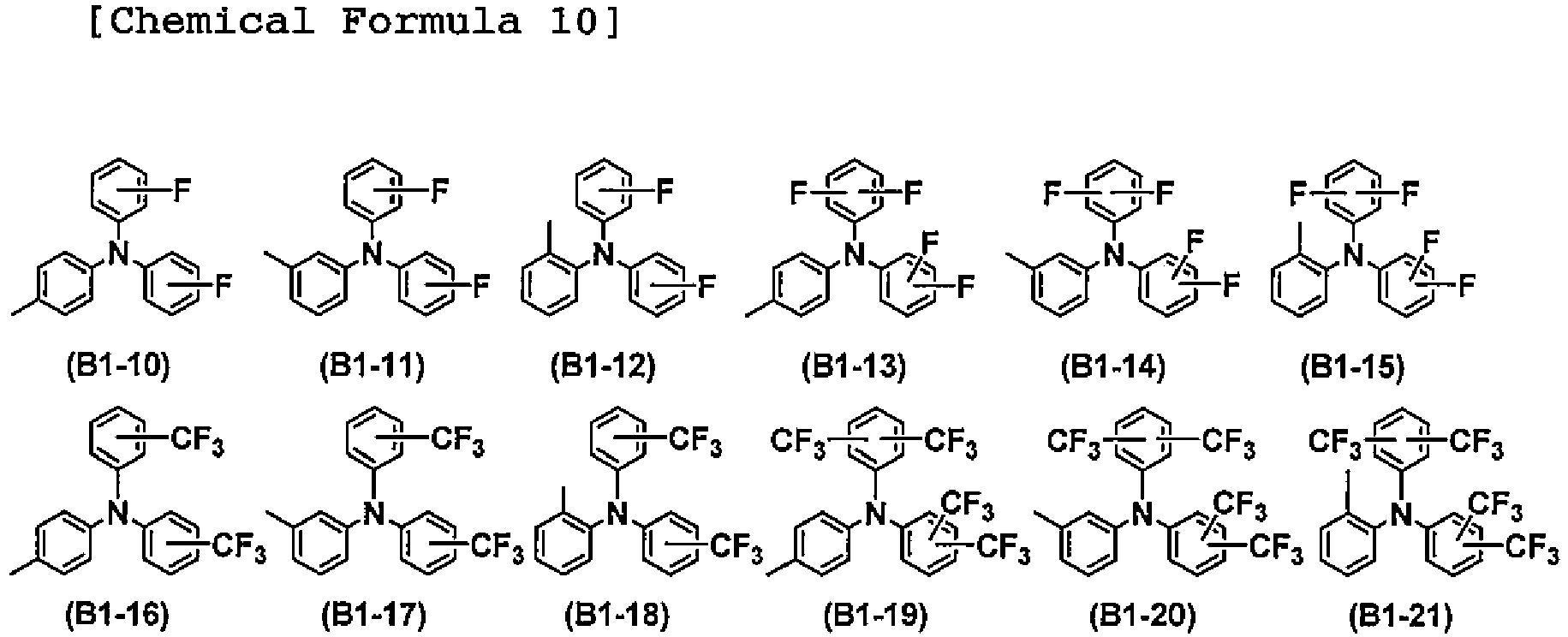


- In formula (1), each Ar2 is independently a group of any one of formulas (A1) to (A18).

- In these formulas, R155 is a hydrogen atom, an alkyl group of 1 to 20 carbon atoms, alkenyl group of 2 to 20 carbon atoms or alkynyl group of 2 to 20 carbon atoms which may be substituted with Z4, or an aryl group of 6 to 20 carbons or heteroaryl group of 2 to 20 carbon atoms which may be substituted with Z1; R156 and R157 are each independently an aryl group of 6 to 20 carbon atoms or heteroaryl group of 2 to 20 carbon atoms which may be substituted with Z1; and DPA, Ar4, Z1 and Z4 are as defined above. These halogen atoms, alkyl groups of 1 to 20 carbon atoms, alkenyl groups of 2 to 20 carbon atoms, alkynyl group of 2 to 20 carbon atoms, aryl groups of 6 to 20 carbon atoms and heteroaryl groups of 2 to 20 carbon atoms are exemplified in the same way as described above for R1 and R2.
- In particular, R155 is preferably a hydrogen atom, an aryl group of 6 to 20 carbon atoms which may be substituted with Z1, a heteroaryl group of 2 to 20 carbon atoms which may be substituted with Z1, or an alkyl group of 1 to 20 carbon atoms which may be substituted with Z4; more preferably a hydrogen atom, an aryl group of 6 to 14 carbon atoms which may be substituted with Z1, a heteroaryl group of 2 to 14 carbon atoms which may be substituted with Z1, or an alkyl group of 1 to 10 carbon atoms which may be substituted with Z4; even more preferably a hydrogen atom, an aryl group of 6 to 14 carbon atoms which may be substituted with Z1, a nitrogen-containing heteroaryl group of 2 to 14 carbon atoms which may be substituted with Z1, or an alkyl group of 1 to 10 carbon atoms which may be substituted with Z4; and still more preferably a hydrogen atom, a phenyl group which may be substituted with Z1, a 1-naphthyl group which may be substituted with Z1, a 2-napthyl group which may be substituted with Z1, a 2-pyridyl group which may be substituted with Z1, a 3-pyridyl group which may be substituted with Z1, a 4-pyridyl group which may be substituted with Z1, or a methyl group which may be substituted with Z4.
- R156 and R157 are each preferably an aryl group of 6 to 14 carbon atoms which may be substituted with Z1 or a heteroaryl group of 2 to 14 carbon atoms which may be substituted with Z1; more preferably an aryl group of 6 to 14 carbon atoms which may be substituted with Z1; and even more preferably a phenyl group which may be substituted with Z1, a 1-naphthyl group which may be substituted with Z1 or a 2-naphthyl group which may be substituted with Z1.
- Specific examples of groups which are suitable as Ar2 include, but are not limited to, those shown below. In the following formulas, R155 and DPA are as defined above.


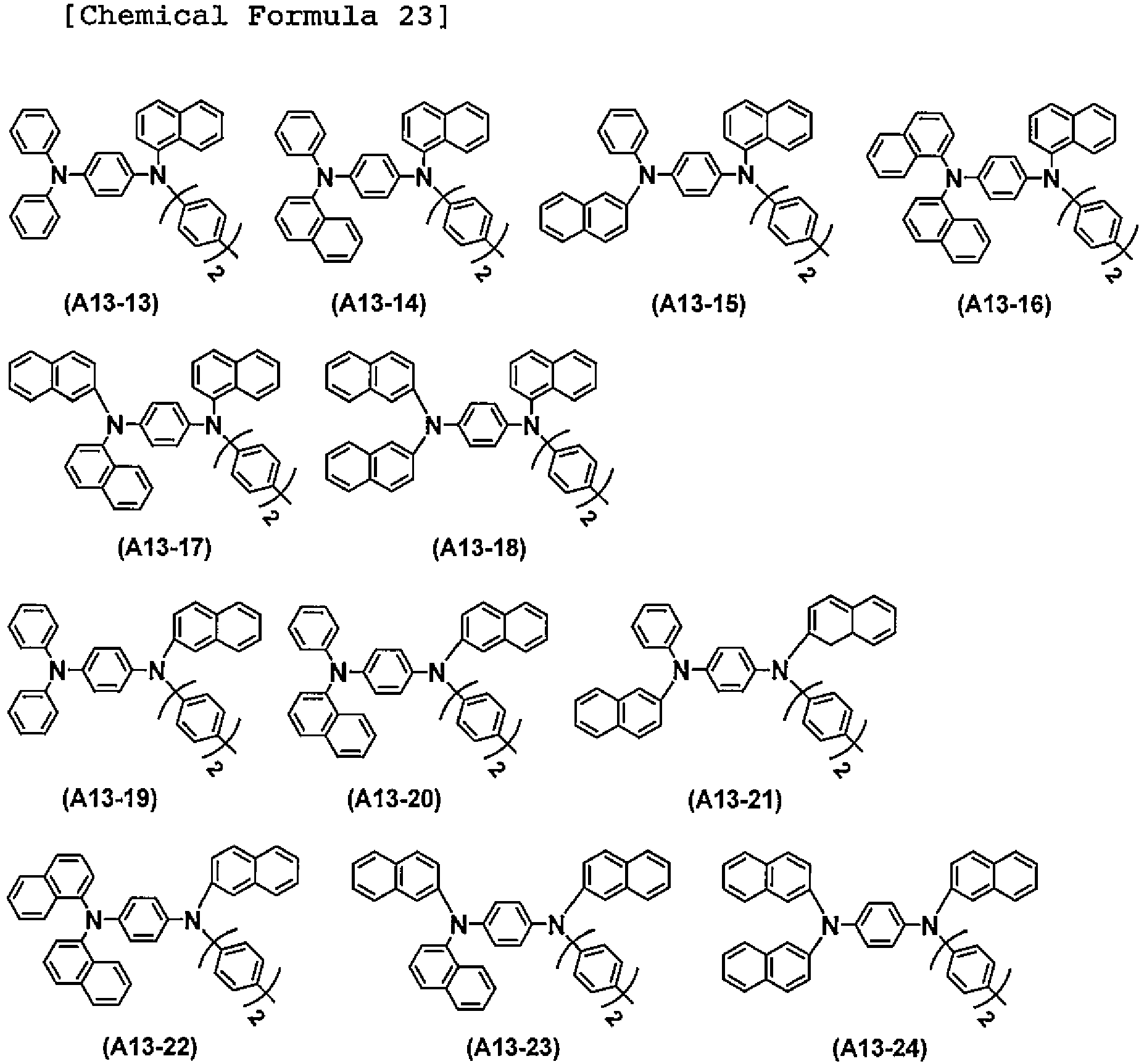


- In formula (1), taking into account the ease of synthesizing the resulting aniline derivative, it is preferable for all the Ar1 groups to be the same group and for all the Ar2 groups to be the same group, and more preferable for all the Ar1 and Ar2 groups to be the same group. That is, the aniline derivative of formula (1) is more preferably an aniline derivative of formula (1-1) below.

- In formula (1-1), Ph1 and k are as defined above and Ar5 is at the same time a group of any of formulas (D1) to (D13) below, with a group of any of formulas (D1') to (D13') being preferred. In the following formulas, R28 , R29, R52 , Ar4 and DPA are as defined above. Ar5 is exemplified by the same groups as mentioned above as suitable examples of Ar1.


- The aniline derivative of formula (1) is preferably an aniline derivative of formula (1-2), both because, as subsequently described, it can be synthesized with relative ease using the relatively inexpensive bis(4-aminophenyl)amine as the starting compound, and because the resulting aniline derivative has an excellent solubility in organic solvents.

- In the formula, Ar6 at the same time represents a group of any one of formulas (E1) to (E14). Also, in the following formulas, R52 is as defined above.

- In formula (2), Ar3 is a group of any of formulas (C1) to (C8), with a group of any of formulas (C1') to (C8') being especially preferred. In the following formulas, DPA is as defined above.


- In formula (1), k is an integer from 1 to 10. However, from the standpoint of increasing the solubility of the compound in the organic solvent, k is preferably from 1 to 5, more preferably from 1 to 3, even more preferably 1 or 2, and most preferably 1. In formula (2), the letter "l" represents 1 or 2.
- In R28, R29, R52 and R155 to R157, Z1 is preferably a halogen atom, a nitro group, a cyano group, an alkyl group of 1 to 10 carbon atoms which may be substituted with Z2, an alkenyl group of 2 to 10 carbon atoms which may be substituted with Z2 or an alkynyl group of 2 to 10 carbon atoms which may be substituted with Z2; more preferably a halogen atom, a nitro group, a cyano group, an alkyl group of 1 to 3 carbon atoms which may be substituted with Z2 , an alkenyl group of 2 or 3 carbon atoms which may be substituted with Z2, or an alkynyl group of 2 or 3 carbon atoms which may be substituted with Z2; and even more preferably a fluorine atom, an alkyl group of 1 to 3 carbon atoms which may be substituted with Z2, an alkenyl group of 2 or 3 carbon atoms which may be substituted with Z2, or an alkynyl group of 2 or 3 carbon atoms which may be substituted with Z2.
- In R28 , R29, R52 and R155 to R157, Z4 is preferably a halogen atom, a nitro group, a cyano group or an aryl group of 6 to 14 carbon atoms which may be substituted with Z5; more preferably a halogen atom, a nitro group, a cyano group, or an aryl group of 6 to 10 carbon atoms which may be substituted with Z5; even more preferably a fluorine atom or an aryl group of 6 to 10 carbon atoms which may be substituted with Z5; and yet more preferably a fluorine atom or a phenyl group which may be substituted with Z5.
- In R28, R29, R52 and R155 to R 157, Z2 is preferably a halogen atom, a nitro group, a cyano group, or an aryl group of 6 to 14 carbon atoms which may be substituted with Z3; more preferably a halogen atom, a nitro group, a cyano group, or an aryl group of 6 to 10 carbon atoms which may be substituted with Z3; even more preferably a fluorine atom or an aryl group of 6 to 10 carbon atoms which may be substituted with Z3; and still more preferably a fluorine atom or a phenyl group which may be substituted with Z3.
- In R28, R29, R52 and R155 to R157, Z5 is preferably a halogen atom, a nitro group, a cyano group, an alkyl group of 1 to 10 carbon atoms which may be substituted with Z3, an alkenyl group of 2 to 10 carbon atoms which may be substituted with Z3, or an alkynyl group of 2 to 10 carbon atoms which may be substituted with Z3; more preferably a halogen atom, a nitro group, a cyano group, an alkyl group of 1 to 3 carbon atoms which may be substituted with Z3 , an alkenyl group of 2 or 3 carbon atoms which may be substituted with Z3, or an alkynyl group of 2 or 3 carbon atoms which may be substituted with Z3 ; and even more preferably a fluorine atom, an alkyl group of 1 to 3 carbon atoms which may be substituted with Z3, an alkenyl group of 2 or 3 carbon atoms which may be substituted with Z3, or an alkynyl group of 2 or 3 carbon atoms which may be substituted with Z3.
- In R28, R29, R52 and R155 to R157, Z3 is preferably a halogen atom, and more preferably a fluorine atom.
- In R7 to R27, R30 to R51 and R53 to R154, Z1 is preferably a halogen atom, a nitro group, a cyano group, an alkyl group of 1 to 3 carbon atoms which may be substituted with Z2, an alkenyl group of 2 or 3 carbon atoms which may be substituted with Z2, or an alkynyl group of 2 or 3 carbon atoms which may be substituted with Z2; more preferably a halogen atom or an alkyl group of 1 to 3 carbon atoms which may be substituted with Z2 ; and even more preferably a fluorine atom or a methyl group which may be substituted with Z2.
- In R7 to R27, R30 to R51 and R53 to R154, Z4 is preferably a halogen atom, a nitro group, a cyano group, or an aryl group of 6 to 10 carbon atoms which may be substituted with Z5; more preferably a halogen atom or an aryl group of 6 to 10 carbon atoms which may be substituted with Z5; and even more preferably a fluorine atom or a phenyl group which may be substituted with Z5.
- In R7 to R27, R30 to R51 and R53 to R154, Z2 is preferably a halogen atom, a nitro group, a cyano group, or an aryl group of 6 to 10 carbon atoms which may be substituted with Z3; more preferably a halogen atom or an aryl group of 6 to 10 carbon atoms which may be substituted with Z3; and even more preferably a fluorine atom or a phenyl group which may be substituted with Z3.
- In R7 to R27, R30 to R51 and R53 to R154, Z5 is preferably a halogen atom, a nitro group, a cyano group, an alkyl group of 1 to 3 carbon atoms which may be substituted with Z3, an alkenyl group of 2 or 3 carbon atoms which may be substituted with Z3, or an alkynyl group of 2 or 3 carbon atoms which may be substituted with Z3; more preferably a halogen atom or an alkyl group of 1 to 3 carbon atoms which may be substituted with Z3 ; and even more preferably a fluorine atom or a methyl group which may be substituted with Z3.
- In R7 to R27, R30 to R51 and R53 to R154, Z3 is preferably a halogen atom, and more preferably a fluorine atom.
- In this invention, specific examples of groups that are suitable as R52 and R155 include, but are not limited to, those shown below.
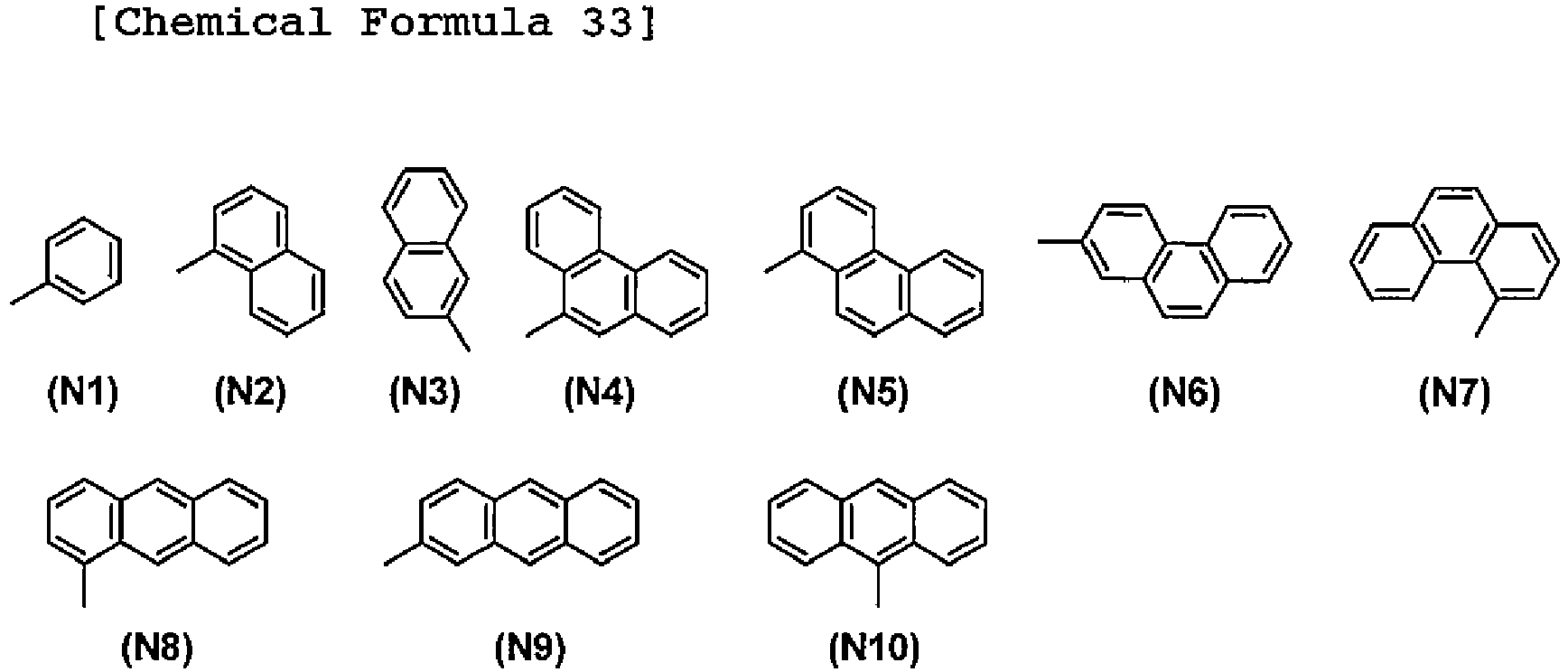


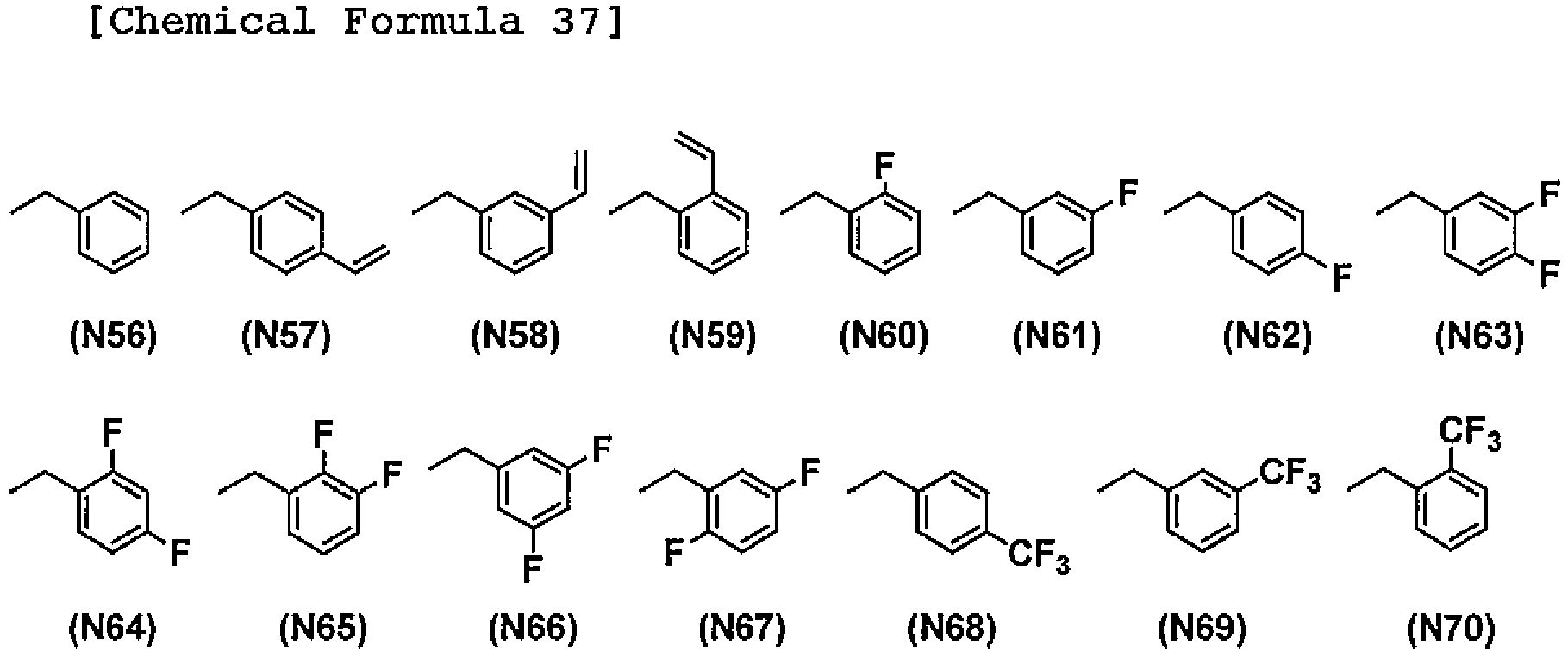

- In this invention, the number of carbon atoms on the above alkyl, alkenyl and alkynyl groups is preferably not more than 10, more preferably not more than 6, and even more preferably not more than 4. The number of carbon atoms on the above aryl groups and heteroaryl groups is preferably not more than 14, more preferably not more than 10, and even more preferably not more than 6.
- Aniline derivatives of formula (1) can be prepared by reacting an amine compound of formula (3) with an aryl compound of formula (4) in the presence of a catalyst.

- In particular, aniline derivatives of formula (1-1) can be prepared by reacting an amine compound of formula (7) with an aryl compound of formula (8) in the presence of a catalyst.

- Aniline derivatives of formula (1-2) can be prepared by reacting bis(4-aminophenyl)amine with an aryl compound of formula (9) in the presence of a catalyst.

- Aniline derivatives of formula (2) can be prepared by reacting an amine compound of formula (5) with an aryl compound of formula (6) in the presence of a catalyst.

- Examples of the halogen atom include the same as those mentioned above. Examples of pseudo-halogen groups include (fluoro)alkylsulfonyloxy groups such as methanesulfonyloxy, trifluoromethanesulfonyloxy and nonafluorobutanesulfonyloxy groups; and aromatic sulfonyloxy groups such as benzenesulfonyloxy and toluenesulfonyloxy groups.
- The charging ratio of the amine compound of formula (3), (5) or (7) or bis(4-aminophenyl)amine to the aryl compound of formula (4), (6), (8) or (9) may be set so as to make the amount of the aryl compound at least 1 equivalent, and preferably about 1 to 1.2 equivalents, with respect to the molar amount of all NH groups on the amine compound or bis(4-aminophenyl)amine.
- The catalyst used in the reaction is exemplified by copper catalysts such as copper chloride, copper bromide and copper iodide; and palladium catalysts such as tetrakis(triphenylphosphine)palladium (Pd(PPh3)4), bis(triphenylphosphine)dichloropalladium (Pd(PPh3)2Cl2), bis(dibenzylideneacetone)palladium (Pd(dba)2), tris(dibenzylideneacetone)palladium (Pd2(dba)3), bis(tri(t-butylphosphine)palladium (Pd(P-t-Bu3)2), and palladium acetate (Pd(OAc)2). These catalysts may be used singly, or two or more may be used in combination. Also, these catalysts may be used together with suitable known ligands.
- Illustrative examples of such ligands include tertiary phosphines such as triphenylphosphine, tri-o-tolylphosphine, diphenylmethylphosphine, phenyldimethylphosphine, trimethylphosphine, triethylphosphine, tributylphosphine, tri-t-butylphosphine, di-t-butyl(phenyl)phosphine, di-t-butyl(4-dimethylaminophenyl)phosphine, 1,2-bis(diphenylphosphino)ethane, 1,3-bis(diphenylphosphino)propane, 1,4-bis(diphenylphosphino)butane and 1,1'-bis(diphenylphosphino)ferrocene; and tertiary phosphites such as trimethylphosphite, triethylphosphite and triphenylphosphite.
- The amount of catalyst used may be set to about 0.2 mole per mole of the aryl compound of formula (4), (6), (8) or (9), with about 0.15 mole being preferred. When ligands are used, the amount thereof may be set to from 0.1 to 5 equivalents, and preferably from 1 to 2 equivalents, with respect to the metal catalyst used.
- When the starting compounds are all solids, or from the standpoint of efficiently obtaining the target aniline derivative, each of the above reactions is carried out in a solvent. When a solvent is used, the type of solvent is not particularly limited, provided it does not have an adverse effect on the reaction. Illustrative examples include aliphatic hydrocarbons (pentane, n-hexane, n-octane, n-decane, decalin, etc.), halogenated aliphatic hydrocarbons (chloroform, dichloromethane, dichloroethane, carbon tetrachloride, etc.), aromatic hydrocarbons (benzene, nitrobenzene, toluene, o-xylene, m-xylene, p-xylene, mesitylene, etc.), halogenated aromatic hydrocarbons (chlorobenzene, bromobenzene, o-dichlorobenzene, m-dichlorobenzene, p-dichlorobenzene, etc.), ethers (diethyl ether, diisopropyl ether, t-butyl methyl ether, tetrahydrofuran, dioxane, 1,2-dimethoxyethane, 1,2-diethoxyethane, etc.), ketones (acetone, methyl ethyl ketone, methyl isobutyl ketone, di-n-butyl ketone, cyclohexanone, etc.), amides (N,N-dimethylformamide, N,N-dimethylacetamide, etc.), lactams and lactones (N-methylpyrrolidone, γ-butyrolactone, etc.), ureas (N,N-dimethylimidazolidinone, tetramethylurea, etc.), sulfoxides (dimethylsulfoxide, sulfolane, etc.), and nitriles (acetonitrile, propionitrile, butyronitrile, etc.). These solvents may be used singly, or two or more may be used in admixture.
- The reaction temperature may be suitably set in the range of the melting point to the boiling point of the solvent used, with a temperature of about 0°C to 200°C being preferred, and a temperature of 20 to 150°C being more preferred.
- Following reaction completion, the target aniline derivative can be obtained by work-up in the usual manner.
- In the method of preparing an aniline derivative of formula (1) above, the amine compound of formula (3') that may be used as a starting material can be efficiently prepared by reacting an amine compound of formula (10) with an aryl compound of formula (11) in the presence of a catalyst.

- The above method for preparing an amine compound of formula (3') involves carrying out a coupling reaction between an amine compound of formula (10) and an aryl compound of formula (11). The amine compound of formula (10) and the aryl compound of formula (11) are charged in a molar ratio of preferably about 2 to 2.4 moles of the aryl compound per mole of the amine compound.
- Various conditions relating to, for example, the catalyst, ligand, solvent and reaction temperature in the above coupling reaction are the same as the conditions described above for the method of preparing the aniline derivative of formula (1).
- When preparing the aniline derivative of the invention wherein, in formula (1), Ar1 is a group of the formula (B4) in which R52 represents a hydrogen atom or a group of formula (B10), or Ar2 is a group of formula (A12) or a group of formula (A16) in which R155 (including R52 in formula (1-1)) represents a hydrogen atom, an aryl compound having a protective group on the amino group may be used in the above reaction.
- Specifically, in the above reaction, in place of an aryl compound of formula (4) wherein Ar2 is a group of formula (A12) (formula (G1)), an aryl compound of formula (4) wherein Ar2 is a group of formula (A16) and R155 is a hydrogen atom (formula (G2)), an aryl compound of formula (8) wherein Ar5 is a group of formula (D9) (formula (G1)), an aryl compound of formula (8) wherein Ar5 is a group of formula (D11) and R52 is a hydrogen atom (formula G2)), an aryl compound of formula (9) wherein Ar6 is a group of formula (E13) and R52 is a hydrogen atom (formula (G3)), an aryl compound of formula (9) wherein Ar6 is a group of formula (E14) and R52 is a hydrogen atom (formula (G4)), an aryl compound of formula (11) wherein Ar1 is a group of formula (B4) and R52 is a hydrogen atom (formula (G5)) or an aryl compound of formula 11 wherein Ar1 is a group of formula (B10) (formula (G6)), use is made instead of aryl compounds wherein the amino group on these respective aryl compounds has been protected (formulas (G1P) to (G6P)). The protected aryl compounds and the above-indicated amine compounds are reacted in the presence of a catalyst, and are subsequently de-protected under suitable timing.

- P1 to P6 are each independently amino-protecting groups. Conventional protective groups may be used as such protective groups. Specific examples include, but are not limited to, oxycarbonyl-type protective groups, such as substituted or unsubstituted alkoxycarbonyl groups (e.g., methoxycarbonyl, ethoxycarbonyl, t-butoxycarbonyl, 2,2,2-trichloroethoxycarbonyl, allyloxycarbonyl and 9-fluorenylmethyloxycarbonyl), substituted or unsubstituted aralkyloxycarbonyl groups (e.g., benzyloxycarbonyl), and substituted or unsubstituted aryloxycarbonyl groups (e.g., phenoxycarbonyl); formyl groups; carbonyl-type protective groups, such as substituted or unsubstituted alkanoyl groups (e.g., acetyl, trifluoroacetyl, t-butanoyl), and substituted or unsubstituted arylcarbonyl groups (e.g., benzoyl); alkyl-type protective groups, such as substituted or unsubstituted alkyl groups (e.g., t-butyl), substituted or unsubstituted aralkyl groups (e.g., benzyl, benzhydryl, trityl); and substituted or unsubstituted sulfonyl-type protective groups (e.g., benzenesulfonyl, p-toluenesulfonyl, 2-nitrobenzenesulfonyl). Of these, oxycarbonyl-type protective groups, carbonyl-type protective groups and alkyl-type protective groups are preferred.
- Ar51 to Ar56 and Ar61 to Ar66 are each monovalent groups represented by removing X (a halogen atom or a pseudo-halogen group) from the respective aryl compounds. For example, Ar61 to Ar66 respectively indicate the following groups.

- Illustrative examples of preparation methods that use aryl compounds having the above amino-protecting groups include, but are not limited to, those shown below.


- Conditions relating to the starting material charging ratios, catalysts, ligands, solvents, reaction temperatures and the like in preparation methods that use such aryl compounds having protective groups are the same as the conditions described above for aniline derivatives of formula (1) or amine compounds of formula (3'). Also, deprotection may be carried out by a suitable known method, such as treatment under acidic or basic conditions or treatment under oxidizing or reducing conditions, while referring to, for example, "Green's Protective Groups" in Organic Synthesis, 4th Edition and taking into consideration the nature, etc. of the protective groups.
- In formula (1), when preparing a tertiary amine site-containing aniline derivative of the invention wherein Ar1 is a group of formula (B4) in which R52 is not a hydrogen atom or a group of formula (B11), or wherein Ar2 is a group of formula (A13) or a group of formula (A16) in which R155 (including R52 in formula (1-1)) is not a hydrogen atom, use may be made of a secondary amine site-containing aniline derivative of the invention represented by formula (1) wherein Ar1 is a group of the formula (B4) in which R52 is a hydrogen atom or a group of formula (B10), or wherein Ar2 is a group of formula (A12) or a group of formula (A16) in which R155 (including R52 in formula (1-1)) is a hydrogen atom, or of a secondary amine site-containing amine compound of formula (3) wherein Ar1 is a group of formula (B4) in which R52 is a hydrogen atom or is a group of formula (B10).
- Specifically, as shown below, the amine site on this secondary amine site-containing aniline derivative or amine compound is reacted with an aryl compound of formula (10) or a hydrocarbon compound of formula (11) or (12).


- In the formulas, X, R139 to R146, Ar4 and R45 to R51 are as defined above. Cb155 and Cb52 are each independently an alkyl group of 1 to 20 carbon atoms, alkenyl group of 2 to 20 carbon atoms or alkynyl group of 2 to 20 carbon atoms which may be substituted with Z4, or an aryl group of 6 to 20 carbon atoms or heteroaryl group of 2 to 20 carbon atoms which may be substituted with Z1, these alkyl, alkenyl, alkynyl, aryl and heteroaryl groups being the same as above. Z1 and Z4 are as defined above.
- More specific examples of preparation methods using these secondary amine site-containing aniline derivatives or amine compounds include, but are not limited to, the following.


- The charging ratio of the aniline derivatives of formula (1-3) to (1-8) to the aryl compound of formula (10) or the hydrocarbon compounds of formulas (11) and (12) may be set such as to make the amount of the aryl compound or hydrocarbon compound at least 1 equivalent, and preferably about 1 to 1.2 equivalents, with respect to the molar amount of all the NH groups on the aniline derivative.
- The charging ratio of the amine compounds of formulas (3'-1) and (3'-2) to the aryl compound of formula (10) or the hydrocarbon compound of formula (12), expressed as a molar ratio, is preferably about 2 to 2.4 moles of the aryl compound of formula (10) or the hydrocarbon compound of formula (12) per mole of the amine compounds of formulas (3'-1) and (3'-2).
- Conditions other than the charging conditions are as follows.
- The conditions relating to catalysts, ligands, solvents, reaction temperatures and the like that are employed when preparing aniline derivatives of formulas (1-9) to (1-14) or amine compounds of formulas (3'-3) to (3'-4) using the copper, palladium or other above-mentioned catalysts may be the conditions described above for the method of preparing aniline derivatives of formula (1).
- When an aniline derivative of formulas (1-9) to (1-14) or an amine compound of formulas (3'-3) to (3'-4) is prepared by a substitution reaction using an aryl compound of formula (1), a hydrocarbon compound of formula (11) wherein Cb155 is an alkyl group of 1 to 20 carbon atoms which may be substituted with Z4 or an aryl group of 6 to 20 carbon atoms or heteroaryl group of 2 to 20 carbon atoms which may be substituted with Z1, or a hydrocarbon compound of formula (12) wherein Cb52 is an alkyl group of 1 to 20 carbon atoms which may be substituted with Z4 or an aryl group of 6 to 20 carbon atoms or heteroaryl group of 2 to 20 carbon atoms which may be substituted with Z1, the aniline derivative of formulas (1-3) to (1-8) or the amine compound of formulas (3'-1) to (3'-2) is reacted with a base in a solvent, and the resulting product is reacted with a hydrocarbon compound of formulas (11) to (12) or an aryl compound of formula (10).
- Examples of the base include, without particular limitation so long as use in this type of reaction is possible: uncombined alkali metals, alkali metal hydroxides, alkoxy alkali metals, alkali metal carbonates and alkali metal bicarbonates, such as lithium, sodium, potassium, lithium hydride, sodium hydride, potassium hydroxide, t-butoxylithium, t-butoxysodium, t-butoxypotassium, lithium hydroxide, sodium hydroxide, potassium hydroxide, sodium carbonate, potassium carbonate, sodium bicarbonate and potassium bicarbonate; alkaline earth metal carbonates such as calcium carbonate; organolithium compounds such as n-butyllithium, s-butyllithium and t-butyllithium; and amines such as triethylamine, diisopropylethylamine, tetramethylethylenediamine, triethylenediamine and pyridine. Sodium hydride, sodium carbonate and potassium carbonate are especially preferred in terms of ease of handling.
- The amount of base used is about 1 to 1.2 equivalents with respect to the molar amount of all the NH groups on the aniline derivative of formulas (1-3) to (1-8), and is about 2 to 2.4 equivalents per mole of amine compound of formulas (3'-1) to (3'-2).
- Specific examples of the solvent include the solvents mentioned with respect to the method for preparing aniline derivatives of formula (1). The reaction temperature should be suitably set within the range of the melting point to the boiling point of the solvent used, and is about 20°C to 150°C.
- Following reaction completion, work-up such as separatory treatment, column chromatography, re-precipitation and re-crystallization is carried out in the usual manner.
- Although impossible to strictly specify owing to effects incurred by, for example, the structure of the starting materials and the type of solvent used, a substitution reaction is preferred when X is a fluorine atom, and a reaction using a catalyst is preferred in cases other than when X is a fluorine atom.
- Amine compounds of formula (3) in which the two Ar1 moieties are both groups of formula (B1) and which may be used as starting materials in the above-described method for preparing aniline derivatives of formula (1) can be synthesized in accordance with the methods described in
WO 2008/129947 orWO 2013/08466 - The charge-transporting material of the invention includes a charge-transporting substance consisting of an aniline derivative of formula (1) or (2). From the standpoint of reproducibly obtaining large-surface area thin-films, the charge-transporting material is preferably in the form of a varnish.
- Specific examples of aniline derivatives of formula (1) or (2) include, but are not limited to, those shown below. In the formulas below, "Me" stands for a methyl group, "Et" for an ethyl group, "Prn" for an n-propyl group, "Pri" for an i-propyl group, "Bun" for an n-butyl group, "Bui" for an i-butyl group, "Bus" for an s-butyl group, "But" for a t-butyl group, "DPA" for a diphenylamino group, and "SBF" for a 9,9'-spirobi[9H-fluoren]-2-yl group.
[Table 1] 
Compound Ar2 Compound Ar2 Compound Ar2 Compound Ar2 (J1-1) (A1-1) (J1-27) (A6-11) (J1-53) (A12-7) (J1-79) (A13-22) (J1-2) (A1-2) (J1-28) (A6-12) (J 1-54) (A12-8) (J1-80) (A13-23) (J1-3) (A2-1) (J1-29) (A6-13) (J1-55) (A12-9) (J1-81) (A13-24) (J1-4) (A2-2) (J1-30) (A6-14) (J 1-56) (A12-10) (J1-82) (A14-1) (J1-5) (A2-3) (J1-31) (A6-15) (J 1-57) (A12-11) (J1-83) (A14-2) (J1-6) (A2-4) (J1-32) (A 7-1) (J1-58) (A13-1) (J1-84) (A14-3) (J1-7) (A2-5) (J1-33) (A 7-2) (J1-59) (A13-2) (J1-85) (A14-4) (J1-8) (A3-1) (J1-34) (A7-3) (J1-60) (A13-3) (J1-86) (A15-1) (J1-9) (A3-2) (J1-35) (A8-1) (J1-61) (A13-4) (J1-87) (A15-2) (J1-10) (A3-3) (J1-36) (A8-2) (J1-62) (A13-5) (J1-88) (A15-3) (J1-11) (A4-1) (J1-37) (A8-3) (J1-63) (A13-6) (J1-89) (A15-4) (J1-12) (A4-2) (J1-38) (A9-1) (J 1-64) (A13-7) (J1-90) (A17-1) (J1-13) (A4-3) (J1-39) (A9-2) (J1-65) (A13-8) (J1-91) (A17-2) (J1-14) (A5-1) (J1-40) (A9-3) (J1-66) (A13-9) (J1-92) (A 17-3) (J1-15) (A5-2) (J1-41) (A10-1) (J1-67) (A13-10) (J1-93) (A17-4) (J1-16) (A5-3) (J1-42) (A10-2) (J1-68) (A13-11) (J1-94) (A17-5) (J1-17) (A6-1) (J1-43) (A10-3) (J1-69) (A13-12) (J1-95) (A17-6) (J1-18) (A6-2) (J1-44) (A11-1) (J1-70) (A13-13) (J1-96) (A17-7) (J1-19) (A6-3) (J1-45) (A11-2) (J1-71) (A13-14) (J1-97) (A17-8) (J1-20) (A6-4) (J1-46) (A11-3) (J1-72) (A13-15) (J1-98) (A17-9) (J1-21) (A6-5) (J1-47) (A12-1) (J1-73) (A13-16) (J1-99) (A17-10) (J1-22) (A6-6) (J1-48) (A12-2) (J1-74) (A13-17) (J1-100) (A17-11) (J1-23) (A6-7) (J1-49) (A12-3) (J1-75) (A13-18) (J1-101) (A17-12) (J1-24) (A6-8) (J1-50) (A12-4) (J1-76) (A13-19) (J1-102) (A18-1) (J1-25) (A6-9) (J1-51) (A12-5) (J1-77) (A13-20) (J1-103) (A18-2) (J1-26) (A6-10) (J1-52) (A12-6) (J1-78) (A13-21) [Table 2] 
Compound Ar2 Compound Ar2 Compound Ar2 Compound Ar2 (J2-1) (A1-1) (J2-27) (A6-11) (J2-53) (A12-7) (J2-79) (A13-22) (J2-2) (A1-2) (J2-28) (A6-12) (J2-54) (A12-8) (J2-80) (A13-23) (J2-3) (A2-1) (J2-29) (A6-13) (J2-55) (A12-9) (J2-81) (A13-24) (J2-4) (A2-2) (J2-30) (A6-14) (J2-56) (A12-10) (J2-82) (A14-1) (J2-5) (A2-3) (J2-31) (A6-15) (J 2-57) (A12-11) (J2-83) (A14-2) (J2-6) (A2-4) (J2-32) (A7-1) (J2-58) (A13-1) (J2-84) (A14-3) (J 2-7) (A2-5) (J2-33) (A7-2) (J2-59) (A13-2) (J2-85) (A14-4) (J 2-8) (A3-1) (J2-34) (A7-3) (J2-60) (A13-3) (J2-86) (A15-1) (J 2-9) (A3-2) (J2-35) (A8-1) (J2-61) (A13-4) (J2-87) (A15-2) (J2-10) (A3-3) (J2-36) (A8-2) (J2-62) (A13-5) (J2-88) (A15-3) (J2-11) (A4-1) (J2-37) (A8-3) (J2-63) (A13-6) (J2-89) (A15-4) (J2-12) (A4-2) (J2-38) (A9-1) (J2-64) (A13-7) (J2-90) (A17-1) (J 2-13) (A4-3) (J2-39) (A9-2) (J2-65) (A13-8) (J2-91) (A17-2) (J2-14) (A5-1) (J2-40) (A9-3) (J2-66) (A13-9) (J2-92) (A17-3) (J2-15) (A5-2) (J2-41) (A10-1) (J2-67) (A13-10) (J2-93) (A17-4) (J2-16) (A5-3) (J2-42) (A10-2) (J2-68) (A13-11) (J2-94) (A17-5) (J2-17) (A6-1) (J2-43) (A10-3) (J2-69) (A13-12) (J2-95) (A17-6) (J2-18) (A6-2) (J2-44) (A11-1) (J2-70) (A13-13) (J2-96) (A17-7) (J 2-19) (A6-3) (J2-45) (A11-2) (J2-71) (A13-14) (J2-97) (A17-8) (J2-20) (A6-4) (J2-46) (A11-3) (J 2-72) (A13-15) (J2-98) (A17-9) (J2-21) (A6-5) (J2-47) (A12-1) (J2-73) (A13-16) (J2-99) (A17-10) (J2-22) (A6-6) (J2-48) (A12-2) (J2-74) (A13-17) (J2-100) (A17-11) (J2-23) (A6-7) (J2-49) (A12-3) (J2-75) (A13-18) (J2-101) (A17-12) (J2-24) (A6-8) (J2-50) (A12-4) (J2-76) (A13-19) (J2-102) (A18-1) (J 2-25) (A6-9) (J2-51) (A12-5) (J2-77) (A13-20) (J2-103) (A18-2) (J2-26) (A6-10) (J2-52) (A12-6) (J2-78) (A13-21) [Table 3] 
Compound R155 Compound R155 Compound R155 Compound R155 (J3-1) (N1) (J3-27) (N27) (J3-53) (N53) (J3-79) -H (J3-2) (N2) (J3-28) (N28) (J3-54) (N54) (J3-80) -Me (J3-3) (N3) (J3-29) (N29) (J3-55) (N55) (J3-81) -Et (J3-4) (N4) (J3-30) (N30) (J3-56) (N56) (J3-82) -Prn (J3-5) (N5) (J3-31) (N31) (J3-57) (N57) (J3-83) -Pri (J3-6) (N6) (J3-32) (N32) (J3-58) (N58) (J3-84) -Bun (J3-7) (N7) (J3-33) (N33) (J3-59) (N59) (J3-85) -Bui (J3-8) (N8) (J3-34) (N34) (J3-60) (N60) (J3-86) -Bus (J3-9) (N9) (J3-35) (N35) (J3-61) (N61) (J3-87) -But (J3-10) (N10) (J3-36) (N36) (J3-62) (N62) (J3-11) (N11) (J3-37) (N37) (J3-63) (N63) (J3-12) (N12) (J3-38) (N38) (J3-64) (N64) (J3-13) (N13) (J3-39) (N39) (J3-65) (N65) (J3-14) (N14) (J3-40) (N40) (J3-66) (N66) (J3-15) (N15) (J3-41) (N41) (J3-67) (N67) (J3-16) (N16) (J3-42) (N42) (J3-68) (N68) (J3-17) (N17) (J3-43) (N43) (J3-69) (N69) (J3-18) (N18) (J3-44) (N44) (J3-70) (N70) (J3-19) (N19) (J3-45) (N45) (J3-71) (N71) (J3-20) (N20) (J3-46) (N46) (J3-72) (N72) (J3-21) (N21) (J3-47) (N47) (J3-73) (N73) (J3-22) (N22) (J3-48) (N48) (J3-74) (N74) (J3-23) (N23) (J3-49) (N49) (J3-75) (N75) (J3-24) (N24) (J3-50) (N50) (J3-76) (N76) (J3-25) (N25) (J3-51) (N51) (J3-77) (N77) (J3-26) (N26) (J3-52) (N52) (J3-78) (N78) [Table 4] 
Compound R155 Compound R155 Compound R155 Compound R155 (J4-1) (N1) (J4-27) (N27) (J4-53) (N53) (J4-79) -H (J4-2) (N2) (J4-28) (N28) (J4-54) (N54) (J4-80) -Me (J4-3) (N3) (J4-29) (N29) (J4-55) (N55) (J4-81) -Et (J4-4) (N4) (J4-30) (N30) (J4-56) (N56) (J4-82) -Prn (J4-5) (N5) (J4-31) (N31) (J4-57) (N57) (J4-83) -Pri (J4-6) (N6) (J4-32) (N32) (J4-58) (N58) (J4-84) -Bun (J4-7) (N7) (J4-33) (N33) (J4-59) (N59) (J4-85) -Bui (J4-8) (N8) (J4-34) (N34) (J4-60) (N60) (J4-86) -Bus (J4-9) (N9) (J4-35) (N35) (J4-61) (N61) (J4-87) -But (J4-10) (N10) (J4-36) (N36) (J4-62) (N62) (J4-11) (N11) (J4-37) (N37) (J4-63) (N63) (J4-12) (N12) (J4-38) (N38) (J4-64) (N64) (J4-13) (N13) (J4-39) (N39) (J4-65) (N65) (J4-14) (N14) (J4-40) (N40) (J4-66) (N66) (J4-15) (N 15) (J4-41) (N41) (J4-67) (N67) (J4-16) (N16) (J4-42) (N42) (J4-68) (N68) (J4-17) (N17) (J4-43) (N43) (J4-69) (N69) (J4-18) (N18) (J4-44) (N44) (J4-70) (N70) J4-19) (N19) (J4-45) (N45) (J4-71) (N71) (J4-20) (N20) (J4-46) (N46) (J4-72) (N72) (J4-21) (N21) (J4-47) (N47) (J4-73) (N73) (J4-22) (N22) (J4-48) (N48) (J4-74) (N74) (J4-23) (N23) (J4-49) (N49) (J4-75) (N75) (J4-24) (N24) (J4-50) (N50) (J4-76) (N76) (J4-25) (N25) (J4-51) (N51) (J4-77) (N77) (J4-26) (N26) (J4-52) (N52) (J4-78) (N78) [Table 5] 
Compound Ar2 Compound Ar2 Compound Ar2 Compound Ar2 (J5-1) (A1-1) (J5-27) (A6-11) (J 5-53) (A12-7) (J5-79) (A13-22) (J 5-2) (A1-2) (J5-28) (A6-12) (J5-54) (A12-8) (J5-80) (A13-23) (J 5-3) (A2-1) (J5-29) (A6-13) (J5-55) (A12-9) (J5-81) (A13-24) (J 5-4) (A2-2) (J5-30) (A6-14) (J5-56) (A12-10) (J5-82) (A14-1) (J5-5) (A2-3) (J5-31) (A6-15) (J 5-57) (A12-11) (J5-83) (A14-2) (J5-6) (A2-4) (J5-32) (A7-1) (J 5-58) (A13-1) (J5-84) (A 14-3) (J 5-7) (A2-5) (J5-33) (A7-2) (J 5-59) (A13-2) (J5-85) (A 14-4) (J 5-8) (A3-1) (J5-34) (A7-3) (J5-60) (A13-3) (J5-86) (A15-1) (J 5-9) (A3-2) (J5-35) (A8-1) (J5-61) (A13-4) (J5-87) (A 15-2) (J5-10) (A3-3) (J5-36) (A8-2) (J5-62) (A13-5) (J5-88) (A15-3) (J5-11) (A4-1) (J5-37) (A8-3) (J5-63) (A13-6) (J5-89) (A15-4) (J 5-12) (A4-2) (J5-38) (A9-1) (J5-64) (A13-7) (J5-90) (A17-1) (J 5-13) (A4-3) (J5-39) (A9-2) (J5-65) (A13-8) (J5-91) (A17-2) (J5-14) (A5-1) (J5-40) (A9-3) (J5-66) (A13-9) (J5-92) (A17-3) (J5-15) (A5-2) (J5-41) (A10-1) (J5-67) (A13-10) (J5-93) (A17-4) (J5-16) (A5-3) (J5-42) (A10-2) (J5-68) (A13-11) (J5-94) (A17-5) (J5-17) (A6-1) (J5-43) (A10-3) (J5-69) (A13-12) (J5-95) (A17-6) (J5-18) (A6-2) (J5-44) (A11-1) (J5-70) (A13-13) (J5-96) (A 17-7) (J5-19) (A6-3) (J5-45) (A11-2) (J5-71) (A13-14) (J5-97) (A17-8) (J5-20) (A6-4) (J5-46) (A11-3) (J5-72) (A13-15) (J5-98) (A17-9) (J5-21) (A6-5) (J5-47) (A12-1) (J5-73) (A13-16) (J5-99) (A17-10) (J 5-22) (A6-6) (J5-48) (A12-2) (J5-74) (A13-17) (J5-100) (A17-11) (J 5-23) (A6-7) (J5-49) (A12-3) (J5-75) (A13-18) (J5-101) (A17-12) (J5-24) (A6-8) (J5-50) (A12-4) (J5-76) (A13-19) (J5-102) (A18-1) (J 5-25) (A6-9) (J5-51) (A12-5) (J5-77) (A13-20) (J5-103) (A18-2) (J5-26) (A6-10) (J5-52) (A12-6) (J5-78) (A13-21) [Table 6] 
Compound Ar2 Compound Ar2 Compound Ar2 Compound Ar2 (J6-1) (A1-1) (J6-27) (A6-11) (J6-53) (A12-7) (J6-79) (A13-22) (J6-2) (A1-2) (J6-28) (A6-12) (J 6-54) (A12-8) (J6-80) (A13-23) (J6-3) (A2-1) (J6-29) (A6-13) (J6-55) (A12-9) (J6-81) (A13-24) (J6-4) (A2-2) (J6-30) (A6-14) (J 6-56) (A12-10) (J6-82) (A14-1) (J 6-5) (A2-3) (J6-31) (A6-15) (J 6-57) (A12-11) (J6-83) (A14-2) (J6-6) (A2-4) (J6-32) (A7-1) (J 6-58) (A13-1) (J6-84) (A14-3) (J6-7) (A2-5) (J6-33) (A7-2) (J6-59) (A13-2) (J6-85) (A14-4) (J6-8) (A3-1) (J6-34) (A7-3) (J6-60) (A13-3) (J6-86) (A15-1) (J6-9) (A3-2) (J6-35) (A8-1) (J6-61) (A13-4) (J6-87) (A15-2) (J6-10) (A3-3) (J6-36) (A8-2) (J6-62) (A13-5) (J6-88) (A 15-3) (J6-11) (A4-1) (J6-37) (A8-3) (J6-63) (A13-6) (J6-89) (A 15-4) (J6-12) (A4-2) (J6-38) (A9-1) (J6-64) (A13-7) (J6-90) (A17-1) (J6-13) (A4-3) (J6-39) (A9-2) (J6-65) (A13-8) (J6-91) (A 17-2) (J6-14) (A5-1) (J6-40) (A9-3) (J6-66) (A13-9) (J6-92) (A 17-3) (J6-15) (A5-2) (J6-41) (A10-1) (J6-67) (A13-10) (J6-93) (A 17-4) (J6-16) (A5-3) (J6-42) (A10-2) (J6-68) (A13-11) (J6-94) (A17-5) (J6-17) (A6-1) (J6-43) (A10-3) (J6-69) (A13-12) (J6-95) (A 17-6) (J6-18) (A6-2) (J6-44) (A11-1) (J6-70) (A13-13) (J6-96) (A17-7) (J6-19) (A6-3) (J6-45) (A11-2) (J6-71) (A13-14) (J6-97) (A 17-8) (J6-20) (A6-4) (J6-46) (A11-3) (J6-72) (A13-15) (J6-98) (A 17-9) (J6-21) (A6-5) (J6-47) (A12-1) (J6-73) (A13-16) (J6-99) (A17-10) (J6-22) (A6-6) (J6-48) (A12-2) (J6-74) (A13-17) (J6-100) (A17-11) (J 6-23) (A6-7) (J6-49) (A12-3) (J6-75) (A13-18) (J6-101) (A17-12) (J6-24) (A6-8) (J6-50) (A12-4) (J6-76) (A13-19) (J6-102) (A18-1) (J6-25) (A6-9) (J6-51) (A12-5) (J6-77) (A13-20) (J6-103) (A 18-2) (J6-26) (A6-10) (J6-52) (A12-6) (J6-78) (A13-21) [Table 7] 
Compound R155 Compound R155 Compound R155 Compound R155 (J7-1) (N1) (J7-27) (N27) (J7-53) (N53) (J7-79) -H (J7-2) (N2) (J7-28) (N28) (J7-54) (N54) (J7-80) -Me (J7-3) (N3) (J7-29) (N29) (J7-55) (N55) (J7-81) -Et (J7-4) (N4) (J7-30) (N30) (J7-56) (N56) (J7-82) -Prn (J7-5) (N5) (J7-31) (N31) (J7-57) (N57) (J7-83) -Pri (J7-6) (N6) (J 7-32) (N32) (J7-58) (N58) (J7-84) -Bun (J7-7) (N7) (J7-33) (N33) (J7-59) (N59) (J7-85) -Bui (J7-8) (N8) (J7-34) (N34) (J7-60) (N60) (J7-86) -Bus (J7-9) (N9) (J7-35) (N35) (J7-61) (N61) (J7-87) -But (J7-10) (N10) (J7-36) (N36) (J7-62) (N62) (J7-11) (N11) (J7-37) (N37) (J7-63) (N63) (J7-12) (N12) (J7-38) (N38) (J7-64) (N64) (J7-13) (N13) (J7-39) (N39) (J7-65) (N65) (J7-14) (N14) (J7-40) (N40) (J7-66) (N66) (J7-15) (N15) (J7-41) (N41) (J7-67) (N67) (J7-16) (N16) (J7-42) (N42) (J7-68) (N68) (J7-17) (N17) (J7-43) (N43) (J7-69) (N69) (J7-18) (N18) (J7-44) (N44) (J7-70) (N70) (J7-19) (N19) (J7-45) (N45) (J7-71) (N71) (J7-20) (N20) (J7-46) (N46) (J7-72) (N72) (J7-21) (N21) (J7-47) (N47) (J7-73) (N73) (J7-22) (N22) (J7-48) (N48) (J7-74) (N74) (J7-23) (N23) (J7-49) (N49) (J7-75) (N75) (J7-24) (N24) (J7-50) (N50) (J7-76) (N76) (J7-25) (N25) (J7-51) (N51) (J7-77) (N77) (J7-26) (N26) (J7-52) (N52) (J7-78) (N78) [Table 8] 
Compound R155 Compound R155 Compound R155 Compound R155 (J8-1) (N1) (J8-27) (N27) (J8-53) (N53) (J8-79) -H (J8-2) (N2) (J8-28) (N28) (J8-54) (N54) (J8-80) -Me (J8-3) (N3) (J8-29) (N29) (J8-55) (N55) (J8-81) -Et (J8-4) (N4) (J8-30) (N30) (J8-56) (N56) (J8-82) -Prn (J8-5) (N5) (J8-31) (N31) (J8-57) (N57) (J8-83) -Pri (J8-6) (N6) (J8-32) (N32) (J8-58) (N58) (J8-84) -Bu" (J8-7) (N7) (J8-33) (N33) (J8-59) (N59) (J8-85) -Bui (J8-8) (N8) (J 8-34) (N34) (J8-60) (N60) (J8-86) -Bus (J8-9) (N9) (J8-35) (N35) (J8-61) (N61) (J8-87) -But (J8-10) (N10) (J 8-36) (N36) (J8-62) (N62) (J8-11) (N11) (J8-37) (N37) (J8-63) (N63) (J8-12) (N12) (J 8-38) (N38) (J8-64) (N64) (J8-13) (N13) (J 8-39) (N39) (J8-65) (N65) (J8-14) (N14) (J8-40) (N40) (J8-66) (N66) (J8-15) (N15) (J8-41) (N41) (J8-67) (N67) (J8-16) (N16) (J8-42) (N42) (J8-68) (N68) (J8-17) (N17) (J8-43) (N43) (J8-69) (N69) (J8-18) (N18) (J8-44) (N44) (J8-70) (N70) (J8-19) (N19) (J8-45) (N45) (J8-71) (N71) (J8-20) (N20) (J8-46) (N46) (J8-72) (N72) (J8-21) (N21) (J 8-47) (N47) (J8-73) (N73) (J8-22) (N22) (J8-48) (N48) (J8-74) (N74) (J8-23) (N23) (J8-49) (N49) (J8-75) (N75) (J8-24) (N24) (J8-50) (N50) (J8-76) (N76) (J8-25) (N25) (J8-51) (N51) (J8-77) (N77) (J8-26) (N26) (J 8-52) (N52) (J8-78) (N78) [Table 9] 
Compound R155 Compound R155 Compound R155 Compound R155 (J9-1) (N1) (J9-27) (N27) (J9-53) (N53) (J9-79) -H (J9-2) (N2) (J9-28) (N28) (J9-54) (N54) (J9-80) -Me (J9-3) (N3) (J9-29) (N29) (J9-55) (N55) (J9-81) -Et (J9-4) (N4) (J9-30) (N30) (J9-56) (N56) (J9-82) -Prn (J9-5) (N5) (J9-31) (N31) (J9-57) (N57) (J9-83) -Pri (J9-6) (N6) (J9-32) (N32) (J9-58) (N58) (J9-84) -Bun (J9-7) (N7) (J9-33) (N33) (J9-59) (N59) (J9-85) -Bui (J9-8) (N8) (J9-34) (N34) (J9-60) (N60) (J9-86) -Bus (J9-9) (N9) (J9-35) (N35) (J9-61) (N61) (J9-87) -But (J9-10) (N10) (J9-36) (N36) (J9-62) (N62) (J9-11) (N11) (J9-37) (N37) (J9-63) (N63) (J9-12) (N12) (J9-38) (N38) (J9-64) (N64) (J9-13) (N13) (J9-39) (N39) (J9-65) (N65) (J9-14) (N14) (J9-40) (N40) (J9-66) (N66) (J9-15) (N15) (J9-41) (N41) (J9-67) (N67) (J9-16) (N16) (J9-42) (N42) (J9-68) (N68) (J9-17) (N17) (J9-43) (N43) (J9-69) (N69) (J9-18) (N18) (J9-44) (N44) (J9-70) (N70) (J9-19) (N19) (J9-45) (N45) (J9-71) (N71) J9-20) (N20) (J9-46) (N46) (J9-72) (N72) (J9-21) (N21) (J9-47) (N47) (J9-73) (N73) (J9-22) (N22) (J9-48) (N48) (J9-74) (N74) (J9-23) (N23) (J9-49) (N49) (J9-75) (N75) (J9-24) (N24) (J9-50) (N50) (J9-76) (N76) (J9-25) (N25) (J9-51) (N51) (J9-77) (N77) (J9-26) (N26) (J9-52) (N52) (J9-78) (N78) [Table 10] 
Compound R155 Compound R155 Compound R155 Compound R155 (J10-1) (N1) (J10-27) (N27) (J10-53) (N53) (J10-79) -H (J10-2) (N2) (J10-28) (N28) (J10-54) (N54) (J10-80) -Me (J10-3) (N3) (J10-29) (N29) (J10-55) (N55) (J10-81) -Et (J10-4) (N4) (J10-30) (N30) (J10-56) (N56) (J10-82) -Prn (J10-5) (N5) (J10-31) (N31) (J10-57) (N57) (J10-83) -Pri (J10-6) (N6) (J10-32) (N32) (J10-58) (N58) (J10-84) -Bun (J10-7) (N7) (J10-33) (N33) (J10-59) (N59) (J10-85) -Bui (J10-8) (N8) (J10-34) (N34) (J10-60) (N60) (J10-86) -Bus (J10-9) (N9) (J10-35) (N35) (J10-61) (N61) (J10-87) -But (J10-10) (N10) (J10-36) (N36) (J10-62) (N62) (J10-11) (N11) (J10-37) (N37) (J10-63) (N63) (J10-12) (N12) (J10-38) (N38) (J10-64) (N64) (J10-13) (N13) (J10-39) (N39) (J10-65) (N65) (J10-14) (N14) (J10-40) (N40) (J10-66) (N66) (J10-15) (N15) (J10-41) (N41) (J10-67) (N67) (J10-16) (N16) (J10-42) (N42) (J10-68) (N68) (J10-17) (N17) (J10-43) (N43) (J10-69) (N69) (J10-18) (N18) (J10-44) (N44) (J10-70) (N70) (J10-19) (N19) (J10-45) (N45) (J10-71) (N71) (J10-20) (N20) (J10-46) (N46) (J10-72) (N72) (J10-21) (N21) (J10-47) (N47) (J10-73) (N73) (J10-22) (N22) (J10-48) (N48) (J10-74) (N74) (J10-23) (N23) (J10-49) (N49) (J10-75) (N75) (J10-24) (N24) (J10-50) (N50) (J10-76) (N76) (J10-25) (N25) (J10-51) (N51) (J10-77) (N77) (J10-26) (N26) (J10-52) (N52) (J10-78) (N78) [Table 11] 
Compound R155 Compound R155 Compound R155 Compound R155 (J11-1) (N1) (J11-27) (N27) (J11-53) (N53) (J11-79) -H (J11-2) (N2) (J11-28) (N28) (J11-54) (N54) (J11-80) -Me (J11-3) (N3) (J11-29) (N29) (J11-55) (N55) (J11-81) -Et (J11-4) (N4) (J11-30) (N30) (J11-56) (N56) (J11-82) -Prn (J11-5) (N5) (J11-31) (N31) (J11-57) (N57) (J11-83) -Pri (J11-6) (N6) (J11-32) (N32) (J11-58) (N58) (J 11-84) -Bun (J11-7) (N7) (J11-33) (N33) (J11-59) (N59) (J11-85) -Bui (J11-8) (N8) (J11-34) (N34) (J11-60) (N60) (J11-86) -Bus (J11-9) (N9) (J11-35) (N35) (J11-61) (N61) (J11-87) -But (J11-10) (N10) (J11-36) (N36) (J11-62) (N62) (J11-11) (N11) (J11-37) (N37) (J11-63) (N63) (J11-12) (N12) (J11-38) (N38) (J11-64) (N64) (J11-13) (N13) (J11-39) (N39) (J11-65) (N65) (J11-14) (N14) (J11-40) (N40) (J11-66) (N66) (J11-15) (N15) (J11-41) (N41) (J11-67) (N67) (J11-16) (N16) (J11-42) (N42) (J11-68) (N68) (J11-17) (N17) (J11-43) (N43) (J11-69) (N69) (J11-18) (N18) (J11-44) (N44) (J11-70) (N70) (J11-19) (N19) (J11-45) (N45) (J11-71) (N71) (J11-20) (N20) (J11-46) (N46) (J11-72) (N72) (J11-21) (N21) (J11-47) (N47) (J11-73) (N73) (J11-22) (N22) (J11-48) (N48) (J11-74} (N74) (J11-23) (N23) (J11-49) (N49) (J11-75) (N75) (J11-24) (N24) (J11-50) (N50) (J11-76) (N76) (J11-25) (N25) (J11-51) (N51) (J11-77) (N77) (J11-26) (N26) (J11-52) (N52) (J11-78) (N78) [Table 12] 
Compound R155 Compound R155 Compound R155 Compound R155 (J12-1) (N1) (J12-27) (N27) (J12-53) (N53) (J12-79) -H (J12-2) (N2) (J12-28) (N28) (J12-54) (N54) (J12-80) -Me (J12-3) (N3) (J12-29) (N29) (J12-55) (N55) (J12-81) -Et (J12-4) (N4) (J12-30) (N30) (J12-56) (N56) (J12-82) -Prn (J12-5) (N5) (J12-31) (N31) (J12-57) (N57) (J12-83) -Pri (J12-6) (N6) (J12-32) (N32) (J12-58) (N58) (J 12-84) -Bun (J12-7) (N7) (J12-33) (N33) (J12-59) (N59) (J12-85) -Bui (J12-8) (N8) (J12-34) (N34) (J12-60) (N60) (J 12-86) -Bus (J12-9) (N9) (J12-35) (N35) (J12-61) (N61) (J12-87) -But (J12-10) (N10) (J12-36) (N36) (J12-62) (N62) (J12-11) (N11) (J12-37) (N37) (J12-63) (N63) (J12-12) (N12) (J 12-38) (N38) (J12-64) (N64) (J12-13) (N13) (J12-39) (N39) (J12-65) (N65) (J12-14) (N14) (J12-40) (N40) (J12-66) (N66) (J12-15) (N15) (J12-41) (N41) (J12-67) (N67) (J12-16) (N16) (J12-42) (N42) (J12-68) (N68) (J12-17) (N17) (J12-43) (N43) (J12-69) (N69) (J12-18) (N18) (J12-44) (N44) (J12-70) (N70) (J12-19) (N19) (J12-45) (N45) (J12-71) (N71) (J12-20) (N20) (J12-46) (N46) (J12-72) (N72) (J12-21) (N21) (J12-47) (N47) (J 12-73) (N73) (J12-22) (N22) (J12-48) (N48) (J12-74) (N74) J12-23) (N23) (J 12-49) (N49) (J12-75) (N75) (J12-24) (N24) (J12-50) (N50) (J12-76) (N76) (J12-25) (N25) (J12-51) (N51) (J12-77) (N77) (J12-26) (N26) (J12-52) (N52) (J12-78) (N78) [Table 13] 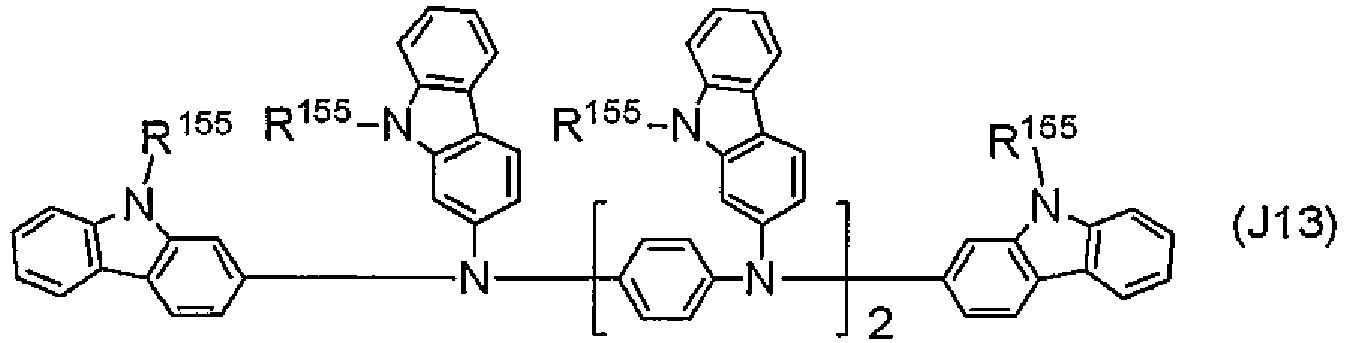
Compound R155 Compound R155 Compound R155 Compound R155 (J3-1) (N1) (J13-27) (N27) (J13-53) (N53) (J13-79) -H (J13-2) (N2) (J 13-28) (N28) (J13-54) (N54) (J13-80) -Me (J3-3) (N3) (J13-29) (N29) (J13-55) (N55) (J13-81) -Et (J13-4) (N4) (J13-30) (N30) (J13-56) (N56) (J13-82) -Prn (J13-5) (N5) (J13-31) (N31) (J13-57) (N57) (J13-83) -Pri (J13-6) (N6) (J13-32) (N32) (J13-58) (N58) (J13-84) -Bun (J13-7) (N7) (J13-33) (N33) (J13-59) (N59) (J13-85) -Bui (J13-8) (N8) (J13-34) (N34) (J13-60) (N60) (J13-86) -Bus (J13-9) (N9) (J13-35) (N35) (J13-61) (N61) (J13-87) -But (J13-10) (N10) (J13-36) (N36) (J13-62) (N62) (J13-11) (N11) (J13-37) (N37) (J13-63) (N63) (J13-12) (N12) (J13-38) (N38) (J13-64) (N64) (J13-13) (N13) (J 13-39) (N39) (J13-65) (N65) (J13-14) (N14) (J13-40) (N40) (J13-66) (N66) (J13-15) (N15) (J13-41) (N41) (J13-67) (N67) (J13-16) (N16) (J13-42) (N42) (J13-68) (N68) (J13-17) (N17) (J13-43) (N43) (J13-69) (N69) (J13-18) (N18) (J13-44) (N44) (J13-70) (N70) (J13-19) (N19) (J13-45) (N45) (J13-71) (N71) (J13-20) (N20) (J13-46) (N46) (J13-72) (N72) (J13-21) (N21) (J13-47) (N47) (J13-73) (N73) (J13-22) (N22) (J13-48) (N48) (J13-74) (N74) (J13-23) (N23) (J13-49) (N49) (J13-75) (N75) (J13-24) (N24) (J13-50) (N50) (J13-76) (N76) (J 13-25) (N25) (J13-51) (N51) (J13-77) (N77) (J13-26) (N26) (J13-52) (N52) (J13-78) (N78) [Table 14] 
Compound R155 Compound R155 Compound R155 Compound R155 (J14-1) (N1) (J 14-27) (N27) (J14-53) (N53) (J14-79) -H (J 14-2) (N2) (J14-28) (N28) (J14-54) (N54) (J14-80) -Me (J 14-3) (N3) (J 14-29) (N29) (J14-55) (N55) (J14-81) -Et (J 14-4) (N4) (J14-30) (N30) (J14-56) (N56) (J 14-82) -Prn (J14-5) (N5) (J14-31) (N31) (J14-57) (N57) (J14-83) -Pri (J 14-6) (N6) (J14-32) (N32) (J14-58) (N58) (J 14-84) -Bun (J14-7) (N7) (J14-33) (N33) (J14-58) (N59) (J 14-85) -Bui (J14-8) (N8) (J14-34) (N34) (J14-60) (N60) (J 14-86) -Bus (J 14-9) (N9) (J14-35) (N35) (J14-61) (N61) (J 14-87) -But (J14-10) (N10) (J 14-36) (N36) (J14-62) (N62) (J14-11) (N11) (J14-37) (N37) (J14-63) (N63) (J14-12) (N12) (J14-38) (N38) (J14-64) (N64) (J14-13) (N13) (J14-39) (N39) (J14-65) (N65) (J14-14) (N14) (J14-40) (N40) (J14-66) (N66) {J14-15) (N15) (J14-41) (N41) (J14-67) (N67) (J14-16) (N16) (J 14-42) (N42) (J14-68) (N68) (J14-17) (N17) (J 14-43) (N43) (J14-69) (N69) (J14-18) (N18) (J14-44) (N44) (J14-70) (N70) (J14-19) (N19) (J14-45) (N45) (J14-71) (N71) (J14-20) (N20) (J 14-46) (N46) (J14-72) (N72) (J14-21) (N21) (J14-47) (N47) (J14-73) (N73) (J14-22) (N22) (J 14-48) (N48) (J14-74) (N74) (J14-23) (N23) (J14-49) (N49) (J14-75) (N75) (J14-24) (N24) (J14-50) (N50) (J14-76) (N76) (J14-25) (N25) (J 14-51) (N51) (J14-77) (N77) (J14-28) (N26) (J 14-52) (N52) (J14-78) (N78) [Table 15] 
Compound Ar5 Compound Ar5 Compound Ar5 Compound Ar5 (J15-1) (A1-1) (J15-27) (A6-11) (J15-53) (A12-7) (J15-79) (A13-22) (J 15-2) (A1-2) (J15-28) (A6-12) (J15-54) (A12-8) (J15-80) (A13-23) (J 15-3) (A2-1) (J15-29) (A6-13) (J15-55) (A12-9) (J15-81) (A 13-24) (J 15-4) (A2-2) (J15-30) (A6-14) (J15-56) (A12-10) (J15-82) (A14-1) (J15-5) (A2-3) J15-31) (A6-15) (J 15-57) (A12-11) (J15-83) (A 14-2) (J 15-6) (A2-4) (J5-32) (A7-1) (J 15-58) (A13-1) (J15-84) (A 14-3) (J 15-7) (A2-5) (J15-33) (A7-2) (J15-59) (A13-2) (J15-85) (A 14-4) (J 15-8) (A3-1) (J15-34) (A7-3) (J15-60) (A13-3) (J15-86) (A15-1) (J 15-9) (A3-2) (J15-35) (A8-1) (J15-61) (A13-4) (J15-87) (A 15-2) (J15-10) (A3-3) (J15-36) (A8-2) (J15-62) (A13-5) (J15-88) (A 15-3) (J15-11) (A4-1) (J15-37) (A8-3) (J 15-63) (A13-6) (J15-89) (A 15-4) (J15-12) (A4-2) (J15-38) (A9-1) (J15-64) (A13-7) (J15-90) (A17-1) (J15-13) (A4-3) (J15-39) (A9-2) (J15-65) (A13-8) (J15-91) (A 17-2) (J 15-14) (A5-1) (J15-40) (A9-3) (J15-66) (A13-9) (J15-92) (A 17-3) (J 15-15) (A5-2) (J15-41) (A10-1) (J 15-67) (A13-10) (J15-93) (A 17-4) (J15-16) (A5-3) (J15-42) (A10-2) (J15-68) (A13-11) (J15-94) (A 17-5) (J 15-17) (A6-1) (J15-43) (A10-3) (J15-69) (A13-12) (J15-95) (A17-6) (J15-18) (A6-2) (J15-44) (A11-1) (J15-70) (A13-13) (J15-96) (A17-7) (J15-19) (A6-3) (J15-45) (A11-2) (J15-71) (A13-14) (J15-97) (A17-8) (J15-20) (A6-4) (J15-46) (A11-3) (J15-72) (A13-15) (J15-98) (A 17-9) (J15-21) (A6-5) (J15-47) (A12-1) (J15-73) (A13-16) (J15-99) (A17-10) (J15-22) (A6-6) (J15-48) (A12-2) (J15-74) (A13-17) (J15-100) (A17-11) (J15-23) (A6-7) (J15-49) (A12-3) (J15-75) (A13-18) (J15-101) (A17-12) (J15-24) (A6-8) (J15-50) (A12-4) (J15-76) (A13-19) (J15-102) (A18-1) (J 15-25) (A6-9) (J15-51) (A12-5) (J15-77) (A13-20) (J15-103) (A 18-2) (J15-26) (A6-10) (J15-52) (A12-6) (J15-78) (A13-21) [Table 16] 
Compound Ar5 Compound Ar5 Compound Ar5 Compound Ar5 (J16-1) (A1-1) (J16-27) (A6-11) (J16-53) (A12-7) (J16-79) (A 13-22) (J16-2) (A1-2) (J16-28) (A6-12) (J16-54) (A12-8) (J16-80) (A13-23) (J16-3) (A2-1) (J16-29) (A6-13) (J16-55) (A12-9) (J16-81) (A13-24) (J16-4) (A2-2) (J16-30) (A6-14) (J16-56) (A12-10) (J16-82) (A14-1) (J16-5) (A2-3) (J16-31) (A6-15) (J16-57) (A12-11) (J16-83) (A 14-2) (J16-6) (A2-4) (J16-32) (A 7-1) (J16-58) (A13-1) (J16-84) (A14-3) (J16-7) (A2-5) (J16-33) (A7-2) (J16-59) (A13-2) (J16-85) (A 14-4) (J16-8) (A3-1) (J16-34) (A7-3) (J16-60) (A13-3) (J16-86) (A15-1) (J16-9) (A3-2) (J16-35) (A8-1) (J16-61) (A13-4) (J16-87) (A 15-2) (J16-10) (A3-3) (J16-36) (A8-2) (J16-62) (A13-5) (J16-88) (A 15-3) (J16-11) (A4-1) (J16-37) (A8-3) (J16-63) (A13-6) (J16-89) (A15-4) (J16-12) (A4-2) (J16-38) (A9-1) (J16-64) (A13-7) (J16-90) (A17-1) (J16-13) (A4-3) (J16-39) (A9-2) (J16-65) (A13-8) (J16-91) (A17-2) (J16-14) (A5-1) (J16-40) (A9-3) (J16-66) (A13-9) (J16-92) (A17-3) (J16-15) (A5-2) (J16-41) (A10-1) (J16-67) (A13-10) (J16-93) (A 17-4) (J16-16) (A5-3) (J16-42) (A10-2) (J16-68) (A13-11) (J16-94) (A 17-5) (J16-17) (A6-1) (J16-43) (A10-3) (J16-69) (A13-12) (J16-95) (A 17-6) (J16-18) (A6-2) (J16-44) (A11-1) (J16-70) (A13-13) (J16-96) (A 17-7) (J16-19) (A6-3) (J16-45) (A11-2) (J16-71) (A13-14) (J16-97) (A 17-8) (J16-20) (A6-4) (J16-46) (A11-3) (J16-72) (A13-15) (J16-98) (A 17-9) (J16-21) (A6-5) (J16-47) (A12-1) (J16-73) (A13-16) (J16-99) (A17-10) (J16-22) (A6-6) (J16-48) (A12-2) (J16-74) (A13-17) (J16-100) (A17-11) (J16-23) (A6-7) (J16-49) (A12-3) (J16-75) (A13-18) (J16-101) (A17-12) (J16-24) (A6-8) (J16-50) (A12-4) (J16-76) (A13-19) (J16-102) (A18-1) (J16-25) (A6-9) (J16-51) (A12-5) (J16-77) (A13-20) (J16-103) (A18-2) (J16-26) (A6-10) (J16-52) (A12-6) (J16-78) (A13-21) [Table 17] 
Compound Ar3 Compound Ar3 Compound Ar3 Compound Ar3 (J17-1) (C1') (J17-3) (C3') (J 17-5) (C5') (J17-7) (C7') (J 17-2) (C2') (J 17-4) (C4') (J17-6) (C6') (J17-8) (C8') [Table 18] 
Compound Ar3 Compound Ar3 Compound Ar3 Compound Ar3 (J18-1) (C1') (J18-3) (C3') (J18-5) (C5') (J18-7) (C7') (J18-2) (C2') (J18-4) (C4') (J18-6) (C6') (J18-8) (C8') - Illustrative examples of aniline derivatives include those of formula (13) below.

- In formula (13), X201 is -NY201-, -O-, - S- , - -(CR207R208 )L- or a single bond. However, when m1 or m2 is 0, X201 is -NY201-.
- Each Y201 is independently a hydrogen atom, an alkyl group of 1 to 20 carbon atoms, alkenyl group of 2 to 20 carbon atoms or alkynyl group of 2 to 20 carbon atoms which may be substituted with Z201, or an aryl group of 6 to 20 carbon atoms or heteroaryl group of 2 to 20 carbon atoms which may be substituted with Z202.
- The alkyl groups of 1 to 20 carbon atoms, alkenyl groups of 2 to 20 carbon atoms, alkynyl groups of 2 to 20 carbon atoms and aryl groups of 6 to 20 carbon atoms are exemplified in the same way as above.
- Illustrative examples of heteroaryl groups of 2 to 20 carbon atoms include 2-thienyl, 3-thienyl, 2-furanyl, 3-furanyl, 2-oxazolyl, 4-oxazolyl, 5-oxazolyl, 3-isooxazolyl, 4-isooxazolyl, 5-isooxazolyl, 2-thiazolyl, 4-thiazolyl, 5-thiazolyl, 3-isothiazolyl, 4-isothiazolyl, 5-isothiazolyl, 2-imidazolyl, 4-imidazolyl, 2-pyridyl, 3-pyridyl and 4-pyridyl.
- R207 and R208 are each independently a hydrogen atom, a halogen atom, a nitro group, a cyano group, an amino group, an aldehyde group, a hydroxyl group, a thiol group, a sulfonic acid group, a carboxylic acid group, an alkyl group of 1 to 20 carbon atoms, alkenyl group of 2 to 20 carbon atoms or alkynyl group of 2 to 20 carbon atoms which may be substituted with Z1, an aryl group of 6 to 20 carbon atoms or heteroaryl group of 2 to 20 carbon atoms which may be substituted with Z2, or a -NHY202 , -NY203Y204, -C(O)Y205, -OY206, -SY207, -SO3Y208, -C(O)OY209, -OC(O)Y210, -C(O)NHY211 or -C(O)NY212Y213 group.
- Y202 to Y213 are each independently an alkyl group of 1 to 20 carbon atoms, alkenyl group of 2 to 20 carbon atoms or alkynyl group of 2 to 20 carbon atoms which may be substituted with Z201, or an aryl group of 6 to 20 carbon atoms or heteroaryl group of 2 to 20 carbon atoms which may be substituted with Z202.
- Z201 is a halogen atom, a nitro group, a cyano group, an amino group, an aldehyde group, a hydroxyl group, a thiol group, a sulfonic acid group, a carboxylic acid group, or an aryl group of 6 to 20 carbon atoms or heteroaryl group of 2 to 20 carbon atoms which may be substituted with Z203.
- Z202 is a halogen atom, a nitro group, a cyano group, an amino group, an aldehyde group, a hydroxyl group, a thiol group, a sulfonic acid group, a carboxylic acid group, or an alkyl group of 1 to 20 carbon atoms, alkenyl group of 2 to 20 carbon atoms or alkynyl group of 2 to 20 carbon atoms which may be substituted with Z203.
- Z203 is a halogen atom, a nitro group, a cyano group, an amino group, an aldehyde group, a hydroxyl group, a thiol group, a sulfonic acid group or a carboxylic acid group.
- The halogen atom is exemplified by fluorine, chlorine, bromine and iodine atoms.
- The alkyl groups, alkenyl groups, alkynyl groups, aryl groups and heteroaryl groups of R207 to R208 and Y202 to Y213 are exemplified in the same way as above.
- Of these, R207 and R208 are preferably hydrogen atoms or alkyl groups of 1 to 20 carbon atoms which may be substituted with Z201, more preferably hydrogen atoms or methyl groups which may be substituted with Z201, and most preferably both hydrogen atoms.
- L, which represents the number of divalent recurring units represented as - (CR207R208)-, is an integer from 1 to 20, preferably from 1 to 10, more preferably from 1 to 5, even more preferably 1 or 2, and most preferably 1. When L is 2 or more, the plurality of R207 groups may be mutually the same or different, and the plurality of R208 groups may be mutually the same or different.
- In particular, X201 is preferably -NY201- or a single bond. Y201 is preferably a hydrogen atom or an alkyl group of 1 to 20 carbon atoms which may be substituted with Z201, more preferably a hydrogen atom or a methyl group which may be substituted with Z201, and most preferably a hydrogen atom.
- R201 to R206 are each independently a hydrogen atom, a halogen atom, a nitro group, a cyano group, an amino group, an aldehyde group, a hydroxyl group, a thiol group, a sulfonic acid group, a carboxylic acid group, an alkyl group of 1 to 20 carbon atoms, alkenyl group of 2 to 20 carbon atoms or alkynyl group of 2 to 20 carbon atoms which may be substituted with Z201, an aryl group of 6 to 20 carbon atoms or heteroaryl group of 2 to 20 carbon atoms which may be substituted with Z202 or a -NHY202, -NY203Y204, -C(O)Y205, -OY206, -SY207, -SO3Y208, -C(O)OY209, -OC(O)Y210, C(O)NHY211 or C(O)NY212Y213 group (wherein Y202 to Y213 are as defined above). These halogen atoms, alkyl groups, alkenyl groups, alkynyl groups, aryl groups and heteroaryl groups are as defined above.
- In particular, in formula (13), R201 to R204 are preferably hydrogen atoms, halogen atoms, alkyl groups of 1 to 10 carbon atoms which may be substituted with Z201, or aryl groups of 6 to 14 carbon atoms which may be substituted with Z202 ; more preferably hydrogen atoms, fluorine atoms, or alkyl groups of 1 to 10 carbon atoms which may be substituted with fluorine atoms; and most preferably all hydrogen atoms.
- R205 and R206 are preferably hydrogen atoms, halogen atoms, alkyl groups of 1 to 10 carbon atoms which may be substituted with Z201, aryl groups of 6 to 14 carbon atoms which may be substituted with Z202 or diphenylamino groups which may be substituted with Z202 (-NY203Y204 groups wherein Y203 and Y204 are phenyl groups which may be substituted with Z202); more preferably hydrogen atoms, fluorine atoms, or diphenylamino groups which may be substituted with fluorine atoms; and even more preferably both hydrogen atoms or both diphenylamino groups.
- Of these, combinations in which R201 to R204 are hydrogen atoms, fluorine atoms or alkyl groups of 1 to 10 carbon atoms which may be substituted with fluorine atoms, R205 and R206 are hydrogen atoms, fluorine atoms or diphenylamino groups which may be substituted with fluorine atoms, X201 is -NY201- or a single bond, and Y201 is a hydrogen atom or a methyl group are preferred. Combinations in which R201 to R204 are hydrogen atoms, R205 and R206 are both hydrogen atoms or diphenylamino groups, and X201 is -NH- or a single bond are more preferred.
- In formula (13), m1 and m2 independently represent an integer of 0 or more and satisfy the condition 1 ≤ m1+m2 ≤ 20. Taking into account the balance between the charge transportability of the resulting thin-film and the solubility of the aniline derivative, m1 and m2 preferably satisfy the condition 2 ≤ m1+m2 ≤ 8, more preferably satisfy the condition 2 ≤ m1+m2 ≤ 6, and still more preferably satisfy the condition 2 s m1+m2 ≤ 4.
- In particular, in Y201 to Y213 and R201 to R208, Z201 is preferably a halogen atom or an aryl group of 6 to 20 carbon atoms which may be substituted with Z203, more preferably a halogen atom or a phenyl group which may be substituted with Z203, and most preferably does not exist (i.e., is non-substituting).
- Z202 is preferably a halogen atom or an alkyl group of 1 to 20 carbon atoms which may be substituted with Z203, more preferably a halogen atom or an alkyl group of 1 to 4 carbon atoms which may be substituted with Z203, and most preferably does not exist (i.e., is non-substituting).
- Also, Z203 is preferably a halogen atom, more preferably fluorine, and most preferably does not exist (i.e., is non-substituting).
- In Y201 to Y1213 and R201 to R208, the number of carbon atoms on the alkyl groups, alkenyl groups and alkynyl groups is preferably 10 or less, more preferably 6 or less, and even more preferably 4 or less. The number of carbons on the aryl groups and heteroaryl groups is preferably 14 or less, more preferably 10 or less, and even more preferably 6 or less.
- The aniline derivative has a molecular weight which is generally from 300 to 5,000. However, from the standpoint of increasing its solubility, the molecular weight is preferably not more than 4,000, more preferably not more than 3,000, and even more preferably not more than 2,000.
- Examples of methods for synthesizing the aniline derivative include, but are not particularly limited to, the methods described in Bulletin of Chemical Society of Japan, 67, pp. 1749-1752 (1994); Synthetic Metals, 84, pp. 119-120 (1997); Thin Solid Films, 520 (24), pp. 7157-7163 (2012),
WO 2008/032617 ,WO 2008/032616 andWO 2008/129947 . - Examples of aniline derivatives of formula (13) include, but are not limited to, those shown below. In these formula, DPA is as defined above, Ph stands for a phenyl group, and TPA stands for a p-(diphenylamino)phenyl group.

- Thiophene derivatives that are suitable as the charge-transporting substance include, but are not limited to, those of formula (14) below.

- In the formula, R221 to R226 are each independently a hydrogen atom, an alkyl group of 1 to 20 carbon atoms, alkenyl group of 2 to 20 carbon atoms or alkynyl group of 2 to 20 carbon atoms which may be substituted with Z204, an aryl group of 6 to 20 carbon atoms or heteroaryl group of 2 to 20 carbon atoms which may be substituted with Z205, or -OY221, -SY222, -NHY223, -NY224Y225 or -NHC(O)Y226. In cases where R221 to R226 are not hydrogen atoms, R221 and R222, R223 and R224 and/or R225 and R226 may mutually bond to form divalent groups.
- R227 and R228 are each independently a hydrogen atom, an alkyl group of 1 to 20 carbon atoms, alkenyl group of 2 to 20 carbon atoms or alkynyl group of 2 to 20 carbon atoms which may be substituted with Z204, an aryl group of 6 to 20 carbon atoms or heteroaryl group of 2 to 20 carbon atoms which may be substituted with Z206 , or -OY221, -SY222, -NHY223, -NY224Y225 or -NHC(O)Y226.
- Y221 to Y226 are each independently an alkyl group of 1 to 20 carbon atoms, alkenyl group of 2 to 20 carbon atoms or alkynyl group of 2 to 20 carbon atoms which may be substituted with Z204, or an aryl group of 6 to 20 carbon atoms or heteroaryl group of 2 to 20 carbon atoms which may be substituted with Z205.
- Z204 is an aryl group of 6 to 20 carbon atoms or a heteroaryl group of 2 to 20 carbon atoms. Z205 is an alkyl group of 1 to 20 carbon atoms, an alkenyl group of 2 to 20 carbon atoms, or an alkynyl group of 2 to 20 carbon atoms. Z206 is an alkyl group of 1 to 20 carbon atoms, an alkenyl group of 2 to 20 carbon atoms, an alkynyl group of 2 to 20 carbon atoms, a dialkylamino group wherein each alkyl is an alkyl group of 1 to 20 carbon atoms, or a diarylamino group wherein each aryl is an aryl group of 6 to 20 carbon atoms.
- Here, the alkyl, alkenyl, alkynyl, aryl and heteroaryl groups are exemplified in the same way as described above.
- In formula (14), R221 and R222 are each preferably a hydrogen atom, an alkyl group of 1 to 20 carbon atoms or alkoxy group of 1 to 20 carbon atoms which may be substituted with Z204 (i.e., an -OY221 group wherein R221 is an alkyl group of 1 to 20 carbon atoms that may be substituted with Z204); more preferably a hydrogen atom, or an alkyl group of 1 to 10 carbon atoms or alkoxy group of 1 to 10 carbon atoms which may be substituted with Z204; even more preferably a hydrogen atom, or an alkyl group of 1 to 8 carbon atoms or alkoxy group of 1 to 8 carbon atoms which may be substituted with Z204; and most preferably a hydrogen atom.
- Accordingly, suitable thiophene derivatives are exemplified by compounds of formula (15) below

- R223 to R226 are each preferably a hydrogen atom, an alkyl group of 1 to 20 carbon atoms or alkoxy group of 1 to 20 carbons which may be substituted with Z204 (i.e., an -OY221 group wherein R221 is an alkyl group of 1 to 20 carbon atoms that may be substituted with Z204); more preferably a hydrogen atom, or an alkyl group of 1 to 10 carbon atoms or alkoxy group of 1 to 10 carbon atoms which may be substituted with Z204; and even more preferably a hydrogen atom, or an alkyl group of 1 to 8 carbon atoms or alkoxy group of 1 to 8 carbon atoms which may be substituted with Z204. It is even more preferable for at least one of R223 and R224 to be an alkyl group of 1 to 18 carbon atoms or alkoxy group of 1 to 8 carbon atoms which may be substituted with Z204.
- R227 and R228 are each preferably a hydrogen atom, -NY224Y225, or an aryl group of 6 to 20 carbon atoms which may be substituted with a dialkylamino group wherein each alkyl group is an alkyl group of 1 to 20 carbon atoms or a diarylamino group wherein each aryl group is an aryl group of 6 to 20 carbon atoms. Here, Y224 and Y225 are each preferably an alkyl group of 1 to 20 carbon atoms which may be substituted with Z204 or an aryl group of 6 to 20 carbon atoms which may be substituted with Z205; and more preferably an alkyl group of 1 to 10 carbon atoms which may be substituted with Z204 or an aryl group of 6 to 10 carbon atoms which may be substituted with Z205.
- Of these, R227 and R228 are, in particular, each preferably a hydrogen atom, a diarylamino group in which each aryl group is an aryl group of 6 to 10 carbon atoms which may be substituted with Z206, or a phenyl group substituted with a diarylamino group in which each aryl group is an aryl group of 6 to 20 carbon atoms; and most preferably a hydrogen atom or a 4-diphenylaminophenyl group.
- In R221 to R228 and Y221 to Y226, Z204 is preferably an aryl group of 6 to 20 carbon atoms, more preferably a phenyl group, and most preferably does not exist (i.e., is non-substituting).
- Z205 is preferably an alkyl group of 1 to 20 carbon atoms, more preferably an alkyl group of 1 to 10 carbon atoms, even more preferably an alkyl group of 1 to 8 carbon atoms, still more preferably an alkyl group of 1 to 6 carbon atoms, and most preferably does not exist (i.e., is non-substituting).
- Z206 is preferably an alkyl group of 1 to 20 carbon atoms, a dialkylamino group in which each alkyl group is an alkyl group of 1 to 20 carbon atoms, or a diarylamino group in which each aryl group is an aryl group of 6 to 20 carbon atoms; more preferably an alkyl group of 1 to 10 carbon atoms, a dialkylamino group in which each alkyl group is an alkyl group of 1 to 10 carbon atoms, or a diarylamino group in which each aryl group is an aryl group of 6 to 10 carbon atoms; even more preferably an alkyl group of 1 to 8 carbon atoms, a dialkylamino group in which each alkyl group is an alkyl group of 1 to 8 carbon atoms, or a diphenylamino group; and most preferably does not exist (i.e., is non-substituting) or is a diphenylamino group.
- In formulas (14) and (15), the subscripts n1 to n3 independently represent a positive integer and satisfy the condition 4 ≤ n1+n2+n3 ≤ 20. Here, n1 is preferably from 1 to 15, more preferably from 1 to 10, even more preferably from 2 to 5, and still more preferably 2 or 3. Also, n2 and n3 are preferably from 1 to 15, more preferably from 1 to 10, even more preferably from 1 to 5, and still more preferably from 1 to 3. From the standpoint of increasing the solubility of the oligothiophene derivative in the organic solvent, n1 to n3 preferably satisfy the condition n1+n2+n3 ≤ 8, more preferably satisfy the condition n1+n2+n3 ≤ 7, even more preferably satisfy the condition n1+n2+n3 ≤ 6, and still more preferably satisfy the condition n1+n2+n3 ≤ 5.
- Illustrative examples of the thiophene derivative of formula (14) include, but are not limited to, the following.

- Such thiophene derivatives may be synthesized by a known method (e.g., the methods described in
JP-A H02-250881 - More specifically, these thiophene derivatives may be synthesized by the reaction shown in Scheme 1 or 2 below. Alternatively, oligothiophene derivatives having, in particular, alkyl groups, alkenyl groups, alkynyl groups, aryl groups or heteroaryl groups at both ends (formula (14')) may be synthesized by the reaction shown in Scheme 3 below.

- R229 and R230 are each independently an alkyl group of 1 to 20 carbon atoms, alkenyl group of 2 to 20 carbon atoms or alkynyl group of 2 to 20 carbon atoms which may be substituted with Z204, or an aryl group of 6 to 20 carbon atoms or heteroaryl group of 2 to 20 carbon atoms which may be substituted with Z206. These are exemplified in the same way as above. Also, Z204 and Z206 are the same as above.
- In Scheme 1, the charging ratios of the thiophene derivatives of formulas (16) to (18) are generally such that the amount of thiophene derivative of formula (16) and the amount of thiophene derivative of formula (18) are each about 0.5 to 1.5 equivalents, and preferably about 0.9 to 1.3 equivalents, with respect to the thiophene derivative of formula (17).
- In Scheme 2, the charging ratios of the thiophene derivatives of formulas (19) to (21) are generally such that the amount of thiophene derivative of formula (19) and the amount of thiophene derivative of formula (21) are each about 0.5 to 1.5 equivalents, and preferably about 0.9 to 1.3 equivalents, with respect to the thiophene derivative of formula (20).
- In Scheme 3, the charging ratios of the thiophene derivative of formula (22) and the compounds of formulas (23) and (24) are generally such that the amount of compound of formula (23) and the amount of compound of formula (24) are each about 0.5 to 1.5 equivalents, and preferably about 0.9 to 1.3 equivalents, with respect to the thiophene derivative of formula (22).
- The catalysts used in these reactions are exemplified in the same way as those described in connection with the method for preparing aniline derivatives of formula (1). These catalysts may be used singly or two or more may be used in combination. These catalysts may be used together with suitable known ligands. Such ligands are exemplified in the same way as those described in connection with the method for preparing aniline derivatives of formula (1).
- The amount of catalyst used may be set to generally about 0.01 to 0.2 mole per mole of the compound of formula (17), (20) or (22), with about 0.05 mole being preferred. When ligands are used, the amount thereof may be set to from 0.1 to 5 equivalents, and preferably from 1 to 4 equivalents, with respect to the metal catalyst used.
- The above reactions may be carried out in a solvent. When a solvent is used, the type thereof is not particularly limited, provided it does not have an adverse effect on the reaction. Specific examples include the same as those mentioned in connection with the method of preparing aniline derivatives of formula (1). The solvent may be used singly, or two or more may be used in admixture.
- The reaction temperature may be suitably set in the range of the melting point to the boiling point of the solvent used, with a temperature of about 0°C to 200°C being preferred, and a temperature of 20°C to 150°C being more preferred.
- Following reaction completion, the oligothiophene derivative of formula (14) or (14') can be obtained by work-up in the usual manner.
- The compounds of formulas (17), (19), (21) and (22) used in the above reactions can each be obtained by using, in accordance with a common technique, a suitable base such as n-butyllithium and a suitable tin compound such as tributyl(chloro)stannane to introduce tributyltin groups onto both ends of thiophene compounds having structures corresponding to the respective compounds. In addition, compounds of formula (22) can be obtained by introducing tributyltin groups onto both ends of an oligothiophene derivative obtained in accordance with Scheme 1 or 2.
- As for the compounds of formulas (16), (18), (20), (23) and (24), use may be made of commercial products, or such compounds may be obtained by, in accordance with a common technique, halogenating or pseudo-halogenating thiophenes, alkanes, alkenes, alkynes, arenes or heteroarenes (exclusive of thiophenes) having structures corresponding to the respective compounds.
- The content of charge-transporting substance in the varnish of the invention is suitably set while taking into account such factors as the viscosity and surface tension of the varnish, and the thickness of the thin-film to be formed. Generally, the content is about 0.1 to 20 wt% of the overall varnish. To improve the ease of applying the varnish, the content is preferably about 0.1 to 10.0 wt%, more preferably about 0.5 to 5.0 wt%, and even more preferably about 1.0 to 3.0 wt%.
- The charge-transporting varnish of the invention may include a dopant. The dopant is not particularly limited. Preferred examples include heteropolyacids and arylsulfonic acids.
- Examples of heteropolyacids include phosphomolybdic acid, silicomolybdic acid, phosphotungstic acid and silicotungstic acid, with phosphotungstic acid or phosphomolybdic acid being preferred. The heteropolyacid may be used singly, or two or more may be used in combination.
- Arylsulfonic acid compounds that may be suitably used as dopants in this invention include those of formula (25) or (26) below.

- In formula (25), A1 represents -O- or -S-, and is preferably -O-. A2 represents a naphthalene ring or an anthracene ring, and is preferably a naphthalene ring. A3 represents a divalent to tetravalent perfluorobiphenyl group and the subscript j1 represents the number of bonds between A1 and A3, which is an integer that satisfies the condition 2 ≤ j1 ≤ 4, with A3 preferably being a divalent perfluorobiphenyl group and j1 preferably being 2. The subscript j2 represents the number of sulfonic acid groups that are bonded to A2, this being an integer that satisfies the condition 1 ≤ j2 ≤ 4, and preferably 2.
- In formula (26), A4 to A8 are each independently a hydrogen atom, a halogen atom, a cyano group, an alkyl group of 1 to 20 carbon atoms, a halogenated alkyl group of 1 to 20 carbon atoms, or a halogenated alkenyl group of 2 to 20 carbon atoms; of A4 to A8, at least three are halogen atoms. The subscript i represents the number of sulfonic acid groups bonded to the naphthalene ring, this being an integer that satisfies the condition 1 ≤ i ≤ 4, preferably from 2 to 4, and more preferably 2.
- Illustrative examples of the halogenated alkyl group of 1 to 20 carbon atoms include trifluoromethyl, 2,2,2-trifluoroethyl, 1,1,2,2,2-pentafluoroethyl, 3,3,3-trifluoropropyl, 2,2,3,3,3-pentafluoropropyl, 1,1,2,2,3,3,3-heptafluoropropyl, 4,4,4-trifluorobutyl, 3,3,4,4,4-pentafluorobutyl, 2,2,3,3,4,4,4-heptafluorobutyl and 1,1,2,2,3,3,4,4,4-nonafluorobutyl groups. Illustrative examples of halogenated alkenyl groups of 2 to 20 carbon atoms include perfluorovinyl, 1-perfluoropropenyl, perfluoroallyl and perfluorobutenyl groups.
- The halogen atoms and alkyl groups of 1 to 20 carbon atoms are exemplified in the same way as above, although the halogen atom is preferably a fluorine atom.
- Of these, A4 to A8 are each preferably a hydrogen atom, a halogen atom, a cyano group, an alkyl group of 1 to 10 carbon atoms, a halogenated alkyl group of 1 to 10 carbon atoms, or a halogenated alkenyl group of 2 to 10 carbon atoms, with at least three of A4 to A8 being fluorine atoms; more preferably a hydrogen atom, a fluorine atom, a cyano group, an alkyl group of 1 to 5 carbon atoms, a fluorinated alkyl group of 1 to 5 carbon atoms, or a fluorinated alkenyl group of 2 to 5 carbon atoms, with at least three of A4 to A8 being fluorine atoms; and even more preferably a hydrogen atom, a fluorine atom, a cyano group, a perfluoroalkyl group of 1 to 5 carbon atoms or a perfluoroalkenyl group of 1 to 5 carbon atoms, with A4, A5 and A8 being fluorine atoms.
- As used herein, "perfluoroalkyl group" refers to an alkyl group on which all the hydrogen atoms are substituted with fluorine atoms, and "perfluoroalkenyl group" refers to an alkenyl group on which all the hydrogen atoms are substituted with fluorine atoms.
- Illustrative examples of the above-described arylsulfonic acid compounds include, but are not limited to, the following.

- The amount of dopant included in the varnish of the invention is suitably selected while taking into account, for example, the type and amount of charge-transporting substance. Expressed as a weight ratio relative to unity (1) for the charge-transporting substance, the amount of dopant included is generally about 0.5 to about 10.
- A charge-transporting thin-film can be formed on a substrate by applying the charge-transporting varnish of the invention onto the substrate and baking.
- Examples of methods for applying the varnish include, but are not particularly limited to, dipping, spin coating, transfer printing, roll coating, brush coating, ink-jet printing, spraying and slit coating. It is preferable to adjust the viscosity and surface tension of the varnish in accordance with the method of application.
- When using the varnish of the invention, the bake atmosphere is not particularly limited. A thin-film having a uniform film-forming surface can be obtained not only in an open-air atmosphere, but even in an inert gas such as nitrogen or in a vacuum. However, in most charge-transporting substances, an open-air atmosphere is preferred because a thin-film having high charge transportability can be reproducibly obtained.
- The bake temperature is suitably set within the range of generally 100 to 260°C, based on such considerations as the intended use of the thin-film to be obtained, and the degree of charge-transportability to be conferred to the resulting thin-film. However, when the resulting thin-film is used as a hole injection layer in an organic EL device, the bake temperature is preferably from about 140°C to about 250°C, and more preferably from about 145°C to about 240°C. During the bake, in order to manifest an even more uniform film formability or to promote the reaction on the substrate, a temperature change of two or more steps may be imparted. Heating should be carried out using a suitable apparatus such as a hot plate or an oven.
- The thickness of the charge-transporting thin-film is not particularly limited. However, when the thin-film is to be used as a hole injection layer in an organic EL device, a film thickness of 5 to 200 nm is preferred. Methods for varying the film thickness include, for example, changing the solids concentration in the varnish and changing the amount of solution on the substrate during application.
- The organic EL device of the invention has a pair of electrodes and, between these electrodes, the above-described charge-transporting thin-film of the invention.
- Typical organic EL device configurations include, but are not limited to, those of (a) to (f) below. In these configurations, where necessary, an electron-blocking layer or the like may be provided between the emissive layer and the anode, and a hole-blocking layer or the like may be provided between the emissive layer and the cathode. Alternatively, the hole injection layer, hole-transporting layer or hole injecting and transporting layer may also have the function of, for example, an electron-blocking layer; and the electron injection layer, electron-transporting layer or electron injecting and transporting layer may also have the function of, for example, a hole-blocking layer.
- (a) anode/hole injection layer/hole-transporting layer/emissive layer/electron-transporting layer/electron injection layer/cathode
- (b) anode/hole injection layer/hole-transporting layer/emissive layer/electron injecting and transporting layer/cathode
- (c) anode/hole injecting and transporting layer/emissive layer/electron-transporting layer/electron injection layer/cathode
- (d) anode/hole injecting and transporting layer/emissive layer/electron injecting and transporting layer/cathode
- (e) anode/hole injection layer/hole-transporting layer/emissive layer/cathode
- (f) anode/hole injecting and transporting layer/emissive layer/cathode
- As used herein, "hole injection layer," "hole-transporting layer" and "hole injecting and transporting layer" refer to layers which are formed between the emissive layer and the anode, and which have the function of transporting holes from the anode to the emissive layer. When only one layer of hole-transporting material is provided between the emissive layer and the anode, this is a "hole injecting and transporting layer"; when two or more layers of hole-transporting material are provided between the emissive layer and the anode, the layer that is closer to the anode is a "hole injection layer" and the other layer is a "hole-transporting layer." In particular, thin-films having not only an ability to receive holes from the anode but also an excellent ability to inject holes into, respectively, the hole-transporting layer and the emissive layer may be used as the hole injection layer and the hole injecting and transporting layer.
- In addition, "electron injection layer," "electron-transporting layer" and "electron injecting and transporting layer" refer to layers which are formed between the emissive layer and the cathode, and which have the function of transporting electrons from the cathode to the emissive layer. When only one layer of electron-transporting material is provided between the emissive layer and the cathode, this is an "electron injecting and transporting layer"; when two or more layers of electron-transporting material are provided between the emissive layer and the cathode, the layer that is closer to the cathode is an "electron injection layer" and the other layer is an "electron-transporting layer."
- The "emissive layer" is an organic layer having a light-emitting function. When a doping system is used, this layer includes a host material and a dopant material. The function of the host material is primarily to promote the recombination of electrons and holes, and to confine the resulting excitons within the emissive layer. The function of the dopant material is to cause the excitons obtained by recombination to efficiently luminesce. In the case of a phosphorescent device, the host material functions primarily to confine within the emissive layer the excitons generated by the dopant.
- The charge-transporting thin-film of the invention can preferably be used as a hole injection layer, a hole-transporting layer or a hole transporting and injecting layer, and can more preferably can be used as a hole injection layer, in an organic EL device.
- The materials and method employed to fabricate an organic EL device using the charge-transporting varnish of the invention are exemplified by, but not limited to, those described below.
- The electrode substrate to be used is preferably cleaned beforehand by liquid washing with, for example, a cleaning agent, alcohol or pure water. When the substrate is an anode substrate, it is preferably subjected to surface treatment such as UV/ozone treatment or oxygen-plasma treatment just prior to use. However, surface treatment need not be carried out if the anode material is composed primarily of organic substances.
- An example of a method of fabricating an inventive organic EL device in which a thin-film obtained from the charge-transporting varnish of the invention serves as a hole injection layer is described below.
- In the method described above, a hole injection layer is formed on an electrode by applying the charge-transporting varnish of the invention onto an anode substrate and baking. A hole-transporting layer, emissive layer, electron-transporting layer, electron injection layer and cathode are then provided in this order on the hole injection layer. The hole-transporting layer, emissive layer, electron-transporting layer and electron injection layer may be formed by a vapor deposition process or a coating process (wet process), depending on the properties of the material to be used.
- Illustrative examples of anode materials include transparent electrodes such as indium-tin oxide (ITO) and indium-zinc oxide (IZO), and metal anodes made of a metal such as aluminum or an alloy of such a metal. An anode material on which planarizing treatment has been carried out is preferred. Use can also be made of polythiophene derivatives and polyaniline derivatives having high charge transportability.
- Examples of other metals making up the metal anode include, but are not limited to, scandium, titanium, vanadium, chromium, manganese, iron, cobalt, nickel, copper, zinc, gallium, yttrium, zirconium, niobium, molybdenum, ruthenium, rhodium, palladium, cadmium, indium, scandium, lanthanum, cerium, praseodymium, neodymium, promethium, samarium, europium, gadolinium, terbium, dysprosium, holmium, erbium, thulium, ytterbium, hafnium, thallium, tungsten, rhenium, osmium, iridium, platinum, gold, titanium, lead, bismuth, and alloys thereof.
- Specific examples of hole-transporting layer-forming materials include the following hole-transporting low-molecular-weight materials: triarylamines such as (triphenylamine) dimer derivatives, [(triphenylamine) dimer] spirodimer, N,N'-bis(naphthalen-1-yl)-N,N'-bis(phenyl)benzidine (α-NPD), N,N'-bis(naphthalen-2-yl)-N,N'-bis(phenyl)benzidine, N,N'-bis(3-methylphenyl)-N,N'-bis(phenyl)benzidine, N,N'-bis(3-methylphenyl)-N,N'-bis(phenyl)-9,9-spirobifluorene, N,N'-bis(naphthalen-1-yl)-N,N'-bis(phenyl)-9,9-splrobifluorene, N,N'-bis(3-methylphenyl)-N,N'-bis(phenyl)-9,9-dimethylfluorene, N,N'-bis(naphthalen-1-yl)-N,N'-bis(phenyl)-9,9-dimethylfluorene, N,N'-bis(3-methylphenyl)-N,N'-bis(phenyl)-9,9-diphenylfluorene, N,N'-bis(naphthalen-1-yl)-N,N'-bis(phenyl)-9,9-diphenylfluorene, N,N'-bis(naphthalen-1-yl)-N,N'-bis(phenyl)-2,2'-dimethylbenzidine, 2,2',7,7'-tetrakis(N,N-diphenylamino)-9,9-spirobifluorene, 9,9-bis[4-(N,N-bisbiphenyl-4-ylamino)phenyl]-9H-fluorene, 9,9-bis[4-(N,N-bisnaphthalen-2-ylamino)phenyl]-9H-fluorene, 9,9-bis[4-(N-naphthalen-1-yl-N-phenylamino)phenyl]-9H-fluorene, 2,2',7,7'-tetrakis[N-naphthalenyl(phenyl)amino]-9,9-spirobifluorene, N,N'-bis(phenanthren-9-yl)-N,N'-bis(phenyl)benzidine, 2,2'-bis[N,N-bis(biphenyl-4-yl)amino]-9,9-spirobifluorene, 2,2'-bis(N,N-diphenylamino)-9,9-spirobifluorene, di[4-(N,N-di(p-tolyl)amino)phenyl]cyclohexane, 2,2',7,7'-tetra(N,N-di(p-tolyl))amino-9,9-spirobifluorene, N,N,N',N'-tetranaphthalen-2-ylbenzidine, N,N,N',N'-tetra(3-methylphenyl)-3,3'-dimethylbenzidine, N,N'-di(naphthalenyl)-N,N'-di(naphthalen-2-yl)benzidine, N,N,N',N'-tetra(naphthalenyl)benzidine, N,N'-di(naphthalen-2--yl)-N,N'-diphenylbenzidine-1-4-diamine, N',N4-diphenyl-N1,N4-di(m-tolyl)benzene-1,4-diamine, N2,N2,N6,N6-tetraphenylnaphthalene-2,6-diamine, tris(4-(quinolin-8-yl)phenyl)amine, 2,2'-bis(3-(N,N-di(p-tolyl)amino)phenyl)biphenyl, 4,4',4"-tris[3-methylphenyl(phenyl)amino]triphenylamine (m-MTDATA) and 4,4',4"-tris[1-naphthyl(phenyl)amino]triphenylamine (1-TNATA); and oligothiophenes such as 5,5"-bis-{4-[bis(4-methylphenyl)-amino]phenyl}-2,2':5',2"-terthiophene (BMA-3T).
- Specific examples of emissive layer-forming materials include tris(8-quinolinolate) aluminum(III) (Alq3), bis(8-quinolinolate) zinc(II) (Znq2), bis(2-methyl-8-quinolinolate)-4-(p-phenylphenolate) aluminum(III) (BAlq), 4,4'-bis(2,2-diphenylvinyl)biphenyl, 9,10-di(naphthalen-2-yl)anthracene, 2-t-butyl-9,10-di(naphthalen-2-yl)anthracene, 2,7-bis[9,9-di(4-methylphenyl)fluoren-2-yl]-9,9-di(4-methylphenyl)fluorene, 2-methyl-9,10-bis(naphthalen-2-yl)anthracene, 2-(9,9-spirobifluoren-2-yl)-9,9-spirobifluorene, 2,7-bis(9,9-spirobifluoren-2-yl)-9,9-spirobifluorene, 2-[9,9-di(4-methylphenyl)fluoren-2-yl]-9,9-di(4-methylphenyl)fluorene, 2,2'-dipyrenyl-9,9-spirobifluorene, 1,3,5-tris(pyren-1-yl)benzene, 9,9-bis[4-(pyrenyl)phenyl]-9H-fluorene, 2,2'-bi(9,10-diphenylanthracene), 2,7-dipyrenyl-9,9-spirobifluorene, 1,4-di(pyren-1-yl)benzene, 1,3-di(pyren-1-yl)benzene, 6,13-di(biphenyl-4-yl)pentacene, 3,9-di(naphthalen-2-yl)perylene, 3,10-di(naphthalen-2-yl)perylene, tris[4-(pyrenyl)phenyl]amine, 10,10'-di(biphenyl-4-yl)-9,9'-bianthracene, N,N'-di(naphthalen-1-yl)-N,N'-diphenyl[1,1':4',1":4",1"1-quaterphenyl]-4,4"'-diamine, 4,4'-di[10-(naphthalen-1-yl)anthracen-9-yl]biphenyl, dibenzo{[f,f']-4,4',7,7'-tetraphenyl}diindeno[1,2,3-cd:1',2',3'-lm]perylene, 1-(7-(9,9'-bianthracen-10-yl)-9,9-dimethyl-9H-fluoren-2-yl)pyrene, 1-(7-(9,9'-bianthracen-10-yl)-9,9-dihexyl-9H-fluoren-2-yl)pyrene, 1,3-bis(carbazol-9-yl)benzene, 1,3,5-tris(carbazol-9-yl)benzene, 4,4',4"-tris(carbazol-9-yl)triphenylamine, 4,4'-bis(carbazol-9-yl)biphenyl (CBP), 4,4'-bis(carbazol-9-yl)-2,2'-dimethylbiphenyl, 2,7-bis(carbazol-9-yl)-9,9-dimethylfluorene, 2,2',7,7'-tetrakis(carbazol-9-yl)-9,9-spirobifluorene, 2,7-bis(carbazol-9-yl)-9,9-di(p-tolyl)fluorene, 9,9-bis[4-(carbazol-9-yl)phenyl]fluorene, 2,7-bis(carbazol-9-yl)-9,9-spirobifluorene, 1,4-bis(triphenylsilyl)benzene, 1,3-bis(triphenylsilyl)benzene, bis(4-N,N-diethylamino-2-methylphenyl)-4-methylphenylmethane, 2,7-bis(carbazol-9-yl)-9,9-dioctylfluorene, 4,4"-di(triphenylsilyl)-p-terphenyl, 4,4'-di(triphenylsilyl)biphenyl, 9-(4-t-butylphenyl)-3,6-bis(triphenylsilyl)-9H-carbazole, 9-(4-t-butylphenyl)-3,6-ditrityl-9H-carbazole, 9-(4-t-butylphenyl)-3,6-bis(9-(4-methoxyphenyl)-9H-fluoren-9-yl)-9H-carbazole, 2,6-bis(3-(9H-carbazol-9-yl)phenyl)pyridine, triphenyl(4-(9-phenyl-9H-fluoren-9-yl)phenyl)silane, 9,9-dimethyl-N,N-diphenyl-7-(4-(1-phenyl-1H-benzo[d]imidazol-2-yl)phenyl-9H-fluoren-2-amine, 3,5-bis(3-(9H-carbazol-9-yl)phenyl)pyridine, 9,9-spirobifluoren-2-yldiphenylphosphine oxide, 9,9'-(5-triphenylsilyl)-1,3-phenylene)bis(9H-carbazole), 3-(2,7-bis(diphenylphosphoryl)-9-phenyl-9H-fluoren-9-yl)-9-phenyl-9H-carbazole, 4,4,8,8,12,12-hexa(p-tolyl)-4H-8H-12H-12C-azadibenzo[cd,mn]-pyrene, 4,7-di(9H-carbazol-9-yl)-1,10-phenanthroline, 2,2'-bis(4-(carbazol-9-yl)phenyl)biphenyl, 2,8-bis(diphenylphosphoryl)dibenzo[b,d]thiophene, bis(2-methylphenyl)diphenylsilane, bis[3,5-di(9H-carbazol-9-yl)phenyl]diphenylsilane, 3,6-bis(carbazol-9-yl)-9-(2-ethylhexyl)-9H-carbazole, 3-(diphenylphosphoryl)-9-(4-(diphenylphosphoryl)phenyl)-9H-carbazole and 3,6-bis[(3,5-diphenyl)phenyl]-9-phenylcarbazole. An emissive layer may be formed by co-vapor deposition of any of these materials with a light-emitting dopant.
- Specific examples of light-emitting dopants include 3-(2-benzothiazolyl)-7-(diethylamino)coumarin, 2,3,6,7-tetrahydro-1,1,7,7-tetramethyl-1H,5H,11H-10-(2-benzothiazolyl)quinolidino[9,9a,1gh]coumarin, quinacridone, N,N'-dimethylquinacridone, tris(2-phenylpyridine) iridium(III) (Ir(ppy)3), bis(2-phenylpyridine)(acetylacetonate) iridium(III) (Ir(ppy)2(acac)), tris[2-(p-tolyl]pyridine) iridium(III) (Ir(mppy)3), 9,10-bis[N,N-di(p-tolyl)amino]anthracene, 9,10-bis[phenyl(m-tolyl)amino]anthracene, bis[2-(2-hydroxyphenyl)benzothiazolate] zinc(II), N10, N10, N10, N14-tetra (p-tolyl)-9,9'-bianthracene-10,10'-diamine, N10,N10, N10, N10-tetraphenyl-9,9'-bianthracene-10,10'-diamine, N10, N10-diphenyl-N10, N10-dinaphthalenyl-9,9'-bianthracene-10,10'-diamine, 4,4'-bis(9-ethyl-3-carbazovinylene)-1,1'-biphenyl, perylene, 2,5,8,11-tetra-t-butylperylene, 1,4-bis[2-(3-N-ethylcarbazolyl)vinyl]benzene, 4,4'-bis[4-(di-p-tolylamino)styryl]biphenyl, 4-(di-p-tolylamino)-4'-[(di-p-tolylamino)styryl]stilbene, bis[3,5-difluoro-2-(2-pyridyl)phenyl-(2-carboxypyridyl)] iridium(III), 4,4'-bis[4-(diphenylamino)styryl]biphenyl, bis(2,4-difluorophenylpyridinato)tetrakis(1-pyrazolyl)borate iridium(III), N,N'-bis(naphthalen-2-yl)-N,N'-bis(phenyl)tris(9,9-dimethylfluorenylene), 2,7-bis{2-[phenyl(m-tolyl)amino]-9,9-dimethylfluoren-7-yl}-9,9-dimethylfluorene, N-(4-((E)-2-(6((E)-4-(diphenylamino)styryl)naphthalen-2-yl)vinyl)phenyl)-N-phenylbenzenamine, fac-iridium(III) tris(1-phenyl-3-methylbenzimidazolin-2-ylidene-C,C2), mer-iridium(III) tris(1-phenyl-3-methylbenzimidazolin-2-ylidene-C,C2), 2,7-bis[4-(diphenylamino)styryl]-9,9-spirobifluorene, 6-methyl-2-(4-(9-(4-(6--methylbenzo[d]thiazol-2-yl)phenyl)anthracen-10-yl)phenyl)benzo[d]thiazole, 1,4-di[4-(N,N-diphenyl)amino]styrylbenzene, 1,4-bis(4-(9H-carbazol-9-yl)styryl)benzene, (E)-6-(4-(diphenylamino)styryl)-N,N-diphenylnaphthalen-2-amine, bis(2,4-difluorophenylpyridinato)(5-(pyridin-2-yl)-1H-tetrazolate) iridium(III), bis(3-trifluoromethyl-5-(2-pyridyl)pyrazole)((2,4-difluoro-benzyl)diphenylphosphinate) iridium(III), bis(3-trifluoromethyl-5-(2-pyridyl)pyrazolate)(benzyl-diphenylphosphinate) iridium(III), bis(1-(2,4-difluorobenzyl)-3-methylbenzimidazolium)(3-(trifluoromethyl)-5-(2-pyridyl)-1,2,4-triazolate) iridium(III), bis(3-trifluoromethyl-5-(2-pyridyl)pyrazolate)(4',6'-difluorophenylpyridinate) iridium(III), bis(4',6'-difluorophenylpyridinato)(3,5-bis(trifluoromethyl)-2-(2'-pyridyl)pyrrolate) iridium(III), bis(4',6'-difluorophenylpyridinato)(3-(trifluoromethyl)-5-(2-pyridyl)-1,2,4-triazolate) iridium (III), (Z)-6-mesityl-N-(6-mesitylquinolin-2(1H)-ylidene)quinoline-2-amine-BF2, (E)-2-(2-(4-(dimethylamino)styryl)-6-methyl-4H-pyran-4-ylidene)malononitrile, 4-(dicyanomethylene)-2-methyl-6-julolidyl-9-enyl-4-H-pyran, 4-(dicyanomethylene)-2-methyl-6-(1,1,7,7-tetramethyl-julolidyl-9-enyl)-4H-pyran, 4-(dicyanomethylene)-2-t-butyl-6-(1,1,7,7-tetramethyl-julolidin-4-ylvinyl)-4H-pyran, tris(dibenzoylmethane)phenanthroline europium(III), 5,6,11,12-tetraphenylnaphthacene, bis(2-benzo[b]thiophen-2-yl-pyridine)(acetylacetonate) iridium(III), tris(1-phenylisoquinoline) iridium(III), bis(1-phenylisoquinoline)(acetylacetonate) iridium(III), bis[1-(9,9-dimethyl-9H-fluoren-2-yl)isoquinoline](acetyl-acetonate) iridium(III), bis[2-(9,9-dimethyl-9H-fluoren-2-yl)quinoline](acetylacetonate) iridium(III), tris[4,4'-di-t-butyl-(2,2')-bipyridine] ruthenium(III)·bis(hexafluorophosphate), tris(2-phenylquinoline) iridium(III), bis(2-phenylquinoline)(acetylacetonate) iridium(III), 2,8-di-t-butyl-5,11-bis(4-t-butylphenyl)-6,12-diphenyltetracene, bis(2-phenylbenzothiazolate)(acetylacetonate) iridium(III), platinum 5,10,15,20-tetraphenyltetrabenzoporphyrin, osmium(II) bis(3-trifluoromethyl-5-(2-pyridine)pyrazolate)-dimethylphenylphosphine, osmium(II) bis(3-trifluoromethyl)-5-(4-t-butylpyridyl)-1,2,4-triazolate)diphenylmethylphosphine, osmium(II) bis(3-(trifluoromethyl)-5-(2-pyridyl)-1,2,4-triazole)dimethylphenylphosphine, osmium(II) bis(3-(trifluoromethyl)-5-(4-t-butylpyridyl)-1,2,4-triazolate)dimethylphenylphosphine, bis[2-(4-n-hexylphenyl)quinoline](acetylacetonate) iridium(III), tris[2-(4-n-hexylphenyl)quinoline] iridium(III), tris[2-phenyl-4-methylquinoline] iridium(III), bis(2-phenylquinoline)(2-(3-methylphenyl)pyridinate) iridium(III), bis(2-(9,9-diethylfluoren-2-yl)-1-phenyl-1H-benzo[d]-imidazolato)(acetylacetonate) iridium(III), bis(2-phenylpyridine)(3-(pyridin-2-yl)-2H-chromen-9-onate) iridium(III), bis(2-phenylquinoline)(2,2,6,6-tetramethylheptane-3,5-dionate) iridium(III), bis(phenylisoquinoline)(2,2,6,6-tetramethylheptane-3,5-dionate) iridium(III), iridium(III) bis(4-phenylthieno[3,2-c]pyridinato-N,C2)acetylacetonate, (E)-2-(2-t-butyl-6-(2-(2,6,6-trimethyl-2,4,5,6-tetrahydro-1H-pyrrolo[3,2,1-ij]quinolin-8-yl)vinyl)-4H-pyran-4-ylidene)-malononitrile, bis(3-trifluoromethyl-5-(1-isoquinolyl)pyrazolate)(methyl-diphenylphosphine) ruthenium, bis[(4-n-hexylpheny)isoquinoline](acetylacetonate) iridium(III), platinum(II) octaethylporphin, bis(2-methyldibenzo[f,h]quinoxaline)(acetylacetonate) iridium(III) and tris[(4-n-hexylphenyl)isoquinoline] iridium(III).
- Specific examples of electron transport layer-forming materials include lithium 8-hydroxyquinolinate, 2,2',2"-(1,3,5-benzinetriyl)-tris(1-phenyl-1-H-benzimidazole), 2-(4-biphenyl)-5-(4-t-butylphenyl)-1,3,4-oxadiazole, 2,9-dimethyl-4,7-diphenyl-1,10-phenanthroline, 4,7-diphenyl-1,10-phenanthroline, bis(2-methyl-8-quinolinolate)-4-(phenylphenolato)aluminum, 1,3-bis[2-(2,2'-bipyridin-6-yl)-1,3,4-oxadiazo-5-yl]benzene, 6,6'-bis[5-(biphenyl-4-yl)-1,3,4-oxadiazo-2-yl]-2,2'-bipyridine, 3-(4-biphenyl)-4-phenyl-5-t-butylphenyl-1,2,4-triazole, 4-(naphthalen-1-yl)-3,5-diphenyl-4H-1,2,4-triazole, 2,9-bis(naphthalen-2-yl)-4,7-diphenyl-1,10-phenanthroline, 2,7-bis[2-(2,2'-bipyridin-6-yl)-1,3,4-oxadiazo-5-yl]-9,9-dimethylfluorene, 1,3-bis[2-(4-t-butylphenyl)-1,3,4-oxadiazo-5-yl]benzene, tris(2,4,6-trimethyl-3-(pyridin-3-yl)phenyl)borane, 1-methyl-2-(4-(naphthalen-2-yl)phenyl)-1H-imidazo[4,5f]-[1,10]phenanthroline, 2-(naphthalen-2-yl)-4,7-diphenyl-1,10-phenanthroline, phenyldipyrenylphosphine oxide, 3,3',5,5'-tetra[(m-pyridyl)phen-3-yl]biphenyl, 1,3,5-tris[(3-pyridyl)phen-3-yl]benzene, 4,4'-bis(4,6-diphenyl-1,3,5-triazin-2-yl)biphenyl, 1,3-bis[3,5-di(pyridin-3-yl)phenyl]benzene, bis(10-hydroxybenzo[h]quinolinato)beryllium, diphenylbis(4-(pyridin-3-yl)phenyl)silane and 3,5-di(pyren-1-yl)pyridine.
- Examples of electron injection layer-forming materials include lithium oxide (Li2O), magnesium oxide (MgO), alumina (Al2O3), lithium fluoride (LiF), sodium fluoride (NaF), magnesium fluoride (MgF2), cesium fluoride (CsF), strontium fluoride (SrF2), molybdenum trioxide (MoO3), aluminum, lithium acetylacetonate Li(acac), lithium acetate and lithium benzoate.
- Examples of cathode materials include aluminum, magnesium-silver alloys, aluminum-lithium alloys, lithium, sodium, potassium and cesium.
- In cases where the thin-film obtained from the charge-transporting varnish of the invention is a hole injection layer, another example of a method of fabricating the organic EL device of the invention is as follows.
- An organic EL device having a charge-transporting thin-film formed using the charge-transporting varnish of the invention can be produced by, in the fabrication of an EL device as described above, successively forming a hole-transporting and an emissive layer instead of carrying out vacuum evaporation operations for a hole-transporting layer, an emissive layer, an electron-transporting layer and an electron injection layer. Specifically, the charge-transporting varnish of the invention is applied onto an anode substrate, and a hole injection layer is formed by the above-described method. A hole-transporting layer and an emissive layer are then successively formed thereon, following which a cathode material is vapor-deposited on top, thereby giving an organic EL device.
- The cathode and anode materials used here may be similar to those described above, and similar cleaning treatment and surface treatment may be carried out.
- The method of forming the hole-transporting layer and the emissive layer is exemplified by a film-forming method that entails adding a solvent to a hole-transporting polymer material or a light-emitting polymer material, or to a material obtained by adding a dopant to these, thereby dissolving or uniformly dispersing the material, and then applying the resulting solution or dispersion onto, respectively, the hole injection layer or the hole-transporting layer and subsequently baking the applied layer.
- Examples of hole-transporting polymer materials include poly[(9,9-dihexylfluorenyl-2,7-diyl)-co-(N,N'-bis{p-butylphenyl}-1,4-diaminophenylene)], poly[(9,9-dioctylfluorenyl-2,7-diyl)-co-(N,N'-bis{p-butylphenyl}-1,1'-biphenylene-4,4-diamine)], poly[(9,9-bis{1'-penten-5'-yl}fluorenyl-2,7-diyl)-co-(N,N'-bis{p-butylphenyl}-1,4-diaminophenylene)], poly[N,N'-bis(4-butylphenyl)-N,N'-bis(phenyl)benzidine] end-capped with polysilsesquioxane and poly[(9,9-dioctylfluorenyl-2,7-diyl)-co-(4,4'-(N-(p-butylphenyl))diphenylamine)].
- Examples of light-emitting polymer materials include polyfluorene derivatives such as poly(9,9-dialkylfluorene) (PDAF), poly(phenylene vinylene) derivatives such as poly(2-methoxy-5-(2'-ethylhexoxy)-1,4-phenylene vinylene) (MEH-PPV), polythiophene derivatives such as poly(3-alkylthiophene) (PAT), and polyvinylcarbazole (PVCz).
- Examples of the solvent include toluene, xylene and chloroform. Examples of the method of dissolution or uniform dispersion include stirring, stirring under applied heat, and ultrasonic dispersion.
- Examples of the coating method include, but are not particularly limited to, inkjet printing, spraying, dipping, spin coating, transfer printing, roll coating and brush coating. Coating is preferably carried out in an inert gas atmosphere such as nitrogen or argon.
- Examples of the baking method include methods that involve heating in an oven or on a hot plate, either within an inert gas atmosphere or in a vacuum.
- An example is described below of a method of fabricating the organic EL device of the invention in a case where the thin-film obtained from the charge-transporting varnish of the invention is a hole-transporting layer.
- A hole injection layer is formed on an anode substrate. The charge-transporting varnish of the invention is applied onto this layer and baked by the above-described method, thereby producing a hole-transporting layer. An emissive layer, an electron-transporting layer, an electron injection layer and a cathode are provided in this order on the hole-transporting layer. Methods of forming the emissive layer, electron-transporting layer and electron injection layer, and specific examples of each, are exemplified in the same way as above. The hole injection layer may be formed by any vapor deposition process and coating process (wet process), according to the properties, etc. of the material used.
- Illustrative examples of the material that forms the hole injection layer include copper phthalocyanine, titanium oxide phthalocyanine, platinum phthalocyanine, pyrazino[2,3-f][1,10]phenanthroline-2,3-dicarbonitrile, N,N,N',N'-tetrakis(4-methoxyphenyl)benzidine. 2,7-bis[N,N-bis(4-methoxyphenyl)amino]-9,9-spirobifluorene, 2,2'-bis[N,N-bis(4-methoxyphenyl)amino]-9,9-spirobifluorene, N,N'-diphenyl-N,N'-di[4-(N,N-ditolylamino)phenyl]benzidine, N,N'-diphenyl-N,N'-di[4-(N,N-diphenylamino)phenyl]benzidine, N4, N4'-(biphenyl-4,4'-diyl)bis(N4,N4',N4'-triphenylbiphenyl-4,4'-diamine), N1,N1'-(biphenyl-4,4'-diyl)bis(N1-phenyl-N4,N4'-dimtolylbenzene-1,4-diamine), and the charge-transporting materials mentioned in
WO 2004/043117 ,WO 2004/105446 ,WO 2005/000832 ,WO 2005/043962 ,WO 2005/042621 ,WO 2005/107335 ,WO 2006/006459 ,WO 2006/025342 ,WO 2006/137473 ,WO 2007/049631 ,WO 2007/099808 ,WO 2008/010474 ,WO 2008/032617 ,WO 2008/032616 ,WO 2008/129947 ,WO 2009/096352 ,WO 2010/041701 ,WO 2010/058777 ,WO 2010/058776 ,WO 2013/042623 ,WO 2013/129249 ,WO 2014/115865 ,WO 2014/132917 ,WO 2014/141998 , andWO 2014/132834 . - The anode material, the materials which form the emissive layer, the light-emitting dopant, the electron-transporting layer and the electron-blocking layer, and the cathode material are exemplified in the same way as above.
- An example is described below of a method of fabricating the organic EL device of the invention in a case where the thin-film obtained from the charge-transporting varnish of the invention is a hole injecting and transporting layer.
- A hole injecting and transporting layer is formed on an anode substrate, and an emissive layer, an electron-transporting layer, an electron injection layer and a cathode are provided in this order on the hole injecting and transporting layer. Methods of forming the emissive layer, electron-transporting layer and electron injection layer, and specific examples of each, are exemplified in the same way as above.
- The anode material, the materials which form the emissive layer, the light-emitting dopant, the electron-transporting layer and the electron-blocking layer, and the cathode material are exemplified in the same way as above.
- A hole-blocking layer, an electron-blocking layer or the like may be optionally provided between the electrodes and any of the above layers. By way of illustration, an example of a material that forms an electron-blocking layer is tris(phenylpyrazole)iridium.
- The materials which make up the layers that form the anode, the cathode and the layers formed therebetween differ according to whether a device provided with a bottom emission structure or a top emission structure is to be fabricated, and so are suitably selected while taking this into account.
- Generally, in an element having a bottom emission structure, a transparent anode is used on the substrate side and light is extracted from the substrate side, whereas in an element having a top emission structure, a reflective anode made of metal is used and light is extracted from a transparent electrode (cathode) in the opposite direction from the substrate. Hence, with regard to the anode material, for example, when fabricating a device having a bottom emission structure, a transparent anode of ITO or the like is used, and when manufacturing a device having a top emission structure, a reflective anode of Al/Nd or the like is used.
- The organic EL device of the invention, in order to prevent a deterioration in characteristics, may be sealed in the usual manner with, if necessary, a desiccant or the like.
- Working Examples are given below to more concretely illustrate the invention, although the invention is not limited by these Examples. The equipment used was as follows.
- (1) 1H-NMR Measurement:
- JNM-ECP300 FT NMR System, from JEOL Ltd.
- (2) MALDI-TOF-MS:
- Autoflex III SmartBeam, from Bruker Daltonics
- (3) Substrate Cleaning:
- Substrate cleaning machine (reduced-pressure plasma system), from Choshu Industry Co., Ltd.
- (4) Varnish Coating:
- MS-A100 Spin Coater, from Mikasa Co., Ltd.
- (5) Film Thickness Measurement:
- Surfcorder ET-4000 microfigure measuring instrument, from Kosaka Laboratory, Ltd.
- (6) Film Surface Examination:
- 1LM21D Real Time Scanning Laser Microscope, from Lasertec Corporation
- (7) EL Device Fabrication:
- C-E2L1G1-N Multifunction Vapor Deposition System, from Choshu Industry Co., Ltd.
- (8) Examination of Light-Emitting Surface of EL Device, and Brightness Measurement:
- I-V-L Measurement System from Tech World, Inc.
-

- A flask was charged with 5.00 g of N1-(4-aminophenyl)-benzene-1,4-diamine, 8.09 g of 9-benzyl-3-bromo-9H-carbazole, 252 mg of Pd(dba)2 and 3.03 g of t-butoxysodium, following which the interior of the flask was flushed with nitrogen. Next, 50 mL of toluene and 2.02 mL of a toluene solution of di-t-butyl(phenyl)phosphine (concentration, 96.4 g/L) prepared beforehand were added, and the system was stirred at 90°C for 3 hours.
- After the completion of stirring, the reaction mixture was cooled to room temperature, the cooled reaction mixture, 200 mL of toluene and 150 mL of saturated saline were mixed together, and separatory treatment was carried out. Next, 0.5 g of activated carbon was added to the resulting organic phase, which was then stirred at room temperature for 1 hour.
- The activated carbon was then removed by filtration, and the filtrate was concentrated. The concentrate was added dropwise to a mixed solvent of methanol and ethyl acetate (200 mL/200 mL), and the resulting slurry was stirred at room temperature for 1 hour, following which the slurry was filtered and the filtered matter was recovered. The resulting filtered matter was dried, thereby giving the target N1,N1,N4-tris(9-benzyl-9H-carbazol-3-yl)-N4-(4-(bis(9-benzyl-9H-carbazol-3-yl)amino)phenyl)benzene-1,4-diamine (amount, 8.46 g; yield, 80%). The 1H-NMR results were as follows.
1H-NMR (300 MHz, THF-d8) 8 [ppm]: - 7.91-8.00 (m, 10H), 7.52-7.58 (m, 10H), 7.34-7.39 (m, 6H), 7.17-7.26 (m, 29H), 7.03-7.11 (m, 5H), 6.83 (d, J = 9.0 Hz, 4H), 6.76 (d, J = 9.0 Hz, 4H), 5.58 (s, 10H).
-

- A flask was charged with 5.05 g of t-butoxypotassium, 18 mL of dimethylsulfoxide and 6 mL of tetrahydrofuran, following which the interior of the flask was flushed with oxygen. Next, a solution prepared by mixing together 3.00 g of the N1,N1,N4-tris(9-benzyl-9H-carbazol-3-yl)-N4-(4-(bis(9-benzyl-9H-carbazol-3-yl)amino)phenyl)benzene-1,4-diamine obtained above and 9 mL of tetrahydrofuran was added dropwise thereto at 10°C, the temperature of the resulting mixture was raised to room temperature, and the mixture was stirred for 4 hours.
- After the completion of stirring, the reaction mixture was added dropwise to 120 mL of deionized water, and 9 mL of 5 mol/L hydrochloric acid was added dropwise thereto, following which the resulting slurry was stirred at room temperature for 1 hour. The slurry was then filtered, and the filtered matter was recovered. The filtered matter thus obtained was mixed thoroughly with 90 mL of tetrahydrofuran, the mixture was filtered with silica gel, and the resulting filtrate was concentrated. The concentrate was added dropwise to 150 mL of methanol, and the resulting slurry was stirred at room temperature for 1 hour.
- Finally, the slurry was filtered, and the filtered matter was recovered. The filtered matter was then dried, giving the target aniline derivative A (amount, 2.20 g; yield, 90%). The MALDI-TOF-MS results were as follows.
MALDI-TOF-MS, m/Z; found: 1024.13
([m]+ calculated: 1024.40). - A flask was charged with 10.00 g of 3-bromocarbazole, 1.75 g of sodium hydroxide and 100 mL of N,N-dimethylformamide, following which the interior of the flask was flushed with nitrogen. Next, 7.42 g of benzyl bromide was added dropwise thereto and the system was stirred at room temperature for 19 hours, following which the reaction mixture was added dropwise to deionized water under stirring, and the resulting system was additionally stirred at room temperature. The resulting slurry was filtered and the filtered matter was dried, giving the target 9-benzyl-3-bromocarbazole (amount, 13.1 g; yield, 96%). The 1H-NMR results are shown below.
1H-NMR (300 MHz, CDCl3) δ [ppm]: - 8.23 (d, J = 2.1 Hz, 1H), 8.07 (d, J = 8.0 Hz, 1H), 7.49 (dd, J = 8.6, 2.1 Hz, 1H), 7.42-7.45 (m, 1H), 7.36 (d, J = 8.0 Hz, 1H), 7.21-7.31 (m, 5H), 7.08-7.11 (m, 2H), 5.49 (s, 2H).
-

- Here and below, DPA stands for a diphenylamine group.
- A flask was charged with charged with 2.00 g of N1-(4-((4-((4-(diphenylamino)phenyl)amino)phenyl)amino)-phenyl)-N4,N4-diphenylbenzene-1,4-diamine, 3.24 g of the 9-benzyl-3-bromocarbozole obtained above, 50.5 mg of Pd(dba)2 and 1.21 g of t-butoxysodium, following which the interior of the flask was flushed with nitrogen. To this was added 20 mL of toluene and 0.56 mL of a toluene solution of tri-t-butylphosphine (concentration, 63.4 g/L) prepared beforehand, and the system was stirred for 24 hours at 50°C.
- After the completion of stirring, the reaction mixture was cooled to room temperature, the cooled reaction mixture, toluene and saturated saline were mixed together, and separatory treatment was carried out. Next, activated carbon was added to the resulting organic phase, which was then stirred at room temperature for 30 minutes, following which the activated carbon was removed by filtration and the filtrate was concentrated. The concentrate thus obtained was added dropwise to a mixed solvent of methanol and ethyl acetate, and the resulting slurry was stirred at room temperature.
- Finally, the slurry was filtered and the filtered matter was dried, giving the target N1,N4-bis(9-benzyl-9H-carbazol-3-yl)-N1-(4-((9-benzyl-9H-carbazol-3-yl)(4-(diphenylamino)phenyl)amino)phenyl)-N4-(4-(diphenylamino)phenyl)benzene-1,4-diamine (amount, 3.92 g; yield, 93%). The MALDI-TOF-MS results were as follows.
MALDI-TOF-MS, m/Z; found: 1452.52
([m]+ calculated: 1450.63). -

- A flask was charged with 2.00 g of the N1,N4-bis(9-benzyl-9H-carbazol-3-yl)-N1-(4-((9-benzyl-9H-carbazol-3-yl)(4-(diphenylamino)phenyl)amino)phenyl)-N4-(4-(diphenylamino)phenyl)benzene-1,4-diamine obtained above and 40 mL of dimethylsulfoxide, following which the interior of the flask was flushed with oxygen. To this was added dropwise 25 mL of a tetrahydrofuran solution of t-butoxypotassium (concentration, 1 mol/L) prepared beforehand, and the system was stirred at room temperature for 23 hours.
- Following the completion of stirring, the reaction mixture was added dropwise to a mixed solvent of deionized water and methanol, and the resulting mixture was stirred, after which 5 mL of 5 mol/L hydrochloric acid was added dropwise thereto and the system was additionally stirred.
- Finally, the resulting slurry was filtered and the filtered matter was dried, giving the target Aniline Derivative B (amount, 1.62 g; yield, 99%). The MALDI-TOF-MS results were as follows.
MALDI-TOF-MS, m/Z; found: 1180.10
([m]* calculated: 1180.49). -

- A flask was charged with 0.50 g of Aniline Derivative A, 0.67 g of potassium carbonate and 5 mL of N,N-dimethylformamide, following which the interior of the flask was flushed with nitrogen. Next, 330 µL of pentafluorobenzonitrile was added dropwise thereto, and the system was stirred at room temperature for 15 hours.
- Following the completion of stirring, the reaction mixture was added dropwise to deionized water and the resulting slurry was stirred at room temperature for 30 minutes. Next, the slurry was filtered, and the filtered matter was dried. The resulting powder was dissolved in toluene and the resulting solution was subjected to silica gel column chromatography (developing solvent: toluene). Using thin-layer column chromatography (TLC) or the like to check for the presence of the target substance, the fractions containing the target substance were separated off and collected. The solvent was distilled off under reduced pressure from the collected fractions and the resulting solid was dried, giving an aniline derivative of the formula (H5) (amount, 0.37 g; yield, 40%). The MALDI-TOF-MS results were as follows.
MALDI-TOF-MS, m/Z; found: 1890.54
([m]+ calculated: 1889.34). -
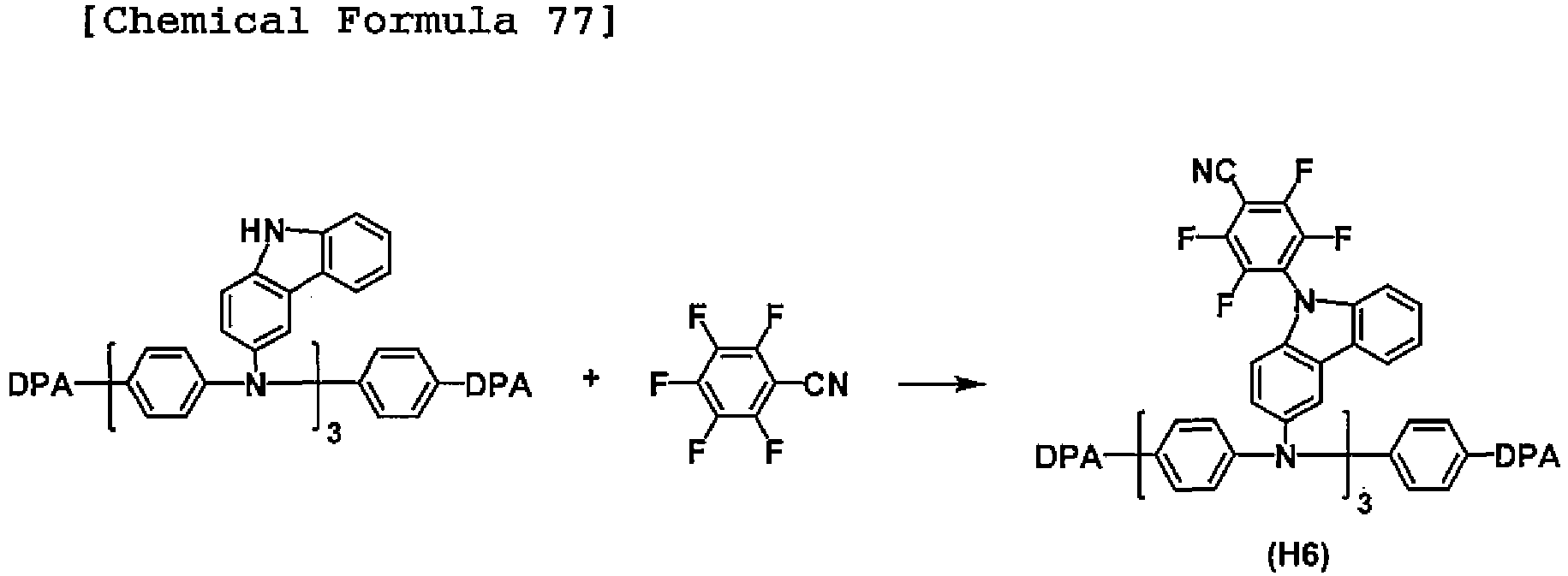
- A flask was charged with 2.36 g of Aniline Derivative B, 20 mL of N,N-dimethylformamide and 1.66 g of potassium carbonate, following which the flask interior was flushed with nitrogen. Next, while cooling the flask in an ice bath, 1.29 g of pentafluorobenzonitrile was added dropwise and the temperature was gradually raised to room temperature under stirring, after which the system was stirred at room temperature in this manner for 24 hours.
- After the completion of stirring, the reaction mixture was filtered, the solvent was distilled off under reduced pressure from the resulting filtrate, and the residue obtained was dissolved in a mixed solvent of toluene and n-hexane (3:2 (v/v)). The resulting solution was subjected to silica gel column chromatography (developing solvent: toluene/hexane). Using thin-layer column chromatography (TLC) or the like to check for the presence of the target substance, the fractions containing the target substance were separated off and collected.
- The solvent was distilled off under reduced pressure from the collected fractions and the resulting solid was dried, giving an aniline derivative of the formula (H6) (amount, 1.34 g; yield, 40%). The 1H-NMR and MALDI-TOF-MS results were as follows.
1H-NMR (300 MHz, THF-d8) δ [ppm]: - 8.02-8.10 (m, 6H), 6.90-7.46 (m, 51H).
- A charge-transporting varnish was obtained by dissolving 0.067 g of an aniline derivative represented by formula (H1) below (referred to below as "H1") as the charge-transporting substance and 0.137 g of an arylsulfonic acid compound of formula (D1) below (referred to below as "D1") as the dopant in 10 g of N,N-dimethylisobutyramide (DMIB), and using a PTFE filter having a pore size of 0.2 µm to filter the resulting solution.
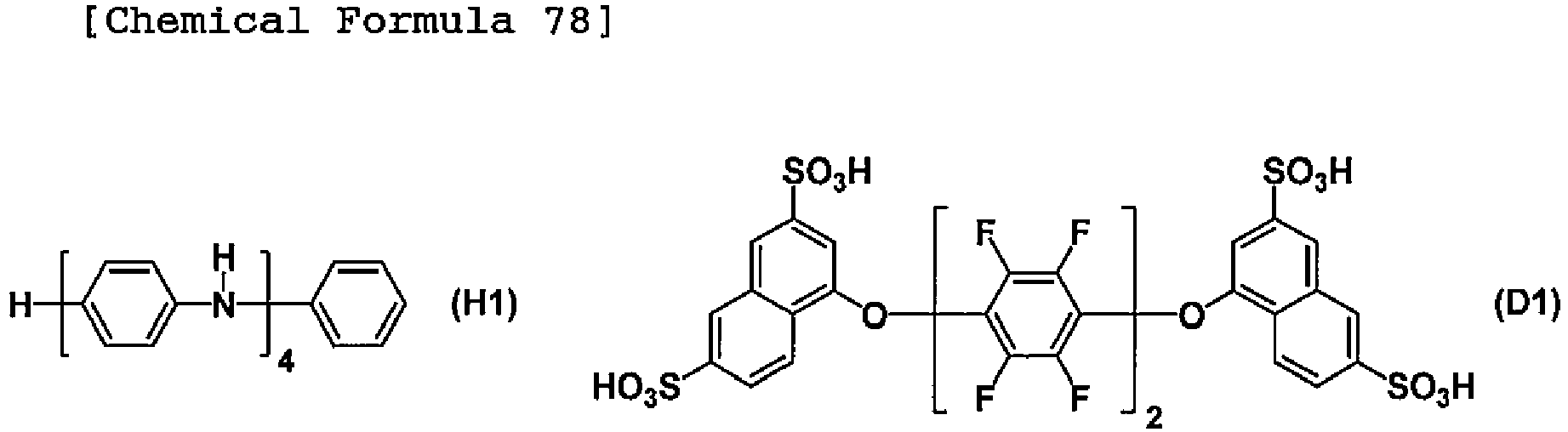
- Aside from varying the types and amounts of the charge-transporting substance, dopant and solvent used in accordance with Table 19, charge-transporting varnishes were prepared by the same method as in Working Example 1-1.
- In the table, H2 represents the aniline derivative of formula (H2) below (wherein "Ph" stands for a phenyl group), H3 represents N,N'-diphenylbenzidine, H4 represents a thiophene derivative of formula (H4) below (wherein "n-Hex" stands for an n-hexyl group), D2 represents phosphotungstic dianhydride, DPM represents dipropylene glycol monomethyl ether, 2,3-BD represents 2,3-butanediol, DMI represents 1,3-dimethyl-2-imidazolidinone, and DMAc represents N,N-dimethylacetamide.
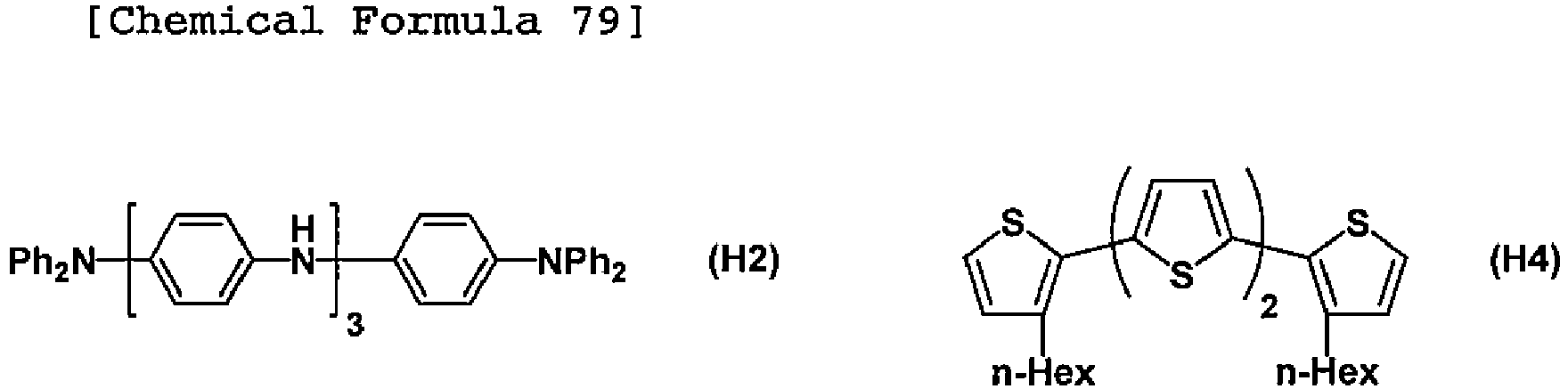
[Table 19] Charge-transporting substance Dopant Solvent Type Amount (g) Type Amount (g) Type Amount (g) Working Example 1-1 H1 0.067 D1 0.137 DMIB 10 Comparative Example 1-1 H1 0.067 D1 0.137 DMAC 10 Comparative Example 1-2 H1 0.067 D1 0.137 DMI 10 Working Example 1-2 H2 0.069 D1 0.135 DMIB 10 Comparative Example 1-3 H2 0.069 D1 0.135 DMAc 10 Comparative Example 1-4 H2 0.069 D1 0.135 DMI 10 Working Example 1-3 H2 0.052 D2 0.258 DMIB 10 Comparative Example 1-5 H2 0.052 D2 0.258 DMAC 10 Comparative Example 1-6 H2 0.052 D2 0.258 DMI 10 Working Example 1-4 H3 0.087 D1 0.117 DIM1B 10 Comparative Example 1-7 H3 0.087 D1 0.117 DMAc 10 Comparative Example 1-8 H3 0.087 D1 0.117 DMI 10 Working Example 1-5 H4 0.052 D2 0.258 DMIB 10 Comparative Example 1-9 H4 0.052 D2 0.258 DMAC 10 Comparative Example 1-10 H4 0.052 D2 0.258 DMI 10 Working Example 1-6 H5 0.208 - - DIM1B 10 Working Example 1-7 H6 0.208 - - DMIB 10 Working Example 1-8 H2 0.069 D1 0.135 DIM1B 8 2,3-BD 2 Working Example 1-9 H2 0.069 D1 0.135 DMIB 6 2,3-BD 4 Working Example 1-10 H2 0.069 D1 0.135 DMIB 4 2,3-BD 6 Working Example 1-11 H2 0.069 D1 0.135 DMIB 8 DPM 2 Working Example 1-12 H2 0.069 D1 0.135 DMIB 6 DPM 4 Working Example 1-13 H2 0.069 D1 0.135 DMIB 4 DPM 6 Working Example 1-14 H2 0.069 D1 0.135 DMIB 8 2,3-BD 1 DPM 1 Working Example 1-15 H2 0.069 D1 0.135 DIM1B 6 2,3-BD 2 DPM 2 Working Example 1-16 H2 0.069 D1 0.135 DMIB 4 2,3-BD 3 DPM 3 - The varnish obtained in Working Example 1-1 was coated onto an ITO substrate using a spin coater and was subsequently, in open air, pre-baked for 5 minutes at 50°C and then subjected to a main bake for 15 minutes at 230°C, thereby forming a 30 nm thin-film on an ITO substrate. A glass substrate with dimensions of 25 mm × 25 mm × 0.7 mm (t) and having indium-tin oxide (ITO) patterned on the surface to a film thickness of 150 nm was used as the ITO substrate. Prior to use, impurities on the surface were removed with an O2 plasma cleaning system (150 W, 30 seconds).
- Aside from using the varnishes obtained in Working Examples 1-2 to 1-16 and Comparative Examples 1-1 to 1-10 instead of the varnish obtained in Working Example 1-1, thin-films were formed by the same method as in Working Example 2-1.
- The surfaces of the resulting thin-films were examined using a laser microscope. The results are shown in
FIGS. 1 to 9 . As is apparent fromFIGS. 1 to 9 , when the varnishes of the comparative examples were used, the surfaces of the resulting thin-films were observed to be uneven and, in most cases, a high-flatness thin-film could not obtained. By contrast, when the varnishes of the invention were used, surface unevenness was substantially not observed. Also, it was possible to reproducibly produce charge-transporting thin-films of excellent flatness, regardless of the types of dopant and host used. - A 30 nm thin-film was formed on an ITO substrate by the same method as in Working Example 2-1.
- Next, using a vapor deposition system (degree of vacuum, 1.0×10⁻⁵ Pa), thin-films of α-NPD, Alq3, lithium fluoride and aluminum were successively deposited on the ITO substrate on which a thin-film had been formed, thereby giving an organic EL device. At this time, vapor deposition was carried out at a rate of 0.2 nm/s for α-NPD, Alq3 and aluminum, and at a rate of 0.02 nm/s for lithium fluoride. The film thicknesses were set to, respectively, 30 nm, 40 nm, 0.5 nm and 120 nm.
- To prevent the device characteristics from deteriorating due to the influence of oxygen, moisture and the like in air, the organic EL device was sealed with sealing substrates, following which the characteristics were evaluated. Sealing was carried out by the following procedure. The organic EL device was placed between sealing substrates in a nitrogen atmosphere having an oxygen concentration of 2 ppm or less and a dew point of not more than -85°C, and the sealing substrates were laminated together using an adhesive (WB90US(P), from Moresco Corporation). At this time, a desiccant (HD-071010W-40, from Dynic Corporation) was placed, together with the organic EL device, within the sealing substrates. The laminated sealing substrates were irradiated with UV light (wavelength, 365 nm; dosage, 6,000 mJ/cm2), then annealed at 80° C for 1 hour to cure the adhesive.
- Aside from using the varnishes obtained in, respectively, Working Example 1-2 and Comparative Examples 1-1 to 1-4 instead of the varnish obtained in Working Example 1-1, organic EL devices were fabricated in the same way as in Working Example 3-1.
- The light-emitting surface when a driving voltage of 5 V was applied to the resulting organic EL device was observed using a CCD camera installed in the I-V-L measurement system. The results are shown in
FIGS. 10 and 11 . - As is apparent from
FIGS. 10 and 11 , the thin-films produced using the varnishes of the comparative examples had poor flatnesses, and so uneven light emission was observed in devices provided with these thin-films. By contrast, the thin-films produced using the varnishes of the working examples had excellent flatnesses, and so uneven light emission was not observed in organic EL devices provided with these thin-films. - The current densities and brightnesses at a driving voltage of 5V for the devices fabricated in Working Examples 3-1 and 3-2 were measured. The results are shown in Table 20.
[Table 20] Current density (mA/cm2) Brightness (cd/m2) Current efficiency (cd/A) Working Example 3-1 91.6 2,820 3.1 Working Example 3-2 89.1 2,870 3.2 - The varnish obtained in Working Example 1-6 was coated onto an ITO substrate using a spin coater, then dried at 80°C for 1 minute and subsequently baked in an open-air atmosphere for 10 minutes at 150°C, thereby forming a uniform 30-nm thin-film on the ITO substrate. The ITO substrate used was similar to that used in Working Example 3-1.
- Next, using a vapor deposition system (degree of vacuum, 1.0×10⁻⁵ Pa), a 30 nm film of α-NPD was formed at a deposition rate of 0.2 nm/s on the ITO substrate on which a thin-film had been formed. CBP and Ir(PPy)3 were then co-vapor deposited. Co-vapor deposition was carried out while controlling the vapor deposition rate so that the Ir(PPy)3 concentration becomes 6%, thereby depositing a 40 nm layer. Next, thin-films of BAlq, lithium fluoride and aluminum were successively deposited, thereby giving an organic EL device. At this time, vapor deposition was carried out at a rate of 0.2 nm/s each for BAlq and aluminum, and at a rate of 0.02 nm/s for lithium fluoride. The film thicknesses were set to respectively 20 nm, 0.5 nm and 100 nm.
- The devices were sealed in the same way as in Working Example 3-1, following which the device characteristics were evaluated.

- Aside from using the varnish obtained in Working Example 1-7 instead of the varnish obtained in Working Example 1-6, an organic EL device was fabricated by the same method as in Working Example 3-3.
- The driving voltage, brightness and luminous efficiency at a driving current of 0.7 mA were measured for the devices fabricated in Working Examples 3-3 and 3-4. The results are shown in Table 21.
[Table 21] Working Examples Driving voltage (V) Brightness (cd/m2) Luminous efficiency (cd/A) 3-3 11.1 18.9 26.5 3-4 11.2 20.6 24.2 - As shown in Tables 20 and 21, by using charge-transporting thin-films obtained from charge-transporting varnishes of this invention as hole injection layers, organic EL devices of excellent brightness characteristics were obtained.
([m]+ calculated: 1700.46).
Claims (9)
- A charge-transporting varnish comprising a charge-transporting substance and an organic solvent, which charge-transporting varnish is characterized in that the organic solvent includes, as a good solvent, an acid amide derivative of formula (A) below
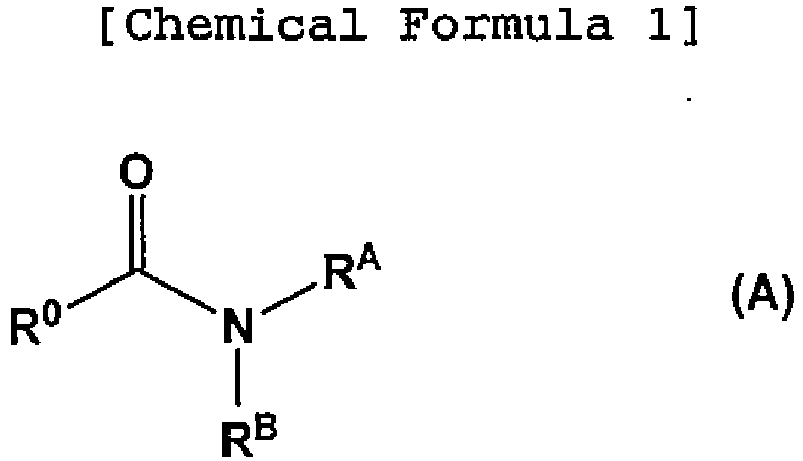
- The charge-transporting varnish of claim 1, wherein the acid amide derivative is N,N-dimethylisobutyramide.
- The charge-transporting varnish of claim 1 or 2, wherein the charge-transporting substance includes at least one compound selected from among aniline derivatives and thiophene derivatives.
- The charge-transporting varnish of any one of claims 1 to 3 which further comprises a dopant.
- A charge-transporting thin-film produced using the charge-transporting varnish of any one of claims 1 to 4.
- An organic electroluminescent device comprising the charge-transporting thin-film of claim 5.
- A method of producing a charge-transporting thin-film, which method is characterized by using the charge-transporting varnish of any one of claims 1 to 4.
- A method of fabricating an organic electroluminescent device, which method is characterized by using the charge-transporting thin-film of claim 5.
- A method of increasing the flatness of a charge-transporting thin-film produced from a charge-transporting varnish containing a charge-transporting substance and an organic solvent, which method is characterized by using an acid amide derivative of formula (A) below as the organic solvent

Applications Claiming Priority (3)
| Application Number | Priority Date | Filing Date | Title |
|---|---|---|---|
| JP2014028462 | 2014-02-18 | ||
| JP2014204996 | 2014-10-03 | ||
| PCT/JP2015/054084 WO2015125721A1 (en) | 2014-02-18 | 2015-02-16 | Charge-transporting varnish |
Publications (3)
| Publication Number | Publication Date |
|---|---|
| EP3109914A1 true EP3109914A1 (en) | 2016-12-28 |
| EP3109914A4 EP3109914A4 (en) | 2017-10-11 |
| EP3109914B1 EP3109914B1 (en) | 2021-04-28 |
Family
ID=53878225
Family Applications (1)
| Application Number | Title | Priority Date | Filing Date |
|---|---|---|---|
| EP15752676.5A Ceased EP3109914B1 (en) | 2014-02-18 | 2015-02-16 | Charge-transporting varnish |
Country Status (6)
| Country | Link |
|---|---|
| EP (1) | EP3109914B1 (en) |
| JP (1) | JP6432593B2 (en) |
| KR (1) | KR102311596B1 (en) |
| CN (1) | CN106030843B (en) |
| TW (1) | TWI638869B (en) |
| WO (1) | WO2015125721A1 (en) |
Families Citing this family (3)
| Publication number | Priority date | Publication date | Assignee | Title |
|---|---|---|---|---|
| CN110226239B (en) * | 2017-01-18 | 2022-08-09 | 日产化学株式会社 | Charge-transporting varnish and charge-transporting film using same |
| EP3731290A4 (en) * | 2017-12-20 | 2021-09-29 | Nissan Chemical Corporation | CARGO TRANSPORT PAINT |
| WO2020203407A1 (en) * | 2019-03-29 | 2020-10-08 | 日産化学株式会社 | Charge-transporting varnish |
Family Cites Families (18)
| Publication number | Priority date | Publication date | Assignee | Title |
|---|---|---|---|---|
| WO1997045842A1 (en) * | 1996-05-31 | 1997-12-04 | The Regents Of The University Of California | Stable, concentrated solutions of high molecular weight polyaniline and articles therefrom |
| US6429282B1 (en) * | 1996-05-31 | 2002-08-06 | The Regents Of The University Of California | Stable, concentrated solutions of polyaniline using amines as gel inhibitors |
| WO1999012395A1 (en) * | 1997-09-02 | 1999-03-11 | Seiko Epson Corporation | Method of producing organic el element and organic el element |
| US6677487B2 (en) * | 2001-08-30 | 2004-01-13 | Pharmacia Corporation | α-haloenamine reagents |
| TW200415954A (en) * | 2002-11-07 | 2004-08-16 | Nissan Chemical Ind Ltd | Charge-transporting varnish |
| US7528176B2 (en) * | 2004-09-14 | 2009-05-05 | Northwestern University | Carbonyl-functionalized thiophene compounds and related device structures |
| WO2006052246A1 (en) * | 2004-11-09 | 2006-05-18 | Btg International Inc. | Light-emitting materials and devices |
| EP2042484B1 (en) | 2006-07-18 | 2012-09-05 | Nissan Chemical Industries, Ltd. | Charge-transporting varnish |
| JP2008243557A (en) * | 2007-03-27 | 2008-10-09 | Osaka Univ | Organic electroluminescence device and method for manufacturing the same |
| KR101323557B1 (en) * | 2008-02-15 | 2013-10-29 | 미쓰비시 가가꾸 가부시키가이샤 | Conjugated polymer, insolubilized polymer, organic electroluminescent device material, composition for organic electroluminescent device, method for producing polymer, organic electroluminescent device, organic el display, and organic el illuminator |
| CN101328256B (en) * | 2008-07-29 | 2010-09-15 | 东南大学 | A kind of thiophene alternating copolymer with double bond in main chain and preparation method thereof |
| WO2012026452A1 (en) * | 2010-08-25 | 2012-03-01 | 日産化学工業株式会社 | Triazine ring-containing polymer and membrane-forming composition containing the same |
| EP2636697B1 (en) * | 2010-11-01 | 2018-08-15 | Nissan Chemical Industries, Ltd. | Triazine ring-containing polymer and film-forming composition containing same |
| JP5659729B2 (en) | 2010-11-24 | 2015-01-28 | 三菱瓦斯化学株式会社 | Photoresist stripper composition |
| KR101641674B1 (en) * | 2011-09-21 | 2016-07-21 | 닛산 가가쿠 고교 가부시키 가이샤 | Charge-transporting varnish |
| EP2822050B1 (en) * | 2012-03-02 | 2017-06-14 | Nissan Chemical Industries, Ltd. | Charge-transporting varnish |
| JP6311343B2 (en) * | 2013-05-09 | 2018-04-18 | Jsr株式会社 | Liquid crystal alignment agent, liquid crystal alignment film, liquid crystal display element, method for manufacturing liquid crystal alignment film, retardation film and method for manufacturing retardation film |
| WO2015050253A1 (en) * | 2013-10-04 | 2015-04-09 | 日産化学工業株式会社 | Aniline derivatives and uses thereof |
-
2015
- 2015-02-16 EP EP15752676.5A patent/EP3109914B1/en not_active Ceased
- 2015-02-16 CN CN201580009153.5A patent/CN106030843B/en active Active
- 2015-02-16 WO PCT/JP2015/054084 patent/WO2015125721A1/en not_active Ceased
- 2015-02-16 JP JP2016504082A patent/JP6432593B2/en active Active
- 2015-02-16 KR KR1020167025234A patent/KR102311596B1/en active Active
- 2015-02-17 TW TW104105683A patent/TWI638869B/en active
Also Published As
| Publication number | Publication date |
|---|---|
| KR102311596B1 (en) | 2021-10-12 |
| EP3109914B1 (en) | 2021-04-28 |
| JPWO2015125721A1 (en) | 2017-03-30 |
| WO2015125721A1 (en) | 2015-08-27 |
| CN106030843A (en) | 2016-10-12 |
| KR20160123347A (en) | 2016-10-25 |
| EP3109914A4 (en) | 2017-10-11 |
| TWI638869B (en) | 2018-10-21 |
| JP6432593B2 (en) | 2018-12-05 |
| CN106030843B (en) | 2019-01-18 |
| TW201546211A (en) | 2015-12-16 |
Similar Documents
| Publication | Publication Date | Title |
|---|---|---|
| EP3053910B1 (en) | Aniline derivatives and uses thereof | |
| JP6658728B2 (en) | Fluorine atom-containing polymer and use thereof | |
| JP2022169503A (en) | charge transport varnish | |
| EP3174115B1 (en) | Charge transport material | |
| JP2023126469A (en) | Charge transport varnish | |
| JP6947180B2 (en) | Varnish for forming charge-transporting thin films | |
| EP3109914B1 (en) | Charge-transporting varnish | |
| EP3249710B1 (en) | Charge-transporting varnish, charge-transporting film, and organic electroluminescent element | |
| EP3101003B1 (en) | Aryl sulfonic acid compound and use thereof | |
| KR20160132440A (en) | Aniline derivative and use thereof | |
| EP3101002B1 (en) | Aryl sulfonic acid compound and use of same | |
| EP3000804B1 (en) | Triphenylamine derivative and use therefor | |
| CN113631536B (en) | Fluorene derivatives and their applications | |
| JP2015092559A (en) | Charge transporting varnish, charge transporting thin film, and organic electroluminescence device | |
| EP3012245A1 (en) | Aniline derivative, charge-transporting varnish and organic electroluminescent device | |
| EP3270433A1 (en) | Composition for forming charge-transporting thin film for organic electroluminescent elements, charge-transporting thin film for organic electroluminescent elements, and organic electroluminescent element | |
| EP3056484A1 (en) | Arylsulfonic acid compound, use thereof, and method for producing arylsulfonic acid compound |
Legal Events
| Date | Code | Title | Description |
|---|---|---|---|
| PUAI | Public reference made under article 153(3) epc to a published international application that has entered the european phase |
Free format text: ORIGINAL CODE: 0009012 |
|
| STAA | Information on the status of an ep patent application or granted ep patent |
Free format text: STATUS: REQUEST FOR EXAMINATION WAS MADE |
|
| 17P | Request for examination filed |
Effective date: 20160826 |
|
| AK | Designated contracting states |
Kind code of ref document: A1 Designated state(s): AL AT BE BG CH CY CZ DE DK EE ES FI FR GB GR HR HU IE IS IT LI LT LU LV MC MK MT NL NO PL PT RO RS SE SI SK SM TR |
|
| AX | Request for extension of the european patent |
Extension state: BA ME |
|
| DAX | Request for extension of the european patent (deleted) | ||
| REG | Reference to a national code |
Ref country code: DE Ref legal event code: R079 Ref document number: 602015068665 Country of ref document: DE Free format text: PREVIOUS MAIN CLASS: H01L0051500000 Ipc: C09D0005240000 |
|
| RIC1 | Information provided on ipc code assigned before grant |
Ipc: C09D 165/00 20060101ALI20170831BHEP Ipc: H05B 33/10 20060101ALI20170831BHEP Ipc: H01B 1/12 20060101ALI20170831BHEP Ipc: C09D 179/02 20060101ALI20170831BHEP Ipc: C09D 5/24 20060101AFI20170831BHEP Ipc: C09D 11/52 20140101ALI20170831BHEP Ipc: H01L 51/00 20060101ALI20170831BHEP Ipc: H01L 51/50 20060101ALI20170831BHEP Ipc: C08K 5/42 20060101ALI20170831BHEP |
|
| A4 | Supplementary search report drawn up and despatched |
Effective date: 20170911 |
|
| RAP1 | Party data changed (applicant data changed or rights of an application transferred) |
Owner name: NISSAN CHEMICAL CORPORATION |
|
| STAA | Information on the status of an ep patent application or granted ep patent |
Free format text: STATUS: EXAMINATION IS IN PROGRESS |
|
| 17Q | First examination report despatched |
Effective date: 20190304 |
|
| GRAP | Despatch of communication of intention to grant a patent |
Free format text: ORIGINAL CODE: EPIDOSNIGR1 |
|
| STAA | Information on the status of an ep patent application or granted ep patent |
Free format text: STATUS: GRANT OF PATENT IS INTENDED |
|
| INTG | Intention to grant announced |
Effective date: 20201204 |
|
| GRAS | Grant fee paid |
Free format text: ORIGINAL CODE: EPIDOSNIGR3 |
|
| GRAA | (expected) grant |
Free format text: ORIGINAL CODE: 0009210 |
|
| STAA | Information on the status of an ep patent application or granted ep patent |
Free format text: STATUS: THE PATENT HAS BEEN GRANTED |
|
| RBV | Designated contracting states (corrected) |
Designated state(s): DE |
|
| AK | Designated contracting states |
Kind code of ref document: B1 Designated state(s): DE |
|
| REG | Reference to a national code |
Ref country code: DE Ref legal event code: R096 Ref document number: 602015068665 Country of ref document: DE |
|
| REG | Reference to a national code |
Ref country code: DE Ref legal event code: R097 Ref document number: 602015068665 Country of ref document: DE |
|
| PLBE | No opposition filed within time limit |
Free format text: ORIGINAL CODE: 0009261 |
|
| STAA | Information on the status of an ep patent application or granted ep patent |
Free format text: STATUS: NO OPPOSITION FILED WITHIN TIME LIMIT |
|
| 26N | No opposition filed |
Effective date: 20220131 |
|
| REG | Reference to a national code |
Ref country code: DE Ref legal event code: R119 Ref document number: 602015068665 Country of ref document: DE |
|
| PG25 | Lapsed in a contracting state [announced via postgrant information from national office to epo] |
Ref country code: DE Free format text: LAPSE BECAUSE OF NON-PAYMENT OF DUE FEES Effective date: 20220901 |