EP3050878B1 - Neuartige stickstoffhaltige verbindung oder salz davon oder metallkomplex davon - Google Patents
Neuartige stickstoffhaltige verbindung oder salz davon oder metallkomplex davon Download PDFInfo
- Publication number
- EP3050878B1 EP3050878B1 EP14849898.3A EP14849898A EP3050878B1 EP 3050878 B1 EP3050878 B1 EP 3050878B1 EP 14849898 A EP14849898 A EP 14849898A EP 3050878 B1 EP3050878 B1 EP 3050878B1
- Authority
- EP
- European Patent Office
- Prior art keywords
- group
- groups
- ethyl
- compound
- optionally substituted
- Prior art date
- Legal status (The legal status is an assumption and is not a legal conclusion. Google has not performed a legal analysis and makes no representation as to the accuracy of the status listed.)
- Active
Links
- 0 CC(Nc1ccc(CCC(C(O)=O)N2CCN(CC(O)=O)CCN(C*)CCN(C*)CC2)cc1)=S Chemical compound CC(Nc1ccc(CCC(C(O)=O)N2CCN(CC(O)=O)CCN(C*)CCN(C*)CC2)cc1)=S 0.000 description 19
- MOQBDZKMXSQTBL-UHFFFAOYSA-N CC(CN1CCN(CC(O)=O)CCN(CC(O)=O)CC1)=O Chemical compound CC(CN1CCN(CC(O)=O)CCN(CC(O)=O)CC1)=O MOQBDZKMXSQTBL-UHFFFAOYSA-N 0.000 description 1
Images




Classifications
-
- C—CHEMISTRY; METALLURGY
- C07—ORGANIC CHEMISTRY
- C07D—HETEROCYCLIC COMPOUNDS
- C07D401/00—Heterocyclic compounds containing two or more hetero rings, having nitrogen atoms as the only ring hetero atoms, at least one ring being a six-membered ring with only one nitrogen atom
- C07D401/02—Heterocyclic compounds containing two or more hetero rings, having nitrogen atoms as the only ring hetero atoms, at least one ring being a six-membered ring with only one nitrogen atom containing two hetero rings
- C07D401/12—Heterocyclic compounds containing two or more hetero rings, having nitrogen atoms as the only ring hetero atoms, at least one ring being a six-membered ring with only one nitrogen atom containing two hetero rings linked by a chain containing hetero atoms as chain links
-
- A—HUMAN NECESSITIES
- A61—MEDICAL OR VETERINARY SCIENCE; HYGIENE
- A61K—PREPARATIONS FOR MEDICAL, DENTAL OR TOILETRY PURPOSES
- A61K51/00—Preparations containing radioactive substances for use in therapy or testing in vivo
- A61K51/02—Preparations containing radioactive substances for use in therapy or testing in vivo characterised by the carrier, i.e. characterised by the agent or material covalently linked or complexing the radioactive nucleus
- A61K51/04—Organic compounds
- A61K51/08—Peptides, e.g. proteins, carriers being peptides, polyamino acids, proteins
- A61K51/088—Peptides, e.g. proteins, carriers being peptides, polyamino acids, proteins conjugates with carriers being peptides, polyamino acids or proteins
-
- A—HUMAN NECESSITIES
- A61—MEDICAL OR VETERINARY SCIENCE; HYGIENE
- A61K—PREPARATIONS FOR MEDICAL, DENTAL OR TOILETRY PURPOSES
- A61K51/00—Preparations containing radioactive substances for use in therapy or testing in vivo
- A61K51/02—Preparations containing radioactive substances for use in therapy or testing in vivo characterised by the carrier, i.e. characterised by the agent or material covalently linked or complexing the radioactive nucleus
- A61K51/04—Organic compounds
- A61K51/041—Heterocyclic compounds
- A61K51/044—Heterocyclic compounds having nitrogen as a ring hetero atom, e.g. guanethidine, rifamycins
- A61K51/0455—Heterocyclic compounds having nitrogen as a ring hetero atom, e.g. guanethidine, rifamycins having six-membered rings with one nitrogen as the only ring hetero atom
-
- A—HUMAN NECESSITIES
- A61—MEDICAL OR VETERINARY SCIENCE; HYGIENE
- A61K—PREPARATIONS FOR MEDICAL, DENTAL OR TOILETRY PURPOSES
- A61K51/00—Preparations containing radioactive substances for use in therapy or testing in vivo
- A61K51/02—Preparations containing radioactive substances for use in therapy or testing in vivo characterised by the carrier, i.e. characterised by the agent or material covalently linked or complexing the radioactive nucleus
- A61K51/04—Organic compounds
- A61K51/0474—Organic compounds complexes or complex-forming compounds, i.e. wherein a radioactive metal (e.g. 111In3+) is complexed or chelated by, e.g. a N2S2, N3S, NS3, N4 chelating group
- A61K51/0478—Organic compounds complexes or complex-forming compounds, i.e. wherein a radioactive metal (e.g. 111In3+) is complexed or chelated by, e.g. a N2S2, N3S, NS3, N4 chelating group complexes from non-cyclic ligands, e.g. EDTA, MAG3
-
- A—HUMAN NECESSITIES
- A61—MEDICAL OR VETERINARY SCIENCE; HYGIENE
- A61K—PREPARATIONS FOR MEDICAL, DENTAL OR TOILETRY PURPOSES
- A61K51/00—Preparations containing radioactive substances for use in therapy or testing in vivo
- A61K51/02—Preparations containing radioactive substances for use in therapy or testing in vivo characterised by the carrier, i.e. characterised by the agent or material covalently linked or complexing the radioactive nucleus
- A61K51/04—Organic compounds
- A61K51/0474—Organic compounds complexes or complex-forming compounds, i.e. wherein a radioactive metal (e.g. 111In3+) is complexed or chelated by, e.g. a N2S2, N3S, NS3, N4 chelating group
- A61K51/0482—Organic compounds complexes or complex-forming compounds, i.e. wherein a radioactive metal (e.g. 111In3+) is complexed or chelated by, e.g. a N2S2, N3S, NS3, N4 chelating group chelates from cyclic ligands, e.g. DOTA
-
- A—HUMAN NECESSITIES
- A61—MEDICAL OR VETERINARY SCIENCE; HYGIENE
- A61P—SPECIFIC THERAPEUTIC ACTIVITY OF CHEMICAL COMPOUNDS OR MEDICINAL PREPARATIONS
- A61P35/00—Antineoplastic agents
-
- A—HUMAN NECESSITIES
- A61—MEDICAL OR VETERINARY SCIENCE; HYGIENE
- A61P—SPECIFIC THERAPEUTIC ACTIVITY OF CHEMICAL COMPOUNDS OR MEDICINAL PREPARATIONS
- A61P9/00—Drugs for disorders of the cardiovascular system
-
- C—CHEMISTRY; METALLURGY
- C07—ORGANIC CHEMISTRY
- C07D—HETEROCYCLIC COMPOUNDS
- C07D213/00—Heterocyclic compounds containing six-membered rings, not condensed with other rings, with one nitrogen atom as the only ring hetero atom and three or more double bonds between ring members or between ring members and non-ring members
- C07D213/02—Heterocyclic compounds containing six-membered rings, not condensed with other rings, with one nitrogen atom as the only ring hetero atom and three or more double bonds between ring members or between ring members and non-ring members having three double bonds between ring members or between ring members and non-ring members
- C07D213/04—Heterocyclic compounds containing six-membered rings, not condensed with other rings, with one nitrogen atom as the only ring hetero atom and three or more double bonds between ring members or between ring members and non-ring members having three double bonds between ring members or between ring members and non-ring members having no bond between the ring nitrogen atom and a non-ring member or having only hydrogen or carbon atoms directly attached to the ring nitrogen atom
- C07D213/60—Heterocyclic compounds containing six-membered rings, not condensed with other rings, with one nitrogen atom as the only ring hetero atom and three or more double bonds between ring members or between ring members and non-ring members having three double bonds between ring members or between ring members and non-ring members having no bond between the ring nitrogen atom and a non-ring member or having only hydrogen or carbon atoms directly attached to the ring nitrogen atom with hetero atoms or with carbon atoms having three bonds to hetero atoms with at the most one bond to halogen, e.g. ester or nitrile radicals, directly attached to ring carbon atoms
- C07D213/72—Nitrogen atoms
- C07D213/73—Unsubstituted amino or imino radicals
-
- C—CHEMISTRY; METALLURGY
- C07—ORGANIC CHEMISTRY
- C07D—HETEROCYCLIC COMPOUNDS
- C07D213/00—Heterocyclic compounds containing six-membered rings, not condensed with other rings, with one nitrogen atom as the only ring hetero atom and three or more double bonds between ring members or between ring members and non-ring members
- C07D213/02—Heterocyclic compounds containing six-membered rings, not condensed with other rings, with one nitrogen atom as the only ring hetero atom and three or more double bonds between ring members or between ring members and non-ring members having three double bonds between ring members or between ring members and non-ring members
- C07D213/04—Heterocyclic compounds containing six-membered rings, not condensed with other rings, with one nitrogen atom as the only ring hetero atom and three or more double bonds between ring members or between ring members and non-ring members having three double bonds between ring members or between ring members and non-ring members having no bond between the ring nitrogen atom and a non-ring member or having only hydrogen or carbon atoms directly attached to the ring nitrogen atom
- C07D213/60—Heterocyclic compounds containing six-membered rings, not condensed with other rings, with one nitrogen atom as the only ring hetero atom and three or more double bonds between ring members or between ring members and non-ring members having three double bonds between ring members or between ring members and non-ring members having no bond between the ring nitrogen atom and a non-ring member or having only hydrogen or carbon atoms directly attached to the ring nitrogen atom with hetero atoms or with carbon atoms having three bonds to hetero atoms with at the most one bond to halogen, e.g. ester or nitrile radicals, directly attached to ring carbon atoms
- C07D213/72—Nitrogen atoms
- C07D213/75—Amino or imino radicals, acylated by carboxylic or carbonic acids, or by sulfur or nitrogen analogues thereof, e.g. carbamates
-
- C—CHEMISTRY; METALLURGY
- C07—ORGANIC CHEMISTRY
- C07D—HETEROCYCLIC COMPOUNDS
- C07D401/00—Heterocyclic compounds containing two or more hetero rings, having nitrogen atoms as the only ring hetero atoms, at least one ring being a six-membered ring with only one nitrogen atom
- C07D401/14—Heterocyclic compounds containing two or more hetero rings, having nitrogen atoms as the only ring hetero atoms, at least one ring being a six-membered ring with only one nitrogen atom containing three or more hetero rings
-
- C—CHEMISTRY; METALLURGY
- C07—ORGANIC CHEMISTRY
- C07D—HETEROCYCLIC COMPOUNDS
- C07D471/00—Heterocyclic compounds containing nitrogen atoms as the only ring hetero atoms in the condensed system, at least one ring being a six-membered ring with one nitrogen atom, not provided for by groups C07D451/00 - C07D463/00
- C07D471/02—Heterocyclic compounds containing nitrogen atoms as the only ring hetero atoms in the condensed system, at least one ring being a six-membered ring with one nitrogen atom, not provided for by groups C07D451/00 - C07D463/00 in which the condensed system contains two hetero rings
- C07D471/04—Ortho-condensed systems
-
- C—CHEMISTRY; METALLURGY
- C07—ORGANIC CHEMISTRY
- C07D—HETEROCYCLIC COMPOUNDS
- C07D519/00—Heterocyclic compounds containing more than one system of two or more relevant hetero rings condensed among themselves or condensed with a common carbocyclic ring system not provided for in groups C07D453/00 or C07D455/00
-
- C—CHEMISTRY; METALLURGY
- C07—ORGANIC CHEMISTRY
- C07K—PEPTIDES
- C07K5/00—Peptides containing up to four amino acids in a fully defined sequence; Derivatives thereof
- C07K5/04—Peptides containing up to four amino acids in a fully defined sequence; Derivatives thereof containing only normal peptide links
- C07K5/08—Tripeptides
-
- C—CHEMISTRY; METALLURGY
- C07—ORGANIC CHEMISTRY
- C07K—PEPTIDES
- C07K5/00—Peptides containing up to four amino acids in a fully defined sequence; Derivatives thereof
- C07K5/04—Peptides containing up to four amino acids in a fully defined sequence; Derivatives thereof containing only normal peptide links
- C07K5/10—Tetrapeptides
-
- C—CHEMISTRY; METALLURGY
- C07—ORGANIC CHEMISTRY
- C07K—PEPTIDES
- C07K5/00—Peptides containing up to four amino acids in a fully defined sequence; Derivatives thereof
- C07K5/04—Peptides containing up to four amino acids in a fully defined sequence; Derivatives thereof containing only normal peptide links
- C07K5/06—Dipeptides
- C07K5/06008—Dipeptides with the first amino acid being neutral
- C07K5/06017—Dipeptides with the first amino acid being neutral and aliphatic
- C07K5/0606—Dipeptides with the first amino acid being neutral and aliphatic the side chain containing heteroatoms not provided for by C07K5/06086 - C07K5/06139, e.g. Ser, Met, Cys, Thr
-
- Y—GENERAL TAGGING OF NEW TECHNOLOGICAL DEVELOPMENTS; GENERAL TAGGING OF CROSS-SECTIONAL TECHNOLOGIES SPANNING OVER SEVERAL SECTIONS OF THE IPC; TECHNICAL SUBJECTS COVERED BY FORMER USPC CROSS-REFERENCE ART COLLECTIONS [XRACs] AND DIGESTS
- Y02—TECHNOLOGIES OR APPLICATIONS FOR MITIGATION OR ADAPTATION AGAINST CLIMATE CHANGE
- Y02P—CLIMATE CHANGE MITIGATION TECHNOLOGIES IN THE PRODUCTION OR PROCESSING OF GOODS
- Y02P20/00—Technologies relating to chemical industry
- Y02P20/50—Improvements relating to the production of bulk chemicals
- Y02P20/55—Design of synthesis routes, e.g. reducing the use of auxiliary or protecting groups
Definitions
- the present invention relates to a novel nitrogen-containing compound or a salt thereof, or a complex of the compound or the salt with a metal.
- Integrins constitute a family of heterodimeric glycoprotein complexes composed of ⁇ and ⁇ subunits and are one kind of cell adhesion receptor involved mainly in cell adhesion to extracellular matrix and signal transduction from extracellular matrix.
- integrins ⁇ v ⁇ 3 and ⁇ v ⁇ 5 which are vitronectin receptors, are known to be low expressed on epithelial cells or mature endothelial cells, but overexpressed on various tumor cells or neovessels.
- Non Patent Literature 1 The overexpression of the integrins ⁇ v ⁇ 3 and ⁇ v ⁇ 5 is reportedly involved in the exacerbation of cancers, including infiltration, metastasis, accompanied by tumor angiogenesis, and highly related to the degree of malignancy (Non Patent Literature 1).
- head and neck cancer, colorectal cancer, breast cancer, small-cell lung cancer, non-small cell lung cancer, glioblastoma, malignant melanoma, pancreatic cancer, and prostate cancer have been found as the cancers in which these integrins are overexpressed (Non Patent Literature 2).
- integrin overexpression on vascular endothelial cells during angiogenesis after ischemia has been revealed in ischemic diseases such as ischemic heart disease or peripheral vascular disease (Non Patent Literature 3).
- Patent Literatures 1 to 4 Treatment or imaging of disease site using low-molecular compounds (Patent Literatures 1 to 4) or compounds labeled with a radioisotope (Patent Literatures 5 to 7) has been reported.
- Non Patent Literatures 4 and 5 have been reported as attempts of imaging using a peptide ligand having an Arg-Gly-Asp (RGD) sequence, and Patent Literature 5 has been reported as an attempt using a nonpeptide low molecule. Also, the visualization of human tumors using compounds carrying a positron nuclide 18 F (Non Patent Literatures 6 and 7) or the like has been attempted (Non Patent Literatures 8 and 9).
- the conventional peptide having an RGD sequence is not sufficiently effective when applied to imaging or treatment, because of its low tumor accumulation and persistence as imaging and therapeutic drugs.
- slow blood clearance may require about several days to 1 week for taking images with decreased blood values as a background. This is a serious disadvantage in consideration of the short halflife of a radioactive metal suitable for imaging.
- long-term blood circulation means the dominant irradiation of the bone marrow and tends to cause severe bone marrow toxicity.
- an object of the present invention is to provide an integrin-binding compound which has high accumulation and persistence in neovessels and tumors involving an integrin and exhibits fast blood clearance, and an agent for diagnosis or treatment, etc., comprising the compound as an active ingredient.
- the present inventors have conducted diligent studies and consequently found that a complex of a compound represented by the following formula (1) or a salt thereof with a metal is useful as an agent for of diagnosis or treatment, etc., of a disease involving an integrin as defined in the claims.
- the present inventors have also found that the compound represented by the following formula (1) or the salt thereof is useful as an intermediate for producing such a complex as defined in the claims.
- the present inventors have further found that a compound represented by the formula (S1a) shown below or a salt thereof is useful as an intermediate for producing the compound represented by the formula (1) or the salt thereof, or the complex of the compound or the salt with a metal. On the basis of these findings, the present invention has been completed.
- a compound represented by the formula (1) or a salt thereof, or a complex of the compound or the salt with a metal wherein A 1 represents a chelating agent; R 1 represents a hydrogen atom, an optionally substituted C 1-6 alkyl group, or an amino-protecting group; R 2 represents a hydrogen atom, an optionally substituted C 1-6 alkyl group, or an amino-protecting group; Z 1 , Z 2 , Z 3 , Z 4 , and Z 5 are the same or different and each represent a nitrogen atom or CR 3 wherein R 3 represents a hydrogen atom, a halogen atom, an optionally substituted C 1-6 alkyl group, an optionally substituted C 1-6 alkoxy group, or a group represented by the formula (2): wherein R 4 represents a hydrogen atom, an optionally substituted C 1-6 alkyl group, or an amino-protecting group; n number of R 5 and n number of R
- the complex of the compound represented by the formula (1) or a salt thereof with a metal of the present invention has high accumulation and persistence in integrin-expressing cells such as cancer cells and exhibits fast blood clearance. Therefore, the complex is useful for a procedure of diagnosis or treatment, etc., of a disease involving an integrin.
- the compound represented by the formula (1) or the salt thereof of the present invention is useful as an intermediate for producing the complex.
- the compound represented by the formula (S1a) of the present invention or a salt thereof is useful as an intermediate for producing the compound represented by the formula (1) or the salt thereof, or the complex of the compound or the salt with a metal of the present invention.
- the group represented by the following formula: used in the present invention means a group in which x number of A are bonded. x number of A may be the same or may be different.
- each term has the following meaning, unless otherwise specified.
- the halogen atom means a fluorine atom, a chlorine atom, a bromine atom, or an iodine atom.
- the C 1-4 alkyl group means a methyl, ethyl, propyl, isopropyl, butyl, sec-butyl, isobutyl, or tert-butyl group.
- the C 1-6 alkyl group means a linear or branched C 1-6 alkyl group such as methyl, ethyl, propyl, isopropyl, butyl, sec-butyl, isobutyl, tert-butyl, pentyl, isopentyl, 2-methylbutyl, 2-pentyl, 3-pentyl, and hexyl groups.
- the aryl group means a C 6-10 aryl group such as phenyl and naphthyl groups.
- the ar-C 1-6 alkyl group means a C 6-10 arC 1-6 alkyl group such as benzyl, diphenylmethyl, trityl, phenethyl, 2-phenylpropyl, 3-phenylpropyl, and naphthylmethyl groups.
- the C 1-4 alkylene group means a linear or branched C 1-4 alkylene group such as methylene, ethylene, propylene, and butylene groups.
- the C 1-6 alkylene group means a linear or branched C 1-6 alkylene group such as methylene, ethylene, propylene, butylene, pentylene, and hexylene groups.
- the -O-C 1-6 alkylene group means a group in which the C 1-6 alkylene group is bonded to an oxygen atom, such as oxyethylene, oxypropylene, and oxybutylene groups.
- the -NH-C 1-6 alkylene group means a group in which the C 1-6 alkylene group is bonded to an amino group, such as aminoethylene, aminopropylene, and aminobutylene groups.
- the C 3-8 cycloalkylene group means a cyclopropylene, cyclobutylene, cyclopentylene, cyclohexylene, cycloheptylene, or cyclooctylene group.
- the C 1-4 alkanetriyl group means a linear or branched C 1-4 alkanetriyl group such as methanetriyl, ethanetriyl, propanetriyl, and butanetriyl groups.
- the C 1-6 alkanetriyl group means a linear or branched C 1-6 alkanetriyl group such as methanetriyl, ethanetriyl, propanetriyl, butanetriyl, pentanetriyl, and hexanetriyl groups.
- the C 1-6 alkoxy group means a linear, cyclic, or branched C 1-6 alkyloxy group such as methoxy, ethoxy, propoxy, isopropoxy, cyclopropoxy, butoxy, isobutoxy, sec-butoxy, tert-butoxy, cyclobutoxy, pentyloxy, and hexyloxy groups.
- the C 1-6 alkoxy-C 1-6 alkyl group means a C 1-6 alkyloxy-C 1-6 alkyl group such as methoxymethyl and 1-ethoxyethyl groups.
- the C 1-6 alkylamino group means a linear, branched, or cyclic C 1-6 alkylamino group such as methylamino, ethylamino, propylamino, isopropylamino, cyclopropylamino, butylamino, sec-butylamino, tert-butylamino, cyclobutylamino, pentylamino, cyclopentylamino, hexylamino, and cyclohexylamino groups.
- the di (C 1-6 alkyl)amino group means a linear, branched, or cyclic di (C 1-6 alkyl) amino group such as dimethylamino, diethylamino, dipropylamino, diisopropylamino, dibutylamino, di(tert-butyl)amino, dipentylamino, dihexylamino, (ethyl)(methyl)amino, (methyl)(propyl)amino, (cyclopropyl)(methyl)amino, (cyclobutyl)(methyl)amino, and (cyclohexyl)(methyl)amino groups.
- the C 2-6 alkanoyl group means a linear or branched C 2 - 6 alkanoyl group such as acetyl, propionyl, valeryl, isovaleryl, and pivaloyl groups.
- the aroyl group means a C 6-10 aroyl group such as benzoyl and naphthoyl groups.
- the heterocyclic carbonyl group means a monocyclic or bicyclic heterocyclic carbonyl group such as furoyl, thenoyl, pyrrolidinylcarbonyl, piperidinylcarbonyl, piperazinylcarbonyl, morpholinylcarbonyl, and pyridinylcarbonyl groups.
- the acyl group means a formyl group, a succinyl group, a glutaryl group, a maleoyl group, a phthaloyl group, a C 2-6 alkanoyl group, an aroyl group, or a heterocyclic carbonyl group.
- the C 1-6 alkoxycarbonyl group means a linear or branched C 1-6 alkyloxycarbonyl group such as methoxycarbonyl, ethoxycarbonyl, isopropoxycarbonyl, tert-butoxycarbonyl, and 1,1-dimethylpropoxycarbonyl groups.
- the ar-C 1-6 alkoxycarbonyl group means a C 6-10 arC 1-6 alkyloxycarbonyl group such as benzyloxycarbonyl and phenethyloxycarbonyl groups.
- the C 1-6 alkylthio group means a C 1-6 alkylthio group such as methylthio, ethylthio, propylthio, and butylthio groups.
- the C 1-6 alkylsulfonyl group means a C 1-6 alkylsulfonyl group such as methylsulfonyl, ethylsulfonyl, and propylsulfonyl groups.
- the arylsulfonyl group means a C 6-10 arylsulfonyl group such as benzenesulfonyl, p-toluenesulfonyl, and naphthalenesulfonyl groups.
- the C 1-6 alkylsulfonyloxy group means a C 1-6 alkylsulfonyloxy group such as methylsulfonyloxy and ethylsulfonyloxy groups.
- the arylsulfonyloxy group means a C 6-10 arylsulfonyloxy group such as benzenesulfonyloxy and p-toluenesulfonyloxy groups.
- the monocyclic nitrogen-containing heterocyclic group means a monocyclic heterocyclic group containing only a nitrogen atom as a heteroatom constituting the ring, such as aziridinyl, azetidinyl, pyrrolidinyl, pyrrolinyl, pyrrolyl, piperidyl, tetrahydropyridyl, dihydropyridyl, pyridyl, homopiperidinyl, octahydroazocinyl, imidazolidinyl, imidazolinyl, imidazolyl, pyrazolidinyl, pyrazolinyl, pyrazolyl, piperazinyl, pyrazinyl, pyridazinyl, pyrimidinyl, homopiperazinyl, triazolyl, and tetrazolyl groups.
- the monocyclic oxygen-containing heterocyclic group means a monocyclic heterocyclic group containing only an oxygen atom as a heteroatom constituting the ring, such as oxetanyl, tetrahydrofuranyl, furanyl, tetrahydropyranyl, pyranyl, 1,3-dioxanyl, and 1,4-dioxanyl groups.
- the monocyclic sulfur-containing heterocyclic group means a monocyclic heterocyclic group containing only a sulfur atom as a heteroatom constituting the ring, such as a thienyl group.
- the monocyclic nitrogen- and oxygen-containing heterocyclic group means a monocyclic heterocyclic group containing only a nitrogen atom and an oxygen atom as heteroatoms constituting the ring, such as oxazolyl, isoxazolyl, oxadiazolyl, morpholinyl, and oxazepanyl groups.
- the monocyclic nitrogen- and sulfur-containing heterocyclic group means a monocyclic heterocyclic group containing only a nitrogen atom and a sulfur atom as heteroatoms constituting the ring, such as thiazolyl, isothiazolyl, thiadiazolyl, thiomorpholinyl, 1-oxidothiomorpholinyl, and 1,1-dioxidothiomorpholinyl groups.
- the monocyclic heterocyclic group means a monocyclic nitrogen-containing heterocyclic group, a monocyclic oxygen-containing heterocyclic group, a monocyclic sulfur-containing heterocyclic group, a monocyclic nitrogen- and oxygen-containing heterocyclic group, or a monocyclic nitrogen- and sulfur-containing heterocyclic group.
- the bicyclic nitrogen-containing heterocyclic group means a bicyclic heterocyclic group containing only a nitrogen atom as a heteroatom constituting the rings, such as indolinyl, indolyl, isoindolinyl, isoindolyl, benzimidazolyl, indazolyl, benzotriazolyl, pyrazolopyridinyl, quinolyl, tetrahydroquinolinyl, quinolyl, tetrahydroisoquinolinyl, isoquinolinyl, quinolizinyl, cinnolinyl, phthalazinyl, quinazolinyl, dihydroquinoxalinyl, quinoxalinyl, naphthyridinyl, purinyl, pteridinyl, and quinuclidinyl groups.
- the bicyclic oxygen-containing heterocyclic group means a bicyclic heterocyclic group containing only an oxygen atom as a heteroatom constituting the rings, such as 2,3-dihydrobenzofuranyl, benzofuranyl, isobenzofuranyl, chromanyl, chromenyl, isochromanyl, 1,3-benzodioxolyl, 1,3-benzodioxanyl, and 1,4-benzodioxanyl groups.
- the bicyclic sulfur-containing heterocyclic group means a bicyclic heterocyclic group containing only a sulfur atom as a heteroatom constituting the rings, such as 2,3-dihydrobenzothienyl and benzothienyl groups.
- the bicyclic nitrogen- and oxygen-containing heterocyclic group means a bicyclic heterocyclic group containing only a nitrogen atom and an oxygen atom as heteroatoms constituting the rings, such as benzoxazolyl, benzisoxazolyl, benzoxadiazolyl, benzomorpholinyl, dihydropyranopyridyl, dioxolopyridyl, furopyridinyl, dihydrodioxinopyridyl, and dihydropyridooxazinyl groups.
- the bicyclic nitrogen- and sulfur-containing heterocyclic group means a bicyclic heterocyclic group containing a nitrogen atom and a sulfur atom as heteroatoms constituting the rings, such as benzothiazolyl, benzisothiazolyl, and benzothiadiazolyl groups.
- the bicyclic heterocyclic group means a bicyclic nitrogen-containing heterocyclic group, a bicyclic oxygen-containing heterocyclic group, a bicyclic sulfur-containing heterocyclic group, a bicyclic nitrogen- and oxygen-containing heterocyclic group, or a bicyclic nitrogen- and sulfur-containing heterocyclic group.
- the heterocyclic group means a monocyclic heterocyclic group or a bicyclic heterocyclic group.
- the divalent aromatic hydrocarbon group means an optionally partially hydrogenated divalent aromatic hydrocarbon group such as phenylene, pentalenylene, indanylene, indenylene, and naphthylene groups.
- the divalent heterocyclic group means a group formed by the further removal of one hydrogen atom from a heterocyclic group, such as pyrrolediyl, imidazolediyl, triazolediyl, tetrazolediyl, pyrrolidinediyl, imidazolidinediyl, furandiyl, thiophenediyl, oxazolediyl, thiazolediyl, pyridinediyl, pyrimidinediyl, indolediyl, quinolinediyl, and isoquinolinediyl groups.
- the amino-protecting group includes ar-C 1-6 alkyl groups, C 1-6 alkoxy-C 1-6 alkyl groups, acyl groups, C 1-6 alkoxycarbonyl groups, ar-C 1-6 alkoxycarbonyl groups, C 1-6 alkylsulfonyl groups, arylsulfonyl groups, and silyl groups.
- the hydroxyl-protecting group includes all groups which may be used as usual protecting groups for the hydroxyl group. Examples thereof include groups described in W. Greene et al., Protective Groups in Organic Synthesis, Vol. 4, p. 16-366, 2007, John Wiley & Sons, INC .
- C 1-6 alkyl groups ar-C 1-6 alkyl groups, C 1-6 alkoxy-C 1-6 alkyl groups, acyl groups, C 1-6 alkoxycarbonyl groups, ar-C 1-6 alkoxycarbonyl groups, C 1-6 alkylsulfonyl groups, arylsulfonyl groups, silyl groups, a tetrahydrofuranyl group, and a tetrahydropyranyl group.
- the carboxyl-protecting group includes C 1-6 alkyl groups, aryl groups, ar-C 1-6 alkyl groups, C 1-6 alkoxy-C 1-6 alkyl groups, and silyl groups.
- the thiol-protecting group includes all groups which may be used as usual protecting groups for the thiol group. Examples thereof include groups described in W. Greene et al., Protective Groups in Organic Synthesis, Vol. 4, p. 647-695, 2007, John Wiley & Sons, INC . Specific examples thereof include C 1-6 alkyl groups, arC 1-6 alkyl groups, C 1-6 alkoxy-C 1-6 alkyl groups, acyl groups, and silyl groups.
- the silyl group means, for example, a trimethylsilyl, triethylsilyl, tributylsilyl, or tert-butyldimethylsilyl group.
- Examples of the leaving group include halogen atoms, C 1-6 alkylsulfonyloxy groups, and arylsulfonyloxy groups.
- the C 1-6 alkylsulfonyloxy groups and the arylsulfonyloxy groups are each optionally substituted.
- the chelating group means an organic group capable of forming a chelate bond with a metal. Specific examples thereof include groups having an alkylenediamine structure, a bipyridine structure, an alkylenediamine tetraacetic acid structure, a phenanthroline structure, a porphyrin structure, a crown ether structure, a polyazamacrocyclic structure, a polyaminopolycarboxylic acid structure, or a polyaminopolyphosphonic acid structure.
- the polyazamacrocyclic structure means a structure having a cyclic backbone in which 3 to 5 nitrogen atoms are interconnected by the same number of C 1-6 alkylene groups as the number of the nitrogen atoms.
- the polyaminopolycarboxylic acid structure means a structure having a backbone in which 3 to 5 nitrogen atoms are interconnected by the same number of C 1-6 alkylene groups as the number of the nitrogen atoms resulting in closure and a C 1-6 alkyl group substituted by at least one carboxyl group is bonded to each of at least two of the nitrogen atoms, or a structure having a backbone in which 2 to 4 nitrogen atoms are interconnected by C 1-6 alkylene groups and/or C 3-8 cycloalkylene groups fewer by one than the number of the nitrogen atoms resulting in open chain and a C 1-6 alkyl group substituted by at least one carboxyl group is bonded to each of at least two of the nitrogen atoms.
- the polyaminopolyphosphonic acid structure means a backbone in which at least one carboxyl group in the backbone of the polyaminopolycarboxylic acid structure is replaced with a phosphono group.
- Examples thereof include DOTP, NOTP, EDTP, HDTP, and NTP.
- the group having a polyazamacrocyclic structure, a polyaminopolycarboxylic acid structure, or a polyaminopolyphosphonic acid structure forms a coordinate bond with a metal as the chelate group through a plurality of nitrogen atoms, carboxyl groups, and/or phosphono groups to form a complex, while the N terminus of L 1 is linked to the metal via a carboxyl group which is not involved in the coordination, a phosphono group which is not involved in the coordination, or a side chain introduced onto the backbone.
- Such a side chain is preferably a side chain capable of binding to L 1 easily, and groups having an active group such as an anhydride group, a bromoacetamide group, an iodoacetamide group, an isothiocyanato group, a N-hydroxysuccinimide group, or a maleimide group are known ( Liu et al., Advanced Drug Delivery Reviews 60: 1347-1370 (2008 )).
- the halogenated hydrocarbons mean methylene chloride, chloroform, and dichloroethane.
- the ethers mean diethyl ether, diisopropyl ether, dioxane, tetrahydrofuran, anisole, ethylene glycol dimethyl ether, diethylene glycol dimethyl ether, and diethylene glycol diethyl ether.
- the alcohols mean methanol, ethanol, propanol, 2-propanol, butanol, and 2-methyl-2-propanol.
- the ketones mean acetone, 2-butanone, 4-methyl-2-pentanone, and methyl isobutyl ketone.
- the esters mean methyl acetate, ethyl acetate, propyl acetate, and butyl acetate.
- the amides mean N,N-dimethylformamide, N,N-dimethylacetamide, and N-methylpyrrolidone.
- the nitriles mean acetonitrile and propionitrile.
- the sulfoxides mean dimethyl sulfoxide and sulfolane.
- the aromatic hydrocarbons mean benzene, toluene, and xylene.
- the inorganic base means sodium hydroxide, potassium hydroxide, sodium tert-butoxide, potassium tert-butoxide, sodium bicarbonate, sodium carbonate, potassium carbonate, or cesium carbonate.
- the organic base means triethylamine, N,N-diisopropylethylamine, 1,8-diazabicyclo(5.4.0)undec-7-ene (DBU), 4-dimethylaminopyridine, or N-methylmorpholine.
- Examples of the salts of the compound represented by the formula (1) and the compound represented by the formula (S1a) can include usually known salts of basic groups such as an amino group or acidic groups such as a hydroxyl group or a carboxyl group.
- Examples of the salts of basic groups include: salts with mineral acids such as hydrochloric acid, hydrobromic acid, nitric acid, and sulfuric acid; salts with organic carboxylic acids such as formic acid, acetic acid, citric acid, oxalic acid, fumaric acid, maleic acid, succinic acid, malic acid, tartaric acid, aspartic acid, trichloroacetic acid, and trifluoroacetic acid; and salts with sulfonic acids such as methanesulfonic acid, benzenesulfonic acid, p-toluenesulfonic acid, mesitylenesulfonic acid, and naphthalenesulfonic acid.
- salts of acidic groups include: salts with alkali metals such as sodium and potassium; salts with alkaline earth metals such as calcium and magnesium; ammonium salts; and salts with nitrogen-containing organic bases such as trimethylamine, triethylamine, tributylamine, pyridine, N,N-dimethylaniline, N-methylpiperidine, N-methylmorpholine, diethylamine, dicyclohexylamine, procaine, dibenzylamine, N-benzyl- ⁇ -phenethylamine, 1-ephenamine, and N,N'-dibenzylethylenediamine.
- preferred examples of the salt include pharmaceutically acceptable salts.
- the procedure means, for example, the diagnosis, prevention, or treatment of various diseases.
- the diagnosis means for example, the judgment of a disease as being a target or the judgment of a condition of the target disease.
- the prevention means for example, the inhibition of development, reduction in the risk of development, or the delay of development.
- the treatment means, for example, the amelioration of the target disease or condition or the suppression of progression thereof.
- the agent means a substance which is applied for the purpose of the procedure.
- the compound of the present invention is represented by the formula (1): wherein R 1 , R 2 , Z 1 , Z 2 , Z 3 , Z 4 , Z 5 , L 1 , L 2 ,L 3 , and A 1 are as defined above.
- a 1 is a chelating group.
- the chelating group represented by A 1 is preferably a group having a polyazamacrocyclic structure, a group having a polyaminopolycarboxylic acid structure, or a group having a polyaminopolyphosphonic acid structure, more preferably a group having a polyaminopolycarboxylic acid structure, further preferably a group represented by the formula (5), (6), (7), (8), (9), (10), (11), or (12) :
- Each of R a , R b , R C , R d , R e , R f , R g , R h , and R 1 is a hydrogen atom or a carboxyl-protecting group.
- Each of R a , R b , R c , R d , R e , R f , R g , R h , and R i is preferably a hydrogen atom or a C 1-6 alkyl group, more preferably a hydrogen atom.
- Each of X 1 , X 2 , X 3 , X 4 , X 5 , X 6 , X 7 , X 8 , X 9 , Y 1 , Y 2 , Y 3 , Y 4 , Y 5 , Y 6 , Y 7 , and Y 8 is an optionally substituted C 1-6 alkylene group or an optionally substituted C 3-8 cycloalkylene group.
- Each of X 1 , X 2 , X 3 , X 4 , X 5 , X 6 , X 7 , X 8 , X 9 , Y 1 , Y 2 , Y 3 , Y 4 , Y 5 , Y 6 , Y 7 , and Y 8 is preferably an optionally substituted C 1-4 alkylene group, more preferably a C 1-4 alkylene group, further preferably a methylene group, an ethylene group, or a propylene group.
- Examples of the substituent for the C 1-6 alkylene group or the C 3-8 cycloalkylene group represented by each of X 1 , X 2 , X 3 , X 4 , X 5 , X 6 , X 7 , X 8 , X 9 , Y 1 , Y 2 , y3 , Y 4 , Y 5 , Y 6 , Y 7 , and Y 8 include one or more groups selected from substituent group ⁇ .
- Substituent group ⁇ a halogen atom, a cyano group, a carbamoyl group, a sulfo group, an optionally protected amino group, an optionally protected hydroxyl group, an optionally protected carboxyl group, a C 1-6 alkyl group, a C 1-6 alkoxy group, an aryl group, a heterocyclic group, and an oxo group.
- X 10 is an optionally substituted C 1-6 alkylene group.
- X 10 is preferably an optionally substituted C 1-4 alkylene group, more preferably a C 1-4 alkylene group, further preferably an ethylene group.
- substituent for the C 1-6 alkylene group represented by X 10 include one or more groups selected from substituent group ⁇ .
- Each of X 4a and X 8a is an optionally substituted C 1-6 alkanetriyl group.
- Each of X 4a and X 8a is preferably an optionally substituted C 1-4 alkanetriyl group, more preferably a C 1-4 alkanetriyl group.
- Examples of the substituent for the C 1-6 alkanetriyl group represented by each of X 4a and X 8a include one or more groups selected from substituent group ⁇ .
- R 1 is a hydrogen atom, an optionally substituted C 1-6 alkyl group, or an amino-protecting group.
- R 1 is preferably a hydrogen atom or an optionally substituted C 1-6 alkyl group, more preferably a hydrogen atom.
- Examples of the substituent for the C 1-6 alkyl group represented by R 1 include one or more groups selected from substituent group ⁇ .
- R 2 is a hydrogen atom, an optionally substituted C 1-6 alkyl group, or an amino-protecting group.
- R 2 is preferably a hydrogen atom or an optionally substituted C 1-6 alkyl group, more preferably a hydrogen atom.
- substituent for the C 1-6 alkyl group represented by R 2 include one or more groups selected from substituent group ⁇ .
- Each of Z 1 , Z 2 , Z 3 , Z 4 , and Z 5 is a nitrogen atom or CR 3 wherein R 3 is as defined above, provided that at least one of Z 1 , Z 2 , Z 3 , Z 4 , and Z 5 is CR 3a wherein R 3a is as defined above.
- Z 1 and Z 5 are the same or different and are each preferably CR 3 wherein R 3 is as defined above, more preferably CR 3b wherein R 3b is as defined above, further preferably CR 3d wherein R 3d represents a hydrogen atom or an optionally substituted C 1-6 alkyl group.
- Z 2 is preferably a nitrogen atom or CR 3 wherein R 3 is as defined above, more preferably a nitrogen atom or CR 3b wherein R 3b is as defined above, further preferably CR 3b wherein R 3b is as defined above, particularly preferably CR 3d wherein R 3d is as defined above.
- Z 3 is preferably CR 3 wherein R 3 is as defined above.
- Z 3 is preferably CR 3b wherein R 3b is as defined above.
- Z 3 is preferably CR 3a wherein R 3a is as defined above.
- Z 3 is further preferably CR 3c wherein R 3c is as defined above, particularly preferably CR 3e wherein R 3e represents a group represented by the formula (2c): wherein n 1 R 5b and n 1 R 6b are the same or different and each represent a hydrogen atom or an optionally protected carboxyl group; L 4a represents an optionally substituted divalent aromatic hydrocarbon group or a bond; n 1 represents 1 or 2; and L 5a is as defined above.
- Z 4 is preferably CR 3 wherein R 3 is as defined above.
- Z 4 is more preferably CR 3a wherein R 3a is as defined above.
- Z 4 is more preferably CR 3b wherein R 3b is as defined above.
- Z 4 is further preferably CR 3b wherein R 3b is as defined above, particularly preferably CR 3d wherein R 3d is as defined above.
- Preferred examples of the structure of the 6-membered ring having Z 1 , Z 2 , Z 3 , Z 4 , and Z 5 include the following structures: wherein R 3 is as defined above.
- More preferred examples of the structure of the 6-membered ring having Z 1 , Z 2 , Z 3 , Z 4 , and Z 5 include the following structures: wherein R 3b and R 3c are as defined above.
- R 3 is a hydrogen atom, a halogen atom, an optionally substituted C 1-6 alkyl group, an optionally substituted C 1-6 alkoxy group, or a group represented by the formula (2) : wherein R 4 , R 5 , R 6 , R 7 , R 8 , R 9 , R 10 , R 11 , R 12 , L 4 , L 5 , m, n, and p are as defined above.
- Examples of the substituent for the C 1-6 alkyl group or the C 1-6 alkoxy group represented by R 3 include one or more groups selected from substituent group ⁇ .
- R 3b is a hydrogen atom, a halogen atom, an optionally substituted C 1-6 alkyl group, or an optionally substituted C 1-6 alkoxy group.
- R 3b is preferably a hydrogen atom or an optionally substituted C 1-6 alkyl group.
- substituent for the C 1-6 alkyl group or the C 1-6 alkoxy group represented by R 3b include one or more groups selected from substituent group ⁇ .
- R 3c is a group represented by the formula (2b): wherein R 5a , R 6a , L 4 , L 5a , and n are as defined above, more preferably a group represented by the formula (2c): wherein R 5b , R 6b , L 4a , L 5a , and n 1 are as defined above.
- R 4 is a hydrogen atom, an optionally substituted C 1-6 alkyl group, or an amino-protecting group.
- R 4 is preferably a hydrogen atom.
- Examples of the substituent for the C 1-6 alkyl group represented by R 4 include one or more groups selected from substituent group ⁇ .
- n number of R 5 and n number of R 6 are the same or different and each represent a hydrogen atom, a halogen atom, an optionally substituted C 1-6 alkyl group, or an optionally protected carboxyl group.
- R 5 and R 6 are the same or different and are each preferably a hydrogen atom, an optionally substituted C 1-6 alkyl group, or an optionally protected carboxyl group.
- substituent for the C 1-6 alkyl group represented by each of R 5 and R 6 include one or more groups selected from substituent group ⁇ .
- n number of R 5a and n number of R 6a are the same or different and each represent a hydrogen atom, an optionally substituted C 1-6 alkyl group, or an optionally protected carboxyl group.
- R 5a is preferably a hydrogen atom or an optionally protected carboxyl group.
- R 6a is preferably a hydrogen atom or an optionally protected carboxyl group.
- substituent for the C 1-6 alkyl group represented by each of R 5a and R 6a include one or more groups selected from substituent group ⁇ .
- n 1 number of R 5b and n 1 number of R 6b are the same or different and each represent a hydrogen atom or an optionally protected carboxyl group.
- R 5b is preferably a hydrogen atom.
- R 6b is preferably a hydrogen atom.
- R 7 is a hydrogen atom, an optionally substituted C 1-6 alkyl group, or an amino-protecting group.
- R 7 is preferably a hydrogen atom.
- Examples of the substituent for the C 1-6 alkyl group represented by R 7 include one or more groups selected from substituent group ⁇ .
- R 8 is a hydrogen atom, an optionally substituted C 1-6 alkyl group, a bond with L 5 , or an optionally substituted C 1-6 alkylene group together with R 9 .
- R 8 is preferably a hydrogen atom, an optionally substituted C 1-6 alkyl group, or an optionally substituted C 1-6 alkylene group together with R 9 , more preferably an optionally substituted C 1-6 alkylene group together with R 9 .
- Examples of the substituent for the C 1-6 alkyl group represented by R 8 include one or more groups selected from substituent group ⁇ .
- Examples of the substituent for the C 1-6 alkylene group formed together with R 9 include one or more groups selected from substituent group ⁇ .
- Substituent group ⁇ a halogen atom, a cyano group, a carbamoyl group, a sulfo group, an optionally protected amino group, an optionally protected hydroxyl group, an optionally protected carboxyl group, a C 1-6 alkyl group, a C 1-6 alkoxy group, an aryl group, a C 1-6 alkylamino group, a di(C 1-6 alkyl)amino group, a heterocyclic group, and an oxo group.
- R 8a is a hydrogen atom or an optionally substituted C 1-6 alkyl group
- R 9a is a hydrogen atom
- R 8a and R 9a together represent an optionally substituted C 1-6 alkylene group.
- R 8a and R 9a together represent an optionally substituted C 1-6 alkylene group.
- substituent for the C 1-6 alkyl group represented by R 8a include one or more groups selected from substituent group ⁇ .
- Examples of the substituent for the C 1-6 alkylene group formed together with R 9a include one or more groups selected from substituent group ⁇ .
- R 9 is a hydrogen atom, a halogen atom, an optionally protected amino group, an optionally substituted C 1-6 alkyl group, an optionally substituted C 1-6 alkylamino group, an optionally substituted di(C 1-6 alkyl)amino group, a bond with L 5 , or an optionally substituted C 1-6 alkylene group together with R 8 .
- R 9 is preferably a hydrogen atom or an optionally substituted C 1-6 alkylene group together with R 8 , more preferably an optionally substituted C 1-6 alkylene group together with R 8 .
- Examples of the substituent for the C 1-6 alkyl group represented by R 9 include one or more groups selected from substituent group ⁇ .
- Examples of the substituent for the C 1-6 alkylene group formed together with R 8 include one or more groups selected from substituent group ⁇ .
- R 10 and R 11 are the same or different and each represent a hydrogen atom, a halogen atom, an optionally protected amino group, an optionally substituted C 1-6 alkyl group, an optionally substituted C 1-6 alkylamino group, an optionally substituted di (C 1-6 alkyl) amino group, or a bond with L 5 .
- R 10 and R 11 are the same or different and are each preferably a hydrogen atom, a halogen atom, or an optionally substituted C 1-6 alkyl group, more preferably a hydrogen atom.
- Examples of the substituent for the C 1-6 alkyl group, the C 1-6 alkylamino group, or the di (C 1-6 alkyl) amino group represented by each of R 10 and R 11 include one or more groups selected from substituent group ⁇ .
- R 12 is a hydrogen atom, a halogen atom, an optionally protected amino group, an optionally substituted C 1-6 alkyl group, an optionally substituted C 1-6 alkylamino group, an optionally substituted di (C 1-6 alkyl)amino group, or a bond with L 5 .
- R 12 is preferably a bond with L 5 .
- Examples of the substituent for the C 1-6 alkyl group, the C 1-6 alkylamino group, or the di (C 1-6 alkyl) amino group represented by R 12 include one or more groups selected from substituent group ⁇ .
- preferred examples of the structure of the 6-membered ring having R 8 , R 9 , R 10 , R 11 , and R 12 include the following structure: wherein R 8a and R 9a are as defined above.
- more preferred examples of the structure of the 6-membered ring having R 8 , R 9 , R 10 , R 11 , and R 12 include the following structures:
- the structure of the 6-membered ring having R 8 , R 9 , R 10 , R 11 , and R 12 of the present invention is the following structure:
- L 4 is an optionally substituted divalent aromatic hydrocarbon group, an optionally substituted divalent heterocyclic group, or a bond.
- L 4 is preferably a divalent aromatic hydrocarbon group, a divalent heterocyclic group, or a bond, more preferably an optionally substituted divalent aromatic hydrocarbon group or a bond, further preferably a phenylene group, an indolediyl group, or a bond.
- substituent for the divalent aromatic hydrocarbon group or the divalent heterocyclic group represented by L 4 include one or more groups selected from substituent group ⁇ .
- L 5 is an optionally substituted C 1-6 alkylene group, an optionally substituted -O-C 1-6 alkylene group, or an optionally substituted -NH-C 1-6 alkylene group.
- L 5 is preferably an optionally substituted C 1-6 alkylene group.
- substituent for the C 1-6 alkylene group, the -O-C 1-6 alkylene group, or the -NH-C 1-6 alkylene group represented by L 5 include one or more groups selected from substituent group ⁇ .
- L 5a is an optionally substituted C 1-6 alkylene group.
- substituent for the C 1-6 alkylene group represented by L 5a include one or more groups selected from substituent group ⁇ .
- n 0 or 1. m is preferably 1.
- n is an integer of 1 to 3. n is preferably 1 or 2.
- p is 0 or 1. p is preferably 1.
- L 2 is an optionally substituted C 1-6 alkylene group.
- L 2 is preferably a C 1-6 alkylene group, more preferably a C 1-4 alkylene group.
- substituent for the C 1-6 alkylene group represented by L 2 include one or more groups selected from substituent group ⁇ .
- L 3 is an optionally substituted C 1-6 alkylene group.
- L 3 is preferably a C 1-6 alkylene group, more preferably a C 1-4 alkylene group.
- substituent for the C 1-6 alkylene group represented by L 3 include one or more groups selected from substituent group ⁇ .
- L 1 is a group represented by the formula (3): wherein R 13 , R 14 , R 15 , R 16 , q, and r are as defined above.
- L 1 is preferably a group represented by the formula (3a): wherein r 1 number of R 16a are the same or different and each represent an optionally sulfo group-substituted C 1-4 alkyl group; and r 1 represents 1 or 2.
- r number of R 13 are the same or different and each represent a hydrogen atom, an optionally substituted C 1-6 alkyl group, or an amino-protecting group. Each of r number of R 13 is preferably a hydrogen atom or an amino-protecting group, more preferably a hydrogen atom. Examples of the substituent for the C 1-6 alkyl group represented by each of r number of R 13 include one or more groups selected from substituent group ⁇ .
- q ⁇ r number of R 14 and q ⁇ r number of R 15 are the same or different and each represent a hydrogen atom or an optionally substituted C 1-6 alkyl group.
- Each of q ⁇ r number of R 14 and q ⁇ r number of R 15 is preferably a hydrogen atom or a C 1-6 alkyl group, more preferably a hydrogen atom.
- Examples of the substituent for the C 1-6 alkyl group represented by each of q ⁇ r number of R 14 and q ⁇ r number of R 15 include one or more groups selected from substituent group ⁇ .
- r number of R 16 are the same or different and each represent a hydrogen atom, an optionally substituted C 1-6 alkyl group, or a group represented by the formula (4): wherein R 1 , R 2 , R 17 , R 18 , R 19 , Z 1 , Z 2 , Z 3 , Z 4 , Z 5 , L 2 , L 3 , s, and t are as defined above.
- R 16 is preferably a hydrogen atom, an optionally substituted C 1-4 alkyl group, or a group represented by the formula (4), more preferably a hydrogen atom, an optionally sulfo group-substituted C 1-4 alkyl group, or a group represented by the formula (4), further preferably an optionally sulfo group-substituted C 1-4 alkyl group.
- substituent for the C 1-6 alkyl group represented by R 16 include one or more groups selected from substituent group ⁇ .
- Substituent group ⁇ a halogen atom, a cyano group, a carbamoyl group, a sulfo group, a guanidino group, an optionally protected amino group, an optionally protected hydroxyl group, an optionally protected carboxyl group, an optionally protected mercapto group, a C 1-6 alkyl group, a C 1-6 alkoxy group, an aryl group, a C 1-6 alkylamino group, a di (C 1-6 alkyl) amino group, a C 1-6 alkylthio group, a heterocyclic group, and an oxo group.
- R 17 are the same or different and each represent a hydrogen atom or an optionally substituted C 1-6 alkyl group.
- R 17 is preferably a hydrogen atom or a C 1-6 alkyl group.
- substituent for the C 1-6 alkyl group represented by R 17 include one or more groups selected from substituent group ⁇ .
- R 18 are the same or different and each represent a hydrogen atom, an optionally substituted C 1-6 alkyl group, or an amino-protecting group.
- R 18 is preferably a hydrogen atom or an amino-protecting group.
- substituent for the C 1-6 alkyl group represented by R 18 include one or more groups selected from substituent group ⁇ .
- R 19 are the same or different and each represent a hydrogen atom or an optionally substituted C 1-6 alkyl group.
- R 19 is preferably a hydrogen atom or a C 1-6 alkyl group.
- Examples of the substituent for the C 1-6 alkyl group represented by R 19 include one or more groups selected from substituent group ⁇ .
- s is an integer of 1 to 3. s is preferably 1 or 2.
- t is an integer of 0 to 3. t is preferably 1 or 2.
- q is an integer of 0 to 3.
- r is an integer of 0 to 3.
- r is preferably an integer of 1 to 3.
- the compound represented by the formula (1) or the salt thereof of the present invention is preferably a compound or a salt thereof wherein A 1 is a group having a polyaminopolycarboxylic acid structure; R 1 is a hydrogen atom or an optionally substituted C 1-6 alkyl group; R 2 is a hydrogen atom or an optionally substituted C 1-6 alkyl group; Z 1 , Z 2 , Z 4 , and Z 5 are the same or different and each represent CR 3b wherein R 3b is as defined above; Z 3 is CR 3c wherein R 3c is as defined above; L 2 is an optionally substituted C 1-6 alkylene group; L 3 is an optionally substituted C 1-6 alkylene group; and L 1 is a group represented by the formula (3): wherein R 13 , R 14 , R 15 , R 16 , q, and r are as defined above with the substituent for each group being the same as above.
- the compound represented by the formula (1) or the salt thereof of the present invention is more preferably a compound or a salt thereof wherein A 1 is a group represented by the formula (5), (6), (7), (8), (9), (10), (11), or (12) :
- the compound represented by the formula (1) or the salt thereof of the present invention is further preferably any of the following compounds or salts thereof described in Examples: 2,2',2''-(10-((4R,7R)-16-(4-(N-((S)-1-carboxy-2-(4-(2-(5,6,7,8-tetrahydro-1,8-naphthyridin-2-yl)ethyl)benzamido)ethyl)sulfamoyl)-3,5-dimethylphenoxy)-2,5,8,13-tetraoxo-4,7-bis(sulfomethyl)-3,6,9,12-tetraazahexadecyl)-1,4,7,10-tetraazacyclododecane-1,4,7-triyl)triacetic acid (Example 1, compound No.
- the compound represented by the formula (1) of the present invention is produced by the combination of methods known per se in the art and can be produced by, for example, production methods given below.
- R A represents an amino-protecting group
- R 1 , R 2 , R B , Z 1 , Z 2 , Z 3 , Z 4 , Z 5 , A 1 , L 1 , L 2 , and L 3 are as defined above.
- a solvent used in this reaction is not particularly limited as long as the solvent does not influence the reaction. Examples thereof include ethers, esters, halogenated hydrocarbons, nitriles, and amides. These solvents may be used as a mixture.
- the amount of the solvent used is not particularly limited and may be 1 to 1,000 times (v/w) the amount of the compound represented by the formula (S1a).
- Examples of the base used in this reaction include inorganic bases and organic bases.
- the amount of the base used may be 1 to 50 times, preferably 1 to 10 times the mol of the compound represented by the formula (S1a).
- the amount of the compound represented by the formula (S2) used is not particularly limited and may be 0.5 to 10 times (w/w) the amount of the compound represented by the formula (S1a).
- the reaction may be carried out at a temperature of -30 to 100°C, preferably 0 to 50°C for 1 minute to 72 hours.
- B 1 , R 1 , R 2 , Z 1 , Z 2 , Z 3 , Z 4 , Z 5 , L 1 , L 2 , L 3 , and Q 1 are as defined above.
- NCS-DOTA (2-(p-isothiocyanatobenzyl)-1,4,7,10-tetraazacyclododecane-1,4,7,10-tetraacetic acid) and MXDTPA (2-(p-isothiocyanatobenzyl)-5(6)-methyl-diethylenetriaminepentaacetic acid)
- MXDTPA (2-(p-isothiocyanatobenzyl)-5(6)-methyl-diethylenetriaminepentaacetic acid
- a solvent used in this reaction is not particularly limited as long as the solvent does not influence the reaction.
- examples thereof include ethers, esters, halogenated hydrocarbons, nitriles, amides, alcohols, and water. These solvents may be used as a mixture.
- Preferred examples of the solvent include amides. N,N-Dimethylformamide and N,N-dimethylacetamide are more preferred.
- the amount of the solvent used is not particularly limited and may be 1 to 1,000 times (v/w) the amount of the compound represented by the formula (S1a) .
- Examples of the base used in this reaction include inorganic bases and organic bases.
- the amount of the base used may be 1 to 50 times, preferably 1 to 10 times the mol of the compound represented by the formula (S1a).
- the amount of the compound represented by the formula (S3) used is not particularly limited and may be 0.5 to 10 times (w/w) the amount of the compound represented by the formula (S1a).
- the reaction may be carried out at a temperature of -30 to 100°C, preferably 0 to 50°C for 1 minute to 72 hours.
- R 1 , R A , R B , Z 1 , Z 2 , Z 3 , Z 4 , Z 5 , L 1 , L 2 , L 3 , and A 1 are as defined above.
- R C represents a leaving group
- R 5 , R 6 , R B , R 9 , R 10 , R 11 , R 12 , R A , R B , Z 1 , Z 2 , Z 4 , Z 5 , L 3 , L 4 , L 5 , and n are as defined above.
- Examples of the base used, if desired, in this reaction include inorganic bases and organic bases.
- the amount of the base used may be 1 to 50 times, preferably, 1 to 10 times the mol of the compound represented by the formula (S7a).
- the amount of the compound represented by the formula (S9) used is not particularly limited and may be 1 to 50 times, preferably 1 to 10 times the mol of the compound represented by the formula (S7a).
- the reaction may be carried out at a temperature of -30 to 100°C, preferably 0 to 50°C for 1 minute to 72 hours.
- R 2 , R 14 , R 15 , R 16 , R A , R B , Z 1 , Z 2 , Z 3 , Z 4 , Z 5 , L 2 , L 3 , and q are as defined above.
- R 1 , R 2 , R 4 , R 5 , R 6 , R 7 , R 8 , R 9 , R 10 , R 11 , R 12 , R B , Z 1 , Z 2 , Z 4 , Z 5 , L 2 , L 3 , L 4 , L 5 , m, and n are as defined above.
- the compound represented by the formula (S6) 4-(2-(5,6,7,8-tetrahydro-1,8-naphthyridin-2-yl)ethyl) benzoic acid is known.
- the compound represented by the formula (S13) (S)-methyl 3-amino-2-(4-(4-((2-(((benzyloxy)carbonyl)amino)ethyl)amino)-4-oxobutoxy)-2,6-dimethylphenylsulfonamido)propanoate is known.
- the compound represented by the formula (SlOb) can be produced by reacting the compound represented by the formula (S13) with the compound represented by the formula (S6). This reaction can be carried out according to production method 1(2).
- R D represents a carboxyl-protecting group
- R 4 , R 5 , R 6 , R 7 , R 8 , R 9 , R 10 , R 11 , R 12 , R B , Z 1 , Z 2 , Z 4 , Z 5 , L 3 , L 4 , L 5 , m, and n are as defined above.
- the compound represented by the formula (S5b) can be produced by reacting a compound represented by the formula (S14) with the compound represented by the formula (S6). This reaction can be carried out according to production method 1(2).
- R 14 , R 15 , R 16 , R A , B 1 , L 2 , Q 1 , and q are as defined above.
- the compound represented by the formula (S4c) can be produced by reacting the compound represented by the formula (S15a) with the compound represented by the formula (S3). This reaction can be carried out according to production method 2.
- the compounds obtained by the production methods mentioned above can be converted to other compounds, for example, through a reaction known per se in the art such as condensation, addition, oxidation, reduction, dislocation, substitution, halogenation, dehydration, or hydrolysis or through an appropriate combination of these reactions.
- the compounds obtained by the production methods mentioned above can be isolated and purified by an ordinary method such as extraction, crystallization, distillation, or column chromatography. Alternatively, the compounds obtained by the production methods mentioned above may be used directly in next reactions without being isolated.
- the compounds obtained by the production methods mentioned above and their intermediates may have amino, hydroxyl, or carboxyl groups.
- the reactions can be carried out with their protective groups appropriately replaced.
- two or more protective groups, if any, can each be deprotected selectively through a reaction known per se in the art.
- the compounds used in the production methods mentioned above can also be used as salts, if these compounds can be in a form of salt.
- Examples of the salts include the same as those exemplified as the salt of the compound represented by the formula (1).
- the compounds used in the production methods mentioned above may have isomers (e.g., optical isomers, geometric isomers, and tautomers). In this case, these isomers may be used.
- the compounds used in the production methods mentioned above may be any of solvates, hydrates, and crystals in various forms. In this case, these solvates, hydrates, and crystals in various forms can be used.
- the complex of the compound represented by the formula (1) or the salt thereof with a metal can be produced, for example, as described below.
- the compound represented by the formula (1) or the salt thereof and a metal ion are mixed in the presence of a buffer solution to produce the complex.
- the buffer solution used in this reaction is not particularly limited as long as the buffer solution does not influence the reaction. Examples thereof include a sodium acetate buffer solution, an ammonium acetate buffer solution, a sodium citrate buffer solution, and an ammonium citrate buffer solution.
- the pH range of the buffer solution is preferably 3 to 6.
- the reaction temperature and the reaction time differ depending on the combination of the compound represented by the formula (1) or the salt thereof and a radioactive metal and may be 0 to 150°C and 5 to 60 minutes.
- the complex obtained by this production method can be isolated and purified by an ordinary method such as extraction, crystallization, distillation, or column chromatography.
- the metal is a radioactive metal
- the complex can also be produced according to this production method.
- the radioactive metal emits radiation, and the radioactive metal is in a trace amount. In consideration of these factors, the following things must be noted. Unnecessary prolongation of the reaction time is not preferred because of the possibility of causing the decomposition of a compound by radiation.
- a labeled compound can be obtained at a radiochemical yield exceeding 80%.
- the compound can be purified by a method such as preparative liquid chromatography, preparative TLC, dialysis, solid-phase extraction, and/or ultrafiltration.
- a metal fluoride complex which is a conjugate of a fluoride and a metal, can be regarded as a metal and reacted with the compound represented by the formula (1) or the salt thereof to produce the complex. This reaction can be carried out by a method described in, for example, JP-B-5388355 .
- an additive such as gentisic acid, ascorbic acid, benzyl alcohol, tocopherol, gallic acid, gallic acid ester, or ⁇ -thioglycerol.
- the complex of the compound represented by the formula (1) or the salt thereof with a metal of the present invention has high accumulation and persistence in integrin-expressing cells and exhibits fast blood clearance. Therefore, the complex is useful as an agent for the diagnosis or treatment, etc., of a disease involving an integrin.
- the compound or the salt thereof of the present invention is preferably used as a metal complex.
- a metal complex include the following complexes on a use basis.
- Examples of the complex useful as an agent for nuclear magnetic resonance diagnosis or the like include complexes containing a metal ion exhibiting paramagnetism (e.g., a paramagnetic ion of a metal selected from the group consisting of Co, Mn, Cu, Cr, Ni, V, Au, Fe, Eu, Gd, Dy, Tb, Ho, and Er) as a metal component.
- a metal ion exhibiting paramagnetism e.g., a paramagnetic ion of a metal selected from the group consisting of Co, Mn, Cu, Cr, Ni, V, Au, Fe, Eu, Gd, Dy, Tb, Ho, and Er
- Examples of the complex useful as an agent for x-ray diagnosis or the like include complexes containing a metal ion absorbing x-rays (e.g., an ion of a metal selected from the group consisting of Re, Sm, Ho, Lu, Pm, Y, Bi, Pb, Os, Pd, Gd, La, Au, Yb, Dy, Cu, Rh, Ag, and Ir) as a metal component.
- a metal ion absorbing x-rays e.g., an ion of a metal selected from the group consisting of Re, Sm, Ho, Lu, Pm, Y, Bi, Pb, Os, Pd, Gd, La, Au, Yb, Dy, Cu, Rh, Ag, and Ir
- Examples of the complex useful as an agent for radiodiagnosis, radiotherapy, or the like include complexes containing a radioactive metal ion (e.g., an ion of a radioactive metal selected from the group consisting of 18 F aluminum complex, 18 F gallium complex, 18 F indium complex, 18 F lutetium complex, 18 F thallium complex, 44 Sc, 47 Sc, 51 Cr, 52m Mn, 55 Co, 57 Co, 58 Co, 52 Fe, 59 Fe, 60 Co, 62 Cu, 64 Cu, 67 Cu, 67 Ga, 68 Ga, 72 As, 72 Se, 73 Se, 75 Se, 76 As, 82 Rb, 82 Sr, 85 Sr, 89 Sr, 89 Zr, 86 Y, 87 Y, 90 Y, 95 Tc , 99m Tc, 103 Ru, 103 Pd, 105 Rh, 109 Pd, 111 In, 114m In, 117m Sn, 111 Ag, 113m In, 140 La,
- the radioactive metal is preferably a cytotoxic radioactive metal for use in an agent for treatment or the like, and is preferably a noncytotoxic radioactive metal for use in an agent for diagnosis or the like.
- 18 F aluminum complex, 111 In, 67 Ga, 68 Ga, 64 Cu, or 89 Zr is preferred from the viewpoint of half-life, radiation energy, and easy labeling reaction, etc.
- Examples of the cytotoxic radioactive metal for use in an agent for treatment or the like include alpha ray-emitting nuclides and beta ray-emitting nuclides. Specific examples thereof include 90 Y, 114m In, 117m Sn, 186 Re, 188 Re, 64 Cu, 67 Cu, 59 Fe, 89 Sr, 198 Au, 203 Hg, 212 Pb, 165 Dy, 103 Ru, 149 Tb, 161 Tb, 212 Bi, 166 Ho, 165 Er, 153 Sm, 177 Lu, 213 Bi, 223 Ra, 225 Ac or 227 Th.
- 64 Cu, 67 Cu, 90 Y, 153 Sm, 166 Ho, 177 Lu, or 225 Ac is preferred from the viewpoint of half-life, radiation energy, easy labeling reaction, and stability of the complex.
- the agent for diagnosis or treatment, etc., of the present invention may be provided by any of a method for providing an already labeled preparation containing the complex of the compound represented by the formula (1) or the salt thereof with a metal and a method for providing a kit preparation containing the compound represented by the formula (1) or the salt thereof.
- the agent for diagnosis or treatment is provided as an already labeled preparation
- the agent containing the already labeled complex can be used directly in administration.
- the agent is provided as a kit preparation
- the agent is labeled with a desired radioactive metal in clinical settings and then used in administration.
- the kit preparation is provided in the form of an aqueous solution or a freeze-dried preparation.
- kit preparation eliminates the need of a special purification step, and a reaction solution can be prepared just before use as a dosing solution by merely performing reaction by the addition of a radioactive metal obtained from a generator stocked regularly in clinical settings or a radioactive metal provided by a drug manufacturer aside from or in set with the kit preparation.
- the agent for treatment, etc., of the present invention may be used in combination with another anticancer agent.
- anticancer agent include alkylating agents, antimetabolites, microtubule inhibitors, anticancer antibiotics, topoisomerase inhibitors, platinum preparations, molecular targeting drugs, hormones, and biologics.
- alkylating agents include nitrogen mustard anticancer agents such as cyclophosphamide, nitrosourea anticancer agents such as ranimustine, and dacarbazine.
- the antimetabolites include 5-FU, UFT, carmofur, capecitabine, tegafur, TS-1, gemcitabine, and cytarabine.
- microtubule inhibitors examples include alkaloid anticancer agents such as vincristine, and taxane anticancer agents such as docetaxel and paclitaxel.
- anticancer antibiotics include mitomycin C, doxorubicin, epirubicin, daunorubicin, and bleomycin.
- the topoisomerase inhibitors include irinotecan and nogitecan having a topoisomerase I inhibitory effect, and etoposide having a topoisomerase II inhibitory effect.
- platinum preparations include cisplatin, Paraplatin, nedaplatin, and oxaliplatin.
- Examples of the molecular targeting drugs include trastuzumab, rituximab, imatinib, gefitinib, erlotinib, bevacizumab, cetuximab, panitumumab, bortezomib, sunitinib, sorafenib, crizotinib, and regorafenib.
- Examples of the hormones include dexamethasone, finasteride, and tamoxifen.
- Examples of the biologics include interferons ⁇ , ⁇ , and ⁇ and interleukin 2.
- the agent for treatment, etc., of the present invention may be used in combination with a cancer therapy and can be used in combination with surgical operation as well as radiotherapy (including gamma knife therapy, cyberknife therapy, boron neutron capture therapy, proton radiation therapy, and heavy particle radiotherapy), MR-guided focused ultrasound surgery, cryotherapy, radiofrequency ablation, percutaneous ethanol injection therapy, arterial embolization, or the like.
- radiotherapy including gamma knife therapy, cyberknife therapy, boron neutron capture therapy, proton radiation therapy, and heavy particle radiotherapy
- MR-guided focused ultrasound surgery including cryotherapy, radiofrequency ablation, percutaneous ethanol injection therapy, arterial embolization, or the like.
- Examples of the disease targeted by the agent for diagnosis or treatment, etc., of the present invention include mammalian (including humans) diseases involving an integrin.
- diseases involving an integrin include cancer, ischemic disease, thrombosis, myocardial infarction, arteriosclerosis, angina pectoris, inflammation, osteolysis, osteoporosis, diabetic retinopathy, macular degeneration, myopia, ocular histoplasmosis, rheumatoid arthritis, osteoarthropathy, rubeotic glaucoma, ulcerative colitis, Crohn's disease, multiple sclerosis, psoriasis, and restenosis.
- the type of the cancer is not particularly limited.
- Examples thereof include rectal cancer, colon cancer, large intestine cancer, familial polyposis colorectal cancer, hereditary non-polyposis colorectal cancer, esophageal cancer, oral cancer, lip cancer, laryngeal cancer, hypopharyngeal cancer, tongue cancer, salivary gland cancer, stomach cancer, adenocarcinoma, medullary thyroid cancer, papillary thyroid carcinoma, kidney cancer, renalparenchyma cancer, ovary cancer, neck cancer, uterine body cancer, endometrial cancer, choriocarcinoma, pancreatic cancer, prostate cancer, testis cancer, breast cancer, ureteral cancer, skin cancer, melanoma, brain tumor, glioblastoma, astrocytoma, meningioma, medulloblastoma, peripheral neuroectodermal tumor, Hodgkin's lymphoma, non-Hodgkin's lymphoma, Burkitt's lymphoma, acute lymphatic
- the agent for diagnosis or treatment, etc., of the present invention is preferably used for the suppression of solid cancer, preferably head and neck cancer, colorectal cancer, breast cancer, small-cell lung cancer, non-small cell lung cancer, glioblastoma, malignant melanoma, pancreatic cancer, or prostate cancer.
- the agent for treatment, etc., of the present invention can be used for suppressing cancer by administering an effective amount thereof to a mammal including a human.
- the agent as an anticancer agent, its effect has the broadest sense including both of a prophylactic effect of preventing, for example, cancer occurrence, metastasis or implantation, or recurrence, and a therapeutic effect of inhibiting cancer progression or ameliorating symptoms by suppressing the growth of cancer cells or reducing the size of tumor, and should not be interpreted restrictively in any case.
- the complex may be appropriately mixed with a pharmacologically acceptable additive.
- the additive include excipients, disintegrants, binders, lubricants, corrigents, colorants, flavoring agents, surfactants, coating agents, stabilizers, and plasticizers.
- excipients examples include: sugar alcohols such as erythritol, mannitol, xylitol, and sorbitol; saccharides such as saccharose, powder sugar, lactose, and glucose; cyclodextrins such as ⁇ -cyclodextrin, ⁇ -cyclodextrin, ⁇ -cyclodextrin, hydroxypropyl ⁇ -cyclodextrin., and sulfobutyl ether ⁇ -cyclodextrin sodium; celluloses such as crystalline cellulose and microcrystalline cellulose; and starches such as corn starch, potato starch, and pregelatinized starch.
- sugar alcohols such as erythritol, mannitol, xylitol, and sorbitol
- saccharides such as saccharose, powder sugar, lactose, and glucose
- cyclodextrins such as ⁇ -cyclodextrin, ⁇ -
- Examples of the disintegrants include carmellose, carmellose calcium, croscarmellose sodium, carboxymethyl starch sodium, crospovidone, low-substituted hydroxypropylcellulose, and partly pregelatinized starch.
- Examples of the binders include hydroxypropylcellulose, carmellose sodium, and methylcellulose.
- Examples of the lubricants include stearic acid, magnesium stearate, calcium stearate, talc, hydrated silicon dioxide, light anhydrous silicic acid, and sucrose fatty acid ester.
- Examples of the corrigents include aspartame, saccharine, stevia, thaumatin, and acesulfame potassium.
- Examples of the colorants include titanium dioxide, red ferric oxide, yellow ferric oxide, black iron oxide, Food Red No. 102, Food Yellow No. 4, and Food Yellow No. 5.
- Examples of the flavoring agents include: essential oils such as orange oil, lemon oil, peppermint oil, and pine oil; extracts such as orange extract and peppermint extract; flavors such as cherry flavor, vanilla flavor, and fruit flavor; powder flavors such as apple micron, banana micron, peach micron, strawberry micron, and orange micron; vanillin; and ethylvanillin.
- Examples of the surfactants include sodium lauryl sulfate, sodium dioctyl sulfosuccinate, polysorbate, and polyoxyethylene hydrogenated castor oil.
- Examples of the coating agents include hydroxypropylmethylcellulose, aminoalkyl methacrylate copolymer E, aminoalkyl methacrylate copolymer RS, ethylcellulose, cellulose acetate phthalate, hydroxypropylmethylcellulose phthalate, methacrylic acid copolymer L, methacrylic acid copolymer LD, and methacrylic acid copolymer S.
- Examples of the stabilizers include gentisic acid, ascorbic acid, benzyl alcohol, tocopherol, gallic acid, gallic acid ester, and ⁇ -thioglycerol.
- Examples of the plasticizers include triethyl citrate, macrogol, triacetin, and propylene glycol.
- Such a preparation can be administered orally or parenterally in a form such as a tablet, a capsule, powders, a syrup, granules, a pill, a suspension, an emulsion, a solution, a powder preparation, a suppository, eye drops, nasal drops, eardrops, a patch, an ointment, or an injection according to a routine method.
- the administration, the dose, and the number of doses can be appropriately selected according to the age, body weight, and symptoms of a patient.
- the preparation can be administered orally or parenterally (e.g., through injection, through an intravenous drip, and by administration to a rectal site) to an adult.
- examples of its type can include alpha ray-emitting nuclides, beta ray-emitting nuclides, gamma ray-emitting nuclides, and positron-emitting nuclides.
- a beta ray-emitting nuclide i.e., a nuclide which emits ⁇ rays is preferred for the agent for treatment, etc.
- the agent for diagnosis, etc., of the present invention can be used in the imaging of integrin expression.
- the complex of the compound represented by the formula (1) or the salt thereof with a metal of the present invention accumulates in the tumor or the like.
- the tumor can be imaged by the detection of radiation using an instrument such as a single photon emission computed tomography (SPECT) apparatus, a positron emission tomography (PET) apparatus, or a scintillation camera.
- SPECT single photon emission computed tomography
- PET positron emission tomography
- scintillation camera a scintillation camera
- the applicability of a therapeutic drug can be determined, or the therapeutic drug can be presumed to be more effective for the imaged tumor having higher accumulation.
- the complex of the compound represented by the formula (1) or the salt thereof with a metal of the present invention can be used in the determination of a therapeutic effect.
- the diagnostic drug of the present invention is administered to a patient who has received the therapeutic drug of the present invention or any of other treatments so that a tumor is imaged. Decrease or increase in tumor size can be determined by observing change in accumulation over time.
- the dose of the agent for treatment, etc., of the present invention differs depending on the age, sex, and symptoms of a patient, an administration route, the number of doses, and a dosage form.
- the dose of the pharmaceutical composition can be selected, for example, within the range of 0.0000001 mg to 100 mg per kg of body weight for one dose, though the dose according to the present invention is not limited thereto.
- One dose in an adult can be 18.5 MBq to 7400 MBq in terms of the amount of radioactivity.
- the dose of the agent for diagnosis, etc., of the present invention also differs depending on the age, sex, and symptoms of a patient, an administration route, the number of doses, and a dosage form.
- the dose of the pharmaceutical composition can be selected, for example, within the range of 0.0000001 mg to 100 mg per kg of body weight for one dose, though the dose according to the present invention is not limited thereto.
- One dose in an adult can be 111 MBq to 740 MBq in terms of the amount of radioactivity.
- the carrier used in silica gel column chromatography was silica gel 60N (spherical/neutral) 63 to 210 ⁇ m (Kanto Chemical Co., Inc.), unless otherwise specified.
- a mixing ratio for an eluent is a volume ratio.
- Compound (A1) was obtained according to the method described in Journal of Medicinal Chemistry, 2000, Vol. 43, p. 3736-3745 .
- Compound (A2) was obtained according to the method described in Bioconjugate chemistry, 2006, Vol. 17, p. 1294-1313 .
- the radiolabeled compound had an Rf value of 0.4. Its radiochemical purity was 95% or more both immediately after preparation and after standing at room temperature for 24 hours.
- Radiolabeled compounds were synthesized in the same way as in (1) and (2).
- the radiolabeled compound had an Rf value of 0.4. Its radiochemical purity was 90% or more both immediately after preparation and after standing at room temperature for 24 hours.
- Radiolabeled compounds were synthesized in the same way as in (28).
- 0.2 ⁇ g/mL a v ⁇ 3 (Chemicon International, Inc.) was immobilized on each well of a 96-well plate (Corning Inc.). Each well was blocked with a 1% Block Ace (DS Pharma Biomedical Co., Ltd) solution and then washed with T-PBS (PBS containing 0.05% Tween 20).
- 0.2 ⁇ g/mL ⁇ v ⁇ 5 (Chemicon International, Inc.) was immobilized on each well of a 96-well plate (Corning Inc.). Each well was blocked with a 1% Block Ace (DS Pharma Biomedical Co., Ltd) solution and then washed with PBST (10 mM Na 2 HPO 4 pH 7.5, 150 mM NaCl, and 0.01% Tween 20).
- the integrin expression levels of tumor masses in which an A375 (human melanoma), A498 (human renal cell cancer), HCT116 (human colorectal cancer), U87MG (human glioblastoma), or T98G (human glioblastoma) cell line was subcutaneously transplanted were confirmed by Western blotting. Cultured cells of each line were subcutaneously transplanted at 1 ⁇ 10 7 cells/mouse to the right flank of Balb/cAJcl-nu/nu (CLEA Japan, Inc., male, 6 to 8 weeks old). 2 to 12 weeks after transplantation, a tumor was extracted from each mouse. The extracted tumor was minced with scissors and then prepared into a homogenate by using a homogenizer.
- the protein level of each sample was adjusted to 1 mg/mL (1 ⁇ Tris/glycine/SDS + 100 mM DTT buffer). Integrins ⁇ v ⁇ 3 (R&D Systems, Inc., 3050-AV) and ⁇ v ⁇ 5 (Chemicon International, Inc., CC1024) were each adjusted to 4 concentrations (1, 2, 5, and 10 ng/well) as standards. These proteins were simultaneously separated by SDS-PAGE (10% gel; manufactured by Bio Craft Co., Ltd.). After the separation, the proteins were transferred to PVDF membranes, which were then blocked with a blocking solution (5% skimmed milk/PBS-T) for 1 hour and then washed twice with PBS-T.
- a blocking solution 5% skimmed milk/PBS-T
- ECL Anti-Rabbit IgG horseradish Peroxidase (GE Healthcare Japan Corp., NA934V), ECL Anti-mouse IgG horseradish Peroxidase (GE Healthcare Japan Corp., NA931V), or Donkey Anti-goat antibody HRP conjugate (Bethyl Laboratories, Inc., A50-101P) was used as a secondary antibody in reaction, and the membranes were washed three times with PBS-T. Light was developed using a chemiluminescent reagent (Super Signal West Femto Maximum Sensitivity Substrate; Thermo Fisher Scientific Inc., 34096) and measured using LAS3000 (GE Healthcare Japan Corp.). The integrin expression level per ⁇ g of tumor mass was calculated from the standards. The results are shown below.
- SK-MEL-28 human melanoma
- A375 human melanoma
- A498 human renal cell cancer
- Caki-2 human renal cell cancer
- HCT116, U87MG, and T98G cells were studied as follows: the cells of each line were cultured and subcutaneously transplanted at 1 ⁇ 10 7 cells/mouse to the right flank of Balb/cAJcl-nu/nu (CLEA Japan, Inc., male, 6 to 8 weeks old). The mice were raised until their tumor volumes reached 85 to 1,075 mm 3 . Then, the mice were allocated at the time of anatomy to groups each involving 3 individuals so as to prevent the tumor volumes from disproportioning among the groups.
- the radiolabeled compound [ 111 In] - (A8) (740 kBq) was administered to the tail veins of the mice.
- the animals were sacrificed at the time of anatomy to extract their tumors.
- the weights of the tumors were measured, and then, the radioactivity was measured using a gamma counter to calculate the concentration of radioactivity in the tumors (%ID/g: %injected dose/g).
- the results are shown below.
- the integrin expression level of the tumor masses differed among the cell lines and was 1.54 to 8.28 ng/ ⁇ g for ⁇ 3 and 1.99 to 13.51 ng/ ⁇ g for ⁇ 5 .
- the tumor accumulation of [ 111 In] - (A8) 4 hours and 24 hours after administration differed among the cell lines and was 3.1 to 13.1%ID/g 4 hours later and 2.9 to 9.3%ID/g 24 hours later.
- the strong correlation (R 0.827) was confirmed between the expression level of integrin ⁇ 3 in the tumor masses and the accumulation of radioactivity at the tumors 24 hours after administration ( Figure 1 ).
- U87MG cells were subcutaneously transplanted at 1 ⁇ 10 7 cells/mouse to the right flank of Balb/cAJcl-nu/nu (CLEA Japan, Inc. or Japan SLC, Inc., 6 to 9 weeks old). After 2 to 3 weeks, the mice were divided into groups each involving 3 individuals per point in time when their tumors became 200 to 500 mm 3 .
- the 111 In-labeled compound (740 kBq) was administered to the tail veins of the mice. After a given time, the animals were sacrificed to extract their tumors. The weights of the tumors were measured, and the radioactivity was measured using a gamma counter to calculate the concentration of radioactivity in the tumors (%ID/g).
- Radiolabeled compound Concentration of radioactivity in tumor (%ID/g) 4 hours later 24 hours later 34-(1) [ 111 In]-(P2) 11.10 9.62 34-(2) [ 90 Y]-(P2) 12.52 1529 34-(3) [ 64 Cu]-(P2) 9.25 8.48 34-(4) [ 111 In]-(D3) 10.50 7.73 34-(5) [ 111 In]-(A8) 9.48 12.90 34-(6) [ 111 In]-(H9) 9.17 8.74 34-(7) [ 111 In]-(I21) 10.60 9.95 34-(9) [ 111 In]-(N3) 9.75 5.93 34-(12) [ 111 In]-(B2) 8.58 11.00 34-(13) [ 111 In]-(E3) 11.00 12.40 34-(14) [ 111 In]-(F3) 11.80 8.41 34-(15) [ 111 In]-(G3) 10.50 9.82 34-(16) [ 111 In]-(O10) 12.80 12.40 34-(17) [ 111 In]-
- the concentrations of radioactivity in the tumors of the compounds shown in Table 5 were 6.95 to 12.80%ID/g 4 hours after administration and 3.34 to 15.29%ID/g 24 hours after administration.
- Test Example 5 Imaging of integrin-expressing tumor by positron emission tomography (PET) using [ 64 Cu]-(P2), [ 64 Cu]-(Aa7), [ 64 Cu]-(Ab9-a), and [ 64 Cu]-(Ab9-b)
- U87MG cells were subcutaneously transplanted at 1 x 10 7 cells/mouse to the right flank of Balb/cAJcl-nu/nu (CLEA Japan, Inc. or Japan SLC, Inc., male, 6 to 9 weeks old).
- the radiolabeled compound [ 64 Cu]-(P2) was administered at 4.8 MBq/mouse to the tail veins of mice whose tumors became 250 to 650 mm 3 .
- the images were taken in microPET/CT (Inveon, Siemens AG) under isoflurane anesthesia.
- mice were euthanized by the collection of the whole blood from the postcava under deep anesthesia with isoflurane, followed by tumor extraction.
- the weights of the tumors were measured, and the radioactivity was measured using a gamma counter to calculate the concentration of radioactivity in the tumors (%ID/g).
- [ 64 Cu]-(Aa7), [ 64 Cu]-(Ab9-a), and [ 64 Cu]-(Ab9-b) were imaged. However, the concentration of radioactivity in the tumors was not calculated.
- the PET images of each compound at each time point are shown in Figures 2 to 5 .
- the tumor accumulation was confirmed for all of the compounds 1 hour after administration, and the tumors were visualized up to 48 hours later. Because an area with low accumulation in the central portion of the tumor was seen on the images of [ 64 Cu]-(P2), the extracted tumors were observed after the completion of the imaging at 48 hours after administration. As a result, hematoma in the central portion was confirmed consistently with the images.
- the concentration of radioactivity in the tumors was 5.6%.ID/g at the time of anatomy (48 hours after administration).
- Test Example 6 Imaging of integrin-expressing tumor with gamma camera using [ 111 In]-(P2)
- U87MG cells were subcutaneously transplanted at 1 x 10 7 cells/mouse to the right flank of Balb/cAJcl-nu/nu (CLEA Japan, Inc., male, 6 weeks old).
- a dosing solution of the radiolabeled compound [ 111 In]-(P2) was administered at 1 MBq/mouse to the tail veins of mice whose tumors became 300 to 600 mm 3 .
- the planar images were taken with a gamma camera (Symbia, Siemens AG) under isoflurane anesthesia.
- the radioactivity in the tumors (%ID) was calculated by image analysis.
- Figure 6 shows the images taken at each time point and the radioactivity in the tumor. The radioactivity was higher in the tumor than other organs 24 hours to 72 hours after administration and the tumor was able to be clearly confirmed.
- Test Example 7 Imaging of integrin-expressing tumor using [ 111 In]-(P2) (intracranial tumor model)
- U87MG cells were intracranially transplanted at 1 x 10 7 cells/mouse to Balb/cAJcl-nu/nu (CLEA Japan, Inc., male, 6 weeks old) using a tapered needle. After 2 to 4 weeks, a dosing solution of the radiolabeled compound [ 111 In]-(P2) was administered at 1 MBq/mouse to the tail veins of the mice. 24, 48, and 72 hours after administration, the planar images were taken with a gamma camera (Symbia, Siemens AG) under isoflurane anesthesia ( Figure 7 ). After the imaging at the final time point, the brain was extracted, and frozen sections were prepared.
- Test Example 8 Treatment experiment of subcutaneously U87MG-transplanted model using [ 90 Y]-(P2)
- U87MG cells were subcutaneously transplanted at 1 x 10 7 cells/mouse to the right flank of Balb/c Slc-nu/nu (SLC Japan, Inc., male, 6 weeks old). After 2 weeks, mice whose tumors became 100 to 500 mm 3 were grouped. Phosphate-buffered saline (PBS) or the radiolabeled compound [ 90 Y]-(P2) was administered to the tail veins of the mice, and their tumor volumes were measured. When the tumor volumes of the mice in the PBS group exceeded 2,000 mm 3 , which is a humanistic endpoint, the antitumor effect was evaluated.
- PBS Phosphate-buffered saline
- P2 radiolabeled compound
- the evaluation values were the rate of inhibition of tumor growth ((1 - (Average tumor volume of the compound administration group - Average tumor volume of the compound administration group before administration) / (Average tumor volume of the PBS group - Average tumor volume of the PBS group before administration)) x 100 (provided that the rate of inhibition exceeding 100% was indicated as 100%)) and the number of individuals having a tumor volume equal to or smaller than that at the start of the experiment (the number of individuals having tumor regression). The results are shown below.
- the compound shown in Table 6 exhibited an excellent antitumor effect.
- Test Example 9 Treatment experiment of subcutaneously U87MG-transplanted model using [ 90 Y]-(A8)
- U87MG cells were subcutaneously transplanted at 1 ⁇ 10 7 cells/mouse to the right flank of Balb/cAJcl-nu/nu (CLEA Japan, Inc., male, 6 weeks old). After 2 weeks, mice whose tumors became 100 to 500 mm 3 were grouped. Phosphate-buffered saline (PBS) or the radiolabeled compound [ 90 Y]-(A8) was administered to the tail veins of the mice, and their tumor volumes were measured. The evaluation values were calculated in the same way as in Test Example 8 to evaluate the antitumor effect. The results are shown below.
- the compound shown in Table 7 exhibited an excellent antitumor effect.
- Test Example 10 Treatment experiment of subcutaneously T98G-transplanted model using [ 90 Y]-(P2)
- mice were subcutaneously transplanted to the right flank of Balb/c Slc-nu/nu (SLC Japan, Inc., male, 6 weeks old). After 77 days, the mice were grouped when their tumors became 300 to 1,200 mm 3 . Phosphate-buffered saline (PBS) or the radiolabeled compound [ 90 Y]-(P2) was administered to the tail veins of the mice, and their tumor volumes were measured. The evaluation values were calculated in the same way as in Test Example 8 to evaluate the antitumor effect. The results are shown below.
- the compound shown in Table 8 exhibited an excellent antitumor effect.
- Test Example 11 Treatment experiment of subcutaneously T98G-transplanted model using [ 90 Y] -(A8)
- mice were grouped when their tumors became 100 to 400 mm 3 .
- Phosphate-buffered saline (PBS) or the radiolabeled compound [ 90 Y] - (A8) was administered to the tail veins of the mice, and their tumor volumes were measured. The evaluation values were calculated in the same way as in Test Example 8 to evaluate the antitumor effect. The results are shown below.
- the compound shown in Table 9 exhibited an excellent antitumor effect.
- Blood kinetic parameters were calculated with OLINDA/EXM 1.0 from the blood concentration of radioactivity by blood collection over time from a cynomolgus monkey using [ 111 In] - (P2) .
- absorbed doses in each organ in the case of administration to humans were calculated with OLINDA/EXM 1.0 from organ distribution by imaging using [ 111 In]-(P2).
- the radiolabeled compound [ 111 In]-(P2) (98 MBq/9.3 ⁇ g) was administered to a cynomolgus monkey (Hamri Co., Ltd., male, 3 years old, 3.4 kg) under anesthesia. After the administration, blood collection and imaging with a gamma camera were performed over time.
- the blood collection was carried out 10 minutes, 30 minutes, 60 minutes, 2 hours, 4 hours, 5 hours, 6 hours, 24 hours, 48 hours, 72 hours, and 144 hours after administration.
- the imaging was carried out 1, 2, 4, 6, 24, 48, 72, and 144 hours after administration with a gamma camera (Symbia, Siemens AG) to take planar images.
- the anesthesia was carried out using 20 mg/kg ketamine before administration of [ 111 In]-(P2) and maintained by inhalation anesthesia (2 to 3% isoflurane, 5 to 8 L/min) until the completion of the imaging at 6 hours after administration.
- blood collection and imaging were performed by the introduction of 20 mg/kg ketamine and 2 mg/kg xylazine.
- Figure 8 shows change in the blood concentration of radioactivity in the monkey using [ 111 In]-(P2).
- the blood kinetic parameters are shown below.
- AUC was 0.22 (%ID ⁇ h/mL) , T 1/2 ⁇ was 0.46 (h), T 1/2 ⁇ was 19.3 (h), Cmax was 0.018 (%ID/mL), CL was 130.2 (mL/h/kg), and Vss was 3.52 (L/kg).
- Figure 9 shows the results of time-dependent planar imaging using [ 111 In]-(P2).
- accumulation to the bladder and the gallbladder was increased over time from administration to 6 hours later.
- the absorbed dose of each labeled compound in humans is shown below.
- Organ Absorbed dose (mGy/MBq) [ 90 Y]-(P2) [ 111 In]-(P2) [ 64 Cu]-(P2)
- Whole body 0.27 0.05 0.02 Red bone marrow ow 0.06 0.05 0.01 Brain 1.96 0.25 0.11 Lung 1.35 0.12 0.08 Liver 1.12 0.19 0.09 Kidney 14.70 1.19 0.69 Small intestine 0.87 0.05 0.06
- the complex of the compound or the salt thereof with a metal of the present invention has high accumulation and persistence in integrin-expressing cells such as cancer cells and exhibits fast blood clearance. Therefore, the complex is useful for diagnosis or treatment, etc., of a disease involving integrin expression.
Landscapes
- Chemical & Material Sciences (AREA)
- Organic Chemistry (AREA)
- Health & Medical Sciences (AREA)
- Life Sciences & Earth Sciences (AREA)
- Medicinal Chemistry (AREA)
- General Health & Medical Sciences (AREA)
- Proteomics, Peptides & Aminoacids (AREA)
- Pharmacology & Pharmacy (AREA)
- Animal Behavior & Ethology (AREA)
- Public Health (AREA)
- Veterinary Medicine (AREA)
- Optics & Photonics (AREA)
- Epidemiology (AREA)
- Physics & Mathematics (AREA)
- Molecular Biology (AREA)
- Biochemistry (AREA)
- Genetics & Genomics (AREA)
- Biophysics (AREA)
- Nuclear Medicine, Radiotherapy & Molecular Imaging (AREA)
- Chemical Kinetics & Catalysis (AREA)
- General Chemical & Material Sciences (AREA)
- Cardiology (AREA)
- Heart & Thoracic Surgery (AREA)
- Bioinformatics & Cheminformatics (AREA)
- Engineering & Computer Science (AREA)
- Pharmaceuticals Containing Other Organic And Inorganic Compounds (AREA)
- Nitrogen Condensed Heterocyclic Rings (AREA)
- Medicines Containing Antibodies Or Antigens For Use As Internal Diagnostic Agents (AREA)
- Nitrogen And Oxygen Or Sulfur-Condensed Heterocyclic Ring Systems (AREA)
- Medicines That Contain Protein Lipid Enzymes And Other Medicines (AREA)
- Plural Heterocyclic Compounds (AREA)
- Peptides Or Proteins (AREA)
- Pyridine Compounds (AREA)
Claims (25)
- Verbindung mit der Formel (1) oder ein Salz davon oder ein Komplex der Verbindung oder des Salzes mit einem Metall:
 worin A1 eine Chelatisierungsgruppe ist, R1 ein Wasserstoffatom, eine wahlweise substituierte C1-6-Alkylgruppe oder eine Aminoschutzgruppe ist, ausgewählt aus Ar-C1-6-alkylgruppen, C1-6-Alkoxy-C1-6-alkylgruppen, Acylgruppen, C1-6-Alkoxycarbonylgruppen, Ar-C1-6-alkoxycarbonylgruppen, C1-6-Alkylsulfonylgruppen, Arylsulfonylgruppen und Silylgruppen; R2 ein Wasserstoffatom, eine wahlweise substituierte C1-6-Alkylgruppe oder Aminoschutzgruppe ist, ausgewählt aus Ar-C1-6-alkylgruppen, C1-6-Alkoxy-C1-6-alkylgruppen, Acylgruppen, C1-6-Alkoxycarbonylgruppen, Ar-C1-6-alkoxycarbonylgruppen, C1-6-Alkylsulfonylgruppen, Arylsulfonylgruppen und Silylgruppen, z1, z2, z3, z4 und z5 gleich oder verschieden sind und jeweils ein Stickstoffatom oder CR3 sind,worin R3 ein Wasserstoffatom, Halogenatom, eine wahlweise substituierte C1-6-Alkylgruppe, wahlweise substituierte C1-6-Alkoxygruppe oder eine Gruppe mit der Formel (2) ist:
 worin R4 ein Wasserstoffatom, eine wahlweise substituierte C1-6-Alkylgruppe oder Aminoschutzgruppe ist, ausgewählt aus Ar-C1-6-alkylgruppen, C1-6-Alkoxy-C1-6-alkylgruppen, Acylgruppen, C1-6-Alkoxycarbonylgruppen, Ar-C1-6-alkoxycarbonylgruppen, C1-6-Alkylsulfonylgruppen, Arylsulfonylgruppen und Silylgruppen,n-Gruppen R5 und n-Gruppen R6 gleich oder verschieden sind und jeweils ein Wasserstoffatom, Halogenatom, eine wahlweise substituierte C1-6-Alkylgruppe oder eine wahlweise geschützte Carboxylgruppe ist, worin die Carboxylschutzgruppe ausgewählt ist aus C1-6-Alkylgruppen, Arylgruppen, Ar-C1-6-alkylgruppen, C1-6-Alkoxy-C1-6-alkylgruppen und Silylgruppen,R7 ein Wasserstoffatom, eine wahlweise substituierte C1-6-Alkylgruppe oder Aminoschutzgruppe ist, ausgewählt aus Ar-C1-6-alkylgruppen, C1-6-Alkoxy-C1-6-alkylgruppen, Acylgruppen, C1-6-Alkoxycarbonylgruppen, Ar-C1-6-alkoxycarbonylgruppen, C1-6-Alkylsulfonylgruppen, Arylsulfonylgruppen und Silylgruppen,worin die Struktur des 6-gliedrigen Rings mit R8, R9, R10, R11 und R12 durch die folgende Struktur dargestellt ist:
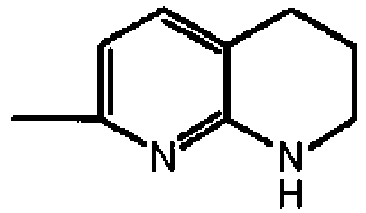 L4 eine wahlweise substituierte bivalente aromatische Kohlenwasserstoffgruppe, wahlweise substituierte bivalente heterocyclische Gruppe oder eine Bindung ist,L5 eine wahlweise substituierte C1-6-Alkylengruppe, wahlweise substituierte -O-C1-6-Alkylengruppe, worin die linke Bindung an L4 bindet, oder eine wahlweise substituierte -NH-C1-6-Alkylengruppe ist, worin die linke Bindung an L4 bindet, m 0 oder 1 ist, n eine ganze Zahl von 1 bis 3 ist und p 0 oder 1 ist,vorausgesetzt, dass zumindest eines von z1, z2, z3, z4 und z5 CR3a ist, worin R3a eine Gruppe mit der Formel (2) ist:
 worin R4, R5, R6, R7, R8, R9, R10, R11, R12, L4, L5, m, n und p wie oben definiert sind,L2 eine wahlweise substituierte C1-6-Alkylengruppe ist, L3 eine wahlweise substituierte C1-6-Alkylengruppe ist und L1 eine Gruppe mit der Formel (3) ist:
 worin r-Gruppen R13 gleich oder verschieden sind und jeweils ein Wasserstoffatom, eine wahlweise substituierte C1-6-Alkylgruppe oder Aminoschutzgruppe sind, ausgewählt aus Ar-C1-6-alkylgruppen, C1-6-Alkoxy-C1-6-alkylgruppen, Acylgruppen, C1-6-Alkoxycarbonylgruppen, Ar-C1-6-alkoxycarbonylgruppen, C1-6-Alkylsulfonylgruppen, Arylsulfonylgruppen und Silylgruppen, q × r-Gruppen R14 und q × r-Gruppen R15 gleich oder verschieden sind und jeweils ein Wasserstoffatom oder eine wahlweise substituierte C1-6-Alkylgruppe sind, r-Gruppen R16 gleich oder verschieden sind und jeweils ein Wasserstoffatom, eine wahlweise substituierte C1-6-Alkylgruppe oder eine Gruppe mit der Formel (4) ist:
 worin s-Gruppen R17 gleich oder verschieden sind und jeweils ein Wasserstoffatom oder eine wahlweise substituierte C1-6-Alkylgruppe sind; t-Gruppen R18 gleich oder verschieden sind und jeweils ein Wasserstoffatom, eine wahlweise substituierte C1-6-Alkylgruppe oder eine Aminoschutzgruppe sind, ausgewählt aus Ar-C1-6-alkylgruppen, C1-6-Alkoxy-C1-6-alkylgruppen, Acylgruppen, C1-6-Alkoxycarbonylgruppen, Ar-C1-6-alkoxycarbonylgruppen, C1-6-Alkylsulfonylgruppen, Arylsulfonylgruppen und Silylgruppen, t-Gruppen R19 gleich oder verschieden sind und jeweils ein Wasserstoffatom oder eine wahlweise substituierte C1-6-Alkylgruppe sind,s eine ganze Zahl von 1 bis 3 ist, t eine ganze Zahl von 0 bis 3 ist und R1, R2, z1, z2, z3, z4, z5, L2 und L3 wie oben definiert sind,q eine ganze Zahl von 0 bis 3 ist und r eine ganze Zahl von 0 bis 3 ist.
 - Verbindung oder Salz davon oder Komplex der Verbindung oder des Salzes mit einem Metall gemäß Anspruch 1, worin z1, z2, z3, z4 und z5 gleich oder verschieden sind und jeweils CR3b sind, worin R3b ein Wasserstoffatom, Halogenatom, wahlweise substituierte C1-6-Alkylgruppe oder wahlweise substituierte C1-6-Alkoxygruppe ist, und z3 CR3c ist, worin R3C eine Gruppe mit der Formel (2b) ist:

- Verbindung oder Salz davon oder Komplex der Verbindung oder des Salzes mit einem Metall gemäß einem der Ansprüche 1 bis 2, worin A1 eine Gruppe mit einer polyazamacrocyclischen Struktur, eine Gruppe mit einer Polyaminopolycarbonsäurestruktur oder eine Gruppe mit einer Polyaminopolyphosphonsäurestruktur ist.
- Verbindung oder Salz davon oder Komplex der Verbindung oder des Salzes mit einem Metall gemäß einem der Ansprüche 1 bis 3, worin A1 eine Gruppe mit der Formel (5), (6), (7), (8), (9), (10), (11) oder (12) ist:

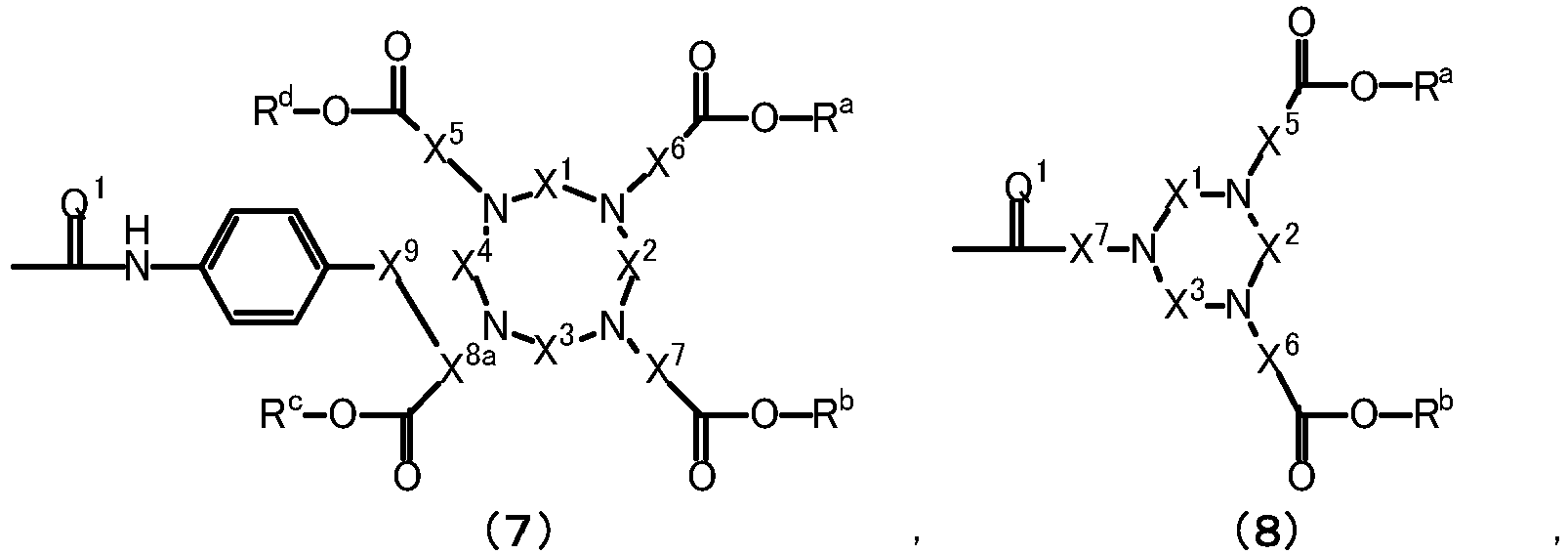


- Verbindung oder Salz davon oder Komplex der Verbindung oder des Salzes mit einem Metall gemäß einem der Ansprüche 1 bis 4, worin A1 eine Gruppe mit der Formel (5a), (6a), (7a), (8a), (8b), (8c), (9a), (10a), (10b), (11a), (11b), (11c) oder (12a) ist:


- Verbindung oder Salz davon oder Komplex der Verbindung oder des Salzes mit einem Metall gemäß Anspruch 1, worin die Verbindung mit der Formel (1) oder das Salz davon eine Verbindung oder ein Salz davon ist, ausgewählt aus der Gruppe, bestehend aus2,2',2"-(10-((4R,7R)-16-(4-(N-((S)-1-Carboxy-2-(4-(2-(5,6,7,8-tetrahydro-1,8-naphthyridin-2-yl)ethyl)benzamido)ethyl)sulfamoyl)-3,5-dimethylphenoxy)-2,5,8,13-tetraoxo-4,7-bis(sulfomethyl)-3,6,9,12-tetraazahexadecyl)-1,4,7,10-tetraazacyclododecan-1,4,7-triyl)triessigsäure,2,2',2"-(10-(2-(((R)-1-((2-(4-(4-(N-((S)-1-Carboxy-2-(4-(2-(5,6,7,8-tetrahydro-1,8-naphthyridin-2-yl)ethyl)benzamido)ethyl)sulfamoyl)-3,5-dimethylphenoxy)butanamido)ethyl)amino)-1-oxo-3-sulfopropan-2-yl)amino)-2-oxoethyl)-1,4,7,10-tetraazacyclododecan-1,4,7-triyl)triessigsäure,2,2',2"-(10-((4R,7R,10R)-19-(4-(N-((S)-1-Carboxy-2-(4-(2-(5,6,7,8-tetrahydro-1,8-naphthyridin-2-yl)ethyl)benzamido)ethyl)sulfamoyl)-3,5-dimethylphenoxy)-2,5,8,11,16-pentaoxo-4,7,10-tris(sulfomethyl)-3,6,9,12,15-pentaazanonadecyl)-1,4,7,10-tetraazacyclododecan-1,4,7-triyl)triessigsäure,(S)-2,2',2"-(10-(19-(4-(N-(1-Carboxy-2-(4-(2-(5,6,7,8-tetrahydro-1,8-naphthyridin-2-yl)ethyl)benzamido)ethyl)sulfamoyl)-3,5-dimethylphenoxy)-2,11,16-trioxo-6,9-dioxa-3,12,15-triazanonadecyl)-1,4,7,10-tetraazacyclododecan-1,4,7-triyl)triessigsäure,2,2',2"-(10-((S)-4-(4-Aminobutyl)-22-(4-(N-((S)-1-carboxy-2-(4-(2-(5,6,7,8-tetrahydro-1,8-naphthyridin-2-yl)ethyl)benzamido)ethyl)sulfamoyl)-3,5-dimethylphenoxy)-2,5,14,19-tetraoxo-9,12-dioxa-3,6,15,18-tetraazadocosyl)-1,4,7,10-tetraazacyclododecan-1,4,7-triyl)triessigsäure, (S)-2,2',2"-(10-(28-(4-(N-(1-Carboxy-2-(4-(2-(5,6,7,8-tetrahydro-1,8-naphthyridin-2-yl)ethyl)benzamido)ethyl)sulfamoyl)-3,5-dimethylphenoxy)-2,11,20,25-tetraoxo-6,9,15,18-tetraoxa-3,12,21,24-tetraazaoctacosyl)-1,4,7,10-tetraazacyclododecan-1,4,7-triyl)triessigsäure,2,2',2"-(10-((R)-22-(4-(N-((S)-1-Carboxy-2-(4-(2-(5,6,7,8-tetrahydro-1,8-naphthyridin-2-yl)ethyl)benzamido)ethyl)sulfamoyl)-3,5-dimethylphenoxy)-2,5,14,19-tetraoxo-4-(sulfomethyl)-9,12-dioxa-3,6,15,18-tetraazadocosyl)-1,4,7,10-tetraazacyclododecan-1,4,7-triyl)triessigsäure,2,2',2"-(10-((9R)-18-(4-(N-((S)-1-Carboxy-2-(4-(2-(5,6,7,8-tetrahydro-1,8-naphthyridin-2-yl)ethyl)benzamido)ethyl)sulfamoyl)-3,5-dimethylphenoxy)-4-(((R)-1-((2-(4-(4-(N-((S)-1-carboxy-2-(4-(2-(5,6,7,8-tetrahydro-1,8-naphthyridin-2-yl)ethyl)benzamido)ethyl)sulfamoyl)-3,5-dimethylphenoxy)butanamido)ethyl)amino)-1-oxo-3-sulfopropan-2-yl)carbamoyl)-2,7,10,15-tetraoxo-9-(sulfomethyl)-3,8,11,14-tetraazaoctadecyl)-1,4,7,10-tetraazacyclododecan-1,4,7-triyl)triessigsäure,2,2',2"-(10-((4R,7R)-16-((5-(2-Carboxy-1-(5-(2-(5,6,7,8-tetrahydro-1,8-naphthyridin-2-yl)ethoxy)-1H-indol-1-yl)ethyl)pyridin-3-yl)oxy)-2,5,8,13-tetraoxo-4,7-bis(sulfomethyl)-3,6,9,12-tetraazahexadecyl)-1,4,7,10-tetraazacyclododecan-1,4,7-triyl)triessigsäure, 2,2',2"-(10-((4R,7R)-16-((5-(2-Carboxy-1-(4-(2-(5,6,7,8-tetrahydro-1,8-naphthyridin-2-yl)ethyl)-1H-indol-1-yl)ethyl)pyridin-3-yl)oxy)-2,5,8,13-tetraoxo-4,7-bis(sulfomethyl)-3,6,9,12-tetraazahexadecyl)-1,4,7,10-tetraazacyclododecan-1,4,7-triyl)triessigsäure, 2,2',2"-(10-(2-(((R)-1-((2-(4-(4-(N-((R)-1-Carboxy-2-(5-(5,6,7,8-tetrahydro-1,8-naphthyridin-2-yl)pentanamido)ethyl)sulfamoyl)-3,5-dimethylphenoxy)butanamido)ethyl)amino)-1-oxo-3-sulfopropan-2-yl)amino)-2-oxoethyl)-1,4,7,10-tetraazacyclododecan-1,4,7-triyl)triessigsäure,2,2',2"-(10-((4R,7R)-16-(4-(N-((S)-1-Carboxy-2-(5-(5,6,7,8-tetrahydro-1,8-naphthyridin-2-yl)pentanamido)ethyl)sulfamoyl)-3,5-dimethylphenoxy)-2,5,8,13-tetraoxo-4,7-bis(sulfomethyl)-3,6,9,12-tetraazahexadecyl)-1,4,7,10-tetraazacyclododecan-1,4,7-triyl)triessigsäure,2,2',2"-(10-(2-(((R)-1-((2-(4-(4-(N-((S)-1-Carboxy-2-(5-(5,6,7,8-tetrahydro-1,8-naphthyridin-2-yl)pentanamido)ethyl)sulfamoyl)-3,5-dimethylphenoxy)butanamido)ethyl)amino)-1-oxo-3-sulfopropan-2-yl)amino)-2-oxoethyl)-1,4,7,10-tetraazacyclododecan-1,4,7-triyl)triessigsäure,2,2',2"-(10-((4R,7R)-16-(4-((S)-2-Carboxy-1-(4-(2-(5,6,7,8-tetrahydro-1,8-naphthyridin-2-yl)ethyl)benzamido)ethyl)-2-fluorophenoxy)-2,5,8,13-tetraoxo-4,7-bis(sulfomethyl)-3,6,9,12-tetraazahexadecyl)-1,4,7,10-tetraazacyclododecan-1,4,7-triyl)triessigsäure,2,2'-((1-(((S)-2-(Bis(carboxymethyl)amino)-3-(4-(3-((R)-1-(((R)-1-((2-(4-(4-(N-((S)-1-carboxy-2-(4-(2-(5,6,7,8-tetrahydro-1,8-naphthyridin-2-yl)ethyl)benzamido)ethyl)sulfamoyl)-3,5-dimethylphenoxy)butanamido)ethyl)amino)-1-oxo-3-sulfopropan-2-yl)amino)-1-oxo-3-sulfopropan-2-yl)thioureido)phenyl)propyl) (carboxymethyl)amino)propan-2-yl)azandiyl)diessigsäure,(S)-2,2',2"-(10-(2-((2-(4-(4-(N-(1-Carboxy-2-(4-(2-(5,6,7,8-tetrahydro-1,8-naphthyridin-2-yl)ethyl)benzamido)ethyl)sulfamoyl)-3,5-dimethylphenoxy)butanamido)ethyl)amino)-2-oxoethyl)-1,4,7,10-tetraazacyclododecan-1,4,7-triyl)triessigsäure,2,2',2",2‴-(2-(4-(3-((R)-1-((2-(4-(4-(N-((S)-1-Carboxy-2-(5-(5,6,7,8-tetrahydro-1,8-naphthyridin-2-yl)pentanamido)ethyl)sulfamoyl)-3,5-dimethylphenoxy)butanamido)ethyl)amino)-1-oxo-3-sulfopropan-2-yl)thioureido)benzyl)-1,4,7,10-tetraazacyclododecan-1,4,7,10-tetrayl)tetraessigsäure,2,2'-((1-(((S)-2-(Bis(carboxymethyl)amino)-3-(4-(3-((R)-1-((2-(4-(4-(N-((S)-1-carboxy-2-(5-(5,6,7,8-tetrahydro-1,8-naphthyridin-2-yl)pentanamido)ethyl)sulfamoyl)-3,5-dimethylphenoxy)butanamido)ethyl)amino)-1-oxo-3-sulfopropan-2-yl)thioureido)phenyl)propyl)(carboxymethyl)amino)propan-2-yl)azandiyl)diessigsäure,2,2',2"-(10-(2-(((R)-1-((2-(4-(4-(N-((S)-1-Carboxy-2-(4-(5,6,7,8-tetrahydro-1,8-naphthyridin-2-yl)butanamido)ethyl)sulfamoyl)-3,5-dimethylphenoxy)butanamido)ethyl)amino)-1-oxo-3-sulfopropan-2-yl)amino)-2-oxoethyl)-1,4,7,10-tetraazacyclododecan-1,4,7-triyl)triessigsäure,2,2',2"-(10-(2-(((R)-1-((2-(4-(4-(N-((S)-1-Carboxy-2-(6-(5,6,7,8-tetrahydro-1,8-naphthyridin-2-yl)hexanamido)ethyl)sulfamoyl)-3,5-dimethylphenoxy)butanamido)ethyl)amino)-1-oxo-3-sulfopropan-2-yl)amino)-2-oxoethyl)-1,4,7,10-tetraazacyclododecan-1,4,7-triyl)triessigsäure,2,2',2"-(10-((4R,7R)-16-(4-(N-((S)-1-Carboxy-2-(5-(2-(5,6,7,8-tetrahydro-1,8-naphthyridin-2-yl)ethyl)thiophen-2-carboxamido)ethyl)sulfamoyl)-3,5-dimethylphenoxy)-2,5,8,13-tetraoxo-4,7-bis(sulfomethyl)-3,6,9,12-tetraazahexadecyl)-1,4,7,10-tetraazacyclododecan-1,4,7-triyl)triessigsäure, 2,2',2"-(10-((4R,7R)-16-(4-(N-((S)-1-Carboxy-2-(4-(2-(5,6,7,8-tetrahydro-1,8-naphthyridin-2-yl)ethyl)benzamido)ethyl)sulfamoyl)phenoxy)-2,5,8,13-tetraoxo-4,7-bis(sulfomethyl)-3,6,9,12-tetraazahexadecyl)-1,4,7,10-tetraazacyclododecan-1,4,7-triyl)triessigsäurehexanatriumsalz,2,2'-(7-((R)-1-Carboxy-4-(((R)-1-((2-(4-(4-(N-((S)-1-carboxy-2-(5-(5,6,7,8-tetrahydro-1,8-naphthyridin-2-yl)pentanamido)ethyl)sulfamoyl)-3,5-dimethylphenoxy)butanamido)ethyl)amino)-1-oxo-3-sulfopropan-2-yl)amino)-4-oxobutyl)-1,4,7-triazonan-1,4-diyl)diessigsäure und5-(((R)-1-((2-(4-(4-(N-((S)-1-Carboxy-2-(5-(5,6,7,8-tetrahydro-1,8-naphthyridin-2-yl)pentanamido)ethyl)sulfamoyl)-3,5-dimethylphenoxy)butanamido)ethyl)amino)-1-oxo-3-sulfopropan-2-yl)amino)-2-(11-(carboxymethyl)-1,4,8,11-tetraazabicyclo[6.6.2]hexadecan-4-yl)-5-oxopentansäure.
- Verbindung oder Salz davon oder Komplex der Verbindung oder des Salzes mit einem Metall gemäß Anspruch 1, worin die Verbindung mit der Formel (1) oder das Salz davon 2,2',2"-(10-(2-(((R)-1-((2-(4-(4-(N-((S)-1-Carboxy-2-(5-(5,6,7,8-tetrahydro-1,8-naphthyridin-2-yl)pentanamido)ethyl)sulfamoyl)-3,5-dimethylphenoxy)butanamido)ethyl)amino)-1-oxo-3-sulfopropan-2-yl)amino)-2-oxoethyl)-1,4,7,10-tetraazacyclododecan-1,4,7-triyl)triessigsäure oder ein Salz davon ist.
- Komplex gemäß einem der Ansprüche 1 bis 7, worin das Metall ein cytotoxisches radioaktives Metall ist.
- Komplex gemäß Anspruch 8, worin das cytotoxische radioaktive Metall ein Metall ist, ausgewählt aus der Gruppe, bestehend aus 90Y, 114mIn, 117mSn, 186Re, 188Re, 64Cu, 67Cu, 59Fe, 89Sr, 198Au, 203Hg, 212Pb, 165Dy, 103Ru, 149Tb, 161Tb, 212Bi, 166Ho, 165Er, 153Sm, 177Lu, 213Bi, 223Ra, 225Ac oder 227Th.
- Komplex gemäß Anspruch 8, worin das cytotoxische radioaktive Metall ein Metall ist, ausgewählt aus der Gruppe, bestehend aus 64Cu, 67Cu, 90Y, 166Ho, 153Sm, 177Lu, 212Pb und 225Ac.
- Komplex gemäß einem der Ansprüche 8 bis 10 zur Verwendung bei der Behandlung einer Erkrankung, die ein Integrin involviert.
- Komplex zur Verwendung gemäß Anspruch 11, worin die Erkrankung Krebs ist.
- Komplex zur Verwendung gemäß Anspruch 12, worin der Krebs ein fester Krebs ist.
- Komplex zur Verwendung gemäß Anspruch 12 oder 13, worin der Krebs Kopf- und Nackenkrebs, Kolorektalkrebs, Brustkrebs, kleinzelliger Lungenkrebs, nichtkleinzelliger Lungenkrebs, Glioblastom, malignes Melanom, Pankreaskrebs oder Prostatakrebs ist.
- Komplex gemäß einem der Ansprüche 1 bis 7, worin das Metall ein nicht-cytotoxisches radioaktives Metall ist.
- Komplex gemäß Anspruch 15, worin das nicht-cytotoxische radioaktive Metall ein Metall ist, ausgewählt aus der Gruppe, bestehend aus 18F-Aluminumkomplex, 18F-Galliumkomplex, 18F-Indiumkomplex, 18F-Lutetiumkomplex, 18F-Thalliumkomplex, 99mTc, 111In, 113mIn, 114mIn, 67Ga, 68Ga, 82Rb, 86Y, 87Y, 152Tb, 155Tb, 201T1, 51Cr, 52Fe, 57Co, 58Co, 60Co, 82Sr, 85Sr, 197Hg, 44SC, 62Cu, 64Cu oder 89Zr.
- Komplex gemäß Anspruch 15, worin das nicht-cytotoxische radioaktive Metall ein Metall ist, ausgewählt aus der Gruppe, bestehend aus 18F-Aluminumkomplex, 111In, 64Cu, 67Ga, 68Ga und 89Zr.
- Komplex gemäß einem der Ansprüche 15 bis 17 zur Verwendung bei der Diagnose einer Erkrankung, die ein Integrin involviert.
- Komplex zur Verwendung gemäß Anspruch 18, worin die Erkrankung Krebs ist.
- Komplex zur Verwendung gemäß Anspruch 19, worin der Krebs ein fester Krebs ist.
- Komplex zur Verwendung gemäß Anspruch 19 oder 20, worin der Krebs Kopf- und Nackenkrebs, Kolorektalkrebs, Brustkrebs, kleinzelliger Lungenkrebs, nichtkleinzelliger Lungenkrebs, Glioblastom, malignes Melanom, Pankreaskrebs oder Prostatakrebs ist.
- Kit zur Herstellung eines Mittels zur Diagnose oder Behandlung durch Zugabe eines Metalls, wobei das Kit die Verbindung oder das Salz davon gemäß einem der Ansprüche 1 bis 7 enthält.
- Verfahren zur Erzeugung der Verbindung gemäß den Ansprüchen 1-7, enthaltend die Reaktion einer Verbindung mit der Formel (S1a):
 worin R1, R2, Z1, Z2, Z3, Z4 und Z5, L1, L2 und L3 wie oben definiert sind, mit einer Verbindung mit der Formel (S2) :
A1―RB (S2)
worin A1 eine Chelatisierungsgruppe ist und RB eine Hydroxylgruppe oder eine Abspaltgruppe ist, oder einer Verbindung mit der Formel (S3):
B1―N=C=Q1 (S3)
worin B1 ein Chelatrest ist und Q1 ein Sauerstoffatom oder Schwefelatom ist. - Verbindung mit der Formel (S1a) oder ein Salz davon
 worin R1 ein Wasserstoffatom, eine wahlweise substituierte C1-6-Alkylgruppe oder Aminoschutzgruppe ist, ausgewählt aus Ar-C1-6-alkylgruppen, C1-6-Alkoxy-C1-6-alkylgruppen, Acylgruppen, C1-6-Alkoxycarbonylgruppen, Ar-C1-6-alkoxycarbonylgruppen, C1-6-Alkylsulfonylgruppen, Arylsulfonylgruppen und Silylgruppen; R2 ein Wasserstoffatom, eine wahlweise substituierte C1-6-Alkylgruppe oder eine Aminoschutzgruppe ist, ausgewählt aus Ar-C1-6-alkylgruppen, C1-6-Alkoxy-C1-6-alkylgruppen, Acylgruppen, C1-6-Alkoxycarbonylgruppen, Ar-C1-6-alkoxycarbonylgruppen, C1-6-Alkylsulfonylgruppen, Arylsulfonylgruppen und Silylgruppen, Z1, Z2, Z3, Z4 und Z5 gleich oder verschieden sind und jeweils ein Stickstoffatom oder CR3 sind, worinR3 ein Wasserstoffatom, Halogenatom, eine wahlweise substituierte C1-6-Alkylgruppe, wahlweise substituierte C1-6-Alkoxygruppe oder eine Gruppe mit der Formel (2) ist:
 worin R4 ein Wasserstoffatom, eine wahlweise substituierte C1-6-Alkylgruppe oder eine Aminoschutzgruppe ist, ausgewählt aus Ar-C1-6-alkylgruppen, C1-6-Alkoxy-C1-6-alkylgruppen, Acylgruppen, C1-6-Alkoxycarbonylgruppen, Ar-C1-6-alkoxycarbonylgruppen, C1-6-Alkylsulfonylgruppen, Arylsulfonylgruppen und Silylgruppen,n-Gruppen R5 und n-Gruppen R6 gleich oder verschieden sind und jeweils ein Wasserstoffatom, Halogenatom, eine wahlweise substituierte C1-6-Alkylgruppe oder wahlweise geschützte Carboxylgruppe sind, worin die Carboxylschutzgruppe ausgewählt ist aus C1-6-Alkylgruppen, Arylgruppen, Ar-C1-6-alkylgruppen, C1-6-Alkoxy-C1-6-alkylgruppen und Silylgruppen,R7 ein Wasserstoffatom, eine wahlweise substituierte C1-6-Alkylgruppe oder Aminoschutzgruppe ist, ausgewählt aus Ar-C1-6-alkylgruppen, C1-6-Alkoxy-C1-6-alkylgruppen, Acylgruppen, C1-6-Alkoxycarbonylgruppen, Ar-C1-6-alkoxycarbonylgruppen, C1-6-Alkylsulfonylgruppen, Arylsulfonylgruppen und Silylgruppen,worin die Struktur des 6-gliedrigen Rings mit R8, R9, R10, R11 und R12 durch die folgende Struktur dargestellt ist:
 L4 eine wahlweise substituierte bivalente aromatische Kohlenwasserstoffgruppe, eine wahlweise substituierte bivalente heterocyclische Gruppe oder eine Bindung ist,L5 eine wahlweise substituierte C1-6-Alkylengruppe, wahlweise substituierte -O-C1-6-Alkylengruppe, worin die linke Bindung an L4 bindet, oder eine wahlweise substituierte -NH-C1-6-Alkylengruppe ist, worin die linke Bindung an L4 bindet, m 0 oder 1 ist, n eine ganze Zahl von 1 bis 3 ist und p 0 oder 1 ist,vorausgesetzt, dass zumindest eines von Z1, Z2, Z3, Z4 und Z5 CR3a ist, worinR3a eine Gruppe mit der Formel (2) ist:
 worin R4, R5, R6, R7, R8, R9, R10, R11, R12, L4, L5, m, n und p wie oben definiert sind,L2 eine wahlweise substituierte C1-6-Alkylengruppe ist, L3 eine wahlweise substituierte C1-6-Alkylengruppe ist und L1 eine Gruppe mit der Formel (3) ist:
 worin r-Gruppen R13 gleich oder verschieden sind und jeweils ein Wasserstoffatom, eine wahlweise substituierte C1-6-Alkylgruppe oder Aminoschutzgruppe sind, ausgewählt aus Ar-C1-6-alkylgruppen, C1-6-Alkoxy-C1-6-alkylgruppen, Acylgruppen, C1-6-Alkoxycarbonylgruppen, Ar-C1-6-alkoxycarbonylgruppen, C1-6-Alkylsulfonylgruppen, Arylsulfonylgruppen und Silylgruppen, q × r-Gruppen R14 und q × r-Gruppen R15 gleich oder verschieden sind und jeweils ein Wasserstoffatom oder eine wahlweise substituierte C1-6-Alkylgruppe sind, r-Gruppen R16 gleich oder verschieden sind und jeweils ein Wasserstoffatom, eine wahlweise substituierte C1-6-Alkylgruppe oder eine Gruppe mit der Formel (4) sind:
 worin s-Gruppen R17 gleich oder verschieden sind und jeweils ein Wasserstoffatom oder eine wahlweise substituierte C1-6-Alkylgruppe sind; t-Gruppen R18 gleich oder verschieden sind und jeweils ein Wasserstoffatom, eine wahlweise substituierte C1-6-Alkylgruppe oder eine Aminoschutzgruppe sind, ausgewählt aus Ar-C1-6-alkylgruppen, C1-6-Alkoxy-C1-6-alkylgruppen, Acylgruppen, C1-6-Alkoxycarbonylgruppen, Ar-C1-6-alkoxycarbonylgruppen, C1-6-Alkylsulfonylgruppen, Arylsulfonylgruppen und Silylgruppen, t-Gruppen R19 gleich oder verschieden sind und jeweils ein Wasserstoffatom oder eine wahlweise substituierte C1-6-Alkylgruppe sind,s eine ganze Zahl von 1 bis 3 ist, t eine ganze Zahl von 0 bis 3 ist und R1, R2, Z1, Z2, Z3, Z4, Z5, L2 und L3 wie oben definiert sind,q eine ganze Zahl von 0 bis 3 ist und r eine ganze Zahl von 0 bis 3 ist.
 - Verbindung oder Salz davon gemäß Anspruch 24, worin Z1, Z2, Z3, Z4 und Z5 gleich oder verschieden sind und jeweils CR3b sind, worin R3b ein Wasserstoffatom, Halogenatom, eine wahlweise substituierte C1-6-Alkylgruppe oder wahlweise substituierte C1-6-Alkoxygruppe ist, und Z3 CR3c ist, worin R3c eine Gruppe mit der Formel (2b) ist:

Priority Applications (8)
| Application Number | Priority Date | Filing Date | Title |
|---|---|---|---|
| PL14849898T PL3050878T3 (pl) | 2013-09-24 | 2014-09-24 | Zawierający atom azotu związek lub jego sól, lub ich kompleks z metalem |
| RS20211416A RS62591B1 (sr) | 2013-09-24 | 2014-09-24 | Novo jedinjenje koje sadrži azot ili njegova so ili njihov kompleks sa metalom |
| DK21187649.5T DK3929196T3 (da) | 2013-09-24 | 2014-09-24 | Farmaceutisk sammensætning af en nitrogenholdig forbindelse eller salt deraf, eller metalkompleks deraf |
| SM20210686T SMT202100686T1 (it) | 2013-09-24 | 2014-09-24 | Nuovo composto contenente azoto, o suo sale, o suo complesso metallico |
| EP21187649.5A EP3929196B1 (de) | 2013-09-24 | 2014-09-24 | Pharmazeutische zusammensetzung von stickstoffhaltige verbindung oder salz davon oder metallkomplex davon |
| HRP20211836TT HRP20211836T1 (hr) | 2013-09-24 | 2014-09-24 | Novi spoj koji sadrži dušik ili njegova sol, ili njegov metalni kompleks |
| SI201431914T SI3050878T1 (sl) | 2013-09-24 | 2014-09-24 | Nova dušik-vsebujoča spojina ali njena sol ali kovinski kompleks le-te |
| EP23188351.3A EP4249471A3 (de) | 2013-09-24 | 2014-09-24 | Pharmazeutische zusammensetzung von stickstoffhaltige verbindung oder salz davon oder metallkomplex davon |
Applications Claiming Priority (2)
| Application Number | Priority Date | Filing Date | Title |
|---|---|---|---|
| JP2013196712 | 2013-09-24 | ||
| PCT/JP2014/075332 WO2015046278A1 (ja) | 2013-09-24 | 2014-09-24 | 新規な含窒素化合物もしくはその塩またはそれらと金属との錯体 |
Related Child Applications (3)
| Application Number | Title | Priority Date | Filing Date |
|---|---|---|---|
| EP21187649.5A Division EP3929196B1 (de) | 2013-09-24 | 2014-09-24 | Pharmazeutische zusammensetzung von stickstoffhaltige verbindung oder salz davon oder metallkomplex davon |
| EP21187649.5A Division-Into EP3929196B1 (de) | 2013-09-24 | 2014-09-24 | Pharmazeutische zusammensetzung von stickstoffhaltige verbindung oder salz davon oder metallkomplex davon |
| EP23188351.3A Division EP4249471A3 (de) | 2013-09-24 | 2014-09-24 | Pharmazeutische zusammensetzung von stickstoffhaltige verbindung oder salz davon oder metallkomplex davon |
Publications (3)
| Publication Number | Publication Date |
|---|---|
| EP3050878A1 EP3050878A1 (de) | 2016-08-03 |
| EP3050878A4 EP3050878A4 (de) | 2017-04-12 |
| EP3050878B1 true EP3050878B1 (de) | 2021-10-27 |
Family
ID=52743412
Family Applications (3)
| Application Number | Title | Priority Date | Filing Date |
|---|---|---|---|
| EP14849898.3A Active EP3050878B1 (de) | 2013-09-24 | 2014-09-24 | Neuartige stickstoffhaltige verbindung oder salz davon oder metallkomplex davon |
| EP23188351.3A Withdrawn EP4249471A3 (de) | 2013-09-24 | 2014-09-24 | Pharmazeutische zusammensetzung von stickstoffhaltige verbindung oder salz davon oder metallkomplex davon |
| EP21187649.5A Active EP3929196B1 (de) | 2013-09-24 | 2014-09-24 | Pharmazeutische zusammensetzung von stickstoffhaltige verbindung oder salz davon oder metallkomplex davon |
Family Applications After (2)
| Application Number | Title | Priority Date | Filing Date |
|---|---|---|---|
| EP23188351.3A Withdrawn EP4249471A3 (de) | 2013-09-24 | 2014-09-24 | Pharmazeutische zusammensetzung von stickstoffhaltige verbindung oder salz davon oder metallkomplex davon |
| EP21187649.5A Active EP3929196B1 (de) | 2013-09-24 | 2014-09-24 | Pharmazeutische zusammensetzung von stickstoffhaltige verbindung oder salz davon oder metallkomplex davon |
Country Status (18)
| Country | Link |
|---|---|
| US (3) | US11426473B2 (de) |
| EP (3) | EP3050878B1 (de) |
| JP (2) | JP6215335B2 (de) |
| CA (1) | CA2961935C (de) |
| CY (1) | CY1124794T1 (de) |
| DK (2) | DK3050878T3 (de) |
| ES (2) | ES2899860T3 (de) |
| FI (1) | FI3929196T3 (de) |
| HR (2) | HRP20231143T1 (de) |
| HU (2) | HUE057203T2 (de) |
| IL (1) | IL251500A (de) |
| LT (2) | LT3929196T (de) |
| PL (2) | PL3050878T3 (de) |
| PT (2) | PT3929196T (de) |
| RS (2) | RS64535B1 (de) |
| SI (2) | SI3050878T1 (de) |
| SM (1) | SMT202100686T1 (de) |
| WO (1) | WO2015046278A1 (de) |
Families Citing this family (6)
| Publication number | Priority date | Publication date | Assignee | Title |
|---|---|---|---|---|
| EP3050878B1 (de) * | 2013-09-24 | 2021-10-27 | FUJIFILM Corporation | Neuartige stickstoffhaltige verbindung oder salz davon oder metallkomplex davon |
| CN107428755B (zh) * | 2015-03-25 | 2020-03-03 | 富士胶片株式会社 | 含氮化合物或其盐的制造方法以及它们的制造中间体 |
| CN116390766A (zh) * | 2020-10-22 | 2023-07-04 | 日本医事物理股份有限公司 | 放射性锆络合物的制造方法 |
| MX2023004715A (es) * | 2020-10-22 | 2023-05-10 | Nihon Mediphysics Co Ltd | Metodo para producir un complejo de circonio radioactivo. |
| EP4262886A1 (de) | 2020-12-21 | 2023-10-25 | Advanced Accelerator Applications International S.A. | Radioaktiv markierter alpha-v beta-3 und/oder alpha-v beta-5-integrin-antagonist zur verwendung als theragnostikum |
| WO2022192503A1 (en) * | 2021-03-10 | 2022-09-15 | Da Zen Theranostics, Inc. | Heptamethine carbocyanine dye-cross-bridged tetraamine cyclam (ctc) chelator conjugates, their stable complexes with copper-64, and uses thereof |
Family Cites Families (142)
| Publication number | Priority date | Publication date | Assignee | Title |
|---|---|---|---|---|
| EP0416740A3 (en) | 1989-08-08 | 1991-08-28 | Beecham Group P.L.C. | Novel compounds with renin-inhibiting activity |
| ATE194596T1 (de) | 1994-11-15 | 2000-07-15 | Moreno Paolini | N-hydroxypiperidine als superoxid-radikalfänger |
| DE19534177A1 (de) | 1995-09-15 | 1997-03-20 | Merck Patent Gmbh | Cyclische Adhäsionsinhibitoren |
| US5952306A (en) | 1996-01-16 | 1999-09-14 | Merck & Co., Inc. | Integrin receptor antagonists |
| WO1997026250A1 (en) | 1996-01-16 | 1997-07-24 | Merck & Co., Inc. | Integrin receptor antagonists |
| WO1998008840A1 (en) | 1996-08-29 | 1998-03-05 | Merck & Co., Inc. | Integrin antagonists |
| US6211184B1 (en) | 1996-08-29 | 2001-04-03 | Merck & Co., Inc. | Integrin antagonists |
| US5952341A (en) | 1996-10-30 | 1999-09-14 | Merck & Co., Inc. | Integrin antagonists |
| US5919792A (en) | 1996-10-30 | 1999-07-06 | Merck & Co., Inc. | Integrin antagonists |
| EP0946164A4 (de) | 1996-10-30 | 2000-08-23 | Merck & Co Inc | Integrin antagonisten |
| WO1998023608A1 (en) | 1996-11-27 | 1998-06-04 | Dupont Pharmaceuticals Company | Novel integrin receptor antagonists |
| AU729869B2 (en) | 1997-01-17 | 2001-02-15 | Merck & Co., Inc. | Integrin antagonists |
| US6017925A (en) | 1997-01-17 | 2000-01-25 | Merck & Co., Inc. | Integrin antagonists |
| EP0973396A4 (de) | 1997-04-07 | 2001-02-07 | Merck & Co Inc | Verfahren zur behandlung von krebs |
| WO1998046220A1 (en) | 1997-04-14 | 1998-10-22 | Merck & Co., Inc. | Combination therapy for the prevention and treatment of osteoporosis |
| US6294549B1 (en) | 1997-07-23 | 2001-09-25 | Merck & Co., Inc. | Method for eliciting an αvβ5 or dual αvβ3/αvβ5 antagonizing effect |
| US6017926A (en) | 1997-12-17 | 2000-01-25 | Merck & Co., Inc. | Integrin receptor antagonists |
| AU736026B2 (en) | 1997-12-17 | 2001-07-26 | Merck & Co., Inc. | Integrin receptor antagonists |
| US6211191B1 (en) | 1997-12-17 | 2001-04-03 | Merck & Co., Inc. | Integrin receptor antagonists |
| US6048861A (en) | 1997-12-17 | 2000-04-11 | Merck & Co., Inc. | Integrin receptor antagonists |
| WO1999031061A1 (en) * | 1997-12-17 | 1999-06-24 | Merck & Co., Inc. | Integrin receptor antagonists |
| US6066648A (en) | 1997-12-17 | 2000-05-23 | Merck & Co., Inc. | Integrin receptor antagonists |
| IL136314A0 (en) | 1997-12-17 | 2001-05-20 | Merck & Co Inc | Integrin receptor antagonists |
| ATE299023T1 (de) | 1997-12-17 | 2005-07-15 | Merck & Co Inc | Integrinrezeptor antagonisten |
| US20020147334A1 (en) | 1998-03-10 | 2002-10-10 | Smithkline Beecham Corporation | Vitronectin Receptor Antagonists |
| DZ2741A1 (fr) | 1998-03-10 | 2003-09-08 | Smithkline Beecham Corp | Composés nouveaux antagonistes des récepteurs de vitronectine procédé pour leur préparation et compositions. |
| US6524553B2 (en) | 1998-03-31 | 2003-02-25 | Bristol-Myers Squibb Pharma Company | Quinolone vitronectin receptor antagonist pharmaceuticals |
| US6537520B1 (en) | 1998-03-31 | 2003-03-25 | Bristol-Myers Squibb Pharma Company | Pharmaceuticals for the imaging of angiogenic disorders |
| AU747784B2 (en) | 1998-07-29 | 2002-05-23 | Merck & Co., Inc. | Integrin receptor antagonists |
| JP2002522540A (ja) | 1998-08-13 | 2002-07-23 | メルク エンド カムパニー インコーポレーテッド | インテグリン受容体拮抗薬 |
| UA71586C2 (en) | 1998-12-04 | 2004-12-15 | Smithkline Beecham Corp | A vitronectin receptor antagonist |
| US6245294B1 (en) | 1998-12-17 | 2001-06-12 | The United States Of America As Represented By The Secretary Of Agriculture | Method and apparatus for surface treatment of materials |
| CA2349501A1 (en) | 1998-12-18 | 2000-06-22 | Du Pont Pharmaceuticals Company | Quinolone vitronectin receptor antagonist pharmaceuticals |
| US6794518B1 (en) * | 1998-12-18 | 2004-09-21 | Bristol-Myers Squibb Pharma Company | Vitronectin receptor antagonist pharmaceuticals |
| DE69936148T2 (de) * | 1998-12-18 | 2008-01-24 | Bristol-Myers Squibb Pharma Co. | Vitronektinrezeptorantagonist-arzneimittel |
| CN1398189A (zh) | 1998-12-23 | 2003-02-19 | G.D.西尔公司 | 用于治疗肿瘤形成的放疗与cox-2抑制剂的联合治疗 |
| US6649645B1 (en) | 1998-12-23 | 2003-11-18 | Pharmacia Corporation | Combination therapy of radiation and a COX-2 inhibitor for treatment of neoplasia |
| US6833373B1 (en) | 1998-12-23 | 2004-12-21 | G.D. Searle & Co. | Method of using an integrin antagonist and one or more antineoplastic agents as a combination therapy in the treatment of neoplasia |
| EP1150965A4 (de) | 1999-02-03 | 2002-05-15 | Merck & Co Inc | Benzazepin derivate als alpha-v intgrin rezeptor antagonisten |
| WO2000061545A1 (en) | 1999-04-14 | 2000-10-19 | American Home Products Corporation | Methods for solid phase combinatorial synthesis of integrin inhibitors |
| DK1187592T3 (da) | 1999-06-02 | 2007-11-05 | Merck & Co Inc | Alfa v-integrinreceptorantagonister |
| AU748949B2 (en) | 1999-06-23 | 2002-06-13 | Merck & Co., Inc. | Integrin receptor antagonists |
| EP1065207A1 (de) | 1999-07-02 | 2001-01-03 | Aventis Pharma Deutschland GmbH | Naphthyridin derivate, Verfahren zu ihrer Herstellung, ihre Anwendung und sie enthaltende pharmazeutische Zusammenfassungen |
| US6514964B1 (en) | 1999-09-27 | 2003-02-04 | Amgen Inc. | Fused cycloheptane and fused azacycloheptane compounds and their methods of use |
| JP2003510360A (ja) | 1999-10-04 | 2003-03-18 | メルク エンド カムパニー インコーポレーテッド | インテグリン受容体拮抗薬 |
| DE10028575A1 (de) | 2000-06-14 | 2002-03-14 | Basf Ag | Integrinliganden |
| DE10039998A1 (de) | 2000-08-11 | 2002-02-21 | Basf Ag | Neue substituierte Diareno-azepin-Derivate als Integrin Liganden |
| DE10027514A1 (de) | 2000-06-06 | 2002-01-03 | Basf Ag | Liganden von Integrinrezeptoren |
| CZ20021508A3 (cs) | 1999-11-08 | 2002-10-16 | Merck & Co., Inc. | Způsob výroby imidazolidinonových derivátů |
| US6407241B1 (en) | 1999-11-08 | 2002-06-18 | Merck & Co., Inc. | Process and intermediates for the preparation of imidazolidinone αv integrin antagonists |
| JP2003514908A (ja) | 1999-11-23 | 2003-04-22 | メルク エンド カムパニー インコーポレーテッド | テトラヒドロ−[1,8]−ナフチリジンに向けた方法および中間体 |
| US6849639B2 (en) | 1999-12-14 | 2005-02-01 | Amgen Inc. | Integrin inhibitors and their methods of use |
| WO2001053297A1 (en) | 2000-01-20 | 2001-07-26 | Merck & Co., Inc. | Alpha v integrin receptor antagonists |
| WO2001053262A1 (en) * | 2000-01-24 | 2001-07-26 | Merck & Co., Inc. | Alpha v integrin receptor antagonists |
| US6921767B2 (en) | 2000-06-15 | 2005-07-26 | Pharmacia Corporation | Cycloalkyl alkanoic acids as integrin receptor antagonists derivatives |
| WO2001096307A2 (en) | 2000-06-15 | 2001-12-20 | Pharmacia Corporation | Cycloalkyl alkanoic acids as integrin receptor antagonists |
| AU7002501A (en) * | 2000-06-21 | 2002-01-02 | Du Pont Pharm Co | Vitronectin receptor antagonist pharmaceuticals for use in combination therapy |
| DE60126496T2 (de) | 2000-07-26 | 2007-11-15 | Merck & Co., Inc. | Alpha v integrin-rezeptor-antagonisten |
| AU2001288485A1 (en) | 2000-08-29 | 2002-03-13 | Balekudru Devadas | Compounds containing a bicyclic ring system useful as alpha v beta 3 antagonists |
| PL365729A1 (en) | 2000-08-30 | 2005-01-10 | Pharmacia Corporation | Gem-substituted alpha v beta 3 integrin antagonists |
| US6531494B1 (en) | 2001-08-29 | 2003-03-11 | Pharmacia Corporation | Gem-substituted αvβ3 antagonists |
| DE10042655A1 (de) | 2000-08-31 | 2002-03-14 | Aventis Pharma Gmbh | Verfahren zur Herstellung von Inhibitoren der Zell-Adhäsion |
| EP1317270A1 (de) | 2000-09-08 | 2003-06-11 | Pharmacia Italia S.p.A. | Exemestan zur behandlung von auf östrogen abhängigen krebs |
| EP1322310A4 (de) | 2000-09-13 | 2004-09-15 | Merck & Co Inc | Alpha-v-integrin-rezeptorantagonisten |
| AU2001290772A1 (en) | 2000-09-14 | 2002-03-26 | Merck And Co., Inc. | Alpha v integrin receptor antagonists |
| AU2001292598B2 (en) | 2000-09-14 | 2006-06-29 | Merck & Co., Inc. | Alpha V integrin receptor antagonists |
| JP2004508401A (ja) | 2000-09-18 | 2004-03-18 | メルク エンド カムパニー インコーポレーテッド | シクロオキシゲナーゼ−2阻害剤およびインテグリンアルファ−vアンタゴニストの組合せを用いる炎症の治療 |
| WO2002028840A1 (en) | 2000-10-05 | 2002-04-11 | Merck & Co., Inc. | Process for preparation of integrin receptor antagonist intermediates |
| AU3943502A (en) | 2000-10-24 | 2002-05-27 | Merck & Co Inc | Dibenzoxazepine alpha v integrin receptor antagonist |
| US6444680B1 (en) | 2000-11-30 | 2002-09-03 | Merck & Co., Inc. | Amine salts of an integrin receptor antagonist |
| WO2002053099A2 (en) | 2001-01-03 | 2002-07-11 | Merck & Co., Inc. | Methods and compositions for treating periodontal disease |
| US20040082557A1 (en) | 2001-01-26 | 2004-04-29 | Wajszczuk Charles Paul | Methods for treating estrogen-dependent disorders |
| CA2434611A1 (en) | 2001-01-26 | 2002-09-19 | Pharmacia Italia Spa | Combined method for treating hormono-dependent disorders |
| NZ539682A (en) | 2001-01-29 | 2006-03-31 | Dimensional Pharm Inc | Substituted indoles and their use as integrin antagonists |
| US6764842B2 (en) | 2001-03-28 | 2004-07-20 | Merck & Co., Inc. | Enantioselective bioreduction for the preparation of integrin receptor antagonist intermediates |
| US6872730B2 (en) | 2001-04-27 | 2005-03-29 | 3-Dimensional Pharmaceuticals, Inc. | Substituted benzofurans and benzothiophenes, methods of making and methods of use as integrin antagonists |
| CA2445679A1 (en) | 2001-05-03 | 2002-11-14 | Paul J. Coleman | Benzazepinone alpha v integrin receptor antagonists |
| US6509347B2 (en) | 2001-06-11 | 2003-01-21 | Merck & Co., Inc. | Crystalline forms of an integrin receptor antagonist |
| US20040043988A1 (en) | 2001-06-15 | 2004-03-04 | Khanna Ish Kurmar | Cycloalkyl alkanoic acids as intergrin receptor antagonists |
| WO2002102374A1 (en) | 2001-06-19 | 2002-12-27 | Merck & Co., Inc. | Amine salt of an integrin receptor antagonist |
| US6838074B2 (en) | 2001-08-08 | 2005-01-04 | Bristol-Myers Squibb Company | Simultaneous imaging of cardiac perfusion and a vitronectin receptor targeted imaging agent |
| US20040030134A1 (en) | 2001-10-01 | 2004-02-12 | Mcwilliams James Christopher | Process for preparation of integrin receptor antagonist intermediates |
| EP1435967A2 (de) | 2001-10-10 | 2004-07-14 | Pharmacia Italia S.p.A. | Verfahren zur vorbeugung und behandlung von knochenverlust mit steroidverbindungen |
| US7074930B2 (en) | 2001-11-06 | 2006-07-11 | Merck & Co., Inc | Amine salts of an integrin receptor antagonist |
| AU2002363429B2 (en) | 2001-11-07 | 2008-05-08 | Merck & Co., Inc. | Mitotic kinesin inhibitors |
| US20040053968A1 (en) | 2001-12-28 | 2004-03-18 | Hartman George D. | Methods and compositions for treating peridontal disease |
| US20030171368A1 (en) | 2002-02-06 | 2003-09-11 | Werner Seitz | Pyrimidinonesulfamoylureas` |
| WO2003072042A2 (en) | 2002-02-27 | 2003-09-04 | Merck & Co., Inc. | Malonate-claisen rearrangement for preparation of integrin receptor antagonist intermediates |
| WO2004013070A2 (en) | 2002-08-01 | 2004-02-12 | Nuevolution A/S | Multi-step synthesis of templated molecules |
| US20040224986A1 (en) | 2002-08-16 | 2004-11-11 | Bart De Corte | Piperidinyl targeting compounds that selectively bind integrins |
| JP4554364B2 (ja) | 2002-08-16 | 2010-09-29 | ジヤンセン・フアーマシユーチカ・ナームローゼ・フエンノートシヤツプ | インテグリンと選択的に結合するピペリジニル化合物 |
| JP2006504696A (ja) | 2002-09-20 | 2006-02-09 | メルク エンド カムパニー インコーポレーテッド | インテグリン受容体アンタゴニストのマンニトール製剤 |
| DK3299463T3 (da) | 2002-10-30 | 2020-12-07 | Nuevolution As | Enzymatisk kodning |
| US20050020591A1 (en) | 2002-12-13 | 2005-01-27 | Dai-Shi Su | 2-Quinoxalinone derivatives as bradykinin antagonists and novel compounds |
| US6908921B2 (en) | 2002-12-13 | 2005-06-21 | Merck & Co., Inc. | Quinoxalinone derivatives as bradykinin B1 antagonists |
| US20050043344A1 (en) | 2002-12-20 | 2005-02-24 | Pharmacia Corporation | Heteroarylalkanoic acids as integrin receptor antagonists derivatives |
| MXPA05006587A (es) | 2002-12-20 | 2005-12-14 | Pharmacia Corp | Compuestos de tiazol como derivados de antagonistas del receptor de la integrina. |
| JP2006513218A (ja) | 2002-12-20 | 2006-04-20 | ファルマシア・コーポレーション | インテグリン受容体アンタゴニスト誘導体としてのピラゾール化合物 |
| WO2004078109A2 (en) | 2003-03-07 | 2004-09-16 | Merck Sharp & Dohme Limited | PROCESS FOR SYNTHESISING USEFUL INTERMEDIATES FOR THE PREPARATION OF ανβ3 RECEPTOR ANTAGONISTS |
| EP1603392A2 (de) | 2003-03-07 | 2005-12-14 | The University Of Toledo | Paclitaxel-hybridderivate |
| WO2005005606A2 (en) | 2003-06-30 | 2005-01-20 | Merck & Co., Inc. | 17-acetamido-4-azasteroid derivatives as androgen receptor modulators |
| US7351711B2 (en) | 2003-07-31 | 2008-04-01 | Janssen Pharmaceutical, N.V. | Tricyclic indanyls as integrin inhibitors |
| US7117807B2 (en) | 2004-02-17 | 2006-10-10 | University Of Florida Research Foundation, Inc. | Dynamically modifiable polymer coatings and devices |
| US7650848B2 (en) | 2004-02-17 | 2010-01-26 | University Of Florida Research Foundation, Inc. | Surface topographies for non-toxic bioadhesion control |
| US9016221B2 (en) | 2004-02-17 | 2015-04-28 | University Of Florida Research Foundation, Inc. | Surface topographies for non-toxic bioadhesion control |
| FR2870541B1 (fr) | 2004-05-18 | 2006-07-14 | Proskelia Sas | Derives de pyrimidines antigonistes du recepteur de la vitronectine |
| CA2575003C (en) | 2004-07-29 | 2010-02-16 | Merck & Co., Inc. | Potassium channel inhibitors |
| US20080064716A1 (en) | 2004-10-14 | 2008-03-13 | Pharmacia | Biphenyl Integrin Antagonists |
| WO2006108040A1 (en) | 2005-04-05 | 2006-10-12 | Janssen Pharmaceutica, N.V. | Substituted indoles and their use as integrin antagonists |
| EP1888563A1 (de) | 2005-05-23 | 2008-02-20 | Merck & Co., Inc. | Prolin-bisamidverbindungen als antagonisten des orexinrezeptors |
| AR059224A1 (es) | 2006-01-31 | 2008-03-19 | Jerini Ag | Compuestos para la inhibicion de integrinas y uso de estas |
| US20080045521A1 (en) | 2006-06-09 | 2008-02-21 | Astrazeneca Ab | Phenylalanine derivatives |
| AU2007343600B2 (en) | 2007-01-11 | 2012-06-28 | Immunomedics, Inc. | Methods and compositions for improved F-18 labeling of proteins, peptides and other molecules |
| WO2008093065A1 (en) | 2007-01-29 | 2008-08-07 | Astrazeneca Ab | L-ALANINE DERIVATIVES AS α5βL ANTAGONISTS |
| WO2008093064A1 (en) | 2007-01-29 | 2008-08-07 | Astrazeneca Ab | L-ALANINE DERIVATIVES AS α5 BETA 1 ANTAGONISTS |
| WO2008125811A1 (en) | 2007-04-11 | 2008-10-23 | Astrazeneca Ab | N-[HETEROARYLCARBONYL]-S-THIENYL-L-ALANINE DERIVATIVES AS α5β1 ANTAGONISTS |
| JP5730581B2 (ja) | 2008-01-08 | 2015-06-10 | ランセウス メディカル イメージング, インコーポレイテッド | 造影剤としてのn−アルコキシアミド抱合体 |
| DE102009000854A1 (de) | 2009-02-13 | 2010-08-19 | Ernst-Moritz-Arndt-Universität Greifswald | Osteopontin-Rezeptor-Liganden zur Behandlung des chronischen Nierenversagens |
| KR101106433B1 (ko) | 2009-04-03 | 2012-01-18 | 서울대학교산학협력단 | 암 조직의 타겟팅을 위한 마크로사이클릭 아미노산 계열의 유도체 및 그의 방사성 또는 비방사성 금속 표지화합물 |
| US9556201B2 (en) | 2009-10-29 | 2017-01-31 | Glaxosmithkline Llc | Bicyclic pyridines and analogs as sirtuin modulators |
| US8349830B2 (en) | 2009-10-30 | 2013-01-08 | Merck Sharp & Dohme | Aryl aminopyridine PDE10 inhibitors |
| KR101383655B1 (ko) | 2010-05-24 | 2014-04-10 | 주식회사 바이오이미징코리아 | 트리카르보닐 테크네슘-99m 또는 레늄-188 표지 고리 알지디 유도체, 이의 제조방법 및 이를 유효성분으로 함유하는 신생혈관 관련 질환의 진단 또는 치료용 약학적 조성물 |
| FR2968999B1 (fr) | 2010-12-20 | 2013-01-04 | Guerbet Sa | Nanoemulsion de chelate pour irm |
| US20120289481A1 (en) | 2011-05-13 | 2012-11-15 | O'neil Jennifer | Compositions and methods for treating cancer |
| ES2553449T3 (es) | 2011-07-06 | 2015-12-09 | Gilead Sciences, Inc. | Compuestos para el tratamiento de VIH |
| FR2980364B1 (fr) | 2011-09-26 | 2018-08-31 | Guerbet | Nanoemulsions et leur utilisation comme agents de contraste |
| WO2013048996A1 (en) | 2011-09-30 | 2013-04-04 | Ge Healthcare Limited | Method for the purification of a peptide-based imaging agent precursor |
| JP6386467B2 (ja) | 2012-11-16 | 2018-09-05 | メルク パテント ゲゼルシャフト ミット ベシュレンクテル ハフツングMerck Patent Gesellschaft mit beschraenkter Haftung | キナーゼ活性のモジュレーターとしての新規複素環式誘導体 |
| FR3001154B1 (fr) * | 2013-01-23 | 2015-06-26 | Guerbet Sa | Magneto-emulsion vectorisee |
| WO2014124302A1 (en) | 2013-02-07 | 2014-08-14 | Scifluor Life Sciences, Llc | Fluorinated integrin antagonists |
| US8901144B2 (en) | 2013-02-07 | 2014-12-02 | Scifluor Life Sciences, Llc | Fluorinated 3-(2-oxo-3-(3-arylpropyl)imidazolidin-1-yl)-3-arylpropanoic acid derivatives |
| GB201305668D0 (en) | 2013-03-28 | 2013-05-15 | Glaxosmithkline Ip Dev Ltd | Avs6 Integrin Antagonists |
| WO2014179186A1 (en) | 2013-04-30 | 2014-11-06 | Boehringer Ingelheim International Gmbh | Aldosterone synthase inhibitors |
| EP3050878B1 (de) | 2013-09-24 | 2021-10-27 | FUJIFILM Corporation | Neuartige stickstoffhaltige verbindung oder salz davon oder metallkomplex davon |
| EP3068443B1 (de) | 2013-11-12 | 2019-04-10 | Centre for Probe Development and Commercialization | Residualisierungsvernetzer und verwendungen davon |
| EP3253745B1 (de) | 2015-02-05 | 2021-09-29 | Piramal Enterprises Limited | Verbindungen mit kohlenstoff-kohlenstoff-linker als gpr120-agonisten |
| CN107428755B (zh) | 2015-03-25 | 2020-03-03 | 富士胶片株式会社 | 含氮化合物或其盐的制造方法以及它们的制造中间体 |
| JP6286467B2 (ja) | 2015-03-25 | 2018-02-28 | 富士フイルム株式会社 | インテグリンが関与する疾患の診断または治療の処置剤 |
| WO2017070793A1 (en) | 2015-10-30 | 2017-05-04 | Trillium Therapeutics Inc. | Novel fluorinated heterocycle derivatives and their uses as therapeutic agents |
| ITUB20160191A1 (it) | 2016-01-21 | 2017-07-21 | Invectors S R L | Kit per la preparazione di doxorubicina liposomiale funzionalizzata con peptidi per il target selettivo di recettori sovra espressi da cellule tumorali |
| EP3510033B1 (de) | 2016-09-09 | 2021-11-24 | Novartis AG | Verbindungen und zusammensetzungen als inhibitoren der endosomalen toll-like-rezeptoren |
| US20210276971A1 (en) | 2018-06-20 | 2021-09-09 | The Research Foundation For The State University Of New York | Triazamacrocycle-derived chelator compositions for coordination of imaging and therapy metal ions and methods of using same |
-
2014
- 2014-09-24 EP EP14849898.3A patent/EP3050878B1/de active Active
- 2014-09-24 SI SI201431914T patent/SI3050878T1/sl unknown
- 2014-09-24 DK DK14849898.3T patent/DK3050878T3/da active
- 2014-09-24 HR HRP20231143TT patent/HRP20231143T1/hr unknown
- 2014-09-24 PT PT211876495T patent/PT3929196T/pt unknown
- 2014-09-24 LT LTEP21187649.5T patent/LT3929196T/lt unknown
- 2014-09-24 ES ES14849898T patent/ES2899860T3/es active Active
- 2014-09-24 EP EP23188351.3A patent/EP4249471A3/de not_active Withdrawn
- 2014-09-24 PL PL14849898T patent/PL3050878T3/pl unknown
- 2014-09-24 ES ES21187649T patent/ES2957460T3/es active Active
- 2014-09-24 HU HUE14849898A patent/HUE057203T2/hu unknown
- 2014-09-24 EP EP21187649.5A patent/EP3929196B1/de active Active
- 2014-09-24 SI SI201432043T patent/SI3929196T1/sl unknown
- 2014-09-24 RS RS20230762A patent/RS64535B1/sr unknown
- 2014-09-24 LT LTEPPCT/JP2014/075332T patent/LT3050878T/lt unknown
- 2014-09-24 WO PCT/JP2014/075332 patent/WO2015046278A1/ja not_active Ceased
- 2014-09-24 RS RS20211416A patent/RS62591B1/sr unknown
- 2014-09-24 PL PL21187649.5T patent/PL3929196T3/pl unknown
- 2014-09-24 HR HRP20211836TT patent/HRP20211836T1/hr unknown
- 2014-09-24 SM SM20210686T patent/SMT202100686T1/it unknown
- 2014-09-24 HU HUE21187649A patent/HUE063437T2/hu unknown
- 2014-09-24 FI FIEP21187649.5T patent/FI3929196T3/fi active
- 2014-09-24 PT PT148498983T patent/PT3050878T/pt unknown
- 2014-09-24 CA CA2961935A patent/CA2961935C/en active Active
- 2014-09-24 DK DK21187649.5T patent/DK3929196T3/da active
- 2014-09-24 JP JP2015539283A patent/JP6215335B2/ja active Active
-
2016
- 2016-03-23 US US15/078,738 patent/US11426473B2/en active Active
-
2017
- 2017-04-02 IL IL251500A patent/IL251500A/en unknown
- 2017-09-20 JP JP2017179764A patent/JP6532515B2/ja active Active
-
2021
- 2021-12-02 CY CY20211101053T patent/CY1124794T1/el unknown
-
2022
- 2022-06-16 US US17/842,418 patent/US20230136073A1/en not_active Abandoned
-
2024
- 2024-01-31 US US18/428,432 patent/US20250009915A1/en not_active Abandoned
Non-Patent Citations (1)
| Title |
|---|
| None * |
Also Published As
Similar Documents
| Publication | Publication Date | Title |
|---|---|---|
| US20250009915A1 (en) | Novel nitrogen-containing compound or salt thereof, or metal complex thereof | |
| ES2990974T3 (es) | Conjugados de folato de entidades fijadoras de albúmina | |
| CN111699181A (zh) | Fap抑制剂 | |
| EP3227272B1 (de) | Bifunktionelle do2pa-derivate, chelate mit metallischen kationen und deren verwendung | |
| AU2022410422B2 (en) | Carbonic anhydrase ix ligands | |
| BR112017020484B1 (pt) | Métodos para fabricar um composto contendo nitrogênio ou sal do mesmo e um complexo metálico, compostos contendo nitrogênio, complexos dos ditos compostos e composições farmacêuticas compreendendo os ditos complexos | |
| CA2413957A1 (en) | Vitronectin receptor antagonist pharmaceuticals for use in combination therapy | |
| ES2962520T3 (es) | Agentes quelantes bifuncionales | |
| US20250025582A1 (en) | Ligands and their use | |
| JP6286467B2 (ja) | インテグリンが関与する疾患の診断または治療の処置剤 | |
| PT1140203E (pt) | Medicamentos antagonistas do receptor da vitronectina | |
| DK2788354T3 (en) | FUNCTIONALIZATION OF CAGE AMINIGANDS FOR METALLO-RADIOPHARMACEUTICAL AGENTS | |
| HK40097471A (en) | Pharmaceutical composition of a nitrogen-containing compound or salt thereof, or metal complex thereof | |
| HK40063347B (en) | Pharmaceutical composition of a nitrogen-containing compound or salt thereof, or metal complex thereof | |
| HK40063347A (en) | Pharmaceutical composition of a nitrogen-containing compound or salt thereof, or metal complex thereof | |
| CN118591549A (zh) | 碳酸酐酶ix配位体 | |
| WO2025088200A2 (en) | Acid phosphatase 3 ligands for targeted delivery applications | |
| JP2025540658A (ja) | 神経ペプチドy1受容体(npy1r)を標的とした治療薬およびその使用 |
Legal Events
| Date | Code | Title | Description |
|---|---|---|---|
| REG | Reference to a national code |
Ref country code: HR Ref legal event code: TUEP Ref document number: P20211836 Country of ref document: HR |
|
| PUAI | Public reference made under article 153(3) epc to a published international application that has entered the european phase |
Free format text: ORIGINAL CODE: 0009012 |
|
| 17P | Request for examination filed |
Effective date: 20160322 |
|
| AK | Designated contracting states |
Kind code of ref document: A1 Designated state(s): AL AT BE BG CH CY CZ DE DK EE ES FI FR GB GR HR HU IE IS IT LI LT LU LV MC MK MT NL NO PL PT RO RS SE SI SK SM TR |
|
| AX | Request for extension of the european patent |
Extension state: BA ME |
|
| DAX | Request for extension of the european patent (deleted) | ||
| REG | Reference to a national code |
Ref country code: DE Ref legal event code: R079 Ref document number: 602014080937 Country of ref document: DE Free format text: PREVIOUS MAIN CLASS: C07D0401120000 Ipc: C07D0471040000 |
|
| A4 | Supplementary search report drawn up and despatched |
Effective date: 20170315 |
|
| RIC1 | Information provided on ipc code assigned before grant |
Ipc: A61P 35/00 20060101ALI20170309BHEP Ipc: C07D 213/75 20060101ALI20170309BHEP Ipc: C07K 5/062 20060101ALI20170309BHEP Ipc: A61P 9/00 20060101ALI20170309BHEP Ipc: A61K 31/555 20060101ALI20170309BHEP Ipc: C07D 471/04 20060101AFI20170309BHEP Ipc: C07D 401/14 20060101ALI20170309BHEP Ipc: C07D 519/00 20060101ALI20170309BHEP Ipc: A61K 51/04 20060101ALI20170309BHEP Ipc: C07D 401/12 20060101ALI20170309BHEP Ipc: C07D 213/73 20060101ALI20170309BHEP |
|
| RAP1 | Party data changed (applicant data changed or rights of an application transferred) |
Owner name: FUJIFILM TOYAMA CHEMICAL CO., LTD. Owner name: FUJIFILM CORPORATION |
|
| STAA | Information on the status of an ep patent application or granted ep patent |
Free format text: STATUS: EXAMINATION IS IN PROGRESS |
|
| 17Q | First examination report despatched |
Effective date: 20190418 |
|
| GRAP | Despatch of communication of intention to grant a patent |
Free format text: ORIGINAL CODE: EPIDOSNIGR1 |
|
| STAA | Information on the status of an ep patent application or granted ep patent |
Free format text: STATUS: GRANT OF PATENT IS INTENDED |
|
| INTG | Intention to grant announced |
Effective date: 20201023 |
|
| GRAJ | Information related to disapproval of communication of intention to grant by the applicant or resumption of examination proceedings by the epo deleted |
Free format text: ORIGINAL CODE: EPIDOSDIGR1 |
|
| STAA | Information on the status of an ep patent application or granted ep patent |
Free format text: STATUS: EXAMINATION IS IN PROGRESS |
|
| INTC | Intention to grant announced (deleted) | ||
| RIN1 | Information on inventor provided before grant (corrected) |
Inventor name: HINO, AKIHIRO Inventor name: OSHIKIRI, SHINOBU Inventor name: DOZONO, HIROYUKI Inventor name: FUKUNAGA, HIROFUMI Inventor name: NAGANO, AKIO |
|
| RAP3 | Party data changed (applicant data changed or rights of an application transferred) |
Owner name: FUJIFILM TOYAMA CHEMICAL CO., LTD. Owner name: FUJIFILM CORPORATION |
|
| GRAP | Despatch of communication of intention to grant a patent |
Free format text: ORIGINAL CODE: EPIDOSNIGR1 |
|
| STAA | Information on the status of an ep patent application or granted ep patent |
Free format text: STATUS: GRANT OF PATENT IS INTENDED |
|
| INTG | Intention to grant announced |
Effective date: 20210416 |
|
| GRAS | Grant fee paid |
Free format text: ORIGINAL CODE: EPIDOSNIGR3 |
|
| GRAA | (expected) grant |
Free format text: ORIGINAL CODE: 0009210 |
|
| STAA | Information on the status of an ep patent application or granted ep patent |
Free format text: STATUS: THE PATENT HAS BEEN GRANTED |
|
| RIN1 | Information on inventor provided before grant (corrected) |
Inventor name: NAGANO, AKIO Inventor name: OSHIKIRI, SHINOBU Inventor name: HINO, AKIHIRO Inventor name: DOZONO, HIROYUKI Inventor name: FUKUNAGA, HIROFUMI |
|
| AK | Designated contracting states |
Kind code of ref document: B1 Designated state(s): AL AT BE BG CH CY CZ DE DK EE ES FI FR GB GR HR HU IE IS IT LI LT LU LV MC MK MT NL NO PL PT RO RS SE SI SK SM TR |
|
| REG | Reference to a national code |
Ref country code: GB Ref legal event code: FG4D |
|
| REG | Reference to a national code |
Ref country code: CH Ref legal event code: EP |
|
| REG | Reference to a national code |
Ref country code: AT Ref legal event code: REF Ref document number: 1441715 Country of ref document: AT Kind code of ref document: T Effective date: 20211115 |
|
| REG | Reference to a national code |
Ref country code: DE Ref legal event code: R096 Ref document number: 602014080937 Country of ref document: DE |
|
| REG | Reference to a national code |
Ref country code: FI Ref legal event code: FGE |
|
| REG | Reference to a national code |
Ref country code: IE Ref legal event code: FG4D |
|
| REG | Reference to a national code |
Ref country code: PT Ref legal event code: SC4A Ref document number: 3050878 Country of ref document: PT Date of ref document: 20211202 Kind code of ref document: T Free format text: AVAILABILITY OF NATIONAL TRANSLATION Effective date: 20211124 |
|
| REG | Reference to a national code |
Ref country code: DK Ref legal event code: T3 Effective date: 20211130 |
|
| REG | Reference to a national code |
Ref country code: GR Ref legal event code: EP Ref document number: 20210403121 Country of ref document: GR Effective date: 20211209 |
|
| REG | Reference to a national code |
Ref country code: SE Ref legal event code: TRGR |
|
| REG | Reference to a national code |
Ref country code: NL Ref legal event code: FP |
|
| REG | Reference to a national code |
Ref country code: EE Ref legal event code: FG4A Ref document number: E021662 Country of ref document: EE Effective date: 20211130 |
|
| REG | Reference to a national code |
Ref country code: SK Ref legal event code: T3 Ref document number: E 38706 Country of ref document: SK |
|
| REG | Reference to a national code |
Ref country code: NO Ref legal event code: T2 Effective date: 20211027 |
|
| REG | Reference to a national code |
Ref country code: HR Ref legal event code: T1PR Ref document number: P20211836 Country of ref document: HR |
|
| REG | Reference to a national code |
Ref country code: ES Ref legal event code: FG2A Ref document number: 2899860 Country of ref document: ES Kind code of ref document: T3 Effective date: 20220315 |
|
| REG | Reference to a national code |
Ref country code: HU Ref legal event code: AG4A Ref document number: E057203 Country of ref document: HU |
|
| REG | Reference to a national code |
Ref country code: DE Ref legal event code: R081 Ref document number: 602014080937 Country of ref document: DE Owner name: PDRADIOPHARMA INC., JP Free format text: FORMER OWNERS: FUJIFILM CORPORATION, TOKYO, JP; FUJIFILM TOYAMA CHEMICAL CO., LTD., TOKYO, JP Ref country code: DE Ref legal event code: R081 Ref document number: 602014080937 Country of ref document: DE Owner name: FUJIFILM CORPORATION, JP Free format text: FORMER OWNERS: FUJIFILM CORPORATION, TOKYO, JP; FUJIFILM TOYAMA CHEMICAL CO., LTD., TOKYO, JP |
|
| REG | Reference to a national code |
Ref country code: EE Ref legal event code: GB1A Ref document number: E021662 Country of ref document: EE |
|
| RAP2 | Party data changed (patent owner data changed or rights of a patent transferred) |
Owner name: PDRADIOPHARMA INC. Owner name: FUJIFILM CORPORATION |
|
| REG | Reference to a national code |
Ref country code: NL Ref legal event code: PD Owner name: FUJIFILM CORPORATION; JP Free format text: DETAILS ASSIGNMENT: CHANGE OF OWNER(S), ASSIGNMENT; FORMER OWNER NAME: FUJIFILM TOYAMA CHEMICAL CO., LTD. Effective date: 20220705 |
|
| REG | Reference to a national code |
Ref country code: DE Ref legal event code: R097 Ref document number: 602014080937 Country of ref document: DE |
|
| REG | Reference to a national code |
Ref country code: BE Ref legal event code: PD Owner name: PDRADIOPHARMA INC.; JP Free format text: DETAILS ASSIGNMENT: CHANGE OF OWNER(S), ASSIGNMENT; FORMER OWNER NAME: FUJIFILM TOYAMA CHEMICAL CO., LTD. Effective date: 20220630 |
|
| PLBE | No opposition filed within time limit |
Free format text: ORIGINAL CODE: 0009261 |
|
| STAA | Information on the status of an ep patent application or granted ep patent |
Free format text: STATUS: NO OPPOSITION FILED WITHIN TIME LIMIT |
|
| REG | Reference to a national code |
Ref country code: HR Ref legal event code: ODRP Ref document number: P20211836 Country of ref document: HR Payment date: 20220825 Year of fee payment: 9 |
|
| 26N | No opposition filed |
Effective date: 20220728 |
|
| REG | Reference to a national code |
Ref country code: HR Ref legal event code: PPPP Ref document number: P20211836 Country of ref document: HR Owner name: PDRADIOPHARMA INC., JP |
|
| REG | Reference to a national code |
Ref country code: HU Ref legal event code: GB9C Owner name: PDRADIOPHARMA INC., JP Free format text: FORMER OWNER(S): FUJIFILM TOYAMA CHEMICAL CO., LTD., JP Ref country code: HU Ref legal event code: GB9C Owner name: FUJIFILM CORPORATION, JP Free format text: FORMER OWNER(S): FUJIFILM TOYAMA CHEMICAL CO., LTD., JP Ref country code: HU Ref legal event code: FH1C Free format text: FORMER REPRESENTATIVE(S): SBGK SZABADALMI UEGYVIVOEI IRODA, HU Representative=s name: SBGK SZABADALMI UEGYVIVOEI IRODA, HU |
|
| REG | Reference to a national code |
Ref country code: GB Ref legal event code: 732E Free format text: REGISTERED BETWEEN 20221006 AND 20221012 |
|
| REG | Reference to a national code |
Ref country code: SI Ref legal event code: SP73 Owner name: FUJIFILM CORPORATION; JP Effective date: 20221027 |
|
| REG | Reference to a national code |
Ref country code: SK Ref legal event code: PC4A Ref document number: E 38706 Country of ref document: SK Owner name: PDRADIOPHARMA INC., TOKYO, JP Free format text: FORMER OWNER: FUJIFILM CORPORATION, TOKYO, JP; FUJIFILM TOYAMA CHEMICAL CO., LTD., CHUO-KU, TOKYO, JP Effective date: 20221118 Ref country code: SK Ref legal event code: PC4A Ref document number: E 38706 Country of ref document: SK Owner name: FUJIFILM CORPORATION, TOKYO, JP Free format text: FORMER OWNER: FUJIFILM CORPORATION, TOKYO, JP; FUJIFILM TOYAMA CHEMICAL CO., LTD., CHUO-KU, TOKYO, JP Effective date: 20221118 |
|
| REG | Reference to a national code |
Ref country code: AT Ref legal event code: PC Ref document number: 1441715 Country of ref document: AT Kind code of ref document: T Owner name: PDRADIOPHARMA INC., JP Effective date: 20221122 Ref country code: AT Ref legal event code: PC Ref document number: 1441715 Country of ref document: AT Kind code of ref document: T Owner name: FUJIFILM CORPORATION, JP Effective date: 20221122 |
|
| P01 | Opt-out of the competence of the unified patent court (upc) registered |
Effective date: 20230602 |
|
| REG | Reference to a national code |
Ref country code: HR Ref legal event code: ODRP Ref document number: P20211836 Country of ref document: HR Payment date: 20230821 Year of fee payment: 10 |
|
| REG | Reference to a national code |
Ref country code: AT Ref legal event code: UEP Ref document number: 1441715 Country of ref document: AT Kind code of ref document: T Effective date: 20211027 |
|
| REG | Reference to a national code |
Ref country code: HR Ref legal event code: ODRP Ref document number: P20211836 Country of ref document: HR Payment date: 20240806 Year of fee payment: 11 |
|
| PGFP | Annual fee paid to national office [announced via postgrant information from national office to epo] |
Ref country code: NL Payment date: 20250814 Year of fee payment: 12 |
|
| REG | Reference to a national code |
Ref country code: HR Ref legal event code: ODRP Ref document number: P20211836 Country of ref document: HR Payment date: 20250808 Year of fee payment: 12 |
|
| REG | Reference to a national code |
Ref country code: CH Ref legal event code: U11 Free format text: ST27 STATUS EVENT CODE: U-0-0-U10-U11 (AS PROVIDED BY THE NATIONAL OFFICE) Effective date: 20251001 |
|
| PGFP | Annual fee paid to national office [announced via postgrant information from national office to epo] |
Ref country code: SM Payment date: 20250929 Year of fee payment: 12 |
|
| PGFP | Annual fee paid to national office [announced via postgrant information from national office to epo] |
Ref country code: FI Payment date: 20250912 Year of fee payment: 12 Ref country code: PT Payment date: 20250924 Year of fee payment: 12 |
|
| PGFP | Annual fee paid to national office [announced via postgrant information from national office to epo] |
Ref country code: LT Payment date: 20250827 Year of fee payment: 12 Ref country code: DK Payment date: 20250911 Year of fee payment: 12 Ref country code: DE Payment date: 20250730 Year of fee payment: 12 |
|
| PGFP | Annual fee paid to national office [announced via postgrant information from national office to epo] |
Ref country code: MC Payment date: 20250828 Year of fee payment: 12 Ref country code: NO Payment date: 20250909 Year of fee payment: 12 Ref country code: GR Payment date: 20250818 Year of fee payment: 12 |
|
| PGFP | Annual fee paid to national office [announced via postgrant information from national office to epo] |
Ref country code: PL Payment date: 20250729 Year of fee payment: 12 Ref country code: TR Payment date: 20250917 Year of fee payment: 12 Ref country code: IT Payment date: 20250825 Year of fee payment: 12 Ref country code: LU Payment date: 20250912 Year of fee payment: 12 |
|
| PGFP | Annual fee paid to national office [announced via postgrant information from national office to epo] |
Ref country code: BG Payment date: 20250815 Year of fee payment: 12 Ref country code: HU Payment date: 20250828 Year of fee payment: 12 Ref country code: BE Payment date: 20250818 Year of fee payment: 12 Ref country code: GB Payment date: 20250731 Year of fee payment: 12 |
|
| PGFP | Annual fee paid to national office [announced via postgrant information from national office to epo] |
Ref country code: HR Payment date: 20250808 Year of fee payment: 12 |
|
| PGFP | Annual fee paid to national office [announced via postgrant information from national office to epo] |
Ref country code: AL Payment date: 20250916 Year of fee payment: 12 Ref country code: FR Payment date: 20250808 Year of fee payment: 12 Ref country code: AT Payment date: 20250827 Year of fee payment: 12 |
|
| PGFP | Annual fee paid to national office [announced via postgrant information from national office to epo] |
Ref country code: MT Payment date: 20250917 Year of fee payment: 12 Ref country code: SE Payment date: 20250812 Year of fee payment: 12 |
|
| PGFP | Annual fee paid to national office [announced via postgrant information from national office to epo] |
Ref country code: EE Payment date: 20250808 Year of fee payment: 12 Ref country code: CZ Payment date: 20250905 Year of fee payment: 12 Ref country code: RS Payment date: 20250821 Year of fee payment: 12 Ref country code: IE Payment date: 20250812 Year of fee payment: 12 |
|
| PGFP | Annual fee paid to national office [announced via postgrant information from national office to epo] |
Ref country code: RO Payment date: 20250828 Year of fee payment: 12 |
|
| PGFP | Annual fee paid to national office [announced via postgrant information from national office to epo] |
Ref country code: SK Payment date: 20250812 Year of fee payment: 12 |
|
| PGFP | Annual fee paid to national office [announced via postgrant information from national office to epo] |
Ref country code: IS Payment date: 20250911 Year of fee payment: 12 |
|
| PGFP | Annual fee paid to national office [announced via postgrant information from national office to epo] |
Ref country code: LV Payment date: 20250805 Year of fee payment: 12 |
|
| PGFP | Annual fee paid to national office [announced via postgrant information from national office to epo] |
Ref country code: SI Payment date: 20250813 Year of fee payment: 12 |
|
| PGFP | Annual fee paid to national office [announced via postgrant information from national office to epo] |
Ref country code: MK Payment date: 20250806 Year of fee payment: 12 |
|
| PGFP | Annual fee paid to national office [announced via postgrant information from national office to epo] |
Ref country code: CH Payment date: 20251001 Year of fee payment: 12 |
|
| PGFP | Annual fee paid to national office [announced via postgrant information from national office to epo] |
Ref country code: CY Payment date: 20250806 Year of fee payment: 12 |
|
| PGFP | Annual fee paid to national office [announced via postgrant information from national office to epo] |
Ref country code: ES Payment date: 20251016 Year of fee payment: 12 |
|
| REG | Reference to a national code |
Ref country code: CH Ref legal event code: R18 Free format text: ST27 STATUS EVENT CODE: U-0-0-R10-R18 (AS PROVIDED BY THE NATIONAL OFFICE) Effective date: 20260209 |
|
| REG | Reference to a national code |
Ref country code: CH Ref legal event code: R18 Free format text: ST27 STATUS EVENT CODE: U-0-0-R10-R18 (AS PROVIDED BY THE NATIONAL OFFICE) Effective date: 20260320 |