EP3044242B1 - Fiber coatings with low young's modulus and high tear strength - Google Patents
Fiber coatings with low young's modulus and high tear strength Download PDFInfo
- Publication number
- EP3044242B1 EP3044242B1 EP14776780.0A EP14776780A EP3044242B1 EP 3044242 B1 EP3044242 B1 EP 3044242B1 EP 14776780 A EP14776780 A EP 14776780A EP 3044242 B1 EP3044242 B1 EP 3044242B1
- Authority
- EP
- European Patent Office
- Prior art keywords
- compound
- acrylate
- reaction
- tear strength
- modulus
- Prior art date
- Legal status (The legal status is an assumption and is not a legal conclusion. Google has not performed a legal analysis and makes no representation as to the accuracy of the status listed.)
- Active
Links
- 0 COC(N*)=O Chemical compound COC(N*)=O 0.000 description 3
Images


Classifications
-
- G—PHYSICS
- G02—OPTICS
- G02B—OPTICAL ELEMENTS, SYSTEMS OR APPARATUS
- G02B6/00—Light guides; Structural details of arrangements comprising light guides and other optical elements, e.g. couplings
- G02B6/02—Optical fibres with cladding with or without a coating
- G02B6/02395—Glass optical fibre with a protective coating, e.g. two layer polymer coating deposited directly on a silica cladding surface during fibre manufacture
-
- C—CHEMISTRY; METALLURGY
- C03—GLASS; MINERAL OR SLAG WOOL
- C03C—CHEMICAL COMPOSITION OF GLASSES, GLAZES OR VITREOUS ENAMELS; SURFACE TREATMENT OF GLASS; SURFACE TREATMENT OF FIBRES OR FILAMENTS MADE FROM GLASS, MINERALS OR SLAGS; JOINING GLASS TO GLASS OR OTHER MATERIALS
- C03C25/00—Surface treatment of fibres or filaments made from glass, minerals or slags
- C03C25/10—Coating
- C03C25/104—Coating to obtain optical fibres
- C03C25/106—Single coatings
-
- C—CHEMISTRY; METALLURGY
- C08—ORGANIC MACROMOLECULAR COMPOUNDS; THEIR PREPARATION OR CHEMICAL WORKING-UP; COMPOSITIONS BASED THEREON
- C08G—MACROMOLECULAR COMPOUNDS OBTAINED OTHERWISE THAN BY REACTIONS ONLY INVOLVING UNSATURATED CARBON-TO-CARBON BONDS
- C08G18/00—Polymeric products of isocyanates or isothiocyanates
- C08G18/04—Polymeric products of isocyanates or isothiocyanates with vinyl compounds
-
- C—CHEMISTRY; METALLURGY
- C08—ORGANIC MACROMOLECULAR COMPOUNDS; THEIR PREPARATION OR CHEMICAL WORKING-UP; COMPOSITIONS BASED THEREON
- C08G—MACROMOLECULAR COMPOUNDS OBTAINED OTHERWISE THAN BY REACTIONS ONLY INVOLVING UNSATURATED CARBON-TO-CARBON BONDS
- C08G18/00—Polymeric products of isocyanates or isothiocyanates
- C08G18/06—Polymeric products of isocyanates or isothiocyanates with compounds having active hydrogen
- C08G18/28—Polymeric products of isocyanates or isothiocyanates with compounds having active hydrogen characterised by the compounds used containing active hydrogen
- C08G18/40—High-molecular-weight compounds
- C08G18/48—Polyethers
- C08G18/4825—Polyethers containing two hydroxy groups
-
- C—CHEMISTRY; METALLURGY
- C08—ORGANIC MACROMOLECULAR COMPOUNDS; THEIR PREPARATION OR CHEMICAL WORKING-UP; COMPOSITIONS BASED THEREON
- C08G—MACROMOLECULAR COMPOUNDS OBTAINED OTHERWISE THAN BY REACTIONS ONLY INVOLVING UNSATURATED CARBON-TO-CARBON BONDS
- C08G18/00—Polymeric products of isocyanates or isothiocyanates
- C08G18/06—Polymeric products of isocyanates or isothiocyanates with compounds having active hydrogen
- C08G18/28—Polymeric products of isocyanates or isothiocyanates with compounds having active hydrogen characterised by the compounds used containing active hydrogen
- C08G18/67—Unsaturated compounds having active hydrogen
- C08G18/671—Unsaturated compounds having only one group containing active hydrogen
- C08G18/672—Esters of acrylic or alkyl acrylic acid having only one group containing active hydrogen
-
- C—CHEMISTRY; METALLURGY
- C08—ORGANIC MACROMOLECULAR COMPOUNDS; THEIR PREPARATION OR CHEMICAL WORKING-UP; COMPOSITIONS BASED THEREON
- C08G—MACROMOLECULAR COMPOUNDS OBTAINED OTHERWISE THAN BY REACTIONS ONLY INVOLVING UNSATURATED CARBON-TO-CARBON BONDS
- C08G18/00—Polymeric products of isocyanates or isothiocyanates
- C08G18/06—Polymeric products of isocyanates or isothiocyanates with compounds having active hydrogen
- C08G18/70—Polymeric products of isocyanates or isothiocyanates with compounds having active hydrogen characterised by the isocyanates or isothiocyanates used
- C08G18/72—Polyisocyanates or polyisothiocyanates
- C08G18/74—Polyisocyanates or polyisothiocyanates cyclic
- C08G18/75—Polyisocyanates or polyisothiocyanates cyclic cycloaliphatic
- C08G18/758—Polyisocyanates or polyisothiocyanates cyclic cycloaliphatic containing two or more cycloaliphatic rings
-
- C—CHEMISTRY; METALLURGY
- C09—DYES; PAINTS; POLISHES; NATURAL RESINS; ADHESIVES; COMPOSITIONS NOT OTHERWISE PROVIDED FOR; APPLICATIONS OF MATERIALS NOT OTHERWISE PROVIDED FOR
- C09D—COATING COMPOSITIONS, e.g. PAINTS, VARNISHES OR LACQUERS; FILLING PASTES; CHEMICAL PAINT OR INK REMOVERS; INKS; CORRECTING FLUIDS; WOODSTAINS; PASTES OR SOLIDS FOR COLOURING OR PRINTING; USE OF MATERIALS THEREFOR
- C09D175/00—Coating compositions based on polyureas or polyurethanes; Coating compositions based on derivatives of such polymers
- C09D175/04—Polyurethanes
- C09D175/14—Polyurethanes having carbon-to-carbon unsaturated bonds
- C09D175/16—Polyurethanes having carbon-to-carbon unsaturated bonds having terminal carbon-to-carbon unsaturated bonds
-
- G—PHYSICS
- G02—OPTICS
- G02B—OPTICAL ELEMENTS, SYSTEMS OR APPARATUS
- G02B1/00—Optical elements characterised by the material of which they are made; Optical coatings for optical elements
- G02B1/10—Optical coatings produced by application to, or surface treatment of, optical elements
- G02B1/14—Protective coatings, e.g. hard coatings
Definitions
- This disclosure pertains to fiber coatings with low Young's modulus and high tear strength. More particularly, this disclosure pertains to oligomers for use in radiation-curable coating compositions that yield fiber coatings with low Young's modulus and high tear strength.
- the transmissivity of light through an optical fiber is highly dependent on the properties of the coatings applied to the fiber.
- the coatings typically include a primary coating and a secondary coating, where the secondary coating surrounds the primary coating and the primary coating contacts the glass waveguide (core + cladding) portion of the fiber.
- the secondary coating is a harder material (higher Young's modulus) than the primary coating and is designed to protect the glass waveguide from damage caused by abrasion or external forces that arise during processing and handling of the fiber.
- the primary coating is a softer material (low Young's modulus) and is designed to buffer or dissipates stresses that result from forces applied to the outer surface of the secondary coating.
- the primary coating is especially important in dissipating stresses that arise when the fiber is bent.
- the bending stresses transmitted to the glass waveguide on the fiber needs to be minimized because bending stresses create local perturbations in the refractive index profile of the glass waveguide.
- the local refractive index perturbations lead to intensity losses for the light transmitted through the waveguide.
- the primary coating minimizes bend-induced intensity losses.
- the present disclosure provides oligomeric materials for use in forming fiber primary coatings.
- the primary coatings feature low Young's modulus and high tear strength.
- the primary coatings provide good microbending performance and are resistant to defect formation during fiber coating processing and handling operations.
- the oligomeric materials include a polyether urethane acrylate compound and a di-adduct compound.
- the polyether urethane acrylate compound has the molecular formula: and the di-adduct compound has the molecular formula: where:
- the oligomeric material may include a polyether urethane acrylate compound having the molecular formula: and a di-adduct compound having the molecular formula: wherein:
- a method of making the oligomeric material comprising:
- the method of making the oligomeric material may include:
- the method of making the oligomer may include:
- the method of making the oligomerin includes:
- the present disclosure further includes fiber coating compositions that include:
- the present disclosure further includes fiber coating compositions that include:
- the present disclosure includes the cured product of a coating composition comprising:
- the present disclosure further includes fiber coatings formed from the oligomeric materials or coating compositions described herein.
- the fiber coating features low Young's modulus and high tear strength.
- Coatings prepared from a coating composition that includes an oligomeric material in accordance with the present disclosure may have a Young Modulus when configured as a film of less than 0.8 MPa, more preferably less than 0.7 MPa and even more preferably less than 0.6 MPa.
- the coating formed from the oligomer may have a tear strength of greater than 17.5 J/m 2 , more preferably greater than 20 J/m 2 and even more preferably greater than 26 J/m 2 .
- Coatings may combine a Young's modulus of less than 1 MPa with a tear strength of at least 15 J/m 2 , or a Young's modulus of less than 0.8 MPa with a tear strength of at least 17.5 J/m 2 , or a Young's modulus of less than 0.8 MPa with a tear strength of at least 20 J/m 2 , or a Young's modulus of less than 0.8 MPa with a tear strength of at least 22.5 J/m 2 , or a Young's modulus of less than 0.8 MPa with a tear strength of at least 24 J/m 2 , or a Young's modulus of less than 0.8 MPa with a tear strength of at least 26 J/m 2 , or a Young's modulus of less than 0.6 MPa with a tear strength of at least 17.5 J/m 2 , or a Young's modulus of less than 0.6 MPa with a tear strength of at least 20 J/m 2 , or a Young's modulus
- the present disclosure further includes an optical fiber coated with a coating formed from the fiber coating composition made from the oligomeric material, the optical fiber including a glass waveguide, the coating surrounding the glass waveguide, wherein the fiber is able to sustain screening at 1380 MPa (200 kpsi) and above without forming defects in the coating.
- the present disclosure further includes an optical fiber coated with a coating formed from the fiber coating composition made from the oligomeric material, the optical fiber including a glass waveguide, the coating surrounding the glass waveguide, wherein the fiber is able to sustain multiple screening of at least 690 MPa (100 kpsi) without forming defects in the coating.
- the present disclosure provides primary coatings that exhibit low Young's moduli and high resistance to defect formation during fiber manufacture and handling.
- the disclosure demonstrates that the resistance of a primary coating to defect formation correlates with the tear strength of the coating.
- the present disclosure accordingly provides fiber coating compositions and components for fiber compositions that enable formation of fiber coatings that feature a low Young's modulus and high resistance to defect formation.
- the present disclosure provides oligomeric materials for radiation-curable coating compositions.
- the oligomeric materials may be radiation-curable and may have a linear molecular structure.
- the oligomeric materials are formed from a reaction between a diisocyanate compound and a polyol compound.
- the reaction may form a urethane linkage upon reaction of an isocyanate group of the diisocyanate compound and an alcohol group of the polyol.
- the reaction to form the oligomeric materials also includes inclusion of a hydroxy acrylate compound to quench residual isocyanate groups that may be present in the composition formed from reaction of the diisocyanate compound and polyol compound.
- R 1 is a 4,4'-methylene bis(cyclohexyl) group so that the diisocyanate compound is 4,4'-methylene bis(cyclohexyl isocyanate).
- the polyol may be represented by molecular formula (II): where R 2 may include an alkyl group.
- the alkyl group may be a linear, branched, or cycloalkyl group.
- the polyol may be a polyalkylene oxide, such as polyethylene oxide, or a polyalkylene glycol, such as polypropylene glycol.
- the index x represents the number of repeat units in the polyol.
- the index x may be at least 40, or at least 50, or at least 60, or at least 70, or at least 80, or at least 90, or at least 100, or between 40 and 100, or between 50 and 90, or between 60 and 80, or about 70.
- the polyol may have a number average molecular weight of about 2000 g/mol, or about 3000 g/mol, or about 4000 g/mol, or about 5000 g/mol.
- the polyol may be polydisperse and may include molecules spanning a range of molecular weights such that the totality of molecules combine to provide the number average molecular weight specified hereinabove.
- the reaction further includes addition of a hydroxy acrylate compound to react with terminal isocyanate groups present in unreacted starting materials (e.g. the diisocyanate compound) or products formed in the reaction of the diisocyanate compound with the polyol (e.g. polyether urethane acrylate compound or di-adduct compound).
- the hydroxy acrylate compound may react with terminal diisocyanate groups to provide terminal acrylate groups for one or more constituents of the oligomeric material.
- the hydroxy acrylate compound may be present in excess of the amount needed to fully convert terminal isocyanate groups to terminal acrylate groups.
- the hydroxy acrylate compound may be represented by molecular formula (III): where R 3 may include an alkyl group, where the alkyl group be a linear, branched, or cycloalkyl group.
- the hydroxy acrylate compound may be a hydroxyalkyl acrylate, such as 2-hydroxyethyl acrylate.
- the hydroxy acrylate compound may include water at residual or higher levels. The presence of water in the hydroxy acrylate compound may facilitate reaction of isocyanate groups to reduce the concentration of unreacted isocyanate groups in the final reaction composition.
- the water content of the hydroxy acrylate compound may be at least 300 ppm, or at least 600 ppm, or at least 1000 ppm, or at least 1500 ppm, or at least 2000 ppm, or at least 2500 ppm.
- the oligomeric material may be formed by first reacting the diisocyanate compound with hydroxy acrylate compound, followed by the reaction with the polyol. According to further aspects, the oligomeric material may also be formed by first reacting the diisocyanate compound with the polyol compound and then reacting the resulting reaction composition with the hydroxy acrylate compound.
- the groups R 1 , R 2 , and R 3 may all be the same, may all be different, or may include two groups that are the same and one group that is different.
- the oligomeric material is formed from a reaction of a diisocyanate compound, a hydroxy acrylate compound, and a polyol, where the molar ratio of the diisocyanate compound to the hydroxy acrylate compound to the polyol in the reaction process is n:m:p.
- the diisocyanate compound, hydroxy acrylate compound and polyol may be combined simultaneously and reacted or may be combined sequentially and reacted. According to aspects of the disclosure, the diisocyanate compound and polyol compound may be combined and reacted and thereafter the hydroxy acrylate compound may be added to the reaction composition.
- n, m, and p may be referred to herein as molar ratios (or mole ratios) of diisocyanate, hydroxy acrylate, and polyol; respectively.
- the molar ratios n, m and p are integer or non-integer numbers. According to aspects of the disclosure, m is between n-1 and 2n-4, and p is 2.
- the diisocyanate compound molar ratio n may be greater than 3.0, or greater than 3.2, or greater than 3.5 or greater larger than 3.7.
- the diisocyanate compound molar ratio n may be less than 4.5, or less than 4.2 or less than 4.
- n may be between 3.0 and 4.5, or between 3.0 and 4.2, and according to embodiments may be between 3.5 and 4.2, or between 3.2 and 4.0.
- m may be selected to stoichiometrically react with isocyanate groups present on the constituents of the oligomeric material or unreacted diisocyanate compound or m may be selected to provide an amount of the hydroxy acrylate compound in excess of the amount needed to stoichiometrically react with any unreacted isocyanate groups present in the reaction composition.
- the oligomeric material is formed by reacting a diisocyanate compound with a hydroxy acrylate compound and a polyol compound, wherein the diisocyanate compound, the hydroxy acrylate compound and the polyol compound are reacted initially in the molar ratio n:n-1 :2. Supplemental hydroxy acrylate compound is added beyond the molar ratio of n-1.
- the supplemental hydroxy acrylate compound may partially or essentially completely quench residual isocyanate groups that may be present in the composition formed from the reaction of the initial amounts of diisocyanate compound, hydroxy acrylate compound, and polyol compound.
- the constituents of the oligomeric material may be essentially free of residual isocyanate groups.
- quench refers to conversion of isocyanate groups through a chemical reaction with hydroxyl groups.
- isocyanate groups tend to react slowly over time. Slow reaction of isocyanate groups leads to instability of coating formulations that include isocyanate compound.
- the composition, reactivity, and properties of the coating formulation varies as reactions of isocyanate groups occur over time. Quenching of isocyanate groups may improve the stability of the reaction composition or reaction products.
- the oligomeric material may be formed from a reaction mixture that includes 4,4'-methylene bis(cyclohexyl isocyanate), 2-hydroxyethyl acrylate, and polypropylene glycol in the molar ratios n:m:p as specified above, where the polypropylene glycol may have a molecular weight between 3000 g/mol and 5000 g/mol, or about 4000 g/mol.
- the oligomeric material includes at least two components.
- the first component may have the molecular formula (IV): and the second component may have the molecular formula (V): where the groups R 1 and R 3 are as described hereinabove.
- the first component may be referred to herein as a polyether urethane acrylate compound.
- the second component is a diacrylate compound and may be referred to herein as a di-adduct or di-adduct compound.
- the di-adduct compound may be formed from a reaction of the diisocyanate compound with the hydroxy acrylate compound.
- the hydroxy group of the hydroxy acrylate compound may react with an isocyanate group of the diisocyanate compound to provide a terminal acrylate group.
- the reaction may occur at each isocyanate group of the diisocyanate compound to form the di-adduct compound.
- the di-adduct compound may be present in the final reaction mixture in an amount of at least 2.35 wt%, or at least 2.4 wt%, or at least 2.6 wt%, or at least 2.9 wt%, or at least 3.2 wt%.
- the di-adduct compound weight % in the finally-synthesized oligomeric material in certain embodiments is larger than 2.35%, In other embodiments, the di-adduct compound weight % in the finally-synthesized oligomeric material is larger than 2.6%, In still other embodiments, the di-adduct compound weight % in the finally-synthesized oligomeric material is larger than 2.9%.
- An illustrative reaction for synthesizing an oligomeric material in accordance with the present disclosure includes reaction of a diisocyanate compound (4,4'-methylene bis(cyclohexyl isocyanate, which may also be referred to herein as H12MDI) and a polyol (polypropylene glycol with M n ⁇ 4000 g/mol, which may also be referred to herein as PPG4000) to form a polyether urethane isocyanate compound: H12MDI ⁇ PPG4000 ⁇ H12MDI ⁇ PPG4000 ⁇ H12MDI where " ⁇ " denotes a urethane linkage formed by the reaction of an isocyanate group of H12MDI and an alcohol group of PPG4000 and ⁇ H12MDI, ⁇ H12MDI ⁇ , and ⁇ PPG4000 ⁇ refer to residues of H12MDI and PPG4000 remaining after the reaction.
- a diisocyanate compound (4,4'-methylene bis
- the polyether urethane isocyanate compound has a repeat unit of the type ⁇ (H12MDI ⁇ PPG4000) ⁇ .
- the particular polyether urethane isocyanate shown includes two PPG4000 units.
- the reaction may also include products having one PPG4000 unit, or three or more PPG4000 units.
- the polyether urethane isocyanate and any unreacted H12MDI include terminal isocyanate groups.
- a hydroxy acrylate compound such as 2-hydroxyethyl acrylate, which may also be referred to herein as HEA
- HEA 2-hydroxyethyl acrylate
- the conversion of terminal isocyanate groups to terminal acrylate groups effects a quenching of the isocyanate group.
- the amount of HEA included in the reaction may be an amount estimated to react stoichiometrically with the expected concentration of unreacted isocyanate groups or an amount in excess of the expected stoichiometric amount.
- Reaction of HEA with the polyether urethane isocyanate compound may form the polyether urethane acrylate compound: HEA ⁇ H12MDI ⁇ PPG4000 ⁇ H12MDI ⁇ PPG4000 ⁇ H12MDI and reaction of HEA with unreacted H12MDI may form the di-adduct compound: HEA ⁇ H12MDI ⁇ HEA where, as above, ⁇ designates a urethane linkage and ⁇ HEA designates the residue of HEA remaining after reaction to form the urethane linkage.
- the combination of the polyether urethane acrylate compound and di-adduct compound in the product composition constitutes an oligomeric material in accordance with the present disclosure.
- oligomeric materials may be used in coating compositions to make coatings that have improved tear strength characteristics.
- oligomeric materials having a high proportion of di-adduct compound may provide coatings with particularly high tear strengths.
- the foregoing reaction may be generalized to an arbitrary combination of a diisocyanate compound, a hydroxy acrylate compound, and a polyol, where the hydroxy acrylate compound reacts with terminal isocyanate groups to form terminal acrylate groups and where urethane linkages form from reactions of isocyanate groups and alcohol groups of the polyol or hydroxy acrylate compound.
- the oligomeric material formed from the general reaction may include a first component that includes a polyether urethane acrylate compound of the type: (hydroxy acrylate) ⁇ (diisocyanate ⁇ polyol) x ⁇ diisocyanate ⁇ (hydroxy acrylate) and a second component that includes a di-adduct compound of the type: (hydroxy acrylate) ⁇ diisocyanate ⁇ (hydroxy acrylate) where the relative proportions of diisocyanate compound, hydroxy acrylate compound, and polyol used in the reaction to form the oligomer correspond to n, m, and p as disclosed hereinabove.
- the reaction between the diisocyanate compound, hydroxy acrylate compound, and polyol may yield a series of polyether urethane acrylate compounds that differ in y such that the average value of y over the distribution of compounds present in the final reaction mixture may be a non-integer.
- the average value of y in the polyether urethane isocyanates and polyether urethane acrylates of molecular formulas (VI) and (IV) may correspond to p or p-1 (where p is as defined hereinabove).
- the average number of occurrences of the group R 1 in the polyether urethane isocyanates and polyether urethane acrylates of the molecular formulas (VI) and (IV) may correspond to n (where n is as defined hereinabove).
- the di-adduct compound may be present in the oligomeric material in an amount of at least 2.35 wt%, or at least 2.4 wt%, or at least 2.6 wt%, or at least 2.9 wt%, or at least 3.2 wt%, or at least 3.5 wt%.
- the relative proportions of the polyether urethane acrylate and di-adduct compounds produced in the reaction may be controlled by varying the molar ratios n, m, and p.
- the compound includes two terminal isocyanate groups, which can be quenched with two equivalents m of a hydroxy acrylate compound in the theoretical limit to form the corresponding polyether urethane acrylate compound (IV).
- Variations in the molar ratios n, m, and p provide control over the relative proportions of polyether urethane acrylate and di-adduct formed in the reaction.
- Increasing the molar ratio n relative to the molar ratio m or the molar ratio p may increase the amount of di-adduct compound formed in the reaction.
- Reaction of the diisocyanate compound, the hydroxy acrylate compound, and polyol compound in molar ratios n:m:p, where n > 3, m is between n-1 and 2n-4, and p is 2, for example, may produce amounts of the di-adduct compound in the oligomeric material sufficient to achieve the beneficial coating properties described hereinbelow.
- oligomeric materials having variable proportions of di-adduct compound can be prepared.
- the variability in proportion of di-adduct compound can be finely controlled to provide oligomeric materials based on a polyether urethane compound with a fixed number of polyol units that provide coatings that offer precise or targeted values of tear strength or other mechanical properties.
- the present disclosers have discovered that improved fiber coatings result when utilizing a coating composition that incorporates an oligomeric material that includes a polyether urethane acrylate compound represented by molecular formula (IV) and a di-adduct compound represented by molecular formula (V), where concentration of the di-adduct compound in the oligomeric material is at least 2.35 wt%.
- concentration of the di-adduct compound may be increased by varying the molar ratios n:m:p of diisocyanate:hydroxy acrylate:polyol.
- molar ratios n:m:p that are rich in diisocyanate relative to polyol promote the formation of the di-adduct compound diacrylate.
- the available hydroxy acrylate may react with isocyanate groups present on the oligomer or free diisocyanate molecules to form terminal acrylate groups.
- the relative kinetics of the two reaction pathways dictates the relative amounts of polyether urethane acrylate and di-adduct compounds formed and the deficit in hydroxy acrylate relative to the theoretical amount may be controlled to further influence the relative proportions of polyether urethane acrylate and di-adduct formed in the reaction.
- the reaction may further include heating the reaction composition formed from the diisocyanate compound, hydroxy acrylate compound, and polyol.
- the heating may facilitate conversion of terminal isocyanate groups to terminal acrylate groups through a reaction of the hydroxy acrylate compound with terminal isocyanate groups.
- the hydroxy acrylate compound may be present in excess in the initial reaction mixture and/or may otherwise be available or added in unreacted form to effect conversion of terminal isocyanate groups to terminal acrylate groups.
- the heating may occur at a temperature above 40 °C for at least 12 hours, or at a temperature above 40 °C for at least 18 hours, or at a temperature above 40 °C for at least 24 hours, or at a temperature above 50 °C for at least 12 hours, or at a temperature above 50 °C for at least 18 hours, or at a temperature above 50 °C for at least 24 hours, or at a temperature above 60 °C for at least 12 hours, or at a temperature above 60 °C for at least 18 hours, or at a temperature above 60 °C for at least 24 hours.
- Conversion of terminal isocyanate groups on the polyether urethane acrylate compound or starting diisocyanate compound (unreacted initial amount or amount present in excess) to terminal acrylate groups may also be facilitated by the addition of a supplemental amount of hydroxy acrylate compound to the reaction mixture.
- the amount of hydroxy acrylate compound needed to quench (neutralize) terminal isocyanate groups may deviate from the theoretical number of equivalents due, for example, to incomplete reaction or a desire to control the relative proportions of polyether urethane acrylate compound and di-adduct compound.
- reaction may be desirable to quench (neutralize) residual isocyanate groups to provide a stabilized reaction product.
- Supplemental hydroxy acrylate isadded to accomplish this objective.
- the amount of supplemental hydroxy acrylate compound isin addition to the amount included in the initial reaction process.
- the presence of terminal isocyanate groups at any stage of the reaction may be monitored, for example, by FTIR spectroscopy (e.g. using a characteristic isocyanate stretching mode near 2265 cm -1 ) and supplemental hydroxy acrylate compound may be added as needed until the intensity of the characteristic stretching mode of isocyanate groups is negligible or below a pre-determined threshold.
- Supplemental hydroxy acrylate compound may be added beyond the amount needed to fully convert terminal isocyanate groups to terminal acrylate groups.
- supplemental hydroxy acrylate compound may be included in the initial reaction mixture (as an amount above the theoretical amount expected from the molar ratios of diisocyanate and polyol), added as the reaction progresses, or added after reaction of the diisocyanate and polyol compounds has occurred to completion or pre-determined extent.
- Amounts of hydroxy acrylate compound above the amount needed to fully convert isocyanate groups may be referred to herein as excess amounts of hydroxy acrylate compound.
- the excess amount of hydroxy acrylate compound may be at least 20% of the amount of supplemental hydroxy acrylate compound needed to fully convert terminal isocyanate groups to terminal acrylate groups, or at least 40% of the amount of supplemental hydroxy acrylate compound needed to fully convert terminal isocyanate groups to terminal acrylate groups, or at least 60% of the amount of supplemental hydroxy acrylate compound needed to fully convert terminal isocyanate groups to terminal acrylate groups, or at least 90% of the amount of supplemental hydroxy acrylate compound needed to fully convert terminal isocyanate groups to terminal acrylate groups.
- the amount of supplemental hydroxy acrylate compound may be sufficient to completely or nearly completely quench residual isocyanate groups present in the oligomeric material formed in the reaction. Quenching of isocyanate groups is desirable because isocyanate groups are relatively unstable and may undergo reaction over time. Such reaction may alter the characteristics of the reaction composition or oligomeric material and may lead to inconsistencies in coatings formed therefrom. Reaction compositions and products formed from the starting diisocyanate and polyol compounds that are free of residual isocyanate groups are expected to have greater stability and predictability of characteristics.
- the oligomeric material of the present disclosure may be included in a coating composition from which a coating may be prepared.
- the coating may be a primary coating.
- the coating composition may be radiation curable.
- the coating composition may include monomers, a polymerization initiator, and one or more additives.
- the weight percent (wt%) of a particular component in the coating composition refers to the amount of the component present in the curable primary composition on an additive-free basis. Generally, the weight percents of the monomer(s), oligomer(s) or oligomeric material(s), and initiator(s) sum to 100%. When present, the amount of an additive is reported herein in units of parts per hundred (pph) relative to the combined amounts of monomer(s), oligomer(s) or oligomeric material(s), and initiator(s). An additive present at the 1 pph level, for example, is present in an amount of 1 g for every 100 g of combined monomer(s), oligomer(s) or oligomeric material(s), and initiator(s).
- the oligomeric component of the coating composition may be an oligomeric material in accordance with the present disclosure.
- the oligomeric material may include a polyether urethane acrylate compound and di-adduct compound as described hereinabove, where the di-adduct compound is present in the oligomeric material in an amount of at least 2.35 wt%.
- the oligomeric component may optionally include one or more additional oligomer compounds.
- the additional oligomer compounds may include a urethane acrylate oligomer, or a urethane acrylate oligomer that includes one or more aliphatic urethane groups, or a urethane acrylate oligomer that includes a single urethane group, or a urethane acrylate oligomer that includes a single aliphatic urethane group.
- the urethane group may be formed from a reaction between an isocyanate group and an alcohol group.
- the additional oligomer compounds may include an acrylate-terminated oligomer.
- Illustrative acrylate-terminated oligomers include BR3731, BR3741, BR582 and KWS4131, (available from Dymax Oligomers & Coatings); polyether urethane acrylate oligomers (e.g., CN986, available from Sartomer Company); polyester urethane acrylate oligomers (e.g., CN966 and CN973, available from Sartomer Company, and BR7432, available from Dymax Oligomers & Coatings); polyether acrylate oligomers (e.g., GENOMER 3456, available from Rahn AG); and polyester acrylate oligomers (e.g., EBECRYL 80, 584 and 657, available from Cytec Industries Inc.).
- Other oligomers are described in U.S. Patent Nos. 4,609,718 ; 4,629,287 ; and
- the additional oligomer compound may include a soft block with a number average molecular weight (M n ) of about 4000 g/mol or greater. Examples of such oligomers are described in U.S. patent application Ser. No. 09/916,536 . These oligomers may have flexible backbones, low polydispersities, and/or may provide cured coatings of low crosslink densities.
- the total oligomer content of the coating composition may be between about 5 wt% and about 95 wt%, or between about 25 wt% and about 65 wt%, or between about 35 wt% and about 55 wt%.
- the entirety of the oligomeric component of the coating composition may include an oligomeric material in accordance with the present disclosure.
- the oligomeric component of the coating composition may optionally include one or more oligomers in addition to an oligomeric material in accordance with the present disclosure.
- the monomer component of the coating composition may be selected to be compatible with the oligomer, to provide a low viscosity formulation, and/or to influence the refractive index of the coating.
- the monomer may also be selected to provide curable compositions having decreased gel times and low Young's moduli.
- the coating composition may include a single monomer or a combination of monomers.
- the monomers may include ethylenically-unsaturated compounds, ethoxylated acrylates, ethoxylated alkylphenol monoacrylates, propylene oxide acrylates, n-propylene oxide acrylates, isopropylene oxide acrylates, monofunctional acrylates, monofunctional aliphatic epoxy acrylates, multifunctional acrylates, multifunctional aliphatic epoxy acrylates, and combinations thereof.
- ethylenically unsaturated monomers such as lauryl acrylate (e.g., SR335 available from Sartomer Company, Inc., AGEFLEX FA12 available from BASF, and PHOTOMER 4812 available from IGM Resins), ethoxylated nonylphenol acrylate (e.g., SR504 available from Sartomer Company, Inc.
- lauryl acrylate e.g., SR335 available from Sartomer Company, Inc.
- AGEFLEX FA12 available from BASF
- PHOTOMER 4812 available from IGM Resins
- ethoxylated nonylphenol acrylate e.g., SR504 available from Sartomer Company, Inc.
- caprolactone acrylate e.g., SR495 available from Sartomer Company, Inc., and TONE M-100 available from Dow Chemical
- phenoxyethyl acrylate e.g., SR339 available from Sartomer Company, Inc., AGEFLEX PEA available from BASF
- PHOTOMER 4035 available from IGM Resins
- isooctyl acrylate e.g., SR440 available from Sartomer Company, Inc.
- tridecyl acrylate e.g., SR489 available from Sartomer Company, Inc.
- isobornyl acrylate e.g., SR506 available from Sartomer Company, Inc. and AGEFLEX IBOA available from CPS Chemical Co.
- tetrahydrofurfuryl acrylate e.g., SR285 available from Sartomer Company, Inc.
- stearyl acrylate e.g., SR257 available from Sartomer Company, Inc.
- isodecyl acrylate e.g., SR395 available from Sartomer Company, Inc.
- AGEFLEX FA10 available from BASF
- 2-(2-ethoxyethoxy)ethyl acrylate e.g., SR256 available from Sartomer Company, Inc.
- epoxy acrylate e.g., CN120, available from Sartomer Company, and EBECRYL 3201 and 3604, available from Cytec Industries Inc.
- lauryloxyglycidyl acrylate e.g., CN130 available from Sartomer Company
- phenoxyglycidyl acrylate e.g., CN131 available from Sartomer Company
- the monomer component of the coating composition may also include a multifunctional (meth)acrylate.
- (meth)acrylate means acrylate or methacrylate.
- Multifunctional (meth)acrylates are (meth)acrylates having two or more polymerizable (meth)acrylate moieties per molecule.
- the multifunctional (meth)acrylate may have three or more polymerizable (meth)acrylate moieties per molecule.
- multifunctional (meth)acrylates include dipentaerythritol monohydroxy pentaacrylate (e.g., PHOTOMER 4399 available from IGM Resins); methylolpropane polyacrylates with and without alkoxylation such as trimethylolpropane triacrylate, ditrimethylolpropane tetraacrylate (e.g., PHOTOMER 4355, IGM Resins); alkoxylated glyceryl triacrylates such as propoxylated glyceryl triacrylate with propoxylation being 3 or greater (e.g., PHOTOMER 4096, IGM Resins); and erythritol polyacrylates with and without alkoxylation, such as pentaerythritol tetraacrylate (e.g., SR295, available from Sartomer Company, Inc.
- PHOTOMER 4399 available from IGM Resins
- methylolpropane polyacrylates with and without alkoxylation such as tri
- a multifunctional (meth)acrylate may be present in the primary curable composition at a concentration of from 0.05 - 15 wt%, or from 0.1 - 10 wt %.
- the monomer component of the coating compositions may include an N-vinyl amide such as an N-vinyl lactam, or N-vinyl pyrrolidinone, or N-vinyl caprolactam.
- the N-vinyl amide monomer may be present at a concentration from 0.1 - 40 wt%, or from 2 - 10 wt%.
- the coating composition may include one or more monofunctional (meth)acrylate monomers in an amount from 5 - 95 wt%, or from 30 - 75 wt%, or from 40 - 65 wt%.
- the coating composition may include one or more monofunctional aliphatic epoxy acrylate monomers in an amount from 5 - 40 wt%, or from 10 - 30 wt%.
- the monomer component of the coating composition may include a hydroxyfunctional monomer.
- a hydroxyfunctional monomer is a monomer that has a pendant hydroxy moiety in addition to other reactive functionality such as (meth)acrylate.
- hydroxyfunctional monomers including pendant hydroxyl groups include caprolactone acrylate (available from Dow Chemical as TONE M-100); poly(alkylene glycol) mono(meth)acrylates, such as poly(ethylene glycol) monoacrylate, poly(propylene glycol) monoacrylate, and poly(tetramethylene glycol) monoacrylate (each available from Monomer, Polymer & Dajac Labs); 2-hydroxyethyl (meth)acrylate, 3-hydroxypropyl (meth)acrylate, and 4-hydroxybutyl (meth)acrylate (each available from Aldrich).
- the hydroxyfunctional monomer may be present in an amount sufficient to improve adhesion of the coating to the optical fiber.
- the hydroxyfunctional monomer may be present in the coating composition in an amount between about 0.1 wt% and about 25 wt%, or in an amount between about 5 wt% and about 8 wt%.
- the use of the hydroxyfunctional monomer may decrease the amount of adhesion promoter necessary for adequate adhesion of the primary coating to the optical fiber.
- the use of the hydroxyfunctional monomer may also tend to increase the hydrophilicity of the coating. Hydroxyfunctional monomers are described in more detail in U.S. patent No. 6,563,996 .
- the total monomer content of the coating composition may be between about 5 wt% and about 95 wt%, or between about 30 wt% and about 75 wt%, or between about 40 wt% and about 65 wt%.
- the coating composition may include an N-vinyl amide monomer at a concentration of 0.1 to 40 wt% or 2 to 10 wt% in combination with an oligomeric material in accordance with the present disclosure in an amount from 5 to 95 wt%, or from 25 to 65 wt% or from 35 to 55 wt%.
- the coating composition may include one or more monofunctional (meth)acrylate monomers in an amount of from about 5 to 95 wt%; an N-vinyl amide monomer in an amount of from about 0.1 to 40 wt%; and an oligomeric material in accordance with the present disclosure in an amount of from about 5 to 95 wt%.
- the coating composition may include one or more monofunctional (meth)acrylate monomers in an amount of from about 40 to 65% by weight; an N-vinyl amide monomer in an amount of from about 2 to 10 % by weight; and an oligomeric material in accordance with the present disclosure in an amount of from about 35 to 60% by weight.
- the coating composition may also include polymerization initiators, antioxidants, and other additives familiar to the skilled artisan.
- the polymerization initiator may facilitate initiation of the polymerization process associated with the curing of the coating composition to form the coating.
- Polymerization initiators may include thermal initiators, chemical initiators, electron beam initiators, and photoinitiators.
- Photoinitiators such as ketonic photoinitiating additives and/or phosphine oxide additives may be employed. When used in the photoformation of the coating of the present disclosure, the photoinitiator may be present in an amount sufficient to enable rapid ultraviolet curing.
- Suitable photoinitiators may include 1-hydroxycyclohexylphenyl ketone (e.g., IRGACURE 184 available from BASF)); bis(2,6-dimethoxybenzoyl)-2,4,4-trimethylpentylphosphine oxide (e.g., commercial blends IRGACURE 1800, 1850, and 1700 available from BASF); 2,2-dimethoxy-2-phenylacetophenone (e.g., IRGACURE 651, available from BASF); bis(2,4,6-trimethylbenzoyl)-phenylphosphine oxide (IRGACURE 819); (2,4,6-trimethylbenzoyl)diphenyl phosphine oxide (LUCIRIN TPO, available from BASF (Munich, Germany)); ethoxy(2,4,6-trimethylbenzoyl)-phenylphosphine oxide (LUCIRIN TPO-L from BASF); and combinations thereof.
- the photoinitiator component of the coating composition may consist of a single photoinitiator or a combination of two or more photoinitiators.
- the total photoinitiator content of the coating composition may be up to about 10 wt%, or between about 0.5 wt% and about 6 wt%.
- the coating composition may include other additives such as an adhesion promoter, a strength additive, a reactive diluent, an antioxidant, a catalyst, a stabilizer, an optical brightener, a property-enhancing additive, an amine synergist, a wax, a lubricant, and/or a slip agent.
- additives may operate to control the polymerization process, thereby affecting the physical properties (e.g., modulus, glass transition temperature) of the polymerization product formed from the primary curable composition.
- the primary curable composition may include a carrier, as described in U.S. Patent Nos. 6,326,416 and 6,539,152 .
- An adhesion promoter is a compound that may facilitate adhesion of the primary coating and/or primary composition to the cladding. Suitable adhesion promoters include alkoxysilanes, organotitanates, and zirconates.
- adhesion promoters include 3-mercaptopropyl-trialkoxysilane (e.g., 3-MPTMS, available from Gelest (Tullytown, Pa.)); bis(trialkoxysilyl-ethyl)benzene; acryloxypropyltrialkoxysilane (e.g., (3-acryloxypropyl)-trimethoxysilane, available from Gelest), methacryloxypropyltrialkoxysilane, vinyltrialkoxysilane, bis(trialkoxysilylethyl)hexane, allyltrialkoxysilane, styrylethyltrialkoxysilane, and bis(trimethoxysilylethyl)benzene (available from United Chemical Technologies (Bristol, Pa.)); see U.S. Patent No. 6,316,516 .
- the adhesion promoter may be present in the coating composition in an amount between about 0.02 pph to about 10 pph, or between about 0.05 pph and 4 pph, or between about 0.1 pph to about 2 pph, or between about 0.1 pph to about 1 pph.
- the coating composition may also include a strength additive, as described in U.S. Published Patent Application No. 20030077059 .
- Representative strength additives include mercapto-functional compounds, such as N-(tert-butoxycarbonyl)-L-cysteine methyl ester, pentaerythritol tetrakis(3-mercaptopropionate), (3-mercaptopropyl)-trimethoxysilane; (3-mercaptopropyl)trimethoxy-silane, and dodecyl mercaptan.
- the strength additive may be present in the coating composition in an amount less than about 1 pph, or in an amount less than about 0.5 pph, or in an amount between about 0.01 pph and about 0.1 pph.
- a representative antioxidant is thiodiethylene bis[3-(3,5-di-tert-butyl)-4-hydroxyphenyl) propionate] (e.g., IRGANOX 1035, available from BASF).
- optical brightener may be included in the coating composition.
- Representative optical brighteners include TINOPAL OB (available from BASF); Blankophor KLA (available from Bayer); bisbenzoxazole compounds; phenylcoumarin compounds; and bis(styryl)biphenyl compounds.
- the optical brightener may be present in the coating composition at a concentration of 0.005 pph - 0.3 pph.
- amine synergists include triethanolamine; 1,4-diazabicyclo[2.2.2]octane (DABCO), triethylamine, and methyldiethanolamine.
- DABCO 1,4-diazabicyclo[2.2.2]octane
- the amine synergist may be present at a concentration of 0.02 pph - 0.5 pph.
- Curing of the coating composition provides a fiber coating with increased resistance to defect formation during the fiber manufacture process or subsequent fiber processing or handling.
- the present disclosure demonstrates that coatings having high tear strength are more resistant to defect formation during fiber processing and handling.
- coatings with high tear strength have been described in the prior art, such coatings also exhibit a high Young's modulus and fail to provide the superior microbending performance of the present coatings.
- the coatings of the present disclosure in contrast, combine a low Young's modulus with high tear strength and are well suited for applications as primary fiber coatings.
- Coatings prepared from a coating composition that includes an oligomeric material in accordance with the present disclosure may have a Young's modulus of less than 1 MPa, or less than 0.8 MPa, or less than 0.7 MPa, or less than 0.6 MPa, or less than 0.5 MPa.
- Coatings prepared from a coating composition that includes an oligomeric material in accordance with the present disclosure may have a tear strength of at least 17.5 J/m 2 , or at least 20 J/m 2 , or at least 22 J/m 2 , or at least 24 J/m 2 , or at least 26 J/m 2 , or at least 28 J/m 2 .
- Coatings prepared from a coating composition that includes an oligomeric material in accordance with the present disclosure may combine a Young's modulus of less than 1 MPa with a tear strength of at least 17.5 J/m 2 , or a Young's modulus of less than 0.8 MPa with a tear strength of at least 20 J/m 2 , or a Young's modulus of less than 0.8 MPa with a tear strength of at least 22 J/m 2 , or a Young's modulus of less than 0.8 MPa with a tear strength of at least 24 J/m 2 , or a Young's modulus of less than 0.8 MPa with a tear strength of at least 26 J/m 2 , or a Young's modulus of less than 0.8 MPa with a tear strength of at least 28 J/m 2 , or a Young's modulus of less than 0.7 MPa with a tear strength of at least 20 J/m 2 , or a Young's modulus of less than 0.7 MPa with a tear
- the present disclosure extends to optical fibers coated with the cured product of coating compositions that include the present oligomeric materials.
- the optical fiber may include a glass waveguide.
- a coating formed as a cured product of the present coating compositions may surround the glass waveguide.
- the cured product of the present coating compositions may function as the primary coating of the fiber.
- the fiber may include a secondary coating.
- the fiber may withstand screening at a level of at least 1380 MPa (200 kpsi) without forming defects in the coating formed as the cured product of the present coating composition.
- the fiber may withstand two or more screenings at a level of at least 690 MPa (100 kpsi) without forming defects in the coating formed as the cured product of the present coating composition.
- coatings prepared from coating compositions that included an oligomeric material in accordance with the present disclosure were tested.
- the components of the coating compositions, processing conditions, test methodologies, and test results are described hereinbelow.
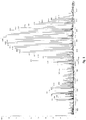
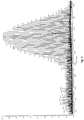
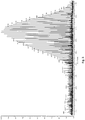
- the exemplary oligomeric materials were prepared from H12MDI (4,4'-methylene bis(cyclohexyl isocyanate), PPG4000 (polypropylene glycol with M n ⁇ 4000 g/mol) and HEA (2-hydroxyethyl acrylate) in accordance with the illustrative reaction described hereinabove. All reagents were used as supplied by the manufacturer and were not subjected to further purification. H12MDI was obtained from Aldrich or Bayer. Three variants of PPG4000 were employed in the synthesis of sample oligomers. Variant 1 (Voranol 220-028, available from Dow) included a greater amount of low molecular weight material.
- Variant 2 Polyglycol P4000, available from Dow
- Variant 3 Product No. 202355, available from Aldrich
- the molecular weights of the three variant of PPG4000 were determined by measuring the hydroxyl number.
- the mass spectra of the three variants of PPG4000 are shown in Figs. 1-3 .
- supplemental HEA was added to the reaction mixture to quench residual isocyanate groups that may have remained unreacted.
- the supplemental HEA was an amount in addition to the amount corresponding to the initial molar ratio n-1.
- dibutyltin dilaurate was used as a catalyst (at a level of 160 ppm based on the mass of the initial reaction mixture) and 2,6-di-tert-butyl-4-methylphenol was used as an inhibitor (at a level of 400 ppm based on the mass of the initial reaction mixture).
- the oligomeric materials were prepared by mixing 4,4'-methylene bis(cyclohexyl isocyanate), dibutyltin dilaurate and 2,6-di- tert -butyl-4 methylphenol, at room temperature, in a 500mL flask equipped with a thermometer, CaCl2 drying tube, stirrer. While continuously stirring the contents of the flask, PPG4000 was added over a time period of 30-40 minutes using an addition funnel. The internal temperature of the reaction mixture was monitored as the PPG4000 was added and the introduction of PPG4000 was controlled to prevent excess heating (arising from the exothermic reaction).
- the reaction mixture was heated in an oil bath at about 60°C - 64°C for about 1 - 1 1 ⁇ 2 hours. Samples 6, 8, and 9 were subjected to extended heating at 60 °C for 24 hours. At various intervals, samples of the reaction mixture where retrieved for analysis by infrared spectroscopy (FTIR) to monitor the progress of the reaction by determining the concentration of unreacted isocyanate groups based on the intensity of a characteristic isocyanate stretching mode at 2265 cm -1 . The flask was removed from the oil bath and its contents were allowed to cool to 56-58°C and addition of supplemental HEA (amounts in addition to those listed in Table 1) was conducted drop wise over 2-5 minutes using an addition funnel.
- FTIR infrared spectroscopy
- Table 3 also lists the amount in weight percent (wt%) of the di-adduct compound in the final reaction mixture of each sample.
- the di-adduct compound corresponds to unreacted H12MDI with isocyanate groups that are end-capped with HEA.
- the di-adduct compound has the formula HEA ⁇ H12MDI ⁇ HEA.
- the concentration (wt%) of di-adduct compound was determined by gel permeation chromatography (GPC).
- GPC gel permeation chromatography
- a Waters Alliance 2690 GPC instrument was used to determine the di-adduct concentration.
- the mobile phase was THF.
- the columns were calibrated with polystyrene standards ranging from 162 - 6,980,000 g/mol using EasiCal PS-1 & 2 polymer calibrant kits (Agilent Technologies Part Nos. PL2010-505 and PL2010-0601).
- the detector was a Waters Alliance 2410 differential refractometer operated at 40 °C and sensitivity level 4. The samples were injected twice along with a THF + 0.05% toluene blank.
- the amount (wt%) of di-adduct in the oligomers prepared in the present disclosure was quantified using the preceding GPC system and technique.
- a calibration curve was obtained using standard solutions containing known amounts of the di-adduct compound (HEA ⁇ H12MDI ⁇ HEA) in THF.
- Standard solutions with di-adduct concentrations or 113.2 ⁇ g/g, 462.6 ⁇ g/g, 825.1 ⁇ g/g, and 4180 ⁇ g/g were prepared.
- the dimension " ⁇ g/g” refers to ⁇ g of di-adduct per gram of total solution (di-adduct + THF)).
- the di-adduct concentration in the oligomeric materials prepared herein was determined using the calibration. Samples were prepared by diluting ⁇ 0.10 g of oligomeric material in THF to obtain a ⁇ 1.5 g test solution. The test solution was run through the GPC instrument and the area of the peak associated with the di-adduct compound was determined. The di-adduct concentration in units of ⁇ g/g was obtained from the peak area and the calibration curve, and was converted to wt% by multiplying by the weight (g) of the test solution and dividing by the weight of the sample of oligomeric material before dilution with THF. The wt% of di-adduct compound for the twelve oligomeric materials prepared in this example are reported in Table 3.
- the measured value of the di-adduct compound in each of the oligomeric materials is at least 2.35 wt%.
- the present disclosers have produced oligomeric materials that include a polyether urethane compound of the type shown in molecular formula (IV) hereinabove and an enhanced concentration of di-adduct compound of the type shown in molecular formula (V) hereinabove.
- coatings formed using oligomeric materials that contain the di-adduct compound in amounts of at least 2.35 wt% may have significantly improved tear strength (relative to coatings formed from polyether urethane acrylate compounds alone or polyether urethane acrylate compounds combined with lesser amounts of di-adduct compound) while maintaining a favorable Young's modulus.
- Oligomeric materials corresponding to Samples 1-12 were separately combined with other components to form coating compositions.
- the amount of each component in the coating composition is listed in Table 4 below.
- the entry in Table 4 for Oligomeric Material includes the polyether urethane acrylate and di-adduct compound produced in the reaction of this Example.
- a separate coating composition was made for each of the exemplary oligomeric materials corresponding to Samples 1-12, where the amount of di-adduct compound in the oligomeric material corresponded to the amount listed in Table 3.
- Sartomer SR504 is ethoxylated(4)nonylphenol acrylate (available from Sartomer).
- V-CAP/RC is (available from ISP Technologies).
- Lucirin TPO is 2,4,6-trimethylbenzoyl)diphenyl phosphine oxide (available from BASF) and functions as a photoinitiator.
- 3-acryloxypropyl trimethoxysilane is an adhesion promoter (available from Gelest).
- Pentaerythritol tetrakis(3-mercaptopropionate) is a strength additive. Young's modulus was measured on films formed by curing the coating compositions. Wet films were cast on silicone release paper with the aid of a draw-down box having a gap thickness of about 0.1 mm (0.005"). Films were cured with a UV dose of 1.2 J/cm 2 (measured over a wavelength range of 225 - 424 nm by a Light Bug model IL490 from International Light) by a Fusion Systems UV curing apparatus with a 600 W/in D-bulb (50% Power and approximately 3.7 m/min (12 ft/min) belt speed) to yield primary coatings in film form. Cured film thickness was between about 0.08 mm (0.0030") and 0.09 mm (0.0035").
- the films were allowed to age (23° C, 50% relative humidity) for at least 16 hours prior to testing. Film samples were cut to specified dimensions of 12.5 cm x 13 mm using a cutting template and a scalpel. Young's modulus, tensile strength at break, and elongation at break were measured on the film samples using a MTS Sintech tensile tester. Young's modulus is defined as the steepest slope of the beginning of the stress-strain curve. Films were tested at an elongation rate of 2.5 cm/min with the initial gauge length of 5.1 cm.
- Tear strength (G 0 ) was measured with a MTS Sintech tensile tester. Coatings were casted on glass plates with the aid of a draw-down box having a gap thickness of about 0.1 mm (0.005") and then immediately cured under UV irradiation at the dose of 1 J/cm 2 . Shape and dimensions of cured films were prepared according to the International Standard norm ISO 816 (second edition 1983-12-01) "Determination of tear strength of small test pieces (Delft test pieces)". Films were conditioned at 23°C ⁇ 2°C and 50% relative humidity (RH) for at least 16 hours. The initial gauge length was 5.0 cm and test speed was set at 0.1 mm/min. Three to five specimens of each coating were tested.
- G 0 F break B ⁇ d ⁇ C ⁇ ⁇ b 2 2 E
- F break is the force at break
- b is the slit length
- d is the thickness
- B is the width of the test piece.
- E is the segment modulus calculated from the stresses at elongation of 0.05% and 2%
- Table 5 The Young's modulus and tear strength results for film samples prepared by curing each of the twelve coating compositions are summarized in Table 5.
- Table 5 also repeats the content of the di-adduct compound present in the oligomeric materials used for each coating composition. The results shown in Table 5 indicate that modification of the oligomeric material to increase the concentration of di-adduct compound leads to a pronounced increase in tear strength.
- the present disclosure demonstrates that the concentration of di-adduct compound influences the tear strength of fiber coatings while preserving the low values of Young's modulus desirable for primary fiber coatings.
- Figure 4 is a plot showing the dependence of Young's modulus on the molar ratio n of H12MDI used in the synthesis of the oligomeric material of the coating composition.
- the molar ratios of HEA and PPG4000 used in the initial reaction mixture during synthesis of the oligomeric material of the coating compositions were n-1 and 2, respectively.
- supplemental HEA added to the reaction mixture to quench residual isocyanate present in the oligomer.
- Data are shown for Samples 1-4 (data points with molar ratios labeled as 3.5:2.5, 3.7:2.7, 3.85:2.85, and 4:3) and two related samples (data points with molar ratios labeled as 3.1:2.1 and 4.5:3.5).
- the Young's modulus was observed to increase with increasing value of the molar ratio n used in the synthesis of the oligomeric material of the coating composition.
- Figure 5 is a plot showing the dependence of tear strength on the molar ratio n of H12MDI used in the synthesis of the oligomeric material of the coating composition.
- the mole ratios of HEA and PPG4000 reacted in the initial reaction mixture were n-1 and 2, respectively with supplemental HEA (beyond the amount represented by molar ratio n-1) being added to the reaction mixture as indicated in Table 3 to quench residual isocyanate groups.
- Data in Fig. 5 are shown for Samples 1-4 in order of increasing value of n.
- the tear strength was observed to increase with increasing value of the molar ratio n used in the synthesis of the oligomeric material used in the coating composition.
- Samples 1-5 were made with HEA having a water content of about 345 ppm, while Samples 6-10 were made with HEA having a water content of about 2500 ppm.
- Samples 6 and 8 For samples with a H12MDI molar ratio value n of 3.5 (Samples 6 and 8), extended heating at 60 °C for about 24 hours was sufficient to quench isocyanate groups (as assessed by the intensity of the IR stretching mode described hereinabove) and no supplemental HEA was needed.
- High tear strengths > 23 J/cm 2 ) were also observed for both of Samples 6 and 8 (despite the difference in polyol reactant).
- Sample 10 was prepared similar to Sample 9, but was not subjected to extended heating after the initial heating at 60-64 °C for 1-1.5 hours and required about the same amount of supplemental HEA as Sample 9 to quench isocyanate groups.
- the tear strength of the coating made from the oligomeric material of Sample 10 had a tear strength of 26.10 J/m 2 .
- Samples 11-12 were prepared using a polyol with a higher fraction of lower molecular weight material. It was observed that use of the polyol with higher fraction of lower molecular weight material resulted in coatings with a tear strength of about 22 J/m 2 or higher, which is much higher than the tear strength of a coating made from a coating composition using an oligomeric material made with a polyol with a smaller fraction of lower molecular weight material (e.g. Sample 1).
- Capstan assemblies consist of a capstan and a pinch belt.
- the pinch belts on each assembly are used to apply a compressive load on the fiber. This compressive load isolates the proof-test tension in the fiber section between the two belted capstan assemblies from the payout and winding tensions.
- a uniform lateral squish load from the pinch belt compression and a shear load which depends on the stick/slip conditions at the coating-pinch belt and coating-capstan interfaces and results from the glass pulling against the coatings from within the fiber. It is important that the coating can be subjected to this process without creating defects.
Landscapes
- Chemical & Material Sciences (AREA)
- Organic Chemistry (AREA)
- Chemical Kinetics & Catalysis (AREA)
- Medicinal Chemistry (AREA)
- Polymers & Plastics (AREA)
- Physics & Mathematics (AREA)
- Health & Medical Sciences (AREA)
- Life Sciences & Earth Sciences (AREA)
- Engineering & Computer Science (AREA)
- Materials Engineering (AREA)
- Optics & Photonics (AREA)
- General Physics & Mathematics (AREA)
- Wood Science & Technology (AREA)
- General Life Sciences & Earth Sciences (AREA)
- General Chemical & Material Sciences (AREA)
- Geochemistry & Mineralogy (AREA)
- Macromonomer-Based Addition Polymer (AREA)
- Polyurethanes Or Polyureas (AREA)
- Paints Or Removers (AREA)
Applications Claiming Priority (2)
| Application Number | Priority Date | Filing Date | Title |
|---|---|---|---|
| US201361876918P | 2013-09-12 | 2013-09-12 | |
| PCT/US2014/055120 WO2015038728A1 (en) | 2013-09-12 | 2014-09-11 | Fiber coatings with low young's modulus and high tear strength |
Publications (2)
| Publication Number | Publication Date |
|---|---|
| EP3044242A1 EP3044242A1 (en) | 2016-07-20 |
| EP3044242B1 true EP3044242B1 (en) | 2020-08-12 |
Family
ID=51626154
Family Applications (1)
| Application Number | Title | Priority Date | Filing Date |
|---|---|---|---|
| EP14776780.0A Active EP3044242B1 (en) | 2013-09-12 | 2014-09-11 | Fiber coatings with low young's modulus and high tear strength |
Country Status (7)
| Country | Link |
|---|---|
| US (1) | US9810838B2 (enExample) |
| EP (1) | EP3044242B1 (enExample) |
| JP (1) | JP6526012B2 (enExample) |
| KR (1) | KR102239819B1 (enExample) |
| CN (1) | CN105722883B (enExample) |
| RU (1) | RU2016113711A (enExample) |
| WO (1) | WO2015038728A1 (enExample) |
Families Citing this family (25)
| Publication number | Priority date | Publication date | Assignee | Title |
|---|---|---|---|---|
| US9708491B2 (en) * | 2014-06-04 | 2017-07-18 | Corning Incorporated | Optical fiber coating and composition |
| US20180127593A1 (en) * | 2016-11-08 | 2018-05-10 | Corning Incorporated | Fiber coatings with low modulus and high critical stress |
| JP2018077303A (ja) * | 2016-11-08 | 2018-05-17 | 住友電気工業株式会社 | 光ファイバ心線 |
| KR102588712B1 (ko) | 2017-06-02 | 2023-10-17 | 코베스트로 (네덜란드) 비.브이. | 광섬유용의 내열성 방사선 경화성 코팅 |
| US10677983B2 (en) * | 2017-07-31 | 2020-06-09 | Ofs Fitel, Llc | Optically uniform fiber, methods of making, and methods of inspecting |
| NL2019821B1 (en) * | 2017-09-27 | 2019-04-03 | Corning Inc | Fiber coating with fast cure speed |
| US10377918B2 (en) * | 2017-09-27 | 2019-08-13 | Corning Incorporated | Fiber coating with fast cure speed |
| CN111315701B (zh) | 2017-11-03 | 2022-10-14 | 科思创(荷兰)有限公司 | 包含用液体可辐射固化超吸收性聚合物组合物涂布的纤维的阻水体系 |
| US11028214B2 (en) | 2018-01-22 | 2021-06-08 | Corning Incorporated | Synthesis of oligomer for optical fiber coating |
| JP7140182B2 (ja) * | 2018-02-13 | 2022-09-21 | 住友電気工業株式会社 | 紫外線硬化型樹脂組成物及び光ファイバ |
| EP3528018B1 (en) | 2018-02-15 | 2021-03-17 | Corning Incorporated | Fiber coating compositions with high cure speed |
| NL2020563B1 (en) * | 2018-02-15 | 2019-08-22 | Corning Inc | Fiber coating compositions with high cure speed |
| US10689544B2 (en) * | 2018-05-03 | 2020-06-23 | Corning Incorporated | Fiber coatings with low pullout force |
| US10775557B2 (en) | 2018-05-03 | 2020-09-15 | Corning Incorporated | Fiber coatings with low pullout force |
| CN112203995B (zh) | 2018-06-01 | 2023-02-21 | 科思创(荷兰)有限公司 | 用于经由交替低聚物涂覆光纤的辐射可固化组合物及由其生产的涂层 |
| US11964906B2 (en) | 2018-08-30 | 2024-04-23 | Covestro (Netherlands) B.V. | Radiation curable compositions for coating optical fiber |
| JP7213660B2 (ja) * | 2018-11-07 | 2023-01-27 | ナガセケムテックス株式会社 | 硬化性樹脂組成物および硬化物 |
| JP2022509797A (ja) | 2018-12-03 | 2022-01-24 | コベストロ (ネザーランズ) ビー.ヴィー. | 光ファイバーをコーティングするための充填放射線硬化性組成物およびそれから製造されるコーティング |
| WO2020239563A1 (en) | 2019-05-24 | 2020-12-03 | Dsm Ip Assets B.V. | Radiation curable compositions for coating optical fiber with enhanced high-speed processability |
| CN114144386B (zh) | 2019-05-24 | 2023-11-17 | 科思创(荷兰)有限公司 | 具有增强的高速可加工性的用于涂覆光纤的辐射可固化组合物 |
| US11822117B2 (en) * | 2019-10-08 | 2023-11-21 | Corning Incorporated | Primary coating compositions with improved microbending performance |
| CN115777077A (zh) | 2020-06-30 | 2023-03-10 | 科思创(荷兰)有限公司 | 光纤涂料的粘度指数改进剂 |
| JP2022020989A (ja) * | 2020-07-21 | 2022-02-02 | Dicグラフィックス株式会社 | 活性エネルギー線硬化性コーティング剤、これを用いた塗装建材 |
| JP7699943B2 (ja) * | 2021-03-26 | 2025-06-30 | 日東電工株式会社 | 位相差層付偏光板および該位相差層付偏光板を用いた画像表示装置 |
| JP2024068708A (ja) | 2022-11-09 | 2024-05-21 | 日本特殊コーティング株式会社 | 光ファイバ第一次コート層形成用の放射線硬化性組成物およびウレタン(メタ)アクリレート |
Family Cites Families (40)
| Publication number | Priority date | Publication date | Assignee | Title |
|---|---|---|---|---|
| US4629287A (en) | 1985-02-25 | 1986-12-16 | Desoto, Inc. | Ultraviolet curable buffer coatings for optical fiber |
| US4609718A (en) | 1985-05-08 | 1986-09-02 | Desoto, Inc. | Ultraviolet curable buffer coatings for optical glass fiber based on long chain oxyalkylene diamines |
| US4798852A (en) | 1985-10-29 | 1989-01-17 | Desoto, Inc. | Ultraviolet curable coatings for optical glass fiber |
| JP2627626B2 (ja) | 1987-10-20 | 1997-07-09 | 日本合成ゴム株式会社 | 光フアイバー被覆用組成物 |
| US5093386A (en) | 1989-05-16 | 1992-03-03 | Stamicarbon B.V. | Liquid curable plastic composition |
| AU7084798A (en) * | 1997-04-22 | 1998-11-13 | Dsm N.V. | Liquid curable resin composition |
| JP4140740B2 (ja) * | 1997-05-20 | 2008-08-27 | Jsr株式会社 | 光ファイバ被覆用放射線硬化性液状樹脂組成物 |
| US6359025B1 (en) | 1997-05-16 | 2002-03-19 | Dsm N.V. | Radiation-curable liquid resin composition for coating optical fibers |
| CN1109874C (zh) * | 1998-11-20 | 2003-05-28 | 陆仁书 | 柔性垫网接触式间歇干燥单板的方法 |
| US6316516B1 (en) | 1999-04-29 | 2001-11-13 | Corning Incorporated | Coating composition for optical fibers |
| US6326416B1 (en) | 1999-04-29 | 2001-12-04 | Corning Incorporated | Coating composition for optical fibers |
| JP4540079B2 (ja) * | 2000-04-28 | 2010-09-08 | Jsr株式会社 | 光ファイバ用硬化性樹脂組成物およびその硬化物 |
| KR100489511B1 (ko) | 1999-07-20 | 2005-05-16 | 제이에스알 가부시끼가이샤 | 방사선 경화성 수지조성물 |
| AU3262001A (en) | 1999-12-30 | 2001-07-16 | Corning Incorporated | Composition containing tackifier and method of modifying time-sensitive rheological properties of optical fiber coating |
| WO2001049625A1 (en) | 1999-12-30 | 2001-07-12 | Corning Incorporated | Optical fibers prepared with a primary coating composition including a monomer with a pendant hydroxyl functional group |
| JP2001200007A (ja) * | 2000-01-19 | 2001-07-24 | Shin Etsu Chem Co Ltd | 光硬化性樹脂組成物及び光ファイバー用被覆材 |
| US7067564B2 (en) | 2000-11-22 | 2006-06-27 | Dsm Ip Assets B.V. | Coated optical fibers |
| US6916855B2 (en) | 2000-11-22 | 2005-07-12 | Dsm Ip Assets B.V. | Radiation curable compositions |
| US7706659B2 (en) | 2000-11-22 | 2010-04-27 | Dsm Ip Assets B.V. | Coated optical fibers |
| JP2002243995A (ja) | 2001-02-13 | 2002-08-28 | Shin Etsu Chem Co Ltd | 光ファイバ心線 |
| JP4782294B2 (ja) | 2001-03-02 | 2011-09-28 | ディーエスエム アイピー アセッツ ビー.ブイ. | 多層被覆 |
| US20030077059A1 (en) | 2001-03-13 | 2003-04-24 | Ching-Kee Chien | Optical fiber coating compositions |
| US20030123839A1 (en) | 2001-07-27 | 2003-07-03 | Chou Kevin Y. | Low modulus, high tensile strength optical fiber coating |
| JP4483189B2 (ja) * | 2002-05-10 | 2010-06-16 | Dic株式会社 | 光ファイバー被覆用樹脂組成物及びそれを用いた素線、ユニット |
| KR100926714B1 (ko) | 2002-05-10 | 2009-11-17 | 디아이씨 가부시끼가이샤 | 광섬유 피복용 수지 조성물 및 그것을 이용한 피복된광섬유 및 광섬유 유닛 |
| JP4233014B2 (ja) * | 2002-08-08 | 2009-03-04 | ダイセル・サイテック株式会社 | 光ファイバーコーティング用樹脂組成物及び光ファイバー |
| AU2002368263B2 (en) * | 2002-10-07 | 2009-05-28 | Prysmian Cavi E Sistemi Energia S.R.L. | Optical fiber with cured polymeric coating |
| JP2004244618A (ja) * | 2003-01-22 | 2004-09-02 | Kansai Paint Co Ltd | 光ファイバー用被覆組成物および被覆光ファイバー |
| US7109252B2 (en) | 2003-11-25 | 2006-09-19 | Bomar Specialties Company | TMXDI-based oligomer and formulations containing it |
| US7010206B1 (en) | 2004-09-08 | 2006-03-07 | Corning Incorporated | Coated optical fiber and optical fiber coating system including a fast-gelling primary coating |
| JP2007269871A (ja) * | 2006-03-30 | 2007-10-18 | Jsr Corp | 放射線硬化性液状樹脂組成物 |
| JP2007297467A (ja) * | 2006-04-28 | 2007-11-15 | Jsr Corp | 液状硬化性樹脂組成物 |
| JP5009659B2 (ja) * | 2007-03-23 | 2012-08-22 | リンテック株式会社 | ダイシングシートおよびチップ体の製造方法 |
| WO2008069088A1 (ja) * | 2006-12-05 | 2008-06-12 | Lintec Corporation | レーザーダイシングシートおよびチップ体の製造方法 |
| CN102935747B (zh) * | 2007-07-30 | 2015-05-20 | 旭硝子株式会社 | 透明层叠体的制造方法以及透明层叠体 |
| JP2009168865A (ja) * | 2008-01-11 | 2009-07-30 | Jsr Corp | 光ファイバアップジャケット用液状硬化性樹脂組成物 |
| CN102428113B (zh) * | 2009-05-20 | 2015-04-22 | 旭硝子株式会社 | 固化性树脂组合物、透明层叠体及其制造方法 |
| RU2504522C2 (ru) | 2009-10-09 | 2014-01-20 | ДСМ Ай Пи ЭССЕТС Б.В. | D1451 способы составления отверждаемых облучением суперпокрытий для оптического волокна |
| US20120128313A1 (en) * | 2009-10-09 | 2012-05-24 | Xiaosong Wu | Radiation curable coating for optical fiber |
| CN102911337B (zh) * | 2012-07-02 | 2014-11-05 | 北京化工大学 | 一种聚氨酯丙烯酸酯低聚物及其制备方法 |
-
2014
- 2014-08-18 US US14/461,685 patent/US9810838B2/en active Active
- 2014-09-11 JP JP2016542088A patent/JP6526012B2/ja active Active
- 2014-09-11 RU RU2016113711A patent/RU2016113711A/ru unknown
- 2014-09-11 KR KR1020167009201A patent/KR102239819B1/ko active Active
- 2014-09-11 WO PCT/US2014/055120 patent/WO2015038728A1/en not_active Ceased
- 2014-09-11 CN CN201480061981.9A patent/CN105722883B/zh active Active
- 2014-09-11 EP EP14776780.0A patent/EP3044242B1/en active Active
Non-Patent Citations (1)
| Title |
|---|
| None * |
Also Published As
| Publication number | Publication date |
|---|---|
| RU2016113711A (ru) | 2017-10-17 |
| KR102239819B1 (ko) | 2021-04-14 |
| JP6526012B2 (ja) | 2019-06-05 |
| WO2015038728A1 (en) | 2015-03-19 |
| US20150071595A1 (en) | 2015-03-12 |
| US9810838B2 (en) | 2017-11-07 |
| JP2016539380A (ja) | 2016-12-15 |
| EP3044242A1 (en) | 2016-07-20 |
| CN105722883B (zh) | 2019-01-18 |
| KR20160055849A (ko) | 2016-05-18 |
| CN105722883A (zh) | 2016-06-29 |
Similar Documents
| Publication | Publication Date | Title |
|---|---|---|
| US9810838B2 (en) | Fiber coatings with low young's modulus and high tear strength | |
| US20180127593A1 (en) | Fiber coatings with low modulus and high critical stress | |
| EP3788017B1 (en) | Fiber coatings with low pullout force | |
| US20200064546A1 (en) | Fiber coatings with low pullout force | |
| US11028214B2 (en) | Synthesis of oligomer for optical fiber coating | |
| US11319456B2 (en) | Fiber coating compositions with acylgermane photoinitiators | |
| US11822117B2 (en) | Primary coating compositions with improved microbending performance | |
| EP3461799B1 (en) | Fiber coating with fast cure speed | |
| KR102722333B1 (ko) | 높은 경화 속도를 갖는 섬유 코팅 조성물 | |
| EP3528018B1 (en) | Fiber coating compositions with high cure speed | |
| NL2020470B1 (en) | Synthesis of oligomer for optical fiber coating | |
| US20210132289A1 (en) | Optical fibers with thin coatings | |
| EP4054988A1 (en) | Fiber coatings with low pullout force | |
| NL2019821B1 (en) | Fiber coating with fast cure speed |
Legal Events
| Date | Code | Title | Description |
|---|---|---|---|
| PUAI | Public reference made under article 153(3) epc to a published international application that has entered the european phase |
Free format text: ORIGINAL CODE: 0009012 |
|
| 17P | Request for examination filed |
Effective date: 20160324 |
|
| AK | Designated contracting states |
Kind code of ref document: A1 Designated state(s): AL AT BE BG CH CY CZ DE DK EE ES FI FR GB GR HR HU IE IS IT LI LT LU LV MC MK MT NL NO PL PT RO RS SE SI SK SM TR |
|
| AX | Request for extension of the european patent |
Extension state: BA ME |
|
| DAX | Request for extension of the european patent (deleted) | ||
| STAA | Information on the status of an ep patent application or granted ep patent |
Free format text: STATUS: EXAMINATION IS IN PROGRESS |
|
| 17Q | First examination report despatched |
Effective date: 20180713 |
|
| GRAP | Despatch of communication of intention to grant a patent |
Free format text: ORIGINAL CODE: EPIDOSNIGR1 |
|
| STAA | Information on the status of an ep patent application or granted ep patent |
Free format text: STATUS: GRANT OF PATENT IS INTENDED |
|
| INTG | Intention to grant announced |
Effective date: 20200227 |
|
| GRAS | Grant fee paid |
Free format text: ORIGINAL CODE: EPIDOSNIGR3 |
|
| GRAA | (expected) grant |
Free format text: ORIGINAL CODE: 0009210 |
|
| STAA | Information on the status of an ep patent application or granted ep patent |
Free format text: STATUS: THE PATENT HAS BEEN GRANTED |
|
| AK | Designated contracting states |
Kind code of ref document: B1 Designated state(s): AL AT BE BG CH CY CZ DE DK EE ES FI FR GB GR HR HU IE IS IT LI LT LU LV MC MK MT NL NO PL PT RO RS SE SI SK SM TR |
|
| REG | Reference to a national code |
Ref country code: CH Ref legal event code: EP |
|
| REG | Reference to a national code |
Ref country code: DE Ref legal event code: R096 Ref document number: 602014068905 Country of ref document: DE |
|
| REG | Reference to a national code |
Ref country code: IE Ref legal event code: FG4D |
|
| REG | Reference to a national code |
Ref country code: NL Ref legal event code: FP |
|
| REG | Reference to a national code |
Ref country code: AT Ref legal event code: REF Ref document number: 1301499 Country of ref document: AT Kind code of ref document: T Effective date: 20200915 |
|
| REG | Reference to a national code |
Ref country code: LT Ref legal event code: MG4D |
|
| PG25 | Lapsed in a contracting state [announced via postgrant information from national office to epo] |
Ref country code: HR Free format text: LAPSE BECAUSE OF FAILURE TO SUBMIT A TRANSLATION OF THE DESCRIPTION OR TO PAY THE FEE WITHIN THE PRESCRIBED TIME-LIMIT Effective date: 20200812 Ref country code: LT Free format text: LAPSE BECAUSE OF FAILURE TO SUBMIT A TRANSLATION OF THE DESCRIPTION OR TO PAY THE FEE WITHIN THE PRESCRIBED TIME-LIMIT Effective date: 20200812 Ref country code: FI Free format text: LAPSE BECAUSE OF FAILURE TO SUBMIT A TRANSLATION OF THE DESCRIPTION OR TO PAY THE FEE WITHIN THE PRESCRIBED TIME-LIMIT Effective date: 20200812 Ref country code: NO Free format text: LAPSE BECAUSE OF FAILURE TO SUBMIT A TRANSLATION OF THE DESCRIPTION OR TO PAY THE FEE WITHIN THE PRESCRIBED TIME-LIMIT Effective date: 20201112 Ref country code: GR Free format text: LAPSE BECAUSE OF FAILURE TO SUBMIT A TRANSLATION OF THE DESCRIPTION OR TO PAY THE FEE WITHIN THE PRESCRIBED TIME-LIMIT Effective date: 20201113 Ref country code: BG Free format text: LAPSE BECAUSE OF FAILURE TO SUBMIT A TRANSLATION OF THE DESCRIPTION OR TO PAY THE FEE WITHIN THE PRESCRIBED TIME-LIMIT Effective date: 20201112 Ref country code: SE Free format text: LAPSE BECAUSE OF FAILURE TO SUBMIT A TRANSLATION OF THE DESCRIPTION OR TO PAY THE FEE WITHIN THE PRESCRIBED TIME-LIMIT Effective date: 20200812 |
|
| REG | Reference to a national code |
Ref country code: AT Ref legal event code: MK05 Ref document number: 1301499 Country of ref document: AT Kind code of ref document: T Effective date: 20200812 |
|
| PG25 | Lapsed in a contracting state [announced via postgrant information from national office to epo] |
Ref country code: IS Free format text: LAPSE BECAUSE OF FAILURE TO SUBMIT A TRANSLATION OF THE DESCRIPTION OR TO PAY THE FEE WITHIN THE PRESCRIBED TIME-LIMIT Effective date: 20201212 Ref country code: RS Free format text: LAPSE BECAUSE OF FAILURE TO SUBMIT A TRANSLATION OF THE DESCRIPTION OR TO PAY THE FEE WITHIN THE PRESCRIBED TIME-LIMIT Effective date: 20200812 Ref country code: PL Free format text: LAPSE BECAUSE OF FAILURE TO SUBMIT A TRANSLATION OF THE DESCRIPTION OR TO PAY THE FEE WITHIN THE PRESCRIBED TIME-LIMIT Effective date: 20200812 Ref country code: LV Free format text: LAPSE BECAUSE OF FAILURE TO SUBMIT A TRANSLATION OF THE DESCRIPTION OR TO PAY THE FEE WITHIN THE PRESCRIBED TIME-LIMIT Effective date: 20200812 |
|
| PG25 | Lapsed in a contracting state [announced via postgrant information from national office to epo] |
Ref country code: EE Free format text: LAPSE BECAUSE OF FAILURE TO SUBMIT A TRANSLATION OF THE DESCRIPTION OR TO PAY THE FEE WITHIN THE PRESCRIBED TIME-LIMIT Effective date: 20200812 Ref country code: CZ Free format text: LAPSE BECAUSE OF FAILURE TO SUBMIT A TRANSLATION OF THE DESCRIPTION OR TO PAY THE FEE WITHIN THE PRESCRIBED TIME-LIMIT Effective date: 20200812 Ref country code: DK Free format text: LAPSE BECAUSE OF FAILURE TO SUBMIT A TRANSLATION OF THE DESCRIPTION OR TO PAY THE FEE WITHIN THE PRESCRIBED TIME-LIMIT Effective date: 20200812 Ref country code: RO Free format text: LAPSE BECAUSE OF FAILURE TO SUBMIT A TRANSLATION OF THE DESCRIPTION OR TO PAY THE FEE WITHIN THE PRESCRIBED TIME-LIMIT Effective date: 20200812 Ref country code: SM Free format text: LAPSE BECAUSE OF FAILURE TO SUBMIT A TRANSLATION OF THE DESCRIPTION OR TO PAY THE FEE WITHIN THE PRESCRIBED TIME-LIMIT Effective date: 20200812 |
|
| REG | Reference to a national code |
Ref country code: CH Ref legal event code: PL |
|
| REG | Reference to a national code |
Ref country code: DE Ref legal event code: R097 Ref document number: 602014068905 Country of ref document: DE |
|
| PG25 | Lapsed in a contracting state [announced via postgrant information from national office to epo] |
Ref country code: MC Free format text: LAPSE BECAUSE OF FAILURE TO SUBMIT A TRANSLATION OF THE DESCRIPTION OR TO PAY THE FEE WITHIN THE PRESCRIBED TIME-LIMIT Effective date: 20200812 Ref country code: ES Free format text: LAPSE BECAUSE OF FAILURE TO SUBMIT A TRANSLATION OF THE DESCRIPTION OR TO PAY THE FEE WITHIN THE PRESCRIBED TIME-LIMIT Effective date: 20200812 Ref country code: AT Free format text: LAPSE BECAUSE OF FAILURE TO SUBMIT A TRANSLATION OF THE DESCRIPTION OR TO PAY THE FEE WITHIN THE PRESCRIBED TIME-LIMIT Effective date: 20200812 Ref country code: AL Free format text: LAPSE BECAUSE OF FAILURE TO SUBMIT A TRANSLATION OF THE DESCRIPTION OR TO PAY THE FEE WITHIN THE PRESCRIBED TIME-LIMIT Effective date: 20200812 |
|
| PLBE | No opposition filed within time limit |
Free format text: ORIGINAL CODE: 0009261 |
|
| REG | Reference to a national code |
Ref country code: BE Ref legal event code: MM Effective date: 20200930 |
|
| STAA | Information on the status of an ep patent application or granted ep patent |
Free format text: STATUS: NO OPPOSITION FILED WITHIN TIME LIMIT |
|
| PG25 | Lapsed in a contracting state [announced via postgrant information from national office to epo] |
Ref country code: SK Free format text: LAPSE BECAUSE OF FAILURE TO SUBMIT A TRANSLATION OF THE DESCRIPTION OR TO PAY THE FEE WITHIN THE PRESCRIBED TIME-LIMIT Effective date: 20200812 Ref country code: LU Free format text: LAPSE BECAUSE OF NON-PAYMENT OF DUE FEES Effective date: 20200911 |
|
| 26N | No opposition filed |
Effective date: 20210514 |
|
| PG25 | Lapsed in a contracting state [announced via postgrant information from national office to epo] |
Ref country code: SI Free format text: LAPSE BECAUSE OF FAILURE TO SUBMIT A TRANSLATION OF THE DESCRIPTION OR TO PAY THE FEE WITHIN THE PRESCRIBED TIME-LIMIT Effective date: 20200812 Ref country code: LI Free format text: LAPSE BECAUSE OF NON-PAYMENT OF DUE FEES Effective date: 20200930 Ref country code: IE Free format text: LAPSE BECAUSE OF NON-PAYMENT OF DUE FEES Effective date: 20200911 Ref country code: CH Free format text: LAPSE BECAUSE OF NON-PAYMENT OF DUE FEES Effective date: 20200930 Ref country code: BE Free format text: LAPSE BECAUSE OF NON-PAYMENT OF DUE FEES Effective date: 20200930 |
|
| PG25 | Lapsed in a contracting state [announced via postgrant information from national office to epo] |
Ref country code: TR Free format text: LAPSE BECAUSE OF FAILURE TO SUBMIT A TRANSLATION OF THE DESCRIPTION OR TO PAY THE FEE WITHIN THE PRESCRIBED TIME-LIMIT Effective date: 20200812 Ref country code: MT Free format text: LAPSE BECAUSE OF FAILURE TO SUBMIT A TRANSLATION OF THE DESCRIPTION OR TO PAY THE FEE WITHIN THE PRESCRIBED TIME-LIMIT Effective date: 20200812 Ref country code: CY Free format text: LAPSE BECAUSE OF FAILURE TO SUBMIT A TRANSLATION OF THE DESCRIPTION OR TO PAY THE FEE WITHIN THE PRESCRIBED TIME-LIMIT Effective date: 20200812 |
|
| PG25 | Lapsed in a contracting state [announced via postgrant information from national office to epo] |
Ref country code: MK Free format text: LAPSE BECAUSE OF FAILURE TO SUBMIT A TRANSLATION OF THE DESCRIPTION OR TO PAY THE FEE WITHIN THE PRESCRIBED TIME-LIMIT Effective date: 20200812 |
|
| PG25 | Lapsed in a contracting state [announced via postgrant information from national office to epo] |
Ref country code: PT Free format text: LAPSE BECAUSE OF FAILURE TO SUBMIT A TRANSLATION OF THE DESCRIPTION OR TO PAY THE FEE WITHIN THE PRESCRIBED TIME-LIMIT Effective date: 20200812 |
|
| P01 | Opt-out of the competence of the unified patent court (upc) registered |
Effective date: 20230527 |
|
| PGFP | Annual fee paid to national office [announced via postgrant information from national office to epo] |
Ref country code: NL Payment date: 20250812 Year of fee payment: 12 |
|
| PGFP | Annual fee paid to national office [announced via postgrant information from national office to epo] |
Ref country code: DE Payment date: 20250808 Year of fee payment: 12 |
|
| PGFP | Annual fee paid to national office [announced via postgrant information from national office to epo] |
Ref country code: IT Payment date: 20250909 Year of fee payment: 12 |
|
| PGFP | Annual fee paid to national office [announced via postgrant information from national office to epo] |
Ref country code: GB Payment date: 20250814 Year of fee payment: 12 |
|
| PGFP | Annual fee paid to national office [announced via postgrant information from national office to epo] |
Ref country code: FR Payment date: 20250808 Year of fee payment: 12 |