EP3000500A1 - Maskenkissen für eine vollgesichtsmaske - Google Patents
Maskenkissen für eine vollgesichtsmaske Download PDFInfo
- Publication number
- EP3000500A1 EP3000500A1 EP15002498.2A EP15002498A EP3000500A1 EP 3000500 A1 EP3000500 A1 EP 3000500A1 EP 15002498 A EP15002498 A EP 15002498A EP 3000500 A1 EP3000500 A1 EP 3000500A1
- Authority
- EP
- European Patent Office
- Prior art keywords
- mask
- area
- full
- region
- wall thickness
- Prior art date
- Legal status (The legal status is an assumption and is not a legal conclusion. Google has not performed a legal analysis and makes no representation as to the accuracy of the status listed.)
- Granted
Links
Images


Classifications
-
- A—HUMAN NECESSITIES
- A61—MEDICAL OR VETERINARY SCIENCE; HYGIENE
- A61M—DEVICES FOR INTRODUCING MEDIA INTO, OR ONTO, THE BODY; DEVICES FOR TRANSDUCING BODY MEDIA OR FOR TAKING MEDIA FROM THE BODY; DEVICES FOR PRODUCING OR ENDING SLEEP OR STUPOR
- A61M16/00—Devices for influencing the respiratory system of patients by gas treatment, e.g. ventilators; Tracheal tubes
- A61M16/06—Respiratory or anaesthetic masks
- A61M16/0605—Means for improving the adaptation of the mask to the patient
- A61M16/0616—Means for improving the adaptation of the mask to the patient with face sealing means comprising a flap or membrane projecting inwards, such that sealing increases with increasing inhalation gas pressure
-
- A—HUMAN NECESSITIES
- A61—MEDICAL OR VETERINARY SCIENCE; HYGIENE
- A61M—DEVICES FOR INTRODUCING MEDIA INTO, OR ONTO, THE BODY; DEVICES FOR TRANSDUCING BODY MEDIA OR FOR TAKING MEDIA FROM THE BODY; DEVICES FOR PRODUCING OR ENDING SLEEP OR STUPOR
- A61M16/00—Devices for influencing the respiratory system of patients by gas treatment, e.g. ventilators; Tracheal tubes
- A61M16/06—Respiratory or anaesthetic masks
- A61M16/0605—Means for improving the adaptation of the mask to the patient
- A61M16/0616—Means for improving the adaptation of the mask to the patient with face sealing means comprising a flap or membrane projecting inwards, such that sealing increases with increasing inhalation gas pressure
- A61M16/0622—Means for improving the adaptation of the mask to the patient with face sealing means comprising a flap or membrane projecting inwards, such that sealing increases with increasing inhalation gas pressure having an underlying cushion
-
- A—HUMAN NECESSITIES
- A61—MEDICAL OR VETERINARY SCIENCE; HYGIENE
- A61M—DEVICES FOR INTRODUCING MEDIA INTO, OR ONTO, THE BODY; DEVICES FOR TRANSDUCING BODY MEDIA OR FOR TAKING MEDIA FROM THE BODY; DEVICES FOR PRODUCING OR ENDING SLEEP OR STUPOR
- A61M16/00—Devices for influencing the respiratory system of patients by gas treatment, e.g. ventilators; Tracheal tubes
- A61M16/06—Respiratory or anaesthetic masks
- A61M16/0605—Means for improving the adaptation of the mask to the patient
- A61M16/0633—Means for improving the adaptation of the mask to the patient with forehead support
- A61M16/0644—Means for improving the adaptation of the mask to the patient with forehead support having the means for adjusting its position
-
- A—HUMAN NECESSITIES
- A61—MEDICAL OR VETERINARY SCIENCE; HYGIENE
- A61M—DEVICES FOR INTRODUCING MEDIA INTO, OR ONTO, THE BODY; DEVICES FOR TRANSDUCING BODY MEDIA OR FOR TAKING MEDIA FROM THE BODY; DEVICES FOR PRODUCING OR ENDING SLEEP OR STUPOR
- A61M16/00—Devices for influencing the respiratory system of patients by gas treatment, e.g. ventilators; Tracheal tubes
- A61M16/06—Respiratory or anaesthetic masks
- A61M2016/0661—Respiratory or anaesthetic masks with customised shape
-
- A—HUMAN NECESSITIES
- A61—MEDICAL OR VETERINARY SCIENCE; HYGIENE
- A61M—DEVICES FOR INTRODUCING MEDIA INTO, OR ONTO, THE BODY; DEVICES FOR TRANSDUCING BODY MEDIA OR FOR TAKING MEDIA FROM THE BODY; DEVICES FOR PRODUCING OR ENDING SLEEP OR STUPOR
- A61M2205/00—General characteristics of the apparatus
- A61M2205/02—General characteristics of the apparatus characterised by a particular materials
- A61M2205/0216—Materials providing elastic properties, e.g. for facilitating deformation and avoid breaking
Definitions
- Masks are used in the field of ventilation and sleep therapy, whereby a patient is supplied with breathing gas by means of a flow or pressure source.
- the mask represents the interface between patient and device. It consists of a mask body with a mask cushion and is usually fixed by means of a harness and an additional forehead support on the head of the patient.
- the mask body is usually made of a relatively rigid plastic and the pad which rests on the face of the patient is made of a relatively thin, soft material, preferably made of a skin-friendly silicone, a thermoplastic elastomer (TPE) or polyurethane and has in the Usually a sealing lip to ensure adequate sealing and prevent leakage.
- TPE thermoplastic elastomer
- These masks can be designed as nasal masks or full-face masks (or mouth-nose masks).
- Conventional masks are usually available in the sizes S, M and L, in order to take into account as many different facial and nasal conditions of the patients and to achieve the highest possible comfort and fit and a high density.
- the present invention has for its object to develop a mask cushion for full face masks, which has a great adaptability to different sized and different shaped facial, nose and chin parts of patients.
- Patients can have a variety of different face shapes and sizes with different nasal shapes with high or low nasal bridge regions, narrow or wide and long or short noses.
- the mouth and chin area may also be of very different sizes and shapes, therefore, the masking pad should be able to accommodate all shapes and sizes of face and achieve the desired fit and tightness.
- a mask cushion for a full-face mask having only one sealing lip, a sealing area facing the patient's face which opens into the sealing lip, a contact area to the mask body and a deformation area extending between the contact area and the sealing area, the deformation area at the bottom has a first height (H1), has a second height (H2) at the top in the nose bridge area and has a third height (H3) laterally in the minor area, the first height (H1) being at least twice as high as the third height (H3) ,
- the invention is also characterized in that the first height (H1) is greater than the second height (H2) and the second height is greater than the third height (H3).
- the invention is also characterized in that the deformation region at the bottom of the base (H1) is 25 mm +/- 3 mm high and / or above in the nasal bridge region (H2) is 20 mm +/- 2.5 mm high and / or laterally in the Maunasen Scheme (H3) 11 mm +/- 2 mm.
- the invention is also characterized in that the mask pad is made of an elastomeric plastic and has at least two different wall thicknesses.
- the invention is also characterized in that the wall thickness in the deformation region at the bottom of the base (W2) and above in the nose bridge region (W1) is thinner than laterally in the secondary nose region (W3).
- the invention is also characterized in that the wall thickness in the deformation area in the nose bridge area (W1) is thinner than the wall thickness in the deformation area at the base (W2) and that the wall thickness (W2) is thinner than laterally in the minor area (W3).
- the invention is also characterized in that the wall thickness (W3) is at least twice as thick as the wall thickness (W2).
- the invention is also characterized in that the length (L) is 105 mm +/- 6 mm and the width (B2) is 90 mm +/- 4 mm.
- the invention is also characterized in that the width in the nose bridge region is outside (B1) 3x, preferably 4x, wider than in the inner cutout of the nose region (B3).
- the invention is also characterized in that the width in the nose region outside (B1) is 35 mm +/- 3 mm and in the inner section of the nose region (B3) 8 mm +/- 2 mm.
- the invention is also characterized in that the Full face mask has a continuously adjustable forehead support.
- the invention is also characterized in that the forehead support has a spring element.
- the invention is also characterized in that the spring element is an elastomer.
- the invention is also characterized in that the continuously adjustable forehead support is adjusted by the tightening force of the head harness.
- the invention is also characterized in that the wall thickness (W1) of ⁇ 0.6 mm in the nose bridge area.
- the invention is also characterized in that in the nose bridge region the wall thickness (W1) is in the range 0.2-0.5 mm.
- the invention is also characterized in that the side region has a wall thickness (W3) in the range 1.2-2.9 mm.
- the invention is also characterized in that the side region has a wall thickness (W3) in the range 1.5-2.5 mm, preferably 2.1 mm +/- 2 mm.
- the invention is also characterized in that the wall thickness W2 decreases continuously from the base to the W4.
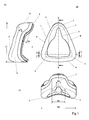
- FIG. 1 shows the mask cushion in plan view. Plotted is a vertical sectional plane x and a horizontal sectional plane y / z. The cuts are in FIG. 2 illustrated.
- the cushion has a nose bridge area (7), side areas (8), the base area (6) and the sealing area (3) to the patient.
- the side areas (8) extend from the contact area to the mask body (4) substantially vertically upward.
- the sealing region (3) opens into a single sealing lip (2), which is molded onto the other regions and releases an opening on the inside, which serves to introduce at least the patient's nose and mouth.
- the sealing area (3) extends starting from the side areas and the base area and the nose bridge area toward the opening, the sealing area (3) extending at least partially horizontally to the side area (8).
- a deformation region (5) extends between the contact region (4) and the sealing region (3).
- the deformation area (5) is the use a higher wall thickness rather a support area.
- the contact region (4) can be designed as a mechanical connection to a hard part of the mask body in the meaning of the invention, or be transferred directly into the hard part of the mask body, for example, be designed as a 2K connection, or as a bond.
- the FIG. 1b shows the pillow in the side view.
- the contact region (4) has a strong indentation with the height (H4).
- H4 is significantly less pronounced in the prior art.
- the strong indentation with the height (H4) of the mask cushion according to the invention serves to make the deformation region (5) as short and stable as possible in the side region (8) of the cushion.
- the maximum length (L) of the pillow is 105 mm +/- 6 mm and the width (B2) is 90 mm +/- 4 mm.
- Figure 1c shows the pillow in the view from above.
- the width of the bridge of the nose (B1) has been broadened than that of known masks to ensure optimal fit and tightness, even with broader and also flat nose shapes. Due to the selected geometry, the cushion sits lower on the nose of the user. A high nose bridge plunges deeper into the cushion at the selected contour.
- the width in the nose bridge area outside (B1) is at least 3x, preferably 4x, wider than in the inner section of the nose area (B3).
- B2 represents the maximum width of the pad.
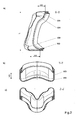
- FIG. 2a shows the pillow cut in the plane x.
- the patient is the most sensitive, so here is a very thin wall (W1) of ⁇ 0.6 mm, preferably 0.2 - 0.5 mm, more preferably selected 0.25 mm.
- This area is easily deformed and adapted to the nose shape.
- the wall of the sealing lip (W4) may have the same thickness as the wall W1 or be thicker. Then, the thickness W1 would be 0.4 mm and W4 would be 0.5 mm.
- the wall thickness (W2) is in the range 0.5 - 1.2 mm, preferably 1.0 mm. Since the patient is most insensitive at the contact points in the side region (8) of the pad, the wall thicknesses (W3) of this area can be made thicker and thus ensure the rigidity and supporting force of the pad.
- the wall thickness (W3) in this range is 1.2-2.9 mm, preferably 1.5-2.5 mm, particularly preferably 2.1 mm.
- the sealing lip is designed as a single sealing lip.
- the wall thickness W4 of the sealing lip was formed on the entire circumference with an approximately constant, thin wall thickness (W4) of 0.2-0.75 mm, preferably 0.5 mm, which allows the patient a pleasant wearing comfort.
- the height (H2), measured for the region of the wall thickness (W1) from the contact region (4) to the radius, in the nose bridge region is 18-25 mm, preferably 20-25 mm, particularly preferably 20 mm +/- 2.5 mm and is higher than masks of the prior art. This opens up a wide range of good sealing properties for different bridge of the nose.
- the height (H1) of the base region (6) is higher than in the case of commercially available mask cushions and is in the range 23-28 mm, preferably 25 mm +/- 3 mm, particularly preferably 25 mm +/- 2 mm.
- the specified heights H1, H2, H3 refer to the deformation range (5). This extends between the outer edge of the contact region (4) and the transition to the sealing region (3). More precisely, starting from the outer edge of the contact region (4), ie above the thickened zone, until the beginning of the radius which merges into the sealing region (3).
- the FIG. 2b shows the pillow cut in the plane y.
- the height (H3) of the side region (8) is lower than in the case of commercially available mask cushions and is in the range 8-13 mm, preferably 11 mm +/- 2 mm.
- the deformation region (5) at the bottom of the base (6) has a first height (H1), a second height (H2) at the top in the nose bridge region (7) and a third height (H3) at the side in the secondary nose region (8) the first height (H1) is greater than the second height (H2) and the second height is greater than the third height (H3), and wherein the first height (H1) is at least twice as high as the third height (H3).
- the Figure 2c shows the pillow cut in the plane z.
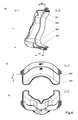
- the differences of the inventive mask pad (M) to prior art pads (M ') will be apparent in perspective view.
- H4 is in the range 10-14 mm, preferably above 11 mm.
- SdT H4 ' is in the range below 8 mm.
- FIGS. 4 and 5 show differences of the mask pad (M) according to the invention to pads of the prior art (M ')
- the relevant features of the cushion according to the invention are the very large deformation range of the nose bridge area (1), which is achieved by the appropriate choice of the wall thickness (W1) and the width (B1), in relation to the width B3 and the height (H2). This area is crucial for the adaptability to differently sized and differently shaped nasal passages of the patients.
- the wall thickness (W2) at the base, the height at the base (H1), and the wall thickness (W3) at the side, the height at the side (H3) are crucial for a large adaptability to the base and a high support function in the side area (8).
- the wall thickness (W2 ') is 1 mm; (W1 ') 0.5 mm; (W3 ') 1.5 mm; W4'0.5 mm.
- the wall thickness (W3 ') is therefore not twice as thick as the wall thickness (W2').
- the cushion according to the invention is about 1/3 flatter, based on H3, as a pillow from the prior art, characterized a stable edge is achieved for better support the side of the nose. For this it is necessary that mask body is higher in the side area, which leads to a pronounced height H4 (with about 12 mm).
Landscapes
- Health & Medical Sciences (AREA)
- Emergency Medicine (AREA)
- Pulmonology (AREA)
- Engineering & Computer Science (AREA)
- Anesthesiology (AREA)
- Biomedical Technology (AREA)
- Heart & Thoracic Surgery (AREA)
- Hematology (AREA)
- Life Sciences & Earth Sciences (AREA)
- Animal Behavior & Ethology (AREA)
- General Health & Medical Sciences (AREA)
- Public Health (AREA)
- Veterinary Medicine (AREA)
- Respiratory Apparatuses And Protective Means (AREA)
Abstract
Description
- Masken werden im Bereich der Beatmung und der Schlaftherapie eingesetzt, wobei ein Patient mittels einer Flow- oder Druckquelle mit Atemgas versorgt wird. Die Maske stellt die Schnittstelle zwischen Patient und Gerät dar. Sie besteht aus einem Maskenkörper mit einem Maskenkissen und wird meistens mittels einer Bänderung und einer zusätzlichen Stirnabstützung am Kopf des Patienten fixiert. Der Maskenkörper besteht in der Regel aus einem relativ steifen Kunststoff und das Kissen, das am Gesicht des Patienten anliegt, besteht aus einem relativ dünnen, weichen Material, vorzugsweise aus einem hautfreundlichen Silikon, einem thermoplastischen Elastomer (TPE) oder aus Polyurethan und besitzt in der Regel eine Dichtlippe, um eine ausreichende Abdichtung zu gewährleisten und Leckagen zu verhindern. Diese Masken können als Nasalmasken oder als Vollgesichtsmasken (oder auch Mund-Nasen-Masken) ausgeführt sein.
- Herkömmliche Masken gibt es üblicherweise in den Größen S, M und L, um möglichst viele verschiedene Gesichts- bzw. Nasenbeschaffenheiten der Patienten zu berücksichtigen und einen möglichst hohen Trage- und Passkomfort und eine hohe Dichtigkeit zu erzielen.
- Derartig bekannte Lösungen haben zur Folge, dass die Anzahl anzubietender Masken groß ausfallen muss, um alle verschiedenen Gesichtsformen und Größen abzudecken. Im Bereich der Nasalmasken ist eine "Universalmaske" in einer Einheitsgröße bekannt. Vollgesichtsmasken in nur einer Größe die für eine größere Anzahl von Gesichtsformen und -größen geeignet sind, sind nicht bekannt. Dies ist darin begründet, dass die Variabilität der Abstände zwischen Nase und Unterlippe oder Kinn groß ist. Zudem müssen noch unterschiedlich große Nasen berücksichtigt werden.
- Die vorliegende Erfindung stellt sich zur Aufgabe ein Maskenkissen für Vollgesichtsmasken zu entwickeln, welches eine große Anpassungsfähigkeit an verschieden große und verscheiden geformte Gesichts-, Nasen- und Kinnpartien der Patienten aufweist. Patienten können diverse verschiedene Gesichtsformen und Größen mit verschiedenen Nasenformen mit hohen oder niedrigen Nasenrückenregionen, schmale oder breite sowie lange oder kurze Nasen haben. Der Mund- und Kinnbereich kann ebenfalls sehr unterschiedlich groß und unterschiedlich geformt sein, deshalb soll das Maskenkissen in der Lage sein, sich allen möglichen Gesichtsformen und -größen anzupassen und die gewünschte Passform und Dichtigkeit zu erzielen.
- Die Aufgabe wird gelöst durch ein Maskenkissen für eine Vollgesichtsmaske mit lediglich einer Dichtlippe, einem zum Patientengesicht weisenden Dichtbereich der in der Dichtlippe mündet, einem Kontaktbereich zum Maskenkörper und einem Verformungsbereich der sich zwischen dem Kontaktbereich und dem Dichtbereich erstreckt, wobei der Verformungsbereich unten an der Basis eine erste Höhe (H1) aufweist, oben im Nasenrückenbereich eine zweite Höhe (H2) aufweist und seitlich im Nebennasenbereich eine dritte Höhe (H3) aufweist, wobei die erste Höhe (H1) zumindest doppelt so hoch ist, wie die dritte Höhe (H3).
- Die Erfindung ist auch dadurch gekennzeichnet, dass die erste Höhe (H1) größer als die zweite Höhe (H2) ist und die zweite Höhe größer als die dritte Höhe (H3) ist.
- Die Erfindung ist auch dadurch gekennzeichnet, dass der Verformungsbereich unten an der Basis (H1) 25 mm +/- 3 mm hoch ist und/oder oben im Nasenrückenbereich (H2) 20 mm +/- 2,5 mm hoch ist und/oder seitlich im Nebennasenbereich (H3) 11 mm +/- 2 mm.
- Die Erfindung ist auch dadurch gekennzeichnet, dass das Maskenkissen aus einem elastomeren Kunststoff hergestellt ist und zumindest zwei unterschiedliche Wandstärken aufweist.
- Die Erfindung ist auch dadurch gekennzeichnet, dass die Wandstärke im Verformungsbereich unten an der Basis (W2) und oben im Nasenrückenbereich (W1) dünner ist als seitlich im Nebennasenbereich (W3).
- Die Erfindung ist auch dadurch gekennzeichnet, dass die Wandstärke im Verformungsbereich im Nasenrückenbereich (W1) dünner ist als die Wandstärke im Verformungsbereich an der Basis (W2) und dass die Wandstärke (W2) dünner ist als seitlich im Nebennasenbereich (W3).
- Die Erfindung ist auch dadurch gekennzeichnet, dass die Wandstärke (W3) zumindest doppelt so dick ist wie die Wandstärke (W2).
- Die Erfindung ist auch dadurch gekennzeichnet, dass die Länge (L) 105 mm +/- 6 mm und die Breite (B2) 90 mm +/- 4 mm ist.
- Die Erfindung ist auch dadurch gekennzeichnet, dass die Breite im Nasenrückenbereich außen (B1) 3x, bevorzugt 4x, breiter ist als im Innenausschnitt des Nasenbereiches (B3).
- Die Erfindung ist auch dadurch gekennzeichnet, dass die Breite im Nasenbereich außen (B1) 35 mm +/- 3 mm ist und im Innenausschnitt des Nasenbereiches (B3) 8 mm +/- 2 mm.
- Die Erfindung ist auch dadurch gekennzeichnet, dass die Vollgesichtsmaske eine stufenlos verstellbare Stirnstütze aufweist.
- Die Erfindung ist auch dadurch gekennzeichnet, dass die Stirnstütze ein Federelement aufweist.
- Die Erfindung ist auch dadurch gekennzeichnet, dass das Federelement ein Elastomer ist.
- Die Erfindung ist auch dadurch gekennzeichnet, dass die stufenlos verstellbare Stirnstütze durch die Anzugkraft der Kopf-Bänderung eingestellt wird.
- Die Erfindung ist auch dadurch gekennzeichnet, dass im Nasenrückenbereich die Wandstärke (W1) von ≤ 0,6 mm ist.
- Die Erfindung ist auch dadurch gekennzeichnet, dass im Nasenrückenbereich die Wandstärke (W1) im Bereich 0,2 - 0,5 mm ist.
- Die Erfindung ist auch dadurch gekennzeichnet, dass der Seitenbereich eine Wandstärke (W3) im Bereich 1,2-2,9 mm aufweist.
- Die Erfindung ist auch dadurch gekennzeichnet, dass der Seitenbereich eine Wandstärke (W3) im Bereich 1,5-2,5 mm, bevorzugt 2,1 mm +/- 2 mm aufweist.
- Die Erfindung ist auch dadurch gekennzeichnet, dass die Wandstärke W2 von der Basis hin zur W4 kontinuierlich abnimmt.
-
-
Fig.1a : Maskenkissen in Draufsicht -
Fig.1b : Maskenkissen in Seitenansicht -
Fig.1c : Maskenkissen von oben -
Fig.2a : vertikale Schnittdarstellung entlang der Ebene x/x -
Fig.2b : horizontale Schnittdarstellung entlang der Ebene y/y -
Fig.2c : horizontale Schnittdarstellung entlang der Ebene z/z -
Fig.3 : Vergleich Erfindung zum Stand der Technik -
Fig.4 : Vergleich Erfindung zum Stand der Technik in verschiedenen Ansichten -
Fig.5 : Vergleich Erfindung zum Stand der Technik Schnittdarstellungen - Die
Figur 1 zeigt das Maskenkissen in der Draufsicht. Eingezeichnet ist eine vertikale Schnittebene x und eine horizontale Schnittebene y/z. Die Schnitte sind inFigur 2 veranschaulicht. Das Kissen weist einen Nasenrückenbereich (7), Seitenbereiche (8), den Basisbereich (6) und den Dichtbereich (3) zum Patienten auf. Die Seitenbereiche (8) erstrecken sich ausgehend vom Kontaktbereich zum Maskenkörper (4) im Wesentlichen vertikal nach oben. Der Dichtbereich (3) mündet in einer Einzeldichtlippe (2), die den anderen Bereichen angeformt ist und innen eine Öffnung freigibt, die der Einführung von zumindest der Nase und Mund des Patienten dient. Der Dichtbereich (3) erstreckt sich ausgehend von den Seitenbereichen und dem Basisbereich sowie dem Nasenrückenbereich zur Öffnung hin, wobei sich der Dichtbereich (3) zumindest teilweise horizontal zum Seitenbereich (8) erstreckt. Ein Verformungsbereich (5) erstreckt sich zwischen dem Kontaktbereich (4) und dem Dichtbereich (3). Im Seitenbereich (8) ist der Verformungsbereich (5) jedoch durch die Verwendung einer höheren Wandstärke eher ein Stützbereich. Der Kontaktbereich (4) kann im Sinne der Erfindung, wie hier ausgeführt, als mechanische Verbindung zu einem Hartteil des Maskenkörpers ausgeführt sein oder auch direkt in den Hartteil des Maskenkörpers übergeleitet sein, beispielsweise als 2K-Verbindung, oder als Klebung ausgeführt sein. - Die
Figur 1b zeigt das Kissen in der Seitenansicht. Der Kontaktbereich (4) weist eine starke Einbuchtung mit der Höhe (H4) auf. Im Vergleich zur Seitenansicht des Kissens aus dem Stand der TechnikFig. 3 ist deutlich zu erkennen, dass H4 im Stand der Technik deutlich weniger ausgeprägt ist. Die starke Einbuchtung mit der Höhe (H4) des erfindungsgemäßen Maskenkissens dient dazu, den Verformungsbereich (5) im Seitenbereich (8) des Kissens möglichst kurz und stabil auszuführen. Die maximale Länge (L) des Kissens ist 105 mm +/- 6 mm und die Breite (B2) 90 mm +/-4 mm. -
Figur 1c zeigt das Kissen in der Ansicht von oben. Die Breite des Nasenrückenbereiches (B1) wurde breiter als bei bekannten Masken gewählt, um eine optimale Passform und Dichtigkeit auch bei breiteren und auch flachen Nasenformen zu gewährleisten. Durch die gewählte Geometrie sitzt das Kissen tiefer auf der Nase des Anwenders. Ein hoher Nasenrücken taucht bei der gewählten Kontur tiefer in das Kissen ein. Die Breite im Nasenrückenbereich außen (B1) ist zumindest 3x, bevorzugt 4x, breiter als im Innenausschnitt des Nasenbereiches (B3). B2 stellt die maximale Breite des Kissens dar. - Die
Figur 2a zeigt das Kissen in der Ebene x geschnitten. Im Nasenrückenbereich (7) ist der Patient am empfindlichsten, daher wird hier eine sehr dünne Wand (W1) von ≤ 0,6 mm, bevorzugt 0,2 - 0,5 mm, besonders bevorzugt 0,25 mm gewählt. Dieser Bereich lässt sich leicht verformen und der Nasenform anpassen. Die Wand der Dichtlippe (W4) kann dieselbe Dicke aufweisen wie die Wand W1 oder auch dicker sein. Dann wäre die Dicke W1 0,4 mm und W4 0,5 mm. - Der Basisbereich (6), mit der Wandstärke (W2), ist im Gegensatz zu den Seitenbereichen (8), mit den Wandstärken (W3), ebenfalls dünn ausgeführt, um eine möglichst große Flexibilität für den Kinnbereich zu erhalten. Die Wandstärke (W2) beträgt im Bereich 0,5 - 1,2 mm, bevorzugt 1,0 mm. Da der Patient an den Kontaktstellen im Seitenbereich (8) des Kissens am unempfindlichsten ist, können die Wandstärken (W3) dieses Bereiches dicker ausgeführt sein und sorgen so für die Steifigkeit und Stützkraft des Kissens. Die Wandstärke (W3) beträgt in diesem Bereich 1,2 - 2,9 mm, bevorzugt 1,5-2,5 mm, besonders bevorzugt 2,1 mm. Die Dichtlippe ist als eine Einzeldichtlippe ausgeführt. Die Wandstärke W4 der Dichtlippe wurde auf dem kompletten Umfang mit einer annähernd gleichbleibenden, dünnen Wandstärke (W4) von 0,2 - 0,75 mm, bevorzugt 0,5 mm, ausgebildet, die dem Patienten einen angenehmen Tragekomfort ermöglicht.
- Die Höhe (H2), gemessen für den Bereich der Wandstärke (W1) vom Kontaktbereich (4) bis zum Radius, im Nasenrückenbereich beträgt 18 - 25 mm, bevorzugt 20 - 25 mm, besonders bevorzugt 20 mm +/-2,5 mm und ist höher als bei Masken aus dem Stand der Technik. Dadurch wird ein weiter Bereich mit guten Dichteigenschaften für unterschiedliche Nasenrücken eröffnet.
- Die Höhe (H1) des Basisbereiches (6) ist höher als bei handelsüblichen Maskenkissen und beträgt im Bereich 23 - 28 mm, bevorzugt 25 mm +/- 3 mm, besonders bevorzugt 25 mm +/- 2 mm.
- Aus
Fig. 1 und2 wird deutlich, dass die angegebenen Höhen H1, H2, H3 sich auf den Verformungsbereich (5) beziehen. Dieser erstreckt sich zwischen der Außenkante des Kontaktbereiches (4) und dem Übergang zum Dichtbereich (3). Genauer ausgehend von der Außenkante des Kontaktbereiches (4), also oberhalb der verdickten Zone, bis zum Beginn des Radius der in den Dichtbereich (3) übergeht. - Die
Figur 2b zeigt das Kissen in der Ebene y geschnitten. Die Höhe (H3) des Seitenbereiches (8) ist geringer als bei handelsüblichen Maskenkissen und beträgt im Bereich 8 - 13 mm, bevorzugt 11 mm +/- 2 mm. Der Verformungsbereich (5) unten an der Basis (6) weist eine erste Höhe (H1) auf, oben im Nasenrückenbereich (7) eine zweite Höhe (H2) auf und seitlich im Nebennasenbereich (8) eine dritte Höhe (H3) auf, wobei die erste Höhe (H1) größer als die zweite Höhe (H2) ist und die zweite Höhe größer als die dritte Höhe (H3) ist und wobei die erste Höhe (H1) zumindest doppelt so hoch ist, wie die dritte Höhe (H3). - Die
Figur 2c zeigt das Kissen in der Ebene z geschnitten.
In derFigur 3 werden die Unterscheide des erfindungsmäßigen Maskenkissens (M) zu Kissen aus dem Stand der Technik (M') in der Perspektivdarstellung deutlich. Insbesondere ist gut erkennbar, dass die Höhe H4' im SdT geringer ist und die Breite B1' größer ist. Erfindungsgemäß ist H4 im Bereich 10 - 14 mm, bevorzugt über 11 mm. Im SdT ist H4' im Bereich unter 8 mm. - Die
Figuren 4 und5 zeigen Unterscheide des erfindungsmäßigen Maskenkissens (M) zu Kissen aus dem Stand der Technik (M') - Eine Gegenüberstellung des Maskenkissens (M) zu den Kissen aus dem Stand der Technik (M') macht den Unterscheid der Erfindung deutlich.
- Die maßgeblichen Merkmale des erfindungsgemäßen Kissens sind der sehr große Verformbereich des Nasenrückenbereiches (1), der durch die geeignete Wahl der Wandstärke (W1) und der Breite (B1), im Verhältnis zur Breite B3 und der Höhe (H2) erzielt wird. Dieser Bereich ist ausschlaggebend für die Anpassungsfähigkeit an verschieden große und verschieden geformte Nasenpartien der Patienten. Zudem sind bei dem erfindungsgemäßen Kissen die Wandstärke (W2) an der Basis, die Höhe an der Basis (H1), sowie die Wandstärke (W3) an der Seite, die Höhe an der Seite (H3) ausschlaggebend für eine große Anpassbarkeit an der Basis und eine hohe Stützfunktion im Seitenbereich (8).
Die Wandstärke (W2') ist 1 mm; (W1') 0,5 mm; (W3') 1,5 mm; W4'0,5 mm. Die Wandstärke (W3') ist also nicht doppelt so dick ist wie die Wandstärke (W2'). - Aus dem Vergleich der Erfindung mit dem Stand der Technik (siehe
Figuren 3 bis 5 ) wird deutlich, dass bei dem erfindungsgemäßen Kissen H1 größer ist als H1'; H3 kleiner ist, als H3'; H4 größer ist, als H4'; W2 kleiner ist als W2'. Seitlich (8) ist das erfindungsgemäße Kissen etwa um 1/3 flacher, bezogen auf H3, als Kissen aus dem Stand der Technik, dadurch wird eine stabile Kante zur besseren Auflage seitlich der Nase erzielt.
Dafür ist notwendig dass Maskenkörper in dem Seitenbereich höher ist, was zu einer ausgeprägten Höhe H4 (mit etwa 12 mm) führt.
Claims (15)
- Maskenkissen (1) für eine Vollgesichtsmaske (10) mit lediglich einer Dichtlippe (2), einem zum Patientengesicht weisenden Dichtbereich (3) der in der Dichtlippe mündet, einem Kontaktbereich (4) zum Maskenkörper (10) und einem Verformungsbereich (5) der sich zwischen dem Kontaktbereich (4) und dem Dichtbereich (3) erstreckt, wobei der Verformungsbereich (5) unten an der Basis (6) eine erste Höhe (H1) aufweist, oben im Nasenrückenbereich (7) eine zweite Höhe (H2) aufweist und seitlich im Nebennasenbereich (8) eine dritte Höhe (H3) aufweist, wobei die erste Höhe (H1) zumindest doppelt so hoch ist, wie die dritte Höhe (H3) .
- Maskenkissen (1) für eine Vollgesichtsmaske (10) nach Anspruch 1 dadurch gekennzeichnet, dass die erste Höhe (H1) größer als die zweite Höhe (H2) ist und die zweite Höhe größer als die dritte Höhe (H3) ist.
- Maskenkissen (1) für eine Vollgesichtsmaske (10) nach zumindest einem der vorhergehenden Ansprüche dadurch gekennzeichnet, dass der Verformungsbereich (5) unten an der Basis (6) (H1) 25 mm +/- 3 mm hoch ist und/oder oben im Nasenrückenbereich (7) (H2) 20 mm +/- 2,5 mm hoch ist und/oder seitlich im Nebennasenbereich (8) (H3) 11 mm +/- 2 mm.
- Maskenkissen (1) für eine Vollgesichtsmaske (10) nach zumindest einem der vorhergehenden Ansprüche dadurch gekennzeichnet, dass das Maskenkissen aus einem elastomeren Kunststoff hergestellt ist und zumindest zwei unterschiedliche Wandstärken (9) aufweist.
- Maskenkissen (1) für eine Vollgesichtsmaske (10) nach zumindest einem der vorhergehenden Ansprüche dadurch gekennzeichnet, dass die Wandstärke (9) im Verformungsbereich (5) unten an der Basis (W2) und oben im Nasenrückenbereich (W1) dünner ist als seitlich im Nebennasenbereich (W3).
- Maskenkissen (1) für eine Vollgesichtsmaske (10) nach zumindest einem der vorhergehenden Ansprüche dadurch gekennzeichnet, dass die Wandstärke (9) im Verformungsbereich im Nasenrückenbereich (W1) dünner ist als die Wandstärke im Verformungsbereich an der Basis (W2) und dass die Wandstärke (W2) dünner ist als seitlich im Nebennasenbereich (W3).
- Maskenkissen (1) für eine Vollgesichtsmaske (10) nach zumindest einem der vorhergehenden Ansprüche dadurch gekennzeichnet, dass die Wandstärke (W3) zumindest doppelt so dick ist wie die Wandstärke (W2).
- Maskenkissen (1) für eine Vollgesichtsmaske (10) nach zumindest einem der vorhergehenden Ansprüche dadurch gekennzeichnet, dass die Länge (L) 105 mm +/- 6 mm und die Breite (B2) 90 mm +/- 4 mm ist.
- Maskenkissen (1) für eine Vollgesichtsmaske (10) nach zumindest einem der vorhergehenden Ansprüche dadurch gekennzeichnet, dass die Breite im Nasenrückenbereich außen (B1) 3x, bevorzugt 4x, breiter ist als im Innenausschnitt des Nasenbereiches (B3).
- Maskenkissen (1) für eine Vollgesichtsmaske (10) nach zumindest einem der vorhergehenden Ansprüche dadurch gekennzeichnet, dass die Breite im Nasenbereich außen (B1) 35 mm +/- 3 mm ist und im Innenausschnitt des Nasenbereiches (B3) 8 mm +/- 2 mm.
- Maskenkissen (1) für eine Vollgesichtsmaske (10) nach zumindest einem der vorhergehenden Ansprüche dadurch gekennzeichnet, dass im Nasenrückenbereich (7) die Wandstärke (W1) von ≤ 0,6 mm ist.
- Maskenkissen (1) für eine Vollgesichtsmaske (10) nach zumindest einem der vorhergehenden Ansprüche dadurch gekennzeichnet, dass im Nasenrückenbereich (7) die Wandstärke (W1) im Bereich 0,2 - 0,5 mm ist.
- Maskenkissen (1) für eine Vollgesichtsmaske (10) nach zumindest einem der vorhergehenden Ansprüche dadurch gekennzeichnet, dass der Seitenbereich eine Wandstärke (W3) im Bereich 1,2-2,9 mm aufweist.
- Maskenkissen (1) für eine Vollgesichtsmaske (10) nach zumindest einem der vorhergehenden Ansprüche dadurch gekennzeichnet, dass der Seitenbereich eine Wandstärke (W3) im Bereich 1,5-2,5 mm, bevorzugt 2,1 mm +/- 2 mm aufweist.
- Maskenkissen (1) für eine Vollgesichtsmaske (10) nach zumindest einem der vorhergehenden Ansprüche dadurch gekennzeichnet, dass die Wandstärke W2 von der Basis (4) hin zur W4 kontinuierlich abnimmt.
Applications Claiming Priority (1)
| Application Number | Priority Date | Filing Date | Title |
|---|---|---|---|
| DE102014013796.1A DE102014013796A1 (de) | 2014-09-23 | 2014-09-23 | Maskenkissen für eine Vollgesichtsmaske |
Publications (2)
| Publication Number | Publication Date |
|---|---|
| EP3000500A1 true EP3000500A1 (de) | 2016-03-30 |
| EP3000500B1 EP3000500B1 (de) | 2020-05-27 |
Family
ID=54007450
Family Applications (1)
| Application Number | Title | Priority Date | Filing Date |
|---|---|---|---|
| EP15002498.2A Active EP3000500B1 (de) | 2014-09-23 | 2015-08-24 | Maskenkissen für eine vollgesichtsmaske |
Country Status (4)
| Country | Link |
|---|---|
| US (1) | US10675426B2 (de) |
| EP (1) | EP3000500B1 (de) |
| JP (2) | JP2016067921A (de) |
| DE (1) | DE102014013796A1 (de) |
Families Citing this family (16)
| Publication number | Priority date | Publication date | Assignee | Title |
|---|---|---|---|---|
| USD884152S1 (en) * | 2016-10-24 | 2020-05-12 | ResMed Pty Ltd | Patient interface |
| US10946154B2 (en) * | 2014-12-23 | 2021-03-16 | Fisher & Paykel Healthcare Limited | Gender based full-face mask sizes |
| US10799661B2 (en) * | 2015-09-23 | 2020-10-13 | ResMed Pty Ltd | Patient interface with a seal-forming structure having varying thickness |
| EP4043057B1 (de) | 2015-09-23 | 2024-01-03 | ResMed Pty Ltd | Patientenschnittstelle mit einer dichtungsbildenden struktur mit unterschiedlicher dicke |
| NZ740229A (en) | 2015-09-23 | 2023-07-28 | ResMed Pty Ltd | Patient interface with foam seal-forming structure |
| USD1007669S1 (en) * | 2019-06-05 | 2023-12-12 | Easyform Medical (Dongguan) Limited | Breathing mask padding |
| USD939078S1 (en) * | 2019-06-05 | 2021-12-21 | Easyform Medical (Dongguan) Limited | Breathing mask padding |
| GB2615230B (en) * | 2019-07-18 | 2024-04-17 | Fisher & Paykel Healthcare Ltd | Patient interface |
| USD941993S1 (en) * | 2019-08-23 | 2022-01-25 | ResMed Pty Ltd | Tube headgear for patient interface |
| CA3161556C (en) | 2019-12-20 | 2023-09-19 | Robin YEW | Patient interface with foam cushion |
| JP1721428S (ja) * | 2020-03-26 | 2022-08-02 | 空気マスク封止用シリコン支持フレーム | |
| USD966497S1 (en) * | 2020-07-10 | 2022-10-11 | Lg Electronics Inc. | Facial contact pad for mask type air purifier |
| US20220175064A1 (en) * | 2020-12-07 | 2022-06-09 | Abacus Investment LLC | Sealing cushion for a protective face mask |
| USD1034959S1 (en) * | 2023-08-04 | 2024-07-09 | Dcstar Inc | Cushion |
| USD1036157S1 (en) * | 2023-11-30 | 2024-07-23 | Dcstar Inc | Cushion for a respiratory mask |
| USD1051358S1 (en) * | 2024-07-23 | 2024-11-12 | Shangying Sun | Silicone support frame for air mask |
Citations (4)
| Publication number | Priority date | Publication date | Assignee | Title |
|---|---|---|---|---|
| DE10002571A1 (de) * | 2000-01-21 | 2001-07-26 | Mpv Truma Ges Fuer Medizintech | Nasale Beatmungsmaske und Maskenkissen für eine nasale Beatmungsmaske |
| WO2010111749A1 (en) * | 2009-04-03 | 2010-10-07 | Resmed Ltd | Mask system |
| EP2737921A2 (de) * | 2012-11-29 | 2014-06-04 | Weinmann Geräte für Medizin GmbH & Co. KG | Maskenwulst für ein Patienteninterface |
| US20140216462A1 (en) * | 2013-02-04 | 2014-08-07 | Resmed Limited | Cushion assembly |
Family Cites Families (16)
| Publication number | Priority date | Publication date | Assignee | Title |
|---|---|---|---|---|
| US6397847B1 (en) * | 1995-09-08 | 2002-06-04 | Respironics, Inc. | Customizable seal, mask with customizable seal and method of using such a seal |
| US6119693A (en) * | 1998-01-16 | 2000-09-19 | Resmed Limited | Forehead support for facial mask |
| US6796308B2 (en) * | 1998-12-09 | 2004-09-28 | Resmed Limited | Mask cushion and frame assembly |
| WO2002051486A1 (en) * | 2000-12-22 | 2002-07-04 | Resmed Ltd. | Flow regulation vent |
| US7743767B2 (en) * | 2002-04-23 | 2010-06-29 | Resmed Limited | Ergonomic and adjustable respiratory mask assembly with frame |
| US6789543B2 (en) * | 2002-07-02 | 2004-09-14 | James L. Cannon | Assisted breathing device and method of wearing same |
| JP4734229B2 (ja) * | 2003-05-02 | 2011-07-27 | レスメド・リミテッド | マスクシステム |
| WO2005063326A1 (en) * | 2003-12-31 | 2005-07-14 | Resmed Limited | Mask system |
| CN101155610B (zh) * | 2005-01-12 | 2012-01-04 | 雷斯梅德有限公司 | 用于患者界面的衬垫 |
| DE202007019572U1 (de) * | 2006-12-06 | 2013-12-02 | Weinmann Geräte für Medizin GmbH + Co. KG | Atemmaske mit einem Füllkörper |
| US20090107506A1 (en) * | 2007-10-24 | 2009-04-30 | Louis Javier Collazo | Mask assembly |
| DE102009024245B4 (de) * | 2008-06-05 | 2026-05-13 | Löwenstein Medical Technology S.A. | Verfahren zur Herstellung eines Patienteninterfaces mit Gelfüllung sowie Patienteninterface mit Gelfüllung |
| JP2013523203A (ja) * | 2010-03-25 | 2013-06-17 | コーニンクレッカ フィリップス エレクトロニクス エヌ ヴィ | 浮動調節アームを用いる患者インターフェース装置 |
| WO2011121463A1 (en) * | 2010-03-31 | 2011-10-06 | Koninklijke Philips Electronics N.V. | Respiratory mask with ribbed contacting surface |
| WO2013088293A1 (en) * | 2011-12-13 | 2013-06-20 | Koninklijke Philips Electronics N.V. | Parametric approach to mask customization |
| US20150297854A1 (en) * | 2012-06-07 | 2015-10-22 | Koninklike Philips N.V. | Pediatric total facemask |
-
2014
- 2014-09-23 DE DE102014013796.1A patent/DE102014013796A1/de not_active Withdrawn
-
2015
- 2015-08-24 EP EP15002498.2A patent/EP3000500B1/de active Active
- 2015-09-16 US US14/855,699 patent/US10675426B2/en active Active
- 2015-09-16 JP JP2015183250A patent/JP2016067921A/ja active Pending
-
2020
- 2020-09-04 JP JP2020148681A patent/JP2020195827A/ja active Pending
Patent Citations (4)
| Publication number | Priority date | Publication date | Assignee | Title |
|---|---|---|---|---|
| DE10002571A1 (de) * | 2000-01-21 | 2001-07-26 | Mpv Truma Ges Fuer Medizintech | Nasale Beatmungsmaske und Maskenkissen für eine nasale Beatmungsmaske |
| WO2010111749A1 (en) * | 2009-04-03 | 2010-10-07 | Resmed Ltd | Mask system |
| EP2737921A2 (de) * | 2012-11-29 | 2014-06-04 | Weinmann Geräte für Medizin GmbH & Co. KG | Maskenwulst für ein Patienteninterface |
| US20140216462A1 (en) * | 2013-02-04 | 2014-08-07 | Resmed Limited | Cushion assembly |
Also Published As
| Publication number | Publication date |
|---|---|
| EP3000500B1 (de) | 2020-05-27 |
| JP2020195827A (ja) | 2020-12-10 |
| DE102014013796A1 (de) | 2016-03-24 |
| JP2016067921A (ja) | 2016-05-09 |
| US10675426B2 (en) | 2020-06-09 |
| US20160082213A1 (en) | 2016-03-24 |
Similar Documents
| Publication | Publication Date | Title |
|---|---|---|
| EP3000500B1 (de) | Maskenkissen für eine vollgesichtsmaske | |
| EP3513828B1 (de) | Maskenwulst für ein patienteninterface | |
| DE69624405T2 (de) | Nasenmaske | |
| DE60111054T2 (de) | Beatmungsmaske | |
| DE112012007301B4 (de) | Interface mit einem beweglichen Nasenrückenteil | |
| DE102004030067B3 (de) | Atemmaske mit einer superelastischen Dichtung | |
| DE202010011334U1 (de) | Beatmungsmaske für die gleichzeitige Mund- und Nasenbeatmung | |
| DE69735657T2 (de) | Nasaler Dilatator | |
| DE69730866T2 (de) | Nasenmaske und polsterung dafür | |
| DE68902839T2 (de) | Verankerungsvorrichtung fuer katheter. | |
| DE112014003604T5 (de) | Dichtung für eine Patientenanschlussstelle, Anschlussstellenbaugruppen und Aspekte davon | |
| DE20321882U1 (de) | Stirnpolster für Atemmaske | |
| DE202006021260U1 (de) | Polster für Patientenschnittstelle | |
| DE102013018897A1 (de) | Vorrichtung zur Positionierung eines Patienten Interfaces | |
| DE10331837B3 (de) | Gesichtsmaske für Beatmungsgeräte | |
| EP3552650B1 (de) | Maskenwulst für ein patienteninterface | |
| EP3967351B1 (de) | Maskenwulst mit schlauchdurchführung | |
| DE10352608A1 (de) | Applikationsvorrichtung für eine Atemmaske | |
| DE202014007582U1 (de) | Maskenkissen | |
| EP1147782B1 (de) | Atemmaskenanordnung | |
| DE202015007792U1 (de) | Vorrichtung zur Abstützung eines Patienteninterfaces am Kopf des Anwenders | |
| DE202019101304U1 (de) | Beatmungsmaske für die gleichzeitige Mund- und Nasenbeatmung | |
| DE202020005711U1 (de) | Gesichtsmaske | |
| DE3914606C2 (de) | ||
| DE202017104606U1 (de) | Maskenelement für eine Beatmungsmaske |
Legal Events
| Date | Code | Title | Description |
|---|---|---|---|
| PUAI | Public reference made under article 153(3) epc to a published international application that has entered the european phase |
Free format text: ORIGINAL CODE: 0009012 |
|
| AK | Designated contracting states |
Kind code of ref document: A1 Designated state(s): AL AT BE BG CH CY CZ DE DK EE ES FI FR GB GR HR HU IE IS IT LI LT LU LV MC MK MT NL NO PL PT RO RS SE SI SK SM TR |
|
| AX | Request for extension of the european patent |
Extension state: BA ME |
|
| 17P | Request for examination filed |
Effective date: 20160607 |
|
| RBV | Designated contracting states (corrected) |
Designated state(s): AL AT BE BG CH CY CZ DE DK EE ES FI FR GB GR HR HU IE IS IT LI LT LU LV MC MK MT NL NO PL PT RO RS SE SI SK SM TR |
|
| RAP1 | Party data changed (applicant data changed or rights of an application transferred) |
Owner name: LOEWENSTEIN MEDICAL TECHNOLOGY GMBH + CO. KG |
|
| RAP1 | Party data changed (applicant data changed or rights of an application transferred) |
Owner name: LOEWENSTEIN MEDICAL TECHNOLOGY S.A. |
|
| STAA | Information on the status of an ep patent application or granted ep patent |
Free format text: STATUS: EXAMINATION IS IN PROGRESS |
|
| 17Q | First examination report despatched |
Effective date: 20180720 |
|
| GRAP | Despatch of communication of intention to grant a patent |
Free format text: ORIGINAL CODE: EPIDOSNIGR1 |
|
| STAA | Information on the status of an ep patent application or granted ep patent |
Free format text: STATUS: GRANT OF PATENT IS INTENDED |
|
| INTG | Intention to grant announced |
Effective date: 20200225 |
|
| GRAS | Grant fee paid |
Free format text: ORIGINAL CODE: EPIDOSNIGR3 |
|
| GRAA | (expected) grant |
Free format text: ORIGINAL CODE: 0009210 |
|
| STAA | Information on the status of an ep patent application or granted ep patent |
Free format text: STATUS: THE PATENT HAS BEEN GRANTED |
|
| AK | Designated contracting states |
Kind code of ref document: B1 Designated state(s): AL AT BE BG CH CY CZ DE DK EE ES FI FR GB GR HR HU IE IS IT LI LT LU LV MC MK MT NL NO PL PT RO RS SE SI SK SM TR |
|
| REG | Reference to a national code |
Ref country code: GB Ref legal event code: FG4D Free format text: NOT ENGLISH |
|
| REG | Reference to a national code |
Ref country code: CH Ref legal event code: EP |
|
| REG | Reference to a national code |
Ref country code: AT Ref legal event code: REF Ref document number: 1273886 Country of ref document: AT Kind code of ref document: T Effective date: 20200615 |
|
| REG | Reference to a national code |
Ref country code: DE Ref legal event code: R096 Ref document number: 502015012638 Country of ref document: DE |
|
| REG | Reference to a national code |
Ref country code: SE Ref legal event code: TRGR |
|
| REG | Reference to a national code |
Ref country code: NL Ref legal event code: FP |
|
| REG | Reference to a national code |
Ref country code: LT Ref legal event code: MG4D |
|
| PG25 | Lapsed in a contracting state [announced via postgrant information from national office to epo] |
Ref country code: IS Free format text: LAPSE BECAUSE OF FAILURE TO SUBMIT A TRANSLATION OF THE DESCRIPTION OR TO PAY THE FEE WITHIN THE PRESCRIBED TIME-LIMIT Effective date: 20200927 Ref country code: NO Free format text: LAPSE BECAUSE OF FAILURE TO SUBMIT A TRANSLATION OF THE DESCRIPTION OR TO PAY THE FEE WITHIN THE PRESCRIBED TIME-LIMIT Effective date: 20200827 Ref country code: PT Free format text: LAPSE BECAUSE OF FAILURE TO SUBMIT A TRANSLATION OF THE DESCRIPTION OR TO PAY THE FEE WITHIN THE PRESCRIBED TIME-LIMIT Effective date: 20200928 Ref country code: GR Free format text: LAPSE BECAUSE OF FAILURE TO SUBMIT A TRANSLATION OF THE DESCRIPTION OR TO PAY THE FEE WITHIN THE PRESCRIBED TIME-LIMIT Effective date: 20200828 Ref country code: FI Free format text: LAPSE BECAUSE OF FAILURE TO SUBMIT A TRANSLATION OF THE DESCRIPTION OR TO PAY THE FEE WITHIN THE PRESCRIBED TIME-LIMIT Effective date: 20200527 Ref country code: LT Free format text: LAPSE BECAUSE OF FAILURE TO SUBMIT A TRANSLATION OF THE DESCRIPTION OR TO PAY THE FEE WITHIN THE PRESCRIBED TIME-LIMIT Effective date: 20200527 |
|
| PG25 | Lapsed in a contracting state [announced via postgrant information from national office to epo] |
Ref country code: LV Free format text: LAPSE BECAUSE OF FAILURE TO SUBMIT A TRANSLATION OF THE DESCRIPTION OR TO PAY THE FEE WITHIN THE PRESCRIBED TIME-LIMIT Effective date: 20200527 Ref country code: BG Free format text: LAPSE BECAUSE OF FAILURE TO SUBMIT A TRANSLATION OF THE DESCRIPTION OR TO PAY THE FEE WITHIN THE PRESCRIBED TIME-LIMIT Effective date: 20200827 Ref country code: RS Free format text: LAPSE BECAUSE OF FAILURE TO SUBMIT A TRANSLATION OF THE DESCRIPTION OR TO PAY THE FEE WITHIN THE PRESCRIBED TIME-LIMIT Effective date: 20200527 Ref country code: HR Free format text: LAPSE BECAUSE OF FAILURE TO SUBMIT A TRANSLATION OF THE DESCRIPTION OR TO PAY THE FEE WITHIN THE PRESCRIBED TIME-LIMIT Effective date: 20200527 |
|
| PG25 | Lapsed in a contracting state [announced via postgrant information from national office to epo] |
Ref country code: AL Free format text: LAPSE BECAUSE OF FAILURE TO SUBMIT A TRANSLATION OF THE DESCRIPTION OR TO PAY THE FEE WITHIN THE PRESCRIBED TIME-LIMIT Effective date: 20200527 |
|
| PG25 | Lapsed in a contracting state [announced via postgrant information from national office to epo] |
Ref country code: DK Free format text: LAPSE BECAUSE OF FAILURE TO SUBMIT A TRANSLATION OF THE DESCRIPTION OR TO PAY THE FEE WITHIN THE PRESCRIBED TIME-LIMIT Effective date: 20200527 Ref country code: IT Free format text: LAPSE BECAUSE OF FAILURE TO SUBMIT A TRANSLATION OF THE DESCRIPTION OR TO PAY THE FEE WITHIN THE PRESCRIBED TIME-LIMIT Effective date: 20200527 Ref country code: SM Free format text: LAPSE BECAUSE OF FAILURE TO SUBMIT A TRANSLATION OF THE DESCRIPTION OR TO PAY THE FEE WITHIN THE PRESCRIBED TIME-LIMIT Effective date: 20200527 Ref country code: EE Free format text: LAPSE BECAUSE OF FAILURE TO SUBMIT A TRANSLATION OF THE DESCRIPTION OR TO PAY THE FEE WITHIN THE PRESCRIBED TIME-LIMIT Effective date: 20200527 Ref country code: CZ Free format text: LAPSE BECAUSE OF FAILURE TO SUBMIT A TRANSLATION OF THE DESCRIPTION OR TO PAY THE FEE WITHIN THE PRESCRIBED TIME-LIMIT Effective date: 20200527 Ref country code: ES Free format text: LAPSE BECAUSE OF FAILURE TO SUBMIT A TRANSLATION OF THE DESCRIPTION OR TO PAY THE FEE WITHIN THE PRESCRIBED TIME-LIMIT Effective date: 20200527 Ref country code: RO Free format text: LAPSE BECAUSE OF FAILURE TO SUBMIT A TRANSLATION OF THE DESCRIPTION OR TO PAY THE FEE WITHIN THE PRESCRIBED TIME-LIMIT Effective date: 20200527 |
|
| PG25 | Lapsed in a contracting state [announced via postgrant information from national office to epo] |
Ref country code: PL Free format text: LAPSE BECAUSE OF FAILURE TO SUBMIT A TRANSLATION OF THE DESCRIPTION OR TO PAY THE FEE WITHIN THE PRESCRIBED TIME-LIMIT Effective date: 20200527 Ref country code: SK Free format text: LAPSE BECAUSE OF FAILURE TO SUBMIT A TRANSLATION OF THE DESCRIPTION OR TO PAY THE FEE WITHIN THE PRESCRIBED TIME-LIMIT Effective date: 20200527 |
|
| REG | Reference to a national code |
Ref country code: DE Ref legal event code: R097 Ref document number: 502015012638 Country of ref document: DE |
|
| PG25 | Lapsed in a contracting state [announced via postgrant information from national office to epo] |
Ref country code: MC Free format text: LAPSE BECAUSE OF FAILURE TO SUBMIT A TRANSLATION OF THE DESCRIPTION OR TO PAY THE FEE WITHIN THE PRESCRIBED TIME-LIMIT Effective date: 20200527 |
|
| PLBE | No opposition filed within time limit |
Free format text: ORIGINAL CODE: 0009261 |
|
| STAA | Information on the status of an ep patent application or granted ep patent |
Free format text: STATUS: NO OPPOSITION FILED WITHIN TIME LIMIT |
|
| PG25 | Lapsed in a contracting state [announced via postgrant information from national office to epo] |
Ref country code: LU Free format text: LAPSE BECAUSE OF NON-PAYMENT OF DUE FEES Effective date: 20200824 |
|
| 26N | No opposition filed |
Effective date: 20210302 |
|
| REG | Reference to a national code |
Ref country code: BE Ref legal event code: MM Effective date: 20200831 |
|
| PG25 | Lapsed in a contracting state [announced via postgrant information from national office to epo] |
Ref country code: SI Free format text: LAPSE BECAUSE OF FAILURE TO SUBMIT A TRANSLATION OF THE DESCRIPTION OR TO PAY THE FEE WITHIN THE PRESCRIBED TIME-LIMIT Effective date: 20200527 |
|
| PG25 | Lapsed in a contracting state [announced via postgrant information from national office to epo] |
Ref country code: IE Free format text: LAPSE BECAUSE OF NON-PAYMENT OF DUE FEES Effective date: 20200824 Ref country code: BE Free format text: LAPSE BECAUSE OF NON-PAYMENT OF DUE FEES Effective date: 20200831 |
|
| PG25 | Lapsed in a contracting state [announced via postgrant information from national office to epo] |
Ref country code: TR Free format text: LAPSE BECAUSE OF FAILURE TO SUBMIT A TRANSLATION OF THE DESCRIPTION OR TO PAY THE FEE WITHIN THE PRESCRIBED TIME-LIMIT Effective date: 20200527 Ref country code: MT Free format text: LAPSE BECAUSE OF FAILURE TO SUBMIT A TRANSLATION OF THE DESCRIPTION OR TO PAY THE FEE WITHIN THE PRESCRIBED TIME-LIMIT Effective date: 20200527 Ref country code: CY Free format text: LAPSE BECAUSE OF FAILURE TO SUBMIT A TRANSLATION OF THE DESCRIPTION OR TO PAY THE FEE WITHIN THE PRESCRIBED TIME-LIMIT Effective date: 20200527 |
|
| PG25 | Lapsed in a contracting state [announced via postgrant information from national office to epo] |
Ref country code: MK Free format text: LAPSE BECAUSE OF FAILURE TO SUBMIT A TRANSLATION OF THE DESCRIPTION OR TO PAY THE FEE WITHIN THE PRESCRIBED TIME-LIMIT Effective date: 20200527 |
|
| P01 | Opt-out of the competence of the unified patent court (upc) registered |
Effective date: 20230524 |
|
| PGFP | Annual fee paid to national office [announced via postgrant information from national office to epo] |
Ref country code: NL Payment date: 20250821 Year of fee payment: 11 |
|
| PGFP | Annual fee paid to national office [announced via postgrant information from national office to epo] |
Ref country code: DE Payment date: 20250819 Year of fee payment: 11 |
|
| PGFP | Annual fee paid to national office [announced via postgrant information from national office to epo] |
Ref country code: GB Payment date: 20250818 Year of fee payment: 11 |
|
| PGFP | Annual fee paid to national office [announced via postgrant information from national office to epo] |
Ref country code: FR Payment date: 20250821 Year of fee payment: 11 Ref country code: AT Payment date: 20250819 Year of fee payment: 11 |
|
| PGFP | Annual fee paid to national office [announced via postgrant information from national office to epo] |
Ref country code: SE Payment date: 20250821 Year of fee payment: 11 Ref country code: CH Payment date: 20250901 Year of fee payment: 11 |