EP2956967B1 - Fotovoltaikstruktur für eine strasse - Google Patents
Fotovoltaikstruktur für eine strasse Download PDFInfo
- Publication number
- EP2956967B1 EP2956967B1 EP14707240.9A EP14707240A EP2956967B1 EP 2956967 B1 EP2956967 B1 EP 2956967B1 EP 14707240 A EP14707240 A EP 14707240A EP 2956967 B1 EP2956967 B1 EP 2956967B1
- Authority
- EP
- European Patent Office
- Prior art keywords
- photovoltaic
- binder
- texturing elements
- elements
- structure according
- Prior art date
- Legal status (The legal status is an assumption and is not a legal conclusion. Google has not performed a legal analysis and makes no representation as to the accuracy of the status listed.)
- Active
Links
Images


Classifications
-
- H—ELECTRICITY
- H10—SEMICONDUCTOR DEVICES; ELECTRIC SOLID-STATE DEVICES NOT OTHERWISE PROVIDED FOR
- H10F—INORGANIC SEMICONDUCTOR DEVICES SENSITIVE TO INFRARED RADIATION, LIGHT, ELECTROMAGNETIC RADIATION OF SHORTER WAVELENGTH OR CORPUSCULAR RADIATION
- H10F77/00—Constructional details of devices covered by this subclass
- H10F77/70—Surface textures, e.g. pyramid structures
-
- E—FIXED CONSTRUCTIONS
- E01—CONSTRUCTION OF ROADS, RAILWAYS, OR BRIDGES
- E01C—CONSTRUCTION OF, OR SURFACES FOR, ROADS, SPORTS GROUNDS, OR THE LIKE; MACHINES OR AUXILIARY TOOLS FOR CONSTRUCTION OR REPAIR
- E01C15/00—Pavings specially adapted for footpaths, sidewalks or cycle tracks
-
- E—FIXED CONSTRUCTIONS
- E01—CONSTRUCTION OF ROADS, RAILWAYS, OR BRIDGES
- E01C—CONSTRUCTION OF, OR SURFACES FOR, ROADS, SPORTS GROUNDS, OR THE LIKE; MACHINES OR AUXILIARY TOOLS FOR CONSTRUCTION OR REPAIR
- E01C9/00—Special pavings; Pavings for special parts of roads or airfields
-
- H—ELECTRICITY
- H02—GENERATION; CONVERSION OR DISTRIBUTION OF ELECTRIC POWER
- H02S—GENERATION OF ELECTRIC POWER BY CONVERSION OF INFRARED RADIATION, VISIBLE LIGHT OR ULTRAVIOLET LIGHT, e.g. USING PHOTOVOLTAIC [PV] MODULES
- H02S20/00—Supporting structures for PV modules
- H02S20/20—Supporting structures directly fixed to an immovable object
- H02S20/22—Supporting structures directly fixed to an immovable object specially adapted for buildings
- H02S20/26—Building materials integrated with PV modules, e.g. façade elements
-
- H—ELECTRICITY
- H10—SEMICONDUCTOR DEVICES; ELECTRIC SOLID-STATE DEVICES NOT OTHERWISE PROVIDED FOR
- H10F—INORGANIC SEMICONDUCTOR DEVICES SENSITIVE TO INFRARED RADIATION, LIGHT, ELECTROMAGNETIC RADIATION OF SHORTER WAVELENGTH OR CORPUSCULAR RADIATION
- H10F19/00—Integrated devices, or assemblies of multiple devices, comprising at least one photovoltaic cell covered by group H10F10/00, e.g. photovoltaic modules
- H10F19/80—Encapsulations or containers for integrated devices, or assemblies of multiple devices, having photovoltaic cells
-
- F—MECHANICAL ENGINEERING; LIGHTING; HEATING; WEAPONS; BLASTING
- F24—HEATING; RANGES; VENTILATING
- F24S—SOLAR HEAT COLLECTORS; SOLAR HEAT SYSTEMS
- F24S20/00—Solar heat collectors specially adapted for particular uses or environments
- F24S20/60—Solar heat collectors integrated in fixed constructions, e.g. in buildings
- F24S20/64—Solar heat collectors integrated in fixed constructions, e.g. in buildings in the form of floor constructions, grounds or roads
-
- Y—GENERAL TAGGING OF NEW TECHNOLOGICAL DEVELOPMENTS; GENERAL TAGGING OF CROSS-SECTIONAL TECHNOLOGIES SPANNING OVER SEVERAL SECTIONS OF THE IPC; TECHNICAL SUBJECTS COVERED BY FORMER USPC CROSS-REFERENCE ART COLLECTIONS [XRACs] AND DIGESTS
- Y02—TECHNOLOGIES OR APPLICATIONS FOR MITIGATION OR ADAPTATION AGAINST CLIMATE CHANGE
- Y02B—CLIMATE CHANGE MITIGATION TECHNOLOGIES RELATED TO BUILDINGS, e.g. HOUSING, HOUSE APPLIANCES OR RELATED END-USER APPLICATIONS
- Y02B10/00—Integration of renewable energy sources in buildings
- Y02B10/10—Photovoltaic [PV]
-
- Y—GENERAL TAGGING OF NEW TECHNOLOGICAL DEVELOPMENTS; GENERAL TAGGING OF CROSS-SECTIONAL TECHNOLOGIES SPANNING OVER SEVERAL SECTIONS OF THE IPC; TECHNICAL SUBJECTS COVERED BY FORMER USPC CROSS-REFERENCE ART COLLECTIONS [XRACs] AND DIGESTS
- Y02—TECHNOLOGIES OR APPLICATIONS FOR MITIGATION OR ADAPTATION AGAINST CLIMATE CHANGE
- Y02B—CLIMATE CHANGE MITIGATION TECHNOLOGIES RELATED TO BUILDINGS, e.g. HOUSING, HOUSE APPLIANCES OR RELATED END-USER APPLICATIONS
- Y02B10/00—Integration of renewable energy sources in buildings
- Y02B10/20—Solar thermal
-
- Y—GENERAL TAGGING OF NEW TECHNOLOGICAL DEVELOPMENTS; GENERAL TAGGING OF CROSS-SECTIONAL TECHNOLOGIES SPANNING OVER SEVERAL SECTIONS OF THE IPC; TECHNICAL SUBJECTS COVERED BY FORMER USPC CROSS-REFERENCE ART COLLECTIONS [XRACs] AND DIGESTS
- Y02—TECHNOLOGIES OR APPLICATIONS FOR MITIGATION OR ADAPTATION AGAINST CLIMATE CHANGE
- Y02E—REDUCTION OF GREENHOUSE GAS [GHG] EMISSIONS, RELATED TO ENERGY GENERATION, TRANSMISSION OR DISTRIBUTION
- Y02E10/00—Energy generation through renewable energy sources
- Y02E10/50—Photovoltaic [PV] energy
Definitions
- the present invention relates to photovoltaic structures, intended in particular to form a roadway suitable for the circulation of pedestrians and vehicles and having in particular an outer surface reproducing the texture of a road and traffic surface coating.
- US 2005/0199282 A1 discloses a roadway incorporating a photovoltaic structure, comprising solar cells covered by a non-opaque coating that must support the weight of the vehicles and provide a coefficient of friction sufficient to allow them to circulate without skidding.
- coatings include materials such as transparent plastic materials coated on the surface with an abrasion-resistant layer, tempered or annealed glass, a complex formed of 5 mm glass beads bonded by a epoxy resin on annealed glass, with a preference for a complex made of acrylic lined with polycarbonate.
- the structure may have friction elements on the surface intended to increase the coefficient of friction.
- These friction elements can be arranged in patterns such as curved or straight, short or long lines, circles or other geometric figures.
- the friction elements can be formed by bars or peaks or by grooves cut in the surface of the coating.
- the friction elements, when attached, can be made of stainless steel or polycarbonate.
- the subject of the invention is, according to a first of its aspects, a photovoltaic structure (also called complex) in accordance with claim 1.
- the term “irregularly” means the fact that the reliefs giving the macrotexture and the microtexture do not all have the same shape, nor the same size. These reliefs can be obtained from texturing elements that do not have the same shape or the same size, being uncalibrated.
- the nature, the average size, the average aspect ratio and the average surface density of the texturing elements are specifically chosen so as to obtain the desired PMT and PSV values.
- a structure according to the present invention has on the surface an irregular dispersion, preferably random, of non-opaque relief elements of irregular and preferably random shape, which approximates the surface appearance of a coating surface well known to the road industry. It also has both topographies on a macroscopic (macrotexture) and microscopic (microtexture) scale conducive to adhesion. Therefore, the particular surface characteristics of the present invention are chosen to present favorable levels of macrotexture and microtexture meeting specifications in terms of PMT and PSV making the coating suitable for circulation.
- the present invention is preferably realized using texturizing elements such as glass grains which 1) replicate the texture of a road and provide measured grip properties conforming to specifications (BO 2002 -10: circular 2002-39 of 16 May 2002 relating to the adhesion of new wearing courses and the control of the macrotexture) and 2) are applicable if desired on site using Public Works machinery and techniques.
- texturizing elements such as glass grains which 1) replicate the texture of a road and provide measured grip properties conforming to specifications (BO 2002 -10: circular 2002-39 of 16 May 2002 relating to the adhesion of new wearing courses and the control of the macrotexture) and 2) are applicable if desired on site using Public Works machinery and techniques.
- the structure according to the present invention is presented as a circulating encapsulated photovoltaic unit.
- the coating of a structure according to the invention makes it possible, thanks to the texture of its outer surface, to present the adhesion suitable for the circulation of vehicles or pedestrians, while effectively protecting the photovoltaic cells placed under it.
- the invention makes it possible not to replace the existing pavements; the structure according to the invention can be adapted to most of these without requiring disbursements or the installation of thick and rigid photovoltaic blocks.
- the invention makes it possible to use the know-how and the usual equipment used for the manufacture and maintenance of road surfaces (finishers, spreading of binder and gravel, etc.)
- the invention allows easy installation of the photovoltaic structure and, from an economic point of view, significantly reduces installation and integration costs.
- the adhesion characteristics of the coating according to the invention are preferably close to those of traditional bituminous road surfaces and the optical characteristics are compatible with obtaining a satisfactory conversion efficiency of solar energy into electrical energy.
- the photovoltaic structure according to the invention can be produced according to two embodiments in particular.
- the photovoltaic cells are present within one or more modules covered by the non-opaque and textured coating, the module or modules being interposed between this coating and the underlying road.
- the coating can, according to this first embodiment, also extend to the part of the road supporting the photovoltaic modules but not covered by them, or else be limited to the sole surface of the modules. These can be fixed to the road by a grip layer.
- the photovoltaic cells are encapsulated in the non-opaque and textured coating, the coating then preferably extending both above and below the photovoltaic cells.
- the coating can extend in contact with a grip layer deposited on the road or directly in contact with the latter.
- the coating can be pre-assembled with one or more photovoltaic modules, containing the photovoltaic cells, preferably using a mould.
- Another subject of the invention is a photovoltaic structure suitable for the circulation of pedestrians and vehicles, comprising at least one photovoltaic cell encapsulated in a non-opaque coating, having a textured, irregular outer surface suitable for vehicular and pedestrian traffic.
- a photovoltaic structure suitable for the circulation of pedestrians and vehicles comprising at least one photovoltaic cell covered by a coating having a surface textured exterior with an irregular relief, defined by irregularly shaped aggregates.
- a photovoltaic structure suitable for the circulation of pedestrians and vehicles comprising a coating covering at least one photovoltaic cell, this coating comprising a bituminous binder, a synthetic or plant-based clear road binder, resins, glues or polymers, such as epoxy or polyurethane, and possibly texturizing elements such as aggregates or glass grains, providing texturing in surface.
- Another subject of the invention is a photovoltaic structure making it possible to produce a roadway, in the form of a rolled-up flexible sheet, to be rolled out to form the running surface, comprising photovoltaic cells and a coating covering them, this coating having a textured outer surface.
- the coating may be as defined below, as may the texturizing elements used.
- texturizing elements such as transparent aggregates are spread to refusal, and ideally in a single layer, on the bottom of a mould. Once the transparent material that has been injected or molded into it has reached its final mechanical properties, the aggregates will be embedded in the material and provide surface texturing.
- transparent aggregates are inserted at the surface of the molded photovoltaic complex, and ideally before the injected or molded transparent material has completely hardened.
- the coating according to the invention is advantageously produced in such a way as to have technical characteristics suitable both for the circulation of pedestrians and vehicles but also allowing its use in the photovoltaic field.
- these characteristics relate to the transparency and the surface texturing of said coating.
- the coating is non-opaque. It advantageously has a level of transparency between 50 and 95%.
- a spectrophotometer equipped with a so-called integrating sphere is used. This device makes it possible to quantify the light which directly passes through the sample and that which is scattered by the sample, for a range of wavelength values, in steps of 5 nm for example, this range preferably being located around the peak efficiency of photovoltaic cells, plus or minus 100 nm.
- the transparency rate is measured for the thickness of the coating traversed by incident light on the running surface, before reaching the photovoltaic cells.
- the coating to be characterized is implemented on a glass plate.
- This plate is previously characterized in transparency using the same spectrophotometer. The measurement is carried out in accordance with the protocol described above and the transparency values obtained are subtracted from those of the glass plate.
- the transmission values are weighted by the spectral response (sensitivity according to the wavelengths) of the photovoltaic cells, whose sensitivities in the blue (450-520 nm) and in violet (380-450) can be different depending on the type of technology used.
- the maximum efficiency of current technologies being in the green around 600 nm, the coating is preferably made in such a way that in the range 500 to 700 nm, its transparency rate is greater than 50%.
- the coating according to the invention is advantageously produced so as to present an outer surface which is both macrotextured and microtextured.
- the macrotexture of the coating characterizes surface irregularities in the range 0.5 to 50 mm horizontally (according to standard NF EN ISO 13473-1); the macrotexture facilitates the evacuation of water from the surface of the structure according to the invention and makes it possible to avoid loss of tire/road adhesion in rainy weather.
- a macrotexture has a texture wavelength ranging from 50 mm to 0.5 mm and a microtexture has a texture wavelength less than 0.5 mm.
- the macrotexture preferably has an irregular relief, which is advantageously obtained thanks to a well-defined choice of texturing elements, with a specifically chosen size and surface density, of irregular shape, in particular random, such as aggregates.
- the outer surface of the coating has a depth of macrotexture preferably such that the average depth of PMT texture measured according to standard NF EN 13036-1 is at least 0.20 mm, and preferably 0.30 mm, and ideally 0.60 mm or more, preferably being between 0.2 mm and 3 mm.
- the surface of the coating also has a microtexture, in order to ensure good grip of the tires.
- Microtexture characterizes surface irregularities whose characteristic horizontal dimension is less than 0.5 mm, according to standard NF EN ISO 13473-1.
- the coating according to the invention has an irregularly macrotextured and also irregularly microtextured outer surface.
- the relief of the macrotexture or the microtexture is not reproduced identically, due to the use of texturizing elements not having the same shape nor the same size, not being calibrated.
- the relief may have a random character, both in terms of its macrotexture and its microtexture.
- the texturing elements are for example shards or grains of glass, as specified below.
- FIG. 1 A first example of photovoltaic structure 10 according to the invention is shown in figure 1 .
- the structure 10 comprises one or more modules 11 with photovoltaic cells and a transparent coating 12 covering this or these modules 11.
- the coating 12 mechanically protects the photovoltaic cells while allowing the circulation of pedestrians and vehicles and its transparency allows the production of electrical energy by the modules 11.
- the structure 10 has a grainy, irregular outer surface 13, preferably having a random relief.
- the coating 12 is for example formed, as shown, of a binder 14, also called a matrix, in which transparent texturing elements 16 are embedded, such as aggregates formed from shards of glass or grains of glass, giving its appearance. granular on the outer surface 13.
- the texture of the coating can also be achieved by structuring the surface, without inclusion of aggregates in the binder.
- the texture of the coating 12 guarantees road holding similar to “conventional” roads, preferably with PMT and PSV values as defined above.
- the photovoltaic modules 11 can be flexible or semi-rigid, or even rigid.
- a grip layer 17 can secure the module(s) 11 to the road R, which can be new or existing.
- the example of the figure 1 corresponds to the first mode of execution of the invention, defined above, according to which the coating 12 extends above the photovoltaic module(s) 11 and is not interposed between the latter and the underlying road. Other variants will be described later.
- the binder used preferably has a degree of transparency ranging from 80 to 100%.
- the material of the coating is chosen so that it remains transparent over time, which can be ensured via aging tests in a climatic chamber, by following standard NFT 30-049, for example.
- the coating will not lose more than 20% after 5 days of aging in the WOM (“weather o meter”) according to standard NFT 30-049 and preferably not more than 10% of its initial transparency.
- the structure shown in figure 1 can be achieved by spreading the binder in the fluid state on the surface of the photovoltaic modules 11, and before the binder hardens, the texturizing elements 16 (preferably in the form of transparent aggregates of irregular shape) can be spread over the the surface.
- the binder dosage can be carried out according to traditional road know-how in order to trap the inclusions formed by the texturizing elements, preferably at about mid-height.
- the binder is of the bituminous type as defined in standard NF EN 12591, clear, that is to say depigmented, whose penetrability classes determined according to the EN 1426 method can be, without limitation, 160/220, 100/150, 70/100, 50/70, 40/60, 35/50, 30/45 or 20/30 (in tenths of a millimetre). Mention may be made, for example, of the binder Bituclair marketed by the company Colas.
- the binder is a synthetic or plant-based clear road binder whose penetrability classes determined according to the EN 1426 method can be, without limitation, 160/220, 100/150, 70/ 100, 50/70, 40/60, 35/50, 30/45 or 20/30 (in tenths of a millimeter). Mention will be made, for example, of the binders Végécol or Végéclair marketed by the company Colas.
- the binder is of purely synthetic nature or of vegetable origin, the binder preferably being of organic nature, preferentially of polymeric nature. Mention will be made, by way of example and without limitation, of an acrylic, epoxy or polyurethane resin, such as the epoxy varnishes called Varnish D marketed by the company Résipoly, or else a polyurethane Sovermol marketed by the company BASF.
- an acrylic, epoxy or polyurethane resin such as the epoxy varnishes called Varnish D marketed by the company Résipoly, or else a polyurethane Sovermol marketed by the company BASF.
- the binders used in the invention can comprise initiators or catalysts, in particular to accelerate hardening. They can also include additives, thickeners, fluxes or others to facilitate spreading and obtaining a film-forming surface of controlled thickness.
- the binders used have good resistance to UV (both in terms of transparency and mechanical properties), to water, to heat, to cold and to frost, which can be checked in a climatic chamber by following for example the NFT 30-049 standard, as well as good adhesion to the texturing elements 16 and to the surface of the photovoltaic modules 11.
- these binders advantageously have a flexibility close to the complex composed of the rolling surface of the existing road and the photovoltaic modules, i.e. ideally an elastic modulus between 0.1 and 10 GPa.
- the texturing elements are advantageously transparent materials (glass, polycarbonate, etc.), preferably glass, shards or grains, preferably glass grains (new or crushed recycled glass).
- the size of these elements can be mono or polydisperse, and range from 0.1 to 10 mm, better still from 0.4 to 4 mm, and still preferably of a size ranging from 0.9 to 1.4mm.
- the surface density of these texturizing elements at the surface of the coating is preferably between 0.1 and 5 kg/m 2 , and advantageously between 0.7 and 1.5 kg/m 2 .
- the form factor of these structuring elements is preferably less than or equal to 8 and preferably between 1 and 3.
- the photovoltaic modules 11 can be thin, flexible or semi-rigid (for example photovoltaic modules of the Unisolar brand) and be glued directly to the surface of a road made of asphalt or cement concrete.
- the rear face of the modules 11 is preferably sufficiently rigid and solid to protect the photovoltaic cells against any punching by the surface roughnesses of the existing road (for example by the heads of aggregates), while marrying the evolution of the topography of road surface (eg due to the formation of ruts or cracking).
- the rear face of the modules 11 is defined by a fluorinated resin such as ethylene-tetrafluoroethylene, for example that marketed under the name Tefzel by the company DuPont, preferably 0.2 to 5 mm thick.
- the pavement can be new or existing, being preferably made from low-rut asphalt mixes, so that the topography of the road surface changes only slightly as vehicles pass.
- the bonding of the modules 11 to the surface of the road R is carried out with the adhesion layer 17, which can be formed from special industrial adhesives, or else from a bituminous binder, possibly reinforced by the addition of a polymer such as SBS, hot or in emulsion.
- the adhesion layer 17 can be formed from special industrial adhesives, or else from a bituminous binder, possibly reinforced by the addition of a polymer such as SBS, hot or in emulsion.
- the adhesive or the bituminous binder forming the adhesion layer 17 is directly spread on the surface of the road R, spread in a thin layer, then the photovoltaic modules 11 are deposited there while the adhesive has not hardened or that the bituminous binder is still viscous and sticky.
- the binder intended to form the adhesion layer 17 is deposited in the factory on the lower face of the photovoltaic modules 11, face which may be raw or have undergone a plasma or corona treatment to promote better adhesion to the binder; the complex thus obtained is then bonded to the road R by slightly heating the binder on the back of the modules 11.
- the complex corresponding to this second embodiment can be placed on a new or existing road.
- a photovoltaic structure 10 according to the second embodiment of the invention defined above, in which the photovoltaic cell or cells 11 are encapsulated in the coating 12.
- the latter can also be fixed on the road R by a layer of hook 17, like the example previously described with reference to the figure 1 .
- Encapsulation ensures the protection (mechanical, hygrometric, sealing, etc.) of the photovoltaic cells.
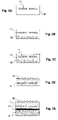
- the encapsulation is preferably carried out by prepositioning the photovoltaic cell or cells 11 within a mold as illustrated in figure 3A Where 4A , and detailed below. Then, the structure 10 is removed from the mold and can be fixed on the existing road R thanks to the grip layer 17.
- texturizing elements 16 such as transparent aggregates are spread over the bottom of a mold, preferably in the form of a single layer, in what will then be the running surface of the structure.
- a transparent binder 14 is then injected or poured into the mold. Once this material has reached its hardness and its final mechanical properties, the aggregates are attached to the contents of the mold and provide the desired surface texturing.
- the transparent binder 14 is first injected or poured into the mold ( figure 4B ), then the texturing elements such as transparent aggregates are spread over the free surface of the mold ( Fig. 4C ), whereas the injected or cast material has not reached its final properties and is still a viscous fluid.
- the texturizing elements can be pushed into the binder via a mechanical constraint or sink by means of their own weight; it is also possible to heat the texturing elements to melt the binder in their immediate vicinity.
- the aggregates are attached to the contents of the mold and provide the desired surface texturing ( 4D figure ).
- These first two embodiments use texturizing elements 16 added to binder 14 to give coating 12 the desired texture, preferably in the form of a single layer.
- encapsulant usable for carrying out the invention according to the second mode of execution it is possible to use any transparent material (transparency rate between 80 and 100%) capable of being poured or injected into a mold, within which have been prepositioned photovoltaic cells.
- the role of the binder is to mechanically protect the photovoltaic cells, to allow the maintenance of any texturizing elements which will give the surface its texture, and therefore to allow the desired road holding, while being and remaining transparent over time (in responding to the aging test in a climatic chamber according to standard NFT 30-049 for example).
- the binder can be the same as according to the first mode of implementation of the invention (see the chapter “Examples of production of the coating” above) and have the same characteristics.
- the binder is of the bituminous type as defined in standard NF EN 12591, clear (depigmented), whose penetrability classes determined according to the EN 1426 method can be, without limitation, 160/220, 100 /150, 70/100, 50/70, 40/60, 35/50, 30/45 or 20/30 (in tenths of a millimeter). Mention may be made, for example, of the binder Bituclair marketed by the company Colas.
- the binder is a synthetic or plant-based clear road binder whose penetrability classes determined according to the EN 1426 method can be, without limitation, 160/220, 100/150, 70/100, 50/ 70, 40/60, 35/50, 30/45 or 20/30 (in tenths of a millimetre). It is possible to use the Vegecol or Vegeclair binders marketed by the company Colas.
- the binder is of purely synthetic nature or of vegetable origin, preferably of organic nature, preferentially of polymeric nature. Mention will be made, by way of example and without limitation, of an acrylic, epoxy or polyurethane resin, such as the epoxy varnishes known as Varnish D marketed by the company Résipoly, or else a polyurethane Sovermol marketed by the company BASF.
- the texturing elements can be the same as those listed in the chapter “Examples of texturing elements”.
- the choice of the nature and the particle size of these inclusions meets the same criteria as those defined above.
- glass aggregates of a size between 0.9 and 1.4 mm, can be used as texturizing elements in combination with polyurethane of the Sovermol type as binder.
- the degree of transparency of such a coating is between 60 and 95% at 600nm and ideally at 95%.
- the PSV values are preferably at least PSV 44 , better PSV 50 , even better PSV 53 , and the average texture depth PMT is preferably between 0.2 and 3 mm.
- the thickness of the photovoltaic structure 10 according to the invention ranges for example from 0.5 to 30 mm, ideally from 0.6 to 12 mm. It is not necessary for the thicknesses of binder above and below the modules or the photovoltaic cells 11 to be identical.
- the bonding of the photovoltaic structure according to this second mode of execution of the invention to the surface of the road can be carried out with special industrial adhesives, or even with a bituminous binder, optionally reinforced by the addition of a polymer such as SBS, hot or in emulsion.
- the binder is spread directly on the surface of the road, spread in a thin layer, then the prefabricated photovoltaic structure is deposited there while the glue has not hardened or the bituminous binder is still viscous and sticky.
- the binder is deposited in the factory on the lower face of the prefabricated photovoltaic structure, which face may be raw or have been treated by plasma or corona effect to promote better adhesion of the binder; the photovoltaic structure is then glued to the road by slightly heating the binder present on the back thereof.
- the front face can be produced during manufacture of the photovoltaic structure in the factory.
- the running surface can also be made on the road site, after having spread the modules or the photovoltaic cells on the first bituminous layers.
- a photovoltaic structure according to the invention can also be proposed in the form of an unrollable complex with a large radius of curvature, textured, whether the upper face (after unrolling) is already pre-textured or whether a layer based on transparent binder carrying texturizing elements such as transparent aggregates.
- the complex may include tracks and flexible electrical connectors.
- a construction machine can be used to roll out the complex on an existing road.
- the coating is advantageously produced by impregnation using a roller.
- the photovoltaic structure is placed on the road to be covered, and a roller previously impregnated with binder, in particular resin, is passed over the structure in the manner of an application of paint.
- the pavement can be new or existing, but preferably made from little rut asphalt mixes, so that the topography of the road surface changes only slightly as the passage of the vehicles.
- the roadway can be a road, a highway, a sidewalk.
- the electrical energy produced by a photovoltaic structure according to the invention can be used in various ways, for example in eco-districts, solar farms, supplying public lighting, road signs or charging electric cars, this list does not not being limiting.
- the invention can also be used for all types of applications where the notion of adhesion is important or for aesthetic reasons.
Landscapes
- Engineering & Computer Science (AREA)
- Architecture (AREA)
- Civil Engineering (AREA)
- Structural Engineering (AREA)
- Road Paving Structures (AREA)
- Photovoltaic Devices (AREA)
- Manufacturing & Machinery (AREA)
- Road Signs Or Road Markings (AREA)
- Thermal Sciences (AREA)
- Chemical & Material Sciences (AREA)
- Combustion & Propulsion (AREA)
- Mechanical Engineering (AREA)
- General Engineering & Computer Science (AREA)
- Sustainable Energy (AREA)
- Sustainable Development (AREA)
- Life Sciences & Earth Sciences (AREA)
- Physics & Mathematics (AREA)
Claims (13)
- Fotovoltaikstruktur (10) für eine für den Verkehr von Fußgängern und Fahrzeugen geeignete Straße mit- mindestens einer Fotozelle,- einer nicht undurchsichtigen Beschichtung (12), die mindestens die Vorderseite der Fotozelle bedeckt und eine äußere Oberfläche (13) aufweist, die gleichermaßen unregelmäßig makrostrukturiert und unregelmäßig mikrostrukturiert ist, wobei die Makrostruktur Oberflächenunregelmäßigkeiten im Bereich von horizontal 0,5 bis 50 mm aufweist, wobei die Mikrostruktur Oberflächenunregelmäßigkeiten aufweist, deren charakteristische horizontale Abmessung kleiner als 0,5 mm beträgt, wobei die äußere Oberfläche (13) den Verkehr von Fußgängern und Fahrzeugen ermöglicht, wobei eine Tiefe der Makrostruktur eine nach der Norm NF EN 16043 gemessene mittlere Strukturtiefe PMT zwischen 0,2 und 3 mm aufweist, wobei die nicht undurchsichtige Beschichtung (12) einen Abriebfestigkeitswert PSV gemäß der Norm NF EN 13043 von mindestens PSV44, besser PSV50, noch besser PSV53 aufweist, wobei die mittlere Strukturtiefe PMT vorzugsweise mindestens 0,30 mm, besser mindestens 0,6 mm, beträgt,wobei die nicht undurchsichtige Beschichtung (12) aus einem Bindemittel (14) und nicht undurchsichtigen Strukturelementen (16) mit einer Größe von 0,4 bis 4 mm gebildet ist, wobei die Strukturelemente Reliefs verschiedener Formen und verschiedener Größen bilden, um die Makrostruktur und die Mikrostruktur zu erhalten.
- Struktur gemäß dem vorangehenden Anspruch, wobei die Beschichtung (12) einen Durchsichtigkeitsgrad von mehr als 50 % in einem Bereich von 100 nm um den Spitzenwert der Wirksamkeit der Fotozellen herum, insbesondere im Bereich 500 - 700 nm, aufweist.
- Struktur gemäß einem der vorangehenden Ansprüche, wobei das Bindemittel (14) vorzugsweise ein Elastizitätsmodul zwischen 0,1 und 10 GPa aufweist, wobei die Fotozelle vorzugsweise vom Bindemittel umgeben ist, wobei die Struktur der äußeren Oberfläche (13) vorzugsweise mindestens teilweise durch das Bindemittel (14) definiert ist.
- Struktur gemäß Anspruch 3, wobei das Bindemittel (14) unter den Materialien synthetischen oder pflanzlichen Ursprungs, den bituminösen Bindemitteln, vorzugsweise der Durchlässigkeitsklassen 160/220, 100/150, 70/100, 50/70, 40/60, 35/50, 30/45 oder 20/30 (in Zehntelmillimetern) nach der Norm EN 1426, den hellen Bindemitteln für Verkehrswege synthetischen oder pflanzlichen Ursprungs, vorzugsweise der Durchlässigkeitsklassen 160/220, 100/150, 70/100, 50/70, 40/60, 35/50, 30/45 oder 20/30 (in Zehntelmillimetern) nach der Norm EN 1426, und den polymeren Bindemitteln ausgewählt ist.
- Struktur gemäß einem der vorangehenden Ansprüche, wobei die Dichte an Strukturelementen an der Oberfläche der Beschichtung vorzugsweise zwischen 0,1 und 5 kg/m2, besser zwischen 0,7 und 1,5 kg/m2, beträgt, wobei die Strukturelemente vorzugsweise einen Formfaktor von weniger als 8, besser zwischen 1 und 3, aufweisen.
- Struktur gemäß Anspruch 5, wobei die Strukturelemente (16) einschichtig angeordnet sind, vorzugsweise ungefähr bis in die Mitte der Dicke des Bindemittels (14) der Beschichtung eingedrückt sind.
- Struktur gemäß einem der Ansprüche 5 und 6, wobei die Strukturelemente (16) unter den Granulaten aus durchsichtigen oder durchscheinenden, organischen oder anorganischen Materialien, insbesondere aus Polykarbonat oder Glas, ausgewählt sind.
- Struktur gemäß einem der Ansprüche 5 bis 7, wobei die Strukturelemente eine Größe von 0,9 bis 1,4 mm aufweisen.
- Struktur gemäß einem der vorangehenden Ansprüche mit einer Schicht aus einem Polymer, gegebenenfalls fluoriert, unter der Fotozelle, vorzugsweise mit einer Dicke von 0,2 bis 5 mm.
- Fahrbahn mit einer wie in einem der vorangehenden Ansprüche definierten Fotozellenstruktur (10).
- Verfahren zum Herstellen einer wie in einem der Ansprüche 1 bis 9 definierten Fotozellenstruktur, das die folgenden Schritte aufweist:- Ablegen von Strukturelementen, insbesondere von Granulaten unregelmäßiger, vorzugsweise zufälliger Form auf dem Boden einer Form (M), wobei die Strukturelemente vorzugsweise einschichtig abgelegt werden,- Ablegen einer oder mehrerer Fotozellen in der Form,- Einspritzen und Gießen eines nicht undurchsichtigen Materials im flüssigen Zustand in die Form, um die Fotozellen zu beschichten und die Strukturelemente festzuhalten.
- Verfahren zum Herstellen einer wie in einem der Ansprüche 1 bis 9 definierten Fotozellenstruktur, das die folgenden Schritte aufweist:- Ablegen einer oder mehrerer Fotozellen in einer Form,- Einspritzen und Gießen eines nicht undurchsichtigen Materials im flüssigen Zustand in die Form,- Einbringen von Strukturelementen, insbesondere von Granulaten unregelmäßiger, vorzugsweise zufälliger Form vor dem Erhärten des Materials in dessen Oberfläche, wobei die Strukturelemente vorzugsweise einschichtig eingebracht werden.
- Verfahren zum Herstellen einer wie in einem der Ansprüche 1 bis 9 definierten Fotozellenstruktur, das die folgenden Schritte aufweist:- Aufbringen eines durchsichtigen Polymerfilms auf eine oder mehrere Fotozellen,- Aufbringen von Strukturelementen unregelmäßiger, vorzugsweise zufälliger Form auf dessen Oberfläche,- die Gesamtheit heiß und unter Druck einer Walze aussetzen, wobei die Hitze das Erweichen des Films sicherstellt und ermöglicht, daß die Strukturelemente in diesen eindringen.
Applications Claiming Priority (2)
| Application Number | Priority Date | Filing Date | Title |
|---|---|---|---|
| FR1351191A FR3002083B1 (fr) | 2013-02-12 | 2013-02-12 | Structure photovoltaique pour chaussee. |
| PCT/IB2014/058908 WO2014125415A1 (fr) | 2013-02-12 | 2014-02-11 | Structure photovoltaique pour chaussee |
Publications (2)
| Publication Number | Publication Date |
|---|---|
| EP2956967A1 EP2956967A1 (de) | 2015-12-23 |
| EP2956967B1 true EP2956967B1 (de) | 2022-10-05 |
Family
ID=48225013
Family Applications (1)
| Application Number | Title | Priority Date | Filing Date |
|---|---|---|---|
| EP14707240.9A Active EP2956967B1 (de) | 2013-02-12 | 2014-02-11 | Fotovoltaikstruktur für eine strasse |
Country Status (11)
| Country | Link |
|---|---|
| US (2) | US10141460B2 (de) |
| EP (1) | EP2956967B1 (de) |
| KR (1) | KR102219319B1 (de) |
| AP (1) | AP2015008639A0 (de) |
| AU (2) | AU2014217512A1 (de) |
| CA (1) | CA2900733C (de) |
| ES (1) | ES2933814T3 (de) |
| FR (1) | FR3002083B1 (de) |
| HU (1) | HUE060662T2 (de) |
| MA (1) | MA38334B1 (de) |
| WO (1) | WO2014125415A1 (de) |
Families Citing this family (35)
| Publication number | Priority date | Publication date | Assignee | Title |
|---|---|---|---|---|
| GB2505516A (en) * | 2012-09-04 | 2014-03-05 | Bombardier Transp Gmbh | Pavement slab assembly having cable bearing element |
| DE102016002839A1 (de) * | 2016-03-10 | 2017-09-14 | Christian Huckschlag | Verkehrsfläche |
| GB201612528D0 (en) * | 2016-07-19 | 2016-08-31 | Machines With Vision Ltd | Vehicle localisation using the ground or road surface |
| CN108017320A (zh) * | 2016-11-03 | 2018-05-11 | 张宏超 | 用于制备太阳能光伏发电路面透光抗滑磨耗层的混合料及其应用 |
| IT201600117467A1 (it) * | 2016-11-21 | 2018-05-21 | Michele Cormio | Pista ciclabile fotovoltaica |
| US20200204105A1 (en) * | 2017-05-12 | 2020-06-25 | Solar Earth Technologies Ltd. | Seamless encapsulation of photovoltaic modules for paving surfaces |
| CN206807347U (zh) * | 2017-06-12 | 2017-12-26 | 北京铂阳顶荣光伏科技有限公司 | 路面发电单元及系统 |
| EP3462605A1 (de) | 2017-10-02 | 2019-04-03 | Nederlandse Organisatie voor toegepast- natuurwetenschappelijk onderzoek TNO | Photovoltaische strassenanordnung |
| WO2019068929A1 (de) * | 2017-10-06 | 2019-04-11 | Buesscher & Hoffmann Gmbh | Verfahren zum rückseitigen abdecken von photovoltaikmodulen |
| FR3073106B1 (fr) * | 2017-10-27 | 2021-04-16 | Colas Sa | Systeme de production d'energie electrique par des dalles photovoltaiques formant une surface de circulation, rail de connexion adapte |
| EP3490008A1 (de) * | 2017-11-27 | 2019-05-29 | Nederlandse Organisatie voor toegepast- natuurwetenschappelijk onderzoek TNO | Photovoltaisches mehrschichtlaminat |
| EP3503213A1 (de) | 2017-12-21 | 2019-06-26 | Nederlandse Organisatie voor toegepast- natuurwetenschappelijk onderzoek TNO | Fotovoltaische strassenanordnung |
| KR102020033B1 (ko) * | 2018-04-09 | 2019-09-18 | (주)콘텍이엔지 | 도로 구조물에 적용 가능한 태양광 발전 시스템 |
| CN110739363A (zh) * | 2018-07-18 | 2020-01-31 | 李武 | 一种太阳能发电路面组件 |
| FR3084955A1 (fr) | 2018-08-08 | 2020-02-14 | Commissariat A L'energie Atomique Et Aux Energies Alternatives | Procede et systeme de detection d'un etre vivant ou d'un objet sur une voie circulable |
| JP6814445B2 (ja) * | 2018-08-31 | 2021-01-20 | Mirai−Labo株式会社 | 太陽光発電パネル、舗装構造体および壁面構造体 |
| CN110931580A (zh) * | 2018-08-31 | 2020-03-27 | 汉能移动能源控股集团有限公司 | 太阳能发电单元的制备方法及其制备的太阳能发电单元 |
| US11978815B2 (en) | 2018-12-27 | 2024-05-07 | Solarpaint Ltd. | Flexible photovoltaic cell, and methods and systems of producing it |
| US12628437B2 (en) | 2018-12-27 | 2026-05-12 | Solarpaint Ltd. | Injection molded, blow molded, and rotational molded articles that integrally incorporate a photovoltaic device, and method and system for producing such articles |
| EP3920241A4 (de) * | 2019-01-31 | 2022-11-23 | Photon Technology (Kunshan) Co., Ltd | Stromerzeugendes baumaterial und herstellungsverfahren dafür |
| EP3712964A1 (de) * | 2019-03-20 | 2020-09-23 | Sono Motors GmbH | Verfahren zur herstellung eines fotovoltaikmoduls |
| CN110188392A (zh) * | 2019-04-30 | 2019-08-30 | 汉能移动能源控股集团有限公司 | 光伏道路承重层设计方法 |
| US20220302875A1 (en) * | 2019-09-20 | 2022-09-22 | Erthos IP LLC | Flat Tile Solar Panels-Module Number |
| US20210091709A1 (en) * | 2019-09-20 | 2021-03-25 | Erthos Inc. | Flat Tile Solar Panels |
| US20230030122A1 (en) * | 2019-09-20 | 2023-02-02 | Erthos IP LLC | Photovoltaic modules and fastening system |
| US20240014768A1 (en) * | 2019-09-20 | 2024-01-11 | Erthos IP LLC | Photovoltaic modules |
| FR3108619B1 (fr) * | 2020-03-31 | 2023-05-12 | Total Marketing Services | Procede de fixation de modules photovoltaiques au moyen d’un liant de collage bitumeux comprenant un organogelateur |
| CN111996862A (zh) * | 2020-08-11 | 2020-11-27 | 中宇智慧光能科技有限公司 | 一种光能路面的铺设方法 |
| CN111996863A (zh) * | 2020-08-11 | 2020-11-27 | 中宇智慧光能科技有限公司 | 一种光能路面铺设结构 |
| ES2907780B2 (es) * | 2020-10-22 | 2022-09-28 | Solum Photovoltaic Innovation S L | Baldosa fotovoltaica destinada a ser instalada en pavimentos exteriores transitables |
| KR20230104184A (ko) * | 2020-10-28 | 2023-07-07 | 솔라페인트 엘티디. | 광기전 디바이스를 일체로 합체한 사출 성형된, 블로우 성형된 및 회전 성형된 물품 및 이러한 물품을 생산하기 위한 방법 및 시스템 |
| CN112927366B (zh) * | 2021-05-10 | 2021-07-16 | 中南大学 | 一种沥青路面构造深度测量方法 |
| CN117546405A (zh) * | 2021-05-11 | 2024-02-09 | Dm太阳能有限公司 | 用于道路的太阳能板、太阳能道路及太阳能板的建造方法 |
| FR3122954B1 (fr) | 2021-05-12 | 2023-06-02 | Univ Gustave Eiffel | Systeme hybride pour chaussee solaire |
| WO2023238831A1 (ja) * | 2022-06-09 | 2023-12-14 | Agc株式会社 | 舗装用光起電力モジュール、太陽光発電舗装ブロック、舗装用光起電力モジュールの製造方法、ガラス板、及びガラス床用合わせガラス |
Family Cites Families (15)
| Publication number | Priority date | Publication date | Assignee | Title |
|---|---|---|---|---|
| JPH0918041A (ja) * | 1995-07-01 | 1997-01-17 | Shinji Kaneko | 太陽電池を使った道路用または歩道用ブロック型発電機 |
| FR2799195B1 (fr) * | 1999-10-01 | 2001-12-14 | Colas Sa | Compose destine a retarder la propagation des fissures dans les chaussees, procede et couche resultants |
| JP2002021036A (ja) * | 2000-07-11 | 2002-01-23 | Kazumasa Sasaki | 太陽電池埋込型不凍結道路方式、そのためのユニット板、それを用いた不凍結道路建設工法 |
| JP2005036386A (ja) * | 2001-12-28 | 2005-02-10 | Doperu:Kk | 蓄光発光性道路標示材と道路構造 |
| US7191568B1 (en) * | 2002-01-30 | 2007-03-20 | Nick Choate | Modular safety surface and method for preparing the same |
| BRPI0412141A (pt) * | 2003-10-06 | 2006-08-15 | Ngk Spark Plug Co | célular solar sensibilizada com corante |
| US20050199282A1 (en) * | 2004-03-11 | 2005-09-15 | Oleinick Energy, Llc | Photovoltaic-embedded surface |
| US9732481B2 (en) * | 2004-04-02 | 2017-08-15 | Flint Trading, Inc. | Preformed thermoplastic pavement marking and method utilizing large aggregate for improved long term skid resistance and reduced tire tracking |
| US7870700B2 (en) * | 2006-06-19 | 2011-01-18 | Daniel Efrain Arguelles | Pan tile for roofing system |
| JP2008004691A (ja) * | 2006-06-21 | 2008-01-10 | Toppan Printing Co Ltd | 太陽電池裏面封止用シート |
| JP5072759B2 (ja) * | 2008-07-25 | 2012-11-14 | 三洋電機株式会社 | 太陽電池の製造方法及び太陽電池モジュールの製造方法 |
| JP2010280147A (ja) * | 2009-06-05 | 2010-12-16 | Kagawa Univ | 撥水撥油防汚性透明部材及びその製造方法並びにそれらを用いた物品 |
| US20110302858A1 (en) * | 2010-06-15 | 2011-12-15 | Bradley Duane Siewert | Roads, walls, and structures for energy generation and conservation |
| US20130118548A1 (en) * | 2011-11-11 | 2013-05-16 | Qualcomm Mems Technologies, Inc. | Apparatus and methods for enhancing photovoltaic efficiency |
| CN104025173A (zh) * | 2012-01-03 | 2014-09-03 | 皇家飞利浦有限公司 | 静电可控设备 |
-
2013
- 2013-02-12 FR FR1351191A patent/FR3002083B1/fr not_active Expired - Fee Related
-
2014
- 2014-02-11 CA CA2900733A patent/CA2900733C/fr active Active
- 2014-02-11 MA MA38334A patent/MA38334B1/fr unknown
- 2014-02-11 EP EP14707240.9A patent/EP2956967B1/de active Active
- 2014-02-11 WO PCT/IB2014/058908 patent/WO2014125415A1/fr not_active Ceased
- 2014-02-11 HU HUE14707240A patent/HUE060662T2/hu unknown
- 2014-02-11 KR KR1020157024444A patent/KR102219319B1/ko active Active
- 2014-02-11 ES ES14707240T patent/ES2933814T3/es active Active
- 2014-02-11 AP AP2015008639A patent/AP2015008639A0/xx unknown
- 2014-02-11 US US14/767,385 patent/US10141460B2/en active Active
- 2014-02-11 AU AU2014217512A patent/AU2014217512A1/en not_active Abandoned
-
2018
- 2018-05-23 AU AU2018203648A patent/AU2018203648B2/en active Active
- 2018-10-29 US US16/173,593 patent/US11075311B2/en not_active Expired - Fee Related
Non-Patent Citations (2)
| Title |
|---|
| DUPONT PIERRE: "Mesure de la macrotexture des revêtements de chaussée Normes en cours de validité", 18 December 2009 (2009-12-18), pages 1 - 3, XP055884077, Retrieved from the Internet <URL:https://www.idrrim.com/ressources/publications/1/395,Note-04.pdf> [retrieved on 20220126] * |
| GANDIL P: "Circulaire no 2002-39 du 16 mai 2002 relative à l'adhérence des couches de roulement neuves et au contrôle de la macrotexture", 16 May 2002 (2002-05-16), pages 1 - 6, XP055884073, Retrieved from the Internet <URL:https://www.bulletin-officiel.developpement-durable.gouv.fr/documents/Bulletinofficiel-0011689/A0100052.pdf;jsessionid=79E1413C6B82893CA74F07E74099052B> [retrieved on 20220126] * |
Also Published As
| Publication number | Publication date |
|---|---|
| CA2900733A1 (fr) | 2014-08-21 |
| AU2014217512A1 (en) | 2016-01-21 |
| EP2956967A1 (de) | 2015-12-23 |
| FR3002083A1 (fr) | 2014-08-15 |
| KR102219319B1 (ko) | 2021-02-24 |
| MA38334B1 (fr) | 2017-04-28 |
| CA2900733C (fr) | 2021-12-14 |
| AP2015008639A0 (en) | 2015-08-31 |
| WO2014125415A1 (fr) | 2014-08-21 |
| US20160035911A1 (en) | 2016-02-04 |
| KR20150127610A (ko) | 2015-11-17 |
| ES2933814T3 (es) | 2023-02-14 |
| AU2018203648A1 (en) | 2018-06-14 |
| MA38334A1 (fr) | 2016-09-30 |
| AU2018203648B2 (en) | 2020-07-02 |
| FR3002083B1 (fr) | 2015-03-13 |
| HUE060662T2 (hu) | 2023-04-28 |
| US20190123216A1 (en) | 2019-04-25 |
| US11075311B2 (en) | 2021-07-27 |
| US10141460B2 (en) | 2018-11-27 |
Similar Documents
| Publication | Publication Date | Title |
|---|---|---|
| CA2900733C (fr) | Structure photovoltaique pour chaussee | |
| EP3175547B1 (de) | Auf eine kreisverkehrszone angewandte anordnung mit einem photovoltaikmodul | |
| US20200204105A1 (en) | Seamless encapsulation of photovoltaic modules for paving surfaces | |
| CA3130165A1 (fr) | Dispositif fonctionnel integrable dans une chaussee circulable et procede de fabrication d'une chaussee circulable avec un tel dispositif fonctionnel | |
| FR3071357B1 (fr) | Laminat flexible de cellules photovoltaiques et procede associe | |
| KR200368103Y1 (ko) | 폐타이어 고무칩, 규사, epdm칩과 골재를 이용한 투수형 복층 포장재 | |
| OA17547A (en) | Photovoltaic structure for a roadway | |
| FR3130687A1 (fr) | Dispositif fonctionnel en structure multicouche dont l’une des couches comprend un matériau composite comportant une résine en polyuréthane thermodurcissable et des fibres de verre et procédé de fabrication d’un tel dispositif fonctionnel | |
| CH716592B1 (fr) | Matériau composite de revêtement de surface et son procédé de réalisation. | |
| FR3106601A1 (fr) | Dalle de revêtement de surface de voirie | |
| BE1013796A4 (fr) | Procede et dispositif de repandage sur une chaussee d'une couche de roulement en beton bitumineux a proprietes photometriques ameliorees. | |
| FR2706497A1 (fr) | Procédé de réfection d'une chaussée. | |
| EP0925408A1 (de) | Reflektierender betonrandstein | |
| EP0927793A1 (de) | Spurrillenbeständiger Strassenbelag und Verfahren zur Herstellung eines solchen Strassenbelages | |
| FR2703095A1 (fr) | Procédé de réalisation d'un revêtement de sol souple. | |
| OA18719A (fr) | Ensemble comportant un module photovoltaïque appliqué sur une zone circulable. | |
| CA2773989A1 (fr) | Appareil et methode associee pour creer un patron dans une surface continue | |
| EP1027386A1 (de) | Zusammensetzung und verfahren zur herstellung einer strassenfahrbahn | |
| FR2824087A1 (fr) | Procede et matrice de realisation d'un revetement de sol ayant l'aspect d'un dallage vieilli | |
| FR2608184A1 (fr) | Element de soutenement comportant une couche alveolaire et procedes de realisation de chaussee provisoire mettant en oeuvre ledit element de soutenement | |
| FR2658212A1 (fr) | Revetement ou enduit drainant convenant notamment dans les travaux publics, sa composition et son procede de fabrication. | |
| FR2666359A1 (fr) | Perfectionnements aux produits bitumineux. | |
| CN101514538A (zh) | 一种沥青混凝土路面的保护方法 | |
| WO2006076816A1 (fr) | Piste de faible adherence pour la conduite de vehicules | |
| BE697148A (de) |
Legal Events
| Date | Code | Title | Description |
|---|---|---|---|
| PUAI | Public reference made under article 153(3) epc to a published international application that has entered the european phase |
Free format text: ORIGINAL CODE: 0009012 |
|
| 17P | Request for examination filed |
Effective date: 20150914 |
|
| AK | Designated contracting states |
Kind code of ref document: A1 Designated state(s): AL AT BE BG CH CY CZ DE DK EE ES FI FR GB GR HR HU IE IS IT LI LT LU LV MC MK MT NL NO PL PT RO RS SE SI SK SM TR |
|
| AX | Request for extension of the european patent |
Extension state: BA ME |
|
| DAX | Request for extension of the european patent (deleted) | ||
| STAA | Information on the status of an ep patent application or granted ep patent |
Free format text: STATUS: EXAMINATION IS IN PROGRESS |
|
| 17Q | First examination report despatched |
Effective date: 20170310 |
|
| GRAP | Despatch of communication of intention to grant a patent |
Free format text: ORIGINAL CODE: EPIDOSNIGR1 |
|
| STAA | Information on the status of an ep patent application or granted ep patent |
Free format text: STATUS: GRANT OF PATENT IS INTENDED |
|
| INTG | Intention to grant announced |
Effective date: 20220602 |
|
| RIN1 | Information on inventor provided before grant (corrected) |
Inventor name: COQUELLE, ERIC Inventor name: BARRUEL, FRANCK Inventor name: PILAT, ERIC Inventor name: GAUTIER, JEAN-LUC |
|
| GRAS | Grant fee paid |
Free format text: ORIGINAL CODE: EPIDOSNIGR3 |
|
| GRAA | (expected) grant |
Free format text: ORIGINAL CODE: 0009210 |
|
| STAA | Information on the status of an ep patent application or granted ep patent |
Free format text: STATUS: THE PATENT HAS BEEN GRANTED |
|
| AK | Designated contracting states |
Kind code of ref document: B1 Designated state(s): AL AT BE BG CH CY CZ DE DK EE ES FI FR GB GR HR HU IE IS IT LI LT LU LV MC MK MT NL NO PL PT RO RS SE SI SK SM TR |
|
| REG | Reference to a national code |
Ref country code: GB Ref legal event code: FG4D Free format text: NOT ENGLISH |
|
| REG | Reference to a national code |
Ref country code: CH Ref legal event code: EP |
|
| REG | Reference to a national code |
Ref country code: AT Ref legal event code: REF Ref document number: 1523300 Country of ref document: AT Kind code of ref document: T Effective date: 20221015 |
|
| REG | Reference to a national code |
Ref country code: IE Ref legal event code: FG4D Free format text: LANGUAGE OF EP DOCUMENT: FRENCH |
|
| REG | Reference to a national code |
Ref country code: DE Ref legal event code: R096 Ref document number: 602014085123 Country of ref document: DE |
|
| RAP4 | Party data changed (patent owner data changed or rights of a patent transferred) |
Owner name: COLAS Owner name: COMMISSARIAT A L'ENERGIE ATOMIQUE ET AUX ENERGIES ALTERNATIVES |
|
| REG | Reference to a national code |
Ref country code: NL Ref legal event code: FP |
|
| REG | Reference to a national code |
Ref country code: LT Ref legal event code: MG9D |
|
| REG | Reference to a national code |
Ref country code: ES Ref legal event code: FG2A Ref document number: 2933814 Country of ref document: ES Kind code of ref document: T3 Effective date: 20230214 |
|
| PG25 | Lapsed in a contracting state [announced via postgrant information from national office to epo] |
Ref country code: SE Free format text: LAPSE BECAUSE OF FAILURE TO SUBMIT A TRANSLATION OF THE DESCRIPTION OR TO PAY THE FEE WITHIN THE PRESCRIBED TIME-LIMIT Effective date: 20221005 Ref country code: PT Free format text: LAPSE BECAUSE OF FAILURE TO SUBMIT A TRANSLATION OF THE DESCRIPTION OR TO PAY THE FEE WITHIN THE PRESCRIBED TIME-LIMIT Effective date: 20230206 Ref country code: NO Free format text: LAPSE BECAUSE OF FAILURE TO SUBMIT A TRANSLATION OF THE DESCRIPTION OR TO PAY THE FEE WITHIN THE PRESCRIBED TIME-LIMIT Effective date: 20230105 Ref country code: LT Free format text: LAPSE BECAUSE OF FAILURE TO SUBMIT A TRANSLATION OF THE DESCRIPTION OR TO PAY THE FEE WITHIN THE PRESCRIBED TIME-LIMIT Effective date: 20221005 Ref country code: FI Free format text: LAPSE BECAUSE OF FAILURE TO SUBMIT A TRANSLATION OF THE DESCRIPTION OR TO PAY THE FEE WITHIN THE PRESCRIBED TIME-LIMIT Effective date: 20221005 |
|
| REG | Reference to a national code |
Ref country code: HU Ref legal event code: AG4A Ref document number: E060662 Country of ref document: HU |
|
| PG25 | Lapsed in a contracting state [announced via postgrant information from national office to epo] |
Ref country code: RS Free format text: LAPSE BECAUSE OF FAILURE TO SUBMIT A TRANSLATION OF THE DESCRIPTION OR TO PAY THE FEE WITHIN THE PRESCRIBED TIME-LIMIT Effective date: 20221005 Ref country code: PL Free format text: LAPSE BECAUSE OF FAILURE TO SUBMIT A TRANSLATION OF THE DESCRIPTION OR TO PAY THE FEE WITHIN THE PRESCRIBED TIME-LIMIT Effective date: 20221005 Ref country code: LV Free format text: LAPSE BECAUSE OF FAILURE TO SUBMIT A TRANSLATION OF THE DESCRIPTION OR TO PAY THE FEE WITHIN THE PRESCRIBED TIME-LIMIT Effective date: 20221005 Ref country code: IS Free format text: LAPSE BECAUSE OF FAILURE TO SUBMIT A TRANSLATION OF THE DESCRIPTION OR TO PAY THE FEE WITHIN THE PRESCRIBED TIME-LIMIT Effective date: 20230205 Ref country code: HR Free format text: LAPSE BECAUSE OF FAILURE TO SUBMIT A TRANSLATION OF THE DESCRIPTION OR TO PAY THE FEE WITHIN THE PRESCRIBED TIME-LIMIT Effective date: 20221005 Ref country code: GR Free format text: LAPSE BECAUSE OF FAILURE TO SUBMIT A TRANSLATION OF THE DESCRIPTION OR TO PAY THE FEE WITHIN THE PRESCRIBED TIME-LIMIT Effective date: 20230106 |
|
| P01 | Opt-out of the competence of the unified patent court (upc) registered |
Effective date: 20230524 |
|
| REG | Reference to a national code |
Ref country code: DE Ref legal event code: R097 Ref document number: 602014085123 Country of ref document: DE |
|
| PG25 | Lapsed in a contracting state [announced via postgrant information from national office to epo] |
Ref country code: SM Free format text: LAPSE BECAUSE OF FAILURE TO SUBMIT A TRANSLATION OF THE DESCRIPTION OR TO PAY THE FEE WITHIN THE PRESCRIBED TIME-LIMIT Effective date: 20221005 Ref country code: RO Free format text: LAPSE BECAUSE OF FAILURE TO SUBMIT A TRANSLATION OF THE DESCRIPTION OR TO PAY THE FEE WITHIN THE PRESCRIBED TIME-LIMIT Effective date: 20221005 Ref country code: EE Free format text: LAPSE BECAUSE OF FAILURE TO SUBMIT A TRANSLATION OF THE DESCRIPTION OR TO PAY THE FEE WITHIN THE PRESCRIBED TIME-LIMIT Effective date: 20221005 Ref country code: DK Free format text: LAPSE BECAUSE OF FAILURE TO SUBMIT A TRANSLATION OF THE DESCRIPTION OR TO PAY THE FEE WITHIN THE PRESCRIBED TIME-LIMIT Effective date: 20221005 Ref country code: CZ Free format text: LAPSE BECAUSE OF FAILURE TO SUBMIT A TRANSLATION OF THE DESCRIPTION OR TO PAY THE FEE WITHIN THE PRESCRIBED TIME-LIMIT Effective date: 20221005 |
|
| PLBE | No opposition filed within time limit |
Free format text: ORIGINAL CODE: 0009261 |
|
| STAA | Information on the status of an ep patent application or granted ep patent |
Free format text: STATUS: NO OPPOSITION FILED WITHIN TIME LIMIT |
|
| PG25 | Lapsed in a contracting state [announced via postgrant information from national office to epo] |
Ref country code: SK Free format text: LAPSE BECAUSE OF FAILURE TO SUBMIT A TRANSLATION OF THE DESCRIPTION OR TO PAY THE FEE WITHIN THE PRESCRIBED TIME-LIMIT Effective date: 20221005 Ref country code: AL Free format text: LAPSE BECAUSE OF FAILURE TO SUBMIT A TRANSLATION OF THE DESCRIPTION OR TO PAY THE FEE WITHIN THE PRESCRIBED TIME-LIMIT Effective date: 20221005 |
|
| 26N | No opposition filed |
Effective date: 20230706 |
|
| PG25 | Lapsed in a contracting state [announced via postgrant information from national office to epo] |
Ref country code: MC Free format text: LAPSE BECAUSE OF FAILURE TO SUBMIT A TRANSLATION OF THE DESCRIPTION OR TO PAY THE FEE WITHIN THE PRESCRIBED TIME-LIMIT Effective date: 20221005 |
|
| PG25 | Lapsed in a contracting state [announced via postgrant information from national office to epo] |
Ref country code: LU Free format text: LAPSE BECAUSE OF NON-PAYMENT OF DUE FEES Effective date: 20230211 |
|
| PG25 | Lapsed in a contracting state [announced via postgrant information from national office to epo] |
Ref country code: SI Free format text: LAPSE BECAUSE OF FAILURE TO SUBMIT A TRANSLATION OF THE DESCRIPTION OR TO PAY THE FEE WITHIN THE PRESCRIBED TIME-LIMIT Effective date: 20221005 |
|
| REG | Reference to a national code |
Ref country code: IE Ref legal event code: MM4A |
|
| PG25 | Lapsed in a contracting state [announced via postgrant information from national office to epo] |
Ref country code: IE Free format text: LAPSE BECAUSE OF NON-PAYMENT OF DUE FEES Effective date: 20230211 |
|
| REG | Reference to a national code |
Ref country code: AT Ref legal event code: UEP Ref document number: 1523300 Country of ref document: AT Kind code of ref document: T Effective date: 20221005 |
|
| PG25 | Lapsed in a contracting state [announced via postgrant information from national office to epo] |
Ref country code: BG Free format text: LAPSE BECAUSE OF FAILURE TO SUBMIT A TRANSLATION OF THE DESCRIPTION OR TO PAY THE FEE WITHIN THE PRESCRIBED TIME-LIMIT Effective date: 20221005 |
|
| REG | Reference to a national code |
Ref country code: DE Ref legal event code: R079 Ref document number: 602014085123 Country of ref document: DE Free format text: PREVIOUS MAIN CLASS: H01L0031023600 Ipc: H10F0077700000 |
|
| PG25 | Lapsed in a contracting state [announced via postgrant information from national office to epo] |
Ref country code: BG Free format text: LAPSE BECAUSE OF FAILURE TO SUBMIT A TRANSLATION OF THE DESCRIPTION OR TO PAY THE FEE WITHIN THE PRESCRIBED TIME-LIMIT Effective date: 20221005 |
|
| PGFP | Annual fee paid to national office [announced via postgrant information from national office to epo] |
Ref country code: HU Payment date: 20250220 Year of fee payment: 12 |
|
| PGFP | Annual fee paid to national office [announced via postgrant information from national office to epo] |
Ref country code: ES Payment date: 20250305 Year of fee payment: 12 |
|
| PGFP | Annual fee paid to national office [announced via postgrant information from national office to epo] |
Ref country code: AT Payment date: 20250107 Year of fee payment: 12 Ref country code: BE Payment date: 20250103 Year of fee payment: 12 |
|
| PGFP | Annual fee paid to national office [announced via postgrant information from national office to epo] |
Ref country code: GB Payment date: 20250103 Year of fee payment: 12 |
|
| PG25 | Lapsed in a contracting state [announced via postgrant information from national office to epo] |
Ref country code: CY Free format text: LAPSE BECAUSE OF FAILURE TO SUBMIT A TRANSLATION OF THE DESCRIPTION OR TO PAY THE FEE WITHIN THE PRESCRIBED TIME-LIMIT; INVALID AB INITIO Effective date: 20140211 |
|
| PG25 | Lapsed in a contracting state [announced via postgrant information from national office to epo] |
Ref country code: TR Free format text: LAPSE BECAUSE OF FAILURE TO SUBMIT A TRANSLATION OF THE DESCRIPTION OR TO PAY THE FEE WITHIN THE PRESCRIBED TIME-LIMIT Effective date: 20221005 |
|
| REG | Reference to a national code |
Ref country code: CH Ref legal event code: U11 Free format text: ST27 STATUS EVENT CODE: U-0-0-U10-U11 (AS PROVIDED BY THE NATIONAL OFFICE) Effective date: 20260301 |
|
| PGFP | Annual fee paid to national office [announced via postgrant information from national office to epo] |
Ref country code: NL Payment date: 20260218 Year of fee payment: 13 |
|
| PGFP | Annual fee paid to national office [announced via postgrant information from national office to epo] |
Ref country code: DE Payment date: 20260213 Year of fee payment: 13 |
|
| PGFP | Annual fee paid to national office [announced via postgrant information from national office to epo] |
Ref country code: IT Payment date: 20260223 Year of fee payment: 13 |
|
| PGFP | Annual fee paid to national office [announced via postgrant information from national office to epo] |
Ref country code: FR Payment date: 20260212 Year of fee payment: 13 |
|
| PGFP | Annual fee paid to national office [announced via postgrant information from national office to epo] |
Ref country code: CH Payment date: 20260301 Year of fee payment: 13 |