EP2944515A1 - Landwirtschaftliches fahrzeug - Google Patents
Landwirtschaftliches fahrzeug Download PDFInfo
- Publication number
- EP2944515A1 EP2944515A1 EP15164964.7A EP15164964A EP2944515A1 EP 2944515 A1 EP2944515 A1 EP 2944515A1 EP 15164964 A EP15164964 A EP 15164964A EP 2944515 A1 EP2944515 A1 EP 2944515A1
- Authority
- EP
- European Patent Office
- Prior art keywords
- aftertreatment system
- vehicle according
- exhaust aftertreatment
- filter
- catalytic converter
- Prior art date
- Legal status (The legal status is an assumption and is not a legal conclusion. Google has not performed a legal analysis and makes no representation as to the accuracy of the status listed.)
- Granted
Links
Images

Classifications
-
- B—PERFORMING OPERATIONS; TRANSPORTING
- B60—VEHICLES IN GENERAL
- B60Q—ARRANGEMENT OF SIGNALLING OR LIGHTING DEVICES, THE MOUNTING OR SUPPORTING THEREOF OR CIRCUITS THEREFOR, FOR VEHICLES IN GENERAL
- B60Q1/00—Arrangement of optical signalling or lighting devices, the mounting or supporting thereof or circuits therefor
- B60Q1/26—Arrangement of optical signalling or lighting devices, the mounting or supporting thereof or circuits therefor the devices being primarily intended to indicate the vehicle, or parts thereof, or to give signals, to other traffic
- B60Q1/2661—Arrangement of optical signalling or lighting devices, the mounting or supporting thereof or circuits therefor the devices being primarily intended to indicate the vehicle, or parts thereof, or to give signals, to other traffic mounted on parts having other functions
- B60Q1/2688—Arrangement of optical signalling or lighting devices, the mounting or supporting thereof or circuits therefor the devices being primarily intended to indicate the vehicle, or parts thereof, or to give signals, to other traffic mounted on parts having other functions on exhaust pipes
-
- F—MECHANICAL ENGINEERING; LIGHTING; HEATING; WEAPONS; BLASTING
- F01—MACHINES OR ENGINES IN GENERAL; ENGINE PLANTS IN GENERAL; STEAM ENGINES
- F01N—GAS-FLOW SILENCERS OR EXHAUST APPARATUS FOR MACHINES OR ENGINES IN GENERAL; GAS-FLOW SILENCERS OR EXHAUST APPARATUS FOR INTERNAL-COMBUSTION ENGINES
- F01N13/00—Exhaust or silencing apparatus characterised by constructional features
- F01N13/14—Exhaust or silencing apparatus characterised by constructional features having thermal insulation
- F01N13/141—Double-walled exhaust pipes or housings
- F01N13/143—Double-walled exhaust pipes or housings with air filling the space between both walls
-
- B—PERFORMING OPERATIONS; TRANSPORTING
- B60—VEHICLES IN GENERAL
- B60Q—ARRANGEMENT OF SIGNALLING OR LIGHTING DEVICES, THE MOUNTING OR SUPPORTING THEREOF OR CIRCUITS THEREFOR, FOR VEHICLES IN GENERAL
- B60Q2800/00—Features related to particular types of vehicles not otherwise provided for
- B60Q2800/20—Utility vehicles, e.g. for agriculture, construction work
-
- F—MECHANICAL ENGINEERING; LIGHTING; HEATING; WEAPONS; BLASTING
- F01—MACHINES OR ENGINES IN GENERAL; ENGINE PLANTS IN GENERAL; STEAM ENGINES
- F01N—GAS-FLOW SILENCERS OR EXHAUST APPARATUS FOR MACHINES OR ENGINES IN GENERAL; GAS-FLOW SILENCERS OR EXHAUST APPARATUS FOR INTERNAL-COMBUSTION ENGINES
- F01N2260/00—Exhaust treating devices having provisions not otherwise provided for
-
- F—MECHANICAL ENGINEERING; LIGHTING; HEATING; WEAPONS; BLASTING
- F01—MACHINES OR ENGINES IN GENERAL; ENGINE PLANTS IN GENERAL; STEAM ENGINES
- F01N—GAS-FLOW SILENCERS OR EXHAUST APPARATUS FOR MACHINES OR ENGINES IN GENERAL; GAS-FLOW SILENCERS OR EXHAUST APPARATUS FOR INTERNAL-COMBUSTION ENGINES
- F01N2260/00—Exhaust treating devices having provisions not otherwise provided for
- F01N2260/20—Exhaust treating devices having provisions not otherwise provided for for heat or sound protection, e.g. using a shield or specially shaped outer surface of exhaust device
-
- F—MECHANICAL ENGINEERING; LIGHTING; HEATING; WEAPONS; BLASTING
- F01—MACHINES OR ENGINES IN GENERAL; ENGINE PLANTS IN GENERAL; STEAM ENGINES
- F01N—GAS-FLOW SILENCERS OR EXHAUST APPARATUS FOR MACHINES OR ENGINES IN GENERAL; GAS-FLOW SILENCERS OR EXHAUST APPARATUS FOR INTERNAL-COMBUSTION ENGINES
- F01N2590/00—Exhaust or silencing apparatus adapted to particular use, e.g. for military applications, airplanes, submarines
- F01N2590/08—Exhaust or silencing apparatus adapted to particular use, e.g. for military applications, airplanes, submarines for heavy duty applications, e.g. trucks, buses, tractors, locomotives
-
- Y—GENERAL TAGGING OF NEW TECHNOLOGICAL DEVELOPMENTS; GENERAL TAGGING OF CROSS-SECTIONAL TECHNOLOGIES SPANNING OVER SEVERAL SECTIONS OF THE IPC; TECHNICAL SUBJECTS COVERED BY FORMER USPC CROSS-REFERENCE ART COLLECTIONS [XRACs] AND DIGESTS
- Y02—TECHNOLOGIES OR APPLICATIONS FOR MITIGATION OR ADAPTATION AGAINST CLIMATE CHANGE
- Y02A—TECHNOLOGIES FOR ADAPTATION TO CLIMATE CHANGE
- Y02A50/00—TECHNOLOGIES FOR ADAPTATION TO CLIMATE CHANGE in human health protection, e.g. against extreme weather
- Y02A50/20—Air quality improvement or preservation, e.g. vehicle emission control or emission reduction by using catalytic converters
Definitions
- the invention relates to an agricultural vehicle, in particular a tractor according to the preamble of claim 1.
- Agricultural vehicles such as tractors are increasingly equipped with exhaust systems that perform a so-called selective catalytic reduction to reduce certain nitrogen oxides in the exhaust of the engine.
- a selective catalyst also called SCR filter
- SCR selective catalytic reduction
- the ammonia thus produced can react with the nitrogen oxides in the exhaust gas in the selective catalyst at the appropriate temperature.
- the amount of injected urea depends on the engine's nitrogen oxide emissions and thus on the current speed and torque of the engine.
- Such exhaust systems on agricultural vehicles are known per se for years. In this context, let me give you an example WO2010 / 069806 A1 referenced, which discloses a tractor equipped with a corresponding exhaust aftertreatment system.
- the selective catalyst - usually a substantially cylindrical component - must have relatively large external dimensions. Since the selective catalyst heats up during operation, it is also necessary to shield it from the outside by at least one protective device against accidental contact. This increases its outer dimensions again.
- the exhaust system is usually arranged laterally in front of the cab and extends vertically upwards, large external dimensions deteriorate the view of a driver sitting inside the driver's cab, which in the with the Tractor on field, yard and / or road to be undertaken works of fundamental disadvantage.
- a further deterioration of visibility results from the fact that tractors are usually equipped with a direction indicator ("turn signals") and / or position lights due to their desired roadworthiness. This is attached, for example, to a front post of the driver's cab.
- a relatively expensive mount is required for mounting the direction indicator and / or the position light, namely to ensure that the direction indicator and / or the position light is held before and at a safe distance to the exhaust aftertreatment system.
- the elaborate bracket worsens the driver's view, is also structurally complex and increases the vehicle weight.
- the object is achieved by a vehicle with the features of claim 1.
- the exhaust aftertreatment system is adapted to receive at least one lighting element, in particular a direction indicator and / or a position light of the vehicle.
- the basic idea of the invention is to attach a lighting element such as a direction indicator and / or a position light of the vehicle by means of the exhaust aftertreatment system on the vehicle by the direction indicator and / or the position light is connected exclusively via the exhaust aftertreatment system to the vehicle.
- the exhaust aftertreatment system thus becomes a supporting element for the lighting element.
- the lighting element Due to the direct inclusion of the lighting element on the exhaust aftertreatment system is a complex mount, which for example - as usual - must be led around by the driver's cab forward and laterally spaced around the exhaust system, no longer required. Instead, the lighting element can be fastened with a relatively short mounting bracket in the appropriate position. As a result, the view from the driver's cab is affected as little as possible and there is a reduced total weight with simplified design and mountability (lighting element is completely mountable with the exhaust aftertreatment system). The stated object is thus achieved.
- the catalytic converter and / or filter has a substantially cylindrical basic shape and is oriented such that its central axis runs vertically upwards relative to a longitudinal axis of the vehicle.
- the vehicle further comprises a driver's cab with a plurality of pillars supporting a canopy, wherein the catalytic converter and / or filter is aligned substantially parallel to one of the posts.
- Parallel alignment with one of the posts results in at least the least possible visual impairment, even with a long structural length of the catalytic converter and / or filter.
- the driver's cab has an approximately centrally arranged driver's seat and the catalytic converter and / or filter relative to a particular front post of the cab is arranged so that for a seated on the driver's seat driver of the post the view largely obscured on the catalytic converter and / or filter.
- the exhaust catalyst and / or filter is from a driver's perspective in line with the front post of the cab, which has the effect of the least possible visual impairment for the driver.
- the exhaust aftertreatment system is received by a holder which is attached to a frame structure of the vehicle.
- the holder can be provided with suitable flanges.
- the exhaust aftertreatment system can basically be of different types.
- the exhaust aftertreatment system comprises a selective catalyst having a substantially cylindrical basic shape, which is attached to the holder.
- the catalytic converter and / or filter is surrounded by a jacket-shaped structure, which is supported on the holder and preferably is formed from two half-shells.
- This shell-shaped structure can have different functions.
- this can provide a heat protection.
- the jacket-shaped structure continues to be a supporting structural unit which serves to accommodate at least the lighting element, preferably also an electronic control unit. This advantageously ensures that the selective catalytic filter is largely spared from mechanical stress by other elements of the exhaust aftertreatment system.
- a measuring device arranged downstream of the exhaust gas catalytic converter and / or filter is arranged in a functional relationship with the exhaust gas catalytic converter and / or filter.
- This may in particular be one or more sensors with which states of the exhaust gas, for example, its composition and / or temperature, pressure, humidity or the like can be detected.
- the jacket-shaped structure and / or a heat-shielding structure surrounding the jacket-shaped structure is advantageously designed so that it has a guide for receiving one or more cables, which in turn serves to connect the lighting element and / or a component of the exhaust aftertreatment system.
- the jacket-shaped structure is further surrounded by a heat protection structure in a further advantageous manner.
- a heat protection structure may for example comprise a grid structure which surrounds the jacket-shaped structure at a distance. Conveniently, this has at least one recess through which the lighting element protrudes to the outside. This ensures that the lighting element attached to the jacket-shaped structure is visible from the outside.
- the lighting element is fixed by means of a separate housing on the shell-shaped structure.
- one of the exhaust aftertreatment system associated electronic control device is preferably integrated into the housing unit provided for the lighting element.
- the housing is thus advantageously used twice, as a receptacle for the lighting element and as a receptacle for the electronic control device.
- a cable guide to the housing unit can therefore be used advantageously multiple times, which is a constructive and montagee
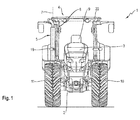
- a tractor 1 is shown schematically from the front.
- the tractor 1 has, in itself known manner four wheels, of which in this view, the two front wheels, in particular a left front wheel 10 and a right front wheel 11 can be seen.
- a frame structure 2 is supported by the four wheels opposite the ground.
- On the frame structure 2 is not shown in detail, because covered by the hood hooded internal combustion engine 3 (diesel engine), which serves to drive the tractor 1.
- a driver's cab 4 Also constructed on the frame structure 2 is a driver's cab 4.
- the cab 4 has at the top a cabin roof 22 which is supported by a plurality of posts. Within the driver's cab 4 is located in a central area a driver's seat 9 for receiving a driver.
- an exhaust aftertreatment system 5 is arranged in the vicinity of a front, relative to the direction of travel of the tractor 1 right post 8 of the cab 4, an exhaust aftertreatment system 5 is arranged. This is connected via a pipe arrangement, not shown, with the internal combustion engine 3 in order to dissipate exhaust gases which arise during operation of the internal combustion engine 3, while reducing pollutants to the environment.
- the Exhaust aftertreatment system 5 has for this purpose an exhaust gas catalyst, which is suitable for carrying out a selective catalytic reaction.
- the design of the exhaust aftertreatment system 5 is particular in that a lighting element 19, which is a combined direction indicator and a position light of the tractor 1, is attached to the exhaust aftertreatment system 5. It follows that the exhaust aftertreatment system 5 becomes a supporting unit for the lighting element 19. Due to the direct inclusion of the lighting element 19 on the exhaust aftertreatment system 5 is a complex mount, for example - as conventional - would have to be led around by the cab forward and laterally spaced around the exhaust system, no longer required. Instead, the lighting element 19 is fixed with a relatively short-mounting bracket in the appropriate position. As a result, the view from the cab 4 is impaired as little as possible and it results in a reduced overall weight with a simplified design and mountability (lighting element is completely mountable with the exhaust aftertreatment system).
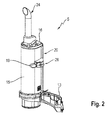
- Fig. 2 shows the exhaust aftertreatment system 5 in a perspective view from the front (relative to a mounted on the tractor 1 state). Accordingly, the entire exhaust aftertreatment system 5 is supported by a holder 13. It is an elongated casting, which is provided at a frame-side end with a vertical flange in order to connect with the frame structure 2 of the tractor 1 (see. Fig. 1 ) to be connected. At the opposite end of the holder 13 forms a horizontal ring for receiving the exhaust aftertreatment system 5.
- the exhaust aftertreatment system 5 has in a central region by an internal selective catalyst (not visible here, as hidden by the protective grid 15) predetermined basic cylindrical shape through a protective grid 15 forming a lateral surface of a cylinder is limited to the outside.
- a lid 16 closes the cylindrical portion upwardly and forms a passageway for an upwardly extending tube assembly 24.
- the tube assembly 24 is attached to the connected selective catalyst and is used for discharging exhaust gases from the exhaust aftertreatment system 5 to the environment.
- a lighting element 19 is attached to the exhaust aftertreatment system 5, which comprises a combination of a direction indicator ("turn signal") and a position light.
- the lighting element 19 has an oval basic shape with lying orientation in the lateral projection.
- a right (outboard) area of the lighting element 19 relative to the forward direction of the tractor 1 is designed as a direction indicator with colored (eg orange) light output, while a left (inner) area of the lighting element 19 serves as a position light (white light).
- the lighting element 19 may be designed exclusively as a direction indicator or exclusively as a position light.
- the lighting element 19 is received by a lamp housing 18, which is provided by an opening provided in the protective grid 15 recess 26 on an inner, therefore in Fig. 2 invisible shell-shaped structure 23 is attached.
- Fig. 2 which is a view of the exhaust aftertreatment system 5 from the front, the direction indicator and the position light are arranged with respect to the forward direction of the tractor 1 in front of the protective grid 15 of the exhaust aftertreatment system 5 and are thus visible from the front.
- the lighting element 19 is attached exclusively to the exhaust aftertreatment system 5. A separate, separate attachment of the lighting element 19 on the tractor 1 is thus eliminated.
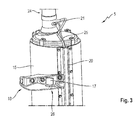
- Fig. 3 a detailed view of the exhaust aftertreatment system 5 with the cover 16 and the open lamp housing 18.
- Fig. 4 is an exploded view of the exhaust aftertreatment system 5.
- the carrier 13 forms in its annular region a flange surface which corresponds to and is in contact with a flange surface of a selective catalyst 6.
- Circumferentially distributed screws serve to connect the selective catalyst 6 to the support 15.
- the selective catalyst 6 has a substantially cylindrical basic shape.
- On its top surface of the selective catalyst 6 is connected to a tube assembly 24, which initially extends parallel to the central axis 7 of the selective catalyst 6 upwards and has a curvature end.
- a tube assembly 24 In a lower portion of the tube assembly 24, it is provided with one or more sensors 21 for sensing one or more conditions (eg, composition, temperature, or the like) of exhaust gases that have exited the selective catalyst 6.
- the selective catalyst 6 reaches high temperatures during operation and is not suitable for high mechanical stress.
- the selective catalyst 6 is therefore - in the assembled state of the exhaust aftertreatment system 5 - surrounded by a shell-shaped structure 23.
- This comprises two half shells 14, which can be assembled into a closed shell and connected together.
- the jacket-shaped structure 23 thus formed is supported together with the selective catalyst 6 relative to the carrier 13, for which purpose an annular flange surface is formed on a lower region of the jacket-shaped structure 23, via which the jacket-shaped structure 23 can also be connected to the carrier 13.
- the jacket-shaped structure 23 is designed as a supporting unit.
- the half shells 14 are made of metal and thus provide a thermally insulating protection for the selective catalyst. 6
- the jacket-shaped structure 23 is surrounded on the outside, with a certain radial spacing, by a protective grid 15.
- the protective grid 15 is used in particular to protect the selective catalyst 6 against accidental contact by persons or objects in its vicinity.
- a recess 26 is provided for the lighting element 19.
- an elongate cable guide 20 is provided on the protective grid 15. This extends as in Fig. 2 A cable 25 connected to the sensor or sensors 21 runs through the cable guide 20 to an electronic control unit 17 assigned to the exhaust aftertreatment system 5, which is arranged in the luminaire housing 18.
- the cable guide 20 also allows a common management of electrical lines for both the electronic control unit 17 and for the Lighting element 19 down to the support 13 and thus provides a suitable way protection against disturbing external influences such as moisture and mechanical stress in particular. By opening the lamp housing 18 access to the electronic control unit 17 is possible in a simple manner.
- tractor 1 results in the advantageous effect that despite the presence of a selective catalytic converter 6 comprehensive exhaust aftertreatment system 5 is only a slight visual impairment by the direction indicator and the position light. Surfaces which become hot during operation are reliably protected against accidental contact.
- a possibility of wiring electronic components of the exhaust aftertreatment system and the direction indicator and the position light is created with simple and secure means. Due to the reduced design effort, the assembly is simplified and there is a reduced total weight for the vehicle.
Landscapes
- Engineering & Computer Science (AREA)
- Mechanical Engineering (AREA)
- Chemical & Material Sciences (AREA)
- Combustion & Propulsion (AREA)
- General Engineering & Computer Science (AREA)
- Cooling, Air Intake And Gas Exhaust, And Fuel Tank Arrangements In Propulsion Units (AREA)
- Exhaust Gas After Treatment (AREA)
Abstract
Description
- Die Erfindung betrifft ein landwirtschaftliches Fahrzeug, insbesondere einen Traktor gemäß dem Oberbegriff des Anspruchs 1.
- Landwirtschaftliche Fahrzeuge wie beispielsweise Traktoren sind zunehmend mit Abgasanlagen ausgestattet, die zur Reduktion bestimmter Stickoxide im Abgas des Verbrennungsmotors eine sogenannte selektive katalytische Reduktion durchführen. Dazu wird in Form einer wässrigen Harnstofflösung mitgeführtes Ammoniak vor einem sogenannten selektiven Katalysator - auch SCR-Filter genannt ("SCR": gebräuchlicher englischer Ausdruck für "selective catalytic reduction") - in den Abgasstrang eingespritzt, wobei aus der Harnstoff-Wasser-Lösung durch eine Hydrolysereaktion Ammoniak und CO2 entstehen. Das so erzeugte Ammoniak kann im selektiven Katalysator bei entsprechender Temperatur mit den Stickoxiden im Abgas reagieren. Die Menge des eingespritzten Harnstoffs ist von der motorischen Stickoxidemission und damit von der momentanen Drehzahl und dem Drehmoment des Motors abhängig. Derartige Abgasanlagen an landwirtschaftlichen Fahrzeugen sind für sich gesehen seit Jahren bekannt. In diesem Zusammenhang sei beispielhaft auf die
WO2010/069806 A1 verwiesen, die einen mit einer entsprechenden Abgasnachbehandlungsanlage ausgestatteten Traktor offenbart. - Mit zunehmender Motorleistung steigen auch die Leistungsanforderungen an die Abgasnachbehandlungsanlage. Dies führt dazu, dass der selektive Katalysator - in der Regel ein im Wesentlichen zylindrisches Bauteil - verhältnismäßig große äußere Abmessungen aufweisen muss. Da sich der selektive Katalysator im Betrieb stark erhitzt, ist es zudem erforderlich, diesen nach außen hin durch zumindest eine Schutzeinrichtung vor versehentlichen Berührungen abzuschirmen. Dies vergrößert dessen Außenmaße abermals.
- Da insbesondere bei Traktoren die Abgasanlage zumeist seitlich vor der Fahrerkabine angeordnet ist und sich vertikal nach oben erstreckt, verschlechtern große Außenmaße die Sicht für einen innerhalb der Fahrerkabine sitzenden Fahrer, was bei den mit dem Traktor auf Feld, Hof und/oder Straße vorzunehmenden Arbeiten von grundsätzlichem Nachteil ist. Eine weitere Verschlechterung der Sicht ergibt sich dadurch, dass Traktoren aufgrund ihrer gewünschten Straßentauglichkeit üblicherweise mit einem Fahrrichtungsanzeiger ("Blinker") und/oder Positionsleuchten ausgestattet sind. Dieser ist beispielsweise an einem vorderen Pfosten der Fahrerkabine angebracht. Weist der Traktor eine groß bemessene Abgasnachbehandlungsanlage auf, so ist zur Anbringung des Fahrrichtungsanzeigers und/oder der Positionsleuchte eine verhältnismäßig aufwendige Halterung erforderlich, um nämlich zu gewährleisten, dass der Fahrrichtungsanzeiger und/oder die Positionsleuchte vor und mit sicherem Abstand zur Abgasnachbehandlungsanlage gehalten wird. Die aufwendige Halterung verschlechtert dabei die Sicht des Fahrers, ist daneben konstruktiv aufwendig und erhöht das Fahrzeuggewicht.
- Es ist eine Aufgabe der vorliegenden Erfindung, ein landwirtschaftliches Fahrzeug, insbesondere einen Traktor der genannten Art anzugeben, bei dem sich trotz Vorhandenseins einer Abgasnachbehandlungsanlage eine nur geringe Sichtbeeinträchtigung durch sicherheitsrelevante Beleuchtungselemente ergibt.
- Die Aufgabe wird gelöst durch ein Fahrzeug mit den Merkmalen des Anspruchs 1. Dieses zeichnet sich dadurch aus, dass die Abgasnachbehandlungsanlage dazu ausgebildet ist, zumindest ein Beleuchtungselement, insbesondere einen Fahrtrichtungsanzeiger und/oder eine Positionsleuchte des Fahrzeugs aufzunehmen. Mit anderen Worten, liegt die Grundidee der Erfindung darin, ein Beleuchtungselement wie einen Fahrtrichtungsanzeiger und/oder eine Positionsleuchte des Fahrzeugs mittels der Abgasnachbehandlungsanlage am Fahrzeug zu befestigen, indem der Fahrtrichtungsanzeiger und/oder die Positionsleuchte ausschließlich über die Abgasnachbehandlungsanlage mit dem Fahrzeug verbunden ist. Erfindungsgemäß wird somit die Abgasnachbehandlungsanlage zu einem tragenden Element für das Beleuchtungselement. Durch die direkte Aufnahme des Beleuchtungselements an der Abgasnachbehandlungsanlage ist eine aufwendige Halterung, die beispielsweise - wie herkömmlich - von der Fahrerkabine nach vorn und seitlich mit Abstand um die Abgasanlage herumgeführt werden muss, nicht mehr erforderlich. Stattdessen kann das Beleuchtungselement mit verhältnismäßig kurz bauender Halterung in der geeigneten Position befestigt werden. Dadurch wird die Sicht aus der Fahrerkabine geringstmöglich beeinträchtigt und es ergibt sich ein verringertes Gesamtgewicht bei vereinfachter Konstruktion und Montierbarkeit (Beleuchtungselement ist komplett mit der Abgasnachbehandlungsanlage montierbar). Die genannte Aufgabe wird somit gelöst.
- Gemäß einer zweckmäßigen Ausführung des Fahrzeugs weist der Abgaskatalysator und/oder -filter eine im Wesentlichen zylindrische Grundform auf und ist so ausgerichtet, dass dessen Mittelachse bezogen auf eine Längsachse des Fahrzeugs senkrecht nach oben verläuft.
- Vorteilhaft weist weiterhin das Fahrzeug eine Fahrerkabine mit mehreren ein Kabinendach tragenden Pfosten auf, wobei der Abgaskatalysator und/oder -filter im Wesentlichen parallel zu einem der Pfosten ausgerichtet ist. Durch eine parallele Ausrichtung zu einem der Pfosten ergibt sich auch bei großer Baulänge des Abgaskatalysators und/oder -filters eine zumindest geringstmögliche Sichtbeeinträchtigung.
- Hinsichtlich der Anordnung erweist es sich als vorteilhaft, wenn die Fahrerkabine einen etwa mittig angeordneten Fahrersitz aufweist und der Abgaskatalysator und/oder -filter relativ zu einem insbesondere vorderen Pfosten der Fahrerkabine so angeordnet ist, dass für einen auf dem Fahrersitz sitzenden Fahrer der Pfosten die Sicht auf den Abgaskatalysator und/oder -filter weitestgehend verdeckt. Anders ausgedrückt, befindet sich vorteilhaft der Abgaskatalysator und/oder -filter aus Fahrersicht in einer Linie mit dem vorderen Pfosten der Fahrerkabine, was für den Fahrer den Effekt einer möglichst geringen Sichteinschränkung hat.
- Zweckmäßigerweise wird die Abgasnachbehandlungsanlage von einem Halter aufgenommen, der an einer Rahmenstruktur des Fahrzeugs befestigt ist. Der Halter kann dazu mit geeigneten Flanschen versehen sein.
- Die Abgasnachbehandlungsanlage kann grundsätzlich unterschiedlicher Art sein. Bevorzugt weist die Abgasnachbehandlungsanlage einen selektiven Katalysator mit im Wesentlichen zylindrischer Grundform auf, der an dem Halter befestigt ist.
- Eine vorteilhafte Weiterbildung sieht vor, dass der Abgaskatalysator und/oder -filter von einer mantelförmigen Struktur umgeben ist, die sich am Halter abstützt und vorzugsweise aus zwei Halbschalen gebildet wird. Diese mantelförmige Struktur kann unterschiedliche Funktionen aufweisen. Zunächst kann hierdurch ein Hitzeschutz bereitgestellt werden. Auf besonders vorteilhafte Weise handelt es sich bei der mantelförmigen Struktur weiterhin um eine tragende Baueinheit, die zur Aufnahme zumindest des Beleuchtungselements, vorzugsweise auch einer elektronischen Steuereinheit dient. Damit vorteilhaft gewährleistet, dass der selektive katalytische Filter weitestgehend von mechanischer Beanspruchung durch übrige Elemente der Abgasnachbehandlungsanlage verschont bleibt.
- Gemäß einer vorteilhaften Weiterbildung ist an einer dem Abgaskatalysator und/oder - filter nachgelagerten Rohranordnung eine mit dem Abgaskatalysator und/oder -filter in funktionaler Beziehung stehende Messeinrichtung angeordnet. Hierbei kann es sich insbesondere um einen oder mehrere Sensoren handeln, mit denen sich Zustände des Abgases, beispielsweise dessen Zusammensetzung und/oder Temperatur, Druck, Feuchtigkeit oder dergleichen erfassen lassen.
- Die mantelförmige Struktur und/oder eine die mantelförmige Struktur umgebende Hitzeschutzstruktur ist vorteilhaft so gestaltet, dass diese eine Führung zur Aufnahme eines oder mehrerer Kabel aufweist, das wiederum zum Anschluss des Beleuchtungselements und/oder einer Komponente der Abgasnachbehandlungsanlage dient.
- Zur Gewährleistung eines hinreichenden Hitzeschutzes, ist auf weiterhin vorteilhafte Weise die mantelförmige Struktur von einer Hitzeschutzstruktur umgeben. Diese kann beispielsweise eine Gitterstruktur umfassen, die in einem Abstand die mantelförmige Struktur umgibt. Zweckmäßigerweise weist diese zumindest eine Aussparung auf, durch welche das Beleuchtungselement nach außen abragt. Somit ist gewährleistet, dass das an der mantelförmigen Struktur befestigte Beleuchtungselement von außen sichtbar ist.
- Eine vorteilhafte Weiterbildung sieht weiterhin vor, dass das Beleuchtungselement mittels eines eigenen Gehäuses an der mantelförmigen Struktur befestigt ist. Dabei ist eine der Abgasnachbehandlungsanlage zugeordnete elektronische Steuereinrichtung bevorzugt in die für das Beleuchtungselement vorgesehene Gehäuseeinheit integriert. Das Gehäuse wird somit vorteilhaft zweifach genutzt, als Aufnahme für das Beleuchtungselement und als Aufnahme für die elektronische Steuereinrichtung. Eine Kabelführung zu der Gehäuseeinheit lässt sich somit vorteilhaft mehrfach nutzen, was eine konstruktive und montagemäßige Vereinfachung darstellt.
- Die Erfindung wird nachfolgend anhand eines einzigen in der beigefügten Zeichnung gezeigten Ausführungsbeispiels näher erläutert. Daraus ergeben sich auch weitere vorteilhafte Effekte. In der Zeichnung zeigt:
- Fig. 1
- eine schematische Ansicht eines Traktors von vorn,
- Fig. 2
- eine Ansicht einer Abgasnachbehandlungsanlage von vorn,
- Fig. 3
- eine Detailansicht der in
Fig. 2 gezeigten Abgasnachbehandlungsanlage bei entferntem Deckel und geöffnetem Leuchtengehäuse, - Fig. 4
- eine Explosionsdarstellung der in
Fig. 2 gezeigten Abgasnachbehandlungsanlage. - In
Fig. 1 ist ein Traktor 1 schematisch von vorn dargestellt. Der Traktor 1 weist auf für sich gesehen bekannte Weise vier Räder auf, von denen in dieser Ansicht die beiden Vorderräder, insbesondere ein linkes Vorderrad 10 und ein rechtes Vorderrad 11 zu sehen sind. Eine Rahmenstruktur 2 stützt sich über die vier Räder gegenüber dem Boden ab. Auf die Rahmenstruktur 2 ist ein nicht näher dargestellter, weil durch die Motorhaube verdeckter Verbrennungsmotor 3 (Dieselmotor) aufgebaut, der zum Antrieb des Traktors 1 dient. Ebenfalls auf die Rahmenstruktur 2 aufgebaut ist eine Fahrerkabine 4. Die Fahrerkabine 4 weist obenseitig ein Kabinendach 22 auf, das sich über mehrere Pfosten abstützt. Innerhalb der Fahrerkabine 4 befindet sich in einem mittigen Bereich ein Fahrersitz 9 zur Aufnahme eines Fahrers. - In der Nähe eines vorderen, bezogen auf die Fahrtrichtung des Traktors 1 rechten Pfostens 8 der Fahrerkabine 4 ist eine Abgasnachbehandlungsanlage 5 angeordnet. Diese ist über eine nicht näher dargestellte Rohranordnung mit dem Verbrennungsmotor 3 verbunden, um Abgase, die während des Betriebs des Verbrennungsmotors 3 entstehen, unter Reduzierung von Schadstoffen an die Umgebung abzuführen. Die Abgasnachbehandlungsanlage 5 weist dazu einen Abgaskatalysator auf, der zur Durchführung einer selektiven katalytischen Reaktion geeignet ist.
- Die Gestaltung der Abgasnachbehandlungsanlage 5 ist insofern besonders, als dass ein Beleuchtungselement 19, bei dem es sich hier um einen kombinierten Fahrtrichtungsanzeiger und eine Positionsleuchte des Traktors 1 handelt, an der Abgasnachbehandlungsanlage 5 befestigt ist. Daraus ergibt sich, dass die Abgasnachbehandlungsanlage 5 zu einer tragenden Einheit für das Beleuchtungselement 19 wird. Durch die direkte Aufnahme des Beleuchtungselements 19 an der Abgasnachbehandlungsanlage 5 ist eine aufwendige Halterung, die beispielsweise - wie herkömmlich - von der Fahrerkabine nach vorn und seitlich mit Abstand um die Abgasanlage herumgeführt werden müsste, nicht mehr erforderlich. Stattdessen wird das Beleuchtungselement 19 mit verhältnismäßig kurz bauender Halterung in der geeigneten Position befestigt. Dadurch wird die Sicht aus der Fahrerkabine 4 geringstmöglich beeinträchtigt und es ergibt sich ein verringertes Gesamtgewicht bei vereinfachter Konstruktion und Montierbarkeit (Beleuchtungselement ist komplett mit der Abgasnachbehandlungsanlage montierbar).
- Der Aufbau der Abgasnachbehandlungsanlage 5 im Einzelnen sei anhand der folgenden Figuren näher erläutert:
-
Fig. 2 zeigt die Abgasnachbehandlungsanlage 5 in einer perspektivischen Ansicht von vorn (bezogen auf einen an den Traktor 1 angebauten Zustand). Demnach wird die gesamte Abgasnachbehandlungsanlage 5 von einem Halter 13 getragen. Es handelt sich dabei um ein längliches Gussteil, das an einem rahmenseitigen Ende mit einem senkrechten Flansch versehen ist, um mit der Rahmenstruktur 2 des Traktors 1 (vgl.Fig. 1 ) verbunden werden zu können. Am gegenüberliegenden Ende bildet der Halter 13 einen liegenden Ring zur Aufnahme der Abgasnachbehandlungsanlage 5. Die Abgasnachbehandlungsanlage 5 weist in einem mittleren Bereich eine durch einen innenliegenden selektiven Katalysator (hier nicht zu sehen, da durch das Schutzgitter 15 verdeckt) vorgegebene zylindrische Grundform auf, die durch ein eine Mantelfläche eines Zylinders bildendes Schutzgitter 15 nach außen begrenzt wird. Ein Deckel 16 schließt den zylindrischen Bereich nach oben ab und bildet einen Durchgang für eine sich nach oben erstreckende Rohranordnung 24. Die Rohranordnung 24 ist an den selektiven Katalysator angeschlossen und dient zum Abführen von Abgasen aus der Abgasnachbehandlungsanlage 5 an die Umgebung. - Wie in
Fig. 2 zu sehen, ist an der Abgasnachbehandlungsanlage 5 ein Beleuchtungselement 19 angebracht, das eine Kombination aus einem Fahrtrichtungsanzeiger ("Blinker") und einer Positionsleuchte umfasst. Gemäß der Ansicht vonFig. 2 weist das Beleuchtungselement 19 dabei eine in der seitlichen Projektion ovale Grundform mit liegender Ausrichtung auf. Ein bezogen auf die Vorwärtsrichtung des Traktors 1 rechter (außenliegender) Bereich des Beleuchtungselements 19 ist als Fahrtrichtungsanzeiger mit farbiger (z.B. oranger) Lichtabgabe ausgebildet, während ein linker (innenliegender) Bereich des Beleuchtungselements 19 als Positionsleuchte (weißes Licht) dient. Alternativ kann das Beleuchtungselement 19 ausschließlich als Fahrtrichtungsanzeiger oder ausschließlich als Positionsleuchte ausgebildet sein. - Das Beleuchtungselement 19 wird von einem Leuchtengehäuse 18 aufgenommen, das durch eine im Schutzgitter 15 vorgesehene Aussparung 26 an einer innenliegenden, daher in
Fig. 2 nicht sichtbaren mantelförmigen Struktur 23 befestigt ist. Gemäß der Darstellung vonFig. 2 , die eine Ansicht der Abgasnachbehandlungsanlage 5 von vorn ist, sind der Fahrtrichtungsanzeiger und die Positionsleuchte bezogen auf die Vorwärtsfahrtrichtung des Traktors 1 vor dem Schutzgitter 15 der Abgasnachbehandlungsanlage 5 angeordnet und sind somit von vorn sichtbar. Dabei ist das Beleuchtungselement 19 ausschließlich an der Abgasnachbehandlungsanlage 5 befestigt. Eine eigene, separate Befestigung des Beleuchtungselements 19 am Traktor 1 entfällt somit. - Der Aufbau der Abgasanlage 5 wird nachfolgend anhand der
Fig. 3 und4 noch näher erläutert. Dabei zeigtFig. 3 eine Detailansicht der Abgasnachbehandlungsanlage 5 bei entferntem Deckel 16 und geöffnetem Leuchtengehäuse 18. Der komplette Aufbau der Abgasanlage 5 wird am deutlichsten inFig. 4 , die eine Explosionsdarstellung der Abgasnachbehandlungsanlage 5 ist. - In
Fig. 4 ist zu sehen, dass der Träger 13 in seinem ringförmigen Bereich eine Flanschfläche bildet, die mit einer Flanschfläche eines selektiven Katalysators 6 korrespondiert und mit dieser in Kontakt steht. Über den Umfang verteilte Schrauben dienen zur Verbindung des selektiven Katalysators 6 an dem Träger 15. Der selektive Katalysator 6 weist eine im Wesentlichen zylindrische Grundform auf. An seiner Deckfläche ist der selektive Katalysator 6 mit einer Rohranordnung 24 verbunden, die sich zunächst parallel zur Mittelachse 7 des selektiven Katalysators 6 nach oben erstreckt und endseitig eine Krümmung aufweist. In einem unteren Bereich der Rohranordnung 24 ist diese mit einem oder mehreren Sensoren versehen 21, die zur Erfassung eines oder mehrerer Zustände (beispielsweise Zusammensetzung, Temperatur oder dergleichen) von Abgasen dient, die den selektiven Katalysator 6 verlassen haben. - Der selektive Katalysator 6 erreicht im Betrieb hohe Temperaturen und eignet sich nicht dazu, mechanisch hoch beansprucht zu werden. Der selektive Katalysator 6 wird daher - im zusammengebauten Zustand der Abgasnachbehandlungsanlage 5 - von einer mantelförmigen Struktur 23 umgeben. Diese umfasst zwei Halbschalen 14, die sich zu einem geschlossenen Mantel zusammensetzen und miteinander verbinden lassen. Die so gebildete mantelförmige Struktur 23 stützt sich gemeinsam mit dem selektiven Katalysator 6 gegenüber dem Träger 13 ab, wozu an einem unteren Bereich der mantelförmigen Struktur 23 eine ringförmige Flanschfläche ausgebildet ist, über welche auch die mantelförmige Struktur 23 mit dem Träger 13 verbindbar ist. Die mantelförmige Struktur 23 ist als tragende Baueinheit ausgelegt. Die Halbschalen 14 sind aus Metall gefertigt und bieten somit einen thermisch isolierenden Schutz für den selektiven Katalysator 6.
- Die mantelförmige Struktur 23 ist außen, mit einer gewissen radialen Beabstandung, von einem Schutzgitter 15 umgeben. Das Schutzgitter 15 dient insbesondere zum Schutz des selektiven Katalysators 6 vor versehentlichen Berührungen durch Personen oder Gegenstände in dessen Nähe. Im Schutzgitter 15 ist eine Aussparung 26 für das Beleuchtungselement 19 vorgesehen.
- In
Fig. 3 ist zu sehen, dass an dem Schutzgitter 15 eine längliche Kabelführung 20 vorgesehen ist. Diese erstreckt sich, wie inFig. 2 zu sehen, über die gesamte Länge des Schutzgitters 15. Ein an den bzw. die Sensoren 21 angeschlossenes Kabel 25 verläuft durch die Kabelführung 20 hindurch zu einer der Abgasnachbehandlungsanlage 5 zugeordneten elektronischen Steuereinheit 17, die in dem Leuchtengehäuse 18 angeordnet ist. Die Kabelführung 20 ermöglicht weiterhin eine gemeinsame Führung elektrischer Leitungen sowohl für die elektronische Steuereinheit 17 als auch für das Beleuchtungselement 19 bis hinunter zum Träger 13 und bietet somit auf geeignete Weise Schutz vor störenden Außeneinflüssen wie insbesondere Feuchtigkeit und mechanischer Beanspruchung. Durch Öffnen des Leuchtengehäuses 18 ist auf einfache Weise ein Zugang zur elektronischen Steuereinheit 17 möglich. - Bei dem anhand der
Fig. 1 bis 4 erläuterten Traktor 1 ergibt sich der vorteilhafte Effekt, dass trotz Vorhandenseins einer einen selektiven Katalysator 6 umfassenden Abgasnachbehandlungsanlage 5 eine nur geringe Sichtbeeinträchtigung durch den Fahrtrichtungsanzeiger und die Positionsleuchte besteht. Im Betrieb heiß werdende Oberflächen werden sicher geschützt vor unbeabsichtigter Berührung. Daneben ist mit einfachen und sicheren Mitteln eine Möglichkeit der Verkabelung elektronischer Komponenten der Abgasnachbehandlungsanlage und des Fahrtrichtungsanzeigers und der Positionsleuchte geschaffen. Durch den verringerten konstruktiven Aufwand ist die Montage vereinfacht und es ergibt sich ein reduziertes Gesamtgewicht für das Fahrzeug. -
- 1
- Traktor
- 2
- Rahmenstruktur
- 3
- Verbrennungsmotor
- 4
- Fahrerkabine
- 5
- Abgasnachbehandlungsanlage
- 6
- selektiver Katalysator
- 7
- Mittelachse
- 8
- Pfosten, rechts vorn
- 9
- Fahrersitz
- 10
- Vorderrad, rechts
- 11
- Vorderrad, links
- 12
- Flansch
- 13
- Halter
- 14
- Halbschale
- 15
- Schutzgitter
- 16
- Deckel
- 17
- elektronische Steuereinheit
- 18
- Leuchtengehäuse
- 19
- Fahrtrichtungsanzeiger und Positionsleuchte
- 20
- Kabelführung
- 21
- SCR-Sensor
- 22
- Kabinendach
- 23
- mantelförmige Struktur
- 24
- Rohranordnung
- 25
- Kabel
- 26
- Aussparung
Claims (12)
- Landwirtschaftliches Fahrzeug, insbesondere Traktor (1), mit einem Verbrennungsmotor (3), dem eine Abgasnachbehandlungsanlage (5) zugeordnet ist, die wenigstens einen Abgaskatalysator und/oder -filter (6) zur Reduzierung von Emissionen des Verbrennungsmotors (3) aufweist,
dadurch gekennzeichnet, dass die Abgasnachbehandlungsanlage (5) dazu ausgebildet ist, zumindest ein Beleuchtungselement (19), insbesondere einen Fahrtrichtungsanzeiger und/oder eine Positionsleuchte des Fahrzeugs (1) aufzunehmen. - Fahrzeug nach Anspruch 1, dadurch gekennzeichnet, dass der Abgaskatalysator und/oder -filter (6) eine im Wesentlichen zylindrische Grundform aufweist und so ausgerichtet ist, dass dessen Mittelachse (7) bezogen auf eine Längsachse des Fahrzeugs (1) etwa senkrecht nach oben verläuft.
- Fahrzeug nach Anspruch 1 oder 2, dadurch gekennzeichnet, dass das Fahrzeug (1) eine Fahrerkabine (4) mit mehreren ein Kabinendach (22) tragenden Pfosten (8) aufweist, wobei der Abgaskatalysator und/oder -filter (6) im Wesentlichen parallel zu einem der Pfosten (8) ausgerichtet ist.
- Fahrzeug nach Anspruch 3, dadurch gekennzeichnet, dass die Fahrerkabine (4) einen etwa mittig angeordneten Fahrersitz (9) aufweist und der Abgaskatalysator und/oder -filter (6) relativ zu einem insbesondere vorderen Pfosten (8) der Fahrerkabine (4) so angeordnet ist, dass für einen auf dem Fahrersitz (9) sitzenden Fahrer der Pfosten (8) die Sicht auf den Abgaskatalysator und/oder -filter (6) weitestgehend verdeckt.
- Fahrzeug nach einem der vorigen Ansprüche, dadurch gekennzeichnet, dass die Abgasnachbehandlungsanlage (5) von einem Halter (13) aufgenommen wird, der an einer Rahmenstruktur (2) des Fahrzeugs (1) befestigt ist.
- Fahrzeug nach Anspruch 5, dadurch gekennzeichnet, dass die Abgasnachbehandlungsanlage (5) einen selektiven Katalysator (6) mit im Wesentlichen zylindrischer Grundform aufweist, der an dem Halter (13) befestigt ist.
- Fahrzeug nach Anspruch 5 oder 6, dadurch gekennzeichnet, dass der Abgaskatalysator und/oder -filter (6) von einer mantelförmigen Struktur (23) umgeben ist, die sich am Halter (13) abstützt und vorzugsweise aus zwei Halbschalen (14) gebildet wird.
- Fahrzeug nach Anspruch 7, dadurch gekennzeichnet, dass es sich bei der mantelförmigen Struktur (23) um eine tragende Baueinheit handelt, die zur Aufnahme zumindest des Beleuchtungselements (19), vorzugsweise auch einer elektronischen Steuereinheit (17) dient.
- Fahrzeug nach einem der vorigen Ansprüche, dadurch gekennzeichnet, dass an einer dem Abgaskatalysator und/oder -filter (6) nachgelagerten Rohranordnung (24) eine mit dem Abgaskatalysator und/oder -filter (6) in funktionaler Beziehung stehende Messeinrichtung (21) angeordnet ist.
- Fahrzeug nach einem der Ansprüche 7 bis 9, dadurch gekennzeichnet, dass die mantelförmige Struktur (23) und/oder eine die mantelförmige Struktur (23) umgebende Hitzeschutzstruktur (15) eine Führung (20) zur Aufnahme eines oder mehrerer Kabel (25) aufweist, das zum Anschluss des Beleuchtungselements (19) und/oder einer Komponente (17, 21) der Abgasnachbehandlungsanlage (5) dient.
- Fahrzeug nach einem der Ansprüche 7 bis 10, dadurch gekennzeichnet, dass die mantelförmige Struktur (23) von einer Hitzeschutzstruktur (15) umgeben ist, die zumindest eine Aussparung (26) aufweist, durch welche das Beleuchtungselement (19) nach außen abragt.
- Fahrzeug nach einem der vorigen Ansprüche, dadurch gekennzeichnet, dass eine der Abgasnachbehandlungsanlage (5) zugeordnete elektronische Steuereinrichtung (17) in eine für das Beleuchtungselement (19) vorgesehene Gehäuseeinheit (18) integriert ist.
Applications Claiming Priority (1)
| Application Number | Priority Date | Filing Date | Title |
|---|---|---|---|
| DE102014106789.4A DE102014106789A1 (de) | 2014-05-14 | 2014-05-14 | Landwirtschaftliches Fahrzeug |
Publications (2)
| Publication Number | Publication Date |
|---|---|
| EP2944515A1 true EP2944515A1 (de) | 2015-11-18 |
| EP2944515B1 EP2944515B1 (de) | 2023-06-07 |
Family
ID=53039253
Family Applications (1)
| Application Number | Title | Priority Date | Filing Date |
|---|---|---|---|
| EP15164964.7A Active EP2944515B1 (de) | 2014-05-14 | 2015-04-24 | Landwirtschaftliches fahrzeug |
Country Status (2)
| Country | Link |
|---|---|
| EP (1) | EP2944515B1 (de) |
| DE (1) | DE102014106789A1 (de) |
Cited By (1)
| Publication number | Priority date | Publication date | Assignee | Title |
|---|---|---|---|---|
| EP3569837A1 (de) * | 2018-05-17 | 2019-11-20 | CLAAS Tractor S.A.S. | Abgasstranganordnung |
Citations (4)
| Publication number | Priority date | Publication date | Assignee | Title |
|---|---|---|---|---|
| JPH1178547A (ja) * | 1997-09-12 | 1999-03-23 | Yanmar Diesel Engine Co Ltd | 作業車両 |
| JP2000344008A (ja) * | 1999-06-04 | 2000-12-12 | Komatsu Ltd | 作業用車両 |
| US20090279319A1 (en) * | 2008-05-12 | 2009-11-12 | Sindelar Richard A | Exhaust Stack and Road Tractor Exhaust Pipe |
| WO2010069806A1 (en) | 2008-12-19 | 2010-06-24 | Agco Gmbh | Exhaust systems for vehicles |
-
2014
- 2014-05-14 DE DE102014106789.4A patent/DE102014106789A1/de not_active Withdrawn
-
2015
- 2015-04-24 EP EP15164964.7A patent/EP2944515B1/de active Active
Patent Citations (4)
| Publication number | Priority date | Publication date | Assignee | Title |
|---|---|---|---|---|
| JPH1178547A (ja) * | 1997-09-12 | 1999-03-23 | Yanmar Diesel Engine Co Ltd | 作業車両 |
| JP2000344008A (ja) * | 1999-06-04 | 2000-12-12 | Komatsu Ltd | 作業用車両 |
| US20090279319A1 (en) * | 2008-05-12 | 2009-11-12 | Sindelar Richard A | Exhaust Stack and Road Tractor Exhaust Pipe |
| WO2010069806A1 (en) | 2008-12-19 | 2010-06-24 | Agco Gmbh | Exhaust systems for vehicles |
Cited By (1)
| Publication number | Priority date | Publication date | Assignee | Title |
|---|---|---|---|---|
| EP3569837A1 (de) * | 2018-05-17 | 2019-11-20 | CLAAS Tractor S.A.S. | Abgasstranganordnung |
Also Published As
| Publication number | Publication date |
|---|---|
| DE102014106789A1 (de) | 2015-11-19 |
| EP2944515B1 (de) | 2023-06-07 |
Similar Documents
| Publication | Publication Date | Title |
|---|---|---|
| DE102005048387B4 (de) | Rücklichtaufbau für Fahrzeuge | |
| EP2415640A1 (de) | Außenrückspiegel und Verfahren zu dessen Montage | |
| DE112018007638T5 (de) | Fahrzeug des sattelsitztyps | |
| DE102013208969A1 (de) | Vordere Luftführungsandordnung eines Motorrads | |
| DE102012101637A1 (de) | Führungsstruktur eines Hochspannungskabels in einem Kraftfahrzeug | |
| DE102010063261A1 (de) | Blowbygas-Rückführsystem | |
| DE19943138B4 (de) | Kraftstofftank an einem Zweirad-Kraftfahrzeug | |
| DE102017011945A1 (de) | Abgassensor-montagestruktur | |
| DE102019112440A1 (de) | Luftzufuhreinstellvorrichtung für ein Kraftfahrzeug und hiermit versehenes Kraftfahrzeug | |
| EP2944515B1 (de) | Landwirtschaftliches fahrzeug | |
| EP3074616B1 (de) | Vorrichtung zur aufnahme eines endschalldämpfers eines zweirads | |
| DE932537C (de) | Kraftfahrzeug mit windschnittigem Wagenaufbau | |
| DE2350077C2 (de) | Kraftfahrzeug mit einem die Frontscheinwerfer aufnehmenden frontseitigen Verkleidungsteil | |
| DE102017124942A1 (de) | Fahrzeug, insbesondere geländegängiges Fahrzeug, mit einer Abgasnachbehandlungseinrichtung | |
| DE112019004861T5 (de) | Nummernschild-Beleuchtung für Sattelfahrzeuge | |
| DE20003386U1 (de) | Entkopplungselement für Schwingungen in Abgasleitungen von Brennkraftmaschinen | |
| EP2336540B1 (de) | Kraftwagen mit einem Luftfiltergehäuse | |
| DE102017216226B4 (de) | Antriebseinrichtung für ein Kraftfahrzeug sowie entsprechendes Kraftfahrzeug | |
| DE102013222810A1 (de) | Multifunktionaler Trittbrettträger eines Motorrollers | |
| DE102014211596A1 (de) | Kühlstruktur für Beleuchtungsvorrichtung für Grätschsitzfahrzeug | |
| EP2371682A2 (de) | Kühlluftführung | |
| DE102014107888B4 (de) | Luftreinigerstruktur eines Motorrades | |
| DE102018124842A1 (de) | Motorrad | |
| DE102013112003A1 (de) | Aufbau für ein Fahrzeug mit einem Heckmotor | |
| CN203172738U (zh) | 一种活动式前挡泥板固定装置 |
Legal Events
| Date | Code | Title | Description |
|---|---|---|---|
| PUAI | Public reference made under article 153(3) epc to a published international application that has entered the european phase |
Free format text: ORIGINAL CODE: 0009012 |
|
| AK | Designated contracting states |
Kind code of ref document: A1 Designated state(s): AL AT BE BG CH CY CZ DE DK EE ES FI FR GB GR HR HU IE IS IT LI LT LU LV MC MK MT NL NO PL PT RO RS SE SI SK SM TR |
|
| AX | Request for extension of the european patent |
Extension state: BA ME |
|
| 17P | Request for examination filed |
Effective date: 20160518 |
|
| RBV | Designated contracting states (corrected) |
Designated state(s): AL AT BE BG CH CY CZ DE DK EE ES FI FR GB GR HR HU IE IS IT LI LT LU LV MC MK MT NL NO PL PT RO RS SE SI SK SM TR |
|
| STAA | Information on the status of an ep patent application or granted ep patent |
Free format text: STATUS: EXAMINATION IS IN PROGRESS |
|
| 17Q | First examination report despatched |
Effective date: 20210510 |
|
| RIC1 | Information provided on ipc code assigned before grant |
Ipc: F01N 13/14 20100101ALI20221208BHEP Ipc: B60Q 1/26 20060101AFI20221208BHEP |
|
| GRAP | Despatch of communication of intention to grant a patent |
Free format text: ORIGINAL CODE: EPIDOSNIGR1 |
|
| STAA | Information on the status of an ep patent application or granted ep patent |
Free format text: STATUS: GRANT OF PATENT IS INTENDED |
|
| INTG | Intention to grant announced |
Effective date: 20230120 |
|
| GRAS | Grant fee paid |
Free format text: ORIGINAL CODE: EPIDOSNIGR3 |
|
| GRAA | (expected) grant |
Free format text: ORIGINAL CODE: 0009210 |
|
| STAA | Information on the status of an ep patent application or granted ep patent |
Free format text: STATUS: THE PATENT HAS BEEN GRANTED |
|
| AK | Designated contracting states |
Kind code of ref document: B1 Designated state(s): AL AT BE BG CH CY CZ DE DK EE ES FI FR GB GR HR HU IE IS IT LI LT LU LV MC MK MT NL NO PL PT RO RS SE SI SK SM TR |
|
| REG | Reference to a national code |
Ref country code: GB Ref legal event code: FG4D Free format text: NOT ENGLISH |
|
| REG | Reference to a national code |
Ref country code: CH Ref legal event code: EP Ref country code: AT Ref legal event code: REF Ref document number: 1574050 Country of ref document: AT Kind code of ref document: T Effective date: 20230615 Ref country code: DE Ref legal event code: R096 Ref document number: 502015016384 Country of ref document: DE |
|
| P01 | Opt-out of the competence of the unified patent court (upc) registered |
Effective date: 20230515 |
|
| REG | Reference to a national code |
Ref country code: LT Ref legal event code: MG9D |
|
| REG | Reference to a national code |
Ref country code: NL Ref legal event code: MP Effective date: 20230607 |
|
| PG25 | Lapsed in a contracting state [announced via postgrant information from national office to epo] |
Ref country code: SE Free format text: LAPSE BECAUSE OF FAILURE TO SUBMIT A TRANSLATION OF THE DESCRIPTION OR TO PAY THE FEE WITHIN THE PRESCRIBED TIME-LIMIT Effective date: 20230607 Ref country code: NO Free format text: LAPSE BECAUSE OF FAILURE TO SUBMIT A TRANSLATION OF THE DESCRIPTION OR TO PAY THE FEE WITHIN THE PRESCRIBED TIME-LIMIT Effective date: 20230907 Ref country code: ES Free format text: LAPSE BECAUSE OF FAILURE TO SUBMIT A TRANSLATION OF THE DESCRIPTION OR TO PAY THE FEE WITHIN THE PRESCRIBED TIME-LIMIT Effective date: 20230607 |
|
| PG25 | Lapsed in a contracting state [announced via postgrant information from national office to epo] |
Ref country code: RS Free format text: LAPSE BECAUSE OF FAILURE TO SUBMIT A TRANSLATION OF THE DESCRIPTION OR TO PAY THE FEE WITHIN THE PRESCRIBED TIME-LIMIT Effective date: 20230607 Ref country code: NL Free format text: LAPSE BECAUSE OF FAILURE TO SUBMIT A TRANSLATION OF THE DESCRIPTION OR TO PAY THE FEE WITHIN THE PRESCRIBED TIME-LIMIT Effective date: 20230607 Ref country code: LV Free format text: LAPSE BECAUSE OF FAILURE TO SUBMIT A TRANSLATION OF THE DESCRIPTION OR TO PAY THE FEE WITHIN THE PRESCRIBED TIME-LIMIT Effective date: 20230607 Ref country code: LT Free format text: LAPSE BECAUSE OF FAILURE TO SUBMIT A TRANSLATION OF THE DESCRIPTION OR TO PAY THE FEE WITHIN THE PRESCRIBED TIME-LIMIT Effective date: 20230607 Ref country code: HR Free format text: LAPSE BECAUSE OF FAILURE TO SUBMIT A TRANSLATION OF THE DESCRIPTION OR TO PAY THE FEE WITHIN THE PRESCRIBED TIME-LIMIT Effective date: 20230607 Ref country code: GR Free format text: LAPSE BECAUSE OF FAILURE TO SUBMIT A TRANSLATION OF THE DESCRIPTION OR TO PAY THE FEE WITHIN THE PRESCRIBED TIME-LIMIT Effective date: 20230908 |
|
| PG25 | Lapsed in a contracting state [announced via postgrant information from national office to epo] |
Ref country code: FI Free format text: LAPSE BECAUSE OF FAILURE TO SUBMIT A TRANSLATION OF THE DESCRIPTION OR TO PAY THE FEE WITHIN THE PRESCRIBED TIME-LIMIT Effective date: 20230607 |
|
| PG25 | Lapsed in a contracting state [announced via postgrant information from national office to epo] |
Ref country code: SK Free format text: LAPSE BECAUSE OF FAILURE TO SUBMIT A TRANSLATION OF THE DESCRIPTION OR TO PAY THE FEE WITHIN THE PRESCRIBED TIME-LIMIT Effective date: 20230607 |
|
| PG25 | Lapsed in a contracting state [announced via postgrant information from national office to epo] |
Ref country code: IS Free format text: LAPSE BECAUSE OF FAILURE TO SUBMIT A TRANSLATION OF THE DESCRIPTION OR TO PAY THE FEE WITHIN THE PRESCRIBED TIME-LIMIT Effective date: 20231007 |
|
| PG25 | Lapsed in a contracting state [announced via postgrant information from national office to epo] |
Ref country code: SM Free format text: LAPSE BECAUSE OF FAILURE TO SUBMIT A TRANSLATION OF THE DESCRIPTION OR TO PAY THE FEE WITHIN THE PRESCRIBED TIME-LIMIT Effective date: 20230607 Ref country code: SK Free format text: LAPSE BECAUSE OF FAILURE TO SUBMIT A TRANSLATION OF THE DESCRIPTION OR TO PAY THE FEE WITHIN THE PRESCRIBED TIME-LIMIT Effective date: 20230607 Ref country code: RO Free format text: LAPSE BECAUSE OF FAILURE TO SUBMIT A TRANSLATION OF THE DESCRIPTION OR TO PAY THE FEE WITHIN THE PRESCRIBED TIME-LIMIT Effective date: 20230607 Ref country code: PT Free format text: LAPSE BECAUSE OF FAILURE TO SUBMIT A TRANSLATION OF THE DESCRIPTION OR TO PAY THE FEE WITHIN THE PRESCRIBED TIME-LIMIT Effective date: 20231009 Ref country code: IS Free format text: LAPSE BECAUSE OF FAILURE TO SUBMIT A TRANSLATION OF THE DESCRIPTION OR TO PAY THE FEE WITHIN THE PRESCRIBED TIME-LIMIT Effective date: 20231007 Ref country code: EE Free format text: LAPSE BECAUSE OF FAILURE TO SUBMIT A TRANSLATION OF THE DESCRIPTION OR TO PAY THE FEE WITHIN THE PRESCRIBED TIME-LIMIT Effective date: 20230607 Ref country code: CZ Free format text: LAPSE BECAUSE OF FAILURE TO SUBMIT A TRANSLATION OF THE DESCRIPTION OR TO PAY THE FEE WITHIN THE PRESCRIBED TIME-LIMIT Effective date: 20230607 |
|
| PG25 | Lapsed in a contracting state [announced via postgrant information from national office to epo] |
Ref country code: PL Free format text: LAPSE BECAUSE OF FAILURE TO SUBMIT A TRANSLATION OF THE DESCRIPTION OR TO PAY THE FEE WITHIN THE PRESCRIBED TIME-LIMIT Effective date: 20230607 |
|
| REG | Reference to a national code |
Ref country code: DE Ref legal event code: R097 Ref document number: 502015016384 Country of ref document: DE |
|
| PLBE | No opposition filed within time limit |
Free format text: ORIGINAL CODE: 0009261 |
|
| STAA | Information on the status of an ep patent application or granted ep patent |
Free format text: STATUS: NO OPPOSITION FILED WITHIN TIME LIMIT |
|
| PG25 | Lapsed in a contracting state [announced via postgrant information from national office to epo] |
Ref country code: DK Free format text: LAPSE BECAUSE OF FAILURE TO SUBMIT A TRANSLATION OF THE DESCRIPTION OR TO PAY THE FEE WITHIN THE PRESCRIBED TIME-LIMIT Effective date: 20230607 |
|
| PG25 | Lapsed in a contracting state [announced via postgrant information from national office to epo] |
Ref country code: SI Free format text: LAPSE BECAUSE OF FAILURE TO SUBMIT A TRANSLATION OF THE DESCRIPTION OR TO PAY THE FEE WITHIN THE PRESCRIBED TIME-LIMIT Effective date: 20230607 |
|
| 26N | No opposition filed |
Effective date: 20240308 |
|
| PG25 | Lapsed in a contracting state [announced via postgrant information from national office to epo] |
Ref country code: SI Free format text: LAPSE BECAUSE OF FAILURE TO SUBMIT A TRANSLATION OF THE DESCRIPTION OR TO PAY THE FEE WITHIN THE PRESCRIBED TIME-LIMIT Effective date: 20230607 Ref country code: IT Free format text: LAPSE BECAUSE OF FAILURE TO SUBMIT A TRANSLATION OF THE DESCRIPTION OR TO PAY THE FEE WITHIN THE PRESCRIBED TIME-LIMIT Effective date: 20230607 |
|
| PG25 | Lapsed in a contracting state [announced via postgrant information from national office to epo] |
Ref country code: BG Free format text: LAPSE BECAUSE OF FAILURE TO SUBMIT A TRANSLATION OF THE DESCRIPTION OR TO PAY THE FEE WITHIN THE PRESCRIBED TIME-LIMIT Effective date: 20230607 |
|
| PG25 | Lapsed in a contracting state [announced via postgrant information from national office to epo] |
Ref country code: MC Free format text: LAPSE BECAUSE OF FAILURE TO SUBMIT A TRANSLATION OF THE DESCRIPTION OR TO PAY THE FEE WITHIN THE PRESCRIBED TIME-LIMIT Effective date: 20230607 |
|
| PG25 | Lapsed in a contracting state [announced via postgrant information from national office to epo] |
Ref country code: MC Free format text: LAPSE BECAUSE OF FAILURE TO SUBMIT A TRANSLATION OF THE DESCRIPTION OR TO PAY THE FEE WITHIN THE PRESCRIBED TIME-LIMIT Effective date: 20230607 Ref country code: BG Free format text: LAPSE BECAUSE OF FAILURE TO SUBMIT A TRANSLATION OF THE DESCRIPTION OR TO PAY THE FEE WITHIN THE PRESCRIBED TIME-LIMIT Effective date: 20230607 |
|
| REG | Reference to a national code |
Ref country code: CH Ref legal event code: PL |
|
| PG25 | Lapsed in a contracting state [announced via postgrant information from national office to epo] |
Ref country code: LU Free format text: LAPSE BECAUSE OF NON-PAYMENT OF DUE FEES Effective date: 20240424 |
|
| GBPC | Gb: european patent ceased through non-payment of renewal fee |
Effective date: 20240424 |
|
| REG | Reference to a national code |
Ref country code: BE Ref legal event code: MM Effective date: 20240430 |
|
| PG25 | Lapsed in a contracting state [announced via postgrant information from national office to epo] |
Ref country code: LU Free format text: LAPSE BECAUSE OF NON-PAYMENT OF DUE FEES Effective date: 20240424 |
|
| PG25 | Lapsed in a contracting state [announced via postgrant information from national office to epo] |
Ref country code: BE Free format text: LAPSE BECAUSE OF NON-PAYMENT OF DUE FEES Effective date: 20240430 |
|
| PG25 | Lapsed in a contracting state [announced via postgrant information from national office to epo] |
Ref country code: GB Free format text: LAPSE BECAUSE OF NON-PAYMENT OF DUE FEES Effective date: 20240424 |
|
| PG25 | Lapsed in a contracting state [announced via postgrant information from national office to epo] |
Ref country code: GB Free format text: LAPSE BECAUSE OF NON-PAYMENT OF DUE FEES Effective date: 20240424 Ref country code: BE Free format text: LAPSE BECAUSE OF NON-PAYMENT OF DUE FEES Effective date: 20240430 Ref country code: CH Free format text: LAPSE BECAUSE OF NON-PAYMENT OF DUE FEES Effective date: 20240430 |
|
| PG25 | Lapsed in a contracting state [announced via postgrant information from national office to epo] |
Ref country code: IE Free format text: LAPSE BECAUSE OF NON-PAYMENT OF DUE FEES Effective date: 20240424 |
|
| REG | Reference to a national code |
Ref country code: AT Ref legal event code: MM01 Ref document number: 1574050 Country of ref document: AT Kind code of ref document: T Effective date: 20240424 |
|
| PG25 | Lapsed in a contracting state [announced via postgrant information from national office to epo] |
Ref country code: AT Free format text: LAPSE BECAUSE OF NON-PAYMENT OF DUE FEES Effective date: 20240424 |
|
| PG25 | Lapsed in a contracting state [announced via postgrant information from national office to epo] |
Ref country code: CY Free format text: LAPSE BECAUSE OF FAILURE TO SUBMIT A TRANSLATION OF THE DESCRIPTION OR TO PAY THE FEE WITHIN THE PRESCRIBED TIME-LIMIT; INVALID AB INITIO Effective date: 20150424 |
|
| PG25 | Lapsed in a contracting state [announced via postgrant information from national office to epo] |
Ref country code: HU Free format text: LAPSE BECAUSE OF FAILURE TO SUBMIT A TRANSLATION OF THE DESCRIPTION OR TO PAY THE FEE WITHIN THE PRESCRIBED TIME-LIMIT; INVALID AB INITIO Effective date: 20150424 |
|
| PG25 | Lapsed in a contracting state [announced via postgrant information from national office to epo] |
Ref country code: TR Free format text: LAPSE BECAUSE OF FAILURE TO SUBMIT A TRANSLATION OF THE DESCRIPTION OR TO PAY THE FEE WITHIN THE PRESCRIBED TIME-LIMIT Effective date: 20230607 |
|
| PGFP | Annual fee paid to national office [announced via postgrant information from national office to epo] |
Ref country code: DE Payment date: 20260422 Year of fee payment: 12 |
|
| PGFP | Annual fee paid to national office [announced via postgrant information from national office to epo] |
Ref country code: FR Payment date: 20260420 Year of fee payment: 12 |