EP2935229B1 - Esterification of 2,5-furan-dicarboxylic acid - Google Patents
Esterification of 2,5-furan-dicarboxylic acid Download PDFInfo
- Publication number
- EP2935229B1 EP2935229B1 EP13866244.0A EP13866244A EP2935229B1 EP 2935229 B1 EP2935229 B1 EP 2935229B1 EP 13866244 A EP13866244 A EP 13866244A EP 2935229 B1 EP2935229 B1 EP 2935229B1
- Authority
- EP
- European Patent Office
- Prior art keywords
- alcohol
- reaction
- fdca
- furan
- psi
- Prior art date
- Legal status (The legal status is an assumption and is not a legal conclusion. Google has not performed a legal analysis and makes no representation as to the accuracy of the status listed.)
- Active
Links
- UWQOPFRNDNVUOA-UHFFFAOYSA-N COC(c1ccc(C(OC)=O)[o]1)=O Chemical compound COC(c1ccc(C(OC)=O)[o]1)=O UWQOPFRNDNVUOA-UHFFFAOYSA-N 0.000 description 1
Images


Classifications
-
- C—CHEMISTRY; METALLURGY
- C07—ORGANIC CHEMISTRY
- C07D—HETEROCYCLIC COMPOUNDS
- C07D307/00—Heterocyclic compounds containing five-membered rings having one oxygen atom as the only ring hetero atom
- C07D307/02—Heterocyclic compounds containing five-membered rings having one oxygen atom as the only ring hetero atom not condensed with other rings
- C07D307/34—Heterocyclic compounds containing five-membered rings having one oxygen atom as the only ring hetero atom not condensed with other rings having two or three double bonds between ring members or between ring members and non-ring members
- C07D307/56—Heterocyclic compounds containing five-membered rings having one oxygen atom as the only ring hetero atom not condensed with other rings having two or three double bonds between ring members or between ring members and non-ring members with hetero atoms or with carbon atoms having three bonds to hetero atoms with at the most one bond to halogen, e.g. ester or nitrile radicals, directly attached to ring carbon atoms
- C07D307/68—Carbon atoms having three bonds to hetero atoms with at the most one bond to halogen
-
- C—CHEMISTRY; METALLURGY
- C12—BIOCHEMISTRY; BEER; SPIRITS; WINE; VINEGAR; MICROBIOLOGY; ENZYMOLOGY; MUTATION OR GENETIC ENGINEERING
- C12P—FERMENTATION OR ENZYME-USING PROCESSES TO SYNTHESISE A DESIRED CHEMICAL COMPOUND OR COMPOSITION OR TO SEPARATE OPTICAL ISOMERS FROM A RACEMIC MIXTURE
- C12P17/00—Preparation of heterocyclic carbon compounds with only O, N, S, Se or Te as ring hetero atoms
- C12P17/02—Oxygen as only ring hetero atoms
- C12P17/04—Oxygen as only ring hetero atoms containing a five-membered hetero ring, e.g. griseofulvin, vitamin C
-
- Y—GENERAL TAGGING OF NEW TECHNOLOGICAL DEVELOPMENTS; GENERAL TAGGING OF CROSS-SECTIONAL TECHNOLOGIES SPANNING OVER SEVERAL SECTIONS OF THE IPC; TECHNICAL SUBJECTS COVERED BY FORMER USPC CROSS-REFERENCE ART COLLECTIONS [XRACs] AND DIGESTS
- Y02—TECHNOLOGIES OR APPLICATIONS FOR MITIGATION OR ADAPTATION AGAINST CLIMATE CHANGE
- Y02P—CLIMATE CHANGE MITIGATION TECHNOLOGIES IN THE PRODUCTION OR PROCESSING OF GOODS
- Y02P20/00—Technologies relating to chemical industry
- Y02P20/50—Improvements relating to the production of bulk chemicals
- Y02P20/54—Improvements relating to the production of bulk chemicals using solvents, e.g. supercritical solvents or ionic liquids
-
- Y—GENERAL TAGGING OF NEW TECHNOLOGICAL DEVELOPMENTS; GENERAL TAGGING OF CROSS-SECTIONAL TECHNOLOGIES SPANNING OVER SEVERAL SECTIONS OF THE IPC; TECHNICAL SUBJECTS COVERED BY FORMER USPC CROSS-REFERENCE ART COLLECTIONS [XRACs] AND DIGESTS
- Y02—TECHNOLOGIES OR APPLICATIONS FOR MITIGATION OR ADAPTATION AGAINST CLIMATE CHANGE
- Y02P—CLIMATE CHANGE MITIGATION TECHNOLOGIES IN THE PRODUCTION OR PROCESSING OF GOODS
- Y02P20/00—Technologies relating to chemical industry
- Y02P20/50—Improvements relating to the production of bulk chemicals
- Y02P20/582—Recycling of unreacted starting or intermediate materials
Definitions
- the present invention relates to an esterification process.
- the invention pertains to the conversion of furan dicarboxylic acid to esters with an alcohol and CO 2 .
- Biomass contains carbohydrates or sugars (i.e., hexoses and pentoses) that can be converted into value added products. Production of biomass-derived products for non-food uses is a growing industry. Bio-based fuels are an example of an application with growing interest. Another application of interest is the use of biomass as feedstock for synthesis of various industrial chemicals from renewable hydrocarbon sources.
- furanic intermediates 5-hydroxymethylfurfural (5-HMF), 2,5-furan-dicarboxylic acid (2,5-FDCA) and 2,5-dimethylfuran (2,5-DMF) have been called the "sleeping giants" of renewable intermediate chemicals.
- 5-HMF 5-hydroxymethylfurfural
- 2,5-furan-dicarboxylic acid (2,5-FDCA) and 2,5-dimethylfuran (2,5-DMF) have been called the "sleeping giants" of renewable intermediate chemicals.
- These intermediates are green building blocks for a range of materials, chemicals and fuels.
- the U.S. Department of Energy has recognized furanic intermediates as one of the top high-potential green building blocks.
- 5-HMF is a dehydration product of hexoses and a potential substitute of petroleum-based building blocks of various polymers.
- 2,5-FDCA is derived from oxidative dehydration of hexoses and is considered as one of the top 12 compounds made from a sugar into a value-added chemical.
- 2,5-DMF is produced through hydrogenation of HMF and is less volatile and of 40% higher energy density than ethanol.
- furan-dicarboxylic acid is a commercially valuable material that can used as a precursor for various plasticizers, or a replacement for purified terephthalic acid (PTA), or other value added products.
- PTA purified terephthalic acid
- chemical manufacturers have sought a simpler way of producing and manipulating FDCA, given the known problems associated with working with FDCA, such as its poor solubility in common organic solvents and being soluble in high boiling solvents like DMSO.
- Another problem that arises when using FDCA in melt polymerization is the tendency for the FDCA molecule to decompose at temperatures greater than about 180°C to furoic acid, leading to poor product quality.
- an acyl chloride i.e., COCl moiety
- thionyl chloride i.e., COCl moiety
- the preparation of an acyl chloride requires treating an acid with thionyl chloride in stoichiometric amount and then converting it to an ester.
- Safety concerns arise when using thionyl chloride on a large scale, as the byproducts for the acylation reaction are SO 2 and HCl, and HCl for the esterification.
- the SO 2 and HCl are captured with a weak base and then disposed as waste.
- conversion of FDCA to the corresponding furan-2,5-dicarbonyl dichloride would generate a mixture of side products upon esterification with alcohols because of unstable intermediates.
- the acyl chloride is sensitive to water and would require special storage conditions.
- WO 2011/023590 A1 by Grass et al. describes, in part, methods for producing mixtures of ester derivatives of 2,5-furan dicarboxylic acid (FDCA) and the use of the derivative material (isononyl furan dicarboxylate) as plasticizers.
- the disclosure relates a method using an acid or metal catalyst for preparing esters of FDCA with isomeric C-9 alcohols, in particular mixtures of linear and branched nonanols (e.g., isononyl furan-2,5-dicarboxylate). The method follows largely a conventional process of esterification.
- the present invention relates to a method of producing one or more furan dicarboxylates.
- the method involves in a first embodiment: reacting 2,5-furan dicarboxylic acid (FDCA) with at least an alcohol or a mixture of different alcohols in a CO 2 atmosphere, according to the following: to yield a mixture of esters, wherein R-group is at least a saturated, unsaturated, cyclic, or aromatic group and wherein any other extrinsic catalysts are either entirely absent or present in a trace amount of less than catalytic efficacy.
- FDCA 2,5-furan dicarboxylic acid
- CO 2 functions as a self-generating acid catalyst in situ and regenerates back to a reagent during ester synthesis.
- the esterification reaction of FDCA with an alcohol in CO 2 is performed under operational conditions that correspond to either supercritical, critical or near-critical reaction temperatures or pressures for at least the alcohol species or CO 2 .
- the synthesis is performed at a reaction temperature between about 150°C and 250°C, at a reaction pressure of about 400 psi up to about 3,000 psi.
- the method may further entail reaction of the ester product in a second esterification reaction to regenerate the alcohol reagent, and recycling the alcohol back to react with additional FDCA.
- the disclosure relates to a method of processing furan dicarboxylic acid (FDCA).
- the method involves: reacting FDCA with a first alcohol in CO 2 atmosphere to produce a first ester mixture, wherein any other acid catalyst is either entirely absent or present in a trace amount of less than catalytic efficacy and under operational conditions that are either at supercritical, critical, or near-critical reaction temperatures and pressures for the alcohol or CO2 gas; reacting said first ester mixture with a second alcohol in a transesterification reaction to produce a second ester mixture.
- One may regenerate the first alcohol and recycling the first alcohol back to react with additional FDCA.
- the method can be adapted for either batch or continuous processing operations.
- the present invention involves the discovery of a simple and effective way of producing esters from furan-dicarboxylic acid (FDCA) using carbon dioxide (CO 2 ) as an acid catalyst in esterification reactions, without the presence of any other acid catalyst.
- the present method is an environmentally benign way to produce mono- and/or di-alkyl furan dicarboxylates.
- the method involves a liquid reaction system.
- dimethyl furan dicarboxylates can be a precursor for plasticizers such as terephthalic acid or isononyl furan-dicarboxylate, or for various polymers, such as polyethylene furan-dicarboxylate or isosorbide FDCA esters for high glass-transition temperature (T g ) polymers.
- Monomethyl furan dicarboxylates can be a precursor for higher alcohol alkyl esters that can be used as cationic surfactants, chelators, and corrosion inhibitors.
- some monoalkyl esters made by the present invention can be used directly as fungicides in wood preservation.
- an advantageous feature of the inventive method is that activation of the free carboxylic acid as an acyl halide (e.g., fluoride, chloride, bromide) or by using strong mineral acids is unnecessary unlike with some other techniques.
- acyl halides are inconvenient to use because these species are inherently reactive, have issues with stability, waste treatment, and can be cumbersome and costly to make.
- An acyl chloride is a more reactive species than FDCA.
- the mechanism for the formation of an ester from an acid and an alcohol is the reverse of the steps for the acid-catalyzed hydrolysis of an ester, and the reaction can go in either direction depending on the conditions used.
- a carboxylic acid does not react with an alcohol unless a strong acid is used as a catalyst.
- the catalyst is usually concentrated sulfuric acid or hydrogen chloride. Protonation makes the carbonyl group more electrophilic and enables it to react with the alcohol, which is a weak nucleophile.
- the present esterification process involves a reaction of FDCA with an alcohol in a CO 2 atmosphere in the substantial absence of any other acid catalyst to produce esters.
- substantially absence refers to a condition in which an acid catalyst is either largely or completely absent, or is present in de minimis or trace amount of less than catalytic efficacy. In other words, no other acid catalyst is present, or is present at a level less than 10%, 5%, 3%, or 1% weight/weight relative to the carboxylic acid in the reaction.
- the esterification reaction is performed in solution under conditions that are either at supercritical, critical or near critical temperatures and/or pressures for either the alcohol and/or CO 2 .
- Figure 2A is an equation that represents certain embodiments of the present esterification method.
- FDCA is reacted with an alcohol (ROH) in a CO 2 atmosphere, at a heightened temperature, such as between 180°C and 240°C, and pressure, such as 950 psi to 3000 psi (gauge).
- ROH alcohol
- the resulting ester products can be either monoesters or diesters, or a mixture of both.
- One can control the reaction to drive the esterification toward either the monoesters or diesters, or a certain mixture of mono- and diesters. For instance, one may select a reaction temperature and pressure that preferentially drives the esterification reaction towards formation of diester molecules.
- One can separate the mono-alkyl esters from di-alkyl esters by means of crystallization, distillation, ion exchange resin, or acid-base extraction techniques.
- Figures 2B and 2C show subsequent tranesterification of the mono- and diakyl esters by means of either base-catalyzed or enzymatic reactions, such as by means of a lipase enzymatic reaction.
- the lipase can be derived from a variety of microbes, such as Candida antartica, which is available commercially under the tradename NOVOZYMTM 435.
- Figure 3 illustrates another aspect of the present invention that pertains to a method of processing FDCA.
- the method involves: reacting FDCA 1 with a first alcohol (R-OH 1 ) in a CO 2 atmosphere 2 in substantial absence of any other catalyst to produce a first ester mixture 3 ; reacting the first ester mixture with a second alcohol (R-OH 2 ) in a transesterification reaction 4 to produce a second ester mixture 5 .
- the mono- and dialkyl esters produced in the reaction with the first alcohol species e.g., methanol
- the second alcohol species e.g., ethanol
- the first ester mixture may include either mono-esters or diesters, such as according to certain embodiments, any one of the following species: methyl furan dicarboxylate, ethyl furan dicarboxylate, propyl furan dicarboxylate, or etc.
- the transesterification reaction 4 can be performed at a lower temperature than the first esterification reaction, for example, at about 80°C to about 90°C, and a reduced pressure at the boiling point of the first alcohol species. That is, one can apply negative pressure, a partial-vacuum, to lower the pressure in the reactor.
- the boiling point of the second alcohol should be at least 10°C-20°C (e.g., 12°C, 15°C) greater than the boiling point of the first alcohol. This will help liberate and separate the first and second alcohol species 6 .
- the alcohol, such as methanol, released during the condensation reaction of the mono- or dialkyl esters can be recycled 7 back for synthesis of more mono- and/or dialkyl furan dicarboxyate, such as depicted in Figure 3 .
- This feature enables one to operate the present process either continuously or in batches.
- the monoesters and diesters in the second ester mixture 5 can be separated 8 from each other thereafter.
- both the catalyst (CO 2 ) and the esterification reagent (alcohol) are present in large excess relative to the amount of organic acid.
- CO 2 should be in the gas phase during the reaction phase, regardless of its origin (e.g., gas tank or dry ice), as the reaction is conducted at high temperatures. Addition of solid CO 2 is strategic in the case where sealed pressure reactors are used, in that it allows for slow sublimation of gaseous CO 2 formation as the reaction apparatus is being assembled. This can minimize CO 2 loss.
- the concentration of CO 2 in the reaction atmosphere can be at least 10% or 15% by volume, favorably about 25% or 30%, preferably greater than 50%.
- the concentration of CO 2 should be maximized. Desirable concentrations of CO 2 are from about 75% or 80% to about 99.9% by volume, typically between about 85% and about 98%. Nitrogen (N 2 ) gas or air is permissible in the reactor, but preferably the concentration of gases other than CO 2 is kept at either a minor percentage ( ⁇ 50%) or de minimis amount.
- Any liquid alcohol with an R-group of C 1 -C 20 can serve as the solvent reagent or first alcohol species.
- the R-group can be at least a saturated, unsaturated, cyclic, or aromatic species.
- a mixture of different kinds of alcohols e.g., C 1 -C 12
- C 1 -C 12 can also be used in the reaction, but will produce a corresponding mixture of different esters depending on the particular R-group.
- Certain lower alcohol species with C 1 -C 6 alkyl groups are preferred as the reagent in the first esterification with CO 2 in view of their common availability, inexpensiveness, and mechanistic simplicity in the esterification reaction.
- alcohols such as methanol, ethanol, propanol, or butanol are preferred because of parameters such as their comparatively simple structure and that the reactions are more easily controlled with respect to the supercritical, critical or near critical temperatures and pressures of these alcohol species.
- the alcohol can also be a C 2 -C 6 -diol. Esterification with a diol can generate monomers or low molecular weight oligomers that can be readily polymerized.
- any kind of liquid alcohol species with at least a C 2 -R-group formula may be used as the second alcohol reagent.
- the R-group can be at least a saturated, unsaturated, cyclic, or aromatic species. Depending on the desired ester compounds, higher alcohols species with longer carbon chains, such as C 3 -C 10 or C 12 -C 18 alkyl groups, may be preferred. Typically, however, alcohols with R-groups of C 2 -C 6 or C 8 are more convenient and easily to use as reagents.
- the alcohol can also be a C 2 -C 6 -diol.
- the esterification process is conducted at a reaction temperature between about 160°C and about 250°C, at a reaction pressure of between about 400 psi or 500 psi and 2,500 or 2,800 psi (gauge), for an extended, at least 4 hours, up to about 12 hours. Particular reaction times may vary but are usually less, such as between about 5 or 6 hours and about 8 or 10 hours.
- the reaction temperature can be in a range from about 170°C or 190°C to about 230°C or 245°C (e.g., 175°C, 187°C, 195°C or 215°C), and the reaction pressure is between about 900 psi or 950 psi and about 2,200 psi or 2,400 psi (e.g., 960 psi, 980 psi, 1020 psi or 1050 psi).
- the temperature can be in a range from about 180°C to about 240°C (e.g., about 185°C or 200°C to about 220°C or 235°C), and the reaction temperature is between about 1,000 psi and 2,350 psi (e.g., 1,100 psi, 1,250 psi, 1,500 psi, 1,700 psi, 1,820 psi, or 1,900 psi).
- 2,350 psi e.g., 1,100 psi, 1,250 psi, 1,500 psi, 1,700 psi, 1,820 psi, or 1,900 psi.
- reaction temperatures may be within a range, for example, from about 160°C or 175°C to about 210°C or 225°C, and other reaction pressures may be within a range, for example, from about 1,200 psi or 1,630 psi to about 1,800 psi or 2,100 psi.
- supercritical fluids have a liquid-like density and gas-like transport properties (i.e., diffusivity and viscosity). This can be seen in Table 2, wherein the typical values of these properties are compared between the three fluid types - conventional liquids, supercritical fluids, and gases. Table 2. Comparison of Typical Physical Property Values of Liquids, Supercritical Fluids, and Gases.
- “near critical” refers to the conditions at which either the temperature or pressure of at least the alcohol species or CO 2 gas is below but within 150K (e.g., within 50-100K), or 220 psi (e.g., within 30-150 psi) of their respective critical points. It is believed that as temperatures and pressures reach near critical, critical or supercritical conditions, the solubility of the reagents are enhanced, which promotes the esterification reaction.
- the CO 2 gas, alcohol, and acid species are better able to interact under near critical, critical or supercritical conditions than under less rigorous conditions.
- the reaction does not require that both the alcohol species and CO 2 gas be at near-critical, critical or supercritical conditions; rather, the reaction is operative as long as either one of the species satisfies such a condition.
- esterification reactions are operated at higher temperatures and greater pressures, up to about 250°C or 3000 psi, respectively, and for reaction times of at least 4 hours, one can produce significant amounts of ester product at relatively greater selectivity and level of purity.
- reaction temperatures ⁇ 190°C
- formation of monoester molecules is more prevalent, while reactions at temperatures ⁇ 190°C or 195°C, will convert preferentially the carboxylic acids to diesters.
- a temperature in a higher range from about 190°C or 195°C or 200°C to about 245°C or 250°C one can preferentially drive the reaction to a greater rate of diester conversion.
- the esterification can yield a minimum of about 50%, desirably at least 65% or 70%, of a diester of the organic acid. Reactions that are performed at or near supercritical operating conditions appear to produce better results. When operated at or near critical conditions of about 250°C for methanol and about 31 °C/1000 psi for CO 2 , one is able to achieve conversions rates of at least 90% or better, typically about 93% or 95%, for example up to about 98% or 99% conversion.
- esterification Using an amount of the alcohol solvent in excess of the carboxylic acid gas, one can produce a very clean esterification.
- the present synthesis process produces very clean ester products (e.g., at about 70%-72% initial purity) without generation of significant amounts of side products such as low molecular weight acids - acetic or formic acid - molecular rearrangements or cyclic products, which one could normally find in standard acid-catalyzed esterification at high temperatures.
- the esters can be refined to achieve about 90% to 99% purity.
- the purification can be accomplished, for instance, by means of crystallization, chromatography, or distillation.
- the process described herein is a more environmentally benign way of producing esters.
- the carbon dioxide can self-generate an acid catalyst in situ in the presence of the alcohol during the esterification reaction, the present process does not require the use or addition of another acid catalyst species.
- the reaction kinetics with CO 2 alone can drive the esterification in the substantial absence of any other acid catalyst.
- the process does not require activation of the FDCA as acyl chloride, which is another savings in costs and process conversion.
- Table 1 presents some esterification reactions according to embodiments of the present method, under the reaction conditions listed therein.
- FDCA is reacted with an alcohol and CO 2 : methanol is used in examples 1-3, ethanol in examples 4-6, propanol in examples 7 and 8, and 1-butanol in examples 9 and 10.
- all of the reactions had good yields of the corresponding diester.
- a higher temperature, a greater pressure, and a longer reaction time, tends to give rise to a better yield.
- Shorter or lower alcohols species tend to produce a better yield of the corresponding diester than longer or higher alcohol solvents.
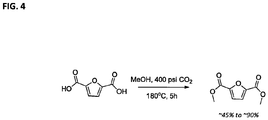
- Figure 4 is an equation of a CO 2 -assisted esterification of FDCA with methanol, such as example 1 of Table 1.
- the diester yield was good at about 45%-90%, indicating that this new protocol is feasible for esterification and can lead to greater practical manipulation of FDCA.
- Table 1 suggests that, along with dimethylesters, esterification reactions can be optimized to convert furan dicarboxylic acid to its corresponding diester species of larger alcohols (e.g., di-ethyl, di-propyl, dibutyl esters in relatively high yield (e.g., ⁇ 60-90%) according to the present method.
- larger alcohols e.g., di-ethyl, di-propyl, dibutyl esters in relatively high yield (e.g., ⁇ 60-90%) according to the present method.
- the reaction mixture was heated to 180°C and maintained at this temperature for 5 hours. During this time the reaction pressure inside the reactor increased from 400 psig to 1600 psig. After 5 hours at 180 °C, the reactor vessel was cooled to ambient room temperature and depressurized. The contents of the reactor were filtered, dried overnight under vacuum. Samples of the solid material and the solution were analyzed quantitatively for conversion using gas chromatography/mass spectrometry (GC/MS).
- the reaction mixture contained dimethyl ester ( ⁇ 23.4 wt.%), monomethyl ester ( ⁇ 50.6 wt.%), and unreacted FDCA ( ⁇ 32.8 wt.%).
- a 12 mL SS316 reactor was charged with 0.5 g of FDCA and 5 mL of methanol, along with a few crystals of dry ice (CO 2 ), which sublimates.
- the reactor was closed and heated to 180°C for 4 hours in a sand bath.
- the internal reaction pressure was between about 1300 psig and 1700 psig.
- the contents were filtered, dried overnight, and analyzed for dimethyl ester and other reaction intermediates.
- the reaction mixture included dimethyl ester ( ⁇ 49.8 wt.%), monomethyl ester ( ⁇ 35.5 wt.%), and unreacted FDCA ( ⁇ 14.8 wt.%).
- the reaction mixture contained dimethyl ester ( ⁇ 51.7 wt.%), monomethyl ester ( ⁇ 31.9 wt.%), and unreacted FDCA ( ⁇ 12.4 wt.%).
- Example 2 Like in Example 2, a 12 mL SS316 reactor was charged with 0.5 g of FDCA and 5 mL of methanol. The reactor was closed, purged with N 2 gas and then pressurized initially to 400 psig with CO 2 , and heated to 190°C for 4hours in a sand bath. The internal reaction pressure was between about 1400 psig and 1800 psig. After 4 hours the reactor was cooled. The contents were filtered, dried, and analyzed for dimethyl ester and other reaction intermediates. The reaction mixture included dimethyl ester ( ⁇ 62.3 wt.%), monomethyl ester ( ⁇ 31.6 wt.%), and unreacted FDCA ( ⁇ 6.7 wt.%).
- a 12 mL SS316 reactor was charged with 0.5 g of FDCA and 5 mL of methanol. A few crystals of dry ice were added to reactor and the reactor was closed and heated to 200°C for 4 hours in a sand bath. The internal reaction pressure was between about 1600 psig and 1900 psig. After 2 hours the reactor was cooled. The contents were filtered, dried overnight, and analyzed using GS/MC. The reaction mixture included dimethyl ester ( ⁇ 70.3 wt.%), monomethyl ester ( ⁇ 29.1 wt.%), and unreacted FDCA ( ⁇ 2.4 wt.%).
- Example 4 In a repeat of Example 4, a 12 mL SS316 reactor was charged with 0.5 g of FDCA and 5 mL of methanol. A few crystals of dry ice were added to reactor and the reactor was heated to 200°C for 4 hours in a sand bath. The internal reaction pressure was between about 1500 psig and 2000 psig. After 4 hours the reactor was cooled. The contents were filtered, dried overnight, and analyzed. The reaction mixture contained dimethyl ester ( ⁇ 81.3 wt.%), monomethyl ester ( ⁇ 24.56 wt.%), and unreacted FDCA ( ⁇ 0.92 wt.%).
- a 12 mL SS316 reactor was charged with 0.5 g of FDCA and 5 mL of methanol. A few crystals of dry ice were added to the reactor and reactor was closed and heated to 200°C for 6 hours in a sand bath. The internal reaction pressure was between about 1200 psig and 1800 psig. After 6 hours the reactor was cooled. The contents were filtered, dried overnight, and analyzed. The reaction mixture included dimethyl ester ( ⁇ 89.2 wt.%), monomethyl ester ( ⁇ 10.3 wt.%), and unreacted FDCA ( ⁇ 0.67 wt.%).
- a 12 mL stainless steel reactor was charged with 0.5 g. of FDCA and 5 mL of ethanol, along with several medium-sized crystals of dry ice.
- the reactor was closed and heated to 190°C for 5 hours in a sand bath.
- the internal reaction pressure was between about 1100 psig and 1700 psig. After 5 hours the reactor was cooled.
- the contents were dried under vacuum and analyzed using GC/MS for dimethyl FDCA and other intermediates.
- the reaction mixture contained diethyl ester ( ⁇ 54.8 wt.%), monoethyl ester ( ⁇ 27.5 wt.%), and unreacted FDCA ( ⁇ 17.8 wt.%).
- the reaction mixture contained dimethyl ester ( ⁇ 55.6 wt.%), monoethyl ester ( ⁇ 29.2 wt.%), and unreacted FDCA ( ⁇ 15.3 wt.%).
- Example 9 Like in Example 9, a 12 mL stainless steel reactor was charged with 0.5 g of FDCA, 5 mL of ethanol, and an excess of dry ice crystals. The reactor is closed and heated to 210°C for 5 hours in a sand bath. The internal reaction pressure was between about 1600 psig and 2200 psig. After 5 hours the reactor is cooled. The contents were dried and analyzed as above. The reaction mixture contained diethyl ester ( ⁇ 82.1%), monoethyl ester ( ⁇ 15.6%), and unreacted FDCA ( ⁇ 2.4%).
- the crude reaction mixture was re-suspended in ethyl acetate and washed with sodium bicarbonate.
- the unreacted FDCA and monoethyl esters were removed by washing.
- the ethyl acetate layer was concentrated to give the dimethyl ester.
- the unreacted FDCA and monoethyl esters were removed by washing and the ethyl acetate layer was concentrated to produce the diethyl ester.
- Other cost effective separation and purification techniques may include crystallization.
Landscapes
- Organic Chemistry (AREA)
- Chemical & Material Sciences (AREA)
- Wood Science & Technology (AREA)
- Life Sciences & Earth Sciences (AREA)
- Engineering & Computer Science (AREA)
- Zoology (AREA)
- Health & Medical Sciences (AREA)
- General Engineering & Computer Science (AREA)
- General Chemical & Material Sciences (AREA)
- Chemical Kinetics & Catalysis (AREA)
- Biotechnology (AREA)
- Biochemistry (AREA)
- Bioinformatics & Cheminformatics (AREA)
- Microbiology (AREA)
- General Health & Medical Sciences (AREA)
- Genetics & Genomics (AREA)
- Organic Low-Molecular-Weight Compounds And Preparation Thereof (AREA)
- Low-Molecular Organic Synthesis Reactions Using Catalysts (AREA)
- Furan Compounds (AREA)
- Preparation Of Compounds By Using Micro-Organisms (AREA)
Applications Claiming Priority (2)
| Application Number | Priority Date | Filing Date | Title |
|---|---|---|---|
| US201261739761P | 2012-12-20 | 2012-12-20 | |
| PCT/US2013/073821 WO2014099438A2 (en) | 2012-12-20 | 2013-12-09 | Esterification of 2,5-furan-dicarboxylic acid |
Publications (3)
| Publication Number | Publication Date |
|---|---|
| EP2935229A2 EP2935229A2 (en) | 2015-10-28 |
| EP2935229A4 EP2935229A4 (en) | 2016-01-27 |
| EP2935229B1 true EP2935229B1 (en) | 2017-06-28 |
Family
ID=50979377
Family Applications (1)
| Application Number | Title | Priority Date | Filing Date |
|---|---|---|---|
| EP13866244.0A Active EP2935229B1 (en) | 2012-12-20 | 2013-12-09 | Esterification of 2,5-furan-dicarboxylic acid |
Country Status (12)
| Country | Link |
|---|---|
| US (2) | US9765045B2 (https=) |
| EP (1) | EP2935229B1 (https=) |
| JP (1) | JP6370307B2 (https=) |
| KR (1) | KR101963478B1 (https=) |
| CN (1) | CN105246958B (https=) |
| AU (1) | AU2013363501B2 (https=) |
| BR (1) | BR112015014183B1 (https=) |
| CA (1) | CA2895186C (https=) |
| ES (1) | ES2642005T3 (https=) |
| MX (1) | MX362292B (https=) |
| SG (1) | SG11201503646TA (https=) |
| WO (1) | WO2014099438A2 (https=) |
Families Citing this family (30)
| Publication number | Priority date | Publication date | Assignee | Title |
|---|---|---|---|---|
| KR102038177B1 (ko) * | 2012-10-29 | 2019-10-29 | 아처 다니엘 미드랜드 캄파니 | 탄산염을 이용한 카복실산의 알코올 매개 에스테르화 |
| MX374703B (es) * | 2013-08-30 | 2025-03-06 | Furanix Technologies Bv | Proceso para purificar una composicion acida que comprende acido 2-formil-furan-5-carboxilico y acido 2,5-furandicarboxilico. |
| US9944615B2 (en) | 2014-05-08 | 2018-04-17 | Eastman Chemical Company | Purifying crude furan 2,5-dicarboxylic acid by hydrogenation and a purge zone |
| US9504994B2 (en) | 2014-05-08 | 2016-11-29 | Eastman Chemical Company | Furan-2,5-dicarboxylic acid purge process |
| US10010812B2 (en) | 2014-05-08 | 2018-07-03 | Eastman Chemical Company | Furan-2,5-dicarboxylic acid purge process |
| JP6452428B2 (ja) * | 2014-12-18 | 2019-01-16 | 花王株式会社 | ハロゲン系樹脂用可塑剤 |
| US10160740B2 (en) | 2015-03-20 | 2018-12-25 | The Board Of Trustees Of The Leland Stanford Junior University | Carbonate-promoted carboxylation reactions for the synthesis of valuable organic compounds |
| CN107848995B (zh) | 2015-04-14 | 2021-12-28 | 杜邦公司 | 用于生产2,5-呋喃二甲酸及其衍生物以及由其制成的聚合物的方法 |
| WO2017019431A1 (en) * | 2015-07-24 | 2017-02-02 | E I Du Pont De Nemours And Company | Process for producing 2,5-furandicarboxylic acid dialkyl ester |
| WO2017019441A1 (en) * | 2015-07-24 | 2017-02-02 | E I Du Pont De Nemours And Company | Processes for preparing 2,5-furandicarboxylic acid and esters thereof |
| WO2017091437A1 (en) * | 2015-11-24 | 2017-06-01 | Archer Daniels Midland Company | Organotin catalysts in esterification processes of furan-2,5-dicarboxylic acid (fdca) |
| JP7458147B2 (ja) | 2016-01-13 | 2024-03-29 | ストラ エンソ オーユーイー | 2,5-フランジカルボン酸ならびにその中間体および誘導体の製造方法 |
| WO2018187031A1 (en) * | 2017-04-05 | 2018-10-11 | Archer Daniels Midland Company | Novel esterification catalyst and uses thereof |
| BR112019027341A2 (pt) | 2017-06-22 | 2020-07-07 | Archer Daniels Midland Company | processo para produzir ésteres de fdca e processo para produzir ésteres de fdca a partir de dextrose |
| CA3069521A1 (en) | 2017-07-12 | 2019-01-17 | Stora Enso Oyj | Purified 2,5-furandicarboxylic acid pathway products |
| US20190023838A1 (en) | 2017-07-20 | 2019-01-24 | Eastman Chemical Company | Production of polyethylene furanoate in a retrofitted pet plant |
| WO2019214576A1 (zh) * | 2018-05-10 | 2019-11-14 | 中国科学院长春应用化学研究所 | 2,5-呋喃二甲酸的制备方法 |
| US20190389820A1 (en) * | 2018-06-25 | 2019-12-26 | Eastman Chemical Company | Process for producing 5-(alkoxycarbonyl)furan-2-carboxylic acids and compositions containing same |
| US11440895B2 (en) | 2018-06-25 | 2022-09-13 | Eastman Chemical Company | Oxidation process to produce 5-(alkoxycarbonyl)furan-2-carboxylic acids (ACFC) |
| US11236199B2 (en) | 2018-06-25 | 2022-02-01 | Eastman Chemical Company | Oxidation process to produce 5-(alkoxycarbonyl)furan-2-carboxylic acids (ACFC) |
| JP7163659B2 (ja) * | 2018-08-06 | 2022-11-01 | 三菱ケミカル株式会社 | グルカル酸生産能を有する高耐酸性微生物、及びそれを用いたグルカル酸の製造方法 |
| CN112585123A (zh) * | 2018-08-31 | 2021-03-30 | 伊士曼化工公司 | 在改造的dmt设备中生产纯化呋喃-2,5-二甲酸二烷基酯(dafd) |
| US10526301B1 (en) * | 2018-10-18 | 2020-01-07 | Eastman Chemical Company | Production of purified dialkyl-furan-2,5-dicarboxylate (DAFD) in a retrofitted DMT plant |
| WO2021045927A1 (en) * | 2019-09-05 | 2021-03-11 | Eastman Chemical Company | Efficient process for producing 5-(alkoxycarbonyl)-furan-2-carboxylic acids |
| US20230348410A1 (en) * | 2020-08-12 | 2023-11-02 | Archer Daniels Midland Company | Purification of 2,5-furandicarboxylic acid, dimethyl ester and other esterified products |
| EP4208450A1 (en) | 2020-09-03 | 2023-07-12 | Imperial College Innovations Limited | Surfactants |
| KR102640902B1 (ko) * | 2021-11-08 | 2024-02-27 | 한국생산기술연구원 | 테트라히드로퓨란-2,5-디카르복실산을 이용한 테트라히드로퓨란-2,5-디에스터의 제조 및 분리 정제 방법 |
| CN115286598B (zh) * | 2022-07-01 | 2024-04-26 | 中国石油化工股份有限公司 | 一种2,5-呋喃二甲酸二酯类化合物的合成方法 |
| CN117362252B (zh) * | 2023-10-08 | 2024-09-10 | 华东师范大学 | 一种从呋喃制备2,5-呋喃二甲酸二甲酯的方法 |
| CN117624093A (zh) * | 2023-12-06 | 2024-03-01 | 中科国生(杭州)科技有限公司 | 一种5-十二烷氧羰基呋喃-2-羧酸钠的制备方法 |
Family Cites Families (16)
| Publication number | Priority date | Publication date | Assignee | Title |
|---|---|---|---|---|
| US5071754A (en) * | 1990-01-23 | 1991-12-10 | Battelle Memorial Institute | Production of esters of lactic acid, esters of acrylic acid, lactic acid, and acrylic acid |
| DE60320035T2 (de) * | 2003-03-05 | 2009-05-14 | Eastman Chemical Co., Kingsport | Polymerblends |
| AU2005207970B2 (en) * | 2004-01-29 | 2011-04-28 | Zeachem Inc. | Recovery of organic acids |
| DE102004008042A1 (de) * | 2004-02-19 | 2005-09-01 | Goldschmidt Gmbh | Verfahren zur Herstellung von Aminosäureestern und deren Säure-Additions-Salzen |
| DE102004047869A1 (de) * | 2004-10-01 | 2006-04-06 | Goldschmidt Gmbh | Verfahren zur enzymatischen Synthese von Pyroglutaminsäureestern |
| WO2007038496A2 (en) * | 2005-09-27 | 2007-04-05 | Chemic Laboratories, Inc. | Synthesis of fatty alcohol esters of hydroxy carboxylic acids, the use of the same as percutaneous permeation enhancers |
| US7772414B1 (en) * | 2006-11-14 | 2010-08-10 | Aerophase, Inc. | Process for producing biodiesel fuel products |
| CA2625511A1 (en) * | 2008-03-13 | 2009-09-13 | Dilum Dunuwila | Process for the direct production of esters of carboxylic acids from fermentation broths |
| US8105809B2 (en) * | 2008-07-03 | 2012-01-31 | Accera, Inc. | Enzymatic synthesis of acetoacetate esters and derivatives |
| WO2010090965A2 (en) * | 2009-02-03 | 2010-08-12 | David Miller | Method of producing biodiesel with supercritical alcohol and apparatus for same |
| DE102009028975A1 (de) * | 2009-08-28 | 2011-03-03 | Evonik Oxeno Gmbh | Esterderivate der 2,5-Furandicarbonsäure und ihre Verwendung als Weichmacher |
| US8519167B2 (en) * | 2009-10-07 | 2013-08-27 | Furanix Technologies B.V. | Method for the preparation of 2,5-furandicarboxylic acid and esters thereof |
| JP5866290B2 (ja) * | 2009-10-07 | 2016-02-17 | フラニックス テクノロジーズ ベスローテン フェンノートシャップ | 2,5−フランジカルボン酸を調製する方法及び2,5−フランジカルボン酸のジアルキルエステルを調製する方法 |
| EP2481733A1 (en) * | 2011-01-28 | 2012-08-01 | Süd-Chemie AG | Process for manufacturing esters of 2,5-furandicarboxylic acid |
| US8658810B2 (en) * | 2012-06-22 | 2014-02-25 | Eastman Chemical Company | Method for producing purified dialkyl-furan-2,5-dicarboxylate vapor |
| US8859788B2 (en) * | 2012-06-22 | 2014-10-14 | Eastman Chemical Company | Esterification of furan-2,5-dicarboxylic acid to a dialkyl-furan-2,5-dicarboxylate vapor with rectification |
-
2013
- 2013-12-09 WO PCT/US2013/073821 patent/WO2014099438A2/en not_active Ceased
- 2013-12-09 SG SG11201503646TA patent/SG11201503646TA/en unknown
- 2013-12-09 US US14/650,586 patent/US9765045B2/en active Active
- 2013-12-09 CA CA2895186A patent/CA2895186C/en active Active
- 2013-12-09 ES ES13866244.0T patent/ES2642005T3/es active Active
- 2013-12-09 JP JP2015549448A patent/JP6370307B2/ja active Active
- 2013-12-09 MX MX2015007903A patent/MX362292B/es active IP Right Grant
- 2013-12-09 CN CN201380064025.1A patent/CN105246958B/zh active Active
- 2013-12-09 AU AU2013363501A patent/AU2013363501B2/en active Active
- 2013-12-09 BR BR112015014183-8A patent/BR112015014183B1/pt active IP Right Grant
- 2013-12-09 EP EP13866244.0A patent/EP2935229B1/en active Active
- 2013-12-09 KR KR1020157019516A patent/KR101963478B1/ko active Active
-
2017
- 2017-08-11 US US15/674,726 patent/US10155736B2/en active Active
Also Published As
| Publication number | Publication date |
|---|---|
| EP2935229A2 (en) | 2015-10-28 |
| WO2014099438A2 (en) | 2014-06-26 |
| US9765045B2 (en) | 2017-09-19 |
| CA2895186C (en) | 2019-10-22 |
| AU2013363501B2 (en) | 2016-12-01 |
| EP2935229A4 (en) | 2016-01-27 |
| MX2015007903A (es) | 2015-10-05 |
| US20170369463A1 (en) | 2017-12-28 |
| AU2013363501A1 (en) | 2015-05-28 |
| WO2014099438A3 (en) | 2015-07-16 |
| ES2642005T3 (es) | 2017-11-14 |
| JP2016506407A (ja) | 2016-03-03 |
| MX362292B (es) | 2019-01-10 |
| US10155736B2 (en) | 2018-12-18 |
| BR112015014183A2 (pt) | 2017-07-11 |
| CA2895186A1 (en) | 2014-06-26 |
| CN105246958A (zh) | 2016-01-13 |
| BR112015014183B1 (pt) | 2021-03-16 |
| US20150315166A1 (en) | 2015-11-05 |
| KR20150095931A (ko) | 2015-08-21 |
| JP6370307B2 (ja) | 2018-08-08 |
| CN105246958B (zh) | 2018-02-02 |
| SG11201503646TA (en) | 2015-07-30 |
| KR101963478B1 (ko) | 2019-03-28 |
Similar Documents
| Publication | Publication Date | Title |
|---|---|---|
| EP2935229B1 (en) | Esterification of 2,5-furan-dicarboxylic acid | |
| EP2750789B1 (en) | Spray oxidation process for producing 2,5-furandicarboxylic acid from hydroxymethylfurfural | |
| CA2902493C (en) | Process for making 2,5-furandicarboxylic acid | |
| EP3283471B1 (en) | Method of producing furan carboxylates from aldaric acids by using solid heterogeneous catalysts | |
| CN114262312A (zh) | 用于生产2,5-呋喃二甲酸及其衍生物以及由其制成的聚合物的方法 | |
| KR20100096152A (ko) | 테레프탈산 조성물 및 이의 제조 방법 | |
| US20140121389A1 (en) | Method for Producing 5-Hydroxymethylfurfural | |
| US10259797B2 (en) | Process for preparing a mixture comprising 5-(hydroxymethyl) furfural and specific HMF esters | |
| EP3218359B1 (en) | Preparation of dialkyl esters of 2,5-furandicarboxylic acid | |
| EP3642190B1 (en) | Process for making esters of 2,5-furandicarboxylic acid | |
| WO2017091412A1 (en) | Oligomers of fdca and glycols from a one-pot esterification-transesterification process using water-tolerant metal triflate catalyst | |
| KR20200005875A (ko) | 퓨란-2,5-디알킬카르복실레이트의 제조방법 | |
| JP2025507914A (ja) | 再利用可能な塩触媒存在下での5-アセトキシメチルフルフラールの合成 | |
| JP2012236819A (ja) | テトラヒドロフランの製造方法 | |
| CN104402723A (zh) | 一种烷基葡萄糖苷制备乙酰丙酸酯和甲酸酯的方法 | |
| JP2008167663A (ja) | エステルオリゴマーの分解方法及び炭素数4の化合物の製造方法 |
Legal Events
| Date | Code | Title | Description |
|---|---|---|---|
| PUAI | Public reference made under article 153(3) epc to a published international application that has entered the european phase |
Free format text: ORIGINAL CODE: 0009012 |
|
| 17P | Request for examination filed |
Effective date: 20150611 |
|
| AK | Designated contracting states |
Kind code of ref document: A2 Designated state(s): AL AT BE BG CH CY CZ DE DK EE ES FI FR GB GR HR HU IE IS IT LI LT LU LV MC MK MT NL NO PL PT RO RS SE SI SK SM TR |
|
| AX | Request for extension of the european patent |
Extension state: BA ME |
|
| A4 | Supplementary search report drawn up and despatched |
Effective date: 20160108 |
|
| RIC1 | Information provided on ipc code assigned before grant |
Ipc: C07D 307/68 20060101AFI20151223BHEP |
|
| DAX | Request for extension of the european patent (deleted) | ||
| GRAP | Despatch of communication of intention to grant a patent |
Free format text: ORIGINAL CODE: EPIDOSNIGR1 |
|
| STAA | Information on the status of an ep patent application or granted ep patent |
Free format text: STATUS: GRANT OF PATENT IS INTENDED |
|
| INTG | Intention to grant announced |
Effective date: 20170116 |
|
| GRAS | Grant fee paid |
Free format text: ORIGINAL CODE: EPIDOSNIGR3 |
|
| GRAA | (expected) grant |
Free format text: ORIGINAL CODE: 0009210 |
|
| STAA | Information on the status of an ep patent application or granted ep patent |
Free format text: STATUS: THE PATENT HAS BEEN GRANTED |
|
| AK | Designated contracting states |
Kind code of ref document: B1 Designated state(s): AL AT BE BG CH CY CZ DE DK EE ES FI FR GB GR HR HU IE IS IT LI LT LU LV MC MK MT NL NO PL PT RO RS SE SI SK SM TR |
|
| REG | Reference to a national code |
Ref country code: GB Ref legal event code: FG4D |
|
| REG | Reference to a national code |
Ref country code: CH Ref legal event code: EP |
|
| REG | Reference to a national code |
Ref country code: AT Ref legal event code: REF Ref document number: 904723 Country of ref document: AT Kind code of ref document: T Effective date: 20170715 |
|
| REG | Reference to a national code |
Ref country code: IE Ref legal event code: FG4D |
|
| REG | Reference to a national code |
Ref country code: DE Ref legal event code: R096 Ref document number: 602013023009 Country of ref document: DE |
|
| REG | Reference to a national code |
Ref country code: NL Ref legal event code: FP |
|
| PG25 | Lapsed in a contracting state [announced via postgrant information from national office to epo] |
Ref country code: GR Free format text: LAPSE BECAUSE OF FAILURE TO SUBMIT A TRANSLATION OF THE DESCRIPTION OR TO PAY THE FEE WITHIN THE PRESCRIBED TIME-LIMIT Effective date: 20170929 Ref country code: FI Free format text: LAPSE BECAUSE OF FAILURE TO SUBMIT A TRANSLATION OF THE DESCRIPTION OR TO PAY THE FEE WITHIN THE PRESCRIBED TIME-LIMIT Effective date: 20170628 Ref country code: HR Free format text: LAPSE BECAUSE OF FAILURE TO SUBMIT A TRANSLATION OF THE DESCRIPTION OR TO PAY THE FEE WITHIN THE PRESCRIBED TIME-LIMIT Effective date: 20170628 Ref country code: NO Free format text: LAPSE BECAUSE OF FAILURE TO SUBMIT A TRANSLATION OF THE DESCRIPTION OR TO PAY THE FEE WITHIN THE PRESCRIBED TIME-LIMIT Effective date: 20170928 Ref country code: LT Free format text: LAPSE BECAUSE OF FAILURE TO SUBMIT A TRANSLATION OF THE DESCRIPTION OR TO PAY THE FEE WITHIN THE PRESCRIBED TIME-LIMIT Effective date: 20170628 |
|
| REG | Reference to a national code |
Ref country code: LT Ref legal event code: MG4D |
|
| REG | Reference to a national code |
Ref country code: ES Ref legal event code: FG2A Ref document number: 2642005 Country of ref document: ES Kind code of ref document: T3 Effective date: 20171114 |
|
| REG | Reference to a national code |
Ref country code: AT Ref legal event code: MK05 Ref document number: 904723 Country of ref document: AT Kind code of ref document: T Effective date: 20170628 |
|
| PG25 | Lapsed in a contracting state [announced via postgrant information from national office to epo] |
Ref country code: RS Free format text: LAPSE BECAUSE OF FAILURE TO SUBMIT A TRANSLATION OF THE DESCRIPTION OR TO PAY THE FEE WITHIN THE PRESCRIBED TIME-LIMIT Effective date: 20170628 Ref country code: LV Free format text: LAPSE BECAUSE OF FAILURE TO SUBMIT A TRANSLATION OF THE DESCRIPTION OR TO PAY THE FEE WITHIN THE PRESCRIBED TIME-LIMIT Effective date: 20170628 Ref country code: BG Free format text: LAPSE BECAUSE OF FAILURE TO SUBMIT A TRANSLATION OF THE DESCRIPTION OR TO PAY THE FEE WITHIN THE PRESCRIBED TIME-LIMIT Effective date: 20170928 Ref country code: SE Free format text: LAPSE BECAUSE OF FAILURE TO SUBMIT A TRANSLATION OF THE DESCRIPTION OR TO PAY THE FEE WITHIN THE PRESCRIBED TIME-LIMIT Effective date: 20170628 |
|
| PG25 | Lapsed in a contracting state [announced via postgrant information from national office to epo] |
Ref country code: SK Free format text: LAPSE BECAUSE OF FAILURE TO SUBMIT A TRANSLATION OF THE DESCRIPTION OR TO PAY THE FEE WITHIN THE PRESCRIBED TIME-LIMIT Effective date: 20170628 Ref country code: CZ Free format text: LAPSE BECAUSE OF FAILURE TO SUBMIT A TRANSLATION OF THE DESCRIPTION OR TO PAY THE FEE WITHIN THE PRESCRIBED TIME-LIMIT Effective date: 20170628 Ref country code: RO Free format text: LAPSE BECAUSE OF FAILURE TO SUBMIT A TRANSLATION OF THE DESCRIPTION OR TO PAY THE FEE WITHIN THE PRESCRIBED TIME-LIMIT Effective date: 20170628 Ref country code: AT Free format text: LAPSE BECAUSE OF FAILURE TO SUBMIT A TRANSLATION OF THE DESCRIPTION OR TO PAY THE FEE WITHIN THE PRESCRIBED TIME-LIMIT Effective date: 20170628 Ref country code: EE Free format text: LAPSE BECAUSE OF FAILURE TO SUBMIT A TRANSLATION OF THE DESCRIPTION OR TO PAY THE FEE WITHIN THE PRESCRIBED TIME-LIMIT Effective date: 20170628 |
|
| REG | Reference to a national code |
Ref country code: FR Ref legal event code: PLFP Year of fee payment: 5 |
|
| PG25 | Lapsed in a contracting state [announced via postgrant information from national office to epo] |
Ref country code: IT Free format text: LAPSE BECAUSE OF FAILURE TO SUBMIT A TRANSLATION OF THE DESCRIPTION OR TO PAY THE FEE WITHIN THE PRESCRIBED TIME-LIMIT Effective date: 20170628 Ref country code: PL Free format text: LAPSE BECAUSE OF FAILURE TO SUBMIT A TRANSLATION OF THE DESCRIPTION OR TO PAY THE FEE WITHIN THE PRESCRIBED TIME-LIMIT Effective date: 20170628 Ref country code: IS Free format text: LAPSE BECAUSE OF FAILURE TO SUBMIT A TRANSLATION OF THE DESCRIPTION OR TO PAY THE FEE WITHIN THE PRESCRIBED TIME-LIMIT Effective date: 20171028 Ref country code: SM Free format text: LAPSE BECAUSE OF FAILURE TO SUBMIT A TRANSLATION OF THE DESCRIPTION OR TO PAY THE FEE WITHIN THE PRESCRIBED TIME-LIMIT Effective date: 20170628 |
|
| REG | Reference to a national code |
Ref country code: DE Ref legal event code: R097 Ref document number: 602013023009 Country of ref document: DE |
|
| PG25 | Lapsed in a contracting state [announced via postgrant information from national office to epo] |
Ref country code: DK Free format text: LAPSE BECAUSE OF FAILURE TO SUBMIT A TRANSLATION OF THE DESCRIPTION OR TO PAY THE FEE WITHIN THE PRESCRIBED TIME-LIMIT Effective date: 20170628 |
|
| PLBE | No opposition filed within time limit |
Free format text: ORIGINAL CODE: 0009261 |
|
| 26N | No opposition filed |
Effective date: 20180329 |
|
| REG | Reference to a national code |
Ref country code: CH Ref legal event code: PL |
|
| PG25 | Lapsed in a contracting state [announced via postgrant information from national office to epo] |
Ref country code: SI Free format text: LAPSE BECAUSE OF FAILURE TO SUBMIT A TRANSLATION OF THE DESCRIPTION OR TO PAY THE FEE WITHIN THE PRESCRIBED TIME-LIMIT Effective date: 20170628 |
|
| REG | Reference to a national code |
Ref country code: IE Ref legal event code: MM4A |
|
| PG25 | Lapsed in a contracting state [announced via postgrant information from national office to epo] |
Ref country code: MT Free format text: LAPSE BECAUSE OF NON-PAYMENT OF DUE FEES Effective date: 20171209 Ref country code: LU Free format text: LAPSE BECAUSE OF NON-PAYMENT OF DUE FEES Effective date: 20171209 |
|
| PG25 | Lapsed in a contracting state [announced via postgrant information from national office to epo] |
Ref country code: IE Free format text: LAPSE BECAUSE OF NON-PAYMENT OF DUE FEES Effective date: 20171209 |
|
| PG25 | Lapsed in a contracting state [announced via postgrant information from national office to epo] |
Ref country code: CH Free format text: LAPSE BECAUSE OF NON-PAYMENT OF DUE FEES Effective date: 20171231 Ref country code: LI Free format text: LAPSE BECAUSE OF NON-PAYMENT OF DUE FEES Effective date: 20171231 |
|
| PG25 | Lapsed in a contracting state [announced via postgrant information from national office to epo] |
Ref country code: MC Free format text: LAPSE BECAUSE OF FAILURE TO SUBMIT A TRANSLATION OF THE DESCRIPTION OR TO PAY THE FEE WITHIN THE PRESCRIBED TIME-LIMIT Effective date: 20170628 Ref country code: HU Free format text: LAPSE BECAUSE OF FAILURE TO SUBMIT A TRANSLATION OF THE DESCRIPTION OR TO PAY THE FEE WITHIN THE PRESCRIBED TIME-LIMIT; INVALID AB INITIO Effective date: 20131209 |
|
| PG25 | Lapsed in a contracting state [announced via postgrant information from national office to epo] |
Ref country code: CY Free format text: LAPSE BECAUSE OF FAILURE TO SUBMIT A TRANSLATION OF THE DESCRIPTION OR TO PAY THE FEE WITHIN THE PRESCRIBED TIME-LIMIT Effective date: 20170628 |
|
| PG25 | Lapsed in a contracting state [announced via postgrant information from national office to epo] |
Ref country code: MK Free format text: LAPSE BECAUSE OF FAILURE TO SUBMIT A TRANSLATION OF THE DESCRIPTION OR TO PAY THE FEE WITHIN THE PRESCRIBED TIME-LIMIT Effective date: 20170628 |
|
| PG25 | Lapsed in a contracting state [announced via postgrant information from national office to epo] |
Ref country code: TR Free format text: LAPSE BECAUSE OF FAILURE TO SUBMIT A TRANSLATION OF THE DESCRIPTION OR TO PAY THE FEE WITHIN THE PRESCRIBED TIME-LIMIT Effective date: 20170628 |
|
| PG25 | Lapsed in a contracting state [announced via postgrant information from national office to epo] |
Ref country code: PT Free format text: LAPSE BECAUSE OF FAILURE TO SUBMIT A TRANSLATION OF THE DESCRIPTION OR TO PAY THE FEE WITHIN THE PRESCRIBED TIME-LIMIT Effective date: 20170628 |
|
| PG25 | Lapsed in a contracting state [announced via postgrant information from national office to epo] |
Ref country code: AL Free format text: LAPSE BECAUSE OF FAILURE TO SUBMIT A TRANSLATION OF THE DESCRIPTION OR TO PAY THE FEE WITHIN THE PRESCRIBED TIME-LIMIT Effective date: 20170628 |
|
| STAA | Information on the status of an ep patent application or granted ep patent |
Free format text: STATUS: NO OPPOSITION FILED WITHIN TIME LIMIT |
|
| P01 | Opt-out of the competence of the unified patent court (upc) registered |
Effective date: 20230531 |
|
| PGFP | Annual fee paid to national office [announced via postgrant information from national office to epo] |
Ref country code: NL Payment date: 20251119 Year of fee payment: 13 |
|
| PGFP | Annual fee paid to national office [announced via postgrant information from national office to epo] |
Ref country code: DE Payment date: 20251126 Year of fee payment: 13 |
|
| PGFP | Annual fee paid to national office [announced via postgrant information from national office to epo] |
Ref country code: GB Payment date: 20251119 Year of fee payment: 13 |
|
| PGFP | Annual fee paid to national office [announced via postgrant information from national office to epo] |
Ref country code: FR Payment date: 20251120 Year of fee payment: 13 |
|
| PGFP | Annual fee paid to national office [announced via postgrant information from national office to epo] |
Ref country code: BE Payment date: 20251119 Year of fee payment: 13 |
|
| PGFP | Annual fee paid to national office [announced via postgrant information from national office to epo] |
Ref country code: ES Payment date: 20260102 Year of fee payment: 13 |