EP2914760B1 - Thermisches spritzen von keramischen materialien - Google Patents
Thermisches spritzen von keramischen materialien Download PDFInfo
- Publication number
- EP2914760B1 EP2914760B1 EP13785472.5A EP13785472A EP2914760B1 EP 2914760 B1 EP2914760 B1 EP 2914760B1 EP 13785472 A EP13785472 A EP 13785472A EP 2914760 B1 EP2914760 B1 EP 2914760B1
- Authority
- EP
- European Patent Office
- Prior art keywords
- particles
- metal
- coating
- metal salt
- coated
- Prior art date
- Legal status (The legal status is an assumption and is not a legal conclusion. Google has not performed a legal analysis and makes no representation as to the accuracy of the status listed.)
- Active
Links
Images


Classifications
-
- C—CHEMISTRY; METALLURGY
- C23—COATING METALLIC MATERIAL; COATING MATERIAL WITH METALLIC MATERIAL; CHEMICAL SURFACE TREATMENT; DIFFUSION TREATMENT OF METALLIC MATERIAL; COATING BY VACUUM EVAPORATION, BY SPUTTERING, BY ION IMPLANTATION OR BY CHEMICAL VAPOUR DEPOSITION, IN GENERAL; INHIBITING CORROSION OF METALLIC MATERIAL OR INCRUSTATION IN GENERAL
- C23C—COATING METALLIC MATERIAL; COATING MATERIAL WITH METALLIC MATERIAL; SURFACE TREATMENT OF METALLIC MATERIAL BY DIFFUSION INTO THE SURFACE, BY CHEMICAL CONVERSION OR SUBSTITUTION; COATING BY VACUUM EVAPORATION, BY SPUTTERING, BY ION IMPLANTATION OR BY CHEMICAL VAPOUR DEPOSITION, IN GENERAL
- C23C4/00—Coating by spraying the coating material in the molten state, e.g. by flame, plasma or electric discharge
- C23C4/04—Coating by spraying the coating material in the molten state, e.g. by flame, plasma or electric discharge characterised by the coating material
- C23C4/10—Oxides, borides, carbides, nitrides or silicides; Mixtures thereof
-
- C—CHEMISTRY; METALLURGY
- C04—CEMENTS; CONCRETE; ARTIFICIAL STONE; CERAMICS; REFRACTORIES
- C04B—LIME, MAGNESIA; SLAG; CEMENTS; COMPOSITIONS THEREOF, e.g. MORTARS, CONCRETE OR LIKE BUILDING MATERIALS; ARTIFICIAL STONE; CERAMICS; REFRACTORIES; TREATMENT OF NATURAL STONE
- C04B35/00—Shaped ceramic products characterised by their composition; Ceramics compositions; Processing powders of inorganic compounds preparatory to the manufacturing of ceramic products
- C04B35/622—Forming processes; Processing powders of inorganic compounds preparatory to the manufacturing of ceramic products
- C04B35/626—Preparing or treating the powders individually or as batches ; preparing or treating macroscopic reinforcing agents for ceramic products, e.g. fibres; mechanical aspects section B
- C04B35/628—Coating the powders or the macroscopic reinforcing agents
-
- C—CHEMISTRY; METALLURGY
- C04—CEMENTS; CONCRETE; ARTIFICIAL STONE; CERAMICS; REFRACTORIES
- C04B—LIME, MAGNESIA; SLAG; CEMENTS; COMPOSITIONS THEREOF, e.g. MORTARS, CONCRETE OR LIKE BUILDING MATERIALS; ARTIFICIAL STONE; CERAMICS; REFRACTORIES; TREATMENT OF NATURAL STONE
- C04B35/00—Shaped ceramic products characterised by their composition; Ceramics compositions; Processing powders of inorganic compounds preparatory to the manufacturing of ceramic products
- C04B35/515—Shaped ceramic products characterised by their composition; Ceramics compositions; Processing powders of inorganic compounds preparatory to the manufacturing of ceramic products based on non-oxide ceramics
- C04B35/56—Shaped ceramic products characterised by their composition; Ceramics compositions; Processing powders of inorganic compounds preparatory to the manufacturing of ceramic products based on non-oxide ceramics based on carbides or oxycarbides
- C04B35/563—Shaped ceramic products characterised by their composition; Ceramics compositions; Processing powders of inorganic compounds preparatory to the manufacturing of ceramic products based on non-oxide ceramics based on carbides or oxycarbides based on boron carbide
-
- C—CHEMISTRY; METALLURGY
- C04—CEMENTS; CONCRETE; ARTIFICIAL STONE; CERAMICS; REFRACTORIES
- C04B—LIME, MAGNESIA; SLAG; CEMENTS; COMPOSITIONS THEREOF, e.g. MORTARS, CONCRETE OR LIKE BUILDING MATERIALS; ARTIFICIAL STONE; CERAMICS; REFRACTORIES; TREATMENT OF NATURAL STONE
- C04B35/00—Shaped ceramic products characterised by their composition; Ceramics compositions; Processing powders of inorganic compounds preparatory to the manufacturing of ceramic products
- C04B35/515—Shaped ceramic products characterised by their composition; Ceramics compositions; Processing powders of inorganic compounds preparatory to the manufacturing of ceramic products based on non-oxide ceramics
- C04B35/56—Shaped ceramic products characterised by their composition; Ceramics compositions; Processing powders of inorganic compounds preparatory to the manufacturing of ceramic products based on non-oxide ceramics based on carbides or oxycarbides
- C04B35/565—Shaped ceramic products characterised by their composition; Ceramics compositions; Processing powders of inorganic compounds preparatory to the manufacturing of ceramic products based on non-oxide ceramics based on carbides or oxycarbides based on silicon carbide
-
- C—CHEMISTRY; METALLURGY
- C04—CEMENTS; CONCRETE; ARTIFICIAL STONE; CERAMICS; REFRACTORIES
- C04B—LIME, MAGNESIA; SLAG; CEMENTS; COMPOSITIONS THEREOF, e.g. MORTARS, CONCRETE OR LIKE BUILDING MATERIALS; ARTIFICIAL STONE; CERAMICS; REFRACTORIES; TREATMENT OF NATURAL STONE
- C04B35/00—Shaped ceramic products characterised by their composition; Ceramics compositions; Processing powders of inorganic compounds preparatory to the manufacturing of ceramic products
- C04B35/515—Shaped ceramic products characterised by their composition; Ceramics compositions; Processing powders of inorganic compounds preparatory to the manufacturing of ceramic products based on non-oxide ceramics
- C04B35/58—Shaped ceramic products characterised by their composition; Ceramics compositions; Processing powders of inorganic compounds preparatory to the manufacturing of ceramic products based on non-oxide ceramics based on borides, nitrides, i.e. nitrides, oxynitrides, carbonitrides or oxycarbonitrides or silicides
- C04B35/583—Shaped ceramic products characterised by their composition; Ceramics compositions; Processing powders of inorganic compounds preparatory to the manufacturing of ceramic products based on non-oxide ceramics based on borides, nitrides, i.e. nitrides, oxynitrides, carbonitrides or oxycarbonitrides or silicides based on boron nitride
-
- C—CHEMISTRY; METALLURGY
- C04—CEMENTS; CONCRETE; ARTIFICIAL STONE; CERAMICS; REFRACTORIES
- C04B—LIME, MAGNESIA; SLAG; CEMENTS; COMPOSITIONS THEREOF, e.g. MORTARS, CONCRETE OR LIKE BUILDING MATERIALS; ARTIFICIAL STONE; CERAMICS; REFRACTORIES; TREATMENT OF NATURAL STONE
- C04B35/00—Shaped ceramic products characterised by their composition; Ceramics compositions; Processing powders of inorganic compounds preparatory to the manufacturing of ceramic products
- C04B35/515—Shaped ceramic products characterised by their composition; Ceramics compositions; Processing powders of inorganic compounds preparatory to the manufacturing of ceramic products based on non-oxide ceramics
- C04B35/58—Shaped ceramic products characterised by their composition; Ceramics compositions; Processing powders of inorganic compounds preparatory to the manufacturing of ceramic products based on non-oxide ceramics based on borides, nitrides, i.e. nitrides, oxynitrides, carbonitrides or oxycarbonitrides or silicides
- C04B35/584—Shaped ceramic products characterised by their composition; Ceramics compositions; Processing powders of inorganic compounds preparatory to the manufacturing of ceramic products based on non-oxide ceramics based on borides, nitrides, i.e. nitrides, oxynitrides, carbonitrides or oxycarbonitrides or silicides based on silicon nitride
-
- C—CHEMISTRY; METALLURGY
- C04—CEMENTS; CONCRETE; ARTIFICIAL STONE; CERAMICS; REFRACTORIES
- C04B—LIME, MAGNESIA; SLAG; CEMENTS; COMPOSITIONS THEREOF, e.g. MORTARS, CONCRETE OR LIKE BUILDING MATERIALS; ARTIFICIAL STONE; CERAMICS; REFRACTORIES; TREATMENT OF NATURAL STONE
- C04B35/00—Shaped ceramic products characterised by their composition; Ceramics compositions; Processing powders of inorganic compounds preparatory to the manufacturing of ceramic products
- C04B35/622—Forming processes; Processing powders of inorganic compounds preparatory to the manufacturing of ceramic products
- C04B35/626—Preparing or treating the powders individually or as batches ; preparing or treating macroscopic reinforcing agents for ceramic products, e.g. fibres; mechanical aspects section B
- C04B35/628—Coating the powders or the macroscopic reinforcing agents
- C04B35/62802—Powder coating materials
-
- C—CHEMISTRY; METALLURGY
- C04—CEMENTS; CONCRETE; ARTIFICIAL STONE; CERAMICS; REFRACTORIES
- C04B—LIME, MAGNESIA; SLAG; CEMENTS; COMPOSITIONS THEREOF, e.g. MORTARS, CONCRETE OR LIKE BUILDING MATERIALS; ARTIFICIAL STONE; CERAMICS; REFRACTORIES; TREATMENT OF NATURAL STONE
- C04B35/00—Shaped ceramic products characterised by their composition; Ceramics compositions; Processing powders of inorganic compounds preparatory to the manufacturing of ceramic products
- C04B35/622—Forming processes; Processing powders of inorganic compounds preparatory to the manufacturing of ceramic products
- C04B35/626—Preparing or treating the powders individually or as batches ; preparing or treating macroscopic reinforcing agents for ceramic products, e.g. fibres; mechanical aspects section B
- C04B35/628—Coating the powders or the macroscopic reinforcing agents
- C04B35/62802—Powder coating materials
- C04B35/62805—Oxide ceramics
-
- C—CHEMISTRY; METALLURGY
- C04—CEMENTS; CONCRETE; ARTIFICIAL STONE; CERAMICS; REFRACTORIES
- C04B—LIME, MAGNESIA; SLAG; CEMENTS; COMPOSITIONS THEREOF, e.g. MORTARS, CONCRETE OR LIKE BUILDING MATERIALS; ARTIFICIAL STONE; CERAMICS; REFRACTORIES; TREATMENT OF NATURAL STONE
- C04B35/00—Shaped ceramic products characterised by their composition; Ceramics compositions; Processing powders of inorganic compounds preparatory to the manufacturing of ceramic products
- C04B35/622—Forming processes; Processing powders of inorganic compounds preparatory to the manufacturing of ceramic products
- C04B35/626—Preparing or treating the powders individually or as batches ; preparing or treating macroscopic reinforcing agents for ceramic products, e.g. fibres; mechanical aspects section B
- C04B35/628—Coating the powders or the macroscopic reinforcing agents
- C04B35/62886—Coating the powders or the macroscopic reinforcing agents by wet chemical techniques
-
- C—CHEMISTRY; METALLURGY
- C23—COATING METALLIC MATERIAL; COATING MATERIAL WITH METALLIC MATERIAL; CHEMICAL SURFACE TREATMENT; DIFFUSION TREATMENT OF METALLIC MATERIAL; COATING BY VACUUM EVAPORATION, BY SPUTTERING, BY ION IMPLANTATION OR BY CHEMICAL VAPOUR DEPOSITION, IN GENERAL; INHIBITING CORROSION OF METALLIC MATERIAL OR INCRUSTATION IN GENERAL
- C23C—COATING METALLIC MATERIAL; COATING MATERIAL WITH METALLIC MATERIAL; SURFACE TREATMENT OF METALLIC MATERIAL BY DIFFUSION INTO THE SURFACE, BY CHEMICAL CONVERSION OR SUBSTITUTION; COATING BY VACUUM EVAPORATION, BY SPUTTERING, BY ION IMPLANTATION OR BY CHEMICAL VAPOUR DEPOSITION, IN GENERAL
- C23C4/00—Coating by spraying the coating material in the molten state, e.g. by flame, plasma or electric discharge
- C23C4/02—Pretreatment of the material to be coated, e.g. for coating on selected surface areas
-
- C—CHEMISTRY; METALLURGY
- C23—COATING METALLIC MATERIAL; COATING MATERIAL WITH METALLIC MATERIAL; CHEMICAL SURFACE TREATMENT; DIFFUSION TREATMENT OF METALLIC MATERIAL; COATING BY VACUUM EVAPORATION, BY SPUTTERING, BY ION IMPLANTATION OR BY CHEMICAL VAPOUR DEPOSITION, IN GENERAL; INHIBITING CORROSION OF METALLIC MATERIAL OR INCRUSTATION IN GENERAL
- C23C—COATING METALLIC MATERIAL; COATING MATERIAL WITH METALLIC MATERIAL; SURFACE TREATMENT OF METALLIC MATERIAL BY DIFFUSION INTO THE SURFACE, BY CHEMICAL CONVERSION OR SUBSTITUTION; COATING BY VACUUM EVAPORATION, BY SPUTTERING, BY ION IMPLANTATION OR BY CHEMICAL VAPOUR DEPOSITION, IN GENERAL
- C23C4/00—Coating by spraying the coating material in the molten state, e.g. by flame, plasma or electric discharge
- C23C4/04—Coating by spraying the coating material in the molten state, e.g. by flame, plasma or electric discharge characterised by the coating material
- C23C4/06—Metallic material
-
- C—CHEMISTRY; METALLURGY
- C23—COATING METALLIC MATERIAL; COATING MATERIAL WITH METALLIC MATERIAL; CHEMICAL SURFACE TREATMENT; DIFFUSION TREATMENT OF METALLIC MATERIAL; COATING BY VACUUM EVAPORATION, BY SPUTTERING, BY ION IMPLANTATION OR BY CHEMICAL VAPOUR DEPOSITION, IN GENERAL; INHIBITING CORROSION OF METALLIC MATERIAL OR INCRUSTATION IN GENERAL
- C23C—COATING METALLIC MATERIAL; COATING MATERIAL WITH METALLIC MATERIAL; SURFACE TREATMENT OF METALLIC MATERIAL BY DIFFUSION INTO THE SURFACE, BY CHEMICAL CONVERSION OR SUBSTITUTION; COATING BY VACUUM EVAPORATION, BY SPUTTERING, BY ION IMPLANTATION OR BY CHEMICAL VAPOUR DEPOSITION, IN GENERAL
- C23C4/00—Coating by spraying the coating material in the molten state, e.g. by flame, plasma or electric discharge
- C23C4/12—Coating by spraying the coating material in the molten state, e.g. by flame, plasma or electric discharge characterised by the method of spraying
- C23C4/126—Detonation spraying
-
- C—CHEMISTRY; METALLURGY
- C23—COATING METALLIC MATERIAL; COATING MATERIAL WITH METALLIC MATERIAL; CHEMICAL SURFACE TREATMENT; DIFFUSION TREATMENT OF METALLIC MATERIAL; COATING BY VACUUM EVAPORATION, BY SPUTTERING, BY ION IMPLANTATION OR BY CHEMICAL VAPOUR DEPOSITION, IN GENERAL; INHIBITING CORROSION OF METALLIC MATERIAL OR INCRUSTATION IN GENERAL
- C23C—COATING METALLIC MATERIAL; COATING MATERIAL WITH METALLIC MATERIAL; SURFACE TREATMENT OF METALLIC MATERIAL BY DIFFUSION INTO THE SURFACE, BY CHEMICAL CONVERSION OR SUBSTITUTION; COATING BY VACUUM EVAPORATION, BY SPUTTERING, BY ION IMPLANTATION OR BY CHEMICAL VAPOUR DEPOSITION, IN GENERAL
- C23C4/00—Coating by spraying the coating material in the molten state, e.g. by flame, plasma or electric discharge
- C23C4/12—Coating by spraying the coating material in the molten state, e.g. by flame, plasma or electric discharge characterised by the method of spraying
- C23C4/134—Plasma spraying
Definitions
- This invention relates to a process for thermally spraying metal oxide coated silicon or boron carbide or metal oxide coated silicon or boron nitride particles onto a substrate so as to provide valuable substrates coated with these ceramics.
- Preferred aspects of the invention also relates to a process for making these oxide coated ceramics with sufficiently thick coatings so that the coatings are capable of protecting the ceramic particle core during the thermal spraying operation.
- Silicon and boron carbide and nitride-based materials had been widely used in many industries due to their excellent combination of mechanical, thermal and chemical properties. These carbides and nitrides offer very good tribological properties and corrosion resistance and thus are generally used in coating applications requiring wear and abrasive resistance, e.g. in a corrosive environment. They compare favourably with more expensive materials such as diamond in terms of these properties.
- Silicon carbide for example, is widely used as protective coating in industrial applications such as in aerospace moving components, metal working tools and petrochemical pipes. This has made these ceramics an attractive synthetic target for inorganic chemists.
- PVD physical vapour deposition
- CVD chemical vapour deposition
- Thermal and kinetic spray processes have been generally accepted as one of the most effective and economic methods for producing metallic and ceramic coatings on small to large scale components. However, these methods are not always suitable for depositing ceramic carbides or nitrides due to decomposition or sublimation of metal and carbide species at the temperatures necessary to thermally spray them. This is true for the cases of silicon and boron carbides and their nitrides.
- powders of 67wt.% SiC + 21.2wt.% Al 2 O 3 & 11.8 wt.% Y 2 O 3 can be mixed, agglomerated and sintered.
- This mixture can be thermally sprayed using a detonation gun, atmospheric plasma spray or high velocity oxy-fuel (HVOF) process to produce SiC coatings (see WO 03/004718 ).
- HVOF high velocity oxy-fuel
- the process involves mixing these materials milling, spray drying to produce agglomerate particles and then sintering in an inert atmosphere. The formed particles can then be thermally sprayed. Note that the metal oxides and the ceramic component form separate phases in this process. There is no coating possible in this process.
- a more limiting process involves a blend of about 60 wt% SiC + 40 wt.% boride binder selected from zirconium boride (ZrB 2 ), titanium boride (TiB 2 ) or hafnium boride (HfB 2 ) produced by spray drying ( US20040258916 ). This process has to be carried out in the absence of oxygen so is impractical industrially.
- the major problems to be addressed when preparing a SiC coating are its sublimation (at around 2500°C) and its decomposition (also around the 2500°C mark).
- the particles are exposed to these temperatures during thermal spraying.
- it is also necessary to sinter the ceramics and that also poses problems. Ensuring a homogenous distribution of sintering aid is key to ensuing a good particulate product and that is difficult.
- the present inventors seek to avoid the problems of decomposition and sublimation of the ceramic material by encapsulating the ceramic in a relatively thick oxide coating.
- US5098740 describes a process for coating ceramic particles such as SiC or silicon nitride with a metal hydroxide or metal oxide coating.
- the coatings envisaged in US5098740 are however, purely for providing homogenous distribution of sintering aids. The idea is to provide sintering additives via a coating with as little additive content as possible.
- the coatings in US5098740 are not believed to be thick enough to protect the core particle during thermal spraying.
- WO 03/004718 A2 discloses a process of thermally spraying metal oxide coated ceramic particles onto a substrate comprising: I) obtaining a plurality of YAG coated particles of silicon carbide and thermally spraying the particles onto a substrate.
- oxide coated ceramic particles are key to allowing thermal spraying.
- the inventors have devised a process for the formation of metal oxide coated ceramic particles and shown that these can be thermally sprayed without decomposition or sublimation of the core ceramic particle.
- the process of the invention therefore opens the door to comparatively cheap SiC type coatings on a wide variety of substrates.
- a key aspect in the formation of metal oxide coated ceramics is the formation of a non oxide coated intermediate particle whose coating is converted to an oxide via calcination and sintering.
- the present disclosure is based, inter alia, on the formation of an intermediate coating based preferably on a metal hydroxide or metal carbonate or based on a mixture of metal hydroxide and metal carbonate. These species are preferably themselves generated from another salt such as a nitrate.
- the invention provides a process for thermally spraying metal oxide coated ceramic particles onto a substrate.
- a process for thermally spraying metal oxide coated ceramic particles onto a substrate comprising:
- a process for thermally spraying metal oxide coated ceramic particles onto a substrate comprising:
- a process for thermally spraying metal oxide coated ceramic particles onto a substrate comprising:
- a process for thermally spraying metal oxide coated ceramic particles onto a substrate comprising:
- an article which has a coating thereon applied by a thermal spraying process as hereinbefore defined.
- metal oxide coated particles of silicon carbide, silicon nitride, boron carbide or boron nitride for thermally spraying onto a substrate.
- metal oxide coated particles of silicon carbide, silicon nitride, boron carbide or boron nitride wherein the amount of metal oxide is at least 10 wt%, such as at least 20 wt%.
- the upper limit of metal oxide may be 40 wt% of the total weight of the particles, such as up to 35 wt%, especially up to 30 wt% such as those prepared by processes herein before defined.
- thermal spraying is used herein to cover either spraying using a combustion thermal spraying process, a detonation thermal spraying process (such as high frequency pulse detonation), or an electrical/plasma thermal spraying process. These techniques are not new and are familiar to workers in this field.
- a metal salt is an ionic compound of at least one metal ion and at least one anion. That anion may be organic or inorganic, preferably inorganic.
- a metal hydroxide according to the invention is a compound containing a metal ion and OH - ion. It may contain other anions as well. Thus the compound boehmite AIOOH, is consider a hydroxide herein.
- a metal carbonate according to the invention is a compound containing a metal ion and CO 3 2- ion. It may contain other anions as well.
- This invention relates to silicon carbide (SiC), boron carbide (B 4 C), silicon nitride (Si 3 N 4 ) and boron nitride (BN) particles coated with a metal oxide to enable their application onto a substrate via thermal spraying without sublimation or decomposition of the core ceramic.
- SiC silicon carbide
- B 4 C boron carbide
- Si 3 N 4 silicon nitride
- BN boron nitride
- the metal oxide coating which we apply is thick enough to allow thermal spraying of the particles by protecting the core but of course, the oxide coating will also act as a sintering additive during the sintering process.
- the metal oxide coating will provide a matrix phase and acts as a wetting agent that melts during the spraying process. The melted oxide bonds SiC particles together and onto a substrate. It also provides high cohesive strength between particles.
- the process of the invention begins with particles of ceramic such as SiC.
- the particle size is typically of the order of 50 nm to 5 micrometers (microns) such as 200 nm to 5 micrometers (microns) at this point, preferably 400 to 3500 nm.
- the particles are preferably not agglomerated at this time.
- the particles are preferably free flowing and therefore powder like or in the form of stable suspension. These particles are well known and can be bought on the open chemical market. These particles cannot however be directly thermally sprayed as they would decompose and sublime at the temperatures to which the particles would be exposed during the spraying process. Even sintered SiC cannot generally be thermally sprayed.
- the inventors have realised that a solution to this problem exists by providing a sufficiently thick oxide coating on the particles.
- This coating must be capable of preventing the decomposition or sublimation of the ceramic particle during thermal spraying.
- the coating is not just present as a homogeneous sintering aid therefore, although it also performs this function thus avoiding the need for any further sintering aids to be present.
- the present inventors have realised that this can be achieved via calcination and sintering of a precursor coating.
- the precursor coating is formed via precipitation of at least one metal salt onto the ceramic particle substrate, via precipitation of at least one metal salt sol onto the ceramic particles or via spray drying of a mixture of at least one metal salt and ceramic particles.
- the present inventors have realised that this can be effected during calcination of a non oxide coating.
- the metal salt used therefore is preferably not an oxide.
- the inventors sought to include a hydroxide or carbonate (or ideally a mixture of hydroxide/carbonate) precursor coating on the particles. When the precursor coating is calcined in the presence of oxygen, this converts to an oxide coating.
- the inventors have also realised that there are various ways of providing a metal hydroxide and/or carbonate coating or other salt based coating onto the ceramic particles. This can be achieved via co-precipitation of metal salt precursor onto the particles or via precipitation of metal salt sol onto the ceramic particles or via spray drying of an appropriate mixture.
- the ceramic particles are contacted with 5 to 50 wt%, preferably 7.5 to 40 wt%, such as 10 to 35 wt%, especially 11 to 30 wt% of a metal salt(s) or metal salt sol. In some embodiments there should be more than 10 wt% of the metal salt(s) or metal salt sol present. Thus if there is 1 g of ceramic particles (solids in any carrier medium) 40 wt% of metal salts represents 400 mg.
- the metals in the salt or salts used in the invention are Al and Y.
- the counterion is preferably not an oxide but is a counterion that can preferably be converted to hydroxide or carbonate (if necessary) and then to an oxide during the process of the invention. Preferred counter ions are therefore nitrates, halides, sulphates, sulphides and nitrites. A hydroxide or carbonate can also be used directly. The use of nitrates is especially preferred.
- the salt is preferably one that deposits on the ceramic particles as a hydroxide or carbonate during the coating process or at least converts to such a hydroxide or carbonate during the coating process.
- the presence of a hydroxide or carbonate precursor coating is the key to the subsequent formation of a oxide coating.
- a mixture of metal salts is used as an oxide coating precursor.
- the use of two different salts is preferred. Where two salts are used, it is preferred if the metal ions are different. It is also preferred if the two counterions are the same. Thus, the use of two different metal nitrates is especially preferred.
- Metal salt(s) of interest are preferably soluble in the solvent used during the process, especially water soluble.
- Highly preferred metal salts of use in the invention are Al(NO 3 ) 3 , (gives Al 2 O 3 ), Y((NO 3 ) 3 (gives Y 2 O 3 ), in particular, salts may be hydrates.
- Preferred salts are Al(NO 3 ) 3 .nH 2 O; Y(NO 3 ) 3 .nH 2 O; AlCl 3 .nH 2 O; YCb.nH 2 O; Y 2 (CO 3 ) 3 •nH 2 O.
- a eutectic system is a mixture of chemical compounds or elements that has a single chemical composition that solidifies at a lower temperature than any other composition made up of the same ingredients.
- the person skilled in the art is aware of certain combinations of metal salts that form eutectics. For example, the use of certain proportions of aluminium nitrate and yttrium nitrate forms a eutectic of yttrium aluminium garnet after calcination (YAG, Y 3 Al 5 O 12 ).
- metal oxide precursors are introduced onto the ceramic particles via co-precipitation.
- Metal salt(s) precursor co-precipitation may be performed by mixing the ceramic particles with the precipitator compound(s) in an aqueous suspension, such as one containing 3 to 10 wt% of solid contents, preferably about 5 wt%. The suspension can be stirred to breakdown any agglomerates and to homogenize and disperse the ceramic particles.
- the mixed suspension may then be heated to 50° to 100°C, preferably about 90° C to assist the precipitation process.
- the eutectic metal salt(s) solution can be delivered into the mixed suspension in any order. However, a reverse titration method where the eutectic salts are added in a controlled order is preferred.
- the use of a precipitator compound is preferred to ensure activation of a hydroxide or carbonate precipitation that ideally forms a coating onto silicon carbide particles during the process.
- the metal salts, precipitator and particles can be combined and spray dried in order to introduce a coating onto the particles, in particular where a weak acid is used as the precipitator.
- Spray drying may provide more spherical particles and hence allow better flowability.
- the key to a successful coating operation is the presence of a "precipitator" compound which enables precipitation of the metal salts onto the ceramic particles.
- This compound is a weak acid or a weak base.
- the precipitator compound can be present in a molar amount of around 1 to 30 times, preferably 3 to 30 times such as 5 to 30 times the molar amount of metal salt(s) present, preferably 6 to 20 times, especially 5 to 10 times, such as 8 to 10 times.
- the molar ratio of precipitator to total metal cation is preferably 1 to 3.
- an ideal molar ratio of precipitator to total metal cation is 6 to 8.
- the amount of precipitator compound present is such that the pH of the mixture is basic, e.g. pH 9-11.
- the pH of the suspension is 9 or more when a weak base is employed as the precipitator.
- pH values as high as 1 to 2 can be employed.
- Precipitator compounds of interest are weak acids such as alkanoic acids (ethanoic acid, methanoic acid), HF, formic acid and organic acids such as citric acid.
- alkanoic acids ethanoic acid, methanoic acid
- HF formic acid
- organic acids such as citric acid.
- citric acid is especially preferred.
- preferred compounds are weak bases such as ammonium hydroxide, alkylamines, but in particular urea, ammonia solution and hydrogen carbonates such as ammonium hydrogen carbonate.
- the precipitator compound is water soluble.
- urea or ammonium hydrogen carbonate is especially preferred.
- the precipitator compound is a weak acid such as citric acid as this gives the best final agglomerated SiC powders compared to when a weak base is used.
- the metal oxide coating is produced via precipitation of a metal salt sol such as a hydroxide sol.
- the ceramic particles are mixed with the metal salt sol to form a mixed suspension, such as one containing total solid loading of 3 to 20 wt%, such as 3 to 10 wt% of the ceramic particles, such as about 5 wt% or 10 wt% of ceramic particles.
- the solvent is preferably water. Stirring can again be used to homogenize the suspension.
- the precipitator compound is then added in controlled order, preferably using titration to assist precipitation of metal salt sol layer onto the ceramic particles.
- the heating of the mixed suspension and control of the pH are part of the process that defines the successful metal salt sol precipitation.
- the pH can be maintained at levels of lower than 2 if a weak acid is used or 9 or more, such as 9 to 11 if a weak base is used.
- Preferred metal sol precursors are inorganic metal salts or metal organic compounds such as metal alkoxides, boehmite [AIO(OH)] or basic yttrium carbonate [Y(OH)CO 3 ].
- the amount of deposition is a function of the amount of metal salts or metal salt sol added according molar ratio to weight percentage calculation. More salt(s) in the system gives a thicker coating.
- the temperature of precipitator activation is preferably from 50 °C to 100°C.
- a temperature of about 50 °C is preferred.
- a preferred temperature is about 90 °C.
- the pressure can be ambient.
- dispersant in the mixed suspension to disperse the ceramic particles and avoid agglomeration in the presence of the precipitator and during the addition of the metal salt(s).
- Conventional dispersants can be used such as those sold under trade names Dolapix A-88 or Dolapix CE-64.
- the dispersant is therefore a non reactive surfactant type material.
- the precipitator compound causes the starting metal salts such as a nitrate to undergo reaction to for example, corresponding hydroxide and carbonate salts. It may be these salts that deposit on the surface of the ceramic particles and which are converted to the oxide during calcination.
- the metal salt(s) are preferably water soluble, it is believed that there will be no free metal salt particles formed in the suspension. Moreover, it is also preferred if the precipitator compound is water soluble. There should therefore be no particles formed from metal salt or precipitator compound.
- a metal sol such as boehmite [AIO(OH)] is used in the precipitation methods or is generated during the precipitation process. Particles such as silicon carbide particles are mixed with metal sol precursor accordingly. The precipitate compound then added with titration, ideally until the suspension pH is between 9 to 11.
- a mixture of Al(NO 3 ) 3 +Y(NO 3 ) 3 is used in the method of the invention.
- the molar ratio of these metal salts may be 5:3 as this forms a eutectic and yields yttrium aluminium Garnet (YAG) upon calcination and sintering.
- YAG yttrium aluminium Garnet
- the particles can be filtered from the rest of the suspension and the particles are dried, preferably spray dried using conventional lyophilisation processes.
- the coated particles which form at this stage of the proceedings tend to agglomerate and can have particle sizes of 10 microns or more, such as 15 microns or more, such as 20 to 50 microns.
- the particles are spray dried although conventional oven type drying is also possible. Where however a urea precipitator is used, the coated particles are preferably oven dried before further treatment (such as calcination, sintering, sieving etc).
- the co-precipitation process using AHC can be spray-dried directly after the titration process without filtering.
- a urea precipitator it is preferred if filtration occurs and the filtrate combined with fresh distilled water (and optional PVA and PEG addition).
- the solid content can be increased up to 20 to 40 wt% to reduce drying cost.
- the coated particles are then calcined. Calcination can occur at conventional temperatures and using conventional techniques. A temperature of 400 to 800°C is preferred such as 500-600 °C. A temperature of 800 to 1200 °C is also possible such as 900 to 1000°C but is less preferred. The process takes place in the presence of air to ensure oxidation of the hydroxide to an oxide coating.
- the particles can be sintered.
- the sintering of oxide coated SiC particles preferably takes place under argon atmospheric furnace with temperature up to 2000 °C such as up to 1750°C. Ideally sintering takes place at a temperature of 1000 °C to 2000°C, such as 1300 to 1800°C.
- Particles sizes are again around 20 to 100 microns at the end of the calcination and sintering process.
- the thickness of the coating and hence also the oxide coating is thicker than a coating that might occur if, for example, a coating is introduced simply as a sintering aid.
- the presence of a thick coating means that the oxide coating is capable of preventing degradation of the ceramic particle during thermal spraying. Rather than decomposing or subliming, the ceramic particle can be successfully thermally sprayed.
- metal oxide coated ceramic particles of the invention will comprise at least 5 wt%, such as at least 10 wt%, preferably at least 20 wt% of the oxide coating.
- the oxide coating ideally forms 11 to 40 wt% of the coated ceramic particles as a whole or 10 to 30 wt%.
- the coating wt.% on the SiC particles can be quantitatively calculated based on the XRD pattern using Rietveld method.
- the thickness of the particulate oxide coating on the ceramic particles may preferably be in the range of 50 to 200 nm. It is generally observed of course that thicker coatings are present on larger particles.
- the coating will form a complete coating around the ceramic particle. Any break in the coating could offer potential for decomposition. Our coating can therefore be considered continuous. That said, even if there is a possibility that the oxide coating may break down, perhaps during the manufacturing process or thermal spraying process, the desired result can still be achieved. During the thermal spraying process, the oxide coating melts. The oxide coating can therefore cover up any breaks in the coating whilst bonding together layers of the spray coating material.
- binders might be added as is known in the art to ensure successful drying processes.
- Polyvinyl alcohol (PVA) might be added to assist agglomeration to create round shaped powder.
- PEG might be added to increase the flowability of suspension preventing the clogging of the spray-drying nozzle and allowing easy transfer of the spray-dried powder and so on.
- the process of the invention leads to the formation of agglomerated and sintered ceramic powders containing, inter alia, yttrium aluminium garnet coated on each ceramic particle.
- the powder with size 20-45 micron can preferably be used as feedstock for high frequency pulse detonation or high velocity oxy fuel thermal spray techniques. Bigger powders that have size of 45-90 micron may be used for atmospheric plasma spraying.
- the particles formed after calcination can then be thermally sprayed onto a substrate.
- Various thermal spray techniques could be used such as those based on combustion (e.g. flame spraying or HVOF), detonation (detonation gun or high frequency detonation gun) or electrical/plasma spraying (atmospheric plasma spraying, wire arc spraying, low pressure plasma spray or vacuum plasma spray).
- Preferred spraying techniques involve a high frequency detonation gun, an HVOF technique or atmospheric plasma spray. As noted above, these techniques are well known and a complete summary of them is not required here.
- a detonation gun for thermal spraying is formed by a combustion chamber and a barrel, with entrances for fuel and for oxidizer. It is also provided with one or more spark plugs for detonating the fuel-oxidizer mixture and one or more injectors for the introduction of the product into the barrel.
- High velocity oxy-fuel spraying involves a mixture of gaseous or liquid fuel and oxygen which is fed into a combustion chamber, where they are ignited and combusted continuously.
- the resultant hot gas at a pressure close to 1 MPa emanates through a converging-diverging nozzle and travels through a straight section.
- the jet velocity at the exit of the barrel exceeds the speed of sound.
- the feed stock is injected into the gas stream, which accelerates the powder up to 800 m/s.
- the stream of hot gas and powder is directed towards the surface to be coated. The powder partially melts in the stream, and deposits upon the substrate.
- the material to be deposited is introduced into the plasma jet, emanating from a plasma torch.
- the temperature is on the order of 10,000 K
- the material is melted and propelled towards a substrate.
- the molten droplets flatten, rapidly solidify and form a deposit.
- the substrate onto which the coated particles are thermally sprayed is not limited and can therefore be any substrate of interest to the skilled person.
- the present inventors have particular interest in spraying the particles onto the mechanical working parts of large industrial equipment such as wind turbines.
- the substrate is therefore preferably a metallic substrate such as steel and its alloy, aluminium and its alloy and other metal or a polymer substrate.
- the coating thickness on the substrate can vary depending on thermal spray parameters. Thicknesses from 10-500 micrometers (microns), preferably 100-200 micrometers (microns) are possible.
- the coatings formed on the substrate have excellent wear and corrosion resistance properties.
- Ra 4,2 micrometers (microns)
- it may be necessary to polish the as sprayed surface until the surface is very smooth (Ra 0.1 micrometers (microns)).
- the substrate surface should be clean. It might also be blasted with grit or the like to create a rough surface that helps adhesion of the coating during thermal spraying.
- Example 1 (Oxide coated silicon carbide from metal salt)
- a metal oxide coated silicon carbide agglomerated powder for thermal spray feedstock containing 30 wt% in weight of YAG was prepared by a co-precipitation method of a metal salt precursor onto a silicon carbide particle.
- the silicon carbide particles used had a mean granulometry of 0.6 micrometers (microns).
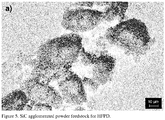
- the coated metal oxide was confirmed by the micrograph in FIG. 1 and FIG. 2 which show the YAG phase coated silicon carbide and an X-ray crystallogram of the coated silicon carbide powder respectively.
- the designed stoichiometry composition leads to 30% in weight of YAG phases.
- the co-precipitation of YAG phase was started by dispersing 100 gram of silicon carbide particles in distilled water. About 0.4 wt% of dispersant is added to stabilise the silicon carbide suspension. The dispersant was Dolapix A-88 dispersant from Zschimmer & Schwarz GmbH & Co KG. Magnetic stirring was utilized to homogenize the suspension. 721.96 ml of 6.4 M of ammonium hydrogen carbonate precipitator agent was added into SiC suspension.
- the suspension was heated to 50°C before the mixed metal salt (formed from 721.96ml of 0.5 M Al(NO 3 ) 3 .9H 2 O and 721.96 ml of 0.3 M Y(NO 3 ) 3 .6H 2 O) was titrated into the suspension mixture.
- the suspension now containing metal hydroxide/carbonate coated silicon carbide particles was then filtered and washed with distilled water.
- the treated powder was dried in the oven and pre-calcinated at 500 C for 2 hour in air furnace. Sintering was employed to the agglomerated powders in vacuum or argon environment at 1750°C for 2h.
- the treated SiC powders were spray dried by introducing distilled water to yield solid content of 20 - 40wt.%.
- Polyvinyl alcohol and polyethylene glycol are added to assist the spray drying process.
- the spray dried powders are then pre-calcinated at 500°C for 2 hours in air furnace before performing sintering at 1750 °C for 2h in vacuum or argon environment.
- FIG. 2 shows the crystallogram of the powder deposition containing SiC + 30wt% YAG.
- the X-ray crystallogram of the powder before deposition and the coating are practically identical. This means that no decomposition has occurred in the thermal spraying process.
- the peak positions of the two compounds are marked.
- a scanning electron micrograph of the coating cross section is performed resulting in the structure as shown in FIG 3 .
- the agglomerated particles are around 45 micrometers (microns) in size. When they travel in the flame during thermal spraying, they deform as the oxide melts and flatten on contacting the substrate. As more particles contact the substrate a coating layer (with each layer perhaps only 5-10 micrometers (microns) in thickness) begins to form. Thus a 100+ micrometer (micron) coating on a substrate is easily achievable as shown in Figure 3 .
- example 1 The process of example 1 was repeated but this time using 3 micrometers (microns) silicon carbide particles.
- the encapsulated oxide will protect SiC particles from direct interaction with the plasma thus inhibiting decomposition.
- the aged suspension was filtered to remove excess NO 3 2- ion.
- the supernatant of SiC was then dried in the furnace at 100°C for 24 hours.
- the dried SiC was pre-calcined at 500°C for 2 hours to remove the hydroxide and carbonate species which form the coating at this stage of the process. Further sintering at 1750°C was performed in an argon atmospheric furnace to crystallize and sinter the agglomerated SiC powders.
- the agglomerated and sintered powders are classified with sieving machine to produce 25- 45 ⁇ m and 45-90 ⁇ m powders.
- the agglomerated powders of 25 -45 ⁇ m are mainly used for high frequency pulse detonation (HFPD) gun, while modified SiC powders of 45-90 ⁇ m are used mainly for atmospheric plasma spray (APS) system.
- HFPD high frequency pulse detonation
- APS atmospheric plasma spray
- the powders formed by oven or spray drying in examples 1, 3 and 4 can be thermally sprayed by HFPD, HVOF or APS.
- the powder of example 1 (oven dried) with powders size of 45-90 ⁇ m was sprayed onto carbon steel substrate with atmospheric plasma spray gun F4-MB plasma gun with 6 mm anode diameter installed in a plasma spray system A3000S (Sulzer Metco, Wolhen, Switzerland) according to the following parameters:
- FIG. 2 shows the crytallogram of the powder feedstock containing 30wt.% YAG and the SiC composite coating produced using HFPD and APS.
- the X-ray crystallogram of the SiC phase before deposition and in the coating are practically identical. This means that no decomposition of SiC has occurred in the thermal spraying process.
- agglomerated powders When the agglomerated powders travel in the flame during thermal spraying, they deform as the oxide melts and flatten on contacting the substrate. As more particles contact the substrate a coating layer (with each layer perhaps only 5-10 micrometers (microns) in thickness) begins to form. Thus a 100+ micrometers (microns) coating on a substrate is easily achievable.
- the spray-dried metal salt precursor mixed with SiC particles will produce hydroxide or carbonate metal precursor encapsulated SiC particles.
- the sintering process create YAG coated SiC powders feedstock
- ⁇ -SiC particles 100g were dispersed in 360,98 ml of 4.8 M citric acid and stirred at 600 rpm for 30 minutes. 0.4wt.% Dolapix A88 was added to stabilize the SiC suspension containing citric acid and stirred for 15 minutes. The suspension was heated to 80 °C.
- the metal salt solution was poured stepwise into SiC suspension and stirred for 1 hour.
- a spray drier was heated until the inlet temperature reached 210 °C and the outlet temperature was stable at between 90 to 110°C.
- the SiC/metal salt solution mixture was spray dried, with adjustment of the suspension feed and the aspirator to produce spherical agglomerated SiC with desired particles size in between 25 - 90 micrometers (microns). These particles were calcined at 500°C for 2 hours in the atmospheric furnace to remove the hydroxide and carbonate species that form during spray drying. Further sintering at 1750°C is performed in an argon atmospheric furnace to crystallize and sinter the agglomerated SiC powders.
- the agglomerated and sintered powders are classified with sieving machine to produce 25- 45 ⁇ m and 45-90 ⁇ m powders.
- the agglomerated powders of 25 -45 ⁇ m are mainly used for high frequency pulse detonation (HFPD) gun, while modified SiC powders of 45-90 ⁇ m are used mainly for atmospheric plasma spray (APS) system.
- HFPD high frequency pulse detonation
- APS atmospheric plasma spray
Landscapes
- Chemical & Material Sciences (AREA)
- Engineering & Computer Science (AREA)
- Ceramic Engineering (AREA)
- Organic Chemistry (AREA)
- Materials Engineering (AREA)
- Manufacturing & Machinery (AREA)
- Structural Engineering (AREA)
- Physics & Mathematics (AREA)
- Plasma & Fusion (AREA)
- Chemical Kinetics & Catalysis (AREA)
- Mechanical Engineering (AREA)
- Metallurgy (AREA)
- Inorganic Chemistry (AREA)
- General Chemical & Material Sciences (AREA)
- Coating By Spraying Or Casting (AREA)
Claims (13)
- Verfahren zum thermischen Spritzen von mit Metalloxid beschichteten keramischen Teilchen auf ein Substrat, umfassend:(I) Erhalten einer Vielzahl von mit Metalloxid beschichteten Siliciumcarbid-, Siliciumnitrid-, Borcarbid- oder Bornitridteilchen, wobei die Metalloxidbeschichtung zumindest 5 Gew.% des Gewichts der beschichteten Teilchen ausmacht; und(II) thermisches Spritzen der Teilchen aus Schritt (I) auf ein Substrat;wobei es sich bei dem Metalloxid um Yttriumaluminiumgranat handelt und wobei die Beschichtung eine vollständige, durchgehende Beschichtung um die keramischen Teilchen herum bildet.
- Verfahren nach Anspruch 1, wobei die Vielzahl von mit Metalloxid beschichteten Teilchen durch Calcinieren und Sintern einer Vielzahl von mit Metallsalz beschichteten Siliciumcarbid-, Siliciumnitrid-, Borcarbid- oder Bornitridteilchen, wie mit Metallhydroxid und/oder Metallcarbonat beschichteten Teilchen, erhalten wird.
- Verfahren nach Anspruch 2, wobei die Vielzahl von mit Metallsalz beschichteten Teilchen durch Kombinieren einer Vielzahl von Siliciumcarbid-, Siliciumnitrid-, Borcarbid- oder Bornitridteilchen mit mindestens einem Metallsalz, wie beispielsweise zwei Metallsalzen, in Gegenwart einer schwachen Säure oder schwachen Base zum Bilden einer Metallsalzbeschichtung auf den Teilchen, und durch Trocknen, wie Sprühtrocknen, der erhaltenen Teilchen erhalten wird;
- Verfahren nach einem der vorstehenden Ansprüche, wobei es sich bei den Teilchen um Siliciumcarbidteilchen handelt.
- Verfahren nach Anspruch 3 oder 4, wobei das Metallsalz eine Mischung aus Yttrium und Aluminiumnitrat ist.
- Verfahren nach einem der Ansprüche 3 bis 5, wobei das Molverhältnis von schwacher Base oder schwacher Säure zu Metallsalz(en) das 1 bis 30-fache, vorzugsweise 1 bis 3 Moläquivalente bei Verwendung einer schwachen Säure und 6 bis 8 Moläquivalente bei Verwendung einer schwachen Base beträgt.
- Verfahren nach einem der Ansprüche 3 bis 6, wobei das Metallsalz bzw. die Metallsalze in eine Lösung aus der schwachen Base oder der schwachen Säure mit Teilchen tituriert wird bzw. werden oder wobei die schwache Base oder die schwache Säure in eine Lösung aus dem Metallsalz bzw. den Metallsalzen und den Teilchen tituriert wird.
- Verfahren nach einem der Ansprüche 3 bis 7, wobei das Metallsalz bzw. die Metallsalze, die schwache Base oder die schwache Säure und die Teilchen kombiniert und sprühgetrocknet werden, um die Teilchen mit der Metallsalzbeschichtung zu beschichten.
- Verfahren nach einem der vorstehenden Ansprüche, wobei das thermische Spritzen unter Verwendung einer Detonationskanone ausgeführt wird.
- Verfahren nach einem der Ansprüche 3 bis 9, wobei es sich bei der schwachen Base um Harnstoff, Ammoniak oder ein Hydrogencarbonat, insbesondere Ammoniumhydrogencarbonat, handelt und es sich bei der schwachen Säure um Citronensäure handelt.
- Verfahren nach einem der vorstehenden Ansprüche, bei dem das Substrat metallisch ist.
- Verfahren nach einem der vorstehenden Ansprüche, bei dem die Metalloxidbeschichtung mindestens 10 Gew.-% des Gewichts der beschichteten Teilchen vor dem thermischen Spritzverfahren ausmacht.
- Verfahren nach einem der Ansprüche 2 bis 12, bei dem die Teilchen vor dem Calcinieren mit einem Hydroxid und/oder Carbonat beschichtet werden.
Priority Applications (3)
| Application Number | Priority Date | Filing Date | Title |
|---|---|---|---|
| EP18179170.8A EP3401417B1 (de) | 2012-11-01 | 2013-11-01 | Teilchen beschichtet mit metaloxid |
| PL18179170T PL3401417T3 (pl) | 2012-11-01 | 2013-11-01 | Cząstki powleczone tlenkiem metalu |
| PL13785472T PL2914760T3 (pl) | 2012-11-01 | 2013-11-01 | Natryskiwanie cieplne materiałów ceramicznych |
Applications Claiming Priority (2)
| Application Number | Priority Date | Filing Date | Title |
|---|---|---|---|
| GBGB1219642.4A GB201219642D0 (en) | 2012-11-01 | 2012-11-01 | Thermal spraying of ceramic materials |
| PCT/EP2013/072861 WO2014068082A2 (en) | 2012-11-01 | 2013-11-01 | Thermal spraying of ceramic materials |
Related Child Applications (2)
| Application Number | Title | Priority Date | Filing Date |
|---|---|---|---|
| EP18179170.8A Division EP3401417B1 (de) | 2012-11-01 | 2013-11-01 | Teilchen beschichtet mit metaloxid |
| EP18179170.8A Division-Into EP3401417B1 (de) | 2012-11-01 | 2013-11-01 | Teilchen beschichtet mit metaloxid |
Publications (2)
| Publication Number | Publication Date |
|---|---|
| EP2914760A2 EP2914760A2 (de) | 2015-09-09 |
| EP2914760B1 true EP2914760B1 (de) | 2018-07-25 |
Family
ID=47358993
Family Applications (2)
| Application Number | Title | Priority Date | Filing Date |
|---|---|---|---|
| EP13785472.5A Active EP2914760B1 (de) | 2012-11-01 | 2013-11-01 | Thermisches spritzen von keramischen materialien |
| EP18179170.8A Active EP3401417B1 (de) | 2012-11-01 | 2013-11-01 | Teilchen beschichtet mit metaloxid |
Family Applications After (1)
| Application Number | Title | Priority Date | Filing Date |
|---|---|---|---|
| EP18179170.8A Active EP3401417B1 (de) | 2012-11-01 | 2013-11-01 | Teilchen beschichtet mit metaloxid |
Country Status (16)
| Country | Link |
|---|---|
| US (2) | US12320009B2 (de) |
| EP (2) | EP2914760B1 (de) |
| JP (1) | JP6401173B2 (de) |
| KR (2) | KR102254982B1 (de) |
| CN (2) | CN104903486B (de) |
| AU (2) | AU2013340802B2 (de) |
| BR (2) | BR112015009810B1 (de) |
| CA (2) | CA2889623C (de) |
| EA (2) | EA030816B1 (de) |
| ES (2) | ES2691938T3 (de) |
| GB (1) | GB201219642D0 (de) |
| MX (2) | MX366872B (de) |
| MY (1) | MY187391A (de) |
| PL (2) | PL2914760T3 (de) |
| TR (1) | TR201815425T4 (de) |
| WO (1) | WO2014068082A2 (de) |
Families Citing this family (21)
| Publication number | Priority date | Publication date | Assignee | Title |
|---|---|---|---|---|
| GB201409693D0 (en) * | 2014-05-31 | 2014-07-16 | Element Six Gmbh | Thermal spray assembly and method for using it |
| KR102447682B1 (ko) * | 2015-05-29 | 2022-09-27 | 삼성전자주식회사 | 코팅층 형성 방법, 플라즈마 처리 장치 및 패턴 형성 방법 |
| DE102016103174B4 (de) * | 2016-02-23 | 2019-10-31 | Reinhold Riemensperger | Verfahren zur Herstellung einer Schichtstruktur an einem Oberflächenbereich eines Bauelements |
| CN106077663A (zh) * | 2016-07-29 | 2016-11-09 | 安庆市德奥特汽车零部件制造有限公司 | 一种纳米钇铝石榴石纤维复合涂层内燃机用活塞环的制备方法 |
| GB201614008D0 (en) | 2016-08-16 | 2016-09-28 | Seram Coatings As | Thermal spraying of ceramic materials |
| CN106544621A (zh) * | 2016-11-18 | 2017-03-29 | 无锡明盛纺织机械有限公司 | 一种复合耐磨涂层的制备方法 |
| CA3002295A1 (en) * | 2017-06-21 | 2018-12-21 | Rolls-Royce Corporation | Impurity barrier layer for ceramic matrix composite substrate |
| US11976013B2 (en) | 2017-09-27 | 2024-05-07 | Rolls-Royce Corporation | Composite coating layer for ceramic matrix composite substrate |
| JP6971110B2 (ja) * | 2017-09-28 | 2021-11-24 | 株式会社フジミインコーポレーテッド | 被覆粒子粉体の製造方法、ならびに当該被覆粒子粉体および分散媒を含む分散体の製造方法 |
| ES2986610T3 (es) | 2018-10-30 | 2024-11-12 | Hyperion Materials & Tech Sweden Ab | Método de boronización de cuerpos sinterizados |
| JP7145773B2 (ja) * | 2019-01-29 | 2022-10-03 | 株式会社フジミインコーポレーテッド | 被覆粒子 |
| KR102091969B1 (ko) * | 2019-03-29 | 2020-03-23 | 오현철 | 전도성 도료 조성물 |
| TWI685072B (zh) * | 2019-04-11 | 2020-02-11 | 宏進金屬科技股份有限公司 | 具絕緣散熱塗層的複合結構、其製法及用途 |
| CN110922188A (zh) * | 2019-12-02 | 2020-03-27 | 昊石新材料科技南通有限公司 | 一种高耐磨抗烧蚀沉积碳化硅涂层及其制备工艺 |
| US20230051800A1 (en) * | 2020-01-27 | 2023-02-16 | Applied Materials, Inc. | Methods and apparatus for plasma spraying silicon carbide coatings for semiconductor chamber applications |
| CN111254379B (zh) * | 2020-03-15 | 2022-02-08 | 河北工业大学 | 高熵陶瓷涂层的制备方法 |
| FR3112143B1 (fr) * | 2020-07-02 | 2025-03-21 | Safran Ceram | Procédé de fabrication d'une barrière environnementale |
| CN112410719B (zh) * | 2020-10-20 | 2023-01-20 | 安徽华飞机械铸锻有限公司 | 一种抗磨性的耐热钢 |
| CN112408991A (zh) * | 2020-11-27 | 2021-02-26 | 安徽盈锐优材科技有限公司 | 一种新型热喷涂氮化硅粉体的制备方法 |
| CN112645711A (zh) * | 2020-12-24 | 2021-04-13 | 江苏集芯半导体硅材料研究院有限公司 | 一种单晶硅炉用加热器SiC-ZrC-BN复合涂层及制备方法 |
| CA3207121A1 (en) * | 2021-02-05 | 2022-08-11 | Oerlikon Metco (Us) Inc. | Oxidation barrier materials and process for ceramic matrix composites |
Citations (1)
| Publication number | Priority date | Publication date | Assignee | Title |
|---|---|---|---|---|
| WO2003004718A2 (de) * | 2001-07-02 | 2003-01-16 | Fraunhofer-Gesellschaft zur Förderung der angewandten Forschung e.V. | Nichtoxidisches keramisches beschichtungspulver und daraus hergestellte schichten |
Family Cites Families (39)
| Publication number | Priority date | Publication date | Assignee | Title |
|---|---|---|---|---|
| JPS5761664A (en) * | 1980-09-29 | 1982-04-14 | Nat Res Inst Metals | Ceramic-base composite powder and manufacture |
| US4619817A (en) * | 1985-03-27 | 1986-10-28 | Battelle Memorial Institute | Hydrothermal method for producing stabilized zirconia |
| JPS61243164A (ja) * | 1985-04-19 | 1986-10-29 | Toshiba Corp | 耐熱被覆の形成方法 |
| US4814128A (en) * | 1985-08-01 | 1989-03-21 | Gte Laboratories Incorporated | Process for making a homogeneous doped silicon nitride article |
| CA1273185A (en) | 1985-08-01 | 1990-08-28 | Sheldon Lieberman | Process for making a homogeneous doped silicon nitride article |
| JPH0645862B2 (ja) * | 1986-12-29 | 1994-06-15 | トヨタ自動車株式会社 | セラミツク溶射層の形成方法 |
| JPH028358A (ja) * | 1988-06-25 | 1990-01-11 | Idemitsu Kosan Co Ltd | 複合化溶射材料、その製法及びそれを用いた溶射体並びにそれからなる赤外線放射体 |
| US5098740A (en) * | 1989-12-13 | 1992-03-24 | Norton Company | Uniformly-coated ceramic particles |
| JPH03218957A (ja) | 1990-01-22 | 1991-09-26 | Isuzu Ceramics Kenkyusho:Kk | セラミック焼結体の製造方法 |
| GB9015892D0 (en) * | 1990-07-19 | 1990-09-05 | Tioxide Group Services Ltd | Compositions |
| US5229339A (en) | 1991-11-12 | 1993-07-20 | Norton Company | Pressure casting ceramic slurries |
| JP3139149B2 (ja) * | 1992-07-27 | 2001-02-26 | 株式会社村田製作所 | 圧電共振子 |
| JP3175483B2 (ja) * | 1994-06-30 | 2001-06-11 | 日本鋼管株式会社 | 窒化ホウ素含有材料およびその製造方法 |
| CN1195884C (zh) | 1995-11-13 | 2005-04-06 | 康涅狄格大学 | 用于热喷涂的纳米结构的进料 |
| US6015630A (en) * | 1997-04-10 | 2000-01-18 | The University Of Connecticut | Ceramic materials for thermal barrier coatings |
| JPH11286768A (ja) | 1998-04-02 | 1999-10-19 | Ishikawajima Harima Heavy Ind Co Ltd | 耐摩耗コーティング材料および耐摩耗コーティング方法 |
| US20060121068A1 (en) * | 1999-08-31 | 2006-06-08 | General Electric Company | Boron nitride particles of spherical geometry and process for making thereof |
| US7976941B2 (en) | 1999-08-31 | 2011-07-12 | Momentive Performance Materials Inc. | Boron nitride particles of spherical geometry and process for making thereof |
| CA2388618C (en) | 1999-10-28 | 2010-03-23 | Aerostar Coatings, S.L. | High frequency pulse rate and high productivity detonation spray gun |
| US6503442B1 (en) | 2001-03-19 | 2003-01-07 | Praxair S.T. Technology, Inc. | Metal-zirconia composite coating with resistance to molten metals and high temperature corrosive gases |
| DE10142635A1 (de) * | 2001-08-31 | 2003-03-20 | Basf Ag | Verfahren zur Herstellung von Isophorondiamin (IPDA, 3-Aminomethyl-3,5,5,-trimethylcyclohexylamin) |
| JP3954851B2 (ja) | 2002-01-28 | 2007-08-08 | 松下電器産業株式会社 | 受信装置及び受信方法 |
| EP1403329A1 (de) | 2002-09-27 | 2004-03-31 | Fuji Photo Film Co., Ltd. | Beschichtungsmethode für Partikel |
| JP2004137482A (ja) * | 2002-09-27 | 2004-05-13 | Fuji Photo Film Co Ltd | 粒子表面被覆方法 |
| ITRM20020618A1 (it) | 2002-12-12 | 2004-06-13 | Ct Sviluppo Materiali Spa | Polvere termospruzzabile a base di carburo di silicio, suo metodo di |
| US20040183135A1 (en) * | 2003-03-19 | 2004-09-23 | Oh-Hun Kwon | ESD dissipative structural components |
| DE10332938B4 (de) * | 2003-07-19 | 2016-12-29 | General Electric Technology Gmbh | Thermisch belastetes Bauteil einer Gasturbine |
| KR20070083557A (ko) | 2004-09-23 | 2007-08-24 | 엘리먼트 씩스 (프티) 리미티드 | 다결정 연마 물질 및 그 제조방법 |
| DE102005002659A1 (de) * | 2005-01-19 | 2006-07-27 | Merck Patent Gmbh | Verfahren zur Herstellung von Mischoxiden mittels Sprühpyrolyse |
| US7799111B2 (en) * | 2005-03-28 | 2010-09-21 | Sulzer Metco Venture Llc | Thermal spray feedstock composition |
| CA2504831C (en) * | 2005-04-21 | 2010-10-19 | Standard Aero Limited | Wear resistant ceramic composite coatings and process for production thereof |
| CN100448800C (zh) * | 2007-04-17 | 2009-01-07 | 陕西科技大学 | 火焰热喷涂铝热剂包裹碳化硅颗粒陶瓷涂层的制备方法 |
| JP2009029692A (ja) | 2007-06-28 | 2009-02-12 | Covalent Materials Corp | 焼成用道具材およびその製造方法 |
| CN101259532A (zh) | 2008-01-02 | 2008-09-10 | 中南大学 | 纳米Fe或Fe2O3包覆Si3N4颗粒的复合粉末及其制备方法 |
| US8790782B2 (en) | 2008-07-02 | 2014-07-29 | E I Du Pont De Nemours And Company | Method for making glass frit powders using aerosol decomposition |
| JP2011178643A (ja) * | 2010-03-03 | 2011-09-15 | Yamagata Univ | 表面改質セラミック粉末の製造方法 |
| JP5305056B1 (ja) | 2012-05-16 | 2013-10-02 | 三菱マテリアル株式会社 | 立方晶窒化ほう素基焼結体製切削工具 |
| JP6045862B2 (ja) * | 2012-09-07 | 2016-12-14 | 有限会社若松屋 | 水産練り製品の製造方法 |
| DE102016215540A1 (de) | 2016-08-18 | 2018-02-22 | Carl Zeiss Smt Gmbh | Optisches system, lithographieanlage sowie verfahren |
-
2012
- 2012-11-01 GB GBGB1219642.4A patent/GB201219642D0/en not_active Ceased
-
2013
- 2013-11-01 EA EA201590852A patent/EA030816B1/ru not_active IP Right Cessation
- 2013-11-01 EP EP13785472.5A patent/EP2914760B1/de active Active
- 2013-11-01 WO PCT/EP2013/072861 patent/WO2014068082A2/en not_active Ceased
- 2013-11-01 KR KR1020157014512A patent/KR102254982B1/ko active Active
- 2013-11-01 MY MYPI2015001136A patent/MY187391A/en unknown
- 2013-11-01 EP EP18179170.8A patent/EP3401417B1/de active Active
- 2013-11-01 JP JP2015540136A patent/JP6401173B2/ja active Active
- 2013-11-01 ES ES13785472.5T patent/ES2691938T3/es active Active
- 2013-11-01 KR KR1020217014639A patent/KR102332812B1/ko active Active
- 2013-11-01 AU AU2013340802A patent/AU2013340802B2/en active Active
- 2013-11-01 MX MX2015005485A patent/MX366872B/es active IP Right Grant
- 2013-11-01 US US14/438,933 patent/US12320009B2/en active Active
- 2013-11-01 CA CA2889623A patent/CA2889623C/en active Active
- 2013-11-01 CN CN201380057259.3A patent/CN104903486B/zh active Active
- 2013-11-01 BR BR112015009810-0A patent/BR112015009810B1/pt active IP Right Grant
- 2013-11-01 CA CA3087556A patent/CA3087556C/en active Active
- 2013-11-01 PL PL13785472T patent/PL2914760T3/pl unknown
- 2013-11-01 TR TR2018/15425T patent/TR201815425T4/tr unknown
- 2013-11-01 CN CN201811230220.8A patent/CN109279896A/zh active Pending
- 2013-11-01 PL PL18179170T patent/PL3401417T3/pl unknown
- 2013-11-01 ES ES18179170T patent/ES2871126T3/es active Active
- 2013-11-01 EA EA201890835A patent/EA038602B1/ru unknown
- 2013-11-01 BR BR122020000551-3A patent/BR122020000551B1/pt active IP Right Grant
-
2015
- 2015-04-29 MX MX2019008509A patent/MX2019008509A/es unknown
-
2018
- 2018-06-29 AU AU2018204753A patent/AU2018204753B2/en active Active
-
2025
- 2025-05-02 US US19/196,813 patent/US20250283203A1/en active Pending
Patent Citations (1)
| Publication number | Priority date | Publication date | Assignee | Title |
|---|---|---|---|---|
| WO2003004718A2 (de) * | 2001-07-02 | 2003-01-16 | Fraunhofer-Gesellschaft zur Förderung der angewandten Forschung e.V. | Nichtoxidisches keramisches beschichtungspulver und daraus hergestellte schichten |
Also Published As
Similar Documents
| Publication | Publication Date | Title |
|---|---|---|
| US20250283203A1 (en) | Thermal spraying of ceramic materials | |
| AU2017314133B2 (en) | Thermal spraying of ceramic materials | |
| US8679246B2 (en) | Preparation of amorphous mixed metal oxides and their use as feedstocks in thermal spray coating | |
| CA3033928C (en) | Thermal spraying of ceramic materials | |
| McDonald et al. | Synthesis of Thermal Spray Grade Silicon Carbide Feedstock Powder for Plasma Spray Deposition | |
| EA043995B1 (ru) | Термическое напыление керамических материалов |
Legal Events
| Date | Code | Title | Description |
|---|---|---|---|
| PUAI | Public reference made under article 153(3) epc to a published international application that has entered the european phase |
Free format text: ORIGINAL CODE: 0009012 |
|
| 17P | Request for examination filed |
Effective date: 20150529 |
|
| AK | Designated contracting states |
Kind code of ref document: A2 Designated state(s): AL AT BE BG CH CY CZ DE DK EE ES FI FR GB GR HR HU IE IS IT LI LT LU LV MC MK MT NL NO PL PT RO RS SE SI SK SM TR |
|
| AX | Request for extension of the european patent |
Extension state: BA ME |
|
| DAX | Request for extension of the european patent (deleted) | ||
| STAA | Information on the status of an ep patent application or granted ep patent |
Free format text: STATUS: EXAMINATION IS IN PROGRESS |
|
| 17Q | First examination report despatched |
Effective date: 20170601 |
|
| REG | Reference to a national code |
Ref country code: DE Ref legal event code: R079 Ref document number: 602013040878 Country of ref document: DE Free format text: PREVIOUS MAIN CLASS: C23C0004020000 Ipc: C23C0004100000 |
|
| RIC1 | Information provided on ipc code assigned before grant |
Ipc: C04B 35/584 20060101ALI20171208BHEP Ipc: C04B 35/563 20060101ALI20171208BHEP Ipc: C23C 4/126 20160101ALI20171208BHEP Ipc: C04B 35/628 20060101ALI20171208BHEP Ipc: C23C 4/10 20160101AFI20171208BHEP Ipc: C04B 35/583 20060101ALI20171208BHEP Ipc: C23C 4/134 20160101ALI20171208BHEP Ipc: C23C 4/02 20060101ALI20171208BHEP Ipc: C04B 35/565 20060101ALI20171208BHEP |
|
| GRAP | Despatch of communication of intention to grant a patent |
Free format text: ORIGINAL CODE: EPIDOSNIGR1 |
|
| STAA | Information on the status of an ep patent application or granted ep patent |
Free format text: STATUS: GRANT OF PATENT IS INTENDED |
|
| INTG | Intention to grant announced |
Effective date: 20180129 |
|
| GRAS | Grant fee paid |
Free format text: ORIGINAL CODE: EPIDOSNIGR3 |
|
| GRAA | (expected) grant |
Free format text: ORIGINAL CODE: 0009210 |
|
| STAA | Information on the status of an ep patent application or granted ep patent |
Free format text: STATUS: THE PATENT HAS BEEN GRANTED |
|
| AK | Designated contracting states |
Kind code of ref document: B1 Designated state(s): AL AT BE BG CH CY CZ DE DK EE ES FI FR GB GR HR HU IE IS IT LI LT LU LV MC MK MT NL NO PL PT RO RS SE SI SK SM TR |
|
| REG | Reference to a national code |
Ref country code: GB Ref legal event code: FG4D |
|
| REG | Reference to a national code |
Ref country code: CH Ref legal event code: EP |
|
| REG | Reference to a national code |
Ref country code: AT Ref legal event code: REF Ref document number: 1021847 Country of ref document: AT Kind code of ref document: T Effective date: 20180815 |
|
| REG | Reference to a national code |
Ref country code: IE Ref legal event code: FG4D |
|
| REG | Reference to a national code |
Ref country code: DE Ref legal event code: R096 Ref document number: 602013040878 Country of ref document: DE |
|
| REG | Reference to a national code |
Ref country code: NL Ref legal event code: FP |
|
| REG | Reference to a national code |
Ref country code: SE Ref legal event code: TRGR |
|
| REG | Reference to a national code |
Ref country code: NO Ref legal event code: T2 Effective date: 20180725 |
|
| REG | Reference to a national code |
Ref country code: ES Ref legal event code: FG2A Ref document number: 2691938 Country of ref document: ES Kind code of ref document: T3 Effective date: 20181129 |
|
| REG | Reference to a national code |
Ref country code: LT Ref legal event code: MG4D |
|
| PG25 | Lapsed in a contracting state [announced via postgrant information from national office to epo] |
Ref country code: IS Free format text: LAPSE BECAUSE OF FAILURE TO SUBMIT A TRANSLATION OF THE DESCRIPTION OR TO PAY THE FEE WITHIN THE PRESCRIBED TIME-LIMIT Effective date: 20181125 Ref country code: RS Free format text: LAPSE BECAUSE OF FAILURE TO SUBMIT A TRANSLATION OF THE DESCRIPTION OR TO PAY THE FEE WITHIN THE PRESCRIBED TIME-LIMIT Effective date: 20180725 Ref country code: BG Free format text: LAPSE BECAUSE OF FAILURE TO SUBMIT A TRANSLATION OF THE DESCRIPTION OR TO PAY THE FEE WITHIN THE PRESCRIBED TIME-LIMIT Effective date: 20181025 Ref country code: GR Free format text: LAPSE BECAUSE OF FAILURE TO SUBMIT A TRANSLATION OF THE DESCRIPTION OR TO PAY THE FEE WITHIN THE PRESCRIBED TIME-LIMIT Effective date: 20181026 Ref country code: LT Free format text: LAPSE BECAUSE OF FAILURE TO SUBMIT A TRANSLATION OF THE DESCRIPTION OR TO PAY THE FEE WITHIN THE PRESCRIBED TIME-LIMIT Effective date: 20180725 |
|
| REG | Reference to a national code |
Ref country code: CH Ref legal event code: PK Free format text: BERICHTIGUNGEN |
|
| RIC2 | Information provided on ipc code assigned after grant |
Ipc: C23C 4/10 20160101AFI20171208BHEP Ipc: C04B 35/563 20060101ALI20171208BHEP Ipc: C04B 35/583 20060101ALI20171208BHEP Ipc: C04B 35/565 20060101ALI20171208BHEP Ipc: C04B 35/628 20060101ALI20171208BHEP Ipc: C23C 4/134 20160101ALI20171208BHEP Ipc: C23C 4/02 20060101ALI20171208BHEP Ipc: C04B 35/584 20060101ALI20171208BHEP Ipc: C23C 4/126 20160101ALI20171208BHEP |
|
| PG25 | Lapsed in a contracting state [announced via postgrant information from national office to epo] |
Ref country code: HR Free format text: LAPSE BECAUSE OF FAILURE TO SUBMIT A TRANSLATION OF THE DESCRIPTION OR TO PAY THE FEE WITHIN THE PRESCRIBED TIME-LIMIT Effective date: 20180725 Ref country code: LV Free format text: LAPSE BECAUSE OF FAILURE TO SUBMIT A TRANSLATION OF THE DESCRIPTION OR TO PAY THE FEE WITHIN THE PRESCRIBED TIME-LIMIT Effective date: 20180725 Ref country code: AL Free format text: LAPSE BECAUSE OF FAILURE TO SUBMIT A TRANSLATION OF THE DESCRIPTION OR TO PAY THE FEE WITHIN THE PRESCRIBED TIME-LIMIT Effective date: 20180725 |
|
| REG | Reference to a national code |
Ref country code: DE Ref legal event code: R097 Ref document number: 602013040878 Country of ref document: DE |
|
| PG25 | Lapsed in a contracting state [announced via postgrant information from national office to epo] |
Ref country code: RO Free format text: LAPSE BECAUSE OF FAILURE TO SUBMIT A TRANSLATION OF THE DESCRIPTION OR TO PAY THE FEE WITHIN THE PRESCRIBED TIME-LIMIT Effective date: 20180725 Ref country code: EE Free format text: LAPSE BECAUSE OF FAILURE TO SUBMIT A TRANSLATION OF THE DESCRIPTION OR TO PAY THE FEE WITHIN THE PRESCRIBED TIME-LIMIT Effective date: 20180725 |
|
| PG25 | Lapsed in a contracting state [announced via postgrant information from national office to epo] |
Ref country code: SK Free format text: LAPSE BECAUSE OF FAILURE TO SUBMIT A TRANSLATION OF THE DESCRIPTION OR TO PAY THE FEE WITHIN THE PRESCRIBED TIME-LIMIT Effective date: 20180725 Ref country code: SM Free format text: LAPSE BECAUSE OF FAILURE TO SUBMIT A TRANSLATION OF THE DESCRIPTION OR TO PAY THE FEE WITHIN THE PRESCRIBED TIME-LIMIT Effective date: 20180725 Ref country code: DK Free format text: LAPSE BECAUSE OF FAILURE TO SUBMIT A TRANSLATION OF THE DESCRIPTION OR TO PAY THE FEE WITHIN THE PRESCRIBED TIME-LIMIT Effective date: 20180725 |
|
| PLBE | No opposition filed within time limit |
Free format text: ORIGINAL CODE: 0009261 |
|
| STAA | Information on the status of an ep patent application or granted ep patent |
Free format text: STATUS: NO OPPOSITION FILED WITHIN TIME LIMIT |
|
| 26N | No opposition filed |
Effective date: 20190426 |
|
| PG25 | Lapsed in a contracting state [announced via postgrant information from national office to epo] |
Ref country code: MC Free format text: LAPSE BECAUSE OF FAILURE TO SUBMIT A TRANSLATION OF THE DESCRIPTION OR TO PAY THE FEE WITHIN THE PRESCRIBED TIME-LIMIT Effective date: 20180725 Ref country code: LU Free format text: LAPSE BECAUSE OF NON-PAYMENT OF DUE FEES Effective date: 20181101 |
|
| REG | Reference to a national code |
Ref country code: IE Ref legal event code: MM4A |
|
| PG25 | Lapsed in a contracting state [announced via postgrant information from national office to epo] |
Ref country code: SI Free format text: LAPSE BECAUSE OF FAILURE TO SUBMIT A TRANSLATION OF THE DESCRIPTION OR TO PAY THE FEE WITHIN THE PRESCRIBED TIME-LIMIT Effective date: 20180725 |
|
| PG25 | Lapsed in a contracting state [announced via postgrant information from national office to epo] |
Ref country code: IE Free format text: LAPSE BECAUSE OF NON-PAYMENT OF DUE FEES Effective date: 20181101 |
|
| PG25 | Lapsed in a contracting state [announced via postgrant information from national office to epo] |
Ref country code: MT Free format text: LAPSE BECAUSE OF NON-PAYMENT OF DUE FEES Effective date: 20181101 |
|
| PG25 | Lapsed in a contracting state [announced via postgrant information from national office to epo] |
Ref country code: PT Free format text: LAPSE BECAUSE OF FAILURE TO SUBMIT A TRANSLATION OF THE DESCRIPTION OR TO PAY THE FEE WITHIN THE PRESCRIBED TIME-LIMIT Effective date: 20180725 |
|
| PG25 | Lapsed in a contracting state [announced via postgrant information from national office to epo] |
Ref country code: MK Free format text: LAPSE BECAUSE OF NON-PAYMENT OF DUE FEES Effective date: 20180725 Ref country code: HU Free format text: LAPSE BECAUSE OF FAILURE TO SUBMIT A TRANSLATION OF THE DESCRIPTION OR TO PAY THE FEE WITHIN THE PRESCRIBED TIME-LIMIT; INVALID AB INITIO Effective date: 20131101 Ref country code: CY Free format text: LAPSE BECAUSE OF FAILURE TO SUBMIT A TRANSLATION OF THE DESCRIPTION OR TO PAY THE FEE WITHIN THE PRESCRIBED TIME-LIMIT Effective date: 20180725 |
|
| REG | Reference to a national code |
Ref country code: AT Ref legal event code: UEP Ref document number: 1021847 Country of ref document: AT Kind code of ref document: T Effective date: 20180725 |
|
| REG | Reference to a national code |
Ref country code: CH Ref legal event code: U11 Free format text: ST27 STATUS EVENT CODE: U-0-0-U10-U11 (AS PROVIDED BY THE NATIONAL OFFICE) Effective date: 20251201 |
|
| PGFP | Annual fee paid to national office [announced via postgrant information from national office to epo] |
Ref country code: NL Payment date: 20251121 Year of fee payment: 13 |
|
| PGFP | Annual fee paid to national office [announced via postgrant information from national office to epo] |
Ref country code: DE Payment date: 20251118 Year of fee payment: 13 |
|
| PGFP | Annual fee paid to national office [announced via postgrant information from national office to epo] |
Ref country code: GB Payment date: 20251118 Year of fee payment: 13 |
|
| PGFP | Annual fee paid to national office [announced via postgrant information from national office to epo] |
Ref country code: NO Payment date: 20251120 Year of fee payment: 13 |
|
| PGFP | Annual fee paid to national office [announced via postgrant information from national office to epo] |
Ref country code: AT Payment date: 20251118 Year of fee payment: 13 |
|
| PGFP | Annual fee paid to national office [announced via postgrant information from national office to epo] |
Ref country code: IT Payment date: 20251121 Year of fee payment: 13 Ref country code: FI Payment date: 20251118 Year of fee payment: 13 |
|
| PGFP | Annual fee paid to national office [announced via postgrant information from national office to epo] |
Ref country code: FR Payment date: 20251117 Year of fee payment: 13 |
|
| PGFP | Annual fee paid to national office [announced via postgrant information from national office to epo] |
Ref country code: TR Payment date: 20251022 Year of fee payment: 13 Ref country code: BE Payment date: 20251121 Year of fee payment: 13 |
|
| PGFP | Annual fee paid to national office [announced via postgrant information from national office to epo] |
Ref country code: CH Payment date: 20251201 Year of fee payment: 13 Ref country code: SE Payment date: 20251121 Year of fee payment: 13 |
|
| PGFP | Annual fee paid to national office [announced via postgrant information from national office to epo] |
Ref country code: CZ Payment date: 20251022 Year of fee payment: 13 |
|
| PGFP | Annual fee paid to national office [announced via postgrant information from national office to epo] |
Ref country code: PL Payment date: 20251022 Year of fee payment: 13 |
|
| PGFP | Annual fee paid to national office [announced via postgrant information from national office to epo] |
Ref country code: ES Payment date: 20251208 Year of fee payment: 13 |