EP2913331B1 - Verfahren zur herstellung einer epoxidverbindung - Google Patents
Verfahren zur herstellung einer epoxidverbindung Download PDFInfo
- Publication number
- EP2913331B1 EP2913331B1 EP13849469.5A EP13849469A EP2913331B1 EP 2913331 B1 EP2913331 B1 EP 2913331B1 EP 13849469 A EP13849469 A EP 13849469A EP 2913331 B1 EP2913331 B1 EP 2913331B1
- Authority
- EP
- European Patent Office
- Prior art keywords
- compound
- reaction
- group
- epoxy
- mmol
- Prior art date
- Legal status (The legal status is an assumption and is not a legal conclusion. Google has not performed a legal analysis and makes no representation as to the accuracy of the status listed.)
- Active
Links
Classifications
-
- C—CHEMISTRY; METALLURGY
- C07—ORGANIC CHEMISTRY
- C07D—HETEROCYCLIC COMPOUNDS
- C07D405/00—Heterocyclic compounds containing both one or more hetero rings having oxygen atoms as the only ring hetero atoms, and one or more rings having nitrogen as the only ring hetero atom
- C07D405/14—Heterocyclic compounds containing both one or more hetero rings having oxygen atoms as the only ring hetero atoms, and one or more rings having nitrogen as the only ring hetero atom containing three or more hetero rings
-
- C—CHEMISTRY; METALLURGY
- C07—ORGANIC CHEMISTRY
- C07D—HETEROCYCLIC COMPOUNDS
- C07D251/00—Heterocyclic compounds containing 1,3,5-triazine rings
- C07D251/02—Heterocyclic compounds containing 1,3,5-triazine rings not condensed with other rings
- C07D251/12—Heterocyclic compounds containing 1,3,5-triazine rings not condensed with other rings having three double bonds between ring members or between ring members and non-ring members
- C07D251/26—Heterocyclic compounds containing 1,3,5-triazine rings not condensed with other rings having three double bonds between ring members or between ring members and non-ring members with only hetero atoms directly attached to ring carbon atoms
- C07D251/30—Only oxygen atoms
- C07D251/34—Cyanuric or isocyanuric esters
-
- C—CHEMISTRY; METALLURGY
- C07—ORGANIC CHEMISTRY
- C07D—HETEROCYCLIC COMPOUNDS
- C07D253/00—Heterocyclic compounds containing six-membered rings having three nitrogen atoms as the only ring hetero atoms, not provided for by group C07D251/00
- C07D253/02—Heterocyclic compounds containing six-membered rings having three nitrogen atoms as the only ring hetero atoms, not provided for by group C07D251/00 not condensed with other rings
- C07D253/04—1,2,3-Triazines
Definitions
- the present invention relates to a method for producing an epoxy compound from an olefin compound.
- the present invention relates to a method for efficiently producing an epoxy compound by a reaction of hydrogen peroxide, a nitrile compound, and an alkaline substance with an olefin compound having a specific structure in a solvent.
- a crystalline epoxy resin generally has a rigid or multifunctional main chain skeleton. Therefore, the crystalline epoxy resin shows high heat resistance and is used in fields in which heat resistance reliability is required, such as electrical and electronic fields.
- a traditional epoxy resin used in liquid molding such as casting molding is a liquid epoxy resin, and cannot sufficiently meet a demand for improvement in physical properties of a cured product, such as heat resistance, that is currently demanded more and more in fields of adhesion, casting, sealing, molding, and laminating. Therefore, there is an increasing demand for liquefaction of a crystalline multifunctional epoxy resin that imparts physical properties of a cured product, such as high heat resistance.
- Examples of a method for producing such an epoxy compound include a method of epoxidizing an olefin by a reaction of olefin-substituted isocyanurate with hydrogen peroxide as an oxidizer using a mixed catalyst containing tungstate or molybdate as a catalyst, a surfactant (a quaternary ammonium salt used as a phase transfer catalyst), and phosphate or phosphonate (see Patent Document 1).
- Additional examples thereof include an epoxidation method in which an olefin compound is reacted with hydrogen peroxide in an aqueous pyrophosphate-pyrophosphoric acid solution in the presence of a nitrile compound (see Patent Document 2).
- Examples of the olefin compound in this method may include: a C 3-15 mono-olefin compound such as propylene, 1-butene, t-2-butene, c-2-butene, 1-pentene, isopentene, cyclopentene, 1-hexene, 2-hexene, cyclohexene, norbornene, and 1-octene; a C 3-15 polyolefin compound such as butadiene, t-1,3-pentadiene, c-1,3-pentadiene, cyclopentadiene, cyclohexadiene, norbornadiene, cyclooctadiene, and vinylcyclohexene; and a polymer having a carbon-carbon double bond in the molecule such as polyester and polyimide.
- a C 3-15 mono-olefin compound such as propylene, 1-butene, t-2-butene, c-2-butene, 1-pen
- US 3,793,321 is concerned with the production of triglycidyl isocyanurate by epoxidation of triallyl isocyanurate with hydrogen peroxide.
- the starting material is obtained either by converting trisodium cyanurate with allyl chloride or from cyanuric chloride and allyl alcohol.
- US 3,376,301 relates to the production of triallylic isocyanurates from cyanuric acid and allylic halide.
- CN102603721 A is concerned with the production of triglycidyl isocyanurate in the presence of an alcohol, a carbonate salt and a nitrile using hydrogen peroxide as an oxidant.
- the triallyl isocyanurate may be prepared from trisodium cyanurate and allyl chloride.
- a styrene oxide derivative is obtained by reaction between a styrene derivative and hydrogen peroxide in the presence of a nitrile such as acetonitrile.
- JP S62-114979 A an epoxidized compound supposedly useful as an intermediate for a lubricant, surfactant, ester for plasticizer, polyester resin and silane coupling agent is produced by reacting a compound having olefinic double bond with hydrogen peroxide in the presence of a nitrile and controlling the pH of the system to ⁇ 7.0.
- 8-oxyquinoline is added to the reaction system in an amount of 0.01-10 mol% based on the olefin to stabilize the peroxycarboimidic acid produced by the reaction.
- WO 2012/008308 A1 is concerned with a method for producing an epoxy compound in which a compound having carbon-carbon double bonds is epoxidized in the presence of acetonitrile using hydrogen peroxide as an oxidant.
- the method comprises: a first step for adding water and an organic solvent, which is not compatible with water and does not dissolve an acetamide by-product of the epoxidation, to the reaction solution once epoxidation is completed and thereby dissolving the acetamide in water; a second step for separating an organic layer and an aqueous layer; and a third step for reducing and then rinsing and concentrating the organic layer to obtain the epoxy compound.
- JP 2009-256260 A relates to a production method of an epoxy alcohol.
- the method comprises causing the hydroxy group-containing olefin compound represented by the general formula R-OH (wherein R is a C 3-10 aliphatic hydrocarbon group containing one carbon-carbon double bond) and hydrogen peroxide to react in the presence of a base and a nitrile compound to form the corresponding epoxy alcohol.
- an epoxy compound having an adamantane skeleton such as 1,3-bis(glycidyloxy) adamantane is obtained by epoxydation by reacting, for example, an allyloxy compound having an adamantane skeleton such as 1,3-bis(allyloxy) adamantane, a nitrile compound such as benzonitrile and aqueous hydrogen peroxide in the presence of a basic compound such as potassium carbonate.
- WO 2011/093188 A1 discloses a resist composition which has a high transparency, a high heat resistance, excellent sensitivity characteristics and a high solubility in a liquid developer and, as a result, is suitable for forming a microlens with a high resolution.
- the composition inter alia comprises a cross-linkable compound represented by formula (1), wherein R 1 , R 2 and R 3 independently represent an optionally branched C 1-6 alkylene or oxyalkylene group, and E 1 , E 2 and E 3 independently represent a group containing a structure represented by formula (2) or (3), wherein R 4 represents a hydrogen atom or a methyl group.
- Patent Document 1 In the method of epoxidizing an olefin described in Patent Document 1, it is necessary to remove tungstate or molybdate and a surfactant (a quaternary ammonium salt used as a phase transfer catalyst) that remain in a reaction medium, and an operation of separating a compound of which all three double bonds in the molecule are epoxidized from a compound having a double bond that remains in the molecule is sometimes required from the viewpoint of epoxidation ratio. Thus the method involves a complex a process.
- Patent Document 2 does not describe a method for efficiently producing an epoxy compound from a specific triolefin compound.
- the inventors of the present invention have found that in a method for producing such an epoxy compound, an olefin compound having a specific structure is used to obtain an epoxy compound of which an olefin moiety is epoxidized with efficiency in high yield. Thus, the present invention has been accomplished.
- the present invention provides, as a first aspect, a method for producing an epoxy compound of Formula (2): comprising reacting a triolefin compound of the following Formula (1): with hydrogen peroxide, a nitrile compound, an alkaline substance in a solvent and a buffer solution, wherein the triolefin compound of Formula (1) is a compound selected from the compounds of Formulae (A-1) to (A-7) as indicated in claim 1 and the epoxy compound of Formula (2) is the corresponding epoxy compound selected from the compounds of Formulae (B-1) to (B-7) as indicated in claim 1.
- the present invention provides, as a second aspect, the method according to the first aspect, in which the nitrile compound is an aliphatic nitrile compound or an aromatic nitrile compound.
- the present invention provides, as a third aspect, the method according to the first or second aspect, in which the alkaline substance is phosphate, carbonate, or an alkaline metal hydroxide.
- the present invention provides, as a forth aspect, the method according to any one of the first to third aspects, in which the solvent is alcohol.
- the present invention provides, as a fifth aspect, the method according to any one of the first to forth aspects, in which the triolefin compound of Formula (1) is obtained by a reaction of cyanuric acid or cyanurate with a C 3-9 unsaturated alcohol having a modified hydroxyl group in a solvent the modifying group of the hydroxyl group in the unsaturated alcohol being a sulfonyl group.
- the present invention provides, as a sixth aspect, the method according to the fifth aspect, in which the sulfonyl group is a p-toluenesulfonyl group, o-nitrobenzenesulfonyl group, or a methanesulfonyl group.
- the present invention relates to a novel method for producing an epoxy compound having an epoxy ring bonded to a triazinetrione ring via a long chain alkylene group.
- An olefin compound bonded to a triazinetrione ring via a long chain alkylene group having a carbon-carbon double bond on or near the terminal is reacted with hydrogen peroxide, a nitrile compound, and an alkaline substance in a solvent to epoxidize the double bond.
- the inventors have found that when the long chain alkylene group has a specific chain length in this case, the double bond is very efficiently converted into an epoxy group.
- the olefin compound as an intermediate has high stability, a decrease in the purity due to production of an impurity by cyclization is not caused during the epoxidation.
- an epoxy compound can be efficiently produced with high purity from an olefin compound.
- a triolefin compound used in the present invention is obtained by a reaction of cyanuric acid or cyanurate with an unsaturated alcohol or the unsaturated alcohol having a modified hydroxyl group.
- a modifying group of the unsaturated alcohol having a modified hydroxyl group a sulfonyl group is used.
- the inventors have found that an olefin compound as an intermediate can be efficiently obtained using a specific sulfonyl group.
- an epoxy compound obtained by the present invention a side chain between a triazinetrione ring and an epoxy group substituted on the triazinetrione ring is elongated, intermolecular hydrogen bonds are reduced in terms of properties to hinder stacking of triazine, and as a result, the epoxy compound is liquefied.
- Completeness of a curing reaction of the epoxy group in the epoxy compound is improved to stabilize a glass transition temperature of a cured product obtained from the epoxy compound. Therefore, the crosslink density is stable even in a heated environment, and toughness can be maintained. Since the curing reaction of the epoxy group is completed in an early stage of curing, the cured product has a stable flexural strength and elastic modulus.
- the liquid epoxy compound having a long chain alkylene group can be photo- or heat-cured using a photoacid generator or a thermal acid generator.
- a photo-curing material using the liquid epoxy compound obtained by the present invention has characteristics such as fast curing, transparency, and small curing shrinkage, and can be used for coating and adhesion of an electronic part, an optical part, and a precision mechanical part.
- the photo-curing material can be used for adhesion of an optical element such as a lens of a cell phone or a camera, a light-emitting diode (LED), and a semiconductor laser (LD), a part such as a liquid crystal panel, a biochip, and a lens and a prism of a camera, and a magnetic part of a hard disc of a personal computer, a pickup (a part capturing optical information reflected from a disc) of a CD or DVD player, a cone and a coil of a speaker, a magnet of a motor, a circuit substrate, an electronic part, and a part inside an engine of an automobile.
- an optical element such as a lens of a cell phone or a camera, a light-emitting dio
- the epoxy compound obtained by the present invention can be applied to a hard coating material for surface protection of an automobile body, a lamp, an electrical appliance, a construction material, and a plastic.
- the epoxy compound can be applied to bodies of an automobile and a motorbike, a lens and a mirror of a head light, a plastic lens of glasses, a cell phone, a game machine, an optical film, and an ID card.
- the epoxy compound obtained by the present invention can be applied to an ink material to be printed on a metal such as aluminum or a plastic.
- the epoxy compound can be applied to an ink to be printed on a card such as a credit card and a membership card, a switch and a keyboard of an electrical appliance and office automation equipment, and an ink for an inkjet printer for CD, DVD.
- the epoxy compound obtained by the present invention can be applied to a technique for forming a complicated solid object by curing a resin in combination with three-dimensional CAD, optical shaping such as modeling of an industrial product, coating of optical fibers, adhesion, optical waveguide, and thick film resist (for MEMS).
- the present invention provides a method for producing an epoxy compound of Formula (2) comprising reacting a triolefin compound of Formula (1) with hydrogen peroxide, a nitrile compound, and an alkaline substance in a solvent as indicated in appended claim 1.
- the amount of hydrogen peroxide to be used during production of the epoxy compound from the triolefin compound is 0.5 to 50 equivalents, 0.5 to 30 equivalents, or 1 to 10 equivalents, relative to 1 equivalent of double bond in the triolefin compound.
- Hydrogen peroxide is added to a reaction system, for example, in a form of 35% by mass of aqueous hydrogen peroxide. Hydrogen peroxide may be all added once. Alternatively, a method of sequentially adding a predetermined amount of hydrogen peroxide in several portions (e.g., in about 2 to 5 portions) may be used. In the addition of aqueous hydrogen peroxide, a dropping method is applied, and one portion of aqueous hydrogen peroxide is dropped over 1 to 2 hours. After that, a reaction can be carried out for 1 to 2 hours.
- the combination of the addition (dropping) and subsequent reaction (dropping and reaction) is repeated several times (e.g., about 2 to 5 times), thereby the yield in the reaction to obtain the epoxy group from the olefin can be improved.
- Examples of the nitrile compound used during production of the epoxy compound from the triolefin compound include an aliphatic nitrile compound and aromatic nitrile.
- Examples of the aromatic nitrile include benzonitrile, and examples of the aliphatic nitrile include acrylonitrile and propionitrile.
- the aliphatic nitrile is preferred, and acetonitrile is preferably used.
- the amount of nitrile compound to be used is 0.5 to 50 equivalents, 1 to 30 equivalents, or 3 to 10 equivalents, relative to 1 equivalent of double bond in the olefin compound.
- Examples of the alkaline substance used during production of the epoxy compound from the triolefin compound according to the present invention include a phosphoric acid-based compound, a carbonate-based compound, and an alkaline metal hydroxide.
- Specific examples of the phosphoric acid-based compound include phosphoric acid, pyrophosphoric acid, polyphosphoric acid, and salts thereof.
- Examples of the carbonate-based compound include sodium carbonate, potassium carbonate, ammonium carbonate, sodium hydrogen carbonate, potassium hydrogen carbonate, and ammonium hydrogen carbonate.
- Examples of the alkaline metal hydroxide include sodium hydroxide and potassium hydroxide. In particular, phosphate, carbonate, and alkaline metal hydroxide are preferred.
- phosphate sodium phosphate, potassium phosphate, or ammonium phosphate is used.
- carbonate sodium carbonate or sodium hydrogen carbonate is used.
- alkaline metal hydroxide sodium hydroxide is used. The amount of alkaline substance to be added is 0.01 to 10 equivalents, or 0.01 to 2 equivalents, relative to 1 equivalent of double bond in the olefin compound.
- a buffer solution is added.
- the buffer solution include a sodium carbonate-sodium hydrogen carbonate buffer solution (pH: 9.2 to 10.6).
- the pH can be adjusted to a predetermined pH by mixing an aqueous 0.1 mol/L sodium carbonate solution and an aqueous 0.1 mol/L sodium hydrogen carbonate solution.
- an alcoholic solvent As the solvent used in the reaction to obtain the epoxy compound from the triolefin compound, an alcoholic solvent is used.
- a linear, branched, or cyclic alcohol such as methanol, ethanol, isopropanol, n-butanol, t-amyl alcohol, and cyclohexanol is used.
- methanol is preferably used.
- a non-alcoholic solvent such as toluene may be mixed in the alcoholic solvent.
- the reaction to obtain the epoxy compound from the triolefin compound can be carried out at 5 to 60°C for 5 to 20 hours.
- a solution after the reaction is filtered to remove an inorganic salt, water is added, and the solvent and the nitrile compound are removed by distillation under reduced pressure to obtain an aqueous phase.
- An organic phase is obtained by extraction with e.g. chloroform from the aqueous phase.
- the organic phase is washed with an aqueous 1 to 5% by mass sodium thiosulfate solution, an aqueous acid solution (e.g., aqueous 0.1 to 2 N phosphoric acid solution), and pure water by turns, and dried.
- a product can be obtained.
- a conversion ratio of the olefin into an epoxy group is 60% or more, for example, 75% or more, or 90% or more.
- the epoxy compounds obtained from the triolefin compounds are as follows (reaction of the triolefin compound of Formula (A-8) to form the epoxy compound of Formula (B-8) is shown for reference and not part of the claimed invention). *For reference, not part of the claimed invention.
- the triolefin compound used in the present invention can be obtained by a reaction of cyanuric acid or cyanurate with a C 3-9 unsaturated alcohol or the unsaturated alcohol having a modified hydroxyl group in a solvent. In this reaction, an alkaline substance may be used.
- alkaline substance used in the reaction examples include sodium hydroxide, sodium carbonate, potassium carbonate, potassium hydrogen carbonate, and triethylamine.
- the alkaline substance may be contained in an amount of 1 to 10 mol relative to 1 mol of cyanuric acid or cyanurate.
- solvent used in the reaction examples include N-methylpyrrolidone, N,N-dimethylformamide, N,N-dimethylacetamide, 1,3-dimethyl-2-imidazolidinone, and dimethylsulfoxide.
- cyanurate examples include trisodium cyanurate and tripotassium cyanurate that are derived from cyanuric acid.
- cyanuric acid or cyanurate can be reacted with a C 3-9 unsaturated alcohol or the unsaturated alcohol having a modified hydroxyl group, for example, in an amount of 0.3 to 9 mol or 0.3 to 27 mol relative to 1 mol of cyanuric acid or cyanurate. Further, an excess amount of the unsaturated alcohol or the unsaturated alcohol having a modified hydroxyl group may be used.
- cyanuric acid or cyanurate can be reacted with a C 3-9 unsaturated alcohol or the unsaturated alcohol having a modified hydroxyl group, for example, in an amount of 0.3 to 5 mol relative to 1 mol of cyanuric acid or cyanurate.
- 1 mol of cyanuric acid can be reacted with 1 to 5 mol or 2 to 5 mol of C 3-9 unsaturated alcohol or the unsaturated alcohol having a modified hydroxyl group.
- One mol of cyanurate can be reacted with 0.3 to 1 mol or 0.3 to 2 mol of C 3-9 unsaturated alcohol or the unsaturated alcohol having a modified hydroxyl group.
- a tris compound can be selectively produced using a relatively expensive unsaturated alcohol in an amount that is equal to or less than the equivalent weight ratio.
- Cyanuric acid and cyanurate have low solubility to the solvent.
- cyanurate has lower solubility to the solvent than cyanuric acid.
- a reaction of 1 mol of cyanurate (having three N-Na groups in the molecule) with 1 mol of unsaturated alcohol or the unsaturated alcohol having a modified hydroxyl group one of the N-Na groups in one molecule of cyanuric acid is first reacted with the unsaturated alcohol or the unsaturated alcohol having a modified hydroxyl group during a reaction process, to produce an intermediate in which cyanuric acid has a substituted alkenyl group.
- the solubility of the molecule (intermediate) to the solvent is improved.
- the intermediate having the improved solubility to the solvent has enhanced reactivity as compared with another cyanurate (unsubstituted), and the intermediate may further be subjected to substitution with an alkenyl group and another alkenyl group to synthesize triolefin isocyanurate. This pattern is caused even in a case of cyanuric acid, but it is considered that the reaction of cyanurate having lower solubility markedly proceeds as compared with cyanuric acid.
- halogenated metal such as potassium bromide and potassium iodide can be used as an additive in the reaction.
- the halogenated metal can be used in an amount of 0.01 to 1 mol relative to 1 mol of isocyanuric acid.
- the additive is preferably added in a reaction of isocyanuric acid with an unsaturated alcohol or the unsaturated alcohol having a modified hydroxyl group.
- the reaction can be carried out at 20 to 100°C for 1 to 20 hours.
- Examples of the unsaturated alcohol or the unsaturatead alcohol having a modified hydroxyl group for synthesis of the triolefin compound include a C 3-9 unsaturated alcohol or the unsaturatead alcohol having a modified hydroxyl group.
- the carbon atom number of 3 to 9 represents a carbon atom number of unsaturated hydrocarbon group excluding a modifying group.
- modifying groups include a p-toluenesulfonyl group, an o-nitrobenzenesulfonyl group, and a methanesulfonyl group.
- a p-toluenesulfonyl group and a methanesulfonyl group are preferred.
- a methanesulfonyl is preferably used since the yield of olefin compound to be obtained is high.
- the unsaturated alcohol or the unsaturated alcohol having a modified hydroxyl group is linear or branched unsaturated alcohol shown below.
- X 1 is a hydrogen atom, a p-toluenesulfonyl group, an o-nitrobenzenesulfonyl group, or a methanesulfonyl group. *For reference, not used for making the triolefin compounds of Formulae (A-1) to (A-7).
- the unsaturated alcohol having the modified hydroxyl group is obtained by a reaction of C 3-9 unsaturated alcohol with p-toluenesulfonyl halide, o-nitrobenzensulfonyl halide, or methanesulfonyl halide in the presence of an alkaline substance in a solvent.
- a halide such as fluoride, chloride, bromide, and iodide is used.
- alkaline substance used in the reaction examples include sodium hydroxide, sodium carbonate, potassium carbonate, potassium hydrogen carbonate, and triethylamine.
- solvent used in the reaction examples include N-methylpyrrolidone, N,N-dimethylformamide, N,N-dimethylacetamide, 1,3-dimethyl-2-imidazolidinone, dimethylsulfoxide, and toluene.
- X 1 is a hydrogen atom, a p-toluenesulfonyl group, an o-nitrobenzenesulfonyl group, or a methanesulfonyl group
- X 2 is a hydrogen atom, sodium, or potassium.
- the triolefin compound of Formula (A-8) is not used in the method of the claimed invention.
- devices used for analysis of samples are as follows.
- Trisodium isocyanurate (5.3 g, 27.0 mmol), 4-pentenyl methanesulfonate (4.4 g, 27.0 mmol), and dimethyl sulfoxide (44.4 g) were mixed and the mixture was heated to 65°C to cause a reaction for 19 hours.
- the reaction solution was analyzed by HPLC, and the yield of 1,3,5-tris-(4-pentenyl)-isocyanurate was confirmed to be 91%.
- Isocyanuric acid 45 mg, 0.35 mmol
- sodium carbonate 106 mg, 1 mmol
- potassium bromide (12 mg, 0.1 mmol
- dimethyl sulfoxide 1.6 g
- the reaction solution was cooled to 65°C, and a mixed solution of 4-pentenyl methanesulfonate (164 mg, 1 mmol), and dimethyl sulfoxide (164 mg) was added dropwise over 1 hour.
- a reaction was carried out for 16 hours.
- the reaction solution was analyzed by HPLC, and the yield of 1,3,5-tris-(4-pentenyl)-isocyanurate was confirmed to be 77%.
- Isocyanuric acid (135 mg, 1.1 mmol), sodium carbonate (318 mg, 3.0 mmol), potassium bromide (36 mg, 0.3 mmol), and dimethyl sulfoxide (4.1 g) were mixed, and the mixture was heated to 65°C.
- the reaction solution was analyzed by GC, and the yield of 1,3,5-tris-(2-propenyl)-isocyanurate was confirmed to be 68%.
- reaction mixture was filtered to remove an inorganic salt, the reaction solution was analyzed by HPLC, and the yield of 1,3,5-tris-(4,5-epoxypentyl)-isocyanurate was confirmed to be 94%.
- 1,3,5-Tris-(4-pentenyl)-isocyanurate (10.0 g, 30.0 mmol), acetonitrile (11 g, 270.0 mmol), and methanol (30 g) were mixed, and the temperature was adjusted to 25°C.
- An aqueous 35% by mass hydrogen peroxide solution (23.2 mL, 270.0 mmol) was added dropwise over 15 hours.
- an aqueous 8% by mass sodium hydroxide solution was started to be added dropwise so that the pH of the reaction solution was maintained at 10.0 to 10.5.
- the reaction solution was analyzed by GC, and the conversion ratio of olefin was 99%.
- 1,3,5-Tris-(4-pentenyl)-isocyanurate (10.0 g, 30.0 mmol), trisodium phosphate dodecahydrate (23.9 g, 63.0 mmol), acetonitrile (11 g, 270.0 mmol), and methanol (30 g) were mixed, the temperature was adjusted to 20°C, and an aqueous 35% by mass hydrogen peroxide solution (7.74 mL, 90 mmol) was added dropwise over 1 hour to cause a reaction for 4 hours.
- reaction mixture was filtered to remove an inorganic salt, the reaction solution was analyzed by HPLC, and the yield of 1,3,5-tris-(4,5-epoxypentyl)-isocyanurate was confirmed to be 75%.
- an olefin compound having a specific structure is used to efficiently obtain an epoxy compound of which an olefin moiety is epoxidized in high yield.
Landscapes
- Chemical & Material Sciences (AREA)
- Organic Chemistry (AREA)
- Plural Heterocyclic Compounds (AREA)
- Epoxy Compounds (AREA)
- Inorganic Chemistry (AREA)
Claims (6)
- Verfahren zur Herstellung einer Epoxidverbindung der Formel (2):
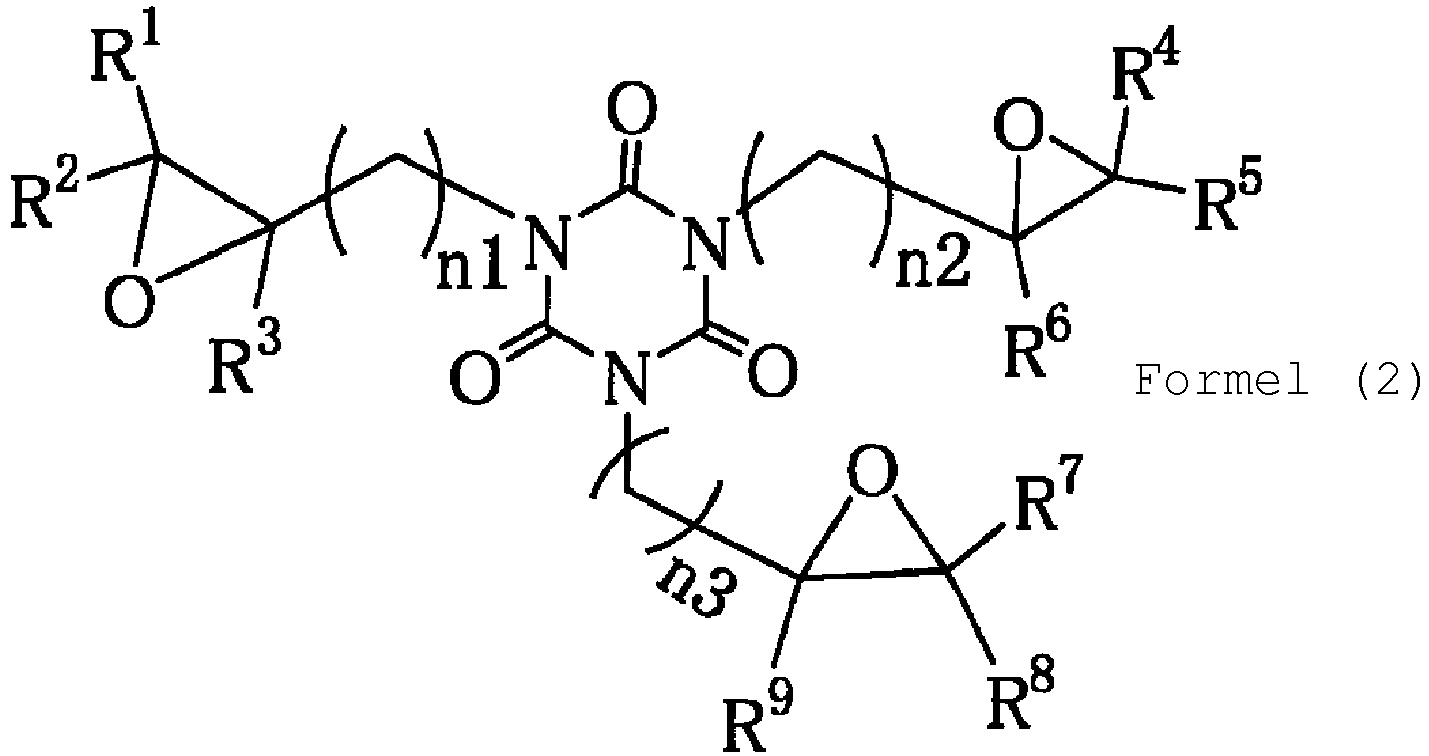

wobei die Triolefinverbindung der Formel (1) eine Verbindung ist, die aus den Verbindungen der Formeln (A-1) bis (A-7) ausgewählt ist, und die Epoxidverbindung der Formel (2) die entsprechende Epoxidverbindung ist, die aus den Verbindungen der Formeln (B-1) bis (B-7) ausgewählt ist:


- Verfahren gemäß Anspruch 1, wobei die Nitrilverbindung eine aliphatische Nitrilverbindung oder eine aromatische Nitrilverbindung ist.
- Verfahren gemäß Anspruch 1 oder 2, wobei die alkalische Substanz ein Phosphat, ein Carbonat oder ein Alkalimetallhydroxid ist.
- Verfahren gemäß einem der Ansprüche 1 bis 3, wobei das Lösungsmittel Alkohol ist.
- Verfahren gemäß einem der Ansprüche 1 bis 4, wobei die Triolefinverbindung der Formel (1) durch eine Reaktion von Cyanursäure oder Cyanurat mit einem ungesättigten C3-9-Alkohol mit einer modifizierten Hydroxylgruppe in dem Lösungsmittel erhalten wird, wobei die modifizierende Gruppe der Hydroxylgruppe in dem ungesättigten Alkohol eine Sulfonylgruppe ist.
- Verfahren gemäß Anspruch 5, wobei die Sulfonylgruppe eine p-Toluolsulfonylgruppe, o-Nitrobenzolsulfonylgruppe oder eine Methansulfonylgruppe ist.
Applications Claiming Priority (2)
| Application Number | Priority Date | Filing Date | Title |
|---|---|---|---|
| JP2012235374 | 2012-10-25 | ||
| PCT/JP2013/078480 WO2014065239A1 (ja) | 2012-10-25 | 2013-10-21 | エポキシ化合物の製造方法 |
Publications (4)
| Publication Number | Publication Date |
|---|---|
| EP2913331A1 EP2913331A1 (de) | 2015-09-02 |
| EP2913331A4 EP2913331A4 (de) | 2016-04-06 |
| EP2913331B1 true EP2913331B1 (de) | 2018-09-12 |
| EP2913331B8 EP2913331B8 (de) | 2018-10-31 |
Family
ID=50544619
Family Applications (1)
| Application Number | Title | Priority Date | Filing Date |
|---|---|---|---|
| EP13849469.5A Active EP2913331B8 (de) | 2012-10-25 | 2013-10-21 | Verfahren zur herstellung einer epoxidverbindung |
Country Status (7)
| Country | Link |
|---|---|
| US (1) | US9464074B2 (de) |
| EP (1) | EP2913331B8 (de) |
| JP (1) | JP6315205B2 (de) |
| KR (1) | KR102126788B1 (de) |
| CN (1) | CN104797576B (de) |
| TW (1) | TWI643852B (de) |
| WO (1) | WO2014065239A1 (de) |
Families Citing this family (6)
| Publication number | Priority date | Publication date | Assignee | Title |
|---|---|---|---|---|
| WO2016027735A1 (ja) * | 2014-08-20 | 2016-02-25 | 日産化学工業株式会社 | 過酸化水素の安定化剤を含有するエポキシ化合物の製造方法 |
| CN104892586B (zh) * | 2015-05-31 | 2017-05-10 | 黄山华惠科技有限公司 | 制备异氰脲酸三缩水甘油酯的新方法 |
| TWI631193B (zh) * | 2016-02-26 | 2018-08-01 | 奇美實業股份有限公司 | 防濕絕緣塗料及其應用 |
| KR20190140474A (ko) * | 2017-05-09 | 2019-12-19 | 닛산 가가쿠 가부시키가이샤 | 에폭시 화합물의 제조방법 |
| CN111253329B (zh) * | 2020-04-14 | 2022-11-29 | 湖南方锐达科技有限公司 | 一种三烯丙基异氰脲酸酯的制备工艺 |
| CN112500399B (zh) * | 2020-12-02 | 2024-03-12 | 黄山华惠科技有限公司 | 一种低氯无ech残留tgic固化剂及其制备方法 |
Family Cites Families (15)
| Publication number | Priority date | Publication date | Assignee | Title |
|---|---|---|---|---|
| US3376301A (en) * | 1960-08-24 | 1968-04-02 | Gulf Oil Corp | Method of producing triallylic isocyanurates |
| US3793321A (en) * | 1970-07-02 | 1974-02-19 | Ciba Geigy Ag | Process for the manufacture of triglycidylisocyanurate |
| JPS59227872A (ja) | 1983-06-08 | 1984-12-21 | Sumitomo Chem Co Ltd | エポキシ化合物の製造方法 |
| JPS62114979A (ja) | 1985-11-13 | 1987-05-26 | Sanyo Kokusaku Pulp Co Ltd | オレフインのエポキシ化法 |
| JPH07206835A (ja) * | 1994-01-26 | 1995-08-08 | Idemitsu Kosan Co Ltd | スチレンオキシド誘導体の製造方法 |
| WO1998000407A1 (en) * | 1996-07-01 | 1998-01-08 | Daikin Industries, Ltd. | Fluorinated triallyl isocyanurates, vulcanizable elastomer compositions containing the same, and method for vulcanization |
| JP2002145872A (ja) | 2000-11-01 | 2002-05-22 | Maruzen Petrochem Co Ltd | エポキシ化合物の製造方法 |
| JP2008239579A (ja) | 2007-03-28 | 2008-10-09 | Tokuyama Corp | エポキシ化合物の製造方法 |
| JP5385546B2 (ja) * | 2008-04-18 | 2014-01-08 | 株式会社クラレ | エポキシアルコールの製造方法 |
| JP5793831B2 (ja) * | 2009-05-25 | 2015-10-14 | 日本化成株式会社 | トリアリルイソシアヌレートの貯蔵方法 |
| CN102725691B (zh) * | 2010-01-26 | 2014-06-11 | 日产化学工业株式会社 | 正型抗蚀剂组合物及图案形成方法、固体摄像元件 |
| JP2011195483A (ja) * | 2010-03-18 | 2011-10-06 | Nippon Steel Chem Co Ltd | トリエポキシエチルシクロヘキサン及びエポキシ樹脂の製造方法 |
| WO2012008308A1 (ja) | 2010-07-14 | 2012-01-19 | 昭和電工株式会社 | エポキシ化合物の製造方法 |
| JP2012025688A (ja) | 2010-07-22 | 2012-02-09 | National Institute Of Advanced Industrial Science & Technology | エポキシ化合物の製造方法 |
| CN102603721A (zh) * | 2012-02-17 | 2012-07-25 | 湖南大学 | 一种异氰脲酸三缩水甘油酯的制备方法 |
-
2013
- 2013-10-21 CN CN201380048998.6A patent/CN104797576B/zh active Active
- 2013-10-21 WO PCT/JP2013/078480 patent/WO2014065239A1/ja not_active Ceased
- 2013-10-21 KR KR1020157010410A patent/KR102126788B1/ko active Active
- 2013-10-21 US US14/438,374 patent/US9464074B2/en active Active
- 2013-10-21 EP EP13849469.5A patent/EP2913331B8/de active Active
- 2013-10-21 JP JP2014543283A patent/JP6315205B2/ja active Active
- 2013-10-25 TW TW102138683A patent/TWI643852B/zh active
Non-Patent Citations (1)
| Title |
|---|
| None * |
Also Published As
| Publication number | Publication date |
|---|---|
| JP6315205B2 (ja) | 2018-04-25 |
| EP2913331B8 (de) | 2018-10-31 |
| TWI643852B (zh) | 2018-12-11 |
| EP2913331A4 (de) | 2016-04-06 |
| WO2014065239A1 (ja) | 2014-05-01 |
| KR20150070190A (ko) | 2015-06-24 |
| TW201429961A (zh) | 2014-08-01 |
| CN104797576A (zh) | 2015-07-22 |
| KR102126788B1 (ko) | 2020-06-25 |
| EP2913331A1 (de) | 2015-09-02 |
| US9464074B2 (en) | 2016-10-11 |
| CN104797576B (zh) | 2018-05-01 |
| US20150284372A1 (en) | 2015-10-08 |
| JPWO2014065239A1 (ja) | 2016-09-08 |
Similar Documents
| Publication | Publication Date | Title |
|---|---|---|
| TWI477498B (zh) | 含有長鏈伸烷基之環氧化合物 | |
| KR101926076B1 (ko) | 다관능 에폭시 화합물 | |
| EP3702356B1 (de) | Epoxid-oxetan-verbindung verfahren zu ihrer herstellung und ihre verwendung | |
| KR20150070190A (ko) | 에폭시 화합물의 제조방법 | |
| WO2007094173A1 (ja) | アダマンタン誘導体、それを含有する組成物及びその組成物を用いた光学電子部材 | |
| JP5973401B2 (ja) | グリシジルグリコールウリル類とその利用 | |
| US10005742B2 (en) | Method for producing epoxy compound containing hydrogen peroxide stabilizer | |
| JP2011195483A (ja) | トリエポキシエチルシクロヘキサン及びエポキシ樹脂の製造方法 | |
| WO2015093461A1 (ja) | エポキシ樹脂、その製造方法、エポキシ樹脂組成物およびその硬化物 | |
| KR101821574B1 (ko) | 질소 함유 고리를 갖는 에폭시 화합물 | |
| KR101734189B1 (ko) | 시아누르산 골격을 갖는 에폭시 화합물의 제조방법 | |
| JP2012188379A (ja) | チイラン化合物及びその硬化物 | |
| KR20080013902A (ko) | 에폭시 수지, 그 제조 방법 및 그 용도 | |
| JP5832821B2 (ja) | エポキシ化合物、及びその製造方法 | |
| JP2013163651A (ja) | オキセタン環を有するイソシアヌレート化合物 | |
| KR20250152004A (ko) | 환상 아미노오르가녹시실란 화합물 및 그의 제조 방법 | |
| JP2014058454A (ja) | 新規なイソシアヌレート化合物 | |
| JPWO2018116872A1 (ja) | 含窒素環状化合物及びその製造方法 |
Legal Events
| Date | Code | Title | Description |
|---|---|---|---|
| PUAI | Public reference made under article 153(3) epc to a published international application that has entered the european phase |
Free format text: ORIGINAL CODE: 0009012 |
|
| 17P | Request for examination filed |
Effective date: 20150518 |
|
| AK | Designated contracting states |
Kind code of ref document: A1 Designated state(s): AL AT BE BG CH CY CZ DE DK EE ES FI FR GB GR HR HU IE IS IT LI LT LU LV MC MK MT NL NO PL PT RO RS SE SI SK SM TR |
|
| AX | Request for extension of the european patent |
Extension state: BA ME |
|
| DAX | Request for extension of the european patent (deleted) | ||
| RA4 | Supplementary search report drawn up and despatched (corrected) |
Effective date: 20160304 |
|
| RIC1 | Information provided on ipc code assigned before grant |
Ipc: C07D 405/14 20060101AFI20160229BHEP |
|
| 17Q | First examination report despatched |
Effective date: 20170124 |
|
| GRAP | Despatch of communication of intention to grant a patent |
Free format text: ORIGINAL CODE: EPIDOSNIGR1 |
|
| INTG | Intention to grant announced |
Effective date: 20180516 |
|
| GRAS | Grant fee paid |
Free format text: ORIGINAL CODE: EPIDOSNIGR3 |
|
| GRAA | (expected) grant |
Free format text: ORIGINAL CODE: 0009210 |
|
| GRAT | Correction requested after decision to grant or after decision to maintain patent in amended form |
Free format text: ORIGINAL CODE: EPIDOSNCDEC |
|
| AK | Designated contracting states |
Kind code of ref document: B1 Designated state(s): AL AT BE BG CH CY CZ DE DK EE ES FI FR GB GR HR HU IE IS IT LI LT LU LV MC MK MT NL NO PL PT RO RS SE SI SK SM TR |
|
| REG | Reference to a national code |
Ref country code: GB Ref legal event code: FG4D |
|
| REG | Reference to a national code |
Ref country code: CH Ref legal event code: EP |
|
| RAP2 | Party data changed (patent owner data changed or rights of a patent transferred) |
Owner name: NISSAN CHEMICAL CORPORATION |
|
| REG | Reference to a national code |
Ref country code: IE Ref legal event code: FG4D |
|
| REG | Reference to a national code |
Ref country code: DE Ref legal event code: R096 Ref document number: 602013043671 Country of ref document: DE |
|
| REG | Reference to a national code |
Ref country code: CH Ref legal event code: PK Free format text: BERICHTIGUNG B8 Ref country code: AT Ref legal event code: REF Ref document number: 1040436 Country of ref document: AT Kind code of ref document: T Effective date: 20181015 |
|
| REG | Reference to a national code |
Ref country code: FR Ref legal event code: PLFP Year of fee payment: 6 |
|
| REG | Reference to a national code |
Ref country code: NL Ref legal event code: MP Effective date: 20180912 |
|
| REG | Reference to a national code |
Ref country code: LT Ref legal event code: MG4D |
|
| PG25 | Lapsed in a contracting state [announced via postgrant information from national office to epo] |
Ref country code: FI Free format text: LAPSE BECAUSE OF FAILURE TO SUBMIT A TRANSLATION OF THE DESCRIPTION OR TO PAY THE FEE WITHIN THE PRESCRIBED TIME-LIMIT Effective date: 20180912 Ref country code: SE Free format text: LAPSE BECAUSE OF FAILURE TO SUBMIT A TRANSLATION OF THE DESCRIPTION OR TO PAY THE FEE WITHIN THE PRESCRIBED TIME-LIMIT Effective date: 20180912 Ref country code: BG Free format text: LAPSE BECAUSE OF FAILURE TO SUBMIT A TRANSLATION OF THE DESCRIPTION OR TO PAY THE FEE WITHIN THE PRESCRIBED TIME-LIMIT Effective date: 20181212 Ref country code: RS Free format text: LAPSE BECAUSE OF FAILURE TO SUBMIT A TRANSLATION OF THE DESCRIPTION OR TO PAY THE FEE WITHIN THE PRESCRIBED TIME-LIMIT Effective date: 20180912 Ref country code: LT Free format text: LAPSE BECAUSE OF FAILURE TO SUBMIT A TRANSLATION OF THE DESCRIPTION OR TO PAY THE FEE WITHIN THE PRESCRIBED TIME-LIMIT Effective date: 20180912 Ref country code: NO Free format text: LAPSE BECAUSE OF FAILURE TO SUBMIT A TRANSLATION OF THE DESCRIPTION OR TO PAY THE FEE WITHIN THE PRESCRIBED TIME-LIMIT Effective date: 20181212 Ref country code: GR Free format text: LAPSE BECAUSE OF FAILURE TO SUBMIT A TRANSLATION OF THE DESCRIPTION OR TO PAY THE FEE WITHIN THE PRESCRIBED TIME-LIMIT Effective date: 20181213 |
|
| PG25 | Lapsed in a contracting state [announced via postgrant information from national office to epo] |
Ref country code: LV Free format text: LAPSE BECAUSE OF FAILURE TO SUBMIT A TRANSLATION OF THE DESCRIPTION OR TO PAY THE FEE WITHIN THE PRESCRIBED TIME-LIMIT Effective date: 20180912 Ref country code: AL Free format text: LAPSE BECAUSE OF FAILURE TO SUBMIT A TRANSLATION OF THE DESCRIPTION OR TO PAY THE FEE WITHIN THE PRESCRIBED TIME-LIMIT Effective date: 20180912 Ref country code: HR Free format text: LAPSE BECAUSE OF FAILURE TO SUBMIT A TRANSLATION OF THE DESCRIPTION OR TO PAY THE FEE WITHIN THE PRESCRIBED TIME-LIMIT Effective date: 20180912 |
|
| REG | Reference to a national code |
Ref country code: AT Ref legal event code: MK05 Ref document number: 1040436 Country of ref document: AT Kind code of ref document: T Effective date: 20180912 |
|
| PG25 | Lapsed in a contracting state [announced via postgrant information from national office to epo] |
Ref country code: ES Free format text: LAPSE BECAUSE OF FAILURE TO SUBMIT A TRANSLATION OF THE DESCRIPTION OR TO PAY THE FEE WITHIN THE PRESCRIBED TIME-LIMIT Effective date: 20180912 Ref country code: AT Free format text: LAPSE BECAUSE OF FAILURE TO SUBMIT A TRANSLATION OF THE DESCRIPTION OR TO PAY THE FEE WITHIN THE PRESCRIBED TIME-LIMIT Effective date: 20180912 Ref country code: IS Free format text: LAPSE BECAUSE OF FAILURE TO SUBMIT A TRANSLATION OF THE DESCRIPTION OR TO PAY THE FEE WITHIN THE PRESCRIBED TIME-LIMIT Effective date: 20190112 Ref country code: EE Free format text: LAPSE BECAUSE OF FAILURE TO SUBMIT A TRANSLATION OF THE DESCRIPTION OR TO PAY THE FEE WITHIN THE PRESCRIBED TIME-LIMIT Effective date: 20180912 Ref country code: PL Free format text: LAPSE BECAUSE OF FAILURE TO SUBMIT A TRANSLATION OF THE DESCRIPTION OR TO PAY THE FEE WITHIN THE PRESCRIBED TIME-LIMIT Effective date: 20180912 Ref country code: IT Free format text: LAPSE BECAUSE OF FAILURE TO SUBMIT A TRANSLATION OF THE DESCRIPTION OR TO PAY THE FEE WITHIN THE PRESCRIBED TIME-LIMIT Effective date: 20180912 Ref country code: RO Free format text: LAPSE BECAUSE OF FAILURE TO SUBMIT A TRANSLATION OF THE DESCRIPTION OR TO PAY THE FEE WITHIN THE PRESCRIBED TIME-LIMIT Effective date: 20180912 Ref country code: CZ Free format text: LAPSE BECAUSE OF FAILURE TO SUBMIT A TRANSLATION OF THE DESCRIPTION OR TO PAY THE FEE WITHIN THE PRESCRIBED TIME-LIMIT Effective date: 20180912 Ref country code: NL Free format text: LAPSE BECAUSE OF FAILURE TO SUBMIT A TRANSLATION OF THE DESCRIPTION OR TO PAY THE FEE WITHIN THE PRESCRIBED TIME-LIMIT Effective date: 20180912 |
|
| PG25 | Lapsed in a contracting state [announced via postgrant information from national office to epo] |
Ref country code: SM Free format text: LAPSE BECAUSE OF FAILURE TO SUBMIT A TRANSLATION OF THE DESCRIPTION OR TO PAY THE FEE WITHIN THE PRESCRIBED TIME-LIMIT Effective date: 20180912 Ref country code: PT Free format text: LAPSE BECAUSE OF FAILURE TO SUBMIT A TRANSLATION OF THE DESCRIPTION OR TO PAY THE FEE WITHIN THE PRESCRIBED TIME-LIMIT Effective date: 20190112 Ref country code: SK Free format text: LAPSE BECAUSE OF FAILURE TO SUBMIT A TRANSLATION OF THE DESCRIPTION OR TO PAY THE FEE WITHIN THE PRESCRIBED TIME-LIMIT Effective date: 20180912 |
|
| REG | Reference to a national code |
Ref country code: CH Ref legal event code: PL |
|
| REG | Reference to a national code |
Ref country code: DE Ref legal event code: R097 Ref document number: 602013043671 Country of ref document: DE |
|
| REG | Reference to a national code |
Ref country code: BE Ref legal event code: MM Effective date: 20181031 |
|
| PG25 | Lapsed in a contracting state [announced via postgrant information from national office to epo] |
Ref country code: LU Free format text: LAPSE BECAUSE OF NON-PAYMENT OF DUE FEES Effective date: 20181021 |
|
| PLBE | No opposition filed within time limit |
Free format text: ORIGINAL CODE: 0009261 |
|
| STAA | Information on the status of an ep patent application or granted ep patent |
Free format text: STATUS: NO OPPOSITION FILED WITHIN TIME LIMIT |
|
| REG | Reference to a national code |
Ref country code: IE Ref legal event code: MM4A |
|
| PG25 | Lapsed in a contracting state [announced via postgrant information from national office to epo] |
Ref country code: MC Free format text: LAPSE BECAUSE OF FAILURE TO SUBMIT A TRANSLATION OF THE DESCRIPTION OR TO PAY THE FEE WITHIN THE PRESCRIBED TIME-LIMIT Effective date: 20180912 Ref country code: DK Free format text: LAPSE BECAUSE OF FAILURE TO SUBMIT A TRANSLATION OF THE DESCRIPTION OR TO PAY THE FEE WITHIN THE PRESCRIBED TIME-LIMIT Effective date: 20180912 |
|
| 26N | No opposition filed |
Effective date: 20190613 |
|
| PG25 | Lapsed in a contracting state [announced via postgrant information from national office to epo] |
Ref country code: BE Free format text: LAPSE BECAUSE OF NON-PAYMENT OF DUE FEES Effective date: 20181031 Ref country code: CH Free format text: LAPSE BECAUSE OF NON-PAYMENT OF DUE FEES Effective date: 20181031 Ref country code: SI Free format text: LAPSE BECAUSE OF FAILURE TO SUBMIT A TRANSLATION OF THE DESCRIPTION OR TO PAY THE FEE WITHIN THE PRESCRIBED TIME-LIMIT Effective date: 20180912 Ref country code: LI Free format text: LAPSE BECAUSE OF NON-PAYMENT OF DUE FEES Effective date: 20181031 |
|
| PG25 | Lapsed in a contracting state [announced via postgrant information from national office to epo] |
Ref country code: IE Free format text: LAPSE BECAUSE OF NON-PAYMENT OF DUE FEES Effective date: 20181021 |
|
| PG25 | Lapsed in a contracting state [announced via postgrant information from national office to epo] |
Ref country code: MT Free format text: LAPSE BECAUSE OF NON-PAYMENT OF DUE FEES Effective date: 20181021 |
|
| PG25 | Lapsed in a contracting state [announced via postgrant information from national office to epo] |
Ref country code: TR Free format text: LAPSE BECAUSE OF FAILURE TO SUBMIT A TRANSLATION OF THE DESCRIPTION OR TO PAY THE FEE WITHIN THE PRESCRIBED TIME-LIMIT Effective date: 20180912 |
|
| PG25 | Lapsed in a contracting state [announced via postgrant information from national office to epo] |
Ref country code: HU Free format text: LAPSE BECAUSE OF FAILURE TO SUBMIT A TRANSLATION OF THE DESCRIPTION OR TO PAY THE FEE WITHIN THE PRESCRIBED TIME-LIMIT; INVALID AB INITIO Effective date: 20131021 Ref country code: MK Free format text: LAPSE BECAUSE OF NON-PAYMENT OF DUE FEES Effective date: 20180912 Ref country code: CY Free format text: LAPSE BECAUSE OF FAILURE TO SUBMIT A TRANSLATION OF THE DESCRIPTION OR TO PAY THE FEE WITHIN THE PRESCRIBED TIME-LIMIT Effective date: 20180912 |
|
| P01 | Opt-out of the competence of the unified patent court (upc) registered |
Effective date: 20230522 |
|
| PGFP | Annual fee paid to national office [announced via postgrant information from national office to epo] |
Ref country code: GB Payment date: 20250828 Year of fee payment: 13 |
|
| PGFP | Annual fee paid to national office [announced via postgrant information from national office to epo] |
Ref country code: FR Payment date: 20250908 Year of fee payment: 13 |
|
| PGFP | Annual fee paid to national office [announced via postgrant information from national office to epo] |
Ref country code: DE Payment date: 20250902 Year of fee payment: 13 |