EP2894142B1 - Kondensierte cyclooctylverbindungen und deren verwendung in metallfreien click-reaktionen - Google Patents
Kondensierte cyclooctylverbindungen und deren verwendung in metallfreien click-reaktionen Download PDFInfo
- Publication number
- EP2894142B1 EP2894142B1 EP14191257.6A EP14191257A EP2894142B1 EP 2894142 B1 EP2894142 B1 EP 2894142B1 EP 14191257 A EP14191257 A EP 14191257A EP 2894142 B1 EP2894142 B1 EP 2894142B1
- Authority
- EP
- European Patent Office
- Prior art keywords
- groups
- hetero
- alkyl
- group
- aryl
- Prior art date
- Legal status (The legal status is an assumption and is not a legal conclusion. Google has not performed a legal analysis and makes no representation as to the accuracy of the status listed.)
- Active
Links
Classifications
-
- C—CHEMISTRY; METALLURGY
- C07—ORGANIC CHEMISTRY
- C07C—ACYCLIC OR CARBOCYCLIC COMPOUNDS
- C07C33/00—Unsaturated compounds having hydroxy or O-metal groups bound to acyclic carbon atoms
- C07C33/05—Alcohols containing rings other than six-membered aromatic rings
- C07C33/16—Alcohols containing rings other than six-membered aromatic rings containing rings with more than six ring members
-
- A—HUMAN NECESSITIES
- A61—MEDICAL OR VETERINARY SCIENCE; HYGIENE
- A61K—PREPARATIONS FOR MEDICAL, DENTAL OR TOILETRY PURPOSES
- A61K47/00—Medicinal preparations characterised by the non-active ingredients used, e.g. carriers or inert additives; Targeting or modifying agents chemically bound to the active ingredient
- A61K47/50—Medicinal preparations characterised by the non-active ingredients used, e.g. carriers or inert additives; Targeting or modifying agents chemically bound to the active ingredient the non-active ingredient being chemically bound to the active ingredient, e.g. polymer-drug conjugates
- A61K47/51—Medicinal preparations characterised by the non-active ingredients used, e.g. carriers or inert additives; Targeting or modifying agents chemically bound to the active ingredient the non-active ingredient being chemically bound to the active ingredient, e.g. polymer-drug conjugates the non-active ingredient being a modifying agent
- A61K47/54—Medicinal preparations characterised by the non-active ingredients used, e.g. carriers or inert additives; Targeting or modifying agents chemically bound to the active ingredient the non-active ingredient being chemically bound to the active ingredient, e.g. polymer-drug conjugates the non-active ingredient being a modifying agent the modifying agent being an organic compound
-
- A—HUMAN NECESSITIES
- A61—MEDICAL OR VETERINARY SCIENCE; HYGIENE
- A61K—PREPARATIONS FOR MEDICAL, DENTAL OR TOILETRY PURPOSES
- A61K49/00—Preparations for testing in vivo
- A61K49/001—Preparation for luminescence or biological staining
- A61K49/0013—Luminescence
- A61K49/0017—Fluorescence in vivo
- A61K49/005—Fluorescence in vivo characterised by the carrier molecule carrying the fluorescent agent
- A61K49/0052—Small organic molecules
-
- C—CHEMISTRY; METALLURGY
- C07—ORGANIC CHEMISTRY
- C07C—ACYCLIC OR CARBOCYCLIC COMPOUNDS
- C07C269/00—Preparation of derivatives of carbamic acid, i.e. compounds containing any of the groups, the nitrogen atom not being part of nitro or nitroso groups
- C07C269/06—Preparation of derivatives of carbamic acid, i.e. compounds containing any of the groups, the nitrogen atom not being part of nitro or nitroso groups by reactions not involving the formation of carbamate groups
-
- C—CHEMISTRY; METALLURGY
- C07—ORGANIC CHEMISTRY
- C07C—ACYCLIC OR CARBOCYCLIC COMPOUNDS
- C07C271/00—Derivatives of carbamic acids, i.e. compounds containing any of the groups, the nitrogen atom not being part of nitro or nitroso groups
- C07C271/06—Esters of carbamic acids
- C07C271/08—Esters of carbamic acids having oxygen atoms of carbamate groups bound to acyclic carbon atoms
- C07C271/10—Esters of carbamic acids having oxygen atoms of carbamate groups bound to acyclic carbon atoms with the nitrogen atoms of the carbamate groups bound to hydrogen atoms or to acyclic carbon atoms
- C07C271/12—Esters of carbamic acids having oxygen atoms of carbamate groups bound to acyclic carbon atoms with the nitrogen atoms of the carbamate groups bound to hydrogen atoms or to acyclic carbon atoms to hydrogen atoms or to carbon atoms of unsubstituted hydrocarbon radicals
-
- C—CHEMISTRY; METALLURGY
- C07—ORGANIC CHEMISTRY
- C07C—ACYCLIC OR CARBOCYCLIC COMPOUNDS
- C07C271/00—Derivatives of carbamic acids, i.e. compounds containing any of the groups, the nitrogen atom not being part of nitro or nitroso groups
- C07C271/06—Esters of carbamic acids
- C07C271/08—Esters of carbamic acids having oxygen atoms of carbamate groups bound to acyclic carbon atoms
- C07C271/10—Esters of carbamic acids having oxygen atoms of carbamate groups bound to acyclic carbon atoms with the nitrogen atoms of the carbamate groups bound to hydrogen atoms or to acyclic carbon atoms
- C07C271/16—Esters of carbamic acids having oxygen atoms of carbamate groups bound to acyclic carbon atoms with the nitrogen atoms of the carbamate groups bound to hydrogen atoms or to acyclic carbon atoms to carbon atoms of hydrocarbon radicals substituted by singly-bound oxygen atoms
-
- C—CHEMISTRY; METALLURGY
- C07—ORGANIC CHEMISTRY
- C07C—ACYCLIC OR CARBOCYCLIC COMPOUNDS
- C07C271/00—Derivatives of carbamic acids, i.e. compounds containing any of the groups, the nitrogen atom not being part of nitro or nitroso groups
- C07C271/06—Esters of carbamic acids
- C07C271/08—Esters of carbamic acids having oxygen atoms of carbamate groups bound to acyclic carbon atoms
- C07C271/10—Esters of carbamic acids having oxygen atoms of carbamate groups bound to acyclic carbon atoms with the nitrogen atoms of the carbamate groups bound to hydrogen atoms or to acyclic carbon atoms
- C07C271/20—Esters of carbamic acids having oxygen atoms of carbamate groups bound to acyclic carbon atoms with the nitrogen atoms of the carbamate groups bound to hydrogen atoms or to acyclic carbon atoms to carbon atoms of hydrocarbon radicals substituted by nitrogen atoms not being part of nitro or nitroso groups
-
- C—CHEMISTRY; METALLURGY
- C07—ORGANIC CHEMISTRY
- C07C—ACYCLIC OR CARBOCYCLIC COMPOUNDS
- C07C29/00—Preparation of compounds having hydroxy or O-metal groups bound to a carbon atom not belonging to a six-membered aromatic ring
- C07C29/132—Preparation of compounds having hydroxy or O-metal groups bound to a carbon atom not belonging to a six-membered aromatic ring by reduction of an oxygen containing functional group
- C07C29/136—Preparation of compounds having hydroxy or O-metal groups bound to a carbon atom not belonging to a six-membered aromatic ring by reduction of an oxygen containing functional group of >C=O containing groups, e.g. —COOH
- C07C29/147—Preparation of compounds having hydroxy or O-metal groups bound to a carbon atom not belonging to a six-membered aromatic ring by reduction of an oxygen containing functional group of >C=O containing groups, e.g. —COOH of carboxylic acids or derivatives thereof
-
- C—CHEMISTRY; METALLURGY
- C07—ORGANIC CHEMISTRY
- C07C—ACYCLIC OR CARBOCYCLIC COMPOUNDS
- C07C29/00—Preparation of compounds having hydroxy or O-metal groups bound to a carbon atom not belonging to a six-membered aromatic ring
- C07C29/58—Preparation of compounds having hydroxy or O-metal groups bound to a carbon atom not belonging to a six-membered aromatic ring by elimination of halogen, e.g. by hydrogenolysis, splitting-off
-
- C—CHEMISTRY; METALLURGY
- C07—ORGANIC CHEMISTRY
- C07C—ACYCLIC OR CARBOCYCLIC COMPOUNDS
- C07C29/00—Preparation of compounds having hydroxy or O-metal groups bound to a carbon atom not belonging to a six-membered aromatic ring
- C07C29/62—Preparation of compounds having hydroxy or O-metal groups bound to a carbon atom not belonging to a six-membered aromatic ring by introduction of halogen; by substitution of halogen atoms by other halogen atoms
-
- C—CHEMISTRY; METALLURGY
- C07—ORGANIC CHEMISTRY
- C07C—ACYCLIC OR CARBOCYCLIC COMPOUNDS
- C07C62/00—Compounds having carboxyl groups bound to carbon atoms of rings other than six—membered aromatic rings and containing any of the groups OH, O—metal, —CHO, keto, ether, groups, groups, or groups
- C07C62/30—Unsaturated compounds
-
- C—CHEMISTRY; METALLURGY
- C07—ORGANIC CHEMISTRY
- C07C—ACYCLIC OR CARBOCYCLIC COMPOUNDS
- C07C67/00—Preparation of carboxylic acid esters
- C07C67/30—Preparation of carboxylic acid esters by modifying the acid moiety of the ester, such modification not being an introduction of an ester group
- C07C67/333—Preparation of carboxylic acid esters by modifying the acid moiety of the ester, such modification not being an introduction of an ester group by isomerisation; by change of size of the carbon skeleton
- C07C67/343—Preparation of carboxylic acid esters by modifying the acid moiety of the ester, such modification not being an introduction of an ester group by isomerisation; by change of size of the carbon skeleton by increase in the number of carbon atoms
- C07C67/347—Preparation of carboxylic acid esters by modifying the acid moiety of the ester, such modification not being an introduction of an ester group by isomerisation; by change of size of the carbon skeleton by increase in the number of carbon atoms by addition to unsaturated carbon-to-carbon bonds
-
- C—CHEMISTRY; METALLURGY
- C07—ORGANIC CHEMISTRY
- C07D—HETEROCYCLIC COMPOUNDS
- C07D311/00—Heterocyclic compounds containing six-membered rings having one oxygen atom as the only hetero atom, condensed with other rings
- C07D311/02—Heterocyclic compounds containing six-membered rings having one oxygen atom as the only hetero atom, condensed with other rings ortho- or peri-condensed with carbocyclic rings or ring systems
- C07D311/78—Ring systems having three or more relevant rings
- C07D311/80—Dibenzopyrans; Hydrogenated dibenzopyrans
- C07D311/82—Xanthenes
-
- C—CHEMISTRY; METALLURGY
- C07—ORGANIC CHEMISTRY
- C07D—HETEROCYCLIC COMPOUNDS
- C07D495/00—Heterocyclic compounds containing in the condensed system at least one hetero ring having sulfur atoms as the only ring hetero atoms
- C07D495/02—Heterocyclic compounds containing in the condensed system at least one hetero ring having sulfur atoms as the only ring hetero atoms in which the condensed system contains two hetero rings
- C07D495/04—Ortho-condensed systems
-
- C—CHEMISTRY; METALLURGY
- C07—ORGANIC CHEMISTRY
- C07K—PEPTIDES
- C07K14/00—Peptides having more than 20 amino acids; Gastrins; Somatostatins; Melanotropins; Derivatives thereof
- C07K14/435—Peptides having more than 20 amino acids; Gastrins; Somatostatins; Melanotropins; Derivatives thereof from animals; from humans
- C07K14/46—Peptides having more than 20 amino acids; Gastrins; Somatostatins; Melanotropins; Derivatives thereof from animals; from humans from vertebrates
- C07K14/47—Peptides having more than 20 amino acids; Gastrins; Somatostatins; Melanotropins; Derivatives thereof from animals; from humans from vertebrates from mammals
-
- G—PHYSICS
- G01—MEASURING; TESTING
- G01N—INVESTIGATING OR ANALYSING MATERIALS BY DETERMINING THEIR CHEMICAL OR PHYSICAL PROPERTIES
- G01N21/00—Investigating or analysing materials by the use of optical means, i.e. using sub-millimetre waves, infrared, visible or ultraviolet light
- G01N21/62—Systems in which the material investigated is excited whereby it emits light or causes a change in wavelength of the incident light
- G01N21/63—Systems in which the material investigated is excited whereby it emits light or causes a change in wavelength of the incident light optically excited
- G01N21/64—Fluorescence; Phosphorescence
- G01N21/6428—Measuring fluorescence of fluorescent products of reactions or of fluorochrome labelled reactive substances, e.g. measuring quenching effects, using measuring "optrodes"
-
- G—PHYSICS
- G01—MEASURING; TESTING
- G01N—INVESTIGATING OR ANALYSING MATERIALS BY DETERMINING THEIR CHEMICAL OR PHYSICAL PROPERTIES
- G01N33/00—Investigating or analysing materials by specific methods not covered by groups G01N1/00 - G01N31/00
- G01N33/48—Biological material, e.g. blood, urine; Haemocytometers
- G01N33/50—Chemical analysis of biological material, e.g. blood, urine; Testing involving biospecific ligand binding methods; Immunological testing
- G01N33/53—Immunoassay; Biospecific binding assay; Materials therefor
- G01N33/531—Production of immunochemical test materials
- G01N33/532—Production of labelled immunochemicals
-
- G—PHYSICS
- G01—MEASURING; TESTING
- G01N—INVESTIGATING OR ANALYSING MATERIALS BY DETERMINING THEIR CHEMICAL OR PHYSICAL PROPERTIES
- G01N33/00—Investigating or analysing materials by specific methods not covered by groups G01N1/00 - G01N31/00
- G01N33/48—Biological material, e.g. blood, urine; Haemocytometers
- G01N33/50—Chemical analysis of biological material, e.g. blood, urine; Testing involving biospecific ligand binding methods; Immunological testing
- G01N33/58—Chemical analysis of biological material, e.g. blood, urine; Testing involving biospecific ligand binding methods; Immunological testing involving labelled substances
- G01N33/582—Chemical analysis of biological material, e.g. blood, urine; Testing involving biospecific ligand binding methods; Immunological testing involving labelled substances with fluorescent label
-
- G—PHYSICS
- G01—MEASURING; TESTING
- G01N—INVESTIGATING OR ANALYSING MATERIALS BY DETERMINING THEIR CHEMICAL OR PHYSICAL PROPERTIES
- G01N33/00—Investigating or analysing materials by specific methods not covered by groups G01N1/00 - G01N31/00
- G01N33/48—Biological material, e.g. blood, urine; Haemocytometers
- G01N33/50—Chemical analysis of biological material, e.g. blood, urine; Testing involving biospecific ligand binding methods; Immunological testing
- G01N33/58—Chemical analysis of biological material, e.g. blood, urine; Testing involving biospecific ligand binding methods; Immunological testing involving labelled substances
- G01N33/585—Chemical analysis of biological material, e.g. blood, urine; Testing involving biospecific ligand binding methods; Immunological testing involving labelled substances with a particulate label, e.g. coloured latex
-
- G—PHYSICS
- G01—MEASURING; TESTING
- G01N—INVESTIGATING OR ANALYSING MATERIALS BY DETERMINING THEIR CHEMICAL OR PHYSICAL PROPERTIES
- G01N33/00—Investigating or analysing materials by specific methods not covered by groups G01N1/00 - G01N31/00
- G01N33/48—Biological material, e.g. blood, urine; Haemocytometers
- G01N33/50—Chemical analysis of biological material, e.g. blood, urine; Testing involving biospecific ligand binding methods; Immunological testing
- G01N33/68—Chemical analysis of biological material, e.g. blood, urine; Testing involving biospecific ligand binding methods; Immunological testing involving proteins, peptides or amino acids
- G01N33/6803—General methods of protein analysis not limited to specific proteins or families of proteins
- G01N33/6848—Methods of protein analysis involving mass spectrometry
-
- C—CHEMISTRY; METALLURGY
- C07—ORGANIC CHEMISTRY
- C07C—ACYCLIC OR CARBOCYCLIC COMPOUNDS
- C07C2602/00—Systems containing two condensed rings
- C07C2602/02—Systems containing two condensed rings the rings having only two atoms in common
- C07C2602/14—All rings being cycloaliphatic
- C07C2602/24—All rings being cycloaliphatic the ring system containing nine carbon atoms, e.g. perhydroindane
-
- G—PHYSICS
- G01—MEASURING; TESTING
- G01N—INVESTIGATING OR ANALYSING MATERIALS BY DETERMINING THEIR CHEMICAL OR PHYSICAL PROPERTIES
- G01N21/00—Investigating or analysing materials by the use of optical means, i.e. using sub-millimetre waves, infrared, visible or ultraviolet light
- G01N21/62—Systems in which the material investigated is excited whereby it emits light or causes a change in wavelength of the incident light
- G01N21/63—Systems in which the material investigated is excited whereby it emits light or causes a change in wavelength of the incident light optically excited
- G01N21/64—Fluorescence; Phosphorescence
- G01N21/6428—Measuring fluorescence of fluorescent products of reactions or of fluorochrome labelled reactive substances, e.g. measuring quenching effects, using measuring "optrodes"
- G01N2021/6439—Measuring fluorescence of fluorescent products of reactions or of fluorochrome labelled reactive substances, e.g. measuring quenching effects, using measuring "optrodes" with indicators, stains, dyes, tags, labels, marks
Definitions
- the invention relates to fused cyclooctyne compounds and to a method for their preparation.
- the fused cyclooctyne compounds according to the invention may be used in metal-free click reactions. Therefore, the invention further relates to a method for the modification of a target molecule by reaction of a fused cyclooctyne conjugate with a target molecule comprising a 1,3-dipole or a 1,3-(hetero)diene.
- the invention also relates to the use of cyclooctyne conjugates in bioorthogonal labeling, imaging or modification of a target molecule.
- a reaction is the cycloaddition of cyclic alkynes and azides, one of the reactions known as "click reactions”.
- This reaction has become a versatile tool for bioorthogonal labeling and imaging of biomolecules (such as for example proteins, lipids, glycans and the like), proteomics and materials science.
- biomolecules such as for example proteins, lipids, glycans and the like
- proteomics and materials science In essence, two separate molecular entities, one charged with an azide, and one charged with a strained cycloalkyne, will spontaneously combine into a single molecule by a reaction called strain-promoted azide-alkyne cycloaddition (SPAAC).
- SPAAC strain-promoted azide-alkyne cycloaddition
- SPAAC for bioorthogonal labeling lies in the fact that an isolated cyclic alkyne or azide is fully inert to biological functionalities, such as for example amines, thiols, acids or carbonyls, but in combination undergo rapid and irreversible cycloaddition leading to a stable triazole conjugate.
- biological functionalities such as for example amines, thiols, acids or carbonyls
- azido-modified proteins obtained by expression in auxotrophic bacteria, genetic engineering or chemical conversion, can be cleanly labeled with biotin, fluorophores, PEG-chains or other functionalities upon simply stirring the azido-protein with a cyclooctyne conjugate.
- the small size of azide has proven highly useful for application of SPAAC in the imaging of specific biomolecules by means of the chemical reporter strategy.
- cyclooctynes also show high reactivity with other dipoles, such as nitrones and nitrile oxides.
- other dipoles such as nitrones and nitrile oxides.
- SPANC strain-promoted alkyne-nitrone cycloaddition
- US 2009/0068738 relates to modified cycloalkyne compounds and their use in modifying biomolecules via a cycloaddition reaction that may be carried out under physiological conditions.
- the cycloaddition involves reacting a modified cycloalkyne, such as for example difluorinated cyclooctyne compounds DIFO, DIFO2 and DIFO3, with an azide moiety on a target biomolecule, generating a covalently modified biomolecule. It was observed that fluoride substitution has an accelerating effect on the cycloaddition with azide.
- DIBO and DIBAC were also found to undergo rapid cycloaddition with nitrones as described by Pezacki (Chem. Commun. 2010, 46, 931 - 933 ) and by van Delft (Angew. Chem. Int. Ed. 2010, 49, 3065 - 3068 ), with reaction rate constants up to 300 times higher than with azides.
- the present invention relates to a conjugate of the Formula (IIa) wherein:
- the present invention further relates to a compound of the Formula (IIa) wherein:
- Another aspect of the present invention is to provide a method for preparing a compound of the general Formula (IIa), the method comprising the steps of:
- the present invention also relates to a method for the modification of a target molecule, wherein a conjugate according to the invention is reacted with a compound comprising a 1,3-dipole or a 1,3-(hetero)diene.
- Yet another aspect of the present invention is the use of a conjugate according to the invention for bioorthogonal labeling, imaging or modification, such as for example surface modification, of a target molecule.
- the invention relates to a composition
- a composition comprising a conjugate according to the invention, further comprising a pharmaceutically acceptable carrier.
- indefinite article “a” or “an” does not exclude the possibility that more than one of the element is present, unless the context clearly requires that there is one and only one of the elements.
- the indefinite article “a” or “an” thus usually means “at least one”.
- the compounds disclosed in this description and in the claims may be described as fused cyclooctyne compounds, i.e. cyclooctyne compounds wherein a second ring structure is fused to the cyclooctyne moiety.
- the triple bond of the cyclooctyne moiety in a fused cyclooctyne compound may be located on either one of the three possible locations, i.e. on the 2, 3 or 4 position of the cyclooctyne moiety (numbering according to "IUPAC Nomenclature of Organic Chemistry", Rule A31.2).
- the description of any fused cyclooctyne compound in this description and in the claims is meant to include all three individual regioisomers of the cyclooctyne moiety.
- the compounds disclosed in this description and in the claims may comprise one or more asymmetric centres, and different diastereomers and/or enantiomers may exist of the compounds.
- the description of any compound in this description and in the claims is meant to include all diastereomers, and mixtures thereof, unless stated otherwise.
- the description of any compound in this description and in the claims is meant to include both the individual enantiomers, as well as any mixture, racemic or otherwise, of the enantiomers, unless stated otherwise.
- the structure of a compound is depicted as a specific enantiomer, it is to be understood that the invention of the present application is not limited to that specific enantiomer.
- the compounds may occur in different tautomeric forms.
- the compounds according to the invention are meant to include all tautomeric forms, unless stated otherwise.
- the compounds disclosed in this description and in the claims may exist as cis and trans isomers. Unless stated otherwise, the description of any compound in the description and in the claims is meant to include both the individual cis and the individual trans isomer of a compound, as well as mixtures thereof. As an example, when the structure of a compound is depicted as a cis isomer, it is to be understood that the corresponding trans isomer or mixtures of the cis and trans isomer are not excluded from the invention of the present application.
- Unsubstituted alkyl groups have the general formula C n H 2n+1 and may be linear or branched. Unsubstituted alkyl groups may also contain a cyclic moiety, and thus have the concomitant general formula C n H 2n-1 .
- the alkyl groups are substituted by one or more substituents further specified in this document. Examples of suitable alkyl groups include, but are not limited to, methyl, ethyl, propyl, 2-propyl, t-butyl, 1-hexyl, 1-dodecyl and the like.
- Unsubstituted alkenyl groups have the general formula C n H 2n-1 , and may be linear or branched.
- suitable alkenyl groups include, but are not limited to, ethenyl, propenyl, isopropenyl, butenyl, pentenyl, decenyl, octadecenyl, and eicosenyl and the like.
- Unsubstituted alkenyl groups may also contain a cyclic moiety, and thus have the concomitant general formula C n H 2n-3 .
- Unsubstituted alkenes have the general formula C n H 2n whereas unsubstituted alkynes have the general formula C n H 2n-2 .
- Aryl groups comprise at least six carbon atoms and may include monocyclic, bicyclic and polycyclic structures.
- the aryl groups may be substituted by one or more substituents further specified in this document.
- Examples of aryl groups include groups such as for example phenyl, naphthyl, anthracyl and the like.
- Arylalkyl groups and alkylaryl groups comprise at least seven carbon atoms and may include monocyclic and bicyclic structures.
- the aryl groups may be substituted by one or more substituents further specified in this document.
- An arylalkyl group is for example benzyl and the like.
- An alkylaryl group is for example 4-t-butylphenyl and the like.
- an aryl group is denoted as a (hetero)aryl group, the notation is meant to include an aryl group and a heteroaryl group.
- an alkyl(hetero)aryl group is meant to include an alkylaryl group and a alkylheteroaryl group
- (hetero)arylalkyl is meant to include an arylalkyl group and a heteroarylalkyl group.
- a heteroaryl group comprises one to four heteroatoms selected from the group consisting of oxygen, nitrogen and sulphur.
- strain energy is by benzannulation of cyclooctyne to aryl groups, the strategy followed in WO 2009/067663 for DIBO.
- the strain energy may then be further enhanced by introduction of another sp 2 -type atom in the ring, the approach followed by van Delft for DIBAC and by Bertozzi for BARAC.
- the presence of two aryl moieties in cyclooctyne not only gives rise to serious steric repulsion, but also increases the lipophilic character of the cyclooctyne compounds, which is undesired.
- the present inventors found that a very efficient way to induce additional ring strain involves fusion of a cyclooctyne to a 3- or 4-membered ring, leading to fused cyclooctyne compounds, more in particular to bicyclo[6.1.0]nonyne and bicyclo[6.2.0]decyne systems, respectively.
- These bicyclic systems are surprisingly well suited as bioorthogonal probes, since they combine relative stability with a high reactivity in (3+2) cycloadditions with 1,3-dipoles and in (hetero) Diels-Alder reactions with 1,3-(hetero)dienes.
- fused 3- or 4-membered ring structure apart from inflicting ring strain, is also perfectly suitable for the positioning of a handle for the conjugation to functional groups and/or labels and can be conveniently functionalized for applications such as bioorthogonal labeling, imaging and/or modification, such as for example surface modification, of target molecules.
- the present invention therefore relates to compounds of the general Formula (IIa) wherein:
- An advantage of the fused cyclooctyne compounds according to the present invention is that they are easily synthesized.
- a further advantage is that they are amenable to simple and straightforward modification of the various parts of the molecule.
- the triple bond is located on the 4-position of the cyclooctyne moiety, i.e. opposite to the fused 3-membered ring. This may result in a decreased number of potential regioisomers possible for (IIa), depending on the nature of the substituents on the cyclooctyne compound.
- the -[(L) p -Q] substituent on Z may be positioned on the exo or on the endo position respective to the cyclooctyne ring.
- the two R 1 -substitutents may be in a cis or in a trans position relative to each other.
- p is 0, i.e. Q is bonded directly to the cyclopropyl ring. In another embodiment, p is 1. In yet another embodiment, p is 1 and L is CH2.
- Q is preferably selected from the group consisting of -CN, -N 3 , -NCX, -XCN, -XR 6 , -N(R 6 ) 2 , - + N(R 6 ) 3 , -C(X)N(R 6 ) 2 , -C(R 6 ) 2 XR 6 , -C(X)R 6 , -C(X)XR 6 , -XC(X)R 6 , -XC(X)XR 6 , -XC(X)XR 6 , -XC(X)N(R 6 ) 2 , -N(R 6 )C(X)R 6 , -N(R 6 )C(X)XR 6 and -N(R 6 )C(X)N(R 6 ) 2 , wherein X and R 6 are as defined above.
- X is oxygen.
- Q is selected from the group consisting of -OR 6 , -N(R 6 ) 2 , - + N(R 6 ) 3 , -C(O)N(R 6 ) 2 , -C(O)OR 6 , -OC(O)R 6 , -OC(O)OR 6 , -OC(O)N(R 6 ) 2 , -N(R 6 )C(O)R 6 , -N(R 6 )C(O)OR 6 and -N(R 6 )C(O)N(R 6 ) 2 .
- the functional group Q may optionally be masked or protected.
- the R 6 groups may be selected independently from each other, which means that the two R 6 groups present in, for example, a -N(R 6 ) 2 substituent may be different from each other.
- Q is -OR 6 , preferably -OH.
- Q is -C(O)OR 6 .
- R 3 is hydrogen or [(L) p -Q].
- R 1 is hydrogen
- R 2 is an electron-withdrawing group, i.e. a group with a positive value for the Hammett substituent constant ⁇ .
- Suitable electron-withdrawing groups are known to a person skilled in the art, and include for example halogen (in particular F), -OR 6 , -NO 2 , -CN,-S(O) 2 R 6 , substituted C 1 - C 12 alkyl groups, substituted C 1 - C 12 aryl groups or substituted C 1 - C 12 alkylaryl groups, wherein the substituents are electron-withdrawing groups.
- the substituted alkyl groups, aryl groups and alkylaryl groups are fluorinated C 1 - C 12 alkyl groups (such as for example -CF 3 ), fluorinated C 1 - C 12 aryl groups (such as for example -C 6 F 5 ) or fluorinated C 1 - C 12 alkylaryl groups (such as for example -[3,5-(CF 3 ) 2 (C 6 H 3 )]).
- compounds of the Formula (IIa) are preferred since they may possess an axis or a plane of symmetry, thus reducing the number of potential regioisomers that may be formed.
- the two R 1 substituents may be positioned in a cis or in a trans position relative to each other. In a preferred embodiment, the R 1 substituents are in a cis position.
- p is 0, i.e. Q is bonded directly to N. In another embodiment, p is 1. In yet another embodiment, p is 1 and L is CH2.
- Q is preferably selected from the group consisting of -CN, -N 3 , -NCX, -XCN, -XR 6 , -N(R 6 ) 2 , - + N(R 6 ) 3 , -C(X)N(R 6 ) 2 , -C(R 6 ) 2 XR 6 , -C(X)R 6 , -C(X)XR 6 , -XC(X)R 6 , -XC(X)XR 6 , -XC(X)XR 6 , -XC(X)N(R 6 ) 2 , -N(R 6 )C(X)R 6 , -N(R 6 )C(X)XR 6 and -N(R 6 )C(X)N(R 6 ) 2 , wherein X and R 6 are as defined above.
- X is oxygen.
- Q is selected from the group consisting of -OR 6 , -N(R 6 ) 2 , - + N(R 6 ) 3 , -C(O)N(R 6 ) 2 , -C(O)OR 6 , -OC(O)R 6 , -OC(O)OR 6 , -OC(O)N(R 6 ) 2 , -N(R 6 )C(O)R 6 , -N(R 6 )C(O)OR 6 and -N(R 6 )C(O)N(R 6 ) 2 .
- the functional group Q may optionally be masked or protected.
- the R 6 groups may be selected independently from each other, which means that the two R 6 groups present in, for example, a -N(R 6 ) 2 substituent may be different from each other.
- R 1 is hydrogen
- R 2 is an electron-withdrawing group, i.e. a group with a positive value for the Hammett substituent constant ⁇ .
- Suitable electron-withdrawing groups are known to a person skilled in the art, and include for example halogen (in particular F), -OR 6 , -NO 2 , -CN,-S(O) 2 R 6 , substituted C 1 - C 12 alkyl groups, substituted C 1 - C 12 aryl groups or substituted C 1 - C 12 alkylaryl groups, wherein the substituents are electron-withdrawing groups.
- the substituted alkyl groups, aryl groups and alkylaryl groups are fluorinated C 1 - C 12 alkyl groups (such as for example -CF 3 ), fluorinated C 1 - C 12 aryl groups (such as for example -C 6 F 5 ) or fluorinated C 1 - C 12 alkylaryl groups (such as for example -[3,5-(CF 3 ) 2 (C 6 H 3 )]).
- compounds of the Formula (IIIa) are preferred since they possess an element of symmetry, thus reducing the number of potential regioisomers that may be formed.
- the -[(L) p -Q] substituent may be positioned exo or endo with respect to the cyclooctyne ring, and the two R 1 substituents may be positioned in a cis or in a trans position relative to each other.
- the Z-group i.e. the C-atom bonded to R 3 and to the -[(L) p -Q] substituent, is located at the 9-position of the fused cyclooctyne compound.
- the regioisomers of (IVb) and (IVc) wherein this Z-group is positioned on the 10-position of the fused bicyclodecyne compound are also included, whereby the -[(L) p -Q] substituent may be positioned on the exo or the endo position.
- p is 0, i.e. Q is bonded directly to the cyclobutyl ring. In another embodiment, p is 1. In yet another embodiment, p is 1 and L is CH2.
- Q is preferably selected from the group consisting of -CN, -N 3 , -NCX, -XCN, -XR 6 , -N(R 6 ) 2 , - + N(R 6 ) 3 , -C(X)N(R 6 ) 2 , -C(R 6 ) 2 XR 6 , -C(X)R 6 , -C(X)XR 6 , -XC(X)R 6 , -XC(X)XR 6 , -XC(X)XR 6 , -XC(X)N(R 6 ) 2 , -N(R 6 )C(X)R 6 , -N(R 6 )C(X)XR 6 and -N(R 6 )C(X)N(R 6 ) 2 , wherein X and R 6 are as defined above.
- X is oxygen.
- Q is selected from the group consisting of -OR 6 , -N(R 6 ) 2 , - + N(R 6 ) 3 , -C(O)N(R 6 ) 2 , -C(O)OR 6 , -OC(O)R 6 , -OC(O)OR 6 , -OC(O)N(R 6 ) 2 , -N(R 6 )C(O)R 6 , -N(R 6 )C(O)OR 6 and -N(R 6 )C(O)N(R 6 ) 2 .
- the functional group Q may optionally be masked or protected.
- the R 6 groups may be selected independently from each other, which means that the two R 6 groups present in, for example, a -N(R 6 ) 2 substituent may be different from each other.
- Y is O. In another preferred embodiment, Y is C(O). Both when Y is O and when Y is C(O), it is preferred that R 1 is hydrogen.
- R 2 is an electron-withdrawing group, i.e. a group with a positive value for the Hammett substituent constant ⁇ .
- Suitable electron-withdrawing groups are known to a person skilled in the art, and include for example halogen (in particular F), -OR 6 , -NO 2 , -CN,-S(O) 2 R 6 , substituted C 1 - C 12 alkyl groups, substituted C 1 - C 12 aryl groups or substituted C 1 - C 12 alkylaryl groups, wherein the substituents are electron-withdrawing groups.
- the substituted alkyl groups, aryl groups and alkylaryl groups are fluorinated C 1 - C 12 alkyl groups (such as for example -CF 3 ), fluorinated C 1 - C 12 aryl groups (such as for example -C 6 F 5 ) or fluorinated C 1 - C 12 alkylaryl groups (such as for example -[3,5-(CF 3 ) 2 (C 6 H 3 )]).
- the compound of Formula (IVa) is preferred.
- the triple bond is located on the 4-position of the cyclooctyne moiety, i.e. opposite to the fused cyclobutyl ring.
- the N-atom of the 4-membered ring is positioned on the 9-position of the bicyclic system.
- the present invention also relates to the regioisomers of Formula (Vb) or (Vc) wherein the N-atom of the 4-membered ring is positioned on the 10-position of the bicyclic system.
- the two R 1 -substituents may be positioned cis or trans with respect to each other.
- p is 0, i.e. Q is bonded directly to the 4-membered ring. In another embodiment, p is 1. In yet another embodiment, p is 1 and L is CH2.
- Q is preferably selected from the group consisting of -CN, -N 3 , -NCX, -XCN, -XR 6 , -N(R 6 ) 2 , - + N(R 6 ) 3 , -C(X)N(R 6 ) 2 , -C(R 6 ) 2 XR 6 , -C(X)R 6 , -C(X)XR 6 , -XC(X)R 6 , -XC(X)XR 6 , -XC(X)XR 6 , -XC(X)N(R 6 ) 2 , -N(R 6 )C(X)R 6 , -N(R 6 )C(X)XR 6 and -N(R 6 )C(X)N(R 6 ) 2 , wherein X and R 6 are as defined above.
- X is oxygen.
- Q is selected from the group consisting of -OR 6 , -N(R 6 ) 2 , - + N(R 6 ) 3 , -C(O)N(R 6 ) 2 , -C(O)OR 6 , -OC(O)R 6 , -OC(O)OR 6 , -OC(O)N(R 6 ) 2 , -N(R 6 )C(O)R 6 , -N(R 6 )C(O)OR 6 and -N(R 6 )C(O)N(R 6 ) 2 .
- the functional group Q may optionally be masked or protected.
- the R 6 groups may be selected independently from each other, which means that the two R 6 groups present in, for example, a -N(R 6 ) 2 substituent may be different from each other.
- R 5 is preferably hydrogen. Both when Y is C(R 5 ) 2 and when Y is C(O), it is preferred that R 1 is hydrogen.
- R 2 is an electron-withdrawing group, i.e. a group with a positive value for the Hammett substituent constant ⁇ .
- Suitable electron-withdrawing groups are known to a person skilled in the art, and include for example halogen (in particular F), -OR 6 , -NO 2 , -CN,-S(O) 2 R 6 , substituted C 1 - C 12 alkyl groups, substituted C 1 - C 12 aryl groups or substituted C 1 - C 12 alkylaryl groups, wherein the substituents are electron-withdrawing groups.
- the substituted alkyl groups, aryl groups and alkylaryl groups are fluorinated C 1 - C 12 alkyl groups (such as for example -CF 3 ), fluorinated C 1 - C 12 aryl groups (such as for example -C 6 F 5 ) or fluorinated C 1 - C 12 alkylaryl groups (such as for example -[3,5-(CF 3 ) 2 (C 6 H 3 )]).
- the compound of Formula (Va) wherein the triple bond is located on the 4-position of the cyclooctyne moiety, i.e. opposite to the fused cyclobutyl ring, is preferred.
- the -(L) p -Q substituent may be located on either the ortho or the meta position of the benzannulated aryl group, and also in compounds of the Formula (VIa), (VIb) and (VIc) the R 1 -substituents may be positioned cis or trans relative to each other.
- p is 0, i.e. Q is bonded directly to the aryl group. In another embodiment, p is 1. In yet another embodiment, p is 1 and L is CH2.
- Q is preferably selected, both for p is 0 as for p is 1, from the group consisting of -CN, -N 3 , -NCX, -XCN, -XR 6 , -N(R 6 ) 2 , - + N(R 6 ) 3 , -C(X)N(R 6 ) 2 , -C(R 6 ) 2 XR 6 , -C(X)R 6 , -C(X)XR 6 , -XC(X)R 6 , -XC(X)XR 6 , -XC(X)XR 6 , -XC(X)N(R 6 ) 2 , -N(R 6 )C(X)R 6 , -N(R 6 )C(X)XR 6 and -N(R 6 )C(X)N(R 6 ) 2 , wherein X and R 6 are as defined above.
- X is oxygen.
- Q is selected from the group consisting of -OR 6 , -N(R 6 ) 2 , - + N(R 6 ) 3 , -C(O)N(R 6 ) 2 , -C(O)OR 6 , -OC(O)R 6 , -OC(O)OR 6 , -OC(O)N(R 6 ) 2 , -N(R 6 )C(O)R 6 , -N(R 6 )C(O)OR 6 and -N(R 6 )C(O)N(R 6 ) 2 .
- the functional group Q may optionally be masked or protected.
- the R 6 groups may be selected independently from each other, which means that the two R 6 groups present in, for example, a -N(R 6 ) 2 substituent may be different from each other.
- R 1 is hydrogen.
- n is 0.
- R 2 is an electron-withdrawing group, i.e. a group with a positive value for the Hammett substituent constant ⁇ .
- Suitable electron-with drawing groups are known to a person skilled in the art, and include for example halogen (in particular F), -OR 6 , -NO 2 , -CN, -S(O) 2 R 6 , substituted C 1 - C 12 alkyl groups, substituted C 1 - C 12 aryl groups or substituted C 1 - C 12 alkylaryl groups, wherein the substituents are electron-withdrawing groups.
- the substituted alkyl groups, aryl groups and alkylaryl groups are fluorinated C 1 - C 12 alkyl groups (such as for example -CF 3 ), fluorinated C 1 - C 12 aryl groups (such as for example -C 6 F 5 ) or fluorinated C 1 - C 12 alkylaryl groups (such as for example -[3,5-(CF 3 ) 2 (C 6 H 3 )]).
- the compound of Formula (VIa) wherein the triple bond is located on the 4-position of the cyclooctyne moiety is preferred.
- the fused cyclooctyne compounds according to the present invention are very suitable for use in metal-free click reactions, and consequently these compounds are versatile tools in applications such as for example bioorthogonal labeling, imaging and/or modification, including surface modification, of a large range of target molecules. It is an aspect of the present invention to provide a conjugate wherein a compound of the Formula (IIa) according to the invention is conjugated to a label via a functional group Q.
- label refers to any identifying tag that may be conjugated to a compound of the Formula (IIa) according to the invention.
- a wide variety of labels are known in the art, for a wide variety of different applications. Depending on the specific application, a suitable label for that specific application may be selected.
- Suitable labels for specific applications include, but are not limited to, all kinds of fluorophores, biotin, polyethylene glycol (PEG) chains, polypropylene glycol (PPG) chains, mixed polyethylene/polypropylene glycol chains, radioactive isotopes, steroids, pharmaceutical compounds, lipids, peptides, glycans (including oligo- and polysaccharides), nucleotides (including oligo- and polynucleotides) and peptide tags.
- fluorophores are for example all kinds of Alexa Fluor (e.g. Alexa Fluor 555), cyanine dyes (e.g.
- Suitable peptide tags include FLAG or HIS tags.
- An example of a suitable glycan is concanavalin.
- the label is selected from the group comprising fluorophores, biotin, polyethylene glycol chains, polypropylene glycol chains, mixed polyethylene/polypropylene glycol chains, radioactive isotopes, steroids, pharmaceutical compounds, lipids, peptides, glycans, nucleotides and peptide tags.
- Functional group Q may be connected to the label directly, or indirectly via a linker or linking unit.
- Linking units are well know in the art, and have the general structure Q-S-Q, wherein Q is as defined above, and S is selected from the group consisting of linear or branched C 1 -C 200 alkylene groups, C 2 -C 200 alkenylene groups, C 2 -C 200 alkynylene groups, C 3 -C 200 cycloalkylene groups, C 5 -C 200 cycloalkenylene groups, C 8 -C 200 cycloalkynylene groups, C 7 -C 200 alkylarylene groups, C 7 -C 200 arylalkylene groups, C 8 -C 200 arylalkenylene groups, C 9 -C 200 arylalkynylene groups.
- alkylene groups, alkenylene groups, alkynylene groups, cycloalkylene groups, cycloalkenylene groups, cycloalkynylene groups, alkylarylene groups, arylalkylene groups, arylalkenylene groups and arylalkynylene groups may be substituted, and optionally said groups may be interrupted by one or more heteroatoms, preferably 1 to 100 heteroatoms, said heteroatoms preferably being selected from the group consisting of O, S and NR 6 , wherein R 6 is defined as above. Most preferably, the heteroatom is O.
- linking units include, but are not limited to, (poly)ethylene glycol diamines (such as for example 1,8-diamino-3,6-dioxaoctane or equivalents comprising longer ethylene glycol chains), polyethylene glycol or polyethylene oxide chains, polypropylene glycol or polypropylene oxide chains, 1,x-diaminoalkanes wherein x is the number of carbon atoms in the alkane, and the like.
- Another class of suitable linkers comprises cleavable linkers. Cleavable linkers are well known in the art.
- the invention relates to a conjugate of the Formula (IIa) wherein p is 1 and L is CH 2 .
- R 1 and/or R 3 are preferably H.
- n is 0 (Q, n, p, L, R 1 and R 3 as defined above).
- p is 1, L is CH 2 , R 1 is H, R 3 is H and n is 0.
- conjugated compound of the Formula (IIIa), (IIIb) and/or (IIIc) is conjugated to a label via a functional group Q.
- the conjugated compound of the Formula (IIIa), (IIIb) and/or (IIIc) is a compound wherein p is 1 and L is CH2.
- p is 0, thus functional group Q is bonded directly to the N-atom.
- R 1 is preferably H.
- n is 0 (Q, n, p, L, R 1 and R 3 as defined above).
- p is 1, L is CH2, R 1 is H and n is 0.
- p is 0, R 1 is H and n is 0.
- a conjugate wherein a compound of the Formula (IVa), (IVb) and/or (IVc) is conjugated to a label via a functional group Q.
- the conjugated compound of the Formula (IVa), (IVb) and/or (IVc) is a compound wherein p is 1 and L is CH2.
- R 1 and/or R 3 are preferably H, and Y is preferably C(O) or O.
- n is 0 (Q, n, p, L, R 1 and R 3 as defined above).
- Y is O or C(O)
- p is 1, L is CH2, R 1 is H, R 3 is H and n is 0.
- Y is O or C(O), p is 0, R 1 is H, R 3 is H and n is 0.
- a conjugate wherein a compound of the Formula (Va), (Vb) and/or (Vc) is conjugated to a label via a functional group Q.
- the conjugated compound of the Formula (Va), (Vb) and/or (Vc) is a compound wherein p is 1 and L is CH 2 .
- R 1 preferably is H.
- Y is preferably C(O).
- n is 0 (Q, n, p, L, Y, R 1 and R 3 as defined above).
- Y is C(O)
- p is 1, L is CH 2
- R 1 is H and n is 0.
- Y is C(O)
- p is 0, R 1 is H and n is 0.
- a conjugate wherein a compound of the Formula (VIa), (VIb) and/or (VIc) is conjugated to a label via a functional group Q.
- R 1 is H.
- p is 0, i.e. Q is bonded directly to the aryl group.
- the present invention also relates to the use of a conjugate according to the invention for bioorthogonal labeling, imaging or modification, such as for example surface modification, of a target molecule.
- the invention thus relates to a method for preparing a compound of the general Formula (IIa), the method comprising the steps of:
- the cyclooctadiene of the formula (VIIa) in step (a) may be a cis,cis- or a cis,trans -cyclooctadiene.
- the cyclooctadiene is a cic,cis- cyclooctadiene.
- the cyclooctadiene is a cis,trans- cyclooctadiene.
- the double bond comprising the R 1 -substituents may have the E- or the Z -configuration.
- R 1 is H. In another preferred embodiment, n is 0. In yet another preferred embodiment R 1 is H and n is 0.
- Functional group Q may be introduced at any point in the synthesis method.
- the functional group may be introduced during step (a), the formation of the bicyclic cyclooctene compound.
- the functional group may also be introduced in an additional step, for example before or after the bromination step (b) or after the dehydrobromination step (c).
- the strategy employed for the introduction of the functional group depends entirely on the nature of the specific functional group that needs to be introduced.
- step (a) the introduction of a fused 3- or 4-membered ring onto a cyclooctadiene of the formula (VIIa), (VIIb) or (VIIc), depends on the type of 3- or 4-membered ring that is introduced.
- a 3-membered ring comprising a N-atom may for example be fused to the cyclooctadiene via reaction with a nitrene-comprising compound to form compounds of the Formula (IIIa), (IIIb) or (IIIc).
- the introduction of a 4-membered ring to the cyclooctadiene to form compounds of the Formula (IVa), (IVb) or (IVc) wherein Y is C(O) may for example be accomplished by reaction of the cyclooctadiene with a ketene-comprising compound.
- the introduction of a 4-membered ring comprising a N-atom to the cyclooctadiene to form compounds of the Formula (Va), (Vb) or (Vc) wherein Y is C(O), i.e. ⁇ -lactam comprising compounds, may be accomplished via reaction of the cyclooctadiene with an (activated) isocyanate.
- Step (b), bromination of a cyclooctene compound, and step (c), dehydrobromination of a cyclooctane compound are considered standard organic transformations that are well known to a person skilled in the art.
- R 1 is H. In another preferred embodiment, n is 0. In yet another preferred embodiment R 1 is H and n is 0.
- Step (a) the cyclopropanation of a cyclooctadiene may for example be achieved by reaction of a carbene, carbenoid or a carbene precursor with the cyclooctadiene, optionally in the presence of a catalyst.
- Step (b) and (c) are standard organic transformations that are well known to the person skilled in the art.
- a compound of the Formula endo -(IIa), wherein p is 1, L is CH 2 , Q is OH, n is 0, and R 1 and R 3 are H ( endo -9-(hydroxymethyl)bicyclo[6.1.0]non-4-yne), may be synthesised in good yield in only 4 steps in a very short time (only 1 - 2 days).
- Yet another advantage of the synthesis method according to the present invention is that there only is a limited need for chromatographic purification, thus reducing the total time needed for the total synthesis.
- the conjugates according to the present invention are successfully applied in bioorthogonal labeling, imaging or modification, including surface modification, of target molecules such as for example proteins, lipids and glycans.
- the present invention therefore also relates to a method for the modification of a target molecule, wherein a conjugate according to the present invention is reacted with a compound comprising a 1,3-dipole or a 1,3-(hetero)diene.
- SPAAC cycloalkyne
- SPANC nitrone
- 1,3-Dipolar compounds are well known in the art (cf. for example F.A. Carey and R.J. Sundberg, Advanced Organic Chemistry, Part A: Structure and Mechanisms, 3rd Ed., 1990, p. 635 - 637 ), and include nitrile oxides, azides, diazomethane, nitrones, nitrilamines, etc.
- the compound comprising a 1,3-dipole is an azide-comprising compound, a nitrone-comprising compound or a nitrile oxide-comprising compound.
- 1,3-dienes include, amongst others, 1,3-butadiene, 1,3-cyclopentadiene, 1,3-cyclohexadiene, furan, pyrrole, and their substituted varieties.
- 1,3-heterodienes include amongst others 1-oxa-1,3-butadiene, 1-aza-1,3-butadiene, 2-aza-1,3-butadiene, 3-aza-1,3-butadiene, and their substituted varieties.
- target molecules i.e. compounds comprising a 1,3-dipole or a 1,3-(hetero)diene
- Suitable target molecules include, but are not limited to, biomolecules such as for example proteins, peptides, glycans, lipids, nucleic acids, enzymes, hormones, and the like.
- biomolecules such as for example proteins, peptides, glycans, lipids, nucleic acids, enzymes, hormones, and the like.
- any compound comprising a 1,3-dipole or a 1,3-(hetero)diene may be suitable as a target molecule.
- Applications of the method for the modification of target molecules according to the present invention include, but are by no means limited to, diagnostic and therapeutic applications, cell labeling of living cells, for example MV3 cells, fibroblasts, Jurkat, CHO or HEK cells, modification of biopolymers (proteins, lipids, nucleic acids, glycans), enrichment of proteins and glycans for mass spectrometric analysis, tuning of polymer properties, surface modifications etc.
- the reaction of the conjugate is performed in vitro. In a preferred embodiment, the reaction is performed in vivo , i.e. under physiological conditions.
- conjugates according to the present invention that are applied in the modification of a target molecule are described above in great detail.
- One of the large advantages of these conjugates is that they may be applied both in vivo and in vitro.
- the here described conjugates suffer less from undesired aspecific lipophilic interactions, and show good reaction kinetics in metal-free click reactions.
- Another advantage is that the here described conjugates are easily synthesized and amenable to simple and straightforward modification of various parts of the conjugate. This makes it possible to "fine tune" a conjugate for a specific application, and optimise reaction kinetics for this application.
- a compound of the Formula (IIa), (IIb) and/or (IIc), or a conjugate thereof as described above is reacted with a compound comprising a 1,3-dipole or a 1,3-(hetero)diene.
- a compound comprising a 1,3-dipole or a 1,3-(hetero)diene is reacted with a compound comprising a 1,3-dipole or a 1,3-(hetero)diene.
- Additional applications of the method according to the present invention include for example the ligation of a fluorophore conjugate wherein (IIa) is conjugated with Alexa Fluor 555 to a viral plasmid protein containing a single azide, and the detection of cell surface glycans by means of the chemical reporter strategy.
- the invention relates to a composition comprising a conjugate according to the invention, further comprising a pharmaceutically acceptable carrier.
- a pharmaceutically acceptable carrier are known in the art (cf. for example R.C. Rowe, P.J. Sheskey and P.J. Weller (Eds.), Handbook of Pharmaceutical Excipients, 4th Ed. 2003 ).
- reaction kinetics for cycloaddition with the prototypical azide benzyl azide were investigated.
- compound endo -IIa.2 was dissolved in a 3:1 mixture of CD 3 CN and D 2 O and mixed with benzyl azide at a final concentration of 18 mM.
- Chemical conversion was followed with proton NMR by integration of diagnostic peaks and indicated that endo -IIa.2 reacted rapidly and cleanly to the expected triazole adducts.
- Calculation of second-order reaction kinetics showed a rate constant of 0.12 M -1 s -1 .
- compound IIa.3 was reacted with 1,8-diamino-3,6-dioxaoctane to give amino-terminated BCN-probe IIa.5, that was converted into the fluorophore conjugate IIa.6 upon reaction with commercial Alexa Fluor 555 hydroxysuccinimide ester.
- compound IIa.3 was reacted with 1,5-diaminopentane to give a more lipophilic amino-terminated BCN-probe.
- the capsid protein was prepared to contain only a single azide functionality per molecule, which - after assembly of the capsid - is located on the inside surface of the capsid.
- the protein is dissolved in buffer (50 mM phosphate buffer pH 7.5; 1M NaCl) at a concentration of 1 mg/mL.
- Alexa Fluor 555-BCN conjugate IIa.6 was dissolved in water and 4 equivalents of the conjugate were added to the protein solution. The reaction mixture was incubated for 3 hours at RT before analysis.
- the reaction product was analyzed on a 12% SDS-PAGE gel, of which a fluorescence image was recorded before staining with Coomassie-blue.
- Figure 1 the SDS-Page analyses of the reaction product (left) and of the blank reaction (right) are shown.
- the top part of Figure 1 shows the Coomassie-blue staining, the bottom part shows the fluorescence image before staining with Coomassie-blue.
- the crude reaction mixture was dialyzed to 0.1% TFA in milliQ before analyzing it by electron-spray ionization time-of-flight (ESI-TOF) on a JEOL AccuTOF.
- Figure 2 shows the ESI-TOF mass spectrum of capsid protein reacted with IIa.6. Peak B corresponds to the mass of unreacted capsid protein, while peak A corresponds to the reaction product. The mass difference between the peaks is 1135.1 (expected 1135), indicating that the single azide in the capsid protein has effectively reacted with the BCN-Alexa Fluor555 conjugate which has a mass of 1135.
- the crude reaction mixture was dialyzed to a buffer at pH 5.0 (50 mM NaOAc; 1 M NaCl; 10 mM CaCl 2 ), which should induce the formation of 28 nm sized spherical particles ( B.J.M. Verduin, FEBS Lett. 1974, 45, 50 - 54 ).
- the reaction mixture was analyzed by FPLC. The size exclusion analysis on a Superpose 6 column is shown in Figure 3.
- the absorption peak at 280 nm at an elution volume of 1.2 ml indicates the formation of 28 nm-sized capsids, and the overlapping absorbance at 555 nm shows that the Alexa dye, and thus IIa.6, is present in the capsids.
- FRATtide (15.6 ⁇ g, 3.4 nmol, 34 ⁇ M) was dissolved in 0.1 M NH 4 OAc buffer pH 6.9 (100 ⁇ L) and NaIO 4 (1.1 ⁇ g, 5.5 nmol, 48 ⁇ M) was added. The reaction was allowed to take place at room temperature for 40 min and p-methoxybenzenethiol (9.2 ⁇ g, 66.0 nmol, 565 ⁇ M) was added.
- the mixture was shaken for 2 h at 25 °C and p-anisidine (13.5 ⁇ g, 109.3 ⁇ mol, 845 ⁇ M), N -methylhydroxylamine hydrochloride (18.2 ⁇ g, 218.6 nmol, 1.5 mM), and BCN-OH II.a2 (41.1 ⁇ g, 273.3 nmol, 1.8 mM) were added. Finally, the reaction mixture was shaken at 25 °C for 24 h to give the desired conjugate.
- biotin-conjugate IIa.4 for bioorthogonal labeling purposes was investigated by detection of cell surface glycans by means of the chemical reporter strategy.
- N-Azidoacetylmannosamine (ManNAz) was metabolically incorporated in MV3 cells, and detected by FACS and confocal microscopy.
- MV3 Invasive and metastatic human melanoma cells (MV3) were maintained in culture medium RPMI 1640, containing 10% fetal calf serum, penicillin/streptomycin (each 50U/ml) in a 5% CO 2 water-saturated atmosphere.
- MV3 cells were cultured for 6 days in the absence or presence of Ac 4 ManNAz (50 ⁇ M). Medium and compound change was performed after 3 days. Cell adhesion and morphology was analyzed with a bright field microscope prior to the advanced studies.
- live-cell labeling cells were detached by EDTA (ImM), washed and centrifuged three times (PBS, 300 x G rpm, 5 min, 4°C), resuspended in PBS and incubated in BCN-biotin (IIa.4) (60 ⁇ M), DIBO-biotin (60 ⁇ M) or buffer (1 h, 20°C), washed three times (PBS, 300 x G, 2 min, 4°C), resuspended in ice-cold PBS containing AlexaFluor488-conjugated streptavidin (5 ⁇ g/ml, Invitrogen; final volume 200 ⁇ l). After incubation (30 min, 4°C), cells were washed three times, resus
- Flow cytometry was performed on a BD Biosciences FACS-Calibur flow cytometer using the 488 nm argon laser and data were analyzed with FCS Express version 3 research edition (De Novo Software, Los Angeles, CA). Per sample, 2x10 4 morphologically intact cells were analyzed in the presence of propidium iodide (2.5 ⁇ g/ml).
- Figure 5 shows the fluorescence intensities and cell viability of MV3 cells after metabolic incorporation of Ac 4 ManNAz, labeling with DIBO- or BCN-biotin, and detection with AlexaFluor488-conjugated streptavidin.
- Figure 5A the mean intensities for green fluorescence (AlexaFluor488) and standard deviations (SD) from four independent experiments are shown
- Figure 5B the intact cell viability after glycan labeling.
- Green fluorescence (AlexaFluor488) and propidium iodide (PI) labels were used. Numbers indicate the percentage of PI-negative, viable cells.
- Cell surface glycans were labeled with BCN-biotin or DIBO-biotin and next with AlexaFluor488-conjugated streptavidin. After labeling, cells were resuspended in normal culture medium, transferred in a 6-well plate and incubated for 30 min at 37°C. Life cell imaging of MV3 cells was performed on a Olympus FV1000 confocal laser scanning microscope with an argon 488 laser, excitation 488 nm, emission 520 nm and a 40x magnification at room temperature.
- Figure 6 shows representative confocal images of labeled cells, previously cultured in absence or presence of Ac 4 ManNAz (50 ⁇ M).
- the confocal images clearly show that the cell surface of MV3-cells become fluorescent upon incubation of the cells with Ac 4 ManNAz followed by detection of cell surface glycans with BCN-biotin or DIBO-biotin and then AlexaFluor488-conjugated streptavidin, but not without incubation with Ac 4 ManNAz.
- the diol IIa.9 (145 mg, 0.796 mmol) was dissolved in CH 2 Cl 2 (5 mL). At 0 °C a solution of Br 2 (45 ⁇ L, 0.875 mmol) in CH 2 Cl 2 (1 mL) was added dropwise until the yellow color persisted. The reaction mixture was quenched with a 10% Na 2 S 2 O 3 -solution (5 mL), and extracted with CH 2 Cl 2 (2 x 20 mL). The organic layer was dried (Na 2 SO 4 ) and concentrated in vacuo. The residue was purified by column chromatography on silica gel (EtOAc:heptane, 5:1) afford IIa.10 (235 mg, 86%) as a white solid.
Landscapes
- Chemical & Material Sciences (AREA)
- Organic Chemistry (AREA)
- Health & Medical Sciences (AREA)
- Life Sciences & Earth Sciences (AREA)
- Engineering & Computer Science (AREA)
- Immunology (AREA)
- Biomedical Technology (AREA)
- Molecular Biology (AREA)
- General Health & Medical Sciences (AREA)
- Urology & Nephrology (AREA)
- Hematology (AREA)
- Physics & Mathematics (AREA)
- Medicinal Chemistry (AREA)
- Biochemistry (AREA)
- General Physics & Mathematics (AREA)
- Pathology (AREA)
- Analytical Chemistry (AREA)
- Food Science & Technology (AREA)
- Microbiology (AREA)
- Cell Biology (AREA)
- Biotechnology (AREA)
- Public Health (AREA)
- Animal Behavior & Ethology (AREA)
- Epidemiology (AREA)
- Veterinary Medicine (AREA)
- Bioinformatics & Cheminformatics (AREA)
- Chemical Kinetics & Catalysis (AREA)
- Biophysics (AREA)
- Proteomics, Peptides & Aminoacids (AREA)
- Pharmacology & Pharmacy (AREA)
- Bioinformatics & Computational Biology (AREA)
- Zoology (AREA)
- Gastroenterology & Hepatology (AREA)
- Toxicology (AREA)
- Genetics & Genomics (AREA)
- Nuclear Medicine, Radiotherapy & Molecular Imaging (AREA)
- Optics & Photonics (AREA)
- Spectroscopy & Molecular Physics (AREA)
- Heterocyclic Carbon Compounds Containing A Hetero Ring Having Oxygen Or Sulfur (AREA)
- Medicines Containing Antibodies Or Antigens For Use As Internal Diagnostic Agents (AREA)
Claims (14)
- Konjugat der Formel (IIa):
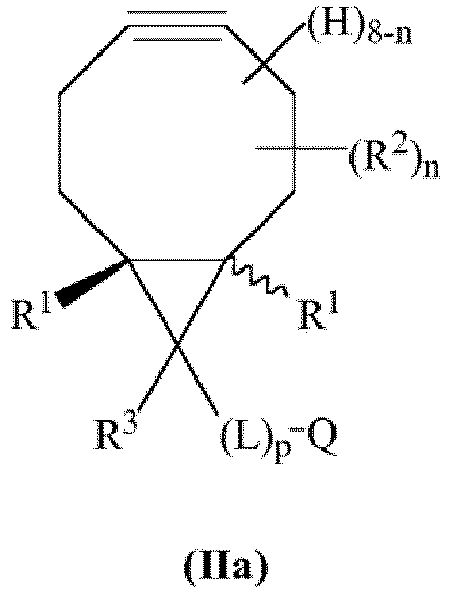 n 0 bis 8 ist;p 0 oder 1 ist;R3 aus der Gruppe ausgewählt ist, bestehend aus [(L)p-Q], Wasserstoff, Halogen, C1-C24-Alkylgruppen, C6-C24-(Hetero)arylgruppen, C7-C24-Alkyl(hetero)arylgruppen und C7-C24-(Hetero)arylalkylgruppen, wobei die Alkylgruppen gegebenenfalls durch eines von mehreren Heteroatomen, ausgewählt aus der Gruppe, bestehend aus O, N und S, unterbrochen sind, wobei die Alkylgruppen, (Hetero)arylgruppen, Alkyl(hetero)arylgruppen und (Hetero)arylalkylgruppen gegebenenfalls unabhängig voneinander mit einem oder mehreren Substituenten substituiert sind, unabhängig ausgewählt aus der Gruppe, bestehend aus C1-C12-Alkylgruppen, C2-C12-Alkenylgruppen, C2-C12-Alkinylgruppen, C3-C12-Cycloalkylgruppen, C1-C12-Alkoxygruppen, C2-C12-Alkenyloxygruppen, C2-C12-Alkinyloxygruppen, C3-C12-Cycloalkyloxygruppen, Halogenen, Aminogruppen, Oxogruppen und Silylgruppen, wobei die Alkylgruppen, Alkenylgruppen, Alkinylgruppen, Cycloalkylgruppen, Alkoxygruppen, Alkenyloxygruppen, Alkinyloxygruppen und Cycloalkyloxygruppen gegebenenfalls substituiert sind, wobei die Alkylgruppen, die Alkoxygruppen, die Cycloalkylgruppen und die Cycloalkoxygruppen gegebenenfalls durch eines von mehreren Heteroatomen, ausgewählt aus der Gruppe, bestehend aus O, N und S, unterbrochen sind, wobei die Silylgruppen durch die Formel (R4)3Si- dargestellt sind, wobei R4 unabhängig aus der Gruppe ausgewählt ist, bestehend aus C1-C12-Alkylgruppen, C2-C12-Alkenylgruppen, C2-C12-Alkinylgruppen, C3-C12-Cycloalkylgruppen, C1-C12-Alkoxygruppen, C2-C12-Alkenyloxygruppen, C2-C12-Alkinyloxygruppen und C3-C12-Cycloalkyloxygruppen, wobei die Alkylgruppen, Alkenylgruppen, Alkinylgruppen, Cycloalkylgruppen, Alkoxygruppen, Alkenyloxygruppen, Alkinyloxygruppen und Cycloalkyloxygruppen gegebenenfalls substituiert sind, wobei die Alkylgruppen, die Alkoxygruppen, die Cycloalkylgruppen und die Cycloalkoxygruppen gegebenenfalls durch eines von mehreren Heteroatomen unterbrochen sind, ausgewählt aus der Gruppe, bestehend aus O, N und S;L eine Verknüpfungsgruppe ist, ausgewählt aus linearen oder verzweigten C1-C24-Alkylengruppen, C2-C24-Alkenylengruppen, C2-C24-Alkinylengruppen, C3-C24-Cycloalkylengruppen, C5-C24-Cycloalkenylengruppen, C8-C24-Cycloalkinylengruppen, C7-C24-Alkyl(hetero)arylengruppen, C7-C24-(Hetero)arylalkylengruppen, C8-C24-(Hetero)arylalkenylengruppen, C9-C24-(Hetero)arylalkinylengruppen, wobei die Alkylengruppen, Alkenylengruppen, Alkinylengruppen, Cycloalkylengruppen, Cycloalkenylengruppen, Cycloalkinylengruppen, Alkyl(hetero)arylengruppen, (Hetero)arylalkylengruppen, (Hetero)arylalkenylengruppen und (Hetero)arylalkinylengruppen gegebenenfalls mit einem oder mehreren Substituenten substituiert sind, unabhängig ausgewählt aus der Gruppe, bestehend aus C1-C12-Alkylgruppen, C2-C12-Alkenylgruppen, C2-C12-Alkinylgruppen, C3-C12-Cycloalkylgruppen, C5-C12-Cycloalkenylgruppen, C8-C12-Cycloalkinylgruppen, C1-C12-Alkoxygruppen, C2-C12-Alkenyloxygruppen, C2-C12-Alkinyloxygruppen, C3-C12-Cycloalkyloxygruppen, Halogenen, Aminogruppen, Oxo- und Silylgruppen, wobei die Silylgruppen durch die Formel (R4)3Si- dargestellt sein können, wobei R4 wie vorstehend definiert ist;Q über eine funktionelle Gruppe, ausgewählt aus der Gruppe, bestehend aus Halogen, C1-C24-Alkylgruppen, C6-C24-(Hetero)arylgruppen, C7-C24-Alkyl(hetero)arylgruppen und C7-C24-(Hetero)arylalkylgruppen, -CH=C(R6)2, -C≡CR6, -[C(R6)2C(R6)20]q-R6, wobei q im Bereich von 1 bis 200 liegt, -CN, -N3, -NCX, -XCN, -XR6, -N(R6)2, -+N(R6)3, -C(X)N(R6)2, -C(R6)2XR6, -C(X)R6, -C(X)XR6, -S(O)R6, -S(O)2R6, -S(O)OR6, -S(O)20R6, -S(O)N(R6)2, -S(O)2N(R6)2, -OS(O)R6, -OS(O)2R6, -OS(O)OR6, -OS(O)2OR6, -P(O)(R6)(OR6), -P(O)(OR6)2, -OP(O)(OR6)2, -Si(R6)3, -XC(X)R6, -XC(X)XR6, -XC(X)N(R6)2, -N(R6)C(X)R6, -N(R6)C(X)XR6 und -N(R6)C(X)N(R6)2 mit einer Markierung konjugiert ist, wobei X Sauerstoff oder Schwefel ist und wobei R6 unabhängig aus der Gruppe ausgewählt ist, bestehend aus Wasserstoff, Halogen, C1-C24-Alkylgruppen, C6-C24-(Hetero)arylgruppen, C7-C24-Alkyl(hetero)arylgruppen und C7-C24-(Hetero)arylalkylgruppen;R1 unabhängig aus der Gruppe ausgewählt ist, bestehend aus Wasserstoff, C1-C24-Alkylgruppen, C6-C24-(Hetero)arylgruppen, C7-C24-Alkyl(hetero)arylgruppen und C7-C24-(Hetero)arylalkylgruppen, undR2 unabhängig aus der Gruppe ausgewählt ist, bestehend aus Halogen, -OR6, -NO2, -CN, -S(O)2R6, C1-C12-Alkylgruppen, C1-C12 Arylgruppen, C1-C12-Alkylarylgruppen und C1-C12 Arylalkylgruppen, wobei R6 wie vorstehend definiert ist und wobei die Alkylgruppen, Arylgruppen, Alkylarylgruppen und Arylalkylgruppen gegebenenfalls substituiert sind.
 - Konjugat gemäß Anspruch 1, wobei die Markierung aus der Gruppe ausgewählt ist, umfassend Fluorophore, Biotin, Polyethylenglycolketten, Polypropylenglycolketten, gemischte Polyethylen-/Polypropylenglycolketten, radioaktive Isotope, Steroide, pharmazeutische Verbindungen, Lipide, Peptide, Glycane, Nucleotide und Peptidanhänge.
- Konjugat gemäß Anspruch 2, wobei die Markierung eine pharmazeutische Verbindung ist.
- Konjugat gemäß einem der Ansprüche 1 - 3, wobei p 1 ist und L CH2 ist.
- Konjugat gemäß einem der Ansprüche 1 - 4, wobei R1 Wasserstoff ist.
- Konjugat gemäß einem der Ansprüche 1 - 5, wobei R3 Wasserstoff oder [(L)p-Q] ist.
- Verfahren zur Modifikation eines Zielmoleküls, wobei ein Konjugat gemäß einem der Ansprüche 1 - 6 mit einer Verbindung umgesetzt wird, die einen 1,3-Dipol oder ein 1,3-(Hetero)dien umfasst.
- Verfahren gemäß Anspruch 7, wobei die Verbindung, die einen 1,3-Dipol umfasst, eine Azid-umfassende Verbindung, eine Nitron-umfassende Verbindung oder eine Nitriloxid-umfassende Verbindung ist.
- Verwendung eines Konjugats gemäß einem der Ansprüche 1 - 6 zur bioorthogonalen Markierung, Bildgebung oder Modifikation eines Zielmoleküls.
- Zusammensetzung, umfassend ein Konjugat gemäß einem der Ansprüche 1 - 6, ferner umfassend einen pharmazeutisch verträglichen Träger.
- Verbindung der Formel (IIa):
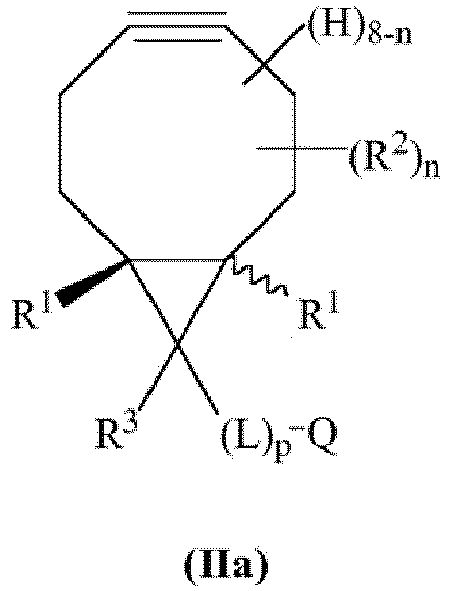 n 0 bis 8 ist;p 0 oder 1 ist;R3 aus der Gruppe ausgewählt ist, bestehend aus [(L)p-Q], Wasserstoff, Halogen, C1-C24-Alkylgruppen, C6-C24-(Hetero)arylgruppen, C7-C24-Alkyl(hetero)arylgruppen und C7-C24-(Hetero)arylalkylgruppen, wobei die Alkylgruppen gegebenenfalls durch eines von mehreren Heteroatomen, ausgewählt aus der Gruppe, bestehend aus O, N und S, unterbrochen sind, wobei die Alkylgruppen, (Hetero)arylgruppen, Alkyl(hetero)arylgruppen und (Hetero)arylalkylgruppen gegebenenfalls unabhängig voneinander mit einem oder mehreren Substituenten substituiert sind, unabhängig ausgewählt aus der Gruppe, bestehend aus C1-C12-Alkylgruppen, C2-C12-Alkenylgruppen, C2-C12-Alkinylgruppen, C3-C12-Cycloalkylgruppen, C1-C12-Alkoxygruppen, C2-C12-Alkenyloxygruppen, C2-C12-Alkinyloxygruppen, C3-C12-Cycloalkyloxygruppen, Halogenen, Aminogruppen, Oxogruppen und Silylgruppen, wobei die Alkylgruppen, Alkenylgruppen, Alkinylgruppen, Cycloalkylgruppen, Alkoxygruppen, Alkenyloxygruppen, Alkinyloxygruppen und Cycloalkyloxygruppen gegebenenfalls substituiert sind, wobei die Alkylgruppen, die Alkoxygruppen, die Cycloalkylgruppen und die Cycloalkoxygruppen gegebenenfalls durch eines von mehreren Heteroatomen, ausgewählt aus der Gruppe, bestehend aus O, N und S, unterbrochen sind, wobei die Silylgruppen durch die Formel (R4)3Si- dargestellt sind, wobei R4 unabhängig aus der Gruppe ausgewählt ist, bestehend aus C1-C12-Alkylgruppen, C2-C12-Alkenylgruppen, C2-C12-Alkinylgruppen, C3-C12-Cycloalkylgruppen, C1-C12-Alkoxygruppen, C2-C12-Alkenyloxygruppen, C2-C12-Alkinyloxygruppen und C3-C12-Cycloalkyloxygruppen, wobei die Alkylgruppen, Alkenylgruppen, Alkinylgruppen, Cycloalkylgruppen, Alkoxygruppen, Alkenyloxygruppen, Alkinyloxygruppen und Cycloalkyloxygruppen gegebenenfalls substituiert sind, wobei die Alkylgruppen, die Alkoxygruppen, die Cycloalkylgruppen und die Cycloalkoxygruppen gegebenenfalls durch eines von mehreren Heteroatomen, ausgewählt aus der Gruppe, bestehend aus O, N und S, unterbrochen sind;L eine Verknüpfungsgruppe ist, ausgewählt aus linearen oder verzweigten C1-C24-Alkylengruppen, C2-C24-Alkenylengruppen, C2-C24-Alkinylengruppen, C3-C24-Cycloalkylengruppen, C5-C24-Cycloalkenylengruppen, C8-C24-Cycloalkinylengruppen, C7-C24-Alkyl(hetero)arylengruppen, C7-C24-(Hetero)arylalkylengruppen, C8-C24-(Hetero)arylalkenylengruppen, C9-C24-(Hetero)arylalkinylengruppen, wobei die Alkylengruppen, Alkenylengruppen, Alkinylengruppen, Cycloalkylengruppen, Cycloalkenylengruppen, Cycloalkinylengruppen, Alkyl(hetero)arylengruppen, (Hetero)arylalkylengruppen, (Hetero)arylalkenylengruppen und (Hetero)arylalkinylengruppen gegebenenfalls mit einem oder mehreren Substituenten substituiert sind, unabhängig ausgewählt aus der Gruppe, bestehend aus C1-C12-Alkylgruppen, C2-C12-Alkenylgruppen, C2-C12-Alkinylgruppen, C3-C12-Cycloalkylgruppen, C5-C12-Cycloalkenylgruppen, C8-C12-Cycloalkinylgruppen, C1-C12-Alkoxygruppen, C2-C12-Alkenyloxygruppen, C2-C12-Alkinyloxygruppen, C3-C12-Cycloalkyloxygruppen, Halogenen, Aminogruppen, Oxo- und Silylgruppen, wobei die Silylgruppen durch die Formel (R4)3Si- dargestellt sein können, wobei R4 wie vorstehend definiert ist;Q eine funktionelle Gruppe ist, ausgewählt aus der Gruppe, bestehend aus Halogen, C1-C24-Alkylgruppen, C6-C24-(Hetero)arylgruppen, C7-C24-Alkyl(hetero)arylgruppen und C7-C24-(Hetero)arylalkylgruppen, -CH=C(R6)2, -C≡CR6, -[C(R6)2C(R6)20]q-R6, wobei q im Bereich von 1 bis 200 liegt, -CN, -N3, -NCX, -XCN, -XR6, -N(R6)2, -+N(R6)3, -C(X)N(R6)2, -C(R6)2XR6, -C(X)R6, -C(X)XR6, -S(O)R6, -S(O)2R6, -S(O)OR6, -S(O)2OR6, -S(O)N(R6)2, -S(O)2N(R6)2, -OS(O)R6, -OS(O)2R6, -OS(O)OR6, -OS(O)2OR6, -P(O)(R6)(OR6), -P(O)(OR6)2, -OP(O)(OR6)2, -Si(R6)3, -XC(X)R6, -XC(X)XR6, -XC(X)N(R6)2, -N(R6)C(X)R6, -N(R6)C(X)XR6 und -N(R6)C(X)N(R6)2, wobei X Sauerstoff oder Schwefel ist und wobei R6 unabhängig aus der Gruppe ausgewählt ist, bestehend aus Wasserstoff, Halogen, C1-C24-Alkylgruppen, C6-C24-(Hetero)arylgruppen, C7-C24-Alkyl(hetero)arylgruppen und C7-C24-(Hetero)arylalkylgruppen;R1 unabhängig aus der Gruppe ausgewählt ist, bestehend aus Wasserstoff, C1-C24-Alkylgruppen, C6-C24-(Hetero)arylgruppen, C7-C24-Alkyl(hetero)arylgruppen und C7-C24-(Hetero)arylalkylgruppen, undR2 unabhängig aus der Gruppe ausgewählt ist, bestehend aus Halogen, -OR6, - NO2, -CN, -S(O)2R6, C1-C12-Alkylgruppen, C1-C12 Arylgruppen, C1-C12-Alkylarylgruppen und C1-C12 Arylalkylgruppen, wobei R6 wie vorstehend definiert ist und wobei die Alkylgruppen, Arylgruppen, Alkylarylgruppen und Arylalkylgruppen gegebenenfalls substituiert sind.
 - Verbindung gemäß Anspruch 11, wobei Q aus der Gruppe ausgewählt ist, bestehend aus -OR6, -N(R6)2, -+N(R6)3, -C(O)N(R6)2, -C(O)OR6, -OC(O)R6, -OC(O)OR6, -OC(O)N(R6)2, -N(R6)C(O)R6, -N(R6)C(O)OR6 und -N(R6)C(O)N(R6)2, wobei R6 wie in Anspruch 11 definiert ist, wobei Q vorzugsweise -OH ist.
- Verbindung gemäß Anspruch 11 oder 12, wobei eines oder mehrere der Folgenden zutrifft:- p ist 1 und L ist CH2;- R1 ist Wasserstoff;- R3 ist Wasserstoff oder [(L)p-Q],wobei vorzugsweise Q -OH ist, R1 Wasserstoff ist, R3 Wasserstoff oder [(L)p-Q] ist und n 0 ist.
- Verfahren zum Herstellen einer Verbindung gemäß einem der Ansprüche 11 - 13, wobei das Verfahren die Schritte umfasst:(a) Cyclopropanierung eines Cyclooctadiens der Formel (Vlla):
 n = 0 bis 8;R1 unabhängig aus der Gruppe ausgewählt ist, bestehend aus Wasserstoff, C1-C24-Alkylgruppen, C6-C24-(Hetero)arylgruppen, C7-C24-Alkyl(hetero)arylgruppen und C7-C24-(Hetero)arylalkylgruppen, undR2 unabhängig aus der Gruppe ausgewählt ist, bestehend aus Halogen, -OR6, -NO2, -CN, -S(O)2R6, C1-C12-Alkylgruppen, C1-C12 Arylgruppen, C1-C12-Alkylarylgruppen und C1-C12 Arylalkylgruppen, wobei die Alkylgruppen, Arylgruppen, Alkylarylgruppen und Arylalkylgruppen gegebenenfalls substituiert sind und wobei R6 unabhängig aus der Gruppe ausgewählt ist, bestehend aus Wasserstoff, Halogen, C1-C24-Alkylgruppen, C6-C24-(Hetero)arylgruppen, C7-C24-Alkyl(hetero)arylgruppen und C7-C24-(Hetero)arylalkylgruppen,um eine bizyklische Cyclooctenverbindung zu bilden,(b) Bromierung der erhaltenen bizyklischen Cyclooctenverbindung, um eine bizyklische Cyclooctanverbindung zu bilden und(c) Dehydrobromierung der erhaltenen bizyklischen Cyclooctanverbindung, um eine Verbindung gemäß einem der Ansprüche 11 - 13 zu bilden.
Priority Applications (1)
| Application Number | Priority Date | Filing Date | Title |
|---|---|---|---|
| EP19179141.7A EP3604264A1 (de) | 2010-04-27 | 2011-04-26 | Kondensierte cyclooctylverbindungen |
Applications Claiming Priority (4)
| Application Number | Priority Date | Filing Date | Title |
|---|---|---|---|
| US32830610P | 2010-04-27 | 2010-04-27 | |
| EP10161192 | 2010-04-27 | ||
| EP11720197.0A EP2563753B9 (de) | 2010-04-27 | 2011-04-26 | Kondensierte Cyclooctylverbindungen und ihre Verwendung in metallfreien Click-Reaktionen |
| PCT/NL2011/050280 WO2011136645A1 (en) | 2010-04-27 | 2011-04-26 | Fused cyclooctyne compounds and their use in metal-free click reactions |
Related Parent Applications (2)
| Application Number | Title | Priority Date | Filing Date |
|---|---|---|---|
| EP11720197.0A Division-Into EP2563753B9 (de) | 2010-04-27 | 2011-04-26 | Kondensierte Cyclooctylverbindungen und ihre Verwendung in metallfreien Click-Reaktionen |
| EP11720197.0A Division EP2563753B9 (de) | 2010-04-27 | 2011-04-26 | Kondensierte Cyclooctylverbindungen und ihre Verwendung in metallfreien Click-Reaktionen |
Related Child Applications (1)
| Application Number | Title | Priority Date | Filing Date |
|---|---|---|---|
| EP19179141.7A Division EP3604264A1 (de) | 2010-04-27 | 2011-04-26 | Kondensierte cyclooctylverbindungen |
Publications (2)
| Publication Number | Publication Date |
|---|---|
| EP2894142A1 EP2894142A1 (de) | 2015-07-15 |
| EP2894142B1 true EP2894142B1 (de) | 2019-06-12 |
Family
ID=42668639
Family Applications (3)
| Application Number | Title | Priority Date | Filing Date |
|---|---|---|---|
| EP14191257.6A Active EP2894142B1 (de) | 2010-04-27 | 2011-04-26 | Kondensierte cyclooctylverbindungen und deren verwendung in metallfreien click-reaktionen |
| EP19179141.7A Pending EP3604264A1 (de) | 2010-04-27 | 2011-04-26 | Kondensierte cyclooctylverbindungen |
| EP11720197.0A Active EP2563753B9 (de) | 2010-04-27 | 2011-04-26 | Kondensierte Cyclooctylverbindungen und ihre Verwendung in metallfreien Click-Reaktionen |
Family Applications After (2)
| Application Number | Title | Priority Date | Filing Date |
|---|---|---|---|
| EP19179141.7A Pending EP3604264A1 (de) | 2010-04-27 | 2011-04-26 | Kondensierte cyclooctylverbindungen |
| EP11720197.0A Active EP2563753B9 (de) | 2010-04-27 | 2011-04-26 | Kondensierte Cyclooctylverbindungen und ihre Verwendung in metallfreien Click-Reaktionen |
Country Status (8)
| Country | Link |
|---|---|
| US (6) | US8859629B2 (de) |
| EP (3) | EP2894142B1 (de) |
| JP (1) | JP5920936B2 (de) |
| CN (2) | CN107235828B (de) |
| DK (1) | DK2563753T6 (de) |
| ES (1) | ES2527536T7 (de) |
| PL (1) | PL2563753T6 (de) |
| WO (1) | WO2011136645A1 (de) |
Families Citing this family (142)
| Publication number | Priority date | Publication date | Assignee | Title |
|---|---|---|---|---|
| US7855279B2 (en) | 2005-09-27 | 2010-12-21 | Amunix Operating, Inc. | Unstructured recombinant polymers and uses thereof |
| CN108530543B (zh) | 2009-02-03 | 2023-06-23 | 阿穆尼克斯制药公司 | 延伸重组多肽和包含该延伸重组多肽的组合物 |
| EP2894142B1 (de) * | 2010-04-27 | 2019-06-12 | SynAffix B.V. | Kondensierte cyclooctylverbindungen und deren verwendung in metallfreien click-reaktionen |
| US9517257B2 (en) | 2010-08-10 | 2016-12-13 | Ecole Polytechnique Federale De Lausanne (Epfl) | Erythrocyte-binding therapeutics |
| JP6017422B2 (ja) | 2010-08-10 | 2016-11-02 | エコール・ポリテクニーク・フェデラル・ドゥ・ローザンヌ(ウペエフエル)Ecole Polytechnique Federale de Lausanne (EPFL) | 赤血球結合療法 |
| US9850296B2 (en) | 2010-08-10 | 2017-12-26 | Ecole Polytechnique Federale De Lausanne (Epfl) | Erythrocyte-binding therapeutics |
| EP3279211B1 (de) * | 2011-02-03 | 2020-04-29 | Embl | Unnatürliche aminosäuren mit einer norbornenylgruppe und verwendungen davon |
| US20130066063A1 (en) * | 2011-09-09 | 2013-03-14 | John Cooke Hodges | Bicyclo[6.1.0]non-4-yne regents for chemical modification of oligonucleotides |
| JP2013151468A (ja) * | 2011-11-30 | 2013-08-08 | Agilent Technologies Inc | オリゴマーの合成及び精製の新規方法 |
| AU2012356894B2 (en) | 2011-12-23 | 2018-01-18 | Araris Biotech Ltd. | Enzymatic conjugation of polypeptides |
| US20130178600A1 (en) * | 2012-01-09 | 2013-07-11 | Intezyne Technologies, Inc. | Poly(ethylene glycol) derivatives for click chemistry |
| CA2865578C (en) | 2012-02-27 | 2023-01-17 | Amunix Operating Inc. | Xten conjugate compositions and methods of making same |
| JP6343604B2 (ja) * | 2012-05-18 | 2018-06-13 | メディカル リサーチ カウンシル | BCN基を含むアミノ酸をコードする直交性コドンと、直交性PylRS合成酵素とを使用して、BCN基を含むアミノ酸をポリペプチドに取り込む方法 |
| WO2013181697A1 (en) * | 2012-06-05 | 2013-12-12 | The University Of Melbourne | Bicyclo[6.1.0]non-4-yne compounds suitable for use as linkers in biological applications |
| WO2013188635A2 (en) * | 2012-06-14 | 2013-12-19 | The Trustees Of The University Of Pennsylvania | Novel methods of identifying proteins via n-terminal tagging and selective pull-down |
| WO2014009426A2 (en) | 2012-07-13 | 2014-01-16 | Innate Pharma | Screening of conjugated antibodies |
| AU2013305827A1 (en) | 2012-08-21 | 2015-03-05 | Academia Sinica | Benzocyclooctyne compounds and uses thereof |
| BR112015006368B1 (pt) | 2012-09-24 | 2022-02-08 | Medimmune Limited | Processo para produção de linha celular eucariótica estável |
| ES2659270T5 (en) | 2012-10-23 | 2026-02-11 | Synaffix Bv | Modified antibody, antibody-conjugate and process for the preparation thereof |
| EP2916872B1 (de) | 2012-11-09 | 2019-02-27 | Innate Pharma | Kennungen für tgase-vermittelte konjugation |
| GB201300707D0 (en) * | 2013-01-15 | 2013-02-27 | Novartis Ag | Compounds and processes |
| HK1219422A1 (zh) | 2013-02-28 | 2017-04-07 | Immunogen, Inc. | 包含细胞结合剂及细胞毒素剂的轭合物 |
| EP2961435B1 (de) | 2013-02-28 | 2019-05-01 | ImmunoGen, Inc. | Konjugate mit zellbindenden mitteln und zytostatika |
| WO2014140300A1 (en) | 2013-03-15 | 2014-09-18 | Innate Pharma | Solid phase tgase-mediated conjugation of antibodies |
| ES2759503T3 (es) | 2013-05-02 | 2020-05-11 | Glykos Finland Oy | Conjugados de una glicoproteína o un glicano con una carga útil tóxica |
| WO2014189370A1 (en) | 2013-05-24 | 2014-11-27 | Stichting Katholieke Universiteit | Substituted azadibenzocyclooctyne compounds and their use in metal-free click reactions |
| WO2014194030A2 (en) | 2013-05-31 | 2014-12-04 | Immunogen, Inc. | Conjugates comprising cell-binding agents and cytotoxic agents |
| WO2014202773A1 (en) | 2013-06-20 | 2014-12-24 | Innate Pharma | Enzymatic conjugation of polypeptides |
| JP6744212B2 (ja) | 2013-06-21 | 2020-08-19 | イナート・ファルマ・ソシエテ・アノニムInnate Pharma Pharma S.A. | ポリペプチドの酵素的結合 |
| BR112016000585A2 (pt) * | 2013-07-11 | 2018-03-20 | Novartis Ag | modificações quimioenzimáticas sítio-específicas de proteína |
| CN104292454B (zh) * | 2013-07-17 | 2017-12-01 | 北京键凯科技股份有限公司 | 聚乙二醇‑环辛炔衍生物 |
| EP2826493A1 (de) | 2013-07-18 | 2015-01-21 | Stichting Katholieke Universiteit, Radboud Universiteit Nijmegen | Polymer, geeignet zur Verwendung bei Zellkulturen |
| WO2015007771A1 (en) | 2013-07-18 | 2015-01-22 | Stichting Katholieke Universiteit, More Particularly Radboud Universiteit Nijmegen | Polymer suitable for use in cell culture |
| EP3057618B1 (de) | 2013-10-14 | 2022-12-14 | SynAffix B.V. | Durch glyco-engineering hergestellter antikörper, antikörperkonjugat und verfahren zu deren herstellung |
| CN105829543B (zh) | 2013-10-14 | 2021-06-01 | 西纳福克斯股份有限公司 | 糖基改造的抗体、抗体-缀合物及其制备方法 |
| US9987373B2 (en) | 2013-10-14 | 2018-06-05 | Synaffix B.V. | Modified glycoprotein, protein-conjugate and process for the preparation thereof |
| US20160303242A1 (en) | 2013-12-09 | 2016-10-20 | Durect Corporation | Pharmaceutically Active Agent Complexes, Polymer Complexes, and Compositions and Methods Involving the Same |
| EP3097079B1 (de) | 2014-01-24 | 2021-05-12 | SynAffix B.V. | Verfahren zur cycloaddition einer hetero(aryl)-1,3-dipol-verbindung mit einem (hetero)cycloalkyn |
| US10046056B2 (en) | 2014-02-21 | 2018-08-14 | École Polytechnique Fédérale De Lausanne (Epfl) | Glycotargeting therapeutics |
| US10946079B2 (en) | 2014-02-21 | 2021-03-16 | Ecole Polytechnique Federale De Lausanne | Glycotargeting therapeutics |
| KR20240154672A (ko) | 2014-02-21 | 2024-10-25 | 에꼴 뽈리떼끄닉 뻬데랄 드 로잔느 (으뻬에프엘) | 글리코타겟팅 치료제 |
| US10953101B2 (en) | 2014-02-21 | 2021-03-23 | École Polytechnique Fédérale De Lausanne (Epfl) | Glycotargeting therapeutics |
| GB2528227A (en) | 2014-03-14 | 2016-01-20 | Medical Res Council | Cyclopropene amino acids and methods |
| EP4674440A3 (de) | 2014-04-08 | 2026-04-22 | University of Georgia Research Foundation, Inc. | Ortsspezifische antikörper-wirkstoff-glycokonjugate und verfahren |
| US10588980B2 (en) | 2014-06-23 | 2020-03-17 | Novartis Ag | Fatty acids and their use in conjugation to biomolecules |
| EP2974744A1 (de) | 2014-07-16 | 2016-01-20 | Stichting Katholieke Universiteit | Durch stammgeförderte Oxidation kontrollierte Cycloaddition mit hoher Reaktionsgeschwindigkeit |
| CN105510591B (zh) * | 2014-09-22 | 2019-02-12 | 程永升 | 一种利用抗体修饰免疫pcr反应的检测试剂盒及检测方法 |
| JP6440250B2 (ja) * | 2014-10-09 | 2018-12-19 | 国立大学法人富山大学 | チオアミド誘導体 |
| EP3270903B1 (de) | 2015-03-17 | 2020-05-06 | Arrowhead Pharmaceuticals, Inc. | Disulfidhaltige alkinverknüpfungsmittel |
| WO2017019561A1 (en) * | 2015-07-24 | 2017-02-02 | The Trustees Of Columbia University In The City Of New York | Epothilone b and dictyostatin analogs, their preparation and use |
| KR102368068B1 (ko) | 2015-08-24 | 2022-02-25 | 삼성전자주식회사 | 반도체 소자 제조용 조성물 및 이를 이용하는 반도체 소자의 제조 방법 |
| JP7170535B2 (ja) * | 2015-10-20 | 2022-11-14 | ソレント・セラピューティクス・インコーポレイテッド | 細胞内送達化合物 |
| MX2018009085A (es) | 2016-01-27 | 2019-05-09 | Sutro Biopharma Inc | Conjugados de anticuerpos anti-cd74, composiciones que comprenden conjugados de anticuerpos anti-cd74 y metodos de uso de congujados de anticuerpos anti-cd74. |
| WO2017137457A1 (en) | 2016-02-08 | 2017-08-17 | Synaffix B.V. | Antibody-conjugates with improved therapeutic index for targeting cd30 tumours and method for improving therapeutic index of antibody-conjugates |
| CN108883191B (zh) | 2016-02-08 | 2022-10-14 | 西纳福克斯股份有限公司 | 用于靶向cd30肿瘤的具有改善的治疗指数的抗体-缀合物以及用于改善抗体-缀合物的治疗指数的方法 |
| US10874746B2 (en) | 2016-02-08 | 2020-12-29 | Synaffix B.V. | Sulfamide linkers for use in bioconjugates |
| US11951175B2 (en) | 2016-02-08 | 2024-04-09 | Synaffix B.V. | Bioconjugates containing sulfamide linkers for use in treatment |
| EP3413915A1 (de) | 2016-02-08 | 2018-12-19 | Synaffix B.V. | Antikörperkonjugate mit verbessertem therapeutischem index zur abzielung auf her2-tumoren und verfahren zur verbesserung des therapeutischen index von antikörperkonjugaten |
| US11786603B2 (en) | 2016-02-26 | 2023-10-17 | Regeneron Pharmaceuticals, Inc. | Optimized transglutaminase site-specific antibody conjugation |
| WO2017191817A1 (ja) | 2016-05-02 | 2017-11-09 | 味の素株式会社 | アジド基含有Fcタンパク質 |
| KR102294517B1 (ko) | 2016-12-29 | 2021-08-27 | 재단법인 생물기술개발중심 | 당단백질-약물 컨주게이트를 제조하는 방법 |
| EP3357903B1 (de) | 2017-02-06 | 2020-11-04 | Stichting Katholieke Universiteit | Verfahren zur kontinuierlichen herstellung eines z-cyclooctens |
| IL269506B2 (en) | 2017-03-22 | 2024-04-01 | Genentech Inc | Hydrogel cross-linked hyaluronic acid prodrug compositions and methods |
| JOP20190245A1 (ar) | 2017-04-20 | 2019-10-15 | Novartis Ag | أنظمة توصيل إطلاق مستدام تتضمن روابط بلا أثر لنقطة الربط |
| EP3638296A1 (de) * | 2017-06-16 | 2020-04-22 | The University Of Chicago | Zusammensetzungen und verfahren zur herbeiführung einer immuntoleranz |
| EP3658588A1 (de) | 2017-07-26 | 2020-06-03 | Sutro Biopharma, Inc. | Verfahren zur verwendung von anti-cd74-antikörpern und antikörperkonjugaten bei der behandlung von t-zell-lymphomen |
| CN111655726B (zh) | 2017-09-18 | 2024-06-21 | 苏特罗生物制药公司 | 抗叶酸受体α抗体偶联物和其用途 |
| WO2019151128A1 (ja) * | 2018-02-05 | 2019-08-08 | 国立大学法人 宮崎大学 | 細胞標識剤及び細胞標識キット |
| CN110117268B (zh) * | 2018-02-06 | 2020-10-16 | 华中科技大学 | 一种甘草素探针及其制备方法和应用 |
| SG11202011078VA (en) | 2018-05-09 | 2020-12-30 | Univ Chicago | Compositions and methods concerning immune tolerance |
| CA3103227A1 (en) * | 2018-06-14 | 2019-12-19 | Mochida Pharmaceutical Co., Ltd. | Novel crosslinked alginic acid |
| WO2019243672A1 (en) | 2018-06-19 | 2019-12-26 | Glykos Biomedical Oy | Conjugate |
| EP3813883A1 (de) | 2018-06-29 | 2021-05-05 | Glykos Biomedical Oy | Konjugate |
| US11168141B2 (en) | 2018-08-02 | 2021-11-09 | Dyne Therapeutics, Inc. | Muscle targeting complexes and uses thereof for treating dystrophinopathies |
| US20220193250A1 (en) | 2018-08-02 | 2022-06-23 | Dyne Therapeutics, Inc. | Muscle targeting complexes and uses thereof for treating facioscapulohumeral muscular dystrophy |
| US12018087B2 (en) | 2018-08-02 | 2024-06-25 | Dyne Therapeutics, Inc. | Muscle-targeting complexes comprising an anti-transferrin receptor antibody linked to an oligonucleotide and methods of delivering oligonucleotide to a subject |
| JP7611825B2 (ja) | 2018-08-02 | 2025-01-10 | ダイン セラピューティクス,インコーポレーテッド | ジストロフィン異常症を処置するための筋標的化複合体およびそれらの使用 |
| US11911484B2 (en) | 2018-08-02 | 2024-02-27 | Dyne Therapeutics, Inc. | Muscle targeting complexes and uses thereof for treating myotonic dystrophy |
| US12370264B1 (en) | 2018-08-02 | 2025-07-29 | Dyne Therapeutics, Inc. | Complexes comprising an anti-transferrin receptor antibody linked to an oligonucleotide and method of delivering oligonucleotide to a subject |
| US12097263B2 (en) | 2018-08-02 | 2024-09-24 | Dyne Therapeutics, Inc. | Muscle targeting complexes and uses thereof for treating myotonic dystrophy |
| US20220047716A1 (en) | 2018-09-17 | 2022-02-17 | Sutro Biopharma, Inc. | Combination therapies with anti-folate receptor antibody conjugates |
| FR3086290B1 (fr) | 2018-09-25 | 2020-11-27 | Univ Bordeaux | Complexes de cycloheptyne-cobalt carbonyles et leurs applications en bioconjugaison |
| AR116566A1 (es) | 2018-10-03 | 2021-05-19 | Novartis Ag | Administración sostenida de polipéptidos similares a la angiopoyetina 3 |
| GB201817444D0 (en) | 2018-10-26 | 2018-12-12 | Res & Innovation Uk | Methods and compositions |
| US20220001083A1 (en) * | 2018-11-27 | 2022-01-06 | Balt Extrusion | Method for the modification of a device surface by grafting a cd31-derived peptide onto the surface of said device |
| WO2020227105A1 (en) | 2019-05-03 | 2020-11-12 | Sutro Biopharma, Inc. | Anti-bcma antibody conjugates |
| JP2022531001A (ja) | 2019-05-03 | 2022-07-05 | セルジーン コーポレーション | 抗bcma抗体コンジュゲート、そのコンジュゲートを含む組成物ならびにそのコンジュゲートの製造および使用方法 |
| CN114269749B (zh) | 2019-06-10 | 2024-10-01 | 苏特罗生物制药公司 | 5H-吡咯并[3,2-d]嘧啶-2,4-二氨基化合物及其抗体偶联物 |
| KR102133823B1 (ko) * | 2019-06-12 | 2020-07-15 | 한국원자력연구원 | 퀴논 화합물을 이용한 방사성 원소의 표지방법, 방사성 표지화합물 및 이를 포함하는 방사성 원소 표지 키트 |
| EP3983410A1 (de) | 2019-06-17 | 2022-04-20 | Sutro Biopharma, Inc. | 1-(4-(aminomethyl)benzyl)-2-butyl-2h-pyrazolo[3,4-c]quinolin-4-aminderivate und verwandte verbindungen als toll-like- rezeptor (tlr) 7/8-agonisten sowie antikörper-wirkstoff-konjugate davon zur verwendung in der krebstherapie und -diagnose |
| CA3144606A1 (en) * | 2019-06-28 | 2020-12-30 | Mochida Pharmaceutical Co., Ltd. | Transplantation device using chemically crosslinked alginic acid |
| WO2021123506A1 (en) | 2019-12-18 | 2021-06-24 | Glykos Biomedical Oy | Stabile conjugate |
| JP7846624B2 (ja) | 2020-01-09 | 2026-04-15 | メルサナ セラピューティクス インコーポレイテッド | ペプチド含有リンカーとの部位特異的抗体-薬物コンジュゲート |
| KR102270784B1 (ko) * | 2020-01-13 | 2021-06-28 | 경희대학교 산학협력단 | 새로운 덱스트란 고분자 청색 형광체 |
| US12624120B2 (en) | 2020-01-31 | 2026-05-12 | Dyne Therapeutics, Inc. | Anti-transferrin receptor (TfR) antibody and uses thereof |
| US20230095053A1 (en) | 2020-03-03 | 2023-03-30 | Sutro Biopharma, Inc. | Antibodies comprising site-specific glutamine tags, methods of their preparation and methods of their use |
| PH12022552719A1 (en) | 2020-04-22 | 2024-02-05 | Merck Sharp & Dohme Llc | HUMAN INTERLEUKIN-2 CONJUGATES BIASED FOR THE INTERLEUKIN-2 RECEPTOR BETA GAMMAc DIMER AND CONJUGATED TO A NONPEPTIDIC, WATER-SOLUBLE POLYMER |
| KR20230052958A (ko) | 2020-08-19 | 2023-04-20 | 박사이트, 인코포레이티드 | 운반-단백질 폴리삭카라이드 접합 방법 |
| WO2022103983A2 (en) | 2020-11-11 | 2022-05-19 | Sutro Biopharma, Inc. | Fluorenylmethyloxycarbonyl and fluorenylmethylaminocarbonyl compounds, protein conjugates thereof, and methods for their use |
| CA3202832A1 (en) | 2020-12-31 | 2022-07-07 | Romesh R. Subramanian | Muscle targeting complexes and uses thereof for treating myotonic dystrophy |
| US11931420B2 (en) | 2021-04-30 | 2024-03-19 | Celgene Corporation | Combination therapies using an anti-BCMA antibody drug conjugate (ADC) in combination with a gamma secretase inhibitor (GSI) |
| WO2022250679A1 (en) * | 2021-05-27 | 2022-12-01 | Massachusetts Institute Of Technology | Cyclooctynes for click chemistry |
| US11377424B1 (en) | 2021-05-27 | 2022-07-05 | Massachusetts Institute Of Technology | Cyclooctynes for click chemistry |
| TW202320857A (zh) | 2021-07-06 | 2023-06-01 | 美商普方生物製藥美國公司 | 連接子、藥物連接子及其結合物及其使用方法 |
| US11672872B2 (en) | 2021-07-09 | 2023-06-13 | Dyne Therapeutics, Inc. | Anti-transferrin receptor antibody and uses thereof |
| US11633498B2 (en) | 2021-07-09 | 2023-04-25 | Dyne Therapeutics, Inc. | Muscle targeting complexes and uses thereof for treating myotonic dystrophy |
| US11969475B2 (en) | 2021-07-09 | 2024-04-30 | Dyne Therapeutics, Inc. | Muscle targeting complexes and uses thereof for treating facioscapulohumeral muscular dystrophy |
| CN117980006A (zh) | 2021-07-09 | 2024-05-03 | 达因疗法公司 | 用于治疗肌养蛋白病的肌肉靶向复合物和制剂 |
| US11771776B2 (en) | 2021-07-09 | 2023-10-03 | Dyne Therapeutics, Inc. | Muscle targeting complexes and uses thereof for treating dystrophinopathies |
| US11638761B2 (en) | 2021-07-09 | 2023-05-02 | Dyne Therapeutics, Inc. | Muscle targeting complexes and uses thereof for treating Facioscapulohumeral muscular dystrophy |
| CN113548984B (zh) * | 2021-07-29 | 2023-08-11 | 浙江新码生物医药有限公司 | 一种非天然氨基酸及其应用、包含其的重组蛋白以及重组蛋白偶联物 |
| WO2023004687A1 (zh) | 2021-07-29 | 2023-02-02 | 浙江新码生物医药有限公司 | 一种非天然氨基酸及其应用、包含其的重组蛋白以及重组蛋白偶联物 |
| AU2021458069B2 (en) | 2021-07-29 | 2025-04-24 | Novocodex Biopharmaceuticals Co., Ltd. | Unnatural amino acid, and use thereof, recombinant protein containing same, and recombinant protein conjugate |
| CN113698468B (zh) | 2021-09-01 | 2022-10-11 | 浙江新码生物医药有限公司 | 人白细胞介素2-聚乙二醇偶联物及其应用 |
| CN114085130B (zh) * | 2021-12-08 | 2022-08-30 | 西安康福诺生物科技有限公司 | ((1r,8s,9s,z)-双环[6.1.0]非-4-烯-9-基)甲醇的合成方法 |
| KR20250004770A (ko) | 2022-04-15 | 2025-01-08 | 다인 세라퓨틱스, 인크. | 근긴장성 이영양증을 치료하기 위한 근육 표적화 복합체 및 제제 |
| CA3258164A1 (en) | 2022-06-27 | 2024-01-04 | Sutro Biopharma, Inc. | β-GLUCURONIDE BINDER PAYLOADS, THEIR PROTEIN CONJUGATES AND ASSOCIATED METHODS |
| TW202408589A (zh) | 2022-06-30 | 2024-03-01 | 美商舒卓生物製藥公司 | 抗ror1抗體及抗體結合物、包含抗ror1抗體或抗體結合物之組合物,及製造及使用抗ror1抗體及抗體結合物之方法 |
| JP2025523752A (ja) | 2022-07-15 | 2025-07-25 | ストロ バイオファーマ インコーポレーテッド | プロテアーゼ/酵素切断可能リンカー-ペイロードおよびタンパク質コンジュゲート |
| WO2024044780A1 (en) | 2022-08-26 | 2024-02-29 | Sutro Biopharma, Inc. | Interleukin-18 variants and uses thereof |
| EP4344707A1 (de) | 2022-09-29 | 2024-04-03 | Emergence Therapeutics AG | Neue anti-nectin-4-antikörper-wirkstoffkonjugate |
| WO2024098023A2 (en) | 2022-11-04 | 2024-05-10 | Sutro Biopharma, Inc. | Interferon alpha polypeptides and conjugates |
| WO2024121123A1 (en) | 2022-12-06 | 2024-06-13 | Synaffix B.V. | Synthesis of endo-bicyclononene |
| KR20260044219A (ko) | 2023-07-21 | 2026-04-01 | 매로우 테라퓨틱스, 인크. | 조혈 세포 표적화 접합체 및 관련 방법 |
| AU2024315750A1 (en) | 2023-07-31 | 2026-03-05 | Sutro Biopharma, Inc. | Sting agonist compounds and conjugates |
| WO2025072406A1 (en) | 2023-09-26 | 2025-04-03 | Profoundbio Us Co. | Ptk7 binding agents, conjugates thereof and methods of using the same |
| WO2025081117A2 (en) | 2023-10-13 | 2025-04-17 | Sutro Biopharma, Inc. | Anti-tissue factor antibodies and antibody conjugates, compositions comprising anti-tissue factor antibodies or antibody conjugates, and methods of making and using anti-tissue factor antibodies and antibody conjugates |
| WO2025080711A1 (en) | 2023-10-13 | 2025-04-17 | Sutro Biopharma, Inc. | Dual payload antibody drug conjugates |
| WO2025096716A1 (en) | 2023-11-01 | 2025-05-08 | Incyte Corporation | Anti-mutant calreticulin (calr) antibody-drug conjugates and uses thereof |
| EP4574174A1 (de) | 2023-12-19 | 2025-06-25 | Jack Elands | Neuartige antikörper-wirkstoff-konjugate mit einem anti-(tcr)-cd3-komplex-bindenden antikörper |
| TW202547866A (zh) | 2024-01-10 | 2025-12-16 | 丹麥商珍美寶股份有限公司 | Slitrk6結合劑、其共軛物及使用彼之方法 |
| WO2025149667A1 (en) | 2024-01-12 | 2025-07-17 | Pheon Therapeutics Ltd | Antibody drug conjugates and uses thereof |
| WO2025163120A1 (en) | 2024-02-01 | 2025-08-07 | Adcytherix Sas | ANTIBODY-DRUG CONJUGATES COMPRISING AN ANTI-INTEGRIN ΑVβ6 BINDING ANTIBODY |
| US20250381289A1 (en) | 2024-02-29 | 2025-12-18 | Genmab A/S | Egfr and c-met bispecific binding agents, conjugates thereof and methods of using the same |
| US20260053942A1 (en) | 2024-05-30 | 2026-02-26 | Astellas Pharama Inc. | Sting agonist immunostimulatory antibody drug conjugates |
| WO2025264647A1 (en) | 2024-06-18 | 2025-12-26 | Sutro Biopharma, Inc. | Oxoadenine tlr7 agonist compounds and conjugates |
| WO2025262641A1 (en) | 2024-06-19 | 2025-12-26 | Pheon Therapeutics Ltd | Antibody drug conjugates that bind cdcp1 and uses thereof |
| WO2026035986A1 (en) | 2024-08-07 | 2026-02-12 | Bighat Biosciences, Inc. | Humanized anti-cdh17 antibodies and use of the same |
| WO2026052513A1 (en) | 2024-09-09 | 2026-03-12 | Adcytherix Sas | Antibody-drug conjugates comprising an flt3 binding antibody |
| WO2026080697A1 (en) | 2024-10-09 | 2026-04-16 | Sutro Biopharma, Inc. | Antibody conjugates with high payload to antibody ratios, compositions comprising the same, and methods of their use |
| WO2026080692A1 (en) | 2024-10-09 | 2026-04-16 | Sutro Biopharma, Inc. | Branched beta-glucuronide linker-payloads, protein conjugates thereof, and methods thereof |
| WO2026080688A1 (en) | 2024-10-09 | 2026-04-16 | Sutro Biopharma, Inc. | Dual mechanism of action payload antibody drug conjugates |
Family Cites Families (7)
| Publication number | Priority date | Publication date | Assignee | Title |
|---|---|---|---|---|
| US8431558B2 (en) | 2004-11-01 | 2013-04-30 | The Regents Of The University Of California | Compositions and methods for modification of biomolecules |
| US8137925B2 (en) * | 2007-11-09 | 2012-03-20 | Massachusetts Institute Of Technology | Methods and compositions for protein labeling using lipoic acid ligases |
| WO2009067663A1 (en) | 2007-11-21 | 2009-05-28 | University Of Georgia Research Foundation, Inc. | Alkynes and methods of reacting alkynes with 1,3-dipole-functional compounds |
| EP2894142B1 (de) * | 2010-04-27 | 2019-06-12 | SynAffix B.V. | Kondensierte cyclooctylverbindungen und deren verwendung in metallfreien click-reaktionen |
| EP3279211B1 (de) * | 2011-02-03 | 2020-04-29 | Embl | Unnatürliche aminosäuren mit einer norbornenylgruppe und verwendungen davon |
| WO2015112016A1 (en) * | 2014-01-24 | 2015-07-30 | Synaffix B.V. | Process for the cycloaddition of a halogenated 1,3-dipole compound with a (hetero)cycloalkyne |
| EP3097079B1 (de) * | 2014-01-24 | 2021-05-12 | SynAffix B.V. | Verfahren zur cycloaddition einer hetero(aryl)-1,3-dipol-verbindung mit einem (hetero)cycloalkyn |
-
2011
- 2011-04-26 EP EP14191257.6A patent/EP2894142B1/de active Active
- 2011-04-26 ES ES11720197.0T patent/ES2527536T7/es active Active
- 2011-04-26 US US13/643,546 patent/US8859629B2/en not_active Expired - Fee Related
- 2011-04-26 JP JP2013507899A patent/JP5920936B2/ja active Active
- 2011-04-26 CN CN201710037816.5A patent/CN107235828B/zh active Active
- 2011-04-26 DK DK11720197.0T patent/DK2563753T6/en active
- 2011-04-26 CN CN201180031963.2A patent/CN103153927B/zh active Active
- 2011-04-26 EP EP19179141.7A patent/EP3604264A1/de active Pending
- 2011-04-26 PL PL11720197T patent/PL2563753T6/pl unknown
- 2011-04-26 WO PCT/NL2011/050280 patent/WO2011136645A1/en not_active Ceased
- 2011-04-26 EP EP11720197.0A patent/EP2563753B9/de active Active
-
2014
- 2014-10-10 US US14/512,324 patent/US9222940B2/en active Active
-
2015
- 2015-12-22 US US14/978,924 patent/US10239807B2/en active Active
-
2019
- 2019-03-19 US US16/358,272 patent/US11358921B2/en active Active
-
2022
- 2022-06-13 US US17/839,202 patent/US12180145B2/en active Active
-
2024
- 2024-11-21 US US18/955,142 patent/US20250084022A1/en active Pending
Non-Patent Citations (1)
| Title |
|---|
| M. F. DEBETS ET AL.: "Azide: A unique dipole for metal-free bioorthogonal ligations", CHEMBIOCHEM, vol. 11, 7 May 2010 (2010-05-07), pages 168 - 1184 * |
Also Published As
| Publication number | Publication date |
|---|---|
| CN103153927A (zh) | 2013-06-12 |
| DK2563753T3 (en) | 2014-12-01 |
| CN107235828A (zh) | 2017-10-10 |
| WO2011136645A1 (en) | 2011-11-03 |
| US20230102685A1 (en) | 2023-03-30 |
| US20200048174A1 (en) | 2020-02-13 |
| US11358921B2 (en) | 2022-06-14 |
| EP2563753B3 (de) | 2016-01-06 |
| US20250084022A1 (en) | 2025-03-13 |
| EP2563753A1 (de) | 2013-03-06 |
| PL2563753T6 (pl) | 2016-05-31 |
| US9222940B2 (en) | 2015-12-29 |
| US10239807B2 (en) | 2019-03-26 |
| EP2894142A1 (de) | 2015-07-15 |
| US8859629B2 (en) | 2014-10-14 |
| CN107235828B (zh) | 2024-06-07 |
| CN103153927B (zh) | 2017-02-15 |
| JP5920936B2 (ja) | 2016-05-18 |
| ES2527536T3 (es) | 2015-01-26 |
| DK2563753T6 (en) | 2016-04-04 |
| ES2527536T7 (es) | 2016-03-08 |
| PL2563753T3 (pl) | 2015-04-30 |
| JP2013525425A (ja) | 2013-06-20 |
| EP2563753B1 (de) | 2014-11-05 |
| US20130137763A1 (en) | 2013-05-30 |
| US20160214917A1 (en) | 2016-07-28 |
| EP3604264A1 (de) | 2020-02-05 |
| EP2563753B9 (de) | 2016-07-06 |
| US20150125892A1 (en) | 2015-05-07 |
| US12180145B2 (en) | 2024-12-31 |
Similar Documents
| Publication | Publication Date | Title |
|---|---|---|
| US12180145B2 (en) | Fused cyclooctyne compounds and their use in metal-free click reactions | |
| Debets et al. | Azide: a unique dipole for metal‐free bioorthogonal ligations | |
| EP3004062B1 (de) | Substituierte azadibenzocyclooctynverbindungen und deren verwendung in metallfreien klickreaktionen | |
| DK3094977T3 (en) | Multiple cycloaddition reactions to select molecules | |
| EP3304078B1 (de) | Zelldurchlässige, zellkompatible und spaltbare linker zur kovalenten bindung von funktionselementen | |
| EP2222341A1 (de) | Alkyne und verfahren zur reaktion von alkynen mit 1,3-dipol-funktionalen verbindungen | |
| Choi et al. | Rhenium (I) polypyridine dibenzocyclooctyne complexes as phosphorescent bioorthogonal probes: Synthesis, characterization, emissive behavior, and biolabeling properties | |
| US8541604B2 (en) | Process for the functionalization of biological molecules | |
| EP2974744A1 (de) | Durch stammgeförderte Oxidation kontrollierte Cycloaddition mit hoher Reaktionsgeschwindigkeit | |
| CN112979668B (zh) | 一种人工受体分子及其制备方法和应用 | |
| Wu et al. | Strained alkyne substituted near infrared BF 2 azadipyrromethene fluorochrome | |
| Garrison | Cycloparaphenylenes and Their Biological Applications | |
| Jayah | Design, Synthesis, Characterization, and Applications of Novel Fluorescent Lipid Analogs: An Olefin Cross Metathesis Based Approach | |
| Tomčo et al. | Beyond Traditional SPAAC: Achieving Orthogonality and Rapid Kinetics with Fluoroalkyl Azides | |
| Slavíček et al. | Matúš Tomčo 1 Veronika Šlachtová 1 Milan Vrábel 1 Jialu Li 1 Josef Filgas 2 | |
| Baskin | Development of copper-free click chemistry and application to imaging glycans in living systems | |
| Selaya | Investigations into the fluorescent covalent labeling of biomolecules utilizing rhodamine dyes, electrophilic leaving groups and mRNA display | |
| CN116836188A (zh) | 一种检测ox-ldl的探针前药和探针及其检测血管动脉粥样硬化的应用 |
Legal Events
| Date | Code | Title | Description |
|---|---|---|---|
| PUAI | Public reference made under article 153(3) epc to a published international application that has entered the european phase |
Free format text: ORIGINAL CODE: 0009012 |
|
| 17P | Request for examination filed |
Effective date: 20141031 |
|
| AC | Divisional application: reference to earlier application |
Ref document number: 2563753 Country of ref document: EP Kind code of ref document: P |
|
| AK | Designated contracting states |
Kind code of ref document: A1 Designated state(s): AL AT BE BG CH CY CZ DE DK EE ES FI FR GB GR HR HU IE IS IT LI LT LU LV MC MK MT NL NO PL PT RO RS SE SI SK SM TR |
|
| 17Q | First examination report despatched |
Effective date: 20160902 |
|
| STAA | Information on the status of an ep patent application or granted ep patent |
Free format text: STATUS: EXAMINATION IS IN PROGRESS |
|
| GRAP | Despatch of communication of intention to grant a patent |
Free format text: ORIGINAL CODE: EPIDOSNIGR1 |
|
| STAA | Information on the status of an ep patent application or granted ep patent |
Free format text: STATUS: GRANT OF PATENT IS INTENDED |
|
| RIC1 | Information provided on ipc code assigned before grant |
Ipc: G01N 33/532 20060101ALI20181115BHEP Ipc: G01N 33/58 20060101ALI20181115BHEP Ipc: C07C 33/16 20060101AFI20181115BHEP Ipc: A61K 49/00 20060101ALI20181115BHEP Ipc: C07C 69/96 20060101ALI20181115BHEP |
|
| INTG | Intention to grant announced |
Effective date: 20181204 |
|
| GRAS | Grant fee paid |
Free format text: ORIGINAL CODE: EPIDOSNIGR3 |
|
| GRAA | (expected) grant |
Free format text: ORIGINAL CODE: 0009210 |
|
| STAA | Information on the status of an ep patent application or granted ep patent |
Free format text: STATUS: THE PATENT HAS BEEN GRANTED |
|
| AC | Divisional application: reference to earlier application |
Ref document number: 2563753 Country of ref document: EP Kind code of ref document: P |
|
| AK | Designated contracting states |
Kind code of ref document: B1 Designated state(s): AL AT BE BG CH CY CZ DE DK EE ES FI FR GB GR HR HU IE IS IT LI LT LU LV MC MK MT NL NO PL PT RO RS SE SI SK SM TR |
|
| REG | Reference to a national code |
Ref country code: GB Ref legal event code: FG4D |
|
| REG | Reference to a national code |
Ref country code: CH Ref legal event code: EP |
|
| REG | Reference to a national code |
Ref country code: AT Ref legal event code: REF Ref document number: 1142374 Country of ref document: AT Kind code of ref document: T Effective date: 20190615 |
|
| REG | Reference to a national code |
Ref country code: DE Ref legal event code: R096 Ref document number: 602011059764 Country of ref document: DE |
|
| REG | Reference to a national code |
Ref country code: IE Ref legal event code: FG4D |
|
| REG | Reference to a national code |
Ref country code: NL Ref legal event code: MP Effective date: 20190612 |
|
| REG | Reference to a national code |
Ref country code: LT Ref legal event code: MG4D |
|
| PG25 | Lapsed in a contracting state [announced via postgrant information from national office to epo] |
Ref country code: HR Free format text: LAPSE BECAUSE OF FAILURE TO SUBMIT A TRANSLATION OF THE DESCRIPTION OR TO PAY THE FEE WITHIN THE PRESCRIBED TIME-LIMIT Effective date: 20190612 Ref country code: SE Free format text: LAPSE BECAUSE OF FAILURE TO SUBMIT A TRANSLATION OF THE DESCRIPTION OR TO PAY THE FEE WITHIN THE PRESCRIBED TIME-LIMIT Effective date: 20190612 Ref country code: LT Free format text: LAPSE BECAUSE OF FAILURE TO SUBMIT A TRANSLATION OF THE DESCRIPTION OR TO PAY THE FEE WITHIN THE PRESCRIBED TIME-LIMIT Effective date: 20190612 Ref country code: FI Free format text: LAPSE BECAUSE OF FAILURE TO SUBMIT A TRANSLATION OF THE DESCRIPTION OR TO PAY THE FEE WITHIN THE PRESCRIBED TIME-LIMIT Effective date: 20190612 Ref country code: NO Free format text: LAPSE BECAUSE OF FAILURE TO SUBMIT A TRANSLATION OF THE DESCRIPTION OR TO PAY THE FEE WITHIN THE PRESCRIBED TIME-LIMIT Effective date: 20190912 Ref country code: AL Free format text: LAPSE BECAUSE OF FAILURE TO SUBMIT A TRANSLATION OF THE DESCRIPTION OR TO PAY THE FEE WITHIN THE PRESCRIBED TIME-LIMIT Effective date: 20190612 |
|
| PG25 | Lapsed in a contracting state [announced via postgrant information from national office to epo] |
Ref country code: BG Free format text: LAPSE BECAUSE OF FAILURE TO SUBMIT A TRANSLATION OF THE DESCRIPTION OR TO PAY THE FEE WITHIN THE PRESCRIBED TIME-LIMIT Effective date: 20190912 Ref country code: GR Free format text: LAPSE BECAUSE OF FAILURE TO SUBMIT A TRANSLATION OF THE DESCRIPTION OR TO PAY THE FEE WITHIN THE PRESCRIBED TIME-LIMIT Effective date: 20190913 Ref country code: LV Free format text: LAPSE BECAUSE OF FAILURE TO SUBMIT A TRANSLATION OF THE DESCRIPTION OR TO PAY THE FEE WITHIN THE PRESCRIBED TIME-LIMIT Effective date: 20190612 Ref country code: RS Free format text: LAPSE BECAUSE OF FAILURE TO SUBMIT A TRANSLATION OF THE DESCRIPTION OR TO PAY THE FEE WITHIN THE PRESCRIBED TIME-LIMIT Effective date: 20190612 |
|
| REG | Reference to a national code |
Ref country code: AT Ref legal event code: MK05 Ref document number: 1142374 Country of ref document: AT Kind code of ref document: T Effective date: 20190612 |
|
| PG25 | Lapsed in a contracting state [announced via postgrant information from national office to epo] |
Ref country code: EE Free format text: LAPSE BECAUSE OF FAILURE TO SUBMIT A TRANSLATION OF THE DESCRIPTION OR TO PAY THE FEE WITHIN THE PRESCRIBED TIME-LIMIT Effective date: 20190612 Ref country code: NL Free format text: LAPSE BECAUSE OF FAILURE TO SUBMIT A TRANSLATION OF THE DESCRIPTION OR TO PAY THE FEE WITHIN THE PRESCRIBED TIME-LIMIT Effective date: 20190612 Ref country code: SK Free format text: LAPSE BECAUSE OF FAILURE TO SUBMIT A TRANSLATION OF THE DESCRIPTION OR TO PAY THE FEE WITHIN THE PRESCRIBED TIME-LIMIT Effective date: 20190612 Ref country code: PT Free format text: LAPSE BECAUSE OF FAILURE TO SUBMIT A TRANSLATION OF THE DESCRIPTION OR TO PAY THE FEE WITHIN THE PRESCRIBED TIME-LIMIT Effective date: 20191014 Ref country code: CZ Free format text: LAPSE BECAUSE OF FAILURE TO SUBMIT A TRANSLATION OF THE DESCRIPTION OR TO PAY THE FEE WITHIN THE PRESCRIBED TIME-LIMIT Effective date: 20190612 Ref country code: RO Free format text: LAPSE BECAUSE OF FAILURE TO SUBMIT A TRANSLATION OF THE DESCRIPTION OR TO PAY THE FEE WITHIN THE PRESCRIBED TIME-LIMIT Effective date: 20190612 Ref country code: AT Free format text: LAPSE BECAUSE OF FAILURE TO SUBMIT A TRANSLATION OF THE DESCRIPTION OR TO PAY THE FEE WITHIN THE PRESCRIBED TIME-LIMIT Effective date: 20190612 |
|
| PG25 | Lapsed in a contracting state [announced via postgrant information from national office to epo] |
Ref country code: IS Free format text: LAPSE BECAUSE OF FAILURE TO SUBMIT A TRANSLATION OF THE DESCRIPTION OR TO PAY THE FEE WITHIN THE PRESCRIBED TIME-LIMIT Effective date: 20191012 Ref country code: SM Free format text: LAPSE BECAUSE OF FAILURE TO SUBMIT A TRANSLATION OF THE DESCRIPTION OR TO PAY THE FEE WITHIN THE PRESCRIBED TIME-LIMIT Effective date: 20190612 Ref country code: ES Free format text: LAPSE BECAUSE OF FAILURE TO SUBMIT A TRANSLATION OF THE DESCRIPTION OR TO PAY THE FEE WITHIN THE PRESCRIBED TIME-LIMIT Effective date: 20190612 Ref country code: IT Free format text: LAPSE BECAUSE OF FAILURE TO SUBMIT A TRANSLATION OF THE DESCRIPTION OR TO PAY THE FEE WITHIN THE PRESCRIBED TIME-LIMIT Effective date: 20190612 |
|
| REG | Reference to a national code |
Ref country code: DE Ref legal event code: R097 Ref document number: 602011059764 Country of ref document: DE |
|
| PG25 | Lapsed in a contracting state [announced via postgrant information from national office to epo] |
Ref country code: TR Free format text: LAPSE BECAUSE OF FAILURE TO SUBMIT A TRANSLATION OF THE DESCRIPTION OR TO PAY THE FEE WITHIN THE PRESCRIBED TIME-LIMIT Effective date: 20190612 |
|
| PLBE | No opposition filed within time limit |
Free format text: ORIGINAL CODE: 0009261 |
|
| STAA | Information on the status of an ep patent application or granted ep patent |
Free format text: STATUS: NO OPPOSITION FILED WITHIN TIME LIMIT |
|
| PG25 | Lapsed in a contracting state [announced via postgrant information from national office to epo] |
Ref country code: PL Free format text: LAPSE BECAUSE OF FAILURE TO SUBMIT A TRANSLATION OF THE DESCRIPTION OR TO PAY THE FEE WITHIN THE PRESCRIBED TIME-LIMIT Effective date: 20190612 Ref country code: DK Free format text: LAPSE BECAUSE OF FAILURE TO SUBMIT A TRANSLATION OF THE DESCRIPTION OR TO PAY THE FEE WITHIN THE PRESCRIBED TIME-LIMIT Effective date: 20190612 |
|
| 26N | No opposition filed |
Effective date: 20200313 |
|
| PG25 | Lapsed in a contracting state [announced via postgrant information from national office to epo] |
Ref country code: SI Free format text: LAPSE BECAUSE OF FAILURE TO SUBMIT A TRANSLATION OF THE DESCRIPTION OR TO PAY THE FEE WITHIN THE PRESCRIBED TIME-LIMIT Effective date: 20190612 Ref country code: IS Free format text: LAPSE BECAUSE OF FAILURE TO SUBMIT A TRANSLATION OF THE DESCRIPTION OR TO PAY THE FEE WITHIN THE PRESCRIBED TIME-LIMIT Effective date: 20200224 |
|
| PG2D | Information on lapse in contracting state deleted |
Ref country code: IS |
|
| PG25 | Lapsed in a contracting state [announced via postgrant information from national office to epo] |
Ref country code: MC Free format text: LAPSE BECAUSE OF FAILURE TO SUBMIT A TRANSLATION OF THE DESCRIPTION OR TO PAY THE FEE WITHIN THE PRESCRIBED TIME-LIMIT Effective date: 20190612 |
|
| REG | Reference to a national code |
Ref country code: CH Ref legal event code: PL |
|
| PG25 | Lapsed in a contracting state [announced via postgrant information from national office to epo] |
Ref country code: LU Free format text: LAPSE BECAUSE OF NON-PAYMENT OF DUE FEES Effective date: 20200426 Ref country code: CH Free format text: LAPSE BECAUSE OF NON-PAYMENT OF DUE FEES Effective date: 20200430 Ref country code: LI Free format text: LAPSE BECAUSE OF NON-PAYMENT OF DUE FEES Effective date: 20200430 |
|
| REG | Reference to a national code |
Ref country code: BE Ref legal event code: MM Effective date: 20200430 |
|
| PG25 | Lapsed in a contracting state [announced via postgrant information from national office to epo] |
Ref country code: BE Free format text: LAPSE BECAUSE OF NON-PAYMENT OF DUE FEES Effective date: 20200430 |
|
| PG25 | Lapsed in a contracting state [announced via postgrant information from national office to epo] |
Ref country code: IE Free format text: LAPSE BECAUSE OF NON-PAYMENT OF DUE FEES Effective date: 20200426 |
|
| PG25 | Lapsed in a contracting state [announced via postgrant information from national office to epo] |
Ref country code: MT Free format text: LAPSE BECAUSE OF FAILURE TO SUBMIT A TRANSLATION OF THE DESCRIPTION OR TO PAY THE FEE WITHIN THE PRESCRIBED TIME-LIMIT Effective date: 20190612 Ref country code: CY Free format text: LAPSE BECAUSE OF FAILURE TO SUBMIT A TRANSLATION OF THE DESCRIPTION OR TO PAY THE FEE WITHIN THE PRESCRIBED TIME-LIMIT Effective date: 20190612 |
|
| PG25 | Lapsed in a contracting state [announced via postgrant information from national office to epo] |
Ref country code: MK Free format text: LAPSE BECAUSE OF FAILURE TO SUBMIT A TRANSLATION OF THE DESCRIPTION OR TO PAY THE FEE WITHIN THE PRESCRIBED TIME-LIMIT Effective date: 20190612 |
|
| P01 | Opt-out of the competence of the unified patent court (upc) registered |
Effective date: 20230425 |
|
| PGFP | Annual fee paid to national office [announced via postgrant information from national office to epo] |
Ref country code: DE Payment date: 20250428 Year of fee payment: 15 |
|
| PGFP | Annual fee paid to national office [announced via postgrant information from national office to epo] |
Ref country code: GB Payment date: 20250422 Year of fee payment: 15 |
|
| PGFP | Annual fee paid to national office [announced via postgrant information from national office to epo] |
Ref country code: FR Payment date: 20250424 Year of fee payment: 15 |