EP2867318B1 - Klebeband für die kapselung einer organischen elektronischen anordnung - Google Patents
Klebeband für die kapselung einer organischen elektronischen anordnung Download PDFInfo
- Publication number
- EP2867318B1 EP2867318B1 EP13727834.7A EP13727834A EP2867318B1 EP 2867318 B1 EP2867318 B1 EP 2867318B1 EP 13727834 A EP13727834 A EP 13727834A EP 2867318 B1 EP2867318 B1 EP 2867318B1
- Authority
- EP
- European Patent Office
- Prior art keywords
- adhesive
- getter material
- layer
- electronic arrangement
- permeate
- Prior art date
- Legal status (The legal status is an assumption and is not a legal conclusion. Google has not performed a legal analysis and makes no representation as to the accuracy of the status listed.)
- Active
Links
Images
Classifications
-
- C—CHEMISTRY; METALLURGY
- C09—DYES; PAINTS; POLISHES; NATURAL RESINS; ADHESIVES; COMPOSITIONS NOT OTHERWISE PROVIDED FOR; APPLICATIONS OF MATERIALS NOT OTHERWISE PROVIDED FOR
- C09J—ADHESIVES; NON-MECHANICAL ASPECTS OF ADHESIVE PROCESSES IN GENERAL; ADHESIVE PROCESSES NOT PROVIDED FOR ELSEWHERE; USE OF MATERIALS AS ADHESIVES
- C09J7/00—Adhesives in the form of films or foils
- C09J7/10—Adhesives in the form of films or foils without carriers
-
- C—CHEMISTRY; METALLURGY
- C09—DYES; PAINTS; POLISHES; NATURAL RESINS; ADHESIVES; COMPOSITIONS NOT OTHERWISE PROVIDED FOR; APPLICATIONS OF MATERIALS NOT OTHERWISE PROVIDED FOR
- C09J—ADHESIVES; NON-MECHANICAL ASPECTS OF ADHESIVE PROCESSES IN GENERAL; ADHESIVE PROCESSES NOT PROVIDED FOR ELSEWHERE; USE OF MATERIALS AS ADHESIVES
- C09J11/00—Features of adhesives not provided for in group C09J9/00, e.g. additives
- C09J11/02—Non-macromolecular additives
- C09J11/04—Non-macromolecular additives inorganic
-
- C—CHEMISTRY; METALLURGY
- C09—DYES; PAINTS; POLISHES; NATURAL RESINS; ADHESIVES; COMPOSITIONS NOT OTHERWISE PROVIDED FOR; APPLICATIONS OF MATERIALS NOT OTHERWISE PROVIDED FOR
- C09J—ADHESIVES; NON-MECHANICAL ASPECTS OF ADHESIVE PROCESSES IN GENERAL; ADHESIVE PROCESSES NOT PROVIDED FOR ELSEWHERE; USE OF MATERIALS AS ADHESIVES
- C09J7/00—Adhesives in the form of films or foils
- C09J7/20—Adhesives in the form of films or foils characterised by their carriers
-
- C—CHEMISTRY; METALLURGY
- C09—DYES; PAINTS; POLISHES; NATURAL RESINS; ADHESIVES; COMPOSITIONS NOT OTHERWISE PROVIDED FOR; APPLICATIONS OF MATERIALS NOT OTHERWISE PROVIDED FOR
- C09J—ADHESIVES; NON-MECHANICAL ASPECTS OF ADHESIVE PROCESSES IN GENERAL; ADHESIVE PROCESSES NOT PROVIDED FOR ELSEWHERE; USE OF MATERIALS AS ADHESIVES
- C09J7/00—Adhesives in the form of films or foils
- C09J7/30—Adhesives in the form of films or foils characterised by the adhesive composition
- C09J7/35—Heat-activated
-
- C—CHEMISTRY; METALLURGY
- C09—DYES; PAINTS; POLISHES; NATURAL RESINS; ADHESIVES; COMPOSITIONS NOT OTHERWISE PROVIDED FOR; APPLICATIONS OF MATERIALS NOT OTHERWISE PROVIDED FOR
- C09J—ADHESIVES; NON-MECHANICAL ASPECTS OF ADHESIVE PROCESSES IN GENERAL; ADHESIVE PROCESSES NOT PROVIDED FOR ELSEWHERE; USE OF MATERIALS AS ADHESIVES
- C09J7/00—Adhesives in the form of films or foils
- C09J7/30—Adhesives in the form of films or foils characterised by the adhesive composition
- C09J7/38—Pressure-sensitive adhesives [PSA]
-
- H—ELECTRICITY
- H10—SEMICONDUCTOR DEVICES; ELECTRIC SOLID-STATE DEVICES NOT OTHERWISE PROVIDED FOR
- H10K—ORGANIC ELECTRIC SOLID-STATE DEVICES
- H10K50/00—Organic light-emitting devices
- H10K50/80—Constructional details
- H10K50/84—Passivation; Containers; Encapsulations
- H10K50/842—Containers
- H10K50/8426—Peripheral sealing arrangements, e.g. adhesives, sealants
-
- H—ELECTRICITY
- H10—SEMICONDUCTOR DEVICES; ELECTRIC SOLID-STATE DEVICES NOT OTHERWISE PROVIDED FOR
- H10K—ORGANIC ELECTRIC SOLID-STATE DEVICES
- H10K50/00—Organic light-emitting devices
- H10K50/80—Constructional details
- H10K50/84—Passivation; Containers; Encapsulations
- H10K50/844—Encapsulations
-
- H—ELECTRICITY
- H10—SEMICONDUCTOR DEVICES; ELECTRIC SOLID-STATE DEVICES NOT OTHERWISE PROVIDED FOR
- H10K—ORGANIC ELECTRIC SOLID-STATE DEVICES
- H10K50/00—Organic light-emitting devices
- H10K50/80—Constructional details
- H10K50/84—Passivation; Containers; Encapsulations
- H10K50/846—Passivation; Containers; Encapsulations comprising getter material or desiccants
-
- H—ELECTRICITY
- H10—SEMICONDUCTOR DEVICES; ELECTRIC SOLID-STATE DEVICES NOT OTHERWISE PROVIDED FOR
- H10K—ORGANIC ELECTRIC SOLID-STATE DEVICES
- H10K77/00—Constructional details of devices covered by this subclass and not covered by groups H10K10/80, H10K30/80, H10K50/80 or H10K59/80
- H10K77/10—Substrates, e.g. flexible substrates
-
- C—CHEMISTRY; METALLURGY
- C09—DYES; PAINTS; POLISHES; NATURAL RESINS; ADHESIVES; COMPOSITIONS NOT OTHERWISE PROVIDED FOR; APPLICATIONS OF MATERIALS NOT OTHERWISE PROVIDED FOR
- C09J—ADHESIVES; NON-MECHANICAL ASPECTS OF ADHESIVE PROCESSES IN GENERAL; ADHESIVE PROCESSES NOT PROVIDED FOR ELSEWHERE; USE OF MATERIALS AS ADHESIVES
- C09J153/00—Adhesives based on block copolymers containing at least one sequence of a polymer obtained by reactions only involving carbon-to-carbon unsaturated bonds; Adhesives based on derivatives of such polymers
- C09J153/005—Modified block copolymers
-
- C—CHEMISTRY; METALLURGY
- C09—DYES; PAINTS; POLISHES; NATURAL RESINS; ADHESIVES; COMPOSITIONS NOT OTHERWISE PROVIDED FOR; APPLICATIONS OF MATERIALS NOT OTHERWISE PROVIDED FOR
- C09J—ADHESIVES; NON-MECHANICAL ASPECTS OF ADHESIVE PROCESSES IN GENERAL; ADHESIVE PROCESSES NOT PROVIDED FOR ELSEWHERE; USE OF MATERIALS AS ADHESIVES
- C09J153/00—Adhesives based on block copolymers containing at least one sequence of a polymer obtained by reactions only involving carbon-to-carbon unsaturated bonds; Adhesives based on derivatives of such polymers
- C09J153/02—Vinyl aromatic monomers and conjugated dienes
-
- C—CHEMISTRY; METALLURGY
- C09—DYES; PAINTS; POLISHES; NATURAL RESINS; ADHESIVES; COMPOSITIONS NOT OTHERWISE PROVIDED FOR; APPLICATIONS OF MATERIALS NOT OTHERWISE PROVIDED FOR
- C09J—ADHESIVES; NON-MECHANICAL ASPECTS OF ADHESIVE PROCESSES IN GENERAL; ADHESIVE PROCESSES NOT PROVIDED FOR ELSEWHERE; USE OF MATERIALS AS ADHESIVES
- C09J157/00—Adhesives based on unspecified polymers obtained by reactions only involving carbon-to-carbon unsaturated bonds
- C09J157/02—Copolymers of mineral oil hydrocarbons
-
- C—CHEMISTRY; METALLURGY
- C09—DYES; PAINTS; POLISHES; NATURAL RESINS; ADHESIVES; COMPOSITIONS NOT OTHERWISE PROVIDED FOR; APPLICATIONS OF MATERIALS NOT OTHERWISE PROVIDED FOR
- C09J—ADHESIVES; NON-MECHANICAL ASPECTS OF ADHESIVE PROCESSES IN GENERAL; ADHESIVE PROCESSES NOT PROVIDED FOR ELSEWHERE; USE OF MATERIALS AS ADHESIVES
- C09J163/00—Adhesives based on epoxy resins; Adhesives based on derivatives of epoxy resins
-
- C—CHEMISTRY; METALLURGY
- C09—DYES; PAINTS; POLISHES; NATURAL RESINS; ADHESIVES; COMPOSITIONS NOT OTHERWISE PROVIDED FOR; APPLICATIONS OF MATERIALS NOT OTHERWISE PROVIDED FOR
- C09J—ADHESIVES; NON-MECHANICAL ASPECTS OF ADHESIVE PROCESSES IN GENERAL; ADHESIVE PROCESSES NOT PROVIDED FOR ELSEWHERE; USE OF MATERIALS AS ADHESIVES
- C09J177/00—Adhesives based on polyamides obtained by reactions forming a carboxylic amide link in the main chain; Adhesives based on derivatives of such polymers
- C09J177/06—Polyamides derived from polyamines and polycarboxylic acids
-
- C—CHEMISTRY; METALLURGY
- C09—DYES; PAINTS; POLISHES; NATURAL RESINS; ADHESIVES; COMPOSITIONS NOT OTHERWISE PROVIDED FOR; APPLICATIONS OF MATERIALS NOT OTHERWISE PROVIDED FOR
- C09J—ADHESIVES; NON-MECHANICAL ASPECTS OF ADHESIVE PROCESSES IN GENERAL; ADHESIVE PROCESSES NOT PROVIDED FOR ELSEWHERE; USE OF MATERIALS AS ADHESIVES
- C09J2203/00—Applications of adhesives in processes or use of adhesives in the form of films or foils
- C09J2203/326—Applications of adhesives in processes or use of adhesives in the form of films or foils for bonding electronic components such as wafers, chips or semiconductors
-
- C—CHEMISTRY; METALLURGY
- C09—DYES; PAINTS; POLISHES; NATURAL RESINS; ADHESIVES; COMPOSITIONS NOT OTHERWISE PROVIDED FOR; APPLICATIONS OF MATERIALS NOT OTHERWISE PROVIDED FOR
- C09J—ADHESIVES; NON-MECHANICAL ASPECTS OF ADHESIVE PROCESSES IN GENERAL; ADHESIVE PROCESSES NOT PROVIDED FOR ELSEWHERE; USE OF MATERIALS AS ADHESIVES
- C09J2301/00—Additional features of adhesives in the form of films or foils
- C09J2301/30—Additional features of adhesives in the form of films or foils characterized by the chemical, physicochemical or physical properties of the adhesive or the carrier
- C09J2301/302—Additional features of adhesives in the form of films or foils characterized by the chemical, physicochemical or physical properties of the adhesive or the carrier the adhesive being pressure-sensitive, i.e. tacky at temperatures inferior to 30°C
-
- C—CHEMISTRY; METALLURGY
- C09—DYES; PAINTS; POLISHES; NATURAL RESINS; ADHESIVES; COMPOSITIONS NOT OTHERWISE PROVIDED FOR; APPLICATIONS OF MATERIALS NOT OTHERWISE PROVIDED FOR
- C09J—ADHESIVES; NON-MECHANICAL ASPECTS OF ADHESIVE PROCESSES IN GENERAL; ADHESIVE PROCESSES NOT PROVIDED FOR ELSEWHERE; USE OF MATERIALS AS ADHESIVES
- C09J2301/00—Additional features of adhesives in the form of films or foils
- C09J2301/40—Additional features of adhesives in the form of films or foils characterized by the presence of essential components
- C09J2301/408—Additional features of adhesives in the form of films or foils characterized by the presence of essential components additives as essential feature of the adhesive layer
-
- C—CHEMISTRY; METALLURGY
- C09—DYES; PAINTS; POLISHES; NATURAL RESINS; ADHESIVES; COMPOSITIONS NOT OTHERWISE PROVIDED FOR; APPLICATIONS OF MATERIALS NOT OTHERWISE PROVIDED FOR
- C09J—ADHESIVES; NON-MECHANICAL ASPECTS OF ADHESIVE PROCESSES IN GENERAL; ADHESIVE PROCESSES NOT PROVIDED FOR ELSEWHERE; USE OF MATERIALS AS ADHESIVES
- C09J2400/00—Presence of inorganic and organic materials
- C09J2400/20—Presence of organic materials
- C09J2400/22—Presence of unspecified polymer
-
- C—CHEMISTRY; METALLURGY
- C09—DYES; PAINTS; POLISHES; NATURAL RESINS; ADHESIVES; COMPOSITIONS NOT OTHERWISE PROVIDED FOR; APPLICATIONS OF MATERIALS NOT OTHERWISE PROVIDED FOR
- C09J—ADHESIVES; NON-MECHANICAL ASPECTS OF ADHESIVE PROCESSES IN GENERAL; ADHESIVE PROCESSES NOT PROVIDED FOR ELSEWHERE; USE OF MATERIALS AS ADHESIVES
- C09J2453/00—Presence of block copolymer
-
- C—CHEMISTRY; METALLURGY
- C09—DYES; PAINTS; POLISHES; NATURAL RESINS; ADHESIVES; COMPOSITIONS NOT OTHERWISE PROVIDED FOR; APPLICATIONS OF MATERIALS NOT OTHERWISE PROVIDED FOR
- C09J—ADHESIVES; NON-MECHANICAL ASPECTS OF ADHESIVE PROCESSES IN GENERAL; ADHESIVE PROCESSES NOT PROVIDED FOR ELSEWHERE; USE OF MATERIALS AS ADHESIVES
- C09J2463/00—Presence of epoxy resin
-
- C—CHEMISTRY; METALLURGY
- C09—DYES; PAINTS; POLISHES; NATURAL RESINS; ADHESIVES; COMPOSITIONS NOT OTHERWISE PROVIDED FOR; APPLICATIONS OF MATERIALS NOT OTHERWISE PROVIDED FOR
- C09J—ADHESIVES; NON-MECHANICAL ASPECTS OF ADHESIVE PROCESSES IN GENERAL; ADHESIVE PROCESSES NOT PROVIDED FOR ELSEWHERE; USE OF MATERIALS AS ADHESIVES
- C09J2477/00—Presence of polyamide
-
- Y—GENERAL TAGGING OF NEW TECHNOLOGICAL DEVELOPMENTS; GENERAL TAGGING OF CROSS-SECTIONAL TECHNOLOGIES SPANNING OVER SEVERAL SECTIONS OF THE IPC; TECHNICAL SUBJECTS COVERED BY FORMER USPC CROSS-REFERENCE ART COLLECTIONS [XRACs] AND DIGESTS
- Y02—TECHNOLOGIES OR APPLICATIONS FOR MITIGATION OR ADAPTATION AGAINST CLIMATE CHANGE
- Y02E—REDUCTION OF GREENHOUSE GAS [GHG] EMISSIONS, RELATED TO ENERGY GENERATION, TRANSMISSION OR DISTRIBUTION
- Y02E10/00—Energy generation through renewable energy sources
- Y02E10/50—Photovoltaic [PV] energy
- Y02E10/549—Organic PV cells
Definitions
- the present invention relates to an adhesive tape for encapsulating an organic electronic device and a method for its use.
- Optoelectronic devices are increasingly used in commercial products or are about to be introduced to the market. Such arrangements include inorganic or organic electronic structures, for example organic, organometallic or polymeric semiconductors or combinations thereof. Depending on the desired application, the corresponding products are designed to be rigid or flexible, and there is an increasing demand for flexible arrangements. Arrangements of this type are frequently produced by printing methods such as relief printing, gravure printing, screen printing, planographic printing or else so-called “non-impact printing” such as thermal transfer printing, inkjet printing or digital printing.
- vacuum processes such as chemical vapor deposition (CVD), physical vapor deposition (PVD), plasma-enhanced chemical or physical deposition processes (PECVD), sputtering, (plasma) etching or vapor deposition are also often used.
- CVD chemical vapor deposition
- PVD physical vapor deposition
- PECVD plasma-enhanced chemical or physical deposition processes
- sputtering sputtering
- plasma etching etching or vapor deposition
- Electrophoretic or electrochromic structures or displays, organic or polymer light-emitting diodes (OLEDs or PLEDs) in display devices or as lighting, electroluminescent lamps, light-emitting electrochemical cells are examples of optoelectronic applications that are already commercially available or have interesting market potential (LEECs), organic solar cells such as dye or polymer solar cells, inorganic thin-film solar cells, for example based on silicon, germanium, copper, Indium and selenium, organic field effect transistors, organic switching elements, organic optical amplifiers, organic laser diodes, organic or inorganic sensors or also organically or inorganically based RFID transponders.
- an organic electronic arrangement is understood to mean an electronic arrangement which comprises at least one electronically functional, at least partially organic component - e.g. organometallic compounds - or whose electronically functional structure has a thickness of less than 20 ⁇ m.
- This term also includes, for example, inorganic thin-film solar cells and inorganic electrochromic layer structures. Thicker electroluminescent structures with inorganic particles are also included if organic, e.g. polymeric, layers or matrix materials are used to embed the particles, since the organic materials take on an electronic function as a dielectric.
- electronically functional components are to be understood at least, but not exclusively, as all materials located in an electronic structure between the contact electrodes (e.g. anode and cathode) and any further electrically conductive layers used.
- organic electronic arrangement does not include classic electronic arrangements based on semiconductor wafers, since their structure is generally thicker than 20 ⁇ m.
- a large number of optoelectronic arrangements - especially when using organic materials - is sensitive to both water vapor and oxygen. Protection by encapsulation is therefore necessary during the lifetime of the electronic devices, since otherwise the performance degrades over the period of use. Otherwise, oxidation of the components of light-emitting devices such as electroluminescent lamps (EL lamps) or organic light-emitting diodes (OLED) can drastically reduce the luminosity, electrophoretic displays (EP displays) the contrast or solar cells the efficiency within a short period of time.
- EL lamps electroluminescent lamps
- OLED organic light-emitting diodes
- a cover that is impermeable to permeable substances can keep them away from the electronic arrangement.
- This cover is usually glued to the electronic arrangement and/or to the areas of the substrate adjoining the electronic arrangement, on which the arrangement is present.
- Coverings that are impermeable to substances capable of permeation can be present, for example, in the form of an impermeable layer of an adhesive that may need to be post-treated, stabilized or covered, or in the form of an impermeable layer of a rigid or flexible material that is bonded over the entire surface or at least in the edge areas and so the electronic assembly encapsulated.
- Liquid adhesives and adhesives based on epoxides are used more frequently as barrier adhesives to form an adhesive layer and to bond cover materials used, as for example in WO 98/21287 A1 , US 4,051,195A and US 4,552,604A are described. Their main areas of application are edge bonding of rigid arrangements, but also moderately flexible arrangements. Curing takes place thermally or by means of UV radiation.
- liquid adhesives also has a number of undesirable effects.
- Low-molecular components VOCs - volatile organic compounds
- the adhesive has to be applied to each individual component of the arrangement in a complex manner.
- the purchase of expensive dispensers and fixing devices is necessary to ensure accurate positioning.
- the type of application also prevents a fast, continuous process. In the lamination step that is subsequently required, the low viscosity can make it difficult to achieve a defined layer thickness and bond width.
- PSAs pressure-sensitive or hot-melt adhesives to seal optoelectronic structures.
- Such masses are used, for example, in US 2006/0100299 A1 and WO 2007/087281 A1 described.
- Their advantage lies in particular in the fact that the barrier effect of the adhesives can be improved as a result of the crosslinking.
- Hot melt adhesives based on block copolymers or functionalized polymers are, for example, in WO 2008/036707 A2 , WO 2003/002684 A1 , JP 2005- 298703A and U.S. 2004/0216778 A1 described.
- One advantage of these adhesives is that the adhesives themselves introduce little or no substance into the structure to be encapsulated that would damage the structure itself, whereas this problem is relevant primarily in the case of reactive liquid adhesive systems, in particular those based on acrylate or epoxy resin . Due to the high number of reactive groups, these systems have a relatively high polarity, so that they contain water in particular. The amount typically ranges from less than 100 ppm to more than 1%. For this reason, among others, such liquid adhesives are used—as already mentioned above—mainly as edge sealing of the electronic arrangements, whereby they are not in direct contact with the active electronic materials.
- the getter material is in direct contact with the electronic arrangement when it is completely or partially covered and can damage it due to its reactivity.
- the effect that the getter materials in turn can attack the adhesives themselves, but also the electronic arrangement over time, means that the presence of getter materials promotes the aging of pressure-sensitive adhesives and reduces the service life of the electronic arrangement which they are actually intended to protect , leads, even if this does not happen to the same extent as would be the case with the permeates.
- the addition of getter materials to adhesives results in the In addition, there is usually an immediate reduction in the adhesive strength, as is regularly the case when larger amounts of additives are added.
- the amount of getter material introduced into an adhesive should be as high as possible without impairing the adhesive properties to an unacceptable degree.
- a content in the range of 5-95% by weight is considered suitable here, preferably 15-50% by weight.
- the EP 1 021 070 A1 teaches that a getter content of less than 5% must be considered insufficient.
- hotmelts or pressure-sensitive adhesives are available which inherently have little or no permeate permeability.
- these PSAs In order in particular to keep the oxygen permeation low, it is often necessary for these PSAs to be highly crosslinked. Due to the high number of reactive groups then necessary, these systems, like the liquid adhesives, have a relatively high polarity, so that water in particular is contained in them. The amount typically ranges from less than 100 ppm to more than 1%. Contact of such adhesives with the electronic structure thus leads to immediate damage, so that covering the electronic structure, ie overlaminating essentially over the whole area, is not readily possible. Such adhesives can therefore only be used for edge encapsulation or have to be dried in a complicated manner.
- the WO 03/065470 A1 discloses organic electronic devices at least partially encapsulated by transfer adhesives loaded with adsorbent material.
- the adsorption material can be a drying agent and/or a getter material.
- the loaded with adsorbent transfer adhesive can form a seal around the perimeter of the device or may cover the entire device and its perimeter.
- An encapsulating lid covers the device.
- WO 2011/018356 A1 relates to a method for encapsulating an electronic arrangement against permeants, in which an at least partially crosslinked pressure-sensitive adhesive based on acid or acid anhydride-modified vinylaromatic block copolymers is provided and in which the pressure-sensitive adhesive is applied to and/or around the areas of the electronic arrangement to be encapsulated.
- WO 2012/070871 A2 relates to an adhesive composition for use in encapsulating an organic electronic device, an adhesive film, a method for producing an adhesive film, and an organic electronic device.
- the adhesive composition can be formed into an encapsulation layer excellent in adhesion, impact resistance, heat dissipation and moisture barrier properties, and therefore the organic electronic device comprising an element encapsulated by the above adhesive composition can have an extended life and have superior durability.
- the—particularly technical adhesive—properties of the adhesive tape should not be adversely altered by appropriate modification of the adhesive, and more advantageously, no significant change in these properties should be detectable over the period of use of the adhesive tape.
- the adhesive of the adhesive tape of the invention and the adhesive of the adhesive tape used in the method of the invention is very advantageously a pressure-sensitive adhesive, in a further preferred embodiment an activatable adhesive.
- activatable PSAs are adhesives whose set film remains permanently tacky and adhesive at room temperature in the dry state. Pressure-sensitive adhesives permit a permanent connection to the substrate even under relatively weak pressure and can be detached again from the substrate after use essentially without leaving any residue.
- the bondability of the adhesives is based on their adhesive properties and their redetachability on their cohesive properties.
- Adhesives that can be activated are adhesive systems in which the bonding takes place by an input of energy, for example by actinic radiation or heat.
- (pressure-sensitive) adhesive is used below in the sense of “adhesive, in particular in the embodiment as a pressure-sensitive adhesive”.
- the term “(pressure-sensitive) adhesive tape” means “adhesive tape, in particular in the form of a pressure-sensitive adhesive tape”. Without further ado, the variants that can be activated in each case should also be explicitly included. If only “adhesive” or “adhesive tape” is mentioned, the embodiment as “pressure-sensitive adhesive tape” or “pressure-sensitive adhesive” and the embodiment as an activatable adhesive, also in combination with one another (activatable pressure-sensitive adhesive), should be explicitly included, provided that in detail nothing else is stated.
- the method according to the invention thus has a separation with regard to the functions that are realized in large quantities in the prior art by getter materials: the inherent barrier effect ensures that permeates cannot penetrate the encapsulation.
- the getter component ensures that permeates that are already present in the structure of the organic electronic arrangement—which are present prior to encapsulation due to production or storage reasons—are intercepted.
- those permeates which penetrate or have already penetrated into the (pressure-sensitive) adhesive tape during production, packaging and/or storage are intercepted. During production and storage of the (pressure-sensitive) adhesive tape, this is thus kept largely free of permeates.
- the separation of functions means that the disadvantages of the prior art can be overcome.
- the proportion of getter material in the (pressure-sensitive) adhesive is not more than 1% by weight.
- an adhesive tape in particular a pressure-sensitive adhesive tape, is used, which is used in the form of a single layer of the corresponding (pressure-sensitive) adhesive.
- Such single-layer adhesive tapes are referred to as "transfer adhesive tapes" and, for easier handling, are often available on one or both sides with a temporary backing that is removed again for use.
- Anti-adhesive foils and papers for example siliconized foils and papers, are suitable as temporary carriers.
- the process of the invention can advantageously be carried out in such a way that first the (pressure-sensitive) adhesive layer, optionally as part of a double-sided adhesive tape comprising further layers, and in a subsequent step the covering is applied to the substrate and/or the electronic arrangement.
- the (pressure-sensitive) adhesive layer, optionally as part of a double-sided adhesive tape comprising further layers, and the cover are applied together to the substrate and/or the electronic arrangement.
- the adhesive transfer tape can thus first be connected to the substrate or the electronic arrangement or first to the cover.
- it is preferred to first connect the adhesive transfer tape to the cover since an assembly of the electronic functional unit can thus be prefabricated independently of the electronic arrangement and laminated on as a whole.
- the method of the invention can advantageously be carried out in such a way that the covering and/or the layer of (pressure-sensitive) adhesive, in particular in the form of an adhesive transfer tape, completely covers the electronic arrangement.
- the full-surface lamination of the adhesive transfer tape over the electronic arrangement also precludes the effect of harmful permeates that may be trapped in the gas space of an arrangement that is only encapsulated at the edge, since there is no gas space.
- the object is surprisingly achieved essentially through the unexpectedly strong synergistic effect of full-area lamination with permeation-blocking adhesive and a low proportion of getter material.
- the method according to the invention is preferably carried out in such a way that an area of the substrate around the electronic arrangement is also completely or partially covered by the cover, with the adhesive tape for bonding being able to cover the entire surface of the electronic arrangement - and preferably also an area of the substrate around the electronic arrangement covered, preferably the same area as the cover - or can be applied over part of the area, for example in the form of a frame around the electrical arrangement - preferably in the area that is also covered by the cover - and optionally additionally in an edge area on the electronic arrangement .
- the getter material can be present in dispersed form in the layer of adhesive or as a layer within or on one of the sides of the layer of adhesive.
- the getter material is preferably present as a dispersed phase in the adhesive.
- Present as a dispersed phase means that the getter material is present in finely divided form in the adhesive. In principle, there are no limits to the shape and size of the getter material particles—of course within the limitations resulting from the structure and the function of the layer of adhesive.
- the feature "present as a dispersed phase” includes a molar dispersion of the getter material and thus a true (molecular) solution of the getter material in the adhesive as well as a dispersion of getter material primary particles, getter material aggregates and getter material agglomerates.
- the structure of the getter particles can be spherical, rod-shaped or platelet-shaped. In particular, platelet-shaped materials are preferably present in an essentially isolated form and not as a stack of platelets.
- the feature "present as a dispersed phase” also means that the getter material does not form an independent, continuous layer, but is generally present in the form of a plurality of distributed particles. On the other hand, it does not mean that the getter material particles have to be ideally distributed in the layer of adhesive, but this can be the case. However, the getter material particles can, for example, by all means concentrate in specific areas within the layer or specific areas in the layer of adhesive can also be free of getter material.
- the size of the particles of the getter material is limited by the requirements of the thickness of the layer containing them, for example the layer of adhesive. Approximately 200 ⁇ m can therefore be regarded as an upper limit for the size of the particles, but preference is given to using getter material in the form of particles with a maximum particle size of 50 ⁇ m, particularly preferably in the form of particles with a maximum particle size of 10 ⁇ m.
- the getter material is preferably present in the form of particles with a particle size distribution in which a maximum of 1% by volume of the getter material exceeds the mean layer thickness of the layer containing getter material. This has the advantage that the getter particles do not protrude from the respective layer and thus the Affect surface properties strongly negative.
- all of the getter material contained in the adhesive transfer tape of the invention is present in a particle size distribution in which not more than 1% by volume of the getter material exceeds the average layer thickness of the layer containing getter material.
- particles are understood to mean primary particles, aggregates and agglomerates of the getter material or getter materials.
- the "particle size” is understood to mean the maximum extent of a particle.
- the particle size is preferably determined by means of laser diffraction according to ISO 13320 (with agglomerates being dispersed in the dispersion step, but not aggregates), but other methods known to those skilled in the art are also suitable.
- All getter materials are particularly preferably nanoscale, that is to say the maximum extent in at least one dimension is less than 500 nm, very particularly preferably less than 200 nm, for example less than 100 nm.
- Such getter materials can be, for example, dispersed pyrogenic silica such as Aerosil from Evonik, calcium oxide nanopowder from Sigma-Aldrich, calcium chloride CA-CI-02-NP from American Elements (Los Angeles), nanozeolite LTA or FAU from Nanoscape (Planegg-Martinsried ) or nanoscale zeolite Lucidot NCL 40 from Clariant (Frankfurt).
- dispersed pyrogenic silica such as Aerosil from Evonik, calcium oxide nanopowder from Sigma-Aldrich, calcium chloride CA-CI-02-NP from American Elements (Los Angeles), nanozeolite LTA or FAU from Nanoscape (Planegg-Martinsried ) or nanoscale zeolite Lucidot NCL 40 from Clariant (Frankfurt).
- the adhesive transfer tape can consist of further layers beyond the layer of adhesive and, if appropriate, a layer of getter material. This can be, for example, additional layers of adhesive, backing material or liner.
- Such a further layer is preferably a carrier material, in particular a polymeric carrier material, since this improves the ability to punch or apply the structure.
- a carrier layer therefore preferably consists of polyesters, in particular of polyethylene terephthalate, for example biaxially stretched polyethylene terephthalate, or of polyolefins, in particular of polybutene, Cyclo-olefin copolymer, polymethylpentene, polypropylene or polyethylene, for example monoaxially stretched polypropylene, biaxially stretched polypropylene or biaxially stretched polyethylene.
- Polyester films have the advantage that they ensure temperature stability and introduce increased mechanical stability.
- a backing layer in a liner according to the invention therefore very particularly preferably consists of a polyester film, for example of biaxially stretched polyethylene terephthalate.
- the carrier material also contains a barrier function against one or more specific permeate(s), in particular against water vapor and oxygen.
- a barrier function can consist of organic or inorganic materials. Backing materials with a barrier function are in EP 2 078 608 A1 shown in detail.
- the carrier material particularly preferably contains at least one inorganic barrier layer.
- Metals such as aluminum, silver, gold, nickel or, in particular, metal compounds such as Metal oxides, nitrides or hydronitrides, for example oxides or nitrides of silicon, boron, aluminum, zirconium, hafnium or tellurium or indium tin oxide (ITO). Layers of the above-mentioned variants doped with further elements are also suitable.
- Particularly suitable methods for applying an inorganic barrier layer are high-power impulse magnetron sputtering and atomic layer deposition, which can be used to create particularly permeation-tight layers with low temperature stress on the carrier layer.
- a permeation barrier of the carrier layer with barrier function or of the composite of carrier layer and barrier layer against water vapor (WVTR) of ⁇ 1 g/(m 2 *d) and/or against oxygen (OTR) of ⁇ 1 cm 3 /(m 2 *d) is preferred *bar), whereby the value is related to the thickness of the carrier layer used in the fabric, i.e. it is not standardized to a specific thickness.
- WVTR is measured at 38°C and 90% relative humidity according to ASTM F-1249 and the OTR at 23°C and 50% relative humidity according to DIN 53380-Part 3.
- the carrier material is equipped with a barrier function as described above, it can also be regarded as a cover in the method according to the invention.
- the adhesive is first applied to the cover.
- Adhesive tapes that are coated with adhesives on one or both sides are usually wound up into a roll in the form of an Archimedean spiral at the end of the manufacturing process.
- the adhesive tapes are covered with a covering material (also referred to as release material) before they are wound is wound up together with the tape.
- Covering materials of this type are known to the person skilled in the art under the names liners or release liners.
- liners are also used to cover pure adhesive masses (adhesive transfer tape) and adhesive tape sections (e.g. labels).
- the (pressure-sensitive) adhesive tape of the invention and the (pressure-sensitive) adhesive tape used for the method of the invention contain at least one getter material capable of sorption of at least one permeable substance, the permeable substance being water.
- “Sorption” is the process of selective absorption of one substance or several substances by another substance—according to the invention by the getter material.
- the sorption of the permeable substance(s) by the getter material can take place, for example, by absorption or adsorption, with adsorption occurring both in the form of chemisorption and of physisorption.
- a “substance capable of permeation” is understood as meaning a substance which, as a gaseous or liquid, optionally also as a solid substance, can penetrate into the adhesive composition to be protected and subsequently penetrate it.
- Substances of this type are hereinafter referred to as “permeates”—as has already been done several times in the present text.
- the permeates can originate from the adhesive itself or from the environment, for example also from the backing material of an adhesive tape coated with the adhesive. From the adhesive or from the Adhesive tape itself often contains low-molecular organic compounds such as solvent residues, residual monomers, oils, resin components, plasticizers and water. Water, volatile organic compounds (VOCs), low molecular weight hydrocarbons and oxygen often come from the environment.
- VOCs volatile organic compounds
- a “getter material” is understood to mean a material which—in the sense of the process defined above as “sorption”—can selectively or non-selectively absorb at least one substance capable of permeation.
- the getter material could therefore also be referred to as a "sorbent” or as a "sorbent”.
- the getter material is capable of at least sorption of water.
- the getter materials are preferably used as materials that are essentially free of permeates, for example anhydrous. This distinguishes getter materials from similar materials used as filler.
- the getter material is selected from calcium oxide, calcium sulfate, calcium chloride and zeolites and from mixtures of two or more of the above substances. These materials have particularly high capacities for absorbing water and other permeates, are largely regenerable, can be easily incorporated into the adhesive and, in the amount according to the invention, do not impair the function of this layer at all or only in a negligible manner.
- the getter material is calcium oxide. This substance allows conclusions to be drawn about the permeate content of the adhesive via a change in its optical properties, for example by changing from white to a transparent appearance with increasing water absorption. So as long as there is still free getter capacity on the basis of the visual appearance of the adhesive transfer tape, this can be taken as an indication that no or at most little permeate has diffused into the adhesive.
- the getter material binds the permeate by chemisorption. This process runs slower than physisorption due to the usually higher activation energy.
- a well-known example here is calcium oxide, which is converted into calcium hydroxide by the permeate water. The slower conversion makes it possible to handle the getter material in the ambient atmosphere for a short time without already losing a significant part of the absorption capacity.
- the getter material or getter materials can be introduced into the adhesive by any of the methods known to those skilled in the art.
- the getter material can be present in solution, dispersion, melt or as a fluid.
- the layer of adhesive comprises no more than 2% by weight of getter material.
- the content essentially depends on the desired absorption capacity for the respective permeate(s).
- the layer of adhesive comprises at least 0.5% by weight of getter material.
- the absorption capacity required for the layer of adhesive is very high, however, a relatively high content of getter material must be used, and the getter material should also have a high absorption capacity. But a getter material with a low absorption capacity can be used if this is cost or Advise compatibility aspects. Within the scope of a further preferred embodiment of the fabric according to the invention, this therefore contains 0.5 to 1.9% by weight.
- a getter material with a high absorption capacity (maximum absorbable permeate weight >25% of the getter weight) is preferred, since this allows the getter content to be kept low.
- the absorption capacity is determined after storage of the getter material for 100 h at 23 °C and 50% relative humidity for water vapor permeate or at 23 °C in a saturated atmosphere for other gaseous permeates.
- the permeate content of the getter after storage can be determined gravimetrically.
- the adhesive transfer tape is preferably transparent, ie the transmission measured according to ASTM D1003-00 (Procedure A, but as a modification standard illuminant D65) is greater than 50%, preferably greater than 75%. With transparency, the fabric can be positioned more easily in the application and can be used in applications where transparency is required, e.g.
- the transfer adhesive tape is particularly preferably impermeable to UV light, i.e. the transmission in a wavelength range from 300 to 400 nm, measured according to ASTM D1003-00 (Procedure B, but as a modification standard illuminant D65), is less than 25%, preferably less than 10 %.
- An electronic structure can be protected against changes (e.g. chemical reactions, aging, cross-linking) by exposure to UV light with a UV-impermeable fabric.
- the getter material is therefore preferably a UV absorber at the same time, since the additional addition of a UV absorber can then be dispensed with.
- the adhesive is preferably a pressure-sensitive adhesive or an activatable adhesive and in particular an activatable pressure-sensitive adhesive.
- PSAs based on acrylates and/or methacrylates, polyurethanes, natural rubbers and/or silicones can be used according to the invention.
- pressure-sensitive adhesives based on acrylate are mentioned in the context of this document, this also includes pressure-sensitive adhesives based on methacrylates and based on acrylates and methacrylates without explicit mention, unless expressly stated otherwise. It is likewise possible for the purposes of the invention to use combinations and mixtures of a plurality of base polymers and adhesives to which additized adhesive resins, fillers, aging inhibitors and crosslinkers are added, the listing of the additives being intended only as an example and not to be understood as restrictive.
- Adhesives which can be kept water-free or which, because of their chemical nature, contribute to keeping the water content as low as possible are very preferably used. This can be achieved in particular by using PSAs with non-polar properties. PSAs based on synthetic rubbers are therefore very advantageous according to the invention; Styrene block copolymer compositions with an elastomer block made from unsaturated or hydrogenated polydiene blocks such as, for example, polybutadiene, polyisoprene, copolymers of both, and other elastomer blocks familiar to those skilled in the art; PSAs used based on polyolefins. Pressure-sensitive adhesives based on styrene block copolymers, polybutylenes, and polyolefins are very preferred, since these are characterized by a high permeation barrier to water vapor and a low water content.
- Heat-activatedly bonding adhesives can basically be classified into two categories: thermoplastic heat-activatedly bonding adhesives (hot melt adhesives) and reactive heat-activatedly bonding adhesives (reactive adhesives). Also included are those adhesives which can be assigned to both categories, namely reactive thermoplastic heat-activatedly bonding adhesives (reactive hot-melt adhesives).
- Thermoplastic adhesives are based on polymers which soften reversibly when heated and solidify again when cooled.
- thermoplastic adhesives have in particular those based on polyolefins and copolymers of polyolefins and their acid-modified derivatives, of ionomers, of thermoplastic polyurethanes, of polyamides and polyesters and their copolymers and also block copolymers such as styrene block copolymers have been found to be advantageous.
- particular preference is given to selecting the activatable adhesives which have nonpolar properties, since this allows the water content to be kept low and the barrier reaction to water vapor is good.
- the adhesives based on polyolefins, based on copolymers of polyolefins and acid-modified derivatives thereof, based on polyamides, based on polyamide copolymers and based on block copolymers such as styrene block copolymers are therefore particularly preferred.
- reactive, heat-activatedly bonding adhesives contain reactive components.
- the latter components are also referred to as "reactive resins" in which heating initiates a crosslinking process that ensures a permanent, stable connection after the crosslinking reaction has ended.
- Such adhesives preferably also contain elastic components, for example synthetic nitrile rubbers or styrene block copolymers. Because of their high flow viscosity, such elastic components give the heat-activatedly bonding adhesive a particularly high dimensional stability, even under pressure.
- Particularly preferred reactive, heat-activated adhesives are those based on styrene block copolymers because of their nonpolar character.
- Radiation-activated adhesives are also based on reactive components.
- the latter components can include, for example, polymers or reactive resins in which the irradiation initiates a crosslinking process that ensures a permanent, stable connection after the crosslinking reaction has ended.
- Such adhesives preferably also contain elastic components, as set out above.
- activatable adhesives based on (meth)acrylates can also be used here; however, preference is given to using activatable adhesives based on epoxides, oxetanes or modified styrene block copolymers.
- the adhesive of the invention itself has a permeate content of less than 1000 ppm, preferably less than 500 ppm.
- the ppm specification relates to the relation of the total weight of permeate present to the weight of adhesive examined, the permeate being water.
- the permeate content can be determined using gas chromatography according to VDA 277 or, in the case of water, according to DIN EN ISO 62 (gravimetric method, method 4) or DIN 53715 (Karl Fischer titration) after storing the test specimen for 24 hours at 23°C and 50% relative humidity.
- the adhesive tape can better fulfill its function as a cover that binds permeates from the electronic arrangement itself or even protects against permeates from the environment.
- What is claimed is a method for producing an adhesive tape containing getter material as described above, in which first a first getter material capable of sorption of water is added to the adhesive composition, and then a second getter material capable of sorption of water is added, which is selected from calcium oxide, Calcium sulfate, calcium chloride and zeolites and mixtures of two or more of the above substances, the first getter material being removed from the fluid mass before or after the addition of the second getter material by filtering, settling and decanting, precipitation, centrifuging or chemical reaction , and then an adhesive tape is formed.
- the method of the invention offers the advantage that permeate is removed simultaneously from essentially all of the components of an adhesive formulation, and the effort is therefore lower. Furthermore, such permeate is also detected which is introduced into the adhesive via production and/or transport devices.
- the method of the invention is not intended to preclude further components of the adhesive from being added to the adhesive formulation after addition or removal of the first getter material or after addition of the second getter material. These can also be freed from permeate separately.
- This process is carried out in a fluid state of the adhesive.
- a melt, a solution or a dispersion is preferred.
- the getter materials can be easily distributed and the separation of the first getter material can also be carried out easily using separation methods known to those skilled in the art, i.e. filtering, settling and decanting, precipitation or centrifuging, with a chemical reaction of the getter material - regardless of any occurring chemical conversion by the permeate - should not be ruled out prior to separation.
- the first and the second getter material can be (chemically) identical or different. If they are the same, it is preferred that they have at least one feature that allows them to be separated, e.g., different particle size or density. However, this is not absolutely necessary since, according to the invention, the first getter material can also be removed again from the adhesive even before the second getter material is added.
- the first getter material has a larger particle size than the second getter material. Then the first getter material can be easily filtered out.
- zeolite spheres with a diameter of more than 100 ⁇ m, preferably more than 500 ⁇ m, can be used to bind water, as explained in the examples.
- the first getter material is preferably present as a disperse phase, particularly preferably as a particulate disperse phase and not as a molar disperse phase.
- the adhesive has a low permeation rate for the water vapor permeate to be immobilized.
- the water vapor permeation rate (WVTR) is less than 50 g/(m 2 d), preferably less than 20 g/(m 2 d), based on an adhesive thickness of 50 ⁇ m.
- the WVTR becomes more relative at 38 °C and 90% Humidity measured according to ASTM F-1249, the oxygen permeation rate (OTR) measured at 23 °C and 50% relative humidity according to DIN 53380-Part 3.
- an adhesive tape as described above, in the form of an adhesive transfer tape, comprising at least one layer as described above of a getter material-containing pressure-sensitive adhesive or an activatable adhesive and in particular an activatable pressure-sensitive adhesive, the adhesive containing a getter material in a proportion of less than 2 wt. -% contains.
- the adhesive tape can also contain further layers, for example one or more further layers of adhesive or a backing material.
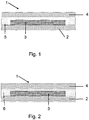
- FIG. 1 shows a first embodiment of an organic electronic arrangement 1 according to the prior art.
- This arrangement 1 has a substrate 2 on which an electronic structure 3 is arranged.
- the substrate 2 itself is designed as a barrier for permeates and thus forms part of the encapsulation of the electronic structure 3.
- a further cover 4 designed as a barrier is arranged above the electronic structure 3, in the present case also spatially spaced from it.
- an adhesive compound 5 is provided circumferentially next to the electronic structure 3 on the substrate 2 . It is irrelevant whether the adhesive was first connected to the substrate 2 or first to the cover 4.
- the pressure-sensitive adhesive 5 connects the cover 4 to the substrate 2.
- a correspondingly thick design also allows the pressure-sensitive adhesive 5 to separate the cover 4 from the electronic structure 3.
- the adhesive 5 is one according to the prior art, ie an adhesive with a high permeation barrier, which can also be filled to a large extent with getter material.
- the adhesive 5 not only assumes the function of connecting the substrate 2 to the covering 4 but also forms a barrier layer for permeates, in order to encapsulate the electronic structure 2 from the side against permeates such as water vapor and oxygen.
- a high proportion of getter material is usually not critical, since the fluid form ensures good flow and thus good sealing of the interface.
- the adhesive is an adhesive transfer tape which is tacky or is made tacky by an activation step, for example by heating
- an activation step for example by heating
- the transfer adhesive tape filled with getter material this often makes it necessary to introduce a getter pad separately into the gas space.
- an adhesive transfer tape would also be provided in the form of a diecut, which due to its filigree geometry is more difficult to handle than an adhesive transfer tape applied essentially over the entire surface.
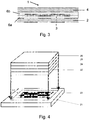
- FIG. 2 1 shows an embodiment according to the invention of an (opto)electronic arrangement 1.
- an electronic structure 3 is shown, which is arranged on a substrate 2 and encapsulated by the substrate 2 from below.
- the adhesive transfer tape 6 according to the invention is now arranged over the entire surface above and to the side of the electronic structure.
- the electronic structure 3 is thus completely encapsulated by the transfer adhesive tape 6 from above.
- a cover 4 is then applied to the adhesive transfer tape 6 .
- the adhesive transfer tape 6 is based on the adhesive transfer tape according to the invention, as was described above in general terms and is explained in more detail below in exemplary embodiments.
- the adhesive transfer tape consists of only one layer of an adhesive composition filled to an extent of less than 2% by weight.
- the combination of an adhesive compound filled with getter material and the full-area covering also exhibits a further surprising synergistic effect: the electronic arrangement does not degrade over the entire area, but only slowly and increasingly from the edge. As a result, a large part of the arrangement can still be used even when permeates penetrate for the first time. Due to the dense interface between adhesive transfer tape and substrate or cover and also to the electronic arrangement, permeates are forced to permeate through the adhesive itself, in which Surprisingly, the combination of a small proportion of getter material with a high permeation barrier is sufficient to extend the service life to a similar extent as a high proportion of getter material.
- the cover 4 does not necessarily have to meet the high barrier requirements, since when the electronic arrangement is covered over the entire area by the adhesive transfer tape, the barrier is already provided by the pressure-sensitive adhesive.
- the cover 4 can, for example, only perform a mechanical protective function, but it can also be additionally provided as a permeation barrier.
- FIG. 3 shows an alternative configuration of an (opto)electronic arrangement 1.
- two adhesive transfer tapes 6a, b are now provided, which in the present case are of identical design, but can also be different.
- the first adhesive transfer tape 6a is arranged on the substrate 2 over the entire surface.
- the electronic structure 3, which is fixed by the adhesive transfer tape 6a, is provided on the adhesive transfer tape 6a.
- the composite of adhesive transfer tape 6a and electronic structure 3 is then covered over the entire area with the further adhesive transfer tape 6b, so that the electronic structure 3 is encapsulated on all sides by the adhesive transfer tapes 6a, b.
- the cover 4 is again provided above the adhesive transfer tape 6b.
- neither the substrate 2 nor the cover 4 necessarily have to have barrier properties. However, they can still be provided in order to further limit the permeation of permeates to the electronic structure 3 .
- the adhesive transfer tape has a homogeneous layer thickness here and preferably in each case. Therefore, no sharp edge forms at the transition to the electronic structure, as appears in the illustration, but the transition is fluid and small unfilled or gas-filled areas can remain. If necessary, however, it can also be adapted to the substrate, especially if the application is carried out under vacuum.
- the adhesive mass is locally compressed to different degrees, so that the difference in height at the edge structures can be compensated to a certain extent by flow processes.
- the dimensions shown are also not to scale, but only serve to provide a better representation.
- the electronic structure itself is generally relatively flat (often less than 1 ⁇ m thick).
- the thickness of the adhesive transfer tape can include all the usual thicknesses, ie from about 1 ⁇ m to 3000 ⁇ m. A thickness of between 25 and 100 ⁇ m is preferred, since the bond strength and handling properties are particularly positive in this range. A further preferred range is a thickness of 3 to 25 ⁇ m, since in this range the amount of substances permeating through the glue joint can be kept low in an encapsulation application simply because of the small cross-sectional area of the glue joint.
- the backing of the adhesive tape or the liner is coated or printed on one side with the getter-containing adhesive from solution or dispersion or 100% (for example melt), or the adhesive tape is produced by (co)extrusion.
- the adhesive layer of the invention by lamination onto a backing material or a liner is possible.
- the layer of adhesive can be crosslinked by heat or high-energy radiation.
- This production process preferably takes place in an environment in which the specific permeate is present in only a low concentration or almost not at all.
- a relative humidity of less than 30%, preferably less than 15%, can be mentioned as an example.
- the adhesive used can be blended with one or more additives such as tackifiers (resins), plasticizers, fillers, pigments, UV absorbers, light stabilizers, aging inhibitors, crosslinking agents, crosslinking promoters or elastomers.
- additives such as tackifiers (resins), plasticizers, fillers, pigments, UV absorbers, light stabilizers, aging inhibitors, crosslinking agents, crosslinking promoters or elastomers.
- the amount of an adhesive layer is preferably 1 to 120 g/m 2 , preferably 10 to 100 g/m 2 , "amount" meaning the amount after any water or solvent has been removed.
- Another object of the present invention is the use of a change in the optical properties of the getter material to indicate the integrity of the adhesive tape.
- Calcium oxide for example, changes color from white to transparent as it binds more water. So as long as getter material is still discernible in the optical appearance of the unused state, this can serve as an indication that no permeate, or at most little permeate, has diffused to the adhesive to be protected.
- Methyl ethyl ketone was used as the solvent.
- Ultramid 1C Copolyamide 6/66/136 from BASF with a viscosity number in 96% sulfuric acid according to ISO 307 of 122 ml/g 10 parts EPR 166 Bisphenol based epoxy resin from Bakelite, epoxy number 184 20 parts PEG 2000 Polyethylene glycol with an average molecular weight of 2000 20 parts Foralyn 5040 Eastman adhesive resin
- the adhesive mass was made in a process as shown in DE102006047739 A1 is disclosed, prepared with ethanol as a solvent.
- Acrylate PSA which contained 30% by weight of ethylhexyl acrylate, 67% by weight of butyl acrylate and 3% by weight of acrylic acid as comonomers.
- the individual comonomers were polymerized in a manner known to those skilled in the art in a mixture of benzine and acetone.
- WVTR water vapor permeation rate
- OTR oxygen permeation rate
- the WVTR was measured at 38°C and 90% relative humidity according to ASTM F-1249, the OTR at 23°C and 50% relative humidity according to DIN 53380-Part 3.
- the adhesive tapes were produced in a glove box under a nitrogen atmosphere at 23° C. and 1 ppm water content.
- the various adhesives were applied from a solution to a conventional permeation-tight liner of the type ALU I 38 UV1 from Mondi, comprising an aluminum foil backing, using a laboratory applicator and dried.
- the layer thickness of adhesive after drying was 25 ⁇ m in each case. The drying took place in each case at 120° C. for 30 minutes in a drying oven.
- the layers of adhesive were lined with the above-mentioned liner on the open side as well.
- the adhesive transfer tapes of the invention produced by way of example therefore each consisted of only one layer of an adhesive.
- getter-filled adhesive transfer tapes were welded into vacuum bags made of a permeation-tight foil laminate (polyester foil-aluminum foil-sealing adhesive film), stored in the glove box under a nitrogen atmosphere and only removed immediately before use.
- a permeation-tight foil laminate polyester foil-aluminum foil-sealing adhesive film
- example adhesive mass getter material Proportion [ % by weight] 1 K1 G1 0.2 2 K1 G1 1 3 K1 G1 2 4 K2 G5 1 5 K3 G1 1 6 K3 G2 0.2 7 K3 G2 1 8th K3 G2 2 9* K4 G4 0.2 10* K4 G4 1 11* K4 G4 2 comparative examples V1 K1 G1 5 v2 K1 G1 20 V3 K2 G5 5 V4 K2 G5 20 V5 K3 G1 20 V6 K3 G2 5 V7 K3 G2 20 V8 K4 G4 5 V9 K4 G4 20 V10 K5 G1 1 V11 K5 G1 5 V12 K5 G1 20 *not according to the invention
- the bond strengths on steel of Examples 1-4 and Comparative Examples C1 - C4 and C10 - C12 were measured analogously to ISO 29862 (Method 3) at 23° C. and 50% relative humidity with a peel-off speed of 300 mm/min and a peel-off angle of 180 ° determined.
- the measuring strip was bonded using a laboratory laminator at a temperature of 60°C. Only the adhesive K2 was bonded at a temperature of 120.degree. The adhesive tapes were removed 14 days after application.
- a calcium test has been used as a measure of determining the lifetime of an electronic assembly. This one is in the figure 4 shown.
- a 20 ⁇ 20 mm 2 large, thin calcium layer 23 is deposited on a glass plate 21 in a vacuum and then stored under a nitrogen atmosphere.
- the thickness of the calcium layer 23 is about 100 nm.
- an adhesive tape (26 ⁇ 26 mm 2 ) with the adhesive 22 to be tested and a thin glass pane 24 (35 ⁇ m, Schott) is used as carrier material.
- the thin glass pane was laminated with a 100 ⁇ m thick PET film 26 by means of a 50 ⁇ m thick adhesive transfer tape 25 of an optically highly transparent acrylate PSA.
- the adhesive 22 is applied to the glass plate 21 in such a way that the adhesive 22 covers the calcium mirror 23 with an edge of 3 mm (AA) projecting on all sides. Due to the impermeable glass substrate 24, only the permeation through the pressure-sensitive adhesive or along the interfaces is determined.
- Adhesive 4 was hot pressed at a temperature of 160 °C and a pressure of about 1 MPa: adhesive mass lamination temperature K1 60°C K2 120°C K3 100oC K4 140°C
- the test is based on the reaction of calcium with water vapor and oxygen, e.g by AG Erlat et. al. in "47th Annual Technical Conference Proceedings-Society of Vacuum Coaters", 2004, pages 654 to 659 , and by ME Gross et al. in "46th Annual Technical Conference Proceedings-Society of Vacuum Coaters", 2003, pages 89 to 92 , are described.
- the light transmission of the calcium layer is monitored, which increases due to the conversion into calcium hydroxide and calcium oxide. In the test setup described, this is done from the edge, so that the visible surface of the calcium mirror is reduced. The time it takes for the light absorption of the calcium level to halve is called the lifespan.
- the method records both the degradation of the surface of the calcium level from the edge and through selective degradation in the area as well as the homogeneous reduction in the layer thickness of the calcium level through full-surface degradation.
- the measurement conditions selected were 60°C and 90% relative humidity.
- the samples were bonded over the entire surface and bubble-free with a layer thickness of the PSA of 25 ⁇ m.
- the measured value (in h) was the mean of three individual measurements.
- adhesive transfer tapes according to the invention show a life of a similar magnitude to prior art adhesive tapes (compare Examples 1-3 with C1-C2, 4 vs. C3-C4).
- adhesive tapes according to the invention even achieve longer service lives than adhesive tapes which, according to the prior art, are already considered to be filled with getter material only to a small extent (compare examples 5 vs. V5, 6-8 vs. V6-V7).
- Comparative examples C10-C12 show that the synergistic effect does not occur in the case of adhesives which already have a high permeation rate of permeates, which lead to calcium degradation in the service life test.
- the effect occurs only when using adhesives that already represent a high permeation barrier, which at a thickness of 50 ⁇ m has a water vapor permeation rate of less than 50 g/m 2 d and optionally an oxygen permeation rate of less than 5000 g /m 2 d bar.
Landscapes
- Chemical & Material Sciences (AREA)
- Organic Chemistry (AREA)
- Physics & Mathematics (AREA)
- Optics & Photonics (AREA)
- Inorganic Chemistry (AREA)
- Adhesives Or Adhesive Processes (AREA)
- Electroluminescent Light Sources (AREA)
- Adhesive Tapes (AREA)
- Photovoltaic Devices (AREA)
- Packages (AREA)
Applications Claiming Priority (2)
| Application Number | Priority Date | Filing Date | Title |
|---|---|---|---|
| DE102012211335.5A DE102012211335A1 (de) | 2012-06-29 | 2012-06-29 | Klebeband für die Kapselung einer organischen elektronischen Anordnung |
| PCT/EP2013/060895 WO2014001005A1 (de) | 2012-06-29 | 2013-05-27 | Klebeband für die kapselung einer organischen elektronischen anordnung |
Publications (2)
| Publication Number | Publication Date |
|---|---|
| EP2867318A1 EP2867318A1 (de) | 2015-05-06 |
| EP2867318B1 true EP2867318B1 (de) | 2022-01-12 |
Family
ID=48579029
Family Applications (1)
| Application Number | Title | Priority Date | Filing Date |
|---|---|---|---|
| EP13727834.7A Active EP2867318B1 (de) | 2012-06-29 | 2013-05-27 | Klebeband für die kapselung einer organischen elektronischen anordnung |
Country Status (8)
| Country | Link |
|---|---|
| US (1) | US9543549B2 (enExample) |
| EP (1) | EP2867318B1 (enExample) |
| JP (2) | JP2015529934A (enExample) |
| KR (1) | KR102013435B1 (enExample) |
| CN (1) | CN104508063B (enExample) |
| DE (1) | DE102012211335A1 (enExample) |
| TW (1) | TWI580756B (enExample) |
| WO (1) | WO2014001005A1 (enExample) |
Families Citing this family (63)
| Publication number | Priority date | Publication date | Assignee | Title |
|---|---|---|---|---|
| TW201436855A (zh) | 2012-12-21 | 2014-10-01 | Tesa Se | 從平面結構物移除滲透物的方法 |
| JP6273858B2 (ja) * | 2014-01-24 | 2018-02-07 | 三菱ケミカル株式会社 | 湿度感受性部材の封止体 |
| KR20150097359A (ko) | 2014-02-18 | 2015-08-26 | 주식회사 엘지화학 | 봉지 필름 및 이를 포함하는 유기전자장치 |
| DE102014207074A1 (de) | 2014-04-11 | 2015-10-15 | Tesa Se | Klebeband für die Kapselung einer organischen elektronischen Anordnung |
| DE102014207792A1 (de) | 2014-04-25 | 2015-10-29 | Tesa Se | Dünnglasverbund und Verfahren zum Lagern einer Dünnglasfolie |
| CN103956435A (zh) * | 2014-04-28 | 2014-07-30 | 上海大学 | 一种有机发光二极管的胶带封装结构 |
| DE102014208111A1 (de) * | 2014-04-29 | 2015-10-29 | Tesa Se | Verfahren zur Herstellung einer Verklebung auf Permeat sensiblen Oberflächen |
| JP2017528865A (ja) | 2014-06-23 | 2017-09-28 | ショット アクチエンゲゼルシャフトSchott AG | 板状の別個の要素を有する蓄電システム、板状の別個の要素、並びにその製造方法、及びその使用 |
| BR112017008003A2 (pt) * | 2014-10-29 | 2017-12-19 | Tesa Se | massas adesivas compreendendo siloxanos multifuncionais sequestrantes de água |
| EP3212725B1 (de) | 2014-10-29 | 2024-03-06 | tesa SE | Oled kompatible klebemassen mit silanwasserfängern |
| US20170327717A1 (en) | 2014-10-29 | 2017-11-16 | Tesa Se | Adhesive compounds containing getter materials that can be activated |
| US20160137889A1 (en) * | 2014-11-18 | 2016-05-19 | E I Du Pont De Nemours And Company | Bondply adhesive composition |
| KR102456654B1 (ko) * | 2014-11-26 | 2022-10-18 | 가부시키가이샤 한도오따이 에네루기 켄큐쇼 | 표시 장치 및 전자 기기 |
| WO2016087311A2 (de) | 2014-12-01 | 2016-06-09 | Schott Ag | Elektrisches speichersystem mit einem scheibenförmigen diskreten element, diskretes scheibenförmiges element, verfahren zu dessen herstellung sowie dessen verwendung |
| EP3034548A1 (en) * | 2014-12-18 | 2016-06-22 | Nederlandse Organisatie voor toegepast- natuurwetenschappelijk onderzoek TNO | Barrier film laminate comprising submicron getter particles and electronic device comprising such a laminate |
| CN107109083B (zh) * | 2014-12-18 | 2021-01-08 | 巴斯夫涂料有限公司 | 包含亲水纳米颗粒的可辐射固化的组合物 |
| JP2016160343A (ja) * | 2015-03-02 | 2016-09-05 | 富士フイルム株式会社 | 粘着シート、粘着フィルム、有機発光装置、および、粘着剤組成物 |
| DE102015222027A1 (de) | 2015-11-09 | 2017-05-11 | Tesa Se | Barriereklebemasse mit polymerem Gettermaterial |
| WO2017174457A1 (en) * | 2016-04-04 | 2017-10-12 | Disruptive Materials Ab | Getter material comprising intrinsic composite nanoparticles and method of production thereof |
| DE102016207075A1 (de) | 2016-04-26 | 2017-10-26 | Tesa Se | Repositionierbares feuchtigkeitshärtendes Klebeband |
| EP3450333B1 (en) * | 2016-04-27 | 2022-10-12 | Kyeong Keun Song | Sealing device for securing packaging material |
| EP3258516A1 (de) | 2016-06-15 | 2017-12-20 | odelo GmbH | Leuchteinheit mit organischer leuchtdiode (oled) sowie verfahren zu deren herstellung |
| EP3258515A1 (de) | 2016-06-15 | 2017-12-20 | odelo GmbH | Leuchteinheit mit organischer leuchtdiode (oled) für fahrzeuganwendungen sowie verfahren zu deren herstellung |
| US11034865B2 (en) | 2016-06-16 | 2021-06-15 | 3M Innovative Properties Company | Nanoparticle filled barrier adhesive compositions |
| KR102406867B1 (ko) | 2016-06-16 | 2022-06-13 | 쓰리엠 이노베이티브 프로퍼티즈 컴파니 | 나노입자 충전된 배리어 접착제 조성물 |
| DE102016213911A1 (de) | 2016-07-28 | 2018-02-01 | Tesa Se | OLED kompatible Klebemassen mit cyclischen Azasilanwasserfängern |
| TWI627764B (zh) * | 2016-12-02 | 2018-06-21 | Mitsubishi Electric Corp | Solar battery module and solar battery module manufacturing method |
| KR102671369B1 (ko) | 2016-12-02 | 2024-06-04 | 삼성디스플레이 주식회사 | 플렉시블 유기 발광 표시 장치 및 그 제조방법 |
| US11138490B2 (en) | 2016-12-14 | 2021-10-05 | Ajay Khoche | Hierarchical combination of distributed statistics in a monitoring network |
| US10902310B2 (en) | 2016-12-14 | 2021-01-26 | Trackonomy Systems, Inc. | Wireless communications and transducer based event detection platform |
| US10885420B2 (en) | 2016-12-14 | 2021-01-05 | Ajay Khoche | Package sealing tape types with varied transducer sampling densities |
| US10482369B2 (en) | 2016-12-14 | 2019-11-19 | Trackonomy Systems, Inc. | Window based locationing of mobile targets using complementary position estimates |
| US11003978B2 (en) | 2016-12-14 | 2021-05-11 | Ajay Khoche | Programmable network node roles in hierarchical communications network |
| TWI649392B (zh) * | 2016-12-21 | 2019-02-01 | 住華科技股份有限公司 | 黏著劑薄片以及偏光板組件 |
| EP3339388B1 (en) * | 2016-12-22 | 2022-01-26 | 3M Innovative Properties Company | Pressure-sensitive adhesive compositions for manufacturing electronic devices |
| KR102549995B1 (ko) * | 2017-05-05 | 2023-06-29 | 쓰리엠 이노베이티브 프로퍼티즈 컴파니 | 중합체 필름 및 그러한 필름을 포함하는 디스플레이 디바이스 |
| US9960389B1 (en) | 2017-05-05 | 2018-05-01 | 3M Innovative Properties Company | Polymeric films and display devices containing such films |
| KR102316563B1 (ko) * | 2017-05-22 | 2021-10-25 | 엘지디스플레이 주식회사 | 금속으로 형성된 상부 기판을 포함하는 유기 발광 표시 장치 및 이의 제조 방법 |
| WO2018217026A1 (ko) * | 2017-05-24 | 2018-11-29 | 주식회사 엘지화학 | 유기전자장치 |
| CN107331787B (zh) * | 2017-06-26 | 2019-06-21 | 京东方科技集团股份有限公司 | 封装盖板、有机发光显示器及其制备方法 |
| CN111465669B (zh) | 2017-12-06 | 2022-12-16 | 3M创新有限公司 | 阻隔性粘合剂组合物和制品 |
| DE102018203276A1 (de) | 2018-03-06 | 2019-09-12 | Tesa Se | Indikatortape |
| DE102018208168A1 (de) | 2018-05-24 | 2019-11-28 | Tesa Se | Kombination einer transparenten vollflächigen Verkapselung mit einer (intransparenten) Randverkapselung mit hohem Gettergehalt |
| CN110783492A (zh) * | 2018-07-27 | 2020-02-11 | 株式会社日本有机雷特显示器 | 发光显示装置及其制造方法 |
| CN109679510B (zh) * | 2018-12-25 | 2021-04-27 | 广州市隆创新材料有限公司 | 一种适合全自动贴合的热熔光学胶膜及其制备方法 |
| EP3911930B1 (en) * | 2019-01-18 | 2023-12-27 | Nitto Denko Corporation | Gas and/or chemical liquid indicator |
| WO2020247354A1 (en) | 2019-06-05 | 2020-12-10 | Trackonomy Systems, Inc. | Temperature monitoring in cold supply chains |
| US11317516B2 (en) | 2019-09-13 | 2022-04-26 | Trackonomy Systems, Inc. | Roll-to-roll additive manufacturing method and device |
| TWI780494B (zh) * | 2019-10-09 | 2022-10-11 | 德商卡爾科德寶兩合公司 | 複合材料在主動和/或被動冷卻的通電系統中用於吸收和分配液體的應用 |
| US11864058B1 (en) | 2020-10-04 | 2024-01-02 | Trackonomy Systems, Inc. | Flexible tracking device for cables and equipment |
| EP4186053A4 (en) | 2020-07-24 | 2024-09-04 | Trackonomy Systems, Inc. | TEAR TO ACTIVATE A WIRELESS NODE WITH MULTIPLE CUTOUTS ALLOWING REUSE |
| US12124904B2 (en) | 2020-09-05 | 2024-10-22 | Trackonomy Systems, Inc. | Wireless sensor device with an attachable external sensor probe |
| US12047841B2 (en) | 2020-09-21 | 2024-07-23 | Trackonomy Systems, Inc. | Detecting special events and strategically important areas in an IoT tracking system |
| EP4205053A4 (en) | 2020-10-03 | 2024-09-18 | Trackonomy Systems, Inc. | SYSTEM AND METHOD FOR GENERATING ENVIRONMENTAL PROFILES TO DETERMINE ASSET LOGISTICS |
| US11527148B1 (en) | 2020-10-04 | 2022-12-13 | Trackonomy Systems, Inc. | Augmented reality for guiding users to assets in IOT applications |
| US12051916B1 (en) | 2020-10-05 | 2024-07-30 | Trackonomy Systems, Inc. | Method for recharging wireless IOT devices and system thereof |
| TW202221082A (zh) * | 2020-11-17 | 2022-06-01 | 明基材料股份有限公司 | 一種矽膠阻氣膜 |
| CN112322233A (zh) * | 2020-11-23 | 2021-02-05 | 广东能辉新材料科技有限公司 | 含改性sis热塑性弹性体的热熔压敏胶及其制备方法 |
| WO2022126020A1 (en) | 2020-12-12 | 2022-06-16 | Trackonomy Systems, Inc. | Flexible solar-powered wireless communication device |
| CN113437242B (zh) * | 2021-06-29 | 2023-06-20 | 固安翌光科技有限公司 | 一种封装结构以及光电器件 |
| JP2023051755A (ja) * | 2021-09-30 | 2023-04-11 | 株式会社リコー | 光電変換素子、光電変換モジュール、及び電子機器 |
| CN114224306B (zh) * | 2021-11-11 | 2024-03-22 | 煤炭科学研究总院有限公司 | 心率检测传感器、防护服和传感器的制作方法 |
| FR3139143B1 (fr) * | 2022-08-30 | 2024-08-30 | Commissariat Energie Atomique | Procede de transfert d’une couche adhesive en polymere(s) thermoplastique(s) d’un premier substrat vers un deuxieme substrat |
Citations (1)
| Publication number | Priority date | Publication date | Assignee | Title |
|---|---|---|---|---|
| WO2012070871A2 (ko) * | 2010-11-23 | 2012-05-31 | 주식회사 엘지화학 | 접착제 조성물 |
Family Cites Families (29)
| Publication number | Priority date | Publication date | Assignee | Title |
|---|---|---|---|---|
| US4051195A (en) | 1975-12-15 | 1977-09-27 | Celanese Polymer Specialties Company | Polyepoxide-polyacrylate ester compositions |
| GB1552046A (en) | 1977-02-02 | 1979-09-05 | Ciba Geigy Ag | Film adhesives |
| JPH03127488A (ja) * | 1989-10-12 | 1991-05-30 | Teijin Ltd | 電場発光素子 |
| KR100430958B1 (ko) | 1996-11-12 | 2004-05-12 | 미네소타 마이닝 앤드 매뉴팩춰링 캄파니 | 열경화성의 감압성 접착제 |
| JP2000208252A (ja) | 1999-01-14 | 2000-07-28 | Tdk Corp | 有機el素子 |
| US6803081B2 (en) | 2001-06-26 | 2004-10-12 | National Starch And Chemical Investment Holding Corporation | Radiation curable adhesive |
| US6936131B2 (en) | 2002-01-31 | 2005-08-30 | 3M Innovative Properties Company | Encapsulation of organic electronic devices using adsorbent loaded adhesives |
| US20060100299A1 (en) | 2002-07-24 | 2006-05-11 | Ranjit Malik | Transformable pressure sensitive adhesive tape and use thereof in display screens |
| US7449629B2 (en) | 2002-08-21 | 2008-11-11 | Truseal Technologies, Inc. | Solar panel including a low moisture vapor transmission rate adhesive composition |
| JP2005298703A (ja) | 2004-04-13 | 2005-10-27 | Mitsui Chemicals Inc | 粘着性フィルム、筐体およびそれを用いた有機el発光素子 |
| US20060087230A1 (en) | 2004-10-22 | 2006-04-27 | Eastman Kodak Company | Desiccant film in top-emitting OLED |
| JP2006228519A (ja) * | 2005-02-16 | 2006-08-31 | Canon Inc | 有機エレクトロルミネッセンス素子及びその製造方法 |
| JP2007197517A (ja) | 2006-01-24 | 2007-08-09 | Three M Innovative Properties Co | 接着性封止組成物、封止フィルム及び有機el素子 |
| JP2008065994A (ja) * | 2006-09-04 | 2008-03-21 | Seiko Epson Corp | エレクトロルミネッセンス装置、エレクトロルミネッセンス装置の製造方法並びに電子機器 |
| EP2070127B2 (en) | 2006-09-20 | 2015-09-02 | Dow Global Technologies LLC | Electronic device module comprising an ethylene multi-block copolymer |
| DE102006047739A1 (de) | 2006-10-06 | 2008-04-17 | Tesa Ag | Hitzeaktivierbares Klebeband insbesondere für die Verklebung von elektronischen Bauteilen und Leiterbahnen |
| DE102008003546A1 (de) | 2008-01-09 | 2009-07-16 | Tesa Ag | Liner mit einer Barriereschicht |
| JP2009259656A (ja) * | 2008-04-18 | 2009-11-05 | Toyo Ink Mfg Co Ltd | 封止剤 |
| DE102008047964A1 (de) | 2008-09-18 | 2010-03-25 | Tesa Se | Verfahren zur Kapselung einer elektronischen Anordnung |
| JP2010080293A (ja) * | 2008-09-26 | 2010-04-08 | Dainippon Printing Co Ltd | 有機エレクトロルミネッセンス素子封止用粘着フィルム |
| JP5201347B2 (ja) | 2008-11-28 | 2013-06-05 | 株式会社スリーボンド | 有機el素子封止用光硬化性樹脂組成物 |
| JP5639476B2 (ja) * | 2008-11-28 | 2014-12-10 | 三井化学株式会社 | 有機el素子の面封止剤、表示装置の製造方法および表示装置 |
| DE102008060113A1 (de) | 2008-12-03 | 2010-07-29 | Tesa Se | Verfahren zur Kapselung einer elektronischen Anordnung |
| DE102008062130A1 (de) | 2008-12-16 | 2010-06-17 | Tesa Se | Verfahren zur Kapselung einer elektronischen Anordnung |
| JP2010182449A (ja) * | 2009-02-03 | 2010-08-19 | Fujifilm Corp | 有機el表示装置 |
| DE102009036968A1 (de) * | 2009-08-12 | 2011-02-17 | Tesa Se | Verfahren zur Kapselung einer elektronischen Anordnung |
| DE102009036970A1 (de) | 2009-08-12 | 2011-02-17 | Tesa Se | Verfahren zur Kapselung einer elektronischen Anordnung |
| DE102009036986B4 (de) | 2009-08-12 | 2011-07-07 | Volkswagen AG, 38440 | Ausgleichsgetriebe |
| JPWO2012077431A1 (ja) * | 2010-12-08 | 2014-05-19 | コニカミノルタ株式会社 | 有機エレクトロルミネッセンス素子の製造方法 |
-
2012
- 2012-06-29 DE DE102012211335.5A patent/DE102012211335A1/de not_active Withdrawn
-
2013
- 2013-05-27 EP EP13727834.7A patent/EP2867318B1/de active Active
- 2013-05-27 WO PCT/EP2013/060895 patent/WO2014001005A1/de not_active Ceased
- 2013-05-27 JP JP2015518932A patent/JP2015529934A/ja active Pending
- 2013-05-27 KR KR1020157002573A patent/KR102013435B1/ko active Active
- 2013-05-27 CN CN201380040109.1A patent/CN104508063B/zh active Active
- 2013-05-27 US US14/411,585 patent/US9543549B2/en active Active
- 2013-06-06 TW TW102120099A patent/TWI580756B/zh not_active IP Right Cessation
-
2018
- 2018-08-02 JP JP2018145579A patent/JP2018199821A/ja not_active Withdrawn
Patent Citations (2)
| Publication number | Priority date | Publication date | Assignee | Title |
|---|---|---|---|---|
| WO2012070871A2 (ko) * | 2010-11-23 | 2012-05-31 | 주식회사 엘지화학 | 접착제 조성물 |
| EP2644677A2 (en) * | 2010-11-23 | 2013-10-02 | LG Chem, Ltd. | Adhesive composition |
Non-Patent Citations (1)
| Title |
|---|
| ANONYMOUS: "Lithiumaluminiumhydrid", 1 December 2007 (2007-12-01), pages 1 - 3, XP055664368, Retrieved from the Internet <URL:https://roempp.thieme.de/lexicon/RD-12-01348#/> [retrieved on 20200203] * |
Also Published As
| Publication number | Publication date |
|---|---|
| JP2015529934A (ja) | 2015-10-08 |
| JP2018199821A (ja) | 2018-12-20 |
| CN104508063A (zh) | 2015-04-08 |
| TWI580756B (zh) | 2017-05-01 |
| KR102013435B1 (ko) | 2019-08-22 |
| CN104508063B (zh) | 2017-07-21 |
| US9543549B2 (en) | 2017-01-10 |
| WO2014001005A1 (de) | 2014-01-03 |
| TW201402766A (zh) | 2014-01-16 |
| EP2867318A1 (de) | 2015-05-06 |
| KR20150032569A (ko) | 2015-03-26 |
| DE102012211335A1 (de) | 2014-01-02 |
| US20150162568A1 (en) | 2015-06-11 |
Similar Documents
| Publication | Publication Date | Title |
|---|---|---|
| EP2867318A1 (de) | Klebeband für die kapselung einer organischen elektronischen anordnung | |
| EP2607439B1 (de) | Liner zum schutz von klebemassen | |
| EP2935500B1 (de) | Gettermaterial enthaltendes klebeband | |
| EP3129443B1 (de) | Klebeband für die kapselung einer organischen elektronischen anordnung | |
| EP2768918B1 (de) | Klebemasse insbesondere zur kapselung einer elektronischen anordnung | |
| EP2794791B1 (de) | Verwendung eines liners zum schutz von klebemassen | |
| EP2465149B1 (de) | Verfahren zur kapselung einer elektronischen anordnung | |
| EP2279537B1 (de) | Verfahren zur kapselung einer elektronischen anordnung | |
| EP2465150B1 (de) | Verfahren zur kapselung einer elektronischen anordnung | |
| EP2649642B1 (de) | Klebmasse und verfahren zur kapselung einer elektronischen anordnung | |
| DE102012219877A1 (de) | Haftklebemasse insbesondere zur Kapselung einer elektronischen Anordnung | |
| EP3134368B1 (de) | Dünnglasverbund und verfahren zum lagern einer dünnglasfolie | |
| DE102015212058A1 (de) | Klebemasse insbesondere zur Kapselung einer elektronischen Anordnung | |
| DE102016213840A1 (de) | Klebeband zur Verkapselung elektronischer Aufbauten | |
| EP2823010B1 (de) | Verbundsystem zur verkapselung elektronischer anordnungen | |
| DE102013223451A1 (de) | Verfahren zur Trocknung von Klebemassen |
Legal Events
| Date | Code | Title | Description |
|---|---|---|---|
| PUAI | Public reference made under article 153(3) epc to a published international application that has entered the european phase |
Free format text: ORIGINAL CODE: 0009012 |
|
| 17P | Request for examination filed |
Effective date: 20150129 |
|
| AK | Designated contracting states |
Kind code of ref document: A1 Designated state(s): AL AT BE BG CH CY CZ DE DK EE ES FI FR GB GR HR HU IE IS IT LI LT LU LV MC MK MT NL NO PL PT RO RS SE SI SK SM TR |
|
| AX | Request for extension of the european patent |
Extension state: BA ME |
|
| DAX | Request for extension of the european patent (deleted) | ||
| RAP1 | Party data changed (applicant data changed or rights of an application transferred) |
Owner name: TESA SE |
|
| STAA | Information on the status of an ep patent application or granted ep patent |
Free format text: STATUS: EXAMINATION IS IN PROGRESS |
|
| 17Q | First examination report despatched |
Effective date: 20180307 |
|
| REG | Reference to a national code |
Ref country code: DE Ref legal event code: R079 Ref document number: 502013016050 Country of ref document: DE Free format text: PREVIOUS MAIN CLASS: C09J0007000000 Ipc: C09J0011040000 |
|
| RIC1 | Information provided on ipc code assigned before grant |
Ipc: H01L 51/52 20060101ALI20210804BHEP Ipc: H01L 51/00 20060101ALI20210804BHEP Ipc: C09J 7/38 20180101ALI20210804BHEP Ipc: C09J 7/35 20180101ALI20210804BHEP Ipc: C09J 7/20 20180101ALI20210804BHEP Ipc: C09J 7/10 20180101ALI20210804BHEP Ipc: C09J 11/04 20060101AFI20210804BHEP |
|
| GRAP | Despatch of communication of intention to grant a patent |
Free format text: ORIGINAL CODE: EPIDOSNIGR1 |
|
| STAA | Information on the status of an ep patent application or granted ep patent |
Free format text: STATUS: GRANT OF PATENT IS INTENDED |
|
| INTG | Intention to grant announced |
Effective date: 20211022 |
|
| GRAS | Grant fee paid |
Free format text: ORIGINAL CODE: EPIDOSNIGR3 |
|
| GRAA | (expected) grant |
Free format text: ORIGINAL CODE: 0009210 |
|
| STAA | Information on the status of an ep patent application or granted ep patent |
Free format text: STATUS: THE PATENT HAS BEEN GRANTED |
|
| RIN1 | Information on inventor provided before grant (corrected) |
Inventor name: PETERSEN, ANIKA Inventor name: KEITE-TELGENBUESCHER, KLAUS Inventor name: GRUENAUER, JUDITH Inventor name: ELLINGER, JAN Inventor name: BAI, MINYOUNG |
|
| AK | Designated contracting states |
Kind code of ref document: B1 Designated state(s): AL AT BE BG CH CY CZ DE DK EE ES FI FR GB GR HR HU IE IS IT LI LT LU LV MC MK MT NL NO PL PT RO RS SE SI SK SM TR |
|
| REG | Reference to a national code |
Ref country code: GB Ref legal event code: FG4D Free format text: NOT ENGLISH |
|
| REG | Reference to a national code |
Ref country code: CH Ref legal event code: EP |
|
| REG | Reference to a national code |
Ref country code: DE Ref legal event code: R096 Ref document number: 502013016050 Country of ref document: DE |
|
| REG | Reference to a national code |
Ref country code: IE Ref legal event code: FG4D Free format text: LANGUAGE OF EP DOCUMENT: GERMAN |
|
| REG | Reference to a national code |
Ref country code: AT Ref legal event code: REF Ref document number: 1462378 Country of ref document: AT Kind code of ref document: T Effective date: 20220215 |
|
| REG | Reference to a national code |
Ref country code: LT Ref legal event code: MG9D |
|
| REG | Reference to a national code |
Ref country code: NL Ref legal event code: MP Effective date: 20220112 |
|
| PG25 | Lapsed in a contracting state [announced via postgrant information from national office to epo] |
Ref country code: NL Free format text: LAPSE BECAUSE OF FAILURE TO SUBMIT A TRANSLATION OF THE DESCRIPTION OR TO PAY THE FEE WITHIN THE PRESCRIBED TIME-LIMIT Effective date: 20220112 |
|
| PG25 | Lapsed in a contracting state [announced via postgrant information from national office to epo] |
Ref country code: SE Free format text: LAPSE BECAUSE OF FAILURE TO SUBMIT A TRANSLATION OF THE DESCRIPTION OR TO PAY THE FEE WITHIN THE PRESCRIBED TIME-LIMIT Effective date: 20220112 Ref country code: RS Free format text: LAPSE BECAUSE OF FAILURE TO SUBMIT A TRANSLATION OF THE DESCRIPTION OR TO PAY THE FEE WITHIN THE PRESCRIBED TIME-LIMIT Effective date: 20220112 Ref country code: PT Free format text: LAPSE BECAUSE OF FAILURE TO SUBMIT A TRANSLATION OF THE DESCRIPTION OR TO PAY THE FEE WITHIN THE PRESCRIBED TIME-LIMIT Effective date: 20220512 Ref country code: NO Free format text: LAPSE BECAUSE OF FAILURE TO SUBMIT A TRANSLATION OF THE DESCRIPTION OR TO PAY THE FEE WITHIN THE PRESCRIBED TIME-LIMIT Effective date: 20220412 Ref country code: LT Free format text: LAPSE BECAUSE OF FAILURE TO SUBMIT A TRANSLATION OF THE DESCRIPTION OR TO PAY THE FEE WITHIN THE PRESCRIBED TIME-LIMIT Effective date: 20220112 Ref country code: HR Free format text: LAPSE BECAUSE OF FAILURE TO SUBMIT A TRANSLATION OF THE DESCRIPTION OR TO PAY THE FEE WITHIN THE PRESCRIBED TIME-LIMIT Effective date: 20220112 Ref country code: ES Free format text: LAPSE BECAUSE OF FAILURE TO SUBMIT A TRANSLATION OF THE DESCRIPTION OR TO PAY THE FEE WITHIN THE PRESCRIBED TIME-LIMIT Effective date: 20220112 Ref country code: BG Free format text: LAPSE BECAUSE OF FAILURE TO SUBMIT A TRANSLATION OF THE DESCRIPTION OR TO PAY THE FEE WITHIN THE PRESCRIBED TIME-LIMIT Effective date: 20220412 |
|
| PG25 | Lapsed in a contracting state [announced via postgrant information from national office to epo] |
Ref country code: PL Free format text: LAPSE BECAUSE OF FAILURE TO SUBMIT A TRANSLATION OF THE DESCRIPTION OR TO PAY THE FEE WITHIN THE PRESCRIBED TIME-LIMIT Effective date: 20220112 Ref country code: LV Free format text: LAPSE BECAUSE OF FAILURE TO SUBMIT A TRANSLATION OF THE DESCRIPTION OR TO PAY THE FEE WITHIN THE PRESCRIBED TIME-LIMIT Effective date: 20220112 Ref country code: GR Free format text: LAPSE BECAUSE OF FAILURE TO SUBMIT A TRANSLATION OF THE DESCRIPTION OR TO PAY THE FEE WITHIN THE PRESCRIBED TIME-LIMIT Effective date: 20220413 Ref country code: FI Free format text: LAPSE BECAUSE OF FAILURE TO SUBMIT A TRANSLATION OF THE DESCRIPTION OR TO PAY THE FEE WITHIN THE PRESCRIBED TIME-LIMIT Effective date: 20220112 |
|
| PG25 | Lapsed in a contracting state [announced via postgrant information from national office to epo] |
Ref country code: IS Free format text: LAPSE BECAUSE OF FAILURE TO SUBMIT A TRANSLATION OF THE DESCRIPTION OR TO PAY THE FEE WITHIN THE PRESCRIBED TIME-LIMIT Effective date: 20220512 |
|
| REG | Reference to a national code |
Ref country code: DE Ref legal event code: R097 Ref document number: 502013016050 Country of ref document: DE |
|
| PG25 | Lapsed in a contracting state [announced via postgrant information from national office to epo] |
Ref country code: SM Free format text: LAPSE BECAUSE OF FAILURE TO SUBMIT A TRANSLATION OF THE DESCRIPTION OR TO PAY THE FEE WITHIN THE PRESCRIBED TIME-LIMIT Effective date: 20220112 Ref country code: SK Free format text: LAPSE BECAUSE OF FAILURE TO SUBMIT A TRANSLATION OF THE DESCRIPTION OR TO PAY THE FEE WITHIN THE PRESCRIBED TIME-LIMIT Effective date: 20220112 Ref country code: RO Free format text: LAPSE BECAUSE OF FAILURE TO SUBMIT A TRANSLATION OF THE DESCRIPTION OR TO PAY THE FEE WITHIN THE PRESCRIBED TIME-LIMIT Effective date: 20220112 Ref country code: EE Free format text: LAPSE BECAUSE OF FAILURE TO SUBMIT A TRANSLATION OF THE DESCRIPTION OR TO PAY THE FEE WITHIN THE PRESCRIBED TIME-LIMIT Effective date: 20220112 Ref country code: DK Free format text: LAPSE BECAUSE OF FAILURE TO SUBMIT A TRANSLATION OF THE DESCRIPTION OR TO PAY THE FEE WITHIN THE PRESCRIBED TIME-LIMIT Effective date: 20220112 Ref country code: CZ Free format text: LAPSE BECAUSE OF FAILURE TO SUBMIT A TRANSLATION OF THE DESCRIPTION OR TO PAY THE FEE WITHIN THE PRESCRIBED TIME-LIMIT Effective date: 20220112 |
|
| PLBE | No opposition filed within time limit |
Free format text: ORIGINAL CODE: 0009261 |
|
| STAA | Information on the status of an ep patent application or granted ep patent |
Free format text: STATUS: NO OPPOSITION FILED WITHIN TIME LIMIT |
|
| PG25 | Lapsed in a contracting state [announced via postgrant information from national office to epo] |
Ref country code: AL Free format text: LAPSE BECAUSE OF FAILURE TO SUBMIT A TRANSLATION OF THE DESCRIPTION OR TO PAY THE FEE WITHIN THE PRESCRIBED TIME-LIMIT Effective date: 20220112 |
|
| 26N | No opposition filed |
Effective date: 20221013 |
|
| REG | Reference to a national code |
Ref country code: CH Ref legal event code: PL |
|
| REG | Reference to a national code |
Ref country code: BE Ref legal event code: MM Effective date: 20220531 |
|
| GBPC | Gb: european patent ceased through non-payment of renewal fee |
Effective date: 20220527 |
|
| PG25 | Lapsed in a contracting state [announced via postgrant information from national office to epo] |
Ref country code: MC Free format text: LAPSE BECAUSE OF FAILURE TO SUBMIT A TRANSLATION OF THE DESCRIPTION OR TO PAY THE FEE WITHIN THE PRESCRIBED TIME-LIMIT Effective date: 20220112 Ref country code: LU Free format text: LAPSE BECAUSE OF NON-PAYMENT OF DUE FEES Effective date: 20220527 Ref country code: LI Free format text: LAPSE BECAUSE OF NON-PAYMENT OF DUE FEES Effective date: 20220531 Ref country code: CH Free format text: LAPSE BECAUSE OF NON-PAYMENT OF DUE FEES Effective date: 20220531 |
|
| PG25 | Lapsed in a contracting state [announced via postgrant information from national office to epo] |
Ref country code: SI Free format text: LAPSE BECAUSE OF FAILURE TO SUBMIT A TRANSLATION OF THE DESCRIPTION OR TO PAY THE FEE WITHIN THE PRESCRIBED TIME-LIMIT Effective date: 20220112 |
|
| PG25 | Lapsed in a contracting state [announced via postgrant information from national office to epo] |
Ref country code: IE Free format text: LAPSE BECAUSE OF NON-PAYMENT OF DUE FEES Effective date: 20220527 Ref country code: FR Free format text: LAPSE BECAUSE OF NON-PAYMENT OF DUE FEES Effective date: 20220531 |
|
| PG25 | Lapsed in a contracting state [announced via postgrant information from national office to epo] |
Ref country code: GB Free format text: LAPSE BECAUSE OF NON-PAYMENT OF DUE FEES Effective date: 20220527 Ref country code: BE Free format text: LAPSE BECAUSE OF NON-PAYMENT OF DUE FEES Effective date: 20220531 |
|
| REG | Reference to a national code |
Ref country code: AT Ref legal event code: MM01 Ref document number: 1462378 Country of ref document: AT Kind code of ref document: T Effective date: 20220527 |
|
| PG25 | Lapsed in a contracting state [announced via postgrant information from national office to epo] |
Ref country code: IT Free format text: LAPSE BECAUSE OF FAILURE TO SUBMIT A TRANSLATION OF THE DESCRIPTION OR TO PAY THE FEE WITHIN THE PRESCRIBED TIME-LIMIT Effective date: 20220112 Ref country code: AT Free format text: LAPSE BECAUSE OF NON-PAYMENT OF DUE FEES Effective date: 20220527 |
|
| PG25 | Lapsed in a contracting state [announced via postgrant information from national office to epo] |
Ref country code: HU Free format text: LAPSE BECAUSE OF FAILURE TO SUBMIT A TRANSLATION OF THE DESCRIPTION OR TO PAY THE FEE WITHIN THE PRESCRIBED TIME-LIMIT; INVALID AB INITIO Effective date: 20130527 |
|
| PG25 | Lapsed in a contracting state [announced via postgrant information from national office to epo] |
Ref country code: MK Free format text: LAPSE BECAUSE OF FAILURE TO SUBMIT A TRANSLATION OF THE DESCRIPTION OR TO PAY THE FEE WITHIN THE PRESCRIBED TIME-LIMIT Effective date: 20220112 Ref country code: CY Free format text: LAPSE BECAUSE OF FAILURE TO SUBMIT A TRANSLATION OF THE DESCRIPTION OR TO PAY THE FEE WITHIN THE PRESCRIBED TIME-LIMIT Effective date: 20220112 |
|
| PG25 | Lapsed in a contracting state [announced via postgrant information from national office to epo] |
Ref country code: MT Free format text: LAPSE BECAUSE OF FAILURE TO SUBMIT A TRANSLATION OF THE DESCRIPTION OR TO PAY THE FEE WITHIN THE PRESCRIBED TIME-LIMIT Effective date: 20220112 |
|
| PG25 | Lapsed in a contracting state [announced via postgrant information from national office to epo] |
Ref country code: TR Free format text: LAPSE BECAUSE OF FAILURE TO SUBMIT A TRANSLATION OF THE DESCRIPTION OR TO PAY THE FEE WITHIN THE PRESCRIBED TIME-LIMIT Effective date: 20220112 |
|
| PGFP | Annual fee paid to national office [announced via postgrant information from national office to epo] |
Ref country code: DE Payment date: 20260522 Year of fee payment: 14 |