EP2865769B1 - Aktivkohle zur edelmetalladsorption, edelmetalladsorptionsfilter und verfahren zur rückgewinnung von edelmetallen - Google Patents
Aktivkohle zur edelmetalladsorption, edelmetalladsorptionsfilter und verfahren zur rückgewinnung von edelmetallen Download PDFInfo
- Publication number
- EP2865769B1 EP2865769B1 EP13807762.3A EP13807762A EP2865769B1 EP 2865769 B1 EP2865769 B1 EP 2865769B1 EP 13807762 A EP13807762 A EP 13807762A EP 2865769 B1 EP2865769 B1 EP 2865769B1
- Authority
- EP
- European Patent Office
- Prior art keywords
- activated carbon
- noble metal
- filter
- adsorption
- palladium
- Prior art date
- Legal status (The legal status is an assumption and is not a legal conclusion. Google has not performed a legal analysis and makes no representation as to the accuracy of the status listed.)
- Active
Links
Images

Classifications
-
- B—PERFORMING OPERATIONS; TRANSPORTING
- B01—PHYSICAL OR CHEMICAL PROCESSES OR APPARATUS IN GENERAL
- B01J—CHEMICAL OR PHYSICAL PROCESSES, e.g. CATALYSIS OR COLLOID CHEMISTRY; THEIR RELEVANT APPARATUS
- B01J20/00—Solid sorbent compositions or filter aid compositions; Sorbents for chromatography; Processes for preparing, regenerating or reactivating thereof
- B01J20/28—Solid sorbent compositions or filter aid compositions; Sorbents for chromatography; Processes for preparing, regenerating or reactivating thereof characterised by their form or physical properties
- B01J20/28054—Solid sorbent compositions or filter aid compositions; Sorbents for chromatography; Processes for preparing, regenerating or reactivating thereof characterised by their form or physical properties characterised by their surface properties or porosity
- B01J20/28078—Pore diameter
- B01J20/2808—Pore diameter being less than 2 nm, i.e. micropores or nanopores
-
- B—PERFORMING OPERATIONS; TRANSPORTING
- B01—PHYSICAL OR CHEMICAL PROCESSES OR APPARATUS IN GENERAL
- B01J—CHEMICAL OR PHYSICAL PROCESSES, e.g. CATALYSIS OR COLLOID CHEMISTRY; THEIR RELEVANT APPARATUS
- B01J20/00—Solid sorbent compositions or filter aid compositions; Sorbents for chromatography; Processes for preparing, regenerating or reactivating thereof
- B01J20/02—Solid sorbent compositions or filter aid compositions; Sorbents for chromatography; Processes for preparing, regenerating or reactivating thereof comprising inorganic material
- B01J20/20—Solid sorbent compositions or filter aid compositions; Sorbents for chromatography; Processes for preparing, regenerating or reactivating thereof comprising inorganic material comprising free carbon; comprising carbon obtained by carbonising processes
-
- B—PERFORMING OPERATIONS; TRANSPORTING
- B01—PHYSICAL OR CHEMICAL PROCESSES OR APPARATUS IN GENERAL
- B01J—CHEMICAL OR PHYSICAL PROCESSES, e.g. CATALYSIS OR COLLOID CHEMISTRY; THEIR RELEVANT APPARATUS
- B01J20/00—Solid sorbent compositions or filter aid compositions; Sorbents for chromatography; Processes for preparing, regenerating or reactivating thereof
- B01J20/28—Solid sorbent compositions or filter aid compositions; Sorbents for chromatography; Processes for preparing, regenerating or reactivating thereof characterised by their form or physical properties
- B01J20/28014—Solid sorbent compositions or filter aid compositions; Sorbents for chromatography; Processes for preparing, regenerating or reactivating thereof characterised by their form or physical properties characterised by their form
- B01J20/2803—Sorbents comprising a binder, e.g. for forming aggregated, agglomerated or granulated products
-
- B—PERFORMING OPERATIONS; TRANSPORTING
- B01—PHYSICAL OR CHEMICAL PROCESSES OR APPARATUS IN GENERAL
- B01J—CHEMICAL OR PHYSICAL PROCESSES, e.g. CATALYSIS OR COLLOID CHEMISTRY; THEIR RELEVANT APPARATUS
- B01J20/00—Solid sorbent compositions or filter aid compositions; Sorbents for chromatography; Processes for preparing, regenerating or reactivating thereof
- B01J20/28—Solid sorbent compositions or filter aid compositions; Sorbents for chromatography; Processes for preparing, regenerating or reactivating thereof characterised by their form or physical properties
- B01J20/28054—Solid sorbent compositions or filter aid compositions; Sorbents for chromatography; Processes for preparing, regenerating or reactivating thereof characterised by their form or physical properties characterised by their surface properties or porosity
- B01J20/28057—Surface area, e.g. B.E.T specific surface area
- B01J20/28061—Surface area, e.g. B.E.T specific surface area being in the range 100-500 m2/g
-
- B—PERFORMING OPERATIONS; TRANSPORTING
- B01—PHYSICAL OR CHEMICAL PROCESSES OR APPARATUS IN GENERAL
- B01J—CHEMICAL OR PHYSICAL PROCESSES, e.g. CATALYSIS OR COLLOID CHEMISTRY; THEIR RELEVANT APPARATUS
- B01J20/00—Solid sorbent compositions or filter aid compositions; Sorbents for chromatography; Processes for preparing, regenerating or reactivating thereof
- B01J20/28—Solid sorbent compositions or filter aid compositions; Sorbents for chromatography; Processes for preparing, regenerating or reactivating thereof characterised by their form or physical properties
- B01J20/28054—Solid sorbent compositions or filter aid compositions; Sorbents for chromatography; Processes for preparing, regenerating or reactivating thereof characterised by their form or physical properties characterised by their surface properties or porosity
- B01J20/28069—Pore volume, e.g. total pore volume, mesopore volume, micropore volume
- B01J20/28071—Pore volume, e.g. total pore volume, mesopore volume, micropore volume being less than 0.5 ml/g
-
- B—PERFORMING OPERATIONS; TRANSPORTING
- B01—PHYSICAL OR CHEMICAL PROCESSES OR APPARATUS IN GENERAL
- B01J—CHEMICAL OR PHYSICAL PROCESSES, e.g. CATALYSIS OR COLLOID CHEMISTRY; THEIR RELEVANT APPARATUS
- B01J20/00—Solid sorbent compositions or filter aid compositions; Sorbents for chromatography; Processes for preparing, regenerating or reactivating thereof
- B01J20/28—Solid sorbent compositions or filter aid compositions; Sorbents for chromatography; Processes for preparing, regenerating or reactivating thereof characterised by their form or physical properties
- B01J20/28054—Solid sorbent compositions or filter aid compositions; Sorbents for chromatography; Processes for preparing, regenerating or reactivating thereof characterised by their form or physical properties characterised by their surface properties or porosity
- B01J20/28069—Pore volume, e.g. total pore volume, mesopore volume, micropore volume
- B01J20/28073—Pore volume, e.g. total pore volume, mesopore volume, micropore volume being in the range 0.5-1.0 ml/g
-
- C—CHEMISTRY; METALLURGY
- C01—INORGANIC CHEMISTRY
- C01B—NON-METALLIC ELEMENTS; COMPOUNDS THEREOF; METALLOIDS OR COMPOUNDS THEREOF NOT COVERED BY SUBCLASS C01C
- C01B32/00—Carbon; Compounds thereof
- C01B32/30—Active carbon
- C01B32/312—Preparation
- C01B32/336—Preparation characterised by gaseous activating agents
-
- C—CHEMISTRY; METALLURGY
- C01—INORGANIC CHEMISTRY
- C01B—NON-METALLIC ELEMENTS; COMPOUNDS THEREOF; METALLOIDS OR COMPOUNDS THEREOF NOT COVERED BY SUBCLASS C01C
- C01B32/00—Carbon; Compounds thereof
- C01B32/30—Active carbon
- C01B32/312—Preparation
- C01B32/342—Preparation characterised by non-gaseous activating agents
-
- C—CHEMISTRY; METALLURGY
- C02—TREATMENT OF WATER, WASTE WATER, SEWAGE, OR SLUDGE
- C02F—TREATMENT OF WATER, WASTE WATER, SEWAGE, OR SLUDGE
- C02F1/00—Treatment of water, waste water, or sewage
- C02F1/28—Treatment of water, waste water, or sewage by sorption
- C02F1/283—Treatment of water, waste water, or sewage by sorption using coal, charred products, or inorganic mixtures containing them
-
- C—CHEMISTRY; METALLURGY
- C22—METALLURGY; FERROUS OR NON-FERROUS ALLOYS; TREATMENT OF ALLOYS OR NON-FERROUS METALS
- C22B—PRODUCTION AND REFINING OF METALS; PRETREATMENT OF RAW MATERIALS
- C22B11/00—Obtaining noble metals
- C22B11/04—Obtaining noble metals by wet processes
-
- C—CHEMISTRY; METALLURGY
- C22—METALLURGY; FERROUS OR NON-FERROUS ALLOYS; TREATMENT OF ALLOYS OR NON-FERROUS METALS
- C22B—PRODUCTION AND REFINING OF METALS; PRETREATMENT OF RAW MATERIALS
- C22B3/00—Extraction of metal compounds from ores or concentrates by wet processes
- C22B3/20—Treatment or purification of solutions, e.g. obtained by leaching
- C22B3/22—Treatment or purification of solutions, e.g. obtained by leaching by physical processes, e.g. by filtration, by magnetic means, or by thermal decomposition
-
- C—CHEMISTRY; METALLURGY
- C22—METALLURGY; FERROUS OR NON-FERROUS ALLOYS; TREATMENT OF ALLOYS OR NON-FERROUS METALS
- C22B—PRODUCTION AND REFINING OF METALS; PRETREATMENT OF RAW MATERIALS
- C22B3/00—Extraction of metal compounds from ores or concentrates by wet processes
- C22B3/20—Treatment or purification of solutions, e.g. obtained by leaching
- C22B3/22—Treatment or purification of solutions, e.g. obtained by leaching by physical processes, e.g. by filtration, by magnetic means, or by thermal decomposition
- C22B3/24—Treatment or purification of solutions, e.g. obtained by leaching by physical processes, e.g. by filtration, by magnetic means, or by thermal decomposition by adsorption on solid substances, e.g. by extraction with solid resins
-
- C—CHEMISTRY; METALLURGY
- C02—TREATMENT OF WATER, WASTE WATER, SEWAGE, OR SLUDGE
- C02F—TREATMENT OF WATER, WASTE WATER, SEWAGE, OR SLUDGE
- C02F2101/00—Nature of the contaminant
- C02F2101/10—Inorganic compounds
- C02F2101/20—Heavy metals or heavy metal compounds
-
- C—CHEMISTRY; METALLURGY
- C02—TREATMENT OF WATER, WASTE WATER, SEWAGE, OR SLUDGE
- C02F—TREATMENT OF WATER, WASTE WATER, SEWAGE, OR SLUDGE
- C02F2103/00—Nature of the water, waste water, sewage or sludge to be treated
- C02F2103/16—Nature of the water, waste water, sewage or sludge to be treated from metallurgical processes, i.e. from the production, refining or treatment of metals, e.g. galvanic wastes
-
- Y—GENERAL TAGGING OF NEW TECHNOLOGICAL DEVELOPMENTS; GENERAL TAGGING OF CROSS-SECTIONAL TECHNOLOGIES SPANNING OVER SEVERAL SECTIONS OF THE IPC; TECHNICAL SUBJECTS COVERED BY FORMER USPC CROSS-REFERENCE ART COLLECTIONS [XRACs] AND DIGESTS
- Y02—TECHNOLOGIES OR APPLICATIONS FOR MITIGATION OR ADAPTATION AGAINST CLIMATE CHANGE
- Y02P—CLIMATE CHANGE MITIGATION TECHNOLOGIES IN THE PRODUCTION OR PROCESSING OF GOODS
- Y02P10/00—Technologies related to metal processing
- Y02P10/20—Recycling
Definitions
- the present invention relates to an activated carbon for adsorbing a noble metal from an aqueous solution containing the noble metal, a noble metal adsorption filter containing the activated carbon, and a method for recovering a noble metal using the activated carbon.
- Noble metals are not only in demand for jewelry but also in demand industrially due to electrical and chemical properties thereof, for example, an electronic apparatus, including a printed wiring board.
- Noble metals are also widely used for dental materials, medical materials, various catalysts, and others.
- the prices of the noble metals are rising against the backgrounds of the expansion of the overseas market and the speculation purposes due to economic anxiety.
- it is urgently necessary to reduce the amount of noble metals to be used or to recycle noble metals .
- an ion exchange resin or an activated carbon As a method for recovering a noble metal from a wastewater (or a waste fluid) containing a low concentration of the noble metal, use of an ion exchange resin or an activated carbon is known.
- the ion exchange resin or the activated carbon has a low capacity to absorb a noble metal in some wastewaters that have a high acid concentration, a high alkali concentration, a high salt concentration, a high impurity concentration, or the like.
- Another known method includes use of a resin having a special functional group added thereto for adsorbing a noble metal selectively.
- Patent Document 1 reports a method for separating and recovering a noble metal; the method comprises: dissolving a metal component of a waste electronic part in an aqueous separation solution containing a cyan ion, adding sodium hypochlorite to the resulting solution to maintain an oxidation-reduction potential of not less than +350 mV (silver/silver chloride electrode) and further adding a mineral acid to the solution to adjust the pH to 6 to 8, then throwing an activated carbon into the solution while stirring to adsorb a noble metal on the activated carbon, separating the activated carbon by filtration, and recovering the noble metal from the activated carbon separated.
- Patent Document 2 Japanese Patent Application Laid-Open Publication No. 2001-303148 ( JP-2001-303148A , Patent Document 2) reports a method for treating a detergent drain containing palladium; the method comprises: adding a coagulant to a detergent drain containing a palladium catalyst added in an electroless plating step to precipitate a palladium-containing slurry, then dissolving the palladium-containing slurry in a mineral acid, and passing the resulting dissolved solution through a capture column of an activated carbon loaded with a reducing agent to adsorb palladium metal on the column.
- This document discloses that a hydroquinone derivative is effectively used as the reducing agent.
- Document EP0794240 A1 discloses an activated carbon material for adsorbing mercury or mercury compounds in liquid hydrocarbons, having a total micropore volume of more than 80 ml/g having radii less than 8 angstroms.
- Example 10 provides a total micropore volume of 329 ml/g and 148 ml/g of micropores having radii less than 0.8 nm.
- Another object of the present invention is to provide an activated carbon for noble metal adsorption that is easy to handle and can recover a noble metal in the state of a simple substance from a liquid containing the noble metal, a noble metal adsorption filter containing the activated carbon, and a method for recovering a noble metal using the activated carbon.
- the inventors of the present invention started studies on improvement in a capacity of an activated carbon to adsorb a noble metal with the focus on a chemical structure of a surface of an activated carbon in addition to a pore structure of an activated carbon.
- the studies on the chemical structure of the surface proceeded with the focus on the presence of a functional group on the surface.
- the amount of the functional group on the surface of the activated carbon was measured by titration, it was difficult to determine the functional group qualitatively and quantitatively because of various disturbance factors, such as the influence of ash or the influence of acid remaining after washing.
- the relationship between the functional group and the noble metal adsorption has not been found thoroughly.
- the oxygen atom % was calculated by wave-form separation analysis of 01s in XPS (X-ray Photoelectron Spectroscopy).
- XPS X-ray Photoelectron Spectroscopy
- the relationship between the functional group and the noble metal adsorption has not been found completely.
- the inventors of the present invention focused attention on the charge state of the surface due to the functional group and found that there is a relationship between the charge state and the noble metal adsorption when a zeta ( ⁇ ) potential in an aqueous solution of sodium tetraborate (which is a weak alkaline aqueous solution) is used as an index.
- an activated carbon having little difference between a zeta-potential in a 10 mmol/L aqueous solution of sodium tetraborate and a zeta-potential in a 0.01 mmol/L aqueous solution of sodium tetraborate shows an excellent capacity to adsorb a noble metal.
- the noble metal is easy to aggregate. Since the fine particle of the reduced noble metal is aggregated on the surface of the activated carbon, the activated carbon presumably shows a high capacity to adsorb the noble metal. This is also understood from the fact that the metal is adsorbed in a membrane (or film) form on the adsorption surface of the activated carbon.
- an adsorption capacity of an activated carbon is considerably affected by a volume of a pore having not more than 1 nm, and found that the adsorption capacity of the activated carbon can be improved by combining the adjustment of the range of the pore volume with the specific chemical structure of the surface based on the difference in zeta-potential.
- the activated carbon for noble metal adsorption according to the present invention is an activated carbon for adsorbing a noble metal from an aqueous solution containing the noble metal, and the activated carbon has a difference (absolute value) of not more than 18 mV between a zeta-potential in a 10 mmol/L aqueous solution of sodium tetraborate and a zeta-potential in a 0.01 mmol/L aqueous solution of sodium tetraborate and has a total pore volume of pores with a pore radius of not more than 1 nm of 250 to 500 mm 3 /g.
- the activated carbon of the present invention may have a carbohydrate solution decolorizing performance (or decolorizing performance of carbohydrate solution) of not less than 30%.
- the aqueous solution containing the noble metal may be a plating wastewater.
- the present invention also includes a noble metal adsorption filter (or a filter for noble metal adsorption or a filter for adsorbing a noble metal) containing the activated carbon for noble metal adsorption and a binder, wherein the proportion of the activated carbon in the filter is not less than 20% by mass.
- the filter of the present invention may be a liquid-permeable filter, and the activated carbon may have a carbohydrate solution decolorizing performance of not less than 30%.
- the present invention includes a method for recovering a noble metal from an aqueous solution containing the noble metal, and the method comprises adsorbing the noble metal on the activated carbon for noble metal adsorption or the noble metal adsorption filter.
- the activated carbon since the difference in zeta-potential of an activated carbon in an aqueous solution of sodium tetraborate and the pore volume of the activated carbon are adjusted within specific ranges, the activated carbon allows efficient adsorption (or recovery) of a noble metal from a liquid containing the noble metal (in particular, a weak aqueous solution containing the noble metal) with a high yield without passing through any complicated step. Moreover, the activated carbon is easy to handle and can recover a noble metal in the state of a simple substance from a liquid containing the noble metal.
- an activated carbon having a large number of functional groups recovers a metal oxide with a low percent recovery, while the activated carbon can recover a noble metal in the state of a simple substance with a high percent recovery probably because a reduced noble metal accumulates like a plating layer on the surface of the activated carbon.
- adjustment of the carbohydrate solution decolorizing performance of the activated carbon to not less than 30% allows improvement in adsorption speed.
- a liquid-permeable filter containing the activated carbon can efficiently adsorb a noble metal from a liquid containing the noble metal.
- the activated carbon of the present invention can efficiently adsorb a low concentration of palladium contained in a plating rinse wastewater.
- the activated carbon for noble metal adsorption of the present invention has a difference (absolute value) of not more than 18 mV (for example, 0 to 18 mV) between a zeta-potential in a 10 mmol/L aqueous solution of sodium tetraborate and a zeta-potential in a 0.01 mmol/L aqueous solution of sodium tetraborate at an ordinary temperature (25°C) .
- An activated carbon having a difference in zeta-potential over 18 mV increases in the capacity to adsorb a noble metal ion electrostatically and inhibits the reduction of the noble metal ion, due to the presence of a large number of functional groups dissociable in an aqueous solution of sodium tetraborate.
- such an activated carbon fails to adsorb the noble metal ion with a high percent recovery, because the noble metal ion is easy to adsorb in the state of an oxide and the adsorption of the noble metal ion depends on the amount of the functional group.
- the adsorption capacity of such an activated carbon depends on the amount or species of the functional group and the pH value of the aqueous solution, the adsorption capacity fluctuates depending on the state of the aqueous solution containing the noble metal; thus the activated carbon is difficult to handle.
- the difference (absolute value) in zeta-potential may be, for example, not more than 15 mV (e.g., 0.01 to 15 mV) or may be, for example, not more than 12 mV (e.g., 0.1 to 12 mV), preferably not more than 10 mV (e.g., 0.1 to 10 mV), and more preferably not more than 5 mV (e.g., 1 to 5 mV).
- the difference (absolute value) in zeta-potential may be, for example, about 3 to 15 mV, preferably about 5 to 12 mV, and more preferably about 8 to 11 mV.
- the activated carbon for noble metal adsorption of the present invention may have a zeta-potential in a 10 mmol/L aqueous solution of sodium tetraborate of about -60 to 0 mV, for example, about -50 to -5mV, preferably about -45 to -10 mV, and more preferably about -40 to -20 mV.
- the activated carbon can efficiently adsorb a low concentration of a noble metal contained in a plating wastewater.
- the zeta-potential can be measured according to the method described in after-mentioned Examples.
- the activated carbon of the present invention has a pore volume (total pore volume) of pores with a pore radius of not more than 1nm of 250 to 500mm 3 /g.
- An activated carbon having such a pore volume of less than 150 mm 3 /g decreases in the adsorption amount of a noble metal due to a small volume to be substantially subjected to adsorption or reducing reaction.
- An activated carbon having such a pore volume of more than 500 mm 3 /g has a low bulk density and fails to obtain a sufficient noble metal adsorption amount per unit volume.
- the pore volume may be about 250 to 450 mm 3 /g, preferably about 250 to 420 mm 3 /g, and more preferably about 300 to 400 mm 3 /g (in particular, about 350 to 380 mm 3 /g).
- the pore volume of pores with a pore radius of not more than 1 nm can be measured according to the method described in the after-mentioned Examples.
- the activated carbon of the present invention preferably has a higher carbohydrate solution decolorizing performance in the light of the adsorption speed.
- the carbohydrate solution decolorizing performance may be not less than 30% (e.g., 30 to 100%), for example, not less than 50% (e.g., about 50 to 99%), preferably not less than 70% (e.g. , about 70 to 98%), and more preferably about 80 to 97% (in particular, about 85 to 95%).
- An activated carbon having the carbohydrate solution decolorizing performance within the range described above is suitable for a dynamic filter (e.g., a liquid-permeable filter) because a material to be adsorbed (e.g., a noble metal ion) is easy to move and diffuse inside such an activated carbon and is adsorbed on the activated carbon at a high adsorption speed.
- a material to be adsorbed e.g., a noble metal ion
- the activated carbon of the present invention may have a BET specific surface area, calculated by a nitrogen adsorption method, selected from the range of about 100 to 5000 m 2 /g; for example, the BET specific surface area is about 300 to 4000 m 2 /g, preferably about 500 to 3000 m 2 /g (e.g., about 1000 to 2500 m 2 /g), and more preferably about 1500 to 2300 m 2 /g (in particular, about 1800 to 2200 m 2 /g).
- An activated carbon having an excessively small specific surface area decreases in the adsorption amount of a noble metal due to a small volume to be subjected to adsorption or reducing reaction.
- An activated carbon having an excessively large specific surface area has a low adsorption capacity due to a low bulk density.
- the form of the activated carbon of the present invention may include, but should not be limited to, a granular form, a fibrous form, and an amorphous form.
- the activated carbon is usually in a granular form or a fibrous form.
- a granulated activated carbon may have an average primary particle diameter of, for example, about 1 ⁇ m to 5 mm (in particular, about 10 ⁇ m to 2 mm).
- a fibrous activated carbon may have an average fiber diameter of, for example, about 1 to 500 ⁇ m, preferably about 2 to 300 ⁇ m, and particularly about 5 to 50 ⁇ m.
- the activated carbon for noble metal adsorption of the present invention is produced by carbonizing a carbonaceous material and then activating the carbonized carbonaceous material.
- the carbonaceous material may include, but should not be limited to, for example, a plant carbonaceous material [for example, a material derived from a plant, such as a wood, a sawdust, a charcoal, a fruit shell (such as a coconut shell or a walnut shell), a fruit seed, a by-product of pulp production, a lignin, or blackstrap molasses (or black treacle)], a mineral carbonaceous material (for example, a material derived from a mineral, such as peat, lignite, brown coal, bituminous coal, anthracite coal, coke, coal tar, coal tar pitch, petroleum distillation residue, or petroleum pitch), a synthetic-resin-series carbonaceous material [for example, a material derived from a synthetic resin, such as a phenolic resin, a poly (vinylidene chloride), or an acrylic resin], and a natural-fiber-series carbonaceous material [for example, a material derived from
- carbonaceous materials may be used alone or in combination.
- a plant carbonaceous material e.g., a coconut shell
- a plant carbonaceous material is preferred in terms of easiness of development in pore volume having a pore radius of not more than 1 nm.
- a gas activation or a chemical activation may be used as an activation method.
- the gas activation and the chemical activation may be used in combination.
- a gas to be used for the gas activation may include vapor (water vapor), carbon dioxide gas, oxygen gas, LPG exhaust combustion gas, or a mixed gas thereof, and others .
- vapor water vapor
- carbon dioxide gas oxygen gas
- LPG exhaust combustion gas or a mixed gas thereof, and others .
- a gas containing 10 to 50% by volume water vapor is preferred.
- the activation temperature is, for example, about 700 to 1100°C and preferably about 800 to 1000°C.
- the activation time and the rate of heating are not particularly limited and may suitably be selected depending on the species, form and size of a carbonaceous material to be selected.
- a chemical activator to be used for the chemical activation may include, a chemical agent having dehydration, oxidization, and erosive action, for example, zinc chloride, potassium hydroxide, sodium hydroxide, phosphoric acid, potassium sulfide, sulfuric acid, and various alkalis. These chemical activators may be used alone or in combination. Among these chemical activators, zinc chloride or phosphoric acid is preferred in terms of easiness of development in pore volume having a pore radius of not more than 1 nm. The concentration and amount of the chemical activator may suitably be selected depending on the species of a chemical activator to be used, the amount of a raw material, and others.
- the activation is performed by mixing a carbonaceous raw material with phosphoric acid in a mixing ratio of about 30 to 95 parts by mass (preferably 60 to 80 parts by mass) of phosphoric acid relative to 100 parts by mass of the carbonaceous raw material and heating the mixture at 300 to 750°C for about 20 minutes to 10 hours (preferably about 30 minutes to 5 hours) .
- the amount of zinc chloride is about 0.4 to 5.0 times, preferably about 1.0 to 4.5 times, and more preferably about 1.5 to 3.5 times, as large as the amount of the carbonaceous raw material on the basis of mass.
- the activation time is, for example, about 20 minutes to 10 hours and preferably about 30 minutes to 5 hours.
- the activation is performed at a temperature of not higher than the boiling point of zinc chloride (732°C) .
- the activation temperature is usually about 450 to 730°C and preferably about 550 to 700°C.
- the activated carbon after activation may be washed for removing the ash or the chemical agent.
- the activated carbon after washing may be heat-treated under an inactive gas atmosphere in order to remove impurities unremoved by washing. Sufficient removal of impurities by heat treatment can prevent contamination of impurities in burning and ashing the activated carbon having a noble metal adsorbed thereon and extracting the noble metal from the resulting ashed product.
- the activated carbon after activation may be pulverized. In a case where the activated carbon after activation is in a fibrous form, the activated carbon may be cut.
- various means may be used according to an objective particle size, for example, a jaw crusher, a hammer mill, a pin mill, a roller mill, a rod mill, a ball mill, and a jet mill.
- the noble metal adsorption filter (or the filter for noble metal adsorption or the filter for adsorbing a noble metal) of the present invention contains the activated carbon.
- the noble metal adsorption filter is a formed product of a mixture containing the activated carbon and a binder.
- the proportion of the activated carbon in the noble metal adsorption filter is not less than 20% by mass and is, for example, about 20 to 97% by mass, preferably about 30 to 95% by mass, and more preferably about 35 to 90% by mass. In a case where the proportion of the activated carbon in the noble metal adsorption filter is too small, the adsorption amount of the noble metal tends to be decreased.
- the binder can form the activated carbon into a formed product.
- the binder may be a binder for bonding an activated carbon to form a formed product or may be a binder for supporting an activated carbon to a substrate constituting a filter.
- the binder there may usually be employed a fibrillated fiber and/or a thermoplastic binder particle.
- the fibrillated fiber may be a pulpy fiber obtainable by opening a fibrillatable fiber using a high-pressure homogenizer or a high-speed disintegrator (or refiner) .
- the fibrillated fiber has an average fiber diameter of, for example, about 0.1 to 50 ⁇ m and preferably about 1 to 20 ⁇ m.
- the fibrillated fiber has an average fiber length of, for example, about 0.5 to 4 mm and preferably about 1 to 2 mm.
- Concrete examples of a fiber constituting the fibrillated fiber may include an acrylic fiber, a polyethylene fiber, a polypropylene fiber, a polyacrylonitrile fiber, a cellulose fiber, a polyamide fiber, and an aramid fiber.
- an acrylic fiber or a cellulose fiber is preferred in terms of easiness of fibrillation and high binding on the activated carbon.
- "Bi-PUL" which is a homoacrylic pulp manufactured by Japan Exlan Co., Ltd., is obtainable.
- thermoplastic binder particle is formed from a thermoplastic polymer that can be melted to bond an activated carbon.
- the thermoplastic polymer may include a polyolefin, a polystyrene, a poly(methyl methacrylate), a polyacrylonitrile, an ethylene-vinyl acetate copolymer, a polyester, a polyamide, a polyurethane, and others. These polymers may be used alone or in combination.
- a widely used binder includes a polyethylene, a polypropylene, a polystyrene, an ethylene-vinyl acetate copolymer, a poly(ethylene terephthalate), a poly(butylene terephthalate), a poly(methyl methacrylate), and others.
- a polyethylene is particularly preferred.
- the thermoplastic binder particle has an average particle diameter of, for example, about 0.1 to 200 ⁇ m and preferably about 1.0 to 50 ⁇ m.
- the noble metal adsorption filter can be produced by a conventional method, depending on the species of the binder.
- the noble metal adsorption filter is preferably formed by a wet forming.
- a process for producing a filter using the fibrillated fiber by a wet forming may include, for example, a process that comprises a slurry-preparing step and a drying step; in the slurry-preparing step an activated carbon and a fibrillated fiber are mixed, and the mixture is dispersed in water to give a slurry having a solid content of about 0.1 to 10% by mass (in particular about 1 to 5% by mass), and in the drying step water is removed from the slurry prepared.
- the slurry may be dried by pouring the slurry into a water-permeable box container formed from a stainless-steel wire gauze or the like and draining water, or by filling the slurry into a given-shaped sheet-like cavity of a die with a large number of through-holes and removing water in the slurry via the through-holes under vacuum suction.
- a water-permeable box container formed from a stainless-steel wire gauze or the like and draining water
- the ratio of the fibrillated fiber relative to 100 parts by mass of the activated carbon may be about 1 to 20 parts by mass and preferably about 3 to 10 parts by mass.
- the activated carbon may also be in a fibrous form.
- the noble metal adsorption filter is preferably formed by a dry forming.
- a process for producing a filter containing the thermoplastic binder particle by a dry forming may include, for example, an injection molding that comprises a mixing step and molding step; the mixing step comprises stirring and mixing an activated carbon powder and a thermoplastic binder particle in a desired ratio in a mixer (e.g., a Henschel mixer), and the molding step comprises filling the resulting mixture into a sheet-like cavity of a die, heating the die to a temperature not lower than the melting point of the thermoplastic binder particle to melt or soften the binder particle, and then cooling the melted or softened product for solidification.
- the ratio of the thermoplastic binder particle relative to 100 parts by mass of the activated carbon may be, for example, about 5 to 50 parts by mass and more preferably about 7 to 20 parts by mass.
- use of the activated carbon for noble metal adsorption and the noble metal filter allows a noble metal to be recovered from an aqueous solution containing the noble metal.
- the noble metal can be recovered by allowing an aqueous solution containing a noble metal to contact with the activated carbon for noble metal adsorption and the noble metal filter and desorbing the noble metal adsorbed on the activated carbon for noble metal adsorption and the noble metal filter.
- the noble metal may include, for example, gold, silver, ruthenium, rhodium, palladium, osmium, iridium, and platinum. These noble metals may be contained alone or in combination in the aqueous solution. Among these noble metals, a group 9 metal (such as palladium or platinum), particularly palladium, is preferred.
- the noble metal content of the aqueous solution is not particularly limited to a specific one.
- an aqueous solution containing the noble metal at a concentration of not more than 1000 mg/L in terms of mass of the noble metal is preferred.
- the noble metal content is more than 1000 mg/L, the noble metal is rapidly adsorbed on the activated carbon to blockade the pores of the activated carbon.
- the activated carbon decreases in saturation adsorption or is required in large quantity.
- the aqueous solution containing the noble metal contains other metals, inorganic salts or organic matters in addition to the noble metal, the noble metal can efficiently be adsorbed on the activated carbon.
- use of the difference in oxidation-reduction potential allows the noble metal to be separated from a base metal (e.g., iron, nickel, copper, and tin).
- the activated carbon shows an excellent function of selectively recovering the noble metal.
- the aqueous solution containing the noble metal may contain other solvents in addition to water, for example, a hydrophilic solvent, such as an alcohol (e.g., ethanol, isopropanol) or a ketone (e.g., acetone).
- the pH of the aqueous solution containing the noble metal is not particularly limited to a specific one.
- the aqueous solution may have a pH value within a wide range from strong alkalinity to slight acidity. The reason of this is presumably as follows : the activated carbon of the present invention, which has few surface functional groups susceptible to pH, adsorbs a noble metal by a mechanism different from an adsorption mechanism of a conventional activated carbon, i.e., functional group adsorption.
- the aqueous solution containing the noble metal may include, for example, a liquid waste (such as a plating wastewater, or a washing (or a cleaning liquid) used in a step for producing electronic parts), and in addition, a recovered liquid that is obtainable by bringing a solid waste from a catalyst containing a noble metal supported on a solid into a solution.
- a liquid waste such as a plating wastewater, or a washing (or a cleaning liquid) used in a step for producing electronic parts
- a recovered liquid that is obtainable by bringing a solid waste from a catalyst containing a noble metal supported on a solid into a solution.
- the noble metal may also be recovered by a plurality of methods combined (e.g., separation by electrolysis, chemical reduction, or precipitation due to chemical aggregation).
- the noble metal can efficiently be recovered through the following steps: subjecting an undiluted solution containing a high concentration of the noble metal to electrolysis, chemical reduction, or precipitation due to chemical aggregation to separate out the noble metal; and then collecting or trapping the noble metal remaining in the resulting filtrate having a low concentration of the noble metal by the activated carbon for noble metal adsorption or noble metal adsorption filter of the present invention.
- the activated carbon for noble metal adsorption or noble metal adsorption filter of the present invention can recover a noble metal with a high adsorption collectability.
- the activated carbon for noble metal adsorption or noble metal adsorption filter is preferably used.
- a method for desorbing a noble metal adsorbed on an activated carbon may include, for example, a method that comprises directly dissociating a noble metal adsorbed on an activated carbon as a noble metal salt with an inorganic strong acid (such as aqua regia) and recovering the noble metal as a simple substance (e.g., metal palladium) by hydrogen reduction or electrolytic reduction; and a method that comprises burning and ashing an activated carbon having a noble metal adsorbed thereon, extracting the noble metal from the resulting ashed product with an inorganic strong acid (such as aqua regia), and reducing the extract.
- an inorganic strong acid such as aqua regia
- a sample tube was filled with a sample (0.1 g) and pre-treated at 300°C for 5 hours under a reduced pressure.
- the nitrogen adsorption isotherm of the sample in the sample tube was measured at a liquid nitrogen temperature using Belsorp 28SA (manufactured by BEL Japan, Inc.).
- the resulting adsorption isotherm was analyzed using BEL Analysis Software (Version 4.0.13) to select a pair of variables having the strongest correlation coefficient, one having a relative pressure of not more than 0.01 and the other having a relative pressure of 0.05 to 0.1; and the specific surface area was determined.
- the pore volume of pores with a pore radius of not more than 1 nm was calculated according to CI method using the software.
- an activated carbon powder (median particle diameter: 6 to 7 ⁇ m) was added to each of an aqueous solution (100 mL) of sodium tetraborate having a concentration of 10 mmol/L and an aqueous solution (100 mL) of sodium tetraborate having a concentration of 0.01 mmol/L to prepare two dispersions.
- the particle velocity at 25°C was measured in order to calculate the zeta-potential using a zeta-potential measuring apparatus ("MARKII" manufactured by RANK BROTHERS Ltd.) .
- the measurement of the particle velocity under a voltage of 20 V was carried out by putting the dispersion in a given cell and observing the particles in the dispersion at a measurement site of the cell by a microscope.
- the particle velocity was determined by measuring the time (second) required for the particle to move through a distance of 60.3 ⁇ m. From the average value (S) of 5 to 10 particles measured, the zeta-potential was determined according to the following equations.
- the distance between electrodes, which is necessary for the calculation, is 8.53 cm.
- Each activated carbon before palladium adsorption was measured under measuring conditions (X-ray excitation condition: 100 ⁇ m-25W-15kV, anticathode: Al, measurement range: 1000 ⁇ m x 1000 ⁇ m, pressure: 6 x 10 -7 Pa) by an X-ray photoelectron spectrometer ("PHI Quantera SXM” manufactured by ULVAC-PHI, Inc.), and the oxygen atom % was calculated by wave-form separation analysis of O1s.
- the palladium adsorption amount was determined as follows.
- the activated carbon was pulverized by a sample mill so that not less than 90% of the pulverized product had a size of not more than 330 Mesh in a particle size distribution based on JIS K1474.
- the pulverized product was dried at 115°C for 3 hours and then allowed to cool down to a room temperature in a desiccator to give a sample.
- the standard solution 500 ml was put in an Erlenmeyer flask, and 0.02 g (weighed to the forth decimal place) of the activated carbon was put in the flask and shaken at a shaking frequency of 160 per minute for 2 hours in a thermostatic shaker at 20°C. Thereafter, the resulting mixture was filtered by suction through a membrane filter having a pore size of 0.45 ⁇ m, and the concentration of palladium remaining in the filtrate was measured.
- An activated carbon sample was prepared in the same manner as in the Pd adsorption test.
- a Pd-Sn aqueous solution containing palladium at 20 mg/L and tin at 1000 mg/L was used as a standard solution.
- the activated carbon was pulverized by a sample mill so that not less than 90% of the pulverized product had a size of not more than 330 Mesh in a particle size distribution based on JIS K1474.
- the pulverized product was dried at 115°C for 3 hours and then allowed to cool down to a room temperature in a desiccator to give a sample.
- a gold-cyan wastewater obtained by separating gold from a gold-containing waste electronic part using a separation solution containing a cyan ion to give a solution having gold dissolved therein; and an aqua regia wastewater containing platinum, gold, and palladium.
- the compositions of these solutions are shown in Table 2 and Table 3.
- the raw solution (100 ml) was put in an Erlenmeyer flask, and 0.5 g (weighed to the forth decimal place) of the activated carbon was put in the flask and shaken at a shaking frequency of 160 per minute for 2 hours in a thermostatic shaker at 20°C. Thereafter, the resulting mixture was filtered by suction through a membrane filter having a pore size of 0.45 ⁇ m and washed with water.
- the noble metal concentration in the raw solution and that in the filtrate after recovery were measured by an ICP emission spectrophotometer in the same manner as in the palladium adsorption amount, and the percent recovery was calculated.
- a noble metal filter was set in a resinous column having an inner diameter of 46 mm, a height of 75 mm, and an internal volume of 125 ml.
- the standard solution was passed through the filter at a flow rate of 100 ml/minute from the outer-diameter side toward the inner-diameter side by a feed pump ("Master FLEX L/S" manufactured by Cole-Parmer Instrument Company).
- the change of the palladium concentration in the filtrate after the filtration was measured with time course.
- a Pd-Sn aqueous solution containing palladium at 20 mg/L and tin at 1000 mg/L was used as a standard solution.
- a noble metal filter was installed in a housing having an inner diameter of 46 mm, a height of 75 mm, and an internal volume of 125 ml.
- the standard solution was passed through the filter at each space velocity (SV) (i.e. , 100 (1/hr), 178 (1/hr), 300 (1/hr)) at a flow rate of 100 ml/minute from the outer-diameter side toward the inner-diameter side by a feed pump ("Master FLEX L/S" manufactured by Cole-Parmer Instrument Company).
- SV space velocity
- the change of the palladium concentration in the filtrate after the filtration was measured with time course.
- a coconut shell charcoal (100 g) containing an alkaline earthmetal of 4 g/kg was activated at an activation temperature of 920°C.
- the gas composition in the activation was as follows: CO 2 partial pressure was 10%, H 2 O partial pressure was 30%, and the residual gas was N 2 .
- the activation time was 20 minutes.
- the resulting activated carbon was washed with a 1 mol/L aqueous solution of hydrochloric acid and then with water, and then dried.
- the resulting dried product was heat-treated at 700°C for 30 minutes in a fluidized-bed furnace. The heat treatment was performed using LNG combustion gas.
- Table 1 shows the various physical properties, palladium adsorption amount and Pd-Sn adsorption amount of the resulting activated carbon.
- the activated carbon which has a zeta-potential difference of as very small as 3.1 mV and a pore volume of pores with a pore radius of not more than 1 nm of as large as 368.3 mm 3 /g, has a very high capacity to adsorb palladium.
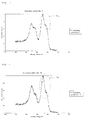
- Fig. 1 shows an XPS spectrum of the activated carbon after palladium adsorption. It is seen that the spectrum has a strong peak at 335 eV, which is assigned to metal palladium. That is, the palladium adsorbed on the activated carbon No. 1 is in the form of reduced palladium metal.
- the adsorption amount of palladium is larger than that of tin; the activated carbon selectively adsorbs palladium rather than tin.
- Table 2 shows the percent gold recovery from the gold-cyan wastewater by the resulting activated carbon;
- Table 3 shows the percent noble metal recovery from the aqua regia wastewater by the resulting activated carbon.
- the activated carbon allows recovery of noble metals from both of wastewaters at high percent recoveries over 99.5%.
- a sawdust (100 g) was impregnated with 100 mL of an aqueous solution of zinc chloride having a concentration of 4000 g/L.
- the impregnated product was heated to 700°C at rate of 5°C/minute, maintained at 700°C for one hour, and then allowed to cool.
- the resulting activated carbon was boiled in a 1 mol/L hydrochloric acid for washing and washed with water.
- Table 1 shows the various physical properties, Pd adsorption amount and Pd-Sn adsorption amount of the resulting activated carbon.
- the activated carbon which has a zeta-potential difference of as very small as 9.7 mV and a pore volume of pores with a pore radius of not more than 1 nm of as large as 317.4 mm 3 /g, has a high capacity to adsorb palladium.
- Fig. 2 shows an XPS spectrum of the activated carbon after Pd adsorption. It is seen that the spectrum has a strong peak at 335 eV, which is assigned to metal palladium. That is, the palladium adsorbed on the activated carbon No. 2 is in the form of reduced palladium metal.
- the activated carbon only adsorbs palladium without adsorbing tin.
- the adsorption amount of palladium is extremely larger than that of tin; the activated carbon selectively adsorbs palladium rather than tin.
- a coconut shell charcoal (100 g) containing an alkaline earth metal of 1 g/kg was activated in the same conditions as those in Example 1.
- the activation time was 3 hours.
- the resulting activated carbon was washed with a 1 mol/L hydrochloric acid and then with water, and then dried.
- the resulting dried product was heat-treated in the same manner as in Example 1.
- Table 1 shows the various physical properties and palladium adsorption amount of the resulting activated carbon.
- the activated carbon which has a zeta-potential difference of as somewhat high as 13.5 mV but a pore volume of pores with a pore radius of not more than 1 nm of as extremely large as 443.9 mm 3 /g, has a high capacity to adsorb palladium.
- a sawdust (100 g) was impregnated with an aqueous solution of phosphoric acid having a concentration of 75% so that the sawdust was impregnated with 150 g of phosphoric acid.
- the impregnated product was heat-treated at a temperature of 550°C. During the heat treatment, air was passed at a rate of 3 L/minute. After the heat treatment, the resulting burned product was boiled in water for washing.
- Table 1 shows the various physical properties and palladium adsorption amount of the resulting activated carbon.
- the activated carbon which has a zeta-potential difference of as small as 10.4 mV and a pore volume of pores with a pore radius of not more than 1 nm of as extremely large as 403.7 mm 3 /g, has a high capacity to adsorb palladium.
- a sawdust (100 g) was impregnated with an aqueous solution of phosphoric acid having a concentration of 75% so that the sawdust was impregnated with 100 g of phosphoric acid.
- the impregnated product was heat-treated at a temperature of 550°C. During the heat treatment, air was passed at a rate of 3 L/minute. After the heat treatment, the resulting burned product was boiled in water for washing.
- Table 1 shows the various physical properties and palladium adsorption amount of the resulting activated carbon.
- the activated carbon which has a zeta-potential difference of 12.7 mV and a pore volume of pores with a pore radius of not more than 1 nm of as relatively large as 294.3 mm 3 /g, has a high capacity to adsorb palladium.
- a phenolic resin fiber was subjected to an oxidation treatment at 300°C for one hour.
- the oxidation-treated product was dried by distillation at 700°C for one hour.
- the phenolic resin fiber obtained by the dry distillation was treated at an activation temperature of 950°C in an LPG combustion gas atmosphere for 5 hours.
- Table 1 shows the various physical properties and palladium adsorption amount of the resulting activated carbon.
- the activated carbon which has a zeta-potential difference of as somewhat high as 14.9 mV but a pore volume of pores with a pore radius of not more than 1 nm of 200 mm 3 /g, has a high capacity to adsorb palladium.
- Table 1 shows the various physical properties, palladium adsorption amount and Pd-Sn adsorption amount of a commercially available activated carbon ("GW-H” manufactured by Kuraray Chemical Co., Ltd.).
- the activated carbon which has a zeta-potential difference of as high as 21.5 mV and a pore volume of pores with a pore radius of not more than 1 nm of as extremely small as 66 mm 3 /g, has a low capacity to adsorb palladium.
- Fig. 3 shows an XPS spectrum of the activated carbon after palladium adsorption. It is seen that the spectrum has a strong peak at 337 to 338 eV, which is assigned to palladium oxide.
- the palladium adsorbed on the activated carbon No. 10 is not reduced and is in the form of palladium oxide. Moreover, in the Pd-Sn adsorption test, although the activated carbon does not adsorb tin, the adsorption amount of palladium is also small.
- Table 1 shows the various physical properties, palladium adsorption amount and Pd-Sn adsorption amount of a commercially available activated carbon ("KW" manufactured by Kuraray Chemical Co., Ltd.).
- the activated carbon which has a zeta-potential difference of as high as 19.3 mV and a pore volume of pores with a pore radius of not more than 1 nm of as extremely small as 89.4 mm 3 /g, has a low capacity to adsorb palladium.
- the adsorption amount of palladium is small, and tin is adsorbed.
- a sawdust charcoal obtained from sawdust by dry distillation was activated for 30 minutes in the same conditions as those in Example 1.
- the resulting activated carbon was washed with a 1 mol/L hydrochloric acid and with water, and then dried.
- Table 1 shows the various physical properties and palladium adsorption amount of the resulting activated carbon.
- the activated carbon which has a zeta-potential difference of as small as 17.5 mV but a pore volume of pores with a pore radius of not more than 1nm of as small as 117.9 mm 3 /g, has a low capacity to adsorb palladium.
- Table 1 shows the various physical properties, palladium adsorption amount and Pd-Sn adsorption amount of a commercially available activated carbon ("GW" manufactured by Kuraray Chemical Co., Ltd.).
- the activated carbon which has a zeta-potential difference of as extremely high as 55. 6 mV and a pore volume of pores with a pore radius of not more than 1 nm of as extremely small as 35 mm 3 /g, has a low capacity to adsorb palladium.
- Fig. 4 shows an XPS spectrum of the activated carbon after palladium adsorption. It is seen that the spectrum has a strong peak at 337 to 338 eV, which is assigned to palladium oxide.
- the palladium adsorbed on the activated carbon No. 10 is not reduced and is in the form of palladium oxide. Moreover, in the Pd-Sn adsorption test, although the activated carbon does not adsorb tin, the adsorption amount of palladium is also small.
- a phenolic resin fiber was subjected to an oxidation treatment at 300°C for one hour.
- the oxidation-treated product was dried by distillation at 700°C for one hour.
- the phenolic resin fiber obtained by the dry distillation was treated at an activation temperature of 950°C in an LPG combustion gas atmosphere for 3 hours.
- Table 1 shows the various physical properties and palladium adsorption amount of the resulting activated carbon.
- the activated carbon which has a zeta-potential difference of as high as 20.0 mV and a pore volume of pores with a pore radius of not more than 1 nm of as extremely small as 45.7 mm 3 /g, has a low capacity to adsorb palladium.
- This weight per unit volume was referred to as a beating density and was used as a measure of the shortness of a fibrous activated carbon.
- a formed product for measuring the beating density was produced as follows .
- a double-pipe forming die described in Japanese Patent No. 3516811 was provided.
- the forming die had a shaft having a large number of small suction holes at a pitch of 5 mm; each small suction hole had a size of 3 mm ⁇ .
- the shaft was wrapped with a 300-mesh wire gauze to give a die having a shaft diameter of 18 mm ⁇ , an outer diameter (flange diameter) of 40 mm ⁇ , and an inter-flange distance of 50 mm.
- the slurry was sucked from the central (or internal) part of the resulting die to give a cylindrical formed product. From the size and the weight of the dried formed product, the beating density of the slurry of the formed product was determined to be 0.18 g/ml. The slurry having this beating density was used as a standard slurry.
- the activated carbon No. 1 was pulverized so that the D50 measured by a wet particle size analyzer ("MICROTRAC MT3000" manufactured by Nikkiso Co., Ltd.) was about 40 ⁇ m.
- the pulverized activated carbon No. 1 (0.09 kg) and a fibrillated acrylic pulp (Bi-PUL/F) (0.0045 kg in terms of dry weight) were added to 14 L of the standard slurry.
- the resulting slurry was made to 20 L with tap water.
- a die having the same shape as the die for beating density measurement was provided.
- This die had a shaft having an outer diameter (flange diameter) of 35 mm ⁇ , a shaft diameter of 10 mm ⁇ , and an inter-flange distance of 145 mm.
- a nonwoven fabric (“9540F” manufactured by Shinwa Corp.) formed into a cylindrical shape was installed on the die. The slurry was accumulated on the die by suction, dried and then cut to give a formed product having an outer diameter of 35 mm ⁇ , an inner diameter of 10 mm ⁇ , and a height of 71.5 mm.
- An outer side of the formed product was wrapped with a single layer of a spunbonded nonwoven fabric ("T0703WDO" manufactured by Unitika, Ltd.) togive a filter for the Liquid-passing test of Pd standard solution.
- the formed product weighed 13.35 g.
- the resulting sample (filter) for evaluation was subjected to the liquid-passing test of the Pd standard solution. The results showed that the filter had a break point of 23 L.
- the resulting sample (filter) for evaluation was subjected to the liquid-passing test of the Pd-Sn standard solution. The results showed that the filter had a high weight and high break point at each space velocity.
- the filter Since the activated carbon No. 1 used has a carbohydrate solution decolorizing performance of as an extremely high as 90.7%, the filter has a high filterability.
- the activated carbon No. 2 (0.09 kg) having a D50 of about 40 ⁇ m and a fibrillated acrylic pulp (Bi-PUL/F) (0.0045 kg in terms of dry weight) were added to 14 L of the standard slurry as the same as the slurry used in Example 7.
- the resulting slurry was made to 20 L with tap water.
- the suction forming and the nonwoven fabric processing were carried out in the same manner as in Example 7, and a filter for the liquid-passing test of the Pd standard solution was obtained.
- the formed product weighed 12.50 g.
- the resulting sample (filter) for evaluation was subjected to the liquid-passing test of the Pd standard solution. The results showed that the filter had a break point of 15 L.
- a formed product having an outer diameter of 20 mm ⁇ , an inner diameter of 10 mm ⁇ , and a height of 71.5 mm was produced and used as a filter for the liquid-passing test of the Pd-Sn standard solution.
- the weight of the formed product used for each test was shown in Table 4.
- the resulting sample (filter) for evaluation was subjected to the liquid-passing test of the Pd-Sn standard solution. The results showed that the filter had a high weight and a high break point at each space velocity.
- the filter Since the activated carbon No. 2 used has a carbohydrate solution decolorizing performance of as an extremely high as 82.7%, the filter has a high filterability.
- the standard slurry (20 L) alone as the same as the slurry used in Example 7 was subjected to the suction forming and the nonwoven fabric processing in the same manner as in Example 7 to give a filter for the liquid-passing test of the Pd standard solution.
- the formed product weighed 11.20 g.
- the resulting sample (filter) for evaluation was subjected to the liquid-passing test of the Pd standard solution. The results showed that the filter had a break point of 1 L.
- a formed product having an outer diameter of 20 mm ⁇ , an inner diameter of 10 mm ⁇ , and a height of 71.5 mm was produced and used as a filter for the liquid-passing test of the Pd-Sn standard solution.
- the weight of the formed product used for each test was shown in Table 4.
- the resulting sample (filter) for evaluation was subjected to the liquid-passing test of the Pd-Sn standard solution. The results showed that the filter had a low weight and a low break point at each space velocity. In particular, as apparent from the break point at SV of 178 (1/hr) and 300 (1/hr), the filter had been broken at the start of the liquid passing.
- the filter Since the activated carbon No. 6 used has an excellent palladium adsorption in the thermostatic shaker and a carbohydrate solution decolorizing performance as low as 22.8% in the above-mentioned experiments, the filter has a low adsorption speed and a low filterability.
- the activated carbon No. 7 was pulverized so that the D50 was about 40 ⁇ m.
- the pulverized activated carbon No. 7 (0.09 kg) and Bi-PUL/F (0.0045 kg in terms of dry weight) were added to 14 L of the standard slurry as the same as that in Example 7.
- the resulting slurry was made to 20 L with tap water .
- the suction forming and the nonwoven fabric processing were carried out in the same manner as in Example 7, and a filter for the liquid-passing test of the Pd standard solution was obtained.
- the formed product weighed 14.09 g.
- the resulting sample (filter) for evaluation was subjected to the liquid-passing test of the Pd standard solution. The results showed that the filter had a break point of 2.5 L.
- a formed product having an outer diameter of 20 mm ⁇ , an inner diameter of 10 mm ⁇ , and a height of 71.5 mm was produced and used as a filter for the liquid-passing test of the Pd-Sn standard solution.
- the weight of the formed product used for each test was shown in Table 4.
- the resulting sample (filter) for evaluation was subjected to the liquid-passing test of the Pd-Sn standard solution. The results showed that the filter had a high weight and a low break point at each space velocity. In particular, as apparent from the break point at SV of 178 (1/hr) and 300 (1/hr), the filter had been broken at the start of the liquid passing.
- the filter Since the activated carbon No. 7 has not only a zeta-potential difference of as high as 21.5 mV but also a carbohydrate solution decolorizing performance of as low as 26.3%, the filter has a low filterability.
- the activated carbon No. 10 was pulverized so that the D50 was about 40 ⁇ m.
- the pulverized activated carbon No. 10 (0.09 kg) and a fibrillated acrylic pulp (Bi-PUL/F) (0.0045 kg in terms of dry weight) were added to 14 L of the standard slurry as the same as that in Example 7.
- the resulting slurry was made to 20 L with tap water.
- the suction forming and the nonwoven fabric processing were carried out in the same manner as in Example 7, and a filter for the liquid-passing test of the Pd standard solution was obtained.
- the formed product weighed 14.07 g.
- the resulting sample (filter) for evaluation was subjected to the liquid-passing test of the Pd standard solution. The results showed that the filter had a break point of 2 L.
- a formed product having an outer diameter of 20 mm ⁇ , an inner diameter of 10 mm ⁇ , and a height of 71.5 mm was produced and used as a filter for the liquid-passing test of the Pd-Sn standard solution.
- the weight of the formed product used for each test was shown in Table 4.
- the resulting sample (filter) for evaluation was subjected to the liquid-passing test of the Pd-Sn standard solution. The results showed that the filter had a high weight and a low break point at each space velocity. In particular, as apparent from the break point at SV of 178 (1/hr) and 300 (1/hr), the filter had been broken at the start of the liquid passing.
- the filter Since the activated carbon No. 10 has not only a zeta-potential difference of as extremely high as 55.6 mV but also a carbohydrate solution decolorizing performance of as low as 16.6%, the filter has a low filterability.
- Table 4 shows the results of liquid-passing test of the filter obtained in Examples 7 to 8, Reference Example 1 and Comparative Examples 6 to 7.
- Example 7 Example 8 Reference Example 1 Comparative Example 6 Comparative Example 7 Filter A B C D E mixing ratio Activated carbon No. 1 0.09 parts Activated carbon No. 2 0.09 parts Activated carbon No. 6 0.21 parts 0.21 parts 0.3 parts 0.21 parts 0.21 parts Activated carbon No. 7 0.09 parts Activated carbon No.
- the activated carbon of the present invention is used for recovering a noble metal from an aqueous solution containing the noble metal.
- the activated carbon is useful for recovering a noble metal from a plating wastewater containing a low concentration of the noble metal.
Landscapes
- Chemical & Material Sciences (AREA)
- Organic Chemistry (AREA)
- Engineering & Computer Science (AREA)
- Chemical Kinetics & Catalysis (AREA)
- Analytical Chemistry (AREA)
- Inorganic Chemistry (AREA)
- Materials Engineering (AREA)
- Mechanical Engineering (AREA)
- Metallurgy (AREA)
- Manufacturing & Machinery (AREA)
- Life Sciences & Earth Sciences (AREA)
- Environmental & Geological Engineering (AREA)
- Geology (AREA)
- General Life Sciences & Earth Sciences (AREA)
- Geochemistry & Mineralogy (AREA)
- Nanotechnology (AREA)
- Hydrology & Water Resources (AREA)
- Water Supply & Treatment (AREA)
- Solid-Sorbent Or Filter-Aiding Compositions (AREA)
- Water Treatment By Sorption (AREA)
- Manufacture And Refinement Of Metals (AREA)
- Carbon And Carbon Compounds (AREA)
Claims (6)
- Aktivkohle zum Adsorbieren eines Edelmetalls aus einer wässrigen Lösung, die das Edelmetall enthält, wobei die Aktivkohle einen Unterschied (Absolutwert) von nicht mehr als 18 mV zwischen einem Zeta-Potential in einer 10 mmol/L wässrigen Lösung von Natriumtetraborat und einem Zeta-Potential in einer 0,01 mmol/L wässrigen Lösung von Natriumtetraborat aufweist und ein Gesamtporenvolumen von Poren mit einem Porenradius von nicht mehr als 1 nm von 250 bis 500 mm3/g aufweist;
wobei das Zeta-Potential wie in der Beschreibung unter der Überschrift mit dem Titel "zeta-potential" definiert gemessen wurde und
wobei das Gesamtporenvolumen wie in der Beschreibung unter der Überschrift mit dem Titel "specific surface area, and pore volume of pores with a pore radius of not more than 1 nm" definiert gemessen wurde unter Verwendung von Stickstoffadsorption mit Analyse der sich ergebenden Isotherme unter Verwendung von BEL Analysesoftware Version 4.0.13 und Berechnung nach dem Cl Verfahren. - Aktivkohle nach Anspruch 1, welche eine Kohlenhydratlösungsentfärbungsleistung von nicht weniger als 30% aufweist;
wobei die Kohlenhydratlösungsentfärbungsleistung wie in der Beschreibung unter der Überschrift mit dem Titel "carbohydrate solution decolorizing performance" definiert gemessen wurde. - Verwendung der Aktivkohle nach Anspruch 1 oder 2 zum Adsorbieren eines Edelmetalls aus einem Plattierungsabwasser, welches das Edelmetall enthält.
- Filter für Edelmetalladsorption, enthaltend eine Aktivkohle nach Anspruch 1 oder 2 und ein Bindemittel, wobei der Anteil der Aktivkohle in dem Filter nicht weniger als 20 Massen% beträgt.
- Filter für Edelmetalladsorption nach Anspruch 4, welcher ein flüssigkeitsdurchlässiger Filter ist, wobei die Aktivkohle eine Kohlenhydratlösungsentfärbungsleistung von nicht weniger als 30% aufweist; wobei die Kohlenhydratlösungsentfärbungsleistung wie in der Beschreibung unter der Überschrift mit dem Titel "carbohydrate solution decolorizing performance" definiert gemessen wurde.
- Verfahren zum Rückgewinnen eines Edelmetalls aus einer wässrigen Lösung, die das Edelmetall enthält, wobei das Verfahren umfasst:das Adsorbieren des Edelmetalls an einer Aktivkohle nach Anspruch 1 oder 2 oder an einem Filter nach Anspruch 4 oder 5.
Applications Claiming Priority (2)
| Application Number | Priority Date | Filing Date | Title |
|---|---|---|---|
| JP2012141349 | 2012-06-22 | ||
| PCT/JP2013/067033 WO2013191269A1 (ja) | 2012-06-22 | 2013-06-21 | 貴金属吸着用活性炭並びに貴金属吸着フィルター及び貴金属回収方法 |
Publications (3)
| Publication Number | Publication Date |
|---|---|
| EP2865769A1 EP2865769A1 (de) | 2015-04-29 |
| EP2865769A4 EP2865769A4 (de) | 2016-03-02 |
| EP2865769B1 true EP2865769B1 (de) | 2018-12-12 |
Family
ID=49768861
Family Applications (1)
| Application Number | Title | Priority Date | Filing Date |
|---|---|---|---|
| EP13807762.3A Active EP2865769B1 (de) | 2012-06-22 | 2013-06-21 | Aktivkohle zur edelmetalladsorption, edelmetalladsorptionsfilter und verfahren zur rückgewinnung von edelmetallen |
Country Status (10)
| Country | Link |
|---|---|
| US (1) | US9782750B2 (de) |
| EP (1) | EP2865769B1 (de) |
| JP (1) | JP6151691B2 (de) |
| KR (1) | KR102095613B1 (de) |
| CN (1) | CN104685075B (de) |
| IN (1) | IN2014DN11197A (de) |
| MY (1) | MY178393A (de) |
| SG (1) | SG11201408253WA (de) |
| TW (1) | TWI603915B (de) |
| WO (1) | WO2013191269A1 (de) |
Families Citing this family (21)
| Publication number | Priority date | Publication date | Assignee | Title |
|---|---|---|---|---|
| JP6430184B2 (ja) * | 2013-09-18 | 2018-11-28 | フタムラ化学株式会社 | 合成樹脂バインダー成形固体酸及びその製造方法 |
| JP6236311B2 (ja) * | 2013-12-20 | 2017-11-22 | 田中貴金属工業株式会社 | 塩酸酸性Sn含有貴金属触媒回収液からの貴金属の回収方法 |
| JP6247088B2 (ja) * | 2013-12-20 | 2017-12-13 | 田中貴金属工業株式会社 | 塩酸酸性Sn含有貴金属触媒回収液からの貴金属の回収方法 |
| JP6085336B2 (ja) * | 2015-06-18 | 2017-02-22 | 関西熱化学株式会社 | 活性炭成形体、および該活性炭成形体の製造方法、並びに該活性炭成形体を用いた吸着材、および吸蔵材 |
| JP6085335B2 (ja) * | 2015-06-18 | 2017-02-22 | 関西熱化学株式会社 | 活性炭成形体、および該活性炭成形体の製造方法、並びに該活性炭成形体を用いた吸着材、および吸蔵材 |
| JP6608266B2 (ja) * | 2015-12-16 | 2019-11-20 | ユニチカ株式会社 | 白金族金属コロイド粒子回収材、該回収材を含むフィルター及び該回収材を用いる白金族金属コロイド粒子の回収方法 |
| CN107176637A (zh) * | 2016-03-10 | 2017-09-19 | 郭东山 | 含金属残液的净化装置 |
| JP2017177047A (ja) * | 2016-03-31 | 2017-10-05 | 大阪ガスケミカル株式会社 | 金属除去用吸着剤 |
| RU2739923C9 (ru) | 2016-05-06 | 2021-03-01 | Голдкорп Инк. | Адсорбирующая композиция, способ ее получения и ее применения |
| CN106245059B (zh) * | 2016-08-08 | 2018-03-09 | 侯梦斌 | 一种基于流过式电容去离子法的贵金属回收设备与工艺 |
| CN106987877A (zh) * | 2017-04-01 | 2017-07-28 | 厦门建霖工业有限公司 | 一种塑料电镀用胶体钯回收及水回用的系统及方法 |
| CN107267762A (zh) * | 2017-07-01 | 2017-10-20 | 励福(江门)环保科技股份有限公司 | 一种钯活化废水中钯回收的方法 |
| US20190119444A1 (en) * | 2017-10-25 | 2019-04-25 | Covestro Llc | Process to remove dmc catalysts from polyether carbonate polyols |
| CN109455783A (zh) * | 2018-10-25 | 2019-03-12 | 嘉兴珠韵服装有限公司 | 一种印染废水深度处理剂及其制备方法 |
| WO2020188378A1 (en) * | 2019-03-18 | 2020-09-24 | Universiti Brunei Darussalam | A method of making modified charcoal for selective adsorption of heavy metals |
| JP7077502B2 (ja) * | 2019-10-07 | 2022-05-31 | 株式会社フジテクノ | 水中の微量有害物質を除去する水質改善部材 |
| CN111257083B (zh) * | 2020-03-25 | 2023-03-17 | 江苏安捷鹿检测科技有限公司 | 一种土壤和底泥的重金属含量检测方法 |
| CN113956266B (zh) * | 2020-07-20 | 2025-12-30 | 上海晟平医疗器械有限公司 | 一种规模化合成河豚毒素的方法 |
| JP2022142928A (ja) * | 2021-03-17 | 2022-10-03 | 大阪ガスケミカル株式会社 | 活性炭成型体及びその製造方法 |
| JP7736399B2 (ja) * | 2021-07-30 | 2025-09-09 | 大口電子株式会社 | 活性炭からの貴金属の回収方法 |
| JP7459365B1 (ja) | 2023-11-29 | 2024-04-01 | 大阪ガスケミカル株式会社 | 炭素質材料及びその製造方法、並びにパラジウム錯体の吸着方法 |
Family Cites Families (31)
| Publication number | Priority date | Publication date | Assignee | Title |
|---|---|---|---|---|
| US1617206A (en) | 1922-06-20 | 1927-02-08 | Electro Metallurg Co | Process of recovering metals from liquids and compositions therefor |
| JPS5628846B2 (de) * | 1974-09-03 | 1981-07-04 | ||
| US4292176A (en) * | 1976-12-08 | 1981-09-29 | Standard Oil Company (Indiana) | Use of activated carbon in waste water treating process |
| US4260493A (en) * | 1979-05-21 | 1981-04-07 | Shipley Company, Inc. | Solution waste treatment |
| JPS58221240A (ja) * | 1982-06-15 | 1983-12-22 | Mitsubishi Chem Ind Ltd | 金の回収法 |
| JPH0834605A (ja) * | 1994-07-26 | 1996-02-06 | Kansai Coke & Chem Co Ltd | 浄水用吸着材 |
| JPH08281099A (ja) * | 1995-04-13 | 1996-10-29 | Toyobo Co Ltd | 有機塩素系化合物用吸着材 |
| JPH08295512A (ja) * | 1995-04-21 | 1996-11-12 | Kanebo Ltd | 金属元素の分離精製方法 |
| JP3537581B2 (ja) * | 1996-03-04 | 2004-06-14 | クラレケミカル株式会社 | 水銀吸着剤 |
| JP3516811B2 (ja) | 1996-06-24 | 2004-04-05 | クラレケミカル株式会社 | 活性炭繊維成形吸着体 |
| JPH10121156A (ja) * | 1996-08-26 | 1998-05-12 | Kawasaki Kasei Chem Ltd | 金属イオン処理剤及び貴金属錯イオンの処理方法 |
| US6106589A (en) | 1996-08-26 | 2000-08-22 | Kawasaki Kasei Chemicals Ltd. | Method for treating noble metal complex ions |
| WO1999041010A1 (fr) * | 1998-02-17 | 1999-08-19 | Kanebo, Limited | Carbone active pour adsorption et stockage d'un compose gazeux |
| US6865068B1 (en) | 1999-04-30 | 2005-03-08 | Asahi Glass Company, Limited | Carbonaceous material, its production process and electric double layer capacitor employing it |
| JP2001011001A (ja) * | 1999-06-25 | 2001-01-16 | Jsr Corp | フェノール系化合物中の金属除去方法 |
| JP2001303148A (ja) | 2000-04-20 | 2001-10-31 | Hitachi Chem Co Ltd | パラジウム含有排水の処理方法 |
| KR20020061530A (ko) | 2001-01-18 | 2002-07-24 | 쉬플리 캄파니, 엘.엘.씨. | 촉매 금속의 회수방법 |
| US7202195B2 (en) * | 2001-02-28 | 2007-04-10 | The Penn State Research Foundation | Method of heat treating carbonaceous material to enhance its adsorption of taste-and-odor-causing and other organic compounds from water |
| JP2002274828A (ja) * | 2001-03-13 | 2002-09-25 | Adchemco Corp | 活性炭、その製造方法および重金属除去方法 |
| JP2003247028A (ja) | 2001-11-21 | 2003-09-05 | Shipley Co Llc | 触媒金属を回収する方法 |
| US7759289B2 (en) * | 2002-07-30 | 2010-07-20 | Kuraray Chemical Co., Ltd. | Activated carbon, method for production thereof, polarizing electrode and electrical double layer capacitor |
| US8277654B2 (en) * | 2003-11-26 | 2012-10-02 | Selecto, Inc. | Water purification apparatus and system |
| US20050242041A1 (en) * | 2004-04-30 | 2005-11-03 | Cumberland Scott L | Silver Impregnated, Alumina Coated Materials and Filtration Systems Implementing Same |
| JP2006059923A (ja) | 2004-08-18 | 2006-03-02 | Nippon Oil Corp | 電気二重層キャパシタの電極用炭素材の原料炭組成物 |
| JP5082300B2 (ja) | 2005-05-27 | 2012-11-28 | 住友化学株式会社 | 活性炭及びその製造方法 |
| JP5070581B2 (ja) | 2007-07-18 | 2012-11-14 | 大口電子株式会社 | 貴金属の分離回収方法 |
| US8482901B2 (en) | 2010-01-22 | 2013-07-09 | Corning Incorporated | Microporous activated carbon for EDLCS |
| US8622224B2 (en) * | 2010-02-26 | 2014-01-07 | Kx Technologies, Llc | Method of making a filter media with an enriched binder |
| CN101844842A (zh) | 2010-05-21 | 2010-09-29 | 安徽宏宇玻璃有限公司 | 一种银镜生产线的废银处理装置 |
| CN102167319B (zh) | 2011-05-13 | 2013-03-13 | 江苏大学 | 一种醋糟制备活性炭的方法 |
| CN102251110B (zh) | 2011-06-29 | 2013-03-06 | 广西地博矿业集团股份有限公司 | 利用活性炭过滤装置回收载金活性炭粉的方法 |
-
2013
- 2013-06-21 EP EP13807762.3A patent/EP2865769B1/de active Active
- 2013-06-21 IN IN11197DEN2014 patent/IN2014DN11197A/en unknown
- 2013-06-21 WO PCT/JP2013/067033 patent/WO2013191269A1/ja not_active Ceased
- 2013-06-21 KR KR1020157001465A patent/KR102095613B1/ko active Active
- 2013-06-21 JP JP2014521519A patent/JP6151691B2/ja active Active
- 2013-06-21 SG SG11201408253WA patent/SG11201408253WA/en unknown
- 2013-06-21 US US14/410,319 patent/US9782750B2/en active Active
- 2013-06-21 CN CN201380040957.2A patent/CN104685075B/zh active Active
- 2013-06-21 MY MYPI2014703868A patent/MY178393A/en unknown
- 2013-06-21 TW TW102122119A patent/TWI603915B/zh active
Non-Patent Citations (1)
| Title |
|---|
| None * |
Also Published As
| Publication number | Publication date |
|---|---|
| SG11201408253WA (en) | 2015-01-29 |
| JP6151691B2 (ja) | 2017-06-21 |
| TW201408597A (zh) | 2014-03-01 |
| EP2865769A1 (de) | 2015-04-29 |
| US9782750B2 (en) | 2017-10-10 |
| CN104685075A (zh) | 2015-06-03 |
| KR20150028305A (ko) | 2015-03-13 |
| US20150190781A1 (en) | 2015-07-09 |
| IN2014DN11197A (de) | 2015-10-02 |
| WO2013191269A1 (ja) | 2013-12-27 |
| CN104685075B (zh) | 2018-11-06 |
| JPWO2013191269A1 (ja) | 2016-05-26 |
| HK1204660A1 (en) | 2015-11-27 |
| MY178393A (en) | 2020-10-12 |
| TWI603915B (zh) | 2017-11-01 |
| EP2865769A4 (de) | 2016-03-02 |
| KR102095613B1 (ko) | 2020-03-31 |
Similar Documents
| Publication | Publication Date | Title |
|---|---|---|
| EP2865769B1 (de) | Aktivkohle zur edelmetalladsorption, edelmetalladsorptionsfilter und verfahren zur rückgewinnung von edelmetallen | |
| JP6033395B2 (ja) | 粒状活性炭およびその製造方法 | |
| KR101724979B1 (ko) | 탄소체 및 강자성 탄소체 | |
| JP7061107B2 (ja) | 炭素質材料およびその製造方法 | |
| Zheng et al. | Banana peel carbon that containing functional groups applied to the selective adsorption of Au (III) from waste printed circuit boards | |
| JP2010100875A (ja) | 次亜リン酸イオン、亜リン酸イオンの酸化方法、無電解ニッケルメッキ廃液の浄化方法並びにリン酸塩の再資源化方法 | |
| KR20190008859A (ko) | 탄소질 재료, 그리고 그 탄소질 재료를 함유하는 전기 이중층 캐패시터용 전극 재료, 전기 이중층 캐패시터용 전극 및 전기 이중층 캐패시터 | |
| Liu et al. | Novel EDTA-chitosan/alginate porous composite beads for the removal of Pb (II) and methylene blue from aqueous solutions | |
| JP6401814B2 (ja) | 塩酸酸性Sn含有貴金属触媒回収液からの貴金属の回収方法 | |
| EP1808412A1 (de) | Verfahren zur reinigung einer wässrig-alkalischen lösung | |
| JP6236311B2 (ja) | 塩酸酸性Sn含有貴金属触媒回収液からの貴金属の回収方法 | |
| JP6247088B2 (ja) | 塩酸酸性Sn含有貴金属触媒回収液からの貴金属の回収方法 | |
| JPH0330834A (ja) | 金回収用球状活性炭及び金回収方法 | |
| HK1204660B (en) | Activated carbon for noble metal adsorption, noble metal adsorption filter, and method for recovering noble metals | |
| Khuder et al. | Removal of Cr (III), Mn (II), Fe (III), Ni (II), Cu (II), Zn (II), and Pb (II) from water solutions using activated carbon based on cherry kernel shell powder | |
| JP3539434B2 (ja) | 高性能炭素材料の製造方法 | |
| JP4115150B2 (ja) | 分子ふるい活性炭の製造方法 | |
| Meshram et al. | Taguchi optimization of adsorptive treatment of effluent from lead-acid battery recycling unit using pressmud-a sugar industry waste | |
| JP7459365B1 (ja) | 炭素質材料及びその製造方法、並びにパラジウム錯体の吸着方法 | |
| JP6735702B2 (ja) | 塩酸酸性Sn含有貴金属触媒回収液からの貴金属の回収方法 | |
| JP4740659B2 (ja) | 炭素材料の製造方法 | |
| Patel et al. | Study of KOH impregnated jack fruit leaf based carbon as adsorbent for treatment of wastewater contaminated with nickel | |
| Thomas et al. | A comparative study on the efficiency of KOH and H3PO4 impregnated jackfruit leaf based carbon as adsorbent for removal of Cr (VI) from its aqueous solution | |
| Balda | Colloidal activated carbon and Fe/C composites by hydrothermal carbonization and subsequent pyrolysis: mechanisms of formation, pollutant adsorption and reductive dechlorination | |
| WO2024190714A1 (ja) | 窒素ドープ活性炭及びその製造方法、並びに装置 |
Legal Events
| Date | Code | Title | Description |
|---|---|---|---|
| PUAI | Public reference made under article 153(3) epc to a published international application that has entered the european phase |
Free format text: ORIGINAL CODE: 0009012 |
|
| 17P | Request for examination filed |
Effective date: 20141218 |
|
| AK | Designated contracting states |
Kind code of ref document: A1 Designated state(s): AL AT BE BG CH CY CZ DE DK EE ES FI FR GB GR HR HU IE IS IT LI LT LU LV MC MK MT NL NO PL PT RO RS SE SI SK SM TR |
|
| AX | Request for extension of the european patent |
Extension state: BA ME |
|
| DAX | Request for extension of the european patent (deleted) | ||
| REG | Reference to a national code |
Ref country code: HK Ref legal event code: DE Ref document number: 1204660 Country of ref document: HK |
|
| RA4 | Supplementary search report drawn up and despatched (corrected) |
Effective date: 20160129 |
|
| RIC1 | Information provided on ipc code assigned before grant |
Ipc: C22B 11/00 20060101AFI20160125BHEP Ipc: B01J 20/10 20060101ALI20160125BHEP Ipc: C22B 7/00 20060101ALI20160125BHEP Ipc: C01B 31/10 20060101ALI20160125BHEP Ipc: C02F 1/28 20060101ALI20160125BHEP Ipc: C01B 31/12 20060101ALI20160125BHEP Ipc: C22B 3/24 20060101ALI20160125BHEP Ipc: B01J 20/28 20060101ALI20160125BHEP |
|
| STAA | Information on the status of an ep patent application or granted ep patent |
Free format text: STATUS: EXAMINATION IS IN PROGRESS |
|
| 17Q | First examination report despatched |
Effective date: 20170418 |
|
| RAP1 | Party data changed (applicant data changed or rights of an application transferred) |
Owner name: KURARAY CO., LTD. Owner name: TANAKA KIKINZOKU KOGYO K.K. |
|
| GRAP | Despatch of communication of intention to grant a patent |
Free format text: ORIGINAL CODE: EPIDOSNIGR1 |
|
| STAA | Information on the status of an ep patent application or granted ep patent |
Free format text: STATUS: GRANT OF PATENT IS INTENDED |
|
| RIC1 | Information provided on ipc code assigned before grant |
Ipc: B01J 20/28 20060101ALI20180515BHEP Ipc: C22B 11/00 20060101AFI20180515BHEP Ipc: C22B 7/00 20060101ALI20180515BHEP Ipc: C02F 1/28 20060101ALI20180515BHEP Ipc: C22B 3/24 20060101ALI20180515BHEP Ipc: B01J 20/10 20060101ALI20180515BHEP |
|
| INTG | Intention to grant announced |
Effective date: 20180606 |
|
| RIN1 | Information on inventor provided before grant (corrected) |
Inventor name: SABAE, YOSHICHIKA Inventor name: YAMADA, TAKAYUKI Inventor name: HANAMOTO, TETSUYA |
|
| GRAS | Grant fee paid |
Free format text: ORIGINAL CODE: EPIDOSNIGR3 |
|
| GRAJ | Information related to disapproval of communication of intention to grant by the applicant or resumption of examination proceedings by the epo deleted |
Free format text: ORIGINAL CODE: EPIDOSDIGR1 |
|
| GRAL | Information related to payment of fee for publishing/printing deleted |
Free format text: ORIGINAL CODE: EPIDOSDIGR3 |
|
| STAA | Information on the status of an ep patent application or granted ep patent |
Free format text: STATUS: EXAMINATION IS IN PROGRESS |
|
| GRAR | Information related to intention to grant a patent recorded |
Free format text: ORIGINAL CODE: EPIDOSNIGR71 |
|
| STAA | Information on the status of an ep patent application or granted ep patent |
Free format text: STATUS: GRANT OF PATENT IS INTENDED |
|
| GRAA | (expected) grant |
Free format text: ORIGINAL CODE: 0009210 |
|
| STAA | Information on the status of an ep patent application or granted ep patent |
Free format text: STATUS: THE PATENT HAS BEEN GRANTED |
|
| INTC | Intention to grant announced (deleted) | ||
| RIN1 | Information on inventor provided before grant (corrected) |
Inventor name: HANAMOTO, TETSUYA Inventor name: YAMADA, TAKAYUKI Inventor name: SABAE, YOSHICHIKA |
|
| AK | Designated contracting states |
Kind code of ref document: B1 Designated state(s): AL AT BE BG CH CY CZ DE DK EE ES FI FR GB GR HR HU IE IS IT LI LT LU LV MC MK MT NL NO PL PT RO RS SE SI SK SM TR |
|
| INTG | Intention to grant announced |
Effective date: 20181106 |
|
| REG | Reference to a national code |
Ref country code: GB Ref legal event code: FG4D |
|
| REG | Reference to a national code |
Ref country code: CH Ref legal event code: EP |
|
| REG | Reference to a national code |
Ref country code: AT Ref legal event code: REF Ref document number: 1076052 Country of ref document: AT Kind code of ref document: T Effective date: 20181215 |
|
| REG | Reference to a national code |
Ref country code: CH Ref legal event code: NV Representative=s name: BOHEST AG, CH |
|
| REG | Reference to a national code |
Ref country code: DE Ref legal event code: R096 Ref document number: 602013048190 Country of ref document: DE |
|
| REG | Reference to a national code |
Ref country code: IE Ref legal event code: FG4D |
|
| REG | Reference to a national code |
Ref country code: NL Ref legal event code: MP Effective date: 20181212 |
|
| REG | Reference to a national code |
Ref country code: LT Ref legal event code: MG4D |
|
| PG25 | Lapsed in a contracting state [announced via postgrant information from national office to epo] |
Ref country code: BG Free format text: LAPSE BECAUSE OF FAILURE TO SUBMIT A TRANSLATION OF THE DESCRIPTION OR TO PAY THE FEE WITHIN THE PRESCRIBED TIME-LIMIT Effective date: 20190312 Ref country code: HR Free format text: LAPSE BECAUSE OF FAILURE TO SUBMIT A TRANSLATION OF THE DESCRIPTION OR TO PAY THE FEE WITHIN THE PRESCRIBED TIME-LIMIT Effective date: 20181212 Ref country code: NO Free format text: LAPSE BECAUSE OF FAILURE TO SUBMIT A TRANSLATION OF THE DESCRIPTION OR TO PAY THE FEE WITHIN THE PRESCRIBED TIME-LIMIT Effective date: 20190312 Ref country code: LT Free format text: LAPSE BECAUSE OF FAILURE TO SUBMIT A TRANSLATION OF THE DESCRIPTION OR TO PAY THE FEE WITHIN THE PRESCRIBED TIME-LIMIT Effective date: 20181212 Ref country code: ES Free format text: LAPSE BECAUSE OF FAILURE TO SUBMIT A TRANSLATION OF THE DESCRIPTION OR TO PAY THE FEE WITHIN THE PRESCRIBED TIME-LIMIT Effective date: 20181212 Ref country code: LV Free format text: LAPSE BECAUSE OF FAILURE TO SUBMIT A TRANSLATION OF THE DESCRIPTION OR TO PAY THE FEE WITHIN THE PRESCRIBED TIME-LIMIT Effective date: 20181212 Ref country code: FI Free format text: LAPSE BECAUSE OF FAILURE TO SUBMIT A TRANSLATION OF THE DESCRIPTION OR TO PAY THE FEE WITHIN THE PRESCRIBED TIME-LIMIT Effective date: 20181212 |
|
| REG | Reference to a national code |
Ref country code: AT Ref legal event code: MK05 Ref document number: 1076052 Country of ref document: AT Kind code of ref document: T Effective date: 20181212 |
|
| PG25 | Lapsed in a contracting state [announced via postgrant information from national office to epo] |
Ref country code: AL Free format text: LAPSE BECAUSE OF FAILURE TO SUBMIT A TRANSLATION OF THE DESCRIPTION OR TO PAY THE FEE WITHIN THE PRESCRIBED TIME-LIMIT Effective date: 20181212 Ref country code: SE Free format text: LAPSE BECAUSE OF FAILURE TO SUBMIT A TRANSLATION OF THE DESCRIPTION OR TO PAY THE FEE WITHIN THE PRESCRIBED TIME-LIMIT Effective date: 20181212 Ref country code: RS Free format text: LAPSE BECAUSE OF FAILURE TO SUBMIT A TRANSLATION OF THE DESCRIPTION OR TO PAY THE FEE WITHIN THE PRESCRIBED TIME-LIMIT Effective date: 20181212 Ref country code: GR Free format text: LAPSE BECAUSE OF FAILURE TO SUBMIT A TRANSLATION OF THE DESCRIPTION OR TO PAY THE FEE WITHIN THE PRESCRIBED TIME-LIMIT Effective date: 20190313 |
|
| PG25 | Lapsed in a contracting state [announced via postgrant information from national office to epo] |
Ref country code: NL Free format text: LAPSE BECAUSE OF FAILURE TO SUBMIT A TRANSLATION OF THE DESCRIPTION OR TO PAY THE FEE WITHIN THE PRESCRIBED TIME-LIMIT Effective date: 20181212 |
|
| PG25 | Lapsed in a contracting state [announced via postgrant information from national office to epo] |
Ref country code: IT Free format text: LAPSE BECAUSE OF FAILURE TO SUBMIT A TRANSLATION OF THE DESCRIPTION OR TO PAY THE FEE WITHIN THE PRESCRIBED TIME-LIMIT Effective date: 20181212 Ref country code: PL Free format text: LAPSE BECAUSE OF FAILURE TO SUBMIT A TRANSLATION OF THE DESCRIPTION OR TO PAY THE FEE WITHIN THE PRESCRIBED TIME-LIMIT Effective date: 20181212 Ref country code: PT Free format text: LAPSE BECAUSE OF FAILURE TO SUBMIT A TRANSLATION OF THE DESCRIPTION OR TO PAY THE FEE WITHIN THE PRESCRIBED TIME-LIMIT Effective date: 20190412 Ref country code: CZ Free format text: LAPSE BECAUSE OF FAILURE TO SUBMIT A TRANSLATION OF THE DESCRIPTION OR TO PAY THE FEE WITHIN THE PRESCRIBED TIME-LIMIT Effective date: 20181212 |
|
| PG25 | Lapsed in a contracting state [announced via postgrant information from national office to epo] |
Ref country code: SK Free format text: LAPSE BECAUSE OF FAILURE TO SUBMIT A TRANSLATION OF THE DESCRIPTION OR TO PAY THE FEE WITHIN THE PRESCRIBED TIME-LIMIT Effective date: 20181212 Ref country code: IS Free format text: LAPSE BECAUSE OF FAILURE TO SUBMIT A TRANSLATION OF THE DESCRIPTION OR TO PAY THE FEE WITHIN THE PRESCRIBED TIME-LIMIT Effective date: 20190412 Ref country code: RO Free format text: LAPSE BECAUSE OF FAILURE TO SUBMIT A TRANSLATION OF THE DESCRIPTION OR TO PAY THE FEE WITHIN THE PRESCRIBED TIME-LIMIT Effective date: 20181212 Ref country code: EE Free format text: LAPSE BECAUSE OF FAILURE TO SUBMIT A TRANSLATION OF THE DESCRIPTION OR TO PAY THE FEE WITHIN THE PRESCRIBED TIME-LIMIT Effective date: 20181212 Ref country code: SM Free format text: LAPSE BECAUSE OF FAILURE TO SUBMIT A TRANSLATION OF THE DESCRIPTION OR TO PAY THE FEE WITHIN THE PRESCRIBED TIME-LIMIT Effective date: 20181212 |
|
| REG | Reference to a national code |
Ref country code: DE Ref legal event code: R097 Ref document number: 602013048190 Country of ref document: DE |
|
| PLBE | No opposition filed within time limit |
Free format text: ORIGINAL CODE: 0009261 |
|
| STAA | Information on the status of an ep patent application or granted ep patent |
Free format text: STATUS: NO OPPOSITION FILED WITHIN TIME LIMIT |
|
| PG25 | Lapsed in a contracting state [announced via postgrant information from national office to epo] |
Ref country code: AT Free format text: LAPSE BECAUSE OF FAILURE TO SUBMIT A TRANSLATION OF THE DESCRIPTION OR TO PAY THE FEE WITHIN THE PRESCRIBED TIME-LIMIT Effective date: 20181212 Ref country code: DK Free format text: LAPSE BECAUSE OF FAILURE TO SUBMIT A TRANSLATION OF THE DESCRIPTION OR TO PAY THE FEE WITHIN THE PRESCRIBED TIME-LIMIT Effective date: 20181212 Ref country code: SI Free format text: LAPSE BECAUSE OF FAILURE TO SUBMIT A TRANSLATION OF THE DESCRIPTION OR TO PAY THE FEE WITHIN THE PRESCRIBED TIME-LIMIT Effective date: 20181212 |
|
| 26N | No opposition filed |
Effective date: 20190913 |
|
| PG25 | Lapsed in a contracting state [announced via postgrant information from national office to epo] |
Ref country code: MC Free format text: LAPSE BECAUSE OF FAILURE TO SUBMIT A TRANSLATION OF THE DESCRIPTION OR TO PAY THE FEE WITHIN THE PRESCRIBED TIME-LIMIT Effective date: 20181212 |
|
| REG | Reference to a national code |
Ref country code: BE Ref legal event code: MM Effective date: 20190630 |
|
| PG25 | Lapsed in a contracting state [announced via postgrant information from national office to epo] |
Ref country code: TR Free format text: LAPSE BECAUSE OF FAILURE TO SUBMIT A TRANSLATION OF THE DESCRIPTION OR TO PAY THE FEE WITHIN THE PRESCRIBED TIME-LIMIT Effective date: 20181212 |
|
| PG25 | Lapsed in a contracting state [announced via postgrant information from national office to epo] |
Ref country code: IE Free format text: LAPSE BECAUSE OF NON-PAYMENT OF DUE FEES Effective date: 20190621 |
|
| PG25 | Lapsed in a contracting state [announced via postgrant information from national office to epo] |
Ref country code: BE Free format text: LAPSE BECAUSE OF NON-PAYMENT OF DUE FEES Effective date: 20190630 Ref country code: LU Free format text: LAPSE BECAUSE OF NON-PAYMENT OF DUE FEES Effective date: 20190621 |
|
| PG25 | Lapsed in a contracting state [announced via postgrant information from national office to epo] |
Ref country code: CY Free format text: LAPSE BECAUSE OF FAILURE TO SUBMIT A TRANSLATION OF THE DESCRIPTION OR TO PAY THE FEE WITHIN THE PRESCRIBED TIME-LIMIT Effective date: 20181212 |
|
| PG25 | Lapsed in a contracting state [announced via postgrant information from national office to epo] |
Ref country code: MT Free format text: LAPSE BECAUSE OF FAILURE TO SUBMIT A TRANSLATION OF THE DESCRIPTION OR TO PAY THE FEE WITHIN THE PRESCRIBED TIME-LIMIT Effective date: 20181212 Ref country code: HU Free format text: LAPSE BECAUSE OF FAILURE TO SUBMIT A TRANSLATION OF THE DESCRIPTION OR TO PAY THE FEE WITHIN THE PRESCRIBED TIME-LIMIT; INVALID AB INITIO Effective date: 20130621 |
|
| PG25 | Lapsed in a contracting state [announced via postgrant information from national office to epo] |
Ref country code: MK Free format text: LAPSE BECAUSE OF FAILURE TO SUBMIT A TRANSLATION OF THE DESCRIPTION OR TO PAY THE FEE WITHIN THE PRESCRIBED TIME-LIMIT Effective date: 20181212 |
|
| P01 | Opt-out of the competence of the unified patent court (upc) registered |
Effective date: 20230503 |
|
| PGFP | Annual fee paid to national office [announced via postgrant information from national office to epo] |
Ref country code: DE Payment date: 20250429 Year of fee payment: 13 |
|
| PGFP | Annual fee paid to national office [announced via postgrant information from national office to epo] |
Ref country code: GB Payment date: 20250501 Year of fee payment: 13 |
|
| PGFP | Annual fee paid to national office [announced via postgrant information from national office to epo] |
Ref country code: FR Payment date: 20250508 Year of fee payment: 13 |
|
| PGFP | Annual fee paid to national office [announced via postgrant information from national office to epo] |
Ref country code: CH Payment date: 20250701 Year of fee payment: 13 |