EP2858204A1 - Drehübertrager für Werkzeugmaschinen - Google Patents
Drehübertrager für Werkzeugmaschinen Download PDFInfo
- Publication number
- EP2858204A1 EP2858204A1 EP14179694.6A EP14179694A EP2858204A1 EP 2858204 A1 EP2858204 A1 EP 2858204A1 EP 14179694 A EP14179694 A EP 14179694A EP 2858204 A1 EP2858204 A1 EP 2858204A1
- Authority
- EP
- European Patent Office
- Prior art keywords
- transmission path
- stator
- rotor
- alternating current
- data
- Prior art date
- Legal status (The legal status is an assumption and is not a legal conclusion. Google has not performed a legal analysis and makes no representation as to the accuracy of the status listed.)
- Granted
Links
Images


Classifications
-
- H—ELECTRICITY
- H04—ELECTRIC COMMUNICATION TECHNIQUE
- H04B—TRANSMISSION
- H04B5/00—Near-field transmission systems, e.g. inductive or capacitive transmission systems
- H04B5/70—Near-field transmission systems, e.g. inductive or capacitive transmission systems specially adapted for specific purposes
- H04B5/79—Near-field transmission systems, e.g. inductive or capacitive transmission systems specially adapted for specific purposes for data transfer in combination with power transfer
-
- B—PERFORMING OPERATIONS; TRANSPORTING
- B23—MACHINE TOOLS; METAL-WORKING NOT OTHERWISE PROVIDED FOR
- B23Q—DETAILS, COMPONENTS, OR ACCESSORIES FOR MACHINE TOOLS, e.g. ARRANGEMENTS FOR COPYING OR CONTROLLING; MACHINE TOOLS IN GENERAL CHARACTERISED BY THE CONSTRUCTION OF PARTICULAR DETAILS OR COMPONENTS; COMBINATIONS OR ASSOCIATIONS OF METAL-WORKING MACHINES, NOT DIRECTED TO A PARTICULAR RESULT
- B23Q1/00—Members which are comprised in the general build-up of a form of machine, particularly relatively large fixed members
- B23Q1/0009—Energy-transferring means or control lines for movable machine parts; Control panels or boxes; Control parts
-
- B—PERFORMING OPERATIONS; TRANSPORTING
- B23—MACHINE TOOLS; METAL-WORKING NOT OTHERWISE PROVIDED FOR
- B23Q—DETAILS, COMPONENTS, OR ACCESSORIES FOR MACHINE TOOLS, e.g. ARRANGEMENTS FOR COPYING OR CONTROLLING; MACHINE TOOLS IN GENERAL CHARACTERISED BY THE CONSTRUCTION OF PARTICULAR DETAILS OR COMPONENTS; COMBINATIONS OR ASSOCIATIONS OF METAL-WORKING MACHINES, NOT DIRECTED TO A PARTICULAR RESULT
- B23Q5/00—Driving or feeding mechanisms; Control arrangements therefor
- B23Q5/02—Driving main working members
- B23Q5/04—Driving main working members rotary shafts, e.g. working-spindles
- B23Q5/043—Accessories for spindle drives
-
- H—ELECTRICITY
- H01—ELECTRIC ELEMENTS
- H01F—MAGNETS; INDUCTANCES; TRANSFORMERS; SELECTION OF MATERIALS FOR THEIR MAGNETIC PROPERTIES
- H01F38/00—Adaptations of transformers or inductances for specific applications or functions
- H01F38/18—Rotary transformers
-
- H—ELECTRICITY
- H02—GENERATION; CONVERSION OR DISTRIBUTION OF ELECTRIC POWER
- H02J—ELECTRIC POWER NETWORKS; CIRCUIT ARRANGEMENTS OR SYSTEMS FOR SUPPLYING OR DISTRIBUTING ELECTRIC POWER; SYSTEMS FOR STORING ELECTRIC ENERGY
- H02J50/00—Circuit arrangements or systems for wireless supply or distribution of electric power
- H02J50/10—Circuit arrangements or systems for wireless supply or distribution of electric power using inductive coupling
-
- H—ELECTRICITY
- H04—ELECTRIC COMMUNICATION TECHNIQUE
- H04B—TRANSMISSION
- H04B15/00—Suppression or limitation of noise or interference
-
- H—ELECTRICITY
- H04—ELECTRIC COMMUNICATION TECHNIQUE
- H04B—TRANSMISSION
- H04B15/00—Suppression or limitation of noise or interference
- H04B15/02—Reducing interference from electric apparatus by means located at or near the interfering apparatus
-
- H—ELECTRICITY
- H04—ELECTRIC COMMUNICATION TECHNIQUE
- H04B—TRANSMISSION
- H04B5/00—Near-field transmission systems, e.g. inductive or capacitive transmission systems
- H04B5/20—Near-field transmission systems, e.g. inductive or capacitive transmission systems characterised by the transmission technique; characterised by the transmission medium
- H04B5/24—Inductive coupling
-
- H—ELECTRICITY
- H04—ELECTRIC COMMUNICATION TECHNIQUE
- H04B—TRANSMISSION
- H04B5/00—Near-field transmission systems, e.g. inductive or capacitive transmission systems
- H04B5/20—Near-field transmission systems, e.g. inductive or capacitive transmission systems characterised by the transmission technique; characterised by the transmission medium
- H04B5/24—Inductive coupling
- H04B5/26—Inductive coupling using coils
- H04B5/266—One coil at each side, e.g. with primary and secondary coils
Definitions
- the invention relates to a rotary transformer for machine tools with an inductive transmission path for electrical energy, with a machine-fixed stator having a arranged in a primary circuit primary winding, with a tool-fixed, rotatable about a rotational axis rotor part having a secondary circuit with one of the primary winding via an air gap having separate secondary winding, and with stator and rotor side transmitting and receiving elements for bidirectional non-contact data transmission.
- Rotary transducers of this type are used for example in machine tools with adjusting tools (EP 1 856 705 B1 ).
- one stator-side and one rotor-side energy winding for the inductive energy transmission according to the transformer principle are each provided.
- the energy windings are separated from one another by a respective stator-side and rotor-side core section, the stator-side and rotor-side core sections facing one another at mutually facing ends via an air gap.
- stator and rotor side transmitting and receiving elements are provided which have pairwise associated, stator and rotor-side coupling windings for the inductive data transmission and which are connected to a transmitting and receiving electronics.
- the alternating voltage for the energy transmission is expediently produced in an inverter in the manner of a square-wave voltage.
- the alternating voltage for the energy transmission is expediently produced in an inverter in the manner of a square-wave voltage.
- the object of the invention is to increase the power that can be transmitted on the energy transmission path without disturbing the data transmission.
- stator-side and the rotor-side transmitting element is each connected to a control module containing a buffer in which data packets are stored for transmission to the associated rotor-side or stator-side receiving element in a defined time window, said time length of the time window is less than half the period of the primary winding in the primary circuit and / or the secondary winding in the secondary circuit through flowing alternating current, and wherein the beginning and the end of the time window temporally spaced from the successive zero crossings of the primary winding and / or have the secondary winding flowing through alternating current.
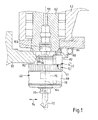
- the in Fig. 2 shown rotary transformer is intended for use in the field of a replaceable tool head of a machine tool, as exemplified in Fig. 1 is shown.
- the in Fig. 1 formed, designed as a fine turning head tool head 60 consists essentially of a base body 68, a transversely adjustable in the direction of arrow 74 to the rotation axis 64 of the tool head 60, a cutting tool 72 having slide 70, at least one disposed within the tool head 60 power consumers 50, for example in shape a measuring device 78 for direct Verstellwegshift and an electric Verstellmotors 76 for the slider 70.
- the tool head 60 can be coupled to the machine spindle 62 of a machine tool 63 by means of a tool shank 80 projecting axially beyond the main body.
- the stator housing 82 is arranged on a statorfesten holder 86 by means of an adjusting mechanism 88 both in its distance from the rotor and in its rotational position about an axis parallel to the axis of rotation 64 axis.
- the stator part 4 extends in segments only over a partial circumference of approximately 60 ° to 100 ° of the tool shaft 80 and leaves the majority of the shaft circumference free to form a free space 90 for the access of a tool gripper 92 for the automatic tool change.
- the tool head 60 on the gripper groove 96 is gripped by the tool gripper 92 from the side opposite the stator part 4 and is displaced axially with respect to the machine spindle 62 when the tool coupling is released.
- the coupling the tool head 60 with the machine spindle 62 takes place via a clamping mechanism operable on the machine side, which engages from the machine side into the cavity 100 of the tool shank 80 and couples the tool head 60 to the machine spindle 62, producing a planar clamping and radial clamping.
- the rotary transformer 2 an inductive energy transmission path 31, which already in connection with Fig. 1 described machine-fixed stator 4 and the tool-fixed, about a rotational axis 64 rotatable rotor part 6 includes.
- the stator 4 has a primary winding 10 arranged in a primary circuit 8 and the rotor part 6 has a secondary winding 38 arranged in a secondary circuit 36 and separated from the primary winding 10 via the air gap 37.
- an inverter 12 is arranged, the DC input 14, 16 is connected to a DC power source 7, 9 and whose AC output 18, 20 is connected to a primary winding 10 containing primary resonant circuit.
- the operating frequency of the inverter 12 is adjustable via a stator-side control module 24.
- a rectifier 40 In the rotor-side secondary circuit 36 is a rectifier 40, at the AC input 42, 44, a secondary winding 38 containing secondary resonant circuit is connected and the DC output 46, 48 is formed as a connection for the rotor-side power consumers 50.
- each a transmitting and receiving element 106, 108 and 106 ', 108' for non-contact bidirectional data transmission, each a transmitting and receiving electronics 110, 112 and 110 ', 112'.
- the control of the transmitting and receiving elements via the stator-side control module 24 or the rotor-side control module 56.
- the transmitting and receiving elements are expedient components of an inductive, capacitive or optical übertragungsstecke.
- the contactless energy transfer via the air gap 37 according to the transformer principle has the disadvantage that the coupling between the stator-side primary winding 10 and the rotor-side secondary winding 38 is significantly smaller than 1 and changes with the size of the air gap 37. Also, the inductances of the primary and secondary windings 10, 38 change with the size of the air gap 37.
- the primary circuit 8 and the secondary circuit 36 must be operated at an optimum frequency approximately equal to the natural frequency of the secondary circuit , Since the natural frequency changes with the air gap size and the tolerances of various components in the stator and rotor parts 4, 6, it requires an adjustment of the operating frequency at each system start.
- the secondary circuit 36 has a selectively connectable via the switch 53, the DC output 46, 48 in the region of the load terminal bridging test resistor 51.
- an ammeter 28 is arranged in the primary circuit at the DC input 14, 16 of the inverter 12, whose output 30 communicates with a measuring input 32 of the stator-side control module 24.
- a the voltage drop across the test resistor 51 detecting voltmeter 102 is arranged, whose output communicates for example via a data transmission path 41 with a measuring input 39 of the stator-side control module 24.
- the stator-side control module 24 has a programmable control output 26 connected to the frequency input 22 of the inverter 12.
- the control module 24 in turn has an evaluation circuit or routine for storing and / or evaluating the measured values of the current meter 28 or of the voltage meter 102 received via the measuring input 32 or 39 as a function of the frequency values fp output via the control output 26 in the form of frequency signals Sp when the test resistor 51 is switched on as well as a data memory for storing one with the evaluation circuit or routine calculated optimal operating frequency f opt .
- the operation of this circuit is as follows:
- the stator-side control module 24 gives the inverter 12 a fixed alternating frequency for a short time, which is roughly in the range of the later operating frequency.
- energy is transferred from the stator side to the rotor side, with which the rotor-side control module 56 can start its operation.
- This turns on the first via the output 59 and the switch 53, the test resistor 51, which receives the transmitted energy through the DC output 46, 48 of the rectifier 40 and thus makes the secondary resonant circuit for the natural frequency low impedance, so it gives him a certain quality.
- stator-side control module 24 begins to step through a predetermined frequency range. In this case, at each frequency step, either the current consumption I of the inverter 12 via the ammeter 28 or the voltage drop U at the test resistor 51 is measured via the voltmeter 102 and with the associated frequency values fp to form a curve 140 (FIG. Fig. 3 ) stored. If the natural frequency of the rotor-side secondary resonant circuit is now within the frequency range passed through, then either a current maximum 142 or a voltage maximum 144 will be able to be detected there (cf. Fig. 3 ).
- the evaluation circuit or routine present in the stator-side control module 24 now determines the frequency associated with the maximum current 142 or maximum voltage 144, possibly even with a counter Correction value and stores it as optimal operating frequency f opt in a data memory for the subsequent control of the inverter 12. Thereafter, the test resistor 51 is switched off via the switch 53, so that now the entire transferable power is the power consumer 50 available.
- both an inductive energy transmission path 31 and a contactless bidirectional data transmission path 35 are provided between the stator part 4 and the rotor part 6 of the rotary transformer 2.
- the AC voltage for the power transmission is made specifically in the connected to a DC power source inverter 12 in the manner of a square wave.
- a DC power source inverter 12 When chopping the DC voltage into the AC voltage, especially at the zero crossings, higher-frequency interferences occur, but these decay rapidly. At a time interval from each zero crossing, a longer period of time follows until the next zero crossing, in which there are no disturbances.
- the bit rate is sufficiently high, the data need not be transmitted continuously over the communication link 35.
- the data is transmitted via the bidirectional data transmission path 35 in the form of data packets 180, 182, 176, 178 in time frames with intermediate transmission pauses.
- the information of the temporal position of the zero crossing of the alternating current in the energy transmission path is first determined. Due to the information of the timing of the zero crossing of the alternating current of the energy transmission path, the time windows for transmitting the data packets 180, 182, 176, 178 are then set to lie between two consecutive zero crossings of the alternating current and each one of the zero crossings of the alternating current have temporally spaced start and end points.
- FIG. 2 Circuit technology, this is according to Fig. 2 realized in that the stator-side and the rotor-side transmitting element is each connected to a control module 24, 56, each containing a latch 34, 58, in which data packets 180, 182 and 176, 178 for sending via the associated rotor-side or stator-side transmitting elements 106, 106 'are stored in a defined time window.
- the data packets 180, 182, 176, 178 are dimensioned such that the time length of the associated time window is less than half the period of the primary winding 10 in the primary circuit 8 and / or the secondary winding 38 in the secondary circuit 36 flowing through the alternating current and wherein the beginning of time and the time end of the time window has a time interval from the successive zero crossings of the alternating current flowing through the primary winding 10 and the secondary winding 38, respectively.
- this measure achieves undisturbed data transfer due to switching disturbances in the energy transmission path.
- the invention relates to a rotary transformer 2 for machine tools with an inductive power transmission path 31 arranged between a machine-fixed stator part 4 and a rotor part 6 fixed to the tool and a non-contacting bidirectional data transmission path 35.
- a special feature of the invention is that for maximum utilization of the Performance of the energy transmission path 31 precautions are taken, whereby the optimum operating frequency f opt of working according to the transformer principle energy transfer at each system start in a test run with activated test resistor 51 and variable frequency fp is determined.
- an intermediate storage of the data to be transmitted via the data transmission path 35 is proposed which is synchronized in predetermined time windows with interference-free time intervals of the energy transmission.
Landscapes
- Engineering & Computer Science (AREA)
- Computer Networks & Wireless Communication (AREA)
- Signal Processing (AREA)
- Power Engineering (AREA)
- Mechanical Engineering (AREA)
- Arrangements For Transmission Of Measured Signals (AREA)
- Inverter Devices (AREA)
- Control Of Ac Motors In General (AREA)
Abstract
Description
- Die Erfindung betrifft einen Drehübertrager für Werkzeugmaschinen mit einer induktiven Übertragungsstrecke für elektrische Energie, mit einem maschinenfesten Statorteil, das eine in einem Primärstromkreis angeordnete Primärwicklung aufweist, mit einem werkzeugfesten, um eine Rotationsachse drehbaren Rotorteil, das einen Sekundärstromkreis mit einer von der Primärwicklung über einen Luftspalt getrennten Sekundärwicklung aufweist, und mit stator- und rotorseitigen Sende- und Empfangselementen zur bidirektionalen berührungsfreien Datenübertragung.
- Drehübertrager dieser Art werden beispielsweise in Werkzeugmaschinen mit Verstellwerkzeugen eingesetzt (
EP 1 856 705 B1 ). Bei dem bekannten Drehübertrager sind je einer statorseitige und eine rotorseitige Energiewicklung für die induktive Energieübertragung nach dem Transformatorprinzip vorgesehen. Die Energiewicklungen sind durch je eine statorseitige und rotorseitige Kernpartie voneinander getrennt, wobei die statorseitigen und rotorseitigen Kernpartien an einander zugewandten Enden über einen Luftspalt einander zugewandt sind. Zusätzlich sind bei dem bekannten Drehübertrager stator- und rotorseitige Sende- und Empfangselemente vorgesehen, die einander paarweise zugeordnete, stator- und rotorseitige Kopplungswindungen für die induktive Datenübertragung aufweisen und die an eine Sende- und Empfangselektronik angeschlossen sind. Eine wesentliche Forderung an diese Drehübertrager besteht darin, dass bei möglichst geringem Bauraum hohe elektrische Leistungen und große Datenmengen übertragen werden können. Außerdem sollen die Systeme robust und einfach in der Handhabung sein, da sie unter rauen Umgebungs- und Einsatzbedingungen zuverlässig arbeiten müssen. Sowohl bei der Herstellung unter Verwendung toleranzbehafteter Bauteile und der teilweise maschinellen Fertigung der Koppelelemente, als auch beim praktischen Einsatz, bei welchem Rotor-, Stator-und Ansteuerelektronik im Reparatur- und Wartungsfall austauschbar sein müssen, ergeben sich Unterschiede in den Komponenten, welche die Eigenschaften sowohl der Energie- als auch der Datenübertragung beeinflussen können. Zudem besteht bei der gebotenen kompakten Bauweise durch die räumliche Nähe von Energie- und Datenübertragungselementen das Problem, dass die Energieübertragung die Datenübertragung stören kann. Trotz vielfältiger konstruktiver Maßnahmen zur Reduzierung dieses Einflusses durch Abschirmung, Symmetrisierung, störungsreduzierte Schaltungstechnik, bedeutet dies, dass der Übertragungsleistung, der Bauraumreduzierung, der Datenrate, der Flexibilität und nicht zuletzt auch den Systemkosten Grenzen gesetzt sind, die den Anwendungsbereich beschränken. - Die Wechselspannung für die Energieübertragung wird im Falle der vorliegenden Erfindung zweckmäßig in einem Wechselrichter nach Art einer Rechteckspannung hergestellt. In diesem Falle treten vor allem bei den Nulldurchgängen höherfrequente Störsignale auf, die wegen der kompakten Anordnung von Energie- und Datenübertragungsstrecke in einem Drehübertrager zu Störungen bei der Datenübertragung führen können.
- Ausgehend hiervon liegt der Erfindung die Aufgabe zugrunde, die auf der Energieübertragungsstrecke übertragbare Leistung zu vergrößern, ohne dabei die Datenübertragung zu stören.
- Zur Lösung dieser Aufgabe werden die in den Patentansprüchen 1 bis 3 angegebenen Merkmalskombinationen vorgeschlagen.
- Die erfindungsgemäße Verfahrensweise besteht im Wesentlichen darin,
- a) dass die Daten über die bidirektionale Datenübertragungsstrecke in Form von Datenpaketen in Zeitfenstern übertragen werden,
- b) dass die Information der zeitlichen Lage des Nulldurchgangs eines Wechselstroms in der Energieübertragungsstrecke ermittelt wird,
- c) und dass aufgrund der Information der zeitlichen Lage des Nulldurchgangs des Wechselstroms im Primärstromkreis oder im Sekundärstromkreis der Energieübertragungsstrecke die Zeitfenster für das Übertragen der Datenpakete so festgelegt werden,
- dass die Zeitfenster zwischen zwei aufeinanderfolgenden Nulldurchgängen des Wechselstroms liegen
- und jeweils einen von den Nulldurchgängen des Wechselstroms zeitlich beabstandeten Anfangs- und Endpunkt haben.
- Schaltungstechnisch lässt sich dies gemäß der Erfindung dadurch realisieren, dass das statorseitige und das rotorseitige Sendeelement mit je einer Steuerbaugruppe verbunden ist, die einen Zwischenspeicher enthält, in welchem Datenpakete für die Übermittlung zum zugehörigen rotorseitigen oder statorseitigen Empfangselement in einem definierten Zeitfenster abgelegt sind, wobei die zeitliche Länge des Zeitfensters kleiner ist als die halbe Periode des die Primärwicklung in dem Primärstromkreis und/oder die Sekundärwicklung in dem Sekundärstromkreis durchfließenden Wechselstroms, und wobei der zeitliche Anfang und das zeitliche Ende des Zeitfensters einen zeitlichen Abstand von den aufeinanderfolgenden Nulldurchgängen des die Primärwicklung und/oder die Sekundärwicklung durchfließenden Wechselstroms aufweisen.
- Im Folgenden wird die Erfindung anhand der in der Zeichnung in schematischer Weise dargestellten Ausführungsbeispiele näher erläutert. Es zeigen
- Fig. 1
- eine Seitenansicht eines in eine Maschinenspindel eingespannten Werkzeugkopfs mit Drehübertrager für die Energie- und Datenübertragung in teilweise geschnittener Darstellung;
- Fig. 2
- ein Schaltschema des Drehübertragers mit statorseitigem Primärstromkreis und rotorseitigem Sekundärstromkreis;
- Fig. 3
- ein Optimierungsdiagramm für die Bestimmung der optimalen Betriebsfrequenz der Energieübertragungsstrecke;
- Der in
Fig. 2 dargestellte Drehübertrager ist für den Einsatz im Bereich eines austauschbaren Werkzeugkopfs einer Werkzeugmaschine bestimmt, wie er beispielhaft inFig. 1 dargestellt ist. Der inFig. 1 gezeigte, als Feindrehkopf ausgebildete Werkzeugkopf 60 besteht im Wesentlichen aus einem Grundkörper 68, einem quer in Richtung des Pfeils 74 zur Rotationsachse 64 des Werkzeugkopfs 60 verstellbaren, ein Schneidwerkzeug 72 aufweisenden Schieber 70, mindestens einem innerhalb des Werkzeugkopfs 60 angeordneten Stromverbraucher 50, beispielsweise in Form einer Messeinrichtung 78 zur direkten Verstellwegmessung und eines elektrischen Verstellmotors 76 für den Schieber 70. Die Stromversorgung des Stromverbrauchers 50 und der Datenaustausch erfolgt über den Drehübertrager 2, der aus einem Statorteil 4 und einem Rotorteil 6 besteht. Der Werkzeugkopf 60 ist mit einem axial über den Grundkörper überstehenden Werkzeugschaft 80 mit der Maschinenspindel 62 einer Werkzeugmaschine 63 kuppelbar. Zur Einstellung eines Luftspalts 37 zwischen dem Statorteil 4 und dem Rotorteil 6 ist das Statorgehäuse 82 an einem statorfesten Halter 86 mittels eines Verstellmechanismus 88 sowohl in seinem Abstand zum Rotor als auch in seiner Drehlage um eine zur Rotationsachse 64 parallele Achse verstellbar angeordnet. Bei dem inFig. 1 gezeigten Ausführungsbeispiel erstreckt sich das Statorteil 4 segmentartig nur über einen Teilumfang von etwa 60° bis 100° des Werkzeugschafts 80 und lässt den überwiegenden Teil des Schaftumfangs unter Bildung eines Freiraums 90 für den Zugriff eines Werkzeuggreifers 92 für den automatischen Werkzeugwechsel frei. Beim Werkzeugwechsel wird der Werkzeugkopf 60 an der Greiferrille 96 vom Werkzeuggreifer 92 von der dem Statorteil 4 gegenüberliegenden Seite erfasst und bei gelöster Werkzeugkupplung axial gegenüber der Maschinenspindel 62 verschoben. Die Kupplung des Werkzeugkopfes 60 mit der Maschinenspindel 62 erfolgt über eine maschinenseitig über eine Zugstange 98 betätigbaren Spannmechanismus, der von der Maschinenseite aus in den Hohlraum 100 des Werkzeugschafts 80 eingreift und den Werkzeugkopf 60 unter Herstellung einer Planflächenverspannung und einer Radialverspannung mit der Maschinenspindel 62 kuppelt. - Wie aus
Fig. 2 zu ersehen ist, weist der Drehübertrager 2 eine induktive Energieübertragungsstrecke 31 auf, die das bereits im Zusammenhang mitFig. 1 beschriebene maschinenfeste Statorteil 4 und das werkzeugfeste, um eine Rotationsachse 64 drehbare Rotorteil 6 umfasst. Das Statorteil 4 weist eine in einem Primärstromkreis 8 angeordnete Primärwicklung 10 und das Rotorteil 6 eine in einem Sekundärstromkreis 36 angeordnete, von der Primärwicklung 10 über den Luftspalt 37 getrennte Sekundärwicklung 38 auf. - Im Primärstromkreis 8 ist ein Wechselrichter 12 angeordnet, dessen Gleichstromeingang 14, 16 an eine Gleichstromquelle 7, 9 angeschlossen ist und dessen Wechselstromausgang 18, 20 an einen die Primärwicklung 10 enthaltenden Primärschwingkreis angeschlossen ist. Die Betriebsfrequenz des Wechselrichters 12 ist über eine statorseitige Steuerbaugruppe 24 einstellbar. Im rotorseitigen Sekundärstromkreis 36 befindet sich ein Gleichrichter 40, an dessen Wechselstromeingang 42, 44 ein die Sekundärwicklung 38 enthaltender Sekundärschwingkreis angeschlossen ist und dessen Gleichstromausgang 46, 48 als Anschluss für den rotorseitigen Stromverbraucher 50 ausgebildet ist.
- Zwischen dem Statorteil 4 und dem Rotorteil 6 befindet sich außerdem eine Datenübertragungsstrecke 35, die jeweils ein Sende- und Empfangselement 106, 108 bzw. 106', 108' für die berührungsfreie bidirektionale Datenübertragung, die jeweils eine Sende- und Empfangselektronik 110, 112 bzw. 110', 112' aufweisen. Die Ansteuerung der Sende- und Empfangselemente erfolgt über die statorseitige Steuerbaugruppe 24 oder die rotorseitige Steuerbaugruppe 56. Die Sende- und Empfangselemente sind zweckmäßig Bestandteile einer induktiven, kapazitiven oder optischen Datenübertragungsstecke.
- Die kontaktlose Energieübertragung über den Luftspalt 37 nach dem Transformatorprinzip hat den Nachteil, dass die Kopplung zwischen der statorseitigen Primärwicklung 10 und der rotorseitigen Sekundärwicklung 38 deutlich kleiner als 1 ist und sich mit der Größe des Luftspalts 37 ändert. Auch die Induktivitäten der Primär- und Sekundärwicklung 10, 38 ändern sich mit der Größe des Luftspalts 37. Um eine maximale Leistungsübertragung zu erzielen, müssen der Primärstromkreis 8 und der Sekundärstromkreis 36 mit einer optimalen Frequenz, die etwa der Eigenfrequenz des Sekundärstromkreises entspricht, betrieben werden. Da sich die Eigenfrequenz mit der Luftspaltgröße und den Toleranzen diverser Bauteile in den Stator- und Rotorteilen 4, 6 ändert, bedarf es bei jedem Systemstart einer Anpassung der Betriebsfrequenz.
- Zu diesem Zweck weist der Sekundärstromkreis 36 einen wahlweise über den Schalter 53 zuschaltbaren, den Gleichstromausgang 46, 48 im Bereich des Verbraucheranschlusses überbrückenden Testwiderstand 51 auf. Außerdem ist gemäß einer ersten Ausführungsvariante im Primärstromkreis am Gleichstromeingang 14, 16 des Wechselrichters 12 ein Strommesser 28 angeordnet, dessen Ausgang 30 mit einem Messeingang 32 der statorseitigen Steuerbaugruppe 24 kommuniziert. Alternativ hierzu ist gemäß einer zweiten Ausführungsvariante im Sekundärstromkreis ein den Spannungsabfall am Testwiderstand 51 erfassender Spannungsmesser 102 angeordnet, dessen Ausgang beispielsweise über eine Datenübertragungsstrecke 41 mit einem Messeingang 39 der statorseiteigen Steuerbaugruppe 24 kommuniziert.
- Bei beiden Ausführungsvarianten weist die statorseitige Steuerbaugruppe 24 einen mit dem Frequenzeingang 22 des Wechselrichters 12 verbundenen programmierbaren Stellausgang 26 auf. Die Steuerbaugruppe 24 weist ihrerseits eine Auswerteschaltung oder-routine zum Speichern und/oder Auswerten der über den Messeingang 32 bzw. 39 in Form von Messsignalen empfangenen Messwerte des Strommessers 28 oder des Spannungsmessers 102 in Abhängigkeit von den über dem Stellausgang 26 in Form von Frequenzsignalen S abgegebenen Frequenzwerten fp bei zugeschaltetem Testwiderstand 51 sowie einen Datenspeicher zur Abspeicherung einer mit der Auswerteschaltung oder -routine berechneten optimalen Betriebsfrequenz fopt auf. Die Betriebsweise dieser Schaltungsanordnung ist wie folgt:
- Nach der Aktivierung des Drehübertragers 2 gibt die statorseitige Steuerbaugruppe 24 dem Wechselrichter 12 für kurze Zeit eine feste Wechselfrequenz vor, welche grob im Bereich der späteren Betriebsfrequenz liegt. Dabei wird Energie von der Statorseite auf die Rotorseite übertragen, mit der die rotorseitige Steuerbaugruppe 56 ihren Betrieb aufnehmen kann. Diese schaltet als erste über den Ausgang 59 und den Schalter 53 den Testwiderstand 51 ein, der die übertragene Energie über den Gleichstromausgang 46, 48 des Gleichrichters 40 aufnimmt und damit den Sekundärschwingkreis für die Eigenfrequenz niedrig impedant macht, ihm also eine gewisse Güte verleiht.
- Im Anschluss daran fängt die statorseitige Steuerbaugruppe 24 an, einen vorgegebenen Frequenzbereich schrittweise durchzufahren. Dabei wird bei jedem Frequenzschritt entweder die Stromaufnahme I des Wechselrichters 12 über den Strommesser 28 oder der Spannungsabfall U am Testwiderstand 51 über den Spannungsmesser 102 gemessen und mit den zugehörigen Frequenzwerten fp unter Bildung einer Kurve 140 (
Fig. 3 ) abgespeichert. Liegt nun die Eigenfrequenz des rotorseitigen Sekundärschwingkreises innerhalb des durchgefahrenen Frequenzbereichs, so wird man dort entweder ein Strommaximum 142 oder ein Spannungsmaximum 144 feststellen können (vgl.Fig. 3 ). - Die in der statorseitigen Steuerbaugruppe 24 vorhandene Auswerteschaltung oder -routine bestimmt nun die zum Strommaximum 142 oder Spannungsmaximum 144 gehörende Frequenz, verrechnet diese ggf. noch mit einem Korrekturwert und speichert diese als optimale Betriebsfrequenz fopt in einen Datenspeicher für die nachfolgende Ansteuerung des Wechselrichters 12. Danach wird der Testwiderstand 51 über den Schalter 53 abgeschaltet, so dass nun die gesamte übertragbare Leistung dem Stromverbraucher 50 zur Verfügung steht.
- Wie vorstehend bereits erläutert, ist zwischen dem Statorteil 4 und dem Rotorteil 6 des Drehübertragers 2 sowohl eine induktive Energieübertragungsstrecke 31 als auch eine berührungsfreie bidirektionale Datenübertragungsstrecke 35 vorgesehen. Die Wechselspannung für die Energieübertragung wird eigens in dem an eine Gleichstromquelle angeschlossenen Wechselrichter 12 nach Art einer Rechteckspannung hergestellt. Beim Zerhacken der Gleichspannung in die Wechselspannung treten vor allem bei den Nulldurchgängen höherfrequente Störungen auf, die aber schnell abklingen. In zeitlichem Abstand von jedem Nulldurchgang folgt ein längerer Zeitabschnitt bis zum nächsten Nulldurchgang, in welchem keine Störungen vorhanden sind. Andererseits müssen die Daten bei ausreichend hoher Bitrate über die Datenübertragungsstrecke 35 nicht kontinuierlich übertragen werden. Dies kann gemäß der Erfindung dazu benutzt werden, dass die Daten über die bidirektionale Datenübertragungsstrecke 35 in Form von Datenpaketen 180, 182, 176, 178 in Zeitfenstern mit zwischengeschalteten Übertragungspausen übertragen werden. Um eine störungsfreie Übertragung zu gewährleisten, wird zunächst die Information der zeitlichen Lage des Nulldurchgangs des Wechselstroms in der Energieübertragungsstrecke ermittelt. Aufgrund der Information der zeitlichen Lage des Nulldurchgangs des Wechselstroms der Energieübertragungsstrecke werden sodann die Zeitfenster für das Übertragen der Datenpakete 180, 182, 176, 178 so festgelegt, dass sie zwischen zwei aufeinanderfolgenden Nulldurchgängen des Wechselstroms liegen und dass sie jeweils einen von den Nulldurchgängen des Wechselstroms zeitlich beabstandeten Anfangs- und Endpunkt haben.
- Schaltungstechnisch wird dies gemäß
Fig. 2 dadurch realisiert, dass das statorseitige und das rotorseitige Sendeelement mit je einer Steuerbaugruppe 24, 56 verbunden ist, die jeweils einen Zwischenspeicher 34, 58 enthält, in welchen Datenpakete 180, 182 bzw. 176, 178 für die Absendung über die zugehörigen rotorseitigen oder statorseitigen Sendeelemente 106, 106' in einem definierten Zeitfenster abgelegt sind. Die Datenpakete 180, 182, 176, 178 sind dabei so bemessen, dass die zeitliche Länge des zugehörigen Zeitfensters kleiner ist als die halbe Periode des die Primärwicklung 10 im Primärstromkreis 8 und/oder die Sekundärwicklung 38 im Sekundärstromkreis 36 durchfließenden Wechselstroms und wobei der zeitliche Anfang und das zeitliche Ende des Zeitfensters einen zeitlichen Abstand von den aufeinanderfolgenden Nulldurchgängen des die Primärwicklung 10 bzw. die Sekundärwicklung 38 durchfließenden Wechselstroms aufweisen. Mit dieser Maßnahme wird trotz kompakter Bauweise des Drehübertragers 2 eine durch Umschaltstörungen in der Energieübertragungsstrecke ungestörte Datenübertragung erzielt. - Zusammenfassend ist folgendes festzuhalten: Die Erfindung bezieht sich auf einen Drehübertrager 2 für Werkzeugmaschinen mit einer zwischen einem maschinenfesten Statorteil 4 und einem werkzeugfesten Rotorteil 6 angeordneten induktiven Energieübertragungsstrecke 31 sowie einer berührungsfreien bidirektionalen Datenübertragungsstrecke 35. Eine Besonderheit der Erfindung besteht darin, dass zur maximalen Ausschöpfung der Leistungsfähigkeit der Energieübertragungsstrecke 31 Vorkehrungen getroffen sind, womit die optimale Betriebsfrequenz fopt der nach dem Transformatorprinzip arbeitenden Energieübertragung bei jedem Systemstart in einem Testlauf mit zugeschaltetem Testwiderstand 51 und variabler Frequenz fp ermittelt wird. Weiter wird zum Zwecke der störungsfreien Datenübertragung eine Zwischenspeicherung der über die Datenübertragungsstrecke 35 zu übertragenden Daten vorgeschlagen, die in vorgegebenen Zeitfenstern mit störungsfreien Zeitabschnitten der Energieübertragung synchronisiert werden.
-
- 2
- Drehübertrager
- 4
- Statorteil
- 6
- Rotorteil
- 7, 9
- Gleichstromquelle
- 8
- Primärstromkreis
- 10
- Primärwicklung
- 12
- Wechselrichter
- 14
- Schieber
- 14, 16
- Gleichstromeingang
- 18, 20
- Wechselstromausgang
- 22
- Frequenzeingang
- 24
- statorseitige Steuerbaugruppe
- 26
- Stellausgang
- 28
- Strommesser
- 30
- Ausgang
- 31
- Energieübertragungsstrecke
- 32
- Messeingang (I)
- 34
- Zwischenspeicher, Datenspeicher
- 35
- Datenübertragungsstrecke
- 36
- Sekundärstromkreis
- 37
- Luftspalt
- 38
- Sekundärwicklung
- 39
- Messeingang (U)
- 40
- Gleichrichter
- 41
- Datenübertragungsstrecke
- 42, 44
- Wechselstromeingang
- 46, 48
- Gleichstromausgang
- 50
- Stromverbraucher
- 51
- Testwiderstand
- 53
- Schalter
- 56
- rotorseitige Steuerbaugruppe
- 58
- Zwischenspeicher
- 59
- Ausgang
- 60
- Werkzeug kopf
- 62
- Maschinenspindel
- 63
- Werkzeugmaschine
- 64
- Rotationsachse, Drehachse
- 68
- Grundkörper
- 70
- Schieber
- 72
- Schneidwerkzeug
- 74
- Pfeil
- 76
- elektrischer Verstellmotor
- 78
- Messeinrichtung
- 80
- Werkzeugschaft
- 82
- Statorgehäuse
- 86
- statorfester Halter
- 88
- Verstellmechanismus
- 90
- Freiraum
- 92
- Werkzeuggreifer
- 96
- Greiferrille
- 98
- Zugstange
- 100
- Hohlraum
- 102
- Spannungsmesser
- 106, 108
- Sende- und Empfangselement (statorseitig)
- 106', 108'
- Sende- und Empfangselement (rotorseitig)
- 110, 112
- Sende- und Empfangselektronik (statorseitig)
- 110', 112'
- Sende- und Empfangselektronik (rotorseitig)
- 140
- Kurve
- 142
- Strommaximum
- 144
- Spannungsmaximum
- 176, 178, 180, 182
- Datenpaket
- I
- Strom
- U
- Spannung
- fp
- Frequenz
- fopt
- optimale Betriebsfrequenz
Claims (3)
- Drehübertrager für Werkzeugmaschinen mit einer induktiven Übertragungsstrecke für elektrische Energie, mit einem maschinenfesten Statorteil (4), das eine in einem Primärstromkreis (8) angeordnete Primärwicklung (10) aufweist, mit einem werkzeugfesten, um eine Rotationsachse (64) drehbaren Rotorteil (6), das einen Sekundärstromkreis (36) mit einer von der Primärwicklung (10) über einen Luftspalt (37) getrennten Sekundärwicklung (38) aufweist, und mit stator- und rotorseitigen Sende- und Empfangselementen (106, 108, 106', 108') zur bidirektionalen berührungsfreien Datenübertragung, dadurch gekennzeichnet, dass das statorseitige und das rotorseitige Sendeelement (106, 106') mit je einer Steuerbaugruppe (24) verbunden ist, die einen Zwischenspeicher (34, 58) enthält, in welchem Datenpakete (180, 182, 176, 178) für die Übermittlung zum zugehörigen rotorseitigen oder statorseitigen Empfangselement (108, 108') in einem definierten Zeitfenster abgelegt sind, wobei die zeitliche Länge des Zeitfensters kleiner ist als die halbe Periode des die Primärwicklung (10) und/oder die Sekundärwicklung (38) durchfließenden Wechselstroms, und wobei der zeitliche Anfang und das zeitliche Ende des Zeitfensters einen zeitlichen Abstand von den aufeinanderfolgenden Nulldurchgängen des die Primärwicklung (10) und/oder die Sekundärwicklung (38) durchfließenden Wechselstroms aufweisen.
- Werkzeugkopf mit einem elektrischen Verbraucher (50) und mit einem gemäß Anspruch 1 ausgebildeten Drehübertrager (2) dadurch gekennzeichnet, dass der elektrische Verbraucher (50) als ein an den Sekundärstromkreis (36) anschließbarer Elektromotor (76) für das Verstellen eines Schiebers (70) und/oder als ein Aktuator für die Schneidenverstellung und/oder als ein Laser und/oder als ein Induktor und/oder als ein elektrisch ansteuerbares Sprühaggregat für ein Abschreckfluid und/oder als eine Vorrichtung zum Schweißen, Löten, Erhitzen, Härten, Beschichten oder Beschriften eines Werkstücks ausgebildet ist.
- Verfahren für das Übertragen von Daten über eine Datenübertragungsstrecke (35) mittels eines berührungslosen Drehübertragers (2), der auch eine induktive Energieübertragungsstrecke (31) aufweist, bei dem die Daten in Form von Datenpaketen (180, 182, 176, 178) in Zeitfenstern übertragen werden, dadurch gekennzeichnet, dass die Information der zeitlichen Lage des Nulldurchgangs eines Wechselstroms in der Energieübertragungsstrecke (31) ermittelt wird, und dass aufgrund der Information der zeitlichen Lage des Nulldurchgangs des Wechselstroms in einem Primärstromkreis (8) oder in einem Sekundärstromkreis (36) der Energieübertragungsstrecke die Zeitfenster für das Übertragen der Datenpakete (180, 182, 176, 178) so festgelegt werden, dass die Zeitfenster zwischen zwei aufeinanderfolgenden Nulldurchgängen des Wechselstroms liegen und jeweils einen von den Nulldurchgängen des Wechselstroms zeitlich beabstandeten Anfangs- und Endpunkt haben.
Applications Claiming Priority (2)
| Application Number | Priority Date | Filing Date | Title |
|---|---|---|---|
| DE102011080973A DE102011080973A1 (de) | 2011-08-16 | 2011-08-16 | Drehübertrager für Werkzeugmaschinen |
| EP12730891.4A EP2745377B1 (de) | 2011-08-16 | 2012-06-21 | Drehübertrager für werkzeugmaschinen |
Related Parent Applications (2)
| Application Number | Title | Priority Date | Filing Date |
|---|---|---|---|
| EP12730891.4A Division EP2745377B1 (de) | 2011-08-16 | 2012-06-21 | Drehübertrager für werkzeugmaschinen |
| EP12730891.4A Division-Into EP2745377B1 (de) | 2011-08-16 | 2012-06-21 | Drehübertrager für werkzeugmaschinen |
Publications (2)
| Publication Number | Publication Date |
|---|---|
| EP2858204A1 true EP2858204A1 (de) | 2015-04-08 |
| EP2858204B1 EP2858204B1 (de) | 2018-05-30 |
Family
ID=46420131
Family Applications (2)
| Application Number | Title | Priority Date | Filing Date |
|---|---|---|---|
| EP14179694.6A Active EP2858204B1 (de) | 2011-08-16 | 2012-06-21 | Drehübertrager für Werkzeugmaschinen |
| EP12730891.4A Not-in-force EP2745377B1 (de) | 2011-08-16 | 2012-06-21 | Drehübertrager für werkzeugmaschinen |
Family Applications After (1)
| Application Number | Title | Priority Date | Filing Date |
|---|---|---|---|
| EP12730891.4A Not-in-force EP2745377B1 (de) | 2011-08-16 | 2012-06-21 | Drehübertrager für werkzeugmaschinen |
Country Status (6)
| Country | Link |
|---|---|
| US (3) | US9184803B2 (de) |
| EP (2) | EP2858204B1 (de) |
| JP (2) | JP6180413B2 (de) |
| CN (1) | CN103563203B (de) |
| DE (1) | DE102011080973A1 (de) |
| WO (1) | WO2013023823A2 (de) |
Cited By (4)
| Publication number | Priority date | Publication date | Assignee | Title |
|---|---|---|---|---|
| WO2018125709A1 (en) * | 2016-12-30 | 2018-07-05 | Panosense, Inc. | Interface for transferring power and data between a non-rotating body and a rotating body |
| US10109183B1 (en) | 2016-12-30 | 2018-10-23 | Panosense Inc. | Interface for transferring data between a non-rotating body and a rotating body |
| US10122416B2 (en) | 2016-12-30 | 2018-11-06 | Panosense Inc. | Interface for transferring power and data between a non-rotating body and a rotating body |
| US10742088B2 (en) | 2016-12-30 | 2020-08-11 | Panosense Inc. | Support assembly for rotating body |
Families Citing this family (18)
| Publication number | Priority date | Publication date | Assignee | Title |
|---|---|---|---|---|
| DE102008055971A1 (de) * | 2008-11-05 | 2010-05-06 | Komet Group Gmbh | Bearbeitungszentrum mit Drehübertrager für elektrische Energie |
| DE102010003338A1 (de) * | 2010-03-26 | 2011-09-29 | Komet Group Gmbh | Werkzeugmaschine mit Drehübertrager für Daten |
| DE102013105829A1 (de) * | 2013-06-06 | 2014-12-11 | Bilz Werkzeugfabrik Gmbh & Co. Kg | Werkzeugspannsystem |
| EP3028804B1 (de) * | 2014-12-04 | 2017-02-22 | SMW-AUTOBLOK Spannsysteme GmbH | Übertragungsanordnung, insb. zur Energie- und/oder Signalübertragung |
| EP3059036B1 (de) * | 2014-12-04 | 2017-04-26 | SMW-AUTOBLOK Spannsysteme GmbH | Spannfutter mit elektromotoren |
| EP3182555B1 (de) | 2015-12-18 | 2019-04-17 | TE Connectivity Nederland B.V. | Kontaktfreier verbinder und kontaktfreies verbindersystem |
| DE102016121724A1 (de) * | 2016-11-14 | 2018-05-17 | Hamm Ag | Baumaschine |
| EP3563467A1 (de) * | 2016-12-30 | 2019-11-06 | Panosense, Inc. | Schnittstelle zur übertragung von strom und daten zwischen einem nichtrotierenden körper und einem rotierenden körper |
| DE102017217051A1 (de) * | 2017-09-26 | 2019-03-28 | Spinner Gmbh | Vorrichtung und Verfahren zur Übertragung von Daten zwischen zwei physikalischen Schnittstellen |
| CN109067005B (zh) * | 2018-06-26 | 2022-07-01 | 上海航天设备制造总厂有限公司 | 用于旋转机电设备的非接触供电装置 |
| JP7104613B2 (ja) * | 2018-12-05 | 2022-07-21 | オークマ株式会社 | 工作機械の制御装置 |
| JP7281917B2 (ja) | 2019-02-18 | 2023-05-26 | 株式会社マキタ | 電動作業機 |
| JP7224950B2 (ja) * | 2019-02-18 | 2023-02-20 | 株式会社マキタ | 電動作業機 |
| TWI717067B (zh) * | 2019-10-23 | 2021-01-21 | 財團法人工業技術研究院 | 主軸電能及訊號傳輸裝置 |
| DE102020212399A1 (de) * | 2020-09-30 | 2022-03-31 | Fraunhofer-Gesellschaft zur Förderung der angewandten Forschung eingetragener Verein | Rotierendes Element |
| JP7604163B2 (ja) * | 2020-10-14 | 2024-12-23 | キヤノン株式会社 | 無線伝送システム、制御方法、およびプログラム |
| JP7630967B2 (ja) * | 2020-11-17 | 2025-02-18 | キヤノン株式会社 | 無線伝送システム、制御方法、およびプログラム |
| DE102021108803A1 (de) * | 2021-04-08 | 2022-10-13 | Deckel Maho Pfronten Gmbh | System zur Werkstückbearbeitung, Werkzeugmaschine, Trägervorrichtung und Werkstückträger |
Citations (1)
| Publication number | Priority date | Publication date | Assignee | Title |
|---|---|---|---|---|
| EP1856705B1 (de) | 2005-03-09 | 2009-04-15 | KOMET GROUP Holding GmbH | Drehübertrager |
Family Cites Families (16)
| Publication number | Priority date | Publication date | Assignee | Title |
|---|---|---|---|---|
| JP3097319B2 (ja) * | 1992-06-18 | 2000-10-10 | 株式会社安川電機 | 電動機の無接触給電制御方法、該方法による分離型制御電動機、及び該分離型制御電動機を用いた機械装置 |
| JPH07273696A (ja) * | 1994-03-31 | 1995-10-20 | Idec Izumi Corp | データ伝送装置 |
| DE19653522A1 (de) * | 1996-12-20 | 1998-06-25 | Bayerische Motoren Werke Ag | Verfahren zum drahtlosen Übertragen von Energie und Daten |
| JP3533375B2 (ja) * | 2001-03-16 | 2004-05-31 | 多摩川精機株式会社 | 回転型非接触コネクタ |
| JP4200257B2 (ja) * | 2000-09-26 | 2008-12-24 | パナソニック電工株式会社 | 非接触電力伝達装置 |
| JP4222115B2 (ja) * | 2003-06-13 | 2009-02-12 | セイコーエプソン株式会社 | 非接触電力伝送装置 |
| FR2874765B1 (fr) * | 2004-08-31 | 2007-02-09 | Valeo Equip Electr Moteur | Module de commande et de puissance pour une machine electrique tournante |
| JP2008109762A (ja) * | 2006-10-24 | 2008-05-08 | Olympus Imaging Corp | 電力伝送装置 |
| EP2492932B1 (de) * | 2006-12-20 | 2014-07-30 | Analogic Corporation | Kontaktfreies rotierendes Energieübertragungssystem |
| JP2008295156A (ja) * | 2007-05-23 | 2008-12-04 | Seiko Epson Corp | 受電装置及び電子機器 |
| JP2009112153A (ja) * | 2007-10-31 | 2009-05-21 | Meleagros Corp | 電力伝送装置の受電装置 |
| US8729734B2 (en) * | 2007-11-16 | 2014-05-20 | Qualcomm Incorporated | Wireless power bridge |
| WO2009147574A1 (en) * | 2008-06-02 | 2009-12-10 | Philips Intellectual Property & Standards Gmbh | Rotary power transformer for use in a high-voltage generator circuitry for inductively transmitting two or more independently controllable supply voltages to the power supply terminals of a load |
| US9186995B2 (en) * | 2009-05-14 | 2015-11-17 | Toyota Jidosha Kabushiki Kaisha | Non-contact power receiving apparatus and vehicle having the same |
| US8164929B2 (en) * | 2009-08-17 | 2012-04-24 | Schleifring Und Apparatebau Gmbh | Controlled contactless power transmission |
| EP2658084B1 (de) * | 2010-12-24 | 2017-10-18 | Toyota Jidosha Kabushiki Kaisha | Kontaktloses stromversorgungssystem und steuerverfahren für ein kontaktloses stromversorgungssystem |
-
2011
- 2011-08-16 DE DE102011080973A patent/DE102011080973A1/de not_active Withdrawn
-
2012
- 2012-06-21 EP EP14179694.6A patent/EP2858204B1/de active Active
- 2012-06-21 CN CN201280023590.9A patent/CN103563203B/zh active Active
- 2012-06-21 WO PCT/EP2012/061970 patent/WO2013023823A2/de not_active Ceased
- 2012-06-21 JP JP2014525361A patent/JP6180413B2/ja not_active Expired - Fee Related
- 2012-06-21 EP EP12730891.4A patent/EP2745377B1/de not_active Not-in-force
- 2012-06-21 US US14/238,537 patent/US9184803B2/en not_active Expired - Fee Related
-
2015
- 2015-10-26 US US14/922,884 patent/US9413433B2/en active Active
-
2016
- 2016-06-28 US US15/195,012 patent/US9537540B2/en active Active
-
2017
- 2017-04-05 JP JP2017075086A patent/JP6454749B2/ja active Active
Patent Citations (1)
| Publication number | Priority date | Publication date | Assignee | Title |
|---|---|---|---|---|
| EP1856705B1 (de) | 2005-03-09 | 2009-04-15 | KOMET GROUP Holding GmbH | Drehübertrager |
Cited By (5)
| Publication number | Priority date | Publication date | Assignee | Title |
|---|---|---|---|---|
| WO2018125709A1 (en) * | 2016-12-30 | 2018-07-05 | Panosense, Inc. | Interface for transferring power and data between a non-rotating body and a rotating body |
| US10109183B1 (en) | 2016-12-30 | 2018-10-23 | Panosense Inc. | Interface for transferring data between a non-rotating body and a rotating body |
| US10122416B2 (en) | 2016-12-30 | 2018-11-06 | Panosense Inc. | Interface for transferring power and data between a non-rotating body and a rotating body |
| US10742088B2 (en) | 2016-12-30 | 2020-08-11 | Panosense Inc. | Support assembly for rotating body |
| US11411462B1 (en) | 2016-12-30 | 2022-08-09 | Zoox, Inc. | Support assembly for rotating body |
Also Published As
| Publication number | Publication date |
|---|---|
| JP6180413B2 (ja) | 2017-08-16 |
| WO2013023823A3 (de) | 2013-07-11 |
| CN103563203B (zh) | 2016-12-21 |
| JP2017163831A (ja) | 2017-09-14 |
| US20160308586A1 (en) | 2016-10-20 |
| US20160065273A1 (en) | 2016-03-03 |
| US9413433B2 (en) | 2016-08-09 |
| EP2745377A2 (de) | 2014-06-25 |
| JP2014529886A (ja) | 2014-11-13 |
| US20140295755A1 (en) | 2014-10-02 |
| US9537540B2 (en) | 2017-01-03 |
| JP6454749B2 (ja) | 2019-01-16 |
| US9184803B2 (en) | 2015-11-10 |
| EP2745377B1 (de) | 2016-06-08 |
| WO2013023823A2 (de) | 2013-02-21 |
| EP2858204B1 (de) | 2018-05-30 |
| DE102011080973A1 (de) | 2013-02-21 |
| CN103563203A (zh) | 2014-02-05 |
Similar Documents
| Publication | Publication Date | Title |
|---|---|---|
| EP2858204B1 (de) | Drehübertrager für Werkzeugmaschinen | |
| DE3706659C2 (de) | ||
| DE102008015837A1 (de) | Positionsmessgerät und Verfahren zu dessen Betrieb | |
| DE102009041340A1 (de) | Schäleinrichtung und Schälmaschine | |
| DE102013204871A1 (de) | Verfahren und Winkelsensor zur kontaktlosen Messung eines Winkels | |
| EP3386679A1 (de) | Werkzeugmaschine | |
| EP2839490A1 (de) | Verfahren zur überwachung eines stufenschalters | |
| EP3839462B1 (de) | Zahnriemen mit integrierter sensorik | |
| EP2083407A1 (de) | Vorrichtung und Verfahren zur kontaktlosen Energie- und Datenübertragung | |
| WO2023041698A1 (de) | Energieübertragung in einem linearen transportsystem | |
| DE69718971T2 (de) | Elektromechanischer Wandler mit zwei permanentmagnetischen Rotoren | |
| WO2023072736A1 (de) | System mit elektrischem drehtransformator | |
| EP0897999B1 (de) | Verfahren zur berührungslosen Energie- und Signalübertragung an Textilmaschinen, insbesondere Zwirnmaschinen sowie Einrichtung zur Durchführung des Verfahrens | |
| EP1340988A2 (de) | Verfahren und Vorrichtung zur Messung der Impedanz eines elektrischen Energieversorgungsnetzes | |
| DE10006648A1 (de) | Verfahren und Gerät zum Erfassen des Lastmoments und zum Bestimmen der Optimierung des Treiberstroms eines Motors | |
| EP2091799B1 (de) | Vorrichtung zur kontaktlosen ermittlung des energiebedarfs eines weichenstellantriebs | |
| DE10142273A1 (de) | Meßdatenübertragung | |
| EP2475498A1 (de) | Rundschalttisch mit direktem antrieb der transportkurve | |
| DE10012981A1 (de) | Einrichtung zur kontaktlosen Übertragung von elektrischer Energie und elektronischen Daten zwichen einer stationären und einer rotierenden Einheit | |
| DE102007053755A1 (de) | Verfahren und Einrichtung zur Überwachung einer Läufertemperatur einer permanent erregten elektrischen Maschine | |
| DE2525070B2 (de) | Informationsleseeinheit für von einem Förderer mitgefühlte Steuerinformationen | |
| DE102007036558A1 (de) | Übertragung von Informationen zwischen einem elektrischen Verbraucher und einem Betriebsmittel | |
| DE19843575A1 (de) | Mehrspindelige Werkzeugmaschine, insbesondere Mehrspindeldrehautomat | |
| EP2246970A2 (de) | Verfahren und Vorrichtung zum Bestimmen einer absoluten Winkellage eines Rotors eines kommutierten Elektromotors | |
| DE973289C (de) | Anordnung zur Drehzahlsteuerung eines im Anker- und Erregerstromkreis ueber gittergesteuerte Gas- oder Dampfentladungsgefaesse gespeisten Gleichstrommotors |
Legal Events
| Date | Code | Title | Description |
|---|---|---|---|
| PUAI | Public reference made under article 153(3) epc to a published international application that has entered the european phase |
Free format text: ORIGINAL CODE: 0009012 |
|
| 17P | Request for examination filed |
Effective date: 20140804 |
|
| AC | Divisional application: reference to earlier application |
Ref document number: 2745377 Country of ref document: EP Kind code of ref document: P |
|
| AK | Designated contracting states |
Kind code of ref document: A1 Designated state(s): AL AT BE BG CH CY CZ DE DK EE ES FI FR GB GR HR HU IE IS IT LI LT LU LV MC MK MT NL NO PL PT RO RS SE SI SK SM TR |
|
| R17P | Request for examination filed (corrected) |
Effective date: 20150701 |
|
| RBV | Designated contracting states (corrected) |
Designated state(s): AL AT BE BG CH CY CZ DE DK EE ES FI FR GB GR HR HU IE IS IT LI LT LU LV MC MK MT NL NO PL PT RO RS SE SI SK SM TR |
|
| REG | Reference to a national code |
Ref country code: DE Ref legal event code: R079 Ref document number: 502012012802 Country of ref document: DE Free format text: PREVIOUS MAIN CLASS: H02J0005000000 Ipc: H04B0015020000 |
|
| GRAP | Despatch of communication of intention to grant a patent |
Free format text: ORIGINAL CODE: EPIDOSNIGR1 |
|
| RIC1 | Information provided on ipc code assigned before grant |
Ipc: H04B 15/02 20060101AFI20170929BHEP |
|
| INTG | Intention to grant announced |
Effective date: 20171031 |
|
| GRAS | Grant fee paid |
Free format text: ORIGINAL CODE: EPIDOSNIGR3 |
|
| GRAJ | Information related to disapproval of communication of intention to grant by the applicant or resumption of examination proceedings by the epo deleted |
Free format text: ORIGINAL CODE: EPIDOSDIGR1 |
|
| GRAL | Information related to payment of fee for publishing/printing deleted |
Free format text: ORIGINAL CODE: EPIDOSDIGR3 |
|
| INTC | Intention to grant announced (deleted) | ||
| GRAP | Despatch of communication of intention to grant a patent |
Free format text: ORIGINAL CODE: EPIDOSNIGR1 |
|
| GRAA | (expected) grant |
Free format text: ORIGINAL CODE: 0009210 |
|
| RAP1 | Party data changed (applicant data changed or rights of an application transferred) |
Owner name: KOMET DEUTSCHLAND GMBH |
|
| INTG | Intention to grant announced |
Effective date: 20180417 |
|
| AC | Divisional application: reference to earlier application |
Ref document number: 2745377 Country of ref document: EP Kind code of ref document: P |
|
| AK | Designated contracting states |
Kind code of ref document: B1 Designated state(s): AL AT BE BG CH CY CZ DE DK EE ES FI FR GB GR HR HU IE IS IT LI LT LU LV MC MK MT NL NO PL PT RO RS SE SI SK SM TR |
|
| REG | Reference to a national code |
Ref country code: GB Ref legal event code: FG4D Free format text: NOT ENGLISH |
|
| REG | Reference to a national code |
Ref country code: CH Ref legal event code: EP |
|
| REG | Reference to a national code |
Ref country code: CH Ref legal event code: NV Representative=s name: TROESCH SCHEIDEGGER WERNER AG, CH Ref country code: AT Ref legal event code: REF Ref document number: 1004691 Country of ref document: AT Kind code of ref document: T Effective date: 20180615 |
|
| REG | Reference to a national code |
Ref country code: DE Ref legal event code: R096 Ref document number: 502012012802 Country of ref document: DE |
|
| REG | Reference to a national code |
Ref country code: IE Ref legal event code: FG4D Free format text: LANGUAGE OF EP DOCUMENT: GERMAN |
|
| REG | Reference to a national code |
Ref country code: NL Ref legal event code: MP Effective date: 20180530 |
|
| REG | Reference to a national code |
Ref country code: LT Ref legal event code: MG4D |
|
| PG25 | Lapsed in a contracting state [announced via postgrant information from national office to epo] |
Ref country code: ES Free format text: LAPSE BECAUSE OF FAILURE TO SUBMIT A TRANSLATION OF THE DESCRIPTION OR TO PAY THE FEE WITHIN THE PRESCRIBED TIME-LIMIT Effective date: 20180530 Ref country code: SE Free format text: LAPSE BECAUSE OF FAILURE TO SUBMIT A TRANSLATION OF THE DESCRIPTION OR TO PAY THE FEE WITHIN THE PRESCRIBED TIME-LIMIT Effective date: 20180530 Ref country code: FI Free format text: LAPSE BECAUSE OF FAILURE TO SUBMIT A TRANSLATION OF THE DESCRIPTION OR TO PAY THE FEE WITHIN THE PRESCRIBED TIME-LIMIT Effective date: 20180530 Ref country code: NO Free format text: LAPSE BECAUSE OF FAILURE TO SUBMIT A TRANSLATION OF THE DESCRIPTION OR TO PAY THE FEE WITHIN THE PRESCRIBED TIME-LIMIT Effective date: 20180830 Ref country code: CY Free format text: LAPSE BECAUSE OF FAILURE TO SUBMIT A TRANSLATION OF THE DESCRIPTION OR TO PAY THE FEE WITHIN THE PRESCRIBED TIME-LIMIT Effective date: 20180530 Ref country code: LT Free format text: LAPSE BECAUSE OF FAILURE TO SUBMIT A TRANSLATION OF THE DESCRIPTION OR TO PAY THE FEE WITHIN THE PRESCRIBED TIME-LIMIT Effective date: 20180530 Ref country code: BG Free format text: LAPSE BECAUSE OF FAILURE TO SUBMIT A TRANSLATION OF THE DESCRIPTION OR TO PAY THE FEE WITHIN THE PRESCRIBED TIME-LIMIT Effective date: 20180830 |
|
| PG25 | Lapsed in a contracting state [announced via postgrant information from national office to epo] |
Ref country code: GR Free format text: LAPSE BECAUSE OF FAILURE TO SUBMIT A TRANSLATION OF THE DESCRIPTION OR TO PAY THE FEE WITHIN THE PRESCRIBED TIME-LIMIT Effective date: 20180831 Ref country code: HR Free format text: LAPSE BECAUSE OF FAILURE TO SUBMIT A TRANSLATION OF THE DESCRIPTION OR TO PAY THE FEE WITHIN THE PRESCRIBED TIME-LIMIT Effective date: 20180530 Ref country code: RS Free format text: LAPSE BECAUSE OF FAILURE TO SUBMIT A TRANSLATION OF THE DESCRIPTION OR TO PAY THE FEE WITHIN THE PRESCRIBED TIME-LIMIT Effective date: 20180530 Ref country code: LV Free format text: LAPSE BECAUSE OF FAILURE TO SUBMIT A TRANSLATION OF THE DESCRIPTION OR TO PAY THE FEE WITHIN THE PRESCRIBED TIME-LIMIT Effective date: 20180530 |
|
| PG25 | Lapsed in a contracting state [announced via postgrant information from national office to epo] |
Ref country code: NL Free format text: LAPSE BECAUSE OF FAILURE TO SUBMIT A TRANSLATION OF THE DESCRIPTION OR TO PAY THE FEE WITHIN THE PRESCRIBED TIME-LIMIT Effective date: 20180530 |
|
| PG25 | Lapsed in a contracting state [announced via postgrant information from national office to epo] |
Ref country code: RO Free format text: LAPSE BECAUSE OF FAILURE TO SUBMIT A TRANSLATION OF THE DESCRIPTION OR TO PAY THE FEE WITHIN THE PRESCRIBED TIME-LIMIT Effective date: 20180530 Ref country code: SK Free format text: LAPSE BECAUSE OF FAILURE TO SUBMIT A TRANSLATION OF THE DESCRIPTION OR TO PAY THE FEE WITHIN THE PRESCRIBED TIME-LIMIT Effective date: 20180530 Ref country code: CZ Free format text: LAPSE BECAUSE OF FAILURE TO SUBMIT A TRANSLATION OF THE DESCRIPTION OR TO PAY THE FEE WITHIN THE PRESCRIBED TIME-LIMIT Effective date: 20180530 Ref country code: EE Free format text: LAPSE BECAUSE OF FAILURE TO SUBMIT A TRANSLATION OF THE DESCRIPTION OR TO PAY THE FEE WITHIN THE PRESCRIBED TIME-LIMIT Effective date: 20180530 Ref country code: DK Free format text: LAPSE BECAUSE OF FAILURE TO SUBMIT A TRANSLATION OF THE DESCRIPTION OR TO PAY THE FEE WITHIN THE PRESCRIBED TIME-LIMIT Effective date: 20180530 Ref country code: PL Free format text: LAPSE BECAUSE OF FAILURE TO SUBMIT A TRANSLATION OF THE DESCRIPTION OR TO PAY THE FEE WITHIN THE PRESCRIBED TIME-LIMIT Effective date: 20180530 |
|
| PG25 | Lapsed in a contracting state [announced via postgrant information from national office to epo] |
Ref country code: SM Free format text: LAPSE BECAUSE OF FAILURE TO SUBMIT A TRANSLATION OF THE DESCRIPTION OR TO PAY THE FEE WITHIN THE PRESCRIBED TIME-LIMIT Effective date: 20180530 |
|
| REG | Reference to a national code |
Ref country code: DE Ref legal event code: R097 Ref document number: 502012012802 Country of ref document: DE |
|
| REG | Reference to a national code |
Ref country code: BE Ref legal event code: MM Effective date: 20180630 |
|
| REG | Reference to a national code |
Ref country code: IE Ref legal event code: MM4A |
|
| PG25 | Lapsed in a contracting state [announced via postgrant information from national office to epo] |
Ref country code: LU Free format text: LAPSE BECAUSE OF NON-PAYMENT OF DUE FEES Effective date: 20180621 Ref country code: MC Free format text: LAPSE BECAUSE OF FAILURE TO SUBMIT A TRANSLATION OF THE DESCRIPTION OR TO PAY THE FEE WITHIN THE PRESCRIBED TIME-LIMIT Effective date: 20180530 |
|
| PLBE | No opposition filed within time limit |
Free format text: ORIGINAL CODE: 0009261 |
|
| STAA | Information on the status of an ep patent application or granted ep patent |
Free format text: STATUS: NO OPPOSITION FILED WITHIN TIME LIMIT |
|
| PG25 | Lapsed in a contracting state [announced via postgrant information from national office to epo] |
Ref country code: FR Free format text: LAPSE BECAUSE OF NON-PAYMENT OF DUE FEES Effective date: 20180630 Ref country code: IE Free format text: LAPSE BECAUSE OF NON-PAYMENT OF DUE FEES Effective date: 20180621 |
|
| 26N | No opposition filed |
Effective date: 20190301 |
|
| PG25 | Lapsed in a contracting state [announced via postgrant information from national office to epo] |
Ref country code: BE Free format text: LAPSE BECAUSE OF NON-PAYMENT OF DUE FEES Effective date: 20180630 Ref country code: SI Free format text: LAPSE BECAUSE OF FAILURE TO SUBMIT A TRANSLATION OF THE DESCRIPTION OR TO PAY THE FEE WITHIN THE PRESCRIBED TIME-LIMIT Effective date: 20180530 |
|
| PG25 | Lapsed in a contracting state [announced via postgrant information from national office to epo] |
Ref country code: AL Free format text: LAPSE BECAUSE OF FAILURE TO SUBMIT A TRANSLATION OF THE DESCRIPTION OR TO PAY THE FEE WITHIN THE PRESCRIBED TIME-LIMIT Effective date: 20180530 |
|
| PG25 | Lapsed in a contracting state [announced via postgrant information from national office to epo] |
Ref country code: MT Free format text: LAPSE BECAUSE OF FAILURE TO SUBMIT A TRANSLATION OF THE DESCRIPTION OR TO PAY THE FEE WITHIN THE PRESCRIBED TIME-LIMIT Effective date: 20180530 |
|
| PG25 | Lapsed in a contracting state [announced via postgrant information from national office to epo] |
Ref country code: TR Free format text: LAPSE BECAUSE OF FAILURE TO SUBMIT A TRANSLATION OF THE DESCRIPTION OR TO PAY THE FEE WITHIN THE PRESCRIBED TIME-LIMIT Effective date: 20180530 |
|
| PG25 | Lapsed in a contracting state [announced via postgrant information from national office to epo] |
Ref country code: PT Free format text: LAPSE BECAUSE OF FAILURE TO SUBMIT A TRANSLATION OF THE DESCRIPTION OR TO PAY THE FEE WITHIN THE PRESCRIBED TIME-LIMIT Effective date: 20180530 |
|
| PG25 | Lapsed in a contracting state [announced via postgrant information from national office to epo] |
Ref country code: MK Free format text: LAPSE BECAUSE OF NON-PAYMENT OF DUE FEES Effective date: 20180530 Ref country code: HU Free format text: LAPSE BECAUSE OF FAILURE TO SUBMIT A TRANSLATION OF THE DESCRIPTION OR TO PAY THE FEE WITHIN THE PRESCRIBED TIME-LIMIT; INVALID AB INITIO Effective date: 20120621 |
|
| PG25 | Lapsed in a contracting state [announced via postgrant information from national office to epo] |
Ref country code: IS Free format text: LAPSE BECAUSE OF FAILURE TO SUBMIT A TRANSLATION OF THE DESCRIPTION OR TO PAY THE FEE WITHIN THE PRESCRIBED TIME-LIMIT Effective date: 20180930 |
|
| PGFP | Annual fee paid to national office [announced via postgrant information from national office to epo] |
Ref country code: DE Payment date: 20250618 Year of fee payment: 14 |
|
| PGFP | Annual fee paid to national office [announced via postgrant information from national office to epo] |
Ref country code: GB Payment date: 20250618 Year of fee payment: 14 |
|
| PGFP | Annual fee paid to national office [announced via postgrant information from national office to epo] |
Ref country code: AT Payment date: 20250620 Year of fee payment: 14 |
|
| PGFP | Annual fee paid to national office [announced via postgrant information from national office to epo] |
Ref country code: IT Payment date: 20250624 Year of fee payment: 14 |
|
| PGFP | Annual fee paid to national office [announced via postgrant information from national office to epo] |
Ref country code: CH Payment date: 20250701 Year of fee payment: 14 |