EP2830565B1 - Aufstehtrainer - Google Patents
Aufstehtrainer Download PDFInfo
- Publication number
- EP2830565B1 EP2830565B1 EP13709749.9A EP13709749A EP2830565B1 EP 2830565 B1 EP2830565 B1 EP 2830565B1 EP 13709749 A EP13709749 A EP 13709749A EP 2830565 B1 EP2830565 B1 EP 2830565B1
- Authority
- EP
- European Patent Office
- Prior art keywords
- sit
- support
- positioning unit
- trainer according
- strut
- Prior art date
- Legal status (The legal status is an assumption and is not a legal conclusion. Google has not performed a legal analysis and makes no representation as to the accuracy of the status listed.)
- Active
Links
- 230000033001 locomotion Effects 0.000 claims description 29
- 210000003127 knee Anatomy 0.000 claims description 24
- 210000002414 leg Anatomy 0.000 claims description 18
- 230000005484 gravity Effects 0.000 claims description 8
- 238000005096 rolling process Methods 0.000 claims description 3
- 230000005540 biological transmission Effects 0.000 claims description 2
- 230000001483 mobilizing effect Effects 0.000 claims 1
- 210000001624 hip Anatomy 0.000 description 9
- 210000003423 ankle Anatomy 0.000 description 4
- 230000008092 positive effect Effects 0.000 description 4
- 238000012549 training Methods 0.000 description 4
- 230000002349 favourable effect Effects 0.000 description 3
- 210000002683 foot Anatomy 0.000 description 3
- 238000000034 method Methods 0.000 description 3
- 210000003205 muscle Anatomy 0.000 description 3
- 210000003371 toe Anatomy 0.000 description 3
- 206010033307 Overweight Diseases 0.000 description 2
- 208000006011 Stroke Diseases 0.000 description 2
- 210000001217 buttock Anatomy 0.000 description 2
- 230000006735 deficit Effects 0.000 description 2
- 238000006073 displacement reaction Methods 0.000 description 2
- 230000000694 effects Effects 0.000 description 2
- 238000012423 maintenance Methods 0.000 description 2
- 238000012546 transfer Methods 0.000 description 2
- XDTMQSROBMDMFD-UHFFFAOYSA-N C1CCCCC1 Chemical compound C1CCCCC1 XDTMQSROBMDMFD-UHFFFAOYSA-N 0.000 description 1
- 208000034657 Convalescence Diseases 0.000 description 1
- 208000008238 Muscle Spasticity Diseases 0.000 description 1
- 230000003187 abdominal effect Effects 0.000 description 1
- 230000006978 adaptation Effects 0.000 description 1
- 230000009286 beneficial effect Effects 0.000 description 1
- 230000001419 dependent effect Effects 0.000 description 1
- 238000011161 development Methods 0.000 description 1
- 230000018109 developmental process Effects 0.000 description 1
- 201000010099 disease Diseases 0.000 description 1
- 208000037265 diseases, disorders, signs and symptoms Diseases 0.000 description 1
- 210000004124 hock Anatomy 0.000 description 1
- 210000004197 pelvis Anatomy 0.000 description 1
- 230000006833 reintegration Effects 0.000 description 1
- 230000000630 rising effect Effects 0.000 description 1
- 230000036421 sense of balance Effects 0.000 description 1
- 208000018198 spasticity Diseases 0.000 description 1
- 238000013519 translation Methods 0.000 description 1
- 210000000689 upper leg Anatomy 0.000 description 1
Images


Classifications
-
- A—HUMAN NECESSITIES
- A47—FURNITURE; DOMESTIC ARTICLES OR APPLIANCES; COFFEE MILLS; SPICE MILLS; SUCTION CLEANERS IN GENERAL
- A47C—CHAIRS; SOFAS; BEDS
- A47C9/00—Stools for specified purposes
- A47C9/002—Stools for specified purposes with exercising means or having special therapeutic or ergonomic effects
-
- A—HUMAN NECESSITIES
- A61—MEDICAL OR VETERINARY SCIENCE; HYGIENE
- A61G—TRANSPORT, PERSONAL CONVEYANCES, OR ACCOMMODATION SPECIALLY ADAPTED FOR PATIENTS OR DISABLED PERSONS; OPERATING TABLES OR CHAIRS; CHAIRS FOR DENTISTRY; FUNERAL DEVICES
- A61G5/00—Chairs or personal conveyances specially adapted for patients or disabled persons, e.g. wheelchairs
- A61G5/10—Parts, details or accessories
- A61G5/14—Standing-up or sitting-down aids
-
- A—HUMAN NECESSITIES
- A63—SPORTS; GAMES; AMUSEMENTS
- A63B—APPARATUS FOR PHYSICAL TRAINING, GYMNASTICS, SWIMMING, CLIMBING, OR FENCING; BALL GAMES; TRAINING EQUIPMENT
- A63B21/00—Exercising apparatus for developing or strengthening the muscles or joints of the body by working against a counterforce, with or without measuring devices
- A63B21/00181—Exercising apparatus for developing or strengthening the muscles or joints of the body by working against a counterforce, with or without measuring devices comprising additional means assisting the user to overcome part of the resisting force, i.e. assisted-active exercising
-
- A—HUMAN NECESSITIES
- A63—SPORTS; GAMES; AMUSEMENTS
- A63B—APPARATUS FOR PHYSICAL TRAINING, GYMNASTICS, SWIMMING, CLIMBING, OR FENCING; BALL GAMES; TRAINING EQUIPMENT
- A63B21/00—Exercising apparatus for developing or strengthening the muscles or joints of the body by working against a counterforce, with or without measuring devices
- A63B21/06—User-manipulated weights
- A63B21/068—User-manipulated weights using user's body weight
-
- A—HUMAN NECESSITIES
- A63—SPORTS; GAMES; AMUSEMENTS
- A63B—APPARATUS FOR PHYSICAL TRAINING, GYMNASTICS, SWIMMING, CLIMBING, OR FENCING; BALL GAMES; TRAINING EQUIPMENT
- A63B22/00—Exercising apparatus specially adapted for conditioning the cardio-vascular system, for training agility or co-ordination of movements
- A63B22/20—Exercising apparatus specially adapted for conditioning the cardio-vascular system, for training agility or co-ordination of movements using rollers, wheels, castors or the like, e.g. gliding means, to be moved over the floor or other surface, e.g. guide tracks, during exercising
-
- A—HUMAN NECESSITIES
- A63—SPORTS; GAMES; AMUSEMENTS
- A63B—APPARATUS FOR PHYSICAL TRAINING, GYMNASTICS, SWIMMING, CLIMBING, OR FENCING; BALL GAMES; TRAINING EQUIPMENT
- A63B23/00—Exercising apparatus specially adapted for particular parts of the body
- A63B23/035—Exercising apparatus specially adapted for particular parts of the body for limbs, i.e. upper or lower limbs, e.g. simultaneously
- A63B23/04—Exercising apparatus specially adapted for particular parts of the body for limbs, i.e. upper or lower limbs, e.g. simultaneously for lower limbs
- A63B23/0405—Exercising apparatus specially adapted for particular parts of the body for limbs, i.e. upper or lower limbs, e.g. simultaneously for lower limbs involving a bending of the knee and hip joints simultaneously
-
- A—HUMAN NECESSITIES
- A63—SPORTS; GAMES; AMUSEMENTS
- A63B—APPARATUS FOR PHYSICAL TRAINING, GYMNASTICS, SWIMMING, CLIMBING, OR FENCING; BALL GAMES; TRAINING EQUIPMENT
- A63B22/00—Exercising apparatus specially adapted for conditioning the cardio-vascular system, for training agility or co-ordination of movements
- A63B2022/0092—Exercising apparatus specially adapted for conditioning the cardio-vascular system, for training agility or co-ordination of movements for training agility or co-ordination of movements
-
- A—HUMAN NECESSITIES
- A63—SPORTS; GAMES; AMUSEMENTS
- A63B—APPARATUS FOR PHYSICAL TRAINING, GYMNASTICS, SWIMMING, CLIMBING, OR FENCING; BALL GAMES; TRAINING EQUIPMENT
- A63B22/00—Exercising apparatus specially adapted for conditioning the cardio-vascular system, for training agility or co-ordination of movements
- A63B2022/0094—Exercising apparatus specially adapted for conditioning the cardio-vascular system, for training agility or co-ordination of movements for active rehabilitation, e.g. slow motion devices
-
- A—HUMAN NECESSITIES
- A63—SPORTS; GAMES; AMUSEMENTS
- A63B—APPARATUS FOR PHYSICAL TRAINING, GYMNASTICS, SWIMMING, CLIMBING, OR FENCING; BALL GAMES; TRAINING EQUIPMENT
- A63B2208/00—Characteristics or parameters related to the user or player
- A63B2208/02—Characteristics or parameters related to the user or player posture
- A63B2208/0204—Standing on the feet
-
- A—HUMAN NECESSITIES
- A63—SPORTS; GAMES; AMUSEMENTS
- A63B—APPARATUS FOR PHYSICAL TRAINING, GYMNASTICS, SWIMMING, CLIMBING, OR FENCING; BALL GAMES; TRAINING EQUIPMENT
- A63B2208/00—Characteristics or parameters related to the user or player
- A63B2208/02—Characteristics or parameters related to the user or player posture
- A63B2208/0228—Sitting on the buttocks
- A63B2208/0233—Sitting on the buttocks in 90/90 position, like on a chair
Definitions
- the invention relates to an upright trainer according to the preamble of claim 1.
- Convalescent illness-related illnesses such as stroke patients, often face the problem that they need to relearn movements that are necessary for daily life.
- Especially the coordination of movements which are accompanied by a shift of the body's center of gravity, often presents these convalescents with major problems. For example, they have to relearn getting up and sitting.
- This sequence of movements places high demands on the coordinative abilities. So, when getting up first, the shoulders have to be shifted forward in the direction of the toes. The center of gravity is then moved further forward by tipping the lower legs over the ankle, which also shifts the knees forward. This then results in a slight increase in the thighs and buttocks of the seat.
- the US Pat. No. 6,440,046 B1 shows a training device for people with disabilities, especially for wheelchair users.
- a seat surface is transferred from a horizontal position to a vertical standing position by means of an air spring adjustable via a lever.
- a motorized adjustment of the seat is not provided here.
- this is not the Aufurgiworthing of the user in the foreground.
- the standing position is used to allow the user a positively controlled walking movement of the legs, which is initiated by hand movements by a movement of the arms - comparable to a crosstrainer.
- the WO 03/041628 A2 shows a wheelchair for disabled persons whose seat can be adjusted by a pneumatic drive between a sitting and a standing position.
- a pneumatic drive between a sitting and a standing position.
- For driving the rear wheels of the wheelchair hand wheels are provided, which are connected by a chain drive with the rear wheels.
- a guidance of the positioning unit is not given, which has a negative effect on the stability of the wheelchair.
- the wheelchair is out of the WO 03/041628 A2 a physiologically correct getting up is not possible.
- a patient chair is known whose seat is guided vertically adjustable on a support strut of a frame.
- the support strut has a curved course in order to to allow a tilt of the chair during the procedure.
- an adjustment of the chair between a sitting and a standing position is not possible here.
- a geriatric exercise machine is known to assist in the performance of squats while allowing you to train your abdominal and arm muscles.
- a seat is provided, which supports the buttocks of the exerciser and adjusted in height while being inclined at the same time.
- this device is less suitable for use by the disabled, since the exerciser must support the adjustment of the seat by the use of the arm muscles. Also, the user is not transferred to a fully standing position, so that a workout of natural movement is not possible.
- the EP 1 275 363 A2 a wheelchair whose seat is height adjustable. For this adjustment is at the EP 1 275 363 A2 a spindle drive used, which is actuated by an electric motor. To tilt the seat comes in the EP 1 275 363 A2 a complex cable-spring mechanism is used to allow the user of the wheelchair to take a standing position. Also from the EP 1 275 363 A2 known wheelchair, does not allow a physiologically correct movement.
- the US 4,890,853 shows a wheelchair whose seat is height adjustable. In the in the US 4,890,853 However, it is not possible to tilt the seat to simulate the natural movement sequence when getting up and sitting down.
- the WO 88/01578 shows a wheelchair whose seat can be saponified by a piston between a sitting and a standing position. An adjustment of the back support is with the WO 88/01578 not provided.
- the invention has for its object to improve in a Clothingstehrainer according to the preamble of claim 1 so that a physiologically correct movement can be trained.
- an auxiliary person By using a positioning unit, which is adjustable by a drive, an auxiliary person can essentially be dispensed with. This has a positive effect on the financial outlay.
- the convalescent can be placed in the Aufierrainer by the assistant and then complete the exercises independently without their help.
- an assistant can in particular have several convalescents at the same time, which has a positive effect on the cost situation, especially for larger rehabilitation facilities.
- the power of the drive can be adjusted and thus adapted to the needs of the respective convalescents. So it makes sense that, depending on the severity of the disease, the force of the drive between a slight support and a complete drive-controlled transfer of the convalescent between the sitting position and the standing position can be varied.
- the starting and ending position of the positioning unit can be set, whereby the Aufiererainer can be adapted to the mobility of the convalescent.
- the at least one securing means for securing the convalescent is ensured that it is secured when using the Aufierrainers invention, and that can be dispensed with an assistant essentially.
- This also has the decisive advantage that several Aufschwrainer can be cared for by only one helper. This allows the assistant to give each convalescent one-time assistance in getting into the Aufierrainer, attach them in the Aufierrainer and then leave alone to train, without being in danger of neglecting their duties of supervision.
- the Aufschwhrainer can also be used by convalescents who have only a very limited control over their motor skills. For example, convalescence with spasticity or the like should be considered here.
- the use of the support strut gives the Aufstehrainer invention stability and also can thus be set the position of the positioning unit.
- the positioning unit is realized hydraulically or pneumatically, whereby it is possible to dispense with the guiding function of the support strut. By using a guided on the support strut carriage, the position of the associated seat is always fixed.
- the at least one securing means for securing the convalescent is formed as a belt and / or a knee support.
- a belt which may be attached to the seat in the invention, the pelvic area of the convalescent is fixed and it is thus effectively prevented that the convalescent falls out when using the Aufierrainers invention.
- a knee brace is attached to the Aufierrainer that serves to support and guide the knee area of the convalescents when getting up.
- the seat is connected to the positioning unit via a seat stay which is rotatably mounted on the positioning unit and is not oriented parallel to the support strut.
- the lack of parallelism between the support strut and the seat stay ensures that an adjustment of the positioning unit along the support strut always a torque is induced, which serves to adjust the seat.
- the support strut is formed as a control curve, which specifies the trajectory of the seat directly attached thereto.
- a backrest with the support strut indirectly or directly connecting toggle lever is provided. This ensures that the back support is adjusted simultaneously with the seat. Due to the shape of the toggle lever with the selected leg lengths, the desired trajectory of the back support can also be specifically defined.
- the back support is also associated with a securing means for securing the convalescent. This ensures that the position of the upper body of the convalescent is determined when using the Aufierrainers invention, whereby the risk of falling is reduced.
- a frame for holding a two inclined to the vertical and by a horizontal auxiliary strut interconnected support struts containing frame is provided.
- the support strut it is also conceivable within the scope of the invention for the support strut to be vertical and the seat strut not to be mounted vertically.
- both the seat stay and the support strut are not vertically oriented.
- the frame also provides a receptacle for the drive and the frame ensures that the Aufstehrainer invention provides sufficient stability even when used by overweight people.
- the frame is connected to the leg brace for tilting the seat via a tilting element.
- the tilting element can in this case be formed in the usual way as a joint or as an elastically deformable component.
- the seat surface is connected to the leg brace for adjusting the seat surface between the sitting position and the standing position via an erection joint. As a result, during the adjustment of the positioning unit, the seat surface is adjusted between a substantially horizontal seating position and a substantially vertical standing position.
- back support is associated with at least one resilient return element to support the natural physiological course of motion, are given by the back of the convalescent and certain degrees of freedom.
- the frame rollers are assigned, which are preferably steerable and / or lockable.
- the position of the complete Aufschwrainers can be easily changed.
- the lockability of the rollers also ensures that the Aufschwrainer is always stable when using. By using the rollers, the Aufschwrainer can also be used in the home, since it can be easily moved when not in use.
- the frame is assigned a preferably height-adjustable tread surface for supporting the soles of a user.
- the Aufierer can be adjusted individually to the size of the respective convalescents and offers him a safe footing for training the movement.
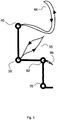
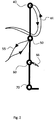
- FIG. 1 and FIG. 2 show in schematic representations of the trajectories of individual parts of the body, which arise when getting up and sitting down a person - for example, a convalescent.
- FIG. 1 shows the person in their sitting position and in FIG. 2 the person is shown standing.
- the trajectories of a shoulder region 40, a hip region 50, a knee region 60 and an ankle region 70 are shown.
- FIG. 1 shows the in the in the FIG. 2 represented standing position first the shoulder area 40 moves forward.
- the shoulder area is additionally tilted slightly downwards.
- the knee region 60 is likewise tilted obliquely forwards and downwards in the direction of the soles of the foot according to an knee trajectory 66.
- the shoulder region 40 is erected along the shoulder trajectory 44 and the knee region 60 is displaced back again, so that a substantially vertical alignment of the shoulder region 40, the hip region 50, the knee region 60 and the ankle region 70 of the person is provided in the state.
- FIG. 1 and FIG. 2 show that the hip trajectory 55 and especially the shoulder trajectory 44 have a clear hysteresis behavior. So remains when sitting down the hip area 50 longer upright and is moved late in the direction of the seat bottom. Only the ankle region 70 remains stationary throughout the movement.
- FIG. 3 shows an Aufmaschinerainer 1 according to the invention, which serves a convalescent in training the required for getting up and sitting natural movement and support the trajectories that in the FIG. 1 and the FIG. 2 are shown to allow or allow.
- two positioning units 2 each of which is guided on a support strut 3, which is part of a frame 4 mounted on a frame 5, and out of a Carriage 6 are formed, which is additionally guided over a rolling on the support strut 3 7 wheel.
- the positioning unit 2 is in each case connected to a seat surface 9 via a seat stay 8 mounted rotatably on the wheel 7.
- the support struts 3 are not arranged parallel to the seat stay 8.
- the seat stays 8 are vertical and the support struts 3 are not arranged vertically.
- the seat 9 is not only adjusted upward during an adjustment of the positioning units 2 along the support struts 3, but also erected.
- the seat 9 is connected via leg struts 10 with the frame 4.
- the connection of the leg brace 10 with the frame 4 is not rigid, but by tilting elements 11, which are formed in the embodiment shown as joints implemented.
- the tilting makes it possible for the knees to be tilted in the direction of the foot tips during the adjustment of the seat surface 9 from the sitting position to the standing position in accordance with the natural physiological movement sequence.
- the seat 9 is connected to the leg brace 10 via an erection joint 12.
- a toggle lever 14 is provided, which in the embodiment shown is fastened to an auxiliary strut 15 which horizontally connects the two support struts 3 and the back support 13.
- a resilient return element 16 which is designed in the illustrated embodiment as a spiral spring. This will the natural physiological movement process supports, because the convalescent can always move against the restoring spring force.
- the Aufierrainer 1 can be easily moved, which also favors the use in the home, since the Aufierrainer 1 can be easily pushed into a corner when it is not used.
- the user of the Aufmaschinerainers 1 has the ability his feet on a tread 18, which is associated with the frame 4, off. For better adaptation to the respective user this is preferably height adjustable.
- the force of a drive 19 designed as an electric motor in the exemplary embodiment shown is transmitted via deflection rollers 20 to the positioning unit.
- the force of the drive 19 can be adjusted.
- the support by the drive 19 can be adjusted to the needs and the weight of the respective convalescent.
- the required power assistance is significantly higher than, for example, in a stroke patient, who suffers from his illness only a slight motor disturbances with a possible impairment of the sense of balance.
- the start and end position of the positioning unit and thus the seat can also be set before the start of training and thus adapted to the needs of each convalescent.
- a securing means 21 for securing the convalescent is shown.
- the securing means 21 is formed as a belt which fixes the convalescent in the area of the pelvis and thus secures against falling from the Aufstehrainer 1.
- FIGS. 4 to 6 show schematic representations of the Aufstandsrainers invention 1 in different positions.
- the Clothingmaschinerainer 1 in the sitting position.
- the seat surface 9 is substantially horizontal and the back support 13 is arranged in a substantially vertical position.
- the toggle 14 is in a closed position. If now the positioning units 2 are adjusted along the support struts 3, the situation arises, which is described below in FIG FIG. 5 is shown.
- FIG. 5 shows an intermediate position between the sitting position and the standing position.
- the leg braces 10 are already inclined by the adjustment of the positioning units 2 and the seat surface 9 connected thereto forward on the tilting 11.
- the user's knees shift in the direction of his toes.
- the seat 9 is raised by the adjustment of the positioning units 2 and by the unfolding of the toggle lever 14, the back support 13 and thus the shoulder area of a user is displaced forward. This results in the user's center of gravity also shifting to the front.
- the in FIG. 6 In the standing position, the in FIG. 6 is shown, now forms the back support 13 with the seat surface 9 and the leg braces 10 is a substantially vertical plane.
- the knees of a user are fully stretched, causing the user to stand upright.
- the running direction of the motor 19 is changed, the leg braces 11 are tilted forward by the adjustment of the positioning units 2 via the tilting elements 11.
- the seat 9 pivots to the rear and the movement ends again in the sitting position, which represented the starting position.
Landscapes
- Health & Medical Sciences (AREA)
- General Health & Medical Sciences (AREA)
- Orthopedic Medicine & Surgery (AREA)
- Physical Education & Sports Medicine (AREA)
- Life Sciences & Earth Sciences (AREA)
- Biophysics (AREA)
- Public Health (AREA)
- Animal Behavior & Ethology (AREA)
- Veterinary Medicine (AREA)
- Vascular Medicine (AREA)
- Cardiology (AREA)
- Rehabilitation Tools (AREA)
- Accommodation For Nursing Or Treatment Tables (AREA)
Description
- Die Erfindung betrifft einen Aufstehtrainer gemäß dem Oberbegriff von Anspruch 1.
- Rekonvaleszente, die krankheitsbedingt bewegungseingeschränkt sind, beispielsweise Schlaganfallpatienten, stehen oftmals vor dem Problem, dass sie Bewegungsabläufe, die für das tägliche Leben notwendig sind, neu erlernen müssen. Speziell die Koordination von Bewegungen, die mit einer Verlagerung des Körperschwerpunktes einhergehen, stellt diese Rekonvaleszenten oft vor große Probleme. So müssen sie beispielsweise das Aufstehen und Setzen neu erlernen. Dieser Bewegungsablauf stellt dabei hohe Anforderungen an die koordinativen Fähigkeiten. So müssen beim Aufstehen zuerst die Schultern nach vorne in Richtung der Fußspitzen verlagert werden. Der Schwerpunkt wird danach weiter nach vorne verlagert, indem die Unterschenkel über das Sprunggelenk verkippt werden, wodurch die Knie ebenfalls nach vorne verlagert werden. Dies resultiert dann in einer leichten Anhebung der Oberschenkel und des Gesäßes von der Sitzfläche. Durch ein Durchstrecken der Beine und ein simultanes Zurückverlagern der Schulterpartie und damit auch des Schwerpunktes wird der Rekonvaleszente dann in den Stand überführt. Bei diesen Verlagerungen des Schwerpunktes besteht jedoch stets die Gefahr, dass der Schwerpunkt zu weit verlagert wird, was zu einer deutlich erhöhten Sturzgefahr führt. Zudem besteht die Problematik, dass die Muskelkraft der Rekonvaleszenten oft nicht ausreicht, um den Bewegungsablauf selbstständig durchzuführen.
- Aus diesem Grund muss beim Wiedererlernen des Aufstehprozesses stets eine beaufsichtigende Hilfsperson zugegen sein, die den Rekonvaleszenten unterstützt und ihn aktiv aus der sitzenden Position in die stehende Position überführt. Der damit verbundene Aufwand sorgt dafür, dass die Wiedereingliederung dieser Rekonvaleszenten in das tägliche Leben äußerst betreuungsintensiv und damit auch sehr kostenintensiv ist. Im Übrigen sind diese Übungen nicht nur für Rekonvaleszente, sondern auch für die Hilfsperson körperlich sehr anstrengend, insbesondere wenn die Hilfsperson deutlich leichter ist.
- Aus der
DE 20 2009 013 889 Um ist eine Verstelleinrichtung bekannt, bei der mittels einer elektromotorischen Verstellung, die durch einen Spindelantrieb realisiert ist, eine Sitzfläche aus einer horizontalen Position in eine vertikale Position überführt werden kann. Bei der Verwendung einer derartigen Einrichtung besteht jedoch das Problem, dass ein Spindelantrieb oftmals der Belastung, insbesondere bei übergewichtigen Patienten, nicht gewachsen ist, wodurch sich die Lebensdauer der Einrichtung merklich verkürzt. Zudem ist die Führung der Positionierungseinheit nicht gegeben, was sich negativ auf die Stabilität der Verstelleinrichtung auswirkt. - Weiterhin zeigt die
EP 1 716 834 ein Aufstehgerät, bei dem die Aufstehbewegung durch ein Gegengewicht unterstützt wird. Auf einen Antrieb und eine Sitzfläche wird jedoch verzichtet, so dass eine erzwungene Bewegung nicht möglich ist. Weiterhin muss der Verwender durch den Verzicht auf eine Sitzfläche umständlich an dem Gerät befestigt werden. - Die
US 6,440,046 B1 zeigt ein Trainingsgerät für Menschen mit Behinderungen, insbesondere für Rollstuhlfahrer. Hierbei wird mittels einer über einen Hebel verstellbaren Luftfeder eine Sitzfläche aus einer horizontalen Position in eine vertikale Stehposition überführt. Eine motorische Verstellung der Sitzfläche ist hierbei jedoch nicht vorgesehen. Weiterhin steht hierbei auch nicht das Aufstehtraining des Verwenders im Vordergrund. Vielmehr wird die stehende Position dazu verwendet, um dem Verwender eine zwangsgesteuerte Gehbewegung der Beine zu ermöglich, die über Handgriffe durch eine Bewegung der Arme - vergleichbar mit einem Crosstrainer - eingeleitet wird. - Die
WO 03/041628 A2 WO 03/041628 A2 - Aus der
WO 2004/098479 A1 ist weiterhin ein Patientenstuhl bekannt, dessen Sitzfläche an einer Stützstrebe eines Rahmens höhenverstellbar geführt ist. Die Stützstrebe weist dabei einen gekrümmten Verlauf auf, um eine Neigung des Stuhles beim Verfahren zu ermöglichen. Eine Verstellung des Stuhls zwischen einer Sitz- und einer Stehposition ist hierbei jedoch nicht möglich. - Aus der
US 2005/0227826 A1 ist ein geriatrisches Trainingsgerät bekannt, dass die Durchführung von Kniebeugen unterstützt und gleichzeitig das Training von Bauch- und Armmuskulatur ermöglicht. Hierzu ist eine Sitzfläche vorgesehen, die das Gesäß des Trainierenden abstützt und in der Höhe verstellt und dabei gleichzeitig geneigt wird. Dieses Gerät ist jedoch weniger für die Verwendung durch Behinderte geeignet, da der Trainierende die Verstellung der Sitzfläche durch den Einsatz der Armmuskulatur unterstützen muss. Auch wird der Benutzer nicht in eine vollständig stehende Position überführt, so dass ein Training des natürlichen Bewegungsablaufes nicht möglich ist. - Weiterhin zeigt auch die
EP 1 275 363 A2 einen Rollstuhl, dessen Sitzfläche höhenverstellbar ist. Für diese Verstellung wird bei derEP 1 275 363 A2 ein Spindeltrieb verwendet, der durch einen Elektromotor betätigt wird. Zum Verkippen der Sitzfläche kommt bei derEP 1 275 363 A2 ein komplexer Seilzug-Feder-Mechanismus zum Einsatz, um es dem Nutzer des Rollstuhls zu ermöglichen eine Stehposition einzunehmen. Auch der aus derEP 1 275 363 A2 bekannte Rollstuhl, ermöglicht keinen physiologisch korrekten Bewegungsablauf. - Auch die
US 4,890,853 zeigt einen Rollstuhl, dessen Sitzfläche höhenverstellbar ist. Bei dem in derUS 4,890,853 gezeigten Rollstuhl ist es jedoch nicht möglich die Sitzfläche zu kippen, um den natürlichen Bewegungsablauf beim Aufstehen und Hinsetzen zu simulieren. - Die
WO 88/01578 WO 88/01578 - Der Erfindung liegt die Aufgabe zugrunde, bei einem Aufstehtrainer gemäß dem Oberbegriff von Anspruch 1 so zu verbessern, dass ein physiologisch korrekter Bewegungsablauf trainiert werden kann.
- Diese Aufgabe wird gelöst von einem Aufstehtrainer mit den Merkmalen des Anspruchs 1. Vorteilhafte Ausgestaltungen und Weiterbildungen ergeben sich aus den Unteransprüchen.
- Durch die Verwendung einer Positionierungseinheit, die durch einen Antrieb verstellbar ist, kann auf eine Hilfsperson im Wesentlichen verzichtet werden. Dies wirkt sich positiv auf den finanziellen Aufwand aus. So kann der Rekonvaleszent beispielsweise durch die Hilfsperson in den Aufstehtrainer gesetzt werden und dann ohne deren Hilfe die Übungen selbstständig absolvieren. Dadurch kann insbesondere auch eine Hilfsperson mehrere Rekonvaleszente gleichzeitig betreuen, was sich speziell bei größeren Rehabilitationseinrichtungen positiv auf die Kostensituation auswirkt. Im Rahmen der Erfindung ist es auch vorgesehen, dass die Kraft des Antriebs verstellt und damit an die Bedürfnisse des jeweiligen Rekonvaleszenten angepasst werden kann. So ist es sinnvoll, dass je nach Schweregrad der Erkrankung die Kraft des Antriebs zwischen einer leichten Unterstützung und einer vollständigen antriebsgesteuerten Überführung des Rekonvaleszenten zwischen der Sitzposition und der Stehposition variiert werden kann. Darüber hinaus ist es im Rahmen der Erfindung auch vorgesehen, dass die Anfangs- und Endposition der Positionierungseinheit festgelegt werden kann, wodurch der Aufstehtrainer an die Bewegungsfähigkeit des Rekonvaleszenten angepasst werden kann. Durch die Verwendung des mindestens einen Sicherungsmittels zur Sicherung des Rekonvaleszenten ist gewährleistet, dass dieser bei der Verwendung des erfindungsgemäßen Aufstehtrainers gesichert ist, und dass auf eine Hilfsperson im Wesentlichen verzichtet werden kann. Dadurch wird dem Rekonvaleszenten ein zusätzliches Sicherheitsgefühl vermittelt und Stürzen effektiv vorgebeugt. Dies hat dadurch auch den entscheidenden Vorteil, dass mehrere Aufstehtrainer von nur einer Hilfsperson betreut werden können. So kann die Hilfsperson den jeweiligen Rekonvaleszenten einmalige Hilfestellung beim Einsteigen in den Aufstehtrainer leisten, diese in dem Aufstehtrainer befestigen und dann allein Trainieren lassen, ohne in der Gefahr zu sein, dass sie ihre Aufsichtspflichten vernachlässigt. Zudem kann der Aufstehtrainer auch von Rekonvaleszenten verwendet werden, die nur eine äußerst eingeschränkte Kontrolle über ihre motorischen Fähigkeiten haben. Hierbei ist beispielsweise an Rekonvaleszente mit Spastiken oder dergleichen zu denken. Die Verwendung der Stützstrebe verleiht dem erfindungsgemäßen Aufstehtrainer Stabilität und zudem kann damit die Position der Positionierungseinheit festgelegt werden. Im Rahmen der Erfindung ist es auch vorgesehen, dass die Positionierungseinheit hydraulisch oder pneumatisch realisiert ist, wodurch auf die Führungsfunktion der Stützstrebe verzichtet werden kann. Durch die Verwendung eines an der Stützstrebe geführten Schlittens ist die Position der damit verbundenen Sitzfläche stets festgelegt.
- Als besonders günstig hat es sich gezeigt, wenn das mindestens eine Sicherungsmittel zur Sicherung des Rekonvaleszenten als ein Gurt und/oder eine Kniestütze gebildet ist. Durch die Verwendung eines Gurtes, der im Rahmen der Erfindung an der Sitzfläche angebracht sein kann, ist der Beckenbereich des Rekonvaleszenten fixiert und es wird damit wirkungsvoll verhindert, dass der Rekonvaleszent bei der Verwendung des erfindungsgemäßen Aufstehtrainers aus diesem herausfällt. Darüber hinaus ist es im Rahmen der Erfindung auch vorgesehen, dass zusätzlich zu dem oder anstelle des Gurtes eine Kniestütze an dem Aufstehtrainer angebracht ist, die dazu dient, den Kniebereich des Rekonvaleszenten beim Aufstehen zu stützen und zu führen.
- Als vorteilhaft hat es sich zudem gezeigt, wenn die Sitzfläche mit der Positionierungseinheit über eine drehbar an der Positionierungseinheit gelagerte und nicht parallel zu der Stützstrebe orientierte Sitzstrebe verbunden ist. Durch die fehlende Parallelität zwischen der Stützstrebe und der Sitzstrebe ist gewährleistet, dass eine Verstellung der Positionierungseinheit entlang der Stützstrebe stets auch ein Drehmoment induziert wird, das zur Verstellung der Sitzfläche dient. Im Rahmen der Erfindung ist es auch vorgesehen, dass die Stützstrebe als Steuerkurve gebildet ist, die die Trajektorie der daran direkt befestigten Sitzfläche vorgibt.
- Als vorteilhaft hat es sich zudem erwiesen, wenn ein an der Stützstrebe abrollendes Rad zur Führungsunterstützung der Positionierungseinheit auf der Stützstrebe vorgesehen ist. Dies hat einen positiven Einfluss auf die Betriebssicherheit des Aufstehtrainers.
- Als besonders günstig hat es sich gezeigt, wenn zur zwangsgeführten und aus der Bewegung der Sitzfläche abgeleiteten Verstellung einer Rückenstütze ein die Rückenstütze mit der Stützstrebe mittelbar oder unmittelbar verbindender Kniehebel vorgesehen ist. Dadurch ist gewährleistet, dass die Rückenstütze simultan mit der Sitzfläche verstellt wird. Durch die Form des Kniehebels mit den gewählten Schenkellängen lässt sich darüber hinaus auch die gewünschte Trajektorie der Rückenstütze gezielt festlegen. Im Rahmen der Erfindung ist es auch vorgesehen, dass der Rückenstütze ebenfalls ein Sicherungsmittel zur Sicherung des Rekonvaleszenten zugeordnet ist. Dadurch ist gewährleistet, dass die Position des Oberkörpers des Rekonvaleszenten bei der Verwendung des erfindungsgemäßen Aufstehtrainers festgelegt ist, wodurch die Sturzgefahr reduziert wird.
- Für den erfindungsgemäßen Aufstehtrainer ist es zudem von Vorteil, wenn ein Gestell zur Halterung eines zwei zur Vertikalen geneigten und durch eine horizontale Hilfsstrebe miteinander verbundenen Stützstreben beinhaltenden Rahmens vorgesehen ist. Die zur Vertikalen geneigte Anordnung der Stützstreben bedingt bei einer Verstellung der Positionierungseinheit entlang der zur Sitzstrebe geneigten Stützstrebe eine Überlagerung von Translation und Rotation, was zum Verkippen und Aufrichten der Sitzfläche führt. Denkbar ist im Rahmen der Erfindung natürlich auch, dass die Stützstrebe vertikal und die Sitzstrebe nicht vertikal angebracht sind. Darüber hinaus ist es auch möglich, dass sowohl die Sitzstrebe als auch die Stützstrebe nicht vertikal orientiert sind. Das Gestell bietet darüber hinaus auch eine Aufnahme für den Antrieb und durch den Rahmen ist gewährleistet, dass der erfindungsgemäße Aufstehtrainer eine ausreichende Stabilität auch bei der Benutzung durch übergewichtige Menschen bereitstellt.
- Als günstig hat es sich zudem gezeigt, wenn die Sitzfläche mit dem Gestell durch eine Beinstrebe verbunden ist. Dadurch wird die Sitzfläche zusätzlich unterstützt, was sich positiv auf die Zuverlässigkeit des Aufstehtrainers auswirkt. Wenn bei einem erfindungsgemäßen Aufstehtrainer eine Kniestütze als Sicherungsmittel zur Sicherung des Rekonvaleszenten vorgesehen ist, dann kann diese an der Beinstrebe angebracht sein, wodurch der Kniebereich des Rekonvaleszenten bei der Verwendung des erfindungsgemäßen Aufstehtrainers wirkungsvoll unterstützt wird.
- Als vorteilhaft hat es sich zudem erwiesen, wenn das Gestell mit der Beinstrebe zur Verkippung der Sitzfläche über ein Verkippungselement verbunden ist. Dadurch ist gewährleistet, dass die Knie des Benutzers beim Aufstehen nach vorne verschoben werden können, was die Unterstützung des natürlichen Bewegungsablaufes fördert. Das Verkippungselement kann hierbei in üblicher Weise als Gelenk oder als elastisch verformbares Bauteil gebildet sein.
- Als besonders vorteilhaft hat es sich zudem gezeigt, wenn die Sitzfläche mit der Beinstrebe zur Verstellung der Sitzfläche zwischen der Sitzposition und der Stehposition über ein Aufrichtungsgelenk verbunden ist. Dadurch wird bei der Verstellung der Positionierungseinheit die Sitzfläche zwischen einer im Wesentlichen waagerechten Sitzposition und einer im Wesentlichen senkrechten Stehposition verstellt.
- Als günstig hat es sich zudem erwiesen, wenn der Rückenstütze mindestens ein federndes Rückstellelement zur Unterstützung des natürlichen physiologischen Bewegungsablaufs zugeordnet ist, durch das dem Rücken des Rekonvaleszenten auch gewisse Freiheitsgrade gegeben werden.
- Für die vielseitige Anwendung des Aufstehtrainers hat es sich zudem als vorteilhaft erwiesen, wenn dem Gestell Rollen zugeordnet sind, die vorzugsweise lenkbar und/oder arretierbar sind. Dadurch kann die Position des kompletten Aufstehtrainers einfach verändert werden. Durch die Arretierbarkeit der Rollen ist zudem gewährleistet, dass der Aufstehtrainer bei der Verwendung stets stabil steht. Durch die Verwendung der Rollen kann der Aufstehtrainer auch im häuslichen Bereich zum Einsatz kommen, da er bei Nichtbenutzung einfach verschoben werden kann.
- Als günstig hat es sich zudem gezeigt, wenn dem Gestell eine vorzugsweise höhenverstellbare Trittfläche zur Abstützung der Fußsohlen eines Benutzers zugeordnet ist. Dadurch kann der Aufstehtrainer auf die Größenverhältnisse des jeweiligen Rekonvaleszenten individuell eingestellt werden und bietet ihm eine sichere Standfläche zum Trainieren des Bewegungsablaufes.
- Als besonders günstig hat es sich zudem erwiesen, wenn die Kraftübertragung des Antriebs auf die Positionierungseinheit durch Umlenkrollen realisiert ist. Dadurch ist gewährleistet, dass der Antrieb unabhängig von der Position der Positionierungseinheit stets lediglich eine Zugkraft ausüben muss. Dies ist für die Langlebigkeit des Antriebs von großem Vorteil, wodurch auch die Wartungs- und die Instandhaltungskosten nachhaltig gesenkt werden.
- Als vorteilhaft hat sich zudem gezeigt, wenn der Antrieb durch einen Motor, insbesondere durch einen Elektromotor, realisiert ist. Da ein solcher Elektromotor emissionsfrei und zudem äußerst leise arbeitet, wirkt sich die Verwendung eines solchen Elektromotors positiv auf die Benutzerfreundlichkeit und die Einsetzbarkeit des erfindungsgemäßen Aufstehtrainers in Innenräumen aus.
- Im Folgenden wird die Erfindung an einem in der Zeichnung dargestellten Ausführungsbeispiel näher erläutert; es zeigen:
- Fig. 1
- eine schematische Darstellung einer Person in Sitzposition mit Darstellung der beim Aufstehen und Hinsetzen entstehenden Trajektorien,
- Fig. 2
- eine schematische Darstellung einer Person in Stehposition mit Darstellung der beim Aufstehen und Hinsetzen entstehenden Trajektorien,
- Fig. 3
- eine perspektivische Ansicht eines Aufstehtrainer,
- Fig. 4
- eine schematische Darstellung des Aufstehtrainers in der Sitzposition,
- Fig. 5
- eine schematische Darstellung des Aufstehtrainers in einer intermediären Position, und
- Fig. 6
- eine schematische Darstellung des Aufstehtrainers in der Stehposition.
-
Figur 1 undFigur 2 zeigen in schematischen Darstellungen die Trajektorien einzelner Körperteile, die beim Aufstehen und Hinsetzen einer Person - beispielsweise eines Rekonvaleszenten - entstehen.Figur 1 zeigt dabei die Person in ihrer Sitzposition und inFigur 2 ist die Person stehend gezeigt. Hierbei sind die Trajektorien eines Schulterbereiches 40, eines Hüftbereiches 50, eines Kniebereiches 60 sowie eines Sprunggelenksbereiches 70 dargestellt. Bei einer natürlichen Bewegung aus der sitzenden Position, die inFigur 1 dargestellt ist, in die in derFigur 2 dargestellte stehende Position wird zuerst der Schulterbereich 40 nach vorne verlagert. Wie aus einer Schultertrajektorie 44 ersichtlich ist, wird der Schulterbereich dabei auch zusätzlich leicht nach unten geneigt. Zeitgleich wird der Kniebereich 60 gemäß einer Knietrajektorie 66 ebenfalls schräg nach vorne und nach unten in Richtung der Fußsohlen verkippt. Dies resultiert in einer Verlagerung des Körperschwerpunktes nach vorne, wodurch der Hüftbereich 50 entlastet wird und nun entlang einer Hüfttrajektorie 55 schräg nach vorn und nach oben verstellt werden kann. Nun wird der Schulterbereich 40 entlang der Schultertrajektorie 44 aufgerichtet und der Kniebereich 60 wird wieder zurückverlagert, sodass im Stand eine im Wesentlichen vertikale Ausrichtung des Schulterbereiches 40, des Hüftbereiches 50, des Kniebereiches 60 und des Sprunggelenksbereiches 70 der Person gegeben ist. Bei der Verlagerung aus dem Stand zurück in die Sitzposition wird im Wesentlichen zuerst der Hüftbereich 50 schräg nach hinten verlagert, wodurch zunächst auch der Schulterbereich 40 abgesenkt wird. Wie aus der Knietrajektorie 66 ersichtlich ist, neigt sich der Kniebereich 60 beim Hinsetzen nur leicht und verbleibt ansonsten ortsfest.Figur 1 undFigur 2 zeigen, dass die Hüfttrajektorie 55 und besonders die Schultertrajektorie 44 ein deutliches Hystereseverhalten aufweisen. So bleibt beim Hinsetzen der Hüftbereich 50 länger aufrecht und wird erst spät nach unten in Richtung der Sitzfläche verlagert. Lediglich der Sprunggelenksbereich 70 verbleibt im kompletten Bewegungsablauf ortsfest. -
Figur 3 zeigt einen erfindungsgemäßen Aufstehtrainer 1, der dazu dient einen Rekonvaleszenten beim Trainieren des zum Aufstehen und Hinsetzen benötigten natürlichen Bewegungsablaufes zu unterstützen und die Trajektorien, die in derFigur 1 und derFigur 2 dargestellt sind, zuzulassen beziehungsweise zu ermöglichen. Zu sehen sind zwei Positionierungseinheiten 2, die jeweils an einer Stützstrebe 3, die Teil eines auf einem Gestell 4 befestigten Rahmens 5 ist, geführt sind und aus einem Schlitten 6 gebildet sind, der zusätzlich über ein an der Stützstrebe 3 abrollendes Rad 7 geführt wird. Die Positionierungseinheit 2 ist jeweils über eine drehbar an dem Rad 7 gelagerte Sitzstrebe 8 mit einer Sitzfläche 9 verbunden. Um bei der Verstellung der Positionierungseinheit 2 ein Verstellen der Sitzfläche 9 aus einer im Wesentlichen horizontalen Sitzposition in eine im Wesentlichen vertikale Stehposition zu bewirken, ist es notwendig, dass die Stützstreben 3 nicht parallel zu der Sitzstrebe 8 angeordnet sind. In dem gezeigten Ausführungsbeispiel sind hierbei die Sitzstreben 8 vertikal und die Stützstreben 3 nicht vertikal angeordnet. Durch die Nichtparallelität der beiden Streben zueinander wird bei einer Verstellung der Positionierungseinheiten 2 entlang der Stützstreben 3 die Sitzfläche 9 nicht nur nach oben verstellt, sondern auch aufgerichtet. Zur Erhöhung der Stabilität des erfindungsgemäßen Aufstehtrainers 1 ist die Sitzfläche 9 über Beinstreben 10 mit dem Gestell 4 verbunden. Um die Verlagerung der Knie in Richtung der Fußspitzen zu ermöglichen, ist die Verbindung der Beinstrebe 10 mit dem Gestell 4 nicht starr, sondern durch Verkippungselemente 11, die im gezeigten Ausführungsbeispiel als Gelenke gebildet sind, realisiert. Die Verkippung ermöglicht, dass bei der Verstellung der Sitzfläche 9 aus der Sitzposition in die Stehposition die Knie gemäß dem natürlichen physiologischen Bewegungsablauf in Richtung der Fußspitzen gekippt werden. Um die Sitzfläche 9 bei einer Verstellung der Positionierungseinheit 2 aufzurichten, ist die Sitzfläche 9 über ein Aufrichtungsgelenk 12 mit der Beinstrebe 10 verbunden. Zur zwangsgeführten Verstellung einer mit der Sitzfläche 9 verbundenen Rückenstütze 13 ist ein Kniehebel 14 vorgesehen, der im gezeigten Ausführungsbeispiel an einer die beiden Stützstreben 3 horizontal verbindenden Hilfsstrebe 15 und der Rückenstütze 13 befestigt ist. Zur Unterstützung des natürlichen physiologischen Bewegungsablaufes ist der Rückenstütze 13 ein federndes Rückstellelement 16 zugeordnet, das im gezeigten Ausführungsbeispiel als Spiralfeder ausgeführt ist. Dadurch wird der natürliche physiologische Bewegungsablauf unterstützt, da sich der Rekonvaleszent stets gegen die rückstellende Federkraft bewegen kann. Im gezeigten Ausführungsbeispiel weist das Gestell 4 Rollen 17 auf, die lenkbar und arretierbar ausgeführt sind. Dadurch kann der Aufstehtrainer 1 einfach verschoben werden, was auch die Verwendung im häuslichen Bereich begünstigt, da der Aufstehtrainer 1 einfach in eine Ecke geschoben werden kann, wenn er nicht verwendet wird. Der Benutzer des Aufstehtrainers 1 hat die Möglichkeit seine Füße auf einer Trittfläche 18, die dem Gestell 4 zugeordnet ist, abzustellen. Zur besseren Anpassung an den jeweiligen Benutzer ist diese vorzugsweise höhenverstellbar. Die Kraft eines im gezeigten Ausführungsbeispiel als Elektromotor ausgeführten Antriebs 19 wird über Umlenkrollen 20 auf die Positionierungseinheit übertragen. Im Rahmen der Erfindung ist es auch vorgesehen, dass die Kraft des Antriebs 19 eingestellt werden kann. Dadurch kann die Unterstützung durch den Antrieb 19 auf die Bedürfnisse und das Gewicht des jeweiligen Rekonvaleszenten eingestellt werden. So ist bei einem Rekonvaleszenten, der durch einen Querschnitt der Wirbelsäule eine sehr starke Beeinträchtigung des Bewegungsablaufes hat, die erforderliche Kraftunterstützung deutlich höher als beispielsweise bei einem Schlaganfallpatienten, der durch seine Erkrankung lediglich unter einer leichten motorischen Störungen mit einer eventuellen Beeinträchtigung des Gleichgewichtssinnes leidet. Zudem können die Start- und die Endposition der Positionierungseinheit und damit der Sitzfläche ebenfalls vor Trainingsbeginn eingestellt und damit an die Bedürfnisse des jeweiligen Rekonvaleszenten angepasst werden. In der Zeichnung ist auch ein Sicherungsmittel 21 zur Sicherung des Rekonvaleszenten dargestellt. Im gezeigten Ausführungsbeispiel ist das Sicherungsmittel 21 als ein Gurt ausgebildet, der den Rekonvaleszenten im Bereich des Beckens fixiert und damit vor einem Sturz aus dem Aufstehtrainer 1 sichert. - Die
Figuren 4 bis 6 zeigen schematische Darstellungen des erfindungsgemäßen Aufstehtrainers 1 in unterschiedlichen Positionen. InFigur 4 befindet sich der Aufstehtrainer 1 in der Sitzposition. Hierbei ist die Sitzfläche 9 im Wesentlichen horizontal und die Rückenstütze 13 in einer im Wesentlichen vertikalen Position angeordnet. Der Kniehebel 14 ist hierbei in einer geschlossenen Position. Werden nun die Positionierungseinheiten 2 entlang der Stützstreben 3 verstellt, so entsteht die Situation, die nachstehend inFigur 5 dargestellt ist. -
Figur 5 zeigt eine Zwischenposition zwischen der Sitzposition und der Stehposition. Hierbei sind durch die Verstellung der Positionierungseinheiten 2 und der damit verbundenen Sitzfläche 9 die Beinstreben 10 bereits über die Verkippungselemente 11 nach vorne geneigt. Dadurch verlagern sich die Knie des Benutzers in Richtung seiner Zehenspitzen. Gleichzeitig wird die Sitzfläche 9 durch die Verstellung der Positionierungseinheiten 2 aufgerichtet und durch das Aufklappen des Kniehebels 14 wird die Rückenstütze 13 und damit der Schulterbereich eines Benutzers nach vorne verlagert. Dies resultiert darin, dass sich der Schwerpunkt des Benutzers ebenfalls nach vorne verlagert. - In der Stehposition, die in
Figur 6 dargestellt ist, bildet nun die Rückenstütze 13 mit der Sitzfläche 9 und der Beinstreben 10 eine im Wesentlichen vertikale Ebene. Die Knie eines Benutzers sind vollkommen durchgestreckt, wodurch der Benutzer senkrecht zum Stehen kommt. Wird nun die Laufrichtung des Motors 19 verändert, so werden durch die Verstellung der Positionierungseinheiten 2 die Beinstreben 11 über die Verkippungselemente 11 nach vorne verkippt. Dadurch schwenkt die Sitzfläche 9 nach hinten und der Bewegungsablauf endet wieder in der Sitzposition, die die Ausgangslage darstellte. -
- 1
- Aufstehtrainer
- 2
- Positionierungseinheit
- 3
- Stützstrebe
- 4
- Gestell
- 5
- Rahmen
- 6
- Schlitten
- 7
- Rad
- 8
- Sitzstrebe
- 9
- Sitzfläche
- 10
- Beinstrebe
- 11
- Verkippungselement
- 12
- Aufrichtungsgelenk
- 13
- Rückenstütze
- 14
- Kniehebel
- 15
- Hilfsstrebe
- 16
- Rückstellelement
- 17
- Rolle
- 18
- Trittfläche
- 19
- Antrieb
- 20
- Umlenkrolle
- 21
- Sicherungsmittel
- 40
- Oberkörper
- 44
- Trajektorie Oberkörper
- 50
- Hüfte
- 55
- Trajektorie Hüfte
- 60
- Knie
- 66
- Trajektorie Knie
- 70
- Sprunggelenk
Claims (13)
- Aufstehtrainer, insbesondere zur Mobilisierung von bewegungseingeschränkten Rekonvaleszenten im Rehabilitationsbereich, wobei zur Verstellung einer Sitzfläche (9) zwischen einer Sitzposition und einer Stehposition eine durch einen Antrieb (19) verstellbare Positionierungseinheit (2) vorgesehen ist und mindestens ein Sicherungsmittel (21) zur Sicherung des Rekonvaleszenten vorgesehen ist, wobei eine Stützstrebe (3) zur Führung der Positionierungseinheit (2) vorgesehen ist, und wobei die Positionierungseinheit (2) durch einen die Stützstrebe (3) umgreifenden Schlitten (6) gebildet ist, dadurch gekennzeichnet, dass zur zwangsgeführten und aus der Bewegung der Sitzfläche (9) abgeleiteten Verstellung einer Rückenstütze (13) ein die Rückenstütze (13) mit der Stützstrebe (3) mittelbar oder unmittelbar verbindender Kniehebel (14) vorgesehen ist, der derartig ausgebildet ist, dass bei dessen Aufklappen die Rückenstütze zur Schwerpunktsverlagerung des Rekonvaleszenten nach vorne verlagert wird.
- Aufstehtrainer nach Anspruch 1, dadurch gekennzeichnet, dass das mindestens eine Sicherungsmittel (21) zur Sicherung des Rekonvaleszenten als ein Gurt und/oder eine Kniestütze gebildet ist.
- Aufstehtrainer nach Anspruch 1 oder 2, dadurch gekennzeichnet, dass die Sitzfläche (9) mit der Positionierungseinheit (2) über eine drehbar an der Positionierungseinheit (2) gelagerte und nicht parallel zu der Stützstrebe (3) orientierte Sitzstrebe (8) verbunden ist.
- Aufstehtrainer nach einem der Ansprüche 1 bis 3, dadurch gekennzeichnet, dass ein an der Stützstrebe (3) abrollendes Rad (7) zur Führungsunterstützung der Positionierungseinheit (2) auf der Stützstrebe (3) vorgesehen ist.
- Aufstehtrainers nach einem der Ansprüche 1 bis 4, dadurch gekennzeichnet, dass ein Gestell (4) zur Halterung eines zwei zur Vertikalen geneigten und durch eine horizontale Hilfsstrebe (15) miteinander verbundenen Stützstreben (3) beinhaltenden Rahmens (5) vorgesehen ist.
- Aufstehtrainer nach Anspruch 5, dadurch gekennzeichnet, dass die Sitzfläche (9) mit dem Gestell (4) durch eine Beinstrebe (10) verbunden ist.
- Aufstehtrainer nach Anspruch 6, dadurch gekennzeichnet, dass das Gestell (4) mit der Beinstrebe (10) zur Verkippung der Sitzfläche (9) über ein Verkippungselement (11) verbunden ist.
- Aufstehtrainer nach Anspruch 6 oder 7, dadurch gekennzeichnet, dass die Sitzfläche (9) mit der Beinstrebe (10) zur Verstellung der Sitzfläche (9) zwischen der Sitzposition und der Stehposition über ein Aufrichtungsgelenk (12) verbunden ist.
- Aufstehtrainer nach einem der Ansprüche 1 bis 8, dadurch gekennzeichnet, dass der Rückenstütze (13) mindestens ein federndes Rückstellelement (16) zur Unterstützung des natürlichen physiologischen Bewegungsablaufs zugeordnet ist.
- Aufstehtrainer nach einem der Ansprüche 5 bis 9, dadurch gekennzeichnet, dass dem Gestell (4) Rollen (17) zugeordnet sind, die vorzugsweise lenkbar und/oder arretierbar sind.
- Aufstehtrainer nach einem der Ansprüche 5 bis 10, dadurch gekennzeichnet, dass dem Gestell (4) eine vorzugsweise höhenverstellbare Trittfläche (18) zur Abstützung der Fußsohlen eines Benutzers zugeordnet ist.
- Aufstehtrainer nach einem der Ansprüche 1 bis 11, dadurch gekennzeichnet, dass die Kraftübertragung des Antriebs (19) auf die Positionierungseinheit (2) durch Umlenkrollen (20) realisiert ist.
- Aufstehtrainer nach einem der Ansprüche 1 bis 12, dadurch gekennzeichnet, dass der Antrieb (19) durch einen Motor, insbesondere durch einen Elektromotor, realisiert ist.
Applications Claiming Priority (2)
| Application Number | Priority Date | Filing Date | Title |
|---|---|---|---|
| DE102012102699A DE102012102699B4 (de) | 2012-03-29 | 2012-03-29 | Aufstehtrainer |
| PCT/DE2013/100072 WO2013143529A1 (de) | 2012-03-29 | 2013-02-25 | Aufstehtrainer |
Publications (2)
| Publication Number | Publication Date |
|---|---|
| EP2830565A1 EP2830565A1 (de) | 2015-02-04 |
| EP2830565B1 true EP2830565B1 (de) | 2017-10-04 |
Family
ID=47891336
Family Applications (1)
| Application Number | Title | Priority Date | Filing Date |
|---|---|---|---|
| EP13709749.9A Active EP2830565B1 (de) | 2012-03-29 | 2013-02-25 | Aufstehtrainer |
Country Status (6)
| Country | Link |
|---|---|
| US (1) | US9565947B2 (de) |
| EP (1) | EP2830565B1 (de) |
| CN (1) | CN104203187B (de) |
| DE (1) | DE102012102699B4 (de) |
| RU (1) | RU2014143480A (de) |
| WO (1) | WO2013143529A1 (de) |
Families Citing this family (19)
| Publication number | Priority date | Publication date | Assignee | Title |
|---|---|---|---|---|
| JP2017532097A (ja) * | 2014-09-08 | 2017-11-02 | スプレーン デザイン アソシエイツ,インク. | シート補助装置 |
| CN105287123B (zh) * | 2015-11-20 | 2017-03-22 | 合肥工业大学 | 一种康复轮椅 |
| KR101811216B1 (ko) * | 2016-04-12 | 2017-12-22 | 조기환 | 가변식 의자 |
| US10085906B2 (en) * | 2016-06-21 | 2018-10-02 | Hefei University Of Technology | Medical apparatus for standing aid |
| US11096847B2 (en) | 2017-02-03 | 2021-08-24 | Toyota Motor Engineering & Manufacturing North America, Inc. | Exoskeleton wheelchair system |
| US11071664B2 (en) * | 2017-05-27 | 2021-07-27 | Ton Duc Thang University | Wheelchair for transferring a patient to an automobile |
| KR101819124B1 (ko) * | 2017-06-23 | 2018-01-16 | 조기환 | 가변식 의자 |
| CN107913136B (zh) * | 2017-12-19 | 2023-08-01 | 吉林大学 | 智能如厕与康复训练多功能轮椅 |
| CN108814899B (zh) * | 2018-05-10 | 2021-01-15 | 合肥工业大学 | 一种多位姿、轨迹可调的下肢训练装置 |
| US10918544B2 (en) * | 2018-10-10 | 2021-02-16 | Muhammad Abdullah | Wheelchair lift apparatus |
| CN109674638B (zh) * | 2019-01-22 | 2020-11-20 | 安徽状元郎电子科技有限公司 | 一种具有辅助理疗功能的康复科用机器人 |
| DE102019102375A1 (de) * | 2019-01-30 | 2020-07-30 | Christian Behrendt | Stuhl, Pressurvorrichtung |
| ES2884252B2 (es) | 2020-06-05 | 2022-04-08 | Tecnimusa S L | Aparato de rehabilitacion |
| CN112569036B (zh) * | 2020-12-29 | 2023-01-03 | 韦永春 | 一种防止倾倒的牵引椅 |
| CN113521667B (zh) * | 2021-08-18 | 2022-06-28 | 黄丹丽 | 一种骨科用大腿术后恢复设备 |
| CN113769330A (zh) * | 2021-09-23 | 2021-12-10 | 王淼 | 一种康复科锻炼装置 |
| US11963921B2 (en) | 2022-07-08 | 2024-04-23 | Leo Harden | Convertible walker |
| US11633322B1 (en) | 2022-07-08 | 2023-04-25 | Leo Harden | Convertible wheelchair |
| US12544617B1 (en) * | 2023-04-10 | 2026-02-10 | David Baird | Adaptive programmable device for rehabilitation of physical disability |
Family Cites Families (42)
| Publication number | Priority date | Publication date | Assignee | Title |
|---|---|---|---|---|
| US3039818A (en) * | 1961-08-09 | 1962-06-19 | Louis P Frank | Chair for arthritics and the like |
| GB1534777A (en) * | 1976-04-30 | 1978-12-06 | Imbro M | Invalid chairs |
| US4231614A (en) * | 1978-10-27 | 1980-11-04 | Shaffer Gene P | Wheelchair |
| SE449164B (sv) * | 1984-03-12 | 1987-04-13 | Henning Bergenwall | Mobel innefattande ett stativ, ett sete och ett relativt setet svengbart ryggstod |
| US5137102A (en) * | 1986-08-25 | 1992-08-11 | Retec Pr, Inc. | Combination wheelchair and walker apparatus |
| US4809804A (en) * | 1986-08-25 | 1989-03-07 | Falcon Rehabilitation Products, Inc. | Combination wheelchair and walker apparatus |
| FR2619060B1 (fr) * | 1987-08-06 | 1989-12-22 | Cousin Ets Cousin Freres Sa | Mecanisme a memoire simple comportant un verin mecanique pour la manoeuvre de basculement sur l'avant d'un siege de vehicule |
| US4890853A (en) * | 1988-03-07 | 1990-01-02 | Luanne Olson | Wheelchair walker |
| US5061010A (en) * | 1988-05-20 | 1991-10-29 | La-Z-Boy Chair Co. | Cam guide drive mechanism for power-assisted chairs and the like |
| US4869552A (en) * | 1988-09-14 | 1989-09-26 | Shelby Williams Industries, Inc. | Flexible backrest assembly for a chair |
| CH681059A5 (en) * | 1990-04-18 | 1993-01-15 | Conrad R Dr Deucher | Rising chair with lifting mechanism - has seat tilt axis moved upwards and forwards when lifting |
| US5165753A (en) * | 1991-01-02 | 1992-11-24 | Henderson Eldred D | Elevator chair apparatus |
| DE9112558U1 (de) * | 1991-10-09 | 1993-02-04 | Stanzwerk Wetter Sichelschmidt & Co, 5802 Wetter | Sessel mit Aufstehhilfe |
| US5346280A (en) * | 1992-03-31 | 1994-09-13 | Deumite Norman A | Chair with automatic standing aid |
| US5366036A (en) * | 1993-01-21 | 1994-11-22 | Perry Dale E | Power stand-up and reclining wheelchair |
| FR2717377B1 (fr) * | 1994-03-18 | 1996-06-21 | Idc Isolateur Denominateur | Dispositif-élévateur pour fauteuil roulant verticalisateur et fauteuil roulant en faisant application. |
| CN2245971Y (zh) * | 1995-10-23 | 1997-01-29 | 台湾三荣股份有限公司 | 椅子 |
| ES2128192T3 (es) * | 1996-06-27 | 1999-05-01 | Levo Ag Dottikon | Silla de ruedas enderezable. |
| US5800016A (en) * | 1997-03-10 | 1998-09-01 | Allred; Lyle | Elevating chair |
| JP4159627B2 (ja) * | 1997-03-13 | 2008-10-01 | 三菱電機株式会社 | リハビリ装置 |
| US6125957A (en) * | 1998-02-10 | 2000-10-03 | Kauffmann; Ricardo M. | Prosthetic apparatus for supporting a user in sitting or standing positions |
| FR2779945B1 (fr) * | 1998-06-23 | 2000-11-10 | Internat Diffusion Consommateu | Noix d'articulation pour accoudoir de fauteuil d'handicape et fauteuil en faisant application |
| WO2000028930A2 (en) * | 1998-11-17 | 2000-05-25 | Altimate Medical, Inc. | Disabled user lift system |
| DE19853271A1 (de) * | 1998-11-18 | 2000-05-25 | Maquet Ag | Untersuchungsstuhl |
| US6213554B1 (en) * | 1999-09-07 | 2001-04-10 | Groupe Myca | Lift chair |
| JP2003019055A (ja) * | 2001-07-11 | 2003-01-21 | Komura Seisakusho:Kk | 昇降椅子 |
| US6637818B2 (en) * | 2001-08-24 | 2003-10-28 | Jerry Wayne Williams | Portable lift seat apparatus |
| GB0121732D0 (en) * | 2001-09-10 | 2001-10-31 | Pellerin Rene | Tilt adjustment assembly for reclining chair |
| BR0105828B1 (pt) * | 2001-11-13 | 2009-01-13 | dispositivo para locomoÇço de deficientes fÍsicos. | |
| JP3830486B2 (ja) * | 2002-04-03 | 2006-10-04 | 株式会社オージーエー | 運動補助具 |
| US6908154B2 (en) * | 2002-12-20 | 2005-06-21 | Aono Co., Ltd. | Fold-up wheelchair and elevating apparatus of the same |
| SE522825C2 (sv) * | 2003-05-05 | 2004-03-09 | Arjo Hospital Equipment Ab | Patientstol med sits förskjutbar i höjdled |
| US7097189B2 (en) * | 2003-11-18 | 2006-08-29 | Lloyd Linden, Inc. | Wheelchair with self-raising seat |
| US7090297B2 (en) * | 2004-10-13 | 2006-08-15 | La-Z-Boy Incorporated | Heavy lift chair |
| US7601104B2 (en) | 2005-04-25 | 2009-10-13 | University Of Delaware | Passive gravity-balanced assistive device for sit-to-stand tasks |
| US20060238007A1 (en) * | 2005-04-26 | 2006-10-26 | Lin Chang C | Chair with aid in lying back and getting up |
| US7455360B2 (en) * | 2006-04-21 | 2008-11-25 | L & P Property Management | Seating furniture with lift mechanism |
| US7735926B1 (en) * | 2008-12-09 | 2010-06-15 | Combs John A | Chair lift |
| CN101480370B (zh) * | 2009-02-11 | 2011-01-05 | 清华大学 | 一种用于康复训练的装置 |
| DE202009013889U1 (de) * | 2009-10-13 | 2010-04-15 | Motion-Solution Gmbh | Verstelleinrichtung |
| US8398171B2 (en) * | 2011-01-14 | 2013-03-19 | Cycling & Health Tech Industry R & D Center | Lift chair |
| US8973997B2 (en) * | 2011-07-19 | 2015-03-10 | Skip's Patents, Llc | Seat structure with sit-to-stand feature |
-
2012
- 2012-03-29 DE DE102012102699A patent/DE102012102699B4/de not_active Expired - Fee Related
-
2013
- 2013-02-25 RU RU2014143480A patent/RU2014143480A/ru not_active Application Discontinuation
- 2013-02-25 CN CN201380017116.XA patent/CN104203187B/zh not_active Expired - Fee Related
- 2013-02-25 EP EP13709749.9A patent/EP2830565B1/de active Active
- 2013-02-25 WO PCT/DE2013/100072 patent/WO2013143529A1/de not_active Ceased
-
2014
- 2014-09-29 US US14/500,209 patent/US9565947B2/en not_active Expired - Fee Related
Non-Patent Citations (1)
| Title |
|---|
| None * |
Also Published As
| Publication number | Publication date |
|---|---|
| CN104203187B (zh) | 2017-05-17 |
| RU2014143480A (ru) | 2016-05-20 |
| US20150018177A1 (en) | 2015-01-15 |
| DE102012102699B4 (de) | 2013-10-17 |
| DE102012102699A1 (de) | 2013-10-02 |
| US9565947B2 (en) | 2017-02-14 |
| EP2830565A1 (de) | 2015-02-04 |
| CN104203187A (zh) | 2014-12-10 |
| WO2013143529A1 (de) | 2013-10-03 |
Similar Documents
| Publication | Publication Date | Title |
|---|---|---|
| DE102012102699B4 (de) | Aufstehtrainer | |
| DE102010022386B4 (de) | Entlordosierungsvorrichtung | |
| EP1492597B1 (de) | Verfahren für ein gezieltes training und trainingsgerät | |
| EP3131516B1 (de) | Rehabilitationsmechanismus für bettpflichtige patienten sowie ein den rehabilitationsmechanismus umfassendes bett | |
| EP2039335B1 (de) | Aufrichtrollstuhl | |
| DE60017617T2 (de) | Hebevorrichtung für Behinderte | |
| US9375599B1 (en) | Assisted apparatus for lower back exercise | |
| EP2750653A1 (de) | Therapeutischer gehtrainer | |
| EP3592319B1 (de) | Orthopädische steh- und gehhilfe | |
| KR20160046676A (ko) | 엑스자형 링크를 이용한 기립 보조 휠체어 로봇 | |
| DE29511509U1 (de) | Orthopädisches Gerät zum Gehen und für die Rehabilitation von behinderten Personen | |
| DE4114264C2 (de) | ||
| EP2773433B2 (de) | Trainingsgerät für die rumpfmuskulatur | |
| DE19724770C1 (de) | Gerät zur Unterstützung des Stehens und anderer Körperhaltungen körperbehinderter Personen | |
| EP3970811B1 (de) | Trainingsgerät zum trainieren einzelner muskelgruppen im oberkörper | |
| DE7043924U (de) | Vorrichtung zur koerperlichen schulung und zur fortbewegung von koerperbehinderten | |
| DE10013739A1 (de) | Trainingsgerät zum Bauch- und Rückenmuskeltraining | |
| DE19546115C2 (de) | Stehtrainer | |
| EP1865908A1 (de) | Streckgerät für heilgymnastik | |
| DE102004034634B4 (de) | Dynamische progressive Beckenaufrichtungsvorrichtung | |
| DE2749181A1 (de) | Geh- und fahrstuhl fuer behinderte | |
| DE202006010067U1 (de) | Passives, isokinetisches Muskelkrafttrainingsgerät | |
| DE7737947U1 (de) | Schwebegeraet fuer eine person zur verbesserung der durchblutung | |
| EP0435869A1 (de) | Trainingsapparatur zur therapeutischen behandlung | |
| DE102021126561A1 (de) | Therapiegerät |
Legal Events
| Date | Code | Title | Description |
|---|---|---|---|
| PUAI | Public reference made under article 153(3) epc to a published international application that has entered the european phase |
Free format text: ORIGINAL CODE: 0009012 |
|
| 17P | Request for examination filed |
Effective date: 20140908 |
|
| AK | Designated contracting states |
Kind code of ref document: A1 Designated state(s): AL AT BE BG CH CY CZ DE DK EE ES FI FR GB GR HR HU IE IS IT LI LT LU LV MC MK MT NL NO PL PT RO RS SE SI SK SM TR |
|
| AX | Request for extension of the european patent |
Extension state: BA ME |
|
| DAX | Request for extension of the european patent (deleted) | ||
| GRAP | Despatch of communication of intention to grant a patent |
Free format text: ORIGINAL CODE: EPIDOSNIGR1 |
|
| STAA | Information on the status of an ep patent application or granted ep patent |
Free format text: STATUS: GRANT OF PATENT IS INTENDED |
|
| INTG | Intention to grant announced |
Effective date: 20170511 |
|
| RIN1 | Information on inventor provided before grant (corrected) |
Inventor name: MATJACIC, ZLATKO Inventor name: OBLAK, JAKOB |
|
| GRAA | (expected) grant |
Free format text: ORIGINAL CODE: 0009210 |
|
| GRAS | Grant fee paid |
Free format text: ORIGINAL CODE: EPIDOSNIGR3 |
|
| STAA | Information on the status of an ep patent application or granted ep patent |
Free format text: STATUS: THE PATENT HAS BEEN GRANTED |
|
| AK | Designated contracting states |
Kind code of ref document: B1 Designated state(s): AL AT BE BG CH CY CZ DE DK EE ES FI FR GB GR HR HU IE IS IT LI LT LU LV MC MK MT NL NO PL PT RO RS SE SI SK SM TR |
|
| REG | Reference to a national code |
Ref country code: GB Ref legal event code: FG4D Free format text: NOT ENGLISH |
|
| REG | Reference to a national code |
Ref country code: CH Ref legal event code: EP |
|
| REG | Reference to a national code |
Ref country code: AT Ref legal event code: REF Ref document number: 933323 Country of ref document: AT Kind code of ref document: T Effective date: 20171015 |
|
| REG | Reference to a national code |
Ref country code: IE Ref legal event code: FG4D Free format text: LANGUAGE OF EP DOCUMENT: GERMAN |
|
| REG | Reference to a national code |
Ref country code: DE Ref legal event code: R096 Ref document number: 502013008486 Country of ref document: DE |
|
| REG | Reference to a national code |
Ref country code: NL Ref legal event code: MP Effective date: 20171004 |
|
| REG | Reference to a national code |
Ref country code: LT Ref legal event code: MG4D |
|
| REG | Reference to a national code |
Ref country code: FR Ref legal event code: PLFP Year of fee payment: 6 |
|
| PG25 | Lapsed in a contracting state [announced via postgrant information from national office to epo] |
Ref country code: NL Free format text: LAPSE BECAUSE OF FAILURE TO SUBMIT A TRANSLATION OF THE DESCRIPTION OR TO PAY THE FEE WITHIN THE PRESCRIBED TIME-LIMIT Effective date: 20171004 |
|
| PG25 | Lapsed in a contracting state [announced via postgrant information from national office to epo] |
Ref country code: FI Free format text: LAPSE BECAUSE OF FAILURE TO SUBMIT A TRANSLATION OF THE DESCRIPTION OR TO PAY THE FEE WITHIN THE PRESCRIBED TIME-LIMIT Effective date: 20171004 Ref country code: NO Free format text: LAPSE BECAUSE OF FAILURE TO SUBMIT A TRANSLATION OF THE DESCRIPTION OR TO PAY THE FEE WITHIN THE PRESCRIBED TIME-LIMIT Effective date: 20180104 Ref country code: SE Free format text: LAPSE BECAUSE OF FAILURE TO SUBMIT A TRANSLATION OF THE DESCRIPTION OR TO PAY THE FEE WITHIN THE PRESCRIBED TIME-LIMIT Effective date: 20171004 Ref country code: LT Free format text: LAPSE BECAUSE OF FAILURE TO SUBMIT A TRANSLATION OF THE DESCRIPTION OR TO PAY THE FEE WITHIN THE PRESCRIBED TIME-LIMIT Effective date: 20171004 Ref country code: ES Free format text: LAPSE BECAUSE OF FAILURE TO SUBMIT A TRANSLATION OF THE DESCRIPTION OR TO PAY THE FEE WITHIN THE PRESCRIBED TIME-LIMIT Effective date: 20171004 |
|
| PG25 | Lapsed in a contracting state [announced via postgrant information from national office to epo] |
Ref country code: LV Free format text: LAPSE BECAUSE OF FAILURE TO SUBMIT A TRANSLATION OF THE DESCRIPTION OR TO PAY THE FEE WITHIN THE PRESCRIBED TIME-LIMIT Effective date: 20171004 Ref country code: HR Free format text: LAPSE BECAUSE OF FAILURE TO SUBMIT A TRANSLATION OF THE DESCRIPTION OR TO PAY THE FEE WITHIN THE PRESCRIBED TIME-LIMIT Effective date: 20171004 Ref country code: IS Free format text: LAPSE BECAUSE OF FAILURE TO SUBMIT A TRANSLATION OF THE DESCRIPTION OR TO PAY THE FEE WITHIN THE PRESCRIBED TIME-LIMIT Effective date: 20180204 Ref country code: RS Free format text: LAPSE BECAUSE OF FAILURE TO SUBMIT A TRANSLATION OF THE DESCRIPTION OR TO PAY THE FEE WITHIN THE PRESCRIBED TIME-LIMIT Effective date: 20171004 Ref country code: GR Free format text: LAPSE BECAUSE OF FAILURE TO SUBMIT A TRANSLATION OF THE DESCRIPTION OR TO PAY THE FEE WITHIN THE PRESCRIBED TIME-LIMIT Effective date: 20180105 Ref country code: BG Free format text: LAPSE BECAUSE OF FAILURE TO SUBMIT A TRANSLATION OF THE DESCRIPTION OR TO PAY THE FEE WITHIN THE PRESCRIBED TIME-LIMIT Effective date: 20180104 |
|
| REG | Reference to a national code |
Ref country code: DE Ref legal event code: R097 Ref document number: 502013008486 Country of ref document: DE |
|
| PG25 | Lapsed in a contracting state [announced via postgrant information from national office to epo] |
Ref country code: CZ Free format text: LAPSE BECAUSE OF FAILURE TO SUBMIT A TRANSLATION OF THE DESCRIPTION OR TO PAY THE FEE WITHIN THE PRESCRIBED TIME-LIMIT Effective date: 20171004 Ref country code: SK Free format text: LAPSE BECAUSE OF FAILURE TO SUBMIT A TRANSLATION OF THE DESCRIPTION OR TO PAY THE FEE WITHIN THE PRESCRIBED TIME-LIMIT Effective date: 20171004 Ref country code: DK Free format text: LAPSE BECAUSE OF FAILURE TO SUBMIT A TRANSLATION OF THE DESCRIPTION OR TO PAY THE FEE WITHIN THE PRESCRIBED TIME-LIMIT Effective date: 20171004 Ref country code: EE Free format text: LAPSE BECAUSE OF FAILURE TO SUBMIT A TRANSLATION OF THE DESCRIPTION OR TO PAY THE FEE WITHIN THE PRESCRIBED TIME-LIMIT Effective date: 20171004 |
|
| PLBE | No opposition filed within time limit |
Free format text: ORIGINAL CODE: 0009261 |
|
| STAA | Information on the status of an ep patent application or granted ep patent |
Free format text: STATUS: NO OPPOSITION FILED WITHIN TIME LIMIT |
|
| PG25 | Lapsed in a contracting state [announced via postgrant information from national office to epo] |
Ref country code: IT Free format text: LAPSE BECAUSE OF FAILURE TO SUBMIT A TRANSLATION OF THE DESCRIPTION OR TO PAY THE FEE WITHIN THE PRESCRIBED TIME-LIMIT Effective date: 20171004 Ref country code: RO Free format text: LAPSE BECAUSE OF FAILURE TO SUBMIT A TRANSLATION OF THE DESCRIPTION OR TO PAY THE FEE WITHIN THE PRESCRIBED TIME-LIMIT Effective date: 20171004 Ref country code: SM Free format text: LAPSE BECAUSE OF FAILURE TO SUBMIT A TRANSLATION OF THE DESCRIPTION OR TO PAY THE FEE WITHIN THE PRESCRIBED TIME-LIMIT Effective date: 20171004 Ref country code: PL Free format text: LAPSE BECAUSE OF FAILURE TO SUBMIT A TRANSLATION OF THE DESCRIPTION OR TO PAY THE FEE WITHIN THE PRESCRIBED TIME-LIMIT Effective date: 20171004 |
|
| 26N | No opposition filed |
Effective date: 20180705 |
|
| REG | Reference to a national code |
Ref country code: CH Ref legal event code: PL |
|
| PG25 | Lapsed in a contracting state [announced via postgrant information from national office to epo] |
Ref country code: MC Free format text: LAPSE BECAUSE OF FAILURE TO SUBMIT A TRANSLATION OF THE DESCRIPTION OR TO PAY THE FEE WITHIN THE PRESCRIBED TIME-LIMIT Effective date: 20171004 Ref country code: MT Free format text: LAPSE BECAUSE OF FAILURE TO SUBMIT A TRANSLATION OF THE DESCRIPTION OR TO PAY THE FEE WITHIN THE PRESCRIBED TIME-LIMIT Effective date: 20171004 |
|
| REG | Reference to a national code |
Ref country code: IE Ref legal event code: MM4A |
|
| REG | Reference to a national code |
Ref country code: BE Ref legal event code: MM Effective date: 20180228 |
|
| PG25 | Lapsed in a contracting state [announced via postgrant information from national office to epo] |
Ref country code: LU Free format text: LAPSE BECAUSE OF NON-PAYMENT OF DUE FEES Effective date: 20180225 Ref country code: SI Free format text: LAPSE BECAUSE OF FAILURE TO SUBMIT A TRANSLATION OF THE DESCRIPTION OR TO PAY THE FEE WITHIN THE PRESCRIBED TIME-LIMIT Effective date: 20171004 Ref country code: CH Free format text: LAPSE BECAUSE OF NON-PAYMENT OF DUE FEES Effective date: 20180228 Ref country code: LI Free format text: LAPSE BECAUSE OF NON-PAYMENT OF DUE FEES Effective date: 20180228 |
|
| PG25 | Lapsed in a contracting state [announced via postgrant information from national office to epo] |
Ref country code: IE Free format text: LAPSE BECAUSE OF NON-PAYMENT OF DUE FEES Effective date: 20180225 |
|
| PG25 | Lapsed in a contracting state [announced via postgrant information from national office to epo] |
Ref country code: BE Free format text: LAPSE BECAUSE OF NON-PAYMENT OF DUE FEES Effective date: 20180228 |
|
| REG | Reference to a national code |
Ref country code: AT Ref legal event code: MM01 Ref document number: 933323 Country of ref document: AT Kind code of ref document: T Effective date: 20180225 |
|
| PG25 | Lapsed in a contracting state [announced via postgrant information from national office to epo] |
Ref country code: AT Free format text: LAPSE BECAUSE OF NON-PAYMENT OF DUE FEES Effective date: 20180225 |
|
| PGFP | Annual fee paid to national office [announced via postgrant information from national office to epo] |
Ref country code: GB Payment date: 20190211 Year of fee payment: 7 |
|
| PGFP | Annual fee paid to national office [announced via postgrant information from national office to epo] |
Ref country code: FR Payment date: 20190221 Year of fee payment: 7 |
|
| PG25 | Lapsed in a contracting state [announced via postgrant information from national office to epo] |
Ref country code: TR Free format text: LAPSE BECAUSE OF FAILURE TO SUBMIT A TRANSLATION OF THE DESCRIPTION OR TO PAY THE FEE WITHIN THE PRESCRIBED TIME-LIMIT Effective date: 20171004 |
|
| PG25 | Lapsed in a contracting state [announced via postgrant information from national office to epo] |
Ref country code: HU Free format text: LAPSE BECAUSE OF FAILURE TO SUBMIT A TRANSLATION OF THE DESCRIPTION OR TO PAY THE FEE WITHIN THE PRESCRIBED TIME-LIMIT; INVALID AB INITIO Effective date: 20130225 Ref country code: PT Free format text: LAPSE BECAUSE OF FAILURE TO SUBMIT A TRANSLATION OF THE DESCRIPTION OR TO PAY THE FEE WITHIN THE PRESCRIBED TIME-LIMIT Effective date: 20171004 |
|
| PG25 | Lapsed in a contracting state [announced via postgrant information from national office to epo] |
Ref country code: MK Free format text: LAPSE BECAUSE OF NON-PAYMENT OF DUE FEES Effective date: 20171004 Ref country code: CY Free format text: LAPSE BECAUSE OF FAILURE TO SUBMIT A TRANSLATION OF THE DESCRIPTION OR TO PAY THE FEE WITHIN THE PRESCRIBED TIME-LIMIT Effective date: 20171004 |
|
| PG25 | Lapsed in a contracting state [announced via postgrant information from national office to epo] |
Ref country code: AL Free format text: LAPSE BECAUSE OF FAILURE TO SUBMIT A TRANSLATION OF THE DESCRIPTION OR TO PAY THE FEE WITHIN THE PRESCRIBED TIME-LIMIT Effective date: 20171004 |
|
| GBPC | Gb: european patent ceased through non-payment of renewal fee |
Effective date: 20200225 |
|
| PG25 | Lapsed in a contracting state [announced via postgrant information from national office to epo] |
Ref country code: FR Free format text: LAPSE BECAUSE OF NON-PAYMENT OF DUE FEES Effective date: 20200229 Ref country code: GB Free format text: LAPSE BECAUSE OF NON-PAYMENT OF DUE FEES Effective date: 20200225 |
|
| REG | Reference to a national code |
Ref country code: DE Ref legal event code: R081 Ref document number: 502013008486 Country of ref document: DE Owner name: REHING D.O.O., SI Free format text: FORMER OWNER: MEDICA - MEDIZINTECHNIK GMBH, 88454 HOCHDORF, DE |
|
| P01 | Opt-out of the competence of the unified patent court (upc) registered |
Effective date: 20230517 |
|
| P02 | Opt-out of the competence of the unified patent court (upc) changed |
Effective date: 20230807 |
|
| REG | Reference to a national code |
Ref country code: DE Ref legal event code: R082 Ref document number: 502013008486 Country of ref document: DE Representative=s name: HENTRICH PATENT- & RECHTSANWALTSPARTNERSCHAFT , DE |
|
| PGFP | Annual fee paid to national office [announced via postgrant information from national office to epo] |
Ref country code: DE Payment date: 20250211 Year of fee payment: 13 |