EP2809736B1 - Klarlackbeschichtungszusammensetzung, verfahren zur herstellung und verwendung - Google Patents
Klarlackbeschichtungszusammensetzung, verfahren zur herstellung und verwendung Download PDFInfo
- Publication number
- EP2809736B1 EP2809736B1 EP13704386.5A EP13704386A EP2809736B1 EP 2809736 B1 EP2809736 B1 EP 2809736B1 EP 13704386 A EP13704386 A EP 13704386A EP 2809736 B1 EP2809736 B1 EP 2809736B1
- Authority
- EP
- European Patent Office
- Prior art keywords
- coating composition
- clearcoat coating
- clearcoat
- acrylate
- mol
- Prior art date
- Legal status (The legal status is an assumption and is not a legal conclusion. Google has not performed a legal analysis and makes no representation as to the accuracy of the status listed.)
- Not-in-force
Links
- 239000000203 mixture Substances 0.000 title claims description 32
- 238000004519 manufacturing process Methods 0.000 title claims description 13
- 239000008199 coating composition Substances 0.000 claims description 107
- 229920000877 Melamine resin Polymers 0.000 claims description 73
- 229920000728 polyester Polymers 0.000 claims description 61
- 229920001577 copolymer Polymers 0.000 claims description 46
- 150000001875 compounds Chemical class 0.000 claims description 37
- -1 urea compound Chemical class 0.000 claims description 36
- 239000000758 substrate Substances 0.000 claims description 32
- 238000004132 cross linking Methods 0.000 claims description 31
- 238000000576 coating method Methods 0.000 claims description 26
- 239000003973 paint Substances 0.000 claims description 23
- 229920005862 polyol Polymers 0.000 claims description 23
- 238000000034 method Methods 0.000 claims description 21
- 150000003077 polyols Chemical class 0.000 claims description 21
- 239000004202 carbamide Substances 0.000 claims description 20
- 239000003377 acid catalyst Substances 0.000 claims description 19
- 125000001931 aliphatic group Chemical group 0.000 claims description 18
- 125000002887 hydroxy group Chemical group [H]O* 0.000 claims description 17
- 239000003960 organic solvent Substances 0.000 claims description 17
- 239000000470 constituent Substances 0.000 claims description 16
- BNCADMBVWNPPIZ-UHFFFAOYSA-N 2-n,2-n,4-n,4-n,6-n,6-n-hexakis(methoxymethyl)-1,3,5-triazine-2,4,6-triamine Chemical compound COCN(COC)C1=NC(N(COC)COC)=NC(N(COC)COC)=N1 BNCADMBVWNPPIZ-UHFFFAOYSA-N 0.000 claims description 13
- 239000005056 polyisocyanate Substances 0.000 claims description 13
- 229920001228 polyisocyanate Polymers 0.000 claims description 13
- 125000002015 acyclic group Chemical group 0.000 claims description 12
- 150000008064 anhydrides Chemical class 0.000 claims description 10
- 239000011248 coating agent Substances 0.000 claims description 9
- 230000009477 glass transition Effects 0.000 claims description 9
- 230000008569 process Effects 0.000 claims description 9
- XZOYHFBNQHPJRQ-UHFFFAOYSA-N 7-methyloctanoic acid Chemical compound CC(C)CCCCCC(O)=O XZOYHFBNQHPJRQ-UHFFFAOYSA-N 0.000 claims description 8
- 239000007983 Tris buffer Substances 0.000 claims description 8
- 238000002156 mixing Methods 0.000 claims description 5
- 150000003460 sulfonic acids Chemical class 0.000 claims description 5
- FEWJPZIEWOKRBE-UHFFFAOYSA-N Tartaric Acid Chemical compound [H+].[H+].[O-]C(=O)C(O)C(O)C([O-])=O FEWJPZIEWOKRBE-UHFFFAOYSA-N 0.000 claims description 3
- 150000001990 dicarboxylic acid derivatives Chemical class 0.000 claims description 3
- 125000000542 sulfonic acid group Chemical group 0.000 claims 1
- KWYUFKZDYYNOTN-UHFFFAOYSA-M Potassium hydroxide Chemical compound [OH-].[K+] KWYUFKZDYYNOTN-UHFFFAOYSA-M 0.000 description 60
- NIXOWILDQLNWCW-UHFFFAOYSA-M Acrylate Chemical compound [O-]C(=O)C=C NIXOWILDQLNWCW-UHFFFAOYSA-M 0.000 description 46
- LRHPLDYGYMQRHN-UHFFFAOYSA-N N-Butanol Chemical compound CCCCO LRHPLDYGYMQRHN-UHFFFAOYSA-N 0.000 description 30
- 229920005989 resin Polymers 0.000 description 27
- 239000011347 resin Substances 0.000 description 27
- 239000010410 layer Substances 0.000 description 22
- 239000002253 acid Substances 0.000 description 19
- XSQUKJJJFZCRTK-UHFFFAOYSA-N Urea Natural products NC(N)=O XSQUKJJJFZCRTK-UHFFFAOYSA-N 0.000 description 17
- WSFSSNUMVMOOMR-UHFFFAOYSA-N Formaldehyde Chemical compound O=C WSFSSNUMVMOOMR-UHFFFAOYSA-N 0.000 description 16
- 238000006243 chemical reaction Methods 0.000 description 16
- 239000002904 solvent Substances 0.000 description 16
- OKKJLVBELUTLKV-UHFFFAOYSA-N Methanol Chemical group OC OKKJLVBELUTLKV-UHFFFAOYSA-N 0.000 description 15
- 238000002360 preparation method Methods 0.000 description 15
- 239000003054 catalyst Substances 0.000 description 14
- 238000001723 curing Methods 0.000 description 14
- 230000000977 initiatory effect Effects 0.000 description 14
- 230000009257 reactivity Effects 0.000 description 14
- 239000000047 product Substances 0.000 description 12
- 229920000642 polymer Polymers 0.000 description 11
- 239000007787 solid Substances 0.000 description 10
- XLYOFNOQVPJJNP-UHFFFAOYSA-N water Substances O XLYOFNOQVPJJNP-UHFFFAOYSA-N 0.000 description 10
- 150000007513 acids Chemical class 0.000 description 9
- 150000001298 alcohols Chemical class 0.000 description 9
- 150000001412 amines Chemical class 0.000 description 9
- 229920003023 plastic Polymers 0.000 description 9
- 239000004033 plastic Substances 0.000 description 9
- LSNNMFCWUKXFEE-UHFFFAOYSA-M Bisulfite Chemical compound OS([O-])=O LSNNMFCWUKXFEE-UHFFFAOYSA-M 0.000 description 8
- 125000000524 functional group Chemical group 0.000 description 8
- 239000000178 monomer Substances 0.000 description 8
- 238000000518 rheometry Methods 0.000 description 8
- LFQSCWFLJHTTHZ-UHFFFAOYSA-N Ethanol Chemical compound CCO LFQSCWFLJHTTHZ-UHFFFAOYSA-N 0.000 description 7
- 239000000654 additive Substances 0.000 description 7
- 125000004466 alkoxycarbonylamino group Chemical group 0.000 description 7
- 150000001735 carboxylic acids Chemical class 0.000 description 7
- 150000002009 diols Chemical class 0.000 description 7
- 239000000243 solution Substances 0.000 description 7
- LYCAIKOWRPUZTN-UHFFFAOYSA-N Ethylene glycol Chemical compound OCCO LYCAIKOWRPUZTN-UHFFFAOYSA-N 0.000 description 6
- 150000001252 acrylic acid derivatives Chemical class 0.000 description 6
- WGQKYBSKWIADBV-UHFFFAOYSA-N benzylamine Chemical compound NCC1=CC=CC=C1 WGQKYBSKWIADBV-UHFFFAOYSA-N 0.000 description 6
- 239000011247 coating layer Substances 0.000 description 6
- 238000006266 etherification reaction Methods 0.000 description 6
- 239000003999 initiator Substances 0.000 description 6
- 150000002596 lactones Chemical class 0.000 description 6
- 239000007921 spray Substances 0.000 description 6
- 239000004640 Melamine resin Substances 0.000 description 5
- CTQNGGLPUBDAKN-UHFFFAOYSA-N O-Xylene Chemical compound CC1=CC=CC=C1C CTQNGGLPUBDAKN-UHFFFAOYSA-N 0.000 description 5
- UHOVQNZJYSORNB-UHFFFAOYSA-N benzene Substances C1=CC=CC=C1 UHOVQNZJYSORNB-UHFFFAOYSA-N 0.000 description 5
- 239000002981 blocking agent Substances 0.000 description 5
- 150000001991 dicarboxylic acids Chemical class 0.000 description 5
- 239000000945 filler Substances 0.000 description 5
- 238000011049 filling Methods 0.000 description 5
- RRAMGCGOFNQTLD-UHFFFAOYSA-N hexamethylene diisocyanate Chemical compound O=C=NCCCCCCN=C=O RRAMGCGOFNQTLD-UHFFFAOYSA-N 0.000 description 5
- 239000000463 material Substances 0.000 description 5
- 238000005259 measurement Methods 0.000 description 5
- JDSHMPZPIAZGSV-UHFFFAOYSA-N melamine Chemical compound NC1=NC(N)=NC(N)=N1 JDSHMPZPIAZGSV-UHFFFAOYSA-N 0.000 description 5
- 150000002894 organic compounds Chemical class 0.000 description 5
- 238000006068 polycondensation reaction Methods 0.000 description 5
- 239000011541 reaction mixture Substances 0.000 description 5
- 238000003860 storage Methods 0.000 description 5
- 239000008096 xylene Substances 0.000 description 5
- DKPFZGUDAPQIHT-UHFFFAOYSA-N Butyl acetate Natural products CCCCOC(C)=O DKPFZGUDAPQIHT-UHFFFAOYSA-N 0.000 description 4
- PPBRXRYQALVLMV-UHFFFAOYSA-N Styrene Chemical compound C=CC1=CC=CC=C1 PPBRXRYQALVLMV-UHFFFAOYSA-N 0.000 description 4
- 230000015572 biosynthetic process Effects 0.000 description 4
- 125000004432 carbon atom Chemical group C* 0.000 description 4
- BVKZGUZCCUSVTD-UHFFFAOYSA-N carbonic acid Chemical class OC(O)=O BVKZGUZCCUSVTD-UHFFFAOYSA-N 0.000 description 4
- 238000006482 condensation reaction Methods 0.000 description 4
- FUZZWVXGSFPDMH-UHFFFAOYSA-N hexanoic acid Chemical compound CCCCCC(O)=O FUZZWVXGSFPDMH-UHFFFAOYSA-N 0.000 description 4
- ZXEKIIBDNHEJCQ-UHFFFAOYSA-N isobutanol Chemical compound CC(C)CO ZXEKIIBDNHEJCQ-UHFFFAOYSA-N 0.000 description 4
- 239000004814 polyurethane Substances 0.000 description 4
- 229920002635 polyurethane Polymers 0.000 description 4
- 238000005507 spraying Methods 0.000 description 4
- 239000007858 starting material Substances 0.000 description 4
- JYEUMXHLPRZUAT-UHFFFAOYSA-N 1,2,3-triazine Chemical group C1=CN=NN=C1 JYEUMXHLPRZUAT-UHFFFAOYSA-N 0.000 description 3
- QBDAFARLDLCWAT-UHFFFAOYSA-N 2,3-dihydropyran-6-one Chemical compound O=C1OCCC=C1 QBDAFARLDLCWAT-UHFFFAOYSA-N 0.000 description 3
- ZWEHNKRNPOVVGH-UHFFFAOYSA-N 2-Butanone Chemical compound CCC(C)=O ZWEHNKRNPOVVGH-UHFFFAOYSA-N 0.000 description 3
- DSKYSDCYIODJPC-UHFFFAOYSA-N 2-butyl-2-ethylpropane-1,3-diol Chemical compound CCCCC(CC)(CO)CO DSKYSDCYIODJPC-UHFFFAOYSA-N 0.000 description 3
- WBIQQQGBSDOWNP-UHFFFAOYSA-N 2-dodecylbenzenesulfonic acid Chemical compound CCCCCCCCCCCCC1=CC=CC=C1S(O)(=O)=O WBIQQQGBSDOWNP-UHFFFAOYSA-N 0.000 description 3
- QTBSBXVTEAMEQO-UHFFFAOYSA-N Acetic acid Chemical compound CC(O)=O QTBSBXVTEAMEQO-UHFFFAOYSA-N 0.000 description 3
- CSCPPACGZOOCGX-UHFFFAOYSA-N Acetone Chemical compound CC(C)=O CSCPPACGZOOCGX-UHFFFAOYSA-N 0.000 description 3
- OKTJSMMVPCPJKN-UHFFFAOYSA-N Carbon Chemical group [C] OKTJSMMVPCPJKN-UHFFFAOYSA-N 0.000 description 3
- XEKOWRVHYACXOJ-UHFFFAOYSA-N Ethyl acetate Chemical compound CCOC(C)=O XEKOWRVHYACXOJ-UHFFFAOYSA-N 0.000 description 3
- PEDCQBHIVMGVHV-UHFFFAOYSA-N Glycerine Chemical compound OCC(O)CO PEDCQBHIVMGVHV-UHFFFAOYSA-N 0.000 description 3
- CERQOIWHTDAKMF-UHFFFAOYSA-M Methacrylate Chemical compound CC(=C)C([O-])=O CERQOIWHTDAKMF-UHFFFAOYSA-M 0.000 description 3
- CERQOIWHTDAKMF-UHFFFAOYSA-N Methacrylic acid Chemical compound CC(=C)C(O)=O CERQOIWHTDAKMF-UHFFFAOYSA-N 0.000 description 3
- 239000004952 Polyamide Substances 0.000 description 3
- DNIAPMSPPWPWGF-UHFFFAOYSA-N Propylene glycol Chemical compound CC(O)CO DNIAPMSPPWPWGF-UHFFFAOYSA-N 0.000 description 3
- YXFVVABEGXRONW-UHFFFAOYSA-N Toluene Chemical compound CC1=CC=CC=C1 YXFVVABEGXRONW-UHFFFAOYSA-N 0.000 description 3
- ZJCCRDAZUWHFQH-UHFFFAOYSA-N Trimethylolpropane Chemical compound CCC(CO)(CO)CO ZJCCRDAZUWHFQH-UHFFFAOYSA-N 0.000 description 3
- XLOMVQKBTHCTTD-UHFFFAOYSA-N Zinc monoxide Chemical compound [Zn]=O XLOMVQKBTHCTTD-UHFFFAOYSA-N 0.000 description 3
- 230000000996 additive effect Effects 0.000 description 3
- 150000001299 aldehydes Chemical class 0.000 description 3
- 239000003849 aromatic solvent Substances 0.000 description 3
- 125000003118 aryl group Chemical group 0.000 description 3
- 230000000903 blocking effect Effects 0.000 description 3
- 150000001732 carboxylic acid derivatives Chemical class 0.000 description 3
- 230000000295 complement effect Effects 0.000 description 3
- 238000009833 condensation Methods 0.000 description 3
- 229940060296 dodecylbenzenesulfonic acid Drugs 0.000 description 3
- 238000004070 electrodeposition Methods 0.000 description 3
- 238000010438 heat treatment Methods 0.000 description 3
- 125000001841 imino group Chemical group [H]N=* 0.000 description 3
- IQPQWNKOIGAROB-UHFFFAOYSA-N isocyanate group Chemical group [N-]=C=O IQPQWNKOIGAROB-UHFFFAOYSA-N 0.000 description 3
- 229910052751 metal Inorganic materials 0.000 description 3
- 239000002184 metal Substances 0.000 description 3
- WXZMFSXDPGVJKK-UHFFFAOYSA-N pentaerythritol Chemical compound OCC(CO)(CO)CO WXZMFSXDPGVJKK-UHFFFAOYSA-N 0.000 description 3
- 229920002647 polyamide Polymers 0.000 description 3
- 238000002076 thermal analysis method Methods 0.000 description 3
- 238000001029 thermal curing Methods 0.000 description 3
- JOXIMZWYDAKGHI-UHFFFAOYSA-N toluene-4-sulfonic acid Chemical compound CC1=CC=C(S(O)(=O)=O)C=C1 JOXIMZWYDAKGHI-UHFFFAOYSA-N 0.000 description 3
- MUTGBJKUEZFXGO-OLQVQODUSA-N (3as,7ar)-3a,4,5,6,7,7a-hexahydro-2-benzofuran-1,3-dione Chemical compound C1CCC[C@@H]2C(=O)OC(=O)[C@@H]21 MUTGBJKUEZFXGO-OLQVQODUSA-N 0.000 description 2
- ULQISTXYYBZJSJ-UHFFFAOYSA-N 12-hydroxyoctadecanoic acid Chemical compound CCCCCCC(O)CCCCCCCCCCC(O)=O ULQISTXYYBZJSJ-UHFFFAOYSA-N 0.000 description 2
- LTMRRSWNXVJMBA-UHFFFAOYSA-L 2,2-diethylpropanedioate Chemical compound CCC(CC)(C([O-])=O)C([O-])=O LTMRRSWNXVJMBA-UHFFFAOYSA-L 0.000 description 2
- OZAIFHULBGXAKX-UHFFFAOYSA-N 2-(2-cyanopropan-2-yldiazenyl)-2-methylpropanenitrile Chemical compound N#CC(C)(C)N=NC(C)(C)C#N OZAIFHULBGXAKX-UHFFFAOYSA-N 0.000 description 2
- GHPVDCPCKSNJDR-UHFFFAOYSA-N 2-hydroxydecanoic acid Chemical compound CCCCCCCCC(O)C(O)=O GHPVDCPCKSNJDR-UHFFFAOYSA-N 0.000 description 2
- 125000000954 2-hydroxyethyl group Chemical group [H]C([*])([H])C([H])([H])O[H] 0.000 description 2
- KDSNLYIMUZNERS-UHFFFAOYSA-N 2-methylpropanamine Chemical compound CC(C)CN KDSNLYIMUZNERS-UHFFFAOYSA-N 0.000 description 2
- QOXOZONBQWIKDA-UHFFFAOYSA-N 3-hydroxypropyl Chemical group [CH2]CCO QOXOZONBQWIKDA-UHFFFAOYSA-N 0.000 description 2
- 229910002012 Aerosil® Inorganic materials 0.000 description 2
- IJGRMHOSHXDMSA-UHFFFAOYSA-N Atomic nitrogen Chemical compound N#N IJGRMHOSHXDMSA-UHFFFAOYSA-N 0.000 description 2
- SOGAXMICEFXMKE-UHFFFAOYSA-N Butylmethacrylate Chemical compound CCCCOC(=O)C(C)=C SOGAXMICEFXMKE-UHFFFAOYSA-N 0.000 description 2
- ZTQSAGDEMFDKMZ-UHFFFAOYSA-N Butyraldehyde Chemical compound CCCC=O ZTQSAGDEMFDKMZ-UHFFFAOYSA-N 0.000 description 2
- 239000004593 Epoxy Substances 0.000 description 2
- QUSNBJAOOMFDIB-UHFFFAOYSA-N Ethylamine Chemical compound CCN QUSNBJAOOMFDIB-UHFFFAOYSA-N 0.000 description 2
- VZCYOOQTPOCHFL-OWOJBTEDSA-N Fumaric acid Chemical compound OC(=O)\C=C\C(O)=O VZCYOOQTPOCHFL-OWOJBTEDSA-N 0.000 description 2
- 239000005057 Hexamethylene diisocyanate Substances 0.000 description 2
- MHAJPDPJQMAIIY-UHFFFAOYSA-N Hydrogen peroxide Chemical compound OO MHAJPDPJQMAIIY-UHFFFAOYSA-N 0.000 description 2
- 239000005058 Isophorone diisocyanate Substances 0.000 description 2
- KFZMGEQAYNKOFK-UHFFFAOYSA-N Isopropanol Chemical compound CC(C)O KFZMGEQAYNKOFK-UHFFFAOYSA-N 0.000 description 2
- ISWSIDIOOBJBQZ-UHFFFAOYSA-N Phenol Chemical compound OC1=CC=CC=C1 ISWSIDIOOBJBQZ-UHFFFAOYSA-N 0.000 description 2
- VYPSYNLAJGMNEJ-UHFFFAOYSA-N Silicium dioxide Chemical compound O=[Si]=O VYPSYNLAJGMNEJ-UHFFFAOYSA-N 0.000 description 2
- 229910000831 Steel Inorganic materials 0.000 description 2
- KKEYFWRCBNTPAC-UHFFFAOYSA-N Terephthalic acid Chemical compound OC(=O)C1=CC=C(C(O)=O)C=C1 KKEYFWRCBNTPAC-UHFFFAOYSA-N 0.000 description 2
- WYURNTSHIVDZCO-UHFFFAOYSA-N Tetrahydrofuran Chemical compound C1CCOC1 WYURNTSHIVDZCO-UHFFFAOYSA-N 0.000 description 2
- UKLDJPRMSDWDSL-UHFFFAOYSA-L [dibutyl(dodecanoyloxy)stannyl] dodecanoate Chemical compound CCCCCCCCCCCC(=O)O[Sn](CCCC)(CCCC)OC(=O)CCCCCCCCCCC UKLDJPRMSDWDSL-UHFFFAOYSA-L 0.000 description 2
- 239000006096 absorbing agent Substances 0.000 description 2
- WNLRTRBMVRJNCN-UHFFFAOYSA-N adipic acid Chemical compound OC(=O)CCCCC(O)=O WNLRTRBMVRJNCN-UHFFFAOYSA-N 0.000 description 2
- 150000007824 aliphatic compounds Chemical class 0.000 description 2
- 125000003277 amino group Chemical group 0.000 description 2
- 238000004458 analytical method Methods 0.000 description 2
- TZCXTZWJZNENPQ-UHFFFAOYSA-L barium sulfate Chemical compound [Ba+2].[O-]S([O-])(=O)=O TZCXTZWJZNENPQ-UHFFFAOYSA-L 0.000 description 2
- 239000011230 binding agent Substances 0.000 description 2
- WERYXYBDKMZEQL-UHFFFAOYSA-N butane-1,4-diol Chemical compound OCCCCO WERYXYBDKMZEQL-UHFFFAOYSA-N 0.000 description 2
- CQEYYJKEWSMYFG-UHFFFAOYSA-N butyl acrylate Chemical compound CCCCOC(=O)C=C CQEYYJKEWSMYFG-UHFFFAOYSA-N 0.000 description 2
- 150000001721 carbon Chemical group 0.000 description 2
- 229910052799 carbon Inorganic materials 0.000 description 2
- 125000003178 carboxy group Chemical group [H]OC(*)=O 0.000 description 2
- 125000002843 carboxylic acid group Chemical group 0.000 description 2
- 239000007795 chemical reaction product Substances 0.000 description 2
- 239000013065 commercial product Substances 0.000 description 2
- 230000000052 comparative effect Effects 0.000 description 2
- 238000007334 copolymerization reaction Methods 0.000 description 2
- 125000004122 cyclic group Chemical class 0.000 description 2
- LSXWFXONGKSEMY-UHFFFAOYSA-N di-tert-butyl peroxide Chemical compound CC(C)(C)OOC(C)(C)C LSXWFXONGKSEMY-UHFFFAOYSA-N 0.000 description 2
- KPUWHANPEXNPJT-UHFFFAOYSA-N disiloxane Chemical compound [SiH3]O[SiH3] KPUWHANPEXNPJT-UHFFFAOYSA-N 0.000 description 2
- 238000001035 drying Methods 0.000 description 2
- JBKVHLHDHHXQEQ-UHFFFAOYSA-N epsilon-caprolactam Chemical compound O=C1CCCCCN1 JBKVHLHDHHXQEQ-UHFFFAOYSA-N 0.000 description 2
- 230000032050 esterification Effects 0.000 description 2
- 238000005886 esterification reaction Methods 0.000 description 2
- 238000001704 evaporation Methods 0.000 description 2
- 230000008020 evaporation Effects 0.000 description 2
- 229920001002 functional polymer Polymers 0.000 description 2
- ZSIAUFGUXNUGDI-UHFFFAOYSA-N hexan-1-ol Chemical compound CCCCCCO ZSIAUFGUXNUGDI-UHFFFAOYSA-N 0.000 description 2
- 150000002430 hydrocarbons Chemical class 0.000 description 2
- 239000011261 inert gas Substances 0.000 description 2
- NIMLQBUJDJZYEJ-UHFFFAOYSA-N isophorone diisocyanate Chemical compound CC1(C)CC(N=C=O)CC(C)(CN=C=O)C1 NIMLQBUJDJZYEJ-UHFFFAOYSA-N 0.000 description 2
- QQVIHTHCMHWDBS-UHFFFAOYSA-N isophthalic acid Chemical compound OC(=O)C1=CC=CC(C(O)=O)=C1 QQVIHTHCMHWDBS-UHFFFAOYSA-N 0.000 description 2
- 239000004922 lacquer Substances 0.000 description 2
- 230000007246 mechanism Effects 0.000 description 2
- 150000002734 metacrylic acid derivatives Chemical class 0.000 description 2
- 150000002763 monocarboxylic acids Chemical class 0.000 description 2
- FTWUXYZHDFCGSV-UHFFFAOYSA-N n,n'-diphenyloxamide Chemical compound C=1C=CC=CC=1NC(=O)C(=O)NC1=CC=CC=C1 FTWUXYZHDFCGSV-UHFFFAOYSA-N 0.000 description 2
- BDJRBEYXGGNYIS-UHFFFAOYSA-N nonanedioic acid Chemical compound OC(=O)CCCCCCCC(O)=O BDJRBEYXGGNYIS-UHFFFAOYSA-N 0.000 description 2
- 230000003287 optical effect Effects 0.000 description 2
- DPBLXKKOBLCELK-UHFFFAOYSA-N pentan-1-amine Chemical compound CCCCCN DPBLXKKOBLCELK-UHFFFAOYSA-N 0.000 description 2
- PGMYKACGEOXYJE-UHFFFAOYSA-N pentyl acetate Chemical compound CCCCCOC(C)=O PGMYKACGEOXYJE-UHFFFAOYSA-N 0.000 description 2
- XNGIFLGASWRNHJ-UHFFFAOYSA-N phthalic acid Chemical compound OC(=O)C1=CC=CC=C1C(O)=O XNGIFLGASWRNHJ-UHFFFAOYSA-N 0.000 description 2
- 239000006223 plastic coating Substances 0.000 description 2
- 238000006116 polymerization reaction Methods 0.000 description 2
- 125000002924 primary amino group Chemical group [H]N([H])* 0.000 description 2
- WGYKZJWCGVVSQN-UHFFFAOYSA-N propylamine Chemical compound CCCN WGYKZJWCGVVSQN-UHFFFAOYSA-N 0.000 description 2
- CXMXRPHRNRROMY-UHFFFAOYSA-N sebacic acid Chemical compound OC(=O)CCCCCCCCC(O)=O CXMXRPHRNRROMY-UHFFFAOYSA-N 0.000 description 2
- 239000010959 steel Substances 0.000 description 2
- 238000003786 synthesis reaction Methods 0.000 description 2
- 125000000999 tert-butyl group Chemical group [H]C([H])([H])C(*)(C([H])([H])[H])C([H])([H])[H] 0.000 description 2
- CIHOLLKRGTVIJN-UHFFFAOYSA-N tert‐butyl hydroperoxide Chemical compound CC(C)(C)OO CIHOLLKRGTVIJN-UHFFFAOYSA-N 0.000 description 2
- UMGDCJDMYOKAJW-UHFFFAOYSA-N thiourea Chemical compound NC(N)=S UMGDCJDMYOKAJW-UHFFFAOYSA-N 0.000 description 2
- 238000004448 titration Methods 0.000 description 2
- VZCYOOQTPOCHFL-UHFFFAOYSA-N trans-butenedioic acid Natural products OC(=O)C=CC(O)=O VZCYOOQTPOCHFL-UHFFFAOYSA-N 0.000 description 2
- GETQZCLCWQTVFV-UHFFFAOYSA-N trimethylamine Chemical compound CN(C)C GETQZCLCWQTVFV-UHFFFAOYSA-N 0.000 description 2
- 150000003672 ureas Chemical class 0.000 description 2
- PUPZLCDOIYMWBV-UHFFFAOYSA-N (+/-)-1,3-Butanediol Chemical compound CC(O)CCO PUPZLCDOIYMWBV-UHFFFAOYSA-N 0.000 description 1
- PSGCQDPCAWOCSH-UHFFFAOYSA-N (4,7,7-trimethyl-3-bicyclo[2.2.1]heptanyl) prop-2-enoate Chemical compound C1CC2(C)C(OC(=O)C=C)CC1C2(C)C PSGCQDPCAWOCSH-UHFFFAOYSA-N 0.000 description 1
- 229920002818 (Hydroxyethyl)methacrylate Polymers 0.000 description 1
- WHIVNJATOVLWBW-PLNGDYQASA-N (nz)-n-butan-2-ylidenehydroxylamine Chemical compound CC\C(C)=N/O WHIVNJATOVLWBW-PLNGDYQASA-N 0.000 description 1
- MFEWNFVBWPABCX-UHFFFAOYSA-N 1,1,2,2-tetraphenylethane-1,2-diol Chemical compound C=1C=CC=CC=1C(C(O)(C=1C=CC=CC=1)C=1C=CC=CC=1)(O)C1=CC=CC=C1 MFEWNFVBWPABCX-UHFFFAOYSA-N 0.000 description 1
- HCITUYXHCZGFEO-UHFFFAOYSA-N 1,3,5-triazine-2,4,6-triamine Chemical compound NC1=NC(N)=NC(N)=N1.N=C1NC(=N)NC(=N)N1 HCITUYXHCZGFEO-UHFFFAOYSA-N 0.000 description 1
- BMVXCPBXGZKUPN-UHFFFAOYSA-N 1-hexanamine Chemical compound CCCCCCN BMVXCPBXGZKUPN-UHFFFAOYSA-N 0.000 description 1
- RTBFRGCFXZNCOE-UHFFFAOYSA-N 1-methylsulfonylpiperidin-4-one Chemical compound CS(=O)(=O)N1CCC(=O)CC1 RTBFRGCFXZNCOE-UHFFFAOYSA-N 0.000 description 1
- NGKIIKNJVVBNNE-UHFFFAOYSA-N 11-methyldodecan-1-amine Chemical compound CC(C)CCCCCCCCCCN NGKIIKNJVVBNNE-UHFFFAOYSA-N 0.000 description 1
- 229940114072 12-hydroxystearic acid Drugs 0.000 description 1
- VSHIRTNKIXRXMI-UHFFFAOYSA-N 2,2-dimethyl-1,3-oxazolidine Chemical compound CC1(C)NCCO1 VSHIRTNKIXRXMI-UHFFFAOYSA-N 0.000 description 1
- OAYXUHPQHDHDDZ-UHFFFAOYSA-N 2-(2-butoxyethoxy)ethanol Chemical compound CCCCOCCOCCO OAYXUHPQHDHDDZ-UHFFFAOYSA-N 0.000 description 1
- VXQBJTKSVGFQOL-UHFFFAOYSA-N 2-(2-butoxyethoxy)ethyl acetate Chemical compound CCCCOCCOCCOC(C)=O VXQBJTKSVGFQOL-UHFFFAOYSA-N 0.000 description 1
- SMZOUWXMTYCWNB-UHFFFAOYSA-N 2-(2-methoxy-5-methylphenyl)ethanamine Chemical compound COC1=CC=C(C)C=C1CCN SMZOUWXMTYCWNB-UHFFFAOYSA-N 0.000 description 1
- XMNIXWIUMCBBBL-UHFFFAOYSA-N 2-(2-phenylpropan-2-ylperoxy)propan-2-ylbenzene Chemical compound C=1C=CC=CC=1C(C)(C)OOC(C)(C)C1=CC=CC=C1 XMNIXWIUMCBBBL-UHFFFAOYSA-N 0.000 description 1
- OBETXYAYXDNJHR-UHFFFAOYSA-N 2-Ethylhexanoic acid Chemical compound CCCCC(CC)C(O)=O OBETXYAYXDNJHR-UHFFFAOYSA-N 0.000 description 1
- GOXQRTZXKQZDDN-UHFFFAOYSA-N 2-Ethylhexyl acrylate Chemical compound CCCCC(CC)COC(=O)C=C GOXQRTZXKQZDDN-UHFFFAOYSA-N 0.000 description 1
- POLVVTMDVYQAJC-UHFFFAOYSA-N 2-N-(1,1,2,4,4,4-hexamethoxybutyl)-1,3,5-triazine-2,4,6-triamine Chemical compound COC(C(OC)(OC)NC1=NC(=NC(=N1)N)N)CC(OC)(OC)OC POLVVTMDVYQAJC-UHFFFAOYSA-N 0.000 description 1
- POAOYUHQDCAZBD-UHFFFAOYSA-N 2-butoxyethanol Chemical compound CCCCOCCO POAOYUHQDCAZBD-UHFFFAOYSA-N 0.000 description 1
- NQBXSWAWVZHKBZ-UHFFFAOYSA-N 2-butoxyethyl acetate Chemical compound CCCCOCCOC(C)=O NQBXSWAWVZHKBZ-UHFFFAOYSA-N 0.000 description 1
- LOJSNUXAIXEBPJ-UHFFFAOYSA-N 2-chloro-2-(1,1,2,2,3-pentachlorohexyl)propanedioic acid Chemical compound CCCC(Cl)C(Cl)(Cl)C(Cl)(Cl)C(Cl)(C(O)=O)C(O)=O LOJSNUXAIXEBPJ-UHFFFAOYSA-N 0.000 description 1
- PASUDGKNNPSRBK-UHFFFAOYSA-N 2-ethoxy-2-methylbutanoic acid Chemical compound CCOC(C)(CC)C(O)=O PASUDGKNNPSRBK-UHFFFAOYSA-N 0.000 description 1
- NYHNVHGFPZAZGA-UHFFFAOYSA-N 2-hydroxyhexanoic acid Chemical compound CCCCC(O)C(O)=O NYHNVHGFPZAZGA-UHFFFAOYSA-N 0.000 description 1
- RUMACXVDVNRZJZ-UHFFFAOYSA-N 2-methylpropyl 2-methylprop-2-enoate Chemical compound CC(C)COC(=O)C(C)=C RUMACXVDVNRZJZ-UHFFFAOYSA-N 0.000 description 1
- CFVWNXQPGQOHRJ-UHFFFAOYSA-N 2-methylpropyl prop-2-enoate Chemical compound CC(C)COC(=O)C=C CFVWNXQPGQOHRJ-UHFFFAOYSA-N 0.000 description 1
- RRRSOFDMHJERAN-UHFFFAOYSA-N 3,3,5-trimethylhexyl 2-methylprop-2-enoate Chemical compound CC(C)CC(C)(C)CCOC(=O)C(C)=C RRRSOFDMHJERAN-UHFFFAOYSA-N 0.000 description 1
- WZHHYIOUKQNLQM-UHFFFAOYSA-N 3,4,5,6-tetrachlorophthalic acid Chemical compound OC(=O)C1=C(Cl)C(Cl)=C(Cl)C(Cl)=C1C(O)=O WZHHYIOUKQNLQM-UHFFFAOYSA-N 0.000 description 1
- SDXAWLJRERMRKF-UHFFFAOYSA-N 3,5-dimethyl-1h-pyrazole Chemical compound CC=1C=C(C)NN=1 SDXAWLJRERMRKF-UHFFFAOYSA-N 0.000 description 1
- FRIBMENBGGCKPD-UHFFFAOYSA-N 3-(2,3-dimethoxyphenyl)prop-2-enal Chemical compound COC1=CC=CC(C=CC=O)=C1OC FRIBMENBGGCKPD-UHFFFAOYSA-N 0.000 description 1
- VHNJXLWRTQNIPD-UHFFFAOYSA-N 3-hydroxybutyl 2-methylprop-2-enoate Chemical compound CC(O)CCOC(=O)C(C)=C VHNJXLWRTQNIPD-UHFFFAOYSA-N 0.000 description 1
- JRCGLALFKDKSAN-UHFFFAOYSA-N 3-hydroxybutyl prop-2-enoate Chemical compound CC(O)CCOC(=O)C=C JRCGLALFKDKSAN-UHFFFAOYSA-N 0.000 description 1
- FAXDZWQIWUSWJH-UHFFFAOYSA-N 3-methoxypropan-1-amine Chemical compound COCCCN FAXDZWQIWUSWJH-UHFFFAOYSA-N 0.000 description 1
- YKXAYLPDMSGWEV-UHFFFAOYSA-N 4-hydroxybutyl 2-methylprop-2-enoate Chemical compound CC(=C)C(=O)OCCCCO YKXAYLPDMSGWEV-UHFFFAOYSA-N 0.000 description 1
- NDWUBGAGUCISDV-UHFFFAOYSA-N 4-hydroxybutyl prop-2-enoate Chemical compound OCCCCOC(=O)C=C NDWUBGAGUCISDV-UHFFFAOYSA-N 0.000 description 1
- SJZRECIVHVDYJC-UHFFFAOYSA-N 4-hydroxybutyric acid Chemical compound OCCCC(O)=O SJZRECIVHVDYJC-UHFFFAOYSA-N 0.000 description 1
- JTHZUSWLNCPZLX-UHFFFAOYSA-N 6-fluoro-3-methyl-2h-indazole Chemical compound FC1=CC=C2C(C)=NNC2=C1 JTHZUSWLNCPZLX-UHFFFAOYSA-N 0.000 description 1
- DZDVMKLYUKZMKK-UHFFFAOYSA-N 7-methyloctan-1-amine Chemical compound CC(C)CCCCCCN DZDVMKLYUKZMKK-UHFFFAOYSA-N 0.000 description 1
- 239000004925 Acrylic resin Substances 0.000 description 1
- NLHHRLWOUZZQLW-UHFFFAOYSA-N Acrylonitrile Chemical compound C=CC#N NLHHRLWOUZZQLW-UHFFFAOYSA-N 0.000 description 1
- KXDHJXZQYSOELW-UHFFFAOYSA-M Carbamate Chemical compound NC([O-])=O KXDHJXZQYSOELW-UHFFFAOYSA-M 0.000 description 1
- KXDHJXZQYSOELW-UHFFFAOYSA-N Carbamic acid Chemical group NC(O)=O KXDHJXZQYSOELW-UHFFFAOYSA-N 0.000 description 1
- 239000004971 Cross linker Substances 0.000 description 1
- 229920003270 Cymel® Polymers 0.000 description 1
- MHZGKXUYDGKKIU-UHFFFAOYSA-N Decylamine Chemical compound CCCCCCCCCCN MHZGKXUYDGKKIU-UHFFFAOYSA-N 0.000 description 1
- RWSOTUBLDIXVET-UHFFFAOYSA-N Dihydrogen sulfide Chemical class S RWSOTUBLDIXVET-UHFFFAOYSA-N 0.000 description 1
- JIGUQPWFLRLWPJ-UHFFFAOYSA-N Ethyl acrylate Chemical compound CCOC(=O)C=C JIGUQPWFLRLWPJ-UHFFFAOYSA-N 0.000 description 1
- PIICEJLVQHRZGT-UHFFFAOYSA-N Ethylenediamine Chemical compound NCCN PIICEJLVQHRZGT-UHFFFAOYSA-N 0.000 description 1
- YCKRFDGAMUMZLT-UHFFFAOYSA-N Fluorine atom Chemical compound [F] YCKRFDGAMUMZLT-UHFFFAOYSA-N 0.000 description 1
- WOBHKFSMXKNTIM-UHFFFAOYSA-N Hydroxyethyl methacrylate Chemical compound CC(=C)C(=O)OCCO WOBHKFSMXKNTIM-UHFFFAOYSA-N 0.000 description 1
- DGAQECJNVWCQMB-PUAWFVPOSA-M Ilexoside XXIX Chemical compound C[C@@H]1CC[C@@]2(CC[C@@]3(C(=CC[C@H]4[C@]3(CC[C@@H]5[C@@]4(CC[C@@H](C5(C)C)OS(=O)(=O)[O-])C)C)[C@@H]2[C@]1(C)O)C)C(=O)O[C@H]6[C@@H]([C@H]([C@@H]([C@H](O6)CO)O)O)O.[Na+] DGAQECJNVWCQMB-PUAWFVPOSA-M 0.000 description 1
- REYJJPSVUYRZGE-UHFFFAOYSA-N Octadecylamine Chemical compound CCCCCCCCCCCCCCCCCCN REYJJPSVUYRZGE-UHFFFAOYSA-N 0.000 description 1
- 239000004642 Polyimide Substances 0.000 description 1
- 239000004793 Polystyrene Substances 0.000 description 1
- ZLMJMSJWJFRBEC-UHFFFAOYSA-N Potassium Chemical compound [K] ZLMJMSJWJFRBEC-UHFFFAOYSA-N 0.000 description 1
- OFOBLEOULBTSOW-UHFFFAOYSA-N Propanedioic acid Natural products OC(=O)CC(O)=O OFOBLEOULBTSOW-UHFFFAOYSA-N 0.000 description 1
- NBBJYMSMWIIQGU-UHFFFAOYSA-N Propionic aldehyde Chemical compound CCC=O NBBJYMSMWIIQGU-UHFFFAOYSA-N 0.000 description 1
- 229910004298 SiO 2 Inorganic materials 0.000 description 1
- KDYFGRWQOYBRFD-UHFFFAOYSA-N Succinic acid Natural products OC(=O)CCC(O)=O KDYFGRWQOYBRFD-UHFFFAOYSA-N 0.000 description 1
- ATJFFYVFTNAWJD-UHFFFAOYSA-N Tin Chemical compound [Sn] ATJFFYVFTNAWJD-UHFFFAOYSA-N 0.000 description 1
- 229920001807 Urea-formaldehyde Polymers 0.000 description 1
- QYKIQEUNHZKYBP-UHFFFAOYSA-N Vinyl ether Chemical class C=COC=C QYKIQEUNHZKYBP-UHFFFAOYSA-N 0.000 description 1
- IAXXETNIOYFMLW-COPLHBTASA-N [(1s,3s,4s)-4,7,7-trimethyl-3-bicyclo[2.2.1]heptanyl] 2-methylprop-2-enoate Chemical compound C1C[C@]2(C)[C@@H](OC(=O)C(=C)C)C[C@H]1C2(C)C IAXXETNIOYFMLW-COPLHBTASA-N 0.000 description 1
- YIMQCDZDWXUDCA-UHFFFAOYSA-N [4-(hydroxymethyl)cyclohexyl]methanol Chemical compound OCC1CCC(CO)CC1 YIMQCDZDWXUDCA-UHFFFAOYSA-N 0.000 description 1
- IKHGUXGNUITLKF-XPULMUKRSA-N acetaldehyde Chemical compound [14CH]([14CH3])=O IKHGUXGNUITLKF-XPULMUKRSA-N 0.000 description 1
- PXAJQJMDEXJWFB-UHFFFAOYSA-N acetone oxime Chemical compound CC(C)=NO PXAJQJMDEXJWFB-UHFFFAOYSA-N 0.000 description 1
- 230000021736 acetylation Effects 0.000 description 1
- 238000006640 acetylation reaction Methods 0.000 description 1
- 238000007171 acid catalysis Methods 0.000 description 1
- 230000002378 acidificating effect Effects 0.000 description 1
- 230000009471 action Effects 0.000 description 1
- 230000004913 activation Effects 0.000 description 1
- 239000002318 adhesion promoter Substances 0.000 description 1
- 239000001361 adipic acid Substances 0.000 description 1
- 235000011037 adipic acid Nutrition 0.000 description 1
- 238000005273 aeration Methods 0.000 description 1
- 150000001338 aliphatic hydrocarbons Chemical class 0.000 description 1
- 229920000180 alkyd Polymers 0.000 description 1
- 125000000217 alkyl group Chemical group 0.000 description 1
- XYLMUPLGERFSHI-UHFFFAOYSA-N alpha-Methylstyrene Chemical compound CC(=C)C1=CC=CC=C1 XYLMUPLGERFSHI-UHFFFAOYSA-N 0.000 description 1
- 150000001408 amides Chemical class 0.000 description 1
- 229920003180 amino resin Polymers 0.000 description 1
- CBTVGIZVANVGBH-UHFFFAOYSA-N aminomethyl propanol Chemical compound CC(C)(N)CO CBTVGIZVANVGBH-UHFFFAOYSA-N 0.000 description 1
- ROOXNKNUYICQNP-UHFFFAOYSA-N ammonium persulfate Chemical compound [NH4+].[NH4+].[O-]S(=O)(=O)OOS([O-])(=O)=O ROOXNKNUYICQNP-UHFFFAOYSA-N 0.000 description 1
- 239000012935 ammoniumperoxodisulfate Substances 0.000 description 1
- JFCQEDHGNNZCLN-UHFFFAOYSA-N anhydrous glutaric acid Natural products OC(=O)CCCC(O)=O JFCQEDHGNNZCLN-UHFFFAOYSA-N 0.000 description 1
- 150000004945 aromatic hydrocarbons Chemical class 0.000 description 1
- 239000012298 atmosphere Substances 0.000 description 1
- 125000000751 azo group Chemical group [*]N=N[*] 0.000 description 1
- 230000008901 benefit Effects 0.000 description 1
- QRUDEWIWKLJBPS-UHFFFAOYSA-N benzotriazole Chemical compound C1=CC=C2N[N][N]C2=C1 QRUDEWIWKLJBPS-UHFFFAOYSA-N 0.000 description 1
- 150000001565 benzotriazoles Chemical class 0.000 description 1
- 239000010866 blackwater Substances 0.000 description 1
- 230000001680 brushing effect Effects 0.000 description 1
- HQABUPZFAYXKJW-UHFFFAOYSA-N butan-1-amine Chemical compound CCCCN HQABUPZFAYXKJW-UHFFFAOYSA-N 0.000 description 1
- KDYFGRWQOYBRFD-NUQCWPJISA-N butanedioic acid Chemical compound O[14C](=O)CC[14C](O)=O KDYFGRWQOYBRFD-NUQCWPJISA-N 0.000 description 1
- 125000000484 butyl group Chemical group [H]C([*])([H])C([H])([H])C([H])([H])C([H])([H])[H] 0.000 description 1
- 238000007707 calorimetry Methods 0.000 description 1
- SHZIWNPUGXLXDT-UHFFFAOYSA-N caproic acid ethyl ester Natural products CCCCCC(=O)OCC SHZIWNPUGXLXDT-UHFFFAOYSA-N 0.000 description 1
- 239000001913 cellulose Substances 0.000 description 1
- 229920002678 cellulose Polymers 0.000 description 1
- 239000012986 chain transfer agent Substances 0.000 description 1
- 230000008859 change Effects 0.000 description 1
- 230000005494 condensation Effects 0.000 description 1
- 238000007739 conversion coating Methods 0.000 description 1
- 238000001816 cooling Methods 0.000 description 1
- 125000000753 cycloalkyl group Chemical group 0.000 description 1
- FWQJLFDJWHTPCJ-UHFFFAOYSA-N cyclodecane;methanol Chemical compound OC.OC.C1CCCCCCCCC1.C1CCCCCCCCC1.C1CCCCCCCCC1 FWQJLFDJWHTPCJ-UHFFFAOYSA-N 0.000 description 1
- IFDVQVHZEKPUSC-UHFFFAOYSA-N cyclohex-3-ene-1,2-dicarboxylic acid Chemical compound OC(=O)C1CCC=CC1C(O)=O IFDVQVHZEKPUSC-UHFFFAOYSA-N 0.000 description 1
- QYQADNCHXSEGJT-UHFFFAOYSA-N cyclohexane-1,1-dicarboxylate;hydron Chemical compound OC(=O)C1(C(O)=O)CCCCC1 QYQADNCHXSEGJT-UHFFFAOYSA-N 0.000 description 1
- OIWOHHBRDFKZNC-UHFFFAOYSA-N cyclohexyl 2-methylprop-2-enoate Chemical compound CC(=C)C(=O)OC1CCCCC1 OIWOHHBRDFKZNC-UHFFFAOYSA-N 0.000 description 1
- KBLWLMPSVYBVDK-UHFFFAOYSA-N cyclohexyl prop-2-enoate Chemical compound C=CC(=O)OC1CCCCC1 KBLWLMPSVYBVDK-UHFFFAOYSA-N 0.000 description 1
- WRAABIJFUKKEJQ-UHFFFAOYSA-N cyclopentyl 2-methylprop-2-enoate Chemical compound CC(=C)C(=O)OC1CCCC1 WRAABIJFUKKEJQ-UHFFFAOYSA-N 0.000 description 1
- BTQLDZMOTPTCGG-UHFFFAOYSA-N cyclopentyl prop-2-enoate Chemical compound C=CC(=O)OC1CCCC1 BTQLDZMOTPTCGG-UHFFFAOYSA-N 0.000 description 1
- 238000007872 degassing Methods 0.000 description 1
- 238000010586 diagram Methods 0.000 description 1
- 239000012975 dibutyltin dilaurate Substances 0.000 description 1
- 235000014113 dietary fatty acids Nutrition 0.000 description 1
- MTHSVFCYNBDYFN-UHFFFAOYSA-N diethylene glycol Chemical compound OCCOCCO MTHSVFCYNBDYFN-UHFFFAOYSA-N 0.000 description 1
- 125000005442 diisocyanate group Chemical group 0.000 description 1
- LVTYICIALWPMFW-UHFFFAOYSA-N diisopropanolamine Chemical compound CC(O)CNCC(C)O LVTYICIALWPMFW-UHFFFAOYSA-N 0.000 description 1
- 229940043276 diisopropanolamine Drugs 0.000 description 1
- 239000003085 diluting agent Substances 0.000 description 1
- 238000007598 dipping method Methods 0.000 description 1
- 238000004821 distillation Methods 0.000 description 1
- WNAHIZMDSQCWRP-UHFFFAOYSA-N dodecane-1-thiol Chemical compound CCCCCCCCCCCCS WNAHIZMDSQCWRP-UHFFFAOYSA-N 0.000 description 1
- GMSCBRSQMRDRCD-UHFFFAOYSA-N dodecyl 2-methylprop-2-enoate Chemical compound CCCCCCCCCCCCOC(=O)C(C)=C GMSCBRSQMRDRCD-UHFFFAOYSA-N 0.000 description 1
- 230000000694 effects Effects 0.000 description 1
- 230000005489 elastic deformation Effects 0.000 description 1
- 239000003480 eluent Substances 0.000 description 1
- 238000010828 elution Methods 0.000 description 1
- 239000000839 emulsion Substances 0.000 description 1
- 150000002148 esters Chemical class 0.000 description 1
- RTZKZFJDLAIYFH-UHFFFAOYSA-N ether Substances CCOCC RTZKZFJDLAIYFH-UHFFFAOYSA-N 0.000 description 1
- 150000002170 ethers Chemical class 0.000 description 1
- SUPCQIBBMFXVTL-UHFFFAOYSA-N ethyl 2-methylprop-2-enoate Chemical compound CCOC(=O)C(C)=C SUPCQIBBMFXVTL-UHFFFAOYSA-N 0.000 description 1
- 230000007717 exclusion Effects 0.000 description 1
- 238000002474 experimental method Methods 0.000 description 1
- 229930195729 fatty acid Natural products 0.000 description 1
- 239000000194 fatty acid Substances 0.000 description 1
- 150000004665 fatty acids Chemical class 0.000 description 1
- 239000000835 fiber Substances 0.000 description 1
- 239000003063 flame retardant Substances 0.000 description 1
- 229910052731 fluorine Inorganic materials 0.000 description 1
- 239000011737 fluorine Substances 0.000 description 1
- MSYLJRIXVZCQHW-UHFFFAOYSA-N formaldehyde;6-phenyl-1,3,5-triazine-2,4-diamine Chemical compound O=C.NC1=NC(N)=NC(C=2C=CC=CC=2)=N1 MSYLJRIXVZCQHW-UHFFFAOYSA-N 0.000 description 1
- 238000009472 formulation Methods 0.000 description 1
- 239000001530 fumaric acid Substances 0.000 description 1
- 230000006870 function Effects 0.000 description 1
- 238000005227 gel permeation chromatography Methods 0.000 description 1
- 150000002334 glycols Chemical class 0.000 description 1
- CATSNJVOTSVZJV-UHFFFAOYSA-N heptan-2-one Chemical compound CCCCCC(C)=O CATSNJVOTSVZJV-UHFFFAOYSA-N 0.000 description 1
- XXMIOPMDWAUFGU-UHFFFAOYSA-N hexane-1,6-diol Chemical compound OCCCCCCO XXMIOPMDWAUFGU-UHFFFAOYSA-N 0.000 description 1
- LNCPIMCVTKXXOY-UHFFFAOYSA-N hexyl 2-methylprop-2-enoate Chemical compound CCCCCCOC(=O)C(C)=C LNCPIMCVTKXXOY-UHFFFAOYSA-N 0.000 description 1
- LNMQRPPRQDGUDR-UHFFFAOYSA-N hexyl prop-2-enoate Chemical compound CCCCCCOC(=O)C=C LNMQRPPRQDGUDR-UHFFFAOYSA-N 0.000 description 1
- 238000004128 high performance liquid chromatography Methods 0.000 description 1
- 229930195733 hydrocarbon Natural products 0.000 description 1
- 125000004435 hydrogen atom Chemical group [H]* 0.000 description 1
- 150000002432 hydroperoxides Chemical class 0.000 description 1
- 125000002768 hydroxyalkyl group Chemical group 0.000 description 1
- LMHJFKYQYDSOQO-UHFFFAOYSA-N hydroxydecanoic acid Natural products CCCCCC(O)CCCC(O)=O LMHJFKYQYDSOQO-UHFFFAOYSA-N 0.000 description 1
- 230000006872 improvement Effects 0.000 description 1
- 239000004615 ingredient Substances 0.000 description 1
- 239000003112 inhibitor Substances 0.000 description 1
- 229940119545 isobornyl methacrylate Drugs 0.000 description 1
- 239000012948 isocyanate Substances 0.000 description 1
- 150000002513 isocyanates Chemical class 0.000 description 1
- DLMVDBDHOIWEJZ-UHFFFAOYSA-N isocyanatooxyimino(oxo)methane Chemical class O=C=NON=C=O DLMVDBDHOIWEJZ-UHFFFAOYSA-N 0.000 description 1
- JJWLVOIRVHMVIS-UHFFFAOYSA-N isopropylamine Chemical compound CC(C)N JJWLVOIRVHMVIS-UHFFFAOYSA-N 0.000 description 1
- 150000002576 ketones Chemical class 0.000 description 1
- PBOSTUDLECTMNL-UHFFFAOYSA-N lauryl acrylate Chemical compound CCCCCCCCCCCCOC(=O)C=C PBOSTUDLECTMNL-UHFFFAOYSA-N 0.000 description 1
- 239000004611 light stabiliser Substances 0.000 description 1
- 238000011068 loading method Methods 0.000 description 1
- VZCYOOQTPOCHFL-UPHRSURJSA-N maleic acid Chemical compound OC(=O)\C=C/C(O)=O VZCYOOQTPOCHFL-UPHRSURJSA-N 0.000 description 1
- 239000011976 maleic acid Substances 0.000 description 1
- 150000007974 melamines Chemical class 0.000 description 1
- XMYQHJDBLRZMLW-UHFFFAOYSA-N methanolamine Chemical class NCO XMYQHJDBLRZMLW-UHFFFAOYSA-N 0.000 description 1
- WSFSSNUMVMOOMR-NJFSPNSNSA-N methanone Chemical compound O=[14CH2] WSFSSNUMVMOOMR-NJFSPNSNSA-N 0.000 description 1
- 125000002496 methyl group Chemical group [H]C([H])([H])* 0.000 description 1
- 230000011987 methylation Effects 0.000 description 1
- 238000007069 methylation reaction Methods 0.000 description 1
- 239000004530 micro-emulsion Substances 0.000 description 1
- 150000002762 monocarboxylic acid derivatives Chemical class 0.000 description 1
- 239000002105 nanoparticle Substances 0.000 description 1
- SLCVBVWXLSEKPL-UHFFFAOYSA-N neopentyl glycol Chemical compound OCC(C)(C)CO SLCVBVWXLSEKPL-UHFFFAOYSA-N 0.000 description 1
- 230000006855 networking Effects 0.000 description 1
- 238000006386 neutralization reaction Methods 0.000 description 1
- 150000002825 nitriles Chemical class 0.000 description 1
- 229910052757 nitrogen Inorganic materials 0.000 description 1
- HMZGPNHSPWNGEP-UHFFFAOYSA-N octadecyl 2-methylprop-2-enoate Chemical compound CCCCCCCCCCCCCCCCCCOC(=O)C(C)=C HMZGPNHSPWNGEP-UHFFFAOYSA-N 0.000 description 1
- OTLDLKLSNZMTTA-UHFFFAOYSA-N octahydro-1h-4,7-methanoindene-1,5-diyldimethanol Chemical compound C1C2C3C(CO)CCC3C1C(CO)C2 OTLDLKLSNZMTTA-UHFFFAOYSA-N 0.000 description 1
- IOQPZZOEVPZRBK-UHFFFAOYSA-N octan-1-amine Chemical compound CCCCCCCCN IOQPZZOEVPZRBK-UHFFFAOYSA-N 0.000 description 1
- KCAMXZBMXVIIQN-UHFFFAOYSA-N octan-3-yl 2-methylprop-2-enoate Chemical compound CCCCCC(CC)OC(=O)C(C)=C KCAMXZBMXVIIQN-UHFFFAOYSA-N 0.000 description 1
- 238000005457 optimization Methods 0.000 description 1
- 150000007524 organic acids Chemical class 0.000 description 1
- 235000005985 organic acids Nutrition 0.000 description 1
- 229920000620 organic polymer Polymers 0.000 description 1
- 230000010355 oscillation Effects 0.000 description 1
- 230000001590 oxidative effect Effects 0.000 description 1
- 150000002923 oximes Chemical class 0.000 description 1
- 238000010422 painting Methods 0.000 description 1
- 238000007591 painting process Methods 0.000 description 1
- GYDSPAVLTMAXHT-UHFFFAOYSA-N pentyl 2-methylprop-2-enoate Chemical compound CCCCCOC(=O)C(C)=C GYDSPAVLTMAXHT-UHFFFAOYSA-N 0.000 description 1
- ULDDEWDFUNBUCM-UHFFFAOYSA-N pentyl prop-2-enoate Chemical compound CCCCCOC(=O)C=C ULDDEWDFUNBUCM-UHFFFAOYSA-N 0.000 description 1
- 229940100684 pentylamine Drugs 0.000 description 1
- PNJWIWWMYCMZRO-UHFFFAOYSA-N pent‐4‐en‐2‐one Natural products CC(=O)CC=C PNJWIWWMYCMZRO-UHFFFAOYSA-N 0.000 description 1
- 150000002976 peresters Chemical class 0.000 description 1
- 150000002978 peroxides Chemical class 0.000 description 1
- 150000002989 phenols Chemical class 0.000 description 1
- 235000011007 phosphoric acid Nutrition 0.000 description 1
- 150000003014 phosphoric acid esters Chemical class 0.000 description 1
- 150000003016 phosphoric acids Chemical class 0.000 description 1
- 229920000058 polyacrylate Polymers 0.000 description 1
- 229920000768 polyamine Polymers 0.000 description 1
- 229920000515 polycarbonate Polymers 0.000 description 1
- 239000004417 polycarbonate Substances 0.000 description 1
- 229920000570 polyether Polymers 0.000 description 1
- 229920001721 polyimide Polymers 0.000 description 1
- 229920001296 polysiloxane Polymers 0.000 description 1
- 229920002223 polystyrene Polymers 0.000 description 1
- 229920001290 polyvinyl ester Polymers 0.000 description 1
- 229910052700 potassium Inorganic materials 0.000 description 1
- 239000011591 potassium Substances 0.000 description 1
- 230000002028 premature Effects 0.000 description 1
- HJWLCRVIBGQPNF-UHFFFAOYSA-N prop-2-enylbenzene Chemical compound C=CCC1=CC=CC=C1 HJWLCRVIBGQPNF-UHFFFAOYSA-N 0.000 description 1
- BOQSSGDQNWEFSX-UHFFFAOYSA-N propan-2-yl 2-methylprop-2-enoate Chemical compound CC(C)OC(=O)C(C)=C BOQSSGDQNWEFSX-UHFFFAOYSA-N 0.000 description 1
- LYBIZMNPXTXVMV-UHFFFAOYSA-N propan-2-yl prop-2-enoate Chemical compound CC(C)OC(=O)C=C LYBIZMNPXTXVMV-UHFFFAOYSA-N 0.000 description 1
- NHARPDSAXCBDDR-UHFFFAOYSA-N propyl 2-methylprop-2-enoate Chemical compound CCCOC(=O)C(C)=C NHARPDSAXCBDDR-UHFFFAOYSA-N 0.000 description 1
- PNXMTCDJUBJHQJ-UHFFFAOYSA-N propyl prop-2-enoate Chemical compound CCCOC(=O)C=C PNXMTCDJUBJHQJ-UHFFFAOYSA-N 0.000 description 1
- 150000003217 pyrazoles Chemical class 0.000 description 1
- 230000001698 pyrogenic effect Effects 0.000 description 1
- 230000005855 radiation Effects 0.000 description 1
- 239000002516 radical scavenger Substances 0.000 description 1
- 230000009467 reduction Effects 0.000 description 1
- 238000010992 reflux Methods 0.000 description 1
- 230000000284 resting effect Effects 0.000 description 1
- 238000005096 rolling process Methods 0.000 description 1
- 229920006395 saturated elastomer Chemical class 0.000 description 1
- 229930195734 saturated hydrocarbon Chemical class 0.000 description 1
- 238000004904 shortening Methods 0.000 description 1
- 125000005624 silicic acid group Chemical class 0.000 description 1
- 235000012239 silicon dioxide Nutrition 0.000 description 1
- 229910052708 sodium Inorganic materials 0.000 description 1
- CHQMHPLRPQMAMX-UHFFFAOYSA-L sodium persulfate Substances [Na+].[Na+].[O-]S(=O)(=O)OOS([O-])(=O)=O CHQMHPLRPQMAMX-UHFFFAOYSA-L 0.000 description 1
- 230000003068 static effect Effects 0.000 description 1
- 238000003756 stirring Methods 0.000 description 1
- 239000000126 substance Substances 0.000 description 1
- 150000005846 sugar alcohols Polymers 0.000 description 1
- QAOWNCQODCNURD-UHFFFAOYSA-N sulfuric acid Substances OS(O)(=O)=O QAOWNCQODCNURD-UHFFFAOYSA-N 0.000 description 1
- 230000000475 sunscreen effect Effects 0.000 description 1
- 239000000516 sunscreening agent Substances 0.000 description 1
- 238000010345 tape casting Methods 0.000 description 1
- OPQYOFWUFGEMRZ-UHFFFAOYSA-N tert-butyl 2,2-dimethylpropaneperoxoate Chemical compound CC(C)(C)OOC(=O)C(C)(C)C OPQYOFWUFGEMRZ-UHFFFAOYSA-N 0.000 description 1
- SJMYWORNLPSJQO-UHFFFAOYSA-N tert-butyl 2-methylprop-2-enoate Chemical compound CC(=C)C(=O)OC(C)(C)C SJMYWORNLPSJQO-UHFFFAOYSA-N 0.000 description 1
- GJBRNHKUVLOCEB-UHFFFAOYSA-N tert-butyl benzenecarboperoxoate Chemical compound CC(C)(C)OOC(=O)C1=CC=CC=C1 GJBRNHKUVLOCEB-UHFFFAOYSA-N 0.000 description 1
- ISXSCDLOGDJUNJ-UHFFFAOYSA-N tert-butyl prop-2-enoate Chemical compound CC(C)(C)OC(=O)C=C ISXSCDLOGDJUNJ-UHFFFAOYSA-N 0.000 description 1
- YBRBMKDOPFTVDT-UHFFFAOYSA-N tert-butylamine Chemical compound CC(C)(C)N YBRBMKDOPFTVDT-UHFFFAOYSA-N 0.000 description 1
- YLQBMQCUIZJEEH-UHFFFAOYSA-N tetrahydrofuran Natural products C=1C=COC=1 YLQBMQCUIZJEEH-UHFFFAOYSA-N 0.000 description 1
- UFDHBDMSHIXOKF-UHFFFAOYSA-N tetrahydrophthalic acid Natural products OC(=O)C1=C(C(O)=O)CCCC1 UFDHBDMSHIXOKF-UHFFFAOYSA-N 0.000 description 1
- DVKJHBMWWAPEIU-UHFFFAOYSA-N toluene 2,4-diisocyanate Chemical compound CC1=CC=C(N=C=O)C=C1N=C=O DVKJHBMWWAPEIU-UHFFFAOYSA-N 0.000 description 1
- RUELTTOHQODFPA-UHFFFAOYSA-N toluene 2,6-diisocyanate Chemical compound CC1=C(N=C=O)C=CC=C1N=C=O RUELTTOHQODFPA-UHFFFAOYSA-N 0.000 description 1
- 150000003918 triazines Chemical class 0.000 description 1
- SRPWOOOHEPICQU-UHFFFAOYSA-N trimellitic anhydride Chemical compound OC(=O)C1=CC=C2C(=O)OC(=O)C2=C1 SRPWOOOHEPICQU-UHFFFAOYSA-N 0.000 description 1
- 239000013638 trimer Substances 0.000 description 1
- 150000004670 unsaturated fatty acids Chemical class 0.000 description 1
- 235000021122 unsaturated fatty acids Nutrition 0.000 description 1
- 229930195735 unsaturated hydrocarbon Chemical class 0.000 description 1
- HGBOYTHUEUWSSQ-UHFFFAOYSA-N valeric aldehyde Natural products CCCCC=O HGBOYTHUEUWSSQ-UHFFFAOYSA-N 0.000 description 1
- 229920001567 vinyl ester resin Polymers 0.000 description 1
- 125000000391 vinyl group Chemical group [H]C([*])=C([H])[H] 0.000 description 1
- 230000000007 visual effect Effects 0.000 description 1
- 239000000080 wetting agent Substances 0.000 description 1
- 239000011787 zinc oxide Substances 0.000 description 1
- PAPBSGBWRJIAAV-UHFFFAOYSA-N ε-Caprolactone Chemical compound O=C1CCCCCO1 PAPBSGBWRJIAAV-UHFFFAOYSA-N 0.000 description 1
Classifications
-
- C—CHEMISTRY; METALLURGY
- C09—DYES; PAINTS; POLISHES; NATURAL RESINS; ADHESIVES; COMPOSITIONS NOT OTHERWISE PROVIDED FOR; APPLICATIONS OF MATERIALS NOT OTHERWISE PROVIDED FOR
- C09D—COATING COMPOSITIONS, e.g. PAINTS, VARNISHES OR LACQUERS; FILLING PASTES; CHEMICAL PAINT OR INK REMOVERS; INKS; CORRECTING FLUIDS; WOODSTAINS; PASTES OR SOLIDS FOR COLOURING OR PRINTING; USE OF MATERIALS THEREFOR
- C09D167/00—Coating compositions based on polyesters obtained by reactions forming a carboxylic ester link in the main chain; Coating compositions based on derivatives of such polymers
-
- B—PERFORMING OPERATIONS; TRANSPORTING
- B05—SPRAYING OR ATOMISING IN GENERAL; APPLYING FLUENT MATERIALS TO SURFACES, IN GENERAL
- B05D—PROCESSES FOR APPLYING FLUENT MATERIALS TO SURFACES, IN GENERAL
- B05D3/00—Pretreatment of surfaces to which liquids or other fluent materials are to be applied; After-treatment of applied coatings, e.g. intermediate treating of an applied coating preparatory to subsequent applications of liquids or other fluent materials
- B05D3/02—Pretreatment of surfaces to which liquids or other fluent materials are to be applied; After-treatment of applied coatings, e.g. intermediate treating of an applied coating preparatory to subsequent applications of liquids or other fluent materials by baking
-
- C—CHEMISTRY; METALLURGY
- C08—ORGANIC MACROMOLECULAR COMPOUNDS; THEIR PREPARATION OR CHEMICAL WORKING-UP; COMPOSITIONS BASED THEREON
- C08L—COMPOSITIONS OF MACROMOLECULAR COMPOUNDS
- C08L2205/00—Polymer mixtures characterised by other features
- C08L2205/02—Polymer mixtures characterised by other features containing two or more polymers of the same C08L -group
-
- C—CHEMISTRY; METALLURGY
- C08—ORGANIC MACROMOLECULAR COMPOUNDS; THEIR PREPARATION OR CHEMICAL WORKING-UP; COMPOSITIONS BASED THEREON
- C08L—COMPOSITIONS OF MACROMOLECULAR COMPOUNDS
- C08L2205/00—Polymer mixtures characterised by other features
- C08L2205/02—Polymer mixtures characterised by other features containing two or more polymers of the same C08L -group
- C08L2205/025—Polymer mixtures characterised by other features containing two or more polymers of the same C08L -group containing two or more polymers of the same hierarchy C08L, and differing only in parameters such as density, comonomer content, molecular weight, structure
-
- C—CHEMISTRY; METALLURGY
- C08—ORGANIC MACROMOLECULAR COMPOUNDS; THEIR PREPARATION OR CHEMICAL WORKING-UP; COMPOSITIONS BASED THEREON
- C08L—COMPOSITIONS OF MACROMOLECULAR COMPOUNDS
- C08L2205/00—Polymer mixtures characterised by other features
- C08L2205/03—Polymer mixtures characterised by other features containing three or more polymers in a blend
-
- C—CHEMISTRY; METALLURGY
- C08—ORGANIC MACROMOLECULAR COMPOUNDS; THEIR PREPARATION OR CHEMICAL WORKING-UP; COMPOSITIONS BASED THEREON
- C08L—COMPOSITIONS OF MACROMOLECULAR COMPOUNDS
- C08L2205/00—Polymer mixtures characterised by other features
- C08L2205/03—Polymer mixtures characterised by other features containing three or more polymers in a blend
- C08L2205/035—Polymer mixtures characterised by other features containing three or more polymers in a blend containing four or more polymers in a blend
Definitions
- the present invention relates to a clearcoat coating composition
- a clearcoat coating composition comprising at least one polyester, at least two differently reactive melamine-formaldehyde resins, at least one urea compound as rheology aid and at least one acid catalyst. Furthermore, the present invention relates to the preparation of the clearcoat composition and its use for coating different substrates.
- Multicoat paint systems of metallic substrates generally consist of an electrodeposition coating layer, a surfacer layer, a basecoat film and a clearcoat film.
- plastic substrates either single-coat coatings or also multi-layer coatings are built. In the latter case, the usual fillers, single-coat topcoat, basecoat and clearcoat coating compositions which are suitable for use in the plastic coating and whose selection and use are known to the person skilled in the art are used.
- the high technological and optical demand that is placed on coatings in the field of today's automotive industry, as well as the functions and technological properties of the respective individual, above-mentioned paint layers are known in the art.
- the clearcoats thus characterize such essential optical properties as, for example, the gloss and the distinctiveness of image (DOI) or the appearance of the lacquered surface. This appearance is particularly influenced by the roughness or waviness of the surface. While a rough surface results in a rather uneven, visually unfavorable appearance, a particularly smooth, regular surface has a good appearance.
- DOI gloss and the distinctiveness of image
- the Clearcoat coating composition, with which the clearcoat is produced must therefore have the appropriate properties, so that the appearance of the resulting paint meets the high demands of the automotive industry.
- EP 0 837 891 B1 discloses a process for automotive multi-layer coating using transparent coating compositions, which are characterized for example by a good topcoat, especially gloss.
- the coating composition contains a special combination of binders, wherein inter alia a (meth) acrylate copolymer, a polyester, a blocked isocyanate and a melamine resin can be used.
- nfA non-volatile fraction
- the systems can be made more environmentally friendly.
- Even a slight increase in nfA achieves a lower material consumption / a higher yield in the coating process and thus saves a great deal of material in the context of large-scale paint shops with correspondingly high throughput rates, and ultimately works much more economically and, in turn, more environmentally friendly.
- An important goal of the paint industry is accordingly to achieve a steady increase in the nfA or a reduction of the VOC emissions while at the same time preserving the technological properties of the respective coating compositions, for example clearcoat coating compositions.
- This clearcoat coating composition is the subject of the present invention and is accordingly referred to as a clearcoat coating composition according to the invention. Further preferred embodiments will become apparent from the following description.
- the clearcoat coating composition according to the invention has an excellent filling capacity or a good flow so that it is suitable for the production of coatings which have a particularly smooth surface and thus a high gloss and, in particular, an outstanding appearance.
- the clearcoat coating composition has an increased non-volatile content compared to compositions with similar or even worse technological properties and thus has a markedly improved ecological profile.
- the clearcoat coating composition may be used to form a clearcoat which, either alone or as part of a multi-layer finish, covers a metal or plastic substrate.
- the present invention is a process for the preparation of the clearcoat coating composition of the invention and its use for producing a coating or cured clearcoat on a substrate.
- a clearcoat film which has been produced with the clearcoat coating composition according to the invention on a substrate.
- non-volatile fractions solids
- an amount of 2 g of the respective sample is applied to a solid lid and heated for 2 h at 125 ° C, cooled to room temperature and then weighed back (see ISO 3251).
- the non-volatile fraction was determined, for example, by corresponding polymer solutions or resins which are contained in the clearcoat coating composition according to the invention, in order to be able to set and determine, for example, the proportion by weight of the particular constituent on a mixture of several constituents or of the entire clearcoat coating composition.
- the hydroxyl number or OH number indicates the amount of potassium hydroxide in milligrams, which is equivalent to the molar amount of acetic acid bound in an acetylation of one gram of the respective component.
- the hydroxyl number is in the context of the present invention, unless otherwise stated, determined experimentally by titration according to DIN 53240-2 (Determination of hydroxyl value - Part 2: Method with catalyst).
- the acid number indicates the amount of potassium hydroxide in milligrams, which is necessary for the neutralization of 1 g of the respective constituent.
- the acid number is in the context of the present invention, unless otherwise stated, determined experimentally by titration according to DIN EN ISO 2114.
- the mass-average (M w ) and number-average molecular weight (M n ) is determined in the context of the present invention by means of gel permeation chromatography at 40 ° C. with a high-pressure liquid chromatography pump and a refractive index detector.
- eluent tetrahydrofuran was used at an elution rate of 1 mL / min. Calibration is carried out using polystyrene standards.
- the glass transition temperature T g is determined experimentally in the context of the invention on the basis of DIN 51005 "Thermal Analysis (TA) - Terms” and DIN 53765 “Thermal Analysis - Dynamic Differential Calorimetry (DDK)”.
- a sample of 10 mg is weighed into a sample pan and introduced into a DSC instrument. It is cooled to the starting temperature and then carried out a first and second run at an inert gas (N 2 ) of 50 ml / min with a heating rate of 10 K / min, being cooled between the measuring runs back to the starting temperature.
- the measurement is usually carried out in the temperature range of about 50 ° C lower than the expected glass transition temperature to about 50 ° C higher than the glass transition temperature.
- the glass transition temperature based on DIN 53765, point 8.1, is the temperature in the second measuring run at which half of the change in specific heat capacity (0.5 delta c p ) is reached.
- the crosslinking initiation temperature of melamine-formaldehyde resins is determined experimentally by means of dynamic mechanical analysis (DMA) within the scope of the invention. This method is described, for example, in DIN EN ISO 6721-1, the method in this standard being explained in the context of determining dynamic mechanical properties of plastics.
- DMA dynamic mechanical analysis
- the frequency and temperature dependence of the viscoelastic properties that is, the stiffness expressed by the measured storage modulus E ', and the dissipated work per vibration, expressed by the measured loss modulus E " of the sample.
- the stiffer a material the greater the amount of storage modulus, that is, the material provides greater resistance to its elastic deformation
- stiffness increases when crosslinking
- DMA is applied by loading the sample with a sinusoidal oscillation of constant amplitude and frequency at a continuous temperature temperature increase determines the storage modulus.
- the temperature at which the storage module begins to increase is referred to in the context of the present invention as the crosslinking start temperature of the melamine formaldehyde resins.
- the measurements were carried out with a device of the type DMTA IV from Rheometric Scientific. In this case, 1 g of each to be measured melamine-formaldehyde resin (solids 50%, adjusted with n-butanol) is placed on a clamped in the meter fiber optic network and continuous temperature increase of 2 ° C per minute with sinusoidal sample load (constant frequency, constant Amplitude in the linear measuring range) the memory module E 'measured.
- the measurement is usually carried out in the temperature range of about 80-100 ° C lower than the expected crosslinking start temperature to about 80-100 ° C higher than that Linking starting temperature.
- the cure start temperature is then determined graphically from the memory module / temperature diagram and is the temperature of the intersection of the extrapolated baseline of the memory module prior to onset crosslinking and the extrapolated straight line resulting from the quasi-linear ramp up region of the memory module after onset of crosslinking. In this way, the crosslinking start temperature can be easily determined to +/- 1 ° C.
- the first constituent of the clearcoat coating composition according to the invention is at least one polyester (A) as described below.
- polyester As a polyester is usually referred to a polymeric organic compound which is prepared using polyvalent organic polyols and polybasic organic carboxylic acids.
- the polyols and polycarboxylic acids are linked together by esterification, that is to say by condensation reactions. Accordingly, the polyesters are usually assigned to the group of polycondensation resins.
- linear or branched products are obtained, for example. While linear products mainly arise when using difunctional starting components (diols, dicarboxylic acids), branching is achieved, for example, by the use of higher-functionality alcohols (OH functionality, ie number of OH groups per molecule, greater than 2).
- polycarboxylic acids and polyols for example aliphatic polycarboxylic acids and aliphatic polyols, can be used in the production of polyesters.
- Aliphatic compounds are known to be acyclic or cyclic, saturated or unsaturated hydrocarbon compounds.
- the term aliphatic compound thus comprises acyclic and cyclic aliphatics and also applies in the context of the present invention as a corresponding generic term.
- the non-cyclic aliphatic compounds are referred to as acyclic aliphatic compounds and the cyclic aliphatic compounds as cycloaliphatic compounds.
- the acyclic aliphatics may be linear or branched. As is known, linear means that the respective compound has no branches with regard to the carbon chain, but that the carbon atoms are arranged in a chain in a linear sequence only.
- Branched or nonlinear means in the context of the present invention that the respective considered compound has a branch in the carbon chain, that is to say that at least one carbon atom of the respective compound is a tertiary carbon atom.
- cycloaliphatic compounds it is known to refer to those compounds in which at least part of the carbon atoms present in the molecule are linked in such a way that one or more rings are formed.
- acyclic linear or branched aliphatic groups may be present.
- aliphatic polycarboxylic acid As aliphatic polycarboxylic acid, therefore, those polycarboxylic acids are referred to, which in addition to their carboxylic acid groups have aliphatic groups, ie consist of carboxylic acid groups and aliphatic groups. This form of designation also applies to all other classes of compounds mentioned in the context of the present invention, for example the polyols already mentioned.
- aromatic polycarboxylic acids and aromatic polyols or else polycarboxylic acids and polyols which, in addition to the functional groups denoting their class of compounds, have both (linear, branched and / or cyclic) aliphatic and aromatic groups.
- aromatic polycarboxylic acids and aromatic polyols or else polycarboxylic acids and polyols which, in addition to the functional groups denoting their class of compounds, have both (linear, branched and / or cyclic) aliphatic and aromatic groups.
- linear, branched and / or cyclic aliphatic and / or aromatic hydroxycarboxylic acids and lactones that is to say therefore hydroxycarboxylic acids and lactones which, in addition to the functional groups which designate their class of compounds, have linear, branched and / or cyclic aliphatic and / or aromatic groups.
- Suitable diols are, for example, glycols, such as ethylene glycol, propylene glycol, butylene glycol, 1,4-butanediol, 1,6-hexanediol, neopentyl glycol, and other diols, such as 1,4-dimethylolcyclohexane or 2-butyl-2-ethyl-1,3- propanediol.
- said diols are the only contained diols.
- Suitable higher-functionality alcohols are, for example, trimethylolpropane, glycerol and pentaerythritol.
- the higher-functionality alcohols mentioned are the only higher-functionality alcohols present.
- the acid component of a polyester generally comprises dicarboxylic acids or their anhydrides having 2 to 44, preferably 4 to 36 carbon atoms in the molecule.
- Suitable acids are, for example, o-phthalic acid, isophthalic acid, terephthalic acid, tetrahydrophthalic acid, cyclohexanedicarboxylic acid, succinic acid, adipic acid, azelaic acid, sebacic acid, maleic acid, fumaric acid, glutaric acid, hexachloroheptanedicarboxylic acid, tetrachlorophthalic acid and / or dimerized fatty acids.
- their anhydrides if they exist, can also be used.
- higher-functional carboxylic acids having 3 or more carboxyl groups (or the corresponding anhydrides), for example trimellitic anhydride.
- monocarboxylic acids such as unsaturated fatty acids, are also used proportionately.
- said dicarboxylic acids and higher functional carboxylic acids are the only dicarboxylic acids present and higher functional carboxylic acids including their anhydrides.
- Useful hydroxycarboxylic acids are, for example, hydroxycaproic acid, hydroxybutyric acid, hydroxydecanoic acid and / or 12-hydroxystearic acid.
- Useful lactones are, for example, the known beta, gamma, delta and epsilon lactones, in particular epsilon-caprolactone.
- polymeric starting materials for example as diols
- polyester diols known per se, which are obtained by reacting a lactone with a dihydric alcohol.
- polyesters has no process-specific features and is usually carried out by the usual per se and known polymerization, in particular polycondensation, for example in bulk or solution at temperatures of preferably 50 to 300 ° C, optionally with the typical catalysts such as acids (For example, concentrated sulfuric acid), dibutyltin laurate or other, for example, under the trade name Fascat available tin-based catalysts are used (for example, Fascat 4100).
- the water resulting from the condensation reactions is typically removed by means of a water separator.
- An exemplary preparation process can be found in the examples given below.
- the at least one polyester (A) comprising the clearcoat coating composition according to the invention is a special polyester which may contain the compounds described above, in particular the monomeric compounds, but in any case must have the features mentioned below.
- the polyester (A) can also be prepared under the conditions described above. If it is indicated in the context of the present invention that a polymer, for example the polyester (A), contains certain compounds, this is to be understood as meaning that in the preparation of the respective polymer, for example a polyester (A), these particular compounds are used as starting compounds become. Depending on the nature of the starting compounds, the respective conversion to the polymer takes place according to different mechanisms. For example, in the condensation reaction of an alcohol and a carboxylic acid, one molecule of water is known to be split off for each ester bond formed.
- the at least one polyester (A) thus contains in each case the monocarboxylic acid isononanoic acid. He is therefore also referred to as isononanoic acid modified polyester.
- the proportion of the at least one polyester (A) is preferably 12 to 45% by weight, in particular 15 to 40% by weight, particularly preferably 18 to 30% by weight, in each case based on the total amount of the clearcoat coating composition according to the invention.
- the at least one polyester (A) is OH-functional and has an OH number of 100-220 mg KOH / g, preferably 120-200 mg KOH / g, very particularly preferably 140-180 mg KOH / g.
- the at least one polyester (A) may contain carboxy functions.
- the acid number is preferably less than 30 mg KOH / g, in particular 10-15 mg KOH / g.
- the at least one polyester (A) preferably has a weight average molecular weight M W of 2900 to 4100 g / mol, particularly preferably 3250 to 3800 g / mol and a number average molecular weight M n of between 1000 to 1500 g / mol, more preferably 1100 to 1300 g / mol on.
- the compound (A1) is preferably 2-butyl-2-ethyl-1,3-propanediol
- the compound (A2) is trimethylolpropane
- the compound (A3) is pentaerythritol
- the compound (A4) is hexahydrophthalic anhydride in the polyester (A).
- this polyester (A) leads to very excellent performance properties of the clearcoat coating composition of the invention and in particular to a high gloss and a very uniform appearance of the coatings produced with the clearcoat coating composition.
- the clearcoat coating composition of the present invention further contains at least one melamine-formaldehyde resin (B) as defined below and at least one melamine-formaldehyde resin (C) other than those defined below.
- Melamine-formaldehyde resins are products of melamine (1,3,5-triazine-2,4,6-triamine) and a maximum of 6 moles of formaldehyde per mole.
- aldehydes having carbon chains in particular aldehydes having 2 to 8 carbon atoms.
- Preferred aldehydes are, for example, formaldehyde, acetaldehyde, propyl aldehyde or butyraldehyde, generally very particularly preferred is formaldehyde and thus the melamine-formaldehyde resins.
- reaction products containing methylol groups it being possible for a total of 2 formaldehyde molecules to be added per amino group, or one formaldehyde to be added per N-H unit.
- different adducts can then be formed by condensation reactions containing a plurality of melamine nuclei, these nuclei are then linked, for example via corresponding ether bridges.
- Melamine-formaldehyde resins are thus composed of molecules that are mononuclear or polynuclear, that is, the molecules may contain a triazine ring ("mononuclear") or several triazine nuclei (“polynuclear”).
- these adducts may have a different degree of methylolation and thus also contain free, reactive NH units (imino-containing melamine-formaldehyde resins).
- the melamine-formaldehyde resins with a high content of free imino groups are comparatively reactive and react (crosslink) with themselves (self-condensation) or, for example, with a specific OH-functional polymer.
- a polyester (A) at correspondingly constant selected reaction conditions (for example, constant temperature or when using constant amounts of a particular catalyst) is much faster than is the case with melamine-formaldehyde resins with a high degree of methylolation. Accordingly, lower temperatures and / or amounts of catalyst are necessary to achieve a certain degree of crosslinking in a given time frame. Similarly, a lower temperature is necessary for the onset of crosslinking and / or self-crosslinking under otherwise constant conditions.
- constant selected reaction conditions for example, constant temperature or when using constant amounts of a particular catalyst
- the degree of methylolation of a melamine resin describes how many of the possible methylolation sites of the melamine are methylolated on average, that is, how many of the six total hydrogen atoms of the primary amino groups of the melamine (1,3,5-triazine-2,4,6-triamine) Methylol group are replaced.
- a fully methylolated mononuclear melamine resin therefore has six methylol groups per triazine ring (hexamethoxymethylmelamine). The degree of methylolation must therefore always be ⁇ 6.
- the reactivity of the melamine resins is modified or reduced by fully or partially etherifying the methylol groups with different alcohols, for example, to control the crosslinking affinity and, at the same time, to vary the solubility of the resins.
- monohydric or polyhydric alcohols are suitable.
- Monohydric alcohols are preferably used for the etherification.
- methanol, ethanol, n-butanol, isobutanol or hexanol can be used for etherification.
- Preference is generally given to methanol, n-butanol and isobutanol. It is also possible to use mixtures of different alcohols, for example a mixture of methanol and n-butanol.
- the degree of etherification of a melamine resin then describes the proportion of methylol groups of the melamine-formaldehyde resins which has been etherified with an alcohol.
- Examples of mononuclear, fully methylolated and completely alcohol-etherified melamine-formaldehyde resins are hexamethoxybutylmelamine or hexamethoxymethylmelamine (HMMM).
- the molecular weight of a melamine-formaldehyde resin can also influence the reactivity, in particular the reactivity for self-condensation and / or the crosslinking reactivity with, for example, OH-functional polymers.
- higher molecular weight for example polynuclear melamine-formaldehyde resins
- low molecular weight for example mononuclear melamine-formaldehyde resins
- the described melamine-formaldehyde resins can be known to be obtained from different suppliers. These melamine-formaldehyde resins, optionally dissolved in corresponding organic solvents, for example n-butanol, can then be used directly in coating compositions, for example paints.
- Known types of product for example, from Cytec (for example, Cymel ® product line) or BASF (for example, product line Luwipal ®) can be obtained.
- Cytec for example, Cymel ® product line
- BASF for example, product line Luwipal ®
- products with different degrees of methylation, degree of etherification or degree of condensation are available.
- melamine-formaldehyde resins which are etherified with butanol, preferably n-butanol are. That is, at least a portion of the existing methylol groups is etherified with butanol, preferably n-butanol (butanol-etherified melamine-formaldehyde resins).
- melamine-formaldehyde resins must be used, which have a high reactivity. As described above, high reactivities can be achieved, for example, by a high content of non-methylolated NH units (high-imino-melamine-formaldehyde resins). The above-mentioned increase in the molecular weight can also contribute to an increase in the reactivity.
- the at least one melamine-formaldehyde resin (B) and the at least one melamine-formaldehyde resin (C) are butanol-etherified melamine-formaldehyde resins.
- the reactivity of both resins (B) and (C) is significantly higher than that of the generally low-reactivity melamine-formaldehyde resins which have a high degree of methylolation and etherification, for example HMMM.
- the resins (B) and (C) are different in reactivity. In this case, the resin (B) is more reactive than the resin (C).
- the reactivity of a melamine-formaldehyde resin is determined in the context of the present invention based on the crosslinking initiation temperature, wherein lower crosslinking initiating temperatures of course mean a higher reactivity.
- the crosslinking initiation temperature is determined in the context of the present invention by means of the dynamic mechanical analysis (DMA) measuring method known per se to the person skilled in the art.
- DMA dynamic mechanical analysis
- the crosslinking start temperature of the melamine resins (B) and (C) according to the invention in relation to a standard, namely the mononuclear, fully methylolated and fully etherified HMMM given.
- the crosslinking initiation temperature of the at least one melamine-formaldehyde resin (B) is between 65 ° C - 100 ° C, preferably between 70 ° C - 90 ° C, lower than the crosslinking initiation temperature of HMMM.
- the crosslinking initiation temperature of the at least one melamine-formaldehyde resin (C) is between 30 ° C-60 ° C, preferably between 40 ° C-55 ° C, lower than the crosslinking initiation temperature of HMMM.
- the HMMM serving as a reference can also be obtained as a commercial product.
- it may be Luwipal® ® 066 (BASF) act.
- the reactivity of melamine-formaldehyde resins is determined in particular by the degree of methylolation or the proportion of free imino groups.
- the resins (B) and (C) are therefore generally referred to as high-imino-melamine-formaldehyde resins.
- a typical, commercially available melamine-formaldehyde resin (B) is the Luwipal 014 ® (BASF).
- a typical, commercially available melamine-formaldehyde resin (C) is the Luwipal 018 ® (BASF).
- the proportion of the at least one melamine-formaldehyde resin (B) is preferably 2 to 10 wt .-%, in particular 3 to 8 wt .-%, particularly preferably 4 to 6 wt .-%, each based on the total amount of the clearcoat composition of the invention ,
- the proportion of the at least one melamine-formaldehyde resin (C) is preferably 5 to 20 wt .-%, in particular 7.5 to 17.5 wt .-%, particularly preferably 10 to 15 wt .-%, each based on the Total amount of the clearcoat coating composition of the invention.
- the proportion of the resin (C) is preferably larger than the proportion of the resin (B).
- the clearcoat coating composition according to the invention may also contain other melamine resins in addition to the melamine-formaldehyde resins (B) and (C).
- melamine resins which can be used particularly advantageously in the context of the present invention are, in addition to the resins (B) and (C) various melamine-formaldehyde resins, the formaldehyde-free alkoxycarbonylaminotriazines, in particular the tris (alkoxycarbonylamino) -1,3,5-triazines (TACT).
- TACT tris (alkoxycarbonylamino) -1,3,5-triazines
- These melamine resins are melamine adducts which are carbamate functional instead of the optionally etherified methylol groups.
- each primary amino group of a melamine is functionalized with a carbamate moiety.
- the clearcoat coating composition according to the invention preferably contains at least one tris (alkoxycarbonylamino) -1,3,5-triazine (TACT).
- TACT tris (alkoxycarbonylamino) -1,3,5-triazine
- the amounts of the melamine-formaldehyde resins (B) and (C) and the optionally present tris (alkoxycarbonylamino) -1,3,5-triazines (TACT) are preferably to be chosen within the scope of the above ranges, that in the case of such combination, the weight ratio of the melamine-formaldehyde resins (B) and (C) to the tris (alkoxycarbonylamino) triazines in the range from 2: 1 to 15: 1, in particular from 4: 1 to 12: 1, most preferably from 6 : 1 to 10: 1.
- the clearcoat coating composition of the invention contains at least one organic urea compound (D) as a rheology aid.
- urea compounds are preferably addition products of one or more polyisocyanates, in particular a polyisocyanate, with one or more amines, in particular one or more monoamine, more preferably a monoamine.
- polyisocyanates it is possible in principle to use all organic compounds containing at least two isocyanate groups per molecule.
- Isocyanate group-containing reaction products of, for example, polyols and polyamines and polyisocyanates can also be used.
- Examples of usable polyisocyanates are: tetramethylene-1,4-diisocyanate, hexamethylene-1,6-diisocyanate, cyclohexyl-1,4-diisocyanate, dicyclohexylmethane-4,4-diisocyanate, 1,5-dimethyl- (2,4 -omega-diisocyanato-ethyl) -benzene, 1,3,5-trimethyl- (2,4-omega-diisocyanato-methyl) -benzene, 1,3,5-triethyl- (2,4-omega-diisocyanato-methyl ) benzene, the trimer of hexamethylene-1,6-diisocyanate, isophorone diisocyanate, 2,4-toluene diisocyanate, 2,6-toluene diisocyanate, isophorone diisocyanate. Very particular preference is
- the amines used are preferably primary monoamines, in particular araliphatic or aliphatic primary monoamines.
- Examples of usable amines are: benzylamine, ethylamine, methoxypropylamine, n-propylamine, isopropylamine, n-butylamine, isobutylamine, tert-butylamine, pentylamine, n-hexylamine, n-octylamine, iso-Nonanylamin, iso-tridecylamine, n- Decylamine, stearylamine or ethylenediamine. Very particular preference is given to benzylamine.
- the organic urea compound (D) is preferably mixed in the form of a paste with at least one typical organic solvent as described below and at least one polyester, for example a polyester (A), and / or a (meth) acrylate (co) polymer, preferably one As described below (meth) acrylate (co) polymer (DD), used in the clearcoat composition of the invention.
- a polyester A
- a (meth) acrylate (co) polymer preferably one As described below (meth) acrylate (co) polymer (DD)
- the preparation of the urea compound for example, directly in the presence of a polyester and / or of a (meth) acrylate (co) polymer.
- the procedure is such that the aliphatic primary monoamine is added to a solution of a (meth) acrylate (co) polymer and / or polyester in an organic solvent or in a mixture of organic solvents and then the polyisocyanate is added.
- the suitable organic solvents are described below and are selected in particular so that they do not interfere with the components present in the reaction, that is with the at least one amine, the at least one polyisocyanate and the at least one (meth) acrylate (co) polymer and / or polyester.
- the preferred proportions of the urea compound on the clearcoat coating composition described below also relate exclusively to the urea compound in the case of a paste and not to the mixture of urea compound and (meth) acrylate (co) polymer and / or polyester.
- the actual amount of urea compound can thus be calculated, for example, in a simple manner by the amounts of polyisocyanate and amine used.
- the paste thus obtained that is to say the mixture of urea group-containing rheology aid and (meth) acrylate (co) polymer and / or polyester, preferably (meth) acrylate (co) polymer, with organic solvents can then be used directly in the clearcoat coating composition according to the invention.
- Polymers urea compounds as the addition product of a polyisocyanate and amines as mixtures with, for example, (meth) acrylate (co) or polyesters are obtainable for example under the trade name Setalux ® and Setal ® (from Nuplex Resins) and can be used in the inventive transparent coating composition easily.
- organic urea compound (D) as a paste, mixed with at least one organic solvent and at least one (meth) acrylate (co) polymer (DD) as described below.
- the proportion of the at least one organic urea compound (D) as a rheology aid is preferably from 0.1 to 4% by weight, in particular from 0.2 to 3 Wt .-%, particularly preferably 0.3 to 2 wt .-%, most preferably 0.4 to 1 wt .-%, each based on the total amount of the clearcoat composition.
- the clearcoat coating composition according to the invention preferably contains at least one (meth) acrylate (co) polymer (DD) as described below.
- the paste of the at least one urea compound (D) to be used preferably contains at least one such (meth) acrylate (co) polymer (DD).
- the (meth) acrylate (co) polymer (DD) may of course also be used without or included in a paste in the clearcoat coating composition without prior mixing with a urea compound (D).
- (meth) acrylate (co) polymer is understood as meaning a polymeric organic compound which is composed of different acrylate and / or methacrylate monomers.
- the term (meth) acrylate is in the context of the invention for acrylates and / or methacrylates or those compounds which include or are composed of acrylates and / or methacrylates.
- acrylate and methacrylate monomers are various alkyl (meth) acrylates and cycloalkyl (meth) acrylates, such as.
- the compounds known to those skilled in the art include ethyl acrylate, ethyl methacrylate, propyl acrylate, propyl methacrylate, isopropyl acrylate, isopropyl methacrylate, butyl acrylate, butyl methacrylate, isobutyl acrylate, isobutyl methacrylate, tert-butyl acrylate, tert-butyl methacrylate, amyl acrylate, amyl methacrylate, hexyl acrylate, hexyl methacrylate, ethylhexyl acrylate, ethylhexyl methacrylate, 3.3 , 5-trimethylhexyl acrylate, 3,3,5-trimethylhexyl methacrylate, stearyl acrylate, stearyl methacrylate, lauryl acrylate or lauryl methacrylate, cycloalkyl acrylates
- the (meth) acrylate (co) polymer (DD) is OH-functional and has an OH number of 60-200 mg KOH / g, preferably 70-180 mg KOH / g, very particularly preferably 90-170 mg KOH / g, up. Accordingly, certain proportions of such acrylate and methacrylate monomers are incorporated in the polymer backbone, which have OH groups and thus make up the OH functionality of the (meth) acrylate (co) polymer (DD).
- hydroxyl-containing monomer building blocks for the preparation of the (meth) acrylate (co) polymers (DD) are hydroxyalkyl (meth) acrylates such as 2-hydroxyethyl, 2-hydroxyethyl, 2-hydroxypropyl, 2-hydroxypropyl, 3-hydroxypropyl, 3-hydroxypropyl, 3-hydroxybutyl acrylate, 3-hydroxybutyl methacrylate and in particular 4-hydroxybutyl acrylate and / or 4-hydroxybutyl methacrylate.
- Other monomer building blocks for the (meth) acrylate (co) polymers (DD) may be vinylaromatic hydrocarbons, such as vinyltoluene, alpha-methylstyrene or, in particular, styrene, amides or nitriles of acrylic or methacrylic acid, vinyl esters or vinyl ethers, and in minor amounts, in particular acrylonitrile. and / or methacrylic acid.
- vinylaromatic hydrocarbons such as vinyltoluene, alpha-methylstyrene or, in particular, styrene, amides or nitriles of acrylic or methacrylic acid, vinyl esters or vinyl ethers, and in minor amounts, in particular acrylonitrile. and / or methacrylic acid.
- the at least one (meth) acrylate (co) polymer (DD) has a glass transition temperature T g of -40 ° C. to 70 ° C, preferably from -35 ° C to 50 ° C, most preferably from -35 ° C to 35 ° C, on.
- T g glass transition temperature
- the glass transition temperature of (meth) acrylate (co) polymers for example, determined by the nature of the monomers contained and their proportions on the polymer. A corresponding selection can be made by the skilled person without much effort.
- the molecular weight of the (meth) acrylate (co) polymer (DD) is within the ranges known to the person skilled in the art and is ultimately not subject to any restrictions.
- Weight-average molecular weights M w between 7000 and 15000 g / mol, in particular 8000 and 13000 g / mol and number-average molecular weights M n between 2000 and 4000 g / mol, in particular between 2500 and 3500 g / mol are preferred.
- the acid number of the (meth) acrylate (co) polymer (DD) is preferably between 0-50 mg KOH / g, in particular between 0-30 mg KOH / g.
- (meth) acrylate (co) polymers (DD) it is possible to use both customary commercially available and self-produced (meth) acrylate (co) polymers.
- Commercially available (meth) acrylate (co) polymers (DD) include, for example, polyacrylates the product series "Macrynal” (Cytec Surface Specialties) or the commercial product Setalux 1756 VV-65 (Nuplex Resins).
- the preparation of the (meth) acrylate (co) polymers (DD) has no process-specific features, but takes place, for example, with the help of the usual and known in the plastic art methods of continuous or discontinuous free-radically initiated copolymerization in bulk, solution, emulsion, miniemulsion or microemulsion under normal pressure or overpressure in stirred tanks, autoclaves, tubular reactors, loop reactors or Taylor reactors at temperatures of preferably 50 to 200 ° C.
- Suitable free-radical initiators are dialkyl peroxides, such as di-tert-butyl peroxide or dicumyl peroxide, hydroperoxides, such as cumene hydroperoxide or tert-butyl hydroperoxide, peresters, such as tert-butyl perbenzoate, tert-butyl perpivalate, tert-butyl per-3,5,5 trimethyl hexanoate or tert-butyl per-2-ethylhexanoate, peroxodicarbonates, potassium, sodium or ammonium peroxodisulfate, azo initiators, for example azodinitriles such as azobisisobutyronitrile, CC-cleaving initiators such as benzpinacol silyl ether, or a combination of a non-oxidizing initiator with hydrogen peroxide. It is also possible to use combinations of the initiators described above.
- Suitable initiators are disclosed in the German patent application DE 196 28 142 A1 , Page 3, line 49, to page 4, line 6 described. Further, thiocarbonylthio compounds or mercaptans such as dodecyl mercaptan can be used as the chain transfer agent or molecular weight regulator.
- the proportion of the at least one (meth) acrylate (co) polymer (DD) is preferably 5 to 20 wt .-%, in particular 6 to 15 wt .-%, particularly preferably 7.5 to 12.5 wt .-%, each based on the total amount of the clearcoat coating composition of the invention.
- the clearcoat coating composition according to the invention contains at least two (meth) acrylate (co) polymers (DD), where at least one of the two acrylates has a T g of -35 ° C. to 35 ° C., an OH number of 90 °. 170 mg KOH / g, an acid number of 0-30 mg KOH / g, a number-average molecular weight M n of 2000-4000 g / mol and a mass-average molecular weight of 7000-15000 g / mol.
- DD acrylate (co) polymers
- the clearcoat coating composition according to the invention additionally comprises at least one acid catalyst (E).
- catalysts are used, for example, in coating compositions in which the resins used therein crosslink during curing by means of corresponding polycondensation reactions.
- Exemplary resins are in particular hydroxy-functional resins such as polyesters and / or (meth) acrylate (co) polymers and melamine-formaldehyde resins.
- acid catalysis By using the catalysts and their known mechanisms of action (acid catalysis), the crosslinking reactions are catalyzed, thereby lowering the stoving temperatures, shortening the stoving times or even making complete curing possible in the first place.
- the acid catalysts (E) are preferably organic acids, in particular sulfonic acids, carboxylic acids, phosphoric acids and / or acidic phosphoric acid esters. Very particular preference is given to sulfonic acids.
- the acid catalysts mentioned are preferably used in blocked form.
- Suitable blocking agents are, for example, amines, such as preferably tertiary alkylated or heterocyclic amines.
- Suitable sulfonic acids are, for example, dodecylbenzenesulfonic acid (DDBSA), dinonylnaphthalenedisulfonic acid (DNNSA), para-toluenesulfonic acid (pTSA) and blocked sulfonic acid catalysts such as blocked DDBSA, blocked DNNSA or blocked p-TSA.
- DBSA dodecylbenzenesulfonic acid
- DNNSA dinonylnaphthalenedisulfonic acid
- pTSA para-toluenesulfonic acid
- blocked sulfonic acid catalysts such as blocked DDBSA, blocked DNNSA or blocked p-TSA.
- the blocking of the sulfonic acid catalysts is carried out, for example, likewise via amines, such as preferably tertiary alkylated or heterocyclic amines, for example 2-amino-2-methylpropanol, diisopropanolamine, dimethyloxazolidine or trimethylamine.
- amines such as preferably tertiary alkylated or heterocyclic amines, for example 2-amino-2-methylpropanol, diisopropanolamine, dimethyloxazolidine or trimethylamine.
- covalently blocked sulfonic acid catalysts are used for blocking covalently binding blocking agents such as epoxy or epoxy-isocyanate compounds.
- Such blocked sulfonic acid catalysts are described in detail in the patent publication US Pat. 5102961 described.
- amine-blocked sulfonic acid catalysts are, for example, under the trade name CYCAT ® (Cytec) or Nacure ® (King Industries) and can be used directly in the inventive clearcoat coating composition.
- the acid catalyst (s), in particular sulfonic acid catalysts, are used in the customary and known amounts. Preference is given to using from 0.01 to 3% by weight, in particular from 0.05 to 2% by weight, very particularly preferably from 0.1 to 1% by weight, in each case based on the total amount of the clearcoat coating composition.
- the clearcoat coating composition of the invention may further comprise at least one organic solvent.
- it contains such a solvent, that is, it is solvent-containing.
- Particularly suitable organic solvents are those which, in the clearcoat coating composition, are chemically inert to the compounds (A), (B), (C), (D), (DD), (E) and (F) and others, if appropriate and also in the case of the curing of the clearcoat prepared from the clearcoat coating composition according to the invention, are not compatible with (A), (B), (C), (D), (DD), (E) and (F) and other optional constituents react.
- One skilled in the art can easily select suitable solvents based on their known solvency and reactivity.
- solvents examples include aliphatic and / or aromatic hydrocarbons, such as butylglycol, toluene, xylene, solvent naphtha, Solvesso 100, or Hydrosol® (ARAL), ketones, such as acetone, methyl ethyl ketone or methyl amyl ketone, esters, such as ethyl acetate, butyl acetate, butylglycol acetate, Pentyl acetate or Ethylethoxypropionat, ethers, alcohols such as butanol and Butyldiglycol or mixtures of the aforementioned solvents.
- ketones such as acetone, methyl ethyl ketone or methyl amyl ketone
- esters such as ethyl acetate, butyl acetate, butylglycol acetate, Pentyl acetate or Ethylethoxypropionat
- ethers alcohols such as butanol
- the proportion of the at least one organic solvent may vary widely and may, for example, be in the range of from 20 to 65% by weight, based on the total amount of the clearcoat coating composition. It is preferably between 25 to 60 wt .-%, in particular between 30 and 55 wt .-%.
- an advantage of the clearcoat coating composition of the present invention is that it may contain lower levels of organic solvents compared to known solventborne clearcoat coating compositions which have similar or even worse technological properties (eg, gloss or "appearance"). In this way, while maintaining or improving the technological properties, for example, an increase in the nfA take place, which ultimately saves material and thus can be worked much more economically and in turn more environmentally friendly.
- the solids or nfA of the clearcoat coating composition according to the invention is preferably between 35 and 80%, in particular between 40 and 75%, very preferably between 45% by weight to 70%.
- the described components (A), (B), (C), (D), and (E) preferably make up more than 30% by weight, in particular more than 35% by weight, of the total amount of clearcoat coating composition of the invention. If an organic solvent is present, which is preferred, the constituents (A), (B), (C), (D), (E) and the solvent described make in particular more than 70% by weight, preferably more than 75 Wt .-%, of the total amount of the clearcoat coating composition according to the invention.
- component (DD) a preferred variant according to the invention, make the components (A), (B), (C), (D), (DD), (E) and the solvent in particular more than 85% by weight, preferably more than 90% by weight, of the total amount of the clearcoat coating composition according to the invention.
- the clearcoat coating composition according to the invention can contain at least one further constituent, for example a customary and, as described below, coating additive in conventional amounts of less than 10% by weight, in particular less than 5% by weight.
- polyesters (A), (meth) acrylate (co) polymers (DD) and the melamine resins (B) and (C) may contain various other organic polymeric compounds.
- the constituents mentioned, if present, may be, for example, random, alternating and / or block-like, linear, branched and / or comb-like (co) polymers of at least one monomeric compound.
- all typical organic compounds are known to those skilled in the art are.
- suitable (co) polymers of ethylenically unsaturated monomers are, in addition to the (meth) acrylate (co) polymers already described in detail, partially saponified polyvinyl esters.
- polyesters (A) polyesters, alkyds, polyurethanes, polylactones, polycarbonates, polyethers, epoxy resin-amine adducts, polyamides, polyimides, polyester-polyurethanes, polyether-polyurethanes and polyester-polyether-polyurethanes
- melamine-formaldehyde resins (B) and (C) and TACT may also contain various amino resins, such as the urea resins and thiourea resins known per se or else benzoguanamine-formaldehyde resins and acetoguanamine-formaldehyde resins.
- Also included in the clearcoat coating composition of the invention may be, for example, blocked organic polyisocyanates.
- blocked organic polyisocyanates In principle, it is possible to use all organic compounds containing at least two isocyanate groups per molecule, for example the polyisocyanates mentioned above.
- Typical blocking agents in this context are, for example, phenols, alcohols, oximes, pyrazoles, amines and CHacide compounds, such as diethyl malonate, in particular caprolactam, butanone oxime, acetone oxime, diethyl malonate, dimethylpyrazole or phenol.
- the blocking reaction is typically carried out by reacting the free NCO groups with said blocking agents in the presence of, for example, catalysts such as dibutyltin dilaurate or stannous bis (2-ethylhexanoate).
- catalysts such as dibutyltin dilaurate or stannous bis (2-ethylhexanoate).
- the blocking agents and the corresponding reaction reactions are known to the person skilled in the art.
- At least one customary and per se known coating additive to be present in the clearcoat coating composition according to the invention.
- Such paint additives are known in the art and can be selected depending on the individual case.
- the clearcoat coating composition of the present invention may be thermally cured.
- it contains, for example, the at least one polyester (A), the at least one (meth) acrylate (co) polymer (DD) and the at least one melamine resin (B).
- thermalally curable or the term “thermal curing” means the crosslinking of a coating layer taking place by chemical reaction of reactive functional groups (formation of a coating film), wherein the energetic activation of this chemical reaction by thermal energy is possible.
- the additional use of certain catalysts is desirable or necessary to accelerate or allow the curing reaction.
- different functional groups that are complementary to each other, react with each other (complementary functional groups) and / or the Film formation is based on the reaction of autoreactive groups, that is, functional groups that react with each other with groups of their kind.
- suitable complementary reactive functional groups and autoreactive functional groups are, for example, from the German patent application DE 199 30 665 A1 , Page 7, line 28, to page 9, lines 24, known.
- the components to be crosslinked are present next to one another, that is to say in one component.
- a prerequisite for this is, for example, that the components to be crosslinked crosslink only at higher temperatures and / or by the use of catalysts.
- the components to be crosslinked are present in two components, which are combined only shortly before application. This form is selected when the components to be crosslinked already react at room temperature, ie between 10 and 30 ° C., in particular 25 ° C.
- the compounds present in the clearcoat coating composition according to the invention in particular the at least one polyester (A) and the melamine resins (B) and (C), generally do not crosslink at room temperature.
- the clearcoat coating composition according to the invention is therefore preferably one-component (1K) system.
- 1K one-component
- 2K two-component
- a process for the production of the clearcoat coating composition according to the invention is a further subject of the present invention.
- all advantageous embodiments as described above with regard to the constituents to be used or usable of the clearcoat coating composition according to the invention also apply with respect to the process for producing the clearcoat coating composition of the invention.
- the production has no special features, but takes place by mixing and homogenizing the above-described constituents by means of customary and known mixing methods and devices such as stirred tank, stirred mills, extruders, kneaders, Ultraturrax, in-line dissolvers, static mixers, Zahnzranzdispergatoren, pressure relief nozzles and / or microfluidizers optionally with the exclusion of actinic radiation.
- mixing methods and devices such as stirred tank, stirred mills, extruders, kneaders, Ultraturrax, in-line dissolvers, static mixers, Zahnzranzdispergatoren, pressure relief nozzles and / or microfluidizers optionally with the exclusion of actinic radiation.
- the organic urea compound (D) as described above preferably in the form of a paste mixed with at least one typical organic solvent and at least one polyester, for example a polyester (A), and / or a (meth) acrylate (co ) polymer, in particular such as (meth) acrylate (co) polymer (DD) is used. That is, the paste is first prepared separately and then mixed with the other ingredients.
- Another object of the present invention is the use of the clearcoat coating composition according to the invention.
- the clearcoat coating composition of the invention is particularly suitable for use in automotive finishing for the production of clearcoats on different substrates and is used accordingly. Accordingly, a clearcoat layer made from the clearcoat coating composition of the present invention on a substrate is also an object of the present invention.
- all the advantageous embodiments described above with regard to the constituents to be used or usable of the clearcoat coating composition according to the invention also apply with regard to the use of Clearcoat coating composition of the invention and the clearcoat film prepared therefrom.
- the application of the clearcoat coating composition according to the invention to a substrate can be carried out by all customary application methods, such as, for example, spraying, knife coating, brushing, pouring, dipping, impregnating, dropping or rolling.
- the substrate to be coated can rest as such, with the application device or system being moved.
- the substrate to be coated in particular a coil, can also be moved, with the application system resting relative to the substrate or being moved in a suitable manner.
- spray application methods such as compressed air spraying (pneumatic application systems), airless spraying, high rotation, electrostatic spray application (ESTA), optionally combined with hot spray application such as hot air hot spraying.
- compressed air spraying pneumatic application systems
- airless spraying high rotation
- electrostatic spray application electrostatic spray application
- hot spray application such as hot air hot spraying.
- the layer thickness in the cured, dry state is between 10 and 150 micrometers, in particular between 20 and 80 micrometers, very particularly preferably between 25 and 70 micrometers.
- a certain rest time or evaporation time of, for example, 1 minute to 60 minutes, in particular 2 minutes to 10 minutes, can take place.
- the rest period serves, for example, for the course and degassing of the paint layers or for the evaporation of volatile components such as solvents.
- the rest period may be at room temperature, that is between 10 and 30 ° C, or supported by the application of elevated temperatures and / or reduced air humidity and / or shortened, provided that no damage or changes in the paint layers occur, such as premature complete networking.
- the curing takes place, whereby a clearcoat is formed.
- the thermal curing of the clearcoat coating composition according to the invention has no special methodological features, but takes place by the customary and known methods such as heating in a convection oven or irradiation with IR lamps.
- the thermal curing can also be done gradually.
- Another curing method is near infrared (NIR) curing.
- the curing is usually at a temperature of 10 to 200 ° C, more preferably 50 to 190 ° C and especially 80 to 180 ° C for a time of, for example, 1 minute to 10 hours, more preferably 2 minutes to 2 hours and in particular 5 minutes to 60 minutes.
- the curing is preferably carried out at a temperature of 80 to 180 ° C for a time of 5 minutes to 60 minutes.
- the substrate is either coated directly (single-coat coating) or the clearcoat is formed on existing, previously applied and optionally dried or cured lacquer layers, in which case a multi-layer coating results.
- Preferred multicoat paint systems on metallic substrates usually comprise, in the order given from the substrate, a conversion coating (for example phosphating), an electrodeposition coating layer, a surfacer layer, a basecoat film and the clearcoat film of the invention.
- the paints which can be used in this case, their compositions, layer thicknesses to be selected, and application and curing methods are known to the person skilled in the art and can be selected from this simply on the basis of their specialist knowledge.
- the usual filler, single-coat topcoat, basecoat coating compositions which are known to the person skilled in the art and used in the plastic coating are used and then overcoated with the clearcoat coating composition according to the invention, the clearcoat film according to the invention then resulting.
- the individual layers of the multicoat paint systems can each be cured individually or else the multicoat paint systems are produced by the wet-on-wet method known per se; that is, the individual layers are applied, only briefly flashed and / or pre-dried without a complete cross-linking occurs, and then cured together.
- a separate curing of electrodeposition paint and filler can take place while the subsequently applied basecoat and clearcoat coating compositions are cured together.
- the substrate is preferably a metallic substrate or a plastic substrate, as used for the production of bodywork and / or attachments in the automotive industry. Very particular preference is given to metallic substrates.
- reaction mixture is stirred at 220 ° C until an acid number of 11.5 to 13.5 mg KOH / g is reached.
- the mixture is cooled to 145 ° C and solubilized with solvent naphtha to a solids content of 63 ⁇ 2%.
- the resulting polyester has a solids content of 63 ⁇ 2% and a viscosity of 450 - 650 mPa ⁇ s (determined according to DIN EN ISO 2884 -1, Brookfield 03/10000 1 / s).
- the resulting hydroxyl number is 164 mg KOH / g
- the weight average molecular weight M w is 3349 g / mol
- the number average molecular weight M n is 1193 g / mol.
- a composition according to the invention and a comparative composition were prepared by mixing their constituents and homogenizing the resulting mixtures (data in Table 1 in parts by weight).
- the finished formulations were mixed with a solvent naphtha 160/180 (20%), solvent naphtha 180/210 (35%), xylene (25%), butyl acetate (8.5%), Butanol (11.5%) to the same spray viscosity (26 seconds DIN 4 flow time at 20 ° C) set.
- the clearcoat coating composition according to the invention had a solids content (nfA) of 46.9%.
- the nfA of the comparative composition at spray viscosity was only 43.1%.
- Multilayer coatings were built on KTL ( CathoGuard 320) coated steel sheets (Gardobond 26S 60 0C). All paints were applied by ESTA application. First, a commercially available aqueous gray / anthracite-colored filler was applied, flashed for 5 minutes at 25 ° C and for 10 minutes at 80 ° C, then for 20 minutes at 160 ° C, baked (dry film thickness 30 microns). This was followed by the application of a commercially available black water-based paint, a 5-minute flash-off at 25 ° C and a 10-minute drying at 80 ° C (dry film thickness 12 microns). Finally, the clearcoat coating compositions were applied according to Table 1. The clearcoat coating compositions were also flashed for 5 minutes at 25 ° C and then baked for 20 minutes at 140 ° C (dry film thickness 40 microns).
- the results show that the course and the resulting appearance of the multilayer coatings prepared with the clearcoat coating composition according to the invention are substantially better than in the comparison system.
- the clearcoat coating composition according to the invention has a significantly higher solids content or a lower content of organic solvents and thus has a significantly improved ecological profile.
Landscapes
- Chemical & Material Sciences (AREA)
- Chemical Kinetics & Catalysis (AREA)
- Organic Chemistry (AREA)
- Engineering & Computer Science (AREA)
- Materials Engineering (AREA)
- Wood Science & Technology (AREA)
- Life Sciences & Earth Sciences (AREA)
- Paints Or Removers (AREA)
- Application Of Or Painting With Fluid Materials (AREA)
- Health & Medical Sciences (AREA)
- Medicinal Chemistry (AREA)
- Polymers & Plastics (AREA)
- Polyurethanes Or Polyureas (AREA)
- Polyesters Or Polycarbonates (AREA)
Description
- Die vorliegende Erfindung betrifft eine Klarlackbeschichtungszusammensetzung, enthaltend mindestens einen Polyester, mindestens zwei verschieden reaktive Melamin-Formaldehyd-Harze, mindestens eine Harnstoffverbindung als Rheologiehilfsmittel und mindestens ein Säurekatalysator. Weiterhin betrifft die vorliegende Erfindung die Herstellung der Klarlackbeschichtungszusammensetzung sowie deren Verwendung zur Beschichtung unterschiedlicher Substrate.
- In der heutigen Automobillackierung werden unterschiedliche Substrate wie beispielsweise aus Metall oder Kunststoff hergestellte Karosserien und Karosserieteile lackiert. Neben einschichtigen Lackierungen werden dabei auch häufig Mehrschichtlackierungen aufgebaut. Mehrschichtlackierungen von metallischen Substraten bestehen in der Regel aus einer Elektrotauchlackschicht, einer Füllerschicht, einer Basislackschicht und einer Klarlackschicht. Im Falle von Kunststoffsubstraten werden entweder einschichtige Lackierungen oder ebenfalls Mehrschichtlackierungen aufgebaut. In letzterem Fall werden die üblichen, in der Kunststofflackierung einsetzbaren Füller-, Einschichtdecklack-, Basislack- und Klarlackbeschichtungszusammensetzungen, deren Auswahl und Einsatz dem Fachmann bekannt sind, eingesetzt.
- Der hohe technologische und optische Anspruch, der an Lackierungen im Bereich der heutigen Automobilindustrie gestellt wird, sowie die Funktionen und technologischen Eigenschaften der jeweiligen einzelnen, oben genannten Lackschichten, sind dem Fachmann bekannt. Dabei prägen die Klarlackierungen so wesentliche optische Eigenschaften wie beispielsweise den Glanz und die Abbildungsunterscheidbarkeit (DOI, distinctiveness of image) beziehungsweise das Erscheinungsbild ("appearance") der lackierten Oberfläche. Dieses Erscheinungsbild wird in besonderem Maße von der Rauhigkeit beziehungsweise Welligkeit der Oberfläche beeinflusst. Während eine raue Oberfläche zu einem eher ungleichmäßigen, optisch unvorteilhaften Aussehen führt, besitzt eine besonders glatte, regelmäßige Oberfläche ein gutes Erscheinungsbild. Die Klarlackbeschichtungszusammensetzung, mit der die Klarlackschicht hergestellt wird, muss also entsprechende Eigenschaften aufweisen, damit das Erscheinungsbild der resultierenden Lackierung den hohen Anforderungen der Automobilindustrie entspricht. Hierbei handelt es sich insbesondere um gute Verlaufseigenschaften und ein gutes Füllvermögen der Klarlackbeschichtungszusammensetzung. Hierdurch können beispielsweise Unebenheiten des Substrats ausgeglichen werden, um eine möglichst glatte Oberfläche zu erhalten. In herkömmlichen Mehrschichtlackierungen wird dies gängigerweise durch die unterhalb der Klarlackschicht liegenden Lackschichten, insbesondere durch die Füllerschicht, bewirkt. Zur Steigerung der Effizienz von Lackierprozessen bei gleichzeitig angestrebter Kostenminimierung wird es jedoch immer wichtiger, dass auch die Klarlackbeschichtungszusammensetzungen die genannten Eigenschaften aufweisen. So wird beispielsweise versucht, im Rahmen von Lackierprozessen auch Stahlsubstrate einsetzen zu können, die eine höhere Rauhigkeit aufweisen und damit kostengünstiger sind. Diese höhere Rauhigkeit wird jedoch bislang häufig nicht ausreichend durch die unter der Klarlackschicht liegenden Lackschichten abgedeckt, sodass auch die eingesetzte Klarlackbeschichtungszusammensetzung ein gutes Füllvermögen aufweisen muss, um ein gutes Erscheinungsbild zu erreichen. Hinzu kommt, dass im Zuge der Prozessoptimierung häufig die Ablüftungs- und Trocknungszeiten der Nicht-Decklackschichten verringert werden, sodass hier keine maximale Verlaufswirkung erreicht wird. Des Weiteren wird versucht, die Schichtdicken der Lackschichten immer weiter zu reduzieren oder sogar einzelne Lackschichten im Rahmen innovativer Lackierungsprozesse vollständig auszulassen. Auch aus diesen Gründen wird die Aufgabe der Abdeckung von Unebenheiten immer mehr auch auf die Klarlackschicht verlagert. Entsprechend wichtig ist es, dass Klarlackbeschichtungszusammensetzungen ein gutes Füllvermögen aufweisen und damit zu einem hervorragenden Erscheinungsbild der lackierten Oberfläche beitragen.
-
EP 0 837 891 B1 offenbart ein Verfahren zur Automobilmehrschichtlackierung unter Verwendung von transparenten Überzugsmitteln, die sich beispielsweise durch einen guten Decklackstand, insbesondere Glanz, auszeichnen. Das Überzugsmittel enthält dabei eine spezielle Bindemittelkombination, wobei unter anderem ein (Meth)acrylatCopolymerisat, ein Polyester, ein blockiertes Isocyanat und ein Melaminharz eingesetzt werden. - In der Automobilindustrie besteht jedoch nach wie vor die Notwendigkeit von Verbesserungen hinsichtlich des optischen Erscheinungsbilds von lackierten Oberflächen.
- Hinzu kommt, dass heutzutage als weitere Anforderung an Lacke, insbesondere an lösemittelhaltige Klarlackbeschichtungszusammensetzungen, die Erhöhung des nicht-flüchtigen Anteils (nfA) dieser Zusammensetzungen im Fokus der Lackindustrie steht. Durch geringfügige Erhöhung des nfA und damit einhergehend einer Reduzierung des Anteils flüchtiger organischer Stoffe, insbesondere Lösemittel, können die Systeme umweltfreundlicher gestaltet werden. Zudem wird bereits durch eine geringfügige Erhöhung des nfA ein geringerer Materialverbrauch/eine höhere Ergiebigkeit bei der Lackierung erreicht und damit im Rahmen von großindustriellen Lackieranlagen mit entsprechend hohen Durchsatzraten viel Material eingespart und letztlich deutlich ökonomischer und wiederum umweltfreundlicher gearbeitet. Ein wichtiges Ziel der Lackindustrie ist es demnach, eine stetige Erhöhung des nfA beziehungsweise eine Reduzierung der VOC Emissionen bei gleichzeitiger Wahrung der technologischen Eigenschaften der jeweiligen Lackzusammensetzungen, beispielsweise Klarlackbeschichtungszusammensetzungen, zu erreichen.
- Trotz entsprechender Bemühungen der Automobilindustrie konnten die oben genannten Eigenschaften bei Klarlackbeschichtungszusammensetzungen bis heute nicht zufrieden stellend erzielt werden. Aufgabe der vorliegenden Erfindung war es demzufolge, eine Klarlackbeschichtungszusammensetzung bereitzustellen, die ein gutes Füllvermögen beziehungsweise einen guten Verlauf aufweist und damit zur Herstellung von Beschichtungen auf Substraten, insbesondere aus Metall oder Kunststoff hergestellte Karosserien und Karosserieteilen aus dem Bereich der Automobillackierung, genutzt werden kann. Die Beschichtungen sollten entsprechend einen hohen Glanz und insbesondere ein hervorragendes Erscheinungsbild aufweisen. Zudem war es Aufgabe der Erfindung, den nicht flüchtigen Anteil der Klarlackbeschichtungszusammensetzung bei gleichzeitiger Wahrung der technologischen Eigenschaften, insbesondere der "appearance", erhöhen zu können und damit ein im Vergleich zu technologisch vergleichbaren oder sogar schlechteren Zusammensetzungen verbessertes ökonomisches und ökologisches Profil zu erreichen.
- Es wurde gefunden, dass die genannten Aufgaben gelöst werden konnten durch eine Klarlackbeschichtungszusammensetzung enthaltend
- (A) mindestens einen Polyester
- mit einer OH-Zahl von 100 - 220 mg KOH/g, enthaltend
- (A1) 10 bis 20 mol-% mindestens eines acyclischen, aliphatischen, verzweigten Polyols mit zwei Hydroxygruppen,
- (A2) 5 bis 15 mol-% mindestens eines acyclischen, aliphatischen, verzweigten Polyols mit drei Hydroxygruppen,
- (A3) 10 bis 20 mol-% mindestens eines acyclischen, aliphatischen, verzweigten Polyols mit vier Hydroxygruppen,
- (A4) 25 bis 40 mol-% mindestens einer cycloaliphatischen 1,2-Dicarbonsäure und/oder das Anhydrid dieser Dicarbonsäure sowie
- (A5) 20 bis 35 mol-% Isononansäure,
- mit einer OH-Zahl von 100 - 220 mg KOH/g, enthaltend
- (B) mindestes ein butanolverethertes Melamin-Formaldehyd-Harz mit einer Vernetzungsbeginntemperatur, die zwischen 65°C - 100°C niedriger als die Vernetzungsbeginntemperatur von Hexamethoxymethylmelamin;
- (C) mindestes ein butanolverethertes Melamin-Formaldehyd-Harz mit einer Vernetzungsbeginntemperatur, die zwischen 30°C - 60°C niedriger als die Vernetzungsbeginntemperatur von Hexamethoxymethylmelamin;
- (D) mindestens eine organische Harnstoffverbindung als Rheologiehilfsmittel und
- (E) mindestens einen Säurekatalysator (E).
- Diese Klarlackbeschichtungszusammensetzung ist Gegenstand der vorliegenden Erfindung und wird demnach als erfindungsgemäße Klarlackbeschichtungszusammensetzung bezeichnet. Weitere bevorzugte Ausführungsformen gehen aus der folgenden Beschreibung hervor. Die erfindungsgemäße Klarlackbeschichtungszusammensetzung besitzt ein hervorragendes Füllvermögen beziehungsweise einen guten Verlauf, sodass sie zur Herstellung von Beschichtungen geeignet ist, die eine besonders glatte Oberfläche und damit einen hohen Glanz sowie insbesondere ein hervorragendes Erscheinungsbild aufweisen. Zudem weist die Klarlackbeschichtungszusammensetzung im Vergleich zu Zusammensetzungen mit ähnlichen oder sogar schlechteren technologischen Eigenschaften einen erhöhten nicht flüchtigen Anteil auf und zeigt damit ein deutlich verbessertes ökologisches Profil. Die Klarlackbeschichtungszusammensetzung kann zum Aufbau einer Klarlackierung dienen, die entweder für sich allein oder im Rahmen einer Mehrschichtlackierung ein Metall- oder Kunststoffsubstrat bedeckt.
- Ebenfalls Gegenstand der vorliegenden Erfindung ist ein Verfahren zur Herstellung der erfindungsgemäßen Klarlackbeschichtungszusammensetzung sowie deren Verwendung zur Herstellung einer Beschichtung beziehungsweise gehärteten Klarlackierung auf einem Substrat. Ebenfalls Gegenstand der vorliegenden Erfindung ist eine Klarlackschicht, die mit der erfindungsgemäßen Klarlackbeschichtungszusammensetzung auf einem Substrat hergestellt wurde.
- Im Rahmen der vorliegenden Erfindung wurden zur Bestimmung von nicht-flüchtigen Anteilen (nfA, Festkörper) jeweils konstante Bedingungen gewählt, sofern nichts anderes angegeben wurde. Zur Bestimmung des nicht-flüchtigen Anteils wird eine Menge von 2 g der jeweiligen Probe auf einen Festkörperdeckel aufgebracht und für 2 h bei 125°C erhitzt, auf Raumtemperatur abgekühlt und dann zurückgewogen (vgl. ISO 3251). Ermittelt wurde der nicht-flüchtige Anteil beispielsweise von entsprechenden Polymerlösungen beziehungsweise Harzen, die in der erfindungsgemäßen Klarlackbeschichtungszusammensetzung enthalten sind, um dadurch beispielsweise den Gewichtsanteil des jeweiligen Bestandteils an einer Mischung mehrerer Bestandteile oder der gesamten Klarlackbeschichtungszusammensetzung einstellen und bestimmen zu können.
- Im Rahmen der Erfindung gibt die Hydroxylzahl beziehungsweise OH-Zahl die Menge Kaliumhydroxid in Milligramm an, welche der bei einer Acetylierung von einem Gramm des jeweiligen Bestandteils gebundenen molaren Menge Essigsäure äquivalent ist. Die Hydroxylzahl wird im Rahmen der vorliegenden Erfindung, sofern nicht etwas anderes angegeben ist, gemäß DIN 53240-2 (Determination of hydroxyl value - Part 2: Method with catalyst) experimentell durch Titration bestimmt.
- Im Rahmen der Erfindung gibt die Säurezahl die Menge Kaliumhydroxid in Milligramm an, welche zur Neutralisation von 1 g des jeweiligen Bestandteils notwendig ist. Die Säurezahl wird im Rahmen der vorliegenden Erfindung, sofern nicht etwas anderes angegeben ist, gemäß DIN EN ISO 2114 experimentell durch Titration bestimmt.
- Das massenmittlere (Mw) und zahlenmittlere (Mn) Molekulargewicht wird im Rahmen der vorliegenden Erfindung mittels Gelpermeationschromatographie bei 40°C mit einer Hochdruckflüssigkeitschromatographie-Pumpe und einem Brechungsindexdetektor bestimmt. Als Elutionsmittel wurde Tetrahydrofuran mit einer Elutionsgeschwindigkeit von 1 mL/min verwendet. Die Kalibrierung wird mittels Polystyrol-Standards durchgeführt.
- Die Glasübergangstemperatur Tg wird im Rahmen der Erfindung experimentell in Anlehnung an DIN 51005 "Thermische Analyse (TA) - Begriffe" und DIN 53765 "Thermische Analyse - Dynamische Differenzkalorimetrie (DDK)" bestimmt. Dabei wird eine Probe von 10 mg in ein Probenpfännchen eingewogen und in ein DSC-Gerät eingeführt. Es wird auf die Starttemperatur abgekühlt und im Anschluss daran ein 1. und 2. Messlauf bei einer Inertgasspülung (N2) von 50 ml/min mit einer Heizrate von 10 K/min durchgeführt, wobei zwischen den Messläufen wieder auf die Starttemperatur abgekühlt wird. Die Messung erfolgt üblicherweise im Temperaturbereich von etwa 50 °C niedriger als die erwartete Glasübergangstemperatur bis etwa 50 °C höher als die Glasübergangstemperatur. Als Glasübergangstemperatur wird im Rahmen der vorliegenden Erfindung in Anlehnung an DIN 53765, Punkt 8.1, diejenige Temperatur im 2. Messlauf bezeichnet, bei der die Hälfte der Änderung der spezifischen Wärmekapazität (0,5 Delta cp) erreicht ist.
- Sie wird aus dem DDK-Diagramm (Auftragung des Wärmestroms gegen die Temperatur) ermittelt und ist die Temperatur des Schnittpunkts der Mittellinie zwischen den extrapolierten Basislinien vor und nach dem Glasübergang mit der Messkurve.
- Die Vernetzungsbeginntemperatur von Melamin-Formaldehyharzen wird im Rahmen der Erfindung experimentell mittels Dynamisch-Mechanischer Analyse (DMA) bestimmt. Beschrieben ist diese Methode beispielsweise in der DIN EN ISO 6721-1, wobei die Methode in dieser Norm im Rahmen der Bestimmung dynamisch-mechanischer Eigenschaften von Kunststoffen erläutert wird. Bei der DMA werden durch Anwendung einer oszillierenden Kraft auf die Probe frequenz- und temperaturabhängig die viskoelastischen Eigenschaften (das heißt die Steifigkeit, ausgedrückt durch das gemessene Speichermodul E', und die dissipierte Arbeit pro Schwingung, ausgedrückt durch das gemessene Verlustmodul E") der Probe erfasst. Je steifer ein Material ist, desto größer ist der Betrag des Speichermoduls, das heißt das Material setzt seiner elastischen Verformung einen größeren Widerstand entgegen. Für eine Zusammensetzung von vernetzbaren Polymerketten, beispielsweise ein Melamin-Formaldehyharz, steigt die Steifigkeit an, wenn die Vernetzung der einzelnen Polymerketten untereinander beginnt und sich damit aus einer Mischung einzelner Polymerketten ein komplexes Netzwerk beziehungsweise ein Film bildet. Im Rahmen der vorliegenden Erfindung wird mit der DMA durch Belastung der Probe mit einer sinusförmigen Schwingung konstanter Amplitude und Frequenz bei kontinuierlicher Temperaturerhöhung das Speichermodul bestimmt. Die Temperatur, bei der das Speichermodul beginnt anzusteigen, wird im Rahmen der vorliegenden Erfindung als Vernetzungsbeginntemperatur der Melamin-Formaldehyharze bezeichnet. Die Messungen wurden mit einem Gerät des Typs DMTA IV der Firma Rheometric Scientific durchgeführt. Dabei wird 1 g des jeweiligen zu vermessenden Melamin-Formaldehyd-Harzes (Festkörper 50 %, eingestellt mit n-Butanol) auf ein in das Messgerät eingespanntes Glasfasernetz gegeben und bei kontinuierlicher Temperaturerhöhung von 2°C pro Minute bei sinusförmiger Probenbelastung (konstante Frequenz, konstante Amplitude im linearen Messbereich) das Speichermodul E' gemessen. Die Messung erfolgt üblicherweise im Temperaturbereich von etwa 80-100 °C niedriger als die erwartete Vernetzungsbeginntemperatur bis etwa 80-100 °C höher als die Vernetzungsbeginntemperatur. Die Vernetzungsbeginntemperatur wird dann graphisch aus dem Speichermodul/Temperaturdiagramm ermittelt und ist die Temperatur des Schnittpunkts der extrapolierten Basislinie des Speichermoduls vor der einsetzenden Vernetzung und der extrapolierten Geraden, die sich aus dem quasi-linearen Anstiegsbereich des Speichermoduls nach dem Einsetzen der Vernetzung ergibt. Auf diese Weise kann die Vernetzungsbeginntemperatur problemlos auf +/- 1°C genau bestimmt werden.
- Der erste erfindungswesentliche Bestandteil der erfindungsgemäßen Klarlackbeschichtungszusammensetzung ist mindestens ein wie unten beschriebener Polyester (A).
- Als Polyester wird in der Regel eine polymere organische Verbindung bezeichnet, die unter Einsatz mehrwertiger organischer Polyole und mehrwertiger organischer Carbonsäuren hergestellt wird. Die Polyole und Polycarbonsäuren werden dabei durch Veresterung, das heißt also durch Kondensationsreaktionen, miteinander verknüpft. Entsprechend werden die Polyester in der Regel der Gruppe der Polykondensationsharze zugeordnet. Je nach Art, Funktionalität und eingesetzten Anteilen und Verhältnissen der Ausgangskomponenten werden dabei beispielsweise lineare oder verzweigte Produkte erhalten. Während lineare Produkte vornehmlich beim Einsatz von difunktionellen Ausgangskomponenten (Diole, Dicarbonsäuren) entstehen, wird beispielsweise durch den Einsatz von höherfunktionellen Alkoholen (OH-Funktionalität, das heißt Anzahl OH-Gruppen pro Molekül, größer 2) eine Verzweigung erreicht. Natürlich ist bei der Herstellung auch der anteilige Einsatz von monofunktionellen Komponenten, beispielsweise Monocarbonsäuren, möglich. Zur Herstellung von Polyestern können bekanntermaßen auch statt oder neben den entsprechenden organischen Carbonsäuren, die Anhydride der Carbonsäuren, insbesondere die Anhydride der Dicarbonsäuren, eingesetzt werden. Ebenfalls möglich ist die Herstellung durch den Einsatz von Hydroxycarbonsäuren oder den von den Hydroxycarbonsäuren durch intramolekulare Veresterung abgeleiteten Lactonen.
- Ganz allgemein können bei der Herstellung von Polyestern Polycarbonsäuren und Polyole, beispielsweise aliphatische Polycarbonsäuren und aliphatische Polyole zum Einsatz kommen.
- Aliphatische Verbindungen sind bekanntermaßen acyclische oder cyclische, gesättigte oder ungesättigte Kohlenstoffwasserstoffverbindungen. Der Begriff aliphatische Verbindung umfasst also acyclische und cyclische Aliphaten und gilt auch im Rahmen der vorliegenden Erfindung als entsprechender Oberbegriff. Im Rahmen der vorliegenden Erfindung werden die nicht cyclischen Aliphaten als acyclische Aliphaten und die cyclischen Aliphaten als Cycloaliphaten bezeichnet. Die acyclischen Aliphaten können linear oder verzweigt sein. Linear bedeutet bekanntermaßen, dass die jeweilige Verbindung keine Verzweigungen hinsichtlich der Kohlenstoffkette aufweist, sondern die Kohlenstoffatome ausschließlich in linearer Abfolge in einer Kette angeordnet sind. Verzweigt beziehungsweise nichtlinear bedeutet damit im Rahmen der vorliegenden Erfindung, dass die jeweils betrachtete Verbindung eine Verzweigung in der Kohlenstoffkette aufweist, das heißt also mindestens ein Kohlenstoffatom der jeweiligen Verbindung ein tertiäres Kohlenstoffatom ist. Als Cycloaliphaten werden bekanntermaßen solche Verbindungen bezeichnet, in denen zumindest ein Teil der vorhandenen Kohlenstoffatome im Molekül so verknüpft sind, dass einer oder mehrere Ringe ausgebildet werden. Natürlich können neben dem einen oder den mehreren Ringen weitere acyclische lineare oder verzweigte aliphatische Gruppen vorhanden sein.
- Als aliphatische Polycarbonsäure werden folglich solche Polycarbonsäuren bezeichnet, die neben ihren Carbonsäuregruppen aliphatische Gruppen aufweisen, also aus Carbonsäuregruppen und aliphatischen Gruppen bestehen. Diese Form der Bezeichnung gilt auch für alle weiteren im Rahmen der vorliegenden Erfindung genannten Verbindungsklassen, beispielsweise die bereits genannten Polyole.
- Ebenfalls zum Einsatz kommen können aromatische Polycarbonsäuren und aromatische Polyole oder auch Polycarbonsäuren und Polyole, die neben den ihre Verbindungsklasse bezeichnenden funktionellen Gruppen sowohl (lineare, verzweigte und/oder cyclische) aliphatische als auch aromatische Gruppen aufweisen. Ebenso möglich ist der Einsatz von linearen, verzweigten und/oder cyclischen aliphatischen und/oder aromatischen Hydroxycarbonsäuren sowie Lactonen, das heißt also Hydroxycarbonsäuren und Lactonen, die neben den ihre Verbindungsklasse bezeichnenden funktionellen Gruppen lineare, verzweigte und/oder cyclische aliphatische und/oder aromatische Gruppen aufweisen.
- Geeignete Diole sind beispielsweise Glykole, wie Ethylenglykol, Propylenglykol, Butylenglykol, Butandiol-1,4, Hexandiol-1,6, Neopentylglykol, und andere Diole, wie 1,4-Dimethylolcyclohexan oder 2-Butyl-2-Ethyl-1,3-Propandiol. Vorzugsweise sind die genannten Diole die einzigen enthaltenen Diole.
- Geeignete höherfunktionelle Alkohole (OH-Funktionalität größer 2) sind beispielsweise Trimethylolpropan, Glycerin und Pentaerythrit. Vorzugsweise sind die genannten höherfunktionellen Alkohole die einzigen enthaltenen höherfunktionellen Alkohole.
- Die Säurekomponente eines Polyesters umfasst in der Regel Dicarbonsäuren oder ihre Anhydride mit 2 bis 44, bevorzugt 4 bis 36 Kohlenstoffatomen im Molekül. Geeignete Säuren sind beispielsweise o-Phthalsäure, Isophthalsäure, Terephthalsäure, Tetrahydrophthalsäure, Cyclohexandicarbonsäure, Bernsteinsäure, Adipinsäure, Azelainsäure, Sebazinsäure, Maleinsäure, Fumarsäure, Glutarsäure, Hexachlorheptandicarbonsäure, Tetrachlorphthalsäure und/oder dimerisierte Fettsäuren. Anstelle dieser Säuren können auch ihre Anhydride, soweit diese existieren, verwendet werden. Es können auch höherfunktionelle Carbonsäuren mit 3 oder mehr Carboxylgruppen (beziehungsweise die entsprechenden Anhydride), beispielsweise Trimellithsäureanhydrid eingesetzt werden. Häufig werden auch anteilig Monocarbonsäuren, wie beispielsweise ungesättigte Fettsäuren, verwendet. Vorzugsweise sind die genannten Dicarbonsäuren und höherfunktionellen Carbonsäuren die einzigen enthaltenen Dicarbonsäuren und höherfunktionellen Carbonsäuren einschließlich deren Anhydride.
- Einsetzbare Hydroxcarbonsäuren sind beispielsweise Hydroxycapronsäure, Hydroxybuttersäure, Hydroxydecansäure und/oder 12-Hydroxystearinsäure. Einsetzbare Lactone sind beispielsweise die an sich bekannten beta-, gamma-, delta- und epsilon-Lactone, insbesondere epsilon-Caprolacton.
- Neben den oben beschriebenen monomeren Verbindungen können beispielsweise auch bereits polymere Ausgangsprodukte eingesetzt werden, beispielsweise als Diole die an sich bekannten Polyesterdiole, die durch Umsetzung eines Lactons mit einem zweiwertigen Alkohol erhalten werden.
- Die Herstellung von Polyestern weist keine verfahrenstechnischen Besonderheiten auf und erfolgt in der Regel über die an sich üblichen und bekannten Polymerisationsverfahren, insbesondere Polykondensationsverfahren, beispielsweise in Masse oder Lösung bei Temperaturen von vorzugsweise 50 bis 300 °C, wobei gegebenenfalls die hierfür typischen Katalysatoren wie beispielsweise Säuren (beispielsweise konzentrierte Schwefelsäure), Dibutylzinnlaurat oder weitere, beispielsweise unter der Handelsbezeichnung Fascat erhältliche zinnbasierte Katalysatoren zum Einsatz kommen (beispielsweise Fascat 4100). Das aus der Kondensationsreaktionen entstehende Wasser wird typischerweise mit Hilfe eines Wasserabscheiders entfernt. Ein beispielhaftes Herstellverfahren ist den unten angegebenen Beispielen zu entnehmen.
- Bei dem mindestens einen in der erfindungsgemäßen Klarlackbeschichtungszusammensetzung enthaltenden Polyester (A) handelt es sich um einen speziellen Polyester, der die oben beschriebenen Verbindungen, insbesondere die monomeren Verbindungen, enthalten kann, jedoch jedenfalls die weiter unten genannten Merkmale aufweisen muss. Der Polyester (A) kann auch unter den oben beschriebenen Bedingungen hergestellt werden. Sofern im Rahmen der vorliegenden Erfindung angegeben ist, dass ein Polymer, beispielsweise der Polyester (A), bestimmte Verbindungen enthält, ist hierunter zu verstehen, dass bei der Herstellung des jeweiligen Polymers, beispielsweise eines Polyesters (A), diese bestimmten Verbindungen als Ausgangsverbindungen eingesetzt werden. Je nach Art der Ausgangsverbindungen erfolgt die jeweilige Umsetzung zum Polymer nach unterschiedlichen Mechanismen. So wird beispielsweise bei der Kondensationsreaktion eines Alkohols und einer Carbonsäure bekanntermaßen für jede ausgebildete Esterbindung ein Molekül Wasser abgespalten. Dieses Molekül Wasser ist dann selbstverständlich nicht mehr in dem hergestellten Polyester vorhanden. Trotzdem enthält der Polyester natürlich, abgesehen von dem Wasser, die beiden Verbindungen, das heißt den Alkohol und die Carbonsäure. Demnach wird der Übersicht halber angegeben, dass das jeweilige Polymer die Verbindungen enthält. Die Bedeutung des Ausdrucks "das Polymer enthält Verbindungen V" ist also gleichzusetzen mit der Bedeutung des Ausdrucks "bei der Herstellung des Polymers wurden Verbindungen V einsetzt".
- Der Polyester (A) enthält erfindungsgemäß
- (A1) 10 bis 20 mol-% mindestens eines acyclischen, aliphatischen, verzweigten Polyols mit zwei Hydroxygruppen,
- (A2) 5 bis 15 mol-% mindestens eines acyclischen, aliphatischen, verzweigten Polyols mit drei Hydroxygruppen,
- (A3) 10 bis 20 mol-% mindestens eines acyclischen, aliphatischen, verzweigten Polyols mit vier Hydroxygruppen,
- (A4) 25 bis 40 mol-% mindestens einer cycloaliphatischen 1,2-Dicarbonsäure und/oder das Anhydrid dieser Dicarbonsäure sowie
- (A5) 20 bis 35 mol-% Isononansäure,
- Der mindestens eine Polyester (A) enthält also in jedem Fall die Monocarbonsäure Isononansäure. Er wird demzufolge auch als isononansäuremodifizierter Polyester bezeichnet.
- Der Anteil des mindestens einen Polyesters (A) beträgt vorzugsweise 12 bis 45 Gew.-%, insbesondere 15 bis 40 Gew.-%, besonders bevorzugt 18 bis 30 Gew.-%, jeweils bezogen auf die Gesamtmenge der erfindungsgemäßen Klarlackbeschichtungszusammensetzung.
- Der mindestens eine Polyester (A) ist OH-funktionell und weist eine OH-Zahl von 100 - 220 mg KOH/g, vorzugsweise 120 - 200 mg KOH/g, ganz besonders bevorzugt von 140 - 180 mg KOH/g, auf.
- Der mindestens eine Polyester (A) kann Carboxyfunktionen enthalten. Die Säurezahl ist bevorzugt kleiner 30 mg KOH/g, insbesondere 10 - 15 mg KOH/g.
- Der mindestens eine Polyester (A) weist bevorzugt ein gewichtsmittleres Molekulargewicht MW von 2900 bis 4100 g/mol, besonders bevorzugt 3250 bis 3800 g/mol und ein zahlenmittleres Molekulargewicht Mn zwischen 1000 bis 1500 g/mol, besonders bevorzugt 1100 bis 1300 g/mol auf.
- Bevorzugt ist als Verbindung (A1) 2-Butyl-2-Ethyl-1,3-Propandiol, als Verbindung (A2) Trimethylolpropan, als Verbindung (A3) Pentaerythrit und als Verbindung (A4) Hexahydrophthalsäureanhydrid in dem Polyester (A) enthalten. Dieser Polyester (A) führt überraschenderweise zu ganz ausgezeichneten anwendungstechnischen Eigenschaften der erfindungsgemäßen Klarlackbeschichtungszusammensetzung und führt insbesondere zu einem hohem Glanz und einem sehr gleichmäßigen Erscheinungsbild der mit der Klarlackbeschichtungszusammensetzung hergestellten Beschichtungen.
- Die erfindungsgemäße Klarlackbeschichtungszusammensetzung enthält zudem mindestens ein wie unten definiertes Melamin-Formaldehyd-Harz (B) und mindestens ein davon verschiedenes und wie unten definiertes Melamin-Formaldehyd-Harz (C).
- Als Melamin-Formaldehyd-Harze werden Produkte aus Melamin (1,3,5-Triazin-2,4,6-triamin) und maximal 6 Mol Formaldehyd pro Mol bezeichnet. Bei den Melaminharzen allgemein können aber beispielsweise auch Aldehyde mit Kohlenstoffketten, insbesondere Aldehyde mit 2 bis 8 Kohlenstoffatomen verwendet werden. Bevorzugte Aldehyde sind beispielsweise Formaldehyd, Acetaldehyd, Propylaldehyd oder Butyraldehyd, allgemein ganz besonders bevorzugt ist Formaldehyd und damit die Melamin-Formaldehyd-Harze.
- Durch Reaktion der Aminogruppen des Melamins mit dem Formaldehyd resultieren methylolgruppenhaltige Reaktionsprodukte, wobei pro Aminogruppe insgesamt 2 Formaldehydmoleküle angelagert werden können beziehungsweise pro N-H-Einheit ein Formaldehyd angelagert werden kann. Beispielsweise aus diesen Methylolaminen können dann durch Kondensationsreaktionen unterschiedliche Addukte gebildet werden, die mehrere Melaminkerne enthalten, wobei diese Kerne dann beispielsweise über entsprechende Etherbrücken verknüpft sind. Melamin-Formaldehyd-Harze sind also aus Molekülen aufgebaut, die einkernig oder mehrkernig sind, das heißt die Moleküle können einen Triazinring ("einkernig") beziehungsweise mehrere Triazinkerne ("mehrkernig") enthalten.
- Natürlich können diese Addukte einen unterschiedlichen Methylolierungsgrad aufweisen und damit auch noch freie, reaktive N-H-Einheiten enthalten (iminogruppenhaltige Melamin-Formaldehyd-Harze). Die Melamin-Formaldehyd-Harze mit hohem Gehalt an freien Iminogruppen (so genannte high-imino-Melamin-Formaldehyd-Harze) sind vergleichsweise reaktiv und reagieren (vernetzen) mit sich selbst (Selbstkondensation) oder aber beispielsweise mit einem bestimmten OH-funktionellen Polymer, beispielsweise einem Polyester (A), bei entsprechend konstant gewählten Reaktionsbedingungen (beispielsweise konstanter Temperatur oder bei Einsatz konstanter Mengen eines bestimmten Katalysators) wesentlich schneller als dies bei Melamin-Formaldehyd-Harzen mit hohem Methylolierungsgrad der Fall ist. Entsprechend sind für das Erreichen eines bestimmten Vernetzungsgrads in einem gegebenen Zeitrahmen geringere Temperaturen und/oder Katalysatormengen notwendig. Genauso ist für das Einsetzen einer Vernetzung und/oder Selbstvernetzung bei ansonsten konstanten Bedingungen eine geringere Temperatur notwendig. Der Methylolierungsgrad eines Melaminharzes beschreibt, wie viele der möglichen Methylolierungsstellen des Melamins im Mittel methyloliert sind, das heißt wie viele der insgesamt sechs Wasserstoffatome der primären Aminogruppen des Melamins (1,3,5-Triazin-2,4,6-triamin) durch eine Methylolgruppe ersetzt sind. Ein vollständig methyloliertes, einkerniges Melaminharz weist demzufolge sechs Methylolgruppen pro Triazinring auf (Hexamethoxymethylmelamin). Der Methylolierungsgrad muss demnach immer einen Wert von ≤ 6 einnehmen.
- Häufig wird die Reaktivität der Melaminharze durch vollständige oder teilweise Veretherung der Methylolgruppen mit unterschiedlichen Alkoholen modifiziert beziehungsweise herabgesetzt, um beispielsweise die Vernetzungsaffinität zu regulieren und gleichzeitig die Löslichkeit der Harze zu variieren. Zur Veretherung sind ein- oder mehrwertige Alkohole geeignet. Bevorzugt werden einwertige Alkohole zur Veretherung eingesetzt. Beispielsweise können Methanol, Ethanol, n-Butanol, iso-Butanol oder auch Hexanol zur Veretherung eingesetzt werden. Bevorzugt sind in der Regel Methanol, n-Butanol und iso-Butanol. Es können auch Gemische verschiedener Alkohole eingesetzt werden, beispielsweise ein Gemisch aus Methanol und n-Butanol. Dabei beschreibt der Veretherungsgrad eines Melaminharzes dann den Anteil an Methylolgruppen des Melamin-Formaldehyd-Harze, der mit einem Alkohol verethert wurde. Beispiele für einkernige, vollständig methylolierte und vollständig mit Alkoholen veretherte Melamin-Formaldehyd-Harze sind Hexamethoxybutylmelamin oder Hexamethoxymethylmelamin (HMMM).
- Bekanntermaßen kann das Molekulargewicht eines Melamin-Formaldehyd-Harzes ebenfalls die Reaktivität, insbesondere die Reaktivität zur Selbstkondensation und/oder die Vernetzungsreaktivität mit beispielsweise OH-funktionellen Polymeren, beeinflussen. So haben höhermolekulare (beispielsweise mehrkernige Melamin-Formaldehyd-Harze) in der Regel eine höhere Reaktivität als niedrigmolekulare (beispielsweise einkernige Melamin-Formaldehyd-Harze).
- Die beschriebenen Melamin-Formaldehyd-Harze können bekanntermaßen von verschiedenen Anbietern erhalten werden. Diese Melamin-Formaldehyd-Harze, gegebenenfalls gelöst in entsprechenden organischen Lösemitteln, beispielsweise n-Butanol, können dann direkt in Beschichtungszusammensetzungen, beispielsweise Lacken, eingesetzt werden. Bekannte Produkttypen sind beispielsweise von Cytec (beispielsweise Produktlinie Cymel®) oder BASF (beispielsweise Produktlinie Luwipal®) erhalten werden. Dabei sind beispielsweise Produkte mit unterschiedlichem Methyolierungsgrad, Veretherungsgrad oder Kondensationsgrad (einkernig oder mehrkernig) erhältlich.
- In der erfindungsgemäßen Klarlackbeschichtungszusammensetzung sind Melamin-Formaldehyd-Harze einzusetzen, die mit Butanol, bevorzugt n-Butanol, verethert sind. Das heißt, dass zumindest ein Teil der vorhandenen Methylolgruppen mit Butanol, bevorzugt n-Butanol, verethert ist (butanolveretherte Melamin-Formaldehyd-Harze). Gleichzeitig müssen Melamin-Formaldehyd-Harze eingesetzt werden, die eine hohe Reaktivität aufweisen. Wie oben beschrieben, lassen sich hohe Reaktivitäten beispielsweise durch einen hohen Gehalt nicht methylolierter N-H-Einheiten (high-imino-Melamin-Formaldehyd-Harze) erzielen. Auch die bereits oben genannte Erhöhung des Molekulargewichts kann zu einer Erhöhung der Reaktivität beitragen.
- Demzufolge sind das mindestens eine Melamin-Formaldehyd-Harz (B) und das mindestens eine Melamin-Formaldehyd-Harz (C) butanolveretherte Melamin-Formaldehyd-Harze. Die Reaktivität beider Harze (B) und (C) ist signifikant höher als bei den allgemein als niedrig reaktiv bekannten Melamin-Formaldehyd-Harzen, die einen hohen Methylolierungs- und Veretherungsgrad aufweisen, beispielsweise HMMM. Die Harze (B) und (C) unterscheiden sich jedoch anhand ihrer Reaktivität. Dabei ist das Harz (B) reaktiver als das Harz (C). Es hat sich überraschenderweise gezeigt, dass gerade durch den Einsatz zweier unterschiedlich reaktiver Melamin-Formaldehyd-Harze die erfindungsgemäßen Aufgaben gelöst werden und insbesondere ein hervorragendes Erscheinungsbild der letztlich resultierenden Lackschicht erzielt wird. Die Reaktivität eines Melamin-Formaldehyd-Harzes wird im Rahmen der vorliegenden Erfindung anhand der Vernetzungsbeginntemperatur festgelegt, wobei niedrigere Vernetzungsbeginntemperaturen selbstverständlich eine höhere Reaktivität bedeuten. Die Vernetzungsbeginntemperatur wird im Rahmen der vorliegenden Erfindung anhand der weiter oben beschriebenen, dem Fachmann auf dem Gebiet an sich bekannten Messmethode der Dynamisch-Mechanischen Analyse (DMA) bestimmt. Dabei wird die Vernetzungsbeginntemperatur der Melaminharze (B) und (C) erfindungsgemäß in Relation zu einem Standard, nämlich dem einkernigen, vollmethylolierten und vollveretherten HMMM, angegeben.
- Die Vernetzungsbeginntemperatur des mindestens einen Melamin-Formaldehyd-Harzes (B) ist zwischen 65°C - 100°C, bevorzugt zwischen 70°C - 90°C, niedriger als die Vernetzungsbeginntemperatur von HMMM.
- Die Vernetzungsbeginntemperatur des mindestens einen Melamin-Formaldehyd-Harzes (C) ist zwischen 30°C - 60°C, bevorzugt zwischen 40°C - 55°C, niedriger als die Vernetzungsbeginntemperatur von HMMM.
- Das als Referenz dienende HMMM kann beispielsweise ebenfalls als Handelsprodukt erhalten werden. Insbesondere kann es sich um Luwipal® 066 (BASF) handeln.
- Wie bereits beschrieben, bestimmt sich die Reaktivität von Melamin-Formaldehyd-Harzen insbesondere durch den Methylolierungsgrad beziehungsweise den Anteil freier Iminogruppen. Die Harze (B) und (C) sind demnach in der Regel als high-imino-Melamin-Formaldehyd-Harze zu bezeichnen. Ein typisches, im Handel erhältliches Melamin-Formaldehyd-Harz (B) ist das Luwipal® 014 (BASF). Ein typisches, im Handel erhältliches Melamin-Formaldehyd-Harz (C) ist das Luwipal® 018 (BASF).
- Der Anteil des mindestens einen Melamin-Formaldehyd-Harzes (B) beträgt vorzugsweise 2 bis 10 Gew.-%, insbesondere 3 bis 8 Gew.-%, besonders bevorzugt 4 bis 6 Gew.-%, jeweils bezogen auf die Gesamtmenge der erfindungsgemäßen Klarlackbeschichtungszusammensetzung.
- Der Anteil des mindestens einen Melamin-Formaldehyd-Harzes (C) beträgt vorzugsweise 5 bis 20 Gew.-%, insbesondere 7,5 bis 17,5 Gew.-%, besonders bevorzugt 10 bis 15 Gew.-%, jeweils bezogen auf die Gesamtmenge der erfindungsgemäßen Klarlackbeschichtungszusammensetzung.
- Der Anteil des Harzes (C) ist bevorzugt größer als der Anteil des Harzes (B).
- Die erfindungsgemäße Klarlackbeschichtungszusammensetzung kann neben den Melamin-Formaldehyd-Harzen (B) und (C) auch noch weitere Melaminharze enthalten.
- Weitere Melaminharze, die insbesondere vorteilhaft im Rahmen der vorliegenden Erfindung zum Einsatz kommen können, sind neben von den Harzen (B) und (C) verschiedene Melamin-Formaldehyd-Harze die formaldehydfreien Alkoxycarbonylaminotriazine, insbesondere die Tris(alkoxycarbonylamino)-1,3,5-triazine (TACT). Bei diesen Melaminharzen handelt es sich um Melaminaddukte, die statt der gegebenenfalls veretherten Methylolgruppen carbamatfunktionell sind. So ist beispielsweise bei den bevorzugten Tris(alkoxycarbonylamino)-1,3,5-triazinen jede primäre Aminogruppe eines Melamins mit einer Carbamateinheit funktionalisiert.
- Bevorzugt enthält die erfindungsgemäße Klarlackbeschichtungszusammensetzung also mindestens ein Tris(alkoxycarbonylamino)-1,3,5-triazin (TACT). Besonders bevorzugte Tris(alkoxycarbonylamino)-1,3,5-triazine besitzen eine Struktur der folgenden Formel (I):
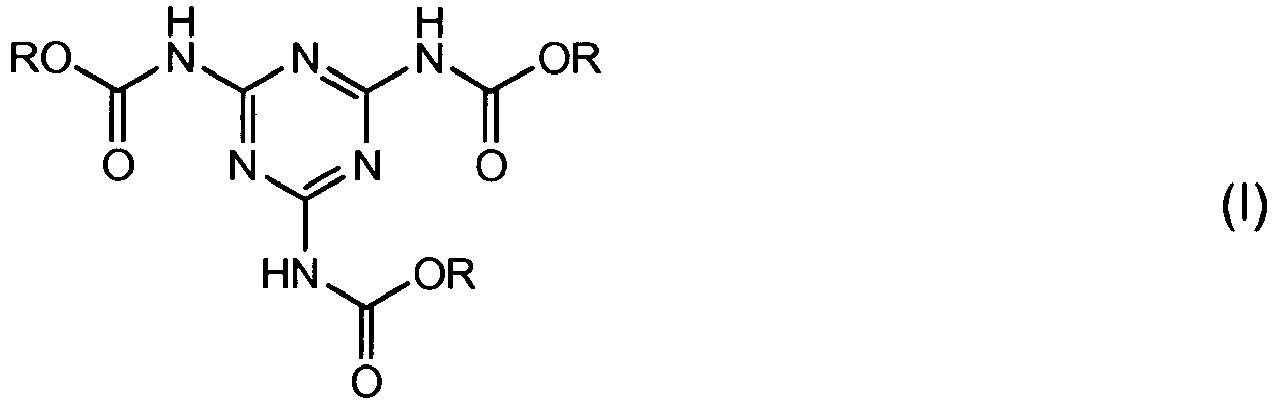
- Sofern mindestens ein Tris(alkoxycarbonylamino)-1,3,5-triazin, insbesondere mindestens ein TACT der Formel (I), vorhanden ist, hat es bevorzugt einen Anteil von 0,5 bis 10 Gew.-%, insbesondere 0,8 bis 7,5 Gew.-%, besonders bevorzugt 1 bis 5 Gew.-%, jeweils bezogen auf die Gesamtmenge der erfindungsgemäßen Klarlackbeschichtungszusammensetzung.
- Die Mengen der Melamin-Formaldehyd-Harze (B) und (C) sowie der gegebenenfalls vorhandenen Tris(alkoxycarbonylamino)-1,3,5-triazine (TACT) sind im Rahmen der oben angegebenen Anteilsbereiche vorzugsweise so zu wählen, dass im Falle einer solchen Kombination das Gewichtsverhältnis der Melamin-Formaldehyd-Harze (B) und (C) zu den Tris(alkoxycarbonylamino)triazinen im Bereich von 2:1 bis 15:1, insbesondere von 4:1 bis 12:1, ganz besonders bevorzugt von 6:1 bis 10:1 liegt.
- Die erfindungsgemäße Klarlackbeschichtungszusammensetzung enthält mindestens eine organische Harnstoffverbindung (D) als Rheologiehilfsmittel.
- Bei diesen Harnstoffverbindungen handelt es sich vorzugsweise um Additionsprodukte eines oder mehrerer Polyisocyanate, insbesondere einem Polyisocyanat, mit einem oder mehreren Aminen, insbesondere einem oder mehreren Monoamin, besonders bevorzugt einem Monoamin.
- Als Polyisocyanate können im Prinzip alle mindestens zwei Isocyanatgruppen pro Molekül enthaltende organischen Verbindungen eingesetzt werden. Es können auch isocyanatgruppenhaltige Reaktionsprodukte aus beispielsweise Polyolen und Polyaminen und Polyisocyanaten eingesetzt werden. Vorzugsweise werden Diisocyanate, ganz besonders bevorzugt aliphatische Diisocyanate, insbesondere Hexamethylendiisocyanat eingesetzt. Als Beispiele für einsetzbare Polyisocyanate werden genannt: Tetramethylen-1,4-diisocyanat, Hexamethylen-1,6-diisocyanat, Cyclohexyl-1,4-diisocyanat, Dicyclohexylmethan-4,4-diisocyanat, 1,5-Dimethyl-(2,4-omega-diisocyanato-ethyl)-benzol, 1,3,5-Trimethyl-(2,4-omega-diisocyanato-methyl)-benzol, 1,3,5-Triethyl-(2,4-omega-diisocyanato-methyl)-benzol, das Trimere des Hexamethylen-1,6-diisocyanats, Isophorondiisocyanat, 2,4-Toluoldiisocyanat, 2,6-Toluoldiisocyanat, Isophorondiisocyanat. Ganz besonders bevorzugt ist Hexamethylen-1,6-diisocyanat.
- Als Amine werden vorzugsweise primäre Monoamine, insbesondere araliphatische oder aliphatische primäre Monoamine, eingesetzt. Als Beispiele für einsetzbare Amine werden genannt: Benzylamin, Ethylamin, Methoxypropylamin, n-Propylamin, Isopropylamin, n-Butylamin, Isobutylamin, tert-Butylamin, Pentylamin, n-Hexylamin, n-Octylamin, iso-Nonanylamin, iso-Tridecylamin, n-Decylamin, Stearylamin oder auch Ethylendiamin. Ganz besonders bevorzugt ist Benzylamin.
- Die organische Harnstoffverbindung (D) wird vorzugsweise in Form einer Paste gemischt mit mindestens einem typischen wie weiter unten beschriebenen organischen Lösemittel sowie mindestens einem Polyester, beispielsweise einem Polyester (A), und/oder einem (Meth)Acrylat(co)polymerisat, bevorzugt einem wie unten beschriebenen (Meth)Acrylat(co)polymerisat (DD), in der erfindungsgemäßen Klarlackbeschichtungszusammensetzung eingesetzt. So kann die Herstellung der Harnstoffverbindung beispielsweise direkt in Gegenwart eines Polyesters und/oder eines (Meth)Acrylat(co)polymerisats erfolgen. Dabei wird beispielsweise so vorgegangen, dass das aliphatische primäre Monoamin zu einer Lösung eines (Meth)Acrylat(co)polymerisats und/oder Polyesters in einem organischen Lösemittel beziehungsweise in einem Gemisch aus organischen Lösemitteln gegeben wird und dann das Polyisocyanat zugegeben wird. Die in Frage kommenden organischen Lösemittel sind weiter unten beschrieben und werden insbesondere so ausgewählt, dass sie keine störenden Wechselwirkungen mit den bei der Reaktion vorliegenden Bestandteilen, das heißt also mit dem mindestens einen Amin, dem mindestens einen Polyisocyanat und dem mindestens einen (Meth)Acrylat(co)polymerisat und/oder Polyesters, eingehen. Die weiter unten beschriebenen, bevorzugten Anteile der Harnstoffverbindung an der Klarlackbeschichtungszusammensetzung beziehen sich allerdings auch im Falle einer Paste ausschließlich auf die Harnstoffverbindung und nicht auf die Mischung aus Harnstoffverbindung und (Meth)Acrylat(co)polymerisat und/oder Polyester. Die tatsächliche Menge an Harnstoffverbindung kann damit beispielsweise in einfacher Weise durch die eingesetzten Mengen Polyisocyanat und Amin berechnet werden.
- Die so erhaltene Paste, das heißt die Mischung aus harnstoffgruppenhaltigem Rheologiehilfsmittel und (Meth)Acrylat(co)polymerisat und/oder Polyester, bevorzugt (Meth)Acrylat(co)polymerisat, mit organischen Lösemitteln kann dann direkt in der erfindungsgemäßen Klarlackbeschichtungszusammensetzung eingesetzt werden.
- Harnstoffverbindungen als Additionsprodukt eines Polyisocyanats und Aminen als Mischungen mit beispielsweise (Meth)Acrylat(co)polymerisaten oder Polyestern sind beispielsweise auch unter den Handelsnamen Setalux® und Setal® (Firma Nuplex Resins) erhältlich und können ohne weiteres in der erfindungsgemäßen Klarlackbeschichtungszusammensetzung eingesetzt werden.
- Ganz besonders bevorzugt wird die organische Harnstoffverbindung (D) als Paste, gemischt mit mindestens einem organischen Lösemittel und mindestens einem wie unten beschriebenen (Meth)Acrylat(co)polymerisat (DD), eingesetzt.
- Der Anteil der mindestens einen organischen Harnstoffverbindung (D) als Rheologiehilfsmittel beträgt vorzugsweise 0,1 bis 4 Gew.-%, insbesondere 0,2 bis 3 Gew.-%, besonders bevorzugt 0,3 bis 2 Gew.-%, ganz besonders bevorzugt 0,4 bis 1 Gew.-%, jeweils bezogen auf die Gesamtmenge der Klarlackbeschichtungszusammensetzung.
- Die erfindungsgemäße Klarlackbeschichtungszusammensetzung enthält bevorzugt mindestens ein wie im folgenden beschriebenes (Meth)Acrylat(co)polymerisat (DD). Wie oben beschrieben, enthält beispielsweise die bevorzugt einzusetzende Paste der mindestens einen Harnstoffverbindung (D) bevorzugt mindestens ein solches (Meth)Acrylat(co)polymerisat (DD). Das (Meth)Acrylat(co)polymerisat (DD) kann jedoch selbstverständlich auch ohne vorhergehende Vermischung mit einer Harnstoffverbindung (D) zu einer Paste in der Klarlackbeschichtungszusammensetzung eingesetzt werden beziehungsweise in dieser enthalten sein.
- Unter (Meth)Acrylat(co)polymerisat wird bekanntermaßen eine polymere organische Verbindung verstanden, die sich aus unterschiedlichen Acrylat- und/oder Methacrylatmonomeren zusammensetzt. Die Bezeichnung (Meth)acrylat steht im Rahmen der Erfindung für Acrylate und/oder Methacrylate beziehungsweise solche Verbindungen, die Acrylate und/oder Methacrylate beinhalten beziehungsweise aus diesen aufgebaut sind. Als Beispiele für solche Acrylat- und Methacrylatmonomere sind unterschiedliche Alkyl(meth)acrylate und Cycloalkyl(meth)acrylate zu nennen, wie z. B. die dem Fachmann bekannten Verbindungen Ethylacrylat, Ethylmethacrylat, Propylacrylat, Propylmethacrylat, Isopropylacrylat, Isopropylmethacrylat, Butylacrylat, Butylmethacrylat, Isobutylacrylat, Isobutylmethacrylat, tert-Butylacrylat, tert-Butylmethacrylat, Amylacrylat, Amylmethacrylat, Hexylacrylat, Hexylmethacrylat, Ethylhexylacrylat, Ethylhexylmethacrylat, 3,3,5-Trimethylhexylacrylat, 3,3,5-Trimethylhexylmethacrylat, Stearylacrylat, Stearylmethacrylat, Laurylacrylat oder Laurylmethacrylat, Cycloalkylacrylate sowie Cyclopentylacrylat, Cyclopentylmethacrylat, Isobornylacrylat, Isobornylmethacrylat, Cyclohexylacrylat und Cyclohexylmethacrylat.
- Das (Meth)Acrylat(co)polymerisat (DD) ist OH-funktionell und weist eine OH-Zahl von 60 - 200 mg KOH/g, vorzugsweise 70 - 180 mg KOH/g, ganz besonders bevorzugt von 90 - 170 mg KOH/g, auf. Dementsprechend sind in das Polymergerüst bestimmte Anteile solcher Acrylat- und Methacrylatmonomere eingebaut, die OH-Gruppen aufweisen und damit die OH-Funktionalität des (Meth)Acrylat(co)polymerisats (DD) ausmachen.
- Als hydroxylgruppenhaltige Monomerbausteine zur Herstellung der (Meth)Acrylat(co)polymerisate (DD) werden Hydroxyalkyl(meth)acrylate, wie beispielsweise 2-Hydroxyethylacrylat, 2-Hydroxyethylmethacrylat, 2-Hydroxypropylacrylat, 2-Hydroxypropylmethacrylat, 3-Hydroxypropylacrylat, 3-Hydroxypropylmethacrylat, 3-Hydroxybutylacrylat, 3-Hydroxybutylmethacrylat sowie insbesondere 4-Hydroxybutylacrylat und/oder 4-Hydroxybutylmethacrylat, eingesetzt. Als weitere Monomerbausteine für die (Meth)Acrylat(co)polymerisate (DD) können vinylaromatische Kohlenwasserstoffe, wie Vinyltoluol, alpha-Methylstyrol oder insbesondere Styrol, Amide oder Nitrile der Acryl- oder Methacrylsäure, Vinylester oder Vinylether, sowie in untergeordneten Mengen insbesondere Acryl- und/oder Methacrylsäure eingesetzt werden.
- Das mindestens eine (Meth)Acrylat(co)polymerisat (DD) weist eine Glasübergangstemperatur Tg von -40°C. bis 70°C, vorzugsweise von -35°C bis 50°C, ganz besonders bevorzugt von -35°C bis 35°C, auf. Wie dem Fachmann auf dem Gebiet bekannt ist, bestimmt sich die Glasübergangstemperatur von (Meth)Acrylat(co)polymerisaten beispielsweise durch die Art der enthaltenen Monomere und deren Anteilen am Polymer. Eine entsprechende Auswahl kann vom Fachmann ohne größeren Aufwand getroffen werden.
- Das Molekulargewicht des (Meth)Acrylat(co)polymerisats (DD) liegt in den dem Fachmann geläufigen Bereichen und ist letztlich keinen Beschränkungen unterworfen. Bevorzugt sind gewichtsmittlere Molekulargewichte Mw zwischen 7000 und 15000 g/mol, insbesondere 8000 und 13000 g/mol und zahlenmittlere Molekulargewichte Mn zwischen 2000 bis 4000 g/mol, insbesondere zwischen 2500 bis 3500 g/mol.
- Die Säurezahl des (Meth)Acrylat(co)polymerisats (DD) liegt vorzugsweise zwischen 0 - 50 mg KOH/g, insbesondere zwischen 0 - 30 mg KOH/g.
- Als (Meth)Acrylat(co)polymerisate (DD) können sowohl übliche im Handel erhältliche als auch selbst hergestellte (Meth)Acrylat(co)polymerisate verwendet werden. Als handelsübliche (Meth)Acrylat(co)polymerisate (DD) sind beispielsweise Polyacrylate der Produktreihe "Macrynal" (Cytec Surface Specialities) oder das Handelsprodukt Setalux 1756 VV-65 (Nuplex Resins) zu nennen.
- Die Herstellung der (Meth)Acrylat(co)polymerisate (DD) weist keine verfahrenstechnischen Besonderheiten auf, sondern erfolgt beispielsweise mit Hilfe der auf dem Kunststoffgebiet üblichen und bekannten Methoden der kontinuierlichen oder diskontinuierlichen radikalisch initiierten Copolymerisation in Masse, Lösung, Emulsion, Miniemulsion oder Mikroemulsion unter Normaldruck oder Überdruck in Rührkesseln, Autoklaven, Rohrreaktoren, Schlaufenreaktoren oder Taylorreaktoren bei Temperaturen von vorzugsweise 50 bis 200 °C.
- Beispiele geeigneter Copolymerisationsverfahren werden in den Patentanmeldungen
DE 197 09 465 A1 ,DE 197 09 476 A1 ,DE 28 48 906 A1 ,DE 195 24 182 A1 ,DE 198 28 742 A1 ,DE 196 28 143 A1 ,DE 196 28 142 A1 ,EP 0 554 783 A1 ,WO 95/27742 A1 WO 82/02387 A1 WO 98/02466 A1 - Beispiele geeigneter radikalischer Initiatoren sind Dialkylperoxide, wie Di- tert.-Butylperoxid oder Dicumylperoxid, Hydroperoxide, wie Cumolhydroperoxid oder tert.-Butylhydroperoxid, Perester, wie tert.-Butylperbenzoat, tert.-Butylperpivalat, tert.-Butylper-3, 5, 5-trimethyl- hexanoat oder tert.-Butylper-2-ethylhexanoat, Peroxodicarbonate, Kalium-, Natrium- oder Ammoniumperoxodisulfat, Azoinitiatoren, beispielsweise Azodinitrile wie Azobisisobutyronitril, C-C-spaltende Initiatoren wie Benzpinakolsilylether, oder eine Kombination eines nicht oxidierenden Initiators mit Wasserstoffperoxid. Es können auch Kombinationen der vorstehend beschriebenen Initiatoren eingesetzt werden.
- Weitere Beispiele geeigneter Initiatoren werden in der deutschen Patentanmeldung
DE 196 28 142 A1 , Seite 3, Zeile 49, bis Seite 4, Zeile 6, beschrieben. Des Weiteren können Thiocarbonylthio-Verbindungen oder Mercaptane wie Dodecylmercaptan als Kettenübertragungsmittel oder Molekulargewichtsregler verwendet werden. - Der Anteil des mindestens einen (Meth)Acrylat(co)polymerisats (DD) beträgt bevorzugt 5 bis 20 Gew.-%, insbesondere 6 bis 15 Gew.-%, besonders bevorzugt 7,5 bis 12,5 Gew.-%, jeweils bezogen auf die Gesamtmenge der erfindungsgemäßen Klarlackbeschichtungszusammensetzung.
- Die erfindungsgemäße Klarlackbeschichtungszusammensetzung enthält in einer besonders bevorzugten Ausführungsform mindestens zwei (Meth)Acrylat(co)-polymerisate (DD), wobei mindestens eines der beiden Acrylate eine Tg von -35°C bis 35°C, eine OH-Zahl von 90 - 170 mg KOH/g, eine Säurezahl von 0 - 30 mg KOH/g, ein zahlenmittleres Molekulargewicht Mn von 2000 - 4000 g/mol und ein massenmittleres Molekulargewicht von 7000 - 15000 g/mol aufweist.
- Die erfindungsgemäße Klarlackbeschichtungszusammensetzung enthält zudem mindestens einen Säurekatalysator (E). Bekanntermaßen werden solche Katalysatoren beispielsweise in Beschichtungszusammensetzungen, in denen die darin eingesetzten Harze bei der Härtung durch entsprechende Polykondensationsreaktionen vernetzen, eingesetzt. Beispielhafte Harze sind dabei insbesondere hydroxyfunktionelle Harze wie Polyester und/oder (Meth)Acrylat(co)polymerisate sowie Melamin-Formaldehyd-Harze. Durch den Einsatz der Katalysatoren und deren bekannte Wirkungsmechanismen (Säurekatalyse) werden die Vernetzungsreaktionen katalysiert und dadurch die Einbrenntemperaturen erniedrigt, die Einbrennzeiten verkürzt oder aber die vollständige Härtung überhaupt erst ermöglicht.
- Bei den Säurekatalysatoren (E) handelt es sich bevorzugt um organische Säuren, insbesondere Sulfonsäuren, Carbonsäuren, Phosphorsäuren und/oder saure Phosphorsäureester. Ganz besonders bevorzugt sind Sulfonsäuren.
- Die genannten Säurekatalysatoren werden bevorzugt in blockierter Form eingesetzt. Dadurch wird bekanntermaßen beispielsweise die Lagerstabilität der Zusammensetzungen, die die Katalysatoren enthalten, verbessert. Geeignete Blockierungsmittel sind beispielsweise Amine wie bevorzugt tertiär alkylierte oder heterocyclische Amine.
- Geeignete Sulfonsäuren sind beispielsweise Dodecylbenzolsulfonsäure (DDBSA), Dinonylnaphthalendisulfonsäure (DNNSA), para-Toluolsulfonsäure (pTSA) sowie blockierte Sulfonsäurekatalysatoren wie blockierte DDBSA, blockierte DNNSA oder blockierte p-TSA.
- Die Blockierung der Sulfonsäurekatalysatoren erfolgt dabei beispielsweise ebenfalls über Amine wie bevorzugt tertiär alkylierte oder heterocyclische Amine, wie beispielsweise 2-Amino-2-methylpropanol, Diisopropanolamin, Dimethyloxazolidin oder Trimethylamin. Möglich ist auch der Einsatz von kovalentblockierten Sulfonsäurekatalysatoren. Hierbei werden zur Blockierung kovalent bindende Blockierungsmittel wie beispielsweise Epoxy- oder Epoxy-Isocyanat-Verbindungen eingesetzt. Solche blockierten Sulfonsäure-Katalysatoren werden detailliert in der Patentveröffentlichung
U.S. Pat. No. 5.102.961 beschrieben. - Bevorzugt werden Amin-blockierte Sulfonsäurekatalysatoren eingesetzt. Solche Katalysatoren sind beispielsweise unter dem Handelsnamen CYCAT® (Firma Cytec) oder auch Nacure® (Firma King Industries) erhältlich und können direkt in der erfindungsgemäßen Klarlackbeschichtungszusammensetzung eingesetzt werden.
- Der oder die Säurekatalysatoren (E), insbesondere Sulfonsäurekatalysatoren, werden in den üblichen und bekannten Mengen eingesetzt. Bevorzugt werden 0,01 bis 3 Gew.-%, insbesondere 0,05 bis 2 Gew.-%, ganz besonders bevorzugt 0,1 bis 1 Gew.-%, jeweils bezogen auf die Gesamtmenge der Klarlackbeschichtungszusammensetzung, eingesetzt.
- Die erfindungsgemäße Klarlackbeschichtungszusammensetzung kann zudem mindestens ein organisches Lösemittel enthalten. Bevorzugt enthält sie ein solches Lösemittel, das heißt sie ist lösemittelhaltig.
- Als organische Lösemittel sind insbesondere solche geeignet, die in der Klarlackbeschichtungszusammensetzung chemisch inert gegenüber den Verbindungen (A), (B), (C), (D), (DD), (E) und (F) sowie sonstigen gegebenenfalls vorhandenen Bestandteilen sind und die auch bei der Härtung der aus der erfindungsgemäßen Klarlackbeschichtungszusammensetzung hergestellten Klarlackierung nicht mit (A), (B), (C), (D), (DD), (E) und (F) sowie sonstigen gegebenenfalls vorhandenen Bestandteilen reagieren. Der Fachmann kann geeignete Lösemittel leicht anhand ihres bekannten Lösevermögens und ihrer Reaktivität auswählen.
- Beispiele für solche Lösemittel sind aliphatische und/oder aromatische Kohlenwasserstoffe wie Butylglycol, Toluol, Xylol, Solventnaphtha, Solvesso 100, oder Hydrosol® (Fa. ARAL), Ketone, wie Aceton, Methylethylketon oder Methylamylketon, Ester, wie Ethylacetat, Butylacetat, Butylglycolacetat, Pentylacetat oder Ethylethoxypropionat, Ether, Alkohole wie Butanol und Butyldiglycol oder Mischungen aus den vorgenannten Lösemitteln.
- Der Anteil des mindestens einen organischen Lösemittels kann breit variieren und kann beispielsweise im Bereich zwischen 20 bis 65 Gew.-%, bezogen auf die Gesamtmenge der Klarlackbeschichtungszusammensetzung, liegen. Bevorzugt liegt er zwischen 25 bis 60 Gew.-%, insbesondere zwischen 30 und 55 Gew.-%. Ein Vorteil der erfindungsgemäßen Klarlackbeschichtungszusammensetzung ist es allerdings, dass sie im Vergleich zu bekannten lösemittelhaltigen Klarlackbeschichtungszusammensetzungen, die ähnliche oder sogar schlechtere technologische Eigenschaften (beispielsweise Glanz oder "appearance") aufweisen, niedrigere Gehalte an organischen Lösemitteln enthalten kann. Auf diese Weise kann bei gleichzeitigem Erhalt beziehungsweise bei Verbesserung der technologischen Eigenschaften beispielsweise auch eine Erhöhung des nfA stattfinden, wodurch letztlich Material eingespart und damit deutlich ökonomischer und wiederum umweltfreundlicher gearbeitet werden kann.
- Der Festkörper beziehungsweise nfA der erfindungsgemäßen Klarlackbeschichtungszusammensetzung liegt vorzugsweise zwischen 35 und 80 %, insbesondere zwischen 40 und 75 %, ganz bevorzugt zwischen 45 Gew.-% bis 70 %.
- Die beschriebenen Bestandteile (A), (B), (C), (D), und (E) machen bevorzugt mehr als 30 Gew.-%, insbesondere mehr als 35 Gew.-%, der Gesamtmenge der erfindungsgemäßen Klarlackbeschichtungszusammensetzung aus. Ist ein organisches Lösemittel enthalten, was bevorzugt ist, so machen die beschriebenen Bestandteile (A), (B), (C), (D), (E) und das Lösemittel insbesondere mehr als 70 Gew.-%, bevorzugt mehr als 75 Gew.-%, der Gesamtmenge der erfindungsgemäßen Klarlackbeschichtungszusammensetzung aus. Für den Fall, dass zusätzlich noch der Bestandteil (DD) vorhanden ist, einer erfindungsgemäß bevorzugten Variante, machen die Bestandteile (A), (B), (C), (D), (DD), (E) und das Lösemittel insbesondere mehr als 85 Gew.-%, bevorzugt mehr als 90 Gew.-%, der Gesamtmenge der erfindungsgemäßen Klarlackbeschichtungszusammensetzung aus.
- Dies bedeutet insbesondere, dass die erfindungsgemäße Klarlackbeschichtungszusammensetzung mindestens einen weiteren Bestandteil, beispielsweise ein übliches und wie weiter unten beschriebenes Lackadditiv in üblichen Mengen von weniger als 10 Gew.-%, insbesondere weniger als 5 Gew.-%, enthalten kann.
- Als weitere Bestandteile können beispielsweise von den Polyestern (A), (Meth)Acrylat(co)polymerisaten (DD) und den Melaminharzen (B) und (C) verschiedene, weitere organische polymere Verbindungen enthalten sein. Bei den genannten, gegebenenfalls vorhandenen Bestandteilen kann es sich beispielsweise um statistisch, alternierend und/oder blockartig aufgebaute, lineare, verzweigte und/oder kammartig aufgebaute (Co)polymerisate mindestens einer monomeren Verbindung handeln. In Frage kommen letztlich, abgesehen von den weiter oben beschriebenen Polyestern (A), (Meth)Acrylat(co)polymerisaten (DD) und den Melaminharzen (B) und (C), alle typischen organischen Verbindungen, die dem Fachmann in diesem Zusammenhang bekannt sind.
- Enthalten sein können insbesondere weitere statistisch, alternierend und blockartig aufgebaute, lineare, verzweigte und/oder kammartig aufgebaute (Co)polymerisate von ethylenisch ungesättigten Monomeren. Neben den genannten (Meth)Acrylat(co)polymerisaten (DD) können beispielsweise auch weitere, von den (Meth)Acrylat(co)polymerisaten (DD) verschiedene (Meth)Acrylat(co)polymerisate in den Klarlackbeschichtungsmittelzusammensetzungen enthalten sein.
- Beispiele weiterer, geeigneter (Co)polymerisate von ethylenisch ungesättigten Monomeren sind neben den bereits ausführlich beschriebenen (Meth)acrylat(co)polymerisaten auch partiell verseifte Polyvinylester.
- Enthalten sein können auch weitere Polyadditionsharze und/oder Polykondensationsharze. Beispiele geeigneter Polyadditionsharze und/oder Polykondensationsharze sind von den Polyestern (A) verschiedene Polyester, Alkyde, Polyurethane, Polylactone, Polycarbonate, Polyether, Epoxidharz-Amin-Addukte, Polyamide, Polyimide, Polyester-Polyurethane, Polyether-Polyurethane und Polyester-Polyether-Polyurethane. Enthalten sein können beispielsweise auch von den Melamin-Formaldehyd-Harzen (B) und (C) und TACT verschiedene Aminoharze wie die an sich bekannten Harnstoffharze und Thioharnstoffharze oder auch Benzoguanamin-Formaldehyd-Harze und Acetoguanamin-Formaldehydharze.
- Ebenfalls in der erfindungsgemäßen Klarlackbeschichtungszusammensetzung enthalten sein können beispielsweise blockierte organische Polyisocyanate. Im Prinzip können dabei alle mindestens zwei Isocyanatgruppen pro Molekül enthaltende organischen Verbindungen eingesetzt werden, beispielsweise die weiter oben genannten Polyisocyanate. Typische Blockierungsmittel sind in diesem Zusammenhang beispielsweise Phenole, Alkohole, Oxime, Pyrazole, Amine und CHacide Verbindungen wie Malonsäurediethylester, insbesondere Caprolactam, Butanonoxim, Acetonoxim, Malonsäurediethylester, Dimethylpyrazol oder Phenol. Die Blockierungsreaktion wird typischerweise durch Umsetzung der freien NCO-Gruppen mit den genannten Blockierungsmitteln in Anwesenheit von beispielsweise Katalysatoren wie Dibutylzinndilaurat oder Zinn(II)bis(2-ethylhexanoat) durchgeführt. Die Blockierungsmittel und die entsprechenden Umsetzungsreaktionen sind dem Fachmann bekannt.
- Als weitere Bestandteile kann auch mindestens ein übliches und an sich bekanntes Lackadditiv in der erfindungsgemäßen Klarlackbeschichtungszusammensetzung enthalten sein. Solche Lackadditive sind dem Fachmann bekannt und können je nach Einzelfall ausgewählt werden.
- Insbesondere geeignete Lackadditive sind
- insbesondere UV-Absorber;
- insbesondere Lichtschutzmittel wie HALS-Verbindungen, Benztriazole oder Oxalanilide;
- nicht-deckende, transparente Füllstoffe, wie SiO2-Nanopartikel, Bariumsulfat und Zinkoxid
- Radikalfänger;
- Slipadditive;
- Polymerisationsinhibitoren;
- Entschäumer;
- Reaktivverdünner, wie sie aus dem Stand der Technik allgemein bekannt sind,
- Netzmittel wie Siloxane, fluorhaltige Verbindungen, Carbonsäurehalbester,
- Haftvermittler wie Tricyclodecandimethanol;
- weitere Rheologiehilfsmittel, die von den oben beschriebenen Rheologiehilfsmitteln (D) verschiedene sind, wie insbesondere Polyamide (beispielsweise unter dem Handelsnamen Disparlon erhältlich) oder auch pyrogene Kieselsäuren (beispielsweise unter dem Handelsnamen Aerosil erhältlich), beziehungsweise deren Anreibungen in entsprechenden Harzen als Bindemittel,
- filmbildende Hilfsmittel wie Cellulose-Derivate;
- und/oder Flammschutzmittel.
- Die erfindungsgemäße Klarlackbeschichtungszusammensetzung kann beispielsweise thermisch gehärtet werden. Zu diesem Zweck enthält sie beispielsweise den mindestens einen Polyester (A), das mindestens eine (Meth)Acrylat(co)polymerisat (DD) und das mindestens eine Melaminharz (B).
Im Rahmen der vorliegenden Erfindung bedeutet "thermisch härtbar" beziehungsweise der Begriff "thermische Härtung" die durch chemische Reaktion von reaktiven funktionellen Gruppen stattfindende Vernetzung einer Lackschicht (Bildung eines Beschichtungsfilms), wobei die energetische Aktivierung dieser chemischen Reaktion durch thermische Energie möglich ist. Wie der Fachmann weiß, ist bei dieser Härtung in unterschiedlichen Fällen der zusätzliche Einsatz von bestimmten Katalysatoren wünschenswert beziehungsweise notwendig, um die Härtungsreaktion zu beschleunigen beziehungsweise zu ermöglichen. Dabei können unterschiedliche funktionelle Gruppen, die zueinander komplementär sind, miteinander reagieren (komplementäre funktionelle Gruppen) und/oder die Filmbildung beruht auf der Reaktion von autoreaktiven Gruppen, das heißt also funktionellen Gruppen, die untereinander mit Gruppen ihrer Art reagieren. Beispiele geeigneter komplementärer reaktiver funktioneller Gruppen und autoreaktiver funktioneller Gruppen sind beispielsweise aus der deutschen PatentanmeldungDE 199 30 665 A1 , Seite 7, Zeile 28, bis Seite 9, Zeilen 24, bekannt. - Bekanntermaßen tritt unter den gängigen Härtungsbedingungen, beispielsweise den unten beschriebenen Härtungsbedingungen, eine solche Vernetzung damit jedenfalls bei der erfindungsgemäßen Klarlackbeschichtungszusammensetzung auf, insbesondere durch die Vernetzung des hydroxyfunktionellen Polyesters (A) und der Melaminharze (B) und (C).
- Möglich sind dabei die an sich bekannten Einkomponenten-(1K)- und Mehrkomponentensysteme, insbesondere Zweikomponenten-(2K)-systeme.
- In Einkomponenten(1K)-Systemen liegen die zu vernetzenden Komponenten nebeneinander, das heißt in einer Komponente, vor. Voraussetzung hierfür ist beispielsweise, dass die zu vernetzenden Komponenten erst bei höheren Temperaturen und/oder durch den Einsatz von Katalysatoren vernetzen.
- In Zweikomponenten(2K)-Systemen liegen die zu vernetzenden Komponenten in zwei Komponenten vor, die erst kurz vor der Applikation zusammengegeben werden. Diese Form wird dann gewählt, wenn die zu vernetzenden Komponenten bereits bei Raumtemperatur, das heißt zwischen 10 und 30°C, insbesondere 25°C, miteinander reagieren.
- Wie der Fachmann weiß, vernetzen die in der erfindungsgemäßen Klarlackbeschichtungszusammensetzung vorhandenen Verbindungen, insbesondere der mindestens eine Polyester (A) und die Melaminharze (B) und (C), in der Regel nicht bereits bei Raumtemperatur. Die erfindungsgemäße Klarlackbeschichtungszusammensetzung ist demnach bevorzugt Einkomponenten(1K)-System. Sie kann aber natürlich auch als Zweikomponenten(2K)-System vorliegen. Dies ist beispielsweise dann der Fall, wenn die erfindungsgemäße Klarlackbeschichtungszusammensetzung wie oben beschriebene unblockierte Polyisocyanate enthält.
- Neben der erfindungsgemäßen Klarlackbeschichtungszusammensetzung ist ein Verfahren zur Herstellung der erfindungsgemäßen Klarlackbeschichtungszusammensetzung ein weiterer Gegenstand der vorliegenden Erfindung. Natürlich gelten dabei alle wie oben beschriebenen vorteilhaften Ausführungsformen hinsichtlich der einzusetzenden beziehungsweise einsetzbaren Bestandteile der erfindungsgemäßen Klarlackbeschichtungszusammensetzung auch in Bezug auf das Verfahren zur Herstellung der erfindungsgemäßen Klarlackbeschichtungszusammensetzung.
- Methodisch weist die Herstellung keine Besonderheiten auf, sondern erfolgt durch das Vermischen und Homogenisieren der vorstehend beschriebenen Bestandteile mit Hilfe üblicher und bekannter Mischverfahren und Vorrichtungen wie Rührkessel, Rührwerksmühlen, Extruder, Kneter, Ultraturrax, In-line-Dissolver, statische Mischer, Zahnkranzdispergatoren, Druckentspannungsdüsen und/oder Microfluidizer gegebenenfalls unter Ausschluss von aktinischer Strahlung. Dabei ist allerdings zu beachten, dass die organische Harnstoffverbindung (D) wie oben beschrieben vorzugsweise in Form einer Paste gemischt mit mindestens einem typischen organischen Lösemittel sowie mindestens einem Polyester, beispielsweise einem Polyester (A), und/oder einem (Meth)Acrylat(co)polymerisat, insbesondere einem wie (Meth)Acrylat(co)polymerisat (DD), eingesetzt wird. Das heißt, die Paste wird zunächst separat hergestellt und dann mit den weiteren Bestandteilen gemischt.
- Weiterer Gegenstand der vorliegenden Erfindung ist die Verwendung der erfindungsgemäßen Klarlackbeschichtungszusammensetzung. Die erfindungsgemäße Klarlackbeschichtungszusammensetzung eignet sich insbesondere zum Einsatz in der Automobillackierung zur Herstellung von Klarlackierungen auf unterschiedlichen Substraten und wird dementsprechend verwendet. Demzufolge ist auch eine Klarlackschicht, die aus der erfindungsgemäßen Klarlackbeschichtungszusammensetzung auf einem Substrat hergestellt wurde, Gegenstand der vorliegenden Erfindung. Natürlich gelten alle wie oben beschriebenen vorteilhaften Ausführungsformen hinsichtlich der einzusetzenden beziehungsweise einsetzbaren Bestandteile der erfindungsgemäßen Klarlackbeschichtungszusammensetzung auch in Bezug auf die Verwendung der erfindungsgemäßen Klarlackbeschichtungszusammensetzung sowie die daraus hergestellte Klarlackschicht.
- Die Applikation der erfindungsgemäßen Klarlackbeschichtungszusammensetzung auf ein Substrat kann durch alle üblichen Applikationsmethoden, wie beispielsweise Spritzen, Rakeln, Streichen, Giessen, Tauchen, Tränken, Träufeln oder Walzen erfolgen. Dabei kann das zu beschichtende Substrat als solches ruhen, wobei die Applikationseinrichtung oder -anlage bewegt wird. Indes kann auch das zu beschichtende Substrat, insbesondere ein Coil, bewegt werden, wobei die Applikationsanlage relativ zum Substrat ruht oder in geeigneter Weise bewegt wird.
- Vorzugsweise werden Spritzapplikationsmethoden angewandt, wie zum Beispiel Druckluftspritzen (Pneumatische Applikationsanlagen), Airless-Spritzen, Hochrotation, elektrostatischer Sprühauftrag (ESTA), gegebenenfalls verbunden mit Heissspritzapplikation wie zum Beispiel Hot-Air-Heissspritzen.
- Bevorzugt beträt die Schichtdicke im gehärteten, trockenen Zustand zwischen 10 und 150 Mikrometer, insbesondere zwischen 20 und 80 Mikrometer ganz besonders bevorzugt zwischen 25 und 70 Mikrometer.
- Nach der Applikation und vor der Aushärtung der erfindungsgemäßen Klarlackbeschichtungszusammensetzung kann eine gewisse Ruhezeit beziehungsweise Abdunstzeit von beispielsweise 1 Minute bis 60 Minuten, insbesondere 2 Minuten bis 10 Minuten, erfolgen. Die Ruhezeit dient beispielsweise zum Verlauf und zur Entgasung der Lackschichten oder zum Verdunsten von flüchtigen Bestandteilen wie Lösemittel. Die Ruhezeit kann bei Raumtemperatur, das heißt zwischen 10 und 30°C, erfolgen oder auch durch die Anwendung erhöhter Temperaturen und/oder durch eine reduzierte Luftfeuchte unterstützt und/oder verkürzt werden, sofern hierbei keine Schädigungen oder Veränderungen der Lackschichten eintreten, etwa eine vorzeitige vollständige Vernetzung.
- Nach der Applikation und gegebenenfalls der Abdunstzeit der erfindungsgemäßen Klackbeschichtungszusammensetzung auf einem Substrat, erfolgt die Härtung, wodurch eine Klarlackierung gebildet wird.
- Die thermische Härtung der erfindungsgemäßen Klarlackbeschichtungszusammensetzung weist keine methodischen Besonderheiten auf, sondern erfolgt nach den üblichen und bekannten Methoden wie Erhitzen in einem Umluftofen oder Bestrahlen mit IR-Lampen. Hierbei kann die thermische Härtung auch stufenweise erfolgen. Eine weitere Härtungsmethode ist die Härtung mit nahem Infrarot (NIR-Strahlung). Die Härtung wird in der Regel bei einer Temperatur von 10 bis 200°C, besonders bevorzugt 50 bis 190°C und insbesondere 80 bis 180°C während einer Zeit von beispielsweise 1 Minuten bis zu 10 Stunden, besonders bevorzugt 2 Minuten bis zu 2 Stunde und insbesondere 5 Minuten bis 60 Minuten durchgeführt. Im Falle der bevorzugt eingesetzten Einkomponenten-Klarlackbeschichtungssysteme erfolgt die Härtung bevorzugt bei einer Temperatur von 80 bis 180°C während einer Zeit von 5 Minuten bis 60 Minuten.
- Das Substrat wird entweder direkt beschichtet (einschichtige Lackierung) oder aber die Klarlackschicht wird auf schon vorhandenen, zuvor applizierten und gegebenenfalls getrockneten beziehungsweise gehärteten Lackschichten ausgebildet, wobei dann eine Mehrschichtlackierung resultiert. Bevorzugt sind Mehrschichtlackierungen auf metallischen Substraten oder Kunststoffsubstraten. Bevorzugte Mehrschichtlackierungen auf metallischen Substraten bestehen meist, in der angegebenen Reihenfolge vom Substrat aus betrachtet, aus einer Konversionsbeschichtung (beispielsweise Phosphatierung), einer Elektrotauchlackschicht, einer Füllerschicht, einer Basislackschicht und der erfindungsgemäßen Klarlackschicht. Die hierbei einsetzbaren Lacke, deren Zusammensetzungen, zu wählende Schichtdicken sowie Applikations- und Härtungsmethoden sind dem Fachmann bekannt und können von diesem einfach aufgrund seines Fachwissens ausgewählt werden. Im Falle von Kunststoffsubstraten werden die üblichen, in der Kunststofflackierung einsetzbaren Füller-, Einschichtdecklack-, Basislackbeschichtungszusammensetzungen, deren Auswahl und Einsatz dem Fachmann bekannt sind, eingesetzt und dann mit der erfindungsgemäßen Klarlackbeschichtungszusammensetzung überschichtet, wobei dann die erfindungsgemäße Klarlackschicht resultiert. Die einzelnen Schichten der Mehrschichtlackierungen können jeweils einzeln gehärtet werden oder aber die Herstellung der Mehrschichtlackierungen erfolgt nach dem an sich bekannten nassin-nass-Verfahren; das heißt, die einzelnen Schichten werden appliziert, nur kurz abgelüftet und/oder vorgetrocknet ohne das eine vollständige Vernetzung eintritt, und dann gemeinsam gehärtet. Natürlich sind auch Kombinationen möglich. So kann beispielsweise eine jeweils separate Härtung von Elektrotauchlack und Füller erfolgen, während die im Anschluss aufgebrachten Basislack- und Klarlackbeschichtungszusammensetzungen gemeinsam gehärtet werden.
- Das Substrat ist bevorzugt ein metallisches Substrat oder ein Kunststoffsubstrat, wie sie zur Herstellung von Karosserie- und/oder Anbauteilen im Automobilbau verwendet werden. Ganz besonders bevorzugt sind metallische Substrate.
- Die Erfindung wird anfolgend anhand von Ausführungsbeispielen näher beschrieben.
- In einem mit einem Rührer, Rückflußkühler und Wasserabscheider versehenen 3,5 I Reaktor werden 678,1 g Isononansäure und 364,8 g Pentaerythrit zusammengegeben. Der Wasserabscheider wird mit Xylol (Schleppmittel) versetzt und die Reaktionsmischung auf 160°C erhitzt. Nach 120 Minuten wird der Wasserabscheider entleert und die Reaktionsmischung auf 100°C abgekühlt. Nach dem Abkühlen wird eine Füllkörperkolonne eingebaut. Danach werden 287,4 g Trimethylolpropan, 826,4 g Hexahydrophthalsäureanhydrid und 343,4 g 2-Butyl-2-Ethyl-1,3-Propandiol zugegeben und die Reaktionsmischung langsam auf maximal 220°C erhitzt. Hierbei darf die Kolonnenkopftemperatur 85°C nicht überschreiten. Zur Überwachung des Reaktionsverlaufes wird das Volumen des Kondensats (Wasser im Wasserabscheider) mitprotokolliert und von Zeit zu Zeit eine Probe der Reaktionsmischung (Produktschmelze) zur Bestimmung der Säurezahl entnommen. Nachdem die zuvor berechnete, einer vollständigen Umsetzung entsprechende Menge an Kondensat erreicht ist, wird der Xylolanteil destillativ entfernt. Das Reaktionsgemisch wird bei 220°C gerührt, bis eine Säurezahl von 11,5 bis 13,5 mg KOH/g erreicht ist. Das Gemisch wird auf 145°C abgekühlt und mit Solventnaphtha auf einen Festkörper von 63 ± 2 % angelöst.
- Der resultierende Polyester hat einen Festkörperanteil von 63 ± 2 % und eine Viskosität von 450 - 650 mPa·s (bestimmt gemäß DIN EN ISO 2884 -1; Brookfield 03/ 10000 1/s). Die resultierende Hydroxylzahl beträgt 164 mg KOH/g, das gewichtsmittlere Molekulargewicht Mw beträgt 3349 g/mol und das zahlenmittlere Molekulargewicht Mn beträgt 1193 g/mol.
-
- a)
Ein 5 I Juvo-Reaktionsgefäß mit Heizmantel, Thermometer, Rührer und mit aufgesetztem Kühler wurde mit 875,7 g eines aromatischen Lösemittels beschickt. Unter Rühren und Schutzgasatmosphäre (200 cm3/min Stickstoff) wurde das aromatische Lösemittel unter Überdruck (max. 3,5 bar) auf 160°C erhitzt. Mit Hilfe einer Messpumpe wurde eine Mischung aus 37,5 g Di-tert.-butylperoxide und 138,6 g eines aromatischen Lösemittels gleichmäßig und tropfenweise innerhalb von 4,75 h hinzugegeben. 0,25 h nach Beginn der Zugabe wurden mit Hilfe einer Messpumpe 848,4 g Styrol, 600,0 g n-Butylacrylat, 418,2 g Hydroxyethylmethacrylat und 38,4 g Methacrylsäure innerhalb von 4 h gleichmäßig hinzugegeben. Nach Beendigung der Zugabe wurde die Temperatur noch für 2 h gehalten und dann das Produkt auf 60°C abgekühlt und durch einen 5 µm GAF-Bag gefiltert. Das resultierende Harz hatte eine Tg von 24°C, eine Säurezahl von 15 mg KOH/g (nach DIN 53402), einen Feststoffgehalt von 65% +/- 1 und eine Viskosität von 8,5 dPa · s gemäß der Versuchsvorschrift nach DIN ISO 2884-1 (55% in Solventnaphtha PK (10), 23°C). Die resultierende Hydroxylzahl beträgt 95 mg KOH/g, das gewichtsmittlere Molekulargewicht Mw beträgt 8600 g/mol und das zahlenmittlere Molekulargewicht Mn beträgt 3300 g/mol. - b)
Ein 1 I-Reaktor wurde mit 423,5 g der Harzlösung gemäß Schritt a) befüllt und mit 29,4 g Butylacetat verdünnt. Danach wurden 11,2 g Benzylamin hinzugefügt und die Mischung für 30 min gerührt. Nach dieser Zeit wurde unter Aufwand hoher Scherkräfte eine Mischung von 8,8 g Hexamethylendiisocyanat und 17,1 g Butylacetat so hinzugefügt, dass eine Reaktionstemperatur von 40°C nicht überschritten wurde. Die so erhaltene Mischung hatte eine Viskosität von > 800mPas (10 s-1) (Z3) (DIN ISO 2884-1) und einen Feststoffgehalt von 59,0%. - Gemäß Tabelle 1 wurden eine erfindungsgemäße Zusammensetzung und eine Vergleichszusammensetzung durch Vermischen ihrer Bestandteile und Homogenisieren der resultierenden Mischungen hergestellt (Angaben in Tabelle 1 in Gewichtsteilen). Direkt vor der wie unten beschriebenen Applikation auf ein Substrat wurden die fertigen Rezepturen mit einer Mischung aus Solventnaphtha 160/180 (20 %), Solventnaphtha 180/210 (35 %), Xylol (25 %), Butylacetat (8,5 %), Butanol (11,5 %) auf dieselbe Spritzviskosität (26 Sekunden DIN 4 Auslaufzeit bei 20°C) eingestellt. Bei Spritzviskosität hatte die erfindungsgemäße Klarlackbeschichtungszusammensetzung einen Festkörpergehalt (nfA) von 46,9 %. Der nfA der Vergleichszusammensetzung betrug bei Spritzviskosität lediglich 43,1 %.
Tabelle 1: Zusammensetzung der Klarlackbeschichtungszusammensetzungen Bestandteil Vergleich Erfindungsgemäß Polyester (A) gemäß Herstellbeispiel 1 34,800 Handelsübliche Acrylatharzlösung (nfA 60%, OH-Zahl 128) 33,800 Melamin-Formaldehyd-Harz (C)1 24,300 17,400 Melamin-Formaldehyd-Harz (B)2 8,800 Paste gemäß Herstellbeispiel 2 17,000 20,000 Cylink 2000 (von Cytec) 3 4,000 4,000 Xylol 1,185 Solventnaphtha 7,250 5,500 Handelsübliche silikonhaltige Obertlächenadditive 0,115 0,200 Handelsübliche Lichtschutzmittel 0,900 0,950 Solvesso 150 4,700 6,100 Butyldiglykolacetat 1,000 1,100 Butyldiglykol 3,000 Butanol 2,000 Sulfonsäurekatalysator (E) 4 0,150 0,150 Sulfonsäurekatalysator (E) 5 0,100 Handelsübliches Verlaufsadditiv auf Acrylatbasis 0,600 Anmerkung: Das Referenzharz HMMM (Luwipal® 066, BASF) hat eine gemessene Vernetzungsbeginntemperatur von 219°C.
1 (Luwipal 018 BX von BASF, nfA 72% in Butanol, Vernetzungsbeginntemperatur 169°C)
2 (Luwipal 014 von BASF nfA 52 % in Butanol, Vernetzungsbeginntemperatur 141 °C)
3 TACT-Vernetzer (nfA 50 % in Butanol)
4 CYCAT 4045 (35 % aktiver Katalysator in Ethylenglykol, von Cytec)
5 Nacure 5076 (70 % aktiver Katalysator in Isopropanol, von King Industries) - Es wurden Mehrschichtbeschichtungen auf mit KTL (CathoGuard 320) beschichteten Stahlblechen (Gardobond 26S 60 0C) aufgebaut. Alle Lacke wurden mittels ESTA-Applikation aufgetragen. Zunächst wurde ein handelsüblicher wässriger grau/anthrazitfarbender Füller appliziert, für 5 Minuten bei 25°C abgelüftet und für 10 Minuten bei 80°C, dann für 20 Minuten bei 160°C, eingebrannt (Trockenschichtdicke 30 Mikrometer). Danach folgte die Applikation eines handelsüblichen schwarzen Wasserbasislacks, ein 5-minütiges Ablüften bei 25°C sowie ein 10-minütiges Trocknen bei 80°C (Trockenschichtdicke 12 Mikrometer). Zuletzt erfolgte die Applikation der Klarlackbeschichtungszusammensetzungen gemäß Tabelle 1. Die Klarlackbeschichtungszusammensetzungen wurden ebenfalls für 5 Minuten bei 25°C abgelüftet und anschließend für 20 Minuten bei 140°C eingebrannt (Trockenschichtdicke 40 Mikrometer).
- Die so hergestellten Mehrschichtbeschichtungen wurden hinsichtlich des Verlaufs beziehungsweise des Erscheinungsbildes ("appearance") untersucht. Die Analysen erfolgten über Wavescanmessungen (Longwave/Shortwave). Als Messgerät wurde ein Wavescan II von Byk-Gardner eingesetzt. Bekanntermaßen korrelieren niedrige Werte von LW/SW (Longwave/Shortwave) mit einem guten Verlauf und einem daraus resultierenden guten und hochwertigem Erscheinungsbild (gute Abbildungsunterscheidbarkeit (DOI), hohe Oberflächenglätte). Die Ergebnisse sind in Tabelle 2 dargestellt.
Tabelle 2: Messergebnisse Vergleich Erfindungsgemäß LW vertikal 7 5 SW vertikal 24 19 LW horizontal 10 9 SW horizontal 22 17 - Anmerkung: Die Bleche wurden einmal in horizontaler, einmal in vertikaler Lage beschichtet, um dadurch die Applikationsbedingungen für unterschiedliche Bereiche einer Automobilkarosserie nachzustellen.
- Die Ergebnisse zeigen, dass der Verlauf und das damit resultierende Erscheinungsbild der mit der erfindungsgemäßen Klarlackbeschichtungszusammensetzung hergestellten Mehrschichtbeschichtungen wesentlich besser sind als bei dem Vergleichssystem. Hinzu kommt, dass die erfindungsgemäße Klarlackbeschichtungszusammensetzung einen signifikant höheren Festkörper beziehungsweise einen niedrigeren Gehalt an organischen Lösemitteln aufweist und damit ein deutlich verbessertes ökologisches Profil aufweist.
Claims (15)
- Klarlackbeschichtungszusammensetzung, enthaltend(A) mindestens einen Polyester
mit einer OH-Zahl von 100 - 220 mg KOH/g, enthaltend(A1) 10 bis 20 mol-% mindestens eines acyclischen, aliphatischen, verzweigten Polyols mit zwei Hydroxygruppen,(A2) 5 bis 15 mol-% mindestens eines acyclischen, aliphatischen, verzweigten Polyols mit drei Hydroxygruppen,(A3) 10 bis 20 mol-% mindestens eines acyclischen, aliphatischen, verzweigten Polyols mit vier Hydroxygruppen,(A4) 25 bis 40 mol-% mindestens einer cycloaliphatischen 1,2-Dicarbonsäure und/oder das Anhydrid dieser Dicarbonsäure sowie(A5) 20 bis 35 mol-% Isononansäure,wobei die angegebenen molaren Anteile jeweils auf den molaren Gesamtanteil der Verbindungen (A1) bis (A5) bezogen sind und dieser molare Gesamtanteil mindestens 70 mol-%, der in dem Polyester (A) enthaltenen Verbindungen ausmacht;(B) mindestes ein butanolverethertes Melamin-Formaldehyd-Harz mit einer Vernetzungsbeginntemperatur, die zwischen 65°C -100°C, niedriger als die Vernetzungsbeginntemperatur von Hexamethoxymethylmelamin;(C) mindestes ein butanolverethertes Melamin-Formaldehyd-Harz mit einer Vernetzungsbeginntemperatur, die zwischen 30°C - 60°C, niedriger als die Vernetzungsbeginntemperatur von Hexamethoxymethylmelamin;(D) mindestens eine organische Harnstoffverbindung als Rheologiehilfsmittel;(E) mindestens einen Säurekatalysator. - Klarlackbeschichtungszusammensetzung nach Anspruch 1, dadurch gekennzeichnet, dass
der mindestens eine Polyester (A) in einer Menge von 12 bis 45 Gew.-%,
das mindestens eine butanolveretherte Melamin-Formaldehyd-Harz (B) in einer Menge von 2 bis 10 Gew.-%,
das mindestens eine butanolveretherte Melamin-Formaldehyd-Harz (C) in einer Menge von 5 bis 20 Gew.-%,
die mindestens eine organische Harnstoffverbindung (D) als Rheologiehilfsmittel in einer Menge von 0,1 bis 7 Gew.-%, und
der mindestens eine Säurekatalysator in einer Menge von 0,01 bis 3 Gew.-%, jeweils bezogen auf die Gesamtmenge der Klarlackbeschichtungszusammensetzung, enthalten ist. - Klarlackbeschichtungszusammensetzung nach Anspruch 1, dadurch gekennzeichnet, dass zudem mindestens ein (Meth)Acrylat(co)polymerisat (DD) mit einer Glasübergangstemperatur von -40°C. bis 70°C und einer OH-Zahl von 60 bis 200 mg KOH/g enthalten ist.
- Klarlackbeschichtungszusammensetzung nach Anspruch 2, dadurch gekennzeichnet, dass zudem mindestens ein (Meth)Acrylat(co)polymerisat (DD) mit einer Glasübergangstemperatur von -40°C bis 70°C und einer OH-Zahl von 60 bis 200 mg KOH/g in einer Menge von 5 bis 20 Gew.-%, bezogen auf die Gesamtmenge der Klarlackbeschichtungszusammensetzung, enthalten ist.
- Klarlackbeschichtungszusammensetzung nach Anspruch 1 oder 3, dadurch gekennzeichnet, dass zudem mindestens ein organisches Lösemittel enthalten ist.
- Klarlackbeschichtungszusammensetzung nach Anspruch 2 oder 4, dadurch gekennzeichnet, dass zudem mindestens ein organisches Lösemittel in einer Menge von 10 bis 60 Gew.-%, bezogen auf die Gesamtmenge der Klarlackbeschichtungszusammensetzung, enthalten ist.
- Klarlackbeschichtungszusammensetzung nach einem der Ansprüche 1 bis 6, dadurch gekennzeichnet, dass zudem mindestens ein Tris(alkoxycarbonylamino)-1,3,5-triazin, bevorzugt in einer Menge von 0,5 bis 10 Gew.-%, bezogen auf die Gesamtmenge der Klarlackbeschichtungszusammensetzung, enthalten ist.
- Klarlackbeschichtungszusammensetzung nach einem der Ansprüche 1 bis 7, dadurch gekennzeichnet, dass die mindestens eine organische Harnstoffverbindung als Rheologiehilfsmittel ein Additionsprodukt eines Polyisocyanats und eines araliphatischen oder aliphatischen primären Monoamins ist.
- Klarlackbeschichtungszusammensetzung nach einem der Ansprüche 1 bis 8, dadurch gekennzeichnet, dass der Säurekatalysator ein Sulfonsäurekatalysator ausgewählt aus der Gruppe der freien Sulfonsäuren und der aminblockierten Sulfonsäuren ist.
- Verfahren zur Herstellung einer Klarlackbeschichtungszusammensetzung gemäß einem der Ansprüche 1 bis 9 durch Vermischen der enthaltenen Bestandteile.
- Verfahren nach Anspruch 10, dadurch gekennzeichnet, dass die Harnstoffverbindung in Form einer Paste zugegeben wird, die eine Mischung der Harnstoffverbindung mit einem Polyester und/oder einem (Meth)Acrylat(co)-polymerisat und mindestens einem organischen Lösemittel enthält.
- Verfahren nach Anspruch 11, dadurch gekennzeichnet, dass die Paste ein (Meth)Acrylat(co)polymerisat (DD) enthält.
- Verfahren zur Herstellung einer gehärteten Klarlackierung auf einem Substrat durch Applikation einer Klarlackbeschichtungszusammensetzung nach einem der Ansprüche 1 - 9 auf ein Substrat und anschließende thermische Härtung bei einer Temperatur von 80 bis 180°C.
- Verfahren nach Anspruch 13, dadurch gekennzeichnet, dass die Klarlackbeschichtungszusammensetzung auf schon vorhandenen, zuvor applizierten und gegebenenfalls gehärteten Lackschichten hergestellt wird und damit das Substrat ein vorbeschichtetes Substrat ist, wobei dann eine Mehrschichtlackierung resultiert.
- Mehrschichtbeschichtung, die gemäß Anspruch 14 hergestellt wurde.
Priority Applications (1)
| Application Number | Priority Date | Filing Date | Title |
|---|---|---|---|
| EP13704386.5A EP2809736B1 (de) | 2012-02-03 | 2013-02-01 | Klarlackbeschichtungszusammensetzung, verfahren zur herstellung und verwendung |
Applications Claiming Priority (4)
| Application Number | Priority Date | Filing Date | Title |
|---|---|---|---|
| US201261594396P | 2012-02-03 | 2012-02-03 | |
| EP12153865 | 2012-02-03 | ||
| EP13704386.5A EP2809736B1 (de) | 2012-02-03 | 2013-02-01 | Klarlackbeschichtungszusammensetzung, verfahren zur herstellung und verwendung |
| PCT/EP2013/052070 WO2013113893A1 (de) | 2012-02-03 | 2013-02-01 | Klarlackbeschichtungszusammensetzung, verfahren zur herstellung und verwendung |
Publications (2)
| Publication Number | Publication Date |
|---|---|
| EP2809736A1 EP2809736A1 (de) | 2014-12-10 |
| EP2809736B1 true EP2809736B1 (de) | 2016-08-24 |
Family
ID=48904428
Family Applications (1)
| Application Number | Title | Priority Date | Filing Date |
|---|---|---|---|
| EP13704386.5A Not-in-force EP2809736B1 (de) | 2012-02-03 | 2013-02-01 | Klarlackbeschichtungszusammensetzung, verfahren zur herstellung und verwendung |
Country Status (6)
| Country | Link |
|---|---|
| US (1) | US9617448B2 (de) |
| EP (1) | EP2809736B1 (de) |
| JP (1) | JP6165175B2 (de) |
| KR (1) | KR102010746B1 (de) |
| CN (1) | CN104080868B (de) |
| WO (1) | WO2013113893A1 (de) |
Families Citing this family (16)
| Publication number | Priority date | Publication date | Assignee | Title |
|---|---|---|---|---|
| US9765178B2 (en) | 2013-06-19 | 2017-09-19 | Empire Technology Development Llc | Self-writing waveguide with nanoparticles |
| DE102013014683A1 (de) | 2013-09-05 | 2015-03-05 | Mankiewicz Gebr. & Co. Gmbh & Co. Kg | Beschichtungsstoffe und deren Verwendung in Beschichtungssystemen für Bauteile in Fahrzeuginnenräumen |
| EP2899218A1 (de) | 2014-01-22 | 2015-07-29 | Hesse GmbH & Co. KG | Lackzusammensetzungen |
| US20150355377A1 (en) * | 2014-06-06 | 2015-12-10 | Empire Technology Development Llc | Configurable optical couplers |
| US9575250B2 (en) | 2014-07-03 | 2017-02-21 | Empire Technology Development Llc | Direct writable and erasable waveguides in optoelectronic systems |
| PT3231596T (pt) * | 2016-04-12 | 2019-01-17 | SWISS KRONO Tec AG | Material de suporte com camada de resina modificada e preparação do mesmo |
| WO2018001474A1 (de) * | 2016-06-29 | 2018-01-04 | Wacker Chemie Ag | Verfahren zur herstellung von vinylacetat-ethylen-copolymerisaten mittels emulsionspolymerisation |
| JP6762209B2 (ja) * | 2016-11-29 | 2020-09-30 | ビーエーエスエフ コーティングス ゲゼルシャフト ミット ベシュレンクテル ハフツングBASF Coatings GmbH | アクリル樹脂及びメラミン樹脂を主体樹脂とするトップコート用塗料組成物 |
| CN112912416A (zh) * | 2018-11-06 | 2021-06-04 | 湛新荷兰有限公司 | 具有改善的外观的非水性可交联的组合物 |
| WO2021122978A1 (en) | 2019-12-19 | 2021-06-24 | Allnex Netherlands B.V. | Non aqueous crosslinkable composition |
| US12344763B2 (en) * | 2020-03-30 | 2025-07-01 | Akzo Nobel Coatings International B.V. | High temperature curable coating composition |
| KR102557478B1 (ko) | 2020-12-10 | 2023-07-19 | 한국화학연구원 | 이황화 폴리우레탄 디올 부가물, 이를 포함하는 클리어코트 조성물 및 그 용도 |
| KR20240024222A (ko) | 2021-06-22 | 2024-02-23 | 알넥스 네덜란드 비. 브이. | 비수성 가교성 조성물 |
| CN117625016A (zh) * | 2023-12-27 | 2024-03-01 | 天津科瑞达涂料化工有限公司 | 一种抗冲击的汽车轮毂用水性素色面漆及应用 |
| WO2026047005A1 (en) * | 2024-08-28 | 2026-03-05 | Basf Coatings Gmbh | High-solids one-component clearcoat compositions |
| KR102831275B1 (ko) | 2024-09-26 | 2025-07-08 | 주식회사 비츠로케미칼 | 전기 자동차용 클리어코트 조성물 및 이를 이용한 코팅방법 |
Family Cites Families (24)
| Publication number | Priority date | Publication date | Assignee | Title |
|---|---|---|---|---|
| US4246382A (en) | 1977-11-11 | 1981-01-20 | Asahi Kasei Kogyo Kabushiki Kaisha | Solvent resistent acrylic resin and process for producing the same |
| WO1982002387A1 (en) | 1981-01-09 | 1982-07-22 | & Son Inc S C Johnson | Process for continuous bulk copolymerization of vinyl monomers and product thereof |
| DE3624313A1 (de) * | 1985-08-17 | 1987-02-19 | Hoechst Ag | Verfahren zur herstellung von ss-hydroxypolyaminen durch umsetzung von epoxidharzen mit ammoniak |
| US5102961A (en) | 1989-01-05 | 1992-04-07 | King Industries | Isocyanate modified blocked sulfonic acid ester as a crosslinking catalyst |
| JPH04130168A (ja) * | 1990-09-20 | 1992-05-01 | Nippon Paint Co Ltd | クリヤー塗料及び塗膜の形成方法 |
| CA2088129A1 (en) | 1992-02-06 | 1993-08-07 | Fritz Erdmann Kempter | Continuous polymerization of vinyl monomers |
| DE4237658A1 (de) * | 1992-11-07 | 1994-05-11 | Herberts Gmbh | Bindemittelzusammensetzung, diese enthaltende Überzugsmittel, deren Herstellung und Verwendung |
| DE4237659A1 (de) * | 1992-11-07 | 1994-05-11 | Herberts Gmbh | Bindemittelzusammensetzung, diese enthaltende Überzugsmittel, deren Herstellung und Verwendung |
| US5447998A (en) | 1994-04-08 | 1995-09-05 | E. I. Du Pont De Nemours And Company | Clear coat resins by continuous polymerization |
| DE19524182A1 (de) | 1995-07-03 | 1997-01-09 | Basf Ag | Verfahren und Vorrichtung zur kontinuierlichen Herstellung von Polymeren |
| DE19525375A1 (de) | 1995-07-12 | 1997-01-16 | Herberts Gmbh | Überzugsmittel, deren Verwendung und Verfahren zur Herstellung von Mehrschichtüberzügen |
| US5690569A (en) | 1996-03-13 | 1997-11-25 | Borg-Warner Automotive, Inc. | Single piece reinforced chain guide |
| DE19628143A1 (de) | 1996-07-12 | 1998-01-15 | Basf Ag | Verfahren zur Herstellung einer wäßrigen Polymerisatdispersion |
| DE19628142A1 (de) | 1996-07-12 | 1998-01-15 | Basf Ag | Verfahren zur Herstellung von wäßrigen Polymerdispersionen mit bimodaler Teilchengrößenverteilung |
| DE19709465C2 (de) | 1997-03-07 | 2001-07-12 | Basf Coatings Ag | Beschichtungsmittel, Verfahren zur Herstellung von Mehrschichtlackierungen und Verwendung der Beschichtungsmittel hierfür |
| US5948851A (en) * | 1997-11-21 | 1999-09-07 | E. I. Du Pont De Nemours And Company | Coating compositions containing a highly fluorinated polymeric additive |
| US20030138650A1 (en) * | 1998-03-05 | 2003-07-24 | Omnova Solutions Inc. | Polyester coetherified melamine formaldehyde copolymers |
| DE19828742A1 (de) | 1998-06-27 | 1999-12-30 | Basf Coatings Ag | Taylorreaktor für Stoffumwandlungen, bei deren Verlauf einer Änderung der Viskosität v des Reaktionsmediums eintritt |
| DE19924171A1 (de) * | 1999-05-25 | 2000-11-30 | Basf Coatings Ag | Beschichtungsstoff mit einer Mischung aus mindestens einem Netzmittel und Harnstoffen und/oder Harnstoffderivaten als Thixotropiermittel |
| DE19930665A1 (de) | 1999-07-02 | 2001-01-11 | Basf Coatings Ag | Basislack und seine Verwendung zur Herstellung von farb- und/oder effektgebenden Basislackierungen und Mehrschichtlackierung |
| EP1625176B1 (de) * | 2003-04-24 | 2009-07-22 | Nuplex Resins B.V. | Beschichtungszusammensetzung |
| DE602006008350D1 (de) * | 2005-12-15 | 2009-09-17 | Akzo Nobel Coatings Int Bv | Mehrlagiges beschichtungssystem |
| DE102007026722A1 (de) * | 2007-06-06 | 2008-12-11 | Basf Coatings Japan Ltd., Yokohama | Klarlackzusammensetzungen enthaltend hyperverzweigte, dendritische hydroxyfunktionelle Polyester |
| JP2009233507A (ja) * | 2008-03-26 | 2009-10-15 | Nippon Paint Co Ltd | 積層塗膜形成方法および塗装物 |
-
2013
- 2013-02-01 EP EP13704386.5A patent/EP2809736B1/de not_active Not-in-force
- 2013-02-01 WO PCT/EP2013/052070 patent/WO2013113893A1/de not_active Ceased
- 2013-02-01 CN CN201380007070.3A patent/CN104080868B/zh not_active Expired - Fee Related
- 2013-02-01 US US14/374,389 patent/US9617448B2/en not_active Expired - Fee Related
- 2013-02-01 JP JP2014555229A patent/JP6165175B2/ja not_active Expired - Fee Related
- 2013-02-01 KR KR1020147024670A patent/KR102010746B1/ko not_active Expired - Fee Related
Also Published As
| Publication number | Publication date |
|---|---|
| CN104080868A (zh) | 2014-10-01 |
| JP6165175B2 (ja) | 2017-07-19 |
| US20140378587A1 (en) | 2014-12-25 |
| WO2013113893A1 (de) | 2013-08-08 |
| KR20140122749A (ko) | 2014-10-20 |
| US9617448B2 (en) | 2017-04-11 |
| CN104080868B (zh) | 2017-07-18 |
| KR102010746B1 (ko) | 2019-10-21 |
| EP2809736A1 (de) | 2014-12-10 |
| JP2015511974A (ja) | 2015-04-23 |
Similar Documents
| Publication | Publication Date | Title |
|---|---|---|
| EP2809736A1 (de) | Klarlackbeschichtungszusammensetzung, verfahren zur herstellung und verwendung | |
| EP2697320B1 (de) | Lösemittelhaltige klarlackbeschichtungszusammensetzung, verfahren zu ihrer herstellung und ihre verwendung | |
| EP2782966B1 (de) | Lösemittelhaltige klarlackbeschichtungszusammensetzung, verfahren zu ihrer herstellung und ihre verwendung | |
| EP0986595B1 (de) | Beschichtungsmittel, verfahren zu seiner herstellung und seine verwendung als decklack oder klarlack, insbesondere zur beschichtung von kunststoffen | |
| EP1190003B1 (de) | Beschichtungsstoff mit einer mischung aus mindestens einem netzmittel und harnstoffen und/oder harnstoffderivaten als thixotropiermittel | |
| WO2008148554A1 (de) | Bindemittel mit hoher oh - zahl und sie enthaltende klarlackzusammensetzungen mit guten optischen eigenschaften und guter kratz- und chemikalienbeständigkeit | |
| WO2017148796A1 (de) | Wässrige dispersionen enthaltend mehrstufig hergestellte polymerisate sowie diese enthaltende beschichtungsmittelzusammensetzungen | |
| DE60217403T2 (de) | Verfahren zur herstellung von beschichtungsmassen mit reduziertem gehalt an flüchtigen organischen substanzen | |
| EP1590385B1 (de) | Beschichtungsstoffe, verfahren zu ihrer herstellung und ihre verwendung | |
| EP3107972B1 (de) | Beschichtungsmittelzusammensetzungen und daraus hergestellte beschichtungen und sowie deren verwendung | |
| EP2780423B1 (de) | Glyceroldiester enthaltende beschichtungsmittel und deren verwendung in mehrschichtlackierungen | |
| EP0813552A1 (de) | Modifiziertes acrylcopolymerisat | |
| EP3227350B1 (de) | Pigmentiertes beschichtungsmittel und daraus hergestellte beschichtungen | |
| DE10305119B4 (de) | Beschichtungsstoffe, Verfahren zu ihrer Herstellung und ihre Verwendung | |
| EP2780315B1 (de) | Verwendung von glyceroldiestern als reaktivverdünner und diese enthaltende beschichtungsmittel | |
| WO2016087226A1 (de) | Pigmentiertes beschichtungsmittel und daraus hergestellte beschichtungen | |
| US20130202807A1 (en) | Method for producing a colour- and/or effect-producing multilayer coating | |
| EP3227351B1 (de) | Copolymer und pigmentierte beschichtungsmittel enthaltend das copolymer |
Legal Events
| Date | Code | Title | Description |
|---|---|---|---|
| PUAI | Public reference made under article 153(3) epc to a published international application that has entered the european phase |
Free format text: ORIGINAL CODE: 0009012 |
|
| 17P | Request for examination filed |
Effective date: 20140903 |
|
| AK | Designated contracting states |
Kind code of ref document: A1 Designated state(s): AL AT BE BG CH CY CZ DE DK EE ES FI FR GB GR HR HU IE IS IT LI LT LU LV MC MK MT NL NO PL PT RO RS SE SI SK SM TR |
|
| AX | Request for extension of the european patent |
Extension state: BA ME |
|
| RIN1 | Information on inventor provided before grant (corrected) |
Inventor name: WEIHER, CHRISTIAN Inventor name: POPPE, ANDREAS Inventor name: KLEINE BECKMANN, HELMUT Inventor name: KLEIN, GUENTER Inventor name: CLAUSEN-MEIRING, ULRIKE Inventor name: LEITNER, THOMAS Inventor name: AUSSMANN, CORINNA |
|
| RIN1 | Information on inventor provided before grant (corrected) |
Inventor name: LEITNER, THOMAS Inventor name: WEIHER, CHRISTIAN Inventor name: KLEINE BECKMANN, HELMUT Inventor name: CLAUSEN-MEIRING, ULRIKE Inventor name: KLEIN, GUENTER Inventor name: POPPE, ANDREAS Inventor name: AUSSMANN, CORINNA |
|
| DAX | Request for extension of the european patent (deleted) | ||
| 17Q | First examination report despatched |
Effective date: 20150520 |
|
| GRAP | Despatch of communication of intention to grant a patent |
Free format text: ORIGINAL CODE: EPIDOSNIGR1 |
|
| INTG | Intention to grant announced |
Effective date: 20160330 |
|
| GRAS | Grant fee paid |
Free format text: ORIGINAL CODE: EPIDOSNIGR3 |
|
| GRAA | (expected) grant |
Free format text: ORIGINAL CODE: 0009210 |
|
| AK | Designated contracting states |
Kind code of ref document: B1 Designated state(s): AL AT BE BG CH CY CZ DE DK EE ES FI FR GB GR HR HU IE IS IT LI LT LU LV MC MK MT NL NO PL PT RO RS SE SI SK SM TR |
|
| REG | Reference to a national code |
Ref country code: GB Ref legal event code: FG4D Free format text: NOT ENGLISH |
|
| REG | Reference to a national code |
Ref country code: CH Ref legal event code: EP |
|
| REG | Reference to a national code |
Ref country code: AT Ref legal event code: REF Ref document number: 823092 Country of ref document: AT Kind code of ref document: T Effective date: 20160915 |
|
| REG | Reference to a national code |
Ref country code: IE Ref legal event code: FG4D Free format text: LANGUAGE OF EP DOCUMENT: GERMAN |
|
| REG | Reference to a national code |
Ref country code: DE Ref legal event code: R096 Ref document number: 502013004156 Country of ref document: DE |
|
| REG | Reference to a national code |
Ref country code: LT Ref legal event code: MG4D |
|
| REG | Reference to a national code |
Ref country code: NL Ref legal event code: MP Effective date: 20160824 |
|
| PG25 | Lapsed in a contracting state [announced via postgrant information from national office to epo] |
Ref country code: LT Free format text: LAPSE BECAUSE OF FAILURE TO SUBMIT A TRANSLATION OF THE DESCRIPTION OR TO PAY THE FEE WITHIN THE PRESCRIBED TIME-LIMIT Effective date: 20160824 Ref country code: RS Free format text: LAPSE BECAUSE OF FAILURE TO SUBMIT A TRANSLATION OF THE DESCRIPTION OR TO PAY THE FEE WITHIN THE PRESCRIBED TIME-LIMIT Effective date: 20160824 Ref country code: FI Free format text: LAPSE BECAUSE OF FAILURE TO SUBMIT A TRANSLATION OF THE DESCRIPTION OR TO PAY THE FEE WITHIN THE PRESCRIBED TIME-LIMIT Effective date: 20160824 Ref country code: HR Free format text: LAPSE BECAUSE OF FAILURE TO SUBMIT A TRANSLATION OF THE DESCRIPTION OR TO PAY THE FEE WITHIN THE PRESCRIBED TIME-LIMIT Effective date: 20160824 Ref country code: NL Free format text: LAPSE BECAUSE OF FAILURE TO SUBMIT A TRANSLATION OF THE DESCRIPTION OR TO PAY THE FEE WITHIN THE PRESCRIBED TIME-LIMIT Effective date: 20160824 Ref country code: NO Free format text: LAPSE BECAUSE OF FAILURE TO SUBMIT A TRANSLATION OF THE DESCRIPTION OR TO PAY THE FEE WITHIN THE PRESCRIBED TIME-LIMIT Effective date: 20161124 |
|
| REG | Reference to a national code |
Ref country code: FR Ref legal event code: PLFP Year of fee payment: 5 |
|
| PG25 | Lapsed in a contracting state [announced via postgrant information from national office to epo] |
Ref country code: PT Free format text: LAPSE BECAUSE OF FAILURE TO SUBMIT A TRANSLATION OF THE DESCRIPTION OR TO PAY THE FEE WITHIN THE PRESCRIBED TIME-LIMIT Effective date: 20161226 Ref country code: GR Free format text: LAPSE BECAUSE OF FAILURE TO SUBMIT A TRANSLATION OF THE DESCRIPTION OR TO PAY THE FEE WITHIN THE PRESCRIBED TIME-LIMIT Effective date: 20161125 Ref country code: LV Free format text: LAPSE BECAUSE OF FAILURE TO SUBMIT A TRANSLATION OF THE DESCRIPTION OR TO PAY THE FEE WITHIN THE PRESCRIBED TIME-LIMIT Effective date: 20160824 Ref country code: ES Free format text: LAPSE BECAUSE OF FAILURE TO SUBMIT A TRANSLATION OF THE DESCRIPTION OR TO PAY THE FEE WITHIN THE PRESCRIBED TIME-LIMIT Effective date: 20160824 Ref country code: SE Free format text: LAPSE BECAUSE OF FAILURE TO SUBMIT A TRANSLATION OF THE DESCRIPTION OR TO PAY THE FEE WITHIN THE PRESCRIBED TIME-LIMIT Effective date: 20160824 |
|
| PG25 | Lapsed in a contracting state [announced via postgrant information from national office to epo] |
Ref country code: RO Free format text: LAPSE BECAUSE OF FAILURE TO SUBMIT A TRANSLATION OF THE DESCRIPTION OR TO PAY THE FEE WITHIN THE PRESCRIBED TIME-LIMIT Effective date: 20160824 Ref country code: EE Free format text: LAPSE BECAUSE OF FAILURE TO SUBMIT A TRANSLATION OF THE DESCRIPTION OR TO PAY THE FEE WITHIN THE PRESCRIBED TIME-LIMIT Effective date: 20160824 |
|
| REG | Reference to a national code |
Ref country code: DE Ref legal event code: R097 Ref document number: 502013004156 Country of ref document: DE |
|
| PG25 | Lapsed in a contracting state [announced via postgrant information from national office to epo] |
Ref country code: DK Free format text: LAPSE BECAUSE OF FAILURE TO SUBMIT A TRANSLATION OF THE DESCRIPTION OR TO PAY THE FEE WITHIN THE PRESCRIBED TIME-LIMIT Effective date: 20160824 Ref country code: CZ Free format text: LAPSE BECAUSE OF FAILURE TO SUBMIT A TRANSLATION OF THE DESCRIPTION OR TO PAY THE FEE WITHIN THE PRESCRIBED TIME-LIMIT Effective date: 20160824 Ref country code: SM Free format text: LAPSE BECAUSE OF FAILURE TO SUBMIT A TRANSLATION OF THE DESCRIPTION OR TO PAY THE FEE WITHIN THE PRESCRIBED TIME-LIMIT Effective date: 20160824 Ref country code: BE Free format text: LAPSE BECAUSE OF NON-PAYMENT OF DUE FEES Effective date: 20170228 Ref country code: SK Free format text: LAPSE BECAUSE OF FAILURE TO SUBMIT A TRANSLATION OF THE DESCRIPTION OR TO PAY THE FEE WITHIN THE PRESCRIBED TIME-LIMIT Effective date: 20160824 Ref country code: PL Free format text: LAPSE BECAUSE OF FAILURE TO SUBMIT A TRANSLATION OF THE DESCRIPTION OR TO PAY THE FEE WITHIN THE PRESCRIBED TIME-LIMIT Effective date: 20160824 Ref country code: BG Free format text: LAPSE BECAUSE OF FAILURE TO SUBMIT A TRANSLATION OF THE DESCRIPTION OR TO PAY THE FEE WITHIN THE PRESCRIBED TIME-LIMIT Effective date: 20161124 |
|
| PLBE | No opposition filed within time limit |
Free format text: ORIGINAL CODE: 0009261 |
|
| STAA | Information on the status of an ep patent application or granted ep patent |
Free format text: STATUS: NO OPPOSITION FILED WITHIN TIME LIMIT |
|
| 26N | No opposition filed |
Effective date: 20170526 |
|
| PG25 | Lapsed in a contracting state [announced via postgrant information from national office to epo] |
Ref country code: SI Free format text: LAPSE BECAUSE OF FAILURE TO SUBMIT A TRANSLATION OF THE DESCRIPTION OR TO PAY THE FEE WITHIN THE PRESCRIBED TIME-LIMIT Effective date: 20160824 |
|
| PG25 | Lapsed in a contracting state [announced via postgrant information from national office to epo] |
Ref country code: MC Free format text: LAPSE BECAUSE OF FAILURE TO SUBMIT A TRANSLATION OF THE DESCRIPTION OR TO PAY THE FEE WITHIN THE PRESCRIBED TIME-LIMIT Effective date: 20160824 |
|
| REG | Reference to a national code |
Ref country code: CH Ref legal event code: PL |
|
| GBPC | Gb: european patent ceased through non-payment of renewal fee |
Effective date: 20170201 |
|
| PG25 | Lapsed in a contracting state [announced via postgrant information from national office to epo] |
Ref country code: LI Free format text: LAPSE BECAUSE OF NON-PAYMENT OF DUE FEES Effective date: 20170228 Ref country code: CH Free format text: LAPSE BECAUSE OF NON-PAYMENT OF DUE FEES Effective date: 20170228 |
|
| REG | Reference to a national code |
Ref country code: IE Ref legal event code: MM4A |
|
| PG25 | Lapsed in a contracting state [announced via postgrant information from national office to epo] |
Ref country code: LU Free format text: LAPSE BECAUSE OF NON-PAYMENT OF DUE FEES Effective date: 20170201 |
|
| REG | Reference to a national code |
Ref country code: BE Ref legal event code: MM Effective date: 20170228 |
|
| REG | Reference to a national code |
Ref country code: FR Ref legal event code: PLFP Year of fee payment: 6 |
|
| PG25 | Lapsed in a contracting state [announced via postgrant information from national office to epo] |
Ref country code: GB Free format text: LAPSE BECAUSE OF NON-PAYMENT OF DUE FEES Effective date: 20170201 Ref country code: IE Free format text: LAPSE BECAUSE OF NON-PAYMENT OF DUE FEES Effective date: 20170201 |
|
| PG25 | Lapsed in a contracting state [announced via postgrant information from national office to epo] |
Ref country code: MT Free format text: LAPSE BECAUSE OF FAILURE TO SUBMIT A TRANSLATION OF THE DESCRIPTION OR TO PAY THE FEE WITHIN THE PRESCRIBED TIME-LIMIT Effective date: 20160824 |
|
| PG25 | Lapsed in a contracting state [announced via postgrant information from national office to epo] |
Ref country code: AL Free format text: LAPSE BECAUSE OF FAILURE TO SUBMIT A TRANSLATION OF THE DESCRIPTION OR TO PAY THE FEE WITHIN THE PRESCRIBED TIME-LIMIT Effective date: 20160824 |
|
| REG | Reference to a national code |
Ref country code: AT Ref legal event code: MM01 Ref document number: 823092 Country of ref document: AT Kind code of ref document: T Effective date: 20180201 |
|
| PG25 | Lapsed in a contracting state [announced via postgrant information from national office to epo] |
Ref country code: AT Free format text: LAPSE BECAUSE OF NON-PAYMENT OF DUE FEES Effective date: 20180201 |
|
| PG25 | Lapsed in a contracting state [announced via postgrant information from national office to epo] |
Ref country code: HU Free format text: LAPSE BECAUSE OF FAILURE TO SUBMIT A TRANSLATION OF THE DESCRIPTION OR TO PAY THE FEE WITHIN THE PRESCRIBED TIME-LIMIT; INVALID AB INITIO Effective date: 20130201 |
|
| PG25 | Lapsed in a contracting state [announced via postgrant information from national office to epo] |
Ref country code: CY Free format text: LAPSE BECAUSE OF FAILURE TO SUBMIT A TRANSLATION OF THE DESCRIPTION OR TO PAY THE FEE WITHIN THE PRESCRIBED TIME-LIMIT Effective date: 20160824 |
|
| PG25 | Lapsed in a contracting state [announced via postgrant information from national office to epo] |
Ref country code: MK Free format text: LAPSE BECAUSE OF FAILURE TO SUBMIT A TRANSLATION OF THE DESCRIPTION OR TO PAY THE FEE WITHIN THE PRESCRIBED TIME-LIMIT Effective date: 20160824 |
|
| PG25 | Lapsed in a contracting state [announced via postgrant information from national office to epo] |
Ref country code: TR Free format text: LAPSE BECAUSE OF FAILURE TO SUBMIT A TRANSLATION OF THE DESCRIPTION OR TO PAY THE FEE WITHIN THE PRESCRIBED TIME-LIMIT Effective date: 20160824 |
|
| PG25 | Lapsed in a contracting state [announced via postgrant information from national office to epo] |
Ref country code: IS Free format text: LAPSE BECAUSE OF FAILURE TO SUBMIT A TRANSLATION OF THE DESCRIPTION OR TO PAY THE FEE WITHIN THE PRESCRIBED TIME-LIMIT Effective date: 20161224 |
|
| PGFP | Annual fee paid to national office [announced via postgrant information from national office to epo] |
Ref country code: IT Payment date: 20210223 Year of fee payment: 9 Ref country code: FR Payment date: 20210223 Year of fee payment: 9 |
|
| PG25 | Lapsed in a contracting state [announced via postgrant information from national office to epo] |
Ref country code: FR Free format text: LAPSE BECAUSE OF NON-PAYMENT OF DUE FEES Effective date: 20220228 |
|
| PG25 | Lapsed in a contracting state [announced via postgrant information from national office to epo] |
Ref country code: IT Free format text: LAPSE BECAUSE OF NON-PAYMENT OF DUE FEES Effective date: 20220201 |
|
| PGFP | Annual fee paid to national office [announced via postgrant information from national office to epo] |
Ref country code: DE Payment date: 20230227 Year of fee payment: 11 |
|
| REG | Reference to a national code |
Ref country code: DE Ref legal event code: R119 Ref document number: 502013004156 Country of ref document: DE |
|
| PG25 | Lapsed in a contracting state [announced via postgrant information from national office to epo] |
Ref country code: DE Free format text: LAPSE BECAUSE OF NON-PAYMENT OF DUE FEES Effective date: 20240903 |
|
| PG25 | Lapsed in a contracting state [announced via postgrant information from national office to epo] |
Ref country code: DE Free format text: LAPSE BECAUSE OF NON-PAYMENT OF DUE FEES Effective date: 20240903 |