EP2808394A1 - Mikroorganismus und Verfahren zur fermentativen Überproduktion von Gamma-Glutamylcystein und Derivaten dieses Dipeptids - Google Patents
Mikroorganismus und Verfahren zur fermentativen Überproduktion von Gamma-Glutamylcystein und Derivaten dieses Dipeptids Download PDFInfo
- Publication number
- EP2808394A1 EP2808394A1 EP20140166197 EP14166197A EP2808394A1 EP 2808394 A1 EP2808394 A1 EP 2808394A1 EP 20140166197 EP20140166197 EP 20140166197 EP 14166197 A EP14166197 A EP 14166197A EP 2808394 A1 EP2808394 A1 EP 2808394A1
- Authority
- EP
- European Patent Office
- Prior art keywords
- gsha
- glutamylcysteine
- strain
- atg
- microorganism
- Prior art date
- Legal status (The legal status is an assumption and is not a legal conclusion. Google has not performed a legal analysis and makes no representation as to the accuracy of the status listed.)
- Withdrawn
Links
- 244000005700 microbiome Species 0.000 title claims abstract description 46
- 108010068906 gamma-glutamylcysteine Proteins 0.000 title claims description 64
- 238000000855 fermentation Methods 0.000 title claims description 28
- 230000004151 fermentation Effects 0.000 title claims description 28
- 238000000034 method Methods 0.000 title claims description 24
- 238000012261 overproduction Methods 0.000 title claims description 10
- 108010016626 Dipeptides Proteins 0.000 title claims description 5
- RITKHVBHSGLULN-CRCLSJGQSA-N γ-glutamylcysteine Chemical compound OC(=O)[C@@H](N)CCC(=O)N[C@H](CS)C(O)=O RITKHVBHSGLULN-CRCLSJGQSA-N 0.000 title 1
- 230000000694 effects Effects 0.000 claims abstract description 47
- 102100034294 Glutathione synthetase Human genes 0.000 claims abstract description 26
- 108010036164 Glutathione synthase Proteins 0.000 claims abstract description 25
- 230000001413 cellular effect Effects 0.000 claims abstract description 19
- 230000002829 reductive effect Effects 0.000 claims abstract description 13
- 101150019860 gshA gene Proteins 0.000 claims description 70
- RITKHVBHSGLULN-WHFBIAKZSA-N L-gamma-glutamyl-L-cysteine Chemical compound OC(=O)[C@@H](N)CCC(=O)N[C@@H](CS)C(O)=O RITKHVBHSGLULN-WHFBIAKZSA-N 0.000 claims description 64
- XUJNEKJLAYXESH-REOHCLBHSA-N L-Cysteine Chemical compound SC[C@H](N)C(O)=O XUJNEKJLAYXESH-REOHCLBHSA-N 0.000 claims description 56
- 101100015982 Dictyostelium discoideum gcsA gene Proteins 0.000 claims description 40
- 101100172084 Mycobacterium tuberculosis (strain ATCC 25618 / H37Rv) egtA gene Proteins 0.000 claims description 40
- 241000588724 Escherichia coli Species 0.000 claims description 34
- 108010081687 Glutamate-cysteine ligase Proteins 0.000 claims description 31
- 108090000623 proteins and genes Proteins 0.000 claims description 30
- 230000001965 increasing effect Effects 0.000 claims description 28
- 102100039696 Glutamate-cysteine ligase catalytic subunit Human genes 0.000 claims description 25
- 239000004201 L-cysteine Substances 0.000 claims description 22
- 235000013878 L-cysteine Nutrition 0.000 claims description 22
- 230000015572 biosynthetic process Effects 0.000 claims description 20
- 239000002609 medium Substances 0.000 claims description 18
- AFRDPBJNFFSFJD-SWOGJVQHSA-N (2r,7s)-2,7-diamino-3-[[(2r)-2-amino-2-carboxyethyl]disulfanyl]-4-oxooctanedioic acid Chemical compound OC(=O)[C@@H](N)CCC(=O)C([C@H](N)C(O)=O)SSC[C@H](N)C(O)=O AFRDPBJNFFSFJD-SWOGJVQHSA-N 0.000 claims description 13
- GOZJYXJJQVGDOJ-XKNYDFJKSA-N (2s)-2-amino-5-[[(1r)-2-[[(2r)-2-[[(4s)-4-amino-4-carboxybutanoyl]amino]-2-carboxyethyl]disulfanyl]-1-carboxyethyl]amino]-5-oxopentanoic acid Chemical compound OC(=O)[C@@H](N)CCC(=O)N[C@H](C(O)=O)CSSC[C@@H](C(O)=O)NC(=O)CC[C@H](N)C(O)=O GOZJYXJJQVGDOJ-XKNYDFJKSA-N 0.000 claims description 13
- 108010085668 bis-gamma-glutamylcystine Proteins 0.000 claims description 13
- 238000010367 cloning Methods 0.000 claims description 13
- 108010024953 gamma-glutamylcystine Proteins 0.000 claims description 13
- BURBYWNSQNXLSI-UHFFFAOYSA-N gamma-glutamylcystine Natural products OC(=O)C(N)CCC(=O)NC(C(O)=O)CSSCC(N)C(O)=O BURBYWNSQNXLSI-UHFFFAOYSA-N 0.000 claims description 13
- 102000004169 proteins and genes Human genes 0.000 claims description 11
- 235000018102 proteins Nutrition 0.000 claims description 10
- 230000008569 process Effects 0.000 claims description 9
- 108091081024 Start codon Proteins 0.000 claims description 8
- 230000014509 gene expression Effects 0.000 claims description 8
- 229940024606 amino acid Drugs 0.000 claims description 5
- 235000001014 amino acid Nutrition 0.000 claims description 5
- 230000003247 decreasing effect Effects 0.000 claims description 5
- 239000001963 growth medium Substances 0.000 claims description 5
- 239000013600 plasmid vector Substances 0.000 claims description 4
- MTCFGRXMJLQNBG-UHFFFAOYSA-N Serine Natural products OCC(N)C(O)=O MTCFGRXMJLQNBG-UHFFFAOYSA-N 0.000 claims description 3
- 230000006696 biosynthetic metabolic pathway Effects 0.000 claims description 3
- ROHFNLRQFUQHCH-YFKPBYRVSA-N L-leucine Chemical compound CC(C)C[C@H](N)C(O)=O ROHFNLRQFUQHCH-YFKPBYRVSA-N 0.000 claims description 2
- KZSNJWFQEVHDMF-BYPYZUCNSA-N L-valine Chemical compound CC(C)[C@H](N)C(O)=O KZSNJWFQEVHDMF-BYPYZUCNSA-N 0.000 claims description 2
- ROHFNLRQFUQHCH-UHFFFAOYSA-N Leucine Natural products CC(C)CC(N)C(O)=O ROHFNLRQFUQHCH-UHFFFAOYSA-N 0.000 claims description 2
- 241000588696 Pantoea ananatis Species 0.000 claims description 2
- AYFVYJQAPQTCCC-UHFFFAOYSA-N Threonine Natural products CC(O)C(N)C(O)=O AYFVYJQAPQTCCC-UHFFFAOYSA-N 0.000 claims description 2
- 239000004473 Threonine Substances 0.000 claims description 2
- KZSNJWFQEVHDMF-UHFFFAOYSA-N Valine Natural products CC(C)C(N)C(O)=O KZSNJWFQEVHDMF-UHFFFAOYSA-N 0.000 claims description 2
- 235000004279 alanine Nutrition 0.000 claims description 2
- 239000004474 valine Substances 0.000 claims description 2
- UDMUZXFJJXKLPT-JYNRFYEASA-N (2r,5s)-2,5-diamino-4-oxo-3-sulfanyloctanedioic acid Chemical compound OC(=O)CC[C@H](N)C(=O)C(S)[C@H](N)C(O)=O UDMUZXFJJXKLPT-JYNRFYEASA-N 0.000 abstract 1
- 108090000364 Ligases Proteins 0.000 abstract 1
- 102000003960 Ligases Human genes 0.000 abstract 1
- 230000003292 diminished effect Effects 0.000 abstract 1
- 239000013612 plasmid Substances 0.000 description 54
- RWSXRVCMGQZWBV-WDSKDSINSA-N glutathione Chemical compound OC(=O)[C@@H](N)CCC(=O)N[C@@H](CS)C(=O)NCC(O)=O RWSXRVCMGQZWBV-WDSKDSINSA-N 0.000 description 42
- 210000004027 cell Anatomy 0.000 description 35
- 108700028369 Alleles Proteins 0.000 description 34
- 101150096947 gshB gene Proteins 0.000 description 27
- 108010024636 Glutathione Proteins 0.000 description 23
- 101150056072 TUFB gene Proteins 0.000 description 22
- 101150099542 tuf gene Proteins 0.000 description 22
- 101150071165 tuf1 gene Proteins 0.000 description 22
- 101150010742 tuf2 gene Proteins 0.000 description 22
- 101100498063 Emericella nidulans (strain FGSC A4 / ATCC 38163 / CBS 112.46 / NRRL 194 / M139) cysB gene Proteins 0.000 description 19
- 101150111114 cysE gene Proteins 0.000 description 19
- 229960003180 glutathione Drugs 0.000 description 19
- 238000002703 mutagenesis Methods 0.000 description 19
- 231100000350 mutagenesis Toxicity 0.000 description 19
- 238000003752 polymerase chain reaction Methods 0.000 description 19
- 238000006243 chemical reaction Methods 0.000 description 17
- 108091028043 Nucleic acid sequence Proteins 0.000 description 16
- 239000012634 fragment Substances 0.000 description 15
- 238000005516 engineering process Methods 0.000 description 14
- 108020004414 DNA Proteins 0.000 description 13
- 238000004519 manufacturing process Methods 0.000 description 12
- MTCFGRXMJLQNBG-REOHCLBHSA-N (2S)-2-Amino-3-hydroxypropansäure Chemical compound OC[C@H](N)C(O)=O MTCFGRXMJLQNBG-REOHCLBHSA-N 0.000 description 9
- WQZGKKKJIJFFOK-GASJEMHNSA-N Glucose Natural products OC[C@H]1OC(O)[C@H](O)[C@@H](O)[C@@H]1O WQZGKKKJIJFFOK-GASJEMHNSA-N 0.000 description 9
- WHUUTDBJXJRKMK-VKHMYHEASA-N L-glutamic acid Chemical compound OC(=O)[C@@H](N)CCC(O)=O WHUUTDBJXJRKMK-VKHMYHEASA-N 0.000 description 9
- 239000008103 glucose Substances 0.000 description 9
- 239000002773 nucleotide Substances 0.000 description 9
- 125000003729 nucleotide group Chemical group 0.000 description 9
- 239000000047 product Substances 0.000 description 9
- 238000012163 sequencing technique Methods 0.000 description 9
- 230000037430 deletion Effects 0.000 description 8
- 238000012217 deletion Methods 0.000 description 8
- 239000000523 sample Substances 0.000 description 8
- 101100052574 Bacillus subtilis (strain 168) ydeD gene Proteins 0.000 description 7
- 101100117976 Escherichia coli (strain K12) eamA gene Proteins 0.000 description 7
- 241001302584 Escherichia coli str. K-12 substr. W3110 Species 0.000 description 7
- 239000011543 agarose gel Substances 0.000 description 7
- 230000003321 amplification Effects 0.000 description 7
- 150000001875 compounds Chemical class 0.000 description 7
- VHJLVAABSRFDPM-QWWZWVQMSA-N dithiothreitol Chemical compound SC[C@@H](O)[C@H](O)CS VHJLVAABSRFDPM-QWWZWVQMSA-N 0.000 description 7
- 230000006870 function Effects 0.000 description 7
- 238000004128 high performance liquid chromatography Methods 0.000 description 7
- 239000000203 mixture Substances 0.000 description 7
- 230000035772 mutation Effects 0.000 description 7
- 238000003199 nucleic acid amplification method Methods 0.000 description 7
- 239000011734 sodium Substances 0.000 description 7
- FAPWRFPIFSIZLT-UHFFFAOYSA-M Sodium chloride Chemical compound [Na+].[Cl-] FAPWRFPIFSIZLT-UHFFFAOYSA-M 0.000 description 6
- 101150070837 eamA gene Proteins 0.000 description 6
- 239000000243 solution Substances 0.000 description 6
- 239000013598 vector Substances 0.000 description 6
- IJGRMHOSHXDMSA-UHFFFAOYSA-N Atomic nitrogen Chemical compound N#N IJGRMHOSHXDMSA-UHFFFAOYSA-N 0.000 description 5
- LEVWYRKDKASIDU-IMJSIDKUSA-N L-cystine Chemical compound [O-]C(=O)[C@@H]([NH3+])CSSC[C@H]([NH3+])C([O-])=O LEVWYRKDKASIDU-IMJSIDKUSA-N 0.000 description 5
- 239000004098 Tetracycline Substances 0.000 description 5
- 230000002538 fungal effect Effects 0.000 description 5
- 235000013919 monopotassium glutamate Nutrition 0.000 description 5
- 230000000644 propagated effect Effects 0.000 description 5
- 229960001153 serine Drugs 0.000 description 5
- 229960002180 tetracycline Drugs 0.000 description 5
- 229930101283 tetracycline Natural products 0.000 description 5
- 235000019364 tetracycline Nutrition 0.000 description 5
- 150000003522 tetracyclines Chemical class 0.000 description 5
- QGZKDVFQNNGYKY-UHFFFAOYSA-N Ammonia Chemical compound N QGZKDVFQNNGYKY-UHFFFAOYSA-N 0.000 description 4
- OKTJSMMVPCPJKN-UHFFFAOYSA-N Carbon Chemical compound [C] OKTJSMMVPCPJKN-UHFFFAOYSA-N 0.000 description 4
- KRKNYBCHXYNGOX-UHFFFAOYSA-K Citrate Chemical compound [O-]C(=O)CC(O)(CC([O-])=O)C([O-])=O KRKNYBCHXYNGOX-UHFFFAOYSA-K 0.000 description 4
- 102000004190 Enzymes Human genes 0.000 description 4
- 108090000790 Enzymes Proteins 0.000 description 4
- 239000004158 L-cystine Substances 0.000 description 4
- 235000019393 L-cystine Nutrition 0.000 description 4
- VZXPDPZARILFQX-BYPYZUCNSA-N O-acetyl-L-serine Chemical compound CC(=O)OC[C@H]([NH3+])C([O-])=O VZXPDPZARILFQX-BYPYZUCNSA-N 0.000 description 4
- 108091034117 Oligonucleotide Proteins 0.000 description 4
- JLCPHMBAVCMARE-UHFFFAOYSA-N [3-[[3-[[3-[[3-[[3-[[3-[[3-[[3-[[3-[[3-[[3-[[5-(2-amino-6-oxo-1H-purin-9-yl)-3-[[3-[[3-[[3-[[3-[[3-[[5-(2-amino-6-oxo-1H-purin-9-yl)-3-[[5-(2-amino-6-oxo-1H-purin-9-yl)-3-hydroxyoxolan-2-yl]methoxy-hydroxyphosphoryl]oxyoxolan-2-yl]methoxy-hydroxyphosphoryl]oxy-5-(5-methyl-2,4-dioxopyrimidin-1-yl)oxolan-2-yl]methoxy-hydroxyphosphoryl]oxy-5-(6-aminopurin-9-yl)oxolan-2-yl]methoxy-hydroxyphosphoryl]oxy-5-(6-aminopurin-9-yl)oxolan-2-yl]methoxy-hydroxyphosphoryl]oxy-5-(6-aminopurin-9-yl)oxolan-2-yl]methoxy-hydroxyphosphoryl]oxy-5-(6-aminopurin-9-yl)oxolan-2-yl]methoxy-hydroxyphosphoryl]oxyoxolan-2-yl]methoxy-hydroxyphosphoryl]oxy-5-(5-methyl-2,4-dioxopyrimidin-1-yl)oxolan-2-yl]methoxy-hydroxyphosphoryl]oxy-5-(4-amino-2-oxopyrimidin-1-yl)oxolan-2-yl]methoxy-hydroxyphosphoryl]oxy-5-(5-methyl-2,4-dioxopyrimidin-1-yl)oxolan-2-yl]methoxy-hydroxyphosphoryl]oxy-5-(5-methyl-2,4-dioxopyrimidin-1-yl)oxolan-2-yl]methoxy-hydroxyphosphoryl]oxy-5-(6-aminopurin-9-yl)oxolan-2-yl]methoxy-hydroxyphosphoryl]oxy-5-(6-aminopurin-9-yl)oxolan-2-yl]methoxy-hydroxyphosphoryl]oxy-5-(4-amino-2-oxopyrimidin-1-yl)oxolan-2-yl]methoxy-hydroxyphosphoryl]oxy-5-(4-amino-2-oxopyrimidin-1-yl)oxolan-2-yl]methoxy-hydroxyphosphoryl]oxy-5-(4-amino-2-oxopyrimidin-1-yl)oxolan-2-yl]methoxy-hydroxyphosphoryl]oxy-5-(6-aminopurin-9-yl)oxolan-2-yl]methoxy-hydroxyphosphoryl]oxy-5-(4-amino-2-oxopyrimidin-1-yl)oxolan-2-yl]methyl [5-(6-aminopurin-9-yl)-2-(hydroxymethyl)oxolan-3-yl] hydrogen phosphate Polymers Cc1cn(C2CC(OP(O)(=O)OCC3OC(CC3OP(O)(=O)OCC3OC(CC3O)n3cnc4c3nc(N)[nH]c4=O)n3cnc4c3nc(N)[nH]c4=O)C(COP(O)(=O)OC3CC(OC3COP(O)(=O)OC3CC(OC3COP(O)(=O)OC3CC(OC3COP(O)(=O)OC3CC(OC3COP(O)(=O)OC3CC(OC3COP(O)(=O)OC3CC(OC3COP(O)(=O)OC3CC(OC3COP(O)(=O)OC3CC(OC3COP(O)(=O)OC3CC(OC3COP(O)(=O)OC3CC(OC3COP(O)(=O)OC3CC(OC3COP(O)(=O)OC3CC(OC3COP(O)(=O)OC3CC(OC3COP(O)(=O)OC3CC(OC3COP(O)(=O)OC3CC(OC3COP(O)(=O)OC3CC(OC3COP(O)(=O)OC3CC(OC3CO)n3cnc4c(N)ncnc34)n3ccc(N)nc3=O)n3cnc4c(N)ncnc34)n3ccc(N)nc3=O)n3ccc(N)nc3=O)n3ccc(N)nc3=O)n3cnc4c(N)ncnc34)n3cnc4c(N)ncnc34)n3cc(C)c(=O)[nH]c3=O)n3cc(C)c(=O)[nH]c3=O)n3ccc(N)nc3=O)n3cc(C)c(=O)[nH]c3=O)n3cnc4c3nc(N)[nH]c4=O)n3cnc4c(N)ncnc34)n3cnc4c(N)ncnc34)n3cnc4c(N)ncnc34)n3cnc4c(N)ncnc34)O2)c(=O)[nH]c1=O JLCPHMBAVCMARE-UHFFFAOYSA-N 0.000 description 4
- QVGXLLKOCUKJST-UHFFFAOYSA-N atomic oxygen Chemical compound [O] QVGXLLKOCUKJST-UHFFFAOYSA-N 0.000 description 4
- 229910052799 carbon Inorganic materials 0.000 description 4
- 210000000349 chromosome Anatomy 0.000 description 4
- 239000000287 crude extract Substances 0.000 description 4
- XUJNEKJLAYXESH-UHFFFAOYSA-N cysteine Natural products SCC(N)C(O)=O XUJNEKJLAYXESH-UHFFFAOYSA-N 0.000 description 4
- 235000018417 cysteine Nutrition 0.000 description 4
- 229960003067 cystine Drugs 0.000 description 4
- WDRWZVWLVBXVOI-QTNFYWBSSA-L dipotassium;(2s)-2-aminopentanedioate Chemical compound [K+].[K+].[O-]C(=O)[C@@H](N)CCC([O-])=O WDRWZVWLVBXVOI-QTNFYWBSSA-L 0.000 description 4
- 229960002989 glutamic acid Drugs 0.000 description 4
- 230000002018 overexpression Effects 0.000 description 4
- 230000003647 oxidation Effects 0.000 description 4
- 238000007254 oxidation reaction Methods 0.000 description 4
- 239000001301 oxygen Substances 0.000 description 4
- 229910052760 oxygen Inorganic materials 0.000 description 4
- 239000002243 precursor Substances 0.000 description 4
- LXNHXLLTXMVWPM-UHFFFAOYSA-N pyridoxine Chemical compound CC1=NC=C(CO)C(CO)=C1O LXNHXLLTXMVWPM-UHFFFAOYSA-N 0.000 description 4
- 230000009467 reduction Effects 0.000 description 4
- 238000006467 substitution reaction Methods 0.000 description 4
- OGYGFUAIIOPWQD-UHFFFAOYSA-N 1,3-thiazolidine Chemical compound C1CSCN1 OGYGFUAIIOPWQD-UHFFFAOYSA-N 0.000 description 3
- WEVYAHXRMPXWCK-UHFFFAOYSA-N Acetonitrile Chemical compound CC#N WEVYAHXRMPXWCK-UHFFFAOYSA-N 0.000 description 3
- 241000203069 Archaea Species 0.000 description 3
- 241000894006 Bacteria Species 0.000 description 3
- 108020004705 Codon Proteins 0.000 description 3
- 108091035707 Consensus sequence Proteins 0.000 description 3
- 241000196324 Embryophyta Species 0.000 description 3
- 108700039691 Genetic Promoter Regions Proteins 0.000 description 3
- PEDCQBHIVMGVHV-UHFFFAOYSA-N Glycerine Chemical compound OCC(O)CO PEDCQBHIVMGVHV-UHFFFAOYSA-N 0.000 description 3
- DHMQDGOQFOQNFH-UHFFFAOYSA-N Glycine Chemical compound NCC(O)=O DHMQDGOQFOQNFH-UHFFFAOYSA-N 0.000 description 3
- 238000012181 QIAquick gel extraction kit Methods 0.000 description 3
- 230000035508 accumulation Effects 0.000 description 3
- 238000009825 accumulation Methods 0.000 description 3
- 238000000246 agarose gel electrophoresis Methods 0.000 description 3
- 150000001413 amino acids Chemical class 0.000 description 3
- 229910052796 boron Inorganic materials 0.000 description 3
- 238000005119 centrifugation Methods 0.000 description 3
- 239000013611 chromosomal DNA Substances 0.000 description 3
- 238000012937 correction Methods 0.000 description 3
- 101150058227 cysB gene Proteins 0.000 description 3
- 230000002950 deficient Effects 0.000 description 3
- 230000001419 dependent effect Effects 0.000 description 3
- 239000007789 gas Substances 0.000 description 3
- 238000011081 inoculation Methods 0.000 description 3
- 238000003780 insertion Methods 0.000 description 3
- 230000037431 insertion Effects 0.000 description 3
- 229930027917 kanamycin Natural products 0.000 description 3
- 229960000318 kanamycin Drugs 0.000 description 3
- SBUJHOSQTJFQJX-NOAMYHISSA-N kanamycin Chemical compound O[C@@H]1[C@@H](O)[C@H](O)[C@@H](CN)O[C@@H]1O[C@H]1[C@H](O)[C@@H](O[C@@H]2[C@@H]([C@@H](N)[C@H](O)[C@@H](CO)O2)O)[C@H](N)C[C@@H]1N SBUJHOSQTJFQJX-NOAMYHISSA-N 0.000 description 3
- 229930182823 kanamycin A Natural products 0.000 description 3
- 229910052757 nitrogen Inorganic materials 0.000 description 3
- 230000003287 optical effect Effects 0.000 description 3
- 238000005457 optimization Methods 0.000 description 3
- 238000013492 plasmid preparation Methods 0.000 description 3
- 150000003839 salts Chemical class 0.000 description 3
- 238000002741 site-directed mutagenesis Methods 0.000 description 3
- 239000011780 sodium chloride Substances 0.000 description 3
- 238000003756 stirring Methods 0.000 description 3
- 239000011573 trace mineral Substances 0.000 description 3
- 235000013619 trace mineral Nutrition 0.000 description 3
- GHOKWGTUZJEAQD-ZETCQYMHSA-N (D)-(+)-Pantothenic acid Chemical compound OCC(C)(C)[C@@H](O)C(=O)NCCC(O)=O GHOKWGTUZJEAQD-ZETCQYMHSA-N 0.000 description 2
- PWKSKIMOESPYIA-UHFFFAOYSA-N 2-acetamido-3-sulfanylpropanoic acid Chemical compound CC(=O)NC(CS)C(O)=O PWKSKIMOESPYIA-UHFFFAOYSA-N 0.000 description 2
- QKNYBSVHEMOAJP-UHFFFAOYSA-N 2-amino-2-(hydroxymethyl)propane-1,3-diol;hydron;chloride Chemical compound Cl.OCC(N)(CO)CO QKNYBSVHEMOAJP-UHFFFAOYSA-N 0.000 description 2
- WTLKTXIHIHFSGU-UHFFFAOYSA-N 2-nitrosoguanidine Chemical compound NC(N)=NN=O WTLKTXIHIHFSGU-UHFFFAOYSA-N 0.000 description 2
- 241000235646 Cyberlindnera jadinii Species 0.000 description 2
- 101100364969 Dictyostelium discoideum scai gene Proteins 0.000 description 2
- BWGNESOTFCXPMA-UHFFFAOYSA-N Dihydrogen disulfide Chemical compound SS BWGNESOTFCXPMA-UHFFFAOYSA-N 0.000 description 2
- 102100031181 Glyceraldehyde-3-phosphate dehydrogenase Human genes 0.000 description 2
- XEEYBQQBJWHFJM-UHFFFAOYSA-N Iron Chemical compound [Fe] XEEYBQQBJWHFJM-UHFFFAOYSA-N 0.000 description 2
- 239000006142 Luria-Bertani Agar Substances 0.000 description 2
- 101100364971 Mus musculus Scai gene Proteins 0.000 description 2
- JJIHLJJYMXLCOY-BYPYZUCNSA-N N-acetyl-L-serine Chemical compound CC(=O)N[C@@H](CO)C(O)=O JJIHLJJYMXLCOY-BYPYZUCNSA-N 0.000 description 2
- PXHVJJICTQNCMI-UHFFFAOYSA-N Nickel Chemical compound [Ni] PXHVJJICTQNCMI-UHFFFAOYSA-N 0.000 description 2
- NBIIXXVUZAFLBC-UHFFFAOYSA-N Phosphoric acid Chemical compound OP(O)(O)=O NBIIXXVUZAFLBC-UHFFFAOYSA-N 0.000 description 2
- ZLMJMSJWJFRBEC-UHFFFAOYSA-N Potassium Chemical compound [K] ZLMJMSJWJFRBEC-UHFFFAOYSA-N 0.000 description 2
- 240000004808 Saccharomyces cerevisiae Species 0.000 description 2
- 235000014680 Saccharomyces cerevisiae Nutrition 0.000 description 2
- 241000192581 Synechocystis sp. Species 0.000 description 2
- 229930003451 Vitamin B1 Natural products 0.000 description 2
- 229910021529 ammonia Inorganic materials 0.000 description 2
- 230000033228 biological regulation Effects 0.000 description 2
- 239000003795 chemical substances by application Substances 0.000 description 2
- 230000000295 complement effect Effects 0.000 description 2
- 239000000470 constituent Substances 0.000 description 2
- 238000010276 construction Methods 0.000 description 2
- 239000012228 culture supernatant Substances 0.000 description 2
- 238000004520 electroporation Methods 0.000 description 2
- 108010030074 endodeoxyribonuclease MluI Proteins 0.000 description 2
- 239000013613 expression plasmid Substances 0.000 description 2
- 238000012239 gene modification Methods 0.000 description 2
- 230000005017 genetic modification Effects 0.000 description 2
- 235000013617 genetically modified food Nutrition 0.000 description 2
- 108020004445 glyceraldehyde-3-phosphate dehydrogenase Proteins 0.000 description 2
- 229910001385 heavy metal Inorganic materials 0.000 description 2
- 238000002744 homologous recombination Methods 0.000 description 2
- 230000006801 homologous recombination Effects 0.000 description 2
- 238000011534 incubation Methods 0.000 description 2
- 230000005764 inhibitory process Effects 0.000 description 2
- 230000010354 integration Effects 0.000 description 2
- 230000007154 intracellular accumulation Effects 0.000 description 2
- 150000002500 ions Chemical class 0.000 description 2
- 230000000670 limiting effect Effects 0.000 description 2
- 239000003550 marker Substances 0.000 description 2
- 239000011159 matrix material Substances 0.000 description 2
- 230000004048 modification Effects 0.000 description 2
- 238000012986 modification Methods 0.000 description 2
- 231100000219 mutagenic Toxicity 0.000 description 2
- 230000003505 mutagenic effect Effects 0.000 description 2
- 150000007524 organic acids Chemical class 0.000 description 2
- 235000005985 organic acids Nutrition 0.000 description 2
- 239000011591 potassium Substances 0.000 description 2
- 229910052700 potassium Inorganic materials 0.000 description 2
- RADKZDMFGJYCBB-UHFFFAOYSA-N pyridoxal hydrochloride Natural products CC1=NC=C(CO)C(C=O)=C1O RADKZDMFGJYCBB-UHFFFAOYSA-N 0.000 description 2
- 239000011541 reaction mixture Substances 0.000 description 2
- 239000003642 reactive oxygen metabolite Substances 0.000 description 2
- 230000001603 reducing effect Effects 0.000 description 2
- 230000001105 regulatory effect Effects 0.000 description 2
- 108091008146 restriction endonucleases Proteins 0.000 description 2
- 230000002441 reversible effect Effects 0.000 description 2
- 230000028327 secretion Effects 0.000 description 2
- 238000000926 separation method Methods 0.000 description 2
- 101150002295 serA gene Proteins 0.000 description 2
- 230000001954 sterilising effect Effects 0.000 description 2
- 238000004659 sterilization and disinfection Methods 0.000 description 2
- 239000011550 stock solution Substances 0.000 description 2
- 239000000126 substance Substances 0.000 description 2
- 239000000758 substrate Substances 0.000 description 2
- 235000000346 sugar Nutrition 0.000 description 2
- 229960003495 thiamine Drugs 0.000 description 2
- DPJRMOMPQZCRJU-UHFFFAOYSA-M thiamine hydrochloride Chemical compound Cl.[Cl-].CC1=C(CCO)SC=[N+]1CC1=CN=C(C)N=C1N DPJRMOMPQZCRJU-UHFFFAOYSA-M 0.000 description 2
- 230000009466 transformation Effects 0.000 description 2
- 235000010374 vitamin B1 Nutrition 0.000 description 2
- 239000011691 vitamin B1 Substances 0.000 description 2
- 239000011726 vitamin B6 Substances 0.000 description 2
- 235000019158 vitamin B6 Nutrition 0.000 description 2
- 229940011671 vitamin b6 Drugs 0.000 description 2
- DPIZXXSISWJHPG-DMHGHPMTSA-N (2R,6S)-2,6-diamino-2-[[[(2R,6S)-2,6-diamino-2,6-dicarboxy-3-oxohexyl]disulfanyl]methyl]-3-oxoheptanedioic acid Chemical compound N[C@@H](CCC(=O)[C@](CSSC[C@@](C(=O)O)(N)C(CC[C@H](N)C(=O)O)=O)(C(=O)O)N)C(=O)O DPIZXXSISWJHPG-DMHGHPMTSA-N 0.000 description 1
- GVEZIHKRYBHEFX-MNOVXSKESA-N 13C-Cerulenin Natural products CC=CCC=CCCC(=O)[C@H]1O[C@@H]1C(N)=O GVEZIHKRYBHEFX-MNOVXSKESA-N 0.000 description 1
- HHDDCCUIIUWNGJ-UHFFFAOYSA-M 3-hydroxypyruvate Chemical compound OCC(=O)C([O-])=O HHDDCCUIIUWNGJ-UHFFFAOYSA-M 0.000 description 1
- HHDDCCUIIUWNGJ-UHFFFAOYSA-N 3-hydroxypyruvic acid Chemical compound OCC(=O)C(O)=O HHDDCCUIIUWNGJ-UHFFFAOYSA-N 0.000 description 1
- QTBSBXVTEAMEQO-UHFFFAOYSA-M Acetate Chemical compound CC([O-])=O QTBSBXVTEAMEQO-UHFFFAOYSA-M 0.000 description 1
- 229930024421 Adenine Natural products 0.000 description 1
- GFFGJBXGBJISGV-UHFFFAOYSA-N Adenine Chemical compound NC1=NC=NC2=C1N=CN2 GFFGJBXGBJISGV-UHFFFAOYSA-N 0.000 description 1
- 229920001817 Agar Polymers 0.000 description 1
- GUBGYTABKSRVRQ-XLOQQCSPSA-N Alpha-Lactose Chemical compound O[C@@H]1[C@@H](O)[C@@H](O)[C@@H](CO)O[C@H]1O[C@@H]1[C@@H](CO)O[C@H](O)[C@H](O)[C@H]1O GUBGYTABKSRVRQ-XLOQQCSPSA-N 0.000 description 1
- 206010003805 Autism Diseases 0.000 description 1
- 208000020706 Autistic disease Diseases 0.000 description 1
- ZOXJGFHDIHLPTG-UHFFFAOYSA-N Boron Chemical compound [B] ZOXJGFHDIHLPTG-UHFFFAOYSA-N 0.000 description 1
- CTBINQUSEXBUDG-UHFFFAOYSA-N CCCCCCC(C)C#C[IH]#N Chemical compound CCCCCCC(C)C#C[IH]#N CTBINQUSEXBUDG-UHFFFAOYSA-N 0.000 description 1
- OYPRJOBELJOOCE-UHFFFAOYSA-N Calcium Chemical compound [Ca] OYPRJOBELJOOCE-UHFFFAOYSA-N 0.000 description 1
- GHOKWGTUZJEAQD-UHFFFAOYSA-N Chick antidermatitis factor Natural products OCC(C)(C)C(O)C(=O)NCCC(O)=O GHOKWGTUZJEAQD-UHFFFAOYSA-N 0.000 description 1
- ZAMOUSCENKQFHK-UHFFFAOYSA-N Chlorine atom Chemical compound [Cl] ZAMOUSCENKQFHK-UHFFFAOYSA-N 0.000 description 1
- 206010061764 Chromosomal deletion Diseases 0.000 description 1
- 206010061765 Chromosomal mutation Diseases 0.000 description 1
- 108700010070 Codon Usage Proteins 0.000 description 1
- 201000003883 Cystic fibrosis Diseases 0.000 description 1
- 241000588921 Enterobacteriaceae Species 0.000 description 1
- 108010046276 FLP recombinase Proteins 0.000 description 1
- 229930091371 Fructose Natural products 0.000 description 1
- 239000005715 Fructose Substances 0.000 description 1
- RFSUNEUAIZKAJO-ARQDHWQXSA-N Fructose Chemical compound OC[C@H]1O[C@](O)(CO)[C@@H](O)[C@@H]1O RFSUNEUAIZKAJO-ARQDHWQXSA-N 0.000 description 1
- 241000233866 Fungi Species 0.000 description 1
- 102000004263 Glutamate-Cysteine Ligase Human genes 0.000 description 1
- 241000204946 Halobacterium salinarum Species 0.000 description 1
- DGAQECJNVWCQMB-PUAWFVPOSA-M Ilexoside XXIX Chemical compound C[C@@H]1CC[C@@]2(CC[C@@]3(C(=CC[C@H]4[C@]3(CC[C@@H]5[C@@]4(CC[C@@H](C5(C)C)OS(=O)(=O)[O-])C)C)[C@@H]2[C@]1(C)O)C)C(=O)O[C@H]6[C@@H]([C@H]([C@@H]([C@H](O6)CO)O)O)O.[Na+] DGAQECJNVWCQMB-PUAWFVPOSA-M 0.000 description 1
- QNAYBMKLOCPYGJ-REOHCLBHSA-N L-alanine Chemical compound C[C@H](N)C(O)=O QNAYBMKLOCPYGJ-REOHCLBHSA-N 0.000 description 1
- 101100312053 Lactococcus lactis subsp. lactis (strain IL1403) glyS gene Proteins 0.000 description 1
- GUBGYTABKSRVRQ-QKKXKWKRSA-N Lactose Natural products OC[C@H]1O[C@@H](O[C@H]2[C@H](O)[C@@H](O)C(O)O[C@@H]2CO)[C@H](O)[C@@H](O)[C@H]1O GUBGYTABKSRVRQ-QKKXKWKRSA-N 0.000 description 1
- FYYHWMGAXLPEAU-UHFFFAOYSA-N Magnesium Chemical compound [Mg] FYYHWMGAXLPEAU-UHFFFAOYSA-N 0.000 description 1
- ZOKXTWBITQBERF-UHFFFAOYSA-N Molybdenum Chemical compound [Mo] ZOKXTWBITQBERF-UHFFFAOYSA-N 0.000 description 1
- 206010028980 Neoplasm Diseases 0.000 description 1
- 101100005280 Neurospora crassa (strain ATCC 24698 / 74-OR23-1A / CBS 708.71 / DSM 1257 / FGSC 987) cat-3 gene Proteins 0.000 description 1
- 102000008153 Peptide Elongation Factor Tu Human genes 0.000 description 1
- 108010049977 Peptide Elongation Factor Tu Proteins 0.000 description 1
- 108090000279 Peptidyltransferases Proteins 0.000 description 1
- 108010038555 Phosphoglycerate dehydrogenase Proteins 0.000 description 1
- OAICVXFJPJFONN-UHFFFAOYSA-N Phosphorus Chemical compound [P] OAICVXFJPJFONN-UHFFFAOYSA-N 0.000 description 1
- KWYUFKZDYYNOTN-UHFFFAOYSA-M Potassium hydroxide Chemical compound [OH-].[K+] KWYUFKZDYYNOTN-UHFFFAOYSA-M 0.000 description 1
- 102000013009 Pyruvate Kinase Human genes 0.000 description 1
- 108020005115 Pyruvate Kinase Proteins 0.000 description 1
- 102000018120 Recombinases Human genes 0.000 description 1
- 108010091086 Recombinases Proteins 0.000 description 1
- 241000235343 Saccharomycetales Species 0.000 description 1
- 101100016002 Schizosaccharomyces pombe (strain 972 / ATCC 24843) gsa1 gene Proteins 0.000 description 1
- 108091022908 Serine O-acetyltransferase Proteins 0.000 description 1
- NINIDFKCEFEMDL-UHFFFAOYSA-N Sulfur Chemical compound [S] NINIDFKCEFEMDL-UHFFFAOYSA-N 0.000 description 1
- UCKMPCXJQFINFW-UHFFFAOYSA-N Sulphide Chemical compound [S-2] UCKMPCXJQFINFW-UHFFFAOYSA-N 0.000 description 1
- 108010006785 Taq Polymerase Proteins 0.000 description 1
- 241000282485 Vulpes vulpes Species 0.000 description 1
- 240000008042 Zea mays Species 0.000 description 1
- 235000005824 Zea mays ssp. parviglumis Nutrition 0.000 description 1
- 235000002017 Zea mays subsp mays Nutrition 0.000 description 1
- HCHKCACWOHOZIP-UHFFFAOYSA-N Zinc Chemical compound [Zn] HCHKCACWOHOZIP-UHFFFAOYSA-N 0.000 description 1
- 239000002253 acid Substances 0.000 description 1
- 230000003213 activating effect Effects 0.000 description 1
- 239000000654 additive Substances 0.000 description 1
- 229960000643 adenine Drugs 0.000 description 1
- 230000009603 aerobic growth Effects 0.000 description 1
- 239000008272 agar Substances 0.000 description 1
- 229910000147 aluminium phosphate Inorganic materials 0.000 description 1
- 150000003863 ammonium salts Chemical class 0.000 description 1
- BFNBIHQBYMNNAN-UHFFFAOYSA-N ammonium sulfate Chemical compound N.N.OS(O)(=O)=O BFNBIHQBYMNNAN-UHFFFAOYSA-N 0.000 description 1
- 229910052921 ammonium sulfate Inorganic materials 0.000 description 1
- 235000011130 ammonium sulphate Nutrition 0.000 description 1
- 230000003698 anagen phase Effects 0.000 description 1
- 238000004458 analytical method Methods 0.000 description 1
- 239000003242 anti bacterial agent Substances 0.000 description 1
- 229940088710 antibiotic agent Drugs 0.000 description 1
- 230000003078 antioxidant effect Effects 0.000 description 1
- 238000003556 assay Methods 0.000 description 1
- 239000007640 basal medium Substances 0.000 description 1
- WQZGKKKJIJFFOK-VFUOTHLCSA-N beta-D-glucose Chemical compound OC[C@H]1O[C@@H](O)[C@H](O)[C@@H](O)[C@@H]1O WQZGKKKJIJFFOK-VFUOTHLCSA-N 0.000 description 1
- 230000000975 bioactive effect Effects 0.000 description 1
- 230000008827 biological function Effects 0.000 description 1
- 230000001851 biosynthetic effect Effects 0.000 description 1
- GVEZIHKRYBHEFX-UHFFFAOYSA-N caerulein A Natural products CC=CCC=CCCC(=O)C1OC1C(N)=O GVEZIHKRYBHEFX-UHFFFAOYSA-N 0.000 description 1
- 239000011575 calcium Substances 0.000 description 1
- 229910052791 calcium Inorganic materials 0.000 description 1
- 201000011510 cancer Diseases 0.000 description 1
- 229940041514 candida albicans extract Drugs 0.000 description 1
- 238000004113 cell culture Methods 0.000 description 1
- 230000033077 cellular process Effects 0.000 description 1
- GVEZIHKRYBHEFX-NQQPLRFYSA-N cerulenin Chemical compound C\C=C\C\C=C\CCC(=O)[C@H]1O[C@H]1C(N)=O GVEZIHKRYBHEFX-NQQPLRFYSA-N 0.000 description 1
- 229950005984 cerulenin Drugs 0.000 description 1
- 239000013043 chemical agent Substances 0.000 description 1
- 239000003638 chemical reducing agent Substances 0.000 description 1
- 239000000460 chlorine Substances 0.000 description 1
- 229910052801 chlorine Inorganic materials 0.000 description 1
- 239000010941 cobalt Substances 0.000 description 1
- 229910017052 cobalt Inorganic materials 0.000 description 1
- GUTLYIVDDKVIGB-UHFFFAOYSA-N cobalt atom Chemical compound [Co] GUTLYIVDDKVIGB-UHFFFAOYSA-N 0.000 description 1
- 230000021615 conjugation Effects 0.000 description 1
- 235000005822 corn Nutrition 0.000 description 1
- 150000001944 cysteine derivatives Chemical class 0.000 description 1
- 125000000151 cysteine group Chemical group N[C@@H](CS)C(=O)* 0.000 description 1
- 238000001514 detection method Methods 0.000 description 1
- 238000001784 detoxification Methods 0.000 description 1
- 230000029087 digestion Effects 0.000 description 1
- 238000010790 dilution Methods 0.000 description 1
- 239000012895 dilution Substances 0.000 description 1
- 201000010099 disease Diseases 0.000 description 1
- 208000037265 diseases, disorders, signs and symptoms Diseases 0.000 description 1
- PXEDJBXQKAGXNJ-QTNFYWBSSA-L disodium L-glutamate Chemical compound [Na+].[Na+].[O-]C(=O)[C@@H](N)CCC([O-])=O PXEDJBXQKAGXNJ-QTNFYWBSSA-L 0.000 description 1
- 239000003480 eluent Substances 0.000 description 1
- 239000003623 enhancer Substances 0.000 description 1
- 230000002255 enzymatic effect Effects 0.000 description 1
- 238000001952 enzyme assay Methods 0.000 description 1
- 235000013312 flour Nutrition 0.000 description 1
- 125000002642 gamma-glutamyl group Chemical group 0.000 description 1
- 101150091570 gapA gene Proteins 0.000 description 1
- 230000002068 genetic effect Effects 0.000 description 1
- 229940049906 glutamate Drugs 0.000 description 1
- 229930195712 glutamate Natural products 0.000 description 1
- 230000012010 growth Effects 0.000 description 1
- 230000001771 impaired effect Effects 0.000 description 1
- 238000000338 in vitro Methods 0.000 description 1
- 230000002779 inactivation Effects 0.000 description 1
- 230000001939 inductive effect Effects 0.000 description 1
- 230000002452 interceptive effect Effects 0.000 description 1
- 230000003834 intracellular effect Effects 0.000 description 1
- 229910052742 iron Inorganic materials 0.000 description 1
- 238000002955 isolation Methods 0.000 description 1
- 239000008101 lactose Substances 0.000 description 1
- 239000011777 magnesium Substances 0.000 description 1
- 229910052749 magnesium Inorganic materials 0.000 description 1
- 230000014759 maintenance of location Effects 0.000 description 1
- WPBNNNQJVZRUHP-UHFFFAOYSA-L manganese(2+);methyl n-[[2-(methoxycarbonylcarbamothioylamino)phenyl]carbamothioyl]carbamate;n-[2-(sulfidocarbothioylamino)ethyl]carbamodithioate Chemical compound [Mn+2].[S-]C(=S)NCCNC([S-])=S.COC(=O)NC(=S)NC1=CC=CC=C1NC(=S)NC(=O)OC WPBNNNQJVZRUHP-UHFFFAOYSA-L 0.000 description 1
- 239000000463 material Substances 0.000 description 1
- 230000007246 mechanism Effects 0.000 description 1
- 230000004060 metabolic process Effects 0.000 description 1
- 230000000813 microbial effect Effects 0.000 description 1
- 238000001823 molecular biology technique Methods 0.000 description 1
- 229910052750 molybdenum Inorganic materials 0.000 description 1
- 239000011733 molybdenum Substances 0.000 description 1
- 235000013923 monosodium glutamate Nutrition 0.000 description 1
- 239000013642 negative control Substances 0.000 description 1
- 230000007935 neutral effect Effects 0.000 description 1
- 238000006386 neutralization reaction Methods 0.000 description 1
- 229910052759 nickel Inorganic materials 0.000 description 1
- 150000002829 nitrogen Chemical class 0.000 description 1
- 108020004707 nucleic acids Proteins 0.000 description 1
- 150000007523 nucleic acids Chemical class 0.000 description 1
- 102000039446 nucleic acids Human genes 0.000 description 1
- 235000015097 nutrients Nutrition 0.000 description 1
- 229940055726 pantothenic acid Drugs 0.000 description 1
- 235000019161 pantothenic acid Nutrition 0.000 description 1
- 239000011713 pantothenic acid Substances 0.000 description 1
- 239000011574 phosphorus Substances 0.000 description 1
- 229910052698 phosphorus Inorganic materials 0.000 description 1
- 238000000053 physical method Methods 0.000 description 1
- 231100000614 poison Toxicity 0.000 description 1
- 238000002360 preparation method Methods 0.000 description 1
- KCXFHTAICRTXLI-UHFFFAOYSA-N propane-1-sulfonic acid Chemical compound CCCS(O)(=O)=O KCXFHTAICRTXLI-UHFFFAOYSA-N 0.000 description 1
- 239000003531 protein hydrolysate Substances 0.000 description 1
- 238000000746 purification Methods 0.000 description 1
- 239000013558 reference substance Substances 0.000 description 1
- 230000010076 replication Effects 0.000 description 1
- 201000000980 schizophrenia Diseases 0.000 description 1
- 150000003354 serine derivatives Chemical group 0.000 description 1
- 229910052708 sodium Inorganic materials 0.000 description 1
- 229940073490 sodium glutamate Drugs 0.000 description 1
- 241000894007 species Species 0.000 description 1
- 230000006641 stabilisation Effects 0.000 description 1
- 238000011105 stabilization Methods 0.000 description 1
- 238000010561 standard procedure Methods 0.000 description 1
- 239000007858 starting material Substances 0.000 description 1
- 238000011146 sterile filtration Methods 0.000 description 1
- 150000005846 sugar alcohols Chemical class 0.000 description 1
- 150000008163 sugars Chemical class 0.000 description 1
- 239000011593 sulfur Substances 0.000 description 1
- 229910052717 sulfur Inorganic materials 0.000 description 1
- 208000024891 symptom Diseases 0.000 description 1
- 238000003786 synthesis reaction Methods 0.000 description 1
- JZRWCGZRTZMZEH-UHFFFAOYSA-N thiamine Chemical compound CC1=C(CCO)SC=[N+]1CC1=CN=C(C)N=C1N JZRWCGZRTZMZEH-UHFFFAOYSA-N 0.000 description 1
- 150000003548 thiazolidines Chemical class 0.000 description 1
- 150000003573 thiols Chemical class 0.000 description 1
- 239000003440 toxic substance Substances 0.000 description 1
- 238000013518 transcription Methods 0.000 description 1
- 230000035897 transcription Effects 0.000 description 1
- 238000010361 transduction Methods 0.000 description 1
- 230000026683 transduction Effects 0.000 description 1
- 238000013519 translation Methods 0.000 description 1
- 241001515965 unidentified phage Species 0.000 description 1
- 229930003231 vitamin Natural products 0.000 description 1
- 239000011782 vitamin Substances 0.000 description 1
- 235000013343 vitamin Nutrition 0.000 description 1
- 229940088594 vitamin Drugs 0.000 description 1
- XLYOFNOQVPJJNP-UHFFFAOYSA-N water Substances O XLYOFNOQVPJJNP-UHFFFAOYSA-N 0.000 description 1
- 238000010626 work up procedure Methods 0.000 description 1
- 239000002676 xenobiotic agent Substances 0.000 description 1
- 239000012138 yeast extract Substances 0.000 description 1
- 239000011701 zinc Substances 0.000 description 1
- 229910052725 zinc Inorganic materials 0.000 description 1
Images




Classifications
-
- C—CHEMISTRY; METALLURGY
- C07—ORGANIC CHEMISTRY
- C07K—PEPTIDES
- C07K5/00—Peptides containing up to four amino acids in a fully defined sequence; Derivatives thereof
- C07K5/04—Peptides containing up to four amino acids in a fully defined sequence; Derivatives thereof containing only normal peptide links
- C07K5/06—Dipeptides
- C07K5/06008—Dipeptides with the first amino acid being neutral
- C07K5/06017—Dipeptides with the first amino acid being neutral and aliphatic
- C07K5/06034—Dipeptides with the first amino acid being neutral and aliphatic the side chain containing 2 to 4 carbon atoms
-
- C—CHEMISTRY; METALLURGY
- C12—BIOCHEMISTRY; BEER; SPIRITS; WINE; VINEGAR; MICROBIOLOGY; ENZYMOLOGY; MUTATION OR GENETIC ENGINEERING
- C12N—MICROORGANISMS OR ENZYMES; COMPOSITIONS THEREOF; PROPAGATING, PRESERVING, OR MAINTAINING MICROORGANISMS; MUTATION OR GENETIC ENGINEERING; CULTURE MEDIA
- C12N9/00—Enzymes; Proenzymes; Compositions thereof; Processes for preparing, activating, inhibiting, separating or purifying enzymes
- C12N9/93—Ligases (6)
-
- C—CHEMISTRY; METALLURGY
- C12—BIOCHEMISTRY; BEER; SPIRITS; WINE; VINEGAR; MICROBIOLOGY; ENZYMOLOGY; MUTATION OR GENETIC ENGINEERING
- C12P—FERMENTATION OR ENZYME-USING PROCESSES TO SYNTHESISE A DESIRED CHEMICAL COMPOUND OR COMPOSITION OR TO SEPARATE OPTICAL ISOMERS FROM A RACEMIC MIXTURE
- C12P21/00—Preparation of peptides or proteins
- C12P21/02—Preparation of peptides or proteins having a known sequence of two or more amino acids, e.g. glutathione
-
- C—CHEMISTRY; METALLURGY
- C12—BIOCHEMISTRY; BEER; SPIRITS; WINE; VINEGAR; MICROBIOLOGY; ENZYMOLOGY; MUTATION OR GENETIC ENGINEERING
- C12Y—ENZYMES
- C12Y603/00—Ligases forming carbon-nitrogen bonds (6.3)
- C12Y603/02—Acid—amino-acid ligases (peptide synthases)(6.3.2)
- C12Y603/02003—Glutathione synthase (6.3.2.3)
Definitions
- the invention relates to a prokaryotic microorganism strain which is suitable for the overproduction of ⁇ -glutamylcysteine ( ⁇ GC) and the derivatives of this dipeptide, ⁇ -glutamylcystine and bis- ⁇ -glutamylcystine, as well as processes for the preparation of these compounds.
- ⁇ GC ⁇ -glutamylcysteine
- ⁇ -glutamylcysteine is a dipeptide produced in cells of prokaryotic and eukaryotic organisms by linking the amino acids L-cysteine and L-glutamic acid.
- Bis- ⁇ -glutamylcystine is a disulfide that results from the oxidation of two molecules of ⁇ -glutamylcysteine. This reaction is reversible, meaning that bis- ⁇ -glutamylcystine can be converted back into ⁇ -glutamylcysteine by reduction (e.g., enzymatically or chemically).
- ⁇ -glutamylcystine is a disulfide that results from the oxidation of one molecule of ⁇ -glutamylcysteine with one molecule of L-cysteine. This reaction is reversible, meaning that ⁇ -glutamylcystine can be converted back into ⁇ -glutamylcysteine and L-cysteine by reduction (e.g., chemically).
- the thiol compound ⁇ -glutamylcysteine serves as precursor of glutathione in numerous organisms.
- the first step of glutathione biosynthesis is the formation of a ⁇ -peptide bond between the ⁇ -amino group of L-cysteine and the ⁇ -carboxy group of L-glutamic acid by the ATP-dependent enzyme ⁇ -glutamylcysteine synthetase.
- This reaction is also the limiting step in glutathione biosynthesis as the enzyme ⁇ -glutamylcysteine synthetase is inhibited by glutathione.
- the second step of glutathione biosynthesis is the reaction of L-glycine with ⁇ -glutamylcysteine to glutathione, whereby L-glycine is linked through an ⁇ -peptide bond to the cysteinyl function of ⁇ -glutamylcysteine.
- L-glycine is linked through an ⁇ -peptide bond to the cysteinyl function of ⁇ -glutamylcysteine.
- ATP-dependent Reaction is catalyzed by the enzyme glutathione synthetase.
- glutathione plays a key role in cells and is involved in numerous cellular processes as a reducing agent, co-substrate and co-factor.
- glutathione-deficient organisms are also known, in which the glutathione precursor, ⁇ -glutamylcysteine, takes over the biological functions of glutathione.
- the halophilic archaebacteria such as Halobacterium halobium called ( Sundquist and Fahey, 1989, J. Biol. Chem. 264: 719-725 ).
- the literature also describes various glutathione-deficient microorganism strains of various species, eg of Saccharomyces cerevisiae ( Grant et al., 1997, Mol. Biol. Cell. 8: 1699-1707 ), Synechocystis sp. ( Cameron and Pakrasi, 2011, Plant Signal. Behav. 6: 89-92 ) or Escherichia coli ( Fuchs and Warner, 1975, J. Bacteriol. 124: 140-148 ). These strains have mutations or deletions in the corresponding glutathione synthetase-encoding gene (eg, gshB for E. coli and Synechocystis sp., Or gsh2 for S.
- Saccharomyces cerevisiae Grant et al., 1997, Mol. Biol. Cell. 8: 1699-1707
- Synechocystis sp. Cameron and Pakrasi, 2011, Plant Signal. Behav. 6: 89-92
- WO2006102722 describes an enzymatic process for the production of ⁇ -glutamylcysteine which is based on the reaction of cysteine derivatives and a ⁇ -glutamyl donor with the aid of an immobilized ⁇ -glutamylcysteine transpeptidase.
- microbial ⁇ -glutamylcysteine producers are mainly fungal strains of the order Saccharomycetales, such as Saccharomyces cerevisiae or Candida utilis, but which are used primarily for glutathione production.
- Such strains are disclosed, for example, in WO2010116833A1 . US7371557B2 and US2005074835A1 .
- Other fungal strains of the same order with exclusively increased ⁇ -glutamylcysteine production performance are, inter alia, in EP2251413A1 . US7569360B2 . US2004214308A1 . US2003124684A1 . US7410790B2 and EP1489173B1 described.
- these fungus strains share a common feature of reduced glutathione synthetase activity.
- Disadvantages of the fungal ⁇ GC production systems are the relatively low ⁇ -glutamylcysteine yields, as well as the intracellular accumulation of ⁇ -glutamylcysteine, causing a disruption would make the fungal cells necessary for a possible work-up of ⁇ -glutamylcysteine.
- Microorganism strains which are capable of overproduction of the promising bioactive compound ⁇ -glutamylcysteine and its derivatives bis- ⁇ -glutamylcystine and ⁇ -glutamylcystine, and which moreover allow the secretion of these compounds into the culture medium on a g / l scale, do not yet exist.
- the object is achieved by a prokaryotic microorganism strain which can be produced from a parent strain and which has a reduced cellular glutathione synthetase activity in comparison with the parent strain, and has a cellular, increased glutamylcysteine synthetase activity, as in a strain with similar decreased cellular glutathione synthetase activity.
- the glutathione synthetase activity in the strain according to the invention is preferably reduced to the extent that it is at most 50% of the Glutathione synthetase activity of a corresponding wild-type strain is.
- prokaryotic microorganism strains which have a maximum of 25% of the glutathione synthetase activity of the wild-type strain before modification of its glutathione synthetase activity.
- Very particularly preferred is a reduced glutathione synthetase activity of a strain to understand the lack of glutathione synthetase activity in this strain.
- the ⁇ -glutamylcysteine synthetase activity is preferably higher by at least a factor of 5 in the strain according to the invention than in a strain having a similarly reduced glutathione synthetase activity.
- both the glutathione synthetase activity and the ⁇ -glutamylcysteine synthetase activity are particularly preferably modified as described above.
- the degree of DNA identities is determined by the program "nucleotide blast” on the page http://blast.ncbi.nlm.nih.gov/ , which is based on the blastn algorithm.
- algorithm parameters for an alignment of two or more nucleotide sequences the default parameters were used.
- microorganism strains which have the biosynthesis pathway for ⁇ -glutamylcysteine and which can be cultivated by fermentation are suitable as starting strains for the generation of the microorganism strains according to the invention.
- Such microorganisms may belong to the domains of Bacteria (formerly Eubacteria) or Archaea (formerly Archaebacteria).
- these organisms are representatives of the phylogenetic group of bacteria.
- Particularly preferred are microorganisms of the family Enterobacteriaceae, in particular the species Escherichia coli and Pantoea ananatis.
- the ⁇ -glutamylcysteine synthetase activity is measured by ⁇ -glutamylcysteine formation over time as described in Example 9.
- Glutathione synthetase activity is determined by the rate of formation of ADP with a pyruvate kinase-coupled enzyme assay, whereby L-glycine and L- ⁇ -glutamyl-L- ⁇ -aminobutyrate are reacted as substrates ( Kim et al., 2003, J. Biochem. Mol. Biol. 36: 326-331 ).
- Suitable starting strains for the generation of the microorganisms according to the invention are preferably prokaryotic microorganism strains which have the biosynthetic pathway for ⁇ -glutamylcysteine and moreover have an increased L-cysteine biosynthesis performance in comparison with a corresponding starting strain.
- An increased L-cysteine biosynthesis performance is for the Formation of ⁇ -glutamylcysteine is advantageous, since the provision of sufficient amounts of L-cysteine as ⁇ -glutamylcysteine precursor should not be limiting for high ⁇ -glutamylcysteine production.
- L-cysteine biosynthetic efficiency is meant, within the scope of the invention, the ability of a microorganism strain to produce more L-cysteine or its derivatives L-cystine and thiazolidine than a corresponding wild-type, parent, or unmodified strain. This is typically expressed in an accumulation of L-cysteine, L-cystine and / or thiazolidine in the medium.
- L-cysteine biosynthesis performance is therefore present if at least 0.5 g / l of "total cysteine" (L-cysteine + L-cystine + thiazolidine) has been detected in the medium during or at the end of a fermentation of the corresponding microorganism strain known to the person skilled in the art can be.
- a microorganism strain according to the invention preferably also expresses one or more of the abovementioned genes or alleles. Particularly preferred is the use of one of the described alleles of cysE or serA and of orf306.
- the cysE and serA alleles and orf306 can be expressed individually or together in the microorganism strain according to the invention.
- a microorganism strain according to the invention has the genetic modifications set forth in the examples, in particular the genetic modifications characterized in Table 4 as characterized according to the invention.
- a microorganism strain of the invention can be generated by standard molecular biology techniques.
- GshA ⁇ -glutamylcysteine synthetase
- the cellular activity of ⁇ -glutamylcysteine synthetase can be achieved, for example, by increasing the copy number of the gshA gene or a gshA homolog or by using suitable promoters which lead to increased expression of the gshA gene or of a gshA gene . Homolgs lead to be increased.
- the gshA gene of E. coli encodes the enzyme ⁇ -glutamylcysteine synthetase (GshA).
- the gshA gene is characterized by SEQ ID no. 1.
- the GshA gene product (GshA) is characterized by SEQ ID NO. 2.
- gshA homologs are genes which have a sequence identity greater than 30% to SEQ ID no. 1 have.
- GshA homologues particularly preferably have a sequence identity greater than 70% to SEQ ID no. 1 on.
- GshA homologs are proteins with a sequence identity greater than 30% to SEQ ID no. 2. GshA homologs particularly preferably have a sequence identity greater than 70% to SEQ ID no. 2 on.
- the increase in the copy number of the gshA gene or a gshA homolog in a microorganism can be carried out by methods known to the person skilled in the art.
- gshA or a gshA homolog may be cloned into multiple copy number plasmid vectors per cell (eg, pBR322, pBR derivatives, pBluescript, pUC18, pUC19, pACYC184, and pACYC184 derivatives for E. coli ) and introduced into the microorganism
- the gshA gene or the gshA homologue can be multiply integrated into the chromosome of a microorganism strain.
- the known systems with temperate bacteriophages, integrative plasmids or integration via homologous recombination can be used ( Hamilton et al., 1989, J. Bacteriol. 171: 4617-4622 ; Datsenko and Wanner, 2000, PNAS 97: 6640-6645 ).
- the increase in copy number by cloning of gshA or a gshA homolog in plasmid vectors is below that Control of a promoter.
- Particularly preferred is the increase in copy number in E. coli by cloning of gshA or a gshA homologue in a pACYC derivative such as pACYC184-LH (deposited under the Budapest Treaty at the German Collection of Microorganisms and Cell Cultures, 83124 Braunschweig, Inhoffen No 7B am 18.08.1995 under number DSM 10172).
- An increase in the copy number is preferably to be understood as an increase by at least a factor of 10.
- the cloning of the gshA gene or a gshA homologue in plasmid vectors is carried out, for example, by specific amplification by means of polymerase chain reaction (PCR) using specific primers which capture the complete gene, and subsequent ligation with plasmid DNA fragments ,
- PCR polymerase chain reaction
- the natural promoter and / or operator region of the genes can serve as a control region for the expression of plasmid-encoded genes.
- An increase in the expression rate of gshA or a gshA homolog can also be carried out by means of other promoters.
- Corresponding promoter systems such as, for example, the constitutive GAPDH promoter of the gapA gene in E. coli or the inducible lac, tac, trc, lambda, ara or tet promoters are known to the person skilled in the art ( Markides SC, 1996, Microbiol. Rev. 60: 512-538 ).
- Such constructs can be used in a conventional manner on plasmids or chromosomally.
- increased cellular GshA activity can be achieved by having translation start signals, e.g. the ribosome binding site, or the Shine-Dalgarno sequence are present in an optimized sequence on the respective construct, or that according to the "codon usage" rare codons are exchanged for more frequently used codons.
- translation start signals e.g. the ribosome binding site, or the Shine-Dalgarno sequence are present in an optimized sequence on the respective construct, or that according to the "codon usage" rare codons are exchanged for more frequently used codons.
- the cellular GshA activity can also be increased by introducing a mutation (substitution, insertion or deletion of single or multiple nucleotides) into the reading frame of the gshA gene or a gshA homologue which results in increasing the specific activity of GshA or a GshA homologue.
- a mutation substitution, insertion or deletion of single or multiple nucleotides
- the replacement of the unusual start codon TTG of the gshA gene with the normal start codon ATG not only leads to an increased expression of gshA, but also to an increase in the total cellular activity of GshA in E. coli ( Kwak et al., 1998, J. Biochem. Mol. Biol. 31: 254-257 ).
- Targeted mutations of gshA which at the protein level result in an exchange of alanine 494 for valine or leucine (A494V or A494L) or a substitution of serine at position 495 for threonine (S495T), lead to an increased cellular level in E. coli GshA activity ( Yamak et al., 1998, J. Biochem. Mol. Biol. 31: 254-257 ). Such alleles are therefore inventively preferred gshA homologs.
- Methods for reducing glutathione synthetase activity in a microorganism strain are also known in the art.
- cellular glutathione synthetase activity can be reduced by introducing a mutation (substitution, insertion or deletion of single or multiple nucleotides) into the reading frame of the gshB gene or a gshB homolog which results in the specific activity of GshB or a GshB homolog is reduced.
- a mutation substitution, insertion or deletion of single or multiple nucleotides
- the person skilled in the art is familiar with methods for producing such gshB alleles.
- Alleles of the gshB gene can be produced, for example, by nonspecific or targeted mutagenesis with the DNA of the gshB wild-type gene as starting material.
- Unspecific mutations within the gshB gene or the promoter region of the gshB gene can be detected, for example, by chemical agents such as nitrosoguanidine, ethylmethanesulfonic acid and the like. and / or generated by physical methods and / or by PCR reactions carried out under certain conditions.
- methods for introducing mutations at specific positions within a DNA fragment are known.
- the exchange of one or more bases in a DNA fragment comprising the gshB gene and its promoter region can be carried out by PCR using suitable oligonucleotides as primers.
- gshB alleles are generally first generated in vitro and then introduced into the chromosome of the cell, thereby replacing the original gshB wild-type gene, thus producing a gshB mutant of the strain.
- gshB alleles can be introduced by known standard methods into the chromosome of a host cell instead of the gshB wild-type gene. This can be done, for example, by means of in Link et al. (1997, J. Bacteriol. 179: 6228-37 ) to introduce chromosomal mutations into a gene via the mechanism of homologous recombination.
- GSHB alleles can be transferred to a GSHB wild type strain via transduction or conjugation using P1 phage from a strain with mutation GSHB, wherein the GSHB wild type gene in the chromosome against the corresponding GSHB allele is replaced.
- glutathione synthetase activity of a cell can also be reduced by mutating at least one element necessary for expression regulation (e.g., promoter, enhancer, ribosome binding site) by substitution, insertion or deletion of single or multiple nucleotides.
- at least one element necessary for expression regulation e.g., promoter, enhancer, ribosome binding site
- the gshB gene of E. coli encodes the enzyme glutathione synthetase.
- the gshB gene is characterized by SEQ ID no. 3.
- the GshB gene product (GshB) is characterized by SEQ ID no. 4th
- gshB homologs are genes which have a sequence identity greater than 30% to SEQ ID no. 3 have. Particularly preferred is a sequence identity greater than 70% to SEQ ID no. 3.
- GshB homologs are proteins with a sequence identity greater than 30% to SEQ ID no. 4.
- GshB homologues particularly preferably have a sequence identity greater than 70% to SEQ ID no. 4 on.
- the invention further relates to a method for the overproduction of ⁇ -glutamylcysteine ( ⁇ GC) and the derivatives of this dipeptide, ⁇ -glutamylcystine and bis- ⁇ -glutamylcystine, which is characterized in that a microorganism according to the invention is cultured in a fermentation medium, the cells from the Medium are removed and the desired products are purified from the culture medium.
- ⁇ GC ⁇ -glutamylcysteine
- the cultivation (fermentation) of the microorganisms necessary for the process according to the invention is carried out on an industrial scale by customary fermentation processes known to the person skilled in the art in a bioreactor (fermenter).
- the fermentation preferably takes place in a conventional bioreactor, for example a stirred tank, a bubble column fermenter or an airlift fermenter. Particularly preferred is a stirred tank fermentor.
- industrial scale is meant a fermenter size of at least 2 liters. Preference is given to fermenters having a volume of more than 5 l, more preferably fermenters having a volume of> 50 l.
- the cultivation of the cells for ⁇ -glutamylcysteine production is carried out under aerobic growth conditions, the oxygen content during fermentation being set at a maximum of 50% saturation.
- the regulation of the oxygen saturation in the culture takes place automatically via the gas supply and the stirring speed.
- the carbon source used are preferably sugars, sugar alcohols, organic acids or sugar-containing plant hydrolysates. Particularly preferred in the process according to the invention as the carbon source are glucose, fructose, lactose, glycerol or mixtures, which contain two or more of these compounds used.
- the carbon source of the culture is preferably metered in so that the content of the carbon source in the fermenter does not exceed 10 g / l during the production phase.
- a maximum concentration of 2 g / l is preferred.
- the nitrogen source used in the process according to the invention is preferably ammonia, ammonium salts or protein hydrolyzates. When using ammonia as a correction agent for pH stabilization, this nitrogen source is regularly replenished during the fermentation.
- salts of the elements phosphorus, chlorine, sodium, magnesium, nitrogen, potassium, calcium, iron and in traces, i. in ⁇ M concentrations, salts of the elements molybdenum, boron, cobalt, manganese, zinc and nickel may be added.
- organic acids eg acetate, citrate
- amino acids eg L-glutamic acid, L-cysteine
- vitamins eg B1, B6
- L-glutamic acid can be used either directly as an acid or in the form of one of its salts, such as potassium or sodium glutamate, individually or as a mixture. The use in the form of potassium glutamate is preferred.
- Yeast extract e.g. Yeast extract, corn steep liquor, soy flour or malt extract are used.
- the incubation temperature for mesophilic microorganisms such as E. coli is preferably 15-45 ° C, more preferably 30-37 ° C.
- the production phase of the fermentation process according to the invention begins with the time from which ⁇ -glutamylcysteine, bis- ⁇ -glutamylcystine or ⁇ -glutamylcystine can be detected in the culture broth for the first time. Typically begins this phase about 8-12 h after inoculation of the production fermenter with a preculture.
- Microorganisms which are fermented by the method described, ⁇ -glutamylcysteine secrete in a batch or fedbatch process after a growth phase in a period of at least 48 hours and the compounds derived therefrom ⁇ -glutamylcystine and bis- ⁇ -glutamylcystin with high efficiency in the fermentation medium.
- Example 1 Deletion of the gene gshB (inactivation glutathione synthetase) in E. coli strain W3110 (ATCC27325)
- the gene gshB which codes for the enzyme glutathione synthetase (GshB) in E. coli , was deleted according to the " ⁇ -Red method" developed by Datsenko and Wanner in E. coli strain W3110 (ATCC27325) ( Datsenko and Wanner, 2000, PNAS 97: 6640-6645 ).
- a DNA fragment coding for the kanamycin resistance marker (kanR) was amplified with the primers gshB-del-for (SEQ ID No. 5) and gshB-del-rev (SEQ ID No. 6) were amplified.
- the primer gshB-del-for encodes a sequence consisting of 30 nucleotides which is homologous to the 5 'end of the gshB gene and a 20 nucleotide sequence which is complementary to a DNA sequence which is one of the two FRT sites (FLPrecognition target) on the plasmid pKD13 (Coli Genetic Stock Center (CGSC) No. 7633).
- the primer gshB-del-rev encodes a sequence consisting of 30 nucleotides homologous to the 3 'end of the gshB gene and a 20 nucleotide sequence complementary to a DNA sequence encoding the second FRT site encoded on the plasmid pKD13.
- the amplified PCR product was purified as in Example 2 of US5972663A transformed by electroporation into the Escherichia coli strain W3110 (ATCC27325).
- the selection of the transformed, gshB- deficient cells was carried out on LB agar plates containing 50 mg / l kanamycin.
- the removal of the marker gene (kanamycin resistance, kanR) was carried out with the enzyme FLP recombinase, which is coded on the plasmid pCP20 (CGSC No. 7629). Due to a temperature-sensitive "origin of replication" (ori), the plasmid pCP20 can be removed again after transformation by incubation of the E. coli cells at 43.degree.
- the E. coli gshB deletion strain generated in this manner is called W3110 ⁇ gshB.
- Example 2 Amplification of the gshA gene with its own promoter
- the promoter sequence of the gshA gene in E. coli is known ( Watanabe et al., 1986, Nucleic Acids Res. 14: 4393-4400 ).
- a DNA fragment coding for the gshA gene and the gshA promoter (gshAp) from E. coli was amplified by PCR.
- the DNA fragment coding for the gshA gene promoter sequence was amplified with the primers gshAp-gshA-for (SEQ ID No. 7) and gshA p -gshA-rev (SEQ ID No. 8).
- the template used for the PCR reaction was chromosomal DNA of E. coli strain W3110 (ATCC 27325).
- the approximately 1.9 kb PCR fragment was purified by agarose gel electrophoresis and isolated from the agarose gel using the "QIAquick Gel Extraction Kit” (Qiagen GmbH, Hilden, Germany) according to the manufacturer's instructions. Subsequently, the purified PCR fragment was digested with the restriction enzyme XbaI and stored at -20 ° C.
- the gene gshA from E. coli was amplified by PCR.
- the template used for the PCR reaction was chromosomal DNA of E. coli strain W3110 (ATCC 27325).
- a Taq polymerase Qiagen GmbH
- the unusual start codon TTG was replaced by the start codon ATG by the use of a suitable primer.
- the oligonucleotides gshA-OE-for (SEQ ID NO. 9) and gshA-OE-rev (SEQ ID NO. 10) were used as specific primers.
- the resulting 1.6 kb DNA fragment was purified by agarose gel electrophoresis and isolated from the agarose gel using the QIAquick Gel Extraction Kit (Qiagen GmbH).
- the ligation of the amplified and purified PCR product with the vector pCR2.1-TOPO was carried out by a "TA cloning" with the "TOPO ® TA Cloning ® Kit with PCR ® 2.1 TOPO ® ", according to the manufacturer (Life Technologies GmbH).
- the ligation mixture was transformed into "DH5 ⁇ TM -T1R E. coli cells" (Life Technologies), propagated in these cells, and after plasmid isolation, the DNA sequence of the plasmids was verified by sequencing.
- the resulting desired sequence construct is named pCR2.1-gshA.
- the two interfering restriction sites EcoRI and BglII in the gshA gene were first removed by directed mutagenesis.
- the mutagenesis reactions were performed using the GeneTailor Site-Directed Mutagenesis System. (Life Technologies GmbH) according to the manufacturer.
- the template for the first mutagenesis was plasmid pCR2.1-gshA.
- the mutagenesis primers gshA-EcoRImut-for (SEQ ID No. 11) and gshA-EcoRImut-rev (SEQ ID No. 12) were used.
- the activating region of the tRNA tufB operon was used ( Lee et al., 1981, Cell 25: 251-258 ).
- This operon codes in E. coli for the structural genes thrU, tyrU, glyT and thrT, as well as for the protein "protein chain elongation factor EF-Tu" (TufB).
- the desired promoter sequence was amplified with the oligonucleotides tufB p -for (SEQ ID No. 15) and tufB p -rev (SEQ ID No. 16).
- genomic DNA of the strain E E.
- coli W3110 (ATCC27325) served as template.
- the resulting DNA fragment was purified by agarose gel electrophoresis and isolated from the agarose gel using the QIAquick Gel Extraction Kit (Qiagen GmbH). Subsequently, the purified PCR fragment was digested with the restriction enzyme XbaI and stored at -20 ° C.
- the XbaI site of pACYC184-LH was first cloned into the PCR product digested in Example 2 and digested with XbaI, which codes for the gshA gene with its own promoter and the unusual start codon TTG.
- the ligation mixture was transformed into "DH5 ⁇ TM -T1R E. coli cells" (Life Technologies GmbH), multiplied in these cells and the DNA sequence of the isolated plasmids was verified by means of sequencing.
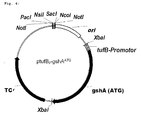
- the resulting construct is named pgshA p -gshA TTG (see Fig. 2 ).
- the plasmid pACYC184-tufBp served as a template for a total of 3 optimizations (mutagenesis) performed on the DNA sequence of the native tufB promoter.
- mutagenesis agenesis performed on the DNA sequence of the native tufB promoter.
- the ribosome binding site (RBS), the -10 region, and the tufB promoter region were optimized to ultimately account for the corresponding consensus sequences of these prokaryotic promoter elements encoded (see Table 1).
- Table 1 Comparison of the DNA sequences of the RBS, -10 region and the -35 region of the tufB promoter with the corresponding consensus sequences.
- the mutagenized nucleotides are bold ⁇ / b> mar ⁇ b>.
- ⁇ / B> element in the tufB promoter consensus sequence RBS 5'-A CTT GG - 3 ' 5'-AGGAGG - 3 ' -10 region 5'-TA G AAT - 3 ' 5'-TATAAT - 3 ' -35 region 5'-TTG CAT - 3 ' 5'-TTGACA - 3 '
- the mutagenesis primers tufB p -RBS opt -for (SEQ ID No. 17) and tufB p -RBS opt -rev (SEQ ID No. 18) were used. used.
- pACYC184-tufBp (RBS -10) opt .
- the plasmid pACYC184-tufB p (RBS 10) opt served as a template for mutagenesis of the -35 region which rev with primers tufB p opt -for -35 (SEQ ID No. 21) and tufB p -35 opt (SEQ ID No. 22).
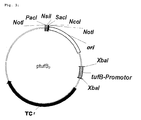
- the resulting sequencing-screened plasmid with optimized RBS, -10 region, and -35 region is called ptufB p .
- a restriction and function map of the resulting plasmid ptufB p is in Fig. 3 shown.
- the serA gene with its own promoter was first amplified by PCR.
- As a template for the PCR reaction served chromosomal DNA of E. coli strain W3110 (ATCC 27325).
- the oligonucleotides serA-NcoI-for (SEQ ID No. 23) and serA-SacI-rev (SEQ ID No. 24) were used.
- the amplified serA gene including its own promoter, was subsequently digested with the enzymes NcoI and SacI and, after purification, ligated over an agarose gel into the NcoI and SacI-cut vector ptufB p -gshA ATG .
- the ligation mixture was transformed into "DH5 ⁇ TM -T1R E. coli cells" (Life Technologies GmbH), multiplied in these cells and the DNA sequence of the isolated plasmids verified by means of sequencing.
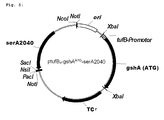
- the gshA plasmid derived from this cloning with serA under the control of the native promoter was designated ptufB p -gshA ATG -serA.
- the gshA plasmids with different cysE alleles resulting from this cloning were designated ptufB p -gshA ATG -cysE ..., where ... corresponds to the respective cysE allele number (see, for example, US Pat Fig. 6 for ptufB p -gshA ATG -cysE14).
- the gshA plasmids resulting from this cloning with different cysE and serA alleles were designated ptufB p -gshA ATG -cysE ... serA ..., where ... corresponds to the respective cysE or serA allele number (see eg Fig. 7 for ptufB p -gshA ATG- cysE14-serA2040).
- Encoding the approximately 1.2 kb fragment encoding the O-acetylserine / cysteine exporter (EAMA, ydeD) was purified on an agarose gel, and then into one of the linearized with NsiI and PacI vectors ptufB p - ptufB p -gshA ATG -serA. .., gshA ATG -cysE ... or ptufB p -gshA ATG -cysE ...- serA ... ligated.
- Example 7 Transformation of E. coli strains W3110 (ATCC 27325) and W3110 ⁇ gshB
- total ⁇ -glutamylcysteine summarizes ⁇ -glutamylcysteine and the oxidation products formed therefrom bis- ⁇ -glutamylcystine and ⁇ -glutamylcystine, which are formed during the fermentation and accumulate in the culture supernatant.
- concentrations of "total ⁇ -glutamylcysteine" were determined by means of HPLC analysis.
- the microorganisms were first separated from the fermentation broth by a centrifugation step and subsequent sterile filtration.
- the ⁇ -glutamylcysteine derivatives in the sample to be measured were reduced for 1 hour at room temperature (22 ° C.) with a molar excess of dithiothreitol (DTT). Since the reducing action of DTT is complete only at neutral to alkaline pH, the pH of the sample was previously adjusted to pH> 7.0, if necessary, with concentrated potassium hydroxide (KOH).
- DTT dithiothreitol
- the HPLC analysis was carried out with the column Synergi 4 micron Hydro-RP 250 x 4.6 mm (Phenomenex Ltd., Aillesburg, D) at 20 ° C.
- the eluent used was 0.5% (v / v) phosphoric acid (A) or acetonitrile (B).
- the reference substance used to determine the retention time of ⁇ -glutamylcysteine and the final concentration in the samples to be measured was reduced ⁇ -glutamylcysteine from Sigma Aldrich GmbH (Steinheim, D).
- the concentration of "total ⁇ -glutamylcysteine" was calculated from the peak areas in the chromatogram (see Fig. 11 ).
- the reaction mixture of the underlying ⁇ -glutamylcysteine formation assay is composed as follows: 100 mM Tris-HCl pH 8.2; 10 mM potassium glutamate; 10 mM L-cysteine; 20 mM MgCl 2 ; 150 mM KCl; 20 mM ATP and 0.25 to 4 mg / ml crude extract protein.
- the ATP-dependent formation of ⁇ -glutamylcysteine from L-cysteine and potassium glutamate was started by adding crude extract protein. Over a period of at least 2 hours aliquots (20 ⁇ l to 50 ⁇ l) were taken from the reaction mixture.
- ⁇ -glutamylcysteine synthetase activity in the aliquots was inactivated for 5 minutes at 70 ° C and the content of ⁇ -glutamylcysteine formed was determined by HPLC (see Example 8).
- One unit of ⁇ -glutamylcysteine synthetase activity corresponds to the amount of enzyme which forms one ⁇ mol of ⁇ -glutamylcysteine per minute at 25 ° C.
- a portion of the respective preculture 1 was inoculated into a fermenter filled with fermentation medium type Sixfors (Infors AG, Bottmingen, CH), so initially an optical density of about 0.01 in the fermenter was present (measured at 600 nm).
- the fermenter used had a total volume of 1 l and an initial working volume of 0.7 l.
- the fermentation medium contained the following components: 3 g / l (NH 4 ) 2 SO 4 , 1.7 g / l KH 2 PO 4 , 0.25 g / l NaCl, 0.6 g / l MgSO 4 .7H 2 O , 0.03 g / l CaCl 2 ⁇ 2 H 2 O, 0.15 g / l FeSO 4 ⁇ 7 H 2 O, 1 g / l Na 3 citrate ⁇ 2 H 2 O, 5 g / l Cornsteep Dry (CSD ) and 3 ml / l trace element solution (consisting of 2.5 g / l H 3 BO 3 , 0.7 g / l CoCl 2 ⁇ 6 H 2 O, 0.25 g / l CuSO 4 ⁇ 5 H 2 O, 1 , 6 g / l MnCl 2 ⁇ 4 H 2 O, 0.3 g / l ZnSO 4 ⁇ 7 H 2 O, 0.15
- the pH in the fermenter was adjusted to 7.0 by addition of a 25% NH 4 OH solution. During the fermentation, the pH was maintained at a value of 7.0 by automatic correction with 25% NH 4 OH.
- the cultures were initially stirred at 400 rpm and gassed at a gassing rate of 0.7 volume per volume per minute (vvm) of compressed air sterilized via a sterile filter. Under these start conditions, the oxygen probe was calibrated to 100% saturation prior to inoculation.
- the target value for the O 2 saturation during the fermentation was set to 50%. After lowering the O 2 saturation below the target value, a regulatory cascade was started to bring the O 2 saturation back to the target value.
- the gas supply was initially increased continuously (to a maximum of 1.4 vvm) and then the stirring speed was increased continuously to a maximum of 1,200 rpm.
- the fermentation was carried out at a temperature of 32 ° C until an optical density of 30 to 40 was reached (measured at 600 nm). This was usually the case after about 17 h.
- the fermentations were carried out in fermenters of the BIOSTAT B-DCU type from Sartorius Stedim GmbH (Göttingen, Germany). A culture vessel with 2 l total volume was used at an initial working volume of 1 l.
- the fermentation medium contains the following components: 3 g / l (NH 4 ) 2 SO 4 , 1.7 g / l KH 2 PO 4 , 0.25 g / l NaCl, 0.6 g / l MgSO 4 .7H 2 O , 0.03 g / l CaCl 2 ⁇ 2 H 2 O, 0.15 g / l FeSO 4 ⁇ 7 H 2 O, 1 g / l Na 3 citrate ⁇ 2 H 2 O, 15 g / l Cornsteep Dry (CSD ) and 3 ml / l trace element solution (consisting of 2.5 g / l H 3 BO 3 , 0.7 g / l CoCl 2 ⁇ 6 H 2 O, 0.25 g / l CuSO 4 ⁇ 5 H 2 O, 1 , 6 g / l MnCl 2 ⁇ 4 H 2 O, 0.3 g / l ZnSO 4 ⁇ 7 H 2 O, 0.15
- the main culture For inoculating the main culture, 100 ml of preculture 2 were transferred to the fermenter vessel.
- the pH in the fermenter was initially adjusted to 7.0 by addition of a 25% NH 4 OH solution and maintained at this value by automatic correction with 25% NH 4 OH.
- the cultures were initially stirred at 400 rpm and gassed with a gassing rate of 2 vvm compressed air sterilized via a sterile filter. Under these start conditions, the oxygen probe was calibrated to 100% saturation prior to inoculation.
- the target value for the O 2 saturation during the fermentation was set to 50%. After lowering the O 2 saturation below the target value, a regulatory cascade was started to bring the O 2 saturation back to the target value.
- the gas supply was initially increased continuously (to a maximum of 5 vvm) and then the stirring speed was increased continuously to a maximum of 1,500 rpm.
- the fermentations were carried out at a temperature of 32 ° C. As soon as the glucose content in the fermenter had dropped from initially 10 g / l to approximately 2 g / l, a continuous metered addition of a 60% glucose solution took place. The feeding rate was adjusted so that the glucose concentration in the fermenter no longer exceeded 2 g / l.
- the glucose determination was carried out with a YSI glucose analyzer (Yellow Springs, Ohio, USA).
- ⁇ GC total ⁇ -glutamylcysteine
- ⁇ / B E. coli strain Total ⁇ -glutamylcysteine (g / L) 24 hours 48 h 72 h W3110 / pACYC184-LH 0 0 0 W3110 / pgshA p -gshA TTG 0.2 ⁇ 0.0 0.3 ⁇ 0.0 0.3 ⁇ 0.0 W3110 / ptufB p -gshA ATG 1.2 ⁇ 0.0 1.4 ⁇ 0.0 1.5 ⁇ 0.1 W3110 ⁇ gshB / pACYC184-LH 2.2 ⁇ 0.1 2.7 ⁇ 0.1 2.9 ⁇ 0.2 W3110 ⁇ gshB / pgshA p -gshA TTG (*) 3.4 ⁇ 0.2 5.4
Landscapes
- Chemical & Material Sciences (AREA)
- Life Sciences & Earth Sciences (AREA)
- Organic Chemistry (AREA)
- Health & Medical Sciences (AREA)
- Zoology (AREA)
- Engineering & Computer Science (AREA)
- Wood Science & Technology (AREA)
- Genetics & Genomics (AREA)
- Bioinformatics & Cheminformatics (AREA)
- Biochemistry (AREA)
- General Health & Medical Sciences (AREA)
- General Engineering & Computer Science (AREA)
- Molecular Biology (AREA)
- Biotechnology (AREA)
- Microbiology (AREA)
- Medicinal Chemistry (AREA)
- Proteomics, Peptides & Aminoacids (AREA)
- Biomedical Technology (AREA)
- Chemical Kinetics & Catalysis (AREA)
- General Chemical & Material Sciences (AREA)
- Biophysics (AREA)
- Preparation Of Compounds By Using Micro-Organisms (AREA)
- Micro-Organisms Or Cultivation Processes Thereof (AREA)
- Enzymes And Modification Thereof (AREA)
Abstract
Die Erfindung betrifft einen zur Überproduktion von ³-Glutamylcystein und dessen Derivaten bis-³-Glutamylcystin und ³-Glutamylcystin befähigten prokaryotischen Mikroorganismenstamm, herstellbar aus einem Ausgangsstamm, dadurch gekennzeichnet, dass er im Vergleich zu dem Ausgangsstamm eine verminderte zelluläre Glutathion-Synthetase-Aktivität besitzt, und eine zelluläre ³-Glutamylcystein-Synthetase-Aktivität aufweist, die stärker erhöht ist als in einem Stamm mit gleichartig verminderter zellulärer Glutathion-Synthetase-Aktivität.
Description
- Die Erfindung betrifft einen prokaryotischen Mikroorganismenstamm, welcher zur Überproduktion von γ-Glutamylcystein (γGC) und den Derivaten dieses Dipeptids, γ-Glutamylcystin und bis-γ-Glutamylcystin geeignet ist, sowie Verfahren zur Herstellung dieser Verbindungen.
- γ-Glutamylcystein ist ein Dipeptid, das in Zellen prokaryotischer und eukaryotischer Organismen durch Verknüpfung der Aminosäuren L-Cystein und L-Glutaminsäure entsteht.
- Bis-γ-Glutamylcystin ist ein Disulfid, das bei der Oxidation von zwei Molekülen γ-Glutamylcystein entsteht. Diese Reaktion ist reversibel, was bedeutet, dass bis-γ-Glutamylcystin durch Reduktion (z.B. enzymatisch oder chemisch) wieder in γ-Glutamylcystein überführt werden kann.
- γ-Glutamylcystin ist ein Disulfid, das bei der Oxidation von einem Molekül γ-Glutamylcystein mit einem Molekül L-Cystein entsteht. Diese Reaktion ist reversibel, was bedeutet, dass γ-Glutamylcystin durch Reduktion (z.B. chemisch) wieder in γ-Glutamylcystein und L-Cystein überführt werden kann.
- Die Thiolverbindung γ-Glutamylcystein dient in zahlreichen Organismen als Vorstufe von Glutathion. Der erste Schritt der Glutathion-Biosynthese ist die Knüpfung einer γ-Peptidbindung zwischen der α-Aminogruppe von L-Cystein und der γ-Carboxygruppe von L-Glutaminsäure durch das ATP-abhängige Enzym γ-Glutamylcystein-Synthetase. Diese Reaktion stellt zudem den limitierenden Schritt der Glutathion-Biosynthese dar, da das Enzym γ-Glutamylcystein-Synthetase durch Glutathion gehemmt wird. Der zweite Schritt der Glutathion-Biosynthese ist die Reaktion von L-Glycin mit γ-Glutamylcystein zu Glutathion, wobei L-Glycin über eine α-Peptidbindung mit der Cysteinyl-Funktion von γ-Glutamylcystein verknüpft wird. Diese ebenfalls ATP-abhängige Reaktion wird durch das Enzym Glutathion-Synthetase katalysiert.
- Aufgrund seiner antioxidativen Eigenschaften nimmt Glutathion eine Schlüsselrolle in den Zellen ein und ist als Reduktionsmittel, Co-Substrat und Co-Faktor an zahlreichen zellulären Prozessen beteiligt. Es sind aber auch Glutathion-defiziente Organismen bekannt, in denen die Glutathion-Vorstufe, γ-Glutamylcystein, die biologischen Aufgaben von Glutathion übernimmt. Als Beispiele sind Vertreter der halophilen Archaebakterien wie z.B. Halobacterium halobium genannt (Sundquist und Fahey, 1989, J. Biol. Chem. 264: 719-725).
- In der Literatur sind zudem verschiedene Glutathion-defiziente Mikroorganismen-Stämme verschiedener Spezies beschrieben, z.B. von Saccharomyces cerevisiae (Grant et al., 1997, Mol. Biol. Cell. 8: 1699-1707), Synechocystis sp. (Cameron und Pakrasi, 2011, Plant Signal. Behav. 6: 89-92) oder Eschericha coli (Fuchs und Warner, 1975, J. Bacteriol. 124: 140-148). Diese Stämme besitzen Mutationen oder Deletionen im entsprechenden Glutathion-Synthetase-codierenden Gen (z.B. gshB für E. coli und Synechocystis sp. oder gsh2 für S. cerevisiae). Durch Veränderung oder Verlust der Glutathion-Synthetase-Aktivität sind diese Stämme nicht mehr, oder nur in begrenztem Maße, in der Lage, Glutathion zu synthetisieren. Infolge dessen steigt der zelluläre γ-Glutamylcystein-Spiegel an. Diese mutierten Stämme sind lebensfähig, da das verstärkt gebildete und nun in erhöhter Konzentration vorliegende γ-Glutamylcystein zahlreiche Glutathion-spezifische Funktionen übernimmt. Sie zeichnen sich aber gegenüber den entsprechenden Wildtyp-Stämmen oftmals durch eine erhöhte Anfälligkeit gegenüber reaktiven Sauerstoffspezies und Schwermetallionen aus, sodass sie teilweise in ihrem Wachstum beeinträchtigt sind (Cameron und Pakrasi, 2011, Plant Signal. Behav. 6: 89-92; Helbig et al., 2008, J. Bacteriol. 190: 5439-5454).
- Die Entgiftung von reaktiven Sauerstoffspezies, Schwermetallionen und Xenobiotika geschieht in vielen Organsismen, u.a. auch im Menschen, sehr häufig mit Hilfe von Glutathion (Grant et al., Mol. Biol. Cell. 8: 1699-1707). Ein niedriger Glutathion-Spiegel ist zudem oft ein Symptom und/oder Grund für verschiedene Krankheiten wie Autismus, Parkinson, Cystische Fibrose, HIV, Krebs oder Schizophrenie (Wu et al., 2004, J. Nutr. 134: 489-492). Daher besteht ein großes Interesse den intrazellulären Glutathion-Spiegel konstant zu halten oder gar zu erhöhen. γ-Glutamylcystein wurde bereits als vielversprechende Substanz zur Erhöhung des zellulären Glutathion-Spiegels erfolgreich getestet (Anderson und Meister, 1983, P.N.A.S. 80: 707-711).
-
WO2006102722 beschreibt ein enzymatisches Verfahren zur Herstellung von γ-Glutamylcystein, welches auf der Umsetzung von Cystein-Derivaten und einem γ-Glutamyldonor mit Hilfe einer immobilisierten γ-Glutamylcystein-Transpeptidase basiert. - Als mikrobielle γ-Glutamylcystein-Produzenten gelten hauptsächlich Pilzstämme der Ordnung Saccharomycetales, wie z.B. Saccharomyces cerevisiae oder Candida utilis, welche aber vorrangig für die Glutathion-Produktion genutzt werden. Derartige Stämme sind beispielsweise offenbart in
WO2010116833A1 ,US7371557B2 undUS2005074835A1 . Andere Pilzstämme derselben Ordnung mit einer ausschließlich erhöhten γ-Glutamylcystein-Produktionsleistung sind u.a. inEP2251413A1 ,US7569360B2 ,US2004214308A1 ,US2003124684A1 ,US7410790B2 undEP1489173B1 beschrieben. Neben verschiedenen stammspezifischen Charakteristika, wie einer Cerulenin- bzw. nitroso-Guanidin-Resistenz oder einer Pantothensäure-Auxotrophie haben diese Pilzstämme als gemeinsames Merkmal eine reduzierte Glutathion-Synthetase-Aktivität. - Darüber hinaus beschreibt
US2005042328A1 die intrazelluläre Anreicherung von γ-Glutamylcystein in einem C. utilis-Stamm mit reduzierter Glutathion-Synthetase-Aktivität und einer erhöhten gshl-Expression (gshl codiert für γ-Glutamylcystein-Synthetase). - Nachteile der pilzlichen γGC-Produktionssysteme sind die relativ niedrigen γ-Glutamylcystein-Ausbeuten, sowie die intrazelluläre Akkumulation von γ-Glutamylcystein, was einen Aufschluss der pilzlichen Zellen für eine mögliche Aufarbeitung von γ-Glutamylcystein notwendig machen würde.
- Als prokaryotische Produzenten für γ-Glutamylcystein sind in
US20100203592A1 verschiedene E. coli-Stämme beschrieben, welche alle eine erhöhte gshA-Expression aufweisen. Darüber hinaus besitzen diese Stämme eine normale oder erhöhte Glutathionsynthetase-Aktivität im Vergleich zum entsprechenden Ausgangsstamm. Im Gegensatz zu den pilzlichen Systemen ist mit diesen Stämmen eine Sekretion von γ-Glutamylcystein ins Kultivierungsmedium möglich. Die maximalen Ausbeuten mit diesen Stämmen liegen bei 262 mg/l, was für die Etablierung eines wirtschaftlichen Verfahrens nicht ausreichend ist. - Mikroorganismenstämme, welche zur Überproduktion der vielversprechenden bioaktiven Verbindung γ-Glutamylcystein und deren Derivaten bis-γ-Glutamylcystin und γ-Glutamylcystin befähigt sind, und die darüber hinaus die Sekretion dieser Verbindungen ins Kultivierungsmedium im g/l-Maßstab erlauben, existieren noch nicht.
- Aufgabe der vorliegenden Erfindung ist es daher, einen Mikroorganismenstamm zur Verfügung zu stellen, der zur Überproduktion von γ-Glutamylcystein und dessen Derivaten bis-γ-Glutamylcystin und γ-Glutamylcystin befähigt ist und der darüber hinaus die extrazelluläre Akkumulation dieser Verbindungen im Kultivierungsmedium ermöglicht.
- Die Aufgabe wird gelöst durch einen prokaryotischen Mikroorganismenstamm, der aus einem Ausgangsstamm herstellbar ist, und der im Vergleich zu dem Ausgangsstamm eine verminderte zelluläre Glutathion-Synthetase-Aktivität besitzt, und eine zelluläre γ-Glutamylcystein-Synthetase-Aktivität aufweist, die stärker erhöht ist, als in einem Stamm mit gleichartig verminderter zellulärer Glutathion-Synthetase-Aktivität.
- Die Glutathion-Synthetase-Aktivität im erfindungsgemäßen Stamm ist vorzugsweise soweit vermindert, dass sie maximal 50% der Glutathion-Synthetase-Aktivität eines entsprechenden Wildtypstammes beträgt.
- Bevorzugt sind prokaryotische Mikroorganismenstämme, die maximal 25% der Glutathion-Synthetase-Aktivität des Wildtypstammes vor Modifikation seiner Glutathion-Synthetase-Aktivität besitzen. Ganz besonders bevorzugt ist unter einer verminderten Glutathion-Synthetase-Aktivität eines Stammes das Fehlen der Glutathion-Synthetase-Aktivität in diesem Stamm zu verstehen.
- Die γ-Glutamylcystein-Synthetase-Aktivität ist im erfindungsgemäßen Stamm vorzugsweise um mindestens den Faktor 5 höher als in einem Stamm mit gleichartig verminderter Glutathion-Synthetase-Aktivität.
- Besonders bevorzugt sind im erfindungsgemäßen Mikroorganismenstamm sowohl die Glutathion-Synthetase-Aktivität als auch die γ-Glutamylcystein-Synthetase-Aktivität wie vorstehend beschrieben modifiziert.
- Der Grad der DNA-Identitäten wird durch das Programm "nucleotide blast" zu finden auf der Seite http://blast.ncbi.nlm.nih.gov/ bestimmt, welches auf dem blastn-Algorithmus basiert. Als Algorithmus-Parameter für ein Alignment zweier oder mehrerer Nukleotidsequenzen wurden die voreingestellten Parameter genutzt. Die voreingestellten generellen Parameter sind: Max target sequences = 100; Short queries = "Automatically adjust parameters for short input sequences"; Expect Treshold = 10; Word size = 28; Automatically adjust parameters for short input sequences = 0. Die entsprechenden voreingestellten Scoring Parameter sind: Match/Mismatch Scores = 1,-2; Gap Costs = Linear.
- Für den Vergleich von Proteinsequenzen wird das Programm "protein blast", auf der Seite http://blast.ncbi.nlm.nih.gov/, genutzt. Dieses Programm greift auf den blastp-Algorithmus zurück. Als Algorithmus-Parameter für ein Alignment zweier oder mehrerer Proteinsequenzen wurden die voreingestellten Parameter genutzt. Die voreingestellten generellen Parameter sind: Max target sequences = 100; Short queries = "Automatically adjust parameters for short input sequences"; Expect Treshold = 10; Word size = 3; Automatically adjust parameters for short input sequences = 0. Die voreingestellten Scoring Parameter sind: Matrix = BLOSUM62; Gap Costs = Existence: 11 Extension: 1; Compositional adjustments = Conditional compositional score matrix adjustment.
- Als Ausgangsstämme für die Generierung der erfindungsgemäßen Mikroorganismenstämme sind prinzipiell alle prokaryotischen Mikroorganismenstämme geeignet, die den Biosyntheseweg für γ-Glutamylcystein aufweisen, und die durch Fermentation kultivierbar sind. Solche Mikroorganismen können den Domänen der Bacteria (ehemals Eubacteria) oder Archaea (ehemals Archaebacteria) angehören.
- Bevorzugt handelt es sich bei diesen Organismen um Vertreter der phylogenetischen Gruppe der Bacteria. Besonders bevorzugt sind Mikroorganismen der Familie der Enterobacteriaceae, insbesondere die Spezies Escherichia coli und Pantoea ananatis.
- Die γ-Glutamylcystein-Synthetase-Aktivität wird anhand der γ-Glutamylcystein-Bildung über die Zeit gemessen, wie in Beispiel 9 beschrieben.
- Die Glutathion-Synthetase-Aktivität wird anhand der Bildungsrate von ADP mit einem Pyruvatkinase-gekoppelten Enzymtest bestimmt, wobei L-Glycin und L-γ-Glutamyl-L-α-Aminobutyrat als Substrate umgesetzt werden (Kim et al., 2003, J. Biochem. Mol. Biol. 36: 326-331).
- Als Ausgangsstämme für die Generierung der erfindungsgemäßen Mikroorganismen eignen sich bevorzugt prokaryotische Mikroorganismenstämme, die den Biosyntheseweg für γ-Glutamylcystein aufweisen und darüber hinaus eine, im Vergleich zu einem entsprechenden Ausgangsstamm, erhöhte L-Cysteinbiosyntheseleistung besitzen. Eine erhöhte L-Cysteinbiosyntheseleistung ist für die Bildung von γ-Glutamylcystein von Vorteil, da die Bereitstellung ausreichender Mengen an L-Cystein als γ-GlutamylcysteinVorstufe für eine hohe γ-Glutamylcystein-Produktion nicht limitierend sein sollte. Unter einer "erhöhten L-Cystein-Biosyntheseleistung" versteht man im Rahmen der Erfindung die Fähigkeit eines Mikroorganismenstammes, mehr L-Cystein oder dessen Derivate L-Cystin und Thiazolidin zu produzieren als ein entsprechender Wildtyp-, Ausgangs-, oder nicht-modifizierter Stamm. Dies äußert sich typischerweise in einer Anreicherung von L-Cystein, L-Cystin und/oder Thiazolidin im Medium. Eine erhöhte L-Cystein-Biosyntheseleistung liegt demnach vor, wenn während oder am Ende einer, dem Fachmann bekannten, Fermentation des entsprechenden Mikroorganismenstammes mindestens 0,5 g/l "Gesamtcystein" (L-Cystein + L-Cystin + Thiazolidin) im Medium nachgewiesen werden können.
- Potentielle Ausgangsstämme mit einer erhöhten L-Cystein-Biosyntheseleistung, für die Generierung der erfindungsgemäßen Mikroorganismen, sind beispielsweise offenbart in
US20040038352A1 ,US20090053778 ,EP1528108A1 ,EP2345667A2 oderEP2138585 . - Darüber hinaus sind bereits Gene oder Varianten dieser Gene (Allele) im Stand der Technik bekannt, deren Einsatz zur Überproduktion der Aminosäure L-Cystein und/oder den Vorstufen L-Serin bzw. O-Acetyl-Serin führen:
- serA-Allele wie beschrieben in
EP0620853B1 ,EP1496111B1 undEP0931833A2 :- Diese serA-allele codieren für 3-Phosphoglycerat-Dehydrogenasen, die einer verminderten Feedback-Hemmung durch L-Serin unterliegen. Dadurch wird die Bildung von 3-Hydroxypyruvat weitgehend vom Serin-Spiegel der Zelle entkoppelt, was einen besseren Stofffluss zum L-Cystein erlaubt.
- cysE-Allele, wie beschrieben in
WO9715673 - Diese cysE-Allele codieren für Serin-O-Acetyl-Transferasen, die einer verminderten Feedback-Hemmung durch L-Cystein unterliegen. Dadurch wird die Bildung von O-Acetyl-Serin und L-Cystein weitgehend vom L-Cystein-Spiegel der Zelle entkoppelt.
- Effluxgene wie beschrieben in
EP885962A1 - Der in
EP885962A1 EP885962 EP1233067B1 ).
- Der in
- cysB beschrieben wie in
DE19949579C1 :- Das cysB-Gen codiert für einen zentralen Regulator des Cysteinstoffwechsels und spielt u.a. eine entscheidende Rolle bei der Bereitstellung von Sulfid für die Cystein-Biosynthese.
- Ein erfindungsgemäßer Mikroorganismenstamm exprimiert vorzugsweise auch eines oder mehrere der vorgenannten Gene bzw. Allele. Besonders bevorzugt wird der Einsatz eines der beschriebenen Allele von cysE oder serA sowie von orf306. Die cysE- und serA-Allele sowie orf306 können dabei einzeln oder zusammen im erfindungsgemäßen Mikroorganismenstamm exprimiert werden. Insbesondere bevorzugt weist ein erfindungsgemäßer Mikroorganismenstamm die in den Beispielen als erfindungsgemäß dargelegten, insbesondere die in Tab. 4 als erfindungsgemäß gekennzeichneten, genetischen Veränderungen auf.
- Ein erfindungsgemäßer Mikroorganismenstamm kann mit Standardtechniken der Molekularbiologie erzeugt werden.
- Die zelluläre Aktivität der γ-Glutamylcystein-Synthetase (GshA) kann zum Beispiel durch Erhöhung der Kopienzahl des gshA-Gens bzw. eines gshA-Homologs oder durch den Einsatz geeigneter Promotoren, welche zu einer verstärkten Expression des gshA-Gens bzw. eines gshA-Homolgs führen, erhöht werden.
- Das gshA-Gen von E. coli codiert für das Enzym γ-Glutamylcystein-Synthetase (GshA). Das gshA-Gen ist charakterisiert durch SEQ ID No. 1. Das GshA-Genprodukt (GshA) ist charakterisiert durch SEQ ID No. 2. Im Rahmen der vorliegenden Erfindung sind gshA-Homologe Gene, die eine Sequenzidentität größer 30% zu SEQ ID No. 1 aufweisen. Besonders bevorzugt weisen gshA-Homologe eine Sequenzidentität größer 70% zu SEQ ID No. 1 auf.
- GshA-Homologe sind Proteine mit einer Sequenzidentität größer 30% zu SEQ ID No. 2. Besonders bevorzugt weisen GshA-Homologe eine Sequenzidentität größer 70% zu SEQ ID No. 2 auf.
- Die Erhöhung der Kopienzahl des gshA-Gens oder eines gshA-Homologs in einem Mikroorganismus kann mit dem Fachmann bekannten Methoden vorgenommen werden. So kann gshA oder ein gshA-Homolog zum Beispiel in Plasmid-Vektoren mit mehrfacher Kopienzahl pro Zelle (z.B. pBR322, pBR-Derivate, pBlueskript, pUC18, pUC19, pACYC184 und pACYC184-Derivate für E. coli) kloniert und in den Mikroorganismus eingebracht werden. Alternativ kann das gshA-Gen oder das gshA-Homolog mehrfach in das Chromosom eines Mikroorganismenstammes integriert werden. Als Integrationsverfahren können die bekannten Systeme mit temperenten Bakteriophagen, integrativen Plasmiden oder die Integration über homologe Rekombination genutzt werden (Hamilton et al., 1989, J. Bacteriol. 171: 4617-4622; Datsenko und Wanner, 2000, P.N.A.S. 97: 6640-6645).
- Bevorzugt ist die Erhöhung der Kopienzahl durch Klonierung von gshA oder eines gshA-Homologs in Plasmid-Vektoren unter der Kontrolle eines Promotors. Besonders bevorzugt ist die Erhöhung der Kopienzahl in E. coli durch Klonierung von gshA oder eines gshA-Homologs in einem pACYC-Derivat wie z.B. pACYC184-LH (hinterlegt gemäß Budapester Vertrag bei der Deutschen Sammlung für Mikroorganismen und Zellkulturen, 83124 Braunschweig, Inhoffenstraße 7B am 18.08.1995 unter Nummer DSM 10172).
- Unter einer Erhöhung der Kopienzahl ist vorzugsweise eine Erhöhung um mindestens den Faktor 10 zu verstehen.
- Die Klonierung des gshA-Gens oder eines gshA-Homologs in Plasmid-Vektoren erfolgt beispielsweise durch spezifische Amplifikation mittels Polymerase-Ketten-Reaktion (PCR) unter Einsatz von spezifischen Primern, die das komplette Gen erfassen, und anschließender Ligation mit Plasmid-DNS-Fragmenten.
- Als Kontrollregion für die Expression Plasmid-codierter Gene kann die natürliche Promotor- und/oder Operatorregion der Gene dienen.
- Eine Erhöhung der Expressionsrate von gshA oder eines gshA-Homologs kann auch mittels anderer Promotoren erfolgen. Entsprechende Promotorsysteme wie beispielsweise in E. coli der konstitutive GAPDH-Promotor des gapA-Gens oder die induzierbaren lac-, tac-, trc, lambda-, ara- oder tet-Promotoren sind dem Fachmann bekannt (Markides S.C., 1996, Microbiol. Rev. 60: 512-538). Solche Konstrukte können in an sich bekannter Weise auf Plasmiden oder chromosomal verwendet werden.
- Des Weiteren kann eine erhöhte zelluläre GshA-Aktivität dadurch erreicht werden, dass Translationsstartsignale, wie z.B. die Ribosomenbindestelle, oder die Shine-Dalgarno-Sequenz in optimierter Sequenz auf dem jeweiligen Konstrukt vorhanden sind, oder dass gemäß der "codon usage" seltene Codons gegen häufiger genutzte Codons ausgetauscht werden.
- Die zelluläre GshA-Aktivität kann auch dadurch erhöht werden, dass eine Mutation (Substitution, Insertion oder Deletion einzelner oder mehrerer Nukleotide) in den Leserahmen des gshA-Gens oder eines gshA-Homologs eingebracht wird, welche dazu führt, dass die spezifische Aktivität von GshA oder eines GshA-Homologs erhöht wird. So führt beispielsweise der Austausch des ungewöhnlichen Startcodons TTG des gshA-Gens gegen das normale Startcodon ATG nicht nur zu einer erhöhten Expression von gshA, sondern auch zu einer Steigerung der zellulären Gesamtaktivität von GshA in E. coli (Kwak et al., 1998, J. Biochem. Mol. Biol. 31: 254-257).
- Auch zielgerichtete Mutationen von gshA, welche auf Proteinebene einen Austausch von Alanin 494 gegen Valin oder Leucin (A494V oder A494L) bzw. eine Substitution von Serin an Position 495 gegen Threonin (S495T) zur Folge haben, führen in E. coli zu einer erhöhten zellulären GshA-Aktivität (Kwak et al., 1998, J. Biochem. Mol. Biol. 31: 254-257). Derartige Allele sind daher erfindungsgemäß bevorzugte gshA-Homologe.
- Verfahren zur Verminderung der Glutathionsynthetase-Aktivität in einem Mikroorganismenstamm sind ebenfalls im Stand der Technik bekannt. Die zelluläre Glutathionsynthetase-Aktivität kann beispielsweise dadurch vermindert werden, dass eine Mutation (Substitution, Insertion oder Deletion einzelner oder mehrerer Nukleotide) in den Leserahmen des gshB-Gens oder eines gshB-Homologs eingebracht wird, welche dazu führt, dass die spezifische Aktivität von GshB oder eines GshB-Homologs vermindert wird. Dem Fachmann sind Verfahren zur Erzeugung solcher gshB-Allele bekannt. Allele des gshB-Gens kann man beispielsweise durch unspezifische oder gezielte Mutagenese mit der DNS des gshB-Wildtyp-Gens als Ausgangsmaterial herstellen. Beispiele solcher Allele, welche für GshB-Varianten mit einer verringerten GshB-Aktivität im Vergleich zum Wildtyp-Enzym codieren, sind beispielsweise in Kato et al. (1988, J. Biol. Chem. 263: 11646-11651) beschrieben.
- Unspezifische Mutationen innerhalb des gshB-Gens oder des Promotorbereichs des gshB-Gens können z.B. durch chemische Agentien wie Nitrosoguanidin, Ethylmethansulfonsäure u.ä. und/oder durch physikalische Methoden und/oder durch unter bestimmten Bedingungen durchgeführte PCR-Reaktionen erzeugt werden. Methoden zur Einführung von Mutationen an spezifischen Positionen innerhalb eines DNS-Fragmentes sind bekannt. So kann beispielsweise der Austausch einer oder mehrerer Basen in einem DNS-Fragment, welches das gshB-Gen und dessen Promotorregion umfasst, mittels PCR unter Verwendung geeigneter Oligonukleotide als Primer erfolgen. Außerdem ist es möglich, das gesamte gshB-Gen bzw. ein neues gshB-Allel mittels Gensynthese herzustellen.
- gshB-Allele werden in der Regel zunächst in vitro erzeugt und anschließend in das Chromosom der Zelle eingebracht, wodurch das ursprünglich vorhandene gshB-Wildtyp-Gen ersetzt und somit eine gshB-Mutante des Stammes erzeugt wird. gshB-Allele können mittels bekannter Standardmethoden in das Chromosom einer Wirtszelle anstelle des gshB-Wildtyp-Gens eingebracht werden. Dies kann beispielsweise mittels des in Link et al. (1997, J. Bacteriol. 179: 6228-37) beschriebenen Verfahrens zur Einführung chromosomaler Mutationen in ein Gen über den Mechanismus der homologen Rekombination erfolgen. Die chromosomale Deletion des gesamten gshB-Gens oder eines Teils davon ist beispielsweise mit Hilfe des λ-Red Rekombinase-Systems nach der von Datsenko und Wanner (2000, Proc. Natl. Acad. Sci. U S A. 97: 6640-5) beschriebenen Methode möglich. gshB-Allele können auch über eine Transduktion mittels P1-Phagen oder Konjugation aus einem Stamm mit gshB-Mutation auf einen gshB-Wildtyp-Stamm übertragen werden, wobei das gshB-Wildtyp-Gen im Chromosom gegen das entsprechende gshB-Allel ersetzt wird.
- Darüber hinaus kann die Glutathionsynthetase-Aktivität einer Zelle auch dadurch verringert werden, dass mindestens ein für die Expressionsregulation notwendiges Element (z.B. Promotor, Enhancer, Ribosomen-Bindestelle) durch Substitution, Insertion oder Deletion einzelner oder mehrerer Nukleotide mutiert wird.
- Das gshB-Gen von E. coli codiert für das Enzym Glutathion-Synthetase. Das gshB-Gen ist charakterisiert durch SEQ ID No. 3. Das GshB-Genprodukt (GshB) ist charakterisiert durch SEQ ID No. 4.
- Im Rahmen der vorliegenden Erfindung sind gshB-Homologe Gene, die eine Sequenzidentität größer 30% zu SEQ ID No. 3 aufweisen. Besonders bevorzugt ist eine Sequenzidentität größer 70% zu SEQ ID No. 3. GshB-Homologe sind Proteine mit einer Sequenzidentität größer 30% zu SEQ ID No. 4. Besonders bevorzugt weisen GshB-Homologe eine Sequenzidentität größer 70% zu SEQ ID No. 4 auf.
- Die Erfindung betrifft ferner ein Verfahren zur Überproduktion von γ-Glutamylcystein (γGC) und den Derivaten dieses Dipeptids, γ-Glutamylcystin und bis-γ-Glutamylcystin, welches dadurch gekennzeichnet ist, dass ein erfindungsgemäßer Mikroorganismus in einem Fermentationsmedium kultiviert wird, die Zellen aus dem Medium entfernt werden und die gewünschten Produkte aus dem Kulturmedium aufgereinigt werden.
- Die Kultivierung (Fermentation) der für das erfindungsgemäße Verfahren notwendigen Mikroorganismen erfolgt im technischen Maßstab nach üblichen, dem Fachmann bekannten Fermentationsverfahren in einem Bioreaktor (Fermenter).
- Die Fermentation findet vorzugsweise in einem üblichen Bioreaktor, beispielsweise einem Rührkessel, einem Blasensäulen-Fermenter oder einem Airlift-Fermenter statt. Besonders bevorzugt ist ein Rührkessel-Fermenter. Unter technischem Maßstab ist dabei eine Fermentergröße von mindestens 2 l zu verstehen. Bevorzugt sind Fermenter mit einem Volumen von mehr als 5 l, besonders bevorzugt Fermenter mit einem Volumen von > 50 l. Die Kultivierung der Zellen für eine γ-Glutamylcystein-Produktion wird unter aeroben Wachstumsbedingungen durchgeführt, wobei der Sauerstoff-Gehalt während der Fermentation bei maximal 50 % Sättigung eingestellt wird. Die Regulation der Sauerstoff-Sättigung in der Kultur erfolgt dabei automatisch über die Gaszufuhr und die Rührgeschwindigkeit.
- Als Kohlenstoffquelle dienen vorzugsweise Zucker, Zuckeralkohole, organische Säuren oder zuckerhaltige Pflanzenhydrolysate. Besonders bevorzugt werden im erfindungsgemäßen Verfahren als Kohlenstoffquelle Glukose, Fruktose, Laktose, Glycerin oder Gemische, die zwei oder mehr dieser Verbindungen enthalten, eingesetzt.
- Bevorzugt wird die Kohlenstoffquelle der Kultur so zudosiert, dass der Gehalt der Kohlenstoffquelle im Fermenter während der Produktionsphase 10 g/l nicht übersteigt. Bevorzugt ist eine maximale Konzentration von 2 g/l.
- Als Stickstoff-Quelle werden im erfindungsgemäßen Verfahren vorzugsweise Ammoniak, Ammoniumsalze oder Proteinhydrolysate verwendet. Bei der Verwendung von Ammoniak als Korrekturmittel zur pH-Stabilisierung wird während der Fermentation regelmäßig diese Stickstoff-Quelle nachdosiert.
- Als weitere Medienzusätze können Salze der Elemente Phosphor, Chlor, Natrium, Magnesium, Stickstoff, Kalium, Calcium, Eisen und in Spuren, d.h. in µM-Konzentrationen, Salze der Elemente Molybdän, Bor, Kobalt, Mangan, Zink und Nickel zugesetzt werden.
- Des Weiteren können organische Säuren (z.B. Acetat, Citrat), Aminosäuren (z.B. L-Glutaminsäure, L-Cystein) und Vitamine (z.B. B1, B6) dem Medium zugesetzt werden.
L-Glutaminsäure kann dabei entweder direkt als Säure oder in Form eines ihrer Salze, wie z.B. Kalium- oder Natrium-Glutamat, einzeln oder als Gemisch, eingesetzt werden. Bevorzugt ist der Einsatz in Form von Kalium-Glutamat. - Als komplexe Nährstoffquellen können z.B. Hefeextrakt, Maisquellwasser, Sojamehl oder Malzextrakt zum Einsatz kommen.
- Die Inkubationstemperatur für mesophile Mikroorganismen wie z.B. E. coli beträgt vorzugsweise 15 - 45 °C, besonders bevorzugt 30 - 37 °C.
- Die Produktionsphase des erfindungsgemäßen Fermentationsverfahrens beginnt mit dem Zeitpunkt, ab dem erstmals γ-Glutamylcystein, bis-γ-Glutamylcystin oder γ-Glutamylcystin in der Kulturbrühe nachgewiesen werden kann. Typischerweise beginnt diese Phase ca. 8-12 h nach Inokulation des Produktionsfermenters mit einer Vorkultur.
- Mikroorganismen, die nach dem beschriebenen Verfahren fermentiert werden, sezernieren in einem Batch- oder Fedbatch-Prozess nach einer Anwachsphase in einem Zeitraum von mindestens 48 h Stunden γ-Glutamylcystein und die davon abgeleiteten Verbindungen γ-Glutamylcystin und bis-γ-Glutamylcystin mit hoher Effizienz in das Fermentationsmedium.
- Im Rahmen der Erfindung ist unter der Überproduktion von γ-Glutamylcystein vorzugsweise die Fähigkeit eines Mikroorganismusstammes zu verstehen, mehr γ-Glutamylcystein oder dessen Derivate γ-Glutamylcystin und bis-γ-Glutamylcystin zu produzieren als ein entsprechender Wildtyp-, Ausgangs-, oder nicht-modifizierter Stamm. Dies äußert sich typischerweise in einer Anreicherung von γ-Glutamylcystein, γ-Glutamylcystin und/oder bis-γ-Glutamylcystin im Medium. Eine Überproduktion von γ-Glutamylcystein liegt demnach vor, wenn am Ende einer Fermentation des entsprechenden Mikroorganismenstammes Ausbeuten von mindestens 0,2 g/l "Gesamt-γ-Glutamycystein" (γ-Glutamycystein + γ-Glutamycystin + bis-γ-Glutamylcystin) im Medium nachgewiesen werden können. Bevorzugt werden Ausbeuten an "Gesamt-γ-Glutamycystein" im Medium im Bereich von 3 bis 23 g/l, so wie sie beispielsweise mit den in den Tabellen 3 und 4 aufgeführten erfindungsgemäßen Mikroorganismen erzielt werden können. Besonders bevorzugt sind, hinsichtlich der Etablierung eines wirtschaftlichen Verfahrens, Ausbeuten im Bereich von 10 bis 23 g/l an "Gesamt-γ-Glutamycystein" im Medium.
-
Fig. 1 zeigt eine Restriktions- und Funktionskarte von Plasmid pACYC184-LH. -
Fig. 2 zeigt eine Restriktions- und Funktionskarte von pgshAp-gshATTG. -
Fig. 3 zeigt eine Restriktions- und Funktionskarte von ptufB. -
Fig. 4 zeigt eine Restriktions- und Funktionskarte von ptufBp-gshAATG. -
Fig. 5 zeigt eine Restriktions- und Funktionskarte von pgshAATC-serA2040. -
Fig. 6 zeigt eine Restriktions- und Funktionskarte von pgshAATC-cysE14. -
Fig. 7 zeigt eine Restriktions- und Funktionskarte von pgshAATC-cysE14-serA2040. -
Fig. 8 zeigt eine Restriktions- und Funktionskarte von pgshAATG-serA2040-orf306. -
Fig. 9 zeigt eine Restriktions- und Funktionskarte von pgshAATG-cysE14-orf306. -
Fig. 10 zeigt eine Restriktions- und Funktionskarte von pgshAATG-cysE14-serA2040-orf306. -
Fig. 11 zeigt HPLC-Chromatogramme von A) einer unbehandelten (oxidierten) Probe und B) einer mit DTT behandelten (reduzierten) Probe. - Die folgenden Beispiele dienen der weiteren Erläuterung der Erfindung.
- Das Gen gshB, welches in E. coli für das Enzym Glutathion-Synthetase (GshB) codiert, wurde nach der von Datsenko und Wanner entwickelten "λ-Red-Methode" im E. coli Stamm W3110 (ATCC27325) deletiert (Datsenko und Wanner, 2000, P.N.A.S. 97: 6640-6645). Ein DNS-Fragment, welches für den Kanamycin-Resistenzmarker (kanR) codiert, wurde mit den Primern gshB-del-for (SEQ ID No. 5) und gshB-del-rev (SEQ ID No. 6) amplifiziert.
- Der Primer gshB-del-for codiert für eine Sequenz, bestehend aus 30 Nukleotiden, welche homolog zum 5'-Ende des gshB-Gens ist, und eine 20 Nukleotide umfassende Sequenz, die komplementär zu einer DNS-Sequenz ist, welche eine der beiden FRT-sites (FLPrecognition target) auf dem Plasmid pKD13 (Coli Genetic Stock Center (CGSC) No. 7633) codiert. Der Primer gshB-del-rev codiert für eine Sequenz, bestehend aus 30 Nukleotiden, welche homolog zum 3'-Ende des gshB-Gens ist, und eine 20 Nukleotide umfassende Sequenz, die komplementär zu einer DNS-Sequenz ist, welche die zweite FRT-site auf dem Plasmid pKD13 codiert.
- Das amplifizierte PCR-Produkt wurde, wie in Beispiel 2 von
US5972663A beschrieben, mittels Elektroporation in den E-scherichia coli Stamm W3110 (ATCC27325) transformiert. Die Selektion der transformierten, gshB-defizienten Zellen erfolgte auf LB-Agarplatten, die 50 mg/l Kanamycin enthielten. Die Entfernung des Markergens (Kanamycin-Resistenz, kanR) erfolgte mit dem Enzym FLP-Rekombinase, welches auf dem Plasmid pCP20 (CGSC No. 7629) codiert ist. Aufgrund eines temperatursensitiven "origin of replication" (ori) kann das Plasmid pCP20 nach erfolgter Transformation durch Inkubation der E. coli Zellen bei 43°C wieder entfernt werden. Der auf diese Art und Weise generierte E. coli gshB-Deletionsstamm trägt die Bezeichnung W3110ΔgshB. - Die Promotorsequenz des gshA-Gens in E. coli ist bekannt (Watanabe et al., 1986, Nucleic Acids Res. 14: 4393-4400). Ein DNS-Fragment, welches für das gshA-Gen und den gshA-Promotor (gshAp) aus E. coli codiert, wurde mittels PCR amplifiziert. Das DNS-Fragment, welches für die Promotorsequenz des gshA-Gens codiert, wurde mit den Primern gshAp-gshA-for (SEQ ID No. 7) und gshAp-gshA-rev (SEQ ID No. 8) amplifiziert. Als Matrize für die PCR-Reaktion diente chromosomale DNS des E. coli Stammes W3110 (ATCC 27325).
- Das etwa 1,9 kb große PCR-Fragment wurde über eine Agarose-Gelelektrophorese gereinigt und mit dem "QIAquick Gel Extraction Kit" (Qiagen GmbH, Hilden, D) nach Angaben des Herstellers aus dem Agarosegel isoliert. Anschließend wurde das gereinigte PCR-Fragment mit dem Restriktionsenzym XbaI verdaut und bei -20°C gelagert.
- Das Gen gshA aus E. coli wurde mittels PCR amplifiziert. Als Matrize für die PCR-Reaktion diente chromosomale DNS des E. coli Stammes W3110 (ATCC 27325). Für die Amplifikation wurde eine Taq-Polymerase (Qiagen GmbH) verwendet, die ein zusätzliches Adenin an das jeweilige 3'-Ende des PCR-Produkts anfügt. Im Zuge der Amplifikation von gshA wurde, durch den Einsatz eines geeigneten Primers, das ungewöhnliche Startcodon TTG gegen das Startcodon ATG ersetzt. Als spezifische Primer dienten die Oligonukleotide gshA-OE-for (SEQ ID NO. 9) und gshA-OE-rev (SEQ ID NO. 10)
- Das resultierende 1,6 kb große DNS-Fragment wurde mit Hilfe einer Agarose-Gelelektrophorese gereinigt und mit dem "QIAquick Gel Extraction Kit" (Qiagen GmbH) aus dem Agarosegel isoliert. Die Ligation des amplifizierten und gereinigten PCR-Produkts mit dem Vektor pCR2.1-TOPO (Life Technologies, Life Technologies GmbH, Darmstadt, D) erfolgte über eine "TA-Klonierung" mit dem "TOPO® TA Cloning® Kit with PCR®2.1 TOPO®", nach Angaben des Herstellers (Life Technologies GmbH).
- Der Ligationsansatz wurde in "DH5α™-T1R E. coli-Zellen" (Life Technologies) transformiert, in diesen Zellen vermehrt und nach einer Plasmidisolierung wurde die DNS-Sequenz der Plasmide mittels Sequenzierung verifiziert. Das resultierende Konstrukt mit gewünschter Sequenz trägt die Bezeichnung pCR2.1-gshA.
- Für eine Umklonierung von gshA wurden zunächst die zwei störenden Restriktionsschnittstellen EcoRI und BglII im gshA-Gen mittels gerichteter Mutagenese entfernt. Die Mutagenesereaktionen wurden mit dem "GeneTailor™ Site-Directed Mutagenesis System" (Life Technologies GmbH) nach Angaben des Herstellers durchgeführt. Als Matrize für die erste Mutagenese diente das Plasmid pCR2.1-gshA. Für die Entfernung der EcoRI-Schnittstelle im gshA-Gen wurden die Mutageneseprimer gshA-EcoRImut-for (SEQ ID No. 11) und gshA-EcoRImut-rev (SEQ ID No. 12) verwendet. Im Anschluss an die durchgeführte Mutagenese der EcoRI-Schnittstelle im gshA-Gen wurde ein Teil der Mutagensereaktion erneut in "DH5α™-T1R E. coli-Zellen" der Firma Life Technologies transformiert und in diesen Zellen vermehrt. Nach einer Plasmidpräparation wurde die DNS-Sequenz der isolierten Plasmide mittels Sequenzierung verifiziert. Das resultierende Konstrukt mit richtiger DNS-Sequenz ohne EcoRI-Schnittstelle innerhalb des gshA-Gens trägt die Bezeichnung pCR2.1-gshA_mut1.
- Für die Entfernung der BglII-Schnittstelle im gshA-Gen von pCR2.1-gshA_mut1 wurde ähnlich verfahren, nur dass die Mutageneseprimer gshA-BglIImut-for (SEQ ID No. 13) und gshA-BglIImut-rev (SEQ ID No. 14) für die Mutagenesereaktion verwendet wurden.
- Ein Teil der zweiten Mutagenesereaktion wurde erneut in "DH5α™-T1R E. coli-Zellen" (Life Technologies GmbH) transformiert, in diesen Zellen vermehrt und nach einer erneuten Plasmidpräparation wurde die DNS-Sequenz der isolierten Plasmide mittels Sequenzierung verifiziert. Das resultierende Konstrukt mit richtiger DNS-Sequenz ohne EcoRI- und BglII-Schnittstellen innerhalb des gshA-Gens trägt die Bezeichnung pCR2.1-gshA_mut2.
- Zur wirksamen Transkription (Überexpression) des gshA-Gens wurde die aktivierende Region des tRNA-tufB-Operons verwendet (Lee et al., 1981, Cell 25: 251-258). Dieses Operon codiert in E. coli für die Strukturgene thrU, tyrU, glyT und thrT, sowie für das Protein "Proteinketten-Elongations-Faktor EF-Tu" (TufB). Die gewünschte Promotorsequenz wurde mit den Oligonukleotiden tufBp-for (SEQ ID No. 15) und tufBp-rev (SEQ ID No. 16) amplifiziert. Als Matrize diente wiederum genomische DNS des Stammes E. coli W3110 (ATCC27325). Das erhaltene DNS-Fragment wurde über eine Agarose-Gelelektrophorese gereinigt und mit Hilfe des "QIAquick Gel Extraction Kit" (Qiagen GmbH) aus dem Agarosegel isoliert. Anschließend wurde das gereinigte PCR-Fragment mit dem Restriktionsenzym XbaI verdaut und bei -20°C gelagert.
- Als Basisplasmid für die Konstruktion der erfindungsgemäßen Plasmide wurde das Plasmid pACYC184-LH verwendet. Eine Restriktions- und Funktionskarte von Plasmid pACYC184-LH ist in
Fig. 1 gezeigt. Das Plasmid pACYC184-LH codiert neben einer XbaI-Erkennungssequenz auch für eine Polylinkerregion mit folgenden Restriktionsschnittstellen: - NotI - NcoI - ScaI - NsiI - MluI - PacI - NotI
- In die XbaI-Schnittstelle von pACYC184-LH wurde zunächst das in Beispiel 2 beschriebene, und mit XbaI verdaute PCR-Produkt kloniert, welches für das gshA-Gen mit eigenem Promotor und dem ungewöhnlichen Startcodon TTG codiert. Der Ligationsansatz wurde in "DH5α™-T1R E. coli-Zellen" (Life Technologies GmbH) transformiert, in diesen Zellen vermehrt und die DNS-Sequenz der isolierten Plasmide mittels Sequenzierung verifiziert. Das resultierende Konstrukt trägt die Bezeichnung pgshAp-gshATTG (siehe
Fig. 2 ). - In die XbaI-Schnittstelle von pACYC184-LH wurde auch das in
- Beispiel 4 beschriebene, und mit XbaI verdaute PCR-Produkt kloniert, welches für den tufB-Promotor (tufBp) codiert. Der Ligationsansatz wurde in "DH5α™-T1R E. coli-Zellen" (Life Technologies GmbH) transformiert, in diesen Zellen vermehrt und die DNS-Sequenz der isolierten Plasmide mittels Sequenzierung verifiziert. Das resultierende Konstrukt trägt die Bezeichnung pACYC184-tufBp.
- Das Plasmid pACYC184-tufBp diente als Matrize für insgesamt 3 Optimierungen (Mutagenesen), die an der DNS-Sequenz des nativen tufB-Promotors vorgenommen wurden. Mit Hilfe des "GeneTailor™ Site-Directed Mutagenesis Systems" (Life Technologies GmbH) wurden die Ribosomenbindestelle (RBS), die -10 Region und die - 35 Region des tufB-Promotors dahingehend optimiert, dass sie letztlich für die entsprechenden Konsensussequenzen dieser prokaryotischen Promotorelemente codierten (siehe Tabelle 1).
Tabelle 1: Vergleich der DNS-Sequenzen der RBS, -10 Region und der -35 Region des tufB-Promotors mit den entsprechenden Konsensussequenzen. Die mutagenisierten Nukleotide sind fett markiert. Element im tufB-Promotor Konsensussequenz RBS 5'- ACTTGG - 3' 5'- AGGAGG - 3' -10 Region 5'- TAGAAT - 3' 5'- TATAAT - 3' -35 Region 5'- TTGCAT - 3' 5'- TTGACA - 3' - Für die Optimierung der RBS durch zielgerichtete Mutagenese des tufB-Promotors auf dem Plasmid pACYC184-tufBp wurden die Mutageneseprimer tufBp-RBSopt-for (SEQ ID No. 17) und tufBp-RBSopt-rev (SEQ ID No. 18) verwendet.
- Im Anschluss an die durchgeführte Mutagenesereaktion der RBS des tufB-Promotors mit dem "GeneTailor™ Site-Directed Mutagenesis System" (Life Technologies) wurde ein Teil der Mutagensereaktion in "DH5α™-T1R E. coli-Zellen" (Life Technologies GmbH) transformiert, in diesen Zellen vermehrt und nach einer Plasmidpräparation wurde die DNS-Sequenz der isolierten Plasmide mittels Sequenzierung verifiziert. Das resultierende Konstrukt mit richtiger DNS- und optimierter RBS-Sequenz trägt die Bezeichnung pACYC184-tufBp-RBSopt.
- Für die Optimierung (Mutagenese) der -10 Region auf Basis von pACYC184-tufBp-RBSopt wurde ähnlich verfahren, nur dass für die Mutagenese die Primer tufBp-10opt-for (SEQ ID No. 19) und tufBp-10opt-rev (SEQ ID No. 20) genutzt wurden.
- Das entstandene und mittels Sequenzierung überprüfte Plasmid mit optimierter RBS und -10 Region trägt die Bezeichnung pACYC184-tufBp (RBS -10)opt.
- Das Plasmid pACYC184-tufBp(RBS-10)opt diente wiederum als Matrize für die Mutagenese der -35 Region, welche mit den Primern tufBp-35opt-for (SEQ ID No. 21) und tufBp-35opt-rev (SEQ ID No. 22) durchgeführt wurde.
- Das entstandene und mittels Sequenzierung überprüfte Plasmid mit optimierter RBS, -10 Region und -35 Region trägt die Bezeichnung ptufBp. Eine Restriktions- und Funktionskarte des resultierenden Plasmids ptufBp ist in
Fig. 3 gezeigt. - Das in Beispiel 3 beschriebene, mutagenisierte gshA-Gen mit dem Startcodon ATG wurde durch einen Restriktionsverdau mit den Enzymen EcoRI und BglII aus dem Plasmid pCR2.1-gshA_mut2 entfernt und in den mit EcoRI und BglII geschnittenen Vektor ptufBp umkloniert.
- Das resultierende Konstrukt ptufBp-gshAATG (siehe
Fig. 4 ) wurde in "DH5α™-T1R E. coli-Zellen" (Life Technologies GmbH) transformiert, in diesen Zellen vermehrt und die DNS-Sequenz der isolierten Plasmide mittels Sequenzierung verifiziert. - Um den Einfluss einer erhöhten L-Cystein-Biosynthese auf die γ-Glutamylcystein-Produktion zu untersuchen, wurde das Plasmid ptufBp-gshAATG um serA- und/oder cysE-Allele sowie den orf306 (= orf299, eamA oder ydeD) erweitert.
- Für die Erweiterung des Plasmids ptufBp-gshAATG um ein bestimmtes serA-Allel wurde zunächst das serA-Gen mit eigenem Promotor über eine PCR amplifiziert. Als Matrize für die PCR-Reaktion diente chromosomale DNS des E. coli Stammes W3110 (ATCC 27325). Für die PCR-Reaktion wurden die Oligonukleotide serA-NcoI-for (SEQ ID. No. 23) und serA-SacI-rev (SEQ ID No. 24)verwendet. Das amplifizierte serA-Gen, inklusive eigenem Promotor, wurde anschließend mit den Enzymen NcoI und SacI verdaut und nach einer Reinigung über ein Agarosegel in den mit NcoI und SacI geschnittenen Vektor ptufBp-gshAATG ligiert.
- Der Ligationsansatz wurde in "DH5α™-T1R E. coli-Zellen" (Life Technologies GmbH) transformiert, in diesen Zellen vermehrt und die DNS-Sequenz der isolierten Plasmide mittels Sequenzierung verifiziert. Das aus dieser Klonierung hervorgegangene gshA-Plasmid mit serA unter Kontrolle des nativen Promotors wurde ptufBp-gshAATG-serA bezeichnet. Für die Generierung verschiedener serA-Allele, welche für gegenüber L-Serin feedbackresistente SerA-Varianten codieren, wurde wie in Beispiel 2 von
EP1496111B1 verfahren, nur dass das Plasmid ptufBp-gshAATG-serA anstelle von pFL209 als Matrize für die Veränderung der Codons 349 und/oder 372 diente. Die aus den Mutagenesen hervorgegangenen gshA-Plasmide mit unterschiedlichen serA-Allelen wurden ptufBp-gshAATG-serA... bezeichnet, wobei ... der jeweiligen serA-Allelnummer entspricht (siehe z.B.Fig. 5 für ptufBp-gshAATG-serA2040). - Für die Erweiterung des Plasmides ptufBp-gshAATG um ein bestimmtes cysE-Allel wurde zunächst eines der in Beispiel 6 (Tabelle No. 7) von
WO9715673 Fig. 6 für ptufBp-gshAATG-cysE14). - Für die Erweiterung der Plasmide ptufBp-gshAATG-serA... um ein bestimmtes cysE-Allel wurde zunächst eines der in Beispiel 6 (Tabelle No. 7) von
WO9715673 Fig. 7 für ptufBp-gshAATG-cysE14-serA2040). - Für die Erweiterung der entsprechenden Plasmide ptufBp-gshAATG, ptufBp-gshAATG-serA..., ptufBp-gshAATG-cysE... bzw. ptufBp-gshAATG-cysE...-serA... um den orf306 wurde zunächst das in Beispiel 2 von
EP885962B1 Fig. 8 für ptufBp-gshAATG-serA2040-orf306,Fig. 9 für ptufBp-gshAATG-cysE14-orf306 undFig. 10 für ptufBp-gshAATG-cysE14-serA2040-orf306). - Die gshA-Expressionsplasmide pgshAp-gshATTG, ptufBp-gshAATG, ptufBp-gshAATG-serA2040, ptufBp-gshAATG-cysE14, ptufBp-gshAATG-cysE14-serA2040, ptufBp-gshAATG-serA2040-orf306, ptufBp-gshAATG-cysE14-orf306 und ptufBp-gshAATG-cysE14-serA2040-orf306 sowie Plasmid pACYC184-LH als Negativkontrolle wurden, wie schon in Beispiel 1 beschrieben, mittels Elektroporation in die E. coli Stämme W3110 (ATCC27325) und W3110ΔgshB transformiert. Die Selektion auf Plasmid-tragende Zellen erfolgte auf LB-Agarplatten, die 15 mg/l Tetracyclin enthielten.
- Unter dem Begriff "Gesamt-γ-Glutamylcystein" sind γ-Glutamylcystein und die daraus gebildeten Oxidationsprodukte bis-γ-Glutamylcystin und γ-Glutamylcystin, die während der Fermentation entstehen und im Kulturüberstand akkumulieren, zusammengefasst. Die Konzentrationen an "Gesamt-γ-Glutamylcystein" wurden mittels HPLC-Analytik bestimmt.
- Für die zu vermessenen Fermenterproben wurden zunächst die Mikroorganismen durch einen Zentrifugationsschritt und eine anschließenden Sterilfiltration von der Fermentationsbrühe getrennt.
- Für die exakte Bestimmung der "Gesamt-γ-Glutamylcystein-Konzentration" wurden die γ-Glutamylcystein-Derivate in der zu vermessenden Probe 1 Stunde bei Raumtemperatur (22°C) mit einem molaren Überschuss an Dithiothreitol (DTT) reduziert. Da die reduzierende Wirkung von DTT nur bei neutralem bis alkalischem pH-Wert vollständig erfolgt, wurde der pH-Wert der Probe, wenn nötig, zuvor mit konzentrierter Kalilauge (KOH) auf einen pH-Wert > 7,0 eingestellt.
- Nach Ansetzen entsprechender Verdünnungen mit vollentsalztem Wasser erfolgte die HPLC-Analytik mit der Säule Synergi 4µm Hydro-RP 250 x 4,6 mm (Phenomenex Ltd., Aschaffenburg, D) bei 20°C. Als Fließmittel dienten 0,5% (v/v) Phosphorsäure (A) bzw. Acetonitril (B).
- Zur Trennung von γ-Glutamylcystein aus einem zellfreien und reduzierten Substanzgemisch wurde folgende Methode für die HPLC genutzt.
- Flussrate = 0,5 ml/min
- Detektion bei 200 nm mit Diodenarray-Detektor (DAD)
- Die Trennung erfolgt isokratisch bei 100% A. Durch einen Spülschritt bei 100% B wird die Säule nach jedem Lauf gereinigt.
- Als Referenzsubstanz, zur Bestimmung der Retentionszeit von γ-Glutamylcystein und der finalen Konzentration in den zu vermessenen Proben, diente reduziertes γ-Glutamylcystein der Firma Sigma Aldrich GmbH (Steinheim, D). Die Konzentration an "Gesamt-γ-Glutamylcystein" wurde anhand der Peakflächen im Chromatogramm berechnet (siehe
Fig. 11 ). - Zur Bestimmung der γ-Glutamylcystein-Synthetase-Enzymaktivität wurden 30 ml SM1-Medium (12 g/l K2HPO4, 3 g/l KH2PO4, 5 g/l (NH4)2SO4, 0,3 g/l MgSO4 x 7 H2O, 0,015 g/l CaCl2 x 2 H2O, 0,002 g/l FeSO4 x 7 H2O, 1 g/l Na3Citrat x 2 H2O, 0,1 g/l NaCl; 1 ml/l Spurenelementlösung, bestehend aus 0,15 g/l Na2MoO4 x 2H2O, 2,5 g/l H3BO3, 0,7 g/l CoCl2 x 6 H2O, 0,25 g/l CuSO4 x 5 H2O, 1,6 g/l MnCl2 x 4 H2O, 0,3 g/l ZnSO4 x 7 H2O), das mit 15 g/l Glukose, 5 mg/l Vitamin B1 und 15 mg/l Tetracyclin supplementiert wurde, mit einer 2 ml Übernachtkultur der in Tabelle 2 aufgeführten Stämme beimpft. Ausgehend von einer anfänglichen optischen Dichte bei 600 nm (OD600) von 0,025 wurde der gesamte 30 ml-Ansatz für weitere 16 Stunden bei 30°C und 135 rpm inkubiert. Die Zellen wurden anschließend durch Zentrifugation geerntet, gewaschen und in 2 ml Puffer (100 mM Tris-HCl pH 8,2) resuspendiert. Der Zellaufschluss erfolgte mittels einer French Press (Spectronic Instruments, Inc. Rochester, NY, USA) bei einem Druck von 124106 kPa. Die Rohextrakte wurden durch Zentrifugation bei 30.000 g geklärt und die γ-Glutamylcystein-Synthetase-Aktivität anhand der Bildung von γ-Glutamylcystein über die Zeit gemessen. Das Reaktionsgemisch des zugrunde liegenden γ-Glutamylcystein-Bildungsassays setzt sich folgendermaßen zusammen:
100 mM Tris-HCl pH 8,2; 10 mM Kaliumglutamat; 10 mM L-Cystein; 20 mM MgCl2; 150 mM KCl; 20 mM ATP und 0,25 bis 4 mg/ml Rohextrakt-Protein. Die ATP-abhängige Bildung von γ-Glutamylcystein aus L-Cystein und Kaliumglutamat wurde durch Zugabe von Rohextrakt-Protein gestartet. Über einen Zeitraum von mindestens 2 Stunden wurden Aliquots (20 µl bis 50 µl) dem Reaktionsgemisch entnommen. Anschließend wurde die γ-Glutamylcystein-Synthetase-Aktivität in den Proben (Aliquots) für 5 min bei 70°C inaktiviert und der Gehalt an gebildetem γ-Glutamylcystein mittels HPLC bestimmt (siehe Beispiel 8). Eine Unit an γ-Glutamylcystein-Synthetase-Aktivität entspricht dabei derjenigen Enzymmenge, die bei 25°C ein µmol γ-Glutamylcystein pro Minute bildet.Tabelle 2: γ-Glutamylcystein-Synthetase-Aktivitäten der untersuchten gshB-Deletionsstämme mit Plasmid-codierter gshA-Überexpression. E. coli-Stamm mU/mg Protein Rohextrakt W3110ΔgshB/pACYC184-LH 1,8 + 0,1 W3110ΔgshB/pgshAp-gshATTG (*) 9,1 ± 1,9 W3110ΔgshB/ptufBp-gshAATG (*) 143,2 ± 22,9 ((*) erfindungsgemäßer Stamm) - 100 ml LB-Medium mit 15 mg/l Tetracyclin wurden in einem 1 1-Erlenmeyerkolben mit Schikanen mit den in Tabellen 3 und 4 aufgelisteten E. coli-Stämmen von einer Agarkultur beimpft und für sieben Stunden auf einem Schüttler bei 130 rpm und 32°C inkubiert.
- Ein Teil der jeweiligen Vorkultur 1 wurde in einen mit Fermentationsmedium gefüllten Fermenter des Typs Sixfors (Infors AG, Bottmingen, CH) überimpft, sodass zu Beginn eine optische Dichte von ca. 0,01 im Fermenter vorlag (gemessen bei 600 nm). Der verwendete Fermenter hatte ein Gesamtvolumen von 1 l und ein initiales Arbeitsvolumen von 0,7 l.
- Das Fermentationsmedium enthielt folgende Bestandteile: 3 g/l (NH4)2SO4, 1,7 g/l KH2PO4, 0,25 g/l NaCl, 0,6 g/l MgSO4 x 7 H2O, 0,03 g/l CaCl2 x 2 H2O, 0,15 g/l FeSO4 x 7 H2O, 1 g/l Na3Citrat x 2 H2O, 5 g/l Cornsteep Dry (CSD) und 3 ml/l Spurenelementlösung (bestehend aus 2,5 g/l H3BO3, 0,7 g/l CoCl2 x 6 H2O, 0,25 g/l CuSO4 x 5 H2O, 1,6 g/l MnCl2 x 4 H2O, 0,3 g/l ZnSO4 x 7 H2O, 0,15 g/l Na2MoO4 x 2 H2O). Nach Sterilisation dieses Grundmediums wurden unter sterilen Bedingungen folgende Bestandteile zudosiert: 40 g/l Glukose, 0,018 g/l Vitamin B1, 0,09 g/l Vitamin B6 und 15 mg/l Tetracyclin.
- Der pH-Wert im Fermenter wurde durch Zugabe einer 25%-igen NH4OH-Lösung auf 7,0 eingestellt. Während der Fermentation wurde der pH-Wert durch automatische Korrektur mit 25% NH4OH auf einem Wert von 7,0 gehalten. Die Kulturen wurden zu Beginn mit 400 rpm gerührt und mit einer Begasungsrate von 0,7 Volumen pro Volumen pro Minute (vvm) einer über einen Sterilfilter entkeimten Druckluft begast. Unter diesen Startbedingungen war die Sauerstoff-Sonde vor der Inokulation auf 100% Sättigung kalibriert worden. Der Soll-Wert für die O2-Sättigung während der Fermentation wurde auf 50% eingestellt. Nach Absinken der O2-Sättigung unter den Soll-Wert wurde eine Regulationskaskade gestartet, um die O2-Sättigung wieder an den Soll-Wert heranzuführen. Dabei wurde zunächst die Gaszufuhr kontinuierlich erhöht (auf max. 1,4 vvm) und anschließend die Rührgeschwindigkeit auf maximal 1.200 rpm kontinuierlich gesteigert.
- Die Fermentation wurde bei einer Temperatur von 32°C so lange durchgeführt, bis eine optische Dichte von 30 bis 40 erreicht wurde (gemessen bei 600 nm). Dies war in der Regel nach ca. 17 h der Fall.
- Die Fermentationen wurden in Fermentern des Typs BIOSTAT B-DCU der Firma Sartorius Stedim GmbH (Göttingen, D) durchgeführt. Es wurde ein Kulturgefäß mit 2 l Gesamtvolumen bei einem initialen Arbeitsvolumen von 1 l verwendet.
- Das Fermentationsmedium enthält folgende Bestandteile: 3 g/l (NH4)2SO4, 1,7 g/l KH2PO4, 0,25 g/l NaCl, 0,6 g/l MgSO4 x 7 H2O, 0,03 g/l CaCl2 x 2 H2O, 0,15 g/l FeSO4 x 7 H2O, 1 g/l Na3Citrat x 2 H2O, 15 g/l Cornsteep Dry (CSD) und 3 ml/l Spurenelementlösung (bestehend aus 2,5 g/l H3BO3, 0,7 g/l CoCl2 x 6 H2O, 0,25 g/l CuSO4 x 5 H2O, 1,6 g/l MnCl2 x 4 H2O, 0,3 g/l ZnSO4 x 7 H2O, 0,15 g/l Na2MoO4 x 2 H2O). Nach Sterilisation dieses Grundmediums wurden unter sterilen Bedingungen folgende Bestandteile zudosiert: 10 g/l Glukose, 0,018 g/l Vitamin B1, 0,09 g/l Vitamin B6 und 15 mg/l Tetracyclin.
- Zum Animpfen der Hauptkultur wurden 100 ml der Vorkultur 2 in das Fermentergefäß überführt. Der pH-Wert im Fermenter wurde zu Beginn durch Zugabe einer 25%-igen NH4OH-Lösung auf 7,0 eingestellt und durch automatische Korrektur mit 25% NH4OH auf diesem Wert gehalten. Die Kulturen wurden zu Beginn mit 400 rpm gerührt und mit einer Begasungsrate von 2 vvm einer über einen Sterilfilter entkeimten Druckluft begast. Unter diesen Startbedingungen war die Sauerstoff-Sonde vor der Inokulation auf 100% Sättigung kalibriert worden. Der Soll-Wert für die O2-Sättigung während der Fermentation wurde auf 50% eingestellt. Nach Absinken der O2-Sättigung unter den Soll-Wert wurde eine Regulationskaskade gestartet, um die O2-Sättigung wieder an den Soll-Wert heranzuführen. Dabei wurde zunächst die Gaszufuhr kontinuierlich erhöht (auf max. 5 vvm) und anschließend die Rührgeschwindigkeit auf maximal 1.500 rpm kontinuierlich gesteigert. Die Fermentationen wurden bei einer Temperatur von 32°C durchgeführt. Sobald der Glukose-Gehalt im Fermenter von anfänglich 10 g/l auf ca. 2 g/l abgesunken war, erfolgte eine kontinuierliche Zudosierung einer 60% Glukose-Lösung. Die Fütterungsrate wurde so eingestellt, dass die Glukosekonzentration im Fermenter 2 g/l fortan nicht mehr überstieg. Die Glukose-Bestimmung wurde mit einem Glukoseanalysator der Firma YSI (Yellow Springs, Ohio, USA) durchgeführt.
- Nach 5 h Fermentationszeit erfolgte die Zufütterung einer Schwefelquelle in Form einer sterilen 1,5 M (NH4)2SO4-Stammlösung (Ammoniumsulfat) mit einer Rate von 8-17 mmol/l pro Stunde (Durchschnitt = 11 mmol/l pro Stunde).
- Nach 16 h Fermentationszeit wurde der Hauptkultur zusätzlich Glutamat in Form einer sterilen 2,3 M Kaliumglutamat-Stammlösung mit einer Rate von 7,4 mmol/l pro Stunde zugesetzt. Die Fermentationsdauer betrug 72 Stunden. Nach 24 h, 48 h und 72 h wurden Proben entnommen und nach Reduktion mit DTT der Anteil an "Gesamt-γ-Glutamylcystein" im Kulturüberstand mittels HPLC-Analytik bestimmt.
Tabelle 3: Einfluss der gshB-Deletion und/oder gshA-Überexpression auf die γ-Glutamylcystein-Produktion. Gehalt von "Gesamt-γ-Glutamylcystein" (γGC) nach Neutralisation der Fermenterbrühe und anschließender Reduktion der Oxidationsprodukte mit Dithiothreitol. E. coli-Stamm Gesamt-γ-Glutamylcystein (g/L) 24 h 48 h 72 h W3110/pACYC184-LH 0 0 0 W3110/pgshAp-gshATTG 0,2 ± 0,0 0,3 ± 0,0 0,3 ± 0,0 W3110/ptufBp-gshAATG 1,2 ± 0,0 1,4 ± 0,0 1,5 ± 0,1 W3110ΔgshB/pACYC184-LH 2,2 ± 0,1 2,7 ± 0,1 2,9 ± 0,2 W3110ΔgshB/pgshAp-gshATTG(*) 3,4 ± 0,2 5,4 ± 0,1 5,7 ± 0,3 W3110ΔgshB/ptufBp-gshAATG(*) 7,2 ± 0,3 13,1 ± 0,5 14,4 ± 0,3 ((*) erfindungsgemäßer Stamm) Tabelle 4: Einfluss der gshB-Deletion und gshA-überexpression in Kombination mit einer erhöhten L-Cystein-Biosyntheseleistung auf die γ-Glutamylcystein-Produktion. Gehalt von "Gesamt-γ-Glutamylcystein" (γGC) nach Neutralisation der Fermenterbrühe und anschließender Reduktion der Oxidationsprodukte bis-γ-Glutamylcystin und γ-Glutamylcystin mit Dithiothreitol: E. coli W3110ΔgshB mit Plasmid Gesamt-γ-Glutamylcystein (g/L) 24 h 48 h 72 h pgshAp-gshATTG(*) 3,4 ± 0,2 5,4 ± 0,1 5,7 ± 0,3 ptufBp-gshAATG(*) 7,2 ± 0,3 13,1 ± 0,5 14,4 ± 0,3 ptufBp-gshAATG-serA2040(*) 8,5 ± 0,5 15,1 ± 1,1 16,5 ± 1,1 ptufBp-gshAATG-cysE14(*) 8,6 ± 0,3 15,2 ± 1,0 17,0 ± 0,9 ptufBp-gshAATG-cysE14-serA2040(*) 10,0 ± 0,7 16,6 ± 0,9 20,1 ± 1,2 ptufBp-gshAATG-serA2040-orf306(*) 8,7 ± 0,4 15,5 ± 0,2 16,9 ± 0,6 ptufBp-gshAATG-cysE14-orf306(*) 8,9 ± 0,5 15,7 ± 0,8 17,5 ± 1,1 ptufBp-gshAATG-cysE14-serA2040-orf306(*) 11,6 ± 0,3 17,9 ± 0,7 21,8 ± 1,0 ((*) erfindungsgemäßer Stamm) 


Claims (10)
- Zur Überproduktion von γ-Glutamylcystein, bis-γ-Glutamylcystin und γ-Glutamylcystin befähigter prokaryotischer Mikroorganismenstamm, herstellbar aus einem Ausgangsstamm, dadurch gekennzeichnet, dass er im Vergleich zu dem Ausgangsstamm eine verminderte zelluläre Glutathion-Synthetase-Aktivität besitzt, und eine zelluläre γ-Glutamylcystein-Synthetase-Aktivität aufweist, die stärker erhöht ist als in einem Stamm mit gleichartig verminderter zellulärer Glutathion-Synthetase-Aktivität.
- Mikroorganismenstamm gemäß Anspruch 1, dadurch gekennzeichnet, dass die Glutathion-Synthetase-Aktivität im erfindungsgemäßen Stamm soweit vermindert ist, dass sie maximal 50% der Glutathion-Synthetase-Aktivität eines entsprechenden Wildtypstammes beträgt.
- Mikroorganismenstamm gemäß Anspruch 1 oder 2, dadurch gekennzeichnet, dass die zelluläre γ-Glutamylcystein-Synthetase-Aktivität um mindestens einen Faktor 5 höher ist, als in einem Stamm mit gleichartig verringerter zellulärer Glutathion-Synthetase-Aktivität.
- Mikroorganismenstamm gemäß Anspruch 1, 2 oder 3, dadurch gekennzeichnet, dass der Ausgangsstamm der Spezies E-scherichia coli oder Pantoea ananatis angehört.
- Mikroorganismenstamm gemäß einem der Ansprüche 1 bis 4, dadurch gekennzeichnet, dass der Ausgangsstamm ein Mikroorganismenstamm ist, der den Biosyntheseweg für γ-Glutamylcystein aufweist und eine, im Vergleich zu einem entsprechenden Ausgangsstamm erhöhte L-Cystein-Biosynthese-Leistung besitzt.
- Mikroorganismenstamm gemäß einem der Ansprüche 1 bis 5,
dadurch gekennzeichnet, dass die Aktivitätserhöhung der γ-Glutamylcystein-Synthetase durch Erhöhung der Kopienzahl des gshA-Gens oder eines gshA-Homologs oder durch Einsatz eines Promotors, welcher zu einer verstärkten Expression von gshA führt, erreicht wird. - Mikroorganismenstamm gemäß einem der Ansprüche 1 bis 6, dadurch gekennzeichnet, dass die Kopienzahl von gshA oder eines gshA-Homologs durch Klonierung in Plasmid-Vektoren unter der Kontrolle eines Promotors erhöht ist.
- Mikroorganismenstamm gemäß einem der Ansprüche 1 bis 7, dadurch gekennzeichnet, dass GshA eine Proteinsequenz aufweist, in der die Aminosäure Alanin an Position 494 gegen Valin oder Leucin (A494V oder A494L) ausgetauscht ist, oder die Aminosäure Serin an Position 495 gegen Threonin (S495T) ausgetauscht ist.
- Mikroorganismenstamm gemäß einem der Ansprüche 1 bis 8, dadurch gekennzeichnet, dass das native Startcodon TTG des gshA-Gens gegen ATG ersetzt ist.
- Verfahren zur Überproduktion von γ-Glutamylcystein (γGC) und den Derivaten dieses Dipeptids, γ-Glutamylcystin und bis-γ-Glutamylcystin, welches dadurch gekennzeichnet ist, dass ein Mikroorganismenstamm gemäß einem der Ansprüche 1 bis 9 in einem Fermentationsmedium kultiviert wird, die Zellen aus dem Medium entfernt werden und die gewünschten Produkte aus dem Kulturmedium aufgereinigt werden.
Applications Claiming Priority (1)
| Application Number | Priority Date | Filing Date | Title |
|---|---|---|---|
| DE102013209274.1A DE102013209274A1 (de) | 2013-05-17 | 2013-05-17 | Mikroorganismus und Verfahren zur fermentativen Überproduktion von Gamma-Glutamylcystein und Derivaten dieses Dipeptids |
Publications (1)
| Publication Number | Publication Date |
|---|---|
| EP2808394A1 true EP2808394A1 (de) | 2014-12-03 |
Family
ID=50543530
Family Applications (1)
| Application Number | Title | Priority Date | Filing Date |
|---|---|---|---|
| EP20140166197 Withdrawn EP2808394A1 (de) | 2013-05-17 | 2014-04-28 | Mikroorganismus und Verfahren zur fermentativen Überproduktion von Gamma-Glutamylcystein und Derivaten dieses Dipeptids |
Country Status (7)
| Country | Link |
|---|---|
| US (1) | US20140342399A1 (de) |
| EP (1) | EP2808394A1 (de) |
| JP (1) | JP2014226136A (de) |
| KR (1) | KR20140135622A (de) |
| CN (1) | CN104164381A (de) |
| DE (1) | DE102013209274A1 (de) |
| IN (1) | IN2014CH02384A (de) |
Families Citing this family (7)
| Publication number | Priority date | Publication date | Assignee | Title |
|---|---|---|---|---|
| DE102013218232A1 (de) | 2013-09-11 | 2015-03-12 | Wacker Chemie Ag | Verfahren zur fermentativen Herstellung von Gamma-Glutamyl-cystein und Derivaten dieses Dipeptids |
| DE102013219016A1 (de) | 2013-09-20 | 2015-03-26 | Wacker Chemie Ag | Verfahren zur fermentativen Herstellung von Gamma-Glutamylcystein und Derivaten dieses Dipeptids |
| KR20210153687A (ko) * | 2019-05-20 | 2021-12-17 | 와커 헤미 아게 | 감마-글루타밀티로신 및 감마-글루타밀페닐알라닌의 발효 생성을 위한 미생물의 균주 및 방법 |
| EP4096920A1 (de) * | 2020-01-27 | 2022-12-07 | Silcotek Corp. | Biopharmazeutisches herstellungsverfahren und produkt |
| KR102354283B1 (ko) | 2020-04-03 | 2022-01-21 | 씨제이제일제당 주식회사 | 신규한 프로모터 및 이를 이용한 글루타치온 생산 방법 |
| CN113621640B (zh) * | 2021-09-01 | 2023-09-19 | 浙江华睿生物技术有限公司 | 构建谷氨酸-半胱氨酸二肽生产菌的方法 |
| KR20230090044A (ko) * | 2021-12-14 | 2023-06-21 | 샘표식품 주식회사 | 깊은맛의 식물성 발효물을 위한 감마-글루타밀 펩타이드 증진 제조방법 |
Citations (24)
| Publication number | Priority date | Publication date | Assignee | Title |
|---|---|---|---|---|
| EP0620853B1 (de) | 1991-12-12 | 1996-03-06 | Wacker-Chemie GmbH | Materialien und verfahren zur biosynthese von serinen und serinverwandten produkten |
| WO1997015673A1 (de) | 1995-10-26 | 1997-05-01 | Consortium für elektrochemische Industrie GmbH | Verfahren zur herstellung von o-acetylserin, l-cystein und l-cystein-verwandten produkten |
| EP0885962A1 (de) | 1997-06-19 | 1998-12-23 | Consortium für elektrochemische Industrie GmbH | Mikroorganismen und Verfahren zur fermentativen Herstellung von L-Cystein, L-Cystin, N-Acetyl-Serin oder Thiazolindinderivaten |
| EP0931833A2 (de) | 1998-01-12 | 1999-07-28 | Ajinomoto Co., Inc. | Methode zur Herstellung von L-Serin mittels Fermentation |
| DE19949579C1 (de) | 1999-10-14 | 2000-11-16 | Consortium Elektrochem Ind | Verfahren zur fermentativen Herstellung von L-Cystein oder L-Cystein-Derivaten |
| US20030124684A1 (en) | 2000-05-25 | 2003-07-03 | Hiroaki Nishiuchi | Method for producing gamma-glutamylcysteine |
| US20040038352A1 (en) | 2002-07-19 | 2004-02-26 | Consortium Fur Elektrochemische Industrie Gmbh | Method for fermentative production of amino acids and amino acid derivatives of the phosphoglycerate family |
| EP1233067B1 (de) | 2001-02-15 | 2004-05-26 | Consortium für elektrochemische Industrie GmbH | Verfahren zur fermentativen Herstellung von O-Acetyl-L-Serin |
| US20040214308A1 (en) | 2001-11-26 | 2004-10-28 | Ajinomoto Co., Inc. | Gamma-glutamylcystein-producing yeast and method of screening the same |
| US20050042328A1 (en) | 2002-03-26 | 2005-02-24 | Ajinomoto Co., Inc. | Candida utilis containing gamma-glutamylcysteine |
| US20050074835A1 (en) | 2003-09-02 | 2005-04-07 | Ajinomoto Co., Inc. | Gene encoding glutathione synthetase from Candida utilis |
| EP1528108A1 (de) | 2003-11-03 | 2005-05-04 | Ajinomoto Co., Inc. | Verfahren zur Herstellung von L-Cystein unter Verwendung eines zur Gattung Escherichia gehörenden Bakteriums |
| WO2006102722A1 (en) | 2005-03-31 | 2006-10-05 | Newsouth Innovations Pty Limited | Process for the production of ϝ-glutamylcysteine |
| EP1496111B1 (de) | 2003-07-10 | 2007-05-02 | Consortium für elektrochemische Industrie GmbH | Varianten der 3-Phosphoglyceratdehydrogenase mit reduzierter Hemmung durch L-Serin und dafür codierende Gene |
| US7371557B2 (en) | 2006-02-22 | 2008-05-13 | Food Industry Research And Development Institute | Saccharomyces cerevisiae strains for hyper-producing glutathione and γ-glutamylcysteine and processes of use |
| US7410790B2 (en) | 2002-12-13 | 2008-08-12 | Ajinomoto Co., Inc. | Method for producing γ-glutamylcysteine |
| US20090053778A1 (en) | 2004-07-20 | 2009-02-26 | France Telecom | Microorganisms for producing sulfur-containing compounds |
| US20090068713A1 (en) * | 2005-05-09 | 2009-03-12 | Kyowa Hakko Kogyo Co., Ltd. | Process for producing gamma-glutamylamide compounds |
| US7569360B2 (en) | 2001-11-26 | 2009-08-04 | Ajinomoto Co., Inc. | γ-glutamylcysteine producing yeast |
| EP2138585A1 (de) | 2008-03-06 | 2009-12-30 | Ajinomoto Co., Inc. | L-Zystein-produzierendes Bakterium und Verfahren zur Herstellung von L-Zystein |
| EP2143804A1 (de) * | 2007-04-06 | 2010-01-13 | Kyowa Hakko Bio Co., Ltd. | Verfahren zur herstellung von glutathion oder gamma-glutamylcystein |
| WO2010116833A1 (en) | 2009-04-08 | 2010-10-14 | Ajinomoto Co., Inc. | Novel yeast having increased content of sulfur-containing compound, screening method thereof, and culturing method thereof |
| EP2251413A1 (de) | 2008-03-04 | 2010-11-17 | Ajinomoto Co., Inc. | Gamma-glutamylcystein produzierende hefe und verfahren zur herstellung eines hefeextrakts |
| EP2345667A2 (de) | 2010-01-15 | 2011-07-20 | Ajinomoto Co., Inc. | Verfahren zur Herstellung einer L-Aminosäure unter Verwendung eines Bakteriums der Familie Enterobacteriaceae |
Family Cites Families (1)
| Publication number | Priority date | Publication date | Assignee | Title |
|---|---|---|---|---|
| DE102008033459B3 (de) * | 2008-07-11 | 2009-08-27 | Sächsisches Textilforschungsinstitut e.V. | Verfahren und Vorrichtung zum Befüllen von textilen Schläuchen während der Herstellung |
-
2013
- 2013-05-17 DE DE102013209274.1A patent/DE102013209274A1/de not_active Withdrawn
-
2014
- 2014-04-15 US US14/253,212 patent/US20140342399A1/en not_active Abandoned
- 2014-04-28 EP EP20140166197 patent/EP2808394A1/de not_active Withdrawn
- 2014-05-07 JP JP2014096105A patent/JP2014226136A/ja active Pending
- 2014-05-07 CN CN201410191775.1A patent/CN104164381A/zh active Pending
- 2014-05-09 KR KR1020140055455A patent/KR20140135622A/ko not_active Abandoned
- 2014-05-13 IN IN2384CH2014 patent/IN2014CH02384A/en unknown
Patent Citations (28)
| Publication number | Priority date | Publication date | Assignee | Title |
|---|---|---|---|---|
| EP0620853B1 (de) | 1991-12-12 | 1996-03-06 | Wacker-Chemie GmbH | Materialien und verfahren zur biosynthese von serinen und serinverwandten produkten |
| WO1997015673A1 (de) | 1995-10-26 | 1997-05-01 | Consortium für elektrochemische Industrie GmbH | Verfahren zur herstellung von o-acetylserin, l-cystein und l-cystein-verwandten produkten |
| EP0885962B1 (de) | 1997-06-19 | 2005-04-13 | Consortium für elektrochemische Industrie GmbH | Mikroorganismen und Verfahren zur fermentativen Herstellung von L-Cystein, L-Cystin, N-Acetyl-Serin oder Thiazolindinderivaten |
| US5972663A (en) | 1997-06-19 | 1999-10-26 | Consortium Fur Elektrochemische Industrie Gmbh | Microorganisms and processes for the fermentative preparation of L-cysteine, L-cystine, N-acetylserine or thiazolidine derivatives |
| EP0885962A1 (de) | 1997-06-19 | 1998-12-23 | Consortium für elektrochemische Industrie GmbH | Mikroorganismen und Verfahren zur fermentativen Herstellung von L-Cystein, L-Cystin, N-Acetyl-Serin oder Thiazolindinderivaten |
| EP0931833A2 (de) | 1998-01-12 | 1999-07-28 | Ajinomoto Co., Inc. | Methode zur Herstellung von L-Serin mittels Fermentation |
| DE19949579C1 (de) | 1999-10-14 | 2000-11-16 | Consortium Elektrochem Ind | Verfahren zur fermentativen Herstellung von L-Cystein oder L-Cystein-Derivaten |
| US20030124684A1 (en) | 2000-05-25 | 2003-07-03 | Hiroaki Nishiuchi | Method for producing gamma-glutamylcysteine |
| EP1233067B1 (de) | 2001-02-15 | 2004-05-26 | Consortium für elektrochemische Industrie GmbH | Verfahren zur fermentativen Herstellung von O-Acetyl-L-Serin |
| US20040214308A1 (en) | 2001-11-26 | 2004-10-28 | Ajinomoto Co., Inc. | Gamma-glutamylcystein-producing yeast and method of screening the same |
| US7569360B2 (en) | 2001-11-26 | 2009-08-04 | Ajinomoto Co., Inc. | γ-glutamylcysteine producing yeast |
| US20050042328A1 (en) | 2002-03-26 | 2005-02-24 | Ajinomoto Co., Inc. | Candida utilis containing gamma-glutamylcysteine |
| EP1489173B1 (de) | 2002-03-26 | 2011-10-12 | Ajinomoto Co., Inc. | Candida utilis mit gamma-glutamylcystein |
| US20040038352A1 (en) | 2002-07-19 | 2004-02-26 | Consortium Fur Elektrochemische Industrie Gmbh | Method for fermentative production of amino acids and amino acid derivatives of the phosphoglycerate family |
| US7410790B2 (en) | 2002-12-13 | 2008-08-12 | Ajinomoto Co., Inc. | Method for producing γ-glutamylcysteine |
| EP1496111B1 (de) | 2003-07-10 | 2007-05-02 | Consortium für elektrochemische Industrie GmbH | Varianten der 3-Phosphoglyceratdehydrogenase mit reduzierter Hemmung durch L-Serin und dafür codierende Gene |
| US20050074835A1 (en) | 2003-09-02 | 2005-04-07 | Ajinomoto Co., Inc. | Gene encoding glutathione synthetase from Candida utilis |
| EP1528108A1 (de) | 2003-11-03 | 2005-05-04 | Ajinomoto Co., Inc. | Verfahren zur Herstellung von L-Cystein unter Verwendung eines zur Gattung Escherichia gehörenden Bakteriums |
| US20090053778A1 (en) | 2004-07-20 | 2009-02-26 | France Telecom | Microorganisms for producing sulfur-containing compounds |
| WO2006102722A1 (en) | 2005-03-31 | 2006-10-05 | Newsouth Innovations Pty Limited | Process for the production of ϝ-glutamylcysteine |
| US20090068713A1 (en) * | 2005-05-09 | 2009-03-12 | Kyowa Hakko Kogyo Co., Ltd. | Process for producing gamma-glutamylamide compounds |
| US7371557B2 (en) | 2006-02-22 | 2008-05-13 | Food Industry Research And Development Institute | Saccharomyces cerevisiae strains for hyper-producing glutathione and γ-glutamylcysteine and processes of use |
| EP2143804A1 (de) * | 2007-04-06 | 2010-01-13 | Kyowa Hakko Bio Co., Ltd. | Verfahren zur herstellung von glutathion oder gamma-glutamylcystein |
| US20100203592A1 (en) | 2007-04-06 | 2010-08-12 | Kyowa Hakko Bio Co., Ltd. | Method for production of glutathione or gamma-glutamylcysteine |
| EP2251413A1 (de) | 2008-03-04 | 2010-11-17 | Ajinomoto Co., Inc. | Gamma-glutamylcystein produzierende hefe und verfahren zur herstellung eines hefeextrakts |
| EP2138585A1 (de) | 2008-03-06 | 2009-12-30 | Ajinomoto Co., Inc. | L-Zystein-produzierendes Bakterium und Verfahren zur Herstellung von L-Zystein |
| WO2010116833A1 (en) | 2009-04-08 | 2010-10-14 | Ajinomoto Co., Inc. | Novel yeast having increased content of sulfur-containing compound, screening method thereof, and culturing method thereof |
| EP2345667A2 (de) | 2010-01-15 | 2011-07-20 | Ajinomoto Co., Inc. | Verfahren zur Herstellung einer L-Aminosäure unter Verwendung eines Bakteriums der Familie Enterobacteriaceae |
Non-Patent Citations (23)
| Title |
|---|
| ANDERSON; MEISTER, P.N.A.S., vol. 80, 1983, pages 707 - 711 |
| CAMERON; PAKRASI, PLANT SIGNAL. BEHAV., vol. 6, 2011, pages 89 - 92 |
| DATSENKO; WANNER, P.N.A.S., vol. 97, 2000, pages 6640 - 6645 |
| DATSENKO; WANNER, PROC. NATL. ACAD. SCI. U S A., vol. 97, 2000, pages 6640 - 5 |
| FUCHS; WARNER, J. BACTERIOL., vol. 124, 1975, pages 140 - 148 |
| GRANT ET AL., MOL. BIOL. CELL, vol. 8, 1997, pages 1699 - 1707 |
| GRANT ET AL., MOL. BIOL. CELL, vol. 8, pages 1699 - 1707 |
| HAMILTON ET AL., J. BACTERIOL., vol. 171, 1989, pages 4617 - 4622 |
| HELBIG ET AL., J. BACTERIOL., vol. 190, 2008, pages 5439 - 5454 |
| KATO ET AL., J. BIOL. CHEM., vol. 263, 1988, pages 11646 - 11651 |
| KIM ET AL., J. BIOCHEM. MOL. BIOL., vol. 36, 2003, pages 326 - 331 |
| KWAK ET AL., J. BIOCHEM. MOL. BIOL., vol. 31, 1998, pages 254 - 257 |
| LEE ET AL., CELL, vol. 25, 1981, pages 251 - 258 |
| LI YIN ET AL: "Glutathione: a review on biotechnological production", APPLIED MICROBIOLOGY AND BIOTECHNOLOGY, SPRINGER VERLAG, BERLIN, DE, vol. 66, no. 3, 1 December 2004 (2004-12-01), pages 233 - 242, XP009131077, ISSN: 0175-7598 * |
| LINK ET AL., J. BACTERIOL., vol. 179, 1997, pages 6228 - 37 |
| MARKIDES S.C., MICROBIOL. REV., vol. 60, 1996, pages 512 - 538 |
| NAKAMORI S. ET AL., ENV. MICROBIOL, vol. 64, 1998, pages 1607 - 1611 |
| OHTSU I. ET AL., J. BIOL. CHEM., vol. 285, 2010, pages 17479 - 17489 |
| SUNDQUIST; FAHEY, J. BIOL. CHEM., vol. 264, 1989, pages 719 - 725 |
| TAKAGI H. ET AL., FEBS LETT., vol. 452, pages 323 - 327 |
| TAKUJI TANAKA ET AL: "Mutational and proteolytic studies on a flexible loop in glutathione synthetase from Escherichia coli B: the loop and arginine 233 are critical for the catalytic reaction", BIOCHEMISTRY, vol. 31, no. 8, 1 March 1992 (1992-03-01), US, pages 2259 - 2265, XP055243073, ISSN: 0006-2960, DOI: 10.1021/bi00123a007 * |
| WATANABE ET AL., NUCLEIC ACIDS RES., vol. 14, 1986, pages 4393 - 4400 |
| WU ET AL., J. NUTR., vol. 134, 2004, pages 489 - 492 |
Also Published As
| Publication number | Publication date |
|---|---|
| US20140342399A1 (en) | 2014-11-20 |
| DE102013209274A1 (de) | 2014-11-20 |
| CN104164381A (zh) | 2014-11-26 |
| JP2014226136A (ja) | 2014-12-08 |
| KR20140135622A (ko) | 2014-11-26 |
| IN2014CH02384A (de) | 2015-07-03 |
Similar Documents
| Publication | Publication Date | Title |
|---|---|---|
| EP1382684B1 (de) | Verfahren zur fermentativen Herstellung von Aminosäuren und Aminosäure-Derivaten der Phosphoglycerat-Familie | |
| EP2808394A1 (de) | Mikroorganismus und Verfahren zur fermentativen Überproduktion von Gamma-Glutamylcystein und Derivaten dieses Dipeptids | |
| EP1445310B1 (de) | Verfahren zur fermentativen Herstellung von L-Methionin | |
| EP2726625B1 (de) | Verfahren zur fermentativen produktion von natürlichem l-cystein | |
| EP3556847B1 (de) | Mikroorganismenstamm und verfahren zur antibiotikafreien, fermentativen herstellung von niedermolekularen substanzen und proteinen | |
| EP2707492B1 (de) | Verfahren zur fermentativen Herstellung von L-Cystin bei kontrollierter Sauerstoffsättigung | |
| CN100510092C (zh) | 生产l-谷氨酸的方法 | |
| WO2024223833A1 (en) | Genetically modified microorganism for producing ectoine | |
| EP4172310A1 (de) | Verbesserte cystein produzierende stämme | |
| DE10258127A1 (de) | Verfahen zur fermentativen Herstellung von R-α-Liponsäure | |
| WO2018210432A1 (de) | Mikroorganismen-stamm und verfahren zur fermentativen herstellung von himbeerketon | |
| JP4582573B2 (ja) | ピルビン酸の製造方法及びl−バリンの製造方法 | |
| DE10104722A1 (de) | Verfahren zur fermentativen Herstellung von Cystein, Cystin und Glutathion | |
| EP2895597B1 (de) | Verfahren zur fermentativen produktion von l-cystein und derivaten dieser aminosäure | |
| EP3973053B1 (de) | Mikroorganismen-stamm und verfahren zur fermentativen herstellung von gamma-glutamyltyrosin und gamma-glutamylphenylalanin | |
| EP4652266A1 (de) | Biotin-produktion in mikroorganismen, die gene für pantothenatkinasen mit verminderter produkthemmung durch coenzym a exprimieren | |
| WO2023165684A1 (de) | Verbesserte cystein produzierende stämme | |
| WO2024125794A1 (de) | Verfahren zur fermentativen herstellung von hypotaurin | |
| WO2022210308A1 (ja) | 環状リポペプチド産生微生物株、及び環状リポペプチドの製造方法 | |
| WO2015036301A1 (de) | Verfahren zur fermentativen herstellung von gamma-glutamylcystein und derivaten dieses dipeptids | |
| WO2015039904A1 (de) | Verfahren zur fermentativen herstellung von gamma-glutamylcystein und derivaten dieses dipeptids | |
| DE102012208359A1 (de) | Verfahren zur fermentativen Produktion von L-Cystein und Derivaten dieser Aminosäure |
Legal Events
| Date | Code | Title | Description |
|---|---|---|---|
| PUAI | Public reference made under article 153(3) epc to a published international application that has entered the european phase |
Free format text: ORIGINAL CODE: 0009012 |
|
| 17P | Request for examination filed |
Effective date: 20140428 |
|
| AK | Designated contracting states |
Kind code of ref document: A1 Designated state(s): AL AT BE BG CH CY CZ DE DK EE ES FI FR GB GR HR HU IE IS IT LI LT LU LV MC MK MT NL NO PL PT RO RS SE SI SK SM TR |
|
| AX | Request for extension of the european patent |
Extension state: BA ME |
|
| 17Q | First examination report despatched |
Effective date: 20141219 |
|
| STAA | Information on the status of an ep patent application or granted ep patent |
Free format text: STATUS: THE APPLICATION IS DEEMED TO BE WITHDRAWN |
|
| 18D | Application deemed to be withdrawn |
Effective date: 20160608 |