EP2754566B1 - Strip, production method for same and production method for pneumatic tire - Google Patents
Strip, production method for same and production method for pneumatic tire Download PDFInfo
- Publication number
- EP2754566B1 EP2754566B1 EP12832333.4A EP12832333A EP2754566B1 EP 2754566 B1 EP2754566 B1 EP 2754566B1 EP 12832333 A EP12832333 A EP 12832333A EP 2754566 B1 EP2754566 B1 EP 2754566B1
- Authority
- EP
- European Patent Office
- Prior art keywords
- strip
- styrene
- layer
- mass
- percent
- Prior art date
- Legal status (The legal status is an assumption and is not a legal conclusion. Google has not performed a legal analysis and makes no representation as to the accuracy of the status listed.)
- Not-in-force
Links
Images




Classifications
-
- B—PERFORMING OPERATIONS; TRANSPORTING
- B29—WORKING OF PLASTICS; WORKING OF SUBSTANCES IN A PLASTIC STATE IN GENERAL
- B29C—SHAPING OR JOINING OF PLASTICS; SHAPING OF MATERIAL IN A PLASTIC STATE, NOT OTHERWISE PROVIDED FOR; AFTER-TREATMENT OF THE SHAPED PRODUCTS, e.g. REPAIRING
- B29C48/00—Extrusion moulding, i.e. expressing the moulding material through a die or nozzle which imparts the desired form; Apparatus therefor
- B29C48/001—Combinations of extrusion moulding with other shaping operations
- B29C48/0011—Combinations of extrusion moulding with other shaping operations combined with compression moulding
-
- B—PERFORMING OPERATIONS; TRANSPORTING
- B60—VEHICLES IN GENERAL
- B60C—VEHICLE TYRES; TYRE INFLATION; TYRE CHANGING; CONNECTING VALVES TO INFLATABLE ELASTIC BODIES IN GENERAL; DEVICES OR ARRANGEMENTS RELATED TO TYRES
- B60C1/00—Tyres characterised by the chemical composition or the physical arrangement or mixture of the composition
- B60C1/0008—Compositions of the inner liner
-
- B—PERFORMING OPERATIONS; TRANSPORTING
- B29—WORKING OF PLASTICS; WORKING OF SUBSTANCES IN A PLASTIC STATE IN GENERAL
- B29C—SHAPING OR JOINING OF PLASTICS; SHAPING OF MATERIAL IN A PLASTIC STATE, NOT OTHERWISE PROVIDED FOR; AFTER-TREATMENT OF THE SHAPED PRODUCTS, e.g. REPAIRING
- B29C48/00—Extrusion moulding, i.e. expressing the moulding material through a die or nozzle which imparts the desired form; Apparatus therefor
- B29C48/03—Extrusion moulding, i.e. expressing the moulding material through a die or nozzle which imparts the desired form; Apparatus therefor characterised by the shape of the extruded material at extrusion
- B29C48/07—Flat, e.g. panels
- B29C48/08—Flat, e.g. panels flexible, e.g. films
-
- B—PERFORMING OPERATIONS; TRANSPORTING
- B29—WORKING OF PLASTICS; WORKING OF SUBSTANCES IN A PLASTIC STATE IN GENERAL
- B29C—SHAPING OR JOINING OF PLASTICS; SHAPING OF MATERIAL IN A PLASTIC STATE, NOT OTHERWISE PROVIDED FOR; AFTER-TREATMENT OF THE SHAPED PRODUCTS, e.g. REPAIRING
- B29C48/00—Extrusion moulding, i.e. expressing the moulding material through a die or nozzle which imparts the desired form; Apparatus therefor
- B29C48/16—Articles comprising two or more components, e.g. co-extruded layers
- B29C48/18—Articles comprising two or more components, e.g. co-extruded layers the components being layers
-
- B—PERFORMING OPERATIONS; TRANSPORTING
- B29—WORKING OF PLASTICS; WORKING OF SUBSTANCES IN A PLASTIC STATE IN GENERAL
- B29C—SHAPING OR JOINING OF PLASTICS; SHAPING OF MATERIAL IN A PLASTIC STATE, NOT OTHERWISE PROVIDED FOR; AFTER-TREATMENT OF THE SHAPED PRODUCTS, e.g. REPAIRING
- B29C48/00—Extrusion moulding, i.e. expressing the moulding material through a die or nozzle which imparts the desired form; Apparatus therefor
- B29C48/25—Component parts, details or accessories; Auxiliary operations
- B29C48/36—Means for plasticising or homogenising the moulding material or forcing it through the nozzle or die
- B29C48/395—Means for plasticising or homogenising the moulding material or forcing it through the nozzle or die using screws surrounded by a cooperating barrel, e.g. single screw extruders
-
- B—PERFORMING OPERATIONS; TRANSPORTING
- B29—WORKING OF PLASTICS; WORKING OF SUBSTANCES IN A PLASTIC STATE IN GENERAL
- B29D—PRODUCING PARTICULAR ARTICLES FROM PLASTICS OR FROM SUBSTANCES IN A PLASTIC STATE
- B29D30/00—Producing pneumatic or solid tyres or parts thereof
- B29D30/06—Pneumatic tyres or parts thereof (e.g. produced by casting, moulding, compression moulding, injection moulding, centrifugal casting)
- B29D30/0681—Parts of pneumatic tyres; accessories, auxiliary operations
-
- B—PERFORMING OPERATIONS; TRANSPORTING
- B29—WORKING OF PLASTICS; WORKING OF SUBSTANCES IN A PLASTIC STATE IN GENERAL
- B29D—PRODUCING PARTICULAR ARTICLES FROM PLASTICS OR FROM SUBSTANCES IN A PLASTIC STATE
- B29D30/00—Producing pneumatic or solid tyres or parts thereof
- B29D30/06—Pneumatic tyres or parts thereof (e.g. produced by casting, moulding, compression moulding, injection moulding, centrifugal casting)
- B29D30/08—Building tyres
- B29D30/20—Building tyres by the flat-tyre method, i.e. building on cylindrical drums
- B29D30/30—Applying the layers; Guiding or stretching the layers during application
-
- B—PERFORMING OPERATIONS; TRANSPORTING
- B29—WORKING OF PLASTICS; WORKING OF SUBSTANCES IN A PLASTIC STATE IN GENERAL
- B29D—PRODUCING PARTICULAR ARTICLES FROM PLASTICS OR FROM SUBSTANCES IN A PLASTIC STATE
- B29D30/00—Producing pneumatic or solid tyres or parts thereof
- B29D30/06—Pneumatic tyres or parts thereof (e.g. produced by casting, moulding, compression moulding, injection moulding, centrifugal casting)
- B29D30/08—Building tyres
- B29D30/20—Building tyres by the flat-tyre method, i.e. building on cylindrical drums
- B29D30/30—Applying the layers; Guiding or stretching the layers during application
- B29D30/3021—Applying the layers; Guiding or stretching the layers during application by feeding a continuous band and winding it spirally, i.e. the band is fed without relative movement along the drum axis, to form an annular element
-
- B—PERFORMING OPERATIONS; TRANSPORTING
- B32—LAYERED PRODUCTS
- B32B—LAYERED PRODUCTS, i.e. PRODUCTS BUILT-UP OF STRATA OF FLAT OR NON-FLAT, e.g. CELLULAR OR HONEYCOMB, FORM
- B32B25/00—Layered products comprising a layer of natural or synthetic rubber
- B32B25/04—Layered products comprising a layer of natural or synthetic rubber comprising rubber as the main or only constituent of a layer, which is next to another layer of the same or of a different material
- B32B25/042—Layered products comprising a layer of natural or synthetic rubber comprising rubber as the main or only constituent of a layer, which is next to another layer of the same or of a different material of natural rubber or synthetic rubber
-
- B—PERFORMING OPERATIONS; TRANSPORTING
- B32—LAYERED PRODUCTS
- B32B—LAYERED PRODUCTS, i.e. PRODUCTS BUILT-UP OF STRATA OF FLAT OR NON-FLAT, e.g. CELLULAR OR HONEYCOMB, FORM
- B32B3/00—Layered products comprising a layer with external or internal discontinuities or unevennesses, or a layer of non-planar shape; Layered products comprising a layer having particular features of form
- B32B3/02—Layered products comprising a layer with external or internal discontinuities or unevennesses, or a layer of non-planar shape; Layered products comprising a layer having particular features of form characterised by features of form at particular places, e.g. in edge regions
- B32B3/06—Layered products comprising a layer with external or internal discontinuities or unevennesses, or a layer of non-planar shape; Layered products comprising a layer having particular features of form characterised by features of form at particular places, e.g. in edge regions for securing layers together; for attaching the product to another member, e.g. to a support, or to another product, e.g. groove/tongue, interlocking
-
- B—PERFORMING OPERATIONS; TRANSPORTING
- B60—VEHICLES IN GENERAL
- B60C—VEHICLE TYRES; TYRE INFLATION; TYRE CHANGING; CONNECTING VALVES TO INFLATABLE ELASTIC BODIES IN GENERAL; DEVICES OR ARRANGEMENTS RELATED TO TYRES
- B60C5/00—Inflatable pneumatic tyres or inner tubes
- B60C5/12—Inflatable pneumatic tyres or inner tubes without separate inflatable inserts, e.g. tubeless tyres with transverse section open to the rim
- B60C5/14—Inflatable pneumatic tyres or inner tubes without separate inflatable inserts, e.g. tubeless tyres with transverse section open to the rim with impervious liner or coating on the inner wall of the tyre
-
- C—CHEMISTRY; METALLURGY
- C08—ORGANIC MACROMOLECULAR COMPOUNDS; THEIR PREPARATION OR CHEMICAL WORKING-UP; COMPOSITIONS BASED THEREON
- C08L—COMPOSITIONS OF MACROMOLECULAR COMPOUNDS
- C08L23/00—Compositions of homopolymers or copolymers of unsaturated aliphatic hydrocarbons having only one carbon-to-carbon double bond; Compositions of derivatives of such polymers
- C08L23/02—Compositions of homopolymers or copolymers of unsaturated aliphatic hydrocarbons having only one carbon-to-carbon double bond; Compositions of derivatives of such polymers not modified by chemical after-treatment
- C08L23/18—Homopolymers or copolymers of hydrocarbons having four or more carbon atoms
- C08L23/20—Homopolymers or copolymers of hydrocarbons having four or more carbon atoms having four to nine carbon atoms
- C08L23/22—Copolymers of isobutene; Butyl rubber; Homopolymers or copolymers of other iso-olefins
-
- C—CHEMISTRY; METALLURGY
- C08—ORGANIC MACROMOLECULAR COMPOUNDS; THEIR PREPARATION OR CHEMICAL WORKING-UP; COMPOSITIONS BASED THEREON
- C08L—COMPOSITIONS OF MACROMOLECULAR COMPOUNDS
- C08L53/00—Compositions of block copolymers containing at least one sequence of a polymer obtained by reactions only involving carbon-to-carbon unsaturated bonds; Compositions of derivatives of such polymers
-
- C—CHEMISTRY; METALLURGY
- C08—ORGANIC MACROMOLECULAR COMPOUNDS; THEIR PREPARATION OR CHEMICAL WORKING-UP; COMPOSITIONS BASED THEREON
- C08L—COMPOSITIONS OF MACROMOLECULAR COMPOUNDS
- C08L53/00—Compositions of block copolymers containing at least one sequence of a polymer obtained by reactions only involving carbon-to-carbon unsaturated bonds; Compositions of derivatives of such polymers
- C08L53/02—Compositions of block copolymers containing at least one sequence of a polymer obtained by reactions only involving carbon-to-carbon unsaturated bonds; Compositions of derivatives of such polymers of vinyl-aromatic monomers and conjugated dienes
-
- C—CHEMISTRY; METALLURGY
- C08—ORGANIC MACROMOLECULAR COMPOUNDS; THEIR PREPARATION OR CHEMICAL WORKING-UP; COMPOSITIONS BASED THEREON
- C08L—COMPOSITIONS OF MACROMOLECULAR COMPOUNDS
- C08L7/00—Compositions of natural rubber
-
- C—CHEMISTRY; METALLURGY
- C08—ORGANIC MACROMOLECULAR COMPOUNDS; THEIR PREPARATION OR CHEMICAL WORKING-UP; COMPOSITIONS BASED THEREON
- C08L—COMPOSITIONS OF MACROMOLECULAR COMPOUNDS
- C08L9/00—Compositions of homopolymers or copolymers of conjugated diene hydrocarbons
-
- B—PERFORMING OPERATIONS; TRANSPORTING
- B29—WORKING OF PLASTICS; WORKING OF SUBSTANCES IN A PLASTIC STATE IN GENERAL
- B29D—PRODUCING PARTICULAR ARTICLES FROM PLASTICS OR FROM SUBSTANCES IN A PLASTIC STATE
- B29D30/00—Producing pneumatic or solid tyres or parts thereof
- B29D30/06—Pneumatic tyres or parts thereof (e.g. produced by casting, moulding, compression moulding, injection moulding, centrifugal casting)
- B29D30/0681—Parts of pneumatic tyres; accessories, auxiliary operations
- B29D2030/0682—Inner liners
-
- B—PERFORMING OPERATIONS; TRANSPORTING
- B60—VEHICLES IN GENERAL
- B60C—VEHICLE TYRES; TYRE INFLATION; TYRE CHANGING; CONNECTING VALVES TO INFLATABLE ELASTIC BODIES IN GENERAL; DEVICES OR ARRANGEMENTS RELATED TO TYRES
- B60C5/00—Inflatable pneumatic tyres or inner tubes
- B60C5/12—Inflatable pneumatic tyres or inner tubes without separate inflatable inserts, e.g. tubeless tyres with transverse section open to the rim
- B60C5/14—Inflatable pneumatic tyres or inner tubes without separate inflatable inserts, e.g. tubeless tyres with transverse section open to the rim with impervious liner or coating on the inner wall of the tyre
- B60C2005/145—Inflatable pneumatic tyres or inner tubes without separate inflatable inserts, e.g. tubeless tyres with transverse section open to the rim with impervious liner or coating on the inner wall of the tyre made of laminated layers
-
- C—CHEMISTRY; METALLURGY
- C08—ORGANIC MACROMOLECULAR COMPOUNDS; THEIR PREPARATION OR CHEMICAL WORKING-UP; COMPOSITIONS BASED THEREON
- C08L—COMPOSITIONS OF MACROMOLECULAR COMPOUNDS
- C08L2205/00—Polymer mixtures characterised by other features
- C08L2205/03—Polymer mixtures characterised by other features containing three or more polymers in a blend
-
- C—CHEMISTRY; METALLURGY
- C08—ORGANIC MACROMOLECULAR COMPOUNDS; THEIR PREPARATION OR CHEMICAL WORKING-UP; COMPOSITIONS BASED THEREON
- C08L—COMPOSITIONS OF MACROMOLECULAR COMPOUNDS
- C08L2205/00—Polymer mixtures characterised by other features
- C08L2205/03—Polymer mixtures characterised by other features containing three or more polymers in a blend
- C08L2205/035—Polymer mixtures characterised by other features containing three or more polymers in a blend containing four or more polymers in a blend
-
- C—CHEMISTRY; METALLURGY
- C08—ORGANIC MACROMOLECULAR COMPOUNDS; THEIR PREPARATION OR CHEMICAL WORKING-UP; COMPOSITIONS BASED THEREON
- C08L—COMPOSITIONS OF MACROMOLECULAR COMPOUNDS
- C08L2207/00—Properties characterising the ingredient of the composition
- C08L2207/04—Thermoplastic elastomer
-
- Y—GENERAL TAGGING OF NEW TECHNOLOGICAL DEVELOPMENTS; GENERAL TAGGING OF CROSS-SECTIONAL TECHNOLOGIES SPANNING OVER SEVERAL SECTIONS OF THE IPC; TECHNICAL SUBJECTS COVERED BY FORMER USPC CROSS-REFERENCE ART COLLECTIONS [XRACs] AND DIGESTS
- Y10—TECHNICAL SUBJECTS COVERED BY FORMER USPC
- Y10T—TECHNICAL SUBJECTS COVERED BY FORMER US CLASSIFICATION
- Y10T428/00—Stock material or miscellaneous articles
- Y10T428/24—Structurally defined web or sheet [e.g., overall dimension, etc.]
- Y10T428/24479—Structurally defined web or sheet [e.g., overall dimension, etc.] including variation in thickness
- Y10T428/24488—Differential nonuniformity at margin
Definitions
- the present invention relates to a strip for an inner liner used for a pneumatic tire, a method for manufacturing the strip, and a method for manufacturing a pneumatic tire including the strip.
- the inner liner is disposed inwardly in a tire, and has a function of reducing an amount of leakage of air from inside to outside of the pneumatic tire.
- PTD 1 Japanese Patent Laying-Open No. 2007-291256 proposes, as a pneumatic tire that can simultaneously realize suppression of air pressure drop, improvement in durability and improvement in fuel efficiency, a pneumatic tire using a rubber composition for an inner liner, containing at least an ethylene-vinyl alcohol copolymer within the range of 15 parts by mass to 30 parts by mass relative to 100 parts by mass of a rubber component composed of a natural rubber and/or a synthetic rubber in an inner liner layer.
- the technique of PTD 1 leaves room for improvement in respect of weight saving of tires since a rubber sheet using the rubber composition has a thickness of 1 mm.
- PTD 2 Japanese Patent Laying-Open No. 9-165469 proposes forming an inner liner layer by using nylon of low air permeability to improve adhesive property with the tire inside or a carcass layer which is a rubber composition.
- the technique of PTD 2 has a problem that a rubber cement composed of a rubber composition must be bonded after subjecting a nylon film to an RFL treatment so as to form a nylon film layer, resulting in complicated steps.
- a bladder is expanded from the inside of an unvulcanized tire in a vulcanization step, and nylon of the inner liner layer will come into contact with the bladder in a heated state. Thus, the inner liner will be stuck and adhered to the bladder to cause damage thereon.
- the thermoplastic elastomer has a smaller thickness than that of a butyl-based rubber and shows high air permeation resistance, but is inferior to the butyl-based rubber in vulcanization adhesion strength with an insulation or a carcass rubber adjacent to the inner liner.
- a so-called "air-in phenomenon” in which air enters between the inner liner and the insulation or the carcass to cause multiple small air bubbles. This phenomenon gives a user an impression of bad appearance because of such small spots in the tire. Further, air bubbles may cause the inner liner to be detached from the insulation or carcass during running, resulting in cracks in the inner liner to decrease a tire internal pressure.
- PTD 3 Japanese Patent Laying-Open No. 2010-13646 proposes using, as a tackifier, a petroleum resin or a terpene resin for a SIB, which is a thermoplastic elastomer, to improve adhesion strength.
- SIB which is a thermoplastic elastomer
- flection cracking resistance is decreased disadvantageously since a polyamide-based polymer is blended in addition to the SIBS.
- PTD 4 Japanese Patent Laying-Open No. 2010-100675 proposes using, as a tackifier, a natural rosin, terpene, a coumarone-indene resin, a petroleum resin, an alkylphenol resin, or the like in a blend of a polymer capable of cross-linking with the SIBS by means of sulfur, to improve adhesive property of a carcass ply rubber.
- the technique of blending 10 parts by weight to 300 parts by weight of the polymer that can be vulcanized with sulfur relative to 100 parts by weight of the SIBS if the polymer that can be vulcanized with sulfur is less than or equal to 100 parts by weight, the SIBS serves as a matrix (sea portion) and the polymer that can be vulcanized with sulfur serves as a domain structure (island portion). Accordingly, adhesion strength is not improved at a contact interface with the carcass rubber. Further, if the polymer capable of cross-linking with sulfur is more than or equal to 100 parts by weight, gas barrier property is decreased as to rubbers except the butyl rubber and adhesion strength is decreased as to the butyl rubber. Moreover, depending on a polymer to be blended, viscosity becomes high, with the result that a film having a thickness of less than or equal to 600 ⁇ m cannot be fabricated, disadvantageously.
- a tire is manufactured using a strip of a film layer stack in which a thermoplastic resin and a thermoplastic elastomer have been blended.
- a layer stack gas barrier property and adhesive property can be improved, whereby bonding can be achieved between portions of the ribbon-shaped strip.
- gauge is constant in a non-vulcanized raw cover of film layer stack. Hence, when the gauge is thinned, a buttress portion or the like in the finished tire after vulcanization may become thin.
- PTD 6 Japanese Patent Laying-Open No. 2009-220460 discloses a method for manufacturing an inner liner material by extrusion molding a thermoplastic elastomer composition in which a thermoplastic resin constitutes a sea component and a rubber constitutes an island component into a sheet shape through an extrusion mouthpiece, wherein the extrusion mouthpiece has a mouthpiece slit having a thick extrusion portion in cross section between the central part of the slit and opposite ends of the slit and has a ratio (%) of thickness increment ⁇ t with respect to length ⁇ l of a thickness changing portion in the slit longitudinal direction is set at 0.01 to 10%.
- the size of the extrusion die is difficult to change, which imposes limits on the size of tires to be manufactured. Even if several types of extrusion dies are prepared, it will take time for stage changing at the time of size changing, which decreases productivity.
- PTD 7 Japanese Patent Laying-Open No. 2000-254980 discloses sequentially winding a ribbon-shaped unvulcanized rubber strip on a cylindrical drum, thereby forming a rubber component into a contour close to a desired finished sectional shape.
- an inner liner used for a pneumatic tire is obtained in general by continuously extrusion molding into a predetermined finished sectional shape from a rubber extruder or the like.
- the finished sectional shape is determined by a mouthpiece provided at a head part of the rubber extruder.
- the sectional size of a rubber component is large, so that a large size rubber extruder needs to be used. As a result, a production line cannot be reduced in size.
- PTD 8 Japanese Patent Laying-Open No. 2010-058437 discloses a method for molding a sheet by extruding melted resin into a sheet shape from a die, holding the extruded resin sheet between a die roller and a nip roller, at least one of which has a projecting shape formed thereon, to transfer the projecting shape to the sheet, forming a cut groove therein, and cooling and hardening.
- PTD 9 Japanese Patent Laying-Open No. 9-19987 discloses a layer stack for improving adhesive property between an inner liner layer and a rubber layer.
- the adhesion layers come into contact with each other at an overlapping portion of the inner liner layer and are bonded firmly by heating. Air pressure retainability is thus improved.
- these adhesion layers for overlapping in the inner liner layer will come into contact with a bladder in a heated state in a vulcanization step and will be stuck to the bladder disadvantageously.
- JP 2011 051320 A describes that when a pneumatic tire is produced by using a polymer film made of an styrene-isobutylene-styrene copolymer (SIBS) as an inner liner, a halogenated rubber having high specific gravity, which has hitherto been used so as to impart air permeation resistance, such as a halogenated butyl rubber, shall not be used in order to ensure air permeation resistance by the addition of the SIBS.
- SIBS styrene-isobutylene-styrene copolymer
- JP 2011 057788 A discloses a polymer composition for an inner liner which contains styrene-isobutylene-styrene copolymer (SIBS), a polyamide based polymer and an organic derivative of clay.
- SIBS styrene-isobutylene-styrene copolymer
- JP 2008 127443 A discloses a rubber composition which includes at least 40 percent by mass of a butyl rubber /a halogenated butyl rubber and a styrene-block polymer.
- the present invention provides a ribbon-shaped strip used for an inner liner, a method for manufacturing the strip, and a method for manufacturing a pneumatic tire including the strip.
- a strip has a flat rectangular cross sectional shape. Therefore, when overlapping a ribbon-shaped strip of predetermined width to make a wider sheet, overlapping portions on the opposite ends of the strip becomes thick, so that the surface of a finished sheet has unevenness.
- a first object of the present invention is to equalize the thickness of an inner liner by providing ear portions for the ribbon-shaped strip.
- a second object of the present invention is to reduce rolling resistance by weight reduction through the use of a strip obtained by blending an organic derivative of clay mineral into a thermoplastic elastomer and further to prevent the inner liner from breaking or deforming by heat and pressure of a bladder in a vulcanization step, thereby avoiding cracks in the surface and/or air remaining inside.
- a third object of the present invention is to improve adhesive property between the inner liner and a carcass ply through the use of the strip obtained by blending an organic derivative of clay mineral into the thermoplastic elastomer and to reduce crack growth in connection with repeated flection deformation during traveling with the tire.
- a fourth object of the present invention is to reduce rolling resistance by weight reduction through the use of a strip of a thermoplastic elastomer composition containing a thermoplastic elastomer and a styrene-maleic acid copolymer and further to prevent the inner liner from breaking or deforming by heat and pressure of a bladder in a vulcanization step, thereby avoiding cracks in the surface and/or air remaining inside.
- a fifth object of the present invention is to improve adhesive property between the inner liner and the carcass ply through the use of the strip of a thermoplastic elastomer composition containing a thermoplastic elastomer and a styrene-maleic acid copolymer and to reduce crack growth in connection with repeated flection deformation during traveling with the tire.
- a sixth object of the present invention is to reduce rolling resistance by reducing weight of the inner liner through the use of a mixture of a thermoplastic elastomer and at least one of a natural rubber, an isoprene rubber and a butyl rubber, as a polymer component and by vulcanizing the mixture with sulfur, and further to prevent the inner liner from breaking or deforming by heat and pressure of the bladder in the vulcanization step, thereby avoiding cracks in the surface and/or air remaining inside.
- a further object is to improve adhesive property between the inner liner and the carcass ply, thereby reducing crack growth due to repeated flection deformation during traveling with the tire.
- a seventh object of the present invention is to reduce rolling resistance by weight reduction by adopting a strip in which an isoprene-based modified copolymer containing ⁇ -pinene in copolymer is used for a first or second layer, and further to prevent the inner liner from breaking or deforming by heat and pressure of the bladder in the vulcanization step, thereby avoiding cracks in the surface and/or air remaining inside.
- An eighth object of the present invention is to improve adhesive property between the inner liner and the carcass ply by using the strip in which an isoprene-based modified copolymer containing ⁇ -pinene in copolymer is used for the first or second layer, thereby reducing crack growth due to repeated flection deformation during traveling with the tire.
- the present invention is a strip of a thermoplastic elastomer composition to be wound spirally on a cylindrical drum to form an inner liner for a tire having a shape close to a finished sectional shape.
- the strip is composed of a layer stack of (A) a first layer made of a thermoplastic elastomer composition containing 0.1 part by mass to 50 parts by mass of an organic derivative of clay mineral relative to 100 parts by mass of an elastomer component made of a styrene-isobutylene-styrene triblock copolymer, and (B) a second layer made of a thermoplastic elastomer composition containing at least one of a styrene-isoprene-styrene triblock copolymer and a styrene-isobutylene diblock copolymer.
- the strip has a strip main body and ear portions disposed on opposite sides thereof.
- the strip main body has a thickness (T1) of 0.05 mm to 1.0 mm.
- the ear portions have a thickness (T2) thinner than the thickness (T1) of the strip main body and a width (W2) of 0.5 mm to 5.0 mm.
- the styrene-isoprene-styrene triblock copolymer has a weight average molecular weight of 50,000 to 400,000 and contains a styrene component at a content of 10 percent by mass to 30 percent by mass.
- the styrene-isoprene-styrene triblock copolymer has a weight average molecular weight of 100,000 to 290,000 and contains a styrene component at a content of 10 percent by mass to 30 percent by mass.
- the styrene-isobutylene diblock copolymer has a weight average molecular weight of 40,000 to 120,000 and contains a styrene component at a content of 10 percent by mass to 35 percent by mass.
- the strip has a width (W0) of 5 mm to 40 mm, and the thickness of the ear portions of the strip is 0.02 mm to 0.5 mm.
- the first layer has a thickness of 0.05 mm to 0.6 mm, and the second layer has a thickness of 0.01 mm to 0.3 mm.
- the present invention relates to a strip of a thermoplastic elastomer composition to be wound spirally on a cylindrical drum to form an inner liner for a tire having a shape close to a finished sectional shape.
- the strip is composed of a layer stack of a first layer made of a thermoplastic elastomer composition containing 60 percent by mass to 99.9 percent by mass of a styrene-isobutylene-styrene triblock copolymer (hereinafter, also referred to as "SIBS”) and 0.5 percent by mass to 40 percent by mass of a styrene-maleic anhydride copolymer, and a second layer made of a thermoplastic elastomer composition containing at least one of a styrene-isoprene-styrene triblock copolymer (hereinafter, also referred to as "SIS”) and a styrene-isobutylene-styrene triblock copo
- the strip has a strip main body and ear portions disposed on both sides thereof.
- the strip main body has a thickness (T1) of 0.05 mm to 1.0 mm.
- the ear portions have a thickness (T2) thinner than the thickness (T1) of the strip main body and a width (W2) of 0.5 mm to 5.0 mm.
- the styrene-isobutylene-styrene triblock copolymer has a weight average molecular weight of 50,000 to 400,000 and contains a styrene component at a content of 10 percent by mass to 30 percent by mass.
- the styrene-maleic anhydride copolymer contains a styrene component and a maleic anhydride component at a molar ratio of 50/50 to 90/10, has a weight average molecular weight of 4,000 to 20,000, and further contains a styrene-maleic anhydride copolymer base resin in which the maleic anhydride component has an acid value of 50 to 600.
- the styrene-maleic anhydride copolymer can contain an ester resin of a styrene-maleic anhydride copolymer having a monoester group and a monocarboxylic acid group, the ester resin being obtained by esterification of the styrene-maleic anhydride copolymer base resin.
- the styrene-maleic anhydride copolymer contains a styrene-maleic anhydride copolymer ammonium salt aqueous solution, which is a solution of an ammonium salt of the styrene-maleic anhydride copolymer base resin.
- the strip has a width (W0) of 5 mm to 40 mm, and the thickness (T2) of the ear portions of the strip is 0.02 mm to 0.5 mm.
- the first layer has a thickness of 0.05 mm to 0.6 mm, and the second layer has a thickness of 0.01 mm to 0.3 mm.
- the present invention relates to a method for manufacturing the above-described strip made of a thermoplastic elastomer composition, including the steps of (a) extruding a thermoplastic elastomer composition by an extruder having an extruder main body and an extrusion head to form a sheet having a horizontally long rectangular cross sectional shape, (b) passing the sheet between a pair of die rollers and transferring a shape of the die rollers on the sheet to form the strip having the ear portions on ends thereof, and (c) detaching the strip from the die rollers.
- the present invention relates to a method for manufacturing a pneumatic tire, characterized in that the strip is wound spirally on the cylindrical drum to form the inner liner, and the inner liner is disposed on an inner surface of a raw tire, and then vulcanization is performed.
- the present invention relates to a strip of a polymer composition to be wound spirally on a cylindrical drum to form an inner liner for a tire having a shape close to a finished sectional shape.
- the strip is made of a polymer sheet of a polymer composition containing more than or equal to 0.1 part by mass and less than or equal to 5 parts by mass of sulfur relative to 100 parts by mass of a polymer component containing more than or equal to 5 percent by mass and less than or equal to 40 percent by mass of a styrene-isobutylene-styrene triblock copolymer and more than or equal to 60 percent by mass and less than or equal to 95 percent by mass of at least one kind of rubber component selected from the group consisting of a natural rubber, an isoprene rubber and a butyl rubber.
- the strip has a strip main body and ear portions disposed on both sides thereof.
- the strip main body has a thickness (T1) of 0.05 mm to 1.0 mm.
- the ear portions have a thickness (T2) thinner than the thickness (T1) of the strip main body and a width (W2) of 0.5 mm to 5.0 mm.
- the polymer sheet further contains more than or equal to 1 part by mass and less than or equal to 5 parts by mass of stearic acid, more than or equal to 0.1 part by mass and less than or equal to 8 parts by mass of a zinc oxide, more than or equal to 0.1 part by mass and less than or equal to 5 parts by mass of an antioxidant, and more than or equal to 0.1 part by mass and less than or equal to 5 parts by mass of a vulcanization accelerator relative to 100 parts by mass of the polymer component.
- the styrene-isobutylene-styrene triblock copolymer has a weight average molecular weight of 50,000 to 400,000 and contains a styrene unit at a content of 10 percent by mass to 30 percent by mass.
- Another embodiment of the present invention relates to a strip of a polymer composition to be wound spirally on a cylindrical drum to form an inner liner for a tire having a shape close to a finished sectional shape.
- the strip is composed of a layer stack of a first layer of a polymer sheet of a polymer composition containing more than or equal to 0.1 part by mass and less than or equal to 5 parts by mass of sulfur relative to 100 parts by mass of a polymer component containing more than or equal to 5 percent by mass and less than or equal to 40 percent by mass of a styrene-isobutylene-styrene triblock copolymer and more than or equal to 60 percent by mass and less than or equal to 95 percent by mass of at least one kind of rubber component selected from the group consisting of a natural rubber, an isoprene rubber and a butyl rubber, and a second layer made of a thermoplastic elastomer composition.
- the strip has a strip main body and ear portions disposed on both sides thereof.
- the strip main body has a thickness (T1) of 0.05 mm to 1.0 mm.
- the ear portions have a thickness (T2) thinner than the thickness (T1) of the strip main body and a width (W2) of 0.5 mm to 5.0 mm.
- the second layer contains a thermoplastic elastomer containing at least one kind selected from the group consisting of a styrene-isoprene-styrene triblock copolymer, a styrene-isobutylene diblock copolymer and an epoxidized styrene-butadiene-triblock copolymer, and at least one kind of rubber component selected from the group consisting of a natural rubber, an isoprene rubber and a butyl rubber, and more than or equal to 20 percent by mass and less than or equal to 90 percent by mass of the rubber component is contained relative to the total of the thermoplastic elastomer and the rubber component.
- a thermoplastic elastomer containing at least one kind selected from the group consisting of a styrene-isoprene-styrene triblock copolymer, a styrene-isobutylene diblock copolymer and an ep
- the strip has a width (W0) of 5 mm to 40 mm, and the thickness (T2) of the ear portions of the strip is 0.02 mm to 0.5 mm.
- the present invention relates to a strip of a thermoplastic elastomer composition to be wound spirally on a cylindrical drum to form an inner liner for a tire having a shape close to a finished sectional shape.
- the strip is composed of a first layer disposed on the tire inside and a second layer disposed adjacent to a carcass.
- At least one of the first layer and the second layer is made of an elastomer composition containing, in an elastomer component, more than or equal to 10 percent by mass and less than or equal to 100 percent by mass of an isobutylene-based modified copolymer which is an isobutylene-based block copolymer formed of a polymeric block (A) mainly containing isobutylene and a polymeric block (B) mainly containing an aromatic vinyl-based compound and which contains ⁇ -pinene copolymerized in at least one block.
- an isobutylene-based modified copolymer which is an isobutylene-based block copolymer formed of a polymeric block (A) mainly containing isobutylene and a polymeric block (B) mainly containing an aromatic vinyl-based compound and which contains ⁇ -pinene copolymerized in at least one block.
- the second layer is made of an elastomer composition containing more than or equal to 5 percent by mass and less than or equal to 80 percent by mass of said isobutylene-based modified copolymer and at least one of a styrene-isoprene-styrene block copolymer and a styrene-isobutylene block copolymer.
- the strip has a strip main body and ear portions disposed on both sides thereof.
- the strip main body has a thickness (T1) of 0.05 mm to 1.0 mm.
- the ear portions have a thickness (T2) thinner than the thickness (T1) of the strip main body and a width (W2) of 0.5 mm to 5.0 mm.
- the elastomer composition of the first layer contains more than or equal to 10 percent by mass and less than or equal to 100 percent by mass of the isobutylene-based modified copolymer in the elastomer component.
- the elastomer composition of the second layer contains more than or equal to 5 percent by mass and less than or equal to 80 percent by mass of the isobutylene-based modified copolymer in the elastomer component.
- the isobutylene-based modified copolymer contains ⁇ -pinene at a content of 0.5 percent by weight to 25 percent by weight.
- the isobutylene-based modified copolymer has a weight average molecular weight Mw of 30,000 to 300,000, and a value of a molecular weight distribution (weight average molecular weight Mw/number average molecular weight Mn) is less than or equal to 1.3.
- the isobutylene-based modified copolymer contains ⁇ -pinene in a styrene block of one of a styrene-isobutylene-styrene block copolymer, a styrene-isoprene-styrene block copolymer and a styrene-isobutylene block copolymer.
- the strip has a width (W0) of 5 mm to 40 mm, and the thickness (T2) of the ear portions of the strip is 0.02 mm to 0.5 mm.
- Another embodiment of the present invention relates to a method for manufacturing a pneumatic tire, characterized in that the above-described strip is wound spirally on a cylindrical drum to mold an inner liner for a tire having a shape close to a finished sectional shape to be disposed on an inner surface of a raw tire, and the raw tire is vulcanized.
- Still another embodiment of the present invention relates to the above-described method for manufacturing a pneumatic tire, wherein the strip is manufactured by the steps including (a) extruding a thermoplastic elastomer composition by an extruder having an extruder main body and an extrusion head to form a sheet having a horizontally long rectangular cross sectional shape, (b) passing the sheet between a pair of die rollers and transferring a shape of the die rollers on the sheet to form the strip having the ear portions on ends thereof, and (c) detaching the strip from the die rollers.
- a strip of a thermoplastic elastomer composition in which an organification clay mineral having ear portions on the opposite ends is used for an inner liner.
- an unvulcanized raw cover adjusted in thickness depending on the arrangement position in a tire. For example, since merely a buttress portion can be designed to be thick, gas barrier property and tire durability can be improved.
- the strip is of ribbon shape, it is applicable to tires of any size.
- the overall thickness can be made thin to achieve weight reduction while maintaining air shutoff property, so that rolling resistance can be reduced. Furthermore, adhesive property with an adjacent carcass ply can be improved, so that flection crack growth can be reduced.
- the thickness of the inner liner in the tire circumferential direction and between the beads of the tire can be made uniform. Therefore, the tire uniformity (RFV) can be improved.
- a strip of a thermoplastic elastomer material having ear portions on the opposite ends is used for an inner liner, it is possible to design an unvulcanized raw cover adjusted in thickness depending on the arrangement position in a tire. For example, since merely a buttress portion can be designed to be thick, gas barrier property and tire durability can be improved. Moreover, because the strip is of ribbon shape, it is applicable to tires of any tire size.
- the manufacturing method is to particularly adopt, as the strip having ear portion, a layer stack obtained by bonding a first layer made of a thermoplastic elastomer composition containing a SIBS and a styrene-maleic anhydride copolymer and a second layer containing at least one of a SIS and a SIB, thereby making the thickness on the tire circumference uniform. Therefore, the radial force variation (RFV) can be improved advantageously.
- the overall thickness can be made thin to achieve weight reduction while maintaining air shutoff property, so that rolling resistance can be reduced. Furthermore, adhesive property with an adjacent carcass ply can be improved, so that flection crack growth can be reduced.
- a strip of a thermoplastic elastomer composition having ear portions on the opposite ends is used for the inner liner.
- an unvulcanized raw cover adjusted in thickness depending on the arrangement position in a tire.
- a buttress portion can be designed to be thick, gas barrier property and tire durability can be improved.
- the strip is of ribbon shape, it is applicable to tires of any tire size.
- the inner liner can be reduced in weight to reduce rolling resistance.
- the inner liner can be prevented from breaking or deforming by heat and pressure of a bladder in a vulcanization step, thereby avoiding cracks in the surface and/or air remaining inside.
- the adhesive property between the inner liner and the carcass ply is improved to reduce crack growth in connection with repeated flection deformation during traveling with the tire.
- the strip of a thermoplastic elastomer material composition having ear portions on the opposite ends is used for the inner liner, it is possible to design an unvulcanized raw cover adjusted in thickness depending on the arrangement position in a tire. For example, since merely a buttress portion can be designed to be thick, gas barrier property and tire durability can be improved. Moreover, because the strip is of ribbon shape, it is applicable to tires of any tire size.
- a layer stack of a first layer and a second layer is used as the strip having ear portions thereon, an elastomer composition containing an isobutylene-based modified copolymer containing ⁇ -pinene in one of the first layer and the second layer, and the above-described inner liner molding method is adopted, vulcanization adhesion between the first layer and the second layer can be improved.
- adhesion strength is improved between the first layer and the carcass ply, between the first layer and the second layer, and between the carcass ply and the second layer.
- the overall thickness can be made thin to achieve weight reduction while maintaining air shutoff property, so that rolling resistance can be reduced.
- adhesive property with an adjacent carcass ply can be improved, so that flection crack growth can be reduced.
- FIG. 4(a) to Fig. 4(d) is a schematic cross sectional view of a strip of the present invention.
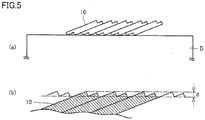
- Fig. 5 is a schematic view showing a method for manufacturing an inner liner using the strip of the present invention.
- FIG. 6(a) to Fig. 6(d) is a schematic cross sectional view showing arrangement states of an inner liner.
- Fig. 7 is a schematic view showing a method for manufacturing an inner liner using a conventional strip.
- a strip for forming an inner liner is a strip of a thermoplastic elastomer composition to be wound spirally on a cylindrical drum to form an inner liner for a tire having a shape close to a finished sectional shape.
- the strip is composed of a layer stack of a first layer made of a thermoplastic elastomer composition containing 0.1 part by mass to 50 parts by mass of an organic derivative of clay mineral relative to 100 parts by mass of a styrene-isobutylene-styrene triblock copolymer, and a second layer made of a thermoplastic elastomer composition containing at least one of a styrene-isoprene-styrene triblock copolymer and a styrene-isobutylene diblock copolymer.
- the strip has a strip main body and ear portions disposed on opposite sides thereof.
- the strip main body has a thickness (T1) of 0.05 mm to 1.0 mm.
- the ear portions have a thickness (T2) thinner than the thickness (T1) of the strip main body and a width (W2) of 0.5 mm to 5.0 mm.
- T2 thickness
- W2 width
- the strip, a method for manufacturing the strip, a pneumatic tire including the strip, and a method for manufacturing the pneumatic tire will now be described.
- the present invention relates to a strip for an inner liner disposed inside a pneumatic tire, a method for manufacturing the strip, and a method for manufacturing a pneumatic tire including the strip.
- the inner liner is manufactured by spirally winding a ribbon-shaped strip having ear portions on the opposite ends thereof on a cylindrical drum.
- the ribbon-shaped strip is manufactured by extrusion molding into a state close to a finished sectional shape.
- the strip is formed of a layer stack of at least two layers.
- the first layer contains a styrene-isobutylene-styrene triblock copolymer (SIBS), and the second layer contains at least one of a styrene-isoprene-styrene triblock copolymer (SIS) and a styrene-isobutylene diblock copolymer (SIB).
- SIBS styrene-isobutylene-styrene triblock copolymer
- SIB styrene-isobutylene diblock copolymer
- the first layer has a thickness ranging from 0.05 mm to 0.6 mm
- the second layer has a thickness ranging from 0.01 mm to 0.3 mm.
- the second layer is arranged to be in contact with a rubber layer of a carcass ply.
- Fig. 1 is a schematic cross sectional view of the right half of the pneumatic tire.
- pneumatic tire 1 includes a tread portion 2, and a sidewall portion 3 and bead portions 4 so as to form a shape of toroid from the opposite ends of the tread portion.
- a bead core 5 is embedded in each of bead portions 4.
- a carcass ply 6 and a belt layer 7 are disposed.
- Carcass ply 6 is provided to extend from one bead portion 4 to the other bead portion, and is anchored by winding its ends around bead cores 5.
- Belt layer 7, which is formed of at least two plies, is disposed outside a crown portion of carcass ply 6.
- Belt layer 7 is disposed such that two plies, which are formed of cords such as steel cords or aramid fibers, are arranged to allow the cords to cross each other between the plies normally at an angle of 5° to 30° relative to the tire circumferential direction.
- topping rubber layers can be provided on the outer sides of the ends of the belt layer to reduce detachment in the ends of the belt layer.
- organic fiber cords such as polyester, nylon, or aramid are arranged at substantially 90° relative to the tire circumferential direction.
- a bead apex 8 is disposed to extend from the upper end of bead core 5 in the sidewall direction.
- an inner liner 9 is disposed inwardly relative to carcass ply 6 in the tire radial direction, so as to extend from one bead portion 4 to the other bead portion 4.
- Figs. 4(a) to 4(d) show a cross sectional view of an embodiment of a strip 10.
- a strip main body 10A has a thickness (T1) of 0.05 mm to 1.0 mm.
- the thickness (T1) of strip main body 10A is less than 0.05 mm, extrusion molding will be difficult, and the number of times will be increased unnecessarily in order to form an inner liner of predetermined thickness. On the other hand, if the thickness exceeds 1.0 mm, flection durability of the inner liner will be decreased and weight reduction can no longer be expected.
- the thickness (T1) of the strip preferably ranges from 0.1 mm to 0.6 mm.
- the strip has an overall width (W0) adjusted to range from 5 mm to 40 mm, and preferably ranges from 10 mm to 30 mm.
- Ear portions 10B formed on the opposite sides of strip main body 10A have a thickness (T2) thinner than the thickness (T1) of the strip main body, and ranges from 0.02 mm to 0.5 mm, and more preferably ranges from 0.05 mm to 0.3 mm. If the thickness (T2) of the ear portions is thinner than 0.02 mm, extrusion dimensional accuracy may be deteriorated. On the other hand, if the thickness (T2) of the ear portions is thicker than 0.5 mm, unevenness of the surface formed by adjacent portions of the strip may be increased.
- the thickness (T2) of the ear portions is defined as an average thickness in the widthwise direction when it is changed in the widthwise direction of the strip.
- Ear portions 10B preferably have a width (W2) ranging from 0.5 mm to 5.0 mm so as to smooth out unevenness formed on the surface wound on a drum, which is more preferably adjusted to range from 0.8 mm to 3.0 mm.
- the value of (W2x2) is a value less than or equal to the value of (W0 ⁇ 0.5). If the width (W2) of the ear portions falls outside the range of 0.5 mm to 5.0 mm, the thickness dimension of the cross section of the inner liner formed by bonding the strip may become uneven.
- ear portions 10B of the strip preferably have a symmetric shape on the right and left ends of the strip main body, but they can be asymmetric.
- the strip has an approximately parallelogram section.
- Ear portion 10B on the left side has a shape gradually decreasing in thickness downward
- ear portion 10B on the right side has a shape gradually decreasing in thickness upward.
- Fig. 4(b) shows ear portions 10B gradually decreasing in thickness toward the lower surface of the strip on the right and left ends of strip main body 10A.
- the ear portion on the left side is formed with a constant thickness on the lower surface
- the ear portion on the right side is formed with a constant thickness on the upper surface.
- strip main body 10A has its thickness (T1) presenting a horizontally-long, flat rectangular shape constant in the longitudinal direction.
- Fig. 4(d) shows ear portions 10B having step differences formed on the right and left ends of strip main body 10A and decreased in thickness.
- Ear portions 10B have a constant thickness on the lower surface of the strip. In this case, when bonding the strip on the drum, step differences will be formed at ends of adjacent portions of the strip, but the unevenness can be reduced.
- the strip of the present invention By forming the strip of the present invention into the above-described shapes, adjacent ear portions of the strip when winding the strip on the drum to form an inner liner fit together appropriately, so that a junction of even thickness can be formed. It should be noted that the thickness (T1) of strip main body 10A forms a horizontally long, flat rectangular shape constant in the longitudinal direction. It should be noted that not only these shapes but also various variations can be employed for the ear portions of the present invention.
- the inner liner is manufactured by winding a ribbon-shaped strip on the drum, and the strip is implemented by a layer stack.
- the layer stack is formed of a first layer containing a styrene-isobutylene-styrene triblock copolymer (SIBS) and a second layer containing at least one of a styrene-isoprene-styrene triblock copolymer (SIS) and a styrene-isobutylene diblock copolymer (SIB).
- the first layer is made of a thermoplastic elastomer composition containing 0.1 part by mass to 50 parts by mass of an organic derivative of clay mineral relative to 100 parts by mass of a styrene-isobutylene-styrene triblock copolymer (hereinafter also referred to as "SIBS").
- SIBS styrene-isobutylene-styrene triblock copolymer
- a sheet made of a thermoplastic elastomer composition containing the SIBS is excellent in air permeability resistance due to the isobutylene block of the SIBS.
- a sheet made of a thermoplastic elastomer composition containing the SIBS is used for the inner liner, there can be obtained a pneumatic tire excellent in air permeability resistance.
- the molecular structure of the SIBS is completely saturated except aromatic side chain, so that the SIBS is restrained from being deteriorated and hardened and therefore has excellent durability.
- a sheet made of a thermoplastic elastomer composition containing the SIBS is used for the inner liner, there can be obtained a pneumatic tire excellent in durability.
- the molecular weight of the SIBS is not particularly limited, but the SIBS preferably has a weight average molecular weight of 50,000 to 400,000, which is measured through GPC measurement, in view of flowability, molding step, rubber elasticity, and the like. When the weight average molecular weight thereof is less than 50,000, tensile strength and tensile elongation may be unfavorably decreased. On the other hand, when the weight average molecular weight thereof exceeds 400,000, extrusion workability unfavorably becomes bad.
- the SIBS preferably contains the styrene component at a content of 10 percent by mass to 30 percent by mass, preferably, 14 percent by mass to 23 percent by mass.
- the isobutylene block preferably has a degree of polymerization in a range of approximately 10,000 to 150,000
- the styrene block preferably has a degree of polymerization in a range of approximately 5,000 to 30,000, in view of rubber elasticity and handling (when the degree of polymerization is less than 10,000, each block will be in a liquid form).
- the SIBS can be obtained through a general living cationic polymerization method for a vinyl-based compound.
- a general living cationic polymerization method for a vinyl-based compound for example, each of Japanese Patent Laying-Open No. 62-48704 and Japanese Patent Laying-Open No. 64-62308 discloses that living cationic polymerization is possible between isobutylene and another vinyl compound and use of isobutylene and another compound for a vinyl compound allows for production of a polyisobutylene-based block copolymer.
- the SIBS does not have a double bond other than double bond of an aromatic side chain in the molecule. Hence, the SIBS is highly stable to ultraviolet rays as compared with a polymer having a double bond in the molecule, such as polybutadiene. Accordingly, the SIBS is excellent in weather resistance.
- the first layer of the layer stack is made of a thermoplastic elastomer composition containing 0.1 part by mass to 50 parts by mass of an organic derivative of clay mineral relative to 100 parts by mass of a styrene-isobutylene-styrene triblock copolymer.
- the organic derivative of clay mineral is a layered clay mineral with an organic compound intercalated therein.
- the interlayer distance is increased, which improves dispersibility in the polymer.
- the layered clay mineral is a kind of a layer silicate mineral having a crystal structure in which three layers of a silicic acid tetrahedral layer, an alumina octahedral layer and a silicic acid tetrahedral layer are stacked, and presents the form of an ultrathin plate whose unit layer has a thickness of about 10 ⁇ (1 nm) and a breadth of 0.1 ⁇ m to 1 ⁇ m.
- a representative example of the layered clay mineral is montmorillonite.
- Montmorillonite falls short of positive electric charges with part of Al which is a central atom of the alumina octahedral layer in the crystal structure being substituted by Mg, and each crystal layer itself is negatively charged.
- a cation such as Na + , K + , Ca 2+ , or Mg 2+ between crystal layers, the shortage of charges is neutralized, so that a stable state is attained. Therefore, montmorillonite exists with a number of crystal layers overlapping one upon another.
- the layered clay mineral examples include: phyllosilicates such as a smectite-based clay such as montmorillonite (particularly, sodium montmorillonite, magnesium montmorillonite and calcium montmorillonite), bentoneite, kaolinite, nonlite, beidellite, volkonskoite, hectorite, saponite, sauconite, sobockite, stevensite, svinfordite, and vermiculite; mica minerals such as illite and a mixture of illite/smectite (rectorite, tarosovite, ledikite and a mixture of the clay compound and illite); or attapulgite and sepiolite hydrotalcite-based layered compound, and the like.
- phyllosilicates such as a smectite-based clay such as montmorillonite (particularly, sodium montmorillonite, magnesium montmorillonite and calcium montmorillonite), bentoneit
- a smectite-based clay is preferable, and a montmorillonite-based clay is particularly preferable.
- Bentoneite containing a smectite-based clay mineral may be used.
- these layered clay minerals are obtained by gathering natural minerals and performing a predetermined refining operation thereon. These synthetic clays can be used without distinction.
- Examples of the organic compound used as an intercalant include an organic compound having an easy-to-ionize polar group in the molecule. It is held that an organic compound having a polar group brings about a strong interaction with the surface of a layer covered with an anion, such as an oxygen ion, of a smectite-based clay mineral enters (is intercalated) between layers of the layered clay mineral, and increases the interlayer distance to be expanded.
- a preferable organic compound has an alkyl group having six or more carbon atoms and has a polar group to be ionized terminally.
- examples thereof include an organic compound having a hydroxyl or carboxyl group, aldehydes, amines, amides, and a quaternary ammonium salt.
- organic compound having a hydroxyl group examples include phenols as well as alcohols such as fatty alcohol such as octyl alcohol and nonyl alcohol, and aromatic alcohol with an alkyl group substituted.
- Examples of the organic compound having a carboxyl group include a straight-chain aliphatic group such as stearic acid, palmitate acid and lauric acid, a straight-chain alkene acid such as oleic acid, dienoic acid such as linolelaidic acid, a polyunsaturated fatty acid such as trienoic acid, and the like.
- aldehydes include hexylaldehyde and the like.
- amines or amides include a polar organic compound having one or more amines or amides, for example, alkylamine, amino cycloalkane and aminocycloalkane substitution, annular aliphatic diamine, aliphatic amine, alkyl aromatic amine, alkyl diarylamine, aliphatic amide, and the like, and primary, secondary and/or tertiary amines or amides are included.
- alkylamine, aliphatic amine, alkyl aromatic amine, and alkyl diarylamine are preferable.
- the above-mentioned organic compounds can be used independently or two or more or them can be used in mixture.
- preferable amines include primary amines such as 1-hexylamine, 1-heptylamine, 1-octylamine, 1-nonylamine, 1-dodecylamine, 1-hexadecylamine, 1-octadecylamine, and oleylamine, secondary amines such as di-n-dodecylamine, di-n-hexadecylamine and di-n-octadecylamine, tertiary amines such as dimethyl-n-octylamine, dimethyl-n-decylamine, dimethyl-n-tetradecylamine, dimethyl-n-hexadecylamine, dimethyl-n-octadecylamine, and dimethyloleylamine, and aliphatic amines such as di-n-decylmethylamine, dicocoalkyl methylamine, tri-n-octylamine, tri-n-dec
- amides examples include hexylamide, heptylamide, octylamide, nonylamide, lauramide, myristamide, palmitamide, steramide, palmiamide, oleamide, linoleamide, and the like.
- organic compound having a polar group an organic compound having a nitrile group or a lactam group, pyridines, esters, surface active agents, ethers or the like can also be used.
- quaternary ammonium salt examples include dimethyldistearyl ammonium salt, trimethylstearyl ammonium salt, dimethyldioctadecyl ammonium, dimethylbenzyl octadecyl ammonium, trimethyl octadecyl ammonium, and the like.
- a publicly-known method can be adopted. For example, in order to bring a montmorillonite-based clay mineral and an organic compound into contact with each other, there is a method for previously causing a layered clay mineral to contain water ranging from 10 percent by mass to about 20 times the mass thereof and then bringing an organic compound and the montmorillonite-based clay mineral into contact to obtain an organic derivative of clay mineral.
- the cation exchange amount of the organic compound in the organic derivative of layered clay mineral is preferably 50 meg/100 g to 200 meg/100 g.
- the blending amount of the organic derivative of layered clay mineral is 0.1 percent by mass to 50 percent by mass relative to 100 parts by mass of the styrene-isobutylene-styrene triblock copolymer, and more preferably 0.5 percent by mass to 30 percent by mass. If the blending amount of the organic derivative of layered clay mineral is less than 0.1 percent by mass, air permeability resistance and tensile property at the time of high temperature of the thermoplastic elastomer composition will be decreased. On the other hand, if the blending amount of the organic derivative of layered clay mineral exceeds 50 percent by mass, the thermoplastic elastomer composition will have excessively large hardness, and flex fatigue resistance will be decreased.
- thermoplastic elastomer composition Various types of compounding agents and additives, which are blended in a general polymer composition, such as other reinforcers, vulcanizing agents, vulcanization accelerators, various types of oils, antioxidants, softeners, plasticizers, and coupling agents can be blended into the thermoplastic elastomer composition according to an embodiment of the present invention. Moreover, the content of these compounding agents and additives can also be a general amount.
- the first layer containing the SIBS preferably has a thickness of 0.05 mm to 0.6 mm. If the thickness of the first layer is less than 0.05 mm, the first layer may be broken due to pressing pressure when vulcanizing the raw tire in which the layer stack is applied to the inner liner, with the result that an air leakage phenomenon may take place in the resulting tire. On the other hand, if the thickness of the first layer exceeds 0.6 mm, the weight of the tire is increased to result in decreased performance in fuel efficiency. Further, the first layer preferably has a thickness of 0.05 mm to 0.4 mm.
- the first layer can be obtained by forming the thermoplastic elastomer composition containing the SIBS into the form of a sheet by means of a general method for forming thermoplastic resin or thermoplastic elastomer into a sheet, such as extrusion molding or calender molding.
- the second layer contains at least one of a styrene-isoprene-styrene triblock copolymer and a styrene-isobutylene diblock copolymer.
- the isoprene block of the styrene-isoprene-styrene triblock copolymer (SIS) is a soft segment.
- SIS styrene-isoprene-styrene triblock copolymer
- a sheet made of a thermoplastic elastomer composition containing the SIS is likely to adhere to a rubber component through vulcanization. Therefore, when a sheet made of a thermoplastic elastomer composition containing the SIS is used for the inner liner, a pneumatic tire excellent in durability can be obtained because the inner liner is excellent in adhesive property with the rubber layer of the carcass ply, for example.
- the molecular weight of the SIS is not particularly limited, but the SIS preferably has a weight average molecular weight of 100,000 to 290,000 measured through GPC measurement, in view of rubber elasticity and moldability. When the weight average molecular weight thereof is less than 100,000, tensile strength may be unfavorably decreased. On the other hand, when the weight average molecular weight thereof exceeds 290,000, extrusion workability unfavorably becomes bad.
- the SIS preferably contains the styrene component at a content of 10 percent by mass to 30 percent by mass in order to maintain tackiness, adhesive property, and rubber elasticity.
- the isoprene block has a degree of polymerization in a range of approximately 500 to 5,000 and the styrene block has a degree of polymerization in a range of approximately 50 to 1,500 in view of rubber elasticity and handling.
- the SIS can be obtained through a general polymerization method for a vinyl-based compound, such as the living cationic polymerization method.
- the SIS layer can be obtained by forming the SIS into the form of a film by means of a general method for forming thermoplastic resin or thermoplastic elastomer into a film, such as extrusion molding or calender molding.
- the isobutylene block of the styrene-isobutylene diblock copolymer (SIB) is a soft segment.
- SIB styrene-isobutylene diblock copolymer
- a sheet made of a thermoplastic elastomer composition containing the SIB is likely to adhere to a rubber component through vulcanization. Therefore, when a sheet made of a thermoplastic elastomer composition containing the SIB is used for the inner liner, a pneumatic tire excellent in durability can be obtained because the inner liner is excellent in adhesive property with an adjacent rubber forming the carcass or the insulation, for example.
- a linear SIB is preferably used in view of rubber elasticity and adhesive property.
- the molecular weight of the SIB is not particularly limited, but the SIB preferably has a weight average molecular weight of 40,000 to 120,000 measured through GPC measurement, in view of rubber elasticity and moldability. When the weight average molecular weight thereof is less than 40,000, tensile strength may be unfavorably decreased. On the other hand, when the weight average molecular weight thereof exceeds 120,000, extrusion workability unfavorably becomes bad.
- the SIB preferably contains the styrene component at a content of 10 percent by mass to 35 percent by mass, in view of tackiness, adhesive property, and rubber elasticity.
- the isobutylene block has a degree of polymerization in a range of approximately 300 to 3,000 and the styrene block has a degree of polymerization in a range of approximately 10 to 1,500 in view of rubber elasticity and handling
- the SIB can be obtained through a general polymerization method for a vinyl-based compound, such as the living cationic polymerization method.
- a general polymerization method for a vinyl-based compound such as the living cationic polymerization method.
- International Publication No. WO2005/033035 discloses a manufacturing method wherein the SIB is obtained by adding methylcyclohexane, n-butyl chloride, and cumyl chloride into an agitator, cooling them to -70°C, reacting them for 2 hours, then adding a large amount of methanol to stop the reaction, and performing vacuum-drying at 60°C.
- a sheet of a thermoplastic elastomer composition containing the SIS or a sheet of a thermoplastic elastomer composition containing the SIB can be obtained by forming the SIS or the SIB into the form of a sheet through a general method for forming thermoplastic resin or thermoplastic elastomer into a sheet, such as extrusion molding or calender molding.
- the thickness of the second layer is less than or equal to 0.4 mm, and preferably ranges from 0.01 mm to 0.3 mm.
- the thickness of the second layer refers to the thickness of this SIS layer.
- the thickness of the second layer refers to the thickness of this SIB layer.
- the thickness of the second layer refers to the thickness of this SIB layer.
- the thickness of the second layer refers to the total thickness of the SIS and SIB layers.
- the second layer may be broken due to pressing pressure when vulcanizing the raw tire in which the layer stack is applied to the inner liner, with the result that vulcanization adhesion strength may be decreased.
- the thickness of the second layer exceeds 0.4 mm, the weight of the tire is increased to result in decreased performance in fuel efficiency.
- the second layer preferably has a thickness of 0.01 mm to 0.3 mm.
- a method for manufacturing strip 10 will be described with reference to Fig. 2 .
- a strip manufacturing device 11 is composed of an extruder 13 for extrusion molding of a thermoplastic elastomer sheet 12 having a horizontally-long rectangular cross section and a pair of die rollers 14 arranged in the vicinity of an extrusion port 16.
- Extruder 13 includes an extruder main body 13 A having a screw shaft 15 and an extrusion head 13B forming a sheet of thermoplastic elastomer discharged from this extruder main body 13A and extruding the sheet through extrusion port 16.
- Extruder main body 13 A kneads and melts the input thermoplastic elastomer with screw shaft 15 driven by a motor having a slowdown function.
- Extrusion head 13B has a mouthpiece 17 for extrusion molding attached to the leading end of extruder main body 13 A to constitute extrusion port 16.
- the pair of die rollers 14 has a structure having upper and lower rolls 14A, 14B, and is held in the transverse direction orthogonal to the direction of extrusion through extrusion port 16.
- Upper and lower die rolls 14A, 14B are rotatably drive controlled at the same speed and in synchronization with each other.
- a gap between upper and lower die rolls 14A, 14B presents a shape resembling the sectional shape of strip 10, as shown in Fig. 3 .
- "resembling" refers to being substantially similar to the sectional shape of strip 10.
- the similarity proportion is usually in a range of 0.50 to 0.90 in consideration of expansion.
- the distance between roll 14A and roll 14B at gap sections K1 corresponding to the thickness of the ear portions of the strip is smaller than the distance between roll 14A and roll 14B at a gap section K2 corresponding to the thickness of the strip main body.
- one or both of upper and lower die rolls 14A, 14B are provided with recessed sections 14a, 14b on the circumferential surface of a straight cylindrical roll body. Recessed sections 14a, 14b correspond to strip main body 10A. Therefore, ear portions 10B are molded by gap sections K1 between die rolls 14A, 14B, and strip main body 10A is molded by gap section K2 formed by recessed sections 14a, 14b.
- horizontally-long rectangular sheet 12 is formed first by extruder 13, and the shape of the die rolls is transferred to the sheet on the condition that heat is not generated during die roll molding. Then, strip 12A with the ear portions formed thereon is detached from die roller 14B by a free roller 18, and is processed into a final shape. Accordingly, dimensional accuracy and stability are increased, and manufacturing efficiency can be improved in that, for example, a knife cutting operation for width adjustment, which usually has been required in calender molding, becomes unnecessary. Besides, variations in thickness T2 at ear portions 10B can be reduced, so that strip 10 of high quality can be manufactured.
- an opening height HA1 of extrusion port 16 of extrusion head 13B at 2 to 7 times thickness T1 of the strip and to set an opening width WA1 of extrusion port 16 at 0.7 to 1.0 times width W0 of the strip.
- opening height HA1 exceeds 7 times T1 and opening width WA1 is less than 0.7 times W0, the processing ratio in die roll molding will be excessively large, resulting in degraded quality and accuracy of strip 10. Particularly, accuracy in width will become unstable, which will require width accuracy to be maintained by knife cutting.
- opening height HA1 is less than twice T1
- the sheet thickness at the time of extrusion will be thin in order to obtain strip 10 of less than or equal to 1.0 mm. Then, extrusion pressure will be higher, resulting in unstable dimensions.
- opening width WA1 exceeds 1 times W0, the processing ratio will become too small to the contrary to cause strip 10 to break, and dimensional stability will be deteriorated.
- mold release processing it is desirable to perform mold release processing on the die rolls and the free roll to be used in the molding step and the detaching step.
- a conventional technique that can be adopted for the mold release processing include a method for subjecting the roll surface to nitriding (radical nitriding, Kanuc process) to obtain a Cr-N coating (hardness Hv: 200 to 800; thickness: 25 ⁇ m to 500 ⁇ m), plating obtained by impregnating hard chromium with Teflon (registered trademark) (hardness Hv: 800 to 1000; thickness: 25 ⁇ m to 1000 ⁇ m), a diamond-like carbon (DLC) coating (hardness Hv: 2000 to 7000; thickness: 0.2 ⁇ m to 3.0 ⁇ m), and a Teflon (registered trademark) coating (hardness Hv: 100 to 500; thickness: 0.1 ⁇ m to 0.5 ⁇ m).
- thermoplastic elastomer composition can be manufactured by a conventionally known method. For example, after weighing the above-mentioned respective materials at a predetermined blending ratio, they can be kneaded at 100°C to 250°C for 5 minutes to 60 minutes using a rubber kneader such as an open roll or a Banbury mixer, thereby obtaining a pellet of a thermoplastic elastomer composition.
- a rubber kneader such as an open roll or a Banbury mixer
- the inner liner of the present invention is formed by winding ribbon-shaped strip 10 such that portions of strip main body 10A overlap one another.
- strip 10 is sequentially wound spirally such that portions of strip main body 10A on a cylindrical drum D overlap one another in the range of 3 mm to 38 mm, for example, to form an inner liner.
- adjacent portions of strip 10 form a step difference during winding as shown in Fig. 5(b) with the ends shown on an enlarged scale, but the ear portions will reduce a step difference d of unevenness.
- a step difference d0 of unevenness in the case of using a conventional strip of rectangular cross section having no ear portions is about twice the unevenness in the case of the strip having the ear portions.
- the use of the strip having the ear portions facilitates making the inner liner resemble a finished sectional shape required of the inner liner.
- a smooth contour can be obtained, and surface cracks can be prevented from occurring after vulcanization.
- the inner liner can be formed by approximately the same number of times of winding as in the case of a conventional strip of the same thickness, which can restrain production efficiency from being deteriorated and air from remaining.
- the pneumatic tire of the present invention can be manufactured using a general manufacturing method.
- layer stack PL is used to manufacture a strip.
- an inner liner is manufactured by the above-described method.
- Pneumatic tire 1 can be manufactured by applying the above-described inner liner to a raw tire and molding them together with other members through vulcanization.
- the second layer of layer stack PL i.e., PL2 made of an SIS layer or PL3 made of an SIB layer is disposed outwardly in the tire radial direction so as to be in contact with carcass ply C.
- the pneumatic tire has excellent air permeability resistance and durability.
- Fig. 6 shows arrangement states of the inner liner formed of the layer stack in the vulcanized tire of the present invention.
- layer stack PL is composed of PL1 of a first layer containing a thermoplastic elastomer composition containing the SIBS (hereinafter also referred to as a SIBS layer), and second layer PL2 made of an SIS layer.
- SIBS layer a thermoplastic elastomer composition containing the SIBS
- second layer PL2 made of an SIS layer.
- layer stack PL is composed of PL1 made of a SIBS layer serving as the first layer, and PL3 made of a SIB layer serving as the second layer.
- layer stack PL When applying layer stack PL to the inner liner of the pneumatic tire and disposing a surface of PL3 made of the SIB layer outwardly in the tire radial direction so as to be in contact with carcass ply C, adhesion strength between PL3 made of the SIB layer and carcass C can be increased in the step of vulcanizing the tire. Accordingly, in the resulting pneumatic tire, the inner liner and the rubber layer of carcass ply C are adhered to each other in an excellent manner. Thus, the pneumatic tire can have excellent air permeability resistance and durability.
- layer stack PL is composed of PL1 made of a SIBS layer serving as the first layer, PL2 made of a SIS layer and PL3 made of a SIB layer both serving as the second layer, which are stacked on one another in this order.
- layer stack PL When applying layer stack PL to the inner liner of the pneumatic tire and disposing a surface of PL3 made of the SIB layer outwardly in the tire radial direction so as to be in contact with carcass ply C, adhesion strength between PL3 made of the SIB layer and carcass ply C can be increased in the step of vulcanizing the tire. Accordingly, in the resulting pneumatic tire, the inner liner and the rubber layer of carcass ply C are adhered to each other in an excellent manner. Thus, the pneumatic tire can have excellent air permeability resistance and durability.
- layer stack PL is composed of PL1 made of a SIBS layer serving as the first layer, and PL3 made of a SIB layer and PL2 made of a SIS layer both serving as the second layer, which are stacked on one another in this order.
- a strip for an inner liner is a strip of a thermoplastic elastomer composition to be wound spirally on a cylindrical drum to form an inner liner for a tire having a shape close to a finished sectional shape.
- the strip is composed of a layer stack of a first layer made of a thermoplastic elastomer composition containing 60 percent by mass to 99.9 percent by mass of a styrene-isobutylene-styrene triblock copolymer and 0.5 percent by mass to 40 percent by mass of a styrene-maleic anhydride copolymer, and a second layer made of a thermoplastic elastomer composition containing a styrene-isoprene-styrene triblock copolymer.
- the strip has a strip main body and ear portions disposed on both sides thereof.
- the strip main body has a thickness (T1) of 0.05 mm to 1.0 mm.
- the ear portions have a thickness (T2) thinner than the thickness (T1) of the strip main body and a width (W2) of 0.5 mm to 5.0 mm.
- T2 thickness
- W2 width
- the strip, a method for manufacturing the strip, a pneumatic tire including the strip, and a method for manufacturing the pneumatic tire will now be described.
- the pneumatic tire can have a structure similar to that of the first embodiment.
- the strip can have a shape similar to that of the first embodiment.
- width (W2) of ear portions 10B preferably ranges from 0.5 mm to 5.0 mm so as to smooth out the unevenness formed on the wound surface on the drum, and the value of (W2 ⁇ 2) is preferably less than or equal to the value of (W0 ⁇ 0.5).
- the inner liner is manufactured by winding a ribbon-shaped strip on a drum, and the strip is implemented by a layer stack.
- the layer stack is formed of a first layer made of a thermoplastic elastomer containing a styrene-isobutylene-styrene triblock copolymer (SIBS) and a styrene-maleic anhydride copolymer, and a second layer made of a thermoplastic elastomer composition containing a styrene-isoprene-styrene triblock copolymer (SIS).
- SIBS styrene-isobutylene-styrene triblock copolymer
- SIS styrene-maleic anhydride copolymer
- the first layer is made of a thermoplastic elastomer composition containing 60 percent by mass to 99.5 percent by mass of a styrene-isobutylene-styrene triblock copolymer (SIBS), and 0.5 percent by mass to 40 percent by mass of a styrene-maleic anhydride copolymer (hereinafter also referred to as "SMA").
- SIBS styrene-isobutylene-styrene triblock copolymer
- SMA styrene-maleic anhydride copolymer
- thermoplastic elastomer composition By blending the SMA into the SIBS, the thermoplastic elastomer composition can improve vulcanization adhesive property with a rubber while maintaining air permeability resistance.
- the SIBS similar to that of the first embodiment can be used.
- the "styrene-maleic anhydride copolymer (SMA)" is described to represent a concept including: a styrene-maleic anhydride copolymer base resin (hereinafter, also referred to as "SMA base resin”); an ester resin (hereinafter, also referred to as "SMA ester resin") of a styrene-maleic anhydride copolymer, the ester resin being obtained by esterification of the styrene-maleic anhydride copolymer base resin and having a monoester group and a monocarboxylic acid group; and a styrene-maleic anhydride copolymer ammonium salt aqueous solution (hereinafter, also referred to as "SMA resin ammonium salt aqueous solution”) which is a solution containing ammonium salt of the styrene-maleic anhydride copolymer base resin.
- SMA base resin a sty
- the styrene-maleic anhydride copolymer has been used as a polymer surfactant or a high-functionality cross linking agent in dispersion or emulsification, and is very excellent in vulcanization adhesion with a rubber. Further, the styrene-maleic anhydride copolymer provides the rubber with wettability, and is therefore excellent in tackiness effect.
- the content of the SMA is 0.5 percent by mass to 40 percent by mass. With the content of the SMA being 0.5 percent by mass or more, there can be obtained an inner liner excellent in adhesive property with the second layer. With the content of the SMA being 40 percent by mass or less, there can be obtained an inner liner excellent in air permeability resistance and durability.
- the content of the SMA in the polymer component is more preferably 2 percent by mass to 30 percent by mass.
- the SMA preferably contains the SMA base resin in view of unvulcanization tackiness and post-vulcanization adhesive property.
- the SMA base resin preferably contains the styrene component and the maleic anhydride component at a molar ratio of 50/50 to 90/10, in order to attain a high softening point and high thermal stability.
- the SMA base resin preferably has a weight average molecular weight of 4,000 to 20,000 in view of post-vulcanization adhesive property and flowability. Moreover, the weight average molecular weight is more preferably 5,000 to 15,000.
- the acid value of the maleic anhydride component in the styrene-maleic anhydride copolymer is preferably 50 to 600 in view of unvulcanization tackiness. Moreover, the acid value of the maleic anhydride component is more preferably 95 to 500.
- the styrene-maleic anhydride copolymer preferably contains the ester resin (hereinafter, also referred to as "SMA ester resin") of the styrene-maleic anhydride copolymer, the ester resin being obtained by esterification of the styrene-maleic anhydride copolymer base resin and having a monoester group and a monocarboxylic acid group.
- SMA ester resin the ester resin (hereinafter, also referred to as "SMA ester resin" of the styrene-maleic anhydride copolymer, the ester resin being obtained by esterification of the styrene-maleic anhydride copolymer base resin and having a monoester group and a monocarboxylic acid group.
- the SMA ester resin has such a property that vulcanization adhesive property is excellent. Hence, by blending the SIBS with the SMA ester resin, the thermoplastic elastomer composition for an inner liner can be provided with excellent vulcanization adhesive property with a rubber layer.
- the SMA ester resin preferably contains the styrene component and the maleic anhydride component at a molar ratio of 50/50 to 90/10 in view of vulcanization adhesive property.
- the SMA ester resin preferably has a weight average molecular weight of 5,000 to 12,000 in view of post-vulcanization adhesive property and flowability. Moreover, the weight average molecular weight is more preferably 6,000 to 11,000.
- the acid value of the maleic anhydride component is preferably 50 to 400 in view of tackiness to an unvulcanized rubber. Moreover, the acid value of the maleic anhydride component is more preferably 95 to 290.
- the SMA ester resin can be produced by, for example, introducing a base resin and an alcohol into a reaction container and heating and stirring them under an inert gas atmosphere.
- the styrene-maleic anhydride copolymer preferably contains the styrene-maleic anhydride copolymer ammonium salt aqueous solution (hereinafter, also referred to as "SMA ammonium salt aqueous solution”) which is a solution containing ammonium salt of the SMA base resin.
- SMA ammonium salt aqueous solution a solution containing ammonium salt of the SMA base resin.
- the SMA ammonium salt aqueous solution has such a property that wettability is excellent. Hence, by blending the SIBS with the SMA ammonium salt aqueous solution, the thermoplastic elastomer composition for the inner liner can be provided with excellent tackiness.
- the SMA ammonium salt aqueous solution preferably has a solid concentration of 10.0% to 45.0% in view of tackiness to an unvulcanized rubber and molding workability.
- the SMA ammonium salt aqueous solution preferably has a pH of 8.0 to 9.5 in view of tackiness.
- the SMA ammonium salt aqueous solution can be produced in the following manner, for example. Water is introduced into a reaction container and a base resin is added under vigorous stirring. Then, ammonium hydroxide is gradually added to cause exothermic reaction. Thereafter, heating is performed to a predetermined temperature, and stirring is continued until completion of dissolution.
- additives similar to those of the first embodiment can be blended into the thermoplastic elastomer composition.
- the first layer made of a thermoplastic elastomer composition containing the SIBS and the SMA preferably has a thickness of 0.05 mm to 0.6 mm. If the thickness of the first layer is less than 0.05 mm, the first layer may be broken due to pressing pressure when vulcanizing the raw tire in which the layer stack is applied to the inner liner, with the result that an air leakage phenomenon may take place in the resulting tire. On the other hand, if the thickness of the first layer exceeds 0.6 mm, the weight of the tire is increased to result in decreased performance in fuel efficiency. Further, the first layer preferably has a thickness of 0.05 mm to 0.4 mm.
- the first layer can be formed by forming a thermoplastic elastomer composition containing the SIBS into the form of a sheet by means of a general method for forming thermoplastic resin or thermoplastic elastomer into a sheet, such as extrusion molding or calender molding.
- the second layer contains a thermoplastic elastomer composition containing a styrene-isoprene-styrene triblock copolymer (SIS).
- SIS styrene-isoprene-styrene triblock copolymer
- a SIS similar to that of the first embodiment can be used.
- the second layer preferably has a thickness of less than or equal to 0.4 mm, and preferably ranges from 0.01 mm to 0.3 mm. If the thickness of the second layer is less than 0.01 mm, the second layer may be broken due to pressing pressure when vulcanizing the raw tire in which the layer stack is applied to the inner liner, with the result that vulcanization adhesion strength may be decreased. On the other hand, if the thickness of the second layer exceeds 0.4 mm, the weight of the tire is increased to result in decreased performance in fuel efficiency. Further, the second layer preferably has a thickness of 0.01 mm to 0.3 mm.
- a method for producing a strip similar to that of the first embodiment can be used.
- thermoplastic elastomer composition of the present invention can be manufactured by a conventionally known method.
- the above-described materials are measured to attain a predetermined blending ratio, and thereafter they are kneaded at 100°C to 250°C for 5 minutes to 60 minutes using a rubber kneader such as an open roll or a Banbury mixer.
- the SIBS, the SMA, the SMA base resin, the SMA ester resin, and the SMA ammonium salt aqueous solution, as well as various types of additives as required are introduced into a twin-screw extruder and are kneaded at approximately 100°C to approximately 250°C and 50 rpm to 300 rpm, thereby obtaining a pellet of a thermoplastic elastomer composition in which these components are dynamically crosslinked to each other.
- the SIBS which is a thermoplastic elastomer composition
- the rubber component serves as the island phase and is dispersed.
- the rubber component reacts with the additive component, and the rubber component serving as the island phase produces a crosslinking reaction.
- the rubber component is dynamically crosslinked in the twin-screw extruder (dynamic crosslinking). Even if the rubber component is crosslinked in the twin-screw extruder, the shear viscosity of the whole system is low since the matrix phase of the system is composed of the thermoplastic elastomer component, so that extrusion molding is possible.
- the rubber component is crosslinked, however, the thermoplastic elastomer composition of the matrix phase holds plasticity, and maintains plasticity of the whole system. Therefore, the pellet also exhibits plasticity in the T-die extrusion, and thus can be molded into a sheet shape.
- thermoplastic elastomer composition of the inner liner can be prevented from penetrating into the carcass layer even when a pneumatic tire is heated while manufacturing the pneumatic tire by applying the thermoplastic elastomer layer stack manufactured using this pellet to the inner liner.
- a method for manufacturing a pneumatic tire similar to that of the first embodiment can be used.
- Fig. 6(a) shows an arrangement state of the inner liner formed of the layer stack in the vulcanized tire of the present invention.
- layer stack PL is composed of PL1 serving as the first layer made of a thermoplastic elastomer composition containing the SIBS and the SMA, and PL2 serving as the second layer made of a thermoplastic elastomer composition containing the SIS.
- PL1 serving as the first layer made of a thermoplastic elastomer composition containing the SIBS and the SMA
- PL2 serving as the second layer made of a thermoplastic elastomer composition containing the SIS.
- a strip for forming an inner liner is a strip of a polymer composition to be wound spirally on a cylindrical drum to form an inner liner for a tire having a shape close to a finished sectional shape.
- the strip is formed of a polymer sheet of a polymer composition containing more than or equal to 0.1 part by mass and less than or equal to 5 parts by mass of sulfur relative to 100 parts by mass of a polymer component containing more than or equal to 5 percent by mass and less than or equal to 40 percent by mass of a styrene-isobutylene-styrene triblock copolymer and more than or equal to 60 percent by mass and less than or equal to 95 percent by mass of at least one kind of rubber component selected from the group consisting of a natural rubber, an isoprene rubber and a butyl rubber.
- the strip has a strip main body and ear portions disposed on both sides thereof.
- the strip main body has a thickness (T1) of 0.05 mm to 1.0 mm.
- the ear portions have a thickness (T2) thinner than the thickness (T1) of the strip main body and a width (W2) of 0.5 mm to 5.0 mm.
- the strip is composed of a layer stack of a first layer of a polymer sheet of a polymer composition containing more than or equal to 0.1 part by mass and less than or equal to 5 parts by mass of sulfur relative to 100 parts by mass of a polymer component containing more than or equal to 5 percent by mass and less than or equal to 40 percent by mass of a styrene-isobutylene-styrene triblock copolymer and more than or equal to 60 percent by mass and less than or equal to 95 percent by mass of at least one kind of rubber component selected from the group consisting of a natural rubber, an isoprene rubber and a butyl rubber, and a second layer made of a thermoplastic elastomer composition.
- the strip a method for manufacturing the strip, a pneumatic tire including the strip, and a method for manufacturing the pneumatic tire will now be described.
- the pneumatic tire can have a structure similar to that of the first embodiment.
- the strip can have a shape similar to that of the first embodiment.
- width (W2) of ear portions 10B preferably ranges from 0.5 mm to 5.0 mm so as to smooth out the unevenness formed on a wound surface on a drum, and the value of (W2 ⁇ 2) is preferably less than or equal to the value of (W0 ⁇ 0.5).
- the strip of the present invention is made of a polymer composition containing more than or equal to 0.1 part by mass and less than or equal to 5 parts by mass of sulfur relative to 100 parts by mass of a polymer component containing more than or equal to 5 percent by mass and less than or equal to 40 percent by mass of a styrene-isobutylene-styrene triblock copolymer and more than or equal to 60 percent by mass and less than or equal to 95 percent by mass of at least one kind of rubber component selected from the group consisting of a natural rubber, an isoprene rubber and a butyl rubber.
- the polymer composition contains the SIBS, a rubber component, and sulfur.
- the rubber component and sulfur When the rubber component and sulfur are added to the SIBS and mixed by heating, the rubber component and sulfur produce a vulcanization reaction during mixing by heating to form a sea-island structure in which the SIBS serves as a matrix (sea), and the rubber component serves as an island.
- the polymer composition having the sea-island structure has air permeation resistance originating in the matrix phase composed of the SIBS. Further, the rubber component constituting the island phase has tackiness before vulcanization with an adjacent member containing a rubber component and vulcanization adhesive property with the adjacent member because of the vulcanization reaction with the rubber component of the adjacent member during mixing by heating. Therefore, a polymer sheet made of the polymer composition is excellent in air permeation resistance, and can have tackiness before vulcanization and vulcanization adhesive property with the adjacent member.
- a SIBS similar to that of the first embodiment can be used.
- the SIBS content is more than or equal to 5 percent by mass and less than or equal to 40 percent by mass in the polymer component of the polymer composition.
- the SIBS content is preferably more than or equal to 10 percent by mass and less than or equal to 30 percent by mass of the polymer component in terms of ensuring air permeation resistance.
- the polymer composition constituting a polymer sheet for an inner liner contains a rubber component.
- the rubber component can provide the polymer composition with tackiness before vulcanization with an adjacent member containing a rubber component. Further, because of the vulcanization reaction with sulfur, the rubber component can provide the polymer composition with vulcanization adhesive property with an adjacent member such as a carcass or an insulation.
- the rubber component contains at least one kind selected from the group consisting of a natural rubber, an isoprene rubber and a butyl rubber, and it is particularly preferable to contain a natural rubber in terms of breaking strength and adhesive property.
- the content of the rubber component is more than or equal to 60 percent by mass and less than or equal to 95 percent by mass in the polymer component of the polymer composition.
- the content of the rubber component is less than 60 percent by mass, the viscosity of the polymer composition increases to cause extrusion moldability to deteriorate. Hence, when producing a polymer sheet, the polymer sheet may not be made thin.
- the content of the rubber component exceeds 95 percent by mass, air permeation resistance of the polymer sheet may be reduced.
- the content of the rubber component is preferably more than or equal to 70 percent by mass and less than or equal to 90 percent by mass of the polymer component in terms of tackiness before vulcanization and vulcanization adhesive property.
- the sulfur content is more than or equal to 0.1 part by mass and less than or equal to 5 parts by mass with respect to 100 parts by mass of the polymer component.
- the sulfur content is more preferably more than or equal to 0.3 part by mass and less than or equal to 3.0 parts by mass.
- the polymer composition constituting the strip can contain additives such as stearic acid, zinc oxide, an antioxidant, and a vulcanization accelerator.
- Stearic acid functions as a vulcanization assistant for the rubber component.
- the content of stearic acid is preferably more than or equal to 1 part by mass and less than or equal to 5 parts by mass with respect to 100 parts by mass of the polymer component. When the content of stearic acid is less than 1 part by mass, the effect as a vulcanization assistant cannot be achieved. On the other hand, when the content of stearic acid exceeds 5 parts by mass, the viscosity of the polymer composition may be reduced, and the breaking strength may be reduced, which is not preferable.
- the content of stearic acid is more preferably more than or equal to 1 part by mass and less than or equal to 4 parts by mass.
- Zinc oxide functions as a vulcanization assistant of the rubber component.
- the content of zinc oxide is preferably more than or equal to 0.1 part by mass and less than or equal to 8 parts by mass with respect to 100 parts by mass of the polymer component.
- the content of zinc oxide is less than 0.1 part by mass, the effect as a vulcanization assistant cannot be achieved.
- the content of zinc oxide exceeds 8 parts by mass, the hardness of the polymer composition increases, and when the polymer sheet is used as the inner liner, the durability of a pneumatic tire may deteriorate.
- the content of zinc oxide is more preferably more than or equal to 0.5 part by mass and less than or equal to 6 parts by mass.
- An antioxidant has the function of preventing a series of degradations, such as oxidation degradation called aging, thermal degradation, ozone degradation, and fatigue degradation.
- Antioxidants are classified into a primary antioxidant including amines and phenols and a secondary antioxidant including sulfur compounds and phosphites.
- the primary antioxidant has the function of supplying hydrogen to various polymer radicals to stop a chain reaction of autooxidation, and the secondary antioxidant exhibits a stabilizing effect by turning hydroxyperoxide into stable alcohol.
- antioxidants examples include amines, phenols, imidazoles, phosphors, thioureas, and the like.
- the antioxidants may be used alone, or two or more kinds of them may be used in combination. Particularly, it is preferable to use N-(1,3-dimethylbutyl)-N'-phenyl-p-phenylenediamine.
- the antioxidant content is preferably more than or equal to 0.1 part by mass and less than or equal to 5 parts by mass relative to 100 parts by mass of the polymer component.
- the antioxidant content is more preferably more than or equal to 0.3 part by mass and less than or equal to 4 parts by mass.
- vulcanization accelerator thiurams, thiazoles, thioureas, dithiocarbamates, guanidines, sulfenamides, and the like can be used.
- the vulcanization accelerators may be used alone, or two or more kinds of them may be used in combination. Particularly, it is preferable to use dibenzothiazyl sulfide.
- the content of the vulcanization accelerator is preferably more than or equal to 0.1 part by mass and less than or equal to 5 parts by mass relative to 100 parts by mass of the polymer component.
- the content of the vulcanization accelerator is less than 0.1 part by mass, the vulcanization acceleration effect cannot be achieved.
- the content of the vulcanization accelerator exceeds 5 parts by mass, the hardness of the polymer composition increases, and when the polymer sheet is used as an inner liner, the durability of a pneumatic tire may deteriorate.
- the raw material cost of the polymer composition increases.
- the content of the vulcanization accelerator is more preferably more than or equal to 0.3 part by mass and less than or equal to 4 parts by mass.
- the strip As the strip according to an embodiment of the present invention, a layer stack of a first layer and a second layer is used.
- the first layer can be implemented by substantially the same polymer composition as that of the above-described polymer sheet, and is a polymer composition mainly containing a styrene-isobutylene-styrene triblock copolymer (SIBS).
- SIBS styrene-isobutylene-styrene triblock copolymer
- the second layer is made of a thermoplastic elastomer composition containing a thermoplastic elastomer.
- This second layer can also be obtained by blending at least one kind of rubber component selected from the group consisting of a natural rubber, an isoprene rubber and a butyl rubber into a thermoplastic elastomer.
- thermoplastic elastomer at least one kind selected from the group consisting of: a styrene-isoprene-styrene triblock copolymer; a styrene-isobutylene diblock copolymer; a styrene-butadiene-styrene triblock copolymer; a styrene-isoprene butadiene-styrene triblock copolymer; a styrene-ethylene butene-styrene triblock copolymer; a styrene-ethylene propylene-styrene triblock copolymer; a styrene-ethylene ethylene propylene-styrene triblock copolymer; and a styrene-butadiene butylene-styrene triblock copolymer can be used. It should be noted that these thermoplastic elastomers may be
- SIS styrene-isoprene-styrene triblock copolymer
- SIB styrene-isobutylene diblock copolymer
- epoxidized styrene-butadiene-styrene triblock copolymer epoxidized styrene-butadiene-styrene triblock copolymer
- a SIS similar to that of the first embodiment can be used.
- a SIB similar to that of the first embodiment can be used.
- the epoxidized styrene-butadiene-styrene triblock copolymer (hereinafter also referred to as epoxidized SBS) is a thermoplastic elastomer including a polystyrene block as a hard segment and a butadiene block as a soft segment, with an unsaturated double bond portion included in the butadiene block having been epoxidized. Since the epoxidized SBS has the soft segment, a thermoplastic elastomer composition containing the epoxidized SBS easily adheres to a rubber component through vulcanization.
- the polymer layer stack is excellent in adhesive property with an adjacent rubber forming the carcass or the insulation, for example, and thus a pneumatic tire that can avoid the air-in phenomenon and presents excellent durability can be obtained.
- the epoxidized SBS preferably has a weight average molecular weight of 10,000 to 400,000, which is measured through GPC measurement, in view of rubber elasticity and moldability. If the weight average molecular weight thereof is less than 10,000, the reinforcing effect may be unfavorably decreased. If the weight average molecular weight thereof exceeds 400,000, the viscosity of the thermoplastic elastomer composition may be unfavorably increased.
- the epoxidized SBS preferably contains the styrene unit at a content of more than or equal to 10 percent by mass and less than or equal to 30 percent by mass, in view of tackiness, adhesive property, and rubber elasticity.
- the epoxidized SBS preferably contains the butadiene unit and the styrene unit at a molar ratio (butadiene unit/styrene unit) of 90/10 to 70/30.
- the butadiene block has a degree of polymerization of approximately 500 to 5,000 and the styrene block has a degree of polymerization of approximately 500 to 1,500 in view of rubber elasticity and handling.
- the rubber component is preferably more than or equal to 20 percent by mass and less than or equal to 90 percent by mass, and more preferably more than or equal to 30 percent by mass and less than or equal to 80 percent by mass relative to the total of the thermoplastic elastomer and the rubber component.
- the rubber component is less than 20 percent by mass, the second layer may be less likely to adhere to the carcass layer through vulcanization.
- the rubber component exceeds 90 percent by mass, the second layer and the carcass layer may excessively adhere to each other through vulcanization.
- the sulfur content is more than or equal to 0.1 part by mass and less than or equal to 5 parts by mass relative to 100 parts by mass of the thermoplastic elastomer.
- the sulfur content is less than 0.1 part by mass, the vulcanization reaction may not be produced.
- the sulfur content exceeds 5 parts by mass, the crosslinking density of the thermoplastic elastomer composition may be increased to increase viscosity.
- the sulfur content is more preferably more than or equal to 0.3 part by mass and less than or equal to 3 parts by mass.
- thermoplastic elastomer composition can contain additives such as stearic acid, zinc oxide, an antioxidant, and a vulcanization accelerator. Blending similar to that of the first layer can be adopted for these additives.
- the strip can be manufactured using strip manufacturing device 11 similar to that of the first embodiment.
- the strip for an inner liner of the present invention can be manufactured by the following method.
- the respective ingredients are charged into a twin-screw extruder and kneaded under the conditions of about 150°C to 280°C and 50 to 300 rpm, thereby obtaining a pellet of a polymer composition in which the SIBS, the rubber component, sulfur, and various additives according to necessity are dynamically crosslinked.
- the obtained pellet is introduced into a T-die extruder to obtain a sheet-like polymer sheet (or the first layer) made of a polymer composition and a sheet-like second layer made of a thermoplastic elastomer composition.
- the SIBS which is a thermoplastic elastomer
- the rubber component serves as the island phase and is dispersed.
- the rubber component reacts with the additive component, and the rubber component serving as the island phase produces a crosslinking reaction.
- So-called dynamic crosslinking in which the rubber component is dynamically crosslinked in the twin-screw extruder is formed. Even if the rubber component is crosslinked in the twin-screw extruder, the shear viscosity of the whole system is low and extrusion molding is possible since the matrix phase of the system is composed of the thermoplastic elastomer component.
- the rubber component is crosslinked, however, the thermoplastic elastomer component of the matrix phase holds plasticity, and serves to produce plasticity of the whole polymer composition. Therefore, the polymer composition also exhibits plasticity in the T-die extruder, and thus can be molded into a sheet shape.
- the polymer composition of the inner liner can be prevented from penetrating into the carcass layer even when a pneumatic tire is heated while manufacturing the pneumatic tire by applying the polymer sheet produced from this pellet to the inner liner.
- the first layer and the second layer are bonded together.
- a polymer sheet can be used for the first layer.
- the respective pellets of the polymer composition and the thermoplastic elastomer composition can be subjected to lamination extrusion such as laminate extrusion or coextrusion to form a layer stack, thereby obtaining a ribbon-shaped sheet. Then, a strip having ear portions of a predetermined shape formed on the both ends in the width direction of the sheet is manufactured.
- the inner liner can be molded by a method similar to that of the first embodiment.
- the pneumatic tire can be manufactured by a method similar to that of the first embodiment.
- Fig. 6 shows arrangement states of the inner liner formed of the layer stack in the vulcanized tire of the present invention.
- layer stack PL is composed of PL1 made of the first layer containing a polymer composition and PL2 made of the second layer containing a thermoplastic elastomer composition.
- a strip for forming an inner liner is a strip of a thermoplastic elastomer composition to be wound spirally on a cylindrical drum to form an inner liner for a tire having a shape close to a finished sectional shape.
- the strip is composed of a first layer disposed on the tire inside and a second layer disposed adjacent to the carcass.
- At least one of the first layer and the second layer is an isobutylene-based block copolymer made of a polymeric block (A) mainly containing isobutylene and a polymeric block (B) mainly containing an aromatic vinyl-based compound, and is an elastomer composition containing an isobutylene-based modified copolymer with ⁇ -pinene copolymerized in at least one block.
- the strip has a strip main body and ear portions disposed on both sides thereof.
- the strip main body has a thickness (T1) of 0.05 mm to 1.0 mm.
- the ear portions have a thickness (T2) thinner than the thickness (T1) of the strip main body and a width (W2) of 0.5 mm to 5.0 mm.
- the pneumatic tire can have a structure similar to that of the first embodiment.
- the strip can have a shape similar to that of the first embodiment.
- the inner liner is composed of a first layer disposed inwardly in the tire, and a second layer disposed so as to come into contact with a rubber layer of the carcass ply. At least one of the elastomer compositions of the first layer and the second layer contains an isobutylene-based modified copolymer.
- the elastomer component of the elastomer composition used for the first layer of the inner liner is implemented by an isobutylene-based modified copolymer alone or a mixture of the isobutylene-based modified copolymer and another elastomer component.
- the isobutylene-based modified copolymer ranges from 10 percent by mass to 100 percent by mass, preferably 30 percent by mass to 100 percent by mass of the whole elastomer component. When the isobutylene-based modified copolymer is less than 10 percent by mass, vulcanization adhesion strength with the second layer may be decreased.
- the isobutylene-based modified copolymer is an isobutylene-based modified copolymer made of a polymeric block (A) mainly containing isobutylene and a polymeric block (B) mainly containing an aromatic vinyl-based compound, and is a random copolymer in which at least one block contains ⁇ -pinene.
- the polymeric block (A) containing isobutylene as a principal component is a polymeric block in which a unit whose soft segment originates in isobutylene occupies more than or equal to 80 percent by weight.
- a polymeric block can be produced by using aliphatic olefins, dienes, vinyl ethers, silanes, vinylcarbazole, acenaphthylene, or the like as a monomer component.
- the polymeric block (B) mainly containing an aromatic vinyl-based compound is a polymeric block in which a unit whose hard segment originates in the aromatic vinyl-based compound occupies more than or equal to 80 percent by weight.
- aromatic vinyl-based compound examples include styrene, methylstyrene, ⁇ -methylstyrene, ⁇ -methylstyrene, 2,6-dimethylstyrene, 2,4-dimethylstyrene, ⁇ -methyl-o-methylstyrene, ⁇ -methyl-m-methylstyrene, ⁇ -methyl-p-methylstyrene, ⁇ -methyl-o-methylstyrene, ⁇ -methyl-m-methylstyrene, ⁇ -methyl-p-methylstyrene, 2,4,6-trimethylstyrene, ⁇ -methyl-2,6-dimethylstyrene, ⁇ -methyl-2,4-dimethylstyrene, ⁇ -methyl-2,6-dimethylstyrene, ⁇ -methyl-2,4-dimethyl styrene, chlorostyrene, 2,6-dichlorostyrene, 2,4-dichlor
- At least one block of the polymeric blocks (A) and (B) has been copolymerized at random with ⁇ -pinene.
- ⁇ -pinene has been copolymerized with the polymeric block (B) mainly containing an aromatic vinyl-based compound.
- ⁇ -pinene has been copolymerized with the polymeric block (A) mainly containing isobutylene.
- the content of ⁇ -pinene is preferably 0.5 percent by weight to 25 percent by weight, and more preferably 2 percent by weight to 25 percent by weight of the isobutylene-based modified copolymer.
- adhesive property is insufficient.
- it exceeds 25 percent by weight it will become fragile, and rubber elasticity is likely to be decreased.
- the constitution of the isobutylene-based modified copolymer of the present invention there is no particular restriction on the constitution of the isobutylene-based modified copolymer of the present invention, and any of a block copolymer, a triblock copolymer, a multi-block copolymer, and the like having a straight, branched or star chain structure can be selected.
- a constitution in which the polymeric blocks (A) and (B) constitute a diblock copolymer ((A)-(B)) or a triblock copolymer ((B)-(A)-(B)) can be adopted. They can be used each alone or two or more kinds of them can be combined, in order to obtain desired physical properties and molding workability.
- the weight average molecular weight measured through GPC measurement is preferably 30,000 to 300,000, and particularly preferably 30,000 to 150,000 in terms of flowability, molding workability, rubber elasticity and the like.
- the weight average molecular weight is lower than 30,000, mechanical physical properties are less likely to be fully exhibited.
- the value of the molecular weight distribution of the isobutylene-based modified copolymer is preferably less than or equal to 1.3.
- a method for producing an isobutylene-based modified copolymer is disclosed in Japanese Patent Laying-Open No. 2010-195969 , for example.
- the isobutylene-based modified copolymer can be produced by polymerizing the above-described monomer components under the presence of a polymerization initiator expressed by a general formula (1) indicated below.
- R 1 R 2 X nR 3 (1)
- X is a substituent selected from among a halogen atom, an alkoxy group having 1 to 6 carbon atoms and an acyloxy group
- each of R 1 and R 2 is a hydrogen atom or a monovalent hydrocarbon group having 1 to 6 carbon atoms
- R 1 and R 2 may be the same or may be different
- R 3 is a monovalent or multivalent aromatic hydrocarbon group, or a monovalent or multivalent aliphatic hydrocarbon group
- n indicates a natural number of 1 to 6
- the compound expressed by the above general formula (1) will be an initiator, and generates carbocation under the presence of Lewis acid or the like to be the starting point of cationic polymerization.
- Examples of the compound expressed by the above general formula (1) include bis(1-chloro-1-methylethyl) benzene [C 6 H 4 (C(CH 3 ) 2 Cl) 2 ] and tris(1-chloro-1-methylethyl) benzene [(ClC(CH 3 ) 2 ) 3 C 6 H 3 ].
- a Lewis acid catalyst can further be present together.
- Lewis acid can be used for cationic polymerization, and a metal halide such as TiCl 4 , TiBr 4 , BCl 3 , BF 3 , BF 3 OEt 2 , ZnBr 2 , or AlCl 3 , or an organic metal halide such as Et 2 AlCl, or EtAlCl 2 can be used, for example.
- the above Lewis acid can be used by 0.1 molar equivalent to 100 molar equivalent relative to the compound expressed by the general formula (1).
- an electron donor component can also be present together.
- this electron donor component include pyridines, amines, amides, and sulfoxides, for example.
- Polymerization of the isobutylene-based modified copolymer can be performed in an organic solvent.
- an organic solvent that does not inhibit cationic polymerization can be used.
- a halogenated hydrocarbon such as methyl chloride, dichloromethane, chloroform, ethyl chloride, and dichloroethane
- alkylbenzenes such as benzene, toluene, xylene, and ethylbenzene
- straight aliphatic hydrocarbons such as ethane, propane, butane, pentane, hexane, and heptane
- branched aliphatic hydrocarbons such as 2-methylpropane and 2-methylbutane
- cyclic aliphatic hydrocarbons such as cyclohexane, methylcyclohexane and ethylcyclohexane can be used.
- the amount of the above-mentioned organic solvent is adjusted such that the copolymer has a concentration of 5 percent by mass to 40 percent by mass. It should be noted that the copolymerization reaction in the range of -20°C to -70°C is preferable.
- thermoplastic elastomer particularly a styrene-based thermoplastic elastomer is suitably used.
- the styrene-based thermoplastic elastomer refers to a copolymer including a styrene block as a hard segment.
- SIS styrene-isoprene-styrene block copolymer
- SIB styrene-isobutylene block copolymer
- SIBS styrene-butadiene-styrene block copolymer
- SIBS styrene-isobutylene-styrene block copolymer
- SEBS styrene-ethylene butene-styrene block copolymer
- SEEPS styrene-ethylene propylene-styrene block copolymer
- SEEPS styrene-ethylene ethylene propylene-styrene block copolymer
- SEEPS styrene-ethylene ethylene propylene-styrene block copolymer
- SEEPS styrene-ethylene ethylene propylene-styrene block copolymer
- SEEPS styrene-butadiene butylene-
- the styrene-based thermoplastic elastomer may have an epoxy group in its molecular structure.
- a usable example thereof is Epofriend A1020 provided by Daicel Chemical Industries Ltd, i.e., an epoxy modified styrene-butadiene-styrene copolymer (epoxidized SBS) (having a weight average molecular weight of 100,000 and an epoxy equivalent of 500).
- epoxidized SBS epoxy modified styrene-butadiene-styrene copolymer
- a styrene-isobutylene-styrene block copolymer is suitably used.
- a rubber component can be blended as the elastomer component of the first layer. By blending the rubber component, tackiness with the adjacent carcass ply in an unvulcanized state is imparted, and vulcanization adhesive property with the carcass ply or the insulation can be increased through vulcanization.
- the rubber component preferably contains at least one kind selected from the group consisting of a natural rubber, an isoprene rubber, a chloroprene rubber, and a butyl rubber.
- the blending amount of the rubber component preferably ranges from 5 percent by mass to 20 percent by mass relative to 100 parts by mass of a thermoplastic polymer component.
- the first layer has a thickness of 0.05 mm to 0.6 mm. If the thickness of the first layer is less than 0.05 mm, the first layer may be broken due to pressing pressure when vulcanizing the raw tire in which the polymer layer stack is applied to the inner liner, with the result that an air leakage phenomenon may take place in the resulting tire. On the other hand, if the thickness of the first layer exceeds 0.6 mm, the weight of the tire is increased to result in decreased performance in fuel efficiency.
- the elastomer component in the elastomer composition used for the second layer of the inner liner is composed of a mixture of an isobutylene-based modified copolymer and another elastomer component.
- the isobutylene-based modified copolymer ranges from 5 percent by mass to 80 percent by mass, preferably 10 percent by mass to 60 percent by mass of the whole elastomer component.
- the isobutylene-based modified copolymer is less than 5 percent by mass, vulcanization adhesion strength with the first layer may be decreased.
- vulcanization adhesion with the carcass ply may be decreased.
- thermoplastic elastomer particularly a styrene-based thermoplastic elastomer
- styrene-based thermoplastic elastomer examples include: a styrene-isoprene-styrene block copolymer ("SIS"); a styrene-isobutylene block copolymer (“SIB”); a styrene-butadiene-styrene block copolymer (“SBS”); a styrene-isobutylene-styrene block copolymer (“SIBS”); a styrene-ethylene butene-styrene block copolymer (“SEBS”); a styrene-ethylene propylene-styrene block copolymer (“SEPS”); a styrene-ethylene propylene-styrene block copolymer ("SEPS”); a styrene
- thermoplastic elastomer composition containing at least one of a styrene-isoprene-styrene block copolymer (SIS) and a styrene-isobutylene block copolymer (SIB) is preferable.
- SIS styrene-isoprene-styrene block copolymer
- SIB styrene-isobutylene block copolymer
- the SIS and the SIB are particularly suitable.
- a SIS and a SIB similar to those of the first embodiment can be used.
- the second layer preferably has a thickness of 0.01 mm to 0.3 mm.
- the thickness of the second layer refers to the thickness of that one layer.
- the second layer includes the SIS layer, the SIB layer and the like, the thickness of the second layer refers to the total thickness of these layers.
- At least one of the first layer and the second layer can be blended with 0.1 part by mass to 100 parts by mass of a tackifier relative to 100 parts by mass of the thermoplastic elastomer component.
- a tackifier refers to a compounding agent for increasing tackiness of the thermoplastic elastomer composition. Examples of such a tackifier will be illustrated below.
- Typical examples include a C9 petroleum resin and a C5 petroleum resin.
- a C9 petroleum resin is an aromatic petroleum resin obtained by polymerizing C5 to C9 fractions (mainly C9 fraction) in a mixed state.
- the C5 to C9 fractions are remnants when obtaining useful compounds, such as ethylene, propylene, and butadiene, by thermally decomposing naphtha.
- Examples thereof include products such as: ARKON P70, P90, P100, P125, P140, M90, M100, M115, and M135 (each provided by Arakawa Chemical Industries, Ltd, and having a softening point of 70°C to 145°C); I-MARV S100, S110, P100, P125, and P140 (aromatic copolymer-based hydrogenated petroleum resins each provided by Idemitsu Petrochemical Ltd, having a softening point of 100°C to 140°C, having a weight average molecular weight of 700 to 900, and having a bromine number of 2.0g/100g to 6.0g/100g); and Petcoal XL (provided by TOSOH Corporation).
- ARKON P70, P90, P100, P125, P140, M90, M100, M115, and M135 each provided by Arakawa Chemical Industries, Ltd, and having a softening point of 70°C to 145°C
- the second layer is disposed between the first layer disposed on the tire inside and the carcass ply, and is required to have adhesive property with them. Therefore, the tackifier is blended in a range of 0.1 part by mass to 100 parts by mass, preferably 1 part by mass to 50 parts by mass relative to 100 parts by mass of the thermoplastic elastomer of the second layer.
- the strip can be manufactured by a method similar to that of the first embodiment.
- the inner liner can be molded by a method similar to that of the first embodiment.
- a method for manufacturing a pneumatic tire similar to that of the first embodiment can be used.
- Fig. 6 shows arrangement states of the inner liner formed of the layer stack in the vulcanized tire of the present invention.
- layer stack PL is composed of first layer PL1 and second layer PL2.
- adhesion strength between second layer PL2 and carcass ply C can be increased in the step of vulcanizing the tire.
- the inner liner and the rubber layer of carcass ply C are adhered to each other in an excellent manner.
- the pneumatic tire has excellent air permeability resistance and durability.
- thermoplastic elastomers (SIB and SIBS) were used for manufacturing of the strip of the present invention.
- SIBSTAR 102T (Shore A hardness: 25; the content of the styrene component: 25 percent by mass; weight average molecular weight: 100,000)" provided by Kaneka Corporation was used.
- the SIBS SIBSTAR 102T
- an organic derivative of clay mineral or an inorganic clay mineral were pelletized with a twin-screw extruder (screw diameter: ⁇ 50 mm, L/D:30, cylinder temperature: 220°C).
- BENTONE 34 provided by Rheox Inc. was used for the organic derivative of clay mineral.
- the layered clay mineral is a hectorite clay mineral.
- the organic compound is a dimethyl distearylammonium salt.
- the cation exchange amount of the organic compound is 100 meg/100 g.
- Kunipia F provided by KUNIMINE INDUSTRIES CO., LTD. was used for the inorganic clay mineral.
- D1161JP (the content of the styrene component: 15 percent by mass and weight average molecular weight: 150,000) provided by Kraton Polymers was used and pelletized with a twin-screw extruder (screw diameter: ⁇ 50 mm, L/D: 30, cylinder temperature: 220°C).
- This sheet was passed between die rolls 14A and 14B to manufacture strip 12A with the ear portions of predetermined shape formed on the opposite ends.
- ribbon-shaped sheet 12 is a layer stack made by coextruding thermoplastic elastomers of the first layer and the second layer with the above-mentioned extruder. Then, the strip was passed by a free roller 19 and detached from the die rollers to obtain strip 12A having a sectional structure shown in Fig. 4 .
- width W0 and thickness T1 of strip 10 width W2 of ear portion 10B and thickness T2 of the ear portions are indicated in Tables 1 and 2.
- Thermoplastic elastomer 100 parts by mass Organic derivative of clay mineral variable Stearic acid (*2) 3 parts by mass Zinc oxide (*3) 5 parts by mass Antioxidant (*4) 1 part by mass Vulcanization accelerator (*5) 1 part by mass Sulfur (*6) 0.5 part by mass (*1)
- the SIBS and the SIS were used for thermoplastic elastomers.
- Stearic Acid “Stearic Acid LUNAC S30" provided by Kao Corp.
- Zinc Oxide Zinc White No. 1” provided by Mitsui Mining and Smelting Co., Ltd.
- the above-described strip was wound on the drum as shown in Fig. 5 and molded into the shape of a wide sheet such that adjacent portions of the strip overlap one another to manufacture a sheet for an inner liner.
- the overlapping width of the strip is more than or equal to 3 mm and less than or equal to 38 mm.
- a pneumatic tire of tire size of 195/65R15 was prototyped using an inner liner obtained by molding each strip based on the specifications shown in Tables 1, 2 on a drum. It should be noted that press vulcanization was performed for 20 minutes at 170°C. Then, the tire was cooled for 3 minutes at 100°C without removing the tire from the vulcanization mold, and then was removed from the vulcanization mold.
- ear portions are provided for the strip in the Examples, while in the Comparative Examples, ear portions are not provided for the strip or an organic derivative of clay mineral is not blended in the first layer.
- Each trial tire was assembled to a JIS specification rim 15 ⁇ 6JJ, and air was introduced thereinto at an initial air pressure of 300 kPa. Then, the trial tire was left for 90 days at a room temperature. Then, the decreasing ratio of air pressure was calculated after one month. As the numerical value thereof is smaller, the air pressure is less decreased, which is preferable.
- a radial force variation is measured in conformity with JASO C607: 2000 "Test Procedures for Automobile Tire Uniformity", and a relative value is evaluated by an index assuming Comparative Example 1-1 as 100. It shows that as the numerical value thereof is larger, the uniformity is more favorable. Measurement conditions included a rim of 8.0 ⁇ 17, a tire speed of 60 rpm, an air pressure of 200 kPa, and a longitudinal load of 4000 kN.
- Examples 1-1 to 1-4 are instances where the first layer contains 0.5 part by mass of an organic derivative of clay mineral.
- Examples 1-5 to 1-8 are instances where the organic derivative of clay mineral of the first layer is 25 parts by mass.
- Example 1-9 is an instance where the organic derivative of clay mineral of the first layer is 0.1 part by mass.
- Example 1-10 is an instance where the organic derivative of clay mineral of the first layer is 50 parts by mass. Furthermore, the strips of Examples 1-1 to 1-10 have different sectional shapes.
- Comparative Example 1-1 is an example where the strip is not provided with ear portions.
- Comparative Examples 1-2 to 1-5 are examples where ear portions are formed, and the first layer has an inorganic clay mineral blended therein.
- Comparative Examples 1-6 and 1-7 are instances where ear portions are formed and the first layer has 0.05 part by mass of an organic derivative of clay mineral blended therein, which falls outside the predetermined range.
- Comparative Examples 1-8 and 1-9 are instances where ear portions are formed and the first layer has 70 parts by mass of an organic derivative of clay mineral blended therein, which falls outside the predetermined range.
- Tables 1 and 2 reveal that the Examples of the present invention are superior to Comparative Example 1-1 in the respective results of air-in, flection crack growth test, index of rolling resistance, static air pressure decreasing ratio, and uniformity as a whole.
- ribbon-shaped sheet 12 is a layer made by coextruding thermoplastic elastomers of the first layer and the second layer using the above-mentioned extruder. Then, the strip was passed by a free roller 18 and detached from the die rollers to obtain strip 12A having a sectional structure shown in Fig. 4 . Width W0 and thickness T1 of strip 10, width W2 of ear portion 10B and thickness T2 of the ear portions are indicated in Tables 3 to 6.
- the above-described strip was wound on the drum shown in Fig. 5 and molded into the shape of a wide sheet while forming junctions such that adjacent portions of the strip overlap one another by 5 mm to manufacture a sheet for an inner liner.
- a pneumatic tire of tire size of 195/65R15 was prototyped using an inner liner obtained by molding each strip based on the specifications shown in Tables 3 to 6 on a drum. It should be noted that press vulcanization was performed for 20 minutes at 170°C. Then, the tire was cooled for 3 minutes at 100°C without removing the tire from the vulcanization mold, and then was removed from the vulcanization mold.
- the flection crack growth test was conducted by a method similar to that of Example 1.
- the crack growth property of each Example and Comparative Example was indicated by an index based on the following equation using Comparative Example 2-1 as a reference. It shows that as the value thereof is larger, the flection crack growth is smaller.
- Index of Flection Crack Growth Number of Cracks in Comparative Example 2 ⁇ 1 / Number of Cracks in Each Example ⁇ 100
- the radial force variation (RFV) was measured in conformity with the uniformity test conditions of JASOC607: 2000. A relative value assuming Comparative Example 2-1 as 100 was indicated by an index. As the index is larger, the uniformity is more excellent. Measurement conditions included a rim of 8.0 ⁇ 17, a tire speed of 60 rpm, an air pressure of 200 kPa, and a longitudinal load of 4000 kN.
- Examples 2-1 to 2-5 are instances where each strip had the sectional shape shown in Fig. 4(a) and the blending ratio between the styrene-isobutylene-styrene triblock copolymer and the SMA base resin in the first layer was varied. It should be noted that Example 2-4 is an instance where the SMA base resin and the SMA ester resin were blended, and Example 2-5 is an instance where the SMA base resin and the SMA ammonium aqueous solution were blended. In any of the Examples, air-in is not observed, but improvement in Index of Flection Crack Growth, rolling resistance, static air pressure decreasing ratio, and uniformity is recognized.
- Examples 2-6 to 2-8 are instances where each strip had the sectional shape shown in Fig. 4(b) and the blending ratio between the styrene-isobutylene-styrene triblock copolymer and the SMA base resin in the first layer was varied. It should be noted that Example 2-8 is an instance where the SMA base resin and the SMA ester resin were blended. In any of the Examples, air-in was not observed, and improvements in index of flection crack growth, rolling resistance, static air pressure decreasing ratio, and uniformity were recognized.
- Examples 2-9 to 2-11 are instances where each strip had the sectional shape shown in Fig. 4(c) and the blending ratio between the styrene-isobutylene-styrene triblock copolymer and the SMA base resin in the first layer was varied. It should be noted that Example 2-11 is an instance where the SMA base resin and the SMA ester resin were blended. In any of the Examples, air-in was not observed, and improvements in index of flection crack growth, rolling resistance, and static air pressure decreasing ratio were recognized.
- Examples 2-12 to 2-14 are instances where each strip had the sectional shape shown in Fig. 4(d) and the blending ratio between the styrene-isobutylene-styrene triblock copolymer and the SMA base resin in the first layer was varied. It should be noted that Example 2-14 is an instance where the SMA base resin and the SMA ester resin were blended. In any of the Examples, air-in was not observed, and improvements in index of flection crack growth, rolling resistance, static air pressure decreasing ratio, and uniformity were recognized.
- Examples 2-15 to 2-17 are instances where each strip had the sectional shape shown in Fig. 4(a) and the blending ratio between the styrene-isobutylene-styrene triblock copolymer and the SMA base resin in the first layer was varied. It should be noted that the SIB was used for the second layer.
- Example 2-18 is an instance where the SMA base resin and the SMA ester resin were blended.
- Example 2-19 is an instance where the SMA base resin and the SMA ammonium aqueous solution were blended. In any of the Examples, air-in was not observed, and improvements in index of flection crack growth, rolling resistance, static air pressure decreasing ratio, and uniformity were recognized.
- Comparative Example 2-1 is an instance where the strip had a rectangular sectional shape and IIR was used for the first layer.
- Comparative Example 2-2 is an instance where the strip has a rectangular sectional shape and a mixture of a styrene-isobutylene-styrene triblock copolymer and an SMA base resin was used for the first layer.
- Comparative Example 2-3 is an instance where the strip had the sectional shape shown in Fig. 4(a) and only the styrene-isobutylene-styrene triblock copolymer was used for the first layer.
- Comparative Example 2-4 is an instance where the strip had the sectional shape shown in Fig.
- Comparative Example 2-5 is an instance where the strip had the sectional shape shown in Fig. 4(a) and 50 percent by mass of the styrene-isobutylene-styrene triblock copolymer and 50 percent by mass of the SMA ammonium aqueous solution were blended in the first layer.
- air-in was observed, and deterioration in index of flection crack growth, rolling resistance, and static air pressure decreasing ratio was recognized.
- ribbon-shaped sheet 12 is formed of only one layer of polymer sheet, it is manufactured with one extruder, and in the case of a layer stack, a polymer sheet of the first layer and a thermoplastic elastomer of the second layer are coextruded to manufacture the layer stack. Then, the strip was passed by free roller 18 and detached from the die rollers to obtain strip 12A.
- the enlarged sectional structure of strip 12A is shown as strip 10 in Fig. 4 .
- width W0 and thickness T1 of strip 10 width W2 of ear portion 10B and thickness T2 of the ear portions are indicated in Tables 7 and 9 to 11.
- Blends A1 to A6 are instances where a mixture of IIR and/or a natural rubber was used for the SIBS as a polymer component.
- Each of Blends B1 to B7 is the SIBS or the IIR alone, or a mixture of them and NR, which falls outside the scope of the present invention.
- Table 8 shows the blending of the second layer, and shows instances where each of the SIS, the SIB and the epoxidized SBS was used alone, or a mixture of them with a natural rubber or a butyl rubber was used, as a polymer component.
- the above-described strip was wound on the drum shown in Fig. 5 and molded into the shape of a wide sheet while forming junctions where adjacent portions of the strip overlap one another by 5 mm to manufacture a sheet for an inner liner.
- Examples S1 to S6 and Comparative Examples S1 to S7 of Table 7 each show an example of a pneumatic tire in which a polymer sheet of one layer was used for the strip.
- Example 3-1 to 3-23 and Comparative Examples 3-1 to 3-8 of Tables 9 to 11 each show an example of a pneumatic tire in which a layer stack was used for the strip.
- a pneumatic tire of tire size of 195/65R15 was prototyped using an inner liner obtained by molding each strip on a drum. Press vulcanization was performed for 20 minutes at 170°C. Then, the tire was cooled for 3 minutes at 100°C without removing the tire from the vulcanization mold, and then was removed from the vulcanization mold.
- a sheet of a carcass layer (blending: 100 parts by mass of a styrene-butadiene rubber, 50 parts by mass of carbon black, 2 parts by mass of sulfur, thickness: 2.0 mm) was prepared.
- the polymer sheet and the sheet of the carcass layer were bonded together and held at 100 gf for 30 seconds, and force for detaching them was measured as the tackiness before vulcanization.
- the adhesion strength before vulcanization of each blend was indicated by an index using Blend B1 as a reference (100) for the first layer, and using Blend No. 1 as a reference (100) for the second layer.
- Index of Tackiness before Vulcanization Index of Tackiness before Vulcanization of Each Blend / Index of Tackiness before Vulcanization of Blend B 1 or Bend No . 1 ⁇ 100
- the polymer sheets of the first and second layers were bonded together and held at 100 gf for 30 seconds. Then, force for detaching them was measured as the tackiness before vulcanization.
- the tackiness before vulcanization of each blend was indicated by an index by the following equation using Comparative Example 3-1 as a reference (100). It shows that as the index of tackiness before vulcanization is larger, the tackiness before vulcanization is stronger, which is preferable.
- Index of Tackiness before Vulcanization Tackiness before Vulcanization of Each Blend / Tackiness before Vulcanization of Comparative Example 3 ⁇ 1 / ⁇ 100 c 1 Vulcanization Adhesion Strength with Carcass Layer
- vulcanization adhesion strength of each blend was indicated by an index using Comparative Example S1 as a reference (100) for the first layer and using Blend No. 1 (100) as a reference for the second layer. It shows that as the index of vulcanization adhesion strength is larger, the vulcanization adhesion strength is stronger, which is preferable.
- Index of Vulcanization Adhesion Strength Vulcanization Adhesion Strenght of Each Blend / Vulcanization Adhesion Strength of Comparative Example S 1 or Blend No . 1 ⁇ 100
- the polymer sheets of the first and second layers were bonded together, and were heated at 170°C for 20 minutes to obtain a sample for measuring vulcanization adhesion strength. Detachment force was measured by a tensile detachment test, thereby obtaining vulcanization adhesion strength.
- the vulcanization adhesion strength of each blend was indicated by an index by the following equation using Comparative Example 3-1 as a reference (100). It shows that as the index of vulcanization adhesion strength is larger, the vulcanization adhesion strength is stronger, which is preferable.
- Index of Vulcanization Adhesion Strength Vulcanization Adhesion Strenght of Each Blend / Vulcanization Adhesion Strength of Comparative Example 3 ⁇ 1 ⁇ 100
- the weight of each pneumatic tire was indicated by an index using Comparative Example S1 as a reference (100) in the case where a polymer sheet was used for an inner liner, and using Comparative Example 3-1 as a reference (100) in the case where a layer stack was used for an inner liner. It shows that as the index of weight saving effect is larger, the tire weight is lighter, which is preferable.
- Index of Weight Saving Effect Tire Weight of Comparative Example S 1 or Comparative Example 3 ⁇ 1 / Tire Weight of Each Blend ⁇ 100.
- Each manufactured pneumatic tire of size of 195/65R15 was assembled to a JIS specification rim 15 ⁇ 6JJ, and a rolling resistance tester provided by Kobe Steel Ltd. was used to measure rolling resistance thereof while performing traveling at a room temperature (38°C) under conditions of a load of 3.4 kN, an air pressure of 230 kPa, and a speed of 80 km/h.
- the rolling resistance of each blend was indicated by an index using Comparative Example S1 as a reference (100) in the case where a polymer sheet was used for the inner liner, and using Comparative Example 3-1 as a reference (100) in the case where a layer stack was used for the inner liner. It shows that as the index of rolling resistance is larger, the rolling resistance is reduced, which is preferable.
- Index of Rolling Resistance Rolling Resistance of Comparative Example S 1 or Comparative Example 3 ⁇ 1 / Rolling Resistance of Each Blend ⁇ 100
- Each produced tire of 195/65R15 size was mounted on a JIS standard rim 15 ⁇ 6JJ and an initial air pressure of 300 kPa was applied. The tire was left at room temperatures for 90 days, following which an air pressure decreasing ratio (%/month) was calculated.
- a tire uniformity tester was used to measure the radial force variation (RFV) in conformity with JASO C607: 2000 "Test Procedures for Automobile Tire Uniformity.”
- RSV radial force variation
- a relative value was indicated by an index using Comparative Example 3-1 as a reference (100). As the index is larger, the uniformity is more excellent.
- Measurement conditions were a rim of 8.0 ⁇ 17, a tire revolving speed of 60 rpm, an air pressure of 200 kPa, and a longitudinal load of 4000 kN.
- Examples S1 to S6 and Comparative Examples S1 to S7 are exemplary pneumatic tires in which a single layer of a polymer sheet was used for the strip. It is clear that although Examples S1 to S6 are each inferior to Comparative Example S1 in index of unvulcanization tackiness and index of vulcanization adhesion strength of the strip, they are excellent in performance of the pneumatic tire as a whole.
- Example 3-5 to 3-23 and Comparative Examples 3-1 to 3-8 are examples where the strip had a sectional shape shown in Fig. 4(a) and the combination of blends of the first and second layers was varied. Although some of Examples 3-1 to 3-23 are inferior to Comparative Example 3-1 in index of unvulcanization tackiness and index of vulcanization adhesion strength of the strip, they are excellent in performance of the pneumatic tire as a whole.
- Elastomers used for the first and second layers of the present invention were prepared as follows.
- Component A-1 (styrene/ ⁇ -pinene)-isobutylene-(styrene/ ⁇ -pinene) block copolymer ( ⁇ -pinene content: 9.7 percent by weight, number average molecular weight (Mn): 103,000).
- a method for producing Component A-1 is as follows.
- Air inside a container of a 2L-separable flask was substituted by nitrogen, and 31.0 mL of n-hexane dried with molecular sieves and 294.6 mL of similarly dried butyl chloride were added using a syringe.
- a polymerization container was immersed and cooled in a mixture bath of dry ice and methanol of -70°C.
- a liquid deliver tube made of Teflon (registered trademark) was connected to a liquefaction and collection tube made of a pressure-resistant glass with a three-way stop cock containing 88.9 mL (941.6 mmol) of isobutylene monomer, and isobutylene monomer was delivered into the polymerization container by means of nitrogen pressure. Then, 0.148 g (0.6 mmol) of p-dicumylchloride and 0.07 g (0.8 mmol) of ⁇ -picoline were added. Furthermore, 0.87 mL (7.9 mmol) of titanium tetrachloride was added to start polymerization.
- the polymerized solution was agitated at a similar temperature for 1.5 hours from the start of polymerization, and then, 1mL of the polymerized solution was extracted from the polymerized solution as a sample. Then, 10.4 g (99.4 mmol) of styrene monomer and 6.8 g (49.7 mmol) of ⁇ -pinene which had been cooled to -70°C were uniformly agitated and added into the polymerization container. After 45 minutes since the addition of styrene and ⁇ -pinene, approximately 40 mL of methanol was added to terminate the reaction. After evaporating the solvent and the like from the reaction solution, the reaction solution was dissolved with toluene and rinsed twice.
- the toluene solution was added to a large amount of methanol to precipitate a polymer.
- the polymer thus obtained was vacuum dried at 60°C for 24 hours.
- the molecular weight of the block copolymer obtained through the GPC method was measured.
- the number average molecular weight (Mn) is 103,000, and Mw/Mn is 1.21.
- Component A-2 (styrene/ ⁇ -pinene)-isobutylene-(styrene/ ⁇ -pinene) block copolymer ( ⁇ -pinene content: 5.3 percent by weight, number average molecular weight: 10,7000).
- a method for producing Component A-2 is as follows.
- Air inside a container of a 2L-separable flask was substituted by nitrogen, and 31.0 mL of n-hexane dried with molecular sieves and 294.6 mL of similarly dried butyl chloride were added using a syringe.
- a polymerization container was immersed and cooled in a mixture bath of dry ice and methanol of -70°C.
- a liquid deliver tube made of Teflon (registered trademark) was connected to a liquefaction and collection tube made of a pressure-resistant glass with a three-way stop cock containing 88.9 mL (941.6 mmol) of isobutylene monomer, and isobutylene monomer was delivered into the polymerization container by means of nitrogen pressure. Then, 0.148 g (0.6 mmol) of p-dicumylchloride and 0.07 g (0.8 mmol) of ⁇ -picoline were added.
- the reaction solution was dissolved with toluene and rinsed twice.
- the toluene solution was added to a large amount of methanol to precipitate a polymer.
- the polymer thus obtained was vacuum dried at 60°C for 24 hours.
- the molecular weight of the block copolymer obtained through the GPC method was measured.
- the number average molecular weight (Mn) of the block copolymer is 107,000, and Mw/Mn is 1.23.
- Component A-3 styrene-(isobutylene/ ⁇ -pinene)-styrene block copolymer ( ⁇ -pinene content: 5.3 percent by weight, the number average molecular weight: 10,9000).
- a method for producing Component A-3 is as follows.
- Air inside a container of a 2L-separable flask was substituted by nitrogen, and 31.0 mL of n-hexane dried with molecular sieves and 294.6 mL of butyl chloride dried with molecular sieves were added using a syringe.
- a polymerization container was immersed and cooled in a mixture bath of dry ice and methanol of -70°C, and 3.6 g (26.3 mmol) of ⁇ -pinene was added.
- a liquid deliver tube made of Teflon (registered trademark) was connected to a liquefaction and collection tube made of a pressure-resistant glass with a three-way stop cock containing 88.9 mL (941.6 mmol) of isobutylene monomer, and isobutylene monomer was delivered into the polymerization container by means of nitrogen pressure. Furthermore, 0.148 g (0.6 mmol) ofp-dicumylchloride and 0.07 g (0.8 mmol) of ⁇ -picoline were added. Next, 0.87 mL (7.9 mmol) of titanium tetrachloride was added further to start polymerization.
- SIB Styrene-Isobutylene Block Copolymer
- SIBS Styrene-Isobutylene-Styrene Block Copolymer
- SIBSTAR 102T (Shore A hardness: 25; the content of the styrene component: 25 percent by mass; weight average molecular weight: 100,000)" provided by Kaneka Corporation was used.
- D1161JP (the content of the styrene component: 15 percent by mass; weight average molecular weight: 150,000) provided by Kraton Polymers was used.
- additives were blended into the above-described elastomer components, and the elastomer compositions of the first and second layers were adjusted.
- thermoplastic elastomers such as an isoprene-based modified copolymer, SIBS, SIS, and SIB and blended with a Banbury mixer, a kneader, and a twin-screw extruder (screw diameter: ⁇ 50 mm, L/D: 30, cylinder temperature: 220°C), thereby obtaining an elastomer composition.
- This composition was extruded into a ribbon-shaped sheet at a screw speed of 80 RPM and an extrusion rate of about 9 m/min using the extruder shown in Figs. 2 and 3 (screw diameter: ⁇ 80 mm; L/D: 50; die gap width: 40 mm; cylinder temperature: 220°C).
- This sheet was then passed between die rolls 14A and 14B to manufacture strip 12A with the ear portions of predetermined shape formed on the opposite ends.
- ribbon-shaped sheet 12 is a layer stack by coextruding thermoplastic elastomers of the first and second layers using the above-mentioned extruder. Then, the strip was passed by free roller 18 and detached from the die rollers to obtain strip 12A having a sectional structure shown in Fig. 4 .
- width W0 and thickness T1 of strip 10, width W2 of ear portion 10B and thickness T2 of the ear portions are indicated in Tables 15 to 18.
- the thicknesses of the first and second layers of each strip used for Comparative Examples and Examples are as follows.
- the first layer is 0.25 mm
- the second layer is 0.05 mm
- the total thickness is 0.3 mm.
- the first layer is 0.4 mm
- the second layer is 0.2 mm
- the total thickness is 0.6 mm.
- the first layer is 0.04 mm
- the second layer is 0.01 mm
- the total thickness is 0.05 mm.
- the first layer is 0.7 mm
- the second layer is 0.3 mm
- the total thickness is 1 mm.
- the first layer is 0.25 mm
- the second layer is 0.05 mm
- the total thickness is 0.3 mm.
- the above-described strip was wound on the drum shown in Fig. 5 and molded into a wide sheet while forming junctions where adjacent ear portions of the strip overlap one another by 5 mm, and a sheet for an inner liner was manufactured.
- a pneumatic tire of tire size of 195/65R15 was prototyped using an inner liner obtained by molding each strip based on the specifications shown in Tables 15 to 18 on the drum. It should be noted that press vulcanization was performed for 20 minutes at 170°C. Then, the tire was cooled for 3 minutes at 100°C without removing the tire from the vulcanization mold, and then was removed from the vulcanization mold.
- Example 4-1 Example 4-2
- Example 4-3 Example 4-4 First Layer A1 A1 A1 A1 Second Layer C16 C16 C16 C16 C16 Strip Shape Fig.4(a) Fig.4(b) Fig.4(c) Fig.4(d) Width (W0) (mm) 40 10 40 20 Thickness (T1) (mm) 0.6 0.05 1.0 0.3 Width of Ear Portions (W2) (mm) 5.0 0.5 5.0 3.0 Thickness of Ear Portions (T2) (mm) 0.3 0.02 0.5 0.02 Vulcanization Adhesion 110 106 110 109 Flection Crack Growth 110 107 106 106 Rolling Resistance Changing ratio 109 108 108 107 Static Air Pressure Decreasing Ratio (%/month) 2.0 2.2 2.2 2.4 Overall Judgment A A A A A Uniformity 108 109 110 106 [Table 16]
- Example 4-5 Example 4-6
- Example 4-8 Example 4-9
- Example 4-10 Example 4-11
- Example 4-13
- Each trial tire was assembled to a JIS specification rim 15 ⁇ 6JJ, and air was introduced thereinto at an initial air pressure of 300 kPa. Then, the trial tire was left for 90 days at a room temperature. Then, decreasing ratio of air pressure is calculated. As the numerical value thereof is smaller, the air pressure is less decreased, which is preferable.
- the radial force variation (RFV) was measured using a tire uniformity tester in conformity with JASO C607: 2000 "Test Procedures for Automobile Tire Uniformity.” A relative value assuming Comparative Example 4-1 as 100 was indicated by an index. As the index is larger, the uniformity is more excellent. Measurement conditions were a rim of 8.0 ⁇ 17, a tire revolving speed of 60 rpm, an air pressure of 200 kPa, and a longitudinal load of 4000 kN.
- Examples 4-1 to 4-4 are instances where each layer stack of the first and second layers is made of the same blend, and the strips had different sectional shapes as shown in Fig. 4(a) to Fig. 4(d) .
- Vulcanization adhesion strength, index of flection crack growth, rolling resistance, and static air pressure decreasing ratio are excellent as a whole.
- Examples 4-5 to 4-15 are instances where each strip had the sectional shape shown in Fig. 4(a) and was implemented by layer stacks having different blends of the first layer. Vulcanization adhesion strength, index of flection crack growth, rolling resistance, and static air pressure decreasing ratio are excellent as a whole.
- Examples 4-16 to 4-26 are instances where each strip had the sectional shape shown in Fig. 4(c) and was implemented by layer stacks with the second layer (Blend C16).
- Examples 4-27 to 4-29 are instances where each strip had the sectional shape shown in Fig. 4(a) and was implemented by layer stacks with the second layer. These examples are excellent as a whole in vulcanization adhesion strength, index of flection crack growth, rolling resistance, static air pressure decreasing ratio, and uniformity.
- Comparative Examples 4-1 and 4-12 are instances where each strip had a rectangular sectional shape
- Comparative Examples 4-2 to 4-11 are instances where each strip had the sectional shape shown in Fig. 4(a) and had different blends of the first and second layers.
- the pneumatic tire of the present invention can be used as a pneumatic tire for track/bus, a pneumatic tire for heavy vehicle, or the like, besides a pneumatic tire for passenger car.
Landscapes
- Engineering & Computer Science (AREA)
- Mechanical Engineering (AREA)
- Chemical & Material Sciences (AREA)
- Health & Medical Sciences (AREA)
- Chemical Kinetics & Catalysis (AREA)
- Medicinal Chemistry (AREA)
- Polymers & Plastics (AREA)
- Organic Chemistry (AREA)
- Tyre Moulding (AREA)
- Tires In General (AREA)
- Compositions Of Macromolecular Compounds (AREA)
Applications Claiming Priority (5)
| Application Number | Priority Date | Filing Date | Title |
|---|---|---|---|
| JP2011203217A JP5260712B2 (ja) | 2011-09-16 | 2011-09-16 | ストリップ、その製造方法および空気入りタイヤの製造方法 |
| JP2011210970A JP5575080B2 (ja) | 2011-09-27 | 2011-09-27 | インナーライナーおよび空気入りタイヤの製造方法 |
| JP2011226749A JP5260715B2 (ja) | 2011-10-14 | 2011-10-14 | ストリップおよび空気入りタイヤの製造方法 |
| JP2011231675A JP5260716B2 (ja) | 2011-10-21 | 2011-10-21 | ストリップおよび空気入りタイヤの製造方法 |
| PCT/JP2012/067450 WO2013038787A1 (ja) | 2011-09-16 | 2012-07-09 | ストリップ、その製造方法および空気入りタイヤの製造方法 |
Publications (3)
| Publication Number | Publication Date |
|---|---|
| EP2754566A1 EP2754566A1 (en) | 2014-07-16 |
| EP2754566A4 EP2754566A4 (en) | 2015-04-29 |
| EP2754566B1 true EP2754566B1 (en) | 2017-02-01 |
Family
ID=47883029
Family Applications (1)
| Application Number | Title | Priority Date | Filing Date |
|---|---|---|---|
| EP12832333.4A Not-in-force EP2754566B1 (en) | 2011-09-16 | 2012-07-09 | Strip, production method for same and production method for pneumatic tire |
Country Status (8)
| Country | Link |
|---|---|
| US (2) | US20140190619A1 (enExample) |
| EP (1) | EP2754566B1 (enExample) |
| KR (1) | KR20140062134A (enExample) |
| CN (4) | CN107081992B (enExample) |
| BR (1) | BR112014006193A2 (enExample) |
| IN (1) | IN2014CN01049A (enExample) |
| RU (1) | RU2014108717A (enExample) |
| WO (1) | WO2013038787A1 (enExample) |
Families Citing this family (5)
| Publication number | Priority date | Publication date | Assignee | Title |
|---|---|---|---|---|
| DE102015207931A1 (de) * | 2015-04-29 | 2016-11-03 | Continental Reifen Deutschland Gmbh | Fahrzeugluftreifen mit einem Laufstreifen |
| JP6401327B1 (ja) | 2017-03-28 | 2018-10-10 | 住友ゴム工業株式会社 | 空気入りタイヤ |
| JP6483771B1 (ja) * | 2017-08-30 | 2019-03-13 | 住友ゴム工業株式会社 | 空気入りタイヤ |
| JP2019104780A (ja) * | 2017-12-08 | 2019-06-27 | 株式会社ブリヂストン | ゴム組成物、インナーライナーゴム、及びタイヤ |
| JP6582104B1 (ja) * | 2018-10-03 | 2019-09-25 | Toyo Tire株式会社 | タイヤの製造方法 |
Family Cites Families (26)
| Publication number | Priority date | Publication date | Assignee | Title |
|---|---|---|---|---|
| ATE118510T1 (de) | 1985-06-20 | 1995-03-15 | Univ Akron | Lebende katalysatoren, komplexe und polymere daraus. |
| EP0265053B1 (en) | 1986-08-25 | 1996-10-23 | Joseph Paul Kennedy | Living polymerization of olefins to end-functionalized polymers |
| JPH0919987A (ja) | 1995-07-07 | 1997-01-21 | Gunze Ltd | 積層体 |
| US6079465A (en) * | 1995-01-23 | 2000-06-27 | The Yokohama Rubber Co., Ltd. | Polymer composition for tire and pneumatic tire using same |
| JP3692370B2 (ja) | 1995-10-13 | 2005-09-07 | 住友ゴム工業株式会社 | 空気入りタイヤ |
| JP3352045B2 (ja) * | 1999-03-04 | 2002-12-03 | 住友ゴム工業株式会社 | タイヤゴム部材形成用のゴムストリップ、それを用いたタイヤ、及びゴムストリップの製造装置 |
| US6462131B1 (en) * | 2000-10-16 | 2002-10-08 | Exxonmobil Chemical Patents Inc. | Polymer blend compatibilization using isobutylene-based block copolymers |
| JPWO2005033035A1 (ja) | 2003-10-02 | 2006-12-14 | 株式会社カネカ | ガスバリア性に優れた、ホットメルト粘着性を有した樹脂組成物からなる複層ガラス封止材 |
| WO2007100021A1 (ja) * | 2006-02-23 | 2007-09-07 | The Yokohama Rubber Co., Ltd. | 積層体及びそれを用いた空気入りタイヤ |
| JP5041726B2 (ja) | 2006-04-26 | 2012-10-03 | 住友ゴム工業株式会社 | 空気入りタイヤ |
| JP5126061B2 (ja) | 2006-09-05 | 2013-01-23 | 横浜ゴム株式会社 | 空気入りタイヤ |
| CN101541530B (zh) * | 2006-10-26 | 2015-09-09 | 埃克森美孚化学专利公司 | 低湿气渗透性层压结构 |
| JP5132133B2 (ja) * | 2006-11-20 | 2013-01-30 | 東洋ゴム工業株式会社 | インナーライナー用ゴム組成物及び空気入りタイヤ |
| CN101605650B (zh) * | 2007-02-06 | 2014-08-06 | 横滨橡胶株式会社 | 用于制备在防空气渗透层上具有遮光保护层的充气轮胎的方法 |
| JP5114105B2 (ja) * | 2007-06-21 | 2013-01-09 | 東洋ゴム工業株式会社 | タイヤ用ゴム部材の製造方法 |
| JP5130969B2 (ja) | 2008-03-17 | 2013-01-30 | 横浜ゴム株式会社 | 空気入りタイヤ用インナーライナー材料の製造方法 |
| JP2010013647A (ja) | 2008-03-26 | 2010-01-21 | Sumitomo Rubber Ind Ltd | サイドウォール保護膜および空気入りタイヤ |
| JP2010058437A (ja) | 2008-09-05 | 2010-03-18 | Fujifilm Corp | 樹脂シートの製造方法 |
| JP2010100675A (ja) | 2008-10-21 | 2010-05-06 | Kaneka Corp | 空気入りタイヤ用インナーライナー用組成物および空気入りタイヤ用インナーライナー |
| FR2939076B1 (fr) * | 2008-12-03 | 2011-10-21 | Michelin Soc Tech | Stratifie multicouche etanche a l'air pour objet pneumatique |
| JP5271754B2 (ja) | 2009-02-26 | 2013-08-21 | 株式会社カネカ | タイヤ用インナーライナー |
| JP4831706B2 (ja) * | 2009-09-04 | 2011-12-07 | 住友ゴム工業株式会社 | ポリマー積層体およびそれをインナーライナーに用いた空気入りタイヤ |
| JP4888868B2 (ja) * | 2009-09-08 | 2012-02-29 | 住友ゴム工業株式会社 | 空気入りタイヤ |
| JP5273560B2 (ja) * | 2009-10-01 | 2013-08-28 | 住友ゴム工業株式会社 | インナーライナー用ポリマー組成物およびそれを用いた空気入りタイヤ |
| EP2415617B1 (en) * | 2010-07-30 | 2014-05-14 | Sumitomo Rubber Industries, Ltd. | Polymer sheet for inner liner, polymer laminate for inner liner, and pneumatic tire |
| JP5247852B2 (ja) * | 2010-11-05 | 2013-07-24 | 住友ゴム工業株式会社 | 空気入りタイヤの製造方法 |
-
2012
- 2012-07-09 IN IN1049CHN2014 patent/IN2014CN01049A/en unknown
- 2012-07-09 KR KR1020147009455A patent/KR20140062134A/ko not_active Withdrawn
- 2012-07-09 US US14/239,447 patent/US20140190619A1/en not_active Abandoned
- 2012-07-09 CN CN201610835158.XA patent/CN107081992B/zh not_active Expired - Fee Related
- 2012-07-09 BR BR112014006193A patent/BR112014006193A2/pt not_active Application Discontinuation
- 2012-07-09 WO PCT/JP2012/067450 patent/WO2013038787A1/ja not_active Ceased
- 2012-07-09 CN CN201280045035.6A patent/CN103857538B/zh not_active Expired - Fee Related
- 2012-07-09 CN CN201610835134.4A patent/CN107415589B/zh not_active Expired - Fee Related
- 2012-07-09 RU RU2014108717/05A patent/RU2014108717A/ru not_active Application Discontinuation
- 2012-07-09 EP EP12832333.4A patent/EP2754566B1/en not_active Not-in-force
- 2012-07-09 CN CN201610835723.2A patent/CN107031287B/zh not_active Expired - Fee Related
-
2017
- 2017-08-11 US US15/675,261 patent/US20170341284A1/en not_active Abandoned
Non-Patent Citations (1)
| Title |
|---|
| None * |
Also Published As
| Publication number | Publication date |
|---|---|
| BR112014006193A2 (pt) | 2017-04-11 |
| CN107415589A (zh) | 2017-12-01 |
| CN107415589B (zh) | 2019-07-30 |
| EP2754566A4 (en) | 2015-04-29 |
| CN103857538A (zh) | 2014-06-11 |
| CN107081992B (zh) | 2019-05-31 |
| US20140190619A1 (en) | 2014-07-10 |
| CN107031287B (zh) | 2019-02-05 |
| KR20140062134A (ko) | 2014-05-22 |
| CN107081992A (zh) | 2017-08-22 |
| CN103857538B (zh) | 2017-05-03 |
| CN107031287A (zh) | 2017-08-11 |
| US20170341284A1 (en) | 2017-11-30 |
| IN2014CN01049A (enExample) | 2015-04-10 |
| EP2754566A1 (en) | 2014-07-16 |
| WO2013038787A1 (ja) | 2013-03-21 |
| RU2014108717A (ru) | 2015-10-27 |
Similar Documents
| Publication | Publication Date | Title |
|---|---|---|
| EP2738017B1 (en) | Pneumatic tire | |
| EP2644367B1 (en) | A STRIP, METHOD FOR PRODUCING THE SAME, AND METHOD FOR PRODUCING a PNEUMATIC TIRE USING SUCH A STRIP | |
| EP2749403B1 (en) | Method for manufacturing pneumatic tires | |
| EP2636542B1 (en) | Pneumatic tire | |
| EP2620297B1 (en) | Process for manufacturing a pneumatic tire | |
| US20170341284A1 (en) | Strip, method for manufacturing the same, and method for manufacturing pneumatic tire | |
| JP5260716B2 (ja) | ストリップおよび空気入りタイヤの製造方法 | |
| JP2013063568A (ja) | ストリップ、その製造方法および空気入りタイヤの製造方法 |
Legal Events
| Date | Code | Title | Description |
|---|---|---|---|
| PUAI | Public reference made under article 153(3) epc to a published international application that has entered the european phase |
Free format text: ORIGINAL CODE: 0009012 |
|
| 17P | Request for examination filed |
Effective date: 20140328 |
|
| AK | Designated contracting states |
Kind code of ref document: A1 Designated state(s): AL AT BE BG CH CY CZ DE DK EE ES FI FR GB GR HR HU IE IS IT LI LT LU LV MC MK MT NL NO PL PT RO RS SE SI SK SM TR |
|
| DAX | Request for extension of the european patent (deleted) | ||
| RA4 | Supplementary search report drawn up and despatched (corrected) |
Effective date: 20150330 |
|
| RIC1 | Information provided on ipc code assigned before grant |
Ipc: B60C 5/14 20060101AFI20150324BHEP Ipc: B29L 30/00 20060101ALI20150324BHEP Ipc: B29D 30/30 20060101ALI20150324BHEP Ipc: B29C 47/06 20060101ALI20150324BHEP Ipc: C08L 53/00 20060101ALI20150324BHEP Ipc: B29C 47/46 20060101ALI20150324BHEP |
|
| REG | Reference to a national code |
Ref country code: DE Ref legal event code: R079 Ref document number: 602012028414 Country of ref document: DE Free format text: PREVIOUS MAIN CLASS: B60C0005140000 Ipc: B60C0001000000 |
|
| GRAP | Despatch of communication of intention to grant a patent |
Free format text: ORIGINAL CODE: EPIDOSNIGR1 |
|
| INTG | Intention to grant announced |
Effective date: 20160811 |
|
| RIC1 | Information provided on ipc code assigned before grant |
Ipc: C08L 53/00 20060101ALI20160729BHEP Ipc: B60C 1/00 20060101AFI20160729BHEP Ipc: B32B 3/06 20060101ALI20160729BHEP Ipc: B29C 47/38 20060101ALI20160729BHEP Ipc: B29C 47/46 20060101ALI20160729BHEP Ipc: B29L 30/00 20060101ALI20160729BHEP Ipc: B60C 5/14 20060101ALI20160729BHEP Ipc: B29C 47/00 20060101ALI20160729BHEP Ipc: B29C 47/06 20060101ALI20160729BHEP Ipc: B29D 30/30 20060101ALI20160729BHEP Ipc: B32B 25/04 20060101ALI20160729BHEP |
|
| RIN1 | Information on inventor provided before grant (corrected) |
Inventor name: IMOTO, YOJI Inventor name: SUGIMOTO, MUTSUKI |
|
| STAA | Information on the status of an ep patent application or granted ep patent |
Free format text: STATUS: GRANT OF PATENT IS INTENDED |
|
| GRAS | Grant fee paid |
Free format text: ORIGINAL CODE: EPIDOSNIGR3 |
|
| GRAA | (expected) grant |
Free format text: ORIGINAL CODE: 0009210 |
|
| STAA | Information on the status of an ep patent application or granted ep patent |
Free format text: STATUS: THE PATENT HAS BEEN GRANTED |
|
| AK | Designated contracting states |
Kind code of ref document: B1 Designated state(s): AL AT BE BG CH CY CZ DE DK EE ES FI FR GB GR HR HU IE IS IT LI LT LU LV MC MK MT NL NO PL PT RO RS SE SI SK SM TR |
|
| REG | Reference to a national code |
Ref country code: GB Ref legal event code: FG4D |
|
| REG | Reference to a national code |
Ref country code: CH Ref legal event code: EP Ref country code: AT Ref legal event code: REF Ref document number: 865227 Country of ref document: AT Kind code of ref document: T Effective date: 20170215 |
|
| REG | Reference to a national code |
Ref country code: IE Ref legal event code: FG4D |
|
| REG | Reference to a national code |
Ref country code: DE Ref legal event code: R096 Ref document number: 602012028414 Country of ref document: DE |
|
| REG | Reference to a national code |
Ref country code: NL Ref legal event code: MP Effective date: 20170201 |
|
| REG | Reference to a national code |
Ref country code: LT Ref legal event code: MG4D |
|
| REG | Reference to a national code |
Ref country code: AT Ref legal event code: MK05 Ref document number: 865227 Country of ref document: AT Kind code of ref document: T Effective date: 20170201 |
|
| REG | Reference to a national code |
Ref country code: FR Ref legal event code: PLFP Year of fee payment: 6 |
|
| PG25 | Lapsed in a contracting state [announced via postgrant information from national office to epo] |
Ref country code: HR Free format text: LAPSE BECAUSE OF FAILURE TO SUBMIT A TRANSLATION OF THE DESCRIPTION OR TO PAY THE FEE WITHIN THE PRESCRIBED TIME-LIMIT Effective date: 20170201 Ref country code: IS Free format text: LAPSE BECAUSE OF FAILURE TO SUBMIT A TRANSLATION OF THE DESCRIPTION OR TO PAY THE FEE WITHIN THE PRESCRIBED TIME-LIMIT Effective date: 20170601 Ref country code: FI Free format text: LAPSE BECAUSE OF FAILURE TO SUBMIT A TRANSLATION OF THE DESCRIPTION OR TO PAY THE FEE WITHIN THE PRESCRIBED TIME-LIMIT Effective date: 20170201 Ref country code: LT Free format text: LAPSE BECAUSE OF FAILURE TO SUBMIT A TRANSLATION OF THE DESCRIPTION OR TO PAY THE FEE WITHIN THE PRESCRIBED TIME-LIMIT Effective date: 20170201 Ref country code: GR Free format text: LAPSE BECAUSE OF FAILURE TO SUBMIT A TRANSLATION OF THE DESCRIPTION OR TO PAY THE FEE WITHIN THE PRESCRIBED TIME-LIMIT Effective date: 20170502 Ref country code: NO Free format text: LAPSE BECAUSE OF FAILURE TO SUBMIT A TRANSLATION OF THE DESCRIPTION OR TO PAY THE FEE WITHIN THE PRESCRIBED TIME-LIMIT Effective date: 20170501 |
|
| PG25 | Lapsed in a contracting state [announced via postgrant information from national office to epo] |
Ref country code: AT Free format text: LAPSE BECAUSE OF FAILURE TO SUBMIT A TRANSLATION OF THE DESCRIPTION OR TO PAY THE FEE WITHIN THE PRESCRIBED TIME-LIMIT Effective date: 20170201 Ref country code: SE Free format text: LAPSE BECAUSE OF FAILURE TO SUBMIT A TRANSLATION OF THE DESCRIPTION OR TO PAY THE FEE WITHIN THE PRESCRIBED TIME-LIMIT Effective date: 20170201 Ref country code: NL Free format text: LAPSE BECAUSE OF FAILURE TO SUBMIT A TRANSLATION OF THE DESCRIPTION OR TO PAY THE FEE WITHIN THE PRESCRIBED TIME-LIMIT Effective date: 20170201 Ref country code: ES Free format text: LAPSE BECAUSE OF FAILURE TO SUBMIT A TRANSLATION OF THE DESCRIPTION OR TO PAY THE FEE WITHIN THE PRESCRIBED TIME-LIMIT Effective date: 20170201 Ref country code: BG Free format text: LAPSE BECAUSE OF FAILURE TO SUBMIT A TRANSLATION OF THE DESCRIPTION OR TO PAY THE FEE WITHIN THE PRESCRIBED TIME-LIMIT Effective date: 20170501 Ref country code: PL Free format text: LAPSE BECAUSE OF FAILURE TO SUBMIT A TRANSLATION OF THE DESCRIPTION OR TO PAY THE FEE WITHIN THE PRESCRIBED TIME-LIMIT Effective date: 20170201 Ref country code: RS Free format text: LAPSE BECAUSE OF FAILURE TO SUBMIT A TRANSLATION OF THE DESCRIPTION OR TO PAY THE FEE WITHIN THE PRESCRIBED TIME-LIMIT Effective date: 20170201 Ref country code: PT Free format text: LAPSE BECAUSE OF FAILURE TO SUBMIT A TRANSLATION OF THE DESCRIPTION OR TO PAY THE FEE WITHIN THE PRESCRIBED TIME-LIMIT Effective date: 20170601 Ref country code: LV Free format text: LAPSE BECAUSE OF FAILURE TO SUBMIT A TRANSLATION OF THE DESCRIPTION OR TO PAY THE FEE WITHIN THE PRESCRIBED TIME-LIMIT Effective date: 20170201 |
|
| PG25 | Lapsed in a contracting state [announced via postgrant information from national office to epo] |
Ref country code: IT Free format text: LAPSE BECAUSE OF FAILURE TO SUBMIT A TRANSLATION OF THE DESCRIPTION OR TO PAY THE FEE WITHIN THE PRESCRIBED TIME-LIMIT Effective date: 20170201 Ref country code: SK Free format text: LAPSE BECAUSE OF FAILURE TO SUBMIT A TRANSLATION OF THE DESCRIPTION OR TO PAY THE FEE WITHIN THE PRESCRIBED TIME-LIMIT Effective date: 20170201 Ref country code: EE Free format text: LAPSE BECAUSE OF FAILURE TO SUBMIT A TRANSLATION OF THE DESCRIPTION OR TO PAY THE FEE WITHIN THE PRESCRIBED TIME-LIMIT Effective date: 20170201 Ref country code: RO Free format text: LAPSE BECAUSE OF FAILURE TO SUBMIT A TRANSLATION OF THE DESCRIPTION OR TO PAY THE FEE WITHIN THE PRESCRIBED TIME-LIMIT Effective date: 20170201 Ref country code: CZ Free format text: LAPSE BECAUSE OF FAILURE TO SUBMIT A TRANSLATION OF THE DESCRIPTION OR TO PAY THE FEE WITHIN THE PRESCRIBED TIME-LIMIT Effective date: 20170201 |
|
| REG | Reference to a national code |
Ref country code: DE Ref legal event code: R097 Ref document number: 602012028414 Country of ref document: DE |
|
| PG25 | Lapsed in a contracting state [announced via postgrant information from national office to epo] |
Ref country code: DK Free format text: LAPSE BECAUSE OF FAILURE TO SUBMIT A TRANSLATION OF THE DESCRIPTION OR TO PAY THE FEE WITHIN THE PRESCRIBED TIME-LIMIT Effective date: 20170201 Ref country code: SM Free format text: LAPSE BECAUSE OF FAILURE TO SUBMIT A TRANSLATION OF THE DESCRIPTION OR TO PAY THE FEE WITHIN THE PRESCRIBED TIME-LIMIT Effective date: 20170201 |
|
| PLBE | No opposition filed within time limit |
Free format text: ORIGINAL CODE: 0009261 |
|
| STAA | Information on the status of an ep patent application or granted ep patent |
Free format text: STATUS: NO OPPOSITION FILED WITHIN TIME LIMIT |
|
| 26N | No opposition filed |
Effective date: 20171103 |
|
| PG25 | Lapsed in a contracting state [announced via postgrant information from national office to epo] |
Ref country code: SI Free format text: LAPSE BECAUSE OF FAILURE TO SUBMIT A TRANSLATION OF THE DESCRIPTION OR TO PAY THE FEE WITHIN THE PRESCRIBED TIME-LIMIT Effective date: 20170201 |
|
| REG | Reference to a national code |
Ref country code: CH Ref legal event code: PL |
|
| GBPC | Gb: european patent ceased through non-payment of renewal fee |
Effective date: 20170709 |
|
| REG | Reference to a national code |
Ref country code: IE Ref legal event code: MM4A |
|
| PG25 | Lapsed in a contracting state [announced via postgrant information from national office to epo] |
Ref country code: IE Free format text: LAPSE BECAUSE OF NON-PAYMENT OF DUE FEES Effective date: 20170709 Ref country code: CH Free format text: LAPSE BECAUSE OF NON-PAYMENT OF DUE FEES Effective date: 20170731 Ref country code: LI Free format text: LAPSE BECAUSE OF NON-PAYMENT OF DUE FEES Effective date: 20170731 Ref country code: GB Free format text: LAPSE BECAUSE OF NON-PAYMENT OF DUE FEES Effective date: 20170709 |
|
| REG | Reference to a national code |
Ref country code: BE Ref legal event code: MM Effective date: 20170731 |
|
| REG | Reference to a national code |
Ref country code: FR Ref legal event code: PLFP Year of fee payment: 7 |
|
| PG25 | Lapsed in a contracting state [announced via postgrant information from national office to epo] |
Ref country code: LU Free format text: LAPSE BECAUSE OF NON-PAYMENT OF DUE FEES Effective date: 20170709 |
|
| PG25 | Lapsed in a contracting state [announced via postgrant information from national office to epo] |
Ref country code: BE Free format text: LAPSE BECAUSE OF NON-PAYMENT OF DUE FEES Effective date: 20170731 |
|
| PGFP | Annual fee paid to national office [announced via postgrant information from national office to epo] |
Ref country code: FR Payment date: 20180612 Year of fee payment: 7 |
|
| PG25 | Lapsed in a contracting state [announced via postgrant information from national office to epo] |
Ref country code: MT Free format text: LAPSE BECAUSE OF NON-PAYMENT OF DUE FEES Effective date: 20170709 |
|
| PG25 | Lapsed in a contracting state [announced via postgrant information from national office to epo] |
Ref country code: MC Free format text: LAPSE BECAUSE OF FAILURE TO SUBMIT A TRANSLATION OF THE DESCRIPTION OR TO PAY THE FEE WITHIN THE PRESCRIBED TIME-LIMIT Effective date: 20170201 Ref country code: HU Free format text: LAPSE BECAUSE OF FAILURE TO SUBMIT A TRANSLATION OF THE DESCRIPTION OR TO PAY THE FEE WITHIN THE PRESCRIBED TIME-LIMIT; INVALID AB INITIO Effective date: 20120709 |
|
| PG25 | Lapsed in a contracting state [announced via postgrant information from national office to epo] |
Ref country code: CY Free format text: LAPSE BECAUSE OF NON-PAYMENT OF DUE FEES Effective date: 20170201 |
|
| PG25 | Lapsed in a contracting state [announced via postgrant information from national office to epo] |
Ref country code: MK Free format text: LAPSE BECAUSE OF FAILURE TO SUBMIT A TRANSLATION OF THE DESCRIPTION OR TO PAY THE FEE WITHIN THE PRESCRIBED TIME-LIMIT Effective date: 20170201 |
|
| PG25 | Lapsed in a contracting state [announced via postgrant information from national office to epo] |
Ref country code: TR Free format text: LAPSE BECAUSE OF FAILURE TO SUBMIT A TRANSLATION OF THE DESCRIPTION OR TO PAY THE FEE WITHIN THE PRESCRIBED TIME-LIMIT Effective date: 20170201 |
|
| PG25 | Lapsed in a contracting state [announced via postgrant information from national office to epo] |
Ref country code: FR Free format text: LAPSE BECAUSE OF NON-PAYMENT OF DUE FEES Effective date: 20190731 |
|
| PG25 | Lapsed in a contracting state [announced via postgrant information from national office to epo] |
Ref country code: AL Free format text: LAPSE BECAUSE OF FAILURE TO SUBMIT A TRANSLATION OF THE DESCRIPTION OR TO PAY THE FEE WITHIN THE PRESCRIBED TIME-LIMIT Effective date: 20170201 |
|
| PGFP | Annual fee paid to national office [announced via postgrant information from national office to epo] |
Ref country code: DE Payment date: 20220531 Year of fee payment: 11 |
|
| P01 | Opt-out of the competence of the unified patent court (upc) registered |
Effective date: 20230510 |
|
| REG | Reference to a national code |
Ref country code: DE Ref legal event code: R119 Ref document number: 602012028414 Country of ref document: DE |
|
| PG25 | Lapsed in a contracting state [announced via postgrant information from national office to epo] |
Ref country code: DE Free format text: LAPSE BECAUSE OF NON-PAYMENT OF DUE FEES Effective date: 20240201 |