EP2753656B1 - COPOLYMERES A BLOCS DONT UN POLYANIONIQUE BASE SUR UN MONOMERE ANION DE TYPE TFSILi COMME ELECTROLYTE DE BATTERIE - Google Patents
COPOLYMERES A BLOCS DONT UN POLYANIONIQUE BASE SUR UN MONOMERE ANION DE TYPE TFSILi COMME ELECTROLYTE DE BATTERIE Download PDFInfo
- Publication number
- EP2753656B1 EP2753656B1 EP12773016.6A EP12773016A EP2753656B1 EP 2753656 B1 EP2753656 B1 EP 2753656B1 EP 12773016 A EP12773016 A EP 12773016A EP 2753656 B1 EP2753656 B1 EP 2753656B1
- Authority
- EP
- European Patent Office
- Prior art keywords
- copolymer
- lithium
- block
- peo
- imide
- Prior art date
- Legal status (The legal status is an assumption and is not a legal conclusion. Google has not performed a legal analysis and makes no representation as to the accuracy of the status listed.)
- Active
Links
- SMXJUKVOVIXASH-UHFFFAOYSA-N CS([N-][S](C)(C(F)(F)F)(=O)=O)(=O)=O Chemical compound CS([N-][S](C)(C(F)(F)F)(=O)=O)(=O)=O SMXJUKVOVIXASH-UHFFFAOYSA-N 0.000 description 1
Images

Classifications
-
- H—ELECTRICITY
- H01—ELECTRIC ELEMENTS
- H01M—PROCESSES OR MEANS, e.g. BATTERIES, FOR THE DIRECT CONVERSION OF CHEMICAL ENERGY INTO ELECTRICAL ENERGY
- H01M10/00—Secondary cells; Manufacture thereof
- H01M10/05—Accumulators with non-aqueous electrolyte
- H01M10/056—Accumulators with non-aqueous electrolyte characterised by the materials used as electrolytes, e.g. mixed inorganic/organic electrolytes
- H01M10/0564—Accumulators with non-aqueous electrolyte characterised by the materials used as electrolytes, e.g. mixed inorganic/organic electrolytes the electrolyte being constituted of organic materials only
- H01M10/0565—Polymeric materials, e.g. gel-type or solid-type
-
- C—CHEMISTRY; METALLURGY
- C08—ORGANIC MACROMOLECULAR COMPOUNDS; THEIR PREPARATION OR CHEMICAL WORKING-UP; COMPOSITIONS BASED THEREON
- C08F—MACROMOLECULAR COMPOUNDS OBTAINED BY REACTIONS ONLY INVOLVING CARBON-TO-CARBON UNSATURATED BONDS
- C08F293/00—Macromolecular compounds obtained by polymerisation on to a macromolecule having groups capable of inducing the formation of new polymer chains bound exclusively at one or both ends of the starting macromolecule
- C08F293/005—Macromolecular compounds obtained by polymerisation on to a macromolecule having groups capable of inducing the formation of new polymer chains bound exclusively at one or both ends of the starting macromolecule using free radical "living" or "controlled" polymerisation, e.g. using a complexing agent
-
- C—CHEMISTRY; METALLURGY
- C08—ORGANIC MACROMOLECULAR COMPOUNDS; THEIR PREPARATION OR CHEMICAL WORKING-UP; COMPOSITIONS BASED THEREON
- C08J—WORKING-UP; GENERAL PROCESSES OF COMPOUNDING; AFTER-TREATMENT NOT COVERED BY SUBCLASSES C08B, C08C, C08F, C08G or C08H
- C08J5/00—Manufacture of articles or shaped materials containing macromolecular substances
- C08J5/20—Manufacture of shaped structures of ion-exchange resins
- C08J5/22—Films, membranes or diaphragms
- C08J5/2206—Films, membranes or diaphragms based on organic and/or inorganic macromolecular compounds
- C08J5/2218—Synthetic macromolecular compounds
- C08J5/2231—Synthetic macromolecular compounds based on macromolecular compounds obtained by reactions involving unsaturated carbon-to-carbon bonds
- C08J5/2243—Synthetic macromolecular compounds based on macromolecular compounds obtained by reactions involving unsaturated carbon-to-carbon bonds obtained by introduction of active groups capable of ion-exchange into compounds of the type C08J5/2231
-
- H—ELECTRICITY
- H01—ELECTRIC ELEMENTS
- H01M—PROCESSES OR MEANS, e.g. BATTERIES, FOR THE DIRECT CONVERSION OF CHEMICAL ENERGY INTO ELECTRICAL ENERGY
- H01M10/00—Secondary cells; Manufacture thereof
- H01M10/05—Accumulators with non-aqueous electrolyte
- H01M10/052—Li-accumulators
-
- H—ELECTRICITY
- H01—ELECTRIC ELEMENTS
- H01M—PROCESSES OR MEANS, e.g. BATTERIES, FOR THE DIRECT CONVERSION OF CHEMICAL ENERGY INTO ELECTRICAL ENERGY
- H01M10/00—Secondary cells; Manufacture thereof
- H01M10/05—Accumulators with non-aqueous electrolyte
- H01M10/056—Accumulators with non-aqueous electrolyte characterised by the materials used as electrolytes, e.g. mixed inorganic/organic electrolytes
- H01M10/0561—Accumulators with non-aqueous electrolyte characterised by the materials used as electrolytes, e.g. mixed inorganic/organic electrolytes the electrolyte being constituted of inorganic materials only
- H01M10/0562—Solid materials
-
- H—ELECTRICITY
- H01—ELECTRIC ELEMENTS
- H01M—PROCESSES OR MEANS, e.g. BATTERIES, FOR THE DIRECT CONVERSION OF CHEMICAL ENERGY INTO ELECTRICAL ENERGY
- H01M4/00—Electrodes
- H01M4/02—Electrodes composed of, or comprising, active material
- H01M4/36—Selection of substances as active materials, active masses, active liquids
- H01M4/38—Selection of substances as active materials, active masses, active liquids of elements or alloys
- H01M4/381—Alkaline or alkaline earth metals elements
- H01M4/382—Lithium
-
- H—ELECTRICITY
- H01—ELECTRIC ELEMENTS
- H01M—PROCESSES OR MEANS, e.g. BATTERIES, FOR THE DIRECT CONVERSION OF CHEMICAL ENERGY INTO ELECTRICAL ENERGY
- H01M4/00—Electrodes
- H01M4/02—Electrodes composed of, or comprising, active material
- H01M4/36—Selection of substances as active materials, active masses, active liquids
- H01M4/58—Selection of substances as active materials, active masses, active liquids of inorganic compounds other than oxides or hydroxides, e.g. sulfides, selenides, tellurides, halogenides or LiCoFy; of polyanionic structures, e.g. phosphates, silicates or borates
- H01M4/5825—Oxygenated metallic salts or polyanionic structures, e.g. borates, phosphates, silicates, olivines
-
- C—CHEMISTRY; METALLURGY
- C08—ORGANIC MACROMOLECULAR COMPOUNDS; THEIR PREPARATION OR CHEMICAL WORKING-UP; COMPOSITIONS BASED THEREON
- C08F—MACROMOLECULAR COMPOUNDS OBTAINED BY REACTIONS ONLY INVOLVING CARBON-TO-CARBON UNSATURATED BONDS
- C08F2438/00—Living radical polymerisation
- C08F2438/02—Stable Free Radical Polymerisation [SFRP]; Nitroxide Mediated Polymerisation [NMP] for, e.g. using 2,2,6,6-tetramethylpiperidine-1-oxyl [TEMPO]
-
- C—CHEMISTRY; METALLURGY
- C08—ORGANIC MACROMOLECULAR COMPOUNDS; THEIR PREPARATION OR CHEMICAL WORKING-UP; COMPOSITIONS BASED THEREON
- C08J—WORKING-UP; GENERAL PROCESSES OF COMPOUNDING; AFTER-TREATMENT NOT COVERED BY SUBCLASSES C08B, C08C, C08F, C08G or C08H
- C08J2353/00—Characterised by the use of block copolymers containing at least one sequence of a polymer obtained by reactions only involving carbon-to-carbon unsaturated bonds; Derivatives of such polymers
- C08J2353/02—Characterised by the use of block copolymers containing at least one sequence of a polymer obtained by reactions only involving carbon-to-carbon unsaturated bonds; Derivatives of such polymers of vinyl aromatic monomers and conjugated dienes
-
- C—CHEMISTRY; METALLURGY
- C08—ORGANIC MACROMOLECULAR COMPOUNDS; THEIR PREPARATION OR CHEMICAL WORKING-UP; COMPOSITIONS BASED THEREON
- C08J—WORKING-UP; GENERAL PROCESSES OF COMPOUNDING; AFTER-TREATMENT NOT COVERED BY SUBCLASSES C08B, C08C, C08F, C08G or C08H
- C08J2387/00—Characterised by the use of unspecified macromolecular compounds, obtained otherwise than by polymerisation reactions only involving unsaturated carbon-to-carbon bonds
-
- H—ELECTRICITY
- H01—ELECTRIC ELEMENTS
- H01M—PROCESSES OR MEANS, e.g. BATTERIES, FOR THE DIRECT CONVERSION OF CHEMICAL ENERGY INTO ELECTRICAL ENERGY
- H01M2300/00—Electrolytes
- H01M2300/0017—Non-aqueous electrolytes
- H01M2300/0065—Solid electrolytes
- H01M2300/0082—Organic polymers
-
- Y—GENERAL TAGGING OF NEW TECHNOLOGICAL DEVELOPMENTS; GENERAL TAGGING OF CROSS-SECTIONAL TECHNOLOGIES SPANNING OVER SEVERAL SECTIONS OF THE IPC; TECHNICAL SUBJECTS COVERED BY FORMER USPC CROSS-REFERENCE ART COLLECTIONS [XRACs] AND DIGESTS
- Y02—TECHNOLOGIES OR APPLICATIONS FOR MITIGATION OR ADAPTATION AGAINST CLIMATE CHANGE
- Y02E—REDUCTION OF GREENHOUSE GAS [GHG] EMISSIONS, RELATED TO ENERGY GENERATION, TRANSMISSION OR DISTRIBUTION
- Y02E60/00—Enabling technologies; Technologies with a potential or indirect contribution to GHG emissions mitigation
- Y02E60/10—Energy storage using batteries
Definitions
- the present invention relates to a block copolymer of the BA or BAB type, A being an ethylene oxide block or derivative block and B an anionic polymer block based on lithium bis (trifluoromethylsulfonyl) imide, a process for its preparation, and that its uses, in particular for the preparation of an electrolyte composition for batteries Lithium Metal Polymer (LMP).
- A being an ethylene oxide block or derivative block
- B an anionic polymer block based on lithium bis (trifluoromethylsulfonyl) imide
- This type of battery is in the form of an assembly of coiled thin films (winding of the following pattern ⁇ electrolyte / cathode / collector / cathode / electrolyte / lithium ⁇ on n turns or n thin films stacked (cut and superimposed, ie n
- This stacked / complexed unitary pattern has a thickness of the order of one hundred micrometers 4 functional sheets are included in its composition: i) a negative electrode (anode) generally consisting of a lithium sheet metal or a lithium alloy, ii) an electrolyte composed of a polymer (usually based on poly (ethylene oxide) (POE)) and lithium salts, iii) a positive electrode (cathode) composed of an electrode active material whose working potential is less than 4V vs Li + / Li, for example based on metal oxide or based on LiMPO 4 type phosphate where M represents a metal
- the polymers used in the composition of the electrolytes must combine good properties of ionic conductivity and good mechanical properties of elasticity and plasticity in order to be used satisfactorily in the LMP batteries.
- Solid polymer electrolytes have many advantages, namely high thermal stability, improved safety, Battery thin, flexible and varied shapes, the low cost of the material and its implementation.
- solid electrolyte polymers make it possible to use lithium metal as anode with higher energy densities than lithium ion anodes.
- Polymeric electrolytes are also very interesting because of their low reactivity towards lithium metal and their potential to block the growth of dendrites.
- the growth of polymer electrolytes has been restrained by the inability to develop an electrolyte that has both high ionic conductivity and good mechanical strength. These difficulties lie in the fact that the high conductivity requires a high mobility of the polymer chains which has the opposite effect of producing polymers of low mechanical strength.
- ethylene oxide (EO) polymers have already been proposed in the literature. It has been widely known, since the late 1970s, to use ethylene oxide (EO) polymers, however, it is found that they do not exhibit sufficient conductivity at room temperature.
- EO ethylene oxide
- POE lithium salt-doped poly
- the crystal structure restricts the mobility of the chains and decreases the ionic conductivity of the polymer. Above the POE melting temperature (T f ⁇ 60-65 ° C), the ionic conductivity increases considerably, but at these temperatures the POE becomes a viscous liquid and loses its dimensional stability.
- the POE block copolymers used in the solid polymeric electrolytes may be diblock copolymers A-B or triblock copolymers A-B-A.
- the first block is a poly (alkyl methacrylate), in particular poly (lauryl methacrylate) (PLMA), poly (n-butyl methacrylate) (PnMBA), or poly (methacrylate) of methyl) (PMMA), and the second block is poly (polyethylene glycol methacrylate), comprising 9 ethylene oxide units (PMAPEG).
- the copolymer PLMA- b- MPAPEG doped with LiCF 3 SO 3 has a conductivity of the order of 8.10 -6 S / cm at room temperature, which is insufficient.
- Niitani et al. Electrochemical Solid-State Letters, 2005, 8 (8), 1385-A388 ; J. Power Resources, 2005, 146, 386-390 and EP 1 553 117 ), have described a triblock polymer composed of PMAPEG (23 units of EO) as a central block and polystyrene (PS) as external blocks.
- This ionic conductivity is correct but it corresponds to a liquid visco-elastic and not to a solid.
- the number of lithium ion transport is low, resulting in poor power handling and a significant drop in capacity beyond C / 10.
- a solid polymer electrolyte including a micro-phase separation block copolymer comprising an ion conductive block, a second immiscible block with the ionic conductive block, an anion immobilized on the polymer electrolyte, and a cationic species (Li + ) ensuring polymer neutrality and ion mobility.
- a cationic species Li +
- the anion is preferably immobilized on the second block which induces a phase micro-phase separation of the cations and anions of the polymer electrolyte in order to improve the number of lithium ion transport (t + ) to a value greater than 0.5.
- the ionic conductive block may especially consist of polyethylene oxide (PEO), polyethylene glycol (PEG), polypropylene oxide (PPO) or polypropylene glycol (PPG).
- the number-average molecular weight of the ionic conductive block is greater than 50 kg / mol, and particularly preferably greater than 200000 kg / mol.
- the second block is immiscible with the first block and may consist of an ionic nonconductive block such as a polyalkylacrylate methacrylate type, a polydimethylsiloxane, a polybutadiene, a polyisoprene, polystyrenes modified with flexible side chains alkylfluorocarbon or siloxane attached to phenyl groups, etc.
- the anion is preferably bound to the polymer by a covalent bond and may be selected from carboxylates, sulfonates and phosphates. These polymers can be used in any type of battery and have operating temperatures ranging from 20 to 100 ° C.
- the polymer is a polystyrene bearing sulfonyl (trifluoromethylsulfonyl) imide groups (PSTFSI (a)), it is obtained by radical polymerization from sodium 4-styrene-sulfonyl (trifluoromethylsulfonyl) imide monomers. This polymer is then used in simple mixing with POE to produce an electrolyte membrane containing no additional lithium ions.
- PSTFSI (a) polystyrene bearing sulfonyl (trifluoromethylsulfonyl) imide groups
- membranes Prepared with PSTFSI obtained by chemical modification of sodium polystyrene sulfonate (PSTFSI (b)) in admixture with POE, as well as lithium poly (styrene sulfonate) (PSSOgLi) mixed with POE are also tested for their ionic conductivity.
- the results obtained show a conductivity equivalent to 70 ° C between the membranes consisting of the mixture PSTFSI (b) / POE and the mixture PSSO 3 Li / PO while that obtained with the membrane PSTFSI (a) / POE is 10 times higher ( of the order of 9.5 ⁇ 10 -6 S cm -1 ).
- the number of lithium ion transport is however not indicated.
- the anion of formula (I) is attached to the chain constituting block B, either directly via a covalent bond, or via an alkyl chain.
- the only mobile ion after dissociation of the copolymer is the Li + cation, which gives it specific properties (very good conductivity, Li + cation transport number (t + ) close to 1) while also having good mechanical strength.
- the block A preferably comprises from 225 to 2250 ethylene oxide units, and even more preferably from 500 to 1150 ethylene oxide units. A most preferred value is 795 ethylene oxide units.
- the molecular weight of block A is always less than 100 kDa and preferably varies from 10 to 50 kDa.
- Block B may furthermore result from the copolymerization of at least one vinyl monomer as defined above and from at least one monomer chosen from styrene, a poly (ethylene glycol) acrylate (APEG) and a diene acrylate.
- copolymers of the present invention are copolymers P (STFSILi) - b -POE- b -P (STFSILi), wherein each of PSTFSILi blocks has an average molecular weight ranging from 2000-7500 g / mol and POE core block a number average molecular weight of 35000 g / mol.
- Still more preferred copolymer according to the present invention is the copolymer P (STFSILi) - b -POE- b -P (STFSILi), wherein each of PSTFSILi blocks has an average molecular weight of about 4900 g / mol and the central POE block has a number average molecular weight of 35,000 g / mol, the POE block representing 78% by weight of the total weight of the copolymer.
- copolymer P MMATFSILi-stat-CEPA
- b -PEO- b -P MMATFSILi-stat-CEPA
- the blocks B are copolymers TFSILi methacrylate statistics and polyethylene glycol acrylate
- each of the P blocks MMATFSILi-stat-APEG
- the POE central block has a number average molecular weight of 35000 g / mol
- the POE block representing 70% by weight of the total mass of the copolymer.
- the synthesis when the synthesis is carried out according to the NMP method, it consists in synthesizing at first a macroalkoxyamine based on POE and then in copolymerizing said macroalkoxyamine and the vinyl monomers carrying an anion of formula (I ') then ion exchange to replace the cation K + with a cation Li + .
- the synthesis of macroalkoxyamines based on POE can be carried out according to the method described in the international application WO 2007/113236 .
- the synthesis of the vinyl monomers bearing the anion of formula (I) may for example be carried out according to the method described by R. Meziane et al . ( ibid )
- the first step is preferably carried out in a polar solvent such as for example N, N-dimethylformamide (DMF), dimethylsulfoxide (DMSO), water at a temperature ranging from 80 to 120 ° C, for a period of 2 to 20 hours. .
- a polar solvent such as for example N, N-dimethylformamide (DMF), dimethylsulfoxide (DMSO), water at a temperature ranging from 80 to 120 ° C, for a period of 2 to 20 hours.
- the exchange of the cations of step ii) can for example be carried out using a dialysis membrane, using a lithium salt such as for example lithium chloride.
- step ii) the resulting copolymer according to the invention is then preferably washed to remove the excess lithium salt and optionally the excess vinyl monomer which has not polymerized, then the solution is preferably evaporated under vacuum to allow storage of the copolymer.
- the tests carried out show that the use of the copolymers according to the present invention as solid polymer electrolyte in a lithium metal battery leads to an energy storage device having excellent performance at low temperature (approximately 60 ° C.). C), in particular a lithium ion transport number greater than 0.84, and an ionic conductivity of 10 -5 S.cm -1 at 60 ° C.
- the copolymers according to the present invention when used as solid polymer electrolyte, also have good mechanical strength, high thermal stability (which ensures the safety of the energy storage devices comprising them), and potential stability. improved.
- the high transport number makes it possible to limit the formation of a concentration gradient in the electrolyte during the discharge (respectively of the charge) making it possible to increase the power performances (respectively the speed of the charge).
- the use of these copolymers as a solid polymer electrolyte in a lithium metal battery also makes it possible to limit the dendritic growth of lithium and thus to envisage fast and safe refills. Indeed, the problem of lithium metal battery technology is the formation of heterogeneous lithium electrodeposits (including dendrites) during recharging. which reduces cyclability and can cause short circuits. These polymers are moreover stable up to 4.5 V vs Li + / Li.
- the subject of the invention is also the use of at least one diblock copolymer of BA type or triblock type BAB as defined above, as solid electrolyte in a lithium battery, and in particular in a lithium metal battery.
- Another object of the invention is a solid polymer electrolyte, characterized in that it comprises at least one diblock copolymer of type BA or tri block type BAB as defined above.
- the solid polymer electrolyte according to the invention may further comprise a plasticizer such as a carbonate or a mixture of carbonates chosen from propylene carbonate, ethylene carbonate and dimethyl carbonate, succinonitrile, tetraethylsulfonamide, etc.
- a plasticizer such as a carbonate or a mixture of carbonates chosen from propylene carbonate, ethylene carbonate and dimethyl carbonate, succinonitrile, tetraethylsulfonamide, etc.
- the solid polymer electrolyte according to the present invention may in particular be in any suitable form, for example in the form of a sheet, a film or a membrane.
- the solid polymer electrolyte according to the invention may be prepared by any technique known to those skilled in the art such as for example by coating or extrusion.
- the subject of the invention is also a cell of a rechargeable lithium battery comprising a lithium metal anode and a cathode comprising at least one positive electrode active compound chosen from compounds containing lithium ions, between which is located a solid polymer electrolyte, characterized in that said solid polymer electrolyte is as defined above.
- the ideal operating temperature of such a cell is about 60 to 100 ° C.
- the active electrode active material is preferably chosen from lithium phosphates, and in particular LiFePO 4 , Li 3 V 2 (PO 4 ) 3 , LiCoPO 4 , LiMnPO 4 , LiNiPO 4 ; lithium oxides such as for example LiCoO 2 and LiMn 2 O 4 and mixtures thereof.
- LiFePO 4 is very particularly preferred.
- the grammage of the cathode ie the amount of positive electrode active material / cm 2 / face
- the grammage of the cathode is greater than 0.6 mAh / cm 2 , preferably it varies from 0.6 to 2.5 mAh / cm 2 .
- the positive electrode may also comprise an agent generating an electrical conductivity such as a carbonaceous material such as, for example, carbon black, carbon fibers, carbon nanotubes and mixtures thereof.
- an agent generating an electrical conductivity such as a carbonaceous material such as, for example, carbon black, carbon fibers, carbon nanotubes and mixtures thereof.
- the positive electrode may also further comprise at least one copolymer according to the invention and as defined above, which makes it possible to prevent the formation of a concentration gradient in the thickness of the cathode during cycling and thus to improve the power performance of the battery or to increase the grammage of the cathode.
- the anionic solid copolymer according to the present invention preferably represents from 25 to 45% by weight relative to the total mass of the cathode.
- the mass proportions of the positive electrode are as follows: positive electrode active material / solid polymer electrolyte / carbon: 60/32/8.
- the present invention is illustrated by the following exemplary embodiments, to which it is however not limited.
- the polymerization reaction was stopped by immersing the flask in an ice bath.
- the solvent (DMF) was then evaporated under vacuum and the resulting residue was dissolved in 30 mL of deionized water.
- the solution obtained was then placed in a dialysis membrane sold under the trade name Cellu-Sep® T2 by the company Orange Scientific, having a retention threshold (MWCO) of 6,000-8,000 Da and dialyzed with 4 times 1 liter of lithium chloride solution (0.25 mol / L), in order to carry out the K + cation exchange by Li + cations (0.25 mol / L), then by 4 times 1 liter of permutated water to remove excess lithium chloride.
- the dialysis step also eliminated the monomer and the remaining DMF.
- the copolymer solution was then evaporated under vacuum.
- the expected block copolymer was obtained in which each of the PSTFSILi blocks had a number average molecular weight of 7300 g / mol (estimated from 30.8% by mass measured by NMR) and the central POE block an average molecular weight. in number of 35000 g / mol, the PSTFSILi block representing 30.8% by weight of the total weight of the copolymer.
- This product was synthesized according to the same protocol as potassium 4-styrenesulfonyl (trifluoromethylsulfonyl) imide (STFSIK) using the potassium salt of 3-sulfopropyl methacrylic acid instead of the sodium salt of styrene sulfonic acid.
- STFSIK potassium 4-styrenesulfonyl (trifluoromethylsulfonyl) imide
- the mixture was then heated at 110 ° C for 4h.
- the polymerization reaction was stopped by immersing the flask in an ice bath.
- the reaction mixture obtained was diluted in 30 ml of deionized water and placed in a dialysis membrane sold under the trade name Cellu-Sep® T2 by the company Orange Scientific, having a retention level. (MWCO) of 6,000-8,000 Da and dialyzed with 4 times 1 liter of solution of litliium chloride (0.25 mol / L), in order to carry out the K + cation exchange by Li + cations (0.25 mol / L), then 4 times 1 liter of deionized water to remove excess lithium chloride.
- the dialysis step also eliminated the remaining monomer.
- the copolymer solution was then evaporated under vacuum.
- the expected block copolymer was obtained in which each of the P blocks (MMATFSILi-stat-APEG) had a number average molecular weight of 1700 g / mol (estimated from 9% by mass measured by NMR) and the central block of POE a number average molecular weight of 35000 g / mol, the P block (MMASTFSILi-stat-APEG) representing 9% by weight of the total copolymer mass (7% of MMATFSILi and 2% of APEG).
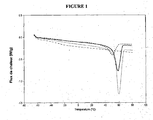
- the fusion of the POE crystallites in the various copolymers prepared above in Example 1 was studied by Differential Scanning Calorimetry (DSC) using an apparatus sold under the reference DSC. 2920 by Thermal Analysis using an aluminum nacelle, in the temperature range -70 ° C to 80 ° C with a heating rate of 5 ° C / min, (nitrogen flow rate: 10 mL / min) .
- DSC Differential Scanning Calorimetry
- thermograms obtained are presented on the figure 1 annexed on which the heat flux (in W / g) is a function of the temperature.
- the dashed line corresponds to the 9.5% by weight copolymer of PSTFSILi
- the continuous line curve to the copolymer to 21.2% by weight of PSTFSILi the distance curve drawn to the copolymer at 30.8%. by weight of PSTFSILi and the curve and dashes and dots alternating with the copolymer at 42.9% by weight of PSTFSILi.
- T f is the melting temperature
- ⁇ Hf triblock is the melting enthalpy of the triblock copolymer
- ⁇ Hf POE is the melting enthalpy of the POE block only
- Tg is the glass transition temperature of the POE.
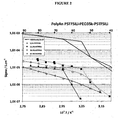
- the maximum conductivity is observed for 78% by weight of PEO relative to the total weight of the copolymer, ie for an OE / Li ratio of approximately 30. This reaches 10 -5 S.cm -1 at 60 ° C. which is unprecedented at such an operating temperature for polymer electrolytes without attached anionic solvents.
- the number of transport of these materials was measured by impedance using a frequency analyzer 1260 sold by the company Solartron, it reaches values greater than 0.84.
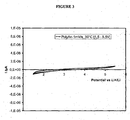
- the electrochemical stability of these copolymers was studied by cyclic voltammetry using cells consisting of a lithium metal anode, a copolymer as prepared in Example 1 as a solid electrolyte and a platinum sheet. as cathode. The measurements were made at 80 ° C between 1.5 and 5.5 V (vs. Li + / Li) at a scanning rate of 1 mVs -1 .
- Prototypes of batteries based on the copolymer according to the present invention at 30.8% by weight of P (STFSILi) as prepared above in Example 1, were assembled using lithium metal as anode and LiFePO 4 to the cathode as a model cathode material.
- the thickness of the solid electrolyte layer was about 70 ⁇ m.
- a non-optimized composite cathode formulation with 60% by weight of LiFePO 4 , 32% by weight of copolymer according to the invention and 8% by weight of black carbon was produced by coating.
- the measured surface capacitance was of the order of 0.75 mAh.cm -2 , which is comparable to standard Li-ion technologies.
- the battery thus prepared has a comparable cyclability at 60, 70 and 80 ° C which is a performance compared to the results of the literature on dry polymers.
- the battery thus prepared has a comparable cyclability at 60, 70 and 80 ° C which is a performance compared to the results of the literature on dry polymers.
- it is the same prototype battery that has worked in different thermal conditions, which is a drastic treatment because the tests are usually performed in isothermal conditions, except in the case of an accelerated aging simulation.
- the power handling of the battery is given by the figure 5 annexed on which the capacity restored (in mAh / g) is a function of the logarithm of the current density (pseudo-Ragone curve).
- the curve whose points are solid squares corresponds to the operation at 80 ° C.
- the curve whose points are empty triangles corresponds to the operation at 70 ° C.
- the curve whose points are solid diamonds corresponds to the operation at 60 ° C.
Landscapes
- Chemical & Material Sciences (AREA)
- Chemical Kinetics & Catalysis (AREA)
- Engineering & Computer Science (AREA)
- General Chemical & Material Sciences (AREA)
- Electrochemistry (AREA)
- Manufacturing & Machinery (AREA)
- Inorganic Chemistry (AREA)
- Health & Medical Sciences (AREA)
- Medicinal Chemistry (AREA)
- Polymers & Plastics (AREA)
- Organic Chemistry (AREA)
- Materials Engineering (AREA)
- Physics & Mathematics (AREA)
- Condensed Matter Physics & Semiconductors (AREA)
- General Physics & Mathematics (AREA)
- Crystallography & Structural Chemistry (AREA)
- Dispersion Chemistry (AREA)
- Graft Or Block Polymers (AREA)
- Secondary Cells (AREA)
- Battery Electrode And Active Subsutance (AREA)
Applications Claiming Priority (2)
| Application Number | Priority Date | Filing Date | Title |
|---|---|---|---|
| FR1157841A FR2979630B1 (fr) | 2011-09-05 | 2011-09-05 | Copolymeres a blocs dont un polyanionique base sur un monomere anion de type tfsili comme electrolyte de batterie. |
| PCT/FR2012/051982 WO2013034848A1 (fr) | 2011-09-05 | 2012-09-05 | COPOLYMERES A BLOCS DONT UN POLYANIONIQUE BASE SUR UN MONOMERE ANION DE TYPE TFSILi COMME ELECTROLYTE DE BATTERIE |
Publications (2)
| Publication Number | Publication Date |
|---|---|
| EP2753656A1 EP2753656A1 (fr) | 2014-07-16 |
| EP2753656B1 true EP2753656B1 (fr) | 2015-11-04 |
Family
ID=47022950
Family Applications (1)
| Application Number | Title | Priority Date | Filing Date |
|---|---|---|---|
| EP12773016.6A Active EP2753656B1 (fr) | 2011-09-05 | 2012-09-05 | COPOLYMERES A BLOCS DONT UN POLYANIONIQUE BASE SUR UN MONOMERE ANION DE TYPE TFSILi COMME ELECTROLYTE DE BATTERIE |
Country Status (9)
| Country | Link |
|---|---|
| US (1) | US9431677B2 (enExample) |
| EP (1) | EP2753656B1 (enExample) |
| JP (1) | JP6243842B2 (enExample) |
| KR (1) | KR101927267B1 (enExample) |
| CN (1) | CN103874724B (enExample) |
| CA (1) | CA2846267C (enExample) |
| ES (1) | ES2560406T3 (enExample) |
| FR (1) | FR2979630B1 (enExample) |
| WO (1) | WO2013034848A1 (enExample) |
Families Citing this family (58)
| Publication number | Priority date | Publication date | Assignee | Title |
|---|---|---|---|---|
| CN105377407B (zh) * | 2013-05-24 | 2019-08-13 | 明尼苏达大学评议会 | 聚合物电解质膜 |
| FR3012461B1 (fr) * | 2013-10-31 | 2016-01-01 | Arkema France | Compositions stables de nanotubes de carbone - polymeres electrolytes |
| FR3012462B1 (fr) | 2013-10-31 | 2016-01-01 | Arkema France | Compositions stables de poly (3,4-ethylenedioxythiophene) et de stabilisants anioniques a acidite limitee |
| US10020512B2 (en) * | 2013-12-19 | 2018-07-10 | Sion Power Corporation | Polymer for use as protective layers and other components in electrochemical cells |
| FR3024146B1 (fr) * | 2014-07-23 | 2018-02-16 | Cdp Innovation | Nouveaux polymeres contenant des sels de lithium ou de sodium de bis(sulfonyl)imides greffes, leurs procedes de preparation et leurs utilisations comme electrolytes pour batteries |
| FR3024145B1 (fr) * | 2014-07-23 | 2018-03-16 | Cdp Innovation | Nouveaux polymeres contenant des sels de lithium ou de sodium de sulfonamides, leurs procedes de preparation et leurs utilisations comme electrolytes pour batteries |
| EP3031798B1 (en) | 2014-12-10 | 2017-09-27 | Belenos Clean Power Holding AG | A novel cross-linker for the preparation of a new family of single ion conduction polymers for electrochemical devices and such polymers |
| JP6459485B2 (ja) * | 2014-12-19 | 2019-01-30 | 東洋インキScホールディングス株式会社 | カラーフィルタ用着色組成物、およびカラーフィルタ |
| KR102386841B1 (ko) | 2014-12-19 | 2022-04-14 | 삼성전자주식회사 | 복합전해질 및 이를 포함하는 리튬전지 |
| KR102303831B1 (ko) | 2014-12-26 | 2021-09-17 | 삼성전자주식회사 | 고분자, 이를 포함하는 전해질 및 리튬이차전지 |
| DE102015208438A1 (de) * | 2015-05-06 | 2016-11-10 | Robert Bosch Gmbh | Temperierungsvorrichtung für eine Batterie und einen Fahrzeuginnenraum, Verfahren zur Temperierung einer Batterie und eines Fahrzeuginnenraumes mit einer solchen Temperierungsvorrichtung und Verwendung einer solchen Temperierungsvorrichtung |
| JP6533305B2 (ja) * | 2015-05-12 | 2019-06-19 | シーオ インコーポレーテッドSeeo, Inc. | リチウム電池用電解質としてのpeoポリマーおよびフッ素化ポリマーを含むコポリマー |
| WO2016200559A1 (en) | 2015-06-09 | 2016-12-15 | Seeo, Inc. | Peo-based graft copolymers with pendant fluorinated groups for use as electrolytes |
| FR3040550B1 (fr) * | 2015-08-25 | 2017-08-11 | Commissariat Energie Atomique | Batterie au lithium-ion gelifiee |
| FR3041358B1 (fr) | 2015-09-21 | 2017-11-24 | Commissariat Energie Atomique | Electrolyte pour generateur electrochimique |
| FR3041350B1 (fr) | 2015-09-21 | 2019-05-10 | Commissariat A L'energie Atomique Et Aux Energies Alternatives | Electrolyte solide pour generateur electrochimique |
| DE102015224345A1 (de) * | 2015-12-04 | 2017-06-08 | Robert Bosch Gmbh | SIC-Separator und SIC-Zelle |
| FR3049114B1 (fr) * | 2016-03-18 | 2018-03-09 | Blue Solutions | Batterie lithium metal polymere a haute densite d'energie |
| CN105801768B (zh) * | 2016-04-19 | 2018-06-29 | 武汉纺织大学 | 一种用于苎麻织物液氨溶剂染色中的匀染剂及其制备方法与应用方法 |
| CN107459647B (zh) * | 2016-06-02 | 2020-04-14 | 杭州聚力氢能科技有限公司 | 侧链接枝双磺酰亚胺的聚酰亚胺型单离子传导聚合物及其应用 |
| KR102003306B1 (ko) * | 2016-10-31 | 2019-07-24 | 주식회사 엘지화학 | 리튬 전극 및 이를 포함하는 리튬 이차전지 |
| US11072689B2 (en) * | 2016-10-31 | 2021-07-27 | Lg Chem, Ltd. | Gel polymer electrolyte, electrochromic device comprising the same and production method thereof |
| KR20190090402A (ko) | 2016-12-14 | 2019-08-01 | 블루 솔루션즈 캐나다 인크. | 고정화된 음이온으로 그라프팅된 전해질을 갖는 리튬 금속 배터리 |
| US10854919B2 (en) * | 2017-03-09 | 2020-12-01 | Blue Solutions Canada Inc. | Block copolymer electrolyte for lithium batteries |
| CN111316491B (zh) * | 2017-11-02 | 2023-06-16 | 联邦科学和工业研究机构 | 电解质组合物 |
| CN109851703B (zh) * | 2017-11-30 | 2020-10-23 | 比亚迪股份有限公司 | 适用于粘结剂的偏二氟乙烯类共聚物及其制备方法和应用 |
| CN109851704B (zh) * | 2017-11-30 | 2020-06-19 | 比亚迪股份有限公司 | 聚合物隔膜及其制备方法和应用及锂电池 |
| TWI630748B (zh) | 2017-12-28 | 2018-07-21 | 財團法人工業技術研究院 | 負極及包含其之鋰離子電池 |
| KR102682124B1 (ko) * | 2018-11-30 | 2024-07-08 | 삼성전자주식회사 | 고분자 화합물, 이를 포함하는 고체 전해질막, 및 상기 고체 전해질막을 포함하는 리튬공기전지 |
| KR102135218B1 (ko) * | 2018-08-09 | 2020-07-17 | 건국대학교 글로컬산학협력단 | 수계 리튬이온전지용 전해질 및 그를 포함하는 수계 리튬이온전지 |
| KR102427345B1 (ko) | 2018-09-21 | 2022-08-01 | 주식회사 엘지에너지솔루션 | 겔 폴리머 전해질용 조성물 및 이로부터 형성된 겔 폴리머 전해질을 포함하는 리튬 이차전지 |
| FR3088932B1 (fr) * | 2018-11-27 | 2020-11-20 | Blue Solutions | Électrolyte polymère pour batterie lithium métal polymère à performances ameliorées |
| CN109776709B (zh) * | 2018-12-25 | 2021-09-07 | 广东工业大学 | 一种聚对苯乙烯磺酰(三氟甲基磺酰)亚胺锂-聚碳酸亚乙烯基酯共聚物及其应用 |
| KR102188558B1 (ko) | 2019-09-06 | 2020-12-08 | 건국대학교 글로컬산학협력단 | PEALiFSI 고분자 화합물, 이의 제조방법 및 이의 고체 전해질 용도 |
| CN112552438B (zh) * | 2019-09-10 | 2022-05-27 | 北京紫藤医创医药信息技术有限公司 | 一种用于柔性锂电池的高分子聚合物电解质的制备方法 |
| KR102311173B1 (ko) * | 2019-10-18 | 2021-10-12 | 건국대학교 글로컬산학협력단 | LiFSI를 활용한 자립형 겔화 고분자 화합물 및 이의 유연한 리튬 이온 배터리용 겔 고분자 전해질 용도 |
| KR102779843B1 (ko) | 2019-11-15 | 2025-03-10 | 주식회사 엘지에너지솔루션 | 전고체 전지용 전해질막 및 이를 포함하는 전고체 전지 |
| EP3832757A1 (en) * | 2019-12-03 | 2021-06-09 | Belenos Clean Power Holding AG | Single-ion conductive polymers for electrochemical devices |
| KR102531686B1 (ko) * | 2020-01-23 | 2023-05-10 | 삼성에스디아이 주식회사 | 첨가제, 이를 포함하는 리튬 이차 전지용 전해액 및 리튬 이차 전지 |
| KR102394800B1 (ko) * | 2020-02-03 | 2022-05-06 | 서울대학교산학협력단 | 가교 고분자 전해질 겔 및 이를 포함하는 배터리 |
| EP4127002A1 (en) | 2020-03-30 | 2023-02-08 | 3M Innovative Properties Company | Fluoropolymer comprising pendent groups with ionic bis(sulfonyl)imide moiety and perfluoroether terminal group |
| US12021186B2 (en) * | 2020-04-27 | 2024-06-25 | The Hong Kong University Of Science And Technology | Framework supported solid-state electrolyte composites for all-solid-state batteries |
| CN112185712B (zh) * | 2020-09-28 | 2021-10-15 | 浙江工业大学 | 一种咪唑类聚离子液体凝胶电解质及其制备方法 |
| GB202015440D0 (en) * | 2020-09-30 | 2020-11-11 | Fujifilm Mfg Europe Bv | Compounds, compositions and polymer films |
| WO2023090664A1 (ko) * | 2021-11-16 | 2023-05-25 | 주식회사 엘지에너지솔루션 | 신규한 비수계 전해액용 첨가제 및 이를 포함하는 리튬 이차전지 |
| JP7716965B2 (ja) * | 2021-11-24 | 2025-08-01 | 住友化学株式会社 | 電解質組成物、及び電池 |
| EP4307406B1 (en) * | 2022-03-17 | 2026-07-29 | LG Energy Solution, Ltd. | Lithium secondary battery |
| CN118248936B (zh) * | 2023-02-13 | 2025-07-22 | 深圳市固易能科技有限责任公司 | 包含离子型聚合物的凝胶电解质锂离子电池及制备方法 |
| CN121263454A (zh) * | 2023-05-08 | 2026-01-02 | 住友化学株式会社 | 有机锂盐的制造方法、包含该有机锂盐的组合物及聚合物 |
| WO2024249183A1 (en) * | 2023-05-26 | 2024-12-05 | Energy Exploration Technologies, Inc. | Compositions and methods for solid-state electrochemical cells |
| KR20260040642A (ko) * | 2023-08-04 | 2026-03-25 | 캐논 가부시끼가이샤 | 폴리머 전해질 및 이차 전지 |
| DE112024003219T5 (de) * | 2023-08-04 | 2026-06-18 | Canon Kabushiki Kaisha | Polymerelektrolyten und Sekundärbatterie |
| WO2025057907A1 (ja) * | 2023-09-12 | 2025-03-20 | 住友化学株式会社 | 電解質組成物、及び電池 |
| EP4765287A1 (en) * | 2023-09-12 | 2026-06-24 | Sumitomo Chemical Company, Limited | Electrolyte composition and battery |
| CN117497842B (zh) * | 2023-12-27 | 2024-03-12 | 江苏蓝固新能源科技有限公司 | 一种聚合物电解质和制备方法及其在二次电池中的应用 |
| WO2025183003A1 (ja) * | 2024-02-29 | 2025-09-04 | 住友化学株式会社 | 電解質組成物、電極組成物、及び電池 |
| WO2025197682A1 (ja) * | 2024-03-18 | 2025-09-25 | 住友化学株式会社 | 電池 |
| JP2026044317A (ja) * | 2024-08-30 | 2026-03-12 | トヨタ自動車株式会社 | 固体電解質材料および電池 |
Family Cites Families (13)
| Publication number | Priority date | Publication date | Assignee | Title |
|---|---|---|---|---|
| US5521025A (en) * | 1993-10-20 | 1996-05-28 | Chaloner-Gill; Benjamin | Electro chemical cell comprising non-radiation curable solid polymer electrolytes |
| DE69618019T2 (de) * | 1996-03-26 | 2002-08-01 | Minnesota Mining And Mfg. Co., Saint Paul | Kationisch polymerisierbare zusmmensetzungen, die zur beschichtung in einem elektrostatischen verfahren verwendet werden können |
| JP4124487B2 (ja) * | 1996-12-30 | 2008-07-23 | イドロ―ケベック | 五員環アニオン塩又はテトラアザペンタレン誘導体と、イオン伝導性物質としてのそれらの使用 |
| US6063522A (en) | 1998-03-24 | 2000-05-16 | 3M Innovative Properties Company | Electrolytes containing mixed fluorochemical/hydrocarbon imide and methide salts |
| US6361901B1 (en) * | 1998-07-23 | 2002-03-26 | Massachusetts Institute Of Technology | Self-doped microphase separated block copolymer electrolyte |
| JP2000082494A (ja) | 1998-09-03 | 2000-03-21 | Sanyo Chem Ind Ltd | 難燃性非水電解液およびそれを用いた二次電池 |
| US7579401B2 (en) | 2002-07-23 | 2009-08-25 | Nippon Soda Co., Ltd. | Solid polymer electrolyte |
| CN100539288C (zh) * | 2004-12-02 | 2009-09-09 | 株式会社小原 | 全固态型锂离子二次电池及其固体电解质 |
| US9666862B2 (en) * | 2005-02-23 | 2017-05-30 | Lg Chem, Ltd. | Secondary battery of improved lithium ion mobility and cell capacity |
| FR2899235B1 (fr) * | 2006-03-31 | 2012-10-05 | Arkema | Electrolytes polymeres solides a base de copolymeres triblocs notamment polystyrene-poly(oxyethylene)-polystyrene |
| US20090280411A1 (en) * | 2006-06-16 | 2009-11-12 | Koji Ohira | Positive electrode, production method thereof, and lithium secondary battery using the same |
| KR100892048B1 (ko) * | 2006-09-18 | 2009-04-06 | 주식회사 엘지화학 | 고율 방전 특성이 향상된 이차전지 |
| US9252456B2 (en) * | 2009-02-27 | 2016-02-02 | University Of Maryland, College Park | Polymer solid electrolyte for flexible batteries |
-
2011
- 2011-09-05 FR FR1157841A patent/FR2979630B1/fr not_active Expired - Fee Related
-
2012
- 2012-09-05 CA CA2846267A patent/CA2846267C/fr active Active
- 2012-09-05 WO PCT/FR2012/051982 patent/WO2013034848A1/fr not_active Ceased
- 2012-09-05 ES ES12773016.6T patent/ES2560406T3/es active Active
- 2012-09-05 CN CN201280043240.9A patent/CN103874724B/zh active Active
- 2012-09-05 EP EP12773016.6A patent/EP2753656B1/fr active Active
- 2012-09-05 KR KR1020147009099A patent/KR101927267B1/ko active Active
- 2012-09-05 US US14/239,905 patent/US9431677B2/en active Active
- 2012-09-05 JP JP2014527725A patent/JP6243842B2/ja active Active
Also Published As
| Publication number | Publication date |
|---|---|
| JP6243842B2 (ja) | 2017-12-06 |
| CA2846267C (fr) | 2019-10-29 |
| JP2014529863A (ja) | 2014-11-13 |
| WO2013034848A1 (fr) | 2013-03-14 |
| EP2753656A1 (fr) | 2014-07-16 |
| US9431677B2 (en) | 2016-08-30 |
| CN103874724A (zh) | 2014-06-18 |
| KR101927267B1 (ko) | 2018-12-10 |
| FR2979630B1 (fr) | 2013-10-04 |
| KR20140061501A (ko) | 2014-05-21 |
| US20140272600A1 (en) | 2014-09-18 |
| CA2846267A1 (fr) | 2013-03-14 |
| CN103874724B (zh) | 2016-10-19 |
| FR2979630A1 (fr) | 2013-03-08 |
| ES2560406T3 (es) | 2016-02-18 |
Similar Documents
| Publication | Publication Date | Title |
|---|---|---|
| CA2846267C (fr) | Copolymeres a blocs dont un polyanionique base sur un monomere anion de type tfsili comme electrolyte de batterie | |
| EP3430660B1 (fr) | Batterie lithium métal polymère à haute densité d'énergie | |
| CA3115556C (fr) | Electrolyte polymere pour batterie lithium metal polymere a performances ameliorees | |
| CN104813525B (zh) | 锂电池用粘结剂、电极制作用组合物和电极 | |
| EP2001917B1 (fr) | Electrolytes polymeres solides a base de copolymeres triblocs notamment polystyrene-poly(oxyethylene)- polystyrene | |
| JP2024051020A (ja) | ケイ素またはケイ素-グラファイト複合材電極のためのポリマー結合剤、および電気化学セルにおけるそれらの使用 | |
| EP3865533B1 (fr) | Electrolyte polymerique solide a base de polymere en peigne | |
| WO2020043995A1 (fr) | Polymère, son procédé de préparation, composition le comprenant et utilisation dans des batteries | |
| EP3326229B1 (fr) | Procédé de préparation d'ionomères à conduction cationique unipolaire à partir de monomères ioniques difluorés | |
| CN113265055B (zh) | 梳状聚合物 | |
| EP3126475B1 (fr) | Utilisation de polymères comme agents lubrifiants dans la production de films de métaux alcalins | |
| CN113764729A (zh) | 电解液以及锂金属电池 | |
| FR3085378A1 (fr) | Polymere, son procede de preparation, composition le comprenant et utilisation dans des batteries | |
| WO2019243519A1 (fr) | Électrolyte polymere solide, son procede de preparation et accumulateur/cellule electrochimique en comprenant | |
| WO2017050691A1 (fr) | Electrolyte solide pour generateur electrochimique |
Legal Events
| Date | Code | Title | Description |
|---|---|---|---|
| PUAI | Public reference made under article 153(3) epc to a published international application that has entered the european phase |
Free format text: ORIGINAL CODE: 0009012 |
|
| 17P | Request for examination filed |
Effective date: 20140304 |
|
| AK | Designated contracting states |
Kind code of ref document: A1 Designated state(s): AL AT BE BG CH CY CZ DE DK EE ES FI FR GB GR HR HU IE IS IT LI LT LU LV MC MK MT NL NO PL PT RO RS SE SI SK SM TR |
|
| DAX | Request for extension of the european patent (deleted) | ||
| GRAP | Despatch of communication of intention to grant a patent |
Free format text: ORIGINAL CODE: EPIDOSNIGR1 |
|
| INTG | Intention to grant announced |
Effective date: 20150112 |
|
| GRAP | Despatch of communication of intention to grant a patent |
Free format text: ORIGINAL CODE: EPIDOSNIGR1 |
|
| INTG | Intention to grant announced |
Effective date: 20150512 |
|
| GRAS | Grant fee paid |
Free format text: ORIGINAL CODE: EPIDOSNIGR3 |
|
| GRAA | (expected) grant |
Free format text: ORIGINAL CODE: 0009210 |
|
| AK | Designated contracting states |
Kind code of ref document: B1 Designated state(s): AL AT BE BG CH CY CZ DE DK EE ES FI FR GB GR HR HU IE IS IT LI LT LU LV MC MK MT NL NO PL PT RO RS SE SI SK SM TR |
|
| REG | Reference to a national code |
Ref country code: GB Ref legal event code: FG4D Free format text: NOT ENGLISH |
|
| REG | Reference to a national code |
Ref country code: CH Ref legal event code: EP |
|
| REG | Reference to a national code |
Ref country code: AT Ref legal event code: REF Ref document number: 759165 Country of ref document: AT Kind code of ref document: T Effective date: 20151115 |
|
| REG | Reference to a national code |
Ref country code: IE Ref legal event code: FG4D Free format text: LANGUAGE OF EP DOCUMENT: FRENCH |
|
| REG | Reference to a national code |
Ref country code: DE Ref legal event code: R096 Ref document number: 602012012215 Country of ref document: DE |
|
| REG | Reference to a national code |
Ref country code: ES Ref legal event code: FG2A Ref document number: 2560406 Country of ref document: ES Kind code of ref document: T3 Effective date: 20160218 |
|
| REG | Reference to a national code |
Ref country code: NL Ref legal event code: MP Effective date: 20151104 |
|
| REG | Reference to a national code |
Ref country code: LT Ref legal event code: MG4D |
|
| REG | Reference to a national code |
Ref country code: AT Ref legal event code: MK05 Ref document number: 759165 Country of ref document: AT Kind code of ref document: T Effective date: 20151104 |
|
| PG25 | Lapsed in a contracting state [announced via postgrant information from national office to epo] |
Ref country code: HR Free format text: LAPSE BECAUSE OF FAILURE TO SUBMIT A TRANSLATION OF THE DESCRIPTION OR TO PAY THE FEE WITHIN THE PRESCRIBED TIME-LIMIT Effective date: 20151104 Ref country code: LT Free format text: LAPSE BECAUSE OF FAILURE TO SUBMIT A TRANSLATION OF THE DESCRIPTION OR TO PAY THE FEE WITHIN THE PRESCRIBED TIME-LIMIT Effective date: 20151104 Ref country code: NO Free format text: LAPSE BECAUSE OF FAILURE TO SUBMIT A TRANSLATION OF THE DESCRIPTION OR TO PAY THE FEE WITHIN THE PRESCRIBED TIME-LIMIT Effective date: 20160204 Ref country code: NL Free format text: LAPSE BECAUSE OF FAILURE TO SUBMIT A TRANSLATION OF THE DESCRIPTION OR TO PAY THE FEE WITHIN THE PRESCRIBED TIME-LIMIT Effective date: 20151104 Ref country code: IS Free format text: LAPSE BECAUSE OF FAILURE TO SUBMIT A TRANSLATION OF THE DESCRIPTION OR TO PAY THE FEE WITHIN THE PRESCRIBED TIME-LIMIT Effective date: 20160304 |
|
| PG25 | Lapsed in a contracting state [announced via postgrant information from national office to epo] |
Ref country code: AT Free format text: LAPSE BECAUSE OF FAILURE TO SUBMIT A TRANSLATION OF THE DESCRIPTION OR TO PAY THE FEE WITHIN THE PRESCRIBED TIME-LIMIT Effective date: 20151104 Ref country code: PT Free format text: LAPSE BECAUSE OF FAILURE TO SUBMIT A TRANSLATION OF THE DESCRIPTION OR TO PAY THE FEE WITHIN THE PRESCRIBED TIME-LIMIT Effective date: 20160304 Ref country code: PL Free format text: LAPSE BECAUSE OF FAILURE TO SUBMIT A TRANSLATION OF THE DESCRIPTION OR TO PAY THE FEE WITHIN THE PRESCRIBED TIME-LIMIT Effective date: 20151104 Ref country code: GR Free format text: LAPSE BECAUSE OF FAILURE TO SUBMIT A TRANSLATION OF THE DESCRIPTION OR TO PAY THE FEE WITHIN THE PRESCRIBED TIME-LIMIT Effective date: 20160205 Ref country code: FI Free format text: LAPSE BECAUSE OF FAILURE TO SUBMIT A TRANSLATION OF THE DESCRIPTION OR TO PAY THE FEE WITHIN THE PRESCRIBED TIME-LIMIT Effective date: 20151104 Ref country code: RS Free format text: LAPSE BECAUSE OF FAILURE TO SUBMIT A TRANSLATION OF THE DESCRIPTION OR TO PAY THE FEE WITHIN THE PRESCRIBED TIME-LIMIT Effective date: 20151104 Ref country code: LV Free format text: LAPSE BECAUSE OF FAILURE TO SUBMIT A TRANSLATION OF THE DESCRIPTION OR TO PAY THE FEE WITHIN THE PRESCRIBED TIME-LIMIT Effective date: 20151104 Ref country code: SE Free format text: LAPSE BECAUSE OF FAILURE TO SUBMIT A TRANSLATION OF THE DESCRIPTION OR TO PAY THE FEE WITHIN THE PRESCRIBED TIME-LIMIT Effective date: 20151104 |
|
| PG25 | Lapsed in a contracting state [announced via postgrant information from national office to epo] |
Ref country code: CZ Free format text: LAPSE BECAUSE OF FAILURE TO SUBMIT A TRANSLATION OF THE DESCRIPTION OR TO PAY THE FEE WITHIN THE PRESCRIBED TIME-LIMIT Effective date: 20151104 |
|
| REG | Reference to a national code |
Ref country code: DE Ref legal event code: R097 Ref document number: 602012012215 Country of ref document: DE |
|
| PG25 | Lapsed in a contracting state [announced via postgrant information from national office to epo] |
Ref country code: SM Free format text: LAPSE BECAUSE OF FAILURE TO SUBMIT A TRANSLATION OF THE DESCRIPTION OR TO PAY THE FEE WITHIN THE PRESCRIBED TIME-LIMIT Effective date: 20151104 Ref country code: DK Free format text: LAPSE BECAUSE OF FAILURE TO SUBMIT A TRANSLATION OF THE DESCRIPTION OR TO PAY THE FEE WITHIN THE PRESCRIBED TIME-LIMIT Effective date: 20151104 Ref country code: SK Free format text: LAPSE BECAUSE OF FAILURE TO SUBMIT A TRANSLATION OF THE DESCRIPTION OR TO PAY THE FEE WITHIN THE PRESCRIBED TIME-LIMIT Effective date: 20151104 Ref country code: RO Free format text: LAPSE BECAUSE OF FAILURE TO SUBMIT A TRANSLATION OF THE DESCRIPTION OR TO PAY THE FEE WITHIN THE PRESCRIBED TIME-LIMIT Effective date: 20151104 Ref country code: EE Free format text: LAPSE BECAUSE OF FAILURE TO SUBMIT A TRANSLATION OF THE DESCRIPTION OR TO PAY THE FEE WITHIN THE PRESCRIBED TIME-LIMIT Effective date: 20151104 |
|
| PLBE | No opposition filed within time limit |
Free format text: ORIGINAL CODE: 0009261 |
|
| STAA | Information on the status of an ep patent application or granted ep patent |
Free format text: STATUS: NO OPPOSITION FILED WITHIN TIME LIMIT |
|
| REG | Reference to a national code |
Ref country code: FR Ref legal event code: PLFP Year of fee payment: 5 |
|
| 26N | No opposition filed |
Effective date: 20160805 |
|
| PG25 | Lapsed in a contracting state [announced via postgrant information from national office to epo] |
Ref country code: SI Free format text: LAPSE BECAUSE OF FAILURE TO SUBMIT A TRANSLATION OF THE DESCRIPTION OR TO PAY THE FEE WITHIN THE PRESCRIBED TIME-LIMIT Effective date: 20151104 |
|
| PG25 | Lapsed in a contracting state [announced via postgrant information from national office to epo] |
Ref country code: BE Free format text: LAPSE BECAUSE OF NON-PAYMENT OF DUE FEES Effective date: 20160930 |
|
| PG25 | Lapsed in a contracting state [announced via postgrant information from national office to epo] |
Ref country code: MC Free format text: LAPSE BECAUSE OF FAILURE TO SUBMIT A TRANSLATION OF THE DESCRIPTION OR TO PAY THE FEE WITHIN THE PRESCRIBED TIME-LIMIT Effective date: 20151104 |
|
| REG | Reference to a national code |
Ref country code: IE Ref legal event code: MM4A |
|
| PG25 | Lapsed in a contracting state [announced via postgrant information from national office to epo] |
Ref country code: IE Free format text: LAPSE BECAUSE OF NON-PAYMENT OF DUE FEES Effective date: 20160905 |
|
| PG25 | Lapsed in a contracting state [announced via postgrant information from national office to epo] |
Ref country code: LU Free format text: LAPSE BECAUSE OF NON-PAYMENT OF DUE FEES Effective date: 20160905 |
|
| REG | Reference to a national code |
Ref country code: FR Ref legal event code: PLFP Year of fee payment: 6 |
|
| REG | Reference to a national code |
Ref country code: BE Ref legal event code: MM Effective date: 20160930 |
|
| PG25 | Lapsed in a contracting state [announced via postgrant information from national office to epo] |
Ref country code: HU Free format text: LAPSE BECAUSE OF FAILURE TO SUBMIT A TRANSLATION OF THE DESCRIPTION OR TO PAY THE FEE WITHIN THE PRESCRIBED TIME-LIMIT; INVALID AB INITIO Effective date: 20120905 |
|
| PG25 | Lapsed in a contracting state [announced via postgrant information from national office to epo] |
Ref country code: MK Free format text: LAPSE BECAUSE OF FAILURE TO SUBMIT A TRANSLATION OF THE DESCRIPTION OR TO PAY THE FEE WITHIN THE PRESCRIBED TIME-LIMIT Effective date: 20151104 Ref country code: CY Free format text: LAPSE BECAUSE OF FAILURE TO SUBMIT A TRANSLATION OF THE DESCRIPTION OR TO PAY THE FEE WITHIN THE PRESCRIBED TIME-LIMIT Effective date: 20151104 Ref country code: MT Free format text: LAPSE BECAUSE OF FAILURE TO SUBMIT A TRANSLATION OF THE DESCRIPTION OR TO PAY THE FEE WITHIN THE PRESCRIBED TIME-LIMIT Effective date: 20151104 |
|
| PG25 | Lapsed in a contracting state [announced via postgrant information from national office to epo] |
Ref country code: BG Free format text: LAPSE BECAUSE OF FAILURE TO SUBMIT A TRANSLATION OF THE DESCRIPTION OR TO PAY THE FEE WITHIN THE PRESCRIBED TIME-LIMIT Effective date: 20151104 |
|
| REG | Reference to a national code |
Ref country code: FR Ref legal event code: PLFP Year of fee payment: 7 |
|
| PG25 | Lapsed in a contracting state [announced via postgrant information from national office to epo] |
Ref country code: TR Free format text: LAPSE BECAUSE OF FAILURE TO SUBMIT A TRANSLATION OF THE DESCRIPTION OR TO PAY THE FEE WITHIN THE PRESCRIBED TIME-LIMIT Effective date: 20151104 Ref country code: AL Free format text: LAPSE BECAUSE OF FAILURE TO SUBMIT A TRANSLATION OF THE DESCRIPTION OR TO PAY THE FEE WITHIN THE PRESCRIBED TIME-LIMIT Effective date: 20151104 |
|
| REG | Reference to a national code |
Ref country code: GB Ref legal event code: 732E Free format text: REGISTERED BETWEEN 20230518 AND 20230524 |
|
| REG | Reference to a national code |
Ref country code: DE Ref legal event code: R082 Ref document number: 602012012215 Country of ref document: DE Representative=s name: GRAMM, LINS & PARTNER PATENT- UND RECHTSANWAEL, DE Ref country code: DE Ref legal event code: R082 Ref document number: 602012012215 Country of ref document: DE Representative=s name: IPSILON PATENTANWALTSGESELLSCHAFT MBH, DE |
|
| REG | Reference to a national code |
Ref country code: DE Ref legal event code: R081 Ref document number: 602012012215 Country of ref document: DE Owner name: BLUE SOLUTIONS SOCIETE PAR ACTIONS SIMPLIFEE, FR Free format text: FORMER OWNER: UNIVERSITE D'AIX-MARSEILLE, MARSEILLE, FR Ref country code: DE Ref legal event code: R081 Ref document number: 602012012215 Country of ref document: DE Owner name: UNIVERSITE DE PICARDIE JULES VERNE, FR Free format text: FORMER OWNER: UNIVERSITE D'AIX-MARSEILLE, MARSEILLE, FR Ref country code: DE Ref legal event code: R081 Ref document number: 602012012215 Country of ref document: DE Owner name: UNIVERSITE D'AIX-MARSEILLE, FR Free format text: FORMER OWNER: UNIVERSITE D'AIX-MARSEILLE, MARSEILLE, FR Ref country code: DE Ref legal event code: R081 Ref document number: 602012012215 Country of ref document: DE Owner name: CENTRE NATIONAL DE LA RECHERCHE SCIENTIFIQUE, FR Free format text: FORMER OWNER: UNIVERSITE D'AIX-MARSEILLE, MARSEILLE, FR |
|
| REG | Reference to a national code |
Ref country code: ES Ref legal event code: PC2A Owner name: CENTRE NATIONAL DE LA RECHERCHE SCIENTIFIQUE Effective date: 20230622 |
|
| REG | Reference to a national code |
Ref country code: DE Ref legal event code: R082 Ref document number: 602012012215 Country of ref document: DE Representative=s name: GRAMM, LINS & PARTNER PATENT- UND RECHTSANWAEL, DE Ref country code: DE Ref legal event code: R081 Ref document number: 602012012215 Country of ref document: DE Owner name: BLUE SOLUTIONS SOCIETE PAR ACTIONS SIMPLIFEE, FR Free format text: FORMER OWNERS: CENTRE NATIONAL DE LA RECHERCHE SCIENTIFIQUE, 75016 PARIS, FR; UNIVERSITE D'AIX-MARSEILLE, MARSEILLE, FR; UNIVERSITE DE PICARDIE JULES VERNE, AMIENS, FR |
|
| REG | Reference to a national code |
Ref country code: ES Ref legal event code: PC2A Owner name: BLUE SOLUTIONS Effective date: 20241108 |
|
| REG | Reference to a national code |
Ref country code: CH Ref legal event code: U11 Free format text: ST27 STATUS EVENT CODE: U-0-0-U10-U11 (AS PROVIDED BY THE NATIONAL OFFICE) Effective date: 20251001 |
|
| PGFP | Annual fee paid to national office [announced via postgrant information from national office to epo] |
Ref country code: DE Payment date: 20250820 Year of fee payment: 14 |
|
| PGFP | Annual fee paid to national office [announced via postgrant information from national office to epo] |
Ref country code: IT Payment date: 20250820 Year of fee payment: 14 |
|
| PGFP | Annual fee paid to national office [announced via postgrant information from national office to epo] |
Ref country code: GB Payment date: 20250820 Year of fee payment: 14 |
|
| PGFP | Annual fee paid to national office [announced via postgrant information from national office to epo] |
Ref country code: FR Payment date: 20250821 Year of fee payment: 14 |
|
| PGFP | Annual fee paid to national office [announced via postgrant information from national office to epo] |
Ref country code: CH Payment date: 20251001 Year of fee payment: 14 |
|
| PGFP | Annual fee paid to national office [announced via postgrant information from national office to epo] |
Ref country code: ES Payment date: 20251001 Year of fee payment: 14 |
|
| REG | Reference to a national code |
Ref country code: GB Ref legal event code: 732E Free format text: REGISTERED BETWEEN 20260226 AND 20260304 |