EP2722923B1 - Nonaqueous electrolyte secondary battery - Google Patents
Nonaqueous electrolyte secondary battery Download PDFInfo
- Publication number
- EP2722923B1 EP2722923B1 EP12801291.1A EP12801291A EP2722923B1 EP 2722923 B1 EP2722923 B1 EP 2722923B1 EP 12801291 A EP12801291 A EP 12801291A EP 2722923 B1 EP2722923 B1 EP 2722923B1
- Authority
- EP
- European Patent Office
- Prior art keywords
- positive electrode
- active material
- life
- ratio
- electrode active
- Prior art date
- Legal status (The legal status is an assumption and is not a legal conclusion. Google has not performed a legal analysis and makes no representation as to the accuracy of the status listed.)
- Not-in-force
Links
Images
Classifications
-
- H—ELECTRICITY
- H01—ELECTRIC ELEMENTS
- H01M—PROCESSES OR MEANS, e.g. BATTERIES, FOR THE DIRECT CONVERSION OF CHEMICAL ENERGY INTO ELECTRICAL ENERGY
- H01M4/00—Electrodes
- H01M4/02—Electrodes composed of, or comprising, active material
-
- H—ELECTRICITY
- H01—ELECTRIC ELEMENTS
- H01M—PROCESSES OR MEANS, e.g. BATTERIES, FOR THE DIRECT CONVERSION OF CHEMICAL ENERGY INTO ELECTRICAL ENERGY
- H01M10/00—Secondary cells; Manufacture thereof
- H01M10/05—Accumulators with non-aqueous electrolyte
- H01M10/052—Li-accumulators
- H01M10/0525—Rocking-chair batteries, i.e. batteries with lithium insertion or intercalation in both electrodes; Lithium-ion batteries
-
- H—ELECTRICITY
- H01—ELECTRIC ELEMENTS
- H01M—PROCESSES OR MEANS, e.g. BATTERIES, FOR THE DIRECT CONVERSION OF CHEMICAL ENERGY INTO ELECTRICAL ENERGY
- H01M4/00—Electrodes
- H01M4/02—Electrodes composed of, or comprising, active material
- H01M4/13—Electrodes for accumulators with non-aqueous electrolyte, e.g. for lithium-accumulators; Processes of manufacture thereof
- H01M4/136—Electrodes based on inorganic compounds other than oxides or hydroxides, e.g. sulfides, selenides, tellurides, halogenides or LiCoFy
-
- H—ELECTRICITY
- H01—ELECTRIC ELEMENTS
- H01M—PROCESSES OR MEANS, e.g. BATTERIES, FOR THE DIRECT CONVERSION OF CHEMICAL ENERGY INTO ELECTRICAL ENERGY
- H01M4/00—Electrodes
- H01M4/02—Electrodes composed of, or comprising, active material
- H01M4/36—Selection of substances as active materials, active masses, active liquids
- H01M4/362—Composites
- H01M4/366—Composites as layered products
-
- H—ELECTRICITY
- H01—ELECTRIC ELEMENTS
- H01M—PROCESSES OR MEANS, e.g. BATTERIES, FOR THE DIRECT CONVERSION OF CHEMICAL ENERGY INTO ELECTRICAL ENERGY
- H01M4/00—Electrodes
- H01M4/02—Electrodes composed of, or comprising, active material
- H01M4/36—Selection of substances as active materials, active masses, active liquids
- H01M4/48—Selection of substances as active materials, active masses, active liquids of inorganic oxides or hydroxides
- H01M4/485—Selection of substances as active materials, active masses, active liquids of inorganic oxides or hydroxides of mixed oxides or hydroxides for inserting or intercalating light metals, e.g. LiTi2O4 or LiTi2OxFy
-
- H—ELECTRICITY
- H01—ELECTRIC ELEMENTS
- H01M—PROCESSES OR MEANS, e.g. BATTERIES, FOR THE DIRECT CONVERSION OF CHEMICAL ENERGY INTO ELECTRICAL ENERGY
- H01M4/00—Electrodes
- H01M4/02—Electrodes composed of, or comprising, active material
- H01M4/36—Selection of substances as active materials, active masses, active liquids
- H01M4/58—Selection of substances as active materials, active masses, active liquids of inorganic compounds other than oxides or hydroxides, e.g. sulfides, selenides, tellurides, halogenides or LiCoFy; of polyanionic structures, e.g. phosphates, silicates or borates
- H01M4/5825—Oxygenated metallic salts or polyanionic structures, e.g. borates, phosphates, silicates, olivines
-
- H—ELECTRICITY
- H01—ELECTRIC ELEMENTS
- H01M—PROCESSES OR MEANS, e.g. BATTERIES, FOR THE DIRECT CONVERSION OF CHEMICAL ENERGY INTO ELECTRICAL ENERGY
- H01M50/00—Constructional details or processes of manufacture of the non-active parts of electrochemical cells other than fuel cells, e.g. hybrid cells
- H01M50/10—Primary casings; Jackets or wrappings
- H01M50/147—Lids or covers
- H01M50/148—Lids or covers characterised by their shape
- H01M50/154—Lid or cover comprising an axial bore for receiving a central current collector
-
- H—ELECTRICITY
- H01—ELECTRIC ELEMENTS
- H01M—PROCESSES OR MEANS, e.g. BATTERIES, FOR THE DIRECT CONVERSION OF CHEMICAL ENERGY INTO ELECTRICAL ENERGY
- H01M50/00—Constructional details or processes of manufacture of the non-active parts of electrochemical cells other than fuel cells, e.g. hybrid cells
- H01M50/50—Current conducting connections for cells or batteries
- H01M50/543—Terminals
- H01M50/552—Terminals characterised by their shape
- H01M50/559—Terminals adapted for cells having curved cross-section, e.g. round, elliptic or button cells
- H01M50/56—Cup shaped terminals
-
- Y—GENERAL TAGGING OF NEW TECHNOLOGICAL DEVELOPMENTS; GENERAL TAGGING OF CROSS-SECTIONAL TECHNOLOGIES SPANNING OVER SEVERAL SECTIONS OF THE IPC; TECHNICAL SUBJECTS COVERED BY FORMER USPC CROSS-REFERENCE ART COLLECTIONS [XRACs] AND DIGESTS
- Y02—TECHNOLOGIES OR APPLICATIONS FOR MITIGATION OR ADAPTATION AGAINST CLIMATE CHANGE
- Y02E—REDUCTION OF GREENHOUSE GAS [GHG] EMISSIONS, RELATED TO ENERGY GENERATION, TRANSMISSION OR DISTRIBUTION
- Y02E60/00—Enabling technologies; Technologies with a potential or indirect contribution to GHG emissions mitigation
- Y02E60/10—Energy storage using batteries
-
- Y—GENERAL TAGGING OF NEW TECHNOLOGICAL DEVELOPMENTS; GENERAL TAGGING OF CROSS-SECTIONAL TECHNOLOGIES SPANNING OVER SEVERAL SECTIONS OF THE IPC; TECHNICAL SUBJECTS COVERED BY FORMER USPC CROSS-REFERENCE ART COLLECTIONS [XRACs] AND DIGESTS
- Y02—TECHNOLOGIES OR APPLICATIONS FOR MITIGATION OR ADAPTATION AGAINST CLIMATE CHANGE
- Y02T—CLIMATE CHANGE MITIGATION TECHNOLOGIES RELATED TO TRANSPORTATION
- Y02T10/00—Road transport of goods or passengers
- Y02T10/60—Other road transportation technologies with climate change mitigation effect
- Y02T10/70—Energy storage systems for electromobility, e.g. batteries
Definitions
- the exemplary embodiment of the present invention relates to a non-aqueous electrolyte secondary battery.
- non-aqueous electrolyte secondary batteries that are charged and discharged as Li ions move between the negative electrode and the positive electrode have become a subject of active research and development as high energy density batteries.
- Such non-aqueous electrolyte secondary batteries are anticipated as large-sized power sources particularly for electric cars or hybrid cars that combine an engine and a motor, from the viewpoint of environmental problems.
- their use is not limited to the automobile applications, much attention is paid to the non-aqueous electrolyte secondary batteries also as electric power sources.
- non-aqueous electrolyte secondary batteries the characteristics of instantaneously releasing a large current are considered important to an extent equal to or higher than that of those non-aqueous electrolyte batteries used in small-sized mobile telephones, notebook PCs and the like.
- lithium iron phosphate LiFePO 4
- the positive electrode attention is being paid to lithium iron phosphate (LiFePO 4 ) having an olivine type structure, from the viewpoint of resources, and from the viewpoints of high environmental compatibility as well as electrochemical stability, thermal safety and the like.
- a battery which uses lithium titanium composite oxide in the negative electrode, and lithium iron phosphate in the positive electrode, can become an innovative secondary battery that is far more safe and has a far longer service life as compared with conventional lithium ion secondary batteries.
- lithium iron phosphate has a problem that the compound easily reacts with moisture, and iron is likely to be eluted from the positive electrode active material. Furthermore, the inventors confirmed that the lithium titanium composite oxide having a very fine particle size, which is used in the negative electrode, contains a large amount of water of crystallization. That is, in the case of such a combination of a positive electrode and a negative electrode, the large amount of water of crystallization contained in the negative electrode causes dissolution of lithium iron phosphate, deterioration of capacity is prone to occur, and the original potentials of the positive electrode and the negative electrode could not be sufficiently extracted.
- a technique of coating, for example, a substance such as Li 3 PO 4 that is inert to water, or carbon that has electron conductivity in order to suppress such reaction with moisture or the like, is already well known (see for example Sheng-huang Wu, et al., "Effects of Fe2P and Li3PO4 additives on the cycling performance of LiFePO4/C composite cathode materials", Journal of Power Sources 196(2011)6676-6681 and EP2124272A1 ).
- the substances mentioned as examples are not capable per se of insertion and extraction of lithium, the substances do not contribute to the charge-discharge capacity.
- WO 2008/091707 relates to oxide coatings for Lithium Oxide particles where the core of the particle may comprise LiFePO 4 .
- CN 12 009 969 relates to a method for treating an anode material lithium iron phosphate of a lithium ion battery.
- Patent Literature 1 Japanese Patent Application Laid-Open No. 2000-67925
- the invention according to the exemplary embodiment is intended to provide a non-aqueous electrolyte secondary battery having a positive electrode active material with excellent water resistance.
- the non-aqueous electrolyte secondary battery of the exemplary embodiment includes a positive electrode containing positive electrode active material particles that are composed of a core section that has olivine type LiFePO 4 , an intermediate section that lies on the outer side of the core section and has a lithium iron phosphate which can be represented by the formula: LiFe x P y O z , and a surface section that lies on the outer side of the intermediate section and has a lithium iron phosphate which can be represented by the formula: LiFe a P b O c ; and a negative electrode containing lithium titanate, the molar concentration ratio of Fe relative to P of the lithium iron phosphate at the core section is greater than the average of the ratio x/y of LiFe x P y O z , the average value of the ratio a/b of LiFe a P b O c at the surface section of the positive electrode active material particles is smaller than the average of the ratio x/y of LiFe x P y O z
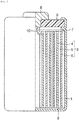
- FIG. 1 is a partial cross-sectional diagram of the non-aqueous electrolyte secondary battery of the exemplary embodiment.
- the inventors found a tendency that as the molar concentration ratio of Fe relative to P in the lithium iron phosphate of the positive electrode active material increases, the diffusion of lithium ions can be smoothly achieved, but on the other hand, the effect of preventing the erosion by water is decreased.
- the molar concentration ratio of Fe to P is represented by, for example, x/y when the lithium iron phosphate is LiFe x P y O z .
- the positive electrode active materials are all LiFePO 4
- the positive electrode material of the exemplary embodiment is composed of lithium iron phosphate having olivine type LiFePO 4 in the core section, an intermediate section that lies on the outer side of the core section and has a lithium iron phosphate which can be represented by the formula : LiFe x P y O z , and a lithium iron phosphate which can be represented by the formula: LiFe a P b O c on the outer side of the intermediate section.
- a region in which x/y of LiFe x P y O z increases continuously or intermittently in the direction from the surface section to the core is included in the positive electrode active material particles. When the increasing region is included, the diffusion of lithium can proceed smoothly. Furthermore, it is constructed such that erosion by water is prevented as a/b at the surface section of the positive electrode active material is decreased. Since this surface section is not the coating layer of Li 3 PO 4 or the like, the surface section can contribute to the process of charge and discharge.
- the positive electrode active material particles of the exemplary embodiment can be subjected to a surface composition analysis using X-rays by XPS (X-ray Photon Spectroscopy). Through an XPS analysis, the bonding state of the various elements and the composition proportions of the various elements of the positive electrode active material can be calculated.
- the composition proportions of the various elements according to the exemplary embodiment for example, x/y, which is the molar concentration ratio of Fe to P in the lithium iron phosphate represented by LiFe x P y O z , is all obtained by an analysis by XPS.
- the molar concentration ratios of Fe to P in other lithium iron phosphates are also obtained by an analysis by XPS.
- the average particle size of the positive electrode active material particles is preferably from 0.1 ⁇ m to 50 ⁇ m, and more preferably from 1 ⁇ m to 20 ⁇ m.
- an arbitrary point at the outermost surface or the surface section of the positive electrode active material particle is designated as P1, and a point which satisfies the following conditions in the particle depth direction on the line that connects P1 and the center of the positive electrode active material particle is designated as P2.
- P1 an arbitrary point at the outermost surface or the surface section of the positive electrode active material particle
- P2 a point which satisfies the following conditions in the particle depth direction on the line that connects P1 and the center of the positive electrode active material particle.
- P1 is determined as a point at the outermost surface, etching is not performed for the analysis of P1.
- the ratios Fe/P (molar concentration ratio of Fe to P) of lithium iron phosphate at P1 and P2 are designated as C(P1) and C(P2).
- the state is considered as a "state in which the Fe concentration relative to P increases in the direction from the surface section toward the center (core section) of the positive electrode active material.”
- the determination of P2 point is made such that a point where C(P2) is in the range of from 0.95 to 1.05, or a point at which, when the concentration ratio C in a region ranging from 1000 nm to 2000 nm in the depth direction from the surface is 0.85 or greater and maintains fluctuation within the range of ⁇ 0.05/100 nm or less, the fluctuation decreases for the first time, is considered as P2.
- the depth distance between P2 and P1 is calculated based on the etching time in terms of SiO 2 .
- the respective ratios Fe/P (molar concentration ratio of Fe to P) of lithium iron phosphate are designated as C(P1), C(P2), C(P3) and C(P4).
- C(P1) ⁇ C(P2) is satisfied, and C (P3) and C (P4) are equal to or greater than C(P1) and equal to or less than C(P2), the state is considered as a "state in which the Fe concentration relative to P increases in the intermediate section.”
- composition change of the region in which Fe continuously or intermittently increases relative to P, or the range of that region can be found by investigating the intermediate section in detail by an XPS analysis by shifting the positions of P3 and P4.
- the range of the region that is subject to continuous or intermittent changes start from a point which is deeper by 0.1% or more of the diameter of the particle in the direction from the outermost surface to the center of the positive electrode active material particle. Furthermore, when a region that is subject to continuous or intermittent change is extended to an excessively deep point, the time for diffusion of Li ions becomes long, and therefore, the rate characteristics or the input/output characteristics are adversely affected. Thus, it is preferable that the region that is subject to continuous or intermittent change include up to points that are deep by 20.0% or less of the diameter of the particle in the direction from the outermost surface to the center.
- the region be included in the range of from 0.1% to 20% of the diameter of the particle in the direction from the outermost surface to the center of the positive electrode active material particle. It is more preferable that this region that is subject to continuous or intermittent be included in the range of 0.5% to 15% as described above.
- the region of concentration change in the intermediate section is short, or if the concentration change is very steep, it becomes easy to adopt a structure in which a region of high or low lithium concentration surrounds like a shell, in such a manner that the region surrounds the core section of the active material (core-shell structure).
- core-shell structure When such a structure in which a region of high lithium concentration and a region of low lithium concentration are separated is adopted, the diffusion rate of lithium changes even at the same charge depth. Therefore, as a result, there is a possibility that the input-output characteristics may be greatly different. Accordingly, handling is difficult in controlling the battery, and therefore, it is not preferable.
- the core section of the positive electrode active material particle is mostly or entirely composed of olivine type LiFePO 4 , and in other cases, the core section may contain any one of Li 3 PO 4 , LiFeP 2 O 7 , LiFe 4 (P 2 O 7 ) 3 , Li 3 Fe 2 (PO 4 ) 3 and the like.
- the molar concentration ratio of Fe to P of the lithium iron phosphate at the core section is greater than the average of x/y of LiFe x P y O z in the intermediate section.
- the molar concentration ratio of Fe to P of the lithium iron phosphate at the core section is from 0. 95 to 1. 05, and the amount of change of the concentration ratio in the region is smaller than the amount of change of x/y of LiFe x P y O z in the region of the intermediate section.
- the surface section of the positive electrode active material particles means a region extending up to less than 0.1% of the diameter in the direction from the outermost surface toward the center of a particle of the positive electrode active material.
- the amount of change of a/b of LiFe a P b O c in the region of the surface section is smaller than the amount of change of x/y of LiFe x P y O z in the region of the intermediate section.
- the average of a/b of LiFe a P b O c of the surface section is smaller than the average of x/y of LiFe x P y O z of the intermediate section.
- LiFe a P b O c of the surface section is such that from the viewpoint of water resistance, it is more preferable as the ratio a/b is smaller. However, if the ratio a/b is too small, it is not preferable because the diffusivity of Li ions is decreased. Furthermore, also from the viewpoint of the charge-discharge capacity, it is not preferable if the ratio a/b is smaller than 0.1. From the viewpoint of the production process and from the viewpoint of electrochemical stability and thermal stability, it is preferable that olivine type LiFePO 4 be included also in the surface. From these, it is preferable that the surface be formed of lithium iron phosphate which includes olivine type LiFePO 4 and has an a/b value of 0.1 or greater.
- the ratio a/b increases, iron in the positive electrode active material is easily eluted by the inevitable water originating from lithium titanate or the like. Therefore, it is preferable that the ratio a/b be 0.5 or less.
- the ratio a/b of LiFe a P b O c of the surface section is from 0.1 to 0.5.
- the surface section of the positive electrode active material particle includes at least one or more compounds selected from Li 3 PO 4 , Li 1+ ⁇ FeP 2 O 7 , Li ⁇ Fe 4 (P 2 O 7 ) 3 and Li 3+ ⁇ Fe 2 (PO 4 ) 3 , and olivine type LiFePO 4 .
- ⁇ , ⁇ and ⁇ satisfy the conditions of 0 ⁇ ⁇ ⁇ 1, 0 ⁇ ⁇ ⁇ 3, and 0 ⁇ ⁇ ⁇ 2.
- the answer to the question about what compounds the surface section would be composed of can be found by an analysis and interpretation of the crystal phase by TEM-EDX.
- the active material can also be analyzed in a state of being fabricated into an electrode.
- MEC methyl ethyl carbonate
- the electrode thus obtained is subjected to etching processing and is analyzed by introducing a sample into TEM while an inert atmosphere is maintained.
- the active material becomes susceptible to the influence of moisture or the like in the atmosphere.
- the positive electrode active material particles are obtained by subjecting olivine type LiFePO 4 to an acid or water washing treatment, and to a heat treatment in an inert atmosphere .
- the acid used in the treatment may be any acid that is capable of dissolving iron, such as hydrochloric acid, sulfuric acid or nitric acid.
- the type of acid, the concentration and the treatment temperature are appropriately adjusted, and the concentration of iron at the surfaces or the interior of the positive electrode active material particles is adjusted.
- a portion of Fe is eluted from LiFePO 4 in advance by performing an acid or water washing treatment, and thus the molar concentration ratios of Fe to P at the surface section and the core section are lowered than that at the core section.
- the surface layer (surface section) adopts a disturbed structure.
- Li 1 + ⁇ FeP 2 O 7 , Li ⁇ Fe 4 (P 2 O 7 ) 3 , Li 3 Fe 2 (PO 4 ) and olivine type LiFePO 4 are included in the surface after the treatment, the three phases of Li 1 + ⁇ FeP 2 O 7 , Li ⁇ Fe 4 (P 2 O 7 ) 3 and Li 3 Fe 2 (PO 4 ) are not sufficiently formed.
- lithium diffusion inside the particle is inhibited.
- water is accumulated as water of crystallization inside the particles through an acid/water washing treatment, if the particles are left as they are, the erosion reaction of water is rather promoted.
- the structure of the surface can be converted to a desired form, and when the water of crystallization is removed, positive electrode active material particles having excellent lithium diffusivity and excellent water resistance can be synthesized.
- the positive electrode active material thus synthesized, a conductive agent and a binder are suspended in an appropriate solvent, and this suspension is applied on a collector such as an aluminum foil, dried and pressed to be produced into a band-shaped electrode.
- the positive electrode active material may have, in addition to the lithium composite phosphate compound thus synthesized, various oxides, sulfides, and lithium composite acid compounds incorporated therein.
- manganese dioxide MnO 2
- lithium manganese composite oxide for example, LiMn 2 O 4 or LiMnO 2
- lithium nickel composite oxide for example, LiNiO 2
- lithium cobalt composite oxide LiCoO 2
- lithium nickel cobalt composite oxide for example, LiNi 1-x Co x O 2
- lithium manganese cobalt composite oxide for example, LiMn x Co 1-x O 2
- the conductive agent include acetylene black, carbon black, and graphite.
- the binder include polytetrafluoroethylene (PTFE), polyvinylidene fluoride (PVdF), fluororubber, ethylene-butadiene rubber (SBR), and carboxymethyl cellulose (CMC).
- the mixing ratio of the positive electrode active material, the conductive agent and the binder is preferably set in the range of 80% to 95% by weight for the positive electrode active material, 3% to 20% by weight of the conductive agent, and 2% to 7% by weight of the binder.
- the negative electrode is produced by, for example, mixing a negative electrode mixture which includes a mixed active material of lithium titanium composite oxide and lithium composite oxide containing the negative electrode material for non-aqueous electrolyte batteries of the present invention, a conductive agent and a binder, by suspending the agents in an appropriate solvent, applying a coating liquid thus prepared on one surface or both surfaces of a collector band, and drying the coating liquid.
- a carbon material is usually used as the conductive agent used in the negative electrode. If a carbon material which may be used for the negative electrode active material described above, and is excellent in both the characteristics such as storability of alkali metals and conductivity, it is possible to use the above-described carbon material used as the negative electrode active material in combination with the conductive agent. However, if graphite having high carbon storability such as mesophase pitch carbon fibers is used alone, conductivity is decreased, and therefore, as the carbon material used as the conductive agent, it is preferable to use, for example, acetylene black or carbon black in the negative electrode.
- binder examples include polytetrafluoroethylene (PTFE), polyvinylidene fluoride (PVdF), fluororubber, ethylene-butadiene rubber (SBR), and carboxymethyl cellulose (CMC).
- PTFE polytetrafluoroethylene
- PVdF polyvinylidene fluoride
- SBR ethylene-butadiene rubber
- CMC carboxymethyl cellulose
- the mixing ratio of the negative electrode active material, the conductive agent and the binder is preferably set in the range of 70% to 95% by weight for the negative electrode active material, 0% to 25% by weight of the conductive agent, and 2% to 10% by weight of the binder.
- Example of the non-aqueous electrolyte include a liquid non-aqueous electrolyte prepared by dissolving an electrolyte in a non-aqueous solvent (non-aqueous electrolyte solution), a polymer gel-like electrolyte containing the non-aqueous solvent and the electrolyte in a polymer material, a polymer solid electrolyte containing the electrolyte in a polymer material, and an inorganic solid electrolyte having lithium ion conductivity.
- a liquid non-aqueous electrolyte prepared by dissolving an electrolyte in a non-aqueous solvent (non-aqueous electrolyte solution), a polymer gel-like electrolyte containing the non-aqueous solvent and the electrolyte in a polymer material, a polymer solid electrolyte containing the electrolyte in a polymer material, and an inorganic solid electrolyte having lithium ion conductivity.
- non-aqueous solvent used in the liquid non-aqueous electrolyte a non-aqueous solvent known for the use in lithium batteries can be used, and examples thereof include cyclic carbonates such as ethylene carbonate (EC) and propylene carbonate (PC); and a non-aqueous solvent mainly composed of a solvent mixture of a cyclic carbonate and a non-aqueous solvent having a lower viscosity than the cyclic carbonate (hereinafter, a second solvent).
- a second solvent a non-aqueous solvent mainly composed of a solvent mixture of a cyclic carbonate and a non-aqueous solvent having a lower viscosity than the cyclic carbonate
- Examples of the second solvent include linear carbonates such as dimethyl carbonate, methyl ethyl carbonate, and diethyl carbonate; ⁇ -butyrolactone, acetonitrile, methyl propionate, ethyl propionate; tetrahydrofuran and 2-methyltetrahydrofuran as cyclic ethers; and dimethoxyethane and diethoxyethane as linear ethers.
- linear carbonates such as dimethyl carbonate, methyl ethyl carbonate, and diethyl carbonate
- ⁇ -butyrolactone acetonitrile, methyl propionate, ethyl propionate
- tetrahydrofuran and 2-methyltetrahydrofuran as cyclic ethers
- dimethoxyethane and diethoxyethane as linear ethers.
- Examples of the electrolyte include alkali salts, and particularly, lithium salts.
- Examples of the lithium salts include lithium hexafluorophosphate (LiPF 6 ), lithium tetrafluoroborate (LiBF 4 ), lithium arsenic hexafluoride (LiAsF 6 ), lithium perchlorate (LiClO 4 ), and lithium trifluoromethanesulfonate (LiCF 3 SO 3 ).
- lithium hexafluorophosphate (LiPF 6 ) and lithium tetrafluoroborate (LiBF 4 ) are preferred.
- the amount of the electrolyte dissolved in the non-aqueous solvent is preferably set to from 0.5 to 2.0 mol/l.
- the gel-like electrolyte is prepared by dissolving the solvent and the electrolyte in a polymer material and converting the solution into a gel
- the polymer material include polymers of monomers such as polyacrylonitrile, polyacrylate, polyvinylidene fluoride (PVdF), and polyethylene oxide (PECO), and copolymers thereof with other monomers.
- the solid electrolyte is a product prepared by dissolving the electrolyte in a polymer material, and solidifying the solution.
- the polymer material include polymers of monomers such as polyacrylonitrile, polyvinylidene fluoride (PVdF), and polyethylene oxide (PEO), or copolymers thereof with other monomers.
- the inorganic solid electrolyte include ceramic materials containing lithium. Among them, Li 3 N, Li 3 PO 4 -Li 2 S-SiS 2 glass and the like.
- a separator may be disposed between the positive electrode and the negative electrode. Furthermore, a gel-like or solid non-aqueous electrolyte layer may be used in combination with this separator, or it is also possible to use a gel-like or solid non-aqueous electrolyte layer instead of the separator.
- the separator is intended to prevent the contact between the positive electrode and the negative electrode, and is composed of an insulating material. Furthermore, a separator having a morphology in which the electrolyte can move between the positive electrode and the negative electrode is used. Specific examples thereof include non-woven fabrics made of synthetic resins, a polyethylene porous film, a polypropylene porous film, and a cellulose-based separator.
- FIG. 1 An example of a partial cross-sectional diagram showing a cylindrical non-aqueous electrolyte secondary battery, which is an exemplary embodiment of the non-aqueous electrolyte battery, is shown in FIG. 1 .
- an insulator 2 is disposed at the bottom of a bottomed, cylindrical container 1 made of stainless steel.
- An electrode group 3 is accommodated in the container 1.
- the electrode group 3 is produced by interposing a separator 5 between a positive electrode 4 and a negative electrode 6, and winding the electrode group in a coil form.
- a powder of olivine type lithium iron phosphate (LiFePO 4 ) was immersed in 0.5 N sulfuric acid for 30 minutes, and then was subjected to water washing and filtration, and moisture was removed. Thereafter, the powder was heat treated for 3 hours in an Ar atmosphere.
- the average particle size of the treated lithium iron phosphate was examined, and was found to be 8.5 ⁇ m.
- This positive electrode powder was subjected to an XPS analysis without performing etching, and the molar concentration ratio of Fe to P (Fe/P) was calculated, which was found to be 0.35. Thereafter, an XPS analysis was carried out while performing etching, and as a result, when the analysis proceeded to a depth of 310 nm or more, no change was seen in the concentration of Fe.
- the molar concentration ratio of Fe to P at that time was 0.98. That is, it can be considered that the concentration change layer ended, and the composition almost reached LiFePO 4 .
- the molar concentration ratio was calculated when there was a concentration change layer which was 3.6% thick with respect to the average particle size.
- the molar concentration ratio of Fe to P was calculated at the outermost surface and at any two points shallower than 310 nm, in this case, at 80 nm and 220 nm, and as a result, the molar concentration ratios were 0.48 and 0.82. Therefore, the molar concentration ratio of Fe to P was continuously changing. Furthermore, a TEM observation of the particle was carried out, and the lattice fringe near the surface was observed. As a result, it was confirmed that the shape of the stripes and the lattice spacing were different at the surface layer and at the particle core section, and thus there were different crystal phases in the particle.
- composition ratios of the respective crystal phases were calculated by TEM-EDX, and as a result, it was confirmed that Li 3 PO 4 was present at the outermost surface layer, and a LiFeP 2 O 7 layer was present in the middle part, in addition to the olivine type LiFePO 4 .
- the positive electrode active material thus obtained was mixed with acetylene black, graphite, and polyvinylidene fluoride (PVdF) at a proportion of 100:8:8:6 (all in percent (%) by weight), using a mixer. Furthermore, N-methylpyrrolidone was added thereto and mixed, and the mixture was applied on a collector formed from an aluminum foil having a thickness of 15 ⁇ m, dried and then pressed. Thereby, a positive electrode having an electrode density of 1.9 g/cm 3 was produced.
- PVdF polyvinylidene fluoride
- the negative electrode active material 85% by weight of a powder of a negative electrode active material, 5% by weight of graphite as a conductive agent, 3% by weight of acetylene black similarly as a conductive agent, 7% by weight of PVdF, and NMP were added to and mixed with spinel-type lithium titanium oxide, and the mixture was applied on a collector formed from an aluminum foil having a thickness of 11 ⁇ m, dried and pressed. Thereby, a negative electrode was produced.
- the positive electrode, a separator formed from cellulose and a porous film made of polyethylene, the negative electrode, and the separator were laminated in this order, and then the laminate was wound in a coil form such that the negative electrode would be positioned on the outermost periphery. Thus, an electrode group was produced.
- LiPF 6 lithium hexafluorophosphate
- EC ethylene carbonate
- MEC methyl ethyl carbonate
- the electrode group and the electrolyte solution were respectively accommodated in a bottomed, cylindrical container made of stainless steel, and thus a cylindrical non-aqueous electrolyte secondary battery was assembled.
- the battery thus produced was subjected to charge and discharge three times at 1C rate in the range of 2.3 V to 1.0 V, and the capacity was checked.
- a battery was produced by the same method as that used in Example 1, except that bare LiFePO 4 was used in the positive electrode.
- a battery was produced by the same method as that used in Example 1, except that the LiFePO 4 of the positive electrode was coated with 2.5 wt% of carbon.
- a battery was produced by the same method as that used in Example 1, except that the LiFePO 4 of the positive electrode was coated with Li 3 PO 4 simply without any concentration gradient.
- the batteries of Examples 1 to 6 and Comparative Examples 1 to 3 were adjusted to a state of SOC 100%, and a storage test was carried out in an environment at 80°C.
- the batteries were returned to 25°C at an interval of one week, and the capacity was measured. Thereafter, the process of bringing the batteries again to the state of SOC 100% and storing them in an environment at 80°C was repeatedly carried out, and thus the test was carried out for 10 weeks in total.
- the ratios (%) of the capacity after 10 weeks relative to the capacity before storage are summarized in Table 2.
- Example 1 As a result, as shown in Comparative Example 1, bare LiFePO 4 had low water resistance and exhibited significant capacity deterioration. On the other hand, It was confirmed in Example 1 and so on that as the ratio of the Fe concentration at the surface was lower, the capacity deterioration was smaller. It can be contemplated that this originates from the fact that the batteries were not easily affected by the water contained in the negative electrode or the like.
- the battery has superior high temperature durability while maintaining rate characteristics.
Landscapes
- Chemical & Material Sciences (AREA)
- Chemical Kinetics & Catalysis (AREA)
- Electrochemistry (AREA)
- General Chemical & Material Sciences (AREA)
- Inorganic Chemistry (AREA)
- Engineering & Computer Science (AREA)
- Materials Engineering (AREA)
- Composite Materials (AREA)
- Crystallography & Structural Chemistry (AREA)
- Manufacturing & Machinery (AREA)
- Battery Electrode And Active Subsutance (AREA)
- Secondary Cells (AREA)
Applications Claiming Priority (2)
| Application Number | Priority Date | Filing Date | Title |
|---|---|---|---|
| JP2011133555A JP5981101B2 (ja) | 2011-06-15 | 2011-06-15 | 非水電解質二次電池 |
| PCT/JP2012/054376 WO2012172831A1 (ja) | 2011-06-15 | 2012-02-23 | 非水電解質二次電池 |
Publications (3)
| Publication Number | Publication Date |
|---|---|
| EP2722923A1 EP2722923A1 (en) | 2014-04-23 |
| EP2722923A4 EP2722923A4 (en) | 2014-11-19 |
| EP2722923B1 true EP2722923B1 (en) | 2017-01-18 |
Family
ID=47356831
Family Applications (1)
| Application Number | Title | Priority Date | Filing Date |
|---|---|---|---|
| EP12801291.1A Not-in-force EP2722923B1 (en) | 2011-06-15 | 2012-02-23 | Nonaqueous electrolyte secondary battery |
Country Status (5)
| Country | Link |
|---|---|
| US (1) | US9214669B2 (enExample) |
| EP (1) | EP2722923B1 (enExample) |
| JP (1) | JP5981101B2 (enExample) |
| CN (1) | CN103608961B (enExample) |
| WO (1) | WO2012172831A1 (enExample) |
Cited By (2)
| Publication number | Priority date | Publication date | Assignee | Title |
|---|---|---|---|---|
| EP4435898A4 (en) * | 2021-11-18 | 2025-08-20 | Shenzhen Innovazone Tech Co Ltd | POSITIVE ELECTRODE LITHIUM SUPPLEMENTATION ADDITIVE AND PREPARATION METHOD THEREOF, POSITIVE SHEET AND SECONDARY BATTERY |
| EP4636837A4 (en) * | 2023-04-27 | 2026-04-08 | Contemporary Amperex Technology Co Ltd | POSITIVE ELECTRODE SHEET, BATTERY AND ELECTRICAL DEVICE |
Families Citing this family (11)
| Publication number | Priority date | Publication date | Assignee | Title |
|---|---|---|---|---|
| WO2015140902A1 (ja) | 2014-03-17 | 2015-09-24 | 株式会社東芝 | 非水電解質二次電池および電池パック |
| JP6741390B2 (ja) * | 2014-04-25 | 2020-08-19 | 住友大阪セメント株式会社 | 正極材料、ペースト及びナトリウムイオン電池 |
| JP5929990B2 (ja) * | 2014-09-29 | 2016-06-08 | 住友大阪セメント株式会社 | 正極材料、正極材料の製造方法、正極およびリチウムイオン電池 |
| KR102519442B1 (ko) * | 2015-12-16 | 2023-04-11 | 삼성전자주식회사 | 양극 활물질, 이를 포함하는 양극 및 리튬 전지, 상기 양극 활물질의 제조방법 |
| US11522191B2 (en) | 2016-03-16 | 2022-12-06 | Kabushiki Kaisha Toshiba | Nonaqueous electrolyte battery, battery pack and vehicle |
| WO2018069957A1 (ja) * | 2016-10-11 | 2018-04-19 | 富士通株式会社 | 二次電池用正極材料、及びその製造方法、並びにリチウムイオン二次電池 |
| JP7096981B2 (ja) | 2019-03-20 | 2022-07-07 | トヨタ自動車株式会社 | リチウムイオン二次電池 |
| KR20250028501A (ko) * | 2021-01-21 | 2025-02-28 | 컨템포러리 엠퍼렉스 테크놀로지 (홍콩) 리미티드 | 양극 활성 재료, 리튬 이온 이차전지, 전지 모듈, 전지 팩 및 전기 장치 |
| KR20220169810A (ko) | 2021-06-21 | 2022-12-28 | 삼성전자주식회사 | 복합양극활물질, 그 제조방법, 이를 포함하는 양극, 이차전지 |
| WO2023206449A1 (zh) * | 2022-04-29 | 2023-11-02 | 宁德时代新能源科技股份有限公司 | 二次电池以及包含其的电池模块、电池包及用电装置 |
| US12009510B1 (en) * | 2023-06-30 | 2024-06-11 | Rivian Ip Holdings, Llc | Fast-charge lithium metal phosphate materials |
Citations (1)
| Publication number | Priority date | Publication date | Assignee | Title |
|---|---|---|---|---|
| CN102009969A (zh) * | 2010-11-10 | 2011-04-13 | 河北力滔电池材料有限公司 | 一种锂离子电池正极材料磷酸铁锂的处理方法 |
Family Cites Families (11)
| Publication number | Priority date | Publication date | Assignee | Title |
|---|---|---|---|---|
| JP2000067925A (ja) | 1998-08-25 | 2000-03-03 | Japan Storage Battery Co Ltd | 非水電解質二次電池の製造方法及び製造装置 |
| JP4747482B2 (ja) * | 2003-07-29 | 2011-08-17 | 三菱化学株式会社 | リチウム二次電池用正極材料、リチウム二次電池用正極及びリチウム二次電池 |
| EP1936721B1 (en) * | 2005-09-21 | 2015-11-11 | Kanto Denka Kogyo Co., Ltd. | Positive electrode active material, method for producing same, and nonaqueous electrolyte battery having positive electrode containing positive electrode active material |
| EP2124272B1 (en) | 2006-12-28 | 2015-06-03 | GS Yuasa International Ltd. | Positive electrode material for nonaqueous electrolyte secondary battery, nonaqueous electrolyte secondary battery comprising the same, and method for producing the same |
| EP2111659A2 (en) | 2007-01-25 | 2009-10-28 | Massachusetts Institute of Technology | Oxide coatings on lithium oxide particles |
| JP5291179B2 (ja) * | 2008-03-28 | 2013-09-18 | ビーワイディー カンパニー リミテッド | リチウム二次電池用のリン酸鉄リチウム正極材料を調製する方法 |
| JP5242315B2 (ja) * | 2008-09-25 | 2013-07-24 | 株式会社東芝 | 非水電解質二次電池 |
| JP5376894B2 (ja) * | 2008-10-20 | 2013-12-25 | 古河電池株式会社 | オリビン構造を有する多元系リン酸型リチウム化合物粒子、その製造方法及びこれを正極材料に用いたリチウム二次電池 |
| JP2011071019A (ja) * | 2009-09-28 | 2011-04-07 | Sumitomo Osaka Cement Co Ltd | リチウムイオン電池正極活物質の製造方法及びリチウムイオン電池用正極活物質 |
| CN102640332B (zh) * | 2010-09-27 | 2014-11-05 | 松下电器产业株式会社 | 锂离子二次电池用正极活性物质粒子、使用了该正极活性物质粒子的正极及锂离子二次电池 |
| KR101350811B1 (ko) * | 2010-11-17 | 2014-01-14 | 한양대학교 산학협력단 | 리튬 이차 전지용 양극 활물질, 이의 제조 방법 및 이를 포함하는 리튬 이차 전지 |
-
2011
- 2011-06-15 JP JP2011133555A patent/JP5981101B2/ja not_active Expired - Fee Related
-
2012
- 2012-02-23 EP EP12801291.1A patent/EP2722923B1/en not_active Not-in-force
- 2012-02-23 WO PCT/JP2012/054376 patent/WO2012172831A1/ja not_active Ceased
- 2012-02-23 CN CN201280029044.6A patent/CN103608961B/zh not_active Expired - Fee Related
-
2013
- 2013-12-16 US US14/107,713 patent/US9214669B2/en active Active
Patent Citations (1)
| Publication number | Priority date | Publication date | Assignee | Title |
|---|---|---|---|---|
| CN102009969A (zh) * | 2010-11-10 | 2011-04-13 | 河北力滔电池材料有限公司 | 一种锂离子电池正极材料磷酸铁锂的处理方法 |
Cited By (2)
| Publication number | Priority date | Publication date | Assignee | Title |
|---|---|---|---|---|
| EP4435898A4 (en) * | 2021-11-18 | 2025-08-20 | Shenzhen Innovazone Tech Co Ltd | POSITIVE ELECTRODE LITHIUM SUPPLEMENTATION ADDITIVE AND PREPARATION METHOD THEREOF, POSITIVE SHEET AND SECONDARY BATTERY |
| EP4636837A4 (en) * | 2023-04-27 | 2026-04-08 | Contemporary Amperex Technology Co Ltd | POSITIVE ELECTRODE SHEET, BATTERY AND ELECTRICAL DEVICE |
Also Published As
| Publication number | Publication date |
|---|---|
| CN103608961A (zh) | 2014-02-26 |
| CN103608961B (zh) | 2016-05-18 |
| US9214669B2 (en) | 2015-12-15 |
| WO2012172831A1 (ja) | 2012-12-20 |
| EP2722923A4 (en) | 2014-11-19 |
| JP5981101B2 (ja) | 2016-08-31 |
| JP2013004284A (ja) | 2013-01-07 |
| EP2722923A1 (en) | 2014-04-23 |
| US20140106225A1 (en) | 2014-04-17 |
Similar Documents
| Publication | Publication Date | Title |
|---|---|---|
| US9214669B2 (en) | Non-aqueous electrolyte secondary battery | |
| CN100377414C (zh) | 非水电解质电池 | |
| KR101215416B1 (ko) | 리튬 배터리용 캐쏘드 물질 | |
| EP2784855B1 (en) | Positive electrode active material, nonaqueous electrolyte battery, and battery pack | |
| TWI458154B (zh) | 鋰二次電池 | |
| JP5890886B1 (ja) | リン酸マンガン鉄リチウム正極活物質及びその製造方法 | |
| JP5164477B2 (ja) | 非水電解質二次電池 | |
| EP2624339A1 (en) | Nonaqueous electrolyte secondary battery and method for manufacturing same | |
| EP3373366B1 (en) | Electrode for non-aqueous electrolyte secondary battery | |
| KR20220031914A (ko) | 부극 활성 재료, 그 제조 방법, 이차 전지 및 그 관련 전지 모듈, 전지 팩과 장치 | |
| JP2017152294A (ja) | 正極活物質材料及びリチウムイオン二次電池 | |
| US20140065480A1 (en) | Positive-Electrode Active Material, Manufacturing Method Of The Same, And Nonaqueous Electrolyte Rechargeable Battery Having The Same | |
| KR101897384B1 (ko) | 부극재, 리튬 이온 이차 전지용 부극, 리튬 이온 이차 전지 및 그들의 제조 방법 | |
| KR20200046944A (ko) | 리튬 이차전지용 음극의 제조방법 | |
| EP4270521A1 (en) | Positive electrode for secondary battery, and secondary battery | |
| EP2672553B1 (en) | Nonaqueous electrolyte secondary battery | |
| CN112313820A (zh) | 锂复合负极活性材料、包括所述锂复合负极活性材料的负极及其制造方法 | |
| EP2477261A2 (en) | Negative active material composition, method of preparing negative electrode plate by using negative active material composition, and lithium secondary battery manufactured by using the negative active material composition | |
| CN103531838B (zh) | 非水电解质二次电池及其制造方法 | |
| KR20150021406A (ko) | 리튬 이차 전지용 음극 활물질, 이의 제조 방법 및 이를 포함하는 리튬 이차 전지 | |
| US20140065481A1 (en) | Positive-Electrode Active Material, Manufacturing Method Of The Same, And Nonaqueous Electrolyte Rechargeable Battery Having The Same | |
| JP2003168427A (ja) | 非水電解質電池 | |
| CN103579620B (zh) | 正极活性物质、其制备方法和包括其的可再充电锂电池 | |
| JP2002083602A (ja) | 非水電解液二次電池及びその製造方法 | |
| EP4553982A1 (en) | Binder, separator and rechargeable lithium battery including the separator |
Legal Events
| Date | Code | Title | Description |
|---|---|---|---|
| PUAI | Public reference made under article 153(3) epc to a published international application that has entered the european phase |
Free format text: ORIGINAL CODE: 0009012 |
|
| 17P | Request for examination filed |
Effective date: 20131212 |
|
| AK | Designated contracting states |
Kind code of ref document: A1 Designated state(s): AL AT BE BG CH CY CZ DE DK EE ES FI FR GB GR HR HU IE IS IT LI LT LU LV MC MK MT NL NO PL PT RO RS SE SI SK SM TR |
|
| DAX | Request for extension of the european patent (deleted) | ||
| A4 | Supplementary search report drawn up and despatched |
Effective date: 20141016 |
|
| RIC1 | Information provided on ipc code assigned before grant |
Ipc: H01M 4/36 20060101ALI20141010BHEP Ipc: H01M 4/485 20100101ALI20141010BHEP Ipc: H01M 4/136 20100101ALI20141010BHEP Ipc: H01M 10/0525 20100101AFI20141010BHEP Ipc: H01M 4/58 20100101ALI20141010BHEP |
|
| 17Q | First examination report despatched |
Effective date: 20150710 |
|
| GRAP | Despatch of communication of intention to grant a patent |
Free format text: ORIGINAL CODE: EPIDOSNIGR1 |
|
| RIC1 | Information provided on ipc code assigned before grant |
Ipc: H01M 10/0525 20100101AFI20160725BHEP Ipc: H01M 4/36 20060101ALI20160725BHEP Ipc: H01M 2/02 20060101ALN20160725BHEP Ipc: H01M 4/136 20100101ALI20160725BHEP Ipc: H01M 4/485 20100101ALI20160725BHEP Ipc: H01M 4/58 20060101ALI20160725BHEP |
|
| INTG | Intention to grant announced |
Effective date: 20160808 |
|
| RIN1 | Information on inventor provided before grant (corrected) |
Inventor name: SATAKE, HIDEKI Inventor name: MATSUNO, SHINSUKE Inventor name: TAKAMI, NORIO Inventor name: YAMAMOTO, DAI |
|
| STAA | Information on the status of an ep patent application or granted ep patent |
Free format text: STATUS: GRANT OF PATENT IS INTENDED |
|
| GRAS | Grant fee paid |
Free format text: ORIGINAL CODE: EPIDOSNIGR3 |
|
| GRAA | (expected) grant |
Free format text: ORIGINAL CODE: 0009210 |
|
| STAA | Information on the status of an ep patent application or granted ep patent |
Free format text: STATUS: THE PATENT HAS BEEN GRANTED |
|
| AK | Designated contracting states |
Kind code of ref document: B1 Designated state(s): AL AT BE BG CH CY CZ DE DK EE ES FI FR GB GR HR HU IE IS IT LI LT LU LV MC MK MT NL NO PL PT RO RS SE SI SK SM TR |
|
| REG | Reference to a national code |
Ref country code: GB Ref legal event code: FG4D |
|
| REG | Reference to a national code |
Ref country code: FR Ref legal event code: PLFP Year of fee payment: 6 |
|
| REG | Reference to a national code |
Ref country code: CH Ref legal event code: EP |
|
| REG | Reference to a national code |
Ref country code: AT Ref legal event code: REF Ref document number: 863377 Country of ref document: AT Kind code of ref document: T Effective date: 20170215 |
|
| REG | Reference to a national code |
Ref country code: IE Ref legal event code: FG4D |
|
| REG | Reference to a national code |
Ref country code: DE Ref legal event code: R096 Ref document number: 602012028056 Country of ref document: DE |
|
| REG | Reference to a national code |
Ref country code: NL Ref legal event code: MP Effective date: 20170118 |
|
| REG | Reference to a national code |
Ref country code: LT Ref legal event code: MG4D |
|
| PG25 | Lapsed in a contracting state [announced via postgrant information from national office to epo] |
Ref country code: BE Free format text: LAPSE BECAUSE OF NON-PAYMENT OF DUE FEES Effective date: 20170228 |
|
| REG | Reference to a national code |
Ref country code: AT Ref legal event code: MK05 Ref document number: 863377 Country of ref document: AT Kind code of ref document: T Effective date: 20170118 |
|
| PG25 | Lapsed in a contracting state [announced via postgrant information from national office to epo] |
Ref country code: NL Free format text: LAPSE BECAUSE OF FAILURE TO SUBMIT A TRANSLATION OF THE DESCRIPTION OR TO PAY THE FEE WITHIN THE PRESCRIBED TIME-LIMIT Effective date: 20170118 |
|
| PG25 | Lapsed in a contracting state [announced via postgrant information from national office to epo] |
Ref country code: NO Free format text: LAPSE BECAUSE OF FAILURE TO SUBMIT A TRANSLATION OF THE DESCRIPTION OR TO PAY THE FEE WITHIN THE PRESCRIBED TIME-LIMIT Effective date: 20170418 Ref country code: GR Free format text: LAPSE BECAUSE OF FAILURE TO SUBMIT A TRANSLATION OF THE DESCRIPTION OR TO PAY THE FEE WITHIN THE PRESCRIBED TIME-LIMIT Effective date: 20170419 Ref country code: HR Free format text: LAPSE BECAUSE OF FAILURE TO SUBMIT A TRANSLATION OF THE DESCRIPTION OR TO PAY THE FEE WITHIN THE PRESCRIBED TIME-LIMIT Effective date: 20170118 Ref country code: IS Free format text: LAPSE BECAUSE OF FAILURE TO SUBMIT A TRANSLATION OF THE DESCRIPTION OR TO PAY THE FEE WITHIN THE PRESCRIBED TIME-LIMIT Effective date: 20170518 Ref country code: FI Free format text: LAPSE BECAUSE OF FAILURE TO SUBMIT A TRANSLATION OF THE DESCRIPTION OR TO PAY THE FEE WITHIN THE PRESCRIBED TIME-LIMIT Effective date: 20170118 Ref country code: LT Free format text: LAPSE BECAUSE OF FAILURE TO SUBMIT A TRANSLATION OF THE DESCRIPTION OR TO PAY THE FEE WITHIN THE PRESCRIBED TIME-LIMIT Effective date: 20170118 |
|
| PG25 | Lapsed in a contracting state [announced via postgrant information from national office to epo] |
Ref country code: RS Free format text: LAPSE BECAUSE OF FAILURE TO SUBMIT A TRANSLATION OF THE DESCRIPTION OR TO PAY THE FEE WITHIN THE PRESCRIBED TIME-LIMIT Effective date: 20170118 Ref country code: AT Free format text: LAPSE BECAUSE OF FAILURE TO SUBMIT A TRANSLATION OF THE DESCRIPTION OR TO PAY THE FEE WITHIN THE PRESCRIBED TIME-LIMIT Effective date: 20170118 Ref country code: PL Free format text: LAPSE BECAUSE OF FAILURE TO SUBMIT A TRANSLATION OF THE DESCRIPTION OR TO PAY THE FEE WITHIN THE PRESCRIBED TIME-LIMIT Effective date: 20170118 Ref country code: PT Free format text: LAPSE BECAUSE OF FAILURE TO SUBMIT A TRANSLATION OF THE DESCRIPTION OR TO PAY THE FEE WITHIN THE PRESCRIBED TIME-LIMIT Effective date: 20170518 Ref country code: ES Free format text: LAPSE BECAUSE OF FAILURE TO SUBMIT A TRANSLATION OF THE DESCRIPTION OR TO PAY THE FEE WITHIN THE PRESCRIBED TIME-LIMIT Effective date: 20170118 Ref country code: BG Free format text: LAPSE BECAUSE OF FAILURE TO SUBMIT A TRANSLATION OF THE DESCRIPTION OR TO PAY THE FEE WITHIN THE PRESCRIBED TIME-LIMIT Effective date: 20170418 Ref country code: LV Free format text: LAPSE BECAUSE OF FAILURE TO SUBMIT A TRANSLATION OF THE DESCRIPTION OR TO PAY THE FEE WITHIN THE PRESCRIBED TIME-LIMIT Effective date: 20170118 Ref country code: SE Free format text: LAPSE BECAUSE OF FAILURE TO SUBMIT A TRANSLATION OF THE DESCRIPTION OR TO PAY THE FEE WITHIN THE PRESCRIBED TIME-LIMIT Effective date: 20170118 |
|
| REG | Reference to a national code |
Ref country code: CH Ref legal event code: PL |
|
| REG | Reference to a national code |
Ref country code: DE Ref legal event code: R097 Ref document number: 602012028056 Country of ref document: DE |
|
| PG25 | Lapsed in a contracting state [announced via postgrant information from national office to epo] |
Ref country code: LI Free format text: LAPSE BECAUSE OF NON-PAYMENT OF DUE FEES Effective date: 20170228 Ref country code: RO Free format text: LAPSE BECAUSE OF FAILURE TO SUBMIT A TRANSLATION OF THE DESCRIPTION OR TO PAY THE FEE WITHIN THE PRESCRIBED TIME-LIMIT Effective date: 20170118 Ref country code: CH Free format text: LAPSE BECAUSE OF NON-PAYMENT OF DUE FEES Effective date: 20170228 Ref country code: SK Free format text: LAPSE BECAUSE OF FAILURE TO SUBMIT A TRANSLATION OF THE DESCRIPTION OR TO PAY THE FEE WITHIN THE PRESCRIBED TIME-LIMIT Effective date: 20170118 Ref country code: EE Free format text: LAPSE BECAUSE OF FAILURE TO SUBMIT A TRANSLATION OF THE DESCRIPTION OR TO PAY THE FEE WITHIN THE PRESCRIBED TIME-LIMIT Effective date: 20170118 Ref country code: CZ Free format text: LAPSE BECAUSE OF FAILURE TO SUBMIT A TRANSLATION OF THE DESCRIPTION OR TO PAY THE FEE WITHIN THE PRESCRIBED TIME-LIMIT Effective date: 20170118 |
|
| PLBE | No opposition filed within time limit |
Free format text: ORIGINAL CODE: 0009261 |
|
| STAA | Information on the status of an ep patent application or granted ep patent |
Free format text: STATUS: NO OPPOSITION FILED WITHIN TIME LIMIT |
|
| REG | Reference to a national code |
Ref country code: IE Ref legal event code: MM4A |
|
| PG25 | Lapsed in a contracting state [announced via postgrant information from national office to epo] |
Ref country code: SM Free format text: LAPSE BECAUSE OF FAILURE TO SUBMIT A TRANSLATION OF THE DESCRIPTION OR TO PAY THE FEE WITHIN THE PRESCRIBED TIME-LIMIT Effective date: 20170118 Ref country code: DK Free format text: LAPSE BECAUSE OF FAILURE TO SUBMIT A TRANSLATION OF THE DESCRIPTION OR TO PAY THE FEE WITHIN THE PRESCRIBED TIME-LIMIT Effective date: 20170118 Ref country code: MC Free format text: LAPSE BECAUSE OF FAILURE TO SUBMIT A TRANSLATION OF THE DESCRIPTION OR TO PAY THE FEE WITHIN THE PRESCRIBED TIME-LIMIT Effective date: 20170118 |
|
| 26N | No opposition filed |
Effective date: 20171019 |
|
| GBPC | Gb: european patent ceased through non-payment of renewal fee |
Effective date: 20170418 |
|
| PG25 | Lapsed in a contracting state [announced via postgrant information from national office to epo] |
Ref country code: LU Free format text: LAPSE BECAUSE OF NON-PAYMENT OF DUE FEES Effective date: 20170223 |
|
| REG | Reference to a national code |
Ref country code: FR Ref legal event code: PLFP Year of fee payment: 7 |
|
| REG | Reference to a national code |
Ref country code: BE Ref legal event code: MM Effective date: 20170228 |
|
| PG25 | Lapsed in a contracting state [announced via postgrant information from national office to epo] |
Ref country code: IE Free format text: LAPSE BECAUSE OF NON-PAYMENT OF DUE FEES Effective date: 20170223 Ref country code: GB Free format text: LAPSE BECAUSE OF NON-PAYMENT OF DUE FEES Effective date: 20170418 Ref country code: SI Free format text: LAPSE BECAUSE OF FAILURE TO SUBMIT A TRANSLATION OF THE DESCRIPTION OR TO PAY THE FEE WITHIN THE PRESCRIBED TIME-LIMIT Effective date: 20170118 |
|
| PG25 | Lapsed in a contracting state [announced via postgrant information from national office to epo] |
Ref country code: MT Free format text: LAPSE BECAUSE OF NON-PAYMENT OF DUE FEES Effective date: 20170223 |
|
| PG25 | Lapsed in a contracting state [announced via postgrant information from national office to epo] |
Ref country code: HU Free format text: LAPSE BECAUSE OF FAILURE TO SUBMIT A TRANSLATION OF THE DESCRIPTION OR TO PAY THE FEE WITHIN THE PRESCRIBED TIME-LIMIT; INVALID AB INITIO Effective date: 20120223 |
|
| PG25 | Lapsed in a contracting state [announced via postgrant information from national office to epo] |
Ref country code: CY Free format text: LAPSE BECAUSE OF NON-PAYMENT OF DUE FEES Effective date: 20170118 |
|
| PG25 | Lapsed in a contracting state [announced via postgrant information from national office to epo] |
Ref country code: MK Free format text: LAPSE BECAUSE OF FAILURE TO SUBMIT A TRANSLATION OF THE DESCRIPTION OR TO PAY THE FEE WITHIN THE PRESCRIBED TIME-LIMIT Effective date: 20170118 |
|
| PG25 | Lapsed in a contracting state [announced via postgrant information from national office to epo] |
Ref country code: TR Free format text: LAPSE BECAUSE OF FAILURE TO SUBMIT A TRANSLATION OF THE DESCRIPTION OR TO PAY THE FEE WITHIN THE PRESCRIBED TIME-LIMIT Effective date: 20170118 |
|
| PG25 | Lapsed in a contracting state [announced via postgrant information from national office to epo] |
Ref country code: AL Free format text: LAPSE BECAUSE OF FAILURE TO SUBMIT A TRANSLATION OF THE DESCRIPTION OR TO PAY THE FEE WITHIN THE PRESCRIBED TIME-LIMIT Effective date: 20170118 |
|
| PGFP | Annual fee paid to national office [announced via postgrant information from national office to epo] |
Ref country code: FR Payment date: 20231229 Year of fee payment: 13 |
|
| PGFP | Annual fee paid to national office [announced via postgrant information from national office to epo] |
Ref country code: DE Payment date: 20231228 Year of fee payment: 13 |
|
| PGFP | Annual fee paid to national office [announced via postgrant information from national office to epo] |
Ref country code: IT Payment date: 20240111 Year of fee payment: 13 |
|
| REG | Reference to a national code |
Ref country code: DE Ref legal event code: R119 Ref document number: 602012028056 Country of ref document: DE |
|
| PG25 | Lapsed in a contracting state [announced via postgrant information from national office to epo] |
Ref country code: DE Free format text: LAPSE BECAUSE OF NON-PAYMENT OF DUE FEES Effective date: 20250902 |
|
| PG25 | Lapsed in a contracting state [announced via postgrant information from national office to epo] |
Ref country code: FR Free format text: LAPSE BECAUSE OF NON-PAYMENT OF DUE FEES Effective date: 20250228 Ref country code: IT Free format text: LAPSE BECAUSE OF NON-PAYMENT OF DUE FEES Effective date: 20250223 |