EP2712364B1 - Low energy method for the preparation of non-derivatized nanocellulose - Google Patents
Low energy method for the preparation of non-derivatized nanocellulose Download PDFInfo
- Publication number
- EP2712364B1 EP2712364B1 EP13735325.6A EP13735325A EP2712364B1 EP 2712364 B1 EP2712364 B1 EP 2712364B1 EP 13735325 A EP13735325 A EP 13735325A EP 2712364 B1 EP2712364 B1 EP 2712364B1
- Authority
- EP
- European Patent Office
- Prior art keywords
- morpholine
- cellulose
- piperidine
- swelling
- mixtures
- Prior art date
- Legal status (The legal status is an assumption and is not a legal conclusion. Google has not performed a legal analysis and makes no representation as to the accuracy of the status listed.)
- Active
Links
Images


Classifications
-
- C—CHEMISTRY; METALLURGY
- C08—ORGANIC MACROMOLECULAR COMPOUNDS; THEIR PREPARATION OR CHEMICAL WORKING-UP; COMPOSITIONS BASED THEREON
- C08B—POLYSACCHARIDES; DERIVATIVES THEREOF
- C08B15/00—Preparation of other cellulose derivatives or modified cellulose, e.g. complexes
- C08B15/02—Oxycellulose; Hydrocellulose; Cellulosehydrate, e.g. microcrystalline cellulose
-
- C—CHEMISTRY; METALLURGY
- C08—ORGANIC MACROMOLECULAR COMPOUNDS; THEIR PREPARATION OR CHEMICAL WORKING-UP; COMPOSITIONS BASED THEREON
- C08B—POLYSACCHARIDES; DERIVATIVES THEREOF
- C08B1/00—Preparatory treatment of cellulose for making derivatives thereof, e.g. pre-treatment, pre-soaking, activation
- C08B1/003—Preparation of cellulose solutions, i.e. dopes, with different possible solvents, e.g. ionic liquids
-
- D—TEXTILES; PAPER
- D21—PAPER-MAKING; PRODUCTION OF CELLULOSE
- D21C—PRODUCTION OF CELLULOSE BY REMOVING NON-CELLULOSE SUBSTANCES FROM CELLULOSE-CONTAINING MATERIALS; REGENERATION OF PULPING LIQUORS; APPARATUS THEREFOR
- D21C9/00—After-treatment of cellulose pulp, e.g. of wood pulp, or cotton linters ; Treatment of dilute or dewatered pulp or process improvement taking place after obtaining the raw cellulosic material and not provided for elsewhere
- D21C9/001—Modification of pulp properties
- D21C9/002—Modification of pulp properties by chemical means; preparation of dewatered pulp, e.g. in sheet or bulk form, containing special additives
- D21C9/004—Modification of pulp properties by chemical means; preparation of dewatered pulp, e.g. in sheet or bulk form, containing special additives inorganic compounds
-
- D—TEXTILES; PAPER
- D21—PAPER-MAKING; PRODUCTION OF CELLULOSE
- D21C—PRODUCTION OF CELLULOSE BY REMOVING NON-CELLULOSE SUBSTANCES FROM CELLULOSE-CONTAINING MATERIALS; REGENERATION OF PULPING LIQUORS; APPARATUS THEREFOR
- D21C9/00—After-treatment of cellulose pulp, e.g. of wood pulp, or cotton linters ; Treatment of dilute or dewatered pulp or process improvement taking place after obtaining the raw cellulosic material and not provided for elsewhere
- D21C9/001—Modification of pulp properties
- D21C9/002—Modification of pulp properties by chemical means; preparation of dewatered pulp, e.g. in sheet or bulk form, containing special additives
- D21C9/005—Modification of pulp properties by chemical means; preparation of dewatered pulp, e.g. in sheet or bulk form, containing special additives organic compounds
-
- D—TEXTILES; PAPER
- D21—PAPER-MAKING; PRODUCTION OF CELLULOSE
- D21C—PRODUCTION OF CELLULOSE BY REMOVING NON-CELLULOSE SUBSTANCES FROM CELLULOSE-CONTAINING MATERIALS; REGENERATION OF PULPING LIQUORS; APPARATUS THEREFOR
- D21C9/00—After-treatment of cellulose pulp, e.g. of wood pulp, or cotton linters ; Treatment of dilute or dewatered pulp or process improvement taking place after obtaining the raw cellulosic material and not provided for elsewhere
- D21C9/001—Modification of pulp properties
- D21C9/007—Modification of pulp properties by mechanical or physical means
-
- D—TEXTILES; PAPER
- D21—PAPER-MAKING; PRODUCTION OF CELLULOSE
- D21H—PULP COMPOSITIONS; PREPARATION THEREOF NOT COVERED BY SUBCLASSES D21C OR D21D; IMPREGNATING OR COATING OF PAPER; TREATMENT OF FINISHED PAPER NOT COVERED BY CLASS B31 OR SUBCLASS D21G; PAPER NOT OTHERWISE PROVIDED FOR
- D21H11/00—Pulp or paper, comprising cellulose or lignocellulose fibres of natural origin only
- D21H11/16—Pulp or paper, comprising cellulose or lignocellulose fibres of natural origin only modified by a particular after-treatment
- D21H11/18—Highly hydrated, swollen or fibrillatable fibres
-
- D—TEXTILES; PAPER
- D21—PAPER-MAKING; PRODUCTION OF CELLULOSE
- D21H—PULP COMPOSITIONS; PREPARATION THEREOF NOT COVERED BY SUBCLASSES D21C OR D21D; IMPREGNATING OR COATING OF PAPER; TREATMENT OF FINISHED PAPER NOT COVERED BY CLASS B31 OR SUBCLASS D21G; PAPER NOT OTHERWISE PROVIDED FOR
- D21H17/00—Non-fibrous material added to the pulp, characterised by its constitution; Paper-impregnating material characterised by its constitution
- D21H17/03—Non-macromolecular organic compounds
- D21H17/05—Non-macromolecular organic compounds containing elements other than carbon and hydrogen only
- D21H17/07—Nitrogen-containing compounds
-
- D—TEXTILES; PAPER
- D21—PAPER-MAKING; PRODUCTION OF CELLULOSE
- D21H—PULP COMPOSITIONS; PREPARATION THEREOF NOT COVERED BY SUBCLASSES D21C OR D21D; IMPREGNATING OR COATING OF PAPER; TREATMENT OF FINISHED PAPER NOT COVERED BY CLASS B31 OR SUBCLASS D21G; PAPER NOT OTHERWISE PROVIDED FOR
- D21H17/00—Non-fibrous material added to the pulp, characterised by its constitution; Paper-impregnating material characterised by its constitution
- D21H17/63—Inorganic compounds
- D21H17/64—Alkaline compounds
-
- D—TEXTILES; PAPER
- D21—PAPER-MAKING; PRODUCTION OF CELLULOSE
- D21H—PULP COMPOSITIONS; PREPARATION THEREOF NOT COVERED BY SUBCLASSES D21C OR D21D; IMPREGNATING OR COATING OF PAPER; TREATMENT OF FINISHED PAPER NOT COVERED BY CLASS B31 OR SUBCLASS D21G; PAPER NOT OTHERWISE PROVIDED FOR
- D21H17/00—Non-fibrous material added to the pulp, characterised by its constitution; Paper-impregnating material characterised by its constitution
- D21H17/63—Inorganic compounds
- D21H17/66—Salts, e.g. alums
-
- D—TEXTILES; PAPER
- D21—PAPER-MAKING; PRODUCTION OF CELLULOSE
- D21H—PULP COMPOSITIONS; PREPARATION THEREOF NOT COVERED BY SUBCLASSES D21C OR D21D; IMPREGNATING OR COATING OF PAPER; TREATMENT OF FINISHED PAPER NOT COVERED BY CLASS B31 OR SUBCLASS D21G; PAPER NOT OTHERWISE PROVIDED FOR
- D21H21/00—Non-fibrous material added to the pulp, characterised by its function, form or properties; Paper-impregnating or coating material, characterised by its function, form or properties
- D21H21/14—Non-fibrous material added to the pulp, characterised by its function, form or properties; Paper-impregnating or coating material, characterised by its function, form or properties characterised by function or properties in or on the paper
- D21H21/22—Agents rendering paper porous, absorbent or bulky
Definitions
- the present invention is directed towards a low energy method for the preparation of non-derivatized nanocellulose via a swollen intermediate.
- the present invention is directed towards a low energy method for the preparation of nanocellulose using selected organic or inorganic swelling agents.
- the use of these swelling agents allows opening up the intercrystalline structure and only partially but not fully opening up the intracrystalline structure of the cellulosic material thereby achieving a reduction in the energy required to subsequently process the resultant swollen cellulose material into nanocellulose.
- the invention thus provides for a low energy method for preparing a non-derivatised nanocellulose material comprising (a) treating a cellulosic material with a swelling agent to obtain swollen cellulosic material, (b) subjecting said swollen cellulosic material to effective mechanical comminution processing, such as high shear forces, high pressure homogenization, microfluidization, high friction forces, and combinations thereof, and (c) isolating the nanocellulose material, wherein the swelling agent is a swelling agent disrupting intercrystalline regions only and wherein the cellulosic material is characterized by a swelling index of between 1.5 to 3 in said swelling agent And further wherein the swelling agent is an aqueous solution of morpholine, piperidine or mixtures thereof comprising of from 70 to 99% (by volume) of morpholine, piperidine or mixtures thereof, respectively.
- the invention further provides for the use of an aqueous solution of morpholine, piperidine or mixtures thereof comprising of from 70 to 99% (by volume) of morpholine, piperidine or mixtures thereof, preferably of from 70 to 95% (by volume) of morpholine, piperidine or mixtures thereof, as a swelling agent in a low energy method for preparing a non-derivatised nanocellulose material as described above.
- low energy method or energy efficient method (or method of the invention) refers to a method which is characterized by a significantly reduced energy consumption of the mechanical processing devices applied compared to the known energy intensive prior art methods in this area of technology.
- a low energy method suitable for the present invention is based on a mechanical comminution processing method, which typically requires less than 2000 kWh/t, preferably less than 1500 kWh/t and more preferably less than 500 kWh/t.
- Mechanical comminution processing methods include any effective mechanical comminution processing step which achieves a breaking up (or breakdown) into small particles (see also hereinafter).
- nanocellulose as used herein encompasses the (interchangeably used) term "nanofibrillated cellulose” and refers to cellulose particles which are characterized by having an elongated form, having an aspect ratio of >1, and having an average length in the range of 15-900 nm, preferably in the range of 50-700 nm, more preferably 70-700nm.
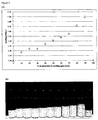
- the average thickness is preferably in the range of 3-200 nm, preferably in the range of 5-100 nm, more preferably in the range of 5-30 nm (for example, see Figure 1(A) .
- cellulosic material includes but is not limited to the following type: microcrystalline cellulose, microbial cellulose, cellulose derived from marine or other invertebrates, mechanically generated wood pulp, chemical (dissolving) pulp, native biomass (in the form of plant fibres, stems or husks) and cellulosic man-made fibres such as tyre cord and other cellulose II sources such as mercerised cellulose.
- the cellulosic material may further be chemically derivatized by for example carboxylation, oxidation, sulphation or esterification.
- Preferred cellulose sources are derived primarily from wood pulp and other cellulosic biomass fibres and micro-crystalline cellulose, as for example Avicel PH-101, from FMC Corporation and also textile or technical textile fibres, for example as supplied by Cordenka GmbH under the trade name of Cordenka 700 (Super 3) can be used as a starting source of cellulosic material.
- Preferred sources of wood pulp include ground wood fibres, recycled or secondary wood pulp fibres, bleached and unbleached wood fibres. Both softwoods and hardwoods can be utilised.
- suitable biomass materials such as bagasse and bamboo based cellulose can be utilised.
- swelling agent is defined as being an agent that can disrupt either the intercrystalline bonding or which can disrupt both the intercrystalline and partially (i.e. not fully) the intracrystalline bonding normally present in cellulosic material.
- reaction conditions that are able to disrupt both intercrystalline bonding and intracrystalline bonding may lead to either swelling (at most partial but not full disruption of intracrystalline bonding) or solvation (full disruption of of intracrystalline bonding) depending on the reaction conditions.
- suitable reaction conditions e.g. concentration, temperature, reaction time have to be chosen for obtaining swelling only (i.e. either achieving disruption of the intercrystalline bonding only or achieving disruption of the intercrystalline bonding and only partial (but not full) disruption of the intracrystalline bonding), but preventing complete solvation.
- full disruption of intracrystalline bonding is not desired and has to be prevented.
- a suitable swelling agent is an organic or inorganic swelling agent or a mixture thereof (in pure form or a solution thereof). It is understood that a swelling agent may be a solid or a liquid. A solid swelling agent may be dissolved or suspended in one or more suitable solvents, a liquid swelling agent may be used in pure form or further diluted with one or more suitable solvents to form a swelling agent solution. Thus the term "swelling agent" includes all of the above forms (pure and in solution).
- a typical inorganic swelling agent includes inorganic bases such as an inorganic halide, which is an inorganic metal halide or inorganic pseudo metal halide or an inorganic hydroxide.
- a typical organic swelling agent may include any organic swelling agents disclosed in the art, see, e.g. as cited in The Polymer Handbook 3rd edition, 1989 (published by J Wiley & Sons, edited by J Brandrup & EH Immergut ), more specifically within the section “Properties of Cellulose Materials", specifically in the section “Solvents for Cellulose”.
- Suitable swelling agents for use in the present invention include but are not limited to (i) swelling agents, which are cellulose non-solvents which only swell the intercrystalline regions, such as morpholine, piperidine, and the like and (ii) swelling agents, which can swell both the intercrystalline and partially (but not fully) the intracrystalline regions.
- Suitable swelling agents that can swell both the intercrystalline and partially (but not fully) the intracrystalline regions of the cellulosic materials could be alkali metal oxides, alkali metal hydroxides (e.g. potassium hydroxide, lithium hydroxide), alkaline earth metal oxides, alkaline earth metal hydroxides, alkali silicates, alkali aluminates, alkali carbonates, alkali thiocyanates, alkaline earth thiocyanates, alkali halides (e.g.
- chlorides, fluorides, bromides) amines including aliphatic hydrocarbon amines, preferably lower aliphatic amines (e.g. trimethylamine, triethylamine), cupriethylenediamine, ammonia, ammonium hydroxide; tetramethyl ammonium hydroxide; trimethylbenzylammonium hydroxide; lithium chloride; tertiary amine oxides (e.g. N-methyl morpholine N-oxide), ionic liquids (e.g.
- Suitable mixtures of swelling agents include a mixture of an organic swelling agent and an inorganic metal halide or pseudo metal halide, e.g. a mixture of sodium thiocyanate and ethylenediamine,
- swelling agents for use in the present invention are any acid halides, e.g. hydrochloric acid, and conventional mineral acids, e.g. sulphuric, phosphoric and nitric acids.
- acid halides e.g. hydrochloric acid
- mineral acids e.g. sulphuric, phosphoric and nitric acids.
- the swelling agent is a liquid organic swelling agent, preferably morpholine, piperidine or mixtures thereof.
- a aqueous mixture comprising > 1 % morpholine, piperidine or mixtures thereof (by volume), preferably >50% morpholine, piperidine or mixtures thereof, and most preferably at a ratio of from 80% morpholine, piperidine or mixtures thereof to 20% water to 90% morpholine, piperidine or mixtures thereof to 10% water.
- the swelling agent is an aqueous mixture of morpholine, piperidine or mixtures thereof comprising of from 60 to 99% (by volume) morpholine, piperidine or mixtures thereof, or of from 70 to 95% (by volume) of morpholine, piperidine or mixtures thereof.
- the liquid organic swelling agent is N-methyl morpholine N-oxide.
- N-methyl morpholine N-oxide is used at a concentration of higher than 50 %, preferably higher than 70 %, but less than 81 %, at temperatures of higher than 80 °C, preferably higher than 85°C.
- N-methyl morpholine N-oxide Most preferred conditions for N-methyl morpholine N-oxide (NMMO) are at a concentration of 78 % w/w and 85 °C. Above these conditions (82 % w/w and 85 °C) it behaves as a solvent for cellulosic material.
- suitable reaction conditions such as concentration of the swelling agent depends on the choice of swelling agent and its potential as a cellulose swelling agent.
- concentration of the swelling agent depends on the choice of swelling agent and its potential as a cellulose swelling agent.
- a swelling agent which is also a recognised cellulose solvent, it is necessary to use it at below its dissolution concentration and temperature (which are known in the art, see e.g. The Polymer Handbook 3rd edition, 1989 (published by J Wiley & Sons, edited by J Brandrup & EH Immergut ), more specifically within the section “Properties of Cellulose Materials", specifically in the section "Solvents for Cellulose”) such that it acts as a cellulose swelling agent, i.e. prior to the stage of full disruption of all intracrystalline bonding in the cellulosic material and its resultant dissolution.
- Solvation should be preferably avoided, as complete disruption of the intracrystalline bonding will lead to destruction of the crystalline structure that is required as the product from the swelling process as disclosed herein.
- the extent of swelling may be determined in various ways. In the context of the present invention, the extent of swelling has been found to be conveniently defined in terms of the apparent increase in the phase volume fraction of the cellulosic material in the system, relative to the phase volume fraction of the same cellulosic material suspended in water - the cellulose being in a powdered form amenable to processing via the intended mechanical technique.
- the cellulosic material in powdered form (1.0 g) was weighed into a 20 ml glass scintillation vial and the liquid swelling agent of interest (9.0 ml) added by means of a micropipetting device. The system was then mixed via manual agitation and allowed to equilibrate for 24 hours at 20 °C. Alternatively, the extent of swelling may be determined following incubation at a temperature greater than ambient, as appropriate to the swelling agent of interest. In each case, an identical standard sample was also prepared using deionized water in place of the liquid swelling agent.
- the cellulosic material is expected to not enter into a true solution of molecularly dispersed chains - rather to absorb a proportion of the fluid of the continuous phase, facilitated via disruption of intermolecular and intramolecular hydrogen bonding.
- the apparent phase volume fraction of the resultant swollen cellulose particles (and the associated interstitial fluid) is then estimated visually/macroscopically by means of a ruler with 1mm graduations, with the heights of the upper (liquid supernatant, h Upper ) and lower (swollen cellulosic particles, h Lower ) phases being estimated to the nearest 0.01 mm.
- a scintillation vial of cylindrical form conveniently allowed cellulose phase volume fractions, v Cell , to be simply estimated from measured phase heights (v Cell ⁇ h Lower / (h Upper + h Lower )).
- nanofibrillation of cellulosic materials via mechanical comminution processing means may be afforded in liquid media characterized by a swelling index, S , as defined above, of between 1 and 10, with a value between 1.5 and 3 being most preferred.
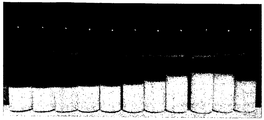
- FIG. 1 The practical determination of the swelling index, S , for Avicel PH-101 microcrystalline cellulose in morpholine:water mixtures of varying composition is presented in Figure 1 .
- Swelling increases to reach a maximum in systems where the volume fraction of morpholine in the continuous medium is between 80% and 90%.
- an aqueous mixture of morpholine and piperidine may be used, where the volume fraction of morpholine in the continuous medium may be kept below or equal to 78%, or from 60 to 78%, while the remaining volume fraction is made up of water and piperidine, thereby combining a safety advantage with dramatic energy reduction.
- Exemplary swelling agents are aqueous mixtures of morpholine and piperidine comprising, preferably consisting of, from 60 to 78% (by volume) of morpholine, of 1 to 39 (by volume) of piperidine, and at least 1% water, and more preferably aqueous mixtures of morpholine and piperidine comprising, preferably consisting of, from 70 to 78% (by volume) of morpholine, of 1 to 29 (by volume) of piperidine, and at least 1% water.
- Mechanical comminution processing may be performed using conventional technologies known in the art, such as high shear forces, microfluidization, (e.g. a M110-EH Microfluidizer Processor fitted with two chambers in series), high pressure homogenization (e.g. a NanoDeBee high pressure homogenizer (BEE International Inc), a ConCor high pressure/high shear homogenizer (Primary Dispersions Ltd)), controlled hydro-dynamic cavitation (eg. using an Arisdyne Systems controlled flow cavitation device) and high friction forces (e.g. a Super MassColloider colloid/friction mill (Masuko)), and combinations thereof.
- high shear forces e.g. a M110-EH Microfluidizer Processor fitted with two chambers in series
- high pressure homogenization e.g. a NanoDeBee high pressure homogenizer (BEE International Inc)
- ConCor high pressure/high shear homogenizer
- High friction forces e.g.
- Apparatus of the type classified as a high pressure or high shear homogenizer relies on the generation of high mechanical stresses within the fluid to achieve break down of the cellulosic feedstock into the desired nanocellulose. This is achieved by pumping the fluid formulation through a well-defined microfluidic interaction chamber - effectively a situation corresponding to a confined flow, as defined in the field of fluid dynamics.
- microfluidic in the context of the present invention, refers to a confined flow geometry or interaction chamber, where the width orthogonal to the direction of flow is less than 500 microns, preferably between 400 and 50 microns.
- Commonly encountered interaction chamber designs include abrupt contractions (either axisymmetic or rectangular slots), Z-geometries (abrupt inflections in the path of the flow) and Y-geometries (where the flow is split and recombined as impinging/opposing jets).
- geometries involving convergence of the streamlines/acceleration of the fluid (contractions, Z-geometries) or generation of a stagnation point (Y-geometry/opposing jets) are characterised by a high tensile or extensional component within the flow field - which makes a major contribution to the efficiency of mechanical fibrillation and dispersive mixing (but also further complicates defining a characteristic shear rate for the process).
- 'high shear' in the context of use of a high shear homogenizer within the scope of the present invention, is best clarified via an illustrative example of the shear rate in a 50 micron radius ( R ) axisymmetric capillary (which may be considered as part of e.g. a Z-geometry used on an M110-EH Microfluidizer).
- a batch of MCC (5.0g, Avicel PH-101) dispersed in 80:20 vol% morpholine:water (500 ml) was seen to pass through such a geometry in 2 minutes at a operating pressure ( P ) of 25000 psi. This corresponds to a volume flow rate (Q) of 4.16 ml min -1 and thus a shear rate (assuming steady flow and making no allowance for shear thinning of the fluid) of 42.4 x 10 6 s -1 .
- Q volume flow rate
- the operating range of processing apparatus of the high shear homogenizer type is between 8.5 x 10 6 s -1 and 102 x 10 6 s -1 (defined as above) and 5000 psi to 60000 psi, most preferably between 34 x 10 6 s -1 and 72 x 10 6 s -1 (defined as above) and 20000 psi to 42500 psi.
- An alternative technology that could be employed would be a colloid or friction mills.
- This technology relies on the generation of high shear rates between two coaxially mounted cone-shaped members separated by a narrow gap (the term narrow, in the context of the present invention would be defined by a distance of less than 500 microns).
- one member is fixed (stator) and the other rotated at high speed (rotor).
- Sections of the rotor and stator may have increasingly fine serrations or grooves, which aid fibrillation of the cellulosic feedstock.
- typical rotortip speeds of up to 50 ms -1 are used.
- the apparent shear rate is conveniently estimated from the velocity gradient across the gap. In the above case, the apparent shear rate is therefore typically 1 x 10 6 s -1 .
- the degree of disruption of the intercrystalline and the intracrystalline structure of the cellulosic materials can be determined using X-Ray diffraction or 13 C NMR. It can be seen by these techniques that swelling agents that only affect the intercrystalline structure of the cellulosic materials retain all or most of their original, pre-swelling crystallinity. In the case of swelling agents that disrupt both intercrystalline and partially (but not fully) the intracrystalline bonding that the measured crystallinity of the cellulosic material will be reduced as a function of the extent of the degree of intracrystalline swelling induced by the agent used and by the processing conditions.
- the relative proportions of amorphous and crystalline material is readily ascertained by consideration of the double peak corresponding to the resonance of the carbon nucleus at C4 (chemical shift typically 80 - 93 ppm), which is split into two components as the amorphous (80 - 87 ppm) and crystalline (87 - 93 ppm) regions correspond to different chemical environments. Loss of crystallinity post-swelling is manifested as a significant reduction in the area of the downfield peak of the C4 resonance signal, relative to the area of the upfield component.
- the fraction of crystalline cellulose is most simply estimated by comparison of the relative intensity of the peak corresponding to diffraction from the 002 plane in the cellulose I unit cell (I 002 taken at a Bragg angle 2 ⁇ of ⁇ 22.7°) to the intensity (I AM ) measured at the trough between the 002 and 101 diffraction peaks (corresponding to diffraction from the less ordered amorphous regions).
- I AM intensity measured at the trough between the 002 and 101 diffraction peaks (corresponding to diffraction from the less ordered amorphous regions).
- More complex analyses based on a full peak deconvolution of the diffractogram are available in e.g. Park et al - ⁇ Cellulose crystallinity index: measurement techniques and their impact on interpreting cellulase performance' ( Biotechnology for Biofuels, 2010, 3, 10 ) and references cited therein.
- the native cellulose polymorph At high levels of intracrystalline swelling the native cellulose polymorph, cellulose I is partially or fully converted to another polymorph when the swelling agent is removed from the cellulosic material. This is commonly encountered where alkali metal hydroxides (e.g. potassium hydroxide, sodium hydroxide) in aqueous media are employed as swelling agents.
- alkali metal hydroxides e.g. potassium hydroxide, sodium hydroxide
- the native cellulose, present in the natively occurring cellulose I polymorph is regenerated into the more thermodynamically stable (for use in the present invention less preferred) cellulose II polymorph - a process commonly referred to as 'Mercerisation' in the field of textile fibre science.
- the cellulose I and cellulose II polymorphs are readily distinguished by their characteristically different wide angle x-ray diffraction patterns.
- Both cellulose I and cellulose II are characterised by a monoclinic crystal habit, but differ in the relative directional orientation of adjacent polymer chains and pattern of associated intra- and intermolecular hydrogen bonding - the chains in cellulose I being parallel, whilst those in cellulose II are antiparallel.
- the mechanical comminution processing has been performed here using a M110-EH Microfluidizer Processor fitted with two chambers in series.
- the first chamber is the Auxiliary processing Module (APM) and comprises a ceramic module with a 200 micron diameter channel and the second is called the Interaction chamber (IXC) and has a diamond channel with a 100 micron diameter channel.
- a range of channel geometries and channel sizes can be used with this equipment. The operational limits are not defined by this example.
- Example 1 Processing of microcrystalline cellulose in aqueous morpholine (organic swelling agent).
- Microcrystalline cellulose (Avicel PH-101, 5.0g) was added to morpholine:water (80:20 vol%, 500 ml) by gradual introduction into the vortex created by a rotor:stator mixer (UltraTurrax), mixing being continued for a further 10 minutes at room temperature.
- This slurry was then introduced into the feed hopper of a M110-EH Microfluidizer (Microfluidics Corp) and recirculated for 8.5 minutes through two Z-shaped interaction chambers arranged in series [200 micron diameter (ceramic) followed by 100 micron diameter (diamond)], setting the operating pressure of the apparatus at 25000 psi.
- the resultant nanostructured cellulose was then separated from the swelling agent via centrifugation and the upper level of continuous phase removed via decantation.
- the system was then made up to its original volume by addition of an appropriate amount of deionized water and the system mixed thoroughly via manual agitation to afford re-suspension of the cellulose.
- Two more centrifugation, decantation, re-suspension operations were performed, prior to further purification of the system via dialysis against deionized water for 3 days (with frequent replacement of the dialysate).
- the cellulose was then isolated in solid form by means of freeze-drying. The morphology of the cellulose was conveniently characterized via scanning electron microscopy.
- PVOH poly(vinyl alcohol) [PVOH] film was cast from a 10% aqueous solution on a glass microscope slide and allowed to dry under ambient conditions in a covered petri dish. A small aliquot of the dialysed cellulose suspension ( ⁇ 1 microlitre) was then dispensed onto the PVOH and spread into a thin layer with the micropipette tip, before being allowed to dry. A small square ( ⁇ 3mm x 3mm) of the PVOH was then cut from the polymer film and placed sample side down on an SEM stub covered with conducting tape. The PVOH layer was then removed via dissolution in hot deionized water and the exposed particles sputter coated with Au prior to imaging.
- Cellulose pulp (92% ⁇ -cellulose, viscose/dissolving grade from Sappi Saiccor) was shredded in a standard office paper shredder (cross-cut configuration). The shredded pulp (5.0 g) was then suspended in morpholine:water (80:20 vol%, 500 ml) and allowed to swell for 2 hours. The swollen pulp suspension was then homogenized using a rotor-stator mixer (UltraTurrax) and processed, purified and dried as in Example 1. SEM analysis as above indicated that the pulp fibres has been extensively broken down into an entangled web of fibres of diameter ⁇ 30 nm. Under these conditions, the generation of such a nanocellulose product required approximately 1500kWh/t.
- Microcrystalline cellulose (Avicel PH-101, 5.0g) was suspended in aqueous calcium thiocyanate solution (45 % by weight, 500 ml) at 50 °C (corresponding to conditions which afford swelling as disclosed hereinabove) and the system homogenized using a rotor stator mixer. The hot cellulose slurry was then transferred into the feed hopper of an M110-EH Microfluidizer and processed, purified and dried as in Example 1.
- Cellulose pulp (prepared as in Example 2, 5.0 g) was suspended in aqueous calcium thiocyanate solution (45% by weight, 500 ml) at 50 °C. and allowed to swell for 1 hour. The pulp suspension was then homogenized by means of a rotor-stator mixer (UltraTurrax) for 10 minutes and the hot slurry introduced into the feed hopper of a M110-EH Microfluidiser (Microfluidics Corp). The cellulose slurry was then processed, purified and dried as in Example 1. SEM analysis indicated the mechanical breakdown of the pulp into extensively fibrillated and entangled structures of diameter ⁇ 100 nm.
- Microcrystalline cellulose (Avicel PH-101, 5.0g) was suspended in aqueous potassium hydroxide solution (27 % by weight, 500 ml) at 20 °C (corresponding to conditions which afford swelling as disclosed hereinabove) and the system homogenized using a rotor stator mixer. The hot cellulose slurry was then transferred into the feed hopper of an M110-EH Microfluidizer and processed, purified and dried as in Example 1. SEM analysis as above indicated the mechanical breakdown of the microcrystalline cellulose in the presence of the swelling agent into separate needle-like particles of length 200-400 nm, although extensively aggregated.
- Cellulose pulp (prepared as in Example 2, 5.0 g) was suspended in aqueous potassium hydroxide solution (27% by weight, 500 ml) at 20 °C and allowed to swell for 30 minutes. The pulp suspension was then homogenized by means of a rotor-stator mixer (UltraTurrax) for 10 minutes and the slurry introduced into the feed hopper of an M110-EH Microfluidiser (Microfluidics Corp). The cellulose slurry was then processed, purified and dried as in Example 1. SEM analysis indicated the mechanical breakdown of the pulp into extensively fibrillated and entangled structures of diameter ⁇ 100 nm.
- Microcrystalline cellulose (Avicel PH-101, 5.0g) was suspended in aqueous N-methylmorpholine-N-oxide [NMMO] solution (78 % by weight, 500 ml - prepared by mixing appropriate amounts of NMMO monohydrate and water) at 85 °C (corresponding to conditions which afford swelling as disclosed hereinabove) and the system homogenized using a rotor stator mixer (UltraTurrax).
- NMMO N-methylmorpholine-N-oxide
- the cellulose slurry was then transferred into the feed hopper of an M110-EH Microfluidizer (Microfluidics Corp) and processed, purified and dried as in Example 1.
- SEM analysis as above indicated the mechanical breakdown of the microcrystalline cellulose in the presence of the swelling agent into separate needle-like particles of length 200-400 nm, width 20-50 nm, which had a loosely aggregated structure.
- Cellulose pulp (prepared as in Example 2, 5.0 g) was suspended in aqueous N-methylmorpholine-N-oxide solution (78% by weight, 500 ml - prepared by mixing appropriate amounts of NMMO monohydrate and deionized water) at 85 °C and allowed to swell for 1 hour.
- the pulp suspension was then homogenized by means of a rotor-stator mixer (UltraTurrax) for 10 minutes and the hot slurry introduced into the feed hopper of an M110-EH Microfluidiser (Microfluidics Corp).
- the cellulose slurry was then processed, purified and dried as in Example 1.
- Example 10 Processing of cellulose pulp in aqueous piperidine
- Cellulose pulp (92% ⁇ -cellulose, viscose/dissolving grade from Sappi Saiccor) was shredded in a standard office paper shredder (cross-cut configuration). The shredded pulp (5.0 g) was then suspended in piperidine:water (90:10 vol%, 500 ml) and allowed to swell for 30 minutes.
- the swollen fibre suspension was then homogenised using a rotor-stator mixer (UltraTurrax) at 4000 rpm for 10 minutes at room temperature and then further processed, purified and dried as described in Example 1.
- a rotor-stator mixer UltraTurrax
Landscapes
- Chemical & Material Sciences (AREA)
- Engineering & Computer Science (AREA)
- Life Sciences & Earth Sciences (AREA)
- Chemical Kinetics & Catalysis (AREA)
- Wood Science & Technology (AREA)
- Inorganic Chemistry (AREA)
- General Chemical & Material Sciences (AREA)
- Medicinal Chemistry (AREA)
- Health & Medical Sciences (AREA)
- Biochemistry (AREA)
- Polymers & Plastics (AREA)
- Organic Chemistry (AREA)
- Materials Engineering (AREA)
- Mechanical Engineering (AREA)
- Polysaccharides And Polysaccharide Derivatives (AREA)
- Processes Of Treating Macromolecular Substances (AREA)
- Pharmaceuticals Containing Other Organic And Inorganic Compounds (AREA)
- Medicinal Preparation (AREA)
- Compositions Of Macromolecular Compounds (AREA)
Priority Applications (1)
| Application Number | Priority Date | Filing Date | Title |
|---|---|---|---|
| EP13735325.6A EP2712364B1 (en) | 2012-07-13 | 2013-07-12 | Low energy method for the preparation of non-derivatized nanocellulose |
Applications Claiming Priority (3)
| Application Number | Priority Date | Filing Date | Title |
|---|---|---|---|
| EP12176252 | 2012-07-13 | ||
| EP13735325.6A EP2712364B1 (en) | 2012-07-13 | 2013-07-12 | Low energy method for the preparation of non-derivatized nanocellulose |
| PCT/EP2013/064776 WO2014009517A1 (en) | 2012-07-13 | 2013-07-12 | Low energy method for the preparation of non-derivatized nanocellulose |
Publications (2)
| Publication Number | Publication Date |
|---|---|
| EP2712364A1 EP2712364A1 (en) | 2014-04-02 |
| EP2712364B1 true EP2712364B1 (en) | 2016-03-09 |
Family
ID=48782361
Family Applications (1)
| Application Number | Title | Priority Date | Filing Date |
|---|---|---|---|
| EP13735325.6A Active EP2712364B1 (en) | 2012-07-13 | 2013-07-12 | Low energy method for the preparation of non-derivatized nanocellulose |
Country Status (17)
| Country | Link |
|---|---|
| US (1) | US9371401B2 (enExample) |
| EP (1) | EP2712364B1 (enExample) |
| JP (2) | JP6499959B2 (enExample) |
| KR (1) | KR102058518B1 (enExample) |
| CN (1) | CN104470951B (enExample) |
| AU (1) | AU2013288608B2 (enExample) |
| BR (1) | BR112014032026A2 (enExample) |
| CA (1) | CA2874414A1 (enExample) |
| DK (1) | DK2712364T3 (enExample) |
| EA (1) | EA025803B1 (enExample) |
| ES (1) | ES2575403T3 (enExample) |
| HU (1) | HUE028027T2 (enExample) |
| IN (1) | IN2014KN02636A (enExample) |
| PL (1) | PL2712364T3 (enExample) |
| PT (1) | PT2712364E (enExample) |
| WO (1) | WO2014009517A1 (enExample) |
| ZA (1) | ZA201408693B (enExample) |
Families Citing this family (34)
| Publication number | Priority date | Publication date | Assignee | Title |
|---|---|---|---|---|
| FI125818B (fi) * | 2009-06-08 | 2016-02-29 | Upm Kymmene Corp | Menetelmä paperin valmistamiseksi |
| JP2016061002A (ja) * | 2014-09-22 | 2016-04-25 | 国立大学法人信州大学 | セルロースナノファイバーの製造方法 |
| FI127717B (en) * | 2014-10-29 | 2018-12-31 | Kemira Oyj | Process for the preparation of microfibrillar cellulose and microfibrillar cellulose |
| AU2016280766A1 (en) * | 2015-06-17 | 2017-12-07 | Sappi Netherlands Services B.V. | Solvent exchange compositions |
| WO2017051030A1 (en) | 2015-09-25 | 2017-03-30 | Sappi Netherlands Services B.V. | Supercritical co2 cellulose spraydrying |
| JP6818985B2 (ja) * | 2015-10-01 | 2021-01-27 | バイオイーコン インターナショナル ホールディング エヌ. ヴィー.Bioecon International Holding N.V. | 新規な改変バイオベース材料を調製する方法 |
| US10813377B2 (en) | 2015-10-28 | 2020-10-27 | Innotech Materials, Llc | Preparation of modified cellulose and its derivatives |
| EP3176321A1 (en) * | 2015-12-04 | 2017-06-07 | SAPPI Netherlands Services B.V. | Process to reduce the overall energy consumption in the production of nanocellulose |
| EP3184549A1 (en) * | 2015-12-22 | 2017-06-28 | SAPPI Netherlands Services B.V. | Acylation of biopolymer comprising anhydroglucose units |
| KR101888624B1 (ko) * | 2016-03-29 | 2018-08-14 | 한국화학연구원 | 비(非) 산 처리 친환경 셀룰로오스 나노결정체의 제조방법 및 이로 제조된 셀룰로오스 나노결정체 |
| AU2017270026B2 (en) | 2016-05-25 | 2020-10-29 | Sappi Netherlands Services B.V. | Production of chemically derivatized nanocellulose |
| GB201612889D0 (en) * | 2016-07-26 | 2016-09-07 | Natural Resources (2000) Ltd | Moulding of articles |
| EP3538044B1 (en) | 2016-11-11 | 2020-06-17 | 3M Innovative Properties Company | Trimmable conformable wound dressing |
| EP3321316A1 (en) * | 2016-11-11 | 2018-05-16 | SAPPI Netherlands Services B.V. | Drying of nanocellulose using ammonia in a supercritical state |
| CN106800604A (zh) * | 2016-12-21 | 2017-06-06 | 广西大学 | 一种在BmimCl体系中制备纳米纤维素的方法 |
| CN106674357A (zh) * | 2016-12-21 | 2017-05-17 | 广西大学 | 一种在EmimOAc体系中制备纳米纤维素的方法 |
| CN106674374A (zh) * | 2016-12-26 | 2017-05-17 | 青岛聚大洋藻业集团有限公司 | 一种利用鼠尾藻提取褐藻胶的工艺技术 |
| AU2018255503A1 (en) * | 2017-04-17 | 2019-12-05 | NanoCellulose IP Pty Ltd | Method for treatment of cellulose |
| CA3062261C (en) | 2017-05-05 | 2024-06-04 | Betulium Oy | Cellulose derivatives |
| EP3409691B1 (en) * | 2017-05-31 | 2019-10-02 | SAPPI Biochemtech B.V. | Process for the production of a nanocellulose material |
| CN107236048A (zh) * | 2017-06-12 | 2017-10-10 | 齐鲁工业大学 | 一种离子液体/固体酸体系中制备纳晶纤维素的方法 |
| CN109972439B (zh) * | 2017-12-28 | 2022-12-02 | 上海凯矜新材料科技有限公司 | 制备纳米纤维素的方法 |
| CN108084278A (zh) * | 2018-01-02 | 2018-05-29 | 青岛大学 | 一种小尺寸纤维素纳米晶的制备方法 |
| SE543549C2 (en) | 2018-03-02 | 2021-03-23 | Stora Enso Oyj | Method for manufacturing a composition comprising microfibrillated cellulose |
| CN108468204A (zh) * | 2018-03-08 | 2018-08-31 | 深圳市彩铜时代科技有限公司 | 抗菌无机金属盐改性纤维素纤维的制备方法 |
| CN108824050B (zh) * | 2018-04-26 | 2020-08-18 | 东莞市泰昌纸业有限公司 | 一种高浓碎浆过程中减少废纸纤维损伤的方法 |
| EP3801878A1 (en) | 2018-06-01 | 2021-04-14 | Climeworks AG | Process for the preparation of homogeneous hybrid materials |
| CN109778587A (zh) * | 2019-03-05 | 2019-05-21 | 山东天阳纸业有限公司 | 一种透析原纸的生产方法 |
| KR102073523B1 (ko) * | 2019-07-12 | 2020-02-04 | 송인갑 | 저에너지 특성을 나타내는 셀룰로오스 원료의 해리 및 추출방법, 이를 포함하는 셀룰로오스 미세섬유의 제조방법, 및 셀룰로오스 미세섬유의 제조장치 |
| CN110511438B (zh) * | 2019-08-01 | 2022-04-29 | 黑龙江大学 | 一种利用微流法制备光热蒸发凝胶薄膜的方法 |
| JP2024523832A (ja) | 2021-06-09 | 2024-07-02 | ソーン マテリアルズ エルエルシー | ナノセルロース要素を含む製造物品 |
| IT202200007589A1 (it) | 2022-04-15 | 2023-10-15 | Pabif Srl | Processo ed apparato per la produzione di acido levulinico da cellulosa ricavata da biomasse |
| KR102454807B1 (ko) * | 2022-07-22 | 2022-10-17 | 주식회사 모빅신소재기술 | 친환경적이며 경제적인 공법으로 바이오매스 유래 셀룰로오스를 나노 섬유화하는 제조공정 및 이의 제조장치 |
| CN116462857B (zh) * | 2023-05-16 | 2025-07-29 | 太原理工大学 | 一种溶解纤维素的方法 |
Family Cites Families (19)
| Publication number | Priority date | Publication date | Assignee | Title |
|---|---|---|---|---|
| DE19543310C2 (de) * | 1995-11-21 | 2000-03-23 | Herzog Stefan | Verfahren zur Herstellung eines organischen Verdickungs- und Suspensionshilfsmittels |
| WO1997047790A1 (en) * | 1996-06-10 | 1997-12-18 | Korea Institute Of Science And Technology | Process for preparing a homogeneous cellulose solution using n-methylmorpholine-n-oxide |
| FR2770232B1 (fr) * | 1997-10-27 | 2000-01-14 | Rhodia Ag Rhone Poulenc | Procede de preparation d'une fibre ou d'un fil de cellulose regeneree |
| JP2909458B1 (ja) * | 1998-05-20 | 1999-06-23 | 聚隆纖維股▲ふん▼有限公司 | 低粘度セルロース粘液の製法 |
| JP3855023B2 (ja) * | 2000-06-14 | 2006-12-06 | 和歌山県 | 木材分解生成物、並びに、この木材分解生成物を用いる、物の接着方法、未硬化エポキシ化合物の硬化方法、エポキシ樹脂の製造方法、およびウレタン樹脂の製造方法 |
| JP4235966B2 (ja) * | 2002-03-22 | 2009-03-11 | 和歌山県 | 木材及び木質材料用の防腐防虫剤 |
| WO2004024774A2 (en) * | 2002-09-16 | 2004-03-25 | Rensselaer Polytechnic Institute | Methods for manufacturing polysaccharide derivatives |
| JP5206947B2 (ja) * | 2007-03-30 | 2013-06-12 | 独立行政法人産業技術総合研究所 | 微細繊維状セルロース系物質及びその製造方法 |
| WO2009063508A2 (en) * | 2007-11-13 | 2009-05-22 | Jawaharlal Nehru Centre For Advanced Scientific Research | Nanoparticle composition and process thereof |
| SE0800807L (sv) | 2008-04-10 | 2009-10-11 | Stfi Packforsk Ab | Nytt förfarande |
| FI124724B (fi) | 2009-02-13 | 2014-12-31 | Upm Kymmene Oyj | Menetelmä muokatun selluloosan valmistamiseksi |
| SI2236545T1 (sl) | 2009-03-30 | 2014-12-31 | Omya International Ag | Postopek za proizvodnjo gelov iz nanofibrilirane celuloze |
| PL3617400T3 (pl) * | 2009-03-30 | 2023-01-02 | Fiberlean Technologies Limited | Zastosowanie zawiesin nanofibrylarnej celulozy |
| CN102712108A (zh) * | 2009-11-13 | 2012-10-03 | 瑞典树木科技公司 | 制造颗粒的方法 |
| EP2386682B1 (en) * | 2010-04-27 | 2014-03-19 | Omya International AG | Process for the manufacture of structured materials using nano-fibrillar cellulose gels |
| DK2386683T3 (da) | 2010-04-27 | 2014-06-23 | Omya Int Ag | Fremgangsmåde til fremstilling af gel-baserede kompositmaterialer |
| EP2532410A1 (en) * | 2011-06-06 | 2012-12-12 | Eidgenössische Materialprüfungs- und Forschungsanstalt EMPA | Porous adsorbent structure for adsorption of CO2 from a gas mixture |
| CN102220718B (zh) * | 2011-06-08 | 2013-05-15 | 南京林业大学 | 一种高压破碎低温冷却制备纳米纤维素的方法 |
| CN104768416B (zh) * | 2012-05-30 | 2016-10-12 | 西杰·西拉 | 用于带有生态点火器的移动设备的盖子 |
-
2013
- 2013-07-12 BR BR112014032026A patent/BR112014032026A2/pt active Search and Examination
- 2013-07-12 PT PT137353256T patent/PT2712364E/pt unknown
- 2013-07-12 EP EP13735325.6A patent/EP2712364B1/en active Active
- 2013-07-12 WO PCT/EP2013/064776 patent/WO2014009517A1/en not_active Ceased
- 2013-07-12 DK DK13735325.6T patent/DK2712364T3/en active
- 2013-07-12 CN CN201380036778.1A patent/CN104470951B/zh not_active Expired - Fee Related
- 2013-07-12 JP JP2015521012A patent/JP6499959B2/ja not_active Expired - Fee Related
- 2013-07-12 AU AU2013288608A patent/AU2013288608B2/en not_active Ceased
- 2013-07-12 KR KR1020147034022A patent/KR102058518B1/ko not_active Expired - Fee Related
- 2013-07-12 HU HUE13735325A patent/HUE028027T2/en unknown
- 2013-07-12 ES ES13735325.6T patent/ES2575403T3/es active Active
- 2013-07-12 US US14/413,449 patent/US9371401B2/en not_active Expired - Fee Related
- 2013-07-12 IN IN2636KON2014 patent/IN2014KN02636A/en unknown
- 2013-07-12 EA EA201590176A patent/EA025803B1/ru not_active IP Right Cessation
- 2013-07-12 PL PL13735325.6T patent/PL2712364T3/pl unknown
- 2013-07-12 CA CA2874414A patent/CA2874414A1/en not_active Abandoned
-
2014
- 2014-11-26 ZA ZA2014/08693A patent/ZA201408693B/en unknown
-
2019
- 2019-02-08 JP JP2019021315A patent/JP2019090053A/ja active Pending
Non-Patent Citations (1)
| Title |
|---|
| H. T. LOKHANDE: "Swelling behavior of cotton fibers in morpholine and piperidine", JOURNAL OF APPLIED POLYMER SCIENCE, vol. 22, no. 5, 1 May 1978 (1978-05-01), pages 1243 - 1253, XP055118176, ISSN: 0021-8995, DOI: 10.1002/app.1978.070220507 * |
Also Published As
| Publication number | Publication date |
|---|---|
| HK1195573A1 (zh) | 2014-11-14 |
| EA201590176A1 (ru) | 2016-05-31 |
| BR112014032026A2 (pt) | 2017-07-25 |
| IN2014KN02636A (enExample) | 2015-05-08 |
| AU2013288608B2 (en) | 2017-08-03 |
| ES2575403T3 (es) | 2016-06-28 |
| KR20150034686A (ko) | 2015-04-03 |
| JP2015522097A (ja) | 2015-08-03 |
| DK2712364T3 (en) | 2016-06-13 |
| EP2712364A1 (en) | 2014-04-02 |
| JP2019090053A (ja) | 2019-06-13 |
| CA2874414A1 (en) | 2014-01-16 |
| AU2013288608A1 (en) | 2014-12-04 |
| CN104470951A (zh) | 2015-03-25 |
| PL2712364T3 (pl) | 2016-09-30 |
| JP6499959B2 (ja) | 2019-04-10 |
| US9371401B2 (en) | 2016-06-21 |
| CN104470951B (zh) | 2017-11-07 |
| KR102058518B1 (ko) | 2019-12-23 |
| HUE028027T2 (en) | 2016-11-28 |
| ZA201408693B (en) | 2016-08-31 |
| WO2014009517A1 (en) | 2014-01-16 |
| EA025803B1 (ru) | 2017-01-30 |
| US20150158955A1 (en) | 2015-06-11 |
| PT2712364E (pt) | 2016-06-09 |
Similar Documents
| Publication | Publication Date | Title |
|---|---|---|
| US9371401B2 (en) | Low energy method for the preparation of non-derivatized nanocellulose | |
| Zhang et al. | Microfibrillated cellulose from bamboo pulp and its properties | |
| Siddiqui et al. | Production and characterization of cellulose nanofibers from wood pulp | |
| US8722092B2 (en) | Nanoparticles made of amorphous cellulose | |
| US20190023862A1 (en) | Method of dewatering water soluble polymers | |
| BR112019014155B1 (pt) | Nanofibras de celulose modificadas com éster sulfato e método para a produção das nanofibras de celulose | |
| KR102267446B1 (ko) | 나노셀룰로오스의 제조에서 전체 에너지 소모를 감소시키는 방법 | |
| EP3024976A1 (en) | Method of modifying nanofibrillar cellulose composition | |
| WO2016075371A1 (en) | Anionic parenchymal cellulose | |
| Wang et al. | Fabrication of regenerated cellulose fibers using phosphoric acid with hydrogen peroxide treated wheat straw in a DMAc/LiCl solvent system | |
| KR101924867B1 (ko) | 나노 셀룰로오스 보강재의 제조방법 | |
| Kosan et al. | Preparation and subsequent shaping of cellulose acetates using ionic liquids | |
| US20180371211A1 (en) | Bimodal cellulose composition | |
| Navard et al. | Preparation and properties of cellulose solutions | |
| EP3808780B1 (en) | Cellulose acetate, cellulose acetate fibers, cellulose acetate composition, method for producing cellulose acetate, and method for producing cellulose acetate composition | |
| HK1195573B (en) | Low energy method for the preparation of non-derivatized nanocellulose | |
| Khandelwal | Structure and processing of fibrous cellulose: bacterial and ascidian material |
Legal Events
| Date | Code | Title | Description |
|---|---|---|---|
| PUAI | Public reference made under article 153(3) epc to a published international application that has entered the european phase |
Free format text: ORIGINAL CODE: 0009012 |
|
| 17P | Request for examination filed |
Effective date: 20131119 |
|
| AK | Designated contracting states |
Kind code of ref document: A1 Designated state(s): AL AT BE BG CH CY CZ DE DK EE ES FI FR GB GR HR HU IE IS IT LI LT LU LV MC MK MT NL NO PL PT RO RS SE SI SK SM TR |
|
| AX | Request for extension of the european patent |
Extension state: BA ME |
|
| 17Q | First examination report despatched |
Effective date: 20140521 |
|
| RAX | Requested extension states of the european patent have changed |
Extension state: ME Payment date: 20140616 Extension state: BA Payment date: 20140616 |
|
| RBV | Designated contracting states (corrected) |
Designated state(s): AL AT BE BG CH CY CZ DE DK EE ES FI FR GB GR HR HU IE IS IT LI LT LU LV MC MK MT NL NO PL PT RO RS SE SI SK SM TR |
|
| RIN1 | Information on inventor provided before grant (corrected) |
Inventor name: ENGLISH, ROBERT Inventor name: GRAVESON, IAN |
|
| REG | Reference to a national code |
Ref country code: HK Ref legal event code: DE Ref document number: 1195573 Country of ref document: HK |
|
| GRAP | Despatch of communication of intention to grant a patent |
Free format text: ORIGINAL CODE: EPIDOSNIGR1 |
|
| DAX | Request for extension of the european patent (deleted) | ||
| INTG | Intention to grant announced |
Effective date: 20150722 |
|
| GRAS | Grant fee paid |
Free format text: ORIGINAL CODE: EPIDOSNIGR3 |
|
| RAX | Requested extension states of the european patent have changed |
Extension state: ME Payment date: 20140616 Extension state: BA Payment date: 20140616 |
|
| GRAA | (expected) grant |
Free format text: ORIGINAL CODE: 0009210 |
|
| AK | Designated contracting states |
Kind code of ref document: B1 Designated state(s): AL AT BE BG CH CY CZ DE DK EE ES FI FR GB GR HR HU IE IS IT LI LT LU LV MC MK MT NL NO PL PT RO RS SE SI SK SM TR |
|
| AX | Request for extension of the european patent |
Extension state: BA ME |
|
| REG | Reference to a national code |
Ref country code: GB Ref legal event code: FG4D |
|
| REG | Reference to a national code |
Ref country code: AT Ref legal event code: REF Ref document number: 779465 Country of ref document: AT Kind code of ref document: T Effective date: 20160315 Ref country code: CH Ref legal event code: EP |
|
| REG | Reference to a national code |
Ref country code: IE Ref legal event code: FG4D |
|
| REG | Reference to a national code |
Ref country code: DE Ref legal event code: R096 Ref document number: 602013005427 Country of ref document: DE |
|
| REG | Reference to a national code |
Ref country code: CH Ref legal event code: NV Representative=s name: ISLER AND PEDRAZZINI AG, CH |
|
| REG | Reference to a national code |
Ref country code: PT Ref legal event code: SC4A Free format text: AVAILABILITY OF NATIONAL TRANSLATION Effective date: 20160603 |
|
| REG | Reference to a national code |
Ref country code: DK Ref legal event code: T3 Effective date: 20160609 |
|
| REG | Reference to a national code |
Ref country code: NL Ref legal event code: FP |
|
| REG | Reference to a national code |
Ref country code: SE Ref legal event code: TRGR Ref country code: ES Ref legal event code: FG2A Ref document number: 2575403 Country of ref document: ES Kind code of ref document: T3 Effective date: 20160628 |
|
| REG | Reference to a national code |
Ref country code: LT Ref legal event code: MG4D |
|
| REG | Reference to a national code |
Ref country code: FR Ref legal event code: PLFP Year of fee payment: 4 |
|
| REG | Reference to a national code |
Ref country code: NO Ref legal event code: T2 Effective date: 20160309 |
|
| PG25 | Lapsed in a contracting state [announced via postgrant information from national office to epo] |
Ref country code: GR Free format text: LAPSE BECAUSE OF FAILURE TO SUBMIT A TRANSLATION OF THE DESCRIPTION OR TO PAY THE FEE WITHIN THE PRESCRIBED TIME-LIMIT Effective date: 20160610 Ref country code: HR Free format text: LAPSE BECAUSE OF FAILURE TO SUBMIT A TRANSLATION OF THE DESCRIPTION OR TO PAY THE FEE WITHIN THE PRESCRIBED TIME-LIMIT Effective date: 20160309 |
|
| PG25 | Lapsed in a contracting state [announced via postgrant information from national office to epo] |
Ref country code: RS Free format text: LAPSE BECAUSE OF FAILURE TO SUBMIT A TRANSLATION OF THE DESCRIPTION OR TO PAY THE FEE WITHIN THE PRESCRIBED TIME-LIMIT Effective date: 20160309 Ref country code: LT Free format text: LAPSE BECAUSE OF FAILURE TO SUBMIT A TRANSLATION OF THE DESCRIPTION OR TO PAY THE FEE WITHIN THE PRESCRIBED TIME-LIMIT Effective date: 20160309 |
|
| PG25 | Lapsed in a contracting state [announced via postgrant information from national office to epo] |
Ref country code: EE Free format text: LAPSE BECAUSE OF FAILURE TO SUBMIT A TRANSLATION OF THE DESCRIPTION OR TO PAY THE FEE WITHIN THE PRESCRIBED TIME-LIMIT Effective date: 20160309 Ref country code: IS Free format text: LAPSE BECAUSE OF FAILURE TO SUBMIT A TRANSLATION OF THE DESCRIPTION OR TO PAY THE FEE WITHIN THE PRESCRIBED TIME-LIMIT Effective date: 20160709 |
|
| REG | Reference to a national code |
Ref country code: HU Ref legal event code: AG4A Ref document number: E028027 Country of ref document: HU |
|
| PG25 | Lapsed in a contracting state [announced via postgrant information from national office to epo] |
Ref country code: SM Free format text: LAPSE BECAUSE OF FAILURE TO SUBMIT A TRANSLATION OF THE DESCRIPTION OR TO PAY THE FEE WITHIN THE PRESCRIBED TIME-LIMIT Effective date: 20160309 Ref country code: SK Free format text: LAPSE BECAUSE OF FAILURE TO SUBMIT A TRANSLATION OF THE DESCRIPTION OR TO PAY THE FEE WITHIN THE PRESCRIBED TIME-LIMIT Effective date: 20160309 Ref country code: RO Free format text: LAPSE BECAUSE OF FAILURE TO SUBMIT A TRANSLATION OF THE DESCRIPTION OR TO PAY THE FEE WITHIN THE PRESCRIBED TIME-LIMIT Effective date: 20160309 |
|
| REG | Reference to a national code |
Ref country code: DE Ref legal event code: R097 Ref document number: 602013005427 Country of ref document: DE |
|
| PLBE | No opposition filed within time limit |
Free format text: ORIGINAL CODE: 0009261 |
|
| STAA | Information on the status of an ep patent application or granted ep patent |
Free format text: STATUS: NO OPPOSITION FILED WITHIN TIME LIMIT |
|
| 26N | No opposition filed |
Effective date: 20161212 |
|
| PG25 | Lapsed in a contracting state [announced via postgrant information from national office to epo] |
Ref country code: MC Free format text: LAPSE BECAUSE OF FAILURE TO SUBMIT A TRANSLATION OF THE DESCRIPTION OR TO PAY THE FEE WITHIN THE PRESCRIBED TIME-LIMIT Effective date: 20160309 |
|
| REG | Reference to a national code |
Ref country code: HK Ref legal event code: GR Ref document number: 1195573 Country of ref document: HK |
|
| PG25 | Lapsed in a contracting state [announced via postgrant information from national office to epo] |
Ref country code: SI Free format text: LAPSE BECAUSE OF FAILURE TO SUBMIT A TRANSLATION OF THE DESCRIPTION OR TO PAY THE FEE WITHIN THE PRESCRIBED TIME-LIMIT Effective date: 20160309 |
|
| REG | Reference to a national code |
Ref country code: FR Ref legal event code: PLFP Year of fee payment: 5 |
|
| PG25 | Lapsed in a contracting state [announced via postgrant information from national office to epo] |
Ref country code: LU Free format text: LAPSE BECAUSE OF NON-PAYMENT OF DUE FEES Effective date: 20160712 |
|
| PG25 | Lapsed in a contracting state [announced via postgrant information from national office to epo] |
Ref country code: CY Free format text: LAPSE BECAUSE OF FAILURE TO SUBMIT A TRANSLATION OF THE DESCRIPTION OR TO PAY THE FEE WITHIN THE PRESCRIBED TIME-LIMIT Effective date: 20160309 |
|
| PG25 | Lapsed in a contracting state [announced via postgrant information from national office to epo] |
Ref country code: MT Free format text: LAPSE BECAUSE OF NON-PAYMENT OF DUE FEES Effective date: 20160731 Ref country code: MK Free format text: LAPSE BECAUSE OF FAILURE TO SUBMIT A TRANSLATION OF THE DESCRIPTION OR TO PAY THE FEE WITHIN THE PRESCRIBED TIME-LIMIT Effective date: 20160309 |
|
| REG | Reference to a national code |
Ref country code: FR Ref legal event code: PLFP Year of fee payment: 6 |
|
| REG | Reference to a national code |
Ref country code: AT Ref legal event code: UEP Ref document number: 779465 Country of ref document: AT Kind code of ref document: T Effective date: 20160309 |
|
| PG25 | Lapsed in a contracting state [announced via postgrant information from national office to epo] |
Ref country code: AL Free format text: LAPSE BECAUSE OF FAILURE TO SUBMIT A TRANSLATION OF THE DESCRIPTION OR TO PAY THE FEE WITHIN THE PRESCRIBED TIME-LIMIT Effective date: 20160309 |
|
| PGFP | Annual fee paid to national office [announced via postgrant information from national office to epo] |
Ref country code: PL Payment date: 20200629 Year of fee payment: 8 |
|
| PGFP | Annual fee paid to national office [announced via postgrant information from national office to epo] |
Ref country code: NL Payment date: 20200727 Year of fee payment: 8 |
|
| PGFP | Annual fee paid to national office [announced via postgrant information from national office to epo] |
Ref country code: CZ Payment date: 20200703 Year of fee payment: 8 Ref country code: IE Payment date: 20200727 Year of fee payment: 8 Ref country code: DK Payment date: 20200723 Year of fee payment: 8 Ref country code: NO Payment date: 20200723 Year of fee payment: 8 Ref country code: DE Payment date: 20200721 Year of fee payment: 8 Ref country code: TR Payment date: 20200710 Year of fee payment: 8 Ref country code: GB Payment date: 20200727 Year of fee payment: 8 Ref country code: FR Payment date: 20200723 Year of fee payment: 8 Ref country code: ES Payment date: 20200922 Year of fee payment: 8 Ref country code: PT Payment date: 20200703 Year of fee payment: 8 Ref country code: FI Payment date: 20200722 Year of fee payment: 8 |
|
| PGFP | Annual fee paid to national office [announced via postgrant information from national office to epo] |
Ref country code: HU Payment date: 20200823 Year of fee payment: 8 Ref country code: BE Payment date: 20200727 Year of fee payment: 8 Ref country code: SE Payment date: 20200727 Year of fee payment: 8 Ref country code: BG Payment date: 20200728 Year of fee payment: 8 Ref country code: CH Payment date: 20200713 Year of fee payment: 8 Ref country code: LV Payment date: 20200717 Year of fee payment: 8 Ref country code: IT Payment date: 20200728 Year of fee payment: 8 Ref country code: AT Payment date: 20200722 Year of fee payment: 8 |
|
| REG | Reference to a national code |
Ref country code: DE Ref legal event code: R119 Ref document number: 602013005427 Country of ref document: DE |
|
| REG | Reference to a national code |
Ref country code: DK Ref legal event code: EBP Effective date: 20210731 |
|
| REG | Reference to a national code |
Ref country code: FI Ref legal event code: MAE Ref country code: CH Ref legal event code: PL Ref country code: NO Ref legal event code: MMEP |
|
| REG | Reference to a national code |
Ref country code: NL Ref legal event code: MM Effective date: 20210801 |
|
| REG | Reference to a national code |
Ref country code: AT Ref legal event code: MM01 Ref document number: 779465 Country of ref document: AT Kind code of ref document: T Effective date: 20210712 |
|
| GBPC | Gb: european patent ceased through non-payment of renewal fee |
Effective date: 20210712 |
|
| REG | Reference to a national code |
Ref country code: BE Ref legal event code: MM Effective date: 20210731 |
|
| PG25 | Lapsed in a contracting state [announced via postgrant information from national office to epo] |
Ref country code: LI Free format text: LAPSE BECAUSE OF NON-PAYMENT OF DUE FEES Effective date: 20210731 Ref country code: HU Free format text: LAPSE BECAUSE OF NON-PAYMENT OF DUE FEES Effective date: 20210713 Ref country code: GB Free format text: LAPSE BECAUSE OF NON-PAYMENT OF DUE FEES Effective date: 20210712 Ref country code: FI Free format text: LAPSE BECAUSE OF NON-PAYMENT OF DUE FEES Effective date: 20210712 Ref country code: DE Free format text: LAPSE BECAUSE OF NON-PAYMENT OF DUE FEES Effective date: 20220201 Ref country code: CH Free format text: LAPSE BECAUSE OF NON-PAYMENT OF DUE FEES Effective date: 20210731 Ref country code: BG Free format text: LAPSE BECAUSE OF NON-PAYMENT OF DUE FEES Effective date: 20220131 Ref country code: AT Free format text: LAPSE BECAUSE OF NON-PAYMENT OF DUE FEES Effective date: 20210712 |
|
| PG25 | Lapsed in a contracting state [announced via postgrant information from national office to epo] |
Ref country code: SE Free format text: LAPSE BECAUSE OF NON-PAYMENT OF DUE FEES Effective date: 20210713 Ref country code: PT Free format text: LAPSE BECAUSE OF NON-PAYMENT OF DUE FEES Effective date: 20220112 Ref country code: NO Free format text: LAPSE BECAUSE OF NON-PAYMENT OF DUE FEES Effective date: 20210731 Ref country code: NL Free format text: LAPSE BECAUSE OF NON-PAYMENT OF DUE FEES Effective date: 20210801 Ref country code: CZ Free format text: LAPSE BECAUSE OF NON-PAYMENT OF DUE FEES Effective date: 20210712 Ref country code: LV Free format text: LAPSE BECAUSE OF NON-PAYMENT OF DUE FEES Effective date: 20210712 Ref country code: FR Free format text: LAPSE BECAUSE OF NON-PAYMENT OF DUE FEES Effective date: 20210731 |
|
| PG25 | Lapsed in a contracting state [announced via postgrant information from national office to epo] |
Ref country code: IT Free format text: LAPSE BECAUSE OF NON-PAYMENT OF DUE FEES Effective date: 20210712 Ref country code: IE Free format text: LAPSE BECAUSE OF NON-PAYMENT OF DUE FEES Effective date: 20210712 Ref country code: DK Free format text: LAPSE BECAUSE OF NON-PAYMENT OF DUE FEES Effective date: 20210731 Ref country code: BE Free format text: LAPSE BECAUSE OF NON-PAYMENT OF DUE FEES Effective date: 20210731 |
|
| REG | Reference to a national code |
Ref country code: ES Ref legal event code: FD2A Effective date: 20220930 |
|
| PG25 | Lapsed in a contracting state [announced via postgrant information from national office to epo] |
Ref country code: ES Free format text: LAPSE BECAUSE OF NON-PAYMENT OF DUE FEES Effective date: 20210713 |
|
| PG25 | Lapsed in a contracting state [announced via postgrant information from national office to epo] |
Ref country code: PL Free format text: LAPSE BECAUSE OF NON-PAYMENT OF DUE FEES Effective date: 20210712 |
|
| PG25 | Lapsed in a contracting state [announced via postgrant information from national office to epo] |
Ref country code: TR Free format text: LAPSE BECAUSE OF NON-PAYMENT OF DUE FEES Effective date: 20210712 |