EP2705178B1 - Growth of a uniformly doped silicon ingot by doping only the initial charge - Google Patents
Growth of a uniformly doped silicon ingot by doping only the initial charge Download PDFInfo
- Publication number
- EP2705178B1 EP2705178B1 EP12781614.8A EP12781614A EP2705178B1 EP 2705178 B1 EP2705178 B1 EP 2705178B1 EP 12781614 A EP12781614 A EP 12781614A EP 2705178 B1 EP2705178 B1 EP 2705178B1
- Authority
- EP
- European Patent Office
- Prior art keywords
- silicon
- crucible
- zone
- ingot
- growth
- Prior art date
- Legal status (The legal status is an assumption and is not a legal conclusion. Google has not performed a legal analysis and makes no representation as to the accuracy of the status listed.)
- Active
Links
Images


Classifications
-
- C—CHEMISTRY; METALLURGY
- C30—CRYSTAL GROWTH
- C30B—SINGLE-CRYSTAL GROWTH; UNIDIRECTIONAL SOLIDIFICATION OF EUTECTIC MATERIAL OR UNIDIRECTIONAL DEMIXING OF EUTECTOID MATERIAL; REFINING BY ZONE-MELTING OF MATERIAL; PRODUCTION OF A HOMOGENEOUS POLYCRYSTALLINE MATERIAL WITH DEFINED STRUCTURE; SINGLE CRYSTALS OR HOMOGENEOUS POLYCRYSTALLINE MATERIAL WITH DEFINED STRUCTURE; AFTER-TREATMENT OF SINGLE CRYSTALS OR A HOMOGENEOUS POLYCRYSTALLINE MATERIAL WITH DEFINED STRUCTURE; APPARATUS THEREFOR
- C30B15/00—Single-crystal growth by pulling from a melt, e.g. Czochralski method
- C30B15/10—Crucibles or containers for supporting the melt
- C30B15/12—Double crucible methods
-
- C—CHEMISTRY; METALLURGY
- C30—CRYSTAL GROWTH
- C30B—SINGLE-CRYSTAL GROWTH; UNIDIRECTIONAL SOLIDIFICATION OF EUTECTIC MATERIAL OR UNIDIRECTIONAL DEMIXING OF EUTECTOID MATERIAL; REFINING BY ZONE-MELTING OF MATERIAL; PRODUCTION OF A HOMOGENEOUS POLYCRYSTALLINE MATERIAL WITH DEFINED STRUCTURE; SINGLE CRYSTALS OR HOMOGENEOUS POLYCRYSTALLINE MATERIAL WITH DEFINED STRUCTURE; AFTER-TREATMENT OF SINGLE CRYSTALS OR A HOMOGENEOUS POLYCRYSTALLINE MATERIAL WITH DEFINED STRUCTURE; APPARATUS THEREFOR
- C30B15/00—Single-crystal growth by pulling from a melt, e.g. Czochralski method
- C30B15/02—Single-crystal growth by pulling from a melt, e.g. Czochralski method adding crystallising materials or reactants forming it in situ to the melt
- C30B15/04—Single-crystal growth by pulling from a melt, e.g. Czochralski method adding crystallising materials or reactants forming it in situ to the melt adding doping materials, e.g. for n-p-junction
-
- H—ELECTRICITY
- H10—SEMICONDUCTOR DEVICES; ELECTRIC SOLID-STATE DEVICES NOT OTHERWISE PROVIDED FOR
- H10P—GENERIC PROCESSES OR APPARATUS FOR THE MANUFACTURE OR TREATMENT OF DEVICES COVERED BY CLASS H10
- H10P95/00—Generic processes or apparatus for manufacture or treatments not covered by the other groups of this subclass
-
- C—CHEMISTRY; METALLURGY
- C30—CRYSTAL GROWTH
- C30B—SINGLE-CRYSTAL GROWTH; UNIDIRECTIONAL SOLIDIFICATION OF EUTECTIC MATERIAL OR UNIDIRECTIONAL DEMIXING OF EUTECTOID MATERIAL; REFINING BY ZONE-MELTING OF MATERIAL; PRODUCTION OF A HOMOGENEOUS POLYCRYSTALLINE MATERIAL WITH DEFINED STRUCTURE; SINGLE CRYSTALS OR HOMOGENEOUS POLYCRYSTALLINE MATERIAL WITH DEFINED STRUCTURE; AFTER-TREATMENT OF SINGLE CRYSTALS OR A HOMOGENEOUS POLYCRYSTALLINE MATERIAL WITH DEFINED STRUCTURE; APPARATUS THEREFOR
- C30B29/00—Single crystals or homogeneous polycrystalline material with defined structure characterised by the material or by their shape
- C30B29/02—Elements
- C30B29/06—Silicon
-
- Y—GENERAL TAGGING OF NEW TECHNOLOGICAL DEVELOPMENTS; GENERAL TAGGING OF CROSS-SECTIONAL TECHNOLOGIES SPANNING OVER SEVERAL SECTIONS OF THE IPC; TECHNICAL SUBJECTS COVERED BY FORMER USPC CROSS-REFERENCE ART COLLECTIONS [XRACs] AND DIGESTS
- Y10—TECHNICAL SUBJECTS COVERED BY FORMER USPC
- Y10T—TECHNICAL SUBJECTS COVERED BY FORMER US CLASSIFICATION
- Y10T117/00—Single-crystal, oriented-crystal, and epitaxy growth processes; non-coating apparatus therefor
- Y10T117/10—Apparatus
- Y10T117/1024—Apparatus for crystallization from liquid or supercritical state
- Y10T117/1032—Seed pulling
Definitions
- the present invention relates generally to growth of crystalline materials and, in particular, to Czochralski growth of doped silicon.
- CZ Czochralski
- a crucible composed of a refractory material such as fused quartz and containing silicon is heated to the melting point of silicon at around 1416°C to produce a silicon melt in the crucible.
- a seed of crystalline silicon of predetermined crystallographic orientation is lowered to barely contact the melt. Molten silicon freezes on the seed with the same orientation.
- the seed is slowly withdrawn from the melt and the process continues to grow an ingot of monocrystalline silicon having a diameter of perhaps 200 or 300 mm and a length of a meter or more. After drawing, the ingot is sliced to produce silicon wafers, which are then further processed to produce IC's or PV solar cells.
- the IC industry predominantly relies on the batch Czochralski process in which a crucible is initially charged with silicon shards, chunks, or pellets of very high purity and then heated to the silicon melting point. Typically, after the growth of one silicon ingot, the crucible is discarded and replaced by a fresh crucible.
- continuous Czochralski CCZ
- semi-continuous CZ has been proposed in which during the growth of an ingot the crucible is continuously or at least intermittently supplied with silicon feedstock such that the level of silicon melt in the crucible remains substantially constant.
- CCZ CCZ process reduces the cost of crucibles, increases manufacturing throughput, and in some respects simplifies the thermal control along the length of the ingot.
- CCZ also requires resupply directly into the hot crucible while it is growing crystalline silicon.
- Wafers including wafers destined for solar applications, are preferentially grown doped to a desired conductivity type and dopant concentration, usually simply measured by resistivity.
- the fabrication of doped silicon wafers of one conductivity types allows the formation of a p - n junction by the diffusion or implantation of a layer of dopant of the other conductivity type.
- Semiconductor dopants are well known, most particularly boron (B) for p -type and phosphorous (P) for n -type although gallium (Ga) offers many advantages as a p -type dopant for solar cells.
- Doped silicon can be grown according to the CZ method by including in the melt a required level of the dopant, and the dopant is incorporated from the melt into the silicon ingot along with the silicon.
- Doping concentrations relative to silicon are typically much less than 1 ppma (part per million atomic).
- the process is complicated by the segregation effect according to which, if the concentration of a dopant in the melt is C , the dopant concentration in the solidified ingot is kC , where k is the segregation coefficient, which is usually less than one and often much less than one. Segregation coefficients for several dopants in silicon are given in TABLE 1.
- TABLE 1 Element k B 0.8 P 0.35 Ga 0.008 In 0.0004 As 0.3 Al 0.002
- the dopant can often be charged into the cold crucible together with the solid silicon feedstock and the two melted together as the crucible is heated to the silicon melting point.
- the segregation effect causes a larger fraction of silicon than of the dopant in the melt to be supplied to the growing ingot.
- the dopant concentration in the pre-charge can be adjusted to produce the desired doping in the ingot, the segregation effects causes the concentration of the dopant to gradually increase in the melt as the crystal grows and the melt is depleted. As a result, the later portions of the ingot have a higher dopant concentration (lower resistivity) than the initial portions.
- gallium doping can vary by a factor of ten and boron doping can vary by about 30%.
- Such axial variation i.e., along the length of the ingot
- solar panel performance is negatively affected by cell non-uniformity
- cell manufactures include costly wafer sorting steps in their fabrication lines. Uniformity of the wafer supply can help in eliminating these steps.
- Another application that would benefit from this invention is the making of heavily doped rods of uniform resistivity that can be sectioned and mixed as solid with feedstock in subsequent CZ manufacturing processes to make rods of relatively lower dopant concentration and higher resistivity.
- an amount of dopant which, when melted, provides a desired concentration in the liquid may be supplied together with the fresh silicon feedstock in order to maintain a constant dopant concentration in the melt and thus assure a constant axial resistivity within each ingot and a constant resistivity among ingots.
- the continuous resupply of dopant in elemental form in CCZ presents difficulties arising from the lower melting points of most dopants relative to silicon and the need to separately meter controllable amounts of dopant into the hot crucible.
- Gallium presents particular difficulties because of its melting point of about 30°C and its very low segregation coefficient.
- Continuous doping with elemental dopants, such as boron and phosphorous that are typically in powder form is also quite difficult in practice.
- US 5 073 229 A discloses a crystal pulling method which includes the step of disposing a separation wall concentrically with an in a semiconductor crystal pulling crucible to divide the crucible into an inner chamber and an outer chamber. The method further discloses the step of putting first doped material melt into the inner chamber and second material melt into the outer chamber. The method further discloses the step of pulling crystal from the first material melt in the inner chamber while the second material melt in the outer chamber is being supplied to the inner chamber via a coupling member which connects the inner and outer chamber with each other but suppresses the outflow of impurity from the inner chamber to the outer chamber.
- EP 1 722 014 A1 discloses a method for manufacturing a nitrogen-doped silicon single crystal in which nitrogen is doped at a rate which is not smaller than 1 x 10 15 atoms/cm 3 and less than 4.5 x 10 15 atoms/cm 3 by pulling up silicon single crystal from a silicon melt which is stored in a quartz crucible and contains nitrogen.
- the method comprises the step of pulling up the single crystal while supplying a silicon raw material which does not contain nitrogen into the silicon melt in such a manner that a liquid level position of the silicon melt stored in the quartz crucible is maintained constant in accordance with an amount of growth of the single crystal.
- An amount of nitrogen contained in a pulled-up silicon single crystal is controlled, and hence a nitrogen concentration can be uniformed along an axial direction of the single crystal.
- a pull-up length of the silicon crystal in which nitrogen is doped at a high concentration can be increased.
- the present invention relates to a method of growing a silicon ingot comprising a dopant material having a segregation coefficient of k .
- the method comprises the steps of providing a crucible having an inner growth zone in fluid communication with an outer feed zone; providing an initial charge in the inner growth zone and the outer feed zone, the initial charge in the inner growth zone comprising silicon and the dopant material and the initial charge in the outer feed zone comprising silicon; melting the silicon and dopant material in the inner growth zone to form a melted mixture and the silicon in the outer feed zone to form a silicon melt, the melted mixture and the silicon melt having upper melt surfaces at substantially similar heights; growing the silicon ingot from the inner growth zone; and removing the grown silicon ingot.
- the resulting ingot comprises the dopant material in an axially substantially constant concentration, and, in various embodiments of the method, the crucible geometry, particularly the inner growth zone and the outer feed zone cross-sectional areas, are used to determine conditions for maintaining dopant uniformity for the specific dopant material used.
- the present invention further relates to a crystalline growth system for growing at least one silicon ingot comprising a dopant material having a segregation coefficient of k , wherein the silicon ingot comprises the dopant material in an axially substantially constant concentration.
- the present invention relates to a method of crystal growth of a silicon ingot, as well as to crystal growth systems and ingots produced therefrom.
- the present invention allows manufacturing of silicon ingots with axially uniform dopant profiles without supplying additional dopant material during ingot growth. Aspects of the invention result from a detailed analysis of silicon and dopant flow during Czochralski (CZ) growth, particularly in a multi-wall crucible.
- CZ Czochralski
- the present invention relates to a method of growing a crystalline material, particularly a Czochralski growth method.
- the method of crystal growth comprises the steps of providing a crucible having a growth zone in fluid communication with a feed zone, pre-charging the crucible with feedstock material and dopant material, melting the initial charge, and growing an ingot of crystalline material that is subsequently removed from the system.
- the resulting crystalline ingot is axially uniform in dopant concentration - that is, the ingot has a substantially constant concentration along its vertical axis. This can be determined using any method known in the art, particularly using known resistivity measurements.
- the resulting crystalline ingot has axially uniform resistivity.
- uniform resistivity or dopant concentration is meant that the resistivity or dopant concentration is within ⁇ 20% or more preferably to within ⁇ 10%.
- the crucible used in the method of the present invention has a growth zone in fluid communication with feed zone.
- the crucible is a multi-zoned crucible.
- the crucible can be any known for use in crystal growing that is capable of containing both solid and liquid feedstock, particularly silicon.
- the crucible can be a quartz crucible or can be a graphite crucible containing a quartz inner liner.
- the crucible can also have any cross-sectional shape depending, for example, on the geometry of the crystal growth system used, but typically has a circular cross-sectional shape.
- the crucible has an inner growth zone within an outer feed zone, and the inner growth zone is in fluid communication with the outer feed zone.
- the crucible can comprise a wall or other separating means that divides the crucible into the inner and outer zones.
- the separator can have an opening, such as a hole or pipe, which provides restricted fluid communication between the two zones so that, as material is removed from the inner growth zone by the crystallization process, fresh material can enter from the feed zone.
- the inner growth zone and the outer feed zone have cross-sectional areas whose ratio can be used to determine the procedure for maintaining dopant uniformity, discussed in more detail below.
- a pre-charge is provided into the zones of the crucible prior to initiating growth of the silicon ingot.
- an initial charge comprising silicon, such as electronic grade silicon, metallurgical grade silicon, or solar grade silicon, is provided in both the inner growth zone and the outer feed zone of the crucible.
- dopant material is also pre-charged into the growth zone of the crucible. Any dopant known in the art can be used, including, for example, n-type dopants such as phosphorus and p-type dopants such as boron, gallium, indium, or aluminum.
- the charge in the crucible is then heated to a temperature above the melting point of the charge whereby the pre-charge in the growth zone, comprising feedstock, such as silicon, and dopant material, forms a melted mixture, and the pre-charge in the feed zone, comprising feedstock, such as silicon, forms feedstock melt.
- feedstock such as silicon
- Any method known in the art can be used to melt the pre-charges. Since the growth zone of the crucible is in fluid communication with the feed zone, when melted, the melted mixture and the feedstock melt have upper melt surfaces at substantially similar heights. Once melted, at least one crystalline ingot is then grown from the melted charge in the growth zone and subsequently removed for further processing.
- a crystalline ingot having axially constant dopant concentration can be grown based solely on the knowledge of the dopant segregation coefficient and the geometry of the crucible.
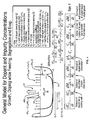
- Various embodiments of this method result from a detailed analysis of the melt flow between the zones, which are in fluid communication with each other, and this is shown in FIG 1 - FIG 4 .
- Double-wall crucible 10 comprises inner circular growth zone 12 of radius r s and liquid upper surface area A s and outer annular feed zone 14 of outer radius r t , liquid total upper surface area A t , and annular area ( A t - A s ) separated from inner growth zone 12 by a wall 16 .
- Hole 18 in wall 16 provides limited fluid connection from outer feed zone 14 to the inner growth zone 12 .
- Hole 18 assures a nearly level upper melt surface 20 in both the growth and feed zones.
- one or more additional walls with associated holes can be used to produce additional zones with limited fluid communication, particularly from the outermost to the central zone.
- Unillustrated heaters initially heat the solid feedstock, for example, silicon, and possible dopants pre-charged into the cold crucible to the melting point, and maintain the temperature at or just above the melting point for crystal drawing.
- Ingot 22 having a diameter D or radius r x has a cross-sectional area A x in contact with the melt in inner growth zone 12 from solidification region 24 .
- the solidification (growth) mass flow (rate of mass change) from inner growth zone 12 to ingot 22 is dM x / dt
- the transferred mass flow from outer feed zone 14 to inner growth zone 12 through hole 18 is dM 12 / dt .
- a feed comprising additional feedstock can be used, and the feed mass flow into outer feed zone 14 of solid or liquid silicon feedstock, which may be zero, is dM F / dt . It is assumed that there is no significant reverse flow through hole 18 .
- the present invention allows the level of upper melt surface 20 of the melt to vary during the growth of the ingot 22 .
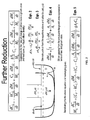
- the time rate of change dh / dt of the level of upper melt surface 20 in both the growth and feed zones is given respectively by Eqn. 2 and Eqn. 3 shown in FIG 2 .
- the two rates must be the same because of the fluid communication through hole 18 . Therefore, these two equations can be combined into Eqn. 4 shown in FIG 2 . Substitution into Eqn. 1 shown in FIG 1 and rearrangement results in Eqn. 5 shown in FIG 2 .
- Various embodiments result from specific conditions applied to Eqn. 5.
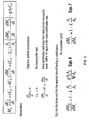
- the ratio of the feed mass flow rate (the rate at which the feed is delivered to the crucible) to the growth mass flow rate (the rate at which the ingot is grown) is given by Eqn. 6. If evaporation of the dopant material from the inner growth zone is substantially equal to zero (i.e., the evaporation rate coefficient is approximately zero), such as for boron and phosphorous, then the ratio of the rate of silicon feed to the rate of ingot growth is given by Eqn. 7. Note that Eqn. 7 is independent of the dopant concentration, kC L , that is desired or targeted for the resulting final ingot as well as the solidification rate.
- the ratio of feed rate to ingot growth rate depends only upon the crucible geometry and the segregation coefficient of the dopant material.
- the relevant feature of the crucible geometry is the area ratio A t / A s of the outer and inner zones of the crucibles at the melt height or, for a circular crucible, either their squared radius ratio n t 2 / r s 2 or equivalently their squared diameter ratio D t 2 / D s 2 .
- Eqn. 6 additionally depends on the evaporation rate, ingot diameter, and pull rate.
- the area ratio can be adjusted for height, or, alternatively, the vertically tapering of the inner and outer crucible can be tailored to produce an axially unvarying area ratio.
- the ratio of feeding silicon feedstock to the outer feed zone to solidification mass flow is determined based on specific crucible geometry characteristics and knowledge of the segregation coefficient of the dopant material in the crystalline material used to grow the ingot, according to Eqn. 6 or Eqn. 7 shown in FIG 3 .
- the inner growth zone of the crucible is pre-charged with feedstock, such as silicon, and further includes the dopant material, which, when melted with the feedstock, is in concentration of C L .
- the outer feed zone is also pre-charged, but this solid pre-charge includes no dopant material. Loading solid or even liquid dopant at room temperature presents little difficulty.
- the solid pre-charges in both zones, when melted, must have equal initial surface levels.
- feedstock should be continuously or at least intermittently supplied to the melt in the outer feed zone, and no dopant material is needed in the feed.
- this method is a batch Czochralski growth method in which both the inner growth zone and the outer annular feed zone are pre-charged with both feedstock such as silicon, and with dopant material.
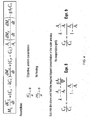
- the ratio of the concentration of pre-charged dopant in the outer feed zone to the concentration of pre-charged dopant material in the inner growth zone, C F / C L is given by Eqn.
- Eqn. 9 shown in FIG 4 when evaporation is not important (i.e., dopant materials having an evaporation rate coefficient, g, that is approximately equal to zero), such as for boron and phosphorous.
- Eqn. 9 depends only on crucible geometry and the segregation coefficient of the dopant material.
- the growth and feed zones are pre-charged with amounts of solid silicon giving initial equal melt levels and with amounts of dopant giving dopant concentrations respectively of C L and C F , and the ratio of these concentrations is determined based on the specific crucible geometry characteristics and knowledge of the segregation coefficient of the dopant material in the crystalline material used to grow the ingot, according to Eqn. 8 or Eqn. 9 shown in FIG 4 .
- Low temperature pre-charging of dopants should present few difficulties, and the absence of a continuous silicon feed greatly simplifies the growth chamber design and operation.
- the growth zone is supplied with solid silicon feedstock and dopants only when it is cold and, once the silicon is exhausted, growth stops and the crucible is replaced by a fresh one.
- This process closely resembles conventional batch Czochralski operations, but there are partitions in the crucible. If sufficient silicon remains in the melt after the growth of one ingot, a second or further ingot can be grown from the melt, which is now at a reduced melt level. Alternatively, feeding and doping could be performed between crystals and the batch-like growth process could then be repeated.
- a second method which is not an embodiment, is a special case of either of the embodiment of the method of the present invention and the first method, which is not an embodiment.
- the embodiment of the method of the present invention is a continuous Czochralski growth method in which silicon and dopant material are pre-charged into the inner growth zone and silicon is pre-charged into the outer feed zone with no dopant material.
- the growth zone is pre-charged with both silicon and dopant material to a concentration C L when melted and the feed zone is pre-charged with only silicon to an amount providing equal initial melt levels. No continuous feed of either silicon or dopant material is needed during the ingot growth.
- the diameter ratio of the inner growth zone diameter to outer feed zone diameter (the crucible diameter), D s / D t , has a value of 0.89 for boron and 0.59 for phosphorous.
- ratios are independent of crystal growth rate or ingot diameter and may be derived from the cusps of the graph shown in FIG 5 which shows for boron and phosphorous dopants the relationships between the crucible geometry A s / A t and the operational parameter dM F / dM x for the embodiment of the method of the present invention on the right axis represented by solid lines and the operational parameter C F / C L on the left for the first method represented by dashed lines. These values can also be calculated based on the segregation coefficients of TABLE 1.
- the diameter ratio for gallium requires consideration of the pull rate and ingot diameter.
- the special value of the area ratio can also be used to determine how a crucible having a specific geometry (or other dopant) can be used to produce a uniformly doped crystalline ingot.
- a value of kA t / A s > 1 requires that dM F ⁇ 0, which is impossible unless liquid silicon can be removed from the system without removing dopant.
- a crucible having an inner growth zone and outer feed zone cross-sectional areas such that k ( A t / A s ) ⁇ 1 and dM F ⁇ dM x can be used to produce an ingot having an axially substantially uniform dopant concentration.
- a value of kA t / A s ⁇ 1 requires that C F ⁇ 0.
- a crucible having an inner growth zone and outer feed zone cross-sectional areas such that k(A t / A s ) > 1 and C F ⁇ C L can be used to produce an ingot having an axially substantially uniform dopant concentration.
- the melt level will decrease during growth and the length of ingot grown is limited by when the melt level approaches the bottom of the crucible.
- silicon ingots are uniformly doped with a specific dopant material by growing the ingot from a crucible having an inner growth zone in fluid communication with an outer feed zone.
- a s / A t equals the segregation coefficient of the dopant material, k
- a uniform ingot can be grown without dopant material being included in the outer feed zone and without the need of an additional silicon or dopant feed replenishing the growth zone as the ingot grows.
- different methods are needed as described for the - embodiment of the present method.
- the outer feed zone should contain no dopant material and should be fed with only silicon as the ingot is grown.
- the rate for feeding silicon into the outer feed zone should be less than the rate the silicon ingot is grown.
- both the inner growth zone and the outer feed zone should contain silicon and dopant, and the concentration of dopant in the outer feed zone should be less than the concentration of the dopant in the inner growth zone. No additional feed of silicon or dopant material is needed.
- a uniformly doped silicon ingot may be produced using the previously described methods.
- a third method combines the embodiment of the method of the present invention and the first method, which is not an embodiment.
- the outer annular feed zone is pre-charged with silicon and dopant and is continuously supplied with silicon but no dopant during growth.
- This method requires the hot feeding of silicon feedstock, it does not restrict the crucible geometry and allows longer runs before the crucible is emptied.
- the third method would benefit from computerized and dynamic control of the silicon replenishment.
- the present invention further relates to a crystal growth system, and, in particular, a Czochralski growth system, used to prepare a crystal ingot, such as a silicon ingot having an axially substantially uniform dopant concentration.
- the system comprises a crucible having a known geometry and known type of dopant material.
- the crystal growth system of the present invention is used to prepare the ingot using the method of the present invention, described in more detail above.
- the crystal growth system comprises a crucible having an inner growth zone in fluid communication with an outer feed zone, the inner growth zone comprising silicon and the dopant material which, when melted, forms a melted mixture, and the outer feed zone comprising silicon, which, when melted, forms a silicon melt.
- the melted mixture and the silicon melt have upper melt surfaces at substantially similar heights.
- the inner growth zone and the outer feed zone have cross-sectional areas that can be used to determine conditions for maintaining dopant uniformity for the specific dopant material used, and these are described in more detail above relating to the various methods described above.
- Czochralski growth system 10 includes crucible chamber 12 arranged about central axis 13 and enclosing pedestal 14 supporting double-walled crucible 16 which is substantially circular in cross-sectional shape.
- Shaft 18 connected to an unillustrated motor rotates pedestal 14 and crucible 16 about central axis 13 .
- Crucible chamber 12 includes ports for supplying an inert ambient gas such as argon and vacuum ports for exhausting the ambient gas and reducing the chamber pressure.
- Crucible 16 includes inner wall 20 defining therein inner growth zone 22 and outer wall 24 defining, together with inner wall 20 , outer annular feed zone 26 .
- Aperture 28 in inner wall 20 provides restricted fluid communication between outer feed zone 26 and inner growth zone 22 . Additional walls producing addition zones and other flow controls are possible.
- the diameters, and thus the cross-sectional surface areas, of inner growth zone 22 and outer feed zone 26 are preselected based on the segregation coefficient of the dopant material to be incorporated into the desired grown ingot, as discussed in more detail above.
- the diameter of the inner growth zone is also selected to be significantly larger than the targeting ingot diameter by an optimized factor, and the pull rate is also optimized to reduce crystal defects and other undesired effects.
- the desired solid pre-charges comprising silicon are supplied into crucible 16 , and side heater 30 and annular bottom heater 32 heat crucible 16 to approximately 1420°C, just above the melting point of silicon, so that the pre-charge melts and substantially fills inner growth zone 22 and outer feed zone 26 with molten material up to an upper melt surface level 34 .
- a pre-heater can be used to melt silicon for pre-charging the crucible.
- Czochralski growth system 10 further includes pull chamber 40 that extends vertically upwards from the top of crucible chamber 12 and is vacuum isolated from it by puller isolation valve 42 .
- Puller mechanism 44 supports, retracts and extends, and rotates cable 46 having clamp 48 at its lower end to selectively hold crystalline silicon seed 50 of predetermined crystalline orientation.
- puller 44 lowers seed 50 through opened puller isolation valve 42 to barely contact upper melt surface 34 of inner growth zone 22 . Under the proper temperature conditions, the silicon at the surface of the melt in the inner growth zone freezes or solidifies on seed 50 with the same crystalline orientation as that of the seed.
- Puller 44 then slowly raises seed 50 from the melt as the seed and crucible 16 are rotated in opposite directions such that additional silicon freezes and the crystal expands to form growing ingot 52 .
- the diameter of ingot 52 expands in crown region 54 , but the drawing rate is then increased so that the central portion of the ingot 52 has a substantially constant diameter, for example, 200 or 300mm.
- ingot 52 As the length of ingot 52 increases, it is partially pulled into pull chamber 40 . When a final length of the ingot has been achieved, for example, 1 to 2 meters, the pull rate is further increased to create an ingot tail of decreasing diameter which eventually breaks from the melt. Ingot 52 is then completely pulled into pull chamber 40 , and puller isolation valve 42 closes to isolate the pull chamber from the crucible chamber. When the ingot has sufficiently cooled, it is removed from pull chamber 40 , and a new seed can be clamped to puller cable 46 so that a subsequent ingot may be drawn from the same hot crucible if sufficient melt remains.
- additional silicon can be delivered to crucible 16 at least intermittently during the drawing of ingot 52 or between ingots.
- solid silicon particles 60 in the form of shards or pellets are supplied by feeder tray 62 selectively penetrating the sidewall of crucible chamber 12 through feeder isolation valve 64 .
- Feeder tray 62 which may be contained in its own isolation chamber and be selectively activated by a vibrator, can be withdrawn from crucible chamber 12 and the feeder isolation valve closed to allow resupply of feedstock to the feeder tray or its servicing.
- Feeder tray 62 may be positioned over an inclined chute having spout 66 positioned closely over rotating outer feed zone 26 to drop particles 60 at low velocity into outer feed zone 26 , in which they melt and eventually are supplied through aperture 28 into inner growth zone 22 to maintain upper melt surface level 34 .
- the invention has been described for a two-zone crucible with one apertured separating wall, the invention can be readily extended to crucibles having more than two zones with multiple apertured separating walls providing limited fluid communication from the outermost zones to the innermost growth zone.
- Some aspects of the invention can be easily expanded to the use of multiple dopants, perhaps of differing conductivity types, by accounting for their separate segregation coefficients.
- the invention offers significant commercial importance for growing monocrystalline silicon ingots, it may be applied to the growth of other materials and crystallographies.
Landscapes
- Chemical & Material Sciences (AREA)
- Engineering & Computer Science (AREA)
- Crystallography & Structural Chemistry (AREA)
- Materials Engineering (AREA)
- Metallurgy (AREA)
- Organic Chemistry (AREA)
- Crystals, And After-Treatments Of Crystals (AREA)
- Silicon Compounds (AREA)
Applications Claiming Priority (2)
| Application Number | Priority Date | Filing Date | Title |
|---|---|---|---|
| US201161483140P | 2011-05-06 | 2011-05-06 | |
| PCT/US2012/036497 WO2012154551A2 (en) | 2011-05-06 | 2012-05-04 | Growth of a uniformly doped silicon ingot by doping only the initial charge |
Publications (3)
| Publication Number | Publication Date |
|---|---|
| EP2705178A2 EP2705178A2 (en) | 2014-03-12 |
| EP2705178A4 EP2705178A4 (en) | 2015-04-15 |
| EP2705178B1 true EP2705178B1 (en) | 2016-07-06 |
Family
ID=47089362
Family Applications (1)
| Application Number | Title | Priority Date | Filing Date |
|---|---|---|---|
| EP12781614.8A Active EP2705178B1 (en) | 2011-05-06 | 2012-05-04 | Growth of a uniformly doped silicon ingot by doping only the initial charge |
Country Status (9)
| Country | Link |
|---|---|
| US (1) | US10544517B2 (enExample) |
| EP (1) | EP2705178B1 (enExample) |
| JP (1) | JP5909276B2 (enExample) |
| KR (1) | KR101939594B1 (enExample) |
| CN (1) | CN103635613B (enExample) |
| MY (1) | MY169752A (enExample) |
| PH (1) | PH12013502255A1 (enExample) |
| TW (1) | TWI588303B (enExample) |
| WO (1) | WO2012154551A2 (enExample) |
Cited By (1)
| Publication number | Priority date | Publication date | Assignee | Title |
|---|---|---|---|---|
| TWI808884B (zh) * | 2021-09-30 | 2023-07-11 | 大陸商西安奕斯偉材料科技股份有限公司 | 坩堝元件、拉晶爐及拉制單晶矽棒的方法 |
Families Citing this family (18)
| Publication number | Priority date | Publication date | Assignee | Title |
|---|---|---|---|---|
| DE102013203740B4 (de) * | 2013-03-05 | 2020-06-18 | Solarworld Industries Gmbh | Vorrichtung und Vefahren zur Herstellung von Silizium-Blöcken |
| FR3010721B1 (fr) | 2013-09-17 | 2017-02-24 | Commissariat Energie Atomique | Procede de fabrication d'un lingot de silicium presentant une concentration homogene en phosphore |
| JP6056772B2 (ja) | 2014-01-07 | 2017-01-11 | 株式会社Sumco | エピタキシャルウェーハの製造方法およびエピタキシャルウェーハ |
| KR20150106204A (ko) | 2014-03-11 | 2015-09-21 | (주)기술과가치 | 잉곳 제조 장치 |
| KR20150107540A (ko) | 2014-03-14 | 2015-09-23 | (주)기술과가치 | 잉곳 제조 장치 |
| JP6471492B2 (ja) | 2014-12-24 | 2019-02-20 | 株式会社Sumco | 単結晶の製造方法 |
| WO2016179022A1 (en) * | 2015-05-01 | 2016-11-10 | Sunedison, Inc. | Methods for producing single crystal ingots doped with volatile dopants |
| US20180291524A1 (en) * | 2015-05-01 | 2018-10-11 | Corner Star Limited | Methods for producing single crystal ingots doped with volatile dopants |
| CN105755532A (zh) * | 2016-04-13 | 2016-07-13 | 江西赛维Ldk太阳能高科技有限公司 | 一种晶体硅的制备方法及晶体硅 |
| CN105951173A (zh) * | 2016-05-30 | 2016-09-21 | 上海超硅半导体有限公司 | N型单晶硅晶锭及其制造方法 |
| US20180087179A1 (en) * | 2016-09-28 | 2018-03-29 | Corner Star Limited | Single crystal silicon ingots having doped axial regions with different resistivity and methods for producing such ingots |
| KR102275678B1 (ko) | 2017-04-25 | 2021-07-08 | 가부시키가이샤 사무코 | n형 실리콘 단결정의 제조 방법, n형 실리콘 단결정의 잉곳, 실리콘 웨이퍼 및, 에피택셜 실리콘 웨이퍼 |
| JP7080017B2 (ja) | 2017-04-25 | 2022-06-03 | 株式会社Sumco | n型シリコン単結晶のインゴット、シリコンウェーハ、およびエピタキシャルシリコンウェーハ |
| CN110158148A (zh) * | 2019-04-29 | 2019-08-23 | 江苏协鑫软控设备科技发展有限公司 | 晶硅及其晶体生长工艺 |
| US11585010B2 (en) | 2019-06-28 | 2023-02-21 | Globalwafers Co., Ltd. | Methods for producing a single crystal silicon ingot using boric acid as a dopant and ingot puller apparatus that use a solid-phase dopant |
| WO2022103416A1 (en) * | 2020-11-11 | 2022-05-19 | Globalwafers Co., Ltd. | Methods for forming a single crystal silicon ingot with reduced crucible erosion |
| US11742451B2 (en) * | 2020-11-24 | 2023-08-29 | Cisco Technology, Inc. | Integrate stressor with Ge photodiode using a substrate removal process |
| KR102516630B1 (ko) * | 2021-10-18 | 2023-03-30 | 한화솔루션 주식회사 | 잉곳 성장 장치 |
Family Cites Families (8)
| Publication number | Priority date | Publication date | Assignee | Title |
|---|---|---|---|---|
| JPS6379790A (ja) | 1986-09-22 | 1988-04-09 | Toshiba Corp | 結晶引上げ装置 |
| JPS6395195A (ja) * | 1986-10-08 | 1988-04-26 | Toshiba Corp | 結晶引上げ方法及び装置 |
| JP2755588B2 (ja) * | 1988-02-22 | 1998-05-20 | 株式会社東芝 | 結晶引上げ方法 |
| JPH085740B2 (ja) * | 1988-02-25 | 1996-01-24 | 株式会社東芝 | 半導体の結晶引上げ方法 |
| JPH0392774U (enExample) * | 1989-12-28 | 1991-09-20 | ||
| US5427056A (en) | 1990-10-17 | 1995-06-27 | Komatsu Electronic Metals Co., Ltd. | Apparatus and method for producing single crystal |
| JP3484870B2 (ja) | 1996-03-27 | 2004-01-06 | 信越半導体株式会社 | 連続チャージ法によるシリコン単結晶の製造方法およびドーパント供給装置 |
| JP2006315869A (ja) * | 2005-05-10 | 2006-11-24 | Sumco Corp | 窒素ドープシリコン単結晶の製造方法 |
-
2012
- 2012-05-04 MY MYPI2013004019A patent/MY169752A/en unknown
- 2012-05-04 US US13/464,203 patent/US10544517B2/en active Active
- 2012-05-04 WO PCT/US2012/036497 patent/WO2012154551A2/en not_active Ceased
- 2012-05-04 PH PH1/2013/502255A patent/PH12013502255A1/en unknown
- 2012-05-04 EP EP12781614.8A patent/EP2705178B1/en active Active
- 2012-05-04 JP JP2014509471A patent/JP5909276B2/ja active Active
- 2012-05-04 KR KR1020137032404A patent/KR101939594B1/ko active Active
- 2012-05-04 CN CN201280030859.6A patent/CN103635613B/zh active Active
- 2012-05-07 TW TW101116159A patent/TWI588303B/zh active
Cited By (1)
| Publication number | Priority date | Publication date | Assignee | Title |
|---|---|---|---|---|
| TWI808884B (zh) * | 2021-09-30 | 2023-07-11 | 大陸商西安奕斯偉材料科技股份有限公司 | 坩堝元件、拉晶爐及拉制單晶矽棒的方法 |
Also Published As
| Publication number | Publication date |
|---|---|
| MY169752A (en) | 2019-05-15 |
| US20120279437A1 (en) | 2012-11-08 |
| EP2705178A4 (en) | 2015-04-15 |
| JP2014513034A (ja) | 2014-05-29 |
| JP5909276B2 (ja) | 2016-04-26 |
| PH12013502255A1 (en) | 2014-01-13 |
| KR20140096993A (ko) | 2014-08-06 |
| WO2012154551A2 (en) | 2012-11-15 |
| KR101939594B1 (ko) | 2019-01-17 |
| CN103635613A (zh) | 2014-03-12 |
| TWI588303B (zh) | 2017-06-21 |
| CN103635613B (zh) | 2017-02-15 |
| WO2012154551A3 (en) | 2013-03-21 |
| US10544517B2 (en) | 2020-01-28 |
| TW201303092A (zh) | 2013-01-16 |
| EP2705178A2 (en) | 2014-03-12 |
Similar Documents
| Publication | Publication Date | Title |
|---|---|---|
| US10544517B2 (en) | Growth of a uniformly doped silicon ingot by doping only the initial charge | |
| EP2697412B1 (en) | Method for producing silicon ingot having axially uniform doping | |
| US5242531A (en) | Continuous liquid silicon recharging process in czochralski crucible pulling | |
| KR102658843B1 (ko) | 연속 쵸크랄스키 방법을 사용하여 질소 도핑된 단결정 실리콘 잉곳을 성장시키기 위한 방법들 및 이 방법에 의해 성장되는 단결정 실리콘 잉곳 | |
| US20030061985A1 (en) | Process for preparing an arsenic-doped single crystal silicon using a submersed dopant feeder | |
| US20070056504A1 (en) | Method and apparatus to produce single crystal ingot of uniform axial resistivity | |
| US8840721B2 (en) | Method of manufacturing silicon single crystal | |
| TW202231942A (zh) | 在單晶矽錠成長過程中使用緩衝劑 | |
| KR102576552B1 (ko) | 연속 쵸크랄스키 방법을 사용하여 단결정 실리콘 잉곳을 성장시키기 위한 방법들 | |
| TWI831613B (zh) | 製造單晶矽鑄碇之方法 | |
| JP5262257B2 (ja) | 窒素ドープシリコン単結晶の製造方法 | |
| TW202248470A (zh) | 石英板於單晶矽錠生長期間之用途 | |
| JP3885245B2 (ja) | 単結晶引上方法 | |
| JP7359241B2 (ja) | シリコン単結晶の製造方法 | |
| CN116783333A (zh) | 在单晶硅锭生长期间使用缓冲剂 |
Legal Events
| Date | Code | Title | Description |
|---|---|---|---|
| PUAI | Public reference made under article 153(3) epc to a published international application that has entered the european phase |
Free format text: ORIGINAL CODE: 0009012 |
|
| 17P | Request for examination filed |
Effective date: 20131126 |
|
| AK | Designated contracting states |
Kind code of ref document: A2 Designated state(s): AL AT BE BG CH CY CZ DE DK EE ES FI FR GB GR HR HU IE IS IT LI LT LU LV MC MK MT NL NO PL PT RO RS SE SI SK SM TR |
|
| DAX | Request for extension of the european patent (deleted) | ||
| RIC1 | Information provided on ipc code assigned before grant |
Ipc: C30B 15/12 20060101ALI20141110BHEP Ipc: C30B 15/04 20060101AFI20141110BHEP Ipc: C30B 29/06 20060101ALI20141110BHEP |
|
| A4 | Supplementary search report drawn up and despatched |
Effective date: 20150316 |
|
| RIC1 | Information provided on ipc code assigned before grant |
Ipc: C30B 15/12 20060101ALI20150309BHEP Ipc: C30B 29/06 20060101ALI20150309BHEP Ipc: C30B 15/04 20060101AFI20150309BHEP |
|
| RAP1 | Party data changed (applicant data changed or rights of an application transferred) |
Owner name: GTAT IP HOLDING LLC |
|
| GRAP | Despatch of communication of intention to grant a patent |
Free format text: ORIGINAL CODE: EPIDOSNIGR1 |
|
| INTG | Intention to grant announced |
Effective date: 20151216 |
|
| GRAS | Grant fee paid |
Free format text: ORIGINAL CODE: EPIDOSNIGR3 |
|
| GRAA | (expected) grant |
Free format text: ORIGINAL CODE: 0009210 |
|
| AK | Designated contracting states |
Kind code of ref document: B1 Designated state(s): AL AT BE BG CH CY CZ DE DK EE ES FI FR GB GR HR HU IE IS IT LI LT LU LV MC MK MT NL NO PL PT RO RS SE SI SK SM TR |
|
| REG | Reference to a national code |
Ref country code: GB Ref legal event code: FG4D |
|
| REG | Reference to a national code |
Ref country code: AT Ref legal event code: REF Ref document number: 810771 Country of ref document: AT Kind code of ref document: T Effective date: 20160715 Ref country code: CH Ref legal event code: EP |
|
| REG | Reference to a national code |
Ref country code: IE Ref legal event code: FG4D |
|
| REG | Reference to a national code |
Ref country code: DE Ref legal event code: R096 Ref document number: 602012020245 Country of ref document: DE |
|
| REG | Reference to a national code |
Ref country code: NL Ref legal event code: MP Effective date: 20160706 |
|
| REG | Reference to a national code |
Ref country code: LT Ref legal event code: MG4D |
|
| REG | Reference to a national code |
Ref country code: AT Ref legal event code: MK05 Ref document number: 810771 Country of ref document: AT Kind code of ref document: T Effective date: 20160706 |
|
| PG25 | Lapsed in a contracting state [announced via postgrant information from national office to epo] |
Ref country code: HR Free format text: LAPSE BECAUSE OF FAILURE TO SUBMIT A TRANSLATION OF THE DESCRIPTION OR TO PAY THE FEE WITHIN THE PRESCRIBED TIME-LIMIT Effective date: 20160706 Ref country code: RS Free format text: LAPSE BECAUSE OF FAILURE TO SUBMIT A TRANSLATION OF THE DESCRIPTION OR TO PAY THE FEE WITHIN THE PRESCRIBED TIME-LIMIT Effective date: 20160706 Ref country code: IS Free format text: LAPSE BECAUSE OF FAILURE TO SUBMIT A TRANSLATION OF THE DESCRIPTION OR TO PAY THE FEE WITHIN THE PRESCRIBED TIME-LIMIT Effective date: 20161106 Ref country code: NL Free format text: LAPSE BECAUSE OF FAILURE TO SUBMIT A TRANSLATION OF THE DESCRIPTION OR TO PAY THE FEE WITHIN THE PRESCRIBED TIME-LIMIT Effective date: 20160706 Ref country code: LT Free format text: LAPSE BECAUSE OF FAILURE TO SUBMIT A TRANSLATION OF THE DESCRIPTION OR TO PAY THE FEE WITHIN THE PRESCRIBED TIME-LIMIT Effective date: 20160706 Ref country code: IT Free format text: LAPSE BECAUSE OF FAILURE TO SUBMIT A TRANSLATION OF THE DESCRIPTION OR TO PAY THE FEE WITHIN THE PRESCRIBED TIME-LIMIT Effective date: 20160706 Ref country code: NO Free format text: LAPSE BECAUSE OF FAILURE TO SUBMIT A TRANSLATION OF THE DESCRIPTION OR TO PAY THE FEE WITHIN THE PRESCRIBED TIME-LIMIT Effective date: 20161006 Ref country code: FI Free format text: LAPSE BECAUSE OF FAILURE TO SUBMIT A TRANSLATION OF THE DESCRIPTION OR TO PAY THE FEE WITHIN THE PRESCRIBED TIME-LIMIT Effective date: 20160706 |
|
| PG25 | Lapsed in a contracting state [announced via postgrant information from national office to epo] |
Ref country code: AT Free format text: LAPSE BECAUSE OF FAILURE TO SUBMIT A TRANSLATION OF THE DESCRIPTION OR TO PAY THE FEE WITHIN THE PRESCRIBED TIME-LIMIT Effective date: 20160706 Ref country code: BE Free format text: LAPSE BECAUSE OF FAILURE TO SUBMIT A TRANSLATION OF THE DESCRIPTION OR TO PAY THE FEE WITHIN THE PRESCRIBED TIME-LIMIT Effective date: 20160706 Ref country code: ES Free format text: LAPSE BECAUSE OF FAILURE TO SUBMIT A TRANSLATION OF THE DESCRIPTION OR TO PAY THE FEE WITHIN THE PRESCRIBED TIME-LIMIT Effective date: 20160706 Ref country code: SE Free format text: LAPSE BECAUSE OF FAILURE TO SUBMIT A TRANSLATION OF THE DESCRIPTION OR TO PAY THE FEE WITHIN THE PRESCRIBED TIME-LIMIT Effective date: 20160706 Ref country code: LV Free format text: LAPSE BECAUSE OF FAILURE TO SUBMIT A TRANSLATION OF THE DESCRIPTION OR TO PAY THE FEE WITHIN THE PRESCRIBED TIME-LIMIT Effective date: 20160706 Ref country code: GR Free format text: LAPSE BECAUSE OF FAILURE TO SUBMIT A TRANSLATION OF THE DESCRIPTION OR TO PAY THE FEE WITHIN THE PRESCRIBED TIME-LIMIT Effective date: 20161007 Ref country code: PT Free format text: LAPSE BECAUSE OF FAILURE TO SUBMIT A TRANSLATION OF THE DESCRIPTION OR TO PAY THE FEE WITHIN THE PRESCRIBED TIME-LIMIT Effective date: 20161107 Ref country code: PL Free format text: LAPSE BECAUSE OF FAILURE TO SUBMIT A TRANSLATION OF THE DESCRIPTION OR TO PAY THE FEE WITHIN THE PRESCRIBED TIME-LIMIT Effective date: 20160706 |
|
| REG | Reference to a national code |
Ref country code: DE Ref legal event code: R097 Ref document number: 602012020245 Country of ref document: DE |
|
| PG25 | Lapsed in a contracting state [announced via postgrant information from national office to epo] |
Ref country code: RO Free format text: LAPSE BECAUSE OF FAILURE TO SUBMIT A TRANSLATION OF THE DESCRIPTION OR TO PAY THE FEE WITHIN THE PRESCRIBED TIME-LIMIT Effective date: 20160706 Ref country code: EE Free format text: LAPSE BECAUSE OF FAILURE TO SUBMIT A TRANSLATION OF THE DESCRIPTION OR TO PAY THE FEE WITHIN THE PRESCRIBED TIME-LIMIT Effective date: 20160706 |
|
| PLBE | No opposition filed within time limit |
Free format text: ORIGINAL CODE: 0009261 |
|
| STAA | Information on the status of an ep patent application or granted ep patent |
Free format text: STATUS: NO OPPOSITION FILED WITHIN TIME LIMIT |
|
| REG | Reference to a national code |
Ref country code: FR Ref legal event code: PLFP Year of fee payment: 6 |
|
| PG25 | Lapsed in a contracting state [announced via postgrant information from national office to epo] |
Ref country code: CZ Free format text: LAPSE BECAUSE OF FAILURE TO SUBMIT A TRANSLATION OF THE DESCRIPTION OR TO PAY THE FEE WITHIN THE PRESCRIBED TIME-LIMIT Effective date: 20160706 Ref country code: SM Free format text: LAPSE BECAUSE OF FAILURE TO SUBMIT A TRANSLATION OF THE DESCRIPTION OR TO PAY THE FEE WITHIN THE PRESCRIBED TIME-LIMIT Effective date: 20160706 Ref country code: BG Free format text: LAPSE BECAUSE OF FAILURE TO SUBMIT A TRANSLATION OF THE DESCRIPTION OR TO PAY THE FEE WITHIN THE PRESCRIBED TIME-LIMIT Effective date: 20161006 Ref country code: DK Free format text: LAPSE BECAUSE OF FAILURE TO SUBMIT A TRANSLATION OF THE DESCRIPTION OR TO PAY THE FEE WITHIN THE PRESCRIBED TIME-LIMIT Effective date: 20160706 Ref country code: SK Free format text: LAPSE BECAUSE OF FAILURE TO SUBMIT A TRANSLATION OF THE DESCRIPTION OR TO PAY THE FEE WITHIN THE PRESCRIBED TIME-LIMIT Effective date: 20160706 |
|
| 26N | No opposition filed |
Effective date: 20170407 |
|
| PG25 | Lapsed in a contracting state [announced via postgrant information from national office to epo] |
Ref country code: LU Free format text: LAPSE BECAUSE OF NON-PAYMENT OF DUE FEES Effective date: 20170531 Ref country code: SI Free format text: LAPSE BECAUSE OF FAILURE TO SUBMIT A TRANSLATION OF THE DESCRIPTION OR TO PAY THE FEE WITHIN THE PRESCRIBED TIME-LIMIT Effective date: 20160706 |
|
| REG | Reference to a national code |
Ref country code: CH Ref legal event code: PL |
|
| GBPC | Gb: european patent ceased through non-payment of renewal fee |
Effective date: 20170504 |
|
| PG25 | Lapsed in a contracting state [announced via postgrant information from national office to epo] |
Ref country code: MC Free format text: LAPSE BECAUSE OF FAILURE TO SUBMIT A TRANSLATION OF THE DESCRIPTION OR TO PAY THE FEE WITHIN THE PRESCRIBED TIME-LIMIT Effective date: 20160706 |
|
| REG | Reference to a national code |
Ref country code: IE Ref legal event code: MM4A |
|
| PG25 | Lapsed in a contracting state [announced via postgrant information from national office to epo] |
Ref country code: LI Free format text: LAPSE BECAUSE OF NON-PAYMENT OF DUE FEES Effective date: 20170531 Ref country code: CH Free format text: LAPSE BECAUSE OF NON-PAYMENT OF DUE FEES Effective date: 20170531 |
|
| PG25 | Lapsed in a contracting state [announced via postgrant information from national office to epo] |
Ref country code: LU Free format text: LAPSE BECAUSE OF NON-PAYMENT OF DUE FEES Effective date: 20170504 |
|
| PG25 | Lapsed in a contracting state [announced via postgrant information from national office to epo] |
Ref country code: IE Free format text: LAPSE BECAUSE OF NON-PAYMENT OF DUE FEES Effective date: 20170504 Ref country code: GB Free format text: LAPSE BECAUSE OF NON-PAYMENT OF DUE FEES Effective date: 20170504 |
|
| REG | Reference to a national code |
Ref country code: FR Ref legal event code: PLFP Year of fee payment: 7 |
|
| PG25 | Lapsed in a contracting state [announced via postgrant information from national office to epo] |
Ref country code: MT Free format text: LAPSE BECAUSE OF NON-PAYMENT OF DUE FEES Effective date: 20170504 |
|
| PG25 | Lapsed in a contracting state [announced via postgrant information from national office to epo] |
Ref country code: AL Free format text: LAPSE BECAUSE OF FAILURE TO SUBMIT A TRANSLATION OF THE DESCRIPTION OR TO PAY THE FEE WITHIN THE PRESCRIBED TIME-LIMIT Effective date: 20160706 |
|
| PG25 | Lapsed in a contracting state [announced via postgrant information from national office to epo] |
Ref country code: HU Free format text: LAPSE BECAUSE OF FAILURE TO SUBMIT A TRANSLATION OF THE DESCRIPTION OR TO PAY THE FEE WITHIN THE PRESCRIBED TIME-LIMIT; INVALID AB INITIO Effective date: 20120504 |
|
| PG25 | Lapsed in a contracting state [announced via postgrant information from national office to epo] |
Ref country code: CY Free format text: LAPSE BECAUSE OF NON-PAYMENT OF DUE FEES Effective date: 20160706 |
|
| PG25 | Lapsed in a contracting state [announced via postgrant information from national office to epo] |
Ref country code: MK Free format text: LAPSE BECAUSE OF FAILURE TO SUBMIT A TRANSLATION OF THE DESCRIPTION OR TO PAY THE FEE WITHIN THE PRESCRIBED TIME-LIMIT Effective date: 20160706 |
|
| PG25 | Lapsed in a contracting state [announced via postgrant information from national office to epo] |
Ref country code: TR Free format text: LAPSE BECAUSE OF FAILURE TO SUBMIT A TRANSLATION OF THE DESCRIPTION OR TO PAY THE FEE WITHIN THE PRESCRIBED TIME-LIMIT Effective date: 20160706 |
|
| PGFP | Annual fee paid to national office [announced via postgrant information from national office to epo] |
Ref country code: DE Payment date: 20250423 Year of fee payment: 14 |
|
| PGFP | Annual fee paid to national office [announced via postgrant information from national office to epo] |
Ref country code: FR Payment date: 20250423 Year of fee payment: 14 |