EP2645178B1 - Dichtungsring für kraftfahrzeuge sowie dichtungsring und gleitelement für industrielle gasverdichter - Google Patents
Dichtungsring für kraftfahrzeuge sowie dichtungsring und gleitelement für industrielle gasverdichter Download PDFInfo
- Publication number
- EP2645178B1 EP2645178B1 EP11842510.7A EP11842510A EP2645178B1 EP 2645178 B1 EP2645178 B1 EP 2645178B1 EP 11842510 A EP11842510 A EP 11842510A EP 2645178 B1 EP2645178 B1 EP 2645178B1
- Authority
- EP
- European Patent Office
- Prior art keywords
- resin
- seal ring
- sliding member
- repeating unit
- automobile
- Prior art date
- Legal status (The legal status is an assumption and is not a legal conclusion. Google has not performed a legal analysis and makes no representation as to the accuracy of the status listed.)
- Active
Links
Images
Classifications
-
- F—MECHANICAL ENGINEERING; LIGHTING; HEATING; WEAPONS; BLASTING
- F16—ENGINEERING ELEMENTS AND UNITS; GENERAL MEASURES FOR PRODUCING AND MAINTAINING EFFECTIVE FUNCTIONING OF MACHINES OR INSTALLATIONS; THERMAL INSULATION IN GENERAL
- F16J—PISTONS; CYLINDERS; SEALINGS
- F16J9/00—Piston-rings, e.g. non-metallic piston-rings, seats therefor; Ring sealings of similar construction
- F16J9/26—Piston-rings, e.g. non-metallic piston-rings, seats therefor; Ring sealings of similar construction characterised by the use of particular materials
-
- C—CHEMISTRY; METALLURGY
- C08—ORGANIC MACROMOLECULAR COMPOUNDS; THEIR PREPARATION OR CHEMICAL WORKING-UP; COMPOSITIONS BASED THEREON
- C08L—COMPOSITIONS OF MACROMOLECULAR COMPOUNDS
- C08L27/00—Compositions of homopolymers or copolymers of compounds having one or more unsaturated aliphatic radicals, each having only one carbon-to-carbon double bond, and at least one being terminated by a halogen; Compositions of derivatives of such polymers
- C08L27/02—Compositions of homopolymers or copolymers of compounds having one or more unsaturated aliphatic radicals, each having only one carbon-to-carbon double bond, and at least one being terminated by a halogen; Compositions of derivatives of such polymers not modified by chemical after-treatment
- C08L27/12—Compositions of homopolymers or copolymers of compounds having one or more unsaturated aliphatic radicals, each having only one carbon-to-carbon double bond, and at least one being terminated by a halogen; Compositions of derivatives of such polymers not modified by chemical after-treatment containing fluorine atoms
- C08L27/18—Homopolymers or copolymers or tetrafluoroethene
-
- B—PERFORMING OPERATIONS; TRANSPORTING
- B65—CONVEYING; PACKING; STORING; HANDLING THIN OR FILAMENTARY MATERIAL
- B65H—HANDLING THIN OR FILAMENTARY MATERIAL, e.g. SHEETS, WEBS, CABLES
- B65H29/00—Delivering or advancing articles from machines; Advancing articles to or into piles
- B65H29/54—Article strippers, e.g. for stripping from advancing elements
- B65H29/56—Article strippers, e.g. for stripping from advancing elements for stripping from elements or machines
-
- C—CHEMISTRY; METALLURGY
- C08—ORGANIC MACROMOLECULAR COMPOUNDS; THEIR PREPARATION OR CHEMICAL WORKING-UP; COMPOSITIONS BASED THEREON
- C08J—WORKING-UP; GENERAL PROCESSES OF COMPOUNDING; AFTER-TREATMENT NOT COVERED BY SUBCLASSES C08B, C08C, C08F, C08G or C08H
- C08J5/00—Manufacture of articles or shaped materials containing macromolecular substances
-
- C—CHEMISTRY; METALLURGY
- C08—ORGANIC MACROMOLECULAR COMPOUNDS; THEIR PREPARATION OR CHEMICAL WORKING-UP; COMPOSITIONS BASED THEREON
- C08L—COMPOSITIONS OF MACROMOLECULAR COMPOUNDS
- C08L27/00—Compositions of homopolymers or copolymers of compounds having one or more unsaturated aliphatic radicals, each having only one carbon-to-carbon double bond, and at least one being terminated by a halogen; Compositions of derivatives of such polymers
- C08L27/02—Compositions of homopolymers or copolymers of compounds having one or more unsaturated aliphatic radicals, each having only one carbon-to-carbon double bond, and at least one being terminated by a halogen; Compositions of derivatives of such polymers not modified by chemical after-treatment
- C08L27/12—Compositions of homopolymers or copolymers of compounds having one or more unsaturated aliphatic radicals, each having only one carbon-to-carbon double bond, and at least one being terminated by a halogen; Compositions of derivatives of such polymers not modified by chemical after-treatment containing fluorine atoms
-
- C—CHEMISTRY; METALLURGY
- C08—ORGANIC MACROMOLECULAR COMPOUNDS; THEIR PREPARATION OR CHEMICAL WORKING-UP; COMPOSITIONS BASED THEREON
- C08L—COMPOSITIONS OF MACROMOLECULAR COMPOUNDS
- C08L79/00—Compositions of macromolecular compounds obtained by reactions forming in the main chain of the macromolecule a linkage containing nitrogen with or without oxygen or carbon only, not provided for in groups C08L61/00 - C08L77/00
- C08L79/04—Polycondensates having nitrogen-containing heterocyclic rings in the main chain; Polyhydrazides; Polyamide acids or similar polyimide precursors
- C08L79/08—Polyimides; Polyester-imides; Polyamide-imides; Polyamide acids or similar polyimide precursors
-
- F—MECHANICAL ENGINEERING; LIGHTING; HEATING; WEAPONS; BLASTING
- F04—POSITIVE - DISPLACEMENT MACHINES FOR LIQUIDS; PUMPS FOR LIQUIDS OR ELASTIC FLUIDS
- F04B—POSITIVE-DISPLACEMENT MACHINES FOR LIQUIDS; PUMPS
- F04B39/00—Component parts, details, or accessories, of pumps or pumping systems specially adapted for elastic fluids, not otherwise provided for in, or of interest apart from, groups F04B25/00 - F04B37/00
- F04B39/0005—Component parts, details, or accessories, of pumps or pumping systems specially adapted for elastic fluids, not otherwise provided for in, or of interest apart from, groups F04B25/00 - F04B37/00 adaptations of pistons
-
- F—MECHANICAL ENGINEERING; LIGHTING; HEATING; WEAPONS; BLASTING
- F04—POSITIVE - DISPLACEMENT MACHINES FOR LIQUIDS; PUMPS FOR LIQUIDS OR ELASTIC FLUIDS
- F04B—POSITIVE-DISPLACEMENT MACHINES FOR LIQUIDS; PUMPS
- F04B39/00—Component parts, details, or accessories, of pumps or pumping systems specially adapted for elastic fluids, not otherwise provided for in, or of interest apart from, groups F04B25/00 - F04B37/00
- F04B39/04—Measures to avoid lubricant contaminating the pumped fluid
- F04B39/041—Measures to avoid lubricant contaminating the pumped fluid sealing for a reciprocating rod
- F04B39/042—Measures to avoid lubricant contaminating the pumped fluid sealing for a reciprocating rod sealing being provided on the piston
-
- F—MECHANICAL ENGINEERING; LIGHTING; HEATING; WEAPONS; BLASTING
- F04—POSITIVE - DISPLACEMENT MACHINES FOR LIQUIDS; PUMPS FOR LIQUIDS OR ELASTIC FLUIDS
- F04B—POSITIVE-DISPLACEMENT MACHINES FOR LIQUIDS; PUMPS
- F04B53/00—Component parts, details or accessories not provided for in, or of interest apart from, groups F04B1/00 - F04B23/00 or F04B39/00 - F04B47/00
- F04B53/14—Pistons, piston-rods or piston-rod connections
- F04B53/143—Sealing provided on the piston
-
- G—PHYSICS
- G03—PHOTOGRAPHY; CINEMATOGRAPHY; ANALOGOUS TECHNIQUES USING WAVES OTHER THAN OPTICAL WAVES; ELECTROGRAPHY; HOLOGRAPHY
- G03G—ELECTROGRAPHY; ELECTROPHOTOGRAPHY; MAGNETOGRAPHY
- G03G15/00—Apparatus for electrographic processes using a charge pattern
- G03G15/20—Apparatus for electrographic processes using a charge pattern for fixing, e.g. by using heat
- G03G15/2003—Apparatus for electrographic processes using a charge pattern for fixing, e.g. by using heat using heat
- G03G15/2014—Apparatus for electrographic processes using a charge pattern for fixing, e.g. by using heat using heat using contact heat
- G03G15/2017—Structural details of the fixing unit in general, e.g. cooling means, heat shielding means
- G03G15/2028—Structural details of the fixing unit in general, e.g. cooling means, heat shielding means with means for handling the copy material in the fixing nip, e.g. introduction guides, stripping means
-
- G—PHYSICS
- G03—PHOTOGRAPHY; CINEMATOGRAPHY; ANALOGOUS TECHNIQUES USING WAVES OTHER THAN OPTICAL WAVES; ELECTROGRAPHY; HOLOGRAPHY
- G03G—ELECTROGRAPHY; ELECTROPHOTOGRAPHY; MAGNETOGRAPHY
- G03G15/00—Apparatus for electrographic processes using a charge pattern
- G03G15/65—Apparatus which relate to the handling of copy material
- G03G15/6555—Handling of sheet copy material taking place in a specific part of the copy material feeding path
- G03G15/657—Feeding path after the transfer point and up to the fixing point, e.g. guides and feeding means for handling copy material carrying an unfused toner image
-
- B—PERFORMING OPERATIONS; TRANSPORTING
- B65—CONVEYING; PACKING; STORING; HANDLING THIN OR FILAMENTARY MATERIAL
- B65H—HANDLING THIN OR FILAMENTARY MATERIAL, e.g. SHEETS, WEBS, CABLES
- B65H2401/00—Materials used for the handling apparatus or parts thereof; Properties thereof
- B65H2401/10—Materials
- B65H2401/11—Polymer compositions
-
- C—CHEMISTRY; METALLURGY
- C08—ORGANIC MACROMOLECULAR COMPOUNDS; THEIR PREPARATION OR CHEMICAL WORKING-UP; COMPOSITIONS BASED THEREON
- C08L—COMPOSITIONS OF MACROMOLECULAR COMPOUNDS
- C08L2201/00—Properties
- C08L2201/08—Stabilised against heat, light or radiation or oxydation
-
- C—CHEMISTRY; METALLURGY
- C08—ORGANIC MACROMOLECULAR COMPOUNDS; THEIR PREPARATION OR CHEMICAL WORKING-UP; COMPOSITIONS BASED THEREON
- C08L—COMPOSITIONS OF MACROMOLECULAR COMPOUNDS
- C08L2205/00—Polymer mixtures characterised by other features
- C08L2205/02—Polymer mixtures characterised by other features containing two or more polymers of the same C08L -group
-
- C—CHEMISTRY; METALLURGY
- C08—ORGANIC MACROMOLECULAR COMPOUNDS; THEIR PREPARATION OR CHEMICAL WORKING-UP; COMPOSITIONS BASED THEREON
- C08L—COMPOSITIONS OF MACROMOLECULAR COMPOUNDS
- C08L2205/00—Polymer mixtures characterised by other features
- C08L2205/02—Polymer mixtures characterised by other features containing two or more polymers of the same C08L -group
- C08L2205/025—Polymer mixtures characterised by other features containing two or more polymers of the same C08L -group containing two or more polymers of the same hierarchy C08L, and differing only in parameters such as density, comonomer content, molecular weight, structure
-
- C—CHEMISTRY; METALLURGY
- C08—ORGANIC MACROMOLECULAR COMPOUNDS; THEIR PREPARATION OR CHEMICAL WORKING-UP; COMPOSITIONS BASED THEREON
- C08L—COMPOSITIONS OF MACROMOLECULAR COMPOUNDS
- C08L2205/00—Polymer mixtures characterised by other features
- C08L2205/03—Polymer mixtures characterised by other features containing three or more polymers in a blend
-
- F—MECHANICAL ENGINEERING; LIGHTING; HEATING; WEAPONS; BLASTING
- F05—INDEXING SCHEMES RELATING TO ENGINES OR PUMPS IN VARIOUS SUBCLASSES OF CLASSES F01-F04
- F05C—INDEXING SCHEME RELATING TO MATERIALS, MATERIAL PROPERTIES OR MATERIAL CHARACTERISTICS FOR MACHINES, ENGINES OR PUMPS OTHER THAN NON-POSITIVE-DISPLACEMENT MACHINES OR ENGINES
- F05C2225/00—Synthetic polymers, e.g. plastics; Rubber
- F05C2225/10—Polyimides, e.g. Aurum
Definitions
- the present invention relates to a seal ring for an automobile, and a seal ring and a sliding member for an industrial gas compressor.
- the sliding member for sheet-shaped recording material detachment has been used as a separation claw, a separation plate, and the like which detach a sheet-shaped recording material, such as a copying paper and a printing paper, from a roll of a fixing roll or the like in a fixing portion and a development portion of various kinds of image forming devices (hereinafter referred to as a "copying machine") by an electrophotographic system, such as a copying machine, a laser beam printer, and a printing machine, for example.
- non-adhesive property which prevents the adhesion of printing toner
- shape stability which prevents deformation and breakage of the tip portion of a separation claw and the like
- non-attackability which prevents damages to the roll surface which the most distal end portion thereof contacts
- heat resistance which prevents the deformation thereof at a high temperature of about 200 to 250°C and silent properties during sliding with a roll, and the like
- Patent Document 1 a separation claw for a copying machine
- Patent Document 2 whose surface non-adhesive property is improved by forming a coat containing a specific fluorocarbon resin, such as tetrafluoroethylene, as the main component on the surface of a molded body of polyimide having a specific structure
- Patent Document 2 a separation claw for copying
- Patent Document 3 which is injection molded with a fluorine resin, and the like.
- the surface hardness of resin such as polyimide
- the surface hardness is still high, which causes a risk of damaging the roll surface where the most distal end portion thereof contacts.
- the coat is worn out or the coat is detached due to a certain situation, there arises a problem of considerably damaging the roll surface.
- the hardness of the surface of the coat is high, silent properties are not so good.
- the quality of the formed coat has influence on the performance of the separation claw.
- the coat forming process is the final process but the process is most likely to cause defects, so that inspection by human beings is required. Therefore, there is a problem such that cost is required for the management aspect of performing the inspection.
- a seal ring and other sliding members other than the sliding member for sheet-shaped recording material detachment are used for a portion where liquid and gas are required to be sealed or a sliding portion in transport machines, such as automobiles, office machines, a gas compressor, other industrial machines, and the like.
- transport machines such as automobiles, office machines, a gas compressor, other industrial machines, and the like.
- a seal ring for use in various pistons for an industrial gas compressor and an automobile and the like are also sliding members. Therefore, the seal ring is required to have low abrasiveness of the seal ring itself and low attackability to a mating member of the seal ring. Furthermore, since the seal ring is also required to have sufficient sealing properties with which the seal ring hardly causes gas leakage, moderate flexibility is required.
- a seal ring for use therein has been increasingly required to also have high mechanical strength with an increase in pressure of compressed gas and an increase in performance of the machine in recent years. Therefore, a currently-used polytetrafluoroethylene (PTFE) resin material containing a filler is limited in the mechanical strength (e.g., tensile strength and bending strength) and cannot meet the demand in some cases.
- PTFE polytetrafluoroethylene
- a piston ring and the like in which a material charged with carbon fibers, PTFE, and the like is used for super engineering plastics with high mechanical strength such as thermoplastic polyimide (TPI) and polyetheretherketone (PEEK) resin, (hereinafter also referred to as "super engineering plastics") have been proposed (for example, Patent Document 4).
- thermoplastic polyimide (TPI) and polyetheretherketone (PEEK) resin hereinafter also referred to as "super engineering plastics”
- TPI thermoplastic polyimide
- PEEK polyetheretherketone
- a material having high mechanical strength which allows the material to bear high pressure for example, bending strength (30 MPa or more)
- flexibility which allows the material to satisfy a seal function (for example, bending elastic modulus of 1000 MPa or more and lower than 2000 MPa and bending breaking strain of 4% or more or bending elastic modulus of 2000 MPa or more and lower than 4000 MPa and bending breaking strain of 2% or more).
- a piston seal structure has been proposed in which a functional portion having an outer circumferential surface portion constituted by a low friction material, such as PTFE, PI, PEEK, is provided in a piston of a specific structure and one-side gap with the inner circumferential surface portion of a cylinder facing the outer circumferential surface portion is set to 0.03 mm or lower (Patent Document 5).
- a functional portion having an outer circumferential surface portion constituted by a low friction material such as PTFE, PI, PEEK
- Patent document 6 discloses a separating pawl which is formed of a resin composition containing as blend polytetrafluoroethylene resin materials which are different in melt flow rate.
- Patent document 7 relates to a resin composition
- a resin composition comprising a fluorinated polymer having a high fluorine content and a polymer containing no fluorine, which are uniformly and finely dispersed and mixed by a dispersing agent.
- Patent document 8 discloses a coating composition which is an aqueous dispersion containing at least one fluorine-containing polymer (a) selected from the group consisting of a polytetrafluoroethylene, a tetrafluoroethylene/hexafluoropropylene copolymer and a tetrafluoroethylene/perfluoro(alkylvinyl ether) copolymer, a heat-resistant resin (b), a nonionic surfactant (c) having an HLB of not more than 11, and a fluorine-containing surfactant (d) in an aqueous medium.
- fluorine-containing polymer a
- a selected from the group consisting of a polytetrafluoroethylene, a tetrafluoroethylene/hexafluoropropylene copolymer and a tetrafluoroethylene/perfluoro(alkylvinyl ether) copolymer
- a heat-resistant resin
- Patent document 9 relates to a sliding component that is used, for example, in a compressor for an air conditioning system, and to a compressor.
- Patent document 10 discloses a slide member having a substrate, which is made of a metal; an intermediate layer, which is formed on at least one of the surfaces of the substrate, and which is composed a first resinous composition including a thermoplastic polyimide resin and a polyaryl ketone resin; and a superficial layer, which is formed on the intermediate layer, and which is composed of a second resinous composition including a polyaryl ketone resin.
- Patent document 11 relates to a method for manufacturing a tip seal for use in a scroll compressor.
- a sliding member for sheet-shaped recording material detachment which has the above-described functions demanded as sliding members for sheet-shaped recording material detachment, such as a separation claw and a separation plate, and in which the resistance to abrasion and the heat resistant rigidity are improved without forming a coat.
- a seal function for example, bending elastic modulus of 1000 MPa or more and lower than 2000 MPa and bending breaking strain of 4% or more or bending elastic modulus of 2000 MPa or more and lower than 4000 MPa and bending breaking strain of 2% or more.
- the present inventors have extensively examined in order to solve the above-described problems. As a result, the present inventors have found that the above-described problems can be solved by the use of an adhesive fluorocarbon resin and thermoplastic polyimide, and thus the present invention has accomplished.
- a sliding member for sheet-shaped recording material detachment which has non-adhesive property, shape stability, non-attackability, heat resistance, silent properties, and the like which are demanded as sliding members for sheet-shaped recording material detachment, such as a separation claw and a separation plate, and in which the resistance to abrasion and the heat resistant rigidity are improved without forming a coat.
- the present invention provides a seal ring for an automobile, or a seal ring or a sliding member for an industrial gas compressor containing a resin composite having high mechanical strength which allows the seal rings and the sliding member to bear high pressure (for example, bending strength (30 MPa or more), flexibility which allows the seal rings and the sliding member to satisfy a seal function (for example, bending elastic modulus of 1000 MPa or more and lower than 2000 MPa and bending breaking strain of 4% or more or bending elastic modulus of 2000 MPa or more and lower than 4000 MPa and bending breaking strain of 2% or more).
- high pressure for example, bending strength (30 MPa or more)
- flexibility which allows the seal rings and the sliding member to satisfy a seal function
- a disclosed sliding member for sheet-shaped recording material detachment, a seal ring for an automobile, or a seal ring or a sliding member for an industrial gas compressor according to the present invention is made from a resin composite containing, as a first element, either an adhesive fluorocarbon resin (A) or a resin compound of the resin (A) and a fluorocarbon resin (B) which differs from the resin (A), which are in a volumetric ratio (A/B) of 5/95 to 99/1 and, as a second element, 0.5 to 99 volume% of a thermoplastic polyimide (C).
- the sliding member may be constituted using the resin composite containing the resin (A) as the first element and the thermoplastic polyimide (C) as the second element or the sliding member may be constituted using a specific resin composite containing the resin compound of the resin (A) and the resin (B) in a specific volumetric ratio as the first element and the thermoplastic polyimide (C) as the second element.
- thermoplastic polyimide (C) By compounding the resin (A) or a specific resin compound in the resin composite and setting the content of the thermoplastic polyimide (C) of 0.5 to 99 volume%, it is possible to provide a disclosed sliding member for sheet-shaped recording material detachment, a seal ring for an automobile, or a seal ring or a sliding member for an industrial gas compressor according to the present invention having excellent properties as described above.
- a suitable sliding member can be obtained by adjusting the composition and the content of the thermoplastic polyimide (C) in the resin composite.
- the adhesive fluorocarbon resin (A) for use in the invention is described first, and then the disclosed sliding member for sheet-shaped recording material detachment, the seal ring for an automobile, or the seal ring or the sliding member for an industrial gas compressor of the invention is described.
- Adhesive fluorocarbon resin (a) Adhesive fluorocarbon resin (A)
- the adhesive fluorocarbon resin (A) (hereinafter sometimes referred to as an adhesive fluorine resin) any material can be used without particular limitation insofar as the material has compatibility with the thermoplastic polyimide (C).
- the "adhesive” includes having compatibility or affinity with resin including the thermoplastic polyimide (C), another resin other than the resin (A), and other materials.
- a fluorine resin containing a repeating unit based on tetrafluoroethylene can be preferably used, for example.
- the base fluorine resin for example, one selected from the group consisting of a tetrafluoroethylene-perfluoro (alkyl vinyl ether) copolymer (PFA), a tetrafluoroethylene-hexafluoro propylene copolymer (FEP), an ethylene-tetrafluoroethylene copolymer (ETFE), a chlorotrifluoroethylene (CTFE)-TFE copolymer, and the like can be preferably used alone or a blend of two or more kinds thereof can be preferably used.
- PFA tetrafluoroethylene-perfluoro (alkyl vinyl ether) copolymer
- FEP tetrafluoroethylene-hexafluoro propylene copolymer
- ETFE ethylene-tetrafluoroethylene copolymer
- CTFE chlor
- PFA can be preferably used from the viewpoint of heat resistance and non-adhesive property in the case of the sliding member for sheet-shaped recording material detachment or from the viewpoint that the heat resistance is high and melt molding can be performed in the case of the seal ring for an automobile and the seal ring or the sliding member for an industrial gas compressor.
- the adhesive fluorocarbon resin (A) a fluorine resin and the like having at least one functional group selected from the group consisting of an acid anhydride group, a carboxyl group, an acid halide group and a carbonate group are mentioned, for example.
- the compatibility with the thermoplastic polyimide described later can be further improved.
- resin such as thermoplastic polyimide
- phase separation is difficult to occur.
- the sliding member for sheet-shaped recording material detachment resistance to abrasion and heat resistant rigidity can be imparted as a whole.
- mechanical strength can be further improved while holding flexibility as a whole.
- an unsaturated carboxylic acid anhydride group can be preferably used, and a dicarboxylic anhydride group can be more preferably used.
- a dicarboxylic anhydride group combined with cyclic hydrocarbon can be preferably used.
- cyclic monomer a repeating unit based on a cyclic hydrocarbon monomerhaving a polymerizable unsaturated group and a dicarboxylic anhydride group in the ring (hereinafter referred to as a "cyclic monomer”) is used.
- a fluorine containing copolymer which has a first repeating unit based on tetrafluoroethylene, a second repeating unit based on the cyclic hydrocarbon monomer having a dicarboxylic anhydride group and a polymerizable unsaturated group in the ring, a third repeating unit based on another monomer (hereinafter referred to as an "additional monomer") other than tetrafluoroethylene and the cyclic hydrocarbon monomer.
- the adhesive fluorine resin a fluorine containing copolymer is used in which the first repeating unit is 50 to 99.89 mol%, the second repeating unit is 0.01 to 5 mol%, and the third repeating unit is 0.1 to 49.99 mol% based on the total molar amount of the first repeating unit, the second repeating unit, and the third repeating unit.
- the adhesive fluorine resin is excellent in heat resistance, chemical resistance, adhesiveness, moldability, and mechanical physical properties.
- the adhesive fluorine resin is more preferably a fluorine containing copolymer in which the first repeating unit is 60 to 99.45 mol%, the second repeating unit is 0.05 to 3 mol%, and the third repeating unit is 0.5 to 45 mol% and most preferably a fluorine containing copolymer in which the first repeating unit is 80 to 98.9 mol%, the second repeating unit is 0.1 to 1 mol%, and the third repeating unit is 1 to 40 mol%.
- the cyclic monomer forming the adhesive fluorine resin is preferably a polymerizable compound having cyclic hydrocarbon containing one or more 5-membered rings or 6-membered rings, a dicarboxylic anhydride group, and an endocyclic polymerizable unsaturated group.
- cyclic monomer one having cyclic hydrocarbon having one or more bridged polycyclic hydrocarbons can be preferably used and particularly one having cyclic hydrocarbon containing one bridged polycyclic hydrocarbon, cyclic hydrocarbon in which two or more bridged polycyclic hydrocarbons are condensed, or cyclic hydrocarbon in which bridged polycyclic hydrocarbon and another cyclic hydrocarbon are condensed can be preferably used.
- cyclic monomer one having an endocyclic polymerizable unsaturated group containing one or more polymerizable unsaturated groups present between the carbon atoms constituting the hydrocarbon ring can be preferably used.
- cyclic monomer one having a dicarboxylic anhydride group (-CO-O-CO-) bonded to two carbon atoms constituting the hydrocarbon ring or bonded to two carbon atoms outside the ring can be preferably used.
- cyclic monomer 5-norbornene-2,3-dicarboxylic anhydride (hereinafter referred to as "NAH"), an acid anhydride represented by the following formulae (1) to (3), and the like can be preferably used, for example, and NAH can be particularly preferably used.
- NAH 5-norbornene-2,3-dicarboxylic anhydride
- an acid anhydride represented by the following formulae (1) to (3), and the like can be particularly preferably used.
- R f1 a perfluoroalkyl group having 1 to 6 carbon atoms is preferable, a perfluoroalkyl group having 2 to 4 carbon atoms is more preferable, and a perfluoropropyl group is the most preferable.
- the adhesive fluorine resin one whose melting point is in the range of 150 to 320°C can be preferably used, and one whose melting point is in the range of 200 to 310°C can be particularly preferably used.
- the adhesive fluorine resin whose melting point is in the ranges mentioned above is particularly suitable for melting and kneading, under a high temperature, a polymer alloy with super engineering plastics having heat resistance which allows the super engineering plastics to be resistant to a temperature of 150°C or higher, such as polyphenylene sulfide (PPS), polyimide (PI), polyetheretherketone (PEEK), a liquid crystalline polymer (LCP), and semiaromatic polyamide, and is excellent in melt moldability.
- the melting point of the adhesive fluorine resin can be adjusted as appropriate according to the content ratio of each repeating unit contained in the adhesive fluorine resin.
- the adhesive fluorine resin a fluorine resin in which the first repeating unit based on TFE is 50 to 99.89 mol%, the second repeating unit is 0.01 to 5 mol%, and the third repeating unit based on CTFE is 0.1 to 49.99 mol% can also be used.
- a method for manufacturing the adhesive fluorine resin is not particularly limited, and a radical polymerization method using a radical polymerization initiator is used.
- a radical polymerization method using a radical polymerization initiator is used.
- the polymerization method mass polymerization, solution polymerization using organic solvents, such as hydrocarbon fluoride, hydrocarbon chloride, fluorinated chlorinated hydrocarbon, alcohol, and hydrocarbon, suspension polymerization using an aqueous medium and, as required, a suitable organic solvent, and emulsification polymerization using an aqueous medium and a emulsifier are mentioned, and particularly the solution polymerization is preferable.
- radical polymerization initiator a radical polymerization initiator having a half-life of 10 hours at 0°C to 100°C is preferable.
- the temperature is more preferably 20°C to 90°C.
- azo compounds such as azobisisobutyronitril, non-fluorine diacylperoxide, such as isobutyrylperoxide, octanoylperoxide, benzoylperoxide, and lauroylperoxide, peroxydicarbonate, such as diisopropylperoxydicarbonate and di-n-propylperoxydicarbonate, peroxyester, such as tert-butylperoxypivalate, tert-butyl peroxyisobutyrate, and tert-butylperoxyacetate, fluorine containing diacylperoxide, such as a compound represented by (Z(CF 2 ) r COO) 2 (in which Z re
- the adhesive fluorocarbon polymer (A) is the fluorine containing copolymer
- a chain transfer agent in order to control the melt flow rate (MFR) of the fluorine containing copolymer.
- the chain transfer agent are alcohol, such as methanol and ethanol, chlorofluorohydrocarbon, such as 1,3-dichloro-1,1,2,2,3-pentafluoropropane and 1,1-dichloro-1-fluoroethane, and hydrocarbon, such as pentane, hexane, and cyclohexane.
- chain transfer agent for introducing an adhesive functional group into the polymer end of the fluorine containing copolymer, acetic acid, acetic acid anhydride, methyl acetate, ethylene glycol, propylene glycol, and the like are mentioned.
- the polymerization conditions of the adhesive fluorine resin for use in the invention are not particularly limited.
- the polymerization temperature is preferably 0 to 100°C and more preferably 20 to 90°C.
- the polymerization pressure is preferably 0.1 to 10 MPa and more preferably 0.5 to 3 MPa.
- the polymerization time is preferably 1 to 30 hours.
- the adhesive fluorine resin obtained by the manufacturing method described above can be used in the form of pellets, powder, and the like according to a usual method.
- a sliding member for sheet-shaped recording material detachment is preferably made from a resin composite containing as a first element, either an adhesive fluorocarbon resin (A) or a resin compound of the resin (A) and a fluorocarbon resin (B) which differs from the resin (A), which are in a volumetric ratio (A/B) of 5/95 to 99/1 and, as a second element, 0.5 to 50 volume% of a thermoplastic polyimide (C).
- the sliding member for sheet-shaped recording material detachment contains the thermoplastic polyimide (C) in a specific proportion, and therefore has excellent heat resistance and high mechanical strength (i.e., having shape stability and heat resistance) based on the characteristics thereof and also contains the resin (A) (the resin (B) as required), and therefore has excellent chemical resistance (i.e., non-adhesive property) and moderate flexibility (i.e., silent properties) based on the characteristics of the fluorocarbon resin.
- the resin composite since not only the surface but the entire member contains the resin composite described above unlike a former melt coat, the attackability to a roll can be suppressed.
- the adhesive fluorocarbon resin (A) for use in the invention has properties of the fluorocarbon resin, such as moderate flexibility, excellent heat resistance, chemical resistance, weatherability, and gas barrier properties, and also has moderately high surface free energy
- the adhesive fluorocarbon resin (A) can form a resin composite, such as a polymer alloy combined with other materials. Accordingly, the resin composite having excellent properties of the thermoplastic polyimide, such as heat resistance and mechanical strength, and the above-described excellent properties of the fluorocarbon resin is obtained as in the invention.
- the fluorocarbon resin (B) is not particularly limited insofar as it is a fluorocarbon resin other than the adhesive fluorocarbon resin (A).
- Known injection moldable fluorocarbon resin can be used, e.g., one selected from the group consisting of PFA, FEP, ETFE, CTFE-TFE copolymers, and the like can be used alone or a blend of two or more kinds thereof can be used.
- the volumetric ratio (A/B) of the resin (A) and the fluorocarbon resin (B) which differs from the resin (A) is 5/95 to 99/1, preferably 15/85 to 90/10, and more preferably 20/80 to 85/15.
- the compatibility with the thermoplastic polyimide (C) is obtained.
- the volumetric ratio (A/B) is smaller than 5/95, there is a tendency such that a desired compatibility is not obtained.
- the volumetric ratio of the resin compound is calculated from the mass ratio and the specific gravity of each element.
- injection moldable means that the melt flow rate (MFR) of the resin is 0.2 to 4.0 mm 3 /second.
- a method for manufacturing the resin compound is not particularly limited, and methods used for the mixing of common resin, e.g., biaxial kneading, dry blend of powder, and the like, can be employed.
- thermoplastic polyimide (C) is not particularly limited and a known one and a commercially-available one can be used.
- AURUM PD-500 manufactured by Mitsui Chemicals, Inc., and the like are mentioned, for example.
- the resin composite in the sliding member for sheet-shaped recording material detachment, it is preferable for the resin composite to contain the thermoplastic polyimide (C) in a proportion of 0.5 to 50 volume%.
- the thermoplastic polyimide (C) in a proportion of 0.5 to 50 volume%.
- the content of the thermoplastic polyimide (C) is smaller than 0.5 volume%, there is a tendency such that an improvement of the heat resistant rigidity and the resistance to abrasion is not achieved.
- the content thereof is larger than 50 volume%, there is a tendency such that the fluidity during injection molding and the surface properties deteriorate and the non-adhesive property also decreases.
- the content may be 0.5 to 30 volume% considering the securing of fluidity during injection molding, heat resistant rigidity, and resistance to abrasion.
- the average dispersion particle diameter of the thermoplastic polyimide (C) is 10 ⁇ m or lower.
- a sliding member for sheet-shaped recording material detachment is obtained in which the thermoplastic polyimide (C) is moderately dispersed in the resin (A) or the resin compound and the resistance to abrasion and the heat resistant rigidity are improved.
- the average dispersion particle diameter can be measured with a scanning electron microscope.
- the sliding member for sheet-shaped recording material detachment may be constituted so that the resin composite contains at least one (hereinafter referred to as a specific additive) selected from the group consisting of a fiber-like substance, a whisker-like substance, and a particle-like substance as additives.
- a specific additive selected from the group consisting of a fiber-like substance, a whisker-like substance, and a particle-like substance as additives.
- the fiber-like substance inorganic and organic fiber-like substances are mentioned.
- the inorganic fiber-like substances carbon fibers, glass fibers, graphite fibers, and metal fibers, such as stainless steel fibers, and the like are mentioned, for example.
- the organic fiber-like substances various kinds of synthetic fibers and natural fibers are mentioned. Among the above, the carbon fibers and the organic fibers are preferable from the viewpoint of resistance to abrasion and non-attackability.
- the whisker-like substance is a needle-like (whisker-like) single crystalline body or polycrystalline body.
- the average diameter is 0.01 to 10 ⁇ m.
- inorganic and organic whisker-like substances can be used.
- Mentioned as the inorganic whisker-like substances are, for example, a calcium silicate whisker, a calcium carbonate whisker, a calcium sulfate whisker, a magnesium sulfate whisker, a magnesium nitrate whisker, an aluminum borate whisker, a titanium oxide whisker, a zinc oxide whisker, a potassium titanate whisker, a wollastonite whisker, and the like.
- the calcium carbonate whisker and the potassium titanate whisker are particularly preferable from the viewpoint of resistance to abrasion and non-attackability.
- organic and inorganic particle-like substances having a particle diameter of 0.5 to 100 ⁇ m can be used.
- inorganic particle-like substances talc, mica, montmorillonite, silica, calcium carbonate, and the like are mentioned, for example.
- organic particle-like substances aramid powder of wholly aromatic polyamide and the like are mentioned, for example.
- talc and calcium carbonate are preferable from the viewpoint of resistance to abrasion, non-attackability, and cost.
- the content of the additives (specific additives) in the resin composite is preferably 0.1 to 30 volume% and more preferably 3 to 20 volume% from the viewpoint of heat resistant rigidity , resistance to abrasion, and fluidity during injection molding.
- additives other than the specific additives may be used for the resin composite in the range where the effects of the sliding member for sheet-shaped recording material detachment are not impaired.
- Mentioned as such additives are one or more additives of a mold release agent, a lubricant, a heat stabilizer, an antioxidant, an ultraviolet absorber, a crystal nucleus agent, a foaming agent, an antirust, an ion trap agent, a fire retardant, an auxiliary fire retardant, a colorant, such a dye and a pigment, an antistatic agent, and the like.
- the sliding member for sheet-shaped recording material detachment may be constituted so that, in the resin composite, the total of the volumetric ratio of each of the resin (A) or the resin compound, the thermoplastic polyimide (C), and the specific additive is 100 volume%.
- the water droplet contact angle of the surface is preferably 90° or more.
- the non-adhesive property of toner to the sliding member for sheet-shaped recording material detachment is further improved.
- a method for manufacturing the resin composite for use in the sliding member for sheet-shaped recording material detachment is not particularly limited and methods used for the mixing of common resin, e.g., biaxial kneading, dry blend of powder, and the like, can be employed.
- the resin composite can be formed into a general resin form, such as pellet, strand, powder, paste, and the like.
- the sliding member for sheet-shaped recording material detachment can be obtained by integrally molding the entire resin composite by injection molding or the like. Accordingly, a process for forming a melt coat is not required, so that a simplification of a manufacturing process and a reduction of the environmental load can be achieved as compared with a former one in which a melt coat is formed. Since the injection molding can be performed, there is an advantage in that mass productivity is excellent.
- the sliding member for sheet-shaped recording material detachment containing the resin composite described above can be suitably used as sliding members, such as a separation claw and a separation plate which detach a sheet-shaped recording material, such as a copying paper and a printing paper, from a roll of a fixing roll or the like in a fixing portion and a development portion of a copying machine, for example.
- the sliding member for sheet-shaped recording material detachment As an embodiment of the sliding member for sheet-shaped recording material detachment, a case where the sliding member is a separation claw for a copying machine is described.
- the form of the separation claw for a copying machine is not particularly limited and may basically have the same form as that of a former separation claw.
- the entire separation claw for a copying machine of this embodiment is integrally molded with the resin composite.
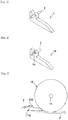
- a support shaft 2 is integrally molded with a separation claw 1.
- a shaft hole 2a is provided in a separation claw 1a.
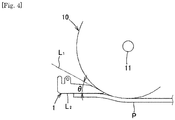
- the separation claw 1 can be rotated around the support shaft 2 by providing a rotation axis 11 of a fixing roll or another roll 10 and the support shaft 2 in such a manner as to be parallel to each other and the separation claw 1a can be rotated around an attachment shaft 4 by inserting the shaft hole 2a portion into the attachment shaft 4 provided in parallel with the rotation axis 11 of the roll 10 , and then the separation claw 1 or 1a is attached in a state where the tip portion of the claws contacts the surface of the roll 10 at a proper pressure by a biasing means 3, such as a spring.
- the angle ⁇ formed by an edge line L1 of the separation claw 1 at the side contacting the roll 10 and an edge line L2 of the separation claw 1 through which a copying paper P passes when viewed from the rotation axis 11 side of the roll 10 is defined as the tip angle of the separation claw.
- the tip angle of the separation claw is preferably in the range of 5 to 80° and more preferably in the range of 25 to 45°.
- a seal ring for an automobile or a seal ring or a sliding member for an industrial gas compressor according to the invention is preferably made from a resin composite containing, as a first element, either an adhesive fluorocarbon resin (A) or a resin compound of the resin (A) and a fluorocarbon resin (B) which differs from the resin (A), which are in a volumetric ratio (A/B) of 5/95 to 99/1 and, as a second element, 1 to 99 volume% of a thermoplastic polyimide (C).
- the adhesive fluorocarbon resin (A) or the resin compound and the thermoplastic polyimide (C) a resin composite having moderate mechanical strength and flexibility is obtained.
- the resin composite is suitable as a constituent material of the seal ring for an automobile and the seal ring or the sliding member for an industrial gas compressor.
- the adhesive fluorocarbon resin for use in the seal ring for an automobile and the seal ring or the sliding member for an industrial gas compressor of the invention have moderate flexibility and mechanical strength and also have excellent properties of the fluorocarbon resin, such as excellent heat resistance, chemical resistance, weatherability, and gas barrier properties, and have moderately high surface free energy. Therefore, when combined with other materials, the adhesive fluorocarbon resin can form an alloyed resin composite. Accordingly, as an alloyed resin composite obtained by mixing the thermoplastic polyimide described later and the adhesive fluorocarbon resin, a resin composite is obtained which has both excellent properties of the thermoplastic polyimide, such as heat resistance and mechanical strength, and the excellent properties of the fluorocarbon resin.
- the fluorocarbon resin (B) for use in the seal ring for an automobile and the seal ring or the sliding member for an industrial gas compressor of the invention is not particularly limited if it is a fluorocarbon resin other than the adhesive fluorocarbon resin (A) described above.
- a known fluorocarbon resin can be used, e.g., one selected from the group containing of PFA, FEP, ETFE, CTFE-TFE copolymers, and the like, for example, can be used alone or a blend of two or more kinds thereof can be used.
- the volumetric ratio (A/B) of the resin (A) and the fluorocarbon resin (B) which differs from the resin (A) is 5/95 to 99/1.
- the lower limit of the volumetric ratio (A/B) is more preferably 10/90 and still more preferably 50/50.
- the volumetric ratio (A/B) is smaller than 5/95, there is a tendency such that moderate flexibility and the like and desired compatibility are not obtained.
- the volumetric ratio of the resin compound is calculated from the mass ratio and the specific gravity of each element.
- a method for manufacturing the resin compound is not particularly limited and methods used for the mixing of common resin, e.g., biaxial kneading, dry blend of powder, and the like, can be employed.
- thermoplastic polyimide (C) is not particularly limited and a known one and a commercially-available one can be used.
- AURUM PD-500 manufactured by Mitsui Chemicals, Inc., and the like are mentioned, for example.
- the resin composite for use in the seal ring for an automobile and the seal ring or the sliding member for an industrial gas compressor of the invention contains the thermoplastic polyimide (C) in a proportion of 1 to 99 volume%.
- the upper limit of the content is preferably 90 volume% and more preferably 80 volume%.
- the lower limit of the content is more preferably 20 volume%, still more preferably 40 volume%, and most preferably 60 volume%.
- the resin composite may also contain additives in a proportion of 50 volume% or lower.
- additives are not particularly limited and a filler for use in a generally-used resin can be used.
- carbon fibers, glass fibers, graphite fibers, and metal fibers, such as stainless steel fibers, synthetic fibers, such as aramid fibers, various kinds of whiskers, graphite, molybdenum disulfide, and the like are mentioned. It is also possible to use the specific additives described in "(b) Sliding member for sheet-shaped recording material detachment" above.
- additives other than the filler may be used for the resin composite in the range where the effects of the invention are not impaired.
- Mentioned as such additives are one or more additives of a mold release agent, a lubricant, a heat stabilizer, an antioxidant, an ultraviolet absorber, a crystal nucleus agent, a foaming agent, an antirust, an ion trap agent, a fire retardant, an auxiliary fire retardant, a colorant, such a dye and a pigment, an antistatic agent, and the like.
- the additives and the like may be contained as appropriate in the resin composite.
- the seal ring for an automobile and the seal ring or the sliding member for an industrial gas compressor of the invention may be constituted so that the total of the volumetric ratio of each of the resin (A) or the resin compound, the thermoplastic polyimide (C), and the filler is 100 volume%.
- the seal ring for an automobile and the seal ring or the sliding member for an industrial gas compressor of the invention may be constituted so that the resin composite contains the resin (A) or the resin compound and the thermoplastic polyimide (C) as the essential element and contains the filler which is an arbitrary element (The volumetric ratio of the filler is sometimes 0.) but does not contain other elements.
- the resistance to abrasion can be increased and the mechanical strength can be increased without losing the moderate flexibility and low friction properties of the resin (A), so that a more preferable aspect as the seal ring for an automobile and the seal ring or the sliding member for an industrial gas compressor, for example, can be achieved.
- the method when mixing the resin (A) or the resin compound and the thermoplastic polyimide (C) and the filler, the method is not particularly limited insofar as the substances can be uniformly mixed. Methods used for the mixing of common resin, e.g., biaxial kneading, dry blend of powder, and the like, can be employed.
- the resin composite can be formed into a general resin form, such as pellet, strand, powder, paste, and the like according to a usual method
- the seal ring for an automobile and the seal ring or the sliding member for an industrial gas compressor according to the invention can be obtained by molding the resin composite by injection molding, transfer molding, compression molding (hot molding method, free baking method, and the like), and other general molding methods.
- the "seal ring” refers to parts for sealing gas, liquid, solid, powder, and the like, such as a piston ring for use in automobiles (for example, a compressor of a car air-conditioner and the like) and an industrial gas compressor.
- the “sliding member” refers to parts which move (slide) at low friction while receiving the load of a piston, a piston rod, and the like in the vicinity of a piston ring of an industrial gas compressor. A case where the seal ring is used as the sliding parts and a case where the sliding parts are used as the seal ring are included in the category of the invention.
- the seal ring and the sliding member molded as described above have high mechanical strength and moderate flexibility. More specifically, as the index of the mechanical strength, the bending strength is 30 MPa or more. As the index of the flexibility, the bending elastic modulus is 1000 MPa or more and lower than 2000 MPa and the bending breaking strain is 4% or more or the bending elastic modulus is 2000 MPa or more and lower than 4000 MPa and the bending breaking strain is 2% or more.
- the seal ring for an automobile and the seal ring or the sliding member for an industrial gas compressor of the invention have high mechanical strength and moderate flexibility as described above, the seal ring for an automobile and the seal ring or the sliding member for an industrial gas compressor of the invention can be suitably used as parts for sealing media, such as gas and liquid, and parts for use in a sliding portion and are more suitably used as a seal ring of a sliding portion.
- seal ring for an automobile or an industrial gas compressor
- piston ring a rod packing, a grand packing, and the like
- sliding member for an industrial gas compressor
- rider ring, a bearing, and the like are mentioned.
- the invention is not limited thereto.
- the invention is particularly suitable as a seal ring which also has a function as a sliding member for an industrial gas compressor which requires further airtightness.
- NAH HIMIC Anhydride manufactured by Hitachi Chemical Co., Ltd.
- AK225cb 1,3-dichloro-1,1,2,2,3-pentafluoropropane
- PPVE 1,3-dichloro-1,1,2,2,3-pentafluoropropane
- a solution in which (perfluorobutyryl) peroxide was dissolved in AK225cb with a concentration of 0.36 mass% was prepared as a polymerization initiator solution. Then, polymerization was performed while continuously adding 3 L of the solution into the polymerization vessel at a rate of 6.25 mL per minute. TFE was continuously charged so that the pressure in the polymerization vessel during the polymerization reaction was held at 0.89 MPa/G. A solution in which NAH was dissolved in AK225cb with a concentration of 0.3 mass% was continuously charged with an amount equivalent to 0.1 mol% in terms of the number of moles of TFE which was charged during the polymerization.
- the copolymerization composition of the adhesive fluorine resin (sometimes abbreviated as m-PFA)
- the ratio of the repeating unit (the first repeating unit) based on TFE, the repeating unit based on NAH (the second repeating unit), and the repeating unit based on PPVE (third repeating unit) was 97.9/0.1/2.0 (mol%).
- the melting point of the adhesive fluorine resin (m-PFA) was 300°C and the melt flow rate (MFR) was 0.39 mm 3 /second. Therefore, the obtained m-PFA was able to be injection molded.
- Examples 1 to 8 are Reference Examples.
- Resin composites of the compositions based on volume shown in Table 1 were prepared by a biaxial kneading extruder according to a usual method using the injection moldable m-PFA produced in the manufacturing example as an adhesive fluorocarbon resin (A), PFA manufactured by Asahi Glass Co., Ltd., (Product name: “Fluon (Registered Trademark) PFA P-62XP", Specific gravity ( ⁇ ): 2.15) as an injection moldable fluorocarbon resin (B), TPI manufactured by Mitsui Chemicals, Inc., (Product name: “AURUM (Registered Trademark) PD-500", Specific Gravity ( ⁇ ): 1.33) as a thermoplastic polyimide (C), and carbon fibers (Specific Gravity ( ⁇ ): 1.7), glass fibers (Specific Gravity ( ⁇ ): 2.5), and calcium carbonate whiskers (Specific Gravity ( ⁇ ): 2.8) as additives (specific additives), and then pellet
- A adhesive fluorocarbon resin
- Pellets of a resin composite of the composition shown in Table 1 were obtained in the same manner as in Examples and Comparative Examples.
- a sliding member for sheet-shaped recording material detachment which was injection molded using the obtained resin composite, a sliding member for sheet-shaped recording material detachment on which a melt coat of PFA was formed was prepared according to a usual method.
- the surface appearance of the injection-molded products prepared in Examples and the like were visually observed.
- the evaluation criteria are as follows. ⁇ : No surface detachment occurred. ⁇ : Surface detachment occurred.
- the injection-molded products prepared in Examples and Comparative Examples were freeze-cut, and then observed under a scanning electron microscope (SEM) (S-3400N manufactured by Hitachi High-Technologies Corp.) to thereby measure the particle diameter of TPI using a length measuring function attached to the SEM.
- SEM scanning electron microscope
- a bending test at 25°C was performed according to JIS K7203 using the injection-molded products prepared in Examples and the like.
- a bending test at 200°C was performed according to JIS K7203 using the injection-molded products prepared in Examples and the like.
- the specific abrasion amount at 25°C to stainless steel was measured by a pin-on disk type friction abrasion tester under the conditions of Table 4 (The temperature of the stainless steel was 25°C.). Since the stainless steel was a general mating material for confirming a difference in the friction abrasion characteristics between materials, the stainless steel was employed.
- the specific abrasion amount at 200°C to stainless steel was measured by a pin-on disk type friction abrasion tester under the conditions of Table 4 (The temperature of the stainless steel was 200°C.).
- the attackability of the injection molded products to stainless steel was evaluated by a pin-on disk type friction abrasion tester under the conditions of Table 4 (The temperature of the stainless steel was 25°C.).
- the evaluation criteria are as follows. ⁇ : The depth of damage of the stainless steel was 2 ⁇ m or lower. ⁇ : The depth of damage of the stainless steel was larger than 2 ⁇ m and 10 ⁇ m or lower.
- the specific abrasion amount at 200°C to PFA was measured by a pin-on disk type friction abrasion tester under the conditions of Table 4 (The temperature of the PFA was 200°C.). Since the surface of a roll was generally covered with PFA, the PFA was employed.
- the abrasion coefficient at 200°C to PFA was measured by a pin-on disk type friction abrasion tester under the conditions of Table 4 (The temperature of the PFA was 200°C.).
- the attackability of the injection molded products to PFA was evaluated by a pin-on disk type friction abrasion tester under the conditions of Table 4 (The temperature of the PFA was 25°C.).
- the evaluation criteria are as follows. ⁇ : The depth of damage of the PFA was 30 ⁇ m or lower. ⁇ : The depth of damage of the PFA was larger than 30 ⁇ m and 100 ⁇ m or lower.
- the water droplet contact angle of the surface was measured using the injection-molded products prepared in Examples and the like with an automatic contact angle meter (manufactured by Kyowa Interface Science Co., Ltd., FACE automatic contact angle meter CA-Z type).
- a load of 1.96 N was applied to an edge portion having a thickness of 2.5 mm, a tip angle of 45°, and a tip R of 0.05 mm on a 200°C stainless steel disk. Then, the size in the load direction before and 2 hours after the test were measured, and then a difference in the size before and after the test (deformation amount) was calculated, thereby evaluating the deformation characteristics during heating.
- the evaluation criteria are as follows. ⁇ : The deformation amount was lower than 0.05 mm. ⁇ : The deformation amount was 0.05 mm or more and lower than 0.15 mm. ⁇ : The deformation amount was 0.15 mm or more.
- Reference Examples 1 to 8, the comparative examples 1 and 2, and Reference Example were evaluated for the material cost.
- the evaluation criteria are as follows.
- ⁇ The material cost was equal to the kg-unit price of the injection-molding materials of PFA.
- ⁇ The material cost was lower than a price 4 times the kg-unit price of the injection-molding materials of PFA.
- the product cost was evaluated by scoring, in the evaluation of the material cost and the ease of the process among the evaluation items, ⁇ as 2 points, ⁇ as 1 point, and ⁇ as 0 point of each of the evaluation criteria, and then defining the total of the evaluation scores of both the evaluations was 3 to 4 points as ⁇ , 2 points as ⁇ , and 0 to 1 points as ⁇ .
- Samples for evaluation for evaluating the suitability as a seal ring for an automobile and a seal ring or a sliding member for an industrial gas compressor were produced using the m-PFA prepared in the manufacturing example, and the evaluation thereof was performed. Then, each evaluation system is described first, and then the preparation of each samples for evaluation used for each evaluation system is described.
- Each sample for measuring the dispersion particle diameter was immersed in liquid nitrogen and frozen, the samples were freeze-cut, and then the cross section thereof was observed under a scanning electron microscope (SEM) (S-3400N manufactured by Hitachi High-Technologies Corp.) to thereby measure the particle diameter of the domain using a length measuring function attached to the SEM.
- SEM scanning electron microscope
- the average dispersion particle diameter serves as a guideline for judging the compatibility of each element contained in the resin composite.
- the average dispersion particle diameter is small as compared with the case where the m-PFA is not contained.
- the elements having a smaller average dispersion particle diameter can be judged to have good compatibility.
- a bending test was performed according to JIS K7203 using each sample for evaluation for measuring the physical properties to measure the bending elastic modulus, the maximum bending strength, and the bending breaking strain.
- the conformity as the seal ring for an automobile or the seal ring or the sliding member for an industrial gas compressor was evaluated based on the results of the bending test among the evaluations.
- the evaluation criteria are as follows.
- Resin composites of the compositions based on volume shown in Table 5 were prepared by a biaxial kneading extruder (manufactured by TECHNOVEL, KZW15TW-45MG-NH) according to a usual method using the m-PFA produced in the manufacturing example as an adhesive fluorocarbon resin (A), PFA manufactured by Asahi Glass Co., Ltd., (Product name: “Fluon (Registered Trademark) PFAP63", Specific gravity: 2.15) as a fluorocarbon resin (B), and TPI manufactured by Mitsui Chemicals, Inc., (Product name: "AURUM (Registered Trademark) PD-500", Specific Gravity: 1.33) as a thermoplastic polyimide (C), and then pellets were obtained.
- A adhesive fluorocarbon resin
- PFA manufactured by Asahi Glass Co., Ltd. Product name: "Fluon (Registered Trademark) PFAP63", Specific gravity: 2.15) as
- the obtained resin composites were compression molded according to a usual method, thereby molding the samples for evaluation for measuring the average dispersion particle diameter described above (1 mm thick sheet).
- the samples for evaluation for measuring the physical properties described above (approximately cylindrical shape of Outer diameter of ⁇ 60 mm ⁇ Inner diameter of ⁇ 30 mm ⁇ Length of 100 mm) were molded by transfer molding according to a usual method.
- Resin composites of the compositions based on volume shown in Table 5 were prepared in the same manner as in Example 5, and then samples for evaluation for measuring the physical properties (approximately cylindrical shape of Outer diameter of ⁇ 60 mm ⁇ Inner diameter of ⁇ 30 mm ⁇ Length of 100 mm) were molded by compression molding.
- the TPI manufactured by Mitsui Chemicals, Inc. was compression molded by a hot molding method according to a usual method, thereby molding a sample for evaluation for measuring the physical properties described later (approximately cylindrical shape of Outer diameter of ⁇ 60 mm ⁇ Inner diameter of ⁇ 30 mm ⁇ Length of 100 mm).
- PTFE manufactured by Asahi Glass Co., Ltd. (Product name: "Fluon (Registered Trademark) PTFE G165", Specific gravity: 2.17) was compression molded by a free baking method according to a usual method, thereby molding a sample for evaluation for measuring the physical properties described above (approximately cylindrical shape of Outer diameter of ⁇ 60 mm ⁇ Inner diameter of ⁇ 30 mm ⁇ Length of 100 mm).
- Powder of each element was stirred and mixed with a mixer according to a usual method in such a manner as to achieve the compositions based on volume shown in Table 8 (Table 9 shows the compositions based on mass.).
- the obtained mixture was compression molded by a hot molding method, thereby molding samples for evaluation for measuring the physical properties (approximately cylindrical shape of Outer diameter of ⁇ 60 mm ⁇ Inner diameter of ⁇ 30 mm ⁇ Length of 100 mm) containing resin composites of the compositions shown in Table 8 (Table 9).
- Powder of each element was stirred and mixed with a mixer according to a usual method in such a manner as to achieve the compositions based on volume shown in Table 8 (Table 9 shows the compositions based on mass.).
- the obtained mixture was compression molded by a free baking method, thereby molding samples for evaluation for measuring the physical properties (approximately columnar shape of Outer diameter of ⁇ 50 mm ⁇ Length of 50 mm) containing resin composites of the compositions shown in Table 8 (Table 9).
Landscapes
- Chemical & Material Sciences (AREA)
- Engineering & Computer Science (AREA)
- General Engineering & Computer Science (AREA)
- Medicinal Chemistry (AREA)
- Polymers & Plastics (AREA)
- Organic Chemistry (AREA)
- Health & Medical Sciences (AREA)
- Chemical Kinetics & Catalysis (AREA)
- Mechanical Engineering (AREA)
- Physics & Mathematics (AREA)
- General Physics & Mathematics (AREA)
- Manufacturing & Machinery (AREA)
- Materials Engineering (AREA)
- Compositions Of Macromolecular Compounds (AREA)
- Manufacture Of Macromolecular Shaped Articles (AREA)
Claims (5)
- Ein Dichtungsring für ein Kraftfahrzeug oder ein Dichtungsring oder ein Gleitelement für einen industriellen Gasverdichter, umfassend:einen Harzverbundstoff, enthaltend als ein erstes Element entweder (i) ein haftendes Fluorkohlenstoffharz (A) oder (ii) eine Harzverbindung aus dem Harz (A) und einem Fluorkohlenstoffharz (B), das sich von dem Harz (A) unterscheidet, die in einem Volumenverhältnis (A/B) von 5/95 bis 99/1 vorliegen, wobei das haftende Fluorkohlenstoffharz (A) ein fluorhaltiges Copolymer ist, enthaltend eine erste Wiederholungseinheit basierend auf Tetrafluorethylen, eine zweite Wiederholungseinheit basierend auf einem cyclischen Kohlenwasserstoffmonomer mit einer Dicarbonsäureanhydridgruppe und einer polymerisierbaren ungesättigten Gruppe in einem Ring, und eine dritte Wiederholungseinheit basierend auf einem anderen Monomer, wobei die erste Wiederholungseinheit 50 bis 99,89 Mol-% ausmacht, die zweite Wiederholungseinheit 0,01 bis 5 Mol-% ausmacht und die dritte Wiederholungseinheit 0,1 bis 49,99 Mol-% ausmacht, bezogen auf eine Gesamtmolmenge der ersten Wiederholungseinheit, der zweiten Wiederholungseinheit und der dritten Wiederholungseinheit;und als ein zweites Element, 0,5 bis 99 Volumen-% eines thermoplastischen Polyimids (C).
- Der Dichtungsring für ein Kraftfahrzeug oder der Dichtungsring oder das Gleitelement für einen industriellen Gasverdichter gemäß Anspruch 1, wobei der Harzverbundstoff einen Zusatzstoff in einem Anteil von 50 Volumen-% oder weniger enthält.
- Der Dichtungsring für ein Kraftfahrzeug oder der Dichtungsring oder das Gleitelement für einen industriellen Gasverdichter gemäß Anspruch 2, wobei eine Summe eines volumetrischen Verhältnisses des jeweiligen Harzes (A) oder der Harzverbindung, des thermoplastischen Polyimids (C) und des Zusatzstoffes 100 Volumen-% beträgt.
- Der Dichtungsring für ein Kraftfahrzeug oder der Dichtungsring oder das Gleitelement für einen industriellen Gasverdichter gemäß einem der Ansprüche 1 bis 3, wobei das haftende Fluorkohlenstoffharz (A) mindestens eine funktionelle Gruppe, ausgewählt aus der Gruppe bestehend aus einer Säureanhydridgruppe, einer Carboxygruppe, einer Säurehalidgruppe und einer Carbonatgruppe, enthält.
- Der Dichtungsring für ein Kraftfahrzeug oder der Dichtungsring oder das Gleitelement für einen industriellen Gasverdichter gemäß einem der Ansprüche 1 bis 4, umfassend das thermoplastische Polyimid (C) in einem Anteil von 1 bis 99 Volumen-%.
Applications Claiming Priority (3)
| Application Number | Priority Date | Filing Date | Title |
|---|---|---|---|
| JP2010261696A JP5365939B2 (ja) | 2010-11-24 | 2010-11-24 | 自動車用シールリング、産業ガス圧縮機用シールリング及び摺動部品 |
| JP2010261695A JP5263269B2 (ja) | 2010-11-24 | 2010-11-24 | シート状記録材剥離用摺動部材 |
| PCT/JP2011/075997 WO2012070401A1 (ja) | 2010-11-24 | 2011-11-10 | シート状記録材剥離用摺動部材、自動車用シールリング、並びに、産業ガス圧縮機用シールリング及び摺動部材 |
Publications (3)
| Publication Number | Publication Date |
|---|---|
| EP2645178A1 EP2645178A1 (de) | 2013-10-02 |
| EP2645178A4 EP2645178A4 (de) | 2018-07-04 |
| EP2645178B1 true EP2645178B1 (de) | 2021-06-23 |
Family
ID=46145749
Family Applications (1)
| Application Number | Title | Priority Date | Filing Date |
|---|---|---|---|
| EP11842510.7A Active EP2645178B1 (de) | 2010-11-24 | 2011-11-10 | Dichtungsring für kraftfahrzeuge sowie dichtungsring und gleitelement für industrielle gasverdichter |
Country Status (5)
| Country | Link |
|---|---|
| US (1) | US9388009B2 (de) |
| EP (1) | EP2645178B1 (de) |
| KR (1) | KR101908289B1 (de) |
| CN (2) | CN104945795B (de) |
| WO (1) | WO2012070401A1 (de) |
Families Citing this family (10)
| Publication number | Priority date | Publication date | Assignee | Title |
|---|---|---|---|---|
| JP6819579B2 (ja) | 2015-05-11 | 2021-01-27 | Agc株式会社 | プリント基板用材料、金属積層板、それらの製造方法およびプリント基板の製造方法 |
| CN108291536A (zh) * | 2015-12-16 | 2018-07-17 | 安捷伦科技有限公司 | 具有活塞和用于支承活塞以进行密封的支撑体的流体泵 |
| CN105542362A (zh) * | 2016-01-26 | 2016-05-04 | 孟根森 | 一种汽车轴承用密封圈材料 |
| CN105968446B (zh) * | 2016-05-16 | 2017-10-13 | 苏州科迪流体控制设备有限公司 | 一种用于制造起重机多路阀密封垫的合成材料 |
| WO2019014662A1 (en) * | 2017-07-14 | 2019-01-17 | Arkema Inc. | HIGH-RESISTANCE VINYLIDENE POLYFLUORIDE SIZED FIBER DIMENSIONS |
| US12252596B2 (en) | 2018-07-23 | 2025-03-18 | Agc Chemicals Americas, Inc. | Glass-reinforced fluoropolymer compositions |
| US10423099B1 (en) * | 2018-10-08 | 2019-09-24 | Eastman Kodak Company | User stripping mechanism with protrusion |
| WO2020076496A1 (en) * | 2018-10-08 | 2020-04-16 | Eastman Kodak Company | Fuser stripping mechanism with beveled tip |
| CN111960162A (zh) * | 2020-08-26 | 2020-11-20 | 广东全富数码科技股份有限公司 | 一种新型分离爪 |
| EP4324883A4 (de) * | 2021-04-15 | 2024-11-06 | Mitsubishi Gas Chemical Company, Inc. | Thermoplastische polyimidharzzusammensetzung und formprodukt |
Family Cites Families (30)
| Publication number | Priority date | Publication date | Assignee | Title |
|---|---|---|---|---|
| US5098627A (en) * | 1987-12-15 | 1992-03-24 | Ntn-Rulon Industries Company Ltd. | Method for producing a paper-releasing guide-claw of copying machine |
| JPH0816815B2 (ja) | 1987-12-15 | 1996-02-21 | エヌティエヌ株式会社 | 複写機用分離爪 |
| JP3293653B2 (ja) * | 1991-05-31 | 2002-06-17 | エヌティエヌ株式会社 | 分離爪 |
| JP2948393B2 (ja) * | 1991-12-10 | 1999-09-13 | 日東電工株式会社 | 摺動材およびその成形に使用できる組成物 |
| JPH06194988A (ja) * | 1992-12-09 | 1994-07-15 | Ntn Corp | 分離爪 |
| JP3234316B2 (ja) * | 1992-12-24 | 2001-12-04 | エヌティエヌ株式会社 | 摺動材用ポリイミド系樹脂組成物 |
| JP2902320B2 (ja) | 1994-03-31 | 1999-06-07 | エヌティエヌ株式会社 | 複写機用分離爪 |
| CN1051328C (zh) * | 1994-05-05 | 2000-04-12 | 中国科学院兰州化学物理研究所 | 碳纤维增强高分子复合材料及其制备工艺 |
| JPH0816815A (ja) | 1994-06-28 | 1996-01-19 | Ge Yokogawa Medical Syst Ltd | 画像処理方法及び画像処理装置 |
| CN1318501C (zh) * | 1995-10-27 | 2007-05-30 | 大金工业株式会社 | 树脂组合物和使用它的成型制品及其制法 |
| US5726232A (en) * | 1995-12-21 | 1998-03-10 | Ntn Corporation | Heat resistant lubricative resin composition |
| US5837366A (en) * | 1996-07-08 | 1998-11-17 | Ntn Corporation | Stripping fingers for copying machines and printers |
| US6605660B2 (en) * | 1997-09-29 | 2003-08-12 | Polyplastics Co., Ltd. | Polyarylene sulfide resin composition |
| JPH11209548A (ja) * | 1998-01-20 | 1999-08-03 | Asahi Glass Co Ltd | 含フッ素樹脂組成物 |
| US5997965A (en) * | 1998-03-18 | 1999-12-07 | Ntn Corporation | Stripping finger |
| US6844051B1 (en) * | 1998-07-30 | 2005-01-18 | E. I. Du Pont De Nemours And Company | Separation fingers for electro photographic devices |
| JP2000240578A (ja) * | 1999-02-23 | 2000-09-05 | Ntn Corp | スクロール型圧縮機用チップシールの製造方法 |
| JP3889580B2 (ja) | 2001-06-21 | 2007-03-07 | 株式会社サクション瓦斯機関製作所 | 無給油往復動式コンプレッサのピストンシール構造 |
| JP2003049766A (ja) * | 2001-08-03 | 2003-02-21 | Toyota Industries Corp | 摺動部品及び圧縮機 |
| JP4303432B2 (ja) * | 2001-08-31 | 2009-07-29 | Ntn株式会社 | 分離爪 |
| JP2003241557A (ja) | 2002-02-14 | 2003-08-29 | Starlite Co Ltd | 複写機用分離爪 |
| EP1551886B1 (de) * | 2002-08-19 | 2008-09-10 | E.I. Du Pont De Nemours And Company | Fluorierte polymere, die zur verwendung als photoresists geeignet sind, und mikrolithographieverfahren |
| JP4701735B2 (ja) * | 2004-07-09 | 2011-06-15 | 株式会社豊田自動織機 | 摺動部材 |
| JP4424246B2 (ja) * | 2004-10-28 | 2010-03-03 | 旭硝子株式会社 | 含フッ素共重合体及びその用途 |
| JP4092329B2 (ja) * | 2004-12-17 | 2008-05-28 | 株式会社リコー | 定着装置、分離板、その製造方法及び画像形成装置 |
| ATE433467T1 (de) * | 2005-04-19 | 2009-06-15 | Asahi Glass Co Ltd | Mehrschichtiges schlauchhaltiges fluorcopolymer |
| JP4771217B2 (ja) * | 2005-04-19 | 2011-09-14 | 旭硝子株式会社 | 含フッ素共重合体の積層ホース |
| JP2007192242A (ja) | 2006-01-17 | 2007-08-02 | Mitsui Chemicals Inc | 溶融成形可能な熱可塑性ポリイミド樹脂からなるピストンリング |
| CN101558092B (zh) * | 2006-12-21 | 2011-11-16 | 纳幕尔杜邦公司 | 可交联的氟乙烯共聚物涂层薄膜以及它们的制备方法 |
| WO2009014009A1 (ja) * | 2007-07-24 | 2009-01-29 | Daikin Industries, Ltd. | 被覆用組成物 |
-
2011
- 2011-11-10 CN CN201510145567.2A patent/CN104945795B/zh active Active
- 2011-11-10 CN CN201180056742.0A patent/CN103314332B/zh active Active
- 2011-11-10 EP EP11842510.7A patent/EP2645178B1/de active Active
- 2011-11-10 WO PCT/JP2011/075997 patent/WO2012070401A1/ja not_active Ceased
- 2011-11-10 KR KR1020137016126A patent/KR101908289B1/ko active Active
- 2011-11-10 US US13/989,520 patent/US9388009B2/en active Active
Non-Patent Citations (1)
| Title |
|---|
| None * |
Also Published As
| Publication number | Publication date |
|---|---|
| KR101908289B1 (ko) | 2018-10-16 |
| HK1212721A1 (zh) | 2016-06-17 |
| WO2012070401A1 (ja) | 2012-05-31 |
| CN104945795B (zh) | 2019-05-21 |
| CN103314332B (zh) | 2017-02-15 |
| CN104945795A (zh) | 2015-09-30 |
| KR20130107333A (ko) | 2013-10-01 |
| EP2645178A4 (de) | 2018-07-04 |
| EP2645178A1 (de) | 2013-10-02 |
| US9388009B2 (en) | 2016-07-12 |
| CN103314332A (zh) | 2013-09-18 |
| US20130313774A1 (en) | 2013-11-28 |
Similar Documents
| Publication | Publication Date | Title |
|---|---|---|
| EP2645178B1 (de) | Dichtungsring für kraftfahrzeuge sowie dichtungsring und gleitelement für industrielle gasverdichter | |
| US6726994B1 (en) | Structural member of fluorine-containing polymer having adhesive property at high temperature and sliding material produced by using same | |
| JP7180738B2 (ja) | 含フッ素共重合体組成物、その製造方法、および成形体 | |
| US8731452B2 (en) | Bionanocomposite fuser topcoats comprising nanosized cellulosic particles | |
| US9244406B2 (en) | Nanotube reinforced fluorine-containing composites | |
| JP7405074B2 (ja) | スピーカー振動板及び医療用カテーテル | |
| US20070044906A1 (en) | Multilayer polymeric composites having a layer of dispersed fluoroelastomer in thermoplastic | |
| US20070045967A1 (en) | Assemblies sealed with multilayer composite torsion seals having a layer of dispersed fluoroelastomer in thermoplastic | |
| CN110099973A (zh) | 基于聚醚酮酮的聚合物材料用于减少磨损的用途 | |
| US20070048476A1 (en) | Assemblies sealed with multilayer composite compression seals having a layer of dispersed fluoroelastomer in thermoplastic | |
| JP6206492B2 (ja) | 耐熱電線用被覆材料、その製造方法および電線 | |
| US11168210B2 (en) | Resin composition | |
| JP5263269B2 (ja) | シート状記録材剥離用摺動部材 | |
| JP3668748B2 (ja) | 摺動部品用非付着性成形材料、分離爪及び排紙コロ | |
| JP7768133B2 (ja) | 樹脂組成物、成形体、複合体及びその用途 | |
| JP5365939B2 (ja) | 自動車用シールリング、産業ガス圧縮機用シールリング及び摺動部品 | |
| JP2579312B2 (ja) | 含フッ素エラストマ−及びその成形体 | |
| HK1212721B (zh) | 机动车用密封圈或者工业气体压缩机用密封圈或滑动构件 | |
| JP2019019004A (ja) | 回転摺動部材 | |
| WO2025005080A1 (ja) | 樹脂組成物および成形体 | |
| EP4450569A1 (de) | Pulverbeschichtungszusammensetzung, beschichtung, mehrschichtige beschichtung und beschichteter artikel | |
| WO2024214812A1 (ja) | 平角線及びその製造方法 | |
| US20240218168A1 (en) | Fluoroelastomer composition, formed article and fuel hose |
Legal Events
| Date | Code | Title | Description |
|---|---|---|---|
| PUAI | Public reference made under article 153(3) epc to a published international application that has entered the european phase |
Free format text: ORIGINAL CODE: 0009012 |
|
| 17P | Request for examination filed |
Effective date: 20130624 |
|
| AK | Designated contracting states |
Kind code of ref document: A1 Designated state(s): AL AT BE BG CH CY CZ DE DK EE ES FI FR GB GR HR HU IE IS IT LI LT LU LV MC MK MT NL NO PL PT RO RS SE SI SK SM TR |
|
| RAP1 | Party data changed (applicant data changed or rights of an application transferred) |
Owner name: ASAHI GLASS COMPANY, LIMITED |
|
| DAX | Request for extension of the european patent (deleted) | ||
| RIC1 | Information provided on ipc code assigned before grant |
Ipc: F04B 53/14 20060101ALI20171206BHEP Ipc: G03G 15/20 20060101AFI20171206BHEP Ipc: G03G 15/00 20060101ALI20171206BHEP Ipc: F04B 39/00 20060101ALI20171206BHEP Ipc: C08L 27/12 20060101ALI20171206BHEP Ipc: F04B 39/04 20060101ALI20171206BHEP Ipc: C08K 3/00 20180101ALI20171206BHEP Ipc: C08L 27/18 20060101ALI20171206BHEP Ipc: C08L 79/08 20060101ALI20171206BHEP |
|
| RIC1 | Information provided on ipc code assigned before grant |
Ipc: F04B 53/14 20060101ALI20180103BHEP Ipc: C08L 27/18 20060101ALI20180103BHEP Ipc: F04B 39/00 20060101ALI20180103BHEP Ipc: F04B 39/04 20060101ALI20180103BHEP Ipc: C08L 27/12 20060101ALI20180103BHEP Ipc: C08L 79/08 20060101ALI20180103BHEP Ipc: C08K 3/00 20180101ALI20180103BHEP Ipc: G03G 15/20 20060101AFI20180103BHEP Ipc: G03G 15/00 20060101ALI20180103BHEP |
|
| RA4 | Supplementary search report drawn up and despatched (corrected) |
Effective date: 20180606 |
|
| RIC1 | Information provided on ipc code assigned before grant |
Ipc: C08L 27/12 20060101ALI20180530BHEP Ipc: F04B 53/14 20060101ALI20180530BHEP Ipc: G03G 15/20 20060101AFI20180530BHEP Ipc: C08L 27/18 20060101ALI20180530BHEP Ipc: G03G 15/00 20060101ALI20180530BHEP Ipc: F04B 39/04 20060101ALI20180530BHEP Ipc: C08K 3/00 20060101ALI20180530BHEP Ipc: C08L 79/08 20060101ALI20180530BHEP Ipc: F04B 39/00 20060101ALI20180530BHEP |
|
| RAP1 | Party data changed (applicant data changed or rights of an application transferred) |
Owner name: AGC INC. |
|
| STAA | Information on the status of an ep patent application or granted ep patent |
Free format text: STATUS: EXAMINATION IS IN PROGRESS |
|
| 17Q | First examination report despatched |
Effective date: 20191202 |
|
| GRAP | Despatch of communication of intention to grant a patent |
Free format text: ORIGINAL CODE: EPIDOSNIGR1 |
|
| STAA | Information on the status of an ep patent application or granted ep patent |
Free format text: STATUS: GRANT OF PATENT IS INTENDED |
|
| INTG | Intention to grant announced |
Effective date: 20210112 |
|
| GRAS | Grant fee paid |
Free format text: ORIGINAL CODE: EPIDOSNIGR3 |
|
| GRAA | (expected) grant |
Free format text: ORIGINAL CODE: 0009210 |
|
| STAA | Information on the status of an ep patent application or granted ep patent |
Free format text: STATUS: THE PATENT HAS BEEN GRANTED |
|
| AK | Designated contracting states |
Kind code of ref document: B1 Designated state(s): AL AT BE BG CH CY CZ DE DK EE ES FI FR GB GR HR HU IE IS IT LI LT LU LV MC MK MT NL NO PL PT RO RS SE SI SK SM TR |
|
| RAP3 | Party data changed (applicant data changed or rights of an application transferred) |
Owner name: AGC INC. |
|
| REG | Reference to a national code |
Ref country code: GB Ref legal event code: FG4D |
|
| RIN1 | Information on inventor provided before grant (corrected) |
Inventor name: NISHI, EIICHI Inventor name: SATO, TAKASHI Inventor name: UEJIMA, HIROYOSHI Inventor name: ICHIKAWA, TOMOKAZU Inventor name: HASHIMOTO, TORU Inventor name: KIKUTANI, SHINYA Inventor name: MIZUTANI, KAZUHIRO Inventor name: HISANO, RYO |
|
| REG | Reference to a national code |
Ref country code: CH Ref legal event code: EP |
|
| REG | Reference to a national code |
Ref country code: DE Ref legal event code: R096 Ref document number: 602011071241 Country of ref document: DE Ref country code: AT Ref legal event code: REF Ref document number: 1404810 Country of ref document: AT Kind code of ref document: T Effective date: 20210715 |
|
| REG | Reference to a national code |
Ref country code: IE Ref legal event code: FG4D |
|
| REG | Reference to a national code |
Ref country code: LT Ref legal event code: MG9D |
|
| PG25 | Lapsed in a contracting state [announced via postgrant information from national office to epo] |
Ref country code: BG Free format text: LAPSE BECAUSE OF FAILURE TO SUBMIT A TRANSLATION OF THE DESCRIPTION OR TO PAY THE FEE WITHIN THE PRESCRIBED TIME-LIMIT Effective date: 20210923 Ref country code: HR Free format text: LAPSE BECAUSE OF FAILURE TO SUBMIT A TRANSLATION OF THE DESCRIPTION OR TO PAY THE FEE WITHIN THE PRESCRIBED TIME-LIMIT Effective date: 20210623 Ref country code: FI Free format text: LAPSE BECAUSE OF FAILURE TO SUBMIT A TRANSLATION OF THE DESCRIPTION OR TO PAY THE FEE WITHIN THE PRESCRIBED TIME-LIMIT Effective date: 20210623 Ref country code: LT Free format text: LAPSE BECAUSE OF FAILURE TO SUBMIT A TRANSLATION OF THE DESCRIPTION OR TO PAY THE FEE WITHIN THE PRESCRIBED TIME-LIMIT Effective date: 20210623 |
|
| REG | Reference to a national code |
Ref country code: AT Ref legal event code: MK05 Ref document number: 1404810 Country of ref document: AT Kind code of ref document: T Effective date: 20210623 |
|
| PG25 | Lapsed in a contracting state [announced via postgrant information from national office to epo] |
Ref country code: GR Free format text: LAPSE BECAUSE OF FAILURE TO SUBMIT A TRANSLATION OF THE DESCRIPTION OR TO PAY THE FEE WITHIN THE PRESCRIBED TIME-LIMIT Effective date: 20210924 Ref country code: LV Free format text: LAPSE BECAUSE OF FAILURE TO SUBMIT A TRANSLATION OF THE DESCRIPTION OR TO PAY THE FEE WITHIN THE PRESCRIBED TIME-LIMIT Effective date: 20210623 Ref country code: SE Free format text: LAPSE BECAUSE OF FAILURE TO SUBMIT A TRANSLATION OF THE DESCRIPTION OR TO PAY THE FEE WITHIN THE PRESCRIBED TIME-LIMIT Effective date: 20210623 Ref country code: RS Free format text: LAPSE BECAUSE OF FAILURE TO SUBMIT A TRANSLATION OF THE DESCRIPTION OR TO PAY THE FEE WITHIN THE PRESCRIBED TIME-LIMIT Effective date: 20210623 Ref country code: NO Free format text: LAPSE BECAUSE OF FAILURE TO SUBMIT A TRANSLATION OF THE DESCRIPTION OR TO PAY THE FEE WITHIN THE PRESCRIBED TIME-LIMIT Effective date: 20210923 |
|
| REG | Reference to a national code |
Ref country code: NL Ref legal event code: MP Effective date: 20210623 |
|
| PG25 | Lapsed in a contracting state [announced via postgrant information from national office to epo] |
Ref country code: AT Free format text: LAPSE BECAUSE OF FAILURE TO SUBMIT A TRANSLATION OF THE DESCRIPTION OR TO PAY THE FEE WITHIN THE PRESCRIBED TIME-LIMIT Effective date: 20210623 Ref country code: ES Free format text: LAPSE BECAUSE OF FAILURE TO SUBMIT A TRANSLATION OF THE DESCRIPTION OR TO PAY THE FEE WITHIN THE PRESCRIBED TIME-LIMIT Effective date: 20210623 Ref country code: RO Free format text: LAPSE BECAUSE OF FAILURE TO SUBMIT A TRANSLATION OF THE DESCRIPTION OR TO PAY THE FEE WITHIN THE PRESCRIBED TIME-LIMIT Effective date: 20210623 Ref country code: NL Free format text: LAPSE BECAUSE OF FAILURE TO SUBMIT A TRANSLATION OF THE DESCRIPTION OR TO PAY THE FEE WITHIN THE PRESCRIBED TIME-LIMIT Effective date: 20210623 Ref country code: PT Free format text: LAPSE BECAUSE OF FAILURE TO SUBMIT A TRANSLATION OF THE DESCRIPTION OR TO PAY THE FEE WITHIN THE PRESCRIBED TIME-LIMIT Effective date: 20211025 Ref country code: EE Free format text: LAPSE BECAUSE OF FAILURE TO SUBMIT A TRANSLATION OF THE DESCRIPTION OR TO PAY THE FEE WITHIN THE PRESCRIBED TIME-LIMIT Effective date: 20210623 Ref country code: CZ Free format text: LAPSE BECAUSE OF FAILURE TO SUBMIT A TRANSLATION OF THE DESCRIPTION OR TO PAY THE FEE WITHIN THE PRESCRIBED TIME-LIMIT Effective date: 20210623 Ref country code: SM Free format text: LAPSE BECAUSE OF FAILURE TO SUBMIT A TRANSLATION OF THE DESCRIPTION OR TO PAY THE FEE WITHIN THE PRESCRIBED TIME-LIMIT Effective date: 20210623 Ref country code: SK Free format text: LAPSE BECAUSE OF FAILURE TO SUBMIT A TRANSLATION OF THE DESCRIPTION OR TO PAY THE FEE WITHIN THE PRESCRIBED TIME-LIMIT Effective date: 20210623 |
|
| PGFP | Annual fee paid to national office [announced via postgrant information from national office to epo] |
Ref country code: FR Payment date: 20211108 Year of fee payment: 11 |
|
| PG25 | Lapsed in a contracting state [announced via postgrant information from national office to epo] |
Ref country code: PL Free format text: LAPSE BECAUSE OF FAILURE TO SUBMIT A TRANSLATION OF THE DESCRIPTION OR TO PAY THE FEE WITHIN THE PRESCRIBED TIME-LIMIT Effective date: 20210623 |
|
| PGFP | Annual fee paid to national office [announced via postgrant information from national office to epo] |
Ref country code: IT Payment date: 20211105 Year of fee payment: 11 |
|
| REG | Reference to a national code |
Ref country code: DE Ref legal event code: R097 Ref document number: 602011071241 Country of ref document: DE |
|
| PG25 | Lapsed in a contracting state [announced via postgrant information from national office to epo] |
Ref country code: DK Free format text: LAPSE BECAUSE OF FAILURE TO SUBMIT A TRANSLATION OF THE DESCRIPTION OR TO PAY THE FEE WITHIN THE PRESCRIBED TIME-LIMIT Effective date: 20210623 |
|
| PLBE | No opposition filed within time limit |
Free format text: ORIGINAL CODE: 0009261 |
|
| STAA | Information on the status of an ep patent application or granted ep patent |
Free format text: STATUS: NO OPPOSITION FILED WITHIN TIME LIMIT |
|
| 26N | No opposition filed |
Effective date: 20220324 |
|
| PG25 | Lapsed in a contracting state [announced via postgrant information from national office to epo] |
Ref country code: AL Free format text: LAPSE BECAUSE OF FAILURE TO SUBMIT A TRANSLATION OF THE DESCRIPTION OR TO PAY THE FEE WITHIN THE PRESCRIBED TIME-LIMIT Effective date: 20210623 |
|
| PG25 | Lapsed in a contracting state [announced via postgrant information from national office to epo] |
Ref country code: MC Free format text: LAPSE BECAUSE OF FAILURE TO SUBMIT A TRANSLATION OF THE DESCRIPTION OR TO PAY THE FEE WITHIN THE PRESCRIBED TIME-LIMIT Effective date: 20210623 |
|
| REG | Reference to a national code |
Ref country code: CH Ref legal event code: PL |
|
| PG25 | Lapsed in a contracting state [announced via postgrant information from national office to epo] |
Ref country code: LU Free format text: LAPSE BECAUSE OF NON-PAYMENT OF DUE FEES Effective date: 20211110 Ref country code: BE Free format text: LAPSE BECAUSE OF NON-PAYMENT OF DUE FEES Effective date: 20211130 |
|
| REG | Reference to a national code |
Ref country code: BE Ref legal event code: MM Effective date: 20211130 |
|
| PG25 | Lapsed in a contracting state [announced via postgrant information from national office to epo] |
Ref country code: LI Free format text: LAPSE BECAUSE OF NON-PAYMENT OF DUE FEES Effective date: 20211130 Ref country code: CH Free format text: LAPSE BECAUSE OF NON-PAYMENT OF DUE FEES Effective date: 20211130 |
|
| PG25 | Lapsed in a contracting state [announced via postgrant information from national office to epo] |
Ref country code: IE Free format text: LAPSE BECAUSE OF NON-PAYMENT OF DUE FEES Effective date: 20211110 |
|
| PGFP | Annual fee paid to national office [announced via postgrant information from national office to epo] |
Ref country code: GB Payment date: 20221117 Year of fee payment: 12 |
|
| PG25 | Lapsed in a contracting state [announced via postgrant information from national office to epo] |
Ref country code: HU Free format text: LAPSE BECAUSE OF FAILURE TO SUBMIT A TRANSLATION OF THE DESCRIPTION OR TO PAY THE FEE WITHIN THE PRESCRIBED TIME-LIMIT; INVALID AB INITIO Effective date: 20111110 Ref country code: CY Free format text: LAPSE BECAUSE OF FAILURE TO SUBMIT A TRANSLATION OF THE DESCRIPTION OR TO PAY THE FEE WITHIN THE PRESCRIBED TIME-LIMIT Effective date: 20210623 |
|
| PG25 | Lapsed in a contracting state [announced via postgrant information from national office to epo] |
Ref country code: IT Free format text: LAPSE BECAUSE OF NON-PAYMENT OF DUE FEES Effective date: 20221110 |
|
| PG25 | Lapsed in a contracting state [announced via postgrant information from national office to epo] |
Ref country code: FR Free format text: LAPSE BECAUSE OF NON-PAYMENT OF DUE FEES Effective date: 20221130 |
|
| PG25 | Lapsed in a contracting state [announced via postgrant information from national office to epo] |
Ref country code: MK Free format text: LAPSE BECAUSE OF FAILURE TO SUBMIT A TRANSLATION OF THE DESCRIPTION OR TO PAY THE FEE WITHIN THE PRESCRIBED TIME-LIMIT Effective date: 20210623 |
|
| PG25 | Lapsed in a contracting state [announced via postgrant information from national office to epo] |
Ref country code: TR Free format text: LAPSE BECAUSE OF FAILURE TO SUBMIT A TRANSLATION OF THE DESCRIPTION OR TO PAY THE FEE WITHIN THE PRESCRIBED TIME-LIMIT Effective date: 20210623 |
|
| GBPC | Gb: european patent ceased through non-payment of renewal fee |
Effective date: 20231110 |
|
| PG25 | Lapsed in a contracting state [announced via postgrant information from national office to epo] |
Ref country code: MT Free format text: LAPSE BECAUSE OF FAILURE TO SUBMIT A TRANSLATION OF THE DESCRIPTION OR TO PAY THE FEE WITHIN THE PRESCRIBED TIME-LIMIT Effective date: 20210623 |
|
| PG25 | Lapsed in a contracting state [announced via postgrant information from national office to epo] |
Ref country code: GB Free format text: LAPSE BECAUSE OF NON-PAYMENT OF DUE FEES Effective date: 20231110 |
|
| PG25 | Lapsed in a contracting state [announced via postgrant information from national office to epo] |
Ref country code: GB Free format text: LAPSE BECAUSE OF NON-PAYMENT OF DUE FEES Effective date: 20231110 |
|
| PGFP | Annual fee paid to national office [announced via postgrant information from national office to epo] |
Ref country code: DE Payment date: 20241129 Year of fee payment: 14 |