EP2612917B1 - Antisense nucleic acid - Google Patents
Antisense nucleic acid Download PDFInfo
- Publication number
- EP2612917B1 EP2612917B1 EP11821996.3A EP11821996A EP2612917B1 EP 2612917 B1 EP2612917 B1 EP 2612917B1 EP 11821996 A EP11821996 A EP 11821996A EP 2612917 B1 EP2612917 B1 EP 2612917B1
- Authority
- EP
- European Patent Office
- Prior art keywords
- nucleic acid
- synthetic nucleic
- seq
- artificial
- exon
- Prior art date
- Legal status (The legal status is an assumption and is not a legal conclusion. Google has not performed a legal analysis and makes no representation as to the accuracy of the status listed.)
- Active
Links
- 0 *C1OC(COC(CCC(O)=O)=O)CN(*)C1 Chemical compound *C1OC(COC(CCC(O)=O)=O)CN(*)C1 0.000 description 1
Images








Classifications
-
- C—CHEMISTRY; METALLURGY
- C07—ORGANIC CHEMISTRY
- C07H—SUGARS; DERIVATIVES THEREOF; NUCLEOSIDES; NUCLEOTIDES; NUCLEIC ACIDS
- C07H21/00—Compounds containing two or more mononucleotide units having separate phosphate or polyphosphate groups linked by saccharide radicals of nucleoside groups, e.g. nucleic acids
- C07H21/04—Compounds containing two or more mononucleotide units having separate phosphate or polyphosphate groups linked by saccharide radicals of nucleoside groups, e.g. nucleic acids with deoxyribosyl as saccharide radical
-
- A—HUMAN NECESSITIES
- A61—MEDICAL OR VETERINARY SCIENCE; HYGIENE
- A61P—SPECIFIC THERAPEUTIC ACTIVITY OF CHEMICAL COMPOUNDS OR MEDICINAL PREPARATIONS
- A61P21/00—Drugs for disorders of the muscular or neuromuscular system
-
- A—HUMAN NECESSITIES
- A61—MEDICAL OR VETERINARY SCIENCE; HYGIENE
- A61K—PREPARATIONS FOR MEDICAL, DENTAL OR TOILETRY PURPOSES
- A61K31/00—Medicinal preparations containing organic active ingredients
- A61K31/70—Carbohydrates; Sugars; Derivatives thereof
- A61K31/7088—Compounds having three or more nucleosides or nucleotides
- A61K31/7125—Nucleic acids or oligonucleotides having modified internucleoside linkage, i.e. other than 3'-5' phosphodiesters
-
- C—CHEMISTRY; METALLURGY
- C07—ORGANIC CHEMISTRY
- C07H—SUGARS; DERIVATIVES THEREOF; NUCLEOSIDES; NUCLEOTIDES; NUCLEIC ACIDS
- C07H21/00—Compounds containing two or more mononucleotide units having separate phosphate or polyphosphate groups linked by saccharide radicals of nucleoside groups, e.g. nucleic acids
-
- C—CHEMISTRY; METALLURGY
- C07—ORGANIC CHEMISTRY
- C07K—PEPTIDES
- C07K14/00—Peptides having more than 20 amino acids; Gastrins; Somatostatins; Melanotropins; Derivatives thereof
- C07K14/435—Peptides having more than 20 amino acids; Gastrins; Somatostatins; Melanotropins; Derivatives thereof from animals; from humans
- C07K14/46—Peptides having more than 20 amino acids; Gastrins; Somatostatins; Melanotropins; Derivatives thereof from animals; from humans from vertebrates
- C07K14/47—Peptides having more than 20 amino acids; Gastrins; Somatostatins; Melanotropins; Derivatives thereof from animals; from humans from vertebrates from mammals
- C07K14/4701—Peptides having more than 20 amino acids; Gastrins; Somatostatins; Melanotropins; Derivatives thereof from animals; from humans from vertebrates from mammals not used
- C07K14/4707—Muscular dystrophy
- C07K14/4708—Duchenne dystrophy
-
- C—CHEMISTRY; METALLURGY
- C12—BIOCHEMISTRY; BEER; SPIRITS; WINE; VINEGAR; MICROBIOLOGY; ENZYMOLOGY; MUTATION OR GENETIC ENGINEERING
- C12N—MICROORGANISMS OR ENZYMES; COMPOSITIONS THEREOF; PROPAGATING, PRESERVING, OR MAINTAINING MICROORGANISMS; MUTATION OR GENETIC ENGINEERING; CULTURE MEDIA
- C12N15/00—Mutation or genetic engineering; DNA or RNA concerning genetic engineering, vectors, e.g. plasmids, or their isolation, preparation or purification; Use of hosts therefor
- C12N15/09—Recombinant DNA-technology
- C12N15/11—DNA or RNA fragments; Modified forms thereof; Non-coding nucleic acids having a biological activity
- C12N15/111—General methods applicable to biologically active non-coding nucleic acids
-
- C—CHEMISTRY; METALLURGY
- C12—BIOCHEMISTRY; BEER; SPIRITS; WINE; VINEGAR; MICROBIOLOGY; ENZYMOLOGY; MUTATION OR GENETIC ENGINEERING
- C12N—MICROORGANISMS OR ENZYMES; COMPOSITIONS THEREOF; PROPAGATING, PRESERVING, OR MAINTAINING MICROORGANISMS; MUTATION OR GENETIC ENGINEERING; CULTURE MEDIA
- C12N15/00—Mutation or genetic engineering; DNA or RNA concerning genetic engineering, vectors, e.g. plasmids, or their isolation, preparation or purification; Use of hosts therefor
- C12N15/09—Recombinant DNA-technology
- C12N15/11—DNA or RNA fragments; Modified forms thereof; Non-coding nucleic acids having a biological activity
- C12N15/113—Non-coding nucleic acids modulating the expression of genes, e.g. antisense oligonucleotides; Antisense DNA or RNA; Triplex- forming oligonucleotides; Catalytic nucleic acids, e.g. ribozymes; Nucleic acids used in co-suppression or gene silencing
-
- C—CHEMISTRY; METALLURGY
- C12—BIOCHEMISTRY; BEER; SPIRITS; WINE; VINEGAR; MICROBIOLOGY; ENZYMOLOGY; MUTATION OR GENETIC ENGINEERING
- C12N—MICROORGANISMS OR ENZYMES; COMPOSITIONS THEREOF; PROPAGATING, PRESERVING, OR MAINTAINING MICROORGANISMS; MUTATION OR GENETIC ENGINEERING; CULTURE MEDIA
- C12N2310/00—Structure or type of the nucleic acid
- C12N2310/10—Type of nucleic acid
- C12N2310/11—Antisense
-
- C—CHEMISTRY; METALLURGY
- C12—BIOCHEMISTRY; BEER; SPIRITS; WINE; VINEGAR; MICROBIOLOGY; ENZYMOLOGY; MUTATION OR GENETIC ENGINEERING
- C12N—MICROORGANISMS OR ENZYMES; COMPOSITIONS THEREOF; PROPAGATING, PRESERVING, OR MAINTAINING MICROORGANISMS; MUTATION OR GENETIC ENGINEERING; CULTURE MEDIA
- C12N2310/00—Structure or type of the nucleic acid
- C12N2310/30—Chemical structure
- C12N2310/31—Chemical structure of the backbone
- C12N2310/314—Phosphoramidates
- C12N2310/3145—Phosphoramidates with the nitrogen in 3' or 5'-position
-
- C—CHEMISTRY; METALLURGY
- C12—BIOCHEMISTRY; BEER; SPIRITS; WINE; VINEGAR; MICROBIOLOGY; ENZYMOLOGY; MUTATION OR GENETIC ENGINEERING
- C12N—MICROORGANISMS OR ENZYMES; COMPOSITIONS THEREOF; PROPAGATING, PRESERVING, OR MAINTAINING MICROORGANISMS; MUTATION OR GENETIC ENGINEERING; CULTURE MEDIA
- C12N2310/00—Structure or type of the nucleic acid
- C12N2310/30—Chemical structure
- C12N2310/31—Chemical structure of the backbone
- C12N2310/315—Phosphorothioates
-
- C—CHEMISTRY; METALLURGY
- C12—BIOCHEMISTRY; BEER; SPIRITS; WINE; VINEGAR; MICROBIOLOGY; ENZYMOLOGY; MUTATION OR GENETIC ENGINEERING
- C12N—MICROORGANISMS OR ENZYMES; COMPOSITIONS THEREOF; PROPAGATING, PRESERVING, OR MAINTAINING MICROORGANISMS; MUTATION OR GENETIC ENGINEERING; CULTURE MEDIA
- C12N2310/00—Structure or type of the nucleic acid
- C12N2310/30—Chemical structure
- C12N2310/32—Chemical structure of the sugar
- C12N2310/321—2'-O-R Modification
-
- C—CHEMISTRY; METALLURGY
- C12—BIOCHEMISTRY; BEER; SPIRITS; WINE; VINEGAR; MICROBIOLOGY; ENZYMOLOGY; MUTATION OR GENETIC ENGINEERING
- C12N—MICROORGANISMS OR ENZYMES; COMPOSITIONS THEREOF; PROPAGATING, PRESERVING, OR MAINTAINING MICROORGANISMS; MUTATION OR GENETIC ENGINEERING; CULTURE MEDIA
- C12N2310/00—Structure or type of the nucleic acid
- C12N2310/30—Chemical structure
- C12N2310/35—Nature of the modification
- C12N2310/352—Nature of the modification linked to the nucleic acid via a carbon atom
- C12N2310/3525—MOE, methoxyethoxy
-
- C—CHEMISTRY; METALLURGY
- C12—BIOCHEMISTRY; BEER; SPIRITS; WINE; VINEGAR; MICROBIOLOGY; ENZYMOLOGY; MUTATION OR GENETIC ENGINEERING
- C12N—MICROORGANISMS OR ENZYMES; COMPOSITIONS THEREOF; PROPAGATING, PRESERVING, OR MAINTAINING MICROORGANISMS; MUTATION OR GENETIC ENGINEERING; CULTURE MEDIA
- C12N2320/00—Applications; Uses
- C12N2320/30—Special therapeutic applications
- C12N2320/33—Alteration of splicing
Definitions
- the present invention relates to an antisense oligomer which causes skipping of exon 53 in the human dystrophin gene, and a pharmaceutical composition comprising the oligomer.
- DMD Duchenne muscular dystrophy
- DMD is known to be caused by a mutation in the dystrophin gene.
- the dystrophin gene is located on X chromosome and is a huge gene consisting of 2.2 million DNA nucleotide pairs. DNA is transcribed into mRNA precursors, and introns are removed by splicing to synthesize mRNA in which 79 exons are joined together. This mRNA is translated into 3,685 amino acids to produce the dystrophin protein.
- the dystrophin protein is associated with the maintenance of membrane stability in muscle cells and necessary to make muscle cells less fragile.
- the dystrophin gene from patients with DMD contains a mutation and hence, the dystrophin protein, which is functional in muscle cells, is rarely expressed. Therefore, the structure of muscle cells cannot be maintained in the body of the patients with DMD, leading to a large influx of calcium ions into muscle cells. Consequently, an inflammation-like response occurs to promote fibrosis so that muscle cells can be regenerated only with difficulty.
- Becker muscular dystrophy is also caused by a mutation in the dystrophin gene.
- the symptoms involve muscle weakness accompanied by atrophy of muscle but are typically mild and slow in the progress of muscle weakness, when compared to DMD. In many cases, its onset is in adulthood. Differences in clinical symptoms between DMD and BMD are considered to reside in whether the reading frame for amino acids on the translation of dystrophin mRNA into the dystrophin protein is disrupted by the mutation or not (Non-Patent Document 1).
- DMD the presence of mutation shifts the amino acid reading frame so that the expression of functional dystrophin protein is abolished
- BMD the dystrophin protein that functions, though imperfectly, is produced because the amino acid reading frame is preserved, while a part of the exons are deleted by the mutation.
- Exon skipping is expected to serve as a method for treating DMD.
- This method involves modifying splicing to restore the amino acid reading frame of dystrophin mRNA and induce expression of the dystrophin protein having the function partially restored (Non-Patent Document 2).
- the amino acid sequence part which is a target for exon skipping, will be lost.
- the dystrophin protein expressed by this treatment becomes shorter than normal one but since the amino acid reading frame is maintained, the function to stabilize muscle cells is partially retained. Consequently, it is expected that exon skipping will lead DMD to the similar symptoms to that of BMD which is milder.
- the exon skipping approach has passed the animal tests using mice or dogs and now is currently assessed in clinical trials on human DMD patients.
- exon skipping can be induced by binding of antisense nucleic acids targeting either 5' or 3' splice site or both sites, or exon-internal sites.
- An exon will only be included in the mRNA when both splice sites thereof are recognized by the spliceosome complex.
- exon skipping can be induced by targeting the splice sites with antisense nucleic acids.
- ESE exonic splicing enhancer
- antisense nucleic acids need to be desined based on the site or type of respective genetic mutation.
- antisense nucleic acids that induce exon skipping for all 79 exons were produced by Steve Wilton, et al., University of Western Australia (Non-Patent Document 3), and the antisense nucleic acids which induce exon skipping for 39 exons were produced by Annemieke Aartsma-Rus, et al., Netherlands (Non-Patent Document 4).
- exon 53 it is considered that approximately 8% of all DMD patients may be treated by skipping the 53rd exon (hereinafter referred to as "exon 53").
- exon 53 the 53rd exon
- exon 53 skipping can be induced with a high efficiency by targeting the sequence consisting of the 32nd to the 56th nucleotides from the 5' end of exon 53 in the mRNA precursor (hereinafter referred to as "pre-mRNA") in the dystrophin gene with antisense oligomers. Based on this finding, the present inventors have accomplished the present invention.
- the present invention is as follows.
- the antisense oligomer of the present invention can induce exon 53 skipping in the human dystrophin gene with a high efficiency.
- the symptoms of Duchenne muscular dystrophy can be effectively alleviated by administering the pharmaceutical composition of the present invention.
- the present invention provides the antisense oligomer (hereinafter referred to as the "oligomer of the present invention”) which causes skipping of the 53rd exon in the human dystrophin gene, consisting of a nucleotide sequence complementary to any one of the sequences (hereinafter also referred to as “target sequences”) consisting of the 32nd to the 56th, the 36th to the 56th, from the 5' end of the 53rd exon in the human dystrophin gene. [Exon 53 in human dystrophin gene]
- the term "gene” is intended to mean a genomic gene and also include cDNA, mRNA precursor and mRNA.
- the gene is mRNA precursor, i.e., pre-mRNA.
- the human dystrophin gene locates at locus Xp21.2.
- the human dystrophin gene has a size of 3.0 Mbp and is the largest gene among known human genes.
- the coding regions of the human dystrophin gene are only 14 kb, distributed as 79 exons throughout the human dystrophin gene ( Roberts, RG., et al., Genomics, 16: 536-538 (1993 )).
- the pre-mRNA which is the transcript of the human dystrophin gene, undergoes splicing to generate mature mRNA of 14 kb.
- the nucleotide sequence of human wild-type dystrophin gene is known (GenBank Accession No. NM_004006).
- the nucleotide sequence of exon 53 in the human wild-type dystrophin gene is represented by SEQ ID NO: 1.
- the oligomer of the present invention is designed to cause skipping of exon 53 in the human dystrophin gene, thereby modifying the protein encoded by DMD type of dystrophin gene into the BMD type of dystrophin protein. Accordingly, exon 53 in the dystrophin gene that is the target of exon skipping by the oligomer of the present invention includes both wild and mutant types.
- exon 53 mutants of the human dystrophin gene include the polynucleotides defined in (a) or (b) below.
- polynucleotide is intended to mean DNA or RNA.
- polynucleotide that hybridizes under stringent conditions refers to, for example, a polynucleotide obtained by colony hybridization, plaque hybridization, Southern hybridization or the like, using as a probe all or part of a polynucleotide consisting of a nucleotide sequence complementary to the nucleotide sequence of, e.g., SEQ ID NO: 1.
- the hybridization method which may be used includes methods described in, for example, “ Sambrook & Russell, Molecular Cloning: A Laboratory Manual Vol. 3, Cold Spring Harbor, Laboratory Press 2001 ,” “ Ausubel, Current Protocols in Molecular Biology, John Wiley & Sons 1987-1997,” etc .
- the term "complementary nucleotide sequence” is not limited only to nucleotide sequences that form Watson-Crick pairs with target nucleotide sequences, but is intended to also include nucleotide sequences which form Wobble base pairs.
- Watson-Crick pair refers to a pair of nucleobases in which hydrogen bonds are formed between adenine-thymine, adenine-uracil or guanine-cytosine
- the term Wobble base pair refers to a pair of nucleobases in which hydrogen bonds are formed between guanine-uracil, inosine-uracil, inosine-adenine or inosine-cytosine.
- complementary nucleotide sequence does not only refers to a nucleotide sequence 100% complementary to the target nucleotide sequence but also refers to a complementary nucleotide sequence that may contain, for example, 1 to 3, 1 or 2, or one nucleotide non-complementary to the target nucleotide sequence.
- stringent conditions may be any of low stringent conditions, moderate stringent conditions or high stringent conditions.
- low stringent conditions are, for example, 5x SSC, 5x Denhardt's solution, 0.5% SDS, 50% formamide at 32°C.
- moderate stringent conditions are, for example, 5x SSC, 5x Denhardt's solution, 0.5% SDS, 50% formamide at 42°C, or 5x SSC, 1% SDS, 50 mM Tris-HCl (pH 7.5), 50% formamide at 42°C.
- high stringent conditions are, for example, 5x SSC, 5x Denhardt's solution, 0.5% SDS, 50% formamide at 50°C or 0.2 x SSC, 0.1% SDS at 65°C. Under these conditions, polynucleotides with higher homology are expected to be obtained efficiently at higher temperatures, although multiple factors are involved in hybridization stringency including temperature, probe concentration, probe length, ionic strength, time, salt concentration and others, and those skilled in the art may appropriately select these factors to achieve similar stringency.
- an Alkphos Direct Labeling and Detection System (GE Healthcare) may be used.
- the membrane is washed with a primary wash buffer containing 0.1 % (w/v) SDS at 55°C, thereby detecting hybridized polynucleotides.
- hybridization in producing a probe based on the entire or part of the nucleotide sequence complementary to the nucleotide sequence of SEQ ID NO: 1, hybridization can be detected with a DIG Nucleic Acid Detection Kit (Roche Diagnostics) when the probe is labeled with digoxigenin (DIG) using a commercially available reagent (e.g., a PCR Labeling Mix (Roche Diagnostics), etc.).
- DIG DIG Nucleic Acid Detection Kit
- DIG digoxigenin
- polynucleotides that can be hybridized include polynucleotides having 90% or higher, 91% or higher, 92% or higher, 93% or higher, 94% or higher, 95% or higher, 96% or higher, 97% or higher, 98% or higher, 99% or higher, 99.1% or higher, 99.2% or higher, 99.3% or higher, 99.4% or higher, 99.5% or higher, 99.6% or higher, 99.7% or higher, 99.8% or higher or 99.9% or higher identity with the polynucleotide of SEQ ID NO: 1, as calculated by homology search software BLAST using the default parameters.
- nucleotide sequences may be determined using algorithm BLAST (Basic Local Alignment Search Tool) by Karlin and Altschul ( Proc. Natl. Acad. Sci. USA 872264-2268, 1990 ; Proc. Natl. Acad. Sci. USA 90: 5873, 1993 ).
- Programs called BLASTN and BLASTX based on the BLAST algorithm have been developed ( Altschul SF, et al: J. Mol. Biol. 215: 403, 1990 ).
- BLAST and Gapped BLAST programs the default parameters for each program are employed.
- the oligomer of the present invention consists of a nucleotide sequence complementary to any one of the sequences consisting of the 32nd to the 56th or the 36th to the 56th nucleotides (e.g., SEQ ID NO: 11 or SEQ ID NO: 35), from the 5' end of the 53rd exon in the human dystrophin gene.
- the term "cause skipping of the 53rd exon in the human dystrophin gene” is intended to mean that by binding of the oligomer of the present invention to the site corresponding to exon 53 of the transcript (e.g., pre-mRNA) of the human dystrophin gene, for example, the nucleotide sequence corresponding to the 5' end of exon 54 is spliced at the 3' side of the nucleotide sequence corresponding to the 3' end of exon 51 in DMD patients with deletion of, exon 52 when the transcript undergoes splicing, thus resulting in formation of mature mRNA which is free of codon frame shift.
- the oligomer of the present invention to the site corresponding to exon 53 of the transcript (e.g., pre-mRNA) of the human dystrophin gene, for example, the nucleotide sequence corresponding to the 5' end of exon 54 is spliced at the 3' side of the nucleotide sequence corresponding to the 3' end of exon
- binding is intended to mean that when the oligomer of the present invention is mixed with the transcript of human dystrophin gene, both are hybridized under physiological conditions to form a double strand nucleic acid.
- under physiological conditions refers to conditions set to mimic the in vivo environment in terms of pH, salt composition and temperature. The conditions are, for example, 25 to 40°C, preferably 37°C, pH 5 to 8, preferably pH 7.4 and 150 mM of sodium chloride concentration.
- Whether the skipping of exon 53 in the human dystrophin gene is caused or not can be confirmed by introducing the oligomer of the present invention into a dystrophin expression cell (e.g., human rhabdomyosarcoma cells), amplifying the region surrounding exon 53 of mRNA of the human dystrophin gene from the total RNA of the dystrophin expression cell by RT-PCR and performing nested PCR or sequence analysis on the PCR amplified product.
- a dystrophin expression cell e.g., human rhabdomyosarcoma cells
- the oligomer of the present invention includes, for example, an oligonucleotide, morpholino oligomer or peptide nucleic acid (PNA).
- PNA peptide nucleic acid
- the oligonucleotide described above (hereinafter referred to as "the oligonucleotide of the present invention") is the oligomer of the present invention composed of nucleotides as constituent units.
- Such nucleotides may be any of ribonucleotides, deoxyribonucleotides and modified nucleotides.
- the modified nucleotide refers to one having fully or partly modified nucleobases, sugar moieties and/or phosphate-binding regions, which constitute the ribonucleotide or deoxyribonucleotide.
- the nucleobase includes, for example, adenine, guanine, hypoxanthine, cytosine, thymine, uracil, and modified bases thereof.
- modified nucleobases include, but not limited to, pseudouracil, 3-methyluracil, dihydrouracil, 5-alkylcytosines (e.g., 5-methylcytosine), 5-alkyluracils (e.g., 5-ethyluracil), 5-halouracils (5-bromouracil), 6-azapyrimidine, 6-alkylpyrimidines (6-methyluracil), 2-thiouracil, 4-thiouracil, 4-acetylcytosine, 5-(carboxyhydroxymethyl) uracil, 5'-carboxymethylaminomethyl-2-thiouracil, 5-carboxymethylaminomethyluracil, 1-methyladenine, 1-methylhypoxanthine, 2,2-dimethylguanine, 3-methylcytosine, 2-methyladenine,
- Modification of the sugar moiety may include, for example, modifications at the 2'-position of ribose and modifications of the other positions of the sugar.
- the modification at the 2'-position of ribose includes replacement of the 2'-OH of ribose with OR, R, R'OR, SH, SR, NH 2 , NHR, NR 2 , N 3 , CN, F, Cl, Br or I, wherein R represents an alkyl or an aryl and R' represents an alkylene.
- the modification for the other positions of the sugar includes, for example, replacement of O at the 4' position of ribose or deoxyribose with S, bridging between 2' and 4' positions of the sugar, e.g ., LNA (locked nucleic acid) or ENA (2'-O,4'-C-ethylene-bridged nucleic acids), but is not limited thereto.
- LNA locked nucleic acid
- ENA 2'-O,4'-C-ethylene-bridged nucleic acids
- a modification of the phosphate-binding region includes, for example, a modification of replacing phosphodiester bond with phosphorothioate bond, phosphorodithioate bond, alkyl phosphonate bond, phosphoroamidate bond or boranophosphate bond ( Enya et al: Bioorganic & Medicinal Chemistry,2008, 18, 9154-9160 ) (cf., e.g ., Japan Domestic Re-Publications of PCT Application Nos. 2006/129594 and 2006/038608 ).
- the alkyl is preferably a straight or branched alkyl having 1 to 6 carbon atoms. Specific examples include methyl, ethyl, n -propyl, isopropyl, n -butyl, isobutyl, sec -butyl, tert -butyl, n -pentyl, isopentyl, neopentyl, tert -pentyl, n -hexyl and isohexyl.
- the alkyl may optionally be substituted. Examples of such substituents are a halogen, an alkoxy, cyano and nitro.
- the alkyl may be substituted with 1 to 3 substituents.
- the cycloalkyl is preferably a cycloalkyl having 5 to 12 carbon atoms. Specific examples include cyclopentyl, cyclohexyl, cycloheptyl, cyclooctyl, cyclodecyl and cyclododecyl.
- the halogen includes fluorine, chlorine, bromine and iodine.
- the alkoxy is a straight or branched alkoxy having 1 to 6 carbon atoms such as methoxy, ethoxy, n -propoxy, isopropoxy, n -butoxy, isobutoxy, sec -butoxy, tert -butoxy, n -pentyloxy, isopentyloxy, n -hexyloxy, isohexyloxy, etc.
- an alkoxy having 1 to 3 carbon atoms is preferred.
- the aryl is preferably an aryl having 6 to 10 carbon atoms. Specific examples include phenyl, ⁇ -naphthyl and ⁇ -naphthyl. Among others, phenyl is preferred.
- the aryl may optionally be substituted. Examples of such substituents are an alkyl, a halogen, an alkoxy, cyano and nitro. The aryl may be substituted with one to three of such substituents.
- the alkylene is preferably a straight or branched alkylene having 1 to 6 carbon atoms. Specific examples include methylene, ethylene, trimethylene, tetramethylene, pentamethylene, hexamethylene, 2-(ethyl) trimethylene and 1-(methyl) tetramethylene.
- the acyl includes a straight or branched alkanoyl or aroyl.
- alkanoyl include formyl, acetyl, 2-methylacetyl, 2,2-dimethylacetyl, propionyl, butyryl, isobutyryl, pentanoyl, 2,2-dimethylpropionyl, hexanoyl, etc.
- aroyl include benzoyl, toluoyl and naphthoyl. The aroyl may optionally be substituted at substitutable positions and may be substituted with an alkyl(s).
- the oligonucleotide of the present invention is the oligomer of the present invention containing a constituent unit represented by general formula below wherein the -OH group at position 2' of ribose is substituted with methoxy and the phosphate-binding region is a phosphorothioate bond: wherein Base represents a nucleobase.
- the oligonucleotide of the present invention may be easily synthesized using various automated synthesizer (e.g ., AKTA oligopilot plus 10/100 (GE Healthcare)). Alternatively, the synthesis may also be entrusted to a third-party organization (e.g ., Promega Inc., or Takara Co.), etc.
- various automated synthesizer e.g ., AKTA oligopilot plus 10/100 (GE Healthcare)
- the synthesis may also be entrusted to a third-party organization (e.g ., Promega Inc., or Takara Co.), etc.
- the morpholino oligomer of the present invention is the oligomer of the present invention comprising the constituent unit represented by general formula below: wherein Base has the same significance as defined above, and, W represents a group shown by any one of the following groups:
- the morpholino oligomer is an oligomer comprising a constituent unit represented by general formula below (phosphorodiamidate morpholino oligomer (hereinafter referred to as "PMO")).
- PMO phosphorodiamidate morpholino oligomer
- the morpholino oligomer may be produced in accordance with, e.g ., WO 1991/009033 or WO 2009/064471 .
- PMO can be produced by the procedure described in WO 2009/064471 or produced by the process shown below.
- PMO is, for example, the compound represented by general formula (I) below (hereinafter PMO (I)).
- PMO (I) can be produced in accordance with a known method, for example, can be produced by performing the procedures in the following steps.
- the compounds and reagents used in the steps below are not particularly limited so long as they are commonly used to prepare PMO.
- the following steps can all be carried out by the liquid phase method or the solid phase method (using manuals or commercially available solid phase automated synthesizers).
- the solid phase method In producing PMO by the solid phase method, it is desired to use automated synthesizers in view of simple operation procedures and accurate synthesis.
- nucleobase for B P includes the same “nucleobase” as in Base, provided that the amino or hydroxy group in the nucleobase shown by B P may be protected.
- Such protective group for amino is not particularly limited so long as it is used as a protective group for nucleic acids.
- Specific examples include benzoyl, 4-methoxybenzoyl, acetyl, propionyl, butyryl, isobutyryl, phenylacetyl, phenoxyacetyl, 4-tert-butylphenoxyacetyl, 4-isopropylphenoxyacetyl and (dimethylamino)methylene.
- the protective group for the hydroxy group examples include 2-cyanoethyl, 4-nitrophenethyl, phenylsulfonylethyl, methylsulfonylethyl and trimethylsilylethyl, and phenyl, which may be substituted by 1 to 5 electron-withdrawing group at optional substitutable positions, diphenylcarbamoyl, dimethylcarbamoyl, diethylcarbamoyl, methylphenylcarbamoyl, 1-pyrolidinylcarbamoyl, morpholinocarbamoyl, 4-(tert-butylcarboxy) benzyl, 4-[(dimethylamino)carboxy]benzyl and 4-(phenylcarboxy)benzyl, (cf., e.g ., WO 2009/064471 ).
- the “solid carrier” is not particularly limited so long as it is a carrier usable for the solid phase reaction of nucleic acids. It is desired for the solid carrier to have the following properties: e.g ., (i) it is sparingly soluble in reagents that can be used for the synthesis of morpholino nucleic acid derivatives (e.g ., dichloromethane, acetonitrile, tetrazole, N -methylimidazole, pyridine, acetic anhydride, lutidine, trifluoroacetic acid); (ii) it is chemically stable to the reagents usable for the synthesis of morpholino nucleic acid derivatives; (iii) it can be chemically modified; (iv) it can be charged with desired morpholino nucleic acid derivatives; (v) it has a strength sufficient to withstand high pressure through treatments; and (vi) it has a uniform particle diameter range and distribution.
- morpholino nucleic acid derivatives
- swellable polystyrene e.g ., aminomethyl polystyrene resin 1% dibenzylbenzene crosslinked (200-400 mesh) (2.4-3.0 mmol/g) (manufactured by Tokyo Chemical Industry), Aminomethylated Polystyrene Resin ⁇ HCl [dibenzylbenzene 1%, 100-200 mesh] (manufactured by Peptide Institute, Inc.)), non-swellable polystyrene (e.g., Primer Support (manufactured by GE Healthcare)), PEG chain-attached polystyrene (e.g., NH 2 -PEG resin (manufactured by Watanabe Chemical Co.), TentaGel resin), controlled pore glass (controlled pore glass; CPG) (manufactured by, e.g., CPG), oxalyl-controlled pore glass (cf, e.g., Alul
- a “linker” which can be used is a known linker generally used to connect nucleic acids or morpholino nucleic acid derivatives. Examples include 3-aminopropyl, succinyl, 2,2'-diethanolsulfonyl and a long chain alkyl amino (LCAA).
- LCAA long chain alkyl amino
- This step can be performed by reacting Compound (II) with an acid.
- the “acid” which can be used in this step includes, for example, trifluoroacetic acid, dichloroacetic acid and trichloroacetic acid.
- the acid used is appropriately in a range of, for example, 0.1 mol equivalent to 1000 mol equivalents based on 1 mol of Compound (II), preferably in a range of 1 mol equivalent to 100 mol equivalents based on 1 mol of Compound (II).
- An organic amine can be used in combination with the acid described above.
- the organic amine is not particularly limited and includes, for example, triethylamine.
- the amount of the organic amine used is appropriately in a range of, e.g., 0.01 mol equivalent to 10 mol equivalents, and preferably in a range of 0.1 mol equivalent to 2 mol equivalents, based on 1 mol of the acid.
- the salt or mixture includes, for example, a salt or mixture of trifluoroacetic acid and triethylamine, and more specifically, a mixture of 1 equivalent of triethylamine and 2 equivalents of trifluoroacetic acid.
- the acid which can be used in this step may also be used in the form of a dilution with an appropriate solvent in a concentration of 0.1% to 30%.
- the solvent is not particularly limited as far as it is inert to the reaction, and includes, for example, dichloromethane, acetonitrile, an alcohol (ethanol, isopropanol, trifluoroethanol, etc.), water, or a mixture thereof.
- the reaction temperature in the reaction described above is preferably in a range of, e.g., 10°C to 50°C, more preferably, in a range of 20°C to 40°C, and most preferably, in a range of 25°C to 35°C.
- the reaction time may vary depending upon kind of the acid used and reaction temperature, and is appropriately in a range of 0.1 minute to 24 hours in general, and preferably in a range of 1 minute to 5 hours.
- a base may be added, if necessary, to neutralize the acid remained in the system.
- the “base” is not particularly limited and includes, for example, diisopropylamine.
- the base may also be used in the form of a dilution with an appropriate solvent in a concentration of 0.1% (v/v) to 30% (v/v).
- the solvent used in this step is not particularly limited so long as it is inert to the reaction, and includes dichloromethane, acetonitrile, an alcohol (ethanol, isopropanol, trifluoroethanol, etc.), water, and a mixture thereof.
- the reaction temperature is preferably in a range of, e.g., 10°C to 50°C, more preferably, in a range of 20°C to 40°C, and most preferably, in a range of 25°C to 35°C.
- the reaction time may vary depending upon kind of the base used and reaction temperature, and is appropriately in a range of 0.1 minute to 24 hours in general, and preferably in a range of 1 minute to 5 hours.
- Compound (II) the compound of general formula (IIa) below (hereinafter Compound (IIa)), wherein n is 1 and L is a group (IV), can be produced by the following procedure. wherein B P , T, linker and solid carrier have the same significance as defined above.
- This step can be carried out by known procedures for introducing linkers, using Compound (V) as the starting material.
- the compound represented by general formula (VIa) below can be produced by performing the method known as esterification, using Compound (V) and succinic anhydride. wherein B P and T have the same significance as defined above.
- Compound (VI) is reacted with a solid career by a condensing agent to prepare Compound (IIa).
- B P , R 4 , T, linker and solid carrier have the same significance as defined above.
- This step can be performed using Compound (VI) and a solid carrier in accordance with a process known as condensation reaction.
- Compound (II) the compound represented by general formula (IIb2) below wherein n is 2 to 99 and L is hydrogen can be produced by using Compound (IIb) as the starting material and repeating step A and step B of the PMO production method described in the specification for a desired number of times.
- B P , n', R 2 , R 3 and T have the same significance as defined above.
- Compound (II) the compound represented by general formula (IIc2) below wherein n is 2 to 99 and L is an acyl can be produced by using Compound (IIc) as the starting material and repeating step A and step B of the PMO production method described in the specification for a desired number of times.
- B P , n', R 2 , R 3 , R 5 and T have the same significance as defined above.
- Compound (III) is reacted with a morpholino monomer compound in the presence of a base to prepare the compound represented by general formula (VII) below (hereinafter referred to as Compound (VII)): wherein B P , L, n, R 2 , R 3 and T have the same significance as defined above.
- This step can be performed by reacting Compound (III) with the morpholino monomer compound in the presence of a base.
- the morpholino monomer compound includes, for example, compounds represented by general formula (VIII) below: wherein B P , R 2 , R 3 and T have the same significance as defined above.
- the "base” which can be used in this step includes, for example, diisopropylamine, triethylamine and N -ethylmorpholine.
- the amount of the base used is appropriately in a range of 1 mol equivalent to 1000 mol equivalents based on 1 mol of Compound (III), preferably, 10 mol equivalents to 100 mol equivalents based on 1 mol of Compound (III).
- the morpholino monomer compound and base which can be used in this step may also be used as a dilution with an appropriate solvent in a concentration of 0.1% to 30%.
- the solvent is not particularly limited as far as it is inert to the reaction, and includes, for example, N,N-dimethylimidazolidone, N -methylpiperidone, DMF, dichloromethane, acetonitrile, tetrahydrofuran, or a mixture thereof.
- the reaction temperature is preferably in a range of, e.g., 0°C to 100°C, and more preferably, in a range of 10°C to 50°C.
- the reaction time may vary depending upon kind of the base used and reaction temperature, and is appropriately in a range of 1 minute to 48 hours in general, and preferably in a range of 30 minutes to 24 hours.
- an acylating agent can be added, if necessary.
- the "acylating agent” includes, for example, acetic anhydride, acetyl chloride and phenoxyacetic anhydride.
- the acylating agent may also be used as a dilution with an appropriate solvent in a concentration of 0.1% to 30%.
- the solvent is not particularly limited as far as it is inert to the reaction, and includes, for example, dichloromethane, acetonitrile, an alcohol(s) (ethanol, isopropanol, trifluoroethanol, etc.), water, or a mixture thereof.
- a base such as pyridine, lutidine, collidine, triethylamine, diisopropylethylamine, N -ethylmorpholine, etc. may also be used in combination with the acylating agent.
- the amount of the acylating agent is appropriately in a range of 0.1 mol equivalent to 10000 mol equivalents, and preferably in a range of 1 mol equivalent to 1000 mol equivalents.
- the amount of the base is appropriately in a range of, e.g., 0.1 mol equivalent to 100 mol equivalents, and preferably in a range of 1 mol equivalent to 10 mol equivalents, based on 1 mol of the acylating agent.
- the reaction temperature in this reaction is preferably in a range of 10°C to 50°C, more preferably, in a range of 10°C to 50°C, much more preferably, in a range of 20°C to 40°C, and most preferably, in a range of 25°C to 35°C.
- the reaction time may vary depending upon kind of the acylating agent used and reaction temperature, and is appropriately in a range of 0.1 minute to 24 hours in general, and preferably in a range of 1 minute to 5 hours.
- This step can be performed by reacting Compound (VII) with a deprotecting agent.
- the "deprotecting agent” includes, e.g ., conc. ammonia water and methylamine.
- the “deprotecting agent” used in this step may also be used as a dilution with, e.g ., water, methanol, ethanol, isopropyl alcohol, acetonitrile, tetrahydrofuran, DMF, N,N-dimethylimidazolidone, N -methylpiperidone, or a mixture of these solvents. Among others, ethanol is preferred.
- the amount of the deprotecting agent used is appropriately in a range of, e.g., 1 mol equivalent to 100000 mol equivalents, and preferably in a range of 10 mol equivalents to 1000 mol equivalents, based on 1 mol of Compound (VII).
- the reaction temperature is appropriately in a range of 15°C to 75°C, preferably, in a range of 40°C to 70°C, and more preferably, in a range of 50°C to 60°C.
- the reaction time for deprotection may vary depending upon kind of Compound (VII), reaction temperature, etc., and is appropriately in a range of 10 minutes to 30 hours, preferably 30 minutes to 24 hours, and more preferably in a range of 5 hours to 20 hours.
- PMO (I) is produced by reacting Compound (IX) produced in step C with an acid: wherein Base, n, R 2 , R 3 and T have the same significance as defined above.
- This step can be performed by adding an acid to Compound (IX).
- the "acid" which can be used in this step includes, for example, trichloroacetic acid, dichloroacetic acid, acetic acid, phosphoric acid, hydrochloric acid, etc.
- the acid used is appropriately used to allow the solution to have a pH range of 0.1 to 4.0, and more preferably, in a range of pH 1.0 to 3.0.
- the solvent is not particularly limited so long as it is inert to the reaction, and includes, for example, acetonitrile, water, or a mixture of these solvents thereof.
- the reaction temperature is appropriately in a range of 10°C to 50°C, preferably, in a range of 20°C to 40°C, and more preferably, in a range of 25°C to 35°C.
- the reaction time for deprotection may vary depending upon kind of Compound (IX), reaction temperature, etc., and is appropriately in a range of 0.1 1 minute to 5 hours, preferably 1 minute to 1 hour, and more preferably in a range of 1 minute to 30 minutes.
- PMO (I) can be obtained by subjecting the reaction mixture obtained in this step to conventional means of separation and purification such as extraction, concentration, neutralization, filtration, centrifugal separation, recrystallization, reversed phase column chromatography C 8 to C 18 , cation exchange column chromatography, anion exchange column chromatography, gel filtration column chromatography, high performance liquid chromatography, dialysis, ultrafiltration, etc., alone or in combination thereof.
- the desired PMO (I) can be isolated and purified (cf., e.g., WO 1991/09033 ).
- PMO (I) In purification of PMO (I) using ion exchange chromatography, e.g ., a solution mixture of 1 M saline solution and 10 mM sodium hydroxide aqueous solution can be used as an elution solvent.
- a peptide nucleic acid is the oligomer of the present invention having a group represented by the following general formula as the constituent unit: wherein Base has the same significance as defined above.
- Peptide nucleic acids can be prepared by referring to, e.g., the following literatures.
- the 5' end may be any of chemical structures (1) to (3) below, and preferably is (3)-OH.
- Group (1) the groups shown by (1), (2) and (3) above are referred to as “Group (1),” “Group (2)” and “Group (3),” respectively.
- the oligomer of the present invention causes exon 53 skipping with a higher efficiency as compared to the prior art antisense oligomers. It is thus expected that conditions of muscular dystrophy can be relieved with high efficience by administering the pharmaceutical composition comprising the oligomer of the present invention to DMD patients.
- the pharmaceutical composition comprising the oligomer of the present invention when used, the same therapeutic effects can be achieved even in a smaller dose than that of the oligomers of the prior art. Accordingly, side effects can be alleviated and such is economical.
- the present invention provides the pharmaceutical composition for the treatment of muscular dystrophy, comprising as an active ingredient the oligomer of the present invention, a pharmaceutically acceptable salt or hydrate thereof (hereinafter referred to as "the composition of the present invention").
- Examples of the pharmaceutically acceptable salt of the oligomer of the present invention contained in the composition of the present invention are alkali metal salts such as salts of sodium, potassium and lithium; alkaline earth metal salts such as salts of calcium and magnesium; metal salts such as salts of aluminum, iron, zinc, copper, nickel, cobalt, etc.; ammonium salts; organic amine salts such as salts of t-octylamine, dibenzylamine, morpholine, glucosamine, phenylglycine alkyl ester, ethylenediamine, N -methylglucamine, guanidine, diethylamine, triethylamine, dicyclohexylamine, N , N' -dibenzylethylenediamine, chloroprocaine, procaine, diethanolamine, N -benzylphenethylamine, piperazine, tetramethylammonium, tris(hydroxymethyl)aminomethane; hydrohalide salt
- Administration route for the composition of the present invention is not particularly limited so long as it is pharmaceutically acceptable route for administration, and can be chosen depending upon method of treatment.
- preferred are intravenous administration, intraarterial administration, intramuscular administration, subcutaneous administration, oral administration, tissue administration, transdermal administration, etc.
- dosage forms which are available for the composition of the present invention are not particularly limited, and include, for example, various injections, oral agents, drips, inhalations, ointments, lotions, etc.
- the composition of the present invention preferably contains a carrier to promote delivery of the oligomer to muscle tissues.
- a carrier is not particularly limited as far as it is pharmaceutically acceptable, and examples include cationic carriers such as cationic liposomes, cationic polymers, etc., or carriers using viral envelope.
- the cationic liposomes are, for example, liposomes composed of 2-O-(2-diethylaminoethyl)carabamoyl-1,3-O-dioleoylglycerol and phospholipids as the essential constituents (hereinafter referred to as "liposome A"), Oligofectamine (registered trademark) (manufactured by Invitrogen Corp.), Lipofectin (registered trademark) (manufactured by Invitrogen Corp.), Lipofectamine (registered trademark) (manufactured by Invitrogen Corp.), Lipofectamine 2000 (registered trademark) (manufactured by Invitrogen Corp.), DMRIE-C (registered trademark) (manufactured by Invitrogen Corp.), GeneSilencer (registered trademark) (manufactured by Gene Therapy Systems), TransMessenger (registered trademark) (manufactured by QIAGEN, Inc.), TransIT
- liposome A is preferred.
- cationic polymers are JetSI (registered trademark) (manufactured by Qbiogene, Inc.) and Jet-PEI (registered trademark) (polyethylenimine, manufactured by Qbiogene, Inc.).
- An example of carriers using viral envelop is GenomeOne (registered trademark) (HVJ-E liposome, manufactured by Ishihara Sangyo).
- the medical devices described in Japanese Patent No. 2924179 and the cationic carriers described in Japanese Domestic Re-Publication PCT Nos. 2006/129594 and 2008/096690 may be used as well.
- a concentration of the oligomer of the present invention contained in the composition of the present invention may vary depending on kind of the carrier, etc., and is appropriately in a range of 0.1 nM to 100 ⁇ M, preferably in a range of 1 nM to 10 ⁇ M, and more preferably in a range of 10 nM to 1 ⁇ M.
- a weight ratio of the oligomer of the present invention contained in the composition of the present invention and the carrier (carrier/oligomer of the present invention) may vary depending on property of the oligomer, type of the carrier, etc., and is appropriately in a range of 0.1 to 100, preferably in a range of 1 to 50, and more preferably in a range of 10 to 20.
- additives may also be optionally formulated in the composition of the present invention.
- emulsification aids e.g., fatty acids having 6 to 22 carbon atoms and their pharmaceutically acceptable salts, albumin and dextran
- stabilizers e.g., cholesterol and phosphatidic acid
- isotonizing agents e.g., sodium chloride, glucose, maltose, lactose, sucrose, trehalose
- pH controlling agents e.g., hydrochloric acid, sulfuric acid, phosphoric acid, acetic acid, sodium hydroxide, potassium hydroxide and triethanolamine.
- the content of the additive in the composition of the present invention is appropriately 90 wt% or less, preferably 70 wt% or less and more preferably, 50 wt% or less.
- composition of the present invention can be prepared by adding the oligomer of the present invention to a carrier dispersion and adequately stirring the mixture. Additives may be added at an appropriate step either before or after addition of the oligomer of the present invention.
- An aqueous solvent that can be used in adding the oligomer of the present invention is not particularly limited as far as it is pharmaceutically acceptable, and examples are injectable water or injectable distilled water, electrolyte fluid such as physiological saline, etc., and sugar fluid such as glucose fluid, maltose fluid, etc. A person skilled in the art can appropriately choose conditions for pH and temperature for such matter.
- the composition of the present invention may be prepared into, e.g., a liquid form and its lyophilized preparation.
- the lyophilized preparation can be prepared by lyophilizing the composition of the present invention in a liquid form in a conventional manner.
- the lyophilization can be performed, for example, by appropriately sterilizing the composition of the present invention in a liquid form, dispensing an aliquot into a vial container, performing preliminary freezing for 2 hours at conditions of about -40 to -20°C, performing a primary drying at 0 to 10°C under reduced pressure, and then performing a secondary drying at about 15 to 25°C under reduced pressure.
- the lyophilized preparation of the composition of the present invention can be obtained by replacing the content of the vial with nitrogen gas and capping.
- the lyophilized preparation of the composition of the present invention can be used in general upon reconstitution by adding an optional suitable solution (reconstitution liquid) and redissolving the preparation.
- a reconstitution liquid includes injectable water , physiological saline and other infusion fluids.
- a volume of the reconstitution liquid may vary depending on the intended use, etc., is not particularly limited, and is suitably 0.5 to 2-fold greater than the volume prior to lyophilization or no more than 500 mL.
- a daily dose calculated as the amount of the oligomer of the present invention is generally in a range of 0.1 mg to 10 g/human, and preferably 1 mg to 1 g/human. This numerical range may vary occasionally depending on type of the target disease, administration route and target molecule. Therefore, a dose lower than the range may be sufficient in some occasion and conversely, a dose higher than the range may be required occasionally.
- the composition can be administered from once to several times daily or at intervals from one day to several days.
- composition of the present disclosure there is provided a pharmaceutical composition
- a pharmaceutical composition comprising a vector capable of expressing the oligonucleotide of the present invention and the carrier described above.
- Such an expression vector may be a vector capable of expressing a plurality of the oligonucleotides of the present invention.
- the composition may be formulated with pharmaceutically acceptable additives as in the case with the composition of the present invention containing the oligomer of the present invention.
- a concentration of the expression vector contained in the composition may vary depending upon type of the career, etc., and is appropriately in a range of 0.1 nM to 100 ⁇ M, preferably in a range of 1 nM to 10 ⁇ M, and more preferably in a range of 10 nM to 1 ⁇ M.
- a weight ratio of the expression vector contained in the composition and the carrier may vary depending on property of the expression vector, type of the carrier, etc., and is appropriately in a range of 0.1 to 100, preferably in a range of 1 to 50, and more preferably in a range of 10 to 20.
- the content of the carrier contained in the composition is the same as in the case with the composition of the present invention containing the oligomer of the present invention, and a method for producing the same is also the same as in the case with the composition of the present invention.
- the resulting organic layer was washed sequentially with 0.5M aqueous potassium dihydrogenphosphate solution, water and brine in the order mentioned.
- the resulting organic layer was dried over sodium sulfate and concentrated under reduced pressure to give 25.9 g of the product.
- the loading amount of the product was determined by measuring UV absorbance at 409 nm of the molar amount of the trityl per g resin using a known method.
- the loading amount of the resin was 397.4 ⁇ mol/g.
- Step 1 Production of N 2 -(phenoxyacetyl)guanosine
- Guanosine 100 g was dried at 80°C under reduced pressure for 24 hours. After 500 mL of pyridine (anhydrous) and 500 mL of dichloromethane (anhydrous) were added thereto, 401 mL of chlorotrimethylsilane was dropwise added to the mixture under an argon atmosphere at 0°C, followed by stirring at room temperature for 3 hours. The mixture was again ice-cooled and 66.3 g of phenoxyacetyl chloride was dropwise added thereto. Under ice cooling, the mixture was stirred for further 3 hours. To the reaction solution was added 500 mL of methanol, and the mixture was stirred at room temperature overnight. The solvent was then removed by distillation under reduced pressure.
- the title compound was produced in a manner similar to REFERENCE EXAMPLE 1, except that N- ⁇ 9-[(2R,6S)-6-(hydroxymethyl)-4-tritylmorpholin-2-yl]-6-oxo-6,9-dihydro-1H-purin-2-yl ⁇ -2-phenoxyacetamide was used in this step, instead of N - ⁇ 1-[(2R,6S)-6-(hydroxymethyl)-4-tritylmorpholin-2-yl]-2-oxo-1,2-dihydropyrimidin-4-yl ⁇ benzamide used in Step 1 of REFERENCE EXAMPLE 1.
- the title compound was produced in a manner similar to REFERENCE EXAMPLE 1, except that 1-[(2R,6S)-6-(hydroxymethyl)-4-tritylmorpholin-2-yl]-5-methylpyrimidine-2,4 (1H,3H)-dione was used in this step, instead of N - ⁇ 1-[(2R,6S)-6-(hydroxymethyl)-4-tritylmorpholin-2-yl]-2-oxo-1,2-dihydropyrimidin-4-yl ⁇ benzamide used in Step 1 of REFERENCE EXAMPLE 1.
- the title compound was produced in a manner similar to REFERENCE EXAMPLE 1, except that 2-[2-(2-hydroxyethoxy)ethoxy]ethyl 4-tritylpiperazine-1-carboxylic acid (the compound described in WO 2009/064471 ) was used in this step, instead of N- ⁇ 1-[(2R,6S)-6-(hydroxymethyl)-4-tritylmorpholin-2-yl]-2-oxo-1,2-dihydropyrimidin-4-yl ⁇ benzamide.
- PMO Nos. 1-11 and 13-16 in TABLE 2 various types of PMO shown by PMO Nos. 1-11 and 13-16 in TABLE 2 were synthesized.
- the PMO synthesized was dissolved in injectable water (manufactured by Otsuka Pharmaceutical Factory, Inc.).
- PMO No. 12 was purchased from Gene Tools, LLC. TABLE 2 PMO No.
- the deblocking solution used was a solution obtained by dissolving a mixture of trifluoroacetic acid (2 equivalents) and triethylamine (1 equivalent) in a dichloromethane solution containing 1% (v/v) ethanol and 10% (v/v) 2,2,2-trifluoroethanol to be 3% (w/v).
- the neutralizing solution used was a solution obtained by dissolving N,N-diisopropylethylamine in a dichloromethane solution containing 25% (v/v) 2-propanol to be 5% (v/v).
- the coupling solution A used was a solution obtained by dissolving the morpholino monomer compound in 1,3-dimethyl-2-imidazolidinone containing 10% (v/v) N,N-diisopropylethylamine to be 0.15M.
- the coupling solution B used was a solution obtained by dissolving N,N-diisopropylethylamine in 1,3-dimethyl-2-imidazolidinone to be 10% (v/v).
- the capping solution used was a solution obtained by dissolving 20% (v/v) acetic anhydride and 30% (v/v) 2, 6-lutidine in dichloromethane.
- the aminomethyl polystyrene resin loaded with the PMO synthesized above was recovered from the reaction vessel and dried at room temperature for at least 2 hours under reduced pressure.
- the dried PMO loaded onto aminomethyl polystyrene resin was charged in a reaction vessel, and 200 mL of 28% ammonia water-ethanol (1/4) was added thereto. The mixture was stirred at 55°C for 15 hours.
- the aminomethyl polystyrene resin was separated by filtration and washed with 50 mL of water-ethanol (1/4). The resulting filtrate was concentrated under reduced pressure.
- the resulting aqueous solution containing the product was purified by an anionic exchange resin column.
- the filtrate was concentrated to give approximately 250 mL of an aqueous solution.
- the resulting aqueous solution was filtered through a membrane filter (0.45 ⁇ m).
- the aqueous solution obtained was freeze-dried to give 1.5 g of the objective compound as a white cotton-like solid.
- the title compound was produced in accordance with the procedure of EXAMPLE 1, except that 4-(((2S,6R)-6-(5-methyl-2,4-dioxo-3,4-dihydropyrimidin-1(2H)-yl)-4-tritylmorpholi n-2-yl)methoxy)-4-oxobutanoic acid (REFERENCE EXAMPLE 3) loaded onto aminomethyl polystyrene resin was used as the starting material.
- the title compound was produced in accordance with the procedure of EXAMPLE 1, except that 4-(((2S,6R)-6-(5-methyl-2,4-dioxo-3,4-dihydropyrimidin-1(2H)-yl)-4-tritylmorpholi n-2-yl)methoxy)-4-oxobutanoic acid loaded onto aminomethyl polystyrene resin (REFERENCE EXAMPLE 3) was used as the starting material.
- the title compound was produced in accordance with the procedure of EXAMPLE 1, except that 4-oxo-4-(((2S,6R)-6-(6-oxo-2-(2-phenoxyacetamido)-1H-purin-9 (6H)-yl)-4-tritylmorpholin-2-yl)methoxy)butanoic acid loaded onto aminomethyl polystyrene resin (REFERENCE EXAMPLE 2) was used as the starting material.
- the title compound was produced in accordance with the procedure of EXAMPLE 1, except that 4-oxo-4-(((2S,6R)-6-(6-oxo-2-(2-phenoxyacetamido)-1H-purin-9 (6H)-yl)-4-tritylmorpholin-2-yl)methoxy)butanoic acid loaded onto aminomethyl polystyrene resin (REFERENCE EXAMPLE 2) was used as the starting material.
- the title compound was produced in accordance with the procedure of EXAMPLE 1, except that 1,12-dioxo-1-(4-tritylpiperazin-1-yl)-2,5,8,11-tetraoxa-15-pentadecanoic acid loaded onto aminomethyl polystyrene resin (REFERENCE EXAMPLE 4) was used as the starting material.
- the title compound was produced in accordance with the procedure of EXAMPLE 1, except that 1,12-dioxo-1-(4-tritylpiperazin-1-yl)-2,5,8,1-tetraoxa-15-pentadecanoic acid loaded onto aminomethyl polystyrene resin (REFEENCE EXAMPLE 4) was used as the starting material.
- EMEM Eagle's minimal essential medium
- FCS fetal calf serum
- Invitrogen 10% fetal calf serum
- the cells were washed twice with PBS (manufactured by Nissui, hereinafter the same) and 500 ⁇ l of ISOGEN (manufactured by Nippon Gene) was added to the cells. After the cells were allowed to stand at room temperature for a few minutes to lyse the cells, the lysate was collected in an Eppendorf tube. The total RNA was extracted according to the protocol attached to ISOGEN. The concentration of the total RNA extracted was determined using a NanoDrop ND-1000 (manufactured by LMS).
- One-Step RT-PCR was performed with 400 ng of the extracted total RNA using a Titan One Tube RT-PCR Kit (manufactured by Roche). A reaction solution was prepared in accordance with the protocol attached to the kit. A PTC-100 (manufactured by MJ Research) was used as a thermal cycler. The RT-PCR program used is as follows.
- nucleotide sequences of the forward primer and reverse primer used for RT-PCR are given below.
- a nested PCR was performed with the product amplified by RT-PCR above using a Taq DNA Polymerase (manufactured by Roche).
- the PCR program used is as follows.
- the reaction product, 1 ⁇ l, of the nested PCR above was analyzed using a Bioanalyzer (manufactured by Agilent Technologies, Inc.).
- skipping efficiency % A / A + B ⁇ 100
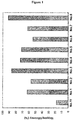
- FIG. 1 This experiment revealed that the oligomers PMO Nos. 1 to 8 of the present disclosure caused exon 53 skipping with a markedly high efficiency as compared to the antisense oligomer PMO No. 11.
- the oligomers PMO Nos. 3 and 8 of the present invention exhibited more than four times higher exon skipping efficiency than that of the antisense oligomer PMO No. 11.
- Human myoD gene (SEQ ID NO: 44) was introduced into TIG-119 cells (human normal tissue-derived fibroblasts, National Institute of Biomedical Innovation) or 5017 cells (human DMD patient-derived fibroblasts, Coriell Institute for Medical Research) using a ZsGreen1 coexpression retroviral vector.
- ZsGreen-positive MyoD-transformed fibroblasts were collected by FACS and plated at 5x 10 4 /cm 2 into a 12-well plate.
- As a growth medium there was used 1 mL of Dulbecco's Modified Eagle Medium: Nutrient Mixture F-12 (DMEM.F-12) (Invitrogen Corp.) containing10% FCS and 1% Penicillin/Streptomycin (P/S) (Sigma-Aldrich, Inc.).
- the medium was replaced 24 hours later by differentiation medium (DMEM/F-12 containing 2% equine serum (Invitrogen Corp.), 1% P/S and ITS Liquid Media Supplement (Sigma, Inc.)). The medium was exchanged every 2 to 3 days and incubation was continued for 12 to 14 days to differentiate into myotubes.
- differentiation medium DMEM/F-12 containing 2% equine serum (Invitrogen Corp.), 1% P/S and ITS Liquid Media Supplement (Sigma, Inc.)
- the primers used were hEX51F and hEX55R.
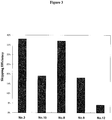
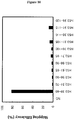
- FIGS. 2 and 3 The results are shown in FIGS. 2 and 3 .
- This experiment revealed that in TIG-119 cells, the oligomers PMO Nos. 3, 8 and 9 of the present disclosure ( FIG. 2 ) all caused exon 53 skipping with a higher efficiency than the antisense oligomer PMO No. 12 ( FIG. 2 ).
- the oligomers PMO Nos. 3 and 8 of the present disclosure exhibited more than twice higher exon skipping efficiency than that of the antisense oligomer PMO No. 12 ( FIG. 2 ).
- the skin fibroblast cell line (fibroblasts from human DMD patient (exons 45-52 or exons 48-52)) was established by biopsy from the medial left upper arm of DMD patient with deletion of exons 45-52 or DMD patient with deletion of exons 48-52.
- Human myoD gene (SEQ ID NO: 44) was introduced into the fibroblast cells using a ZsGreen1 coexpression retroviral vector.
- ZsGreen-positive MyoD-transformed fibroblasts were collected by FACS and plated at 5x 10 4 /cm 2 into a 12-well plate.
- As a growth medium there was used 1 mL of Dulbecco's Modified Eagle Medium: Nutrient Mixture F-12 (DMEM/F-12) (Invitrogen Corp.) containing 10% FCS and 1% Penicillin/Streptomycin (P/S) (Sigma-Aldrich, Inc.).
- the medium was replaced 24 hours later by a differentiation medium (DMEM/F-12 containing 2% equine serum (Invitrogen Corp.), 1% P/S and ITS Liquid Media Supplement (Sigma, Inc.)).
- the medium was exchanged every 2 to 3 days and incubation was continued for 12, 14 or 20 days to differentiate into myotubes.
- the primers used were hEx44F and h55R.
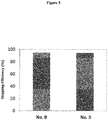
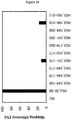
- FIGS. 4 and 5 The results are shown in FIGS. 4 and 5 .
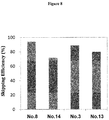
- This experiment revealed that the oligomers PMO Nos. 3 and 8 of the present disclosure caused exon 53 skipping with an efficiency as high as more than 80% in the cells from DMD patient with deletion of exons 45-52 ( FIG. 4 ) or deletion of exons 48-52 ( FIG. 5 ). Also, the oligomers PMO Nos. 3 and 8 of the present disclosure were found to cause exon 53 skipping with a higher efficiency than that of the antisense oligomer PMO No. 15 in the cells from DMD patient with deletion of exons 45-52 ( FIG. 4 ).
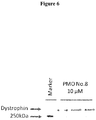
- the oligomer PMO No. 8 of the present disclosure was added to the cells at a concentration of 10 ⁇ M, and proteins were extracted from the cells after 72 hours using a RIPA buffer (manufactured by Thermo Fisher Scientific) containing Complete Mini (manufactured by Roche Applied Science) and quantified using a BCA protein assay kit (manufactured by Thermo Fisher Scientific).
- the proteins were electrophoresed in NuPAGE Novex Tris-Acetate Gel 3-8% (manufactured by Invitrogen) at 150V for 75 minutes and transferred onto a PVDF membrane (manufactured by Millipore) using a semi-dry blotter.
- the PVDF membrane was blocked with a 5% ECL Blocking agent (manufactured by GE Healthcare) and the membrane was then incubated in a solution of anti-dystrophin antibody (manufactured by NCL-Dys1, Novocastra). After further incubation in a solution of peroxidase-conjugated goat-antimouse IgG (Model No. 170-6516, Bio-Rad), the membrane was stained with ECL Plus Western blotting system (manufactured by GE Healthcare).
- the oligomer PMO No. 3 or 8 of the present disclosure was added to the cells.
- the cells after 72 hours were fixed in 3% paraformaldehyde for 10 minutes, followed by incubation in 10% Triton-X for 10 minutes.
- the membrane After blocking in 10% goat serum-containing PBS, the membrane was incubated in a solution of anti-dystrophin antibody (NCL-Dys1, Novocastra).
- the membrane was further incubated in a solution of anti-mouse IgG antibody (manufactured by Invitrogen).
- the membrane was mounted with Pro Long Gold Antifade reagent (manufactured by Invitrogen) and observed with a fluorescence microscope.
- FIGS. 6 and 7 The results are shown in FIGS. 6 and 7 .
- this experiment it was confirmed by western blotting ( FIG. 6 ) and immunostaining ( FIG. 7 ) that the oligomers PMO Nos. 3 and 8 of the present disclosure induced expression of the dystrophin protein.
- RD cells human rhabdomyosarcoma cell line
- EMEM Eagle's minimal essential medium
- FCS 10% fetal calf serum
- the cells were cultured overnight. The cells were washed twice with PBS (manufactured by Nissui, hereafter the same) and then 500 ⁇ l of ISOGEN (manufactured by Nippon Gene) were added to the cells. After the cells were allowed to stand at room temperature for a few minutes for cell lysis, the lysate was collected in an Eppendorf tube. The total RNA was extracted according to the protocol attached to ISOGEN. The concentration of the total RNA extracted was determined using a NanoDrop ND-1000 (manufactured by LMS).
- One-Step RT-PCR was performed with 400 ng of the extracted total RNA using a Titan One Tube RT-PCR Kit (manufactured by Roche). A reaction solution was prepared in accordance with the protocol attached to the kit. A PTC-100 (manufactured by MJ Research) was used as a thermal cycler. The RT-PCR program used is as follows.
- nucleotide sequences of the forward primer and reverse primer used for RT-PCR are given below.
- a nested PCR was performed with the amplified product of RT-PCR above using a Taq DNA Polymerase (manufactured by Roche).
- the PCR program used is as follows.
- the reaction product, 1 ⁇ l, of the nested PCR above was analyzed using a Bioanalyzer (manufactured by Agilent Technologies, Inc.).
- skipping efficiency % A / A + B ⁇ 100
- the cells were cultured overnight in 2 mL of Eagle's minimal essential medium (EMEM) (manufactured by Sigma, Inc., hereinafter the same) containing 10% fetal calf serum (FCS) (manufactured by Invitrogen Corp.) under conditions of 37°C and 5% CO 2 .
- EMEM Eagle's minimal essential medium
- FCS fetal calf serum
- the cells were washed twice with PBS (manufactured by Nissui, hereinafter the same) and 500 ⁇ l of ISOGEN (manufactured by Nippon Gene) was then added to the cells. After the cells were allowed to stand at room temperature for a few minutes to lyse the cells, the lysate was collected in an Eppendorf tube.
- the total RNA was extracted according to the protocol attached to ISOGEN. The concentration of the total RNA extracted was determined using a NanoDrop ND-1000 (manufactured by LMS).
- One-Step RT-PCR was performed with 400 ng of the extracted total RNA using a QIAGEN OneStep RT-PCR Kit (manufactured by Qiagen, Inc.). A reaction solution was prepared in accordance with the protocol attached to the kit. The thermal cycler used was a PTC-100 (manufactured by MJ Research). The RT-PCR program used is as follows..
- nucleotide sequences of the forward primer and reverse primer used for RT-PCR are given below.
- the reaction product, 1 ⁇ l, of the PCR above was analyzed using a Bioanalyzer (manufactured by Agilent Technologies, Inc.).
- skipping efficiency % A / A + B ⁇ 100
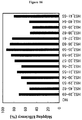
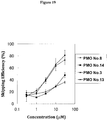
- FIGS. 18 and 19 The results are shown in FIGS. 18 and 19 . These experiments revealed that the oligomer PMO No. 8 of the present disclosure caused exon 53 skipping with a markedly high efficiency as compared to the antisense oligomers PMO Nos. 15 and 16 ( FIG. 18 ). It was also revealed that the oligomers PMO Nos. 3 and 8 of the present disclosure caused exon 53 skipping with a markedly high efficiency as compared to the oligomers PMO Nos. 13 and 14 of the present disclosure ( FIG. 19 ). These results showed that the sequences with -OH group at the 5' end provide a higher skipping efficiency even in the same sequences.
- TEST EXAMPLES demonstrate that the oligomers of the present invention (PMO Nos. 1 to 10) all caused exon 53 skipping with a markedly high efficiency under all cell environments, as compared to the oligomers (PMO Nos. 11, 12, 15 and 16) in accordance with the prior art.
- the 5017 cells used in TEST EXAMPLE 2 are the cells isolated from DMD patients, and the fibroblasts used in TEST EXAMPLES 3 and 5 are exon 53 skipping target cells from DMD patients.
- the oligomers of the present invention show the exon 53 skipping efficiency of 90% or higher in the cells from DMD patients that are the target for exon 53 skipping. Consequently, the oligomers of the present invention can induce exon 53 skipping with a high efficiency, when DMD patients are administered.
- the oligomers of the present invention are extremely useful for the treatment of DMD.
Landscapes
- Health & Medical Sciences (AREA)
- Life Sciences & Earth Sciences (AREA)
- Chemical & Material Sciences (AREA)
- Engineering & Computer Science (AREA)
- Genetics & Genomics (AREA)
- Organic Chemistry (AREA)
- Molecular Biology (AREA)
- Biomedical Technology (AREA)
- Biochemistry (AREA)
- Biotechnology (AREA)
- General Health & Medical Sciences (AREA)
- Zoology (AREA)
- Bioinformatics & Cheminformatics (AREA)
- General Engineering & Computer Science (AREA)
- Wood Science & Technology (AREA)
- Biophysics (AREA)
- Physics & Mathematics (AREA)
- Plant Pathology (AREA)
- Microbiology (AREA)
- Medicinal Chemistry (AREA)
- Animal Behavior & Ethology (AREA)
- Veterinary Medicine (AREA)
- Public Health (AREA)
- Pharmacology & Pharmacy (AREA)
- Toxicology (AREA)
- Chemical Kinetics & Catalysis (AREA)
- Proteomics, Peptides & Aminoacids (AREA)
- Gastroenterology & Hepatology (AREA)
- Neurology (AREA)
- Orthopedic Medicine & Surgery (AREA)
- Physical Education & Sports Medicine (AREA)
- Epidemiology (AREA)
- General Chemical & Material Sciences (AREA)
- Nuclear Medicine, Radiotherapy & Molecular Imaging (AREA)
- Pharmaceuticals Containing Other Organic And Inorganic Compounds (AREA)
- Medicines That Contain Protein Lipid Enzymes And Other Medicines (AREA)
- Saccharide Compounds (AREA)
- Acyclic And Carbocyclic Compounds In Medicinal Compositions (AREA)
Priority Applications (12)
| Application Number | Priority Date | Filing Date | Title |
|---|---|---|---|
| EP19188572.2A EP3581655A1 (en) | 2010-09-01 | 2011-08-31 | Antisense nucleic acids |
| EP24168460.4A EP4403632A3 (en) | 2010-09-01 | 2011-08-31 | Antisense nucleic acids |
| EP15199455.5A EP3018211B1 (en) | 2010-09-01 | 2011-08-31 | Antisense nucleic acids |
| HRP20160336TT HRP20160336T1 (hr) | 2010-09-01 | 2011-08-31 | Protusmjerna nukleinska kiselina |
| PL15199455T PL3018211T3 (pl) | 2010-09-01 | 2011-08-31 | Antysensowne nici kwasu nukleinowego |
| EP24168426.5A EP4400168A3 (en) | 2010-09-01 | 2011-08-31 | Antisense nucleic acids |
| PL11821996T PL2612917T3 (pl) | 2010-09-01 | 2011-08-31 | Antysensowy kwas nukleinowy |
| DK15199455.5T DK3018211T3 (da) | 2010-09-01 | 2011-08-31 | Antisense-nukleinsyrer |
| SI201130767A SI2612917T1 (sl) | 2010-09-01 | 2011-08-31 | Protismiselna nukleinska kislina |
| EP19169673.1A EP3543341A1 (en) | 2010-09-01 | 2011-08-31 | Antisense nucleic acids |
| CY20161100315T CY1117367T1 (el) | 2010-09-01 | 2016-04-15 | Αντινοηματικο νουκλεϊνικο οξυ |
| CY20191101075T CY1122167T1 (el) | 2010-09-01 | 2019-10-14 | Αντινοηματικα νουκλεϊνικα οξεα |
Applications Claiming Priority (2)
| Application Number | Priority Date | Filing Date | Title |
|---|---|---|---|
| JP2010196032 | 2010-09-01 | ||
| PCT/JP2011/070318 WO2012029986A1 (ja) | 2010-09-01 | 2011-08-31 | アンチセンス核酸 |
Related Child Applications (6)
| Application Number | Title | Priority Date | Filing Date |
|---|---|---|---|
| EP19188572.2A Division EP3581655A1 (en) | 2010-09-01 | 2011-08-31 | Antisense nucleic acids |
| EP24168426.5A Division EP4400168A3 (en) | 2010-09-01 | 2011-08-31 | Antisense nucleic acids |
| EP15199455.5A Division EP3018211B1 (en) | 2010-09-01 | 2011-08-31 | Antisense nucleic acids |
| EP15199455.5A Division-Into EP3018211B1 (en) | 2010-09-01 | 2011-08-31 | Antisense nucleic acids |
| EP19169673.1A Division EP3543341A1 (en) | 2010-09-01 | 2011-08-31 | Antisense nucleic acids |
| EP24168460.4A Division EP4403632A3 (en) | 2010-09-01 | 2011-08-31 | Antisense nucleic acids |
Publications (3)
| Publication Number | Publication Date |
|---|---|
| EP2612917A1 EP2612917A1 (en) | 2013-07-10 |
| EP2612917A4 EP2612917A4 (en) | 2014-12-31 |
| EP2612917B1 true EP2612917B1 (en) | 2016-02-24 |
Family
ID=45773054
Family Applications (6)
| Application Number | Title | Priority Date | Filing Date |
|---|---|---|---|
| EP11821996.3A Active EP2612917B1 (en) | 2010-09-01 | 2011-08-31 | Antisense nucleic acid |
| EP24168426.5A Pending EP4400168A3 (en) | 2010-09-01 | 2011-08-31 | Antisense nucleic acids |
| EP19188572.2A Withdrawn EP3581655A1 (en) | 2010-09-01 | 2011-08-31 | Antisense nucleic acids |
| EP15199455.5A Revoked EP3018211B1 (en) | 2010-09-01 | 2011-08-31 | Antisense nucleic acids |
| EP19169673.1A Withdrawn EP3543341A1 (en) | 2010-09-01 | 2011-08-31 | Antisense nucleic acids |
| EP24168460.4A Pending EP4403632A3 (en) | 2010-09-01 | 2011-08-31 | Antisense nucleic acids |
Family Applications After (5)
| Application Number | Title | Priority Date | Filing Date |
|---|---|---|---|
| EP24168426.5A Pending EP4400168A3 (en) | 2010-09-01 | 2011-08-31 | Antisense nucleic acids |
| EP19188572.2A Withdrawn EP3581655A1 (en) | 2010-09-01 | 2011-08-31 | Antisense nucleic acids |
| EP15199455.5A Revoked EP3018211B1 (en) | 2010-09-01 | 2011-08-31 | Antisense nucleic acids |
| EP19169673.1A Withdrawn EP3543341A1 (en) | 2010-09-01 | 2011-08-31 | Antisense nucleic acids |
| EP24168460.4A Pending EP4403632A3 (en) | 2010-09-01 | 2011-08-31 | Antisense nucleic acids |
Country Status (20)
| Country | Link |
|---|---|
| US (16) | US9079934B2 (enExample) |
| EP (6) | EP2612917B1 (enExample) |
| JP (13) | JP5363655B2 (enExample) |
| KR (1) | KR101310569B1 (enExample) |
| CN (1) | CN103154245B (enExample) |
| AU (1) | AU2011296882B2 (enExample) |
| CA (1) | CA2809637C (enExample) |
| CY (2) | CY1117367T1 (enExample) |
| DK (2) | DK3018211T3 (enExample) |
| ES (2) | ES2567411T3 (enExample) |
| HR (2) | HRP20160336T1 (enExample) |
| HU (2) | HUE027321T2 (enExample) |
| LT (1) | LT3018211T (enExample) |
| PL (2) | PL2612917T3 (enExample) |
| PT (1) | PT3018211T (enExample) |
| RS (2) | RS54649B1 (enExample) |
| SI (2) | SI3018211T1 (enExample) |
| SM (2) | SMT201900559T1 (enExample) |
| TW (1) | TWI541024B (enExample) |
| WO (1) | WO2012029986A1 (enExample) |
Cited By (8)
| Publication number | Priority date | Publication date | Assignee | Title |
|---|---|---|---|---|
| US10781451B2 (en) | 2004-06-28 | 2020-09-22 | The University Of Western Australia | Antisense oligonucleotides for inducing exon skipping and methods of use thereof |
| RU2799442C2 (ru) * | 2018-06-26 | 2023-07-05 | Ниппон Синяку Ко., Лтд. | Композиция, содержащая антисмысловой олигонуклеотид, и ее применение для лечения мышечной дистрофии дюшенна |
| US12173079B2 (en) | 2018-08-02 | 2024-12-24 | Dyne Therapeutics, Inc. | Muscle-targeting complexes comprising an anti-transferrin receptor antibody linked to an oligonucleotide |
| US12239717B2 (en) | 2021-07-09 | 2025-03-04 | Dyne Therapeutics, Inc. | Muscle targeting complexes and uses thereof for treating dystrophinopathies |
| US12263225B2 (en) | 2018-08-02 | 2025-04-01 | Dyne Therapeutics, Inc. | Muscle-targeting complexes comprising an anti-transferrin receptor antibody linked to an oligonucleotide and methods of use thereof to target dystrophin and to treat Duchenne muscular dystrophy |
| US12329825B1 (en) | 2018-08-02 | 2025-06-17 | Dyne Therapeutics, Inc. | Muscle targeting complexes comprising an anti-transferrin receptor antibody linked to an oligonucleotide and method of use thereof to induce exon skipping of exon 44 of dystrophin in a subject |
| US12403203B2 (en) | 2021-07-09 | 2025-09-02 | Dyne Therapeutics, Inc. | Muscle targeting complexes and uses thereof for treating dystrophinopathies |
| US12428487B2 (en) | 2018-08-02 | 2025-09-30 | Dyne Therapeutics, Inc. | Complexes comprising an anti-transferrin receptor antibody linked to an oligonicleotide and method of delivering oligonucleotide to a subject |
Families Citing this family (69)
| Publication number | Priority date | Publication date | Assignee | Title |
|---|---|---|---|---|
| USRE48960E1 (en) | 2004-06-28 | 2022-03-08 | The University Of Western Australia | Antisense oligonucleotides for inducing exon skipping and methods of use thereof |
| WO2006086667A2 (en) | 2005-02-09 | 2006-08-17 | Avi Bio Pharma, Inc. | Antisense composition and method for treating muscle atrophy |
| NZ584793A (en) * | 2007-10-26 | 2012-05-25 | Academisch Ziekenhuis Leiden | Means and methods for counteracting muscle disorders |
| EP2119783A1 (en) | 2008-05-14 | 2009-11-18 | Prosensa Technologies B.V. | Method for efficient exon (44) skipping in Duchenne Muscular Dystrophy and associated means |
| US8084601B2 (en) | 2008-09-11 | 2011-12-27 | Royal Holloway And Bedford New College Royal Holloway, University Of London | Oligomers |
| EP3133160B1 (en) | 2008-10-24 | 2018-12-12 | Sarepta Therapeutics, Inc. | Exon skipping compositions for dmd |
| HUE040445T2 (hu) | 2009-11-12 | 2019-03-28 | Univ Western Australia | Antiszensz molekulák és eljárások betegségek kezelésére |
| TWI541024B (zh) * | 2010-09-01 | 2016-07-11 | 日本新藥股份有限公司 | 反義核酸 |
| US20130085139A1 (en) | 2011-10-04 | 2013-04-04 | Royal Holloway And Bedford New College | Oligomers |
| CA2862628C (en) * | 2012-01-27 | 2021-08-24 | Prosensa Technologies B.V. | Rna modulating oligonucleotides with improved characteristics for the treatment of duchenne and becker muscular dystrophy |
| CN106414739A (zh) * | 2012-12-20 | 2017-02-15 | 萨雷普塔医疗公司 | 用于治疗肌营养不良症的改良的外显子跳跃组合物 |
| EP3760720A1 (en) * | 2013-03-14 | 2021-01-06 | Sarepta Therapeutics, Inc. | Exon skipping compositions for treating muscular dystrophy |
| US9217148B2 (en) | 2013-03-14 | 2015-12-22 | Sarepta Therapeutics, Inc. | Exon skipping compositions for treating muscular dystrophy |
| HK1220154A1 (zh) | 2013-03-15 | 2017-04-28 | Sarepta Therapeutics, Inc. | 改进的用於治疗肌营养不良的组合物 |
| BR112016020618B1 (pt) * | 2014-03-12 | 2023-04-04 | Nippon Shinyaku Co., Ltd. | Oligômero antissentido, composição farmacêutica, e, uso de um oligômero antissentido |
| JP6536911B2 (ja) * | 2014-05-19 | 2019-07-03 | 神戸天然物化学株式会社 | CD44遺伝子のバリアントエクソンのスキッピングを誘導し、正常型CD44mRNAの発現を増加させる核酸医薬 |
| PT3159409T (pt) * | 2014-06-17 | 2020-01-21 | Nippon Shinyaku Co Ltd | Ácido nucleico anti-sentido para utilização no tratamento da distrofia muscular de duchenne |
| MA41795A (fr) | 2015-03-18 | 2018-01-23 | Sarepta Therapeutics Inc | Exclusion d'un exon induite par des composés antisens dans la myostatine |
| HUE050061T2 (hu) | 2015-09-15 | 2020-12-28 | Nippon Shinyaku Co Ltd | Antiszensz nukleinsav |
| WO2017047741A1 (ja) * | 2015-09-16 | 2017-03-23 | 日本新薬株式会社 | 筋萎縮症治療用アンチセンス核酸 |
| MA46427A (fr) | 2015-10-09 | 2018-08-15 | Wave Life Sciences Ltd | Compositions d'oligonucléotides et procédés associés |
| JP2018530560A (ja) | 2015-10-09 | 2018-10-18 | サレプタ セラピューティクス, インコーポレイテッド | デュシェンヌ型筋ジストロフィーおよび関連障害の処置のための組成物および方法 |
| FR3044926B1 (fr) | 2015-12-09 | 2020-01-31 | Genethon | Outils de therapie genique efficaces pour le saut de l'exon 53 de la dystrophine |
| KR101686379B1 (ko) | 2016-02-05 | 2016-12-13 | 박정열 | 휴대용 구이기 |
| US11472824B2 (en) | 2016-05-24 | 2022-10-18 | Sarepta Therapeutics, Inc. | Processes for preparing phosphorodiamidate morpholino oligomers |
| US10947533B2 (en) | 2016-05-24 | 2021-03-16 | Sarepta Therapeutics, Inc. | Processes for preparing phosphorodiamidate morpholino oligomers |
| TWI737736B (zh) | 2016-05-24 | 2021-09-01 | 美商薩羅塔治療公司 | 製備磷醯二胺嗎啉代寡聚物之方法 |
| MX384727B (es) | 2016-05-24 | 2025-03-14 | Sarepta Therapeutics Inc | Procesos para preparar oligómeros |
| MX390906B (es) | 2016-05-24 | 2025-03-21 | Sarepta Therapeutics Inc | Procesos para preparar oligómeros de morfolino fosforodiamidato. |
| KR20190024977A (ko) | 2016-06-30 | 2019-03-08 | 사렙타 쎄러퓨틱스 인코퍼레이티드 | 근육 이상증에 대한 엑손 스킵핑 올리고머 |
| CA3024153A1 (en) * | 2016-06-30 | 2017-11-30 | Sarepta Therapeutics, Inc. | Processes for preparing phosphorodiamidate morpholino oligomers |
| AU2017291960B2 (en) * | 2016-07-05 | 2024-03-14 | Biomarin Technologies B.V. | Pre-mRNA splice switching or modulating oligonucleotides comprising bicyclic scaffold moieties, with improved characteristics for the treatment of genetic disorders |
| KR101715572B1 (ko) | 2016-10-11 | 2017-03-22 | 박종찬 | 구이대 승강구조를 갖는 양방향 구이기 |
| PT4122497T (pt) | 2016-12-19 | 2024-06-12 | Sarepta Therapeutics Inc | Conjugados oligoméricos de salto de exão para a distrofia muscular |
| NZ755416A (en) | 2016-12-19 | 2023-05-26 | Sarepta Therapeutics Inc | Exon skipping oligomer conjugates for muscular dystrophy |
| ES3051834T3 (en) | 2016-12-19 | 2025-12-30 | Sarepta Therapeutics Inc | Exon skipping oligomer conjugates for muscular dystrophy |
| WO2018150196A1 (en) | 2017-02-17 | 2018-08-23 | Oxford University Innovation Limited | Cell penetrating peptides modified by glycosylation |
| US11603532B2 (en) | 2017-06-02 | 2023-03-14 | Wave Life Sciences Ltd. | Oligonucleotide compositions and methods of use thereof |
| US20230038956A1 (en) * | 2017-08-31 | 2023-02-09 | Sarepta Therapeutics, Inc. | Methods for treating muscular dystrophy |
| EA201991450A1 (ru) | 2017-09-22 | 2019-12-30 | Сарепта Терапьютикс, Инк. | Конъюгаты олигомеров для пропуска экзона при мышечной дистрофии |
| EP3687519A1 (en) | 2017-09-28 | 2020-08-05 | Sarepta Therapeutics, Inc. | Combination therapies for treating muscular dystrophy |
| JP2021521140A (ja) | 2018-04-12 | 2021-08-26 | ウェイブ ライフ サイエンシズ リミテッドWave Life Sciences Ltd. | オリゴヌクレオチド組成物及びその使用方法 |
| WO2019209764A2 (en) * | 2018-04-26 | 2019-10-31 | Sarepta Therapeutics, Inc. | Exon skipping oligomers and oligomer conjugates for muscular dystrophy |
| CA3098624A1 (en) | 2018-05-11 | 2019-11-14 | Wave Life Sciences Ltd. | Oligonucleotide compositions and methods of use thereof |
| US10765760B2 (en) | 2018-05-29 | 2020-09-08 | Sarepta Therapeutics, Inc. | Exon skipping oligomer conjugates for muscular dystrophy |
| JP7345466B2 (ja) * | 2018-06-26 | 2023-09-15 | 日本新薬株式会社 | アンチセンスオリゴヌクレオチドを含有する組成物およびデュシェンヌ型筋ジストロフィーの治療へのその使用 |
| GB201812972D0 (en) | 2018-08-09 | 2018-09-26 | Univ Oxford Innovation Ltd | Cell-penetrating peptides |
| GB201812980D0 (en) | 2018-08-09 | 2018-09-26 | Univ Oxford Innovation Ltd | Cell-penetrating peptides |
| AU2019394177A1 (en) | 2018-12-07 | 2021-06-10 | Oxford University Innovation Limited | Linkers |
| US20220144902A1 (en) * | 2018-12-25 | 2022-05-12 | National Center Of Neurology And Psychiatry | Method for inducing muscular cells using cells in spot urine |
| GB201821269D0 (en) * | 2018-12-28 | 2019-02-13 | Nippon Shinyaku Co Ltd | Myostatin signal inhibitor |
| EP4079329A4 (en) * | 2019-12-19 | 2024-04-17 | Nippon Shinyaku Co., Ltd. | ANTISENSE NUCLEIC ACID ENABLING EXON SKIPPING |
| IL294271A (en) | 2019-12-26 | 2022-08-01 | Nippon Shinyaku Co Ltd | Antisense nucleic acid that induces skipping of exon 50 |
| PE20230237A1 (es) | 2020-02-28 | 2023-02-07 | Nippon Shinyaku Co Ltd | Acidos nucleicos antisentido que inducen la omision del exon 51 |
| EP4119167A4 (en) | 2020-03-11 | 2025-08-06 | Biocomber Co Ltd | SINGLE-STRANDED NUCLEIC ACID MOLECULE FOR INDUCING FRAME SHIFT-1 AND COMPOSITION |
| US11638761B2 (en) | 2021-07-09 | 2023-05-02 | Dyne Therapeutics, Inc. | Muscle targeting complexes and uses thereof for treating Facioscapulohumeral muscular dystrophy |
| JP7850075B2 (ja) * | 2020-09-18 | 2026-04-22 | 天野エンザイム株式会社 | 加工ひよこ豆ミルクの製造方法 |
| CA3211038A1 (en) | 2021-02-12 | 2022-08-18 | Oxford University Innovation Limited | Cell-penetrating peptide conjugates and methods of their use |
| WO2022232478A1 (en) | 2021-04-30 | 2022-11-03 | Sarepta Therapeutics, Inc. | Treatment methods for muscular dystrophy |
| WO2023283623A1 (en) | 2021-07-09 | 2023-01-12 | Dyne Therapeutics, Inc. | Muscle targeting complexes and formulations for treating dystrophinopathies |
| WO2023026994A1 (ja) | 2021-08-21 | 2023-03-02 | 武田薬品工業株式会社 | ヒトトランスフェリンレセプター結合ペプチド-薬物コンジュゲート |
| US20240366775A1 (en) | 2021-08-24 | 2024-11-07 | Peptidream Inc. | Human transferrin receptor binding antibody-peptide conjugate |
| KR20240129006A (ko) | 2021-12-27 | 2024-08-27 | 니뽄 신야쿠 가부시키가이샤 | 올리고 핵산 화합물의 제조 방법 |
| EP4215614A1 (en) | 2022-01-24 | 2023-07-26 | Dynacure | Combination therapy for dystrophin-related diseases |
| WO2023168427A1 (en) | 2022-03-03 | 2023-09-07 | Yale University | Compositions and methods for delivering therapeutic polynucleotides for exon skipping |
| JP2025079347A (ja) * | 2022-03-11 | 2025-05-22 | 日本新薬株式会社 | キャリアペプチドが連結された核酸 |
| EP4493693A1 (en) | 2022-03-17 | 2025-01-22 | Sarepta Therapeutics, Inc. | Phosphorodiamidate morpholino oligomer conjugates |
| WO2023214512A1 (ja) | 2022-05-06 | 2023-11-09 | 学校法人常翔学園 | 人工rna分子 |
| WO2025153061A1 (zh) * | 2024-01-19 | 2025-07-24 | 云合智药(苏州)生物科技有限公司 | 用于抑制激活素iib型受体基因表达的核酸及其用途 |
Family Cites Families (62)
| Publication number | Priority date | Publication date | Assignee | Title |
|---|---|---|---|---|
| ATE312834T1 (de) | 1989-12-20 | 2005-12-15 | Avi Biopharma Inc | Ungeladene, auf morpholin basierende polymere mit chiralen, phosphor enthaltenden brücken zwischen den untereinheiten |
| JP2924179B2 (ja) | 1993-02-19 | 1999-07-26 | 日本新薬株式会社 | グリセロール誘導体,デバイス及び医薬組成物 |
| US7321828B2 (en) | 1998-04-13 | 2008-01-22 | Isis Pharmaceuticals, Inc. | System of components for preparing oligonucleotides |
| JP2000325085A (ja) | 1999-05-21 | 2000-11-28 | Masafumi Matsuo | デュシェンヌ型筋ジストロフィー治療剤 |
| US6653467B1 (en) | 2000-04-26 | 2003-11-25 | Jcr Pharmaceutical Co., Ltd. | Medicament for treatment of Duchenne muscular dystrophy |
| AU5752601A (en) | 2000-05-04 | 2001-11-12 | Avi Biopharma Inc | Splice-region antisense composition and method |
| US6727355B2 (en) | 2000-08-25 | 2004-04-27 | Jcr Pharmaceuticals Co., Ltd. | Pharmaceutical composition for treatment of Duchenne muscular dystrophy |
| JP4836366B2 (ja) | 2000-08-25 | 2011-12-14 | 雅文 松尾 | デュシェンヌ型筋ジストロフィー治療剤 |
| EP1191097A1 (en) | 2000-09-21 | 2002-03-27 | Leids Universitair Medisch Centrum | Induction of exon skipping in eukaryotic cells |
| ITRM20020253A1 (it) | 2002-05-08 | 2003-11-10 | Univ Roma | Molecole chimeriche di snrna con sequenze antisenso per le giunzioni di splicing del gene della distrofina e applicazioni terapeutiche. |
| EP2530155B1 (en) | 2002-11-25 | 2016-03-16 | Masafumi Matsuo | ENA nucleic acid drugs modifying splicing in mRNA precursor |
| AU2003225410A1 (en) | 2003-03-21 | 2004-10-11 | Academisch Ziekenhuis Leiden | Modulation of exon recognition in pre-mrna by interfering with the secondary rna structure |
| ES2627917T3 (es) | 2004-06-28 | 2017-08-01 | The University Of Western Australia | Oligonucleótidos no codificantes para la inducción de la omisión exónica y métodos de uso de los mismos |
| JP2006038608A (ja) | 2004-07-27 | 2006-02-09 | Tokyo Electric Power Co Inc:The | 超音波検査装置及び方法 |
| US20110046200A1 (en) | 2004-08-03 | 2011-02-24 | Michael T Howard | Use of antisense oligonucleotides to effect translation modulation |
| FR2874384B1 (fr) | 2004-08-17 | 2010-07-30 | Genethon | Vecteur viral adeno-associe pour realiser du saut d'exons dans un gene codant une proteine a domaines dispensables |
| EP1811024A1 (en) | 2004-10-05 | 2007-07-25 | Nippon Shinyaku Co., Ltd. | Oligo double-stranded rna and medicinal composition |
| JP2006129594A (ja) | 2004-10-28 | 2006-05-18 | Hitachi Ltd | 船舶用電気推進装置の制御方法及びその装置 |
| US20090312532A1 (en) | 2005-04-22 | 2009-12-17 | Van Deutekom Judith Christina | Modulation of exon recognition in pre-mrna by interfering with the binding of sr proteins and by interfering with secodary rna structure |
| WO2006129594A1 (ja) | 2005-05-30 | 2006-12-07 | Nippon Shinyaku Co., Ltd. | 核酸含有複合体製剤の製造方法 |
| PT2548560E (pt) * | 2005-06-23 | 2015-09-22 | Isis Pharmaceuticals Inc | Composições e métodos de modulação da excisão-união de smn2 |
| LT2735568T (lt) | 2006-05-10 | 2017-11-27 | Sarepta Therapeutics, Inc. | Oligonukleotido analogai, turintys katijonines jungtis tarp subvienetų |
| EP1857548A1 (en) | 2006-05-19 | 2007-11-21 | Academisch Ziekenhuis Leiden | Means and method for inducing exon-skipping |
| JP4816396B2 (ja) | 2006-10-12 | 2011-11-16 | 富士ゼロックス株式会社 | 画像形成装置 |
| EP2119738B1 (en) | 2007-02-05 | 2014-04-16 | Nippon Shinyaku Co., Ltd. | Polyethylene glycol derivative |
| NZ584793A (en) | 2007-10-26 | 2012-05-25 | Academisch Ziekenhuis Leiden | Means and methods for counteracting muscle disorders |
| MX2010004955A (es) | 2007-11-15 | 2010-06-30 | Avi Biopharma Inc | Metodo de sintesis de oligomeros de morfolina. |
| EP2119783A1 (en) | 2008-05-14 | 2009-11-18 | Prosensa Technologies B.V. | Method for efficient exon (44) skipping in Duchenne Muscular Dystrophy and associated means |
| US8084601B2 (en) * | 2008-09-11 | 2011-12-27 | Royal Holloway And Bedford New College Royal Holloway, University Of London | Oligomers |
| EP3133160B1 (en) | 2008-10-24 | 2018-12-12 | Sarepta Therapeutics, Inc. | Exon skipping compositions for dmd |
| SI2607484T1 (sl) | 2008-10-27 | 2016-11-30 | Biomarin Technologies B.V. | Metode in sredstva za učinkovito preskakovanje eksona 45 v pre-mRNA Duchennove mišične distrofije |
| JP2010196032A (ja) | 2009-01-29 | 2010-09-09 | Fujifilm Corp | 水不溶性色材の分散体及びこの製造方法、これを用いた記録液、インクセット、印画物、画像形成方法、及び画像形成装置 |
| CN102459595A (zh) | 2009-04-24 | 2012-05-16 | 普罗森那技术公司 | 用于治疗dmd的包含肌苷的寡核苷酸 |
| KR20220084437A (ko) * | 2009-06-17 | 2022-06-21 | 바이오젠 엠에이 인코포레이티드 | 대상에게서 smn2 스플라이싱을 조정하기 위한 조성물 및 방법 |
| HUE040445T2 (hu) | 2009-11-12 | 2019-03-28 | Univ Western Australia | Antiszensz molekulák és eljárások betegségek kezelésére |
| TWI541024B (zh) * | 2010-09-01 | 2016-07-11 | 日本新藥股份有限公司 | 反義核酸 |
| BR112013020273A2 (pt) | 2011-02-08 | 2016-10-18 | Charlotte Mecklenburg Hospital | oligonucleotídeos antissenso |
| AU2011367230B2 (en) | 2011-05-05 | 2017-08-10 | Sarepta Therapeutics, Inc. | Peptide oligonucleotide conjugates |
| CA2862628C (en) | 2012-01-27 | 2021-08-24 | Prosensa Technologies B.V. | Rna modulating oligonucleotides with improved characteristics for the treatment of duchenne and becker muscular dystrophy |
| CN104603271B (zh) | 2012-07-03 | 2019-07-19 | 马林生物科技有限公司 | 用于治疗肌肉萎缩症患者的寡核苷酸 |
| CN106414739A (zh) | 2012-12-20 | 2017-02-15 | 萨雷普塔医疗公司 | 用于治疗肌营养不良症的改良的外显子跳跃组合物 |
| EP3760720A1 (en) | 2013-03-14 | 2021-01-06 | Sarepta Therapeutics, Inc. | Exon skipping compositions for treating muscular dystrophy |
| US9217148B2 (en) | 2013-03-14 | 2015-12-22 | Sarepta Therapeutics, Inc. | Exon skipping compositions for treating muscular dystrophy |
| HK1220154A1 (zh) | 2013-03-15 | 2017-04-28 | Sarepta Therapeutics, Inc. | 改进的用於治疗肌营养不良的组合物 |
| US10112977B2 (en) | 2014-06-23 | 2018-10-30 | Toagosei Co., Ltd. | Peptide for inducing multinucleation in cells, and use therefor |
| CA2957661A1 (en) | 2014-08-09 | 2016-02-18 | Kevin FLANIGAN | Methods and materials for activating an internal ribosome entry site in exon 5 of the dmd gene |
| US20190054113A1 (en) | 2015-09-30 | 2019-02-21 | Sarepta Therapeutics, Inc. | Methods for treating muscular dystrophy |
| JP2018530560A (ja) | 2015-10-09 | 2018-10-18 | サレプタ セラピューティクス, インコーポレイテッド | デュシェンヌ型筋ジストロフィーおよび関連障害の処置のための組成物および方法 |
| MA45158A (fr) | 2016-05-24 | 2019-04-10 | Sarepta Therapeutics Inc | Composition pharmaceutique comprenant de l'éteplirsen |
| MX384727B (es) | 2016-05-24 | 2025-03-14 | Sarepta Therapeutics Inc | Procesos para preparar oligómeros |
| MX390906B (es) | 2016-05-24 | 2025-03-21 | Sarepta Therapeutics Inc | Procesos para preparar oligómeros de morfolino fosforodiamidato. |
| TWI737736B (zh) | 2016-05-24 | 2021-09-01 | 美商薩羅塔治療公司 | 製備磷醯二胺嗎啉代寡聚物之方法 |
| KR20190024977A (ko) | 2016-06-30 | 2019-03-08 | 사렙타 쎄러퓨틱스 인코퍼레이티드 | 근육 이상증에 대한 엑손 스킵핑 올리고머 |
| CA3024153A1 (en) | 2016-06-30 | 2017-11-30 | Sarepta Therapeutics, Inc. | Processes for preparing phosphorodiamidate morpholino oligomers |
| BR112019009953A2 (pt) | 2016-11-16 | 2019-10-08 | Academisch Ziekenhuis Leiden | substâncias direcionadas a vários órgãos ou tecidos selecionados |
| ES3051834T3 (en) | 2016-12-19 | 2025-12-30 | Sarepta Therapeutics Inc | Exon skipping oligomer conjugates for muscular dystrophy |
| PT4122497T (pt) | 2016-12-19 | 2024-06-12 | Sarepta Therapeutics Inc | Conjugados oligoméricos de salto de exão para a distrofia muscular |
| NZ755416A (en) | 2016-12-19 | 2023-05-26 | Sarepta Therapeutics Inc | Exon skipping oligomer conjugates for muscular dystrophy |
| US20230038956A1 (en) | 2017-08-31 | 2023-02-09 | Sarepta Therapeutics, Inc. | Methods for treating muscular dystrophy |
| JP2020536058A (ja) | 2017-09-28 | 2020-12-10 | サレプタ セラピューティクス, インコーポレイテッド | 筋ジストロフィーを処置するための併用療法 |
| JP2020536060A (ja) | 2017-09-28 | 2020-12-10 | サレプタ セラピューティクス, インコーポレイテッド | 筋ジストロフィーを処置するための併用療法 |
| EP3687519A1 (en) | 2017-09-28 | 2020-08-05 | Sarepta Therapeutics, Inc. | Combination therapies for treating muscular dystrophy |
-
2011
- 2011-08-30 TW TW100131052A patent/TWI541024B/zh active
- 2011-08-31 EP EP11821996.3A patent/EP2612917B1/en active Active
- 2011-08-31 RS RS20160204A patent/RS54649B1/sr unknown
- 2011-08-31 CA CA2809637A patent/CA2809637C/en active Active
- 2011-08-31 US US13/819,520 patent/US9079934B2/en active Active
- 2011-08-31 LT LT15199455T patent/LT3018211T/lt unknown
- 2011-08-31 EP EP24168426.5A patent/EP4400168A3/en active Pending
- 2011-08-31 HU HUE11821996A patent/HUE027321T2/en unknown
- 2011-08-31 SI SI201131801T patent/SI3018211T1/sl unknown
- 2011-08-31 EP EP19188572.2A patent/EP3581655A1/en not_active Withdrawn
- 2011-08-31 KR KR1020137006385A patent/KR101310569B1/ko active Active
- 2011-08-31 PL PL11821996T patent/PL2612917T3/pl unknown
- 2011-08-31 PT PT151994555T patent/PT3018211T/pt unknown
- 2011-08-31 WO PCT/JP2011/070318 patent/WO2012029986A1/ja not_active Ceased
- 2011-08-31 RS RSP20191250 patent/RS59361B1/sr unknown
- 2011-08-31 AU AU2011296882A patent/AU2011296882B2/en active Active
- 2011-08-31 HU HUE15199455A patent/HUE046364T2/hu unknown
- 2011-08-31 HR HRP20160336TT patent/HRP20160336T1/hr unknown
- 2011-08-31 EP EP15199455.5A patent/EP3018211B1/en not_active Revoked
- 2011-08-31 SI SI201130767A patent/SI2612917T1/sl unknown
- 2011-08-31 JP JP2012531987A patent/JP5363655B2/ja active Active
- 2011-08-31 ES ES11821996.3T patent/ES2567411T3/es active Active
- 2011-08-31 DK DK15199455.5T patent/DK3018211T3/da active
- 2011-08-31 EP EP19169673.1A patent/EP3543341A1/en not_active Withdrawn
- 2011-08-31 ES ES15199455T patent/ES2750748T3/es active Active
- 2011-08-31 CN CN201180042420.0A patent/CN103154245B/zh active Active
- 2011-08-31 SM SM20190559T patent/SMT201900559T1/it unknown
- 2011-08-31 PL PL15199455T patent/PL3018211T3/pl unknown
- 2011-08-31 DK DK11821996.3T patent/DK2612917T3/en active
- 2011-08-31 EP EP24168460.4A patent/EP4403632A3/en active Pending
-
2013
- 2013-09-05 JP JP2013184193A patent/JP6141728B2/ja active Active
-
2015
- 2015-02-06 US US14/615,504 patent/US9708361B2/en active Active
- 2015-12-28 JP JP2015256962A patent/JP6193343B2/ja active Active
-
2016
- 2016-04-15 CY CY20161100315T patent/CY1117367T1/el unknown
- 2016-04-18 SM SM201600111T patent/SMT201600111B/it unknown
-
2017
- 2017-06-12 US US15/619,996 patent/US10329319B2/en active Active
- 2017-08-09 JP JP2017154320A patent/JP6465932B2/ja active Active
-
2019
- 2019-01-08 JP JP2019001091A patent/JP6647430B2/ja active Active
- 2019-03-20 US US16/359,213 patent/US10385092B2/en active Active
- 2019-03-26 US US16/364,451 patent/US10407461B2/en active Active
- 2019-03-29 US US16/369,427 patent/US10487106B2/en active Active
- 2019-05-10 US US16/408,529 patent/US10870676B2/en active Active
- 2019-06-24 US US16/449,537 patent/US10647741B2/en active Active
- 2019-09-30 HR HRP20191770TT patent/HRP20191770T1/hr unknown
- 2019-10-14 CY CY20191101075T patent/CY1122167T1/el unknown
- 2019-12-12 US US16/712,686 patent/US10662217B2/en active Active
- 2019-12-17 US US16/717,274 patent/US10683322B2/en active Active
-
2020
- 2020-01-14 JP JP2020003338A patent/JP6867619B2/ja active Active
- 2020-12-18 US US17/126,366 patent/US20210179659A1/en not_active Abandoned
-
2021
- 2021-01-21 JP JP2021008200A patent/JP6867620B1/ja active Active
- 2021-01-21 JP JP2021008202A patent/JP6867636B1/ja active Active
- 2021-01-21 JP JP2021008201A patent/JP6867621B1/ja active Active
- 2021-02-12 US US17/175,276 patent/US11028122B1/en active Active
- 2021-03-30 JP JP2021058526A patent/JP2021104037A/ja active Pending
- 2021-05-28 US US17/333,677 patent/US20210284680A1/en not_active Abandoned
- 2021-07-14 US US17/375,877 patent/US20210340171A1/en not_active Abandoned
-
2022
- 2022-11-08 US US18/053,679 patent/US20230151050A1/en not_active Abandoned
- 2022-12-27 JP JP2022209270A patent/JP2023036865A/ja active Pending
-
2024
- 2024-07-16 US US18/774,442 patent/US20250042933A1/en active Pending
- 2024-08-27 JP JP2024145055A patent/JP2024170458A/ja active Pending
-
2026
- 2026-04-17 JP JP2026068510A patent/JP2026123076A/ja active Pending
Cited By (16)
| Publication number | Priority date | Publication date | Assignee | Title |
|---|---|---|---|---|
| US10781451B2 (en) | 2004-06-28 | 2020-09-22 | The University Of Western Australia | Antisense oligonucleotides for inducing exon skipping and methods of use thereof |
| RU2799442C2 (ru) * | 2018-06-26 | 2023-07-05 | Ниппон Синяку Ко., Лтд. | Композиция, содержащая антисмысловой олигонуклеотид, и ее применение для лечения мышечной дистрофии дюшенна |
| US12428487B2 (en) | 2018-08-02 | 2025-09-30 | Dyne Therapeutics, Inc. | Complexes comprising an anti-transferrin receptor antibody linked to an oligonicleotide and method of delivering oligonucleotide to a subject |
| US12357703B2 (en) | 2018-08-02 | 2025-07-15 | Dyne Therapeutics, Inc. | Muscle-targeting complexes comprising an anti-transferin receptor antibody linked to an oligonucleotide and method of use thereof to induce exon skipping |
| US12662545B2 (en) | 2018-08-02 | 2026-06-23 | Dyne Therapeutics, Inc. | Complexes comprising an anti-transferrin receptor antibody linked to an oligonucleotide and method of delivering oligonucleotide to a subject |
| US12263225B2 (en) | 2018-08-02 | 2025-04-01 | Dyne Therapeutics, Inc. | Muscle-targeting complexes comprising an anti-transferrin receptor antibody linked to an oligonucleotide and methods of use thereof to target dystrophin and to treat Duchenne muscular dystrophy |
| US12325753B2 (en) | 2018-08-02 | 2025-06-10 | Dyne Therapeutics, Inc. | Method of using an anti-transferrin receptor antibody to deliver an oligonucleotide to a subject having facioscapulohumeral muscular dystrophy |
| US12478687B2 (en) | 2018-08-02 | 2025-11-25 | Dyne Therapeutics, Inc. | United states |
| US12329825B1 (en) | 2018-08-02 | 2025-06-17 | Dyne Therapeutics, Inc. | Muscle targeting complexes comprising an anti-transferrin receptor antibody linked to an oligonucleotide and method of use thereof to induce exon skipping of exon 44 of dystrophin in a subject |
| US12173079B2 (en) | 2018-08-02 | 2024-12-24 | Dyne Therapeutics, Inc. | Muscle-targeting complexes comprising an anti-transferrin receptor antibody linked to an oligonucleotide |
| US12397062B2 (en) | 2021-07-09 | 2025-08-26 | Dyne Therapeutics, Inc. | Muscle targeting complexes and uses thereof for treating dystrophinopathies |
| US12403203B2 (en) | 2021-07-09 | 2025-09-02 | Dyne Therapeutics, Inc. | Muscle targeting complexes and uses thereof for treating dystrophinopathies |
| US12239717B2 (en) | 2021-07-09 | 2025-03-04 | Dyne Therapeutics, Inc. | Muscle targeting complexes and uses thereof for treating dystrophinopathies |
| US12440575B2 (en) | 2021-07-09 | 2025-10-14 | Dyne Therapeutics, Inc. | Muscle targeting complexes and uses thereof for treating dystrophinopathies |
| US12329824B1 (en) | 2021-07-09 | 2025-06-17 | Dyne Therapeutics, Inc. | Muscle targeting complexes and uses thereof for treating dystrophinopathies |
| US12239716B2 (en) | 2021-07-09 | 2025-03-04 | Dyne Therapeutics, Inc. | Muscle targeting complexes and uses thereof for treating dystrophinopathies |
Also Published As
Similar Documents
| Publication | Publication Date | Title |
|---|---|---|
| US20250042933A1 (en) | Antisense nucleic acids | |
| EP4596047A2 (en) | Antisense nucleic acid for use in treating duchenne muscular dystrophy | |
| HK40112203A (en) | Antisense nucleic acids | |
| HK40017657A (en) | Antisense nucleic acids | |
| HK40110953A (en) | Antisense nucleic acids | |
| AU2015203659A1 (en) | Antisense nucleic acid |
Legal Events
| Date | Code | Title | Description |
|---|---|---|---|
| PUAI | Public reference made under article 153(3) epc to a published international application that has entered the european phase |
Free format text: ORIGINAL CODE: 0009012 |
|
| 17P | Request for examination filed |
Effective date: 20130326 |
|
| AK | Designated contracting states |
Kind code of ref document: A1 Designated state(s): AL AT BE BG CH CY CZ DE DK EE ES FI FR GB GR HR HU IE IS IT LI LT LU LV MC MK MT NL NO PL PT RO RS SE SI SK SM TR |
|
| RIN1 | Information on inventor provided before grant (corrected) |
Inventor name: TAKEDA, SHIN'ICHI Inventor name: WATANABE, NAOKI Inventor name: NAGATA, TETSUYA Inventor name: SATOU, YOUHEI |
|
| DAX | Request for extension of the european patent (deleted) | ||
| A4 | Supplementary search report drawn up and despatched |
Effective date: 20141202 |
|
| RIC1 | Information provided on ipc code assigned before grant |
Ipc: C12N 15/113 20100101AFI20141126BHEP Ipc: C12N 15/11 20060101ALI20141126BHEP Ipc: A61K 31/7125 20060101ALI20141126BHEP |
|
| GRAP | Despatch of communication of intention to grant a patent |
Free format text: ORIGINAL CODE: EPIDOSNIGR1 |
|
| INTG | Intention to grant announced |
Effective date: 20150722 |
|
| GRAS | Grant fee paid |
Free format text: ORIGINAL CODE: EPIDOSNIGR3 |
|
| RAP1 | Party data changed (applicant data changed or rights of an application transferred) |
Owner name: NIPPON SHINYAKU CO., LTD. Owner name: NATIONAL CENTER OF NEUROLOGY AND PSYCHIATRY |
|
| INTG | Intention to grant announced |
Effective date: 20151214 |
|
| GRAA | (expected) grant |
Free format text: ORIGINAL CODE: 0009210 |
|
| AK | Designated contracting states |
Kind code of ref document: B1 Designated state(s): AL AT BE BG CH CY CZ DE DK EE ES FI FR GB GR HR HU IE IS IT LI LT LU LV MC MK MT NL NO PL PT RO RS SE SI SK SM TR |
|
| REG | Reference to a national code |
Ref country code: GB Ref legal event code: FG4D |
|
| REG | Reference to a national code |
Ref country code: CH Ref legal event code: EP |
|
| REG | Reference to a national code |
Ref country code: AT Ref legal event code: REF Ref document number: 776773 Country of ref document: AT Kind code of ref document: T Effective date: 20160315 |
|
| REG | Reference to a national code |
Ref country code: IE Ref legal event code: FG4D |
|
| REG | Reference to a national code |
Ref country code: HR Ref legal event code: TUEP Ref document number: P20160336 Country of ref document: HR |
|
| REG | Reference to a national code |
Ref country code: DE Ref legal event code: R096 Ref document number: 602011023505 Country of ref document: DE |
|
| REG | Reference to a national code |
Ref country code: PT Ref legal event code: SC4A Free format text: AVAILABILITY OF NATIONAL TRANSLATION Effective date: 20160405 |
|
| REG | Reference to a national code |
Ref country code: DK Ref legal event code: T3 Effective date: 20160411 |
|
| REG | Reference to a national code |
Ref country code: NL Ref legal event code: FP |
|
| REG | Reference to a national code |
Ref country code: HR Ref legal event code: T1PR Ref document number: P20160336 Country of ref document: HR Ref country code: ES Ref legal event code: FG2A Ref document number: 2567411 Country of ref document: ES Kind code of ref document: T3 Effective date: 20160422 |
|
| REG | Reference to a national code |
Ref country code: RO Ref legal event code: EPE |
|
| REG | Reference to a national code |
Ref country code: SE Ref legal event code: TRGR |
|
| REG | Reference to a national code |
Ref country code: NO Ref legal event code: T2 Effective date: 20160224 |
|
| REG | Reference to a national code |
Ref country code: FR Ref legal event code: PLFP Year of fee payment: 6 |
|
| REG | Reference to a national code |
Ref country code: EE Ref legal event code: FG4A Ref document number: E011964 Country of ref document: EE Effective date: 20160421 |
|
| REG | Reference to a national code |
Ref country code: SK Ref legal event code: T3 Ref document number: E 20898 Country of ref document: SK |
|
| REG | Reference to a national code |
Ref country code: GR Ref legal event code: EP Ref document number: 20160400713 Country of ref document: GR Effective date: 20160601 |
|
| REG | Reference to a national code |
Ref country code: HU Ref legal event code: AG4A Ref document number: E027321 Country of ref document: HU |
|
| REG | Reference to a national code |
Ref country code: DE Ref legal event code: R097 Ref document number: 602011023505 Country of ref document: DE |
|
| PLBE | No opposition filed within time limit |
Free format text: ORIGINAL CODE: 0009261 |
|
| STAA | Information on the status of an ep patent application or granted ep patent |
Free format text: STATUS: NO OPPOSITION FILED WITHIN TIME LIMIT |
|
| 26N | No opposition filed |
Effective date: 20161125 |
|
| REG | Reference to a national code |
Ref country code: FR Ref legal event code: PLFP Year of fee payment: 7 |
|
| REG | Reference to a national code |
Ref country code: CH Ref legal event code: NV Representative=s name: HGF GMBH, CH |
|
| REG | Reference to a national code |
Ref country code: FR Ref legal event code: PLFP Year of fee payment: 8 |
|
| REG | Reference to a national code |
Ref country code: HR Ref legal event code: ODRP Ref document number: P20160336 Country of ref document: HR Payment date: 20190715 Year of fee payment: 9 |
|
| REG | Reference to a national code |
Ref country code: AT Ref legal event code: UEP Ref document number: 776773 Country of ref document: AT Kind code of ref document: T Effective date: 20160224 |
|
| REG | Reference to a national code |
Ref country code: HR Ref legal event code: ODRP Ref document number: P20160336 Country of ref document: HR Payment date: 20200806 Year of fee payment: 10 |
|
| REG | Reference to a national code |
Ref country code: CH Ref legal event code: PCAR Free format text: NEW ADDRESS: OBC SUISSE AG AESCHENGRABEN 29, 4051 BASEL (CH) |
|
| REG | Reference to a national code |
Ref country code: HR Ref legal event code: ODRP Ref document number: P20160336 Country of ref document: HR Payment date: 20210825 Year of fee payment: 11 |
|
| REG | Reference to a national code |
Ref country code: HR Ref legal event code: ODRP Ref document number: P20160336 Country of ref document: HR Payment date: 20220823 Year of fee payment: 12 |
|
| P01 | Opt-out of the competence of the unified patent court (upc) registered |
Effective date: 20230522 |
|
| REG | Reference to a national code |
Ref country code: HR Ref legal event code: ODRP Ref document number: P20160336 Country of ref document: HR Payment date: 20230726 Year of fee payment: 13 |
|
| REG | Reference to a national code |
Ref country code: DE Ref legal event code: R082 Ref document number: 602011023505 Country of ref document: DE Representative=s name: KRAUS & LEDERER PARTGMBB, DE |
|
| REG | Reference to a national code |
Ref country code: HR Ref legal event code: ODRP Ref document number: P20160336 Country of ref document: HR Payment date: 20240709 Year of fee payment: 14 |
|
| PGFP | Annual fee paid to national office [announced via postgrant information from national office to epo] |
Ref country code: SI Payment date: 20250715 Year of fee payment: 15 |
|
| PGFP | Annual fee paid to national office [announced via postgrant information from national office to epo] |
Ref country code: NL Payment date: 20250704 Year of fee payment: 15 |
|
| REG | Reference to a national code |
Ref country code: HR Ref legal event code: ODRP Ref document number: P20160336 Country of ref document: HR Payment date: 20250715 Year of fee payment: 15 |
|
| PGFP | Annual fee paid to national office [announced via postgrant information from national office to epo] |
Ref country code: LU Payment date: 20250814 Year of fee payment: 15 |
|
| PGFP | Annual fee paid to national office [announced via postgrant information from national office to epo] |
Ref country code: HU Payment date: 20250728 Year of fee payment: 15 |
|
| PGFP | Annual fee paid to national office [announced via postgrant information from national office to epo] |
Ref country code: SM Payment date: 20250730 Year of fee payment: 15 |
|
| PGFP | Annual fee paid to national office [announced via postgrant information from national office to epo] |
Ref country code: PT Payment date: 20250827 Year of fee payment: 15 Ref country code: ES Payment date: 20250901 Year of fee payment: 15 Ref country code: FI Payment date: 20250814 Year of fee payment: 15 |
|
| PGFP | Annual fee paid to national office [announced via postgrant information from national office to epo] |
Ref country code: DK Payment date: 20250814 Year of fee payment: 15 Ref country code: LT Payment date: 20250723 Year of fee payment: 15 Ref country code: DE Payment date: 20250702 Year of fee payment: 15 |
|
| PGFP | Annual fee paid to national office [announced via postgrant information from national office to epo] |
Ref country code: GR Payment date: 20250716 Year of fee payment: 15 Ref country code: MC Payment date: 20250728 Year of fee payment: 15 Ref country code: NO Payment date: 20250808 Year of fee payment: 15 |
|
| PGFP | Annual fee paid to national office [announced via postgrant information from national office to epo] |
Ref country code: TR Payment date: 20250829 Year of fee payment: 15 Ref country code: PL Payment date: 20250702 Year of fee payment: 15 Ref country code: IT Payment date: 20250722 Year of fee payment: 15 |
|
| PGFP | Annual fee paid to national office [announced via postgrant information from national office to epo] |
Ref country code: BE Payment date: 20250703 Year of fee payment: 15 Ref country code: BG Payment date: 20250715 Year of fee payment: 15 Ref country code: GB Payment date: 20250703 Year of fee payment: 15 |
|
| PGFP | Annual fee paid to national office [announced via postgrant information from national office to epo] |
Ref country code: HR Payment date: 20250715 Year of fee payment: 15 |
|
| PGFP | Annual fee paid to national office [announced via postgrant information from national office to epo] |
Ref country code: AL Payment date: 20250813 Year of fee payment: 15 Ref country code: FR Payment date: 20250703 Year of fee payment: 15 Ref country code: AT Payment date: 20250725 Year of fee payment: 15 |
|
| PGFP | Annual fee paid to national office [announced via postgrant information from national office to epo] |
Ref country code: MT Payment date: 20250818 Year of fee payment: 15 Ref country code: CH Payment date: 20250901 Year of fee payment: 15 Ref country code: SE Payment date: 20250702 Year of fee payment: 15 |
|
| PGFP | Annual fee paid to national office [announced via postgrant information from national office to epo] |
Ref country code: RS Payment date: 20250812 Year of fee payment: 15 Ref country code: CZ Payment date: 20250820 Year of fee payment: 15 Ref country code: EE Payment date: 20250730 Year of fee payment: 15 Ref country code: IE Payment date: 20250702 Year of fee payment: 15 |
|
| PGFP | Annual fee paid to national office [announced via postgrant information from national office to epo] |
Ref country code: RO Payment date: 20250716 Year of fee payment: 15 |
|
| PGFP | Annual fee paid to national office [announced via postgrant information from national office to epo] |
Ref country code: SK Payment date: 20250723 Year of fee payment: 15 |
|
| PGFP | Annual fee paid to national office [announced via postgrant information from national office to epo] |
Ref country code: IS Payment date: 20250811 Year of fee payment: 15 |
|
| PGFP | Annual fee paid to national office [announced via postgrant information from national office to epo] |
Ref country code: LV Payment date: 20250703 Year of fee payment: 15 |
|
| PGFP | Annual fee paid to national office [announced via postgrant information from national office to epo] |
Ref country code: MK Payment date: 20250709 Year of fee payment: 15 |
|
| PGFP | Annual fee paid to national office [announced via postgrant information from national office to epo] |
Ref country code: CY Payment date: 20250821 Year of fee payment: 15 |