EP2610285B1 - Kunststoffverglasung und Herstellungsverfahren dafür - Google Patents
Kunststoffverglasung und Herstellungsverfahren dafür Download PDFInfo
- Publication number
- EP2610285B1 EP2610285B1 EP12197543.7A EP12197543A EP2610285B1 EP 2610285 B1 EP2610285 B1 EP 2610285B1 EP 12197543 A EP12197543 A EP 12197543A EP 2610285 B1 EP2610285 B1 EP 2610285B1
- Authority
- EP
- European Patent Office
- Prior art keywords
- oxide
- layer
- silicon
- polycarbonate
- base layer
- Prior art date
- Legal status (The legal status is an assumption and is not a legal conclusion. Google has not performed a legal analysis and makes no representation as to the accuracy of the status listed.)
- Active
Links
Images
Classifications
-
- B—PERFORMING OPERATIONS; TRANSPORTING
- B32—LAYERED PRODUCTS
- B32B—LAYERED PRODUCTS, i.e. PRODUCTS BUILT-UP OF STRATA OF FLAT OR NON-FLAT, e.g. CELLULAR OR HONEYCOMB, FORM
- B32B27/00—Layered products comprising a layer of synthetic resin
- B32B27/36—Layered products comprising a layer of synthetic resin comprising polyesters
- B32B27/365—Layered products comprising a layer of synthetic resin comprising polyesters comprising polycarbonates
-
- B—PERFORMING OPERATIONS; TRANSPORTING
- B32—LAYERED PRODUCTS
- B32B—LAYERED PRODUCTS, i.e. PRODUCTS BUILT-UP OF STRATA OF FLAT OR NON-FLAT, e.g. CELLULAR OR HONEYCOMB, FORM
- B32B27/00—Layered products comprising a layer of synthetic resin
- B32B27/06—Layered products comprising a layer of synthetic resin as the main or only constituent of a layer, which is next to another layer of the same or of a different material
- B32B27/08—Layered products comprising a layer of synthetic resin as the main or only constituent of a layer, which is next to another layer of the same or of a different material of synthetic resin
-
- C—CHEMISTRY; METALLURGY
- C08—ORGANIC MACROMOLECULAR COMPOUNDS; THEIR PREPARATION OR CHEMICAL WORKING-UP; COMPOSITIONS BASED THEREON
- C08G—MACROMOLECULAR COMPOUNDS OBTAINED OTHERWISE THAN BY REACTIONS ONLY INVOLVING UNSATURATED CARBON-TO-CARBON BONDS
- C08G64/00—Macromolecular compounds obtained by reactions forming a carbonic ester link in the main chain of the macromolecule
- C08G64/04—Aromatic polycarbonates
- C08G64/06—Aromatic polycarbonates not containing aliphatic unsaturation
-
- C—CHEMISTRY; METALLURGY
- C08—ORGANIC MACROMOLECULAR COMPOUNDS; THEIR PREPARATION OR CHEMICAL WORKING-UP; COMPOSITIONS BASED THEREON
- C08J—WORKING-UP; GENERAL PROCESSES OF COMPOUNDING; AFTER-TREATMENT NOT COVERED BY SUBCLASSES C08B, C08C, C08F, C08G or C08H
- C08J7/00—Chemical treatment or coating of shaped articles made of macromolecular substances
- C08J7/04—Coating
- C08J7/042—Coating with two or more layers, where at least one layer of a composition contains a polymer binder
-
- C—CHEMISTRY; METALLURGY
- C08—ORGANIC MACROMOLECULAR COMPOUNDS; THEIR PREPARATION OR CHEMICAL WORKING-UP; COMPOSITIONS BASED THEREON
- C08J—WORKING-UP; GENERAL PROCESSES OF COMPOUNDING; AFTER-TREATMENT NOT COVERED BY SUBCLASSES C08B, C08C, C08F, C08G or C08H
- C08J7/00—Chemical treatment or coating of shaped articles made of macromolecular substances
- C08J7/04—Coating
- C08J7/042—Coating with two or more layers, where at least one layer of a composition contains a polymer binder
- C08J7/0423—Coating with two or more layers, where at least one layer of a composition contains a polymer binder with at least one layer of inorganic material and at least one layer of a composition containing a polymer binder
-
- C—CHEMISTRY; METALLURGY
- C08—ORGANIC MACROMOLECULAR COMPOUNDS; THEIR PREPARATION OR CHEMICAL WORKING-UP; COMPOSITIONS BASED THEREON
- C08J—WORKING-UP; GENERAL PROCESSES OF COMPOUNDING; AFTER-TREATMENT NOT COVERED BY SUBCLASSES C08B, C08C, C08F, C08G or C08H
- C08J7/00—Chemical treatment or coating of shaped articles made of macromolecular substances
- C08J7/04—Coating
- C08J7/0427—Coating with only one layer of a composition containing a polymer binder
-
- C—CHEMISTRY; METALLURGY
- C08—ORGANIC MACROMOLECULAR COMPOUNDS; THEIR PREPARATION OR CHEMICAL WORKING-UP; COMPOSITIONS BASED THEREON
- C08J—WORKING-UP; GENERAL PROCESSES OF COMPOUNDING; AFTER-TREATMENT NOT COVERED BY SUBCLASSES C08B, C08C, C08F, C08G or C08H
- C08J7/00—Chemical treatment or coating of shaped articles made of macromolecular substances
- C08J7/04—Coating
- C08J7/043—Improving the adhesiveness of the coatings per se, e.g. forming primers
-
- C—CHEMISTRY; METALLURGY
- C08—ORGANIC MACROMOLECULAR COMPOUNDS; THEIR PREPARATION OR CHEMICAL WORKING-UP; COMPOSITIONS BASED THEREON
- C08J—WORKING-UP; GENERAL PROCESSES OF COMPOUNDING; AFTER-TREATMENT NOT COVERED BY SUBCLASSES C08B, C08C, C08F, C08G or C08H
- C08J7/00—Chemical treatment or coating of shaped articles made of macromolecular substances
- C08J7/04—Coating
- C08J7/046—Forming abrasion-resistant coatings; Forming surface-hardening coatings
-
- B—PERFORMING OPERATIONS; TRANSPORTING
- B32—LAYERED PRODUCTS
- B32B—LAYERED PRODUCTS, i.e. PRODUCTS BUILT-UP OF STRATA OF FLAT OR NON-FLAT, e.g. CELLULAR OR HONEYCOMB, FORM
- B32B2605/00—Vehicles
- B32B2605/006—Transparent parts other than made from inorganic glass, e.g. polycarbonate glazings
-
- C—CHEMISTRY; METALLURGY
- C08—ORGANIC MACROMOLECULAR COMPOUNDS; THEIR PREPARATION OR CHEMICAL WORKING-UP; COMPOSITIONS BASED THEREON
- C08J—WORKING-UP; GENERAL PROCESSES OF COMPOUNDING; AFTER-TREATMENT NOT COVERED BY SUBCLASSES C08B, C08C, C08F, C08G or C08H
- C08J2369/00—Characterised by the use of polycarbonates; Derivatives of polycarbonates
-
- C—CHEMISTRY; METALLURGY
- C08—ORGANIC MACROMOLECULAR COMPOUNDS; THEIR PREPARATION OR CHEMICAL WORKING-UP; COMPOSITIONS BASED THEREON
- C08J—WORKING-UP; GENERAL PROCESSES OF COMPOUNDING; AFTER-TREATMENT NOT COVERED BY SUBCLASSES C08B, C08C, C08F, C08G or C08H
- C08J2400/00—Characterised by the use of unspecified polymers
-
- Y—GENERAL TAGGING OF NEW TECHNOLOGICAL DEVELOPMENTS; GENERAL TAGGING OF CROSS-SECTIONAL TECHNOLOGIES SPANNING OVER SEVERAL SECTIONS OF THE IPC; TECHNICAL SUBJECTS COVERED BY FORMER USPC CROSS-REFERENCE ART COLLECTIONS [XRACs] AND DIGESTS
- Y10—TECHNICAL SUBJECTS COVERED BY FORMER USPC
- Y10T—TECHNICAL SUBJECTS COVERED BY FORMER US CLASSIFICATION
- Y10T428/00—Stock material or miscellaneous articles
- Y10T428/24—Structurally defined web or sheet [e.g., overall dimension, etc.]
- Y10T428/24942—Structurally defined web or sheet [e.g., overall dimension, etc.] including components having same physical characteristic in differing degree
-
- Y—GENERAL TAGGING OF NEW TECHNOLOGICAL DEVELOPMENTS; GENERAL TAGGING OF CROSS-SECTIONAL TECHNOLOGIES SPANNING OVER SEVERAL SECTIONS OF THE IPC; TECHNICAL SUBJECTS COVERED BY FORMER USPC CROSS-REFERENCE ART COLLECTIONS [XRACs] AND DIGESTS
- Y10—TECHNICAL SUBJECTS COVERED BY FORMER USPC
- Y10T—TECHNICAL SUBJECTS COVERED BY FORMER US CLASSIFICATION
- Y10T428/00—Stock material or miscellaneous articles
- Y10T428/31504—Composite [nonstructural laminate]
- Y10T428/31507—Of polycarbonate
Definitions
- the present invention relates to a plastic glazing and a method of preparing the same. More particularly, the present invention relates to a plastic glazing and a method of preparing the same, which contains a certain amount of biphenyl structure in a base layer to improve interface stability between coating layers, thereby providing excellent reliability and solvent resistance.
- Polycarbonate is a representative thermoplastic material having a heat deflection temperature of 135°C and exhibits a good balance of properties such as transparency, impact resistance, self-extinguishing property, dimensional stability, heat resistance, and the like to be used in a wide range of application including electric/electronic products, office equipment, automobile components, and the like.
- polycarbonate is widely applied to a glazing material for vehicles based on excellent impact resistance, transparency, and formability thereof. Accordingly, since many years ago, various attempts have been made to use polycarbonate as a substituent for metal and glass articles in the vehicle industry. With merits of excellent impact resistance, optical transmittance, and formability enabling various designs, polycarbonate provides new usage to a vehicle glazing system. Particularly, when polycarbonate components are applied to a vehicle instead of glass components, the center of gravity of the vehicle is lowered, enabling safer driving. In addition, reduction in the weight of the vehicle through application of polycarbonate improves fuel efficiency, thereby ensuring economic feasibility.
- polycarbonate As a candidate material for glass, it has been endeavored to enhance scratch resistance and wear resistance of polycarbonate. Such endeavor can be generally divided into two kinds of challenges, that is, improving a polycarbonate matrix itself and adding a layer for imparting functionality on the polycarbonate matrix.
- Most inventions in the art are focused on improvement of a stack structure on the polycarbonate matrix and impartment of functionality rather than development of a polycarbonate resin for application to glazing.
- Most polycarbonate resin inventions relate to preparation of polycarbonate resins through increase in the molecular weight of polycarbonate or through co-extrusion with copolymers. Recently, a polycarbonate resin containing additives for absorbing or blocking visible light or a polycarbonate resin having improved scratch resistance is often applied to glazing.
- the polycarbonate resin to be used for glazing are scratch resistance and wear resistance.
- improvement of such characteristics has a practical limit only through development of the polycarbonate resin and thus has been challenged through addition of a functional layer.
- the scratch resistance and wear resistance of the glazing material has significantly improved, but there is still a challenge for ensuring interface stability between the polycarbonate base and the coating layer stacked thereon.
- the coating layer stacked on the polycarbonate base for improving scratch resistance and wear resistance is comprised of acrylic or silicon resins, the coefficient of linear thermal expansion of which is 40 cm/cm/°C and is much less than that of general polycarbonate having a coefficient of linear thermal expansion of 60 ⁇ 65 cm/cm/°C.
- reduction in the coefficient of linear thermal expansion of polycarbonate is an essential factor in improving interface stability between the base and the coating layer but cannot be easily achieved due to the chemical structure of polycarbonate.
- US 2005/031855 A1 refers to as multi-layer article containing a base layer containing a thermoplastic resin and a second layer containing a thermoplastic (co)polyformal superimposed over said base layer, wherein the polyformals or copolyformals are of a specific formula with diphenolate groups.
- US 2004/0013882 A1 discloses a multi-layer product comprising a coex layer and a base layer, wherein the coex layer contains a copolycarbonate of a specific formula and the base layer contains a polycarbonate with less chemical resistance that that of the copolycarbonate.
- Database WPI Week 200259, Thomson Scientific, London, GB, AN 2002-551379, XP-002695643 & JP 2002 069219 A discloses a molded article of polycarbonate resin composition containing specific low molecular compounds and having a hard coat treated on a surface.
- Database WPI Week 200433, Thomson Scientific, London, GB, AN 2004-350346, XP-002695644 & JP 2004 035614 A discloses a coated polycarbonate plate-shaped compact having a primer layer provided on surface(s) of the compact, and a hard-coat layer provided on the primer layer.
- US 2007/0009741 A1 refers to windows or other articles made from dimethyl bisphenol cyclohexane (DMBPC) polycarbonate homopolymer or copolymer.
- DMBPC dimethyl bisphenol cyclohexane
- the plastic glazing of the present invention includes a base layer; and a coating layer formed on one surface of the base layer, wherein the base layer comprises polycarbonate containing a biphenyl group and the biphenyl group is present in an amount of 10 mol% to 50 mol% based on the total amount of polycarbonate.
- the polycarbonate containing a biphenyl group may include repeated structures of Formulae 1 and 2, and the repeated structure of Formula 1 and the repeated structure of Formula 2 may be present in a molar ratio of 50 to 90 : 10 to 50.
- R 1 and R 2 are each independently halogen, a substituted or unsubstituted C 1 to C 6 alkyl group, or a substituted or unsubstituted C 6 to C 20 aryl group, and a and b are each independently an integer from 0 to 4).
- the base layer may have a coefficient of linear thermal expansion ranging from 39 cm/cm/°C to 57 cm/cm/°C for a 6.4 mm flexural specimen according to ISO 11359.
- Difference in coefficient of linear thermal expansion between the base layer and the coating layer may be 16 cm/cm/°C or less.
- the coating layer has a stack structure of a primer layer and a hard coating layer, in which the primer layer contacts the base layer.
- the primer layer may be comprised of at least one of organopolysiloxane, acrylic, polyester, and acryl-polyester blend resins.
- the hard coating layer may be comprised of at least one of silicone, urethane, epoxy, acrylic, polysiloxane, and polycarbonate grafted polysiloxane resins.
- the plastic glazing may further include an inorganic material layer formed on the surface of the hard coating layer.
- the inorganic material layer may be comprised of at least one of aluminum oxide, barium fluoride, boron nitride, hafnium oxide, lanthanum fluoride, magnesium fluoride, magnesium oxide, scandium oxide, silicon monoxide, silicon dioxide, silicon nitride, silicon oxynitride, silicon oxycarbide, hydrogenated silicon oxycarbide, silicon carbide, tantalum oxide, titanium oxide, tin oxide, indium tin oxide, yttrium oxide, zinc oxide, zinc selenide, zinc sulfide, zirconium oxide, and zirconium titanate.
- Another aspect of the present invention provides a method of preparing a plastic glazing.
- the method include forming a base layer using a polycarbonate resin containing a biphenyl group; forming a primer layer on a surface of the base layer; and forming a hard coating layer on a surface of the primer layer.
- the method may further include depositing a layer of a compound on a surface of the hard coating layer.
- the compound is at least one of aluminum oxide, barium fluoride, boron nitride, hafnium oxide, lanthanum fluoride, magnesium fluoride, magnesium oxide, scandium oxide, silicon monoxide, silicon dioxide, silicon nitride, silicon oxynitride, silicon oxycarbide, hydrogenated silicon oxycarbide, silicon carbide, tantalum oxide, titanium oxide, tin oxide, indium tin oxide, yttrium oxide, zinc oxide, zinc selenide, zinc sulfide, zirconium oxide, and zirconium titanate.
- a plastic glazing according to the present invention includes a base layer, and a coating layer formed on one surface of the base layer.
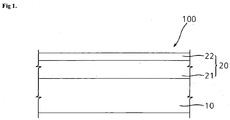
- Fig. 1 is a side sectional view of a plastic glazing according to one embodiment of the present invention.
- a coating layer 20 is formed on one surface of a base layer 10 and has a stack structure of a primer layer 21 and a hard coating layer 22.
- the primer layer 21 is interposed between the base layer 10 and the hard coating layer 22.
- the plastic glazing according to this embodiment may be prepared by forming a base layer using a polycarbonate resin containing a biphenyl group; forming a primer layer on a surface of the base layer; and forming a hard coating layer on a surface of the primer layer.
- the primer layer may be formed by coating and curing a primer on the surface of the base layer.
- the hard coating layer may be formed by coating and curing a hard coating material on the surface of the cured primer layer.
- the base layer is comprised of polycarbonate containing a biphenyl group.
- the biphenyl group is present in an amount of 10 mol% to 50 mol% based on the total amount of polycarbonate. If the amount of the biphenyl group is less than 10 mol%, the base layer may be peeled off and it is difficult to obtain desired solvent resistance and wear resistance. If the amount of the biphenyl group exceeds 50 mol%, there may be a problem of rapid deterioration in elongation and impact resistance.
- the amount of the biphenyl group is preferably in the range of 15 mol% to 45 mol%, more preferably in the range of 20 mol% to 40 mol%.
- the polycarbonate containing a biphenyl group may include repeated structures of Formulae 1 and 2. (wherein R 1 and R 2 are each independently halogen, a substituted or unsubstituted C 1 to C 6 alkyl group, or a substituted or unsubstituted C 6 to C 20 aryl group, and a and b are each independently an integer from 0 to 4).
- the polycarbonate containing a biphenyl group may be prepared through transesterification of diols represented by Formulae 1-1 and 2-1 and diaryl carbonate. (wherein R 1 , R 2 , a, and b are the same as those defined in Formulae 1 and 2).
- Examples of the diol represented by Formula 1-1 include 2,2-bis-(4-hydroxyphenyl)-propane, 2,2-bis-(3,5-dimethyl-4-hydroxyphenyl)-propane, and 2,2-bis-(3,5-diisopropyl-4-hydroxyphenyl)-propane.
- 2,2-bis-(4-hydroxyphenyl)-propane called bisphenol-A is used.
- Examples of the diol represented by Formula 2-1 include 4,4'-biphenol, 2,2'-dimethyl 4,4'-biphenyldiol, 3,3-dimethyl 4,4-dihydroxybiphenyl, and 2,2',6,6',-tetramethyl -4,4'-biphenol.
- 4,4'-biphenol is used.
- the molar ratio of the diol represented by Formula 1-1 to the diol represented by Formula 2-1 may range from 50 to 90 : 10 to 50.
- the molar ratio of a repeated structure of Formula 1 and a repeated structure of Formula 2 may range from 50 to 90 : 10 to 50.
- the plastic glazing can have a good balance of properties, such as impact resistance, chemical resistance, interface stability, wear resistance, scratch resistance, and weather resistance.
- the molar ratio ranges from 55 to 85 : 15 to 45, more preferably from 60 to 80 : 20 to 40.
- diaryl carbonate may include diphenyl carbonate, ditoryl carbonate, bis(chlorophenyl) carbonate, m-cresyl carbonate, dinaphthyl carbonate, bis(diphenyl) carbonate, diethyl carbonate, dimethyl carbonate, dibutyl carbonate, and dicyclohexyl carbonate, without being limited thereto. These may be used alone or in combination thereof. Preferably, diphenyl carbonate is used.
- the molar ratio (diol/diaryl carbonate) of the diols represented by Formula 1-1 and Formula 2-1 to the diaryl carbonate may range from 0.6 to 1.0, preferably from 0.7 to 0.9.
- the plastic glazing exhibits excellent flowability, impact resistance and chemical resistance, and particularly, excellent heat resistance and room temperature impact resistance.
- the plastic glazing can secure a low index of refraction and thus can have excellent compatibility with other resins.
- the base layer may have a coefficient of linear thermal expansion ranging from 39 cm/cm/°C to 57 cm/cm/°C, preferably from 40 cm/cm/°C to 50 cm/cm/°C, for a 6.4 mm flexural specimen according to ISO 11359.
- the base layer according to the present invention may provide excellent interface stability between the base layer and the coating layer having a coefficient of linear thermal expansion of 40 cm/cm/°C by minimizing difference in the coefficient of linear thermal expansion therebetween.
- the difference in the coefficient of linear thermal expansion between the base layer and the coating layer is preferably 16 cm/cm/°C or less, more preferably 5 cm/cm/°C or less.
- the base layer typically has a thickness of 0.1 cm to 5 cm.
- the coating layer has a stack structure of a primer layer and a hard coating layer.
- the primer layer serves as a coupling between the base layer and the hard coating layer thereon.
- the primer layer may be formed to a thickness of 5 ⁇ m to 80 ⁇ m by coating a primer on the surface of the base layer comprised of the polycarbonate containing a biphenyl group, or by coating and curing the primer thereon through film insert molding or the like.
- the primer layer may be constituted by a single layer or multiple layers. Any material publicly known to those skilled in the art in the art may be used as the material for the primer layer.
- the primer layer may be formed of an organopolysiloxane, acrylic, polyester, or acryl-polyester blend resin primer.
- the hard coating layer serves to improve scratch resistance of the base layer.
- the hard coating layer may be formed to a thickness of 10 ⁇ m to 100 ⁇ m by coating and curing a hard coating material on the surface of the primer layer through bar coating, spray coating, roll coating, flow coating, dip coating, and film insert molding.
- the hard coating layer may be constituted by a single layer or multiple layers. Within this thickness range, the hard coating layer provides excellent scratch resistance while providing a uniform coating surface.
- the hard coating material may include silicone, urethane, epoxy, acrylic, polysiloxane, and polycarbonate grafted polysiloxane resins.
- the plastic glazing can have further improved properties in terms of scratch resistance, transparency and wear resistance.
- Curing may be carried out by heat curing or UV curing.
- UV curing is suited for products having small sizes, recent trend in the art concerns heat curing with increase in size of products.
- a stack structure having the base layer, the primer layer and the hard coating layer sequentially stacked therein is formed.
- a preform is prepared as the base layer by molding a polycarbonate resin containing a biphenyl group, and then the primer layer and the hard coating layer are sequentially formed on the base layer, thereby forming the stack structure.
- the preform comprised of the polycarbonate resin containing a biphenyl group may be obtained by any typical molding method, such as injection molding, and extraction molding.
- the preform is formed by injection molding.
- the primer layer may be formed by coating and curing the primer.
- the hard coating layer may be formed by coating and curing a hard coating material.
- the primer layer and the hard coating layer preferably have a coefficient of linear thermal expansion from 30 cm/cm/°C to 50 cm/cm/°C, more preferably from 32 cm/cm/°C to 40 cm/cm/°C.
- difference in coefficient of linear thermal expansion between the primer layer and the hard coating layer is preferably 5 cm/cm/°C or less, more preferably 3 cm/cm/°C or less, still more preferably 0 cm/cm/°C, to provide excellent dimensional stability.
- the coating layer may further include an inorganic material layer on the surface of the hard coating layer.
- the inorganic material layer may be formed of at least one material of aluminum oxide, barium fluoride, boron nitride, hafnium oxide, lanthanum fluoride, magnesium fluoride, magnesium oxide, scandium oxide, silicon monoxide, silicon dioxide, silicon nitride, silicon oxynitride, silicon oxycarbide, hydrogenated silicon oxycarbide, silicon carbide, tantalum oxide, titanium oxide, tin oxide, indium tin oxide, yttrium oxide, zinc oxide, zinc selenide, zinc sulfide, zirconium oxide, and zirconium titanate.
- the inorganic material layer may be formed by any method, such as vapor deposition, sputtering, plasma chemical deposition, sol-gel coating, coating, and plasma polymerization, known to those skilled in the art. Further, the inorganic material layer may be constituted by a single layer or multiple layers.
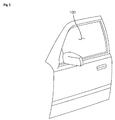
- Fig. 2 is a partial perspective view of a vehicle to which a plastic glazing according to one embodiment of the present invention is applied.
- the plastic glazing is illustrated as being applied to a side window of the vehicle, but may be applied to front and rear windows thereof.
- a 3.0 mm thick specimen (15 mm x 15 mm) was obtained using the pellet through an injection machine (DHC 120WD, Donshin Hydraulic Pressure Co., Ltd., 120 ton) at a molding temperature of 270°C and a mold temperature of 90°C.
- a primer Momentive AS4000
- 2% of solid was deposited to a thickness of 60 ⁇ m at room temperature and then cured.
- a silicone hard coating material (Momentive AS4700) containing 20% of solid was coated to a thickness of 15 ⁇ m thereon by flow coating, followed by curing using a UV lamp. Then, a 0.5 ⁇ m thick silicon dioxide layer was formed thereon to prepare a polycarbonate glazing sample.
- the coating layer had an average coefficient of linear thermal expansion of 40 cm/cm/°C.
- Example 1 The samples were prepared by the same method as in Example 1 except that the molar ratio of 2,2-bis(4-hydroxyphenyl)propane (bisphenol A) to 4,4'-biphenyl was changed as shown in the following Table 1.
- Table 1 Example Comparative Example 1 2 3 4 5 1 2 3 Molar ratio between BPA and BP in base layer BPA 90 80 70 60 50 100 95 40 BP 10 20 30 40 50 - 5 60
Landscapes
- Chemical & Material Sciences (AREA)
- Health & Medical Sciences (AREA)
- Chemical Kinetics & Catalysis (AREA)
- Medicinal Chemistry (AREA)
- Polymers & Plastics (AREA)
- Organic Chemistry (AREA)
- Inorganic Chemistry (AREA)
- Laminated Bodies (AREA)
- Coating Of Shaped Articles Made Of Macromolecular Substances (AREA)
- Paints Or Removers (AREA)
Claims (9)
- Kunststoffverglasung bzw. Kunststoffglasierung, umfassend: eine Grundschicht;
und eine auf einer Oberfläche der Grundschicht gebildete Überzugsschicht, wobei die Grundschicht ein Polycarbonat umfasst, welches eine Biphenylgruppe enthält, und die Biphenylgruppe in einer Menge von 10 Mol-% bis 50 Mol-%, bezogen auf die Gesamtmenge an Polycarbonat, vorliegt und
wobei die Überzugsschicht eine Stapelstruktur aus einer Primärschicht und einer Hartüberzugsschicht bzw. Hartanstrichschicht aufweist, wobei die Primärschicht die Grundschicht berührt. - Kunststoffverglasung nach Anspruch 1, wobei das Polycarbonat eine Biphenylgruppe enthält, welche sich wiederholende Strukturen der Formeln 1 und 2 umfasst, und die sich wiederholende Struktur der Formel 1 und die sich wiederholende Struktur der Formel 2 in einem molaren Verhältnis von 50 bis 90 : 10 bis 50 vorliegen;


- Kunststoffverglasung nach Anspruch 1 oder 2, wobei die Grundschicht einen thermischen Längenausdehnungskoeffizienten im Bereich von 39 cm/cm/°C bis 57 cm/cm/°C für eine 6,4 mm Biegeprobe gemäß ISO 11359 aufweist.
- Kunststoffverglasung nach irgendeinem der Ansprüche 1 bis 3, wobei der Unterschied im thermischen Längenausdehnungskoeffizienten zwischen der Grundschicht und der Überzugsschicht 16 cm/cm/°C oder weniger beträgt.
- Kunststoffverglasung nach irgendeinem der Ansprüche 1 bis 4, wobei die Primärschicht wenigstens eines von Organopolysiloxan, Acryl, Polyester, und Acryl-Polyester-Gemisch-Harzen umfasst.
- Kunststoffverglasung nach irgendeinem der Ansprüche 1 bis 5, wobei die Hartüberzugsschicht wenigstens eines von Silicon, Urethan, Epoxy, Acryl, Polysiloxan und Polycarbonat-gepfropften Polysiloxan-Harzen umfasst.
- Kunststoffverglasung nach Anspruch 1, weiterhin umfassend: eine Schicht eines anorganischen Materials gebildet auf einer Oberfläche der Hartüberzugsschicht, wobei das anorganische Material wenigstens eines von Aluminiumoxid, Bariumfluorid, Bornitrid, Hafniumoxid, Lanthanfluorid, Magnesiumfluorid, Magnesiumoxid, Scandiumoxid, Siliciummonoxid, Siliciumdioxid, Siliciumnitrid, Siliciumoxynitrid, Siliciumoxycarbid, hydriertem Siliciumoxycarbid, Siliciumcarbid, Tantaloxid, Titanoxid, Zinnoxid, Indium-Zinn-Oxid, Yttriumoxid, Zinkoxid, Zinkselenid, Zinksulfid, Zirkoniumoxid und Zirkoniumtitanat umfasst.
- Verfahren zur Herstellung einer Kunststoffverglasung, umfassend:Bilden einer Grundschicht unter Verwendung eines Polycarbonatharzes, welches eine Biphenylgruppe enthält und die Biphenylgruppe in einer Menge von 10 Mol-% bis 50 Mol-%, bezogen auf die Gesamtmenge an Polycarbonat, vorliegt;Bilden einer Primärschicht auf einer Oberfläche der Grundschicht; undBilden einer Hartüberzugsschicht bzw. Hartanstrichschicht auf einer Oberfläche der Primärschicht.
- Verfahren nach Anspruch 8, weiterhin umfassend: eine Schicht einer Verbindung auf einer Oberfläche der Hartüberzugsschicht, wobei die Verbindung wenigstens eines von Aluminiumoxid, Bariumfluorid, Bornitrid, Hafniumoxid, Lanthanfluorid, Magnesiumfluorid, Magnesiumoxid, Scandiumoxid, Siliciummonoxid, Siliciumdioxid, Siliciumnitrid, Siliciumoxynitrid, Siliciumoxycarbid, hydriertem Siliciumoxycarbid, Siliciumcarbid, Tantaloxid, Titanoxid, Zinnoxid, Indium-Zinn-Oxid, Yttriumoxid, Zinkoxid, Zinkselenid, Zinksulfid, Zirkoniumoxid, Zirkoniumtitanat umfasst.
Applications Claiming Priority (1)
| Application Number | Priority Date | Filing Date | Title |
|---|---|---|---|
| KR1020110147625A KR101459130B1 (ko) | 2011-12-30 | 2011-12-30 | 플라스틱 글레이징 및 그 제조방법 |
Publications (2)
| Publication Number | Publication Date |
|---|---|
| EP2610285A1 EP2610285A1 (de) | 2013-07-03 |
| EP2610285B1 true EP2610285B1 (de) | 2016-04-06 |
Family
ID=47428517
Family Applications (1)
| Application Number | Title | Priority Date | Filing Date |
|---|---|---|---|
| EP12197543.7A Active EP2610285B1 (de) | 2011-12-30 | 2012-12-17 | Kunststoffverglasung und Herstellungsverfahren dafür |
Country Status (4)
| Country | Link |
|---|---|
| US (1) | US20130171435A1 (de) |
| EP (1) | EP2610285B1 (de) |
| KR (1) | KR101459130B1 (de) |
| CN (1) | CN103183841B (de) |
Families Citing this family (16)
| Publication number | Priority date | Publication date | Assignee | Title |
|---|---|---|---|---|
| KR20150041404A (ko) * | 2013-10-08 | 2015-04-16 | 제일모직주식회사 | 폴리카보네이트 글래이징 및 그 제조방법 |
| KR20150054271A (ko) * | 2013-11-11 | 2015-05-20 | 제일모직주식회사 | 폴리카보네이트 글래이징 및 그 제조방법 |
| CN104754079B (zh) * | 2013-12-30 | 2018-09-11 | 比亚迪精密制造有限公司 | 手机外壳及其制作方法 |
| KR20150109221A (ko) * | 2014-03-19 | 2015-10-01 | 제일모직주식회사 | 하드코팅액 조성물 및 이를 이용한 폴리카보네이트 글레이징 |
| KR101674607B1 (ko) * | 2014-06-17 | 2016-11-09 | 주식회사 엘지화학 | 자동차용 플라스틱 글레이징 기판 |
| KR101768277B1 (ko) * | 2014-09-05 | 2017-08-16 | 삼성에스디아이 주식회사 | 프라이머 조성물 및 이를 이용한 플라스틱 글레이징 |
| KR101746460B1 (ko) * | 2015-11-20 | 2017-06-13 | 현대자동차주식회사 | 폴리카보네이트 글레이징용 코팅도료 조성물로 코팅된 도장품 |
| CN105713330B (zh) * | 2016-03-01 | 2017-10-10 | 苏州云舒新材料科技有限公司 | 一种耐刮擦有机玻璃材料及其制备方法 |
| EP3554722A1 (de) * | 2016-12-15 | 2019-10-23 | Covestro Deutschland AG | Transparent beschichtetes polycarbonat bauteil, dessen herstellung und verwendung |
| KR102034597B1 (ko) | 2017-11-10 | 2019-10-21 | 엘지엠엠에이 주식회사 | 자동차 글레이징용 수지 조성물 |
| KR102116729B1 (ko) * | 2017-11-22 | 2020-06-01 | 주식회사 디앤샤인 | 자가진단 기능을 갖는 비상벨 장치 |
| KR102088750B1 (ko) * | 2017-11-30 | 2020-03-16 | 주식회사 디앤샤인 | 폴대형 무선 비상벨 장치 |
| CN108559122A (zh) * | 2018-04-26 | 2018-09-21 | 周文雄 | 一种聚碳酸酯板材表面处理工艺 |
| CN108656591A (zh) * | 2018-04-26 | 2018-10-16 | 周文雄 | 一种以聚碳酸酯为原料制备汽车车窗或防风罩的工艺 |
| CN109233168A (zh) * | 2018-09-10 | 2019-01-18 | 天长市瑞慈有机玻璃有限公司 | 一种增透有机玻璃管 |
| KR102664602B1 (ko) | 2023-08-14 | 2024-05-10 | 광주과학기술원 | 폴리카보네이트 기반 광학 적층체, 그 제조 방법 및 이를 이용한 커버윈도우 |
Family Cites Families (14)
| Publication number | Priority date | Publication date | Assignee | Title |
|---|---|---|---|---|
| DE3447457A1 (de) * | 1984-12-27 | 1986-07-03 | Wacker-Chemie GmbH, 8000 München | Vernetzbare organopolysiloxane, verfahren zu ihrer herstellung und verwendung dieser organopolysiloxane |
| JP2002069219A (ja) * | 2000-08-31 | 2002-03-08 | Teijin Chem Ltd | ポリカーボネート樹脂組成物成形体 |
| JP2004035614A (ja) * | 2002-06-28 | 2004-02-05 | Teijin Chem Ltd | 被覆ポリカーボネート板状成形体 |
| DE10230983A1 (de) * | 2002-07-10 | 2004-01-22 | Bayer Ag | Mehrschichtiges Erzeugnis enthaltend Polycarbonat |
| DE10333927A1 (de) * | 2003-07-25 | 2005-02-24 | Bayer Materialscience Ag | Polyformale als Coextrusionsschutzschicht auf Polycarbonat |
| US7521119B2 (en) * | 2005-07-07 | 2009-04-21 | Sabic Innovative Plastics Ip B.V. | Windows and other articles made from DMBPC polycarbonate homopolymer and copolymer |
| US20070104956A1 (en) * | 2005-11-10 | 2007-05-10 | Exatec Llc | Polycarbonate system having enhanced weatherability and method of making same |
| JP5073203B2 (ja) * | 2005-12-21 | 2012-11-14 | 出光興産株式会社 | ポリカーボネート樹脂組成物、その成形品並びにフィルム及びシート |
| JP2008049623A (ja) * | 2006-08-25 | 2008-03-06 | Mitsubishi Plastics Ind Ltd | 打抜加工用ポリカーボネート樹脂積層シート及びその製造方法 |
| CN102352028A (zh) * | 2006-10-18 | 2012-02-15 | 出光兴产株式会社 | 聚碳酸酯共聚物、成形体,光学材料及电子照相感光体 |
| JP2010055918A (ja) * | 2008-08-28 | 2010-03-11 | Seiko Epson Corp | 電気光学装置、電気光学装置の製造方法、及び電子機器 |
| JP5468896B2 (ja) * | 2009-01-22 | 2014-04-09 | 帝人株式会社 | ポリカーボネート樹脂積層体 |
| JP2011126164A (ja) * | 2009-12-18 | 2011-06-30 | Toyobo Co Ltd | 成型用帯電防止ハードコートフィルム |
| US8525191B2 (en) * | 2011-04-01 | 2013-09-03 | Sabic Innovative Plastics Ip B.V. | Optoelectronic devices and coatings therefore |
-
2011
- 2011-12-30 KR KR1020110147625A patent/KR101459130B1/ko active Active
-
2012
- 2012-12-04 CN CN201210512793.6A patent/CN103183841B/zh active Active
- 2012-12-10 US US13/709,126 patent/US20130171435A1/en not_active Abandoned
- 2012-12-17 EP EP12197543.7A patent/EP2610285B1/de active Active
Also Published As
| Publication number | Publication date |
|---|---|
| KR20130078601A (ko) | 2013-07-10 |
| EP2610285A1 (de) | 2013-07-03 |
| CN103183841A (zh) | 2013-07-03 |
| KR101459130B1 (ko) | 2014-11-10 |
| CN103183841B (zh) | 2016-01-06 |
| US20130171435A1 (en) | 2013-07-04 |
Similar Documents
| Publication | Publication Date | Title |
|---|---|---|
| EP2610285B1 (de) | Kunststoffverglasung und Herstellungsverfahren dafür | |
| CN101151321B (zh) | 聚碳酸酯树脂组合物和热辐射遮蔽性成形体 | |
| JP5714788B2 (ja) | プラスチックレンズおよびその製造方法 | |
| EP2338880B1 (de) | Mehrschichtige Erzeugnisse enthaltend ein Polycarbonat mit verbesserten thermischen und mechanischen Eigenschaften sowie reduziertem thermischen Ausdehnungskoeffizienten | |
| EP2817149B1 (de) | Mehrschichtaufbau als reflektor mit erhöhter mechanischer stabilität | |
| JP2009063976A (ja) | 光学素子成形品およびそのための成形材料 | |
| CN101874074B (zh) | 聚碳酸酯树脂组合物、聚碳酸酯树脂成形品及其制造方法 | |
| JP2013203042A (ja) | 積層体 | |
| CN1134357A (zh) | 改良的耐冲击性压层物 | |
| EP3628699B1 (de) | Copolycarbonat und herstellungsverfahren dafür | |
| EP3170852B1 (de) | Copolycarbonatharz und herstellungsverfahren dafür | |
| EP3157980A1 (de) | Weitgehend vernetzte polycarbonatartikel | |
| JP4907755B2 (ja) | ポリカーボネート樹脂積層体 | |
| JP5076336B2 (ja) | 熱線遮蔽能を備えた成形体 | |
| EP0646152B1 (de) | Laminierte strukturen aus polycarbonat | |
| EP1038907A2 (de) | Polycarbonatharzlaminat | |
| JP2012097279A (ja) | プラスチックレンズの製造方法 | |
| JP2017177553A (ja) | 積層体 | |
| KR101704896B1 (ko) | 폴리에스테르카보네이트 수지, 이의 제조방법 및 이를 포함하는 성형품 | |
| JP2002060527A (ja) | ポリカーボネート樹脂組成物成形体 | |
| US9012591B2 (en) | Copolymerized polycarbonate resin, method for preparing the same, and article comprising the same | |
| JP2002060528A (ja) | ポリカーボネート樹脂組成物成形体 | |
| KR100889829B1 (ko) | 내스크래치성 및 가공성이 우수한 폴리카보네이트 글레이징 | |
| JP2002069219A (ja) | ポリカーボネート樹脂組成物成形体 | |
| KR20250031471A (ko) | 열가소성 수지 조성물로부터 제조된 성형품 |
Legal Events
| Date | Code | Title | Description |
|---|---|---|---|
| PUAI | Public reference made under article 153(3) epc to a published international application that has entered the european phase |
Free format text: ORIGINAL CODE: 0009012 |
|
| 17P | Request for examination filed |
Effective date: 20121217 |
|
| AK | Designated contracting states |
Kind code of ref document: A1 Designated state(s): AL AT BE BG CH CY CZ DE DK EE ES FI FR GB GR HR HU IE IS IT LI LT LU LV MC MK MT NL NO PL PT RO RS SE SI SK SM TR |
|
| AX | Request for extension of the european patent |
Extension state: BA ME |
|
| 17Q | First examination report despatched |
Effective date: 20150313 |
|
| GRAP | Despatch of communication of intention to grant a patent |
Free format text: ORIGINAL CODE: EPIDOSNIGR1 |
|
| INTG | Intention to grant announced |
Effective date: 20151002 |
|
| GRAS | Grant fee paid |
Free format text: ORIGINAL CODE: EPIDOSNIGR3 |
|
| GRAA | (expected) grant |
Free format text: ORIGINAL CODE: 0009210 |
|
| AK | Designated contracting states |
Kind code of ref document: B1 Designated state(s): AL AT BE BG CH CY CZ DE DK EE ES FI FR GB GR HR HU IE IS IT LI LT LU LV MC MK MT NL NO PL PT RO RS SE SI SK SM TR |
|
| REG | Reference to a national code |
Ref country code: GB Ref legal event code: FG4D |
|
| REG | Reference to a national code |
Ref country code: AT Ref legal event code: REF Ref document number: 787773 Country of ref document: AT Kind code of ref document: T Effective date: 20160415 Ref country code: CH Ref legal event code: EP |
|
| REG | Reference to a national code |
Ref country code: IE Ref legal event code: FG4D |
|
| REG | Reference to a national code |
Ref country code: DE Ref legal event code: R096 Ref document number: 602012016559 Country of ref document: DE |
|
| REG | Reference to a national code |
Ref country code: LT Ref legal event code: MG4D Ref country code: NL Ref legal event code: MP Effective date: 20160406 |
|
| REG | Reference to a national code |
Ref country code: AT Ref legal event code: MK05 Ref document number: 787773 Country of ref document: AT Kind code of ref document: T Effective date: 20160406 |
|
| PG25 | Lapsed in a contracting state [announced via postgrant information from national office to epo] |
Ref country code: NL Free format text: LAPSE BECAUSE OF FAILURE TO SUBMIT A TRANSLATION OF THE DESCRIPTION OR TO PAY THE FEE WITHIN THE PRESCRIBED TIME-LIMIT Effective date: 20160406 |
|
| PG25 | Lapsed in a contracting state [announced via postgrant information from national office to epo] |
Ref country code: PL Free format text: LAPSE BECAUSE OF FAILURE TO SUBMIT A TRANSLATION OF THE DESCRIPTION OR TO PAY THE FEE WITHIN THE PRESCRIBED TIME-LIMIT Effective date: 20160406 Ref country code: FI Free format text: LAPSE BECAUSE OF FAILURE TO SUBMIT A TRANSLATION OF THE DESCRIPTION OR TO PAY THE FEE WITHIN THE PRESCRIBED TIME-LIMIT Effective date: 20160406 Ref country code: NO Free format text: LAPSE BECAUSE OF FAILURE TO SUBMIT A TRANSLATION OF THE DESCRIPTION OR TO PAY THE FEE WITHIN THE PRESCRIBED TIME-LIMIT Effective date: 20160706 Ref country code: LT Free format text: LAPSE BECAUSE OF FAILURE TO SUBMIT A TRANSLATION OF THE DESCRIPTION OR TO PAY THE FEE WITHIN THE PRESCRIBED TIME-LIMIT Effective date: 20160406 Ref country code: IS Free format text: LAPSE BECAUSE OF FAILURE TO SUBMIT A TRANSLATION OF THE DESCRIPTION OR TO PAY THE FEE WITHIN THE PRESCRIBED TIME-LIMIT Effective date: 20160806 |
|
| PG25 | Lapsed in a contracting state [announced via postgrant information from national office to epo] |
Ref country code: SE Free format text: LAPSE BECAUSE OF FAILURE TO SUBMIT A TRANSLATION OF THE DESCRIPTION OR TO PAY THE FEE WITHIN THE PRESCRIBED TIME-LIMIT Effective date: 20160406 Ref country code: RS Free format text: LAPSE BECAUSE OF FAILURE TO SUBMIT A TRANSLATION OF THE DESCRIPTION OR TO PAY THE FEE WITHIN THE PRESCRIBED TIME-LIMIT Effective date: 20160406 Ref country code: HR Free format text: LAPSE BECAUSE OF FAILURE TO SUBMIT A TRANSLATION OF THE DESCRIPTION OR TO PAY THE FEE WITHIN THE PRESCRIBED TIME-LIMIT Effective date: 20160406 Ref country code: GR Free format text: LAPSE BECAUSE OF FAILURE TO SUBMIT A TRANSLATION OF THE DESCRIPTION OR TO PAY THE FEE WITHIN THE PRESCRIBED TIME-LIMIT Effective date: 20160707 Ref country code: LV Free format text: LAPSE BECAUSE OF FAILURE TO SUBMIT A TRANSLATION OF THE DESCRIPTION OR TO PAY THE FEE WITHIN THE PRESCRIBED TIME-LIMIT Effective date: 20160406 Ref country code: AT Free format text: LAPSE BECAUSE OF FAILURE TO SUBMIT A TRANSLATION OF THE DESCRIPTION OR TO PAY THE FEE WITHIN THE PRESCRIBED TIME-LIMIT Effective date: 20160406 Ref country code: ES Free format text: LAPSE BECAUSE OF FAILURE TO SUBMIT A TRANSLATION OF THE DESCRIPTION OR TO PAY THE FEE WITHIN THE PRESCRIBED TIME-LIMIT Effective date: 20160406 Ref country code: PT Free format text: LAPSE BECAUSE OF FAILURE TO SUBMIT A TRANSLATION OF THE DESCRIPTION OR TO PAY THE FEE WITHIN THE PRESCRIBED TIME-LIMIT Effective date: 20160808 |
|
| PG25 | Lapsed in a contracting state [announced via postgrant information from national office to epo] |
Ref country code: IT Free format text: LAPSE BECAUSE OF FAILURE TO SUBMIT A TRANSLATION OF THE DESCRIPTION OR TO PAY THE FEE WITHIN THE PRESCRIBED TIME-LIMIT Effective date: 20160406 Ref country code: BE Free format text: LAPSE BECAUSE OF FAILURE TO SUBMIT A TRANSLATION OF THE DESCRIPTION OR TO PAY THE FEE WITHIN THE PRESCRIBED TIME-LIMIT Effective date: 20160406 |
|
| REG | Reference to a national code |
Ref country code: DE Ref legal event code: R097 Ref document number: 602012016559 Country of ref document: DE |
|
| PG25 | Lapsed in a contracting state [announced via postgrant information from national office to epo] |
Ref country code: CZ Free format text: LAPSE BECAUSE OF FAILURE TO SUBMIT A TRANSLATION OF THE DESCRIPTION OR TO PAY THE FEE WITHIN THE PRESCRIBED TIME-LIMIT Effective date: 20160406 Ref country code: RO Free format text: LAPSE BECAUSE OF FAILURE TO SUBMIT A TRANSLATION OF THE DESCRIPTION OR TO PAY THE FEE WITHIN THE PRESCRIBED TIME-LIMIT Effective date: 20160406 Ref country code: SK Free format text: LAPSE BECAUSE OF FAILURE TO SUBMIT A TRANSLATION OF THE DESCRIPTION OR TO PAY THE FEE WITHIN THE PRESCRIBED TIME-LIMIT Effective date: 20160406 Ref country code: EE Free format text: LAPSE BECAUSE OF FAILURE TO SUBMIT A TRANSLATION OF THE DESCRIPTION OR TO PAY THE FEE WITHIN THE PRESCRIBED TIME-LIMIT Effective date: 20160406 Ref country code: DK Free format text: LAPSE BECAUSE OF FAILURE TO SUBMIT A TRANSLATION OF THE DESCRIPTION OR TO PAY THE FEE WITHIN THE PRESCRIBED TIME-LIMIT Effective date: 20160406 |
|
| PLBE | No opposition filed within time limit |
Free format text: ORIGINAL CODE: 0009261 |
|
| STAA | Information on the status of an ep patent application or granted ep patent |
Free format text: STATUS: NO OPPOSITION FILED WITHIN TIME LIMIT |
|
| PG25 | Lapsed in a contracting state [announced via postgrant information from national office to epo] |
Ref country code: SM Free format text: LAPSE BECAUSE OF FAILURE TO SUBMIT A TRANSLATION OF THE DESCRIPTION OR TO PAY THE FEE WITHIN THE PRESCRIBED TIME-LIMIT Effective date: 20160406 |
|
| 26N | No opposition filed |
Effective date: 20170110 |
|
| REG | Reference to a national code |
Ref country code: DE Ref legal event code: R082 Ref document number: 602012016559 Country of ref document: DE Representative=s name: BARDEHLE PAGENBERG PARTNERSCHAFT MBB PATENTANW, DE Ref country code: DE Ref legal event code: R081 Ref document number: 602012016559 Country of ref document: DE Owner name: LOTTE ADVANCED MATERIALS CO., LTD., YEOSU-SI, KR Free format text: FORMER OWNER: CHEIL INDUSTRIES INC., GUMI-SI, GYEONGSANGBUK-DO, KR |
|
| REG | Reference to a national code |
Ref country code: DE Ref legal event code: R082 Ref document number: 602012016559 Country of ref document: DE Representative=s name: BARDEHLE PAGENBERG PARTNERSCHAFT MBB PATENTANW, DE Ref country code: DE Ref legal event code: R081 Ref document number: 602012016559 Country of ref document: DE Owner name: LOTTE ADVANCED MATERIALS CO., LTD., YEOSU-SI, KR Free format text: FORMER OWNER: SAMSUNG SDI CO., LTD., YONGIN-SI, KYONGGI-DO, KR |
|
| PG25 | Lapsed in a contracting state [announced via postgrant information from national office to epo] |
Ref country code: SI Free format text: LAPSE BECAUSE OF FAILURE TO SUBMIT A TRANSLATION OF THE DESCRIPTION OR TO PAY THE FEE WITHIN THE PRESCRIBED TIME-LIMIT Effective date: 20160406 |
|
| REG | Reference to a national code |
Ref country code: CH Ref legal event code: PL |
|
| GBPC | Gb: european patent ceased through non-payment of renewal fee |
Effective date: 20161217 |
|
| PG25 | Lapsed in a contracting state [announced via postgrant information from national office to epo] |
Ref country code: MC Free format text: LAPSE BECAUSE OF FAILURE TO SUBMIT A TRANSLATION OF THE DESCRIPTION OR TO PAY THE FEE WITHIN THE PRESCRIBED TIME-LIMIT Effective date: 20160406 |
|
| REG | Reference to a national code |
Ref country code: FR Ref legal event code: ST Effective date: 20170831 |
|
| REG | Reference to a national code |
Ref country code: IE Ref legal event code: MM4A |
|
| PG25 | Lapsed in a contracting state [announced via postgrant information from national office to epo] |
Ref country code: FR Free format text: LAPSE BECAUSE OF NON-PAYMENT OF DUE FEES Effective date: 20170102 Ref country code: CH Free format text: LAPSE BECAUSE OF NON-PAYMENT OF DUE FEES Effective date: 20161231 Ref country code: LU Free format text: LAPSE BECAUSE OF NON-PAYMENT OF DUE FEES Effective date: 20161217 Ref country code: LI Free format text: LAPSE BECAUSE OF NON-PAYMENT OF DUE FEES Effective date: 20161231 |
|
| PG25 | Lapsed in a contracting state [announced via postgrant information from national office to epo] |
Ref country code: GB Free format text: LAPSE BECAUSE OF NON-PAYMENT OF DUE FEES Effective date: 20161217 Ref country code: IE Free format text: LAPSE BECAUSE OF NON-PAYMENT OF DUE FEES Effective date: 20161217 |
|
| PG25 | Lapsed in a contracting state [announced via postgrant information from national office to epo] |
Ref country code: CY Free format text: LAPSE BECAUSE OF FAILURE TO SUBMIT A TRANSLATION OF THE DESCRIPTION OR TO PAY THE FEE WITHIN THE PRESCRIBED TIME-LIMIT Effective date: 20160406 Ref country code: HU Free format text: LAPSE BECAUSE OF FAILURE TO SUBMIT A TRANSLATION OF THE DESCRIPTION OR TO PAY THE FEE WITHIN THE PRESCRIBED TIME-LIMIT; INVALID AB INITIO Effective date: 20121217 |
|
| PG25 | Lapsed in a contracting state [announced via postgrant information from national office to epo] |
Ref country code: MK Free format text: LAPSE BECAUSE OF FAILURE TO SUBMIT A TRANSLATION OF THE DESCRIPTION OR TO PAY THE FEE WITHIN THE PRESCRIBED TIME-LIMIT Effective date: 20160406 Ref country code: TR Free format text: LAPSE BECAUSE OF FAILURE TO SUBMIT A TRANSLATION OF THE DESCRIPTION OR TO PAY THE FEE WITHIN THE PRESCRIBED TIME-LIMIT Effective date: 20160406 |
|
| PG25 | Lapsed in a contracting state [announced via postgrant information from national office to epo] |
Ref country code: BG Free format text: LAPSE BECAUSE OF FAILURE TO SUBMIT A TRANSLATION OF THE DESCRIPTION OR TO PAY THE FEE WITHIN THE PRESCRIBED TIME-LIMIT Effective date: 20160406 |
|
| PG25 | Lapsed in a contracting state [announced via postgrant information from national office to epo] |
Ref country code: MT Free format text: LAPSE BECAUSE OF NON-PAYMENT OF DUE FEES Effective date: 20161217 |
|
| PG25 | Lapsed in a contracting state [announced via postgrant information from national office to epo] |
Ref country code: AL Free format text: LAPSE BECAUSE OF FAILURE TO SUBMIT A TRANSLATION OF THE DESCRIPTION OR TO PAY THE FEE WITHIN THE PRESCRIBED TIME-LIMIT Effective date: 20160406 |
|
| P01 | Opt-out of the competence of the unified patent court (upc) registered |
Effective date: 20230528 |
|
| PGFP | Annual fee paid to national office [announced via postgrant information from national office to epo] |
Ref country code: DE Payment date: 20251104 Year of fee payment: 14 |