EP2589643B1 - Hocheffiziente verbindung auf carbazolbasis sowie organische elektrolumineszenzvorrichtung damit - Google Patents
Hocheffiziente verbindung auf carbazolbasis sowie organische elektrolumineszenzvorrichtung damit Download PDFInfo
- Publication number
- EP2589643B1 EP2589643B1 EP11801078.4A EP11801078A EP2589643B1 EP 2589643 B1 EP2589643 B1 EP 2589643B1 EP 11801078 A EP11801078 A EP 11801078A EP 2589643 B1 EP2589643 B1 EP 2589643B1
- Authority
- EP
- European Patent Office
- Prior art keywords
- substituted
- unsubstituted
- group
- carbons
- independently
- Prior art date
- Legal status (The legal status is an assumption and is not a legal conclusion. Google has not performed a legal analysis and makes no representation as to the accuracy of the status listed.)
- Not-in-force
Links
- 0 C*C1CCCCC1 Chemical compound C*C1CCCCC1 0.000 description 2
- DCYYWMVYVGOCOO-LLVKDONJSA-N CCC[O](CC)[C@@H]1C=CC=CC1 Chemical compound CCC[O](CC)[C@@H]1C=CC=CC1 DCYYWMVYVGOCOO-LLVKDONJSA-N 0.000 description 1
Images

Classifications
-
- H—ELECTRICITY
- H10—SEMICONDUCTOR DEVICES; ELECTRIC SOLID-STATE DEVICES NOT OTHERWISE PROVIDED FOR
- H10K—ORGANIC ELECTRIC SOLID-STATE DEVICES
- H10K85/00—Organic materials used in the body or electrodes of devices covered by this subclass
- H10K85/60—Organic compounds having low molecular weight
- H10K85/649—Aromatic compounds comprising a hetero atom
- H10K85/657—Polycyclic condensed heteroaromatic hydrocarbons
- H10K85/6572—Polycyclic condensed heteroaromatic hydrocarbons comprising only nitrogen in the heteroaromatic polycondensed ring system, e.g. phenanthroline or carbazole
-
- C—CHEMISTRY; METALLURGY
- C07—ORGANIC CHEMISTRY
- C07D—HETEROCYCLIC COMPOUNDS
- C07D209/00—Heterocyclic compounds containing five-membered rings, condensed with other rings, with one nitrogen atom as the only ring hetero atom
- C07D209/56—Ring systems containing three or more rings
- C07D209/80—[b, c]- or [b, d]-condensed
- C07D209/82—Carbazoles; Hydrogenated carbazoles
-
- C—CHEMISTRY; METALLURGY
- C07—ORGANIC CHEMISTRY
- C07F—ACYCLIC, CARBOCYCLIC OR HETEROCYCLIC COMPOUNDS CONTAINING ELEMENTS OTHER THAN CARBON, HYDROGEN, HALOGEN, OXYGEN, NITROGEN, SULFUR, SELENIUM OR TELLURIUM
- C07F9/00—Compounds containing elements of Groups 5 or 15 of the Periodic Table
- C07F9/02—Phosphorus compounds
- C07F9/28—Phosphorus compounds with one or more P—C bonds
- C07F9/50—Organo-phosphines
- C07F9/53—Organo-phosphine oxides; Organo-phosphine thioxides
- C07F9/5325—Aromatic phosphine oxides or thioxides (P-C aromatic linkage)
-
- C—CHEMISTRY; METALLURGY
- C07—ORGANIC CHEMISTRY
- C07F—ACYCLIC, CARBOCYCLIC OR HETEROCYCLIC COMPOUNDS CONTAINING ELEMENTS OTHER THAN CARBON, HYDROGEN, HALOGEN, OXYGEN, NITROGEN, SULFUR, SELENIUM OR TELLURIUM
- C07F9/00—Compounds containing elements of Groups 5 or 15 of the Periodic Table
- C07F9/02—Phosphorus compounds
- C07F9/547—Heterocyclic compounds, e.g. containing phosphorus as a ring hetero atom
- C07F9/553—Heterocyclic compounds, e.g. containing phosphorus as a ring hetero atom having one nitrogen atom as the only ring hetero atom
- C07F9/572—Five-membered rings
- C07F9/5728—Five-membered rings condensed with carbocyclic rings or carbocyclic ring systems
-
- C—CHEMISTRY; METALLURGY
- C07—ORGANIC CHEMISTRY
- C07F—ACYCLIC, CARBOCYCLIC OR HETEROCYCLIC COMPOUNDS CONTAINING ELEMENTS OTHER THAN CARBON, HYDROGEN, HALOGEN, OXYGEN, NITROGEN, SULFUR, SELENIUM OR TELLURIUM
- C07F9/00—Compounds containing elements of Groups 5 or 15 of the Periodic Table
- C07F9/02—Phosphorus compounds
- C07F9/547—Heterocyclic compounds, e.g. containing phosphorus as a ring hetero atom
- C07F9/6558—Heterocyclic compounds, e.g. containing phosphorus as a ring hetero atom containing at least two different or differently substituted hetero rings neither condensed among themselves nor condensed with a common carbocyclic ring or ring system
- C07F9/65583—Heterocyclic compounds, e.g. containing phosphorus as a ring hetero atom containing at least two different or differently substituted hetero rings neither condensed among themselves nor condensed with a common carbocyclic ring or ring system each of the hetero rings containing nitrogen as ring hetero atom
-
- C—CHEMISTRY; METALLURGY
- C09—DYES; PAINTS; POLISHES; NATURAL RESINS; ADHESIVES; COMPOSITIONS NOT OTHERWISE PROVIDED FOR; APPLICATIONS OF MATERIALS NOT OTHERWISE PROVIDED FOR
- C09K—MATERIALS FOR MISCELLANEOUS APPLICATIONS, NOT PROVIDED FOR ELSEWHERE
- C09K11/00—Luminescent materials, e.g. electroluminescent or chemiluminescent
- C09K11/06—Luminescent materials, e.g. electroluminescent or chemiluminescent containing organic luminescent materials
-
- H—ELECTRICITY
- H05—ELECTRIC TECHNIQUES NOT OTHERWISE PROVIDED FOR
- H05B—ELECTRIC HEATING; ELECTRIC LIGHT SOURCES NOT OTHERWISE PROVIDED FOR; CIRCUIT ARRANGEMENTS FOR ELECTRIC LIGHT SOURCES, IN GENERAL
- H05B33/00—Electroluminescent light sources
- H05B33/12—Light sources with substantially two-dimensional [2D] radiating surfaces
- H05B33/14—Light sources with substantially two-dimensional [2D] radiating surfaces characterised by the chemical or physical composition or the arrangement of the electroluminescent material, or by the simultaneous addition of the electroluminescent material in or onto the light source
-
- H—ELECTRICITY
- H10—SEMICONDUCTOR DEVICES; ELECTRIC SOLID-STATE DEVICES NOT OTHERWISE PROVIDED FOR
- H10K—ORGANIC ELECTRIC SOLID-STATE DEVICES
- H10K50/00—Organic light-emitting devices
- H10K50/10—OLEDs or polymer light-emitting diodes [PLED]
- H10K50/11—OLEDs or polymer light-emitting diodes [PLED] characterised by the electroluminescent [EL] layers
-
- H—ELECTRICITY
- H10—SEMICONDUCTOR DEVICES; ELECTRIC SOLID-STATE DEVICES NOT OTHERWISE PROVIDED FOR
- H10K—ORGANIC ELECTRIC SOLID-STATE DEVICES
- H10K50/00—Organic light-emitting devices
- H10K50/10—OLEDs or polymer light-emitting diodes [PLED]
- H10K50/14—Carrier transporting layers
- H10K50/15—Hole transporting layers
-
- H—ELECTRICITY
- H10—SEMICONDUCTOR DEVICES; ELECTRIC SOLID-STATE DEVICES NOT OTHERWISE PROVIDED FOR
- H10K—ORGANIC ELECTRIC SOLID-STATE DEVICES
- H10K50/00—Organic light-emitting devices
- H10K50/10—OLEDs or polymer light-emitting diodes [PLED]
- H10K50/14—Carrier transporting layers
- H10K50/16—Electron transporting layers
-
- H—ELECTRICITY
- H10—SEMICONDUCTOR DEVICES; ELECTRIC SOLID-STATE DEVICES NOT OTHERWISE PROVIDED FOR
- H10K—ORGANIC ELECTRIC SOLID-STATE DEVICES
- H10K50/00—Organic light-emitting devices
- H10K50/10—OLEDs or polymer light-emitting diodes [PLED]
- H10K50/17—Carrier injection layers
- H10K50/171—Electron injection layers
-
- C—CHEMISTRY; METALLURGY
- C09—DYES; PAINTS; POLISHES; NATURAL RESINS; ADHESIVES; COMPOSITIONS NOT OTHERWISE PROVIDED FOR; APPLICATIONS OF MATERIALS NOT OTHERWISE PROVIDED FOR
- C09K—MATERIALS FOR MISCELLANEOUS APPLICATIONS, NOT PROVIDED FOR ELSEWHERE
- C09K2211/00—Chemical nature of organic luminescent or tenebrescent compounds
- C09K2211/10—Non-macromolecular compounds
- C09K2211/1003—Carbocyclic compounds
- C09K2211/1007—Non-condensed systems
-
- C—CHEMISTRY; METALLURGY
- C09—DYES; PAINTS; POLISHES; NATURAL RESINS; ADHESIVES; COMPOSITIONS NOT OTHERWISE PROVIDED FOR; APPLICATIONS OF MATERIALS NOT OTHERWISE PROVIDED FOR
- C09K—MATERIALS FOR MISCELLANEOUS APPLICATIONS, NOT PROVIDED FOR ELSEWHERE
- C09K2211/00—Chemical nature of organic luminescent or tenebrescent compounds
- C09K2211/10—Non-macromolecular compounds
- C09K2211/1003—Carbocyclic compounds
- C09K2211/1014—Carbocyclic compounds bridged by heteroatoms, e.g. N, P, Si or B
-
- C—CHEMISTRY; METALLURGY
- C09—DYES; PAINTS; POLISHES; NATURAL RESINS; ADHESIVES; COMPOSITIONS NOT OTHERWISE PROVIDED FOR; APPLICATIONS OF MATERIALS NOT OTHERWISE PROVIDED FOR
- C09K—MATERIALS FOR MISCELLANEOUS APPLICATIONS, NOT PROVIDED FOR ELSEWHERE
- C09K2211/00—Chemical nature of organic luminescent or tenebrescent compounds
- C09K2211/10—Non-macromolecular compounds
- C09K2211/1018—Heterocyclic compounds
- C09K2211/1025—Heterocyclic compounds characterised by ligands
- C09K2211/1029—Heterocyclic compounds characterised by ligands containing one nitrogen atom as the heteroatom
-
- H—ELECTRICITY
- H10—SEMICONDUCTOR DEVICES; ELECTRIC SOLID-STATE DEVICES NOT OTHERWISE PROVIDED FOR
- H10K—ORGANIC ELECTRIC SOLID-STATE DEVICES
- H10K2101/00—Properties of the organic materials covered by group H10K85/00
- H10K2101/10—Triplet emission
-
- H—ELECTRICITY
- H10—SEMICONDUCTOR DEVICES; ELECTRIC SOLID-STATE DEVICES NOT OTHERWISE PROVIDED FOR
- H10K—ORGANIC ELECTRIC SOLID-STATE DEVICES
- H10K85/00—Organic materials used in the body or electrodes of devices covered by this subclass
- H10K85/30—Coordination compounds
- H10K85/341—Transition metal complexes, e.g. Ru(II)polypyridine complexes
- H10K85/342—Transition metal complexes, e.g. Ru(II)polypyridine complexes comprising iridium
Definitions
- the present invention relates to a highly efficient carbazole-based compound, which is capable of improving low efficiency characteristics of a conventional organic electroluminescence device, in particular, low efficiency characteristics of a pure-blue phosphorescent device, and to an organic electroluminescence device including the same.
- Organic electroluminescence devices have a simpler structure, various processing advantages, higher luminance, superior viewing angle, quicker response rate, and a lower operating voltage than other flat panel display devices such as liquid crystal displays (LCDs), plasma display panels (PDPs), field emission displays (FEDs), etc., and thus many attempts are being made to use them as a light source of flat panel displays such as wall-mountable TVs or of the backlight units of displays, illuminators, advertisement boards and the like.
- LCDs liquid crystal displays
- PDPs plasma display panels
- FEDs field emission displays
- holes injected from an anode and electrons injected from a cathode recombine to form electron-hole pairs, namely, excitons, after which the excitons return to a stable ground state and the corresponding energy is transferred to a light-emitting material and is thereby converted into light.
- a variety of known compounds function as the conventional host materials of organic electroluminescence devices. These include triazine-based compounds, oxadiazole-based compounds, benzimidazole-based compounds, phenyl pyridine-based compounds, and silicon-based compounds.
- triazine-based compounds oxadiazole-based compounds
- benzimidazole-based compounds phenyl pyridine-based compounds
- silicon-based compounds silicon-based compounds.
- such compounds are problematic because superior efficiency characteristics cannot be achieved in the organic electroluminescence devices, and host materials able to exhibit superior characteristics in blue phosphorescent devices are considerably limited. Hence, the development of novel compounds to solve such problems is required.
- Korean Patent Publication No. 10-2006-0109524 discloses an arylphosphine oxide-based compound, an arylphosphine sulfide-based compound or an arylphosphine selenide-based compound and an organic electroluminescence device using the same, but is problematic because high efficiency cannot be obtained in a pure-blue phosphorescent device.
- carbazole-based compounds As conventional compounds having high triplet energy, a variety of carbazole-based compounds have been developed.
- the carbazole-based compounds have been applied to various phosphorescent devices because of high triplet energy thereof, but are problematic because electron injection characteristics may deteriorate, undesirably limiting diverse applications thereof. In the case where an aromatic structure is introduced to improve thermal stability, triplet energy may decrease, undesirably resulting in limited applications.
- the present invention is intended to develop a novel host material, namely, a phosphine-based compound having a carbazole structure (c.f. CN101747373A ), and to apply it as the host material of a light-emitting layer of an organic electroluminescence device.
- a novel host material namely, a phosphine-based compound having a carbazole structure (c.f. CN101747373A )
- a phosphine-based compound having a carbazole structure c.f. CN101747373A
- the present invention adopts a highly efficient carbazole-based compound, which is configured such that an aromatic structure is provided at the center thereof and includes at least two carbazole units and at least one phosphine unit, and thus which may exhibit high thermal stability and high triplet energy and may adjust balance between electrons and holes and thereby may be applied as a host material for any light-emitting layer from red to blue phosphorescence, and furthermore may achieve high efficiency characteristics in a pure-blue phosphorescent device, and thus an object of the present invention is to provide a highly efficient carbazole-based compound and an organic electroluminescence device including the same.
- the present invention provides a compound for an organic electroluminescence device, represented by Chemical Formula 1 below.
- Ar represents a substituted or unsubstituted aryl group having 6 to 50 ring carbons, or a substituted or unsubstituted heteroaryl group having 5 to 50 ring atoms
- Y 1 to Y 5 are independently an oxygen atom, a sulfur atom or a selenium atom
- Ar 1 to Ar 10 are identical or different substituents and each represent a substituted or unsubstituted aryl group having 6 to 50 ring carbons, or a substituted or unsubstituted heteroaryl group having 5 to 50 ring atoms
- R 1 to R 4 each represent a unit which does not expand a conjugated structure of a carbazole unit, and part or all of R 1 to R 4 are independently a hydrogen atom
- R 1 to R 4 are identical or different substituents and each represent a halogen atom, a cyano group, a nitro group, a substituted or unsubstituted alkyl group having 1 to 50 carbons, a
- the present invention provides a compound for an organic electroluminescence device, represented by Chemical Formula 2 below.
- Ar' represents a substituted or unsubstituted aryl group having 6 to 50 ring carbons, or a substituted or unsubstituted heteroaryl group having 5 to 50 ring atoms
- Y 6 to Y 11 are independently an oxygen atom, a sulfur atom or a selenium atom
- Ar 11 to Ar 22 are identical or different substituents and each represent a substituted or unsubstituted aryl group having 6 to 50 ring carbons, or a substituted or unsubstituted heteroaryl group having 5 to 50 ring atoms
- R 5 to R 10 each represent a unit which does not expand a conjugated structure of a carbazole unit, and part or all of R 5 to R 10 are independently a hydrogen atom
- R 5 to R 10 are identical or different substituents and each represent a halogen atom, a cyano group, a nitro group, a substituted or unsubstituted alkyl group having 1 to 50 carbons,
- the present invention provides an organic electroluminescence device, comprising a first electrode; a second electrode; and a light-emitting layer including a host and a dopant, wherein the host includes the compound for an organic electroluminescence device of claim 1.
- the present invention provides an organic electroluminescence device, comprising a first electrode; a second electrode; a light-emitting layer, an electron transport layer, and a hole transport layer, wherein the hole transport layer includes the compound for an organic electroluminescence device of claim 1.
- a highly efficient carbazole-based compound is configured such that an aromatic structure is provided at the center thereof and at least two carbazole units and at least one phosphine unit are included in the aromatic structure, so that this compound can exhibit high thermal stability and high triplet energy and can adjust balance between electrons and holes and thereby can be applied as a host material having high efficiency characteristics for a light-emitting layer for red to blue phosphorescence, in particular, pure-blue phosphorescence.
- an organic electroluminescence device includes the highly efficient carbazole-based compound of the invention, thus exhibiting superior efficiency characteristics in a red to blue phosphorescent device, in particular, a pure-blue phosphorescent device.
- the present invention provides a compound for an organic EL device, as represented by Chemical Formula 1 below.
- Ar represents a substituted or unsubstituted phenyl group having 6 to 34 carbons, a substituted or unsubstituted biphenyl group, a substituted or unsubstituted terphenyl group, a substituted or unsubstituted naphthyl group, a substituted or unsubstituted anthryl group, a substituted or unsubstituted pyrenyl group, substituted or unsubstituted dibenzofuran, substituted or unsubstituted dibenzothiophene, substituted or unsubstituted dibenzophosphole, substituted or unsubstituted dibenzophosphole oxide, substituted or unsubstituted benzofuran, substituted or unsubstituted benzothiophene, substituted or unsubstituted carbazole, substituted or unsubstituted phenylcarbazole, substituted or unsubstituted indole, substitute
- the compound for an organic EL device as represented by Chemical Formula 1 in which Ar is a phenyl group, Y 1 to Y 5 are an oxygen atom, Ar 1 to Ar 10 each represent a phenyl group, R 1 to R 4 each represent a hydrogen atom, n1 to n5 are independently 0 or 1, n1+n2+n3+n4+n5 ⁇ 0, and n6 to n9 are independently 0 or 1.
- the present invention provides a compound for an organic EL device, as represented by Chemical Formula 2 below.
- Ar' represents a substituted or unsubstituted aryl group having 6 to 50 ring carbons, or a substituted or unsubstituted heteroaryl group having 5 to 50 ring atoms
- Y 6 to Y 11 are independently an oxygen atom, a sulfur atom or a selenium atom
- Ar 11 to Ar 22 are identical or different substituents and each represent a substituted or unsubstituted aryl group having 6 to 50 ring carbons, or a substituted or unsubstituted heteroaryl group having 5 to 50 ring atoms
- R 5 to R 10 each represent a unit which does not expand a conjugated structure of a carbazole unit, and part or all of R 5 to R 10 are independently a hydrogen atom
- R 5 to R 10 are identical or different substituents and each represent a halogen atom, a cyano group, a nitro group, a substituted or unsubstituted alkyl group having 1 to 50 carbons,
- the compound for an organic EL device as represented by Chemical Formula 2 in which Ar' represents a substituted or unsubstituted phenyl group having 6 to 34 carbons, a substituted or unsubstituted biphenyl group, a substituted or unsubstituted terphenyl group, a substituted or unsubstituted naphthyl group, a substituted or unsubstituted anthryl group, substituted or unsubstituted phenylcarbazole, substituted or unsubstituted phenylindole, substituted or unsubstituted pyrenyl, substituted or unsubstituted pyridine, substituted or unsubstituted pyridazine, or substituted or unsubstituted pyrimidine, Y 6 to Y 11 are an oxygen atom, Ar 11 to Ar 22 are identical or different substituents and each represent a substituted or unsubstituted
- the compound for an organic EL device as represented by Chemical Formula 2 in which Ar' represents a phenyl group, Y 6 to Y 11 are an oxygen atom, Ar 11 to Ar 22 each represent a phenyl group, R 5 to R 10 each represent a hydrogen atom, n10 to n15 are independently 0 or 1, n10+n11+n12+n13+n14+n15 ⁇ 0, and n16 to n21 are independently 0 or 1.
- substituted or unsubstituted aryl group having 6 to 50 ring carbons on the Ar, Ar', and Ar 1 to Ar 22 include phenyl, 1-naphthyl, 2-naphthyl, 1-anthryl, 2-anthryl, 9-anthryl, 1-phenanthryl, 2-phenanthryl, 3-phenanthryl, 4-phenanthryl, 9-phenanthryl, 1-naphthacenyl, 2-naphthacenyl, 9-naphthacenyl, 1-pyrenyl, 2-pyrenyl, 4-pyrenyl, 2-biphenylyl, 3-biphenylyl, 4-biphenylyl, p-terphenyl-4-yl, p -terphenyl-3-yl, p -terphenyl-2-yl, m -terphenyl-4-yl, m -terphenyl-3-yl, m -terphenyl,
- aromatic heterocyclic group having 5 to 50 ring atoms on the Ar, Ar', and Ar 1 to Ar 22 include 1-pyrolyl, 2-pyrolyl, 3-pyrolyl, pyrazinyl, pyrimidyl, pyridazyl, 2-pyridinyl, 3-pyridinyl, 4-pyridinyl, 1-indolyl, 2-indolyl, 3-indolyl, 4-indolyl, 5-indolyl, 6-indolyl, 7-indolyl, 1-isoindolyl, 2-isoindolyl, 3-isoindolyl, 4-isoindolyl, 5-isoindolyl, 6-isoindolyl, 7-isoindolyl, 2-furyl, 3-furyl, 2-benzofuranyl, 3-benzofuranyl, 4-benzofuranyl, 5-benzofuranyl, 6-benzofuranyl, 7-benzofurany
- R 1 to R 10 specific examples of the substituted or unsubstituted alkyl group having 1 to 50 carbons and the substituted or unsubstituted cycloalkyl group having 3 to 50 carbons include methyl, ethyl, n -propyl, n -pentyl, n -butyl, n -hexyl, n -heptyl, n -octyl, n -decanyl, n -eicosanyl isopropyl, sec -butyl, isobutyl, tert -butyl, hydroxymethyl, 1-hydroxyethyl, 2-hydroxyethyl, 2-hydroxyisobutyl, 1,2-dihydroxyethyl, 1,3-dihydroxyisopropyl, 2,3-dihydroxy- tert -butyl, 1,2,3-trihydroxypropyl, chloromethyl, 1-chloroethyl, 2-chlor
- substituted or unsubstituted thio group having 1 to 50 carbons include methylthio, ethylthio, propylthio, butylthio, pentylthio, hexylthio, tri(isopropyl)thio, tri(isobutyl)thio, tri( tert -butyl)thio, tri(2-butyl)thio, phenylthio, naphthylthio, biphenylthio, (3-methylphenyl)thio, (4-methylnaphthyl)thio, (2-methylbiphenyl)thio, etc.
- substituted or unsubstituted silyl group having 1 to 50 carbons include trimethylsilyl, triethylsilyl, tributylsilyl, tri(isopropyl)silyl, tri(isobutyl)silyl, tri( tert- butyl)silyl, tri(2-butyl)silyl, triphenylsilyl, trinaphthylsilyl, tribiphenylsilyl, tri(3-methylphenyl)silyl, tri(4-methylnaphthyl)silyl, tri(2-methylbiphenyl)silyl, phenylmethylsilyl, phenylethylsilyl, naphthylmethylsilyl, naphthylethylsilyl, biphenylmethylsilyl, 3-methyl-phenylmethylsilyl, phenyl(isopropyl)s
- a compound was developed in the present invention, which is configured such that an aromatic structure is provided at the center thereof and at least two carbazole units and at least one phosphine oxide are included in the aromatic structure.
- the compound according to the present invention is featured in that an aromatic compound which may expand the conjugated structure of the carbazole unit is not introduced, thus ensuring high triplet energy, and also that electron transfer characteristics may be improved via the phosphine oxide unit, thereby maintaining balance between holes and electrons in the organic compound.
- the compound according to the present invention includes a phosphine oxide unit and a hydrogen, saturated hydrocarbon structure, etc., which do not influence on triplet energy, ultimately ensuring high triplet energy and superior thermal stability.
- FIG. 1 schematically shows the structure of the organic EL device according to the present invention.
- the organic EL device including the compound represented by Chemical Formula 1 or 2 may be embodied in a variety of structures.
- the organic EL device includes a first electrode 110; a second electrode 150; and a light-emitting layer 130 including a host and a dopant, wherein the host includes the compound for an organic EL device according to the present invention.
- the organic EL device may further include an electron transport layer 140 and a hole transport layer 120.
- the hole transport layer 120 or the electron transport layer 140 may include the compound for an organic EL device according to the present invention.
- an organic EL device including a first electrode 110; a second electrode 150; a light-emitting layer 130; an electron transport layer 140; and a hole transport layer 120
- the electron transport layer 140 or the hole transport layer 120 includes the compound for an organic EL device according to the present invention.
- the organic EL device further includes one or more layers selected from among a hole injection layer, an electron injection layer, and an electron transport layer, thus increasing luminous efficiency.
- the organic EL device is preferably supported on a transparent substrate.
- the material for the transparent substrate is not particularly limited so long as it has good mechanical strength, thermal stability and transparency. Specific examples thereof include glass, a transparent plastic film, etc.
- the anode material of the organic EL device according to the present invention may include a metal having a work function of 4 eV or more, an alloy, an electrical conductive compound, or a mixture thereof. Specific examples thereof include Au metal or a transparent conductive material such as Cul, ITO (Indium Tin Oxide), SnO 2 and ZnO.
- the thickness of the anode film may be 10 to 200 nm.
- the cathode material of the organic EL device according to the present invenion may include a metal having a work function of less than 4 eV, an alloy, an electrical conductive compound, or a mixture thereof. Specific examples thereof include Na, Na-K alloy, Ca, Mg, Li, Li alloy, In, Al, Mg alloy, Al alloy, etc. In addition, Al/AlO 2 , Al/Li, Mg/Ag or Mg/In may be used. The thickness of the cathode film may be 10 to 200 nm. In order to increase the luminous efficiency of the organic EL device, one or more electrodes should have a light transmittance of 10% or more. The sheet resistance of the electrodes is preferably hundreds of ⁇ /mm or less.
- the thickness of the electrodes may range from 10 nm to 1 ⁇ m, and preferably from 10 to 400 nm.
- Such electrodes may be obtained by forming the above electrode material into a thin film using vapor deposition such as chemical vapor deposition (CVD) or physical vapor deposition (PVD) or sputtering.
- CVD chemical vapor deposition
- PVD physical vapor deposition
- the hole transport material and the hole injection material may be optionally selected from materials typically used as a hole transport material among light conductive materials and materials known to be useful for forming a hole transport layer or a hole injection layer of an organic EL device, in addition to the compound of Chemical Formula 1 or 2 according to the present invention.
- porphyrin compound derivatives such as N,N-dicarbazolyl-3,5-benzene (mCP), poly(3,4-ethylenedioxythiophene):polystyrenesulfonate (PEDOT:PSS), N,N'-di(1-naphthyl)-N,N'-diphenylbenzidine (NPD), N,N'-diphenyl-N,N'-di(3-methylphenyl)-4,4'-diaminobiphenyl (TPD), N,N'-diphenyl-N,N'-dinaphthyl-4,4'-diaminobiphenyl, N,N,N'N'-tetra-p-tolyl-4,4'-diaminobiphenyl, N,N,N',N'-tetraphenyl-4,4'-diaminobiphenyl, copper (II) 1,10,15,20-tetraphen
- Known electron transport materials for the electron transport layer include, for example, diphenylphosphine oxide-4-(triphenylsilyl)phenyl (TSPO1), Alq 3 , a 2,5-diaryl silole derivative (PyPySPyPy), a perfluorinated compound (PF-6P), octasubstituted cyclooctatetraene compounds (COTs), etc., which may be used in mixtures.
- TSPO1 diphenylphosphine oxide-4-(triphenylsilyl)phenyl
- Alq 3 a 2,5-diaryl silole derivative
- PF-6P perfluorinated compound
- COTs octasubstituted cyclooctatetraene compounds
- the electron injection layer, the electron transport layer, the hole injection layer and the hole transport layer may be provided in the form of a single layer containing one or more kinds of the above compounds, or of a laminated plurality of layers containing different kinds of compounds.
- Another light-emitting material employed in the organic EL device according to the present invention may include known light-emitting materials, for example, photoluminescent fluorescent materials, fluorescent brighteners, laser dyes, organic scintillators, and fluorescent analysis reagents.
- known light-emitting materials for example, photoluminescent fluorescent materials, fluorescent brighteners, laser dyes, organic scintillators, and fluorescent analysis reagents.
- Specific examples thereof include carbazole-based compounds, phosphine oxide-based compounds, carbazole-based phosphine oxide compounds, polyaromatic compounds including bis((3,5-difluoro-4-cyanophenyl)pyridine)iridium picolinate (FCNlrpic), tris(8-hydroxyquinoline)aluminum (Alq 3 ), anthracene, phenanthrene, pyrene, crysene, perylene, coronene, rubrene and quinacridone, oligophenylene compounds including quater
- Respective layers of the organic EL device according to the present invention may be provided in the form of a thin film using a known process such as vacuum deposition, spin coating or casting, or may be prepared using materials therefor.
- the film thickness of respective layers is not particularly limited, and may be appropriately determined depending on the characteristics of the materials, and may be typically set in the range of 2 nm to 5000 nm.
- the compound of Chemical Formula 1 or 2 according to the present invention may be subjected to vacuum deposition, it may be simply formed into a thin film and may be easily provided in the form of a uniform thin film having almost no pin holes.
- compounds for an organic EL device were prepared, and organic EL devices were manufactured using the same.
- the following preparation examples and examples are set to illustrate the present invention but are not construed to limit the present invention.
- a blue phosphorescent device was manufactured using the above compound, and the characteristics of the organic compound were evaluated.
- a blue phosphorescent device including Compound 1, that is, mCPPO1, synthesized in the present invention was formed using FCNIrpic which is a known blue dopant.
- FCNIrpic which is a known blue dopant.
- a blue phosphorescent device was manufactured using FCNIrpic which is a blue dopant.
- the structure of the device was ITO/N,N'-diphenyl-N,N'-bis-[4-(phenyl-m-tolyl-amino)-phenyl]-biphenyl-4,4'-diamine(DNTPD,60nm)/NPD(20nm)/mCP(10nm)/mCPPO1:FCNIrpic(30nm, 3%)[TSPO1 (20nm)/LiF/Al.
- the device was manufactured in the following manner. Specifically, an ITO substrate was washed using ultrasound for 30 min in pure water and isopropyl alcohol, and the surface of the ITO substrate was treated using short-wavelength UV light, after which an organic material was vacuum-deposited thereon at a pressure of 1x10 -6 torr. DNTPD, NPD, mCP, and TSPO1 were deposited at a rate of 0.1 nm/s, thus forming respective films having the corresponding thicknesses, and Compound 1 was vacuum-deposited together with a FCNIr dopant. As such, Compound 1 was deposited at a rate of 0.1 nm/s, and FCNIr was deposited at a rate of 0.03 nm/s.
- LiF was formed to a thickness of 1 nm at a rate of 0.01 nm/s
- Al was formed to a thickness of 100 nm at a deposition rate of 0.5 nm/s.
- the device thus obtained was sealed using a CaO desiccant and a cover glass.
- the blue organic EL device manufactured in the present invention manifested a maximum quantum efficiency of 21.9%.
- the color coordinates were (0.14, 0.17).
- the maximum quantum efficiency and the color coordinates of Examples 1 to 5 according to the present invention and Comparative Example 1 are shown in Table 4 below.
- a blue phosphorescent device including Compound 2, that is, mCPPO2, synthesized in the present invention was formed using FCNIrpic which is a known blue dopant.
- the structure of the device was ITO/DNTPD(60nm)/NPD(20nm)/mCP(10nm)/mCPPO2:FCNIrpic(30nm, 3%)/TSPO1(20nm)/LiF/Al.
- the device was manufactured in the same manner as in Example 1, with the exception that Compound 2 was used in lieu of Compound 1.
- the blue organic EL device manufactured in the present invention manifested a maximum quantum efficiency of 20.3%. The color coordinates were (0.14, 0.17).
- a blue phosphorescent device including Compound 3, that is, mCPPO3, synthesized in the present invention was formed using FCNIrpic which is a known blue dopant.
- the structure of the device was ITO/DNTPD(60nm)/NPD(20nm)/mCP(10nm)/mCPPO3:FCNIrpic(30nm, 3%)/TSPO1(20nm)/LiF/Al.
- the device was manufactured in the same manner as in Example 1, with the exception that Compound 3 was used in lieu of Compound 1.
- the blue organic EL device manufactured in the present invention manifested a maximum quantum efficiency of 19.7%.
- the color coordinates were (0.14, 0.17).
- a blue phosphorescent device including Compound 4, that is, mCPPO4, synthesized in the present invention was formed using FCNIrpic which is a known blue dopant.
- the structure of the device was ITO/DNTPD(60nm)/NPD(20nm)/mCP(10nm)/mCPPO4:FCNIrpic(30nm, 3%)/TSPO1(20nm)/LiF/Al.
- the device was manufactured in the same manner as in Example 1, with the exception that Compound 4 was used in lieu of Compound 1.
- the blue organic EL device manufactured in the present invention manifested a maximum quantum efficiency of 17.0%.
- the color coordinates were (0.14, 0.17).
- a blue phosphorescent device including Compound 12, that is, mCPPO12, synthesized in the present invention was formed using FCNIrpic which is a known blue dopant.
- the structure of the device was ITO/DNTPD(60nm)/NPD(20nm)/mCP(10nm)/mCPPO12:FCNIrpic(30nm, 3%)/TSPO1(20nm)/LiF/Al.
- the device was manufactured in the same manner as in Example 1, with the exception that Compound 12 was used in lieu of Compound 1.
- the blue organic EL device manufactured in the present invention manifested a maximum quantum efficiency of 15.0%.
- the color coordinates were (0.14, 0.17).
- a typically known device having the structure of ITO/DNTPD(60nm)/NPD(20nm)/mCP(10nm)/mCP:FCNIrpic(30nm, 15%)/TSPO1(20nm)/LiF/Al was manufactured.
- the device was manufactured in the same manner as in Example 1, with the exception that a blue phosphorescent material mCP was used instead of Compound 1 as the host material for a light-emitting layer. This blue phosphorescent device manifested a low quantum efficiency of 9.5%. The color coordinates were (0.15, 0.19).
- a highly efficient carbazole-based compound is configured such that an aromatic structure is provided at the center thereof and at least two carbazole units and at least one phosphine unit are included in the aromatic structure, and thereby this compound can exhibit high thermal stability and high triplet energy and can adjust balance between electrons and holes and thereby can be applied as a host material having high efficiency characteristics for a light-emitting layer for red to blue phosphorescence, in particular, pure-blue phosphorescence.
- an organic EL device includes the highly efficient carbazole-based compound of the invention, thus exhibiting superior efficiency characteristics in a red to blue phosphorescent device, in particular, a pure-blue phosphorescent device.
Landscapes
- Chemical & Material Sciences (AREA)
- Organic Chemistry (AREA)
- Physics & Mathematics (AREA)
- Engineering & Computer Science (AREA)
- Materials Engineering (AREA)
- Optics & Photonics (AREA)
- Biochemistry (AREA)
- General Health & Medical Sciences (AREA)
- Molecular Biology (AREA)
- Life Sciences & Earth Sciences (AREA)
- Health & Medical Sciences (AREA)
- Spectroscopy & Molecular Physics (AREA)
- Electroluminescent Light Sources (AREA)
Claims (9)
- Verbindung für eine organische Elektrolumineszenzvorrichtung, dargestellt durch die chemische Formel 1 unten:
 wobei Ar eine substituierte oder unsubstituierte Phenylgruppe mit 6 bis 34 Kohlenstoffen, eine substituierte oder unsubstituierte Biphenylgruppe, eine substituierte oder unsubstituierte Terphenylgruppe, eine substituierte oder unsubstituierte Naphthylgruppe, eine substituierte oder unsubstituierte Anthrylgruppe, eine substituierte oder unsubstituierte Pyrenylgruppe, substituiertes oder unsubstituiertes Dibenzofuran, substituiertes oder unsubstituiertes Dibenzothiophen, substituiertes oder unsubstituiertes Dibenzophosphol, substituiertes oder unsubstituiertes Dibenzophospholoxid, substituiertes oder unsubstituiertes Benzofuran, substituiertes oder unsubstituiertes Benzothiophen, substituiertes oder unsubstituiertes Carbazol, substituiertes oder unsubstituiertes Phenylcarbazol, substituiertes oder unsubstituiertes Indol, substituiertes oder unsubstituiertes Phenylindol, substituiertes oder unsubstituiertes Pyridin, substituiertes oder unsubstituiertes Pyridazin, oder substituiertes oder unsubstituiertes Pyrimidin darstellt,Y1 bis Y5 ein Sauerstoffatom sind,Ar1 bis Ar10 identische oder unterschiedliche Substituenten sind und jeweils eine substituierte oder unsubstituierte Phenylgruppe mit 6 bis 34 Kohlenstoffen, eine substituierte oder unsubstituierte Biphenylgruppe, eine substituierte oder unsubstituierte Terphenylgruppe, eine substituierte oder unsubstituierte Naphthylgruppe, eine substituierte oder unsubstituierte Anthrylgruppe, oder eine substituierte oder unsubstituierte Pyrenylgruppe darstellen,R1 bis R4 jeweils eine Einheit darstellen, die eine konjugierte Struktur einer Carbazoleinheit nicht erweitert, und ein Teil oder alle von R1 bis R4 unabhängig voneinander ein Wasserstoffatom sind, oder R1 bis R4 identische oder unterschiedliche Substituenten sind und jeweils ein Halogenatom, eine Cyanogruppe, eine Nitrogruppe, tert.-Butyl, substituiertes oder unsubstituiertes Triphenylmethyl, substituiertes oder unsubstituiertes Diphenylmethyl, substituiertes oder unsubstituiertes Phenylmetyl, Methylsilyl, substituiertes oder unsubstituiertes Triphenysilyl, Methyl, Ethyl, oder Propyl darstellen,wobei die Gruppe zur Substitution an dem Ar, Ar1 bis Ar10 geeignet ist, und R1 bis R4 identisch oder unterschiedlich ist und ein Halogenatom, eine Cyanogruppe, eine Nitrogruppe, eine Arylgruppe mit 6 bis 34 Ringkohlenstoffen, eine Heteroarylgruppe mit 5 bis 34 Ringatomen, eine Alkylgruppe mit 1 bis 34 Kohlenstoffen, eine Cycloalkylgruppe mit 3 bis 34 Kohlenstoffen, eine Thiogruppe mit 1 bis 34 Kohlenstoffen, oder eine Silylgruppe mit 1 bis 34 Kohlenstoffen darstellt,n1 bis n5 unabhängig voneinander 0 oder 1 sind,n1+n2+n3+n4+n5≠0, undn6 bis n9 unabhängig voneinander 0 oder 1 sind; odereine Verbindung für eine organische Elektrolumineszenzvorrichtung, dargestellt durch die chemische Formel 2 unten:
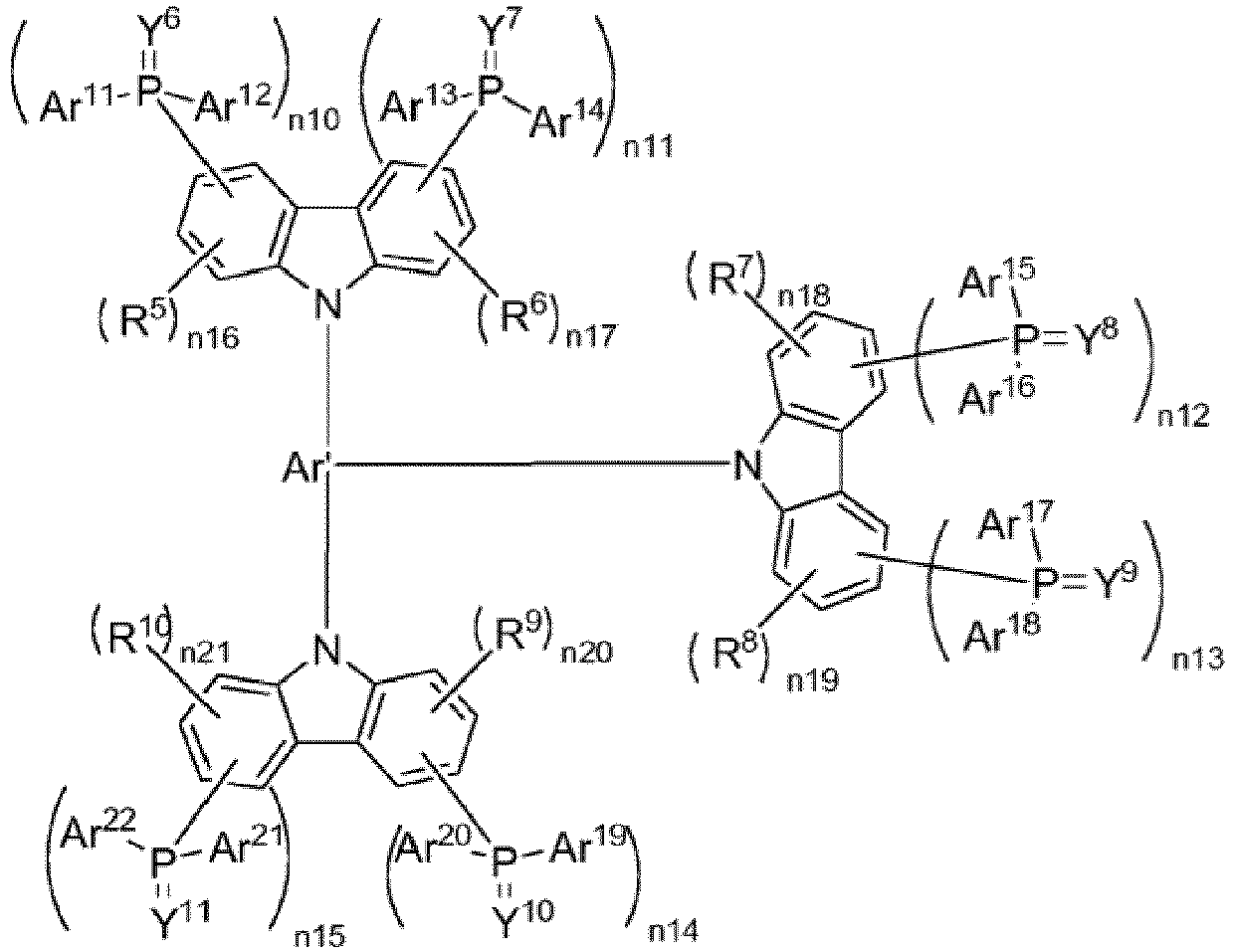 wobei Ar' eine substituierte oder unsubstituierte Arylgruppe mit 6 bis 50 Ringkohlenstoffen, oder eine substituierte oder unsubstituierte Heteroarylgruppe mit 5 bis 50 Ringatomen darstellt,Y6 bis Y11 unabhängig voneinander ein Sauerstoffatom, ein Schwefelatom oder ein Selenatom sind,Ar11 bis Ar22 identische oder unterschiedliche Substituenten sind und jeweils eine substituierte oder unsubstituierte Arylgruppe mit 6 bis 50 Ringkohlenstoffen, oder eine substituierte oder unsubstituierte Heteroarylgruppe mit 5 bis 50 Ringatomen darstellen,R5 bis R10 jeweils eine Einheit darstellen, die eine konjugierte Struktur einer Carbazoleinheit nicht erweitert, und ein Teil oder alle von R5 bis R10 unabhängig voneinander ein Wasserstoffatom sind, oder R5 bis R10 identische oder unterschiedliche Substituenten sind und jeweils ein Halogenatom, eine Cyanogruppe, eine Nitrogruppe, eine substituierte oder unsubstituierte Alkylgruppe mit 1 bis 50 Kohlenstoffen, eine substituierte oder unsubstituierte Cycloalkylgruppe mit 3 bis 50 Kohlenstoffen, eine substituierte oder unsubstituierte Thiogruppe mit 1 bis 50 Kohlenstoffen, oder eine substituierte oder unsubstituierte Silylgruppe mit 1 bis 50 Kohlenstoffen darstellen,wobei eine für die Substitution an dem Ar', Ar11 bis Ar22, und R5 bis R10 geeignete Gruppe identisch oder unterschiedlich ist und ein Halogenatom, eine Cyanogruppe, eine Nitrogruppe, eine Arylgruppe mit 6 bis 50 Ringkohlenstoffen, eine Heteroarylgruppe mit 5 bis 50 Ringatomen, eine Alkylgruppe mit 1 bis 50 Kohlenstoffen, eine Cycloalkylgruppe mit 3 bis 50 Kohlenstoffen, eine Thiogruppe mit 1 bis 50 Kohlenstoffen, oder eine Silylgruppe mit 1 bis 50 Kohlenstoffen darstellt,n10 bis n15 unabhängig voneinander 0 oder 1 sind,n10+n11+n12+n13+n14+n15≠0, undn16 bis n21 unabhängig voneinander 0 oder 1 sind.
 - Verbindung nach Anspruch 1, wobei in der chemischen Formel 1 Ar eine Phenylgruppe ist, Y1 bis Y5 ein Sauerstoffatom sind, Ar1 bis Ar10 jeweils eine Phenylgruppe darstellen, R1 bis R4 jeweils ein Wasserstoffatom darstellen, n1 bis n5 unabhängig voneinander 0 oder 1 sind, n1+n2+n3+n4+n5≠0, und n6 bis n9 unabhängig voneinander 0 oder 1 sind.
- Verbindung nach Anspruch 1, wobei in der chemischen Formel 2 Ar' eine substituierte oder unsubstituierte Phenylgruppe mit 6 bis 34 Kohlenstoffen, eine substituierte oder unsubstituierte Biphenylgruppe, eine substituierte oder unsubstituierte Terphenylgruppe, eine substituierte oder unsubstituierte Naphthylgruppe, eine substituierte oder unsubstituierte Anthrylgruppe, substituiertes oder unsubstituiertes Phenylcarbazol, substituiertes oder unsubstituiertes Phenylindol, substituiertes oder unsubstituiertes Pyrenyl, substituiertes oder unsubstituiertes Pyridin, substituiertes oder unsubstituiertes Pyridazin, oder substituiertes oder unsubstituiertes Pyrimidin darstellt,Y6 bis Y11 ein Sauerstoffatom sind,Ar11 bis Ar22 identische oder unterschiedliche Substituenten sind und jeweils eine substituierte oder unsubstituierte Phenylgruppe mit 6 bis 34 Kohlenstoffen, eine substituierte oder unsubstituierte Biphenylgruppe, eine substituierte oder unsubstituierte Terphenylgruppe, eine substituierte oder unsubstituierte Naphthylgruppe, eine substituierte oder unsubstituierte Anthrylgruppe, oder eine substituierte oder unsubstituierte Pyrenylgruppe darstellen,R5 bis R10 jeweils eine Einheit darstellen, die eine konjugierte Struktur einer Carbazoleinheit nicht erweitert, und ein Teil oder alle von R5 bis R10 unabhängig voneinander ein Wasserstoffatom sind, oder R5 bis R10 identische oder unterschiedliche Substituenten sind und jeweils ein Halogenatom, ein Cyanogruppe, eine Nitrogruppe, tert.-Butyl, substituiertes oder unsubstituiertes Triphenylmethyl, substituiertes oder unsubstituiertes Diphenylmethyl, substituiertes oder unsubstituiertes Phenylmethyl, Methylsilyl, substituiertes oder unsubstituiertes Triphenylsilyl, Methyl, Ethyl oder Propyl darstellen,wobei die zur Substitution an dem Ar', Ar11 bis Ar22, und R5 bis R10 geeignete Gruppe identisch oder unterschiedlich ist und ein Halogenatom, eine Cyanogruppe, eine Nitrogruppe, eine Arylgruppe mit 6 bis 34 Ringkohlenstoffen, eine Heteroarylgruppe mit 5 bis 34 Ringatomen, eine Alkylgruppe mit 1 bis 34 Kohlenstoffen, eine Cycloalkylgruppe mit 3 bis 34 Kohlenstoffen, eine Thiogruppe mit 1 bis 34 Kohlenstoffen, oder eine Silylgruppe mit 1 bis 34 Kohlenstoffen darstellt,n10 bis n15 unabhängig voneinander 0 oder 1 sind,n10+n11+n12+n13+n14+n15≠0, undn16 bis n21 unabhängig voneinander 0 oder 1 sind.
- Verbindung nach Anspruch 1, wobei in der chemischen Formel 2 Ar' eine Phenylgruppe darstellt, Y6 bis Y11 ein Sauerstoffatom sind, Ar11 bis Ar22 jeweils eine Phenylgruppe darstellen, R5 bis R10 jeweils ein Wasserstoffatom darstellen, n10 bis n15 unabhängig voneinander 0 oder 1 sind, n10+n11+n12+n13+n14+n15≠0, und n16 bis n21 unabhängig voneinander 0 oder 1 sind.
- Organische Elektrolumineszenzvorrichtung, umfassend:eine erste Elektrode; eine zweite Elektrode; und eine lichtemittierende Schicht, die einen Wirt und einen Dotierstoff enthält,wobei der Wirt die Verbindung für eine organische Elektrolumineszenzvorrichtung nach Anspruch 1 enthält.
- Organische Elektrolumineszenzvorrichtung nach Anspruch 5, ferner umfassend eine Elektronentransportschicht; und eine Lochtransportschicht.
- Organische Elektrolumineszenzvorrichtung nach Anspruch 6, wobei die Lochtransportschicht oder die Elektronentransportschicht die Verbindung für eine organische Elektrolumineszenzvorrichtung nach Anspruch 1 enthält.
- Organische Elektrolumineszenzvorrichtung, umfassend:eine erste Elektrode; eine zweite Elektrode; eine lichtemittierende Schicht; eine Elektronentransportschicht; und eine Lochtransportschicht,wobei die Lochtransportschicht oder die Elektronentransportschicht die Verbindung für eine organische Elektrolumineszenzvorrichtung nach Anspruch 1 enthält.
- Organische Elektrolumineszenzvorrichtung nach Anspruch 8, ferner umfassend eine oder mehrere Schichten, die ausgewählt sind aus einer Lochinjektionsschicht und einer Elektroneninjektionsschicht.
Applications Claiming Priority (2)
| Application Number | Priority Date | Filing Date | Title |
|---|---|---|---|
| KR1020100061704A KR101211471B1 (ko) | 2010-06-29 | 2010-06-29 | 고효율 카바졸계 화합물 및 이를 포함하는 유기전계 발광소자 |
| PCT/KR2011/004584 WO2012002671A2 (ko) | 2010-06-29 | 2011-06-23 | 고효율 카바졸계 화합물 및 이를 포함하는 유기전계 발광소자 |
Publications (3)
| Publication Number | Publication Date |
|---|---|
| EP2589643A2 EP2589643A2 (de) | 2013-05-08 |
| EP2589643A4 EP2589643A4 (de) | 2015-11-11 |
| EP2589643B1 true EP2589643B1 (de) | 2017-09-20 |
Family
ID=45402526
Family Applications (1)
| Application Number | Title | Priority Date | Filing Date |
|---|---|---|---|
| EP11801078.4A Not-in-force EP2589643B1 (de) | 2010-06-29 | 2011-06-23 | Hocheffiziente verbindung auf carbazolbasis sowie organische elektrolumineszenzvorrichtung damit |
Country Status (6)
| Country | Link |
|---|---|
| US (1) | US9142784B2 (de) |
| EP (1) | EP2589643B1 (de) |
| JP (1) | JP5856161B2 (de) |
| KR (1) | KR101211471B1 (de) |
| CN (1) | CN102959040B (de) |
| WO (1) | WO2012002671A2 (de) |
Families Citing this family (3)
| Publication number | Priority date | Publication date | Assignee | Title |
|---|---|---|---|---|
| KR101944860B1 (ko) * | 2011-07-04 | 2019-02-01 | 엘지디스플레이 주식회사 | 청색 인광 화합물 및 이를 사용한 유기전계발광소자 |
| CN104177285A (zh) * | 2013-05-28 | 2014-12-03 | 海洋王照明科技股份有限公司 | 双极性蓝光磷光主体材料及其制备方法和有机电致发光器件 |
| JP6512301B2 (ja) * | 2015-03-05 | 2019-05-15 | エルジー・ケム・リミテッド | ヘテロ環化合物およびこれを含む有機発光素子 |
Family Cites Families (13)
| Publication number | Priority date | Publication date | Assignee | Title |
|---|---|---|---|---|
| DE10203328A1 (de) | 2002-01-28 | 2003-08-07 | Syntec Ges Fuer Chemie Und Tec | Neue Triarylamin-Derivate mit raumfüllenden Flügelgruppen und ihre Einsatz in elektro-fotografischen und organischen elektrolumineszenten Vorrichtungen |
| KR101199276B1 (ko) * | 2005-01-25 | 2012-11-09 | 미쓰비시 가가꾸 가부시키가이샤 | 유기 화합물, 전하 수송 재료, 및 유기 전계 발광 소자 |
| KR100707482B1 (ko) | 2005-04-15 | 2007-04-13 | 주식회사 진웅산업 | 아릴 포스핀 옥사이드계 화합물, 아릴포스핀 설파이드계화합물 또는 아릴포스핀 셀레나이드계 화합물 및 이를이용한 유기전계발광소자 |
| CN101321728A (zh) * | 2005-12-02 | 2008-12-10 | 东洋油墨制造株式会社 | 具有咔唑基的二氨基亚芳基化合物及其用途 |
| WO2007063986A1 (ja) * | 2005-12-02 | 2007-06-07 | Toyo Ink Manufacturing Co., Ltd. | カルバゾリル基を有するジアミノアリーレン化合物及びその用途 |
| US20070262704A1 (en) | 2006-05-15 | 2007-11-15 | Ken-Tsung Wong | Carbazole-based Compounds and Their Application |
| CN100569750C (zh) * | 2007-08-07 | 2009-12-16 | 中国科学院长春应用化学研究所 | 树枝状主体材料及该化合物制备的有机电致发光器件 |
| WO2010046259A1 (en) * | 2008-10-21 | 2010-04-29 | Basf Se | Polycyclic compounds for electronic applications |
| TWI466980B (zh) * | 2009-02-27 | 2015-01-01 | Nippon Steel & Sumikin Chem Co | Organic electroluminescent elements |
| KR101092170B1 (ko) * | 2009-05-27 | 2011-12-13 | 단국대학교 산학협력단 | 카바졸계 포스핀 옥사이드 화합물 및 이를 포함하는 유기 전계 발광 소자 |
| CN101747373B (zh) * | 2010-01-20 | 2013-04-10 | 中国科学院长春应用化学研究所 | 咔唑类化合物、含有咔唑类化合物的有机电致发光器件及其制备方法 |
| JP5727237B2 (ja) * | 2010-02-17 | 2015-06-03 | ケミプロ化成株式会社 | 新規なビカルバゾリル誘導体、それよりなるホスト材料およびそれを用いた有機エレクトロルミネッセンス素子 |
| KR101420318B1 (ko) * | 2010-06-17 | 2014-07-16 | 이-레이 옵토일렉트로닉스 테크놀로지 컴퍼니 리미티드 | 유기전계발광장치용 화합물 및 이를 포함하는 유기전계발광장치 |
-
2010
- 2010-06-29 KR KR1020100061704A patent/KR101211471B1/ko not_active Expired - Fee Related
-
2011
- 2011-06-23 EP EP11801078.4A patent/EP2589643B1/de not_active Not-in-force
- 2011-06-23 US US13/807,504 patent/US9142784B2/en not_active Expired - Fee Related
- 2011-06-23 CN CN201180031514.8A patent/CN102959040B/zh not_active Expired - Fee Related
- 2011-06-23 JP JP2013518237A patent/JP5856161B2/ja not_active Expired - Fee Related
- 2011-06-23 WO PCT/KR2011/004584 patent/WO2012002671A2/ko not_active Ceased
Non-Patent Citations (1)
| Title |
|---|
| None * |
Also Published As
| Publication number | Publication date |
|---|---|
| US20130119367A1 (en) | 2013-05-16 |
| US9142784B2 (en) | 2015-09-22 |
| KR20120001084A (ko) | 2012-01-04 |
| EP2589643A2 (de) | 2013-05-08 |
| KR101211471B1 (ko) | 2012-12-12 |
| WO2012002671A2 (ko) | 2012-01-05 |
| WO2012002671A3 (ko) | 2012-05-18 |
| JP5856161B2 (ja) | 2016-02-09 |
| EP2589643A4 (de) | 2015-11-11 |
| JP2013535809A (ja) | 2013-09-12 |
| CN102959040A (zh) | 2013-03-06 |
| CN102959040B (zh) | 2015-05-20 |
Similar Documents
| Publication | Publication Date | Title |
|---|---|---|
| EP2436751B1 (de) | Carbazolbasierte phosphinoxidverbindung und organisches elektrolumineszenzelement damit | |
| JP5753873B2 (ja) | 有機エレクトロルミネッセンス素子用材料及びそれを用いた有機エレクトロルミネッセンス素子 | |
| CN108369992B (zh) | 有机el发光装置和电子设备 | |
| JP4490923B2 (ja) | 有機エレクトロルミネッセンス素子用材料及びそれを用いた有機エレクロルミネッセンス素子 | |
| JP6034196B2 (ja) | 有機エレクトロルミネッセンス素子用材料及びそれを用いた有機エレクトロルミネッセンス素子 | |
| JP2009267257A (ja) | 有機エレクトロルミネッセンス素子用材料及びそれを用いた有機エレクトロルミネッセンス素子 | |
| JP5544103B2 (ja) | 芳香族化合物、有機電子素子用材料及びそれを用いた有機エレクトロルミネッセンス素子 | |
| JPWO2011122133A1 (ja) | 有機エレクトロルミネッセンス素子用材料及びそれを用いた有機エレクトロルミネッセンス素子 | |
| JP2009263579A (ja) | 有機エレクトロルミネッセンス素子用材料及びそれを用いた有機エレクトロルミネッセンス素子 | |
| CN105609649A (zh) | 有机电致发光装置 | |
| JP2016076569A (ja) | 有機電界発光素子 | |
| JP2016092297A (ja) | 有機電界発光素子 | |
| JP2015103583A (ja) | 有機エレクトロルミネッセンス素子用材料及びそれを用いた有機エレクトロルミネッセンス素子 | |
| EP2589643B1 (de) | Hocheffiziente verbindung auf carbazolbasis sowie organische elektrolumineszenzvorrichtung damit | |
| JP2016076568A (ja) | 有機電界発光素子 | |
| JP2015119059A (ja) | 有機エレクトロルミネッセンス素子用材料及びそれを用いた有機エレクトロルミネッセンス素子 | |
| JP2016100377A (ja) | 有機電界発光素子 | |
| JP2016111065A (ja) | 有機電界発光素子 | |
| JP2007230974A (ja) | 有機エレクトロルミネッセンス素子及び有機エレクトロルミネッセンス素子用材料 | |
| JP2016100376A (ja) | 有機電界発光素子 | |
| JP2016225458A (ja) | 有機電界発光素子 | |
| JP2016111099A (ja) | 有機電界発光素子 | |
| JP2017011114A (ja) | 有機電界発光素子 | |
| JP2017011113A (ja) | 有機電界発光素子 | |
| JP2016111098A (ja) | 有機電界発光素子 |
Legal Events
| Date | Code | Title | Description |
|---|---|---|---|
| PUAI | Public reference made under article 153(3) epc to a published international application that has entered the european phase |
Free format text: ORIGINAL CODE: 0009012 |
|
| 17P | Request for examination filed |
Effective date: 20130123 |
|
| AK | Designated contracting states |
Kind code of ref document: A2 Designated state(s): AL AT BE BG CH CY CZ DE DK EE ES FI FR GB GR HR HU IE IS IT LI LT LU LV MC MK MT NL NO PL PT RO RS SE SI SK SM TR |
|
| RIN1 | Information on inventor provided before grant (corrected) |
Inventor name: LEE, JUN YEOB Inventor name: YOOK, KYOUNG SOO Inventor name: SON, HYO SUK Inventor name: JEON, SOON OK Inventor name: JANG, SANG EOK |
|
| DAX | Request for extension of the european patent (deleted) | ||
| RAP1 | Party data changed (applicant data changed or rights of an application transferred) |
Owner name: SK CHEMICALS CO., LTD. |
|
| A4 | Supplementary search report drawn up and despatched |
Effective date: 20151009 |
|
| RIC1 | Information provided on ipc code assigned before grant |
Ipc: H01L 51/50 20060101ALI20151005BHEP Ipc: C09K 11/06 20060101AFI20151005BHEP |
|
| GRAP | Despatch of communication of intention to grant a patent |
Free format text: ORIGINAL CODE: EPIDOSNIGR1 |
|
| INTG | Intention to grant announced |
Effective date: 20170515 |
|
| GRAS | Grant fee paid |
Free format text: ORIGINAL CODE: EPIDOSNIGR3 |
|
| GRAA | (expected) grant |
Free format text: ORIGINAL CODE: 0009210 |
|
| AK | Designated contracting states |
Kind code of ref document: B1 Designated state(s): AL AT BE BG CH CY CZ DE DK EE ES FI FR GB GR HR HU IE IS IT LI LT LU LV MC MK MT NL NO PL PT RO RS SE SI SK SM TR |
|
| REG | Reference to a national code |
Ref country code: GB Ref legal event code: FG4D |
|
| REG | Reference to a national code |
Ref country code: CH Ref legal event code: EP |
|
| REG | Reference to a national code |
Ref country code: AT Ref legal event code: REF Ref document number: 930112 Country of ref document: AT Kind code of ref document: T Effective date: 20171015 |
|
| REG | Reference to a national code |
Ref country code: IE Ref legal event code: FG4D |
|
| REG | Reference to a national code |
Ref country code: DE Ref legal event code: R096 Ref document number: 602011041766 Country of ref document: DE |
|
| REG | Reference to a national code |
Ref country code: NL Ref legal event code: MP Effective date: 20170920 |
|
| PG25 | Lapsed in a contracting state [announced via postgrant information from national office to epo] |
Ref country code: LT Free format text: LAPSE BECAUSE OF FAILURE TO SUBMIT A TRANSLATION OF THE DESCRIPTION OR TO PAY THE FEE WITHIN THE PRESCRIBED TIME-LIMIT Effective date: 20170920 Ref country code: NO Free format text: LAPSE BECAUSE OF FAILURE TO SUBMIT A TRANSLATION OF THE DESCRIPTION OR TO PAY THE FEE WITHIN THE PRESCRIBED TIME-LIMIT Effective date: 20171220 Ref country code: SE Free format text: LAPSE BECAUSE OF FAILURE TO SUBMIT A TRANSLATION OF THE DESCRIPTION OR TO PAY THE FEE WITHIN THE PRESCRIBED TIME-LIMIT Effective date: 20170920 Ref country code: FI Free format text: LAPSE BECAUSE OF FAILURE TO SUBMIT A TRANSLATION OF THE DESCRIPTION OR TO PAY THE FEE WITHIN THE PRESCRIBED TIME-LIMIT Effective date: 20170920 Ref country code: HR Free format text: LAPSE BECAUSE OF FAILURE TO SUBMIT A TRANSLATION OF THE DESCRIPTION OR TO PAY THE FEE WITHIN THE PRESCRIBED TIME-LIMIT Effective date: 20170920 |
|
| REG | Reference to a national code |
Ref country code: LT Ref legal event code: MG4D |
|
| REG | Reference to a national code |
Ref country code: AT Ref legal event code: MK05 Ref document number: 930112 Country of ref document: AT Kind code of ref document: T Effective date: 20170920 |
|
| PG25 | Lapsed in a contracting state [announced via postgrant information from national office to epo] |
Ref country code: GR Free format text: LAPSE BECAUSE OF FAILURE TO SUBMIT A TRANSLATION OF THE DESCRIPTION OR TO PAY THE FEE WITHIN THE PRESCRIBED TIME-LIMIT Effective date: 20171221 Ref country code: RS Free format text: LAPSE BECAUSE OF FAILURE TO SUBMIT A TRANSLATION OF THE DESCRIPTION OR TO PAY THE FEE WITHIN THE PRESCRIBED TIME-LIMIT Effective date: 20170920 Ref country code: BG Free format text: LAPSE BECAUSE OF FAILURE TO SUBMIT A TRANSLATION OF THE DESCRIPTION OR TO PAY THE FEE WITHIN THE PRESCRIBED TIME-LIMIT Effective date: 20171220 Ref country code: LV Free format text: LAPSE BECAUSE OF FAILURE TO SUBMIT A TRANSLATION OF THE DESCRIPTION OR TO PAY THE FEE WITHIN THE PRESCRIBED TIME-LIMIT Effective date: 20170920 |
|
| PG25 | Lapsed in a contracting state [announced via postgrant information from national office to epo] |
Ref country code: NL Free format text: LAPSE BECAUSE OF FAILURE TO SUBMIT A TRANSLATION OF THE DESCRIPTION OR TO PAY THE FEE WITHIN THE PRESCRIBED TIME-LIMIT Effective date: 20170920 |
|
| PG25 | Lapsed in a contracting state [announced via postgrant information from national office to epo] |
Ref country code: CZ Free format text: LAPSE BECAUSE OF FAILURE TO SUBMIT A TRANSLATION OF THE DESCRIPTION OR TO PAY THE FEE WITHIN THE PRESCRIBED TIME-LIMIT Effective date: 20170920 Ref country code: RO Free format text: LAPSE BECAUSE OF FAILURE TO SUBMIT A TRANSLATION OF THE DESCRIPTION OR TO PAY THE FEE WITHIN THE PRESCRIBED TIME-LIMIT Effective date: 20170920 Ref country code: ES Free format text: LAPSE BECAUSE OF FAILURE TO SUBMIT A TRANSLATION OF THE DESCRIPTION OR TO PAY THE FEE WITHIN THE PRESCRIBED TIME-LIMIT Effective date: 20170920 Ref country code: PL Free format text: LAPSE BECAUSE OF FAILURE TO SUBMIT A TRANSLATION OF THE DESCRIPTION OR TO PAY THE FEE WITHIN THE PRESCRIBED TIME-LIMIT Effective date: 20170920 |
|
| PG25 | Lapsed in a contracting state [announced via postgrant information from national office to epo] |
Ref country code: IS Free format text: LAPSE BECAUSE OF FAILURE TO SUBMIT A TRANSLATION OF THE DESCRIPTION OR TO PAY THE FEE WITHIN THE PRESCRIBED TIME-LIMIT Effective date: 20180120 Ref country code: SK Free format text: LAPSE BECAUSE OF FAILURE TO SUBMIT A TRANSLATION OF THE DESCRIPTION OR TO PAY THE FEE WITHIN THE PRESCRIBED TIME-LIMIT Effective date: 20170920 Ref country code: IT Free format text: LAPSE BECAUSE OF FAILURE TO SUBMIT A TRANSLATION OF THE DESCRIPTION OR TO PAY THE FEE WITHIN THE PRESCRIBED TIME-LIMIT Effective date: 20170920 Ref country code: SM Free format text: LAPSE BECAUSE OF FAILURE TO SUBMIT A TRANSLATION OF THE DESCRIPTION OR TO PAY THE FEE WITHIN THE PRESCRIBED TIME-LIMIT Effective date: 20170920 Ref country code: EE Free format text: LAPSE BECAUSE OF FAILURE TO SUBMIT A TRANSLATION OF THE DESCRIPTION OR TO PAY THE FEE WITHIN THE PRESCRIBED TIME-LIMIT Effective date: 20170920 Ref country code: AT Free format text: LAPSE BECAUSE OF FAILURE TO SUBMIT A TRANSLATION OF THE DESCRIPTION OR TO PAY THE FEE WITHIN THE PRESCRIBED TIME-LIMIT Effective date: 20170920 |
|
| REG | Reference to a national code |
Ref country code: DE Ref legal event code: R097 Ref document number: 602011041766 Country of ref document: DE |
|
| PLBE | No opposition filed within time limit |
Free format text: ORIGINAL CODE: 0009261 |
|
| STAA | Information on the status of an ep patent application or granted ep patent |
Free format text: STATUS: NO OPPOSITION FILED WITHIN TIME LIMIT |
|
| PG25 | Lapsed in a contracting state [announced via postgrant information from national office to epo] |
Ref country code: DK Free format text: LAPSE BECAUSE OF FAILURE TO SUBMIT A TRANSLATION OF THE DESCRIPTION OR TO PAY THE FEE WITHIN THE PRESCRIBED TIME-LIMIT Effective date: 20170920 |
|
| 26N | No opposition filed |
Effective date: 20180621 |
|
| PG25 | Lapsed in a contracting state [announced via postgrant information from national office to epo] |
Ref country code: SI Free format text: LAPSE BECAUSE OF FAILURE TO SUBMIT A TRANSLATION OF THE DESCRIPTION OR TO PAY THE FEE WITHIN THE PRESCRIBED TIME-LIMIT Effective date: 20170920 |
|
| REG | Reference to a national code |
Ref country code: CH Ref legal event code: PL |
|
| REG | Reference to a national code |
Ref country code: BE Ref legal event code: MM Effective date: 20180630 |
|
| REG | Reference to a national code |
Ref country code: IE Ref legal event code: MM4A |
|
| PG25 | Lapsed in a contracting state [announced via postgrant information from national office to epo] |
Ref country code: MC Free format text: LAPSE BECAUSE OF FAILURE TO SUBMIT A TRANSLATION OF THE DESCRIPTION OR TO PAY THE FEE WITHIN THE PRESCRIBED TIME-LIMIT Effective date: 20170920 Ref country code: LU Free format text: LAPSE BECAUSE OF NON-PAYMENT OF DUE FEES Effective date: 20180623 |
|
| PG25 | Lapsed in a contracting state [announced via postgrant information from national office to epo] |
Ref country code: IE Free format text: LAPSE BECAUSE OF NON-PAYMENT OF DUE FEES Effective date: 20180623 Ref country code: FR Free format text: LAPSE BECAUSE OF NON-PAYMENT OF DUE FEES Effective date: 20180630 Ref country code: LI Free format text: LAPSE BECAUSE OF NON-PAYMENT OF DUE FEES Effective date: 20180630 Ref country code: CH Free format text: LAPSE BECAUSE OF NON-PAYMENT OF DUE FEES Effective date: 20180630 |
|
| PG25 | Lapsed in a contracting state [announced via postgrant information from national office to epo] |
Ref country code: BE Free format text: LAPSE BECAUSE OF NON-PAYMENT OF DUE FEES Effective date: 20180630 |
|
| PGFP | Annual fee paid to national office [announced via postgrant information from national office to epo] |
Ref country code: DE Payment date: 20190520 Year of fee payment: 9 |
|
| PGFP | Annual fee paid to national office [announced via postgrant information from national office to epo] |
Ref country code: GB Payment date: 20190521 Year of fee payment: 9 |
|
| PG25 | Lapsed in a contracting state [announced via postgrant information from national office to epo] |
Ref country code: MT Free format text: LAPSE BECAUSE OF NON-PAYMENT OF DUE FEES Effective date: 20180623 |
|
| PG25 | Lapsed in a contracting state [announced via postgrant information from national office to epo] |
Ref country code: TR Free format text: LAPSE BECAUSE OF FAILURE TO SUBMIT A TRANSLATION OF THE DESCRIPTION OR TO PAY THE FEE WITHIN THE PRESCRIBED TIME-LIMIT Effective date: 20170920 |
|
| PG25 | Lapsed in a contracting state [announced via postgrant information from national office to epo] |
Ref country code: HU Free format text: LAPSE BECAUSE OF FAILURE TO SUBMIT A TRANSLATION OF THE DESCRIPTION OR TO PAY THE FEE WITHIN THE PRESCRIBED TIME-LIMIT; INVALID AB INITIO Effective date: 20110623 Ref country code: PT Free format text: LAPSE BECAUSE OF FAILURE TO SUBMIT A TRANSLATION OF THE DESCRIPTION OR TO PAY THE FEE WITHIN THE PRESCRIBED TIME-LIMIT Effective date: 20170920 |
|
| PG25 | Lapsed in a contracting state [announced via postgrant information from national office to epo] |
Ref country code: CY Free format text: LAPSE BECAUSE OF FAILURE TO SUBMIT A TRANSLATION OF THE DESCRIPTION OR TO PAY THE FEE WITHIN THE PRESCRIBED TIME-LIMIT Effective date: 20170920 Ref country code: MK Free format text: LAPSE BECAUSE OF NON-PAYMENT OF DUE FEES Effective date: 20170920 |
|
| PG25 | Lapsed in a contracting state [announced via postgrant information from national office to epo] |
Ref country code: AL Free format text: LAPSE BECAUSE OF FAILURE TO SUBMIT A TRANSLATION OF THE DESCRIPTION OR TO PAY THE FEE WITHIN THE PRESCRIBED TIME-LIMIT Effective date: 20170920 |
|
| REG | Reference to a national code |
Ref country code: DE Ref legal event code: R119 Ref document number: 602011041766 Country of ref document: DE |
|
| GBPC | Gb: european patent ceased through non-payment of renewal fee |
Effective date: 20200623 |
|
| PG25 | Lapsed in a contracting state [announced via postgrant information from national office to epo] |
Ref country code: GB Free format text: LAPSE BECAUSE OF NON-PAYMENT OF DUE FEES Effective date: 20200623 |
|
| PG25 | Lapsed in a contracting state [announced via postgrant information from national office to epo] |
Ref country code: DE Free format text: LAPSE BECAUSE OF NON-PAYMENT OF DUE FEES Effective date: 20210101 |