EP2569354B1 - Polymer-zusammensetzung mit wärme-absorbierenden eigenschaften und verbesserten farbeigenschaften - Google Patents
Polymer-zusammensetzung mit wärme-absorbierenden eigenschaften und verbesserten farbeigenschaften Download PDFInfo
- Publication number
- EP2569354B1 EP2569354B1 EP11718988.6A EP11718988A EP2569354B1 EP 2569354 B1 EP2569354 B1 EP 2569354B1 EP 11718988 A EP11718988 A EP 11718988A EP 2569354 B1 EP2569354 B1 EP 2569354B1
- Authority
- EP
- European Patent Office
- Prior art keywords
- boride
- weight
- absorber
- color
- finished part
- Prior art date
- Legal status (The legal status is an assumption and is not a legal conclusion. Google has not performed a legal analysis and makes no representation as to the accuracy of the status listed.)
- Active
Links
- 0 CC=CC1=C(C=C*)C2=NC(CC=Cc3ccc4)c3c4N2C1=O Chemical compound CC=CC1=C(C=C*)C2=NC(CC=Cc3ccc4)c3c4N2C1=O 0.000 description 1
Images
Classifications
-
- C—CHEMISTRY; METALLURGY
- C08—ORGANIC MACROMOLECULAR COMPOUNDS; THEIR PREPARATION OR CHEMICAL WORKING-UP; COMPOSITIONS BASED THEREON
- C08K—Use of inorganic or non-macromolecular organic substances as compounding ingredients
- C08K3/00—Use of inorganic substances as compounding ingredients
- C08K3/38—Boron-containing compounds
-
- C—CHEMISTRY; METALLURGY
- C08—ORGANIC MACROMOLECULAR COMPOUNDS; THEIR PREPARATION OR CHEMICAL WORKING-UP; COMPOSITIONS BASED THEREON
- C08J—WORKING-UP; GENERAL PROCESSES OF COMPOUNDING; AFTER-TREATMENT NOT COVERED BY SUBCLASSES C08B, C08C, C08F, C08G or C08H
- C08J3/00—Processes of treating or compounding macromolecular substances
- C08J3/20—Compounding polymers with additives, e.g. colouring
- C08J3/22—Compounding polymers with additives, e.g. colouring using masterbatch techniques
-
- C—CHEMISTRY; METALLURGY
- C08—ORGANIC MACROMOLECULAR COMPOUNDS; THEIR PREPARATION OR CHEMICAL WORKING-UP; COMPOSITIONS BASED THEREON
- C08J—WORKING-UP; GENERAL PROCESSES OF COMPOUNDING; AFTER-TREATMENT NOT COVERED BY SUBCLASSES C08B, C08C, C08F, C08G or C08H
- C08J5/00—Manufacture of articles or shaped materials containing macromolecular substances
- C08J5/005—Reinforced macromolecular compounds with nanosized materials, e.g. nanoparticles, nanofibres, nanotubes, nanowires, nanorods or nanolayered materials
-
- C—CHEMISTRY; METALLURGY
- C08—ORGANIC MACROMOLECULAR COMPOUNDS; THEIR PREPARATION OR CHEMICAL WORKING-UP; COMPOSITIONS BASED THEREON
- C08K—Use of inorganic or non-macromolecular organic substances as compounding ingredients
- C08K3/00—Use of inorganic substances as compounding ingredients
- C08K3/02—Elements
- C08K3/04—Carbon
-
- C—CHEMISTRY; METALLURGY
- C08—ORGANIC MACROMOLECULAR COMPOUNDS; THEIR PREPARATION OR CHEMICAL WORKING-UP; COMPOSITIONS BASED THEREON
- C08K—Use of inorganic or non-macromolecular organic substances as compounding ingredients
- C08K5/00—Use of organic ingredients
- C08K5/49—Phosphorus-containing compounds
- C08K5/50—Phosphorus bound to carbon only
-
- C—CHEMISTRY; METALLURGY
- C08—ORGANIC MACROMOLECULAR COMPOUNDS; THEIR PREPARATION OR CHEMICAL WORKING-UP; COMPOSITIONS BASED THEREON
- C08L—COMPOSITIONS OF MACROMOLECULAR COMPOUNDS
- C08L101/00—Compositions of unspecified macromolecular compounds
-
- C—CHEMISTRY; METALLURGY
- C09—DYES; PAINTS; POLISHES; NATURAL RESINS; ADHESIVES; COMPOSITIONS NOT OTHERWISE PROVIDED FOR; APPLICATIONS OF MATERIALS NOT OTHERWISE PROVIDED FOR
- C09C—TREATMENT OF INORGANIC MATERIALS, OTHER THAN FIBROUS FILLERS, TO ENHANCE THEIR PIGMENTING OR FILLING PROPERTIES ; PREPARATION OF CARBON BLACK ; PREPARATION OF INORGANIC MATERIALS WHICH ARE NO SINGLE CHEMICAL COMPOUNDS AND WHICH ARE MAINLY USED AS PIGMENTS OR FILLERS
- C09C1/00—Treatment of specific inorganic materials other than fibrous fillers; Preparation of carbon black
- C09C1/44—Carbon
- C09C1/48—Carbon black
-
- C—CHEMISTRY; METALLURGY
- C08—ORGANIC MACROMOLECULAR COMPOUNDS; THEIR PREPARATION OR CHEMICAL WORKING-UP; COMPOSITIONS BASED THEREON
- C08K—Use of inorganic or non-macromolecular organic substances as compounding ingredients
- C08K2201/00—Specific properties of additives
- C08K2201/011—Nanostructured additives
-
- C—CHEMISTRY; METALLURGY
- C08—ORGANIC MACROMOLECULAR COMPOUNDS; THEIR PREPARATION OR CHEMICAL WORKING-UP; COMPOSITIONS BASED THEREON
- C08K—Use of inorganic or non-macromolecular organic substances as compounding ingredients
- C08K3/00—Use of inorganic substances as compounding ingredients
- C08K3/01—Use of inorganic substances as compounding ingredients characterized by their specific function
- C08K3/013—Fillers, pigments or reinforcing additives
-
- C—CHEMISTRY; METALLURGY
- C08—ORGANIC MACROMOLECULAR COMPOUNDS; THEIR PREPARATION OR CHEMICAL WORKING-UP; COMPOSITIONS BASED THEREON
- C08K—Use of inorganic or non-macromolecular organic substances as compounding ingredients
- C08K5/00—Use of organic ingredients
- C08K5/0008—Organic ingredients according to more than one of the "one dot" groups of C08K5/01 - C08K5/59
- C08K5/0041—Optical brightening agents, organic pigments
-
- Y—GENERAL TAGGING OF NEW TECHNOLOGICAL DEVELOPMENTS; GENERAL TAGGING OF CROSS-SECTIONAL TECHNOLOGIES SPANNING OVER SEVERAL SECTIONS OF THE IPC; TECHNICAL SUBJECTS COVERED BY FORMER USPC CROSS-REFERENCE ART COLLECTIONS [XRACs] AND DIGESTS
- Y10—TECHNICAL SUBJECTS COVERED BY FORMER USPC
- Y10T—TECHNICAL SUBJECTS COVERED BY FORMER US CLASSIFICATION
- Y10T428/00—Stock material or miscellaneous articles
- Y10T428/25—Web or sheet containing structurally defined element or component and including a second component containing structurally defined particles
-
- Y—GENERAL TAGGING OF NEW TECHNOLOGICAL DEVELOPMENTS; GENERAL TAGGING OF CROSS-SECTIONAL TECHNOLOGIES SPANNING OVER SEVERAL SECTIONS OF THE IPC; TECHNICAL SUBJECTS COVERED BY FORMER USPC CROSS-REFERENCE ART COLLECTIONS [XRACs] AND DIGESTS
- Y10—TECHNICAL SUBJECTS COVERED BY FORMER USPC
- Y10T—TECHNICAL SUBJECTS COVERED BY FORMER US CLASSIFICATION
- Y10T428/00—Stock material or miscellaneous articles
- Y10T428/29—Coated or structually defined flake, particle, cell, strand, strand portion, rod, filament, macroscopic fiber or mass thereof
- Y10T428/2982—Particulate matter [e.g., sphere, flake, etc.]
Definitions
- the invention relates to a finished part of an infrared radiation (IR) -absorbing polymer composition containing polycarbonate an inorganic infrared absorber, hereinafter also referred to as IR absorber, and at least one nanoscale carbon black and the use of a nanoscale carbon black.
- IR infrared radiation
- the present invention relates to the reduction of unwanted scattering effects caused by boride-based inorganic IR absorbers and to the use of the inventive polymer composition containing these IR absorbers for producing windows for use in buildings, motor vehicles and rail or air vehicles.
- Glazings of compositions containing transparent thermoplastic polymers for vehicle and building applications, offers many advantages over conventional glass glazing. These include e.g. Increased resistance to breakage and / or weight saving, which in the case of car glazings enable higher occupant safety in traffic accidents and lower fuel consumption. Finally, transparent materials containing transparent thermoplastic polymers allow much greater design freedom due to their ease of molding.
- transparent thermoplastic polymers e.g. Polycarbonate
- thermoplastic polymers when exposed to sunlight results in undesirable heating inside vehicles and buildings.
- the increased indoor temperatures reduce the comfort for the occupants or occupants and can result in increased demands on the air conditioning, which in turn increase energy consumption and thus cancel out the positive effects.
- discs are required, which are equipped with a corresponding thermal protection. This applies in particular to the automotive sector.
- NIR near infrared
- Invading solar radiation is absorbed, for example, inside an automobile and emitted as long-wave heat radiation with a wavelength of 5 microns to 15 microns.
- conventional glazing materials-in particular in the visible range transparent thermoplastic polymers-are not transparent in this area the thermal radiation can not radiate outward. You get a greenhouse effect and the interior heats up. To keep this effect as small as possible, therefore, the transmission of the glazing in the NIR be minimized as possible.
- conventional transparent thermoplastic polymers such as polycarbonate are transparent both in the visible range and in the NIR.
- polymers based on polymethyl methacrylate (PMMA) and polycarbonate are particularly well suited for use as a glazing material. Due to the high toughness, polycarbonate in particular has a very good profile of properties for such purposes.
- corresponding infrared absorbers are therefore used as additives.
- this IR-absorber systems are interesting, which have a broad absorption spectrum in the NIR range (near infrared, 750 nm - 2500 nm) with low absorption in the visible range (low intrinsic color).
- the corresponding polymer compositions should also have a high thermal stability and excellent light stability.
- IR absorbers based on organic or inorganic materials known that can be used in transparent thermoplastics.
- a selection of such materials is for example in J. Fabian, H. Nakazumi, H. Matsuoka, Chem. Rev. 92, 1197 (1992 ), in US Pat. No. 5,712,332 or JP-A 06240146 described.
- IR-absorbing additives based on organic materials often have the disadvantage that they have a low stability to thermal stress or irradiation.
- many of these additives are not sufficiently heat-stable to be incorporated into transparent thermoplastics, since their processing requires temperatures of up to 350 ° C.
- the glazings in use are often exposed for prolonged periods temperatures of more than 50 ° C, due to the sunlight, which can lead to the decomposition or degradation of the organic absorbents.
- organic IR absorbers often do not have a sufficiently broad absorption band in the NIR range, so that their use as IR absorbers in glazing materials is inefficient, in addition often still a strong inherent color of these systems occurs, which is generally undesirable.
- IR-absorbing additives based on inorganic materials are often much more stable compared to organic additives. Also, the use of these systems is often more economical, since they have a much better price / performance ratio in most cases. For example, materials based on finely divided borides, such as lanthanum hexaboride, have proven to be efficient IR absorbers proved, as they have a broad absorption band in the IR range combined with a high thermal stability.
- Boride-borne IR-absorbing additives are suitable for transparent thermoplastics such as polymethyl methacrylate and polycarbonate because of the advantages described above. However, it has been found that these additives in transparent thermoplastic compositions lead to unexpected color impressions regardless of their intrinsic color.
- the object thus acts like a color filter.
- preference is given to using colorants which dissolve in the polymer matrix or have such a small particle size that they do not cause haze, with no haze within the meaning of the present invention having a haze of less than 3%. for a given layer thickness, measured according to ASTM D1003.
- the boride-based IR absorber particles used do not lead to turbidity of the corresponding glazing element (turbidity ⁇ 3%).
- these particles whose size is preferably in the nanometer range, can produce scattering effects in the matrix embedding them, starting from a certain concentration, independently of the type and other properties of the particles. While this scattering only imperceptibly affects the transmission and hence the transparency of the article, the color impression of the article is due to the scattered light, in particular as a function of the viewing angle, in some cases. changed a lot.
- the IR-absorbing additives from the group of borides thus lead in the finished part, for example in a transparent pane, under certain lighting conditions and viewing angles to undesirable color reflections.
- corresponding slices show a bluish to violet shimmer.
- this color impression does not result from the color of the selected added pigments and absorbers. but is due to scattering effects of the nanoparticles, which are observed in particular at observation angles between 1 and 60 °. This scattering can adversely affect the overall color impression of the corresponding article, eg a vehicle or a building.
- the scattering effect is often perceived as a bluish-purple color as described. It is often desirable to have a neutral color impression, i.e. that the natural color impression is not disturbed by scattering effects. That means that the color caused by the scattering effect on the one hand has to be relatively close to the uncoloured point and on the other hand has to be close to the intrinsic color of the component.
- this color effect is not caused by the normal absorbed or transmitted color. This phenomenon is caused only by scattered light. Normally, dyes or color pigments do not contribute to this color effect. Only certain additives, e.g. the nanoscale boride-based IR absorbers cause this effect. Furthermore, it must be pointed out that the scattering effect is pronounced only under certain lighting conditions and defined viewing angles. This is e.g. the case when the article - preferably a disc - under good lighting conditions, i. when viewed in sunlight and at observation angles between 1 and 60 °.
- the bluish scattering is caused by the IR additive, which consists of fine particles.
- These particles on the average size, which are e.g. determined by TEM (transmission electron microscopy), of preferably less than 200 nm, particularly preferably less than 100 nm, cause a scattering effect and can thus also lead to undesired color reflections.
- TEM transmission electron microscopy
- this is expensive, since the particles must be ground very finely and there is a risk of reagglomeration or, if the particle concentration is too low, the desired effect can no longer be achieved.
- thermoplastic molding compositions which contain both IR absorbers and color pigments, including carbon blacks, in order to influence both the heat-absorbing properties and the coloring.
- measures to reduce the scattering radiation caused by boride-based IR-absorbing particles are as little described in the literature as this undesirable effect.
- compositions based on polycarbonate containing boride-based inorganic IR absorbers have been described in various publications.
- the US 2004/0028920 describes masterbatches containing boride-based inorganic IR absorbers for the production of molded parts.
- the US 2004/0028920 does not mention any stray effects nor does it describe compositions that would reduce this effect.
- the use of carbon black is described in this application in the general part only as a means for color adjustment, ie as a colorant.
- EP 1 559 743 describes polymer compositions containing inorganic IR absorbers in combination with organic UV absorbers. However, this application does not describe the scattering effect described in the present invention. The EP 1 559 743 gives no indication how the scattering effect can be reduced.
- WO 2007/008476 A1 molding compositions are known which contain boride-based IR absorbers and special carbon blacks, whereby the combination of these components is intended to achieve a synergistic effect with regard to the IR-absorbing properties.
- This application makes no statement on the effect described here and gives no indication as to how to solve the problem described in the present application.
- the WO 2007/008476 refers to materials that are particularly suitable for glasses.
- the concentrations of colorants, inorganic IR absorbers and nanoscale inorganic pigments used therein are quite different from those used in the present invention to solve the problem described in glazings, such as automobile or architectural glazings.
- EP 1865027 A1 describes polymer compositions of special polycarbonates which additionally contain lanthanum hexaboride as IR absorber. EP 1865027 does not describe that in the nor can the skilled person know how the problem would be solved.
- the object of the present invention was therefore to provide transparent polymer compositions with no or little haze, good IR absorption and minimized color effects due to scattering, which do not have the disadvantages of the compositions known from the prior art.
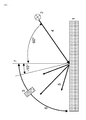
- specimens are illuminated at an incidence angle of 60 ° with respect to the vertical with a white point light source with a low opening angle of less than 2 ° and the scattering is measured at an angle of departure of 30 ° to -80 ° with respect to the vertical (cf. FIG. 1 ).
- CIELAB color coordinates L *, a *, b * are calculated with illuminant D65 and 10 ° observers according to ASTM E 308. This color system is eg in Manfred Richter: Introduction to colorimetry. 1984 ISBN 3-11-008209-8 described.
- the b * value is used at the -10 ° angle of reflection. This b * value is hereinafter referred to as b * (60 °), wherein the value of 60 ° refers to the angle of incidence.
- b * hemispherical reflectance
- a measure of the size of the scattering effect is therefore the measurement of the b * value in reflection (b * (60 °)) at which the scattered light is measured. The closer the b * (60 °) is to zero, the lower the reflection in the blue region.
- the b * (60 °) value of the reflected light at -10 ° angle of reflection of the shaped bodies according to the invention is preferably in the range from -2.5 to 0.0, more preferably from -2.3 to 0.0.
- the absolute value of the value ⁇ b *, calculated from the difference of b * (60 °) and the hemispherical reflection b * (hemispherical), is less than 1.0 in the case of moldings according to the invention.
- ⁇ b * ⁇ 1.0 results from the color difference of delta E (calculated according to DIN 6174) that can be detected by the human eye, which is smaller than 1.0. Since this scattering is essentially a bluish scattering, the calculation is simplified here to the difference ⁇ b *, which refers to the blue component of the light.
- the increase in the scattered radiation measured as b * (60 °) value, based on the IR absorber concentration used is not linear.
- the relative increase in scattered radiation is less than in the medium concentration range of 0.00100% by weight - 0.00500% by weight.
- the range of 0.00100 wt .-% to 0.00500 wt .-% is a strong increase the scattered radiation, while this increase surprisingly decreases at concentrations above 0.01000%.
- compositions comprising boride in a concentration range of 0.00270 wt .-% - 0.00800 wt .-%, in which the relative increase of the scattered radiation, measured as b * (60 °), with the Borid concentration increases sharply, in conjunction with an inorganic nanoscale pigment, preferably a nanoscale carbon black, dissolved.
- nanoscale carbon blacks reduce the unwanted scattering effect without significantly influencing the transparency and without negatively changing the overall color impression (neutral color impression).
- nanoscale carbon blacks significantly reduce the described phenomenon of bluish scattering in certain concentration ranges. It was particularly surprising that even relatively low concentrations in the range of 0.00090 wt .-% - 0.00300 wt .-% sufficient to significantly reduce the effect.
- compositions according to claim 1 based on polycarbonate defined concentrations of boride-based IR absorbers and certain concentrations nanoscale carbon black solved.
- concentrations of boride-based IR absorbers and certain concentrations nanoscale carbon black solved As a result, the bluish-purple color caused by scattering could be reduced or changed to a more neutral color.
- Particularly preferred polycarbonates are the homopolycarbonate based on bisphenol A, the homopolycarbonate based on 1,3-bis (4-hydroxyphenyl) -3,3,5-trimethylcyclohexane and the copolycarbonates based on the two monomers bisphenol A and 1,1 bis (4-hydroxyphenyl) -3,3,5-trimethylcyclohexane.
- Polycarbonates in the context of the present invention are both homopolycarbonates and copolycarbonates;
- the polycarbonates may be linear or branched in a known manner.
- the preparation of the polycarbonates is carried out in a known manner from diphenols, carbonic acid derivatives, optionally chain terminators and branching agents.
- Diphenols suitable for the preparation of the polycarbonates are, for example, hydroquinone, resorcinol, dihydroxydiphenyls, bis (hydroxyphenyl) alkanes, bis (hydroxyphenyl) cycloalkanes, bis (hydroxyphenyl) sulfides, bis (hydroxyphenyl) ether, bis (hydroxyphenyl ) ketones, bis (hydroxyphenyl) sulfones, bis (hydroxyphenyl) sulfoxides, alpha-alpha 'bis (hydroxyphenyl) diisopropylbenzenes, phthalimidines derived from isatin or phenolphthalein derivatives and their nuclear alkylated and ring-halogenated compounds.
- Preferred diphenols are 4,4'-dihydroxydiphenyl, 2,2-bis (4-hydroxyphenyl) propane, 2,4-bis (4-hydroxyphenyl) -2-methylbutane, 1,1-bis (4-hydroxyphenyl ) -p-diisopropylbenzene, 2,2-bis (3-methyl-4-hydroxyphenyl) -propane, 2,2-bis (3-chloro-4-hydroxyphenyl) -propane, bis (3,5-dimethyl 4-hydroxyphenyl) methane, 2,2-bis (3,5-dimethyl-4-hydroxyphenyl) propane, bis (3,5-dimethyl-4-hydroxyphenyl) sulfone, 2,4-bis- (3,5-dimethyl-4-hydroxyphenyl) -2-methylbutane, 1,1-bis (3,5-dimethyl-4-hydroxyphenyl) -p-diisopropylbenzene, 2,2-bis (3,5-dichloro 4-hydroxyphenyl) -prop
- diphenols are 2,2-bis (4-hydroxyphenyl) propane, 2,2-bis (3,5-dimethyl-4-hydroxyphenyl) propane, 2,2-bis (3,5-dichloro 4-hydroxyphenyl) -propane, 2,2-bis (3,5-dibromo-4-hydroxyphenyl) -propane, 1,1-bis (4-hydroxyphenyl) cyclohexane and 1,1-bis (4-hydroxyphenyl) -3,3,5-trimethylcyclohexane.
- Suitable carbonic acid derivatives are, for example, phosgene or diphenyl carbonate.
- Suitable chain terminators which can be used in the preparation of the polycarbonates are both monophenols and monocarboxylic acids.
- Suitable monophenols are phenol itself, alkylphenols such as cresols, p-tert-butylphenol, cumylphenol, pn-octylphenol, p-isoctylphenol, pn-nonylphenol and p-iso-nonylphenol, halophenols such as p-chlorophenol, 2,4-dichlorophenol, p -Bromophenol and 2,4,6-tribromophenol, 2,4,6-triiodophenol, p-iodophenol, and mixtures thereof.
- Preferred chain terminators are phenol, cumylphenol and / or p-tert-butylphenol.
- Suitable monocarboxylic acids are furthermore benzoic acid, alkylbenzoic acids and halobenzoic acids.
- Preferred chain terminators are also the phenols which are mono- or polysubstituted by C 1 to C 30 -alkyl radicals, linear or branched, preferably unsubstituted or substituted by tert-butyl.
- the amount of chain terminator to be used is preferably from 0.1 to 5 mol%, based on mols of diphenols used in each case.
- the addition of the chain terminators can be done before, during or after the phosgenation.
- Suitable branching agents are the trifunctional or more than trifunctional compounds known in polycarbonate chemistry, especially those having three or more than three phenolic OH groups.
- Suitable branching agents are, for example, phloroglucinol, 4,6-dimethyl-2,4,6-tri- (4-hydroxyphenyl) -heptene-2, 4, 6-dimethyl-2,4,6-tri (4-hydroxyphenyl) heptane , 1,3,5-tri (4-hydroxyphenyl) -benzene, 1,1,1-tri- (4-hydroxyphenyl) -ethane, tri- (4-hydroxyphenyl) -phenylmethane, 2,2-bis [4,4-bis (4-hydroxyphenyl) cyclohexyl] propane, 2,4-bis (4-hydroxyphenylisopropyl) phenol, 2,6-bis (2-hydroxy-5 '-methylbenzyl) -4-methylphenol, 2- (4-hydroxyphenyl) -2- (2,4-dihydroxyphenyl) -propane, hexa- (4- (4-hydroxyphenylisopropyl) -phenyl) -orthoterephthal
- the amount of optionally used branching agent is preferably 0.05 mol% to 2.00 mol%, based in turn on moles of diphenols used in each case.
- the branching agents may be presented either with the diphenols and the chain terminators in the aqueous alkaline phase, or may be added dissolved in an organic solvent prior to phosgenation. In the case of the transesterification process, the branching agents are used together with the diphenols.
- the aromatic polycarbonates of the present invention have weight average molecular weights Mw (as determined by gel permeation chromatography and polycarbonate calibration) of between 5,000 and 200,000, preferably between 10,000 and 80,000, and more preferably between 15,000 and 40,000 (this is approximately between 12,000 and 330,000, preferably between 20,000 and 135,000 and more preferably between 28,000 and 69,000 determined by calibration by means of polystyrene standard)
- the polymer compositions according to the invention may optionally contain further customary polymer additives, for example those described in US Pat EP-A 0 839 623 . WO-A 96/15102 .
- the further polymer additives are preferably used in amounts of from 0% by weight to 5% by weight, more preferably from 0.1% by weight to 1% by weight, based in each case on the amount of the respective polymer overall compositions. Also mixtures of several additives are suitable.
- the nanoscale boride-based inorganic IR absorber particles which are the subject of the present application are preferably a metal boride wherein the metal selected from the group La, Ce, Pr, Nd, Tb, Dy, Ho, Y, Sm, Eu, ER , Tm, Yb, Lu, Sr, Ti, Zr, Hf, V, Ta, Cr, Mo, W and Ca.
- the form of the hexaboride is particularly preferred. Particularly preferred are lanthanum hexaboride (LaB 6 ), praseodymium boride (PrB 6 ), neodymium boride (NdB 6 ), cerium boride
- CeB 6 terbium boride
- DyB 6 dysprosium boride
- HoB 6 holmium boride
- YB 6 yttrium boride
- SmB 6 samarium boride
- EuB 6 europium boride
- ErB 6 erbium boride
- TmB 6 thulium boride
- TmB 6 ytterbium boride
- the surface of these particles is preferably unoxidized; however, oxidized or partially oxidized particles can be used.
- lanthanum hexaboride (LaB 6 ) is very particularly preferred.
- the boride is obtained in the form of a powder.
- the particles may have a spherical, platelike, irregular or needle-like shape.
- the absorption capacity of IR radiation is the greater, the more crystalline the boride particles are.
- particles with a low crystallinity eg characterized by a broad diffraction peak in the X-ray diffraction experiment
- particles with a low crystallinity also have an IR absorption property which is adequate for the purposes of the invention.
- This is only the case as long as the particles inside have a bond of the metal and boron used.
- the color of the particles in the powder may, for example, be greyish-black, brownish-black, greenish-black or the like.
- the average size of the particles is less than 200 nm, preferably less than or equal to 150 nm and particularly preferably less than 100 nm, where the particle diameter is greater than 5 nm, more preferably greater than 10 nm and particularly preferably greater than 15 nm are.
- the particles are transparent in the visible region of the spectrum, with transparency meaning that the absorption of these IR absorbers in the visible region is low compared to the absorption in the IR region and the IR absorber does not lead to significantly increased turbidity of the composition or the respective end product leads.
- the transparent shaped article has a transmission of at least 6% and a haze of less than 3%, preferably less than 2.5 %, more preferably less than 2.0%.
- the Tds value is preferably less than 70%, more preferably less than 60%, and most preferably less than 50%.
- the Tds value is less than 20%, more preferably less than 15% (T ds : direct solar transmittance; values are measured on optical color pattern plates having a thickness of 4 mm.)
- the total transmission T ds is calculated according to ISO 13837, computational convention "A" performed).
- the size of the particles can be determined by means of transmission electron spectroscopy (TEM). Such measurements on IR absorber nanoparticles are, for example, in Adachi et al., J. Am. Ceram. Soc. 2008, 91, 2897-2902 , described.
- TEM transmission electron spectroscopy
- the surface of the particles can be treated.
- the surface may be treated with a silane or provided with a titanium-based, zirconium-based layer or similar layers.
- This type of coating increases the long-term stability with respect to the IR absorption and is for example in US 2005 0161642 described.
- boride-based particles In addition to the boride-based particles, it is possible, but not necessarily, for further particles to be based on SiO 2 TiO 2 ZuO 2 Al 2 O 3 or MgO. These particles are preferably present in a size of less than 200 nm.
- the finely divided IR absorber particles are introduced in the form of a dispersion in the polymer matrix.
- This dispersion prevents reagglomeration and facilitates incorporation into a thermoplastic matrix such as e.g. Polycarbonate.
- Polymeric dispersants are preferably used.
- Suitable polymer-based dispersants are, above all, dispersants which have a high light transmission, e.g. Polyacrylates, polyethers, polyesters or polyurethanes and polymers derived therefrom.
- Preferred dispersants are polyacrylates, polyethers and polyester-based polymers. Preference is given to using high-temperature-stable dispersants.
- the blend ratio of polymeric dispersant to boride particles is usually from 0.2% by weight to 50.0% by weight, preferably 0.5% by weight to 50.0% by weight and most preferably 1.0% by weight. % - 40.0 wt .-% based on the weight fraction of inorganic IR absorber.
- the nanoparticles are obtained in the form of a dispersion. After grinding can if necessary, further dispersants are added. The solvent is removed at elevated temperatures and reduced pressure.
- Lanthanum hexaboride in the form of the dispersion which is suitable in the context of the invention, is commercially available from, for example, the company Sumitomo Metal Mining Co., Ltd., for example under the trade name KHDS 06.
- Dispersants suitable for the present invention are commercially available.
- polyacrylate-based dispersants are suitable.
- Polyacrylates are e.g. under the trade names EFKA®, e.g. EFKA® 4500 and EFKA® 4530 are available from Ciba Specialty Chemicals.
- Polyester-based dispersants are also suitable. Polyester-containing dispersants are sold under the trade names Solsperse®, e.g. Solsperse® 22000, 24000SC, 26000, 27000 available from Avecia.
- Polyurethane-based systems are also suitable. These are available under the trade name EFKA® 4046, EFKA® 4047 from Ciba Specialty Chemicals. Texaphor® P60 and P63 are corresponding trade names of Cognis.
- Polyether-containing dispersants can also be used. These are e.g. known under the trade names Disparlon® DA234 and DA325 from Kusumoto Chemicals.
- the dispersants may be used singly or in combinations. With regard to the thermal resistance, dispersants from the group of the polyacrylates and the polyesters are particularly preferred.
- the IR-absorbing inorganic boride is preferably dispersed in organic matrix and preferably used in concentrations described below in the polymer composition according to the invention.
- the borides are used in an amount of 0.00270 wt .-% - 0.00800 wt .-% calculated as solids content of boride in the total polymer composition.
- the borides are present in an amount of preferably 0.00350 wt .-% - 0.00800 wt .-% and particularly preferably 0.00400 wt .-% - 0.00800 wt. % calculated as the solids content of boride in the total polymer composition.
- Solids content of boride in this context means the boride as a pure substance and not a suspension or other preparation containing the pure substance.
- the lanthanum hexaboride is in a usable dispersion of a mixture of polymethyl methacrylate and polyester a Festoffgehalt of 5 wt .-% - 25 wt .-% before.
- organic solvents such as toluene and further inorganic particles such as zirconia may be present.
- IR absorbers in addition to the borides according to the invention as IR absorbers, further IR absorbers may additionally be used, the proportion of which in terms of quantity and / or power in such a mixture being below those of the borides described above. In the case of mixtures, preference is given here to compositions which contain two to five inclusive and particularly preferably two or three different IR absorbers.
- the polymer composition according to the invention contains no tungsten-type inorganic IR absorbers such as cesium tungstate, Cs 0.33 WO 3 .
- the further IR absorber is preferably selected from the group of tin oxides, more preferably contains antimony-doped tin oxide or indium tin oxide.
- indium oxide which is doped with 2 to 30 atom%, preferably with 4 to 12 atom% tin (ITO) or with 10 to 70 atom% fluorine, can be added.
- tin oxide as a further IR absorber which is doped with 2 to 60 atom% of antimony (ATO) or with 10 to 70 atom% of fluorine.
- zinc oxide particularly doped with 1 to 30 at%, preferably 2 to 10 at% of aluminum or 2 to 30 at% indium or 2 to 30 at% gallium is particularly suitable.
- the additional IR absorber (s) has an absorption spectrum different from the boride used, based on the absorption maxima, so that a maximum absorption range is covered by the maxima.
- Suitable additional organic infrared absorbers are by substance classes eg in M. Matsuoka, Infrared Absorbing Dyes, Plenum Press, New York, 1990 described. Especially suitable are infrared absorbers from the classes of phthalocyanines, naphthalocyanines, metal complexes, azo dyes, anthraquinones, squaric acid derivatives, immonium dyes, perylenes, quaterylenes and polymethines. Of these, phthalocyanines and naphthalocyanines are particularly suitable.
- phthalocyanines and naphthalocyanines having bulky side groups are preferable, such as phenyl, phenoxy, alkylphenyl, alkylphenoxy, tert-butyl, (-S-phenyl), -NH-aryl, -NH-alkyl, and the like.
- the polymer composition contains at least one anoskaliger carbon black.
- the carbon black is preferably finely dispersed in the organic polymer matrix and is preferably nanoscale.
- Suitable carbon blacks have an average particle size of preferably less than 100 nanometers (nm), more preferably less than 75 nm, even more preferably less than 50 nm, and most preferably less than 40 nm, the average particle size preferably being greater than 0.5 nm more preferably greater than 1 nm and especially preferably greater than 5 nm.
- suitable carbon blacks differ from so-called Leitru touch in that they have little or no electrical conductivity.
- Conductive carbon blacks have certain morphologies and superstructures compared to the carbon blacks used here to achieve high conductivity.
- the nanoscale carbon blacks used here can be very well dispersed in thermoplastics, so that hardly coherent areas of carbon black occur, from which a corresponding conductivity could result.
- Commercially available carbon blacks useful in the invention are available from a variety of trade names and forms, such as pellets or powders.
- BLACK PEARLS® as wet-processed pellets under the names ELFTEX®, REGAL® and CSX®, and in a fluffy form under MONARCH®, ELFTEX®, REGAL® and MOGUL® - all available from Cabot Corporation.
- the carbon black types have particle sizes of 10 to 30 nm and have a surface area of preferably 35 to 138 m 2 per g (m 2 / g).
- the carbon black may be treated or untreated - so the carbon black may be treated with certain gases, with silica or organic substances such as butyllithium. By such a treatment, a modification or functionalization of the surface can be achieved. This can promote compatibility with the appropriate matrix.
- Particularly preferred are carbon blacks traded under the trade name BLACK PEARLS® (CAS No. 1333-86-4).
- the nanoscale carbon black is used in the composition according to the invention in concentrations of 0.00090% by weight - 0.00300% by weight and preferably in concentrations of 0.00100% by weight - 0.00280% by weight.
- the nanoscale carbon black is preferably present in an amount of 0.00140% by weight. 0.00260 wt .-%, particularly preferably used in an amount of 0.00150 wt .-% - 0.00250 wt .-%.
- the ratio of IR absorber to carbon black is 20: 1 to 0.4: 1, preferably 15: 1 to 1: 1. In a specific embodiment of the present invention, the ratio of IR absorber to carbon black is 5: 1 to 1.5: 1.
- concentrations given here for carbon blacks and IR absorbers are used for finished parts with thicknesses of 3.5 to 7.0 mm and preferably of 4 mm to 6 mm. At low or higher thickness, the concentrations must be adjusted accordingly up or down, for example, to avoid excessive turbidity or too low an effect.
- the polymer composition contains thermal stabilizers.
- thermal stabilizers Especially suitable are phosphites and phosphonites as well as phosphines. Examples are triphenyl phosphite, diphenyl alkyl phosphite, phenyl dialkyl phosphite, tris (nonylphenyl) phosphite, trilauryl phosphite, trioctadecyl phosphite, distearyl pentaerythritol diphosphite, tris (2,4-di-tert-butylphenyl) phosphite, diisodecylpentaerythritol diphosphite, bis (2,4-di-tert-butylphenyl) pentaerythritol diphosphite , Bis (2,4-di-cumylphenyl) pentaerythritol diphosphit
- TPP triphenylphosphine
- Irgafos ® 168 Tris (2,4-di-tert-butyl-phenyl) phosphite) and tris (nonylphenyl) phosphite used, or mixtures thereof.
- phenolic antioxidants such as alkylated monophenols, alkylated thioalkylphenols, hydroquinones and alkylated hydroquinones can be used.
- Irganox ® 1010 penentaerythritol 3- (4-hydroxy-3,5-di-tert-butylphenyl) propionate; CAS: 6683-19-8) and Irganox 1076 ® is (2,6-di-tert-butyl 4- (octadecanoxycarbonylethyl) phenol) used.
- the phosphine compounds according to the invention are used together with a phosphite or a phenolic antioxidant or a mixture of the latter two compounds.
- the polymer composition of the invention further contains an ultraviolet absorber.
- Ultraviolet absorbers suitable for use in the polymer composition according to the invention are compounds which have the lowest possible transmission below 400 nm and the highest possible transmission above 400 nm. Such compounds and their preparation are known from the literature and are for example in the EP-A 0 839 623 . WO-A 96/15102 and EP-A 0 500 496 described.
- Particularly suitable ultraviolet absorbers for use in the composition according to the invention are benzotriazoles, triazines, benzophenones and / or arylated cyanoacrylates.
- Particularly useful ultraviolet absorbers are hydroxy-benzotriazoles, such as 2- (3 ', 5'-bis (1,1-dimethylbenzyl) -2'-hydroxyphenyl) benzotriazole (Tinuvin ® 234, Ciba Specialty Chemicals, Basel) 2- (2'-hydroxy-5 '- (tert-octyl) phenyl) benzotriazole (Tinuvin ® 329, Ciba specialty Chemicals, Basel), 2- (2'-hydroxy-3' - (2-butyl) - 5 '- (tert-butyl) phenyl) benzotriazole (Tinuvin ® 350, Ciba specialty Chemicals, Basel), bis (3- (2H-benzotriazolyl) -2-hydroxy-5-tert-octyl) methane, (Tinuvin ® 360, Ciba specialty Chemicals, Basel), (2- (4,6-diphenyl-1,3,5-triazin-2-yl)
- the amount of the ultraviolet absorber contained in the composition there are no particular limitations as long as the desired absorption of ultraviolet rays and sufficient transparency of the molded article produced from the composition are ensured.
- the composition contains ultraviolet absorber in an amount of 0.05% by weight to 20.00% by weight, in particular from 0.07% by weight - 10.00% by weight and very particularly preferably from 0.10% by weight - 1.00% by weight.
- compositions according to the invention preferably contain further colorants for adjusting the color.
- the dyes are used to adjust the color in transmission - they affect the reflected color only to a minor extent. These are preferably anthraquinone-based, perinone-based or phthaloperinone-based colorants.
- At least one colorant of the following structures (1) - (2) is preferably used:
- R 1 can be a linear or branched alkyl radical, or halogen, preferably a halogen.
- n is a natural number between 0 and 4.
- R1 independently of one another can assume the radicals described above and n represents a natural number of 0-3 for each designated aromatic ring.
- the dyes of the formulas (1) and (2) are preferably used in amounts of from 0.00010% by weight to 0.05000% by weight, more preferably from 0.00100% by weight to 0.01000% by weight in each case based on the total molding composition.
- organic or inorganic pigments or organic dyes or the like can be used.
- inorganic pigments which can be used are sulfur-containing pigments such as cadmium red and cadmium yellow, iron cyanide-based pigments such as Berlin blue, oxide pigments such as titanium dioxide, Zinc oxide, red iron oxide, black iron oxide, chromium oxide, titanium yellow, zinc-iron-based brown, titanium-cobalt-based green, cobalt blue, copper-chromium-based black and copper-iron-based black, or chromium-based pigments such as chrome yellow.
- sulfur-containing pigments such as cadmium red and cadmium yellow
- iron cyanide-based pigments such as Berlin blue
- oxide pigments such as titanium dioxide, Zinc oxide, red iron oxide, black iron oxide, chromium oxide, titanium yellow, zinc-iron-based brown, titanium-cobalt-based green, cobalt blue, copper-chromium-based black and copper-iron-based black, or chromium-based pigments
- Preferred organic pigments or dyes are, for example, phthalocyanine-derived dyes such as copper phthalocyanine blue and copper phthalocyanine green, condensed polycyclic dyes and pigments such as azo-based (eg nickel-azo yellow), sulfur indigo dyes, perynone-based, perylene-based, quinacridone derived, dioxazine-based, isoindolinone-based and quinophthalone-derived derivatives, anthraquinone-based, heterocyclic systems, etc.
- phthalocyanine-derived dyes such as copper phthalocyanine blue and copper phthalocyanine green
- condensed polycyclic dyes and pigments such as azo-based (eg nickel-azo yellow), sulfur indigo dyes, perynone-based, perylene-based, quinacridone derived, dioxazine-based, isoindolinone-based and quinophthalone-derived derivatives, anthraquinone-
- MACROLEX Blue RR® MACROLEX Violet 3R®
- MACROLEX Violet B® Lixess AG, Germany
- Sumiplast Violet RR Sumiplast Violet B
- Sumiplast Blue OR Sumitomo Chemical Co., Ltd.
- diaresin Violet D Diaresin Blue G, Diaresin Blue N (Mitsubishi Chemical Corporation), Heliogen Blue or Heliogen Green (BASF AG, Germany).
- These dyes can be used in amounts of 0.00001 wt .-% - 1.00000 wt .-%, preferably from 0.00010 wt .-% - 0.10000 wt .-% and particularly preferably from 0.00050 wt .-% - 0.05000 wt .-% ,
- Particularly suitable mold release agents for the composition according to the invention are e.g. Pentaerythritol tetrastearate (PETS) or glycerol monostearate (GMS).
- PETS Pentaerythritol tetrastearate
- GMS glycerol monostearate
- the preparation of the polymer compositions according to the invention comprising polycarbonate, an inorganic IR absorber from the group of borides, optionally one or more colorants and optionally further customary polymer additives is carried out by conventional incorporation methods by combining, mixing and homogenizing the individual constituents, preference being given in particular to homogenization takes place in the melt under the action of shear forces.
- the merging and mixing takes place before the melt homogenization using powder premixes.
- premixes which have been prepared from solutions of the mixture components in suitable solvents, optionally homogenizing in solution and subsequently removing the solvent.
- the IR absorbers, colorants, ultraviolet absorbers and other additives of the composition according to the invention can be introduced by known methods or as a masterbatch.
- masterbatches are particularly preferred for incorporation of the IR absorber, in particular masterbatches based on polycarbonate are used, in which the IR absorbers in the form of a ready to use IR absorber formulation containing dispersants, preferably polyacrylate, polyether or polyester-based Dispersants, preferably high temperature stable dispersants, such as a polyacrylate (homo- or copolymer), such as Polymethyl methacrylate, and / or polyester or mixtures thereof, further containing adjuvants such as zirconia and optionally residual solvents such as toluene, benzene or similar aromatic hydrocarbons have been registered.
- dispersants preferably polyacrylate, polyether or polyester-based Dispersants, preferably high temperature stable dispersants, such as a polyacrylate (homo- or copolymer), such as Polymethyl methacrylate, and / or polyester or mixtures thereof, further containing adjuvants such as zirconia and optionally residual solvents such as toluene, benz
- the composition can be combined, mixed, homogenized and then extruded in conventional equipment such as screw extruders (for example twin-screw extruder, ZSK), kneaders, Brabender or Banbury mills. After extrusion, the extrudate can be cooled and comminuted. It is also possible to premix individual components and then to add the remaining starting materials individually and / or likewise mixed.
- the IR absorber according to the invention prior to incorporation into the thermoplastic polymer matrix, is optionally mixed with the nanoscale pigment according to the invention and optionally further additives to give a masterbatch, wherein the mixing preferably takes place in the melt under the action of shearing forces (for example in a Kneader or twin-screw extruder) takes place.
- shearing forces for example in a Kneader or twin-screw extruder
- the preferred polymer matrix is polycarbonate, which is also the main component of the final overall polymer composition.
- the polymer compositions according to the invention can be processed into products or moldings by, for example, initially extruding the polymer compositions as described into granules and processing these granules by suitable processes to give various products or shaped articles in a known manner.
- compositions according to the invention may be used in this context for example by hot pressing, spinning, blow molding, deep drawing, extrusion or injection molding into articles or shaped articles, shaped articles such as toy parts, fibers, films, tapes, plates such as solid plates, multiwall sheets or corrugated sheets, vessels, pipes or other profiles are transferred. Also of interest is the use of multilayer systems.
- the application may be simultaneous or immediately after the formation of the body, e.g. by coextrusion or multi-component injection molding.
- the application can also be done on the finished shaped body, e.g. by lamination with a film or by coating with a solution.
- base and optional topcoat / optional topcoat panels are preferably made by (co) extrusion.
- the optionally polymerized by drying, for example, polymer composition is fed to the extruder and melted in the plasticizing system of the extruder.
- the plastic melt is then pressed through a slot die or a web plate nozzle and thereby deformed, brought in the nip of a smoothing calender in the desired final shape and by mutual cooling on smoothing rollers and the Ambient air formfixed.
- the temperatures necessary to extrude the polymer composition are adjusted, usually following the manufacturer's instructions. For example, if the polymer compositions contain polycarbonates of high melt viscosity, they will normally be processed at melt temperatures of 260 ° C to 350 ° C, and accordingly the cylinder temperatures of the plasticizing cylinder and the die temperatures will be adjusted.
- thermoplastic melts of different composition can be stacked on top of each other and thus produce multilayer sheets or films (for coextrusion see, for example EP-A 0 110 221 .
- EP-A 0 110 238 and EP-A 0 716 919 for details of the adapter and nozzle method, see Johannaber / Ast: “Plastic Machine Operator”, Hanser Verlag, 2000 and in Deutschen Kunststofftechnik: “Coextruded Films and Sheets: Future Perspectives, Requirements, Equipment and Production, Quality Assurance", VDI-Verlag, 1990 ).
- thermoformings are plates, films, glazing, such as car windows, windows of rail and aircraft, car sun roofs, roofing or building glazings containing the compositions of the invention.
- double-wall sheets or multi-sheet sheets can be used.
- further material parts may be contained in the products according to the invention.
- glazings can have sealing materials on the edge of the glazings.
- roofing may, for example, metal components such as screws, metal pins or the like, which can serve for attachment or guidance (in folding or sliding roofs) of the roofing elements.
- other materials may be combined with the compositions of the invention, e.g. in 2-component injection molding.
- the corresponding component with IR-absorbing properties can be provided with an edge which is e.g. serves for bonding.
- the articles are coated from the composition of the present invention.
- This coating serves to protect the thermoplastic material from general weathering (e.g., sunlight damage), as well as from mechanical deterioration of the surface (e.g., scratching), thus increasing the durability of the appropriately finished articles.
- polycarbonate can be protected against UV radiation by means of various coatings. Usually, these coatings contain UV absorbers. These layers also increase the scratch resistance of the corresponding article.
- the articles from the present invention may carry single layer or multi-layer systems. They can be coated on one or both sides. In a preferred embodiment, the article contains a scratch-resistant lacquer containing UV absorber. In a particular embodiment, the multi-layer product contains at least one layer containing the composition according to the invention, at least one UV protective layer and optionally a scratch-resistant coating.
- the article carries at least one scratch-resistant or antireflective coating on at least one side.
- the preparation of the coating can be carried out by various methods.
- various methods of vapor deposition for example via electron beam method, resistance heating and plasma deposition or various sputtering methods such as high-frequency sputtering, magnetron sputtering, ion beam sputtering, etc., ion plating by DC, RF, HCD methods, reactive ion plating, etc or chemical vapor deposition, a coating.
- an antireflective coating can also be applied from solution.
- a suitable coating solution can be prepared by a dispersion of a metal oxide having high refractive index such as ZrO 2, TiO 2, Sb 2 O 5 or WO 3 in a silicone-based paint, which is suitable for coating Kunststoffoffumblen and thermally or UV-based cured can.
- a metal oxide having high refractive index such as ZrO 2, TiO 2, Sb 2 O 5 or WO 3
- silicone-based paint which is suitable for coating Kunststoffoff
- a scratch-resistant coating on plastic articles For example, epoxy, acrylic, polysiloxane, colloidal silica, or inorganic / organic (hybrid systems) based paints can be used. These systems can be applied via, for example, by dipping, spin coating, spraying, or flow coating. The curing can be done thermally or by UV irradiation. Single or multi-layer systems can be used.
- the scratch-resistant coating can be applied, for example, directly or after preparation of the substrate surface with a primer.
- a scratch-resistant coating can be applied via plasma-assisted polymerization processes, for example via an SiO 2 plasma.
- Antifog or antireflective coatings can also be made by plasma techniques.
- a scratch-resistant coating to the resulting molded article by means of certain injection molding methods, such as the back-molding of surface-treated films.
- various additives such as UV absorbers, for example derived from triazoles or triazines, may be present.
- IR absorbers of organic or inorganic nature may be included. These additives can be contained in the scratch-resistant coating itself or in the primer layer.
- the thickness of the scratch-resistant layer is 1 to 20 ⁇ m, preferably 2 to 15 ⁇ m. Below 1 ⁇ m, the resistance of the scratch-resistant layer is insufficient. Above 20 ⁇ m cracks occur more frequently in the paint.
- the base material according to the invention which in the is described after the completion of the injection molded article is provided with a scratch-resistant and / or antireflective layer described above, since the preferred application range is in the range of window or automobile glazing.
- a primer containing UV absorbers is preferably used in order to improve the adhesion of the scratch-resistant lacquer.
- the primer may contain other stabilizers such as HALS systems (stabilizers based on sterically hindered amines), adhesion promoters, flow aids.
- HALS systems stabilizers based on sterically hindered amines
- adhesion promoters flow aids.
- the respective resin can be selected from a variety of materials and is eg in Ullmann's Encylopedia of Industrial Chemistry, 5th Edition, Vol. A18, pp. 368-426, VCH, Weinheim 1991 described. It is possible to use polyacrylates, polyurethanes, phenol-based, melamine-based, epoxy and alkyd systems or mixtures of these systems.
- the resin is usually dissolved in suitable solvents - often in alcohols.
- curing may be at room or elevated temperatures. Preferably, temperatures between 50 ° C and 130 ° C are used - often after a large part of the solvent was briefly removed at room temperature.
- Commercially available systems include SHP470, SHP470FT2050 and SHP401 from Momentive Performance Materials. Such coatings are for example in US 6350512 B1 . US 5869185 . EP 1308084 . WO 2006/108520 described.
- Scratch-resistant paints are preferably composed of siloxanes and preferably contain UV absorbers. They are preferably applied by dipping or flow processes. Curing takes place at temperatures of 50 ° C - 130 ° C.
- Commercially available systems include AS4000, SHC5020 and AS4700 from Momentive Performance Materials. Such systems are eg in US 5041313 . DE 3121385 . US 5391795 . WO 2008/109072 described. The synthesis of these materials is usually carried out by condensation of alkoxy and / or alkylakoxysilanes under acid or base catalysis. Optionally, nanoparticles can be incorporated.
- Preferred solvents are alcohols such as butanol, isopropanol, methanol, ethanol and mixtures thereof.
- one-component hybrid systems can be used These are eg in EP0570165 or WO 2008/071363 or DE 2804283 described.
- Commercially available hybrid systems are available, for example, under the name PHC587 or UVHC 3000 from Momentive Performance Materials.
- melt volume rate (MVR) is carried out according to ISO 1133 (at 300 ° C, 1.2 kg).
- the hemispherical reflectance of the test specimen was measured according to ASTM E 1331 and the CIELAB color coordinates L *, a *, b * were calculated with illuminant D65 and 10 ° observer according to ASTM E 308.
- the corresponding b * (hemispherical) value is given in the table.
- ⁇ b * Absolute value of the difference of b * (60 °) and b * (hemispherical).
- the transmission measurements were made on a Perkin Elmer Lambda 900 photometer sphere spectrophotometer (i.e., determination of total transmission by both diffuse and direct transmission measurement and diffuse and direct reflection) according to ASTM D1003.
- polycarbonate Makrolon AL2647 from Bayer Material Science (linear polycarbonate based on bisphenol A), with an MVR of 12.5 cm 3/10 min. at 300 ° C and 1.2 kg load in accordance with ISO 1033.
- This polycarbonate contains UV absorber, mold release agent and thermal stabilizer.
- the IR absorber used is lanthanum hexaboride, LaB6 (KHDS 06 from Sumitomo Metal Mining, Japan).
- the product is in the form of a dispersion.
- the weights in the examples refer to the lanthanum hexaboride as a pure substance, wherein the solids content of lanthanum hexaboride in the commercial KHDS06 dispersion used is 21.5% by weight.
- Nanoscale carbon black particles size about 17 nm
- Black Pearls® 800 from Cabot Corp. are used. used.
- Another colorant is antharchinone-based Macrolex Blue RR. used by the company Lanxess Germany GmbH.
- Another colorant used is Heliogen Blue K 6911D BASF SE, 67065 Ludwigshafen, Germany.
- the additives were compounded on a twin-screw extruder from KrausMaffei Berstorff TYPE ZE25 at a housing temperature of 260 ° C. or a melt temperature of 270 ° C. and a speed of 100 rpm with the amounts of additives indicated in Table 1.
- the granules are dried at 120 ° C for 3 hours in a vacuum and then on an injection molding machine Arburg 370 with a 25 injection unit at a melt temperature of 300 ° C and a mold temperature of 90 ° C to color sample plates with the dimensions 60 mm x 40 mm x 4 mm processed.
- Makrolon ® 3108 is compounded without further additives as described above. The results of the reflectance measurement are shown in Table 1.
- Makrolon ® 3108 is with 0.00086 wt .-% of lanthanum hexaboride, LaB6, (corresponding to 0.004 wt .-% KHDS 06 dispersion) was compounded as described above. The results of the reflectance measurement are shown in Table 1.
- Makrolon ® 3108 is with 0.00108 wt .-% of lanthanum hexaboride, LaB6, (corresponding to 0.005% wt .- KHDS 06 dispersion) was compounded as described above. The results of the reflectance measurement are shown in Table 1.
- Makrolon ® 3108 is with 0.00215 wt .-% of lanthanum hexaboride, LaB6, (corresponding to 0.01 wt .-% KHDS 06 dispersion) was compounded as described above. The results of the reflectance measurement are shown in Table 1.
- Makrolon ® 3108 is with 0.00430 wt .-% of lanthanum hexaboride, LaB6, (corresponding to 0.02 wt .-% KHDS 06 dispersion) was compounded as described above. The results of the reflectance measurement are shown in Table 1.
- Makrolon ® 3108 is with 0.01075 wt .-% of lanthanum hexaboride, LaB6, (corresponding to 0.05 wt .-% KHDS 06 dispersion) was compounded as described above. The results of the reflectance measurement are shown in Table 1.
- Makrolon ® 3108 is with 0.02150 wt .-% of lanthanum hexaboride, LaB6, (equivalent to 0.1 wt .-% KHDS 06 dispersion) was compounded as described above. The results of the reflectance measurement are shown in Table 1.
- Makrolon ® 3108 is with 0.00430 wt .-% of lanthanum hexaboride, LaB6, (corresponding to 0.02 wt .-% KHDS 06 dispersion) and compounded described above 0.0003 wt .-% nanoscale carbon black like.
- the results of the reflectance measurement are shown in Table 1.
- Makrolon ® 3108 is with 0.00430 wt .-% of lanthanum hexaboride, LaB6, (corresponding to 0.02 wt .-% KHDS 06 dispersion) as well as compounded above 0.004 wt .-% nanoscale carbon black like.
- the results of the reflectance measurement are shown in Table 1.
- Makrolon ® 3108 is with 0.00430 wt .-% of lanthanum hexaboride, LaB6, (corresponding to 0.02 wt .-% KHDS 06 dispersion) and compounded described above 0.0025 wt .-% nanoscale carbon black like.
- the results of the reflectance measurement are shown in Table 1.
- Makrolon ® AL2647 is with 0.00667 wt .-% of lanthanum hexaboride, LaB6, (corresponding to 0.031 wt .-% KHDS 06 dispersion) and 0.0005 wt .-% nanoscale carbon black, and as colorants 0.0055 wt .-% Macrolex Rot EG, 0.0039 wt% Macrolex Blue RR, and 0.0013 Heliogen Blue K6911D compounded as described above. The results of the reflectance measurement are shown in Table 2.
- Makrolon ® AL2647 is with 0.00667 wt .-% of lanthanum hexaboride, LaB6, (corresponding to 0.031 wt .-% KHDS 06 dispersion) by weight and 0.00167 wt .-% nanoscale carbon black, and as colorants 0.0055.% Macrolex Red EG, 0.0039 wt% Macrolex Blue RR, and 0.0013 wt% Heliogen Blue K6911D compounded as described above.
- Table 2 The results of the reflectance measurement are shown in Table 2.
- Makrolon ® AL2647 is with 0.00452 wt .-% of lanthanum hexaboride, LaB6, (corresponding to 0.021 wt .-% KHDS 06 dispersion) and 0.0005 wt .-% nanoscale carbon black, and as colorants 0.0048 wt .-% Macrolex Rot EG, 0.0037 wt% Macrolex Blue RR and 0.0011 wt% Heliogen Blue K6911D compounded as described above. The results of the reflectance measurement are shown in Table 2.
- Makrolon ® AL2647 is with 0.00452 wt .-% of lanthanum hexaboride, LaB6, (corresponding to 0.021 wt .-% KHDS 06 dispersion) by weight and 0.00225 wt .-% nanoscale carbon black, and as colorants 0.0048.% Macrolex Red EG , 0.0037 wt% Macrolex Blue RR and 0.0011 wt% Heliogen Blue K6911D compounded as described above.
- Table 2 Change in the scattering effect by different IR absorber / carbon black combinations Example no.
- Example 8 shows that low levels of carbon black are not capable of significantly shifting the b * (60 °) value toward 0 or within a range of 0 to -2.5, respectively. Furthermore, the ⁇ b * value is clearly above 1 and thus clearly visible to the viewer.
- Example 10 shows that only higher amounts of carbon black show the desired effect. Further, the difference of the bluish shimmer caused by the scattering effect and the reflected intrinsic color is no longer recognizable ( ⁇ b * is less than 1). Too high concentrations of nanoscale carbon black, as shown in Example 9, drastically reduce the transmission and are not suitable for transparent moldings.
- Carbon black [% by weight] 0.00050 0.00167 0.00050 0.00225
- LaB6 [% by weight] 0.00667 0.00667 0.00452 0.00452 Transmission Ty 20.1 8.1 25.5 7.8 b * in reflection -3.2 -1.7 -3.2 -1.3 b * in reflection, hemispherical -3.1 -2.3 -3.2 -2.0 .DELTA.b * 0.1 0.6 0.0 0.7 T DS [%] 14.1 6.0 20.6 7.7
- the scattering effect of the IR absorber particles can be seen.
- the concentrations of nanoscale pigment according to the invention make it possible to detect the scattering effect (which can be recognized by the significant increase of b * (60 °) in reflection, ie b * moves in the direction 0) to reduce. Even if the ⁇ b * is in the range of 0-1 (ie, the blue portion of the inherent color is indistinguishable from the proportion of the scattering effect), the color of the comparative examples having a b * (60 °) is outside the desired one Range for a neutral gray unacceptable.
Landscapes
- Chemical & Material Sciences (AREA)
- Organic Chemistry (AREA)
- Health & Medical Sciences (AREA)
- Chemical Kinetics & Catalysis (AREA)
- Medicinal Chemistry (AREA)
- Polymers & Plastics (AREA)
- Engineering & Computer Science (AREA)
- Materials Engineering (AREA)
- Nanotechnology (AREA)
- Manufacturing & Machinery (AREA)
- Compositions Of Macromolecular Compounds (AREA)
Description
- Die Erfindung betrifft ein Fertigteil aus einer Infrarotstrahlung-(IR)-absorbierenden Polymer-Zusammensetzung enthaltend Polycarbonat einen anorganischen Infrarotabsorber, nachfolgend auch als IR-Absorber bezeichnet, und mindestens einen nanoskaligen Ruß sowie die Verwendung eines nanoskaligen Rußes.
- Insbesondere betrifft die vorliegende Erfindung die Reduzierung unerwünschter Streueffekte, hervorgerufen durch anorganische IR-Absorber auf Boridbasis sowie die Verwendung der erfindungsgemäßen Polymer-Zusammensetzung enthaltend diese IR-Absorber zur Herstellung von Scheiben für den Einsatz in Gebäuden, Kraftfahrzeugen und Schienen- oder Luftfahrzeugen.
- Verscheibungen aus Zusammensetzungen, enthaltend transparente thermoplastische Polymere wie z.B. Polycarbonat, bieten für den Einsatz im Fahrzeugbereich und für Gebäude viele Vorteile gegenüber herkömmlichen Verscheibungen aus Glas. Hierzu zählen z.B. erhöhte Bruchsicherheit und/oder Gewichtsersparnis, die im Fall von Automobilverscheibungen eine höhere Insassensicherheit bei Verkehrsunfällen und einen niedrigeren Kraftstoffverbrauch ermöglichen. Schließlich lassen transparente Werkstoffe, die transparente thermoplastische Polymere enthalten, aufgrund der einfacheren Formbarkeit eine wesentlich größere Designfreiheit zu.
- Nachteilig ist allerdings, daß die hohe Wärmedurchlässigkeit (d.h. Durchlässigkeit für IR-Strahlung) von transparenten thermoplastischen Polymeren bei Sonneneinwirkung zu einer unerwünschten Erwärmung im Inneren von Fahrzeugen und Gebäuden führt. Die erhöhten Temperaturen im Innenraum vermindern den Komfort für die Insassen bzw. Bewohner und können erhöhte Anforderungen an die Klimatisierung nach sich ziehen, die wiederum den Energieverbrauch steigern und so die positiven Effekte wieder aufheben. Um dennoch der Forderung nach einem geringen Energieverbrauch verbunden mit einem hohen Insassenkomfort Rechnung zu tragen, sind Scheiben erforderlich, die mit einem entsprechenden Wärmeschutz ausgerüstet sind. Dies gilt insbesondere für den Automobilbereich.
- Wie seit langem bekannt ist, entfällt der größte Teil der solaren Energie neben dem sichtbaren Bereich des Lichts zwischen 400 nm und 750 nm auf den Bereich des nahen Infrarots (NIR) zwischen 750 nm und 2500 nm. Eindringende Sonnenstrahlung wird z.B. im Inneren eines Automobils absorbiert und als langwellige Wärmestrahlung mit einer Wellenlänge von 5 µm bis 15 µm emittiert. Da in diesem Bereich übliche Verscheibungsmaterialien -insbesondere im sichtbaren Bereich transparente thermoplastische Polymere - nicht transparent sind, kann die Wärmestrahlung nicht nach außen abstrahlen. Man erhält einen Treibhauseffekt und der Innenraum heizt sich auf. Um diesen Effekt möglichst klein zu halten, sollte daher die Transmission der Verscheibungen im NIR möglichst minimiert werden. Übliche transparente thermoplastische Polymere wie z.B. Polycarbonat sind jedoch sowohl im sichtbaren Bereich, als auch im NIR transparent.
- Es werden daher z.B. Zusätze benötigt, welche im NIR eine möglichst geringe Transparenz aufweisen ohne die Transparenz im sichtbaren Bereich des Spektrums nachteilig zu beeinflussen.
- Unter den transparenten thermoplastischen Kunststoffen sind Polymere basierend auf Polymethylmethacrylat (PMMA) und Polycarbonat besonders gut für die Verwendung als Verscheibungsmaterial geeignet. Aufgrund der hohen Zähigkeit besitzt insbesondere Polycarbonat ein sehr gutes Eigenschaftsprofil für derartige Einsatzzwecke.
- Um diesen Kunststoffen Infrarot-absorbierende Eigenschaften zu verleihen werden daher entsprechende Infrarotabsorber als Additive eingesetzt. Insbesondere sind hierfür IR-Absorber-Systeme interessant, die über ein breites Absorptionsspektrum im NIR-Bereich (Nahes Infrarot, 750 nm - 2500 nm) bei gleichzeitig geringer Absorption im sichtbaren Bereich (geringe Eigenfarbe) verfügen. Die entsprechenden Polymer-Zusammensetzungen sollen darüber hinaus eine hohe Thermostabilität sowie eine ausgezeichnete Lichtstabilität aufweisen.
- Es ist eine Vielzahl von IR-Absorbern auf Basis organischer oder anorganischer Materialien bekannt, die in transparenten Thermoplasten eingesetzt werden können. Eine Auswahl derartiger Materialien ist z.B. in J. Fabian, H. Nakazumi, H. Matsuoka, Chem. Rev. 92, 1197 (1992), in
US-A 5,712,332 oderJP-A 06240146 - IR-absobierende Additive auf Basis organischer Materialien haben allerdings häufig den Nachteil, dass sie eine geringe Stabilität gegenüber thermischer Belastung oder Bestrahlung aufweisen. So sind viele dieser Additive nicht genügend wärmestabil, um in transparente Thermoplaste eingearbeitet zu werden, da bei Ihrer Verarbeitung Temperaturen bis zu 350°C erforderlich sind. Darüber hinaus sind die Verscheibungen im Gebrauch oft über längere Zeiträume Temperaturen von mehr als 50°C, bedingt durch die Sonneneinstrahlung, ausgesetzt, was zur Zersetzung oder zum Abbau der organischen Absorbentien führen kann.
- Ferner weisen die organischen IR-Absorber häufig nicht eine genügend breite Absorptionsbande im NIR-Bereich auf, so dass ihr Einsatz als IR-Absorber in Verscheibungsmaterialien ineffizient ist, wobei zusätzlich oft noch eine starke Eigenfarbe dieser Systeme auftritt, die in der Regel unerwünscht ist.
- IR-absorbierende Additive auf Basis anorganischer Materialien sind im Vergleich zu organischen Additiven häufig deutlich stabiler. Auch ist der Einsatz dieser Systeme oft ökonomischer, da sie in den meisten Fällen ein deutlich günstigeres Preis/Leistungsverhältnis aufweisen. So haben Materialien auf Basis feinteiliger Boride, wie z.B. Lanthanhexaborid, sich als effiziente IR-Absorber erwiesen, da sie über eine breite Absorptionsbande im IR-Bereich verbunden mit einer hohen Thermostabilität aufweisen.
- IR-absorbierende Additive aus der Gruppe der Boride sind aufgrund der oben beschriebenen Vorteile für transparente Thermoplaste wie Polymethylmathacrylat und Polycarbonat geeignet. Allerdings zeigte sich, dass diese Additive in transparenten thermoplastischen Zusammensetzungen zu unerwarteten Farbeindrücken unabhängig von Ihrer Eigenfarbe führen.
- Der Farbeindruck eines nicht transparenten Gegenstandes ist auf das reflektierte Licht zurückzuführen. Ein Gegenstand, welcher z. B. die langwelligen Bestandteile des Lichts absorbiert, erscheint blau, da die verbleibenden kürzer welligen Anteile des Spektrums remittiert werden. Diese Anmeldung betrifft jedoch transparente Gegenstände, wie z.B. Fensterscheiben. Unter transparenten Gegenständen sind an dieser Stelle Körper gemeint, die eine Transmission von mindesten 6 % und eine Trübung von weniger als 3 %, bevorzugt weniger als 2,5 %, weiter bevorzugt weniger als 2,0 %, aufweisen. Bei transparenten Körpern steht im Vergleich zu nicht transparenten Gegenständen normalerweise nicht die remittierte sondern die transmittierte Farbe im Vordergrund.
- Der Gegenstand wirkt also wie ein Farbfilter. Um die Transparenz der Scheibe nicht zu beeinträchtigen, kommen bevorzugt Farbmittel zum Einsatz, die sich in der Polymermatrix lösen oder aber eine so geringe Partikelgröße aufweisen, daß sie keine Trübung verursachen, wobei keine Trübung im Sinne der vorliegenden Erfindung eine Trübung von weniger als 3 % bei gegebener Schichtdicke bedeutet, gemessen gemäß ASTM D1003.
- Tatsächlich führen die eingesetzten IR-Absorberpartikel auf Boridbasis nicht zu einer Trübung des entsprechenden Verscheibungselements (Trübung <3%).
- Allerdings stellte sich heraus, dass diese Partikel, deren Größe bevorzugt im Nanometerbereich liegt, ab einer gewissen Konzentrationen Streueffekte in der sie einbettenden Matrix unabhängig von der Art und sonstigen Eigenschaften der Partikel erzeugen können. Während diese Streuung die Transmission und damit die Transparenz des Artikels nur unmerklich beeinflußt, wird jedoch der Farbeindruck des Artikels durch das gestreute Licht, insbesondere in Abhängigkeit vom Betrachtungswinkel, z.T. stark verändert.
- Die IR-absorbierenden Additive aus der Gruppe der Boride führen folglich im Fertigteil, also z.B. in einer transparenten Scheibe, unter bestimmten Lichtbedingungen und Beobachtungswinkeln zu unerwünschten Farbreflexen. So zeigen entsprechende Scheiben je nach eingesetzter Konzentration des anorganischen IR-Absorbers einen bläulichen bis violetten Schimmer. Dieser Farbeindruck resultiert wie beschrieben nicht von der Farbe der gewählten zugesetzten Pigmente und Absorber, sondern ist auf Streueffekte der Nanopartikel zurückzuführen, die insbesondere bei Beobachtungswinkeln zwischen 1 und 60° zu beobachten sind. Durch diese Streuung kann der Gesamt-Farbeindruck des entsprechenden Artikels, z.B. ein Fahrzeug oder ein Gebäude, negativ beeinflusst werden.
- Der Streueffekt wird wie beschrieben häufig als eine bläulich-violetten Farbe empfunden. Wünschenswert ist häufig ein neutraler Farbeindruck, d.h., daß der natürlichen Farbeindruck nicht durch Streueffekte gestört wird. Dass heißt die durch den Streueffekt hervorgerufene Farbe muß einerseits relativ nahe am Unbuntpunkt sein und andererseits nahe an der Eigenfarbe des Bauteils sein.
- Es muss betont werden, dass dieser Farbeffekt nicht durch die normale absorbierte bzw. transmittierte Farbe hervorgerufen wird. Dieses Phänomen wird nur durch gestreutes Licht verursacht. Normalerweise tragen Farbstoffe oder Farbpigmente nicht zu diesem Farbeffekt bei. Nur bestimmte Additive, wie z.B. die nanoskaligen Borid-basierten IR-Absorber, verursachen diesen Effekt. Ferner muss darauf hingewiesen werden, dass der Streueffekt nur unter bestimmten Lichtverhältnissen und definierten Betrachtungswinkeln ausgeprägt ist. Dies ist z.B. der Fall wenn der Artikel - bevorzugt eine Scheibe - unter guten Lichtverhältnissen, d.h. bei Sonnenbestrahlung und bei Beobachtungswinkeln zwischen 1 und 60° betrachtet wird.
- Die bläuliche Streuung wird durch das IR-Additiv, welches aus feinen Partikeln besteht, hervorgerufen. Diese Partikel, die im Durchschnitt eine Größe, welche sich z.B. mittels TEM (Transmissionselektronenmikroskopie) ermittelt lässt, von bevorzugt kleiner 200 nm, insbesondere bevorzugt kleiner 100 nm aufweisen, verursachen einen Streueffekt und können somit auch zu unerwünschten Farbreflexionen führen. Um diesen Effekt zu minimieren, könnte versucht werden, den Größendurchmesser der Partikel zu verringern oder die Menge der Partikel in der Matrix zu begrenzen. Dies ist allerdings aufwendig, da die Partikel sehr fein gemahlen werden müssen und die Gefahr einer Reaglomeration besteht bzw. bei einer zu geringen Partikelkonzentration der gewünschte Effekt nicht mehr erzielt werden kann.
- Es ist bekannt, dass feinteilige Partikel eine sogenannte Raleighstreuung verursachen können. Diese Rayleighstreuung ist z.B. in C.F. Bohren, D. Huffman, Absorption and scattering of light by small particles, John Wiley, New York 1983 beschrieben. Das Streuverhalten von Nanopartikeln auf Boridbasis ist bislang nicht beschrieben worden. Die Konzentrationsbereiche, in denen es zu den beschriebenen farblichen Streueffekten kommt, waren bislang ebenfalls nicht bekannt. Maßnahmen, die zur Abschwächung des beschriebenen Effektes dienen, waren aus dem derzeitigen Stand der Technik nicht offensichtlich.
- Weiterhin sind thermoplastische Formmassen bekannt, die sowohl IR-Absorber als auch Farbpigmente, unter anderem Ruße, enthalten, um sowohl die Wärme-absorbierenden Eigenschaften als auch die Farbgebung zu beeinflussen. Maßnahmen zur Reduktion der von IR-absorbierenden Partikeln auf Boridbasis verursachten Streustrahlung sind jedoch in der Literatur ebensowenig beschrieben wie dieser unerwünschte Effekt.
- Zusammensetzungen auf Basis von Polycarbonat enthaltend anorganische IR-Absorber auf Boridbasis sind in verschiedenen Publikationen beschrieben worden.
- In
DE 10392543 A1 werden transparente Wärmewellen-Abschirmfolien beschrieben, die feine Teilchen aus Hexaborid enthalten. Demgegenüber betrifft die vorliegende Erfindung Zusammensetzungen enthaltend spezielle Kombinationen von anorganischen IR-Absorber und anorganischem Pigment zur Reduktion von Streueffekten. - Die
US 2004/0028920 beschreibt Masterbatche enthaltend anorganische IR-Absorber auf Boridbasis zur Herstellung von Formteilen. DieUS 2004/0028920 erwähnt weder Streueffekte noch beschreibt sie Zusammensetzungen, die diesen Effekt reduzieren würden. Die Verwendung von Ruß wird in dieser Anmeldung im allgemeinen Teil lediglich als ein Mittel zur Farbeinstellung, also als Farbmittel, beschrieben. - In
EP 1 559 743 werden Polymer-Zusammensetzungen enthaltend anorganische IR-Absorber in Kombination mit organischen UV-Absorbern beschrieben. Diese Anmeldung beschreibt jedoch nicht den in der vorliegenden Erfindung beschriebenen Streueffekt. DieEP 1 559 743 gibt keine Hinweise, wie der Streueffekt reduziert werden kann. - Aus der
WO 2007/008476 A1 sind Formmassen bekannt, die IR-Absorber auf Borid-Basis und spezielle Ruße enthalten, wobei durch die Kombination dieser Komponenten ein synergistischer Effekt hinsichtlich der IR-absorbierenden Eigenschaften erzielt werden soll. Diese Anmeldung macht jedoch keine Angaben zu dem hier beschriebenen Effekt und gibt keinerlei Hinweise wie das in der vorliegenden Anmeldung beschriebene Problem zu lösen ware. DieWO 2007/008476 bezieht sich auf Materialien, die insbesondere für Brillen geeignet sind. Die dort verwendeten Konzentrationen von Farbmitteln, anorganischen IR-Absorbern und nanoskaligen anorganischen Pigmenten sind jedoch völlig verschieden zu denen, die in der vorliegenden Erfindung zur Lösung des beschriebenen Problems in Verscheibungen, wie Automobil- oder Architekturverscheibungen, eingesetzt werden. - Die
EP 1865027 A1 beschreibt Polymer-Zusammensetzungen aus speziellen Polycarbonaten, die zusätzlich Lanthanhexaborid als IR-Absorber enthalten.EP 1865027 beschreibt weder das in der vorliegenden Erfindung beschriebene Problem noch kann der Fachmann erkennen, wie das Problem zu lösen wäre. - In keinem der zuvor genannte Dokumente werden Streu- bzw. Reflexionseffekte anorganischer IR-absorber in transparenten Thermoplasten und die daraus resultierenden Probleme beschrieben und somit auch keine Lösung für dieses Problem nahegelegt.
- Die Aufgabe der vorliegenden Erfindung war somit die Bereitstellung von transparenten Polymerzusammensetzungen mit keiner oder geringer Trübung, einer guten IR-Absorption und minimierten Farbeffekten durch Streuung, die nicht die Nachteile der aus dem Stand der Technik bekannten Zusammensetzungen aufweisen.
- Zur Erfassung und Messung der Streueffekte werden Prüfkörper unter einem Einfallswinkel von 60° gegenüber der Vertikalen mit einer weißen Punktlichtquelle mit einem geringem Öffnungswinkel von unter 2° beleuchtet und die Streuung unter einem Ausfallswinkel von 30° bis - 80° gegenüber der Vertikalen gemessen (Vgl.
FIG. 1 ). Ferner werden die CIELAB Farbkoordinaten L*, a*, b* mit Lichtart D65 und 10°-Beobachter nach ASTM E 308 berechnet. Dieses Farbsystem ist z.B. in Manfred Richter: Einführung in die Farbmetrik. 1984 ISBN 3-11-008209-8 beschrieben. Für die Evaluation der Farbe wird der b* Wert beim Ausfallswinkel von - 10° verwendet. Dieser b*-Wert wird nachfolgend als b* (60°) bezeichnet, wobei sich der Wert von 60° auf den Einfallswinkel bezieht. - Die Messungen wurden mit einem Goniophotometer "Gon360-105" (Gon360 mit Simultanspektrometer CAS 140) der Firma Instrument Systems durchgeführt. Der Messaufbau ist in
Abb. 1 gezeigt, wobei - 1
- Probe,
- 2
- Weißlichtquelle,
- 3
- Detektor mit Farbkoordinatenauswertung,
- 4
- Eingestrahltes Licht unter 60° gegenüber normal (der Senkrechten),
- 5
- Gestreutes und reflektiertes Licht,
- 6
- Winkelbereich, in welchem der Detektor die Farbe misst, und
- 7
- Senkrechte Einfallsrichtung (Normalrichtung)
- Darüber hinaus wird die hemispärische Reflexion des Prüfkörpers nach ASTM E 1331 gemessen und die CIELAB Farbkoordinaten L*, a*, b* mit Lichtart D65 und 10°-Beobachter nach ASTM E 308 berechnet. Der entsprechende b*-Wert wird nachfolgend mit b*(hemisphärisch) bezeichnet.
- Ein Maß für die Größe des Streueffektes ist also die Messung des b*-Wertes in Reflexion (b* (60°)), bei welcher das gestreute Licht gemessen wird. Je näher der b* (60°) an Null liegt, desto geringer ist die Reflexion im blauen Bereich.
- Der b* (60°) Wert des reflektierten Lichts bei -10° Ausfallswinkel der erfindungsgemäßen Formkörper liegt vorzugsweise im Bereich von -2.5 bis 0,0, weiter bevorzugt von -2,3 bis 0,0.
- Die Grenze von -2.5 bzw. -2,3 für b* (60°) kommt aus der Anforderung heraus, dass für Autoscheiben eine möglichst neutralgraue Farbe gefordert ist, die Nanoteilchen aber immer eine bläuliche Streuung hervorrufen.
- Der Absolutwert des Wertes Δb*, berechnet aus der Differenz von b*(60°) und der hemisphärischen Reflexion b*(hemisphärisch), ist bei erfindungsgemäßen Formkörpern kleiner als 1,0.
- Die Grenze von Δb* < 1,0 ergibt sich durch den für das menschliche Auge erfassbaren Farbunterschied von Delta E (berechnet nach DIN 6174), der kleiner als 1,0 ist. Da es sich bei dieser Streuung im wesentlichen um einen bläuliche Streuung handelt, wird hier die Rechnung vereinfacht auf die Differenz Δb*, die sich auf den Blauanteil des Lichts bezieht.
- Bei der Untersuchung des Streuungsverhaltens stellte sich heraus, dass die unerwünschten Streuungseffekte stark von der Konzentration des Borid-basierten IR-Absorbers in der Polymermatrix abhängig sind.
- Überraschenderweise zeigte sich, dass der Anstieg der Streustrahlung, gemessen als b* (60°)-Wert, bezogen auf die eingesetzte IR-Absorber-Konzentration nicht linear verläuft. So ist im höheren Konzentrationsbereich ab 0,01000 Gew.-% (Borid-Konzentration) die relative Zunahme der Streustrahlung geringer als im mittleren Konzentrationsbereich von 0,00100 Gew.-% - 0,00500 Gew.-%. So ist also im Bereich von 0,00100 Gew.-% bis 0,00500 Gew.-% eine starke Zunahme der Streustrahlung zu beobachten, während dieser Anstieg bei Konzentrationen oberhalb von 0,01000 % überraschenderweise abnimmt.
- Die Aufgabe der vorliegenden Erfindung wird daher durch Zusammensetzungen enthaltend Borid in einem Konzentrationsbereich von 0,00270 Gew.-% - 0,00800 Gew.-%, in dem die relative Zunahme der Streustrahlung, gemessen als b* (60°), mit der Boridkonzentration stark ansteigt, in Verbindung mit einem anorganischen nanoskaligen Pigment, bevorzugt einem nanoskaligen Ruß, gelöst.
- Überraschenderweise zeigte sich, dass nanoskalige Ruße den unerwünschten Streueffekt vermindern ohne die Transparenz deutlich zu beeinflussen und ohne den Gesamtfarbeindruck negativ zu verändern (neutraler Farbeindruck).
- Andere Pigmente und Farbstoffe sind hingegen weniger effektiv oder unwirksam bzw. verfälschen den ursprünglichen Farbeindruck oder sind, wie organische Farbmittel, nicht langzeitstabil und können so zu unerwünschten Farbeffekten führen. Zudem ist der zusätzliche Einsatz von Farbmitteln teuer und damit nicht ökonomisch.
- Es wurde gefunden, dass nanoskalige Ruße, das beschriebene Phänomen einer bläulichen Streuung in bestimmten Konzentrationsbereichen deutlich reduzieren. Es war dabei insbesondere überraschend, dass bereits relativ geringe Konzentrationen im Bereich von 0,00090 Gew.-% - 0,00300 Gew.-% ausreichen, um den Effekt signifikant zu vermindern.
- Ferner war überraschend, dass nur bestimmte Verhältnisse von nanoskaligem Ruß zu IRabsorbierendem Additiv auf Boridbasis, den Streueffekt vermindern. Zu hohe Konzentrationen an Ruß vermindern drastisch die Transmission (<6 %) und verändern die Eigenfarbe der Zusammensetzung, während eine zu geringe Konzentration an Ruß nur einen unzureichenden Effekt hat. Dasselbe gilt für die Konzentration der IR-Absorber auf Boridbasis.
- Überraschenderweise wurde somit gefunden, daß nur in einem eng definierten Konzentrationsbereich sowohl von IR-Absorber als auch von nanoskaligem Ruß bzw. einem definiertem Verhältnis dieser Komponenten zueinander die unerwünschten Farbeffekte durch Streuung ohne negative Beeinträchtigung anderer physikalischer Eigenschaften wie Transmission und Trübung verhindern oder zumindest signifikant reduzieren können
- Das der vorliegenden Erfindung zugrunde liegende Problem wird somit durch Zusammensetzungen nach Anspruch 1 auf Basis Polycarbonat enthaltend definierte Konzentrationen von Borid-basierten IR-Absorbern sowie bestimmte Konzentrationen nanoskaliger Ruße gelöst. Dadurch konnte die durch Streuung verursachte bläulichviolette Farbe reduziert bzw. hin zu einer neutraleren Farbgebung verändert werden.
- Bevorzugt werden in den erfindungsgemäßen Polymerzusammensetzungen weitere Farbmittel, weiter bevorzugt auf Anthrachinonbasis, Perinonbais oder auf Phthaloperinonbasis eingesetzt, da Scheiben vor allem im Automobilbereich in einer bestimmten Farbgebung erwünscht sind. Es zeigte sich, dass auch in diesen eingefärbten Polymerzusammensetzungen bei Zusatz von anorganischen IR-absorber auf Boridbasis, der oben beschriebene Streueffekt auftritt. Auch in diesen eingefärbten Zusammensetzungen konnte überraschenderweise durch Einsatz bestimmter Konzentrationen nanoskaliger Ruße der Streueffekt begrenzt werden.
- Die erfindungsgemäßen Polymerzusammensetzung enthalten:
- a) Polycarbonat,
- b) einen anorganischen IR Absorber aus der Gruppe der Boridverbindungen vom Typ MxBy (M = La, Ce, Pr, Nd, Tb, Dy, Ho, Y, Sm, Eu, ER, Tm, Yb, Lu, Sr, Ti, Zr, Hf, V, Ta, Cr, Mo, W und Ca wobei Lanthanhexaborid (LaB6), Praseodymiumborid (PrB6), Neodymiumborid (NdB6), Ceriumborid (CeB6), Terbiumborid (TbB6), Dysprosiumborid (DyB6), Holmiumborid (HoB6), Yttriumborid (YB6), Samariumborid (SmB6), Europiumborid (EuB6), Erbiumborid (ErB6), Thuliumborid (TmB6), Ytterbiumborid (YbB6), Lutetiumborid (LuB6), Strontiumborid (SrB6), Calciumborid (CaB6), Titaniumborid (TiB2), Zirconiumborid (ZrB2), Hafniumborid (HfB2), Vanadiumborid (VB2), Tantalumborid (TaB2), Chromborid (CrB and CrB2), Molybdänborid (MoB2, Mo2B5 and MoB), Wolframborid (W2B5), oder Kombinationen dieser Boride bevorzugt sind. Ganz besonders bevorzugt sind Boride auf Basis von Lanthanhexaborid (LaB6) oder Mischungen enthaltend Lanthanhexaborid.
Die Boride werden in einer Menge von 0,00270 Gew.-% - 0,00800 Gew.-% berechnet als Feststoffanteil an Borid in der Polymer-Gesamtzusammensetzung eingesetzt. In einer besonderen Ausführungsform, die weitere Farbmittel enthalten kann, werden die Boride in einer Menge von bevorzugt 0,00350 Gew.-% bis 0,00800 Gew.-% und insbesondere bevorzugt 0,00400 Gew.-% bis 0,00800 Gew.% berechnet als Feststoffanteil an Borid in der Polymer-Gesamtzusammensetzung eingesetzt. Feststoffanteil an Borid meint in diesem Zusammenhang das Borid als Reinstoff und nicht eine Suspension oder andere Zubereitung, enthaltend den Reinstoff, - c) mindestens ein nanoskaliger Ruß enthält.
Der nanoskalige Ruß wird in der erfindungsgemäßen Zusammensetzung in Konzentrationen von 0,00090 Gew.-% - 0,00300 Gew.-% und bevorzugt in Konzentrationen von 0,00100 Gew.-% bis 0,00280 Gew-% eingesetzt. In einer besonderen Ausführungsform, die weitere Farbmittel enthalten kann, wird der nanoskalige Ruß bevorzugt in einer Menge von 0,00140 Gew.-% bis 0,00260 Gew.-% insbesondere bevorzugt in einer Menge von 0,00150 Gew.-% bis 0,00250 Gew.-% eingesetzt, - d) optional mindestens ein Farbmittel auf Anthrachinonbasis, Perinonbasis oder auf Phthaloperinonbasis bzw. deren Gemische,
und - e) optional Additive, wie Stabilisatoren, Antioxidantien, Entformungsmittel, Flammschutzmittel, Thermostabilisatoren, UV-Stabilisatoren, oder optische Aufheller. Polymere im Sinne der Erfindung sind Polycarbonate oder Copolycarbonate auf Basis von Diphenolen.
- Besonders bevorzugte Polycarbonate sind das Homopolycarbonat auf Basis von Bisphenol A, das Homopolycarbonat auf Basis von 1,3-Bis-(4-hydroxyphenyl)-3,3,5-trimethylcyclohexan und die Copolycarbonate auf Basis der beiden Monomere Bisphenol A und 1,1-Bis-(4-hydroxyphenyl)-3,3,5-trimethylcyclohexan.
- Polycarbonate im Sinn der vorliegenden Erfindung sind sowohl Homopolycarbonate als auch Copolycarbonate; die Polycarbonate können in bekannter Weise linear oder verzweigt sein.
- Die Herstellung der Polycarbonate erfolgt in bekannter Weise aus Diphenolen, Kohlensäurederivaten, gegebenenfalls Kettenabbrechern und Verzweigern.
- Einzelheiten der Herstellung von Polycarbonaten sind in vielen Patentschriften seit etwa 40 Jahren niedergelegt. Beispielhaft sei hier nur auf Schnell, "Chemistry and Physics of Polycarbonates", Polymer Reviews, Volume 9, Interscience Publishers, New York, London, Sydney 1964, auf D. Freitag, U. Grigo, P.R. Müller, H. Nouvertne', BAYER AG, "Polycarbonates" in Encyclopedia of Polymer Science and Engineering, Volume 11, Second Edition, 1988, Seiten 648-718 und schliesslich auf Dres. U. Grigo, K. Kirchner und P.R. Müller "Polycarbonate" in Becker/Braun, Kunststoff-Handbuch, Band 3/1, Polycarbonate, Polyacetale, Polyester, Celluloseester, Carl Hanser Verlag München, Wien 1992, Seiten 117-299 verwiesen.
- Für die Herstellung der Polycarbonate geeignete Diphenole sind beispielsweise Hydrochinon, Resorcin, Dihydroxydiphenyle, Bis-(hydroxyphenyl)-alkane, Bis(hydroxyphenyl)-cycloalkane, Bis-(hydroxyphenyl)-sulfide, Bis-(hydroxyphenyl)-ether, Bis-(hydroxyphenyl)-ketone, Bis-(hydroxyphenyl)-sulfone, Bis-(hydroxyphenyl)-sulfoxide, alpha - alpha '-Bis-(hydroxyphenyl)-diisopropylbenzole, Phtalimidine abgeleitet von Isatin- oder Phenolphthaleinderivaten sowie deren kernalkylierte und kernhalogenierte Verbindungen.
- Bevorzugte Diphenole sind 4,4'-Dihydroxydiphenyl, 2,2-Bis-(4-hydroxyphenyl)-propan, 2,4-Bis-(4-hydroxyphenyl)-2-methylbutan, 1,1-Bis-(4-hdydroxyphenyl)-p-diisopropylbenzol, 2,2-Bis-(3-methyl-4-hydroxyphenyl)-propan, 2,2-Bis-(3-chlor-4-hydroxyphenyl)-propan, Bis-(3,5-dimethyl-4-hydroxyphenyl)-methan, 2,2-Bis-(3,5-dimethyl-4-hydroxyphenyl)-propan, Bis-(3,5-dimethyl-4-hydroxyphenyl)-sulfon, 2,4-Bis-(3,5-dimethyl-4-hydroxyphenyl)-2-methylbutan, 1,1-Bis-(3,5-dimethyl-4-hydroxyphenyl)-p-diisopropylbenzol, 2,2-Bis-(3,5-dichlor-4-hydroxyphenyl)-propan, 2,2-Bis-(3,5-dibrom-4-hydroxyphenyl)-propan und 1,1-Bis-(4-hydroxyphenyl)-3,3,5-trimethyl-cyclohexan.
- Besonders bevorzugte Diphenole sind 2,2-Bis-(4-hydroxyphenyl)-propan, 2,2-Bis-(3,5-dimethyl-4-hydroxyphenyl)-propan, 2,2-Bis-(3,5-dichlor-4-hydroxyphenyl)-propan, 2,2-Bis-(3,5-dibrom-4-hydroxyphenyl)-propan, 1,1-Bis-(4-hydroxyphenyl)-cyclohexan und 1,1-Bis-(4-hydroxyphenyl)-3,3,5-trimethylcyclohexan.
- Diese und weitere geeignete Diphenole sind z.B. in
US-A 3 028 635 ,US-A 2 999 825 ,US-A 3 148 172 ,US-A 2 991 273 ,US-A 3 271 367 ,US-A 4 982 014 undUS-A 2 999 846 , inDE-A 1 570 703 ,DE-A 2063 050 ,DE-A 2 036 052 ,DE-A 2 211 956 undDE-A 3 832 396 , inFR-A 1 561 518 JP-A 62039/1986 JP-A 62040/1986 JP-A 105550/1986 - Im Fall der Homopolycarbonate ist nur ein Diphenol eingesetzt, im Fall der Copolycarbonate sind mehrere Diphenole eingesetzt.
- Geeignete Kohlensäurederivate sind beispielsweise Phosgen oder Diphenylcarbonat.
- Geeignete Kettenabbrecher, die bei der Herstellung der Polycarbonate eingesetzt werden können, sind sowohl Monophenole als auch Monocarbonsäuren. Geeignete Monophenole sind Phenol selbst, Alkylphenole wie Kresole, p-tert.-Butylphenol, Cumylphenol, p-n-Octylphenol, p-isoOctylphenol, p-n-Nonylphenol und p-iso-Nonylphenol, Halogenphenole wie p-Chlorphenol, 2,4-Dichlorphenol, p-Bromphenol und 2,4,6-Tribromphenol, 2,4,6-Trijodphenol, p-Jodphenol, sowie deren Mischungen.
- Bevorzugte Kettenabbrecher sind Phenol, Cumylphenol und/oder p-tert.-Butylphenol.
- Geeignete Monocarbonsäuren sind weiterhin Benzoesäure, Alkylbenzoesäuren und Halogenbenzoesäuren.
- Bevorzugte Kettenabbrecher sind ferner die Phenole welche ein oder mehrfach mit C1 bis C30-Alkylresten, linear oder verzweigt, bevorzugt unsubstituiert oder mit tert.-Butyl substituiert sind.
- Die Menge an einzusetzendem Kettenabbrecher beträgt bevorzugt 0,1 bis 5 Mol%, bezogen auf Mole an jeweils eingesetzten Diphenolen. Die Zugabe der Kettenabbrecher kann vor, während oder nach der Phosgenierung erfolgen.
- Geeignete Verzweiger sind die in der Polycarbonatchemie bekannten tri- oder mehr als trifunktionellen Verbindungen, insbesondere solche mit drei oder mehr als drei phenolischen OH-Gruppen.
- Geeignete Verzweiger sind beispielsweise Phloroglucin, 4,6-Dimethyl-2,4,6-tri-(4-hydroxyphenyl)-hepten-2 , 4 , 6-Dimethyl-2,4,6-tri(4-hydroxyphenyl)-heptan, 1,3,5-Tri(4-hydroxyphenyl)-benzol, 1,1,1-Tri-(4-hydroxyphenyl)-ethan, Tri-(4-hydroxyphenyl)-phenylmethan, 2,2-Bis-[4,4-bis-(4-hydroxyphenyl)-cyclohexyl]-propan, 2 , 4-Bis-(4-hydroxyphenylisopropyl)-phenol, 2,6-Bis-(2-hydroxy-5'-methyl-benzyl)-4-methylphenol, 2-(4-hydroxyphenyl)-2-(2,4-dihydroxyphenyl)-propan, Hexa-(4(4-hydroxyphenylisopropyl)-phenyl)-orthoterephthalsäureester, Tetra-(4-hydroxyphenyl)-methan, Tetra-(4-(4-hydroxyphenylisopropyl)-phenoxy)-methan und 1,4-Bis-((4',4"-dihydroxytriphenyl)-methyl)-benzol sowie 2,4-Dihydroxybenzoesäure, Trimesinsäure, Cyanurchlorid und 3,3-Bis-(3-methyl-4-hydroxyphenyl)-2-oxo-2,3-dihydroindol.
- Die Menge der gegebenenfalls einzusetzenden Verzweiger beträgt bevorzugt 0,05 Mol-% bis 2,00 Mol%, bezogen wiederum auf Mole an jeweils eingesetzten Diphenolen.
- Die Verzweiger können entweder mit den Diphenolen und den Kettenabbrechern in der wässrig alkalischen Phase vorgelegt werden, oder in einem organischen Lösungsmittel gelöst vor der Phosgenierung zugegeben werden. Im Fall des Umesterungsverfahrens werden die Verzweiger zusammen mit den Diphenolen eingesetzt.
- Die aromatischen Polycarbonate der vorliegenden Erfindung besitzen Gewichtsmittelmolekulargewichte Mw (ermittelt durch Gelpermeationschromatographie und Eichung mit Polycarbonateichung) zwischen 5000 und 200.000, vorzugsweise zwischen 10.000 und 80.000 und besonders bevorzugt zwischen 15.000 und 40.000 (dies entspricht in etwa zwischen 12.000 und 330.000, vorzugsweise zwischen 20.000 und 135.000 und besonders bevorzugt zwischen 28.000 und 69.000 ermittelt durch Eichung mittels Polystyrolstandard)
- Die erfindungsgemäßen Polymer-Zusammensetzungen können neben den erfindungsgemäßen Stabilisatoren optional noch weitere übliche Polymeradditive enthalten, wie z.B. die in
EP-A 0 839 623 ,WO-A 96/15102 EP-A 0 500 496 oder "Plastics Additives Handbook", Hans Zweifel, 5th Edition 2000, Hanser Verlag, München) beschriebenen Antioxidantien, Entformungsmittel, Flammschutzmittel, Farbmittel, Thermostabilisatoren, UV-Stabilisatoren, oder optische Aufheller in den für die jeweiligen Thermoplasten üblichen Mengen, wobei von den genannten optional enthaltenen weiteren üblichen Polymeradditiven Farbmittel in einer speziellen Ausführungsform der Erfindung besonders bevorzugt sind. Bevorzugt werden die weiteren Polymeradditive in Mengen von 0 Gew.-% bis zu 5 Gew.-%, weiter bevorzugt 0,1 Gew.-% bis 1 Gew.-%, jeweils bezogen auf die Menge der jeweiligen Polymer-Gesamtzusammensetzungen verwendet. Auch Mischungen mehrerer Zusatzstoffe sind geeignet. - Die nanoskaligen anorganischen IR-Absorber Partikel auf Boridbasis, welche Gegenstand der vorliegenden Anmeldung sind, sind vorzugsweise ein Metallborid wobei das Metall ausgewählt aus der Gruppe die La, Ce, Pr, Nd, Tb, Dy, Ho, Y, Sm, Eu, ER, Tm, Yb, Lu, Sr, Ti, Zr, Hf, V, Ta, Cr, Mo, W und Ca umfaßt. Die Form des Hexaborids ist besonders bevorzugt. Insbesondere bevorzugt sind Lanthanhexaborid (LaB6), Praseodymiumborid (PrB6), Neodymiumborid (NdB6), Ceriumborid
- (CeB6), Terbiumborid (TbB6), Dysprosiumborid (DyB6), Holmiumborid (HoB6), Yttriumborid (YB6), Samariumborid (SmB6), Europiumborid (EuB6), Erbiumborid (ErB6), Thuliumborid (TmB6), Ytterbiumborid (YbB6), Lutetiumborid (LuB6), Strontiumborid (SrB6), Calciumborid (CaB6), Titaniumborid (TiB2), Zirconiumborid (ZrB2), Hafniumborid (HfB2), Vanadiumborid (VB2), Tantalumborid (TaB2), Chromborid (CrB and CrB2), Molybdänborid (MoB2, Mo2B5 and MoB), Wolframborid (W2B5), oder Kombinationen dieser Boride. Ganz besonders bevorzugt sind Boride auf Basis von Lanthanhexaborid (LaB6) oder Mischungen enthaltend Lanthanhexaborid.
- Die Oberfläche dieser Partikel ist vorzugsweise unoxidiert; jedoch können oxidierte oder teilweise oxidierte Partikel eingesetzt werden.
- In einer besonderen Ausführungsform der vorliegenden Erfindung ist die alleinige Verwendung von Lanthanhexaborid (LaB6) ganz besonders bevorzugt.
- Die Herstellung der Borid-basierten IR-Absorber kann z.B. aus Oxiden der seltenen Erden wie z.B. X2O3 (mit X z.B. = La, Ce, Pr, Nd, Gd) und z.B. Borcarbiden (B4C) erfolgen in dem diese Verbindungen gemischt und im Vakuum bei hohen Temperaturen, wie z.B. 1500 °C für einige Stunden, wie z.B. 3 Stunden, getempert werden. Man erhält das Borid in Form eines Pulvers. Bezüglich der Form der feinteiligen Partikel gibt es keinerlei Beschränkung - so können die Partikel eine spärische, Plättchen-artige, irreguläre oder nadelförmige Form aufweisen. Die Absorptionsfähigkeit von IR-Strahlung ist umso größer, je kristalliner die Boridpartikel sind. Jedoch weisen auch Partikel mit einer niedrigen Kristallinität (z.B. gekennzeichnet durch einen breiten Beugungspeak im Röntgenbeugungsexperiment) eine im Sinne der Erfindung ausreichende IR-Absorptionseigenschaft auf. Dies ist allerdings nur der Fall, solange die Partikel im Inneren eine Bindung aus dem verwendetem Metall und Bor aufweisen. Die Farbe der Partikel im Pulver kann z.B. gräulich-schwarz, bräunlich-schwarz, grünlich-schwarz oder dergleichen sein.
- Die Durchschnittsgröße der Partikel (ermittelt durch TEM / Transmissionselektronenmikroskopie) ist kleiner als 200 nm, bevorzugt kleiner gleich 150 nm und besonders bevorzugt kleiner als 100 nm, wobei die Partikeldurchmesser größer als 5 nm, weiter bevorzugt größer als 10 nm und besonders bevorzugt größer als 15 nm sind.
- Bezüglich der Größenverteilung der Partikel liegen keinerlei Beschränkungen vor so können auch bi- oder höher-modale Verteilungen vorliegen. Die Partikel sind im sichtbaren Bereich des Spektrums transparent, wobei Transparent bedeutet, dass die Absorption dieser IR-Absorber im sichtbaren Bereich verglichen mit der Absorption im IR-Bereich gering ist und der IR-Absorber zu keiner deutlich erhöhten Trübung der Zusammensetzung oder dem jeweiligen Endprodukt führt. Damit ist gemeint, dass in der Gesamtzusammensetzung der transparente Formkörper eine Transmission von mindesten 6 % und eine Trübung von weniger als 3 %, bevorzugt weniger als 2,5 %, weiter bevorzugt weniger als 2,0 %, aufweist. Der Tds-Wert liegt bevorzugt bei weniger als 70%, insbesondere bevorzugt bei weniger als 60 % und ganz besonders bevorzugt bei weniger als 50 %. In einer besonderen Ausführungsform beträgt der Tds -Wert weniger als 20%, besonders bevorzugt weniger als 15% (Tds : Direct Solar Transmittance; Werte werden gemessen an optischen Farbmusterplatten mit einer Dicke von 4 mm. Die Berechnung der Gesamttransmission Tds wird nach ISO 13837, computational convention "A" durchgeführt).
- Die Größe der Partikel kann mit Hilfe der Transmissionselektronenspektroskopie (TEM) bestimmt werden. Derartige Messungen an IR-Absorber-Nanopartikeln sind z.B. in Adachi et al., J. Am. Ceram. Soc. 2008, 91, 2897-2902, beschrieben.
- Die Oberfläche der Partikel kann behandelt sein. So kann die Oberfläche mit einem Silan behandelt oder mit einer Titan-basierten, Zirkonium-basierten Schicht oder ähnlichen Schichten versehen sein. Durch diese Behandlung kann die Widerstandsfähigkeit gegen Feuchtigkeit erhöht werden. Diese Art von Beschichtung erhöht die Langzeitstabilität bezüglich der IR-Absorption und ist z.B. in
US 2005 0161642 beschrieben. - Neben den Partikeln auf Boridbasis können - allerdings nicht notwendigerweise - weitere Partikel auf Basis von SiO2 TiO2 ZuO2 Al2O3 oder MgO vorliegen. Diese Partikel liegen bevorzugt in einer Größe von kleiner als 200 nm vor.
- In der vorliegenden Erfindung werden die feinteiligen IR-Absorber Partikel in Form einer Dispersion in die Polymermatrix eingebracht. Diese Dispersion verhindert die Reaglomeration und erleichtert die Einarbeitung in eine thermoplastische Matrix wie z.B. Polycarbonat. Polymerartige Dispergiermittel werden bevorzugt eingesetzt. Geeignete Polymer-basierte Dispergiermittel sind vor allem Dispergiermittel, die eine hohe Lichttransmission aufweisen, wie z.B. Polyacrylate, , Polyether, Polyester oder Polyurethane sowie davon abgeleitete Polymere. Als Dispergiermittel bevorzugt sind Polyacrylate, Polyether und Polyester-basierte Polymere. Bevorzugt werden hochtemperaturstabile Dispergiermittel eingesetzt.
- Das Blendverhältnis von polymeren Dispergiermittel zu Boridpartikel liegt gewöhnlich bei 0,2 Gew.-% bis 50,0 Gew-%, bevorzugt 0,5 Gew.-% - 50,0 Gew-% und ganz besonders bevorzugt bei 1,0 Gew-% - 40,0 Gew.-% bezogen auf den Gewichtsanteil von anorganischem IR-Absorber. Zur Herstellung der erfindungsgemäßen anorganischen IR-Absorber Nanopartikel kann der IR-Absorber mit den unten beschriebenen Dispergiermitteln und weiteren organischen Lösemitteln, wie z.B. Toluol, Benzol oder ähnliche aromatische Kohlenwasserstoffe vermischt und in geeigneten Mühlen, wie z.B. Kugelmühlen, unter Zugabe von Zirkoniumoxid (z.B. mit einem Durchmesser von 0,3 mm) gemahlen werden, um die gewünschte Partikelgrößenverteilung herzustellen. Man erhält die Nanopartikel in Form einer Dispersion. Nach Mahlung können gegebenenfalls weitere Dispergiermittel zugesetzt werden. Das Lösungsmittel wird bei erhöhten Temperaturen und reduziertem Druck entfernt.
- Die Herstellung von Lanthanhexaborid sowie der Lanthanhexaborid Dispersion ist beispielsweise beschrieben in
JP2003-277045 DE 10392543 sowie in Adachi et al. , J. Am. Chem. Ceram. Soc 2008, 91 [9], 2897-2902. Lanthanhexaborid in Form der Dispersion, welches geeignet im Sinne der Erfindung ist, ist kommerziell erhältlich von der z.B. bei der Firma Sumitomo Metal Mining Co., Ltd beispielsweise unter dem Handelsnamen KHDS 06. - Für die vorliegende Erfindung geeignete Dispergiermittel sind kommerziell erhältlich. Insbesondere sind Dispergiermittel auf Polyacrylatbasis geeignet. Polyacrylate sind z.B. unter den Handelsnamen EFKA®, z.B. EFKA® 4500 und EFKA® 4530 bei Ciba Specialty Chemicals erhältlich. Polyester-basierte Dispergiermittel sind ebenfalls geeignet. Polyesterhaltige Dispergiermittel sind unter den Handelsnamen Solsperse®, z.B. Solsperse® 22000, 24000SC, 26000, 27000 von Avecia erhältlich. Polyurethan-basierte Systeme sind ebenfalls geeignet. Diese sind unter dem Handelsnamen EFKA® 4046, EFKA® 4047 von Ciba Specialty Chemicals erhältlich. Texaphor® P60 und P63 sind entsprechende Handelsnamen der Cognis. Polyetherhaltige Dispergiermittel können ebenfalls zum Einsatz kommen. Diese sind z.B. unter den Handelsnamen Disparlon® DA234 und DA325 der Firma Kusumoto Chemicals bekannt.
- Die Dispergiermittel können einzeln oder in Kombinationen verwendet werden. Hinsichtlich der thermischen Beständigkeit sind Dispergiermittel aus der Gruppe der Polyacrylate und der Polyester besonders bevorzugt.
- Das IR-absorbierende anorganische Borid wird bevorzugt in organischer Matrix dispergiert und bevorzugt in nachfolgend beschriebenen Konzentrationen in der erfindungsgemäßen Polymer-Zusammensetzung eingesetzt. Die Boride werden in einer Mengen von 0,00270 Gew.-% - 0,00800 Gew.-% berechnet als Feststoffanteil an Borid in der Polymer-Gesamtzusammensetzung eingesetzt. In einer besonderen Ausführungsform, die weitere Farbmittel enthalten kann, werden die Boride in einer Menge von bevorzugt 0,00350 Gew.-% - 0,00800 Gew.-% und insbesondere bevorzugt 0,00400 Gew.-% - 0,00800 Gew.-% berechnet als Feststoffanteil an Borid in der Polymer-Gesamtzusammensetzung eingesetzt. Feststoffanteil an Borid meint in diesem Zusammenhang das Borid als Reinstoff und nicht eine Suspension oder andere Zubereitung, enthaltend den Reinstoff.
- In einer bevorzugten Ausführungsform beträgt liegt das Lanthanhexaborid in einer gebrauchsfähigen Dispersion aus einem Gemisch von Polymethylmethacrylat und Polyester in einem Festoffgehalt von 5 Gew.-% - 25 Gew.-% vor. Daneben können organische Lösungsmittel wie Toluol und weiter anorganische Partikel wie Zirconiumdioxid vorliegen.
- In einer weiteren Ausführungsform können optional neben den erfindungsgemäßen Boriden als IR-Absorber zusätzlich weitere IR-Absorber verwendet werden, wobei deren Anteil bezüglich Menge und/oder Leistung in einer derartigen Mischung aber jeweils unterhalb derer der oben beschriebenen Boride liegt. Bei Mischungen sind hierbei Zusammensetzungen bevorzugt, die zwei bis einschließlich fünf und besonders bevorzugt zwei oder drei unterschiedliche IR-Absorber enthalten. In einer besonderen Ausführungsform der vorliegenden Erfindung enthält die erfindungsgemäße Polymer-Zusammensetzung keinerlei anorganische IR-Absorber vom Typ der Wolframate wie beispielsweise Cäsiumwolframat, Cs0,33WO3.
- Der weitere IR-Absorber ist vorzugsweise ausgewählt aus der Gruppe der Zinnoxide, besonders bevorzugt Antimon dotiertes Zinnoxid oder Indiumzinnoxid enthält.
- Weiterhin können Verbindungen wie Indiumoxid, das mit 2 bis 30 Atom%, vorzugsweise mit 4 bis 12 Atom% Zinn (ITO) oder mit 10 bis 70 Atom% Fluor dotiert ist, zugesetzt werden.
- Besonders bevorzugt ist die Kombination mit Zinnoxid als weiterem IR-Absorber, welches mit 2 bis 60 Atom% Antimon (ATO) oder mit 10 bis 70 Atom% Fluor dotiert ist.
- Ferner ist Zinkoxid besonders geeignet, das mit 1 bis 30 Atom%, vorzugsweise mit 2 bis 10 Atom% Aluminium oder mit 2 bis 30 Atom% Indium oder mit 2 bis 30 Atom% Gallium dotiert ist.
- Mischungen der oben genannten Infrarot-Absorbern sind besonders geeignet, da der Fachmann durch eine gezielte Auswahl eine Optimierung der Absorption im nahen Infrarotbereich erreichen kann.
- In einer weiteren bevorzugten Ausführungsform weist der/die zusätzliche(n) IR-Absorber ein von dem eingesetzten Borid unterschiedliches Absorptionsspektrum bezogen auf die Absorptionsmaxima auf, so daß ein maximaler Absorptionsbereich durch die Maxima abgedeckt wird.
- Geeignete zusätzliche organische Infrarot-Absorber sind nach Stoffklassen z.B. in M. Matsuoka, Infrared Absorbing Dyes, Plenum Press, New York, 1990 beschrieben. Besonders geeignet sind Infrarot-Absorber aus den Klassen der Phthalocyanine, der Naphthalocyanine, der Metallkomplexe, der Azofarbstoffe, der Anthraquinone, der Quadratsäurederivate, der Immoniumfarbstoffe, der Perylene, der Quaterylene sowie der Polymethine. Davon sind ganz besonders Phthalocyanine und Naphthalocyanine geeignet.
- Aufgrund der verbesserten Löslichkeit in Thermoplasten sind Phthalocyanine und Naphthalocyanine mit sterisch anspruchsvollen Seitengruppen vorzuziehen, wie beispielsweise Phenyl, Phenoxy, Alkylphenyl, Alkylphenoxy, tert-Butyl, (-S-Phenyl), -NH-Aryl, -NH-Alkyl und ähnliche Gruppen.
- Die Polymer-Zusammensetzung enthält mindestens ein anoskaliger Ruß.
- Der Ruß liegt bevorzugt fein dispergiert in der organischen Polymermatrix vor und ist bevorzugt nanoskalig. Geeignete Ruße weisen eine durchschnittliche Teilchengröße auf von bevorzugt weniger als 100 Nanometer (nm), weiter bevorzugt weniger als 75 nm , noch weiter bevorzugt weniger als 50 nm und besonders bevorzugt weniger als 40 nm, wobei die durchschnittliche Teilchengröße vorzugsweise größer als 0,5 nm. weiter bevorzugt größer als 1 nm und besonders bevozugt größer als 5nm ist.
- Im Sinne der Erfindung geeignete Ruße unterscheiden sich von sogenannten Leitrußen dadurch, daß sie nur geringe oder keine elektrische Leitfähigkeit aufweisen. Leitruße weisen im Vergleich zu den hier verwendeten Rußen bestimmte Morphologien und Überstrukturen auf, um eine hohe Leitfähigkeit zu erzielen. Demgegenüber lassen sich die hier verwendeten nanoskaligen Ruße sehr gut in Thermoplasten dispergieren, so dass kaum zusammenhängende Bereiche aus Ruß auftreten, aus denen eine entsprechende Leitfähigkeit resultieren könnte. Kommerziell erhältliche und im Sinne der Erfindung geeignete Ruße sind unter einer Vielzahl von Handelsnamen und Formen, wie Pellets oder Pulver, erhältlich. So sind geeignete Ruße unter den Handelsnamen BLACK PEARLS®, als nass-verarbeitete Pellets unter den Namen ELFTEX®, REGAL® und CSX®, und in einer flockigen Erscheinungsform unter MONARCH®, ELFTEX®, REGAL® und MOGUL® - alle erhältlich von Cabot Corporation.
- In einer besonders bevorzugten Ausführungsform weisen die Ruß-Typen Partikelgrößen von 10 - 30 nm auf und haben eine Oberfläche von vorzugsweise 35- 138 m2 pro g (m2/g). Der Ruß kann behandelt oder unbehandelt sein - so kann der Ruß mit bestimmten Gasen, mit Silica oder organischen Substanzen, wie z.B. Butyllithium behandelt sein. Durch eine derartige Behandlung kann eine Modifizierung oder Funktionlisierung der Oberfläche erreicht werden. Dies kann die Kompatibiliät zur entsprechend eingesetzten Matrix fördern. Insbesondere bevorzugt sind Ruße, die unter dem Handelsnamen BLACK PEARLS® (CAS-Nr. 1333-86-4) gehandelt werden.
- Der nanoskalige Ruß wird in der erfindungsgemäßen Zusammensetzung in Konzentrationen von 0,00090 Gew.-% - 0,00300 Gew.-% und bevorzugt in Konzentrationen von 0,00100 Gew. % - 0,00280 Gew-% eingesetzt. In einer besonderen Ausführungsform, die weitere Farbmittel enthalten kann, wird der nanoskalige Ruß bevorzugt in einer Menge von 0,00140 Gew.-% - 0,00260 Gew.-% insbesondere bevorzugt in einer Menge von 0,00150 Gew.-% - 0,00250 Gew.-% eingesetzt.
- In einer bevorzugten Ausführungsform ist das Verhältnis von IR-Absorber zu Ruß 20 : 1 bis 0,4 : 1, bevorzugt 15 : 1 bis 1 : 1. In einer speziellen Ausführungsform der vorliegenden Erfindung beträgt das Verhältnis von IR-Absorber zu Ruß 5 : 1 bis 1,5 : 1.
- Die vorliegend angegebenen Konzentrationen für Ruße und IR-Absorber finden Anwendung für Fertigteile mit Dicken 3,5 - 7,0 mm und bevorzugt von 4 mm - 6 mm. Bei niedriger oder höherer Dicke müssen die Konzentrationen entsprechend nach oben bzw. unten angepasst werden, um beispielsweise eine zu starke Trübung oder eine zu geringe Wirkung zu vermeiden.
- In einer besonderen Ausführungsform enthält die Polymerzusammensetzung Thermostabilisatoren. Insbesonders geeignet sind Phosphite und Phosphonite sowie Phosphine. Beispiele sind Triphenylphosphit, Diphenylalkylphosphit, Phenyldialkylphosphit, Tris(nonylphenyl)phosphit, Trilaurylphosphit, Trioctadecyl phosphit, Distearylpentaerythritoldiphosphit, Tris(2,4-di-tert-butylphenyl)phosphit, Diisodecylpentaerythritoldiphosphit, Bis(2,4-di-tert-butylphenyl)pentaerythritoldiphosphit,Bis(2,4-di- cumylphenyl)pentaerythritol diphosphit, Bis(2,6-di-tert-butyl-4-methylphenyl)pentaerythritoldiphosphit, Diisodecyloxypentaerythritoldiphosphit, Bis(2,4-di-tert-butyl-6-methylphenyl)- pentaerythritoldiphosphit, Bis(2,4,6-tris(tert-butylphenyl)pentaerythritoldiphosphit, Tristea-rylsorbitoltriphosphit, Tetrakis(2,4-di-tert-butylphenyl)-4,4'-biphenylen diphosphonit, 6-Isooctyloxy-2,4,8,10-tetra-tert-butyl-12H-dibenz[d,g]-1,3,2-dio-xaphosphocin, Bis(2,4-di-tert-butyl-6-methylphenyl)methylphosphit, Bis(2,4-di-tert-butyl-6-methylphenyl)ethylphosphit, 6-Fluoro-2,4,8,10-tetra-tert-butyl-12-methyl-dibenz[d,g]-1 , 3, 2-dio-xaphosphocin, 2,2',2"-Nitrilo-[triethyltris(3,3',5,5'-tetra-tert-butyl-1,1'-biphenyl-2,2'-diyl)phosphit], 2-Ethylhexyl(3,3',5,5'-tetra-tert-butyl-1,1'-biphenyl-2,2'-diyl)phosphit, 5-Butyl-5-ethyl-2-(2,4,6-tri-tert-butylphenoxy)-1,3,2-dioxaphosphiran, Triphenylphosphin (TPP), Trialkylphenylphosphin, Bisdiphenylphosphino-ethan oder ein Trinaphthylphosphin. Insbesondere bevorzugt werden Triphenylphosphin (TPP), Irgafos® 168 (Tris(2,4-di-tert-butyl-phenyl)-phosphit) und Tris(nonylphenyl)phosphit oder deren Mischungen eingesetzt.
- Ferner können phenolische Antioxidantien wie alkylierte Monophenole, alkylierte Thioalkylphenole, Hydrochinone und alkylierte Hydrochinone eingesetzt werden. Vorzugsweise werden Irganox® 1010 (Pentaerythrit- 3-(4-hydroxy-3,5-di-tert-butylphenyl)propionat; CAS: 6683-19-8) und Irganox 1076® (2,6-Di-tert-butyl-4-(octadecanoxycarbonylethyl)phenol) eingesetzt. In einer speziellen Ausführungsform der vorliegenden Erfindung werden die erfindungsgemäßen Phosphinverbindungen gemeinsam mit einem Phosphit oder einem phenolischen Antioxidans oder einer Mischung aus den beiden letztgenannten Verbindungen eingesetzt.
- In einer bevorzugten Ausführungsform enthält die erfindungsgemäße Polymer-Zusammensetzung weiterhin einen Ultraviolett-Absorber. Zum Einsatz in der erfindungsgemäßen Polymer-Zusammensetzung geeignete Ultraviolett-Absorber sind Verbindungen, die eine möglichst geringe Transmission unterhalb 400 nm und eine möglichst hohe Transmission oberhalb von 400 nm besitzen. Derartige Verbindungen und deren Herstellung sind literaturbekannt und sind beispielsweise in den
EP-A 0 839 623 ,WO-A 96/15102 EP-A 0 500 496 beschrieben. Für den Einsatz in der erfindungsgemäßen Zusammensetzung besonders geeignete Ultraviolett-Absorber sind Benzotriazole, Triazine, Benzophenone und/oder arylierte Cyanoacrylate. - Besonders geeignete Ultraviolett-Absorber sind Hydroxy-Benzotriazole, wie 2-(3',5'-Bis-(1,1-dimethylbenzyl)-2'-hydroxy-phenyl)-benzotriazol (Tinuvin® 234, Ciba Spezialitätenchemie, Basel), 2-(2'-Hydroxy-5'-(tert.-octyl)-phenyl)-benzotriazol (Tinuvin® 329, Ciba Spezialitätenchemie, Basel), 2-(2'-Hydroxy-3'-(2-butyl)-5'-(tert.butyl)-phenyl)-benzotriazol (Tinuvin® 350, Ciba Spezialitätenchemie, Basel), Bis-(3-(2H-benztriazolyl)-2-hydroxy-5-tert.-octyl)methan, (Tinuvin® 360, Ciba Spezialitätenchemie, Basel), (2-(4,6-diphenyl-1,3,5-triazin-2-yl)-5-(hexyloxy)-phenol (Tinuvin® 1577, Ciba Spezialitätenchemie, Basel), sowie der Benzophenone 2,4-Dihydroxy-benzophenon (Chimasorb® 22 , Ciba Spezialitätenchemie, Basel) und 2-Hydroxy-4-(octyloxy)-benzophenon (Chimassorb® 81, Ciba, Basel), 2-Propenoic acid, 2-cyano-3,3-diphenyl-, 2,2-bis[[(2-cyano-1-oxo-3,3-diphenyl-2-propenyl)oxy]-methyl]-1,3-propanediyl ester (9CI) (Uvinul® 3030, BASF AG Ludwigshafen), 2-[2-hydroxy-4-(2-ethylhexyl)oxy]phenyl-4,6-di(4-phenyl)phenyl-1,3,5-triazine (CGX UVA 006, Ciba Spezialitätenchemie, Basel) oder Tetra-ethyl-2,2'-(1,4-phenylene-dimethylidene)-bismalonate (Hostavin® B-Cap, Clariant AG).
- Es können auch Mischungen dieser Ultraviolett-Absorber eingesetzt werden.
- Hinsichtlich der Menge des in der Zusammensetzung enthaltenen Ultraviolett-Absorbers liegen keine besonderen Beschränkungen vor, solange die gewünschte Absorption von UV-Strahlung sowie eine ausreichende Transparenz des aus der Zusammensetzung hergestellten Formkörpers gewährleistet sind. Gemäß einer speziellen Ausführungsform der Erfindung enthält die Zusammensetzung Ultraviolett-Absorber in einer Menge von 0,05 Gew.-% - 20,00 Gew.-%, insbesondere von 0,07 Gew.-% - 10,00 Gew.-% und ganz besonders bevorzugt von 0,10 Gew.-% - 1,00 Gew.-%.
- Die erfindungsgemäßen Zusammensetzungen enthalten neben dem anorganischen IR-Absorber und dem anorganischen nanoskaligen Pigment bevorzugt weitere Farbmittel zur Einstellung der Farbe. Die Farbstoffe dienen zur Einstellung der Farbe in Transmission - sie beeinflussen die reflektierte Farbe nur in untergeordnetem Maße. Dabei handelt es sich bevorzugt um Farbmittel auf Anthrachinonbasis, Perinonbasis oder auf Phthaloperinonbasis.
- Bevorzugt wird zumindest ein Farbmittel der folgenden Strukturen (1) - (2) eingesetzt:

- Dabei kann R1 ein linearer oder verzweigter Alkylrest, oder Halogen, bevorzugt ein Halogen sein. n ist eine natürliche Zahl zwischen 0 und 4.

- Worin R1 unabhängig voneinander die oben beschrieben Reste annehmen kann und n für jeden bezeichneten aromatischen Ring eine natürliche Zahl von 0 - 3 darstellt.
- Die Farbstoffe der Formeln (1) und (2) werden bevorzugt in Mengen von 0,00010 Gew.-% - 0,05000 Gew.-% insbesondere bevorzugt von 0,00100 Gew.-% - 0,01000 Gew.-% eingesetzt jeweils bezogen auf die Gesamtformmasse.
- Als weitere zusätzliche Farbstoffe oder Pigmente können beispielsweise organische oder anorganische Pigmente oder organische Farbstoffe oder dergleichen eingesetzt werden. Als anorganische Pigmente können z.B. Schwefel-haltige Pigmente wie Cadmium Red and Cadmium Gelb, Eisencyanid basierte Pigmente wie Berliner Blau, Oxid-Pigmente wie Titandioxid, Zinkoxid, rotes Eisenoxid, schwarzes Eisenoxid, Chromoxid, Titangelb, Zink-Eisen basiertes Braun, Titan-Cobalt basiertes Grün, Cobaltblau, Kupfer-chrom basiertes Schwarz und Kupfer-Eisen basiertes Schwarz oder Chrom-basierte Pigmente wie Chromgelb. Bevorzugte organische Pigmente oder Farbstoffe sind z.B. Phthalocyanin-abgeleitete Farbstoffe wie Kupfer-Phthalocyanin Blau and Kupfer Phthalocyanin Grün, kondensierte polycyclische Farbstoffe und Pigmente wie Azo-basierende (z.B. Nickel-Azogelb), Schwefel-Indigo-Farbstoffe, Perynon-basierte, Perylenebasierte, Chinacridon-abgeleitete, Dioxazin-basierte, Isoindolinon-basierte und Chinophthalonabgeleitete Derivate, Anthrachinon-basierte, heterocyclische Systeme usw. Von diesen sind Cyaninderivate, Chinolinderivate, Anthrachinonderivate, Phthalocyaninderivate bevorzugt. Konkrete Beispiele für Handelsprodukte wären z.B. MACROLEX Blau RR ®, MACROLEX Violett 3R®, MACROLEX Violett B® (Lanxess AG, Deutschland), Sumiplast Violett RR, Sumiplast Violett B, Sumiplast Blau OR, (Sumitomo Chemical Co., Ltd.), Diaresin Violett D, Diaresin Blau G, Diaresin Blau N (Mitsubishi Chemical Corporation), Heliogen Blau oder Heliogen Grün (BASF AG, Deutschland).
- Diese Farbstoffe können in Mengen von 0.00001 Gew.-% - 1,00000 Gew.-%, bevorzugt von 0.00010 Gew.-% - 0.10000 Gew.-% und besonders bevorzugt von 0.00050 Gew.-% - 0.05000 Gew.-% eingesetzt werden.
- Besonders geeignete Entformungsmittel für die erfindungsgemäße Zusammensetzung sind z.B. Pentaerythrittetrastearat (PETS) oder Glycerinmonostearat (GMS). Methoden zur Herstellung der erfindungsgemäßen Polymer-Zusammensetzungen sind dem Fachmann bekannt.
- Die Herstellung der erfindungsgemäßen Polymer-Zusammensetzungen enthaltend Polycarbonat, einen anorganischen IR-Absorber aus der Gruppe der Boride, optional ein oder mehrere Farbmittel und optional weitere übliche Polymeradditive erfolgt mit gängigen Einarbeitungsverfahren durch Zusammenführung, Vermischen und Homogenisieren der einzelnen Bestandteile, wobei insbesondere die Homogenisierung bevorzugt in der Schmelze unter Einwirkung von Scherkräften stattfindet. Gegebenenfalls erfolgt das Zusammenführen und Vermischen vor der Schmelzehomogenisierung unter Verwendung von Pulvervormischungen.
- Es können auch Vormischungen verwendet werden, die aus Lösungen der Mischungskomponenten in geeigneten Lösungsmitteln, wobei gegebenenfalls in Lösung homogenisiert wird und das Lösungsmittel anschließend entfernt wird, hergestellt worden sind.
- Insbesondere können hierbei die IR-Absorber, Farbmittel, Ultraviolett-Absorber und sonstigen Additive der erfindungsgemäßen Zusammensetzung durch bekannte Verfahren oder als Masterbatch eingebracht werden.
- Die Verwendung von Masterbatchen ist insbesondere zum Einbringen des IR-Absorbers bevorzugt, wobei insbesondere Masterbatche auf Basis von Polycarbonat verwendet werden, in die die IR-Absorber in Form einer gebrauchsfertigen IR-Absorberformulierung enthaltend Dispergiermittel, vorzugsweise Polyacrylat-, Polyether- oder Polyester-basierte Dispergiermittel, hiervon vorzugsweise hochtemperaturstabile Dispergiermittel, wie einem Polyacrylat (Homo- oder Copolymer), wie z.B. Polymethylmethacrylat, und/oder Polyester oder deren Mischungen, weiterhin enthaltend Hilfsstoffe wie zum Beispiel Zirkoniumdioxid und ggf. Restlösemittel wie zum Beispiel Toluol, Benzol oder ähnliche aromatische Kohlenwasserstoffe eingetragen worden sind. Durch Verwendung dieser Masterbatche in Kombination mit den entsprechenden IR-Absorberformulierungen wird eine Agglomeration des IR-Absorbers in der Polymerzusammensetzung wirksam verhindert.
- In diesem Zusammenhang kann die Zusammensetzung in üblichen Vorrichtungen wie Schneckenextrudern (zum Beispiel Zweischneckenextruder, ZSK), Knetern, Brabender- oder Banbury-Mühlen zusammengeführt, vermischt, homogenisiert und anschließend extrudiert werden. Nach der Extrusion kann das Extrudat abgekühlt und zerkleinert werden. Es können auch einzelne Komponenten vorgemischt werden und dann die restlichen Ausgangsstoffe einzeln und/oder ebenfalls gemischt hinzugegeben werden.
- In einer besonderen Ausführungsform wird der erfindungemäße IR-Absorber vor der Einarbeitung in die thermoplastische Polymermatrix ggf. mit dem erfindungsgemäßen nanoskaligen Pigment und ggf. weiteren Additiven zu einem Masterbatch vermischt, wobei die Vermischung bevorzugt in der Schmelze unter Einwirkung von Scherkräften (zum Beispiel in einem Kneter oder Zweischneckenextruder) stattfindet. Dieses Verfahren bietet den Vorteil, daß der IR-Absorber besser in der Polymermatrix verteilt werden kann. Zur Herstellung de Masterbatches wird als Polymermatrix bevorzugt Polycarbonat gewählt, der auch die Hauptkomponente der letztlichen Polymer-Gesamtzusammensetzung darstellt.
- Der so hergestellte Masterbatch enthält
- a. 85,00 Gew.-% - 98,90 Gew.-%, bevorzugt 93,00 Gew.-% - 98,90 Gew.-% Polycarbonat;
- b. 0,10 Gew.-% - 2,00 Gew.-% Borid als anorganischen IR-Absorber, vorzugsweise Lanthanhexaborid LaB6; und
- c. 1,00 Gew.-% - 4,80 Gew.-% Dispergiermittel;
- d. optional 0,00 Gew.-%- 0,20 Gew.-%, bevorzugt 0,01 Gew.-% - 0,10 Gew.-%, mindestens eines Stabilisators ausgewählt aus der Gruppe, die Phosphine, Phosphite und phenolische Antioxidantien sowie Mischungen dieser Stabilisatoren umfaßt;
- e. optional 0,001 Gew.-% - 0,200 Gew.-% nanoskaliger Ruß,
- f. optional 0,00 - 8,00 Gew.-% mindestens eines weiteren Hilfsstoffs und/oder Additivs, wie z. B. Zirkondioxid;
- g. optional Farbmittel,
- Die erfindungsgemäßen Polymer-Zusammensetzungen können zu Erzeugnissen oder Formkörpern verarbeitet werden, in dem man beispielsweise die Polymer-Zusammensetzungen zunächst wie beschrieben zu Granulat extrudiert und dieses Granulat durch geeignete Verfahren zu verschiedenen Erzeugnissen oder Formkörpern in bekannter Weise verarbeitet.
- Die erfindungsgemäßen Zusammensetzungen können in diesem Zusammenhang beispielsweise durch Heißpressen, Spinnen, Blasformen, Tiefziehen, Extrudieren oder Spritzgiessen in Erzeugnisse oder Formkörper, geformte Gegenstände wie Spielzeugteile, Fasern, Folien, Bändchen, Platten wie Massivplatten, Stegplatten, Doppelstegplatten oder Wellplatten, Gefäße, Rohre oder sonstige Profile, überführt werden. Von Interesse ist auch die Verwendung von Mehrschichtsystemen. Das Aufbringen kann zugleich oder unmittelbar nach der Formgebung des Grundkörpers geschehen, z.B. durch Coextrusion oder Mehrkomponentenspritzguss. Das Aufbringen kann aber auch auf den fertig geformten Grundkörper geschehen, z.B. durch Lamination mit einem Film oder durch Beschichtung mit einer Lösung.
- Platten aus Basis- und optionaler Deckschicht / optionalen Deckschichten werden jedoch bevorzugt durch (Co)extrusion hergestellt.
- Zur Extrusion wird die gegebenenfalls z.B. mittels Trocknung vorbehandelte Polymer-Zusammensetzung dem Extruder zugeführt und im Plastifizierungssystem des Extruders aufgeschmolzen. Die Kunststoffschmelze wird dann durch eine Breitschlitzdüse oder eine Stegplattendüse gedrückt und dabei verformt, im Walzenspalt eines Glättkalanders in die gewünschte endgültige Form gebracht und durch wechselseitige Kühlung auf Glättwalzen und der Umgebungsluft formfixiert. Es werden die zur Extrusion der Polymer-Zusammensetzung notwendigen Temperaturen eingestellt, wobei üblicherweise den Herstellerangaben gefolgt werden kann. Enthalten die Polymerzusammensetzungen beispielsweise Polycarbonate mit hoher Schmelzeviskosität, so werden diese normalerweise bei Schmelzetemperaturen von 260 °C bis 350 °C verarbeitet, entsprechend werden die Zylindertemperaturen des Plastifizierzylinders sowie die Düsentemperaturen eingestellt.
- Durch Einsatz von einem oder mehreren Seitenextrudern und einer Mehrkanal-Düse oder gegebenenfalls geeigneten Schmelzeadaptern vor einer Breitschlitzdüse lassen sich thermoplastische Schmelzen verschiedener Zusammensetzung übereinander legen und somit mehrschichtige Platten oder Folien erzeugen (für die Coextrusion siehe beispielsweise
EP-A 0 110 221 ,EP-A 0 110 238 undEP-A 0 716 919 , für Details des Adapter- und Düsenverfahrens siehe Johannaber/Ast:,,Kunststoff- Maschinenführer", Hanser Verlag, 2000 und in Gesellschaft Kunststofftechnik: "Coextrudierte Folien und Platten: Zukunftsperspektiven, Anforderungen, Anlagen und Herstellung, Qualitätssicherung", VDI-Verlag, 1990). - Erfindungsgemäß bevorzugte Erzeugnisse oder Formkörper sind Platten, Folien, Verscheibungen, beispielsweise Autofenster, Fenster von Schienen- und Luftfahrzeugen, Autosonnendächer, Bedachungen oder Gebäudeverglasungen, die die erfindungsgemäßen Zusammensetzungen enthalten. Dabei können neben Massivplatten auch Doppelstegplatten oder Multistegplatten verwendet werden. Als weitere Komponenten der erfindungsgemäßen Erzeugnisse neben den erfindungsgemäßen Zusammensetzungen können beispielsweise weitere Werkstoffteile in den erfindungsgemäßen Erzeugnissen enthalten sein. Beispielsweise können Verscheibungen Dichtungsmaterialen am Rand der Verscheibungen aufweisen. Bedachungen können beispielsweise Metallkomponenten wie Schrauben, Metallstifte oder ähnliches aufweisen, die zur Befestigung oder Führung (bei Falt- oder Schiebedächern) der Bedachungselemente dienen können. Ferner können weitere Materialien mit den erfindungsgemäßen Zusammensetzungen verbunden werden, z.B. im 2-Komponenten-Spritzguss. So kann das entsprechende Bauteil mit IR-absorbierenden Eigenschaften mit einem Rand versehen werden, welcher z.B. dem Verkleben dient.
- In einer besonderen Ausführungsform werden die Artikel aus der Zusammensetzung der vorliegenden Erfindung beschichtet. Diese Beschichtung dient dem Schutz des thermoplastischen Materials gegenüber allgemeinen Witterungseinflüssen (z.B. Schädigung durch Sonnenlicht) sowie gegenüber mechanischer Beeinträchtigung der Oberfläche (z.B. Verkratzen) und erhöht somit die Beständigkeit der entsprechend ausgerüsteten Artikel.
- Es ist bekannt, dass Polycarbonat gegenüber UV-Strahlung mittels verschiedener Beschichtungen geschützt werden kann. Üblicherweise enthalten diese Beschichtungen UV-Absorber. Diese Schichten erhöhen ebenso die Kratzfestigkeit des entsprechenden Artikels. Die Artikel aus der vorliegenden Erfindung können Einschicht oder Mehrschichtsysteme tragen. Sie können ein- oder beidseitig beschichtet sein. In einer bevorzugten Ausführungsform enthält der Artikel einen Kratzfestlack enthaltend UV-Absorber. In einer besonderen Ausführungsorm enthält das Mehrschichterzeugnis mindestens eine Schicht enthaltend die erfindungsgemäße Zusammensetzung , mindestens eine UV-Schutzschicht und optional eine Kratzfestbeschichtung.
- Bei Verscheibungsmaterialien trägt der Artikel mindestens eine Kratzfest- bzw. Antireflexbeschichtung auf mindestens einer Seite.
- Die Herstellung der Beschichtung, z.B. einer Anti-Reflexbeschichtung, kann über verschiedene Methoden erfolgen. Beispielsweise kann über verschiedene Methoden des Aufdampfens, z.B. über Elektronenstrahlverfahren, Widerstandserhitzung sowie über Plasmaabscheidung oder verschiedener Sputtermethoden wie Hochfrequenz-Sputtern, Magnetron-Sputtern, Ionenstrahl-Sputtern usw., Ionenplattieren mittels DC-, RF-, HCD-Methoden, Reaktiv-Ionenplattieren usw. oder chemischer Gasphasenabscheidung eine Beschichtung erfolgen. Ferner kann eine Antireflexbeschichtung auch aus Lösung aufgebracht werden. So kann über eine Dispersion eines Metalloxids mit hohen Brechungsindex wie ZrO2, TiO2 Sb2O5 oder WO3 in einen Silicon-basierten Lack eine entsprechende Beschichtungslösung hergestellt werden, welche zur Beschichtung von Kunstoffartikeln geeignet ist und thermisch oder UV-gestützt ausgehärtet werden kann.
- Es sind verschiedene Methoden bekannt, um eine Kratzfestbeschichtung auf Kunststoffartikeln herzustellen. Beispielsweise können Epoxy-, Acryl-, Polysiloxan-, kolloidales Kieselgel-, oder anorganisch/organisch (Hybridsysteme) basierte Lacke verwendet werden. Diese Systeme können über beispielsweise über Tauchverfahren, Spincoating, Sprühverfahren, oder Fließbeschichtung aufgebracht werden. Die Aushärtung kann thermisch oder mittels UV-Bestrahlung erfolgen. Es können Ein- oder Mehrschichtsysteme verwendet werden. Die Kratzfestbeschichtung kann z.B. direkt oder nach Vorbereitung der Substratoberfläche mit einer Grundierung (Primer) aufgetragen werden. Ferner kann eine Kratzfestbeschichtung über Plasma-gestützte Polymerisationsverfahren aufgebracht werden, z.B. über ein SiO2-Plasma. Antibeschlags- oder Antireflex-Beschichtungen können ebenfalls über Plasmaverfahren hergestellt werden. Weiterhin ist es möglich, über bestimmte Spritzgussverfahren, wie z.B. das Hinterspritzen von oberflächenbehandelten Folien, eine Kratzfestbeschichtung auf den resultierenden Formkörper aufzubringen. In der Kratzfestschicht können verschiedene Additive, wie z.B. UV-Absorber, abgeleitet z.B. von Triazolen oder Triazinen, vorhanden sein. Ferner können IR-Absorber organischer oder anorganischer Natur enthalten sein. Diese Additive können im Kratzfestlack selbst oder in der Primerschicht enthalten sein. Die Dicke der Kratzfestschicht beträgt 1 - 20 µm, bevorzugt 2 - 15 µm. Unterhalb von 1 µm ist die Beständigkeit der Kratzfestschicht ungenügend. Oberhalb von 20 µm treten häufiger Risse im Lack auf. Das erfindungsgemäße Basismaterial, welches in der vorliegenden Erfindung beschrieben wird, wird bevorzugt nach Fertigstellung des Spritzgussartikels mit einer oben beschriebenen Kratzfest- und/oder Antireflexschicht versehen, da der bevorzugte Einsatzbereich im Bereich von Fenster- oder- Automobilverscheibung liegt.
- Für Polycarbonate wird bevorzugt ein UV-Absorber enthaltener Primer eingesetzt, um die Haftung des Kratzfestlackes zu verbessern. Der Primer kann weitere Stabilisatoren wie z.B. HALS-Systeme (Stabilisatoren auf Basis sterisch gehinderter Amine), Haftvermittler, Fließhilfsmittel enthalten. Das jeweilige Harz kann aus einer Vielzahl von Materialien ausgewählt werden und ist z.B. in Ullmann's Encylopedia of Industrial Chemistry, 5th Edition, Vol. A18, pp. 368-426, VCH, Weinheim 1991 beschrieben. Es können Polyacrylate, Polyurethane, Phenol-basierte, Melaminbasierte, Epoxy- und Alkyd-Systeme oder Mischungen dieser Systeme eingesetzt werden. Das Harz wird meist in geeigneten Lösemitteln gelöst - häufig in Alkoholen. Abhängig vom gewählten Harz kann die Aushärtung bei Raumtemperatur oder bei erhöhten Temperaturen erfolgen. Bevorzugt werden Temperaturen zwischen 50 °C und 130 °C eingesetzt - häufig nach dem ein Großteil des Lösemittels kurzzeitig bei Raumtemperatur entfernt wurde. Kommerziell erhältliche Systeme sind z.B. SHP470, SHP470FT2050 und SHP401 der Firma Momentive Performance Materials. Derartige Beschichtungen sind z.B. in
US 6350512 B1 ,US 5869185 ,EP 1308084 ,WO 2006/108520 beschrieben. - Kratzfest-Lacke (Hard-Coat) sind bevorzugt aus Siloxanen aufgebaut und enthalten bevorzugt UV-.Absorber. Sie werden bevorzugt über Tauch- oder Fließverfahren aufgebracht. Die Aushärtung erfolgt bei Temperaturen von 50 °C - 130 °C. Kommerziell erhältliche Systeme sind z.B. AS4000, SHC5020 und AS4700 von Momentive Performance Materials. Derartige Systeme sind z.B. in
US 5041313 ,DE 3121385 ,US 5391795 ,WO 2008/109072 beschrieben. Die Synthese dieser Materialien erfolgt meist über Kondensation von Alkoxy- und/oder Alkylakoxysilanen unter Säure-oder Basenkatalyse. Optional können Nanopartikel eingearbeitet werden. Bevorzugte Lösemittel sind Alkohole wie Butanol, Isopropanol, Methanol, Ethanol und deren Mischungen. - Anstatt von Primer / Kratzfestbeschichtungs-Kombinationen können Einkomponenten-Hybrid-Systeme eingesetzt werden Diese sind z.B. in
EP0570165 oderWO 2008/071363 oderDE 2804283 beschrieben. Kommerziell erhältlich Hybrid-Systeme sind z.B. unter den Namen PHC587 oder UVHC 3000 von Momentive Performance Materials erhältlich. - Im Folgenden wird die Erfindung anhand von Ausführungsbeispielen näher beschrieben, wobei die hier beschriebenen Bestimmungsmethoden für alle korrespondierenden Größen in der vorliegenden Erfindung zur Anwendung kommen, sofern nichts Gegenteiliges beschrieben worden ist.
- Die Bestimmung des Schmelzvolumenrate (MVR) erfolgt nach ISO 1133 (bei 300 °C; 1,2 kg).
- Die Messung der Farbe erfolgt in Reflexion und wird wie folgt durchgeführt:
- Der Prüfkörper wird unter 60° Einfallswinkel gegenüber der Vertikalen mit einer weißen Punktlichtquelle beleuchtet und unter 30° bis -80° Ausfallswinkel gegenüber der Vertikalen wird die Streuung gemessen und die CIELAB Farbkoordinaten L*, a*, b* mit Lichtart D65 und 10°-Beobachter (Vgl.
FIG.1 ) nach ASTME 308 berechnet. Dieses Farbsystem ist z.B. in Manfred Richter: Einführung in die Farbmetrik. 1984 ISBN 3-11-008209-8 beschrieben. Für die Evaluation der Farbe wird der b* Wert bei 10°-Beobachter verwendet (im weiteren b* (60°) genannt). - Die Messungen wurden mit einem Goniophotometer "Gon360-105" (Gon360 mit Simultanspektrometer CAS 140) der Firma Instrument Systems durchgeführt.
- Die hemisphärische Reflexion des Prüfkörpers nach ASTM E 1331 gemessen und die CIELAB Farbkoordinaten L*, a*, b* mit Lichtart D65 und 10°-Beobachter nach ASTM E 308 berechnet. In der Tabelle ist der entsprechende b*(hemisphärisch)-Wert angegeben.
- Bestimmung des TDS-Wertes (Direct Solar Transmittance):
- Die Transmissions- und Reflexionsmessungen wurden an einem Perkin Elmer Lambda 900 Spektralphotometer mit Photometerkugel durchgeführt (d.h. Bestimmung der Gesamttransmission sowohl durch Messung der diffusen und direkten Transmission als auch der diffusen und direkten Reflektion). Alle Werte wurden von 320 nm bis 2300 nm bestimmt.
- Die Berechnung der Gesamttransmission TDS wurde nach ISO 13837, computational convention "A" durchgeführt.
- Die Transmissionsmessungen wurden an einem Perkin Elmer Lambda 900 Spektralphotometer mit Photometerkugel durchgeführt (d.h. Bestimmung der Gesamttransmission sowohl durch Messung der diffusen und direkten Transmission als auch der diffusen und direkten Reflektion).gemäß ASTM D1003.
- Zur Herstellung der Probekörper wird additivfreies Polycarbonat, Makrolon 3108 von Bayer MaterialScience (lineares Bisphenol A Polycarbonat), mit einer Schmelze-Volumenrate (MVR) von 6 cm3/10 min bei 300 °C und 1,2 kg Belastung gemäß ISO 1033.
- Zur Herstellung der Probekörper wird Polycarbonat, Makrolon AL2647 der Firma Bayer MaterialScience (lineares Polycarbonat auf Basis von Bisphenol A), mit einem MVR von 12,5 cm3/10 min. bei 300 °C und 1,2 kg Belastung gemäß ISO 1033. Dieses Polycarbonat enthält UV-Absorber, Entformungsmittel und Thermostabilisator.
- Als IR-Absorber wird Lanthanhexaborid, LaB6 (KHDS 06 der Firma Sumitomo Metal Mining, Japan), eingesetzt. Das Produkt liegt in Form einer Dispersion vor. Die Gewichtsangaben in den Beispielen beziehen sich auf das Lanthanhexaborid als Reinstoff, wobei der Feststoffgehalt an Lanthanhexaborid in der eingesetzten kommerziellen KHDS06-Dispersion 21,5 Gew.-% beträgt.
- Als nanoskaliger Ruß (Partikelgröße ca. 17 nm) werden Black Pearls® 800 der Firma Cabot Corp. eingesetzt.
- Als Farbmittel der Formel (1) bzw. (2) wird soweit verwendet hier Makrolex Rot EG der Firma Lanxess Deutschland GmbH eingesetzt
- Als weiteres Farbmittel wird Antharchinon-basiertes Macrolex Blau RR. der Firma Lanxess Deutschland GmbH eingesetzt. Ein weiteres eingesetztes Farbmittel ist Heliogen Blau K 6911D der Firma BASF SE, 67065 Ludwigshafen, Deutschland.
- Die Compoundierung der Additive erfolgte auf einem Zweiwellenextruder der Firma KrausMaffei Berstorff TYP ZE25 bei einer Gehäusetemperatur von 260°C bzw. einer Massetemperatur von 270°C und einer Drehzahl von 100 Upm mit der in Tabelle 1 angegebenen Mengen an Additiven.
- Das Granulat wird bei 120 °C für 3 Stunden im Vakuum getrocknet und anschließend auf einer Spritzgussmaschine vom Typ Arburg 370 mit einer 25-Spritzeinheit bei einer Massetemperatur von 300°C und einer Werkzeugtemperatur von 90 °C zu Farbmusterplatten mit den Abmessungen 60 mm x 40 mm x 4 mm verarbeitet.
- Makrolon® 3108 wird ohne weitere Additive wie oben beschrieben compoundiert. Die Ergebnisse der Reflexionsmessung sind in Tabelle 1 aufgeführt.
- Makrolon® 3108 wird mit 0,00086 Gew.-% Lanthanhexaborid, LaB6, (entspricht 0,004 Gew.-% KHDS 06-Dispersion) wie oben beschrieben compoundiert. Die Ergebnisse der Reflexionsmessung sind in Tabelle 1 aufgeführt.
- Makrolon® 3108 wird mit 0,00108 Gew.-% Lanthanhexaborid, LaB6, (entspricht 0,005 Gew.-% KHDS 06-Dispersion) wie oben beschrieben compoundiert. Die Ergebnisse der Reflexionsmessung sind in Tabelle 1 aufgeführt.
- Makrolon® 3108 wird mit 0,00215 Gew.-% Lanthanhexaborid, LaB6, (entspricht 0,01 Gew.-% KHDS 06-Dispersion) wie oben beschrieben compoundiert. Die Ergebnisse der Reflexionsmessung sind in Tabelle 1 aufgeführt.
- Makrolon® 3108 wird mit 0,00430 Gew.-% Lanthanhexaborid, LaB6, (entspricht 0,02 Gew.-% KHDS 06-Dispersion) wie oben beschrieben compoundiert. Die Ergebnisse der Reflexionsmessung sind in Tabelle 1 aufgeführt.
- Makrolon® 3108 wird mit 0,01075 Gew.-% Lanthanhexaborid, LaB6, (entspricht 0,05 Gew.-% KHDS 06-Dispersion) wie oben beschrieben compoundiert. Die Ergebnisse der Reflexionsmessung sind in Tabelle 1 aufgeführt.
- Makrolon® 3108 wird mit 0,02150 Gew.-% Lanthanhexaborid, LaB6, (entspricht 0,1 Gew.-% KHDS 06-Dispersion) wie oben beschrieben compoundiert. Die Ergebnisse der Reflexionsmessung sind in Tabelle 1 aufgeführt.
- Makrolon® 3108 wird mit 0,00430 Gew.-% Lanthanhexaborid, LaB6, (entspricht 0,02 Gew.-% KHDS 06-Dispersion) sowie 0,0003 Gew.-% nanoskaliger Ruß wie oben beschrieben compoundiert. Die Ergebnisse der Reflexionsmessung sind in Tabelle 1 aufgeführt.
- Makrolon® 3108 wird mit 0,00430 Gew.-% Lanthanhexaborid, LaB6, (entspricht 0,02 Gew.-% KHDS 06-Dispersion) sowie 0,004 Gew.-% nanoskaliger Ruß wie oben beschrieben compoundiert. Die Ergebnisse der Reflexionsmessung sind in Tabelle 1 aufgeführt.
- Makrolon® 3108 wird mit 0,00430 Gew.-% Lanthanhexaborid, LaB6, (entspricht 0,02 Gew.-% KHDS 06-Dispersion) sowie 0,0025 Gew.-% nanoskaliger Ruß wie oben beschrieben compoundiert. Die Ergebnisse der Reflexionsmessung sind in Tabelle 1 aufgeführt.
- Makrolon® AL2647 wird mit 0,00667 Gew.-% Lanthanhexaborid, LaB6, (entspricht 0,031 Gew.-% KHDS 06-Dispersion) sowie 0,0005 Gew.-% nanoskaliger Ruß und als Farbmittel 0,0055 Gew.-% Macrolex Rot EG, 0,0039 Gew.-% Macrolex Blau RR, und 0,0013 Heliogen Blau K6911D wie oben beschrieben compoundiert. Die Ergebnisse der Reflexionsmessung sind in Tabelle 2 aufgeführt.
- Makrolon® AL2647 wird mit 0,00667 Gew.-% Lanthanhexaborid, LaB6, (entspricht 0,031 Gew.-% KHDS 06-Dispersion) sowie 0,00167 Gew.-% nanoskaliger Ruß und als Farbmittel 0,0055 Gew. % Macrolex Rot EG, 0,0039 Gew.-% Macrolex Blau RR, und 0,0013 Gew.-% Heliogen Blau K6911D wie oben beschrieben compoundiert. Die Ergebnisse der Reflexionsmessung sind in Tabelle 2 aufgeführt.
- Makrolon® AL2647 wird mit 0,00452 Gew.-% Lanthanhexaborid, LaB6, (entspricht 0,021 Gew.-% KHDS 06-Dispersion) sowie 0,0005 Gew.-% nanoskaliger Ruß und als Farbmittel 0,0048 Gew.-% Macrolex Rot EG, 0,0037 Gew.-% Macrolex Blau RR und 0,0011 Gew.-% Heliogen Blau K6911D wie oben beschrieben compoundiert. Die Ergebnisse der Reflexionsmessung sind in Tabelle 2 aufgeführt.
- Makrolon® AL2647 wird mit 0,00452 Gew.-% Lanthanhexaborid, LaB6, (entspricht 0,021 Gew.-% KHDS 06-Dispersion) sowie 0,00225 Gew.-% nanoskaliger Ruß und als Farbmittel 0,0048 Gew. % Macrolex Rot EG, 0,0037 Gew.-% Macrolex Blau RR und 0,0011 Gew.-% Heliogen Blau K6911D wie oben beschrieben compoundiert. Die Ergebnisse der Reflexionsmessung sind in Tabelle 2 aufgeführt.
Tabelle 1: Veränderung des Streueffektes durch verschiedene IR-Absorber / Ruß-Kombinationen Beispiel-Nr. LaB6 [Gew.-%] Nanoskaliger Ruß [Gew.-%] b* (60°) b* (hemisphärisch) Δ b* TDS [%] Lichttransmission [%] 1 (Vergleich) - - -0,6 -0,4 0,2 84,8 88,9 2 (Vergleich) 0,00086 - -2,7 -0,4 2,3 76,4 84,4 3 (Vergleich) 0,00108 - -3,2 0 3,2 67,4 82,5 4 (Vergleich) 0,00215 - -4,8 0,4 5,2 54,0 75,5 5 (Vergleich) 0,00430 - -6,7 0,3 7,0 36,5 62,6 6 (Vergleich) 0,01075 - -7,5 -1,6 5,9 14,8 35,8 7 (Vergleich) 0,02150 - -8,0 -3,4 4,6 5,0 14,8 8 (Vergleich) 0,00430 0,00030 -5,6 0,1 5,7 31,0 53,0 9 (Vergleich) 0,00430 0,00400 -1,4 -1,5 0.1 6,4 5,7 10 (Erfindungsgemäß) 0,00430 0,00250 -2,2 -1,6 0,6 11.0 14,6 - Aus den Beispielen 2 - 7 ist ersichtlich, dass der von den IR-Absorber Partikeln hervorgerufene Streueffekt mit der Konzentration an Lanthanhexaborid stark ansteigt. Beispiel 8 zeigt, dass niedrige Mengen an Ruß nicht dazu geeignet sind, den b* (60°)-Wert deutlich in Richtung 0 bzw. in einen Bereich von 0 bis -2,5 zu verschieben. Ferner liegt der Δb* -Wert deutlich oberhalb von 1 und ist somit für den Betrachter deutlich sichtbar. Beispiel 10 zeigt, dass erst höhere Mengen an Ruß den erwünschten Effekt zeigen. Ferner ist der Unterschied der durch den Streueffekt hervorgerufenen bläulichen Schimmer und der reflektierten Eigenfarbe nicht mehr erkennbar (Δb* ist kleiner als 1). Zu hohe Konzentrationen an nanoskaligem Ruß, wie in Beispiel 9 gezeigt, vermindern drastisch die Transmission und sind für transparente Formkörper nicht geeignet. Überraschend zeigt sich auch, dass der für das Maß der Streuung verantwortliche b*-Wert (b* (60°)) einen anderen Verlauf nimmt als die reflektierte Eigenfarbe (b* (hemisphärisch)).
Tabelle 2: Spezielle Farbeinstellungen Bsp. 11 Bsp. 12 Bsp. 13 Bsp. 14 Vergleich Erfindungsgemäß Vergleich Erfindungsgemäß Macrolex Rot EG [Gew.-%] 0,00550 0,00550 0,00480 0,00480 Macrolex Blau RR [Gew.-%] 0,00390 0,00390 0,00370 0,00370 Heliogen Blau K 6911D [Gew.-%] 0,00130 0,00130 0,00110 0,00110 Nanosk. Ruß [Gew.-%] 0,00050 0,00167 0,00050 0,00225 LaB6 [Gew.-%] 0,00667 0,00667 0,00452 0,00452 Transmission Ty 20,1 8,1 25,5 7,8 b* in Reflexion -3,2 -1,7 -3,2 -1,3 b* in Reflexion, hemisphärisch -3,1 -2,3 -3,2 -2,0 Δb* 0,1 0,6 0,0 0,7 TDS[%] 14,1 6,0 20,6 7,7 - Auch in den Farbrezepturen ist der Streueffekt der IR-Absorberpartikel zu erkennen. Durch die erfindungsgemäßen Konzentrationen an nanoskaligem Pigment, wie in den Beispielen 12 und 14 gezeigt, gelingt es, den Streueffekt (was durch die signifikante Zunahme von b* (60°) in Reflexion zu erkennen ist, d.h. b* bewegt sich in Richtung 0) zu verringern. Auch wenn der Δb* sich für die Beispiele 11 - 14 im Bereich von 0 - 1 (d.h. blauer Anteil der Eigenfarbe nicht von dem Anteil des Streueffekts unterscheidbar) liegt, ist die Farbe der Vergleichsbeispiele mit einem b*(60°) außerhalb des gewünschten Bereichs für ein neutrales grau nicht akzeptabel.
Claims (10)
- Fertigteil aus einer Polymer-Zusammensetzung, enthaltenda. Polycarbonat,b. mindestens einen anorganischen IR Absorber aus der Gruppe der Boridverbindungen mit einer Durchschnittsgröße der Partikel der Boridverbindungen kleiner als 200 nm und größer als 5 nm in einem Anteil von 0,00270 Gew.% - 0,00800 Gew.% berechnet als Feststoffanteil an Borid in der Polymergesamtzusammensetzung undc. nanoskaligen Ruß in einem Anteil von 0,00090 Gew.% - 0,00300 Gew.% bezogen auf die Gesamtzusammensetzung undd. optional weitere Additive,
wobei das Fertigteil eine Dicke von 3,5 bis 7,0 mm aufweist. - Fertigteil nach Anspruch 1, dadurch gekennzeichnet, daß das Verhältnis von b) zu c) 20 : 1 bis 0,4 : 1 beträgt.
- Fertigteil nach Anspruch 1, dadurch gekennzeichnet, daß das Verhältnis von b) zu c) 5 : 1 bis 1,5 : 1 beträgt.
- Fertigteil nach Anspruch 1, dadurch gekennzeichnet, daß der Infrarotabsorber ausgewählt ist aus der Gruppe, die anorganische IR Absorber aus der Gruppe der Boridverbindungen vom Typ MxBy mit M = La, Ce, Pr, Nd, Tb, Dy, Ho, Y, Sm, Eu, ER, Tm, Yb, Lu, Sr, Ti, Zr, Hf, V, Ta, Cr, Mo, W und Ca.
- Fertigteil nach Anspruch 1, dadurch gekennzeichnet, daß der Infrarotabsorber LaB6 ist.
- Fertigteil nach Anspruch 1, dadurch gekennzeichnet, daß das nanoskalige Pigment ein Ruß mit einer mittleren Teilchengröße von < 100 nm ist.
- Fertigteil nach Anspruch 1, dadurch gekennzeichnet, daß die Zusammensetzung zusätzlich Triphenylphosphin als Stabilisator zur Stabilisierung des IR-Absorbers enthält.
- Fertigteil nach Anspruch 1, dadurch gekennzeichnet, dass Komponente d) ausgewählt ist aus der Gruppe, die Ultraviolett-Absorber, Farbmittel, Entformer, Flammschutzmittel und Thermostabilisatoren enthält.
- Fertigteil nach Anspruch 1 mit einem b* (60°) Wert von -2,5 bis 0,0.
- Verwendung eines nanoskaligen Rußes in einem Anteil von 0,00090 Gew.% - 0,00300 Gew.%, bezogen auf die Gesamtzusammensetzung, zur Verminderung von Streuungen in einer Polycarbonat-Zusammensetzung, hervorgerufen durch nanoskalige Teilchen aus der Gruppe der Boridverbindungen mit einer Durchschnittsgröße der Partikel der Boridverbindungen kleiner als 200 nm und größer als 5 nm_in einem Anteil von 0,00270 Gew.% - 0,00800 Gew.%, berechnet als Feststoffanteil an Borid in der Polycarbonat-Zusammensetzung.
Applications Claiming Priority (2)
| Application Number | Priority Date | Filing Date | Title |
|---|---|---|---|
| IT000225A ITRM20100225A1 (it) | 2010-05-10 | 2010-05-10 | Composizione di polimeri con caratteristiche di assorbimento del calore e migliorate caratteristiche di colore. |
| PCT/EP2011/057283 WO2011141369A1 (de) | 2010-05-10 | 2011-05-06 | Polymer-zusammensetzung mit wärme-absorbierenden eigenschaften und verbesserten farbeigenschaften |
Publications (2)
| Publication Number | Publication Date |
|---|---|
| EP2569354A1 EP2569354A1 (de) | 2013-03-20 |
| EP2569354B1 true EP2569354B1 (de) | 2015-07-22 |
Family
ID=42735276
Family Applications (1)
| Application Number | Title | Priority Date | Filing Date |
|---|---|---|---|
| EP11718988.6A Active EP2569354B1 (de) | 2010-05-10 | 2011-05-06 | Polymer-zusammensetzung mit wärme-absorbierenden eigenschaften und verbesserten farbeigenschaften |
Country Status (9)
| Country | Link |
|---|---|
| US (2) | US20110293921A1 (de) |
| EP (1) | EP2569354B1 (de) |
| JP (1) | JP6173910B2 (de) |
| KR (1) | KR20130063513A (de) |
| CN (2) | CN105001574B (de) |
| ES (1) | ES2547129T3 (de) |
| IT (1) | ITRM20100225A1 (de) |
| TW (1) | TWI572653B (de) |
| WO (1) | WO2011141369A1 (de) |
Families Citing this family (28)
| Publication number | Priority date | Publication date | Assignee | Title |
|---|---|---|---|---|
| ITRM20100225A1 (it) * | 2010-05-10 | 2011-11-10 | Bayer Materialscience Ag | Composizione di polimeri con caratteristiche di assorbimento del calore e migliorate caratteristiche di colore. |
| ITRM20100667A1 (it) * | 2010-12-17 | 2012-06-18 | Bayer Materialscience Ag | Composizione di polimeri con caratteristiche di assorbimento di calore ad alta stabilità agli agenti atmosferici. |
| ITRM20100668A1 (it) | 2010-12-17 | 2012-06-18 | Bayer Materialscience Ag | Substrato-led a colorazione stabile. |
| ITRM20100670A1 (it) | 2010-12-17 | 2012-06-18 | Bayer Materialscience Ag | Colorante organico e composizioni polimeriche colorate ad alta stabilità agli agenti atmosferici. |
| IT1403380B1 (it) | 2010-12-17 | 2013-10-17 | Bayer Materialscience Ag | Composizione di polimeri con caratteristiche di assorbimento di calore ad alta stabilità agli agenti atmosferici. |
| BR112014012633A2 (pt) * | 2011-11-30 | 2017-06-13 | Bayer Ip Gmbh | corpos multicamada feitos de policarbonato com um efeito brilho profundo |
| FR2991332B1 (fr) | 2012-06-04 | 2015-04-24 | Arkema France | Utilisation de nanocharges carbonees a tres faible taux pour la stabilisation uv de materiaux composites |
| FR2991330B1 (fr) | 2012-06-04 | 2015-04-03 | Arkema France | Materiau composite a tres faible taux de nanocharges carbonees, son procede de preparation et ses utilisations |
| ITRM20120414A1 (it) * | 2012-08-17 | 2014-02-18 | Bayer Materialscience Ag | Prodotti con caratteristiche ignifughe migliorate. |
| ITRM20120656A1 (it) * | 2012-12-20 | 2014-06-21 | Bayer Materialscience Ag | Articolo multistrato a base di policarbonato con forte resistenza agli agenti atmosferici. |
| WO2014208748A1 (ja) * | 2013-06-28 | 2014-12-31 | 日本化薬株式会社 | 紫外線硬化型ハードコート樹脂組成物 |
| US9617457B2 (en) | 2014-03-14 | 2017-04-11 | Covestro Deutschland Ag | Thermally conductive thermoplastic compositions featuring balanced processability |
| WO2016037865A1 (de) | 2014-09-11 | 2016-03-17 | Covestro Deutschland Ag | Blende für kraftfahrzeugverscheibungssysteme |
| CN104693704B (zh) * | 2015-03-16 | 2018-04-13 | 南京工业大学 | 一种非晶透明petg共聚酯功能薄膜及其制备方法 |
| CN105001437B (zh) * | 2015-07-20 | 2017-10-03 | 安徽工程大学 | 一种紫外屏蔽型透光隔热薄膜的制备方法 |
| JP6514060B2 (ja) * | 2015-07-27 | 2019-05-15 | 帝人株式会社 | 樹脂組成物およびそれからなる成形品 |
| CN109789753A (zh) | 2016-09-27 | 2019-05-21 | 科思创德国股份有限公司 | 用于机动车辆的挡风玻璃 |
| WO2018091556A1 (de) | 2016-11-17 | 2018-05-24 | Covestro Deutschland Ag | Transparenter mehrschichtkörper zum wärmemanagement |
| EP3499119A1 (de) | 2017-12-18 | 2019-06-19 | Covestro Deutschland AG | Vorrichtung zum ableiten von wärme von einer wärmequelle und verwendung dieser vorrichtung |
| EP3502183B1 (de) | 2017-12-20 | 2020-10-21 | Covestro Deutschland AG | Talk-gefüllte polycarbonat-zusammensetzungen |
| EP3502182B1 (de) | 2017-12-20 | 2020-10-21 | Covestro Deutschland AG | Stabilisierte, gefüllte polycarbonat-zusammensetzungen |
| CN108164963A (zh) * | 2017-12-29 | 2018-06-15 | 广州汽车集团零部件有限公司 | 一种旋钮式换挡器选换挡控制面板与模式按钮材料及其制备方法 |
| CN108164964A (zh) * | 2017-12-29 | 2018-06-15 | 广州汽车集团零部件有限公司 | 一种旋钮式换挡器旋钮显示屏上盖材料及上盖的制备方法 |
| WO2019219615A1 (de) | 2018-05-17 | 2019-11-21 | Covestro Deutschland Ag | Gefüllte polycarbonat-zusammensetzungen mit guter kratzfestigkeit und reduzierter vergilbung |
| US12104045B2 (en) | 2018-05-29 | 2024-10-01 | Covestro Intellectual Property Gmbh & Co. Kg | Opaque multi-layer body made of polycarbonate and having weathering stability |
| US12007093B2 (en) | 2019-10-15 | 2024-06-11 | Covestro Llc | Three part headlamp assembly |
| WO2022096390A1 (de) | 2020-11-06 | 2022-05-12 | Covestro Deutschland Ag | Verfahren zur herstellung eines polyol-gemisches |
| WO2022112405A1 (de) | 2020-11-30 | 2022-06-02 | Covestro Deutschland Ag | Zur verwendung als reflektor geeigneter multilagenaufbau |
Family Cites Families (67)
| Publication number | Priority date | Publication date | Assignee | Title |
|---|---|---|---|---|
| DE1007996B (de) | 1955-03-26 | 1957-05-09 | Bayer Ag | Verfahren zur Herstellung thermoplastischer Kunststoffe |
| US2991273A (en) | 1956-07-07 | 1961-07-04 | Bayer Ag | Process for manufacture of vacuum moulded parts of high molecular weight thermoplastic polycarbonates |
| US3148172A (en) | 1956-07-19 | 1964-09-08 | Gen Electric | Polycarbonates of dihydroxyaryl ethers |
| US2999846A (en) | 1956-11-30 | 1961-09-12 | Schnell Hermann | High molecular weight thermoplastic aromatic sulfoxy polycarbonates |
| BE585496A (de) | 1958-12-12 | |||
| US3028635A (en) | 1959-04-17 | 1962-04-10 | Schlumberger Cie N | Advancing screw for gill box |
| GB1122003A (en) | 1964-10-07 | 1968-07-31 | Gen Electric | Improvements in aromatic polycarbonates |
| NL152889B (nl) | 1967-03-10 | 1977-04-15 | Gen Electric | Werkwijze ter bereiding van een lineair polycarbonaatcopolymeer, alsmede orienteerbare textielvezel van dit copolymeer. |
| DE2036052A1 (en) | 1970-07-21 | 1972-01-27 | Milchwirtschafthche Forschungs und Untersuchungs Gesellschaft mbH, 2100 Hamburg | Working up of additives in fat and protein - contng foodstuffs |
| DE2063050C3 (de) | 1970-12-22 | 1983-12-15 | Bayer Ag, 5090 Leverkusen | Verseifungsbeständige Polycarbonate, Verfahren zu deren Herstellung und deren Verwendung |
| DE2211956A1 (de) | 1972-03-11 | 1973-10-25 | Bayer Ag | Verfahren zur herstellung verseifungsstabiler blockcopolycarbonate |
| DE2321120B2 (de) | 1973-04-26 | 1975-05-07 | Dynamit Nobel Ag, 5210 Troisdorf | Verfahren zur Stabilisierung von Polyesteramiden |
| US4101513A (en) | 1977-02-02 | 1978-07-18 | Minnesota Mining And Manufacturing Company | Catalyst for condensation of hydrolyzable silanes and storage stable compositions thereof |
| US4395463A (en) | 1980-06-03 | 1983-07-26 | General Electric Company | Article comprising silicone resin coated, methacrylate-primed substrate |
| DE8233007U1 (de) | 1982-11-25 | 1983-03-24 | Röhm GmbH, 6100 Darmstadt | Polycarbonat-kunststofftafel |
| DE3244953C2 (de) | 1982-12-04 | 1984-11-29 | Röhm GmbH, 6100 Darmstadt | Verfahren zur Herstellung einer Hohlkammerkunststofftafel |
| JPS6162040A (ja) | 1984-09-04 | 1986-03-29 | Fuji Xerox Co Ltd | 電子写真用感光体 |
| JPS6162039A (ja) | 1984-09-04 | 1986-03-29 | Fuji Xerox Co Ltd | 電子写真用感光体 |
| JPS61105550A (ja) | 1984-10-29 | 1986-05-23 | Fuji Xerox Co Ltd | 電子写真用感光体 |
| EP0339623B1 (de) | 1988-04-26 | 1993-12-15 | Nippon Telegraph And Telephone Corporation | Lasermagnetisches Immuntestverfahren und Gerät dazu |
| DE3844633A1 (de) | 1988-08-12 | 1990-04-19 | Bayer Ag | Dihydroxydiphenylcycloalkane, ihre herstellung und ihre verwendung zur herstellung von hochmolekularen polycarbonaten |
| NO170326C (no) | 1988-08-12 | 1992-10-07 | Bayer Ag | Dihydroksydifenylcykloalkaner |
| US5041313A (en) | 1990-05-11 | 1991-08-20 | General Electric Company | Method for making silicone hardcoat composites and primer compositions |
| TW222292B (de) | 1991-02-21 | 1994-04-11 | Ciba Geigy Ag | |
| CA2093686A1 (en) | 1992-05-11 | 1993-11-12 | Gautam A. Patel | Heat curable primerless silicone hardcoat compositions, and thermoplastic composites |
| US5712332A (en) | 1993-01-13 | 1998-01-27 | Nippon Shokubai Co. | Method for absorbing heat radiation |
| JPH06240146A (ja) | 1993-02-22 | 1994-08-30 | Nippon Shokubai Co Ltd | 熱線遮蔽材 |
| US5391795A (en) | 1994-02-18 | 1995-02-21 | General Electric Company | Silylated agents useful for absorbing ultraviolet light |
| ES2131764T3 (es) | 1994-03-04 | 1999-08-01 | Gen Electric | Revestimientos utiles para absorber luz ultravioleta. |
| BR9509644A (pt) | 1994-11-10 | 1997-09-16 | Basf Ag | Ester 2-cianoacrílico processos para prepapar ésteres 2-cianoacrílicos uso dos mesmos material orgânico estabilizado contra a ação da luz oxigênio e calor e plástico ou tinta estabilizado contra a ação da luz oxigênio e calor |
| DE4444868A1 (de) | 1994-12-16 | 1996-06-20 | Bayer Ag | UV-geschützte, mehrschichtige Polycarbonatplatten |
| DE4445786A1 (de) | 1994-12-21 | 1996-06-27 | Bayer Ag | Arylphosphin-haltige Polycarbonate |
| CA2203595A1 (en) | 1996-04-26 | 1997-10-26 | Robert F. Hurley | Cross-linked polyolefin tape |
| DE59702969D1 (de) | 1996-10-30 | 2001-03-08 | Ciba Sc Holding Ag | Stabilisatorkombination für das Rotomolding-Verfahren |
| DE19942396A1 (de) | 1999-09-06 | 2001-03-08 | Bayer Ag | Formmassen |
| TWI226351B (en) | 2000-07-14 | 2005-01-11 | Clariant Int Ltd | Synergistic mixtures of phosphorus-containing compounds for stabilizing polymers |
| DE10128704A1 (de) | 2001-06-13 | 2002-12-19 | Bayer Ag | Wärmeabsorbierende Polymer-Zusammensetzung |
| US7157439B2 (en) | 2001-06-14 | 2007-01-02 | The Regents Of The University Of California | HoxD3, HoxA3, and HoxB3 compositions and methods for improved wound healing |
| JP4250953B2 (ja) | 2002-01-18 | 2009-04-08 | 住友金属鉱山株式会社 | 6ホウ化物粒子とこの6ホウ化物粒子が分散された分散体および6ホウ化物粒子若しくは分散体を用いた物品 |
| JP4187999B2 (ja) | 2002-05-13 | 2008-11-26 | 住友金属鉱山株式会社 | 熱線遮蔽樹脂シート材及びその製造方法 |
| JP4349779B2 (ja) * | 2002-07-31 | 2009-10-21 | 住友金属鉱山株式会社 | 熱線遮蔽透明樹脂成形体と熱線遮蔽透明積層体 |
| JP3982466B2 (ja) * | 2002-09-25 | 2007-09-26 | 住友金属鉱山株式会社 | 熱線遮蔽成分分散体とその製造方法およびこの分散体を用いて得られる熱線遮蔽膜形成用塗布液と熱線遮蔽膜並びに熱線遮蔽樹脂成形体 |
| EP1308084A1 (de) | 2002-10-02 | 2003-05-07 | Ciba SC Holding AG | Synergistisch wirksame UV-Absorbercombination |
| JP4096205B2 (ja) | 2003-10-20 | 2008-06-04 | 住友金属鉱山株式会社 | 赤外線遮蔽材料微粒子分散体、赤外線遮蔽体、及び赤外線遮蔽材料微粒子の製造方法、並びに赤外線遮蔽材料微粒子 |
| US7258923B2 (en) * | 2003-10-31 | 2007-08-21 | General Electric Company | Multilayered articles and method of manufacture thereof |
| DE10354546A1 (de) * | 2003-11-21 | 2005-06-23 | Bayer Materialscience Ag | Polycarbonat-Massivformkörper mit verbesserten optischen und verarbeitungstechnischen Eigenschaften |
| US7244376B2 (en) | 2004-01-26 | 2007-07-17 | Sumitomo Metal Mining Co., Ltd. | Hexaboride particles, hexaboride particle dispersion, and article making use of hexaboride particles or hexaboride particle dispersion |
| US20050165148A1 (en) | 2004-01-28 | 2005-07-28 | Bogerd Jos V.D. | Infra-red radiation absorption articles and method of manufacture thereof |
| US7148313B2 (en) * | 2004-03-26 | 2006-12-12 | Teijin Chemicals, Ltd. | Polycarbonate resin composition and molded articles thereof |
| KR100982871B1 (ko) | 2004-08-31 | 2010-09-16 | 스미토모 긴조쿠 고잔 가부시키가이샤 | 도전성 입자, 가시광 투과형 입자 분산 도전체 및 그제조방법, 투명 도전 박막 및 그 제조방법, 이를 이용한투명 도전물품, 적외선 차폐물품 |
| JP4182357B2 (ja) | 2005-01-17 | 2008-11-19 | 住友金属鉱山株式会社 | 熱線遮蔽樹脂シート材および熱線遮蔽樹脂シート材積層体、並びにそれらを用いた建築構造体 |
| US8153239B2 (en) * | 2005-03-28 | 2012-04-10 | Mitsubishi Engineering-Plastics Corporation | Polycarbonate resin composition and heat ray shielding molded product |
| DE102005017023A1 (de) | 2005-04-13 | 2006-10-19 | Bayer Materialscience Ag | UV-stabilisierte Polycarbonatformkörper |
| US7399571B2 (en) | 2005-05-06 | 2008-07-15 | General Electric Company | Multilayered articles and method of manufacture thereof |
| US8900693B2 (en) * | 2005-07-13 | 2014-12-02 | Sabic Global Technologies B.V. | Polycarbonate compositions having infrared absorbance, method of manufacture, and articles prepared therefrom |
| JP5102969B2 (ja) | 2006-04-14 | 2012-12-19 | 出光興産株式会社 | ポリカーボネート樹脂組成物及びその成形板 |
| JP4632094B2 (ja) | 2006-07-25 | 2011-02-16 | 住友金属鉱山株式会社 | 高耐熱性マスターバッチの製造方法、熱線遮蔽透明樹脂成形体、並びに熱線遮蔽透明積層体 |
| US7993732B2 (en) | 2006-07-28 | 2011-08-09 | Ricoh Company, Ltd. | Heat-sensitive pressure-sensitive adhesive and heat-sensitive adhesive material |
| US7952805B2 (en) * | 2006-08-22 | 2011-05-31 | 3M Innovative Properties Company | Solar control film |
| GB2444053A (en) | 2006-11-23 | 2008-05-28 | Eques Coatings | Hybrid UV-curable resins |
| JP2008150548A (ja) | 2006-12-20 | 2008-07-03 | Sumitomo Metal Mining Co Ltd | ポリカーボネート樹脂成形体 |
| EP2096143B1 (de) * | 2006-12-21 | 2014-01-29 | Teijin Limited | Polycarbonatharzzusammensetzung und formartikel daraus |
| US7857905B2 (en) | 2007-03-05 | 2010-12-28 | Momentive Performance Materials Inc. | Flexible thermal cure silicone hardcoats |
| JP2008214596A (ja) | 2007-03-08 | 2008-09-18 | Sumitomo Metal Mining Co Ltd | ポリカーカーボネート樹脂組成物及びそれを用いた熱線遮蔽成形体 |
| WO2009059900A2 (en) | 2007-11-05 | 2009-05-14 | Basf Se | Tungsten oxides used to increase the heat-input amount of near infrared radiation |
| JP2009258581A (ja) | 2008-03-21 | 2009-11-05 | Sumitomo Metal Mining Co Ltd | プラズマディスプレイパネル用近赤外線吸収フィルターとその製造方法およびプラズマディスプレイパネル |
| ITRM20100225A1 (it) * | 2010-05-10 | 2011-11-10 | Bayer Materialscience Ag | Composizione di polimeri con caratteristiche di assorbimento del calore e migliorate caratteristiche di colore. |
-
2010
- 2010-05-10 IT IT000225A patent/ITRM20100225A1/it unknown
-
2011
- 2011-05-06 WO PCT/EP2011/057283 patent/WO2011141369A1/de not_active Ceased
- 2011-05-06 JP JP2013509515A patent/JP6173910B2/ja active Active
- 2011-05-06 KR KR1020127032083A patent/KR20130063513A/ko not_active Ceased
- 2011-05-06 ES ES11718988.6T patent/ES2547129T3/es active Active
- 2011-05-06 CN CN201510389009.0A patent/CN105001574B/zh active Active
- 2011-05-06 CN CN201180034066.7A patent/CN102985471B/zh not_active Expired - Fee Related
- 2011-05-06 EP EP11718988.6A patent/EP2569354B1/de active Active
- 2011-05-09 TW TW100116083A patent/TWI572653B/zh not_active IP Right Cessation
- 2011-05-10 US US13/104,197 patent/US20110293921A1/en not_active Abandoned
-
2014
- 2014-10-29 US US14/527,222 patent/US9605129B2/en active Active
Also Published As
| Publication number | Publication date |
|---|---|
| CN105001574A (zh) | 2015-10-28 |
| CN105001574B (zh) | 2018-01-05 |
| ES2547129T3 (es) | 2015-10-01 |
| WO2011141369A1 (de) | 2011-11-17 |
| EP2569354A1 (de) | 2013-03-20 |
| TW201213418A (en) | 2012-04-01 |
| US20150050484A1 (en) | 2015-02-19 |
| US20110293921A1 (en) | 2011-12-01 |
| ITRM20100225A1 (it) | 2011-11-10 |
| CN102985471A (zh) | 2013-03-20 |
| KR20130063513A (ko) | 2013-06-14 |
| CN102985471B (zh) | 2015-08-12 |
| JP6173910B2 (ja) | 2017-08-02 |
| TWI572653B (zh) | 2017-03-01 |
| US9605129B2 (en) | 2017-03-28 |
| JP2013526626A (ja) | 2013-06-24 |
Similar Documents
| Publication | Publication Date | Title |
|---|---|---|
| EP2569353B1 (de) | Polymer-zusammensetzung mit wärme-absorbierenden eigenschaften und verbesserten farbeigenschaften | |
| EP2652026B1 (de) | Polymer-zusammensetzung mit wärme-absorbierenden eigenschaften und hoher stabilität gegen bewitterung | |
| EP2569354A1 (de) | Polymer-zusammensetzung mit wärme-absorbierenden eigenschaften und verbesserten farbeigenschaften | |
| EP2569356B1 (de) | Polymer-zusammensetzung mit wärme-absorbierenden eigenschaften und hoher stabilität | |
| EP2652030B1 (de) | Polymer-zusammensetzung mit wärme-absorbierenden eigenschaften und hoher stabilität gegen bewitterung | |
| EP2513213B1 (de) | Polymer-zusammensetzung mit wärme-absorbierenden eigenschaften und hoher stabilität | |
| EP2768895B1 (de) | Polymer-zusammensetzung mit wärme-absorbierenden eigenschaften | |
| EP2569360B1 (de) | Stabilisatorzusammensetzungen | |
| EP2632721B1 (de) | Kunststoff-mehrschichtaufbau mit niedriger energietransmission | |
| EP2945480B1 (de) | Vogelschutzverglasung |
Legal Events
| Date | Code | Title | Description |
|---|---|---|---|
| PUAI | Public reference made under article 153(3) epc to a published international application that has entered the european phase |
Free format text: ORIGINAL CODE: 0009012 |
|
| 17P | Request for examination filed |
Effective date: 20121210 |
|
| AK | Designated contracting states |
Kind code of ref document: A1 Designated state(s): AL AT BE BG CH CY CZ DE DK EE ES FI FR GB GR HR HU IE IS IT LI LT LU LV MC MK MT NL NO PL PT RO RS SE SI SK SM TR |
|
| DAX | Request for extension of the european patent (deleted) | ||
| 17Q | First examination report despatched |
Effective date: 20131105 |
|
| GRAP | Despatch of communication of intention to grant a patent |
Free format text: ORIGINAL CODE: EPIDOSNIGR1 |
|
| INTG | Intention to grant announced |
Effective date: 20150213 |
|
| GRAS | Grant fee paid |
Free format text: ORIGINAL CODE: EPIDOSNIGR3 |
|
| GRAA | (expected) grant |
Free format text: ORIGINAL CODE: 0009210 |
|
| AK | Designated contracting states |
Kind code of ref document: B1 Designated state(s): AL AT BE BG CH CY CZ DE DK EE ES FI FR GB GR HR HU IE IS IT LI LT LU LV MC MK MT NL NO PL PT RO RS SE SI SK SM TR |
|
| REG | Reference to a national code |
Ref country code: GB Ref legal event code: FG4D Free format text: NOT ENGLISH |
|
| REG | Reference to a national code |
Ref country code: CH Ref legal event code: EP |
|
| REG | Reference to a national code |
Ref country code: IE Ref legal event code: FG4D Free format text: LANGUAGE OF EP DOCUMENT: GERMAN |
|
| REG | Reference to a national code |
Ref country code: AT Ref legal event code: REF Ref document number: 737891 Country of ref document: AT Kind code of ref document: T Effective date: 20150815 |
|
| REG | Reference to a national code |
Ref country code: DE Ref legal event code: R096 Ref document number: 502011007379 Country of ref document: DE |
|
| REG | Reference to a national code |
Ref country code: ES Ref legal event code: FG2A Ref document number: 2547129 Country of ref document: ES Kind code of ref document: T3 Effective date: 20151001 |
|
| REG | Reference to a national code |
Ref country code: LT Ref legal event code: MG4D |
|
| REG | Reference to a national code |
Ref country code: NL Ref legal event code: MP Effective date: 20150722 |
|
| REG | Reference to a national code |
Ref country code: DE Ref legal event code: R081 Ref document number: 502011007379 Country of ref document: DE Owner name: COVESTRO DEUTSCHLAND AG, DE Free format text: FORMER OWNER: BAYER INTELLECTUAL PROPERTY GMBH, 40789 MONHEIM, DE |
|
| PG25 | Lapsed in a contracting state [announced via postgrant information from national office to epo] |
Ref country code: FI Free format text: LAPSE BECAUSE OF FAILURE TO SUBMIT A TRANSLATION OF THE DESCRIPTION OR TO PAY THE FEE WITHIN THE PRESCRIBED TIME-LIMIT Effective date: 20150722 Ref country code: NO Free format text: LAPSE BECAUSE OF FAILURE TO SUBMIT A TRANSLATION OF THE DESCRIPTION OR TO PAY THE FEE WITHIN THE PRESCRIBED TIME-LIMIT Effective date: 20151022 Ref country code: LV Free format text: LAPSE BECAUSE OF FAILURE TO SUBMIT A TRANSLATION OF THE DESCRIPTION OR TO PAY THE FEE WITHIN THE PRESCRIBED TIME-LIMIT Effective date: 20150722 Ref country code: GR Free format text: LAPSE BECAUSE OF FAILURE TO SUBMIT A TRANSLATION OF THE DESCRIPTION OR TO PAY THE FEE WITHIN THE PRESCRIBED TIME-LIMIT Effective date: 20151023 Ref country code: LT Free format text: LAPSE BECAUSE OF FAILURE TO SUBMIT A TRANSLATION OF THE DESCRIPTION OR TO PAY THE FEE WITHIN THE PRESCRIBED TIME-LIMIT Effective date: 20150722 |
|
| PG25 | Lapsed in a contracting state [announced via postgrant information from national office to epo] |
Ref country code: IS Free format text: LAPSE BECAUSE OF FAILURE TO SUBMIT A TRANSLATION OF THE DESCRIPTION OR TO PAY THE FEE WITHIN THE PRESCRIBED TIME-LIMIT Effective date: 20151122 Ref country code: SE Free format text: LAPSE BECAUSE OF FAILURE TO SUBMIT A TRANSLATION OF THE DESCRIPTION OR TO PAY THE FEE WITHIN THE PRESCRIBED TIME-LIMIT Effective date: 20150722 Ref country code: PL Free format text: LAPSE BECAUSE OF FAILURE TO SUBMIT A TRANSLATION OF THE DESCRIPTION OR TO PAY THE FEE WITHIN THE PRESCRIBED TIME-LIMIT Effective date: 20150722 Ref country code: PT Free format text: LAPSE BECAUSE OF FAILURE TO SUBMIT A TRANSLATION OF THE DESCRIPTION OR TO PAY THE FEE WITHIN THE PRESCRIBED TIME-LIMIT Effective date: 20151123 Ref country code: RS Free format text: LAPSE BECAUSE OF FAILURE TO SUBMIT A TRANSLATION OF THE DESCRIPTION OR TO PAY THE FEE WITHIN THE PRESCRIBED TIME-LIMIT Effective date: 20150722 Ref country code: HR Free format text: LAPSE BECAUSE OF FAILURE TO SUBMIT A TRANSLATION OF THE DESCRIPTION OR TO PAY THE FEE WITHIN THE PRESCRIBED TIME-LIMIT Effective date: 20150722 |
|
| REG | Reference to a national code |
Ref country code: DE Ref legal event code: R097 Ref document number: 502011007379 Country of ref document: DE |
|
| REG | Reference to a national code |
Ref country code: FR Ref legal event code: PLFP Year of fee payment: 6 |
|
| PG25 | Lapsed in a contracting state [announced via postgrant information from national office to epo] |
Ref country code: SK Free format text: LAPSE BECAUSE OF FAILURE TO SUBMIT A TRANSLATION OF THE DESCRIPTION OR TO PAY THE FEE WITHIN THE PRESCRIBED TIME-LIMIT Effective date: 20150722 Ref country code: CZ Free format text: LAPSE BECAUSE OF FAILURE TO SUBMIT A TRANSLATION OF THE DESCRIPTION OR TO PAY THE FEE WITHIN THE PRESCRIBED TIME-LIMIT Effective date: 20150722 Ref country code: EE Free format text: LAPSE BECAUSE OF FAILURE TO SUBMIT A TRANSLATION OF THE DESCRIPTION OR TO PAY THE FEE WITHIN THE PRESCRIBED TIME-LIMIT Effective date: 20150722 Ref country code: DK Free format text: LAPSE BECAUSE OF FAILURE TO SUBMIT A TRANSLATION OF THE DESCRIPTION OR TO PAY THE FEE WITHIN THE PRESCRIBED TIME-LIMIT Effective date: 20150722 |
|
| PLBE | No opposition filed within time limit |
Free format text: ORIGINAL CODE: 0009261 |
|
| STAA | Information on the status of an ep patent application or granted ep patent |
Free format text: STATUS: NO OPPOSITION FILED WITHIN TIME LIMIT |
|
| PG25 | Lapsed in a contracting state [announced via postgrant information from national office to epo] |
Ref country code: RO Free format text: LAPSE BECAUSE OF FAILURE TO SUBMIT A TRANSLATION OF THE DESCRIPTION OR TO PAY THE FEE WITHIN THE PRESCRIBED TIME-LIMIT Effective date: 20150722 |
|
| 26N | No opposition filed |
Effective date: 20160425 |
|
| PG25 | Lapsed in a contracting state [announced via postgrant information from national office to epo] |
Ref country code: BE Free format text: LAPSE BECAUSE OF NON-PAYMENT OF DUE FEES Effective date: 20160531 Ref country code: SI Free format text: LAPSE BECAUSE OF FAILURE TO SUBMIT A TRANSLATION OF THE DESCRIPTION OR TO PAY THE FEE WITHIN THE PRESCRIBED TIME-LIMIT Effective date: 20150722 |
|
| REG | Reference to a national code |
Ref country code: GB Ref legal event code: 732E Free format text: REGISTERED BETWEEN 20160922 AND 20160928 |
|
| REG | Reference to a national code |
Ref country code: FR Ref legal event code: TP Owner name: COVESTRO DEUTSCHLAND AG, DE Effective date: 20161115 |
|
| PG25 | Lapsed in a contracting state [announced via postgrant information from national office to epo] |
Ref country code: LU Free format text: LAPSE BECAUSE OF FAILURE TO SUBMIT A TRANSLATION OF THE DESCRIPTION OR TO PAY THE FEE WITHIN THE PRESCRIBED TIME-LIMIT Effective date: 20160506 |
|
| REG | Reference to a national code |
Ref country code: CH Ref legal event code: PL |
|
| PG25 | Lapsed in a contracting state [announced via postgrant information from national office to epo] |
Ref country code: LI Free format text: LAPSE BECAUSE OF NON-PAYMENT OF DUE FEES Effective date: 20160531 Ref country code: CH Free format text: LAPSE BECAUSE OF NON-PAYMENT OF DUE FEES Effective date: 20160531 |
|
| REG | Reference to a national code |
Ref country code: ES Ref legal event code: PC2A Owner name: BAYER MATERIALSCIENCE AG Effective date: 20170125 |
|
| REG | Reference to a national code |
Ref country code: IE Ref legal event code: MM4A |
|
| REG | Reference to a national code |
Ref country code: FR Ref legal event code: PLFP Year of fee payment: 7 |
|
| PG25 | Lapsed in a contracting state [announced via postgrant information from national office to epo] |
Ref country code: IE Free format text: LAPSE BECAUSE OF NON-PAYMENT OF DUE FEES Effective date: 20160506 |
|
| PG25 | Lapsed in a contracting state [announced via postgrant information from national office to epo] |
Ref country code: NL Free format text: LAPSE BECAUSE OF FAILURE TO SUBMIT A TRANSLATION OF THE DESCRIPTION OR TO PAY THE FEE WITHIN THE PRESCRIBED TIME-LIMIT Effective date: 20150722 |
|
| REG | Reference to a national code |
Ref country code: AT Ref legal event code: MM01 Ref document number: 737891 Country of ref document: AT Kind code of ref document: T Effective date: 20160506 |
|
| PG25 | Lapsed in a contracting state [announced via postgrant information from national office to epo] |
Ref country code: AT Free format text: LAPSE BECAUSE OF NON-PAYMENT OF DUE FEES Effective date: 20160506 |
|
| REG | Reference to a national code |
Ref country code: ES Ref legal event code: PC2A Owner name: COVESTRO DEUTSCHLAND AG Effective date: 20171219 |
|
| REG | Reference to a national code |
Ref country code: FR Ref legal event code: PLFP Year of fee payment: 8 |
|
| PG25 | Lapsed in a contracting state [announced via postgrant information from national office to epo] |
Ref country code: HU Free format text: LAPSE BECAUSE OF FAILURE TO SUBMIT A TRANSLATION OF THE DESCRIPTION OR TO PAY THE FEE WITHIN THE PRESCRIBED TIME-LIMIT; INVALID AB INITIO Effective date: 20110506 Ref country code: CY Free format text: LAPSE BECAUSE OF FAILURE TO SUBMIT A TRANSLATION OF THE DESCRIPTION OR TO PAY THE FEE WITHIN THE PRESCRIBED TIME-LIMIT Effective date: 20150722 Ref country code: SM Free format text: LAPSE BECAUSE OF FAILURE TO SUBMIT A TRANSLATION OF THE DESCRIPTION OR TO PAY THE FEE WITHIN THE PRESCRIBED TIME-LIMIT Effective date: 20150722 |
|
| PG25 | Lapsed in a contracting state [announced via postgrant information from national office to epo] |
Ref country code: MT Free format text: LAPSE BECAUSE OF FAILURE TO SUBMIT A TRANSLATION OF THE DESCRIPTION OR TO PAY THE FEE WITHIN THE PRESCRIBED TIME-LIMIT Effective date: 20150722 Ref country code: MC Free format text: LAPSE BECAUSE OF FAILURE TO SUBMIT A TRANSLATION OF THE DESCRIPTION OR TO PAY THE FEE WITHIN THE PRESCRIBED TIME-LIMIT Effective date: 20150722 Ref country code: TR Free format text: LAPSE BECAUSE OF FAILURE TO SUBMIT A TRANSLATION OF THE DESCRIPTION OR TO PAY THE FEE WITHIN THE PRESCRIBED TIME-LIMIT Effective date: 20150722 Ref country code: MK Free format text: LAPSE BECAUSE OF FAILURE TO SUBMIT A TRANSLATION OF THE DESCRIPTION OR TO PAY THE FEE WITHIN THE PRESCRIBED TIME-LIMIT Effective date: 20150722 |
|
| PG25 | Lapsed in a contracting state [announced via postgrant information from national office to epo] |
Ref country code: BG Free format text: LAPSE BECAUSE OF FAILURE TO SUBMIT A TRANSLATION OF THE DESCRIPTION OR TO PAY THE FEE WITHIN THE PRESCRIBED TIME-LIMIT Effective date: 20150722 |
|
| PG25 | Lapsed in a contracting state [announced via postgrant information from national office to epo] |
Ref country code: AL Free format text: LAPSE BECAUSE OF FAILURE TO SUBMIT A TRANSLATION OF THE DESCRIPTION OR TO PAY THE FEE WITHIN THE PRESCRIBED TIME-LIMIT Effective date: 20150722 |
|
| PGFP | Annual fee paid to national office [announced via postgrant information from national office to epo] |
Ref country code: FR Payment date: 20200505 Year of fee payment: 10 Ref country code: ES Payment date: 20200601 Year of fee payment: 10 |
|
| PG25 | Lapsed in a contracting state [announced via postgrant information from national office to epo] |
Ref country code: FR Free format text: LAPSE BECAUSE OF NON-PAYMENT OF DUE FEES Effective date: 20210531 |
|
| PGFP | Annual fee paid to national office [announced via postgrant information from national office to epo] |
Ref country code: IT Payment date: 20220426 Year of fee payment: 12 Ref country code: GB Payment date: 20220425 Year of fee payment: 12 |
|
| REG | Reference to a national code |
Ref country code: ES Ref legal event code: FD2A Effective date: 20220801 |
|
| PG25 | Lapsed in a contracting state [announced via postgrant information from national office to epo] |
Ref country code: ES Free format text: LAPSE BECAUSE OF NON-PAYMENT OF DUE FEES Effective date: 20210507 |
|
| GBPC | Gb: european patent ceased through non-payment of renewal fee |
Effective date: 20230506 |
|
| PG25 | Lapsed in a contracting state [announced via postgrant information from national office to epo] |
Ref country code: IT Free format text: LAPSE BECAUSE OF NON-PAYMENT OF DUE FEES Effective date: 20230506 Ref country code: GB Free format text: LAPSE BECAUSE OF NON-PAYMENT OF DUE FEES Effective date: 20230506 |
|
| PGFP | Annual fee paid to national office [announced via postgrant information from national office to epo] |
Ref country code: DE Payment date: 20260416 Year of fee payment: 16 |