EP2547332B1 - Heterogeneous implantable devices for drug delivery - Google Patents
Heterogeneous implantable devices for drug delivery Download PDFInfo
- Publication number
- EP2547332B1 EP2547332B1 EP11756957.4A EP11756957A EP2547332B1 EP 2547332 B1 EP2547332 B1 EP 2547332B1 EP 11756957 A EP11756957 A EP 11756957A EP 2547332 B1 EP2547332 B1 EP 2547332B1
- Authority
- EP
- European Patent Office
- Prior art keywords
- layer
- pharmaceutical substance
- core
- drug
- pharmaceutical
- Prior art date
- Legal status (The legal status is an assumption and is not a legal conclusion. Google has not performed a legal analysis and makes no representation as to the accuracy of the status listed.)
- Active
Links
Images

Classifications
-
- A—HUMAN NECESSITIES
- A61—MEDICAL OR VETERINARY SCIENCE; HYGIENE
- A61K—PREPARATIONS FOR MEDICAL, DENTAL OR TOILETRY PURPOSES
- A61K9/00—Medicinal preparations characterised by special physical form
- A61K9/0012—Galenical forms characterised by the site of application
- A61K9/0019—Injectable compositions; Intramuscular, intravenous, arterial, subcutaneous administration; Compositions to be administered through the skin in an invasive manner
- A61K9/0024—Solid, semi-solid or solidifying implants, which are implanted or injected in body tissue
-
- A—HUMAN NECESSITIES
- A61—MEDICAL OR VETERINARY SCIENCE; HYGIENE
- A61K—PREPARATIONS FOR MEDICAL, DENTAL OR TOILETRY PURPOSES
- A61K31/00—Medicinal preparations containing organic active ingredients
- A61K31/185—Acids; Anhydrides, halides or salts thereof, e.g. sulfur acids, imidic, hydrazonic or hydroximic acids
- A61K31/19—Carboxylic acids, e.g. valproic acid
- A61K31/195—Carboxylic acids, e.g. valproic acid having an amino group
- A61K31/197—Carboxylic acids, e.g. valproic acid having an amino group the amino and the carboxyl groups being attached to the same acyclic carbon chain, e.g. gamma-aminobutyric acid [GABA], beta-alanine, epsilon-aminocaproic acid or pantothenic acid
- A61K31/198—Alpha-amino acids, e.g. alanine or edetic acid [EDTA]
-
- A—HUMAN NECESSITIES
- A61—MEDICAL OR VETERINARY SCIENCE; HYGIENE
- A61K—PREPARATIONS FOR MEDICAL, DENTAL OR TOILETRY PURPOSES
- A61K31/00—Medicinal preparations containing organic active ingredients
- A61K31/33—Heterocyclic compounds
- A61K31/395—Heterocyclic compounds having nitrogen as a ring hetero atom, e.g. guanethidine or rifamycins
- A61K31/40—Heterocyclic compounds having nitrogen as a ring hetero atom, e.g. guanethidine or rifamycins having five-membered rings with one nitrogen as the only ring hetero atom, e.g. sulpiride, succinimide, tolmetin, buflomedil
- A61K31/403—Heterocyclic compounds having nitrogen as a ring hetero atom, e.g. guanethidine or rifamycins having five-membered rings with one nitrogen as the only ring hetero atom, e.g. sulpiride, succinimide, tolmetin, buflomedil condensed with carbocyclic rings, e.g. carbazole
- A61K31/404—Indoles, e.g. pindolol
- A61K31/4045—Indole-alkylamines; Amides thereof, e.g. serotonin, melatonin
-
- A—HUMAN NECESSITIES
- A61—MEDICAL OR VETERINARY SCIENCE; HYGIENE
- A61K—PREPARATIONS FOR MEDICAL, DENTAL OR TOILETRY PURPOSES
- A61K31/00—Medicinal preparations containing organic active ingredients
- A61K31/33—Heterocyclic compounds
- A61K31/395—Heterocyclic compounds having nitrogen as a ring hetero atom, e.g. guanethidine or rifamycins
- A61K31/435—Heterocyclic compounds having nitrogen as a ring hetero atom, e.g. guanethidine or rifamycins having six-membered rings with one nitrogen as the only ring hetero atom
- A61K31/47—Quinolines; Isoquinolines
- A61K31/485—Morphinan derivatives, e.g. morphine, codeine
-
- A—HUMAN NECESSITIES
- A61—MEDICAL OR VETERINARY SCIENCE; HYGIENE
- A61K—PREPARATIONS FOR MEDICAL, DENTAL OR TOILETRY PURPOSES
- A61K45/00—Medicinal preparations containing active ingredients not provided for in groups A61K31/00 - A61K41/00
- A61K45/06—Mixtures of active ingredients without chemical characterisation, e.g. antiphlogistics and cardiaca
-
- A—HUMAN NECESSITIES
- A61—MEDICAL OR VETERINARY SCIENCE; HYGIENE
- A61K—PREPARATIONS FOR MEDICAL, DENTAL OR TOILETRY PURPOSES
- A61K47/00—Medicinal preparations characterised by the non-active ingredients used, e.g. carriers or inert additives; Targeting or modifying agents chemically bound to the active ingredient
- A61K47/30—Macromolecular organic or inorganic compounds, e.g. inorganic polyphosphates
- A61K47/32—Macromolecular compounds obtained by reactions only involving carbon-to-carbon unsaturated bonds, e.g. carbomers, poly(meth)acrylates, or polyvinyl pyrrolidone
-
- A—HUMAN NECESSITIES
- A61—MEDICAL OR VETERINARY SCIENCE; HYGIENE
- A61K—PREPARATIONS FOR MEDICAL, DENTAL OR TOILETRY PURPOSES
- A61K9/00—Medicinal preparations characterised by special physical form
- A61K9/20—Pills, tablets, discs, rods
- A61K9/28—Dragees; Coated pills or tablets, e.g. with film or compression coating
- A61K9/2886—Dragees; Coated pills or tablets, e.g. with film or compression coating having two or more different drug-free coatings; Tablets of the type inert core-drug layer-inactive layer
-
- A—HUMAN NECESSITIES
- A61—MEDICAL OR VETERINARY SCIENCE; HYGIENE
- A61P—SPECIFIC THERAPEUTIC ACTIVITY OF CHEMICAL COMPOUNDS OR MEDICINAL PREPARATIONS
- A61P25/00—Drugs for disorders of the nervous system
- A61P25/30—Drugs for disorders of the nervous system for treating abuse or dependence
- A61P25/36—Opioid-abuse
-
- A—HUMAN NECESSITIES
- A61—MEDICAL OR VETERINARY SCIENCE; HYGIENE
- A61P—SPECIFIC THERAPEUTIC ACTIVITY OF CHEMICAL COMPOUNDS OR MEDICINAL PREPARATIONS
- A61P43/00—Drugs for specific purposes, not provided for in groups A61P1/00-A61P41/00
-
- A—HUMAN NECESSITIES
- A61—MEDICAL OR VETERINARY SCIENCE; HYGIENE
- A61K—PREPARATIONS FOR MEDICAL, DENTAL OR TOILETRY PURPOSES
- A61K9/00—Medicinal preparations characterised by special physical form
- A61K9/20—Pills, tablets, discs, rods
- A61K9/2072—Pills, tablets, discs, rods characterised by shape, structure or size; Tablets with holes, special break lines or identification marks; Partially coated tablets; Disintegrating flat shaped forms
- A61K9/2086—Layered tablets, e.g. bilayer tablets; Tablets of the type inert core-active coat
Definitions
- the invention provides implantable devices comprising a core comprising a core polymeric material, surrounded by one or more layers comprising a first-layer and additional polymeric materials (which may or may not be identical to the first) and a pharmaceutical substance or substances.
- Implantable devices may be used for drug delivery. These devices can produce long-term delivery of dugs, ensuring compliance independent of the patient, maintaining stable plasma levels of medication and reducing the likelihood of abuse or diversion.
- Continuous release of a compound in vivo over an extended duration may be achieved via implantation of a device containing the compound encapsulated in a polymeric matrix.
- implantable polymeric devices for continuous drug release are described in, e.g., U.S. Pat. Nos. 4,883,666 ; 5,114,719 ; and 5,601,835 .
- Patel et al. U.S. Patent Application Publication Nos. 2004/0033250 , 2007/0275031 , and 2008/0026031 , and Kleppner et al. 2006 J. Pharm. Pharmacol. 58:295-302 describe an implantable device comprising buprenorphine blended with ethylene vinyl acetate (EVA copolymer).
- EVA copolymer ethylene vinyl acetate
- U.S. Patent Application Publication No. 2005/0031668 describes an implantable polymeric device for sustained release of nalmefene. Patel et al.
- U.S. Patent Application Publication No. 2005/0031667 describes an implantable polymeric device for sustained release of dopamine agonists. Additional drug delivery devices include stents coated with compositions comprising drugs. Various devices and coatings are described in U.S. Patent No. 6,506,437 to Harish ; U.S. Patent No. 7,364,748 to Claude and U.S. Patent No. 7,384,660 to Hossainy .
- U.S. Patent No. 3,625,214 describes a drug-delivery device for prolonged drug delivery, fabricated in a spiral or "jellyroll" fashion.
- U.S. Patent No. 3,926,188 describes a three-layer laminate drug dispenser comprising a core lamina of a crystalline drug of low water solubility dispersed in a polymer matrix, interposed between outer laminas made of a drug release rate controlling polymer.
- U.S. Patent No. 5,683,719 describes a controlled release composition comprising an extruded core of active material and excipients, the core being coated in a water insoluble coating.
- Implantable devices are inserted subcutaneously in areas of the body, and may be subject to physical damage. Kleppner et al. 2006 J. Pharm. Pharmacol. 58:295-302 described breakage of devices within the bodies of treated dogs. Implantable devices comprising EVA (ethyl vinyl acetate copolymer) and buprenorphine (for treatment of opioid dependence) were inserted subcutaneously in the backs of test dogs. 70% of the implants had broken within 10 months. Drug delivery was estimated to increase by 5% in implants that broke into two pieces, and 10% in implants that broke into three pieces. Thus, breakage of implantable devices would interfere with the regulated dosing and delivery of drug substances. Breakage of the implantable devices may also result in jagged device edges which could cause tissue damage and pain to the patient. Finally, breakage of the implantable devices seriously complicates removal of the device, as it may be difficult to extract the broken pieces without causing damage to the surrounding tissue.
- EVA ethyl vinyl acetate copolymer
- the invention provides implantable drug delivery devices of heterogeneous composition.
- Various embodiments of the devices can provide enhanced mechanical strength and/or advantageous drug delivery properties.
- an implantable device for delivery of a pharmaceutical substance to a patient comprising:
- the device is generally rod-shaped and comprises a core comprising a core polymeric material, surrounded by one or more layers comprising a first-layer polymeric material, and, if more than one layer is present, a second-layer polymeric material, a third-layer polymeric material, through an Nth-layer polymeric material when N layers are present (where N is a positive integer), where said layer or layers may or may not be identical to the core polymer, and where each layer comprises a pharmaceutical substance.
- the layers can comprise the same pharmaceutical substance.
- the layers can all comprise different pharmaceutical substances.
- the core does not have a core pharmaceutical substance.
- the device comprises a core comprising a core polymeric material and multiple layers comprising a layer polymeric material and at least one pharmaceutical substance.
- the core does not have a core pharmaceutical substance.
- the concentration of pharmaceutical substance in the various layers varies radially in the device. In another embodiment, the concentration varies step-wise with the radius of the device. In another embodiment, the concentration varies linearly with the radius of the device. In another embodiment, the concentration varies both linearly (in some regions) and stepwise (in other regions) of the device.
- the concentration of drug in the core is essentially zero percent; in some embodiments in the surrounding layers the concentration of drug decreases with increasing distance from the core, such that the inner-most layer comprises the highest concentration of drug.
- the concentration of drug in the core is essentially 0%; in the inner-most surrounding layer, the concentration of drug is about 80%; in the next layer, the concentration of drug is about 60%; in the next layer, the concentration of drug is about 40%; in the outermost layer, the concentration of drug is about 20%.
- the concentration of pharmaceutical substance in the various layers varies radially in the device. In another embodiment, the concentration varies step-wise with the radius of the device. In another embodiment, the concentration varies linearly with the radius of the device. In another embodiment, the concentration varies both linearly (in some regions) and stepwise (in other regions) of the device. In some embodiments, the concentration of drug in the core is essentially zero percent; in the surrounding layers the concentration of drug decreases with decreasing distance from the core, such that the inner-most layer comprises the lowest concentration of drug.
- the concentration of drug in the core is essentially 0%; in the inner-most surrounding layer, the concentration of drug is about 20%; in the next layer, the concentration of drug is about 40%; in the next layer, the concentration of drug is about 60%; in the outermost layer, the concentration of drug is about 80%.
- the device comprises a core comprising a core polymeric material.
- the device comprises a core comprising essentially 100% polymer.
- the core is rod-like.
- the core extends the majority of the length of the device.
- the implantable device comprises the non-bioerodible polymer EVA
- the vinyl acetate content is about 33% by weight.
- the implantable devices generally comprises about 10% to about 85% pharmaceutical substance or substances, often about 50% to about 75% pharmaceutical substance or substances. In one embodiment, the device comprises about 50% pharmaceutical substance or substances.
- a method for delivering a pharmaceutical substance (or substances) to a patient in need thereof comprising the step of inserting a device subcutaneously into the patient, wherein the pharmaceutical substance (or substances) is released from the device into the patient.
- the first pharmaceutical substance (or first-layer pharmaceutical substance), and any additional pharmaceutical substances (if present), are independently selected from the group consisting of anastrozole, apomorphine, beraprost, buprenorphine, buserelin, dutasteride, finasteride, haloperidol, iloprost, L-thyroxine, L-triiodothryonine, leuprolide, lisuride, nalmefene, nicotine, pramipexole, rasagiline, risperidone, ropinerole, rotigotine, selegiline, sirolimus, tacrolimus, tamsulosin, and testosterone.
- the device remains implanted in the patient for at least about 3 months, at least about 6 months, at least about 9 months, at least about 12 months, at least about 15 months, at least about 18 months, at least about 21 months, or at least about 24 months.
- the device is removed from the patient after at least about 3 months, at least about 6 months, at least about 9 months, at least about 12 months, at least about 15 months, at least about 18 months, at least about 21 months, or at least about 24 months.
- the device remains implanted in the patient indefinitely and does not need to be removed.
- the concentration of pharmaceutical substance in each layer of the device is designed such that an approximately constant or essentially constant amount of pharmaceutical substance is released from the device.
- compositions i.e., implantable devices
- methods for dosing patients with drug substances.
- the devices have enhanced mechanical strength which prevent device breakage inside the body.
- the device is rod-shaped and contains a rod-shaped inner core comprising a high percentage of polymer for structural integrity.
- the core is surrounded by one of more layers comprising the same or a different polymer blended with drug.
- the multiple layers can comprise varying concentrations of drug to shape or maintain the level of drug delivery over time.
- a “core polymeric material” as used herein refers to the polymeric material from which the core of the device is made.
- a “first-layer polymeric material” as used herein refers to the polymeric material from which the first layer of the device is made.
- second-layer polymeric material refers to the polymeric material comprising the second layer of the device (if present), the third layer of the device (if present), and, generally, the polymeric material comprising the Nth layer of the device (if present), where N is a positive integer.
- Blends of two or more polymeric materials can be used for the core polymeric material or any of the layer polymeric materials.
- the core polymeric material and the layer polymeric materials can be the same polymeric material, different polymeric materials, or some of the core and layer polymeric materials can be the same while others are different.
- a “core pharmaceutical substance” as used herein refers to the pharmaceutical substance (if any) contained in the core of the device.
- a “first-layer pharmaceutical substance” as used herein refers to the pharmaceutical substance contained in the first layer of the device.
- second-layer pharmaceutical substance refers to the pharmaceutical substance in the second layer of the device (if present), the third layer of the device (if present), and, generally, the pharmaceutical substance in the Nth layer of the device (if present), where N is a positive integer.
- Blends of two or more pharmaceutical substances can be used for any of the layer pharmaceutical substances. Some of the layer pharmaceutical substances can be the same while others are different.
- the invention provides implantable drug delivery devices of heterogeneous composition.
- Various embodiments of the devices comprise a core comprising polymeric material, where the core is essentially free of drug, or has a sufficiently low concentration of drug such that the mechanical strength of the core remains close to that of the pure polymer.
- a core can provide enhanced mechanical strength, can reduce breakage of the devices after implant, and can improve drug delivery properties of the device.
- the device is generally rod-shaped and comprises a core comprising a core polymeric material, surrounded by one or more layers comprising a first-layer polymeric material, and when more than one layer is present, a second-layer polymeric material through an Nth-layer polymeric material, where N is a positive integer indicating the total number of layers present, and where the first-layer polymeric material and any additional layer polymeric materials may or may not be identical to each other and to the core polymeric material, where the first layer and any additional layers also comprises a pharmaceutical substance or substances.
- the invention encompasses an implantable device for delivery of a pharmaceutical substance to a patient, comprising a core comprising a core polymeric material and, surrounded by a first layer comprising a first-layer pharmaceutical substance and a first-layer polymeric material, optionally surrounded by one or more additional layers comprising an additional pharmaceutical substance and an additional polymeric material, where the core, first-layer, and any additional polymeric materials may be the same or different, and where the first and additional pharmaceutical substances may be the same or different.
- the device comprises a core comprising a core polymeric material and multiple layers comprising a layer-polymeric material and at least one pharmaceutical substance, where the core polymeric materials and the layer polymeric materials may be the same or different, and where the layer polymeric materials may be the same for all layers, different for all layers, or the same for some layers and different for other layers.
- the concentration, or average concentration, of pharmaceutical substance in the various layers varies radially in the device. In another embodiment, the concentration varies step-wise with the radius of the device. In another embodiment, the concentration varies linearly with the radius of the device. In another embodiment, the concentration varies both linearly (in some regions) and stepwise (in other regions) of the device.
- the concentration of drug in the core is essentially zero percent; in the surrounding layers the concentration of drug decreases with distance from the core, such that the inner-most layer comprises the highest concentration of drug.
- the concentration of drug in the core is essentially 0%; in the inner-most surrounding layer, the concentration of drug is about 80%; in the next layer, the drug is 60%; in the next layer, the drug is about 40%; in the outermost layer, the drug is about 20%.
- concentration of a drug in a layer or in the core is meant to mean the “average concentration” of the drug in the layer, or in the core, that is referred to; the core or an individual layer may contain the same concentration of drug throughout, or may have a gradient or other non-uniformity of concentration.
- the core is rod-like or cylindrical. In another embodiment, the core is rod-like or cylindrical, and is rounded at either end, that is, capped by a hemisphere, oblate hemisphere, oblate hemispheroid, or ellipsoid having about the same diameter as the rod-like or cylindrical portion of the core.
- the portions of the device capping the ends of the rod can be essentially 100% polymer, or can comprises about or at least about 50% polymer and about or at most about 50% drug, about or at least about 60% polymer and about or at most about 40% drug, about or at least about 70% polymer and about or at most about 30% drug, about or at least about 75% polymer and about or at most about 25% drug, about or at least about 80% polymer and about or at most about 20% drug, about or at least about 85% polymer and about or at most about 15% drug, about or at least about 90% polymer and about or at most about 10% drug, about or at least about 95% polymer and about or at most about 5% drug, about or at least about 96% polymer and about or at most about 4% drug, about or at least about 97% polymer and about or at most about 3% drug, about or at least about 98% polymer and about or at most about 2% drug, or about or at least about 99% polymer and about or at most about 1% drug.
- the core extends the majority of the length of the
- the implantable device comprises EVA, the vinyl acetate content may be about 33% by weight.
- the implantable devices generally comprises about 10% to about 85%, often about 50% to 75% drug. In one embodiment, the device comprises about 50% drug.
- the device remains implanted in the patient for at least about 3 months, at least about 6 months, at least about 9 months, at least about 12 months, at least about 15 months, at least about 18 months, at least about 21 months, or at least about 24 months.
- the concentration of pharmaceutical substance in each layer of the device is designed such that a steady-state level or approximately constant level or essentially constant level of pharmaceutical substance is released into the patient.
- the devices provide a steady-state level or approximately constant level or essentially constant level of pharmaceutical substance in the plasma of the patient.
- the invention comprises a rod-shaped core comprising a polymer with essentially no pharmaceutical substance.
- This core is surrounded by a single layer comprising a polymer and a pharmaceutical substance.
- the rod is about 2 to about 3 cm in length, e.g., about 2.6 cm, and about 2 mm to about 3 mm in diameter;
- the single layer is about 0.5 mm to about 1 mm in thickness, and the core is about 0.5 mm to about 2 mm in diameter.
- Both the core and the single layer comprise the same polymer, ethylene vinyl acetate (EVA).
- EVA ethylene vinyl acetate
- the single layer comprises about 10% to about 90% of a pharmaceutical substance, for example, anastrozole, apomorphine, beraprost, buprenorphine, buserelin, dutasteride, finasteride, haloperidol, iloprost, L-thyroxine, L-triiodothryonine, leuprolide, lisuride, nalmefene, nicotine, pramipexole, rasagiline, risperidone, ropinerole, rotigotine, selegiline, sirolimus, tacrolimus, tamsulosin, or testosterone.
- the pharmaceutical substance is buprenorphine.
- the invention comprises a rod-shaped core comprising a polymer with essentially no pharmaceutical substance.
- This core is surrounded by two layers comprising a polymer and a pharmaceutical substance.
- the rod is about 2 to about 3 cm in length, e.g., about 2.6 cm, and about 2 mm to about 5 mm in diameter; each layer is about 0.5 to about 1 mm in thickness, and the core is about 0.5 mm to about 2 mm in diameter.
- the core and both layers all comprise the same polymer, for example, ethylene vinyl acetate (EVA).
- EVA ethylene vinyl acetate
- Both layers comprise a pharmaceutical substance, which may be the same substance in each layer or different substances in each layer, for example, a substance independently selected from anastrozole, apomorphine, beraprost, buprenorphine, buserelin, dutasteride, finasteride, haloperidol, iloprost, L-thyroxine, L-triiodothryonine, leuprolide, lisuride, nalmefene, nicotine, pramipexole, rasagiline, risperidone, ropinerole, rotigotine, selegiline, sirolimus, tacrolimus, tamsulosin, or testosterone.
- a pharmaceutical substance which may be the same substance in each layer or different substances in each layer, for example, a substance independently selected from anastrozole, apomorphine, beraprost, buprenorphine, buserelin, dutasteride, finasteride, haloperidol
- the layers can independently comprise about 10% to about 90% of the pharmaceutical substance(s).
- both layers contain the same pharmaceutical substance, and the outermost layer comprises a lower concentration of the pharmaceutical substance than the innermost layer; e.g., the outermost layer comprises about 10% to about 90% of a pharmaceutical substance and the innermost layer comprises about 10% to about 90% of the pharmaceutical substance, where the outermost layer comprises a lower concentration of the pharmaceutical substance than the innermost layer.
- the pharmaceutical substance in both layers is buprenorphine.
- the invention comprises a rod-shaped core comprising a polymer with essentially no pharmaceutical substance.
- the core is surrounded by three layers comprising a polymer and a pharmaceutical substance.
- the rod is about 2 to about 3 cm in length, e.g., about 2.6 cm, and about 3 mm to about 7 mm in diameter; each layer is about 0.5 mm to about 1 mm in thickness, and the core is about 0.5 to about 2 mm in diameter.
- the core and all the layers all comprise the same polymer, for example, ethylene vinyl acetate (EVA).
- EVA ethylene vinyl acetate
- All the layers comprise a pharmaceutical substance which may be the same substance in each layer, different substances in each layer, or the same in two of the layers and different in the third layer, for example, a substance independently selected from anastrozole, apomorphine, beraprost, buprenorphine, buserelin, dutasteride, finasteride, haloperidol, iloprost, L-thyroxine, L-triiodothryonine, leuprolide, lisuride, nalmefene, nicotine, pramipexole, rasagiline, risperidone, ropinerole, rotigotine, selegiline, sirolimus, tacrolimus, tamsulosin, or testosterone.
- a pharmaceutical substance which may be the same substance in each layer, different substances in each layer, or the same in two of the layers and different in the third layer, for example, a substance independently selected from anastrozole, apomorphine, berapros
- the layers can independently comprise about 10% to about 90% of the pharmaceutical substance(s).
- each layer contains the same pharmaceutical substance, but the layers differ in the concentration of the pharmaceutical substance, such that the average concentration of the pharmaceutical substance in each layer decreases with increasing distance from the core.
- the outermost layer comprises about 10% to about 90% of the pharmaceutical substance
- the middle layer comprises about 10% to about 90% of the pharmaceutical substance
- the innermost layer comprises about 10% to about 90% of the pharmaceutical substance, subject to the condition that the outer layer has a lower concentration of pharmaceutical substance than the middle layer, while the inner layer (adjacent to the core) has a higher concentration of pharmaceutical substance than the middle layer.
- the pharmaceutical substance in all three layers is buprenorphine.
- the invention comprises a rod-shaped core comprising a polymer with essentially no pharmaceutical substance.
- the core is surrounded by four layers comprising a polymer and a pharmaceutical substance.
- the rod is about 2 cm to about 3 cm in length, e.g., about 2.6 cm, and about 4 mm to about 9 mm in diameter; each layer is about 0.5 mm to about 1 mm in thickness, and the core is about 0.5 mm to about 1 mm in thickness.
- the core and all the layers all comprise the same polymer, for example, ethylene vinyl acetate (EVA).
- EVA ethylene vinyl acetate
- All the layers comprise a pharmaceutical substance, for example, a substance independently selected from anastrozole, apomorphine, beraprost, buprenorphine, buserelin, dutasteride, finasteride, haloperidol, iloprost, L-thyroxine, L-triiodothryonine, leuprolide, lisuride, nalmefene, nicotine, pramipexole, rasagiline, risperidone, ropinerole, rotigotine, selegiline, sirolimus, tacrolimus, tamsulosin, or testosterone.
- the layers can independently comprise about 10% to about 90% of the pharmaceutical substance(s).
- each layer contains the same pharmaceutical substance, but the layers differ in the concentration of the pharmaceutical substance, such that the average concentration of the pharmaceutical substance in each layer decreases with increasing distance from the core.
- the outermost layer comprises about 10% to about 90% of the pharmaceutical substance
- the second-outermost layer comprises about 10% to about 90% of the pharmaceutical substance
- the third-outermost layer comprises about 10% to about 90%, of the pharmaceutical substance
- the innermost layer (adjacent to the core) comprises about 10% to about 90% of the pharmaceutical substance, subject to the condition that the outermost layer has a concentration of the pharmaceutical substance lower than the concentration in the second-outermost layer
- the second-outermost layer has a concentration of the pharmaceutical substance lower than the concentration in the third-outermost layer
- the third-outermost layer has a concentration of the pharmaceutical substance lower than the innermost layer (adjacent to the core).
- the pharmaceutical substance in all four layers is buprenorphine.
- the invention comprises a rod-shaped core comprising a polymer with essentially no pharmaceutical substance.
- the core is surrounded by five layers comprising a polymer and a pharmaceutical substance.
- the rod is about 2 cm to about 3 cm in length, e.g., about 2.6 cm, and about 5 mm to about 10 mm in diameter; each layer is about 0.5 mm to about 1 mm in thickness, and the core is about 0.5 mm to about 1 mm in thickness.
- the core and all the layers all comprise the same polymer, for example, ethylene vinyl acetate (EVA).
- EVA ethylene vinyl acetate
- All the layers comprise a pharmaceutical substance, for example, a substance independently selected from anastrozole, apomorphine, beraprost, buprenorphine, buserelin, dutasteride, finasteride, haloperidol, iloprost, L-thyroxine, L-triiodothryonine, leuprolide, lisuride, nalmefene, nicotine, pramipexole, rasagiline, risperidone, ropinerole, rotigotine, selegiline, sirolimus, tacrolimus, tamsulosin, or testosterone.
- the layers can independently comprise about 10% to about 90% of the pharmaceutical substance(s).
- each layer contains the same pharmaceutical substance, but the layers differ in the concentration of the pharmaceutical substance, such that the average concentration of the pharmaceutical substance in each layer decreases with increasing distance from the core.
- the outermost layer comprises about 10% to about 90% of the pharmaceutical substance
- the second-outermost layer comprises about 10% to about 90% of the pharmaceutical substance
- the third-outermost layer comprises about 10% to about 90%, of the pharmaceutical substance
- the innermost layer (adjacent to the core) comprises about 10% to about 90% of the pharmaceutical substance, subject to the condition that the outermost layer has a concentration of the pharmaceutical substance lower than the concentration in the second-outermost layer
- the second-outermost layer has a concentration of the pharmaceutical substance lower than the concentration in the third-outermost layer
- the third-outermost layer has a concentration of the pharmaceutical substance lower than the fourth-outermost layer
- the fourth-outermost layer has a concentration of the pharmaceutical substance lower than the innermost layer (adjacent to the core).
- the pharmaceutical substance in all five layers is buprenorphine
- the invention can comprise additional layers, each layer having a decreasing concentration of pharmaceutical substance as the distance from the core increases, in a manner similar to that described above.
- the invention comprises a rod-shaped core comprising a polymer with essentially no pharmaceutical substance.
- This core is surrounded by two layers comprising a polymer and a pharmaceutical substance.
- the rod is about 2 cm to about 3 cm in length, e.g., about 2.6 cm, and about 2 mm to about 5 mm in diameter; each layer is about 0.5 mm to about 1 mm in thickness, and the core is about 0.5 mm to 2 mm in diameter.
- the core and all the layers all comprise the same polymer, for example, ethylene vinyl acetate (EVA).
- EVA ethylene vinyl acetate
- Both layers comprise a pharmaceutical substance, for example, a substance independently selected from anastrozole, apomorphine, beraprost, buprenorphine, buserelin, dutasteride, finasteride, haloperidol, iloprost, L-thyroxine, L-triiodothryonine, leuprolide, lisuride, nalmefene, nicotine, pramipexole, rasagiline, risperidone, ropinerole, rotigotine, selegiline, sirolimus, tacrolimus, tamsulosin, or testosterone.
- a pharmaceutical substance for example, a substance independently selected from anastrozole, apomorphine, beraprost, buprenorphine, buserelin, dutasteride, finasteride, haloperidol, iloprost, L-thyroxine, L-triiodothryonine, leuprolide,
- both layers contain the same pharmaceutical substance, and the outermost layer comprises a higher concentration of the pharmaceutical substance than the innermost layer; e.g., the outermost layer comprises about 10% to about 90% of a pharmaceutical substance and the innermost layer comprises about 10% to about 90% of the pharmaceutical substance, where the outermost layer comprises a higher concentration of the pharmaceutical substance than the innermost layer.
- the pharmaceutical substance in both layers is buprenorphine.
- this embodiment can comprise additional layers comprising polymer and pharmaceutical substance; in this case, the outermost layer comprises the highest concentration of pharmaceutical substance, with each more inner layer comprising a lower level of drug. This is illustrated in Fig. 6E .
- the inner-more layers can comprise approximately equal concentrations of drug, yet all lower than the outermost layer. This will allow an initial high rate of drug release into the patient over a certain period, and thus a higher initial serum or systemic level of drug, followed by a lower, essentially steady-state level of drug over a period of time.
- the invention can comprise additional layers, each layer having an increasing concentration of pharmaceutical substance as the distance from the core increases.
- the invention comprises a rod-shaped core comprising a polymer with essentially no pharmaceutical substance.
- This core is surrounded by a single layer comprising a polymer and a pharmaceutical substance.
- the single layer is surrounded by a layer of essentially pure pharmaceutical substance.
- the rod is about 2 to about 3 cm in length, e.g., about 2.6 cm, and about 2 mm to about 3 mm in diameter;
- the single layer is about 0.5 mm to about 1 mm in thickness, and the core is about 0.5 mm to about 2 mm in diameter, while the thickness of the layer of pure drug is determined by the amount of pure drug to be used.
- the core and the single layer comprise the same polymer, for example, ethylene vinyl acetate (EVA).
- the single layer comprises about 10% to about 90% of a pharmaceutical substance, for example, anastrozole, apomorphine, beraprost, buprenorphine, buserelin, dutasteride, finasteride, haloperidol, iloprost, L-thyroxine, L-triiodothryonine, leuprolide, lisuride, nalmefene, nicotine, pramipexole, rasagiline, risperidone, ropinerole, rotigotine, selegiline, sirolimus, tacrolimus, tamsulosin, or testosterone.
- a pharmaceutical substance for example, anastrozole, apomorphine, beraprost, buprenorphine, buserelin, dutasteride, finasteride, haloperidol, iloprost, L-thyroxine, L-triiodothryonine, leuprolide, lisuride,
- the layer of pure drug comprises about 100% of a pharmaceutical substance, independently selected from, for example, anastrozole, apomorphine, beraprost, buprenorphine, buserelin, dutasteride, finasteride, haloperidol, iloprost, L-thyroxine, L-triiodothryonine, leuprolide, lisuride, nalmefene, nicotine, pramipexole, rasagiline, risperidone, ropinerole, rotigotine, selegiline, sirolimus, tacrolimus, tamsulosin, or testosterone.
- the pharmaceutical substance in both the single layer and the layer of pure drug is buprenorphine.
- the invention can comprise additional layers, each layer having an increasing concentration of pharmaceutical substance as the distance from the core increases, with a layer of essentially pure pharmaceutical substance on the outside of the device. This configuration allows an initial high rate of drug release into the patient over a certain period, and thus a higher initial serum or systemic level of drug.
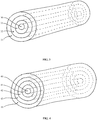
- Fig. 1 depicts one embodiment of the invention, encompassing an implantable device for delivery of a pharmaceutical substance to a patient, comprising: a core 10 comprising a core polymeric material; and a first layer 11 comprising a first-layer pharmaceutical substance and a first-layer polymeric material surrounding the core, where the core polymeric material and the first-layer polymeric material are the same or different.
- the core and the first layer may thus comprise the same or different polymeric materials.
- Fig. 2 depicts another embodiment of the invention, encompassing an implantable device for delivery of a pharmaceutical substance to a patient, comprising: a core 20 comprising a core polymeric material; and a first layer 21 comprising a first-layer pharmaceutical substance and a first-layer polymeric material surrounding the core; and a second layer 22 comprising a second-layer pharmaceutical substance and a second-layer polymeric material, where the core, first-layer, and second-layer polymeric materials are the same or different, and where the first-layer and second-layer pharmaceutical substances are the same or different.
- the core and each layer may thus comprise the same or different polymeric materials.
- Each layer may comprise the same pharmaceutical substance or different pharmaceutical substances.
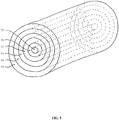
- Fig. 3 depicts another embodiment of the invention, encompassing an implantable device for delivery of a pharmaceutical substance to a patient, comprising: a core 30 comprising a core polymeric material; and a first layer 31 comprising a first-layer pharmaceutical substance and a first-layer polymeric material surrounding the core; and a second layer 32 comprising a second-layer pharmaceutical substance and a second-layer polymeric material, and an additional layer 33 comprising a third-layer pharmaceutical substance and a third-layer polymeric material, where the core, first-layer, second-layer and third-layer polymeric materials are the same or different, and where the first-layer, second-layer and third-layer pharmaceutical substances are the same or different.
- the core and each layer may thus comprise the same or different polymeric materials.
- Each layer may comprise the same pharmaceutical substance or different pharmaceutical substances.
- Fig. 4 depicts another embodiment of the invention, encompassing an implantable device for delivery of a pharmaceutical substance to a patient, comprising: a core 40 comprising a core polymeric material; and a first layer 41 comprising a first-layer pharmaceutical substance and a first-layer polymeric material surrounding the core; and a second layer 42 comprising a second-layer pharmaceutical substance and a second-layer polymeric material, a third layer 43 comprising a third-layer pharmaceutical substance and a third-layer polymeric material, and a fourth layer 44 comprising a fourth-layer pharmaceutical substance and a fourth-layer polymeric material, where the core, first-layer, second-layer, third-layer, and fourth-layer polymeric materials are the same or different, and where the first-layer, second-layer, third-layer, and fourth-layer pharmaceutical substances are the same or different.
- the core and each layer may thus comprise the same or different polymeric materials.
- Each layer may comprise the same pharmaceutical substance or different pharmaceutical substances.
- Fig. 5 depicts another embodiment of the invention, encompassing an implantable device for delivery of a pharmaceutical substance to a patient, comprising: a core 50 comprising a core polymeric material; and a first layer 51 comprising a first-layer pharmaceutical substance and a first-layer polymeric material surrounding the core; and a second layer 52 comprising an second-layer pharmaceutical substance and a second-layer polymeric material, a third layer 53 comprising a third-layer pharmaceutical substance and a third-layer polymeric material, a fourth layer 54 comprising a fourth-layer pharmaceutical substance and a fourth-layer polymeric material, and a fifth layer 55 comprising a fifth-layer pharmaceutical substance and fifth-layer polymeric material, where the core, first, second, third, fourth, and fifth polymeric materials are the same or different, and where the first, second, third, fourth, and fifth pharmaceutical substances are the same or different.
- the core and each layer may thus comprise the same or different polymeric materials.
- Each layer may comprise the same pharmaceutical substance or different pharmaceutical substances.
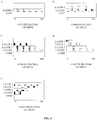
- Fig. 6 diagrams several embodiments of the invention, in which the concentration of pharmaceutical substance in the various layers varies with varying distance from the core.
- the invention comprises a core comprising essentially no drug, with one layer (Layer 1) comprising a high percentage of drug (approximately 80 to approximately 90%).
- the invention comprises a core comprising essentially no drug, with one layer (Layer 1) comprising a high percentage of drug (approximately 80 to approximately 90%), surrounded by an outermost layer (Layer 2) comprising a lower concentration of drug than Layer 1 (approximately 60 to 70%).
- the invention comprises a core comprising essentially no drug, with one layer (Layer 1) comprising a higher percentage of drug (approximately 80 to approximately 90%), surrounded by another layer (Layer 2) comprising a lower concentration of drug than Layer 1 (approximately 60 to approximately 70%), surrounded by an outermost layer (Layer 3), comprising a concentration of drug lower than Layer 2 (approximately 50%).
- Layer 1 a higher percentage of drug
- Layer 2 surrounded by another layer (Layer 2) comprising a lower concentration of drug than Layer 1 (approximately 60 to approximately 70%)
- Layer 3 an outermost layer
- the invention comprises a core comprising essentially no drug, surrounded by a layer (Layer 1) comprising a higher percentage of drug (approximately 80 to approximately 90%), surrounded by another layer (Layer 2), comprising a concentration of drug lower than Layer 1 (approximately 60 to approximately 70%), surrounded by another layer (Layer 3), comprising a concentration of drug lower than Layer 2 (approximately 50%), surrounded by an outermost layer (Layer 4) comprising a concentration of drug lower than Layer 3 (approximately 30 to approximately 40%).
- Layer 1 comprising a higher percentage of drug (approximately 80 to approximately 90%
- Layer 2 surrounded by another layer (Layer 3)
- Layer 3 comprising a concentration of drug lower than Layer 2 (approximately 50%)
- surrounded by an outermost layer (Layer 4) comprising a concentration of drug lower than Layer 3 (approximately 30 to approximately 40%).
- the invention comprises a core comprising essentially no drug, surrounded by a layer (Layer 1) comprising a low level of drug (approximately 30 to approximately 40%), surrounded by a layer (Layer 2) comprising a higher level of drug (approximately 50%), surrounded by a layer (Layer 3) comprising a still higher level of drug (approximately 60 to approximately 70%), surrounded by an outermost layer (Layer 4) comprising a still higher percentage of drug (approximately 80 to approximately 90%).
- each successive layer comprises an increasing percentage of pharmaceutical substance with increasing distance from the core, with the highest percentage of drug in the outermost layer.
- the implantable devices can be produced by an extrusion process.
- the drug substance can be prepared by milling (e.g., ball-milling, impact-milling), spray-drying, solvent precipitation, screening or other method or combination of methods known in the art to produce fine particles.
- the drug can be combined with a polymer which is also prepared as fine particles.
- the blended mixture can be extruded, e.g., via Microtruder screw extruder, Model No. RCP-025, Randcastle Extrusion Systems, Cedar Grove, NJ, or via other extrusion devices known in the industry.
- the diameter of extrusion, as well as temperature, pressure and other parameters can be controlled as appropriate for each drug.
- a core comprising polymer can be formed, e.g., by extrusion, which is then coated with one or more layers comprising polymer and drug via a dip coating or spray coating method.
- a solvent evaporation technique may be used to mix the polymer and drug in a solvent.
- the solution comprising polymer, drug and solvent can then be applied to the surface of the core by either dipping or spraying.
- the resultant composition is then subjected to a drying process, during which the solvent is evaporated, and the polymeric material, with the drug dispersed therein, forms a thin film or layer on the core.
- This procedure can be repeated with various solutions of the same or differing concentrations of drug and polymer to deposit additional layers on the composition.
- devices comprising multiple layers may be produced by any combination of extrusion and coating.
- the extrudate can be extruded horizontally and collected for further processing.
- the extrudate can be cut into desirable lengths, e.g., from about 1 to about 3 cm.
- the extrudate can then be washed in any solvent in which the drug or drugs dissolve, and then dried and packaged.
- Devices with multiple layers can be produced by co-extrusion methods known in the art, for example, by the methods disclosed in U.S. Patent No. 5,063,018 (for manufacturing catheters with a lumen), or U.S. Pat. Nos. 4,832,589 , 4,379,117 , 3,880,691 , and 3,337,665 .
- Multi-manifold dies such as multi-manifold dies using feedblock co-extrusion, are known in the art for producing multi-layered materials.
- devices comprise dimensions of about 0.5 to about 7 mm in diameter. In some embodiments the devices are about 0.5 to 10 cm in length. In one embodiment, the device is from about 1 to about 3 cm in length. In one embodiment, the device is about 2 cm to about 3 cm in length. In another embodiment, the device is about 2.6 cm in length. In one embodiment, the device is about 1 to about 3 mm in diameter. In another embodiment, the device is about 2 to about 3 mm in diameter. In one embodiment, the device is about 2.4 mm in diameter. In some embodiments in which devices comprises dimensions of about 2.4 mm in total diameter and about 2.6 cm in total length, the devices each release 1 mg of pharmaceutical substance per day.
- the core comprising a polymeric material and the layer or layers comprising a polymeric material and a drug are each independently about 0.5 to about 7 mm in diameter or thickness. In one embodiment, the core and layer or layers are each independently about 0.5 to about 3.5 mm. In another embodiment, the core and layer or layers are each independently about 0.5 to about 2 mm. In another embodiment, the core and layer or layers are each independently about 1 to about 2 mm.
- the thickness or diameter of the core may vary from the thickness of the layer or layers. If multiple layers are present, each layer may have the same thickness as the other layers, or each layer may have a different thickness from the other layers, or some layers may have the same thickness as other layers while some layers may have a different thickness from other layers.
- thickness of a layer is meant the distance, as measured from the center of the device, between the start of the layer and the end of the layer; for example, for a cylindrical device with regular, annular layers, a layer that starts at 2 mm from the center and that ends at 3.5 mm from the center has a thickness of 1.5 mm.
- the device may be illustrated as having a core and one or more layers which are cylindrical or annular in cross-section, it is understood that the cross-section of the core and one or more layers may be oval, polygonal, star-shaped, irregular, or of uneven thickness.
- the various layers comprising a polymer and drug may comprise different polymers, or mixtures thereof, and different drugs or mixtures thereof.
- the release of drug from the device is dependent on the rate of dissolution and on passive diffusion through the polymer matrix. Therefore, the surface area of the implant determines the rate of release.
- the release mechanism of the drug from the polymeric material also depends on the nature of the polymer and the drug. The drug diffuses through the polymer to the surrounding tissues and bodily fluids. Release can also occur through degradation or erosion of the polymer, in the case of an erodible or bioerodible polymer. The degradation or erosion of the polymer may occur through hydrolysis, by enzymatic degradation, or via other processes.
- Drug release rates are also affected by washing of the implant prior to insertion into the patient. Washed implants maintain a more-stable release rate after insertion; unwashed implants may show a significantly higher burst release immediately after implant. A burst release may be detrimental to the patient, as local or systemic drug concentration rises from zero to a potentially supra-therapeutic level rapidly. Initial burst may also unnecessarily deplete the drug depot and shorten the duration of the release period.
- the implants may be washed with any solvent in which the drug dissolves, such as water, ethanol, isopropanol, etc. Washing may be followed by drying to remove the solvent. Drying may be followed by packaging and sterilization.
- an initial high dose of a drug is desirable, and in those circumstances washing of the device can be omitted in order to provide for an initial burst as a loading dose.
- a layer of substantially pure pharmaceutical substance is placed on the outside of the device, for an enhanced loading dose (initial dose).
- the extruded device can be cut into implants of appropriate length, such as 2.6 cm.
- the extrudate may be, optionally, washed, e.g., with 95% ethanol at room temperature for 30 min to remove surface drug.
- the washed implants can be dried (e.g., air dried at room temperature for 30 min, then forced air at 40°C for 1 hour, followed by vacuum drying at 30°C for 24 hours) to remove residual ethanol.
- Implants may be placed in moisture barrier foil pouches, heat-sealed and then sterilized using gamma irradiation (2.9 - 3.1 Mrads).
- Stepsy state plasma level refers to an approximately constant level of drug over a period of time in the plasma of the subject or patient.
- a steady state plasma level or approximately constant level of drug varies by no more than about ⁇ 30% over a day, over a week, over a month, over three months, over six months, or over nine months, as compared to the mean or average plasma level over that time period.
- a steady state plasma level or approximately constant level of drug varies by no more than about ⁇ 20% over a day, over a week, over a month, over three months, over six months, or over nine months, as compared to the mean or average plasma level over that time period.
- a steady state plasma level or approximately constant level of drug varies by no more than about ⁇ 10% over a day, over a week, over a month, over three months, over six months, or over nine months, as compared to the mean or average plasma level over that time period.
- An "approximately constant release rate" indicates that an approximately constant level of the pharmaceutical substance is released from the device over a period of time, such as over a day, over a week, over a month, over three months, over six months, or over nine months.
- the approximately constant release rate is no more than about ⁇ 30%, ⁇ 20%, or ⁇ 10% over the time period indicated, as compared to the average or mean release.
- An approximately constant release rate is preferred in order to achieve a steady state plasma level.
- essentially constant is meant that for about 95% of the extended period of time, the concentration of drug in blood plasma is within about three, about two, or preferably about one standard deviation of the mean blood plasma level. Measurements of the blood plasma level can be performed hourly, twice a day, daily, twice a week, weekly, every two weeks, monthly, or at any other periodic interval for determination of the mean plasma levels. For example, if the mean blood plasma level of a drug sampled at weekly intervals is 2.0 ng/ml, and one standard deviation of the measurement is ⁇ 0.1 ng/ml, then blood levels that fall within about ⁇ 0.3 ng/ml, about ⁇ 0.2 ng/ml, or preferably about ⁇ 0.1 ng/ml for about 95% of the measurements are considered essentially constant.
- extended periods of time is meant from about 3 months to about 1 year, or longer, e.g., at least about 3, about 6, about 9, about 12, about 15, about 18, about 21, or about 24 months or more.
- the period during which the initial burst or initial loading dose occurs is excluded from the calculation of steady-state plasma levels or steady-state release rates, approximately constant plasma levels or approximately constant release rates, or essentially constant plasma levels or essentially constant release rates.
- the initial burst period or initial loading dose period ends when the release rate or plasma level falls within the ranges as specified above for steady-state, approximately constant, or essentially constant.
- the implantable device comprises a core comprising a core polymeric material, surrounded by one or more layers comprising a layer polymeric material and a pharmaceutical substance.
- a "polymer” or “polymeric material” means a macromolecule comprising repeating monomer units or co-monomer units.
- the polymer may be bioerodible or non-bioerodible.
- the polymer may be a homopolymer, copolymer, terpolymer, or may contain more than three monomers.
- the polymer is preferably biocompatible.
- non- bioerodible polymers useful in the present invention include poly(ethylene-co-vinyl acetate) (EVA).
- EVA poly(ethylene-co-vinyl acetate)
- the preferred polymer for the devices is ethyl vinyl acetate (EVA).
- Either the core or any layer of the device can comprise a single type of polymer or a mixture of two or more polymers.
- a mixture of two polymers may modulate the release rate of the drug. It is desirable that an effective therapeutic amount of the drug be released from the device for a reasonably long period of time.
- U.S. Patent No. 6,258,121 to Yang et al. disclosed a method of altering the release rate by blending two polymers with differing release rates and incorporating them into a single layer; this technique can also reduce burst release of drug upon implant.
- a "drug” or “pharmaceutical substance” is any biologically active agent or other substance that has therapeutic value to a living organism, including without limitation anti-thrombotics, anticancer agents, anticoagulants, anti-platelet agents, thrombolytics, anti-proliferatives, anti-inflammatories, agents that inhibit restenosis, smooth muscle cell inhibitors, antibiotics, heparin, and the like, and/or mixtures thereof and/or any substance that may assist another substance in performing the function of providing therapeutic value to a living organism.
- Suitable therapeutic and prophylactic agents include synthetic inorganic and organic compounds, proteins and peptides, polysaccharides and other sugars, lipids, and DNA and RNA nucleic acid sequences having therapeutic, prophylactic or diagnostic activities.
- Nucleic acid sequences include genes, antisense molecules that bind to complementary DNA to inhibit transcription, and ribozymes.
- Additional pharmaceutical substances which can be incorporated into the device include those listed in the Physicians' Desk Reference, 57th Edition (2003 ), including allergens, amebicides and trichomonacides, amino acid preparations, analeptic agents, analgesics, analgesics/antacids, anesthetics, anorexics, antacids, antihelmintics, antialcohol preparations, anti-allergics, antiarthritics, antiasthma agents, antibacterials and antiseptics, antibiotics, antiviral antibiotics, anticancer preparations, anticholinergic drug inhibitors, anticoagulants, anticonvulsants, antidepressants, antidiabetic agents, antidiarrheals, antidiuretics, antienuresis agents, anti-fibrin, antifibrinolytic agents, antifibrotics (systemic), antiflatulents, antifungal agents, antigonadotropin, antihistamines, antihyperammonia agents, anti-
- first-layer pharmaceutical substance, and additional pharmaceutical substances are independently selected from the group consisting of: 5-alpha-reductase inhibitors, analeptic agents, analgesics, angiotensin converting enzyme, anticancer agents, anticancer preparations, anticholinergic drug inhibitors, anticoagulants, anticonvulsants, antidepressants, antidiabetic agents, antienuresis agents, anti-inflammatory agents, anti-obesity preparations, antiparasitics, anti-parkinsonism drugs, anti-platelet agents, anti-psychotics, antispasmodics and anticholinergics, anti-thrombotics, antiviral agents, bronchial dilators, calcium channel blockers, central nervous system stimulants, cholesterol reducers and anti-hyperlipemics, diuretics, dopamine agonists, histamine H receptor antagonists, hormones, steroid hormones, peptide hormones, thyroid hormones, hormone mimetics, mimetics of steroid hormones, mi
- first-layer pharmaceutical substance, and additional pharmaceutical substances are independently selected from the group consisting of analeptic agents, analgesics, anticancer preparations, anticholinergic drug inhibitors, anticoagulants, anticonvulsants, antidepressants, antidiabetic agents, antienuresis agents, anti-inflammatory agents, anti-obesity preparations, antiparasitics, anti-parkinsonism drugs, antispasmodics and anticholinergics, anti-thrombotics, antiviral agents, bronchial dilators, central nervous system stimulants, cholesterol reducers and anti-hyperlipemics, diuretics, histamine H receptor antagonists, hormones, hyperglycemic agents, immunosuppressives, narcotic antagonists, narcotic detoxification agents, ophthalmological osmotic dehydrating agents, respiratory stimulants, sympatholytics, thyroid preparations, and uricosuric agents.
- analeptic agents analgesics, anticancer preparations, anticholine
- first-layer pharmaceutical substance, and additional pharmaceutical substances are independently selected from the group consisting of hormones, growth factors, angiopeptin, angiotensin converting enzyme inhibitors, captopril, cilazapril, and lisinopril.
- first-layer pharmaceutical substance, and additional pharmaceutical substances are independently selected from the group consisting of analeptic agents, analgesics, anticancer preparations, anticholinergic drug inhibitors, anticoagulants, anticonvulsants, antidepressants, antidiabetic agents, antienuresis agents, anti-inflammatory agents, anti-obesity preparations, antiparasitics, anti-parkinsonism drugs, antispasmodics and anticholinergics, anti-thrombotics, antiviral agents, bronchial dilators, central nervous system stimulants, cholesterol reducers and anti-hyperlipemics, diuretics, histamine H receptor antagonists, hormones, hyperglycemic agents, immunosuppressives, narcotic antagonists, narcotic detoxification agents, ophthalmological osmotic dehydrating agents, respiratory stimulants, sympatholytics, thyroid preparations, and uricosuric agents.
- analeptic agents analgesics, anticancer preparations, anticholine
- bioactive agents include adhesion peptides, antibodies, antigens for immunization, blood clotting factors, enzymes, hormones and growth factors, inhibitors or clot dissolving agents such as streptokinase and tissue plasminogen activator, oligonucleotides such as antisense oligonucleotides and ribozymes, receptor ligands, and retroviral vectors for use in gene therapy.
- cytostatic substances include angiopeptin, angiotensin converting enzyme inhibitors such as captopril (e.g.
- An example of an anti-allergic agent is permirolast potassium.
- Other therapeutic substances or agents which may be appropriate include alpha-interferon, bioactive RGD, and genetically engineered epithelial cells.
- the foregoing substances can also be used in the form of prodrugs or co-drugs thereof.
- the foregoing substances are listed by way of example and are not meant to be limiting.
- active agents which are currently available or that may be developed in the future are equally applicable. Examples include: 4-amino-2,2,6,6-tetramethylpiperidine-1-oxyl (4-amino-TEMPO), antithrombins including sodium heparin, low molecular weight heparins and heparinoids, argatroban, calcium channel blockers (such as nifedipine), colchicine, dextran, dipyridamole, D-phe-pro-arg-chloromethylketone (synthetic antithrombin), estradiol, fibroblast growth factor (FGF) antagonists, fish oil (omega 3-fatty acid), forskolin, glycoprotein IIb/IIIa platelet membrane receptor antagonist antibody, hirudin, lovastatin (an inhibitor of HMG-CoA reductase, a cholesterol lowering drug, brand name Mevacor(R) from Merck & Co., Inc., Whitehouse Station, N.J.), nitric oxide or ni
- first-layer pharmaceutical substance, and additional pharmaceutical substances are independently selected from the group consisting of calcium channel blockers, nifedipine, and triazolopyrimidine.
- anti-inflammatory agents including steroidal and non-steroidal anti-inflammatory agents include tacrolimus, dexamethasone, clobetasol, or combinations thereof.
- anticancer drugs which can be incorporated into the device include acivicin, aclarubicin, acodazole, acronycine, adozelesin, alanosine, aldesleukin, allopurinol sodium, altretamine, aminoglutethimide, amonafide, ampligen, amsacrine, androgens, anguidine, aphidicolin glycinate, asaley, asparaginase, 5-azacitidine, azathioprine, Bacillus calmette-guerin (BCG), Baker's Antifol (soluble), beta-2'-deoxythioguanosine, bisantrene HCl, bleomycin sulfate, busulfan, buthionine sulfoximine, ceracemide, carbetimer, carboplatin, carmustine, chlorambucil, chloroquinoxaline-sulfonamide, chlorozotocin, chromo
- anti-proliferative agents include rapamycin and its functional or structural derivatives, 40-O-(2-hydroxy)ethyl-rapamycin (everolimus), and its functional or structural derivatives, paclitaxel and its functional and structural derivatives.
- rapamycin derivatives include methyl rapamycin (ABT-578), 40-O-(3-hydroxy)propyl-rapamycin, 40-O-[2-(2-hydroxy)ethoxy]ethyl-rapamycin, and 40-O-tetrazole-rapamycin.
- the anticancer drug or agent is selected from the group consisting of androgens.
- anti-inflammatory drugs which may be incorporated into the device include acetaminophen (Tylenol(R)), acetylsalicylic acid, APHS, aspirin, betamethasone, celecoxib, choline magnesium trisalicylate, cortisone, COX-2 inhibitors, desoxycorticosterone, dexamethasone, diclofenac, diflunisal, DuP-697, etodolac, etoricoxib, fenoprofen, flosulid, fludrocortisone, fluprednisolone, flurbiprofen, glucocorticoids, hydrocortisone, ibuprofen, indomethacin, JTE-522, ketoprofen, ketorolac, L-745337, L-748780, L-761066, lumiracoxib, mefenamic acid, meloxicam, meprednisone, methylpredn
- Exemplary anti-thrombotic agents which may be incorporated into the device include: Vitamin K antagonists such as Acenocoumarol, Clorindione, Dicumarol (Dicoumarol), Diphenadione, Ethyl biscoumacetate, Phenprocoumon, Phenindione, Tioclomarol, Warfarin; Heparin group anti-platelet aggregation inhibitors such as Antithrombin III, Bemiparin, Dalteparin, Danaparoid, Enoxaparin, Heparin, Nadroparin, Parnaparin, Reviparin, Sulodexide, Tinzaparin; other platelet aggregation inhibitors such as Abciximab, Acetylsalicylic acid (Aspirin), Aloxiprin, Beraprost, Ditazole, Carbasalate calcium, Cloricromen, Clopidogrel, Dipyridamole, Eptifibatide, Indobufen, Iloprost, Picotamide
- the anti-thrombotic agent is selected from the group consisting of Beraprost, Clopidogrel, and Iloprost.
- anesthetics which may be incorporated into the device include but are not limited to: bupivacaine, lidocaine, and mepivacaine.
- pharmaceutical substances which can be used in the present invention are: analgesics, acetaminophen, anesthetics, benzodiazepine antagonist flumazenil, benzodiazepine, buprenorphine, carbamazepine, clonidine, fentanyl, hydrocodone, hydromorphone, levorphanol, lidocaine, meperidine, methadone, morphine, nalbuphine, narcotics, opioids, pentazocain, propoxyphene, tramadol, trimipramine maleate, zaleplon, and derivatives, combinations and mixtures thereof.
- antimicrobials which may be incorporated into the device include, but are not limited to, acetyl sulfisoxazole, alatrofloxacin mesylate, amoxicillin, ampicillin, atovaquone, azithromycin, aztreonam, carbenicillin, cefaclor, cefadroxil, cefamandole nafate, cefazolin, cefdinir, cefepime, cefixime, cefoperazone, cefotaxime, cefotetan, cefoxitin, cefpodoxime proxetil, cefprozil, ceftazidime, ceftazidime, ceftibuten, ceftizoxime, ceftriaxone, cefuroxime axetil, cefuroxime, cephalexin, cephalosporins, chlorhexidine, chlortetracycline, cilastatin, ciprofloxacin,
- antifungals examples include amphotericin B, caspofungin acetate, ciclopirox, clotrimazole, econazole, fluconazole, flucytosine, griseofulvin, itraconazole, ketoconazole, micronazole, naftifine, pyrimethamine, terbinafin, and combinations, derivatives and mixtures thereof.
- a subset of pharmaceutical substances of interest is buprenorphine, nalmefene, and dopamine agonists, such as apomorphine, lisuride, pergolide, bromocriptine, pramipexole, ropinerole, and rotigotine.
- first-layer pharmaceutical substance, and additional pharmaceutical substances are independently selected from the group consisting of buprenorphine and fentanyl.
- Drug delivery can have a controlled release during the life of implant.
- a multilaminate device which comprises a core comprising a polymer and multiple layers comprising polymer and drug
- the varying concentration of drug in different layers can be used to modulate the rate of drug delivery over time.
- the device displays a generally linear release of drug over time.
- drug release from the device is approximately constant or essentially constant over the lifetime of the device, or for a specified period within the lifetime of the device.
- the drug is released from the device, layer by layer, from outer-most to inner-most layers. However, each layer will have a diameter and surface area smaller than the layer outside it.
- concentrations of drug layer-by-layer can be designed to create different rates of drug release. For example, if each layer contains the same or a lower drug concentration than the adjoining outer-more layer, this will result in a tapered, ever-decreasing rate of drug delivery. Modulating concentrations of drug layer-by-layer can also produce a slow rise in drug delivery over the lifetime of the implant or a specified period during the lifetime of the implant. Alternating layers of relatively high and low concentrations of drug can produce a pulsed rate of drug delivery that rises and falls over time.
- the device may be designed such that the rate of drug delivery over time is determined, at least in part, by total surface area, surface area of each successive layer, varying concentrations of drug per layer, and selection of polymer(s) in the device.
- the resultant concentration in the blood plasma of drug delivered by the device may be at least about 0.1 ng/ml blood plasma, generally about 0.1 to about 10 ng/ml.
- the steady state of drug is about 1 to about 10 ng/ml blood plasma.
- the steady state plasma level of drug is about 1 to about 6 ng/ml blood plasma.
- more than one implantable device may be inserted into a patient to achieve a desired level of drug concentration in the blood plasma.
- the level of drug delivery is preferably within the therapeutic range of the drug and lower than a level that might cause toxicity.
- the device can comprise multiple drugs.
- the multiple drugs are integrated into the device and released layer by layer to maintain steady-state levels of each drug throughout the duration of implant.
- the drugs are distributed in varying concentrations layer by layer so that drug delivery may occur in waves, with a higher dosage of one drug released, followed by a higher dosage of another drug over time.
- the device may be designed to provide a steady-state concentration of drug in the blood plasma.
- the device may be designed such that the resulting concentration of drug in the blood plasma remains essentially constant over extended periods of time.
- the device may be designed such that the resulting concentration of drug in the blood plasma remains approximately constant over extended periods of time.
- the device is administered by subcutaneous implantation.
- the devices are subcutaneously implanted at a site selected from a group consisting of the upper arm, scapular region, the back, the leg and the abdomen.
- the patient may be lightly anesthetized, e.g., with isoflurane or other anesthetic known in the art, and/or may have topical, transdermal, or subcutaneous anesthetic applied at the site of implantation.
- a small incision can be made through the skin and a trocar inserted subcutaneously, then loaded with one implant.
- the stylet can be inserted to hold the implant in place and the trocar carefully removed, leaving the implant in the subcutaneous space.
- Each site can be sutured closed and examined later. Complications such as skin irritation, inflammation, infection or other site-specific adverse effects can be monitored and treated, e.g., with antibiotics, as needed.
- the device can be left in the body for up to one year or more.
- the period of sustained release of drug into the body is thus from about 3 months to about 1 year, or longer, e.g., at least about 3 months, at least about 6 months, at least about 9 months, at least about 12 months, at least about 15 months, at least about 18 months, at least about 21 months, or at least about 24 months or more.
- the device can be left in the body for more than 1 year. Implants may be removed from the body at the end of the treatment period, through an incision, e.g., a 3-mm incision, using forceps.
- a second implant may, for example, be used to deliver a pharmaceutical substance to counteract any adverse effects caused by a drug released from a first implant.
- Multiple implants may be inserted into a single patient to regulate the delivery of a single drug, or to deliver several drugs.
- the core comprises a core polymeric material of ethylene vinyl acetate (EVA).
- EVA ethylene vinyl acetate
- the first layer surrounding the core is made out of EVA, and contains the substance buprenorphine.
- the disclosure provides an implantable device for treating opiate addiction, comprising buprenorphine and a biocompatible, nonerodible polymeric matrix in a first layer surrounding a core of a biocompatible, nonerodible polymer lacking said buprenorphine, wherein said buprenorphine is encapsulated within said matrix of the first layer, and wherein when said implantable device is implanted subcutaneously in a mammal, said buprenorphine is continuously released in vivo over a sustained period of time through pores that open to the surface of said matrix at a rate that results in a steady state plasma buprenorphine level of at least about 0.1 ng/ml, typically in the range of about 0.1 to about 70 ng/ml.
- the steady state plasma buprenorphine level is about 0.1 to about 10 ng/ml, about 0.1 to about 5 ng/ml, about 0.1 to about 3 ng/ml, about 0.1 to about 2 ng/ml, about 0.1 to about 1 ng/ml, about 0.1 to about 0.9 ng/ml, about 0.1 to about 0.8 ng/ml, about 0.1 to about 0.7 ng/ml, about 0.1 to about 0.6 ng/ml, about 0.1 to about 0.5 ng/ml, or about 0.5 to about 1 ng/ml.
- the steady state plasma buprenorphine level is about 1 to about 10 ng/ml, about 1 to about 6 ng/ml, about 1 to about 5 ng/ml, about 1 to about 3 ng/ml, about 1 to about 2 ng/ml, or about 1 ng/ml.
- the polymeric matrix of both the core and the first layer comprises EVA.
- the vinyl acetate content can be about 2 to about 40, about 10 to about 35, about 30 to about 35 %, or about 33% by weight.
- the EVA-buprenorphine blend of the first layer of the implantable devices generally comprise about 10% to about 85%, such as about or at least about 10, 20, 30, 40, 50, 55, 60, 65, 70, 75, 80, or 85% buprenorphine, often about 50% to about 75% buprenorphine.
- the EVA-buprenorphine blend of the first layer of the implantable device comprises about 50% buprenorphine and about 50% EVA.
- the EVA-buprenorphine blend of the first layer of the implantable device comprises about 66.7% buprenorphine and about 33.3% EVA.
- the EVA-buprenorphine blend of the first layer of the implantable device comprises about 75% buprenorphine and about 25% EVA.
- the sustained period of time for buprenorphine release is from about 3 months to about 1 year, or longer, e.g., at least about 3, 6, 9, or 12 months.
- the disclosure provides an implantable device for treating pain, including chronic pain or acute pain, comprising buprenorphine and a biocompatible, nonerodible polymeric matrix in a first layer surrounding a core of a biocompatible, nonerodible polymer lacking said buprenorphine, wherein said buprenorphine is encapsulated within said matrix of the first layer, and wherein when said implantable device is implanted subcutaneously in a mammal, said buprenorphine is continuously released in vivo over a sustained period of time through pores that open to the surface of said matrix at a steady state rate of at least about 0.1 mg per day, generally in the range of about 0.1 to about 5 mg per day, about 0.1 to about 4 mg per day, about 0.1 to about 3 mg per day, about 0.1 to about 2 mg per day, about 0.1 to about 1 mg per day, about 0.2 to about 5 mg per day, about 0.2 to about 4 mg per day, about 0.2 to about 3 mg per day, about 0.2 to about 2 mg per
- the steady state rate of buprenorphine release is about 0.1 mg per day, 0.2 mg per day, 0.3 mg per day, about 0.4 mg per day, about 0.5 mg per day, about 0.6 mg per day, about 0.7 mg per day, about 0.8 mg per day, about 0.9 mg per day, about 1.0 mg per day, about 1.1 mg per day, about 1.2 mg per day, about 1.3 mg per day, about 1.4 mg per day, about 1.5 mg per day, about 2 mg per day, about 3 mg per day, about 4 mg per day, about 5 mg per day, in vivo or in vitro.
- the polymeric matrix of both the core and the first layer comprises EVA.
- the vinyl acetate content can be about 2 to about 40, about 10 to about 35, about 30 to about 35 %, or about 33% by weight.
- the EVA-buprenorphine blend of the first layer of the implantable devices generally comprise about 10% to about 85%, such as about or at least about 10, 20, 30, 40, 50, 55, 60, 65, 70, 75, 80, or 85% buprenorphine, often about 50% to about 75% buprenorphine.
- the EVA-buprenorphine blend of the first layer of the implantable device comprises about 50% buprenorphine and about 50% EVA.
- the EVA-buprenorphine blend of the first layer of the implantable device comprises about 66.7% buprenorphine and about 33.3% EVA. In another embodiment, the EVA-buprenorphine blend of the first layer of the implantable device comprises about 75% buprenorphine and about 25% EVA. In various embodiments, the sustained period of time for buprenorphine release is from about 3 months to about 1 year, or longer, e.g., at least about 3, 6, 9, or 12 months.
- the implantable device for treatment of opiate addiction or treatment of pain, such as chronic or acute pain is produced by an extrusion process.
- the devices are subcutaneously implanted at a site selected from the group consisting of the upper arm, the back, and the abdomen.
- extruded devices comprise dimensions of about 2.4 mm in diameter and about 2.6 cm in length.
- extruded devices comprise dimensions of about 2 to about 3 mm in diameter and about 2 to about 3 cm in length.
- extruded devices comprises dimensions of about 0.5 to about 7 mm in diameter and about 0.5 to about 5 cm in length.
- extruded devices comprises dimensions of about 0.5 to about 7 mm in diameter and about 0.5 to about 10 cm in length. In some embodiments in which extruded devices comprise dimensions of about 2.4 mm in diameter and about 2.6 cm in length, the devices each release about 1 mg buprenorphine per day in vitro.
- the implantable devices are administered by subcutaneous implantation.
- the devices are subcutaneously implanted at a site selected from the group consisting of the upper arm, scapular region, the back, the leg and the abdomen.
- buprenorphine refers to buprenorphine free base and pharmaceutically acceptable salts thereof, such as buprenorphine HCl. Norbuprenorphine can also be used in place of buprenorphine. Incorporation of buprenorphine into the polymeric matrix causes the formation of a series of interconnecting channels and pores that are accessible to the surface for release of the drug. Where appropriate, a coating that is impermeable to the drug is placed over at least a portion of the device to further regulate the rate of release. Where appropriate, the device does not have any coating that is impermeable to the drug.
- devices of the invention When implanted subcutaneously, devices of the invention continuously release buprenorphine for an extended period of time with a pseudo or near zero order release rate. After an initial burst following implantation, release rates are typically within about 10-20% of the steady state average. In some embodiments, the initial burst of buprenorphine released in vivo after implantation is reduced or minimized by prewashing the implantable devices before implantation to remove surface buprenorphine. Prewashing may be performed in any solution in which buprenorphine is soluble, for example 30 minutes in ethanol or normal saline.
- the release rate can be altered by modifying the percent drug loading, porosity of the matrix, structure of the implantable device, or hydrophobicity of the matrix, or by adding a hydrophobic coating to the exterior of the implantable device.
- the devices can deliver buprenorphine without the need for external medical equipment such as intravenous lines or pumps.
- Devices may be produced using an extrusion process, wherein ground EVA is blended with buprenorphine, melted, and extruded into rod-shaped structures. Rods are cut into individual implantable devices of the desired length, packaged, and sterilized prior to use.
- Other methods for encapsulating therapeutic compounds in implantable polymeric, nonerodible matrices are well known to those of skill in the art. Such methods include, for example, solvent casting (see, e.g., U.S. Pat. Nos. 4,883,666 , 5,114,719 , and 5,601,835 ).
- solvent casting see, e.g., U.S. Pat. Nos. 4,883,666 , 5,114,719 , and 5,601,835 .
- a skilled artisan would be able to readily determine an appropriate method of preparing such an implantable device, depending on the shape, size, drug loading, and release kinetics desired for a particular type of patient or clinical indication.
Landscapes
- Health & Medical Sciences (AREA)
- Chemical & Material Sciences (AREA)
- General Health & Medical Sciences (AREA)
- Pharmacology & Pharmacy (AREA)
- Veterinary Medicine (AREA)
- Public Health (AREA)
- Medicinal Chemistry (AREA)
- Animal Behavior & Ethology (AREA)
- Life Sciences & Earth Sciences (AREA)
- Epidemiology (AREA)
- Engineering & Computer Science (AREA)
- Bioinformatics & Cheminformatics (AREA)
- Neurosurgery (AREA)
- Biomedical Technology (AREA)
- Dermatology (AREA)
- Emergency Medicine (AREA)
- Inorganic Chemistry (AREA)
- Chemical Kinetics & Catalysis (AREA)
- General Chemical & Material Sciences (AREA)
- Nuclear Medicine, Radiotherapy & Molecular Imaging (AREA)
- Organic Chemistry (AREA)
- Addiction (AREA)
- Neurology (AREA)
- Psychiatry (AREA)
- Medicinal Preparation (AREA)
- Pharmaceuticals Containing Other Organic And Inorganic Compounds (AREA)
- Medicines That Contain Protein Lipid Enzymes And Other Medicines (AREA)
Priority Applications (5)
| Application Number | Priority Date | Filing Date | Title |
|---|---|---|---|
| SM20180629T SMT201800629T1 (it) | 2010-03-16 | 2011-03-16 | Dispositivi impiantabili eterogenei per la somministrazione di farmaci |
| HRP20182014TT HRP20182014T1 (hr) | 2010-03-16 | 2011-03-16 | Heterogeni implantabilni uređaji za isporuku lijeka |
| RS20181407A RS58011B1 (sr) | 2010-03-16 | 2011-03-16 | Heterogena implantabilna sredstva za isporuku lekova |
| PL11756957T PL2547332T3 (pl) | 2010-03-16 | 2011-03-16 | Heterogeniczne wyroby wszczepialne do podaży leku |
| SI201131621T SI2547332T1 (sl) | 2010-03-16 | 2011-03-16 | Heterogeni vsadljivi pripomočki za dovajanje zdravila |
Applications Claiming Priority (2)
| Application Number | Priority Date | Filing Date | Title |
|---|---|---|---|
| US31446510P | 2010-03-16 | 2010-03-16 | |
| PCT/US2011/028727 WO2011116132A1 (en) | 2010-03-16 | 2011-03-16 | Heterogeneous implantable devices for drug delivery |
Publications (3)
| Publication Number | Publication Date |
|---|---|
| EP2547332A1 EP2547332A1 (en) | 2013-01-23 |
| EP2547332A4 EP2547332A4 (en) | 2014-04-16 |
| EP2547332B1 true EP2547332B1 (en) | 2018-08-29 |
Family
ID=44649589
Family Applications (1)
| Application Number | Title | Priority Date | Filing Date |
|---|---|---|---|
| EP11756957.4A Active EP2547332B1 (en) | 2010-03-16 | 2011-03-16 | Heterogeneous implantable devices for drug delivery |
Country Status (19)
| Country | Link |
|---|---|
| US (4) | US10111830B2 (cg-RX-API-DMAC7.html) |
| EP (1) | EP2547332B1 (cg-RX-API-DMAC7.html) |
| JP (2) | JP5869551B2 (cg-RX-API-DMAC7.html) |
| KR (1) | KR101914119B1 (cg-RX-API-DMAC7.html) |
| AU (1) | AU2011227289B2 (cg-RX-API-DMAC7.html) |
| CA (1) | CA2792179C (cg-RX-API-DMAC7.html) |
| CY (1) | CY1120964T1 (cg-RX-API-DMAC7.html) |
| DK (1) | DK2547332T3 (cg-RX-API-DMAC7.html) |
| ES (1) | ES2699200T3 (cg-RX-API-DMAC7.html) |
| HR (1) | HRP20182014T1 (cg-RX-API-DMAC7.html) |
| LT (1) | LT2547332T (cg-RX-API-DMAC7.html) |
| MX (1) | MX354444B (cg-RX-API-DMAC7.html) |
| PL (1) | PL2547332T3 (cg-RX-API-DMAC7.html) |
| PT (1) | PT2547332T (cg-RX-API-DMAC7.html) |
| RS (1) | RS58011B1 (cg-RX-API-DMAC7.html) |
| SG (2) | SG184059A1 (cg-RX-API-DMAC7.html) |
| SI (1) | SI2547332T1 (cg-RX-API-DMAC7.html) |
| SM (1) | SMT201800629T1 (cg-RX-API-DMAC7.html) |
| WO (1) | WO2011116132A1 (cg-RX-API-DMAC7.html) |
Families Citing this family (35)
| Publication number | Priority date | Publication date | Assignee | Title |
|---|---|---|---|---|
| KR101914119B1 (ko) | 2010-03-16 | 2018-11-02 | 타이탄 파머슈티컬즈 인코퍼레이티드 | 약물 전달용 이종 이식가능 장치 |
| MX350469B (es) * | 2011-10-24 | 2017-09-07 | Endo Pharmaceuticals Solutions | Composiciones para el suministro de farmacos implantables y metodos para su tratamiento. |
| EP2770981B1 (en) | 2011-10-24 | 2017-05-24 | Braeburn Pharmaceuticals, Inc. | Implantable tizanidine compositions and methods of treatment thereof |
| JP2014530913A (ja) * | 2011-10-24 | 2014-11-20 | エンドゥ ファーマシューティカルズ ソリューションズ インコーポレイティド | 移植可能ラサギリン組成物及びその治療方法 |
| TW201332585A (zh) | 2012-02-14 | 2013-08-16 | Chemo Res S L | 核鞘藥物遞送裝置 |
| CN102731777B (zh) * | 2012-07-06 | 2013-12-18 | 辽宁大学 | 聚l-谷氨酸-苄酯/聚磷酸乙酯嵌段共聚物的合成方法 |
| EP3148494A4 (en) * | 2014-05-30 | 2017-12-20 | Textile-Based Delivery, Inc. | Drug delivery systems and related methods of use |
| CN107205956A (zh) | 2014-10-30 | 2017-09-26 | 纺织品技术股份有限公司 | 输送系统 |
| KR101693696B1 (ko) * | 2015-06-12 | 2017-01-06 | 한국생산기술연구원 | 지혈용 다공성 구조체 및 그의 제조 방법 |
| PT109154B (pt) * | 2016-02-12 | 2019-11-05 | Univ De Coimbra | Tecnologia não-invasiva de inserto ocular para libertação controlada de fármacos |
| GB201603296D0 (en) | 2016-02-25 | 2016-04-13 | Ucl Business Plc | Chemotactic,drug-containing polymersomes |
| GB201604553D0 (en) | 2016-03-17 | 2016-05-04 | Ucl Business Plc | Fumarate polymersomes |
| BR112018072883B1 (pt) * | 2016-05-12 | 2023-01-17 | Merck Sharp & Dohme Llc | Sistema de implante subdérmico do agente antiviral 4'-etinil-2-fluoro-2'-desoxiadenosina com polímero eva e seu uso |
| KR102637575B1 (ko) * | 2016-10-05 | 2024-02-20 | 타이탄 파머슈티컬즈 인코퍼레이티드 | 버스트 방출이 감소된 약물 전달용 이식 가능한 장치 |
| IT201700101582A1 (it) * | 2017-09-12 | 2019-03-12 | Milano Politecnico | Dispositivo per rilascio intraoculare |
| CN108310455B (zh) * | 2018-03-20 | 2021-07-30 | 嘉兴尔云信息科技有限公司 | 纳米羟基磷灰石、pgs-m复合骨修复材料及其制备方法 |
| CN119236191A (zh) * | 2018-05-24 | 2025-01-03 | 塞拉尼斯伊娃高性能聚合物公司 | 用于持续释放大分子药物化合物的可植入器件 |
| WO2019222856A1 (en) | 2018-05-24 | 2019-11-28 | Nureva Inc. | Method, apparatus and computer-readable media to manage semi-constant (persistent) sound sources in microphone pickup/focus zones |
| CA3087238A1 (en) * | 2018-05-24 | 2019-11-28 | Celanese EVA Performance Polymers Corporation | Implantable device for sustained release of a macromolecular drug compound |
| EP3810092A4 (en) * | 2018-06-25 | 2022-04-20 | Titan Pharmaceuticals, Inc. | LOADED POROUS STRUCTURES FOR USE AS IMPLANTS |
| CA3123747A1 (en) | 2019-01-07 | 2020-07-16 | Ucl Business Ltd | Polymersomes functionalised with multiple ligands |
| EP3915614A4 (en) * | 2019-01-25 | 2022-09-28 | Daicel Corporation | CRACK RESISTANT COMPONENT |
| KR102183669B1 (ko) * | 2019-03-26 | 2020-11-26 | 가톨릭대학교 산학협력단 | 이중 약물 방출을 위한 약물 전달체 |
| US20200375245A1 (en) * | 2019-05-31 | 2020-12-03 | Bio-On S.P.A. | Filter elements suitable for use in smoking articles and processes for producing the same |
| BR102020013862A2 (pt) * | 2020-07-07 | 2022-01-18 | Edson Luiz Peracchi | Implante subcutâneo reabsorvível de longa duração com liberação sustentada de substância farmacologicamente ativa pré-concentrada em polímero para tratamento da doença de parkinson |
| US20240165064A1 (en) * | 2021-03-29 | 2024-05-23 | Edson Luiz Peracchi | Long-lasting resorbable subcutaneous implant with prolonged release of pre-concentrated pharmacologically active substance in polymer for the treatment of hypothyroidism, and method |
| WO2022221862A1 (en) * | 2021-04-14 | 2022-10-20 | Titan Pharmaceuticals, Inc. | Kappa-opioid receptor agonist implants for treatment of pruritus |
| BR112023022439A2 (pt) | 2021-04-26 | 2023-12-26 | Celanese Eva Performance Polymers Llc | Dispositivo implantável para liberação sustentada de um composto de fármaco macromolecular |
| CN113209050A (zh) * | 2021-05-14 | 2021-08-06 | 浙江恒冀制药有限责任公司 | 基于生物相容性聚合物的长效体内皮埋或内植缓释制剂 |
| EP4433035A1 (en) * | 2021-11-17 | 2024-09-25 | Celanese EVA Performance Polymers LLC | Implantable device for treating an inflammatory eye condition |
| US20230404907A1 (en) * | 2022-06-13 | 2023-12-21 | Celanese Eva Performance Polymers Llc | Monolithic Implantable Device for Sustained Release of an Antibody |
| GB202304657D0 (en) * | 2023-03-29 | 2023-05-10 | Univ Liverpool | Atovaquine compositions |
| WO2024238703A1 (en) * | 2023-05-16 | 2024-11-21 | Elixir Medical Corporation | Anticoagulant compositions comprising anti-platelet and anti-inflammatory drugs and methods and devices for their use |
| GB202401392D0 (en) | 2024-02-02 | 2024-03-20 | Imphatec Ltd | Implant for delivery of a drug |
| WO2025174767A1 (en) * | 2024-02-13 | 2025-08-21 | Biraj Investments, Llc | Highly loaded implantable devices with high tensile strength for drug delivery |
Family Cites Families (41)
| Publication number | Priority date | Publication date | Assignee | Title |
|---|---|---|---|---|
| US4379117A (en) | 1961-12-05 | 1983-04-05 | W. R. Grace & Co. | Method for preparing a film of vinylidene chloride polymer |
| US3337665A (en) | 1964-10-12 | 1967-08-22 | Union Carbide Corp | Method for the production of thermoplastic film |
| US3625214A (en) | 1970-05-18 | 1971-12-07 | Alza Corp | Drug-delivery device |
| DE2114065C2 (de) | 1971-03-23 | 1982-08-19 | Heinrich Pannenbecker | Verfahren zur Herstellung von Folien aus thermoplastischen Kunststoffen mit Klebereigenschaft |
| US3920805A (en) * | 1971-12-09 | 1975-11-18 | Upjohn Co | Pharmaceutical devices and method |
| US3926188A (en) | 1974-11-14 | 1975-12-16 | Alza Corp | Laminated drug dispenser |
| CA1076480A (en) * | 1975-04-28 | 1980-04-29 | John S. Kent | Inert core implant pellet |
| US4191741A (en) | 1978-09-22 | 1980-03-04 | Eli Lilly And Company | Removable drug implant |
| IT1177349B (it) | 1984-11-28 | 1987-08-26 | Prandi G & C Off Mec | Testa di coestrusione circolare di piu' strati di materiali termoplastici |
| US4693886A (en) * | 1985-04-22 | 1987-09-15 | Alza Corporation | Osmotic device with inert core |
| US5601835A (en) | 1987-04-29 | 1997-02-11 | Massachusetts Institute Of Technology | Polymeric device for controlled drug delivery to the CNS |
| US4883666A (en) | 1987-04-29 | 1989-11-28 | Massachusetts Institute Of Technology | Controlled drug delivery system for treatment of neural disorders |
| US5114719A (en) | 1987-04-29 | 1992-05-19 | Sabel Bernhard A | Extended drug delivery of small, water-soluble molecules |
| US5063018A (en) | 1990-06-04 | 1991-11-05 | Cordis Corporation | Extrusion method |
| US5683719A (en) | 1990-11-22 | 1997-11-04 | British Technology Group Limited | Controlled release compositions |
| AU6360896A (en) | 1995-07-04 | 1997-02-05 | Akzo Nobel N.V. | Ring-shaped devices |
| US5733565A (en) | 1996-02-23 | 1998-03-31 | The Population Council, Center For Biomedical Research | Male contraceptive implant |
| DE19608423A1 (de) * | 1996-03-05 | 1997-09-11 | Merck Patent Gmbh | Implantate mit phasenweiser Arzneistoffabgabe |
| US20030059471A1 (en) | 1997-12-15 | 2003-03-27 | Compton Bruce Jon | Oral delivery formulation |
| TW586944B (en) | 1998-05-29 | 2004-05-11 | Sumitomo Pharma | Controlled release agent having a multi-layer structure |
| US6117441A (en) * | 1998-07-02 | 2000-09-12 | The Population Council, Inc. | Silicone core long term androgen delivery implant |
| US6258121B1 (en) | 1999-07-02 | 2001-07-10 | Scimed Life Systems, Inc. | Stent coating |
| US6585765B1 (en) | 2000-06-29 | 2003-07-01 | Advanced Cardiovascular Systems, Inc. | Implantable device having substances impregnated therein and a method of impregnating the same |
| US6506437B1 (en) | 2000-10-17 | 2003-01-14 | Advanced Cardiovascular Systems, Inc. | Methods of coating an implantable device having depots formed in a surface thereof |
| US6713081B2 (en) * | 2001-03-15 | 2004-03-30 | The United States Of America As Represented By The Department Of Health And Human Services | Ocular therapeutic agent delivery devices and methods for making and using such devices |
| US6780424B2 (en) | 2001-03-30 | 2004-08-24 | Charles David Claude | Controlled morphologies in polymer drug for release of drugs from polymer films |
| EP1441703B1 (en) * | 2001-10-29 | 2018-01-03 | Massachusetts Institute of Technology | Zero-order release profile dosage form manufactured by three-dimensional printing |
| AU2003240493B2 (en) * | 2002-05-31 | 2008-06-12 | L. Molteni & C. Dei Fratelli Alitti Societa' Di Esercizio S.P.A. | Implantable polymeric device for sustained release of buprenorphine |
| DE602004031512D1 (de) | 2003-03-31 | 2011-04-07 | Titan Pharmaceuticals Inc | Polymeres implantat zur verzögerten freisetzung von dopamin antagonisten |
| US20050031668A1 (en) * | 2003-05-30 | 2005-02-10 | Patel Rajesh A. | Implantable polymeric device for sustained release of nalmefene |
| US8313763B2 (en) | 2004-10-04 | 2012-11-20 | Tolmar Therapeutics, Inc. | Sustained delivery formulations of rapamycin compounds |
| KR100511618B1 (ko) | 2005-01-17 | 2005-08-31 | 이경범 | 약물방출 조절형 다층 코팅 스텐트 및 이의 제조방법 |
| DE102005034453A1 (de) * | 2005-07-23 | 2007-01-25 | Voith Patent Gmbh | Verfahren zur Herstellung eines Papiermaschinensiebes |
| US20090022806A1 (en) | 2006-12-22 | 2009-01-22 | Mousa Shaker A | Nanoparticle and polymer formulations for thyroid hormone analogs, antagonists and formulations and uses thereof |
| WO2007139744A2 (en) | 2006-05-23 | 2007-12-06 | Titan Pharmaceuticals, Inc. | Implantable polymeric device for sustained release of buprenorphine with minimal initial burst |
| US20100203104A1 (en) | 2006-11-22 | 2010-08-12 | N.V. Organon | Delivery system for risperidone |
| AR066166A1 (es) | 2007-09-21 | 2009-07-29 | Organon Nv | Sistema de suministro de droga |
| WO2010009335A1 (en) * | 2008-07-17 | 2010-01-21 | Micell Technologies, Inc. | Drug delivery medical device |
| US20100040671A1 (en) * | 2008-08-12 | 2010-02-18 | Ahmed Salah U | Intravaginal Devices With a Rigid Support, Methods of Making, and Uses Thereof |
| CA2755828A1 (en) * | 2009-03-17 | 2010-09-23 | Intervet International B.V. | Zoo-technical drug delivery device |
| KR101914119B1 (ko) | 2010-03-16 | 2018-11-02 | 타이탄 파머슈티컬즈 인코퍼레이티드 | 약물 전달용 이종 이식가능 장치 |
-
2011
- 2011-03-16 KR KR1020127026810A patent/KR101914119B1/ko not_active Expired - Fee Related
- 2011-03-16 LT LTEP11756957.4T patent/LT2547332T/lt unknown
- 2011-03-16 PT PT11756957T patent/PT2547332T/pt unknown
- 2011-03-16 AU AU2011227289A patent/AU2011227289B2/en active Active
- 2011-03-16 SM SM20180629T patent/SMT201800629T1/it unknown
- 2011-03-16 US US13/634,535 patent/US10111830B2/en active Active
- 2011-03-16 SG SG2012067989A patent/SG184059A1/en unknown
- 2011-03-16 RS RS20181407A patent/RS58011B1/sr unknown
- 2011-03-16 PL PL11756957T patent/PL2547332T3/pl unknown
- 2011-03-16 MX MX2012010611A patent/MX354444B/es active IP Right Grant
- 2011-03-16 HR HRP20182014TT patent/HRP20182014T1/hr unknown
- 2011-03-16 DK DK11756957.4T patent/DK2547332T3/en active
- 2011-03-16 JP JP2013500190A patent/JP5869551B2/ja not_active Expired - Fee Related
- 2011-03-16 WO PCT/US2011/028727 patent/WO2011116132A1/en not_active Ceased
- 2011-03-16 ES ES11756957T patent/ES2699200T3/es active Active
- 2011-03-16 SG SG10201501964QA patent/SG10201501964QA/en unknown
- 2011-03-16 SI SI201131621T patent/SI2547332T1/sl unknown
- 2011-03-16 CA CA2792179A patent/CA2792179C/en active Active
- 2011-03-16 EP EP11756957.4A patent/EP2547332B1/en active Active
-
2013
- 2013-03-13 US US13/802,504 patent/US10123971B2/en active Active
- 2013-03-13 US US13/802,526 patent/US20130195951A1/en not_active Abandoned
- 2013-03-13 US US13/802,539 patent/US20130202673A1/en not_active Abandoned
-
2015
- 2015-08-12 JP JP2015159516A patent/JP6022649B2/ja not_active Expired - Fee Related
-
2018
- 2018-11-29 CY CY181101276T patent/CY1120964T1/el unknown
Non-Patent Citations (1)
| Title |
|---|
| None * |
Also Published As
| Publication number | Publication date |
|---|---|
| EP2547332A4 (en) | 2014-04-16 |
| AU2011227289A1 (en) | 2012-09-27 |
| RS58011B1 (sr) | 2019-02-28 |
| CA2792179A1 (en) | 2011-09-22 |
| CA2792179C (en) | 2019-04-02 |
| MX354444B (es) | 2018-03-06 |
| US10111830B2 (en) | 2018-10-30 |
| US20130189342A1 (en) | 2013-07-25 |
| SG184059A1 (en) | 2012-10-30 |
| US10123971B2 (en) | 2018-11-13 |
| SMT201800629T1 (it) | 2019-01-11 |
| WO2011116132A1 (en) | 2011-09-22 |
| KR101914119B1 (ko) | 2018-11-02 |
| DK2547332T3 (en) | 2018-12-17 |
| KR20130038840A (ko) | 2013-04-18 |
| HRP20182014T1 (hr) | 2019-01-25 |
| US20130202673A1 (en) | 2013-08-08 |
| PT2547332T (pt) | 2018-11-27 |
| CY1120964T1 (el) | 2019-12-11 |
| PL2547332T3 (pl) | 2019-07-31 |
| MX2012010611A (es) | 2013-02-21 |
| SI2547332T1 (sl) | 2019-01-31 |
| JP5869551B2 (ja) | 2016-02-24 |
| SG10201501964QA (en) | 2015-05-28 |
| AU2011227289B2 (en) | 2016-01-21 |
| JP2013522314A (ja) | 2013-06-13 |
| US20130195950A1 (en) | 2013-08-01 |
| JP2015227371A (ja) | 2015-12-17 |
| ES2699200T3 (es) | 2019-02-07 |
| JP6022649B2 (ja) | 2016-11-09 |
| US20130195951A1 (en) | 2013-08-01 |
| LT2547332T (lt) | 2018-12-10 |
| EP2547332A1 (en) | 2013-01-23 |
Similar Documents
| Publication | Publication Date | Title |
|---|---|---|
| EP2547332B1 (en) | Heterogeneous implantable devices for drug delivery | |
| DK1986711T3 (en) | An implantable medical device having surface eroding medikamentleveringspolyestercoating | |
| BR112019013251A2 (pt) | stent de uma liga de magnésio biodegradável com um revestimento inorgânico compreendendo fluoreto de magnésio e com um revestimento orgânico | |
| CN106806938A (zh) | 可吸收铁基合金植入医疗器械 | |
| JP2012529922A (ja) | ポリ(エチレングリコール)及びポリ(ラクチド−グリコリド)のブロックコポリマーを含む埋込型医療機器及びそのためのコーティング物 | |
| US20130004548A1 (en) | Medical devices having pharmacological active agent releasing material | |
| US20140328893A1 (en) | Nutlin compounds for use in the treatment of pulmonary hypertension | |
| CN106668952B (zh) | 一种多涂层生物可降解金属支架及其制备方法 | |
| CN102917693B (zh) | 释放特征不同的植入装置及制造和使用该装置的方法 | |
| US8574616B2 (en) | Implant and method for manufacturing same | |
| HK1181311B (en) | Heterogeneous implantable devices for drug delivery | |
| HK1181311A (en) | Heterogeneous implantable devices for drug delivery | |
| JP2016523588A (ja) | 治療剤配合物が充填されている中空ステント | |
| US20180193536A1 (en) | Bioresorbable drug delivery matrices based on cross-linked polysaccharides, dosage forms designed for delayed/controlled release | |
| JP5131632B2 (ja) | 薬物徐放材料及びその製造方法 |
Legal Events
| Date | Code | Title | Description |
|---|---|---|---|
| PUAI | Public reference made under article 153(3) epc to a published international application that has entered the european phase |
Free format text: ORIGINAL CODE: 0009012 |
|
| 17P | Request for examination filed |
Effective date: 20120912 |
|
| AK | Designated contracting states |
Kind code of ref document: A1 Designated state(s): AL AT BE BG CH CY CZ DE DK EE ES FI FR GB GR HR HU IE IS IT LI LT LU LV MC MK MT NL NO PL PT RO RS SE SI SK SM TR |
|
| DAX | Request for extension of the european patent (deleted) | ||
| REG | Reference to a national code |
Ref country code: HK Ref legal event code: DE Ref document number: 1181311 Country of ref document: HK |
|
| A4 | Supplementary search report drawn up and despatched |
Effective date: 20140318 |
|
| RIC1 | Information provided on ipc code assigned before grant |
Ipc: A61K 9/22 20060101AFI20140312BHEP |
|
| STAA | Information on the status of an ep patent application or granted ep patent |
Free format text: STATUS: EXAMINATION IS IN PROGRESS |
|
| 17Q | First examination report despatched |
Effective date: 20161221 |
|
| GRAP | Despatch of communication of intention to grant a patent |
Free format text: ORIGINAL CODE: EPIDOSNIGR1 |
|
| STAA | Information on the status of an ep patent application or granted ep patent |
Free format text: STATUS: GRANT OF PATENT IS INTENDED |
|
| INTG | Intention to grant announced |
Effective date: 20180326 |
|
| GRAS | Grant fee paid |
Free format text: ORIGINAL CODE: EPIDOSNIGR3 |
|
| GRAA | (expected) grant |
Free format text: ORIGINAL CODE: 0009210 |
|
| STAA | Information on the status of an ep patent application or granted ep patent |
Free format text: STATUS: THE PATENT HAS BEEN GRANTED |
|
| AK | Designated contracting states |
Kind code of ref document: B1 Designated state(s): AL AT BE BG CH CY CZ DE DK EE ES FI FR GB GR HR HU IE IS IT LI LT LU LV MC MK MT NL NO PL PT RO RS SE SI SK SM TR |
|
| REG | Reference to a national code |
Ref country code: GB Ref legal event code: FG4D |
|
| REG | Reference to a national code |
Ref country code: CH Ref legal event code: EP |
|
| REG | Reference to a national code |
Ref country code: AT Ref legal event code: REF Ref document number: 1034308 Country of ref document: AT Kind code of ref document: T Effective date: 20180915 |
|
| REG | Reference to a national code |
Ref country code: IE Ref legal event code: FG4D |
|
| REG | Reference to a national code |
Ref country code: DE Ref legal event code: R096 Ref document number: 602011051530 Country of ref document: DE |
|
| REG | Reference to a national code |
Ref country code: RO Ref legal event code: EPE |
|
| REG | Reference to a national code |
Ref country code: PT Ref legal event code: SC4A Ref document number: 2547332 Country of ref document: PT Date of ref document: 20181127 Kind code of ref document: T Free format text: AVAILABILITY OF NATIONAL TRANSLATION Effective date: 20181113 |
|
| REG | Reference to a national code |
Ref country code: HR Ref legal event code: TUEP Ref document number: P20182014 Country of ref document: HR |
|
| REG | Reference to a national code |
Ref country code: CH Ref legal event code: NV Representative=s name: VENI GMBH, CH |
|
| REG | Reference to a national code |
Ref country code: NL Ref legal event code: FP |
|
| REG | Reference to a national code |
Ref country code: DK Ref legal event code: T3 Effective date: 20181210 |
|
| REG | Reference to a national code |
Ref country code: SE Ref legal event code: TRGR |
|
| REG | Reference to a national code |
Ref country code: HR Ref legal event code: T1PR Ref document number: P20182014 Country of ref document: HR |
|
| REG | Reference to a national code |
Ref country code: NO Ref legal event code: T2 Effective date: 20180829 |
|
| REG | Reference to a national code |
Ref country code: ES Ref legal event code: FG2A Ref document number: 2699200 Country of ref document: ES Kind code of ref document: T3 Effective date: 20190207 |
|
| REG | Reference to a national code |
Ref country code: EE Ref legal event code: FG4A Ref document number: E016534 Country of ref document: EE Effective date: 20181127 |
|
| REG | Reference to a national code |
Ref country code: HR Ref legal event code: ODRP Ref document number: P20182014 Country of ref document: HR Payment date: 20190207 Year of fee payment: 9 |
|
| REG | Reference to a national code |
Ref country code: SK Ref legal event code: T3 Ref document number: E 29220 Country of ref document: SK |
|
| REG | Reference to a national code |
Ref country code: GR Ref legal event code: EP Ref document number: 20180403561 Country of ref document: GR Effective date: 20190404 |
|
| REG | Reference to a national code |
Ref country code: DE Ref legal event code: R097 Ref document number: 602011051530 Country of ref document: DE |
|
| PLBE | No opposition filed within time limit |
Free format text: ORIGINAL CODE: 0009261 |
|
| STAA | Information on the status of an ep patent application or granted ep patent |
Free format text: STATUS: NO OPPOSITION FILED WITHIN TIME LIMIT |
|
| 26N | No opposition filed |
Effective date: 20190531 |
|
| PG25 | Lapsed in a contracting state [announced via postgrant information from national office to epo] |
Ref country code: RS Free format text: LAPSE BECAUSE OF NON-PAYMENT OF DUE FEES Effective date: 20190920 |
|
| REG | Reference to a national code |
Ref country code: HR Ref legal event code: ODRP Ref document number: P20182014 Country of ref document: HR Payment date: 20200206 Year of fee payment: 10 |
|
| REG | Reference to a national code |
Ref country code: AT Ref legal event code: UEP Ref document number: 1034308 Country of ref document: AT Kind code of ref document: T Effective date: 20180829 |
|
| REG | Reference to a national code |
Ref country code: HR Ref legal event code: ODRP Ref document number: P20182014 Country of ref document: HR Payment date: 20210312 Year of fee payment: 11 |
|
| REG | Reference to a national code |
Ref country code: HR Ref legal event code: ODRP Ref document number: P20182014 Country of ref document: HR Payment date: 20220314 Year of fee payment: 12 |
|
| REG | Reference to a national code |
Ref country code: HR Ref legal event code: ODRP Ref document number: P20182014 Country of ref document: HR Payment date: 20230201 Year of fee payment: 13 |
|
| PGFP | Annual fee paid to national office [announced via postgrant information from national office to epo] |
Ref country code: SM Payment date: 20230227 Year of fee payment: 13 Ref country code: RO Payment date: 20230215 Year of fee payment: 13 Ref country code: MC Payment date: 20230228 Year of fee payment: 13 Ref country code: LT Payment date: 20230302 Year of fee payment: 13 Ref country code: CZ Payment date: 20230215 Year of fee payment: 13 Ref country code: BG Payment date: 20230118 Year of fee payment: 13 |
|
| PGFP | Annual fee paid to national office [announced via postgrant information from national office to epo] |
Ref country code: TR Payment date: 20230315 Year of fee payment: 13 Ref country code: SK Payment date: 20230213 Year of fee payment: 13 Ref country code: SI Payment date: 20230127 Year of fee payment: 13 Ref country code: RS Payment date: 20230217 Year of fee payment: 13 Ref country code: LV Payment date: 20230120 Year of fee payment: 13 Ref country code: IS Payment date: 20230208 Year of fee payment: 13 Ref country code: HR Payment date: 20230201 Year of fee payment: 13 Ref country code: GR Payment date: 20230215 Year of fee payment: 13 Ref country code: EE Payment date: 20230206 Year of fee payment: 13 Ref country code: CY Payment date: 20230217 Year of fee payment: 13 |
|
| PGFP | Annual fee paid to national office [announced via postgrant information from national office to epo] |
Ref country code: MT Payment date: 20230328 Year of fee payment: 13 |
|
| PGFP | Annual fee paid to national office [announced via postgrant information from national office to epo] |
Ref country code: AL Payment date: 20230307 Year of fee payment: 13 |
|
| PGFP | Annual fee paid to national office [announced via postgrant information from national office to epo] |
Ref country code: FI Payment date: 20231218 Year of fee payment: 14 |
|
| PGFP | Annual fee paid to national office [announced via postgrant information from national office to epo] |
Ref country code: MK Payment date: 20230125 Year of fee payment: 13 |
|
| REG | Reference to a national code |
Ref country code: HR Ref legal event code: PBON Ref document number: P20182014 Country of ref document: HR Effective date: 20240316 |
|
| PG25 | Lapsed in a contracting state [announced via postgrant information from national office to epo] |
Ref country code: BG Free format text: LAPSE BECAUSE OF NON-PAYMENT OF DUE FEES Effective date: 20240316 |
|
| REG | Reference to a national code |
Ref country code: LT Ref legal event code: MM4D Effective date: 20240316 |
|
| REG | Reference to a national code |
Ref country code: EE Ref legal event code: MM4A Ref document number: E016534 Country of ref document: EE Effective date: 20240331 |
|
| PG25 | Lapsed in a contracting state [announced via postgrant information from national office to epo] |
Ref country code: CZ Free format text: LAPSE BECAUSE OF NON-PAYMENT OF DUE FEES Effective date: 20240316 |
|
| PG25 | Lapsed in a contracting state [announced via postgrant information from national office to epo] |
Ref country code: CY Free format text: LAPSE BECAUSE OF NON-PAYMENT OF DUE FEES Effective date: 20240316 |
|
| PG25 | Lapsed in a contracting state [announced via postgrant information from national office to epo] |
Ref country code: LV Free format text: LAPSE BECAUSE OF NON-PAYMENT OF DUE FEES Effective date: 20240316 |
|
| PG25 | Lapsed in a contracting state [announced via postgrant information from national office to epo] |
Ref country code: RO Free format text: LAPSE BECAUSE OF NON-PAYMENT OF DUE FEES Effective date: 20240316 Ref country code: LV Free format text: LAPSE BECAUSE OF NON-PAYMENT OF DUE FEES Effective date: 20240316 Ref country code: CZ Free format text: LAPSE BECAUSE OF NON-PAYMENT OF DUE FEES Effective date: 20240316 Ref country code: CY Free format text: LAPSE BECAUSE OF NON-PAYMENT OF DUE FEES Effective date: 20240316 Ref country code: BG Free format text: LAPSE BECAUSE OF NON-PAYMENT OF DUE FEES Effective date: 20240316 Ref country code: RS Free format text: LAPSE BECAUSE OF NON-PAYMENT OF DUE FEES Effective date: 20240316 |
|
| REG | Reference to a national code |
Ref country code: SK Ref legal event code: MM4A Ref document number: E 29220 Country of ref document: SK Effective date: 20240316 |
|
| PG25 | Lapsed in a contracting state [announced via postgrant information from national office to epo] |
Ref country code: MC Free format text: LAPSE BECAUSE OF NON-PAYMENT OF DUE FEES Effective date: 20240402 |
|
| PG25 | Lapsed in a contracting state [announced via postgrant information from national office to epo] |
Ref country code: MC Free format text: LAPSE BECAUSE OF NON-PAYMENT OF DUE FEES Effective date: 20240402 |
|
| PG25 | Lapsed in a contracting state [announced via postgrant information from national office to epo] |
Ref country code: LT Free format text: LAPSE BECAUSE OF NON-PAYMENT OF DUE FEES Effective date: 20240316 |
|
| PG25 | Lapsed in a contracting state [announced via postgrant information from national office to epo] |
Ref country code: GR Free format text: LAPSE BECAUSE OF NON-PAYMENT OF DUE FEES Effective date: 20241004 |
|
| PG25 | Lapsed in a contracting state [announced via postgrant information from national office to epo] |
Ref country code: EE Free format text: LAPSE BECAUSE OF NON-PAYMENT OF DUE FEES Effective date: 20240331 |
|
| PG25 | Lapsed in a contracting state [announced via postgrant information from national office to epo] |
Ref country code: HR Free format text: LAPSE BECAUSE OF NON-PAYMENT OF DUE FEES Effective date: 20240316 |
|
| PG25 | Lapsed in a contracting state [announced via postgrant information from national office to epo] |
Ref country code: SK Free format text: LAPSE BECAUSE OF NON-PAYMENT OF DUE FEES Effective date: 20240316 |
|
| PG25 | Lapsed in a contracting state [announced via postgrant information from national office to epo] |
Ref country code: SM Free format text: LAPSE BECAUSE OF NON-PAYMENT OF DUE FEES Effective date: 20241004 |
|
| PG25 | Lapsed in a contracting state [announced via postgrant information from national office to epo] |
Ref country code: SM Free format text: LAPSE BECAUSE OF NON-PAYMENT OF DUE FEES Effective date: 20241004 Ref country code: SK Free format text: LAPSE BECAUSE OF NON-PAYMENT OF DUE FEES Effective date: 20240316 Ref country code: LT Free format text: LAPSE BECAUSE OF NON-PAYMENT OF DUE FEES Effective date: 20240316 Ref country code: HR Free format text: LAPSE BECAUSE OF NON-PAYMENT OF DUE FEES Effective date: 20240316 Ref country code: GR Free format text: LAPSE BECAUSE OF NON-PAYMENT OF DUE FEES Effective date: 20241004 Ref country code: EE Free format text: LAPSE BECAUSE OF NON-PAYMENT OF DUE FEES Effective date: 20240331 |
|
| PGFP | Annual fee paid to national office [announced via postgrant information from national office to epo] |
Ref country code: PT Payment date: 20250203 Year of fee payment: 15 Ref country code: DE Payment date: 20250318 Year of fee payment: 15 |
|
| PGFP | Annual fee paid to national office [announced via postgrant information from national office to epo] |
Ref country code: DK Payment date: 20250213 Year of fee payment: 15 Ref country code: NL Payment date: 20250318 Year of fee payment: 15 |
|
| PGFP | Annual fee paid to national office [announced via postgrant information from national office to epo] |
Ref country code: LU Payment date: 20250304 Year of fee payment: 15 |
|
| PGFP | Annual fee paid to national office [announced via postgrant information from national office to epo] |
Ref country code: HU Payment date: 20250310 Year of fee payment: 15 |
|
| PGFP | Annual fee paid to national office [announced via postgrant information from national office to epo] |
Ref country code: SE Payment date: 20250214 Year of fee payment: 15 Ref country code: IE Payment date: 20250311 Year of fee payment: 15 |
|
| PGFP | Annual fee paid to national office [announced via postgrant information from national office to epo] |
Ref country code: NO Payment date: 20250210 Year of fee payment: 15 |
|
| PGFP | Annual fee paid to national office [announced via postgrant information from national office to epo] |
Ref country code: AT Payment date: 20250304 Year of fee payment: 15 Ref country code: BE Payment date: 20250311 Year of fee payment: 15 |
|
| PGFP | Annual fee paid to national office [announced via postgrant information from national office to epo] |
Ref country code: FR Payment date: 20250314 Year of fee payment: 15 |
|
| PGFP | Annual fee paid to national office [announced via postgrant information from national office to epo] |
Ref country code: GB Payment date: 20250314 Year of fee payment: 15 |
|
| PGFP | Annual fee paid to national office [announced via postgrant information from national office to epo] |
Ref country code: PL Payment date: 20250211 Year of fee payment: 15 |
|
| PGFP | Annual fee paid to national office [announced via postgrant information from national office to epo] |
Ref country code: ES Payment date: 20250604 Year of fee payment: 15 |
|
| PGFP | Annual fee paid to national office [announced via postgrant information from national office to epo] |
Ref country code: IT Payment date: 20250317 Year of fee payment: 15 |
|
| PGFP | Annual fee paid to national office [announced via postgrant information from national office to epo] |
Ref country code: CH Payment date: 20250401 Year of fee payment: 15 |
|
| REG | Reference to a national code |
Ref country code: SI Ref legal event code: KO00 Effective date: 20240317 |
|
| PG25 | Lapsed in a contracting state [announced via postgrant information from national office to epo] |
Ref country code: FI Free format text: LAPSE BECAUSE OF NON-PAYMENT OF DUE FEES Effective date: 20250316 |