EP2539293B1 - Dual coated optical fibers and methods for forming the same - Google Patents
Dual coated optical fibers and methods for forming the same Download PDFInfo
- Publication number
- EP2539293B1 EP2539293B1 EP11706410.5A EP11706410A EP2539293B1 EP 2539293 B1 EP2539293 B1 EP 2539293B1 EP 11706410 A EP11706410 A EP 11706410A EP 2539293 B1 EP2539293 B1 EP 2539293B1
- Authority
- EP
- European Patent Office
- Prior art keywords
- polyimide material
- coating
- coated optical
- glass fiber
- optical fiber
- Prior art date
- Legal status (The legal status is an assumption and is not a legal conclusion. Google has not performed a legal analysis and makes no representation as to the accuracy of the status listed.)
- Active
Links
- 239000013307 optical fiber Substances 0.000 title claims description 102
- 230000009977 dual effect Effects 0.000 title claims description 63
- 238000000034 method Methods 0.000 title claims description 8
- 238000000576 coating method Methods 0.000 claims description 147
- 239000011248 coating agent Substances 0.000 claims description 145
- 239000000463 material Substances 0.000 claims description 94
- 239000004642 Polyimide Substances 0.000 claims description 92
- 229920001721 polyimide Polymers 0.000 claims description 92
- 239000003365 glass fiber Substances 0.000 claims description 84
- 239000002318 adhesion promoter Substances 0.000 claims description 26
- 238000000354 decomposition reaction Methods 0.000 claims description 17
- 239000011247 coating layer Substances 0.000 claims description 13
- 229920000642 polymer Polymers 0.000 claims description 12
- XLYOFNOQVPJJNP-UHFFFAOYSA-N water Chemical compound O XLYOFNOQVPJJNP-UHFFFAOYSA-N 0.000 claims description 10
- 150000001282 organosilanes Chemical class 0.000 claims description 8
- 239000008367 deionised water Substances 0.000 claims description 6
- 229910021641 deionized water Inorganic materials 0.000 claims description 6
- 125000001424 substituent group Chemical group 0.000 claims description 6
- WZCQRUWWHSTZEM-UHFFFAOYSA-N 1,3-phenylenediamine Chemical compound NC1=CC=CC(N)=C1 WZCQRUWWHSTZEM-UHFFFAOYSA-N 0.000 claims description 5
- HLBLWEWZXPIGSM-UHFFFAOYSA-N 4-Aminophenyl ether Chemical compound C1=CC(N)=CC=C1OC1=CC=C(N)C=C1 HLBLWEWZXPIGSM-UHFFFAOYSA-N 0.000 claims description 5
- 238000005253 cladding Methods 0.000 claims description 5
- 238000007654 immersion Methods 0.000 claims description 5
- 229940018564 m-phenylenediamine Drugs 0.000 claims description 5
- 150000004986 phenylenediamines Chemical class 0.000 claims description 5
- 229920005575 poly(amic acid) Polymers 0.000 claims description 5
- VQVIHDPBMFABCQ-UHFFFAOYSA-N 5-(1,3-dioxo-2-benzofuran-5-carbonyl)-2-benzofuran-1,3-dione Chemical compound C1=C2C(=O)OC(=O)C2=CC(C(C=2C=C3C(=O)OC(=O)C3=CC=2)=O)=C1 VQVIHDPBMFABCQ-UHFFFAOYSA-N 0.000 claims description 4
- 239000000203 mixture Substances 0.000 claims description 4
- CBCKQZAAMUWICA-UHFFFAOYSA-N 1,4-phenylenediamine Chemical compound NC1=CC=C(N)C=C1 CBCKQZAAMUWICA-UHFFFAOYSA-N 0.000 claims description 3
- 239000012965 benzophenone Substances 0.000 claims description 3
- 238000010438 heat treatment Methods 0.000 claims description 3
- 238000001723 curing Methods 0.000 description 15
- 230000000052 comparative effect Effects 0.000 description 14
- 239000002356 single layer Substances 0.000 description 12
- VYPSYNLAJGMNEJ-UHFFFAOYSA-N Silicium dioxide Chemical compound O=[Si]=O VYPSYNLAJGMNEJ-UHFFFAOYSA-N 0.000 description 11
- 238000001816 cooling Methods 0.000 description 10
- 239000011521 glass Substances 0.000 description 9
- 239000000835 fiber Substances 0.000 description 8
- 238000002791 soaking Methods 0.000 description 8
- 238000001029 thermal curing Methods 0.000 description 8
- 229920002160 Celluloid Polymers 0.000 description 6
- 239000010410 layer Substances 0.000 description 6
- 230000003247 decreasing effect Effects 0.000 description 5
- 239000002019 doping agent Substances 0.000 description 5
- FZHAPNGMFPVSLP-UHFFFAOYSA-N silanamine Chemical compound [SiH3]N FZHAPNGMFPVSLP-UHFFFAOYSA-N 0.000 description 4
- 238000005229 chemical vapour deposition Methods 0.000 description 3
- 230000007246 mechanism Effects 0.000 description 3
- 230000004048 modification Effects 0.000 description 3
- 238000012986 modification Methods 0.000 description 3
- 239000002243 precursor Substances 0.000 description 3
- 235000012239 silicon dioxide Nutrition 0.000 description 3
- OPWQHYSPLFFRMU-UHFFFAOYSA-N 1-trimethoxysilylpropan-1-amine Chemical compound CCC(N)[Si](OC)(OC)OC OPWQHYSPLFFRMU-UHFFFAOYSA-N 0.000 description 2
- OKTJSMMVPCPJKN-UHFFFAOYSA-N Carbon Chemical compound [C] OKTJSMMVPCPJKN-UHFFFAOYSA-N 0.000 description 2
- PXHVJJICTQNCMI-UHFFFAOYSA-N Nickel Chemical compound [Ni] PXHVJJICTQNCMI-UHFFFAOYSA-N 0.000 description 2
- GWEVSGVZZGPLCZ-UHFFFAOYSA-N Titan oxide Chemical compound O=[Ti]=O GWEVSGVZZGPLCZ-UHFFFAOYSA-N 0.000 description 2
- 125000003277 amino group Chemical group 0.000 description 2
- 229910052799 carbon Inorganic materials 0.000 description 2
- 229910010293 ceramic material Inorganic materials 0.000 description 2
- 239000002355 dual-layer Substances 0.000 description 2
- 230000000694 effects Effects 0.000 description 2
- 125000003700 epoxy group Chemical group 0.000 description 2
- 125000000524 functional group Chemical group 0.000 description 2
- YBMRDBCBODYGJE-UHFFFAOYSA-N germanium dioxide Chemical compound O=[Ge]=O YBMRDBCBODYGJE-UHFFFAOYSA-N 0.000 description 2
- 238000004519 manufacturing process Methods 0.000 description 2
- 229910052751 metal Inorganic materials 0.000 description 2
- 239000002184 metal Substances 0.000 description 2
- 150000002739 metals Chemical class 0.000 description 2
- 230000037361 pathway Effects 0.000 description 2
- 239000000377 silicon dioxide Substances 0.000 description 2
- 239000002904 solvent Substances 0.000 description 2
- 239000003039 volatile agent Substances 0.000 description 2
- ZOXJGFHDIHLPTG-UHFFFAOYSA-N Boron Chemical compound [B] ZOXJGFHDIHLPTG-UHFFFAOYSA-N 0.000 description 1
- PXGOKWXKJXAPGV-UHFFFAOYSA-N Fluorine Chemical compound FF PXGOKWXKJXAPGV-UHFFFAOYSA-N 0.000 description 1
- UFHFLCQGNIYNRP-UHFFFAOYSA-N Hydrogen Chemical compound [H][H] UFHFLCQGNIYNRP-UHFFFAOYSA-N 0.000 description 1
- 229910052581 Si3N4 Inorganic materials 0.000 description 1
- 229910034327 TiC Inorganic materials 0.000 description 1
- ATJFFYVFTNAWJD-UHFFFAOYSA-N Tin Chemical compound [Sn] ATJFFYVFTNAWJD-UHFFFAOYSA-N 0.000 description 1
- GTDPSWPPOUPBNX-UHFFFAOYSA-N ac1mqpva Chemical compound CC12C(=O)OC(=O)C1(C)C1(C)C2(C)C(=O)OC1=O GTDPSWPPOUPBNX-UHFFFAOYSA-N 0.000 description 1
- 229910045601 alloy Inorganic materials 0.000 description 1
- 239000000956 alloy Substances 0.000 description 1
- 229910052782 aluminium Inorganic materials 0.000 description 1
- XAGFODPZIPBFFR-UHFFFAOYSA-N aluminium Chemical compound [Al] XAGFODPZIPBFFR-UHFFFAOYSA-N 0.000 description 1
- 229910003481 amorphous carbon Inorganic materials 0.000 description 1
- 230000005540 biological transmission Effects 0.000 description 1
- 229910052796 boron Inorganic materials 0.000 description 1
- 150000001875 compounds Chemical class 0.000 description 1
- 230000032798 delamination Effects 0.000 description 1
- 230000007613 environmental effect Effects 0.000 description 1
- 229910052731 fluorine Inorganic materials 0.000 description 1
- 239000011737 fluorine Substances 0.000 description 1
- 239000007789 gas Substances 0.000 description 1
- PCHJSUWPFVWCPO-UHFFFAOYSA-N gold Chemical compound [Au] PCHJSUWPFVWCPO-UHFFFAOYSA-N 0.000 description 1
- 229910052737 gold Inorganic materials 0.000 description 1
- 239000010931 gold Substances 0.000 description 1
- 239000001257 hydrogen Substances 0.000 description 1
- 229910052739 hydrogen Inorganic materials 0.000 description 1
- 230000036039 immunity Effects 0.000 description 1
- 229910003465 moissanite Inorganic materials 0.000 description 1
- 229910052759 nickel Inorganic materials 0.000 description 1
- 230000003287 optical effect Effects 0.000 description 1
- 230000000704 physical effect Effects 0.000 description 1
- 239000011241 protective layer Substances 0.000 description 1
- 229910010271 silicon carbide Inorganic materials 0.000 description 1
- 238000003860 storage Methods 0.000 description 1
- 238000009864 tensile test Methods 0.000 description 1
- 125000006158 tetracarboxylic acid group Chemical group 0.000 description 1
- 229910052718 tin Inorganic materials 0.000 description 1
- 238000011144 upstream manufacturing Methods 0.000 description 1
Images
Classifications
-
- G—PHYSICS
- G02—OPTICS
- G02B—OPTICAL ELEMENTS, SYSTEMS OR APPARATUS
- G02B6/00—Light guides; Structural details of arrangements comprising light guides and other optical elements, e.g. couplings
- G02B6/02—Optical fibres with cladding with or without a coating
-
- C—CHEMISTRY; METALLURGY
- C03—GLASS; MINERAL OR SLAG WOOL
- C03C—CHEMICAL COMPOSITION OF GLASSES, GLAZES OR VITREOUS ENAMELS; SURFACE TREATMENT OF GLASS; SURFACE TREATMENT OF FIBRES OR FILAMENTS MADE FROM GLASS, MINERALS OR SLAGS; JOINING GLASS TO GLASS OR OTHER MATERIALS
- C03C25/00—Surface treatment of fibres or filaments made from glass, minerals or slags
- C03C25/10—Coating
- C03C25/104—Coating to obtain optical fibres
- C03C25/1065—Multiple coatings
-
- C—CHEMISTRY; METALLURGY
- C03—GLASS; MINERAL OR SLAG WOOL
- C03C—CHEMICAL COMPOSITION OF GLASSES, GLAZES OR VITREOUS ENAMELS; SURFACE TREATMENT OF GLASS; SURFACE TREATMENT OF FIBRES OR FILAMENTS MADE FROM GLASS, MINERALS OR SLAGS; JOINING GLASS TO GLASS OR OTHER MATERIALS
- C03C25/00—Surface treatment of fibres or filaments made from glass, minerals or slags
- C03C25/10—Coating
- C03C25/24—Coatings containing organic materials
- C03C25/26—Macromolecular compounds or prepolymers
- C03C25/32—Macromolecular compounds or prepolymers obtained otherwise than by reactions involving only carbon-to-carbon unsaturated bonds
-
- G—PHYSICS
- G02—OPTICS
- G02B—OPTICAL ELEMENTS, SYSTEMS OR APPARATUS
- G02B6/00—Light guides; Structural details of arrangements comprising light guides and other optical elements, e.g. couplings
- G02B6/02—Optical fibres with cladding with or without a coating
- G02B6/02395—Glass optical fibre with a protective coating, e.g. two layer polymer coating deposited directly on a silica cladding surface during fibre manufacture
Definitions
- the present specification generally relates to coated optical fibers and, more specifically, to coated optical fibers for use at elevated temperatures and/or aqueous environments.
- Optical fibers are commonly utilized in telecommunication applications due to their high transmission capacity and immunity to electromagnetic interference and other advantageous properties. In recent years optical fibers have also gained acceptance in sensing applications including point and/or distributed sensing applications. For example, optical fibers have been utilized to measure the strain in bridges, buildings and other civil structures. Optical fibers have also been utilized to measure pressure and temperature in oil and gas wells, platforms, pipelines as well as the structural integrity of military and commercial aerospace and marine vessels.
- a coated optical fiber according to claim 1 there is provided a coated optical fiber according to claim 1.
- a dual coated optical fiber in another example, includes a glass fiber comprising a core region and a clad region.
- a dual coating layer surrounds the glass fiber.
- the dual coating layer includes an inner coating and an outer coating.
- the inner coating surrounds the glass fiber and includes a mixture of a polyamic acid of benzophenone tetracarboxylic dianhydride/4,4-oxydianiline/m-phenylenediamine polymer and an organosilane adhesion promoter.
- the outer coating surrounds and is in direct contact with the inner coating.
- the outer coating includes a polymer based on the s-biphenyldianhydride/p-phenylenediamine backbone chemistry.
- the dual coated optical fiber generally comprises a glass fiber surrounded by a dual coating layer comprising an inner coating and an outer coating.
- the inner coating comprises a mixture of a first polyimide material and an adhesion promoter for improving the bond between the inner coating and the glass fiber.
- the outer coating comprises a second polyimide material with a greater decomposition threshold temperature than the first polyimide material.
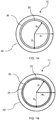
- a dual coated optical fiber 10 is schematically depicted according to one or more embodiments described herein.
- the dual coated optical fiber 10 is particularly well suited for use at high temperatures and/or wet environments.
- the dual coated optical fiber 10 comprises a glass fiber 20 surrounded by a dual coating layer comprising and inner coating 30 and an outer coating 40.
- the inner coating surrounds the glass fiber and, in turn, is surrounded by and in direct contact with the outer coating 40.
- the inner coating 30 is in direct contact with the glass fiber 20.
- the glass fiber 20 has a radius R 1 from the centerline and is formed from silica-based glass.
- the radius R 1 may be from about 12.5 microns to about 155 microns, more preferably less than about 125 microns, and even more preferably, less than about 100 microns. In some embodiments the radius R 1 is from about 61.5 microns to about 63.5 microns and, more preferably, from about 62 microns to about 63 microns. In other embodiments the radius R 1 of the glass fiber is from about 14.5 microns to about 15.5 microns while in other embodiments the radius R 1 of the glass fiber is from about 39 microns to about 41 microns. In still other embodiments the radius R 1 of the optical fiber is from about 290 microns to about 310 microns.
- the glass fiber 20 generally comprises a glass core region (not shown) and a cladding region (not shown) which surrounds the core region.
- the core region facilitates guiding light through the glass fiber 20.
- the cladding region comprises one or more glass cladding layers (not shown) surrounding the glass core region.
- the glass core region and/or the glass cladding layer(s) may be formed from pure silica glass (i.e., silica glass substantially free from any dopants which would alter the index of refraction of pure silica glass) or formed from silica glass which contains dopants that increase the index of refraction of silica glass (e.g., germania or similar index increasing dopants) or dopants that decrease the index of refraction of pure silica glass (e.g., fluorine, boron or similar index decreasing dopants).
- the glass fiber 20 may be constructed such that the dual coated optical fiber 10 is single moded, multi-moded, bend insensitive, high index, or has any other desired optical and/or physical property.
- the inner coating 30 surrounds the glass fiber 20.
- the radial thickness T 2 of the inner coating 30 is from about 1 micron to about 10 microns, more preferably from about 3 microns to about 7 microns and, most preferably, from about 4 microns to about 6 microns.
- the inner coating 30 comprises a polyimide material which has a decomposition threshold temperature which is less than the decomposition threshold temperature of the second polyimide material in the outer coating 40.
- the first polyimide material of the inner coating 30 may also have a modulus of elasticity which is less than the modulus of elasticity of the second polyimide material in the outer coating 40 and a moisture uptake which is greater than the moisture uptake of the second polyimide material.
- the first polyimide material comprises substituents selected from the group consisting of benzophenone tetracarboxylic dianhydrides, 4,4-oxydianilines, phenylenediamines or combinations thereof.
- the first polyimide material comprises a polymer comprising a polyamic acid of benzophene tetracarboxylic dianhydride/4,4-oxydianiline/m-phenylenediamine.
- Pyralin® PI-2574 manufactured by HD Microsystems. Pyralin® PI-2574 has a modulus of 2.4 GPa, a moisture uptake of 2-3% and a decomposition threshold temperature of 550°C after thermal curing. However, it should be understood that Pyralin® PI-2574 is one example of a commercially available polyimide material that can be used for the first polyimide material in the inner coating and that other polyimide materials with suitable characteristics may also be used as the first polyimide material of the inner coating.
- the first polyimide material of the inner coating comprises an adhesion promoter that improves the bond between the inner coating 30 and the glass fiber 20.
- the adhesion promoter may be an organosilane that comprises either an amino group or an epoxy group.
- organosilanes include aminosilane-based adhesion promoters such as a-aminopropyltrimethoxysilane.
- other organosilanes with different functional groups may also be used as adhesion promoters in the fibers described herein.
- adhesion promoters suitable for improving the adhesion of a polymer to glass may also be used.
- aminosilane based adhesion promoters include VM-651 and VM-652 adhesion promoters manufactured by HD MicroSystems.
- the inner coating 30 comprises a polyimide material which contains an adhesion promoter
- the adhesion promoter may be separately applied around the glass fiber 20 before the first polyimide material is applied around the glass fiber.
- the separate adhesion promoter may generally comprise a material which improves the ability of the first polyimide material to bond with the silica glass as described above.
- the separate adhesion promoter may be an organosilane which comprises either an amino group or an epoxy group. Examples of such organosilanes include aminosilane-based adhesion promoters such as a-aminopropyltrimethoxysilane.
- organosilanes with different functional groups may also be used as separate adhesion promoters in the fibers described herein.
- adhesion promoters suitable for improving the adhesion of a polymer to glass may also be used.
- the inner coating may be formed from a polyimide precursor, such as Pyraline® PI-2525 manufactured by HD Microsystems, or a similar polyimide precursor material.
- a polyimide precursor such as Pyraline® PI-2525 manufactured by HD Microsystems
- the PI-2525 polyimide precursor does not include an adhesion promoter and, as such, a separate aminosilane adhesion promoter such as VM-651 or VM-652, both of which are manufactured by HD Microsystems, may be applied to the glass fiber prior to the application of the inner coating to improve the adhesion of the polyimide material to the glass fiber.
- the outer coating 40 surrounds and is in direct contact with the inner coating 30.
- the radial thickness T 3 of the outer coating 40 is preferably from about 5 microns to about 20 microns, more preferably from about 7 microns to about 13 microns and, most preferably, from about 9 microns to about 11 microns.
- the outer coating 40 comprises a second polyimide material which has a decomposition threshold temperature that is greater than the decomposition threshold temperature of the first polyimide material.
- the second polyimide material of the outer coating 40 has a decomposition threshold temperature that is preferably greater than about 550°C, more preferably greater than about 580°C, and most preferably greater than about 620°C.
- the second polyimide material also has a modulus of elasticity which is greater than the modulus of elasticity of the first polyimide material.
- the modulus of elasticity of the second polyimide material may be greater than about 2.5 GPa, more preferably greater than about 5.0 GPa, and, most preferably, greater than about 8.5 GPa.
- the second polyimide material also has a moisture uptake which is lower than the moisture uptake of the first polyimide material.
- the second polyimide material has moisture uptake which is preferably less than about 3.0%, more preferably less than about 1.5%, and, most preferably, less than about 0.5%.
- the second polyimide material of the outer coating comprises substituents selected from the group consisting of byphenyldianhydrides, pheylenediamines, or combinations thereof.
- the second polyimide material comprises a polymer based on biphenyldianhydride/phenylenediamine backbone chemistry.
- the second polyimide material may be a polymer with s-biphenyldianhydride/p-phenylenediamine backbone chemistry.
- PI-2611 manufactured by HD Microsystems. PI-2611 had a modulus of 8.5 GPa, a moisture uptake of 0.5% and a decomposition threshold temperature of 620°C after thermal curing. However, it should be understood that PI-2611 is one example of a commercially available polyimide material that can be used for the second polyimide material in the outer coating and that other polyimide materials with suitable characteristics may also be used as the second polyimide material of the outer coating.
- the dual coated optical fiber 11 comprises a glass fiber 20 surrounded by an inner coating 30 which is, in turn, surrounded by and in direct contact with an outer coating 40.
- the material and dimensions of the glass fiber 20, the inner coating 30 and the outer coating 40 of the dual coated optical fiber 11 are the same as the dual coated optical fiber 10 depicted in FIG. 1A and described above.
- a hermetic coating 25 is positioned between the glass fiber 20 and the inner coating 30 such that the hermetic coating 25 is in direct contact with both the glass fiber 20 and the inner coating 30.
- the hermetic coating 25 improves the mechanical integrity of the optical fiber.
- the hermetic coating acts as a protective layer which prevents the ingress of molecular water or hydrogen into the glass fiber 20.
- the hermetic coating 25 also facilitates deploying the dual coated fiber under small coil diameters.
- the hermetic coating 25 may be deposited on the glass fiber 20 before the inner coating 30 is applied to the optical fiber.
- the hermetic coating 25 may be applied by chemical vapor deposition (CVD) or any other suitable technique.
- the material from which the hermetic coating is formed may include: metals and alloys such as aluminum, gold, nickel or similar elemental or alloyed metals; carbon or compounds of carbon; or ceramic materials such as TiO 2 , TiN, Si 3 N 4 , SiC, TiC or similar ceramic materials.
- the hermetic coating 25 is amorphous carbon and has a radial thickness from about 30 nm to about 500 nm.
- the radial thickness of the hermetic coating 25 is nominal relative to the radius R 1 of the glass fiber.
- the radius of the glass fiber R 1 includes the radial thickness of the hermetic coating 25.
- the dual coated optical fibers formed as described herein with an inner coating of a first polyimide material and an outer coating of a second polyimide material having a decomposition threshold temperature greater than the first polyimide material are resistant to delamination following exposure to aqueous environments for extended periods of time. Further, the dual coated optical fibers formed as described herein have tensile strengths of at least 100 kpsi, more preferably greater than 200 kpsi and, most preferably, greater than 300 kpsi following exposure to elevated temperatures of 300 °C for 216 hours. Methods of forming the dual coated optical fibers will now be described with reference to FIGS. 1A and 2 .
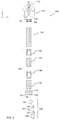
- the system 100 may comprise a draw furnace 114 for heating an optical fiber preform 112 such that a glass fiber 20 may be drawn from the optical fiber preform 112.
- the draw furnace 114 may be vertically oriented such that the glass fiber 20 drawn from the optical fiber preform 112 exits the draw furnace along a substantially vertical pathway (i.e., a pathway that is substantially parallel with the z-direction of the coordinate axes depicted in FIG. 2 ).
- the diameter of the glass fiber 20 and the draw tension applied to the glass fiber 20 may be measured using non-contact sensors 118, 120.
- the dual coated optical fiber comprises a hermetic coating 25 in contact with the glass fiber 20
- the hermetic coating 25 may be applied to the glass fiber after the glass fiber exits the draw furnace and either before or after the diameter and draw tension applied to the glass fiber 20 are measured.
- the glass fiber 20 may be drawn through a hermetic layer coating system (not shown), such as a CVD system, which deposits the hermetic coating 25 on to the glass fiber 20.
- the glass fiber 20 may optionally be drawn through a cooling system 122 which cools the glass fiber 20 prior to the inner coating 30 being applied to the glass fiber 20.
- the cooling system 122 is generally spaced apart from the draw furnace 114 such that the glass fiber 20 of the dual coated optical fiber 10 cools at ambient temperatures before entering the cooling system 122.
- the spacing between the draw furnace 114 and the cooling system 122 may be sufficient to cool the optical fiber from the draw temperature (e.g., from about 1700°C - 2000°C) to about 1300°C and, more preferably, to about 1200°C before the glass fiber 20 enters the cooling system 122.
- the draw temperature e.g., from about 1700°C - 2000°C
- the fiber is cooled to less than about 80°C and, more preferably, less than about 60°C.
- cooling system and a hermetic coating system have been described herein as part of the system 100 for producing a coated optical fiber, it should be understood that the cooling system and the hermetic layer coating system are optional and that, in other embodiments, the glass fiber may be drawn directly from the draw furnace to a coating system without entering a cooling system and/or a hermetic layer coating system.
- the glass fiber 20 enters a coating system 130 where the inner coating 30 and the outer coating 40 are applied to the glass fiber 20.
- the coating system 130 includes a primary coating die 132 for applying the inner coating 30, a primary curing unit 134 for curing the inner coating 30, a secondary coating die 136 for applying the outer coating 40 and a secondary curing unit 138 for curing the outer coating 40.
- the primary curing unit 134 and the secondary curing unit 138 are thermal curing units suitable for curing polyimide materials.
- the coating system 130 may further comprise a preliminary coating unit (not shown) positioned upstream of the primary coating die 132.
- the preliminary coating unit may be used to apply an adhesion promoter to the glass fiber 20 prior to the glass fiber entering the primary coating die 132.
- the inner coating 30 is applied to the glass fiber 20.
- the inner coating 30 comprises a first polyimide material and an adhesion promoter and, as such, a separate adhesion promoter need not be applied to the glass fiber.
- the glass fiber 20 enters a primary curing unit 134 after exiting the primary coating die 132.
- the primary curing unit 134 is operated at a temperature suitable for curing the inner coating 30 and driving off any solvents or other volatiles present in the first polyimide material. Because the first polyimide material is cured prior to the outer coating 40 being applied, the dual layer coating described herein may be referred to as a wet on dry coating system.
- the glass fiber 20 is drawn through the secondary coating die 136 where the outer coating 40 is applied to the glass fiber 20 over the inner coating 30.
- the outer coating 40 comprises a second polyimide material which has a decomposition threshold temperature greater than the decomposition threshold temperature of the first polyimide material.
- the second polyimide material may also have a modulus of elasticity greater than the first polyimide material and/or a moisture uptake of less than the first polyimide material.
- the glass fiber 20 is drawn through the secondary curing unit 138.
- the secondary curing unit 138 is operated at a temperature suitable for curing the outer coating 40 and driving off any solvents or other volatiles present in the second polyimide material.
- the glass fiber 20 with the inner coating 30 and the outer coating 40 is a dual coated optical fiber 10.
- the diameter of the dual coated optical fiber 10 is measured again using a non-contact sensor 118. Thereafter, a non-contact flaw detector 139 is used to examine the dual coated optical fiber 10 for damage and/or flaws that may have occurred during the manufacture of the dual coated optical fiber 10. It should be understood that, after the glass fiber 20 has been coated, the dual coated optical fiber 10 is less susceptible to damage due to mechanical contact. Accordingly, in subsequent processing stages (not shown) mechanical contact with the dual coated optical fiber 10 may be acceptable.
- a fiber take-up mechanism 140 utilizes various drawing mechanisms 142 and pulleys 141 to provide the necessary tension applied to the dual coated optical fiber 10 as the dual coated optical fiber 10 is drawn through the system 100. Accordingly, it will be understood that the fiber take-up mechanism 140 controls the speed at which the dual coated optical fiber 10 is drawn through the system 100. After manufacture of the dual coated optical fiber 10 is complete, the dual coated optical fiber 10 is wound onto a storage spool 148.
- a dual coated optical fiber was formed by applying an inner coating and an outer coating to a glass fiber.
- the glass fiber comprised silica-based glass with an outer diameter (i.e., 2 ⁇ R 1 ) of 124.6 microns.
- An inner coating comprising a first polyimide material was applied directly to the glass fiber such that the inner coating was in direct contact with the glass fiber.
- the inner coating had a radial thickness of 5.2 microns after thermal curing.
- the inner coating was formed from Pyralin® PI-2574 manufactured by HD Microsystems.
- the Pyralin® PI-2574 material contains an adhesion promoter and generally has a modulus of 2.4 GPa, a moisture uptake of 2-3% and a decomposition threshold temperature of 550°C after thermal curing.
- the outer coating comprised a second polyimide material with a decomposition threshold temperature greater than the first polyimide material.
- the outer coating was applied directly to the inner coating and had a radial thickness of 9.5 microns after thermal curing.
- the outer coating was formed from PI-2611 manufactured by HD Microsystems.
- the PI-2611 material had a modulus of 8.5 GPa, a moisture uptake of 0.5% and a decomposition threshold temperature of 620°C after thermal curing.
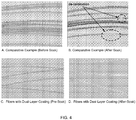
- the dual coated optical fibers were soaked in a deionized water bath for seven days at room temperature. After soaking, the dual coated optical fibers were removed from the deionized water bath and visually inspected to qualitatively determine if the dual layer coating delaminated from the fiber. Images of the dual coated optical fibers before soaking and after soaking are presented in FIGS. 4C and 4D , respectively. As shown in FIGS. 4C and 4D , the dual coated optical fibers did not delaminate during the seven day soaking period.
- Single layer coated optical fibers were formed by applying a single coating layer of polyimide material directly to a glass fiber.
- the glass fiber had an outer diameter of 124.8 microns.
- the polyimide material was PI-2611 manufactured by HD Microsystems, as described above in Example 1.
- the single coating layer of polyimide material had a radial thickness of 13.6 microns after thermal curing.
- the single layer coated optical fibers were soaked in a deionized water bath for seven days at room temperature. Following the soaking, the single layer coated optical fibers were removed from the water bath and visually inspected to qualitatively determine if the single layer coating delaminated from the glass fiber. Images of the single layer coated optical fiber before soaking and after soaking are presented in FIGS. 4A and 4B , respectively. As shown in FIGS. 4A and 4B the single layer polyimide coating delaminated during the seven day soaking period producing discontinuities in the coating layer as depicted in FIG. 4B .
- the optical fibers of Example 2 were dual coated optical fibers produced as described in Example 1.
- the optical fibers of Comparative Example B were single layer coated optical fibers produced as described in Comparative Example A.
- the optical fibers of Comparative Example C were single layer coated optical fibers formed by applying a single coating layer of polyimide material containing an adhesion promoter directly to a glass fiber. The glass fiber had an outer diameter of 124.8 microns.
- the polyimide material of Comparative Example C was Pyralin® PI-2574 manufactured by HD Microsystems, as described above in Example 1.
- the single coating layer of polyimide material had a radial thickness of 15.6 microns after curing.
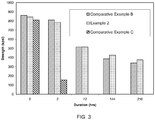
- Example 2 and Comparative Examples B and C were exposed to temperatures of 300°C for 2 to 216 hours. Following exposure to the elevated temperature at different time durations, 50 cm gauge lengths of the optical fibers were tensile tested in a controlled environment of 50% relative humidity and a temperature of 22° C. The optical fibers were drawn at a crosshead speed of 500 mm/min until failure. The results of the tensile testing are shown in FIG. 3 .
- the coated optical fibers of Example 2 and Comparative Examples B and C have tensile strengths between about 800 kpsi and 900 kpsi prior to exposure to elevated temperatures. And, following exposure to elevated temperatures, the tensile strength of the optical fibers in all three examples decreased. However, the tensile strength of the coated optical fibers of Comparative Example C decreased to zero after less than 72 hours of elevated temperature exposure while the tensile strength of the coated optical fibers of Example 2 and Comparative Example B decreased by less than half during the same time interval.
- the tensile strength of the coated optical fibers of Example 2 decreased less than the coated optical fibers of Comparative Example B and, after 216 hours of exposure, the optical fibers of Example 2 had a tensile strength of greater than 300 kpsi.
- Examples 1-2 and Comparative Examples A-C indicate that the dual coated optical fibers produced according to embodiments described herein have improved performance characteristics relative to single layer coated optical fibers constructed of similar materials. Specifically, it was determined that the dual coated optical fibers formed with an inner coating of a first polyimide material and an outer coating of a second polyimide material with a higher decomposition threshold temperature than the first polyimide material do not delaminate after immersion in water over an extended time period. However, coated optical fibers formed with a single layer of the second polyimide material delaminated after immersion in water for extended periods of time.
- the tensile strength of the dual coated optical fibers does not decrease as rapidly over time after exposure to elevated temperatures as the tensile strength of optical fibers coated with a single layer of the first polyimide material. Further, it was also determined that the tensile strength of the dual coated optical fibers is greater than or equal to the tensile strength of optical fibers with a single layer of the second polyimide material after 144 hours of exposure to elevated temperatures of 300°C.
Landscapes
- Life Sciences & Earth Sciences (AREA)
- Chemical & Material Sciences (AREA)
- Physics & Mathematics (AREA)
- Engineering & Computer Science (AREA)
- Chemical Kinetics & Catalysis (AREA)
- General Chemical & Material Sciences (AREA)
- Geochemistry & Mineralogy (AREA)
- Materials Engineering (AREA)
- Organic Chemistry (AREA)
- General Life Sciences & Earth Sciences (AREA)
- General Physics & Mathematics (AREA)
- Optics & Photonics (AREA)
- Optical Fibers, Optical Fiber Cores, And Optical Fiber Bundles (AREA)
- Surface Treatment Of Glass Fibres Or Filaments (AREA)
Applications Claiming Priority (2)
| Application Number | Priority Date | Filing Date | Title |
|---|---|---|---|
| US30748410P | 2010-02-24 | 2010-02-24 | |
| PCT/US2011/025216 WO2011106231A1 (en) | 2010-02-24 | 2011-02-17 | Dual coated optical fibers and methods for forming the same |
Publications (2)
| Publication Number | Publication Date |
|---|---|
| EP2539293A1 EP2539293A1 (en) | 2013-01-02 |
| EP2539293B1 true EP2539293B1 (en) | 2019-06-26 |
Family
ID=43903015
Family Applications (1)
| Application Number | Title | Priority Date | Filing Date |
|---|---|---|---|
| EP11706410.5A Active EP2539293B1 (en) | 2010-02-24 | 2011-02-17 | Dual coated optical fibers and methods for forming the same |
Country Status (6)
| Country | Link |
|---|---|
| US (1) | US9063268B2 (enExample) |
| EP (1) | EP2539293B1 (enExample) |
| JP (1) | JP5725673B2 (enExample) |
| CN (1) | CN102770387B (enExample) |
| DK (1) | DK2539293T3 (enExample) |
| WO (1) | WO2011106231A1 (enExample) |
Families Citing this family (26)
| Publication number | Priority date | Publication date | Assignee | Title |
|---|---|---|---|---|
| CN102360096A (zh) * | 2011-10-10 | 2012-02-22 | 中天科技光纤有限公司 | 耐高温光纤及其加工工艺 |
| US10737973B2 (en) | 2012-02-28 | 2020-08-11 | Corning Incorporated | Pharmaceutical glass coating for achieving particle reduction |
| SG10201806654PA (en) | 2012-02-28 | 2018-09-27 | Corning Inc | Glass articles with low-friction coatings |
| US11497681B2 (en) | 2012-02-28 | 2022-11-15 | Corning Incorporated | Glass articles with low-friction coatings |
| US10273048B2 (en) | 2012-06-07 | 2019-04-30 | Corning Incorporated | Delamination resistant glass containers with heat-tolerant coatings |
| US9034442B2 (en) | 2012-11-30 | 2015-05-19 | Corning Incorporated | Strengthened borosilicate glass containers with improved damage tolerance |
| US10117806B2 (en) | 2012-11-30 | 2018-11-06 | Corning Incorporated | Strengthened glass containers resistant to delamination and damage |
| CN103278897A (zh) * | 2013-05-20 | 2013-09-04 | 江苏南方通信科技有限公司 | 新型高温光缆 |
| CN104155716B (zh) * | 2014-08-14 | 2018-09-11 | 武汉北方光电科技有限公司 | 低损耗耐高温光纤 |
| WO2016026110A1 (zh) * | 2014-08-21 | 2016-02-25 | 武汉北方光电科技有限公司 | 多层金属涂层耐高温耐腐蚀光纤 |
| CN107074628B (zh) | 2014-09-05 | 2020-05-19 | 康宁股份有限公司 | 玻璃制品和用于改善玻璃制品的可靠性的方法 |
| WO2016052406A1 (ja) * | 2014-09-29 | 2016-04-07 | 積水化学工業株式会社 | カーボン被覆熱伝導材料 |
| EP3206998B1 (en) | 2014-11-26 | 2021-09-08 | Corning Incorporated | Methods for producing strengthened and durable glass containers |
| CN104950380B (zh) * | 2015-06-11 | 2019-04-23 | 中国化学纤维工业协会 | 一种光导纤维 |
| EP3150564B1 (en) | 2015-09-30 | 2018-12-05 | Corning Incorporated | Halogenated polyimide siloxane chemical compositions and glass articles with halogenated polylmide siloxane low-friction coatings |
| RU2610503C1 (ru) * | 2015-10-21 | 2017-02-13 | Федеральное государственное бюджетное учреждение науки Институт элементоорганических соединений им. А.Н. Несмеянова Российской академии наук (ИНЭОС РАН) | Полиимидное покрытие волоконных световодов и способ его изготовления |
| GB2554658A (en) * | 2016-09-30 | 2018-04-11 | Fibercore Ltd | Coated fiber manufacture |
| WO2021128211A1 (zh) * | 2019-12-26 | 2021-07-01 | 中天科技光纤有限公司 | 光纤 |
| CN111153597A (zh) * | 2019-12-26 | 2020-05-15 | 中天科技光纤有限公司 | 光纤 |
| CN116075288A (zh) | 2020-09-04 | 2023-05-05 | 康宁股份有限公司 | 阻挡紫外光的经涂覆的药物包装 |
| CN113292256B (zh) * | 2021-06-18 | 2024-01-09 | 江苏华能电缆股份有限公司 | 一种光纤表面耐高温耐氢损聚酰亚胺涂覆工艺 |
| CN113655578B (zh) * | 2021-08-19 | 2023-10-31 | 中天科技光纤有限公司 | 耐高温光纤及其制备方法 |
| CN114035266B (zh) * | 2022-01-10 | 2022-04-26 | 中天科技光纤有限公司 | 细径光纤及其制备方法 |
| CN116449514A (zh) * | 2023-04-19 | 2023-07-18 | 中天科技光纤有限公司 | 双涂覆层光纤的生产方法以及双涂覆层光纤 |
| CN116908978A (zh) * | 2023-07-14 | 2023-10-20 | 中天科技光纤有限公司 | 芯线及其制备方法、线缆 |
| CN119644499B (zh) * | 2024-12-03 | 2025-10-24 | 长飞光纤光缆股份有限公司 | 一种金属涂覆层抗辐照光纤及其制作方法 |
Family Cites Families (10)
| Publication number | Priority date | Publication date | Assignee | Title |
|---|---|---|---|---|
| GB2214653A (en) | 1988-01-21 | 1989-09-06 | Stc Plc | High Temperature optical cables |
| JP2587679B2 (ja) * | 1988-04-28 | 1997-03-05 | 三菱電線工業株式会社 | ガラス系光ファイバの製造方法 |
| JPH032808A (ja) * | 1989-05-31 | 1991-01-09 | Fujikura Ltd | 光ファイバ心線 |
| US5427862A (en) * | 1990-05-08 | 1995-06-27 | Amoco Corporation | Photocurable polyimide coated glass fiber |
| JP2701621B2 (ja) | 1991-10-31 | 1998-01-21 | 日立電線株式会社 | 耐熱光ファイバ |
| JPH11242143A (ja) | 1998-02-25 | 1999-09-07 | Hitachi Ltd | 光ファイバ及びそれを用いた光センシングシステム |
| JP3869602B2 (ja) * | 1999-11-30 | 2007-01-17 | 日立電線株式会社 | 細径耐熱光ファイバセンサ |
| US20050135763A1 (en) | 2003-12-17 | 2005-06-23 | Gary Drenzek | Optical fiber with a mechanically strippable coating and methods of making the same |
| JP4935273B2 (ja) * | 2006-09-26 | 2012-05-23 | 住友電気工業株式会社 | ポリイミド被覆ファイバの製造方法 |
| US8369668B1 (en) * | 2009-04-23 | 2013-02-05 | Superior Essex Communications Lp | Water blocked fiber optic cable |
-
2011
- 2011-02-17 WO PCT/US2011/025216 patent/WO2011106231A1/en not_active Ceased
- 2011-02-17 JP JP2012555047A patent/JP5725673B2/ja not_active Expired - Fee Related
- 2011-02-17 DK DK11706410.5T patent/DK2539293T3/da active
- 2011-02-17 CN CN201180010936.7A patent/CN102770387B/zh not_active Expired - Fee Related
- 2011-02-17 US US13/577,292 patent/US9063268B2/en not_active Expired - Fee Related
- 2011-02-17 EP EP11706410.5A patent/EP2539293B1/en active Active
Non-Patent Citations (1)
| Title |
|---|
| None * |
Also Published As
| Publication number | Publication date |
|---|---|
| WO2011106231A1 (en) | 2011-09-01 |
| DK2539293T3 (da) | 2019-07-22 |
| CN102770387A (zh) | 2012-11-07 |
| US9063268B2 (en) | 2015-06-23 |
| EP2539293A1 (en) | 2013-01-02 |
| JP5725673B2 (ja) | 2015-05-27 |
| CN102770387B (zh) | 2015-11-25 |
| JP2013520710A (ja) | 2013-06-06 |
| US20130071078A1 (en) | 2013-03-21 |
Similar Documents
| Publication | Publication Date | Title |
|---|---|---|
| US9063268B2 (en) | Dual coated optical fibers and methods for forming the same | |
| US8297080B2 (en) | Method for producing high strength and long coiling length single-mode fiber for submarine cable | |
| CN103472531A (zh) | 一种低衰减耐高温光纤 | |
| CN105242368A (zh) | 一种新型制导光缆及其制备方法 | |
| CN113655578B (zh) | 耐高温光纤及其制备方法 | |
| CN108802896B (zh) | 一种光纤及其制备方法 | |
| CN111153597A (zh) | 光纤 | |
| JPH01301531A (ja) | 大きな引張り力で延伸することによって機械抵抗の大きい光ファイバを製造する方法 | |
| CN113292256B (zh) | 一种光纤表面耐高温耐氢损聚酰亚胺涂覆工艺 | |
| CN102686529A (zh) | 光纤素线的制造方法以及制造装置 | |
| CN110780410A (zh) | 一种灵敏度增强的柔软轻型分布式声波传感光缆 | |
| CN117031613A (zh) | 细径低损耗光纤和光缆 | |
| CN101614842B (zh) | 一种室内布设光纤 | |
| WO2010107026A1 (ja) | 光ファイバ | |
| CN204964805U (zh) | 一种油气井下监测用耐高温碳密封光纤 | |
| JP2007322893A (ja) | 光ファイバ心線とその評価方法 | |
| WO2021128211A1 (zh) | 光纤 | |
| Sohma et al. | Heat-resistant thin optical fiber for sensing in high-temperature environments | |
| CN102360096A (zh) | 耐高温光纤及其加工工艺 | |
| CN117534345B (zh) | 光纤制备方法、系统及光纤 | |
| CN105259628A (zh) | 一种利用peek材料制备的制导光缆及其制备方法 | |
| CN114035266B (zh) | 细径光纤及其制备方法 | |
| CN115950462B (zh) | 传感光纤及其制作方法 | |
| JPH05297255A (ja) | 耐熱光ファイバ | |
| JP2765039B2 (ja) | 光ファイバーケーブル |
Legal Events
| Date | Code | Title | Description |
|---|---|---|---|
| PUAI | Public reference made under article 153(3) epc to a published international application that has entered the european phase |
Free format text: ORIGINAL CODE: 0009012 |
|
| 17P | Request for examination filed |
Effective date: 20120726 |
|
| AK | Designated contracting states |
Kind code of ref document: A1 Designated state(s): AL AT BE BG CH CY CZ DE DK EE ES FI FR GB GR HR HU IE IS IT LI LT LU LV MC MK MT NL NO PL PT RO RS SE SI SK SM TR |
|
| DAX | Request for extension of the european patent (deleted) | ||
| STAA | Information on the status of an ep patent application or granted ep patent |
Free format text: STATUS: EXAMINATION IS IN PROGRESS |
|
| 17Q | First examination report despatched |
Effective date: 20170420 |
|
| GRAP | Despatch of communication of intention to grant a patent |
Free format text: ORIGINAL CODE: EPIDOSNIGR1 |
|
| STAA | Information on the status of an ep patent application or granted ep patent |
Free format text: STATUS: GRANT OF PATENT IS INTENDED |
|
| INTG | Intention to grant announced |
Effective date: 20190123 |
|
| GRAS | Grant fee paid |
Free format text: ORIGINAL CODE: EPIDOSNIGR3 |
|
| GRAA | (expected) grant |
Free format text: ORIGINAL CODE: 0009210 |
|
| STAA | Information on the status of an ep patent application or granted ep patent |
Free format text: STATUS: THE PATENT HAS BEEN GRANTED |
|
| AK | Designated contracting states |
Kind code of ref document: B1 Designated state(s): AL AT BE BG CH CY CZ DE DK EE ES FI FR GB GR HR HU IE IS IT LI LT LU LV MC MK MT NL NO PL PT RO RS SE SI SK SM TR |
|
| REG | Reference to a national code |
Ref country code: GB Ref legal event code: FG4D |
|
| REG | Reference to a national code |
Ref country code: CH Ref legal event code: EP |
|
| REG | Reference to a national code |
Ref country code: AT Ref legal event code: REF Ref document number: 1148089 Country of ref document: AT Kind code of ref document: T Effective date: 20190715 |
|
| REG | Reference to a national code |
Ref country code: DE Ref legal event code: R096 Ref document number: 602011059992 Country of ref document: DE |
|
| REG | Reference to a national code |
Ref country code: DK Ref legal event code: T3 Effective date: 20190718 |
|
| REG | Reference to a national code |
Ref country code: IE Ref legal event code: FG4D |
|
| REG | Reference to a national code |
Ref country code: NL Ref legal event code: MP Effective date: 20190626 |
|
| PG25 | Lapsed in a contracting state [announced via postgrant information from national office to epo] |
Ref country code: HR Free format text: LAPSE BECAUSE OF FAILURE TO SUBMIT A TRANSLATION OF THE DESCRIPTION OR TO PAY THE FEE WITHIN THE PRESCRIBED TIME-LIMIT Effective date: 20190626 Ref country code: LT Free format text: LAPSE BECAUSE OF FAILURE TO SUBMIT A TRANSLATION OF THE DESCRIPTION OR TO PAY THE FEE WITHIN THE PRESCRIBED TIME-LIMIT Effective date: 20190626 Ref country code: AL Free format text: LAPSE BECAUSE OF FAILURE TO SUBMIT A TRANSLATION OF THE DESCRIPTION OR TO PAY THE FEE WITHIN THE PRESCRIBED TIME-LIMIT Effective date: 20190626 Ref country code: FI Free format text: LAPSE BECAUSE OF FAILURE TO SUBMIT A TRANSLATION OF THE DESCRIPTION OR TO PAY THE FEE WITHIN THE PRESCRIBED TIME-LIMIT Effective date: 20190626 Ref country code: NO Free format text: LAPSE BECAUSE OF FAILURE TO SUBMIT A TRANSLATION OF THE DESCRIPTION OR TO PAY THE FEE WITHIN THE PRESCRIBED TIME-LIMIT Effective date: 20190926 Ref country code: SE Free format text: LAPSE BECAUSE OF FAILURE TO SUBMIT A TRANSLATION OF THE DESCRIPTION OR TO PAY THE FEE WITHIN THE PRESCRIBED TIME-LIMIT Effective date: 20190626 |
|
| REG | Reference to a national code |
Ref country code: LT Ref legal event code: MG4D |
|
| PG25 | Lapsed in a contracting state [announced via postgrant information from national office to epo] |
Ref country code: GR Free format text: LAPSE BECAUSE OF FAILURE TO SUBMIT A TRANSLATION OF THE DESCRIPTION OR TO PAY THE FEE WITHIN THE PRESCRIBED TIME-LIMIT Effective date: 20190927 Ref country code: LV Free format text: LAPSE BECAUSE OF FAILURE TO SUBMIT A TRANSLATION OF THE DESCRIPTION OR TO PAY THE FEE WITHIN THE PRESCRIBED TIME-LIMIT Effective date: 20190626 Ref country code: RS Free format text: LAPSE BECAUSE OF FAILURE TO SUBMIT A TRANSLATION OF THE DESCRIPTION OR TO PAY THE FEE WITHIN THE PRESCRIBED TIME-LIMIT Effective date: 20190626 Ref country code: BG Free format text: LAPSE BECAUSE OF FAILURE TO SUBMIT A TRANSLATION OF THE DESCRIPTION OR TO PAY THE FEE WITHIN THE PRESCRIBED TIME-LIMIT Effective date: 20190926 |
|
| REG | Reference to a national code |
Ref country code: AT Ref legal event code: MK05 Ref document number: 1148089 Country of ref document: AT Kind code of ref document: T Effective date: 20190626 |
|
| PG25 | Lapsed in a contracting state [announced via postgrant information from national office to epo] |
Ref country code: NL Free format text: LAPSE BECAUSE OF FAILURE TO SUBMIT A TRANSLATION OF THE DESCRIPTION OR TO PAY THE FEE WITHIN THE PRESCRIBED TIME-LIMIT Effective date: 20190626 Ref country code: AT Free format text: LAPSE BECAUSE OF FAILURE TO SUBMIT A TRANSLATION OF THE DESCRIPTION OR TO PAY THE FEE WITHIN THE PRESCRIBED TIME-LIMIT Effective date: 20190626 Ref country code: EE Free format text: LAPSE BECAUSE OF FAILURE TO SUBMIT A TRANSLATION OF THE DESCRIPTION OR TO PAY THE FEE WITHIN THE PRESCRIBED TIME-LIMIT Effective date: 20190626 Ref country code: PT Free format text: LAPSE BECAUSE OF FAILURE TO SUBMIT A TRANSLATION OF THE DESCRIPTION OR TO PAY THE FEE WITHIN THE PRESCRIBED TIME-LIMIT Effective date: 20191028 Ref country code: CZ Free format text: LAPSE BECAUSE OF FAILURE TO SUBMIT A TRANSLATION OF THE DESCRIPTION OR TO PAY THE FEE WITHIN THE PRESCRIBED TIME-LIMIT Effective date: 20190626 Ref country code: RO Free format text: LAPSE BECAUSE OF FAILURE TO SUBMIT A TRANSLATION OF THE DESCRIPTION OR TO PAY THE FEE WITHIN THE PRESCRIBED TIME-LIMIT Effective date: 20190626 Ref country code: SK Free format text: LAPSE BECAUSE OF FAILURE TO SUBMIT A TRANSLATION OF THE DESCRIPTION OR TO PAY THE FEE WITHIN THE PRESCRIBED TIME-LIMIT Effective date: 20190626 |
|
| PG25 | Lapsed in a contracting state [announced via postgrant information from national office to epo] |
Ref country code: IS Free format text: LAPSE BECAUSE OF FAILURE TO SUBMIT A TRANSLATION OF THE DESCRIPTION OR TO PAY THE FEE WITHIN THE PRESCRIBED TIME-LIMIT Effective date: 20191026 Ref country code: ES Free format text: LAPSE BECAUSE OF FAILURE TO SUBMIT A TRANSLATION OF THE DESCRIPTION OR TO PAY THE FEE WITHIN THE PRESCRIBED TIME-LIMIT Effective date: 20190626 Ref country code: SM Free format text: LAPSE BECAUSE OF FAILURE TO SUBMIT A TRANSLATION OF THE DESCRIPTION OR TO PAY THE FEE WITHIN THE PRESCRIBED TIME-LIMIT Effective date: 20190626 Ref country code: IT Free format text: LAPSE BECAUSE OF FAILURE TO SUBMIT A TRANSLATION OF THE DESCRIPTION OR TO PAY THE FEE WITHIN THE PRESCRIBED TIME-LIMIT Effective date: 20190626 |
|
| PG25 | Lapsed in a contracting state [announced via postgrant information from national office to epo] |
Ref country code: TR Free format text: LAPSE BECAUSE OF FAILURE TO SUBMIT A TRANSLATION OF THE DESCRIPTION OR TO PAY THE FEE WITHIN THE PRESCRIBED TIME-LIMIT Effective date: 20190626 |
|
| PG25 | Lapsed in a contracting state [announced via postgrant information from national office to epo] |
Ref country code: PL Free format text: LAPSE BECAUSE OF FAILURE TO SUBMIT A TRANSLATION OF THE DESCRIPTION OR TO PAY THE FEE WITHIN THE PRESCRIBED TIME-LIMIT Effective date: 20190626 |
|
| PG25 | Lapsed in a contracting state [announced via postgrant information from national office to epo] |
Ref country code: IS Free format text: LAPSE BECAUSE OF FAILURE TO SUBMIT A TRANSLATION OF THE DESCRIPTION OR TO PAY THE FEE WITHIN THE PRESCRIBED TIME-LIMIT Effective date: 20200224 |
|
| REG | Reference to a national code |
Ref country code: DE Ref legal event code: R097 Ref document number: 602011059992 Country of ref document: DE |
|
| PLBE | No opposition filed within time limit |
Free format text: ORIGINAL CODE: 0009261 |
|
| STAA | Information on the status of an ep patent application or granted ep patent |
Free format text: STATUS: NO OPPOSITION FILED WITHIN TIME LIMIT |
|
| PG2D | Information on lapse in contracting state deleted |
Ref country code: IS |
|
| 26N | No opposition filed |
Effective date: 20200603 |
|
| PG25 | Lapsed in a contracting state [announced via postgrant information from national office to epo] |
Ref country code: SI Free format text: LAPSE BECAUSE OF FAILURE TO SUBMIT A TRANSLATION OF THE DESCRIPTION OR TO PAY THE FEE WITHIN THE PRESCRIBED TIME-LIMIT Effective date: 20190626 |
|
| REG | Reference to a national code |
Ref country code: DE Ref legal event code: R119 Ref document number: 602011059992 Country of ref document: DE |
|
| REG | Reference to a national code |
Ref country code: CH Ref legal event code: PL |
|
| REG | Reference to a national code |
Ref country code: BE Ref legal event code: MM Effective date: 20200229 |
|
| PG25 | Lapsed in a contracting state [announced via postgrant information from national office to epo] |
Ref country code: MC Free format text: LAPSE BECAUSE OF FAILURE TO SUBMIT A TRANSLATION OF THE DESCRIPTION OR TO PAY THE FEE WITHIN THE PRESCRIBED TIME-LIMIT Effective date: 20190626 Ref country code: LU Free format text: LAPSE BECAUSE OF NON-PAYMENT OF DUE FEES Effective date: 20200217 |
|
| PG25 | Lapsed in a contracting state [announced via postgrant information from national office to epo] |
Ref country code: CH Free format text: LAPSE BECAUSE OF NON-PAYMENT OF DUE FEES Effective date: 20200229 Ref country code: LI Free format text: LAPSE BECAUSE OF NON-PAYMENT OF DUE FEES Effective date: 20200229 |
|
| PG25 | Lapsed in a contracting state [announced via postgrant information from national office to epo] |
Ref country code: FR Free format text: LAPSE BECAUSE OF NON-PAYMENT OF DUE FEES Effective date: 20200229 Ref country code: IE Free format text: LAPSE BECAUSE OF NON-PAYMENT OF DUE FEES Effective date: 20200217 Ref country code: DE Free format text: LAPSE BECAUSE OF NON-PAYMENT OF DUE FEES Effective date: 20200901 |
|
| PG25 | Lapsed in a contracting state [announced via postgrant information from national office to epo] |
Ref country code: BE Free format text: LAPSE BECAUSE OF NON-PAYMENT OF DUE FEES Effective date: 20200229 |
|
| PGFP | Annual fee paid to national office [announced via postgrant information from national office to epo] |
Ref country code: DK Payment date: 20210126 Year of fee payment: 11 Ref country code: GB Payment date: 20210129 Year of fee payment: 11 |
|
| PG25 | Lapsed in a contracting state [announced via postgrant information from national office to epo] |
Ref country code: MT Free format text: LAPSE BECAUSE OF FAILURE TO SUBMIT A TRANSLATION OF THE DESCRIPTION OR TO PAY THE FEE WITHIN THE PRESCRIBED TIME-LIMIT Effective date: 20190626 Ref country code: CY Free format text: LAPSE BECAUSE OF FAILURE TO SUBMIT A TRANSLATION OF THE DESCRIPTION OR TO PAY THE FEE WITHIN THE PRESCRIBED TIME-LIMIT Effective date: 20190626 |
|
| PG25 | Lapsed in a contracting state [announced via postgrant information from national office to epo] |
Ref country code: MK Free format text: LAPSE BECAUSE OF FAILURE TO SUBMIT A TRANSLATION OF THE DESCRIPTION OR TO PAY THE FEE WITHIN THE PRESCRIBED TIME-LIMIT Effective date: 20190626 |
|
| REG | Reference to a national code |
Ref country code: DK Ref legal event code: EBP Effective date: 20220228 |
|
| GBPC | Gb: european patent ceased through non-payment of renewal fee |
Effective date: 20220217 |
|
| PG25 | Lapsed in a contracting state [announced via postgrant information from national office to epo] |
Ref country code: GB Free format text: LAPSE BECAUSE OF NON-PAYMENT OF DUE FEES Effective date: 20220217 Ref country code: DK Free format text: LAPSE BECAUSE OF NON-PAYMENT OF DUE FEES Effective date: 20220228 |