EP2535082B1 - Devices for cardiovascular reflex control - Google Patents
Devices for cardiovascular reflex control Download PDFInfo
- Publication number
- EP2535082B1 EP2535082B1 EP12169661.1A EP12169661A EP2535082B1 EP 2535082 B1 EP2535082 B1 EP 2535082B1 EP 12169661 A EP12169661 A EP 12169661A EP 2535082 B1 EP2535082 B1 EP 2535082B1
- Authority
- EP
- European Patent Office
- Prior art keywords
- baroreceptor
- activation
- activation device
- baroreceptors
- control signal
- Prior art date
- Legal status (The legal status is an assumption and is not a legal conclusion. Google has not performed a legal analysis and makes no representation as to the accuracy of the status listed.)
- Expired - Lifetime
Links
Images













Classifications
-
- A—HUMAN NECESSITIES
- A61—MEDICAL OR VETERINARY SCIENCE; HYGIENE
- A61N—ELECTROTHERAPY; MAGNETOTHERAPY; RADIATION THERAPY; ULTRASOUND THERAPY
- A61N1/00—Electrotherapy; Circuits therefor
- A61N1/02—Details
- A61N1/04—Electrodes
- A61N1/05—Electrodes for implantation or insertion into the body, e.g. heart electrode
- A61N1/0551—Spinal or peripheral nerve electrodes
-
- A—HUMAN NECESSITIES
- A61—MEDICAL OR VETERINARY SCIENCE; HYGIENE
- A61N—ELECTROTHERAPY; MAGNETOTHERAPY; RADIATION THERAPY; ULTRASOUND THERAPY
- A61N1/00—Electrotherapy; Circuits therefor
- A61N1/02—Details
- A61N1/04—Electrodes
- A61N1/05—Electrodes for implantation or insertion into the body, e.g. heart electrode
- A61N1/0551—Spinal or peripheral nerve electrodes
- A61N1/0558—Anchoring or fixation means therefor
-
- A—HUMAN NECESSITIES
- A61—MEDICAL OR VETERINARY SCIENCE; HYGIENE
- A61N—ELECTROTHERAPY; MAGNETOTHERAPY; RADIATION THERAPY; ULTRASOUND THERAPY
- A61N1/00—Electrotherapy; Circuits therefor
- A61N1/18—Applying electric currents by contact electrodes
- A61N1/32—Applying electric currents by contact electrodes alternating or intermittent currents
- A61N1/36—Applying electric currents by contact electrodes alternating or intermittent currents for stimulation
- A61N1/36007—Applying electric currents by contact electrodes alternating or intermittent currents for stimulation of urogenital or gastrointestinal organs, e.g. for incontinence control
-
- A—HUMAN NECESSITIES
- A61—MEDICAL OR VETERINARY SCIENCE; HYGIENE
- A61N—ELECTROTHERAPY; MAGNETOTHERAPY; RADIATION THERAPY; ULTRASOUND THERAPY
- A61N1/00—Electrotherapy; Circuits therefor
- A61N1/18—Applying electric currents by contact electrodes
- A61N1/32—Applying electric currents by contact electrodes alternating or intermittent currents
- A61N1/36—Applying electric currents by contact electrodes alternating or intermittent currents for stimulation
- A61N1/3605—Implantable neurostimulators for stimulating central or peripheral nerve system
- A61N1/3606—Implantable neurostimulators for stimulating central or peripheral nerve system adapted for a particular treatment
- A61N1/36114—Cardiac control, e.g. by vagal stimulation
- A61N1/36117—Cardiac control, e.g. by vagal stimulation for treating hypertension
Definitions
- the present invention generally relates to medical devices for the treatment and/or management of cardiovascular and renal disorders. Specifically, the present invention relates to devices for controlling the baroreflex system for the treatment and/or management of cardiovascular and renal disorders and their underlying causes and conditions.
- Hypertension may occur when the body's smaller blood vessels (arterioles) constrict, causing an increase in blood pressure. Because the blood vessels constrict, the heart must work harder to maintain blood flow at the higher pressures. Although the body may tolerate short periods of increased blood pressure, sustained hypertension may eventually result in damage to multiple body organs, including the kidneys, brain, eyes and other tissues, causing a variety of maladies associated therewith. The elevated blood pressure may also damage the lining of the blood vessels, accelerating the process of atherosclerosis and increasing the likelihood that a blood clot may develop. This could lead to a heart attack and/or stroke. Sustained high blood pressure may eventually result in an enlarged and damaged heart (hypertrophy), which may lead to heart failure.
- vasodilators to reduce the blood pressure and ease the workload of the heart
- diuretics to reduce fluid overload
- inhibitors and blocking agents of the body's neurohormonal responses and other medicaments.
- Heart transplantation has been proposed for patients who suffer from severe, refractory heart failure.
- an implantable medical device such as a ventricular assist device (VAD) may be implanted in the chest to increase the pumping action of the heart.
- a ventricular assist device VAD
- IABP intra-aortic balloon pump
- Other surgical procedures are available as well.
- each of the therapies has its own disadvantages.
- drug therapy is often incompletely effective. Some patients may be unresponsive (refractory) to medical therapy. Drugs often have unwanted side effects and may need to be given in complex regimens. These and other factors contribute to poor patient compliance with medical therapy. Drug therapy may also be expensive, adding to the health care costs associated with these disorders.
- surgical approaches are very costly, may be associated with significant patient morbidity and mortality and may not alter the natural history of the disease. Baropacing also has not gained acceptance.
- Several problems with electrical carotid sinus nerve stimulation have been reported in the medical literature. These include the invasiveness of the surgical procedure to implant the nerve electrodes, and postoperative pain in the jaw, throat, face and head during stimulation.
- Situations may also arise in which it would be beneficial to raise the blood pressure of a patient.
- the patient may be experiencing a period of reduced blood pressure, or hypotension.
- Conditions associated with symptomatic hypotension include vasovagal reactions, orthostatic hypotension and dysautonomia.
- it may be advantageous to augment the blood pressure of a patient in whom the blood pressure may be normal or near normal, for example in claudication syndromes. Therefore, a also need exists for a therapy that can acutely increase the blood pressure in a patient.
- US 4,256,094 A describes an arterial pressure control system comprises an inflatable cuff for encircling the artery and a fluid pump connected to inflate the cuff.
- the outlet pressure of the pump is controlled by a programmable controller which receives a feedback signal from a pressure sensor contacting the artery downstream from the cuff.
- the output of the pressure sensor is compared with a referenced value so that the feedback signal to the controller represents the difference between the actual arterial pressure and the desired pressure.
- the controller thereupon regulates the output pressure of the pump so as to inflate or deflate the cuff as needed to maintain the desired arterial pressure.
- US 4,881,939 A describes an implantable, inflatable helical cuff which is wrapped about a tubular body member such as a nerve cord, esophagus, colon, intestine, or blood vessel in pressure transferring relationship.
- the cuff may be completely inflated to function as an occluder, or partially inflated to function as a pressure sensor or transducer in an appropriate system.
- US 5,114,423 A describes a balloon dilatation catheter having heating elements raise the temperature of the working surface of the balloon while the balloon is being inflated during an angioplasty procedure.
- US 5,222,971 A describes a temporary stent for supporting a region of a vessel in a body comprising a stent portion and an actuator portion and methods for the use and manufacture thereof.
- the stent portion is comprised of an elongated perfusable vessel supporting portion adapted to be configurable between a reduced size for placement in the vessel and removal therefrom and expanded size for structurally supporting the vessel and perfusable end portions connected to and forming ends of the vessel supporting portion and adapted to allow fluid flow therethrough.
- US 5,634,878 A describes an implantable device for selectively opening and closing a tubular organ of the body such as the urethra has an elongate valve body which can be introduced onto the tubular organ.
- the valve body has a shut-off means which can be selectively closed and opened, for which purpose the valve body has an elastic hose portion in which there is disposed an inflation body which can be inflated by a fluid to then close the lumen of the hose portion.
- the blood pressure, nervous system activity, and neurohormonal activity may be selectively and controllably regulated by activating baroreceptors.
- activating baroreceptors By selectively and controllably activating baroreceptors, embodiments of the present invention reduces excessive blood pressure, sympathetic nervous system activation and neurohormonal activation, thereby minimizing their deleterious effects on the heart, vasculature and other organs and tissues.
- the present disclosure provides systems and methods for treating a patient by inducing a baroreceptor signal to affect a change in the baroretlex system (e.g., reduced heart rate, reduced blood pressure, etc.).
- the baroreceptor signal is activated or otherwise modified by selectively activating baroreceptors.
- systems and methods described herein utilize a baroreceptor activation device positioned near a baroreceptor in the carotid sinus, aortic arch, heart, common carotid arteries, subclavian arteries, and/or brachiocephalic artery.
- the baroreceptor activation device may be activated, deactivated or otherwise modulated to activate one or more baroreceptors and induce a baroreceptor signal or a change in the baroreceptor signal to thereby affect a change in the baroretlex system.
- the baroreceptor activation device may be activated, deactivated, or otherwise modulated continuously, periodically, or episodically.
- the baroreceptor activation device may comprise a wide variety of devices which utilize mechanical, electrical, thermal, chemical, biological, or other means to activate the baroreceptor.
- the baroreceptor may be activated directly, or activated indirectly via the adjacent vascular tissue.
- the baroreceptor activation device may be positioned inside the vascular lumen (i.e., intravascularly), outside the vascular wall (i.e., extravascularly) or within the vascular wall (i.e., intramurally).
- a mapping method may be employed to precisely locate or position the baroreceptor activation device.
- various electrode designs are provided.
- the electrode designs may be particularly suitable for connection to the carotid arteries at or near the carotid sinus, and may be designed to minimize extraneous tissue stimulation.
- the blood pressure may be selectively and controllably regulated by inhibiting or dampening baroreceptor signals.
- the blood pressure may be selectively and controllably regulated by inhibiting or dampening baroreceptor signals.
- brachiocephalic artery 22 connects the right subclavian artery 13 and the right common carotid artery 14 to the aortic arch 12.
- the right carotid artery 14 bifurcates into the right external carotid artery 18 and the right internal carotid artery 19 at the right carotid sinus 20.
- the left carotid artery 15 similarly bifurcates into the left external carotid artery and the left internal carotid artery at the left carotid sinus.
- oxygenated blood flows into the carotid arteries 18/19 and the subclavian arteries 13/16.
- oxygenated blood circulates through the head and cerebral vasculature and oxygen depleted blood returns to the heart 11 by way of the jugular veins, of which only the right internal jugular vein 21 is shown for sake of clarity.
- oxygenated blood circulates through the upper peripheral vasculature and oxygen depleted blood returns to the heart by way of the subclavian veins, of which only the right subclavian vein 23 is shown, also for sake of clarity.
- the heart 11 pumps the oxygen depleted blood through the pulmonary system where it is re-oxygenated.
- the re-oxygenated blood returns to the heart 11 which pumps the re-oxygenated blood into the aortic arch as described above, and the cycle repeats.
- baroreceptors 30 Within the arterial walls of the aortic arch 12, common carotid arteries 14/15 (near the right carotid sinus 20 and left carotid sinus), subclavian arteries 13/16 and brachiocephalic artery 22 there are baroreceptors 30.
- baroreceptors 30 reside within the vascular walls of the carotid sinus 20.
- Baroreceptors 30 are a type of stretch receptor used by the body to sense blood pressure. An increase in blood pressure causes the arterial wall to stretch, and a decrease in blood pressure causes the arterial wall to return to its original size. Such a cycle is repeated with each beat of the heart.
- baroreceptors 30 are located within the arterial wall, they are able to sense deformation of the adjacent tissue, which is indicative of a change in blood pressure.
- the baroreceptors 30 located in the right carotid sinus 20, the left carotid sinus and the aortic arch 12 play the most significant role in sensing blood pressure that affects the baroreflex system 50, which is described in more detail with reference to Figure 2B .
- FIG. 2B shows a schematic illustration of baroreceptors 30 disposed in a generic vascular wall 40 and a schematic flow chart of the baroreflex system 50.
- Baroreceptors 30 are profusely distributed within the arterial walls 40 of the major arteries discussed previously, and generally form an arbor 32.
- the baroreceptor arbor 32 comprises a plurality of baroreceptors 30, each of which transmits baroreceptor signals to the brain 52 via nerve 38.
- the baroreceptors 30 are so profusely distributed and arborized within the vascular wall 40 that discrete baroreceptor arbors 32 are not readily discernable.
- the baroreceptors 30 shown in Figure 2B are primarily schematic for purposes of illustration and discussion.
- Baroreceptor signals are used to activate a number of body systems which collectively may be referred to as the baroreflex system 50.
- Baroreceptors 30 are connected to the brain 52 via the nervous system 51.
- the brain 52 is able to detect changes in blood pressure, which is indicative of cardiac output If cardiac output is insufficient to meet demand (i.e., the heart 11 is unable to pump sufficient 10 blood), the baroreflex system 50 activates a number of body systems, including the heart 11, kidneys 53, vessels 54, and other organs/tissues.
- Such activation of the baroreflex system 50 generally corresponds to an increase in neurohormonal activity.
- the baroreflex system 50 initiates a neurohormonal sequence that signals the heart 11 to increase heart rate and increase contraction force in order to increase cardiac output, signals the kidneys 53 to increase blood volume by retaining sodium and water, and signals the vessels 54 to constrict to elevate blood pressure.
- the cardiac, renal and vascular responses increase blood pressure and cardiac output 55, and thus increase the workload of the heart 11. In a patient with heart failure, this further accelerates myocardial damage and exacerbates the heart failure state.
- deactivation or modulation of the baroreceptor activation device 70 may cause or modify activation of the baroreceptors 30.
- the baroreceptor activation device 70 may comprise a wide variety of devices which utilize mechanical, electrical, thermal, chemical, biological, or other means to activate baroreceptors 30.
- the control system 60 when the sensor 80 detects a parameter indicative of the need to modify the baroreflex system activity (e.g., excessive blood pressure), the control system 60 generates a control signal to modulate (e.g. activate) the baroreceptor activation device 70 thereby inducing a baroreceptor 30 signal that is perceived by the brain 52 to be apparent excessive blood pressure.
- the control system 60 When the sensor 80 detects a parameter indicative of normal body function (e.g., normal blood pressure), the control system 60 generates a control signal to modulate (e.g., deactivate) the baroreceptor activation device 70.
- the baroreceptor activation device 70 may comprise a wide variety of devices which utilize mechanical, electrical, thermal, chemical, biological or other means to activate the baroreceptors 30. Specific embodiments of the generic baroreceptor activation device 70 are discussed with reference to Figures 4 - 21 . In most instances, particularly the mechanical activation embodiments, the baroreceptor activation device 70 indirectly activates one or more baroreceptors 30 by stretching or otherwise deforming the vascular wall 40 surrounding the baroreceptors 30. In some other instances, particularly the non-mechanical activation embodiments, the baroreceptor activation device 70 may directly activate one or more baroreceptors 30 by changing the electrical, thermal or chemical environment or potential across the baroreceptors 30.
- baroreceptor activation device 70 are suitable for implantation, and are preferably implanted using a minimally invasive percutaneous translumenal approach and/or a minimally invasive surgical approach, depending on whether the device 70 is disposed intravascularly, extravascularly or within the vascular wall 40.
- the baroreceptor activation device 70 may be positioned anywhere baroreceptors 30 affecting the baroreflex system 50 are numerous, such as in the heart 11, in the aortic arch 12, in the common carotid arteries 18/19 near the carotid sinus 20, in the subclavian arteries 13/16, or in the brachiocephalic artery 22.
- the baroreceptor activation device 70 may be implanted such that the device 70 is positioned immediately adjacent the baroreceptors 30. Alternatively, the baroreceptor activation device 70 may be outside the body such that the device 70 is positioned a short distance from but proximate to the baroreceptors 30. Preferably, the baroreceptor activation device 70 is implanted near the right carotid sinus 20 and/or the left carotid sinus (near the bifurcation of the common carotid artery) and/or the aortic arch 12, where baroreceptors 30 have a significant impact on the baroreflex system 50. Embodiments of the present invention are described with reference to baroreceptor activation device 70 positioned near the carotid sinus 20.
- the optional sensor 80 is operably coupled to the control system 60 by electric sensor cable or lead 82.
- the sensor 80 may comprise any suitable device that measures or monitors a parameter indicative of the need to modify the activity of the baroreflex system.
- the sensor 80 may comprise a physiologic transducer or gauge that measures ECG, blood pressure (systolic, diastolic, average or pulse pressure), blood volumetric flow rate, blood flow velocity, blood pH, O 2 or CO 2 content, mixed venous oxygen saturation (SVO 2 ), vasoactivity, nerve activity, tissue activity or composition.
- suitable transducers or gauges for the sensor 80 include ECG electrodes, a piezoelectric pressure transducer, an ultrasonic flow velocity transducer, an ultrasonic volumetric flow rate transducer, a thermodilution flow velocity transducer, a capacitive pressure transducer, a membrane pH electrode, an optical detector (SVO 2 ) or a strain gage. Although only one sensor 80 is shown, multiple sensors 80 of the same or different type at the same or different locations may be utilized.
- the sensor 80 is preferably positioned in a chamber of the heart 11, or in/on a major artery such as the aortic arch 12, a common carotid artery 14/15, a subclavian artery 13/16 or the brachiocephalic artery 22, such that the parameter of interest may be readily ascertained.
- the sensor 80 may be disposed inside the body such as in or on an artery, a vein or a nerve (e.g. vagus nerve), or disposed outside the body, depending on the type of transducer or gauge utilized.
- the sensor 80 may be separate from the baroreceptor activation device 70 or combined therewith. For purposes of illustration only, the sensor 80 is shown positioned on the right subclavian artery 13.
- the system 60 may operate as a closed loop utilizing feedback from the sensor 80.
- the control system 60 operates as an open loop utilizing commands received by input device 64.
- the open loop operation of the control system 60 preferably utilizes some feedback from the transducer 80, but may also operate without feedback.
- Commands received by the input device 64 may directly influence the control signal or may alter the software and related algorithms contained in memory 62.
- the patient and/or treating physician may provide commands to input device 64.
- Display 65 may be used to view the sensor signal, control signal and/or the software/data contained in memory 62.
- the control signal generated by the control system 60 may be continuous, periodic, episodic or a combination thereof, as dictated by an algorithm contained in memory 62.
- the algorithm contained in memory 62 defines a stimulus regimen which dictates the characteristics of the control signal as a function of time, and thus dictates the stimulation of baroreceptors as a function of time.
- Continuous control signals include a pulse, a train of pulses, a triggered pulse and a triggered train of pulses, all of which are generated continuously.
- Examples of periodic control signals include each of the continuous control signals described above which have a designated start time (e.g., beginning of each minute, hour or day) and a designated duration (e.g., 1 second, 1 minute, 1 hour).
- Examples of episodic control signals include each of the continuous control signals described above which are triggered by an episode (e.g., activation by the patient/physician, an increase in blood pressure above a certain threshold, etc.).
- Such stimulus regimens may be applied to all baroreceptor activation embodiments described herein.
- such stimulus regimens may be applied to the stimulation of the carotid sinus nerves or other nerves affecting the baroreflex system.
- the stimulus regimens described herein may be applied to baropacing (i.e., electrical stimulation of the carotid sinus nerve), which has been proposed to reduce blood pressure and the workload of the heart in the treatment of high blood pressure and angina.
- the stimulus regimens of embodiments of the present invention may be applied to the baropacing system disclosed in U.S. Patent No. 6,073,048 to Kieval et al.
- the transition from each level may be a step function (e.g., a single step or a series of steps), a gradual transition over a period of time, or a combination thereof.
- the signal levels may be continuous, periodic or episodic as discussed previously.
- the output (power or energy) level of the baroreceptor activation device 70 may be changed in a number of different ways depending on the mode of activation utilized.
- the output level of the baroreceptor activation device 70 may be changed by changing the output force/pressure, tissue displacement distance, and/or rate of tissue displacement
- the output level of the baroreceptor activation device 70 may be changed by changing the temperature, the rate of temperature increase, or the rate of temperature decrease (dissipation rate).
- the output level of the baroreceptor activation device 70 may be changed by changing the volume/concentration of the delivered dose and/or the dose delivery rate.
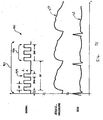
- the control or output signal 410 may comprise a pulse train 412 which generally includes a series of pulses 414 occurring in bursts 416.
- Pulse train 412 characteristics which may be changed include, but are not limited to: burst amplitude ( equal to pulse amplitude if constant within burst packet 416), burst waveform (i.e., pulse amplitude variation within burst packet 416), burst frequency (BF), and burst width or duration (BW).
- the signal 410 or a portion thereof may be triggered by any of the events discussed previously, or by a particular portion of the arterial pressure signal 450 or the ECG signal 460 (e.g., R-wave as shown in Figure 38 ), or another physiologic timing indicator. If the signal 410 or a portion thereof is triggered, the triggering event may be changed and/or the delay from the triggering event may be changed.
- a second general approach for a stimulus regimen which promotes long term efficacy and reduces power requirements/consumption involves the use of one baroreceptor activation device 70 having multiple output means (e.g., electrodes) or the use of multiple baroreceptor activation devices 70 each having a single or multiple output means.
- the stimulus regimen according to this approach calls for alternating activation of two or more devices 70 or output means, which are positioned at different anatomical locations. Alternating activation may be accomplished by alternating the control signal between the devices or output means.
- switching or alternating activation includes switching between individual output means, switching between sets of output means and individual output means, and switching between different sets of output means.
- a third general approach for a stimulus regimen which promotes long term efficacy and reduces power requirements/consumption involves changing the time domain characteristics and/or the triggering event characteristics of the therapy.
- a periodic control signal which has a designated start time (e.g., beginning of each minute, hour or day; specific time of day) and a designated duration (e.g., 1 second, 1 minute, 1 hour) may have a change in the designated start time and/or duration.
- an episodic control signal which is triggered by an episode may have a change in the delay from the triggering event or a change in the triggering event itself.
- the triggering event may be provided by feedback control utilizing sensor 80.
- the control signal may be asynchronous, wherein the start time, duration or delay from a base line event is asynchronous (e.g., random).
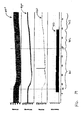
- FIG. 39 shows the control signal (volts) 410, heart rate (beats per minute) 420, mean arterial pressure (mmHg) 430 and arterial pressure (mmHg) 440 plotted as a function of time.
- the control signal 410 comprised a pulse train having a pulse amplitude of 2.5 volts, an initial pulse width or duration of 1.0 millisecond, and a pulse frequency of 100 Hz applied for a first period 401 of approximately 4 minutes.
- the blood pressure 430/440 and heart rate 420 were significantly reduced.
- the pulse duration was changed to a 0.25 milliseconds and applied for a second period 402 of approximately 2 minutes, while the other parameters remained unchanged.
- the reduced blood pressure 430/440 and heart rate 420 were sustained.
- the pulse train was turned off for a period of time 403.
- the blood pressure 430/440 and heart rate 420 began to gradually rise to their pretest values. This stimulus regimen demonstrated that the desired therapeutic effect may be sustained after reducing the pulse width of the stimulus device.
- the control signal 410 was changed to a pulse frequency of 10 Hz, while the pulse amplitude and duration remained unchanged, for a second period 402 of approximately 4 minutes. During this second period 402, the reduced heart rate and blood pressure were substantially sustained. The control signal 410 was changed back to a pulse frequency of 100 Hz, while the pulse amplitude and duration remained unchanged, for a third period 403 of approximately 40 seconds. During this third period 403, the heart rate 420 and blood pressure 430/440 were further reduced. The control signal 410 was changed again to a pulse frequency of 10 Hz, while the pulse amplitude and duration remained unchanged, for a fourth period 404 of approximately 1.5 minutes.
- the reduced heart rate 420 and blood pressure 430/440 were substantially sustained.
- the pulse train was turned off for a fifth period of time 405.
- the blood pressure 430/440 and heart rate 420 began to gradually rise to their pretest values.
- Figure 41 shows the results of an animal experiment wherein a baroreceptor activation device 70 in the form of an extravascular activation device having two electrodes was utilized. A first electrode was connected to the right carotid sinus and a second electrode was connected to the left carotid sinus.
- Figure 41 shows the control signal (volts) 410, heart rate (beats per minute) 420, mean arterial pressure (mmHg) 430 and arterial blood pressure (mmHg) 440 plotted as a function of time.
- connection between the components 60170/80 may be physical (e.g., wires, tubes, cables, etc.) or remote (e.g., transmitter/receiver, inductive, magnetic, etc.).
- the connection may travel intraarterially, intravenously, subcutaneously, or through other natural tissue paths.
- a mechanical expansion device may be used to expand or dilate the vascular wall 40 and thereby mechanically activate the baroreceptors 30.
- the mechanical expansion device may comprise a tubular wire braid structure that diametrically expands when longitudinally compressed as disclosed in U.S. Patent No. 5,222,971 to Willard et al.
- the tubular braid may be disposed intravascularly and permits blood perfusion through the wire mesh.
- the driver 66 may comprise a linear actuator connected by actuation cables to opposite ends of the braid. When the opposite ends of the tubular braid are brought closer together by actuation of the cables, the diameter of the braid increases to expand the vascular wall 40 and activate the baroreceptors 30.
- FIGS. 5A and 5B show schematic illustrations of a baroreceptor activation device 120 in the form of an extravascular pressure cuff.
- the pressure cuff device 120 includes an inflatable cuff 122 which is connected to a fluid line 124. Examples of a similar cuffs 122 are disclosed in U.S. Patent No. 4,256,094 to Kapp et al. and U.S. Patent No. 4,881,939 to Newman .
- the fluid line 124 is connected to the driver 66 of the control system 60.
- the driver 66 comprises a pressure/vacuum source (i.e., an inflation device) which selectively inflates and deflates the cuff 122.
- a pressure/vacuum source i.e., an inflation device
- the cuff 122 Upon inflation, the cuff 122 expands, preferably increasing in inside diameter only, to mechanically activate baroreceptors 30 by stretching or otherwise deforming them and/or the vascular wall 40. Upon deflation, the cuff 122 returns to its relaxed geometry such that the vascular wall 40 returns to its nominal state. Thus, by selectively inflating the inflatable cuff 122, the baroreceptors 30 adjacent thereto may be selectively activated.
- a piston actuated by a solenoid may apply compression to the vascular wall.
- An example of a solenoid actuated piston device is disclosed in U.S. Patent No. 4,014,318 to Dokum et al
- an example of a hydraulically or pneumatically actuated piston device is disclosed in U.S. Patent No. 4,586,501 to Claracq .
- Other examples include a rotary ring compression device as disclosed in U.S. Patent No. 4,551,862 to Haber , and an electromagnetically actuated compression ring device as disclosed in U.S. Patent No. 5,509,888 to Miller .
- the deformable structure device 140 includes a coil, braid or other stent-like structure 142 disposed in the vascular lumen.
- the deformable structure 142 includes one or more individual structural members connected to an electrical lead 144.
- Each of the structural members forming deformable structure 142 may comprise a shape memory material 146 (e.g., nickel titanium alloy) as illustrated in Figure 6C , or a bimetallic material 148 as illustrated in Figure 6D .
- the electrical lead 144 is connected to the driver 66 of the control system 60.
- the driver 66 comprises an electric power generator or amplifier which selectively delivers electric current to the structure 142 which resistively heats the structural members 146/148.
- the structure 142 may be unipolar as shown using the surrounding tissue as ground, or bipolar or multipolar using leads connected to either end of the structure 142. Electrical power may also be delivered to the structure 142 inductively as described hereinafter with reference to Figures 14-16 .
- FIGS 7A and 7B show schematic illustrations of a baroreceptor activation device 160 in the form of an extravascular deformable structure.
- the extravascular deformable structure device 160 is substantially the same as the intravascular deformable structure device 140 described with reference to Figures 6A and 6B , except that the extravascular device 160 is disposed about the vascular wall, and therefore compresses, rather than expands, the vascular wall 40.
- the deformable structure device 160 includes a coil, braid or other stent-like structure 162 comprising one or more individual structural members connected to an electrical lead 164.
- the shape memory material 166 Upon application of electrical current to the shape memory material 166, it is resistively heated causing a phase change and a corresponding change in shape.
- the bimetallic material 168 Upon application of electrical current to the bimetallic material 168, it is resistively heated causing a differential in thermal expansion and a corresponding change in shape.
- the material 166/168 is designed such that the change in shape causes constriction of the structure 162 to mechanically activate baroreceptors 30 by compressing or otherwise deforming the baroreceptors 30 and/or the vascular wall 40.
- the material 166/168 cools and the structure 162 returns to its relaxed geometry such that the baroreceptors 30 and/or the vascular wall 40 return to their nominal state.
- the baroreceptors 30 adjacent thereto may be selectively activated.
- FIGS 8A and 8B show schematic illustrations of a baroreceptor activation device 180 in the form of an extravascular flow regulator which artificially creates back pressure adjacent the baroreceptors 30.
- the flow regulator device 180 includes an external compression device 182, which may comprise any of the external compression devices described with reference to Figures 5A and 5B .
- the external compression device 182 is operably connected to the driver 66 of the control system 60 by way of cable 184, which may comprise a fluid line or electrical lead, depending on the type of external compression device 182 utilized.
- the external compression device 182 is disposed about the vascular wall distal of the baroreceptors 30.
- the external compression device 182 may be located in the distal portions of the external or internal carotid arteries 18/19 to create back pressure adjacent to the baroreceptors 30 in the carotid sinus region 20.
- the external compression device 182 may be located in the right subclavian artery 13, the right common carotid artery 14, the left common carotid artery 15, the left subclavian artery 16, or the brachiocephalic artery 22 to create back pressure adjacent the baroreceptors 30 in the aortic arch 12.
- FIGS 9A and 9B show schematic illustrations of a baroreceptor activation device 200 in the form of an intravascular flow regular which artificially creates back pressure adjacent the baroreceptors 30.
- the intravascular flow regulator device 200 is substantially similar in function and use as extravascular flow regulator 180 described with reference to Figures 8A and 8B , except that the intravascular flow regulator device 200 is disposed in the vascular lumen.
- Intravascular flow regulator 200 includes an internal valve 202 to at least partially close the vascular lumen distal of the baroreceptors 30. By at least partially closing the vascular lumen distal of the baroreceptors 30, back pressure is created proximal of the internal valve 202 such that the vascular wall expands to activate the baroreceptors 30.
- the internal valve 202 may be positioned at any of the locations described with reference to the external compression device 182, except that the internal valve 202 is placed within the vascular lumen.
- the internal compression device 202 may be located in the distal portions of the external or internal carotid arteries 18/19 to create back pressure adjacent to the baroreceptors 30 in the carotid sinus region 20.
- the internal compression device 202 may be located in the right subclavian artery 13, the right common carotid artery 14, the left common carotid artery 15, the left subclavian artery 16, or the brachiocephalic artery 22 to create back pressure adjacent the baroreceptors 30 in the aortic arch 12.
- the internal valve 202 is operably coupled to the driver 66 of the control system 60 by way of electrical lead 204.
- the control system 60 may selectively open, close or change the flow resistance of the valve 202 as described in more detail hereinafter.
- the internal valve 202 may include valve leaflets 206 (bi-leaflet or tri-leaflet) which rotate inside housing 208 about an axis between an open position and a closed position. The closed position may be completely closed or partially closed, depending on the desired amount of back pressure to be created.
- the opening and closing of the internal valve 202 may be selectively controlled by altering the resistance of leaflet 206 rotation or by altering the opening force of the leaflets 206.
- the resistance of rotation of the leaflets 206 may be altered utilizing electromagnetically actuated metallic bearings carried by the housing 208.
- the opening force of the leaflets 206 may be altered by utilizing electromagnetic coils in each of the leaflets to selectively magnetize the leaflets such that they either repel or attract each other, thereby facilitating valve opening and closing, respectively.
- intravascular flow regulators may be used in place of internal valve 202.
- internal inflatable balloon devices as disclosed in U.S. Patent No. 4,682,583 to Burton et al. and U.S. Patent No. 5,634,878 to Grundei et al. , may be adapted for use in place of valve 202.
- Such inflatable balloon devices may be operated in a similar manner as the inflatable cuff 122 described with reference to Figure 5 .
- the driver 66 would comprises a pressure/vacuum source (i.e., an inflation device) which selectively inflates and deflates the internal balloon.
- the balloon Upon inflation, the balloon expands to partially occlude blood flow and create back pressure to mechanically activate baroreceptors 30 by stretching or otherwise deforming them and/or the vascular wall 40.
- the internal balloon Upon deflation, the internal balloon returns to its normal profile such that flow is not hindered and back pressure is eliminated.
- the baroreceptors 30 proximal thereof may be selectively activated by creating back pressure.
- the magnetic particles 222 may comprise magnetically responsive materials (i.e., ferrous based materials) and may be magnetically neutral or magnetically active.
- the magnetic particles 222 comprise permanent magnets having an elongate cylinder shape with north and south poles to strongly respond to magnetic fields.
- the magnetic particles 222 are actuated by an electromagnetic coil 224 which is operably coupled to the driver 66 of the control system 60 by way of an electrical cable 226.
- the electromagnetic coil 224 may be implanted as shown, or located outside the body, in which case the driver 66 and the remainder of the control system 60 would also be located outside the body.
- the electromagnetic coil 224 By selectively activating the electromagnetic coil 224 to create a magnetic field, the magnetic particles 222 may be repelled, attracted or rotated.
- the magnetic field created by the electromagnetic coil 224 may be alternated such that the magnetic particles 222 vibrate within the vascular wall 40.
- the baroreceptors 30 are mechanically activated.
- the electromagnetic coil 224 is preferably placed as close as possible to the magnetic particles 222 in the vascular wall 40, and may be placed intravascularly, extravascularly, or in any of the alternative locations discussed with reference to inductor shown in Figures 14-16 .
- the magnetic particles 222 may be implanted in the vascular wall 40 by injecting a ferro-fluid or a ferro-particle suspension into the vascular wall adjacent to the baroreceptors 30. To increase biocompatibility, the particles 222 may be coated with a ceramic, polymeric or other inert material. Injection of the fluid carrying the magnetic particles 222 is preferably performed percutaneously.
- the transducers 242 comprise an array surrounding the vascular wall.
- the transducers 242 may be intravascularly or extravascularly positioned adjacent to the baroreceptors 30.
- the transducers 242 comprise devices which convert electrical signals into some physical phenomena, such as mechanical vibration or acoustic waves.
- the electrical signals are provided to the transducers 242 by way of electrical cables 244 which are connected to the driver 66 of the control system 60.
- the baroreceptors 30 may be mechanically activated.
- the transducers 242 may comprise an acoustic transmitter which transmits sonic or ultrasonic sound waves into the vascular wall 40 to activate the baroreceptors 30.
- the transducers 242 may comprise a piezoelectric material which vibrates the vascular wall to activate the baroreceptors 30.
- the transducers 242 may comprise an artificial muscle which deflects upon application of an electrical signal.
- An example of an artificial muscle transducer comprises plastic impregnated with a lithium-perchlorate electrolyte disposed between sheets of polypyrrole, a conductive polymer. Such plastic muscles may be electrically activated to cause deflection in different directions depending on the polarity of the applied current.
- FIGS 12A and 12B show schematic illustrations of a baroreceptor activation device 260 in the form of a local fluid delivery device 262 suitable for delivering a chemical or biological fluid agent to the vascular wall adjacent the baroreceptors 30.
- the local fluid delivery device 262 may be located intravascularly, extravascularly, or intramurally. For purposes of illustration only, the local fluid delivery device 262 is positioned extravascularly.
- the local fluid delivery device 262 may include proximal and distal seals 266 which retain the fluid agent disposed in the lumen or cavity 268 adjacent to vascular wall. Preferably, the local fluid delivery device 262 completely surrounds the vascular wall 40 to maintain an effective seal. Those skilled in the art will recognize that the local fluid delivery device 262 may comprise a wide variety of implantable drug delivery devices or pumps known in the art.
- the local fluid delivery device 260 is connected to a fluid line 264 which is connected to the driver 66 of the control system 60.
- the driver 66 comprises a pressure/vacuum source and fluid reservoir containing the desired chemical or biological fluid agent.
- the chemical or biological fluid agent may comprise a wide variety of stimulatory substances. Examples include veratridine, bradykinin, prostaglandins, and related substances. Such stimulatory substances activate the baroreceptors 30 directly or enhance their sensitivity to other stimuli and therefore may be used in combination with the other baroreceptor activation devices described herein.
- Other examples include growth factors and other agents that modify the function of the baroreceptors 30 or the cells of the vascular tissue surrounding the baroreceptors 30 causing the baroreceptors 30 to be activated or causing alteration of their responsiveness or activation pattern to other stimuli. It is also contemplated that injectable stimulators that are induced remotely, as described in U.S. Patent No. 6,061,596 , may be used with examples described herein.
- the fluid delivery device 260 may be used to deliver a photochemical that is essentially inert until activated by light to have a stimulatory effect as described above.
- the fluid delivery device 260 would include a light source such as a light emitting diode (LED), and the driver 66 of the control system 60 would include a pulse generator for the LED combined with a pressure/vacuum source and fluid reservoir described previously.
- the photochemical would be delivered with the fluid delivery device 260 as described above, and the photochemical would be activated, deactivated or modulated by activating, deactivating or modulating the LED.
- the fluid delivery device 260 may be used to deliver a warm or hot fluid (e.g. saline) to thermally activate the baroreceptors 30.
- a warm or hot fluid e.g. saline
- the driver 66 of the control system 60 would include a heat generator for heating the fluid, combined with a pressure/vacuum source and fluid reservoir described previously.
- the hot or warm fluid would be delivered and preferably circulated with the fluid delivery device 260 as described above, and the temperature of the fluid would be controlled by the driver 66.
- the electrode structure 282 may comprise a self-expanding or balloon expandable coil, braid or other stent-like structure disposed in the vascular lumen.
- the electrode structure 282 may serve the dual purpose of maintaining lumen patency while also delivering electrical stimuli.
- the electrode structure 282 may be implanted utilizing conventional intravascular stent and filter delivery techniques.
- the electrode structure 282 comprises a geometry which allows blood perfusion therethrough.
- the electrode structure 282 comprises electrically conductive material which may be selectively insulated to establish contact with the inside surface of the vascular wall 40 at desired locations, and limit extraneous electrical contact with blood flowing through the vessel and other tissues.
- the electrode structure 282 is connected to electric lead 284 which is connected to the driver 66 of the control system 60.
- the driver 66 may comprise a power amplifier, pulse generator or the like to selectively deliver electrical control signals to structure 282.
- the electrical control signal generated by the driver 66 may be continuous, periodic, episodic or a combination thereof, as dictated by an algorithm contained in memory 62 of the control system 60.
- Continuous control signals include a constant pulse, a constant train of pulses, a triggered pulse and a triggered train of pulses.
- Periodic control signals include each of the continuous control signals described above which have a designated start time and a designated duration.
- Episodic control signals include each of the continuous control signals described above which are triggered by an episode.
- electrical energy may be delivered to the vascular wall to activate the baroreceptors 30.
- activation of the baroreceptors 30 may occur directly or indirectly.
- the electrical signal delivered to the vascular wall 40 by the electrode structure 282 may cause the vascular wall to stretch or otherwise deform thereby indirectly activating the baroreceptors 30 disposed therein.
- the electrical signals delivered to the vascular wall by the electrode structure 282 may directly activate the baroreceptors 30 by changing the electrical potential across the baroreceptors 30. In either case, the electrical signal is delivered to the vascular wall 40 immediately adjacent to the baroreceptors 30.
- the electrode structure 282 may delivery thermal energy by utilizing a semi-conductive material having a higher resistance such that the electrode structure 282 resistively generates heat upon application of electrical energy.
- the electrode structure 282 may be unipolar as shown in Figures 13A and 13B using the surrounding tissue as ground, or bipolar using leads connected to either end of the structure 282 as shown in Figures 18A and 18B .
- the electrode structure 282 includes two or more individual electrically conductive members 283/285 which are electrically isolated at their respective cross-over points utilizing insulative materials. Each of the members 283/285 is connected to a separate conductor contained within the electrical lead 284. Alternatively, an array of bipoles may be used as described in more detail with reference to Figure 21 .
- a multipolar arrangement may be used wherein three or more electrically conductive members are included in the structure 282.
- a tripolar arrangement may be provided by one electrically conductive member having a polarity disposed between two electrically conductive members having the opposite polarity.
- the electrical signals may be directly delivered to the electrode structure 282 as described with reference to Figures 13A and 13B , or indirectly delivered utilizing an inductor as illustrated in Figures 14-16 and 21 .
- the embodiments of Figures 14 - 16 and 21 utilize an inductor 286 which is operably connected to the driver 66 of the control system 60 by way of electrical lead 284.
- the inductor 286 comprises an electrical winding which creates a magnetic field 287 (as seen in Figure 21 ) around the electrode structure 282.
- the magnetic field 287 may be alternated by alternating the direction of current flow through the inductor 286.
- the inductor 286 may be utilized to create current flow in the electrode structure 282 to thereby deliver electrical signals to the vascular wall 40 to directly or indirectly activate the baroreceptors 30.
- the inductor 286 may be covered with an electrically insulative material to eliminate direct electrical stimulation of tissues surrounding the inductor 286.
- a preferred embodiment of an inductively activated electrode structure 282 is described in more detail with reference to Figures 21A - 21C .
- Figures 13-16 may be modified to form a cathode/anode arrangement.
- the electrical inductor 286 would be connected to the driver 66 as shown in Figures 14-16 and the electrode structure 282 would be connected to the driver 66 as shown in Figure 13 .
- the electrode structure 282 and the inductor 286 may be any suitable geometry and need not be coiled for purposes of induction.
- the electrode structure 282 and the inductor 286 would comprise a cathode/anode or anode/cathode pair.
- the cathode 282 when activated, may generate a primary stream of electrons which travel through the inter-electrode space (i.e., vascular tissue and baroreceptors 30) to the anode 286.
- the cathode is preferably cold, as opposed to thermionic, during electron emission.
- the electrons may be used to electrically or thermally activate the baroreceptors 30 as discussed previously.
- the electrical inductor 286 is preferably disposed as close as possible to the electrode structure 282.
- the electrical inductor 286 may be disposed adjacent the vascular wall as illustrated in Figures 14A and 14B .
- the inductor 286 may be disposed in an adjacent vessel as illustrated in Figures 15A and 15B .
- the electrode structure 282 is disposed in the carotid sinus 20, for example, the inductor 286 may be disposed in the internal jugular vein 21 as illustrated in Figures 15A and 15B .
- the electrical inductor 286 may comprise a similar structure as the electrode structure 282.
- the electrical inductor 286 may be disposed outside the patient's body, but as close as possible to the electrode structure 282. If the electrode structure 282 is disposed in the carotid sinus 20, for example, the electrical inductor 286 may be disposed on the right or left side of the neck of the patient as illustrated in Figures 16A and 16B . In the embodiment of Figures 16A and 16B , wherein the electrical inductor 286 is disposed outside the patient's body, the control system 60 may also be disposed outside the patient's body.
- the electrode structure 282 may be intravascularly disposed as described with reference to Figures 13A and 13B , or extravascularly disposed as described with reference to Figures 17A and 17B , which show schematic illustrations of a baroreceptor activation device 300 in the form of an extravascular electrically conductive structure or electrode 302. Except as described herein, the extravascular electrode structure 302 is the same in design, function, and use as the intravascular electrode structure 282.
- the electrode structure 302 may comprise a coil, braid or other structure capable of surrounding the vascular wall.
- the electrode structure 302 may comprise one or more electrode patches distributed around the outside surface of the vascular wall.
- the extravascular electrode structure 302 may receive electrical signals directly from the driver 66 of the control system 60 by way of electrical lead 304, or indirectly by utilizing an inductor (not shown) as described with reference to Figures 14-16 .
- FIGS 19A and 19B show schematic illustrations of a baroreceptor activation device 320 in the form of electrically conductive particles 322 disposed in the vascular wall.
- This embodiment is substantially the same as the embodiments described with reference to Figures 13-18 , except that the electrically conductive particles 322 are disposed within the vascular wall, as opposed to the electrically conductive structures 282/302 which are disposed on either side of the vascular wall.
- this embodiment is similar to the embodiment described with reference to Figure 10 , except that the electrically conductive particles 322 are not necessarily magnetic as with magnetic particles 222, and the electrically conductive particles 322 are driven by an electromagnetic filed rather than by a magnetic field.
- the driver 66 of the control system 60 comprises an electromagnetic transmitter such as an radiofrequency or microwave transmitter. Electromagnetic radiation is created by the transmitter 66 which is operably coupled to an antenna 324 by way of electrical lead 326. Electromagnetic waves are emitted by the antenna 324 and received by the electrically conductive particles 322 disposed in the vascular wall 40. Electromagnetic energy creates oscillating current flow within the electrically conductive particles 322, and depending on the intensity of the electromagnetic radiation and the resistivity of the conductive particles 322, may cause the electrical particles 322 to generate heat. The electrical or thermal energy generated by the electrically conductive particles 322 may directly activate the baroreceptors 30, or indirectly activate the baroreceptors 30 by way of the surrounding vascular wall tissue.
- an electromagnetic transmitter such as an radiofrequency or microwave transmitter. Electromagnetic radiation is created by the transmitter 66 which is operably coupled to an antenna 324 by way of electrical lead 326. Electromagnetic waves are emitted by the antenna 324 and received by the electrically conductive particles 322
- the electromagnetic radiation transmitter 66 and antenna 324 may be disposed in the patient's body, with the antenna 324 disposed adjacent to the conductive particles in the vascular wall 40 as illustrated in Figures 19A and 19B .
- the antenna 324 may be disposed in any of the positions described with reference to the electrical inductor shown in Figures 14-16 . It is also contemplated that the electromagnetic radiation transmitter 66 and antenna 324 may be utilized in combination with the intravascular and extravascular electrically conductive structures 282/302 described with reference to Figures 13-18 to generate thermal energy on either side of the vascular wall.
- the electromagnetic radiation transmitter 66 and antenna 324 may be used without the electrically conductive particles 322.
- the electromagnetic radiation transmitter 66 and antenna 324 may be used to deliver electromagnetic radiation (e.g., RF, microwave) directly to the baroreceptors 30 or the tissue adjacent thereto to cause localized heating, thereby thermally inducing a baroreceptor 30 signal.
- electromagnetic radiation e.g., RF, microwave
- FIGS 20A and 20B show schematic illustrations of a baroreceptor activation device 340 in the form of a Peltier effect device 342.
- the Peltier effect device 342 may be extravascularly positioned as illustrated, or may be intravascularly positioned similar to an intravascular stent or filter.
- the Peltier effect device 342 is operably connected to the driver 66 of the control system 60 by way of electrical lead 344.
- the Peltier effect device 342 includes two dissimilar metals or semiconductors 343/345 separated by a thermal transfer junction 347.
- the driver 66 comprises a power source which delivers electrical energy to the dissimilar metals or semiconductors 343/345 to create current flow across the thermal junction 347.
- a cooling effect is created at the thermal junction 347.
- a heating effect created at the junction between the individual leads 344 connected to the dissimilar metals or semiconductors 343/345. This heating effect, which is proportional to the cooling effect, may be utilized to activate the baroreceptors 30 by positioning the junction between the electrical leads 344 and the dissimilar metals or semiconductors 343/345 adjacent to the vascular wall 40.
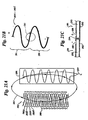
- FIGS 21A-21C show schematic illustrations of a preferred embodiment of an inductively activated electrode structure 282 for use with the embodiments described with reference to Figures 14-16 .
- current flow in the electrode structure 282 is induced by a magnetic field 287 created by an inductor 286 which is operably coupled to the driver 66 of the control system 60 by way of electrical cable 284.
- the electrode structure 282 preferably comprises a multi-filar self-expanding braid structure including a plurality of individual members 282a, 282b, 282c and 282d.
- the electrode structure 282 may simply comprise a single coil for purposes of this embodiment.
- Each of the individual coil members 282a-282d comprising the electrode structure 282 consists of a plurality of individual coil turns 281 connected end to end as illustrated in Figures 21B and 21C.
- Figure 21C is a detailed view of the connection between adjacent coil turns 281 as shown in Figure 21B .
- Each coil turn 281 comprises electrically isolated wires or receivers in which a current flow is established when a changing magnetic field 287 is created by the inductor 286.
- the inductor 286 is preferably covered with an electrically insulative material to eliminate direct electrical stimulation of tissues surrounding the inductor 286. Current flow through each coil turn 281 results in a potential drop 288 between each end of the coil turn 281.
- Each coil turn 281 comprises an electrically conductive wire material 290 surrounded by an electrically insulative material 292. The ends of each coil turn 281 are connected by an electrically insulated material 294 such that each coil turn 281 remains electrically isolated.
- the insulative material 294 mechanically joins but electrically isolates adjacent coil turns 281 such that each turn 281 responds with a similar potential drop 288 when current flow is induced by the changing magnetic field 287 of the inductor 286.
- An exposed portion 296 is provided at each end of each coil turn 281 to facilitate contact with the vascular wall tissue.
- Each exposed portion 296 comprises an isolated electrode in contact with the vessel wall.
- the changing magnetic field 287 of the inductor 286 causes a potential drop in each coil turn 281 thereby creating small current flow cells in the vessel wall corresponding to adjacent exposed regions 296.
- the creation of multiple small current cells along the inner wall of the blood vessel serves to create a cylindrical zone of relatively high current density such that the baroreceptors 30 are activated.
- the cylindrical current density field quickly reduces to a negligible current density near the outer wall of the vascular wall, which serves to limit extraneous current leakage to minimize or eliminate unwanted activation of extravascular tissues and structures such as nerves or muscles.
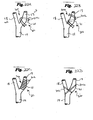
- FIGS 22A - 22F show schematic illustrations of various possible arrangements of electrodes around the carotid sinus 20 for extravascular electrical activation embodiments, such as baroreceptor activation device 300 described with reference to Figures 17A and 17B .
- the electrode designs illustrated and described hereinafter may be particularly suitable for connection to the carotid arteries at or near the carotid sinus, and may be designed to minimize extraneous tissue stimulation.
- the carotid arteries are shown, including the common 14, the external 18 and the internal 19 carotid arteries.
- the location of the carotid sinus 20 may be identified by a landmark bulge 21, which is typically located on the internal carotid artery 19 just distal of the bifurcation, or extends across the bifurcation from the common carotid artery 14 to the internal carotid artery 19.
- the carotid sinus 20, and in particular the bulge 21 of the carotid sinus may contain a relatively high density of baroreceptors 30 (not shown) in the vascular wall. For this reason, it may be desirable to position the electrodes 302 of the activation device 300 on and/or around the sinus bulge 21 to maximize baroreceptor responsiveness and to minimize extraneous tissue stimulation.
- the device 300 and electrodes 302 are merely schematic, and only a portion of which may be shown, for purposes of illustrating various positions of the electrodes 302 on and/or around the carotid sinus 20 and the sinus bulge 21.
- the electrodes 302 may be monopolar (electrodes are cathodes, surrounding tissue is anode or ground), bipolar (cathode-anode pairs), or tripolar (anode-cathode-anode sets). Specific extravascular electrode designs are described in more detail hereinafter.
- the electrodes 302 of the extravascular electrical activation device 300 extend around a portion or the entire circumference of the sinus 20 in a circular fashion.
- the electrodes 302 of the extravascular electrical activation device 300 extend around a portion or the entire circumference of the sinus 20 in a helical fashion.
- the electrodes 302 may wrap around the sinus 20 any number of times to establish the desired electrode 302 contact and coverage.
- a single pair of electrodes 302 may wrap around the sinus 20, or a plurality of electrode pairs 302 may be wrapped around the sinus 20 as shown in Figure 22C to establish more electrode 302 contact and coverage.
- the plurality of electrode pairs 302 may extend from a point proximal of the sinus 20 or bulge 21, to a point distal of the sinus 20 or bulge 21 to ensure activation of baroreceptors 30 throughout the sinus 20 region.
- the electrodes 302 may be connected to a single channel or multiple channels as discussed in more detail hereinafter.
- the plurality of electrode pairs 302 may be selectively activated for purposes of targeting a specific area of the sinus 20 to increase baroreceptor responsiveness, or for purposes of reducing the exposure of tissue areas to activation to maintain baroreceptor responsiveness long term.
- the electrodes 302 extend around the entire circumference of the sinus 20 in a criss-cross fashion. The criss-cross arrangement of the electrodes 302 establishes contact with both the internal 19 and external 18 carotid arteries around the carotid sinus 20. Similarly, in Figure 22E , the electrodes 302 extend around all or a portion of the circumference of the sinus 20, including the internal 19 and external 18 carotid arteries at the bifurcation, and in some instances the common carotid artery 14. In Figure 22F , the electrodes 302 extend around all or a portion of the circumference of the sinus 20, including the internal 19 and external 18 carotid arteries distal of the bifurcation.
- the extravascular electrical activation devices 300 are shown to include a substrate or base structure 306 which may encapsulate and insulate the electrodes 302 and may provide a means for attachment to the sinus 20 as described in more detail hereinafter.
- the electrodes 302 of the activation device 300 are wrapped around a portion of the carotid structure, which may require deformation of the electrodes 302 from their relaxed geometry (e.g., straight).
- the electrodes 302 and/or the base structure 306 may have a relaxed geometry that substantially conforms to the shape of the carotid anatomy at the point of attachment.
- the electrodes 302 and the base structure 306 may be pre-shaped to conform to the carotid anatomy in a substantially relaxed state.
- the electrodes 302 may have a geometry and/or orientation that reduces the amount of electrode 302 strain.
- the electrodes 302 are shown to have a serpentine or wavy shape.
- the serpentine shape of the electrodes 302 reduces the amount of strain seen by the electrode material when wrapped around a carotid structure.
- the serpentine shape of the electrodes increases the contact surface area of the electrode 302 with the carotid tissue.
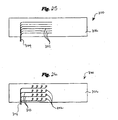
- the electrodes 302 may be arranged to be substantially orthogonal to the wrap direction (i.e., substantially parallel to the axis of the carotid arteries) as shown in Figure 24 .
- the electrodes 302 each have a length and a width or diameter, wherein the length is substantially greater than the width or diameter.
- the electrodes 302 each have a longitudinal axis parallel to the length thereof, wherein the longitudinal axis is orthogonal to the wrap direction and substantially parallel to the longitudinal axis of the carotid artery about which the device 300 is wrapped. As with the multiple electrode embodiments described previously, the electrodes 302 may be connected to a single channel or multiple channels as discussed in more detail hereinafter.
- Figure 25 illustrates a six (6) channel electrode assembly including six (6) separate elongate electrodes 302 extending adjacent to and parallel with each other.
- the electrodes 302 are each connected to multi-channel cable 304. Some of the electrodes 302 may be common, thereby reducing the number of channels necessary in the cable 304.
- Base structure or substrate 306 may comprise a flexible and electrically insulative material suitable for implantation, such as silicone, perhaps reinforced with a flexible material such as polyester fabric.
- the base 306 may have a length suitable to wrap around all (360°) or a portion (i.e., less than 360°) of the circumference of one or more of the carotid arteries adjacent the carotid sinus 20.
- the electrodes 302 may extend around a portion (i.e., less than 360° such as 270°, 180° or 90°) of the circumference of one or more of the carotid arteries adjacent the carotid sinus 20.
- the electrodes 302 may have a length that is less than (e.g., 75%, 50% or 25%) the length of the base 206.
- the electrodes 302 may be parallel, orthogonal or oblique to the length of the base 306, which is generally orthogonal to the axis of the carotid artery to which it is disposed about.
- the electrodes 302 may comprise round wire, rectangular ribbon or foil formed of an electrically conductive and radiopaque material such as platinum.
- the base structure 306 substantially encapsulates the electrodes 302, leaving only an exposed area for electrical connection to extravascular carotid sinus tissue.
- each electrode 302 may be partially recessed in the base 206 and may have one side exposed along all or a portion of its length for electrical connection to carotid tissue. Electrical paths through the carotid tissues may be defined by one or more pairs of the elongate electrodes 302.
- the multi-channel electrodes 302 may be selectively activated for purposes of mapping and targeting a specific area of the carotid sinus 20 to determine the best combination of electrodes 302 (e.g., individual pair, or groups of pairs) to activate for maximum baroreceptor responsiveness, as described elsewhere herein.
- the multi-channel electrodes 302 may be selectively activated for purposes of reducing the exposure of tissue areas to activation to maintain long term efficacy as described , as described elsewhere herein. For these purposes, it may be useful to utilize more than two (2) electrode channels.
- the electrodes 302 may be connected to a single channel whereby baroreceptors are uniformly activated throughout the sinus 20 region.
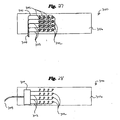
- the device 300 includes sixteen (16) individual electrode pads 302 connected to 16-channel cable 304 via 4-channel connectors 303.
- the circular electrode pads 302 are partially encapsulated by the base structure 306 to leave one face of each button electrode 302 exposed for electrical connection to carotid tissues.
- electrical paths through the carotid tissues may be defined by one or more pairs (bipolar) or groups (tripolar) of electrode pads 302.
- the device 300 includes sixteen (16) individual circular pad electrodes 302 surrounded by sixteen (16) rings 305, which collectively may be referred to as concentric electrode pads 302/305.
- Pad electrodes 302 are connected to 17-channel cable 304 via 4-channel connectors 303, and rings 305 are commonly connected to 17-channel cable 304 via a single channel connector 307.
- the circular shaped electrodes 302 and the rings 305 are partially encapsulated by the base structure 306 to leave one face of each pad electrode 302 and one side of each ring 305 exposed for electrical connection to carotid tissues.
- two rings 305 may surround each electrode 302, with the rings 305 being commonly connected. With these arrangements, electrical paths through the carotid tissues may be defined between one or more pad electrode 302 / ring 305 sets to create localized electrical paths.
- the device 300 includes a control IC chip 310 connected to 3-channel cable 304.
- the control chip 310 is also connected to sixteen (16) individual pad electrodes 302 via 4-channel connectors 303.
- the control chip 310 permits the number of channels in cable 304 to be reduced by utilizing a coding system.
- the control system 60 sends a coded control signal which is received by chip 310.
- the chip 310 converts the code and enables or disables selected electrode 302 pairs in accordance with the code.
- control signal may comprise a pulse wave form, wherein each pulse includes a different code.
- the code for each pulse causes the chip 310 to enable one or more pairs of electrodes, and to disable the remaining electrodes.
- the pulse is only transmitted to the enabled electrode pair(s) corresponding to the code sent with that pulse.
- Each subsequent pulse would have a different code than the preceding pulse, such that the chip 310 enables and disables a different set of electrodes 302 corresponding to the different code.
- the IC chip 310 may be connected to feedback sensor 80, taking advantage of the same functions as described with reference to Figure 3 .
- one or more of the electrodes 302 may be used as feedback sensors when not enabled for activation.
- a feedback sensor electrode may be used to measure or monitor electrical conduction in the vascular wall to provide data analogous to an ECG.
- such a feedback sensor electrode may be used to sense a change in impedance due to changes in blood volume during a pulse pressure to provide data indicative of heart rate, blood pressure, or other physiologic parameter.
- FIG 29 schematically illustrates an extravascular electrical activation device 300 including a support collar or anchor 312.
- the activation device 300 is wrapped around the internal carotid artery 19 at the carotid sinus 20, and the support collar 312 is wrapped around the common carotid artery 14.
- the activation device 300 is connected to the support collar 312 by cables 304, which act as a loose tether.
- the collar 312 isolates the activation device from movements and forces transmitted by the cables 304 proximal of the support collar, such as may be encountered by movement of the control system 60 and/or driver 66.
- a strain relief (not shown) may be connected to the base structure 306 of the activation device 300 at the juncture between the cables 304 and the base 306. With either approach, the position of the device 300 relative to the carotid anatomy may be better maintained despite movements of other parts of the system.
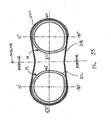
- the base structure 306 of the activation device 300 may comprise molded tube, a tubular extrusion, or a sheet of material wrapped into a tube shape utilizing a suture flap 308 with sutures 309 as shown.
- the base structure 306 may be formed of a flexible and biocompatible material such as silicone, which may be reinforced with a flexible material such as polyester fabric available under the trade name DACRON to form a composite structure.
- the inside diameter of the base structure 306 may correspond to the outside diameter of the carotid artery at the location of implantation, for example 6 - 8 mm.
- the wall thickness of the base structure 306 may be very thin to maintain flexibility and a low profile, for example less than 1 mm. If the device 300 is to be disposed about a sinus bulge 21, a correspondingly shaped bulge may be formed into the base structure for added support and assistance in positioning.
- the electrodes 302 may comprise round wire, rectangular ribbon or foil, formed of an electrically conductive and radiopaque material such as platinum or platinum-indium.
- the electrodes may be molded into the base structure 306 or adhesively connected to the inside diameter thereof, leaving a portion of the electrode exposed for electrical connection to carotid tissues.
- the electrodes 302 may encompass less than the entire inside circumference (e.g., 300°) of the base structure 306 to avoid shorting.
- the electrodes 302 may have any of the shapes and arrangements described previously. For example, as shown in Figure 29 , two rectangular ribbon electrodes 302 may be used, each having a width of 1 mm spaced 1.5 mm apart.
- the support collar 312 may be formed similarly to base structure 306.
- the support collar may comprise molded tube, a tubular extrusion, or a sheet of material wrapped into a tube shape utilizing a suture flap 315 with sutures 313 as shown.
- the support collar 312 may be formed of a flexible and biocompatible material such as silicone, which may be reinforced to form a composite structure.
- the cables 304 are secured to the support collar 312, leaving slack in the cables 304 between the support collar 312 and the activation device 300.
- sutures 311 may be used to maintain the position of the electrical activation device 300 relative to the carotid anatomy (or other vascular site containing baroreceptors).
- Such sutures 311 may be connected to base structure 306, and pass through all or a portion of the vascular wall.
- the sutures 311 may be threaded through the base structure 306, through the adventitia of the vascular wall, and tied.
- the base structure 306 comprises a patch or otherwise partially surrounds the carotid anatomy, the corners and/or ends of the base structure may be sutured, with additional sutures evenly distributed therebetween.
- a reinforcement material such as polyester fabric may be embedded in the silicone material.
- other fixation means may be employed such as staples or a biocompatible adhesive, for example.
- FIG. 30 schematically illustrates an alternative extravascular electrical activation device 300 including one or more electrode ribs 316 interconnected by spine 317.
- a support collar 312 having one or more (non-electrode) ribs 316 may be used to isolate the activation device 300 from movements and forces transmitted by the cables 304 proximal of the support collar 312.
- the ribs 316 of the activation device 300 are sized to fit about the carotid anatomy, such as the internal carotid artery 19 adjacent the carotid sinus 20.
- the ribs 316 of the support collar 312 may be sized to fit about the carotid anatomy, such as the common carotid artery 14 proximal of the carotid sinus 20.
- the ribs 316 may be separated, placed on a carotid artery, and closed thereabout to secure the device 300 to the carotid anatomy.
- Each of the ribs 316 of the device 300 includes an electrode 302 on the inside surface thereof for electrical connection to carotid tissues.
- the ribs 316 provide insulative material around the electrodes 302, leaving only an inside portion exposed to the vascular wall.
- the electrodes 302 are coupled to the multi-channel cable 304 through spine 317.
- Spine 317 also acts as a tether to ribs 316 of the support collar 312, which do not include electrodes since their function is to provide support.
- the multi-channel electrode 302 functions discussed with reference to Figures 25 - 28 are equally applicable to this embodiment.
- the ends of the ribs 316 may be connected (e.g., sutured) after being disposed about a carotid artery, or may remain open as shown. If the ends remain open, the ribs 316 may be formed of a relatively stiff material to ensure a mechanical lock around the carotid artery.
- the ribs 316 may be formed of polyethylene, polypropylene, PTFE, or other similar insulative and biocompatible material.
- the ribs 316 may be formed of a metal such as stainless steel or a nickel titanium alloy, as long as the metallic material was electrically isolated from the electrodes 302.
- the ribs 316 may comprise an insulative and biocompatible polymeric material with the structural integrity provided by metallic (e.g., stainless steel, nickel titanium alloy, etc.) reinforcement.
- metallic e.g., stainless steel, nickel titanium alloy, etc.
- the electrodes 302 may comprise the metallic reinforcement.
- the cable 304 illustrated in Figure 31 comprises a coaxial type cable including two coaxially disposed coil leads separated into two separate coils 318 for attachment to the electrodes 302.
- An alternative cable 304 construction is illustrated in Figure 32.
- Figure 32 illustrates an alternative cable body 304 which may be formed in a curvilinear shape such as a sinusoidal configuration, prior to implantation.
- the curvilinear configuration readily accommodates a change in distance between the device 300 and the control system 60 or the driver 66. Such a change in distance may be encountered during flexion and/or extension of the neck of the patient after implantation.
- the fluid delivery device 260 to deliver a cool or cold fluid (e.g. saline).
- the driver 66 would include a heat exchanger to cool the fluid and the control system 60 may be used to regulate the temperature of the fluid, thereby regulating the degree of baroreceptor 30 signal dampening.
- the A/O ratio is a function of the position of the baroreceptor activation device. In particular, it has been found that the A/O ratio varies about the circumference of the carotid artery near the carotid sinus 20, perhaps due to variations in the location or density of baroreceptors. Although described herein with reference to the carotid sinus 20, it is also likely that the A/O ratio varies at all of the anatomical locations which contain baroreceptors as described previously.
- Figures 33 - 35 show the right carotid arteries including the common 14, internal 18, and external 19 carotid arteries.
- the carotid sinus 20 may be highlighted by a bulge 21, which typically extends from the common carotid artery 14 to the internal carotid artery 18 near the bifurcation.
- the carotid sinus 20 contains a significant number of baroreceptors, the number and density of which may vary around the circumference and along the length of the sinus 20. As such, it is desirable to determine the optimal position for the baroreceptor activation device 70, both in terms of circumferential and longitudinal position.
- the electrodes 520 of the device 500 are then oriented in a different position (e.g., rotated) and/or placed at a different anatomical location, and the same measurements are made. These steps are repeated to collect the desired amount of data, which may be graphically plotted to generate a map to determine an optimal position/location. The A/O ratios may be compared, and the position/location having the most desirable A/O ratio may be selected for the device 500.
- a hand held probe or similar device incorporating electrodes 520 may be used to permit easier manipulation and quicker changes between different locations/positions.
- an animal experiment was performed utilizing device 500 on the left and right carotid arteries of an animal.
- the device 500 was wrapped around the carotid artery near the carotid sinus 20 at the bifurcation of the internal 18 and external 19 carotid arteries, substantially as shown in Figure 34 .
- the center of the bulge 21L of the left carotid sinus 20L for this animal was located at 120°
- the center of the bulge 21R of the right carotid sinus 20R was located at 200°.
- the electrodes 520 were rotated around the left carotid artery at 90°, 120°, 180°, and 270° positions.
- the electrodes 520 were rotated around the right carotid artery at 155°, 180°, 200°, 220°,and 255° positions.
- the electrodes 520 were activated with a 4 volt signal, and the mean arterial pressure (MAP) and heart rate (HR) were measured.
- MAP mean arterial pressure
- HR heart rate
- the device 500 may have many individually controllable electrodes 520 disposed around a large area of the carotid sinus (e.g., around the entire circumference), as described elsewhere herein.
- the electrodes 520 may be individually activated, and the corresponding baroreceptor response for each electrode may be determined.
- the electrodes 520 having the most desirable A/O ratio(s) may then be selected for chronic use. This method negates the need to reposition or relocate the device to find the optimal A/O ratio. This method also enables the electrode selection to be changed after implantation without the need to change the position/location of the device 500 in a subsequent clinical procedure.
Landscapes
- Health & Medical Sciences (AREA)
- Neurology (AREA)
- Neurosurgery (AREA)
- Orthopedic Medicine & Surgery (AREA)
- Cardiology (AREA)
- Heart & Thoracic Surgery (AREA)
- Engineering & Computer Science (AREA)
- Biomedical Technology (AREA)
- Nuclear Medicine, Radiotherapy & Molecular Imaging (AREA)
- Radiology & Medical Imaging (AREA)
- Life Sciences & Earth Sciences (AREA)
- Animal Behavior & Ethology (AREA)
- General Health & Medical Sciences (AREA)
- Public Health (AREA)
- Veterinary Medicine (AREA)
- Electrotherapy Devices (AREA)
- External Artificial Organs (AREA)
- Saccharide Compounds (AREA)
- Pharmaceuticals Containing Other Organic And Inorganic Compounds (AREA)
- Medicines That Contain Protein Lipid Enzymes And Other Medicines (AREA)
- Acyclic And Carbocyclic Compounds In Medicinal Compositions (AREA)
Applications Claiming Priority (6)
| Application Number | Priority Date | Filing Date | Title |
|---|---|---|---|
| US09/671,850 US6522926B1 (en) | 2000-09-27 | 2000-09-27 | Devices and methods for cardiovascular reflex control |
| US09/963,777 US7158832B2 (en) | 2000-09-27 | 2001-09-26 | Electrode designs and methods of use for cardiovascular reflex control devices |
| US09/963,991 US6850801B2 (en) | 2001-09-26 | 2001-09-26 | Mapping methods for cardiovascular reflex control devices |
| US09/964,079 US6985774B2 (en) | 2000-09-27 | 2001-09-26 | Stimulus regimens for cardiovascular reflex control |
| EP01975479A EP1330288B1 (en) | 2000-09-27 | 2001-09-27 | Devices for cardiovascular reflex control |
| EP09158665A EP2085114A3 (en) | 2000-09-27 | 2001-09-27 | Devices and methods for cardiovascular reflex control |
Related Parent Applications (4)
| Application Number | Title | Priority Date | Filing Date |
|---|---|---|---|
| EP01975479A Division EP1330288B1 (en) | 2000-09-27 | 2001-09-27 | Devices for cardiovascular reflex control |
| EP09158665A Division EP2085114A3 (en) | 2000-09-27 | 2001-09-27 | Devices and methods for cardiovascular reflex control |
| EP01975479.5 Division | 2001-09-27 | ||
| EP09158665.1 Division | 2009-04-23 |
Publications (2)
| Publication Number | Publication Date |
|---|---|
| EP2535082A1 EP2535082A1 (en) | 2012-12-19 |
| EP2535082B1 true EP2535082B1 (en) | 2015-09-09 |
Family
ID=27505343
Family Applications (4)
| Application Number | Title | Priority Date | Filing Date |
|---|---|---|---|
| EP12169661.1A Expired - Lifetime EP2535082B1 (en) | 2000-09-27 | 2001-09-27 | Devices for cardiovascular reflex control |
| EP01975479A Expired - Lifetime EP1330288B1 (en) | 2000-09-27 | 2001-09-27 | Devices for cardiovascular reflex control |
| EP09158665A Withdrawn EP2085114A3 (en) | 2000-09-27 | 2001-09-27 | Devices and methods for cardiovascular reflex control |
| EP11175851.2A Expired - Lifetime EP2399644B1 (en) | 2000-09-27 | 2001-09-27 | Devices for cardiovascular reflex control |
Family Applications After (3)
| Application Number | Title | Priority Date | Filing Date |
|---|---|---|---|
| EP01975479A Expired - Lifetime EP1330288B1 (en) | 2000-09-27 | 2001-09-27 | Devices for cardiovascular reflex control |
| EP09158665A Withdrawn EP2085114A3 (en) | 2000-09-27 | 2001-09-27 | Devices and methods for cardiovascular reflex control |
| EP11175851.2A Expired - Lifetime EP2399644B1 (en) | 2000-09-27 | 2001-09-27 | Devices for cardiovascular reflex control |
Country Status (8)
| Country | Link |
|---|---|
| US (1) | US6985774B2 (https=) |
| EP (4) | EP2535082B1 (https=) |
| JP (1) | JP5047447B2 (https=) |
| AT (1) | ATE432732T1 (https=) |
| AU (1) | AU2001294799A1 (https=) |
| DE (1) | DE60138902D1 (https=) |
| ES (1) | ES2330833T3 (https=) |
| WO (1) | WO2002026314A1 (https=) |
Cited By (1)
| Publication number | Priority date | Publication date | Assignee | Title |
|---|---|---|---|---|
| US10980438B2 (en) | 2011-11-01 | 2021-04-20 | DePuy Synthes Products, LLC | Intraoperative neurophysiological monitoring system |
Families Citing this family (519)
| Publication number | Priority date | Publication date | Assignee | Title |
|---|---|---|---|---|
| US6302875B1 (en) | 1996-10-11 | 2001-10-16 | Transvascular, Inc. | Catheters and related devices for forming passageways between blood vessels or other anatomical structures |
| US20070129746A1 (en) * | 1999-12-09 | 2007-06-07 | Mische Hans A | Methods and devices for the treatment of neurological and physiological disorders |
| US7499742B2 (en) * | 2001-09-26 | 2009-03-03 | Cvrx, Inc. | Electrode structures and methods for their use in cardiovascular reflex control |
| US7158832B2 (en) * | 2000-09-27 | 2007-01-02 | Cvrx, Inc. | Electrode designs and methods of use for cardiovascular reflex control devices |
| US20070185542A1 (en) * | 2002-03-27 | 2007-08-09 | Cvrx, Inc. | Baroreflex therapy for disordered breathing |
| US7840271B2 (en) * | 2000-09-27 | 2010-11-23 | Cvrx, Inc. | Stimulus regimens for cardiovascular reflex control |
| US20080167699A1 (en) * | 2000-09-27 | 2008-07-10 | Cvrx, Inc. | Method and Apparatus for Providing Complex Tissue Stimulation Parameters |
| US8086314B1 (en) * | 2000-09-27 | 2011-12-27 | Cvrx, Inc. | Devices and methods for cardiovascular reflex control |
| US20080177366A1 (en) * | 2000-09-27 | 2008-07-24 | Cvrx, Inc. | Cuff electrode arrangement for nerve stimulation and methods of treating disorders |
| US7623926B2 (en) | 2000-09-27 | 2009-11-24 | Cvrx, Inc. | Stimulus regimens for cardiovascular reflex control |
| US7616997B2 (en) * | 2000-09-27 | 2009-11-10 | Kieval Robert S | Devices and methods for cardiovascular reflex control via coupled electrodes |
| US6684105B2 (en) * | 2001-08-31 | 2004-01-27 | Biocontrol Medical, Ltd. | Treatment of disorders by unidirectional nerve stimulation |
| US6907295B2 (en) * | 2001-08-31 | 2005-06-14 | Biocontrol Medical Ltd. | Electrode assembly for nerve control |
| US7904176B2 (en) * | 2006-09-07 | 2011-03-08 | Bio Control Medical (B.C.M.) Ltd. | Techniques for reducing pain associated with nerve stimulation |
| US7734355B2 (en) * | 2001-08-31 | 2010-06-08 | Bio Control Medical (B.C.M.) Ltd. | Treatment of disorders by unidirectional nerve stimulation |
| US8615294B2 (en) * | 2008-08-13 | 2013-12-24 | Bio Control Medical (B.C.M.) Ltd. | Electrode devices for nerve stimulation and cardiac sensing |
| US7778711B2 (en) * | 2001-08-31 | 2010-08-17 | Bio Control Medical (B.C.M.) Ltd. | Reduction of heart rate variability by parasympathetic stimulation |
| US8386056B2 (en) * | 2001-08-31 | 2013-02-26 | Bio Control Medical (B.C.M.) Ltd. | Parasympathetic stimulation for treating atrial arrhythmia and heart failure |
| US7974693B2 (en) | 2001-08-31 | 2011-07-05 | Bio Control Medical (B.C.M.) Ltd. | Techniques for applying, configuring, and coordinating nerve fiber stimulation |
| US20090005845A1 (en) * | 2007-06-26 | 2009-01-01 | Tamir Ben David | Intra-Atrial parasympathetic stimulation |
| US8571653B2 (en) * | 2001-08-31 | 2013-10-29 | Bio Control Medical (B.C.M.) Ltd. | Nerve stimulation techniques |
| US8565896B2 (en) | 2010-11-22 | 2013-10-22 | Bio Control Medical (B.C.M.) Ltd. | Electrode cuff with recesses |
| US7885709B2 (en) * | 2001-08-31 | 2011-02-08 | Bio Control Medical (B.C.M.) Ltd. | Nerve stimulation for treating disorders |
| US7778703B2 (en) * | 2001-08-31 | 2010-08-17 | Bio Control Medical (B.C.M.) Ltd. | Selective nerve fiber stimulation for treating heart conditions |
| US8974446B2 (en) | 2001-10-11 | 2015-03-10 | St. Jude Medical, Inc. | Ultrasound ablation apparatus with discrete staggered ablation zones |
| EP1482882B1 (en) * | 2002-02-11 | 2011-09-14 | Gold-T Tech, Inc. | Implantable device for preventing thrombus formation |
| EP1487536A4 (en) * | 2002-03-27 | 2009-12-02 | Cvrx Inc | DEVICES AND METHODS FOR CARDIOVASCULAR REFLEX CONTROL OF COUPLED ELECTRODES |
| US20140018880A1 (en) | 2002-04-08 | 2014-01-16 | Medtronic Ardian Luxembourg S.A.R.L. | Methods for monopolar renal neuromodulation |
| US9636174B2 (en) | 2002-04-08 | 2017-05-02 | Medtronic Ardian Luxembourg S.A.R.L. | Methods for therapeutic renal neuromodulation |
| US7853333B2 (en) * | 2002-04-08 | 2010-12-14 | Ardian, Inc. | Methods and apparatus for multi-vessel renal neuromodulation |
| US7617005B2 (en) | 2002-04-08 | 2009-11-10 | Ardian, Inc. | Methods and apparatus for thermally-induced renal neuromodulation |
| US8150520B2 (en) * | 2002-04-08 | 2012-04-03 | Ardian, Inc. | Methods for catheter-based renal denervation |
| US8145317B2 (en) | 2002-04-08 | 2012-03-27 | Ardian, Inc. | Methods for renal neuromodulation |
| US8774913B2 (en) | 2002-04-08 | 2014-07-08 | Medtronic Ardian Luxembourg S.A.R.L. | Methods and apparatus for intravasculary-induced neuromodulation |
| US6978174B2 (en) * | 2002-04-08 | 2005-12-20 | Ardian, Inc. | Methods and devices for renal nerve blocking |
| US7653438B2 (en) | 2002-04-08 | 2010-01-26 | Ardian, Inc. | Methods and apparatus for renal neuromodulation |
| US8145316B2 (en) | 2002-04-08 | 2012-03-27 | Ardian, Inc. | Methods and apparatus for renal neuromodulation |
| US8774922B2 (en) | 2002-04-08 | 2014-07-08 | Medtronic Ardian Luxembourg S.A.R.L. | Catheter apparatuses having expandable balloons for renal neuromodulation and associated systems and methods |
| US7162303B2 (en) * | 2002-04-08 | 2007-01-09 | Ardian, Inc. | Renal nerve stimulation method and apparatus for treatment of patients |
| US8150519B2 (en) | 2002-04-08 | 2012-04-03 | Ardian, Inc. | Methods and apparatus for bilateral renal neuromodulation |
| US8131371B2 (en) | 2002-04-08 | 2012-03-06 | Ardian, Inc. | Methods and apparatus for monopolar renal neuromodulation |
| US7756583B2 (en) | 2002-04-08 | 2010-07-13 | Ardian, Inc. | Methods and apparatus for intravascularly-induced neuromodulation |
| US9308044B2 (en) | 2002-04-08 | 2016-04-12 | Medtronic Ardian Luxembourg S.A.R.L. | Methods for therapeutic renal neuromodulation |
| US20070129761A1 (en) | 2002-04-08 | 2007-06-07 | Ardian, Inc. | Methods for treating heart arrhythmia |
| US20070135875A1 (en) | 2002-04-08 | 2007-06-14 | Ardian, Inc. | Methods and apparatus for thermally-induced renal neuromodulation |
| US7620451B2 (en) | 2005-12-29 | 2009-11-17 | Ardian, Inc. | Methods and apparatus for pulsed electric field neuromodulation via an intra-to-extravascular approach |
| US9308043B2 (en) | 2002-04-08 | 2016-04-12 | Medtronic Ardian Luxembourg S.A.R.L. | Methods for monopolar renal neuromodulation |
| US8347891B2 (en) | 2002-04-08 | 2013-01-08 | Medtronic Ardian Luxembourg S.A.R.L. | Methods and apparatus for performing a non-continuous circumferential treatment of a body lumen |
| US20080213331A1 (en) | 2002-04-08 | 2008-09-04 | Ardian, Inc. | Methods and devices for renal nerve blocking |
| US20110207758A1 (en) * | 2003-04-08 | 2011-08-25 | Medtronic Vascular, Inc. | Methods for Therapeutic Renal Denervation |
| US20040039417A1 (en) * | 2002-04-16 | 2004-02-26 | Medtronic, Inc. | Electrical stimulation and thrombolytic therapy |
| US7561922B2 (en) * | 2004-12-22 | 2009-07-14 | Biocontrol Medical Ltd. | Construction of electrode assembly for nerve control |
| US7844346B2 (en) * | 2002-05-23 | 2010-11-30 | Biocontrol Medical Ltd. | Electrode assembly for nerve control |
| US7885711B2 (en) * | 2003-06-13 | 2011-02-08 | Bio Control Medical (B.C.M.) Ltd. | Vagal stimulation for anti-embolic therapy |
| US7321793B2 (en) * | 2003-06-13 | 2008-01-22 | Biocontrol Medical Ltd. | Vagal stimulation for atrial fibrillation therapy |
| US8204591B2 (en) * | 2002-05-23 | 2012-06-19 | Bio Control Medical (B.C.M.) Ltd. | Techniques for prevention of atrial fibrillation |
| NL1021969C2 (nl) * | 2002-11-21 | 2004-05-26 | Eugene Christian Olgers | Inrichting voor inbrenging in een menselijk lichaam. |
| US7189204B2 (en) | 2002-12-04 | 2007-03-13 | Cardiac Pacemakers, Inc. | Sleep detection using an adjustable threshold |
| US8880192B2 (en) | 2012-04-02 | 2014-11-04 | Bio Control Medical (B.C.M.) Ltd. | Electrode cuffs |
| US7627384B2 (en) | 2004-11-15 | 2009-12-01 | Bio Control Medical (B.C.M.) Ltd. | Techniques for nerve stimulation |
| WO2004073767A2 (en) * | 2003-02-18 | 2004-09-02 | Science Medicus, Inc. | Regulation of blood pressure by coded nerve signals |
| US20060111626A1 (en) * | 2003-03-27 | 2006-05-25 | Cvrx, Inc. | Electrode structures having anti-inflammatory properties and methods of use |
| US8060197B2 (en) * | 2003-05-23 | 2011-11-15 | Bio Control Medical (B.C.M.) Ltd. | Parasympathetic stimulation for termination of non-sinus atrial tachycardia |
| US8718791B2 (en) | 2003-05-23 | 2014-05-06 | Bio Control Medical (B.C.M.) Ltd. | Electrode cuffs |
| JP4192040B2 (ja) * | 2003-06-11 | 2008-12-03 | 泉工医科工業株式会社 | バルーンポンプ駆動装置 |
| WO2004110549A2 (en) * | 2003-06-13 | 2004-12-23 | Biocontrol Medical Ltd. | Applications of vagal stimulation |
| US8606356B2 (en) | 2003-09-18 | 2013-12-10 | Cardiac Pacemakers, Inc. | Autonomic arousal detection system and method |
| US7887493B2 (en) * | 2003-09-18 | 2011-02-15 | Cardiac Pacemakers, Inc. | Implantable device employing movement sensing for detecting sleep-related disorders |
| US7184830B2 (en) * | 2003-08-18 | 2007-02-27 | Ebr Systems, Inc. | Methods and systems for treating arrhythmias using a combination of vibrational and electrical energy |
| US8002553B2 (en) | 2003-08-18 | 2011-08-23 | Cardiac Pacemakers, Inc. | Sleep quality data collection and evaluation |
| US7571008B2 (en) * | 2003-08-18 | 2009-08-04 | Medtronic, Inc. | System and apparatus for remote activation of implantable medical devices |
| US8014872B2 (en) | 2003-08-18 | 2011-09-06 | Medtronic, Inc. | System and apparatus for controlled activation of acute use medical devices |
| EP2008581B1 (en) | 2003-08-18 | 2011-08-17 | Cardiac Pacemakers, Inc. | Patient monitoring, diagnosis, and/or therapy systems and methods |
| ES2564694T3 (es) | 2003-09-12 | 2016-03-28 | Vessix Vascular, Inc. | Sistema de remodelación y / o ablación excéntrica seleccionable de material ateroesclerótico |
| US7480532B2 (en) | 2003-10-22 | 2009-01-20 | Cvrx, Inc. | Baroreflex activation for pain control, sedation and sleep |
| US7572226B2 (en) * | 2003-10-28 | 2009-08-11 | Cardiac Pacemakers, Inc. | System and method for monitoring autonomic balance and physical activity |
| US7657312B2 (en) * | 2003-11-03 | 2010-02-02 | Cardiac Pacemakers, Inc. | Multi-site ventricular pacing therapy with parasympathetic stimulation |
| US20050165317A1 (en) * | 2003-11-04 | 2005-07-28 | Turner Nicholas M. | Medical devices |
| US7783353B2 (en) * | 2003-12-24 | 2010-08-24 | Cardiac Pacemakers, Inc. | Automatic neural stimulation modulation based on activity and circadian rhythm |
| US8126560B2 (en) | 2003-12-24 | 2012-02-28 | Cardiac Pacemakers, Inc. | Stimulation lead for stimulating the baroreceptors in the pulmonary artery |
| US7486991B2 (en) * | 2003-12-24 | 2009-02-03 | Cardiac Pacemakers, Inc. | Baroreflex modulation to gradually decrease blood pressure |
| US9020595B2 (en) * | 2003-12-24 | 2015-04-28 | Cardiac Pacemakers, Inc. | Baroreflex activation therapy with conditional shut off |
| US7509166B2 (en) * | 2003-12-24 | 2009-03-24 | Cardiac Pacemakers, Inc. | Automatic baroreflex modulation responsive to adverse event |
| US8024050B2 (en) | 2003-12-24 | 2011-09-20 | Cardiac Pacemakers, Inc. | Lead for stimulating the baroreceptors in the pulmonary artery |
| US7769450B2 (en) * | 2004-11-18 | 2010-08-03 | Cardiac Pacemakers, Inc. | Cardiac rhythm management device with neural sensor |
| US7460906B2 (en) * | 2003-12-24 | 2008-12-02 | Cardiac Pacemakers, Inc. | Baroreflex stimulation to treat acute myocardial infarction |
| US7643875B2 (en) | 2003-12-24 | 2010-01-05 | Cardiac Pacemakers, Inc. | Baroreflex stimulation system to reduce hypertension |
| US20050149133A1 (en) * | 2003-12-24 | 2005-07-07 | Imad Libbus | Sensing with compensation for neural stimulator |
| US8200331B2 (en) * | 2004-11-04 | 2012-06-12 | Cardiac Pacemakers, Inc. | System and method for filtering neural stimulation |
| US20050149129A1 (en) * | 2003-12-24 | 2005-07-07 | Imad Libbus | Baropacing and cardiac pacing to control output |
| US20080015659A1 (en) * | 2003-12-24 | 2008-01-17 | Yi Zhang | Neurostimulation systems and methods for cardiac conditions |
| US8396560B2 (en) | 2004-11-18 | 2013-03-12 | Cardiac Pacemakers, Inc. | System and method for closed-loop neural stimulation |
| JP4633737B2 (ja) * | 2003-12-24 | 2011-02-16 | カーディアック ペースメイカーズ, インコーポレイテッド | 肺動脈中の圧受容体を刺激するための装置 |
| US8126559B2 (en) | 2004-11-30 | 2012-02-28 | Cardiac Pacemakers, Inc. | Neural stimulation with avoidance of inappropriate stimulation |
| US20050149132A1 (en) | 2003-12-24 | 2005-07-07 | Imad Libbus | Automatic baroreflex modulation based on cardiac activity |
| US7869881B2 (en) * | 2003-12-24 | 2011-01-11 | Cardiac Pacemakers, Inc. | Baroreflex stimulator with integrated pressure sensor |
| US7706884B2 (en) * | 2003-12-24 | 2010-04-27 | Cardiac Pacemakers, Inc. | Baroreflex stimulation synchronized to circadian rhythm |
| US7647114B2 (en) * | 2003-12-24 | 2010-01-12 | Cardiac Pacemakers, Inc. | Baroreflex modulation based on monitored cardiovascular parameter |
| US8086315B2 (en) | 2004-02-12 | 2011-12-27 | Asap Medical, Inc. | Cardiac stimulation apparatus and method for the control of hypertension |
| WO2005084389A2 (en) * | 2004-03-02 | 2005-09-15 | Cvrx, Inc. | External baroreflex activation |
| WO2005107854A2 (en) | 2004-05-04 | 2005-11-17 | The Cleveland Clinic Foundation | Corpus callosum neuromodulation assembly |
| US7697991B2 (en) * | 2004-05-04 | 2010-04-13 | The Cleveland Clinic Foundation | Methods of treating neurological conditions by neuromodulation of interhemispheric fibers |
| US7260431B2 (en) * | 2004-05-20 | 2007-08-21 | Cardiac Pacemakers, Inc. | Combined remodeling control therapy and anti-remodeling therapy by implantable cardiac device |
| PL1759536T3 (pl) * | 2004-06-01 | 2011-10-31 | Kwalata Trading Ltd | Techniki in vitro z użyciem komórek macierzystych |
| US7596413B2 (en) * | 2004-06-08 | 2009-09-29 | Cardiac Pacemakers, Inc. | Coordinated therapy for disordered breathing including baroreflex modulation |
| US7747323B2 (en) | 2004-06-08 | 2010-06-29 | Cardiac Pacemakers, Inc. | Adaptive baroreflex stimulation therapy for disordered breathing |
| US20060004417A1 (en) * | 2004-06-30 | 2006-01-05 | Cvrx, Inc. | Baroreflex activation for arrhythmia treatment |
| US7346382B2 (en) | 2004-07-07 | 2008-03-18 | The Cleveland Clinic Foundation | Brain stimulation models, systems, devices, and methods |
| CN100565590C (zh) * | 2004-07-23 | 2009-12-02 | 松下电器产业株式会社 | 三维形状绘制设备和三维形状绘制方法 |
| US20060047337A1 (en) | 2004-08-27 | 2006-03-02 | Brenneman Rodney A | Device and method for establishing an artificial arterio-venous fistula |
| US9706997B2 (en) * | 2004-08-27 | 2017-07-18 | Rox Medical, Inc. | Device and method for establishing an artificial arterio-venous fistula |
| US7828814B2 (en) | 2004-08-27 | 2010-11-09 | Rox Medical, Inc. | Device and method for establishing an artificial arterio-venous fistula |
| US9713730B2 (en) | 2004-09-10 | 2017-07-25 | Boston Scientific Scimed, Inc. | Apparatus and method for treatment of in-stent restenosis |
| US8396548B2 (en) * | 2008-11-14 | 2013-03-12 | Vessix Vascular, Inc. | Selective drug delivery in a lumen |
| US8920414B2 (en) | 2004-09-10 | 2014-12-30 | Vessix Vascular, Inc. | Tuned RF energy and electrical tissue characterization for selective treatment of target tissues |
| US20060074453A1 (en) * | 2004-10-04 | 2006-04-06 | Cvrx, Inc. | Baroreflex activation and cardiac resychronization for heart failure treatment |
| US8175705B2 (en) * | 2004-10-12 | 2012-05-08 | Cardiac Pacemakers, Inc. | System and method for sustained baroreflex stimulation |
| US7672733B2 (en) * | 2004-10-29 | 2010-03-02 | Medtronic, Inc. | Methods and apparatus for sensing cardiac activity via neurological stimulation therapy system or medical electrical lead |
| US20070083239A1 (en) * | 2005-09-23 | 2007-04-12 | Denise Demarais | Methods and apparatus for inducing, monitoring and controlling renal neuromodulation |
| US7937143B2 (en) * | 2004-11-02 | 2011-05-03 | Ardian, Inc. | Methods and apparatus for inducing controlled renal neuromodulation |
| US8332047B2 (en) * | 2004-11-18 | 2012-12-11 | Cardiac Pacemakers, Inc. | System and method for closed-loop neural stimulation |
| US8226592B2 (en) * | 2004-12-15 | 2012-07-24 | Rox Medical, Inc. | Method of treating COPD with artificial arterio-venous fistula and flow mediating systems |
| US8609082B2 (en) | 2005-01-25 | 2013-12-17 | Bio Control Medical Ltd. | Administering bone marrow progenitor cells or myoblasts followed by application of an electrical current for cardiac repair, increasing blood supply or enhancing angiogenesis |
| JP4848505B2 (ja) * | 2005-01-27 | 2011-12-28 | 財団法人ヒューマンサイエンス振興財団 | 頚部圧力負荷による自律神経治療装置 |
| US7840266B2 (en) | 2005-03-11 | 2010-11-23 | Cardiac Pacemakers, Inc. | Integrated lead for applying cardiac resynchronization therapy and neural stimulation therapy |
| US7587238B2 (en) * | 2005-03-11 | 2009-09-08 | Cardiac Pacemakers, Inc. | Combined neural stimulation and cardiac resynchronization therapy |
| WO2006098996A1 (en) * | 2005-03-11 | 2006-09-21 | Cardiac Pacemakers, Inc. | Combined neural stimulation and cardiac resynchronization therapy |
| US7660628B2 (en) * | 2005-03-23 | 2010-02-09 | Cardiac Pacemakers, Inc. | System to provide myocardial and neural stimulation |
| EP2438877B1 (en) | 2005-03-28 | 2016-02-17 | Vessix Vascular, Inc. | Intraluminal electrical tissue characterization and tuned RF energy for selective treatment of atheroma and other target tissues |
| US7493161B2 (en) | 2005-05-10 | 2009-02-17 | Cardiac Pacemakers, Inc. | System and method to deliver therapy in presence of another therapy |
| US8473049B2 (en) | 2005-05-25 | 2013-06-25 | Cardiac Pacemakers, Inc. | Implantable neural stimulator with mode switching |
| US8406876B2 (en) * | 2005-04-05 | 2013-03-26 | Cardiac Pacemakers, Inc. | Closed loop neural stimulation synchronized to cardiac cycles |
| US7542800B2 (en) * | 2005-04-05 | 2009-06-02 | Cardiac Pacemakers, Inc. | Method and apparatus for synchronizing neural stimulation to cardiac cycles |
| US7499748B2 (en) * | 2005-04-11 | 2009-03-03 | Cardiac Pacemakers, Inc. | Transvascular neural stimulation device |
| US7881782B2 (en) * | 2005-04-20 | 2011-02-01 | Cardiac Pacemakers, Inc. | Neural stimulation system to prevent simultaneous energy discharges |
| US7734348B2 (en) | 2005-05-10 | 2010-06-08 | Cardiac Pacemakers, Inc. | System with left/right pulmonary artery electrodes |
| US7617003B2 (en) * | 2005-05-16 | 2009-11-10 | Cardiac Pacemakers, Inc. | System for selective activation of a nerve trunk using a transvascular reshaping lead |
| DE102005031116B4 (de) * | 2005-07-04 | 2012-04-12 | Siemens Ag | Stoßwellensystem |
| US20070021803A1 (en) | 2005-07-22 | 2007-01-25 | The Foundry Inc. | Systems and methods for neuromodulation for treatment of pain and other disorders associated with nerve conduction |
| US8923972B2 (en) | 2005-07-25 | 2014-12-30 | Vascular Dynamics, Inc. | Elliptical element for blood pressure reduction |
| US9642726B2 (en) | 2005-07-25 | 2017-05-09 | Vascular Dynamics, Inc. | Devices and methods for control of blood pressure |
| US20110077729A1 (en) * | 2009-09-29 | 2011-03-31 | Vascular Dynamics Inc. | Devices and methods for control of blood pressure |
| US9125732B2 (en) | 2005-07-25 | 2015-09-08 | Vascular Dynamics, Inc. | Devices and methods for control of blood pressure |
| US20110118773A1 (en) * | 2005-07-25 | 2011-05-19 | Rainbow Medical Ltd. | Elliptical device for treating afterload |
| US9592136B2 (en) | 2005-07-25 | 2017-03-14 | Vascular Dynamics, Inc. | Devices and methods for control of blood pressure |
| EP1909694B1 (en) * | 2005-07-25 | 2014-06-11 | Rainbow Medical Ltd. | Electrical stimulation of blood vessels |
| US7616990B2 (en) | 2005-10-24 | 2009-11-10 | Cardiac Pacemakers, Inc. | Implantable and rechargeable neural stimulator |
| EP1962949B1 (en) * | 2005-12-20 | 2015-02-25 | The Cleveland Clinic Foundation | Apparatus for modulating the baroreflex system |
| US7570999B2 (en) | 2005-12-20 | 2009-08-04 | Cardiac Pacemakers, Inc. | Implantable device for treating epilepsy and cardiac rhythm disorders |
| US20070156200A1 (en) | 2005-12-29 | 2007-07-05 | Lilian Kornet | System and method for regulating blood pressure and electrolyte balance |
| US8109879B2 (en) * | 2006-01-10 | 2012-02-07 | Cardiac Pacemakers, Inc. | Assessing autonomic activity using baroreflex analysis |
| EP1981584B1 (en) * | 2006-02-03 | 2015-05-13 | Interventional Autonomics Corporation | Intravascular device for neuromodulation |
| US20070191904A1 (en) * | 2006-02-14 | 2007-08-16 | Imad Libbus | Expandable stimulation electrode with integrated pressure sensor and methods related thereto |
| TW200734462A (en) | 2006-03-08 | 2007-09-16 | In Motion Invest Ltd | Regulating stem cells |
| US20070225781A1 (en) * | 2006-03-21 | 2007-09-27 | Nidus Medical, Llc | Apparatus and methods for altering temperature in a region within the body |
| JP4828984B2 (ja) * | 2006-03-28 | 2011-11-30 | テルモ株式会社 | 穿刺具 |
| US8019435B2 (en) | 2006-05-02 | 2011-09-13 | Boston Scientific Scimed, Inc. | Control of arterial smooth muscle tone |
| US7647101B2 (en) | 2006-06-09 | 2010-01-12 | Cardiac Pacemakers, Inc. | Physical conditioning system, device and method |
| US8968204B2 (en) * | 2006-06-12 | 2015-03-03 | Transonic Systems, Inc. | System and method of perivascular pressure and flow measurement |
| EP2218479A3 (en) * | 2006-06-28 | 2013-06-05 | Medtronic Ardian Luxembourg S.à.r.l. | Methods and systems for thermally-induced renal neuromodulation |
| US8170668B2 (en) | 2006-07-14 | 2012-05-01 | Cardiac Pacemakers, Inc. | Baroreflex sensitivity monitoring and trending for tachyarrhythmia detection and therapy |
| US8457734B2 (en) * | 2006-08-29 | 2013-06-04 | Cardiac Pacemakers, Inc. | System and method for neural stimulation |
| US8175712B2 (en) * | 2006-09-05 | 2012-05-08 | The Penn State Research Foundation | Homotopic conditioning of the brain stem baroreflex of a subject |
| US20080091255A1 (en) * | 2006-10-11 | 2008-04-17 | Cardiac Pacemakers | Implantable neurostimulator for modulating cardiovascular function |
| EP2076198A4 (en) | 2006-10-18 | 2009-12-09 | Minnow Medical Inc | Inducing Desired Temperatreating Effects on Body Weave |
| EP2076194B1 (en) | 2006-10-18 | 2013-04-24 | Vessix Vascular, Inc. | System for inducing desirable temperature effects on body tissue |
| EP2094352A4 (en) | 2006-12-06 | 2010-05-19 | Cleveland Clinic Foundation | METHOD AND SYSTEM FOR TREATING ACUTE CARDIAC INSUFFICIENCY BY NEUROMODULATION |
| US20080167690A1 (en) * | 2007-01-05 | 2008-07-10 | Cvrx, Inc. | Treatment of peripheral vascular disease by baroreflex activation |
| US8150521B2 (en) * | 2007-03-15 | 2012-04-03 | Cvrx, Inc. | Methods and devices for controlling battery life in an implantable pulse generator |
| US8496653B2 (en) * | 2007-04-23 | 2013-07-30 | Boston Scientific Scimed, Inc. | Thrombus removal |
| US20090132002A1 (en) * | 2007-05-11 | 2009-05-21 | Cvrx, Inc. | Baroreflex activation therapy with conditional shut off |
| US8209033B2 (en) * | 2007-05-14 | 2012-06-26 | Cardiac Pacemakers, Inc. | Method and apparatus for regulating blood volume using volume receptor stimulation |
| EP1998054B1 (de) * | 2007-05-24 | 2014-08-13 | Parker Origa Holding AG | Pneumatikzylinder mit einer selbsteinstellenden Endlagendämpfung und entsprechendes Verfahren |
| US20080306563A1 (en) * | 2007-06-05 | 2008-12-11 | Jose Roberto Kullok | System and method for cardiovascular treatment or training |
| US8828068B2 (en) | 2007-07-17 | 2014-09-09 | Cardiac Pacemakers, Inc. | Systems and methods for local vasoactive response using temperature modulation |
| US8594794B2 (en) | 2007-07-24 | 2013-11-26 | Cvrx, Inc. | Baroreflex activation therapy with incrementally changing intensity |
| WO2009021535A1 (en) * | 2007-08-14 | 2009-02-19 | Campus Micro Technologies Gmbh | Medical devices, systems and methods for blood pressure regulation |
| US20090112962A1 (en) * | 2007-10-31 | 2009-04-30 | Research In Motion Limited | Modular squaring in binary field arithmetic |
| WO2009075750A2 (en) | 2007-12-12 | 2009-06-18 | Cardiac Pacemakers, Inc. | System for delivering neurostimulation from pulmonary artery |
| US20110009692A1 (en) * | 2007-12-26 | 2011-01-13 | Yossi Gross | Nitric oxide generation to treat female sexual dysfunction |
| EP2224847A4 (en) | 2007-12-28 | 2013-01-23 | Cvrx Inc | MEASURE THE PHYSIOLOGICAL PARAMETERS OF A PATIENT |
| US8214050B2 (en) | 2007-12-31 | 2012-07-03 | Cvrx, Inc. | Method for monitoring physiological cycles of a patient to optimize patient therapy |
| US8538535B2 (en) | 2010-08-05 | 2013-09-17 | Rainbow Medical Ltd. | Enhancing perfusion by contraction |
| US20100305392A1 (en) * | 2008-01-31 | 2010-12-02 | Enopace Biomedical Ltd. | Thoracic aorta and vagus nerve stimulation |
| US8626299B2 (en) * | 2008-01-31 | 2014-01-07 | Enopace Biomedical Ltd. | Thoracic aorta and vagus nerve stimulation |
| US9005106B2 (en) | 2008-01-31 | 2015-04-14 | Enopace Biomedical Ltd | Intra-aortic electrical counterpulsation |
| US8626290B2 (en) | 2008-01-31 | 2014-01-07 | Enopace Biomedical Ltd. | Acute myocardial infarction treatment by electrical stimulation of the thoracic aorta |
| US9220889B2 (en) | 2008-02-11 | 2015-12-29 | Intelect Medical, Inc. | Directional electrode devices with locating features |
| US8019440B2 (en) | 2008-02-12 | 2011-09-13 | Intelect Medical, Inc. | Directional lead assembly |
| US7925352B2 (en) | 2008-03-27 | 2011-04-12 | Synecor Llc | System and method for transvascularly stimulating contents of the carotid sheath |
| US20100211131A1 (en) * | 2008-04-07 | 2010-08-19 | Williams Michael S | Intravascular system and method for blood pressure control |
| WO2009134478A1 (en) * | 2008-04-29 | 2009-11-05 | Medtronic, Inc. | Therapy program modification |
| US9272153B2 (en) | 2008-05-15 | 2016-03-01 | Boston Scientific Neuromodulation Corporation | VOA generation system and method using a fiber specific analysis |
| US8401652B2 (en) | 2008-06-16 | 2013-03-19 | Cvrx, Inc. | Devices and methods for treatment of heart failure and associated conditions |
| US8321024B2 (en) | 2008-06-16 | 2012-11-27 | Cvrx, Inc. | Devices and methods for treatment of heart failure and associated conditions |
| US8326430B2 (en) * | 2008-06-16 | 2012-12-04 | Cvrx, Inc. | Devices and methods for treatment of heart failure and associated conditions |
| US8768469B2 (en) | 2008-08-08 | 2014-07-01 | Enteromedics Inc. | Systems for regulation of blood pressure and heart rate |
| CN102209497A (zh) * | 2008-09-22 | 2011-10-05 | 明诺医学股份有限公司 | 使用替代能量源在身体组织上引起期望温度效应 |
| EP2346405B1 (en) * | 2008-09-26 | 2019-03-13 | Vascular Dynamics Inc. | Devices and methods for control of blood pressure |
| WO2010039862A1 (en) * | 2008-09-30 | 2010-04-08 | Rox Medical, Inc. | Methods for screening and treating patients with compromised cardiopulmonary function |
| JP5307900B2 (ja) | 2008-11-17 | 2013-10-02 | べシックス・バスキュラー・インコーポレイテッド | 組織トポグラフィの知識によらないエネルギーの選択的な蓄積 |
| US8652129B2 (en) | 2008-12-31 | 2014-02-18 | Medtronic Ardian Luxembourg S.A.R.L. | Apparatus, systems, and methods for achieving intravascular, thermally-induced renal neuromodulation |
| US8808345B2 (en) * | 2008-12-31 | 2014-08-19 | Medtronic Ardian Luxembourg S.A.R.L. | Handle assemblies for intravascular treatment devices and associated systems and methods |
| US8906275B2 (en) | 2012-05-29 | 2014-12-09 | Nike, Inc. | Textured elements incorporating non-woven textile materials and methods for manufacturing the textured elements |
| US9682512B2 (en) | 2009-02-06 | 2017-06-20 | Nike, Inc. | Methods of joining textiles and other elements incorporating a thermoplastic polymer material |
| US20100199406A1 (en) | 2009-02-06 | 2010-08-12 | Nike, Inc. | Thermoplastic Non-Woven Textile Elements |
| US8551096B2 (en) | 2009-05-13 | 2013-10-08 | Boston Scientific Scimed, Inc. | Directional delivery of energy and bioactives |
| CA2772330A1 (en) | 2009-08-27 | 2011-03-03 | The Cleveland Clinic Foundation | System and method to estimate region of tissue activation |
| CA2781951A1 (en) | 2009-11-13 | 2011-05-19 | St. Jude Medical, Inc. | Assembly of staggered ablation elements |
| WO2011068997A1 (en) | 2009-12-02 | 2011-06-09 | The Cleveland Clinic Foundation | Reversing cognitive-motor impairments in patients having a neuro-degenerative disease using a computational modeling approach to deep brain stimulation programming |
| US8548585B2 (en) | 2009-12-08 | 2013-10-01 | Cardiac Pacemakers, Inc. | Concurrent therapy detection in implantable medical devices |
| US20110208175A1 (en) * | 2010-02-24 | 2011-08-25 | Medtronic Vascular, Inc. | Methods for Treating Sleep Apnea Via Renal Denervation |
| US8556891B2 (en) | 2010-03-03 | 2013-10-15 | Medtronic Ablation Frontiers Llc | Variable-output radiofrequency ablation power supply |
| CN103068330B (zh) | 2010-04-09 | 2016-06-29 | Vessix血管股份有限公司 | 用于治疗组织的功率发生和控制装置 |
| US9192790B2 (en) | 2010-04-14 | 2015-11-24 | Boston Scientific Scimed, Inc. | Focused ultrasonic renal denervation |
| US8870863B2 (en) | 2010-04-26 | 2014-10-28 | Medtronic Ardian Luxembourg S.A.R.L. | Catheter apparatuses, systems, and methods for renal neuromodulation |
| US8473067B2 (en) | 2010-06-11 | 2013-06-25 | Boston Scientific Scimed, Inc. | Renal denervation and stimulation employing wireless vascular energy transfer arrangement |
| AU2011267853B2 (en) | 2010-06-14 | 2016-12-08 | Boston Scientific Neuromodulation Corporation | Programming interface for spinal cord neuromodulation |
| US9782592B2 (en) * | 2010-07-15 | 2017-10-10 | Boston Scientific Neuromodulation Corporation | Energy efficient high frequency nerve blocking technique |
| US9408661B2 (en) | 2010-07-30 | 2016-08-09 | Patrick A. Haverkost | RF electrodes on multiple flexible wires for renal nerve ablation |
| US9155589B2 (en) | 2010-07-30 | 2015-10-13 | Boston Scientific Scimed, Inc. | Sequential activation RF electrode set for renal nerve ablation |
| US9358365B2 (en) | 2010-07-30 | 2016-06-07 | Boston Scientific Scimed, Inc. | Precision electrode movement control for renal nerve ablation |
| US9463062B2 (en) | 2010-07-30 | 2016-10-11 | Boston Scientific Scimed, Inc. | Cooled conductive balloon RF catheter for renal nerve ablation |
| US9084609B2 (en) | 2010-07-30 | 2015-07-21 | Boston Scientific Scime, Inc. | Spiral balloon catheter for renal nerve ablation |
| CN103547229B (zh) | 2010-08-05 | 2017-09-26 | 美敦力Af卢森堡有限责任公司 | 用于肾神经调制的低温消融装置、系统及方法 |
| WO2012149511A2 (en) | 2011-04-28 | 2012-11-01 | Synecor Llc | Neuromodulation systems and methods for treating acute heart failure syndromes |
| JP2013544565A (ja) * | 2010-10-20 | 2013-12-19 | メドトロニック アーディアン ルクセンブルク ソシエテ ア レスポンサビリテ リミテ | 腎神経調節のための拡張可能なメッシュ構造を有するカテーテル器具並びに関連するシステムおよび方法 |
| US9084610B2 (en) | 2010-10-21 | 2015-07-21 | Medtronic Ardian Luxembourg S.A.R.L. | Catheter apparatuses, systems, and methods for renal neuromodulation |
| US8974451B2 (en) | 2010-10-25 | 2015-03-10 | Boston Scientific Scimed, Inc. | Renal nerve ablation using conductive fluid jet and RF energy |
| WO2012061150A1 (en) | 2010-10-25 | 2012-05-10 | Medtronic Ardian Luxembourg S.a.r.I. | Microwave catheter apparatuses, systems, and methods for renal neuromodulation |
| CN103313671B (zh) | 2010-10-25 | 2017-06-06 | 美敦力Af卢森堡有限责任公司 | 用于神经调节治疗的估算及反馈的装置、系统及方法 |
| JP2013544133A (ja) | 2010-10-25 | 2013-12-12 | メドトロニック アーディアン ルクセンブルク ソシエテ ア レスポンサビリテ リミテ | 腎ニューロモジュレーションのためのマルチ電極アレイを有するカテーテル装置ならびに関連のシステムおよび方法 |
| US20120136344A1 (en) | 2010-10-26 | 2012-05-31 | Medtronic Ardian Luxembourg S.A.R.L. | Neuromodulation cryotherapeutic devices and associated systems and methods |
| US9060754B2 (en) | 2010-10-26 | 2015-06-23 | Medtronic Ardian Luxembourg S.A.R.L. | Neuromodulation cryotherapeutic devices and associated systems and methods |
| US9220558B2 (en) | 2010-10-27 | 2015-12-29 | Boston Scientific Scimed, Inc. | RF renal denervation catheter with multiple independent electrodes |
| CN103298521B (zh) | 2010-10-29 | 2015-09-16 | Cvrx有限公司 | 用于微创程序的植入工具和改良的电极设计 |
| US9028485B2 (en) | 2010-11-15 | 2015-05-12 | Boston Scientific Scimed, Inc. | Self-expanding cooling electrode for renal nerve ablation |
| US9457186B2 (en) | 2010-11-15 | 2016-10-04 | Bluewind Medical Ltd. | Bilateral feedback |
| US9089350B2 (en) | 2010-11-16 | 2015-07-28 | Boston Scientific Scimed, Inc. | Renal denervation catheter with RF electrode and integral contrast dye injection arrangement |
| US9668811B2 (en) | 2010-11-16 | 2017-06-06 | Boston Scientific Scimed, Inc. | Minimally invasive access for renal nerve ablation |
| US9326751B2 (en) | 2010-11-17 | 2016-05-03 | Boston Scientific Scimed, Inc. | Catheter guidance of external energy for renal denervation |
| WO2012068268A2 (en) | 2010-11-17 | 2012-05-24 | Medtronic Ardian Luxembourg S.A.R.L. | Therapeutic renal neuromodulation for treating dyspnea and associated systems and methods |
| US9060761B2 (en) | 2010-11-18 | 2015-06-23 | Boston Scientific Scime, Inc. | Catheter-focused magnetic field induced renal nerve ablation |
| US9023034B2 (en) | 2010-11-22 | 2015-05-05 | Boston Scientific Scimed, Inc. | Renal ablation electrode with force-activatable conduction apparatus |
| US9192435B2 (en) | 2010-11-22 | 2015-11-24 | Boston Scientific Scimed, Inc. | Renal denervation catheter with cooled RF electrode |
| US20120157993A1 (en) | 2010-12-15 | 2012-06-21 | Jenson Mark L | Bipolar Off-Wall Electrode Device for Renal Nerve Ablation |
| US8649863B2 (en) | 2010-12-20 | 2014-02-11 | Rainbow Medical Ltd. | Pacemaker with no production |
| US9220561B2 (en) | 2011-01-19 | 2015-12-29 | Boston Scientific Scimed, Inc. | Guide-compatible large-electrode catheter for renal nerve ablation with reduced arterial injury |
| JP2014513622A (ja) | 2011-03-29 | 2014-06-05 | ボストン サイエンティフィック ニューロモデュレイション コーポレイション | 治療刺激提供システムのための通信インタフェース |
| JP5759615B2 (ja) | 2011-04-08 | 2015-08-05 | コヴィディエン リミテッド パートナーシップ | 腎交感神経の除神経およびイオン導入薬物送達のためのイオン導入カテーテルシステムならびに方法 |
| EP2701623B1 (en) | 2011-04-25 | 2016-08-17 | Medtronic Ardian Luxembourg S.à.r.l. | Apparatus related to constrained deployment of cryogenic balloons for limited cryogenic ablation of vessel walls |
| US9526572B2 (en) | 2011-04-26 | 2016-12-27 | Aperiam Medical, Inc. | Method and device for treatment of hypertension and other maladies |
| US20140213971A1 (en) * | 2011-04-27 | 2014-07-31 | Mark J. Dolan | Nerve impingement systems including an intravascular prosthesis and an extravascular prosthesis and associated systems and methods |
| US8909316B2 (en) | 2011-05-18 | 2014-12-09 | St. Jude Medical, Cardiology Division, Inc. | Apparatus and method of assessing transvascular denervation |
| US9592389B2 (en) | 2011-05-27 | 2017-03-14 | Boston Scientific Neuromodulation Corporation | Visualization of relevant stimulation leadwire electrodes relative to selected stimulation information |
| US9446240B2 (en) | 2011-07-11 | 2016-09-20 | Interventional Autonomics Corporation | System and method for neuromodulation |
| US20130072995A1 (en) | 2011-07-11 | 2013-03-21 | Terrance Ransbury | Catheter system for acute neuromodulation |
| US9067071B2 (en) | 2011-07-11 | 2015-06-30 | Interventional Autonomics Corporation | System and method for neuromodulation |
| AU2012283908B2 (en) | 2011-07-20 | 2017-02-16 | Boston Scientific Scimed, Inc. | Percutaneous devices and methods to visualize, target and ablate nerves |
| CN103813829B (zh) | 2011-07-22 | 2016-05-18 | 波士顿科学西美德公司 | 具有可定位于螺旋引导件中的神经调制元件的神经调制系统 |
| US9199082B1 (en) | 2011-07-27 | 2015-12-01 | Cvrx, Inc. | Devices and methods for improved placement of implantable medical devices |
| CA2844081A1 (en) | 2011-08-09 | 2013-02-14 | Boston Scientific Neuromodulation Corporation | Remote control for blind clinical trials of electrical stimulation |
| JP2014522713A (ja) * | 2011-08-10 | 2014-09-08 | カーディアック ペースメイカーズ, インコーポレイテッド | 頚部インピーダンスを使用する生理学的パラメータの判定 |
| US9526637B2 (en) | 2011-09-09 | 2016-12-27 | Enopace Biomedical Ltd. | Wireless endovascular stent-based electrodes |
| US8855783B2 (en) | 2011-09-09 | 2014-10-07 | Enopace Biomedical Ltd. | Detector-based arterial stimulation |
| US9427579B2 (en) | 2011-09-29 | 2016-08-30 | Pacesetter, Inc. | System and method for performing renal denervation verification |
| EP2765942B1 (en) | 2011-10-10 | 2016-02-24 | Boston Scientific Scimed, Inc. | Medical devices including ablation electrodes |
| WO2013055815A1 (en) | 2011-10-11 | 2013-04-18 | Boston Scientific Scimed, Inc. | Off -wall electrode device for nerve modulation |
| US9420955B2 (en) | 2011-10-11 | 2016-08-23 | Boston Scientific Scimed, Inc. | Intravascular temperature monitoring system and method |
| US9364284B2 (en) | 2011-10-12 | 2016-06-14 | Boston Scientific Scimed, Inc. | Method of making an off-wall spacer cage |
| US9162046B2 (en) | 2011-10-18 | 2015-10-20 | Boston Scientific Scimed, Inc. | Deflectable medical devices |
| US9079000B2 (en) | 2011-10-18 | 2015-07-14 | Boston Scientific Scimed, Inc. | Integrated crossing balloon catheter |
| EP2775899B1 (en) | 2011-11-07 | 2017-08-23 | Medtronic Ardian Luxembourg S.à.r.l. | Endovascular nerve monitoring devices and associated systems |
| CN108095821B (zh) | 2011-11-08 | 2021-05-25 | 波士顿科学西美德公司 | 孔部肾神经消融 |
| US9119600B2 (en) | 2011-11-15 | 2015-09-01 | Boston Scientific Scimed, Inc. | Device and methods for renal nerve modulation monitoring |
| US9119632B2 (en) | 2011-11-21 | 2015-09-01 | Boston Scientific Scimed, Inc. | Deflectable renal nerve ablation catheter |
| US9192766B2 (en) | 2011-12-02 | 2015-11-24 | Medtronic Ardian Luxembourg S.A.R.L. | Renal neuromodulation methods and devices for treatment of polycystic kidney disease |
| US8600505B2 (en) | 2011-12-07 | 2013-12-03 | Cyberonics, Inc. | Implantable device for facilitating control of electrical stimulation of cervical vagus nerves for treatment of chronic cardiac dysfunction |
| US8918190B2 (en) | 2011-12-07 | 2014-12-23 | Cyberonics, Inc. | Implantable device for evaluating autonomic cardiovascular drive in a patient suffering from chronic cardiac dysfunction |
| US8577458B1 (en) | 2011-12-07 | 2013-11-05 | Cyberonics, Inc. | Implantable device for providing electrical stimulation of cervical vagus nerves for treatment of chronic cardiac dysfunction with leadless heart rate monitoring |
| US10188856B1 (en) | 2011-12-07 | 2019-01-29 | Cyberonics, Inc. | Implantable device for providing electrical stimulation of cervical vagus nerves for treatment of chronic cardiac dysfunction |
| US8918191B2 (en) | 2011-12-07 | 2014-12-23 | Cyberonics, Inc. | Implantable device for providing electrical stimulation of cervical vagus nerves for treatment of chronic cardiac dysfunction with bounded titration |
| US8630709B2 (en) | 2011-12-07 | 2014-01-14 | Cyberonics, Inc. | Computer-implemented system and method for selecting therapy profiles of electrical stimulation of cervical vagus nerves for treatment of chronic cardiac dysfunction |
| US9265969B2 (en) | 2011-12-21 | 2016-02-23 | Cardiac Pacemakers, Inc. | Methods for modulating cell function |
| JP6158830B2 (ja) | 2011-12-23 | 2017-07-05 | べシックス・バスキュラー・インコーポレイテッド | 身体通路の組織又は身体通路に隣接する組織をリモデリングするためのシステム、方法及び装置 |
| WO2013101452A1 (en) | 2011-12-28 | 2013-07-04 | Boston Scientific Scimed, Inc. | Device and methods for nerve modulation using a novel ablation catheter with polymeric ablative elements |
| US9050106B2 (en) | 2011-12-29 | 2015-06-09 | Boston Scientific Scimed, Inc. | Off-wall electrode device and methods for nerve modulation |
| US8700150B2 (en) | 2012-01-17 | 2014-04-15 | Cyberonics, Inc. | Implantable neurostimulator for providing electrical stimulation of cervical vagus nerves for treatment of chronic cardiac dysfunction with bounded titration |
| US8571654B2 (en) | 2012-01-17 | 2013-10-29 | Cyberonics, Inc. | Vagus nerve neurostimulator with multiple patient-selectable modes for treating chronic cardiac dysfunction |
| US20150018728A1 (en) | 2012-01-26 | 2015-01-15 | Bluewind Medical Ltd. | Wireless neurostimulators |
| US9386991B2 (en) | 2012-02-02 | 2016-07-12 | Rainbow Medical Ltd. | Pressure-enhanced blood flow treatment |
| WO2013134469A1 (en) | 2012-03-07 | 2013-09-12 | Medtronic Ardian Luxembourg Sarl | Selective modulation of renal nerves |
| AU2013230893B2 (en) | 2012-03-08 | 2015-12-03 | Medtronic Af Luxembourg S.A.R.L. | Neuromodulation and associated systems and methods for the management of pain |
| WO2013134541A2 (en) | 2012-03-08 | 2013-09-12 | Medtronic Ardian Luxembourg Sarl | Gastrointestinal neuromodulation and associated systems and methods |
| JP6195856B2 (ja) | 2012-03-08 | 2017-09-13 | メドトロニック アーディアン ルクセンブルク ソシエテ ア レスポンサビリテ リミテ | 神経調節装置に関するバイオマーカーのサンプリングならびに関連システムおよび方法 |
| AU2013230781B2 (en) | 2012-03-08 | 2015-12-03 | Medtronic Af Luxembourg S.A.R.L. | Ovarian neuromodulation and associated systems and methods |
| WO2013134492A1 (en) | 2012-03-08 | 2013-09-12 | Medtronic Ardian Luxembourg Sarl | Neuromodulation and associated systems and methods for the treatment of sexual dysfunction |
| US9883909B2 (en) | 2012-03-08 | 2018-02-06 | Medtronic Ardian Luxembourg S.A.R.L. | Renal neuromodulation methods and systems for treatment of hyperaldosteronism |
| US8934988B2 (en) | 2012-03-16 | 2015-01-13 | St. Jude Medical Ab | Ablation stent with meander structure |
| US20130255103A1 (en) | 2012-04-03 | 2013-10-03 | Nike, Inc. | Apparel And Other Products Incorporating A Thermoplastic Polymer Material |
| US9113929B2 (en) | 2012-04-19 | 2015-08-25 | St. Jude Medical, Cardiology Division, Inc. | Non-electric field renal denervation electrode |
| US10258791B2 (en) | 2012-04-27 | 2019-04-16 | Medtronic Ardian Luxembourg S.A.R.L. | Catheter assemblies for neuromodulation proximate a bifurcation of a renal artery and associated systems and methods |
| WO2013162721A1 (en) | 2012-04-27 | 2013-10-31 | Medtronic Ardian Luxembourg Sarl | Methods and devices for localized inhibition of inflammation by ablation |
| US9848950B2 (en) | 2012-04-27 | 2017-12-26 | Medtronic Ardian Luxembourg S.A.R.L. | Methods and devices for localized disease treatment by ablation |
| US20150088113A1 (en) | 2012-04-27 | 2015-03-26 | Medtronic Ardian Luxembourg S.A.R.L. | Cryotherapeutic devices for renal neuromodulation and associated systems and methods |
| US9241752B2 (en) | 2012-04-27 | 2016-01-26 | Medtronic Ardian Luxembourg S.A.R.L. | Shafts with pressure relief in cryotherapeutic catheters and associated devices, systems, and methods |
| WO2013169927A1 (en) | 2012-05-08 | 2013-11-14 | Boston Scientific Scimed, Inc. | Renal nerve modulation devices |
| US8888773B2 (en) | 2012-05-11 | 2014-11-18 | Medtronic Ardian Luxembourg S.A.R.L. | Multi-electrode catheter assemblies for renal neuromodulation and associated systems and methods |
| US8951296B2 (en) | 2012-06-29 | 2015-02-10 | Medtronic Ardian Luxembourg S.A.R.L. | Devices and methods for photodynamically modulating neural function in a human |
| US8688212B2 (en) | 2012-07-20 | 2014-04-01 | Cyberonics, Inc. | Implantable neurostimulator-implemented method for managing bradycardia through vagus nerve stimulation |
| WO2014025624A1 (en) | 2012-08-04 | 2014-02-13 | Boston Scientific Neuromodulation Corporation | Techniques and methods for storing and transferring registration, atlas, and lead information between medical devices |
| WO2014032016A1 (en) | 2012-08-24 | 2014-02-27 | Boston Scientific Scimed, Inc. | Intravascular catheter with a balloon comprising separate microporous regions |
| JP6224106B2 (ja) | 2012-08-28 | 2017-11-01 | ボストン サイエンティフィック ニューロモデュレイション コーポレイション | リード及び/又は刺激中心に関する臨床効果データの取込み及び可視化 |
| US8612022B1 (en) | 2012-09-13 | 2013-12-17 | Invatec S.P.A. | Neuromodulation catheters and associated systems and methods |
| WO2014043687A2 (en) | 2012-09-17 | 2014-03-20 | Boston Scientific Scimed, Inc. | Self-positioning electrode system and method for renal nerve modulation |
| WO2014047454A2 (en) | 2012-09-21 | 2014-03-27 | Boston Scientific Scimed, Inc. | Self-cooling ultrasound ablation catheter |
| WO2014047411A1 (en) | 2012-09-21 | 2014-03-27 | Boston Scientific Scimed, Inc. | System for nerve modulation and innocuous thermal gradient nerve block |
| JP6074051B2 (ja) | 2012-10-10 | 2017-02-01 | ボストン サイエンティフィック サイムド,インコーポレイテッドBoston Scientific Scimed,Inc. | 血管内神経変調システム及び医療用デバイス |
| US20140110296A1 (en) | 2012-10-19 | 2014-04-24 | Medtronic Ardian Luxembourg S.A.R.L. | Packaging for Catheter Treatment Devices and Associated Devices, Systems, and Methods |
| EP3578222B1 (en) | 2012-10-22 | 2024-06-19 | Medtronic Ardian Luxembourg S.à.r.l. | Catheters with enhanced flexibility |
| US9044575B2 (en) | 2012-10-22 | 2015-06-02 | Medtronic Adrian Luxembourg S.a.r.l. | Catheters with enhanced flexibility and associated devices, systems, and methods |
| WO2014070290A2 (en) | 2012-11-01 | 2014-05-08 | Boston Scientific Neuromodulation Corporation | Systems and methods for voa model generation and use |
| US8923964B2 (en) | 2012-11-09 | 2014-12-30 | Cyberonics, Inc. | Implantable neurostimulator-implemented method for enhancing heart failure patient awakening through vagus nerve stimulation |
| US9643008B2 (en) | 2012-11-09 | 2017-05-09 | Cyberonics, Inc. | Implantable neurostimulator-implemented method for enhancing post-exercise recovery through vagus nerve stimulation |
| US9452290B2 (en) | 2012-11-09 | 2016-09-27 | Cyberonics, Inc. | Implantable neurostimulator-implemented method for managing tachyarrhythmia through vagus nerve stimulation |
| US9095321B2 (en) | 2012-11-21 | 2015-08-04 | Medtronic Ardian Luxembourg S.A.R.L. | Cryotherapeutic devices having integral multi-helical balloons and methods of making the same |
| WO2014087337A1 (en) | 2012-12-06 | 2014-06-12 | Bluewind Medical Ltd. | Delivery of implantable neurostimulators |
| US9017317B2 (en) | 2012-12-06 | 2015-04-28 | Medtronic Ardian Luxembourg S.A.R.L. | Refrigerant supply system for cryotherapy including refrigerant recompression and associated devices, systems, and methods |
| US9008769B2 (en) | 2012-12-21 | 2015-04-14 | Backbeat Medical, Inc. | Methods and systems for lowering blood pressure through reduction of ventricle filling |
| US9179997B2 (en) | 2013-03-06 | 2015-11-10 | St. Jude Medical, Cardiology Division, Inc. | Thermochromic polyvinyl alcohol based hydrogel artery |
| US9956033B2 (en) | 2013-03-11 | 2018-05-01 | Boston Scientific Scimed, Inc. | Medical devices for modulating nerves |
| US9693821B2 (en) | 2013-03-11 | 2017-07-04 | Boston Scientific Scimed, Inc. | Medical devices for modulating nerves |
| US10328238B2 (en) | 2013-03-12 | 2019-06-25 | St. Jude Medical, Cardiology Division, Inc. | Catheter system |
| US10716914B2 (en) | 2013-03-12 | 2020-07-21 | St. Jude Medical, Cardiology Division, Inc. | Catheter system |
| US9775966B2 (en) | 2013-03-12 | 2017-10-03 | St. Jude Medical, Cardiology Division, Inc. | Catheter system |
| US9510902B2 (en) | 2013-03-13 | 2016-12-06 | St. Jude Medical, Cardiology Division, Inc. | Ablation catheters and systems including rotational monitoring means |
| US9808311B2 (en) | 2013-03-13 | 2017-11-07 | Boston Scientific Scimed, Inc. | Deflectable medical devices |
| US9643011B2 (en) | 2013-03-14 | 2017-05-09 | Cyberonics, Inc. | Implantable neurostimulator-implemented method for managing tachyarrhythmic risk during sleep through vagus nerve stimulation |
| US8876813B2 (en) | 2013-03-14 | 2014-11-04 | St. Jude Medical, Inc. | Methods, systems, and apparatus for neural signal detection |
| US20140277313A1 (en) * | 2013-03-14 | 2014-09-18 | Biotronik Se & Co. Kg | Implantable Electrode |
| US9131982B2 (en) | 2013-03-14 | 2015-09-15 | St. Jude Medical, Cardiology Division, Inc. | Mediguide-enabled renal denervation system for ensuring wall contact and mapping lesion locations |
| EP3932470B1 (en) | 2013-03-15 | 2023-07-12 | Medtronic Ardian Luxembourg S.à.r.l. | Controlled neuromodulation systems |
| US9179973B2 (en) | 2013-03-15 | 2015-11-10 | St. Jude Medical, Cardiology Division, Inc. | Feedback systems and methods for renal denervation utilizing balloon catheter |
| US20140276767A1 (en) | 2013-03-15 | 2014-09-18 | St. Jude Medical, Cardiology Division, Inc. | Ablation system, methods, and controllers |
| US9179974B2 (en) | 2013-03-15 | 2015-11-10 | Medtronic Ardian Luxembourg S.A.R.L. | Helical push wire electrode |
| US9066726B2 (en) | 2013-03-15 | 2015-06-30 | Medtronic Ardian Luxembourg S.A.R.L. | Multi-electrode apposition judgment using pressure elements |
| US10265122B2 (en) | 2013-03-15 | 2019-04-23 | Boston Scientific Scimed, Inc. | Nerve ablation devices and related methods of use |
| US9987070B2 (en) | 2013-03-15 | 2018-06-05 | St. Jude Medical, Cardiology Division, Inc. | Ablation system, methods, and controllers |
| EP2967725B1 (en) | 2013-03-15 | 2019-12-11 | Boston Scientific Scimed, Inc. | Control unit for detecting electrical leakage between electrode pads and system comprising such a control unit |
| US9974477B2 (en) | 2013-03-15 | 2018-05-22 | St. Jude Medical, Cardiology Division, Inc. | Quantification of renal denervation via alterations in renal blood flow pre/post ablation |
| US9186212B2 (en) | 2013-03-15 | 2015-11-17 | St. Jude Medical, Cardiology Division, Inc. | Feedback systems and methods utilizing two or more sites along denervation catheter |
| JP6220044B2 (ja) | 2013-03-15 | 2017-10-25 | ボストン サイエンティフィック サイムド,インコーポレイテッドBoston Scientific Scimed,Inc. | 腎神経アブレーションのための医療用デバイス |
| US9370660B2 (en) | 2013-03-29 | 2016-06-21 | Rainbow Medical Ltd. | Independently-controlled bidirectional nerve stimulation |
| EP2988691B1 (en) | 2013-04-25 | 2018-03-28 | St. Jude Medical, Cardiology Division, Inc. | Electrode assembly for catheter system |
| US10548663B2 (en) | 2013-05-18 | 2020-02-04 | Medtronic Ardian Luxembourg S.A.R.L. | Neuromodulation catheters with shafts for enhanced flexibility and control and associated devices, systems, and methods |
| EP3010437A1 (en) | 2013-06-21 | 2016-04-27 | Boston Scientific Scimed, Inc. | Renal denervation balloon catheter with ride along electrode support |
| WO2014205399A1 (en) | 2013-06-21 | 2014-12-24 | Boston Scientific Scimed, Inc. | Medical devices for renal nerve ablation having rotatable shafts |
| US9707036B2 (en) | 2013-06-25 | 2017-07-18 | Boston Scientific Scimed, Inc. | Devices and methods for nerve modulation using localized indifferent electrodes |
| US9872728B2 (en) | 2013-06-28 | 2018-01-23 | St. Jude Medical, Cardiology Division, Inc. | Apparatuses and methods for affixing electrodes to an intravascular balloon |
| JP6204579B2 (ja) | 2013-07-01 | 2017-09-27 | ボストン サイエンティフィック サイムド,インコーポレイテッドBoston Scientific Scimed,Inc. | 腎神経アブレーション用医療器具 |
| US20150011991A1 (en) | 2013-07-03 | 2015-01-08 | St. Jude Medical, Cardiology Division, Inc. | Electrode Assembly For Catheter System |
| WO2015006480A1 (en) | 2013-07-11 | 2015-01-15 | Boston Scientific Scimed, Inc. | Devices and methods for nerve modulation |
| US10413357B2 (en) | 2013-07-11 | 2019-09-17 | Boston Scientific Scimed, Inc. | Medical device with stretchable electrode assemblies |
| JP6131390B2 (ja) * | 2013-07-14 | 2017-05-17 | カーディアック ペースメイカーズ, インコーポレイテッド | Mecho/圧受容器刺激用の基材を有するマルチ電極リード |
| US9925001B2 (en) | 2013-07-19 | 2018-03-27 | Boston Scientific Scimed, Inc. | Spiral bipolar electrode renal denervation balloon |
| US10342609B2 (en) | 2013-07-22 | 2019-07-09 | Boston Scientific Scimed, Inc. | Medical devices for renal nerve ablation |
| CN105392435B (zh) | 2013-07-22 | 2018-11-09 | 波士顿科学国际有限公司 | 具有扭绞球囊的肾神经消融导管 |
| US9345877B2 (en) | 2013-08-05 | 2016-05-24 | Cvrx, Inc. | Adapter for connection to pulse generator |
| US10478096B2 (en) | 2013-08-13 | 2019-11-19 | Innovative Surgical Solutions. | Neural event detection |
| US10478097B2 (en) | 2013-08-13 | 2019-11-19 | Innovative Surgical Solutions | Neural event detection |
| US10722300B2 (en) | 2013-08-22 | 2020-07-28 | Boston Scientific Scimed, Inc. | Flexible circuit having improved adhesion to a renal nerve modulation balloon |
| US9326816B2 (en) | 2013-08-30 | 2016-05-03 | Medtronic Ardian Luxembourg S.A.R.L. | Neuromodulation systems having nerve monitoring assemblies and associated devices, systems, and methods |
| US9339332B2 (en) | 2013-08-30 | 2016-05-17 | Medtronic Ardian Luxembourg S.A.R.L. | Neuromodulation catheters with nerve monitoring features for transmitting digital neural signals and associated systems and methods |
| WO2015035047A1 (en) | 2013-09-04 | 2015-03-12 | Boston Scientific Scimed, Inc. | Radio frequency (rf) balloon catheter having flushing and cooling capability |
| US20150073515A1 (en) | 2013-09-09 | 2015-03-12 | Medtronic Ardian Luxembourg S.a.r.I. | Neuromodulation Catheter Devices and Systems Having Energy Delivering Thermocouple Assemblies and Associated Methods |
| US9138578B2 (en) | 2013-09-10 | 2015-09-22 | Medtronic Ardian Luxembourg S.A.R.L. | Endovascular catheters with tuned control members and associated systems and methods |
| WO2015038947A1 (en) | 2013-09-13 | 2015-03-19 | Boston Scientific Scimed, Inc. | Ablation balloon with vapor deposited cover layer |
| US10376208B2 (en) | 2013-09-20 | 2019-08-13 | Innovative Surgical Solutions, Llc | Nerve mapping system |
| US10449002B2 (en) | 2013-09-20 | 2019-10-22 | Innovative Surgical Solutions, Llc | Method of mapping a nerve |
| US10376209B2 (en) | 2013-09-20 | 2019-08-13 | Innovative Surgical Solutions, Llc | Neural locating method |
| US11246654B2 (en) | 2013-10-14 | 2022-02-15 | Boston Scientific Scimed, Inc. | Flexible renal nerve ablation devices and related methods of use and manufacture |
| EP3057488B1 (en) | 2013-10-14 | 2018-05-16 | Boston Scientific Scimed, Inc. | High resolution cardiac mapping electrode array catheter |
| US9962223B2 (en) | 2013-10-15 | 2018-05-08 | Boston Scientific Scimed, Inc. | Medical device balloon |
| US9770606B2 (en) | 2013-10-15 | 2017-09-26 | Boston Scientific Scimed, Inc. | Ultrasound ablation catheter with cooling infusion and centering basket |
| US10945786B2 (en) | 2013-10-18 | 2021-03-16 | Boston Scientific Scimed, Inc. | Balloon catheters with flexible conducting wires and related methods of use and manufacture |
| USD914883S1 (en) | 2013-10-23 | 2021-03-30 | St. Jude Medical, Cardiology Division, Inc. | Ablation generator |
| USD774043S1 (en) | 2013-10-23 | 2016-12-13 | St. Jude Medical, Cardiology Division, Inc. | Display screen with graphical user interface for ablation generator |
| US10433902B2 (en) | 2013-10-23 | 2019-10-08 | Medtronic Ardian Luxembourg S.A.R.L. | Current control methods and systems |
| US10856936B2 (en) | 2013-10-23 | 2020-12-08 | St. Jude Medical, Cardiology Division, Inc. | Electrode assembly for catheter system including thermoplastic-based struts |
| USD747491S1 (en) | 2013-10-23 | 2016-01-12 | St. Jude Medical, Cardiology Division, Inc. | Ablation generator |
| US9913961B2 (en) | 2013-10-24 | 2018-03-13 | St. Jude Medical, Cardiology Division, Inc. | Flexible catheter shaft and method of manufacture |
| US10034705B2 (en) | 2013-10-24 | 2018-07-31 | St. Jude Medical, Cardiology Division, Inc. | High strength electrode assembly for catheter system including novel electrode |
| EP3060151A1 (en) | 2013-10-24 | 2016-08-31 | St. Jude Medical, Cardiology Division, Inc. | Flexible catheter shaft and method of manufacture |
| US10271898B2 (en) | 2013-10-25 | 2019-04-30 | Boston Scientific Scimed, Inc. | Embedded thermocouple in denervation flex circuit |
| EP3062722B1 (en) | 2013-10-28 | 2019-03-20 | St. Jude Medical, Cardiology Division, Inc. | Electrode assembly for catheter system including interlinked struts |
| US9999773B2 (en) | 2013-10-30 | 2018-06-19 | Cyberonics, Inc. | Implantable neurostimulator-implemented method utilizing multi-modal stimulation parameters |
| US9861433B2 (en) | 2013-11-05 | 2018-01-09 | St. Jude Medical, Cardiology Division, Inc. | Helical-shaped ablation catheter and methods of use |
| CN108836586B (zh) | 2013-11-06 | 2021-04-06 | 伊诺佩斯生医有限公司 | 无线型血管内基于支架的电极 |
| US9839785B2 (en) | 2013-12-13 | 2017-12-12 | Cardiac Pacemakers, Inc. | Surgical instrument for implanting leads for baroreceptor stimulation therapy |
| US9370662B2 (en) | 2013-12-19 | 2016-06-21 | Backbeat Medical, Inc. | Methods and systems for controlling blood pressure by controlling atrial pressure |
| EP3091922B1 (en) | 2014-01-06 | 2018-10-17 | Boston Scientific Scimed, Inc. | Tear resistant flex circuit assembly |
| US9511228B2 (en) | 2014-01-14 | 2016-12-06 | Cyberonics, Inc. | Implantable neurostimulator-implemented method for managing hypertension through renal denervation and vagus nerve stimulation |
| EP3099377B1 (en) | 2014-01-27 | 2022-03-02 | Medtronic Ireland Manufacturing Unlimited Company | Neuromodulation catheters having jacketed neuromodulation elements and related devices |
| US11000679B2 (en) | 2014-02-04 | 2021-05-11 | Boston Scientific Scimed, Inc. | Balloon protection and rewrapping devices and related methods of use |
| EP3424453B1 (en) | 2014-02-04 | 2026-04-01 | Boston Scientific Scimed, Inc. | Alternative placement of thermal sensors on bipolar electrode |
| US10029091B2 (en) | 2014-02-20 | 2018-07-24 | Cardiac Pacemakers, Inc. | Apparatus for baroreceptor stimulation therapy |
| US10492842B2 (en) | 2014-03-07 | 2019-12-03 | Medtronic Ardian Luxembourg S.A.R.L. | Monitoring and controlling internally administered cryotherapy |
| US10463424B2 (en) | 2014-03-11 | 2019-11-05 | Medtronic Ardian Luxembourg S.A.R.L. | Catheters with independent radial-expansion members and associated devices, systems, and methods |
| US9579149B2 (en) | 2014-03-13 | 2017-02-28 | Medtronic Ardian Luxembourg S.A.R.L. | Low profile catheter assemblies and associated systems and methods |
| US9713719B2 (en) | 2014-04-17 | 2017-07-25 | Cyberonics, Inc. | Fine resolution identification of a neural fulcrum for the treatment of chronic cardiac dysfunction |
| US9950169B2 (en) | 2014-04-25 | 2018-04-24 | Cyberonics, Inc. | Dynamic stimulation adjustment for identification of a neural fulcrum |
| US9409024B2 (en) | 2014-03-25 | 2016-08-09 | Cyberonics, Inc. | Neurostimulation in a neural fulcrum zone for the treatment of chronic cardiac dysfunction |
| US9415224B2 (en) | 2014-04-25 | 2016-08-16 | Cyberonics, Inc. | Neurostimulation and recording of physiological response for the treatment of chronic cardiac dysfunction |
| US9272143B2 (en) | 2014-05-07 | 2016-03-01 | Cyberonics, Inc. | Responsive neurostimulation for the treatment of chronic cardiac dysfunction |
| US10194979B1 (en) | 2014-03-28 | 2019-02-05 | Medtronic Ardian Luxembourg S.A.R.L. | Methods for catheter-based renal neuromodulation |
| US10194980B1 (en) | 2014-03-28 | 2019-02-05 | Medtronic Ardian Luxembourg S.A.R.L. | Methods for catheter-based renal neuromodulation |
| US9980766B1 (en) | 2014-03-28 | 2018-05-29 | Medtronic Ardian Luxembourg S.A.R.L. | Methods and systems for renal neuromodulation |
| US10736690B2 (en) | 2014-04-24 | 2020-08-11 | Medtronic Ardian Luxembourg S.A.R.L. | Neuromodulation catheters and associated systems and methods |
| US10398501B2 (en) | 2014-04-24 | 2019-09-03 | St. Jude Medical, Cardiology Division, Inc. | Ablation systems including pulse rate detector and feedback mechanism and methods of use |
| US10610292B2 (en) | 2014-04-25 | 2020-04-07 | Medtronic Ardian Luxembourg S.A.R.L. | Devices, systems, and methods for monitoring and/or controlling deployment of a neuromodulation element within a body lumen and related technology |
| US10709490B2 (en) | 2014-05-07 | 2020-07-14 | Medtronic Ardian Luxembourg S.A.R.L. | Catheter assemblies comprising a direct heating element for renal neuromodulation and associated systems and methods |
| CN106456975B (zh) | 2014-05-22 | 2020-09-04 | 卡迪诺米克公司 | 用于电神经调制的导管和导管系统 |
| EP3157617B1 (en) * | 2014-06-19 | 2018-04-11 | Cardiac Pacemakers, Inc. | Baroreceptor mapping system |
| US9959388B2 (en) | 2014-07-24 | 2018-05-01 | Boston Scientific Neuromodulation Corporation | Systems, devices, and methods for providing electrical stimulation therapy feedback |
| US10265528B2 (en) | 2014-07-30 | 2019-04-23 | Boston Scientific Neuromodulation Corporation | Systems and methods for electrical stimulation-related patient population volume analysis and use |
| US10272247B2 (en) | 2014-07-30 | 2019-04-30 | Boston Scientific Neuromodulation Corporation | Systems and methods for stimulation-related volume analysis, creation, and sharing with integrated surgical planning and stimulation programming |
| US9770599B2 (en) | 2014-08-12 | 2017-09-26 | Cyberonics, Inc. | Vagus nerve stimulation and subcutaneous defibrillation system |
| US9533153B2 (en) | 2014-08-12 | 2017-01-03 | Cyberonics, Inc. | Neurostimulation titration process |
| US9737716B2 (en) | 2014-08-12 | 2017-08-22 | Cyberonics, Inc. | Vagus nerve and carotid baroreceptor stimulation system |
| US11154712B2 (en) | 2014-08-28 | 2021-10-26 | Medtronic Ardian Luxembourg S.A.R.L. | Methods for assessing efficacy of renal neuromodulation and associated systems and devices |
| US9572975B2 (en) | 2014-09-02 | 2017-02-21 | Cardiac Pacemakers, Inc. | Paddle leads configured for suture fixation |
| EP3194017A1 (en) | 2014-09-08 | 2017-07-26 | Cardionomic, Inc. | Methods for electrical neuromodulation of the heart |
| EP3194007B1 (en) | 2014-09-08 | 2018-07-04 | Cardionomic, Inc. | Catheter and electrode systems for electrical neuromodulation |
| US9616219B2 (en) | 2014-09-16 | 2017-04-11 | Cardiac Pacemakers, Inc. | Paddle leads having asymmetric electrode configurations |
| EP4389044A3 (en) | 2014-10-01 | 2024-09-11 | Medtronic Ardian Luxembourg S.à.r.l. | Systems and methods for evaluating neuromodulation therapy via hemodynamic responses |
| EP3204112A1 (en) | 2014-10-07 | 2017-08-16 | Boston Scientific Neuromodulation Corporation | Systems, devices, and methods for electrical stimulation using feedback to adjust stimulation parameters |
| US9504832B2 (en) | 2014-11-12 | 2016-11-29 | Cyberonics, Inc. | Neurostimulation titration process via adaptive parametric modification |
| US11013554B2 (en) | 2014-11-14 | 2021-05-25 | Medtronic Ardian Lexembourg S.A.R.L. | Catheter apparatuses for modulation of nerves in communication with pulmonary system and associated systems and methods |
| WO2016100720A1 (en) | 2014-12-17 | 2016-06-23 | Medtronic Ardian Luxembourg S.A.R.L. | Systems and methods for assessing sympathetic nervous system tone for renal neuromodulation therapy |
| CN109568786A (zh) | 2015-01-05 | 2019-04-05 | 卡迪诺米克公司 | 心脏调节促进方法及系统 |
| US9764146B2 (en) | 2015-01-21 | 2017-09-19 | Bluewind Medical Ltd. | Extracorporeal implant controllers |
| US9597521B2 (en) | 2015-01-21 | 2017-03-21 | Bluewind Medical Ltd. | Transmitting coils for neurostimulation |
| US10004896B2 (en) | 2015-01-21 | 2018-06-26 | Bluewind Medical Ltd. | Anchors and implant devices |
| US10780283B2 (en) | 2015-05-26 | 2020-09-22 | Boston Scientific Neuromodulation Corporation | Systems and methods for analyzing electrical stimulation and selecting or manipulating volumes of activation |
| EP3268082B1 (en) | 2015-05-26 | 2019-04-17 | Boston Scientific Neuromodulation Corporation | Systems and methods for analyzing electrical stimulation and selecting or manipulating volumes of activation |
| US9782589B2 (en) | 2015-06-10 | 2017-10-10 | Bluewind Medical Ltd. | Implantable electrostimulator for improving blood flow |
| US20160375248A1 (en) | 2015-06-29 | 2016-12-29 | Boston Scientific Neuromodulation Corporation | Systems and methods for selecting stimulation parameters based on stimulation target region, effects, or side effects |
| ES2940303T3 (es) | 2015-06-29 | 2023-05-05 | Boston Scient Neuromodulation Corp | Sistemas de selección de parámetros de estimulación por uso de dianas y direccionamiento |
| US10342982B2 (en) | 2015-09-11 | 2019-07-09 | Backbeat Medical, Inc. | Methods and systems for treating cardiac malfunction |
| US10071249B2 (en) | 2015-10-09 | 2018-09-11 | Boston Scientific Neuromodulation Corporation | System and methods for clinical effects mapping for directional stimulation leads |
| US10105540B2 (en) | 2015-11-09 | 2018-10-23 | Bluewind Medical Ltd. | Optimization of application of current |
| US9713707B2 (en) | 2015-11-12 | 2017-07-25 | Bluewind Medical Ltd. | Inhibition of implant migration |
| EP3426338A4 (en) | 2016-03-09 | 2019-10-30 | Cardionomic, Inc. | SYSTEMS AND METHOD FOR HEART CONTRACTILITY REDETIMULATION |
| US10485658B2 (en) | 2016-04-22 | 2019-11-26 | Backbeat Medical, Inc. | Methods and systems for controlling blood pressure |
| US10716942B2 (en) | 2016-04-25 | 2020-07-21 | Boston Scientific Neuromodulation Corporation | System and methods for directional steering of electrical stimulation |
| US10736692B2 (en) | 2016-04-28 | 2020-08-11 | Medtronic Ardian Luxembourg S.A.R.L. | Neuromodulation and associated systems and methods for the treatment of cancer |
| WO2017223264A1 (en) | 2016-06-23 | 2017-12-28 | St. Jude Medical, Cardiology Division, Inc. | Catheter system and electrode assembly for intraprocedural evaluation of renal denervation |
| WO2017223505A2 (en) | 2016-06-24 | 2017-12-28 | Boston Scientific Neuromodulation Corporation | Systems and methods for visual analytics of clinical effects |
| WO2018044881A1 (en) | 2016-09-02 | 2018-03-08 | Boston Scientific Neuromodulation Corporation | Systems and methods for visualizing and directing stimulation of neural elements |
| US10780282B2 (en) | 2016-09-20 | 2020-09-22 | Boston Scientific Neuromodulation Corporation | Systems and methods for steering electrical stimulation of patient tissue and determining stimulation parameters |
| US10321833B2 (en) | 2016-10-05 | 2019-06-18 | Innovative Surgical Solutions. | Neural locating method |
| EP3493876B1 (en) | 2016-10-14 | 2021-03-17 | Boston Scientific Neuromodulation Corporation | Systems for closed-loop determination of stimulation parameter settings for an electrical simulation system |
| US10231784B2 (en) | 2016-10-28 | 2019-03-19 | Medtronic Ardian Luxembourg S.A.R.L. | Methods and systems for optimizing perivascular neuromodulation therapy using computational fluid dynamics |
| US10124178B2 (en) | 2016-11-23 | 2018-11-13 | Bluewind Medical Ltd. | Implant and delivery tool therefor |
| AU2017391436B2 (en) | 2017-01-03 | 2020-06-18 | Boston Scientific Neuromodulation Corporation | Systems and methods for selecting MRI-compatible stimulation parameters |
| US10589104B2 (en) | 2017-01-10 | 2020-03-17 | Boston Scientific Neuromodulation Corporation | Systems and methods for creating stimulation programs based on user-defined areas or volumes |
| WO2018156644A1 (en) | 2017-02-21 | 2018-08-30 | Vascular Dynamics, Inc. | Baroreceptor testing prior to implantation methods and apparatus |
| US10646713B2 (en) | 2017-02-22 | 2020-05-12 | Medtronic Ardian Luxembourg S.A.R.L. | Systems, devices, and associated methods for treating patients via renal neuromodulation to reduce a risk of developing cognitive impairment |
| US10625082B2 (en) | 2017-03-15 | 2020-04-21 | Boston Scientific Neuromodulation Corporation | Visualization of deep brain stimulation efficacy |
| US11357986B2 (en) | 2017-04-03 | 2022-06-14 | Boston Scientific Neuromodulation Corporation | Systems and methods for estimating a volume of activation using a compressed database of threshold values |
| EP4732889A2 (en) | 2017-06-07 | 2026-04-29 | Supira Medical, Inc. | Intravascular fluid movement devices, systems, and methods of use |
| US20180353764A1 (en) | 2017-06-13 | 2018-12-13 | Bluewind Medical Ltd. | Antenna configuration |
| US10945788B2 (en) | 2017-07-05 | 2021-03-16 | Medtronic Ardian Luxembourg S.A.R.L. | Methods for treating depression in patients via renal neuromodulation |
| US11160982B2 (en) | 2017-07-05 | 2021-11-02 | Medtronic Ardian Luxembourg S.A.R.L. | Methods for treating post-traumatic stress disorder in patients via renal neuromodulation |
| AU2018204843B2 (en) | 2017-07-05 | 2023-07-27 | Medtronic Ardian Luxembourg S.A.R.L. | Methods for treating anxiety disorders in patients via renal neuromodulation |
| EP3651849B1 (en) | 2017-07-14 | 2023-05-31 | Boston Scientific Neuromodulation Corporation | Estimating clinical effects of electrical stimulation |
| US10960214B2 (en) | 2017-08-15 | 2021-03-30 | Boston Scientific Neuromodulation Corporation | Systems and methods for controlling electrical stimulation using multiple stimulation fields |
| WO2019055434A1 (en) | 2017-09-13 | 2019-03-21 | CARDIONOMIC, Inc. | NEUROSTIMULATION SYSTEMS AND METHODS FOR AFFECTING CARDIAC CONTRACTILITY |
| US11511103B2 (en) | 2017-11-13 | 2022-11-29 | Shifamed Holdings, Llc | Intravascular fluid movement devices, systems, and methods of use |
| CN111511302B (zh) | 2017-11-17 | 2024-09-17 | 美敦力Af卢森堡有限责任公司 | 用于具有增强的神经靶向的神经调节的系统、设备以及相关联的方法 |
| ES3037968T3 (en) | 2017-12-22 | 2025-10-08 | Panacea Quantum Leap Tech Llc | Bidirectional sensor circuit |
| US12458435B2 (en) | 2018-01-24 | 2025-11-04 | Medtronic Ireland Manufacturing Unlimited Company | Multielectrode catheter |
| US10959669B2 (en) | 2018-01-24 | 2021-03-30 | Medtronic Ardian Luxembourg S.A.R.L. | Systems and methods for assessing the efficacy of neuromodulation therapy |
| US11478298B2 (en) | 2018-01-24 | 2022-10-25 | Medtronic Ardian Luxembourg S.A.R.L. | Controlled irrigation for neuromodulation systems and associated methods |
| US11253189B2 (en) | 2018-01-24 | 2022-02-22 | Medtronic Ardian Luxembourg S.A.R.L. | Systems, devices, and methods for evaluating neuromodulation therapy via detection of magnetic fields |
| US11116561B2 (en) | 2018-01-24 | 2021-09-14 | Medtronic Ardian Luxembourg S.A.R.L. | Devices, agents, and associated methods for selective modulation of renal nerves |
| US12082917B2 (en) | 2018-01-24 | 2024-09-10 | Medtronic Ireland Manufacturing Unlimited Company | Systems, devices, and methods for assessing efficacy of renal neuromodulation therapy |
| JP7410034B2 (ja) | 2018-02-01 | 2024-01-09 | シファメド・ホールディングス・エルエルシー | 血管内血液ポンプならびに使用および製造の方法 |
| EP3784332B1 (en) | 2018-04-27 | 2023-04-26 | Boston Scientific Neuromodulation Corporation | Systems for visualizing and programming electrical stimulation |
| JP7295141B2 (ja) | 2018-04-27 | 2023-06-20 | ボストン サイエンティフィック ニューロモデュレイション コーポレイション | マルチモード電気刺激システム及び製造する及び使用する方法 |
| WO2020028537A1 (en) | 2018-07-31 | 2020-02-06 | Shifamed Holdings, Llc | Intravascaular blood pumps and methods of use |
| EP3836859B1 (en) | 2018-08-13 | 2025-03-05 | Cardionomic, Inc. | Systems for affecting cardiac contractility and/or relaxation |
| US12070595B2 (en) | 2018-08-15 | 2024-08-27 | Cvrx, Inc. | Devices and methods for percutaneous electrode implant |
| US11633120B2 (en) | 2018-09-04 | 2023-04-25 | Medtronic Ardian Luxembourg S.A.R.L. | Systems and methods for assessing efficacy of renal neuromodulation therapy |
| WO2020073047A1 (en) | 2018-10-05 | 2020-04-09 | Shifamed Holdings, Llc | Intravascular blood pumps and methods of use |
| US10870002B2 (en) | 2018-10-12 | 2020-12-22 | DePuy Synthes Products, Inc. | Neuromuscular sensing device with multi-sensor array |
| TWI841620B (zh) | 2018-11-01 | 2024-05-11 | 國立大學法人九州大學 | 血壓控制裝置、以及儲存血壓控制裝置的控制程式的非暫態電腦可讀記錄介質 |
| JP2022531658A (ja) | 2019-05-06 | 2022-07-08 | カーディオノミック,インク. | 電気神経調節中に生理学的信号をノイズ除去するためのシステムおよび方法 |
| WO2021011473A1 (en) | 2019-07-12 | 2021-01-21 | Shifamed Holdings, Llc | Intravascular blood pumps and methods of manufacture and use |
| EP4010046A4 (en) | 2019-08-07 | 2023-08-30 | Calomeni, Michael | Catheter blood pumps and collapsible pump housings |
| EP4017384A1 (en) | 2019-08-22 | 2022-06-29 | Edwards Lifesciences Corporation | Puncture needles |
| WO2021062260A1 (en) | 2019-09-25 | 2021-04-01 | Shifamed Holdings, Llc | Catheter blood pumps and collapsible blood conduits |
| EP4034221B1 (en) | 2019-09-25 | 2024-11-13 | Shifamed Holdings, LLC | Catheter blood pumps and collapsible pump housings |
| US11399777B2 (en) | 2019-09-27 | 2022-08-02 | DePuy Synthes Products, Inc. | Intraoperative neural monitoring system and method |
| CN121694847A (zh) | 2019-11-14 | 2026-03-20 | 爱德华兹生命科学公司 | 经导管的医疗植入物递送 |
| EP4072650A4 (en) | 2019-12-11 | 2024-01-10 | Shifamed Holdings, LLC | Descending aorta and vena cava blood pumps |
| US12599758B2 (en) | 2019-12-19 | 2026-04-14 | Shifamed Holdings, Llc | Intravascular blood pumps, motors, and fluid control |
| AU2021293019A1 (en) | 2020-06-16 | 2023-02-23 | CARDIONOMIC, Inc. | Chronically implantable systems and methods for affecting cardiac contractility and/or relaxation |
| US12527942B2 (en) | 2021-02-01 | 2026-01-20 | Edwards Lifesciences Corporation | Pulmonary vein shunting |
| US12403315B2 (en) | 2021-04-27 | 2025-09-02 | Boston Scientific Neuromodulation Corporation | Systems and methods for automated programming of electrical stimulation |
| WO2022265977A1 (en) | 2021-06-15 | 2022-12-22 | Boston Scientific Neuromodulation Corporation | Methods and systems for estimating neural activation by stimulation using a stimulation system |
| US11400299B1 (en) | 2021-09-14 | 2022-08-02 | Rainbow Medical Ltd. | Flexible antenna for stimulator |
| US12527956B2 (en) | 2021-12-09 | 2026-01-20 | Boston Scientific Neuromodulation Corporation | Methods and systems for monitoring or assessing movement disorders or other physiological parameters using a stimulation system |
| US12471831B2 (en) | 2021-12-10 | 2025-11-18 | Boston Scientific Neuromodulation Corporation | Systems and methods for generating and using response maps for electrical stimulation |
| EP4458407B1 (en) | 2021-12-29 | 2026-02-04 | CVRx, Inc. | Devices for baroreflex activation |
| WO2023167872A1 (en) | 2022-03-02 | 2023-09-07 | Boston Scientific Neuromodulation Corporation | Systems and methods for monitoring stimulation drift in an electrical stimulation system |
| US12502127B2 (en) | 2022-05-03 | 2025-12-23 | Cvrx, Inc. | External baroreflex activation for assessment and treatment |
| WO2024216051A1 (en) * | 2023-04-12 | 2024-10-17 | Cvrx, Inc. | Facial vein access for intravascular devices and methods for baroreflex activation |
| TW202508663A (zh) * | 2023-05-02 | 2025-03-01 | 美商阿比奥梅德公司 | 改善腎功能的方法和裝置 |
Family Cites Families (133)
| Publication number | Priority date | Publication date | Assignee | Title |
|---|---|---|---|---|
| US3522811A (en) | 1969-02-13 | 1970-08-04 | Medtronic Inc | Implantable nerve stimulator and method of use |
| SE346468B (https=) | 1969-02-24 | 1972-07-10 | Lkb Medical Ab | |
| US3645267A (en) | 1969-10-29 | 1972-02-29 | Medtronic Inc | Medical-electronic stimulator, particularly a carotid sinus nerve stimulator with controlled turn-on amplitude rate |
| USRE30366E (en) | 1970-09-21 | 1980-08-12 | Rasor Associates, Inc. | Organ stimulator |
| US3943936A (en) | 1970-09-21 | 1976-03-16 | Rasor Associates, Inc. | Self powered pacers and stimulators |
| US4014318A (en) | 1973-08-20 | 1977-03-29 | Dockum James M | Circulatory assist device and system |
| CA1103316A (en) | 1978-09-11 | 1981-06-16 | Cos Electronics Corporation | Means and method of current application to bulk resistance |
| US4256094A (en) | 1979-06-18 | 1981-03-17 | Kapp John P | Arterial pressure control system |
| US4331157A (en) | 1980-07-09 | 1982-05-25 | Stimtech, Inc. | Mutually noninterfering transcutaneous nerve stimulation and patient monitoring |
| US4481953A (en) | 1981-11-12 | 1984-11-13 | Cordis Corporation | Endocardial lead having helically wound ribbon electrode |
| FR2534801A1 (fr) | 1982-10-21 | 1984-04-27 | Claracq Michel | Dispositif d'occlusion partielle d'un vaisseau, en particulier de la veine cave caudale, et partie constitutive de ce dispositif |
| US4551862A (en) | 1982-12-15 | 1985-11-12 | Haber Terry M | Prosthetic sphincter |
| US4531943A (en) | 1983-08-08 | 1985-07-30 | Angiomedics Corporation | Catheter with soft deformable tip |
| US4525074A (en) | 1983-08-19 | 1985-06-25 | Citizen Watch Co., Ltd. | Apparatus for measuring the quantity of physical exercise |
| US5025807A (en) | 1983-09-14 | 1991-06-25 | Jacob Zabara | Neurocybernetic prosthesis |
| US4702254A (en) | 1983-09-14 | 1987-10-27 | Jacob Zabara | Neurocybernetic prosthesis |
| US4867164A (en) | 1983-09-14 | 1989-09-19 | Jacob Zabara | Neurocybernetic prosthesis |
| US4887608A (en) | 1986-01-31 | 1989-12-19 | Boston Scientific Corporation | Method and apparatus for estimating tissue damage |
| FR2561929B1 (fr) | 1984-03-27 | 1989-02-03 | Atesys | Appareillage automatique implante pour la defibrillation ventriculaire |
| US4682583A (en) | 1984-04-13 | 1987-07-28 | Burton John H | Inflatable artificial sphincter |
| DE3414072A1 (de) | 1984-04-13 | 1985-10-17 | Siemens AG, 1000 Berlin und 8000 München | Endokardiale elektrodenanordnung |
| US4590946A (en) * | 1984-06-14 | 1986-05-27 | Biomed Concepts, Inc. | Surgically implantable electrode for nerve bundles |
| AU592772B2 (en) | 1984-09-05 | 1990-01-25 | Vaso Products Australia Pty. Limited | Control of blood flow |
| US4640286A (en) | 1984-11-02 | 1987-02-03 | Staodynamics, Inc. | Optimized nerve fiber stimulation |
| US4860751A (en) | 1985-02-04 | 1989-08-29 | Cordis Corporation | Activity sensor for pacemaker control |
| US4881939A (en) | 1985-02-19 | 1989-11-21 | The Johns Hopkins University | Implantable helical cuff |
| US4719921A (en) | 1985-08-28 | 1988-01-19 | Raul Chirife | Cardiac pacemaker adaptive to physiological requirements |
| US4699147A (en) * | 1985-09-25 | 1987-10-13 | Cordis Corporation | Intraventricular multielectrode cardial mapping probe and method for using same |
| US4733665C2 (en) | 1985-11-07 | 2002-01-29 | Expandable Grafts Partnership | Expandable intraluminal graft and method and apparatus for implanting an expandable intraluminal graft |
| US4664120A (en) | 1986-01-22 | 1987-05-12 | Cordis Corporation | Adjustable isodiametric atrial-ventricular pervenous lead |
| US4770177A (en) | 1986-02-18 | 1988-09-13 | Telectronics N.V. | Apparatus and method for adjusting heart/pacer relative to changes in venous diameter during exercise to obtain a required cardiac output. |
| US4762820A (en) | 1986-03-03 | 1988-08-09 | Trustees Of Boston University | Therapeutic treatment for congestive heart failure |
| US4709690A (en) | 1986-04-21 | 1987-12-01 | Habley Medical Technology Corporation | Implantable blood flow and occlusion pressure sensing sphincteric system |
| US4762130A (en) | 1987-01-15 | 1988-08-09 | Thomas J. Fogarty | Catheter with corkscrew-like balloon |
| US4813418A (en) | 1987-02-02 | 1989-03-21 | Staodynamics, Inc. | Nerve fiber stimulation using symmetrical biphasic waveform applied through plural equally active electrodes |
| US5117826A (en) | 1987-02-02 | 1992-06-02 | Staodyn, Inc. | Combined nerve fiber and body tissue stimulation apparatus and method |
| US4800882A (en) | 1987-03-13 | 1989-01-31 | Cook Incorporated | Endovascular stent and delivery system |
| US4969458A (en) | 1987-07-06 | 1990-11-13 | Medtronic, Inc. | Intracoronary stent and method of simultaneous angioplasty and stent implant |
| US4791931A (en) | 1987-08-13 | 1988-12-20 | Pacesetter Infusion, Ltd. | Demand pacemaker using an artificial baroreceptor reflex |
| US4886062A (en) | 1987-10-19 | 1989-12-12 | Medtronic, Inc. | Intravascular radially expandable stent and method of implant |
| JPH01229141A (ja) * | 1988-03-08 | 1989-09-12 | Hiroyuki Sakami | 16段遊星歯車自動変速機 |
| US4830003A (en) | 1988-06-17 | 1989-05-16 | Wolff Rodney G | Compressive stent and delivery system |
| US4917092A (en) | 1988-07-13 | 1990-04-17 | Medical Designs, Inc. | Transcutaneous nerve stimulator for treatment of sympathetic nerve dysfunction |
| US4920979A (en) * | 1988-10-12 | 1990-05-01 | Huntington Medical Research Institute | Bidirectional helical electrode for nerve stimulation |
| US4960133A (en) | 1988-11-21 | 1990-10-02 | Brunswick Manufacturing Co., Inc. | Esophageal electrode |
| US4940065A (en) * | 1989-01-23 | 1990-07-10 | Regents Of The University Of California | Surgically implantable peripheral nerve electrode |
| US5114423A (en) * | 1989-05-15 | 1992-05-19 | Advanced Cardiovascular Systems, Inc. | Dilatation catheter assembly with heated balloon |
| US5040533A (en) | 1989-12-29 | 1991-08-20 | Medical Engineering And Development Institute Incorporated | Implantable cardiovascular treatment device container for sensing a physiological parameter |
| US5078736A (en) | 1990-05-04 | 1992-01-07 | Interventional Thermodynamics, Inc. | Method and apparatus for maintaining patency in the body passages |
| US5203348A (en) | 1990-06-06 | 1993-04-20 | Cardiac Pacemakers, Inc. | Subcutaneous defibrillation electrodes |
| US5095905A (en) * | 1990-06-07 | 1992-03-17 | Medtronic, Inc. | Implantable neural electrode |
| US5113869A (en) | 1990-08-21 | 1992-05-19 | Telectronics Pacing Systems, Inc. | Implantable ambulatory electrocardiogram monitor |
| US5222971A (en) | 1990-10-09 | 1993-06-29 | Scimed Life Systems, Inc. | Temporary stent and methods for use and manufacture |
| FR2671010B1 (fr) | 1990-12-27 | 1993-07-09 | Ela Medical Sa | Sonde endocardiaque munie d'un organe de fixation active. |
| US5224491A (en) | 1991-01-07 | 1993-07-06 | Medtronic, Inc. | Implantable electrode for location within a blood vessel |
| US5170802A (en) | 1991-01-07 | 1992-12-15 | Medtronic, Inc. | Implantable electrode for location within a blood vessel |
| US5199428A (en) | 1991-03-22 | 1993-04-06 | Medtronic, Inc. | Implantable electrical nerve stimulator/pacemaker with ischemia for decreasing cardiac workload |
| US5181911A (en) | 1991-04-22 | 1993-01-26 | Shturman Technologies, Inc. | Helical balloon perfusion angioplasty catheter |
| US5251634A (en) * | 1991-05-03 | 1993-10-12 | Cyberonics, Inc. | Helical nerve electrode |
| US5299569A (en) | 1991-05-03 | 1994-04-05 | Cyberonics, Inc. | Treatment of neuropsychiatric disorders by nerve stimulation |
| US5318592A (en) | 1991-09-12 | 1994-06-07 | BIOTRONIK, Mess- und Therapiegerate GmbH & Co., Ingenieurburo Berlin | Cardiac therapy system |
| US5215089A (en) | 1991-10-21 | 1993-06-01 | Cyberonics, Inc. | Electrode assembly for nerve stimulation |
| US5304206A (en) | 1991-11-18 | 1994-04-19 | Cyberonics, Inc. | Activation techniques for implantable medical device |
| US5314453A (en) | 1991-12-06 | 1994-05-24 | Spinal Cord Society | Position sensitive power transfer antenna |
| US5295959A (en) | 1992-03-13 | 1994-03-22 | Medtronic, Inc. | Autoperfusion dilatation catheter having a bonded channel |
| US5330507A (en) | 1992-04-24 | 1994-07-19 | Medtronic, Inc. | Implantable electrical vagal stimulation for prevention or interruption of life threatening arrhythmias |
| AU663948B2 (en) | 1992-06-12 | 1995-10-26 | Kabushiki Kaisha Advance | Electrical stimulator |
| US5330515A (en) | 1992-06-17 | 1994-07-19 | Cyberonics, Inc. | Treatment of pain by vagal afferent stimulation |
| DE669839T1 (de) | 1992-10-01 | 1996-10-10 | Cardiac Pacemakers | Stentartige struktur für entflimmerungselektroden. |
| FR2704151B1 (fr) | 1993-04-21 | 1995-07-13 | Klotz Antoine Olivier | Dispositif électronique destiné à la stimulation adrénergique du système sympathique relatif à la média veineuse. |
| US5411540A (en) | 1993-06-03 | 1995-05-02 | Massachusetts Institute Of Technology | Method and apparatus for preferential neuron stimulation |
| DE4331658B4 (de) | 1993-09-17 | 2009-12-10 | Eska Medical Gmbh & Co | Implantierbare Vorrichtung zum wahlweisen Öffnen und Verschließen von rohrförmigen Körperorganen, insbesondere der Harnröhre |
| US5527159A (en) | 1993-11-10 | 1996-06-18 | The United States Of America As Represented By The Administrator Of The National Aeronautics And Space Administration | Rotary blood pump |
| US5545132A (en) | 1993-12-21 | 1996-08-13 | C. R. Bard, Inc. | Helically grooved balloon for dilatation catheter and method of using |
| US5458626A (en) | 1993-12-27 | 1995-10-17 | Krause; Horst E. | Method of electrical nerve stimulation for acceleration of tissue healing |
| US5501703A (en) | 1994-01-24 | 1996-03-26 | Medtronic, Inc. | Multichannel apparatus for epidural spinal cord stimulator |
| US5522854A (en) | 1994-05-19 | 1996-06-04 | Duke University | Method and apparatus for the prevention of arrhythmia by nerve stimulation |
| EP0688579B1 (en) | 1994-06-24 | 2001-08-22 | St. Jude Medical AB | Device for heart therapy |
| US5509888A (en) | 1994-07-26 | 1996-04-23 | Conceptek Corporation | Controller valve device and method |
| US5529067A (en) | 1994-08-19 | 1996-06-25 | Novoste Corporation | Methods for procedures related to the electrophysiology of the heart |
| US5695468A (en) | 1994-09-16 | 1997-12-09 | Scimed Life Systems, Inc. | Balloon catheter with improved pressure source |
| DE4433111A1 (de) * | 1994-09-16 | 1996-03-21 | Fraunhofer Ges Forschung | Cuff-Elektrode |
| US5531778A (en) * | 1994-09-20 | 1996-07-02 | Cyberonics, Inc. | Circumneural electrode assembly |
| US5540734A (en) * | 1994-09-28 | 1996-07-30 | Zabara; Jacob | Cranial nerve stimulation treatments using neurocybernetic prosthesis |
| US5725471A (en) | 1994-11-28 | 1998-03-10 | Neotonus, Inc. | Magnetic nerve stimulator for exciting peripheral nerves |
| US5540735A (en) | 1994-12-12 | 1996-07-30 | Rehabilicare, Inc. | Apparatus for electro-stimulation of flexing body portions |
| US5571150A (en) | 1994-12-19 | 1996-11-05 | Cyberonics, Inc. | Treatment of patients in coma by nerve stimulation |
| US5535752A (en) | 1995-02-27 | 1996-07-16 | Medtronic, Inc. | Implantable capacitive absolute pressure and temperature monitor system |
| US5707400A (en) | 1995-09-19 | 1998-01-13 | Cyberonics, Inc. | Treating refractory hypertension by nerve stimulation |
| US5700282A (en) | 1995-10-13 | 1997-12-23 | Zabara; Jacob | Heart rhythm stabilization using a neurocybernetic prosthesis |
| US6073048A (en) | 1995-11-17 | 2000-06-06 | Medtronic, Inc. | Baroreflex modulation with carotid sinus nerve stimulation for the treatment of heart failure |
| AU1057697A (en) | 1995-11-24 | 1997-06-11 | Advanced Bionics Corporation | System and method for conditioning pelvic musculature using an implanted microstimulator |
| CN2291164Y (zh) | 1996-12-23 | 1998-09-16 | 祝强 | 降压仪 |
| US5989230A (en) | 1996-01-11 | 1999-11-23 | Essex Technology, Inc. | Rotate to advance catheterization system |
| US5727558A (en) | 1996-02-14 | 1998-03-17 | Hakki; A-Hamid | Noninvasive blood pressure monitor and control device |
| US5913876A (en) | 1996-02-20 | 1999-06-22 | Cardiothoracic Systems, Inc. | Method and apparatus for using vagus nerve stimulation in surgery |
| US5651378A (en) | 1996-02-20 | 1997-07-29 | Cardiothoracic Systems, Inc. | Method of using vagal nerve stimulation in surgery |
| US5690681A (en) | 1996-03-29 | 1997-11-25 | Purdue Research Foundation | Method and apparatus using vagal stimulation for control of ventricular rate during atrial fibrillation |
| US5766236A (en) | 1996-04-19 | 1998-06-16 | Detty; Gerald D. | Electrical stimulation support braces |
| US5824021A (en) | 1996-04-25 | 1998-10-20 | Medtronic Inc. | Method and apparatus for providing feedback to spinal cord stimulation for angina |
| US6006134A (en) | 1998-04-30 | 1999-12-21 | Medtronic, Inc. | Method and device for electronically controlling the beating of a heart using venous electrical stimulation of nerve fibers |
| AU721854B2 (en) | 1996-07-11 | 2000-07-13 | Medtronic, Inc. | Minimally invasive implantable device for monitoring physiologic events |
| US5715837A (en) | 1996-08-29 | 1998-02-10 | Light Sciences Limited Partnership | Transcutaneous electromagnetic energy transfer |
| US5800464A (en) | 1996-10-03 | 1998-09-01 | Medtronic, Inc. | System for providing hyperpolarization of cardiac to enhance cardiac function |
| US5814079A (en) | 1996-10-04 | 1998-09-29 | Medtronic, Inc. | Cardiac arrhythmia management by application of adnodal stimulation for hyperpolarization of myocardial cells |
| US5741316A (en) | 1996-12-02 | 1998-04-21 | Light Sciences Limited Partnership | Electromagnetic coil configurations for power transmission through tissue |
| US5938596A (en) * | 1997-03-17 | 1999-08-17 | Medtronic, Inc. | Medical electrical lead |
| US5861015A (en) | 1997-05-05 | 1999-01-19 | Benja-Athon; Anuthep | Modulation of the nervous system for treatment of pain and related disorders |
| US6023642A (en) | 1997-05-08 | 2000-02-08 | Biogenics Ii, Llc | Compact transcutaneous electrical nerve stimulator |
| US5967986A (en) | 1997-11-25 | 1999-10-19 | Vascusense, Inc. | Endoluminal implant with fluid flow sensing capability |
| US5807258A (en) | 1997-10-14 | 1998-09-15 | Cimochowski; George E. | Ultrasonic sensors for monitoring the condition of a vascular graft |
| US6585763B1 (en) | 1997-10-14 | 2003-07-01 | Vascusense, Inc. | Implantable therapeutic device and method |
| US6231516B1 (en) | 1997-10-14 | 2001-05-15 | Vacusense, Inc. | Endoluminal implant with therapeutic and diagnostic capability |
| US6016449A (en) | 1997-10-27 | 2000-01-18 | Neuropace, Inc. | System for treatment of neurological disorders |
| FR2772622B1 (fr) * | 1997-12-23 | 2000-03-31 | Ela Medical Sa | Dispositif medical implantable actif, notamment stimulateur cardiaque, defibrillateur et/ou cardioverteur, de type multisite configurable |
| WO1999038563A1 (en) | 1998-02-02 | 1999-08-05 | The Trustees Of Columbia University In The City Of New York | Electrical system for weight loss and laparoscopic implantation thereof |
| US6058331A (en) | 1998-04-27 | 2000-05-02 | Medtronic, Inc. | Apparatus and method for treating peripheral vascular disease and organ ischemia by electrical stimulation with closed loop feedback control |
| US5928272A (en) | 1998-05-02 | 1999-07-27 | Cyberonics, Inc. | Automatic activation of a neurostimulator device using a detection algorithm based on cardiac activity |
| WO1999065561A1 (en) | 1998-06-19 | 1999-12-23 | Cordis Webster, Inc. | Method and apparatus for transvascular treatment of tachycardia and fibrillation |
| US5876422A (en) | 1998-07-07 | 1999-03-02 | Vitatron Medical B.V. | Pacemaker system with peltier cooling of A-V node for treating atrial fibrillation |
| US6052623A (en) | 1998-11-30 | 2000-04-18 | Medtronic, Inc. | Feedthrough assembly for implantable medical devices and methods for providing same |
| US6106477A (en) * | 1998-12-28 | 2000-08-22 | Medtronic, Inc. | Chronically implantable blood vessel cuff with sensor |
| US6077227A (en) | 1998-12-28 | 2000-06-20 | Medtronic, Inc. | Method for manufacture and implant of an implantable blood vessel cuff |
| US6077298A (en) | 1999-02-20 | 2000-06-20 | Tu; Lily Chen | Expandable/retractable stent and methods thereof |
| US6161029A (en) | 1999-03-08 | 2000-12-12 | Medtronic, Inc. | Apparatus and method for fixing electrodes in a blood vessel |
| US6178349B1 (en) | 1999-04-15 | 2001-01-23 | Medtronic, Inc. | Drug delivery neural stimulation device for treatment of cardiovascular disorders |
| US6178352B1 (en) | 1999-05-07 | 2001-01-23 | Woodside Biomedical, Inc. | Method of blood pressure moderation |
| CA2376903A1 (en) * | 1999-06-25 | 2001-01-04 | Emory University | Devices and methods for vagus nerve stimulation |
| US6438428B1 (en) | 1999-10-27 | 2002-08-20 | Axelgaard Manufacturing Co., Ltd. | Electrical stimulation compress |
| DE20012378U1 (de) | 2000-07-17 | 2000-10-19 | Leica Microsystems Heidelberg Gmbh, 68165 Mannheim | Anordnung zur spektral empfindlichen Auf- und Durchlichtbeleuchtung |
| US20020103516A1 (en) | 2000-09-20 | 2002-08-01 | Patwardhan Ravish Vinay | Carotid sinus nerve stimulation for epilepsy control |
| WO2002080984A1 (en) | 2001-03-27 | 2002-10-17 | Abmaxis, Inc. | Compositions and methods for isolating genes comprising subcellular localization sequences |
| US6600956B2 (en) | 2001-08-21 | 2003-07-29 | Cyberonics, Inc. | Circumneural electrode assembly |
-
2001
- 2001-09-26 US US09/964,079 patent/US6985774B2/en not_active Expired - Lifetime
- 2001-09-27 JP JP2002530143A patent/JP5047447B2/ja not_active Expired - Lifetime
- 2001-09-27 ES ES01975479T patent/ES2330833T3/es not_active Expired - Lifetime
- 2001-09-27 AT AT01975479T patent/ATE432732T1/de not_active IP Right Cessation
- 2001-09-27 EP EP12169661.1A patent/EP2535082B1/en not_active Expired - Lifetime
- 2001-09-27 WO PCT/US2001/030249 patent/WO2002026314A1/en not_active Ceased
- 2001-09-27 EP EP01975479A patent/EP1330288B1/en not_active Expired - Lifetime
- 2001-09-27 DE DE60138902T patent/DE60138902D1/de not_active Expired - Lifetime
- 2001-09-27 EP EP09158665A patent/EP2085114A3/en not_active Withdrawn
- 2001-09-27 AU AU2001294799A patent/AU2001294799A1/en not_active Abandoned
- 2001-09-27 EP EP11175851.2A patent/EP2399644B1/en not_active Expired - Lifetime
Cited By (1)
| Publication number | Priority date | Publication date | Assignee | Title |
|---|---|---|---|---|
| US10980438B2 (en) | 2011-11-01 | 2021-04-20 | DePuy Synthes Products, LLC | Intraoperative neurophysiological monitoring system |
Also Published As
| Publication number | Publication date |
|---|---|
| WO2002026314A1 (en) | 2002-04-04 |
| US6985774B2 (en) | 2006-01-10 |
| EP2399644A2 (en) | 2011-12-28 |
| ATE432732T1 (de) | 2009-06-15 |
| AU2001294799A1 (en) | 2002-04-08 |
| JP2004526471A (ja) | 2004-09-02 |
| EP2085114A2 (en) | 2009-08-05 |
| EP2399644A3 (en) | 2012-03-14 |
| EP1330288A4 (en) | 2005-12-28 |
| EP2535082A1 (en) | 2012-12-19 |
| EP2085114A3 (en) | 2009-10-28 |
| EP1330288B1 (en) | 2009-06-03 |
| JP5047447B2 (ja) | 2012-10-10 |
| ES2330833T3 (es) | 2009-12-16 |
| EP1330288A1 (en) | 2003-07-30 |
| EP2399644B1 (en) | 2016-04-20 |
| US20030060858A1 (en) | 2003-03-27 |
| DE60138902D1 (de) | 2009-07-16 |
Similar Documents
| Publication | Publication Date | Title |
|---|---|---|
| EP2535082B1 (en) | Devices for cardiovascular reflex control | |
| US7158832B2 (en) | Electrode designs and methods of use for cardiovascular reflex control devices | |
| US6850801B2 (en) | Mapping methods for cardiovascular reflex control devices | |
| US7840271B2 (en) | Stimulus regimens for cardiovascular reflex control | |
| US8880190B2 (en) | Electrode structures and methods for their use in cardiovascular reflex control | |
| US6522926B1 (en) | Devices and methods for cardiovascular reflex control | |
| US7502650B2 (en) | Baroreceptor activation for epilepsy control | |
| US8290595B2 (en) | Method and apparatus for stimulation of baroreceptors in pulmonary artery | |
| US8755907B2 (en) | Devices and methods for electrode implantation | |
| US20060004417A1 (en) | Baroreflex activation for arrhythmia treatment |
Legal Events
| Date | Code | Title | Description |
|---|---|---|---|
| PUAI | Public reference made under article 153(3) epc to a published international application that has entered the european phase |
Free format text: ORIGINAL CODE: 0009012 |
|
| AC | Divisional application: reference to earlier application |
Ref document number: 2085114 Country of ref document: EP Kind code of ref document: P Ref document number: 1330288 Country of ref document: EP Kind code of ref document: P |
|
| AK | Designated contracting states |
Kind code of ref document: A1 Designated state(s): AT BE CH CY DE DK ES FI FR GB GR IE IT LI LU MC NL PT SE TR |
|
| 17P | Request for examination filed |
Effective date: 20130619 |
|
| RBV | Designated contracting states (corrected) |
Designated state(s): AT BE CH CY DE DK ES FI FR GB GR IE IT LI LU MC NL PT SE TR |
|
| 17Q | First examination report despatched |
Effective date: 20130805 |
|
| GRAP | Despatch of communication of intention to grant a patent |
Free format text: ORIGINAL CODE: EPIDOSNIGR1 |
|
| INTG | Intention to grant announced |
Effective date: 20141117 |
|
| RIN1 | Information on inventor provided before grant (corrected) |
Inventor name: IRWIN, ERIC, D. Inventor name: PERSSON, BRUCE, J. Inventor name: SERDAR, DAVID, J. Inventor name: HEKTNER, THOMAS, R. Inventor name: HANSEN, GINA, L. Inventor name: KIEVAL, ROBERT Inventor name: BURNS, MATTHEW, M. Inventor name: KEITH, PETER, T. |
|
| GRAP | Despatch of communication of intention to grant a patent |
Free format text: ORIGINAL CODE: EPIDOSNIGR1 |
|
| GRAJ | Information related to disapproval of communication of intention to grant by the applicant or resumption of examination proceedings by the epo deleted |
Free format text: ORIGINAL CODE: EPIDOSDIGR1 |
|
| GRAP | Despatch of communication of intention to grant a patent |
Free format text: ORIGINAL CODE: EPIDOSNIGR1 |
|
| INTG | Intention to grant announced |
Effective date: 20150319 |
|
| INTG | Intention to grant announced |
Effective date: 20150330 |
|
| GRAS | Grant fee paid |
Free format text: ORIGINAL CODE: EPIDOSNIGR3 |
|
| GRAA | (expected) grant |
Free format text: ORIGINAL CODE: 0009210 |
|
| RAP1 | Party data changed (applicant data changed or rights of an application transferred) |
Owner name: CVRX, INC. |
|
| AC | Divisional application: reference to earlier application |
Ref document number: 1330288 Country of ref document: EP Kind code of ref document: P Ref document number: 2085114 Country of ref document: EP Kind code of ref document: P |
|
| AK | Designated contracting states |
Kind code of ref document: B1 Designated state(s): AT BE CH CY DE DK ES FI FR GB GR IE IT LI LU MC NL PT SE TR |
|
| REG | Reference to a national code |
Ref country code: GB Ref legal event code: FG4D |
|
| REG | Reference to a national code |
Ref country code: AT Ref legal event code: REF Ref document number: 747606 Country of ref document: AT Kind code of ref document: T Effective date: 20150915 Ref country code: CH Ref legal event code: EP |
|
| REG | Reference to a national code |
Ref country code: FR Ref legal event code: PLFP Year of fee payment: 15 |
|
| REG | Reference to a national code |
Ref country code: IE Ref legal event code: FG4D |
|
| REG | Reference to a national code |
Ref country code: DE Ref legal event code: R096 Ref document number: 60149581 Country of ref document: DE |
|
| PG25 | Lapsed in a contracting state [announced via postgrant information from national office to epo] |
Ref country code: GR Free format text: LAPSE BECAUSE OF FAILURE TO SUBMIT A TRANSLATION OF THE DESCRIPTION OR TO PAY THE FEE WITHIN THE PRESCRIBED TIME-LIMIT Effective date: 20151210 Ref country code: FI Free format text: LAPSE BECAUSE OF FAILURE TO SUBMIT A TRANSLATION OF THE DESCRIPTION OR TO PAY THE FEE WITHIN THE PRESCRIBED TIME-LIMIT Effective date: 20150909 |
|
| REG | Reference to a national code |
Ref country code: NL Ref legal event code: FP |
|
| REG | Reference to a national code |
Ref country code: AT Ref legal event code: MK05 Ref document number: 747606 Country of ref document: AT Kind code of ref document: T Effective date: 20150909 |
|
| PG25 | Lapsed in a contracting state [announced via postgrant information from national office to epo] |
Ref country code: ES Free format text: LAPSE BECAUSE OF FAILURE TO SUBMIT A TRANSLATION OF THE DESCRIPTION OR TO PAY THE FEE WITHIN THE PRESCRIBED TIME-LIMIT Effective date: 20150909 Ref country code: SE Free format text: LAPSE BECAUSE OF FAILURE TO SUBMIT A TRANSLATION OF THE DESCRIPTION OR TO PAY THE FEE WITHIN THE PRESCRIBED TIME-LIMIT Effective date: 20150909 |
|
| PG25 | Lapsed in a contracting state [announced via postgrant information from national office to epo] |
Ref country code: IT Free format text: LAPSE BECAUSE OF FAILURE TO SUBMIT A TRANSLATION OF THE DESCRIPTION OR TO PAY THE FEE WITHIN THE PRESCRIBED TIME-LIMIT Effective date: 20150909 |
|
| REG | Reference to a national code |
Ref country code: CH Ref legal event code: PL |
|
| PG25 | Lapsed in a contracting state [announced via postgrant information from national office to epo] |
Ref country code: AT Free format text: LAPSE BECAUSE OF FAILURE TO SUBMIT A TRANSLATION OF THE DESCRIPTION OR TO PAY THE FEE WITHIN THE PRESCRIBED TIME-LIMIT Effective date: 20150909 Ref country code: PT Free format text: LAPSE BECAUSE OF FAILURE TO SUBMIT A TRANSLATION OF THE DESCRIPTION OR TO PAY THE FEE WITHIN THE PRESCRIBED TIME-LIMIT Effective date: 20160111 |
|
| REG | Reference to a national code |
Ref country code: DE Ref legal event code: R097 Ref document number: 60149581 Country of ref document: DE |
|
| PG25 | Lapsed in a contracting state [announced via postgrant information from national office to epo] |
Ref country code: MC Free format text: LAPSE BECAUSE OF FAILURE TO SUBMIT A TRANSLATION OF THE DESCRIPTION OR TO PAY THE FEE WITHIN THE PRESCRIBED TIME-LIMIT Effective date: 20150909 |
|
| PLBE | No opposition filed within time limit |
Free format text: ORIGINAL CODE: 0009261 |
|
| STAA | Information on the status of an ep patent application or granted ep patent |
Free format text: STATUS: NO OPPOSITION FILED WITHIN TIME LIMIT |
|
| PG25 | Lapsed in a contracting state [announced via postgrant information from national office to epo] |
Ref country code: CH Free format text: LAPSE BECAUSE OF NON-PAYMENT OF DUE FEES Effective date: 20150930 Ref country code: LI Free format text: LAPSE BECAUSE OF NON-PAYMENT OF DUE FEES Effective date: 20150930 |
|
| 26N | No opposition filed |
Effective date: 20160610 |
|
| PG25 | Lapsed in a contracting state [announced via postgrant information from national office to epo] |
Ref country code: DK Free format text: LAPSE BECAUSE OF FAILURE TO SUBMIT A TRANSLATION OF THE DESCRIPTION OR TO PAY THE FEE WITHIN THE PRESCRIBED TIME-LIMIT Effective date: 20150909 |
|
| REG | Reference to a national code |
Ref country code: FR Ref legal event code: PLFP Year of fee payment: 16 |
|
| PG25 | Lapsed in a contracting state [announced via postgrant information from national office to epo] |
Ref country code: BE Free format text: LAPSE BECAUSE OF FAILURE TO SUBMIT A TRANSLATION OF THE DESCRIPTION OR TO PAY THE FEE WITHIN THE PRESCRIBED TIME-LIMIT Effective date: 20150909 |
|
| PG25 | Lapsed in a contracting state [announced via postgrant information from national office to epo] |
Ref country code: CY Free format text: LAPSE BECAUSE OF FAILURE TO SUBMIT A TRANSLATION OF THE DESCRIPTION OR TO PAY THE FEE WITHIN THE PRESCRIBED TIME-LIMIT Effective date: 20150909 |
|
| PG25 | Lapsed in a contracting state [announced via postgrant information from national office to epo] |
Ref country code: TR Free format text: LAPSE BECAUSE OF FAILURE TO SUBMIT A TRANSLATION OF THE DESCRIPTION OR TO PAY THE FEE WITHIN THE PRESCRIBED TIME-LIMIT Effective date: 20150909 |
|
| REG | Reference to a national code |
Ref country code: FR Ref legal event code: PLFP Year of fee payment: 17 |
|
| PG25 | Lapsed in a contracting state [announced via postgrant information from national office to epo] |
Ref country code: LU Free format text: LAPSE BECAUSE OF NON-PAYMENT OF DUE FEES Effective date: 20150927 |
|
| REG | Reference to a national code |
Ref country code: FR Ref legal event code: PLFP Year of fee payment: 18 |
|
| PGFP | Annual fee paid to national office [announced via postgrant information from national office to epo] |
Ref country code: GB Payment date: 20200922 Year of fee payment: 20 Ref country code: NL Payment date: 20200925 Year of fee payment: 20 Ref country code: IE Payment date: 20200918 Year of fee payment: 20 Ref country code: DE Payment date: 20200925 Year of fee payment: 20 Ref country code: FR Payment date: 20200914 Year of fee payment: 20 |
|
| REG | Reference to a national code |
Ref country code: DE Ref legal event code: R071 Ref document number: 60149581 Country of ref document: DE |
|
| REG | Reference to a national code |
Ref country code: NL Ref legal event code: MK Effective date: 20210926 |
|
| REG | Reference to a national code |
Ref country code: GB Ref legal event code: PE20 Expiry date: 20210926 |
|
| REG | Reference to a national code |
Ref country code: IE Ref legal event code: MK9A |
|
| PG25 | Lapsed in a contracting state [announced via postgrant information from national office to epo] |
Ref country code: GB Free format text: LAPSE BECAUSE OF EXPIRATION OF PROTECTION Effective date: 20210926 |
|
| PG25 | Lapsed in a contracting state [announced via postgrant information from national office to epo] |
Ref country code: IE Free format text: LAPSE BECAUSE OF EXPIRATION OF PROTECTION Effective date: 20210927 |
|
| P01 | Opt-out of the competence of the unified patent court (upc) registered |
Effective date: 20230526 |