EP2500166A1 - Formprodukt, verkleidung, verfahren zur herstellung eines laminats und verfahren zur herstellung eines formprodukts - Google Patents
Formprodukt, verkleidung, verfahren zur herstellung eines laminats und verfahren zur herstellung eines formprodukts Download PDFInfo
- Publication number
- EP2500166A1 EP2500166A1 EP10829885A EP10829885A EP2500166A1 EP 2500166 A1 EP2500166 A1 EP 2500166A1 EP 10829885 A EP10829885 A EP 10829885A EP 10829885 A EP10829885 A EP 10829885A EP 2500166 A1 EP2500166 A1 EP 2500166A1
- Authority
- EP
- European Patent Office
- Prior art keywords
- substrate
- molded product
- laminate
- surfacing material
- slits
- Prior art date
- Legal status (The legal status is an assumption and is not a legal conclusion. Google has not performed a legal analysis and makes no representation as to the accuracy of the status listed.)
- Granted
Links
Images

Classifications
-
- B—PERFORMING OPERATIONS; TRANSPORTING
- B32—LAYERED PRODUCTS
- B32B—LAYERED PRODUCTS, i.e. PRODUCTS BUILT-UP OF STRATA OF FLAT OR NON-FLAT, e.g. CELLULAR OR HONEYCOMB, FORM
- B32B3/00—Layered products comprising a layer with external or internal discontinuities or unevennesses, or a layer of non-planar shape; Layered products comprising a layer having particular features of form
- B32B3/26—Layered products comprising a layer with external or internal discontinuities or unevennesses, or a layer of non-planar shape; Layered products comprising a layer having particular features of form characterised by a particular shape of the outline of the cross-section of a continuous layer; characterised by a layer with cavities or internal voids ; characterised by an apertured layer
- B32B3/266—Layered products comprising a layer with external or internal discontinuities or unevennesses, or a layer of non-planar shape; Layered products comprising a layer having particular features of form characterised by a particular shape of the outline of the cross-section of a continuous layer; characterised by a layer with cavities or internal voids ; characterised by an apertured layer characterised by an apertured layer, the apertures going through the whole thickness of the layer, e.g. expanded metal, perforated layer, slit layer regular cells B32B3/12
-
- A—HUMAN NECESSITIES
- A41—WEARING APPAREL
- A41C—CORSETS; BRASSIERES
- A41C3/00—Brassieres
- A41C3/12—Component parts
- A41C3/14—Stiffening or bust-forming inserts
- A41C3/144—Pads
-
- A—HUMAN NECESSITIES
- A41—WEARING APPAREL
- A41D—OUTERWEAR; PROTECTIVE GARMENTS; ACCESSORIES
- A41D31/00—Materials specially adapted for outerwear
- A41D31/04—Materials specially adapted for outerwear characterised by special function or use
- A41D31/14—Air permeable, i.e. capable of being penetrated by gases
-
- B—PERFORMING OPERATIONS; TRANSPORTING
- B29—WORKING OF PLASTICS; WORKING OF SUBSTANCES IN A PLASTIC STATE IN GENERAL
- B29C—SHAPING OR JOINING OF PLASTICS; SHAPING OF MATERIAL IN A PLASTIC STATE, NOT OTHERWISE PROVIDED FOR; AFTER-TREATMENT OF THE SHAPED PRODUCTS, e.g. REPAIRING
- B29C51/00—Shaping by thermoforming, i.e. shaping sheets or sheet like preforms after heating, e.g. shaping sheets in matched moulds or by deep-drawing; Apparatus therefor
- B29C51/14—Shaping by thermoforming, i.e. shaping sheets or sheet like preforms after heating, e.g. shaping sheets in matched moulds or by deep-drawing; Apparatus therefor using multilayered preforms or sheets
-
- B—PERFORMING OPERATIONS; TRANSPORTING
- B32—LAYERED PRODUCTS
- B32B—LAYERED PRODUCTS, i.e. PRODUCTS BUILT-UP OF STRATA OF FLAT OR NON-FLAT, e.g. CELLULAR OR HONEYCOMB, FORM
- B32B3/00—Layered products comprising a layer with external or internal discontinuities or unevennesses, or a layer of non-planar shape; Layered products comprising a layer having particular features of form
- B32B3/26—Layered products comprising a layer with external or internal discontinuities or unevennesses, or a layer of non-planar shape; Layered products comprising a layer having particular features of form characterised by a particular shape of the outline of the cross-section of a continuous layer; characterised by a layer with cavities or internal voids ; characterised by an apertured layer
- B32B3/263—Layered products comprising a layer with external or internal discontinuities or unevennesses, or a layer of non-planar shape; Layered products comprising a layer having particular features of form characterised by a particular shape of the outline of the cross-section of a continuous layer; characterised by a layer with cavities or internal voids ; characterised by an apertured layer characterised by a layer having non-uniform thickness
-
- B—PERFORMING OPERATIONS; TRANSPORTING
- B32—LAYERED PRODUCTS
- B32B—LAYERED PRODUCTS, i.e. PRODUCTS BUILT-UP OF STRATA OF FLAT OR NON-FLAT, e.g. CELLULAR OR HONEYCOMB, FORM
- B32B5/00—Layered products characterised by the non- homogeneity or physical structure, i.e. comprising a fibrous, filamentary, particulate or foam layer; Layered products characterised by having a layer differing constitutionally or physically in different parts
- B32B5/02—Layered products characterised by the non- homogeneity or physical structure, i.e. comprising a fibrous, filamentary, particulate or foam layer; Layered products characterised by having a layer differing constitutionally or physically in different parts characterised by structural features of a fibrous or filamentary layer
- B32B5/04—Layered products characterised by the non- homogeneity or physical structure, i.e. comprising a fibrous, filamentary, particulate or foam layer; Layered products characterised by having a layer differing constitutionally or physically in different parts characterised by structural features of a fibrous or filamentary layer characterised by a layer being specifically extensible by reason of its structure or arrangement, e.g. by reason of the chemical nature of the fibres or filaments
-
- B—PERFORMING OPERATIONS; TRANSPORTING
- B32—LAYERED PRODUCTS
- B32B—LAYERED PRODUCTS, i.e. PRODUCTS BUILT-UP OF STRATA OF FLAT OR NON-FLAT, e.g. CELLULAR OR HONEYCOMB, FORM
- B32B5/00—Layered products characterised by the non- homogeneity or physical structure, i.e. comprising a fibrous, filamentary, particulate or foam layer; Layered products characterised by having a layer differing constitutionally or physically in different parts
- B32B5/18—Layered products characterised by the non- homogeneity or physical structure, i.e. comprising a fibrous, filamentary, particulate or foam layer; Layered products characterised by having a layer differing constitutionally or physically in different parts characterised by features of a layer of foamed material
-
- B—PERFORMING OPERATIONS; TRANSPORTING
- B32—LAYERED PRODUCTS
- B32B—LAYERED PRODUCTS, i.e. PRODUCTS BUILT-UP OF STRATA OF FLAT OR NON-FLAT, e.g. CELLULAR OR HONEYCOMB, FORM
- B32B5/00—Layered products characterised by the non- homogeneity or physical structure, i.e. comprising a fibrous, filamentary, particulate or foam layer; Layered products characterised by having a layer differing constitutionally or physically in different parts
- B32B5/22—Layered products characterised by the non- homogeneity or physical structure, i.e. comprising a fibrous, filamentary, particulate or foam layer; Layered products characterised by having a layer differing constitutionally or physically in different parts characterised by the presence of two or more layers which are next to each other and are fibrous, filamentary, formed of particles or foamed
- B32B5/24—Layered products characterised by the non- homogeneity or physical structure, i.e. comprising a fibrous, filamentary, particulate or foam layer; Layered products characterised by having a layer differing constitutionally or physically in different parts characterised by the presence of two or more layers which are next to each other and are fibrous, filamentary, formed of particles or foamed one layer being a fibrous or filamentary layer
- B32B5/245—Layered products characterised by the non- homogeneity or physical structure, i.e. comprising a fibrous, filamentary, particulate or foam layer; Layered products characterised by having a layer differing constitutionally or physically in different parts characterised by the presence of two or more layers which are next to each other and are fibrous, filamentary, formed of particles or foamed one layer being a fibrous or filamentary layer another layer next to it being a foam layer
-
- A—HUMAN NECESSITIES
- A41—WEARING APPAREL
- A41C—CORSETS; BRASSIERES
- A41C3/00—Brassieres
-
- A—HUMAN NECESSITIES
- A41—WEARING APPAREL
- A41D—OUTERWEAR; PROTECTIVE GARMENTS; ACCESSORIES
- A41D27/00—Details of garments or of their making
- A41D27/28—Means for ventilation
-
- B—PERFORMING OPERATIONS; TRANSPORTING
- B29—WORKING OF PLASTICS; WORKING OF SUBSTANCES IN A PLASTIC STATE IN GENERAL
- B29C—SHAPING OR JOINING OF PLASTICS; SHAPING OF MATERIAL IN A PLASTIC STATE, NOT OTHERWISE PROVIDED FOR; AFTER-TREATMENT OF THE SHAPED PRODUCTS, e.g. REPAIRING
- B29C51/00—Shaping by thermoforming, i.e. shaping sheets or sheet like preforms after heating, e.g. shaping sheets in matched moulds or by deep-drawing; Apparatus therefor
- B29C51/14—Shaping by thermoforming, i.e. shaping sheets or sheet like preforms after heating, e.g. shaping sheets in matched moulds or by deep-drawing; Apparatus therefor using multilayered preforms or sheets
- B29C51/145—Shaping by thermoforming, i.e. shaping sheets or sheet like preforms after heating, e.g. shaping sheets in matched moulds or by deep-drawing; Apparatus therefor using multilayered preforms or sheets having at least one layer of textile or fibrous material combined with at least one plastics layer
-
- B—PERFORMING OPERATIONS; TRANSPORTING
- B29—WORKING OF PLASTICS; WORKING OF SUBSTANCES IN A PLASTIC STATE IN GENERAL
- B29D—PRODUCING PARTICULAR ARTICLES FROM PLASTICS OR FROM SUBSTANCES IN A PLASTIC STATE
- B29D99/00—Subject matter not provided for in other groups of this subclass
- B29D99/0064—Producing wearing apparel
-
- B—PERFORMING OPERATIONS; TRANSPORTING
- B29—WORKING OF PLASTICS; WORKING OF SUBSTANCES IN A PLASTIC STATE IN GENERAL
- B29K—INDEXING SCHEME ASSOCIATED WITH SUBCLASSES B29B, B29C OR B29D, RELATING TO MOULDING MATERIALS OR TO MATERIALS FOR MOULDS, REINFORCEMENTS, FILLERS OR PREFORMED PARTS, e.g. INSERTS
- B29K2105/00—Condition, form or state of moulded material or of the material to be shaped
- B29K2105/04—Condition, form or state of moulded material or of the material to be shaped cellular or porous
-
- B—PERFORMING OPERATIONS; TRANSPORTING
- B32—LAYERED PRODUCTS
- B32B—LAYERED PRODUCTS, i.e. PRODUCTS BUILT-UP OF STRATA OF FLAT OR NON-FLAT, e.g. CELLULAR OR HONEYCOMB, FORM
- B32B1/00—Layered products having a non-planar shape
-
- B—PERFORMING OPERATIONS; TRANSPORTING
- B32—LAYERED PRODUCTS
- B32B—LAYERED PRODUCTS, i.e. PRODUCTS BUILT-UP OF STRATA OF FLAT OR NON-FLAT, e.g. CELLULAR OR HONEYCOMB, FORM
- B32B38/00—Ancillary operations in connection with laminating processes
- B32B38/04—Punching, slitting or perforating
- B32B2038/045—Slitting
-
- B—PERFORMING OPERATIONS; TRANSPORTING
- B32—LAYERED PRODUCTS
- B32B—LAYERED PRODUCTS, i.e. PRODUCTS BUILT-UP OF STRATA OF FLAT OR NON-FLAT, e.g. CELLULAR OR HONEYCOMB, FORM
- B32B2266/00—Composition of foam
- B32B2266/02—Organic
- B32B2266/0214—Materials belonging to B32B27/00
- B32B2266/0278—Polyurethane
-
- B—PERFORMING OPERATIONS; TRANSPORTING
- B32—LAYERED PRODUCTS
- B32B—LAYERED PRODUCTS, i.e. PRODUCTS BUILT-UP OF STRATA OF FLAT OR NON-FLAT, e.g. CELLULAR OR HONEYCOMB, FORM
- B32B2437/00—Clothing
-
- B—PERFORMING OPERATIONS; TRANSPORTING
- B32—LAYERED PRODUCTS
- B32B—LAYERED PRODUCTS, i.e. PRODUCTS BUILT-UP OF STRATA OF FLAT OR NON-FLAT, e.g. CELLULAR OR HONEYCOMB, FORM
- B32B37/00—Methods or apparatus for laminating, e.g. by curing or by ultrasonic bonding
- B32B37/12—Methods or apparatus for laminating, e.g. by curing or by ultrasonic bonding characterised by using adhesives
-
- B—PERFORMING OPERATIONS; TRANSPORTING
- B32—LAYERED PRODUCTS
- B32B—LAYERED PRODUCTS, i.e. PRODUCTS BUILT-UP OF STRATA OF FLAT OR NON-FLAT, e.g. CELLULAR OR HONEYCOMB, FORM
- B32B38/00—Ancillary operations in connection with laminating processes
- B32B38/0004—Cutting, tearing or severing, e.g. bursting; Cutter details
-
- Y—GENERAL TAGGING OF NEW TECHNOLOGICAL DEVELOPMENTS; GENERAL TAGGING OF CROSS-SECTIONAL TECHNOLOGIES SPANNING OVER SEVERAL SECTIONS OF THE IPC; TECHNICAL SUBJECTS COVERED BY FORMER USPC CROSS-REFERENCE ART COLLECTIONS [XRACs] AND DIGESTS
- Y10—TECHNICAL SUBJECTS COVERED BY FORMER USPC
- Y10T—TECHNICAL SUBJECTS COVERED BY FORMER US CLASSIFICATION
- Y10T428/00—Stock material or miscellaneous articles
- Y10T428/24—Structurally defined web or sheet [e.g., overall dimension, etc.]
- Y10T428/24628—Nonplanar uniform thickness material
Definitions
- the present invention relates to a molded product produced by molding a laminate that includes a substrate made of a sheet-shaped synthetic resin foam (foamed resin) and a surfacing material affixed to at least one surface of the substrate, an article of clothing including the molded product, a production process for the laminate, and a production process for the molded product.
- a molded product produced by molding a laminate that includes a substrate made of a sheet-shaped synthetic resin foam (foamed resin) and a surfacing material affixed to at least one surface of the substrate, an article of clothing including the molded product, a production process for the laminate, and a production process for the molded product.
- a laminate which is formed by laminating a surfacing material made of a cloth as a surfacing material of a substrate made of a soft polyurethane foam (Patent Documents 1, 2 and 3 given below).
- Patent Document 1 Japanese Patent Publication 2006-348423 A ) states, in paragraphs 0011 and 0012, that a laminate made up of an outer stretchable soft polyurethane foam, an inner stretchable soft polyurethane foam, and a non-stretchable cloth interposed between both the foams is formed into a cup-like shape by hot molding.
- Patent Document 2 Japanese Patent Publication 2004-256956 A states, in paragraphs 0009 to 0011, that, in a cup portion of a brassiere including a surfacing cloth and a backing cloth attached respectively to front and back surfaces of a core material made of an urethane sponge, through-holes each having a diameter of 1 to 2 mm are formed in a zigzag lattice arrangement in the core material, thus giving stretching properties and air permeability to the core material.
- Patent Document 3 Japanese Patent Publication 2006-161195 A states, in paragraph 0011, that an inner cloth and an outer cloth are bonded respectively to front and back surfaces of a hard urethane foam sheet including many through-holes, each having an inner diameter of 3 mm, in a lattice pattern, and a brassiere pad portion is formed by hot press molding of the laminate.
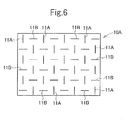
- Patent Document 4 Japanese Patent Publication 2009-057662 A discloses, as illustrated in Fig. 6 , a sheet body 10A made up of a soft polyurethane foam including slit-like cuts 11A formed to extend in one direction and slit-like cuts 11B formed to extend in a direction crossing the one direction.
- Patent Document 4 states, in paragraph 0018, that by providing the cuts 11A and the cuts 11B in the crossing directions in such a way, through-holes can be kept opened in a pad, which is formed by molding the sheet body in a state stretched in multiple directions.
- Patent Document 5 Japanese Patent Publication 59-133043 A states a laminate sheet production process in which a surfacing material is continuously affixed, by using an adhesive, to the surface of a substrate that is made of a soft polyurethane foam, while the substrate is unrolled from a stock roll.
- the sheet body 10A ( Fig. 6 ) in Patent Document 4 is formed of a single layer of the soft urethane foam, and it does not have a surfacing material. Therefore, durability is inferior and workability is poor in sewing the sheet body to other members. Further, retention of the slit-like shape is poor, and the slit may be ripped from its end.
- a laminate is formed by affixing a surfacing material to the surface of the sheet body 10A, strength of the laminate is poor because, as illustrated in Fig. 6 , the slits extend in the sheet body in two directions, i.e., in the one direction and the direction perpendicular to the one direction.
- the surfacing material is apt to wrinkle. More specifically, when the affixing is performed in such a manner that the sheet body 10A is unrolled in a state where the extending direction of the slits 11A, in Fig. 6 , is aligned with a direction in which the sheet body 10A is unrolled, while tensile stress is applied in the unrolling direction, the slits B are opened in the unrolling direction and the sheet body 10A is elongated in the unrolling direction. When the tensile stress is released after the affixing, the sheet body 10A is caused to shrink in the unrolling direction with the opened slits 11B going to be closed. Hence the surfacing material is apt to wrinkle.
- An object of the present invention is to provide a production process for a laminate that can be easily molded into a desired shape, a molded product using the laminate, a production process for the molded product, and an article of clothing using the molded product.
- a molded product obtained by molding a laminate which comprises a stretchable substrate made of a sheet-shaped synthetic resin foam and including multiple slits, and a stretchable surfacing material affixed to at least one surface of the substrate, wherein the substrate is bonded to the surfacing material in a state that at least some of the slits are kept opened.
- a molded product according to a second aspect is characterized in that, in the molded product according to the first aspect, the slits extend in a first direction, and the surfacing material has a greater elongation rate in a second direction perpendicular to the first direction than in the first direction.
- a molded product according to a third aspect is characterized in that, in the molded product according to the first or second aspect, the synthetic resin foam is a soft polyurethane foam.
- a molded product according to a fourth aspect is characterized in that, in the molded product according to any one of the first to third aspects, the surfacing material is a cloth.
- a molded product according to a fifth aspect is characterized in that, in the molded product according to any one of the first to fourth aspects, the molded product has a cup-like shape.
- a molded product according to a sixth aspect is characterized in that, in the molded product according to the fifth aspect, the slits are opened to larger extents at positions closer to a center of the molded product.
- a molded product according to a seventh aspect is characterized in that, in the molded product according to any one of the first to sixth aspects, the molding is hot press molding.
- an article of clothing including the molded product according to any one of the first to seventh aspects.
- a production process for a laminate comprising a stretchable substrate made of a sheet-shaped synthetic resin foam and including multiple slits, and a stretchable surfacing material affixed to at least one surface of the substrate, characterized in that the slits extend in a first direction, and the surfacing material is overlaid and affixed to the substrate while the substrate is continuously fed in the first direction.
- a production process for a laminate according to a tenth aspect is characterized in that, in the production process according to the ninth aspect, the surfacing material is affixed to a surface of the substrate by using a hot-melt adhesive.
- a production process for a molded product characterized in that the slits extend in a first direction, the laminate is cut into a predetermined size, and a cut laminate is subjected to hot press molding under pulling in a second direction perpendicular to the first direction.
- a production process for a molded product according to a twelfth aspect is characterized in that, in the production process according to the eleventh aspect, a compression rate in a central side of the substrate is smaller than a compression rate in a peripheral side thereof in the hot press molding.
- a production process for a molded product according to a thirteenth aspect is characterized in that, in the production process according to the twelfth aspect, a compression rate in a central region of the substrate in a direction of thickness thereof is 14 - 76% and a compression rate in a peripheral region thereof in the thickness direction is 85 - 96% in the hot press molding.
- a production process for a molded product according to a fourteenth aspect is characterized in that, in the production process according to any one of the eleventh to thirteenth aspects, the surfacing material has a greater elongation rate in the second direction than in the first direction, and an elongation rate of the laminate in the second direction is 1.2 - 3 times an elongation rate thereof in the first direction when a same load is applied to the laminate in the first direction and in the second direction.
- the molded product according to the present invention is obtained by molding a laminate which comprises a stretchable substrate made of a sheet-shaped synthetic resin foam and including multiple slits, and a stretchable surfacing material affixed to at least one surface of the substrate.
- the substrate and the surfacing material are both stretchable, the laminate can be easily molded and, after the molding, the molded product can satisfactorily maintain the shape obtained during the molding.
- the molded product has good durability and good workability when the molded product is sewed to another member.
- the substrate is bonded to the surfacing material in a state that at least some of the slits are kept opened. Therefore, the molded product according to the present invention has good air permeability.
- the slits extend in a first direction
- the surfacing material has a greater elongation rate in a second direction (i.e., a direction perpendicular to the first direction) than in the first direction.
- the slits are easily opened in a direction perpendicular to a slit extending direction (i.e., in the second direction), and the surfacing material is also easily elongated in the second direction, whereby the laminate is more easily elongated in the second direction.
- the molded product having a desired shape can be easily produced.
- the elongation rate of the surfacing material in the second direction is set to be smaller than that in the first direction contrary to the present invention, the production of the molded product becomes harder, and a risk arises in that the slit may be closed. More specifically, the surfacing material is hard to elongate in the second direction.
- the slit is easily opened in the second direction (i.e., the direction perpendicular to the slit extending direction), the slit or an opening is easy to elongate in the second direction and is hard to elongate in the first direction. As a result, the laminate becomes hard to elongate in both the first direction and the second direction, and a difficulty arises in molding the laminate.
- the substrate is caused to expand in a direction perpendicular to the direction of thickness thereof when the substrate is compressed in the thickness direction with the press molding. This may lead to a risk that lateral faces of the slit are protruded and the slit is closed.
- the synthetic resin foam constituting the substrate is preferably a soft polyurethane foam, and the surfacing material is preferably a cloth.
- the slits are opened to larger extents at positions closer to a center of the molded product.
- the slits opened to larger extents in the central side good air permeability is obtained.
- the slits in the peripheral side of the molded product are opened to small extents or closed, the molded product is superior in durability, e.g., resistance to washing.
- the molded product according to the present invention can be suitably employed in clothing, e.g., cup portions of brassieres and shoulder pads of clothes.
- a production process for a laminate comprising a stretchable substrate made of a sheet-shaped synthetic resin foam and including multiple slits, and a stretchable surfacing material affixed to at least one surface of the substrate, according to the present invention, is characterized in that the slits extend in a first direction, and the surfacing material is overlaid and affixed to the substrate while the substrate is continuously fed in the first direction.
- the slits can be prevented from being opened in the affixing step.
- the substrate can be prevented from shrinking to a large extent in the first direction and the surfacing material can be prevented from wrinkling.
- An affixing method is preferably practiced, for example, as a method of affixing the surfacing material and the substrate to each other by using an adhesive, e.g., an emulsion adhesive or a hot-melt adhesive, or a method (flame lamination) of melting the surface of the substrate with a flame and affixing the surfacing material to be laminated on the melted surface.
- an adhesive e.g., an emulsion adhesive or a hot-melt adhesive
- a method (flame lamination) of melting the surface of the substrate with a flame and affixing the surfacing material to be laminated on the melted surface e.g., a method of affixing the surfacing material and the substrate to each other by using an adhesive, e.g., an emulsion adhesive or a hot-melt adhesive, or a method (flame lamination) of melting the surface of the substrate with a flame and affixing the surfacing material to be laminated on the melted surface.
- the affixing method is the flame lamination
- the affixing can be easily practiced. Further, because the flame lamination is performed in a state applying tensile stress in the first direction (i.e., the slit extending direction), the slits are not opened. Accordingly, the inside of the slit is not melted by heating. Thus, when the tensile stress is released after the affixing, lateral walls of the slit are avoided from being fusion-bonded to each other and the slit is prevented from being closed.
- the laminate is obtained by bonding the surfacing material to the surface of the substrate with the adhesive in a state applying tensile stress in the first direction (i.e., the slit extending direction). Therefore, the adhesive does not enter the inside of the slit through an opening of the slit. It is hence possible to prevent such an event that, when the opening of the slit is returned to the original state upon release of the tensile stress, the lateral walls of the slit are bonded to each other with the adhesive having entered the inside of the slit and the slit is closed.
- an adhesive e.g., an emulsion adhesive or a hot-melt adhesive
- the laminate is placed in a mold and is subjected to pressure molding (hot press molding) under heating, whereby the molded product is obtained.
- pressure molding hot press molding
- the surfacing material becomes peelable from the substrate, and the substrate and the surfacing material become movable relative to each other. Therefore, when a slit opening force is applied to the slit during the hot press molding, the slit is easily opened without being bound to the surfacing material. As a result, the molded product having the slits opened into the desired shapes can be obtained.
- peel strength between the substrate and the surfacing material in the laminate is preferably 20 - 150 g. In such a case, the substrate and the surfacing material are satisfactorily peeled off during the hot press molding.
- a production process for the molded product is characterized in that the laminate including the slits extending in a first direction is cut into a predetermined size, and a cut laminate is subjected to hot press molding under pulling in a second direction perpendicular to the first direction. With that production process, the molding into the molded product can be satisfactorily performed.
- a compression rate in a central side of the substrate is smaller than a compression rate in a peripheral side thereof.
- the slits in the central side are prevented from being compressed to such a large extent that the slits are closed or that slit areas are reduced.
- good air permeability is obtained.
- the slits in the peripheral side are sufficiently compressed such that the slits are closed or that slits areas are reduced, strength in the peripheral side is increased and durability, e.g., resistance to washing, is improved.
- a compression rate in a central region of the substrate in a direction of thickness thereof may be 14 - 76%, and a compression rate in a peripheral region thereof in the thickness direction may be 85 - 96%.
- the surfacing material may have a greater elongation rate in the second direction than in the first direction.
- An elongation rate of the laminate in the second direction may be 1.2 - 3 times an elongation rate thereof in the first direction when the same load is applied to the laminate in the first direction and in the second direction.
- the slit means a cut penetrating through the substrate in the direction of thickness thereof and having a pair of cut faces formed on both sides of the cut, the cut faces being in contact with each other without a gap being present in the cut, when an external force is not applied.
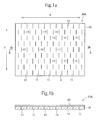
- Fig. 1a is a plan view of a laminate 30A according to an embodiment
- Fig. 1b is a sectional view taken along a line Ib-Ib in Fig. 1a
- Fig. 2 is a plan view of a molded product 40 that is obtained by using the laminate 30A in Fig. 1
- Fig. 3 is a sectional view taken along a line III-III in Fig. 2
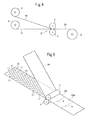
- Fig. 4 is an illustration to explain one example of a production process for the laminate 30A
- Fig. 5 is an enlarged perspective view of a portion V in Fig. 4 .
- the laminate 30A includes a substrate 10 made of a sheet-shaped synthetic resin foam, and a surfacing material 20 affixed to a surface (upper surface in Fig. 1b ) of the substrate 10.
- the laminate 30A has a rectangular shape having a pair of short sides that extend in a widthwise direction (first direction) Y, and a pair of long sides that extend in a lengthwise direction (second direction) X.
- the substrate 10 includes multiple slits 11 penetrating the substrate 10 in a direction toward the backside from the front side.
- the slits 11 can be easily formed, for example, by cutting the substrate 10 with a knife or the like.
- Each slit 11 is oriented in the widthwise direction Y. Therefore, the slit 11 is not opened when a tensile force is applied in the widthwise direction Y, while the slit 11 is opened when a tensile force is applied in the lengthwise direction X.
- the substrate 10 has a smaller elongation rate in the widthwise direction Y than in the lengthwise direction X, and it is more easily elongated in the lengthwise direction X than in the widthwise direction Y.
- the elongation rate represents a ratio of an amount of elongation to an original length when the substrate 10 is caused to elongate by application of a predetermined tensile force, and it means ease of elongation.
- the synthetic resin foam constituting the substrate 10 is not limited to particular one.
- a soft polyurethane foam, a polyethylene foam, a polypropylene foam, etc. can be used as the substrate 10.
- the surfacing material 20 has a greater elongation rate in the lengthwise direction X than in the widthwise direction Y. Accordingly, like the substrate 10, the surfacing material 20 is also more easily elongated in a direction perpendicular to the extending direction of the slit 11 (in the lengthwise direction, i.e., the second direction X) than in the extending direction of the slit 11 (in the widthwise direction, i.e., the first direction Y).
- Materials of the surfacing material 20 are not limited to particular ones.
- a cloth of polyester, nylon, acryl, cotton, or the like can be used.
- a ratio A/B of an elongation rate A of the surfacing material 20 in the lengthwise direction X to an elongation rate B thereof in the widthwise direction Y under a constant load is preferably 1.5 to 4.0, in particular 2.0 to 3.0.
- the slit 11 extends in the widthwise direction Y, the slit 11 is easily opened in the lengthwise direction X, and hence the substrate 10 is easily elongated in the lengthwise direction X.
- the surfacing material 20 has a greater elongation rate in the lengthwise direction X than in the widthwise direction Y, the surfacing material 20 is also easily elongated in the lengthwise direction X.
- the laminate 30A also has a greater elongation rate in the lengthwise direction X than in the widthwise direction Y, and it is more easily elongated in the lengthwise direction X than in the widthwise direction Y.
- the thickness of the substrate 10 is preferably about 7.0 - 25 mm, in particular about 10 - 20 mm, and the areal weight of the surfacing material 20 is preferably about 100 - 200 g/m 2 , in particular about 130 - 170 g/m 2 .
- the thickness of a laminate 30 is preferably about 7.0 - 25 mm, in particular about 10 - 20 mm.
- the thickness of the cloth occupying a part of the laminate is preferably 0.5 mm in the case of a two-layered laminate, and is preferably 1.0 mm in the case of a three-layered laminate.
- the length of the slit 11 in the widthwise direction Y is preferably 3 - 15 mm, in particular 5 - 10 mm.
- the laminate 30A can be satisfactorily molded.
- the laminate 30A is satisfactorily prevented from being broken off along the slits 11.
- the density of the slits 11 per unit surface area is preferably 3000 - 21000 slits/m 2 , in particular 10500 - 21000 slits/m 2 .
- the density is 3000 slits/m 2 or more, the laminate 30A can be satisfactorily molded.
- the laminate 30A is given with sufficient strength.
- the distance between the slits 11 is preferably 5 - 20 mm, in particular 5 to 10 mm.
- the substrate 10 is fed from a substrate roll 1, and the surfacing material 20 is fed from a surfacing material roll 2.
- the substrate 10 includes the multiple slits 11 orienting in a feed direction of the substrate 10.
- the surfacing material 20 has a smaller elongation rate in the feed direction than in a direction perpendicular to the feed direction.
- the substrate 10 and the surfacing material 20 thus fed are passed through a nip between a pair of pressing rolls 4 and 5 in such a state that a lower surface of the surfacing material 20 is contacted with an upper surface of the substrate 10.
- the substrate 10 and the surfacing material 20 are thereby press-bonded to each other.
- a method for the press-bonding is not limited to particular one.
- the substrate 10 and the surfacing material 20 may be affixed to each other by "flame lamination" through the steps of heating the upper surface of the substrate 10, which is fed from the substrate roll 1, with a flame to melt the upper surface, causing the thus-heated substrate 10 and the surfacing material 20 to pass between the pressing rolls 4 and 5, affixing the surfacing material 20 to the substrate 10 by utilizing thermal fusion-bonding properties of the synthetic resin foam that constitutes the substrate 10, and hardening them into an integral laminate.
- the substrate 10 and the surfacing material 20 are preferably affixed to each other by applying a hot-melt adhesive or an emulsion adhesive over the entirety or a part (e.g., at scattered points) of the upper surface of the substrate 10 by using, e.g., an adhesive applying roll with the adhesive attached to its surface, and then causing the substrate 10 and the surfacing material 20 to pass between the pressing rolls 4 and 5.
- a hot-melt adhesive or an emulsion adhesive over the entirety or a part (e.g., at scattered points) of the upper surface of the substrate 10 by using, e.g., an adhesive applying roll with the adhesive attached to its surface, and then causing the substrate 10 and the surfacing material 20 to pass between the pressing rolls 4 and 5.
- the slit 11 can be satisfactorily prevented from being closed.
- the slit 11 extends in the feed direction in which tensile stress is applied, no tensile stress is applied in the direction perpendicular to the extending direction of the slit 11 (i.e., in a direction in which the slit is easily opened).
- the flame lamination therefore, it is possible to satisfactorily prevent such an event that the inside of the slit 11 is heated in a state where the slit 11 is opened in the direction perpendicular to the extending direction of the slit 11, and that the slit 11 is closed with fusion-bonding.
- the bonding using the adhesive it is also possible to satisfactorily prevent such an event that the adhesive enters the inside of the slit 11 and the slit 11 is closed with the fusion-bonding.
- the laminate 30 thus obtained is cut at cutting lines a and b, as illustrated in Fig. 5 , whereby the laminate 30A illustrated in Fig. 1 is obtained.
- the feed direction of the substrate 10 and the surfacing material 20 in Fig. 5 corresponds to the widthwise direction Y in Fig. 1a
- a direction in which the cutting lines a and b in Fig. 5 extend corresponds to the lengthwise direction X in Fig. 1b .
- the laminate 30A illustrated in Fig. 1 may be obtained by rolling the laminate 30 around a core into a laminate roll 3, feeding the laminate 30 from the laminate roll 3 as required, and by cutting the laminate 30 into a desired shape.
- the surfacing material 20 of the laminate 30A can be satisfactorily prevented from wrinkling. More specifically, in Figs. 4 and 5 , because each of the substrate 10 and the surfacing material 20 has the smaller elongation rate in the feed direction than in the direction perpendicular to the feed direction, amounts of stretching and shrinking of the substrate 10 and the surfacing material 20 are small before and after tensile stress is applied in the feed direction. Hence wrinkling of the surfacing material 20 is prevented. In addition, because the slit 11 is not opened, as discussed above, in both the states before and after the application of the tensile stress, the surfacing material 20 is further satisfactorily prevented from wrinkling locally at positions near the slits 11.
- the slits 11 extend in the direction perpendicular to the feed direction unlike this embodiment, the slits 11 are opened by tensile stress applied during the feed. If the surfacing material 20 is affixed in such a state and the tensile force is released thereafter, the slits 11 are going to be closed and a shrinkage amount of the substrate 10 in the feed direction is increased. This causes the surfacing material 20 to wrinkle.
- Fig. 2 is a plan view of the molded product 40 produced by using the laminate 30A of Fig. 1
- Fig. 3 is a sectional view taken along a line III-III in Fig. 2
- the molded product 40 has a cup-like shape projecting convexly on the side including the surface of the laminate 30A on which the surfacing material 20 is disposed.
- the molded product 40 is easily produced by hot press molding of the laminate 30A.
- the cup-shaped molded product 40 is produced by setting the laminate 30A in a mold, clamping the mold, and applying compressive stress to the laminate 30A in the direction of thickness thereof under heating.
- the molding temperature is preferably about 190 - 210°C, and the molding time is preferably about 60 - 100 sec.
- the adhesive force of the adhesive in the laminate is weak and the adhesive force of the adhesive in the molded product is strong.
- the surfacing material 20 and the substrate 10 are apt to peel off from each other during the hot press molding.
- the adhesive force of the adhesive in the molded product is strong, the surfacing material 20 and the substrate 10 are hard to peel off.
- Strength of the adhesive force of the adhesive can be controlled by selecting conditions, such as the molding temperature and the molding time, when the laminate and the molded product are produced. Peel strength between the substrate 10 and the surfacing material 20 in the laminate is preferably 20 - 150 g. In such a case, the substrate 10 and the surfacing material 20 are satisfactorily peeled off during the hot press molding.
- the substrate 10 and the surfacing material 20 are more easily elongated in the lengthwise direction X than in the widthwise direction Y. Accordingly, the laminate 30A is also easily elongated in the lengthwise direction X. Therefore, when the laminate 30A is set in the mold, the laminate 30A is satisfactorily elongated in the lengthwise direction X and it can be easily set in the mold.
- the laminate 30A when the laminate 30A is molded into the cup-like shape, the laminate 30A is elongated to a larger extent at positions closer to a center thereof, and hence the slits 11 positioned closer to the center are opened in larger extents. Also in the obtained molded product 40, therefore, the slits 11 positioned closer to the center thereof are opened in larger extents, as illustrated in Figs. 2 and 3 .
- a compression rate in the thickness direction of the laminate 30A is preferably smaller in the central side than in the peripheral side.
- the molded product 40 obtained with the hot press molding is superior in both air permeability and durability, e.g., resistance to washing.
- the laminate 30A may be demarcated into a central region and a peripheral region, and the compression rate may be set to be small in the central region and to be large in the peripheral region.
- the compression rate in the central region is preferably 14 - 76%, in particular 40 - 70%, and even more preferably 40 - 50%.
- the compression rate in the peripheral region is preferably 85 - 96%. With the compression rates held within those ranges, the extents of openings of the slits in the peripheral side are satisfactorily suppressed, and the openings of the slits in the central side are satisfactorily held.
- the central region means, for example, a region of 10 - 30 mm, in particular 10 - 20 mm ranging from a center (top) of the molded product toward the peripheral side.
- the peripheral region means a region outside the central region.
- an elongation rate of the laminate 30A in the widthwise direction Y is preferably 1.0 - 20%, in particular 1.4 - 15.2%. With the elongation rate held within those ranges, the extents of openings of the slits in the peripheral side are satisfactorily suppressed, and the openings of the slits in the central side are satisfactorily held.
- the surfacing material 20 is fusion-bonded to the substrate 10 during the hot pressing, the shape of the molded product during the molding is satisfactorily held.
- the surfacing material 20 is disposed only on one surface of the substrate 10, the surfacing material 20 may be disposed on both the surfaces of the substrate 10.
- the surfacing material 20 is disposed only on the convex-side surface of the substrate 10
- the surfacing material 20 may be disposed only on a concave-side surface of the substrate 10, or the surfacing material 20 may be disposed on both the convex-side and concave-side surfaces of the substrate 10.
- the shape of the slit formed in the substrate is not limited to one described above in the embodiment. While, in the above-described embodiment, the slit 11 extends in the widthwise direction Y and an angle formed between the widthwise direction Y and the extending direction of the slit 11 is 0°, the widthwise direction Y and the extending direction of the slit 11 may form, for example, a slight angle therebetween. The slight angle is preferably 15° or less. Further, the slit is not limited to linear one such as the slit 11 illustrated in Fig. 1 , and it may have a zigzag shape similar to saw teeth or a wavy shape including an upwardly-convex circular arc and a downwardly-convex circular arc, which arcs are alternately continued.
- the slit can be easily formed by using a knife, for example.
- the slit can be formed without preparing a punching die to form the opening and without needing time and effort to remove residues generated after the punching.
- Clothing using the molded product according to the above-described embodiment is superior in air permeability because the substrate has slits, and is superior in wear comfort because the surfacing material is prevented from wrinkling.
- Examples of the clothing include brassieres using the molded products as cup portions or pack portions, clothes using the molded products as shoulder pads, swimming wears using the molded products as cup portions, and clothes with brassieres.
- the laminate 30A was produced by affixing the surfacing material 20 to the surface of the substrate 10 with the apparatus illustrated in Figs. 4 and 5 . Details of the production will be described below.
- the substrate 10 and the surfacing material 20 were prepared as follows.
- the substrate 10 was fed from the substrate roll 1, and the surfacing material 20 was fed from the surfacing material roll 2.
- the substrate 10 and the surfacing material 20 were affixed to each other by the flame lamination through the steps of heating the upper surface of the substrate 10, which was fed from the substrate roll 1, by a flame to melt the upper surface, causing the thus-heated substrate 10 and the surfacing material 20 to pass between the pressing rolls 4 and 5, affixing the surfacing material 20 to the substrate 10 by utilizing thermal fusion-bonding properties of the urethane constituting the substrate 10, and hardening them into an integral laminate.
- the laminate 30 thus obtained was cut into rectangular pieces each having a length of 500 mm in the feed direction and a length of 300 mm in the direction perpendicular to the feed direction, whereby the laminate 30A was obtained.
- an elongation rate E 1 in the first direction i.e., the feed direction of the substrate 10 and the surfacing material 20
- an elongation rate E 2 in the second direction i.e., the direction perpendicular to the fi direction
- the calculated ratio is indicated in Table 1.
- the obtained laminate 30A was placed in a mold for a cup portion of a brassiere and was subjected to hot press molding at 200°C for 3 minutes, whereby a molded product was obtained.
- the laminate 30A When the laminate 30A was placed in the mold, the laminate 30A was set such that a cloth elongating direction and a slit extending direction were perpendicular to each other (i.e., an angle formed between the cloth elongating direction and the slit extending direction was 90°). In other words, the laminate 30A was placed in the mold such that the laminate 30A was pulled in a direction perpendicular to the slit extending direction (i.e., in a direction in which the slits are opened) without being pulled in the slit extending direction.
- a compression rate in the thickness direction with the hot press molding was measured (the compression rate being expressed by (d 1 - d 2 )/d 1 ⁇ 100 where d 1 was a thickness of the laminate 30A before the hot press molding and d 2 was a thickness of the molded product after the hot press molding).
- the measured result is indicated in Table 1.
- the molded product obtained above was washed by a fully automatic washing machine.
- a washing time was 40 minutes, and washing, draining, rinsing, draining, rinsing, and spin-drying were performed in order named.
- the molded product after the washing was dried under the following conditions and a time required for a water content to reach 50% was measured.
- the measured result is indicated in Table 1. Drying conditions: room temperature of 22°C, humidity of 40%, and drying in the shade within a room
- the molded product obtained above was elongated and confirmed on misalignment and peel between the cloth and the urethane in slit portions.
- the evaluation result was rated in the following three stages. The evaluated result is indicated in Table 1. ⁇ : very good ⁇ : good ⁇ : not good
- the substrate 10 was fed from the substrate roll 1, and the surfacing material 20 was fed from the surfacing material roll 2.
- the substrate 10 and the surfacing material 20 were affixed to each other by using an adhesive applying roll with an acrylic emulsion ("NIPOL LX854EX” made by Japanese Geon Co., Ltd.) attached to its surface, applying the adhesive (in amount of 30 g/m 2 ) to scattered points on the upper surface of the substrate 10 fed from the substrate roll 1, and then causing the substrate 10 and the surfacing material 20 to pass between the pressing rolls 4 and 5.
- an adhesive applying roll with an acrylic emulsion (NIPOL LX854EX" made by Japanese Geon Co., Ltd.) attached to its surface, applying the adhesive (in amount of 30 g/m 2 ) to scattered points on the upper surface of the substrate 10 fed from the substrate roll 1, and then causing the substrate 10 and the surfacing material 20 to pass between the pressing rolls 4 and 5.
- the substrate 10 was fed from the substrate roll 1, and the surfacing material 20 was fed from the surfacing material roll 2.
- the substrate 10 and the surfacing material 20 were superposed one above the other by causing the substrate 10 and the surfacing material 20, as they were, to pass between the pressing rolls 4 and 5 without performing the flame lamination.
- the molded products of EXAMPLES 1 - 12 are each produced by placing the laminate 30A in the mold and molding it, the laminate 30A is placed in the mold and then molded while the laminate 30A is pulled in the direction "perpendicular" to the slit extending direction (i.e., in the direction in which the slits are opened). Therefore, the slits are kept opened in the molded product thus obtained. Because of the slits being kept opened, the molded products of EXAMPLES 1 - 12 are superior in air permeability and are dried more quickly.
- the shape and the re-bonding properties were both good.
- the reason why the shape was good is presumably in that, in the molded products of EXAMPLES 1 - 12, when the laminate 30A is molded, the slits are opened and hence the laminate 30A is apt to deform following the mold and to maintain its shape.
- the reason why the re-bonding properties was good is presumably in that stress exerted between the substrate 10 and the surfacing material 20 during the hot press molding of the laminate 30A is relieved with opening of the slits.
- the reason is presumably as follows. With the flame lamination, the bonding is effectuated by the action of components resulting from decomposition of the polyurethane foam that is a thermosetting resin.
- the emulsion adhesive and the hot-melt adhesive effectuate the bonding by the action of components of a thermoplastic resin and hence provide better re-bonding properties.
Landscapes
- Engineering & Computer Science (AREA)
- Textile Engineering (AREA)
- Mechanical Engineering (AREA)
- Laminated Bodies (AREA)
- Corsets Or Brassieres (AREA)
Applications Claiming Priority (2)
| Application Number | Priority Date | Filing Date | Title |
|---|---|---|---|
| JP2009258082A JP5619407B2 (ja) | 2009-11-11 | 2009-11-11 | 成形体、衣料品及び成形体の製造方法 |
| PCT/JP2010/069705 WO2011058926A1 (ja) | 2009-11-11 | 2010-11-05 | 成形体、衣料品、積層体の製造方法及び成形体の製造方法 |
Publications (3)
| Publication Number | Publication Date |
|---|---|
| EP2500166A1 true EP2500166A1 (de) | 2012-09-19 |
| EP2500166A4 EP2500166A4 (de) | 2013-08-07 |
| EP2500166B1 EP2500166B1 (de) | 2014-05-07 |
Family
ID=43991585
Family Applications (1)
| Application Number | Title | Priority Date | Filing Date |
|---|---|---|---|
| EP10829885.2A Not-in-force EP2500166B1 (de) | 2009-11-11 | 2010-11-05 | Formprodukt, verkleidung, verfahren zur herstellung eines laminats und verfahren zur herstellung eines formprodukts |
Country Status (5)
| Country | Link |
|---|---|
| US (1) | US9238345B2 (de) |
| EP (1) | EP2500166B1 (de) |
| JP (1) | JP5619407B2 (de) |
| CN (1) | CN102666085B (de) |
| WO (1) | WO2011058926A1 (de) |
Cited By (1)
| Publication number | Priority date | Publication date | Assignee | Title |
|---|---|---|---|---|
| AT15947U1 (de) * | 2016-10-28 | 2018-09-15 | Staszek Kaj | Damen Brustschutz mit hochelastischem Kunststoff |
Families Citing this family (18)
| Publication number | Priority date | Publication date | Assignee | Title |
|---|---|---|---|---|
| US7437774B2 (en) * | 2004-03-19 | 2008-10-21 | Nike, Inc. | Article of apparel incorporating a zoned modifiable textile structure |
| US20140182042A1 (en) * | 2012-12-28 | 2014-07-03 | Hurley International, Llc | Article Of Apparel With Stretch-Resistant Matrix |
| CN104273669B (zh) * | 2013-07-01 | 2017-06-20 | 维珍妮国际(集团)有限公司 | 用于钢圈的衬垫套及制造该衬垫套的方法 |
| US20150004874A1 (en) * | 2013-07-01 | 2015-01-01 | Regina Miracle International (Group) Limited | Cushioned casing for an underwire and method of manufacturing the cushioned casing |
| HK1185751A2 (en) * | 2013-10-31 | 2014-02-21 | 黛丽斯胸围制造厂有限公司 | Air permeable pad for brassiere |
| US10814514B2 (en) * | 2015-05-22 | 2020-10-27 | Nike, Inc. | Method of manufacturing an article of apparel having dynamic vent-slits |
| US20160338435A1 (en) * | 2015-05-22 | 2016-11-24 | Nike, Inc. | Lower body article of apparel having dynamic vent-slit structure |
| US10861357B2 (en) | 2015-11-13 | 2020-12-08 | Nike, Inc. | Athletic bib |
| KR101819440B1 (ko) * | 2015-12-16 | 2018-01-17 | 주식회사 영원아웃도어 | 브래지어용 패드 |
| US10609968B2 (en) * | 2016-08-17 | 2020-04-07 | Nike, Inc. | Garment having selected stretch zones |
| US10517271B2 (en) * | 2017-02-09 | 2019-12-31 | Eastwest International (Taiwan) Enterprises | Method of manufacturing an equine protective covering |
| EP3225390B1 (de) * | 2017-02-09 | 2018-12-12 | Eastwest International (Taiwan) Enterprises | Verfahren zur herstellung einer schutzabdeckung für pferde |
| JP7058110B2 (ja) * | 2017-11-21 | 2022-04-21 | スリーエム イノベイティブ プロパティズ カンパニー | 伸縮材、伸縮材の製造方法、伸縮性部材、及び衣料製品 |
| WO2019161533A1 (en) * | 2018-02-22 | 2019-08-29 | Regina Miracle International (Group) Limited | Bra cup for a brassiere and manufacturing method thereof |
| USD898923S1 (en) * | 2018-06-01 | 2020-10-13 | Kinesio Ip Llc | Adhesive tape |
| US11780208B2 (en) * | 2018-11-21 | 2023-10-10 | Silueta (Private) Limited | Moulded composite article formed from laminates |
| JP7162118B2 (ja) * | 2019-02-19 | 2022-10-27 | グンゼ株式会社 | 下半身用衣類 |
| US11696606B2 (en) * | 2019-12-06 | 2023-07-11 | Under Armour, Inc. | Athletic bra |
Family Cites Families (24)
| Publication number | Priority date | Publication date | Assignee | Title |
|---|---|---|---|---|
| US3819033A (en) * | 1972-10-10 | 1974-06-25 | Itek Corp | Expandable spectacle case |
| US4136222A (en) * | 1977-04-18 | 1979-01-23 | Minnesota Mining And Manufacturing Company | Thermally insulating sheet material |
| JPS5742667Y2 (de) * | 1978-02-21 | 1982-09-20 | ||
| US4272850A (en) | 1979-05-25 | 1981-06-16 | W. H. Brine Company | Body protective pads |
| JPS59133043A (ja) | 1983-01-19 | 1984-07-31 | 株式会社イノアックコーポレーション | 座席クッション体のカバー材用ラミネートシートとその製造方法 |
| JP2993170B2 (ja) * | 1991-04-17 | 1999-12-20 | コーテック株式会社 | 創傷被覆材 |
| ES2135064T5 (es) | 1994-04-29 | 2003-04-01 | Kimberly Clark Co | Generos elasticos de capas multiples, no tejidos, fibrosos, dotados de cortes. |
| JP3247822B2 (ja) * | 1994-09-19 | 2002-01-21 | 株式会社ワコール | 乳房カップを有する衣類 |
| JP3656145B2 (ja) * | 1996-10-18 | 2005-06-08 | 株式会社タケダレース | レース入り衣類 |
| FI109677B (fi) * | 1997-05-26 | 2002-09-30 | Fagerdala Tuotanto Oy | Hiostamaton materiaali |
| US6581760B1 (en) * | 2001-05-22 | 2003-06-24 | William Gary Robertson | Flexible lightweight protective container |
| JP4008213B2 (ja) * | 2001-06-29 | 2007-11-14 | ピジョン株式会社 | 吸収性製品の製造方法及び製造装置 |
| DE20114873U1 (de) * | 2001-09-04 | 2001-11-15 | Naturana Dölker GmbH & Co KG, 72810 Gomaringen | Büstenhalter |
| US6805610B2 (en) * | 2003-01-21 | 2004-10-19 | Regina Miracle International Limited | Brassiere |
| JP4223834B2 (ja) | 2003-02-26 | 2009-02-12 | 株式会社カドリールニシダ | 通気性ブラジャー |
| US7442110B2 (en) * | 2004-05-17 | 2008-10-28 | Saucony Inc. | Brassiere, brassiere components, and materials for use thereof |
| US7166012B2 (en) * | 2004-06-03 | 2007-01-23 | Regina Miracle International Limited | Brassiere and molded breast cup construction therefor and related method of manufacture |
| JP2006161195A (ja) | 2004-12-03 | 2006-06-22 | Kuriki Sangyo:Kk | 外着用ウェア |
| US20060201612A1 (en) * | 2005-03-10 | 2006-09-14 | Lin Meng J | Method for working gas permeable cushion |
| JP2006348423A (ja) * | 2005-06-16 | 2006-12-28 | Rushian:Kk | カップ部を有する衣類 |
| US7300331B2 (en) * | 2005-10-11 | 2007-11-27 | Invista North America S.Ar.L. | Brassiere construction using multiple layers of fabric |
| JP5036455B2 (ja) * | 2007-08-31 | 2012-09-26 | 株式会社イノアックコーポレーション | 衣料用パッドの製造方法 |
| US20090117824A1 (en) * | 2007-11-06 | 2009-05-07 | Jin-Yi Jian | Bra cup with thin, air-permeable layer |
| JP2009179891A (ja) * | 2008-01-29 | 2009-08-13 | Bridgestone Corp | ブラジャー材及びブラジャー |
-
2009
- 2009-11-11 JP JP2009258082A patent/JP5619407B2/ja not_active Expired - Fee Related
-
2010
- 2010-11-05 WO PCT/JP2010/069705 patent/WO2011058926A1/ja not_active Ceased
- 2010-11-05 CN CN201080051295.5A patent/CN102666085B/zh not_active Expired - Fee Related
- 2010-11-05 EP EP10829885.2A patent/EP2500166B1/de not_active Not-in-force
- 2010-11-05 US US13/508,942 patent/US9238345B2/en not_active Expired - Fee Related
Cited By (1)
| Publication number | Priority date | Publication date | Assignee | Title |
|---|---|---|---|---|
| AT15947U1 (de) * | 2016-10-28 | 2018-09-15 | Staszek Kaj | Damen Brustschutz mit hochelastischem Kunststoff |
Also Published As
| Publication number | Publication date |
|---|---|
| US9238345B2 (en) | 2016-01-19 |
| CN102666085A (zh) | 2012-09-12 |
| HK1171420A1 (en) | 2013-03-28 |
| EP2500166B1 (de) | 2014-05-07 |
| EP2500166A4 (de) | 2013-08-07 |
| JP2011101995A (ja) | 2011-05-26 |
| JP5619407B2 (ja) | 2014-11-05 |
| WO2011058926A1 (ja) | 2011-05-19 |
| US20120225257A1 (en) | 2012-09-06 |
| CN102666085B (zh) | 2015-06-24 |
Similar Documents
| Publication | Publication Date | Title |
|---|---|---|
| EP2500166B1 (de) | Formprodukt, verkleidung, verfahren zur herstellung eines laminats und verfahren zur herstellung eines formprodukts | |
| US6880211B2 (en) | Macro closure device for disposable articles | |
| CN104644337A (zh) | 制备薄膜/无纺层压体的方法 | |
| US20110053448A1 (en) | Trim cover assembly and a method of manufacture | |
| EP4063104B1 (de) | Verfahren zur herstellung eines laminierten formkörpers | |
| US20090110941A1 (en) | Genuine leather cover assembly, production method therefor, seat, furniture, and leather products using the same, and member used for producing genuine leather cover assembly | |
| JPH0860511A (ja) | 穿孔不織布及びその製造方法 | |
| WO2009081927A1 (ja) | 表皮一体発泡成形用の表皮材 | |
| JP7065570B2 (ja) | 伸縮材、伸縮材の製造方法、伸縮性部材、伸縮性部材の製造方法、及び衣料製品 | |
| JP5605148B2 (ja) | 発泡成型品補強材用不織布及びその製造方法 | |
| JP3725987B2 (ja) | 装身用パッド及びその製造法 | |
| KR101647964B1 (ko) | 중공사 결합을 통한 주름방지를 위한 차량용 시트 및 그 제조방법 | |
| JPH0688353B2 (ja) | かわ張り発泡パッドの製造法 | |
| JP6450200B2 (ja) | ウレタン発泡成形品用補強基布 | |
| WO2024214317A1 (ja) | 発泡成形品用補強材に用いられる不織布、不織布を含む多層構造材、発泡成形品用補強材、及び発泡成形品用補強材に用いられる不織布の製造方法 | |
| JP3207739U (ja) | ウレタン発泡成形品用補強基布およびこの基布を使用したウレタン発泡成形品 | |
| JP4450708B2 (ja) | 一体成型用表皮材 | |
| HK1171420B (en) | Molded product, clothing, process for production of laminate, and process for production of molded product | |
| JP3756925B1 (ja) | 発熱組成物収容用袋およびそれを用いた温熱用具 | |
| EP1511454B1 (de) | Makroverschlussvorrichtung für wegwerfartikel | |
| JP2011101996A (ja) | 積層体、成形品、衣料品及び積層体の製造方法 | |
| JP4796371B2 (ja) | 化粧綿およびその製造方法 | |
| JP7770786B2 (ja) | 人工皮革、及びその製法 | |
| JPH081596A (ja) | 孔明け方法及び同孔明け方法を用いた接合方法 | |
| JPH0517856B2 (de) |
Legal Events
| Date | Code | Title | Description |
|---|---|---|---|
| PUAI | Public reference made under article 153(3) epc to a published international application that has entered the european phase |
Free format text: ORIGINAL CODE: 0009012 |
|
| 17P | Request for examination filed |
Effective date: 20120516 |
|
| AK | Designated contracting states |
Kind code of ref document: A1 Designated state(s): AL AT BE BG CH CY CZ DE DK EE ES FI FR GB GR HR HU IE IS IT LI LT LU LV MC MK MT NL NO PL PT RO RS SE SI SK SM TR |
|
| DAX | Request for extension of the european patent (deleted) | ||
| REG | Reference to a national code |
Ref country code: DE Ref legal event code: R079 Ref document number: 602010016007 Country of ref document: DE Free format text: PREVIOUS MAIN CLASS: B32B0003240000 Ipc: A41C0003120000 |
|
| A4 | Supplementary search report drawn up and despatched |
Effective date: 20130708 |
|
| RIC1 | Information provided on ipc code assigned before grant |
Ipc: A41C 3/12 20060101AFI20130702BHEP Ipc: B32B 5/24 20060101ALI20130702BHEP Ipc: B32B 5/18 20060101ALI20130702BHEP Ipc: B32B 27/12 20060101ALI20130702BHEP Ipc: A41D 31/02 20060101ALI20130702BHEP |
|
| GRAP | Despatch of communication of intention to grant a patent |
Free format text: ORIGINAL CODE: EPIDOSNIGR1 |
|
| INTG | Intention to grant announced |
Effective date: 20131216 |
|
| GRAS | Grant fee paid |
Free format text: ORIGINAL CODE: EPIDOSNIGR3 |
|
| GRAA | (expected) grant |
Free format text: ORIGINAL CODE: 0009210 |
|
| AK | Designated contracting states |
Kind code of ref document: B1 Designated state(s): AL AT BE BG CH CY CZ DE DK EE ES FI FR GB GR HR HU IE IS IT LI LT LU LV MC MK MT NL NO PL PT RO RS SE SI SK SM TR |
|
| REG | Reference to a national code |
Ref country code: GB Ref legal event code: FG4D |
|
| REG | Reference to a national code |
Ref country code: AT Ref legal event code: REF Ref document number: 665886 Country of ref document: AT Kind code of ref document: T Effective date: 20140515 |
|
| REG | Reference to a national code |
Ref country code: IE Ref legal event code: FG4D |
|
| REG | Reference to a national code |
Ref country code: DE Ref legal event code: R096 Ref document number: 602010016007 Country of ref document: DE Effective date: 20140618 |
|
| REG | Reference to a national code |
Ref country code: AT Ref legal event code: MK05 Ref document number: 665886 Country of ref document: AT Kind code of ref document: T Effective date: 20140507 |
|
| REG | Reference to a national code |
Ref country code: NL Ref legal event code: VDEP Effective date: 20140507 |
|
| REG | Reference to a national code |
Ref country code: LT Ref legal event code: MG4D |
|
| PG25 | Lapsed in a contracting state [announced via postgrant information from national office to epo] |
Ref country code: GR Free format text: LAPSE BECAUSE OF FAILURE TO SUBMIT A TRANSLATION OF THE DESCRIPTION OR TO PAY THE FEE WITHIN THE PRESCRIBED TIME-LIMIT Effective date: 20140808 Ref country code: IS Free format text: LAPSE BECAUSE OF FAILURE TO SUBMIT A TRANSLATION OF THE DESCRIPTION OR TO PAY THE FEE WITHIN THE PRESCRIBED TIME-LIMIT Effective date: 20140907 Ref country code: NO Free format text: LAPSE BECAUSE OF FAILURE TO SUBMIT A TRANSLATION OF THE DESCRIPTION OR TO PAY THE FEE WITHIN THE PRESCRIBED TIME-LIMIT Effective date: 20140807 Ref country code: CY Free format text: LAPSE BECAUSE OF FAILURE TO SUBMIT A TRANSLATION OF THE DESCRIPTION OR TO PAY THE FEE WITHIN THE PRESCRIBED TIME-LIMIT Effective date: 20140507 Ref country code: FI Free format text: LAPSE BECAUSE OF FAILURE TO SUBMIT A TRANSLATION OF THE DESCRIPTION OR TO PAY THE FEE WITHIN THE PRESCRIBED TIME-LIMIT Effective date: 20140507 Ref country code: LT Free format text: LAPSE BECAUSE OF FAILURE TO SUBMIT A TRANSLATION OF THE DESCRIPTION OR TO PAY THE FEE WITHIN THE PRESCRIBED TIME-LIMIT Effective date: 20140507 |
|
| PG25 | Lapsed in a contracting state [announced via postgrant information from national office to epo] |
Ref country code: RS Free format text: LAPSE BECAUSE OF FAILURE TO SUBMIT A TRANSLATION OF THE DESCRIPTION OR TO PAY THE FEE WITHIN THE PRESCRIBED TIME-LIMIT Effective date: 20140507 Ref country code: HR Free format text: LAPSE BECAUSE OF FAILURE TO SUBMIT A TRANSLATION OF THE DESCRIPTION OR TO PAY THE FEE WITHIN THE PRESCRIBED TIME-LIMIT Effective date: 20140507 Ref country code: SE Free format text: LAPSE BECAUSE OF FAILURE TO SUBMIT A TRANSLATION OF THE DESCRIPTION OR TO PAY THE FEE WITHIN THE PRESCRIBED TIME-LIMIT Effective date: 20140507 Ref country code: AT Free format text: LAPSE BECAUSE OF FAILURE TO SUBMIT A TRANSLATION OF THE DESCRIPTION OR TO PAY THE FEE WITHIN THE PRESCRIBED TIME-LIMIT Effective date: 20140507 Ref country code: LV Free format text: LAPSE BECAUSE OF FAILURE TO SUBMIT A TRANSLATION OF THE DESCRIPTION OR TO PAY THE FEE WITHIN THE PRESCRIBED TIME-LIMIT Effective date: 20140507 Ref country code: PL Free format text: LAPSE BECAUSE OF FAILURE TO SUBMIT A TRANSLATION OF THE DESCRIPTION OR TO PAY THE FEE WITHIN THE PRESCRIBED TIME-LIMIT Effective date: 20140507 Ref country code: ES Free format text: LAPSE BECAUSE OF FAILURE TO SUBMIT A TRANSLATION OF THE DESCRIPTION OR TO PAY THE FEE WITHIN THE PRESCRIBED TIME-LIMIT Effective date: 20140507 |
|
| PG25 | Lapsed in a contracting state [announced via postgrant information from national office to epo] |
Ref country code: PT Free format text: LAPSE BECAUSE OF FAILURE TO SUBMIT A TRANSLATION OF THE DESCRIPTION OR TO PAY THE FEE WITHIN THE PRESCRIBED TIME-LIMIT Effective date: 20140908 |
|
| PG25 | Lapsed in a contracting state [announced via postgrant information from national office to epo] |
Ref country code: CZ Free format text: LAPSE BECAUSE OF FAILURE TO SUBMIT A TRANSLATION OF THE DESCRIPTION OR TO PAY THE FEE WITHIN THE PRESCRIBED TIME-LIMIT Effective date: 20140507 Ref country code: DK Free format text: LAPSE BECAUSE OF FAILURE TO SUBMIT A TRANSLATION OF THE DESCRIPTION OR TO PAY THE FEE WITHIN THE PRESCRIBED TIME-LIMIT Effective date: 20140507 Ref country code: EE Free format text: LAPSE BECAUSE OF FAILURE TO SUBMIT A TRANSLATION OF THE DESCRIPTION OR TO PAY THE FEE WITHIN THE PRESCRIBED TIME-LIMIT Effective date: 20140507 Ref country code: RO Free format text: LAPSE BECAUSE OF FAILURE TO SUBMIT A TRANSLATION OF THE DESCRIPTION OR TO PAY THE FEE WITHIN THE PRESCRIBED TIME-LIMIT Effective date: 20140507 Ref country code: SK Free format text: LAPSE BECAUSE OF FAILURE TO SUBMIT A TRANSLATION OF THE DESCRIPTION OR TO PAY THE FEE WITHIN THE PRESCRIBED TIME-LIMIT Effective date: 20140507 Ref country code: BE Free format text: LAPSE BECAUSE OF FAILURE TO SUBMIT A TRANSLATION OF THE DESCRIPTION OR TO PAY THE FEE WITHIN THE PRESCRIBED TIME-LIMIT Effective date: 20140507 |
|
| REG | Reference to a national code |
Ref country code: DE Ref legal event code: R097 Ref document number: 602010016007 Country of ref document: DE |
|
| PG25 | Lapsed in a contracting state [announced via postgrant information from national office to epo] |
Ref country code: NL Free format text: LAPSE BECAUSE OF FAILURE TO SUBMIT A TRANSLATION OF THE DESCRIPTION OR TO PAY THE FEE WITHIN THE PRESCRIBED TIME-LIMIT Effective date: 20140507 |
|
| PLBE | No opposition filed within time limit |
Free format text: ORIGINAL CODE: 0009261 |
|
| STAA | Information on the status of an ep patent application or granted ep patent |
Free format text: STATUS: NO OPPOSITION FILED WITHIN TIME LIMIT |
|
| 26N | No opposition filed |
Effective date: 20150210 |
|
| PG25 | Lapsed in a contracting state [announced via postgrant information from national office to epo] |
Ref country code: IT Free format text: LAPSE BECAUSE OF FAILURE TO SUBMIT A TRANSLATION OF THE DESCRIPTION OR TO PAY THE FEE WITHIN THE PRESCRIBED TIME-LIMIT Effective date: 20140507 |
|
| REG | Reference to a national code |
Ref country code: DE Ref legal event code: R097 Ref document number: 602010016007 Country of ref document: DE Effective date: 20150210 |
|
| PG25 | Lapsed in a contracting state [announced via postgrant information from national office to epo] |
Ref country code: MC Free format text: LAPSE BECAUSE OF FAILURE TO SUBMIT A TRANSLATION OF THE DESCRIPTION OR TO PAY THE FEE WITHIN THE PRESCRIBED TIME-LIMIT Effective date: 20140507 Ref country code: LU Free format text: LAPSE BECAUSE OF FAILURE TO SUBMIT A TRANSLATION OF THE DESCRIPTION OR TO PAY THE FEE WITHIN THE PRESCRIBED TIME-LIMIT Effective date: 20141105 |
|
| REG | Reference to a national code |
Ref country code: CH Ref legal event code: PL |
|
| PG25 | Lapsed in a contracting state [announced via postgrant information from national office to epo] |
Ref country code: SI Free format text: LAPSE BECAUSE OF FAILURE TO SUBMIT A TRANSLATION OF THE DESCRIPTION OR TO PAY THE FEE WITHIN THE PRESCRIBED TIME-LIMIT Effective date: 20140507 Ref country code: CH Free format text: LAPSE BECAUSE OF NON-PAYMENT OF DUE FEES Effective date: 20141130 Ref country code: LI Free format text: LAPSE BECAUSE OF NON-PAYMENT OF DUE FEES Effective date: 20141130 |
|
| REG | Reference to a national code |
Ref country code: IE Ref legal event code: MM4A |
|
| PG25 | Lapsed in a contracting state [announced via postgrant information from national office to epo] |
Ref country code: IE Free format text: LAPSE BECAUSE OF NON-PAYMENT OF DUE FEES Effective date: 20141105 |
|
| REG | Reference to a national code |
Ref country code: FR Ref legal event code: PLFP Year of fee payment: 6 |
|
| PG25 | Lapsed in a contracting state [announced via postgrant information from national office to epo] |
Ref country code: SM Free format text: LAPSE BECAUSE OF FAILURE TO SUBMIT A TRANSLATION OF THE DESCRIPTION OR TO PAY THE FEE WITHIN THE PRESCRIBED TIME-LIMIT Effective date: 20140507 |
|
| PG25 | Lapsed in a contracting state [announced via postgrant information from national office to epo] |
Ref country code: BG Free format text: LAPSE BECAUSE OF FAILURE TO SUBMIT A TRANSLATION OF THE DESCRIPTION OR TO PAY THE FEE WITHIN THE PRESCRIBED TIME-LIMIT Effective date: 20140507 |
|
| PG25 | Lapsed in a contracting state [announced via postgrant information from national office to epo] |
Ref country code: HU Free format text: LAPSE BECAUSE OF FAILURE TO SUBMIT A TRANSLATION OF THE DESCRIPTION OR TO PAY THE FEE WITHIN THE PRESCRIBED TIME-LIMIT; INVALID AB INITIO Effective date: 20101105 Ref country code: MT Free format text: LAPSE BECAUSE OF FAILURE TO SUBMIT A TRANSLATION OF THE DESCRIPTION OR TO PAY THE FEE WITHIN THE PRESCRIBED TIME-LIMIT Effective date: 20140507 Ref country code: TR Free format text: LAPSE BECAUSE OF FAILURE TO SUBMIT A TRANSLATION OF THE DESCRIPTION OR TO PAY THE FEE WITHIN THE PRESCRIBED TIME-LIMIT Effective date: 20140507 |
|
| REG | Reference to a national code |
Ref country code: FR Ref legal event code: PLFP Year of fee payment: 7 |
|
| REG | Reference to a national code |
Ref country code: FR Ref legal event code: PLFP Year of fee payment: 8 |
|
| PG25 | Lapsed in a contracting state [announced via postgrant information from national office to epo] |
Ref country code: MK Free format text: LAPSE BECAUSE OF FAILURE TO SUBMIT A TRANSLATION OF THE DESCRIPTION OR TO PAY THE FEE WITHIN THE PRESCRIBED TIME-LIMIT Effective date: 20140507 |
|
| PG25 | Lapsed in a contracting state [announced via postgrant information from national office to epo] |
Ref country code: AL Free format text: LAPSE BECAUSE OF FAILURE TO SUBMIT A TRANSLATION OF THE DESCRIPTION OR TO PAY THE FEE WITHIN THE PRESCRIBED TIME-LIMIT Effective date: 20140507 |
|
| PGFP | Annual fee paid to national office [announced via postgrant information from national office to epo] |
Ref country code: GB Payment date: 20191120 Year of fee payment: 10 |
|
| PGFP | Annual fee paid to national office [announced via postgrant information from national office to epo] |
Ref country code: FR Payment date: 20201120 Year of fee payment: 11 Ref country code: DE Payment date: 20201119 Year of fee payment: 11 |
|
| GBPC | Gb: european patent ceased through non-payment of renewal fee |
Effective date: 20201105 |
|
| PG25 | Lapsed in a contracting state [announced via postgrant information from national office to epo] |
Ref country code: GB Free format text: LAPSE BECAUSE OF NON-PAYMENT OF DUE FEES Effective date: 20201105 |
|
| REG | Reference to a national code |
Ref country code: DE Ref legal event code: R119 Ref document number: 602010016007 Country of ref document: DE |
|
| PG25 | Lapsed in a contracting state [announced via postgrant information from national office to epo] |
Ref country code: DE Free format text: LAPSE BECAUSE OF NON-PAYMENT OF DUE FEES Effective date: 20220601 |
|
| PG25 | Lapsed in a contracting state [announced via postgrant information from national office to epo] |
Ref country code: FR Free format text: LAPSE BECAUSE OF NON-PAYMENT OF DUE FEES Effective date: 20211130 |