EP2498832B1 - Verwendung polymerer biozider materialien für medizinische artikel - Google Patents
Verwendung polymerer biozider materialien für medizinische artikel Download PDFInfo
- Publication number
- EP2498832B1 EP2498832B1 EP10778648.5A EP10778648A EP2498832B1 EP 2498832 B1 EP2498832 B1 EP 2498832B1 EP 10778648 A EP10778648 A EP 10778648A EP 2498832 B1 EP2498832 B1 EP 2498832B1
- Authority
- EP
- European Patent Office
- Prior art keywords
- polymeric
- diamine
- biocidal
- component
- group
- Prior art date
- Legal status (The legal status is an assumption and is not a legal conclusion. Google has not performed a legal analysis and makes no representation as to the accuracy of the status listed.)
- Active
Links
- 0 CC(C)(C)CN1C(C)(NC(CCOCCOCCNC(N(C)C=*)=N)=P)NCC1 Chemical compound CC(C)(C)CN1C(C)(NC(CCOCCOCCNC(N(C)C=*)=N)=P)NCC1 0.000 description 1
- VLLJMKSXXGMUIC-UHFFFAOYSA-N CC1CCC(CC(CC2)CCC2=C)CC1 Chemical compound CC1CCC(CC(CC2)CCC2=C)CC1 VLLJMKSXXGMUIC-UHFFFAOYSA-N 0.000 description 1
- CGNVJXWJBOIFPL-UHFFFAOYSA-N CC1CCC(CC(CC2)CCC2N)CC1 Chemical compound CC1CCC(CC(CC2)CCC2N)CC1 CGNVJXWJBOIFPL-UHFFFAOYSA-N 0.000 description 1
- WGASOMPMICXNKA-UHFFFAOYSA-N CCCC(CC[NH+](C1N(CC(C)C)CCN1)[PH-])CC(CCC1)CC1NC(NC)=N Chemical compound CCCC(CC[NH+](C1N(CC(C)C)CCN1)[PH-])CC(CCC1)CC1NC(NC)=N WGASOMPMICXNKA-UHFFFAOYSA-N 0.000 description 1
Images

Classifications
-
- A—HUMAN NECESSITIES
- A61—MEDICAL OR VETERINARY SCIENCE; HYGIENE
- A61L—METHODS OR APPARATUS FOR STERILISING MATERIALS OR OBJECTS IN GENERAL; DISINFECTION, STERILISATION OR DEODORISATION OF AIR; CHEMICAL ASPECTS OF BANDAGES, DRESSINGS, ABSORBENT PADS OR SURGICAL ARTICLES; MATERIALS FOR BANDAGES, DRESSINGS, ABSORBENT PADS OR SURGICAL ARTICLES
- A61L29/00—Materials for catheters, medical tubing, cannulae, or endoscopes or for coating catheters
- A61L29/14—Materials characterised by their function or physical properties, e.g. lubricating compositions
- A61L29/16—Biologically active materials, e.g. therapeutic substances
-
- A—HUMAN NECESSITIES
- A61—MEDICAL OR VETERINARY SCIENCE; HYGIENE
- A61L—METHODS OR APPARATUS FOR STERILISING MATERIALS OR OBJECTS IN GENERAL; DISINFECTION, STERILISATION OR DEODORISATION OF AIR; CHEMICAL ASPECTS OF BANDAGES, DRESSINGS, ABSORBENT PADS OR SURGICAL ARTICLES; MATERIALS FOR BANDAGES, DRESSINGS, ABSORBENT PADS OR SURGICAL ARTICLES
- A61L27/00—Materials for grafts or prostheses or for coating grafts or prostheses
- A61L27/14—Macromolecular materials
-
- A—HUMAN NECESSITIES
- A61—MEDICAL OR VETERINARY SCIENCE; HYGIENE
- A61L—METHODS OR APPARATUS FOR STERILISING MATERIALS OR OBJECTS IN GENERAL; DISINFECTION, STERILISATION OR DEODORISATION OF AIR; CHEMICAL ASPECTS OF BANDAGES, DRESSINGS, ABSORBENT PADS OR SURGICAL ARTICLES; MATERIALS FOR BANDAGES, DRESSINGS, ABSORBENT PADS OR SURGICAL ARTICLES
- A61L27/00—Materials for grafts or prostheses or for coating grafts or prostheses
- A61L27/50—Materials characterised by their function or physical properties, e.g. injectable or lubricating compositions, shape-memory materials, surface modified materials
- A61L27/54—Biologically active materials, e.g. therapeutic substances
-
- A—HUMAN NECESSITIES
- A61—MEDICAL OR VETERINARY SCIENCE; HYGIENE
- A61L—METHODS OR APPARATUS FOR STERILISING MATERIALS OR OBJECTS IN GENERAL; DISINFECTION, STERILISATION OR DEODORISATION OF AIR; CHEMICAL ASPECTS OF BANDAGES, DRESSINGS, ABSORBENT PADS OR SURGICAL ARTICLES; MATERIALS FOR BANDAGES, DRESSINGS, ABSORBENT PADS OR SURGICAL ARTICLES
- A61L29/00—Materials for catheters, medical tubing, cannulae, or endoscopes or for coating catheters
- A61L29/04—Macromolecular materials
-
- A—HUMAN NECESSITIES
- A61—MEDICAL OR VETERINARY SCIENCE; HYGIENE
- A61L—METHODS OR APPARATUS FOR STERILISING MATERIALS OR OBJECTS IN GENERAL; DISINFECTION, STERILISATION OR DEODORISATION OF AIR; CHEMICAL ASPECTS OF BANDAGES, DRESSINGS, ABSORBENT PADS OR SURGICAL ARTICLES; MATERIALS FOR BANDAGES, DRESSINGS, ABSORBENT PADS OR SURGICAL ARTICLES
- A61L31/00—Materials for other surgical articles, e.g. stents, stent-grafts, shunts, surgical drapes, guide wires, materials for adhesion prevention, occluding devices, surgical gloves, tissue fixation devices
- A61L31/04—Macromolecular materials
-
- A—HUMAN NECESSITIES
- A61—MEDICAL OR VETERINARY SCIENCE; HYGIENE
- A61L—METHODS OR APPARATUS FOR STERILISING MATERIALS OR OBJECTS IN GENERAL; DISINFECTION, STERILISATION OR DEODORISATION OF AIR; CHEMICAL ASPECTS OF BANDAGES, DRESSINGS, ABSORBENT PADS OR SURGICAL ARTICLES; MATERIALS FOR BANDAGES, DRESSINGS, ABSORBENT PADS OR SURGICAL ARTICLES
- A61L31/00—Materials for other surgical articles, e.g. stents, stent-grafts, shunts, surgical drapes, guide wires, materials for adhesion prevention, occluding devices, surgical gloves, tissue fixation devices
- A61L31/14—Materials characterised by their function or physical properties, e.g. injectable or lubricating compositions, shape-memory materials, surface modified materials
- A61L31/16—Biologically active materials, e.g. therapeutic substances
-
- A—HUMAN NECESSITIES
- A61—MEDICAL OR VETERINARY SCIENCE; HYGIENE
- A61P—SPECIFIC THERAPEUTIC ACTIVITY OF CHEMICAL COMPOUNDS OR MEDICINAL PREPARATIONS
- A61P31/00—Antiinfectives, i.e. antibiotics, antiseptics, chemotherapeutics
-
- A—HUMAN NECESSITIES
- A01—AGRICULTURE; FORESTRY; ANIMAL HUSBANDRY; HUNTING; TRAPPING; FISHING
- A01N—PRESERVATION OF BODIES OF HUMANS OR ANIMALS OR PLANTS OR PARTS THEREOF; BIOCIDES, e.g. AS DISINFECTANTS, AS PESTICIDES OR AS HERBICIDES; PEST REPELLANTS OR ATTRACTANTS; PLANT GROWTH REGULATORS
- A01N47/00—Biocides, pest repellants or attractants, or plant growth regulators containing organic compounds containing a carbon atom not being member of a ring and having no bond to a carbon or hydrogen atom, e.g. derivatives of carbonic acid
- A01N47/40—Biocides, pest repellants or attractants, or plant growth regulators containing organic compounds containing a carbon atom not being member of a ring and having no bond to a carbon or hydrogen atom, e.g. derivatives of carbonic acid the carbon atom having a double or triple bond to nitrogen, e.g. cyanates, cyanamides
- A01N47/42—Biocides, pest repellants or attractants, or plant growth regulators containing organic compounds containing a carbon atom not being member of a ring and having no bond to a carbon or hydrogen atom, e.g. derivatives of carbonic acid the carbon atom having a double or triple bond to nitrogen, e.g. cyanates, cyanamides containing —N=CX2 groups, e.g. isothiourea
- A01N47/44—Guanidine; Derivatives thereof
-
- A—HUMAN NECESSITIES
- A61—MEDICAL OR VETERINARY SCIENCE; HYGIENE
- A61L—METHODS OR APPARATUS FOR STERILISING MATERIALS OR OBJECTS IN GENERAL; DISINFECTION, STERILISATION OR DEODORISATION OF AIR; CHEMICAL ASPECTS OF BANDAGES, DRESSINGS, ABSORBENT PADS OR SURGICAL ARTICLES; MATERIALS FOR BANDAGES, DRESSINGS, ABSORBENT PADS OR SURGICAL ARTICLES
- A61L2300/00—Biologically active materials used in bandages, wound dressings, absorbent pads or medical devices
- A61L2300/20—Biologically active materials used in bandages, wound dressings, absorbent pads or medical devices containing or releasing organic materials
- A61L2300/204—Biologically active materials used in bandages, wound dressings, absorbent pads or medical devices containing or releasing organic materials with nitrogen-containing functional groups, e.g. aminoxides, nitriles, guanidines
-
- A—HUMAN NECESSITIES
- A61—MEDICAL OR VETERINARY SCIENCE; HYGIENE
- A61L—METHODS OR APPARATUS FOR STERILISING MATERIALS OR OBJECTS IN GENERAL; DISINFECTION, STERILISATION OR DEODORISATION OF AIR; CHEMICAL ASPECTS OF BANDAGES, DRESSINGS, ABSORBENT PADS OR SURGICAL ARTICLES; MATERIALS FOR BANDAGES, DRESSINGS, ABSORBENT PADS OR SURGICAL ARTICLES
- A61L2300/00—Biologically active materials used in bandages, wound dressings, absorbent pads or medical devices
- A61L2300/40—Biologically active materials used in bandages, wound dressings, absorbent pads or medical devices characterised by a specific therapeutic activity or mode of action
- A61L2300/404—Biocides, antimicrobial agents, antiseptic agents
-
- C—CHEMISTRY; METALLURGY
- C07—ORGANIC CHEMISTRY
- C07C—ACYCLIC OR CARBOCYCLIC COMPOUNDS
- C07C277/00—Preparation of guanidine or its derivatives, i.e. compounds containing the group, the singly-bound nitrogen atoms not being part of nitro or nitroso groups
-
- Y—GENERAL TAGGING OF NEW TECHNOLOGICAL DEVELOPMENTS; GENERAL TAGGING OF CROSS-SECTIONAL TECHNOLOGIES SPANNING OVER SEVERAL SECTIONS OF THE IPC; TECHNICAL SUBJECTS COVERED BY FORMER USPC CROSS-REFERENCE ART COLLECTIONS [XRACs] AND DIGESTS
- Y10—TECHNICAL SUBJECTS COVERED BY FORMER USPC
- Y10T—TECHNICAL SUBJECTS COVERED BY FORMER US CLASSIFICATION
- Y10T428/00—Stock material or miscellaneous articles
- Y10T428/13—Hollow or container type article [e.g., tube, vase, etc.]
- Y10T428/1352—Polymer or resin containing [i.e., natural or synthetic]
- Y10T428/139—Open-ended, self-supporting conduit, cylinder, or tube-type article
Definitions
- the invention relates to the use of biocidal linkage products for the manufacture of medical articles.
- the invention relates to a method for producing a medical article and a medical article.
- Medical articles introduced into the body of a patient such as intravascular catheters, breathing tubes or stents, must have as smooth a surface as possible to minimize discomfort to the patient as well as deposits on the surfaces.
- These medical articles and their packaging are often made by the process of plastics technology, such as molding, injection molding, thermoforming and extrusion of a plastic, trying to achieve the smoothest possible surfaces.
- the medical articles be equipped with antimicrobial agents.
- High demands are placed on the biocidal equipment of the medical articles, since the articles come into contact with body tissue and body fluid.
- catheters inserted through the skin surface into arteries or veins, but also wound or thoracic drainage tubes, are frequent sources of infection.
- patients who require long-term urinary catheters are at risk of developing urinary tract infections that may be bacterial or chronic Can cause pyelonephritis.
- central venous catheters play an increasingly important role in medical treatments and surgical procedures.
- Central venous catheters are increasingly used in intensive care, but also in applications, e.g. used in bone marrow and organ transplantation, hemodialysis or cardiothorax surgery.
- the medical articles especially the catheters, but not only the high demands on a smooth surface, for example to prevent or reduce platelet apposition and biofilm formation and the biocidal equipment that prevent microbial growth on the surface or kill the microbes completely should be ensured, but it must also be ensured that the biocidal equipment of medical items does not adversely affect the material properties of medical articles.
- the medical articles in particular, when they come into contact with liquid, on the one hand have a high biocidal efficacy, but on the other hand are not released to the liquid in order to avoid an accumulation of biocidal agents in the body.
- the delivery of a biocidal drug from a medical article upon fluid contact is also referred to as "leaching.”
- From the EP 0 229 862 are known polyurethane medical articles on the surface of which an antimicrobial agent is applied.
- From the EP 0 379 269 and from the US 2002120333 are also medical articles, in particular hoses, which are molded from a thermoplastic polymer and containing as an antimicrobial agent chlorhexidine.
- These articles are made by first providing a blend of chlorhexidine and plastic granules of a thermoplastic polymer which is made into a melt in which the chlorhexidine is evenly distributed, the melt being extruded through a matrix to form the medical article.
- biocidal agents based on biguanides such as chlorhexidine or polyhexamethylene biguanide, is not always satisfactory.
- WO 2009/009814 A2 discloses a polymeric dental material comprising a siliceous filler modified with a polymeric guanidine derivative based on an alkylenediamine and / or an oxyalkylenediamine.
- a polymeric guanidine derivative poly [2- (2-ethoxyethoxyethyl) guanidium hydrochloride] which, however, has not given satisfactory antimicrobial efficacy and biocompatibility benefits for applications of class 3 medical devices in direct contact with the bloodstream provided.
- biocidal active substances which are intended for the production of medical articles.
- the biocidal active ingredients must adequately soften under the conditions of the processing technology, namely the thermoplastic shaping, such as extrusion or injection molding and the temperatures and pressures occurring, must not decompose and must also be compatible with the other plastic components of the medical article.
- the object of the present invention is achieved by the use of novel biocidal linkage products for the manufacture of medical articles.
- the biocidal linking products are characterized in that at least one covalent bond is present between the polymeric or oligomeric active ingredient (component a)) and the thermoplastic polymer (component b)).
- biocidal coupling products when using the said biocidal coupling products in compositions containing plastics, in particular thermoplastic polymers, wherein the plastics are used for the production of medical articles, very smooth surfaces of the plastic can be ensured, even those of the plastic without the Addition of biocidal linking products.
- the biocidal coupling product as such ie without further addition of thermoplastic polymers, can be used directly for the production of medical articles whose surfaces have an excellent smoothness.
- the biocidal linkage product has an extremely low to no leaching effect.
- the linking products to be used according to the invention have good biocompatibility, have high antimicrobial activity against a large number of germs and, moreover, only a slight influence on the thermoplastic polymers required for the manufacture of the medical articles with regard to strength, Show gloss as well as durability.
- Component a) (polymeric or oligomeric active ingredient)
- An essential component of the biocidal linking products is the polymeric or oligomeric active ingredient.
- the polymeric or oligomeric active compounds used according to the invention can be present both as a homopolymer and as a copolymer. It is advantageous if the guanidine acid addition salt is guanidinium hydrochloride. However, other guanidine acid addition salts based on inorganic or organic acids are also suitable. For example, the hydroxides, hydrogen sulfates and acetates.
- the polymeric or oligomeric active compounds used according to the invention are preferably in the form of a hydroxide salt. These may be prepared, for example, by basic anion exchange from the corresponding halides, e.g. Chlorides are obtained.
- linking product when present as the hydroxide salt, is particularly effective.
- the polymeric or oligomeric active compounds obtainable by the polycondensation in this case preferably have a polyguanidine structure or, in particular in the case of the use of dialkylenetriamines, for example diethylenetriamine, a poly (iminoimidazole) structure.
- the amine mixture comprises component i) (diamine which has at least one cycloaliphatic radical) and / or component ii) (dialkylenetriamine) in an amount of at least 10 mol%, preferably at least 25 mol% , more preferably at least 45 mol%, in particular at least 85 mol%, in particular at least 95 mol%, in each case based on the total amine mixture.
- the amine mixture may further comprise oxyalkylene diamines.
- Suitable oxyalkylene diamines are in particular those oxyalkylene diamines which have terminal amino groups.
- a preferred oxyalkylenediamine is a compound of the general formula NH 2 [(CH 2 ) 2 O)] n (CH 2 ) 2 NH 2 in which n is an integer between 2 and 6, preferably between 2 and 5, more preferably between 2 and 4 and in particular 2.
- Polyoxypropylene diamines, in particular di- or tripropylene glycol diamine can furthermore preferably be used.
- the polymeric or oligomeric drug is present as a homopolymer.
- the amine mixture consists of a diamine having at least one cycloaliphatic radical or of a dialkylene triamine.
- the amine mixture consists of the triamine diethylenetriamine.
- the polymeric or oligomeric active ingredient is thus present as homopolymer, for example as poly (iminoimidazole).
- the amine mixture consists of the diamine 4,4'-methylenebis (cyclohexylamine).
- a guanidine acid addition salt for example, the homopolymer poly (4,4'-methylenebis (cyclohexylamine hydrochloride)) is formed therefrom.
- the polymeric or oligomeric active compounds which are obtainable by polycondensation of a Guanidinkladitionssalzes with an amine mixture comprising at least one diamine having at least one cycloaliphatic radical.
- Diamines which have at least one cycloaliphatic radical are, for example, cycloaliphatic diamines, for example cyclohexanediamine, cyclopentanediamine and derivatives thereof.
- Particularly preferred are those diamines in which at least one NH 2 group is linked directly to the cycloaliphatic radical.
- Particularly preferred are those diamines in which both NH 2 groups are each directly linked to one and the same cycloaliphatic radical or to various cycloaliphatic radicals.
- the amine mixture comprises 4,4'-methylenebis (cyclohexylamine).
- the amine mixture comprises at least one dialkylenetriamine.
- the dialkylenetriamines can have alkylene radicals of different chain lengths. However, preference is given to dialkylenetriamines in which the alkylene groups have the same length.
- Preferred alkylene radicals are ethylene, propylene and butylene and hexylene.
- the amine mixture comprises the triamine diethylenetriamine.
- Particularly suitable copolymers or cooligomere active ingredients have been found to be those in which the first component is 4,4'-methylenebis (cyclohexylamine) and the second component is selected from diethylenetriamine, hexamethylenediamine and triethyleneglycol diamine.
- the copoylmere guanidine derivative as the first component contains diethylenetriamine and the second component is selected from the group consisting of hexamethylenediamine and triethyleneglycol diamine.
- copolymeric guanidine derivatives have been found to be particularly suitable in which at least one component Alkylenediamine, especially hexamethylenediamine, is.
- polymeric or oligomeric active compounds obtainable by polycondensation of a guanidic acid addition salt with an amine mixture in which the first component is diethylenetriamine and / or 4,4'-methylenebis (cyclohexylamine) and the second component is hexamethylenediamine.
- the linkage products produced therefrom show excellent biocidal activity and good leaching behavior.
- amine mixtures comprising diethylenetriamine and hexamethylenediamine.
- the active ingredients obtainable from it not only show outstanding antibacterial properties, but are also biocompatible, which makes these active ingredients particularly suitable for medical articles that are in direct contact with the bloodstream.
- the first component may be diamine having at least one cycloaliphatic radical, and / or a dialkylenetriamine, and the second component an oxyalkylene diamine, especially triethylene glycol diamine.
- the mixing ratio of the amines to be used can be varied within wide limits. However, preference is given to copolymers or cooligomeric active ingredients in which the monomers of the amine mixture, ie the first component and the second component, are present in a molar ratio of 4: 1 to 1: 4, preferably 2: 1 to 1: 2.
- the polymeric or oligomeric active substances to be used according to the invention preferably have an average molecular weight (weight average) in the range from 500 to 7000, in particular from 1000 to 5000 daltons.
- the polymeric or oligomeric active ingredients used according to the invention all have an antibacterial effect which can be described by means of the so-called "minimal inhibitory concentration". This indicates the lowest bactericidal concentration that inhibits the growth of bacteria in a given solution. Particularly favorable is a minimum inhibitory concentration of less than 50 ug / ml.
- the polymeric polymeric or oligomeric active ingredients to be used according to the invention preferably have a minimum inhibitory concentration of less than 10 ⁇ g / ml, in particular less than 5 ⁇ g / ml. The lower this concentration, the more effectively the corresponding polymeric or oligomeric drug can be used as a biocide and correspondingly increase the biocidy of the linkage product.
- the polymeric or oligomeric active substances to be used according to the invention have a minimum inhibitory concentration of 50 ⁇ g / ml or less, preferably 30 ⁇ g / ml or less, more preferably 10 ⁇ g / ml or less and in particular 5 ⁇ g / ml or less.
- the polymeric or oligomeric active substances to be used according to the invention can be prepared relatively easily.
- the polycondensation can be carried out by mixing one equivalent of an acid addition salt with one equivalent of the amine mixture and then heating, preferably in a range of 140 to 180 ° C and stirring the melt at elevated temperatures, preferably in a range of 140 to 180 ° C until gas evolution finished, done.
- the polycondensation is carried out regularly in a period of several hours, in which the melt is preferably stirred in the temperature range of 140 to 180 ° C.
- a preferred reaction period is 1 to 15 hours, preferably 5 to 10 hours.
- the process varies slightly, so it is favorable for the preparation of the homopolymer based on 4,4'-methylenebis (cyclohexylamine), when the reaction temperature is 170 ° C.
- the homopolymer prepared on the basis of diethylenetriamine can be recovered at 150 ° C.
- the preparation of the copolymeric active ingredients to be used according to the invention is again preferably carried out in a temperature range of about 170.degree.
- cyclic structures for example iminoimidazole structures
- the active compounds to be used according to the invention are not only polymeric or oligomeric guanidine derivatives, but also polymers or polymers can act oligomeric Iminoimidazolderivate.
- the polymeric or oligomeric active ingredient has a structure which comprises from the group is selected, where HCl * means that the HCl is not covalently bound, n is a natural number, preferably from 1 to 20, more preferably from 2 to 16 and in particular from 3 to 8, p, q and r are integers that define the preferred molar ratio of structural fragments to one another in the formulas.
- thermoplastic polymer Another essential component of the biocidal linker product is a thermoplastic polymer.
- thermoplastic polymers which undergo a covalent linkage in the context of a "reactive processing" with the polymeric or oligomeric active compounds (component a)).
- Thermoplastic polymers suitable for this purpose are, for example, polymers obtainable by polycondensation or polyaddition.
- thermoplastic polymer is preferably selected from the group consisting of polyurethane, polycarbonate, polyethersulfone, silicone, polyester, polyamide, polycaprolactone, polylactide and polyurea, especially polycondensates.
- polyethylene terephthalate polybutylene terephthalate
- polyamide PA6, PA66, PA610, PA11, PA12 polyamide PA6, PA66, PA610, PA11, PA12, aliphatic and aromatic polycarbonates and aliphatic and aromatic polyurethanes
- biocidal linkage products provided according to the invention for the production of the medical articles comprise the linkage of the previously described polymeric or oligomeric active compounds (component a)) with a thermoplastic polymer (component b)), that is to say the active ingredient and thermoplastic are covalently bonded together.
- linkage products are obtainable by chemical reaction of the aforementioned component a) with component b) to form at least one covalent bond between component a) and component b).
- the linking of the polymeric guanidine derivative with the thermoplastic polymer preferably takes place under the conditions of "reactive processing".
- the polymeric or oligomeric active ingredient (Component a)) with the thermoplastic polymer (component b)) and the reaction conditions selected so that a covalent attachment of component a) to the thermoplastic polymer (component b)) takes place.
- This can be done, for example, by selecting the thermoplastic polymer such that it still carries reactive groups, for example isocyanate groups.
- the attachment of the polymeric guanidine derivative can also take place under selected conditions in the context of a recondensation.
- Particularly suitable thermoplastic polymers for this purpose are aliphatic polyurethanes and / or aromatic and / or araliphatic polyurethanes.
- the oligomeric or polymeric active ingredient in liquid form preferably dissolved in a solvent, is reacted with the thermoplastic polymer. It has surprisingly been found that, especially under these conditions, a covalent attachment is simplified.
- Suitable solvents are, for example, polar solvents such as alcohols, but water is also very suitable.
- the oligomeric or polymeric active ingredient in the form of an aqueous solution, preferably at least 20 wt .-%, more preferably 20 to 80 wt .-%, more preferably 25 to 50 parts by weight. % aqueous solution, reacted with the thermoplastic polymer.
- reaction between component a) and component b) can also take place during processing.
- the reaction preferably takes place by mixing in an extruder.
- the biocidal linking product is preferably obtainable when the reaction between component a) and component b) at a temperature of more than 120 ° C, preferably more than 140 ° C, more preferably more than 160 ° C and especially between 160 ° C and 300 ° C takes place.
- biocidal linking product is obtainable in particular when the thermoplastic polymer in at
- polyesters particularly suitable for the covalent bonding, in particular in the context of a melt extrusion, are polyesters, polylactides, polycaprolactones, polyamides, polyesteramides, polycarbonates, polyurethanes and polyureas.
- polyethylene terephthalate polybutylene terephthalate
- polyamide PA6, PA66, PA610, PA11, PA12 polyamide PA6, PA66, PA610, PA11, PA12, aliphatic and aromatic polycarbonates and aliphatic and aromatic polyurethanes.
- linking products in which the polymeric or oligomeric active ingredient is covalently bound to the thermoplastic polymer, wherein preferably the thermoplastic polymer from the group comprising thermoplastic aliphatic and aliphatic / aromatic polyurethanes, aliphatic and aliphatic / aromatic polyesters, aliphatic and aliphatic / aromatic polyamides aliphatic and aliphatic / aromatic polycarbonates, aliphatic and aliphatic / aromatic polyureas, aliphatic and aliphatic / aromatic polyester amides, and wherein the polymeric or oligomeric active agent has cyclic structures in the main chain.
- the thermoplastic polymer from the group comprising thermoplastic aliphatic and aliphatic / aromatic polyurethanes, aliphatic and aliphatic / aromatic polyesters, aliphatic and aliphatic / aromatic polyamides aliphatic and aliphatic / aromatic polycarbonates, aliphatic and aliphatic / aromatic poly
- the polymeric or oligomeric active ingredient has a structure which comprises from the group is selected, where HCl * means that the HCl is not covalently bound, n is a natural number, preferably from 1 to 20, more preferably from 2 to 16 and in particular from 3 to 8, p, q and r are integers that define the preferred molar ratio of structural fragments to one another in the formulas.
- the linking products are preferably obtainable by compounding the polymeric or oligomeric active ingredient with the thermoplastic polymer under conditions of reactive processing.
- the thermoplastic polymer is a thermoplastic aliphatic polyurethane (TAPU) or a thermoplastic aliphatic / aromatic polyurethane (TAAPU) and when the polymeric or oligomeric agent has a cyclic structure selected from the group comprising in which HCl * means that the HCl is not covalently bound, n is a natural number, preferably from 1 to 20, more preferably from 2 to 16 and in particular from 3 to 8, p, q and r are integers that define the preferred molar ratio of structural fragments to one another in the formulas.
- the biocidal linking products are used as such for the manufacture of medical articles or used in compositions for medical articles.
- the compositions for the medical article may comprise the polymeric or oligomeric active ingredient in an amount of at most 10.0% by weight, preferably in an amount of 0.01 to 5% by weight and in particular in an amount of 1 , 0 to 4.0 wt .-%, each based on the composition for the medical article included.
- the linking products are preferably present in the form of their halide salts (acid addition salts), in particular as HCl addition salt. More preferably, the linking products may be present as hydroxides. These show a particularly good biocide and can be obtained for example from the chlorides by basic anion exchange.
- a particular advantage of the biocidal linkage products to be used according to the invention is their incorporation into plastics, in particular thermoplastic polymers, which frequently form the essential constituent of compositions for medical articles. It has surprisingly been found that the biocidal linkage products can not only be incorporated without problems into plastics, in particular thermoplastic polymer compositions, but moreover that the mechanical properties, such as, for example, the tensile strength or the bending resistance, are only insignificantly influenced. In addition, it has surprisingly been found that the use of the biocidal linking products in compositions comprising plastics, in particular thermoplastic polymers, for medical articles during processing leads to extremely smooth surfaces and moreover has a controllable "leaching" effect.
- the biocidal polymeric or oligomeric active ingredients can be processed so that they are not released from liquids such as water or ethanol from the polymer blend, which is important for medical articles such as catheters, for example.
- targeted release may also be desirable, for example in wound dressings.
- the compositions equipped with the biocidal linking products in particular compositions comprising thermoplastic polymers for medical articles, have excellent antimicrobial efficacy, although they have no leaching effect as in the case of catheter applications.
- the composition for medical articles further comprises, in addition to the linking products to be used according to the invention, plastics, preferably thermoplastic polymers, in particular selected from polyurethane, polyolefin, polyvinyl chloride, polycarbonate, polystyrene, polyethersulfone, silicone and polyamide.
- plastics preferably thermoplastic polymers, in particular selected from polyurethane, polyolefin, polyvinyl chloride, polycarbonate, polystyrene, polyethersulfone, silicone and polyamide.
- the medical article compositions comprise polyurethane, polyethylene or polypropylene.
- compositions may additionally have the above-defined component a) in unbound form.
- the medical article compositions may contain other common additives.
- inert fillers in question.
- Particularly suitable is barium sulfate.
- a suitable BaSO 4 can be purchased under the trade name Blancfix ® from Sachtleben Chemie GmbH.
- the fillers are preferably present in the compositions for medical articles in an amount of from 10 to 35% by weight, based on the total mixture.
- the fillers have an average particle size of 0.01 .mu.m to 10 .mu.m.
- the composition is substantially free of siliceous fillers, as these may adversely affect the surface smoothness as well as the leaching effect.
- siliceous fillers in an amount below 1 wt .-%, preferably below 0.5 wt .-%, more preferably below 0.01 wt .-% and in particular free of any siliceous filler, the weight data being based on the total weight of the composition for the manufacture of the medical article.
- Medical articles within the meaning of the present invention are in particular selected from the group consisting of central nervous catheters; peripheral venous catheters; Breathing tubes; stent; Products for use in regional anesthesia, in particular catheters, hairpins, filters; Infusion therapy products, in particular containers, ports, transfer systems, filters; Accessories such as connectors, spikes, valves, three-way valves, syringes, lines, injection ports; Products of preparation, in particular transfer sets, mix sets; urological products, in particular catheters, urine measuring and collecting apparatus; Wound drainage; Wound care; surgical sutures; Implantation aids and implants, in particular plastic implants, for example hernia meshes, nonwovens, knitted fabrics, knitted fabrics, ports, port catheters, vascular prostheses; Disinfectants; disposable surgical instruments; Chest tubes; probes; Catheter; Housings of medical devices, in particular infusion pumps, dialysis machines and monitors; artificial dentures; Container for liquids, in particular contact lens container.
- Medical articles in the context of the present invention also cover accessories for medical products, such as injection-molded parts and molded parts. Of particular importance is the use of polymeric or oligomeric agents as an additive in surgical suture coatings.
- a preferred medical article in the context of the present invention is a wound dressing.
- Particularly preferred medical articles are tubular medical articles. Such articles have at least one tubular component.
- Tubular medical articles within the meaning of the present invention are those medical articles that can carry fluids.
- the medical articles are selected from the group consisting of catheters; central venous catheters; peripheral venous catheters; Breathing tubes; stent; Knoll lungs; ports; From pipelines; Connectors, spikes, valves, Three-way valves, syringes, pipes, injection ports; Wound drainage; Chest drainage and probes.
- Particularly preferred medical articles are catheters, especially those made by extrusion of compositions comprising polyurethane and / or polyethylene and / or polyamide.
- a particularly suitable polyamide under the trade name Pebax ® (Arkema) are available. It is a polyamide containing polyether blocks.
- the polymeric or oligomeric active ingredients are also suitable as an additive for detergents or disinfectants, in particular hand disinfectants.
- Preferred biocidal linking products and preferred thermoplastic polymers are as previously mentioned.
- step a) is preferably carried out by melt kneading.
- the process conditions can also be selected such that, as part of a reactive processing, the linkage product of component a) and component b) only arises during the manufacturing process for the medical article.
- component a) could as an aqueous solution are added to the molten thermoplastic polymer and then mixed in an extruder.
- the melt kneading is carried out at temperatures above 100 ° C, more preferably above 150 ° C.
- the biocidal linking product is preferably fed to the shaping process in step b) as granules or masterbatch.
- the production of granules can be carried out by methods familiar to the person skilled in the art in the field of plastics technology.
- the masterbatch is a granule having biocidal linker product in a higher concentration than the intended final concentration in the medical article. When using a masterbatch this is therefore further diluted by the addition of further plastic to the desired final concentration.
- the shaping method used in step b) of the method according to the invention is preferably an extrusion method or injection molding method.
- tubular components of the catheter can be made herewith.
- the shaping processes are preferably carried out at temperatures above the melting point of the mixture prepared in step a), particularly preferably in a temperature range above 160 ° C., more preferably in a range of 180-260 ° C.
- a further subject of the present invention is a medical article comprising a biocidal coupling product as defined above.
- Preferred linking products and preferred plastics correspond to those mentioned above.
- thermoplastic polymer to be used in the medical article according to the invention or in the process according to the invention or also the component b) of the linking product is preferably a thermoplastic polyurethane. It has been found to be particularly suitable polyurethanes, consisting of a combination of 4,4'-diphenylmethane diisocyanate (MDI) and a polyol based on polyester or polyether.
- the polyol comprises a polytetramethylene glycol ether.
- thermoplastic polymers which are preferably suitable for compositions of the medical articles according to the invention are, for example, selected from polyurethane, polyolefin, polyvinyl chloride, polycarbonate, polystyrene, polyethersulfone, silicone and polyamide.
- the medical article compositions comprise polyurethane, polyethylene or polypropylene or polyamide.
- Preferred medical articles are the same as those mentioned above. Particularly preferred medical articles are wound dressings and catheters.
- the flask is equipped with an internal thermometer and a threefold heated reflux condenser with non-return valve according to Stutz (in the following section cooler).
- reaction mixture In an oil bath, the reaction mixture is heated, starting from a temperature of 100 ° C, a slow evolution of gas begins. With further increase in temperature, the gas evolution is only slowly stronger. After a total of 85 minutes, a temperature of 170 ° C is reached.
- the melt is cooled to room temperature.
- the starting amounts used give under the conditions mentioned above 24.48 g of a transparent, colorless and brittle solid.
- the structure of the obtained polymer can be represented by the formula (I).
- N 1 to 8, predominantly 1 to 3.
- the resulting product mixture thus contains polymeric compounds corresponding to the formulas (II), (III) and (IV): where n is defined as in formula (I).
- the melt is kept under stirring for five hours at 150 ° C until gas evolution is complete.
- the melt Under ice-cooling and oil vacuum, the melt is cooled to room temperature.
- the starting amounts used give under the conditions mentioned above 11.96 g of a white and brittle solid.
- R3 is either NH 2 or and R4 is selected from or
- the resulting product mixture thus contains polymeric compounds corresponding to the formulas (VI), (VII) and (VIII):
- Example 2 can be represented in an analogous manner, wherein the positive charge mesomerically distributed to all three nitrogen atoms of the guanidine unit.
- the compounds prepared according to one of the preceding examples are prepared in a bacterial nutrient medium, preferably Tryptic Soy Broth, and diluted to various concentrations.
- the minimum inhibitory concentration (MIC) is then understood as meaning the lowest concentration of the biocide to be investigated in the solution in which the growth of the bacteria is inhibited. In the case of the corresponding solution, no cloudiness due to the growth of the bacteria is then observable.
- Formula (V) > 250 C13 8.5 C1 7.5 C14 10 C2 22.5 C15 10 C3 25 C16 10 C4 50 C17 3 C5 1.5 C18 10 C6 4.7 C19 10 C7 4.25 C20 40 C8 2.5 C21 > 50 C9 3.5 C22 > 50 C10 2.5 C23 > 50
- the control used was a control polymer whose biocidal activity is known and whose minimum inhibitory concentration is usually 5 ⁇ g / ml.
- the active ingredient is the product of a polycondensation of a guanidine acid addition salt with an amine mixture containing at least one diamine and / or one triamine, if at least one amine is selected from 4,4'-methylenebis (cyclohexylamine) and diethylenetriamine.
- a guanidine acid addition salt guanidine hydrochloride.
- the polymeric or oligomeric agent may be a homopolymer. It is advantageous if the amine mixture consists of the triamine diethylenetriamine or if the amine mixture consists of the diamine 4,4'-methylenebis (cyclohexylamine).
- the amine mixture may contain a first component and at least one second component, wherein the first component is a diamine or a triamine selected from the group consisting of 4,4'-methylenebis (cyclohexylamine), diethylenetriamine, and wherein the second component is a diamine or a triamine selected from the group consisting of 4,4'-methylenebis (cyclohexylamine), diethylenetriamine, hexamethylenediamine, triethyleneglycol-diamine, and wherein the first component is different from the second component.
- the first component is a diamine or a triamine selected from the group consisting of 4,4'-methylenebis (cyclohexylamine), diethylenetriamine, hexamethylenediamine, triethyleneglycol-diamine, and wherein the first component is different from the second component.
- the first component is 4,4'-methylenebis (cyclohexylamine) and the second component is selected from diethylenetriamine, hexamethylenediamine, triethyleneglycol diamine. It is also favorable if the first Component is diethylenetriamine and the second component is selected from hexamethylenediamine and triethyleneglycol diamine.
- the first component and the second component are preferably present in a mixing ratio of 4: 1 to 1: 4.
- the amine mixture and the guanidine salt are preferably used in approximately equimolar to each other.
- Example 5 Combination product with a polymeric or oligomeric active ingredient covalently bound to a thermoplastic polymer (component b)) (component a))
- thermoplastic polymers e.g. Polyurethanes come under certain conditions to a so-called Reactive processing.
- the polymeric or oligomeric agents are covalently linked to the thermoplastic used.
- aqueous solutions of the polymeric or oligomeric active ingredients are coextruded with melts of thermoplastic polycondensates or polyaddition products. Recondensation causes the formation of new thermoplastics (biocidal linking products).
- thermoplastics polycondensates or polyaddition products are used, which are processable by melt extrusion, z.
- polyesters such as polyethylene terephthalate, polybutylene terephthalate, polylactide, polycaprolactone; Polyamides such.
- Polyamide (PA) 6 PA 66, PA 610, PA11, PA12; Polyesteramides, aliphatic and aromatic polycarbonates, aliphatic and aromatic polyurethanes and polyureas.
- water-soluble polyguanidines are used, which are in particular those having the following structures: in which HCl * means that the HCl is not covalently bound, n is a natural number, preferably from 1 to 20, more preferably from 2 to 16 and in particular from 3 to 8, p, q and r are integers that define the preferred molar ratio of structural fragments to one another in the formulas.
- thermoplastic for the preparation of the biocidal linkage products of the thermoplastic in melt extrusion in a conventional extruder at extrusion temperatures of 70 - 300 ° C depending on the thermoplastic with an aqueous solution of biocidal polymeric or oligomeric active compound at concentrations of 0.1 to 90 wt.% Of the biocidal polymer or oligomeric drug in water additiviert.
- the water is removed in the evaporation zone of the extruder.
- the new product obtained at the end of the extrusion is the biocidal coupling product which contains 0.1-50% of the structures of the polymeric or oligomeric active compounds relative to the thermoplastic used.
- the polymeric or oligomeric active ingredients are covalently bound to the thermoplastics by condensation. The recondensation takes place during the extrusion.
- thermoplastic polymer used after extrusion can be demonstrated both by NMR and by mass spectrometry.
- thermoplastic aliphatic polyurethane TAPU
- TAPU thermoplastic aliphatic polyurethane
- the additivation takes place in such a way that a compound with 10% by weight of the first polyguanidine (PG1) is formed in TAPU.
- the mass spectroscopic analysis shows that after extraction of the compound no active ingredient, namely no first polyguanidine (PG1) can be found in the extract.
- the extraction was carried out with boiling water.
- thermoplastic aliphatic / aromatic polyurethane (TAAPU) is used as thermoplastic polymer instead of the thermoplastic aliphatic polyurethane (TAPU).
- TAAPU thermoplastic aliphatic / aromatic polyurethane
- the extrusion was also carried out here at a melt temperature of 170 ° C in a twin-screw extruder with the addition of a 40% aqueous solution of the first polyguanidine (PG1).
- thermoplastic aliphatic polyurethane (TAPU) was extruded as before at a melt temperature of 170 ° C in a twin-screw extruder and additized with a 40% aqueous solution of a second polyguanidine (PG2).
- TAPU thermoplastic aliphatic polyurethane
- PG2 second polyguanidine
- the second polyguanidine (PG2) has the following structure:
- Fig. 1 shows the 1 H 1 H COZY spectrum of the extract of the embodiment.
- thermoplastic aliphatic Polyurethane instead of the thermoplastic aliphatic Polyurethane (TAPU) uses a thermoplastic aliphatic / aromatic polyurethane and as previously extruded with a 40% aqueous solution of the second polyguanidine (PG2) at a melt temperature of 170 ° C. Additization was carried out in such a way that a compound with 10% by weight of the second polyguanidine (PG2) is produced in TAAPU. Again, no polymeric or oligomeric drug, namely no second polyguanidine (PG2), detectable in the extract with boiling water.
- TAPU thermoplastic aliphatic Polyurethane
- PG2 polyguanidine
- Additization was carried out in such a way that a compound with 10% by weight of the second polyguanidine (PG2) is produced in TAAPU.
- no polymeric or oligomeric drug namely no second polyguanidine (PG2), detectable in the extract with boiling water.
- 1H-1H-COSY NMR were measured on the Bruker Avance 300 B spectrometer (dual 1H-13C Z-gradient probe), each at 25 ° C in a mixed solvent of hexafluoroisopropanol (ca 1 mL) and D 2 O (ca. , 2 mL). Calibration was based on the protonated D 2 O peak as an internal standard (4.79 ppm at 25 ° C.). (The 2D spectra shown in the report are not calibrated because the 1D spectra shift up and left thereby).
- the mass spectra were measured by atmospheric pressure chemical ionization (APCI) on a Thermo Fisher Scientific Finnigan LTQ-FT spectrometer in methanol as a solvent.
- APCI atmospheric pressure chemical ionization
- Example 6 General procedure for the production of a polyurethane-based catheter tube from TPU granules equipped with the polymeric or oligomeric active substance to be used according to the invention
- thermoplastic polyurethane (based on a polytetramethylene glycol ether) with 10 to 35 wt .-%, based on the total mixture, barium sulfate having an average particle size of 0.01 .mu.m to 10 .mu.m and 0.5 to 10 wt. %, based on the proportion of component a), of a compound product to be used according to the invention mixed and then extruded.
- the extrusion takes place with extruders customary for catheter production, for example the maillefer type ED 45-30D extruder.
Landscapes
- Health & Medical Sciences (AREA)
- Life Sciences & Earth Sciences (AREA)
- Veterinary Medicine (AREA)
- Public Health (AREA)
- General Health & Medical Sciences (AREA)
- Animal Behavior & Ethology (AREA)
- Epidemiology (AREA)
- Chemical & Material Sciences (AREA)
- Medicinal Chemistry (AREA)
- Molecular Biology (AREA)
- Biomedical Technology (AREA)
- Engineering & Computer Science (AREA)
- Vascular Medicine (AREA)
- Transplantation (AREA)
- Oral & Maxillofacial Surgery (AREA)
- Dermatology (AREA)
- Heart & Thoracic Surgery (AREA)
- Surgery (AREA)
- Oncology (AREA)
- Pharmacology & Pharmacy (AREA)
- Chemical Kinetics & Catalysis (AREA)
- Communicable Diseases (AREA)
- General Chemical & Material Sciences (AREA)
- Nuclear Medicine, Radiotherapy & Molecular Imaging (AREA)
- Organic Chemistry (AREA)
- Materials For Medical Uses (AREA)
- Acyclic And Carbocyclic Compounds In Medicinal Compositions (AREA)
- Polyesters Or Polycarbonates (AREA)
- Macromolecular Compounds Obtained By Forming Nitrogen-Containing Linkages In General (AREA)
- Compositions Of Macromolecular Compounds (AREA)
Description
- Die Erfindung betrifft die Verwendung biozider Verknüpfungsprodukte für die Herstellung medizinischer Artikel.
- Darüber hinaus betrifft die Erfindung ein Verfahren zur Herstellung eines medizinischen Artikels sowie einen medizinischen Artikel.
- Medizinische Artikel bzw. Gegenstände, die in den Körper eines Patienten eingeführt werden, beispielsweise intravasale Katheter, Beatmungsschläuche oder Stents müssen eine möglichst glatte Oberfläche haben, um Beschwerden beim Patienten als auch Ablagerungen auf den Oberflächen zu minimieren. Hergestellt werden diese medizinischen Artikel sowie deren Verpackung oft durch Verfahren der Kunststofftechnik, beispielsweise Formpress-, Spritzguss-, Tiefzieh- und Extrusionsverfahren aus einem Kunststoff, wobei versucht wird, möglichst glatte Oberflächen zu erzielen.
- Zur Vermeidung von Infektionen ist es vorteilhaft die medizinischen Artikel mit antimikrobiell wirkenden Mitteln ausgerüstet sein. An die biozide Ausrüstung der medizinischen Artikel werden hohe Anforderungen gestellt, da die Artikel mit Körpergewebe und Körperflüssigkeit in Kontakt kommen. Beispielsweise stellen Katheter, die durch die Hautoberfläche in Arterien oder Venen eingeführt werden, aber auch Wund- oder Thoraxdränageschläuche, häufige Infektionsquellen dar. Insbesondere besteht bei Patienten, die Langzeit-Urinkatheter benötigen, die Gefahr von Harnwegsinfektionen, die zu einer Bakterien- oder einer chronischen Pyelonephritis führen können.
- Im medizinischen Bereich spielen insbesondere die zentralen Venenkatheter eine zunehmend größere Rolle bei medizinischen Behandlungen und chirurgischen Eingriffen. Zentrale Venenkatheter werden immer häufiger im Rahmen der Intensivmedizin, aber auch bei Anwendungen, z.B. bei Knochenmarks- und Organtransplantationen, Hämodialyse oder Cardiothoraxchirurgie, eingesetzt.
- Ein ähnliches Infektionsrisiko ist aber auch bei allen Vorrichtungen gegeben, welche die Katheter beispielsweise mit Infusionsbehältnissen außerhalb des Körpers verbinden, beispielsweise Verbindungsstücke, T-Stücke, Kupplungen, Filter, Überleitungssysteme, Ventile, Spritzen und Mehrweg-Hähne. All diese Gegenstände werden für die Zwecke dieser Beschreibung und der Patentansprüche als "medizinische Artikel" bezeichnet.
- Für die medizinischen Artikel, insbesondere die Katheter, müssen aber nicht nur die hohen Anforderungen an eine glatte Oberfläche beispielsweise zur Vermeidung bzw. Verringerung von Thrombozytenapposition und Biofilmbildung und an die biozide Ausrüstung, die ein Wachsen von Mikroben auf der Oberfläche verhindern oder die Mikroben ganz abtöten sollen, gewährleistet sein, sondern es muss auch sichergestellt werden, dass die biozide Ausrüstung der medizinischen Gegenstände die Materialeigenschaften der medizinischen Artikel nicht negativ beeinflusst. Darüber hinaus muss gewährleistet werden, dass die medizinischen Artikel, insbesondere dann, wenn sie mit Flüssigkeit in Kontakt kommen, einerseits eine hohe biozide Wirksamkeit aufweisen, aber andererseits auch nicht an die Flüssigkeit abgegeben werden, um eine Anreicherung der bioziden Wirkstoffe im Körper zu vermeiden. Die Abgabe eines bioziden Wirkstoffs aus einem medizinischen Artikel bei Flüssigkeitskontakt wird auch als "Leaching" bezeichnet.
- Aus der
EP 0 229 862 sind medizinische Artikel aus Polyurethan bekannt, auf deren Oberfläche ein antimikrobielles Mittel aufgebracht ist. Aus derEP 0 379 269 und aus derUS 2002120333 sind ebenfalls medizinische Artikel, insbesondere Schläuche, bekannt, welche aus einem thermoplastischen Polymer geformt sind und als antimikrobiell wirkendes Mittel Chlorhexidin enthalten. Diese Artikel werden hergestellt, indem zunächst eine Mischung aus Chlorhexidin und Kunststoffgranulate eines thermoplastischen Polymers bereitgestellt wird, die zu einer Schmelze verarbeitet wird, in der das Chlorhexidin gleichmäßig verteilt ist, wobei die Schmelze durch eine Matrix extrudiert wird, um den medizinischen Artikel zu formen. Der Einsatz von bioziden Mitteln auf Basis von Biguaniden, wie beispielsweise Chlorhexidin oder Polyhexamethylenbiguanid, ist jedoch nicht immer zufriedenstellend. Insbesondere besteht ein Verbesserungsbedarf im Hinblick auf die Glattheit der Oberfläche der medizinischen Artikel als auch im Hinblick auf die Reduzierung oder Steuerung des "Leaching"-Effekts. -
WO 2009/009814 A2 offenbart einen polymeren Dentalwerkstoff, umfassend einen silikatischen Füllstoff, der mit einem polymeren Guanidinderivat auf Basis eines Alkylendiamins und/oder eines -Oxyalkylendiamins modifiziert ist. Explizit offenbart wird das polymere Guanidinderivat Poly-[2-(2-ethoxy-ethoxyethyl)-guanidium-hydrochlorid], welches jedoch hinsichtlich der antimikrobiellen Wirksamkeit als auch hinsichtlich der Biokompatibilität für Anwendungen von Medizinprodukten der Klasse 3 mit direktem Kontakt zum Blutkreislauf keine zufriedenstellende Ergebnisse lieferte. - Darüber hinaus war es Aufgabe der vorliegenden Erfindung, medizinische Artikel zur Verfügung zu stellen, die mit neuartigen bioziden Materialien ausgerüstet sind, die auch im Hinblick auf eine Resistenz-Entwicklung der Bakterienstämme bezüglich herkömmlicher antimikrobieller Mittel hochwirksam sind.
- An biozide Wirkstoffe, die für die Herstellung von medizinischen Artikeln vorgesehen sind, werden hohe Anforderungen gestellt. Zum Einen müssen die bioziden Wirkstoffe unter den Bedingungen der Verarbeitungstechnik, nämlich der thermoplastischen Formgebung, wie Extrusion oder Spritzguss und den dabei auftretenden Temperaturen und Drücken hinreichend erweichen, dürfen sich nicht zersetzen und müssen zudem mit den übrigen Kunststoffbestandteilen des medizinischen Artikel kompatibel sein.
- Insbesondere für medizinische Artikel, die im direkten Kontakt mit dem Blutkreislauf stehen, werden zudem hohe Anforderungen an die Biokompatibilität, wobei Faktoren, wie die Zytotoxizität, Hämolyse oder auch allergische Reaktionen eine Rolle spielen, gestellt. Darüber hinaus soll vermieden werden, dass die bioziden Wirkstoffe an das Blut abgegeben werden, es aber gleichsam den medizinischen Artikel mit einer hohen antimikrobiellen Wirksamkeit ausstattet.
- Die Aufgabe der vorliegenden Erfindung wird durch die Verwendung neuartiger biozider Verknüpfungsprodukte für die Herstellung medizinischer Artikel gelöst.
- Gegenstand der vorliegenden Erfindung ist daher die Verwendung eines bioziden Verknüpfungsprodukts aus
- a) einem polymeren oder oligomeren Wirkstoff mit biozider Wirkung, welcher erhältlich ist durch Polykondensation eines Guanidin-Säureadditionssalzes mit einem Amingemisch, welches wenigstens ein Diamin und/oder ein Triamin enthält, wobei wenigstens ein Amin ausgewählt ist aus der Gruppe, die aus
- i) Diamin, das wenigstens einen cycloaliphatischen Rest aufweist, und
- ii) Dialkylentriamin besteht, und
- b) einem thermoplastischen Polymer
- Ein weiterer Gegenstand ist die Verwendung eines bioziden Verknüpfungsprodukts, welches erhältlich ist durch Reaktion von
- a) einem polymeren oder oligomeren Wirkstoff mit biozider Wirkung, welcher erhältlich ist durch Polykondensation eines Guanidin-Säureadditionssalzes mit einem Amingemisch, welches wenigstens ein Diamin und/oder ein Triamin enthält, wobei wenigstens ein Amin ausgewählt ist aus der Gruppe, die aus
- i) Diamin, das wenigstens einen cycloaliphatischen Rest aufweist, und
- ii) Dialkylentriamin besteht,
mit
- b) einem thermoplastischen Polymer,
für die Herstellung medizinischer Artikel. - Die bioziden Verknüpfungsprodukte sind dadurch gekennzeichnet, dass wenigstens eine kovalente Bindung zwischen dem polymeren oder oligomeren Wirkstoff (Komponente a)) und dem thermoplastischen Polymer (Komponente b)) vorliegt.
- Es hat sich gezeigt, dass bei Verwendung der genannten bioziden Verknüpfungsprodukte in Zusammensetzungen, die Kunststoffe, insbesondere thermoplastische Polymere, enthalten, wobei die Kunststoffe für die Herstellung medizinischer Artikel eingesetzt werden, sehr glatte Oberflächen des Kunststoffs gewährleistet werden können, welche sogar jene des Kunststoffs ohne den Zusatz der bioziden Verknüpfungsprodukte übertreffen kann. Zudem kann das biozide Verknüpfungsprodukt als solches, d.h. ohne weitere Zugabe von thermoplastischen Polymeren, direkt für die Herstellung von medizinischen Artikeln verwendet werden, deren Oberflächen eine hervorragende Glätte aufweisen. Neben der hervorragenden bioziden Wirksamkeit, die das biozide Verknüpfungsprodukt als solches aufweist oder den Zusammensetzungen für die medizinischen Artikel verleihen, hat sich auch überraschend herausgestellt, dass das biozide Verknüpfungsprodukt ein äußerst geringes bis gar kein Freietzungsverhalten ("Leaching"-Effekt) aufweist.
- Es hat sich zudem überraschend gezeigt, dass die erfindungsgemäß einzusetzenden Verknüpfungsprodukte eine gute Biokompatibilität besitzen, eine hohe antimikrobielle Wirksamkeit gegen eine Vielzahl von Keimen aufweisen und zudem lediglich eine geringe Beeinflussung der thermoplastischen Polymere, die für die Herstellung der medizinischen Artikel benötigt werden, hinsichtlich Festigkeit, Glanz sowie Haltbarkeit zeigen.
- Ein wesentlicher Bestandteil der bioziden Verknüpfungsprodukte ist der polymere oder oligomere Wirkstoff.
- Die erfindungsgemäß verwendeten polymeren oder oligomeren Wirkstoffe können sowohl als Homopolymer als auch als Copolymer vorliegen. Vorteilhaft ist dabei, wenn das Guanidin-Säureadditionssalz Guanidiniumhydrochlorid ist. Es sind aber auch weitere Guanidin-Säureadditionssalze, auf Basis anorganischer oder organischer Säuren ebenfalls geeignet. Beispielsweise die Hydroxide, Hydrogensulfate sowie Acetate.
- Die erfindungsgemäß verwendeten polymeren oder oligomeren Wirkstoffe liegen bevorzugt als Hydroxidsalz vor. Diese können beispielsweise durch basischen Anionenaustausch aus den entsprechenden Halogeniden, z.B. Chloriden, erhalten werden.
- Es hat sich überraschend gezeigt, dass das Verknüpfungsprodukt, wenn es als Hydroxidsalz vorliegt, besonders wirksam ist.
- Die polymeren oder oligomeren Wirkstoffe mit biozider Wirkung sind erhältlich durch Polykondensation eines Guanidin-Säureadditionssalzes mit einem Amingemisch, welches wenigstens ein Diamin und/oder ein Triamin enthält, wobei wenigstens ein Amin ausgewählt ist aus der Gruppe, die aus
- i) Diamin, das wenigstens einen cycloaliphatischen Rest aufweist, und
- ii) Dialkylentriamin besteht.
- Die durch die Polykondensation erhältlichen polymeren oder oligomeren Wirkstoffe weisen hierbei bevorzugt eine Polyguanidinstruktur oder, insbesondere im Falle des Einsatzes von Dialkylentriaminen, beispielsweise Diethylentriamin, eine Poly(iminoimidazol)-Struktur auf.
- In einer bevorzugten Ausgestaltung der vorliegenden Erfindung umfasst das Amingemisch die Komponente i) (Diamin, das wenigstens einen cycloaliphatischen Rest aufweist) und/oder die Komponente ii) (Dialkylentriamin) in einer Menge von wenigstens 10 mol-%, bevorzugt mindestens 25 mol-%, weiter bevorzugt mindestens 45 mol-%, insbesondere mindestens 85 mol-%, im Speziellen mindestens 95 mol-%, jeweils bezogen auf das gesamte Amingemisch.
- Bevorzugt umfasst das Amingemisch zusätzlich ein Alkylendiamin, das besonders bevorzugt eine Verbindung der allgemeinen Formel
NH2(CH2)nNH2
in welcher n eine ganze Zahl zwischen 2 und 10, bevorzugt 4 oder 6, ist. Bevorzugt einzusetzende Alkylendiamine tragen endständige Aminogruppen. Speziell bevorzugt ist das Hexamethylendiamin (Hexan-1,6-diamin). Das Alkylendiamin kann in der Polykondensationsreaktion in Mischung mit weiteren Diaminen oder Triaminen, wobei wenigstens ein Amin ausgewählt ist aus der Gruppe, die aus - i) Diamin, das wenigstens einen cycloaliphatischen Rest aufweist, und
- ii) Dialkylentriamin besteht,
bevorzugt ausgewählt aus der Gruppe bestehend aus 4,4'-Methylenbis(cyclohexylamin) und/oder Diethylentriamin unter Ausbildung von Copolymeren eingesetzt werden. - Vorzugsweise kann das Amingemisch weiterhin Oxyalkylendiamine umfassen.
- Als Oxyalkylendiamine eignen sich insbesondere solche Oxyalkylendiamine, die endständige Aminogruppen aufweisen. Ein bevorzugtes Oxyalkylendiamin ist eine Verbindung der allgemeinen Formel
NH2[(CH2)2O)]n(CH2)2NH2
in welcher n eine ganze Zahl zwischen 2 und 6, bevorzugt zwischen 2 und 5, weiter bevorzugt zwischen 2 und 4 und insbesondere 2 ist. Bevorzugt sind Polyoxyethylendiamine, im Speziellen Triethylenglycoldiamin. Weiter bevorzugt eingesetzt werden können Polyoxypropylendiamine, insbesondere Di- oder Tripropylenglycoldiamin. - In einer bevorzugten Ausführungsform liegt der polymere oder oligomere Wirkstoff als Homopolymer vor. In diesen Fällen besteht das Amingemisch aus einem Diamin, das wenigstens einen cycloaliphatischen Rest aufweist, oder aus einem Dialkylentriamin.
- In einer weiteren bevorzugten Ausführungsform besteht das Amingemisch aus dem Triamin Diethylentriamin. In dieser Variante liegt der polymere oder oligomere Wirkstoff somit als Homopolymer vor, beispielsweise als Poly(iminoimidazol).
- In einer weiteren bevorzugten Ausführungsform besteht das Amingemisch aus dem Diamin 4,4'-Methylenbis(cyclohexylamin). Durch Polykondensation mit einem Guanidinsäureadditionssalz entsteht daraus beispielsweise das Homopolymer Poly(4,4'-methylenbis(cyclohexylaminhydrochlorid)).
- Besonders bevorzugt sind die polymeren oder oligomeren Wirkstoffe, die erhältlich sind durch Polykondensation eines Guanidinsäureadditionssalzes mit einem Amingemisch, welches wenigstens ein Diamin, das wenigstens einen cycloaliphatischen Rest aufweist, umfasst. Diamine, die wenigstens einen cycloaliphatischen Rest aufweisen, sind beispielsweise cycloaliphatische Diamine, beispielsweise Cyclohexandiamin, Cyclopentandiamin sowie Derivate hiervon. Insbesondere bevorzugt sind solche Diamine, bei denen wenigstens eine NH2-Gruppe direkt mit dem cycloaliphatischen Rest verknüpft ist. Besonders bevorzugt sind solche Diamine, bei denen beide NH2-Gruppen jeweils direkt mit ein und demselben cycloaliphatischen Rest oder an verschiedenen cycloaliphatischen Resten verknüpft sind. In einer besonderen Ausführungsform umfasst das Amingemisch 4,4'-Methylenbis(cyclohexylamin).
- In einer weiteren Ausführungsform der vorliegenden Erfindung umfasst das Amingemisch wenigstens ein Dialkylentriamin. Die Dialkylentriamine können dabei Alkylenreste unterschiedlicher Kettenlänge aufweisen. Bevorzugt sind allerdings Dialkylentriamine, bei denen die Alkylengruppen die gleiche Länge aufweisen. Bevorzugte Alkylenreste sind dabei Ethylen, Propylen und Butylen sowie Hexylen. In einer besonders bevorzugten Ausführungsform umfasst das Amingemisch das Triamin Diethylentriamin.
- In einer weiteren bevorzugten Ausführungsform liegen die erfindungsgemäß verwendeten polymeren oder oligomeren Wirkstoffe in Form von Copolymeren vor. Diese können dabei sowohl willkürlich gemischt als auch als Blockcopolymere vorliegen. Im Falle von Copolymeren enthält das Amingemisch wenigstens zwei verschiedene Amine. Das Amingemisch enthält dabei eine erste Komponente und wenigstens eine zweite Komponente, wobei bevorzugt
- a) die erste Komponente ein Diamin oder ein Triamin ist, das ausgewählt ist aus der Gruppe, die aus
- i) Diamin, das wenigstens einen cycloaliphatischen Rest aufweist, und
- ii) Dialkylentriamin besteht, und wobei
- b) die zweite Komponente ein Diamin oder ein Triamin ist, das ausgewählt ist aus der Gruppe, die aus
- i) Diamin, das wenigstens einen cycloaliphatischen Rest aufweist,
- ii) Dialkylentriamin,
- iii) Alkylendiamin und
- iv) Oxyalkylendiamin besteht, und
- Als besonders geeignete copolymere oder cooligomere Wirkstoffe haben sich solche herausgestellt, bei denen die erste Komponente 4,4'-Methylenbis(cyclohexylamin) ist und die zweite Komponente ausgewählt ist aus Diethylentriamin, Hexamethylendiamin und Triethylenglycoldiamin.
- In einer weiteren bevorzugten Ausführungsform enthält das copoylmere Guanidinderviat als erste Komponente Diethylentriamin und die zweite Komponente ist ausgewählt aus der Gruppe bestehend aus Hexamethylendiamin und Triethylenglycoldiamin.
- Insbesondere bezüglich der bioziden Aktivität und des "Leaching"-Verhaltens bei der Einarbeitung der polymeren oder oligomeren Wirkstoffe in Kunststoffe, insbesondere thermoplastische Polymere, die dann zu medizinischen Artikeln verarbeitet werden, haben sich solche copolymeren Guanidinderivate als besonders geeignet herausgestellt, bei denen mindestens eine Komponente Alkylendiamin, insbesondere Hexamethylendiamin, ist. Im Speziellen bevorzugt sind polymere oder oligomere Wirkstoffe, die erhältlich sind durch Polykondensation eines Guanidinsäureadditionssalzes mit einem Amingemisch, bei dem die erste Komponente Diethylentriamin und/oder 4,4'-Methylenbis(cyclohexylamin) ist und die zweite Komponente Hexamethylendiamin.
- Die daraus hergestellten Verknüpfungsprodukte zeigen eine hervorragende biozide Aktivität und ein gutes Leaching-Verhalten.
- Speziell bevorzugt sind Amingemische, die Diethylentriamin und Hexamethylendiamin umfassen. Die daraus erhältlichen Wirkstoffe zeigen nicht nur hervorragende antibakterielle Eigenschaften, sondern sind zusätzlich auch biokompatibel, was diese Wirkstoffe insbesondere für medizinische Artikel, die im direkten Kontakt zum Blutkreislauf stehen, eignet.
- In einer weiteren Ausführungsform kann die erste Komponente Diamin, das wenigstens einen cycloaliphatischen Rest aufweist, und/oder ein Dialkylentriamin sein und die zweite Komponente ein Oxyalkylendiamin, insbesondere Triethylenglycoldiamin.
- Bei der Herstellung von Copolymeren kann das Mischungsverhältnis der einzusetzenden Amine in weiten Bereichen variiert werden. Bevorzugt sind allerdings copolymere oder cooligomere Wirkstoffe, bei denen die Monomere des Amingemischs, also die erste Komponente und die zweite Komponente, in einem Molverhältnis von 4:1 bis 1:4, vorzugsweise 2:1 bis 1:2, vorliegt.
- Die erfindungsgemäß einzusetzenden polymeren oder oligomeren Wirkstoffe besitzen bevorzugt ein mittleres Molekulargewicht (Gewichtsmittel) im Bereich von 500 bis 7000, insbesondere von 1000 bis 5000 Dalton.
- Die erfindungsgemäß verwendeten polymeren oder oligomeren Wirkstoffe weisen allesamt eine antibakterielle Wirkung auf, die sich mit Hilfe der sogenannten "minimalen Hemmkonzentration" beschreiben lässt. Diese gibt die niedrigste Bakterizidkonzentration an, die das Wachstum von Bakterien in einer bestimmten Lösung hemmt. Besonders günstig ist dabei eine minimale Hemmkonzentration von weniger als 50 µg/ml. Bevorzugt weisen die erfindungsgemäß zu verwendenden polymeren polymeren oder oligomeren Wirkstoffe eine minimale Hemmkonzentration von weniger als 10 µg/ml, insbesondere von weniger als 5 µg/ml auf. Je geringer diese Konzentration ist, umso effektiver kann der entsprechende polymere oder oligomere Wirkstoff als Biozid eingesetzt werden und die Biozidie des Verknüpfungsprodukts entsprechend erhöhen.
- In einer bevorzugten Ausführungsform weisen die erfindungsgemäß einzusetzenden polymeren oder oligomeren Wirkstoffe eine minimale Hemmkonzentration von 50 µg/ml oder weniger, bevorzugt 30 µg/ml oder weniger, besonders bevorzugt 10 µg/ml oder weniger und insbesondere 5 µg/ml oder weniger auf.
- Die erfindungsgemäß einzusetzenden polymeren oder oligomeren Wirkstoffe lassen sich relativ einfach herstellen. Die Polykondensation kann durch Mischen eines Äquivalents eines Säureadditionssalzes mit einem Äquivalent der Aminmischung und anschließendes Erhitzen, vorzugsweise in einem Bereich von 140 bis 180 °C und Rühren der Schmelze bei erhöhten Temperaturen, vorzugsweise in einem Bereich von 140 bis 180 °C, bis die Gasentwicklung beendet ist, erfolgen. Die Polykondensation erfolgt regelmäßig in einem Zeitraum von mehreren Stunden, bei der die Schmelze bevorzugt in dem Temperaturbereich von 140 bis 180 °C gerührt wird. Ein bevorzugter Reaktionszeitraum ist 1 bis 15 Stunden, vorzugsweise 5 bis 10 Stunden.
- Je nach gewünschtem Endprodukt variiert das Verfahren leicht, so ist es zur Herstellung des Homopolymeren auf Basis von 4,4'-Methylenbis(cyclohexylamin) günstig, wenn die Reaktionstemperatur 170 °C beträgt. Das auf Basis von Diethylentriamin hergestellte Homopolymer kann dagegen bei 150 °C gewonnen werden. Die Herstellung der erfindungsgemäß einzusetzenden copolymeren Wirkstoffe erfolgt wiederum bevorzugt in einem Temperaturbereich von etwa 170 °C.
- Es hat sich zudem überraschend gezeigt, dass beispielsweise bei der Kondensation von Triaminen cyclische Strukturen, beispielsweise Iminoimidazol-Strukturen, innerhalb der Polymereinheiten entstehen können, so dass es sich bei den erfindungsgemäß einzusetzenden Wirkstoffen nicht nur um polymere oder oligomere Guanidinderivate, sondern auch um polymere oder oligomere Iminoimidazolderivate handeln kann.
- Insbesondere ist es vorteilhaft, wenn der polymere oder oligomere Wirkstoff eine Struktur aufweist, die aus der Gruppe umfassend
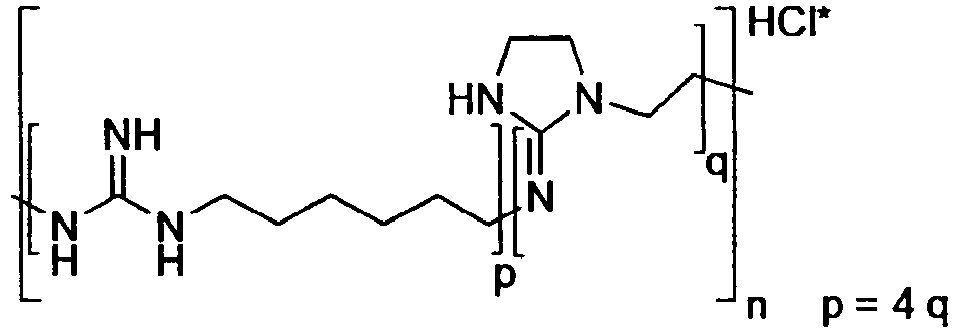

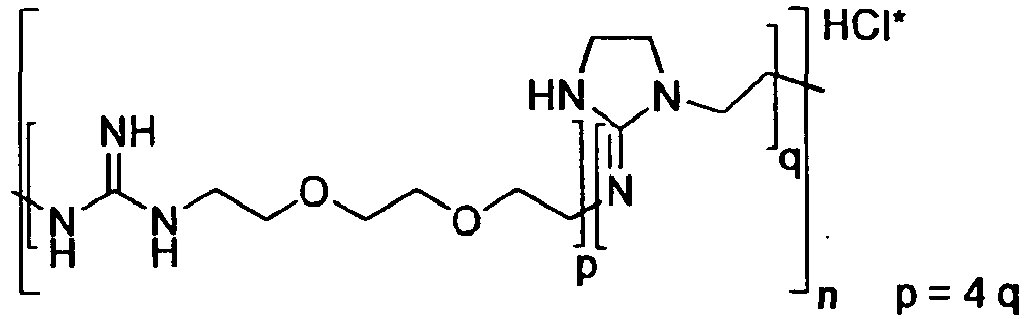


HCl* bedeutet, dass das HCl nicht kovalent gebunden ist,
n ist eine natürliche Zahl, vorzugsweise von 1 bis 20, weiter bevorzugt von 2 bis 16 und insbesondere von 3 bis 8,
p, q und r sind ganze Zahlen, die das bevorzugte molare Verhältnis der Strukturfragmente zueinander in den Formeln definieren. - In einer bevorzugten Ausführungsform der vorliegenden Erfindung sind die polymeren oder oligomeren Wirkstoffe erhältlich durch Polykondensation eines Guanidinsäureadditionssalzes mit einem Amingemisch, welches wenigstens ein Diamin und/oder ein Triamin enthält, wobei wenigstens ein Amin ausgewählt ist aus der Gruppe, die aus
- i) Diamin, das wenigstens einen cycloaliphatischen Rest aufweist, und
- ii) Dialkylentriamin besteht,
- Eine weitere wesentliche Komponente des bioziden Verknüpfungsprodukts ist ein thermoplastische Polymer. Bevorzugt sind thermoplastische Polymere, die im Rahmen eines "reactive processing" mit den polymeren oder oligomeren Wirkstoffen (Komponente a)) eine kovalente Verknüpfung eingehen. Hierfür geeignete thermoplastische Polymere sind beispielsweise Polymere, die durch Polykondensation oder Polyaddition erhältlich sind.
- Das thermoplastische Polymer ist bevorzugt ausgewählt aus der Gruppe bestehend aus Polyurethan, Polycarbonat, Polyethersulfon, Silikon, Polyester, Polyamid, Polycaprolacton, Polylactid und Polyharnstoff, insbesondere Polykondensate.
- Besonders bevorzugt sind Polyethylenterephthalat, Polybutylenterephthalat, Polyamid PA6, PA66, PA610, PA11, PA12, aliphatische und aromatische Polycarbonate sowie aliphatische und aromatische Polyurethane
- Die erfindungsgemäß für die Herstellung der medizinischen Artikel vorgesehenen bioziden Verknüpfungsprodukte umfassen die Verknüpfung aus den zuvor beschriebenen polymeren oder oligomeren Wirkstoffen (Komponente a)) mit einem thermoplastischen Polymer (Komponente b)), das heißt, Wirkstoff und Thermoplast sind kovalent miteinander verbunden.
- Die Verknüpfungsprodukte sind erhältlich durch chemische Reaktion der zuvor genannten Komponente a) mit der Komponente b) unter Ausbildung mindestens einer kovalenten Bindung zwischen Komponente a) und Komponente b).
- Bei der Herstellung der erfindungsgemäß zu verwendenden bioziden Verknüpfungsprodukte erfolgt die Verknüpfung des polymeren Guanidinderivats mit dem thermoplastischen Polymer bevorzugt unter den Bedingungen des "reactive processing". Hierzu wird der polymere oder oligomere Wirkstoff (Komponente a)) mit dem thermoplastischen Polymer (Komponente b)) vermischt und die Reaktionsbedingungen so gewählt, dass eine kovalente Anbindung der Komponente a) an das thermoplastische Polymer (Komponente b)) erfolgt. Dies kann beispielsweise dadurch geschehen, dass das thermoplastische Polymer so ausgewählt wird, dass es noch Reaktivgruppen trägt, beispielsweise Isocyanatgruppen.
- Die Anbindung des polymeren Guanidinderivats kann jedoch auch unter ausgewählten Bedingungen im Rahmen einer Umkondensation erfolgen. Besonders geeignete thermoplastische Polymere sind hierfür aliphatische Polyurethane und/oder aromatische und/oder araliphatische Polyurethane. Bevorzugt wird der oligomere oder polymere Wirkstoff in flüssiger Form, vorzugsweise gelöst in einem Lösungsmittel, mit dem thermoplastischen Polymer zur Reaktion gebracht wird. Es hat sich überraschend gezeigt, dass insbesondere unter diesen Bedingungen eine kovalente Anbindung vereinfacht erfolgt. Geeignete Lösungsmittel sind beispielsweise polare Lösungsmittel wie Alkohole, hervorragend eignet sich jedoch auch Wasser.
- In einer besonders bevorzugten Ausgestaltung der vorliegenden Erfindung wird daher der oligomere oder polymere Wirkstoff in Form einer wässrigen Lösung, bevorzugt einer mindestens 20 Gew.-%igen, weiter bevorzugt 20 bis 80 Gew.-%igen, besonders bevorzugt 25 bis 50 Gew.-%igen wässrigen Lösung, mit dem thermoplastischen Polymer zur Reaktion gebracht.
- Im Rahmen des reactive processing kann die Reaktion zwischen Komponente a) und Komponente b) auch während der Verarbeitung erfolgen. Bevorzugt erfolgt die Reaktion durch Vermischen in einem Extruder.
- Das biozide Verknüpfungsprodukt ist bevorzugt erhältlich, wenn die Reaktion zwischen Komponente a) und Komponente b) bei einer Temperatur von mehr als 120°C, bevorzugt mehr als 140°C, besonders bevorzugt von mehr als 160°C und insbesondere zwischen 160°C und 300°C erfolgt.
- Es hat sich überraschend herausgestellt, dass das biozide Verknüpfungsprodukt insbesondere dann erhältlich ist, wenn das thermoplastische Polymer bei
- Temperaturen oberhalb von 120°C, bevorzugt oberhalb von 160°C schmelzextrudiert wird und eine wässrige Lösung, vorzugsweise eine 20 bis 50 Gew.-%ige wässrige Lösung des polymeren Guanidinderivats zugegeben wird. Gerade unter diesen Reaktionsbedingungen konnte die kovalente Anbindung der polymeren Guanidinderivate an das thermoplastische Polymer beobachtet werden.
- Besonders geeignet für die kovalente Anbindung, insbesondere im Rahmen einer Schmelzextrusion, sind Polyester, Polylactide, Polycaprolactone, Polyamide, Polyesteramide, Polycarbonate, Polyurethane und Polyharnstoffe.
- Besonders bevorzugt sind Polyethylenterephthalat, Polybutylenterephthalat, Polyamid PA6, PA66, PA610, PA11, PA12, aliphatische und aromatische Polycarbonate sowie aliphatische und aromatische Polyurethane.
- Besonders bevorzugt sind Verknüpfungsprodukte, bei denen der polymere oder oligomere Wirkstoff kovalent an das thermoplastische Polymer gebunden ist, wobei bevorzugt das thermoplastische Polymer aus der Gruppe umfassend thermoplastische aliphatische und aliphatische/aromatische Polyurethane, aliphatische und aliphatische/aromatische Polyester, aliphatische und aliphatische/aromatische Polyamide, aliphatische und aliphatische/aromatische Polycarbonate, aliphatische und aliphatische/aromatische Polyharnstoffe, aliphatische und aliphatische/aromatische Polyesteramide ausgewählt ist und wobei der polymere oder oligomere Wirkstoff cyclische Strukturen in der Hauptkette aufweist.
- Insbesondere ist des vorteilhaft, wenn der polymere oder oligomere Wirkstoff eine Struktur aufweist, die aus der Gruppe umfassend


HCl* bedeutet, dass das HCl nicht kovalent gebunden ist,
n ist eine natürliche Zahl, vorzugsweise von 1 bis 20, weiter bevorzugt von 2 bis 16 und insbesondere von 3 bis 8,
p, q und r sind ganze Zahlen, die das bevorzugte molare Verhältnis der Strukturfragmente zueinander in den Formeln definieren. - Die Verknüpfungsprodukte sind bevorzugt erhältlich durch Compoundierung des polymeren oder oligomeren Wirkstoffs mit dem thermoplastischen Polymer unter Bedingungen des reactive processing. Dies geschieht insbesondere dann, wenn das thermoplastische Polymer ein thermoplastisches aliphatisches Polyurethan (TAPU) oder ein thermoplastisches aliphatisches/aromatisches Polyurethan (TAAPU) ist und wenn der polymere oder oligomere Wirkstoff eine cyclische Struktur aufweist, die ausgewählt ist aus der Gruppe, umfassend


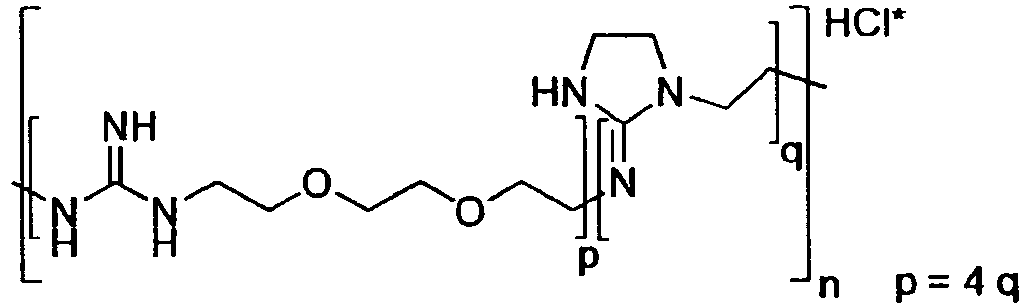


HCl* bedeutet, dass das HCl nicht kovalent gebunden ist,
n ist eine natürliche Zahl, vorzugsweise von 1 bis 20, weiter bevorzugt von 2 bis 16 und insbesondere von 3 bis 8,
p, q und r sind ganze Zahlen, die das bevorzugte molare Verhältnis der Strukturfragmente zueinander in den Formeln definieren. - Erfindungsgemäß werden die bioziden Verknüpfungsprodukte als solches für die Herstellung von medizinischen Artikel verwendet oder in Zusammensetzungen für medizinische Artikel eingesetzt. Je nach biozider Wirksamkeit bioziden Verknüpfungsprodukte sowie der Art und des Aufbaus des medizinischen Artikels können die Zusammensetzungen für den medizinischen Artikel in einer bevorzugten Ausführungsform den polymeren oder oligomeren Wirkstoff in einer Menge von maximal 10,0 Gew.-%, bevorzugt in einer Menge von 0,01 bis 5 Gew.-% und insbesondere in einer Menge von 1,0 bis 4,0 Gew.-%, jeweils bezogen auf die Zusammensetzung für den medizinischen Artikel, enthalten.
- Im Rahmen der vorliegenden Erfindung liegen die Verknüpfungsprodukte bevorzugt in Form ihrer Halogenid-Salze (Säureadditionssalze), insbesonder als HCl-Additionssalz vor. Weiter bevorzugt können die Verknüpfungsprodukte als Hydroxide vorliegen. Diese zeigen eine besonders gute Biozidie und können beispielsweise aus den Chloriden durch basischen Anionentausch erhalten werden.
- Ein besonderer Vorteil der erfindungsgemäß einzusetzenden bioziden Verknüpfungsprodukte ist deren Einarbeitbarkeit in Kunststoffen, insbesondere thermoplastischen Polymeren, die häufig den wesentlichen Bestandteil von Zusammensetzungen für medizinische Artikel bilden. Es hat sich überraschend gezeigt, dass sich die bioziden Verknüpfungsprodukte nicht nur problemlos in Kunstoffen, insbesondere thermoplastischen Polymerzusammensetzungen einarbeiten lassen, sondern dass darüber hinaus die mechanischen Eigenschaften, wie beispielsweise die Zugbelastbarkeit oder der Biegewiderstand, nur unwesentlich beeinflusst werden. Darüber hinaus zeigte sich überraschend, dass der Einsatz der bioziden Verknüpfungsprodukte in Zusammensetzungen umfassend Kunststoffe, insbesondere thermoplastische Polymere, für medizinische Artikel bei der Verarbeitung zu extrem glatten Oberflächen führt und darüber hinaus einen steuerbaren "Leaching"-Effekt aufweist. So können die bioziden polymeren oder oligomeren Wirkstoffe so verarbeitet werden, dass sie nicht von Flüssigkeiten wie beispielsweise Wasser oder Ethanol aus dem Polymer-Blend freigesetzt werden, was beispielsweise für medizinische Artikel wie Katheter von Bedeutung ist. Andererseits kann eine gezielte Freisetzung auch wünschenswert sein, beispielsweise bei Wundauflagen. Für diesen Fall ist es möglich den Zusammensetzungen für die Herstellung der medizinischen Artikel zusätzlich die zuvor definierten polymeren oder oligomeren Wirkstoffe (Komponente a)) zuzugeben. Die mit den bioziden Verknüpfungsprodukten ausgerüsteten Zusammensetzungen, insbesondere Zusammensetzungen umfassend thermoplastische Polymere für medizinische Artikel, weisen eine hervorragende antimikrobielle Wirksamkeit auf, obschon sie wie im Falle der Katheteranwendungen keinen Leaching-Effekt aufweisen.
- In einer bevorzugten Ausführungsform umfasst die Zusammensetzung für medizinische Artikel neben den erfindungsgemäß zu verwendenen Verknüpfungsprodukten weiterhin Kunstoffe, vorzugsweise thermoplastische Polymere, insbesondere ausgewählt aus Polyurethan, Polyolefin, Polyvinylchlorid, Polycarbonat, Polystyrol, Polyethersulfon, Silikon und Polyamid. Besonders bevorzugt umfassen die Zusammensetzungen für medizinische Artikel Polyurethan, Polyethylen oder Polypropylen.
- Darüber hinaus können die Zusammensetzungen zusätzlich die oben definierte Komponente a) in nicht gebundener Form aufweisen.
- Darüber hinaus können die Zusammensetzungen für medizinische Artikel weitere übliche Zusatzstoffe enthalten. Hier kommen insbesondere unter physiologischen Bedingungen inerte Füllstoffe in Frage. Besonders geeignet ist Bariumsulfat. Beispielsweise kann ein geeignetes BaSO4 unter dem Handelsnamen Blancfix® von der Firma Sachtleben Chemie GmbH bezogen werden. Die Füllstoffe liegen bevorzugt in den Zusammensetzungen für medizinische Artikel in einer Menge von 10 bis 35 Gew.-%, bezogen auf die Gesamtmischung, vor. Vorteilhafterweise weisen die Füllstoffe eine mittlere Teilchengröße von 0,01 µm bis 10 µm auf.
- In einer bevorzugten Ausgestaltung der vorliegenden Erfindung ist die Zusammensetzung jedoch im Wesentlichen frei von silikatischen Füllstoffen, da diese die Oberflächenglätte als auch den Leachingeffekt negativ beeinflussen können.
- Im Wesentlichen frei im Rahmen der vorliegenden Erfindung bedeutet, dass die silikatischen Füllstoffe in einer Menge unterhalb von 1 Gew.-%, bevorzugt unterhalb von 0,5 Gew.-%, weiter bevorzugt unterhalb von 0,01 Gew.-% und insbesondere frei von jeglichen silikatischen Füllstoffen, vorliegen können, wobei sich die Gewichtsangaben auf das Gesamtgewicht der Zusammensetzung für die Herstellung des medizinischen Artikels bezieht.
- Medizinische Artikel im Sinne der vorliegenden Erfindung sind insbesondere ausgewählt aus der Gruppe bestehend aus zentralnervösen Kathetern; peripheren Venenkathetern; Beatmungsschläuche; Stents; Produkten für Anwendung in der Regionalanästhesie, insbesondere Katheter, Kuppelungen, Filter; Produkten für die Infusionstherapie, insbesondere Behältnisse, Ports, Überleitungssysteme, Filter; Zubehör wie Konnektoren, Spikes, Ventile, Dreiwegehähne, Spritzen, Leitungen, Zuspritzports; Produkte der Zubereitung, insbesondere Transfersets, Mixsets; urologische Produkte, insbesondere Katheter, Urinmess- und -sammelgeräte; Wunddrainage; Wundversorgung; chirurgische Nahtmaterialien; Implantationshilfsstoffe sowie Implantate, insbesondere Kunststoffimplantate, beispielsweise Herniennetze, Vliese, Gestricke, Gewirke, Ports, Portkatheter, Gefäßprothesen; Desinfektionsmittel; chirurgisches Einmalinstrumentarium; Thoraxdrainagen; Sonden; Katheter; Gehäuse von medizinischen Geräten, insbesondere Infusionspumpen, Dialysegeräte und Monitore; künstliche Gebisse; Behälter für Flüssigkeiten, insbesondere Kontaktlinsenbehälter.
- Medizinische Artikel im Rahmen der vorliegenden Erfindung erfassen auch Zubehörteile für medizinische Produkte, wie beispielsweise Spritzgussteile und Formteile. Eine besondere Bedeutung kommt der Verwendung der polymeren oder oligomeren Wirkstoffe als Additiv in Beschichtungen für chirurgisches Nahtmaterial zu.
- Ein bevorzugter medizinischer Artikel im Rahmen der vorliegenden Erfindung ist eine Wundauflage.
- Besonders bevorzugte medizinische Artikel sind schlauchförmige medizinische Artikel. Solche Artikel weisen zumindest einen schlauchförmigen Bestandteil auf.
- Schlauchförmige medizinische Artikel im Sinne der vorliegenden Erfindung sind solche medizinischen Artikel, die Fluide führen können. Insbesondere sind die medizinischen Artikel ausgewählt aus der Gruppe bestehend aus Katheder; zentralvenösen Kathetern; peripheren Venenkathetern; Beatmungsschläuche; Stents; Kuppelungen; Ports; Überleitungssysteme; Konnektoren, Spikes, Ventile, Dreiwegehähne, Spritzen, Leitungen, Zuspritzports; Wunddrainage; Thoraxdrainagen und Sonden.
- Besonders bevorzugte medizinische Artikel sind Katheter, insbesondere solche, die durch Extrusion von Zusammensetzungen umfassend Polyurethan und/oder Polyethylen und/oder Polyamid hergestellt werden.
- Ein besonders geeignetes Polyamid ist unter dem Handelsnamen Pebax® (Arkema) erhältlich. Es handelt sich dabei um ein Polyamid, das Polyether-Blöcke aufweist.
- Aufgrund ihrer hervorragenden antimikrobiellen Wirkung sind die polymeren oder oligomeren Wirkstoffe auch als Additiv für Reinigungsmittel oder Desinfektionsmittel, insbesondere Händedesinfektionsmittel geeignet.
- Ein weiterer Gegenstand der vorliegenden Erfindung ist ein Verfahren zur Herstellung eines medizinischen Artikels, vorzugsweise eines schlauchförmigen medizinischen Artikels, umfassend die folgenden Schritte:
- a) Zusammenführen und Vermischen des bioziden Verknüpfungsprodukts, wie zuvor definiert, mit gegebenenfalls einem thermoplastischen Polymer, und
- b) Einsetzen des unter a) erhaltenen Gemisches in einem oder mehreren Formgebungsverfahren unter Ausbildung eines medizinischen Artikels, vorzugsweise eines schlauchförmigen medizinischen Artikels.
- Bevorzugte biozide Verknüpfungsprodukte und bevorzugte thermoplastische Polymere entsprechen den zuvor genannten.
- Das Vermischen in Schritt a) erfolgt bevorzugt durch Schmelzkneten. Gegebenfalls können die Verfahrensbedingungen auch so gewählt werden, dass im Rahmen eines reactive processing, das Verknüpfungsprodukt aus Komponente a) und Komponente b) erst während des Herstellverfahrens für den medizinischen Artikel entsteht. Die Komponente a) könnte dazu beispielsweise als wässrige Lösung dem geschmolzenen thermoplastischen Polymer zugegeben werden und anschließend in einem Extruder vermischt werden. Bevorzugt erfolgt das Schmelzkneten bei Temperaturen oberhalb von 100°C, weiter bevorzugt oberhalb von 150°C.
- Bevorzugt wird das biozide Verknüpfungsprodukte dem Formgebungsverfahren in Schritt b) als Granulat oder Masterbatch zugeführt. Die Herstellung von Granulaten kann nach dem Fachmann auf dem Gebiet der Kunststofftechnologie geläufigen Verfahren erfolgen. Bevorzugt ist der Masterbatch ein Granulat, das biozide Verknüpfungsprodukt in einer höheren Konzentration als der vorgesehenen Endkonzentration im medizinischen Artikel aufweist. Bei Einsatz eines Masterbatches wird dieser daher durch Zugabe von weiterem Kunststoff weiter auf die gewünschte Endkonzentration verdünnt.
- Das in Schritt b) des erfindungsgemäßen Verfahrens zum Einsatz kommende Formgebungsverfahren ist bevorzugt ein Extrusionsverfahren oder Spritzgussverfahren. Hiermit können beispielsweise schlauchartige Komponenten des Katheters hergestellt werden.
- Die Formgebungsverfahren werden vorzugsweise bei Temperaturen oberhalb des Schmelzpunkts des in Schritt a) hergestellten Gemisches durchgeführt, besonders bevorzugt in einem Temperaturbereich oberhalb von 160 °C, weiter bevorzugt in einem Bereich von 180 - 260 °C.
- Ein weiterer Gegenstand der vorliegenden Erfindung ist ein medizinischer Artikel umfassend ein biozides Verknüpfungsprodukt wie zuvor definiert.
- Bevorzugte Verknüpfungsprodukte und bevorzugte Kunststoffe entsprechen den zuvor genannten.
- Das in dem erfindungsgemäßen medizinischen Artikel sowie in dem erfindungsgemäßen Verfahren einzusetzende thermoplastische Polymer oder auch die Komponente b) des Verknüpfungsprodukts ist bevorzugt ein thermoplastisches Polyurethan. Es haben sich hier als besonders geeignet Polyurethane herausgestellt, die aus einer Kombination von 4,4'-Diphenylmethan-diisocyanat (MDI) und einem Polyol auf Polyester- oder Polyetherbasis bestehen. Vorteilhafterweise umfasst das Polyol einen Polytetramethylenglycolether. Weitere geeignete thermoplastische Polymere, die bevorzugt für Zusammensetzungen der erfindungsgemäßen medizinischen Artikel in Frage kommen, sind beispielsweise ausgewählt aus Polyurethan, Polyolefin, Polyvinylchlorid, Polycarbonat, Polystyrol, Polyethersulfon, Silikon und Polyamid. Besonders bevorzugt umfassen die Zusammensetzungen für medizinische Artikel Polyurethan, Polyethylen oder Polypropylen oder Polyamid.
- Bevorzugte medizinische Artikel entsprechen den zuvor genannten. Insbesondere bevorzugte medizinische Artikel sind Wundauflagen und Katheter.
- Weitere Merkmale, Einzelheiten und Vorteile der Erfindung ergeben sich aus dem Wortlaut der Ansprüche sowie aus der folgenden Beschreibung von Ausführungsbeispielen.
- Es zeigen:
- Fig. 1
- 1H-1H COSY-Spektrum eines wässrigen Extraktes eines Ausführungsbeispiels einer erfindungsgemäßen Zusammensetzung aus einem thermoplastischen Polymer und einem erfindungsgemäßen polymeren oder oligomeren Wirkstoff.
- Fig. 2
- 1H-1H COSY-Spektrum eines wässrigen Extraktes eines weiteren Ausführungsbeispiels einer erfindungsgemäßen Zusammensetzung aus einem thermoplastischen Polymer und einem erfindungsgemäßen polymeren oder oligomeren Wirkstoff.
- In einen dreifach ausgeheizten 100 ml-Dreihalskolben wird im Argon-Gegenstrom 1 Äquivalent (8,12 g, 85 mmol) Guanidinhydrochlorid gegeben. Anschließend wird in der Glovebox 1 Äquivalent (17,88 g, 85 mmol) 4,4'-Methylenbis(cyclohexylamin)zugefügt.
- Der Kolben wird mit einem Innenthermometer und einem dreifach ausgeheizten Rückflusskühler mit Rückschlagventil nach Stutz (im Folgenden Stutzkühler) ausgestattet.
- In einem Ölbad wird das Reaktionsgemisch erwärmt, wobei ab einer Temperatur von 100°C eine langsame Gasentwicklung einsetzt. Bei weiterer Temperaturerhöhung wird die Gasentwicklung nur langsam stärker. Nach insgesamt 85 Minuten wird eine Temperatur von 170°C erreicht.
- Diese Temperatur wird für neun Stunden beibehalten, bis die Gasentwicklung nach Augenschein beendet ist.
- Unter Eiskühlung und Ölpumpenvakuum wird die Schmelze auf Raumtemperatur abgekühlt.
- Die eingesetzten Ausgangsmengen liefern unter den zuvor genannten Bedingungen 24,48 g eines transparenten, farblosen und spröden Feststoffs.
- Die Struktur des erhaltenen Polymers lässt sich entsprechend Formel (I) darstellen.

- Dabei ist n = 1 bis 8, vorwiegend 1 bis 3.
- Die Reste R1 und R2 können sowohl von dem eingesetzten Monomer als auch von dem eingesetzten Guanidinhydrochlorid stammen und sind daher wie folgt definiert:
- R1 ist ausgewählt aus H oder

- R2 ist ausgewählt aus NH2 oder
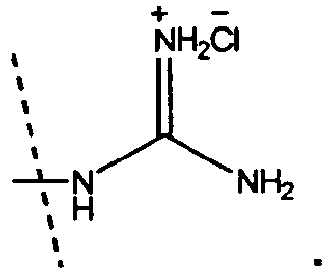
- Das entstehende Produktgemisch enthält somit polymere Verbindungen entsprechend den Formeln (II), (III) und (IV):


- In einem dreifach ausgeheizten und mit Argon befüllten 100 ml-Dreihalskolben mit Innenthermometer, Stutzkühler und einem Absaugstück mit Hahn werden 1 Äquivalent (8,12 g, 85 mmol) Guanidinhydrochlorid und 1 Äquivalent (8,77 g, 85 mmol) Diethylentriamin mit Hilfe eines Ölbades innerhalb von 50 Minuten auf eine Temperatur von 150°C erwärmt.
- Ab dem Erreichen einer Temperatur von 95°C ist eine Gasentwicklung zu beobachten, die bei weiterer Erhöhung der Temperatur schnell zunimmt.
- Die Schmelze wird unter Rühren für fünf Stunden bei 150°C gehalten bis die Gasentwicklung beendet ist.
- Unter Eiskühlung und Ölvakuum wird die Schmelze auf Raumtemperatur abgekühlt.
- Die eingesetzten Ausgangsmengen liefern unter den zuvor genannten Bedingungen 11,96 g eines weißen und spröden Feststoffs.
- Überraschenderweise zeigt die repetitive Monomereinheit des entstehenden polymeren Wirkstoffs die zyklische Struktur entsprechend Formel (V):

- Dabei ist n = 1 bis 12, vorwiegend 2 bis 8. R3 ist entweder NH2 oder


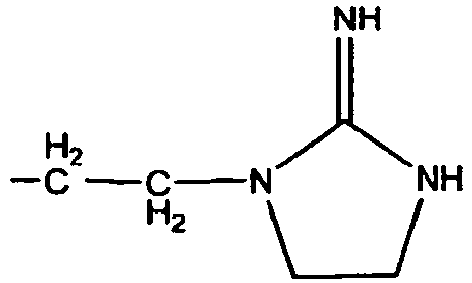
- Das entstehende Produktgemisch enthält somit polymere Verbindungen entsprechend den Formeln (VI), (VII) und (VIII):


- Dabei ist vorstellbar, dass etwa 90 % der Ringe in den Formeln (VI), (VII) und (VIII) eine positive Ladung tragen. Denkbar ist dabei auch, dass die positive
- Ladung nicht auf einem der Stickstoffatome im Ring lokalisiert sondern vielmehr delokalisiert ist. Eine alternative Darstellungsform der Formel (VIII) ist mithin die folgende Formel (VIII')

- Auch die Formeln (I) bis (IV) des Beispiels 2 lassen sich in analoger Weise darstellen, wobei die positive Ladung mesomer auf alle drei Stickstoffatome der Guanidineinheit verteilt ist.
- In einem entsprechend den vorbeschriebenen Beispielen vorbereiteten Reaktionskolben werden jeweils 1 Äquivalent (8,12 g, 85 mmol) Guanidinhydrochlorid und 1 Äquivalent der Comonomere, die in einem Mischungsverhältnis entsprechend Tabelle 1 vorliegen, gemeinsam mit Hilfe eines Ölbades innerhalb von 30 Minuten auf eine Temperatur von 170°C erwärmt.
- Die Schmelze wird unter Rühren für fünf Stunden bei dieser Temperatur gehalten. Unter Eiskühlung und Ölvakuum wird die Schmelze auf Raumtemperatur abgekühlt.
Tabelle 1: Mischungsverhältnisse der in dem Amin-Gemisch eingesetzten Di- und Triamine zur Herstellung von Guanidin-Copolymeren (Äq = Äquivalent). Nr. Monomer 1 Monomer 2 Eingesetzte Menge Monomer 1 Eingesetzte Menge Monomer 2 C1 4,4'-Methylenbis(cyclohexyl-amin) Diethylentriamin 14,30 g 2,21 g 68 mmol 17 mmol 0,80 Äq 0,2 Äq C2 4,4'-Methylenbis(cyclohexylamin) Diethylentriamin 13,41 g 2,77 g 63,75 mmol 21,25 mmol 0,75 Äq 0,25 Äq C3 4,4'-Methylenbis(cyclohexylamin) Diethylentriamin 11,92 g 3,69 g 56,67 mmol 28,33 mmol 0,67 Äq 0,33 Äq C4 4,4'-Methylenbis(cyclohexylamin) Diethylentriamin 8,94 g 5,53 g 42,50 mmol 42,50 mmol 0,50 Äq 0,50 Äq C5 4,4'-Methylenbis(cyclohexylamin) Hexamethylendiamin 3,58 g 7,90 g 17,00 mmol 68,00 mmol 0,20 Äq 0,80 Äq C6 4,4'-Methylenbis(cyclohexylamin) Hexamethylendiamin 4,47 g 7,41 g 21,25 mmol 63,75 mmol 0,25 Äq 0,75 Äq C7 4,4'-Methylenbis(cyclohexylamin) Hexamethylendiamin 5,96 g 6,59 g 28,33 mmol 56,67 mmol 0,33 Äq 0,67 Äq C8 4,4'-Methylenbis(cyclohexylamin) Hexamethylendiamin 8,94 g 4,94 g 42,50 mmol 42,50 mmol 0,50 Äq 0,50 Äq C9 4,4'-Methylenbis(cyclohexylamin) Hexamethylendiamin 11,92 g 3,29 g 56,67 mmol 28,33 mmol 0,67 Äq 0,33 Äq C10 4,4'-Methylenbis(cyclohexylam in) Hexamethylendiamin 13,41 g 2,47 g 63,75 mmol 21,25 mmol 0,75 Äq 0,25 Äq C11 4,4'-Methylenbis(cyclohexylamin) Hexamethylendiamin 14,30 g 1,98 g 68,00 mmol 17,00 mmol 0,80 Äq 0,20 Äq C12 4,4'-Methylenbis(cyclohexylam in) Triethylenglycoldiamin 13,41 g 3,15 g 63,75 mmol 21,25 mmol 0,75 Äq 0,25 Äq C13 4,4'-Methylenbis(cyclohexylamin) Triethylenglycoldiamin 11,92 g 4,20 g, 56,67 mmol 28,33 mmol 0,67 Äq 0,33 Äq C14 4,4'-Methylenbis(cyclohexylamin) Triethylenglycoldiamin 8,94 g 6,30 g 42,50 mmol 42,50 mmol 0,50 Äq 0,50 Äq C15 4,4'-Methylenbis(cyclohexylam in) Triethylenglycoldiamin 5,96 g 8,40 g 28,33 mmol 56,67 mmol 0,33 Äq 0,67 Äq C16 4,4'-Methylenbis(cyclohexylamin) Triethylenglycoldiamin 4,47 g 9,45 g 21,25 mmol 63,75 mmol 0,25 Äq 0,75 Äq C17 Diethylentriamin Hexamethylendiamin 1,75 g 7,90 g 17,00 mmol 68,00 mmol 0,20 Äq 0,80 Äq C18 Diethylentriamin Hexamethylendiamin 2,19 g 7,41 g 21,25 mmol 63,75 mmol 0,25 Äq 0,75 Äq C19 Diethylentriamin Hexamethylendiamin 3,69 g 6,59 g 28,33 mmol 56,67 mmol 0,33 Äq 0,67 Äq C20 Diethylentriamin Hexamethylendiamin 5,53 g 4,94 g 42,50 mmol 42,50 mmol 0,50 Äq 0,50 Äq C21 Diethylentriamin Triethylenglycoldi amin 8,30 g 3,15 g 63,75 mmol 21,35 mmol 0,75 Äq 0,25 Äq C22 Diethylentriamin Triethylenglycoldiamin 7,38 g 4,20 g 56,67 mmol 28,33 mmol 0,67 Äq 0,33 Äq C23 Diethylentriamin Triethylenglycoldi amin 5,53 g 6,30 g 42,50 mmol 42,50 mmol 0,50 Äq 0,50 Äq - Zur Überprüfung der bioziden Wirkung der erfindungsgemäß verwendeten polymeren Guanidinderivate werden die Verbindungen, die entsprechend einem der vorangegangenen Beispiele hergestellt werden in einem Bakterien-Nährmedium, vorzugsweise Tryptic Soy Broth, angesetzt und auf verschiedene Konzentrationen verdünnt.
- Diese Lösungen unterschiedlicher Konzentration werden mit einer Suspension von Escherichia coli inokuliert und für 24 h bei 37°C inkubiert.
- Unter der minimalen Hemmkonzentration (MHK) wird dann die geringste Konzentration des zu untersuchenden Biozids in der Lösung verstanden, bei der das Wachstum der Bakterien gehemmt wird. Bei der entsprechenden Lösung ist dann keine Eintrübung durch das Wachstum der Bakterien beobachtbar.
- Für die in Beispiel 1 und Beispiel 2 dargestellten Homopolymere entsprechend Formel (I) und Formel (V) sowie für die aus den in Beispiel 3 genannten Comonomer-Mischungen C1 bis C23 erhaltenen Copolymere werden die in Tabelle 2 aufgeführten mittleren minimalen Hemmkonzentrationen (MHK) erhalten.
Tabelle 2: Bestimmung der minimalen Hemmkonzentration erfindungsgemäß verwendeter polymerer Guanidinderivate (MHK = minimale Hemmkonzentration). Verbindung MHK [µg/ml] Verbindung MHK [µg/ml] Kontrollpolymer 5 C11 9,75 Entspr. Formel (I) 5 C12 5,5 Entspr. Formel (V) >250 C13 8,5 C1 7,5 C14 10 C2 22,5 C15 10 C3 25 C16 10 C4 50 C17 3 C5 1,5 C18 10 C6 4,7 C19 10 C7 4,25 C20 40 C8 2,5 C21 >50 C9 3,5 C22 >50 C10 2,5 C23 >50 - Als Kontrolle wurde ein Kontrollpolymer eingesetzt, dessen biozide Wirkung bekannt ist und dessen minimale Hemmkonzentration üblicherweise bei 5 µg/ml liegt.
- Man erkennt, dass alle erfindungsgemäß verwendeten polymeren Guanidinderivate, insbesondere die erfindungsgemäß verwendeten Copolymere eine biozide Wirkung aufweisen. Dabei weisen insbesondere Copolymere, die als zweites Monomer Hexametyhlendiamin aufweisen, eine minimale Hemmkonzentration auf, die sogar unterhalb von 5 µg/ml liegt:
Tabelle 3: Ausgewählte erfindungsgemäß verwendete Copolymere mit besonders niedriger minimaler Hemmkonzentration (MHK). (MBC = 4,4'-Methylenbis(cyclohexylamin), HMD = Hexamethylendiamin, DETA = Diethylentriamin). Copolymer Monomer 1 Monomer 2 Mischungsverhältnis Reaktionsbedingungen MHK C5 MBC HMD 1:4 5h, 170°C 1,5 C6 MBC HMD 1:3 5h, 170°C 4,7 C7 MBC HMD 1:2 5h, 170°C 4,25 C8 MBC HMD 1:1 5h, 170°C 2,5 C9 MBC HMD 2:1 5h, 170°C 3,5 C10 MBC HMD 3:1 5h, 170°C 2,5 C17 DETA HMD 1:4 5h, 170°C 3 - Man erkennt, dass es bei den erfindungsgemäß verwendeten polymeren oder oligomeren Wirkstoffen mit biozider Wirkung, wobei der Wirkstoff das Produkt einer Polykondensation eines Guanidin-Säureadditionssalzes mit einem Amin-Gemisch, welches wenigstens ein Diamin und/oder ein Triamin enthält, besonders günstig ist, wenn wenigstens ein Amin ausgewählt ist aus 4,4'-Methylenbis(cyclohexylamin) und Diethylentriamin. Zweckmäßig ist dabei das Guanidin-Säureadditionssalz Guanidinhydrochlorid.
- Man erkennt weiter, dass das polymere oder oligomeren Wirkstoff ein Homopolymer sein kann. Dabei ist es günstig, wenn das Amin-Gemisch aus dem Triamin Diethylentriamin besteht oder wenn das Amin-Gemisch aus dem Diamin 4,4'-Methylenbis(cyclohexylamin) besteht.
- Man erkennt auch, dass das Amin-Gemisch eine erste Komponente und wenigstens eine zweite Komponente enthalten kann, wobei die erste Komponente ein Diamin oder ein Triamin ist, ausgewählt aus der Gruppe 4,4'-Methylenbis(cylcohexylamin), Diethylentriamin, und wobei die zweite Komponente ein Diamin oder ein Triamin, ausgewählt aus der Gruppe 4,4'-Methylenbis(cylcohexylamin), Diethylentriamin, Hexamethylen-diamin, Triethylenglycol-diamin, ist und wobei die erste Komponente von der zweiten Komponente verschieden ist.
- Besonders bevorzugt ist die erste Komponente 4,4'-Methylenbis(cylcohexylamin) und die zweite Komponente ist ausgewählt aus Diethylentriamin, Hexamethylendiamin, Triethylenglycoldiamin. Günstig ist es auch, wenn die erste Komponente Diethylentriamin ist und die zweite Komponente ausgewählt ist aus Hexamethylendiamin und Triethylenglycoldiamin.
- Dabei liegen die erste Komponente und die zweite Komponente bevorzugt in einem Mischungsverhältnis von 4:1 bis 1:4 vor. Das Amin-Gemisch und das Guanidin-Salz werden bevorzugt in etwa äquimolar zueinander eingesetzt.
- Man erkennt, dass es bei den erfindungsgemäß verwendeten polymeren oder oligomeren Wirkstoffen, wobei der Wirkstoff das Produkt einer Polykondensation eines Guanidin-Säureadditionssalzes mit einem Amin-Gemisch, welches wenigstens ein Diamin und/oder ein Triamin enthält, besonders vorteilhaft ist, wenn sie nach einem Verfahren hergestellt sind, umfassend die Schritte Vorlegen von etwa einem Äquivalent Guanidinhydrochlorid, Zugeben etwa eines Äquivalents einer Amin-Mischung, welche eine oder zwei der Verbindungen der Gruppe umfassend Diamin, das wenigstens einen cycloaliphatischen Rest aufweist, und Dialkylentriamin, enthält, Erhitzen auf 150 bis 170°C und Rühren der Schmelze bei 150 bis 170°C bis die Gasentwicklung beendet ist, wenigstens aber für 5 Stunden.
- Bei der Eincompoundierung polymerer oder oligomerer Wirkstoffe in thermoplastische Polymere wie z.B. Polyurethane kommt es unter bestimmten Bedingungen zu einem sogenannten Reactive processing. Dabei werden die polymeren oder oligomeren Wirkstoffe kovalent mit dem verwendenten Thermoplastenverknüpft.
- In einem entsprechenden Herstellungsverfahren werden dazu wässrige Lösungen der polymeren oder oligomeren Wirkstoffe mit Schmelzen thermoplastischer Polykondensate oder Polyadditionsprodukte coextrudiert. Dabei entstehen durch Umkondensation neue Thermoplaste (biozide Verknüpfungsprodukte).
- Als Ausgangs-Thermoplaste werden Polykondensate oder Polyadditionsprodukte eingesetzt, die durch Schmelzextrusion verarbeitbar sind, z. B. Polyester wie Polyethylenterephthalt, Polybutylenterephthalat, Polylaktid, Polycaprolakton; Polyamide wie z. b. Polyamid(PA) 6, PA 66, PA 610, PA11, PA12; Polyesteramide, aliphatische und aromatische Polycarbonate, aliphatische und aromatische Polyurethane und Polyharnstoffe.
- Als polymere bzw. oligomere Wirkstoffe werden wasserlösliche Polyguanidine (PG) eingesetzt, bei denen es sich insbesondere um solche mit folgenden Strukturen handelt:





HCl* bedeutet, dass das HCl nicht kovalent gebunden ist,
n ist eine natürliche Zahl, vorzugsweise von 1 bis 20, weiter bevorzugt von 2 bis 16 und insbesondere von 3 bis 8,
p, q und r sind ganze Zahlen, die das bevorzugte molare Verhältnis der Strukturfragmente zueinander in den Formeln definieren. - Zur Herstellung der bioziden Verknüpfungsprodukte wird der Thermoplast in Schmelzextrusion in einem herkömmlichen Extruder bei Extrusionstemperaturen von 70 - 300°C je nach Thermoplast mit einer wässrigen Lösung des bioziden polymeren oder oligomeren Wirkstoffs mit Konzentrationen von 0,1 - 90 Gew. % des bioziden polymeren oder oligomeren Wirkstoffs in Wasser additiviert.
- Das Wasser wird in der Verdampfungszone des Extruders entfernt. Als neues Produkt wird am Ende der Extrusion das biozide Verknüpfungsprodukt erhalten, der 0,1 - 50 % der Strukturen der polymeren oder oligomeren Wirkstoffe relativ zum eingesetzten Thermoplasten enthält. Die polymeren oder oligomeren Wirkstoffe sind dabei durch Umkondensation kovalent an den Thermoplasten gebunden. Die Umkondensation findet während der Extrusion statt.
- Der Nachweis, dass die polymeren oder oligomeren Wirkstoffe nach der Extrusion kovalent an das eingesetzte thermoplastische Polymer gebunden sind, kann sowohl mittels NMR als auch mittels Massenspektrometrie gezeigt werden.
- In einem ersten Ausführungsbeispiel für die Verknüpfungsprodukte mit kovalent an ein thermoplastisches Polymer gebundenem polymerem oder oligomerem Wirkstoff wird thermoplastisches aliphatisches Polyurethan (TAPU) bei einer Massetemperatur von 170°C im Zweischneckenextruder extrudiert und mit einer 40%igen wässrigen Lösung eines ersten Polyguanidins (PG1) additiviert, welches folgende Struktur aufweist:

- Die Additivierung erfolgt dabei so, dass ein Compound mit 10 Gew. % des ersten Polyguanidins (PG1) in TAPU entsteht.
- Die massenspektroskopische Analyse zeigt, dass nach der Extraktion des Compounds kein Wirkstoff, nämlich kein erstes Polyguanidin (PG1) im Exktrakt zu finden ist. Dabei wurde die Extraktion mit siedendem Wasser durchgeführt.
- In einem zweiten Ausführungsbeispiel wird als thermoplastisches Polymer anstelle des thermoplastischen aliphatischen Polyurethans (TAPU) ein thermoplastisches aliphatisches/aromatische Polyurethan (TAAPU) verwendet. Die Extrusion erfolgte auch hier bei einer Massetemperatur von 170°C im Zweischneckenextruder unter Additivierung einer 40%igen wässrigen Lösung des ersten Polyguanidins (PG1).
- Auch hier kann kein reines PG1 im Extrakt nachgewiesen werden, was die kovalente Bindung von PG1 an das verwendete thermoplastische aliphatische/aromatische Polyurethan zeigt.
- In
Fig. 1 ist auch für ein drittes Ausführungsbeispiel die kovalente Anbindung eindeutig im zweidimensionalen NMR-Spektrum erkennbar. Bei diesem Beispiel wurde thermoplastisches aliphatisches Polyurethan (TAPU) wie zuvor bei einer Massetemperatur von 170°C im Zweischneckenextruder extrudiert und mit einer 40%igen wässrigen Lösung eines zweiten Polyguanidins (PG2) additiviert. Das zweite Polyguanidin (PG2) weist dabei folgende Struktur auf:
- Es entsteht ein Compound mit 10 Gew.-% des zweiten Polyguanidins (PG2) in TAPU.
Fig. 1 zeigt dabei das 1H-1H COSY-Spektrum des Exktraktes des Ausführungsbeispiels. - Für ein viertes Ausführungsbeispiel zeigt auch
Fig. 2 das 1H-1H COSY Spektrum des Extraktes. Dabei wurde anstelle des thermoplastischen aliphatischen Polyurethans (TAPU) ein thermoplastisches aliphatisches/aromatisches Polyurethan verwendet und wie zuvor mit einer 40%igen wässrigen Lösung des zweiten Polyguanidins (PG2) bei einer Massetemperatur von 170°C extrudiert. Die Additivierung erfolgte derart, dass ein Compound mit 10 Gew-% des zweiten Polyguanidins (PG2) in TAAPU entsteht. Auch hier ist kein polymerer oder oligomerer Wirkstoff, nämlich kein zweites Polyguanidin (PG2), im Extrakt mit siedendem Wasser nachweisbar. - 1H-1H-COSY NMR wurden am Bruker Avance 300 B Spektrometer gemessen (Dual 1H - 13C Probenkopf mit Z-Gradient), je bei 25 °C in einem Lösungsmittelgemisch aus Hexafluoroisopropanol (ca. 1 mL) und D2O (ca. 0,2 mL). Kalibriert wurde auf den protonierten D2O-Peak als internen Standard (4.79 ppm bei 25 °C). (Die in dem Bericht dargestellten 2D-Spektren sind nicht kalibriert, weil sich die 1D-Spektren oben und links dadurch verschieben).
- Die Massenspektren wurden durch chemische Ionisation bei Atmosphärendruck (atmospheric pressure chemical ionization, APCI) gemessen an einem Thermo Fisher Scientific Finnigan LTQ-FT Spektrometer in Methanol als Lösungsmittel.
- Die Erfindung ist nicht auf eine der vorbeschriebenen Ausführungsformen beschränkt, sondern in vielfältiger Weise abwandelbar.
- Es wird ein aliphatisches thermoplastisches Polyurethan (auf Basis eines Polytetramethylen-Glycolethers) mit 10 bis 35 Gew.-%, bezogen auf die Gesamtmischung, Bariumsulfat mit einer mittleren Teilchengröße von 0,01 µm bis 10 µm sowie 0,5 bis 10 Gew.-%, bezogen auf den Anteil der Komponente a), eines erfindungsgemäß zu verwendenden Verknüpfungsprodukt gemischt und anschließend extrudiert. Die Extrusion erfolgt mit für die Katheterherstellung üblichen Extrudern, beispielsweise dem Extruder Maillefer Typ ED 45-30D.
Claims (15)
- Verwendung eines bioziden Verknüpfungsprodukts ausa) einen polymeren oder oligomeren Wirkstoff mit biozider Wirkung, welcher erhältlich ist durch Polykondensation eines Guanidin-Säureadditionssalzes mit einem Amingemisch, welches wenigstens ein Diamin und/oder ein Triamin enthält, wobei wenigstens ein Amin ausgewählt ist aus der Gruppe, die ausi) Diamin, das wenigstens einen cycloaliphatischen Rest aufweist, undii) Dialkylentriamin besteht, undb) einem thermoplastischen Polymer
für die Herstellung medizinischer Artikel. - Verwendung eines bioziden Verknüpfungsprodukts, welches erhältlich ist durch Reaktion vona) einem polymeren oder oligomeren Wirkstoff mit biozider Wirkung, welcher erhältlich ist durch Polykondensation eines Guanidin-Säureadditionssalzes mit einem Amingemisch, welches wenigstens ein Diamin und/oder ein Triamin enthält, wobei wenigstens ein Amin ausgewählt ist aus der Gruppe, die ausi) Diamin, das wenigstens einen cycloaliphatischen Rest aufweist, undii) Dialkylentriamin besteht,
mitb) einem thermoplastischen Polymer,
für die Herstellung medizinischer Artikel. - Verwendung mindestens einem der Ansprüche 1 oder 2, dadurch gekennzeichnet, dass das Amingemisch ein Alkylendiamin, insbesondere eine Verbindung der allgemeinen Formel
NH2(CH2)nNH2
in welcher n eine ganze Zahl zwischen 2 und 10, insbesondere 6, ist, umfasst. - Verwendung gemäß mindestens einem der Ansprüche 1 bis 3, dadurch gekennzeichnet, dass das Amingemisch eine erste Komponente und wenigstens eine zweite Komponente enthält, wobeia) die erste Komponente ein Diamin oder ein Triamin ist, das ausgewählt ist aus der Gruppe, die ausi) Diamin, das wenigstens einen cycloaliphatischen Rest aufweist,
undii) Dialkylentriamin besteht, und wobeib) die zweite Komponente ein Diamin oder ein Triamin ist, das ausgewählt ist aus der Gruppe, die ausi) Diamin, das wenigstens einen cycloaliphatischen Rest aufweist,ii) Dialkylentriamin,iii) Alkylendiamin undiv) Oxyalkylendiamin besteht, und
wobei die erste Komponente von der zweiten Komponente verschieden ist. - Verwendung gemäß mindestens einem der Ansprüche 1 bis 4, dadurch gekennzeichnet, dass der polymere oder oligomere Wirkstoff ein Iminoimidazolderivat ist.
- Verwendung gemäß mindestens einem der Ansprüche 1 bis 5, dadurch gekennzeichnet, dass der polymere oder oligomere Wirkstoff eine Struktur aufweist, die aus der Gruppe umfassend


HCl* bedeutet, dass das HCl nicht kovalent gebunden ist,
n ist eine natürliche Zahl, vorzugsweise von 1 bis 20, weiter bevorzugt von 2 bis 16 und insbesondere von 3 bis 8,
p, q und r sind ganze Zahlen, die das bevorzugte molare Verhältnis der Strukturfragmente zueinander in den Formeln definieren. - Verwendung gemäß mindestens einem der Ansprüche 1 bis 6, dadurch gekennzeichnet, dass der polymere oder oligomere Wirkstoff ein mittleres Molekulargewicht im Bereich von 500 bis 7000, insbesondere von 1000 bis 5000 aufweist.
- Verwendung gemäß mindestens einem der Ansprüche 1 bis 7, dadurch gekennzeichnet, dass das thermoplastische Polymer ausgewählt ist aus der Gruppe bestehend aus Polyurethan, Polycarbonat, Polyethersulfon, Silikon, Polyester, Polyamid, Polylactid und Polyharnstoff.
- Verwendung gemäß mindestens einem der Ansprüche 1 bis 8, dadurch gekennzeichnet, dass das thermoplastische Polymer ein thermoplastisches aliphatisches Polyurethan (TAPU) oder ein thermoplastisches aliphatisches/aromatisches Polyurethan (TAAPU) ist und dass der polymere oder oligomere Wirkstoff eine cyclische Struktur aufweist, die ausgewählt ist aus der Gruppe, umfassend


HCl* bedeutet, dass das HCl nicht kovalent gebunden ist,
n ist eine natürliche Zahl, vorzugsweise von 1 bis 20, weiter bevorzugt von 2 bis 16 und insbesondere von 3 bis 8,
p, q und r sind ganze Zahlen, die das bevorzugte molare Verhältnis der Strukturfragmente zueinander in den Formeln definieren. - Verwendung gemäß mindestens einem der Ansprüche 1 bis 9, dadurch gekennzeichnet dass der medizinische Artikel ausgewählt ist aus der Gruppe bestehend aus zentralvenösen Kathetern; peripheren Venenkathetern; Beatmungsschläuche; Stents; Produkten für Anwendung in der Regionalanästhesie, insbesondere Katheter, Kuppelungen, Filter; Produkten für die Infusionstherapie, insbesondere Behältnisse, Ports, Überleitungssysteme, Filter; Zubehör wie Konnektoren, Spikes, Ventile, Dreiwegehähne, Spritzen, Leitungen, Zuspritzports; Produkte der Zubereitung, insbesondere Transfersets, Mixsets; urologische Produkte, insbesondere Katheter, Urinmess- und -sammelgeräte; Wunddrainage; Wundversorgung; chirurgische Nahtmaterialien; Implantatzubehörteile und Implantate, insbesondere Kunstoffimplantate, beispielsweise Herniennetze, Vliese, Gestricke, Gewirke, Ports, Portkatheter, Gefäßprothesen; Desinfektionsmittel; chirurgisches Einmalinstrumentarium; Thoraxdrainagen; Sonden; Katheter; Gehäuse von medizinischen Geräten, insbesondere Infusionspumpen, Dialysegeräte und Monitore, künstliche Gebisse; Behälter für Flüssigkeiten, insbesondere Kontaktlinsenbehälter; Reinigungsmittel und Desinfektionsmittel.
- Verfahren zur Herstellung eines medizinischen Artikels, umfassend die folgenden Schrittea) Zusammenführen und Vermischen des bioziden Verknüpfungsprodukts, wie in mindestens einem der Ansprüche 1 bis 9 definiert, mit gegebenenfalls einem thermoplastischen Polymer undb) Einsetzen des unter a) erhaltenen Gemisches in einem oder mehreren Formgebungsverfahren unter Ausbildung eines medizinischen Artikels.
- Verfahren gemäß Anspruch 11, dadurch gekennzeichnet, dass das biozide Verknüpfungsprodukt dem Formgebungsverfahren in Schritt b) als Granulat oder Masterbatch zugeführt wird.
- Verfahren gemäß Anspruch 11 oder 12, dadurch gekennzeichnet, dass das Formgebungsverfahren eine Extrusion ist.
- Medizinischer Artikel umfassend ein biozides Verknüpfungsprodukt wie in mindestens einem der Ansprüche 1 bis 9 definiert.
- Medizinischer Artikel gemäß Anspruch 14, dadurch gekennzeichnet, dass es ein schlauchförmiger medizinischer Artikel, insbesondere ein Katheter, ist.
Applications Claiming Priority (2)
| Application Number | Priority Date | Filing Date | Title |
|---|---|---|---|
| DE102009052721A DE102009052721A1 (de) | 2009-11-12 | 2009-11-12 | Verwendung polymerer oder oligomerer Wirkstoffe für medizinische Artikel |
| PCT/EP2010/067404 WO2011058144A1 (de) | 2009-11-12 | 2010-11-12 | Verwendung polymerer biozider materialien für medizinische artikel |
Publications (2)
| Publication Number | Publication Date |
|---|---|
| EP2498832A1 EP2498832A1 (de) | 2012-09-19 |
| EP2498832B1 true EP2498832B1 (de) | 2013-10-16 |
Family
ID=43778195
Family Applications (2)
| Application Number | Title | Priority Date | Filing Date |
|---|---|---|---|
| EP10778649.3A Active EP2498833B1 (de) | 2009-11-12 | 2010-11-12 | Verwendung polymerer oder oligomerer wirkstoffe für medizinische artikel |
| EP10778648.5A Active EP2498832B1 (de) | 2009-11-12 | 2010-11-12 | Verwendung polymerer biozider materialien für medizinische artikel |
Family Applications Before (1)
| Application Number | Title | Priority Date | Filing Date |
|---|---|---|---|
| EP10778649.3A Active EP2498833B1 (de) | 2009-11-12 | 2010-11-12 | Verwendung polymerer oder oligomerer wirkstoffe für medizinische artikel |
Country Status (10)
| Country | Link |
|---|---|
| US (1) | US9572913B2 (de) |
| EP (2) | EP2498833B1 (de) |
| CN (1) | CN102665778B (de) |
| BR (1) | BR112012011218A2 (de) |
| CA (1) | CA2780286C (de) |
| DE (1) | DE102009052721A1 (de) |
| ES (2) | ES2438508T3 (de) |
| MX (1) | MX2012005386A (de) |
| RU (1) | RU2557937C2 (de) |
| WO (2) | WO2011058148A1 (de) |
Families Citing this family (6)
| Publication number | Priority date | Publication date | Assignee | Title |
|---|---|---|---|---|
| DE102009052667A1 (de) * | 2009-11-12 | 2011-05-19 | Philipps-Universität Marburg | Polymere oder oligomere Wirkstoffe mit biozider Wirkung, Verfahren zu deren Herstellung und Zusammensetzung umfassend einen polymeren oder oligomeren Wirkstoff |
| ES2774719T3 (es) | 2016-04-20 | 2020-07-22 | Ineos Styrolution Group Gmbh | Masas moldeables termoplásticas no penetrantes, de acción antimicrobiana |
| US11167081B2 (en) | 2016-06-16 | 2021-11-09 | Smiths Medical Asd, Inc. | Assemblies and methods for infusion pump system administration sets |
| CN106366620A (zh) * | 2016-08-30 | 2017-02-01 | 何仁英 | 一种含有聚氨酯的输液袋材料及其制备方法 |
| WO2018140910A1 (en) | 2017-01-30 | 2018-08-02 | Lubrizol Advanced Materials, Inc. | Antimicrobial thermoplastic polyurethanes |
| AU2018302257A1 (en) | 2017-07-19 | 2020-01-30 | Smiths Medical Asd, Inc. | Housing arrangements for infusion pumps |
Family Cites Families (33)
| Publication number | Priority date | Publication date | Assignee | Title |
|---|---|---|---|---|
| US3909200A (en) | 1967-05-22 | 1975-09-30 | Petrolite Corp | Use of guanidine derived compounds as corrosion inhibitors |
| GB1434040A (en) * | 1973-08-06 | 1976-04-28 | Ici Ltd | Process for combating fungi and bacteria |
| US4056508A (en) | 1973-10-27 | 1977-11-01 | Dynamit Nobel Aktiengesellschaft | Difficultly inflammable polyester molding compositions |
| EP0229862A3 (de) | 1986-01-24 | 1987-09-30 | TERUMO KABUSHIKI KAISHA trading as TERUMO CORPORATION | Medizinisches Erzeugnis |
| US6299892B1 (en) * | 1986-02-03 | 2001-10-09 | Robert A. Schmitz | Composition of matter having bioactive properties |
| US6261271B1 (en) | 1989-01-18 | 2001-07-17 | Becton Dickinson And Company | Anti-infective and antithrombogenic medical articles and method for their preparation |
| IE64997B1 (en) | 1989-01-18 | 1995-10-04 | Becton Dickinson Co | Anti-infection and antithrombogenic medical articles and method for their preparation |
| DE4002403A1 (de) * | 1990-01-27 | 1991-08-01 | Degussa | Verfahren zur herstellung von biozid wirksamen polymeren guanidinsalzen |
| US5849311A (en) * | 1996-10-28 | 1998-12-15 | Biopolymerix, Inc. | Contact-killing non-leaching antimicrobial materials |
| DE19619327A1 (de) * | 1996-05-14 | 1997-11-20 | Dunzendorfer Udo Priv Doz Dr M | Oberflächenbeschichteter Katheter |
| RU2144929C1 (ru) * | 1998-05-28 | 2000-01-27 | Институт эколого-технологических проблем | Способ получения полиалкиленгуанидина и полиалкиленгуанидин на основе высшего моноамина "гембицид" |
| AU4372099A (en) | 1998-06-11 | 1999-12-30 | Ciba Specialty Chemicals Holding Inc. | Use of basic polycondensates as antimicrobial active substance |
| KR100557559B1 (ko) * | 1999-12-20 | 2006-03-03 | 에스케이 주식회사 | 폴리헥사메틸렌구아니딘 인산염 분말, 이의 제조방법 및이를 함유한 항균수지 |
| IL152600A0 (en) | 2000-05-11 | 2003-06-24 | P O C Oil Industry Technology | Biocidal polymers based on guanidine salts |
| US20020120333A1 (en) | 2001-01-31 | 2002-08-29 | Keogh James R. | Method for coating medical device surfaces |
| CN1282698C (zh) | 2002-03-15 | 2006-11-01 | 上海塑杰科技有限公司 | 一种聚烯烃功能化母粒及其制备方法和应用 |
| ITRM20020529A1 (it) * | 2002-10-18 | 2004-04-19 | Franco Staino | Polimeri sterilizzanti, processo di loro preparazione ed uso. |
| AT500998B1 (de) | 2003-03-20 | 2008-10-15 | Geopharma Produktionsgmbh | Antimikrobiell wirkendes arzneimittel |
| CN100406496C (zh) * | 2003-07-23 | 2008-07-30 | 上海塑杰科技有限公司 | 一种多元胺与胍盐聚合物及其在抗菌聚酯和聚酰胺材料中的应用 |
| DE10355189B4 (de) * | 2003-11-26 | 2015-04-30 | Johnson & Johnson Medical Gmbh | Verfahren zum Herstellen eines chirurgischen Implantats sowie chirurgisches Implantat |
| DE102004011293A1 (de) * | 2004-03-09 | 2005-09-22 | Aesculap Ag & Co. Kg | Antimikrobielles medizintechnisches Produkt |
| AT505102B1 (de) * | 2004-11-05 | 2010-05-15 | Schmidt Oskar | Biozid, insbesondere fungizid wirkendes mittel |
| US20080139450A1 (en) * | 2005-07-01 | 2008-06-12 | Srinivasa Madhyastha | Antimicrobial Compositions and Uses Thereof |
| EP2071954A1 (de) | 2007-12-19 | 2009-06-24 | Bayer CropScience AG | Verwendung von polymeren Guanidin-Derivaten zum Bekämpfen von unerwünschten Mikro-organismen im Pflanzenschutz |
| WO2008080184A2 (de) * | 2006-12-29 | 2008-07-10 | Aka Technology Gmbh | Verwendung von polymeren guanidinen zum bekämpfen von mikroorganismen |
| AT505563B1 (de) * | 2007-07-16 | 2011-10-15 | Geopharma Produktions Gmbh | Dentalwerkstoff |
| WO2009027186A2 (de) * | 2007-08-29 | 2009-03-05 | Basf Se | Hyperverzweigte polymere mit guanidineinheiten |
| CN101250263A (zh) * | 2007-11-28 | 2008-08-27 | 广州科仁机电有限公司 | 一种多元胺与胍盐预聚物、聚合物及其制备方法和应用 |
| DE102007062372A1 (de) | 2007-12-22 | 2009-06-25 | Paul Hartmann Ag | Medizinischer Artikel mit antimikrobieller Ausrüstung |
| MY155831A (en) * | 2008-03-14 | 2015-12-15 | Allegiance Corp | Water-based resin composition and articles made therefrom |
| DE102009029762A1 (de) | 2009-06-18 | 2010-12-23 | Paul Hartmann Ag | Polymerer medizinischer oder medizintechnischer oder PSA-Artikel mit antimikrobieller Ausrüstung |
| DE102009052667A1 (de) * | 2009-11-12 | 2011-05-19 | Philipps-Universität Marburg | Polymere oder oligomere Wirkstoffe mit biozider Wirkung, Verfahren zu deren Herstellung und Zusammensetzung umfassend einen polymeren oder oligomeren Wirkstoff |
| DE102009052725A1 (de) * | 2009-11-12 | 2011-05-19 | B. Braun Melsungen Ag | Verwendung von Polyoxyalkylendiamin-basierten Polyguanidinderivaten für medizinische Artikel |
-
2009
- 2009-11-12 DE DE102009052721A patent/DE102009052721A1/de not_active Withdrawn
-
2010
- 2010-11-12 CN CN201080051362.3A patent/CN102665778B/zh active Active
- 2010-11-12 ES ES10778648.5T patent/ES2438508T3/es active Active
- 2010-11-12 CA CA2780286A patent/CA2780286C/en active Active
- 2010-11-12 ES ES10778649.3T patent/ES2456698T3/es active Active
- 2010-11-12 WO PCT/EP2010/067411 patent/WO2011058148A1/de not_active Ceased
- 2010-11-12 WO PCT/EP2010/067404 patent/WO2011058144A1/de not_active Ceased
- 2010-11-12 MX MX2012005386A patent/MX2012005386A/es active IP Right Grant
- 2010-11-12 RU RU2012124072/15A patent/RU2557937C2/ru active
- 2010-11-12 US US13/509,010 patent/US9572913B2/en active Active
- 2010-11-12 BR BR112012011218A patent/BR112012011218A2/pt not_active Application Discontinuation
- 2010-11-12 EP EP10778649.3A patent/EP2498833B1/de active Active
- 2010-11-12 EP EP10778648.5A patent/EP2498832B1/de active Active
Also Published As
| Publication number | Publication date |
|---|---|
| EP2498833A1 (de) | 2012-09-19 |
| CN102665778A (zh) | 2012-09-12 |
| WO2011058144A1 (de) | 2011-05-19 |
| ES2438508T3 (es) | 2014-01-17 |
| BR112012011218A2 (pt) | 2016-04-05 |
| US9572913B2 (en) | 2017-02-21 |
| EP2498833B1 (de) | 2014-01-08 |
| CN102665778B (zh) | 2016-08-31 |
| EP2498832A1 (de) | 2012-09-19 |
| RU2012124072A (ru) | 2013-12-20 |
| RU2557937C2 (ru) | 2015-07-27 |
| CA2780286C (en) | 2018-01-02 |
| ES2456698T3 (es) | 2014-04-23 |
| US20120282213A1 (en) | 2012-11-08 |
| CA2780286A1 (en) | 2011-05-19 |
| DE102009052721A1 (de) | 2011-05-26 |
| MX2012005386A (es) | 2012-09-12 |
| WO2011058148A1 (de) | 2011-05-19 |
Similar Documents
| Publication | Publication Date | Title |
|---|---|---|
| DE69708461T2 (de) | Bioresponsive pharmakologisch aktive polymere und daraus hergestellte gegenstände | |
| EP2498833B1 (de) | Verwendung polymerer oder oligomerer wirkstoffe für medizinische artikel | |
| DE60001728T2 (de) | Infektionsresistente polymere, ihre herstellung und verwendungen | |
| EP2498834B1 (de) | Verwendung von polyoxyalkylendiamin-basierten polyguanidinderivaten für medizinische artikel | |
| EP1128723B1 (de) | Wirkstoffhaltige aromatische copolyester | |
| DE112018000451B4 (de) | Verfahren zur Herstellung einer vernetzten Polyethylenimin-Beschichtung und Verwendung einer vernetzten Polyethylenimin-Beschichtung | |
| EP2498766A1 (de) | Polymere oder oligomere wirkstoffe mit biozider wirkung, verfahren zu deren herstellung und zusammensetzung umfassend einen polymeren oder oligomeren wirkstoff | |
| EP1809687A1 (de) | Biozid, insbesondere fungizid wirkendes mittel | |
| EP2185208B1 (de) | Brust-implantat mit antibakterieller wirkung | |
| EP1940938B1 (de) | Antimikrobielle kunststoffzusammensetzung mit niedriger elutionsrate und langer wirksamkeit | |
| EP2552195B1 (de) | Antimikrobielle öl in wasser emulsion | |
| EP1128724B1 (de) | Wirkstoffhaltige polyetherblockamide | |
| DE102007026397A1 (de) | Nanokomplexe mit dendritischer Struktur zur Einlagerung und/oder zum Transport von monovalenten Metallionen | |
| EP3445816B1 (de) | Antimikrobiell wirkende, nicht ausblutende thermoplastische formmassen | |
| Stoica et al. | NOVEL BIOACTIVE AND BIODEGRADABLE MATERIALS FOR MEDICAL APPLICATIONS. |
Legal Events
| Date | Code | Title | Description |
|---|---|---|---|
| PUAI | Public reference made under article 153(3) epc to a published international application that has entered the european phase |
Free format text: ORIGINAL CODE: 0009012 |
|
| 17P | Request for examination filed |
Effective date: 20120531 |
|
| AK | Designated contracting states |
Kind code of ref document: A1 Designated state(s): AL AT BE BG CH CY CZ DE DK EE ES FI FR GB GR HR HU IE IS IT LI LT LU LV MC MK MT NL NO PL PT RO RS SE SI SK SM TR |
|
| DAX | Request for extension of the european patent (deleted) | ||
| GRAP | Despatch of communication of intention to grant a patent |
Free format text: ORIGINAL CODE: EPIDOSNIGR1 |
|
| INTG | Intention to grant announced |
Effective date: 20130507 |
|
| GRAS | Grant fee paid |
Free format text: ORIGINAL CODE: EPIDOSNIGR3 |
|
| GRAA | (expected) grant |
Free format text: ORIGINAL CODE: 0009210 |
|
| RAP1 | Party data changed (applicant data changed or rights of an application transferred) |
Owner name: B. BRAUN MELSUNGEN AG |
|
| AK | Designated contracting states |
Kind code of ref document: B1 Designated state(s): AL AT BE BG CH CY CZ DE DK EE ES FI FR GB GR HR HU IE IS IT LI LT LU LV MC MK MT NL NO PL PT RO RS SE SI SK SM TR |
|
| REG | Reference to a national code |
Ref country code: GB Ref legal event code: FG4D Free format text: NOT ENGLISH |
|
| REG | Reference to a national code |
Ref country code: CH Ref legal event code: EP |
|
| REG | Reference to a national code |
Ref country code: IE Ref legal event code: FG4D Free format text: LANGUAGE OF EP DOCUMENT: GERMAN |
|
| REG | Reference to a national code |
Ref country code: AT Ref legal event code: REF Ref document number: 636152 Country of ref document: AT Kind code of ref document: T Effective date: 20131115 |
|
| REG | Reference to a national code |
Ref country code: DE Ref legal event code: R096 Ref document number: 502010005109 Country of ref document: DE Effective date: 20131205 |
|
| REG | Reference to a national code |
Ref country code: ES Ref legal event code: FG2A Ref document number: 2438508 Country of ref document: ES Kind code of ref document: T3 Effective date: 20140117 |
|
| REG | Reference to a national code |
Ref country code: NL Ref legal event code: VDEP Effective date: 20131016 |
|
| REG | Reference to a national code |
Ref country code: LT Ref legal event code: MG4D |
|
| PG25 | Lapsed in a contracting state [announced via postgrant information from national office to epo] |
Ref country code: IS Free format text: LAPSE BECAUSE OF FAILURE TO SUBMIT A TRANSLATION OF THE DESCRIPTION OR TO PAY THE FEE WITHIN THE PRESCRIBED TIME-LIMIT Effective date: 20140216 Ref country code: HR Free format text: LAPSE BECAUSE OF FAILURE TO SUBMIT A TRANSLATION OF THE DESCRIPTION OR TO PAY THE FEE WITHIN THE PRESCRIBED TIME-LIMIT Effective date: 20131016 Ref country code: LT Free format text: LAPSE BECAUSE OF FAILURE TO SUBMIT A TRANSLATION OF THE DESCRIPTION OR TO PAY THE FEE WITHIN THE PRESCRIBED TIME-LIMIT Effective date: 20131016 Ref country code: SE Free format text: LAPSE BECAUSE OF FAILURE TO SUBMIT A TRANSLATION OF THE DESCRIPTION OR TO PAY THE FEE WITHIN THE PRESCRIBED TIME-LIMIT Effective date: 20131016 Ref country code: NO Free format text: LAPSE BECAUSE OF FAILURE TO SUBMIT A TRANSLATION OF THE DESCRIPTION OR TO PAY THE FEE WITHIN THE PRESCRIBED TIME-LIMIT Effective date: 20140116 Ref country code: NL Free format text: LAPSE BECAUSE OF FAILURE TO SUBMIT A TRANSLATION OF THE DESCRIPTION OR TO PAY THE FEE WITHIN THE PRESCRIBED TIME-LIMIT Effective date: 20131016 Ref country code: FI Free format text: LAPSE BECAUSE OF FAILURE TO SUBMIT A TRANSLATION OF THE DESCRIPTION OR TO PAY THE FEE WITHIN THE PRESCRIBED TIME-LIMIT Effective date: 20131016 |
|
| PG25 | Lapsed in a contracting state [announced via postgrant information from national office to epo] |
Ref country code: LV Free format text: LAPSE BECAUSE OF FAILURE TO SUBMIT A TRANSLATION OF THE DESCRIPTION OR TO PAY THE FEE WITHIN THE PRESCRIBED TIME-LIMIT Effective date: 20131016 Ref country code: CY Free format text: LAPSE BECAUSE OF FAILURE TO SUBMIT A TRANSLATION OF THE DESCRIPTION OR TO PAY THE FEE WITHIN THE PRESCRIBED TIME-LIMIT Effective date: 20131016 Ref country code: RS Free format text: LAPSE BECAUSE OF FAILURE TO SUBMIT A TRANSLATION OF THE DESCRIPTION OR TO PAY THE FEE WITHIN THE PRESCRIBED TIME-LIMIT Effective date: 20131016 |
|
| BERE | Be: lapsed |
Owner name: B. BRAUN MELSUNGEN A.G. Effective date: 20131130 |
|
| PG25 | Lapsed in a contracting state [announced via postgrant information from national office to epo] |
Ref country code: PT Free format text: LAPSE BECAUSE OF FAILURE TO SUBMIT A TRANSLATION OF THE DESCRIPTION OR TO PAY THE FEE WITHIN THE PRESCRIBED TIME-LIMIT Effective date: 20140217 |
|
| REG | Reference to a national code |
Ref country code: DE Ref legal event code: R097 Ref document number: 502010005109 Country of ref document: DE |
|
| PG25 | Lapsed in a contracting state [announced via postgrant information from national office to epo] |
Ref country code: MC Free format text: LAPSE BECAUSE OF FAILURE TO SUBMIT A TRANSLATION OF THE DESCRIPTION OR TO PAY THE FEE WITHIN THE PRESCRIBED TIME-LIMIT Effective date: 20131016 Ref country code: EE Free format text: LAPSE BECAUSE OF FAILURE TO SUBMIT A TRANSLATION OF THE DESCRIPTION OR TO PAY THE FEE WITHIN THE PRESCRIBED TIME-LIMIT Effective date: 20131016 |
|
| PLBE | No opposition filed within time limit |
Free format text: ORIGINAL CODE: 0009261 |
|
| STAA | Information on the status of an ep patent application or granted ep patent |
Free format text: STATUS: NO OPPOSITION FILED WITHIN TIME LIMIT |
|
| REG | Reference to a national code |
Ref country code: IE Ref legal event code: MM4A |
|
| PG25 | Lapsed in a contracting state [announced via postgrant information from national office to epo] |
Ref country code: RO Free format text: LAPSE BECAUSE OF FAILURE TO SUBMIT A TRANSLATION OF THE DESCRIPTION OR TO PAY THE FEE WITHIN THE PRESCRIBED TIME-LIMIT Effective date: 20131016 Ref country code: PL Free format text: LAPSE BECAUSE OF FAILURE TO SUBMIT A TRANSLATION OF THE DESCRIPTION OR TO PAY THE FEE WITHIN THE PRESCRIBED TIME-LIMIT Effective date: 20131016 Ref country code: SK Free format text: LAPSE BECAUSE OF FAILURE TO SUBMIT A TRANSLATION OF THE DESCRIPTION OR TO PAY THE FEE WITHIN THE PRESCRIBED TIME-LIMIT Effective date: 20131016 Ref country code: CZ Free format text: LAPSE BECAUSE OF FAILURE TO SUBMIT A TRANSLATION OF THE DESCRIPTION OR TO PAY THE FEE WITHIN THE PRESCRIBED TIME-LIMIT Effective date: 20131016 |
|
| 26N | No opposition filed |
Effective date: 20140717 |
|
| PG25 | Lapsed in a contracting state [announced via postgrant information from national office to epo] |
Ref country code: BE Free format text: LAPSE BECAUSE OF NON-PAYMENT OF DUE FEES Effective date: 20131130 Ref country code: DK Free format text: LAPSE BECAUSE OF FAILURE TO SUBMIT A TRANSLATION OF THE DESCRIPTION OR TO PAY THE FEE WITHIN THE PRESCRIBED TIME-LIMIT Effective date: 20131016 |
|
| REG | Reference to a national code |
Ref country code: DE Ref legal event code: R097 Ref document number: 502010005109 Country of ref document: DE Effective date: 20140717 |
|
| PG25 | Lapsed in a contracting state [announced via postgrant information from national office to epo] |
Ref country code: IE Free format text: LAPSE BECAUSE OF NON-PAYMENT OF DUE FEES Effective date: 20131112 |
|
| PG25 | Lapsed in a contracting state [announced via postgrant information from national office to epo] |
Ref country code: SI Free format text: LAPSE BECAUSE OF FAILURE TO SUBMIT A TRANSLATION OF THE DESCRIPTION OR TO PAY THE FEE WITHIN THE PRESCRIBED TIME-LIMIT Effective date: 20131016 |
|
| PG25 | Lapsed in a contracting state [announced via postgrant information from national office to epo] |
Ref country code: SM Free format text: LAPSE BECAUSE OF FAILURE TO SUBMIT A TRANSLATION OF THE DESCRIPTION OR TO PAY THE FEE WITHIN THE PRESCRIBED TIME-LIMIT Effective date: 20131016 |
|
| REG | Reference to a national code |
Ref country code: CH Ref legal event code: PL |
|
| PG25 | Lapsed in a contracting state [announced via postgrant information from national office to epo] |
Ref country code: LU Free format text: LAPSE BECAUSE OF NON-PAYMENT OF DUE FEES Effective date: 20131112 Ref country code: LI Free format text: LAPSE BECAUSE OF NON-PAYMENT OF DUE FEES Effective date: 20141130 Ref country code: HU Free format text: LAPSE BECAUSE OF FAILURE TO SUBMIT A TRANSLATION OF THE DESCRIPTION OR TO PAY THE FEE WITHIN THE PRESCRIBED TIME-LIMIT; INVALID AB INITIO Effective date: 20101112 Ref country code: MK Free format text: LAPSE BECAUSE OF FAILURE TO SUBMIT A TRANSLATION OF THE DESCRIPTION OR TO PAY THE FEE WITHIN THE PRESCRIBED TIME-LIMIT Effective date: 20131016 Ref country code: CH Free format text: LAPSE BECAUSE OF NON-PAYMENT OF DUE FEES Effective date: 20141130 Ref country code: BG Free format text: LAPSE BECAUSE OF FAILURE TO SUBMIT A TRANSLATION OF THE DESCRIPTION OR TO PAY THE FEE WITHIN THE PRESCRIBED TIME-LIMIT Effective date: 20131016 |
|
| PG25 | Lapsed in a contracting state [announced via postgrant information from national office to epo] |
Ref country code: MT Free format text: LAPSE BECAUSE OF FAILURE TO SUBMIT A TRANSLATION OF THE DESCRIPTION OR TO PAY THE FEE WITHIN THE PRESCRIBED TIME-LIMIT Effective date: 20131016 Ref country code: GR Free format text: LAPSE BECAUSE OF NON-PAYMENT OF DUE FEES Effective date: 20131016 |
|
| REG | Reference to a national code |
Ref country code: FR Ref legal event code: PLFP Year of fee payment: 6 |
|
| PG25 | Lapsed in a contracting state [announced via postgrant information from national office to epo] |
Ref country code: GR Free format text: LAPSE BECAUSE OF FAILURE TO SUBMIT A TRANSLATION OF THE DESCRIPTION OR TO PAY THE FEE WITHIN THE PRESCRIBED TIME-LIMIT Effective date: 20140117 |
|
| PG25 | Lapsed in a contracting state [announced via postgrant information from national office to epo] |
Ref country code: TR Free format text: LAPSE BECAUSE OF FAILURE TO SUBMIT A TRANSLATION OF THE DESCRIPTION OR TO PAY THE FEE WITHIN THE PRESCRIBED TIME-LIMIT Effective date: 20131016 |
|
| REG | Reference to a national code |
Ref country code: FR Ref legal event code: PLFP Year of fee payment: 7 |
|
| REG | Reference to a national code |
Ref country code: AT Ref legal event code: MM01 Ref document number: 636152 Country of ref document: AT Kind code of ref document: T Effective date: 20151112 |
|
| PG25 | Lapsed in a contracting state [announced via postgrant information from national office to epo] |
Ref country code: AT Free format text: LAPSE BECAUSE OF NON-PAYMENT OF DUE FEES Effective date: 20151112 |
|
| REG | Reference to a national code |
Ref country code: FR Ref legal event code: PLFP Year of fee payment: 8 |
|
| PG25 | Lapsed in a contracting state [announced via postgrant information from national office to epo] |
Ref country code: AL Free format text: LAPSE BECAUSE OF FAILURE TO SUBMIT A TRANSLATION OF THE DESCRIPTION OR TO PAY THE FEE WITHIN THE PRESCRIBED TIME-LIMIT Effective date: 20131016 |
|
| P01 | Opt-out of the competence of the unified patent court (upc) registered |
Free format text: CASE NUMBER: APP_3949/2025 Effective date: 20250124 |
|
| PGFP | Annual fee paid to national office [announced via postgrant information from national office to epo] |
Ref country code: DE Payment date: 20251118 Year of fee payment: 16 |
|
| PGFP | Annual fee paid to national office [announced via postgrant information from national office to epo] |
Ref country code: GB Payment date: 20251120 Year of fee payment: 16 |
|
| PGFP | Annual fee paid to national office [announced via postgrant information from national office to epo] |
Ref country code: IT Payment date: 20251128 Year of fee payment: 16 |
|
| PGFP | Annual fee paid to national office [announced via postgrant information from national office to epo] |
Ref country code: FR Payment date: 20251125 Year of fee payment: 16 |
|
| PGFP | Annual fee paid to national office [announced via postgrant information from national office to epo] |
Ref country code: ES Payment date: 20251216 Year of fee payment: 16 |