EP2495247B1 - Verfahren zur herstellung von zyklischem alkylenphosphohalidat und eines zyklischen phosphorsäureesters - Google Patents
Verfahren zur herstellung von zyklischem alkylenphosphohalidat und eines zyklischen phosphorsäureesters Download PDFInfo
- Publication number
- EP2495247B1 EP2495247B1 EP10820406.6A EP10820406A EP2495247B1 EP 2495247 B1 EP2495247 B1 EP 2495247B1 EP 10820406 A EP10820406 A EP 10820406A EP 2495247 B1 EP2495247 B1 EP 2495247B1
- Authority
- EP
- European Patent Office
- Prior art keywords
- general formula
- phosphoric acid
- acid ester
- compound
- cyclic
- Prior art date
- Legal status (The legal status is an assumption and is not a legal conclusion. Google has not performed a legal analysis and makes no representation as to the accuracy of the status listed.)
- Active
Links
- 0 CCC1(*)COP(OC(C)(C)P(*)(*)=O)#*C1 Chemical compound CCC1(*)COP(OC(C)(C)P(*)(*)=O)#*C1 0.000 description 2
Classifications
-
- C—CHEMISTRY; METALLURGY
- C07—ORGANIC CHEMISTRY
- C07F—ACYCLIC, CARBOCYCLIC OR HETEROCYCLIC COMPOUNDS CONTAINING ELEMENTS OTHER THAN CARBON, HYDROGEN, HALOGEN, OXYGEN, NITROGEN, SULFUR, SELENIUM OR TELLURIUM
- C07F9/00—Compounds containing elements of Groups 5 or 15 of the Periodic Table
- C07F9/02—Phosphorus compounds
- C07F9/547—Heterocyclic compounds, e.g. containing phosphorus as a ring hetero atom
- C07F9/6564—Heterocyclic compounds, e.g. containing phosphorus as a ring hetero atom having phosphorus atoms, with or without nitrogen, oxygen, sulfur, selenium or tellurium atoms, as ring hetero atoms
- C07F9/6571—Heterocyclic compounds, e.g. containing phosphorus as a ring hetero atom having phosphorus atoms, with or without nitrogen, oxygen, sulfur, selenium or tellurium atoms, as ring hetero atoms having phosphorus and oxygen atoms as the only ring hetero atoms
- C07F9/6574—Esters of oxyacids of phosphorus
- C07F9/65742—Esters of oxyacids of phosphorus non-condensed with carbocyclic rings or heterocyclic rings or ring systems
-
- C—CHEMISTRY; METALLURGY
- C07—ORGANIC CHEMISTRY
- C07C—ACYCLIC OR CARBOCYCLIC COMPOUNDS
- C07C29/00—Preparation of compounds having hydroxy or O-metal groups bound to a carbon atom not belonging to a six-membered aromatic ring
- C07C29/74—Separation; Purification; Use of additives, e.g. for stabilisation
- C07C29/94—Use of additives, e.g. for stabilisation
-
- C—CHEMISTRY; METALLURGY
- C07—ORGANIC CHEMISTRY
- C07C—ACYCLIC OR CARBOCYCLIC COMPOUNDS
- C07C31/00—Saturated compounds having hydroxy or O-metal groups bound to acyclic carbon atoms
- C07C31/18—Polyhydroxylic acyclic alcohols
- C07C31/20—Dihydroxylic alcohols
-
- C—CHEMISTRY; METALLURGY
- C07—ORGANIC CHEMISTRY
- C07F—ACYCLIC, CARBOCYCLIC OR HETEROCYCLIC COMPOUNDS CONTAINING ELEMENTS OTHER THAN CARBON, HYDROGEN, HALOGEN, OXYGEN, NITROGEN, SULFUR, SELENIUM OR TELLURIUM
- C07F9/00—Compounds containing elements of Groups 5 or 15 of the Periodic Table
- C07F9/02—Phosphorus compounds
- C07F9/547—Heterocyclic compounds, e.g. containing phosphorus as a ring hetero atom
- C07F9/6564—Heterocyclic compounds, e.g. containing phosphorus as a ring hetero atom having phosphorus atoms, with or without nitrogen, oxygen, sulfur, selenium or tellurium atoms, as ring hetero atoms
- C07F9/6571—Heterocyclic compounds, e.g. containing phosphorus as a ring hetero atom having phosphorus atoms, with or without nitrogen, oxygen, sulfur, selenium or tellurium atoms, as ring hetero atoms having phosphorus and oxygen atoms as the only ring hetero atoms
- C07F9/6574—Esters of oxyacids of phosphorus
- C07F9/65746—Esters of oxyacids of phosphorus the molecule containing more than one cyclic phosphorus atom
Definitions
- the present invention relates to a process for producing a cyclic alkylene phosphorohalidite containing an extremely small amount of a compound having a halogen directly attached to a carbon atom of the compound and a process for producing a cyclic phosphoric acid ester having an extremely low halogen content using the cyclic alkylene phosphorohalidite obtained by the aforementioned process as a raw material.
- halogens are known as environmental toxins, and therefore industrial materials are made progressively halogen-free.
- industrial materials are made progressively halogen-free.
- Japan Electronics Packaging Circuits Association defines a printed circuit board containing "900 ppm or less of bromine, 900 ppm or less of chlorine, and 1500 ppm in total of bromine and chlorine" as halogen-free (JPCA-ES01-2003).
- a flame retardant is required to have a halogen content of an added resin material comparable to or lower than the above-mentioned definition of the halogen-free printed circuit board.
- phosphoric acid esters are known as useful chemical substances in a wide range of fields in the chemical industry as additives for resins such as flame retardants and plasticizers and as materials or intermediates of pharmaceutical products and the like.
- Patent Document 1 Japanese Unexamined Patent Publication No. HEI 11(1999)-181428 discloses that a phosphoric acid ester having a phosphorinane skeleton is useful as a flame retardant for polyurethane resin.
- phosphorous acid esters having a cyclic alkylene skeleton are generally useful chemical substances in a wide range of fields in the chemical industry, being widely used not only as intermediates of the above-mentioned phosphoric acid esters but also as stabilizers of resins and various kinds of compounds.
- Patent Document 2 discloses that 5,5-dimethyl-2-nonylphenoxy-1,3,2-dioxaphosphorinane can be used as a stabilizer of cellulose ester resin and effectively prevent discoloration of the polymer and deterioration of physical properties due to a lowered degree of polymerization of the ester resin.
- Cyclic alkylene phosphorohalidites are used as intermediates in production of the above-mentioned phosphoric acid esters or phosphorous acid esters having a cyclic alkylene skeleton and generally obtained through a reaction between a phosphorus trihalide and an alkylene glycol compound.
- Patent Document 3 discloses that phosphorus trichloride is added to and reacted with neopentyl glycol under ice cooling to obtain 5,5-dimethyl-2-chloro-1,3,2-dioxaphosphorinane.
- Patent Document 4 discloses a method for producing a phosphonate having an alcoholic hydroxy group by addition reaction of a phosphite having two substituents with a carbonyl compound in the presence of a nitrogen-containing basic compound and a metal halide; and the pamphlet of WO 2006/049011 (Patent Document 5) discloses a method for producing a phosphorus compound having a phosphate-phosphonate bond by subjecting a phosphonate having an alcoholic hydroxy group and a di-substituted phosphorohalidite to a dehydrohalogenation reaction in the presence of a nitrogen-containing basic compound, and oxidizing the resulting reaction product with hydrogen peroxide, for example.
- JP 2004 277349 A discloses a method for synthesizing an optically active compound under control of steric factor, in terms of phosphorous atom, of a phosphorous compound such as a triphosphate or phosphoric triester.
- the method comprises obtaining an optically active phosphite in the presence of a catalytic amount of an optically active promoter.
- JP2004-277349A discloses that a phosphorus trihalide is reacted with an alkylene glycol compound to obtain a cyclic phosphorohalidite as an intermediate, and the obtained cyclic phosphorohalidite is reacted with a compound having a hydroxy group, then the obtained reactant is subjected to an oxidation treatment to obtain a cyclic phosphoric acid ester as an optically active compound.
- the yield of the intermediate is very low, the yield of Reference Examples 1 and 2 being 37% and 45%, respectively.
- the method for synthesizing an optically active compound disclosed in JP2004-277349A is thus rather inefficient
- the inventors of the present invention have made intensive studies on causes of an increased halogen concentration in a phosphoric acid ester and, as a result, found that a large amount of halogenated alcohol (compound having a halogen directly attached to a carbon atom) is generated as a by-product in production of a halidite, and when a phosphoric acid ester is produced by using the halidite, the halogenated alcohol changes into a compound such as a halogenated phosphoric acid ester that is difficult to remove in a purification step.
- the halidite is to be purified to remove the halogenated alcohol, the process will be complicated and the yield may be reduced.
- a phosphite may be generated as a by-product, and the phosphite may become an acid phosphate through air oxidation to cause reduction of the product quality and reduction of the yield.
- Patent Document 3 does not disclose the generation of such halogenated alcohol as a by-product or the halogen concentration in the phosphoric acid ester, or describe it as a problem.
- the inventors of the present invention have made intensive studies to solve the above-described problems and, as a result, found that when a phosphorus trihalide is present in an excess amount in a system of reaction between the phosphorus trihalide and an alkylene glycol compound in production of a cyclic alkylene phosphorohalidite, it is possible to inhibit generation of a compound having a halogen directly attached to a carbon atom; and that when a cyclic alkylene phosphorohalidite produced under the above-described condition is used for an intermediate material, it is possible to produce a cyclic phosphoric acid ester having an extremely low halogen content, to reach completion of the present invention.
- the present invention therefore provides a process for producing a cyclic alkylene phosphorohalidite, comprising reacting an alkylene glycol compound represented by the general formula (II): HO-R 0 -OH (II) wherein R 0 is a linear or branched alkylene group having 2 to 20 carbon atoms or a cyclic alkylene group having 3 to 20 carbon atoms, with a phosphorus trihalide represented by the general formula (III): PX 3 (III) wherein X is a halogen atom, to obtain the cyclic alkylene phosphorohalidite being represented by the general formula (I): wherein R 0 and X are as defined above, the phosphorus trihalide and the alkylene glycol compound being reacted under conditions where the phosphorus trihalide is present in an excess amount relative to the amount of the alkylene glycol compound in the reaction system.
- R(OH) n (V) wherein n is an integer from 1 to 4, and R is an aliphatic residue having 1 to 8 carbon atoms or an aromatic residue having 6 to 18 carbon atoms that may have a substituent and that is represented by the following formula: wherein R 1 and R 2 are each independently a linear alkyl group having 1 to 8 carbon atoms or a branched alkyl group having 3 to 8 carbon atoms, a cycloalkyl group having 3 to 8 carbon atoms, or an aryl group having 6 to 12 carbon atoms that may be substituted with a linear alkyl group having 1 to 4 carbon atoms or a branched alkyl group having 3 to 4 carbon atoms; or alternatively, R 1 and R 2 , together with the oxygen atoms and the phosphorus atom to which
- the present invention also provides a process for producing a cyclic phosphoric acid ester by using the above-described cyclic alkylene phosphorohalidite as a raw material.
- the present invention can provide a process for producing a cyclic alkylene phosphorohalidite containing an extremely small amount of compound having a halogen directly attached to a carbon atom and a process for producing a cyclic phosphoric acid ester having an extremely low halogen content by using the cyclic alkylene phosphorohalidite obtained by the aforementioned process as a raw material.
- a cyclic alkylene phosphorohalidite obtained by the production process of the present invention as an intermediate, it is possible to produce a cyclic phosphoric acid ester having an extremely low halogen content to deserve to be referred to as a halogen-free compound in the fields of various industrial materials.
- the process for producing a cyclic alkylene phosphorohalidite of the present invention comprises reacting an alkylene glycol compound represented by the general formula (II) with a phosphorus trihalide represented by the general formula (III) to obtain a cyclic alkylene phosphorohalidite represented by the general formula (I), characterized in that the phosphorus trihalide and the alkylene glycol compound are reacted under conditions where the phosphorus trihalide is present in an excess amount relative to the amount of the alkylene glycol compound in the reaction system.
- the present invention is characterized in that the phosphorus trihalide and the alkylene glycol compound are reacted in a reaction system where the phosphorus trihalide is present in an excess amount, and it is thereby possible to inhibit generation of a compound having a halogen directly attached to a carbon atom as a by-product to obtain a cyclic alkylene phosphorohalidite containing an extremely small amount of the compound.
- the cyclic alkylene phosphorohalidite as an intermediate material, it is possible to obtain a cyclic phosphoric acid ester having less impurities and an extremely low halogen content.
- a phosphorus trihalide and an alkylene glycol compound are reacted under conditions where the phosphorus trihalide is present in an excess amount relative to the amount of the alkylene glycol in the reaction system.
- the conditions do not need to be maintained from initiation to completion of the reaction, but the longer the phosphorus trihalide is present in an excess amount relative to the amount of the alkylene glycol compound in the reaction system during the time between initiation and completion of the reaction, the more effective the inhibition of generation of a compound having a halogen directly attached to a carbon atom as a by-product is. It is therefore preferable to maintain the conditions where the phosphorus trihalide is present in an excess amount from initiation of the reaction till late in the reaction, and it is more preferable to maintain the conditions where the phosphorus trihalide is present in an excess amount from initiation of the reaction to completion of the reaction thoroughly.
- a method in which the whole amount of the phosphorus trihalide to use is added to the reaction system, and then the alkylene glycol compound is gradually added thereto to react the compounds; and a method in which both the compounds are added to the reaction system so that the phosphorus trihalide is always present in the reaction system in an excess amount while the reaction is taking place, of which the former is preferable in terms of workability.
- the alkylene glycol compound to be used in the present invention is represented by the general formula (II): HO-R 0 -OH (II) wherein R 0 is a linear or branched alkylene group having 2 to 20 carbon atoms or a cyclic alkylene group having 3 to 20 carbon atoms.
- alkylene glycols having 2 to 4 carbon atoms in a moiety that is involved directly in the cyclic structure formation are preferable, ethyleneglycols and 1,3-propanediols are more preferable, and 1,3-propanediols having 3 carbon atoms in a linear moiety represented by the general formula (IV) is particularly preferable: wherein R 3 , R 4 , R 5 , R 6 , R 7 and R 8 are each independently a hydrogen atom, or a linear alkyl group having 1 to 5 carbon atoms or a branched alkyl group having 3 to 5 carbon atoms.
- alkylene glycol compound examples include ethylene glycol, propylene glycol (1,2-propanediol), 1,3-propanediol, neopentyl glycol (2,2-dimethyl-1,3-propanediol), 2,2-diethyl-1,3-propanediol, 2,2-dipropyl-1,3-propanediol, 2,2-dibutyl-1,3-propanediol, 2,2-dipentyl-1,3-propanediol, 2,2-dihexyl-1,3-propanediol, 2,2-diheptyl-1,3-propanediol, 2,2-dioctyl-1,3-propanediol, 2-ethyl-2-methyl-1,3-propanediol, 2-methyl-2-propyl-1,3-propanediol, 2-butyl-2-methyl-1,3-propan
- alkylene glycol compounds may be used independently, or two or more kinds thereof may be used in combination.
- the phosphorus trihalide that is used in the present invention is represented by the general formula (III) PX 3 (III) wherein X is a halogen atom.
- Examples of the X include fluorine, chlorine, bromine and iodine.
- phosphorus trihalide phosphorus trichloride and phosphorus tribromide are preferable in terms of cost and availability, of which phosphorus trichloride is particularly preferable.
- the phosphorus trihalide is used at a proportion of 0.99 to 1.15 moles, preferably 1 to 1.1 moles, and more preferably 1 to 1.05 moles with respect to 1 mole of the alkylene glycol compound.
- the proportion of the phosphorus trihalide is less than 0.99 moles, there may come a time when the alkylene glycol compound is excessive in the reaction system to cause generation of a large amount of compound having a halogen directly attached to a carbon atom such as a halogenated alcohol.
- the proportion of the phosphorus trihalide is more than 1.15 moles, the phosphorus trihalide may remain to result in decrease of the purity of the cyclic alkylene phosphorohalidite.
- reaction apparatuses may allow loss of unreacted phosphorus trihalide through volatilization occurring at the same time as generation of noncondensable hydrogen halide gas during the reaction. In that case, the amount of the phosphorus trihalide to be lost may be calculated (assumed) to add the phosphorus trihalide so as to meet the above-specified proportion.
- the reaction temperature is in a range of 0 to 45°C, still more preferably in a range of 0 to 20°C, and particularly preferably in a range of 5 to 20°C.
- reaction temperature When the reaction temperature is higher than 60°C, more phosphorus trihalide may be volatilized, and a halogenated alcohol may be more likely to be generated. On the other hand, when the reaction temperature is lower than -5°C, the rate of reaction between the phosphorus trihalide and the alkylene glycol compound may be significantly reduced.
- the reaction time may be appropriately determined so as to minimize the impact on the generation of a halogenated alcohol and facilitate safe reaction progress.
- the reaction is carried out under an inert gas atmosphere in order to prevent hydrolysis and oxidation of the phosphorus trihalide, a reaction product and the like.
- inert gas examples include nitrogen gas, argon gas and helium gas, among which nitrogen gas is preferable in terms of cost and workability.
- stirring of the reaction mixture may be performed appropriately.
- decomposition of the cyclic alkylene phosphorohalidite generated may be caused to generate a halogenated alcohol as a by-product, and it is therefore preferable to progressively discharge the by-product halogenated alcohol out of the reaction system.
- reaction may be carried out in a reaction system equipped with a hydrochloric-acid-recovering device (condenser connected with a water scrubber), for example.
- a hydrochloric-acid-recovering device condenser connected with a water scrubber
- reaction It is necessary to completely react unreacted phosphorus trihalide and alkylene glycol compound after completion of the addition of the materials.
- the progress of the reaction can be confirmed according to the amount of the hydrogen halide discharged to the outside of the system, the amount of halogen in the system, the composition in the system and the like.
- the reaction may be controlled by temperature rising, decompression or the like.
- the reaction step may be carried out in the presence of an organic solvent, if necessary.
- the organic solvent is not particularly limited as long as it is inert against the materials of the reaction (phosphorus trihalide and alkylene glycol compound) and the reaction product.
- hydrocarbon solvents such as hexane, cyclohexane, heptane, octane, benzene, toluene, xylene and a petroleum spirit
- halogenated hydrocarbon solvents such as chloroform, carbontetrachloride, dichloromethane, dichloroethane, trichloroethane, tetrachloroethane, chlorobenzene and dichlorobenzene, which can be removed in a following step
- ether solvents such as diisopropyl ether, dibutyl ether, 1,4-dioxane and ethylene glycol diethyl ether.
- hydrocarbon solvents are preferable in terms of ease of handling, among which toluene and xylene are more preferable.
- the reaction mixture obtained as described above can be used in production of a phosphoric acid ester without the need of removing the solvent and impurities.
- the solvent and impurities may be removed by a commonly known process.
- the removal process include vacuum distillation.
- the cyclic alkylene phosphorohalidite which is the reaction mixture obtained, is a material that allows a cyclic phosphoric acid ester to be produced therefrom to have a purity of more than 90.0% and a halogen content of 750 ppm or less.
- the term “purity” means a purity determined by a method of (Measurement for purity of cyclic phosphoric acid ester) to be described later.
- the expression “to have a purity of more than 90.0%” means that the purity is "more than 90% and 100% or less”.
- the lower limit of the purity is preferably 92.0%, and more preferably 94.0%, and the upper limit of the purity is as near to 100% by weight as possible.
- the expression "to have a halogen content of 750 ppm or less” means that the halogen content is "more than 0 ppm and 750 ppm or less".
- the upper limit of the halogen content is preferably 700 ppm, more preferably 600 ppm, and still more preferably 500 ppm.
- the cyclic phosphoric acid ester is obtained by reacting a cyclic alkylene phosphorohalidite with a compound having a hydroxyl group, and oxidizing the resulting reaction product (trivalent phosphorus compound).
- the process comprises: reacting the cyclic alkylene phosphorohalidite (I) obtained by the production process of the present invention and a compound having a hydroxyl group and represented by the general formula (V): R(OH) n (V) wherein n is an integer from 1 to 4, and R is an aliphatic residue having 1 to 8 carbon atoms or an aromatic residue having 6 to 18 carbon atoms that may have a substituent and that is represented by the following formula: wherein R 1 and R 2 are each independently a linear alkyl group having 1 to 8 carbon atoms or a branched alkyl group having 3 to 8 carbon atoms, a cycloalkyl group having 3 to 8 carbon atoms, or an aryl group having 6 to 12 carbon atoms that may be substituted with a linear alkyl group having 1 to 4 carbon atoms or a branched alkyl group having 3 to 4 carbon atoms; or alternatively, R 1 and R 2 , together with the oxygen atoms and the
- Examples of the linear or branched alkyl group represented by R 1 and R 2 include methyl, ethyl, n-propyl, iso-propyl, n-butyl, iso-butyl, sec-butyl, tert-butyl, n-pentyl, iso-pentyl, 2-methylbutyl, 1,2-dimethylpropyl, neopentyl, n-hexyl, iso-hexyl, 3-methylpentyl, 2,2-dimethylbutyl, 2,3-dimethylbutyl, n-heptyl, n-octyl and 2-ethylhexyl.
- Examples of the cycloalkyl group represented by R 1 and R 2 include cyclopropyl, cyclobutyl, cyclopentyl, cyclohexyl, cycloheptyl, cyclooctyl, cyclononyl and cyclodecyl.
- Examples of the aryl group represented by R 1 and R 2 include phenyl, cresyl, xylyl, 1-naphthyl, 2-naphthyl and 2- phenylphenyl.
- R 1 and R 2 together with the oxygen atoms and the phosphorus atom to which they are attached, may constitute a ring structure.
- the substituent -R 1 -R 2 - consisting of R 1 and R 2 in bond is preferably an alkylene group in which the sum of the numbers of carbon atoms contained in R 1 and R 2 is 2 to 9, and the ring in the ring structure is preferably a five- to seven-membered ring.
- any alcohols and phenols encompassed by the general formula (V) can be used.
- Examples thereof include ethanol, propanol, butanol, phenol, cresol, xylenol, phenylphenol, dibutyl(1-hydroxy-1-methylethyl)phosphonate, dibutyl(1-hydroxyethyl)phosphonate, dibutylhydroxymethylphosphonate, dicyclohexyl(1-hydroxy-1-methylethyl)phosphonate, dicyclohexyl(1-hydroxyethyl)phosphonate, dicyclohexylhydroxymethylphosphonate, diphenyl(1-hydroxy-1-methylethyl)phosphonate, diphenyl(1-hydroxyethyl)phosphonate, diphenylhydroxymethylphosphonate, ethylene glycol, 1,3-propanediol, 1,4-butanediol, trimethylolethane, trimethylolpropane and pentaerythritol.
- ethanol, propanol, butanol, phenol, cresol, xylenol, phenylphenol, dibutyl(1-hydroxy-1-methylethyl)phosphonate, dibutylhydroxymethylphosphonate, ethylene glycol, 1,3-propanediol and 1,4-butanediol are preferable.
- the cyclic alkylene phosphorohalidite and the compound having a hydroxyl group are reacted in the presence of a hydrogen halide scavenger.
- hydrogen halide scavenger examples include aliphatic tertiary amines such as trimethylamine, triethylamine, tripropylamine and tributylamine; aromatic amines such as aniline and toluidine; and heterocyclic amines such as pyridine, lutidine, picoline and 1,8-diazabicyclo[5,4,0]undecene-7(DBU). Out of them, triethylamine and tributylamine are preferable in terms of availability and ease of handling.
- a catalyst may be used appropriately according to the reactivity of the compound having a hydroxyl group to use.
- the catalyst examples include Lewis acids such as aluminum chloride, magnesium chloride and zinc chloride; and Bronsted acids such as sulfuric acid and p-toluenesulfonic acid. Out of them, Lewis acids are preferable in terms of catalytic activity.
- the reaction step may be carried out in the presence of an organic solvent, if necessary.
- the organic solvent to use is not particularly limited as log as it is inert against the materials of the reaction (compound having a hydroxyl group and cyclic alkylene phosphorohalidite), the intermediate product and the reaction product (phosphoric acid ester).
- hydrocarbon solvents such as hexane, cyclohexane, heptane, octane, toluene and xylene
- halogenated hydrocarbon solvents such as chloroform, carbontetrachloride, dichloromethane, dichloroethane, chlorobenzene and dichlorobenzene
- ether solvents such as diisopropyl ether, dibutyl ether, p-dioxane and ethylene glycol diethyl ether.
- hydrocarbon solvents are preferable in terms of ease of handling, among which toluene and xylene are more preferable.
- amine hydrohalide generated as a by-product it is also preferable to remove amine hydrohalide generated as a by-product after completion of the reaction step.
- removal process commonly known processes such as filtration and washing in water may be employed.
- the reaction product obtained in Step (1) is oxidized by a commonly known method to obtain a phosphoric acid ester.
- the reaction product is oxidized by a process in which hydrogen peroxide is reacted in the presence of a base.
- Examples of the base to use include alkali metal hydroxides such as lithium hydroxide, sodium hydroxide and potassium hydroxide; alkali metal carbonates such as sodium carbonate and sodium hydrogen carbonate; and amines such as ammonia, dimethylamine, triethylamine and tributylamine. Out of them, sodium hydroxide and triethylamine are preferable in terms of availability.
- Step (1) the same reaction vessel as in Step (1) can be continuously used.
- the solvent is removed from the reaction mixture obtained as described above by a commonly known method to obtain a desired phosphoric acid ester.
- impurities such as amine and acidic components may be removed by a commonly known process, if necessary.
- the removal process include acid washing, alkali washing, washing in water and vacuum distillation.
- the mixed solution was cooled to a temperature of 5°C in the thermostat under a nitrogen atmosphere, and 104.0 g (1.0 mole) of neopentyl glycol as an alkylene glycol compound was gradually added thereto over 4 hours by using the powder addition device under stirring in the same condition. After completion of the addition, the resulting mixed solution was stirred and reacted in the same condition (under a nitrogen atmosphere at a temperature of 5°C) for 1 hour to recover 69.4 g of hydrogen chloride (hydrochloric acid gas) generated by using the hydrochloric-acid-recovering device.
- hydrogen chloride hydrogen chloride
- the solution 1 obtained was used to synthesize a compound 1 to be described later, and the compound obtained was measured for the chlorine content and the purity of the cyclic phosphoric acid ester by a method to be described later.
- Table 1 shows the results obtained together with the materials and the reaction conditions.
- a solution 2 containing neopentylenephosphorus chloridite as a main component was obtained in the same manner as in Example 1 except that the amount of the phosphorus trichloride to use was changed to 136.2 g (0.99 moles, less than neopentyl glycol by 1 mole %).
- the solution 2 obtained was used to synthesize a compound 1 to be described later, and the compound obtained was measured for the chlorine content and the purity of the cyclic phosphoric acid ester by the method to be described later.
- Table 1 shows the results obtained together with the materials and the reaction conditions.
- a solution 3 containing neopentylenephosphorus chloridite as a main component was obtained in the same manner as in Example 1 except that the amount of the phosphorus trichloride to use was changed to 140.3 g (1.02 moles, exceeding neopentyl glycol by 2 mole %).
- the solution 3 obtained was used to synthesize a compound 1 to be described later, and the compound obtained was measured for the chlorine content and the purity of the cyclic phosphoric acid ester by the method to be described later.
- Table 1 shows the results obtained together with the materials and the reaction conditions.
- a solution 4 containing neopentylenephosphorus chloridite as a main component was obtained in the same manner as in Example 1 except that the amount of the phosphorus trichloride to use was changed to 143.0 g (1.04 moles, exceeding neopentyl glycol by 4 mole %).
- the solution 4 obtained was used to synthesize a compound 1 to be described later, and the compound obtained was measured for the chlorine content and the purity of the cyclic phosphoric acid ester by the method to be described later.
- Table 1 shows the results obtained together with the materials and the reaction conditions.
- a solution 5 containing neopentylenephosphorus chloridite as a main component was obtained in the same manner as in Example 1 except that the neopentyl glycol was added over 10 hours.
- the solution 5 obtained was used to synthesize a compound 1 to be described later, and the compound obtained was measured for the chlorine content and the purity of the cyclic phosphoric acid ester by the method to be described later.
- Table 1 shows the results obtained together with the materials and the reaction conditions.
- a solution 6 containing neopentylenephosphorus chloridite as a main component was obtained in the same manner as in Example 1 except that the neopentyl glycol was added at a temperature of 40°C.
- the solution 6 obtained was used to synthesize a compound 1 to be described later, and the compound obtained was measured for the chlorine content and the purity of the cyclic phosphoric acid ester by the method to be described later.
- Table 1 shows the results obtained together with the materials and the reaction conditions.
- a solution 7 containing 5-butyl-2-chloro-5-ethyl-1,3,2-dioxaphosphorinane as a main component was obtained in the same manner as in Example 1 except that 160.0 g (1.0 mole) of 2-butyl-2-ethyl-1,3-propanediol was used instead of the neopentyl glycol.
- the solution 7 obtained was used to synthesize a compound 1 to be described later, and the compound obtained was measured for the chlorine content and the purity of the cyclic phosphoric acid ester by the method to be described later.
- Table 1 shows the results obtained together with the materials and the reaction conditions.
- the mixed solution was cooled to a temperature of 5°C in the thermostat under a nitrogen atmosphere, and 137.5 g (1.0 mole, equimolar to neopentyl glycol) of phosphorus trichloride as a phosphorus trihalide was gradually added over 4 hours by using the dropping device under stirring in the same condition. After completion of the addition, the resulting mixed solution was stirred and reacted in the same condition (under a nitrogen atmosphere at a temperature of 5°C) for 1 hour to recover 69.4 g of hydrogen chloride (hydrochloric acid gas) generated by using the hydrochloric-acid-recovering device.
- hydrogen chloride hydrogen chloride
- the solution 1C obtained was used to synthesize a compound 1 to be described later, and the compound obtained was measured for the chlorine content and the purity of the cyclic phosphoric acid ester by the method to be described later.
- Table 1 shows the results obtained together with the materials and the reaction conditions.
- a solution 2C containing neopentylenephosphorus chloridite as a main component was obtained in the same manner as in Comparative Example 1 except that the amount of the phosphorus trichloride to use was changed to 136.2 g (0.99 mol, less than neopentyl glycol by 1 mole %).
- the solution 2C obtained was used to synthesize a compound 1 to be described later, and the compound obtained was measured for the chlorine content and the purity of the cyclic phosphoric acid ester by the method to be described later.
- Table 1 shows the results obtained together with the materials and the reaction conditions.
- a solution 3C containing neopentylenephosphorus chloridite as a main component was obtained in the same manner as in Comparative Example 1 except that the amount of the phosphorus trichloride to use was changed to 143.0 g (1.04 moles, exceeding neopentyl glycol by 4 mole %).
- the solution 3C obtained was used to synthesize a compound 1 to be described later, and the compound obtained was measured for the chlorine content and the purity of the cyclic phosphoric acid ester by the method to be described later.
- Table 1 shows the results obtained together with the materials and the reaction conditions.
- a solution 4C containing neopentylenephosphorus chloridite as a main component was obtained in the same manner as in Comparative Example 1 except that the phosphorus trichloride was added over 10 hours.
- the solution 4C obtained was used to synthesize a compound 1 to be described later, and the compound obtained was measured for the chlorine content and the purity of the cyclic phosphoric acid ester by the method to be described later.
- Table 1 shows the results obtained together with the materials and the reaction conditions.
- a solution 5C containing neopentylenephosphorus chloridite as a main component was obtained in the same manner as in Comparative Example 1 except that the phosphorus trichloride was added at a temperature of 20°C.
- the solution 5C obtained was used to synthesize a compound 1 to be described later, and the compound obtained was measured for the chlorine content and the purity of the cyclic phosphoric acid ester by the method to be described later.
- Table 1 shows the results obtained together with the materials and the reaction conditions.
- a solution 6C containing neopentylenephosphorus chloridite as a main component was obtained in the same manner as in Example 1 except that the amount of the phosphorus trichloride to use was changed to 134.8 g (0.98 moles, less than neopentyl glycol by 2 mole %).
- the solution 6C obtained was used to synthesize a compound 1 to be described later, and the compound obtained was measured for the chlorine content and the purity of the cyclic phosphoric acid ester by the method to be described later.
- Table 1 shows the results obtained together with the materials and the reaction conditions.
- a solution 7C containing neopentylenephosphorus chloridite as a main component was obtained in the same manner as in Example 1 except that the amount of the phosphorus trichloride to use was changed to 165.0 g (1.2 moles, exceeding neopentyl glycol by 20 mole %).
- the solution 7C obtained was used to synthesize a compound 1 to be described later, and the compound obtained was measured for the chlorine content and the purity of the cyclic phosphoric acid ester by the method to be described later.
- Table 1 shows the results obtained together with the materials and the reaction conditions.
- the resulting mixed solution was retained at a temperature of 60°C by using the thermostat, and the whole amount of each solution synthesized in Examples and Comparative Examples was added thereto gradually over 2 hours by using the dropping device. After completion of the addition, the resulting reaction mixture was stirred at a temperature of 60°C for 1 hour to complete the reaction.
- the resulting reaction mixture was washed with an aqueous hydrochloric acid solution and a sodium carbonate aqueous solution sequentially, and finally rinsed with water.
- the resulting reaction mixture was heated to a temperature of 100 to 140°C, and the pressure was reduced to 100 torr (13.3 kPa) to recover water and toluene. Further, steam distillation was performed at a temperature of 100 to 140°C under a reduced pressure of 20 torr (2.7 kPa) to remove low-boiling point components to obtain a transparent and colorless liquid (compound 1).
- the liquid obtained was analyzed by gas chromatography, and the result thereof was compared with gas chromatographic analysis results of cyclic phosphoric acid esters having known cyclic structures to confirm that the main component of the liquid obtained was each of the following cyclic phosphoric acid esters.
- a solution 1 containing neopentylenephosphorus chloridite as a main component was obtained in the same manner as in Example 1.
- the liquid obtained was analyzed by gas chromatography, and the result thereof was compared with gas chromatographic analysis results of cyclic phosphoric acid esters having known cyclic structures to confirm that the main component of the liquid obtained was the following cyclic phosphoric acid ester.
- the cyclic phosphoric acid ester was measured for the chlorine content by the method to be described later.
- a solution 1' containing neopentylenephosphorus chloridite as a main component was obtained in the same manner as in Example 1 except that chlorobenzene was used instead of the toluene.
- the powder obtained was analyzed by gas chromatography, and the result thereof was compared with gas chromatographic analysis results of cyclic phosphoric acid esters having known cyclic structures to confirm that the main component of the powder obtained was the following cyclic phosphoric acid ester.
- the cyclic phosphoric acid ester was measured for the chlorine content by the method to be described later.
- a solution 1 containing neopentylenephosphorus chloridite as a main component was obtained in the same manner as in Example 1.
- the powder obtained was analyzed by gas chromatography, and the result thereof was compared with gas chromatographic analysis results of cyclic phosphoric acid esters having known cyclic structures to confirm that the main component of the powder obtained was the following cyclic phosphoric acid ester.
- the cyclic phosphoric acid ester was measured for the chlorine content by the method to be described later.
- a transparent and colorless liquid in an amount of 191.2 g containing the cyclic phosphoric acid ester C as a main component was obtained in the same manner as in Example 8 except that the solution 1C of Comparative Example 1 was used instead of the solution 1, and the liquid was measured for the chlorine content by the method to be described later.
- a solution 1C' containing neopentylenephosphorus chloridite as a main component was obtained in the same manner as in Comparative Example 1 except that chlorobenzene was used instead of the toluene.
- White powder in an amount of 292.6 g containing the cyclic phosphoric acid ester E as a main component was obtained in the same manner as in Example 10 except that the solution 1C of Comparative Example 1 was used instead of the solution 1, and the powder was measured for the chlorine content by the method to be described later.
- the mixed solution was cooled to a temperature of 15°C in the thermostat under a nitrogen atmosphere, and 650 kg (6.25 kilomoles) of neopentyl glycol as an alkylene glycol compound was gradually added thereto over 6 hours by using the powder addition device under stirring at 15 to 20°C. After completion of the addition, the resulting mixed solution was stirred and reacted in the same condition (under a nitrogen atmosphere at a temperature of 15 to 20°C) for 2 hours to recover 433 kg of hydrogen chloride (hydrochloric acid gas) generated by using the hydrochloric-acid-recovering device.
- hydrogen chloride hydrogen chloride
- reaction mixture was heated to a temperature of 40°C, the pressure in the reaction vessel was reduced to 150 torr (20 kPa), and residual hydrogen chloride was removed under stirring for 2 hours in the same condition to obtain a solution 11 containing neopentylenephosphorus chloridite as a main component.
- the solution 11 obtained was used to synthesize a compound 1 described above, and the compound obtained was measured for the chlorine content and the purity of the cyclic phosphoric acid ester by the method to be described later.
- Table 3 shows the results obtained together with the materials and the reaction conditions.
- the mixed solution was cooled to a temperature of 5°C in the thermostat under a nitrogen atmosphere, and 859 kg (6.25 kilomoles, equimolar to neopentyl glycol) of phosphorus trichloride as a phosphorus trihalide was gradually added thereto over 10 hours by using the dropping device under stirring at 5 to 10°C. After completion of the addition, the resulting mixed solution was stirred and reacted in the same condition (under a nitrogen atmosphere at a temperature of 5 to 10°C) for 2 hours to recover 437 kg of hydrogen chloride (hydrochloric acid gas) generated by using the hydrochloric-acid-recovering device.
- hydrogen chloride hydrogen chloride
- reaction solution was heated to a temperature of 60°C, the pressure in the reaction vessel was reduced to 150 torr (20 kPa), and residual hydrogen chloride was removed under stirring for 3 hours in the same condition to obtain a solution 13C containing neopentylenephosphorus chloridite as a main component.
- the solution 13C obtained was used to synthesize a compound 1 described above, and the compound obtained was measured for the chlorine content and the purity of the cyclic phosphoric acid ester by the method to be described later.
- Table 3 shows the results obtained together with the materials and the reaction conditions.
- Example 11 Comparative Example 13 Alkylene glycol compound (II) Neopentyl glycol Neopentyl glycol Phosphorus trihalide(III) Phosphorus trichloride Phosphorus trichloride Way of addition Alkylene glycol compound was added. Phosphorus trichloride was added. Molar ratio of phosphorus trihalide used (to compound (II)) 1.04 1.00 Time period of addition (hours) 6 10 Reaction temperature (°C) 15-20 5-10 Amount of compound 1 obtained (g) 342.4 342.4 Purity of cyclic phosphoric acid ester (%) 94.2 89.5 Halogen content of compound 1 (ppm) 600 1700
- Each compound being measured was analyzed by gas chromatography with the device and in the conditions mentioned below and the result thereof was compared with gas chromatographic analysis results of known cyclic phosphoric acid esters to identify each cyclic phosphoric acid ester, and the area % of the phosphoric acid ester in the gas chromatography was determined as the purity of the cyclic ester.
- Each compound being measured was decomposed with metallic sodium in n-butanol and measured for the chlorine content (ppm) by potentiometric titration with a silver nitrate aqueous solution by using a potentiometric titrator (model: COM-2000, product by Hiranuma Sangyo Co., Ltd.).
Landscapes
- Chemical & Material Sciences (AREA)
- Organic Chemistry (AREA)
- Health & Medical Sciences (AREA)
- Life Sciences & Earth Sciences (AREA)
- Biochemistry (AREA)
- General Health & Medical Sciences (AREA)
- Molecular Biology (AREA)
Claims (7)
- Ein Verfahren zur Herstellung eines zyklischen Phosphorsäureesters, das Folgendes umfasst:- Reagieren einer Alkylenglykolverbindung, dargestellt durch die allgemeine Formel (II):
HO-R0-OH (II)
mit einem Phosphortrihalogenid dargestellt durch die allgemeine Formel (III):
PX3 (III)
um ein zyklisches Alkylenphosphorhalidit zu erhalten, dargestellt durch die allgemeine Formel (I):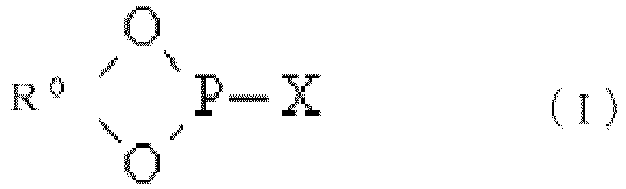
wobei das Phosphortrihalogenid und die Alkylenglykolverbindung unter Bedingungen reagiert werden, wo das Phosphortrihalogenid in einer überschüssigen Menge relativ zu der Menge der Alkylenglykolverbindung in dem Reaktionssystem vorhanden ist;- Reagieren des zyklischen Phosphorhaledits dargestellt durch die allgemeine Formel (I) mit einer Verbindung mit einer Hydroxylgruppe dargestellt durch die allgemeine Formel (V):
R(OH)n (V)
worin n eine ganze Zahl von 1 bis 4 ist, und R ist ein aliphatischer Rest mit 1 bis 8 Kohlenstoffatomen oder ein aromatischer Rest mit 6 bis 18 Kohlenstoffatomen, der einen Substituenten haben kann und der dargestellt ist durch die allgemeine Formel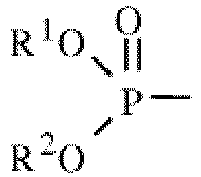

Oxidieren des Reaktionsprodukts, um einen zyklischen Phosphorsäureester zu erhalten, dargestellt durch die allgemeine Formel (VII):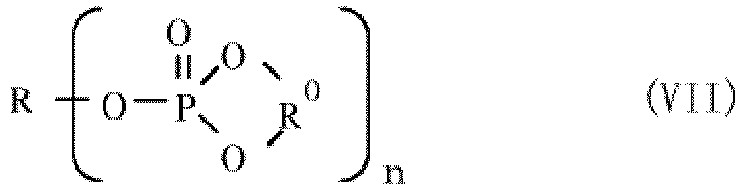
- Das Verfahren zur Herstellung eines zyklischen Phosphorsäureesters gemäß Anspruch 1, worin die Verbindung mit einer Hydroxylgruppe der allgemeinen Formel (V) Ethanol, Propanol, Butanol, Phenol, Cresol, Xylenol, Phenylphenol, Dibutyl(1-hydroxy-1-methylethyl)phosphonat, Dibutylhydroxymethylphosphonat, Ethylenglykol, 1,3-Propandiol oder 1,4-Butandiol ist.
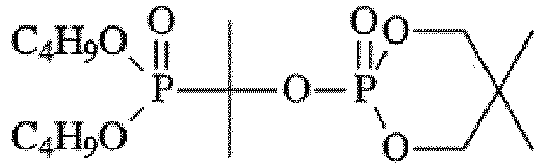
- Das Verfahren zur Herstellung eines zyklischen Phosphorsäureesters gemäß Anspruch 1 oder 2, worin der zyklische Phosphorsäureester der allgemeinen Formel (VII)


- Das Verfahren zur Herstellung eines zyklischen Phosphorsäureesters gemäß irgendeinem der Ansprüche 1 bis 3, worin das Phosphortrihalogenid der allgemeinen Formel (III) in einem Verhältnis von 0,99 bis 1,15 Mol in Bezug auf 1 Mol der Alkylenglykolverbindung der allgemeinen Formel (III) verwendet wird.
- Das Verfahren zur Herstellung eines zyklischen Phosphorsäureesters gemäß irgendeinem der Ansprüche 1 bis 6, worin die Alkylenglykolverbindung der allgemeinen Formel (II) eine 1,3-Propandiolverbindung dargestellt durch die allgemeine Formel (IV) ist:

- Das Verfahren zur Herstellung eines zyklischen Phosphorsäureesters gemäß irgendeinem der Ansprüche 1 bis 5, worin die Alkylenglykolverbindung der allgemeinen Formel (II) Neopentylglykol oder 2-Butyl-2-ethyl-1,3-propandiol ist.
- Das Verfahren zur Herstellung eines zyklischen Phosphorsäureesters gemäß irgendeinem der Ansprüche 1 bis 6, worin das Phosphortrihalogenid der allgemeinen Formel (III) Phosphortrichlorid oder Phosphortribromid ist.
Applications Claiming Priority (2)
| Application Number | Priority Date | Filing Date | Title |
|---|---|---|---|
| JP2009229622 | 2009-10-01 | ||
| PCT/JP2010/066322 WO2011040287A1 (ja) | 2009-10-01 | 2010-09-21 | 環状アルキレンホスホロハリダイトおよび環状リン酸エステルの製造方法 |
Publications (3)
| Publication Number | Publication Date |
|---|---|
| EP2495247A1 EP2495247A1 (de) | 2012-09-05 |
| EP2495247A4 EP2495247A4 (de) | 2014-07-23 |
| EP2495247B1 true EP2495247B1 (de) | 2018-09-12 |
Family
ID=43826111
Family Applications (1)
| Application Number | Title | Priority Date | Filing Date |
|---|---|---|---|
| EP10820406.6A Active EP2495247B1 (de) | 2009-10-01 | 2010-09-21 | Verfahren zur herstellung von zyklischem alkylenphosphohalidat und eines zyklischen phosphorsäureesters |
Country Status (7)
| Country | Link |
|---|---|
| US (1) | US8674130B2 (de) |
| EP (1) | EP2495247B1 (de) |
| JP (1) | JP5762297B2 (de) |
| KR (1) | KR101743003B1 (de) |
| CN (1) | CN102549004A (de) |
| TW (1) | TWI469991B (de) |
| WO (1) | WO2011040287A1 (de) |
Families Citing this family (3)
| Publication number | Priority date | Publication date | Assignee | Title |
|---|---|---|---|---|
| DE202016104862U1 (de) | 2016-09-02 | 2016-09-20 | Shi-Yi Huang | Anordnung eines Schnelllöse-Bithalters |
| CN114621289B (zh) * | 2022-02-21 | 2024-11-15 | 苏州亚科科技股份有限公司 | 一种环状磷酸酯的制备工艺及其应用 |
| GB2623319A (en) * | 2022-10-11 | 2024-04-17 | Af Chempharm Ltd | Method of synthesis of chloro-oxo-dioxaphospholane oxides and derivates |
Citations (1)
| Publication number | Priority date | Publication date | Assignee | Title |
|---|---|---|---|---|
| JP2004277349A (ja) * | 2003-03-17 | 2004-10-07 | Mitsui Chemicals Inc | 光学活性リン化合物の触媒的合成方法 |
Family Cites Families (19)
| Publication number | Priority date | Publication date | Assignee | Title |
|---|---|---|---|---|
| GB1536778A (en) | 1975-11-21 | 1978-12-20 | Upjohn Co | Bis(hydroxyalkyl)dialkylaminomethanephosphonates |
| US4173602A (en) * | 1975-11-21 | 1979-11-06 | The Upjohn Company | Process for preparing spirocyclic phosphorus compounds |
| US4427813A (en) * | 1981-12-14 | 1984-01-24 | The Dow Chemical Co. | Polycarbonate containing a bis(cyclic phosphate) as a thermal stabilizer |
| JPH02273688A (ja) | 1989-04-14 | 1990-11-08 | Sanyo Kagaku Kenkyusho:Kk | 環状亜リン酸エステル誘導体 |
| US5225467A (en) | 1991-11-01 | 1993-07-06 | Witco Corporation | Cellulose ester resin stabilizer and cellulose ester resin compositions stabilized therewith |
| JP3074588B2 (ja) * | 1993-03-16 | 2000-08-07 | 大八化学工業株式会社 | 難燃性ポリウレタン樹脂組成物 |
| ES2131162T3 (es) | 1993-07-22 | 1999-07-16 | Gen Electric | Neodiolfosfitos como estabilizadores de polimeros. |
| US5605947A (en) | 1993-07-22 | 1997-02-25 | General Electric Company | Amorphous neo-diol phosphite compositions |
| JPH10101687A (ja) | 1996-08-07 | 1998-04-21 | Sumitomo Chem Co Ltd | 亜リン酸エステル類、その製造方法及びその用途 |
| JP3645078B2 (ja) | 1997-12-19 | 2005-05-11 | 大八化学工業株式会社 | ポリウレタン系樹脂用難燃剤およびそれを含有する樹脂組成物 |
| US5919966A (en) * | 1998-03-26 | 1999-07-06 | General Electric Company | Process for the preparation of spiro bis-phosphites |
| EP1219677B1 (de) * | 1999-07-09 | 2010-12-08 | Daihachi Chemical Industry Co., Ltd. | Flammschutzmittel für harze und flammgeschützte harzzusammensetzung die diese enthalten |
| JP2001220395A (ja) | 2000-02-08 | 2001-08-14 | Teijin Chem Ltd | 芳香族環状リン酸エステル化合物 |
| DE10210918B4 (de) | 2002-03-13 | 2004-06-03 | Oxeno Olefinchemie Gmbh | Verfahren zur Herstellung von Bisphosphiten |
| US7521496B2 (en) * | 2003-06-09 | 2009-04-21 | Daihachi Chemical Industry Co., Ltd. | Organophosphorus compound having phosphate-phosphonate bond, and flame-retardant polyester fiber and flame-retardant polyurethane resin composition each containing the same |
| JP4206306B2 (ja) * | 2003-07-02 | 2009-01-07 | 大八化学工業株式会社 | 難燃性ポリエステル繊維 |
| US7772440B2 (en) | 2004-11-02 | 2010-08-10 | Daihachi Chemical Industry Co., Ltd. | Process for preparing phosponates having alcoholic hydroxyl group |
| CN100577670C (zh) | 2004-11-02 | 2010-01-06 | 大八化学工业株式会社 | 具有磷酸酯-膦酸酯键的磷化合物的制备方法 |
| KR101286484B1 (ko) * | 2005-09-14 | 2013-07-16 | 다이하치 카가쿠 고교 가부시키가이샤 | 인 화합물, 그의 용도 및 난연성 폴리에스테르 섬유 |
-
2010
- 2010-09-21 EP EP10820406.6A patent/EP2495247B1/de active Active
- 2010-09-21 US US13/497,955 patent/US8674130B2/en active Active
- 2010-09-21 JP JP2011534204A patent/JP5762297B2/ja active Active
- 2010-09-21 CN CN2010800423311A patent/CN102549004A/zh active Pending
- 2010-09-21 KR KR1020127010655A patent/KR101743003B1/ko active Active
- 2010-09-21 WO PCT/JP2010/066322 patent/WO2011040287A1/ja not_active Ceased
- 2010-09-30 TW TW99133244A patent/TWI469991B/zh active
Patent Citations (1)
| Publication number | Priority date | Publication date | Assignee | Title |
|---|---|---|---|---|
| JP2004277349A (ja) * | 2003-03-17 | 2004-10-07 | Mitsui Chemicals Inc | 光学活性リン化合物の触媒的合成方法 |
Also Published As
| Publication number | Publication date |
|---|---|
| US8674130B2 (en) | 2014-03-18 |
| KR101743003B1 (ko) | 2017-06-02 |
| CN102549004A (zh) | 2012-07-04 |
| TWI469991B (zh) | 2015-01-21 |
| EP2495247A4 (de) | 2014-07-23 |
| JPWO2011040287A1 (ja) | 2013-02-28 |
| US20120264965A1 (en) | 2012-10-18 |
| TW201120054A (en) | 2011-06-16 |
| EP2495247A1 (de) | 2012-09-05 |
| KR20120095885A (ko) | 2012-08-29 |
| WO2011040287A1 (ja) | 2011-04-07 |
| JP5762297B2 (ja) | 2015-08-12 |
Similar Documents
| Publication | Publication Date | Title |
|---|---|---|
| KR101345181B1 (ko) | 포스페이트-포스포네이트 결합을 가지는 인 화합물의제조방법 | |
| EP1651737B1 (de) | Phosphonate als flammschutzmittel für thermoplastische kunststoffe | |
| EP2495247B1 (de) | Verfahren zur herstellung von zyklischem alkylenphosphohalidat und eines zyklischen phosphorsäureesters | |
| CN112142779B (zh) | 一种双酚a双(磷酸二芳酯)的快速制备方法 | |
| US9969845B2 (en) | Hydroxyl-containing poly(alkylene phosphates) | |
| US12479871B2 (en) | Method of preparing symmetrical phosphate-based compound | |
| KR101864260B1 (ko) | 인산 에스터 제조 방법 | |
| RU2528053C2 (ru) | Способ получения диалкилфосфитов | |
| US8802883B2 (en) | Method for the manufacture of dialkylphosphites | |
| JP4097384B2 (ja) | ジアリールホスホロハリデートの製造方法 | |
| EP1810975B1 (de) | Verfahren zur herstellung von phosphonaten mit alkoholischer hydroxygruppe | |
| JP3871399B2 (ja) | ペンタエリスリトールホスフェートの製造方法 | |
| EP0578319A1 (de) | Verfahren zur Herstellung von Bis(Pentaerythritol) Carbonat | |
| KR20250147155A (ko) | 비스페놀 a 비스(디페닐 포스페이트)의 제조방법, 이에 의해 제조된 비스페놀 a 비스(디페닐 포스페이트) 및 이를 포함하는 난연제 | |
| JP2013180965A (ja) | 2−ジ置換ホスホリル−1,4−ジヒドロキシナフタレン化合物及びその製造法 | |
| KR20230060027A (ko) | 비대칭형 포스페이트계 화합물의 제조방법 | |
| JP2004035471A (ja) | 金属含有リン系化合物の製造方法 |
Legal Events
| Date | Code | Title | Description |
|---|---|---|---|
| PUAI | Public reference made under article 153(3) epc to a published international application that has entered the european phase |
Free format text: ORIGINAL CODE: 0009012 |
|
| 17P | Request for examination filed |
Effective date: 20120417 |
|
| AK | Designated contracting states |
Kind code of ref document: A1 Designated state(s): AL AT BE BG CH CY CZ DE DK EE ES FI FR GB GR HR HU IE IS IT LI LT LU LV MC MK MT NL NO PL PT RO SE SI SK SM TR |
|
| DAX | Request for extension of the european patent (deleted) | ||
| A4 | Supplementary search report drawn up and despatched |
Effective date: 20140625 |
|
| RIC1 | Information provided on ipc code assigned before grant |
Ipc: C07F 9/6574 20060101AFI20140619BHEP |
|
| 17Q | First examination report despatched |
Effective date: 20151130 |
|
| GRAP | Despatch of communication of intention to grant a patent |
Free format text: ORIGINAL CODE: EPIDOSNIGR1 |
|
| INTG | Intention to grant announced |
Effective date: 20180308 |
|
| GRAJ | Information related to disapproval of communication of intention to grant by the applicant or resumption of examination proceedings by the epo deleted |
Free format text: ORIGINAL CODE: EPIDOSDIGR1 |
|
| GRAP | Despatch of communication of intention to grant a patent |
Free format text: ORIGINAL CODE: EPIDOSNIGR1 |
|
| INTC | Intention to grant announced (deleted) | ||
| INTG | Intention to grant announced |
Effective date: 20180625 |
|
| GRAS | Grant fee paid |
Free format text: ORIGINAL CODE: EPIDOSNIGR3 |
|
| GRAA | (expected) grant |
Free format text: ORIGINAL CODE: 0009210 |
|
| AK | Designated contracting states |
Kind code of ref document: B1 Designated state(s): AL AT BE BG CH CY CZ DE DK EE ES FI FR GB GR HR HU IE IS IT LI LT LU LV MC MK MT NL NO PL PT RO SE SI SK SM TR |
|
| REG | Reference to a national code |
Ref country code: GB Ref legal event code: FG4D |
|
| REG | Reference to a national code |
Ref country code: CH Ref legal event code: EP |
|
| REG | Reference to a national code |
Ref country code: IE Ref legal event code: FG4D |
|
| REG | Reference to a national code |
Ref country code: DE Ref legal event code: R096 Ref document number: 602010053585 Country of ref document: DE |
|
| REG | Reference to a national code |
Ref country code: AT Ref legal event code: REF Ref document number: 1040449 Country of ref document: AT Kind code of ref document: T Effective date: 20181015 |
|
| REG | Reference to a national code |
Ref country code: NL Ref legal event code: MP Effective date: 20180912 |
|
| REG | Reference to a national code |
Ref country code: LT Ref legal event code: MG4D |
|
| PG25 | Lapsed in a contracting state [announced via postgrant information from national office to epo] |
Ref country code: BG Free format text: LAPSE BECAUSE OF FAILURE TO SUBMIT A TRANSLATION OF THE DESCRIPTION OR TO PAY THE FEE WITHIN THE PRESCRIBED TIME-LIMIT Effective date: 20181212 Ref country code: LT Free format text: LAPSE BECAUSE OF FAILURE TO SUBMIT A TRANSLATION OF THE DESCRIPTION OR TO PAY THE FEE WITHIN THE PRESCRIBED TIME-LIMIT Effective date: 20180912 Ref country code: GR Free format text: LAPSE BECAUSE OF FAILURE TO SUBMIT A TRANSLATION OF THE DESCRIPTION OR TO PAY THE FEE WITHIN THE PRESCRIBED TIME-LIMIT Effective date: 20181213 Ref country code: SE Free format text: LAPSE BECAUSE OF FAILURE TO SUBMIT A TRANSLATION OF THE DESCRIPTION OR TO PAY THE FEE WITHIN THE PRESCRIBED TIME-LIMIT Effective date: 20180912 Ref country code: NO Free format text: LAPSE BECAUSE OF FAILURE TO SUBMIT A TRANSLATION OF THE DESCRIPTION OR TO PAY THE FEE WITHIN THE PRESCRIBED TIME-LIMIT Effective date: 20181212 Ref country code: FI Free format text: LAPSE BECAUSE OF FAILURE TO SUBMIT A TRANSLATION OF THE DESCRIPTION OR TO PAY THE FEE WITHIN THE PRESCRIBED TIME-LIMIT Effective date: 20180912 |
|
| PG25 | Lapsed in a contracting state [announced via postgrant information from national office to epo] |
Ref country code: HR Free format text: LAPSE BECAUSE OF FAILURE TO SUBMIT A TRANSLATION OF THE DESCRIPTION OR TO PAY THE FEE WITHIN THE PRESCRIBED TIME-LIMIT Effective date: 20180912 Ref country code: AL Free format text: LAPSE BECAUSE OF FAILURE TO SUBMIT A TRANSLATION OF THE DESCRIPTION OR TO PAY THE FEE WITHIN THE PRESCRIBED TIME-LIMIT Effective date: 20180912 Ref country code: LV Free format text: LAPSE BECAUSE OF FAILURE TO SUBMIT A TRANSLATION OF THE DESCRIPTION OR TO PAY THE FEE WITHIN THE PRESCRIBED TIME-LIMIT Effective date: 20180912 |
|
| REG | Reference to a national code |
Ref country code: AT Ref legal event code: MK05 Ref document number: 1040449 Country of ref document: AT Kind code of ref document: T Effective date: 20180912 |
|
| PG25 | Lapsed in a contracting state [announced via postgrant information from national office to epo] |
Ref country code: AT Free format text: LAPSE BECAUSE OF FAILURE TO SUBMIT A TRANSLATION OF THE DESCRIPTION OR TO PAY THE FEE WITHIN THE PRESCRIBED TIME-LIMIT Effective date: 20180912 Ref country code: IS Free format text: LAPSE BECAUSE OF FAILURE TO SUBMIT A TRANSLATION OF THE DESCRIPTION OR TO PAY THE FEE WITHIN THE PRESCRIBED TIME-LIMIT Effective date: 20190112 Ref country code: PL Free format text: LAPSE BECAUSE OF FAILURE TO SUBMIT A TRANSLATION OF THE DESCRIPTION OR TO PAY THE FEE WITHIN THE PRESCRIBED TIME-LIMIT Effective date: 20180912 Ref country code: NL Free format text: LAPSE BECAUSE OF FAILURE TO SUBMIT A TRANSLATION OF THE DESCRIPTION OR TO PAY THE FEE WITHIN THE PRESCRIBED TIME-LIMIT Effective date: 20180912 Ref country code: EE Free format text: LAPSE BECAUSE OF FAILURE TO SUBMIT A TRANSLATION OF THE DESCRIPTION OR TO PAY THE FEE WITHIN THE PRESCRIBED TIME-LIMIT Effective date: 20180912 Ref country code: RO Free format text: LAPSE BECAUSE OF FAILURE TO SUBMIT A TRANSLATION OF THE DESCRIPTION OR TO PAY THE FEE WITHIN THE PRESCRIBED TIME-LIMIT Effective date: 20180912 Ref country code: IT Free format text: LAPSE BECAUSE OF FAILURE TO SUBMIT A TRANSLATION OF THE DESCRIPTION OR TO PAY THE FEE WITHIN THE PRESCRIBED TIME-LIMIT Effective date: 20180912 Ref country code: CZ Free format text: LAPSE BECAUSE OF FAILURE TO SUBMIT A TRANSLATION OF THE DESCRIPTION OR TO PAY THE FEE WITHIN THE PRESCRIBED TIME-LIMIT Effective date: 20180912 Ref country code: ES Free format text: LAPSE BECAUSE OF FAILURE TO SUBMIT A TRANSLATION OF THE DESCRIPTION OR TO PAY THE FEE WITHIN THE PRESCRIBED TIME-LIMIT Effective date: 20180912 |
|
| REG | Reference to a national code |
Ref country code: CH Ref legal event code: PL |
|
| PG25 | Lapsed in a contracting state [announced via postgrant information from national office to epo] |
Ref country code: PT Free format text: LAPSE BECAUSE OF FAILURE TO SUBMIT A TRANSLATION OF THE DESCRIPTION OR TO PAY THE FEE WITHIN THE PRESCRIBED TIME-LIMIT Effective date: 20190112 Ref country code: SM Free format text: LAPSE BECAUSE OF FAILURE TO SUBMIT A TRANSLATION OF THE DESCRIPTION OR TO PAY THE FEE WITHIN THE PRESCRIBED TIME-LIMIT Effective date: 20180912 Ref country code: SK Free format text: LAPSE BECAUSE OF FAILURE TO SUBMIT A TRANSLATION OF THE DESCRIPTION OR TO PAY THE FEE WITHIN THE PRESCRIBED TIME-LIMIT Effective date: 20180912 |
|
| REG | Reference to a national code |
Ref country code: BE Ref legal event code: MM Effective date: 20180930 |
|
| REG | Reference to a national code |
Ref country code: DE Ref legal event code: R097 Ref document number: 602010053585 Country of ref document: DE |
|
| REG | Reference to a national code |
Ref country code: IE Ref legal event code: MM4A |
|
| PG25 | Lapsed in a contracting state [announced via postgrant information from national office to epo] |
Ref country code: LU Free format text: LAPSE BECAUSE OF NON-PAYMENT OF DUE FEES Effective date: 20180921 |
|
| PLBE | No opposition filed within time limit |
Free format text: ORIGINAL CODE: 0009261 |
|
| STAA | Information on the status of an ep patent application or granted ep patent |
Free format text: STATUS: NO OPPOSITION FILED WITHIN TIME LIMIT |
|
| PG25 | Lapsed in a contracting state [announced via postgrant information from national office to epo] |
Ref country code: IE Free format text: LAPSE BECAUSE OF NON-PAYMENT OF DUE FEES Effective date: 20180921 Ref country code: MC Free format text: LAPSE BECAUSE OF FAILURE TO SUBMIT A TRANSLATION OF THE DESCRIPTION OR TO PAY THE FEE WITHIN THE PRESCRIBED TIME-LIMIT Effective date: 20180912 Ref country code: DK Free format text: LAPSE BECAUSE OF FAILURE TO SUBMIT A TRANSLATION OF THE DESCRIPTION OR TO PAY THE FEE WITHIN THE PRESCRIBED TIME-LIMIT Effective date: 20180912 |
|
| 26N | No opposition filed |
Effective date: 20190613 |
|
| PG25 | Lapsed in a contracting state [announced via postgrant information from national office to epo] |
Ref country code: SI Free format text: LAPSE BECAUSE OF FAILURE TO SUBMIT A TRANSLATION OF THE DESCRIPTION OR TO PAY THE FEE WITHIN THE PRESCRIBED TIME-LIMIT Effective date: 20180912 Ref country code: BE Free format text: LAPSE BECAUSE OF NON-PAYMENT OF DUE FEES Effective date: 20180930 Ref country code: LI Free format text: LAPSE BECAUSE OF NON-PAYMENT OF DUE FEES Effective date: 20180930 Ref country code: CH Free format text: LAPSE BECAUSE OF NON-PAYMENT OF DUE FEES Effective date: 20180930 |
|
| PG25 | Lapsed in a contracting state [announced via postgrant information from national office to epo] |
Ref country code: FR Free format text: LAPSE BECAUSE OF NON-PAYMENT OF DUE FEES Effective date: 20181112 |
|
| PG25 | Lapsed in a contracting state [announced via postgrant information from national office to epo] |
Ref country code: MT Free format text: LAPSE BECAUSE OF NON-PAYMENT OF DUE FEES Effective date: 20180921 |
|
| PG25 | Lapsed in a contracting state [announced via postgrant information from national office to epo] |
Ref country code: TR Free format text: LAPSE BECAUSE OF FAILURE TO SUBMIT A TRANSLATION OF THE DESCRIPTION OR TO PAY THE FEE WITHIN THE PRESCRIBED TIME-LIMIT Effective date: 20180912 |
|
| PG25 | Lapsed in a contracting state [announced via postgrant information from national office to epo] |
Ref country code: HU Free format text: LAPSE BECAUSE OF FAILURE TO SUBMIT A TRANSLATION OF THE DESCRIPTION OR TO PAY THE FEE WITHIN THE PRESCRIBED TIME-LIMIT; INVALID AB INITIO Effective date: 20100921 |
|
| PG25 | Lapsed in a contracting state [announced via postgrant information from national office to epo] |
Ref country code: CY Free format text: LAPSE BECAUSE OF FAILURE TO SUBMIT A TRANSLATION OF THE DESCRIPTION OR TO PAY THE FEE WITHIN THE PRESCRIBED TIME-LIMIT Effective date: 20180912 Ref country code: MK Free format text: LAPSE BECAUSE OF NON-PAYMENT OF DUE FEES Effective date: 20180912 |
|
| REG | Reference to a national code |
Ref country code: DE Ref legal event code: R082 Ref document number: 602010053585 Country of ref document: DE Representative=s name: SCHIEBER - FARAGO PATENTANWAELTE, DE Ref country code: DE Ref legal event code: R082 Ref document number: 602010053585 Country of ref document: DE Representative=s name: FARAGO PATENTANWALTSGESELLSCHAFT MBH, DE |
|
| REG | Reference to a national code |
Ref country code: DE Ref legal event code: R082 Ref document number: 602010053585 Country of ref document: DE Representative=s name: SCHIEBER - FARAGO PATENTANWAELTE, DE |
|
| PGFP | Annual fee paid to national office [announced via postgrant information from national office to epo] |
Ref country code: DE Payment date: 20250918 Year of fee payment: 16 |
|
| PGFP | Annual fee paid to national office [announced via postgrant information from national office to epo] |
Ref country code: GB Payment date: 20250916 Year of fee payment: 16 |