EP2483573B1 - Portalhubwagen zum einsatz in containerterminals und für andere transportaufgaben - Google Patents
Portalhubwagen zum einsatz in containerterminals und für andere transportaufgaben Download PDFInfo
- Publication number
- EP2483573B1 EP2483573B1 EP10765373.5A EP10765373A EP2483573B1 EP 2483573 B1 EP2483573 B1 EP 2483573B1 EP 10765373 A EP10765373 A EP 10765373A EP 2483573 B1 EP2483573 B1 EP 2483573B1
- Authority
- EP
- European Patent Office
- Prior art keywords
- straddle carrier
- carrier according
- spring
- frame
- hoisting
- Prior art date
- Legal status (The legal status is an assumption and is not a legal conclusion. Google has not performed a legal analysis and makes no representation as to the accuracy of the status listed.)
- Active
Links
Images

Classifications
-
- F—MECHANICAL ENGINEERING; LIGHTING; HEATING; WEAPONS; BLASTING
- F16—ENGINEERING ELEMENTS AND UNITS; GENERAL MEASURES FOR PRODUCING AND MAINTAINING EFFECTIVE FUNCTIONING OF MACHINES OR INSTALLATIONS; THERMAL INSULATION IN GENERAL
- F16F—SPRINGS; SHOCK-ABSORBERS; MEANS FOR DAMPING VIBRATION
- F16F1/00—Springs
- F16F1/36—Springs made of rubber or other material having high internal friction, e.g. thermoplastic elastomers
- F16F1/362—Springs made of rubber or other material having high internal friction, e.g. thermoplastic elastomers made of steel wool, compressed hair, woven or non-woven textile, or like materials
-
- B—PERFORMING OPERATIONS; TRANSPORTING
- B66—HOISTING; LIFTING; HAULING
- B66C—CRANES; LOAD-ENGAGING ELEMENTS OR DEVICES FOR CRANES, CAPSTANS, WINCHES, OR TACKLES
- B66C13/00—Other constructional features or details
- B66C13/04—Auxiliary devices for controlling movements of suspended loads, or preventing cable slack
- B66C13/06—Auxiliary devices for controlling movements of suspended loads, or preventing cable slack for minimising or preventing longitudinal or transverse swinging of loads
-
- B—PERFORMING OPERATIONS; TRANSPORTING
- B66—HOISTING; LIFTING; HAULING
- B66C—CRANES; LOAD-ENGAGING ELEMENTS OR DEVICES FOR CRANES, CAPSTANS, WINCHES, OR TACKLES
- B66C13/00—Other constructional features or details
- B66C13/04—Auxiliary devices for controlling movements of suspended loads, or preventing cable slack
- B66C13/10—Auxiliary devices for controlling movements of suspended loads, or preventing cable slack for preventing cable slack
- B66C13/105—Auxiliary devices for controlling movements of suspended loads, or preventing cable slack for preventing cable slack electrical
-
- B—PERFORMING OPERATIONS; TRANSPORTING
- B66—HOISTING; LIFTING; HAULING
- B66C—CRANES; LOAD-ENGAGING ELEMENTS OR DEVICES FOR CRANES, CAPSTANS, WINCHES, OR TACKLES
- B66C13/00—Other constructional features or details
- B66C13/16—Applications of indicating, registering, or weighing devices
-
- B—PERFORMING OPERATIONS; TRANSPORTING
- B66—HOISTING; LIFTING; HAULING
- B66C—CRANES; LOAD-ENGAGING ELEMENTS OR DEVICES FOR CRANES, CAPSTANS, WINCHES, OR TACKLES
- B66C19/00—Cranes comprising trolleys or crabs running on fixed or movable bridges or gantries
- B66C19/007—Cranes comprising trolleys or crabs running on fixed or movable bridges or gantries for containers
-
- B—PERFORMING OPERATIONS; TRANSPORTING
- B66—HOISTING; LIFTING; HAULING
- B66D—CAPSTANS; WINCHES; TACKLES, e.g. PULLEY BLOCKS; HOISTS
- B66D1/00—Rope, cable, or chain winding mechanisms; Capstans
- B66D1/26—Rope, cable, or chain winding mechanisms; Capstans having several drums or barrels
-
- F—MECHANICAL ENGINEERING; LIGHTING; HEATING; WEAPONS; BLASTING
- F16—ENGINEERING ELEMENTS AND UNITS; GENERAL MEASURES FOR PRODUCING AND MAINTAINING EFFECTIVE FUNCTIONING OF MACHINES OR INSTALLATIONS; THERMAL INSULATION IN GENERAL
- F16F—SPRINGS; SHOCK-ABSORBERS; MEANS FOR DAMPING VIBRATION
- F16F3/00—Spring units consisting of several springs, e.g. for obtaining a desired spring characteristic
- F16F3/08—Spring units consisting of several springs, e.g. for obtaining a desired spring characteristic with springs made of a material having high internal friction, e.g. rubber
Definitions
- the invention relates to a straddle carrier for use in container terminals and for other transport tasks, with a frame, a load suspension device that hangs between the frame and can be locked with a container, carriers that are arranged at the lower region of the frame and each a variety in have a row of arranged wheels, and hoisting winches, by means of which hoisting ropes can be rolled up and unrolled, which are attached to the hoisting winches at one end and are guided by means of lifting rope bearing points on the load-carrying means and frame side.
- the invention is based on the object of developing the gantry pallet truck described at the outset for use in container terminals and for other transport tasks in such a way that the mechanical loads to be absorbed by its lifting ropes are considerably reduced.
- This object is achieved with a comparatively low mechanical and structural outlay in that a spring device is arranged on at least one hoist rope bearing point of each hoist rope of the gantry lifting truck, by means of which load impacts transmitted to the hoist ropes can be damped.
- the load peaks of each mechanical load on the hoisting ropes are absorbed by means of the spring device assigned to the respective hoisting rope, with the result that the lifespan of the hoisting ropes is considerably increased or that - with the same planned lifespan - the technical requirements for the lifting ropes can be reduced.
- a spring device is assigned to a fixed point bearing of the lifting rope on the frame side.
- embodiments according to the invention are also expedient in which a spring device is assigned to a deflecting roller bearing of the lifting rope on the frame side.
- the spring devices have a load cell, by means of which the height of load impacts exerted on the lifting rope can be determined, it can be stored for each lifting rope what mechanical stresses it is subjected to has been. This enables maintenance and / or replacement intervals to be optimized.
- the straddle carrier According to a further advantageous embodiment of the straddle carrier according to the invention, its spring devices have a slack rope detection device, by means of which the slackening of the respective lifting rope can be detected.
- irregular operating states are automatically ascertained in which a load to be transported by means of the straddle carrier is not carried by all lifting ropes.
- the slack rope detection device advantageously has two plate elements that are prestressed away from one another and whose distance can be measured.
- the pre-tensioned plate elements are pressed towards each other by the loads acting on the hoist rope against the spring preload, and in the event that there is no load on the hoist rope, the distance between the two plate elements exceeds a predeterminable maximum distance, from which a slack hoist rope is indicated by means of the slack rope detection device Signal is generated.
- a damping unit of the spring device which actually serves to reduce the mechanical stress advantageously has two spring elements arranged one behind the other in the load direction of the lifting cable.
- the spring elements can be separated from one another by means of an intermediate plate, so that the deformations to be absorbed by the spring elements are distributed as evenly as possible over the entire damping unit.
- the spring elements of the damping device made of a metal mesh body or the like are advantageous. formed, which on the one hand has the robustness required for the operation of the spring devices and on the other hand has elastic restoring forces which enable a long service life for the spring device.
- a straddle carrier 1 which is explained in more detail below, has a frame 2, to which an upper frame 3 belongs, from which four vertical supports 4 extend downward.
- the vertical supports 4 are arranged approximately at the corners of the rectangular upper frame 3.
- a travel carrier 5 is attached to both sides of the straddle carrier 1, of which in Figure 1 only one is visible.
- the frame 2 connects the two chassis 5 in the manner of a portal.
- a load-carrying device for example a spreader 6, is provided, which is arranged between the vertical supports 4 of the frame 2 assigned to the two driving beams 5.
- the spreader 6 can be connected or locked to a container 8 by suitable connecting means 7.
- the spreader 6 is in the in Figure 1 Embodiment of the portal truck 1 shown on the upper frame 3 of the frame 2 provided lifting jacks 9 between the vertical supports 4 of the frame 2 can be raised and lowered vertically.
- the spreader 6 is suspended from the hoisting winches 9 by means of hoisting ropes 10, which are each attached to the hoisting winches 9 at one end and are guided by hoisting rope bearing points 11, 12, 13 on the spreader and frame side.
- a driver's cabin 14 is provided on the upper frame 3 of the frame 2, from which an operator of the straddle carrier 1 can drive and control the straddle 6 and the spreader 6.
- the hoist rope bearings 11, 12, 13 are designed as spreading-side deflection roller bearings 11, frame-side fixed point bearings 12 and frame-side deflection roller bearings 13.
- Figure 1 results in that in the Figure 1 left hoist rope 10 from the hoist winch 9 to the spreading-side deflection roller bearing 11 and back from there led to the fixed point bearing 12 on the frame side.
- Figure 1 Right hoist rope 10 runs from the hoist 9 to the frame-side deflection roller bearing 13, from there to the spreader-side deflection roller bearing 11 and then back to the frame-side fixed point bearing 12.
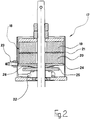
- Each hoist rope 10 is a hoist rope bearing point 11, 12 or 13 in Figure 2 shown spring device 17 associated.
- spring device 17 load surges occurring during operation of the portal lifting truck 1 or the spreader 6 are damped, so that the corresponding mechanical stresses on the lifting ropes 10 are reduced.
- the spring device 17 in the exemplary embodiment shown has a damping unit 18 which has two spring elements 19, 20 arranged one behind the other in the direction of loading of the lifting cable 10.
- the two spring elements 19, 20 are separated from one another by an intermediate plate 21.
- the latter is absorbed in substantial parts by means of the two spring elements 19, 20 which deform.
- the stress on the hoisting rope 10 is reduced accordingly.
- the spring elements 19, 20 of the damping unit 18 return to their original shape due to their restoring forces.
- the spring device 17 in the in Figure 2 shows a load cell 22, by means of which a load impact exerted on the lifting rope 10, ie the force exerted on the lifting rope 10 and in the spring device 17 stored force due to the deformation of the spring elements 19, 20 can be detected.
- the spring device 17 in in Figure 2 Embodiment shown a slack rope detection device 23, by means of which it can be determined when the hoisting rope 10 is free of load.
- the slack rope detection device 23 has a plate element 24 on the damping unit side and a plate element 25 on the load cell side, which are pretensioned away from one another by a separating spring 26. As soon as the distance between the two plate elements 24, 25 exceeds a predeterminable value, a corresponding signal can be generated by means of the slack rope detection device 23, by means of which it is communicated that the lifting rope 10 is load-free.
- the load cell 22 may generate signals indicating the respective level of a load surge and to forward them to a suitable control device.
- the two spring elements 19, 20 of the damping unit 18 of the spring device 17 are made of a robust material with an elasticity module suitable for corresponding loads.
- metal fabric bodies can be used for the spring elements 19, 20.
Landscapes
- Engineering & Computer Science (AREA)
- Mechanical Engineering (AREA)
- General Engineering & Computer Science (AREA)
- Textile Engineering (AREA)
- Control And Safety Of Cranes (AREA)
- Load-Engaging Elements For Cranes (AREA)
- Carriers, Traveling Bodies, And Overhead Traveling Cranes (AREA)
Description
- Die Erfindung bezieht sich auf einen Portalhubwagen zum Einsatz in Containerterminals und für andere Transportaufgaben, mit einem Rahmengestell, einem Lastaufnahmemittel, das zwischen dem Rahmengestell hängt und mit einem Container verriegelbar ist, Fahrträgern, die am unteren Bereich des Rahmengestells angeordnet sind und jeweils eine Vielzahl in einer Reihe angeordneter Räder aufweisen, und Hubwinden, mittels denen Hubseile auf- und abrollbar sind, die mit einem Ende an den Hubwinden angebracht und mittels lastaufnahmemittel- und rahmengestellseitiger Hubseillagerpunkte geführt sind.
- Im Betrieb derartiger Portalhubwagen werden deren Hubseile starken mechanischen Beanspruchungen unterzogen. Entsprechende Laststöße treten insbesondere bei Lastaufnahmen und bei bestimmten Fahrmanövern, insbesondere bei Brems- und Beschleunigungsvorgängen, auf.
DE 20 2006 017624 U1 offenbart einen Portalhubwagen gemäß dem Oberbegriff des Anspruchs 1. - Der Erfindung liegt die Aufgabe zugrunde, den eingangs geschilderten Portalhubwagen zum Einsatz in Containerterminals und für andere Transportaufgaben derart weiterzubilden, dass die von seinen Hubseilen aufzunehmenden mechanischen Beanspruchungen erheblich reduziert werden.
- Diese Aufgabe wird mit einem vergleichsweise geringen mechanisch-konstruktiven Aufwand dadurch gelöst, dass an zumindest einem Hubseillagerpunkt jedes Hubseils des Portalhubwagens eine Federeinrichtung angeordnet ist, mittels der auf die Hubseile übertragene Laststöße dämpfbar sind. Die Lastspitzen jeder mechanischen Beanspruchung der Hubseile werden erfindungsgemäß mittels der dem jeweiligen Hubseil zugeordneten Federeinrichtung aufgenommen, mit der Folge, dass die Lebensdauer der Hubseile erheblich erhöht ist bzw. dass - bei gleicher geplanter Lebensdauer - die technischen Anforderungen an die Hubseile reduziert werden können.
- Gemäß einer vorteilhaften Ausführungsform des erfindungsgemäßen Portalhubwagens ist einem rahmengestellseitigen Festpunktlager des Hubseils eine Federeinrichtung zugeordnet.
- Alternativ oder zusätzlich ist es möglich, einem lastaufnahmemittelseitigen Umlenkrollenlager des Hubseils eine Federeinrichtung zuzuordnen.
- Schließlich sind auch erfindungsgemäße Ausführungsformen zweckmäßig, bei denen einem rahmengestellseitigen Umlenkrollenlager des Hubseils eine Federeinrichtung zugeordnet ist.
- Sofern die Federeinrichtungen eine Kraftmessdose aufweisen, mittels der die Höhe von auf das Hubseil ausgeübten Laststößen ermittelbar ist, kann für jedes Hubseil abgespeichert werden, welchen mechanischen Beanspruchungen es unterzogen worden ist. Hierdurch können Wartungs- und/oder Austauschintervalle optimiert werden.
- Gemäß einer weiteren vorteilhaften Ausführungsform des erfindungsgemäßen Portalhubwagens weisen dessen Federeinrichtungen eine Schlaffseilerkennungseinrichtung auf, mittels der eine Erschlaffung des jeweiligen Hubseils erfassbar ist. Hierdurch werden automatisch irreguläre Betriebszustände erfassbar, bei denen eine mittels des Portalhubwagens zu transportierende Last nicht von allen Hubseilen getragen wird.
- Hierzu weist die Schlaffseilerkennungseinrichtung vorteilhaft zwei voneinander weg vorgespannte Plattenelemente auf, deren Abstand messbar ist. Üblicherweise werden die vorgespannten Plattenelemente durch die am Hubseil angreifenden Lasten gegen die Federvorspannung aufeinander zu gedrückt, wobei für den Fall, dass keine Last am Hubseil ist, der Abstand der beiden Plattenelemente einen vorgebbaren Maximalabstand überschreitet, ab dem mittels der Schlaffseilerkennungseinrichtung ein ein schlaffes Hubseil anzeigendes Signal generiert wird.
- Eine der eigentlichen Reduzierung der mechanischen Beanspruchung dienende Dämpfungseinheit der Federeinrichtung hat vorteilhaft zwei in Lastrichtung des Hubseils hintereinander angeordnete Federelemente. Die Federelemente können mittels einer Zwischenplatte voneinander getrennt sein, so dass die mittels der Federelemente aufzunehmenden Verformungen möglichst gleichmäßig auf die gesamte Dämpfungseinheit verteilt werden.
- Vorteilhaft sind die Federelemente der Dämpfungseinrichtung aus einem Metallgewebekörper od.dgl. ausgebildet, der einerseits über die für den Betrieb der Federeinrichtungen erforderliche Robustheit verfügt und andererseits elastische Rückstellkräfte aufweist, die für die Federeinrichtung eine lange Lebensdauer ermöglichen.
- Im Folgenden wird die Erfindung anhand einer Ausführungsform unter Bezugnahme auf die Zeichnung näher erläutert.
- Es zeigen:
- Figur 1
- eine Prinzipdarstellung eines erfindungsgemäßen Portalhubwagens (Straddle Carrier); und
- Figur 2
- eine Darstellung einer Ausführungsform einer Federeinrichtung des in
Figur 1 gezeigten erfindungsgemäßen Portalhubwagens. - Eine anhand der
Figuren 1 und2 im Folgenden näher erläuterte Ausführungsform eines erfindungsgemäßen Portalhubwagens (Straddle Carrier) 1 hat ein Rahmengestell 2, zu dem ein Oberrahmen 3 gehört, von dem aus vier vertikale Stützen 4 abwärts verlaufen. Die vertikalen Stützen 4 sind etwa an den Ecken des rechteckigen Oberrahmens 3 angeordnet. - An den oberrahmenfernen unteren Enden der an einer Längsseite des Oberrahmens 3 angeordneten beiden vertikalen Stützen 4 ist an beiden Seiten des Portalhubwagens 1 jeweils ein Fahrträger 5 angebracht, von denen in
Figur 1 nur einer sichtbar ist. Das Rahmengestell 2 verbindet die beiden Fahrträger 5 nach Art eines Portals. - Am Portalhubwagen 1 ist ein Lastaufnahmemittel, z.B. ein Spreader 6 vorgesehen, der zwischen den den beiden Fahrträgern 5 zugeordneten vertikalen Stützen 4 des Rahmengestells 2 angeordnet ist. Der Spreader 6 ist durch geeignete Verbindungsmittel 7 mit einem Container 8 verbind- bzw. verriegelbar. Des Weiteren ist der Spreader 6 mittels in der in
Figur 1 gezeigten Ausführungsform des Portalhubwagens 1 am Oberrahmen 3 des Rahmengestells 2 vorgesehener Hubwinden 9 zwischen den vertikalen Stützen 4 des Rahmengestells 2 vertikal anheb- und absenkbar. - Hierzu ist der Spreader 6 mittels Hubseilen 10, die mit jeweils einem Ende an den Hubwinden 9 befestigt sind und mittels spreader- und rahmengestellseitigen Hubseillagerpunkten 11, 12, 13 geführt sind, an den Hubwinden 9 aufgehängt.
- Am Oberrahmen 3 des Rahmengestells 2 ist eine Fahrerkabine 14 vorgesehen, aus der heraus eine Bedienungsperson des Portalhubwagens 1 diesen und den Spreader 6 fahren bzw. steuern kann. Die beiden Fahrträger 9 des Portalhubwagens 1, von denen in
Figur 1 , wie bereits erwähnt, nur einer sichtbar ist, haben in der dargestellten Ausführungsform des Portalhubwagens 1 jeweils vier Räder 15, denen jeweils ein am Fahrträger 5 gehalterter Radträger 16 zugeordnet ist. - Im dargestellten Ausführungsbeispiel des Portalhubwagens 1 sind die Hubseillagerungen 11, 12, 13 als spreaderseitige Umlenkrollenlager 11, rahmengestellseitige Festpunktlager 12 und rahmengestellseitige Umlenkrollenlager 13 ausgebildet. Wie sich aus der prinzipiellen Darstellung in
Figur 1 ergibt, ist das in derFigur 1 linke Hubseil 10 von der Hubwinde 9 zum spreaderseitigen Umlenkrollenlager 11 und von dort zurück zum rahmengestellseitigen Festpunktlager 12 geführt. Das inFigur 1 rechte Hubseil 10 läuft von der Hubwinde 9 zunächst zum rahmengestellseitigen Umlenkrollenlager 13, von dort zum spreaderseitigen Umlenkrollenlager 11 und dann zurück zum rahmengestellseitigen Festpunktlager 12. - Je Hubseil 10 ist einem Hubseillagerpunkt 11, 12 bzw. 13 eine in
Figur 2 gezeigte Federeinrichtung 17 zugeordnet. Mittels der Federeinrichtung 17 werden im Betrieb des Portalhubwagens 1 bzw. des Spreaders 6 auftretende Lastsstöße gedämpft, so dass die entsprechenden mechanischen Beanspruchungen der Hubseile 10 reduziert werden. - Hierzu weist die Federeinrichtung 17 im dargestellten Ausführungsbeispiel eine Dämpfungseinheit 18 auf, die zwei in Beanspruchungsrichtung des Hubseils 10 hintereinander angeordnete Federelemente 19, 20 hat. Die beiden Federelemente 19, 20 sind durch eine Zwischenplatte 21 voneinander getrennt. Bei einem auf das Hubseil 10 übertragenen Laststoß wird dieser zu wesentlichen Teilen mittels der beiden Federelemente 19, 20, die sich verformen, aufgenommen. Die Beanspruchung des Hubseils 10 wird entsprechend reduziert. Bei einem Nachlassen der Last nehmen die Federelemente 19, 20 der Dämpfungseinheit 18 aufgrund ihrer Rückstellkräfte wieder ihre ursprüngliche Form ein.
- Zur Erfassung der auf das Hubseil 10 ausgeübten Beanspruchungskräfte weist die Federeinrichtung 17 in der in
Figur 2 gezeigten Ausführungsform eine Kraftmessdose 22 auf, mittels der ein auf das Hubseil 10 ausgeübter Laststoß, d.h. die auf das Hubseil 10 ausgeübte Kraft und die in der Federeinrichtung 17 aufgrund der Verformung der Federelemente 19, 20 gespeicherte Kraft erfassbar ist. - Darüber hinaus hat die Federeinrichtung 17 im in
Figur 2 gezeigten Ausführungsbeispiel eine Schlaffseilerkennungseinrichtung 23, mittels der feststellbar ist, wenn das Hubseil 10 lastfrei ist. Hierzu hat die Schlaffseilerkennungseinrichtung 23 ein dämpfungseinheitsseitiges Plattenelemente 24 und ein kraftmessdosenseitiges Plattenelement 25, die durch eine Trennfeder 26 voneinander weg vorgespannt sind. Sobald der Abstand zwischen den beiden Plattenelementen 24, 25 einen vorgebbaren Wert übersteigt, kann mittels der Schlaffseilerkennungseinrichtung 23 ein entsprechendes Signal generiert werden, mittels dem mitgeteilt wird, dass das Hubseil 10 lastfrei ist. - Selbstverständlich ist es möglich, dass mittels der Kraftmessdose 22 die jeweilige Höhe eines Laststoßes anzeigende Signale generiert und an eine geeignete Steuervorrichtung weitergeleitet werden.
- Die beiden Federelemente 19, 20 der Dämpfungseinheit 18 der Federeinrichtung 17 sind aus einem robusten Werkstoff mit einem für entsprechende Belastungen geeigneten Elastizitätsmodul ausgebildet. Zum Beispiel können für die Federelemente 19, 20 Metallgewebekörper zum Einsatz kommen.
Claims (9)
- Portalhubwagen zum Einsatz in Containerterminals und für andere Transportaufgaben, mit einem Rahmengestell (2), einem Lastaufnahmemittel (6), das zwischen dem Rahmengestell (2) hängt und mit einem Container (8) verriegelbar ist, Fahrträgern (5), die am unteren Bereich des Rahmengestells (2) angeordnet sind und jeweils eine Vielzahl in einer Reihe angeordneter Räder (15) aufweisen, und Hubwinden (9), mittels denen Hubseile (10) auf- und abrollbar sind, die mit einem Ende an den Hubwinden (9) angebracht und mittels lastaufnahmemittel- und rahmengestellseitigen Hubseillagerpunkten (11, 12, 13) geführt sind, dadurch gekennzeichnet, dass an zumindest einem Hubseillagerpunkt (11, 12, 13) jedes Hubseils (10) des Portalhubwagens (1) eine Federeinrichtung (17) angeordnet ist, mittels der auf die Hubseile (10) übertragene Laststöße dämpfbar sind.
- Portalhubwagen nach Anspruch 1, bei dem einem rahmengestellseitigen Festpunktlager (12) des Hubseils (10) eine Federeinrichtung (17) zugeordnet ist.
- Portalhubwagen nach Anspruch 1 oder 2, bei dem einem lastaufnahmemittelseitigen Umlenkrollenlager (11) des Hubseils (10) eine Federeinrichtung (17) zugeordnet ist.
- Portalhubwagen nach einem der Ansprüche 1 bis 3, bei dem einem rahmengestellseitigen Umlenkrollenlager (13) des Hubseils (10) eine Federeinrichtung zugeordnet ist.
- Portalhubwagen nach einem der Ansprüche 1 bis 4, dessen Federeinrichtungen (17) eine Kraftmessdose (22) aufweisen, mittels der die Höhe des auf das Hubseil (10) ausgeübten Laststoßes ermittelbar ist.
- Portalhubwagen nach einem der Ansprüche 1 bis 5, dessen Federeinrichtungen (17) eine Schlaffseilerkennungseinrichtung (23) aufweisen, mittels denen eine Erschlaffung des Hubseils (10) erfassbar ist.
- Portalhubwagen nach Anspruch 6, bei dem die Schlaffseilerkennungseinrichtung (23) zwei voneinander weg vorgespannte Plattenelemente (24, 25) aufweist, deren Abstand messbar ist.
- Portalhubwagen nach einem der Ansprüche 1 bis 7, dessen Federeinrichtungen (17) eine Dämpfungseinheit (18) mit zumindest zwei in Lastrichtung hintereinander angeordneten Federelementen (19, 20) aufweisen.
- Portalhubwagen nach Anspruch 8, bei dem die Federelemente (19, 20) der Dämpfungseinrichtung (18) aus einem Metallgewebekörpern od.dgl. ausgebildet sind.
Priority Applications (1)
| Application Number | Priority Date | Filing Date | Title |
|---|---|---|---|
| PL10765373T PL2483573T3 (pl) | 2009-10-02 | 2010-09-22 | Wózek bramowy do stosowania w terminalach kontenerowych i do innych celów transportowych |
Applications Claiming Priority (2)
| Application Number | Priority Date | Filing Date | Title |
|---|---|---|---|
| DE102009048131A DE102009048131A1 (de) | 2009-10-02 | 2009-10-02 | Portalhubwagen zum Einsatz in Containerterminals und für andere Transportaufgaben |
| PCT/EP2010/005794 WO2011038852A1 (de) | 2009-10-02 | 2010-09-22 | Portalhubwagen zum einsatz in containerterminals und für andere transportaufgaben |
Publications (2)
| Publication Number | Publication Date |
|---|---|
| EP2483573A1 EP2483573A1 (de) | 2012-08-08 |
| EP2483573B1 true EP2483573B1 (de) | 2020-01-01 |
Family
ID=43402213
Family Applications (1)
| Application Number | Title | Priority Date | Filing Date |
|---|---|---|---|
| EP10765373.5A Active EP2483573B1 (de) | 2009-10-02 | 2010-09-22 | Portalhubwagen zum einsatz in containerterminals und für andere transportaufgaben |
Country Status (6)
| Country | Link |
|---|---|
| EP (1) | EP2483573B1 (de) |
| CN (1) | CN102686900B (de) |
| DE (1) | DE102009048131A1 (de) |
| ES (1) | ES2779275T3 (de) |
| PL (1) | PL2483573T3 (de) |
| WO (1) | WO2011038852A1 (de) |
Families Citing this family (3)
| Publication number | Priority date | Publication date | Assignee | Title |
|---|---|---|---|---|
| DE102013003276B4 (de) | 2013-02-27 | 2024-10-02 | Liebherr-Werk Biberach Gmbh | Kran mit Seilschwingungsdämpfung |
| CN113086899B (zh) * | 2021-03-26 | 2022-05-17 | 常州大学 | 一种物流站点快递转运用堆放装置 |
| CN114016419B (zh) * | 2021-11-20 | 2023-09-26 | 山西路桥第八工程有限公司 | 高速公路混凝土防撞护栏施工的外挂篮 |
Citations (5)
| Publication number | Priority date | Publication date | Assignee | Title |
|---|---|---|---|---|
| GB386655A (en) | 1931-07-14 | 1933-01-16 | Babcock & Wilcox Ltd | Improvements in jib cranes, derricks, sheer legs, overhead travelling cranes, telphers, crabs and like lifting devices |
| US1906665A (en) | 1932-02-18 | 1933-05-02 | Ticknor Lewis Oscar | Shock absorbing sheave |
| DE3438985A1 (de) | 1984-10-24 | 1986-04-24 | Isetron Industrie-Sicherheits-Elektronik GmbH, 2940 Wilhelmshaven | Vorrichtung fuer hebeeinrichtungen |
| FR2669317A1 (fr) | 1990-11-16 | 1992-05-22 | Yvonne Rouzier | Mouvements automatiques de levage synchronises guides par capteurs. |
| DE202006017624U1 (de) * | 2006-11-18 | 2007-02-15 | Noell Mobile Systems & Cranes Gmbh | Spreader mit Flachführung zum Erfassen und Transportieren von Containern an einem Portalhubwagen |
Family Cites Families (6)
| Publication number | Priority date | Publication date | Assignee | Title |
|---|---|---|---|---|
| GB715796A (en) * | 1952-05-28 | 1954-09-22 | Robinson Aviat Inc | Improvements in or relating to vibration isolation units |
| DE2033977C2 (de) * | 1970-07-08 | 1982-12-16 | Tax, Hans, 8000 München | Mit Pendeldämpfungsvorrichtung versehene Seilaufhängung eines Lastaufnahmemittels |
| US4715762A (en) * | 1983-02-24 | 1987-12-29 | Mi-Jack Products, Inc. | Grappler system for lifting apparatus |
| JPH0344782Y2 (de) * | 1985-08-08 | 1991-09-20 | ||
| JPH1135282A (ja) * | 1997-07-14 | 1999-02-09 | Meidensha Corp | 昇降用の吊り下げ材の弛み検出機構 |
| BE1016851A3 (nl) * | 2005-11-15 | 2007-08-07 | Combinus Bv Met Beperkte Aansp | Verbeterde portaalwagen. |
-
2009
- 2009-10-02 DE DE102009048131A patent/DE102009048131A1/de not_active Withdrawn
-
2010
- 2010-09-22 CN CN201080044989.6A patent/CN102686900B/zh active Active
- 2010-09-22 PL PL10765373T patent/PL2483573T3/pl unknown
- 2010-09-22 ES ES10765373T patent/ES2779275T3/es active Active
- 2010-09-22 WO PCT/EP2010/005794 patent/WO2011038852A1/de not_active Ceased
- 2010-09-22 EP EP10765373.5A patent/EP2483573B1/de active Active
Patent Citations (5)
| Publication number | Priority date | Publication date | Assignee | Title |
|---|---|---|---|---|
| GB386655A (en) | 1931-07-14 | 1933-01-16 | Babcock & Wilcox Ltd | Improvements in jib cranes, derricks, sheer legs, overhead travelling cranes, telphers, crabs and like lifting devices |
| US1906665A (en) | 1932-02-18 | 1933-05-02 | Ticknor Lewis Oscar | Shock absorbing sheave |
| DE3438985A1 (de) | 1984-10-24 | 1986-04-24 | Isetron Industrie-Sicherheits-Elektronik GmbH, 2940 Wilhelmshaven | Vorrichtung fuer hebeeinrichtungen |
| FR2669317A1 (fr) | 1990-11-16 | 1992-05-22 | Yvonne Rouzier | Mouvements automatiques de levage synchronises guides par capteurs. |
| DE202006017624U1 (de) * | 2006-11-18 | 2007-02-15 | Noell Mobile Systems & Cranes Gmbh | Spreader mit Flachführung zum Erfassen und Transportieren von Containern an einem Portalhubwagen |
Non-Patent Citations (3)
| Title |
|---|
| "Straddle Carrier 50.000 kg from 2006 price ? 500.000,00", YOUTUBE-VIDEO, 16 August 2009 (2009-08-16), XP054981014, Retrieved from the Internet <URL:https://www.youtube.com/watch?v=3vpp8nZeGK0> |
| "Straddle Carrier", YOUTUBE-VIDEO, 4 August 2009 (2009-08-04), XP054981013, Retrieved from the Internet <URL:https://www.youtube.com/watch?v=Gyshpk1WCdM> |
| REINHOLD KUCHENMEISTER ET AL: "Portalstapler mit energieeffizienten Antrieben", MM-LOGISTIK, 7 October 2008 (2008-10-07), XP055740713 |
Also Published As
| Publication number | Publication date |
|---|---|
| PL2483573T3 (pl) | 2020-07-13 |
| DE102009048131A1 (de) | 2011-04-07 |
| CN102686900A (zh) | 2012-09-19 |
| WO2011038852A1 (de) | 2011-04-07 |
| EP2483573A1 (de) | 2012-08-08 |
| ES2779275T3 (es) | 2020-08-14 |
| CN102686900B (zh) | 2015-07-01 |
Similar Documents
| Publication | Publication Date | Title |
|---|---|---|
| EP2490977B1 (de) | Portalhubwagen mit einzelseilwinden | |
| DE202013012193U1 (de) | Reifen-Hebevorrichtung | |
| EP3768626A1 (de) | Gefederte hebevorrichtung für einen kran | |
| EP3212560A1 (de) | Portalhubgerät für iso-container | |
| EP1948551B1 (de) | Mobiler grosskran | |
| DE102008046154A1 (de) | Brücken- oder Portalkran, insbesondere zum Handhaben von ISO-Containern | |
| EP2799387A1 (de) | Flurförderzeug mit Fahrerschutzdach | |
| EP2279979B1 (de) | Vorrichtung zur Vormontage, Zwischenlagerung und zum Transport grosser Bauteile, insbesondere Bauteile von Windenergieanlagen | |
| DE102004027445A1 (de) | Vorrichtung zum Halten einer Last auf einem Lasttragmittel eines Flurförderzeugs | |
| DE102015005924A1 (de) | Hubwagen und Vorrichtung zum Transport von Lasten | |
| EP2483573A1 (de) | Portalhubwagen zum einsatz in containerterminals und für andere transportaufgaben | |
| WO2010112190A1 (de) | Traverse | |
| DE202004018066U1 (de) | Portalhubstapler für Container | |
| EP2480484B1 (de) | Portalhubwagen zum einsatz in containerterminals und für allgemeine transportzwecke | |
| EP1362821B1 (de) | Portalhubwagen | |
| DE202009009485U1 (de) | Ladungsbehälter mit höhenverstellbaren Zwischenböden und/oder höhenverstellbarem Dach | |
| DE3915304C2 (de) | ||
| DE102008022693A1 (de) | Hubvorrichtung | |
| EP3166881B1 (de) | Schwerlastfahrzeug mit einer hubvorrichtung zum heben und senken eines containers | |
| DE212013000133U1 (de) | Linearmotor-Antriebseinheit zum Bewegen von Lasten und Personen sowie Vorrichtungen zum Bewegen von Personen und Lasten mit derartigen Antriebseinheiten | |
| DE202013006584U1 (de) | Ballastvorrichtung zur Erzeugung einer Windenvorspannung | |
| EP2490976B1 (de) | Portalhubwagen zum einsatz in containerterminals und für allgemeine transportaufgaben | |
| WO2011032706A1 (de) | Portalhubwagen zum einsatz in containerterminals und für allgemeine transportaufgaben | |
| AT511379B1 (de) | Regalbediengerät mit bremsvorrichtung | |
| DE102020117437A1 (de) | Stapler-Anbaugerät |
Legal Events
| Date | Code | Title | Description |
|---|---|---|---|
| PUAI | Public reference made under article 153(3) epc to a published international application that has entered the european phase |
Free format text: ORIGINAL CODE: 0009012 |
|
| 17P | Request for examination filed |
Effective date: 20120321 |
|
| AK | Designated contracting states |
Kind code of ref document: A1 Designated state(s): AL AT BE BG CH CY CZ DE DK EE ES FI FR GB GR HR HU IE IS IT LI LT LU LV MC MK MT NL NO PL PT RO SE SI SK SM TR |
|
| DAX | Request for extension of the european patent (deleted) | ||
| 17Q | First examination report despatched |
Effective date: 20141027 |
|
| GRAP | Despatch of communication of intention to grant a patent |
Free format text: ORIGINAL CODE: EPIDOSNIGR1 |
|
| STAA | Information on the status of an ep patent application or granted ep patent |
Free format text: STATUS: GRANT OF PATENT IS INTENDED |
|
| RIC1 | Information provided on ipc code assigned before grant |
Ipc: F16F 3/08 20060101ALI20190828BHEP Ipc: B66C 13/10 20060101ALI20190828BHEP Ipc: B66C 13/16 20060101ALI20190828BHEP Ipc: B66D 1/26 20060101ALI20190828BHEP Ipc: B66C 13/06 20060101ALI20190828BHEP Ipc: F16F 1/362 20060101AFI20190828BHEP Ipc: B66C 19/00 20060101ALI20190828BHEP |
|
| INTG | Intention to grant announced |
Effective date: 20190923 |
|
| GRAS | Grant fee paid |
Free format text: ORIGINAL CODE: EPIDOSNIGR3 |
|
| GRAA | (expected) grant |
Free format text: ORIGINAL CODE: 0009210 |
|
| STAA | Information on the status of an ep patent application or granted ep patent |
Free format text: STATUS: THE PATENT HAS BEEN GRANTED |
|
| AK | Designated contracting states |
Kind code of ref document: B1 Designated state(s): AL AT BE BG CH CY CZ DE DK EE ES FI FR GB GR HR HU IE IS IT LI LT LU LV MC MK MT NL NO PL PT RO SE SI SK SM TR |
|
| REG | Reference to a national code |
Ref country code: GB Ref legal event code: FG4D Free format text: NOT ENGLISH |
|
| REG | Reference to a national code |
Ref country code: CH Ref legal event code: EP Ref country code: AT Ref legal event code: REF Ref document number: 1220148 Country of ref document: AT Kind code of ref document: T Effective date: 20200115 |
|
| REG | Reference to a national code |
Ref country code: IE Ref legal event code: FG4D Free format text: LANGUAGE OF EP DOCUMENT: GERMAN |
|
| REG | Reference to a national code |
Ref country code: DE Ref legal event code: R096 Ref document number: 502010016437 Country of ref document: DE |
|
| REG | Reference to a national code |
Ref country code: FI Ref legal event code: FGE |
|
| REG | Reference to a national code |
Ref country code: NL Ref legal event code: FP |
|
| REG | Reference to a national code |
Ref country code: LT Ref legal event code: MG4D |
|
| PG25 | Lapsed in a contracting state [announced via postgrant information from national office to epo] |
Ref country code: NO Free format text: LAPSE BECAUSE OF FAILURE TO SUBMIT A TRANSLATION OF THE DESCRIPTION OR TO PAY THE FEE WITHIN THE PRESCRIBED TIME-LIMIT Effective date: 20200401 Ref country code: LT Free format text: LAPSE BECAUSE OF FAILURE TO SUBMIT A TRANSLATION OF THE DESCRIPTION OR TO PAY THE FEE WITHIN THE PRESCRIBED TIME-LIMIT Effective date: 20200101 Ref country code: PT Free format text: LAPSE BECAUSE OF FAILURE TO SUBMIT A TRANSLATION OF THE DESCRIPTION OR TO PAY THE FEE WITHIN THE PRESCRIBED TIME-LIMIT Effective date: 20200527 Ref country code: CZ Free format text: LAPSE BECAUSE OF FAILURE TO SUBMIT A TRANSLATION OF THE DESCRIPTION OR TO PAY THE FEE WITHIN THE PRESCRIBED TIME-LIMIT Effective date: 20200101 |
|
| REG | Reference to a national code |
Ref country code: ES Ref legal event code: FG2A Ref document number: 2779275 Country of ref document: ES Kind code of ref document: T3 Effective date: 20200814 |
|
| PG25 | Lapsed in a contracting state [announced via postgrant information from national office to epo] |
Ref country code: LV Free format text: LAPSE BECAUSE OF FAILURE TO SUBMIT A TRANSLATION OF THE DESCRIPTION OR TO PAY THE FEE WITHIN THE PRESCRIBED TIME-LIMIT Effective date: 20200101 Ref country code: SE Free format text: LAPSE BECAUSE OF FAILURE TO SUBMIT A TRANSLATION OF THE DESCRIPTION OR TO PAY THE FEE WITHIN THE PRESCRIBED TIME-LIMIT Effective date: 20200101 Ref country code: IS Free format text: LAPSE BECAUSE OF FAILURE TO SUBMIT A TRANSLATION OF THE DESCRIPTION OR TO PAY THE FEE WITHIN THE PRESCRIBED TIME-LIMIT Effective date: 20200501 Ref country code: GR Free format text: LAPSE BECAUSE OF FAILURE TO SUBMIT A TRANSLATION OF THE DESCRIPTION OR TO PAY THE FEE WITHIN THE PRESCRIBED TIME-LIMIT Effective date: 20200402 Ref country code: HR Free format text: LAPSE BECAUSE OF FAILURE TO SUBMIT A TRANSLATION OF THE DESCRIPTION OR TO PAY THE FEE WITHIN THE PRESCRIBED TIME-LIMIT Effective date: 20200101 Ref country code: BG Free format text: LAPSE BECAUSE OF FAILURE TO SUBMIT A TRANSLATION OF THE DESCRIPTION OR TO PAY THE FEE WITHIN THE PRESCRIBED TIME-LIMIT Effective date: 20200401 |
|
| REG | Reference to a national code |
Ref country code: DE Ref legal event code: R026 Ref document number: 502010016437 Country of ref document: DE |
|
| PLBI | Opposition filed |
Free format text: ORIGINAL CODE: 0009260 |
|
| PLAX | Notice of opposition and request to file observation + time limit sent |
Free format text: ORIGINAL CODE: EPIDOSNOBS2 |
|
| PG25 | Lapsed in a contracting state [announced via postgrant information from national office to epo] |
Ref country code: RO Free format text: LAPSE BECAUSE OF FAILURE TO SUBMIT A TRANSLATION OF THE DESCRIPTION OR TO PAY THE FEE WITHIN THE PRESCRIBED TIME-LIMIT Effective date: 20200101 Ref country code: EE Free format text: LAPSE BECAUSE OF FAILURE TO SUBMIT A TRANSLATION OF THE DESCRIPTION OR TO PAY THE FEE WITHIN THE PRESCRIBED TIME-LIMIT Effective date: 20200101 Ref country code: SM Free format text: LAPSE BECAUSE OF FAILURE TO SUBMIT A TRANSLATION OF THE DESCRIPTION OR TO PAY THE FEE WITHIN THE PRESCRIBED TIME-LIMIT Effective date: 20200101 Ref country code: SK Free format text: LAPSE BECAUSE OF FAILURE TO SUBMIT A TRANSLATION OF THE DESCRIPTION OR TO PAY THE FEE WITHIN THE PRESCRIBED TIME-LIMIT Effective date: 20200101 Ref country code: DK Free format text: LAPSE BECAUSE OF FAILURE TO SUBMIT A TRANSLATION OF THE DESCRIPTION OR TO PAY THE FEE WITHIN THE PRESCRIBED TIME-LIMIT Effective date: 20200101 |
|
| REG | Reference to a national code |
Ref country code: FI Ref legal event code: MDE Opponent name: KONECRANES GLOBAL CORPORATION |
|
| 26 | Opposition filed |
Opponent name: KONECRANES GLOBAL CORPORATION Effective date: 20200930 |
|
| PLBB | Reply of patent proprietor to notice(s) of opposition received |
Free format text: ORIGINAL CODE: EPIDOSNOBS3 |
|
| PG25 | Lapsed in a contracting state [announced via postgrant information from national office to epo] |
Ref country code: SI Free format text: LAPSE BECAUSE OF FAILURE TO SUBMIT A TRANSLATION OF THE DESCRIPTION OR TO PAY THE FEE WITHIN THE PRESCRIBED TIME-LIMIT Effective date: 20200101 |
|
| PG25 | Lapsed in a contracting state [announced via postgrant information from national office to epo] |
Ref country code: MC Free format text: LAPSE BECAUSE OF FAILURE TO SUBMIT A TRANSLATION OF THE DESCRIPTION OR TO PAY THE FEE WITHIN THE PRESCRIBED TIME-LIMIT Effective date: 20200101 |
|
| REG | Reference to a national code |
Ref country code: CH Ref legal event code: PL |
|
| GBPC | Gb: european patent ceased through non-payment of renewal fee |
Effective date: 20200922 |
|
| PG25 | Lapsed in a contracting state [announced via postgrant information from national office to epo] |
Ref country code: LU Free format text: LAPSE BECAUSE OF NON-PAYMENT OF DUE FEES Effective date: 20200922 |
|
| PG25 | Lapsed in a contracting state [announced via postgrant information from national office to epo] |
Ref country code: FR Free format text: LAPSE BECAUSE OF NON-PAYMENT OF DUE FEES Effective date: 20200930 |
|
| PG25 | Lapsed in a contracting state [announced via postgrant information from national office to epo] |
Ref country code: LI Free format text: LAPSE BECAUSE OF NON-PAYMENT OF DUE FEES Effective date: 20200930 Ref country code: GB Free format text: LAPSE BECAUSE OF NON-PAYMENT OF DUE FEES Effective date: 20200922 Ref country code: CH Free format text: LAPSE BECAUSE OF NON-PAYMENT OF DUE FEES Effective date: 20200930 |
|
| REG | Reference to a national code |
Ref country code: AT Ref legal event code: MM01 Ref document number: 1220148 Country of ref document: AT Kind code of ref document: T Effective date: 20200922 |
|
| REG | Reference to a national code |
Ref country code: DE Ref legal event code: R100 Ref document number: 502010016437 Country of ref document: DE |
|
| PG25 | Lapsed in a contracting state [announced via postgrant information from national office to epo] |
Ref country code: AT Free format text: LAPSE BECAUSE OF NON-PAYMENT OF DUE FEES Effective date: 20200922 |
|
| PLCK | Communication despatched that opposition was rejected |
Free format text: ORIGINAL CODE: EPIDOSNREJ1 |
|
| PG25 | Lapsed in a contracting state [announced via postgrant information from national office to epo] |
Ref country code: TR Free format text: LAPSE BECAUSE OF FAILURE TO SUBMIT A TRANSLATION OF THE DESCRIPTION OR TO PAY THE FEE WITHIN THE PRESCRIBED TIME-LIMIT Effective date: 20200101 Ref country code: MT Free format text: LAPSE BECAUSE OF FAILURE TO SUBMIT A TRANSLATION OF THE DESCRIPTION OR TO PAY THE FEE WITHIN THE PRESCRIBED TIME-LIMIT Effective date: 20200101 Ref country code: CY Free format text: LAPSE BECAUSE OF FAILURE TO SUBMIT A TRANSLATION OF THE DESCRIPTION OR TO PAY THE FEE WITHIN THE PRESCRIBED TIME-LIMIT Effective date: 20200101 |
|
| PG25 | Lapsed in a contracting state [announced via postgrant information from national office to epo] |
Ref country code: MK Free format text: LAPSE BECAUSE OF FAILURE TO SUBMIT A TRANSLATION OF THE DESCRIPTION OR TO PAY THE FEE WITHIN THE PRESCRIBED TIME-LIMIT Effective date: 20200101 Ref country code: AL Free format text: LAPSE BECAUSE OF FAILURE TO SUBMIT A TRANSLATION OF THE DESCRIPTION OR TO PAY THE FEE WITHIN THE PRESCRIBED TIME-LIMIT Effective date: 20200101 |
|
| PLBN | Opposition rejected |
Free format text: ORIGINAL CODE: 0009273 |
|
| STAA | Information on the status of an ep patent application or granted ep patent |
Free format text: STATUS: OPPOSITION REJECTED |
|
| 27O | Opposition rejected |
Effective date: 20220127 |
|
| REG | Reference to a national code |
Ref country code: DE Ref legal event code: R082 Ref document number: 502010016437 Country of ref document: DE Representative=s name: MOSER GOETZE & PARTNER PATENTANWAELTE MBB, DE |
|
| PGFP | Annual fee paid to national office [announced via postgrant information from national office to epo] |
Ref country code: FI Payment date: 20240919 Year of fee payment: 15 Ref country code: IE Payment date: 20240919 Year of fee payment: 15 Ref country code: DE Payment date: 20240823 Year of fee payment: 15 |
|
| PGFP | Annual fee paid to national office [announced via postgrant information from national office to epo] |
Ref country code: BE Payment date: 20240920 Year of fee payment: 15 |
|
| PGFP | Annual fee paid to national office [announced via postgrant information from national office to epo] |
Ref country code: NL Payment date: 20240920 Year of fee payment: 15 |
|
| PGFP | Annual fee paid to national office [announced via postgrant information from national office to epo] |
Ref country code: PL Payment date: 20240823 Year of fee payment: 15 |
|
| PGFP | Annual fee paid to national office [announced via postgrant information from national office to epo] |
Ref country code: IT Payment date: 20240930 Year of fee payment: 15 Ref country code: ES Payment date: 20241018 Year of fee payment: 15 |
|
| REG | Reference to a national code |
Ref country code: DE Ref legal event code: R119 Ref document number: 502010016437 Country of ref document: DE |
|
| PG25 | Lapsed in a contracting state [announced via postgrant information from national office to epo] |
Ref country code: FI Free format text: LAPSE BECAUSE OF NON-PAYMENT OF DUE FEES Effective date: 20250922 |
|
| REG | Reference to a national code |
Ref country code: NL Ref legal event code: MM Effective date: 20251001 |
|
| REG | Reference to a national code |
Ref country code: BE Ref legal event code: MM Effective date: 20250930 |
|
| PG25 | Lapsed in a contracting state [announced via postgrant information from national office to epo] |
Ref country code: NL Free format text: LAPSE BECAUSE OF NON-PAYMENT OF DUE FEES Effective date: 20251001 |
|
| PG25 | Lapsed in a contracting state [announced via postgrant information from national office to epo] |
Ref country code: IT Free format text: LAPSE BECAUSE OF NON-PAYMENT OF DUE FEES Effective date: 20250922 |
|
| PG25 | Lapsed in a contracting state [announced via postgrant information from national office to epo] |
Ref country code: DE Free format text: LAPSE BECAUSE OF NON-PAYMENT OF DUE FEES Effective date: 20260401 |
|
| PG25 | Lapsed in a contracting state [announced via postgrant information from national office to epo] |
Ref country code: BE Free format text: LAPSE BECAUSE OF NON-PAYMENT OF DUE FEES Effective date: 20250930 Ref country code: IE Free format text: LAPSE BECAUSE OF NON-PAYMENT OF DUE FEES Effective date: 20250922 |