EP2462002B1 - Kraftfahrzeugsitz und verfahren zur überführung einer rückenlehne von der gebrauchs- in eine verstauposition - Google Patents
Kraftfahrzeugsitz und verfahren zur überführung einer rückenlehne von der gebrauchs- in eine verstauposition Download PDFInfo
- Publication number
- EP2462002B1 EP2462002B1 EP10744871.4A EP10744871A EP2462002B1 EP 2462002 B1 EP2462002 B1 EP 2462002B1 EP 10744871 A EP10744871 A EP 10744871A EP 2462002 B1 EP2462002 B1 EP 2462002B1
- Authority
- EP
- European Patent Office
- Prior art keywords
- seatback
- component
- relative
- locking
- rotational
- Prior art date
- Legal status (The legal status is an assumption and is not a legal conclusion. Google has not performed a legal analysis and makes no representation as to the accuracy of the status listed.)
- Not-in-force
Links
- 238000000034 method Methods 0.000 title claims description 17
- 230000008878 coupling Effects 0.000 claims 1
- 238000010168 coupling process Methods 0.000 claims 1
- 238000005859 coupling reaction Methods 0.000 claims 1
- 210000000078 claw Anatomy 0.000 description 8
- 230000005540 biological transmission Effects 0.000 description 4
- 230000000903 blocking effect Effects 0.000 description 2
- 238000006073 displacement reaction Methods 0.000 description 2
- 230000002349 favourable effect Effects 0.000 description 2
- 238000004904 shortening Methods 0.000 description 1
Images






Classifications
-
- B—PERFORMING OPERATIONS; TRANSPORTING
- B60—VEHICLES IN GENERAL
- B60N—SEATS SPECIALLY ADAPTED FOR VEHICLES; VEHICLE PASSENGER ACCOMMODATION NOT OTHERWISE PROVIDED FOR
- B60N2/00—Seats specially adapted for vehicles; Arrangement or mounting of seats in vehicles
- B60N2/02—Seats specially adapted for vehicles; Arrangement or mounting of seats in vehicles the seat or part thereof being movable, e.g. adjustable
- B60N2/22—Seats specially adapted for vehicles; Arrangement or mounting of seats in vehicles the seat or part thereof being movable, e.g. adjustable the back-rest being adjustable
-
- B—PERFORMING OPERATIONS; TRANSPORTING
- B60—VEHICLES IN GENERAL
- B60N—SEATS SPECIALLY ADAPTED FOR VEHICLES; VEHICLE PASSENGER ACCOMMODATION NOT OTHERWISE PROVIDED FOR
- B60N2/00—Seats specially adapted for vehicles; Arrangement or mounting of seats in vehicles
- B60N2/02—Seats specially adapted for vehicles; Arrangement or mounting of seats in vehicles the seat or part thereof being movable, e.g. adjustable
- B60N2/20—Seats specially adapted for vehicles; Arrangement or mounting of seats in vehicles the seat or part thereof being movable, e.g. adjustable the back-rest being tiltable, e.g. to permit easy access
- B60N2/206—Seats specially adapted for vehicles; Arrangement or mounting of seats in vehicles the seat or part thereof being movable, e.g. adjustable the back-rest being tiltable, e.g. to permit easy access to a position in which it can be used as a support for objects, e.g. as a tray
-
- B—PERFORMING OPERATIONS; TRANSPORTING
- B60—VEHICLES IN GENERAL
- B60N—SEATS SPECIALLY ADAPTED FOR VEHICLES; VEHICLE PASSENGER ACCOMMODATION NOT OTHERWISE PROVIDED FOR
- B60N2/00—Seats specially adapted for vehicles; Arrangement or mounting of seats in vehicles
- B60N2/02—Seats specially adapted for vehicles; Arrangement or mounting of seats in vehicles the seat or part thereof being movable, e.g. adjustable
- B60N2/20—Seats specially adapted for vehicles; Arrangement or mounting of seats in vehicles the seat or part thereof being movable, e.g. adjustable the back-rest being tiltable, e.g. to permit easy access
-
- B—PERFORMING OPERATIONS; TRANSPORTING
- B60—VEHICLES IN GENERAL
- B60N—SEATS SPECIALLY ADAPTED FOR VEHICLES; VEHICLE PASSENGER ACCOMMODATION NOT OTHERWISE PROVIDED FOR
- B60N2/00—Seats specially adapted for vehicles; Arrangement or mounting of seats in vehicles
- B60N2/02—Seats specially adapted for vehicles; Arrangement or mounting of seats in vehicles the seat or part thereof being movable, e.g. adjustable
- B60N2/22—Seats specially adapted for vehicles; Arrangement or mounting of seats in vehicles the seat or part thereof being movable, e.g. adjustable the back-rest being adjustable
- B60N2/2222—Seats specially adapted for vehicles; Arrangement or mounting of seats in vehicles the seat or part thereof being movable, e.g. adjustable the back-rest being adjustable the back-rest having two or more parts
-
- B—PERFORMING OPERATIONS; TRANSPORTING
- B60—VEHICLES IN GENERAL
- B60N—SEATS SPECIALLY ADAPTED FOR VEHICLES; VEHICLE PASSENGER ACCOMMODATION NOT OTHERWISE PROVIDED FOR
- B60N2/00—Seats specially adapted for vehicles; Arrangement or mounting of seats in vehicles
- B60N2/02—Seats specially adapted for vehicles; Arrangement or mounting of seats in vehicles the seat or part thereof being movable, e.g. adjustable
- B60N2/22—Seats specially adapted for vehicles; Arrangement or mounting of seats in vehicles the seat or part thereof being movable, e.g. adjustable the back-rest being adjustable
- B60N2/235—Seats specially adapted for vehicles; Arrangement or mounting of seats in vehicles the seat or part thereof being movable, e.g. adjustable the back-rest being adjustable by gear-pawl type mechanisms
-
- B—PERFORMING OPERATIONS; TRANSPORTING
- B60—VEHICLES IN GENERAL
- B60N—SEATS SPECIALLY ADAPTED FOR VEHICLES; VEHICLE PASSENGER ACCOMMODATION NOT OTHERWISE PROVIDED FOR
- B60N2/00—Seats specially adapted for vehicles; Arrangement or mounting of seats in vehicles
- B60N2/02—Seats specially adapted for vehicles; Arrangement or mounting of seats in vehicles the seat or part thereof being movable, e.g. adjustable
- B60N2/22—Seats specially adapted for vehicles; Arrangement or mounting of seats in vehicles the seat or part thereof being movable, e.g. adjustable the back-rest being adjustable
- B60N2/235—Seats specially adapted for vehicles; Arrangement or mounting of seats in vehicles the seat or part thereof being movable, e.g. adjustable the back-rest being adjustable by gear-pawl type mechanisms
- B60N2/2352—Seats specially adapted for vehicles; Arrangement or mounting of seats in vehicles the seat or part thereof being movable, e.g. adjustable the back-rest being adjustable by gear-pawl type mechanisms with external pawls
-
- B—PERFORMING OPERATIONS; TRANSPORTING
- B60—VEHICLES IN GENERAL
- B60N—SEATS SPECIALLY ADAPTED FOR VEHICLES; VEHICLE PASSENGER ACCOMMODATION NOT OTHERWISE PROVIDED FOR
- B60N2205/00—General mechanical or structural details
- B60N2205/30—Seat or seat parts characterised by comprising plural parts or pieces
Definitions
- the invention relates to a motor vehicle seat, in particular a rear seat for rear seats of motor vehicles. Furthermore, the invention relates to a method for displacement of a first and a second components relative to a base part, wherein the first and the second component are connected to each other by a first rotating means and the second component and the base part by a second rotating means.
- the invention has for its object to provide a method for folding a backrest of the use in the stowed position and a new, foldable vehicle seat, the vehicle seat is simple and without significant prior knowledge of the user to use and he in the folded state requires little space claimed.
- the method according to the invention relates to the displacement of a backrest, the first component, relative to a seat part, the base part, from a use position in which the backrest is provided substantially perpendicular to the seat part, preferably via a so-called easy entry known to the person skilled in the art -Stellung, in a stowed position, in which the backrest is provided substantially parallel to the seat part.
- first and second rotating means in particular rotation axes provided, which are preferably arranged parallel to each other.
- the first and second rotation means are automatically locked and unlocked relative to the base part relative to the second component and / or second component as a function of at least one position of the first component.
- the first component namely the backrest
- the second component can be displaced relative to the second component, in particular rotated through an angle, the second component remaining locked relative to the base part, for example the seat part, in a first position.
- This function is particularly important for comfort adjustment.
- the angle of attack of the backrest can be adjusted around its vertical position without the lock between the second component and the seat part is released.
- the second rotating means Upon rotation of the first component, namely the backrest, beyond a certain angle, the second rotating means is automatically unlocked and / or the first component is brought into abutment with a stop provided on the second component. This function allows the backrest to be transferred to an easy-entry position.
- a locking means of the first component is automatically brought into a lockable position, i. the locking means could lock the first component relative to the second component, but has not yet locked.
- a locking means of the second component relative to the base part is also automatically brought into a lockable, second position, preferably simultaneously with the locking means of the first component, i. also this locking means could lock the second component relative to the base part, but has not yet locked.
- both parts are automatically locked in their respective position after the component has reached its end position. This position is then, for example, the stowage of the backrest parallel to the seat part.
- the locking is effected by a latching means, in particular a latching pawl.
- the second component in particular after it has been moved to its second position, for example, the stowed position of the backrest, must be unlocked manually or by motor.
- the first component is automatically shortened or extended during a movement of the first component and the second component relative to one another and / or during a movement of the second component relative to the base part.
- the first component is the backrest and / or the base part of the seat part of a vehicle seat.
- Another object is a vehicle seat according to claim 11. Particularly preferably, this agent moves purely translationally.
- the statements made for the method according to the invention apply equally to the vehicle seat according to the invention and vice versa.
- the vehicle seat preferably has an upper fitting, which is pivotable about an upper horizontal axis of rotation, to which the backrest is generally connected and which can be releasably locked by means of an upper locking mechanism.
- the vehicle seat further comprises a second component, an intermediate part, which is preferably pivotally connected about a lower horizontal axis to a lower fitting and is preferably releasably lockable via a lower locking mechanism.
- the under fitting is usually connected to a seat part.
- FIG. 1 shows components of the inventively designed kinematics K of the vehicle seat, in a schematic exploded view.
- the kinematics K comprises a Lehnenschwenkgelenk GL for rotation of the backrest co-rotating with the backrest fitting 10 about an upper axis of rotation.
- the Lehnenschwenkgelenk GL is mechanically coupled to a pull arm 2 so that a rotational movement of the Lehenschwenkgelenks GL is transferable to the pull arm 2.
- the kinematics K further comprises a release member 3, which is in operative connection with the Lehnenschwenkgelenk GL via the Switzerlandarm 2..
- a lower pivot joint GU is non-rotatably connected to a fixed relative to the vehicle body lower fitting 40 to which an example in FIG. 3 represented seat part 4 is mounted.
- the kinematics K further comprises a lower locking unit VU for releasably locking the lower pivot joint GU.
- the locking unit VU in turn comprises a release arm 30, a locking cam 31 and a locking claw 32.
- a sliding strut 5 is provided with a guide slot which serves to guide the release arm 30.
- FIG. 2 shows a schematic sectional view of the basic structure B of the vehicle seat F in a favorable for the vehicle occupant for driving position of use.
- the base structure B includes the backrest fitting 10, which is connected via the Lehnenschwenkgelenk GL hinged to an intermediate part 6.
- the intermediate part 6 is articulated via the lower pivot joint GU, about a lower axis of rotation rotatably on the lower fitting 40.
- the base structure B has an upper locking device for releasably locking the Lehnenschwenkgelenkes GL and a lower locking device V for releasably locking the lower pivot joint GU.
- the Lehnenschwenkgelenk GL is unlocked in this convenient for a vehicle occupant to drive use position of the base structure B, while the lower pivot joint GU is locked.
- the backrest can thus be changed for the comfort adjustment in its inclination angle ⁇ .
- a control slot 20 in the pulling arm 2 serves for the movable guidance of the release member and thereby ultimately allows the pivoting of the backrest fitting 10 within a certain pivoting range for the comfort adjustment of the backrest 1, without being acted upon in this comfort adjustment to the upper locking device or on the lower locking device V.
- the locking cam 31 abuts on a stop lug 33 of the locking claw 32 and thereby holds the locking claw 32 in a position in which a provided on the locking claw 32 first gear 34 with one with the lower Swivel joint GU operatively connected second toothing 35 cooperates, so as ultimately to lock the lower pivot joint GU.
- FIG. 3 shows in a highly schematic representation of a vehicle seat F in a seat-use position, the in FIG. 2 shown use position of the base structure B corresponds.
- the vehicle seat F has a seat part 4 and the backrest 1 connected to the seat part 4 via the intermediate part 6, which rotates together with the backrest fitting 10.
- FIG. 4 shows the basic structure B of FIG. 2 with respect to the FIG. 2 slightly, to the inclination angle ⁇ to the front folded backrest fitting 10.
- the backrest pivot joint GL is still unlocked, while the lower pivot joint GU is still locked.
- FIG. 5 shows in a highly schematic representation of the vehicle seat F in a sitting position, the in FIG. 4 shown position of the base structure B corresponds.
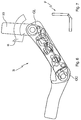
- FIG. 6 shows the basic structure B of Figure 4 with further (greater inclination angle ⁇ ) vorgeklapptem backrest fitting 10.
- the Lehnenschwenkgelenk GL is still unlocked, while the lower pivot joint GU is still locked.
- FIG. 7 shows in a highly schematic representation of the vehicle seat F in a sitting position, the in FIG. 6 shown position of the base structure B corresponds.
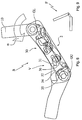
- FIG. 8 shows the basic structure B of FIG. 6 From this position of the backrest fitting 10 engages the standing with the Lehnenschwenkgelenk in operative connection pulling arm 2 on the release member, which in turn pushes a provided on release arm 30 pin in the guide slot of the slide strut.
- the release arm 30 begins to act on the lower locking device V such that the locking cam 31 dips into a blocking recess 36 provided on the locking claw 32, whereupon the locking claw 32 can move backwards, away from the lower pivot joint GU, and thus the first Gearing 34 begins to move away from the area of action of the second gearing 35 to thereby transfer the lower pivot joint GU from the locked state to the unlocked state.
- FIG. 9 shows the vehicle seat F in one of the in FIG. 8 shown position of the base structure B corresponding seating position, in a highly schematic representation.
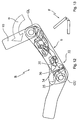
- FIG. 10 shows the basic structure B of FIG. 8 with still further (again larger inclination angle ⁇ ) vorgeklapptem backrest fitting 10.
- the locking cam 31 is even deeper in the locking recess 36 penetrated, whereby the locking claw 32 could retreat further to the rear.
- FIG. 11 shows the vehicle seat F in one of the in FIG. 10 shown position of the basic structure B corresponding seat division, in a highly schematic representation.
- FIG. 12 shows the basic structure B of FIG. 10
- the locking cam 31 is now completely immersed in the locking recess 36, so that the locking claw 32 could retreat so far to the rear, that the first gear 34 and the second gear 35 now out of engagement with even further (even greater angle of inclination ⁇ ) vorgeklapptem backrest fitting with each other and thus the lower pivot joint GU is unlocked.
- the backrest pivot joint GL is still held in the unlocked state by a slider, the backrest fitting 10 is now in a ready-to-lock position ready for locking.
- the intermediate part 6 rotates with the backrest fitting 10 about the lower axis of rotation.
- FIG. 13 shows in a highly schematic representation of the vehicle seat F in a sitting position, the in FIG. 12 shown position of the base structure B corresponds.
- FIG. 14 shows the basic structure B of Figure 12
- the lower pivot joint GU initially remains in the unlocked state until it is transferred into a second locking position (change in the angle ⁇ ) when the backrest movement continues.
- the lower locking device V Before reaching this second locking position, however, on the one hand the lower locking device V is first brought into a ready-to-lock position as a result of the backrest movement and, on the other hand, the rotation of the intermediate part 6 about the lower rotational axis is limited by a second stop stop.
- the kinematics K is designed so that the backrest pivot joint GL and the lower pivot joint GU are locked automatically by their respective associated locking devices only after reaching the second stop stop.
- the coupled to the relative movement of the lower fitting 40 with respect to the intermediate part slider is moved back, after which the Lehnenschwenkgelenk GL begins to rotate into a locked position.
- the backrest fitting 10 is now in contact with a first stop stop, so that further movement of the backrest fitting 10 and thus the backrest 1 is blocked to the front.
- FIG. 15 shows in a highly schematic representation of the vehicle seat F in a sitting position, the in FIG. 14 shown position of the base structure B corresponds.
- FIG. 16 shows the basic structure B of Fig. 14 with even further (even greater inclination angle ⁇ ) vorgeklapptem backrest fitting 10. The slider was moved back further and the Lehnenschwenkgelenk GL continues to rotate to its locked position.
- FIG. 17 shows in a highly schematic representation of the vehicle seat F in one of in FIG. 16 shown position of the base structure B corresponding seat division.
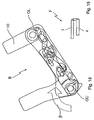
- FIG. 18 shows the basic structure B of FIG. 16
- the backrest pivot joint GL and the lower pivot joint GU are now each latched in a locked position.
- FIG. 19 shows in a highly schematic representation of the vehicle seat F in a sitting position, the in FIG. 18 shown end position of the basic structure corresponds.
- the locked backrest 1 is now arranged approximately horizontally over the seat part 4.
- the front of the seat back 1 and the top of the seat part 4 face each other.
- FIG. 20 a preferred or an additional separate object of the present invention is shown, in which the backrest 1 is shortened when folding from the use position to the stowed position or vice versa, is extended.
- a power transmission means 8 here a toothed belt, driven, the force or torque directly or indirectly to a transmission 9, here a bevel gear. transmits, which drives the length adjustment of the backrest, 1.
Landscapes
- Engineering & Computer Science (AREA)
- Aviation & Aerospace Engineering (AREA)
- Transportation (AREA)
- Mechanical Engineering (AREA)
- Seats For Vehicles (AREA)
- Chairs For Special Purposes, Such As Reclining Chairs (AREA)
Description
- Die Erfindung betrifft einen Kraftfahrzeugsitz, insbesondere einen Rücksitz für hintere Sitzreihen von Kraftfahrzeugen. Des weiteren betrifft die Erfindung ein Verfahren zur Verlagerung von einem ersten und einem zweiten Bauteilen relativ zu einem Basisteil, wobei das erste und das zweite Bauteil durch eine erstes Drehmittel und das zweite Bauteil und das Basisteil durch ein zweites Drehmittel jeweils miteinander verbunden sind.
- Kraftfahrzeugsitze, die zur Gewinnung von zusätzlichem Laderaum klappbar ausgeführt sind, sind in zahlreichen Ausgestaltungen am Markt vorhanden.
- Aus der
US6464299 sind ein Fahrzeugsitz und ein Verfahren zur Verlagerung des Fahrzeugsitzes mit den Merkmalen des Oberbegriffs des Anspruchs 11 bzw. des Anspruchs 1 bekannt. - Der Erfindung liegt die Aufgabe zugrunde, ein Verfahren zum Umklappen einer Rückenlehne von der Gebrauchs- in die Verstaustellung und einen neuen, klappbaren Fahrzeugsitz vorzuschlagen, wobei der Fahrzeugsitz einfach aufgebaut und ohne wesentliche Vorkenntnisse des Nutzers zu bedienen ist und er im zusammengeklappten Zustand einen geringen Platzbedarf beansprucht.
- Gelöst wird die Aufgabe mit einem Verfahren gemäß Anspruch 1.
- Das erfindungsgemäße Verfahren betrifft erfindungsgemäß die Verlagerung von einer Rückenlehne, dem ersten Bauteil, relativ zu einem Sitzteil, dem Basisteil, von einer Gebrauchsstellung, bei der die Rückenlehne im wesentlichen senkrecht zum Sitzteil vorgesehen ist, vorzugsweise über eine sogenannte, dem Fachmann geläufige Easy-Entry-Stellung, in eine Verstaustellung, in der die Rückenlehne im Wesentlichen parallel zu dem Sitzteil vorgesehen ist.
- Zwischen dem ersten Bauteil, nämlich der Rückenlehne, und dem Basisteil, nämlich dem Sitzteil, ist ein zweites Bauteil vorgesehen, das sowohl mit dem ersten Bauteil als auch mit dem Basisteil bewegbar, insbesondere drehbar, verbunden ist. Dafür sind erste und zweite Drehmittel, insbesondere Drehachsen vorgesehen, die vorzugsweise parallel zueinander angeordnet sind.
- Erfindungsgemäß ist nun vorgesehen, dass das erste und zweite Drehmittel in Abhängigkeit von mindestens einer Stellung des ersten Bauteils relativ zu dem zweiten Bauteil und/oder zweiten Bauteils relativ zu dem Basisteil automatisch ver- und entriegelt werden. Dadurch kann der Benutzer durch einfaches Drehen der Rückenlehne den Sitz von der Gebrauchsins die Verstaustellung überführen, ohne dass irgendwelche anderen Aktionen, wie beispielsweise Drücken von Knöpfen, Ziehen von Hebeln oder dergleichen vonnöten wäre.
- Erfindungsgemäß kann das erste Bauteil, nämlich die Rückenlehne, relativ zu dem zweiten Bauteil verlagert, insbesondere um einen Winkel gedreht werden, wobei das zweite Bauteil relativ zu dem Basisteil, beispielsweise dem Sitzteil, in einer ersten Position verriegelt bleibt. Diese Funktion ist insbesondere zur Komfortverstellung wichtig. Der Anstellwinkel der Rückenlehne kann um seine senkrechte Stellung herum verstellt werden, ohne dass die Verriegelung zwischen dem zweiten Bauteil und dem Sitzteil gelöst wird.
- Bei einer Drehung des ersten Bauteils, nämlich die Rückenlehne, über einen bestimmten Winkel hinaus, wird das zweite Drehmittel automatisch entriegelt und/oder das erste Bauteil mit einem an dem zweiten Bauteil vorgesehenen Anschlag zur Anlage gebracht wird. Diese Funktion ermöglicht es die Rückenlehne in eine Easy-Entry-Stellung zu überführen.
- Vorzugsweis wird bei einer, insbesondere weiteren, Relativbewegung zwischen dem zweiten Bauteil und dem Basisteil, ein Verriegelungsmittel des ersten Bauteils automatisch in eine verriegelbare Position gebracht, d.h. das Verriegelungsmittel könnte das erste Bauteil relativ zu dem zweiten Bauteil verriegeln, hat aber noch nicht verriegelt.
- Vorzugsweise wird ein Verriegelungsmittel des zweiten Bauteils relativ zu dem Basisteil ebenfalls, vorzugsweise gleichzeitig mit dem Verriegelungsmittel des ersten Bauteils, automatisch in eine verriegelbare, zweite Position gebracht wird, d.h. auch dieses Verriegelungsmittel könnte das zweite Bauteil relativ zu dem Basisteil verriegeln, hat aber noch nicht verriegelt.
- Vorzugsweise werden beide Baufeile automatisch in ihrer jeweiligen Position verriegelt, nachdem das Bauteil seine Endposition erreicht hat. Diese Stellung ist dann beispielsweise die Verstaustellung der Rückenlehne parallel zu dem Sitzteil.
- Vorzugsweise erfolgt die Verriegelung durch ein Rastmittel, insbesondere eine Rastklinke.
- Vorzugsweise muss das zweite Bauteil, insbesondere nachdem es in seine zweite Position, beispielsweise die Verstauposition der Rückenlehne verbracht worden ist, manuell oder motorisch entriegelt werden.
- Vorzugsweise erfolgt dann bei der Bewegung des Bauteils und des Basisteils relativ zueinander, die Entriegelung des ersten Bauteils automatisch.
- In einer bevorzugten Ausführungsform der vorliegenden Erfindung wird bei einer Bewegung des ersten Bauteils und des zweiten Bauteils relativ zueinander und/oder bei einer Bewegung des zweiten Bauteils relativ zu dem Basisteil das erste Bauteil automatisch verkürzt oder verlängert.
- Vorzugsweise ist das erste Bauteil die Rückenlehne und/oder das Basisteil der Sitzteil eines Fahrzeugsitzes.
- Ein weiterer Gegenstand ist ein Fahrzeugsitz gemäß Anspruch 11. Besonders bevorzugt bewegt sich dieses Mittel rein translatorisch. Die zu dem erfindungsgemäßen Verfahren gemachten Ausführungen gelten für den erfindungsgemäßen Fahrzeugsitz gleichermaßen und umgekehrt.
- Vorzugsweise weist der Fahrzeugsitz einen, um eine obere horizontale Drehachse schwenkbaren, oberen Beschlag auf, mit dem in der Regel die Rückenlehne verbunden ist und der über einen oberen Verriegelungsmechanismus lösbar vorriegelbar ist. Der Fahrzeugsitz weist ferner ein zweites Bauteil, ein Zwischenteil, auf, das vorzugsweise um eine untere horizontale Achse schwenkbar an einem unteren Beschlag angelenkt ist und vorzugsweise über einen unteren Verriegelungsmechanismus lösbar verriegelbar ist. Der unter Beschlag ist in der Regel mit einem Sitzteil verbunden.
- Die Kinematik dieses Fahrzeugsitzes ist vorzugsweise derart ausgeführt, dass
- die obere Drehachse entriegelt und die untere Drehachse verriegelt ist, wenn sich die Rückenlehne in einer Gebrauchsstellung, d.h. in einer für den Fahrzeuginsassen zum Fahren günstigen Lage befindet;
- die untere Drehachse selbsttätig entriegelt wird, sobald die Rückenlehne beim Vorklappen einen vorbestimmten Neigungswinkel gegenüber der Senkrechten erreicht;
- die Vorklappbewegung der Rückenlehne durch erste Stopmittel, insbesondere in der dem vorbestimmten Neigungswinkel entsprechenden Stopstellung der Rückenlehne begrenzt wird;
- nach der Entriegelung der unteren Drehachse, bei fortgesetzter Bewegung des oberen Beschlages, die Bewegung des oberen Beschlages auf das Zwischenteil übertragen, die Bewegung des Zwischenteil durch ein zweites Stopmittel begrenzt, und dadurch das Zwischenteil in einer definierten funktionalen Stellung gestoppt wird und/oder
- die obere und die untere Drehachse jeweils erst dann verriegelt werden, wenn der erfindungsgemäße Fahrzeugsitz in eine Endposition verstellt ist, in der die Rückenlehne in einer flachen Stellung über dem Sitzteil angeordnet ist; - die obere und die untere Drehachse in der Endposition des Sitzes nur durch eine irgendwie geartete, auf die Kinematik einwirkende, gezielte Betätigung seitens eines Nutzers entriegelt werden kann.
- Im Folgenden werden die Erfindungen anhand der
Figuren 1 - 20 erläutert. Diese Erläuterungen sind lediglich beispielhaft und schränken den allgemeinen Erfindungsgedanken nicht ein. Die Erläuterungen gelten für beide Erfindungsgegenstände gleichermaßen. - Es zeigen:
- Figur 1
- Komponenten der erfindungsgemäß ausgeführten Kinematik des Fahrzeugsitzes, in schematischer Explosionsdarstellung;
- Figur 2
- eine Basisstruktur des Fahrzeugsitzes in einer ersten Stellung, der Gebrauchsstellung, in schematischer Schnittdarstellung;
- Figur 3
- einen Fahrzeugsitz in einer der in
Figur 2 gezeigten Gebrauchsstellung der Basisstruktur entsprechenden SitzGebrauchsstellung, in stark schematisierter Darstellung; - Figur 4
- die Basisstruktur von
Figur 2 mit gegenüber derFigur 2 leicht nach vorne geklapptem Lehnenbeschlag; - Figur 5
- den Fahrzeugsitz in einer der in
Figur 4 gezeigten Stellung der Basisstruktur entsprechenden Sitzstelllung, in stark schematisierter Darstellung; - Figur 6
- die Basisstruktur von
Figur 4 mit in die aufrechte Stellung weiter vorgeklapptem Lehnenbeschlag; - Figur 7
- der Fahrzeugsitz in einer der in
Figur 6 gezeigten Stellung-der Basisstruktur entsprechenden Sitzstelllung, in stark schematisierter Darstellung; - Figur 8
- die Basisstruktur von
Figur 6 mit noch weiter vorgeklapptem Lehnenbeschlag; - Figur 9
- den Fahrzeugsitz in einer der in
Figur 8 gezeigten Stellung der Basisstruktur entsprechenden Sitzstelllung, in stark schematisierter Darstellung; - Figur 10
- die Basisstruktur von
Figur 8 mit noch weiter vorgeklapptem Lehnenbeschlag; - Figur 11
- den Fahrzeugsitz in einer der in
Figur 10 gezeigten Stellung der Basisstruktur entsprechenden Sitzstelllung, in stark schematisierter Darstellung; - Figur 12
- die Basisstruktur von
Fig.10 mit noch weiter vorgeklapptem Lehnenbeschlag; - Figur 13
- den Fahrzeugsitz in einer der in
Figur 12 gezeigten Stellung der Basisstruktur entsprechenden Sitzstellung, in stark schematisierter Darstellung; - Figur 14
- die Basisstruktur von
Fig. 12 mit noch weiter vorgeklapptem Lehnenbeschlag; - Figur 15
- den Fahrzeugsitz in einer der in Figur' 14, gezeigten Stellung der Basisstruktur entsprechenden Sitzstellung, in stark schematisierter Darstellung;
- Figur 16
- die Basisstruktur von
Fig. 14 mit noch weiter vorgeklapptem Lehnenbeschlag; - Figur 17
- den Fahrzeugsitz in einer der in
Figur 16 gezeigten Stellung der Basisstruktur entsprechenden Sitzstellung, in stark schematisierter Darstellung; - Figur 18
- die Basisstruktur von
Fig.16 mit in die waagerechte Endstellung weiter vorgeklapptem Lehnenbeschlag; - Figur 19
- den Fahrzeugsitz in einer der in
Figur 18 gezeigten Endstellung der Basisstruktur entsprechenden Sitzendstellung, in stark schematisierter Darstellung; - Figur 20
- zeigt die Verlängerung und Verkürzung der Rückenlehne;
-
Figur 1 zeigt Komponenten der erfindungsgemäß ausgeführten Kinematik K des Fahrzeugsitzes, in schematischer Explosionsdarstellung. Die Kinematik K umfasst ein Lehnenschwenkgelenk GL für eine Drehung des mit der Rückenlehne mitrotierenden Lehnenbeschlags 10 um eine obere Drehachse. - Das Lehnenschwenkgelenk GL ist mit einem Zugarm 2 mechanisch so gekoppelt, dass eine Drehbewegung des Lehnenschwenkgelenks GL auf den Zugarm 2 übertragbar ist.
- Die Kinematik K umfasst ferner ein Löseorgan 3, das über den Zugarm 2.mit dem Lehnenschwenkgelenk GL in Wirkverbindung steht.
- Ein unteres Schwenkgelenk GU ist drehfest mit einem bezüglich der Fahrzeugkarosserie feststehenden unteren Beschlag 40 verbunden, an dem ein z.B. in
Figur 3 dargestelltes Sitzteil 4 gelagert ist. - Die Kinematik K weist ferner eine untere Verriegelungseinheit VU zur lösbaren Verriegelung des unteren Schwenkgelenks GU auf. Die Verriegelungseinheit VU umfasst ihrerseits einen Lösearm 30, einen Sperrnocken 31 und eine Sperrklaue 32. Mit einer oberen Verriegelungseinheit VL kann der Beschlag 10 und damit die Rückenlehne relativ zu dem Zwischenteil
- Eine Gleitstrebe 5 ist mit einem Führungsschlitz versehen, der der Führung des Lösearms 30 dient.
-
Figur 2 zeigt in schematischer Schnittdarstellung die Basisstruktur B des Fahrzeugsitzes F in einer für den Fahrzeuginsassen zum Fahren günstigen Gebrauchsstellung. Die Basisstruktur B umfasst den Lehnenbeschlag 10, der über das Lehnenschwenkgelenk GL gelenkig mit einem Zwischenteil 6 verbunden ist. Das Zwischenteil 6 ist über das untere Schwenkgelenk GU, um eine untere Drehachse drehbar am unteren Beschlag 40 angelenkt. - Die Basisstruktur B weist eine obere Verriegelungseinrichtung zur lösbaren Verriegelung des Lehnenschwenkgelenkes GL und eine untere Verriegelungseinrichtung V zur lösbaren Verriegelung des unteren Schwenkgelenks GU auf.
- Das Lehnenschwenkgelenk GL ist in dieser für einen Fahrzeuginsassen zum Fahren günstigen Gebrauchsstellung der Basisstruktur B entriegelt, während das untere Schwenkgelenk GU verriegelt ist. Die Rückenlehne kann folglich für die Komfortverstellung in ihrem Neigungswinkel α verändert werden.
- Ein Steuerschlitz 20 im Zugarm 2 dient der beweglichen Führung des Löseorgans und erlaubt dadurch letztlich das Verschwenken des Lehnenbeschlags 10 innerhalb eines bestimmten Schwenkbereiches für die Komfortverstellung der Rückenlehne 1, ohne dass bei dieser Komfortverstellung auf die obere Verriegelungseinrichtung oder auf die untere Verriegelungseinrichtung V eingewirkt wird. Der Sperrnocken 31 liegt an einer Anschlagnase 33 der Sperrklaue 32 an und hält die Sperrklaue 32 dadurch in einer Position, in der eine an der Sperrklaue 32 vorgesehen erste Verzahnung 34 mit einer mit dem unteren Schwenkgelenk GU wirkverbundenen zweiten Verzahnung 35 zusammenwirkt, um so letztlich das untere Schwenkgelenk GU zu verriegeln.
-
Figur 3 zeigt in stark schematisierter Darstellung einen Fahrzeugsitz F in einer SitzGebrauchsstellung, die der inFigur 2 gezeigten Gebrauchsstellung der Basisstruktur B entspricht. Der Fahrzeugsitz F weist ein Sitzteil 4 und die über das Zwischenteil 6 mit dem Sitzteil 4 verbundene Rückenlehne 1 auf, die mit dem Lehnenbeschlag 10 mitrotiert. -
Figur 4 zeigt die Basisstruktur B vonFigur 2 mit gegenüber derFigur 2 leicht, um den Neigungswinkel α nach vorne geklapptem Lehnenbeschlag 10. Das Lehnenschwenkgelenk GL ist nach wie vor entriegelt, während das untere Schwenkgelenk GU noch immer verriegelt ist. -
Figur 5 zeigt in stark schematisierter Darstellung den Fahrzeugsitz F in einer Sitzstellung, die der inFigur 4 gezeigten Stellung der Basisstruktur B entspricht. -
Figur 6 zeigt die Basisstruktur B vonFig.4 mit weiter (größerer Neigungswinkel α) vorgeklapptem Lehnenbeschlag 10. Das Lehnenschwenkgelenk GL ist nach wie vor entriegelt, während das untere Schwenkgelenk GU noch immer verriegelt ist. -
Figur 7 zeigt in stark schematisierter Darstellung den Fahrzeugsitz F in einer Sitzstellung, die der inFigur 6 gezeigten Stellung der Basisstruktur B entspricht. -
Figur 8 zeigt die Basisstruktur B vonFigur 6 mit noch weiter (noch größerer Neigungswinkel α) vorgeklapptem Lehnenbeschlag 10. Von dieser Stellung des Lehnenbeschlags 10 an greift der mit der Lehnenschwenkgelenk GL in Wirkverbindung stehende Zugarm 2 am Löseorgan an, das seinerseits einen am Lösearm 30 vorgesehenen Stift in den Führungsschlitz der Gleiterstrebe drückt. In der Folge beginnt der Lösearm 30 auf die untere Verriegelungseinrichtung V derart einzuwirken, dass der Sperrnocken 31 in eine an der Sperrklaue 32 vorgesehene Sperrvertiefung 36 eintaucht, woraufhin die Sperrklaue 32 nach hinten, vom unteren Schwenkgelenk GU weg, zurückweichen kann, und damit die erste Verzahnung 34 beginnt, sich aus dem Wirkungsbereich der zweiten Verzahnung 35 zu entfernen, um dadurch das untere Schwenkgelenk GU vom verriegelten Zustand in den entriegelten Zustand zu überführen. -
Figur 9 zeigt den Fahrzeugsitz F in einer der inFigur 8 gezeigten Stellung der Basisstruktur B entsprechenden Sitzstellung, in stark schematisierter Darstellung. -
Figur 10 zeigt die Basisstruktur B vonFigur 8 mit noch weiter (nochmal größerer Neigungswinkel α) vorgeklapptem Lehnenbeschlag 10. Der Sperrnocken 31 ist noch tiefer in die Sperrvertiefung 36 eingedrungen, wodurch die Sperrklaue 32 noch weiter nach hinten zurückweichen konnte. -
Figur 11 zeigt den Fahrzeugsitz F in einer der inFigur 10 gezeigten Stellung der Basisstruktur B entsprechenden Sitzsteilung, in stark schematisierter Darstellung. -
Figur 12 zeigt die Basisstruktur B vonFigur 10 mit noch weiter (noch größerer Neigungswinkel α) vorgeklapptem Lehnenbeschlag 10. Der Sperrnocken 31 ist nun vollständig in die Sperrvertiefung 36 eingetaucht, so dass die Sperrklaue 32 so weit nach hinten zurückweichen konnte, dass die erste Verzahnung 34 und die zweite Verzahnung 35 jetzt außer Eingriff miteinander sind und damit das untere Schwenkgelenk GU entriegelt ist. Das Lehnenschwenkgelenk GL wird zwar noch von einem Gleiter im entriegelten Zustand gehalten, jedoch befindet sich der Lehnenbeschlag 10 nun in einer verrieglungsbereiten Position Ready-to-Lock-Position). Nach der Entriegelung des unteren Schwenkgelenk GU dreht sich das Zwischenteil 6 mit dem Lehnenbeschlag 10 um die untere Drehachse. -
Figur 13 zeigt in stark schematisierter Darstellung den Fahrzeugsitz F in einer Sitzstellung, die der inFigur 12 gezeigten Stellung der Basisstruktur B entspricht. -
Figur 14 zeigt die Basisstruktur B vonFig.12 mit noch weiter (noch größerer Neigungswinkel α) vorgeklapptem Lehnenbeschlag 10. Das untere Schwenkgelenk GU bleibt zunächst noch im entriegelten Zustand, bis es bei fortgesetzter Lehnenbewegung in eine zweite Verriegelungsposition (Veränderung des Winkels β) überführt wird. Vor dem Erreichen dieser zweiten Verriegelungsposition wird jedoch zum einen die untere Verriegelungseinrichtung V zunächst infolge der Lehnenbewegung in eine Ready-to-Lock-Position gebracht und zum anderen die Drehung des Zwischenteils 6 um die untere Drehachse durch einen zweiten Stopanschlag begrenzt. Dabei ist die Kinematik K so ausgelegt, dass das Lehnenschwenkgelenk GL und das untere Schwenkgelenk GU durch die ihnen jeweils zugeordneten Verriegelungseinrichtungen erst nach Erreichen des zweiten Stopanschlags selbsttätig verriegelt werden. Der an die Relativbewegung des unteren Beschlags 40 bezüglich des Zwischenteils gekoppelte Gleiter wird zurückbewegt, woraufhin das Lehnenschwenkgelenk GL beginnt, sich in eine verriegelte Position zu drehen. Der Lehnenbeschlag 10 befindet sich nun in Anlage mit einem ersten Stopanschlag, so dass eine weitere Bewegung des Lehnenbeschlags 10 und damit der Lehne 1 nach vorne blockiert ist. -
Figur 15 zeigt in stark schematisierter Darstellung den Fahrzeugsitz F in einer Sitzstellung, die der inFigur 14 gezeigten Stellung der Basisstruktur B entspricht. -
Figur 16 zeigt die Basisstruktur B vonFig. 14 mit noch weiter (noch größerer Neigungswinkel β) vorgeklapptem Lehnenbeschlag 10. Der Gleiter wurde noch weiter zurückbewegt und das Lehnenschwenkgelenk GL dreht sich weiter auf seine verriegelte Position zu. -
Figur 17 zeigt in stark schematisierter Darstellung den Fahrzeugsitz F in einer der inFigur 16 gezeigten Stellung der Basisstruktur B entsprechenden Sitzsteilung. -
Figur 18 zeigt die Basisstruktur B vonFigur 16 mit in die waagerechte Endstellung weiter vorgeklapptem Lehnenbeschlag 10. Das Lehnenschwenkgelenk GL und das untere Schwenkgelenk GU sind nun jeweils in einer verriegelten Position verrastet. - Um die Verriegelung des Lehnenschwenkgelenks GL und des unteren Schwenkgelenks GU in dieser Endstellung des Fahrzeugsitzes F zu lösen, ist es erforderlich, dass der Nutzer beispielsweise manuell oder über irgendwelche Aktuatoren die Verriegelung des unteren Schwenkgelenkes GU löst, wonach der Sitz wieder in die Ausgangsstellung d.h. in die Gebrauchsstellung verstellt werden kann. Das obere Schwenkgelenk GL entriegelt sich bei der Rückwärtsbewegung der Rückenlehne selbsttätig.
-
Figur 19 zeigt in stark schematisierter Darstellung den Fahrzeugsitz F in einer Sitzendstellung, die der inFigur 18 gezeigten Endstellung der Basisstruktur entspricht. Die arretierte Rückenlehne 1 ist nun annähernd waagerecht über dem Sitzteil 4 angeordnet. Die Vorderseite der Rückenlehne 1 und die Oberseite des Sitzteils 4 sind einander zugewandt. - In
Figur 20 ist eine bevorzugte oder ein zusätzlicher separater Gegenstand der vorliegenden Erfindung dargestellt, bei der die Rückenlehne 1 beim Vorklappen von der Gebrauchsstellung in die Verstaustellung verkürzt bzw. umgekehrt, verlängert wird. Durch Bewegen der Rückenlehne 1 nach vorne, insbesondere durch eine Drehung des zweiten Bauteils 6 um das untere Schwenkgelenk GU wird ein Kraftübertragungsmittel 8, hier ein Zahnriemen, angetrieben, der die Kraft oder das Drehmoment direkt oder indirekt auf ein Getriebe 9, hier ein Kegelradgetriebe. überträgt, das die Längenverstellung der Rückenlehne, 1 antreibt. - Bei dem erläuterten Ausführungsbeispiel gemäß den
Figuren 1 -20 werden bei der Kinematik nur mechanische Bauteile eingesetzt. Dem Fachmann wird jedoch klar sein, dass die oben angesprochene, prinzipielle Funktionsweise der Erfindung selbstverständlich z.B. auch durch andere Vorrichtungen, wie z.B. durch ein mechatronisches System, umgesetzt werden kann. -
- 1
- erstes Bauteil, Rückenlehne
- 2
- Zugarm
- 3
- Löseorgan
- 4
- Basisteil, Sitzteil
- 5
- Gleitstrebe
- 6
- zweites Bauteil, Zwischenteil
- 7
- Rastmittel, Sperrnocken
- 8
- Kraftübertragungsmittel, Zahnriemen
- 9
- Getriebe
- 10
- Lehnenbeschlag
- 11
- Gelenk
- 30
- Lösearm
- 31
- Rastmittel, Sperrnocken
- 32
- Sperrklaue
- 33
- Anschlagnase
- 34
- Verzahnung
- 35
- Verzahnung
- 36
- Sperrvertiefung
- 40
- Beschlag
- B
- Basisstruktur
- F
- Fahrzeugsitz
- GL
- erstes Drehmittel, Lehnenschwenkgelenk
- GU
- zweites Drehmittel, Schwenkgelenk
- VL
- Verriegelungseinrichtung des ersten Drehmittels
- VU
- Verriegelungseinrichtung des zweiten Drehmittels
- α
- Winkel zwischen dem ersten und dem zweiten Bauteil
- β
- Winkel zwischen dem zweiten Bauteil und dem Basisteil
Claims (12)
- Verfahren zur Verlagerung von einem ersten und einem zweiten Bauteil (1, 6) relativ zu einem Basisteil (4) von einer Gebrauchsstellung über eine Easy-Entry-Stellung in eine Verstaustellung, wobei als erstes Bauteil (1) eine Rückenlehne (1) und als Basisteil (4) ein Sitzteil (4) eines Fahrzeugsitzes vorgesehen wird, wobei das erste und das zweite Bauteil (1, 6) durch ein erstes Drehmittel (GL) und das zweite Bauteil (6) und das Basisteil (4) durch ein zweites Drehmittel (GU) jeweils miteinander verbunden sind, wobei das erste und zweite Drehmittel (GL, GU) in Abhängigkeit von mindestens einer Stellung des ersten Bauteils (1) relativ zu dem zweiten Bauteil (6) und/oder des zweiten Bauteils (6) relativ zu dem Basisteil (4) automatisch ver- und entriegelt werden, dadurch gekennzeichnet, dass das erste Drehmittel (GL) in der Gebrauchsstellung der Rückenlehne (1) nicht verriegelt wird und dass durch eine mechanische Kopplung des ersten Drehmittels (GL) mit einem Zugarm (2) die Drehbewegung des ersten Drehmittels (GL) auf den Zugarm (2) übertragen wird, der eine Wirkverbindung zwischen einem Löseorgan (3) und dem ersten Drehmittel (GL) bereitstellt, wobei ein Steuerschlitz (20) des Zugarms (2) der beweglichen Führung des Löseorgans (3) dient und dadurch letztlich das Verschwenken eines um die Rückenlehne mitrotierenden Gelenkbeschlags (10) innerhalb eines bestimmten Schwenkbereiches für eine Komfortverstellung der Rückenlehne (1) erlaubt.
- Verfahren nach Anspruch 1, dadurch gekennzeichnet, dass in einer ersten Stellung die Rückenlehne (1) relativ zu dem zweiten Bauteil verlagert, insbesondere um einen Winkel (α) gedreht, wird und das zweite Bauteil relativ zu dem Sitzteil in einer ersten Position verriegelt bleibt.
- Verfahren nach Anspruch 1 oder 2, dadurch gekennzeichnet, dass bei einer Drehung der Rückenlehne (1) über einen bestimmten Winkel (α) hinaus das zweite Drehmittel (GU) automatisch entriegelt wird und/oder die Rückenlehne (1) mit einem an dem zweiten Bauteil (6) vorgesehenen Anschlag zur Anlage gebracht wird.
- Verfahren nach Anspruch 3, dadurch gekennzeichnet, dass bei einer Relativbewegung zwischen dem zweiten Bauteil (6) und dem Sitzteil (4), ein Verriegelungsmittel (VL) der Rückenlehne (1) automatisch in eine verriegelbare Position gebracht wird.
- Verfahren nach Anspruch 4, dadurch gekennzeichnet, dass ein Verriegelungsmittel (VU) des zweiten Bauteils (6) ebenfalls, vorzugsweise gleichzeitig mit dem Verriegelungsmittel der Rückenlehne (1), automatisch in eine verriegelbare, zweite Position gebracht wird.
- Verfahren nach Anspruch 5, dadurch gekennzeichnet, dass beide Bauteile (1, 6) automatisch in ihrer jeweiligen Position verriegelt werden, nachdem die Rückenlehne (1) ihre Endposition erreicht hat.
- Verfahren nach einem der voranstehenden Ansprüche, dadurch gekennzeichnet, dass die Verriegelung durch ein Rastmittel, insbesondere eine Rastklinke erfolgt.
- Verfahren nach Anspruch 6 oder 7, dadurch gekennzeichnet, dass das zweite Bauteil (6) manuell oder motorisch entriegelt wird.
- Verfahren nach Anspruch 8, dadurch gekennzeichnet, dass bei einer Bewegung des zweiten Bauteils (6) und des Sitzteils (4) relativ zueinander, die Verriegelung der Rückenlehne (1) automatisch erfolgt.
- Verfahren nach einem der voranstehenden Ansprüche, dadurch gekennzeichnet, dass bei einer Bewegung der Rückenlehne (1) und des zweiten Bauteils (6) relativ zueinander und/oder bei einer Bewegung des zweiten Bauteils (6) relativ zu dem Sitzteil (4) die Rückenlehne (1) automatisch verkürzt oder verlängert wird.
- Fahrzeugsitz mit einer Rückenlehne (1), einem Zwischenteil (6), und einem Sitzteil (4) als ein Basisteil (4), wobei der Fahrzeugsitz von einer Gebrauchsstellung über eine Easy-Entry-Stellung in eine Verstaustellung verstellbar ist, wobei die Rückenlehne (1) und das Zwischenteil (6) durch eine erstes Drehmittel (GL) und das Zwischenteil (6) und das Sitzteil (4) durch ein zweites Drehmittel (GU) jeweils miteinander verbunden sind, die jeweils mit einem Verriegelungsmittel (VL, VU) in mindestens einer Position verriegelbar sind, wobei die Verriegelungsmittel (VL, VU) durch ein Mittel (5) so wirkverbunden sind, dass sich bei einer Relativbewegung (α, β) zwischen der Rückenlehne (1) und dem Zwischenteil (6) und/oder dem Zwischenteil (6) und dem Basisteil (4) mindesten ein Verriegelungsmittel (VL, VU) automatisch ver- und entriegelt, dadurch gekennzeichnet, dass das erste Drehmittel (GL) in der Gebrauchsstellung der Rückenlehne (1) nicht durch das Verriegelungsmittel (VL) verriegelt ist und dass das erste Drehmittel (GL) mit einem Zugarm (2) mechanisch derart gekoppelt ist, dass die Drehbewegung des ersten Drehmittels (GL) auf den Zugarm übertragen wird, der eine Wirkverbindung zwischen einem Löseorgan (3) und dem ersten Drehmittel (GL) bereitstellt, wobei ein Steuerschlitz (20) des Zugarms (2) der beweglichen Führung des Löseorgans (3) dient und dadurch letztlich das Verschwenken eines um die Rückenlehne mitrotierenden Gelenkbeschlags (10) innerhalb eines bestimmten Schwenkbereiches für eine Komfortverstellung der Rückenlehne (1) erlaubt.
- Fahrzeugsitz nach Anspruch 11, dadurch gekennzeichnet, sich das Mittel (5) rein translatorisch bewegt.
Applications Claiming Priority (3)
| Application Number | Priority Date | Filing Date | Title |
|---|---|---|---|
| DE102009036138 | 2009-08-05 | ||
| DE102010023765.5A DE102010023765B4 (de) | 2009-08-05 | 2010-06-15 | Verfahren zur Überführung einer Rückenlehne von der Gebrauchs- in eine Verstaustellung und Kraftfahrzeugsitz |
| PCT/EP2010/004667 WO2011015315A1 (de) | 2009-08-05 | 2010-07-30 | Kraftfahrzeugsitz und verfahren zur überführung einer rückenlehne von der gebrauchs- in eine verstauposition |
Publications (2)
| Publication Number | Publication Date |
|---|---|
| EP2462002A1 EP2462002A1 (de) | 2012-06-13 |
| EP2462002B1 true EP2462002B1 (de) | 2016-09-28 |
Family
ID=43448412
Family Applications (1)
| Application Number | Title | Priority Date | Filing Date |
|---|---|---|---|
| EP10744871.4A Not-in-force EP2462002B1 (de) | 2009-08-05 | 2010-07-30 | Kraftfahrzeugsitz und verfahren zur überführung einer rückenlehne von der gebrauchs- in eine verstauposition |
Country Status (8)
| Country | Link |
|---|---|
| US (1) | US8974001B2 (de) |
| EP (1) | EP2462002B1 (de) |
| JP (1) | JP5674784B2 (de) |
| KR (1) | KR101345678B1 (de) |
| CN (1) | CN102548793B (de) |
| DE (1) | DE102010023765B4 (de) |
| IN (1) | IN2012DN00993A (de) |
| WO (1) | WO2011015315A1 (de) |
Families Citing this family (9)
| Publication number | Priority date | Publication date | Assignee | Title |
|---|---|---|---|---|
| DE102012012983B4 (de) * | 2012-06-29 | 2014-04-24 | Isringhausen Gmbh & Co. Kg | Fahrzeugsitz mit Rückenlehnenneigungseinstellung sowie Schulteranpassung |
| US9085252B2 (en) * | 2013-05-02 | 2015-07-21 | GM Global Technology Operations LLC | Vehicle seat assembly with dual locked seating positions and method of adjusting a vehicle seat |
| EP3048004B1 (de) * | 2013-09-18 | 2018-04-04 | TS Tech Co., Ltd. | Fahrzeugsitz |
| US9622593B2 (en) * | 2014-01-14 | 2017-04-18 | Artsana Usa, Inc. | Pinch free folding lock |
| US10149552B2 (en) | 2015-01-06 | 2018-12-11 | Artsana Usa, Inc. | Pinch free folding lock |
| JP6871506B2 (ja) * | 2017-02-08 | 2021-05-12 | テイ・エス テック株式会社 | 中折れシートバック及び中折れシートバックを有する車両用シート |
| CN110920738B (zh) * | 2018-09-19 | 2022-07-26 | 明门瑞士股份有限公司 | 转动安全机构及具有该机构的座椅 |
| US11833937B2 (en) * | 2021-09-08 | 2023-12-05 | Faurecia Automotive Seating, Llc | Occupant support |
| CN114290967B (zh) * | 2022-01-10 | 2023-07-04 | 浙江吉利控股集团有限公司 | 座椅骨架、座椅及车辆 |
Citations (1)
| Publication number | Priority date | Publication date | Assignee | Title |
|---|---|---|---|---|
| US1663898A (en) * | 1924-09-18 | 1928-03-27 | Frank C Bitzenburger | Yieldable back support for seats |
Family Cites Families (11)
| Publication number | Priority date | Publication date | Assignee | Title |
|---|---|---|---|---|
| EP0410814B1 (de) | 1989-07-28 | 1995-09-13 | Fuji Kiko Company Limited | Kraftfahrzeugsitz mit einem Mechanismus zum Erleichtern des Zugangs |
| CN2093112U (zh) * | 1991-03-23 | 1992-01-15 | 施克礼 | 双关节汽车座椅调角器 |
| KR100291936B1 (ko) * | 1997-08-30 | 2001-11-26 | 이계안 | 승합차량용좌석의리클라이너닝과회전연동장치 |
| FR2799420B1 (fr) * | 1999-10-08 | 2002-01-04 | Faure Bertrand Equipements Sa | Siege de vehicule |
| US6513876B1 (en) * | 2000-11-17 | 2003-02-04 | Gayle D. Agler | Multiple function boat seat |
| CA2390667C (en) * | 2001-06-15 | 2006-01-03 | Faurecia Automotive Seating Canada Limited | Improved vehicle seat hinge mechanism with reclining with forward dumping, memory return and fold-flat functionality |
| DE10132701B4 (de) * | 2001-07-05 | 2008-11-06 | Keiper Gmbh & Co.Kg | Beschlag für einen Fahrzeugsitz |
| DE10149858C2 (de) * | 2001-10-10 | 2003-10-02 | Johnson Controls Gmbh | Fahrzeugsitz mit schwenkbarer Rückenlehne |
| KR100461102B1 (ko) * | 2002-08-08 | 2004-12-13 | 현대자동차주식회사 | 차량용 리어시트의 리클라이닝 장치 |
| FR2899161B1 (fr) * | 2006-03-30 | 2009-03-20 | Renault Sas | Siege de vehicule automobile repliable |
| US8376459B2 (en) * | 2007-12-03 | 2013-02-19 | Toyota Boshoku Kabushiki Kaisha | Vehicle seat |
-
2010
- 2010-06-15 DE DE102010023765.5A patent/DE102010023765B4/de not_active Expired - Fee Related
- 2010-07-30 KR KR1020127005873A patent/KR101345678B1/ko not_active Expired - Fee Related
- 2010-07-30 JP JP2012523231A patent/JP5674784B2/ja not_active Expired - Fee Related
- 2010-07-30 IN IN993DEN2012 patent/IN2012DN00993A/en unknown
- 2010-07-30 WO PCT/EP2010/004667 patent/WO2011015315A1/de not_active Ceased
- 2010-07-30 CN CN201080042798.6A patent/CN102548793B/zh not_active Expired - Fee Related
- 2010-07-30 EP EP10744871.4A patent/EP2462002B1/de not_active Not-in-force
- 2010-07-30 US US13/387,132 patent/US8974001B2/en active Active
Patent Citations (1)
| Publication number | Priority date | Publication date | Assignee | Title |
|---|---|---|---|---|
| US1663898A (en) * | 1924-09-18 | 1928-03-27 | Frank C Bitzenburger | Yieldable back support for seats |
Also Published As
| Publication number | Publication date |
|---|---|
| CN102548793A (zh) | 2012-07-04 |
| DE102010023765B4 (de) | 2018-04-26 |
| IN2012DN00993A (de) | 2015-04-10 |
| KR101345678B1 (ko) | 2013-12-30 |
| CN102548793B (zh) | 2015-05-20 |
| JP2013500896A (ja) | 2013-01-10 |
| WO2011015315A1 (de) | 2011-02-10 |
| KR20120049328A (ko) | 2012-05-16 |
| EP2462002A1 (de) | 2012-06-13 |
| JP5674784B2 (ja) | 2015-02-25 |
| US20120139317A1 (en) | 2012-06-07 |
| US8974001B2 (en) | 2015-03-10 |
| DE102010023765A1 (de) | 2011-02-17 |
Similar Documents
| Publication | Publication Date | Title |
|---|---|---|
| DE102010023765B4 (de) | Verfahren zur Überführung einer Rückenlehne von der Gebrauchs- in eine Verstaustellung und Kraftfahrzeugsitz | |
| DE69806472T2 (de) | Einhandentlastungshebel für einen Fahrzeugsitz | |
| DE69500344T2 (de) | Gelenkebeschlag für eine Fahrzeugsitzrückenlehne | |
| EP2734409B1 (de) | Sitzbeschlag für einen kraftfahrzeugsitz | |
| DE102015200816B4 (de) | Antriebssystem für eine Neigungseinstellung, Fahrzeugsitz, Verfahren zum Betrieb eines Antriebssystems | |
| WO2019048399A1 (de) | Vorschwenkbarer fahrzeugsitz | |
| DE102015204273A1 (de) | Fahrzeugsitz mit Easy-Entry-Funktion | |
| DE19758237A1 (de) | Kraftfahrzeugsitz | |
| EP3670251A1 (de) | Insassenschutzsystem, umfassend ein aktivierbares rückenlehnenteil eines fahrzeugsitzes | |
| WO2021214127A1 (de) | Fahrzeugsitz mit einem kinematikhebel | |
| WO2008116436A1 (de) | Fahrzeugsitz | |
| WO2010029010A2 (de) | Sitzanordnung für ein fahrzeug und verfahren zum verstellen eines sitzteils | |
| EP4237279A1 (de) | Fahrzeugsitz | |
| DE102013000164B4 (de) | Fahrzeugsitz, insbesondere für einen Pkw | |
| DE102017010409B4 (de) | Anhängerkupplung für ein Fahrzeug | |
| DE102005003817B4 (de) | Kraftfahrzeugsitz mit vorklappbarer Rückenlehne | |
| DE10142830B4 (de) | Antrieb für mindestens eine manuell betätigbare Verstelleinrichtung an einem Fahrzeugsitz | |
| DE102018213141B3 (de) | Verstellvorrichtung für eine zumindest abschnittsweise Absenkung eines Sitzteils mit Antriebseinrichtung | |
| DE102007017673B4 (de) | Fahrzeugsitz | |
| DE102024127940A1 (de) | Kraftfahrzeugsitz und Kraftfahrzeug | |
| DE10246473A1 (de) | Sitzanordnung für einen Kraftfahrzeugsitz | |
| DE102010045738B4 (de) | Fahrzeugsitz mit einer Memory-Vorrichtung | |
| EP1968815B1 (de) | Kraftfahrzeugsitz mit einer kopplung zwischen der rückenlehnen- und der sitzteilbewegung und kraftfahrzeug mit einem solchen kraftfahrzeugsitz | |
| DE102004024173B4 (de) | Beschlagsystem für einen Fahrzeugsitz | |
| DE20215321U1 (de) | Sitzanordnung für einen Kraftfahrzeugsitz |
Legal Events
| Date | Code | Title | Description |
|---|---|---|---|
| PUAI | Public reference made under article 153(3) epc to a published international application that has entered the european phase |
Free format text: ORIGINAL CODE: 0009012 |
|
| 17P | Request for examination filed |
Effective date: 20120305 |
|
| AK | Designated contracting states |
Kind code of ref document: A1 Designated state(s): AL AT BE BG CH CY CZ DE DK EE ES FI FR GB GR HR HU IE IS IT LI LT LU LV MC MK MT NL NO PL PT RO SE SI SK SM TR |
|
| RIN1 | Information on inventor provided before grant (corrected) |
Inventor name: EWALD, TOBIAS Inventor name: FAHL, MICHAEL |
|
| DAX | Request for extension of the european patent (deleted) | ||
| 17Q | First examination report despatched |
Effective date: 20150302 |
|
| GRAP | Despatch of communication of intention to grant a patent |
Free format text: ORIGINAL CODE: EPIDOSNIGR1 |
|
| INTG | Intention to grant announced |
Effective date: 20160418 |
|
| GRAS | Grant fee paid |
Free format text: ORIGINAL CODE: EPIDOSNIGR3 |
|
| GRAA | (expected) grant |
Free format text: ORIGINAL CODE: 0009210 |
|
| AK | Designated contracting states |
Kind code of ref document: B1 Designated state(s): AL AT BE BG CH CY CZ DE DK EE ES FI FR GB GR HR HU IE IS IT LI LT LU LV MC MK MT NL NO PL PT RO SE SI SK SM TR |
|
| REG | Reference to a national code |
Ref country code: GB Ref legal event code: FG4D Free format text: NOT ENGLISH |
|
| REG | Reference to a national code |
Ref country code: CH Ref legal event code: EP |
|
| REG | Reference to a national code |
Ref country code: AT Ref legal event code: REF Ref document number: 832429 Country of ref document: AT Kind code of ref document: T Effective date: 20161015 |
|
| REG | Reference to a national code |
Ref country code: IE Ref legal event code: FG4D Free format text: LANGUAGE OF EP DOCUMENT: GERMAN |
|
| REG | Reference to a national code |
Ref country code: DE Ref legal event code: R096 Ref document number: 502010012478 Country of ref document: DE |
|
| REG | Reference to a national code |
Ref country code: LT Ref legal event code: MG4D |
|
| PG25 | Lapsed in a contracting state [announced via postgrant information from national office to epo] |
Ref country code: HR Free format text: LAPSE BECAUSE OF FAILURE TO SUBMIT A TRANSLATION OF THE DESCRIPTION OR TO PAY THE FEE WITHIN THE PRESCRIBED TIME-LIMIT Effective date: 20160928 Ref country code: FI Free format text: LAPSE BECAUSE OF FAILURE TO SUBMIT A TRANSLATION OF THE DESCRIPTION OR TO PAY THE FEE WITHIN THE PRESCRIBED TIME-LIMIT Effective date: 20160928 Ref country code: NO Free format text: LAPSE BECAUSE OF FAILURE TO SUBMIT A TRANSLATION OF THE DESCRIPTION OR TO PAY THE FEE WITHIN THE PRESCRIBED TIME-LIMIT Effective date: 20161228 Ref country code: LT Free format text: LAPSE BECAUSE OF FAILURE TO SUBMIT A TRANSLATION OF THE DESCRIPTION OR TO PAY THE FEE WITHIN THE PRESCRIBED TIME-LIMIT Effective date: 20160928 |
|
| REG | Reference to a national code |
Ref country code: NL Ref legal event code: MP Effective date: 20160928 |
|
| PG25 | Lapsed in a contracting state [announced via postgrant information from national office to epo] |
Ref country code: NL Free format text: LAPSE BECAUSE OF FAILURE TO SUBMIT A TRANSLATION OF THE DESCRIPTION OR TO PAY THE FEE WITHIN THE PRESCRIBED TIME-LIMIT Effective date: 20160928 Ref country code: GR Free format text: LAPSE BECAUSE OF FAILURE TO SUBMIT A TRANSLATION OF THE DESCRIPTION OR TO PAY THE FEE WITHIN THE PRESCRIBED TIME-LIMIT Effective date: 20161229 Ref country code: LV Free format text: LAPSE BECAUSE OF FAILURE TO SUBMIT A TRANSLATION OF THE DESCRIPTION OR TO PAY THE FEE WITHIN THE PRESCRIBED TIME-LIMIT Effective date: 20160928 Ref country code: SE Free format text: LAPSE BECAUSE OF FAILURE TO SUBMIT A TRANSLATION OF THE DESCRIPTION OR TO PAY THE FEE WITHIN THE PRESCRIBED TIME-LIMIT Effective date: 20160928 |
|
| PG25 | Lapsed in a contracting state [announced via postgrant information from national office to epo] |
Ref country code: EE Free format text: LAPSE BECAUSE OF FAILURE TO SUBMIT A TRANSLATION OF THE DESCRIPTION OR TO PAY THE FEE WITHIN THE PRESCRIBED TIME-LIMIT Effective date: 20160928 Ref country code: RO Free format text: LAPSE BECAUSE OF FAILURE TO SUBMIT A TRANSLATION OF THE DESCRIPTION OR TO PAY THE FEE WITHIN THE PRESCRIBED TIME-LIMIT Effective date: 20160928 |
|
| PG25 | Lapsed in a contracting state [announced via postgrant information from national office to epo] |
Ref country code: CZ Free format text: LAPSE BECAUSE OF FAILURE TO SUBMIT A TRANSLATION OF THE DESCRIPTION OR TO PAY THE FEE WITHIN THE PRESCRIBED TIME-LIMIT Effective date: 20160928 Ref country code: ES Free format text: LAPSE BECAUSE OF FAILURE TO SUBMIT A TRANSLATION OF THE DESCRIPTION OR TO PAY THE FEE WITHIN THE PRESCRIBED TIME-LIMIT Effective date: 20160928 Ref country code: IS Free format text: LAPSE BECAUSE OF FAILURE TO SUBMIT A TRANSLATION OF THE DESCRIPTION OR TO PAY THE FEE WITHIN THE PRESCRIBED TIME-LIMIT Effective date: 20170128 Ref country code: SM Free format text: LAPSE BECAUSE OF FAILURE TO SUBMIT A TRANSLATION OF THE DESCRIPTION OR TO PAY THE FEE WITHIN THE PRESCRIBED TIME-LIMIT Effective date: 20160928 Ref country code: PT Free format text: LAPSE BECAUSE OF FAILURE TO SUBMIT A TRANSLATION OF THE DESCRIPTION OR TO PAY THE FEE WITHIN THE PRESCRIBED TIME-LIMIT Effective date: 20170130 Ref country code: BG Free format text: LAPSE BECAUSE OF FAILURE TO SUBMIT A TRANSLATION OF THE DESCRIPTION OR TO PAY THE FEE WITHIN THE PRESCRIBED TIME-LIMIT Effective date: 20161228 Ref country code: PL Free format text: LAPSE BECAUSE OF FAILURE TO SUBMIT A TRANSLATION OF THE DESCRIPTION OR TO PAY THE FEE WITHIN THE PRESCRIBED TIME-LIMIT Effective date: 20160928 Ref country code: SK Free format text: LAPSE BECAUSE OF FAILURE TO SUBMIT A TRANSLATION OF THE DESCRIPTION OR TO PAY THE FEE WITHIN THE PRESCRIBED TIME-LIMIT Effective date: 20160928 |
|
| REG | Reference to a national code |
Ref country code: DE Ref legal event code: R097 Ref document number: 502010012478 Country of ref document: DE |
|
| PG25 | Lapsed in a contracting state [announced via postgrant information from national office to epo] |
Ref country code: IT Free format text: LAPSE BECAUSE OF FAILURE TO SUBMIT A TRANSLATION OF THE DESCRIPTION OR TO PAY THE FEE WITHIN THE PRESCRIBED TIME-LIMIT Effective date: 20160928 |
|
| REG | Reference to a national code |
Ref country code: FR Ref legal event code: PLFP Year of fee payment: 8 |
|
| PG25 | Lapsed in a contracting state [announced via postgrant information from national office to epo] |
Ref country code: DK Free format text: LAPSE BECAUSE OF FAILURE TO SUBMIT A TRANSLATION OF THE DESCRIPTION OR TO PAY THE FEE WITHIN THE PRESCRIBED TIME-LIMIT Effective date: 20160928 |
|
| PLBE | No opposition filed within time limit |
Free format text: ORIGINAL CODE: 0009261 |
|
| STAA | Information on the status of an ep patent application or granted ep patent |
Free format text: STATUS: NO OPPOSITION FILED WITHIN TIME LIMIT |
|
| 26N | No opposition filed |
Effective date: 20170629 |
|
| PG25 | Lapsed in a contracting state [announced via postgrant information from national office to epo] |
Ref country code: SI Free format text: LAPSE BECAUSE OF FAILURE TO SUBMIT A TRANSLATION OF THE DESCRIPTION OR TO PAY THE FEE WITHIN THE PRESCRIBED TIME-LIMIT Effective date: 20160928 |
|
| REG | Reference to a national code |
Ref country code: CH Ref legal event code: PL |
|
| GBPC | Gb: european patent ceased through non-payment of renewal fee |
Effective date: 20170730 |
|
| PG25 | Lapsed in a contracting state [announced via postgrant information from national office to epo] |
Ref country code: CH Free format text: LAPSE BECAUSE OF NON-PAYMENT OF DUE FEES Effective date: 20170731 Ref country code: LI Free format text: LAPSE BECAUSE OF NON-PAYMENT OF DUE FEES Effective date: 20170731 Ref country code: GB Free format text: LAPSE BECAUSE OF NON-PAYMENT OF DUE FEES Effective date: 20170730 |
|
| REG | Reference to a national code |
Ref country code: IE Ref legal event code: MM4A |
|
| REG | Reference to a national code |
Ref country code: BE Ref legal event code: MM Effective date: 20170731 |
|
| PG25 | Lapsed in a contracting state [announced via postgrant information from national office to epo] |
Ref country code: LU Free format text: LAPSE BECAUSE OF NON-PAYMENT OF DUE FEES Effective date: 20170730 |
|
| REG | Reference to a national code |
Ref country code: FR Ref legal event code: PLFP Year of fee payment: 9 |
|
| PG25 | Lapsed in a contracting state [announced via postgrant information from national office to epo] |
Ref country code: IE Free format text: LAPSE BECAUSE OF NON-PAYMENT OF DUE FEES Effective date: 20170730 |
|
| PG25 | Lapsed in a contracting state [announced via postgrant information from national office to epo] |
Ref country code: BE Free format text: LAPSE BECAUSE OF NON-PAYMENT OF DUE FEES Effective date: 20170731 |
|
| REG | Reference to a national code |
Ref country code: AT Ref legal event code: MM01 Ref document number: 832429 Country of ref document: AT Kind code of ref document: T Effective date: 20170730 |
|
| PG25 | Lapsed in a contracting state [announced via postgrant information from national office to epo] |
Ref country code: MT Free format text: LAPSE BECAUSE OF FAILURE TO SUBMIT A TRANSLATION OF THE DESCRIPTION OR TO PAY THE FEE WITHIN THE PRESCRIBED TIME-LIMIT Effective date: 20160928 |
|
| PG25 | Lapsed in a contracting state [announced via postgrant information from national office to epo] |
Ref country code: AL Free format text: LAPSE BECAUSE OF FAILURE TO SUBMIT A TRANSLATION OF THE DESCRIPTION OR TO PAY THE FEE WITHIN THE PRESCRIBED TIME-LIMIT Effective date: 20160928 |
|
| PG25 | Lapsed in a contracting state [announced via postgrant information from national office to epo] |
Ref country code: AT Free format text: LAPSE BECAUSE OF NON-PAYMENT OF DUE FEES Effective date: 20170730 |
|
| PG25 | Lapsed in a contracting state [announced via postgrant information from national office to epo] |
Ref country code: MC Free format text: LAPSE BECAUSE OF FAILURE TO SUBMIT A TRANSLATION OF THE DESCRIPTION OR TO PAY THE FEE WITHIN THE PRESCRIBED TIME-LIMIT Effective date: 20160928 Ref country code: HU Free format text: LAPSE BECAUSE OF FAILURE TO SUBMIT A TRANSLATION OF THE DESCRIPTION OR TO PAY THE FEE WITHIN THE PRESCRIBED TIME-LIMIT; INVALID AB INITIO Effective date: 20100730 |
|
| REG | Reference to a national code |
Ref country code: DE Ref legal event code: R081 Ref document number: 502010012478 Country of ref document: DE Owner name: ADIENT US LLC, PLYMOUTH, US Free format text: FORMER OWNER: JOHNSON CONTROLS GMBH, 51399 BURSCHEID, DE Ref country code: DE Ref legal event code: R081 Ref document number: 502010012478 Country of ref document: DE Owner name: ADIENT LUXEMBOURG HOLDING S.A R.L., LU Free format text: FORMER OWNER: JOHNSON CONTROLS GMBH, 51399 BURSCHEID, DE |
|
| PG25 | Lapsed in a contracting state [announced via postgrant information from national office to epo] |
Ref country code: CY Free format text: LAPSE BECAUSE OF NON-PAYMENT OF DUE FEES Effective date: 20160928 |
|
| PG25 | Lapsed in a contracting state [announced via postgrant information from national office to epo] |
Ref country code: MK Free format text: LAPSE BECAUSE OF FAILURE TO SUBMIT A TRANSLATION OF THE DESCRIPTION OR TO PAY THE FEE WITHIN THE PRESCRIBED TIME-LIMIT Effective date: 20160928 |
|
| PG25 | Lapsed in a contracting state [announced via postgrant information from national office to epo] |
Ref country code: TR Free format text: LAPSE BECAUSE OF FAILURE TO SUBMIT A TRANSLATION OF THE DESCRIPTION OR TO PAY THE FEE WITHIN THE PRESCRIBED TIME-LIMIT Effective date: 20160928 |
|
| REG | Reference to a national code |
Ref country code: DE Ref legal event code: R082 Ref document number: 502010012478 Country of ref document: DE Representative=s name: LIEDHEGENER, RALF, DIPL.-ING., DE |
|
| REG | Reference to a national code |
Ref country code: DE Ref legal event code: R081 Ref document number: 502010012478 Country of ref document: DE Owner name: ADIENT US LLC, PLYMOUTH, US Free format text: FORMER OWNER: ADIENT LUXEMBOURG HOLDING S.A R.L., LUXEMBOURG, LU |
|
| PGFP | Annual fee paid to national office [announced via postgrant information from national office to epo] |
Ref country code: DE Payment date: 20220727 Year of fee payment: 13 |
|
| PGFP | Annual fee paid to national office [announced via postgrant information from national office to epo] |
Ref country code: FR Payment date: 20220725 Year of fee payment: 13 |
|
| REG | Reference to a national code |
Ref country code: DE Ref legal event code: R119 Ref document number: 502010012478 Country of ref document: DE |
|
| PG25 | Lapsed in a contracting state [announced via postgrant information from national office to epo] |
Ref country code: DE Free format text: LAPSE BECAUSE OF NON-PAYMENT OF DUE FEES Effective date: 20240201 |
|
| PG25 | Lapsed in a contracting state [announced via postgrant information from national office to epo] |
Ref country code: FR Free format text: LAPSE BECAUSE OF NON-PAYMENT OF DUE FEES Effective date: 20230731 |