EP2431162B1 - Method of manufacturing pneumatic tires - Google Patents
Method of manufacturing pneumatic tires Download PDFInfo
- Publication number
- EP2431162B1 EP2431162B1 EP09844352.6A EP09844352A EP2431162B1 EP 2431162 B1 EP2431162 B1 EP 2431162B1 EP 09844352 A EP09844352 A EP 09844352A EP 2431162 B1 EP2431162 B1 EP 2431162B1
- Authority
- EP
- European Patent Office
- Prior art keywords
- mold
- molded body
- primary molded
- tire
- inner peripheral
- Prior art date
- Legal status (The legal status is an assumption and is not a legal conclusion. Google has not performed a legal analysis and makes no representation as to the accuracy of the status listed.)
- Not-in-force
Links
- 238000004519 manufacturing process Methods 0.000 title claims description 24
- 230000002093 peripheral effect Effects 0.000 claims description 117
- 229920001971 elastomer Polymers 0.000 claims description 42
- 239000000463 material Substances 0.000 claims description 24
- 239000011324 bead Substances 0.000 claims description 18
- 229920005992 thermoplastic resin Polymers 0.000 claims description 14
- 239000000806 elastomer Substances 0.000 claims description 11
- 238000003825 pressing Methods 0.000 claims description 10
- 239000012530 fluid Substances 0.000 claims description 9
- 230000007246 mechanism Effects 0.000 claims description 9
- 229920002725 thermoplastic elastomer Polymers 0.000 claims description 9
- 239000000203 mixture Substances 0.000 claims description 8
- 238000010438 heat treatment Methods 0.000 claims description 4
- 238000002156 mixing Methods 0.000 claims description 4
- 239000005060 rubber Substances 0.000 description 31
- 239000010410 layer Substances 0.000 description 26
- 238000000034 method Methods 0.000 description 15
- 229920005549 butyl rubber Polymers 0.000 description 12
- 230000008569 process Effects 0.000 description 11
- -1 polybutylene terephthalate Polymers 0.000 description 10
- 229920001577 copolymer Polymers 0.000 description 9
- 230000035515 penetration Effects 0.000 description 8
- 229920005989 resin Polymers 0.000 description 7
- 239000011347 resin Substances 0.000 description 7
- 230000006872 improvement Effects 0.000 description 6
- 238000000465 moulding Methods 0.000 description 6
- 238000007789 sealing Methods 0.000 description 5
- 229920000181 Ethylene propylene rubber Polymers 0.000 description 4
- PPBRXRYQALVLMV-UHFFFAOYSA-N Styrene Natural products C=CC1=CC=CC=C1 PPBRXRYQALVLMV-UHFFFAOYSA-N 0.000 description 4
- 239000007789 gas Substances 0.000 description 4
- 229920001707 polybutylene terephthalate Polymers 0.000 description 4
- 238000007493 shaping process Methods 0.000 description 4
- 229920002379 silicone rubber Polymers 0.000 description 4
- YCKRFDGAMUMZLT-UHFFFAOYSA-N Fluorine atom Chemical compound [F] YCKRFDGAMUMZLT-UHFFFAOYSA-N 0.000 description 3
- 229920002302 Nylon 6,6 Polymers 0.000 description 3
- 230000004888 barrier function Effects 0.000 description 3
- 239000003795 chemical substances by application Substances 0.000 description 3
- 239000002131 composite material Substances 0.000 description 3
- 229910052731 fluorine Inorganic materials 0.000 description 3
- 239000011737 fluorine Substances 0.000 description 3
- 229920003229 poly(methyl methacrylate) Polymers 0.000 description 3
- 229920000728 polyester Polymers 0.000 description 3
- 229920000139 polyethylene terephthalate Polymers 0.000 description 3
- 239000005020 polyethylene terephthalate Substances 0.000 description 3
- 229920000642 polymer Polymers 0.000 description 3
- 239000004926 polymethyl methacrylate Substances 0.000 description 3
- 229920002451 polyvinyl alcohol Polymers 0.000 description 3
- 230000009467 reduction Effects 0.000 description 3
- 239000004945 silicone rubber Substances 0.000 description 3
- 229920003048 styrene butadiene rubber Polymers 0.000 description 3
- 239000004709 Chlorinated polyethylene Substances 0.000 description 2
- RRHGJUQNOFWUDK-UHFFFAOYSA-N Isoprene Chemical compound CC(=C)C=C RRHGJUQNOFWUDK-UHFFFAOYSA-N 0.000 description 2
- GYCMBHHDWRMZGG-UHFFFAOYSA-N Methylacrylonitrile Chemical compound CC(=C)C#N GYCMBHHDWRMZGG-UHFFFAOYSA-N 0.000 description 2
- 229920000305 Nylon 6,10 Polymers 0.000 description 2
- 229920000577 Nylon 6/66 Polymers 0.000 description 2
- 239000002033 PVDF binder Substances 0.000 description 2
- 239000004642 Polyimide Substances 0.000 description 2
- 239000004743 Polypropylene Substances 0.000 description 2
- 239000004372 Polyvinyl alcohol Substances 0.000 description 2
- 125000003118 aryl group Chemical group 0.000 description 2
- TZYHIGCKINZLPD-UHFFFAOYSA-N azepan-2-one;hexane-1,6-diamine;hexanedioic acid Chemical compound NCCCCCCN.O=C1CCCCCN1.OC(=O)CCCCC(O)=O TZYHIGCKINZLPD-UHFFFAOYSA-N 0.000 description 2
- 238000004891 communication Methods 0.000 description 2
- 230000000694 effects Effects 0.000 description 2
- 239000013013 elastic material Substances 0.000 description 2
- 238000005485 electric heating Methods 0.000 description 2
- 229920006242 ethylene acrylic acid copolymer Polymers 0.000 description 2
- 229920001038 ethylene copolymer Polymers 0.000 description 2
- 229920006244 ethylene-ethyl acrylate Polymers 0.000 description 2
- 229920006225 ethylene-methyl acrylate Polymers 0.000 description 2
- 229910052751 metal Inorganic materials 0.000 description 2
- 239000002184 metal Substances 0.000 description 2
- 229920001084 poly(chloroprene) Polymers 0.000 description 2
- 229920002493 poly(chlorotrifluoroethylene) Polymers 0.000 description 2
- 229920002239 polyacrylonitrile Polymers 0.000 description 2
- 229920002647 polyamide Polymers 0.000 description 2
- 229920001230 polyarylate Polymers 0.000 description 2
- 239000005023 polychlorotrifluoroethylene (PCTFE) polymer Substances 0.000 description 2
- 229920001721 polyimide Polymers 0.000 description 2
- 229920006124 polyolefin elastomer Polymers 0.000 description 2
- 229920002620 polyvinyl fluoride Polymers 0.000 description 2
- 229920002981 polyvinylidene fluoride Polymers 0.000 description 2
- 230000003014 reinforcing effect Effects 0.000 description 2
- 229920002554 vinyl polymer Polymers 0.000 description 2
- BQCIDUSAKPWEOX-UHFFFAOYSA-N 1,1-Difluoroethene Chemical compound FC(F)=C BQCIDUSAKPWEOX-UHFFFAOYSA-N 0.000 description 1
- WERYXYBDKMZEQL-UHFFFAOYSA-N 1,4-butanediol Substances OCCCCO WERYXYBDKMZEQL-UHFFFAOYSA-N 0.000 description 1
- OEPOKWHJYJXUGD-UHFFFAOYSA-N 2-(3-phenylmethoxyphenyl)-1,3-thiazole-4-carbaldehyde Chemical compound O=CC1=CSC(C=2C=C(OCC=3C=CC=CC=3)C=CC=2)=N1 OEPOKWHJYJXUGD-UHFFFAOYSA-N 0.000 description 1
- NLHHRLWOUZZQLW-UHFFFAOYSA-N Acrylonitrile Chemical compound C=CC#N NLHHRLWOUZZQLW-UHFFFAOYSA-N 0.000 description 1
- 229910000838 Al alloy Inorganic materials 0.000 description 1
- IJGRMHOSHXDMSA-UHFFFAOYSA-N Atomic nitrogen Chemical compound N#N IJGRMHOSHXDMSA-UHFFFAOYSA-N 0.000 description 1
- 229920002943 EPDM rubber Polymers 0.000 description 1
- IMROMDMJAWUWLK-UHFFFAOYSA-N Ethenol Chemical compound OC=C IMROMDMJAWUWLK-UHFFFAOYSA-N 0.000 description 1
- JOYRKODLDBILNP-UHFFFAOYSA-N Ethyl urethane Chemical compound CCOC(N)=O JOYRKODLDBILNP-UHFFFAOYSA-N 0.000 description 1
- 229920000219 Ethylene vinyl alcohol Polymers 0.000 description 1
- 244000043261 Hevea brasiliensis Species 0.000 description 1
- JHWNWJKBPDFINM-UHFFFAOYSA-N Laurolactam Chemical compound O=C1CCCCCCCCCCCN1 JHWNWJKBPDFINM-UHFFFAOYSA-N 0.000 description 1
- 229920000571 Nylon 11 Polymers 0.000 description 1
- 229920000299 Nylon 12 Polymers 0.000 description 1
- 229920003189 Nylon 4,6 Polymers 0.000 description 1
- 229920002292 Nylon 6 Polymers 0.000 description 1
- 229920000572 Nylon 6/12 Polymers 0.000 description 1
- 229920000393 Nylon 6/6T Polymers 0.000 description 1
- 229920000007 Nylon MXD6 Polymers 0.000 description 1
- 239000004698 Polyethylene Substances 0.000 description 1
- 239000004793 Polystyrene Substances 0.000 description 1
- NINIDFKCEFEMDL-UHFFFAOYSA-N Sulfur Chemical compound [S] NINIDFKCEFEMDL-UHFFFAOYSA-N 0.000 description 1
- 229920006172 Tetrafluoroethylene propylene Polymers 0.000 description 1
- XTXRWKRVRITETP-UHFFFAOYSA-N Vinyl acetate Chemical compound CC(=O)OC=C XTXRWKRVRITETP-UHFFFAOYSA-N 0.000 description 1
- BZHJMEDXRYGGRV-UHFFFAOYSA-N Vinyl chloride Chemical compound ClC=C BZHJMEDXRYGGRV-UHFFFAOYSA-N 0.000 description 1
- QYKIQEUNHZKYBP-UHFFFAOYSA-N Vinyl ether Chemical compound C=COC=C QYKIQEUNHZKYBP-UHFFFAOYSA-N 0.000 description 1
- BAPJBEWLBFYGME-UHFFFAOYSA-N acrylic acid methyl ester Natural products COC(=O)C=C BAPJBEWLBFYGME-UHFFFAOYSA-N 0.000 description 1
- 229920000800 acrylic rubber Polymers 0.000 description 1
- 229920000122 acrylonitrile butadiene styrene Polymers 0.000 description 1
- 239000004676 acrylonitrile butadiene styrene Substances 0.000 description 1
- 239000012790 adhesive layer Substances 0.000 description 1
- 229910052782 aluminium Inorganic materials 0.000 description 1
- XAGFODPZIPBFFR-UHFFFAOYSA-N aluminium Chemical compound [Al] XAGFODPZIPBFFR-UHFFFAOYSA-N 0.000 description 1
- 230000008901 benefit Effects 0.000 description 1
- 229920002678 cellulose Polymers 0.000 description 1
- 239000001913 cellulose Substances 0.000 description 1
- 229920002301 cellulose acetate Polymers 0.000 description 1
- 229920006217 cellulose acetate butyrate Polymers 0.000 description 1
- 238000013329 compounding Methods 0.000 description 1
- 230000001419 dependent effect Effects 0.000 description 1
- RAABOESOVLLHRU-UHFFFAOYSA-N diazene Chemical compound N=N RAABOESOVLLHRU-UHFFFAOYSA-N 0.000 description 1
- 229910000071 diazene Inorganic materials 0.000 description 1
- 229920003244 diene elastomer Polymers 0.000 description 1
- 150000001993 dienes Chemical class 0.000 description 1
- 125000000118 dimethyl group Chemical group [H]C([H])([H])* 0.000 description 1
- 229910001873 dinitrogen Inorganic materials 0.000 description 1
- 239000013536 elastomeric material Substances 0.000 description 1
- UFRKOOWSQGXVKV-UHFFFAOYSA-N ethene;ethenol Chemical compound C=C.OC=C UFRKOOWSQGXVKV-UHFFFAOYSA-N 0.000 description 1
- HGVPOWOAHALJHA-UHFFFAOYSA-N ethene;methyl prop-2-enoate Chemical compound C=C.COC(=O)C=C HGVPOWOAHALJHA-UHFFFAOYSA-N 0.000 description 1
- HQQADJVZYDDRJT-UHFFFAOYSA-N ethene;prop-1-ene Chemical group C=C.CC=C HQQADJVZYDDRJT-UHFFFAOYSA-N 0.000 description 1
- HIHIPCDUFKZOSL-UHFFFAOYSA-N ethenyl(methyl)silicon Chemical compound C[Si]C=C HIHIPCDUFKZOSL-UHFFFAOYSA-N 0.000 description 1
- 229920000840 ethylene tetrafluoroethylene copolymer Polymers 0.000 description 1
- 239000004715 ethylene vinyl alcohol Substances 0.000 description 1
- 239000005042 ethylene-ethyl acrylate Substances 0.000 description 1
- 239000005043 ethylene-methyl acrylate Substances 0.000 description 1
- 229920001973 fluoroelastomer Polymers 0.000 description 1
- 229910052736 halogen Inorganic materials 0.000 description 1
- 150000002367 halogens Chemical class 0.000 description 1
- 229920002681 hypalon Polymers 0.000 description 1
- 150000003949 imides Chemical class 0.000 description 1
- 229920000554 ionomer Polymers 0.000 description 1
- 239000004973 liquid crystal related substance Substances 0.000 description 1
- 238000012423 maintenance Methods 0.000 description 1
- 230000013011 mating Effects 0.000 description 1
- 239000000178 monomer Substances 0.000 description 1
- GKTNLYAAZKKMTQ-UHFFFAOYSA-N n-[bis(dimethylamino)phosphinimyl]-n-methylmethanamine Chemical compound CN(C)P(=N)(N(C)C)N(C)C GKTNLYAAZKKMTQ-UHFFFAOYSA-N 0.000 description 1
- 229920003052 natural elastomer Polymers 0.000 description 1
- 229920001194 natural rubber Polymers 0.000 description 1
- 229920006111 poly(hexamethylene terephthalamide) Polymers 0.000 description 1
- 229920003214 poly(methacrylonitrile) Polymers 0.000 description 1
- 229920000058 polyacrylate Polymers 0.000 description 1
- 229920000515 polycarbonate Polymers 0.000 description 1
- 239000004417 polycarbonate Substances 0.000 description 1
- 229920001225 polyester resin Polymers 0.000 description 1
- 229920000573 polyethylene Polymers 0.000 description 1
- 229920000193 polymethacrylate Polymers 0.000 description 1
- 229920005554 polynitrile Polymers 0.000 description 1
- 229920001155 polypropylene Polymers 0.000 description 1
- 229920001296 polysiloxane Polymers 0.000 description 1
- 229920002223 polystyrene Polymers 0.000 description 1
- 229920001021 polysulfide Polymers 0.000 description 1
- 239000005077 polysulfide Substances 0.000 description 1
- 150000008117 polysulfides Polymers 0.000 description 1
- 239000004800 polyvinyl chloride Substances 0.000 description 1
- 239000005033 polyvinylidene chloride Substances 0.000 description 1
- 239000012779 reinforcing material Substances 0.000 description 1
- 229920000468 styrene butadiene styrene block copolymer Polymers 0.000 description 1
- 229910052717 sulfur Inorganic materials 0.000 description 1
- 239000011593 sulfur Substances 0.000 description 1
- BFKJFAAPBSQJPD-UHFFFAOYSA-N tetrafluoroethene Chemical group FC(F)=C(F)F BFKJFAAPBSQJPD-UHFFFAOYSA-N 0.000 description 1
Images





Classifications
-
- B—PERFORMING OPERATIONS; TRANSPORTING
- B29—WORKING OF PLASTICS; WORKING OF SUBSTANCES IN A PLASTIC STATE IN GENERAL
- B29D—PRODUCING PARTICULAR ARTICLES FROM PLASTICS OR FROM SUBSTANCES IN A PLASTIC STATE
- B29D30/00—Producing pneumatic or solid tyres or parts thereof
- B29D30/06—Pneumatic tyres or parts thereof (e.g. produced by casting, moulding, compression moulding, injection moulding, centrifugal casting)
- B29D30/08—Building tyres
- B29D30/20—Building tyres by the flat-tyre method, i.e. building on cylindrical drums
- B29D30/24—Drums
- B29D30/26—Accessories or details, e.g. membranes, transfer rings
- B29D30/2607—Devices for transferring annular tyre components during the building-up stage, e.g. from the first stage to the second stage building drum
-
- B—PERFORMING OPERATIONS; TRANSPORTING
- B29—WORKING OF PLASTICS; WORKING OF SUBSTANCES IN A PLASTIC STATE IN GENERAL
- B29C—SHAPING OR JOINING OF PLASTICS; SHAPING OF MATERIAL IN A PLASTIC STATE, NOT OTHERWISE PROVIDED FOR; AFTER-TREATMENT OF THE SHAPED PRODUCTS, e.g. REPAIRING
- B29C33/00—Moulds or cores; Details thereof or accessories therefor
- B29C33/02—Moulds or cores; Details thereof or accessories therefor with incorporated heating or cooling means
-
- B—PERFORMING OPERATIONS; TRANSPORTING
- B29—WORKING OF PLASTICS; WORKING OF SUBSTANCES IN A PLASTIC STATE IN GENERAL
- B29C—SHAPING OR JOINING OF PLASTICS; SHAPING OF MATERIAL IN A PLASTIC STATE, NOT OTHERWISE PROVIDED FOR; AFTER-TREATMENT OF THE SHAPED PRODUCTS, e.g. REPAIRING
- B29C35/00—Heating, cooling or curing, e.g. crosslinking or vulcanising; Apparatus therefor
- B29C35/02—Heating or curing, e.g. crosslinking or vulcanizing during moulding, e.g. in a mould
-
- B—PERFORMING OPERATIONS; TRANSPORTING
- B29—WORKING OF PLASTICS; WORKING OF SUBSTANCES IN A PLASTIC STATE IN GENERAL
- B29D—PRODUCING PARTICULAR ARTICLES FROM PLASTICS OR FROM SUBSTANCES IN A PLASTIC STATE
- B29D30/00—Producing pneumatic or solid tyres or parts thereof
- B29D30/06—Pneumatic tyres or parts thereof (e.g. produced by casting, moulding, compression moulding, injection moulding, centrifugal casting)
- B29D30/0601—Vulcanising tyres; Vulcanising presses for tyres
-
- B—PERFORMING OPERATIONS; TRANSPORTING
- B29—WORKING OF PLASTICS; WORKING OF SUBSTANCES IN A PLASTIC STATE IN GENERAL
- B29D—PRODUCING PARTICULAR ARTICLES FROM PLASTICS OR FROM SUBSTANCES IN A PLASTIC STATE
- B29D30/00—Producing pneumatic or solid tyres or parts thereof
- B29D30/06—Pneumatic tyres or parts thereof (e.g. produced by casting, moulding, compression moulding, injection moulding, centrifugal casting)
- B29D30/0601—Vulcanising tyres; Vulcanising presses for tyres
- B29D30/0654—Flexible cores therefor, e.g. bladders, bags, membranes, diaphragms
-
- B—PERFORMING OPERATIONS; TRANSPORTING
- B29—WORKING OF PLASTICS; WORKING OF SUBSTANCES IN A PLASTIC STATE IN GENERAL
- B29D—PRODUCING PARTICULAR ARTICLES FROM PLASTICS OR FROM SUBSTANCES IN A PLASTIC STATE
- B29D30/00—Producing pneumatic or solid tyres or parts thereof
- B29D30/06—Pneumatic tyres or parts thereof (e.g. produced by casting, moulding, compression moulding, injection moulding, centrifugal casting)
- B29D30/0681—Parts of pneumatic tyres; accessories, auxiliary operations
-
- B—PERFORMING OPERATIONS; TRANSPORTING
- B29—WORKING OF PLASTICS; WORKING OF SUBSTANCES IN A PLASTIC STATE IN GENERAL
- B29D—PRODUCING PARTICULAR ARTICLES FROM PLASTICS OR FROM SUBSTANCES IN A PLASTIC STATE
- B29D30/00—Producing pneumatic or solid tyres or parts thereof
- B29D30/06—Pneumatic tyres or parts thereof (e.g. produced by casting, moulding, compression moulding, injection moulding, centrifugal casting)
- B29D30/08—Building tyres
-
- B—PERFORMING OPERATIONS; TRANSPORTING
- B29—WORKING OF PLASTICS; WORKING OF SUBSTANCES IN A PLASTIC STATE IN GENERAL
- B29D—PRODUCING PARTICULAR ARTICLES FROM PLASTICS OR FROM SUBSTANCES IN A PLASTIC STATE
- B29D30/00—Producing pneumatic or solid tyres or parts thereof
- B29D30/06—Pneumatic tyres or parts thereof (e.g. produced by casting, moulding, compression moulding, injection moulding, centrifugal casting)
- B29D30/08—Building tyres
- B29D30/10—Building tyres on round cores, i.e. the shape of the core is approximately identical with the shape of the completed tyre
-
- B—PERFORMING OPERATIONS; TRANSPORTING
- B29—WORKING OF PLASTICS; WORKING OF SUBSTANCES IN A PLASTIC STATE IN GENERAL
- B29D—PRODUCING PARTICULAR ARTICLES FROM PLASTICS OR FROM SUBSTANCES IN A PLASTIC STATE
- B29D30/00—Producing pneumatic or solid tyres or parts thereof
- B29D30/06—Pneumatic tyres or parts thereof (e.g. produced by casting, moulding, compression moulding, injection moulding, centrifugal casting)
- B29D30/08—Building tyres
- B29D30/20—Building tyres by the flat-tyre method, i.e. building on cylindrical drums
- B29D30/24—Drums
- B29D30/244—Drums for manufacturing substantially cylindrical tyre components with cores or beads, e.g. carcasses
- B29D30/246—Drums for the multiple stage building process, i.e. the building-up of the cylindrical carcass is realised on one drum and the toroidal expansion is realised after transferring on another drum
-
- B—PERFORMING OPERATIONS; TRANSPORTING
- B60—VEHICLES IN GENERAL
- B60C—VEHICLE TYRES; TYRE INFLATION; TYRE CHANGING; CONNECTING VALVES TO INFLATABLE ELASTIC BODIES IN GENERAL; DEVICES OR ARRANGEMENTS RELATED TO TYRES
- B60C1/00—Tyres characterised by the chemical composition or the physical arrangement or mixture of the composition
- B60C1/0008—Compositions of the inner liner
-
- B—PERFORMING OPERATIONS; TRANSPORTING
- B60—VEHICLES IN GENERAL
- B60C—VEHICLE TYRES; TYRE INFLATION; TYRE CHANGING; CONNECTING VALVES TO INFLATABLE ELASTIC BODIES IN GENERAL; DEVICES OR ARRANGEMENTS RELATED TO TYRES
- B60C5/00—Inflatable pneumatic tyres or inner tubes
- B60C5/12—Inflatable pneumatic tyres or inner tubes without separate inflatable inserts, e.g. tubeless tyres with transverse section open to the rim
- B60C5/14—Inflatable pneumatic tyres or inner tubes without separate inflatable inserts, e.g. tubeless tyres with transverse section open to the rim with impervious liner or coating on the inner wall of the tyre
-
- B—PERFORMING OPERATIONS; TRANSPORTING
- B29—WORKING OF PLASTICS; WORKING OF SUBSTANCES IN A PLASTIC STATE IN GENERAL
- B29D—PRODUCING PARTICULAR ARTICLES FROM PLASTICS OR FROM SUBSTANCES IN A PLASTIC STATE
- B29D30/00—Producing pneumatic or solid tyres or parts thereof
- B29D30/06—Pneumatic tyres or parts thereof (e.g. produced by casting, moulding, compression moulding, injection moulding, centrifugal casting)
- B29D30/0601—Vulcanising tyres; Vulcanising presses for tyres
- B29D30/0645—Devices for inserting vulcanising cores, i.e. bladders, into the tyres; Closing the press in combination herewith
- B29D2030/0647—Supporting or transferring tyres using an assembly of a bladder and side rings
-
- B—PERFORMING OPERATIONS; TRANSPORTING
- B29—WORKING OF PLASTICS; WORKING OF SUBSTANCES IN A PLASTIC STATE IN GENERAL
- B29D—PRODUCING PARTICULAR ARTICLES FROM PLASTICS OR FROM SUBSTANCES IN A PLASTIC STATE
- B29D30/00—Producing pneumatic or solid tyres or parts thereof
- B29D30/06—Pneumatic tyres or parts thereof (e.g. produced by casting, moulding, compression moulding, injection moulding, centrifugal casting)
- B29D30/0601—Vulcanising tyres; Vulcanising presses for tyres
- B29D30/0654—Flexible cores therefor, e.g. bladders, bags, membranes, diaphragms
- B29D2030/0655—Constructional or chemical features of the flexible cores
-
- B—PERFORMING OPERATIONS; TRANSPORTING
- B29—WORKING OF PLASTICS; WORKING OF SUBSTANCES IN A PLASTIC STATE IN GENERAL
- B29D—PRODUCING PARTICULAR ARTICLES FROM PLASTICS OR FROM SUBSTANCES IN A PLASTIC STATE
- B29D30/00—Producing pneumatic or solid tyres or parts thereof
- B29D30/06—Pneumatic tyres or parts thereof (e.g. produced by casting, moulding, compression moulding, injection moulding, centrifugal casting)
- B29D30/0681—Parts of pneumatic tyres; accessories, auxiliary operations
- B29D2030/0682—Inner liners
-
- B—PERFORMING OPERATIONS; TRANSPORTING
- B60—VEHICLES IN GENERAL
- B60C—VEHICLE TYRES; TYRE INFLATION; TYRE CHANGING; CONNECTING VALVES TO INFLATABLE ELASTIC BODIES IN GENERAL; DEVICES OR ARRANGEMENTS RELATED TO TYRES
- B60C5/00—Inflatable pneumatic tyres or inner tubes
- B60C5/12—Inflatable pneumatic tyres or inner tubes without separate inflatable inserts, e.g. tubeless tyres with transverse section open to the rim
- B60C5/14—Inflatable pneumatic tyres or inner tubes without separate inflatable inserts, e.g. tubeless tyres with transverse section open to the rim with impervious liner or coating on the inner wall of the tyre
- B60C2005/145—Inflatable pneumatic tyres or inner tubes without separate inflatable inserts, e.g. tubeless tyres with transverse section open to the rim with impervious liner or coating on the inner wall of the tyre made of laminated layers
Definitions
- the present invention relates to a method for manufacturing a pneumatic tire, and more particularly to a method of manufacturing a pneumatic tire, which enables a pneumatic tire having excellent uniformity to be manufactured with high productivity by effectively using a rigid inner mold, the pneumatic tire having an inner layer which is light in weight and excels in air penetration preventing performance.
- the document US 2006/ 0169392 discloses a tire building system, which does not require prolonging tact time for tire building. Furthermore, the system does not need a specific occupying space for endless circulative traveling of a building carriage.
- the system includes workstations configured to mount applicable tire components onto a building drum.
- the building carriage is configured to support the building drum to thereby move the building drum among the respective workstations.
- the invention in the document US 4,684,422 relates to an apparatus for transferring a cylindrical band of elastomeric material to a tire building drum, or from one tire building drum to another building drum.
- the mentioned transfer apparatus discloses a hollow cylindrical housing having a pair of annular sealing and gripping means and preferably air operable bladders, which are located one at each end of the housing.
- the housing has a vacuum port located between the two annular gripping and sealing means so after said means seal against the outer side of the cylindrical component, air is evacuated through said port to retain the component in the housing.
- the document US 4,634,489 discloses a device for transferring an uncured tire carcass of cylindrical shape and comprising a cylindrical housing. Furthermore, it comprises a plurality of suction cups disposed in at least three circular bands around the housing. The said bands are located one at each end portion and one in a midportion of the housing and each cup is connected to an actuator for radial movement and is also connectable to a vacuum source.
- the invention according to the document US 4,007,080 relates to a device for transferring carcasses with core rings for raw pneumatic tires from a building-up station to a forming station by means of an annular holder which is variable in diameter, composed of segments and is adapted by means of suction cups to be placed on the substantially cylindrical outer surface of the carcass.
- the disclosed device for transferring a tire carcass from a tire building-up statio to a forming station has a cylindrical outer surface and is provided with core rings. The transfer is effected by means of an annular holder composed of segments and provided with suction cups adapted to be placed onto the outer substantially cylindrical surface of the carcass to be transferred for supporting the carcass.
- the document US 3,867,230 relates to an apparatus for shaping tires and more particularly to an apparatus for shaping a green tire carcass built in the so-called flat band form after which belts and tire tread may be placed thereon.
- the invention discloses a tire shaping apparatus for shaping into a toroidal form a green tire carcass built in the form of a flat band which utilizes a plurality of radially moveable supports having accordion-type pleated plates interconnected between the moveable supports, which expands a bladder supported thereon circumferentially uniformly to shape a tire carcass radially while moving the respective bead portions axially inwardly toward each other.
- the document US 2002/0033557 shows a method of inflation able to prevent peeling of an inner layer in a process of molding accompanied with inflation and deformation, in particular, a method of molding a hollow composite by giving deformation toward an inner surface of at least one composite member so as to cause it to laminate with another composite member, comprising giving the deformation and performing the molding by a pressurizing and heating medium.
- the manufacturing method using such a rigid inner mold does not require a conventionally used bladder made of rubber, and can eliminates the process of, for example, detaching the molded green tire from a making drum. Moreover, compared with the case where a bladder is used for manufacturing, there is an advantage in that the inner peripheral surface of the cured tire can be formed into a predetermined shape with high precision.
- the green tire is pressed by the curing mold from only the outside during the curing, the pressing force acting on the inner peripheral surface of the green tire is small. Accordingly, for example, even when non-uniformity in the volume of the tire constituting members exists on the inner peripheral surface of the tire, it is difficult to correct the non-uniformity, and thus improvement in uniformity of the cured tire is limited.
- butyl rubber is mainly used for an inner layer (innermost peripheral surface) of the green tire
- an additional work of, for example, applying release agent is needed in order to easily release the inner layer from the outer peripheral surface of the rigid inner mold.
- Using an inner layer formed of butyl rubber is disadvantageous in reducing the tire weight because an inner layer formed of butyl rubber needs a certain thickness to secure sufficient air penetration preventing performance. For this reason, an inner layer which is light in weight and excels in air penetration preventing performance has been demanded.
- the rigid inner mold is placed inside the curing mold along with the green tire during the curing, and thus there is a problem in that the rigid inner mold cannot be used for molding the green tire during the curing. Consequently, for example, in order to increase the production volume of tires, an accordingly large number of rigid inner molds are needed.
- An object of the present invention is to provide a method of manufacturing a pneumatic tire, which enables a pneumatic tire having excellent uniformity to be manufactured with high productivity by effectively using a rigid inner mold, the pneumatic tire having an inner layer which is light in weight and excels in air penetration preventing performance.
- a preferred embodiment of the method of manufacturing a pneumatic tire according to the present invention has features in that a primary molded body is formed by fitting bead rings on opposite ends, in a width direction, of a cylindrical-shaped body in which at least a carcass material is mounted on an outer peripheral side of a film formed of a thermoplastic resin or a thermoplastic elastomer composition obtained by blending a thermoplastic resin with an elastomer; the primary molded body is expanded and deformed to the outer peripheral side by extending a pressing plate against the inner peripheral surface of the primary molded body, so that the bead rings are moved so as to be closer to each other; the primary molded body is set to be sucked and held to an inner peripheral surface of a transfer and holding mold; a cylindrical-shaped rigid inner mold including multiple divided bodies is inserted inside the primary molded body, the rigid inner mold including divided bodies plurally is divided in the circumferential direction and further divided in half in the width direction of the cylindrical-shaped peripheral surface; out of the resultant divided bodies first those on one
- a bladder which, when being expanded, has a same shape as an inner peripheral hollow portion of the green tire is expanded by heated fluid in the inner peripheral hollow portion of the green tire disposed inside the curing mold.
- the film is pressurized to be inflated while being heated by injecting heated fluid directly into an inner peripheral surface of the green tire disposed inside the curing mold.
- the transfer and holding mold is disposed at an outer peripheral side of the primary molded body, and the primary molded body is pressurized from an inner peripheral side of the primary molded body, while the primary molded body is sucked by the transfer and holding mold from an outer peripheral side of the primary molded body.
- the film is pressurized to be inflated from an inner peripheral side with a pressure of 0.01 MPa to 3.0 MPa. Moreover, for example, air is sucked from an inside of the curing mold to an outside, while a green tire disposed inside the curing mold is cured.
- a primary molded body is formed by fitting bead rings on opposite ends, in the width direction, of a cylindrical-shaped body in which at least a carcass material is mounted on the outer peripheral side of a film formed of a thermoplastic resin or a thermoplastic elastomer composition; the primary molded body is set to be sucked and held to the inner peripheral surface of a transfer and holding mold; cylindrical-shaped rigid inner mold including multiple divided bodies is inserted inside the primary molded body; thereafter, suction by the transfer and holding mold is stopped; whereby the primary molded body can be smoothly transferred to the outer peripheral surface of the rigid inner mold without damaging the film on the inner peripheral surface.
- the opposite ends of the above-mentioned carcass material in the width direction thereof are turned up on the rigid inner mold, while other tire constituting members are stacked on the outer peripheral surface of the primary molded body so that the green tire is molded; the rigid inner mold is detached from the green tire, and then the green tire is disposed inside a curing mold installed in a curing apparatus and is cured; thus the rigid inner mold can be freely used during the curing. Accordingly, the number of green tires that can be molded by one rigid inner mold within a predetermined time period increases, and thus productivity can be improved by effectively using the rigid inner mold.
- the green tire disposed inside the curing mold is cured after the curing mold is heated to a predetermined temperature, and the film is pressurized from the inner peripheral side to be inflated while being heated, and thus unvulcanized rubber of the tire constituting members is pressed against the inner peripheral surface of the curing mold and flows in the circumferential direction, whereby even when non-uniformity in the volume of the tire constituting members exists, the non-uniformity can be corrected. Accordingly, uniformity of the tires to be manufactured can be improved.
- the green tire is cured, while the film is brought into close contact with and bonded to the inner peripheral surface of the tire to form an inner layer.
- This film is formed with a thermoplastic resin or a thermoplastic elastomer composition.
- the film is light in weight and has good gas barrier property, and thus manufactured tires are light in weight and have excellent air penetration preventing performance.
- Fig. 19 illustrates a pneumatic tire 21 manufactured by the present embodiment.
- a carcass material 24 is laid between a pair of bead rings 25, and the carcass material 24 is folded back around a bead core 25a from the inner side to the outer side.
- a tie rubber 23 and a film 22 are stacked on the inner peripheral side of the carcass material 24.
- the film 22 on the innermost side is an inner layer which prevents air penetration, and the film 22 and the carcass material 24 are bonded securely by the tie rubber 23 interposed therebetween.
- a rubber member forming a sidewall portion 26, and a rubber member forming a tread portion 28 are provided on the outer peripheral side of the carcass material 24.
- a belt layer 27 is provided over the entire periphery in the tire circumferential direction on the outer peripheral side of the carcass material 24 of the tread portion 28.
- a reinforcing cord forming the belt layer 27 is disposed so as to be inclined to the tire circumferential direction, and stacked upper and lower belt layers 27 are disposed so that reinforcing cords thereof cross each other.
- a pneumatic tire 1 manufactured by the present embodiment is not limited to the structure shown in Fig. 19 , and the present embodiment is applicable to the manufacture of a pneumatic tire with a different structure.
- the pneumatic tire 11 has a major structural feature in that the inner layer is formed of the film 22 in place of a conventional butyl rubber.
- the thickness of the film 22 is, for example, 0.005 mm to 0.2 mm.
- the film 22 used in the present embodiment includes a thermoplastic resin or a thermoplastic elastomer composition obtained by blending a thermoplastic resin with an elastomer.
- thermoplastic resin examples include: polyamide-based resins [for example, nylon 6 (N6), nylon 66 (N66), nylon 46 (N46), nylon 11 (N11), nylon 12 (N12), nylon 610 (N610), nylon 612 (N612), nylon 6/66 copolymers (N6/66), nylon 6/66/610 copolymers (N6/66/610), nylon MXD6,nylon 6T, nylon 6/6T copolymers, nylon 66/PP copolymers, and nylon 66/PPS copolymers]; polyester-based resins [for example, aromatic polyesters such as polybutylene terephthalate (PBT), polyethylene terephthalate (PET), polyethylene isophthalate (PEI), polybutylene terephthalate/tetramethylene glycol copolymer, PET/PEI copolymers, polyarylate (PAR), polybutylene naphthalate (PBN), liquid crystal polyester, and polyoxyalkylene diimide diacid/pol
- elastomer examples include: diene rubbers and their hydrogenated products [for example, NR, IR, epoxidized natural rubbers, SBR, BR (high-cis BR and low-cis BR), NBR, hydrogenated NBR, and hydrogenated SBR]; olefin-based rubbers [for example, ethylene propylene rubbers (EPDM and EPM), and maleic acid-modified ethylene propylene rubber (M-EPM); butyl rubber (IIR); copolymers of isoprene and aromatic vinyl or diene monomer; acrylic rubber (ACM); ionomers; halogen-containing rubbers [for example, Br-IIR, CI-IIR, brominated isobutylene para-methylstyrene copolymers (Br-IPMS), chloroprene rubber (CR), hydrin rubber (CHC and CHR), chlorosulfonated polyethylene (CSM), chlorinated polyethylene (CM), and maleic acid-
- the weight ratio between a thermoplastic resin component (A) and an elastomer component (B) is determined as appropriate by the balance of the thickness and the flexibility of the film.
- the weight ratio of the thermoplastic resin component (A) to the total weight of the thermoplastic resin component (A) and the elastomer component (B) is preferably 10% to 90%, and more preferably 20% to 85%.
- a compounding agent and other polymers such as a compatibilizer can be mixed to the thermoplastic elastomer composition used in the present embodiment as a third component in addition to the above-mentioned essential components (A) and (B).
- the purposes of mixing other polymers include: improvement of the compatibility between the thermoplastic resin component and the elastomer component, improvement of processability and formability of material into a film, improvement of heat resistance, and cost reduction. Examples of the materials used for these purposes include polyethylene, polypropylene, polystyrene, ABS, SBS, and polycarbonate.
- the film 22 formed of the above-mentioned thermoplastic resin or the thermoplastic elastomer composition has excellent gas barrier property because it excels in the surface orientation of high-polymer chains.
- the film 22 which has better gas barrier property than butyl rubber serves as the inner layer. Accordingly, compared with the conventional pneumatic tire, excellent air penetration preventing performance can be obtained.
- the thickness of the inner layer formed of the conventional butyl rubber is, for example, 0.5 mm to 5.0 mm, but the thickness of the film 22 is 0. 005 mm to 0.2 mm.
- the weight of the inner layer can be significantly reduced, and this reduction greatly contributes to reduction of the weight of the pneumatic tire 21.
- a primary molded body G1 is molded using a primary making drum 1 illustrated in Figs. 1 and 2 .
- the primary making drum 1 is formed of multiple segments 1a, 1b which are divided in the circumferential direction, and two types of segments 1a, 1b are each movable in the radial direction. Accordingly, the primary making drum 1 is a cylindrical body which is expandable and contractible.
- the number of the segments 1a, 1b is 6 in this embodiment, but it is not limited to 6.
- Fixing rings 2 are fitted on opposite ends, in the width direction, of the primary making drum 1, and each segment 1a is moved in a radially-outward direction to make the primary making drum 1 into a cylindrical shape.
- the film 22, the tie rubber 23, and the carcass material 24 are placed so as to be stacked in this order on the outer peripheral surface of the primary making drum 1 which is made into a cylindrical shape, whereby a cylindrical-shaped body is formed.
- the carcass material 24 projects out from the film 22 and the tie rubber 23 at both sides in the width direction.
- the tubular film 22 is fitted on the primary making drum 1 to form a cylindrical-shaped body.
- the strip-shaped film 22 is wrapped around the outer peripheral surface of the primary making drum 1 to form a cylindrical-shaped body.
- the strip-shaped film 22 and the tie rubber 23, or the strip-shaped film 22, the tie rubber 23, and the carcass material 24 are pre-stacked to form a stacked body, then the stacked body can be wrapped around the outer peripheral surface of the primary making drum 1 to form a cylindrical-shaped body.
- the bead rings 25 are disposed on the opposite ends of the carcass material 24 in the width direction thereof on the outer peripheral side.
- the carcass fixing rings 3 are disposed on the opposite ends of the carcass material 24 in the width direction thereof on the outer peripheral side.
- the opposite ends of the carcass material 24 in the width direction thereof are fixed by being sandwiched between the fixing rings 2 and the carcass fixing rings 3.
- the bead rings 25 are fixed on the inner sides of the carcass fixing rings 3.
- the primary molded body G1 is molded by fitting the bead rings 25 on the opposite ends, in the width direction, of a cylindrical-shaped body in which at least the carcass material 24 is mounted on the outer peripheral side of the film 22.
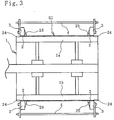
- both carcass fixing rings 3 are coupled with each other via a space adjusting plate 4 as illustrated in Fig. 3 .
- the space adjusting plate 4 is attached to the carcass fixing rings 3 using a fixing member such as a bolt.
- the segments 1a, 1b are moved in a radially-inward direction, and the primary making drum 1 is removed from the cylindrical-shaped primary molded body G1. Accordingly, the primary molded body G1 is in a state to be held by the fixing rings 2, the carcass fixing rings 3, and the space adjusting plate 4.
- a cylindrical-shaped inflation mold 5 is inserted inside the primary molded body G1 as illustrated in Fig. 4 .
- the inflation mold 5 has disc-shaped side plates 6 on both sides of a core portion 5a in the width direction thereof, while the core portion 5a is provided with multiple pressing plates 8 divided in the circumferential direction.
- the number of the pressing plates 8 is 5 in this embodiment, but it is not limited to 5.
- the side plates 6 are moved in the width direction by cylinders 6a provided in the core portion 5a. Expandable and contractible sealing members 7 are provided in the outer peripheral edge portions of the side plates 6.
- Each pressing plate 8 is configured to be moved in the radial direction by a cylinder 8a provided in the core portion 5a.
- the outer peripheral surface of the pressing plate 8 has approximately the same shape as the profile of the inner peripheral surface of the tire to be manufactured.
- the sealing members 7 are expanded so that the peripheral portions (the fixing rings 2 and the carcass fixing rings 3) of the bead rings 25 are securely fixed by the side plates 6. Subsequently, the space adjusting plate 4 is detached from the carcass fixing rings 3.
- each cylinder 6a is set free, and the rod of each cylinder 8a is extended to press the pressing plate 8 against the inner peripheral surface of the primary molded body G1, while slightly pressurizing the primary molded body G1 by injecting air a from the inner peripheral side so that the primary molded body G1 is expanded and deformed to the outer peripheral side.
- both bead rings 25 are moved so as to be closer to each other.
- a transfer and holding mold 9 is disposed on the outer peripheral side of the primary molded body G1.
- Suction means such as a vacuum pump is detachably connected to the transfer and holding mold 9.
- the transfer and holding mold 9 is formed with divided molds 9a which are divided in half in the width direction.
- the inner peripheral surface of the transfer and holding mold 9 is formed in an annular shape, and a large number of suction holes 10 communicating with the suction means are formed.
- the air a is further injected from the inner peripheral side of the primary molded body G1 to pressurize the primary molded body G1, while air A is sucked through the suction holes 10 of the transfer and holding mold 9 with the divided molds 9a assembled, so that the primary molded body G1 is sucked from the outer peripheral side.
- the primary molded body G1 is in a state to be sucked and held to the inner peripheral surface of the transfer and holding mold 9.
- the rods of cylinders 8a are contracted to retreat the pressing plate 8 and the sealing members 7 are contracted, whereby the inflation mold 5 is removed from the primary molded body G1. Suction of the primary molded body G1 by the transfer and holding mold is continued until the primary molded body G1 is transferred to a rigid inner mold 11.
- the cylindrical-shaped rigid inner mold 11 is inserted inside the primary molded body. Detailed structure of the rigid inner mold 11 is described later. Multiple divided bodies 12 divided in the circumferential direction are further divided in the width direction. Out of the resultant divided bodies 12, those on one side in the width direction are first moved around a rotation mechanism 13 as the rotation center in a radially-outward direction. Then, the divided bodies 12 on the other side are similarly moved and attached to the primary molded body G1 in an annular shape. With such attachment operation, the rigid inner mold 11 is inserted inside the primary molded body G1.
- the primary molded body G1 is set to be sucked and held to the inner peripheral surface of the transfer and holding mold 9, then is transferred to the outer peripheral surface of the rigid inner mold 11, and thus transfer operation can be performed smoothly without damaging the film 22 which serves as the inner layer.
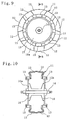
- the rigid inner mold 11 is in a cylindrical shape as illustrated in Figs. 9 and 10 , and includes the divided bodies 12 plurally divided in the circumferential direction.
- the divided bodies 12 are further divided in half in the width direction of the cylindrical-shaped peripheral surface.
- Examples of the material of the rigid inner mold 11 include metal such as aluminum and an aluminum alloy.
- These divided bodies 12 are fixed to peripheral edge portions of opposed disc-shaped supporting plates 15a, 15b via the rotation mechanisms 13, and are formed in a cylindrical shape. That is to say, out of the divided bodies 12 divided in half in the width direction of the cylindrical-shaped peripheral surface, those on one side in the width direction are disposed in an annular shape along the peripheral edge portion of the supporting plate 15a on one side out of the opposed supporting plates 15a, 15b, and out of the divided bodies 12 divided in half in the width direction of the cylindrical-shaped peripheral surface, those on the other side in the width direction are disposed in an annular shape along the peripheral edge portion of the supporting plate 15b on the other side.
- a central shaft 14 is fixed at the circle center position of the opposed supporting plates 15a, 15b to pass therethrough.
- the central shaft 14 and a pair of the supporting plates 15a, 15b are fixed to each other via a supporting rib 16 fixed on the outer peripheral surface of the central shaft 14.
- the rigid inner mold 11 including the multiple divided bodies 12 formed in a cylindrical shape is moved so that each divided body 12 is rotated in a diameter expanding or reducing direction around the rotation mechanism 13 as the rotation center.
- the cylindrical-shaped rigid inner mold 11, to which the primary molded body G1 is transferred, is mounted on a molding apparatus and the like with the central shaft 14 being supported in order to mold the green tire G.
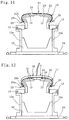
- the opposite ends of the carcass material 24 in the width direction thereof are turned up on the rigid inner mold 11, while other tire constituting members such as the rubber member of the sidewall portion 26, the belt layers 27, the rubber member of the tread portion 28 are stacked on the outer peripheral surface of the primary molded body G1 so that the green tire G is molded as illustrated in Fig. 12 .
- the green tire G has no tread patterns formed thereon, but is formed in approximately the same size and shape as the pneumatic tire 21 to be manufactured.
- the rigid inner mold 11 is detached from the molded green tire G.
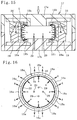
- the rotation mechanisms 13 of the divided bodies 12 are held from both sides in the width direction of the rigid inner mold 11, and engagement between the rotation mechanisms 13 and the supporting plates 15a, 15b is released.
- one supporting plate 15a is removed from the central shaft 14, then the supporting plate 15a and the other supporting plate 15b with fixed central shaft 14 are moved to the outside of the green tire G.
- the divided bodies 12 on one side in the width direction are rotated around the rotation mechanism 13 as the center toward the inside of the tire so that the cylindrical-shaped rigid inner mold 11 reduces its diameter.
- the divided bodies 12 on the other side in the width direction are rotated around the rotation mechanism 13 as the center toward the inside of the tire so that the cylindrical-shaped rigid inner mold 11 reduces its diameter.
- the divided bodies 12 are rotated toward the inside of the tire, then are moved to the outside of the green tire G to be detached.
- the reverse process of the process illustrated in Figs. 13 and 14 may be performed.
- the film 22 tends to be separated from the divided body 12. For this reason, compared with a pneumatic tire whose inner layer is formed of butyl rubber, the rigid inner mold 11 can be detached smoothly. Due to excellent release characteristics of the film 22, an additional work of, for example, applying release agent between the inner peripheral surface of the green tire and the rigid inner mold 11 (the divided bodies 12) is not required, which is advantageous to the improvement of productivity.
- molded green tire G is disposed at a predetermined position inside a curing mold installed in a curing apparatus 17.
- the curing mold includes multiple sectors 18a which are divided in the tire circumferential direction, and upper and lower annular side plates 18b, 18b.
- the lower side plate 18b is fixed in a bottom housing 17b in which each sector 18a is placed.
- a back segment 19 having an inclined surface is mounted on the rear surface of the sector 18a.
- a guide member 20 having an inclined surface and the upper side plate 18b are fixed in a top housing 17a.
- the bead portion below the green tire G is placed on the lower side plate 18b, and after the green tire G is positioned at a predetermined position, the top housing 17a is moved downward.
- the guide member 20 moves downward, and the inclined surface of the guide member 20 comes in contact with the inclined surface of the back segment 19.
- the sector 18a along with the back segment 19 gradually moves toward the central shaft 14. That is to say, the sectors 18a in a state of expanded diameter are moved in a radially-inward direction and are assembled to form an annular shape.
- the upper side plate 18b which is moved downward, is disposed at the upper inner peripheral edge portions of the sectors 18a assembled in an annular shape.
- the bead portion on the upper side of the green tire G comes in contact with the upper side plate 18b.
- the upper and lower bead portions of the green tire G are brought into close contact with and sealed to the upper and lower side plates 18b, respectively. Accordingly, the inner peripheral hollow portion of the green tire G is surrounded and sealed by the curing mold, the top housing 17a, and the bottom housing 17b.
- the curing mold is heated to a predetermined temperature, and heated fluid such as the heated air a is injected into the inner peripheral hollow portion of the green tire G through a communication path 29 provided in the bottom housing 17b.
- heated fluid such as the heated air a is injected into the inner peripheral hollow portion of the green tire G through a communication path 29 provided in the bottom housing 17b.
- the air a to be supplied examples include gas such as general air and nitrogen gas.
- the pressure for inflating the film 22 is, for example, approximately 0.01 MPa to 3.0 MPa.
- the film 22 is brought into close contact with and bonded to the inner peripheral surface of the tire (rubber members disposed in the outer peripheral side of the film 22) so that the pneumatic tire 21 having the film 22 as the inner layer is manufactured.
- the pneumatic tire 21 with excellent uniformity, having an inner layer which is light in weight and excels in air penetration preventing performance can be efficiently manufactured.
- the air A should be forcibly sucked from the inside of the curing mold to the outside so that the green tire G is cured in a negative pressure state.
- vacuum is drawn by a vacuum pump through the mating face of adjacent sectors (curing mold) 18a.
- the air between the stacked tire constituting members, or the air in the tire constituting members (rubber members) can be removed, and thus a problem due to trapped air in manufactured pneumatic tire 21 can be prevented, thereby its quality can be improved.
- an adhesive layer may be previously provided on the outer peripheral surface of the film 22.
- the tie rubber 23 is disposed to cover the entire outer peripheral surface of the film 22, but the tie rubber 23 may be disposed to cover a part of the outer peripheral surface of the film 22. If a certain bonding strength between the film 22 and the members on the outer peripheral side of the film 22 can be secured, the tie rubber 23 may be omitted.
- the film 22 serves as a conventional bladder, and thus maintenance of the bladder is not needed, which is advantageous to the improvement of productivity.
- the curing mold can be heated by various heat sources.
- an electric heating body embedded in the curing mold may be used. Heating by an electric heating body enables a precise temperature control.
- the outer peripheral surface of the green tire G is molded into a predetermined shape by the sector 18a, the inner peripheral surface is brought into contact with and molded by the inflated film 22. Accordingly, unlike the manufacturing method which uses a conventional bladder made of rubber, or the manufacturing method which presses the green tire on the outer peripheral surface of the rigid inner mold, no undesired marks are left on the inner peripheral surface of the cured pneumatic tire, whereby a smooth surface is created, and accordingly appearance quality is improved.
- the rigid inner mold 11 when the green tire G is cured, the rigid inner mold 11 is not disposed inside the curing mold, and thus the rigid inner mold 11 can be freely used during the curing. Consequently, the number of green tires G that can be molded by one rigid inner mold 11 within a predetermined time period increases, and thus productivity can be improved by effectively using the rigid inner mold 11. Accordingly, the number of the rigid inner molds 11 to be prepared can be reduced.
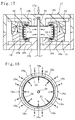
- the green tire G molded by using the rigid inner mold 11 can be cured using a bladder 31 as illustrated in Fig. 17 .
- Two disc-shaped bladder holding plates 32 are attached to a center post 30 which is inserted inside the tubular hole formed at the central portion of the top housing 17a and the bottom housing 17b.
- Elastic material such as rubber, or the bladder 31 formed by embedding reinforcing material such as a canvas layer into elastic material is fixed to the outer peripheral edge portion of the bladder holding plates 32.
- the bladder 31 is formed to have the same shape as the inner peripheral hollow portion of the green tire G when the bladder 31 is inflated. That is to say, the outside shape of the bladder 31 is formed in approximately the same size and shape as the inner peripheral hollow portion of the green tire G.
- the bladder 31 is placed in its contracted state in the inner peripheral hollow portion of the green tire G disposed in a predetermined position of the curing mold. Subsequently, the top housing 17a is moved downward, and the sectors 18a are assembled to form an annular shape.
- the upper side plate 18b which is moved downward, is disposed at the upper inner periphery portion of the sectors 18a assembled to form an annular shape. The upper bead portion comes in contact with the upper side plate 18b.
- the curing mold is heated to a predetermined temperature, while heated fluid such as the heated air a which is heated through a communication hole provided in the center post 30 is supplied to the bladder 31 and is expanded.
- heated fluid such as the heated air a which is heated through a communication hole provided in the center post 30 is supplied to the bladder 31 and is expanded.
- the film 22 is pressurized from the inner peripheral side to be inflated while being heated.
- the bladder 31 has approximately the same size and shape as the inner peripheral hollow portion of the green tire G, and thus is brought into close contact with the entire inner peripheral surface of the green tire G. However, the bladder 31 slightly presses against the inner peripheral surface of the green tire G (the film 22). In this manner, the film 22 is inflated, while being heated, and thus the green tire G is cured.
- the film 22 is inflated, and thus, as illustrated in Fig. 18 , unvulcanized rubber in the tire constituting members is pressed against the inner peripheral surface of the sector (curing mold) 18a, and accordingly, flows in the circumferential direction of the sector 18a. Consequently, even when non-uniformity in the volume of the tire constituting members of the green tire G exists, the non-uniformity can be corrected, and uniformity of the pneumatic tire 21 to be manufactured can be improved.
- the film 22 is brought into close contact with and bonded to the inner peripheral surface of the tire so that the pneumatic tire 21 having the film 22 as the inner layer is manufactured.
- the air A may be forcibly sucked from the inside of the curing mold to the outside so that the green tire G is cured in a negative pressure state.
- the bladder 31 is used, and thus heated fluid does not directly come in contact with the inner peripheral surface of the green tire G. Accordingly, various types of heated fluid can be used.
Landscapes
- Engineering & Computer Science (AREA)
- Mechanical Engineering (AREA)
- Manufacturing & Machinery (AREA)
- Physics & Mathematics (AREA)
- Health & Medical Sciences (AREA)
- Oral & Maxillofacial Surgery (AREA)
- Thermal Sciences (AREA)
- Tyre Moulding (AREA)
- Moulds For Moulding Plastics Or The Like (AREA)
- Tires In General (AREA)
- Heating, Cooling, Or Curing Plastics Or The Like In General (AREA)
Applications Claiming Priority (2)
| Application Number | Priority Date | Filing Date | Title |
|---|---|---|---|
| JP2009112877A JP4816761B2 (ja) | 2009-05-07 | 2009-05-07 | 空気入りタイヤの製造方法 |
| PCT/JP2009/061053 WO2010128565A1 (ja) | 2009-05-07 | 2009-06-17 | 空気入りタイヤの製造方法 |
Publications (3)
| Publication Number | Publication Date |
|---|---|
| EP2431162A1 EP2431162A1 (en) | 2012-03-21 |
| EP2431162A4 EP2431162A4 (en) | 2012-12-26 |
| EP2431162B1 true EP2431162B1 (en) | 2016-03-02 |
Family
ID=43050078
Family Applications (1)
| Application Number | Title | Priority Date | Filing Date |
|---|---|---|---|
| EP09844352.6A Not-in-force EP2431162B1 (en) | 2009-05-07 | 2009-06-17 | Method of manufacturing pneumatic tires |
Country Status (6)
| Country | Link |
|---|---|
| US (1) | US8652394B2 (enExample) |
| EP (1) | EP2431162B1 (enExample) |
| JP (1) | JP4816761B2 (enExample) |
| KR (1) | KR101286519B1 (enExample) |
| CN (1) | CN102421588B (enExample) |
| WO (1) | WO2010128565A1 (enExample) |
Families Citing this family (6)
| Publication number | Priority date | Publication date | Assignee | Title |
|---|---|---|---|---|
| JP4853576B2 (ja) | 2010-03-30 | 2012-01-11 | 横浜ゴム株式会社 | 空気入りタイヤの製造方法 |
| JP4853577B2 (ja) * | 2010-03-30 | 2012-01-11 | 横浜ゴム株式会社 | 空気入りタイヤの製造方法 |
| BR112015004532B1 (pt) * | 2013-07-18 | 2021-12-28 | Mitsui Chemicals, Inc | Estrutura de compósito de resina metálica e membro de metal |
| RU2678662C1 (ru) * | 2013-11-26 | 2019-01-30 | Пирелли Тайр С.П.А. | Способ, процесс и установка для сборки шин |
| BR112018012530B1 (pt) | 2015-12-28 | 2022-03-03 | Pirelli Tyre S.P.A. | Processo e usina para construir pneus |
| CN116494509B (zh) * | 2023-06-28 | 2023-09-08 | 西南石油大学 | 一种玄武岩纤维复合管制备用模具 |
Family Cites Families (34)
| Publication number | Priority date | Publication date | Assignee | Title |
|---|---|---|---|---|
| US3867230A (en) * | 1973-02-08 | 1975-02-18 | Goodrich Co B F | Tire building machine |
| DE2409586B2 (de) * | 1974-02-28 | 1976-12-09 | Zusatz in: 25 05 486 Continental Gummi-Werke AG, 3000 Hannover | Vorrichtung zum ueberfuehren einer mit kernringen belegten karkasse fuer luftreifenrohlinge |
| JPS5878740A (ja) * | 1981-11-02 | 1983-05-12 | Sumitomo Rubber Ind Ltd | タイヤの製造方法及びその装置 |
| IT1151126B (it) * | 1982-03-30 | 1986-12-17 | Pirelli | Procedimento e apparecchiatura per la fabbricazione di pneumatici |
| US4634489A (en) * | 1984-07-18 | 1987-01-06 | The Goodyear Tire & Rubber Company | Device for transferring a tire carcass band |
| EP0190532B1 (en) * | 1985-02-05 | 1989-10-04 | The Goodyear Tire & Rubber Company | A transfer apparatus for tire carcasses and tire bands |
| GB8724849D0 (en) * | 1987-10-23 | 1987-11-25 | Apsley Metals Ltd | Manufacture of tyres |
| US6332999B1 (en) * | 1998-07-31 | 2001-12-25 | Pirelli Pneumatici S.P.A. | Method and apparatus for moulding and curing tires for vehicle wheels |
| US7597837B2 (en) * | 1999-06-25 | 2009-10-06 | Pirelli Pneumatici S.P.A. | Method and apparatus for moulding and curing tyres for vehicle wheels |
| ATE316861T1 (de) | 1999-08-10 | 2006-02-15 | Sedepro | Steifer kern in zwei teilen, zur herstellung von luftreifen |
| US6673184B1 (en) * | 2000-02-23 | 2004-01-06 | The Goodyear Tire & Rubber Company | Tire and method for correcting tire uniformity thereof |
| US6651716B1 (en) * | 2000-02-23 | 2003-11-25 | The Goodyear Tire & Rubber Company | Method and tire adapted for post cure tire uniformity correction |
| US6740280B1 (en) * | 2000-04-10 | 2004-05-25 | The Goodyear Tire & Rubber Company | Tire construction method for improving tire uniformity |
| JP4367593B2 (ja) * | 2000-05-08 | 2009-11-18 | 横浜ゴム株式会社 | タイヤ加硫機及びタイヤ加硫方法 |
| JP4496614B2 (ja) * | 2000-07-18 | 2010-07-07 | 横浜ゴム株式会社 | ホットエアまたはホットガスによるタイヤのインフレーション成形方法 |
| US7360749B2 (en) * | 2002-02-25 | 2008-04-22 | Kabushiki Kaisha Bridgestone | Rubber molded article vulcanizing mold, and method for cleaning the same |
| JP2003245928A (ja) * | 2002-02-25 | 2003-09-02 | Bridgestone Corp | ゴム成型品加硫モールドの洗浄方法 |
| JP2003340824A (ja) | 2002-05-27 | 2003-12-02 | Bridgestone Corp | タイヤの加硫成型方法およびタイヤ成形用金型 |
| EP1568475B1 (en) * | 2002-11-25 | 2014-02-12 | Bridgestone Corporation | Tire building system and tire manufacturing method using this system |
| WO2005009713A1 (ja) * | 2003-07-25 | 2005-02-03 | Fuji Shoji Co., Ltd. | タイヤの加硫方法及び同方法を実施するための加硫機 |
| JP2005219565A (ja) * | 2004-02-04 | 2005-08-18 | Yokohama Rubber Co Ltd:The | 空気入りタイヤ |
| JP2005297478A (ja) * | 2004-04-15 | 2005-10-27 | Yokohama Rubber Co Ltd:The | 空気入りタイヤの製造方法 |
| US7128545B2 (en) * | 2004-08-23 | 2006-10-31 | The Goodyear Tire & Rubber Company | Tire curing bladder |
| JP4715362B2 (ja) * | 2005-07-27 | 2011-07-06 | 横浜ゴム株式会社 | タイヤ用インナーライナー及びそれを用いた空気入りタイヤ |
| JP4735124B2 (ja) * | 2005-08-17 | 2011-07-27 | 横浜ゴム株式会社 | 空気入りタイヤの製造方法 |
| JP4004518B2 (ja) * | 2005-10-04 | 2007-11-07 | 横浜ゴム株式会社 | ゴム積層体を用いた空気入りタイヤ |
| JP4853067B2 (ja) * | 2006-03-22 | 2012-01-11 | 横浜ゴム株式会社 | タイヤ成形用剛性中子の分離取出し方法及びその分離取出し装置 |
| ATE483577T1 (de) * | 2006-07-11 | 2010-10-15 | Pirelli | Verfahren und vorrichtung zur herstellung von luftreifen |
| JP2008044204A (ja) * | 2006-08-14 | 2008-02-28 | Yokohama Rubber Co Ltd:The | 空気入りタイヤの加硫方法 |
| US7780807B2 (en) * | 2006-11-03 | 2010-08-24 | The Goodyear Tire & Rubber Company | Air shaping of green tire carcass |
| FR2917992B1 (fr) * | 2007-06-28 | 2012-08-10 | Michelin Soc Tech | Procede d'application d'une couche de materiau a l'interieur d'un pneumatique pour cycle. |
| JP2009018445A (ja) * | 2007-07-10 | 2009-01-29 | Yokohama Rubber Co Ltd:The | 空気入りタイヤの製造方法 |
| JP2009029035A (ja) * | 2007-07-27 | 2009-02-12 | Yokohama Rubber Co Ltd:The | タイヤの製造方法及び加硫機 |
| JP4297290B2 (ja) * | 2007-12-21 | 2009-07-15 | 横浜ゴム株式会社 | 空気入りタイヤの製造方法 |
-
2009
- 2009-05-07 JP JP2009112877A patent/JP4816761B2/ja not_active Expired - Fee Related
- 2009-06-17 EP EP09844352.6A patent/EP2431162B1/en not_active Not-in-force
- 2009-06-17 US US13/318,196 patent/US8652394B2/en not_active Expired - Fee Related
- 2009-06-17 CN CN200980159138.3A patent/CN102421588B/zh not_active Expired - Fee Related
- 2009-06-17 WO PCT/JP2009/061053 patent/WO2010128565A1/ja not_active Ceased
- 2009-06-17 KR KR1020117026706A patent/KR101286519B1/ko not_active Expired - Fee Related
Also Published As
| Publication number | Publication date |
|---|---|
| JP4816761B2 (ja) | 2011-11-16 |
| CN102421588A (zh) | 2012-04-18 |
| US8652394B2 (en) | 2014-02-18 |
| KR20120011869A (ko) | 2012-02-08 |
| WO2010128565A1 (ja) | 2010-11-11 |
| JP2010260266A (ja) | 2010-11-18 |
| EP2431162A1 (en) | 2012-03-21 |
| CN102421588B (zh) | 2014-05-28 |
| US20120049418A1 (en) | 2012-03-01 |
| EP2431162A4 (en) | 2012-12-26 |
| KR101286519B1 (ko) | 2013-07-16 |
Similar Documents
| Publication | Publication Date | Title |
|---|---|---|
| EP2221159B1 (en) | Process for producing a pneumatic tire | |
| EP2431163B1 (en) | Method of manufacturing pneumatic tires | |
| EP2431162B1 (en) | Method of manufacturing pneumatic tires | |
| KR101337932B1 (ko) | 공기입 타이어의 제조 방법 | |
| EP1800844B1 (en) | Method of manufacturing pneumatic tire | |
| KR101337931B1 (ko) | 공기입 타이어의 제조 방법 | |
| JP5664003B2 (ja) | 空気入りタイヤの製造方法及び加硫装置 |
Legal Events
| Date | Code | Title | Description |
|---|---|---|---|
| PUAI | Public reference made under article 153(3) epc to a published international application that has entered the european phase |
Free format text: ORIGINAL CODE: 0009012 |
|
| 17P | Request for examination filed |
Effective date: 20111207 |
|
| AK | Designated contracting states |
Kind code of ref document: A1 Designated state(s): AT BE BG CH CY CZ DE DK EE ES FI FR GB GR HR HU IE IS IT LI LT LU LV MC MK MT NL NO PL PT RO SE SI SK TR |
|
| DAX | Request for extension of the european patent (deleted) | ||
| A4 | Supplementary search report drawn up and despatched |
Effective date: 20121128 |
|
| RIC1 | Information provided on ipc code assigned before grant |
Ipc: B29C 33/02 20060101ALI20121122BHEP Ipc: B29C 35/02 20060101ALI20121122BHEP Ipc: B60C 5/14 20060101ALI20121122BHEP Ipc: B29D 30/08 20060101AFI20121122BHEP Ipc: B29L 30/00 20060101ALI20121122BHEP |
|
| 17Q | First examination report despatched |
Effective date: 20140114 |
|
| GRAP | Despatch of communication of intention to grant a patent |
Free format text: ORIGINAL CODE: EPIDOSNIGR1 |
|
| INTG | Intention to grant announced |
Effective date: 20151118 |
|
| GRAS | Grant fee paid |
Free format text: ORIGINAL CODE: EPIDOSNIGR3 |
|
| GRAA | (expected) grant |
Free format text: ORIGINAL CODE: 0009210 |
|
| AK | Designated contracting states |
Kind code of ref document: B1 Designated state(s): AT BE BG CH CY CZ DE DK EE ES FI FR GB GR HR HU IE IS IT LI LT LU LV MC MK MT NL NO PL PT RO SE SI SK TR |
|
| REG | Reference to a national code |
Ref country code: GB Ref legal event code: FG4D |
|
| REG | Reference to a national code |
Ref country code: AT Ref legal event code: REF Ref document number: 777704 Country of ref document: AT Kind code of ref document: T Effective date: 20160315 Ref country code: CH Ref legal event code: EP |
|
| REG | Reference to a national code |
Ref country code: IE Ref legal event code: FG4D |
|
| REG | Reference to a national code |
Ref country code: DE Ref legal event code: R096 Ref document number: 602009036629 Country of ref document: DE |
|
| REG | Reference to a national code |
Ref country code: NL Ref legal event code: MP Effective date: 20160302 |
|
| REG | Reference to a national code |
Ref country code: LT Ref legal event code: MG4D |
|
| REG | Reference to a national code |
Ref country code: AT Ref legal event code: MK05 Ref document number: 777704 Country of ref document: AT Kind code of ref document: T Effective date: 20160302 |
|
| PG25 | Lapsed in a contracting state [announced via postgrant information from national office to epo] |
Ref country code: ES Free format text: LAPSE BECAUSE OF FAILURE TO SUBMIT A TRANSLATION OF THE DESCRIPTION OR TO PAY THE FEE WITHIN THE PRESCRIBED TIME-LIMIT Effective date: 20160302 Ref country code: NO Free format text: LAPSE BECAUSE OF FAILURE TO SUBMIT A TRANSLATION OF THE DESCRIPTION OR TO PAY THE FEE WITHIN THE PRESCRIBED TIME-LIMIT Effective date: 20160602 Ref country code: FI Free format text: LAPSE BECAUSE OF FAILURE TO SUBMIT A TRANSLATION OF THE DESCRIPTION OR TO PAY THE FEE WITHIN THE PRESCRIBED TIME-LIMIT Effective date: 20160302 Ref country code: GR Free format text: LAPSE BECAUSE OF FAILURE TO SUBMIT A TRANSLATION OF THE DESCRIPTION OR TO PAY THE FEE WITHIN THE PRESCRIBED TIME-LIMIT Effective date: 20160603 Ref country code: HR Free format text: LAPSE BECAUSE OF FAILURE TO SUBMIT A TRANSLATION OF THE DESCRIPTION OR TO PAY THE FEE WITHIN THE PRESCRIBED TIME-LIMIT Effective date: 20160302 |
|
| PG25 | Lapsed in a contracting state [announced via postgrant information from national office to epo] |
Ref country code: LV Free format text: LAPSE BECAUSE OF FAILURE TO SUBMIT A TRANSLATION OF THE DESCRIPTION OR TO PAY THE FEE WITHIN THE PRESCRIBED TIME-LIMIT Effective date: 20160302 Ref country code: NL Free format text: LAPSE BECAUSE OF FAILURE TO SUBMIT A TRANSLATION OF THE DESCRIPTION OR TO PAY THE FEE WITHIN THE PRESCRIBED TIME-LIMIT Effective date: 20160302 Ref country code: PL Free format text: LAPSE BECAUSE OF FAILURE TO SUBMIT A TRANSLATION OF THE DESCRIPTION OR TO PAY THE FEE WITHIN THE PRESCRIBED TIME-LIMIT Effective date: 20160302 Ref country code: AT Free format text: LAPSE BECAUSE OF FAILURE TO SUBMIT A TRANSLATION OF THE DESCRIPTION OR TO PAY THE FEE WITHIN THE PRESCRIBED TIME-LIMIT Effective date: 20160302 Ref country code: LT Free format text: LAPSE BECAUSE OF FAILURE TO SUBMIT A TRANSLATION OF THE DESCRIPTION OR TO PAY THE FEE WITHIN THE PRESCRIBED TIME-LIMIT Effective date: 20160302 Ref country code: SE Free format text: LAPSE BECAUSE OF FAILURE TO SUBMIT A TRANSLATION OF THE DESCRIPTION OR TO PAY THE FEE WITHIN THE PRESCRIBED TIME-LIMIT Effective date: 20160302 |
|
| PG25 | Lapsed in a contracting state [announced via postgrant information from national office to epo] |
Ref country code: EE Free format text: LAPSE BECAUSE OF FAILURE TO SUBMIT A TRANSLATION OF THE DESCRIPTION OR TO PAY THE FEE WITHIN THE PRESCRIBED TIME-LIMIT Effective date: 20160302 Ref country code: IS Free format text: LAPSE BECAUSE OF FAILURE TO SUBMIT A TRANSLATION OF THE DESCRIPTION OR TO PAY THE FEE WITHIN THE PRESCRIBED TIME-LIMIT Effective date: 20160702 |
|
| PG25 | Lapsed in a contracting state [announced via postgrant information from national office to epo] |
Ref country code: CZ Free format text: LAPSE BECAUSE OF FAILURE TO SUBMIT A TRANSLATION OF THE DESCRIPTION OR TO PAY THE FEE WITHIN THE PRESCRIBED TIME-LIMIT Effective date: 20160302 Ref country code: RO Free format text: LAPSE BECAUSE OF FAILURE TO SUBMIT A TRANSLATION OF THE DESCRIPTION OR TO PAY THE FEE WITHIN THE PRESCRIBED TIME-LIMIT Effective date: 20160302 Ref country code: SK Free format text: LAPSE BECAUSE OF FAILURE TO SUBMIT A TRANSLATION OF THE DESCRIPTION OR TO PAY THE FEE WITHIN THE PRESCRIBED TIME-LIMIT Effective date: 20160302 Ref country code: PT Free format text: LAPSE BECAUSE OF FAILURE TO SUBMIT A TRANSLATION OF THE DESCRIPTION OR TO PAY THE FEE WITHIN THE PRESCRIBED TIME-LIMIT Effective date: 20160704 |
|
| REG | Reference to a national code |
Ref country code: DE Ref legal event code: R097 Ref document number: 602009036629 Country of ref document: DE |
|
| PG25 | Lapsed in a contracting state [announced via postgrant information from national office to epo] |
Ref country code: BE Free format text: LAPSE BECAUSE OF FAILURE TO SUBMIT A TRANSLATION OF THE DESCRIPTION OR TO PAY THE FEE WITHIN THE PRESCRIBED TIME-LIMIT Effective date: 20160302 Ref country code: IT Free format text: LAPSE BECAUSE OF FAILURE TO SUBMIT A TRANSLATION OF THE DESCRIPTION OR TO PAY THE FEE WITHIN THE PRESCRIBED TIME-LIMIT Effective date: 20160302 |
|
| REG | Reference to a national code |
Ref country code: DE Ref legal event code: R119 Ref document number: 602009036629 Country of ref document: DE |
|
| PLBE | No opposition filed within time limit |
Free format text: ORIGINAL CODE: 0009261 |
|
| STAA | Information on the status of an ep patent application or granted ep patent |
Free format text: STATUS: NO OPPOSITION FILED WITHIN TIME LIMIT |
|
| PG25 | Lapsed in a contracting state [announced via postgrant information from national office to epo] |
Ref country code: MC Free format text: LAPSE BECAUSE OF FAILURE TO SUBMIT A TRANSLATION OF THE DESCRIPTION OR TO PAY THE FEE WITHIN THE PRESCRIBED TIME-LIMIT Effective date: 20160302 Ref country code: DK Free format text: LAPSE BECAUSE OF FAILURE TO SUBMIT A TRANSLATION OF THE DESCRIPTION OR TO PAY THE FEE WITHIN THE PRESCRIBED TIME-LIMIT Effective date: 20160302 |
|
| REG | Reference to a national code |
Ref country code: CH Ref legal event code: PL |
|
| 26N | No opposition filed |
Effective date: 20161205 |
|
| PG25 | Lapsed in a contracting state [announced via postgrant information from national office to epo] |
Ref country code: SI Free format text: LAPSE BECAUSE OF FAILURE TO SUBMIT A TRANSLATION OF THE DESCRIPTION OR TO PAY THE FEE WITHIN THE PRESCRIBED TIME-LIMIT Effective date: 20160302 Ref country code: BG Free format text: LAPSE BECAUSE OF FAILURE TO SUBMIT A TRANSLATION OF THE DESCRIPTION OR TO PAY THE FEE WITHIN THE PRESCRIBED TIME-LIMIT Effective date: 20160602 |
|
| GBPC | Gb: european patent ceased through non-payment of renewal fee |
Effective date: 20160617 |
|
| REG | Reference to a national code |
Ref country code: IE Ref legal event code: MM4A |
|
| REG | Reference to a national code |
Ref country code: FR Ref legal event code: ST Effective date: 20170228 |
|
| PG25 | Lapsed in a contracting state [announced via postgrant information from national office to epo] |
Ref country code: FR Free format text: LAPSE BECAUSE OF NON-PAYMENT OF DUE FEES Effective date: 20160630 Ref country code: DE Free format text: LAPSE BECAUSE OF NON-PAYMENT OF DUE FEES Effective date: 20170103 Ref country code: LI Free format text: LAPSE BECAUSE OF NON-PAYMENT OF DUE FEES Effective date: 20160630 Ref country code: CH Free format text: LAPSE BECAUSE OF NON-PAYMENT OF DUE FEES Effective date: 20160630 |
|
| PG25 | Lapsed in a contracting state [announced via postgrant information from national office to epo] |
Ref country code: GB Free format text: LAPSE BECAUSE OF NON-PAYMENT OF DUE FEES Effective date: 20160617 Ref country code: IE Free format text: LAPSE BECAUSE OF NON-PAYMENT OF DUE FEES Effective date: 20160617 |
|
| PG25 | Lapsed in a contracting state [announced via postgrant information from national office to epo] |
Ref country code: CY Free format text: LAPSE BECAUSE OF FAILURE TO SUBMIT A TRANSLATION OF THE DESCRIPTION OR TO PAY THE FEE WITHIN THE PRESCRIBED TIME-LIMIT Effective date: 20160302 Ref country code: HU Free format text: LAPSE BECAUSE OF FAILURE TO SUBMIT A TRANSLATION OF THE DESCRIPTION OR TO PAY THE FEE WITHIN THE PRESCRIBED TIME-LIMIT; INVALID AB INITIO Effective date: 20090617 |
|
| PG25 | Lapsed in a contracting state [announced via postgrant information from national office to epo] |
Ref country code: TR Free format text: LAPSE BECAUSE OF FAILURE TO SUBMIT A TRANSLATION OF THE DESCRIPTION OR TO PAY THE FEE WITHIN THE PRESCRIBED TIME-LIMIT Effective date: 20160302 Ref country code: LU Free format text: LAPSE BECAUSE OF NON-PAYMENT OF DUE FEES Effective date: 20160617 Ref country code: MT Free format text: LAPSE BECAUSE OF NON-PAYMENT OF DUE FEES Effective date: 20160630 Ref country code: MK Free format text: LAPSE BECAUSE OF FAILURE TO SUBMIT A TRANSLATION OF THE DESCRIPTION OR TO PAY THE FEE WITHIN THE PRESCRIBED TIME-LIMIT Effective date: 20160302 |