EP2426482A2 - Textilmaterial-Überwachungsvorrichtung und Garnwickelvorrichtung - Google Patents
Textilmaterial-Überwachungsvorrichtung und Garnwickelvorrichtung Download PDFInfo
- Publication number
- EP2426482A2 EP2426482A2 EP11177232A EP11177232A EP2426482A2 EP 2426482 A2 EP2426482 A2 EP 2426482A2 EP 11177232 A EP11177232 A EP 11177232A EP 11177232 A EP11177232 A EP 11177232A EP 2426482 A2 EP2426482 A2 EP 2426482A2
- Authority
- EP
- European Patent Office
- Prior art keywords
- light
- yarn
- spun yarn
- textile
- light receiving
- Prior art date
- Legal status (The legal status is an assumption and is not a legal conclusion. Google has not performed a legal analysis and makes no representation as to the accuracy of the status listed.)
- Granted
Links
- 239000000463 material Substances 0.000 title claims abstract description 126
- 238000012806 monitoring device Methods 0.000 title claims abstract description 39
- 238000004804 winding Methods 0.000 title claims description 54
- 239000004753 textile Substances 0.000 claims abstract description 84
- 238000009792 diffusion process Methods 0.000 claims abstract description 53
- 238000012544 monitoring process Methods 0.000 claims abstract description 24
- 230000002547 anomalous effect Effects 0.000 claims description 18
- 230000007547 defect Effects 0.000 claims description 15
- 238000001514 detection method Methods 0.000 abstract description 37
- 238000009987 spinning Methods 0.000 description 55
- 238000011176 pooling Methods 0.000 description 14
- 239000000835 fiber Substances 0.000 description 12
- 230000007423 decrease Effects 0.000 description 9
- 238000012935 Averaging Methods 0.000 description 8
- 230000001678 irradiating effect Effects 0.000 description 8
- 230000008859 change Effects 0.000 description 7
- 230000002349 favourable effect Effects 0.000 description 5
- 230000000694 effects Effects 0.000 description 4
- 230000006870 function Effects 0.000 description 4
- 238000011144 upstream manufacturing Methods 0.000 description 4
- 239000002699 waste material Substances 0.000 description 4
- 238000010276 construction Methods 0.000 description 3
- 230000002093 peripheral effect Effects 0.000 description 3
- 239000011347 resin Substances 0.000 description 3
- 229920005989 resin Polymers 0.000 description 3
- 238000013519 translation Methods 0.000 description 3
- 238000010042 air jet spinning Methods 0.000 description 2
- 239000011521 glass Substances 0.000 description 2
- 239000005337 ground glass Substances 0.000 description 2
- 230000006872 improvement Effects 0.000 description 2
- 230000007246 mechanism Effects 0.000 description 2
- 230000004048 modification Effects 0.000 description 2
- 238000012986 modification Methods 0.000 description 2
- 239000011022 opal Substances 0.000 description 2
- BQCADISMDOOEFD-UHFFFAOYSA-N Silver Chemical compound [Ag] BQCADISMDOOEFD-UHFFFAOYSA-N 0.000 description 1
- 238000010586 diagram Methods 0.000 description 1
- 238000005516 engineering process Methods 0.000 description 1
- 238000005286 illumination Methods 0.000 description 1
- 238000004519 manufacturing process Methods 0.000 description 1
- 230000003287 optical effect Effects 0.000 description 1
- 238000012545 processing Methods 0.000 description 1
- 230000009467 reduction Effects 0.000 description 1
- 230000004044 response Effects 0.000 description 1
- 229910052709 silver Inorganic materials 0.000 description 1
- 239000004332 silver Substances 0.000 description 1
- 239000000126 substance Substances 0.000 description 1
- 238000004381 surface treatment Methods 0.000 description 1
- 230000029305 taxis Effects 0.000 description 1
Images




Classifications
-
- G—PHYSICS
- G01—MEASURING; TESTING
- G01N—INVESTIGATING OR ANALYSING MATERIALS BY DETERMINING THEIR CHEMICAL OR PHYSICAL PROPERTIES
- G01N21/00—Investigating or analysing materials by the use of optical means, i.e. using sub-millimetre waves, infrared, visible or ultraviolet light
- G01N21/84—Systems specially adapted for particular applications
- G01N21/88—Investigating the presence of flaws or contamination
- G01N21/89—Investigating the presence of flaws or contamination in moving material, e.g. running paper or textiles
- G01N21/8914—Investigating the presence of flaws or contamination in moving material, e.g. running paper or textiles characterised by the material examined
- G01N21/8915—Investigating the presence of flaws or contamination in moving material, e.g. running paper or textiles characterised by the material examined non-woven textile material
-
- G—PHYSICS
- G01—MEASURING; TESTING
- G01B—MEASURING LENGTH, THICKNESS OR SIMILAR LINEAR DIMENSIONS; MEASURING ANGLES; MEASURING AREAS; MEASURING IRREGULARITIES OF SURFACES OR CONTOURS
- G01B11/00—Measuring arrangements characterised by the use of optical techniques
- G01B11/02—Measuring arrangements characterised by the use of optical techniques for measuring length, width or thickness
- G01B11/06—Measuring arrangements characterised by the use of optical techniques for measuring length, width or thickness for measuring thickness ; e.g. of sheet material
- G01B11/0691—Measuring arrangements characterised by the use of optical techniques for measuring length, width or thickness for measuring thickness ; e.g. of sheet material of objects while moving
-
- G—PHYSICS
- G01—MEASURING; TESTING
- G01B—MEASURING LENGTH, THICKNESS OR SIMILAR LINEAR DIMENSIONS; MEASURING ANGLES; MEASURING AREAS; MEASURING IRREGULARITIES OF SURFACES OR CONTOURS
- G01B11/00—Measuring arrangements characterised by the use of optical techniques
- G01B11/30—Measuring arrangements characterised by the use of optical techniques for measuring roughness or irregularity of surfaces
- G01B11/303—Measuring arrangements characterised by the use of optical techniques for measuring roughness or irregularity of surfaces using photoelectric detection means
Definitions
- the present invention generally relates to textile-material monitoring devices. More particularly, the invention relates to a structure of a diffuser member that diffuses light, with which a textile material is to be irradiated, in a textile-material monitoring device.
- Some winding apparatuses that wind a textile material, such as a spun yarn include a textile-material monitoring device for detecting a foreign matter present in the textile material and a thickness irregularity of the textile material.
- a textile-material monitoring device for detecting a foreign matter present in the textile material and a thickness irregularity of the textile material.
- an optical monitoring device includes a light emitting diode (LED to irradiate the spun yarn includes a light emitting diode (LED) to irradiate the spun yarn with light to thereby detect the thickness irregularity based on a change in an amount of light transmitted through the spun yarn and to detect the foreign matter based on a change in an amount of light reflected from the spun yarn.
- the change in the amount of the transmitted light and the change in the amount of the reflected light are converted into respective electrical signals by a light receiving element, such as a photodiode.
- the detection of the foreign matter by using the deflected light is performed by utilizing a difference in reflectance between is textile material and the foreign matter. For example, between the textile material and the foreign matter. For example, when a colored foreign matter is present in a white spun yarn, the amount of the reflected light decreases in a portion where the foreign matter is present; accordingly, the foreign matter can be detected by measuring a change in an amount of the reflected light.
- a textile material has surface irregularities.
- the irregularities when irradiated with light sometimes form a shadow on the surface of the textile material depending on a positional relationship between a light source and a light receiving element.
- Such a shadow leads to a reduction in the amount of received light of reflected light from the surface of the textile material. Accordingly, the shadow may result in a false detection that a black foreign matter is present in the textile material. If a foreign matter is detected, a portion including the foreign matter is cut and removed. On the other hand, the portion corresponding to the shadow should not be removed; because, it is not a foreign matter.
- a shadow formed on a textile material may be erroneously detected as a foreign matter and a portion of the textile material corresponding to the shadow may be unnecessary removed. This is uneconomical and inefficient.
- the detection of a thickness irregularity in a textile material by using transmitted light is performed by utilizing a fact that a change in an amount of received light of transmitted light depends on a thickness of the textile material. More specifically, the thicker the textile material is, the larger the area where light is shielded by the textile material is, and the less the amount of received light of the transmitted light is. Therefore, by monitoring a change in an amount of transmitted light, which is transmitted through a running textile material, variation in the thickness, or, in other words, a thickness irregularity, of the textile material in a running direction can be detected.
- the inventor of the present invention is of the opinion that the textile-material monitoring device configured to diffuse light using the diffusion plate as in Japanese translation of PCT international publication for patent application No. H6-507979 and Japanese published unexamined application No. 2005-68569 have a problem that, as compared with a structure where a non-diffused light is used, accuracy in detection of a thickness irregularity of a textile material decreases.
- This problem has not been discussed either in Japanese translation of PCT international publication for patent application No. H6-507979 or in Japanese published unexamined application No. 2005-68569 .
- the present inventor has conducted extensive studies and found that a cause of the decrease in the accuracy in detection of the thickness irregularity of the textile material is that transmitted light beams to be received by a light receiving element are averaged out when the light is in a diffused state.
- a transmitted-light receiving element 137 receives transmitted light beams transmitted through the textile material 100 from various directions. Accordingly, an electrical signal output from the light receiving element 137 represents what is called an averaged intensity of intensities of the transmitted light beams from the various directions.
- an electrical signal output from the light receiving element 137 represents what is called an averaged intensity of intensities of the transmitted light beams from the various directions.
- the present invention has been made under the circumstances discussed above. It is an object of the present invention to provide a textile-material monitoring device having improved accuracy in detection of a foreign matter and that can detect a thickness irregularity of the textile material favorably.
- a textile-material monitoring device including a light source unit that is adapted to emit light toward a running textile material; a transmitted-light receiving unit that is adapted to receive light that is emitted from the light source unit after being transmitted through the textile material; a reflected-light receiving unit that is adapted to receive light that is emitted from the light source unit after being reflected from the textile material; and a diffuser unit that is arranged between the light source unit and the textile material, and that is adapted to diffuse the light emitted from the light source unit.
- the diffuser unit is adapted to diffuse the light in a manner that a degree of light diffusion in a plane orthogonal to a running direction of the textile material is greater than a degree of light diffusion in a plane parallel to the running direction.
- a yarn winding apparatus including a winding device that is adapted to wind a textile material into a package form; the above textile-material monitoring device for monitoring the textile material and outputting a result of monitoring; a detector that is adapted to detect one or more of a foreign matter and an anomalous thickness based on the result of the monitoring; and a defect removing unit that is adapted to remove a portion of one or more of the foreign matter and the anomalous thickness.
- a spinning machine 1 illustrated in FIG. 1 serves as a yarn winding apparatus.
- the spinning machine 1 includes a plurality of spinning units 2 arranged side by side, a splicer carrier 3, a blower box 4, and a motor box 5.
- Each of the spinning units 2 drafts a silver 15 into a fiber bundle 8 and forms a spun yarn 10 by twisting the fiber bundle 8. Thereafter, the spinning unit 2 winds the spun yarn 10 to form a package 14.
- Each of the sliver 15, the fiber bundle 8, the spun yarn 10, and the like is a continuous thin fiber filament and hence can be generically referred to as "a textile material".
- each of the spinning units 2 includes a drafting device 7, a spinning device 9, and a winding device 13, which are arranged from upstream to downstream in this order.
- each of the spinning units 2 also includes a unit controller 25 for controlling the units provided in the spinning unit 2. Note that “upstream” and “downstream” used herein are upstream and downstream, respectively, with respect to a feed direction, or a running direction, of the spun yarn 10 during spinning.
- the drafting device 7 that drafts the sliver 15 into the fiber bundle 8 is provided near a top end of is casing 6 of the spinning machine 1. As illustrated in FIG. 2 , the drafting device 7 includes four pairs of rollers, or, more specifically, a pair of back rollers 16, a pair of third rollers 17, a pair of middle rollers 19, around each of which an apron belt 18 is laid, and a pair of front rollers 20. The sliver 15 is drafted by these rollers and the like into the fiber bundle 8.
- the spinning device 9 twists the fiber bundle 8 fed from the drafting device 7 to form the spun yarn 10.
- an air-jet spinning type spinning device is adopted as the spinning device 9. More specifically, the spinning device 9 blows out compressed air into an interior space of the spinning device 9 to generate a swirling airflow, and causes the swirling airflow to impinge on the fiber bundle 8, thereby twisting the fiber bundle 8 to form the spun yarn 10.
- a clearer head 34 is provided in a clearer (textile-material monitoring device) 11.
- the clearer head 34 is arranged at a position between the spinning device 9 and the winding device 13.
- the spun yarn 10 spun by the spinning device 9 is passed through the clearer head 34.
- the clearer 11 monitors whether a foreign matter is present in the running spun yarn 10, and monitors a thickness of the spun yarn 10.
- the clearer 11 transmits a yarn-defect detection signal to the unit controller 25 when a foreign matter and/or an anomalous thickness is detected.
- the unit controller 25 Upon receiving the yarn-defect detection signal, the unit controller 25 causes a cutter (defect removing unit) 22 arranged near the clearer head 34 to cut the spun yarn 10 immediately.
- the spinning unit 2 can remove a yarn defect portion included in the spun yarn 10. Accordingly, the spinning unit 2 can form the package 14 of a high quality free from yarn defects.
- the winding device 13 winds the spun yearn 10 to form the package 14.
- the winding device 13 includes a cradle arm 33, a winding drum 23, and a traverse device 24.
- the cradle arm 33 is supporter by a support shaft 33a to be pivotable about the support shaft 33a.
- the cradle arm 33 is capable of rotatably supporting a bobbin 27, on which the spun yarn 10 is to be wound.
- the winding drum 23 is driven in contact with the bobbin 27 or as outer peripheral surface of the package 14 that is formed by winding the spun yarn 10 on the bobbin 27.
- the traverse device 24 includes a traverse guide 28, on which the spun yarn 10 can be hooked.
- an electric motor (not shown) rotates the winding drum 23 while the traverse guide 28 is reciprocated by a drive mechanism (not shown), thereby rotating the package 14 in contact with the winding drum 23 and winding the spun yarn 10 on the package 14 while traversing the spun yarn 10 across the surface of the passage 14.
- a yarn pooling device 12 is arranged between the clearer 11 and the winding device 13.
- the yarn pooling device 12 winds the spun yarn 10 formed by the spinning device 9 around a yarn pooling roller 21 to thereby temporarily pool the spun yarn 10.
- the yarn pooling roller 21 is adapted to pool a predetermined amount of the spun yarn 10 by winding the spun yarn 10 on its outer peripheral surface.
- the yarn pooling roller 21 is rotated by an electric motor 26.
- a predetermined tension can be applied to the spun yarn 10 on an upstream side relative to the yarn pooling device 12.
- the yarn pooling device 12 can draw out the spun yarn 10 from the spinning device 9 at a predetermined speed and transport the spun yarn 10 downstream at a predetermined speed.
- the splicer carrier 3 includes a splicer (yarn splicing device) 29, a suction pipe 30, and a suction mouth 31.
- the splicer carrier 3 is configured such that when, in one of the spinning units 2, the spun yarn 10 is separated into two pieces, one on a side of the spinning device 9 and the other on a aside of the package 14, due to yarn breakage or yarn cutting, the splicer carrier 3 travels on a rail 32 to a position in front of the corresponding spinning unit 2 where it can perform splicing.
- splicer 29 Although description about a detailed structure of the splicer 29 is omitted, for example, an air-jet spinning type spinning devise that causes a swirling airflow to impinge on a yarn end on the side of the spinning device 9 and a yarn end on the side of the package 14 to thereby twist and join the yarn ends together can be used as the splicer 29.
- an air-jet spinning type spinning devise that causes a swirling airflow to impinge on a yarn end on the side of the spinning device 9 and a yarn end on the side of the package 14 to thereby twist and join the yarn ends together can be used as the splicer 29.
- the unit controller 25 stops the drafting device 7, the spinning device 9, the winding device 13, and the like of the corresponding spinning unit 2.
- the unit controller 25 transmits a control signal to the splicer carrier 3.
- the splicer carrier 3 travels to a position in front of the spinning unit 2.
- the unit controller 25 resumes driving of the drafting device 7, the spinning device 9, and the like and simultaneously causes the splicer carrier 3 to start splicing.
- the splicer carrier 3 causes the when splicing is started, the spicer carrier causes the suction pipe 30 to vertically pivot about a abaft 30a to a position where the suction pipe 30 can suck and catch a yarn end fed from the spinning device 9, and carry the yarn end to the splicer 29.
- the splicer carrier 3 causes the suction mouth 31 to vertically pivot about a shaft 31a to a position where the suction mouth 31 can suck and catch a yarn end extending from the package 14 supported by the winding device 13, and carry the yarn end to the splicer 29.
- the splicer 29 splices the yarn ends carried to the splicer 29 to each other.
- the yarn pooling device 12 successively winds the spun yarn 10, which is continuously fed from the spinning device 9, around the yarn pooling roller 21 to pool the spun yarn 10 until completion of the splicing performed by the splicer 29. This prevents slack in the spun yarn 10, which is fed from the spinning device 9, between the spinning device 9 and the splicer 29 during splicing.
- the unit controller 25 causes the winding device 13 to resume winding.
- the spun yarn 10 separated into two pieces, one coming from the spinning device 9 and the other coming from the package 14, are connected and the spun yarn 10 is brought into a continuous state again. Winding of the spun yarn 10 into a package form is resumed after the spun yarn 10 is brought into the continuous state.
- the clearer 11 includes the clearer head 34 and an analyzer (detector) 35.
- the clearer head 34 is implemented as a housing made of resin.
- a yarn passage (textile material passage) 39 for passage of the running spun yarn 10 is formed in the clearer head 34.
- a light running spun yarn 10 is formed in the clearer head 34.
- a light source unit 36 and a light receiving unit 37 are arranged in the clearer head 34.
- the light source unit 36 includes two light emitting elements, or, more specifically, a first light emitting element 361 and a second light emitting element 362, while the light receiving unit 37 includes two light emitting elements, or, more specifically, a first light receiving element 371 and a second light receiving element 372.
- Each of the two light emitting elements 361 and 362 is implemented as a visible-ray light-emitting diode (LED). That is, the light emitting elements 361 and 362 emit visible light toward the spun yarn 10 running in the yarn passage 39.
- LED visible-ray light-emitting diode
- Each of the light deceiving elements 371 and 372 is implemented as a photodiode, and that receives light, converts intensity of the received light into an electrical signal, and transmits the electrical signal to the analyser 35. Meanwhile, a clearer of this type, i.e., a clearer that includes two light emitting elements, is referred to as a double-axis clearer in the current specification.
- the analyzer 35 is implemented as a computer including a central processing unit (CPU), read only memory (ROM), and random access memory (RAM).
- the analyzer 35 detects a thickness irregularity and a foreign matter in the spun yarn 10 based on a monitoring result (the electrical signal) fed from the light receiving unit 37.
- a monitoring result the electrical signal
- the analyzer 35 determines that a portion of the yarn corresponding to the anomalous thickness or the foreign matter is a yarn defect, and transmits a yarn-defect detection signal to the unit controller 25.
- the first light emitting element 361 and the second light emitting element 362 are arranged so as to emit light from different angles toward the spun yarn 10 running in the yarn passage 39.
- the first light emitting element 361 and the second light emitting element 362 are controlled by the analyzer 35 so as to emit light alternately. This makes it possible to irradiate the spun yarn 10 with a light from two different directions. Put another way, such a double-axis clearer can multi-directionally monitor the spun yarn 10. Thereof, even when the spun yarn 10 has a flat cross-sectional profile in the cross section shown in FIG. 3 , accuracy in detection of a foreign matter and a thickness irregularity of a yarn can be improved.
- the first light receiving element 371 and the second light emitting element 362 are arranged on opposite sides of a yarn path of the spun yarn 10. Accordingly, the first light receiving element 371 receives light (transmitted light) emitted from the second light emitting element 362 and transmitted through spun yarn 10.
- the second light receiving element 372, which is the other light receiving element, and the first light emitting element 361 are arranged on opposite sides of the yarn path of the spun yarn 10. Accordingly, the second light receiving element 372 receives light (transmitted light) emitted from the first light emitting element 361 and transmitted through the spun yarn 10.
- the first light receiving element 371 is arranged such that the first light receiving element 371 is not directly irradiated with the light emitted from the first light emitting element 361 but can receive a light (reflected light) emitted from the first light emitting element 361 and reflected by the spun yarn 10.
- the second light receiving element 372 is arranged such that the second light receiving element 372 is not directly irradiated with the light emitted from the second light emitting element 362 but can receive a light (reflected light) emitted from the second light emitting element 362 and reflected by the spun yarn 10.
- the Light receiving unit 37 provides both a function of receiving reflected light (function as a reflected-Light receiving unit) and a function of receiving transmitted light (function as a transmitted-light receiving unit).
- the transmitted light is the light that is partially transmitted through the spun yarn 10 on a way to being received by the light receiving elements 371 and 372; therefore, the intensity of the transmitted Light varies depending on the thickness of the spun yarn 10. Accordingly, the analyzer 35 can detect a thickness irregularity of the spun yearn 10 by monitoring variations in the intensity of the transmitted light received by the light receiving elements 371 and 372.
- the reflected light is the light reflected by the surface of the spun yarn 10 and then received by the light receiving elements 371 and 372; therefore, the intensity of the reflected, light varies depending on a color of the surface of the spun yarn 10. Accordingly, the analyzer 35 can detect a foreign matter present in the spun yarn 10 by monitoring variations in the intensity of the reflected light received by the light receiving elements 371 and 372.
- a portion e.g., a wall surface of the yarn passage 39
- the intensity of the reflected is unaffected by the variations is the thickness of the yarn; accordingly,the clearer 11 can detect a foreign matter with high accuracy.
- a reflection plate having an appropriate reflectance is provided on the wall surface of the yarn passage 39.
- a structure for diffusing light of the light source using diffuser members 38 is described below.
- the clearer 11 of the first embodiment includes two diffuser members (diffuser units) 38 for diffusing light, one is arranged at a position between the spun yarn 10 and the first light emitting element 361 and the other is arranged at a position between the spun yarn 10 and the second light emitting element 362.
- the clearer 11 is also configured such that light beams emitted from the light emitting elements 361 and 362 illuminate the spun yarn 10 through a corresponding one of the diffuser members 38. Accordingly, the clearer 11 can irradiate the spun yarn 10 with diffused light.
- a filter such as a ground glass or an opal glass, that diffuses light in all directions has been used.
- transmitted light beams are undesirably averaged out, which disadvantageously decreases detection accuracy of the clearer 11 that detects a thickness irregularity of the spun yarn 10.
- a thickness irregularity of the spun yarn 10 is a barometer of how much the thickness of the spun yarn 10 varies in the feed direction of the spun yarn 10. Accordingly, for accurate detection of the thickness irregularity of the spun yarn 10, it is desirable that the clearer 11 be capable of detecting even minute variations in intensities of the transmitted light beams in the feed direction of the spun yarn 10. In this regard, however, when light is diffused by a ground glass or an opal glass in all directions, the intensities of transmitted light beams are undesirably averaged out in the feed direction of the spun yarn 10. Thus, a conventional clearer fails to detect minute variations in the intensities of transmitted light beams in the feed direction of the spun yarn 10. This results in a decrease in detection accuracy of such a clearer that detects a thickness irregularity of the spun yarn 10.
- a decrease in detection accuracy of a clearer that detects a thickness irregularity of the spun yarn 10 can be prevented by preventing averaging out of the transmitted light beams in the feed direction of the spun yarn 10. This can be attained by preventing diffusion of light in a plane parallel to the feed direction of the spun yarn 10. Conversely, so long as light is diffused in a plane orthogonal to the feed direction of the spun yarn 10, averaging out of the transmitted light beams in the feed direction will not occur. In other words, even when light is diffused in the plane orthogonal to the feed direction of the spun yarn 10, detection accuracy of the clearer that detects a thickness irregularity of the spun yarn 10 does not decrease.
- the diffuser members 38 are configured to diffuse light such that a degree of light diffusion in the plane parallel to the yarn feed direction is smaller than a degree of light diffusion in the plane orthogonal to the yarn feed direction.
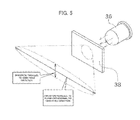
- each of the diffuser members 3B according to the first embodiment is implemented as an anisotropic diffusion sheet.
- an existing, commercially available anisotropic diffusion sheet can be used as the diffuser member 38. Therefore, the clearer 11 can be constructed inexpensively.
- the diffusion sheet is arranged such that an angle of diffusion (the degree of light diffusion in the plane illustrated in FIG. 4 ) in the plane parallel to the yarn feed direction is smaller than an angle of diffusion (the degree of light diffusion in the plane illustrated in FIG. 3 ) in the plane orthogonal to the yarn feed direction.
- an anisotropic diffusion sheet diffuses light in an elliptical pattern as illustrated in FIG. 5 . Accordingly, the diffusion sheet is desirably arranged such that the minor taxis of the elliptical pattern lies substantially parallel to the yarn feed direction.
- the diffusion sheets (diffuser members 38) By arranging the diffusion sheets (diffuser members 38) in this way, the degree of light diffusion of the light source unit 36 can be reduced in the plane (the plane illustrated in FIG. 4 ) parallel to the feed direction of the spun yarn 10. Hence, light is less diffused in the feed direction of the spun yarn 10; accordingly, averaging out of the transmitted light beams to be received by the light receiving unit 37 in the feed direction of the spun yarn 10 can be prevented. Therefore, the clearer 11 can maintain favorable accuracy in detection of a thickness irregularity of the spun yarn 10.
- Angles of diffusion of the diffusion sheet are not particularly limited to specific values; however, to prevent averaging out of the transmitted light beams to be received by the light receiving unit 37, the angle of diffusion (the degree of light diffusion in the plane illustrated in FIG. 4 ) in the plane parallel to the feed direction of the spun yarn 10 should preferably be as small as possible.
- each of the light emitting elements 361 and 362 of the light source unit 36 is implemented as a parallel-ray LED that can emit parallel light. Accordingly, the light source unit 36 can illuminate the spun yarn 10 only from directions orthogonal to the feed direction as illustrated in FIG. 4 . Therefore, averaging out of the transmitted light beams to be received by the light receiving unit 37 is prevented, and hence the clearer 11 can detect a thickness irregularity of the spun yarn 10 accurately.
- Arranging the diffusion sheets (diffuser members 38) as discussed above causes light to diffuse in the plane (the plane illustrated in FIG. 3 ) orthogonal to the feed direction of the spun yarn 10; therefore, the spun yarn 10 can be irradiated with light from various directions parallel to this plane. As a result, shadows projected on the surface of the spun yarn 10 can be reduced. Therefore, the number of times when the spun yarn 10 is cut and removed due to false detection of erroneously detecting a portion of a shadow as a foreign matter can also be reduced. This leads to improvement in efficiency in production of the package 14 by the spinning unit 2.
- a signal-to-noise (S/N) ratio of signals output from the light receiving unit 37 in response to receipt of reflected light can be increased. More specifically, when the spun yarn 10 is directly irradiated with undiffused light, even in a situation where no foreign matter is present in the spun yarn 10, the amount of reflected light received by the light receiving unit 37 undesirably varies minutely due to shadows formed by surface irregularities of the spun yarn 10. In short, when light is not diffused, a noise component of reflected light is large.
- irradiating the spun yarn 10 with diffused light as in the first embodiment eliminates shadows on the spun yarn 10; therefore, when no foreign matter is present in the spun yarn 10, the amount of reflected light received by the light receiving unit 37 does not vary minutely. In other words, by irradiating the spun yarn 10 with diffused light, a noise component of reflected light can be reduced. By virtue of the thus-increased S/N ratio, the analyzer 35 can detect a foreign matter present in the spun yarn 10 easily.
- the clearer 11 provides a solution to the problem in the conventional technology by irradiating the spun yarn 10 with light diffused through the anisotropic diffusion sheet, thereby yielding an effect of reducing shadows to improve accuracy in detection of a foreign matter without sacrificing accuracy in detection of a thickness irregularity.
- the diffuser members 38, and the light receiving elements 371 and 372 are arranged in a flat arrangement with substantially no difference in level relative to the wall surface of the yarn passage 39.
- each of a pair of the light receiving element 371 and a corresponding one of the diffuser members 38 and a pair of the light receiving element 372 and the other diffuser member 38 is arranged substantially flush with the wall surface of the yarn passage 39.
- This arrangement is advantageous in creating no surface irregularity of the yarn passage 39, causing less yarn waste and the like to be caught by the wall surface, thus increasing maintainability.
- Arranging the diffuser member 38 and the wall surface of the yarn passage 39 substantially flush with each other causes the diffuser member 38 to partially form the wall surface of the yarn passage 39.
- a space where the spun yarn 10 runs and each of spaces where the light emitting elements 361 and 362 are individually arranged are separated by the diffuser member 38.
- a light receiving element is arranged at an inner position away from a wall surface of a yarn passage.
- This arrangement is disadvantageous in that the light receiving element is distant from a yarn, and hence an amount of reflected light to be received by the light receiving element decreases.
- the clearer 11 according to the firs embodiment by arranging each of the light receiving elements 371 and 372 substantially flush with the wall surface of the yarn passage 39, the light receiving elements 371 and 372 can be arranged at positions as close as possible to the spun yarn 10. Accordingly, the light receiving elements 371 and 372 can receive reflected light, which is reflected from the spun yarn 10, that is not reduced in amount.
- the clearer 11 includes the light source unit 36, the light receiving unit 37 that doubles as the transmitted-light receiving unit and the reflected-light receiving unit, and the diffuser members 38.
- the light source unit 36 emits light toward the running spun yarn 10.
- the light receiving unit 37 receives, of the light emitted from the light source unit 36, light transmitted through the spun yarn 10.
- the light receiving unit 37 receives, of the light emitted from the light source unit 36, light reflected from the spun yarn 10.
- the diffuser member 38 arranged between the light source unit 36 and the spun yarn 10 diffuses the light emitted from the light source unit 36.
- the diffuser member 38 is configured to diffuse the light such that the degree of light diffusion in the plane orthogonal to the feed direction of the spun yarn 10 is greater than the degree of light diffusion in the plane parallel to the yarn feed direction.
- the clearer 11 can illuminate the spun yarn 10 from various angles by irradiating the spun yarn 10 with diffused light. Accordingly, even when the spun yarn 10 has surface irregularities, it is possible to reduce shadows. Hence, the clearer 11 can detect a portion including a foreign matter accurately. The clearer 11 can prevent a false detection of erroneously detecting a portion of a shadow as a foreign matter because the clearer 11 reduces shadows as discussed above. The clearer 11 reduces the degree of light diffusion in the plane parallel to the feed direction of the spun yarn 10 so that the transmitted light beams are less averaged out in the feed direction of the spun yarn 10. As a result, the clearer 11 can detect variations in the thickness of the running spun yarn 10 accurately.
- the diffuser members 38 are anisotropic diffusion sheets.
- Diffusing light with such an anisotropic diffusion sheet makes it possible to cause the degree of light diffusion in the plane parallel to the yarn feed direction to differ from the degree of light diffusion in the plane orthogonal to the yarn feed direction with a simple structure.
- Using a currently available diffusion sheet as the diffusion member 38 allows inexpensive construction of the clearer 11.
- the clearer 11 includes the yarn passage 39 as a passage for the spun yarn 10.
- each of the pair of one of the diffuser members 38 and the light receiving element 371 and the pair of the other diffuser member 38 and the light receiving element 372 is arranged substantially flush with the wall surface of the yarn passage 39.
- the light receiving elements 371 and 372 can be located close to the spun yarn 10 passing through the yarn passage 39. Accordingly, the light receiving unit 37can receive reflected light that is not reduced in an amount.
- the space where the spun yarn 10 runs and the spaces where the light source unit 36 is arranged are separated by the diffuser members 38 because each of the diffuser members 38 partially forms the wall surface of the yarn passage 39. Accordingly, adhesion of yarn waste and the like to the light source unit 36 can be prevented.
- the clearer 11 includes, as the light source unit 36, the two light emitting elements or, more specifically, the first light emitting element 361 and the second light emitting element 362, and the two light receiving elements, or, more specifically, the first light receiving element 371 and the second light receiving element 372.
- the light emitting elements 361 and 362 alternately emit light toward the spun yarn 10 from different directions.
- Each of the light receiving elements 371 and 372 doubles as the transmitted-light receiving unit and the reflected-light receiving unit.
- Each of the light emitting elements 361 and 362 includes the diffuser member 38.
- the clearer 11 can monitor the spun yarn 10 from the two different directions, thereby improving monitoring accuracy of the clearer 11.
- each of the light emitting elements 361 and 362 of the light source unit 36 is implemented as a parallel-ray LED that can emit parallel light.
- the spinning machine 1 includes the winding devices 13 and the clearers 11 that include the analyzers 35 and the cutters 22.
- Each of the winding devices 13 winds the spun yarn 10 to form the package 14.
- Each of the clearers 11 monitors the spun yarn 10.
- Each of the analyzers 35 detects a foreign matter and an anomalous thickness based on a monitoring result output from the clearer 11.
- Each of the cutters 22 removes a portion of the foreign matter and/or the anomalous thickness.
- the spinning machine 1 adopts the clearer 11 of the present invention. Accordingly, the spinning machine 1 can prevent unnecessary removal of yarn resulting from an erroneous detection of a portion of a shadow as a foreign matter. Furthermore, the spinning machine 1 can detect a thickness irregularity of the spun yarn 10 with favorable accuracy. Accordingly, the spinning machine 1 can form the package 14 of a high quality, from which portions of a foreign matter and an anomalous thickness of the spun yarn 10 are removed. Furthermore, the spinning machine 1 can form the package 14 efficiently because the spinning machine 1 can prevent the unnecessary removal.
- the textile-material monitoring device of the present invention is applied to an automatic winder serving as a yarn winding apparatus.
- a structure of the automatic winder is described below. Structures identical or similar to those of the first embodiment are denoted by like reference numerals as those of the first embodiment and repeated descriptions are omitted in some cases.
- the automatic winder according to the second embodiment includes a plurality of winder units 50 arranged in a line and a machine control device (not shown) arranged at one end of the line. As illustrated in FIG. 6 , each of the winder units 50 winds the spun yarn (textile material) 10 unwound from a yarn feeding bobbin 51 on a winding bobbin 52 while traversing the spun yarn 10 to form a package 53 of a predetermined length and shape.
- a winding device 54 provided in each of the winder units 50 is configured to wind the spun yarn 10 unwound from the yarn feeding bobbin 51 around the winding bobbin 52 to form the package 53. More specifically, the winding device 54 includes a winding drum 56 that causes the spun yarn 10 to traverse and that drives the winding bobbin 52. As illustrated in FIG. 6 , a helical traversing groove 57 is provided in an outer circumferential surface of the winding drum 56 and it causes the spun yearn 10 to traverse.
- the winding bobbin 52 is driven by rotation of the winding drum 56 arranged to face the winding bobbin 52.
- the spun yarn 10 is wound around the rotating winding bobbin 52 while being traversed by the traversing groove 57.
- the winding drum 56 its coupled to an output shaft of a drum driving motor 58.
- Operations of the drum driving motor 58 are controlled by a motor control unit 59.
- the motor control unit 59 receives a control signal a unit controller 60 and rotates or stops the drum driving motor 58 according to the control signal.
- the winder unit 50 includes an unwinding assisting device 61, a tensioning device 62, the splicer 29, and the clearer head 34 of the clearer (textile-material monitoring device) 11 that are arranged on a yarn feed path between the yarn feeding bobbin 51 and the winding drum 56 in this order from the side of the yarn feeding bobbin 51.
- the unwinding assisting device 61 includes a restricting member 64.
- the restricting member 64 comes into contact with a balloon that is formed above the yarn feeding bobbin 51 by the spun yarn 10 that is unwound from the yarn feeding bobbin 51 and swung around, thereby applying an appropriate magnitude of tension onto the balloon. More specifically, the unwinding assisting devise 61 assists unwinding of the spun yarn 10 from the yarn feeding bobbin 51 by lowering the restricting member 64 that covers a core tube in synchronization with unwinding of the spun yarn 10 from the yarn feeding bobbin 51.
- the tensioning device 62 applies a predetermined tension to the running, spun yarn 10.
- a tensioning device 62 for example, a gate type tensioning device, in which movable comb teeth are arranged in combination with fixed comb teeth, can be used.
- a rotary solenoid may be used to rotate the movable comb teeth so that the movable comb teeth are placed in any one of a state where the comb teeth are in engagement and a state where the comb teeth are out of engagement.
- the tensioning device 62 can increase quality of the package 53 by applying a constant tension onto the spun yarn 10 being wound on the package 53.
- the tensioning device 62 is not limited to the gate type discussed above, and other tension applying device, such as that of a disc type, can alternatively be employed.
- the clearer 11 which has the same configuration as in the first embodiment, includes the clearer head 34 and the analyzer (detector) 35.
- the spun yarn 10 runs in the yarn passage 39 formed in the clearer head 34.
- the analyzer 35 detects a thickness irregularity and/or a foreign matter in the spun yarn 10 based on a monitoring result fed from the light receiving unit 37 (not shown in FIG. 6 ) provided in the clearer head 34.
- the analyzer 35 determines that a portion of the anomalous thickness and/or the foreign matter is a yarn defect, and transmits a yarn-defect detection signal to the unit controller 60.
- the cutter (defect removing unit) 22 is annexed to the clearer head 34 at a position near the clearer head 34.
- the analyzer 35 On detecting a yarn defect, the analyzer 35 immediately actuates the cutter 22 to cut the spun yarn 10. Note that the cutter 22 can be controlled by the unit controller 60 rather than by the analyzer 35.
- the splicer 29 splices a lower yarn coming from the yarn feeding bobbin 51 and an upper yarn coming from the package 53 when the clearer 11 cuts the spun yarn 10 on detection of a yarn defect, a situation where yarn breakage occurs during unwinding from the yarn feeding bobbin 51, or the like situation.
- a suction pipe 65 and a suction mouth 66 are provided below and above the splicer 29. When a yarn breakage occurs, the suction pipe 65 catches a yarn end coming from the yarn feeding bobbin 51 and brings the yarn end to the splicer 29, while the suction mouth 66 catches a yarn end coming from the package 53 and brings the yarn end to the splicer 29.
- the automatic winder includes the winding devices 54, and the clearers 11 that include the analyzers 35 and the cutters 22.
- Each of the winding devices 54 winds the corresponding spun yarn 10 to form the package 53.
- Each of the clearers 11 monitors the corresponding spun yarn 10.
- Each of the analyzers 35 detects a foreign matter and/or an anomalous thickness based on a monitoring result output from the clearer 11.
- Each of the cutters 22 removes a portion of the foreign matter and/or the anomalous thickness.
- the automatic winder adopts the clearer 11 of the present invention; accordingly, the automatic winder can prevent unnecessary removal of yarn resulting from an erroneous detection of a portion of a shadow as a foreign matter. Furthermore, the automatic winder can detect a thickness irregularity of the spun yarn 10 with favorable accuracy. Thus, the automatic winder can form the package 53 of a high quality, from which portions of a foreign matter and an anomalous thickness of the spun yarn 10 are removed. Furthermore, the automatic winder can form the package 53 efficiently because the automatic winder can prevent the unnecessary removal.
- the clearer monitors a spun yarn; however, a subject of the monitoring is not limited thereto.
- other textile material such as a sliver or a fiber bundle, than a spun yarn may be monitored with the textile-material monitoring device according to the present invention.
- a sliver or a fiber bundle also has surface irregularities. Accordingly, the effect of the present invention that, by monitoring a sliver or a fiber bundle with the textile-material monitoring device according to the present invention that irradiates it with diffused light, shadows are reduced and hence a foreign matter is detected with shadows are reduced and hence a foreign matter is detected with high accuracy can be yielded as well.
- the light receiving elements are each arranged flush with the wall surface of the yarn passage, however, arrangement of the light receiving elements is not limited thereto.
- arrangement of the light receiving elements is not limited thereto.
- FIG. 7 an arrangement can be employed where the light receiving elements 371 and 372 are diagonal relative to the wall surface of the yarn passage 39 such that light receiving surfaces of the light receiving elements 371 and 372 face the spun yarn 10.
- an angle at which each of the light receiving elements 371 and 372 receives transmitted light and reflected light can be made close to the right angle. Accordingly, performance in detection of transmitted light and reflected light can be further increased.
- the light receiving elements By arranging the light receiving elements in a manner to project from the wall surface of the yarn passage as illustrated in FIG. 7 , the light receiving elements can be located still closer to the spun yarn. This allows the light receiving elements to receive reflected light that is not reduced in amount.
- the clearer according to the embodiments is of a double-axis type that causes the two light emitting elements to emit light alternately.
- the structure of the present invention is applicable to a single-axis clearer that includes only a single light emitting element.
- a clearer of the single-axis type causes the single light emitting element to emit light constantly. accordingly, unlike the double-axis clearer, in the single-axis clearer, switching of a light receiving element that receives transmitted light and a light receiving element that receives reflected light does not occur.
- the single-axis clearer includes a light emitting element (reflected-light receiving unit) that receives only reflected light and a light emitting element (transmitted-light receiving unit) that receives only transmitted light.
- the diffuser member is described as being a diffusion sheet; however, the diffuser member is not limited thereto. More specifically, any member capable of saucing a certain degree of light diffusion in a plane parallel to a feed direction of a textile material to differ from that in a plane orthogonal to the feed direction can be adopted as the diffuser member in the textile-material monitoring device according to the present invention.
- the diffuser member is not necessarily a separate member from the clearer head.
- the diffuser member may be a portion of the clearer head 34 that is formed of a transparent resin and that exhibits anisotropic light diffusion property, which is imparted to the transparent resin portion by applying appropriate surface treatment or the like.
- the diffuser member and the clearer head may be formed in one piece in this manner.
- the visible-ray LED is used as the light source; however, an infrared-ray LED or an ultraviolet-ray LED can alternatively be used.
- the light source is not limited to an LED, and any appropriate light-emitting device can be used as the light source.
- the light source unit 36 uses the parallel-ray LEDs; however, light to be emitted from each of the light emitting elements 361 and 362 is not limited to parallel light, and can alternatively be substantially-parallel light or light of which direction of illumination is not limited.
- an ordinary LED other than a parallel-ray LED
- light from the light source unit 36 is preferably undiffused. Accordingly, it is desirable that the light from the light source unit 36 be as close as possible to parallel light.
- the spun yarn 10 is drawn out from the spinning device 9 by the yarn pooling device 12; however, the structure for drawing out the spun yarn 10 is not limited thereto.
- the textile-material monitoring device according to the present invention may be applied to a spinning machine configured such that the spun yarn 10 is drawn out from the spinning device 9 by delivery rollers and nip rollers and thereafter the spun yarn 10 is pooled by the yarn pooling device 12 provided on a downstream side.
- the yarn pooling device 12 may be omitted.
- the defect removing unit is implemented as the cutter 22; however, any structure that can remove a yarn defect can be used as the defect removing unit in place of the cutter 22.
- the first embodiment can alternatively be configured such that, on detection of a foreign matter or a thickness irregularity of the spun yarn 10, the clearer 11 stops driving of the drafting device 7 with the winding device 13 continuing driving so that the spun yarn 10 is cut in a torn off manner. In this configuration, the winding device 13 and the drafting device 7 can be considered as the defect removing unit.
- the automatic winder is configured such that the package is rotated by rotation of the winding drum while a yarn is traversed across the surface of the package; however, the configuration of the automatic winder is not limited thereto.
- the automatic winder can have a configuration where driving of the package and traversing are performed independent of each other.
- Examples of such an automatic winder includes an automatic winder that includes an arm-type traverse device that performs yarn traversing using a swiveling arm or a belt-driven traverse device that performs yarn traversing using a yarn-hook member that is laterally reciprocated by a belt.
- the automatic winder can be configured such that a package is directly rotated by a motor, while a contact roller, on which a traverse mechanism is not provided, is driven by the package.
- textile-material monitoring device is not limited to a spinning machine or an automatic winder ;the textile-material monitoring device is also applicable to a yarn winding apparatus of other type.
- a textile-material monitoring device including a light source unit that emits light toward a running material; a transmitted-light receiving unit that receives light that is emitted from the light source unit after being transmitted through the textile material; a reflested-light receiving unit that receives light that is emitted from the light source unit after being reflected from the textile material; and a diffuser unit that is arranged between the light source unit and the textile material, and that diffuses the light emitted from the light source unit.
- the diffuser unit diffuses the light in a manner that a degree of light diffusion in a plane orthogonal to a running direction of the textile material is greater than a degree of light diffusion in a plane parallel to the running direction.
- the textile-material monitoring device can illuminate a textile material from various angles by irradiating the textile material with diffused light. Accordingly, even when the textile material has surface irregularities, the textile-malarial monitoring device cam reduce shadows and hence can detest a portion including a foreign matter accurately.
- the textile-material monitoring device can also prevent a false detection of erroneously detecting a portion of a shadow as a foreign matter because the textile-material monitoring device reduces shadows as discussed above.
- the textile-material monitoring device reduces the degree of light diffusion in the plane parallel to the running direction of the textile material so that transmitted light beams are less averaged out in the running direction of the textile material.
- the textile-material monitoring devise can detect a thickness irregularity of the running textile material accurately.
- the textile-material monitoring device diffuses Light using such an anisotropic diffusion sheet.
- the textile-material monitoring device can cause the degree of light diffusion in the plane parallel to the running direction of the textile material to differ from the: degree of light diffusion in the plane orthogonal to the running direction with a simple structure.
- Using a currently available diffusion sheet as the diffuser unit allows inexpensive construction of the textile-material monitoring device.
- the textile-material monitoring device further includes a textile material passage as a passage for the textile material.
- the textile material passage includes a wall surface, and the reflected-light receiving unit and the diffuser unit are arranged substantially flush with the wall surface of the textile material passage.
- the reflected-light receiving unit can be located close to the textile material passing through the textile material passage. Accordingly, the textile-material monitoring device can cause the reflected-light receiving unit to receive reflected light that is not reduced in amount. Furthermore, a space where the textile Material runs and spaces where the light source units are arranged are separated by the diffuser unit because the diffuser unit partially forms the wall surface of the textile material passage. Accordingly, the textile-material monitoring device can prevent adhesion of yarn waste and the like to the light source unit.
- the light source unit includes two Light emitting elements serving as the light source unit, the transmitted-light receiving unit and the reflected-light receiving unit are two light receiving elements, each of the light receiving elements doubling as the transmitted-light receiving unit and the .reflected-light receiving unit, the two light emitting elements are configured to alternately emit light toward the textile material from different directions, and each of the two Light emitting elements includes the diffuser unit.
- the textile-material monitoring device can monitor the textile material from the two different directions, and hence can improve monitoring accuracy.
- the light source unit emits parallel light toward the textile material.
- the textile-material monitoring devise can detest a thickness irregularity of the textile material accurately.
- a yarn winding apparatus including a winding device that winds a textile material into a package form; the above textile-material monitoring device for monitoring the textile material and outputting a result of monitoring; a detector that detects one or more of a foreign matter and an anomalous thickness based on the result of the monitoring; and a defect removing unit that removes a portion of one or more of the foreign matter and the anomalous thickness.
- the yarn winding apparatus can prevent unnecessary removal resulting from a false detection of erroneously detecting a portion of a shadow as a foreign matter. Furthermore, the yarn winding apparatus can detect a thickness irregularity of the textile material with favorable accuracy. Accordingly, the yarn winding apparatus can form a package of a high quality, from which portions of a foreign matter and an anomalous thickness of the textile material are removed. Furthermore, the yarn winding apparatus can form the package efficiently because the yarn winding apparatus can prevent the unnecessary removal.
Landscapes
- General Physics & Mathematics (AREA)
- Physics & Mathematics (AREA)
- Textile Engineering (AREA)
- Engineering & Computer Science (AREA)
- Health & Medical Sciences (AREA)
- Chemical & Material Sciences (AREA)
- Analytical Chemistry (AREA)
- Biochemistry (AREA)
- General Health & Medical Sciences (AREA)
- Life Sciences & Earth Sciences (AREA)
- Immunology (AREA)
- Pathology (AREA)
- Treatment Of Fiber Materials (AREA)
- Investigating Materials By The Use Of Optical Means Adapted For Particular Applications (AREA)
- Spinning Or Twisting Of Yarns (AREA)
Applications Claiming Priority (1)
| Application Number | Priority Date | Filing Date | Title |
|---|---|---|---|
| JP2010199055A JP5636831B2 (ja) | 2010-09-06 | 2010-09-06 | 繊維条体測定装置及び糸巻取機 |
Publications (3)
| Publication Number | Publication Date |
|---|---|
| EP2426482A2 true EP2426482A2 (de) | 2012-03-07 |
| EP2426482A3 EP2426482A3 (de) | 2016-03-30 |
| EP2426482B1 EP2426482B1 (de) | 2020-06-17 |
Family
ID=44582372
Family Applications (1)
| Application Number | Title | Priority Date | Filing Date |
|---|---|---|---|
| EP11177232.3A Active EP2426482B1 (de) | 2010-09-06 | 2011-08-11 | Textilmaterial-überwachungsvorrichtung und garnwickelvorrichtung |
Country Status (3)
| Country | Link |
|---|---|
| EP (1) | EP2426482B1 (de) |
| JP (1) | JP5636831B2 (de) |
| CN (2) | CN202330295U (de) |
Cited By (2)
| Publication number | Priority date | Publication date | Assignee | Title |
|---|---|---|---|---|
| EP2690394A1 (de) * | 2012-07-27 | 2014-01-29 | Murata Machinery, Ltd. | Garnüberwachungsvorrichtung und Garnwickeleinheit |
| CN114148817A (zh) * | 2021-12-02 | 2022-03-08 | 南通新源特种纤维有限公司 | 柔性纱线输送装置及具有其的柔性纱线定量收卷设备 |
Families Citing this family (8)
| Publication number | Priority date | Publication date | Assignee | Title |
|---|---|---|---|---|
| JP5636831B2 (ja) * | 2010-09-06 | 2014-12-10 | 村田機械株式会社 | 繊維条体測定装置及び糸巻取機 |
| CN103090789A (zh) * | 2012-12-18 | 2013-05-08 | 苏州昭人纺织有限公司 | 一种纺织检测系统 |
| JP6151155B2 (ja) * | 2013-10-24 | 2017-06-21 | 日本セレン株式会社 | 糸の異常部の検出装置 |
| SE543374C2 (en) | 2018-09-15 | 2020-12-22 | Coloreel Group AB | A method and a treatment unit for in-line treatment of thread |
| SE542780C2 (en) * | 2018-09-15 | 2020-07-07 | Coloreel Group AB | A system and method for in-line treatment of thread |
| JP2021143026A (ja) * | 2020-03-10 | 2021-09-24 | 村田機械株式会社 | 糸監視装置及び糸巻取機 |
| CN113668104B (zh) * | 2021-08-30 | 2022-06-10 | 闽江学院 | 一种纺织断丝检测设备及其方法 |
| CN115924651B (zh) * | 2022-12-31 | 2023-10-27 | 徐州万丰纺织股份有限公司 | 一种纺织机械用丝线纺织辊 |
Citations (2)
| Publication number | Priority date | Publication date | Assignee | Title |
|---|---|---|---|---|
| JPH06507979A (ja) | 1992-03-17 | 1994-09-08 | ツエルヴエーゲル ウステル アクチエンゲゼルシヤフト | 繊維試料中の不純物を検出する方法と装置 |
| JP2005068569A (ja) | 2003-08-21 | 2005-03-17 | Murata Mach Ltd | 糸の異物検出装置 |
Family Cites Families (8)
| Publication number | Priority date | Publication date | Assignee | Title |
|---|---|---|---|---|
| CH683293A5 (de) * | 1991-12-20 | 1994-02-15 | Peyer Ag Siegfried | Fremdfasererkennung in Garnen. |
| JP3249925B2 (ja) * | 1996-11-08 | 2002-01-28 | 日立電線株式会社 | 線条体の表面欠陥検査装置 |
| US20060014085A1 (en) * | 2002-11-14 | 2006-01-19 | Tomoegawa Paper Co., Ltd. | Anisotropic light diffusion adhesive layer, anisotropic light diffusion adhesive laminate, and illuminating device having anisotropic light diffusion adhesive laminate |
| JP2004225166A (ja) * | 2003-01-20 | 2004-08-12 | Nippon Seren Kk | 糸の異常部の検出装置 |
| JP2004301544A (ja) * | 2003-03-28 | 2004-10-28 | Sunx Ltd | 寸法測定装置 |
| DE102004053735A1 (de) * | 2004-11-06 | 2006-05-11 | Saurer Gmbh & Co. Kg | Garnsensor |
| JP2006329696A (ja) * | 2005-05-24 | 2006-12-07 | Toppan Printing Co Ltd | ラインライトガイド |
| JP5636831B2 (ja) * | 2010-09-06 | 2014-12-10 | 村田機械株式会社 | 繊維条体測定装置及び糸巻取機 |
-
2010
- 2010-09-06 JP JP2010199055A patent/JP5636831B2/ja not_active Expired - Fee Related
-
2011
- 2011-08-09 CN CN2011202908338U patent/CN202330295U/zh not_active Withdrawn - After Issue
- 2011-08-09 CN CN201110230118.XA patent/CN102384914B/zh active Active
- 2011-08-11 EP EP11177232.3A patent/EP2426482B1/de active Active
Patent Citations (2)
| Publication number | Priority date | Publication date | Assignee | Title |
|---|---|---|---|---|
| JPH06507979A (ja) | 1992-03-17 | 1994-09-08 | ツエルヴエーゲル ウステル アクチエンゲゼルシヤフト | 繊維試料中の不純物を検出する方法と装置 |
| JP2005068569A (ja) | 2003-08-21 | 2005-03-17 | Murata Mach Ltd | 糸の異物検出装置 |
Cited By (2)
| Publication number | Priority date | Publication date | Assignee | Title |
|---|---|---|---|---|
| EP2690394A1 (de) * | 2012-07-27 | 2014-01-29 | Murata Machinery, Ltd. | Garnüberwachungsvorrichtung und Garnwickeleinheit |
| CN114148817A (zh) * | 2021-12-02 | 2022-03-08 | 南通新源特种纤维有限公司 | 柔性纱线输送装置及具有其的柔性纱线定量收卷设备 |
Also Published As
| Publication number | Publication date |
|---|---|
| CN202330295U (zh) | 2012-07-11 |
| CN102384914A (zh) | 2012-03-21 |
| CN102384914B (zh) | 2016-03-02 |
| JP2012057978A (ja) | 2012-03-22 |
| JP5636831B2 (ja) | 2014-12-10 |
| EP2426482A3 (de) | 2016-03-30 |
| EP2426482B1 (de) | 2020-06-17 |
Similar Documents
| Publication | Publication Date | Title |
|---|---|---|
| EP2426482B1 (de) | Textilmaterial-überwachungsvorrichtung und garnwickelvorrichtung | |
| EP2354069B1 (de) | Garnwicklungsmaschine | |
| EP2284300B1 (de) | Spinnmaschine und Garnentfernungsverfahren zum Entfernen von verbleibendem Garn auf der Garnzusammentragungsrolle | |
| JP5636785B2 (ja) | 繊維条体測定装置及び糸巻取機 | |
| EP2573235B1 (de) | Spinnmaschine | |
| JP5413560B2 (ja) | 異物検出装置、繊維機械及び異物検出方法 | |
| EP2365115B1 (de) | Garnwicklungsmaschine mit Rolle zur Fadenzwischenspeicherung | |
| EP2905248B1 (de) | Garnaufnahmevorrichtung und Garnwickelmaschine | |
| EP2657382B1 (de) | Garnüberwachungsvorrichtung und Garnwickelmaschine damit | |
| US7770373B2 (en) | Core fiber detecting method and device in core yarn spinning | |
| CN102465364B (zh) | 牵伸罗拉、牵伸装置以及纺纱机 | |
| JP2015157658A (ja) | 糸巻取装置 | |
| JP2014009422A (ja) | 繊維機械、及び繊維機械の周期斑検出方法 | |
| EP3040458A1 (de) | Core-garnzuführvorrichtung, spinnmaschine und verfahren zum zuführen von core-garn | |
| CN107539841B (zh) | 纤维机械 | |
| EP1801271A1 (de) | Kerngarnspinnmaschine, verfahren zur feststellung der an- oder abwesenheit des kerns bei kerngarn sowie verfahren zum bedienen einer kerngarnspinnmaschine | |
| CN115335309A (zh) | 纱线监控装置、纱线监控方法、纱线卷绕机以及纱线监控系统 | |
| EP2921577A2 (de) | Fasersteuerteil, streckwerk und spinnmaschine | |
| JP2013230909A (ja) | 糸監視装置、及びこれを備える糸巻取ユニット | |
| CN116462049A (zh) | 纱线卷取机 | |
| EP2910507A1 (de) | Garnsammelvorrichtung, Garnwickeleinheit damit und Garnwickelmaschine damit | |
| JP2009155781A (ja) | 紡績機 | |
| EP2752512A1 (de) | Spinnmaschine | |
| JPH0322282Y2 (de) | ||
| JP2013063840A (ja) | 糸巻取装置 |
Legal Events
| Date | Code | Title | Description |
|---|---|---|---|
| AK | Designated contracting states |
Kind code of ref document: A2 Designated state(s): AL AT BE BG CH CY CZ DE DK EE ES FI FR GB GR HR HU IE IS IT LI LT LU LV MC MK MT NL NO PL PT RO RS SE SI SK SM TR |
|
| AX | Request for extension of the european patent |
Extension state: BA ME |
|
| PUAI | Public reference made under article 153(3) epc to a published international application that has entered the european phase |
Free format text: ORIGINAL CODE: 0009012 |
|
| PUAL | Search report despatched |
Free format text: ORIGINAL CODE: 0009013 |
|
| AK | Designated contracting states |
Kind code of ref document: A3 Designated state(s): AL AT BE BG CH CY CZ DE DK EE ES FI FR GB GR HR HU IE IS IT LI LT LU LV MC MK MT NL NO PL PT RO RS SE SI SK SM TR |
|
| AX | Request for extension of the european patent |
Extension state: BA ME |
|
| RIC1 | Information provided on ipc code assigned before grant |
Ipc: G01N 21/89 20060101AFI20160222BHEP Ipc: G01B 11/10 20060101ALI20160222BHEP |
|
| 17P | Request for examination filed |
Effective date: 20160908 |
|
| RBV | Designated contracting states (corrected) |
Designated state(s): AL AT BE BG CH CY CZ DE DK EE ES FI FR GB GR HR HU IE IS IT LI LT LU LV MC MK MT NL NO PL PT RO RS SE SI SK SM TR |
|
| GRAP | Despatch of communication of intention to grant a patent |
Free format text: ORIGINAL CODE: EPIDOSNIGR1 |
|
| STAA | Information on the status of an ep patent application or granted ep patent |
Free format text: STATUS: GRANT OF PATENT IS INTENDED |
|
| RIC1 | Information provided on ipc code assigned before grant |
Ipc: G01B 11/10 20060101ALI20191211BHEP Ipc: G01B 11/30 20060101ALI20191211BHEP Ipc: G01B 11/06 20060101ALI20191211BHEP Ipc: G01N 21/89 20060101AFI20191211BHEP |
|
| INTG | Intention to grant announced |
Effective date: 20200108 |
|
| GRAS | Grant fee paid |
Free format text: ORIGINAL CODE: EPIDOSNIGR3 |
|
| GRAA | (expected) grant |
Free format text: ORIGINAL CODE: 0009210 |
|
| STAA | Information on the status of an ep patent application or granted ep patent |
Free format text: STATUS: THE PATENT HAS BEEN GRANTED |
|
| AK | Designated contracting states |
Kind code of ref document: B1 Designated state(s): AL AT BE BG CH CY CZ DE DK EE ES FI FR GB GR HR HU IE IS IT LI LT LU LV MC MK MT NL NO PL PT RO RS SE SI SK SM TR |
|
| REG | Reference to a national code |
Ref country code: GB Ref legal event code: FG4D |
|
| REG | Reference to a national code |
Ref country code: CH Ref legal event code: EP |
|
| REG | Reference to a national code |
Ref country code: IE Ref legal event code: FG4D |
|
| REG | Reference to a national code |
Ref country code: DE Ref legal event code: R096 Ref document number: 602011067324 Country of ref document: DE |
|
| REG | Reference to a national code |
Ref country code: AT Ref legal event code: REF Ref document number: 1281928 Country of ref document: AT Kind code of ref document: T Effective date: 20200715 |
|
| REG | Reference to a national code |
Ref country code: CH Ref legal event code: NV Representative=s name: BOVARD AG PATENT- UND MARKENANWAELTE, CH |
|
| PG25 | Lapsed in a contracting state [announced via postgrant information from national office to epo] |
Ref country code: FI Free format text: LAPSE BECAUSE OF FAILURE TO SUBMIT A TRANSLATION OF THE DESCRIPTION OR TO PAY THE FEE WITHIN THE PRESCRIBED TIME-LIMIT Effective date: 20200617 Ref country code: NO Free format text: LAPSE BECAUSE OF FAILURE TO SUBMIT A TRANSLATION OF THE DESCRIPTION OR TO PAY THE FEE WITHIN THE PRESCRIBED TIME-LIMIT Effective date: 20200917 Ref country code: GR Free format text: LAPSE BECAUSE OF FAILURE TO SUBMIT A TRANSLATION OF THE DESCRIPTION OR TO PAY THE FEE WITHIN THE PRESCRIBED TIME-LIMIT Effective date: 20200918 Ref country code: LT Free format text: LAPSE BECAUSE OF FAILURE TO SUBMIT A TRANSLATION OF THE DESCRIPTION OR TO PAY THE FEE WITHIN THE PRESCRIBED TIME-LIMIT Effective date: 20200617 Ref country code: SE Free format text: LAPSE BECAUSE OF FAILURE TO SUBMIT A TRANSLATION OF THE DESCRIPTION OR TO PAY THE FEE WITHIN THE PRESCRIBED TIME-LIMIT Effective date: 20200617 |
|
| PGFP | Annual fee paid to national office [announced via postgrant information from national office to epo] |
Ref country code: CZ Payment date: 20200810 Year of fee payment: 10 |
|
| REG | Reference to a national code |
Ref country code: LT Ref legal event code: MG4D |
|
| REG | Reference to a national code |
Ref country code: NL Ref legal event code: MP Effective date: 20200617 |
|
| PG25 | Lapsed in a contracting state [announced via postgrant information from national office to epo] |
Ref country code: RS Free format text: LAPSE BECAUSE OF FAILURE TO SUBMIT A TRANSLATION OF THE DESCRIPTION OR TO PAY THE FEE WITHIN THE PRESCRIBED TIME-LIMIT Effective date: 20200617 Ref country code: BG Free format text: LAPSE BECAUSE OF FAILURE TO SUBMIT A TRANSLATION OF THE DESCRIPTION OR TO PAY THE FEE WITHIN THE PRESCRIBED TIME-LIMIT Effective date: 20200917 Ref country code: HR Free format text: LAPSE BECAUSE OF FAILURE TO SUBMIT A TRANSLATION OF THE DESCRIPTION OR TO PAY THE FEE WITHIN THE PRESCRIBED TIME-LIMIT Effective date: 20200617 Ref country code: LV Free format text: LAPSE BECAUSE OF FAILURE TO SUBMIT A TRANSLATION OF THE DESCRIPTION OR TO PAY THE FEE WITHIN THE PRESCRIBED TIME-LIMIT Effective date: 20200617 |
|
| REG | Reference to a national code |
Ref country code: AT Ref legal event code: MK05 Ref document number: 1281928 Country of ref document: AT Kind code of ref document: T Effective date: 20200617 |
|
| PG25 | Lapsed in a contracting state [announced via postgrant information from national office to epo] |
Ref country code: AL Free format text: LAPSE BECAUSE OF FAILURE TO SUBMIT A TRANSLATION OF THE DESCRIPTION OR TO PAY THE FEE WITHIN THE PRESCRIBED TIME-LIMIT Effective date: 20200617 Ref country code: NL Free format text: LAPSE BECAUSE OF FAILURE TO SUBMIT A TRANSLATION OF THE DESCRIPTION OR TO PAY THE FEE WITHIN THE PRESCRIBED TIME-LIMIT Effective date: 20200617 |
|
| PG25 | Lapsed in a contracting state [announced via postgrant information from national office to epo] |
Ref country code: SM Free format text: LAPSE BECAUSE OF FAILURE TO SUBMIT A TRANSLATION OF THE DESCRIPTION OR TO PAY THE FEE WITHIN THE PRESCRIBED TIME-LIMIT Effective date: 20200617 Ref country code: EE Free format text: LAPSE BECAUSE OF FAILURE TO SUBMIT A TRANSLATION OF THE DESCRIPTION OR TO PAY THE FEE WITHIN THE PRESCRIBED TIME-LIMIT Effective date: 20200617 Ref country code: ES Free format text: LAPSE BECAUSE OF FAILURE TO SUBMIT A TRANSLATION OF THE DESCRIPTION OR TO PAY THE FEE WITHIN THE PRESCRIBED TIME-LIMIT Effective date: 20200617 Ref country code: AT Free format text: LAPSE BECAUSE OF FAILURE TO SUBMIT A TRANSLATION OF THE DESCRIPTION OR TO PAY THE FEE WITHIN THE PRESCRIBED TIME-LIMIT Effective date: 20200617 Ref country code: PT Free format text: LAPSE BECAUSE OF FAILURE TO SUBMIT A TRANSLATION OF THE DESCRIPTION OR TO PAY THE FEE WITHIN THE PRESCRIBED TIME-LIMIT Effective date: 20201019 Ref country code: RO Free format text: LAPSE BECAUSE OF FAILURE TO SUBMIT A TRANSLATION OF THE DESCRIPTION OR TO PAY THE FEE WITHIN THE PRESCRIBED TIME-LIMIT Effective date: 20200617 Ref country code: IT Free format text: LAPSE BECAUSE OF FAILURE TO SUBMIT A TRANSLATION OF THE DESCRIPTION OR TO PAY THE FEE WITHIN THE PRESCRIBED TIME-LIMIT Effective date: 20200617 |
|
| PG25 | Lapsed in a contracting state [announced via postgrant information from national office to epo] |
Ref country code: IS Free format text: LAPSE BECAUSE OF FAILURE TO SUBMIT A TRANSLATION OF THE DESCRIPTION OR TO PAY THE FEE WITHIN THE PRESCRIBED TIME-LIMIT Effective date: 20201017 Ref country code: PL Free format text: LAPSE BECAUSE OF FAILURE TO SUBMIT A TRANSLATION OF THE DESCRIPTION OR TO PAY THE FEE WITHIN THE PRESCRIBED TIME-LIMIT Effective date: 20200617 Ref country code: SK Free format text: LAPSE BECAUSE OF FAILURE TO SUBMIT A TRANSLATION OF THE DESCRIPTION OR TO PAY THE FEE WITHIN THE PRESCRIBED TIME-LIMIT Effective date: 20200617 |
|
| REG | Reference to a national code |
Ref country code: DE Ref legal event code: R097 Ref document number: 602011067324 Country of ref document: DE |
|
| PG25 | Lapsed in a contracting state [announced via postgrant information from national office to epo] |
Ref country code: MC Free format text: LAPSE BECAUSE OF FAILURE TO SUBMIT A TRANSLATION OF THE DESCRIPTION OR TO PAY THE FEE WITHIN THE PRESCRIBED TIME-LIMIT Effective date: 20200617 |
|
| PLBE | No opposition filed within time limit |
Free format text: ORIGINAL CODE: 0009261 |
|
| STAA | Information on the status of an ep patent application or granted ep patent |
Free format text: STATUS: NO OPPOSITION FILED WITHIN TIME LIMIT |
|
| PG25 | Lapsed in a contracting state [announced via postgrant information from national office to epo] |
Ref country code: LU Free format text: LAPSE BECAUSE OF NON-PAYMENT OF DUE FEES Effective date: 20200811 Ref country code: DK Free format text: LAPSE BECAUSE OF FAILURE TO SUBMIT A TRANSLATION OF THE DESCRIPTION OR TO PAY THE FEE WITHIN THE PRESCRIBED TIME-LIMIT Effective date: 20200617 |
|
| 26N | No opposition filed |
Effective date: 20210318 |
|
| GBPC | Gb: european patent ceased through non-payment of renewal fee |
Effective date: 20200917 |
|
| REG | Reference to a national code |
Ref country code: BE Ref legal event code: MM Effective date: 20200831 |
|
| PG25 | Lapsed in a contracting state [announced via postgrant information from national office to epo] |
Ref country code: SI Free format text: LAPSE BECAUSE OF FAILURE TO SUBMIT A TRANSLATION OF THE DESCRIPTION OR TO PAY THE FEE WITHIN THE PRESCRIBED TIME-LIMIT Effective date: 20200617 |
|
| PG25 | Lapsed in a contracting state [announced via postgrant information from national office to epo] |
Ref country code: FR Free format text: LAPSE BECAUSE OF NON-PAYMENT OF DUE FEES Effective date: 20200817 |
|
| PG25 | Lapsed in a contracting state [announced via postgrant information from national office to epo] |
Ref country code: GB Free format text: LAPSE BECAUSE OF NON-PAYMENT OF DUE FEES Effective date: 20200917 Ref country code: IE Free format text: LAPSE BECAUSE OF NON-PAYMENT OF DUE FEES Effective date: 20200811 Ref country code: BE Free format text: LAPSE BECAUSE OF NON-PAYMENT OF DUE FEES Effective date: 20200831 |
|
| PG25 | Lapsed in a contracting state [announced via postgrant information from national office to epo] |
Ref country code: TR Free format text: LAPSE BECAUSE OF FAILURE TO SUBMIT A TRANSLATION OF THE DESCRIPTION OR TO PAY THE FEE WITHIN THE PRESCRIBED TIME-LIMIT Effective date: 20200617 Ref country code: MT Free format text: LAPSE BECAUSE OF FAILURE TO SUBMIT A TRANSLATION OF THE DESCRIPTION OR TO PAY THE FEE WITHIN THE PRESCRIBED TIME-LIMIT Effective date: 20200617 Ref country code: CZ Free format text: LAPSE BECAUSE OF NON-PAYMENT OF DUE FEES Effective date: 20210811 Ref country code: CY Free format text: LAPSE BECAUSE OF FAILURE TO SUBMIT A TRANSLATION OF THE DESCRIPTION OR TO PAY THE FEE WITHIN THE PRESCRIBED TIME-LIMIT Effective date: 20200617 |
|
| PG25 | Lapsed in a contracting state [announced via postgrant information from national office to epo] |
Ref country code: MK Free format text: LAPSE BECAUSE OF FAILURE TO SUBMIT A TRANSLATION OF THE DESCRIPTION OR TO PAY THE FEE WITHIN THE PRESCRIBED TIME-LIMIT Effective date: 20200617 |
|
| PGFP | Annual fee paid to national office [announced via postgrant information from national office to epo] |
Ref country code: DE Payment date: 20240723 Year of fee payment: 14 |
|
| PGFP | Annual fee paid to national office [announced via postgrant information from national office to epo] |
Ref country code: CH Payment date: 20240901 Year of fee payment: 14 |